+ Reply to Thread
Page 49 of 120 FirstFirst 1 39 49 59 99 120 LastLast
Results 961 to 980 of 2390

Thread: Ukraine, Crimea, Syria, Israel, Iran, Turkey, Putin, China, and World War III

  1. Link to Post #961
    France Honored, Retired Member. Hervé passed on 13 November 2024.
    Join Date
    7th March 2011
    Location
    Brittany
    Posts
    16,763
    Thanks
    60,315
    Thanked 96,076 times in 15,483 posts

    Default Re: Ukraine, Crimea, Syria, Israel, Iran, Turkey, Putin, China, and World War III

    Ali al-Ahmed: Saudi regime has come to realize it has been defeated in Yemen

    Fri Dec 11, 2015 7:44AM
    Press TV has conducted an interview with Ali al-Ahmed, director of the Institute for the [Persian] Gulf Affairs (IGA) from Washington, on a UN-brokered truce in Yemen.

    The following is a rough transcription of the interview.

    Press TV: What do you think about the ceasefire agreement? We’ve had talks about the whole situation in Yemen before. And you were talking about the Yemenis taking the whole situation into their own hands. What do you make of this new truce that is supposedly going to take place between Yemen’s Ansarullah movement and the United Nations?

    Ahmed: There appears to be Saudi fatigue, the Saudi government right now, I think, more than ever is convinced that it has reached its end. There is nothing that they can do that can change the realities in Yemen. They have spent over 100 billion dollars in eight months on this war. They have bombed Yemen. They have destroyed Yemen’s infrastructure. They have killed more than 10,000 people, mostly civilians, yet although they have many countries behind them, the US, the UK and the mercenaries from different parts of the world from Colombia to Senegal to Jordan, it didn’t work. So, there is a realization that is setting in that Saudi Arabia has been defeated. It has not been able to reach its stated goals. So they are trying to find a way out of this conflict.

    Press TV: Huge failure as you say on behalf of Riyadh and its allies, they didn’t get anywhere with this war, but as we reported Saudi Arabia can’t really be trusted when it comes to a ceasefire, because it’s violated before. Do you think this is the case now or we can be actually hopeful that peace is restored within Yemen?

    Ahmed: You cannot ever trust the Saudi government, ever, but the signs, the writings on the wall, show that there is a Saudi realization that they have been defeated. They are trying to find a way. Today the communiqué in Riyadh of the GCC summit indicated such Saudi desire to end by calling on the warring parties in Yemen to reach a ceasefire. At the same time, there was a disagreement between Saudi Arabia and Kuwait on the final communiqué.

    And I think the emir of Kuwait saw an end and he wanted to make it clear, so he can withdraw his forces as well, because now all these [Persian] Gulf countries, except Oman obviously, which have participated in the criminal war against Yemen, will have to pay certain or some price, at least financial, for reconstructing the Yemeni state and the infrastructure.

    I really think that it’s happening, but again you never ever can trust the Saudi government.

  2. The Following 6 Users Say Thank You to Hervé For This Post:

    animovado (11th December 2015), Cara (14th December 2015), meeradas (12th December 2015), PathWalker (11th December 2015), seko (12th December 2015), Sophocles (12th December 2015)

  3. Link to Post #962
    France Honored, Retired Member. Hervé passed on 13 November 2024.
    Join Date
    7th March 2011
    Location
    Brittany
    Posts
    16,763
    Thanks
    60,315
    Thanked 96,076 times in 15,483 posts

    Default Re: Ukraine, Crimea, Syria, Israel, Iran, Turkey, Putin, China, and World War III

    Turkish Grey Wolves: Forgotten Story of Cold War-Era Paramilitary Group

    Politics 19:38 11.12.2015
    (updated 19:58 11.12.2015)


    © AFP 2015/ ADEM ALTAN

    Why has Washington been blind to Turkey's misdeeds in Syria and Iraq, including the bombing of the Syrian Kurds and oil smuggling in Syria and Iraq? The truth of the matter is that since the beginning of the Cold War era US leadership has viewed Ankara as a valuable geostrategic ally.

    During the Cold War era Turkey was regarded by Washington as an entity capable of containing the USSR's access to the Mediterranean and the Middle East.

    "Since the earliest days of the Cold War, Turkey's strategic importance derived from its geographic position as the West's easternmost bulwark against Soviet communism. In an effort to weaken the Soviet state, the CIA also used pan-Turkish militants to incite anti-Soviet passions among Muslim Turkish minorities inside the Soviet Union, a strategy that strengthened ties between US intelligence and Turkey's ultra-nationalists," prominent American author and expert on far-right movements and terrorism, Martin A. Lee, wrote in his essay for The Consortium in 1997.

    In 1952 the Tactical Mobilization Group, a counter-guerilla special force, was founded in Turkey (later absorbed by the Turkish Army's Special Warfare Department). It was established as a part of NATO's covert "stay-behind" anti-Communist initiative, also known as Operation Gladio. The roots of the initiative lay at the Truman Doctrine voiced by President Harry S. Truman on March 12, 1947, before a joint session of Congress. "I ask the Congress to authorize the detail of American civilian and military personnel to Greece and Turkey, at the request of those countries, to assist in the tasks of reconstruction, and for the purpose of supervising the use of such financial and material assistance as may be furnished. I recommend that authority also be provided for the instruction and training of selected Greek and Turkish personnel," Truman said in his official speech, pledging to "protect" Greece and Turkey from "Soviet aggression."

    A number of Turkish soldiers were sent to the United States in 1948 in order to undergo training in "special war methods" including assassinations, bombings, kidnappings, attacks, torture and militia training.


    Alpaslan Turkes © Photo: library.kiwix.org

    One of these Turkish military servicemen was Alparslan Turkes (Türkeş), a would-be founder of the Turkish National Action Party (Milliyetçi Hareket Partisi, MHP) in 1969 and its militant arm the Grey Wolves (Bozkurtlar).

    "Led by Colonel Alpaslan Turkes, the National Action Party espoused a fanatical pan-Turkish ideology that called for reclaiming large sections of the Soviet Union under the flag of a re-born Turkish empire," Lee narrated, adding that Turkish nationalists widely used translations of Nazi texts and formed a Nazi-like credo "the Turkish race above all others."

    Although many Turkish ultra-nationalists were both "anti-Western" and "anti-Soviet," they continued to cooperate with NATO and US intelligence. Interestingly enough, the Grey Wolves had also established close ties with the Anti-Bolshevik Bloc of Nations (ABN), backed by the Central Intelligence Agency (CIA). The ABN was an umbrella organization for anti-Communist émigré — former Nazi collaborators — formed in 1943 by the Organization of Ukrainian Nationalists (OUN). Headed by the infamous Nazi collaborator and OUN member Yaroslav Stetsko, the organization brought together a wide range of Eastern European emigration groups.

    It is no secret that the CIA used former Nazi collaborators and executioners as a Cold War instrument against the USSR. For instance, the CIA and the US State Department sponsored OUN leaders' immigration to the United States in 1949, according to Dr. Per Anders Rudling, a Swedish-American historian (The OUN, the UPA and the Holocaust: A Study in the Manufacturing of Historical Myths, 2011).

    Remarkably, Ruzi Nazar, a leader of the Munich-based ABN, had longstanding relations with the CIA and MHP. Being a former member of SS Turkestan legion, he had been involved in paramilitary training of Grey Wolves in the 1960s. In general, Turkes established over 100 camps across Turkey for MHP's military arm. The ultra-nationalist group took part in terror activities aimed against their leftist rivals and Kurds in the 1970s, resulting in the death of almost 6,000 people. It is believed that Bozkurtlar were also responsible for a 1981 assassination attempt aimed against Pope John Paul II.

    Despite the massacre they unleashed, the Grey Wolves enjoyed full protection from Turkey's counter-guerilla units of a Special Warfare Department.

    Needless to say, the collapse of the USSR was seen by pan-Turkish MHP and Bozkurtlar as a brilliant opportunity to expand their influence over the former Soviet Republics with Turkic and Muslim population.

    ​The Grey Wolves took part both in the Nagorno-Karabakh War of 1992 between Azerbaijan and Armenia (on the Azerbaijani side) and in the First and the Second Chechen Wars, in 1994 and 1999, respectively, on the side of Chechen Islamists. Furthermore, in 1995 Bozkurtlar were spotted making an attempt to seize power in Azerbaijan.

    Bangkok-based geopolitical analyst Tony Cartalucci calls attention to the fact that the Grey Wolves have recently bolstered their activity in Central Asia, including former Soviet states and, most notably, China's Xinjiang Uyghur Autonomous Region. The analyst assumes that Bozkurtlar could have been behind numerous terror attacks carried out by Uyghur separatists in China.

    Given the history of the Grey Wolves organization, Bozkurtlar's purported cooperation with Crimea Tatar nationalists and the Ukrainian far-right groups, as well as Islamists in Syria and Iraq comes as no surprise.

    However, the question remains open whether there is a force capable of controlling the Turkish Frankenstein, created during the Cold War era.


    Related:
    Are Erdogan's Grey Wolves Terrorists Knocking on Crimea's Door?
    Oil Smuggling and Syria: Is NATO No Better Than Turkey?
    By Equating USSR to Nazi Germany West Covers Up Own Shameful History

  4. The Following 4 Users Say Thank You to Hervé For This Post:

    animovado (12th December 2015), Cara (14th December 2015), seko (12th December 2015), Sophocles (12th December 2015)

  5. Link to Post #963
    France Honored, Retired Member. Hervé passed on 13 November 2024.
    Join Date
    7th March 2011
    Location
    Brittany
    Posts
    16,763
    Thanks
    60,315
    Thanked 96,076 times in 15,483 posts

    Default Re: Ukraine, Crimea, Syria, Israel, Iran, Turkey, Putin, China, and World War III

    Another mis-direct?

    Turkey issues arrest warrant for dozens linked to Gulen

    Fri Dec 11, 2015 4:43PM


    Fethullah Gulen, the US-based Turkish opposition cleric ©AFP

    Turkey has issued arrest warrants for top opposition figure Fethullah Gulen and tens of others accused of having alleged links to a terror group, in what is seen as a new attempt by President Recep Tayyip Erdogan's government to counter the influence of its ally-turned-foe.


    [...]

    Full article: http://www.presstv.ir/Detail/2015/12...gan-Crackdown-

    Who to believe?

    Quote [...]
    While at RAND Fuller played a key role gaining asylum for a Turkish national in the USA. Fetullah Gülen, a Turkish national who was forced to flee in 1999 and seek asylum, won his US residence permit due to the intervention of two senior CIA or former men. One was Graham E. Fuller. [9]

    Foreign Policy Journal describes the role of Fuller and the CIA in getting indicted Turkish fugitive Gülen asylum in the USA: “Fethullah Gülen became a green card holder despite serious opposition from FBI and from Homeland Security Department. Former CIA officers (formally and informally) such as Graham Fuller and Morton Abromovitz were some of the prominent references in Gülen’s green card application.” [10]
    Jihad Spreads to Central Asia

    From his new luxurious heavily-guarded estate in Saylorsburg, a remote part of eastern Pennsylvania, Gülen launched a series of fundamentalist Salafist mosques and madrasses, not only in his native Turkey where he was the alleged power behind Turkey’s AKP regime of Recep Tayyip Erdoğan, himself a product of Gülen’s schools, but across the Islamic regions of Central Asia as they separated from the Soviet Union in the chaos after 1991. [11]

    According to Edmonds, an authority on the subject, “US Islamization Operations in Central Asia via Gülen started in late 1997, early 1998. That brings me to …Graham Fuller.” [12]

    Fethullah Gulen, lives in Pennsylvania. From there he runs a $25 billion international network. He is tied to hundreds of Gulen charter schools in the United States itself, 36 of which are located in Texas alone.

    A memoir by former head of Turkish intelligence, Osman Nuri Gundes, claims that Fethullah Gülen’s worldwide Islamic movement based in Pennsylvania has been providing cover for the CIA since the mid-1990s, and that in the 90s, the movement “sheltered 130 CIA agents” at its schools in Kyrgyzstan and Uzbekistan alone. [13]

    Gülen schools in Russian Chechnya and Dagestan regions, both locations of fanatical Jihadists since 1991, were ultimately banned by Putin. The Russian government has banned all Gülen schools and the activities of the Gülen-linked Nurcu sect in Russia. Over 20 Turkish followers of Gülen were deported from Russia in 2002-2004. In 1999 Uzbekistan closed all Gülen’s Madrasas and shortly afterward arrested eight journalists who were graduates of Gülen schools, and found them guilty of setting up an illegal religious group and of involvement in an extremist organization. In Turkmenistan, government authorities placed Gülen’s schools under close scrutiny and have ordered them to scrap the history of religion from curriculums. [14]
    [...]

    Full post: https://projectavalon.net/forum4/show...=1#post1025663

  6. The Following 5 Users Say Thank You to Hervé For This Post:

    animovado (12th December 2015), Cara (14th December 2015), Rocky_Shorz (12th December 2015), seko (12th December 2015), Sophocles (12th December 2015)

  7. Link to Post #964
    Norway Avalon Member
    Join Date
    19th February 2011
    Age
    44
    Posts
    821
    Thanks
    16,435
    Thanked 4,452 times in 780 posts

    Default Re: Ukraine, Crimea, Syria, Israel, Iran, Turkey, Putin, China, and World War III

    It`s worth a try -A friendly hand for Arseniy Yatsenyuk


  8. The Following 3 Users Say Thank You to Sophocles For This Post:

    Cara (14th December 2015), Rocky_Shorz (12th December 2015), seko (12th December 2015)

  9. Link to Post #965
    India Avalon Member
    Join Date
    10th November 2015
    Posts
    6
    Thanks
    2
    Thanked 19 times in 5 posts

    Default Re: Ukraine, Crimea, Syria, Israel, Iran, Turkey, Putin, China, and World War III

    Since the wars are rising. This may be the right time to see the following from Grants Williams called "Consequences of Economic Peace".

    Should give some idea about if future has more wars or less.


  10. The Following User Says Thank You to umar For This Post:

    Cara (14th December 2015)

  11. Link to Post #966
    France Honored, Retired Member. Hervé passed on 13 November 2024.
    Join Date
    7th March 2011
    Location
    Brittany
    Posts
    16,763
    Thanks
    60,315
    Thanked 96,076 times in 15,483 posts

    Default Re: Ukraine, Crimea, Syria, Israel, Iran, Turkey, Putin, China, and World War III

    Gulen, Grey wolves... and now that other brotherhood:

    Where Will this War Frenzy Lead? What Stinks in Saudi Ain’t the Camel Dung. ISIS is A “Saudi Army in Disguise.”

    By F. William Engdahl
    Global Research, December 10, 2015
    New Eastern Outlook 8 December 2015


    In recent weeks one nation after another is falling over themselves, literally, to join the turkey shoot known, erroneously, as the war in Syria, ostensibly against the Islamic State or Daesh. The most wanted but most feared question is where will this war frenzy lead, and how can it be stopped short of dragging the entire planet into a world war of destruction?

    On September 30, responding to a formal invitation or plea from the duly-elected President of the Syrian Arab Republic, the Russian Federation began what was an initially highly effective bombing campaign in support of the Syrian Government Army.

    On 13 November following the terror attacks claimed by ISIS in Paris, the French President proclaimed France was “at war” and immediately sent her one and only aircraft carrier, the Charles de Gaulle, to Syria to join the battle. Then on December 4, the German Parliament approved sending 1,200 German soldiers and six Tornado jets to “help” France. Reports out of Germany say the Germans will not work with Russia or the Assad regime, but with CentCom command in Florida and coalition headquarters, not in Damascus, but in Kuwait. The same week the UK Parliament approved sending British planes and forces to “fight ISIS” in Syria. Again we can be sure it’s not to help Russia’s cause in cooperation with the Syrian Army of Assad to restore sovereignty to Syria.

    Then Turkey’s hot-head President Recep Erdoğan, fresh from his criminal, premeditated downing of the Russian SU-24 in Syria, orders Turkish tanks into the oil-rich Mosul region of Iraq against the vehement protests of the Iraqi government. And added to this chaos, the United States claims that its planes have been surgically bombing ISIS sites for more than a year, yet the result has been only to expand the territories controlled by ISIS and other terror groups.

    If we take a minute to step back and reflect, we can readily realize the world is literally going berzerk, with Syria as merely the ignition to a far uglier situation which has the potential to destroy our lovely, peaceful planet.

    Something major missing
    In recent weeks I have been increasingly unsatisfied by the general explanations about who is actually pulling the strings in the entire Middle East plot or, more precisely, plots, to the point of reexamining my earlier views on the role of Saudi Arabia. Since the June, 2015 surprise meeting in St Petersburg between Russian President Putin and Saudi Defense Minister Prince Salman, the Saudi monarchy gave a carefully cultivated impression of rapprochement with former arch-enemy Russia, even discussing purchase of up to $10 billion in Russian military equipment and nuclear plants, and possible “face time” for Putin with the Saudi King Salman.

    The long procession of Arab leaders going to Moscow and Sochi in recent months to meet President Putin gave the impression of a modern version of the walk to Canossa in 1077 of Holy Roman Emperor Henry IV to Pope Gregory VII at Canossa Castle, to beg revocation of Henry’s ex-communication. This time it looked like it was the Gulf Arab monarchs in the role of Henry IV, and Vladimir Putin in the role of the Pope. Or so it seemed. I at least believed that at the time. Like many global political events, that, too, was soaked in deception and lies.

    What is now emerging, especially clear since the Turkish deliberate ambush of the Russian SU-24 jet inside Syrian airspace, is that Russia is not fighting a war against merely ISIS terrorists, nor against the ISIS backers in Turkey. Russia is taking on, perhaps unknowingly, a vastly more dangerous plot. Behind that plot is the hidden role of Saudi Arabia and its new monarch, King Salman bin Abdulaziz Al Saud, together with his son, the Defense Minister, Prince Salman.

    Saudi ‘impulsive intervention policy’
    German media has widely reported a leaked German BND intelligence estimate. The BND is Germany’s version of the CIA. The BND report, among other things, concentrates on the rising role of the King’s son, 30-year-old Prince Mohammed bin Salman. Referring to the child prince’s important role the BND states, “The current cautious diplomatic stance of senior members of the Saudi royal family will be replaced by an impulsive intervention policy.”

    Prince Salman is Defense Minister and led the Kingdom, beginning last March, into a mad war, code-named by Salman as “Operation Decisive Storm,” in neighboring Yemen. Saudis headed a coalition of Arab states that includes Egypt, Morocco, Jordan, Sudan, the United Arab Emirates, Kuwait, Qatar and Bahrain. The Prince is also head of the Saudi Economic Council which he created.

    The new King, Salman, is not the benign sweet guy his PR staff try to paint him.

    As my soon-to-be-released book, The Lost Hegemon: Whom the gods would destroy, documents in detail, ever since CIA Cairo Station Chief Miles Copeland organized the transfer of the Muslim Brotherhood, banned in Egypt for an alleged assassination attempt against Nasser, to Saudi Arabia in the early 1950’s, there has existed a perverse marriage of the Saudi monarchy and radical “Islamic” terrorist organizations. As described by John Loftus, a former US Justice Department official, by the joining of Egypt’s Muslim Brothers and Saudi strict Islam, “they combined the doctrines of Nazism with this weird Islamic cult, Wahhabism.”

    Allen Dulles’ CIA secretly persuaded the Saudi monarchy in 1954 to help rebuild the banned Muslim Brotherhood, thereby creating a fusion of the Brotherhood with Saudi ultra-fundamentalist Wahhabi Islam and, of course, backed by the vast Saudi oil riches. The CIA planned to use the Saudi Muslim Brothers to wield a weapon across the entire Muslim world against feared Soviet incursions. A fanatical young terrorist named Osama bin Laden was later to arise out of this marriage in Hell between the Brotherhood and Wahhabite Saudi Islam.

    King Salman was in the middle of creating Osama bin Laden’s Al Qaeda as it was later dubbed in the media. His involvement goes back to the late 1970’s when he, as Governor of Riyadh, was named head of major conservative Saudi charities later discovered financing Al Qaeda in Afghanistan and Bosnia. Salman worked intimately as the financial funding conduit for what became Al Qaeda together with bin Laden’s Saudi intelligence “handler,” then-head of Saudi Intelligence, Prince Turki Al-Faisal and the Saudi-financed Muslim World League.

    King Salman in those days headed the Saudi High Commission for Relief to Bosnia-Herzegovina, a key front for al-Qaeda in the Balkans in the 1990s. According to a United Nations investigation, Salman in the 1990s transferred more than $120 million from commission accounts under his control — as well as his own personal accounts — to the Third World Relief Agency, an al-Qaida front and the main pipeline for illegal weapons shipments to al-Qaida fighters in the Balkans. Osama bin Laden was directly involved in those operations of Salman.

    During the US invasion of Iraq in 2003-4, Al Qaeda entered that country, headed by Moroccan-born terrorist Abu Musab al-Zarqawi, who had pledged allegiance to bin Laden’s Al Qaeda, creating Al Qaeda in Iraq, later calling itself the Islamic State in Iraq, the Saudi-financed forerunner of ISIS. A declassified Pentagon DIA document shows that in August 2012, the DIA knew that the US-backed Syrian insurgency was dominated by Islamist militant groups including “the Salafists, the Muslim Brotherhood and al-Qaeda in Iraq.” According to author Gerald Posner, Salman’s son, Ahmed bin Salman, who died in 2002, also had ties to al-Qaida.

    A Saudi Oil Imperium
    If we look at the emergence of Al Qaeda in Iraq and its transformation into the Islamic State in Iraq and Syria (ISIS), it all traces back to the Saudi operations going back to the late 1970’s involving now-King Salman, Saudi Osama bin Laden, together with Saudi intelligence head, Prince Turki Al-Faisal.

    Washington and the CIA worked intimately with this Saudi network, bringing bin Laden and other key Saudis into Pakistan to train with the Pakistani ISI intelligence, creating what became the Afghan Mujahideen. The Mujahideen were created by Saudi, Pakistani and US intelligence to defeat the Soviet Red Army in the 1980’s Afghanistan war, the CIA’s “Operation Cyclone.” Cyclone was Zbigniew Brzezinski’s plan to lure Moscow into an Afghan “Bear Trap” and give the Soviet Union what he called their “Vietnam.”

    The so-called ISIS today in Iraq and Syria, as well as the Al Qaeda Al-Nusra Front in Syria and various other Jihad terror splinter gangs under attack from Russia and the Damascus government of Assad, all have their origins in Saudi Arabia and the activities of King Salman.

    Has the King undergone a Saul-to-Paul conversion to a pacific world view since becoming King, and his son, Prince Salman as well? Despite signals in recent months that the Saudis have ceased financing the anti-Assad terror organizations in Syria, the reality is the opposite.

    The Saudis Behind Erdoğan
    Much attention of late is given, understandably, to the Turkish dictatorship of the thug, Recep Tayyip Erdoğan. This is especially so since his Air Force deliberately shot down the Russian SU-24 jet over Syrian territory, an act of war. What few look at are the ties of Erdoğan and his AKP to the Saudi monarchy.

    According to a well-informed Turkish political source I spoke with in 2014, who had been involved in attempts to broker a peace between Assad and Erdoğan, Erdoğan’s first Presidential election campaign in August 2014 was “greased” by a gift of $ 10 billion from the Saudis. After his victory in buying the presidential election, Erdoğan and his hand-picked Prime Minister Ahmet Davutoğlu opened the doors wide to establish secret training centers for what was to be called ISIS. Under supervision of Hakan Fidan, Erdoğan’s hand-picked head of the Secret Services (MIT), Turkey organized camps for training ISIS and other terrorists in Turkey and also to provide their supplies in Syria. The financing for the Turkish ISIS operation was arranged apparently by a close personal friend of Erdoğan named Yasin al-Qadi, a Saudi banker close to the Saudi Royal House, member of the Muslim Brotherhood, financier of Osama Bin Laden and Al Qaeda since Afghanistan in the 1980’s. x

    Erdoğan’s US-sanctioned and Saudi-financed terrorist training camps have brought an estimated 200,000 mercenary terrorists from all over the world, transited by Turkey in order to wage “jihad” in Syria.

    But that jihad, it is now clear, is not about Allah but about Moola—money. The Saudi monarchy is determined to control the oil fields of Iraq and of Syria using ISIS to do it. They clearly want to control the entire world oil market, first bankrupting the recent challenge from US shale oil producers, then by controlling through Turkey the oil flows of Iraq and Syria.

    Saudi TOW missiles to ISIS
    In May 2014, the MIT transferred to ISIS terrorists in Syria, by special train, a quantity of heavy weapons and new Toyota pick-ups offered by Saudi Arabia.

    Now a detailed investigation of the Turkish shoot down of the Russian SU-24 jet reveals that the Turkish F-16 jet that shot down the jet was supported by two AWACS reconnaissance planes that enabled the Turkish F-16 exact hit, a very difficult if not impossible feat against a jet as agile as the SU-24. One of the AWACS planes was a Boeing AWACS E-3A of the Saudi Arabian air force which took off from the Riyadh, Saudi Arabia airbase.

    Then, as a Russian rescue helicopter rushed to the scene of the SU-24 crash, Saudi TOW anti-aircraft missiles shot the Russian helicopter down. The Saudis had sent 500 of the highly-effective TOW missiles to anti-Assad terror groups in Syria on October 9.

    What we have, then, is not an isolated Russian war against ISIS in Syria. What lies behind ISIS is not just Erdoğan’s criminal regime, but far more significant, the Kingdom of Saudi Arabia and her Wahhabite allies Kuwait, UAE, Qatar.

    In the true sense, ISIS is simply a “Saudi army in disguise.”

    If we strip away the phony religious cover, what emerges is a Saudi move to grab some of the world’s largest oil reserves, those of the Sunni parts of Iraq, and of Syria, using the criminal Turkish regime in the role of thug to do the rough work, like a bouncer in a brothel. If Moscow is not conscious of this larger dimension, she runs the risk of getting caught in a deadly “bear trap” which will more and more remind them of Afghanistan in the 1980’s.

    What stinks in Saudi Arabia ain’t the camel dung. It’s the monarchy of King Salman and his hot-headed son, Prince Salman. For decades they have financed terrorism under a fake religious disguise, to advance their private plutocratic agenda. It has nothing to do with religion and everything to do with money and oil. A look at the ISIS map from Iraq to Syria shows that they precisely targeted the oil riches of those two sovereign states. Saudi control of that oil wealth via their ISIS agents, along with her clear plan to take out the US shale oil competition, or so Riyadh reckons, would make the Saudi monarchy a vastly richer state, one, perhaps because of that money, finally respected by white western rich men and their society. That is clearly bovine thinking.

    Don’t bet on that Salman.
    Last edited by Hervé; 23rd December 2015 at 16:18.

  12. The Following 8 Users Say Thank You to Hervé For This Post:

    animovado (13th December 2015), avid (13th December 2015), Cara (14th December 2015), meeradas (14th December 2015), Reinhard (14th December 2015), Rocky_Shorz (13th December 2015), seko (13th December 2015), Sophocles (13th December 2015)

  13. Link to Post #967
    France Honored, Retired Member. Hervé passed on 13 November 2024.
    Join Date
    7th March 2011
    Location
    Brittany
    Posts
    16,763
    Thanks
    60,315
    Thanked 96,076 times in 15,483 posts

    Default Re: Ukraine, Crimea, Syria, Israel, Iran, Turkey, Putin, China, and World War III

    All right all, take a breather :

    RT exposed in leaked video: Watch how evil 'Kremlin propaganda bullhorn' REALLY works

    Published time: 14 Dec, 2015 07:29


    Corruption, military style uniforms, trucks of cash, a bear and the feeling of fear and despair in the eyes of expats such as Peter Lavelle and Anissa Naouai locked in a dungeon and living on a Happy Meal.
    TrendsRT10, Viral

    Yes, that's how RT works - all the secrets have been revealed in this video by RT's editor-in-chief Margarita Simonyan.


    Published on Dec 13, 2015
    Finally! What everyone has been waiting for - how RT really works! Editor-in-Chief Margarita Simonyan shows how we 'operate'.

    Capture RT's Great Moments Through Interactive Timeline http://10.rt.com/

    RT LIVE http://rt.com/on-air

  14. The Following 8 Users Say Thank You to Hervé For This Post:

    animovado (14th December 2015), avid (14th December 2015), Cara (15th December 2015), meeradas (14th December 2015), PathWalker (15th December 2015), Reinhard (14th December 2015), seko (14th December 2015), Sophocles (14th December 2015)

  15. Link to Post #968
    UK Avalon Member avid's Avatar
    Join Date
    19th March 2010
    Location
    NW UK
    Language
    English
    Posts
    2,999
    Thanks
    76,424
    Thanked 16,907 times in 2,768 posts

    Default Re: Ukraine, Crimea, Syria, Israel, Iran, Turkey, Putin, China, and World War III

    It's how every MSM news media works! This proves many points, that RT can obviate all of the tricks, openly. It is an exercise in trust, would any MSM outlet do this to expose their lying techniques? OK, tricks are played on the internet globally, but that necessitates more thorough research, and the public are posting reality (or not - as was in Paris, thousands of missing pieces of evidence). Bottom line - question more!
    The love you withhold is the pain that you carry
    and er..
    "Chariots of the Globs" (apols to Fat Freddy's Cat)

  16. The Following 4 Users Say Thank You to avid For This Post:

    animovado (14th December 2015), Cidersomerset (21st December 2015), Hervé (14th December 2015), Sophocles (14th December 2015)

  17. Link to Post #969
    France Honored, Retired Member. Hervé passed on 13 November 2024.
    Join Date
    7th March 2011
    Location
    Brittany
    Posts
    16,763
    Thanks
    60,315
    Thanked 96,076 times in 15,483 posts

    Default Re: Ukraine, Crimea, Syria, Israel, Iran, Turkey, Putin, China, and World War III

    Meanwhile, at Greece's Garage Sale:

    Germans take over 14 Greek airports in privatization deal

    Published time: 15 Dec, 2015 12:27
    Edited time: 15 Dec, 2015 12:27


    A plane is parked at the airport included in a big privatisation deal between Greece and German airport operator Fraport, Thessaloniki, Greece December 14, 2015. © Alexandros Avramidis / Reuters


    Greece has signed its first major privatization deal granting control of over a dozen regional airports to a German company. The agreement is part of international creditors’ demands to privatize state assets to secure €86 billion in bailout funds for Athens.

    The €1.23 billion contract gives a 40-year lease to the Frankfurt airport operator Fraport. The German firm could upgrade and operate a cluster of airports, including those on the popular tourist islands of Corfu, Mykonos, Rhodes and Santorini.

    Fraport chief executive, Stefan Schulte called the deal a “win-win” for “Greece and its people.”

    “The project underscores the extensive know-how that Fraport will be able to provide at these 14 aviation gateways which are vital for Greece’s economy and, in particular, its huge international tourism sector,” Schulte said.

    “It’s a very significant development and a strong message, in all directions, that the Greek economy is winning the trust of markets and entering the road toward growth,” said Stergios Pitsiorlas, the head of Greece’s privatization agency.

    The privatization deal with Fraport was agreed last year but final negotiations were frozen when Syriza came to power in January. It goes against Prime Minister Alexis Tsipras' pre-election promise not to privatize the country’s infrastructure. The idea was strongly opposed by Syriza’s left platform which accused the coalition of “surrendering” public assets.

    Around €3 billion in revenue has been raised in Greece through privatizations over the last six years. In terms of the current bailout program, the Greek government has to raise an additional €6.2 billion from selling or awarding management contracts for state-owned assets in the next three years. The measure aims at reducing national debt and increasing investment.

    On Tuesday night the Greek Parliament will vote on the latest package of economic measures which is widely expected to be passed. If approved it would unlock the next €1 billion in bailout funds.

    Greece’s two biggest unions GSEE and ADEDY have already called on workers to rally in central Athens against the so-called austerity measures.

    Related:
    Athens strikes deal with creditors to unlock €12bn - minister

  18. The Following 4 Users Say Thank You to Hervé For This Post:

    animovado (15th December 2015), meeradas (21st December 2015), seko (15th December 2015), Sophocles (15th December 2015)

  19. Link to Post #970
    Avalon Member Octavusprime's Avatar
    Join Date
    26th February 2013
    Location
    Tip of the neuron's tendril watching the sparks fly...
    Posts
    458
    Thanks
    1,287
    Thanked 2,218 times in 421 posts

    Default Re: Ukraine, Crimea, Syria, Israel, Iran, Turkey, Putin, China, and World War III

    3 ISIS Twitter accounts ‘trace back to UK govt computers,’ claim hackers - RT news 12/15/15

    https://www.rt.com/uk/325994-isis-dw...nment-hackers/

    Quote At least three Islamic State (IS, formerly ISIS) supporters’ social media accounts are run from IP addresses linked to the British government’s Department for Work and Pensions (DWP), a group of hackers has claimed.
    The group of teenage computer experts, known as ‘VandaSec,’ have unearthed details of internet protocol (IP) addresses used by three jihadists to access Twitter accounts used to carry out online recruitment.

    The addresses were thought to be based in Saudi Arabia, but upon further inspection they linked back to the DWP’s London offices, according to the Daily Mirror.

    “Don’t you think that’s strange?” one of the hackers asked the Daily Mirror.

    “We traced these accounts back to London, the home of the British intelligence services,” they added.


    This revelation has sparked speculation that someone inside the government is running IS-supporting accounts, or they were created by intelligence services to trap wannabe terrorists.

    The evidence caused the Cabinet Office to admit to selling IP addresses to two Saudi firms earlier this year. An expert has suggested this is why the IP’s are linked to the government.

    Ads by ZINC


    Following the sale, the IP addresses were used by extremists to spread their message of hate on social media.

    The DWP denied owning the IP addresses.

    “The government owns millions of unused IP addresses which we are selling to get a good return for hardworking taxpayers,” a Cabinet Office spokesperson said.

    “We have sold a number of these addresses to telecoms companies, both in the UK and internationally, to allow their customers to connect to the internet.

    “We think carefully about which companies we sell addresses to, but how their customers use this internet connection is beyond our control.”

    However, the government failed to reveal how much money was made from selling the IP addresses.
    (Insert signature here)

  20. The Following 4 Users Say Thank You to Octavusprime For This Post:

    animovado (16th December 2015), Hervé (16th December 2015), meeradas (21st December 2015), Sophocles (15th December 2015)

  21. Link to Post #971
    France Honored, Retired Member. Hervé passed on 13 November 2024.
    Join Date
    7th March 2011
    Location
    Brittany
    Posts
    16,763
    Thanks
    60,315
    Thanked 96,076 times in 15,483 posts

    Default Re: Ukraine, Crimea, Syria, Israel, Iran, Turkey, Putin, China, and World War III

    Turkish MP faces treason charges after telling RT ISIS used Turkey for transiting sarin

    Published time: 16 Dec, 2015 09:56
    Edited time: 16 Dec, 2015 14:44


    A treason investigation has been launched against a Turkish MP who alleged in an exclusive interview with RT that Islamic State jihadists delivered deadly sarin gas to Syria through Turkey.

    Video: https://www.rt.com/news/326084-erdem...rview-treason/

    Ankara’s Chief Prosecutor's Office opened the case against Istanbul MP Eren Erdem of Republican People's Party (CHP) after his interview about sarin was aired on RT on Monday.

    Quote "Chemical weapon materials were brought to Turkey and put together in ISIS camps in Syria, which was known as the Iraqi Al-Qaeda at that time."
    Erdem noted that the chemicals used for the production of weapons did not originate from Turkey. “All basic materials are purchased from Europe. Western institutions should question themselves about these relations. Western sources know very well who carried out the sarin gas attack in Syria,” Erdem told RT.

    As Turkish media reported Wednesday, the prosecutor’s office is planning to send a summary of proceedings to the Ministry of Justice on Thursday. Following that, the summary may be forwarded to the Turkish parliament, which could vote to strip Erdem of his parliamentary immunity.

    Once Turkish mass-media reported the criminal investigation had been opened against Erdem, the hashtags #ErenErdemYalnızDeğildir - #ErenErdemYouAreNotAlone began to circulate in Turkish social networks.

    On Tuesday, MP Erdem issued a written statement in his defense, saying he had become the target of a smear campaign because of his statements made in parliament.

    As for his accusations about Turkish businessmen being involved in supplying Islamic State (IS, formerly ISIS/ISIL) with the poisonous gas sarin and other reactants needed for chemical warfare, Erdem maintained this statement was made based on the results of a Turkish court investigation in 2013.

    Erdem revealed that five Turkish citizens had been arrested by the Adana Chief Prosecutor's Office as a result of an investigation coded 2013/139. A Syrian national was prosecuted in Turkey for procuring chemical agents for Islamist groups in Syria. At the same time, Erdem noted all the persons arrested within the framework of the 2013/139 investigation were released a week later.

    In his statement Eren Erdem claimed he had received death threats over social media following the publication of his interview to RT.

    Eren Erdem said that the Turkish paramilitary organization Ottoman Hearths has published his home address on Twitter in an effort to enable at an attack on his house.

    “I am being targeted with death threats because I am patriotically opposed to something that tramples on my country's prestige,” MP Erdem said.

    In an interview to Turkey’s Kanal 24 on Tuesday, Cem Küçük, a columnist at the pro-government Star daily, said that Erdem's claims about sarin gas should be regarded as treason. Erdem should be stripped of his parliamentary immunity to “pay for his deeds,” Today’s Zaman cited Küçük as saying.

    The Turkish public is “very much polarized” and those supporting the government and followers of the ruling Justice and Development Party (AKP) make up “about half of the country,” Hisyar Ozsoy, Turkish MP for leftist HDP party, told RT.

    “They really do not care about what is happening in terms of freedom of expression,” Ozsoy said, adding that “anybody who is critical of the government is facing incredible pressure: indictments, court cases, even imprisonments.”

    The Turkish government - and the president in particular - use polarization of the Turkish community as a mode of carrying out politics that very much worries the other half of the citizenry.

    The most widely-reported chemical attack in Syria took place in the early hours of August 21, 2013, in Ghouta, on the outer fringes of Damascus. Rockets containing sarin gas were reportedly fired, killing more than 1,400 people, including no fewer than 426 children. It was on the very day a UN team of inspectors arrived in the city to investigate the alleged March 19 chemical attack in Khan al-Assal, northern Syria.

    Related:
    Turkish newspaper editor in court for 'espionage' after revealing weapon convoy to Syrian militants
    On brink of Syria invasion: 1 year since Ghouta chemical attack

  22. The Following 4 Users Say Thank You to Hervé For This Post:

    animovado (16th December 2015), KiwiElf (16th December 2015), seko (16th December 2015), Sophocles (16th December 2015)

  23. Link to Post #972
    France Honored, Retired Member. Hervé passed on 13 November 2024.
    Join Date
    7th March 2011
    Location
    Brittany
    Posts
    16,763
    Thanks
    60,315
    Thanked 96,076 times in 15,483 posts

    Default Re: Ukraine, Crimea, Syria, Israel, Iran, Turkey, Putin, China, and World War III

    Report: US Pilots in Syria Ordered to Ignore ISIS Oil Convoys

    Rudy Panko Mon, Dec 14


    According to reports, U.S. pilots in Syria have 'flown over oil tanker convoys 4 lanes wide at times and been told to stay silent'


    The U.S. is also using flying dinosaurs to 'target' ISIS

    American officials and responsible western news pundits have had a hard time explaining why the U.S.-led “anti-ISIS” coalition, after more than one year, has been unable to stop ISIS' lucrative oil smuggling operation. Maybe because they were never trying to stop it in the first place? Via New Eastern Outlook:
    Quote Reports from pilots and sources up and down the Pentagon chain of command tell an interesting story. Considering America’s years of experience at “precision bombing” and the vast intelligence, surveillance and reconnaissance capabilities of the world’s largest military, America’s utter failure in curtailing ISIS and her dozens of “sister organizations” has been inexplicable.

    American pilots flying over Iraq and Syria have quietly leaked their story for over a year now but no news agency will carry it. They say they have flown over oil tanker convoys 4 lanes wide at times and been told to stay silent.

    They report mysterious aircraft dropping supplies to ISIS and al Nusra, they are silenced on that as well.
    Hardly surprising. Add in the fact that the Pentagon consistently airdrops ISIS weapons and equipment “by accident”, and one begins to question how serious this “anti-ISIS coalition” really is.

    If U.S. planes actually targeted ISIS oil convoys, they'd probably get shot down by Turkey.

  24. The Following 5 Users Say Thank You to Hervé For This Post:

    animovado (16th December 2015), meeradas (21st December 2015), seko (16th December 2015), Sophocles (16th December 2015), vmk22 (17th December 2015)

  25. Link to Post #973
    United States (Rocky_Shorz passed away on 5 June 2021)
    Join Date
    15th March 2010
    Posts
    10,068
    Thanks
    12,891
    Thanked 32,308 times in 7,756 posts

    Default Re: Ukraine, Crimea, Syria, Israel, Iran, Turkey, Putin, China, and World War III

    Israel and GOP war mongers cry seeing Iran moving enriched Uranium out of the country...

    Russia and Iran are beginning to trade sensitive nuclear materials, an activity that is at least in part condoned by the Obama administration and permissible under the tenets of the recent nuclear accord, according to U.S. and Iranian officials.

    Russian-made yellow cake, a type of uranium powder that helps turn it into a nuclear fuel, “is in Iran and Iran’s enriched uranium cargo will be sent to Russia” within the next several days, according to top Iranian officials quoted this week in the country’s state-run press.

    Senior U.S. officials confirmed on Thursday that the Obama administration backs the opening of commercial nuclear trade between Moscow and Tehran.

    “Commercial contracts are in place for Iran to ship its enriched uranium stockpiles to Russia,” Stephen Mull, a State Department official who is leading the administration’s charge to implement the nuclear deal, told lawmakers.

    “We expect that this material, about 25,000 pounds of … low enriched uranium, will leave Iran in the coming weeks” and make its way to Russia, according to Mull.

    This trade is permitted under the parameters of the nuclear agreement, according to Mull and other U.S. officials who testified before Congress on Thursday.

    Iranian officials say that they intend to send up to nine tons of enriched uranium to the Russians in exchange for yellow cake powder.

    “The yellow cake cargo has been imported and is in [the city of] Isfahan (now) and Iran’s enriched uranium will be loaded into a Russian ship in coming days and will be delivered to that country,” Ali Akbar Salehi, the head of Iran’s atomic energy organization, told Iranian reporters on Wednesday.

    Iran has further vowed to commercialize its nuclear technology once the deal is implemented.

    Meanwhile, U.S. officials detailed plans to create a “procurement channel” by which Iran can obtain nuclear technology and other related materials.

    The nuclear agreement allows for the “creation of a procurement channel that can meet the limited, legitimate nuclear needs that Iran may have,” Thomas Countryman, an assistant secretary of state in the Bureau Of International Security and Nonproliferation, told the Senate Foreign Relations Committee.

    The National Nuclear Security Administration also will have a role in deciding what nuclear goods Iran may import going forward.

    The nuclear accord “establishes a process for review and approval of procurement by Iran of specified nuclear related items,” according to retired Lt. Col. Frank Klotz, an undersecretary for nuclear security at the Department of Energy.

    Elements within the nuclear security administration also will aid in this process, Klotz said.

    As Iran prepares to ship large quantities of its nuclear stockpile to Russia, it has doubled down on the development of intercontinental ballistic missile technology, which historically has been used to carry a nuclear payload.

    Iran’s defense minister, Hossein Dehqan, maintained on Wednesday that Iran will “continue developing its missile and weapons industries” even though this behavior violates United Nations Security Council resolutions.

    “Since day one of the endorsement of the [nuclear agreement], our different tests have not postponed even for a single day, hour or moment,” Dehqan said. “Rather we have not even felt any doubt about declaring them.”

    The Obama administration has come under intense criticism for its failure to take action against Iran in the wake of its second ballistic missile test since the deal was signed.

    “The agreement is off to a really terrible start,” Sen. Bob Corker (R., Tenn.), chairman of the Senate Foreign Relations Committee, said during Thursday’s hearing. “We see no evidence of [Iran] paying a price for any of these actions.”

    Mull, the State Department official, maintained that Iran is going to continue its missile tests no matter what action the administration takes or does not take

    “Iran is going to develop that program regardless of the consequences it’s paid for that,” he said, explaining that the Obama administration’s goal is to remove the nuclear issue from the equation.

    Mull further noted that while Iran’s missile tests violate U.N. resolutions, they do not violate the nuclear deal.

    When pressed by senators to explain whether the administration will take any concrete action against Iran in response to its rogue behavior, Mull said that officials are “actively considering additional measures at this moment.” link

  26. Link to Post #974
    France Honored, Retired Member. Hervé passed on 13 November 2024.
    Join Date
    7th March 2011
    Location
    Brittany
    Posts
    16,763
    Thanks
    60,315
    Thanked 96,076 times in 15,483 posts

    Default Re: Ukraine, Crimea, Syria, Israel, Iran, Turkey, Putin, China, and World War III

    Over 30 Iraqi Soldiers Killed in US Air Force Strike, 20 Others Injured

    Middle East 15:39 18.12.2015
    (updated 18:05 18.12.2015)


    © AP Photo

    At least 30 Iraqi soldiers were killed and 20 others injured in US air strike, Hakim al-Zamili, the head of Iraqi parliament's Security and Defense Committee said.

    "Thirty soldiers from the Iraqi Army's 55 brigade were killed and 20 were injured in a US airstrike on the town of al-Naimiya in the al-Fallujah province," al-Zamili's statement obtained by Sputnik reads.

    The politician stated that he demanded "the [Iraqi] prime minister to conduct an investigation into the airstrike against the 55 brigade, which had previously had huge success in the fight against Daesh terrorists." Daesh (ISIL, ISIS), the international terrorist organization, is in control of vast territories in Iraq and Syria. A number of ISIL cells, with local insurgent groups pledging allegiance, are also known to operate in Libya, Yemen and other territories across the Middle East and North Africa.

    Baghdad will go to court over a US airstrike, head of the Iraqi parliament's security and defense committee Hakim Zamili told Sputnik following the incident.

    Quote "This is very serious and I have asked the prime minister to launch an urgent investigation… We will go to court over this crime, there will be a hearing," Zamili said.
    According to the lawmaker, the number of casualties may increase.

    "The number of victims may increase, many were seriously injured and have not yet been taken to hospitals," Zamili added.

    Meanwhile, Pentagon has denied [the] allegations.

    Claims of a US airstrike killing more than 20 Iraqi soldiers are not accurate, US Defense Department spokesman Maj. Roger Cabiness told Sputnik on Friday.

    “This is not true,” Cabiness said when asked to confirm reports of the incident.
    Last edited by Hervé; 18th December 2015 at 18:10.

  27. The Following 3 Users Say Thank You to Hervé For This Post:

    meeradas (21st December 2015), seko (18th December 2015), Sophocles (18th December 2015)

  28. Link to Post #975
    Avalon Member Octavusprime's Avatar
    Join Date
    26th February 2013
    Location
    Tip of the neuron's tendril watching the sparks fly...
    Posts
    458
    Thanks
    1,287
    Thanked 2,218 times in 421 posts

    Default Re: Ukraine, Crimea, Syria, Israel, Iran, Turkey, Putin, China, and World War III

    Just finished watching this interview by the ex-RT news anchor Abby Martin. Must watch.

    Quote Abby Martin interviews retired U.S. Army Colonel Lawrence Wilkerson, former national security advisor to the Reagan administration, who spent years as an assistant to Secretary of State Colin Powell during both Bush administrations. Today, he is honest about the unfixable corruption inside the establishment and the corporate interests driving foreign policy.


    This is from the thread started by Callista here: https://projectavalon.net/forum4/show...60#post1030860
    (Insert signature here)

  29. The Following 7 Users Say Thank You to Octavusprime For This Post:

    Callista (19th December 2015), Calz (19th December 2015), Cidersomerset (21st December 2015), meeradas (21st December 2015), seko (19th December 2015), Sophocles (19th December 2015), ThePythonicCow (19th December 2015)

  30. Link to Post #976
    UK Avalon Member Cidersomerset's Avatar
    Join Date
    16th May 2011
    Location
    Bridgwater somerset UK
    Age
    65
    Posts
    22,333
    Thanks
    33,460
    Thanked 79,828 times in 18,702 posts

    Default Re: Ukraine, Crimea, Syria, Israel, Iran, Turkey, Putin, China, and World War III

    UN Security Council unanimously approve resolution to deal with Syrian crisis


    Published on 18 Dec 2015

    The five members of the United Nations Security Council approved a security resolution
    with aims to put an end to the violence in Syria. It calls for a ceasefire and an end to
    attacks on civilians. RT’s Egor Piskunov reports from the UN and takes a look at the
    finer points of the reconciliation plan.

    ===================================================
    ===================================================


    Syria war: US welcomes 'milestone' as UN endorses peace plan

    1 hour ago...From the section Middle East


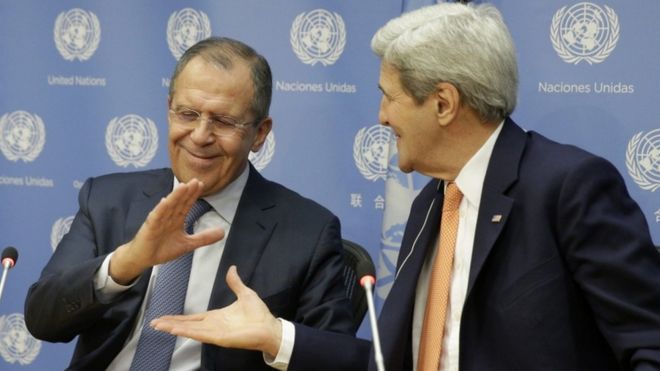
    Sergei Lavrov (left) and John Kerry were both upbeat after the vote, despite
    differences in the Russian and US positions on Syria


    A UN plan for Syria is a "milestone" in the efforts to end the conflict there, says US
    Secretary of State John Kerry.

    He said the plan gave Syrians a "real choice... between war and peace".

    However, disagreements remain over President Assad and the unanimously agreed
    Security Council resolution makes no mention of his future role.Western countries
    have called for his departure, but Russia and China say he should not be required
    to leave power as a precondition for peace talks.

    Mr Kerry said Mr Assad had "lost the ability to unite the country".

    But he also said that demanding Mr Assad's immediate departure was "prolonging
    the war"."We are under no illusions about the obstacles that exist," Mr Kerry
    said. "There obviously remain sharp differences within the international community,
    especially about the future of President Assad."

    However, while Western and Arab nations accept that Mr Assad can be part of the
    transition, they insist he must be gone at the end of it.France's Foreign Minister
    Laurent Fabius said the idea of Mr Assad standing in elections was "unacceptable".

    http://www.bbc.co.uk/news/world-middle-east-35138675


    https://projectavalon.net/forum4/show...n-Pilger/page3

  31. The Following 5 Users Say Thank You to Cidersomerset For This Post:

    animovado (19th December 2015), Calz (19th December 2015), meeradas (21st December 2015), seko (19th December 2015), Sophocles (19th December 2015)

  32. Link to Post #977
    Australia Avalon Retired Member
    Join Date
    20th August 2014
    Location
    Western Australia
    Age
    76
    Posts
    1,186
    Thanks
    9,426
    Thanked 8,989 times in 1,165 posts

    Default Re: Ukraine, Crimea, Syria, Israel, Iran, Turkey, Putin, China, and World War III

    From the Office of the President of Russia:

    Vladimir Putin attended gala reception to mark Security Agency Worker’s Day

    Here is the link to the full report:

    http://en.kremlin.ru/events/president/news/50977

    This paragraph particularly caught my eye:

    I have already mentioned Syria. We can see the efficient work of our pilots and intelligence officers, good coordination even between different forces – the Army, the Navy and aviation, and the use of the most up-to-date armaments. I would like to note that our capabilities are not limited to this. We are not using everything we have there. We have additional means and we will use them if necessary.


    The Russian Bear does not put all his cards on the table and obviously has more moves up his sleeve - mixed metaphors but you know what I mean

  33. The Following 3 Users Say Thank You to Callista For This Post:

    Baby Steps (22nd December 2015), meeradas (21st December 2015), seko (21st December 2015)

  34. Link to Post #978
    UK Avalon Member Cidersomerset's Avatar
    Join Date
    16th May 2011
    Location
    Bridgwater somerset UK
    Age
    65
    Posts
    22,333
    Thanks
    33,460
    Thanked 79,828 times in 18,702 posts

    Default Re: Ukraine, Crimea, Syria, Israel, Iran, Turkey, Putin, China, and World War III

    GLOBAL RESEARCH...

    America’s Permanent War State: Money is Raining Down on the US Military Complex

    The US Congress and the Omnibus Military Bill

    By Binoy Kampmark

    Global Research, December 20, 2015

    The funding to continue the war against ISIL is an authorization of force against ISIL, albeit a
    quiet one, designed not to attract public attention. Jack Goldsmith, Lawfare, Dec 17, 2015

    Money is raining down on the US military complex in the $1.15 trillion spending bill that was
    unveiled on Wednesday by various leaders of Congress.[1] Of that portion, a good $572.7
    billion is set aside for Pentagon expenditure. (These figures tend to be deceptive in themselves,
    given the notoriously unreliable accuracy of defence accounting.)

    The portions, roughly broken down, come to $58.6 billion for so-called Global War on Terror/
    Overseas Contingency Operations (GWOT/OCO) funds, $111 billion for procurement, which
    comes to $17 billion more than actual expenditures for the 2015 fiscal year, and $49.8 billion
    for R&D – $13.7 billion more than 2015 (Defense News, Dec 16).[2]

    House Appropriations Chairman Hal Rogers (R-Ky.) pressed his colleagues to pass the legislation,
    insisting that the “package reflects conservative priorities in both funding and policy – including
    support for critical areas such as our national defence, halting many harmful regulations, and
    trimming wasteful spending.”

    Read More....

    http://www.globalresearch.ca/america...omplex/5497088


  35. The Following 3 Users Say Thank You to Cidersomerset For This Post:

    Baby Steps (22nd December 2015), seko (21st December 2015), Sophocles (21st December 2015)

  36. Link to Post #979
    Norway Avalon Member
    Join Date
    19th February 2011
    Age
    44
    Posts
    821
    Thanks
    16,435
    Thanked 4,452 times in 780 posts

    Default Re: Ukraine, Crimea, Syria, Israel, Iran, Turkey, Putin, China, and World War III

    Military to Military

    Seymour M. Hersh on US intelligence sharing in the Syrian war

    Barack Obama’s repeated insistence that Bashar al-Assad must leave office – and that there are ‘moderate’ rebel groups in Syria capable of defeating him – has in recent years provoked quiet dissent, and even overt opposition, among some of the most senior officers on the Pentagon’s Joint Staff. Their criticism has focused on what they see as the administration’s fixation on Assad’s primary ally, Vladimir Putin. In their view, Obama is captive to Cold War thinking about Russia and China, and hasn’t adjusted his stance on Syria to the fact both countries share Washington’s anxiety about the spread of terrorism in and beyond Syria; like Washington, they believe that Islamic State must be stopped.

    The military’s resistance dates back to the summer of 2013, when a highly classified assessment, put together by the Defense Intelligence Agency (DIA) and the Joint Chiefs of Staff, then led by General Martin Dempsey, forecast that the fall of the Assad regime would lead to chaos and, potentially, to Syria’s takeover by jihadi extremists, much as was then happening in Libya. A former senior adviser to the Joint Chiefs told me that the document was an ‘all-source’ appraisal, drawing on information from signals, satellite and human intelligence, and took a dim view of the Obama administration’s insistence on continuing to finance and arm the so-called moderate rebel groups. By then, the CIA had been conspiring for more than a year with allies in the UK, Saudi Arabia and Qatar to ship guns and goods – to be used for the overthrow of Assad – from Libya, via Turkey, into Syria. The new intelligence estimate singled out Turkey as a major impediment to Obama’s Syria policy. The document showed, the adviser said, ‘that what was started as a covert US programme to arm and support the moderate rebels fighting Assad had been co-opted by Turkey, and had morphed into an across-the-board technical, arms and logistical programme for all of the opposition, including Jabhat al-Nusra and Islamic State. The so-called moderates had evaporated and the Free Syrian Army was a rump group stationed at an airbase in Turkey.’ The assessment was bleak: there was no viable ‘moderate’ opposition to Assad, and the US was arming extremists.

    Lieutenant General Michael Flynn, director of the DIA between 2012 and 2014, confirmed that his agency had sent a constant stream of classified warnings to the civilian leadership about the dire consequences of toppling Assad. The jihadists, he said, were in control of the opposition. Turkey wasn’t doing enough to stop the smuggling of foreign fighters and weapons across the border. ‘If the American public saw the intelligence we were producing daily, at the most sensitive level, they would go ballistic,’ Flynn told me. ‘We understood Isis’s long-term strategy and its campaign plans, and we also discussed the fact that Turkey was looking the other way when it came to the growth of the Islamic State inside Syria.’ The DIA’s reporting, he said, ‘got enormous pushback’ from the Obama administration. ‘I felt that they did not want to hear the truth.’

    ‘Our policy of arming the opposition to Assad was unsuccessful and actually having a negative impact,’ the former JCS adviser said. ‘The Joint Chiefs believed that Assad should not be replaced by fundamentalists. The administration’s policy was contradictory. They wanted Assad to go but the opposition was dominated by extremists. So who was going to replace him? To say Assad’s got to go is fine, but if you follow that through – therefore anyone is better. It’s the “anybody else is better” issue that the JCS had with Obama’s policy.’ The Joint Chiefs felt that a direct challenge to Obama’s policy would have ‘had a zero chance of success’. So in the autumn of 2013 they decided to take steps against the extremists without going through political channels, by providing US intelligence to the militaries of other nations, on the understanding that it would be passed on to the Syrian army and used against the common enemy, Jabhat al-Nusra and Islamic State.

    Germany, Israel and Russia were in contact with the Syrian army, and able to exercise some influence over Assad’s decisions – it was through them that US intelligence would be shared. Each had its reasons for co-operating with Assad: Germany feared what might happen among its own population of six million Muslims if Islamic State expanded; Israel was concerned with border security; Russia had an alliance of very long standing with Syria, and was worried by the threat to its only naval base on the Mediterranean, at Tartus. ‘We weren’t intent on deviating from Obama’s stated policies,’ the adviser said. ‘But sharing our assessments via the military-to-military relationships with other countries could prove productive. It was clear that Assad needed better tactical intelligence and operational advice. The JCS concluded that if those needs were met, the overall fight against Islamist terrorism would be enhanced. Obama didn’t know, but Obama doesn’t know what the JCS does in every circumstance and that’s true of all presidents.’

    Once the flow of US intelligence began, Germany, Israel and Russia started passing on information about the whereabouts and intent of radical jihadist groups to the Syrian army; in return, Syria provided information about its own capabilities and intentions. There was no direct contact between the US and the Syrian military; instead, the adviser said, ‘we provided the information – including long-range analyses on Syria’s future put together by contractors or one of our war colleges – and these countries could do with it what they chose, including sharing it with Assad. We were saying to the Germans and the others: “Here’s some information that’s pretty interesting and our interest is mutual.” End of conversation. The JCS could conclude that something beneficial would arise from it – but it was a military to military thing, and not some sort of a sinister Joint Chiefs’ plot to go around Obama and support Assad. It was a lot cleverer than that. If Assad remains in power, it will not be because we did it. It’s because he was smart enough to use the intelligence and sound tactical advice we provided to others.’

    *

    The public history of relations between the US and Syria over the past few decades has been one of enmity. Assad condemned the 9/11 attacks, but opposed the Iraq War. George W. Bush repeatedly linked Syria to the three members of his ‘axis of evil’ – Iraq, Iran and North Korea – throughout his presidency. State Department cables made public by WikiLeaks show that the Bush administration tried to destabilise Syria and that these efforts continued into the Obama years. In December 2006, William Roebuck, then in charge of the US embassy in Damascus, filed an analysis of the ‘vulnerabilities’ of the Assad government and listed methods ‘that will improve the likelihood’ of opportunities for destabilisation. He recommended that Washington work with Saudi Arabia and Egypt to increase sectarian tension and focus on publicising ‘Syrian efforts against extremist groups’ – dissident Kurds and radical Sunni factions – ‘in a way that suggests weakness, signs of instability, and uncontrolled blowback’; and that the ‘isolation of Syria’ should be encouraged through US support of the National Salvation Front, led by Abdul Halim Khaddam, a former Syrian vice president whose government-in-exile in Riyadh was sponsored by the Saudis and the Muslim Brotherhood. Another 2006 cable showed that the embassy had spent $5 million financing dissidents who ran as independent candidates for the People’s Assembly; the payments were kept up even after it became clear that Syrian intelligence knew what was going on. A 2010 cable warned that funding for a London-based television network run by a Syrian opposition group would be viewed by the Syrian government ‘as a covert and hostile gesture toward the regime’.

    But there is also a parallel history of shadowy co-operation between Syria and the US during the same period. The two countries collaborated against al-Qaida, their common enemy. A longtime consultant to America’s intelligence community said that, after 9/11, ‘Bashar was, for years, extremely helpful to us while, in my view, we were churlish in return, and clumsy in our use of the gold he gave us. That quiet co-operation continued among some elements, even after the [Bush administration’s] decision to vilify him.’ In 2002 Assad authorised Syrian intelligence to turn over hundreds of internal files on the activities of the Muslim Brotherhood in Syria and Germany. Later that year, Syrian intelligence foiled an attack by al-Qaida on the headquarters of the US Navy’s Fifth Fleet in Bahrain, and Assad agreed to provide the CIA with the name of a vital al-Qaida informant. In violation of this agreement, the CIA contacted the informant directly; he rejected the approach, and broke off relations with his Syrian handlers. Assad also secretly turned over to the US relatives of Saddam Hussein who had sought refuge in Syria, and – like America’s allies in Jordan, Egypt, Thailand and elsewhere – tortured suspected terrorists for the CIA in a Damascus prison.

    It was this history of co-operation that made it seem possible in 2013 that Damascus would agree to the new indirect intelligence-sharing arrangement with the US. The Joint Chiefs let it be known that in return the US would require four things: Assad must restrain Hizbullah from attacking Israel; he must renew the stalled negotiations with Israel to reach a settlement on the Golan Heights; he must agree to accept Russian and other outside military advisers; and he must commit to holding open elections after the war with a wide range of factions included. ‘We had positive feedback from the Israelis, who were willing to entertain the idea, but they needed to know what the reaction would be from Iran and Syria,’ the JCS adviser told me. ‘The Syrians told us that Assad would not make a decision unilaterally – he needed to have support from his military and Alawite allies. Assad’s worry was that Israel would say yes and then not uphold its end of the bargain.’ A senior adviser to the Kremlin on Middle East affairs told me that in late 2012, after suffering a series of battlefield setbacks and military defections, Assad had approached Israel via a contact in Moscow and offered to reopen the talks on the Golan Heights. The Israelis had rejected the offer. ‘They said, “Assad is finished,”’ the Russian official told me. ‘“He’s close to the end.”’ He said the Turks had told Moscow the same thing. By mid-2013, however, the Syrians believed the worst was behind them, and wanted assurances that the Americans and others were serious about their offers of help.

    In the early stages of the talks, the adviser said, the Joint Chiefs tried to establish what Assad needed as a sign of their good intentions. The answer was sent through one of Assad’s friends: ‘Bring him the head of Prince Bandar.’ The Joint Chiefs did not oblige. Bandar bin Sultan had served Saudi Arabia for decades in intelligence and national security affairs, and spent more than twenty years as ambassador in Washington. In recent years, he has been known as an advocate for Assad’s removal from office by any means. Reportedly in poor health, he resigned last year as director of the Saudi National Security Council, but Saudi Arabia continues to be a major provider of funds to the Syrian opposition, estimated by US intelligence last year at $700 million.

    In July 2013, the Joint Chiefs found a more direct way of demonstrating to Assad how serious they were about helping him. By then the CIA-sponsored secret flow of arms from Libya to the Syrian opposition, via Turkey, had been underway for more than a year (it started sometime after Gaddafi’s death on 20 October 2011).​* The operation was largely run out of a covert CIA annex in Benghazi, with State Department acquiescence. On 11 September 2012 the US ambassador to Libya, Christopher Stevens, was killed during an anti-American demonstration that led to the burning down of the US consulate in Benghazi; reporters for the Washington Post found copies of the ambassador’s schedule in the building’s ruins. It showed that on 10 September Stevens had met with the chief of the CIA’s annex operation. The next day, shortly before he died, he met a representative from Al-Marfa Shipping and Maritime Services, a Tripoli-based company which, the JCS adviser said, was known by the Joint Staff to be handling the weapons shipments.

    By the late summer of 2013, the DIA’s assessment had been circulated widely, but although many in the American intelligence community were aware that the Syrian opposition was dominated by extremists the CIA-sponsored weapons kept coming, presenting a continuing problem for Assad’s army. Gaddafi’s stockpile had created an international arms bazaar, though prices were high. ‘There was no way to stop the arms shipments that had been authorised by the president,’ the JCS adviser said. ‘The solution involved an appeal to the pocketbook. The CIA was approached by a representative from the Joint Chiefs with a suggestion: there were far less costly weapons available in Turkish arsenals that could reach the Syrian rebels within days, and without a boat ride.’ But it wasn’t only the CIA that benefited. ‘We worked with Turks we trusted who were not loyal to Erdoğan,’ the adviser said, ‘and got them to ship the jihadists in Syria all the obsolete weapons in the arsenal, including M1 carbines that hadn’t been seen since the Korean War and lots of Soviet arms. It was a message Assad could understand: “We have the power to diminish a presidential policy in its tracks.”’

    The flow of US intelligence to the Syrian army, and the downgrading of the quality of the arms being supplied to the rebels, came at a critical juncture. The Syrian army had suffered heavy losses in the spring of 2013 in fighting against Jabhat al-Nusra and other extremist groups as it failed to hold the provincial capital of Raqqa. Sporadic Syrian army and air-force raids continued in the area for months, with little success, until it was decided to withdraw from Raqqa and other hard to defend, lightly populated areas in the north and west and focus instead on consolidating the government’s hold on Damascus and the heavily populated areas linking the capital to Latakia in the north-east. But as the army gained in strength with the Joint Chiefs’ support, Saudi Arabia, Qatar and Turkey escalated their financing and arming of Jabhat al-Nusra and Islamic State, which by the end of 2013 had made enormous gains on both sides of the Syria/Iraq border. The remaining non-fundamentalist rebels found themselves fighting – and losing – pitched battles against the extremists. In January 2014, IS took complete control of Raqqa and the tribal areas around it from al-Nusra and established the city as its base. Assad still controlled 80 per cent of the Syrian population, but he had lost a vast amount of territory.

    CIA efforts to train the moderate rebel forces were also failing badly. ‘The CIA’s training camp was in Jordan and was controlled by a Syrian tribal group,’ the JCS adviser said. There was a suspicion that some of those who signed up for training were actually Syrian army regulars minus their uniforms. This had happened before, at the height of the Iraqi war, when hundreds of Shia militia members showed up at American training camps for new uniforms, weapons and a few days of training, and then disappeared into the desert. A separate training programme, set up by the Pentagon in Turkey, fared no better. The Pentagon acknowledged in September that only ‘four or five’ of its recruits were still battling Islamic State; a few days later 70 of them defected to Jabhat al-Nusra immediately after crossing the border into Syria.

    In January 2014, despairing at the lack of progress, John Brennan, the director of the CIA, summoned American and Sunni Arab intelligence chiefs from throughout the Middle East to a secret meeting in Washington, with the aim of persuading Saudi Arabia to stop supporting extremist fighters in Syria. ‘The Saudis told us they were happy to listen,’ the JCS adviser said, ‘so everyone sat around in Washington to hear Brennan tell them that they had to get on board with the so-called moderates. His message was that if everyone in the region stopped supporting al-Nusra and Isis their ammunition and weapons would dry up, and the moderates would win out.’ Brennan’s message was ignored by the Saudis, the adviser said, who ‘went back home and increased their efforts with the extremists and asked us for more technical support. And we say OK, and so it turns out that we end up reinforcing the extremists.’

    But the Saudis were far from the only problem: American intelligence had accumulated intercept and human intelligence demonstrating that the Erdoğan government had been supporting Jabhat al-Nusra for years, and was now doing the same for Islamic State. ‘We can handle the Saudis,’ the adviser said. ‘We can handle the Muslim Brotherhood. You can argue that the whole balance in the Middle East is based on a form of mutually assured destruction between Israel and the rest of the Middle East, and Turkey can disrupt the balance – which is Erdoğan’s dream. We told him we wanted him to shut down the pipeline of foreign jihadists flowing into Turkey. But he is dreaming big – of restoring the Ottoman Empire – and he did not realise the extent to which he could be successful in this.’

    *

    One of the constants in US affairs since the fall of the Soviet Union has been a military-to-military relationship with Russia. After 1991 the US spent billions of dollars to help Russia secure its nuclear weapons complex, including a highly secret joint operation to remove weapons-grade uranium from unsecured storage depots in Kazakhstan. Joint programmes to monitor the security of weapons-grade materials continued for the next two decades. During the American war on Afghanistan, Russia provided overflight rights for US cargo carriers and tankers, as well as access for the flow of weapons, ammunition, food and water the US war machine needed daily. Russia’s military provided intelligence on Osama bin Laden’s whereabouts and helped the US negotiate rights to use an airbase in Kyrgyzstan. The Joint Chiefs have been in communication with their Russian counterparts throughout the Syrian war, and the ties between the two militaries start at the top. In August, a few weeks before his retirement as chairman of the Joint Chiefs, Dempsey made a farewell visit to the headquarters of the Irish Defence Forces in Dublin and told his audience there that he had made a point while in office to keep in touch with the chief of the Russian General Staff, General Valery Gerasimov. ‘I’ve actually suggested to him that we not end our careers as we began them,’ Dempsey said – one a tank commander in West Germany, the other in the east.

    When it comes to tackling Islamic State, Russia and the US have much to offer each other. Many in the IS leadership and rank and file fought for more than a decade against Russia in the two Chechen wars that began in 1994, and the Putin government is heavily invested in combating Islamist terrorism. ‘Russia knows the Isis leadership,’ the JCS adviser said, ‘and has insights into its operational techniques, and has much intelligence to share.’ In return, he said, ‘we’ve got excellent trainers with years of experience in training foreign fighters – experience that Russia does not have.’ The adviser would not discuss what American intelligence is also believed to have: an ability to obtain targeting data, often by paying huge sums of cash, from sources within rebel militias.

    A former White House adviser on Russian affairs told me that before 9/11 Putin ‘used to say to us: “We have the same nightmares about different places.” He was referring to his problems with the caliphate in Chechnya and our early issues with al-Qaida. These days, after the Metrojet bombing over Sinai and the massacres in Paris and elsewhere, it’s hard to avoid the conclusion that we actually have the same nightmares about the same places.’

    Yet the Obama administration continues to condemn Russia for its support of Assad. A retired senior diplomat who served at the US embassy in Moscow expressed sympathy for Obama’s dilemma as the leader of the Western coalition opposed to Russia’s aggression against Ukraine: ‘Ukraine is a serious issue and Obama has been handling it firmly with sanctions. But our policy vis-à-vis Russia is too often unfocused. But it’s not about us in Syria. It’s about making sure Bashar does not lose. The reality is that Putin does not want to see the chaos in Syria spread to Jordan or Lebanon, as it has to Iraq, and he does not want to see Syria end up in the hands of Isis. The most counterproductive thing Obama has done, and it has hurt our efforts to end the fighting a lot, was to say: “Assad must go as a premise for negotiation.”’ He also echoed a view held by some in the Pentagon when he alluded to a collateral factor behind Russia’s decision to launch airstrikes in support of the Syrian army on 30 September: Putin’s desire to prevent Assad from suffering the same fate as Gaddafi. He had been told that Putin had watched a video of Gaddafi’s savage death three times, a video that shows him being sodomised with a bayonet. The JCS adviser also told me of a US intelligence assessment which concluded that Putin had been appalled by Gaddafi’s fate: ‘Putin blamed himself for letting Gaddafi go, for not playing a strong role behind the scenes’ at the UN when the Western coalition was lobbying to be allowed to undertake the airstrikes that destroyed the regime. ‘Putin believed that unless he got engaged Bashar would suffer the same fate – mutilated – and he’d see the destruction of his allies in Syria.’

    In a speech on 22 November, Obama declared that the ‘principal targets’ of the Russian airstrikes ‘have been the moderate opposition’. It’s a line that the administration – along with most of the mainstream American media – has rarely strayed from. The Russians insist that they are targeting all rebel groups that threaten Syria’s stability – including Islamic State. The Kremlin adviser on the Middle East explained in an interview that the first round of Russian airstrikes was aimed at bolstering security around a Russian airbase in Latakia, an Alawite stronghold. The strategic goal, he said, has been to establish a jihadist-free corridor from Damascus to Latakia and the Russian naval base at Tartus and then to shift the focus of bombing gradually to the south and east, with a greater concentration of bombing missions over IS-held territory. Russian strikes on IS targets in and near Raqqa were reported as early as the beginning of October; in November there were further strikes on IS positions near the historic city of Palmyra and in Idlib province, a bitterly contested stronghold on the Turkish border.

    Russian incursions into Turkish airspace began soon after Putin authorised the bombings, and the Russian air force deployed electronic jamming systems that interfered with Turkish radar. The message being sent to the Turkish air force, the JCS adviser said, was: ‘We’re going to fly our fighter planes where we want and when we want and jam your radar. Do not **** with us. Putin was letting the Turks know what they were up against.’ Russia’s aggression led to Turkish complaints and Russian denials, along with more aggressive border patrolling by the Turkish air force. There were no significant incidents until 24 November, when two Turkish F-16 fighters, apparently acting under more aggressive rules of engagement, shot down a Russian Su-24M jet that had crossed into Turkish airspace for no more than 17 seconds. In the days after the fighter was shot down, Obama expressed support for Erdoğan, and after they met in private on 1 December he told a press conference that his administration remained ‘very much committed to Turkey’s security and its sovereignty’. He said that as long as Russia remained allied with Assad, ‘a lot of Russian resources are still going to be targeted at opposition groups … that we support … So I don’t think we should be under any illusions that somehow Russia starts hitting only Isil targets. That’s not happening now. It was never happening. It’s not going to be happening in the next several weeks.’

    The Kremlin adviser on the Middle East, like the Joint Chiefs and the DIA, dismisses the ‘moderates’ who have Obama’s support, seeing them as extremist Islamist groups that fight alongside Jabhat al-Nusra and IS (‘There’s no need to play with words and split terrorists into moderate and not moderate,’ Putin said in a speech on 22 October). The American generals see them as exhausted militias that have been forced to make an accommodation with Jabhat al-Nusra or IS in order to survive. At the end of 2014, Jürgen Todenhöfer, a German journalist who was allowed to spend ten days touring IS-held territory in Iraq and Syria, told CNN that the IS leadership ‘are all laughing about the Free Syrian Army. They don’t take them for serious. They say: “The best arms sellers we have are the FSA. If they get a good weapon, they sell it to us.” They didn’t take them for serious. They take for serious Assad. They take for serious, of course, the bombs. But they fear nothing, and FSA doesn’t play a role.’

    *

    Putin’s bombing campaign provoked a series of anti-Russia articles in the American press. On 25 October, the New York Times reported, citing Obama administration officials, that Russian submarines and spy ships were ‘aggressively’ operating near the undersea cables that carry much of the world’s internet traffic – although, as the article went on to acknowledge, there was ‘no evidence yet’ of any Russian attempt actually to interfere with that traffic. Ten days earlier the Times published a summary of Russian intrusions into its former Soviet satellite republics, and described the Russian bombing in Syria as being ‘in some respects a return to the ambitious military moves of the Soviet past’. The report did not note that the Assad administration had invited Russia to intervene, nor did it mention the US bombing raids inside Syria that had been underway since the previous September, without Syria’s approval. An October op-ed in the same paper by Michael McFaul, Obama’s ambassador to Russia between 2012 and 2014, declared that the Russian air campaign was attacking ‘everyone except the Islamic State’. The anti-Russia stories did not abate after the Metrojet disaster, for which Islamic State claimed credit. Few in the US government and media questioned why IS would target a Russian airliner, along with its 224 passengers and crew, if Moscow’s air force was attacking only the Syrian ‘moderates’.

    Economic sanctions, meanwhile, are still in effect against Russia for what a large number of Americans consider Putin’s war crimes in Ukraine, as are US Treasury Department sanctions against Syria and against those Americans who do business there. The New York Times, in a report on sanctions in late November, revived an old and groundless assertion, saying that the Treasury’s actions ‘emphasise an argument that the administration has increasingly been making about Mr Assad as it seeks to press Russia to abandon its backing for him: that although he professes to be at war with Islamist terrorists, he has a symbiotic relationship with the Islamic State that has allowed it to thrive while he has clung to power.’

    *

    The four core elements of Obama’s Syria policy remain intact today: an insistence that Assad must go; that no anti-IS coalition with Russia is possible; that Turkey is a steadfast ally in the war against terrorism; and that there really are significant moderate opposition forces for the US to support. The Paris attacks on 13 November that killed 130 people did not change the White House’s public stance, although many European leaders, including François Hollande, advocated greater co-operation with Russia and agreed to co-ordinate more closely with its air force; there was also talk of the need to be more flexible about the timing of Assad’s exit from power. On 24 November, Hollande flew to Washington to discuss how France and the US could collaborate more closely in the fight against Islamic State. At a joint press conference at the White House, Obama said he and Hollande had agreed that ‘Russia’s strikes against the moderate opposition only bolster the Assad regime, whose brutality has helped to fuel the rise’ of IS. Hollande didn’t go that far but he said that the diplomatic process in Vienna would ‘lead to Bashar al-Assad’s departure … a government of unity is required.’ The press conference failed to deal with the far more urgent impasse between the two men on the matter of Erdoğan. Obama defended Turkey’s right to defend its borders; Hollande said it was ‘a matter of urgency’ for Turkey to take action against terrorists. The JCS adviser told me that one of Hollande’s main goals in flying to Washington had been to try to persuade Obama to join the EU in a mutual declaration of war against Islamic State. Obama said no. The Europeans had pointedly not gone to Nato, to which Turkey belongs, for such a declaration. ‘Turkey is the problem,’ the JCS adviser said.

    Assad, naturally, doesn’t accept that a group of foreign leaders should be deciding on his future. Imad Moustapha, now Syria’s ambassador to China, was dean of the IT faculty at the University of Damascus, and a close aide of Assad’s, when he was appointed in 2004 as the Syrian ambassador to the US, a post he held for seven years. Moustapha is known still to be close to Assad, and can be trusted to reflect what he thinks. He told me that for Assad to surrender power would mean capitulating to ‘armed terrorist groups’ and that ministers in a national unity government – such as was being proposed by the Europeans – would be seen to be beholden to the foreign powers that appointed them. These powers could remind the new president ‘that they could easily replace him as they did before to the predecessor … Assad owes it to his people: he could not leave because the historic enemies of Syria are demanding his departure.’

    *

    Moustapha also brought up China, an ally of Assad that has allegedly committed more than $30 billion to postwar reconstruction in Syria. China, too, is worried about Islamic State. ‘China regards the Syrian crisis from three perspectives,’ he said: international law and legitimacy; global strategic positioning; and the activities of jihadist Uighurs, from Xinjiang province in China’s far west. Xinjiang borders eight nations – Mongolia, Russia, Kazakhstan, Kyrgyzstan, Tajikistan, Afghanistan, Pakistan and India – and, in China’s view, serves as a funnel for terrorism around the world and within China. Many Uighur fighters now in Syria are known to be members of the East Turkestan Islamic Movement – an often violent separatist organisation that seeks to establish an Islamist Uighur state in Xinjiang. ‘The fact that they have been aided by Turkish intelligence to move from China into Syria through Turkey has caused a tremendous amount of tension between the Chinese and Turkish intelligence,’ Moustapha said. ‘China is concerned that the Turkish role of supporting the Uighur fighters in Syria may be extended in the future to support Turkey’s agenda in Xinjiang. We are already providing the Chinese intelligence service with information regarding these terrorists and the routes they crossed from on travelling into Syria.’

    Moustapha’s concerns were echoed by a Washington foreign affairs analyst who has closely followed the passage of jihadists through Turkey and into Syria. The analyst, whose views are routinely sought by senior government officials, told me that ‘Erdoğan has been bringing Uighurs into Syria by special transport while his government has been agitating in favour of their struggle in China. Uighur and Burmese Muslim terrorists who escape into Thailand somehow get Turkish passports and are then flown to Turkey for transit into Syria.’ He added that there was also what amounted to another ‘rat line’ that was funnelling Uighurs – estimates range from a few hundred to many thousands over the years – from China into Kazakhstan for eventual relay to Turkey, and then to IS territory in Syria. ‘US intelligence,’ he said, ‘is not getting good information about these activities because those insiders who are unhappy with the policy are not talking to them.’ He also said it was ‘not clear’ that the officials responsible for Syrian policy in the State Department and White House ‘get it’. IHS-Jane’s Defence Weekly estimated in October that as many as five thousand Uighur would-be fighters have arrived in Turkey since 2013, with perhaps two thousand moving on to Syria. Moustapha said he has information that ‘up to 860 Uighur fighters are currently in Syria.’

    China’s growing concern about the Uighur problem and its link to Syria and Islamic State have preoccupied Christina Lin, a scholar who dealt with Chinese issues a decade ago while serving in the Pentagon under Donald Rumsfeld. ‘I grew up in Taiwan and came to the Pentagon as a critic of China,’ Lin told me. ‘I used to demonise the Chinese as ideologues, and they are not perfect. But over the years as I see them opening up and evolving, I have begun to change my perspective. I see China as a potential partner for various global challenges especially in the Middle East. There are many places – Syria for one – where the United States and China must co-operate in regional security and counterterrorism.’ A few weeks earlier, she said, China and India, Cold War enemies that ‘hated each other more than China and the United States hated each other, conducted a series of joint counterterrorism exercises. And today China and Russia both want to co-operate on terrorism issues with the United States.’ As China sees it, Lin suggests, Uighur militants who have made their way to Syria are being trained by Islamic State in survival techniques intended to aid them on covert return trips to the Chinese mainland, for future terrorist attacks there. ‘If Assad fails,’ Lin wrote in a paper published in September, ‘jihadi fighters from Russia’s Chechnya, China’s Xinjiang and India’s Kashmir will then turn their eyes towards the home front to continue jihad, supported by a new and well-sourced Syrian operating base in the heart of the Middle East.’

    *

    General Dempsey and his colleagues on the Joint Chiefs of Staff kept their dissent out of bureaucratic channels, and survived in office. General Michael Flynn did not. ‘Flynn incurred the wrath of the White House by insisting on telling the truth about Syria,’ said Patrick Lang, a retired army colonel who served for nearly a decade as the chief Middle East civilian intelligence officer for the DIA. ‘He thought truth was the best thing and they shoved him out. He wouldn’t shut up.’ Flynn told me his problems went beyond Syria. ‘I was shaking things up at the DIA – and not just moving deckchairs on the Titanic. It was radical reform. I felt that the civilian leadership did not want to hear the truth. I suffered for it, but I’m OK with that.’ In a recent interview in Der Spiegel, Flynn was blunt about Russia’s entry into the Syrian war: ‘We have to work constructively with Russia. Whether we like it or not, Russia made a decision to be there and to act militarily. They are there, and this has dramatically changed the dynamic. So you can’t say Russia is bad; they have to go home. It’s not going to happen. Get real.’

    Few in the US Congress share this view. One exception is Tulsi Gabbard, a Democrat from Hawaii and member of the House Armed Services Committee who, as a major in the Army National Guard, served two tours in the Middle East. In an interview on CNN in October she said: ‘The US and the CIA should stop this illegal and counterproductive war to overthrow the Syrian government of Assad and should stay focused on fighting against … the Islamic extremist groups.’

    ‘Does it not concern you,’ the interviewer asked, ‘that Assad’s regime has been brutal, killing at least 200,000 and maybe 300,000 of his own people?’

    ‘The things that are being said about Assad right now,’ Gabbard responded, ‘are the same that were said about Gaddafi, they are the same things that were said about Saddam Hussein by those who were advocating for the US to … overthrow those regimes … If it happens here in Syria … we will end up in a situation with far greater suffering, with far greater persecution of religious minorities and Christians in Syria, and our enemy will be far stronger.’

    ‘So what you are saying,’ the interviewer asked, ‘is that the Russian military involvement in the air and on-the-ground Iranian involvement – they are actually doing the US a favour?’

    ‘They are working toward defeating our common enemy,’ Gabbard replied.

    Gabbard later told me that many of her colleagues in Congress, Democrats and Republicans, have thanked her privately for speaking out. ‘There are a lot of people in the general public, and even in the Congress, who need to have things clearly explained to them,’ Gabbard said. ‘But it’s hard when there’s so much deception about what is going on. The truth is not out.’ It’s unusual for a politician to challenge her party’s foreign policy directly and on the record. For someone on the inside, with access to the most secret intelligence, speaking openly and critically can be a career-ender. Informed dissent can be transmitted by means of a trust relationship between a reporter and those on the inside, but it almost invariably includes no signature. The dissent exists, however. The longtime consultant to the Joint Special Operations Command could not hide his contempt when I asked him for his view of the US’s Syria policy. ‘The solution in Syria is right before our nose,’ he said. ‘Our primary threat is Isis and all of us – the United States, Russia and China – need to work together. Bashar will remain in office and, after the country is stabilised there will be an election. There is no other option.’

    The military’s indirect pathway to Assad disappeared with Dempsey’s retirement in September. His replacement as chairman of the Joint Chiefs, General Joseph Dunford, testified before the Senate Armed Services Committee in July, two months before assuming office. ‘If you want to talk about a nation that could pose an existential threat to the United States, I’d have to point to Russia,’ Dunford said. ‘If you look at their behaviour, it’s nothing short of alarming.’ In October, as chairman, Dunford dismissed the Russian bombing efforts in Syria, telling the same committee that Russia ‘is not fighting’ IS. He added that America must ‘work with Turkish partners to secure the northern border of Syria’ and ‘do all we can to enable vetted Syrian opposition forces’ – i.e. the ‘moderates’ – to fight the extremists.

    Obama now has a more compliant Pentagon. There will be no more indirect challenges from the military leadership to his policy of disdain for Assad and support for Erdoğan. Dempsey and his associates remain mystified by Obama’s continued public defence of Erdoğan, given the American intelligence community’s strong case against him – and the evidence that Obama, in private, accepts that case. ‘We know what you’re doing with the radicals in Syria,’ the president told Erdoğan’s intelligence chief at a tense meeting at the White House (as I reported in the LRB of 17 April 2014). The Joint Chiefs and the DIA were constantly telling Washington’s leadership of the jihadist threat in Syria, and of Turkey’s support for it. The message was never listened to. Why not?

    Source: London Review of Books Vol. 38 No. 1 · 7 January 2016 pages 11-14 6831 words

  37. The Following 3 Users Say Thank You to Sophocles For This Post:

    Hervé (22nd December 2015), JRS (21st December 2015), seko (21st December 2015)

  38. Link to Post #980
    Avalon Member norman's Avatar
    Join Date
    25th March 2010
    Location
    too close to the hot air exhaust
    Age
    70
    Posts
    11,562
    Thanks
    11,141
    Thanked 76,715 times in 10,839 posts

    Default Re: Ukraine, Crimea, Syria, Israel, Iran, Turkey, Putin, China, and World War III

    I seriously think this post in it's own recently new thread belongs here in this thread.

    It's Kameran Faily, talking to Kerry Cassidy recently. He explains in minute detail what the real deals are that have been going on in the middle east in the last several years.

    https://projectavalon.net/forum4/show...=1#post1030409
    ..................................................my first language is TYPO..............................................

  39. The Following User Says Thank You to norman For This Post:

    Sophocles (22nd December 2015)

+ Reply to Thread
Page 49 of 120 FirstFirst 1 39 49 59 99 120 LastLast

Tags for this Thread

Posting Permissions

  • You may not post new threads
  • You may not post replies
  • You may not post attachments
  • You may not edit your posts