-
10th May 2016 20:24
Link to Post #1
 Kepler telescope discovers 100 Earth-sized planets 9 of which are in the 'Goldilocks' zone...
I can remember clearly the speculation about whether there were any planets
outside our solar system and the announcement of the first official discovery
in 1995 , a period I thought possible disclosure of ET contact would be announced
leading up to the millennium and for me I really thought it might happen. Of course
it did not and then 9/11 and all this 'war on terror' BS and its seems we may be
back on a disclosure cycle circa 2016/7/18 which David Icke and others feel are
significant years. Who knows we have been here before imo......
Carol Rosins comments come to mind...
Carol Rosin and The Last Card... Cold war, Terror, Asteroids, then ETs
https://projectavalon.net/forum4/show...roids-then-ETs
====================================================
====================================================
sciencealert.com
http://www.sciencealert.com/live-upd...t-about-kepler
------------------------------------------------------------------------------------------------

Kepler telescope discovers 100 Earth-sized planets
By Paul Rincon
Science editor, BBC News website
2 hours ago.. From the section Science & Environment
Nasa's Kepler telescope has discovered more than 100 Earth-sized planets orbiting alien
stars.It has also detected nine small planets within so-called habitable zones, where
conditions are favourable for liquid water - and potentially life.The finds are contained
within a catalogue of 1,284 new planets detected by Kepler - which more than doubles
the previous tally.Nasa said it was the biggest single announcement of new exoplanets.
Space agency scientists discussed the new findings in a teleconference on Tuesday.
Statistical analyses of the expanding sample of worlds help astronomers understand
how common planets like our own might be.Dr Natalie Batalha, Kepler mission scientist
at Nasa's Ames Research Center in California, said calculations suggested there could be
more than 10 billion potentially habitable planets in the Milky Way.
"About 24% of the stars harbour potentially habitable planets that are smaller than
about 1.6 times the size of the Earth. That's a number that we like because it's below
that size that we estimate planets are likely to be rocky," said Dr Batalha.
"If you ask yourself where is the next habitable planet likely to be, it's within about 11
light-years, which is very close."
Future observatories such as the James Webb Space Telescope could examine starlight
filtered through the atmospheres of exoplanets for potential markers of biology.
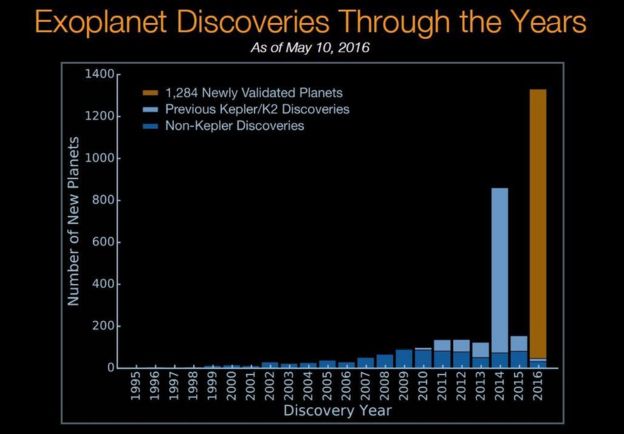
Exoplanet discoveriesImage copyright NASA
"The ultimate goal of our search is to detect the light from a habitable exoplanet and
analyse that light for gases like water vapour, oxygen, methane and carbon dioxide -
gases that might indicate the presence of a biological ecosystem," said Paul Hertz,
director of astrophysics at Nasa.Of the telescope's finds to date, the planets Kepler-186f
and Kepler-452b are arguably the most Earth-like in terms of properties such as their
size, the temperature of their host star and the energy received from their star.
Dr Batalha said the new finds Kepler 1638b and Kepler-1229b were intriguing targets in
the search for habitable planets.The Nasa Ames researcher said the Kepler mission was
part of a "larger strategic goal of finding evidence of life beyond Earth - knowing
whether we're alone or not, to know... how life manifests itself in the galaxy and what is
the diversity".
She added: "Being able to look up to a point of light and being able to say: 'That star
has a living world orbiting it.' I think that's very profound and answers questions about
why we're here."Dr Timothy Morton, from Princeton University in New Jersey, said the
overwhelming majority of exoplanets found by Kepler fell into the super-Earth (1.2-1.9
times bigger than the radius of Earth) and sub-Neptune sized (1.9-3.1 times bigger
than Earth's radius).He noted that planets in this size range had no known analogues in
our Solar System.

Habitable zone planetsImage copyright NASA
Scientists used a new statistical technique to validate the 1,284 new exoplanets from a
pool of 4,302 targets from Kepler's July 2015 catalogue of planet candidates. The
technique involves folded in different types of information about the candidates from
simulations, giving the astronomers a reliability score for each potential new world.
Candidates with a reliability greater than 99% were designated as "validated planets".
The team identified a further 1,327 candidates that are more likely than not to be
planets, but do not meet the 99% threshold and will require further study.
Kepler employs the transit method to detect planets orbiting other stars. This involves
measuring the slight dimming of a star's light when an orbiting planet passes between it
and the Earth. The same orbital phenomenon was involved when Mercury passed across
the face of the Sun on Monday 9 May.The Kepler telescope, named after the
Renaissance astronomer Johannes Kepler, was launched on 7 March 2009.
In May 2013, the second of four reaction wheels - used to control a spacecraft's
orientation - failed on Kepler. This robbed the orbiting observatory of its ability to stay
pointed at a target without drifting off course.However, engineers came up with an
innovative solution: using the pressure of sunlight to stabilise the spacecraft, allowing it
to continue its planet hunt. The resulting mission was dubbed K2.
Follow Paul on Twitter.
http://www.bbc.co.uk/news/science-environment-36256725
======================================================
======================================================
The Guardian
https://www.theguardian.com/science/...pace-telescope
---------------------------------------------------------------------------------------------------
EXPRESS...
http://www.express.co.uk/news/scienc...ast-one-planet
----------------------------------------------------------------------------------------------
NASA...
Kepler and K2....http://www.nasa.gov/mission_pages/ke...ain/index.html
April 17, 2014
NASA's Kepler Discovers First Earth-Size Planet In The 'Habitable Zone' of Another Star
Kepler - 186f
Published on 17 Apr 2014
Astronomers have discovered the first Earth-size planet orbiting a star in the "habitable
zone" -- the range of distance from a star where liquid water might pool on the surface
of an orbiting planet. The discovery of Kepler-186f confirms that planets the size of
Earth exist in the habitable zone of stars other than our sun.
http://www.nasa.gov/ames/kepler/nasa...f-another-star
====================================================

More than 1,200 new planets confirmed using new technique for verifying Kepler data
Date:May 10, 2016 Source rinceton University Summary:
Scientists have confirmed that 1,284 objects observed outside Earth's solar system
by NASA's Kepler spacecraft are indeed planets. The researchers used an
automated technique that allows scientists to efficiently determine if a Kepler signal
is caused by a planet. It is the largest single announcement of new planets to date
and more than doubles the number of confirmed planets discovered by Kepler so far.
https://www.sciencedaily.com/release...0510143704.htm
Last edited by Cidersomerset; 10th May 2016 at 21:13.
-
The Following 14 Users Say Thank You to Cidersomerset For This Post:
Agape (10th May 2016), avid (10th May 2016), Elisheva (11th May 2016), Ewan (11th May 2016), Fairy Friend (10th May 2016), ghostrider (11th May 2016), jjjones (11th May 2016), justntime2learn (11th May 2016), kirolak (11th May 2016), KiwiElf (10th May 2016), Matisse (10th May 2016), Michael Moewes (15th May 2016), Nasu (10th May 2016), WhiteLove (22nd July 2016)
-
14th May 2016 16:29
Link to Post #2
Re: Kepler telescope discovers 100 Earth-sized planets 9 of which are in the 'Goldilocks' zone...
NASA telescope discovers largest collection of planets ever
Published on 13 May 2016
NASA announced that their Kepler telescope discovered the largest collection of
planets outside our solar system, which doubled the agency’s list of known exoplanets.
The term ‘exoplanet’ refers to any planet in space that orbits a star other than the sun.
RT America’s Manuel Rapalo delves deep into the science.
Find RT America in your area: http://rt.com/where-to-watch/
Or watch us online: http://rt.com/on-air/rt-america-air/
-
-
14th May 2016 17:54
Link to Post #3
Re: Kepler telescope discovers 100 Earth-sized planets 9 of which are in the 'Goldilocks' zone...
NASA planet discovery: Kepler space telescope finds 1,284 new planets in our galaxy - TomoNews
Published on 11 May 2016
WASHINGTON — NASA's Kepler mission, launched in 2009 and with two more years
to go, has detected 1,284 new exoplanets, including nine worlds that may be able
to sustain life.
NASA announced on Tuesday that the Kepler Space Telescope, which searches for
planets in our Milky Way that lie up to 3,000 light years from Earth, has verified
1,284 new planets. Five hundred and fifty appear to be rocky based on their size.
Of these 550, nine are located just far enough from their suns to suggest they may
contain water.
The latest finding nearly doubles the number of confirmed exoplanets and is the
largest number of new planets announced at one time, reported Space.
According to NASA's statement, the new findings can be credited to a computer
simulation and a new statistical method that takes into account such factors as how
many total stars are in our galaxy.
The total number of exoplanets discovered now stands at 3,200. A total of 21 of
these may be habitable. The Kepler mission shows that with at least 70 billion stars
in our galaxy, there may be billions of habitable, Earth-sized planets out there that
have yet to be discovered.
====================================================
====================================================
NASA Finds Most Earth-Like Planet Yet
Published on 23 Jul 2015
Researchers have discovered the most similar planet yet to Earth, 1,400 light-years
away. Kepler-452b orbits its star in 385 days, just 20 days longer than our own
year. Its star is just 4% larger, a billion and a half years older, and 20% brighter
than the sun, meaning 452b is firmly in the “goldilocks” habitable zone that puts
the odds of it being rocky, like Earth, between 50-62%.
More Information:
http://www.nasa.gov/press-release/nas...
http://www.theguardian.com/science/20...
http://www.nytimes.com/2015/07/24/sci...
Last edited by Cidersomerset; 21st July 2016 at 23:38.
-
 Posting Permissions
- You may not post new threads
- You may not post replies
- You may not post attachments
- You may not edit your posts
Forum Rules


 Reply With Quote
Bookmarks