


 UFOs in Historical Works of Art
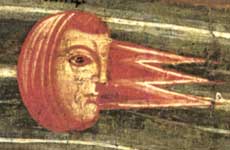
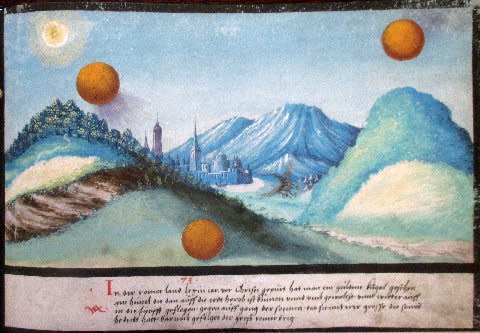
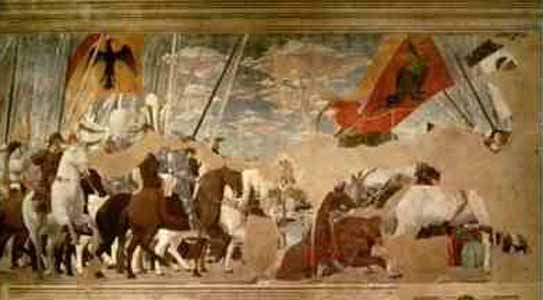
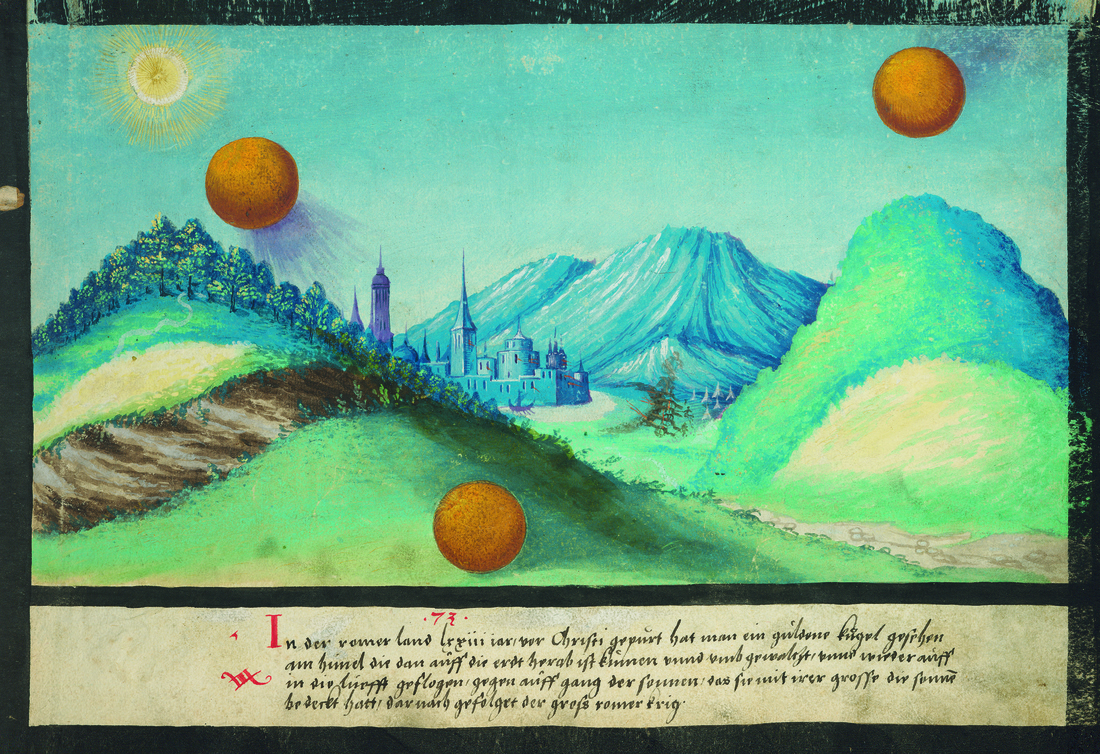
This is partly in answer to the thread Do ETs Exist? There are for one thing examples of UFOs and other mysterious aerial phenomena appearing in historical pieces of artwork to take into strong consideration. We mustn't forget the numerous cave drawings either, but seeing as these are in many respects primitive renditions, the context not always being completely clear, we should probably concentrate on plainer, more recognisable examples. Namely, established and well-known paintings, which in many cases have been around for centuries.
Here are some of the best examples (some elements I've enhanced and blown up) [warning: image heavy]
What warrants particular study is the religious works from the age of enlightenment, the Renaissance, which appear to illustrate classical UFOs. This is long before the age of science-fiction, long before even flying machines. What are they showing us, and what are they trying to tell us, in these extraordinary images - in scenes of the crucifixion, the Virgin Mary, and the Virgin Birth? In the presented artworks below, the artists seem to be hinting at a quite fantastic notion, far beyond their time. That something beyond (or different to) the Divine is taking place, which is non-human and other-worldly in nature.
In my opinion, the artists and intellectuals had knowledge and insight that the rest of the world (at the time) lacked. This was secret and arcane knowledge considered heretical by the then Powers That Be (which were largely ecclesial in nature). This was possibly the function, and perhaps origin, of the first Secret Societies. Possibly the only safe way to communicate their knowledge and ideas was in art – paintings, sculpture, and architecture, which only the informed and the perceptive could understand. So one has to wonder, did this secret knowledge include non-human agencies from beyond the Earth being involved in human affairs?
"The Baptism of Christ"
This can be found in the Fitzwilliam Museum, in Cambridge England. It was painted by Aert De Gelder in 1710. What we see in the sky is a classic flying saucer, shooting what appears to be rays of light down onto the scene – which is the baptism of Jesus Christ by John the Baptist.
* * * * * *
"La Crucifixion"
This is one of several examples of religious imagery depicted in European frescoes. This one can be found in the Monastery of Visoki Decani, in Kosovo. On either side of the cross, in the sky, are two aerial objects apparently moving from left to right. They don't however appear to be natural celestial objects either – two figures, 'pilots' perhaps, seem to be actually flying these objects.
* * * * * *
"The Madonna with Saint Giovannino"
This is a 15th century work by the painter Domenico Ghirlandaio. To the right of Mary’s head, in the sky, is a curious object, at first glance a mere blot on the canvas. Look a little closer, and you will see it is something quite different.
* * * * * *
"The Annunciation with Saint Emidius"
This remarkable scene, painted by Carlo Crivelli (1486) is pretty amazing (if you understand the context). A disc-shaped object in the sky is actually firing a beam of energy down through a window and onto Mary’s head (into maybe her third eye).
* * * * * *
"The Miracle of the Snow"
An armada of UFOs invades a religious scene. This one is by Masolino Da Panicale, and dates to the mid 15th century.
In my opinion, I suspect these 'anomalies' are probably just clouds.

- Home
- Forum
- Chat
- Donate
-
Site Links

-
Avalon Library
-
External Sites
- Solari Report | Catherine Austin Fitts
- The Wall Will Fall | Vanessa Beeley
- Unsafe Space | Keri Smith
- Giza Death Star | Joseph P. Farrell
- The Last American Vagabond
- Caitlin Johnstone
- John Pilger
- Voltaire Network
- Suspicious Observers
- Peak Prosperity | Chris Martenson
- Dark Journalist
- The Black Vault
- Global Research | Michael Chossudovsky
- Corbett Report
- Infowars
- Natural News
- Ice Age Farmer
- Dr. Joseph Mercola
- Childrens Health Defense
- Geoengineering Watch | Dane Wigington
- Truthstream Media
- Unlimited Hangout | Whitney Webb
- Wikileaks index
- Vaccine Impact
- Eva Bartlett (In Gaza blog)
- Scott Ritter
- Redacted (Natalie & Clayton Morris)
- Judging Freedom (Andrew Napolitano)
- Alexander Mercouris
- The Duran
- Simplicius The Thinker


 Reply With Quote


 .
.





Bookmarks