+ Reply to Thread
Results 1 to 12 of 12

Thread: Soft underbellies

  1. Link to Post #1
    France Avalon Member araucaria's Avatar
    Join Date
    24th January 2011
    Posts
    5,403
    Thanks
    12,061
    Thanked 31,025 times in 5,009 posts

    Default Soft underbellies

    From the egg-carton multiverse to the do-it-yourself (DIY) universe, taking the scenic route

    This thread begins (whatever else it may subsequently do) by taking a closer look at the possible properties of the ‘egg-carton universe’ I first broached here, https://projectavalon.net/forum4/show...l=1#post665693 trying not to take the analogy too far, for that is all it is, and indeed all we ever have: an analogy.
    Quote Posted by araucaria (here)
    Quote Posted by ulli (here)
    Quote Posted by araucaria (here)
    Quote Posted by Lisab (here)
    I really hope Vivek changes his mind. I get so much out of his posts and threads. So many bright,young gifted guys on Avalon that give me so much hope for humanity.
    There seems to have been some debate about the unknowable contents of those black backpacks. It reminds me of Saint-Exupéry's Little Prince:
    http://www.angelfire.com/hi/littlepr...echapter2.html

    If you draw a box, you can always say there is a sheep in it. Likewise, I wouldn't stake anything on the content of those backpacks.

    I see Calz is talking about boxes too Understandable: it appears we live in an egg-carton universe (paper referenced by Wilcock):

    http://arxiv.org/pdf/astro-ph/9802009.pdf
    Thanks for the reminder of the Little Prince. My fantasy box is a cat...watching them and speculating what's in their minds. They seem to prefer sunshine, flowery gardens, butterfly chasing in the daytime, and the quiet of nights, solitude, soft and warm places to sleep. Maybe we ought to let their fantasy life guide humanity.

    The Wilcock referenced document was unreadable to me, but left me wondering if Wilcock is either far brighter than I thought for understanding such stuff, or a sadist for pointing people into the direction of it as reading material.
    I don’t know about Wilcock (who looked rather wild or something on the Awake&Aware panel discussion – post 2012-trauma perhaps), but the astronomy goes over my head too; the one thing that interests me about the ‘egg-carton’ universe is the missing ‘eggs’ – what might they be? This leads to an amazing thought that not many people can have had before, at least not in this form.

    I used to know quite a lot about stackable chairs. The earliest design was by Flora Steiger-Crawford way back in 1931. Stackable furniture was a great invention notably for community halls where you can arrange it however you like for a feast or a conference and then clear away for a dance floor.

    http://www.bonluxat.com/a/Flora_Stei...ett_Chair.html

    What has this got to do with that? Well, egg-cartons are stackable. I know this because our greengrocer uses them several times over. Hence it occurs to me that we live in a stackable universe. It will be the mother of all disclosures when we discover that while the gods are dancing, we are in the stacked position up against the wall, and get to know our neighbours immediately above and below

    @carmody: point taken, while we cannot quite dial up ‘the entirety’ of human knowledge, the egg box-shaped knowledge base is enough to be going on with to work out some of what’s being withheld, that’s for sure.
    My first point is that egg-cartons are stackable both full and empty. When cosmologists say they can only see 4% of what’s out there, this suggests to me that the missing 96% is... the eggs. What you actually have is a generously filled egg sandwich, but what they are presenting us with is just a slice of bread that tastes like cardboard So let’s explore this analogy a little further and see where it takes us.

    Just for clarity, I am not talking about the egg carton with a lid: the above-quoted paper makes no mention of a lid. I am not talking about the single sheet; if you want a lid, you need another single sheet. Hence the universe becomes part of a multiverse, with or without eggs, depending on whether you are going to or coming from the greengrocer’s — or possibly at some intermediate stage combining eggs and empty spaces if they are sitting in the fridge. The question then arises: whose fridge? It makes an interesting change from the watchmaker analogy, blind or otherwise. It looks like some chef is into eggs bigtime: raw in mayonnaise, fried, boiled, in omelets, various recipes, cakes candy and eggnogs, you name it. And it sounds like they have got a lot of visitors for some huge ongoing feast...

    Another question would be: where are we at in this process? The Fermi paradox, which says ‘If there were aliens, then why are they not here?’, suggests that we are the last egg in the box. Experiencers on the other hand claim that the box is full. The likelihood is that we are somewhere in between. Close to home, the asteroid belt seems to indicate an egg that got broken, and Mars is like the mark left on the box where an egg has been removed. So the box is definitely not full, and definitely not entirely empty, since we are here. And so we are waiting; we don’t know in what sauce we are going to get eaten, as we say in French, or what sort of an experience that is going to be, but it is bound to be a release from sitting expectantly in someone’s fridge.

    Let’s look at the structure of this household item, the egg box. It is designed to provide rigid support and yet has to be flexible. This is because it is machine-made, i.e. with identical compartments, but designed to hold eggs which, even if you calibrate them, all have slightly different shapes and sizes, being the output of individual hens each time in unique circumstances. These boxes are reusable because their consumption cycle is longer than that of their contents. That means that any egg placed in a box is going to have to adjust to the shape of the mould created by all the previous occupants of that particular position, all of different shapes and sizes. This is where the going gets tough and the rigid support becomes lacking. A larger egg is more fragile in a smaller space than it needs, and vice versa. Over time the very fabric of the egg box will become distorted. And on the macro-scale of the entire sheet, this will inevitably lead to tilting one way or the other. This tilt will extend through the entire pile of sheets and the result will be a multiverse that stacks not into a neat vertical pile but eventually all the way round into a circular (spherical...) arrangement, much like straight lines can be drawn at varying angles to draw a circle. The perfection of the circle is the combined effect of endless imperfections. See here:
    https://www.youtube.com/watch?v=Bj1Zc0GGOaw
    This is a notion first analyzed by Lucretius, who used the term ‘clinamen’: https://en.wikipedia.org/wiki/Clinamen

    Finally, the egg carton model can be seen in terms of dimensions. It is basically a flat, two-dimensional topology, with three-dimensional pockets – the alveolar structure. When you stack two together, these egg-shaped pockets create impassible intermediate (zero-dimensional) points where cardboard meets cardboard. In between these, from the standpoint of an individual egg, you have a one-dimensional line of vision along your equatorial plane both to left and right and to back and front. In other words, you can see your four neighbours, and if they are on the small side, you may detect a little beyond that. However, on the polar plane, you also have close neighbours that will be undetectable owing to the layer of cardboard in between. This is the multiverse perspective which David Icke likens to radio stations on a dial. Any interference can here be seen in terms of leakage due to a damaged egg carton. The curvature of spacetime may then be not a natural state but a process of an ageing multiverse folding round on itself into a presumably four-dimensional spheroid. That is kind of paradoxical: geometrical perfection being attained through a process of degradation and debilitation. But that is one of the easier paradoxes to handle: we all understand, after all, how we get older and wiser in a single package. On this basis the multiverse must be getting pretty old, because the fact of its being discovered at all is a sign that it is getting leaky. But ‘leaky’ is a pejorative term that is not appropriate here: we are talking more about new lines of communication opening up.


  2. The Following 13 Users Say Thank You to araucaria For This Post:

    Baby Steps (5th July 2016), Carmody (5th July 2016), ElfeMya (5th July 2016), Ernie Nemeth (5th July 2016), Foxie Loxie (5th July 2016), Mark (Star Mariner) (5th July 2016), Mercedes (5th July 2016), RunningDeer (5th July 2016), Shannon (13th August 2016), Sierra (5th July 2016), Sophocles (5th July 2016), ulli (5th July 2016), william r sanford72 (5th July 2016)

  3. Link to Post #2
    France Avalon Member araucaria's Avatar
    Join Date
    24th January 2011
    Posts
    5,403
    Thanks
    12,061
    Thanked 31,025 times in 5,009 posts

    Default Re: Soft underbellies

    That is about as far as the egg carton analogy will take us. Why? Because while it is originally a topological metaphor, the topological aspect is the most problematic. Since we live on and around visible matter, it makes no sense to think in terms of a structure on the one hand enclosing a space on the other that we are not seeing at all. But the metaphor has served us well, for it is not so much the analogy per se that is breaking down, it is the egg carton itself. An old leaky egg carton is no longer fit for purpose; which is not to say it dies and is cast off: it morphs into something else. What we can take to the bank at this point is an abstract concept or relationship, between two things or realities. These two things or realities are the visible (material) world and the invisible (immaterial/spiritual) world, and the relationship between them is of indirect detection of the latter through the former. I have another analogy: the skeleton.

    Exoskeletons and endoskeletons

    There are two kinds of skeleton. A crab has an exoskeleton: the skeleton is on the outside, the crab is the same shape inside. A human has an endoskeleton: the skeleton is on the inside, the body is on the outside, and roughly the same shape, with one very noticeable exception.

    A crab exoskeleton is an array of three dimensions. The spindly legs are basically one-dimensional, having virtually no inside at all. The importance of the one-dimensional aspect can be seen in the movements they enable: in mostly straight lines across a mostly two-dimensional surface. The claws are basically two-dimensional: they have thickness but mostly length and width; whatever is on the inside is only there to enable movement on the outside. The importance of the two-dimensional aspect can be seen in the pincers: two prongs exerting opposite forces along a straight line to capture a three-dimensional prey. The shell is a fully three-dimensional body, i.e. a container: its importance lies on what happens on the inside. And basically what happens on the inside is what comes in from the outside: food is taken in, digested, transformed into tissue, and movement to continue the process on a bigger scale, and reproduction to continue the process on an even bigger scale. Hence the inside-outside relationship is mostly the Russian-doll-type food chain of smaller containers being eaten by bigger containers, and occasionally the reverse: a parasitic/viral-type situation where small eats large from the inside.

    This kind of skeleton is visible to the naked eye. What we cannot see without interference are the fully three-dimensional internal organs and functions. The (e.g. human) endoskeleton is rather different. To visualize a human in the way we see a crab, you would need to have x-ray vision, and only x-ray vision. You would see the same one- and two-dimensional structures in the limbs, but the three-dimensional configuration is more complex. You would guess that with its prison-barlike appearance the ribcage is a container, to contain vital organs that mustn’t get out. Then the brain box would look like the high security wing of that prison, perhaps holding in the ringleader. You might be a little puzzled over the pelvis: it is a kind of open prison retaining relatively minor organs. This of course makes sense when one thinks that reproduction ensures survival of the species without endangering the survival of the individual. But what you would miss altogether – the ‘dark matter’ of this microcosm – is the abdomen area where there is vital content but no protective container. But you might also miss the fact that in most mammals this vulnerable soft underbelly is protected by being hidden underneath – protected from the top by the skull, from the front by the ribcage, from the sides and rear by the pelvis. Only homo erectus and following have developed this design flaw of true vulnerability.

    How does man protect himself from this inbuilt weakness? Well, he does and he doesn’t. When he does, he does so by symbolically presenting his three protective sides: his brain – he has to be smart; his heart – he has to be brave; his sexuality – he needs his macho weaponry to survive. When he doesn’t, he is vulnerable to being taken advantage of in those three ways: not smart enough, not brave enough, not potent enough – in a word, not big enough. This is where we veer away from the food chain/virus setup into the cannabilistic ‘like likes like’ (like eats like) situation whereby man is his own worst enemy. Homo homini lupus: man is a wolf to man; but lupus also means disease: man is a disease to man. And the loser is the cradle of humanity, the belly or womb, and ultimately what was never an issue of individual survival – the issue of collective survival – becomes the life-and-death issue: how to protect the soft underbelly of humanity’s future in ways other than those that have to date proven woefully inadequate.

    From this high point of my exposé it can only be downhill. To return to astronomy’s egg carton universe, it is clearly an instance of not being nearly smart enough. If we are detecting only 4% of what is out there, then as we increase the amount of things we can see, we are increasing twenty-fold the amount of things we can’t see. It’s like a shopping addict: they have a problem with too much stuff at home; but they have a much bigger problem with the mountain of packaging that comes with it all. Only here it is the reverse: the content is the packaging, the packaging is the content. In other words, the astronomer believes he is studying an exoskeleton that more or less matches the underlying reality, when in actual fact he is studying an endoskeleton using x-ray vision and only x-ray vision, and missing out on the essential life-giving feature, the soft underbelly that is hidden for safety, and less visible for being downsized. And yet it is still the elephant in the room, taking up 96% of the space and being blithely ignored by people looking out of the window.

    The human scale thus tells us something that cosmology can merely hint at or offer an empty outline of: “Man is the measure of all things” (Protagoras). Cosmology can provide us with a cardboard egg box, al lining for the cosmic eggshells; but the essential life-giving feature, the cosmic eggs themselves, is missing. So let’s stick with the human scale.


  4. The Following 9 Users Say Thank You to araucaria For This Post:

    Carmody (5th July 2016), Ernie Nemeth (5th July 2016), Mark (Star Mariner) (5th July 2016), Mercedes (5th July 2016), Shannon (13th August 2016), Sierra (5th July 2016), Sophocles (5th July 2016), ulli (6th July 2016), william r sanford72 (5th July 2016)

  5. Link to Post #3
    France Avalon Member araucaria's Avatar
    Join Date
    24th January 2011
    Posts
    5,403
    Thanks
    12,061
    Thanked 31,025 times in 5,009 posts

    Default Re: Soft underbellies

    Another concept akin to the decaying egg carton on a human scale takes us into the field of art. The visual arts are all about doing what cosmology signally fails to do: making the invisible visible, and mutatis mutandis the other arts do the same thing. Sculpture is historically figurative, typically representing (making present) people conspicuous by their absence, most notably gods and public figures. Two-dimensional art also imports people, places and things into the here and now from outside. The selfie is a good example of this, bringing into the here and now the here and now of just a second ago, but the same principle is at work: another click and it is sent to some other place and time. ‘Same difference’ as we say: anything a self-conscious universe does is going to be a form of ‘selfie’, so we may as well get over the annoying narcissism we see so much of these days; maybe what seems rather immature is actually more plugged in than we thought.

    If art is the content, then the container is the museum, the gallery, the ‘venue’, which has a history of its own. In a nutshell, that history is of art struggling to avoid being totally ingested, devoured and digested by this container. Originally, sculptures and paintings were immovable: a sculpture was part of the temple, and the painting was a mural, one with the wall. Then due to earthquakes the sculptures became dislodged and carted off to museums; the paintings became damaged and the only way to preserve them was by copying them onto movable supports such as canvas.(Notice again how ageing/damage causes ‘progress’.) Painting remained to a large extent a task for copyists working in museums, the studio and easel painting being an offshoot of that place and that task. This movement increased when the painting as wall became the painting as window and gradually moved outdoors (the Impressionist open-air revolution came about through the technological invention of the portable tube of paint). See https://projectavalon.net/forum4/show...l=1#post923419

    Once art had moved out of the museum, in the 20th century it began wandering off in all directions. One early landmark was the first readymade, when Marcel Duchamp presented a urinal as an artwork, calling it ‘Fountain’. In other words it was design for peering at rather than peeing into. This was quite clever, because when you are peeing into a urinal, you make sure to be peering intently at the wall to show your peers that you are not peering at them peeing. But Duchamp was nonetheless doing art in the traditional sense of making the invisible visible. For if this is a fountain, the actual urinal is only the receptacle at the bottom; it remains dry until a liquid jet is supplied by some human source. https://en.wikipedia.org/wiki/Manneken_Pis The museum situation is neatly encapsulated since there too you have a collection of private individuals all peering intently at the wall for all the world as if some private bodily function was being carried out in public. And of course peering at a bunch of nudes would probably fit that bill rather well. This is probably how modern art in many ways rather degenerated into the scatological and the overtly sexual, generating a sometimes excessively conceptual backlash.

    Things have certainly taken a downward turn when the august museum is placed on the level of the restroom. The question then is, Once you’ve relieved yourself, where do you go from here? Supposing you don’t go outdoors to do say land art or site-specific art, you enter what Brian O’Doherty has called the ‘white cube’, exposing ‘the myth of neutrality of the gallery or museum space’. http://www.amazon.com/Inside-White-C.../dp/0520220404 (do a google search for a downloadable pdf file)
    Quote The white wall's apparent neutrality is an illusion. It stands for a community with common ideas and assumptions. Artist and audience are, as it were, invisibly spread-eagled in 2-D on a white ground. The development of the pristine, placeless white cube is one of modernism's triumphs- a development commercial esthetic, and technological. (p.79)
    Here is an interesting political comment from Charlotte Klonk: ‘one is almost tempted to speak of the white cube as a Nazi invention.’ http://www.tate.org.uk/context-comme...ube-and-beyond

    The ‘pristine, placeless white cube’ (I might add timeless) as a kind of Platonic solid is indeed reactionary, and what it is reacting against is the increasing messiness of the egg-carton paradigm. In an entropic world it is a pseudo-negentropic form that is doomed to fail because it wants to stop the world and turn the clocks back to some non-existent perfect initial condition, when the only way to go is forward, that being the road to greater perfection. The reactionary attitude is understandable, because greater perfection can also be seen as some kind of reset, so better the devil you know than the devil you don’t know. The reactionary attitude is one of fear: instead of standing up to face what lies ahead, you literally recoil and want to step back. It is also idealist, in the sense that the timeless idea or the ideal takes the place of the hard time-based reality.

    Let’s move on to another analogy: what happens to the white cube in everyday life. See the white cube as the brand new modern home. This container starts out with perfectly vertical and horizontal surfaces meeting at perfect right angles, ideal for ‘consuming‘ contemporary modular flatpack furniture. However, once it has digested that meal, it will soon be ready for another. But a brand new modern home it is no longer, just a recent one already with drill holes in the walls, and soon to be a somewhat worn and torn middle-aged one. Like the reusable egg carton put out of shape by a succession of different-sized eggs, in addition to natural ageing, a house is also modified by constant alterations to suit changing needs or tastes as well as new occupiers. This is where you step into what I am calling the do-it-yourself (DIY) world. This is where the one-size fits all Ikea-type model no longer works: everything has to be tailored to suit the particular container; and conversely, the container has to be somewhat modified to accommodate the new content. The white cube paradigm is unworkable because it fails to take this feedback effect into account, and all the more unworkable because this effect is cumulative.

    Hence in the DIY house, over time people will add to or subtract from the electric wiring system, tap into the plumbing, make holes in the walls etc. etc. For example, recently at my daughter’s ‘new (150-year old) house, I removed a kitchen stove to make way for a fitted kitchen range. I plastered over the hole in the wall and was going to fit cupboards, until I realized that they would be hanging from that very same point, which was still more of a hole than a wall. I had to find another solution, but the point is that the defective setup was dictating the arrangement in a way that no catalogue model could cope with.

    The effect is cumulative, as I was saying, which also means we are within the scope of Murphy’s Law, whereby ‘if anything can go wrong, it will’ – and for the deniers, Murphy’s Second Law: ‘if nothing can go wrong, something will’ In other words, Plan A never works, and in order to implement Plan B, you first have to undo what you started under Plan A; this is not always possible, hence the need for Plan C. And so on – but not ad infinitum: you absolutely have to come up with a solution; but it is likely to be makeshift, botched, aesthetically less than perfect, or otherwise somewhat unsatisfactory.

    This ‘DIY job’ is all largely independent of the worker’s skill: skill will of course make a difference, but the principle remains the same. With the flatpack-furnished white cube, on the other hand, there are no Plans A, B or C: you just do it, and you don’t need much skill to achieve a pretty slick result.

    Over time, a house subjected to this treatment will age prematurely, requiring major renovations until the time comes when no one is interested, and it reaches the end of its life. Alternatively, with a careful owner, it will age normally, until it becomes itself a museum piece, possibly surviving until an earthquake hits it. Earthquakes are the earth’s way of telling us that museums and their contents and other such blasts from the past also have a shelf life – and that also includes white cubes.
    Leonardo da Vinci had a similar problem when painting a mural (possibly the Last Supper): he used the asperities on the wall to inspire his creativity. This is the very opposite of white cubism.

    Richard Michael Pasichnyk in The Vital Vastness states that another way to achieve the same end as natural disasters is war. What is the difference between Isis blowing up Palmyra and the US bombing Iraq back into the Stone Age? On this level, basically none. The Stone Age is a misnomer: the real Stone Age is now. Not only have we been laying concrete as fast as possible, we have been preserving everything mineral as best we can in the form of archaeological sites all the way back to the pyramids, and including Palmyra. Terrorism is merely dealing with a different compartment of the same issue. But given half a chance, nature herself will get the job done. If greater London were emptied of people, it is amazing how quickly the whole area would revert to marshlands: a matter of a few years, according to some scientific study. Re-vert, meaning to re-turn is very similar -sounding to the French reverdir, to green again, and in this particular instance the two are synonymous. Only from the standpoint of ‘civilization’ is that a backward step. Similarly, why people cluster on volcanoes is not some innate suicidal tendency they have, it is because volcanic ash is the most fertile soil going.

    When we talk about ‘the elephant in the room’, civilization is the room, and nature is the elephant. It is too big to have come in through the door, hence it was there first: the room is merely an artefact to enclose the elephant. If we return to our analogy of the skeleton, clearly a house is an individual attempt at an exoskeleton, while a city (civis, the root of civilization – but ‘root’ is the wrong word here ) is a collective attempt at same. The logical next step in this process is of course underground bases: the whole planet becomes an exoskeleton for a human equivalent of the hermit crab. A hermit crab, which builds its home in an empty shell, has two exoskeletons: its own, and its ‘house’. What it gains in safety it loses in mobility and interactivity, with just a single claw interfacing with the outside world. Enough to take a selfie, I suppose, but it wouldn’t be much of a picture

    Yet we as humans are a species built around an endoskeleton, with soft bits hanging out that we need ideally not to protect but to allow to flourish in a naturally safer environment. That we have a global issue, an area to be attended to, with the human waistline is evident in the concomitant existence of a wave of anorexia and an obesity epidemic. Winston Churchill built his war strategy around the Mediterranean as "Europe's soft underbelly". To this day, the Middle East has been the entire world’s soft underbelly, geographically and geostrategically. Since we see this same pattern on the largest cosmic scale of the egg carton universe, we can conclude that we are the business end of a universal issue. How could it be otherwise?


  6. The Following 8 Users Say Thank You to araucaria For This Post:

    Agape (5th July 2016), Carmody (5th July 2016), Ernie Nemeth (5th July 2016), Shannon (13th August 2016), Sierra (5th July 2016), Sophocles (5th July 2016), ulli (5th July 2016), william r sanford72 (5th July 2016)

  7. Link to Post #4
    Costa Rica Avalon Member ulli's Avatar
    Join Date
    19th November 2010
    Posts
    13,862
    Thanks
    67,164
    Thanked 128,068 times in 13,545 posts

    Default Re: Soft underbellies

    I love your musings, and your vision, araucaria. They are refreshing, and probing beyond the clichées that we are often exposed to.

    When I read you saying that the Middle East is the underbelly of the world I am reminded of the role it plays as the religious revelation centre of the world...and I include India as well.
    after all, it has produced not only the five best known religions of Hinduism, Judaism, Buddhism, Christianity and Islam, but also the Baha'i revelation, which I have been studying in depth since 1983. And all these religions have created cultures, architecture and art.

    And so as I am reading along your musings I kept being reminded of the words of Baha'u'llah, about what it was really all about, to have humans on this planet.

    Sharing in the hope that you might get further inspiration:

    "Man is the supreme Talisman. Lack of a proper education hath, however, deprived him of that which he doth inherently possess.
    Through a word proceeding out of the mouth of God he was called into being;
    by one word more he was guided to recognize the Source of his education;
    by yet another word his station and destiny were safeguarded.

    The Great Being saith: Regard man as a mine rich in gems of inestimable value. Education can, alone, cause it to reveal its treasures, and enable mankind to benefit therefrom.

    If any man were to meditate on that which the Scriptures, sent down from the heaven of God’s holy Will, have revealed, he would readily recognize that their purpose is that all men shall be regarded as one soul, so that the seal bearing the words “The Kingdom shall be God’s” may be stamped on every heart, and the light of Divine bounty, of grace, and mercy may envelop all mankind.

    The one true God, exalted be His glory, hath wished nothing for Himself. The allegiance of mankind profiteth Him not, neither doth its perversity harm Him.

    The Bird of the Realm of Utterance voiceth continually this call: “All things have I willed for thee, and thee, too, for thine own sake.”
    If the learned and worldly-wise men of this age were to allow mankind to inhale the fragrance of fellowship and love, every understanding heart would apprehend the meaning of true liberty, and discover the secret of undisturbed peace and absolute composure.

    Were the earth to attain this station and be illumined with its light it could then be truly said of it: “Thou shall see in it no hollows or rising hills.”

    This to me is the true purpose of religion, to help us transcend duality, and in that new state pour out new cultures, and systems where all can thrive.

    And it is precisely because of this potential that opposite forces have continued to hijack religious teachings, thus giving religion a bad name.
    But if despite our vulnerabilities we can stretch ourselves to reach for that transcendence, risking sanity even, for the attainment of abosulte health and sanity, there might just be a chance that we might make it.
    Last edited by ulli; 5th July 2016 at 10:21.

  8. The Following 7 Users Say Thank You to ulli For This Post:

    Agape (5th July 2016), araucaria (7th July 2016), Ernie Nemeth (6th July 2016), onawah (9th July 2016), Shannon (13th August 2016), Sierra (5th July 2016), william r sanford72 (5th July 2016)

  9. Link to Post #5
    Aaland Avalon Member Agape's Avatar
    Join Date
    26th March 2010
    Posts
    5,758
    Thanks
    14,692
    Thanked 26,745 times in 4,795 posts

    Default Re: Soft underbellies


    Thank you Araucaria for the great morning reading . I'm not in great typing shape momentarily but thought to share with you old outdated drawing of my Starmap
    that's in reality fairly advanced 3D grid ( you can imagine it as 3D hologram or similar ) describing Space we mapped in kind of cubical manner
    with nests of galaxies resting in its 'belly' .

    We've had several interesting super theories of space evolution and the closest and most advanced model would remind you of polarised ribbon floating in still greater waters of endlessly pure universe ..

    but we've also maintained a bubble theory of universes

    and else

    In the map you are about to see approximate distribution of superclusters ( i think you call yours the Virgo cluster of galaxies ) across a large span of Space.

    The place we came from is located somewhere in the upper Right corner
    in this partition of the map
    and we are currently in the Egg on right bottom .

    I know it sounds sort of mad but if human civilisation survives the speed of its technical evolution we all can return home one day.


  10. The Following 3 Users Say Thank You to Agape For This Post:

    araucaria (7th July 2016), Shannon (13th August 2016), ulli (6th July 2016)

  11. Link to Post #6
    Canada Avalon Member Ernie Nemeth's Avatar
    Join Date
    25th January 2011
    Location
    Toronto
    Age
    67
    Posts
    6,050
    Thanks
    27,820
    Thanked 40,100 times in 5,771 posts

    Default Re: Soft underbellies

    The egg carton universe is a static description that satisfies man's inherent need to classify and thereby mistakenly dominate all it perceives. The static need only be named and placed in its category to gain the privileged rank of fact. It could be argued that only the static stands still long enough to be verified. If there is anything science has so far learned with absolute certainty is that everything is in motion and nothing stands still. As Heisenberg's uncertainty principle makes clear, either the motion or the phenomena must remain unknown. We prefer the phenomena to its trajectory.

    In a static universe, alternate states must co-exist externally adjacent to our reality. If the static state theories of today were correct there would be no interaction between the layers, between both the slots in each carton and the stacked cartons themselves. Most recent calculations reveal that there are in fact enormous transactions of energy and forces that are affecting our universe sourced to unseen and unknown phenomena beyond the normal bounds of space/time as we know it. But we see the speed of interaction, and note its massive and pervading effect on all the observable universe. Whatever it is, it is real. As our science now understands it, it is fair to categorize this unknowable force as both existential and surreal.

    Maybe part of the problem is the entirely mundane way we treat the most miraculous of reality's wonders: life. We think we have the whole story now with the discovery of DNA and its attendant enzymes. We believe that the DNA molecule encodes the entire set of instructions on every possible contingency a life form may ever encounter. We explain the healing process in terms of molecules and chemical signals. We see the chain of life and its marvelous diversity but fail to marvel at the process of a life and the many trillions of cells interacting in perfect harmony to the point that the whole can transcend its parts and become autonomous and singular. Life is impossible, but it happens without fanfare repeatedly, enduringly, dependably. If that fails to awe then the far away and uncomprehendingly vast universe surely won't trigger any ah-ha moments either.

    The soft underbelly of science is exposed. The secret workings of its internal mechanisms are vulnerable.

    It may get bloody.

    Or science could reassert its affiliation to the side of truth and give birth to a new era of open discovery for the sake of all mankind and not merely for the tenures and accolades.

    As the egg carton universe illustrates, mankind is gripped by an irresistible need to vivisection, describe, analyse, conclude and deduce the universe into a digestible meal that bestows comprehension, thereby proving that man is a god. Oddly, the conclusion of science, if it were to fulfill its fantasy, would also disprove man's initial premise and the reason for all the scientific work in the first place: the desire to prove that there is no god, or at least no need for a god. That the laws of the universe alone, free of any outside influence, can and did produce the world we live in today. From the above it seems that whether science succeeds or fails, either way, we will be left with what amounts to at least a small god.

    When I see a theory that points to multiple sets of identical phenomena I immediately realize that the theory must be able to be reduced. It is analogous to removing the common factor from an algebraic function or dividing a limit by its integral in calculus.

    In this case I see that the static structure inclination, the particle proponent camp, has derived and reduced their assumptions down to the basic level only to find that their theory does not zero out. Instead, egg cartons are visualized, stacked one atop the other, where we only live in one but where every other impossible realty exists as well. They see the frozen pockets of subjective realities and the potential for bleed-through and even punch-through. They do not see the space between, the inertia that propels forward, the miraculous.

    There is duration, it's true. But there is also transition. Transition happens fast. Duration ... endures, stays the same, relatively at least. Slow enough at least to measure and quantify. The static state is the ground state, but almost all ground states are local and will at some time experience transition to another ground state.

    It is the transition that remains elusive by its very nature. We are not looking for it. We are looking for things that stay the same, that are repeatable and durable. We are looking for the static. The transition we call the forces. Mysterious things that bind our world together and supply it with both material and energy.

    If there is a god there would be expected to be some godlike qualities in the universe to reflect its author. Since it seems likely that either way it turns out science will one day make gods out of us or prove there was a god looking out for us all along, perhaps it would be prudent to think ahead a bit, to postulate that maybe creation didn't happen once with a bang but happens every instant with a silent whisper.

    Maybe the universe bends to the will of its occupants and manifests as needed when needed. Maybe we ride realities like surfers, catching a wave and riding it to shore, then paddling out to catch another. Maybe bodies come and go in an instant, forever created anew as required in the situation best matching its intent and in a universe built for its exclusive use, with our universes interacting with one another's as needed.

    Maybe instead of asking, as is common logic in our world, which came first the chicken or the egg, we should ask, which came first the carton or the cosmic egg it would contain?

    great article

  12. The Following 4 Users Say Thank You to Ernie Nemeth For This Post:

    araucaria (7th July 2016), Mark (Star Mariner) (7th July 2016), Shannon (13th August 2016), ulli (6th July 2016)

  13. Link to Post #7
    France Avalon Member araucaria's Avatar
    Join Date
    24th January 2011
    Posts
    5,403
    Thanks
    12,061
    Thanked 31,025 times in 5,009 posts

    Default Re: Soft underbellies

    Many thanks for a wonderful post, Ernie. Just to point out that the egg carton universe theory merely describes the distribution of galaxy clusters in terms of the shape of this household item. The stackability idea is an add-on of my own, my ‘musing’ to quote ulli’s term. Scientists are probably not too keen on the way their analogies are followed too literally, yet their more abstract ideas are constantly subject to analogy, and science itself seems to rely to some extent on it. It is not by chance but contemporary analogy that Newton’s celestial mechanics are comparable to clockwork, or that the 20th century view of stars was as nuclear power stations, or that now we find ourselves in a virtual reality universe. These are all topical analogies: the universe will always be something much more than any of that.

    Thank you, ulli, for your Baha’i wisdom, which I shall leave to sink in. Being rather slow, for now I have only just spotted a neat segue from that old post of yours nested in the OP for some more musings from a few weeks back:
    Quote My fantasy box is a cat...watching them and speculating what's in their minds. They seem to prefer sunshine, flowery gardens, butterfly chasing in the daytime, and the quiet of nights, solitude, soft and warm places to sleep. Maybe we ought to let their fantasy life guide humanity.
    This post is about a very hard (scientific) box with an extremely soft underbelly: a cat.

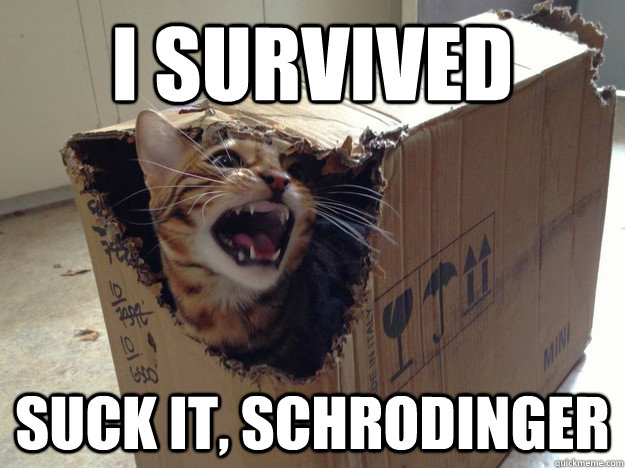
    Schrödinger’s cat revisited

    Many are familiar with the thought experiment designed to scale up quantum uncertainty (a possibly decaying atom) to the real world (a cat in a box).
    https://en.wikipedia.org/wiki/Schr%C3%B6dinger%27s_cat

    Why Schrödinger chose a cat rather than a laboratory rat is presumably an extra step to bring the experiment closer to the real world; a cat that is both dead and alive until you open the box seems much weirder than a laboratory rat, which is routinely subjected to all kinds of treatments where the epithets dead and alive no longer have much meaning. But actually the choice of a cat was not crazy enough by half; real life is more interesting.

    As any cat lover will tell you, cats have four states of being: not just dead or alive but two states of being dead-and-alive. On the one hand, you may find your cat almost in a coma on the sofa; you say, I’ll have it put down in the morning. But when you put your head round the door the next day, the cat has gone, feeling well enough to go and look for some food. This is what we mean by saying a cat has nine lives. It has this recovery mode, and the fact that it is on your sofa at all suggests that it is in recovery mode, because in the alternative dying mode it will slip away and die somewhere where you likely won’t find it. There is no quantum uncertainty about a cat: it has four positions on the dial and, barring accidents, knows exactly where it stands at any given moment. It behaves differently in recovery mode and dying mode, the one moving from death to life, the other from life to death. Any given life-threatening incident will take it round the dial. In the sofa incident, it will go all the way round, plunging into a ‘dead’ (comatose) state, then coming out of it. The fact that it behaves differently when death finally approaches suggests that the cat ‘knows’ the difference between the two states.

    What this means for Schrödinger’s experiment is that the cat’s consciousness is not getting a say in the matter. The uncertainty stems entirely from the human dualistic mindset thinking in vector terms of life and death, i.e. death following life but life never following death. In the experiment, the human agent performs a single act: opening the box to look inside. In real life, however, the cat’s consciousness seems to interact with human consciousness by closing the box as it were, in one of two different ways. In recovery mode on the sofa, when the human consciousness box is open (you can see the cat), it closes the box by going into a coma: the human is conscious of the cat but the cat is unconscious of the human. In dying mode, when the cat slips off to die, the human consciousness box is closed by the cat (you can no longer see it), and the cat consciousness box is subsequently closed when the cat actually dies. Any uncertainty is entirely human: the cat is alive then dead, but from its owner’s standpoint, it is merely old and/or sick, missing and presumed dead. There is no uncertainty about what has definitely died: the interaction of their two consciousnesses, at the 3D reality level at least.

    The uncertainty in the experiment lies in the possible decay within the next hour of one of a very few radioactive particles which could very easily survive for a period many magnitudes longer than that. So the probability is actually very high that the cat would survive: there is a degree of scare-mongering going on here What needs to be factored in then is the cat’s own consciousness inside the box. Even if the box is not in glass (why shouldn’t it be, btw?), we might know from the outside whether the cat was struggling to get out or sitting very quietly, sensing danger, ‘eyeing’ those particles and forcing them to behave like a scared mouse.

    I think cats are so popular because they can go through a similar everyday succession of states faster and more intensely than humans can. When they are alive, their reactions and agility make them seem more alive, but then then can just as quickly curl up and fall asleep, dead to the world, totally oblivious to loud music despite their acute hearing. Then they wake up again with a quick yawn and stretch, and off they go again chasing a fly. This is the ‘nine-life’ process that eventually comes to a halt in death. Compare and contrast with a laboratory technician painstakingly setting up his experiment and waiting for an hour to see if his curiosity has killed the cat! And pondering for decades to realize that the real live cat has killed his simplistic, over-rational ways of thinking about the world.


  14. The Following 5 Users Say Thank You to araucaria For This Post:

    Agape (7th July 2016), Curt (29th July 2016), Ernie Nemeth (7th July 2016), Shannon (13th August 2016), ulli (7th July 2016)

  15. Link to Post #8
    France Avalon Member araucaria's Avatar
    Join Date
    24th January 2011
    Posts
    5,403
    Thanks
    12,061
    Thanked 31,025 times in 5,009 posts

    Default Re: Soft underbellies

    So what we have in place of a pair of terms subjected to time’s arrow, namely life followed by death, we have a circular process capable of multiple loops, i.e. a sine wave configuration. The question then becomes: how can this circular process be applied to conceptual pairs other than life and death? Well since the above experiment is to do with how quantum reality undermines the rational scientific view of reality, the obvious place to start would be to substitute ‘rational’ for ‘alive’ and see where this takes us. The dualistic opposite term would then be ‘irrational’ or ‘non-rational’, and the process would be intuition. There are a host of near-synonyms for these terms, and it would be interesting to see how they might be layered. For example, near-synonyms for ‘irrational’ might be ‘crazy’ or even ‘clinically insane’. The difference being that the former is a stage in the ongoing process, the latter a dead-end where the process stops.

    As an illustration, take a person accusing themselves of a crime they did not commit: that is irrational to the extent that it is a departure from reality into some fictional scenario; but it is rational enough if it turns out that the person was acting to protect a loved one. Depending on who ends up in jail, the new reality will have either absorbed the fictional element or rejected it. Either way, the crime will have been punished, and the reality of the loving relationship will have been established; but in one case that reality will have overwritten the reality of the crime. What you have therefore is a Schrödinger’s cat situation, but a double one: one person who is innocent but guilty, another who is guilty but innocent.

    There is a singular version of this situation in the current news: a single person who is innocent but guilty, and who is guilty but innocent. This is the French woman Fabienne Kabou, whose baby drowned in the sea at her hand, and yet she claims she was not personally involved. The plea of witchcraft is the only possible plea; I am not qualified to call this ‘clinically insane’ as others are, but it is clearly taking a step out of consensus reality: there seems to be no way back to rationality. The fact that the child’s birth was never legally registered or seen by anyone but its parents was the first step: it never actually existed in our consensus reality... until it was found dead.
    https://www.theguardian.com/world/20...daughter-beach
    The mother has put herself in a similar position to her child, but there is still time to bring her back into our consensus reality. Unwanted children – she has become one herself – are the Schrödinger’s cats of our present society: dead or alive, we need to decide. The observer opening the box is in a sense a whistle-blower attempting disclosure.

    The article below and reader comments make clear the gap between rational western thought and magical thinking still prevalent in Africa.
    http://tempsreel.nouvelobs.com/justi...du-rasoir.html
    For all her 135 IQ, her philosophy studies and her ability to puzzle psychiatrists, this young woman hails from Senegal, where her crime is a fairly obvious case of human sacrifice to the water goddess Mami Wata, in exchange for wealth and success:
    http://www.bvoltaire.fr/mariedelarue...ami-wata,43292
    https://africa.si.edu/exhibits/mamiwata/intro.html
    Here in the west, the notions of human sacrifice for wealth and success are staples of ‘conspiracy theory’: this, we are told, is how the entire world elite operate. Whether we are talking about witchcraft or conspiracy theory, the issue is the clash of two ‘realities’, a live cat reality and a dead cat reality, a human reality and an alien reality. Notice the dichotomy human vs alien does not coincide with the distinction between earthlings and ETs, since some earthlings present inhuman characteristics, while presumably some ETs are intensely human with regard to how they treat others.

    Rationality then is not a standalone virtue, but a part, albeit a major part, of an ongoing process. This woman was clearly not applying her 135 IQ to child-rearing, or she would have known that this is not how bath-time is supposed to be. On the other hand, neither is bath-time supposed to be a highly intelligent affair: loving bonding is more about being able to respond to a baby on its own terms. But then neither is the rational scientist rational 24/7. Or if he is, he may have wandered off into a world of his own, which is itself a totally irrational thing to do. He too would be showing how being brainy does not equate with being smart. The rational scientist is smart when he is able occasionally to turn off the rationality.

    A while back I commented on something Einstein said: “Everyone is a genius. But if you judge a fish on its ability to climb a tree, it will live its whole life believing it is stupid.”
    Quote Posted by araucaria (here)
    I of course agree that everyone is a genius of sorts, but this is something that Einstein must have been saying rather sharply in answer to a question that he was fed up of hearing. A bit like the mountaineer who was asked Why climb Everest? and answered irritably ‘Because it’s there!’ He is deliberately sucking any meaning out of the notion of genius. If you judge a fish on its ability to swim, I would find all those encountered to date to be supremely skilful, although I suppose if one studied them, there would be some that are stronger, faster, more elegant swimmers than others. But I would not describe this skill as genius in the normal sense of extraordinary talent or intellectual (creative) power. The comparison with fish is deliberately absurd. They are simply happy in their element, doing what fish do. I would take Einstein to mean that any out-of-the-ordinary achievements are simply an offshoot of being human to the full in all his undertakings, which include being wobbly on a bike, and also things like being pretty handy on the violin. In this sense, genius is not something more but something less: the ability to ‘switch off’, through music, walking, etc. One scientist even had his moments of insight while shaving, and of course Archimedes had his Eureka moment in the bath, Newton reportedly under an apple tree.
    So rationality is part of a process that also includes flashes of intuition, when rationality is switched off, just as cat’s life includes numerous ‘deaths’. Hence when an unexpected scientific discovery is described as counter-intuitive, we don’t take this to mean that science is normally intuitive; we take it to mean that science is one thing, intuition is another. What it means is that an idea has passed through the apparent dead end of irrationality and emerged as a new form of rationality, as illustrated by the person accusing themselves of a crime they did not commit. Conversely, since science is not invariably counter-intuitive, we may conclude that neither is intuition counter-scientific: they are both moments in the same process – moments in time, moments of force producing leverage.

    On the other hand, the entire process can be thrown into reverse, whereby irrationality takes charge: despite moments when irrationality is switched off, it feeds off these flashes of lucidity. However, what makes rationality equatable with life and irrationality synonymous with death is the fact that the process eventually comes to a stop. As rationality dries up, cats and babies and others get killed. Hence the human race’s mental health is quantifiable in terms of life; the body count is a sure indicator of how sick it is. The healthy view is that Schrödinger’s cat is almost invariably alive, only madness can kill it. In my next post, I will look at how this thought experiment does not reflect Schrödinger’s actual views on life.


  16. The Following 3 Users Say Thank You to araucaria For This Post:

    Agape (7th July 2016), Ernie Nemeth (7th July 2016), Shannon (13th August 2016)

  17. Link to Post #9
    Costa Rica Avalon Member ulli's Avatar
    Join Date
    19th November 2010
    Posts
    13,862
    Thanks
    67,164
    Thanked 128,068 times in 13,545 posts

    Default Re: Soft underbellies

    Here is my irrational response to your two latest posts:
    (and I dont mean to be irreverent, it's just how my own mood seems to influence my thinking today)
    Q.: Why are there no cats on Mars?
    A.: Curiosity.

  18. The Following 2 Users Say Thank You to ulli For This Post:

    Agape (7th July 2016), Shannon (13th August 2016)

  19. Link to Post #10
    Aaland Avalon Member Agape's Avatar
    Join Date
    26th March 2010
    Posts
    5,758
    Thanks
    14,692
    Thanked 26,745 times in 4,795 posts

    Default Re: Soft underbellies

    Ulli : I had quite an irrational ( but inspiring ) idea that wasn't in direct response to here but parabolically related about two days ago that somehow well-counter-described the paradox of our global ET/abductee/contactee community
    as the 'Conspiracy of the Naked' .

    It would be irreverent to expand on it in this thread and I'm not quite yet at starting a new one ..

    ( there's none as such of course as conspiracies mostly , really depend on well dressed people )

  20. The Following User Says Thank You to Agape For This Post:

    Shannon (13th August 2016)

  21. Link to Post #11
    United States Avalon Member onawah's Avatar
    Join Date
    28th March 2010
    Language
    English
    Posts
    25,100
    Thanks
    53,371
    Thanked 135,669 times in 23,543 posts

    Default Re: Soft underbellies

    Each breath a gift...
    _____________

  22. The Following 2 Users Say Thank You to onawah For This Post:

    Ernie Nemeth (11th July 2016), Shannon (13th August 2016)

  23. Link to Post #12
    France Avalon Member araucaria's Avatar
    Join Date
    24th January 2011
    Posts
    5,403
    Thanks
    12,061
    Thanked 31,025 times in 5,009 posts

    Default Re: Soft underbellies

    This post was mostly written a few weeks ago, in response to the above posts.
    I am all for a healthy dose of irreverence; in fact, as far as I am concerned, it is an essential ingredient. But it only means anything if we are able to direct it at our own material as well. Once you begin to see the joke, you must not stop laughing by taking yourself too seriously. So I for one am happy to deconstruct what I am saying down to next to nothing, irreverently, but by no means flippantly, au contraire. Anyone should be able to do this; if they reach a point where this process stops, then I suggest they have merely uncovered their precious BS. What makes this allegedly precious material BS is its totally personal, incommunicable quality; the real gold I believe lies in the universally shared communicable stuff that like water to fish we ignore as being our very medium, not because we are unaware of it, but simply because it is such an obvious given. This means that, far from trying to be clever and original, I am trying to be as unclever and unoriginal as possible.

    If I take an irreverent look at this silly Little Prince with his silly crown and his silly asteroid and his silly drawing of a sheep, I do not stop laughing on noticing that his ‘Draw me a sheep’ amounts to saying ‘Sell me some snake oil’. We used to call it ‘a pig in a poke’. A normal healthy earth child would just say, ‘That’s not a sheep; it’s a box’. True, a normal healthy earth child on removing a gift from the carton might enjoy playing with the carton. But a normal healthy earth child would also recall the story of the Little Red Hen who is caught by the sly Fox and carried off in a bag. At some stage the contents of the bag are changed; she gets out and replaces her weight with a stone. The Fox may be a sly creature but he has only fooled himself: what he takes for ‘Home with a nice chicken supper’ turns out to be ‘Home where the table is bare’. This is the point where an outfoxed fox might want to stop laughing; alternatively, it might sportingly accept that it was outmanoeuvred, better luck next time. I suppose it depends on how hungry it is. But since this is basically a rewrite of The Emperor’s New Clothes, we see that what stops the laughter is the resulting disempowerment, i.e. the loss of power at other people’s expense.

    The egg carton universe scientists have drawn a box, and basically told us that is all there is. There is no substance. This is the basic structure of many stories we tell ourselves. ‘They have no bread? Let them eat cake (like I do)’, said Marie-Antoinette. The Roman and Jewish presentation of the Easter story is a drawing of a box with a dead man in his tomb; the Christian version describes a very different sequence of events in the box: Jesus is alive, like Schrödinger’s cat. ‘They have no bread? Let them enjoy this picnic of loaves and fishes rustled up out of nowhere.’ But then the authoritarian church takes over the whole setup: Jesus is alive, yes, but you don’t get to open the box. Just do as you are told; you get no lunch, but you may get home where you can sing for some supper if you’re lucky.

    Hence, if we find the same story told with scientific rigour, with sacred religious solemnity, as a children’s fairytale, and as a sporting contest; the question of reverence or irreverence doesn’t really come into it at all. So, when Schrödinger draws a box, tells us to imagine a cat in it, he then says we can say nothing about the cat, until we ‘let the cat out of the bag’. We find we can say a little more than he is letting on, but all the same, the cat’s basic feature turns out to be that it is just another box. This is a process with no end term, like peeling an onion, it makes you cry, but not because there is no centre (the food is in the layers); or like playing pass the parcel, it makes you laugh and smile, even though it is nearly all wrapping and nothing much to be won at the end, just waste paper to be cleared away (the fun is in the layers). The excitement comes from everyone thinking/hoping they are unwrapping the final layer to reveal the Holy Grail and everyone being wrong many times over, including, several times over, the eventual random winner of the token prize.

    So, when Agape presents me with a page of squiggles purportedly representing the wider universe with a distant home to return to, allow me irreverently to see it as just another pretty box with just another ‘home to supper’ story. I am really not too interested in the details, because I am enjoying my frugal lunch right here and now. A bird in the hand is worth two in the bush. Because Schrödinger’s scientist is just another snake oil salesman. You don’t need a handful of radioactive atoms, a geiger counter, a tube of poison and a hammer to understand that you never quite know what to expect when you open the box. If you put your car keys in a box, or anywhere at all for that matter, next time you need the car you might expect to find them if you have Schrödinger’s lab assistants guarding over them 24/7; otherwise all bets are off, as we all know. And you don’t need to invent a nuclear bomb-like chain reaction device as a cross between Russian roulette and a primitive gas chamber to understand that life is frail and precious, and that this is no way to treat a cat.

    Or take a baby’s teddy bear, hide it behind your back then bring it out again; you can play this game for as long and as often as you like, the baby will not tire of it, just as long as it gets its teddy back. It is good training so that it learns not to cry whenever mummy disappears out of sight for a minute. Hence it is an important part of growing up, being the only way for anything to get done. But it is not how the world actually works. One day mummy may disappear for good (she dies, say).The hide-the-teddy game turns out with this catastrophic fail to have been a sham: the baby was right to bawl and insist on never letting its mother out of sight: this would never have happened – in other words, the baby was looking after its mum in a very real sense, in a relationship of total interdependence. When this situation breaks down, it may react by feeling responsible, or by seeing itself as the victim of a huge conspiracy whereby all its other loved ones and carers played along with this little game as part of a great deception; or it learns to accept that statistically improbable things do happen. Which way this cookie crumbles will likely depend on the quality of the love and care the child receives. If the bad stuff starts becoming less statistically improbable, the lesson is not going to be learnt; on the other hand, it can be if despite everything the home remains the safest haven on earth. And of course the situation (nearly) always does break down, naturally, as the child grows up: its mother does not need to die physically to become less indispensable and important, and the idea of home morphs into something slightly different.

    The point is that there is no 100% watertight safety/security arrangement possible. Take Fort Knox: we hear stories that at some stage it was emptied of its gold. Or take a nuclear missile silo: you won’t get tighter security than that: yet we hear stories of UFOs disabling nuclear warheads. What are these UFOs? The very least that can be said – and that is enough for me – is that they are devices for getting inside boxes and making them meaningless. They don’t have to be extraterrestrial; more likely they are emanations of the collective human consciousness saying that we want none of this lethal stuff near our cats, still less near ourselves. This is not necessarily entirely the same message as the whistle-blower’s message. If we now see the powers-that-be as guardians of the box, whose contents are not revealed or otherwise shared, whistle-blowers staking their reputation on their accurate, static description of the contents are going to get it wrong simply because the aim and process is for such contents to be altered, disabled and eliminated, along with the box itself. As guardians of an alternative box with the properties of a magician’s hat, they are merely perpetuating the power game. We all have stuff in our private boxes; the only way forward is for as many as possible, and ultimately everyone, to give up the box game altogether. The hard part is when we realize that this means not just the evil cabal box, the PTB box, but other much cosier ones called Home, Mother, you name it.

    So we have millions of wildly different stories with everyone clinging onto to what makes their story different, hence better, truer, more important than any other. Of course what really needs to be heard is the basic message common to them all, which has to be utterly simple, and which is, ‘I wanna go home’. We find the same story everywhere, usually in several guises at once. Take America for instance: the white colonists came to make a new home because what was supposed to be home in England was not safe. But they did so by destroying the homes of the existing populations; and then they brought blacks in by force away from their homes in Africa. This is the situation of racial and other conflict that has inevitably only gotten worse over time. Hence it makes its way into the gentlest and most popular music you will find, Dvorak’s Largo from the New World Symphony.

    Whether it was inspired by or the inspiration for a negro spiritual called Goin’ Home, ultimately doesn’t matter. The guy was probably just feeling homesick himself, for fellow Czech composer Smetana’s Ma Vlast (My homeland):


    In other words, it is a nonlocal something he brought along with him.

    Home being the safe haven for one’s soft underbelly, I personally would prefer to say, ‘I wanna feel at home wherever I happen to be’. In other words, our notion of home is far too parochial: we need to expand our comfort zone out into the cosmos, when so many have chains on their front doors. ‘Soft underbelly’ is the shortest shorthand for the biggest of big pictures, one that we even find in the wisdom of the Garden of Eden story. God himself has a soft underbelly which he seeks to protect without hiding it. He reveals the weakness to humans and trusts them not to exploit it. The serpent interprets this trust as an authoritarian command to be disobeyed; Adam and Eve, whose bellies are full, nonetheless decide to eat of the forbidden fruit, thereby betraying that trust and unleashing the full blast of escalating duality also described in legend in terms of a box: Pandora’s box. Loving trust was no longer an option: you had to choose between active/passive, defence/aggression, live or die, eat or be eaten, hide or seek, hide and seek on every scale. A truly universal big picture. You step back millions of years in history, billions of light-years in space, the story is the same; or so it seems.

    The solution was there already in the Garden of Eden: loving trust. There is no going back to that, because the idea never really got off the ground in the first place. We have to move forward to that solution, the question being, can this be achieved as we go along, or is total destruction and a fresh start unavoidable? Evolution or revolution? If it is to be evolution, then trust is not just the goal, it is the way to that goal. It has to start somewhere, and it has to start with unilateral disarmament. Hence, counter-intuitively it starts with the total and deliberate breakdown of defences ahead of offensive weapons. It is totally crazy because it meets Einstein’s definition of madness: we’ve been through all this before, but this time we expect a different outcome.

    We don’t always realize just how over time these defences have escalated beyond belief. On a very practical level, where something can be seen to work, the kinesiologist Dr Bradley Nelson talks of personal barriers being – typically, not exceptionally – (the equivalent of) wooden walls miles thick, or made of an out-of-this-world metal used to build ET spacecraft. This kind of barrier can be removed in a totally impersonal way – no psychoanalysis, confession required, just a mechanical procedure, but mostly (but not entirely) on an individual level. Here is a clue as to how it might be scaled up. The frequency of sh!t happening in various ways follows stable power functions that could be altered to make such events rarer and/or less catastrophic.

    As an example from Schödinger’s cat box experiment, if you use a radioactive element with an extremely short half-life, you make the cat’s death almost certain. If you go in the opposite direction and use a radioactive element with an extremely long half-life, you make the cat’s death highly unlikely in the short and medium term. And if you disable the experiment by substituting a totally stable element, the cat’s demise is no longer an issue at all.

    The answer then is self-conscious stealth. The soft underbelly having become almost totally invisible can finally expose itself – as a total fiction, some would say a huge lie, other perhaps a disproved theory. For the soft underbelly that so needs protecting and comes under such attack is no weak point at all: on the contrary, it is the impregnable fortress that it was folly to even think of ever being able to storm, the reality of eternity and eternity as reality. This is the story of Satanic rebellion as only occasionally told from the outside. The embedded report on the war against the Creator/Creation we get in the Genesis story on the other hand suggests a weakness where none exists, and superior strength where none can exist. Christianity, as expressed in the epistle of St Peter, is therefore basically correct (and therefore to be demonized): “Be sober, be vigilant, because your adversary the devil walketh about as a roaring lion, seeking whom he may devour.” To put it less fearfully, a few thought it worthwhile to test this aspect of Creation, and have gained quite a following in the process; but as expected, the test has proved negative; get over it: it is time to stop resorting to dirty tricks when you are losing an argument. The very idea that death could govern life was clearly absurd from the outset; by definition, life outlives death, as recognized by the ‘immortal’ gods themselves, only relatively immortal in comparison with the ‘mortal’ humans they put in their box with them.

    As I said, Schrödinger’s thought experiment needs no scientific apparatus; neither does it need a cat. And neither does it need a box: it was just a thought. Let’s forget the whole thing. Only when you come away happily empty-handed do you become totally trustworthy.

    At this juncture, there is nothing left for me, or for anyone else, to say. Mods, please close this thread.


  24. The Following 3 Users Say Thank You to araucaria For This Post:

    Agape (31st July 2016), Curt (29th July 2016), Shannon (13th August 2016)

+ Reply to Thread

Posting Permissions

  • You may not post new threads
  • You may not post replies
  • You may not post attachments
  • You may not edit your posts