-
24th October 2016 14:18
Link to Post #1221
 Avalon Member

 Re: Calling all light warriors - the Bees need you!
Keeping Bees in Straw Hives—An New Journey
By Susan Chernak McElroy on October 23, 2016
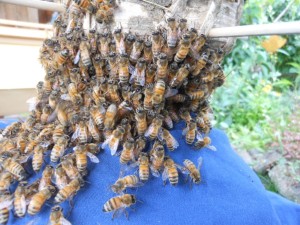
Anahat Hive entering their new woven home.
It has been five months since I brought my bright and beautiful, straw-woven Sun Hive home, and just three months since I escorted a small cast swarm up a wooden ramp and into its dark and enfolding interior. Small the swarm may have been, but the bees took to the woven hive like they had been born to it, building up their comb and their numbers in an explosion of creative energy.
Summer afternoons I would sit beneath the hive where it hung in my covered bee garden. Unlike my other wooden box hives of various sorts, the bees moved around the hive like thousands of honey-colored moons orbiting a planet. The bee activity was never just confined to the entrance, but spiraled about the egg-shaped, dung-plastered womb from morning till dark, even on the cloudiest, coldest days.
Summer afternoons I would sit beneath the hive where it hung in my covered bee garden. Unlike my other wooden box hives of various sorts, the bees moved around the hive like thousands of honey-colored moons orbiting a planet. The bee activity was never just confined to the entrance, but spiraled about the egg-shaped, dung-plastered womb from morning till dark, even on the cloudiest, coldest days.
Some days, I would lay beneath the hive and look up at this precious, new kind of cosmos, populated with amber, swirling, sun-lit bee stars and the welcoming dark gravity of the suspended mother planet. I knew from the day I had decided to attend the Sun Hive workshop that these woven hives would somehow be a significant part of my journey on the good bee road. I just didn’t know which way the path would lead.
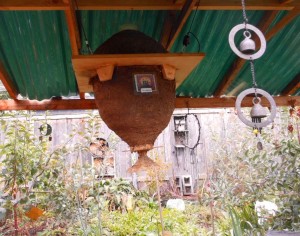
Apis Aboreal!
What I did know is that the shape, the scent, the Gestalt of the Sun Hive reached deep inside of me, grabbed a handful of my heart and soul, and pulled me into its mystery. My bees were giving me every indication that they wanted more of these hives, and all of my interest in my top bars and Warre’ hives began receding swiftly to the back burner of beedom.
The problem was, way back in May, I could not conceive of a way to proceed in making more of the hives. Sun Hives are complex to construct and to install in a bee garden. First, one must have the straw with which to weave them. The straw must be in long, long strands, and pliable. Rye straw is traditional. The interior of the hive is a series of wooden, beveled bars, shaped like descending-scale moons and precisely milled. The platform between the upper and lower basket that also holds up the wooden bars is a large piece of imported plywood, and the straw is woven onto two wooden starter disks to begin the baskets. To keep the shape intact, a form or template of some kind—wood or metal—must be constructed, or a beginner could never hope to weave the correct egg shape of the hive.
Once the hive is complete, it must be covered with something—traditionally organic cow dung—to protect it from UV rays that will destroy the straw. And the whole thing must be suspended precisely level to discourage the bees from connecting comb to the sides of the lower, catenary-curved basket. Of course, the hive must never, ever get wet.
Normally, when faced with this many obstacles, I throw up my hands in frustration and turn away. The only reason I was able to get books published is that my first publisher lived literally next door to me. Had I been required to run the gauntlet most writers navigate to get a book in front of a publisher, “Animals as Teachers and Healers” would never have been written and my life would have taken other directions.
But inexplicably, the concept of these woven hive designs utterly captivated me. I found myself spending hours online researching local sources for rye straw, and never found any.
I talked to woodworkers and brought them the wooden hive interiors and weaving templates and could not find anyone capable of crafting them for a price I could begin to afford.
No weavers from local groups were interested in helping me to learn coiled basket weaving with natural grasses.
Remarkably undeterred, I kept the image of the woven hives active in my mind’s eye. I layed beneath my Sun Hive, which I named “Anahat,” and watched her bees spin and thrive and sing, and I kept dreaming and imagining. Was there I hive I could make that was Sun Hive-like without all the complex inner workings? And what about that two-part basket arrangement, which was so hard to seal around the edges, leaving far too many gaps around the entire “planet?”
In June, I cut long, organic pasture grasses from my bee mentor, Jacqueline Freeman’s farm, brought it home, and stacked it up in five-gallon buckets to dry.
Then I found some long grasses growing all along the creeks where I lived (which I later identified as reed canary grass), and cut some buckets of that. Meanwhile, the brief class I had taken in May began to recede further and further away from my fingertips and my brain. How on earth had I woven that hive? Actually, I had only woven one-half of the Sun Hive: The workshop was only two days, just enough for us to weave only one basket. Also, the weaving onto the two starter disks had been started for us because this can be the most difficult and time-consuming part of the project and time was of the essence. I realized that I had no idea how to begin weaving without those two disks, no idea how much straw it took to weave an entire hive, and no idea how to work with the odd and varied grasses I was collecting in our garage.
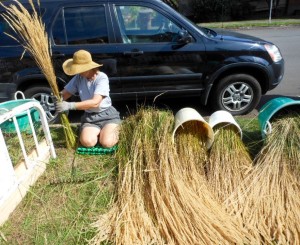
Finally, I find some local grass that really works for weaving. Gotta clean it all first, by pulling it through a metal rake.
Which way do you hold the straw? What direction do you circle the coils? How do you keep the coils even?
One of my beginner beekeeping students came to see the Sun Hive and reminded me that her husband was a metalworker. He told me, “I can make those forms in the size you want very easily. And inexpensively.” Suddenly, Angel and I were in business! He made me a weaving form in short order, I ordered oval flat reed for binding the coils from Amazon.com.
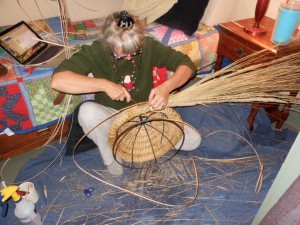
“Hmmm, which way does the binding go??”
Now, the only thing stopping me was my overwhelming ignorance. But up in the bee yard, the Sun Hive was blooming with bees and song, and their call was like a golden ribbon tied around my heart, pulling me forward. One warm afternoon I told my husband I’d be out with the bees, and headed out with all my materials and tools to the bee garden. Beneath the tiny galaxy of the Sun Hive, I layed out my wonky, bent grasses, my bucket of water for soaking my binding cane, Angel’s gorgeous weaving form, scissors, and my beloved fid (a marine tool for rope repair that works great to pierce the straw coils and weave in the cane): I had ordered three of the wrong sizes of that fid before I found one that worked.
Now, the only thing stopping me was my overwhelming ignorance. But up in the bee yard, the Sun Hive was blooming with bees and song, and their call was like a golden ribbon tied around my heart, pulling me forward. One warm afternoon I told my husband I’d be out with the bees, and headed out with all my materials and tools to the bee garden. Beneath the tiny galaxy of the Sun Hive, I layed out my wonky, bent grasses, my bucket of water for soaking my binding cane, Angel’s gorgeous weaving form, scissors, and my beloved fid (a marine tool for rope repair that works great to pierce the straw coils and weave in the cane): I had ordered three of the wrong sizes of that fid before I found one that worked.
In the many weeks between hanging my Sun Hive and finally sitting beneath it to weave, my brain had been afire with possible innovations I could make to the hive to make it affordable and even better for my bees and for me. I live in a county that does not require hobby beekeepers to maintain removable combs for inspection. So I dispensed with my search for master woodworkers: I would simply not use the wooden bars, allowing my bees to attach their combs directly to the inside of the straw basket. How would I medicate my bees in such a hive? Also simple: I am a treatment-free beekeeper, so medicating my hives is not part of my “beeing.”
Now, the only thing stopping me was my overwhelming ignorance. But up in the bee yard, the Sun Hive was blooming with bees and song, and their call was like a golden ribbon tied around my heart, pulling me forward. One warm afternoon I told my husband I’d be out with the bees, and headed out with all my materials and tools to the bee garden. Beneath the tiny galaxy of the Sun Hive, I layed out my wonky, bent grasses, my bucket of water for soaking my binding cane, Angel’s gorgeous weaving form, scissors, and my beloved fid (a marine tool for rope repair that works great to pierce the straw coils and weave in the cane): I had ordered three of the wrong sizes of that fid before I found one that worked.
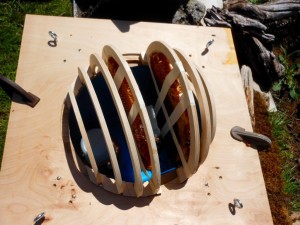
Removable Sun Hive upper bars and stabilizing platform.
What about suspending the hive? The weight of such a hive full of bees, honey, and comb is significant. The straw alone would not support its suspension. Again, a simple solution that took me weeks of mental machinations to unearth: I would put a simple round, beveled disk in the top of the hive to which I would screw—from the outside—eyebolts. Voila! A hanging hive where my bees could express their deeply aboreal nature.
The Sun Hive allows the beekeeper to remove the top and/or bottom baskets for inspections. I am a low-intervention beekeeper with no need or desire to go in and mess about with my bees. I need only to see how the colony is progressing.
Removing the baskets is something I never plan to do with my Sun Hive, but I do like to take a peek inside now and then, so rather than the egg-shaped bottom basket, I decided I would weave what would look more like a traditional step, with a domed top and straight sides. The bees (and I!) would not have to deal with the imperfect junction of the two baskets and would be free to affix their comb in any configuration.
To the bottom of the basket, I would attach a round woven, lipped tray that I could attach with pegs to the bottom of the hive. The tray would have the traditional “flower” entrance of the Sun Hive, and I could remove the bottom with little disturbance to the bees. I could easily place feed bowls on the tray inside if I needed to feed my bees. The hive would look like a large, hanging bell.
But what about honey, you might ask? I’m not into bees because of honey. I am into bees because they have captivated me. They do amazing things for my yard, making an Eden out of my humble, talentless gardening efforts. But even that is a far distant second to why I keep bees. The sound of them, the scent of them, the sight of them dipping and gliding like leaves on the wind entrances me and it heals me in ways that words cannot capture. They touch me at my innermost core with symbol, motion, and tone. That is the language I call upon to commune with them.
That is the only language that works for me. The galaxy and cosmos metaphors are more than metaphors: The bees welcome me into other worlds where only good matters and only love—in its most expansive definition—is expressed. Honey? If I am wanting some honey and if the bees have plenty to spare, I can cut a section of comb from the lower combs of the hive. If a hive perishes, as so many hives do these days, the bees alway leave honey to spare. I have plenty of honey for my family without needing to make honey a factor in how I keep bees.
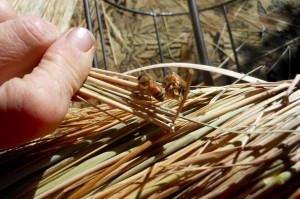
Weaving outside on a sunny day, I find bees are always coming by to “lend a hand.”
In the United States, there is very little use of woven hives among beekeepers because—I keep reading—the hive are “terrible for bees.” The more I studied and the more I reflected, I came to the conclusion that woven hives are “terrible” for beekeepers who need to produce and collect a lot of honey. The hives are marvelous for bees, with the insulation value of six or more inches of wood in a much lighter hive. Also, the hives are round, and temperature control in the vertical round is optimal for bees.
As the months have passed, I have watched myself pursue this new calling with a dedication and determination unusual to my nature, and it is because of this continuing inspiration that I know I am indeed on the right path. This spring, I will be ushering all the swarms that come my way into woven hives.
We all have different ways of hearing and interpreting our inner voices, our intuition, our passions. For me, it is not so much a voice, an image, or a rational decision or conscious choice. Rather, I let myself feel and I observe the feelings. If my creative drive kicks in full-force, if my interest remains strong, I move forward and I allow myself to trust the process and be patient as each new step reveals itself. As I move forward in this way, time begins to move more slowly and in a more—how can I say this?—opaque, organic way—like stem cells coming together and morphing into a new kind of whole.
I look back on the process that has brought me here—right now—to my first prototype of what I am calling “The People’s Sun Hive.” I call it this because it is a hive that is affordable, easy-although-time-consuming to craft, and can be made with whatever grasses grow in your part of the world. I think of the Sun Hive in its classic expression as being the aristocrat of woven hives. I’m crafting something for the common people.
As fall winds her way toward the dark moons of winter, I feel as though I am awakening from a hazy dream that has crystalized into physical form and left me sitting with this lovely, bell-like creation in my lap. The ideas and images of months of sitting with the concept of the Sun Hive are coming together like puzzle pieces now, and I know the next steps on my good bee road: The winter will find me weaving, weaving, weaving. The spring will find me welcoming bees into my new creations—each hive made with loving attention and intention in every stitch.
Summer will find me teaching classes to others interested beekeepers. In the course of the year, I intend to awaken the beekeeping world to the magic of these ancient and primordial hives where bees live in total integrity to their beeing and we assume our rightful role as guardians and stewards.
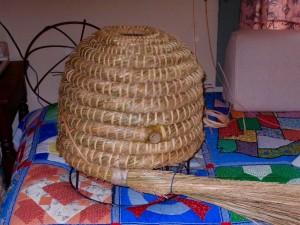
Just a few more rounds to go, then I’ll begin the bottom tray.
Is a woven hive calling to you? Listen!
http://www.keepingbackyardbees.com/k...wold-approach/
www.beehavenblog.wordpress.com.
-
The Following 4 Users Say Thank You to william r sanford72 For This Post:
Cidersomerset (3rd November 2016), fourty-two (3rd November 2016), Star Tsar (26th October 2016), Stephanie (1st November 2016)
-
24th October 2016 14:24
Link to Post #1222
Avalon Member
Re: Calling all light warriors - the Bees need you!
Neonicotinoid Insecticide Exposure Reduces Bumblebee Colony Size
(Beyond Pesticides, October 24, 2016) Systemic neonicotinoid (neonic) exposure is associated with reductions in colony size and changes in foraging behavior, according to a recent field study done by a team of scientists at Imperial College London. The senior author of the study, Richard Gill, Ph.D., stated that when neonicotinoid “exposure is relatively persistent and combined with other stressors associated with land use change, they could have detrimental effects at the colony level.”
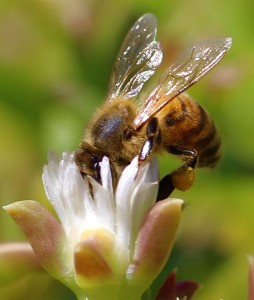
The study, Impact of controlled neonicotinoid exposure on bumblebees in a realistic field setting, assesses the effect of exposure to the neonic, clothianidin, on bumblebee foraging patterns and colony size. Clothianidin was given to 20 buff-tailed bumblebee colonies for five-weeks in a sugar solution at a concentration of 5 parts per billion, an environmentally relevant level of the pesticide. A bumblebee colony census was done before and after the field experiment, where the number of eggs, larvae, pupae, and workers bees were recorded along with the wax and pollen stores in the colony. The researchers found that the clothianidin treated colonies had fewer workers, drones and reproductive female bees compared to the colonies with no exposure. These data add to the growing body of research on sub-lethal effects, which must be considered when looking at the effects of pesticides on non-target organisms.
This study adds to the body of science that has examined the effects of neonic exposure to bee colonies under field conditions. However, neonic pesticides have long been identified as a major culprit in bee decline by independent scientists and beekeepers, yet chemical manufacturers like Bayer and Syngenta have focused on other issues such as the varroa mite. As Beyond Pesticides wrote in the 2014 issue of Pesticides and You, the issue of pollinator decline is No Longer a Big Mystery, and urgent action is needed now to protect pollinators from these toxic pesticides.
Neonics are associated with decreased learning, foraging and navigational ability, as well as increased vulnerability to pathogens and parasites as a result of suppressed bee immune systems. In addition to toxicity to bees, pesticides like neonicotinoids have been shown to also adversely affect birds, aquatic organisms and contaminate soil and waterways, and overall biodiversity.
These findings follow on the recent decision by the U.S. Fish and Wildlife Service (FWS) to add a group of bees to the Endangered Species List. FWS published a final rule in early October that declares seven species of yellow-faced bees that are native to Hawaii as endangered. This announcement follows the FWS’s proposed listing of the rusty patched bumble bee as an endangered species under the Endangered Species Act (ESA). FWS says that it needs additional time to identify specific areas to be designated as critical habitat for the endangered bees. Further, though FWS has identified many threats to bees, including habitat loss and degradation due to urbanization, and other human activities, the final rule does not specifically point to pesticides. However, there is an overwhelming number of research studies demonstrating that neonicotinoid insecticides, working either individually or synergistically, play a critical role in the ongoing decline of bees and other pollinators.
Over the past decade, numerous studies have illuminated the negative effect that neonics have on different pollinator species, but until now little research has been performed on the chemicals’ long-term impacts. The results of this recent study provide additional evidence that links the sublethal impacts of neonic exposure and large-scale population extinctions of wild bee species.
Despite limited action in the United States by federal agencies and Congress to discontinue the use of neonicotinoid insecticides and toxic pesticides in general, consumers and advocates around the country can create safe pollinator habitat and encourage local governments to do the same. Ultimately, the widespread adoption of organic management is necessary to protect pollinators and the environment in the long-term. Farms or other land areas that are managed with chemical-intensive practices turn habitat into pollinator killing fields.
Beyond Pesticides has long sought a broad-scale marketplace transition to organic practices that prohibits the use of toxic synthetic pesticides by law and encourages a systems-based approach that is protective of health and the environment. For information on growing plants to protect pollinators, see our Pollinator-Friendly Seeds and Nursery Directory.
Use the Bee Protective Habitat Guide to plant a pollinator garden suited for your region, and consider seeding white clover into your lawn. You can also declare your garden, yard, park or other space as pesticide-free and pollinator friendly. Sign the pledge today! More information on the adverse effects neonics can be found in the Beyond Pesticides’ report Cultivating Plants that Poison.
Source: Science Daily, Imperial College London
http://beyondpesticides.org/dailynew...e-colony-size/
-
The Following 4 Users Say Thank You to william r sanford72 For This Post:
Cidersomerset (3rd November 2016), fourty-two (3rd November 2016), Star Tsar (26th October 2016), Stephanie (1st November 2016)
-
25th October 2016 17:55
Link to Post #1223
Avalon Member
Re: Calling all light warriors - the Bees need you!
Shimmering blue plant manipulates light with crystal quirks

Blue leaf iridescence, a striking form of structural colour originating from specialised chloroplasts.
Matthew Jacobs
It sounds like an evolutionary mistake – why would a plant that lives in the dark understory of a tropical forest reflect light from its leaves? But it's actually a brilliant way to manipulate light and jack up photosynthetic efficiency.
A team of researchers in the UK led by Heather Whitney from the University of Bristol closely examined the structures inside Begonia pavonina cells and found the light-harvesting process increased the plant’s photosynthesising efficiency by as much as 10%.
The work was published in Nature Plants.
B. pavonina lives in the understory of Malaysian tropical forests. And much like a soap bubble or beetle shell, the vibrant blue B. pavonina leaves are iridescent, which means their colour shifts with viewing angle.
In a study earlier this year, Whitney was part of a team that found iridescence in some flower petals signalled to pollinators.
But in leaves, she says, the purpose wasn’t so clear-cut – especially in a species that spends its life under thick canopies where little sunlight penetrates.
“It appears so counter-intuitive,” Whitney says. “Why would plants that live in such dark surroundings actually go to the trouble of producing structures that reflect photosynthetically useful light?”
Whitney and her crew observed the leaves under a light microscope and saw its blue colour stemmed from unusual chloroplasts – the structures responsible for photosynthesis, which uses sunlight to convert carbon dioxide and water into sugar and oxygen – called iridoplasts.
Normal chloroplasts contain membranes like stacked pancakes called thylakoids. They can be variable in size and thickness and their primary function is to absorb light.
In iridoplasts, though, Whitney saw the thylakoids, stacked around three or four high, were regularly spaced. This means the iridoplasts regulated light, letting only certain colours (or wavelengths) pass and ramping up the amount of light captured at the green end of the light spectrum.
So the wavelengths most useful to photosynthesis were concentrated, making the best use of the little light available.
The effect may not be limited to B. pavonina. Since iridoplasts are present in a diverse range of plants – not only iridescent ones – the researchers write the light-harvesting prowess of B. pavonina could be widespread.
“While the fact that chloroplasts interact with light has obviously long been known, that they can manipulate this light gives us a whole new perspective on chloroplasts and photosynthesis as a whole,” Whitney says.
https://cosmosmagazine.com/physics/s...ike-structures
-
The Following 5 Users Say Thank You to william r sanford72 For This Post:
Bluegreen (3rd November 2016), Cidersomerset (3rd November 2016), fourty-two (3rd November 2016), Star Tsar (26th October 2016), Stephanie (1st November 2016)
-
25th October 2016 17:59
Link to Post #1224
Avalon Member
Re: Calling all light warriors - the Bees need you!
Monsanto Loses GMO Permit In Mexico
By Liam S. Whittaker -
Oct 25, 2016

Many countries around the world have now completely banned genetically modified food and the pesticides that go with them, or at least have severe restrictions against them. Now Mexico can be added to the list!
According to The Yucatan Times, This comes after the world has experienced a massive resistance against Monsanto and other biotech giants that manufacture GMOs and pesticides.
The resistance is also a result of a multitude of studies that have emerged showing the environmental and health dangers that are associated with pesticides, as well as health dangers that could be associated with GMOs.
The most recent country in the headlines for banning Monsanto products is Mexico.
A group of beekeepers was successful in stopping Monsanto from planting soybeans that are genetically modified to resist their Round-up herbicide.
Monsanto had originally received a permit to plant its GM seeds on over 250,000 hectares of land, which equates to approximately 620,000 acres. That’s a lot of land and a lot of pesticide!
They were able to get the permit despite thousands of citizens, beekeepers, Greenpeace, Mayan farmers, The National Institute of Ecology and other major environmental groups protesting against it.
“A district judge in the state of Yucatán last month overturned a permit issued to Monsanto by Mexico’s agriculture ministry, Sagarpa, and environmental protection agency, Semarnat, in June 2012 that allowed commercial planting of Round-up ready Soybeans. In withdrawing the permit, the judge was convinced by the scientific evidence presented about the threats posed by GM soy crops to honey production in the Yucatán peninsula, which includes Campeche, Quintana Roo and Yucatán states.Co-existence between honey production and GM soybeans is not possible, the judge ruled.”
The pesticides ARE killing the bees, and farmers are unable to export pollen from GMO crops! If the honey is made from GMO crops, then the European market becomes unavailable due to the European ban that has been in place since 2001.
With the myriad of scientific information showing the dangers of pesticides used on GM foods and the physical disappearance of much of the bee population, isn’t it about time to reconsider what we call “food?” Isn’t it time to reconsider filling the fields with death?
It is time for American leaders to listen to the dozens of other countries that have banned GM food!
Mexico is the fourth largest honey producer and fifth largest honey exporter in the world.
http://csglobe.com/monsanto-loses-gmo-permit-mexico/
-
The Following 5 Users Say Thank You to william r sanford72 For This Post:
Bluegreen (3rd November 2016), Cara (26th October 2016), Cidersomerset (3rd November 2016), Star Tsar (26th October 2016), Stephanie (1st November 2016)
-
26th October 2016 13:44
Link to Post #1225
Avalon Member
Re: Calling all light warriors - the Bees need you!
Varroa Mites: No-Treatment is the Best Treatment

Drone pupae with varroa mites. Image: Wikipedia.
The narrative in the mainstream press about beekeeping tends to be about brave and environmentally conscious beekeepers fighting the scourge of big ag’s pesticides. But the truth is far messier. Step into the world of beekeeping and what you’ll find is a swarm of acrimonious finger pointing and a heavy reliance, by conventional beekeepers, on pesticides. Why would beekeepers use pesticides? Varroa mites.
The varroa mite is a tiny blood sucking parasite that hops on individual bees and infests whole colonies. Originally from Java, varroa first appeared in the United States in 1987. By far the number one topic at any conventional beekeeping conference is the varroa mite. My beekeeping mentor Kirk Anderson likes to quip that the singular obsession with varroa is “like going to dog show where everyone only talks about fleas.”
One of the controversial aspects of what’s come to be called “backwards” (named after an essay by Charles Martin Simon and taught by Anderson) beekeeping has been two practices: keeping feral bees for their believed varroa resistance and not treating bees in order to favor stronger colonies.
Let’s first define what a “feral” bee is. Honey bees are not native to the Americas. They were, most likely, brought here by the Spanish. Since that introduction, some honey bees escaped tended apiaries and took up residence in forests and cities where they have lived, happily, for centuries without much human intervention. To clarify, when I say “feral” bees I mean untended honey bees (Apis mellifera) not any of the 4,000 species of native bees in North America such as carpenter bees and bumblebees.
Most conventional beekeepers buy or breed their own colonies and queens. Backwards beekeepers collect swarms and remove and relocate feral colonies. When it comes to varroa mite these feral colonies have gone through a process of natural selection. When varroa arrived in the Americas, no doubt, many feral colonies died out. But the ones that had natural resistance survived. Over time feral colonies have developed hygiene practices that greatly reduce the varroa problem. They still have varroa, but they don’t succumb to it.
Most controversially, natural, backwards beekeepers such as myself do not treat our bees for mites, believing that such treatment interferes with the microbiome of the colony and leads to bees that lack natural resistance to varroa. No-treatment beekeepers don’t even use so-called “natural” treatments such as dusting with powdered sugar or essential oils.
A technological solution to varroa?
A recent article in Wired Magazine profiled Jerry Hayes, A Swarm of Controversy In Their Struggle for Survival Against Killer Mites, Bees Get an Unlikely Ally: Monsanto. Hayes was a state beekeeping inspector in Florida and an advice columnist in the American Bee Journal before taking a job with Monsanto. The article looks at Hayes’s work at Monsanto which uses RNA interference (RNAi) to target varroa. It’s easy to see why Hayes would be interested in RNAi technology. It has the potential to knock out varroa mite without the many problems of current miticides. Critics of RNAi, however, bring up the issue of risk management: the unintended consequences of using a novel technology such as RNAi. If something did go wrong it could go very wrong, what some scientists refer to as an “oops” moment.
The ideas in the article, like much science reporting in the mainstream press, suffer, in my opinion from what Nassim Taleb calls the “technological salvation fallacy,” the idea that solutions are always technological. It’s an approach that Taleb criticizes as “blind to risk.” It goes hand in hand with an 18th century Enlightenment narrative of continuous improvement that, I believe, is proving incredibly dangerous (see climate change, nuclear weapons, industrialized genocide etc.). To step out of this Hegelian view of history is, in our contemporary culture, to be a crank a description I’ve come to embrace.
My cranky advice for beekeepers
A prescient 1998 paper in the Journal California Agriculture predicted,
It is unlikely that European bees will evolve resistance [to varroa] because commercial beekeepers must treat their colonies with miticides to stay in business. Varroa eliminate feral European colonies that are then replaced either with AHB [Africanized honeybees] or with European colonies derived from nonresistant commercial colonies. In the end, AHB will spread to their ecological limits, wherever they may be.
The future predicted in that article has arrived. I have heard, from three sources in the natural beekeeping community, that conventional beekeepers are secretly buying feral AHB colonies and queens. The reason is simple. AHB colonies live with and don’t succumb to varroa because they were never treated for the problem.
My experience is limited to Southern California and I’ve only kept (well mannered) AHBs. But the no-treatment approach is not limited to AHB. Here’s what Michael Bush has to say about no-treatment beekeeping in an article on his website, Four simple steps to healthier bees,
What is the upside of not treating? You don’t have to buy the treatments. You don’t have to drive to the yard and put the treatments in and drive to the yard to take them out. You don’t have to contaminate your wax. You don’t upset the natural balance by killing off micro and macro organisms that you weren’t targeting but who are killed by the treatments anyway. That would seem like upside enough, but you also give the ecosystem of the bee hive a chance to find some natural balance again.
But the most obvious up side is that until you quit treating you can’t breed for survival against whatever your issues are. As long as you treat you prop up weak genetics and you can’t tell what weaknesses they have. As long as you treat you keep breeding weak bees and super mites. The sooner you stop, the sooner you start breeding mites adapted to their host and bees who can survive with them.
The treatment vs. no-treatment issue is so tribal in nature that, perhaps, we will have to wait for the pro-treatment technological salvationists to depart, along with Elon Musk, for those Martian colonies (good luck with that one guys) and leave us treatment-free beekeepers in peace on good old planet Earth.
http://www.rootsimple.com/2016/10/va...est-treatment/
-
The Following 3 Users Say Thank You to william r sanford72 For This Post:
Cidersomerset (3rd November 2016), Star Tsar (26th October 2016), Stephanie (1st November 2016)
-
26th October 2016 13:51
Link to Post #1226
Avalon Member
Re: Calling all light warriors - the Bees need you!
A Ghost In The Making: Searching for the Rusty-patched Bumble Bee
Everyone has heard about bee declines, but with so much attention focused on domesticated honeybees, someone has to speak up for the 4,000 species of native bees in North America. Natural history photographer Clay Bolt is on a multi-year quest to tell the stories of our native bees, and one elusive species – the Rusty-patched Bumble Bee – has become his ‘white whale.’
Traveling from state to state in search of the Rusty-patched, he meets the scientists and conservationists working tirelessly to preserve it. Clay’s journey finally brings him to Wisconsin, where he comes face to face with his fuzzy quarry and discovers an answer to the question that has been nagging him all along: why save a species?
-
The Following 3 Users Say Thank You to william r sanford72 For This Post:
Cidersomerset (3rd November 2016), Star Tsar (26th October 2016), Stephanie (1st November 2016)
-
27th October 2016 19:52
Link to Post #1227
Avalon Member
Re: Calling all light warriors - the Bees need you!
AG Takes Action Against Bayer Over Deceptive Marketing About Risks of Pesticides
For Immediate Release - October 27, 2016
First-of-Its-Kind Enforcement Action by a State Attorney General Targeting a Manufacturer of Neonicotinoid Pesticides
BOSTON — Bayer CropScience, the world’s largest agrochemical company and one of the largest global manufacturers of pesticides, has agreed to pay $75,000 and change its advertising practices to resolve allegations that the company misled and deceived consumers about the potential risks its pesticides pose to bees and the environment, Attorney General Maura Healey announced today.
The assurance of discontinuance, filed today in Suffolk Superior Court, is believed to be the first time any major pesticide company has agreed to a court order to address alleged false advertising regarding risks posed by its products containing synthetic chemicals – known as neonicotinoids – to bees, other pollinators and species, and the environment. Bayer CropScience LP (Bayer) is a division of Bayer AG.
“Bayer made numerous misleading claims to consumers about the safety of its pesticide products, including falsely advertising that they were similar to giving ‘a daily vitamin’ to plants, when in fact, they are highly toxic to honey bees and other pollinators in the environment,” said AG Healey. “This settlement is an unprecedented step from a major pesticide manufacturer to promote truth in advertising for consumers about products that expose bees and the environment to harm and in turn also impact farming and food production.”
Honey bees play an essential role in crop pollination for both small, local farms and large national farming operations. The U.S. Department of Agriculture has reported that a quarter of the American diet depends on honey bee pollination.
The AG’s Office began an investigation in September 2013 into Bayer’s advertising for its lawn and garden products. As a result, the AG’s Office alleges that the company violated the state’s Consumer Protection Act by making deceptive and misleading claims that its products did not present risks to bees, other pollinators, and the environment.
The lawn and garden products, which include Bayer Advanced® All-in-One Rose and Flower Care, Bayer Advanced® 12 Month Tree & Shrub Protect and Feed II, and Bayer Advanced® Season Long Grub Control Plus Turf Revitalizer, contain the active ingredients imidacloprid and/or clothianidin, which belong to a family of synthetic chemicals called neonicotinoids. Neonicotinoids are systemic chemicals designed to spread their toxin throughout the plant, including into the plant’s pollen, where the toxic pesticides are easily accessible to pollinators. In addition to causing harm to bees, neonicotinoid exposure on land and in bodies of water has been associated with adverse effects on fish, amphibians, birds, and bats.
Bayer’s alleged deceptive advertisements included statements that:
Its neonicotinoid products are environmentally friendly to beneficial insects including honey bees;
Neonicotinoids are active ingredients approved by the Environmental Protection Agency (EPA), even though the EPA cautions pesticide companies not to characterize any pesticide product as EPA-approved;
Identified the active ingredient in some of its neonicotinoid products only by the term “Merit®,” when the active ingredient is the neonicotinoid pesticide, imidacloprid; and
The consumer should think of systemic insecticides like a preventative treatment, much like taking a daily vitamin.
Today’s settlement requires that Bayer refrain from using any reference or claim that the products are safe, environmentally friendly, non-toxic, or will not harm bees or other pollinators unless the company can substantiate the claims, along with prohibiting any other misleading assertions about the product being safe or harmless.
The settlement also requires that all advertisements state that consumers should read and follow all instructions on the product label.
The AG’s Office also initiated an investigation of Scotts Miracle-Gro for similar allegations, and discontinued the investigation after Scotts decided to phase out neonicotinoids from its lawn and garden consumer product line earlier this year.
For more information about residential pest control click here.
This case was handled by Assistant Attorney General Andrew Goldberg, of AG Healey’s Environmental Protection Division, and Assistant Attorney General Melissa Hoffer, Chief of AG Healey’s Energy and Environment Bureau.
http://www.mass.gov/ago/news-and-upd...marketing.html
-
The Following 3 Users Say Thank You to william r sanford72 For This Post:
Cidersomerset (3rd November 2016), Star Tsar (2nd November 2016), Stephanie (1st November 2016)
-
27th October 2016 20:06
Link to Post #1228
On Sabbatical
-
The Following 3 Users Say Thank You to The Freedom Train For This Post:
Cidersomerset (3rd November 2016), Star Tsar (2nd November 2016), william r sanford72 (27th October 2016)
-
27th October 2016 20:07
Link to Post #1229
Avalon Member
Re: Calling all light warriors - the Bees need you!
USDA...NATIONAL HONEY REPORT
October 25, 2016
-
The Following 3 Users Say Thank You to william r sanford72 For This Post:
Cara (28th October 2016), Cidersomerset (3rd November 2016), Star Tsar (2nd November 2016)
-
28th October 2016 06:10
Link to Post #1230
Avalon Member
Re: Calling all light warriors - the Bees need you!
Will Bayer Succeed In Overturning Neonic Ban
Published on Oct 27, 2016
In this week’s segment of The Neonicotinoid View, host June Stoyer and Tom Theobald talk to bee health advocate and environmental author, Graham White about the upcoming review of the 2013 ban of neonicotinoids in Europe and Bayer’s efforts to overturn it.
www.theorganicview.com.
-
The Following 3 Users Say Thank You to william r sanford72 For This Post:
Cidersomerset (3rd November 2016), Star Tsar (2nd November 2016), Stephanie (1st November 2016)
-
28th October 2016 15:08
Link to Post #1231
Avalon Member
Re: Calling all light warriors - the Bees need you!
Monsanto Bayer: Two Destructive Corporate Conglomerates Become One

Big AG tech giants Monsanto – maker of Agent Orange, genetically modified seeds, weed whacking chemicals – and Bayer – famed for manufacturing heroin, baby aspirin, and systemic pesticides – are merging, much to the horror of food security advocates, consumers, and non-zombies worldwide.
CNN Money declared the Monsanto Bayer merger “the year’s biggest takeover.” Symbolically, it’s the merger of the century.
At $66 billion, it’s also the biggest cash transaction on record. Vermont Senator Bernie Sanders describes the mega deal as “a threat to all Americans.”
“These mergers boost the profits of huge corporations and leaves Americans paying even higher prices,” he said.
If things unfold as planned, the new company (MonBayer? BaySanto? Or should they just call themselves Poisonous?) will generate approximately 50 percent of its revenue from selling “medicine” and the other half from agriculture.
How convenient. They can make us sick with their poisonous, genetically modified faux food, and then treat us with their treadmill of drugs.
The consolidation will create supply-chain dominance, aka vertical integration, in a $100 billion global market.
Monsanto Bayer may as well fuse. They’re a compatible match.Right now, Monsanto’s herbicide-resistant GM crops withstand Roundup and/or dicamba, not Bayer herbicides. The merged giant would start engineering GM crops resistant to Bayer herbicides.
And besides, Bayer’s mischief is mistaken for Monsanto’s all the time. I can’t tell you how many times people credit Monsanto for colony collapse disorder and killing bees.
And while GMO seeds and herbicides are definitely not improving the environment, Bayer’s systemic pesticides deserve every negative implication.In fact, these chemicals are also harming worms, soil, other pollinators, our waterways, aquatic life and humans.
But everyone loves to hate Monsanto.
“The Monsanto brand has many negative associations,” says David King, associate professor at Iowa State University where he teaches undergraduate strategy and assesses the performance of mergers and acquisitions, technology innovation, and defense procurement.
He thinks the Monsanto Bayer merger is a great brand strategy for Monsanto.
According to the Monsanto’s recent courtship history – they approached Syngenta last year with an offer – they agree. King envisions a future where the Monsanto brand name will ultimately be removed as a way to reposition the consolidated firm.
Why do you think Blackwater changed its name to XE, and then Academi?
King just returned from a conference in Berlin where he talked about the Monsanto Bayer merger and learned that many in Europe feel it’s a travesty that Bayer would “tarnish its good name” by acquiring the company behind Roundup and genetically modified crops.
But critics dismiss this sentiment. After all, Bayer is viewed as “Europe’s Monsanto.”
“Bayer [does] significantly better public-relations work than Monsanto, but that’s it,” contends Antonius Michelmann, CEO of the Coalition against BAYER-Dangers.
“Bayer [does] significantly better public-relations work than Monsanto, but that’s it,” contends Antonius Michelmann, CEO of the Coalition against BAYER-Dangers.
“Both, Monsanto and Bayer are poisoning and immediately endangering animals, plants and human life. Both care just about profits and nothing else.”
Bayer already does business with Monsanto. Joint projects include a seed treatment combination: Bayer’s Poncho/Votivo seed-applied insecticide is combined with Monsanto’s Acceleron seed treatment for nematodes.
In 2011, Monsanto and Bayer joined forces to sell soybean GMO seeds coated with a systemic pesticide. In the United States, there are 90 million acres of corn sprouted from GMO seed and treated with a systemic pesticide; now Monsanto and Bayer will have all the pesticides they need in-house.
Isn’t this tarnish enough?
Gone With The Weeds
So why are the companies merging now?
Well, that very much depends on whom you ask.
According to the two Ag giants, the narrative goes something like this: It’s estimated that by 2050 there will be an additional 3 billion people on the planet. Ergo, the merger “is needed to meet a rising food demand.”
Enter Monsanto and Bayer to the rescue!
“What we do is good for consumers. We help to produce sufficient, safe, healthy, and affordable food,” Werner Baumann, CEO of Bayer AG said during a recent press conference.
“[This merger] is also good for our growers. Because they[‘ll] have better choices to increase yields in a sustainable way … Together, we want to make and shape the future of farming.”
It’s amazing the millions of corn fields that can exist between rhetoric and reality.
The “we-need–to-feed-the-world” propaganda has been disproved.
“These two companies are tone deaf to public health and environmental protection. Between them they’re responsible for introducing devastating chemicals,” says Jay Feldman, Executive Director of Beyond Pesticides. “
The question asking if we can actually feed the world without toxic chemicals has long been answered. Despite all our modern ingenuity, we have the same degree of crop loss today that we had before the pesticide revolution.”
According to the Food and Agriculture Organization of the United Nations, the world produces more than 1 1/2 times enough food to feed everyone on the planet.
“Unfortunately, over a billion of the world’s people are too poor to buy this food – so they go hungry. Corporate mergers aren’t going to change that,” write authors Ahna Kruzic and
Eric Holt-Giménez (Monsanto Merger Blues,Food First). They are on point.
So what’s really the thrust behind the merger?
Ask analysts, and they’ll tell you that the entire Ag sector is depressed right now. Farmers are spending less on seeds, fertilizers, and pesticides. Monsanto alone is$9 billion in debt. (It was $1 billion only three years ago.) Currently, the company isn’t in a position to invest money to develop more products and keep up with competitors.
Like the old saying goes, if you can’t beat ’em, join ’em.
Year Of Merging Dangerously
In 2014, worldwide merger and acquisition activity exceeded $3.1 trillion, writes King, who co-edited a recent book on the subject.
At the beginning of 2016, Dow Chemical and DuPont joined forces in a $130 billion merger, and earlier this year Syngenta agreed to a $43 billion sale to China National Chemical Corp.
Writes Vox’s Brad Plumer, “mergers can help slow down the bleeding and boost market share and growth and still allow them to spend billions developing new products.”

Over the years, Monsanto, Syngenta, Bayer, DuPont, Dow, and BASF have respectfully gobbled up about 75 percent of small to medium-size enterprises engaged in biotechnology research. Today, what food advocates refer to as the Big Six has now shrunk to the Big Four: Syngenta, BASF and a 70 percent dominated global market between Monsanto-Bayer and Dow-DuPont.
This buyout is likely to create a grizzly future. “Seed prices could rise for farmers; consumers could see more genetically engineered foods on supermarket shelves, and our global agricultural system could end up depending on just a few companies to meet a high percentage of the world’s agricultural needs,” Leah Douglas, a policy analyst for New America, wrote in a CNN op-ed.
For those who argue the Monsanto Bayer merger will decrease market competition because of overlap, the corporate heads say, “Pashaw!” Monsanto focuses on seeds and biology, Bayer on chemicals. Au contraire, the union allows them to combine their “complementary strengths.”
3 Key Points Obstructing Monsanto Bayer Merger Madness
Bayer has finalized a $57 billion bridge loan to support its acquisition of Monsanto. According to Bloomberg, 27 lenders have joined the deal, including European and Japanese banks.
According to Maurice Stucke of the Konkurrenz Group, and formerly with the Justice Department, merger reviews of this complexity can take six to nine months.
Therefore the deal wouldn’t close until 2017, when it would then fall into the lap of the new administration. Fortunately, there are still several hurdles to navigate before this super company becomes a reality.
Shareholders in both companies must still approve the deal. Bayer holds the right to pull out if the integration is seemingly difficult or if they cannot achieve expected synergies. If Bayer does choose to break up, they’re issuing a $2 billion parting gift to Monsanto.
The merger still has to be confirmed by the European Commission. Foreign antitrust approval must also be granted. This will prove interesting since Europe is not a fan of GMO crops; many of Monsanto’s products are in fact banned in Europe.
In the United States, two antitrust agencies (the Justice Department and the Federal Trade Commission) need to collaborate on their analysis of the agricultural biotechnology and seed industry to ensure that the multiple transactions under consideration do not substantially lessen competition. According to the nonprofit SumOfUs, the Bayer Monsanto merger violates antitrust laws. “The proposed merger would violate a court order that was part of a U.S. Department of Justice consent decree and the primary U.S. anti-trust merger statute, the Clayton Act.”
Bayer is committed to selling $1.6 billion assets to gain antitrust approval. For instance, Monsanto Bayer control 70 percent of all cotton acreage in the U.S., which is already genetically modified by Monsanto and treated with systemic poisons by Bayer.
So the new company would be required to sell one of their existing cottonseed brands. Also Bayer’s Liberty Link competes with Monsanto’s Roundup, so they may just want to pour the mixtures together and call it a day.
Who will keep these companies accountable?
On Oct. 15-16, a panel of six internationally renowned judges will hear testimony from 30 witnesses covering five continents where there are reports of injury by Monsanto’s products.
This grassroots-led international citizens’ tribunal and People’s Assembly will culminate in November with the release of advisory opinions prepared by the judges. (Register for Monsanto Tribunal & People’s Assembly.)
The tribunal’s work, which includes making the case for corporations to be prosecuted for ecocide, is all the more relevant because of the ICC’s(International Criminal Court) announcement.
Whatever decision is reached, it may only be symbolic. No matter what happens at this tribunal, we don’t know what accountability will look like going forward. We’re living in Looney Tune times.
While there has been buzz about transparency in recent years, lies have become “the new truth” — to quote comedian and HBO Real Time host Bill Maher.
Certainly countries and corporations are getting away with murder, these days. For revolutionaries committed to a world without toxic chemicals or miles of monocultures, the proposed merger of Monsanto and Bayer means two of our rivals will now be housed under one roof; the deplorable actions that place profit over people and planet remain the same.
http://csglobe.com/monsanto-bayer-tw...es-become-one/
-
The Following 5 Users Say Thank You to william r sanford72 For This Post:
Cidersomerset (3rd November 2016), Gillian (7th November 2016), RunningDeer (28th October 2016), Star Tsar (2nd November 2016), Stephanie (1st November 2016)
-
30th October 2016 15:11
Link to Post #1232
Avalon Member
Re: Calling all light warriors - the Bees need you!
Most Top Retailers Sell Food Produced with Bee-Killing Pesticides
Only Aldi, Costco, and Whole Foods got passing grades
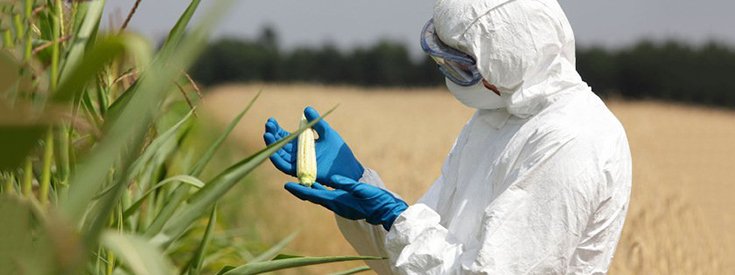
A new ‘scorecard’ report gives a failing grade to 17 out of 20 major food retailers in the United States, based on their policies and practices regarding pollinator protection, organic options, and pesticide reduction.
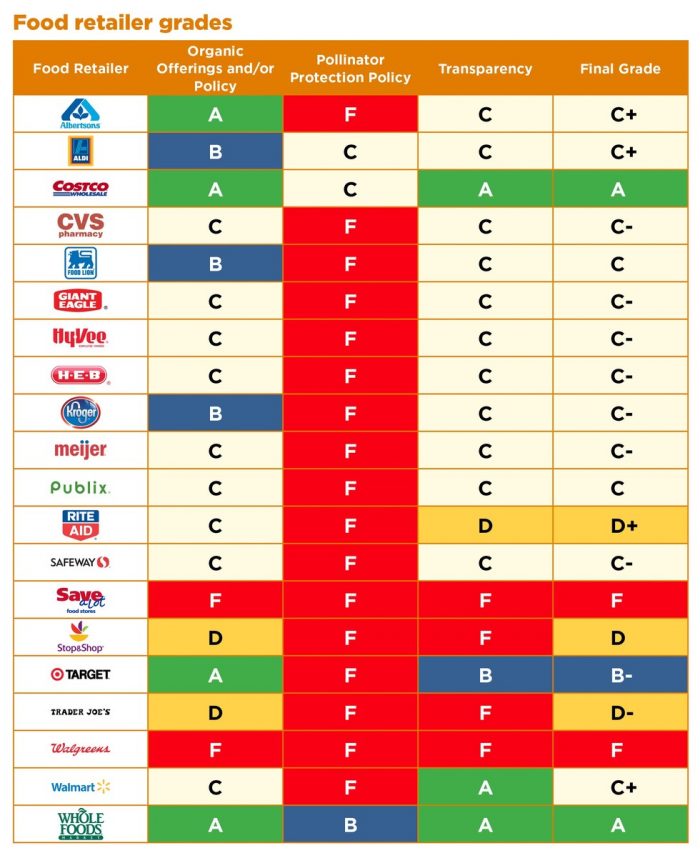
Tiffany Finck-Haynes, food futures campaigner with Friends of the Earth, said:
“U.S. food retailers must take responsibility for how the products they sell are contributing to the bee crisis.
The majority of the food sold at top U.S. food retailers is produced with pollinator-toxic pesticides. We urge all major retailers to work with their suppliers to eliminate pollinator-toxic pesticides and to expand domestic organic offerings that protect pollinators, people and the planet.” [1]
Organic Offerings and Transparency Are Lacking
The report “Swarming the Aisles: Rating Top Retailers on Bee-Friendly and Organic Food” is the work of a coalition led by Friends of the Earth and more than 50 farmer, beekeeper, farmworker, environmental, and public interest organizations.
The coalition sent a letter urging food retailers to eliminate pesticides that are toxic to bees and other pollinators, and increase U.S. Department of Agriculture (USDA) certified organic food and beverages to 15% of overall offerings by 2025. The group would like to see retailers prioritize domestic, regional, and local producers.
Friends of the Earth and its allies have been successful in the past at convincing more than 65 garden retailers, including Lowe’s and Home Depot, to commit to eliminate pollinator-toxic neonicotinoid (neonic) pesticides.
According to Haynes, the demand for organic foods has grown by double-digits, but grocers aren’t keeping up. She said:
“A lot of the major food retailers have started to increase their organic offerings, but few of them have really adopted clear goals or metrics to continue to significantly increase their organic food offerings in the future.” [2]
As evidenced by the group’s research, it’s difficult for the public to know where retailers stand concerning pesticide use and organic food. Eleven of the 20 retailers’ websites examined by Friends of the Earth don’t provide basic information concerning their policies on organic food, pollinators, and/or pesticides, Haynes said, adding
Americans Are Ready for Change
A YouGov poll released 25 October 2016 by Friends of the Earth and SumOfUs reveals that 80% of Americans believe neonics should not be used in agriculture, and 65% of those who do the grocery shopping for their household would be more likely to shop at a store that has made a formal commitment to eliminate neonicotinoids.
Additionally, the poll shows that 59% of respondents believe it’s important for supermarkets to sell organic food. Another 43% said they’d likely spend more time at a different grocery store if it sold more organic food than the store they currently frequent.
Said Angus Wong, lead campaign strategist at SumOfUs, a consumer watchdog with ten million members:
“Over 750,000 SumOfUs members have spoken out advocating that U.S. Hardware stores take action to protect our pollinators. And after years of pressure, Home Depot and Lowe’s have finally enacted more bee-friendly policies.
And the findings of this poll show that a vast majority of consumers want to eliminate neonicotinoids from their grocery stores too. This is why food retailers must commit policies that protect our bees immediately.”
Only four of the nation’s top food retailers – Albertsons, Costco, Target, and Whole Foods – have adopted and made public a company-wide commitment to increase offerings of certified organic food. They are also the only retailers to disclose data on the current percentage of organic food they offer, or organic sales.
Aldi, Food Lion, part of the Delhaize Group, and Kroger disclosed data on the current percentage of organic offerings or organic sales.
None of the retailers that the group looked at have publicly committed to sourcing organic food from American farmers.
Retailer Apathy Is Killing Pollinators
Of the top 20 food retailers surveyed by Friends of the Earth, a shocking 16 were predominantly unresponsive to Friends of the Earth’s requests for information via surveys, calls, and letters. The group was forced to turn to publicly available information, including company websites, company annual reports, U.S. Securities and Exchange Commission filings, corporate social responsibility and sustainability reports, press coverage, and industry analyses, for their data.
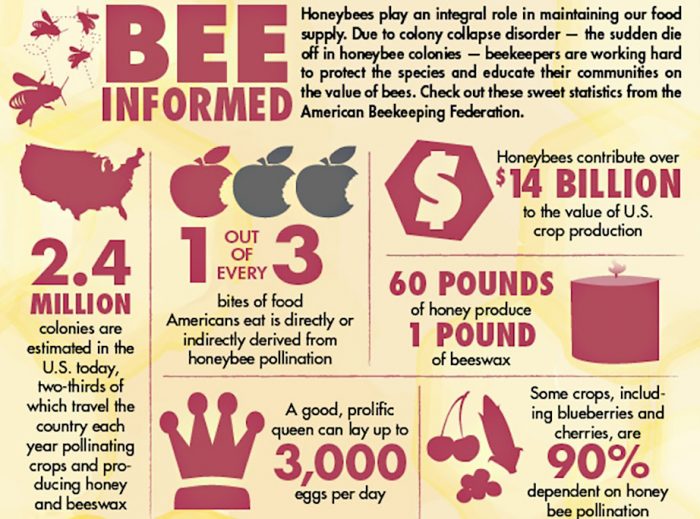
We have bees to thank for every 1 in 3 bites of food we take; and without bees, stores would run low on everything from strawberries to almonds.
Science increasingly points to neonicotinoid pesticides as a leading cause of pollinator decline. Glyphosate, the main ingredient in Monsanto’s blockbuster herbicide, Roundup, has been shown to play a significant role in monarch butterfly declines.
Read: How You Can Help the Dwindling Monarch Butterfly Population
Several U.S. cities have banned neonics, including Boulder City, Colorado, and Portland, Oregon. This past spring, Maryland became the first state to ban the pesticides.
Sources:
[1] Friends of the Earth
[2] Public News Service
Bee Cause
http://naturalsociety.com/most-top-r...sticides-6261/
-
The Following 4 Users Say Thank You to william r sanford72 For This Post:
Cidersomerset (3rd November 2016), Krist (30th October 2016), Star Tsar (2nd November 2016), Stephanie (1st November 2016)
-
30th October 2016 15:21
Link to Post #1233
Avalon Member
Re: Calling all light warriors - the Bees need you!
New PAN report warns of global contamination of health damaging glyphosate
Friday, October 28, 2016 by: Ethan A. Huff, staff writer
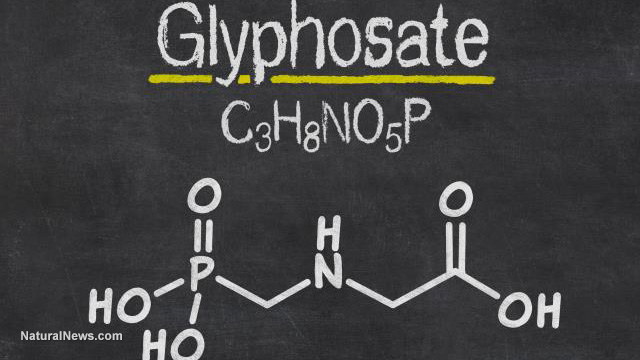
(NaturalNews) The popular herbicide glyphosate, also known as Roundup, is far more toxic to humans than the chemical industry claims it is, a new report has found. The Pesticide Action Network (PAN) in a 96-page document entitled Glyphosate, reveals how people all around the world are being systemically poisoned by glyphosate, and many of them are even dying.
Aerial sprayings of the chemical across crop fields are said to be safe for humans, because the so-called "shikimate" pathway upon which the herbicide acts exists only in plants, and not in animals or humans. But the report highlights the fact that, regardless of the supposed nonexistence of this pathway in humans, glyphosate is sill wreaking havoc on human health.
Some of the acute health effects of glyphosate exposure include gastrointestinal and skin infections, headaches, blistering on the skin, rapid heartbeat, elevated blood pressure, dizziness, numbness, insomnia, blurred vision, abdominal pain, chest pains, problems breathing, respiratory problems, sore throat and strange tastes in the mouth.
Other lesser-reported symptoms include problems staying balanced, cognitive abnormalities, impaired senses, muscle paralysis, peripheral neuropathy, decreased motor skills, chronic fatigue and abnormal body temperature. And none of this even touches on the long-term health effects of glyphosate exposure, which are significantly more problematic.
According to the report, glyphosate directly interferes with "numerous mammalian organs and biochemical pathways, including inhibition of numerous enzymes, metabolic disturbances and oxidative stress leading to excessive membrane lipid peroxidation, and cell and tissue damage." Furthermore, the report highlights "genotoxicity and endocrine disruption" that lead to "chronic health and developmental effects."
South American doctors confirm that glyphosate spraying is causing infertility, cancer
Though U.S. doctors and health experts appear reluctant to report on their observances with glyphosate, their counterparts in South America have a lot to say on the subject. Doctors in Argentina, for instance, are reporting what's being described as a "dramatic upsurge" in long-term health effects where glyphosate is being sprayed on genetically-modified soybean crops.
Included in the list of effects are infertility, pregnancy problems, birth defects, respiratory disease and various forms of cancer. Epidemiological studies have established a link between glyphosate exposure and non-Hodgkin lymphoma, hairy cell leukemia, multiple myeloma and DNA damage. Even at very low concentrations, glyphosate has been shown to damage vital organs like the liver and kidney, as well as skin cells.
Not only is glyphosate sprayed all over food crops during the growing season to kill weeds, but it's also used as a pre-harvest desiccant to speed up the growing and harvesting process. According to the report, this process is used on wheat, cotton, various cereal grains, peas, and beans, as well as other crops.
It's bad for the people who end up eating these food crops, but great for farmers and the chemical companies like Monsanto that they support when they purchase all that extra glyphosate. And the repercussions are startling. Glyphosate residues are now being found in women's breast milk, as well as in blood and urine. Even vaccines are starting to turn up as glyphosate-contaminated, which means developing babies are now being injected with this lethal poison.
"The PAN Report is extremely comprehensive and really needs to be mainstreamed so that food growers, in particular, can understand the harm they are doing to crops, the soil, the environment, wildlife, pollinators, water resources and humans," writes Catherine J. Frompovich for Natural Blaze.
"However, it will be up to consumers and farmers ... to make their concerns and priorities known about saving the planet and humankind from toxic chemicals in food, water and the air, if we are to survive toxic chemicals and their currently unavoidable poisonings."
The full PAN report is available for free online here.
Sources for this article include:
NaturalBlaze.com
PAN-International.org[PDF]
Learn more: http://www.naturalnews.com/055803_glyphosate_PAN_report_toxicity.html#ixzz4Oa9moOvo
http://www.naturalnews.com/055803_glyphosate_PAN_report_toxicity.html
-
The Following 3 Users Say Thank You to william r sanford72 For This Post:
Cidersomerset (3rd November 2016), Star Tsar (2nd November 2016), Stephanie (1st November 2016)
-
31st October 2016 16:11
Link to Post #1234
Avalon Member
Re: Calling all light warriors - the Bees need you!
Strength in numbers of clustering bees
Mary O’Riordan says maintaining the right temperature in the bee cluster is essential to ensuring it survives the winter as it can face several other hazards to boot.

Beekeepers are often asked if bees hibernate? They don’t. They form a cluster. Clustering is necessary for self-preservation.
Bees are poikilothermic and all that means is that they assume the temperature of their surroundings, so if the temperature drops to zero degrees, a bee’s body temperature will go to zero degrees and it will freeze to death.

Colonies of bees have adopted a method to overcome this deficiency by gathering together in the hive to form a heat reserve.
Bees start to cluster at an ambient temperature of 14C, forming a ball with the comb running through it, the top of the ball will be in contact with the store of honey at all times, and below this where the combs are empty, the bees will creep into the cells, making the cluster almost solid, the cluster has an outer shell of bees which can be very dense ranging in thickness from 25mm to 75mm thick.

The outer shell temperature must be maintained at 7C , (below this the outer bees will drop off and die), to maintain the critical temperature as the cluster contracts and expands.
The temperature in the centre of the cluster ranges from 20C to 30C when there is no brood in the hive, which usually happens around December/ January, and when the queen starts laying next February or so, temperatures will have to be maintained at 35C.
You may ask how do bees maintain this temperature? Well, they cluster to reduce their surface area thereby reducing heat loss.
Bees create heat within their body by muscular activity and then within the cluster. The muscles used are the indirect flight muscles. To flex these muscles the bees need to consume honey, so the cluster needs to be near food at all times.

It is very important not to disturb the cluster, even taking off the roof for a quick look can cause a rise in temperature within the cluster by up to 6C, the bees realise there is some interference, and break the cluster to investigate and fly out.
Excluding mice from the hive is paramount, apart from the damage they do to the comb, the disturbance to the cluster can result in weakening or even loss of the colony.
The modern open mesh floors have very big openings, why I don’t know, I’m sure the makers are not beekeepers, so they need a mouse guard which is pinned across the opening, and has bee space for the bees to exit and enter.
Clustering is the nucleus for next year’s honey crop.

Some important points for wintering: Make sure the bees have sufficient food to keep them going until next spring.
Keep out unwanted visitors like mice and check there is no damage after high winds.
Dampness, too, can be a serious problem, make sure there are no leaking roofs, as bees can withstand cold, bur not wet and dampness.
http://www.irishexaminer.com/lifesty...es-427955.html
-
The Following 4 Users Say Thank You to william r sanford72 For This Post:
Bluegreen (1st November 2016), Cidersomerset (3rd November 2016), Star Tsar (2nd November 2016), Stephanie (1st November 2016)
-
1st November 2016 00:14
Link to Post #1235
-
The Following 4 Users Say Thank You to william r sanford72 For This Post:
Bluegreen (1st November 2016), Cidersomerset (3rd November 2016), Star Tsar (2nd November 2016), Stephanie (1st November 2016)
-
2nd November 2016 15:23
Link to Post #1236
Avalon Member
Re: Calling all light warriors - the Bees need you!
After Cursory Review, EPA Proposes Dramatic Expansion of Toxic Pesticide Blend Enlist Duo
November 1st, 2016
Agency Ignores Legal Requirement to Fully Consider Impacts to Environment, Endangered Species
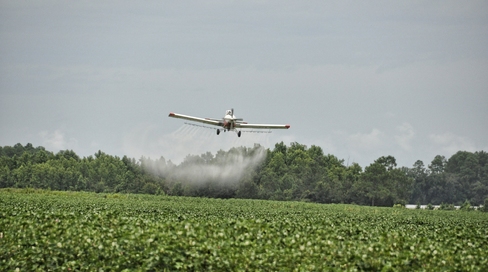
WASHINGTON— The Environmental Protection Agency today reapproved and proposed a dramatic expansion of the use of the toxic pesticide Enlist Duo after only a cursory review of troubling data showing the two chemicals in the pesticide combine to have “synergistic” effects that are potentially harmful to endangered species and the environment. If approved the pesticide cocktail could be used on corn, soy and cotton in 35 states — up from 16 states where the product was previously approved for just corn and soy.
The rush to expand the use of Dow AgroSciences’ toxic chemical concoction of glyphosate and 2,4-D for use on the next generation of genetically engineered crops comes only one year after the EPA asked a court to revoke its previous approval. That request, filed in response to litigation challenging Enlist Duo’s approval, resulted from the agency’s discovery that Dow AgroSciences had filed patent applications for the product filed with the U.S. Patent Office claiming “synergy.” EPA believed the product therefore could have significant and unknown environmental impacts. Today the EPA announced it does not believe the product has synergistic effects, despite Dow’s claims to the Patent Office.
“EPA's decision is a capitulation to the agrichemical industry,” said George Kimbrell, senior attorney with the Center for Food Safety. “We will continue to protect farmers, consumers, and the environment from this toxic crop system, and are exploring all legal options.”
“EPA’s sudden about-face on this product is just astounding,” said Dr. Nathan Donley, a senior scientist at the Center for Biological Diversity. “Just last year the EPA asked a court to cancel registration of this product due to the unknown risks it posed, and now it suddenly wants to more than double the number of states where the pesticide can be used? This proposal ignores the available data and will potentially harm our environment.”
“We're disappointed that EPA has doubled down on Enlist Duo rather than pulled its registration of this hazardous pesticide. Unless EPA makes substantial changes to its previous registration of Enlist Duo, we remain confident it violates the law,” said Paul Achitoff, a managing attorney at Earthjustice.
“Once again, EPA has failed to protect the health, well-being and livelihood of America’s farmers and rural communities. The agency’s decision dramatically increases the risk of pesticide drift causing severe crop losses and harms to human health,” said Marcia Ishii-Eiteman, Ph.D., a senior scientist with Pesticide Action Network.
Background
Dow created Enlist crops as a quick fix for the superweed problem created by “Roundup Ready” crops that were genetically engineered to withstand what would otherwise be a toxic dose of the herbicide glyphosate, the active ingredient in Monsanto’s Roundup herbicide. Just as overuse of antibiotics has left resistant strains of bacteria to thrive, repeated use of Roundup on those crops has resulted in the proliferation of glyphosate-resistant “superweeds” across millions of acres of U.S. farmland. Farmers are already reporting that some weeds have now also developed tolerance to 2-4, D. This means this next generation of new herbicide-tolerant crops will result in massive increases in pesticide use and perpetuate the pesticide treadmill.
The EPA’s negligence in evaluating the potential harms of new pesticides is not a new development. Earlier this year CBD released a groundbreaking report, Toxic Concoctions, finding that more than two-thirds of new pesticides registered in the past six years by the four major pesticide companies had patents demonstrating their new products’ synergistic effects with other pesticides — effects the EPA failed to consider. Synergism can greatly increase the harm of the pesticides to nontarget species such as bees and butterflies. Prior to 2016 the EPA had not considered patents showing pesticide synergy or incorporated the publically available patent information into their analyses of these new pesticides.
http://www.centerforfoodsafety.org/p...end-enlist-duo
-
The Following 2 Users Say Thank You to william r sanford72 For This Post:
Cidersomerset (3rd November 2016), Star Tsar (2nd November 2016)
-
3rd November 2016 15:19
Link to Post #1237
Avalon Member
Re: Calling all light warriors - the Bees need you!
New virus threatening world's bee populations
"Future challenges will be assessing the biological relevance of these novel pathogens," said researcher Gideon Mordecai.

NORWICH, England, Nov. 2 (UPI) -- Scientists have identified a new threat to bees, a virus carried by the invasive parasitic wasp species Vespula pensylvanica. According to a new study in journal Scientific Reports, the Moku virus is a threat to all pollinators, not just honey bees.
The virus is named for the Hawaiian island where it was first isolated. Recent DNA analysis by scientists at the Earlham Institute in England confirmed the virus' unique genetic material.
"The use of next generation gene sequencing techniques has led to a rapid increase in virus discovery, and is a powerful tool for investigating the enormous diversity of viruses out there," lead researcher Gideon Mordecai said in a news release.
Mordecai hopes his team's findings inspire scientists to more closely monitor the threat of new viruses -- and the risk of transmission -- among invasive species.
Unlike other species, limited by ecological niches, invasive species -- with track records of global adaptability -- are more likely to encourage the spread of viruses.
It's not clear yet how exactly the health of bee populations will be impacted by the new virus, but the research suggests the virus is likely to spread among bees endemic to Hawaii.
"Future challenges will be assessing the biological relevance of these novel pathogens and the role they play in the ecology of their hosts," Mordecai concluded.
While parasitic wasps and the viruses they carry are a distinct threat to bees and other pollinators, a number of studies suggest it is the cumulative effect of habitat loss, pollution and pesticides that render bees vulnerable to disease and prone to colony collapse.
http://www.upi.com/Science_News/2016...9991478106352/
Moku virus; a new Iflavirus found in wasps, honey bees and Varroa
Scientific Reports 6, Article number: 34983 (2016)
doi:10.1038/srep34983
Download Citation
Abstract
There is an increasing global trend of emerging infectious diseases (EIDs) affecting a wide range of species, including honey bees. The global epidemic of the single stranded RNA Deformed wing virus (DWV), driven by the spread of Varroa destructor has been well documented. However, DWV is just one of many insect RNA viruses which infect a wide range of hosts. Here we report the full genome
sequence of a novel Iflavirus named Moku virus (MV), discovered in the social wasp Vespula pensylvanica collected in Hawaii. The novel genome is 10,056 nucleotides long and encodes a polyprotein of 3050 amino acids. Phylogenetic analysis showed that MV is most closely related to Slow bee paralysis virus (SBPV), which is highly virulent in honey bees but rarely detected. Worryingly, MV sequences were also detected in honey bees and Varroa from the same location, suggesting that MV can also infect other hymenopteran and Acari hosts.
http://www.nature.com/articles/srep34983
-
The Following 2 Users Say Thank You to william r sanford72 For This Post:
Cidersomerset (3rd November 2016), Star Tsar (3rd November 2016)
-
3rd November 2016 15:31
Link to Post #1238
Avalon Member
Re: Calling all light warriors - the Bees need you!
More Bad News for Honey as U.S. Seeks to Get Handle on Glyphosate Residues in Food
Carey Gillam
Veteran journalist; Research Director for U.S. Right to Know, a non-profit consumer education group
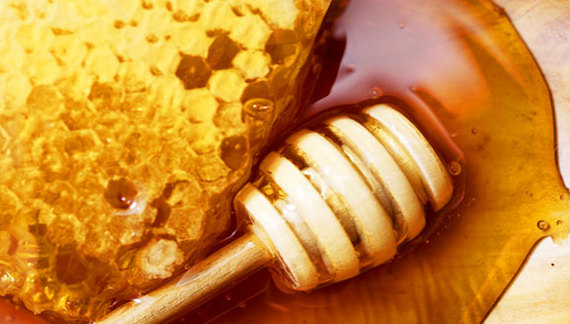
Testing for residues of an herbicide developed by Monsanto Co. that has been linked to cancer has turned up high levels in honey from the key farm state of Iowa, adding to concerns about contamination that have triggered at least two lawsuits against honey industry players and prompted scrutiny by regulators.
The Food and Drug Administration began glyphosate residue testing in a small number of foods earlier this year after the International Agency for Research on Cancer classified glyphosate as a probable human carcinogen in March 2015. The “special assignment,” as the FDA refers to the testing project, is the first time the FDA has ever looked for glyphosate residues in food, though it annually tests foods for numerous other pesticides.
Research by FDA chemist Narong Chamkasem and John Vargo, a chemist at the University of Iowa, shows that residues of glyphosate - the chief ingredient in Monsanto’s branded Roundup herbicide - have been detected at 653 parts per billion, more than 10 times the limit of 50 ppb allowed in the European Union. Other samples tested detected glyphosate residues in honey samples at levels from the low 20s ppb to 123 parts per billion ppb. Some samples had none or only trace amounts below levels of quantification. Previous reports had disclosed glyphosate residues in honey detected as high as 107 ppb. The collaborative work was part of an effort within FDA to establish and validate testing methodology for glyphosate residues.
“According to recent reports, there has been a dramatic increase in the usage of these herbicides, which are of risk to both human health and the environment,” Chamkasem and Vargo stated in their laboratory bulletin.
Because there is no legal tolerance level for glyphosate in honey in the United States, any amount could technically be considered a violation, according to statements made in FDA internal emails, obtained through Freedom of Information Act (FOIA) requests.
The Environmental Protection Agency may soon move to set a tolerance, however. The agency has set tolerance levels for glyphosate residues in many foods the EPA expects might contain residues of the weed killer. When residue levels are detected above the tolerance levels, enforcement action can be taken against the food producer.
“EPA is evaluating the necessity of establishing tolerances for inadvertent residues of pesticides in honey,” the agency said in a statement. The EPA also said there was no reason for consumers to be concerned about the residue in honey. “EPA has examined the glyphosate residue levels found in honey and has determined that glyphosate residues at those levels do not raise a concern for consumers,” the agency said.
Despite the reassurances, at least two lawsuits have been filed over the issue. The Organic Consumers Association and the Beyond Pesticides nonprofit group filed suit Nov. 1 against the Sioux Honey Association Cooperative, a large Iowa-based group of bee keepers who produce the nationally known brand Sue Bee Honey. Sue Bee bills itself as “America’s Honey,” but the lawsuit alleges that the labeling and advertising of Sue Bee products as “Pure,” “100% Pure,” “Natural,” and “All-natural” is “false, misleading, and deceptive.” Some of the glyphosate residues detected in the FDA tests were found in the Sue Bee brand, according to the FDA documents obtained through FOIA requests.
The claims are similar to another lawsuit, which seeks class action status, that was filed against Sioux Honey Association in late September in U.S. District Court for the Eastern District of New York.
Quaker Oats was sued earlier this year on a similar claim regarding glyphosate residues. The FDA has also found glyphosate residues in oatmeal, including several types of infant oat cereal.
Considering corn is a key crop in Iowa, and most of the U.S. corn crop is genetically modified to tolerate being sprayed directly with glyphosate, it is not necessarily surprising that glyphosate residues are showing up in honey in Iowa and other farm states. Honey bees naturally migrate from field to field and plant to plant, so can become contaminated by the pesticide easily and then transfer pesticide residues to their honey, according to bee industry leaders.
“It’s a chemical intrusion, a chemical trespass into our product,” said Darren Cox, president of the American Honey Producers Association. “We have really no way of controlling it. I don’t see an area for us to put our bees. We can’t put them in the middle of the desert. They need to be able to forage in ag areas. There are no ag areas free of this product.”
Sioux Honey Association President David Allibone said no one from the FDA has communicated with his group about the chemical residues found in honey, and he said he could not discuss the issue further because of the litigation.
The lawsuit filed Tuesday acknowledges the difficulties beekeepers face. They “are often the victims of, and have little recourse against, contamination of their hives caused by pesticide applications in the fields where bees forage,” the lawsuit states.
The glyphosate residues showing up in food are surprising and worrisome, according to dietitian Mitzi Dulan, a nationally known nutrition and wellness expert.
“I think more testing should be done so that we are armed with the knowledge and then we can decide what we want to put into our bodies,” Dulan said. “I do believe in minimizing pesticide exposures whenever possible.”
Jay Feldman, executive director of Beyond Pesticides, said regulators need to do more to address the issue.
“Until U.S. regulatory agencies prohibit Monsanto and other manufacturers of glyphosate from selling pesticides that end up in the food supply, we need to protect consumers by demanding truth and transparency in labeling,” Feldman said.
http://www.huffingtonpost.com/carey-..._12769698.html
-
The Following 2 Users Say Thank You to william r sanford72 For This Post:
Cidersomerset (3rd November 2016), Star Tsar (3rd November 2016)
-
3rd November 2016 15:41
Link to Post #1239
Avalon Member
Re: Calling all light warriors - the Bees need you!
Bees collect honeydew from bugs before spring blossoms arrive

Mould signals the sweet stuff
By Emily Benson
Need a sugar fix? When nectar is scarce, bees can tap into another source of sweet stuff: the droppings left behind by other insects.
This honeydew, a sugar-rich substance secreted by sap-sucking scale insects, may tide hungry bees over until spring flowers bloom.
Although we tend to think of bees as hive-living socialites, most bee species are solitary, with each female building a nest to protect her developing offspring. Adults emerge in the spring and live for just a few weeks, when they mate and gather pollen and nectar.
.Fragrant, colourful flowers are like neon arrows pointing to those resources. But how wild bees survive if they mature before the blooms do was still largely a mystery, says Joan Meiners at the University of Florida in Gainesville.
Unlike colony-building honeybees, solitary bees don’t stockpile honey for times when blossoms are scarce. “There’s really not much that’s known about what bees do when there aren’t flowers,” Meiners says.
Mouldy clue
But fungus-covered bushes in central California’s Pinnacles National Park seemed to offer Meiners and her colleagues a clue.
Early in the spring, before flowers had started blooming, Meiners was surprised to see many solitary bees hovering around shrubs sporting sooty mould – a fungus that thrives on honeydew – while mostly ignoring mould-free plants.
To see if the bees were indeed seeking out the honeydew, her team sprayed non-mouldy shrubs with honeydew-mimicking sugar water or plain water.
There was one other possibility to check: the bees might have been going after the mould, perhaps as nest-building material. To test that idea, a quick-dissipating insecticide was applied to mouldy bushes to stop new honeydew production while leaving the fungus intact.
The team found that the sugar took the cake. More than 100 bees visited each group of sugar-sprayed shrubs — about ten times as many as stopped by plants misted with water alone — while only about 15 bees visited the shrubs treated with insecticide.
Crucial chow
The findings may indicate that honeydew is an important food for solitary bees, Meiners says, particularly as climate change begins to shift the timings of bee emergence and peak flower bloom.
But much remains uncertain. We still don’t know how the bees find the scentless and colourless honeydew. The team thinks that a bee may stumble across it when out looking for other stuff like water or minerals, recognise how useful it is and stay on the plant where it is found. Then other bees may notice that bee and investigate.
It is also unclear how much honeydew benefits bees, according to Jessica Forrest at the University of Ottawa in Canada. An interesting next step would be to see if the presence of honeydew translates into larger bee populations, she says.
And even where honeydew is plentiful, bees can’t do without flowers altogether, Forrest adds.
“They need pollen,” she says, as it is a crucial source of protein. “You can’t build a bee larva out of sugar water alone.”
Journal reference: bioRxiv, DOI: 10.1101/082271
https://www.newscientist.com/article...ossoms-arrive/
-
The Following 2 Users Say Thank You to william r sanford72 For This Post:
Cidersomerset (3rd November 2016), Star Tsar (3rd November 2016)
-
3rd November 2016 18:07
Link to Post #1240
Avalon Member
Re: Calling all light warriors - the Bees need you!
Tagging Monarch Butterflies Helps Track Their Migration
November 3, 2016 by Entomology Today

By Kevin Fitzgerald
Every autumn, the Migration Festival takes place at Lighthouse Point on the seacoast of Connecticut near New Haven. It’s a celebration of flying creatures: birds, butterflies, and dragonflies. This event is a cooperative effort sponsored by the New Haven Parks, Recreation, and Tree Department; New Haven Bird Club; Audubon Connecticut; Menunkatuck Audubon Society; Connecticut Audubon Society; New England Hawkwatch; Connecticut Ornithological Association; and the Connecticut Butterfly Association.
Part of the festivities included catching and tagging monarch butterflies (Danaus plexippus) that stop there to feast on flower nectar on their journey south. The public was encouraged to participate, snagging the beautiful creatures with nets and bringing them to representatives of the Connecticut Butterfly Association, who had a display table set up at the fair. Gary Lemmon, one of the founders of CBA, said, “We showed guests a chart of the life cycle and migration routes of the monarchs.”
“There could be up to ten people, mostly children, hunting down monarch butterflies at any one time throughout the day,” Lemmon said. “Many of the children already knew something about monarchs from school. For tags, we used a sheet of paper with 25 tags. Each tag is less than a quarter of an inch long. The underside of the tag is covered with glue. And we peel it off the sheet and attach it to the underside of the rear wing of the butterfly. The catchers would give the nets to one of the three of us at the table, we’d take the butterflies out if the nets, tag them, then hand them to the children, who’d let them go.”
Monarch butterflies get their common name from their regal appearance. Their wings are bright orange with black veins and white spots along the edges. Almost as flamboyant as the adult, the caterpillar or larva is striped vivid white, black, and yellow. The butterflies are large, with a 10 cm (4 inch) wingspan. Monarchs read their world with scent and color vision, and can see into the ultraviolet. They taste with their feet.
The caterpillars and adult monarchs are brightly colored and patterned to warn predators that they are foul-tasting and poisonous. The monarchs become poisonous by absorbing milkweed sap, which contains cardiac glycosides.
The butterflies will follow their migration routes to the southern United States and finally to mountain forests in the oyamel fir forests in the Michoacan hills in central Mexico, where they’ll spend the winter. Hundreds of millions of monarchs roost in the fir trees. Field workers monitor the populations, recording the script on the tags, which is a code of three numbers and three letters. The information goes to a database at Monarch Watch, an affiliate program with the Kansas Biological Survey at the University of Kansas.
In February and March, in Mexico, the monarchs mate. In March and April, that generation of monarchs flies north into the temperate zone to begin the first life cycle of the season, the females laying eggs on the way, up to 250 per day, on several species of milkweed, the only food source for monarch caterpillars. The most preferred species is common milkweed, Asclepias syriaca. Four (sometimes three) generations of butterflies live subsequently. The last generation migrates, while the other generations live for only about six weeks. The second generation will arise in May and June, the third in July and August, and the fourth and last in September and October.
So far, we’ve been discussing monarchs that live east of the Rocky Mountains. Another population of monarchs lives west of the Rocky Mountains. These migrate for the winter to southern California, and some of these fly to Mexico to join their brothers and sisters. Still another population lives in Florida but does not migrate.
Monarch eggs hatch in about four days. The caterpillar feeds on the milkweed, sometimes devouring a leaf in five minutes, and will be full-grown in about two weeks, molting five times and increasing its weight about 2,700 times. After the last moult, it transforms into a pupa or chrysalis, within which, over about ten days, it transforms into the adult form. After emerging, the adult lives for two to six weeks, feeding on flower nectar.
The monarchs found in North America constitute a single species, Danaus plexippus. Another species, Danaus erippus, lives in South America, and both are found on islands of the Caribbean. Danaus plexippus can also be found in Australia, New Zealand, some Pacific Islands including Hawaii, and Europe.
Monarchs are in trouble. Their numbers east of the Rockies have declined by more than 90 percent since 1995. In 1986, the government of Mexico established 62 square miles of forest as the Monarch Butterfly Biosphere Reserve. Conservation efforts include raising and releasing monarchs and planting milkweed and nectar-producing plants in strategic spots on the migration routes. Which brings us back to tagging monarch butterflies. According to Lemmon, “This year, we only tagged six or seven monarchs. In the past, it’s usually been 100-150 for the Migration Festivals. Something major is going on to account for the loss.”
CBA member Mary Ann Nazarphyk added, “For the last two years, we’ve had almost no monarchs, maybe six or seven, and the two years previous, a few more. Some of our tagged monarchs have been collected in Mexico. Kids are so aware of the monarchs. They’ll say, ‘I know all about them,’ and their information is correct. When we let the children handle them, it makes an impression they don’t forget. It’s a lot of fun for everybody. If it helps promote conservation, all the better.”
For further reading:
– Monarch Watch
– Connecticut Butterfly Association
https://entomologytoday.org/2016/11/...eir-migration/
-
The Following 2 Users Say Thank You to william r sanford72 For This Post:
Cidersomerset (3rd November 2016), Star Tsar (3rd November 2016)
 Posting Permissions
- You may not post new threads
- You may not post replies
- You may not post attachments
- You may not edit your posts
Forum Rules


 Reply With Quote


Bookmarks