-
24th January 2018 01:12
Link to Post #241
 Avalon Member

 Re: The Serpent, the Black Sun, HPB & St. Germain
Initial Sequence of Sapta Mudra
1. Perfect Action Wisdom: Vajrasattva, Karma Family, Jnanakaya
Vajrasattva heads the Karma Family of Mantra and Vidya. Manjushri is Jnanakaya or Gnosis Body.
Vidya has a slightly different meaning from Jnana in that it mostly applies to mantra and to goddesses.
Himalayan Art states that Namasangiti Manjuvajra is the solo or un-coupled version of the same deity in Guhyasamaja, who is with Sparsha Vajra.
The idea here is to show how a Yidam or Meditational Deity works. It is called a Knowledge Being because that deity is itself Perfect Enlightenment. But this is considered a separate or interior level which is only accessible by Vajrasattva. It is not that he is not enlightened, but, moreso, beyond his purifying ability, there are different acceleration methods or mantras which can lead to direct revelation within this lifetime, and he accesses this by various Yidams. Manjushri is one single Yidam who has expressed himself in over forty forms.
Regardless of sect, Vajrasattva is the Pledge Being who purifies one before Guru, who is Perfect Enlightenment. Guru displays or teaches it with the various Knowledge Beings or Yidams.
One generates the Symbolic or Pledge Being (Samaya-sattva, or Vajrasattva by name) and draws in the Knowledge Being (Yidam, in this case, Manjushri--Jnanasattva), then applies the Seals to merge the Tri-kaya of the Knowledge Being into the Tri-kaya of the Symbolic Being, which results in Jnanakaya or Gnosis Body. Tri or Three Kayas refers to the "Buddha bodies" of Nirmana, Sambhoga, and Dharma Kaya; Emanation, Enjoyment, and Reality as a simple way of putting it. Yi Dam is Mind Seal.
One of the ancient Commentaries says, "The Knowledge Body becomes clearly manifested as the Body of Manjushri...while one's own consciousness is bright--the mirror-like wisdom devoid of constructive thought". This event is attributed to a bodhi samadhi of the tenth Mayajala: "From the transformation of the A-syllable on the nave of the heart chakra, oneself becomes in body the Bhagavat Manjushri the Knowledge Being (jnanasattva).
One of the oldest, considered the Root Tantra, is the Esoteric Community called Guhya Samaja. Its written form is from ca. year 300. Buddhism considers it a compilation of spoken transmissions from Buddha to his direct disciples. Western skepticism tends to discredit this and claim that something has to be written first before it could be transmitted.
Guhyasamaja ("Secret Assembly") starts with Akshobyavajra (emanated by Mahavajradhara), as the union of Five Families. In his heart is Jnana Sattva (Manjushri). Jnanasattva is the Heart Son of Akshobya who himself is under Vajradhara.
Guhyasamaja Deity has three forms used for meditation: a Blue Akshobyavajra, a Red Avalokita (or Lokeshvara), and normally, Orange (or Saffron-Red) Manjuvajra, which means he is "of Vajrasattva nature". Manjuvajra is the first Namasangiti Mandala Deity. So, Manjushri's form is Manjuvajra, and his name is Jnanakaya, the result. Manjuvajra is the meeting and merged form of Manjushri and Vajrasattva.
Manjuvajra's seed syllable is Mam and his mantra is:
Om ah mam hum
He radiates sunlight and she radiates moonlight.
The Guhyasamaja Lineage of Jnanapada: Vajradhara, Arya Manjushri, Acharya Buddha Jnana, Marmedze Zangpo, Shri Deva, Vimalagupta, Ratnavajra, Ratnakirti...The Lord of Dharma Sakyapa. Jnanapada indicates our interest in teachings from a lineage at Valabhi University and then Vikramasila, the first tantric college. This essentially is this same setting for Mahavairocana Tantra, which clearly emphasizes Nirakara or formless meditation. This is the samadhi which takes place within practice.
Aryadeva's lineage has the same tantra teaching but uses Prasangika philosophy. This would match early study of Prajnaparamita, but we tend to find it is a provisional stage, perhaps a long one. This is Arya Nagarjuna lineage in the straight literal interpretation; the argument of Shentong is that it is present within Nagarjuna's works, and so Jnanapada is the same, but permits Shentong.
Vajrasattva is Vibuddha (expanded) because he has expanded to states of the great "co-natal joy" (sahajananda) while fully comprehending them. He is the Bodhichittavajra, an emanation of Mahavairocana. At the beginning of Guhyasamaja Tantra, Bodhichittavajra holds the Five Dhyanis in his heart. This is already a bit complex--Vairocana emits our Pledge Being, Akshobya emits the Knowledge Being, and we merge these. However, this is the basic formula that will be repeated many times, and this is why it is essential to begin with Vajrasattva Samaya before doing any operations to it.
This is the degree of the Physical Plane, where Amoghasiddhi normally represents Earth Element and the Karma Family. In essence, he must perform the Karma-Action to realize Mahamudra. By "he", of course, this is the practitioner. With this esoteric change, we begin this new practice with the force of Water, Apas--the Amrita or Nectar of Immortality. We are thinking in terms of active forces to use on the Path, not in terms of the original outpouring of nature which places the force of Earth here.
We have examined why Amoghasiddhi moves to the fifth wisdom level, and Vajrasattva remains at the beginning. This idea may not be in common with Six Buddha systems, if they intend to put Vajrasattva at the top. We understand him to be Causal, or the impulse that unfolds the rest of the system.
This is a Namasngiti Manjuvajra Mandala from Ngor. This Mandala is the first one given, and, it carries the Pancha Jina mark, with the Four Buddhas, Vairocana, etc,. in the East, etc., and the Goddesses Locana, etc., in the South East, etc.:
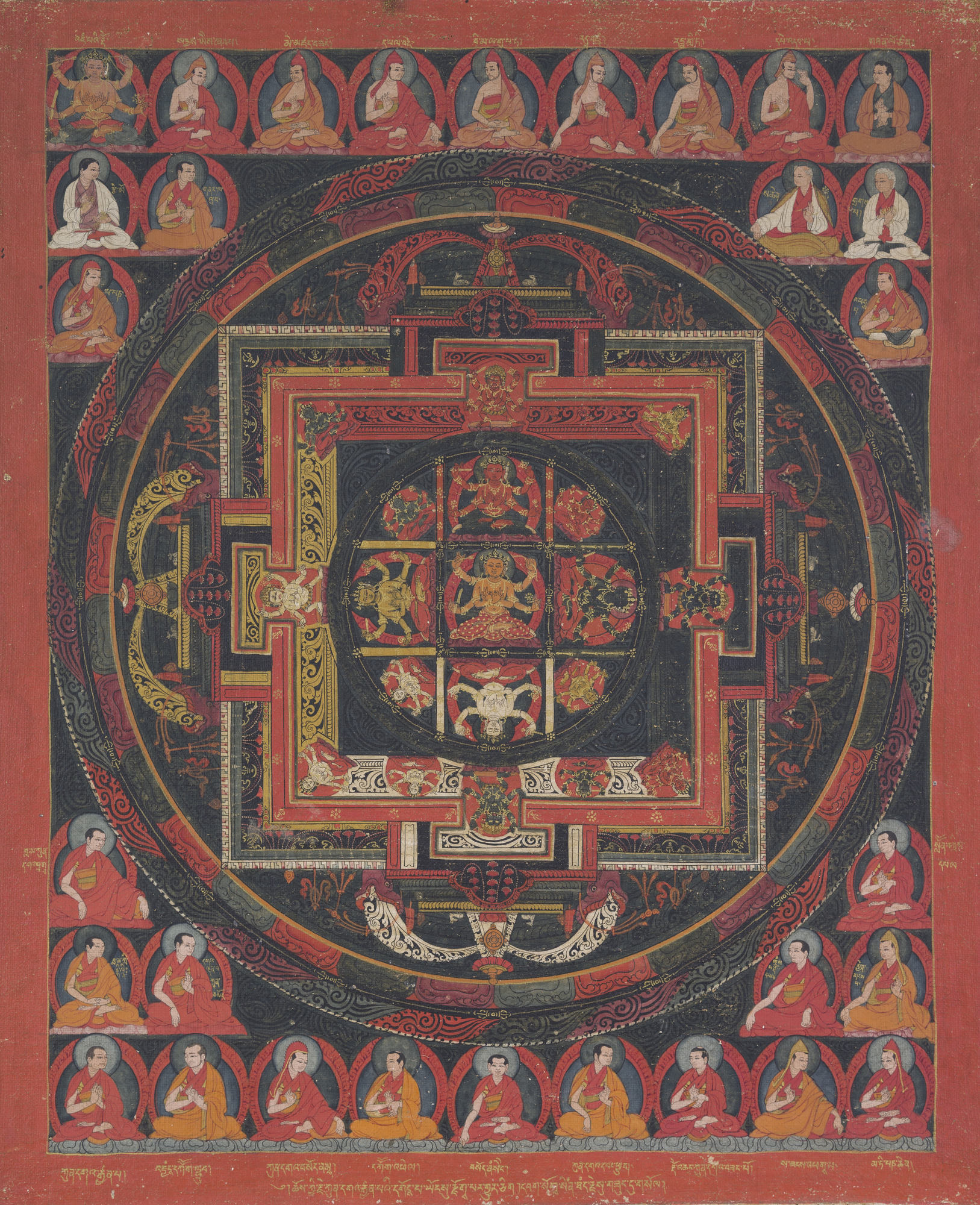
The second ring is a distinct six goddesses (senses) from the Four Gatekeepers.
This is the first mandala in Nispannayogavalli (or is given twice in NSP--first and twentieth; the latter must be of a later date, having Vajrapatala in the Nadir.), where he stands in for Akshobya. He has eight Dhyanis and Prajnas, and then six Vajra goddesses of the five senses plus Dharmadhatu Vajra, who may be considered of Vajradhara's Family. This picture doesn't show the Ten Directions, but it presents an advanced notion, which is to place Mamaki in Akshobya's Family (notice she is Blue), but this leaves Ratnasambhava without a Prajna in his Family. That leaves some kind of room for Ratna to spring forth at the next degree and Mamaki seen to be doing something weird already.
Akshobya's Family is Manjuvajra (of Vajrasattva nature), All Dhyanis, Mamaki, Shabda (sound), most "directions". Vairocana has Locana, Rupa Vajra, and Yamantaka. Ratna just has Gandha. Amitabha has Pandara, Rasa, Padmantaka. Amoghasiddhi has Tara and Sparsha. Sparsha or Manjuvajra's future consort is at the end of this cycle.
Almost always, color is used to identify a deity with a Family, but in a few instances, Akshobya is granted some Yellow members. The underlying reason is that it takes Blue and Yellow to make Green, and eventually we will disassemble green into its components, whereas Blue has been sent to the Yellow place here.
It looks two-dimensional, but is an octagonal bi-pyramid, a three-dimensional shape rising from a point. Kalachakra Vimalaprabha uses that same "senses" naming convention: Dharmadhatu Vajra is the "sixth sense of mind, or intellect within the senses", and at the Prajna level, they use Visvamata as "purified sixth element of gnosis". Overall it has the same structure and meaning, with its own naming style, which we would like to universalize or at least have a consistent one.
[Nothing has been done with Namasangiti verses except to include them. Correspondences and information is after the verse.]
As this first Chapter refers to the birthplace of mantras and a non-syllable word, this will be recapped in the last Mandala by the "nature of non-production and occurs non-two". The Dharmakaya, itself, does not teach, but is the source of teachings. Dharmakaya is not stated here, but implied by the descriptions preceding Sambhogakaya.
The Slokas are:
Fifteen Verses on the Perfected Action Wisdom
(143) He’s the one to be realized by all the Fully Enlightened, he’s the purified state of a Buddha, the peerless; he’s the one that isn’t a syllable, the one comes forth from hidden mantra’s womb, the triad of families of great hidden mantra.
(144) He’s the creator of every significance of hidden mantra, he’s the great creative energy-drop, that which isn’t a syllable; he’s the great void, having five syllables, and the creative-drop void, having six syllables.
(145) He’s the possessor of all aspects, that which hasn’t an aspect, he’s the bearer of the sixteen creative drops, and half of their half; he’s the one without phases, beyond count, holder of the peak of the fourth level of mental stability.
(146) He’s the advanced awareness of the phases of all levels of mental stability, the knower of the families and castes of absorbed concentration; he’s the one with the enlightening body of absorbed concentration, the foremost of the enlightening bodies, the ruler of all (Sambhogakaya,) Enlightening Bodies of Full Use.
(147) He’s the one with a (Nirmanakaya,) Enlightening Body of Emanations, the foremost of the enlightening bodies, holder of the lineage of Buddha’s emanations; he’s the one issuing forth various emanations in the ten directions, the one fulfilling the aims of the wandering world, whatever they may be.
(148) He’s the chief of the deities, the deity over the deities, the chief of the gods, the overlord of the (devilish) non-gods, the chief of the immortals, the guru of the gods, the destroyer, and the powerful lord of the destroyers.
(149) He’s the one with the wilderness of compulsive existence crossed over, the unique indicator, the guru for the wandering world; he’s renowned throughout the world’s ten directions, the master of generous giving of the Dharma, the great one.
(150) Armored with the armor of love, coated with a coat-of-mail of compassion, wielder of a sword of discriminating awareness and a bow and arrow, he’s the one who finishes the battle against disturbing emotions and unawareness.
(151) He’s the heroic one, enemy of the (mara) demonic forces, subduer of the maras, the one who brings fear of the four maras to an end; defeater of the military forces of all maras, he’s the Fully Enlightened, the leader of the world.
(152) He’s the one worthy of offerings, worthy of praise, the one for prostration, worthy of (being honored) forever in paintings, worthy of shows of respect, most worthy of veneration, worthy for homage, the highest guru.
(153) He’s the one traversing the world’s three planes in a single stride, the one striding forth endlessly, just like space; he’s the one with triple knowledge, (proficiency in the sacred,) clean and pure, possessor of the six types of heightened awareness and the six types of close mindfulness.
(154) He’s a bodhisattva, a great-minded (mahasattva), the one with great extraphysical powers, the one gone beyond the world; (situated) at the endpoint of far-reaching discriminating awareness (prajnaparamita), he’s the one who’s come to reality through discriminating awareness.
(155) He’s the one with all knowledge of self and knowledge of others, helpful to all, the foremost person (of all); he’s the one who’s gone beyond all comparison, the superb sovereign of knowing and what’s to be known.
(156) He’s the master of generous giving of Dharma, the most preeminent, the one who shows the meaning of the fourfold (mudra) seals; he’s the one most fitting to be helped and shown respect by the worldly and by those traversing the three (pathways of) definite deliverance.
(157) He’s the purity and glory of the deepest truth, the portion of excellence of the world’s three planes, the great one; the one bringing all enrichments, the one having glory, he’s Manjushri, (the lovely and glorious,) supreme among those possessing glory.
-------------------------------------------------------------
This degree corresponds to Muladhara or Root Chakra, which has been conceived as Ayodhya, birthplace of Rama. This is from an esoteric view of a tradition called Seven Cities of India.
Ayodhya was founded by Manu from Nepal and given to the Solar Dynasty; therefor a very ancient branch, resulting in the birth of Rama, the 7th avatar of Vishnu, Krishna being the 8th. Originally the capital of Kosala until this was absorbed by Magadha. Nageshwarnath was the only temple to survive when Ayodhya was abandoned. The names Rama and Krishna both indicate "dark or black" as well as "beautiful or attractive". The name Rama appears to be used cyclicly, especially with Parashu-rama as 6th incarnation of Vishnu, Rama-chandra the 7th, and then Bala-rama (Hercules) as Krishna's brother. The brotherhood of Vishnu and Bala--Hercules across multiple incarnations is a main subject in Sanskrit literature.
Rama's son, Kusha, lost an armlet in the Sarayu river, which was found by a nag-kanya; a female serpent; esoterically an initiate. She fell in love with Kusha and he built Nageshwaranath temple in her honor. Nageshwarnath is considered the first Jyotirlinga shrine, from the conquering of a forest and lake of demons. As the root chakra senses the beginning of spiritual development, Ayodhya seems to be quite root-ish amongst the cities.
Karumariamman, depicted with a five-headed cobra rising above Her crown, is the main south Indian Mother Goddess worshipped predominantly in rural areas of south Asia. She is not a Nagini (a female Naga), but the primordial form of Durga (Mother Divine) that took Her first form as a cobra. Also known as Mari. Surasa and Naga Mata are alternative names for Snake Mother (Mother Goddess in the form of a cobra); Naageshwari, Jagadgauri. So the temple, Nageshwaranath, can be seen equivalent to those other names. In this case, she is the Serpent-Initiator, and will be seen explicitly in the next stage if her worship is successful in this Root, and how she is different from a Nagini.
Rama, historically, is thought to have come in Treta Yuga, approximately 5,000 B. C. He is thought to have made use of Adam's Bridge to Ceylon. His wife Lakshmi (Sita) was captured by Ravana, King of the Lankans. Cyclicly, this was an act against the Lemurians some million years ago, repeated near the end of Treta Yuga as the last ice age went out. This work is the beginning of epics, and Sita is considerably more important than almost anything. She is linked in the Tara section.
Mystery: Karma
Force: Apas (Water) 6
Planet: Moon
Color: Violet
Principle: Chhaya or Shadow
Skandha: Avidya Skandha, Sakkaya-ditthi or identity with the skandhas themselves, cultivated into Padmavajra's Jnana Kaya
Prajna: Yogini Vajragharvi or Sparshavajra
Heroic Buddha: Kashyapa
Chohan: Bhrantidarsanatah and Kundalinishakti (Akāla Tattva)
Ray: Harikesha (hair of Vishnu) -- Vishnu's Deep Sleep mode
Avatar: From Kali, Lord Krishna was incarnated
Mother: Sapta Matri Chamunda. Mrigavahini ("She Who Rides a Deer") in some places.
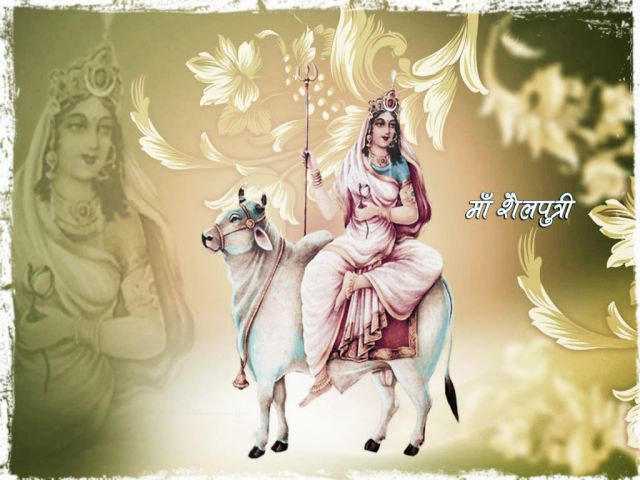
Sister: Navagraha Devi Shailaputri has been considered the embodiment of patience and upon awakening begins her journey from her father to her husband from the Muladhara Chakra.
Maha Vidya: Bhuvaneshvari (Shakti of Trayambaka Bhairava)
Lore:
In having the force of Water here, Amrita, the Nectar of Immortality, this nectar is Bodhi Mind, which begins to transmute the pranas, taking them out of the vrittis and senses and ingathering them for the subtle body.
By starting with the Moon here, and having the Sun, Sixth, we are establishing the purity of the Lunar Nerve and growing the power of the Solar Nerve, in a way that they operate together for the last step. And we have replaced the basal color Red with Violet because, in the physical plane, we are only concerned with the highest frequency or most ethereal state of matter, related to the highest intellection. Hence the physical body is no longer even seen as a principle, just the double.
The Logos of this Ray has entered that volume of space which is false comprehension. It believes in Form. It leads to beliefs in materialistic gods. This has caused its Power of Kundalini to become unavailable (coiled). It's not going to do anything unless we help it. Harikesha, or Deep Sleep, comes straight from Ramayana. This is linked in the Lakshmi Tantra section.
The sixth and seventh groups (Creative Hierarchies) partake of the lower qualities of the Quaternary. They are conscious, ethereal Entities, as invisible as Ether … this Sixth group evolves no more than the future man’s shadowy form, a filmy, hardly visible transparent copy of themselves. … This sixth group, moreover, remains almost inseparable from man, who draws from it all but his highest and lowest principles, or his spirit and body, the five middle human principles being the very essence of those Dhyanis.
Krishna being the first avatar given, tells us that the esoteric Bhagavad Gita is part and parcel of this first lesson. Notes on the Gita, Philosophy of the Gita, and Archive version from Subba Row.
Vajrasattva is rarely depicted with a consort; Vajragharvi (Ghantapani Bell Holder or Yum Dorje Nyemma Karmo) is here for reference. Manjuvajra is shown in union with Sparshavajra. We just want to contact vajra in some way, and this would be Smile at the Daughter. Mantras to invoke Shailaputri to forfeit the obscuration of Chamunda and obtain Vidya of Bhuvaneshvari. This needs to become an emanational presence in the root chakra. This and the first dhyana are the main goals, so we just modify Guru Yoga with a few of the indicated ingredients.
The traditional Wisdom of Karma Family is Successful Performance of Best Actions. Aside from its obvious meanings in the outer world, if we can establish Vajrasattva Samaya, and better yet, get the hang of what it means to use a Pledge Being and draw in a Knowledge Being, then we have started the noumenal path of consciousness, inverting the majority of exoteric yoga. Sakkaya-ditthi from the Pali canon is the main point; nothing has really changed about that. It just isn't usually taught as a Skandha of its own. Do we really have a pile of mental habits that associate ourselves with individual categories of mental habits, yes, this seems reasonably accurate. Is it hard to stop, yes, extremely, that is what the inverted yoga is for.
Vajrasattva's tantric "system of Six" is represented initially by Six Syllable Avalokiteshvara. However, the Six Syllable Goddess there, may be considered Prajnaparamita. She is the first text goddess. Vajrasattva as Jnanadaka is tantric, a form of Chakrasamvara. His consort Jnanadakini is the text goddess of the more esoteric Kagye; she is Jnanadhatvishvari or Vajravarahi. So at first, we are only learning how to make their Nirmanakaya operate. That means to start with the Six Syllable deities, not Varahi herself. Among the other meanings of the mantra, it already gives a doctrine of Six Skandhas:
Applied to the Six bodies, om is the dharmakaya, ma sambhogakaya, ni nirmanakaya, pad svabhavikakaya, me abhisambhodikaya, hum unchanging vajrakaya; to spontaneously obtain the six bodies [rely on] the six syllables.
So you can immediately use the most common mantra in the world, attached to one of the oldest, most basic deities, and instantly double the knowledge base of "Three Kayas". Their specific names may be different from the ones we selected, but their meaning will be found to be the same. Most likely, abhisambodhi would be the same as Jnana Kaya.
If you research the link, Six Syllable mantra takes three forms, and either the standard, or all three, is a way to learn the Six Families and their chief members. If you just work on this as a basic, it will put things together much more quickly than any other way. You will be building Armor Deities from day one, instead of spending fifteen years trying to hear about them. You will find everything you need to prepare for the eventuality that the real Daka--Dakini energy is going to flip everything in the x direction. Jnanadakini is really Completion Stage and it really will take years of study, meditations, and acts, to get her to work safely. This starts with Six Syllable Goddess, who is really Prajnaparamita when you train real Mahayana and Emptiness, and if you succeed with her, Jnanadakini will be there when the time is right.
Vajrasattva is saying you must purify with him until you stand firmly on the Ground of Joy, because he is the first Bodhisattva Bhumi, Pramudita, on which is to be displayed Dana Paramita, or generosity. This has to show so other people see it. That is basically what you need to do until "Six" is internalized. We need to start him this way, and figure out how as a Pledge Being, he interfaces with a deity. Once you have that, then you would be able to proceed with Manjushris and Taras in outer forms. So as a "first stage", we don't mean anything like having Chakrasamvara initiation, but that we understand some of the meanings and methods to it.
The main outer deity path of Nepal that we can follow is Vajrasattva, Manjushri, and Vasudhara. This is basically the way it has to be done; one should not go to Varahi and others of her kind simply because the information is there. There definitely is a structured pattern that must be followed, although for example there are different Taras that could help different people, while the overall goal is still Vasudhara in mature form.
If we broadly make three degrees of Six Syllables:
Outer: Amitabha as Shadaksari Avalokiteshvara (Six Family study) (Prajnaparamita)
Inner: Akshobya as Six Chakravartin Dakas and Dakinis (Six Family complete working practice, Magic Circle) (Jnanadakini)
Secret: Inverted Buddhakapala or Reversed Tara Vajrayogini or Vajra Pitha Tara (Completion)
That's not stated anywhere. It's the underlying meaning from the first Dhyani, Amitabha, ca. 150, up to the height of the Sanskrit university system. Nothing else works like that; those are all primary sources. Vajrasattva is going to get a workout and eventually unite with his consort, but there are many stages of Manjushri and Vasudhara first, the Outer meditations. This is more or less about making all the components of Six Families real. Years of heavy repetition of study and meditation, until, for instance, you can just look at a vajra symbol and instantly be aware of everything about Akshobya and his entire Family and it means something to you.
Buddhakapala is an Akshobya deity whose consort, Red Vishvasukha Matri with knife and skullcup, is similar to Varuni or Matangi (intoxicated). He is called Mahaviro, "Great Hero". In one version, he has twenty-four undefined goddesses, which makes them sound intended as nadis or sacred sites in the body. He also has the eight cemeteries. He is intended as Mother tantra with Chakrasamvara. This makes him a step advanced from any Father tantra or initial realization that Samvara is the united Vajrasattva. The non-dual source of Buddhakapala's mandala is Samvara as Svabhavikakaya (Divine Androgyne, Prajna Upaya, or Transcendental Wisdom and Skillful Methods). So if you see how this links in a quick, simple way, then you already have a handle on a vast concept that usually takes years to know it might be a question. All Six Families in a pretty precisely marked scale. The Seventh Family is not exactly going to include anyone else, but is the conscious center of these. Maybe they are the receivers of Vajrasattva's best offering.
A complex Vajrasattva, one of the oldest, 1300s:

His consort Vajragarvi is also called Vajradhatvishvari. This pair of white consorts is from Mindroling tradition. This retinue is enumerated, it correctly lists Nagaraja and Prajnaparamita (chief top deity here) within Medicine Buddha system. The "shoulder" deities are Amitabha beside Namasangiti over Six Syllable Avalokiteshvara, and Nagaraja beside Green Tara (with a Hood) over Krodha Vajrapani. So this ties together elements that may have seemed disjointed or unrelated, but, this is very much the foundation. At the bottom are Seven Offerings.
According to HPB, Vairocana is pre-eminent among the translators; here is his missing Vajrasatva Khasam Anta Mahātantra
.
Here is an option to use before Vajrasattva Hundred Syllable mantra. This is from Kalachakra practice and they invoke Om Phrem Vishva-mata Hum Phat and then the Ten Paramitas. We will change this to the Twelve Paramitas of Dharmadhatu Vagisvara. The beginning includes the Six Kalachakra Yoga Syllables, which can roll over the symbolism to the Six Yogas and the Six Dharmas. This is no longer truly a mantra, just a mnemonic:
Om Ah Hum Hoh [Ham Ksha Ma La Va Ryam] Hum Phat
Om Ratna Paramita Hum Hum Phat
Om Dana Paramita Hum Hum Phat
Om Shila Paramita Hum Hum Phat
Om Kshanti Paramita Hum Hum Phat
Om Virya Paramita Hum Hum Phat
Om Dhyana Paramita Hum Hum Phat
Om Prajna Paramita Hum Hum Phat
Om Upaya Paramita Hum Hum Phat
Om Pranidhana Paramita Hum Hum Phat
Om Bala Paramita Hum Hum Phat
Om Jnana Paramita Hum Hum Phat
Om Vajrakarma Paramita Hum Hum Phat
The following is also more or less a mnemonic; Kalachakra mantra itself is using seeds of Four Kayas (Om Ah Hum Hoh) and also the chakras. As Yogas, these refer to distinct states, that would take years, for instance the second, Dhyana, may well be compared to the first dhyana at the end of this post. And one could perhaps attain a type of samadhi that doesn't quite qualify as what they describe here. The main importance is how this looks backwards--there is no asana (posture) or breathing exercise.
Six Kalachakra syllables, and the Yogas, or stages of meditation:
Ksha:
Crow-Faced Dakini, Pratyahara (withdrawal): According to HPB, the first stage of real Raja Yoga. Control of ahara or "food": physically, the five elements; mentally, the senses or skandhas; and associations (with people). There are four main forms of pratyahara: indriya-pratyahara—control of the senses; karma-pratyahara—control of action; prana-pratyahara—control (withdrawal) of prana (from the senses, etc.); and mano-pratyahara—withdrawal of mind from the senses. All the withdrawals from the "outer" transfer consciousness to the "subtle" and assist in visualisation.
Pratyahara is the awareness of bliss and emptiness developed by contemplating the emptiness of appearances through bringing the activity winds into the central channel, thereby creating the experience of empty-forms. These are the ten signs, like smoke, and so forth.
Ha:
Owl-Faced Dakini, Dhyana (meditation on the nature of Tathagathas); the awareness of bliss and emptiness absorbed in the emptiness of the appearances of empty-forms through having perfected and increased the appearance of the empty-forms of the ten (types of) signs.
Ya:
Dog-Faced Dakini, Pranayama (control of the winds in five colors with diamond-muttering, vajrajapa); pranayama is not "breathing exercises", it is restraint (yama) of prana (from entering the limbs or senses), the awareness of bliss and emptiness that arises once the ability has been developed to direct the empty-forms to such places as the centres and channels, have them remain there without moving, and this having been stabilised, bind the winds and dissolve the ten winds of the heart centre into the central channel.
Ra:
Boar-Faced Dakini, Dharana, retention with purification of mind (cittta-visuddhi) and personal blessing (svadisthana); the awareness of bliss and emptiness that is developed by having stabilised the dissolution of the ten winds in the central channel, they dissolve into the drops (bindu) in the six centres, the winds and drops become merged, and the drops are bound without melting (emission).
Va:
Yama's Messenger Dakini, Anusmrti or recollection, so as to proceed in reverse order with revelation-enlightenment (abhisambodhi); the awareness of bliss and emptiness that develops once the blending of the winds and drops and the binding of the drops have been stabilised, by the use of whichever is suitable of the three mudrās, through the blazing and melting within the central channel from the six centres arise the awareness of the radiation of all the various divine empty-forms (the classes of deities in the maṇḍala). Anusmrti (memory) is the constant meditation of the object for which the psychic exercise is undertaken, and by this Pratibhasa (revelation) takes place. After commingling the two elements Prajna (knowledge) and Upaya (means) the whole objective world should be conceived as contracted in the form of a lump, and this should be meditated upon in the Bimba (icon-circle). By this process the transcendental knowledge is suddenly realised by the worshipper and is known as Samadhi (visualisation).
La:
Yama's Cremation Ground Dakini, Samadhi "consummation", with yuganaddha, the pair united; The essence of Samādhi, the attainment of the Vajrayāna path of vision and the realisation of the embodiment of the awareness of Kālacakra, the "body of maturation". This has the nature of a meditative absorption on such a form and awareness. Here, the emotional and conceptual obscurations are shed, and the paths of vision and cultivation and the ten levels are traversed. For the purpose of visualisation it is necessary that the process should be continued for six months and this is done according to the Guhyasamaja always while enjoying all kinds of desired objects If within six months the deity does not show herself the process should be repeated thrice while following the rules of restraint duly prescribed.
In Tibet, they almost always add "Hrih" at the end of Om manipadme hum, as in Mipham's Six-Syllable Sadhana. Hrih is the seed syllable; in art, it is at the center, surrounded by six. Although they don't really explain why it is spoken, if you add that, the symbolism is complete. But we have the right one.
"Armor-like" deities is also a System of Six.
White Heruka usually has as consort, Red Varahi. In "Armor-like deities", he has Six Arms, including a drum. Surrounded by five Wrathful Dhyanis, such as Yellow Vairocana holding a wheel. The female equivalent is Six Arm Red Varahi (no consort), surrounded by Five Wrathful Prajnas such as Chandika, with knife and skull.
The following is the unique Practical Key to everything:
According to Taranatha, there is also a Seven Syllable Maha Sri Avalokiteshvara, "inseparable from Heruka", because they share the same mantra:
Om hrih ha ha hum hum phat
This is Blue Avalokiteshvara with Red Gegmo (Varahi), surrounded by six Four Arm drummer dakinis of the White Vajra Dakini class.
So the "Armor-like" deities is like Sat Chakravartin, showing Six Elements. Seven Syllables is the Near Essence mantra of Chakrasamvara; Alex Wayman explains that it comes from Tsonkhapa. As used in Chakrasamvara. With Avalokiteshvara, who is Hum, continuously pronounced, it makes a ring of Six Vajra Dakinis.
In Rinjung Lhantab, there is a series of drumming dakinis (Armor-like Heroines), then White Heruka with consort, and then Seven Syllable Saptaksara Heruka Avalokiteshvara with Red Two Arm Varahi Archer (Lasya), just as in the sadhana (original frame is HAR # 400024):
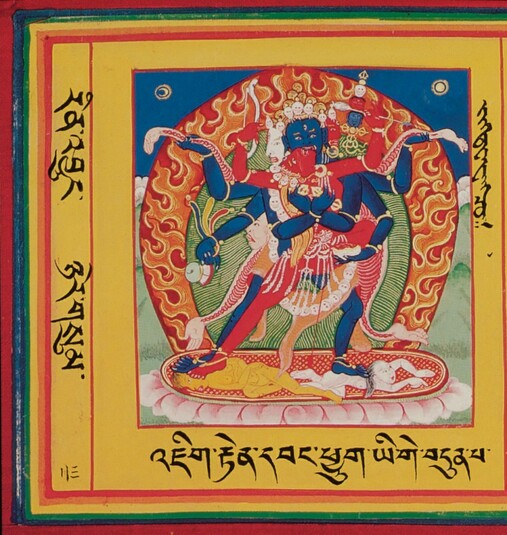
Hum
Om hrih ha ha hum hum phat
Reduce the male to two arms, it becomes Sahaja Heruka, Chakra Paramasukha, which is Chakrasamvara, an Akshobya deity, united with Red Varahi, a Vairocana deity. Same mantra. Avalokiteshvara takes the Hum syllable and gives Hrih to Amoghasiddhi Heruka and Akshobya Samvara, but they all use Seven Syllable mantra.
This Seven Syllable Avalokiteshvara is simply Maha Sri Heruka. He is the root of a shared mantra. The full explanation of it is given by his Vajradaka form.
Sadhanamala calls Six Arm Hevajra's consort Vajrashrinkala. His form is also for Manmatha in #73. Mandarava once emitted six dakinis. In any case, this makes a pretty straight equivalency of Vajrasattva, Heruka, Hevajra, Avalokiteshvara, at the center of Six Shaktis, in a form with Six Arms, from a common mantra. Vajrasattva is the source of Peaceful Deities, Heruka of the Wrathfuls, Red Vidyadhari Guhyeshvari Jnanadakini of Sages or throat center (mantra).
According to Bhattacharya, Saptaksara Hevajra is with Varahi, is crowned with Vishvavajra, has a crescent moon and six auspicious symbols on his head. On the spokes of his sun disk are Blue Heruki, Yellow Vajravarahi, Red Ghoracandi, Green Vajrabhaskari, Smoky Vajraraudri, and White Vajradakini. Each has a sava vahana, corpse vehicle, they stand on a sun orb on a corpse. All carry human skin. Some of those are in the normal 37 Deity Vajrasattva Mandala.. Saptaksara mantra is mentioned several times in Sukla Kurukulla sadhana, 180.
The full Sanskrit Seven Syllable sadhana by Durjayachandra (250) commented by Advaya Vajra or Maitri (251) has been published in Himalayan Passages: Tibetan and Newar Studies.
Namo Vajradakaya
Then it seems to say, use Yam, Ram, Vam, Lam to make a four elements mandala and add Mt. Meru with seven jewels. It then gives a mantra to cast a circle:
Om Medini vajri bhava vajrabandha hum
Om Vajraprakara hum vam hum
Om Vajrapanjara hum pam hum
Om Vajravitana hum kham hum
Om Vajrasarajala tram sam tram
Om Vajrajvalanalarka hum hum hum
Hum syllable then arises as three faced, six armed Vajradaka Mahasukha. He is crowned with Crossed Vajra. Varahi uses Four Activities to summon Six Shaktis. In place of Yellow Vajravarahi, it gives Yellow Vajrabhairavi, and ends with Sita Vajradakini. Varahi remains the central consort.
It gives Lam, Mam, Pam, Tam, Kham as five elements. It then seems to say:
om-am-hrim-hum-hoh-hrih becomes rupa skandha (Form or Sambhoga and Nirmana kayas)
bhrum-hum-kham-ah-hoh-ham becomes the ayatanas (nama rupa or mind)
It casts Armor by Varahi's formula, followed by Six Buddha Wheel and Five Nectar Skullcup.
It ends with Seven Syllable mantra, it explains their powers. Smrti is Sri Heruka, Dharma Pravicaya is Heruki, Virya is Vajrabhairavi, Priti is Ghoracandi, Prasrabdhi is Vajrabhaskari (Light Maker), Samadhi is Vajraraudri, Upeksa is Vajradakini, These are Saptabodhyangabhavana, born or becoming through the Seven Jewels of Enlightenment. The specific terms are a little different, but the meaning is the same. If it means that, by intent, there is no reason it shouldn't be compatible as a mnemonic for everything of Seven.
The Seven Syllable deity is the real Kalachakra Va syllable, Fifth Yoga, Smrti, which is the Sati or Mindfulness of the Seven Jewels of Enlightenment at Completion Stage. All Six Yogas is Buddha Kapala, produced by this deity, just as Smrti produces Samadhi. However the majority of the training is aimed at Pranayama with multiple Families and bound winds. We may experience samadhi that lacks abhisambodhis, or something like that, but most of the original deities are for developing this condition of occult Pranayama.
Nothing in the sadhana mentions Avalokiteshvara, except maybe "Sadaksharabhava", suggesting that you cultivate the Six Syllable form first. Vajradaka was the chief of the "Six Buddha" mandala, now he is central here. The Vajradaka as his own deity is not exactly a Sky-goer, but a Two Arm statue whose mouth is wide open; you toss in black sesame seeds, and they fall and burn in the incense underneath. Vajradaka Sadhana calls him an Akshobya deity. It is considered a preliminary to Anuttara Yoga, and the Sadhanamala version is Anuttara Yoga, where Vajradaka seems to be in a "Mahasukha" form (Sambhogakaya) instead of the purifying one. He started in Pancha Daka mandala, with the Eight Gauri goddesses, so, he has been used twice before entering here. Hevajra may be considered Vajradaka and have nothing to do with the statue.
The elegance is that Seven Syllable Heruka matches Namasangiti and Brihadaranyaka Upanisad, being the center of six mantric beings. Most of the texts use the term, Embrace; this is allowed in the Outer meditations. He has the same Hundred Syllable mantra as Vajrasattva, except sattva is replaced by Heruka. This is, so to speak, an individual's perception of Avalokiteshvara, who is universal or all of the dhyanic consciousness. Vajradhara is the transcendent or unmanifest portion. Vajrasattva gets together with Varahi or the Clear Mind of one's own, and her fruit, or Vajradhatvishvari, is something like an offering to Vajradhara, or, opens the awareness and realization of the Sahaja Guhyasamaja couple.
And that couple is the same way. They arise from Hum in Blue Six Arm forms, in the center of six items, a protection wheel, a reality source (dharmodaya), lotus, sun, crossed vajra, and celestial mansion.
Om ah vahradhrk hum hum svaha
Om ah vajradhatvishvari hum svaha
So Vajrasattva increases to the level of Union, and then there is a mirrored reversal and the disintegration of color. According to Taranatha, there are two deities who only have Vajra Vairocaniye (active radiance) in their mantra.
One is Hrih-arising Golden Varahi Kurmapadi:
Om Vajravairocaniye hum phat svaha
The other is White Vajrayogini who has reversed White Heruka. They arise from Hum and evoke her and Seven Syllable mantra:
Om Vajra Vairocaniye hum hum phat
Om hrih ha ha hum hum phat
The other Cinnamasta attendant, Vajra Varnani, is the true nature (varna = color) of the vajra: transparent, pure, object-free, non-dual, changeless and indestructible like Void. Accordingly, at the beginning of Tummo or inner heat practice, the body of Vajrayogini should be clear. Varnani appears to be a mix of Vairocana's empty consort niche with Vetali (corpse). That stage is the turning point, since tummo is the basis for the other aspects of Completion Stage. So you get to this body-less dakini, stage five, Dharmadhatu, and then reversed White and Green Tara and Buddhakapala unpeel the normal color spectrum.
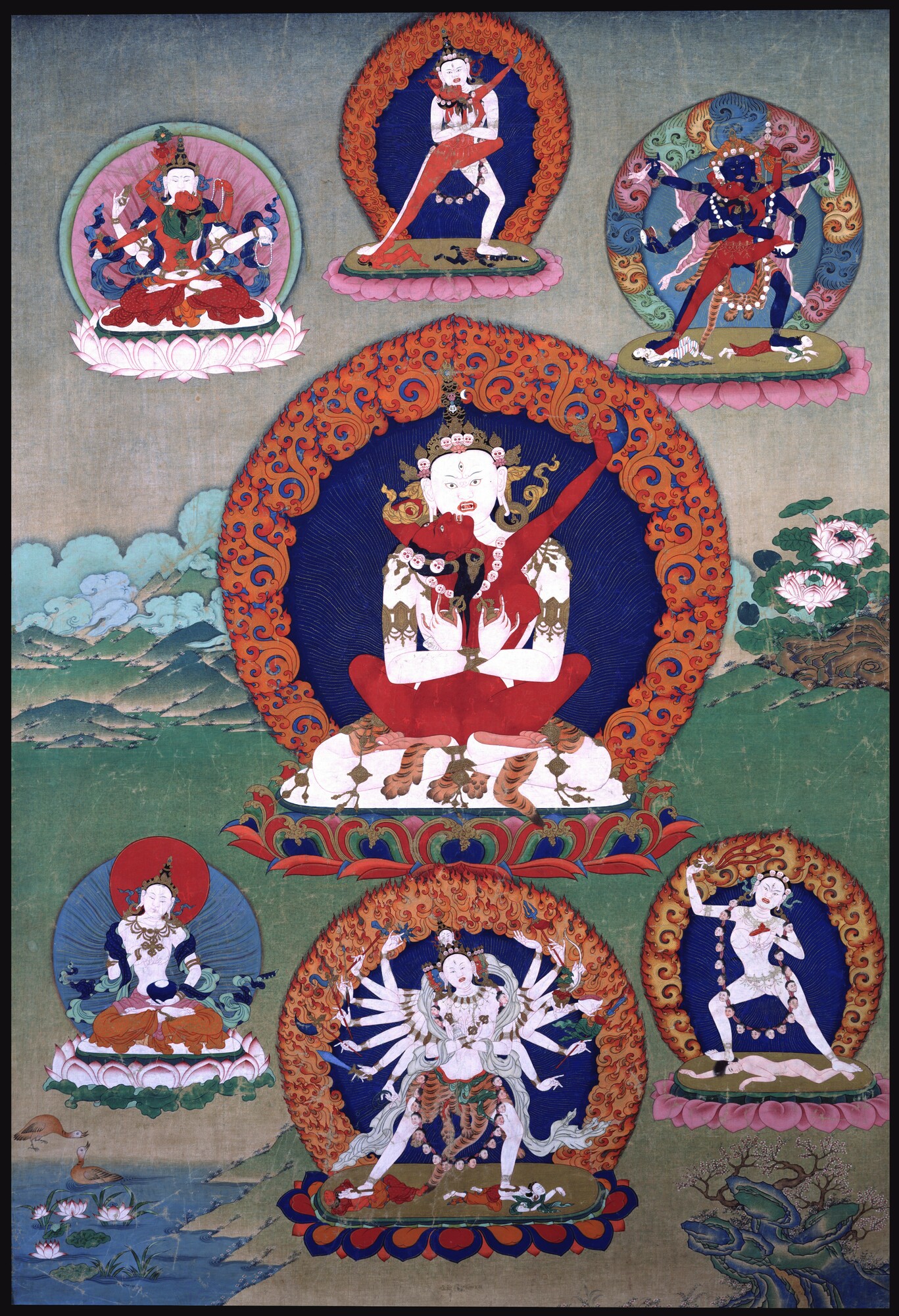
Here is the authoritative version, an 1100s Nepali showing the Six Yogini retinue, Avalokita Chakrasamvara and the consort Lasya, accompanied by six female retinue figures and surrounded by a palace, mandala circle and extensive cemetery scenes according to the tradition of the Indian siddha Advayavajra as found in the teachings of Mitra Yogin. A description for this deity and retinue can also be found in the edited Bhattacharya version of the Sadhanamala Sanskrit text (see #250) where the tradition is attributed to the Indian siddha Durjayachandra.

That deity produces all of the White Completion Stage deities.
The tantric Smile is to get Shailaputri established on our Horizon. And just glean an understanding about Moon Mother as Bhuvaneshvari. Bhuvaneshvari yantra winds up in our early Prajnaparamita meditation. Shailaputri is Durga or a Sister goddess, but the only one of them specifically named Daughter (Putri). She's highly appropriate here.
There is Root Mother Chamunda from the "Seven Mothers" system, with the addition of Shailaputri from Nine Planets. Shailaputri is relevant to the final stage as well; in this, we are picking up some of the dual role of Mars--Angaraka. Here he is as latent heat or charcoal. Through practice, he catches fire, and would be very brilliant should we find him at the end. Similarly, this is the first "baptism in water--Apas", which at the end will be "baptism in fire--Taijasa".
Chamunda is the direct emanation of Devi Chandi, making her the only Mother not derived from a male god. Her vehicle is the owl. Her obscuration is Paisunya, which is a forked tongue, slander, tale-telling (deceit), reporting evil of others, espionage.

Chamunda is both a Kumari Mother and a Wrathful Protector. As a Wrathful, she is seen as Yami, sister of Yama, Death. Also, Chamunda can be Yama's consort. She associates to the Moon, and, as with most Mothers or Matrikas is also classed as a Yogini.

Shaila Putri is a Durga Mountain Daughter of the Himalayas, or literally Snow Daughter. Hers is the night of New Moon, first of Nava Durga celebrations. She associates to the Moon and to Root Chakra. Her mount is the Bull Nandi, giving her the name Vrisharudha.
Bhuvaneshvari (Queen of the Universe) – The Goddess as World Mother, or Whose Body is the Cosmos. Space. Her planet is Moon. The fullness of inner space merges with the cosmic womb of outer space. Love of infinite space. Love that provides space for growth. Associated with Earth and Varahi in some accounts. Earth "was" the first degree and Varahi "is" the last. Moon is "strongly associated" with earth, being our primary timekeeper, changing the tides every day, seen as a veil or connection from the physical to the astral double, etc.
Mistress of the World in that her name is the same as that of Bhu or Bhur Loka. Her syllable is Hrim or Mother's heart or Hridaya and Shakti; syllable of Maya. Bhuvaneshvari is Iccha Shakti, with Kali as Kriya Shakti and Tripura Sundari as Jnana Shakti.
She is Maha Maya and Vagishvari. Her noose is Avidya Maya of the skandhas, which happens to be the same meaning as our added Sixth Skandha for Vajrasattva. Her ancus goad is against the Hindrances. Sarva Rupa and Vishva Rupa means she is all forms. She was invoked by Brahma as Kriya Shakti from the Formless World and becomes Iccha here. That mostly only makes sense noumenally, and I would say if you are using Bodhi Mind, then in this rite, Bodhi should gain a kind of Icch Shakti or Will Power to continue its way. Deeply ingrained into thoughts and actions at the expense of instinctual appetites.
The young male trinity found themselves transformed into women entering her capital Sri Pura. The city was guarded by Nine Wrathfuls and her palace Chintamanigriha was guarded by Yoginis. Here she, Adi Parashakti, reigns over Mani Dvipa or Gem Land, also called Sri Nagara--Svar Loka. Said to be higher than Vaikuntha and reachable by her grace alone. Made by Mula Prakriti, Maṇidvīpa is situated at the top of all the regions, and resembles an umbrella. Its shadow falls on the Brahmāṇḍa and destroys the pains and sufferings of this world. Surrounding this Maṇidvīpa exists an ocean called the Sudhā Samudra or Pure Manifested Waters.
The Divine Couple are on a throne called Panchapretasana. Five "lying down postures" or Five Corpses and Ghosts of the main Five Gods. The couple is Brahman plus Brahmashakti, Adi Purusha and Mula Prakriti. At creation, she splits into two or half of her becomes Shiva. If you follow her description, it says we don't get to her Mother level until stage three (Svar Loka). That is when Amogha-siddhi Mahamudra has to be perfected, to increase to Yoga Tantra.
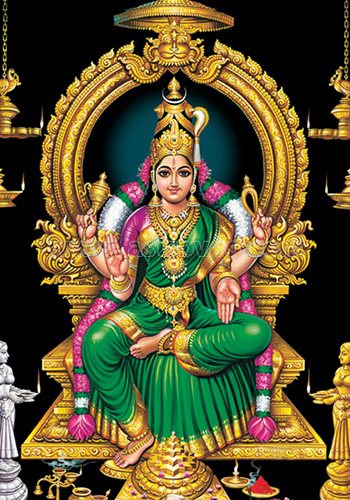
I am not sure if the goddess names actually suggest the ranking order, World Mother, Death's Sister, Snow Daughter, but that is more or less what they mean, all Three Moon Goddesses. And in tantric terms, all we need here is to Smile at the Daughter. Stage two will, out of its own lore, spell out the Sister level, and get us to pick up one of these Gems.
The Moon is known as Chandra, who is Cunda, or Cundavajri.
At Bhuvaneshwar town, Chamunda is known as Vetali (Corpse, Wrathful Sarasvati), and nearby she is Mohini, Charchika, Janguli, and even Candaghanta. This location is mostly the origin of mixed goddess cults and Hindu-Buddhist crossover. She is associated with Matsya Varahi.
Loka--Tala--Dhyana:
1. Bhûrloka, the habitat of thinking and good men, is opposed by Pâtâla, the animal gross body and the astral personality as such. Hence if, while a man is placed among good men, his consciousness is fixed on the animal gross body, he is really in Pâtâla. The sphere of irrational animals, having no feeling save that of self-preservation and gratification of the senses; also of intensely selfish human beings, waking or sleeping. This is why Nârada is said to have visited Pâtâla when he was cursed to be reborn. He reported that life there was very pleasant for those “who had never left their birth-place”; they were very happy. It is the earthly state and corresponds with the sense of smell. Here are also animal dugpas, elementals of animals, and nature spirits. Gandhic.––Sense of smell.
Akin to infancy--on one side, innocence, on the other, pure selfishness.
The first Dhyana requires physical seclusion from extraneous activity, to put time into spiritual development. It also requires mental seclusion from defilements. At that point, one starts changing the Five Hindrances into the five factors for dhyana. The first dhyana possesses five component factors: applied thought (vitakka), sustained thought (vicara), rapture (piti), happiness (sukha), and one-pointedness of mind (ekaggata). The dhyana factors are first aroused by the meditator's initial efforts to concentrate upon one of the prescribed objects for developing dhyana. As he fixes his mind on the preliminary object, such as a kasina disk, a point is eventually reached where he can perceive the object as clearly with his eyes closed as with them open. Through practice, Hindrances are overcome by concentration, and the outcome is "seclusion from the substance" (upadhiviveka) or a prelude of nirvana.
You shift your attention from the meditation subject to the joy associated with your concentration. You do not cling to the sensations, but just watch them. The experience can include some very pleasant physical sensations such as goose bumps on the body and the hair standing up to more intense pleasures which grow in intensity and explode into a state of ecstasy. The pleasant sensations can be so strong to eliminate your painful sensations. You enter the dhyanas from the pleasant experiences exploding into a state of ecstasy where you no longer "feel" any of your senses; although sense-feeling may not completely vanish yet.
Last edited by shaberon; 7th July 2019 at 14:31.
-
-
24th January 2018 01:31
Link to Post #242
Avalon Member
Re: The Serpent, the Black Sun, HPB & St. Germain
2. Equality Wisdom: Ratnasambhava, Jewel Family, Vagisvara
Vagisvara is the Manjushri Name here. His mantra is Om Dharmadhatu Vagisvara Muh Svaha. The Mandala is said to use a Vadiraj Deity form, because the Mantra of Vadiraj includes the name Vagisvara. Manjusrimitra seems to say the practitioner becomes Ekavira (Lone Hero, a Wandering Bhairava or Wrathful Manjushri), surrounded by the Mantra Om Vagisvara Hum (Vadiraj Mantra). As the Jewel Family has the Sound of Dharma, the essence of the Chapter is on teaching doctrine.
With the name Vagisvara, Manjushri represents all five exoteric Dhyani Buddhas; further down, Maha Pratisara is here, who is also the center of the five Protector Goddesses. Also, the fifth principle, Manas, and you find five as the number for Venus and the Nagas, and Akasa, the fifth element.
Ratnasambhava is Sarva because through samata-jnana he establishes the full comprehension of the nature of all things.
Manjushri--Vadiraj is accompanied by two deities, Sudhana-kumara and the ferocious Yamari. Vadiraj is Peacemaker, or mediator of disputes. So, having gained an ability to use Mantra in the first step, we have the first appearance of the Lord of Speech now, whose role is Peacemaker. It seems to start in a Wrathful manner and intend to resolve to Peace by perfecting the Sound of Dharma. In some way, this integrates the standard Five Buddhas and Rakshas into a unit, and the Force associated with Sound, Akasha, loses its old association with Five, becoming Three.
Vadi Raja Manjushri:
[Above] a blue lion with the head looking to the right, in the middle, is a lotus, moon...Vadi Raja Manjushri, with a body colour like melted gold. The two hands are held at the heart performing the Dharma teaching gesture [and] the left holds a blue utpala with a Prajnaparamita book resting upon it. With the same ornaments and garments, seated in the lalitaraja posture. At the front left is Krodha Yama, with a body blue in colour, one face and two hands. The right is held supporting the shin of the Blessed One and the left holds a lasso. With three eyes and bared fangs, yellow hair bristling upwards, the head adorned with a garland of skulls and wearing a lower garment of tiger skin; standing in a manner looking at the face of the Lord.
There are several similar descriptions in the Ocean of Sadhanas, but no mandalas or pictures. Here again, Mr. Wayman's insight was fairly valid because in this case, Vadi Raja just means with or mounted on a lion, which is usually called Simhanada on other deities. But Manjushri does have Five Forms of Wu Tai Shan Mountain, where he is from, and these are Yellow Vimala Manjushri, Red Simhanada, Blue Vimala, Green Tikshna, and White Jnanasattva. So as Tiksna (next), he would likely have a sword, and Simhanada means Vadi Raja or with a lion. Also, Vagisvara is a name mixed in to the batch of lion-related forms, so it associates properly.
This has no existent mandala so we will try to find something similar, in the next post, this one is full of images. These are now posted and very closely correct for this option: Taranatha has Manjushri with Lion-like Speech. He is Orange, Peacefully seated on a Lion. He does Dharmachakra with both hands, utpalas arise, one with a book, the other a sword, arises from Hrih. He is behind Sapphire Sarasvati who is half crouching and both are crowned with Akshobya and have Om Ah Hum in their three places. His seed is Dhih and hers is Hrih. Their mantra will merge him with our practice Prajnaparamita:
Om hrih dhih mame tipasvara svasti, Manjushri mum hrih Prajna Vardhani hrih dhih svaha
So that form more or less is Vadi Raja, who becomes Vagisvara (undefined), this is peaceful and next mandala they come back fiercely.
In a prior use of his name, Vadiraj was a disciple of Hayagriva (incarnation of Vishnu). The story of this Avatara is very simple and short. Vishnu, while He was resting on Sesha in the nectar ocean (laya) after deluge Amirutha willed to create this world. He created first the four faced Brahma and vested in him the task of expanding it with all its sentient and non-sentient things. For this purpose He revealed Vedas to him as his aid to complete this work. Madhu and Kaitabha rakshasas becoming aware of the power of the vedas and the power thereby gained by Brahma to expand this world snatched them away from him and kept them at the bottom of the sea. Consequently. Brahma thus deprived of the Vedas became powerless and did not know what to do. He therefore performed tapas. Sriman Narayana pleased with his bhakti incarnated and took the form of Hayagriva and killed the said rakshasas and restored the vedas to Brahma.
The Slokas are:
Twenty-four Verses on Equality Wisdom
(119) He’s the fulfiller of wished-for aims, he’s superb, the one totally purifying all of the worse rebirth states; he’s the ultimate of all limited beings, the guardian, the complete liberator of all limited beings.
(120) He’s the hero in the battle with disturbing emotions, the unique one, the slayer of the insolent arrogance of the enemy “unawareness”; he’s intelligence, bearer of an enamored tone, the one with glory, bearer of forms with heroic and disdainful tones.
(121) He’s the one pounding with a hundred clubs in his hands, he’s the dancer with a pounding-down of his feet; he’s the one with glory, the user of a hundred (user) hands, the dancer across (the sectors used in) the expanse of the sky.
(122) He’s the one standing on the surface of the mandala of the earth, pressing down on the surface with a single foot; he’s the one standing on the nail of his large toe, pressing down on the tip of Brahma’s (egg-like) world.
(123) He’s the singular item, the item regarding phenomena that’s nondual, he’s the deepest (truth) item, (the imperishable powerful lord,) the one that lacks what’s fearful; he’s the item with a variety of revealing forms, the one that has a continuity of mind and of partitioning consciousness.
(124) He’s joyful awareness of existent things, without an exception, he’s joyful awareness of voidness, the highest intelligence; the one gone beyond the longing desires, and the likes, of compulsive existence, he’s great joyful awareness regarding the three (planes of) compulsive existence.
(125) He’s the pure white one – a brilliant white cloud, with beautiful light – beams of the autumn moon, with an exquisite (face) – the mandala orb of a (youthful) sun, with light from his nails – a great (passionate) red.
(126) With sapphire-blue hair knotted on top, and wearing a great sapphire on top of his locks, he’s the glorious one with the radiant luster of a magnificent gem, having as jewelry emanations of Buddha.
(127) He’s the shaker of spheres of hundreds of worlds, the one with great force with his extraphysical powerful legs; he’s the holder of the great (state of) mindfulness as well as the facts of reality, he’s the ruler of the absorbed concentrations of the four types of mindfulness states.
(128) He’s the fragrance of the love-blossoms on the branches (leading) to a purified state, (the cream atop) the ocean of good qualities of the Thusly Gone Ones; he’s the one knowing the mode of travel with the eightfold pathway minds, the one knowing the pathway mind of the Perfect, Fully Enlightened.
(129) He’s the one having great adherence to all limited beings, but without having adherence, like the sky; he’s the one entering the minds of all limited beings, having speed in accord with the minds of all limited beings.
(130) He’s the one with awareness of the powers and objects of all limited beings, the one who captures the hearts of all limited beings; he’s the one with awareness of the items and reality of the five aggregate factors, the one who holds the full purity of the five aggregate factors.
(131) He’s the one standing at the end of every definite deliverance, the one who’s skilled in that which brings every definite deliverance; he’s the one standing on the path for every definite deliverance, the one who’s indicating every definite deliverance.
(132) He’s the one who’s uprooted compulsive existence with its twelvefold links, the holder of their purification having twelvefold aspects; having the aspect of the mode of travel of the fourfold truths, he’s the holder of the realization of the eightfold awareness.
(133) He’s the points of truth in twelvefold aspects, the knower of reality in sixteen aspects, the Fully Enlightened through twenty aspects, the Enlightened Buddha, the superb knower of all.
(134) He’s the one making knowable millions of enlightening emanation bodies of innumerable Buddhas; he’s the clear realization of everything in a moment, the knower of the objects of all moments of mind.
(135) He’s the skillful means of the modes of travel of the various vehicles of mind, the one who makes knowable the aims of the wandering world; he’s the one who’s definitely delivered threefold, through the vehicles of mind, the one who’s established as the fruit of (Ekayana,) the single vehicle of mind.
(136) He’s the identity-nature totally pure of the spheres of disturbing emotions, he’s the depleter of the spheres of karma; he’s the one who has fully crossed over the ocean of currents, the one who’s emerged from the wilderness by means of the yogas.
(137) He’s the one fully rid of the disturbing emotions, the auxiliary disturbing emotions, and the general disturbing emotions, together with (all) their habits; he’s discriminating awareness and great compassion as skillful means, the one fulfilling the aims of the wandering world, meaningfully (without fail).
(138) He’s the one with objects of all conceptual discernment gotten rid of, the one with objects of partitioning consciousness brought to a halt; he’s the cognitive object (in reference to) the minds of all limited beings, the one that abides in the minds of all limited beings.
(139) He’s the innermost stand of the minds of all limited beings, the one who’s passing as the equality of their minds; he’s the one bringing satisfaction to the minds of all limited beings, he’s the joy of the mind of all limited beings.
(140) He’s the culminating point of actualization, the one with confusion departed, he’s the one with every mistake dispelled; he’s intelligence not indecisively wavering, the one that is threefold, the one (fulfilling) everyone’s aims, with an identity-nature of three constituents.
(141) He’s the object (in reference to) the five aggregate factors, the one throughout the three times, the one that makes things individually knowable in every instant; he’s the one with manifest total enlightenment in an instant, the bearer of all the Buddhas’ self-nature.
(142) He’s the one with an enlightening body that’s incorporeal, the foremost of enlightening bodies, the one that makes knowable millions of enlightening bodies; he’s the one exhibiting everywhere a variety of forms, he’s the great gem, (Ratnaketu,) the crowning jewel.
-----------------------------------------------------
At this degree, we have conceived Haridwar to be Swadisthana.
Haridwar: gateway to Hari (Vishnu). The Ganges enters the plains from the mountains here. Along with Ujjain and some other places, one of the sites where a drop of Amrita or the Nectar of Immortality fell. Unlike most of the other sites which host Kumbh Mela or bathing festivals, Haridwar, being towards the head of the Ganges, also is the center of Kanwar, a pilgrimage where its water is carried to the other Jyotirlinga sites. As Hari means Vishnu, Har or Hara indicates Shiva, and so if this town is also called Hardwar, that also indicates "gate to Shiva", so the location seems to mean both. The chakra associated with water and therefor the ability to distribute purifying water to the rest of the system is swadisthana.
Mystery: Guna
Force: Akasa (Space) 3
Planet: Venus
Color: Indigo
Principle: Manas
Skandha: Vedana (sentience--feeling)
Prajna: Yogini Mamaki -- Protector Maha Pratisara
Heroic Buddha: Visshabu
Chohan: Indriyatman and Jnanashakti Vidya Tattva
Ray: Visvatryarchas or Vishvashrama
Avatar: From Matangi, Lord Parashurama was incarnated.
Mother: Lakshmi (Vaishnavi), Meshavahini (Ram Rider).
Sister: Chandraghanta
Maha Vidya: Kamala
Lore:
The Third order corresponds to the Atma-Buddhi-Manas. This is called Amrita, Immortal, and in the prior first lesson, we learned how to acquire and use the Water Force also called Amrita, Nectar of Immortality. The chakra in question now is Svadisthana, which means "Self Blessing". That is to maintain mastery of the first Dhyana and to rely on its Holy Water to thoroughly permeate this next phase. The symbolic city Haridwar is the station or reservoir of Amrita.
Matangi's son the avatar Axe Rama is not well known; in the Lunar Dynasty, Yadu is the ancestor of Krishna as well as Arjuna the Haihaya. This Arjuna and Yadu honored Dattatreya, the Pervading Actor or Vishnu. Arjuna craves and steals the wealth cow Kamadhenu and so Axe Rama kills him. He's not done so he kills 10,000 sons leaving only five to continue the Lunar Dynasty. He then kills all the Kshatriyas except for Mulaka, who dresses as a woman and hides to continue the Solar Dynasty. Dattatreya is specifically Kshetrajna Vishnu. So we as the Haihayas are killed off for now, rebuilding until we come back with Kshetrajna on step Seven.
Ratnasambhava has a Wrathful manifestation called Kundali Vidyaraja or Amrita Kundalin, whose task is to dispense Amrita. Vidyaraja or Vidyarajni is a term for Wrathful Buddhas and Prajnas. Mahavidya Kamala primordially is bathed in Amrita, and perhaps we are looking for her to receive it from Ratnasambhava. She bears a strong resemblance to Mamaki and her meaning is basically the same.
As Maha Pratisara Vidya Rajni, her book was commonly used for protection all over Asia. Her mantra is:
Om mani dhari vajrini mahaprati sare raksa raksa mam sarvasa sattvanama hum hum hum phat phat phat svaha
Jewel Holder Vajra Mahapratisara protect me always with sattva in nama (the parts of my mind outside the ray of indriyatman: Nama rupa, "Form made of Names", names being mental ideas and constructs).
(or tvananca in place of sattvanama: but I am not sure what it may mean)
She emerges from the syllable Pra, and has another mantra:
Om namo bhagavatyai aryamahapratisarayai.
According to some, she is allowed to take place in Guru Yoga. We are looking at Venus which is not the Sun itself, but what we call the fountain of Formless Solar Lives, Agnishvattas, sometimes called Lords of the Flame, who came to Earth from Venus Millions of years ago and imbued a humanoid animal with the Fire of its Soul. So this lady who's ready for Guru Yoga if she has a Chakra it means emanation of Sun-Vairocana.
The Chohan of the Ray Indriyatman is considered to interact with Jnana Shakti which means to start using Power from the Jnana components in the first stage. Indriya is lord of five elements and Maha Pratisara is Queen of Pancha Raksa Five Protectors. Venus is the Fiery Triangle that lives in the Square of the Moon. We are going to contact that at the Smile at the Sister level.
We take our traditional Indriya Pancha Bhuta as Pentagram of the Microcosm and assemble it here and we are going to place it in the Hexagram of the Macrocosm (Female) further along.
Buddha explained her as being Mamaki. Mamaki is either greed because she means "make all mine", or Equality, because she "owns or identifies with all selves". Mamaki or Maha Pratisara Vidya Rajni is the Chief of the Five Raksha system.
Mamaki with Gems:

Maha Pratisara:
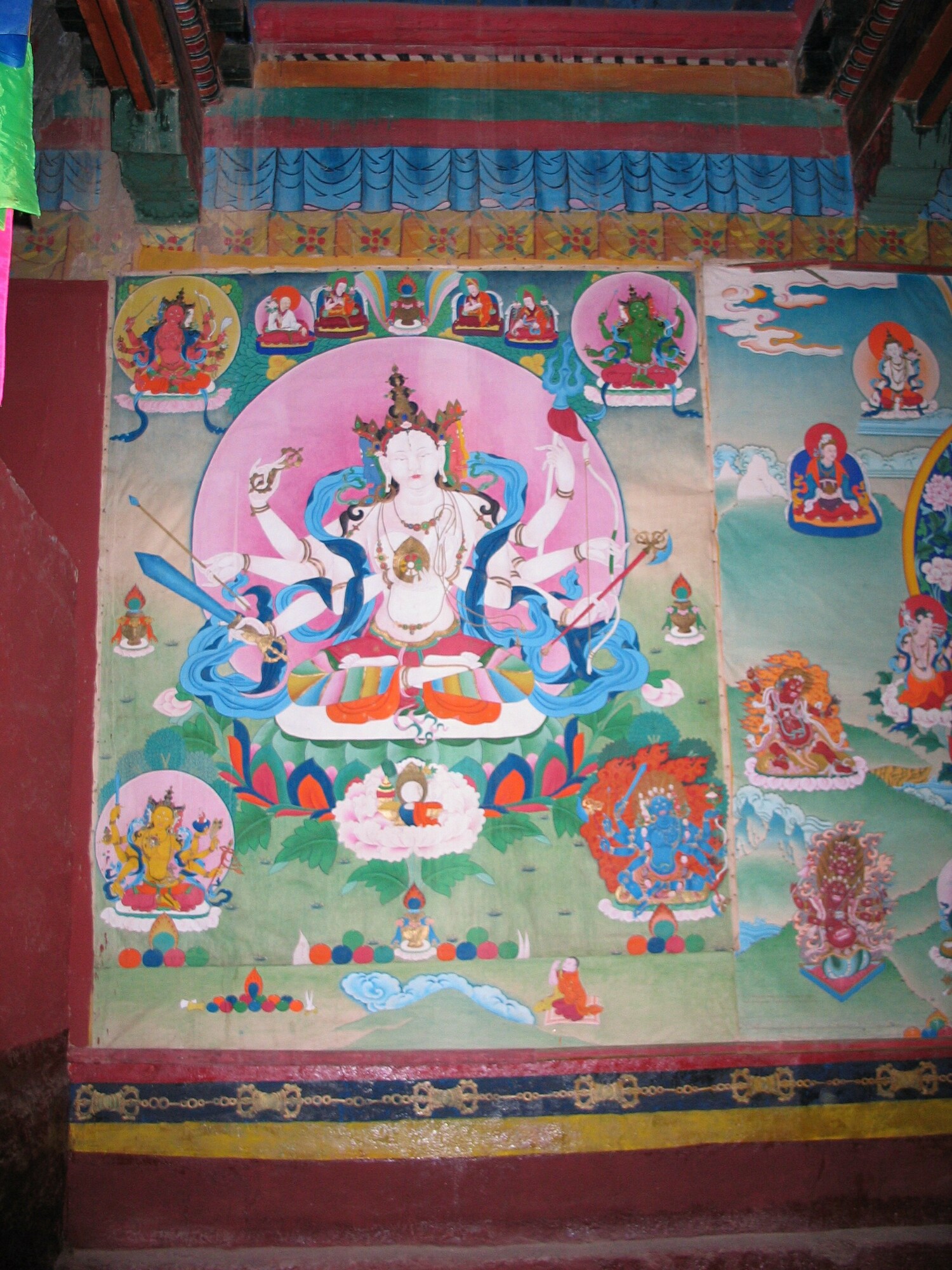
Do the meditation until you get Guru. Then instead of finishing with, empty him. You can do emptiness mantra, arise a Moon Disk from emptiness with her syllable and the syllable will start spinning and she emerges. Merge her lights just as you do the Guru's and give her Heart Mantra an auspicious number of times. Then take samadhi and finish by dedicating the merit. Pratisara Jewel merging with Chakra Family makes Thunderbolt of Body, Kaya Vajra, an esoteric technique for the end, so it would be useful to add this understanding to her now.
So this is not Jewel in Lotus or Om Mani Padme Hum. It is Jewel in Tathagata--Sun--Form. Vairocana Family on a higher Wisdom level (Vajradhatu). Thunderbolt of Body.
Pratisara is considered to be particularly beneficial for the laity, i. e. non-monks. Her name means Wish-Fulfilling Gem; wishes for enlightenment. Her syllable I am not sure, if Sanskrit generally, Pra- is to go forward into differentiation, Pra-vritti, like when the mind wakes from sleep and starts going, that's usually when it starts committing defilements right away and just keeps on doing so.
Manjushri has a wrathful form named Acala or Vidyaraja Chandra Maharoshana considered the consort of Mamaki. Wrathful Moon (Chandra) is the simplest meaning. Roshana can be angry, passionate, touchstone, touchstone for gold, quicksilver. Similar to Pashtun Roshiyana, "Dawn" (Roxanne). Vairocana or phonetically Berotsana. Wrathful Moon Dawn Gem for Gold and Mercury if you can put all of it together. This one is called Fudo-myoo in Japan. He explored Shaktism in Orissa and got together with Eight Arm Red Chandi, which follows through from stage one. Get that into our Vadisimha form and try to get in samadhi with Pratisara.
Namah samanta vajranam chanda maharoshana Sphataya hum traka ham mam
The obscuration of Vaishnavi is Lobha or Raga: greed, sensuality, lust, desire, or attachment to a sensory object. Her mount is Garuda; bird or half-bird. Garuda is considered the most likely occultly helpful kind of being. It flies and drinks Amrita. Lobha as greed and pride is Ratnasambhava's obscuration. Vishnu is closely associated with a Bird and a Serpent, depicted as mortal enemies. The Serpent Sesha-Ananta is Infinite Time, whereas the Garuda is the astrological Great Year. The "vehicles" of Vishnu, etc., represent the ways in which the Formless interacts with Form. So the eagle biting the snake to pieces means time and ever more finite cycles. Snakes just keep coming back because they are infinite.

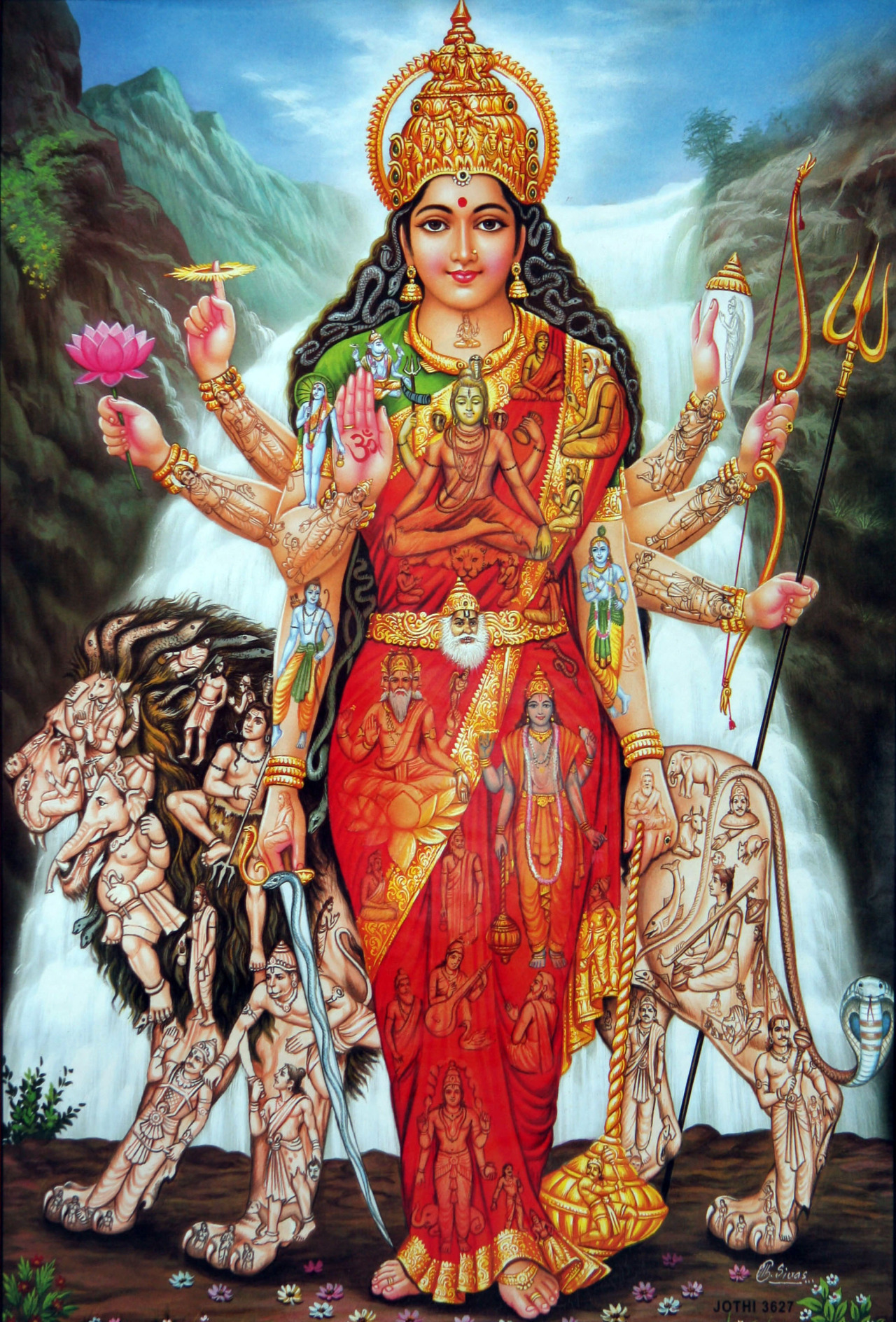
Kamala Vidya pertains to sharing, the virtue opposite Lobha. Kamala or Lotus is a Wrathful Mahavidya of Lakshmi--Vaishnavi, but has the form of being bathed in Amrita by elephants:

She is not that different from Mamaki on a Lotus with gems. Kamala is the 10th Mahavidya and always portrayed as golden beautiful with large breasts that keep her hunched over. This has a bit do with fertility and children, and overall her ultimate manifestation would be the replacement of poverty with beauty. In this she also teaches responsibility, for if taken for granted, all the benefits can be removed. On a grosser aspect she would be pre-occupation with needs. She can become Tamasi and Kalaratri, crushing immovable weight. Said to have three eyes and a kausthubha gem. Her gem belongs to Vishnu and is the most valuable in the whole world:
In Hindu Mythology, the Devas and Asuras performed the "Churning of the Ocean of Milk" (Samudra manthan), in order to get Amrita. In this process, the fourteen treasure jewels (Ratnas) emerged from the ocean. The fourth Ratna that emerged is known as Kaustubha. It represents pure consciousness shining in all its luminous manifestations. It was said by Lord Shiva that nobody in the universe except Lord Vishnu could handle the brilliance and magnificence of this "Mani", since it could corrupt the bearer by infusing in them a greed to carry it forever.
She essentially is the same as Lakshmi, but the esoteric and wrathful parts of her (tantric). Some other names of her are Vidyalakshmi and Gajalakshmi (with elephants). Ratnasambhava is Jewel Being, and if she enters union with his Wrathful aspect, that is her new source of Amrita. Kamala is never shown in union with a god historically. Vadisimha has achieved the Equality Wisdom and works like Ratnasambhava Amrita Kundalini.
Chandraghanta is a Wrathful Venus Durga goddess from a time when Shiva arranged a marriage party of goblins and monsters. Chandraghanta was sort of a disguise of Parvati's, whose name Crescent Moon -- Bell refers to the mark on her forehead. We could say it refers to maintaining mastery of the first stage (Moon) by staying in union with its Prajna (Bell). She pertains to control of all Shaktis.
She persuaded Shiva to clean up and put on some jewels. She is golden colored and manifests through the sound of a bell that dispels demons. And she is a married form. Kamala's White Lotus is fully revealed; the next Family we meet. Chandraghanta generally relates to the next, manipura chakra. This is a sign she's ready to move. Moon Dawn meets Moon Bell.

Venus is the origin of the Formless deities who came to Earth as man's spiritual existence. We are not dealing with the Rupa Skandha, yet, but we are starting with its Wrathful Female component: Mamaki. She is the chief of Five, as is Vagishvara Manjushri, Indriyatman, and Akasha upholds Four Elements. But the Formless Deities are Three. This is the intersection where part of Manas relates to Form and part to spirit. We are learning it as Wisdom of Equality in our Skandha of Sentient Feelings on an axis of greed versus giving, moving towards the equality of Samskara and Nirvana.
From the first lesson, we got the Four Builders in Form or Barshihads (Lunar Pitris), and so at Venus we learn the Three Formless or Agnishvattas, who are unable to produce form without the Moon. Conscious alignment in one's being produces the Venus-Earth master key, combining their astrological glyphs into one symbol. This is hard to find, but blend the Ankh with Orb of Kings, it's two circles joined by a cross.
Those ladies are all gold but we find someone else living in our City.
Haridwar is the residence of Manasa Devi:
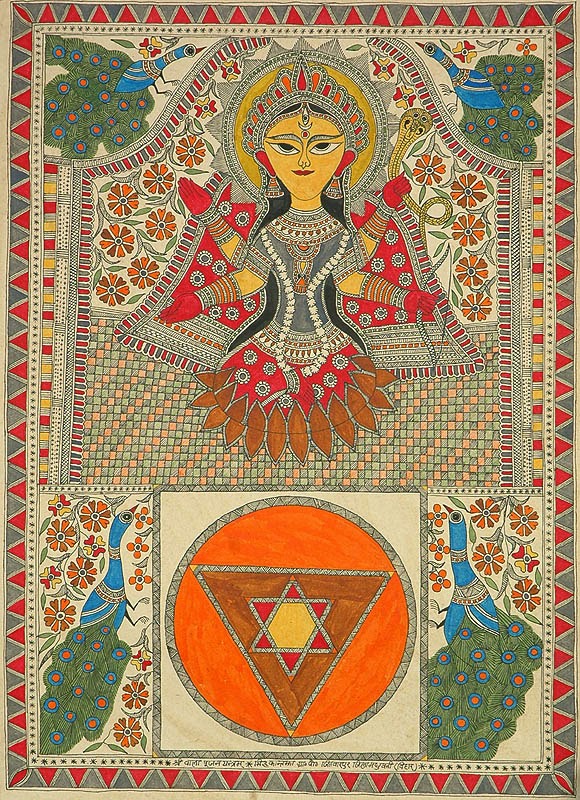
She looks gold and has a gold field in the center of a hexagram. This is inside of the Female Triangle. And she is a Serpent. So she might be related to summoning a golden goddess and releasing kundalini shakti in this chakra.
She is majorly worshipped in different parts of West Bengal and known as Pre-Aryan goddess Vishahara, the demolisher of poison. Some Scriptures say that She was the daughter of famous sage Kashyapa and Kadru, and wife of great sage Jagatkaru. As Manasa was born from Sage Kashyapa's mind, She was named as 'Manasa' meaning born out of mind. The Sanskrit word "manasa" is also tightly related to the word Manasarovar (derived from the two words: "mana" and "sarovara" - lake, but also the name Manasa Sarovara is used), the lake at the foot of Mt Kailash.
Some texts dedicated to celebration of Manasa Devi are also taken from the Brahma Vaivarta Purana, the origin of which is tightly associated with the region of Bengal (where the worship of Manasa Devi has been in vogue for many years). The said texts are taken from the second part of the Brahma Vaivarta Purana called Prakriti khanda.
In the Book 9 of the Devi Bhagavatam Purana, Chapter 1, the following text is written (starting with verse 71): "Then comes the Manasa Devi, the daughter of Kasyapa. She is the dear disciple of Shankara (Lord Shiva) and is therefore very learned in matters of Shastras. She is the daughter of Ananta Deva, the Lord of Snakes and is very much respected by all the Nagas. She Herself is very beautiful, the Lady of the Nagas, the mother of the Nagas and is carried by them. She is decorated with ornaments of the Snakes; She is respected by the Nagendras (Lords of Snakes) and She sleeps on the bed of Snakes."
As Daughter of Ananta, she would appear as the enemy of Lakshmi's Garuda and slashed into pieces. Thus the halves of Daivi Prakriti are split right now and we are starting to form the connection. This should somehwat show the levels of relationships, the Daughter produced by Our Mantra brings us to the Sister Chandraghanta. We are in her sphere of Activity using methods of Pratisara to enhance a Wisdom shown in Kamala. Success is Equality Wisdom Ratnasambhava Amrita Kundalini and looks like radiance of Lakshmi.
Mamaniya had a boon from the King of Nagaloka. One day eight snakes crawled into his house and he had suddenly seven daughters and one son. One of the daughters was Khodiyar Maa. All the cobra sisters dressed in black and were fierce warriors. Goddess Khodiyar Maa derives her name from the word ‘khodi’ which means feet injury. The story behind this is when she was playing with her brother Mehrak. He was bit by a venomous snake. To treat him, ‘Ami’ the Elixirr of Life had to be brought from Naga Loka which is under the sea. Khodiyar Maa, then known as Janbai, volunteers this chore. While she was under water in Naga Kingdom, she injures her foot in the hostile rocks beneath. A divine crocodile escorts Maa back to the surface and lands Maa on the banks. Maa limps her way to save the brother, 'khodati aavechhe’ meaning ‘she is limping her way.
After showing many miraculous powers, people consider her to be goddess and she has temples and shrines too. Her vehicle is crocodile:

We won't see a Crocodile--Makara again for a while. Khodiyaar is a Nirmanakaya.
According to Indian astrology, the God of the fifth date is snake. This is why the number 5 is very important for the Nagas. Here perhaps is the Gate to her level where we find the fifth went. Venus is also associated with 5. In the enumeration of Forces, Akasa is now seen as 3, counted "from above", whereas we are used to seeing it as 5, "from below". The Three is the Amrita of the Agnishvattas. Without the traditional number, we are still looking at Venus which remains related to Nagas.
Ketu is the body of Rahu; they form a head and a tail of one Naga. Naga Mani is a term used for "cobra pearls"; they appear in many colors and have also references within sacred Hindu texts. Some of them, especially in the night, radiate a magic effulgence.
Another story of Manasa Devi's birth starts when Lord Shiva was sexually aroused on the banks of the Kalidaha pool, a pond that is present in West Bengal in Rajnagar (a town). From this version, she goes to Patala. There are legends about Nagas or Snakes in the folklore of present tribal Hindus of Southern India (Adivasis) and the aboriginals of Australia. In these legends, these snakes inhabited a big continent that existed somewhere in the Pacific Ocean which sank and the remnants of it formed the Indonesian archipelago and Australia.
The underground kingdom of the Nagas in Patala is described, for example, the Puranas - one such a story is related to Lord Vishnu's Vamana, or "dwarf incarnation", which occurred in Treta Yuga (the second age) - much earlier than the events described in the Ramayana. Lord Vishnu appears to king Mahabali. Mahabali was king of the Indian region (formerly kingdom) presently known as Kerala (a state in south India bordering with Tamil Nadu), who stands behind the most popular legend here - the Onam legend, which has over many years transformed into the festival celebrating the return of King Mahabali from the underground to Kerala every year.
Naga Kanya is the Buddhist form of Manasa Devi.
Naga Kanya or Virgin Naga, such as Ulupi, the wife of Arjuna. Naga people as a whole, were the main receptacle of Buddhism. Nagas guard treasure and concealed teachings; such as how Nagarjuna obtained the Prajnaparamita. The distinction of a Nag Kanya from a Naga is the wings:

This makes of her a Sky-Goer. Flight is the desired ability for all the Dakinis and Yoginis, showing their mastery over Form and Space and enlightened natures. We will find out exactly who she is the Daughter of. If Chandraghanta is going to show control of all shaktis, it means this.
Most of the goddesses (Devis) are regarded as married ones on one hand and on the other they are considered as virgins (Kumaris). According to the Agni Purana, Chamunda, destroyer of demons Chanda and Munda, regarded as Eight Matrikas, manifested herself as virgin (kumari). In a Newari manuscript Brahmanyadi & Mula komorisatash, eight matrikas (Mother Goddesses) were considered as Kumari.
Malla Nepalese kings were so well-versed in Tantric rituals that they directly communicate with Goddess Taleju. Taleju is the chief protective deity of Nepal and its royal family. Living Goddess Kumari was established as an incarnation of Goddess Taleju in 1701. Buddhists worship Kumari as Vajradevi. Although, female goddesses are worshiped in various forms in Nepal, the most prominent is the worship of the Living Virgin Goddess, Kumari. The cult of Kumari is unique in Nepal where a living vestal virgin is ritually installed as Kumari and is worshiped. This feature exists only in Nepal. According to a legend, Kumari first arrived in the Kathmandu valley in the form of Sri Yantra, a powerful mystical diagram endowed with magical powers of the Goddess Taleju...Taleju Goddess became angry and said that in future nobody will see her in person. However, she will be visible in the form of virgin goddess.
The serpent Ahi Budhnya is, invisibly, what Agni, [the 'furious serpent'] is visibly.
Mahoragas or "great dragons" are another type of naga.
Mysore has a preponderance of triptych style masonry, the panels being firstly, male cobra of one to seven heads; next the female naga or half woman, with a tiara; and finally, them entwined round a linga, as a caduceus.
Under Venus, we're finding serpents leading the way to sort out the shaktis so we may behold her virgin essence. Kundalini generated from the previous phase Moon--Muladhara will work its way through Tara's knots until the brain becomes a generator of the essence Devi. We have introduced Amrita here, the occult name for the imperishable monad. One should see a circuit starting to form.
Moon Dawn needs to Gaze at Moon Bell until even his Wrathful aspect can grant enough kundalini, so that Mother Kamala--Lotus does not have to depend on Four Elephants. Then one has the Manasa Devi or Virgin Flying Serpent of Haridwar, noumenal kundalini of the svadisthana. This needs to purify the element of Space. That is an establishment of Nirmanakaya or body of sattvic emanations.
Upon this, it may be stated that Janguli Tara is Manasa Devi Nag Kanya. This Tara may appear in White, Yellow, or Green. In White, she has a lute and a snake, similar to Sarasvati and White Vajrayogini. However, she is an emanation of Akshobya, and in Yellow or Green she uses a Peacock, holds vajra equipment, and is Tantric Sita White Tara. Similarly to how Kamala is Tantric Lakshmi.
Samata Jnana is deceptively simple. Yes, it would refer to equality of all beings, thus removing the importance of "I". However, we must also consider the nature of the Skandha of sentient feelings: liking, disliking, or indifference. On this, the Vaisnavas also have a correct analysis: Samata, equanimity, refers to freedom from attachment and aversion. Liking or disliking increases Rajas, while indifference increases Tamas. Esoterically, Lobha is not exactly sexual lust--it is liking, disliking, and indifference, in other words this Skandha itself. This is subtle, pervasive, and virtually a dictator. I find that I am largely able to stifle outward behaviors that normally result from it, which really does nothing about the mental factors, and this will do nothing but produce further clash and samsara. So while it is trivial to identify, it is extremely challenging to inculcate mentally as a Wisdom. You can believe that you have, as long as you are in a conducive environment, but chances are, it only takes a small stimulus to trigger a chain reaction. Buddha will not flinch if someone urinates on a sacred thangka, but most Buddhists would be sickened with aversion to it. This is easy to see, but seemingly impossible to achieve in fullness. Therefor it seems we will need a great deal of Pratisara protection until these mental reactions are replaced by Kamala sharing and Mamaki equal identification with all beings. Easy theory, tremendously difficult practice, aggravated by the fact that propaganda and advertising seeks to enflame and enslave us to likes, and put us to war through dislikes, while making us inert and stupidly indifferent to the more important spiritual issues.
So you can see why, ecstatic energy tends to make a person race beyond the first Dhyana, and then why they are going to get wrecked and rejected in this stage. You'd typically think "Well, if I don't like or dislike something, I must be indifferent to it", and the root illnesses are the thinking and the I. We are not saying you need to quit feeling, either--learning how to feel pristinely, without the normal additional reactions, is the intent here. The Jewel Family's Sound of Dharma can certainly produce a feeling of happiness, and when this supersedes attachment to outer objects, we have gained some independence.
"Manas is, as it were, a globe of pure, Divine Light, a Ray from the World Soul, a unit from a higher sphere, in which is no differentiation. Descending to a plane of differentiation it emanates a Ray which is itself, which it can only manifest through the personality already differentiated. This Ray is the Lower Manas, while the globe of Divine Light, a Kumâra on its own plane, is the Higher Ego, or Higher Manas, Manas proper. But it must never be forgotten that the Lower Manas is the same in its essence as the Higher.
This Higher Ego, at incarnation, shoots out the Ray, the Lower Ego. At every incarnation a new Ray is emitted, and yet in essence it is the same Ray, for the essence is always one, the same in you and in me and in everybody. Thus the Higher Ego incarnates in a thousand bodies. The Flame is eternal. From the Flame of the Higher Ego the Lower is lighted, and from this a lower vehicle, and so on. For this Ray can manifest on this Earth, sending out its Mâyâvi-Rûpa. The Higher Ego is the Sun, we may say, and the personal Manases are its Rays; the mission of the Higher Ego is to shoot out a Ray to be a soul in a child. Only thus can the Higher Ego manifest, for thus it manifests through its attributes. Only thus also can it gather experience; and the meaning of the passage in the Upanishads, where it says that the Gods feed upon men, is that the Higher Ego obtains its Earth experience through the Lower.
When the Ray is thus shot forth, it clothes itself in the highest degree of the Astral Light, and is then ready for incarnation; it has been spoken of at this stage as the Chhâyâ, or shadow, of the Higher Mind, as indeed it is. This clothing of itself in a lower form of Matter is necessary for action in the Body; for as an emanation of the Higher Manas and of the same nature, it cannot, in that nature, make any impression on this plane nor receive any. An archangel, having no experience, would be senseless on this plane, and could neither give nor receive impressions. Hence the Lower Manas clothes itself with the essence of the Astral Light, and this Astral Envelope shuts it out from its Parent, except through the Antaskarana. The Antaskarana is therefore that portion of the Lower Manas which is one with the Higher, the essence, that which retains its purity; on it are impressed all good and noble aspirations, and in it are the upward energies of the Lower Manas, the energies and tendencies which become its Devachanic experiences. The whole fate of an incarnation depends on whether this pure essence, Antaskarana, can restrain the Kâma-Manas or not. It is the only salvation. Break this and you become an animal.
But while the inner essence of the higher Ego is unsoilable, that part of it which may be spoken of as its outer garment, the portion of the Ray which takes up Astral Matter, may be soiled. This portion of it forms the downward energies of the Lower Manas, and these go towards Kâma, and this portion may, during life, so crystallize itself and become one with Kâma, that it will remain assimilated with Matter. This unity of Essence with its Divine Parent renders possible its absorption into its source, both during Earth-Life and during the Devachanic interval.
There comes a moment, in the highest meditation, when the Lower Manas is withdrawn into the Triad, which thus becomes the Quaternary, the Tetraktys of Pythagoras, the highest, the most sacred, of all symbols. This upward withdrawal of the Lower Manas leaves what was the Quaternary as a Lower Triad, which is then reversed. The Upper Triad is reflected in the Lower Manas. The Higher Manas cannot reflect itself, but when the Green passes upward it becomes a mirror for the Higher; it is then no more Green, having passed from its associations. The Psyche, thus separated from Kâma, unites itself with the Higher Triad and becomes spiritual; the Triad is reflected in the Fourth, and the Tetraktys is formed. So long as you are not dead, there must be something in which the Higher Triad is to be reflected; for there must be something to bring back to the waking Consciousness the experiences passed through on the higher plane. The Lower Manas is a tablet, which retains the impressions made upon it during trance; thus serving as a carrier between the Higher Manas and the everyday Consciousness. This withdrawal of the Lower Manas from the Lower Quaternary, and the formation of the Tetraktys, is the Turîya state; it is entered on the Fourth Path, and is described in a note to The Voice of the Silence as a state of high spiritual consciousness, beyond the dreamless state."
2. Bhuvarloka is a state of consciousness in which he thinks more of his inner life and it is opposed by Mahâtala because that is the abode of the astral shadow. It distinguishes the condition or vibration of the astral shadow when the thinker is working in Bhuvarloka, the astral light. Mahâtala is connected with the Elementals. Here those beings are coming nearer to man, for we see that they have the power to some extent of living in and by the lower five senses of man and correspond to Kâma and Prâna in the human scale. But as they are without form they are still below men and have not developed Manas. To them man seems as a God, for he shines in their sight. They are also dangerous for man. They have power and certain sorts of knowledge he has not, but they are devoid of that which gives to man his conscience.
Mahatala is esoterically, a place including all others; subjectively and potentially including all preceding it. The state corresponding to the hierarchies of Rasa or Taste Devas, and including a state of consciousness embracing the lower five senses and emanations of life and being. It corresponds to Kâma and Prâna in man, and to Salamanders and Gnomes in nature. Sense of taste.
The second Dhyana does not proceed directly from success with the first. In fact, the opposite is true. Tathagata has said that if you start the second too soon, you will fail, and then not be able to regain the first. So it requires total mastery of the first. Mastery in attaining is the ability to enter upon dhyana quickly, mastery in resolving the ability to remain in the dhyana for exactly the pre-determined length of time, mastery in emerging the ability to emerge from dhyana quickly without difficulty, and mastery in reviewing the ability to review the dhyana and its factors with retrospective knowledge immediately after adverting to them. When the meditator has achieved this fivefold mastery, then he is ready to strive for the second dhyana.
With the subsiding of applied thought and sustained thought he enters and dwells in the second dhyana, which has internal confidence and unification of mind, is without applied thought and sustained thought, and is filled with rapture and happiness born of concentration. Here, you analyze the defects of the first: it is only a minor shield against the Hindrances, and applied and sustained thoughts are found to be gross impediments.
Then one directs the mind to the meditation subject — which must be one capable of inducing the higher dhyanas such as a kasina or the breath — and resolves to overcome applied and sustained thought. When his practice comes to maturity the two kinds of thought subside and the second dhyana arises. In the second dhyana, only three of the original five dhyana factors remain — rapture, happiness, and one-pointedness. Moreover, with the elimination of the two grosser factors these have acquired a subtler and more peaceful tone.
It is more sublime and produces confidence, faith, and tranquility. Concentration becomes undisturbable, and samadhi as experienced at first becomes much more eminent. Furthermore, with the stilling of directed thoughts & evaluations, one enters and remains in the second dhyana: rapture and pleasure born of composure, unification of awareness free from directed thought and evaluation — internal assurance. One permeates and pervades, suffuses and fills this very body with the rapture and pleasure born of composure. There is nothing of the entire body unpervaded by rapture and pleasure born of composure.
Last edited by shaberon; 19th December 2018 at 23:13.
-
-
24th January 2018 03:47
Link to Post #243
Avalon Member
Re: The Serpent, the Black Sun, HPB & St. Germain
3. Discriminative Wisdom: Amitabha, Lotus Family, Vajratiksna
Vajratiksna is the Deity name, and it would use an Amitabha-related form such as Vadisimha, "(Invincible) Lion of Speech" or "Lion of Disputes". That form is invoked into oneself, and Devi Sarasvati (or if needed wrathful and secret Vajra Sarasvati) is conjured ahead, slightly left. The near-heart-mantra of Vajratiksna, "All natures are intrinsically pure like the abhava (not formed or produced)", agrees with the Purity of the Lotus Family.
The Mandala of Vadisimha or Manjushri as Vajratikshna (Sharp Vajra, or of the Sword he usually carries). Here the Manjushri is single-faced and two-armed. The Tibetan tradition of this Manjushri depicts him in the company of Devi Sarasvati. Sarasvati is Vach Devi or Luminous Speech. Now here again, without a Manjushri empowerment we cannot self-generate as above, and still there is no actual mandala or practice beyond that stray comment. If it shows up, fine. In Japan, he is recorded as a Bodhisattva of Amitabha, and, according to the Met, his Four Arm form has sword, book, bow and arrow. At the moment, he is taking a Vajra name here and Sarasvati should go Dark Blue. Given the nature of material we will discuss in this part, and due to the fact we are observing Amitabha, my strong suggestion is to really look at Tara and composing her into Vasudhara. Possibly also Red Yamari belongs here, or both Yamaris.
Because this is the cusp of Vajra or it marks more of a serious power than the first two did.
This chapter refers to Amitabha and Speech.
Amitabha is Tattva because he establishes pratyaveksana-jnana which comprehends reality (tattva) and with sublime joy is like the sky.
As is known elsewhere: The Lotus Family with the speech of samadhi is Completely Pure Lotus. The Vajra Family has the sound of Thunder and the Jewel Family has the sound of Dharma. Having put "self" and "what belongs to self" in front, the Vajras destroy it. The Lotuses purify it. The Jewels make it all sky. In the Lotus Family, siddhis proceed direct from samadhi.
Vishnu's incarnation Narasimha (lion or half-lion) has a Gayatri with vajra and tikshna encapsulating other words:
Narasimha Gayatri Mantra
“Om Nrisimhaye vidmahe vajranakhaya dhimahi tan no simhah Prachodayat |
Vajra nakhaya vidmahe tikshna damstraya dhimahi tan no narasimhah Prachodayat ||”
Meaning: ‘Om! Let us be well aware of Nrisimha, the lightning-nailed. May the Lion promote our thought and actions. Let us meditate on He who is known as the possessor of nails as hard as thunderbolts and sharp teeth. Let us all be enthused by Lord Narasimhadeva.”
Upon receiving kusha grass in Kalachakra empowement, disciples say: “Om Vajra-Tikshna Bam.”
These first two images really are for the meditation that would have been the second mandala. Anything "Lion" about these deities just means one is near; Sri and Buddha and Durga do this in their peaceful aspects. So when you look at Wu Tai Shan, any "Lion Manjushri" is just that aspect where he has a vehicle. We can't be sure, but it is likely that Vadi Raja is this form with companions.
Vadisimha:
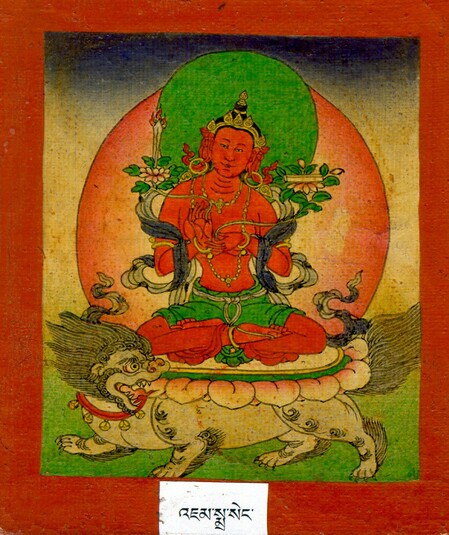
Vadisimha with Sarasvati:
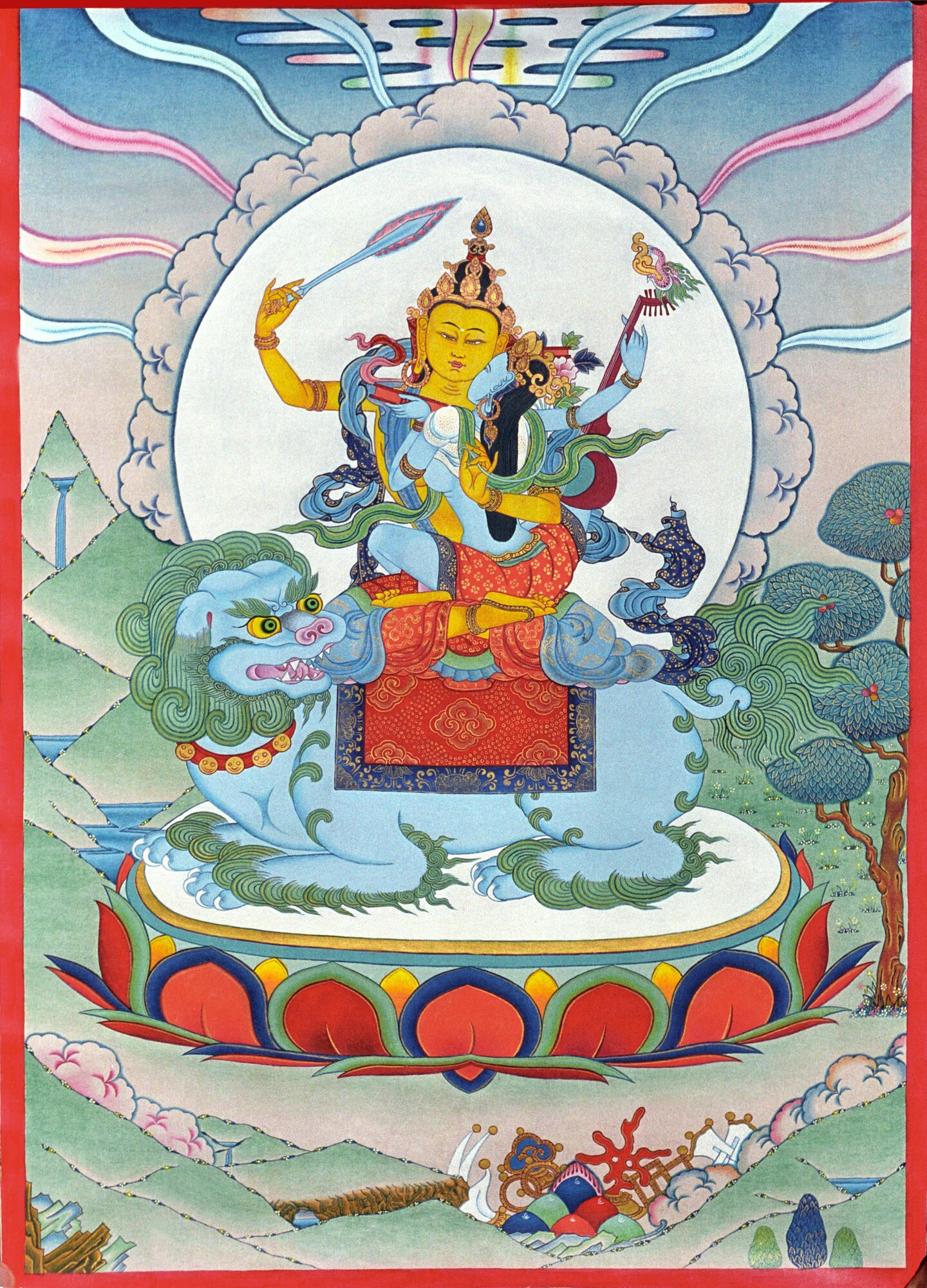
Everyone named Vadisimha always has a lion present, so this form is not much different from Vadiraja. Tiksna is not in Ocean of Sadhanas, I am not sure where it comes from. But he will be in Wu Tai Shan Five Form, and he is not the center, or on a lion. There are many permutations for the positions and colors, but so far, there is not a Five Color variety as described. If I wanted to have a Green Two Arm Tiksna, it would probably be this:
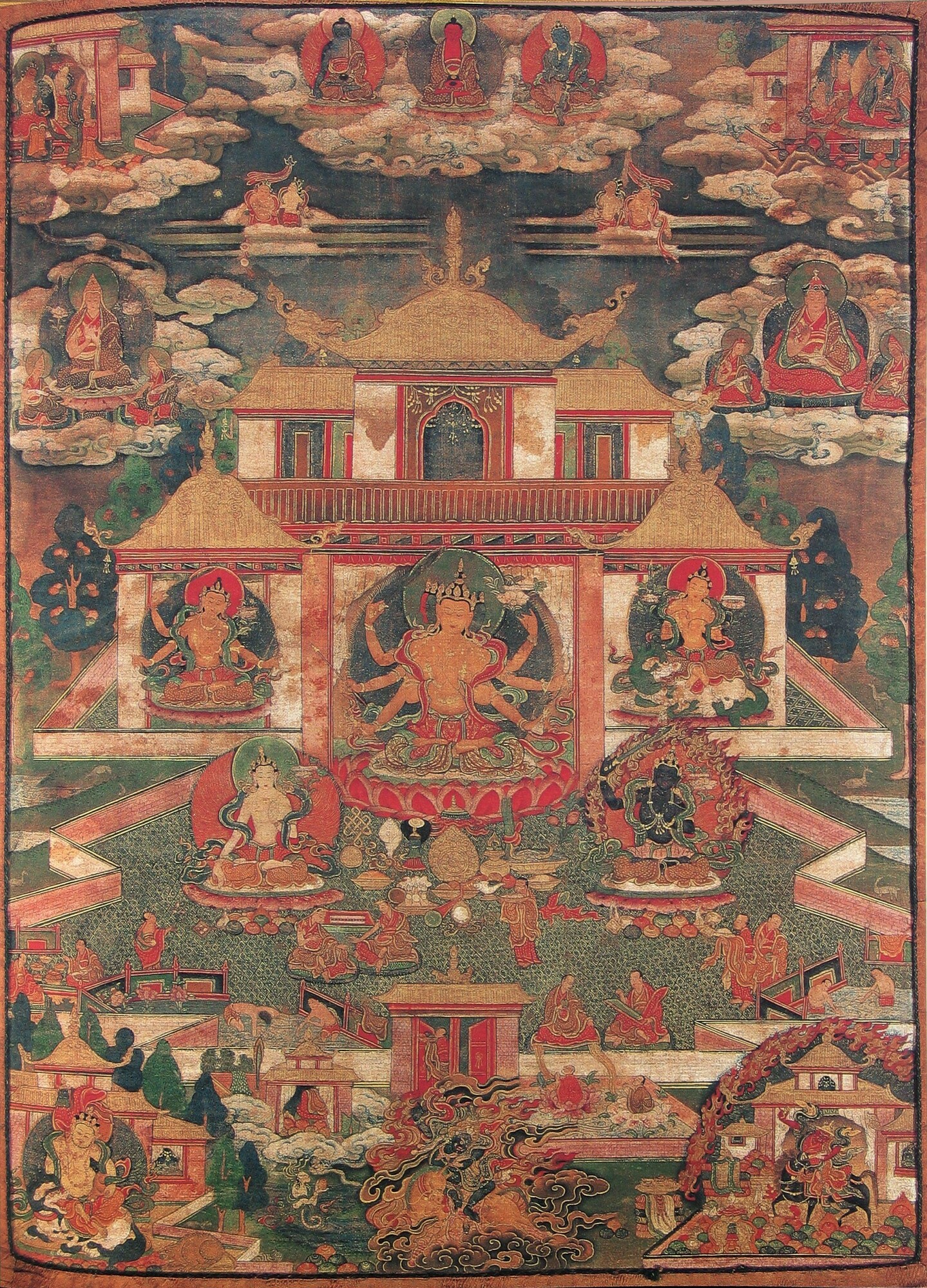
From the source, those are un-named, but we have learned him to realize there are three outer forms and two celestial, and there is more reason to see Vadisimha over Tiksna in this view, than anything else. The lowest register is probably Jambhala, Sri, and a worldly protector.
The Slokas are:
Forty-two Verses on Discriminating Wisdom
(77) He’s what’s perfectly so, the lack of identity-nature, the actual state, the endpoint of that which is perfectly so, that which isn’t a syllable; he’s the proclaimer of voidness, the best of bulls bellowing a roar, profound and extensive.
(78) He’s the conch of Dharma, with a mighty sound, the gong of Dharma, with a mighty crash, the one in a state of non-abiding nirvana, kettledrum of Dharma in the ten directions.
(79) He’s the formless one, with an excellent form, the foremost one, having varied forms, made from the mind; he’s a glory of appearances in every form, the bearer of reflections, leaving out none.
(80) He’s the impervious one, with great (lordly) renown, the great powerful lord of the world’s three planes; abiding with a lofty arya pathway of mind, he’s the one raised on high, the crown banner of Dharma.
(81) He’s the body of youth unique in the world’s three planes, the stable elder, the ancient one, the master of all that lives; he’s the bearer of the thirty-two bodily signs, the beloved, beautiful throughout the world’s three planes.
(82) He’s the teacher of knowledge and good qualities to the world, the teacher of the world without any fears, the guardian, the rescuer, trusted throughout the world’s three planes, the refuge, the protector, unsurpassed.
(83) The experiencer (of experiences) to the ends of space, he’s the ocean of the deep awareness of the omniscient mind, the splitter of the eggshell of unawareness, the tearer of the web of compulsive existence.
(84) He’s the one with disturbing emotions stilled, without an exception, the one crossed over the sea of recurring samsara; he’s the wearer of the crown of the deep awareness empowerment, bearer of the Fully Enlightened as adornment.
(85) He’s the one stilled of the suffering of the three kinds of suffering, the one with an endless ending of the three, having gone to the liberation of the three; he’s the one definitely freed from all obscurations, the one who abides in space-like equality.
(86) He’s the one past the stains of all disturbing emotions, the one understanding the three times as non-time; he’s the great (naga) chief for all limited beings, the crown of those wearing the crown of good qualities.
(87) Definitely freed from all (residue) bodies, he’s the one well established in the track of the sky; bearer of a great wish-fulfilling gem, he’s master of the all-pervasive, ultimate of all jewels.
(88) He’s the great and bounteous wish-granting tree, the superlative great vase of excellence; the agent fulfilling the aims of all limited beings, the wisher of benefit, he’s the one with parental affection toward limited beings.
(89) He’s the knower of what’s wholesome and what’s unwholesome, the knower of timing, the knower of the close bond, the keeper of the close bond, the master of the all-pervasive; he’s the knower of the faculties of limited beings, the knower of the occasion, the one skilled in the three (kinds of) liberation.
(90) He’s the possessor of good qualities, the knower of good qualities, the knower of the Dharma, the auspicious one, the source of what’s auspicious, he’s the auspiciousness of everything auspicious, the one with the auspicious sign of renown, the famous, constructive one.
(91) He’s the great breath, the great festival, the great joy, the great pleasure, the show of respect, the one showing respect, the prosperous one, the supremely joyous, the master of fame, the glorious one.
(92) Possessor of the best, he’s the provider of the best, the most preeminent, suitable for refuge, he’s the superlative refuge, the very best foe of the great frightful things, the eliminator of what’s frightful, without an exception.
(93) Wearing his hair in a bun, he’s the one with a bun of hair, wearing his hair in mats, he’s the one having matted locks, he’s the one draped with a munja-grass sacred cord, the one wearing a crown, the one with five faces, five buns of hair, and five knotted locks, (each) crowned with a bloom.
(94) He’s the one maintaining great taming behavior, the one with shaved head, the one with celibate Brahma(-like) conduct, the one with superlative taming behavior, the one with great trials, the one who’s completed the trials, the one who’s taken ablution, the foremost, Gautama.
(95) He’s a brahmin, a Brahma, the knower of Brahma, the possessor of a Brahma-nirvana attainment; the liberated one, he’s liberation, the one with the body of full liberation, the fully liberated one, the peaceful one, the state of peace.
(96) He’s nirvana release, the one with peace, the one released in nirvana, he’s the one most definitely delivered and nearly (brought to an end), the one who’s completed bringing to an end pleasure and pain, the one with detachment, the one with (residue) body consumed.
(97) He’s the invincible one, the incomparable one, the unmanifest one, the one not appearing, the one with no sign that would make him seen, the unchanging, the all-going, the all-pervasive, the subtle, the untainted, the seedless.
(98) He’s the one without a speck of dust, dustless, stainless, with faults disgorged, the one without sickness; he’s the wide-awake one, by identity-nature, the Fully Enlightened, the Omniscient One, the superb knower of all.
(99) Beyond the nature of partitioning primary consciousness, he’s deep awareness, bearer of the form of nonduality; he’s the one without conceptual thought, spontaneously accomplishing (without any effort), the one enacting the enlightening deeds of the Buddhas throughout the three times.
(100) He’s the Buddha, the one without a beginning or end, the (beginning) primordial Adibuddha, the one without precedent; the singular eye of deep awareness, the one with no stains, deep awareness embodied, he’s the One Thusly Gone.
(101) He’s the powerful lord of speech, the magnificent speaker, the supreme being among speakers, the ruler of speakers, the best of those speaking, the very best one, the lion of speakers, inconquerable by others.
(102) Seeing all around, he’s supreme joy itself, with a garland of brilliance, beautiful to behold; he’s the magnificent light, the blazing one (Vishnu, beloved of Shri,) the curl at the heart, the illuminator with hands (that are rays) of blazing light.
(103) The best of the great physicians, he’s the most preeminent one, the unsurpassed remover of (thorny) pains; he’s the celestial tree of all medications, with none left out, the great nemesis of the sicknesses of disturbing emotions.
(104) He’s the beauty mark of the world’s three planes, the lovely one, the glorious one, with a mandala of lunar and zodiac constellation stars; he’s the one extending to the ends of space in the ten directions, the great ascending of the banner of Dharma.
(105) He’s the unique extension of an umbrella over the wandering world, with his mandala circle of love and compassion; he’s the glorious one, the Powerful Lord of the Lotus Dance, great master of the all-pervasive, the one with an umbrella of precious gems.
(106) He’s the great king of all the Buddhas, holder of the embodiments of all the Buddhas, great yoga of all the Buddhas, unique teaching of all the Buddhas.
(107) He’s the glory of the empowerment of the vajra jewel, powerful lord of the sovereigns of all jewels; master of all (Lokeshvaras,) the powerful lords of the world, he’s the sovereign of all (Vajradharas,) the holders of the vajra.
(108) He’s the great mind of all Buddhas, the one that is present in the mind of all Buddhas; he’s the great enlightening body of all Buddhas, he’s the beautiful speech (Sarasvati) of all Buddhas.
(109) He’s the vajra sun, the great illuminator, the vajra moon, the stainless light; he’s great desire, the one that begins with non-desire, blazing light of various colors.
(110) He’s the vajra posture of the Fully Enlightened, the bearer of the Dharma, the concert of the Buddhas; he’s the glorious one, the one that’s born from the lotus of the Buddhas, the keeper of the treasure of omniscient deep awareness.
(111) He's the bearer of diverse illusions, he's the king; he's the bearer of Buddhas' pure awareness mantras, he's the great one; he's the vajra sharp, the great sword, the supreme syllable, totally pure.
(112) He’s the Great Vehicle (Mahayana), the cutter of suffering, he’s the great weapon, Vajra Dharma; he’s (Jinajik,) the triumph of the triumphant, vajra profound, he’s vajra intelligence, the knower of things and how they exist.
(113) He’s the perfected state of every far-reaching attitude, the wearer of all (bhumi) levels of mind as adornment; he’s the lack of a true identity-nature of totally pure existent things, he’s correct deep awareness, the core light of the moon.
(114) He’s great diligence (applied), Illusion’s Net, sovereign of all tantras, the one that’s superb; he’s the possessor of vajra (postures and) seats, without an exception, he’s the bearer of enlightening bodies of deep awareness, without an exception.
(115) He’s the all-around excellent (Samanta-bhadra), he’s excellent intelligence, he’s the womb of the earth (Ksiti-garbha), the support of the wandering world; he’s the great womb of all of the Buddhas, the bearer of a circle of assorted emanations.
(116) He’s the supreme self-nature of all functional phenomena, the bearer of the self-nature of all functional phenomena; he’s the non-arising existent, with purposes diverse, the bearer of the nature of all existent things.
(117) Great discriminating awareness in a single moment, he’s the bearer of comprehension of all existent things; the clear realization of all existent things, he’s the able sage, with foremost intelligence, the endpoint of that which is perfectly so.
(118) He’s the immovable one, extremely pure, by identity-nature, the bearer of the purified state of the Perfect, Fully Enlightened Ones; he’s the one having bare cognition of all Buddhas, the flame of deep awareness, the excellent clear light.
-----------------------------------------------------------------
Mathura is the birthplace of Krishna. At the Yamuna River--the sister of Yama, death. The town was founded by the youngest brother of Rama, Shatrughna. It was ruled by Krishna's uncle Kansa, who is materialistic ambition. Krishna had to be born in a prison, escape to pastorality, and then kill him. In this motion, Krishna re-installed the previous king, Ugrasena, who was there before Kansa came in. Because Kansa was actively ruled by demons, this has been placed at the solar plexus or manipura. Ugra is a common synonym for Nila or Wrathful. In the Golden Rosary, Tara quelled the turbulent Vinayakas at Mathura.
Mystery: Bodhi
Force: Anupadaka (Parent-less) 2
Planet: Jupiter
Color: Light Blue
Principle: Auric Egg
Skandha: Samjna (perception)
Prajna: Yogini Pandara Vasini -- Protector Maha Sita Sitavani
Heroic Buddha: Sikhin
Chohan: Atman and Parashakti Kāla Tattva- time
Ray: Sarvavasu, "All Vasu"; second or undefined; Buddha was an adept of this ray.
Avatar: From Tripurasundari, Lord Vamana was incarnated.
Mother: Maheshvari
Sister: Katyayini
Maha Vidya: Blue Tara (Blue Sarasvati)
Lore:
Maha Sita Sitavani means The Great Cool Forest. She emanates from "sham". Assigned to Amitabha. Her mantra is:
Om bhara bhara sambhara sambhara indriyavara vishoddhani ruru care hum hum hum phat phat phat svaha.
Or Forest of Sita, Rama's wife, who means "furrow", found in the Ramayana by someone who was ploughing, so considered an earth daughter of Bhuvaneshvari. She was very devoted and submissive and proved her power with an immunity to fire. She's banished to a forest where, unknowingly to him, she is pregnant with Rama's twins. At the end, she refuses Rama, and her purity makes the earth raise a throne which she takes, and then it swallows her.
If you leave Mathura, Sitabani would be the cool forest you would get to if you headed towards the mountains.
The obscuration of Maheshvari is Krodha, anger. Her mount is a bull.
Blue Tara (Ekajati from Bon, also known as Neel Saraswati, Yang Cheng Mo). Silence. Move across the mind guided by the star of silence and the void, hearing nada or om, the primordial sound. Breath in which the sound originates is the carrier (transporter –Tarini) of knowledge conveyed through the sound of speech. Tara is the un-manifest speech that resides in breath and consciousness--the "piercing word". This Tara is accompanied by a ten-headed serpent called Akshobya. Nila Saraswati Tara was practicing her tapas near Lake Chola, her pure energy “fell” into the water and from that moment on her body became blue.
Tara is the unstruck sound, and she as Om is the vehicle for “crossing over”. As Om, she is Nila Saraswati, the blue goddess of knowledge that bestows the true understanding of this sound, compared to that of a veena or lute. She often appears pot-bellied or pregnant, and is one of the only forms to hold a pair of scissors. She is associated with the fires of crematories. Compared to Kali, her hair is combed, indicating discipline. She doesn't seem to have a specific kind of ignorance/wisdom, other than cutting off, or carrying one across, all samskaric turmoil.
So this rite involves one's self as Vadisimha or Lion of Speech interacting with Vach Devi Sarasvati--or her Wrathful form which is the same as Blue Tara. Blue Tara showed up here as a correspondence with Jupiter, the concept of order or Rta. And so Lotus Speech encompasses all from silence, breath, unstruck or potential speech, to pleasant actual speech with the ability to sharply cut away impediments or resolve disputes.

This Sarasvati is a Yidam or meditational deity. The Prajna or Wisdom of Amitabha simply exists. We attempt to change this from concealed to revealed. In this case, she bears no resemblance. Pandara Vasini is Exalted here (in this phase or position), and she is so to speak the big Red Tara of the little Red Lion Tara Gatekeeper:

The Goddess now has a Phoenix. We cannot be sure if she is the origin of White Kwan Yin, however, when Avalokitesvara attained to supreme consciousness, he chose not to pass into nirvana, but vowed to stay behind as the succor of the afflicted. He was filled with compassion, karuna, for the sufferings of the living, which he sought to bring to enlightenment. He was represented as a handsome young man holding a lotus flower in his hand who wore a picture of Amithaba in his hair. His female consort was Tara, also known as Pandaravasini, 'clad in white'. So she is white and picks up red from being close to Amitabha, usually represented by red, west, and fire. We moved the standard Element of Fire, and placed the mysterious Anupadaka, called Aerial Flame. The Formless element of All Vasus or full spectrum. The tattva name Anupadaka is "parent-less", un-created or self-arising, and the alchemical term aerial flame seems similar to White which has been mixed with Red like Pandara.
An Aerial Flame Phoenix. This is nice. The Goddesses have been mostly golden until now which on her part, she's adding Voice and Blue. And then Little Red Lion's going to come out. We are gathering such a Lion nature as well however, we are only Orange Saffron now. Things are to be put to Order--Rta--Sharply. So we gain our Sword. This is generally what will make a male character different from the Female Chain. So when we go to the Gold this time, our conversation gets more complex and goes into the Blue Voice and Red Lion--Red is originally White that's gotten close to Amitabha. Venus-Earth key combined with Order of Flame. Sitabani showed us an aspect of Earth that is not destroyed by fire.
Devi Katyayani is a form of Durga made as a tremendous effulgence formed by angry flames from the eyes of all the Formless and Form gods at the ashram of Rishi Katyayan, hence her name derives from him. It was she who attracted Mahish Asura and said she could not be won without a fight. But then in some versions it was another Durga--Chamunda--that killed him. She is golden and rides the Lion. She drank all the blood of Raktabija. She has much to do with strength and courage, is violent and warlike, and is followed by girls seeking husbands. According to some, she is the sister of Krishna who prevented him from being killed and escape prison as a baby.
The name Katyayani indicates that in this form Devi has the power to remove the rigidity, arrogance and the hard shell covering the spirit. The rigidity of life is eliminated by Katyayani. Sometimes a hard person does not know why they are crying if they experience beauty or a mantra.

Devi Kanya Kumari of the very southern tip of India, where Sati's spine fell, is her avatar. Her mount is the Lion.
We have Wrathful Eye Fire at the Ashram of Gold Sage. He has a particularly attractive Gold Daughter. If we do this right much rigidity will be gone. We would gain the level of Gaze at the Sister. She is attractive so we are going to Gaze--this stage--but won't win without a fight--next stage. We'll start with going to Smile at her in a special place. We got a special gem last stage and here it goes. If we train in the procedure, it will increase to a Gaze. We'll add a new kind of training and try to Hug Tara at Mother Level particularly in Red; if successful, a Phoenix will emerge.
Mani-Pura, "City of Gems" chakra is the major change from the first two, which were mostly purificatory in nature, to a firm advancement in spirituality. It is mostly this chakra which is able to imbue the cold, deathly feeling of Prajna with bliss. Sometimes described as Surya Chakra or one that distributes solar energy to the body. This is where Bhuvaneshvari really lives, but us visiting her turns out to be guarded by Gatekeepers. We want to get in there and start generating Sambhogakaya.
The solar plexus is the crucible distilling outer experience into something fit and healthy for the heart. It is made of the lowest level of goddesses, the Female Outer Gatekeepers. This uses the Fixed Cross of Four Directions and is related to the following mantra from Sadhana-mala. Before using this, it is imperative to learn Om on its own and follow Tara's mantra progression from Prajnaparamita through Vasudhara. She has to be studied in circles and branches, however, from doing this, there is definitely a method of starting from basic Green Tara pledge being, extracting Blue to the Wrathfuls, then Prajnaparamita is White and Yellow. For White, we need to start from Prajnaparamita then learn Sita, Parasol, and Mahasri. For Yellow, Parnasabari, Janguli, and Vasudhara. This is to cross the "Courtyard" to the "Temple door". Then we can look at Hrih syllable and Red.
We should have a knowledge and practice of Vajrasattva, Lion Manjushri, and Tara, which, in the manner described, places us at the beginning of the following information.
Four Gatekeepers Activities mantra:
Om vajrankusi akarsayah Jah, Om vajrapasi pravesaya Hum, Om vajrasphota bandhaya Vam, Om vajravese vasikuru Hoh.
"Om, may the diamond hook attract, Jah! Om, may the diamond noose draw in, Hum! Om, may the diamond chain tie, Vam! Om, may the diamond bell subdue, Hoh!"
Jah is to invite, Hum is to make firm or remain, Vam is to mingle indivisibly, and Hoh is to enjoy.
Those are the Gatekeeper's weapons, and their heads are Cuckoo, Goat, Lion, Snake.
The cuckoo's call is the sound of the heartbeat and is the beginning of the solar plexus wishing to purify its prana for the heart.
The goat ruminates over experience and finds the best parts to use.
The Lion is placed with Amitabha and is purified speech, distilled prana going from the solar plexus to the throat. The use of throat energy is what accesses subtle mental spheres, and allows the heart to operate the secret compartments of the brain. We are primarily doing Mantra Path.
Snake is kundalini and holds the Bell of Prajna, being the chakra's full operation with pure and balanced prana allowing the mysterious kundalini to proceed to the next stage.
At the highest level, Four Directions are the Lipika and the Activity of Tara; at this level, we find them the beginning of Catur Karman or Four Enlightening Activities meant by the weapons mantra. Those are Wrathful in nature and are slightly different when Peaceful:
Pacifying (Santicara) conflict, sickness and famine (White Tara);
Increasing (Paustika) longevity and merit (Yellow Tara);
Magnetizing (Vasikarana) the three realms (Red Tara) and
Subjugating (Abhicara) hostile forces (Black Tara).
These Activities take place mostly either due to the use of Mantra, or at Initiations. All Four Kayas are said to have stages of perfecting the Mind, Body, Voice, and Wisdom of itself. If Emanations are not pristine, these Emanational Rites must occur until the condition is reached. This is the cultivation of purified prana or perfume. Once a set of Gatekeepers is placed into order, they guard one's siddhis and samaya.
We may note the first two stages had White Shailaputri and Yellow Katyayani, and now on the third or Red, we can start using four colors as a sequence.
This pattern of Activity forms a substantial basis of practice. A good explanation of how this is used such as Vajra Samaya Jah Hum Vam Hoh--the Pledge Being and Deity and how they mix and this underlying mantra, Merit Field and Prostration.
The hook is the ancus or goad. This both smashes the Hindrances and also hooks or attracts. Attraction is an invitation by Offerings. It may come either from worldly realms of the Quarters and Directions, or the Dharmadhatu palace of Akanistha in Sambhogakaya. Training starts in Worldly Quarters.
The noose "draws in", which refers to the blending of mandalas and deities as described in the Six Session article. Increases merit and qualities.
The chain ties a bind of sameness between the evoker and things evoked. As "bandhaya" in the mantra, this is related to Bandhu, which says friendship is the basis of the tie. Controls beneficial energy.
Subduing may be understood in that the subjugation of hindrances is pleasing to the Dhyanis and makes them rejoice.
If we get this down as a basic, then over time, Om produces Pranava Vajradakini, Jah produces Jramita Vajradakini, Vam produces Vadava Vajradakini, then Vairani Vajradakini from Hum or Hoh. We have to do these Gatekeepers first, and then we will do the rest of Hundred Deity mandala, so in the final stage, it already works and can penetrate the secrets. The central vajra goddess will not exist unless these have been established.
Rakta Yamari is Red Manjushri. His retinue is Vajravarahi (hog face from Krsnayamdritantra), Vajra Charchika, Vajra-Sarasvati, and Vajra Gauri. So by starting with these Gatekeepers now, we are building that Kaya for a more powerful Gnosis Being, who is only accessible by the weaving process as described in the Six Session article.
So to have a good Gatekeeper Mantra, Om when fully sounded is the triple sound a-u-m and silence. You should have both the spoken or chanted Om to use in phrases, empowered by being able to do this full one on its own:
The triple sound is Tripura Sundari and the silence is Atma or unstruck Om.
A is Agni Vaishvanara and Form. Vishva nara is all whole pervasive man, or Vishnu Narayana (Purush), expanded everywhere in the universe. In Rig Veda, just as the seven bright rays of the sun (Savitri) and the brightness of Agni light up the entire world of inanimate and animate objects, so do the learned people with their wisdom gracefully illuminate the minds of all beings for mutual benefits. Is in the right eye or the ayatana, consciousness of the right eye in its highest intellection.
U is Taijasa perceiving subjectively. Horizon or Kama Manas and Kama Loka; Dreams.
M is Prajna Akasha; Space; Dreamless Sleep. So these second two are Aerial Flame.
Triple Aum is Tripura Sundari: Agni Vaishvanara Savitri and Aerial Flame.
Prajna-Akasa Taijasa Agni-Vaishvanara-Savitri. Fire of manifestation and then Silence.
Similar to "Earth--Horizon" of "Mt. Meru--Kama Loka", in the Fiery World, Taijasa is this same Horizon. This would be the Gaze.
The Peaceful Deities are the Heart and the Wrathful Deities are the mind or Ajna. So the Eye Mind that is not a servant of the Heart, this is the one that will have Wrathfuls running wild, battering it into further transmigrations. If the Heart is supreme, those Wrathfuls or parts of the mind still exist, but have been pacified and controlled, having no more Resistance or Activity. Therefor, a person who reads this material on only an intellectual basis, or a person who has moral behavior mostly from obediently following the rules, will not have an expanded Heart and will face the Wrathfuls after death. And so this is what we mean by Talas or planes of effects, where Wrathful reflexes take place. They are automatic, proceeding from the karmic seeds that have been set. You may become a complete victim of yourself, or utterly immune to the fears and pitfalls.
Avatar Vamana is called Three Steps which refers to Vishnu filling the universe in three steps across Lokas, Earth, and Talas; in other words, this Sarva Vasu Aerial Flame is really eager to end our samadhi and refill the lower planes. It pushes, and "push" separates, compared to looking inwards and centering.
Peaceful and Wrathful together are the group of Hundred Deities, and each one is a syllable in the Hundred Syllable Mantra of Vajrasattva Purification. So if we uphold Vajrasattva Samaya so he becomes reality in our Heart, this is to illuminate the Peaceful and Subdue the Wrathful Hundred. This is why Vajrasattva is so important and taught early in all our schools.
However there is a secret or unmentioned group of Deities called Vidyadharas or Knowledge Holders, and this group is the Throat Chakra. These are Peaceful or Semi-Wrathful. And this is why the Method of Manjushri or Lord of Speech is important. These Deities are not simply pacifiers; the Throat is the center which gathers all of the strengths generated in the Heart and uses them to unlock the secret chambers of the Head, the very high or true transcendent states of mind.
The classes of these Hundred Deities--whose practice originates with Vajrasattva, and culminates at the highest Completion Stage:
The Heart:
Vajrasattva & Consort
Peaceful Dhyani Buddhas (Emanations) & Prajna Mothers (Net). These Mothers are "Surakanya" or "Purity of Element" (Bhuta) and they protect Time or the major time cycles, particularly on the Inner Wheel of Kalachakra. Dharmakaya.
Peaceful Bodhisattvas (Bodhi) & Offering Goddesses (Kaya or Sku). These are the Sisters from the Talas below earth who are Daityakanya or "Purity of Sense Objects" (Bhutika or compounded elements). Sku is Tibetan for "Kaya", so for instance Chos Sku is Dharmakaya. Usually translated as "body", the kaya or sku is really "that which is accumulated", the merits, mental and ultimate components of Buddhahood. This group is Sambhogakaya or the Accumulation of Enjoyment. The Outer Wheel of Time.
Peaceful Munis or Sages. This group is the Nirmanakaya (and Vairajas).
Male and Female Gatekeepers in union (Wrathful Acala with Ankusa, etc., counted as Peaceful)
The Throat: Vidyadharas.
The Mind:
Mahottara Heruka (Amrita Guna) and Consort
Wrathful Buddhas & Krodhishvari Consorts. Dharmaraja Protectors or Dharmapala. Mundane Consciousness.
Mamo Botong or Mukhali (reflex of Akasha Garbha) and the Gauri group.
Wrathful Bodhisattvas or Tramenma. These are sometimes listed as Male, Sometimes Female. Mundane Objects of Consciousness.
Inner Female Gatekeepers. Enlightened Lokapala (apparently the same four gatekeepers)
Wrathful Ishvari Yoginis (Tibetan Wangchukma). These are the Mantra-Born Daughters, Vidya, the Nirmanakaya--originated from the Human Realm, affecting the Secret Wheel of Time (initiation). Wang is Tibetan for Abhiseka, an Empowerment or initiation. These are in Four Groups doing the Four Enlightened Activities.
Outer Female Gatekeepers, as described above. Dikpala or worldly protectors. Each has six Ishvaris, and appear to be outer animal-headed forms or solo versions of the ones in union. Gatekeepers are somtimes called "the times and beliefs", or three times and unfixed time, with the males being four faults of Catuskoti--these are empowerment deities of the three seats (skandhas and dhatus, sense-bases and objects, action and senses) of completeness, Vajra Samaya.
The Gatekeepers or Activities have an Outer form with Ishvaris, and then Bodhisattva-level Peaceful and Wrathful equivalents. So, they empower the three seats, wheels, or levels, which is a similar procedure from the beginning or solar plexus, repeated at increasingly pure and subtle levels. That is why Four Activities are an important basic, it stays in permanent use. The activities sound a little different in peaceful or wrathful versions, but it is mostly the same rhythm. Hook is the beginning, whether in terms of pacifying hindrances or summoning help, and so forth.
Peaceful Male Nirmanakayas are not shown in union with Wrathful Female Nirmanakayas, unlike the higher groups. The Cemetery Mothers appear to be clipped off with neither consorts nor a peaceful equivalent. Vidyadharas are outside of the exoteric Hundred Deities. The Throat Center is both highly secretive, but also it is the Method of Manjushri. The special-ess of Divine Mind is not so much "Spirit in Matter" but Mind (Bodhi) having the Breath of Power (Shakti) over matter.
Pratyavekshana Jnana Wisdom would appear to be a contradiction to the previous Equality Wisdom, since it is usually translated as Discrimination and involves awareness of details. Francesca Fremantle also finds this to be an indaequate translation. She was kind enough to break it down: prati ava ikshana. Ikshana is looking, seeing; ava "downwards", same as in Ava-lokiteshvara. Prati is more complicated, it can be a forward motion, or a reverse one, or mean "each one", which is usually chosen for the translation, i. e. "looking down at each one". What she came up with was "investigation"; Amitabha sees every individual thing face to face; but ultimately remained unsatisfied by this.
Amitabha's Discriminating Wisdom has to do with knowing individual details without seeing differentiation from voidness. The lotus is born in mud, and arises unstained by it. According to Alexander Berzhin, "When we relax our distinguishing people and things into the fixed categories of words and concepts, as implied by speech and specific scents, and when we relax the longing desire and attachment that we experience toward these people and things, which arise when we exaggerate their individualizing good qualities that we distinguish in this way as making them special, then we naturally settle into the underlying Buddha-nature quality of the deep awareness of individualities, which, like the flame of a lamp, merely illuminates items enabling us to specify them. By nature, this deep awareness is unstained by longing desire and attachment, as in the example of the lotus. Awareness of individualities then enables us to communicate compassionately with each individual. To help us reach this level, we uphold all the classes of sutra and tantra, distinguishing their individual features, without the prejudice of attachment to one as being more special than the others." He also includes Samayas for each Family, so for instance Dana Paramita can be found as a bond to Jewel Family, and Dharma-related matters to Amitabha.
We found that Koothoomi utterly discarded "The Lord Who Looks Down from on High" as a translation of Avalokiteshvara, and put it more as "lordliness which is seen". Avalokita means seen, observed, viewed. Plenty of similar compounds have a similar meaning, with nothing about down or downwards at all. It can mean down, off, or away from, but there are hundreds of compounds where it is different or even the opposite, like avabaddha, to put on or attach. Since it is not a prefix, but occurs in the middle of Pratiyavekshana, it is even less likely to mean "down", whereas in avatar, it would have more of an implication of descent.
If we consent that Ikshana is similar to Lokita, then we more or less have Prati-Avalokita. And we just had that prefix in Prati-sara, which means eight different things. And Pratibaddha basically means the same as avabaddha: attached. A direct translation of Pratiyavekshana is nearly impossible, and has to be gleaned from context. We might roughly put it as knowing every individual thing completely, from the standpoint of seeing all at once and knowing them by direct perception. The perception skandha itself is an astral shadow of spiritual perception, so ordinary perception is just chasing shadows, missing the reality. Samjna the daughter of Samjna means exactly this. Amitabha is here in a way that instructs us to meet Sarasvati Tara and the Four Activities. Our Jewel or Gem is going to the City of Gems; meditate on Sarasvati and get her involved in the Activities to heal the solar plexus. Refine the perceptions.
This takes a minimum of months and possibly years.
With Jupiter we have placed what we call the Second Ray here.
"The second Order of Celestial Beings, those of Fire and Aether (corresponding to Spirit and Soul, or the Atma-Buddhi) whose names are legion, are still formless, but more definitely “substantial.” … As the name shows, they are the prototypes of the incarnating Jivas or Monads, and are composed of the Fiery Spirit of Life."
This ray is named Sarva Vasu, All Vasu, and Vasu has a very standard set of equivalencies from either Brihadaranyaka Upanishad, or the Mahabarata. And this is again the same map being made on Inner and Outer Wheels.
The only way the Formless can have the full set of material and mental planes is Nirmanakaya. Anupadaka or "parent-less" is self-existent, but like a full spectrum, not homogeneity. In the prior step, we changed the Number of Akasha--Mental Plane, and purified Kamala--Lotus. In this step, Amitabha--Lotus is placing Jupiterian order, Rta, onto the Formless--Parentless spectrum of All Vasus.
3. In Svarloka, the desires and passions have been almost wholly overcome, and it is opposed by Rasâtala, or that condition wherein desires and passions have complete control. Rasâtala is properly the name for the latter inasmuch as it is the flavor or savor of things and sensations that the desires bring up when they are unsubdued.
Rasâtala is blind inside blind. There is no confusion in reality here...Here the Instructions are speaking of the higher Elementals often mentioned by the Rosicrucians and by the ancients, as the Sight Devas. Some of these are below man and some above him in the sense of their belonging to another order of evolution; and therefore they may be said to be in either Rûpa- or Rasâ-tala.
Rasâ is also Rûpa-tala because in order to appreciate and know the physical form of anything, touch, taste and sight are required. It may not seen at first glance that taste has anything to do with the cognizing of form, but it has, inasmuch as physical form partakes of prithivi or earth, and the distinguishing characteristic of that is taste or flavor and smell, all being interrelated to each other. And turning again to the diagram where we now look for the corresponding state of the entangled self, we see that under Rasâtala the principle Kâma longs for the taste of everything.
Place of taste: a place that can be sensed by one of the organs of sense. (Rasâtala is a blind within a blind, for Rasa, taste, belongs to the next Tala). This state corresponds to the hierarchies of Rupa or Sight Devas, possessed of three senses––sight, hearing and touch. These are Kâma-Mânasic entities, and the highest elementals. With the Rosicrucians, the Sylphs and Undines. It corresponds on earth with an artificial state of consciousness, such as that produced by hypnotism and drugs (morphine, etc.). Rûpatala.––The state of feeling oneself a body and perceiving it (rûpa––form).
In the third dhyana, one finds the defect of the second, rapture. One discards this and is left with happiness and one-pointedness. With the fading away of rapture, one dwells in equanimity (upekkha, neutral feeling, mental poise), mindfulness (sati) and discernment. These prevent the return of rapture, which is always waiting like milk for a suckling.
Last edited by shaberon; 29th June 2019 at 04:38.
-
-
24th January 2018 04:34
Link to Post #244
Avalon Member
Re: The Serpent, the Black Sun, HPB & St. Germain
4: Mirror-like Wisdom: Akshobya, Vajra Family, Duhkhaccheda
The Deity is Vajrabhairava, also called Yamantaka. This is a Wrathful form. Other forms are Vajrahumkara and Trailokiyavijaya. The Mandala of Trailokyavijaya, which features the primary deity Vajrahumkara or Trailokyavijaya, who, through lateral interaction with the Shaiva world, developed into the deity Vajrabhairava.
Bhairava is the wandering form of Shiva. It has 64 forms, the chief of which, is Kalabhairava, the Supreme Ruler of Time, the guardian of Kashi. Bhairava in one sense refers to shouting like a dog; Shiva is accompanied by a dog on his ascetic travels; and the asterism of the Aswins happens to be the eyes of a dog. Vajrabhairava is the Wrathful Form of Manjushri also called Yamantaka.
Duhkhachedda means "Destroys Suffering". It comes from an Adwaita sloka:
Vatavitapi Sameepe Bhoomi Bhaage Nishannam
Sakala Muni Janaanaam Jnaana Daataaram Aaraat
Tribhuvana Gurum Eesham Dakshanaamoorti Devam
Janana Marana Duhkha Chheda Daksham Namaami
I salute Lord Dakshinaamoorti, teacher of the three worlds, who is capable of destroying the sorrows of birth and death, who, seated on a piece of land near the forest of Banyan trees, imparts Self knowledge instantly to all sages.
janana-marana-duhkha-chheda-daksham = who is efficient in destroying the sorrows of birth and death
Shri Dakshinamurti teaches with silence.
It is from among the most notable slokas of Adi Sankara: https://en.wikipedia.org/wiki/Dakshinamurthy_Stotram
More elaborately: http://advaita-academy.org/shri-daks...totram-part-2/
Vishnu is Akshobya; he establishes Dharmadhatu Knowledge and enters the reality of intrinsic nature (svabhava) which pervades all things.
This mandala represents the sacred assembly of Vajrahumkara, a personification of the diamond-like hum mantra. The central deity is also known as Trailokyavijaya ("Conqueror of the Three Worlds"). The three worlds mastered by the deity are sometimes described as the sky, earth and ether; they are also referred to as the three realms (dhatu) of kama ("desire"), rupa ("form") and arupa ("formlessness"). At the center of the mandala is Trailokyavijaya in his three faced, six-armed form. He embraces his consort while holding the bell and thunderbolt sceptre; other hands hold aloft the hook, noose, ceremonial sceptre and skullcup:
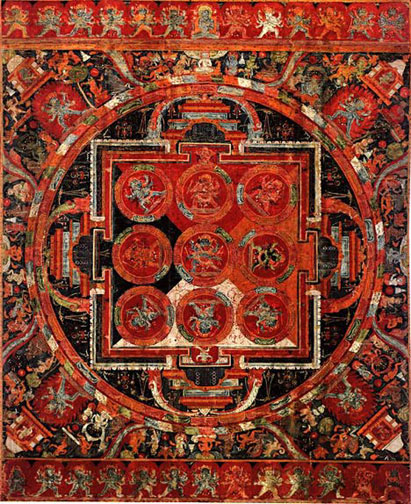
Vairochana Buddha (Trailokyavijaya) Mandala based on the Tattvasamgraha Tantra:
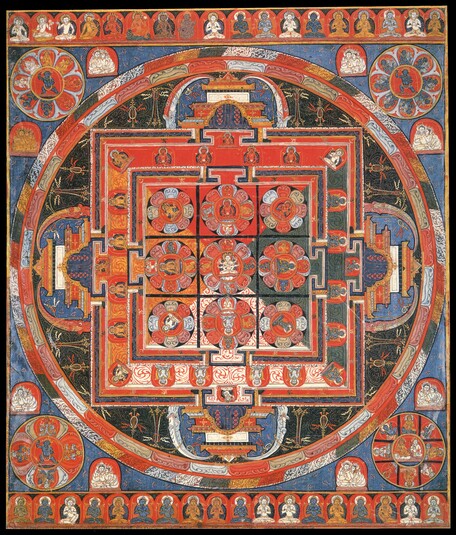
The Slokas are:
He's Vajrabhairava, the terrifying vajra terrifier:
Ten Verses, Plus a Quarter, Praising Mirror-like Deep Awareness
(67) Ruler of the furious, six-faced and terrifying, six-eyed, six-armed, and full of force, the skeleton having bared fangs, halahala, with a hundred heads.
(68) He’s the destroyer of death (Yamantaka), king of the obstructors, (Vajravega,) vajra might, the terrifying one; he’s vajra devastation, vajra heart, vajra illusion, the great bellied one.
(69) Born from the vajra (womb), he’s the vajra lord, vajra essence, equal to the sky; immovable (Achala), (with matted hair) twisted into a single topknot, wearer of garments of moist elephant hide.
(70) Great horrific one, shouting “ha ha,” creator of terror, shouting “hi hi,” with enormous laughter, (booming) long laughter, vajra laughter, great roar.
(71) He’s the vajra-minded (Vajrasattva), the great-minded (mahasattva), vajra king, great bliss; vajra fierce, great delight, Vajra Humkara, the one shouting “hum.”
(72) He’s the holder of a vajra arrow as his weapon, the slasher of everything with his vajra sword; he’s the holder of a crossed vajra, possessor of a vajra, possessor of a unique vajra, the terminator of battles.
(73) His dreadful eyes with vajra flames, hair on his head, vajra flames too, vajra cascade, great cascade, having a hundred eyes, vajra eyes.
(74) His body with bristles of vajra hair, a unique body with vajra hair, with a growth of nails tipped with vajras, and tough, (firm) skin, vajras in essence.
(75) Holder of a garland of vajras, having glory, he’s adorned with jewelry of vajras, and has long (booming) laughter “ha ha,” with loud sound, the vajra sound of the six syllables.
(76) He’s (Manjughosha,) with a lovely voice, enormous volume, a tremendous sound unique in the world’s three planes, a voice resounding to the ends of space, the best of those possessing a voice.
----------------------------------------------------------------

"Satyan nasti paro dharmah" -- motto of the Theosophical Society and the Maharaja of Benares
The seal of the Theosophical Society is based on the same as the heart chakra, the most important occult symbol.
Varanasi, or Kashi, city of light. Or, the area between rivers Varuna and Asi. It is believed that when Shiva shook his head and his jeweled earring fell into the pit that Vishnu had dug, the name Manikarnika came into being; this is where people get cremated. Perhaps, Vishnu's pit is the heart, Shiva's dropped earring is the awakening of prajna, and this cremates the lunar self. The name of the chakra, anahata, itself indicates a pure, "unstruck" sound, which indicates Vach or the Voice of the Logos hidden inside this center.
Om Mani Padme Hum
Om is a head chakra and the root sound of Sanskrit. The middle part, jewel in the lotus, means the individual in the macrocosm: you and Kashi. Hum, among other things, stands for Kalachakra. So in one valid understanding of those syllables:
Inner focus, beginning of Sanskrit culture, you in Kashi, then Kalachakra.
Subba Row suggested the popular "death at Kashi" was not to be performed physically, but was an esoteric allegory for the death of the personality or lunar self, and the activation of prajna in the heart, which produces a profound deathly calm for a while. Therefor he suggested changing the exoteric beliefs about the Seven Cities to a system that places Kashi as the Heart.
This is what HPB (Kunala) taught Damodar as they were walking around Benares:
"...every really ancient building in the whole collection had been constructed with the view to putting into imperishable stone, the symbols of a very ancient religion. Kunala, he says, told him, that although the temples were made when no supposition of the ordinary people of those eras leaned toward the idea that nations could ever arise who would be ignorant of the truths then universally known, or that darkness would envelop the intellect of men, there were many Adepts then well known to the rulers and to the people. They were not yet driven by inexorable fate to places remote from civilization, but lived in the temples, and while not holding temporal power, they exercised a moral sway which was far greater than any sovereignty of earth. And they knew that the time would come when the heavy influence of the dark age would make men to have long forgotten even that such beings had existed, or that any doctrines other than the doctrine based on the material rights of mine and thine, had ever been held. If the teachings were left simply to either paper or papyrus or parchment, they would be easily lost, because of that decay which is natural to vegetable or animal membrane. But stone lasts, in an easy climate, for ages. So these Adepts, some of them here and there being really themselves Maha Rajahs, (King or Ruler) caused the temples to be built in forms, and with such symbolic ornaments, that future races might decipher doctrines from them. In this, great wisdom, he says, is apparent, for to have carved them with sentences in the prevailing language would have defeated the object, since languages also change, and as great a muddle would have resulted as in the case of the Egyptian hieroglyphics, unless a key stone had also been prepared; but that itself might be lost, or in its own turn be unintelligible. The ideas underneath symbols do not alter, no matter what might be the language, and symbols are clear immortally, because they are founded in nature itself. In respect to this part of the matter, he writes down that Kunala informed him that the language used then was not Sanscrit, but a far older one now altogether unknown in the world." (Diary)
A little bit further on, she possessed him, which he watched from outside his body, and she told him that ghosts do the exact same thing, although sometimes they may only capture a leg or hand.
Repeated three times: 'Time ripens and dissolves all beings in the great self, but he who knows into what time itself is dissolved, he is the knower of the Veda.' "
Mystery: Dhatu
Force: Vayu (Air) 4
Planet: Saturn
Color: Green
Principle: Kama manas
Skandha: Manasikara or Vijnana Skandha (intellect in the senses; "sixth sense")
Prajna: Yogini Locana -- Protector Maha Mantra Anudhari
Heroic Buddha: Kakusandha
Chohan: Bhutatman and Icchshakti Rāga Tattva
Ray: Swaraj
Avatar: From Bagalamukhi, Lord Kurma was incarnated
Mother: Indrani or Varuni
Sister: Kalaratri
Maha Vidya: Kali
Lore:
The obscuration of Indrani is Matsarya, envy and jealousy. Her mount is elephant. Indra married Suja, daughter of the Chief of the Asuras, which calmed the discord between Devas and Asuras.
As Indrani, She is Queen of the last part of Kama Loka that is related to the physical plane.
As Varuni, she is found to be Shakti to the above and beyond.
Varuni (also Sura or Brandy) emerged from the Churning of the Ocean for Amrita; the goddesses that came out were Varuni and Sri. She is related to wine. Different sources say either the Devas or Asuras accepted her. This is why there is confusion about "Asura--breath" in Rig Veda and "A-sura--No Varuni" here. She is the daughter of Varuna, Lord of the Waters of the Deep (Chaos or Mulaprakriti); Chief of Adityas or Formless deities. She is really his wife and daughter, as Indra is the reflection of Varuna into the Form World.
Varuni is the embodied radiance of Ananta at the bottom of the Talas. So Nag Kanya Manasa Devi is Varuni's daughter.
She tempts Balarama (Hercules) and he drinks wine: Lord Balarama seemed fully intoxicated from drinking the varuni beverage, and His eyes appeared to be rolling in a drunken state. Lord Balarama appeared just like the king of the elephants in the midst of many she-elephants. He then wishes to bathe in the Yamuna (Death's Sister) River.
At the end of the cycle, Ananta spews Balarama as venomous fire to destroy the Three Worlds. Similarly to the third stage where the goddess turns the practitioner blue, here, as wine, she baptizes him in the river of death, and at the end, he destroys all the worlds, leaving only the immortal.
Newari tradition has Varuni as a secret form of Vajravarahi -- Dorje Phagmo. A Red Eighteen-armed form symbolizing purified ambrosia in the offering skullcup: Mantra Patra Puja or mantra skullcup worship. She is one of Guhyeshvari's Armor Goddesses and is invoked into the cup to purify it. She is the Sky and the Waters of the Deep (an alignment of being her own Mother and Daughter). She gives Guhya Patra Abisekha or secret skull initiation. This is Generation Stage.
Varuni is the quintessence of the unique secret system in Nepal. Eighteen-armed Red Varuni in her central role is flanked by Armor Goddesses White Sanchasani and Blue Yamini. Above is Guhyeshvari. So we learn what Offering Cup is (Prajna + Means = Amrita) and make this our Sambhogakaya Samaya--Activity of Durga. A Sambhogakaya seat is the arrival point for inner deities. Generation Stage is an actual initiation involving the Cup, and a mark of permission to do Anuttara Yoga or Deities in Union. Without this, you are only supposed to add Vajrayogini (Guhyeshvari) to Guru Yoga externally. We were able to add Yellow Pratisara on stage two. Here, we have just been introduced to Red, White, and Blue, after focusing on three new activities of Tara in the last stage. If we did those, then at least we should be able to add something similar to Guru Yoga. Varuni is an evolution of Pratisara.
Red Varuni:

In the collection Nightmare Tales, HPB shows Varuni inhabiting a lake where a very powerful incident involving the sound of Vina (Om) and the Voice in a relatively short story called Blue Lotus. We made the goddess's Full White Lotus on stage two and then turned it Blue.
I am not sure, but "originally heat" and then wine sounds to me like what the alchemists called Watery Fire, which was the quintessence of the Twelve Zodiacal, Seven Planetary, and Four Form Elements. Isaac Newton said this was variously called Isis, Juno, or Ceres, and personally referred to it as quintessence of chaos element, i. e. Mundus. He said it was represented by antimony or Magnesia Gebri. Magnesia is not a particular element, but all of them. "It is fiery, aery, earthy, watery. It is heat and dryness, humidity and cold. It is watery fire and fiery water. It is a corporeal spirit and a spiritual body. It is the condensed spirit of the world."
This, from below, links earth with heaven, as the heavenly quintessence links from above. He noted that the symbol for antimony was based on the orb held by Kings, symbol of a redeemed earth, a sphere surmounted by a cross. Only antimony is "the lawful son of the sun and the true sun of nature".
The vidya of Kali is Eternity; to die daily; detach from body consciousness and attain samadhi.
If we got the previous lesson in Manipura Chakra, we encountered Four Female Gatekeepers, who are lesser Taras, who is the "unstruck sound" that "ferries us across" to Wisdom, which is the essence of Heart Sutra. And so of course we memorized that mantra, which has the words Gate (gah-tay) and Ture (tu-ray). Same words as Gata and Tara. Gata is gone, so Tatha is "suchness" or "thusly", Tathagata is Thusly-gone One, gone to Suchness, carried across by Tara.
And so using her Bell or Unstruck Sound after her Enlightening Activities is the Om which lets Kundalini flow. She does this as a Snake named Lambodara.
And then it gets to the Heart, which has its own set of Gatekeepers--Males and Females in Union. These are Achala-Ankusha, Yamantaka-Pasha, Hayagriva-Shrinkhala, and Amritakundali-Ghanta. These are doing the same Activities, Hook, Noose, Chain, and Bell. Notice to get in here, you have Yamantaka--the Manjushri of the Heart--and in the end, Amrita Kundalini unites with Bell.
Yamantaka is Wrathful and deals with death. We realize that it is an allegorical death of killing the lower centers and the eerie calm of Prajna awakening in the Heart. Prajna has seven kinds for each type of matter. Yamantaka-Pasha are Jewel Family and Yellow. To gain access via these Gatekeepers, it starts on a Black Yamantaka (Krishna Yamari) rite. The last Gatekeeper again is Wrathful Ratnasambhava, Jewel Family, even though he may be wrathful and blue. Also called Vajrasurya or Vajravega. Our occult color is Green, usually a mix of blue and yellow, and the Gatekeepers appear to have a Blue-Yellow axis. The ultimate Mother Prajna for this level is herself Blue. This group still needs to be developed in greater clarity.
Because of this, the Vajra Amritakundalin mantra is Om Vajra Kundalin Hana Hana Hum Phat and here is a Tibetan sadhana.
Like antimony, the Heart is more complex than Four Gatekeepers, from having inner layers of petals, the rest of the Peaceful Deities. At the center of this Lotus is a small living flame that does not have a correspondence in the physical body. This is the seed of Ksehtrajna and Prajna which exists in the Akash of the Heart. Kshetrajna is the Knower of all states of consciousness including sleep and death, and again like antimony this is the link, or the direct reflection of, the permanent and real. Hridaya Vastu.
The ancient term for the Wrathfuls is Krodha Vinyaka--Anger, Remover of Obstacles.
Vinayaka were mischievous spirits we found pacified by Tara at Mathura (solar plexus). Then they became known as Ganeshvara Vinayakas.
This large host of beings is an emanation of Avalokiteshvara. And the host is the Gandharvas, and their chief is Ganesh or Ganapati. Now where did Ganesh come from. He is not a Dhyani Buddha or Bodhisattva. And one of his obscure names is Lambodara--but wait, Lambodara is Tara. We just got kundalini from her. Why is this the same?
Because Gandharvas are the Celestial Musicians whose sound conveys the esoteric sciences to man. They are in charge of the Soma (Nectar, Amrita) plant. Ganadevas inhabit Mahar Loka, govern our Kalpa, so are called Kalpadhikarin. They last only One Day of Brahma. Mahar is the Fourth Loka or same as the plane of Kama Loka. Ganesh does not have a physical planet but is associated with Ketu.
Ganesh and the Gandharvas are the unstruck sound of Om.
HPB says he is Egyptian Thoth (Sirius) and Anubis (Sirius)--Ring-pass-not. Thoth and Anubis are Buddha and the Underworld, the One Initiator and Death.
Ganesh is the Sound of Tara. But we don't see him represented or in any kind of union here. Not exactly, but, in Buddhism, Dhritarashtra is the chief of the Gandharvas. Who is this? He is the Chief of Four Heavenly Kings. He is not even in the human body--the Four Kings protect the Kama Loka itself. And this is the Fourth Plane which corresponds to this degree, or to the Heart.
Whatever sound this Chief hears is turned back, causing harm to whoever produced it, therefore he covers his ears with his helmet and plays a stringed instrument so that he will not hear any other sounds. What does this say? The Om is so gentle and subtle that the least disturbance will really mess you up.
So why did this more difficult name spring up? In a prior life, he had been a Naga, son of Kadru. Also, in another life, he is a major character in the Mahabarata, whose wife is Gandhari. She was the daughter of Subala, king of Gandhar, which we call Kandahar. She was the sister of Shakuni, the sorceror who started Armageddon, but she has some of the strongest morals in the whole story. She blindfolds herself to be like her husband. One out of her hundred sons survive, and in the end she goes into a trance and self-immolates in a forest fire along with Dhritarashtra and Kunti as a form of penance. The King Dhritarashtra had gone to crush Bhima with evil intent, but Krishna instantly replaced Bhima with a metal statue of himself. He crushed this statue, releasing all his anger and apologizing for all his folly. His name means "a good king" and he was born blind due to a fault of his mother.
He was basically good but went around in a blind fury until he got a catharsis. His wife, blindfolded and fair, is Virgo, or the Lady with Six Shaktis. Her name is Gandhari, so--the Gandharvas. Tara's mystic Sound.
In one of Ganesha's incarnations, he is named Lambodara, which corresponds to Śakti...The purpose of this incarnation is to overcome the demon Krodhāsura (anger). His mount is a mouse. Om--Ghandarvas shall overcome any kind of Asura that is angry.
Elephants were bathing Kamala a while ago, and now here one is, riding on a mouse. Elephants represent two things, Water, and Kings.
Ganesh is also named Buddhipriya, Fond of Buddhi or even Buddhi's Husband. He is oṃkārasvarūpa or the sound of Om, mystic celestial non-sound, lord of the hosts of all of it: (O Lord Ganapati!) You are (the Trimurti) Brahma, Vishnu, and Mahesa. You are Indra. You are fire [Agni] and air [Vāyu]. You are the sun [Sūrya] and the moon [Chandrama]. You are Brahman. You are (the three worlds) Bhuloka [earth], Antariksha-loka [space], and Swargaloka [heaven]. You are Om. (That is to say, You are all this).
From using the Krodha and Yamantaka power and Om, we are going to make a true Lion Heart so that Buddhi's Husband, Manas, can join her. At the last stage, Ganesha's consort, a Prajna of Ketu, will be found to match the female half of Ardhanarishvari or sexless unity of Shiva.
And we are going to waltz right through the whole death issue, because we have a very good idea of what happens after death, we enter Kama Loka. Occultism differs from the Bardo as with the Book of the Dead. The struggle is a shock that causes a swoon to consciousness. And it may sort of drift its way along, it does not much revive until the decision.
The Four Kings inhabit Cāturmahārājikakāyika, the lowest level of Kama-Loka. They protect the second level, Trayastrimsa, the final level related to the physical world. The six heavens are, in ascending order, the Heaven of the Four Heavenly Kings, the Heaven of the Thirty-three Gods (Trayastrimsa ruled by Sakra, who is Indra, including Visvakarman, Matali, and Suja, Sakra's Asura wife), the Yama Heaven, the Tusita Heaven ("Contentment", ruled by Maitreya), the Heaven of Enjoying the Conjured (Nirmanarati, ruled by Sunirmita and Visakha), and the Heaven of Freely Enjoying Things Conjured by Others (Parinirmita vasavartin, ruled by Vasavartin and the lair of Mara).
We must stop there for a moment, because, if we did not get Yamantaka right, then Mara is going to pitch us out of the Kama Loka and into the Talas where we will face uncountable horrors until we are annihilated. And that page from the Book of Life will be erased and removed; nothing was there. We get a set number of lives on Earth, and this one will not be counted; it will not even be noticed. It will have to be repeated and replaced.
If we do it right, we will make it to the Seventh Heaven of Kama-Loka, Ghanavyuha Akanistha, the Pure Lands of Deva-Chan. This condition is of the nature of all the things that you wanted to say and do but didn't, or the things that you said or did wrong and know you could do better, those will all come to pass as if they had worked out for the best. Pure Lands are the Sambhogakaya. We can make it real while still alive. If so, the Heart is more complex, and after we arrange its Gatekeepers, we will go through the Four Enlightened Activities of the Mantra-Born Wrathful Yoginis of the Nirmanakaya--Daughter Goddesses considered as on the Human level of the surface of the earth, which again is Kama Manas and Kama Loka.
Now the Pure Lands are called Buddha Kshetra; the Sambhogakaya is made of Kshetra Sister goddesses; and Kshetram just singularly is Chaos or the Great Deep. Again representing the linkage of Varuni from the highest part of Kama Loka to the beyond. Bhutatman is the way Kshetrajna is "in the field".
Mirror Wisdom of Akshobya is obscured by Anger, and he is the Chief of Vajra; the Wrathfuls are of Vajra nature. This has to be understood and attended to, or we will damage the heart.
By the Fourth Degree, we have had so to speak, a Purity Yoga and Kriya Yoga, and a Wrathful Yoga and Anuttara Yoga. In the first pair getting to Kamala, you get a goddess who was never with anyone and, among many others, she has the most powerful Gem in the world which is the 4th. Then, the meditator meets her Wrathful form in the third, and, as she drinks from the lake to turn blue, we drink from her lake to turn Blue and become Wrathful ourselves as a Vajra Bhairava and used Four Gatekeepers doing so--Catuskoti.
It is the conscious transcendence of Yama Heaven. On the fourth plane, we find that Indra is the throne of rulership towards the physical plane, which, at times, the holder might change. Its highest level is Deva Chan. The "chan" is not Sanskrit, it is bde ba can or bde ba chen, Pure Lands or Akanistha.
If my Gatekeepers are arranged, then Wrathful Ratnasambhava is in Union with Bell Tara. And there's more petals in the Lotus still related to the Fourth Plane.
A purified wine of watery fire with a Guhyeshvari Armor Goddess in the Sound of Gandharvas defeating Anger with a Mouse.
If I were moving into Sambhogakaya which is in the Akanistha, I am going to Gaze at my Sister Kalaratri.
Concerning which Durga killed Mahish Asura and drank the blood of Raktabija, she did it in all Nine Forms at once.

You can discern Kalaratri on that. She has the largest Body Aura. Sambhogakaya Sister.
To cross Yama and Mara and accomplish Samhbogakaya, she must become Purity of Sense Objects on the Outer Wheel of Time.
Lightning Jewelry:
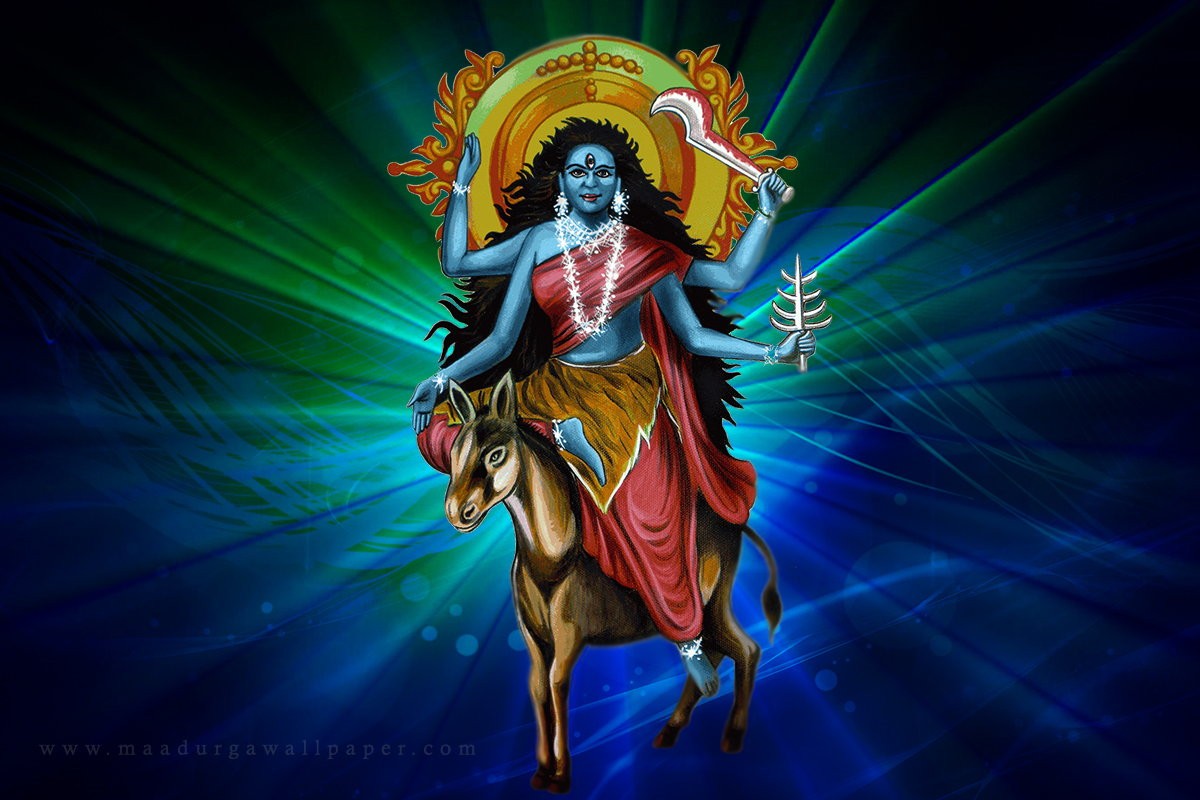
As the Seventh Durga, she would appear to be the seven chakras, but actually the secret chakras in the head, opened by the heart. Buddha found Kalaratri having intercourse with Mahadeva constantly, and when he arrived they stopped and pledged to Dharma. This essentially makes Vajravarahi possible; otherwise, Varahi is worshipped with Vamachara in a temple of Kalaratri. So this gets packed in with our Oath-binding.
The upper portions of Kama Loka are characterized as Nirmana Rati: Constructive Emanations--Sex. In one, anything you want to think of, happens, and in the next you get the ego pleasure of others offering those things to you--the opposite force of Offering Goddess Bodhisattva.
The Sister class she is in is sought as Daityakanya, from Talas below the earth ("Field-born", Sisters, in Ksetra fields {in bodies and in tattvas}, Sambhogakaya, who yield mostly sukha.). Virgin Daitya, with Varuni emitting as Ananta's radiance from the bottom of the Talas. According to HPB, "Daitya are Giants, Titans, exoterically demons, but identical with "certain" Asuras--intellectual gods--enemies or opposed to gods of useless ritualism and literal sacrifices." There is only one Saturn Durga, she lines up with the Saturn Maha Vidya; Kalaratri Daughter of Kali, Varuni Daughter of Varuni, this is how the Sister of the Fourth plane is balanced and aligned. High Shakti of Kama Loka.
We have wakened the son of the sun in the heart, and the Chohan or adjustment in consciousness for Vishnu on this Ray is Bhutatman, the 'phenomenal Self' called the Bhutatman who is subject to the influence of actions and therefore undergoes transmigration as was taught to him by Rishi Maitri. In the Maitri Upanishad Sakayanya deals with various questions as to form, manifestation, division, existence, and infinity of time. With regard to the question - Whether time is the original cause of everything or not?, he says that Time (Kala), Death (Yama) and Life (Prana) are identical, Time is one of chief manifestation of Brahman, there are two forms of Brahman – 1) Time and 2) Non-time (that existed before the sun came into existence and is indivisible); from the former that is divisible, all creatures are born, and explains that Time ripens and dissolves all beings in the great self, but he who knows into what Time itself dissolved is the knower of the Veda (Maitri or Maitrayani Upanishad VI.14-16).
So this is the Ray of Saturn, the Father, and Vishnu in this state is Bhutatman, described as living in the human heart as the mental person or regulating manas, which is to say, this thing I purify and crucify isn't even "mine", it belongs to Vishnu. As Bhutatman is established as a fact in nature, it is found to be without cosmic affairs and involved in the world and can reach emancipation with yoga. Bhutatman is the Skandhas, connected with matter, seen as an impure lower self. Instead of being conquered by material, it can be conquered (abhibhuta) by an inner self (antah purush).
The Upanishads speak of Bhutatman or the elemental Soul, which dwells in the body composed of the elements, subtle and gross, and is like a drop of water on a lotus leaf. He is pure, firm, stable, undefiled, unmoved, free from desire, remaining a spectator, resting in himself.
I Gaze at Kalaratri, whose time is the night, every night, her name means Night Time, she is the most ferocious and violent Durga, and due to the name and the presence of Kali Vidya on this Ray, we take her as vicious as she may wish to get. And because Vishnu is Akshobya, this means unshake-able, we defray the Wrath so there is no agitation in the Mirror. And so in this Mirror is the Father reflecting into the Son. And so if it is Vajra it is Adamantine. The ability to see or contact Buddhi on its own plane because Kama Manas has been stopped and there is only Manas looking upward. Kalaratri can also be Night of Time, i. e. the death of time, or Time and Death together. She is an explicit view of Tamas or Darkness Guna with the obligatory initiative to obliterate wickedness and planetary wickedness. At that point, she is called Subhankari and makes devotees fearless. Her thorny necklace shines like the lights from thunders. Her three eyes, the Trinetri, emanate rays like lightning also. She is clad in loose red cloth to cover her upper body and wears tiger skin below her waist. Her whole body adorns various forms of thorny garlands, anklets, waist-bands, wrist-bands and armlets. Fierce flames hiss out from her nostrils when she inhales and exhales. Her hair is bountiful but disheveled.
Her vehicle is a donkey.
The ensuing Prajna is pale blue Locana (One with the Eye) holding a Bell and Five-pronged Vajra touching the Earth (bhumisparsha--Buddha's gesture when challenged by Mara at enlightenment. When he did this, Earth Goddess arose to testify he could pass. Hence touching the earth in a social situation is an oath of truth generally. And here we are primarily learning the Fourth element of Air which itself is the reason for the sense of touch.). Her seed syllable is lom: oṃ vajra locane loṃ svāhā. In the Japanese "Ten Names of Buddha", Locana is the only female mentioned (Butsugen Butsumo), and called Complete Sambhogakaya. And this kaya is properly the Maha condition. She is also named Gaganalocana (Kokugen: Empty Space Eye) and Sarvabuddhamani (Issainyoraiho: Jewel of All Buddhas). Gagana is sky particularly with respect to sidereal motions, especially the Moon.
Avalokitesvara Sahasra Bhuja Locana means her name is the eyes of Thousand Arm Avalokiteshvara. Deep in his Prophecy, Locanas appear in a list of things near Mahar Lokas. This "item" is all the kinds of "eye consciousness" which we know as the A of Aum. These are (1) the physical eye, which a sentient being is born with; (2) the god eye, which can see anything anywhere; (3) the wisdom eye, which can see the emptiness of dharmas; (4) the dharma eye, which can differentiate all dharmas; and (5) the Buddha eye of omniscience, which includes the preceding four at the highest level. Again we would presume there being seven in Sapta Lochani Tara.
Avalokiteshvara was redeeming souls from Hell successfully, but they came in faster than they were leaving. Thus he emanates Tara and the Gandharvas.
Kamala Locana is an epithet for Lotus Eyed.
Her self-luminous eye: She who is illuminated by the Dharma. She is the center of Womb Realm mandala. Or so to speak, gaining her here will establish the Dharmadhatu as Tatatagata-garbha for the next level. She is originally emanated by Vairochana in white:

She emanates Yeshe Tsogyal and is imaged at Swayambhu Stupa.
Her Blue form:

Her element is water and she has calm blue eyes. Arises from water on a pearl throne, which becomes or grows a lotus with a radiant moon disc. So quite similar to Varuni. She is one of the rare figures who holds the Bell over her heart (Vajrasattva likewise). Akshobya is in her hair and she has a head and body aura, which show the accumulation of Merit and Wisdom. She is the go-between from Vairochana to Akshobya, or, how we are combining Womb Realm and Diamond Realm into one continuous practice. We have Mother Indrani who is allowed to change depending on what Indra is up to (he had a thousand wives or so). And we see how Varuni comes to this rite and at the end is Locana in union with Akshobya.
With Akshobya:

Maha Mantra Anudhari is hard to trace; she has a sutra in the Gyud, called in Tibetan Gsangs-snags-ch'hen-po-rzhes-su-hdsin-pahi-mdo, an exhortation of Buddha to demons. Anu refers to a single atom (q. v. the Babylonian Anu), or something very small or subtle, dhari being the holder of. It seems acceptable to contract it to Anndhari or Andhari, mother of Jinadeva, a Jain Arhat. There is a sacred forest to Andhari in Orissa at Jharsuguda; different state from Jinadeva. If I had the liberty to put things in sutras if I don't even know what's there, I would make this the Newari secret Varuni in a heartbeat or even an instant, but I don't know if it actually says that. But her name says Mantra Point Holder from what I can tell. Mantra is, so to speak, Catuskoti Om at this level, Point or Dhatu the indicated Mystery; centering the Fixed Cross. One's self as Air--Touch meets Watery Fire producing Sambhogakaya.
Now when you go back to the Vajrahumkara mandala you will see the Male has the same first items as the Female Enlightening Activities, and then a Sceptre (instead of a Chain) and an Offering Cup (instead of a Bell). The Peaceful Sambhogakaya Goddesses are Offering Goddesses, and again her Cup is no longer, simply, purity, but is a sort of Catuskoti Amrita produced by and shared with both parties. And then we may note that in Buddhism, the "realms" or "Lokas" are called Dhatu, the indicated Mystery, we are now covering Kama Dhatu. This Gaze Meeting goes in the next stage to meeting Dharma Dhatu.
In the last stage, we met Katyayani, Sati's Spine, which would surely play a major role. And her Nirmanakaya Manushi Human Avatar is Kanya Kumari. Having now seen what Varuni is, the radiance of Ananta, the following contribution from Sivkishen of the oldest King family on earh becomes relevant:
"The worship of Devi Kanya Kumari dates back to the Vedic times. Kanya Puja as a part of Devi worship is to recognize the feminine power vested in the girl child and to give them as much importance in the social fabric. Please listen on the significance of incarnation of the great Goddess Adi Parshakti as Devi Kanya Kumari.
Devi Kanya Kumari Puja worship is the the worship of female innocence. In Atala Loka, all the Asuras worship her in the shining form as Ratna Prabha. In the Vitala Loka, Devi is gleaming as Sharkara Prabha. In the Sutala Loka, Devi is glistering as Valuka Prabha. In the Talatala Loka, Devi is luminous as Panka Prabha. In the Mahatala Loka, Devi is radiant as Dhuma Prabha. In the Rasatala Loka, Devi is shimmering as Tamaha Prabha. In the Patala Loka, Devi is effulgent as Mahatamaha Prabha. In Bhu Loka is worshiped in all forms."
If you follow the equation, Varuni now stretches back to stage three and is Katyayani. So we have already been Gazing at Hellfire for a while.
Further, the Four Kings of the Kama Loka expand to a group of Five in Tibet, known as "sku", which translates "kaya", not exactly a body, but one assembled by Bodhi Mind. These Five adhere to five of the seven Mysteries of RGV, implying potentially there should be seven. Now these are the Pehar Gyalpo who are the class of Ghost Kings. They broke vows while on earth and became malevolent ghosts.
These Pehar Gyalpo operate through certain Oracles--the ones who are themselves Tulku which is Nirmanakaya. And this operation is identical to necromantical mediumistic ghost possession except for one thing: Oath binding.
These possessions are extremely Wrathful and some of the advice that comes out is wrong. However the relationship of Bodhisattva Tulkus to Oracle Tulkus is Peaceful: Wrathful and Commander: Lieutenant.
There are five well-known established Oracles called Chohans, and these are very likely the Masters of the Theosophical Mahatmas. In their own words, these Chohans say they are but disciples of the Bodhisattva Tulkus. As far as I can tell, the Nirmanakaya includes a class of Oath-bound Ghost Kings as Protectors who are the direct intermediaries to the Kama Loka itself. Each messages or visits earth seven or eight times a year.
Bodhisattva Offering Goddesses are also simply referred to as sku or kaya. And so after the Gatekeepers, one is making an Offering from the Ghost Kings to those Peaceful Sambhogakaya Goddesses whose only chance of success is strict Oath keeping. Knock on Earth.
Fortunately, Ganesh takes care of Krodhasuras, whether the term means a Deva or Titan that did or did not accept Varuni, they are now all taken care of by having her. And there you obtain your Sambhogakaya Daitya Kanya: Kanya Kumari (Hellfire or Astral Light) Oath bound by the Varuni Offering of Wrathful Ghost Kings.
If so and you could, you would Enter Union with Locana.
Having mentioned Vajra Armor, this is almost never taught and mostly pursued by doctors. Used mostly for protection and healing. The profound meaning at this level is the Prajna Armor Goddess, but there are various applications. Although an initiated practice, it does not require 500,000 ngondros like most of the rest.
Black Manjushri Armor
Red Lion and Dream Mahamudra
The profound meaning is to get Prajna Locana because she is the Eye required for the next level, and having some Armor is likely necessary.
In Mahavairocana, Buddha says we should do the Fierce Rites on the 8th or 14th day of the New Moon with Saturn or Mars in the Lunar Mansions Hasta, Citra, Asvini, Uttara-phalguni, Punar-vasu, Svati.
One becomes Vajrasattva, takes possession of the rite with Acala, and becomes Vairocana. Then crafts the mandala, placing Ha, which becomes Trilokyavijaya.
Yama becomes his spear, replacing Akasha-garbha. Other elements transmute into the Axe, Aparajita; Amogha-pasha, Ekajata, Hayagriva as Noose, Axe, Mace replacing Tara, Candra-tilaka is the Vajra, Yama + Kalaratri replace the Pure Abode, Nirtti is the Sword. So this has turned the Peacefuls into Wrathful Tara and entities of death and night.
One then becomes Vajrapani, makes offerings, and then becomes Maha Vairocana. A Wind mandala with Hum is placed at the hearth. Hum becomes Agni whose body image is Acala. Offer to Agni and invoke: Om Agnaye Jati Trat Hum Phat. After ritual procedures establishing Agni, one brings back the tutelary deity and purifies with bodhichitta. Wrathful fires of Agni are thus available to one's ordinary Yi-dam Lha on an everyday basis instead of just the special occasions.
He specifically says Kalaratri replaces the Pure Lands (Sambhogakaya). This is the Durga we're fighting to win on this stage. If this is the win stage, then likely Hug would be the next, and what we have to understand about Hug, is to be in Sambhogakaya and Hug the Dharmadhatu, which is the next Wisdom. In this Mirror Wisdom, we are really trying to burn out the major aspects of Wrath and achieve the Fixed Cross or Sambhogakaya of the Fourth Plane, Desire, Kamaloka, Mt. Meru the Horizon and Middle Way of Taijasa.
The Fourth are substantial Entities. This is the highest group among the Rupas (Atomic Forms). It is the nursery of the human, conscious, spiritual Souls. They are called the “Imperishable Jivas,” and constitute, through the order below their own, the first group of the first septenary host – the great mystery of human conscious and intellectual Being.
"The Heart represents the Higher Triad, while the Liver and Spleen represent the Quaternary, taken as a whole. The heart is the abode of the Spiritual Man, whereas the Psycho-Intellectual Man dwells in the Head with its seven gateways...(the seven in the heart) are the seven leaved Lotus, the “Saptaparna,” the “Cave of Buddha”...In the Heart is a spot which is the last to die, a spot marked by a tiny violet light; that is the seat of Life, the centre of all, Brahmâ; the first spot that lives in the foetus, and the last that dies. When a Yogi is buried in a trance, it is this spot that lives, though the rest of the Body be dead, and as long as this remains alive the Yogi can be resurrected. This spot contains potentially mind, life, energy and will. During life it radiates prismatic colors, fiery and opalescent. The Heart is the centre of the Spiritual Consciousness, as the Brain is the centre of Intellectual Consciousness. But this Spiritual Consciousness cannot be guided by a person, nor can its energy be directed by him, until he is completely united with Buddhi-Manas. Until then, it guides him––if it can. In the Heart is the only manifested God; the other two are invisible. And it is this manifested God that represents the Triad, Âtma-Buddhi-Manas (Amrita).
Anyone who can reach up to, and so receive at will, the promptings of this Spiritual Consciousness must be at one with Manas––that is must have attained Adeptship. But the Higher Manas cannot directly guide the ordinary man; it must act through the Lower Manas, and thus reach the lower Consciousness. The effort however should be continually made to centre the Consciousness in the Heart, and to listen for the promptings of the Spiritual Consciousness, for though success be far off, a beginning must be made, and the path opened up.
There are three principal centres in the Body of Man: the Heart, the Head, and the Navel; the Heart, as said, is the centre of the Spiritual Consciousness; the Head is the centre of the Psychic Consciousness; and the Navel is the centre of the Kâmic Consciousness. Any two of these may be positive and negative to each other, according to the relative predominance of the Principles and therefore of their organ for manifestation on this plane. The meaning of the words positive and negative in this relation is the same as is attached to them in electrical science. The current flows from the positive to the negative, or the impression is made by the positive on the negative.
For instance: the aura of the Pineal Gland vibrates during the activity of the Consciousness in the Brain, and shows the play of the seven colors. This septenary disturbance and play of light around the Pineal Gland are reflected in the Heart, or rather in the aura of the Heart, which is negative to the brain in the ordinary man. This aura then vibrates and illumines the seven brains of the Heart, as that of the Pineal Gland illumines the seven centres in the Brain. If the Heart could, in its turn, become positive and impress the Brain, the spiritual Consciousness would reach the lower Consciousness. The Spiritual Consciousness is active during deep sleep, and if the “dreams” that occur in so-called dreamless sleep could be impressed by the Heart on the Brain, your Consciousness would no longer be restricted within the bounds of your personal life. If you could remember your dreams in deep sleep, you would be able to remember all your past incarnations. This is the “memory of the Heart”; and the capacity to impress it on the Brain, so that it becomes part of its Consciousness, is the “opening of the Third Eye.” In deep sleep the Third Eye opens, but it does not remain open.
The Eastern Secret School knows each minute portion of the Heart, and has a name for each portion. It calls them by the names of the Gods, as Brahma’s Hall, Vishnu’s Hall, and so on. Each of these corresponds with a part of the Brain. The student will now begin to understand why so much stress is laid on the Heart in connection with meditation, and why so many allusions are made in old Hindu literature to the Purusha in the Heart. And so with regard to concentration the Blessed Master Koot Hoomi writes:
Your best method is to concentrate on the Master as a Living Man within you. Make His image in your heart, and a focus of concentration, so as to lose all sense of bodily existence in the one thought. The great difficulty to be overcome is the registration of the knowledge of the Higher Self on the physical plane. To accomplish this, the physical Brain must be made an entire blank to all but the Higher Consciousness.
When the Brain is thus rendered a blank, an impression from the Heart may reach it and be retained...In acquiring the power of concentration the first step is one of blankness. Then follows by degrees consciousness, and finally the passage between the two states becomes so rapid and easy as to be almost unnoticed. He who can do this at will has become an Adept, and can “store the knowledge he thus gains in his physical memory.”"
4. Maharloka is the point in development where Kâma has been subdued and Antahkarana may be destroyed. Hence it is opposed, at the other extreme, by Talâtala, where the Lower Manas has been so often sucked down by Kâma that the Antahkarana is atrophied and the loss of the soul results. This is plainly and graphically shown in the fourth division of the column headed “planes of corresponding Hierarchies.” For there the two opposite poles are given concluding with the words: “The sphere of compassion at the one end, and that of intense selfishness at the other.” In the Secret Teachings the intensity of selfishness is always given as the opposite pole of intensity of compassion.
Kara is “hand.” Going to the diagram above analyzed we find that Lower Manas here clings to things, and thus the correspondence is perfectly accurate and is a correspondence made between a metaphysical and physical state. Something that can be grasped or touched (from Kara, a hand): i.e., the state in which matter becomes tangible. A state that corresponds with Sparsha (touch) and to the hierarchies of ethereal semi-objective Dhyâni Chohans of the astral nature of the Mânasa-Manas––or the pure Ray of Manas, that is, of the Lower Manas before it is mixed with Kâma (as in the young child). They are called Sparsha-Devas, the Devas endowed with touch. (These hierarchies are progressive; the first have one sense; the second two, and so on to seven, each containing all the senses potentially but not yet developed. Sparsha would be better rendered by affinity, contact). Sparshic, sense of touch.
In the fourth dhyana, the defect of the third is found to be sukha or happiness, which leads to clinging. With the abandoning of pleasure and pain, and with the previous disappearance of joy and grief, one enters and dwells in the fourth dhyana, which has neither-pain-nor-pleasure and has purity of mindfulness due to equanimity. Neutral feeling replaces happiness. The purification of sati--mindfulness is done by "specific neutrality", the sublime impartiality free from attachment and aversion.
Last edited by shaberon; 26th April 2019 at 18:08.
-
-
24th January 2018 04:51
Link to Post #245
Avalon Member
Re: The Serpent, the Black Sun, HPB & St. Germain
5. Pure Dharmadhatu Wisdom: Amoghasiddhi, Mahamudra Family, Arapacana
The Mandala Deity is Arapacana, accompanied by Jalinikumara or Suryaprabha, Candraprabha (males), Kesini, and Upakesini (females).
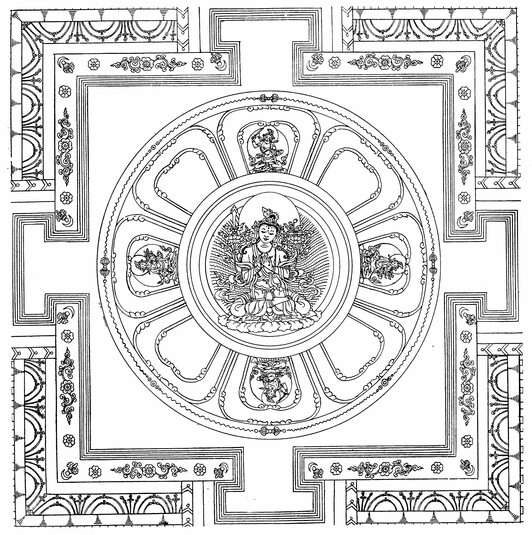
Amoghasiddhi is Shiva, whose krytyanusthaya-jnana continually provides all beings with goods and supra-mundane goods.
Although its chapter starts with Mahavairochana, Smrti explains him as the Dharmakaya and the Tathagathagarbha. Yoni in this chapter links it to Tathagathagarbha. As Buddha Matrix, that allows a transfer away from Mahavairochana. So instead of the Tathagatha Family, the Mahamudra or Bodhichittavajra Family is here in this Wisdom. They have accomplished Paramartha Mahamudra, so Bodhichittavajra is the Paramartha of Bodhichitta. They brought Amoghasiddhi when he moved from Karma Family.
Compared to Shingon, which practices Womb Realm (Tathagata-garbha) prior to Diamond Realm (Vajradhatu) mandalas, here, we seem to have replaced the Japanese Womb Realm with Arapacana. Notice that Smrti has used those "womb" terms to elevate Amogha-siddhi to this degree, and this is completely related to our "Vajra" changes which set Vajrasattva first and added Vajradhara as the last step beyond Vajradhatu mandala. So we have a "system of Vairocana" which totally relies on the Bodhi Mind and esoteric Vajra--Akshobya practice to unlock Vairocana's seventh level, making it different from Shingon and most other systems that do not recognize anything past the sixth, or, do not readily explain anything like this. In general, most schools have a way of presenting Dharmadhatu as obscured and then unobscured by degrees. This cannot take place other than within Mirror Wisdom, so, to an extent, it is accurate to say that Mirror or Dharmadhatu is the entire rest of the Path, but we want to be as specific and complete as possible.
The Mahavairocana Sutra, upon which Womb Realm is based, originally used the letters of the "Arapacana" script as meditations. So these are very closely intertwined or are equivalents. The Sutra itself is a dialogue between Vairocana and Vajrasattva, which exactly fits the practitioner's generated Bodhi Mind attaining a degree where normally or exoterically, Vairocana would be placed.
Womb Realm would include Bodhisattva Akashagarbha here, which we may note has the Wrathful (and female) reflex of Mamo Botong or Mamo Mukhali, a separate Akasha--Space Element version of the rest of the Cemetery Mothers. She is weird, noteworthy. If not pacified, her armies will unleash everything horrid and evil, and so whereas there is some focus on "Durga, Queen of Witches", etc., in our view, it is precisely because taming her is the only way to transcend her and this is mandatory.
There isn't a mandala for this, or, so far, Arapacana seems to be entirely mantric. Something may become appropriate, moreover, we will go to the Dharmadhatu itself.
This type of Manjushri is not complicated. Early versions of him are White, and he becomes Orange, or a tangerine like sunrise. He is an Outer Tantra deity and a Sherab or able to improve one's faculties. He begins early in Prajnaparamita and contains all the Wisdom of Ten Directions and Three Times. He therefor could be said to arise from basic Sarasvati, and he is often shown with her, or Green and White Tara. As Namasangiti, he becomes a Four Armed Archer, and many variations of him go into the real Dharmadhatu mandala. But so far he is familiar; this is an uncommon (and unidentified) view where Arapacana has managed to capture Sita or Sri with a Crossed Vajra:
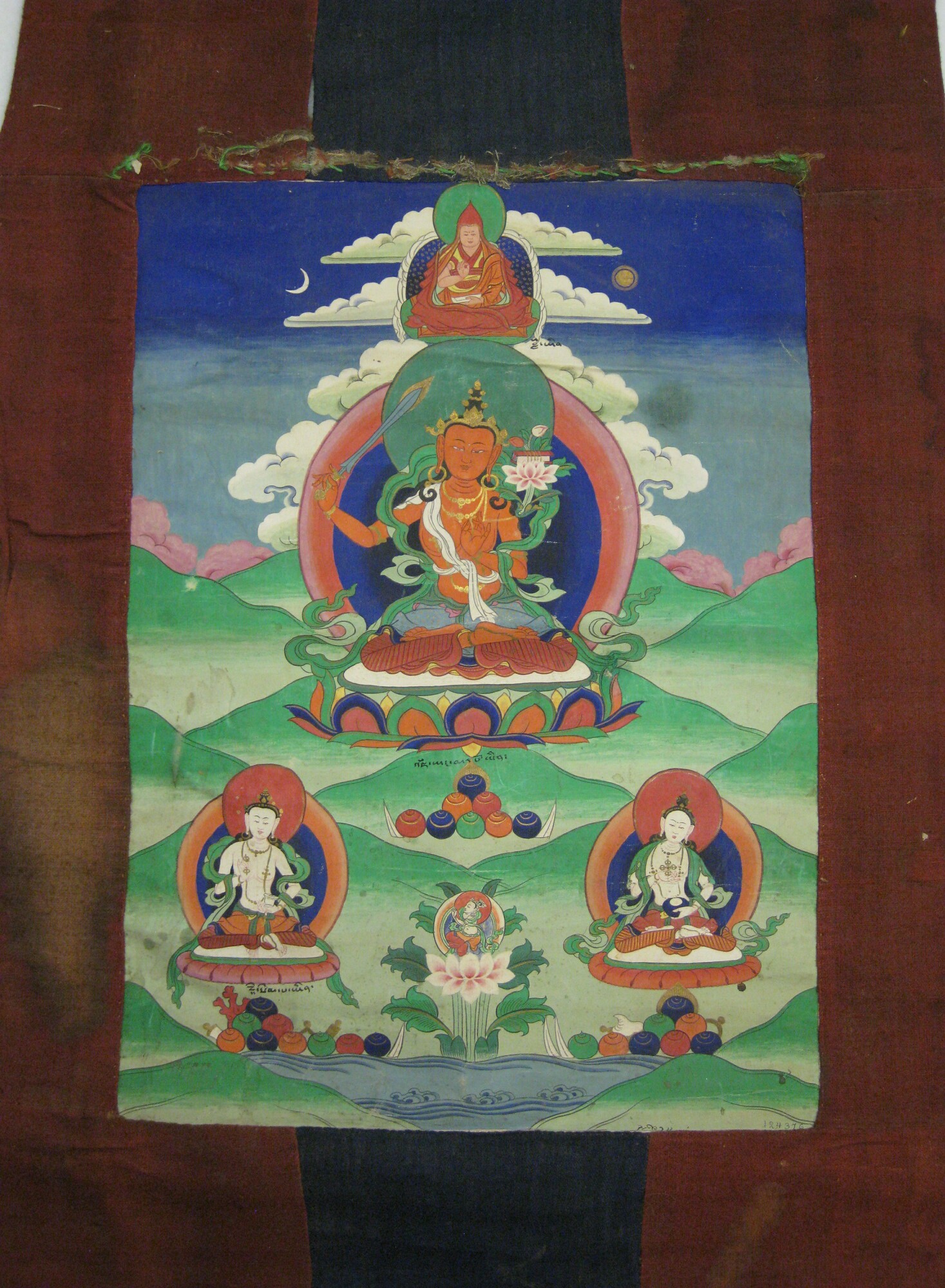
Here is White Manjushri where you can find a shade of difference between Arapacana and Vadisimha. He also has Sarasvati and Sita, and even better, the correct Prajnaparamita with Red and White Lotuses:
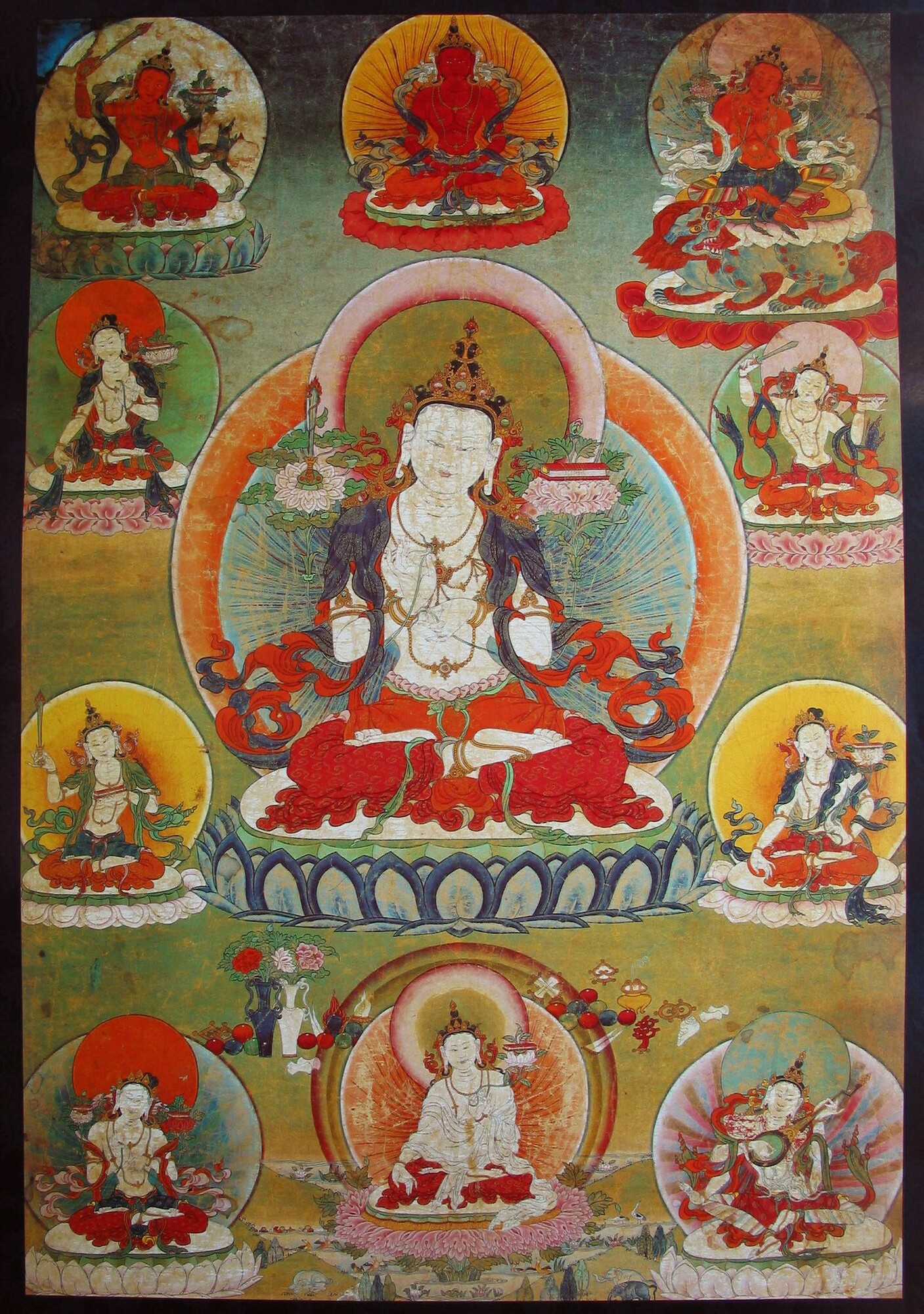
There are two almost identical Sitas, neither of whom has a third eye, so possibly are Mahasri. Their auras are different and one has on her fancy pants or Sambhogakaya nature. So this makes one of the best views of our deity set, especially along the lines of White Sherab forms and their relationship to Red.
Here is a Gold stupa moment. Here, Amitabha arises, along with what appears to be his correspondence to Four Arm All Buddhas Sita. The complex Golden couple is hard to determine, the female also has three faces, on one side she seems to have chain, sword, and drum, on the other a sun or lotus and a staff. Hard to tell, and there are some unusual survivors of the trampling:
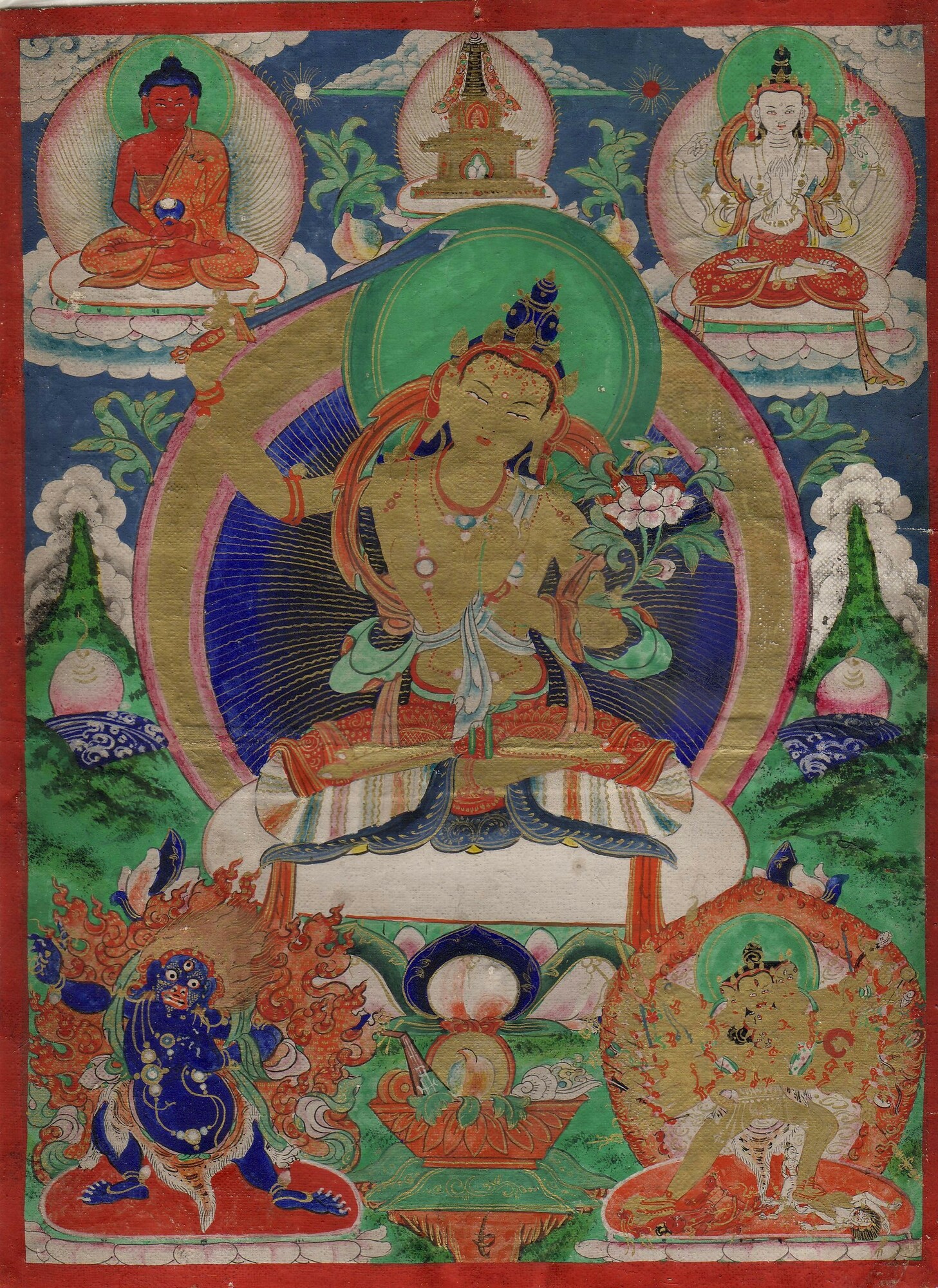
Here, he seems to be over his Black Bhairava, with Hayagriva lower left, and Mahasri on a seated horse lower right:
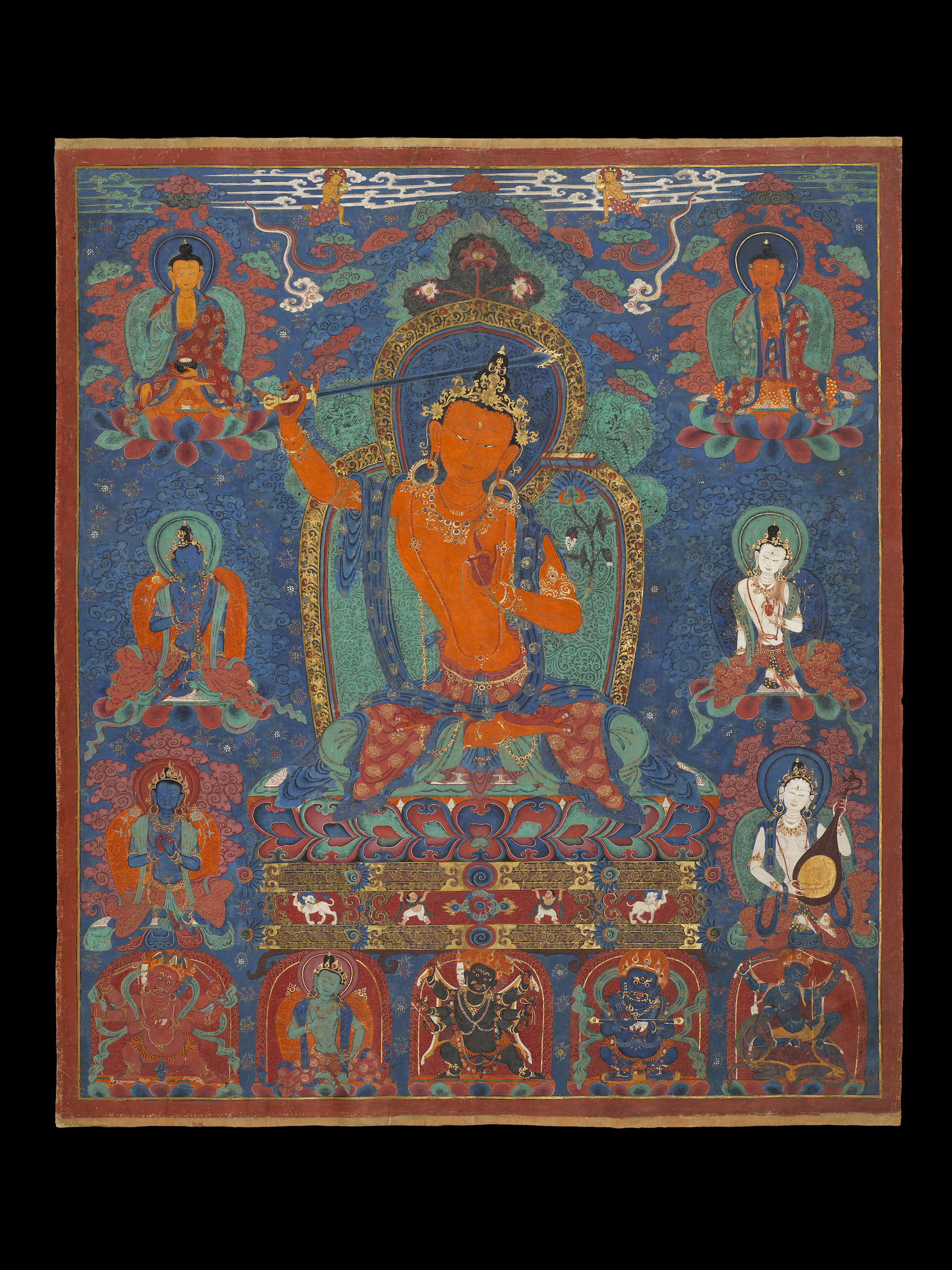
He runs very similarly to Sarasvati. Both use a Four Arm version which marks an exoteric or greater vehicle of teaching that all of us are using: Buddha Mother and Namasangiti. Both have an important Pancha Jina style: Sri or Wu Tai Shan. Each turns to Tara as a link to other Families.
The Slokas are:
Twenty-five Verses, Less a Quarter, on the Pure Dharmadhatu Wisdom
(42) He’s the Buddha (Vairochana), the great illuminator, the great able sage, having great sagely (stillness); he’s the one produced through great mantra’s mode of travel, and, by identity-nature, he (himself) is great mantra’s mode of travel.
(43) He has attainment of the ten far-reaching attitudes, support on the ten far-reaching attitudes, the purity of the ten far-reaching attitudes, the mode of travel of the ten far-reaching attitudes.
(44) He’s the guardian, the powerful lord of the ten (bhumi) levels of mind, the one established through the ten (bhumi) levels of mind; by identity-nature, he’s the purified ten sets of knowledge, and the holder of the purified ten sets of knowledge.
(45) He’s the one with ten aspects, the ten points as his aim, chief of the able sages, the one with ten forces, the master of the all-pervasive; he’s the fulfiller of the various aims, barring none, the powerful one with ten aspects, the great one.
(46) He’s beginningless and, by identity-nature, parted from mental fabrication, by identity-nature, the accordant state; by identity-nature, the pure one; he’s the speaker of what’s actual, with speech of no other, the one who, just as he speaks, just so does he act.
(47) Non-dual, the speaker of nonduality, settled at the endpoint of what’s perfectly so; with a lion’s roar of the lack of a true identity-nature, he’s the frightener of the deer of the deficient extremists.
(48) Coursing everywhere, with his coursing meaningful, (never in vain), he has the speed of the mind of a Thusly Gone One; he’s the conqueror, the full conqueror, with enemies conquered, a (chakravartin) emperor of the universe, one that has great strength.
(49) He’s the teacher of hosts, the head of hosts, the (Ganesha) lord of hosts, the master of hosts, the powerful one; he’s the one with great strength, the one that’s keen (to carry the load), the one that has the great mode of travel, with no need for travel by another mode.
(50) He’s the lord of speech, the master of speech, eloquent in speech, the one with mastery over speech, the one with limitless words, having true speech, the speaker of truth, the one that indicates the four truths.
(51) He’s irreversible, non-returning, the guide for the mode of travel of the self-evolving rhino pratyekas; definitely delivered through various (means) of definite deliverance, he’s the singular cause of the great elemental states.
(52) He’s a (bhiksu) full monk, (an arhat) with enemies destroyed, defilements depleted, with desire departed, senses tamed; having attained ease of mind, having attained a state of no fear, he’s the one with (elements) cooled down, no longer muddied.
(53) Endowed to the full with pure awareness and movement, he’s the Blissfully Gone, superb in his knowledge of the world; he’s the one not grasping for “mine,” not grasping for a “me,” abiding in the mode of travel of the two truths.
(54) He’s the one that’s standing at the far shore, beyond recurring samsara, with what needs to be done having been done, settled on dry land, his cleaving sword of discriminating awareness having drawn out the deep awareness of what’s unique.
(55) He’s the hallowed Dharma, the ruler of the Dharma, the shining one, the superb illuminator of the world; he’s the powerful lord of Dharma, the king of the Dharma, the one who shows the most excellent pathway of mind.
(56) With his aim accomplished, his thought accomplished, and rid of all conceptual thought, he’s the nonconceptual, inexhaustible sphere, the superb, imperishable sphere of reality.
(57) He’s the one possessing positive force, a network of positive force, and deep awareness, the great source of deep awareness, possessing deep awareness, having deep awareness of what exists and what doesn’t exist, the one with the built-up pair of networks networked together.
(58) Eternal, the ruler of all, he’s the (yogi) yoked to the authentic; he’s stability of mind, the one to be made mentally stable, the master of intelligence, the one to be individually reflexively known, the immovable one, the primordial one who’s the highest, the one possessing three enlightening bodies.
(59) With an identity-nature of five enlightening bodies, he’s a Buddha; with an identity-nature of five types of deep awareness, a master of the all-pervasive, having a crown in the identity-nature of the five Buddhas, bearing, unhindered, the five enlightening eyes.
(60) He’s the progenitor of all Buddhas, the superlative, supreme Buddhas’ spiritual son, the womb giving rise to the existence of discriminating awareness, the womb of the Dharma, bringing an end to compulsive existence.
(61) With a singular innermost essence of firmness, by identity-nature, he’s a diamond-strong vajra; as soon as he’s born, he’s master of the wandering world. Arisen from the sky, he’s the self-arisen: the great fire of discriminating deep awareness;
(62) The great-light (Vairochana,) Illuminator of All, luminary of deep awareness, illuminating all; the lamp for the world of the wanderers; the torch of deep awareness; the great brilliance, the clear light;
(63) Lord of the foremost mantras, king of the pure awareness; king of the hidden mantras, the one that fulfills the great aim; he’s the great crown protrusion, the wondrous crown protrusion, the master of space, the one indicating in various ways.
(64) He’s the foremost one, an enlightening body with the identity-nature of all the Buddhas, the one with an eye for the joy of the entire wandering world, the creator of diverse bodily forms, the great (rishi) muse, worthy of offerings, worthy of honor.
(65) He’s the bearer of the three family traits, the possessor of the hidden mantra, he’s the upholder of the great close bond and of the hidden mantra; he’s the most preeminent holder of the three precious gems, indicator of the ultimate of the three vehicles of mind.
(66) He’s the totally triumphant, with an unfailing grappling-rope, the great apprehender with a vajra grappling-rope, with a vajra elephant-hook and a great grappling-rope.
--------------------------------------------------
Dwarka: Dwar or gate of Ka, a seed syllable frequently used to extend names, such as Kanish-ka. Ka is the first consonant syllable in Sanskrit, corresponding physically to the first position in the mouth where the free flow of vowel sounds is interrupted by a consonant. It is used at the beginning of all interrogatives such as who or what. As an ending, it seems to indicate royal or great. This area is massive, and the only one to be an international port. It was designed by Vishwakarma, whose name is still preserved as an entire caste of smiths and masons.
Krishna made this area his capital. His consort, Rukmini, was cursed to live separately from him. The town is submerged. Rukmini was an avatar of Lakshmi born at Haridwar. Its main temple is called Jagat Mandir or Temple of the World.
Because the international aspect of Dwarka resembles speech; i. e. this *entire* system talking to another one, in this case Dwarka is the throat. After Dwarka is ruined, the Thousand-Headed Ananta flows from the mouth of Bala-Rama. Karkotaka appears to be about the fifth successor down this line.
Mystery: Sangha
Force: Prithivi (Earth) 7
Planet: Mercury
Color: Yellow
Principle: Buddhi
Skandha: Samsara (formations)
Prajna: Yogini Green Tara -- Protector Maha Mayuri
Heroic Buddha: Sakyamuni Gautama Siddartha
Chohan: Viswabhavana and Mantrashakti Maya Tattva
Ray: Visvakarma
Avatar: From Kamala, Lord Buddha was incarnated (or Jaganath, Ayyappa, or Mohini--we do not hold that Buddha was an avatar)
Mother: Kumari
Sister: Karttikeyani, Skandamata
Maha Vidya: Sodashi (Tripura Sundari)
Lore:
This stage is subtle, very subtle. From changing the colors, we get Earth Yellow here placed with Buddhi. There were several attempts to start Yellow Hats prior to the Gelug-pa, and they often said it was because it is the color of Earth Element.
This mantric Manjushri is a basic form using the mantra:
Om Arapacana Dhih
This bears no translation in any language. It is all bijas or seed syllables.
In the Large Sutra on Perfect Wisdom,
"The Equipment with the Dharanis:
And again, Subhuti, the Dharani-doors are the great vehicle of the Bodhisattvas, the great being. Which are they? The sameness of all letters and syllables, the sameness of all spoken words, the syllable-doors, the syllable-entrances. What then are the syllable-doors, the syllable-entrances?
1. [A]: The syllable A is a door to the insight that all dharmas are unproduced from the very beginning (ady-anutpannatvad);
2. RA is a door to the insight that all dharmas are without dirt (rajas);
3. PA is a door to the insight that all dharmas have been expounded in the ultimate sense (paramrtha);
4. CA is a door to the insight that the decease (cyavana) or rebirth of any dharma cannot be apprehended, because all dharmas do not decease, nor are they reborn;
5. NA is a door to the insight that the Names of all dharmas have vanished; the essential nature behind names cannot be gained or lost."
Dhiih is defined as meaning: thought, (especially) religious thought, reflection, meditation, devotion, prayer; understanding, intelligence, wisdom. The Vedic concept of dhī refers to the visionary's ability to see the gods' and goddesses' presence in the world and to respond to that divine company through imagainative songs of praise sung during sacred ceremonial rites. The syllable also pertains to Prajnaparamita in her mantra:
Oṃ āḥ dhīḥ hūṃ svāhā.
Compared to Om or origin, Dhih, perhaps, could be described as quintessence. So then when Mma (similar to Mam) is used to represent Manjushri, the two deities blend as Dhimmma.
From H. H. 5th Dalai Lama, here is an Orange Manjushri sadhana using Dhih. It will combine Om Ah Hum, the Four Activities, and Eight Offerings, so this is a straightforward application of the basics we are trying to get. In the sadhana, the term saparivara has the sense of "to give with bonuses".
Several of the listed goddesses are said to be the Mother of Mars but our system has separated her from the planet. The former mostly remain their Pleiadian selves, but in some way, Mars is no longer their son as he has become a prodigal. The Ray is named Vishvakarma who is in Kama Loka, having had to do with cutting off 1/8th of Surya's rays with which to form material creation. Mars is out there trying to figure out something about Red, White, and the Veil of Maya, and why he is seen as charcoal, or latent and active heat and light, as a metaphysical symbol of man's spiritual development from carbon to brilliance.
Buddhi is feminine and being matched to Tripura Sundari, and the Virgin Kumari goddesses who once were Mars's mother but are now hosting Mercury, the Budha planet, facing a Male force Vishvakarman who fashioned Earth, as a son of a Vishnu chakra represented as Interaction with Mundane Matter + Mantra Power. The Family of Maya tattva governs the terrestrial Spirits (elementals) which gradually form, build, and condense the physical body, and this tattva is governed by Mantra. This is what we are meaning by the Seventh Ray.
The obscuration of Kartikkeyani is Moha or attachment. Her mount is peacock. Being Kumari, she is the virgin essence. Amoghasiddhi is Shiva, so we are seeing Shiva united with virgin essence, or Ardhanarishvar, the two in one; and in a rough sense, the higher initiations run from Marriage up to Not-two.
And Green Tara is a Pledge or Samaya Tara. If I have progressed from the Sister or Generation Stage, then I am going to Gaze at Green Tara and then Hug her. So it seems the real pledge to Tara is not a verbal intention stated by a disciple, but to Hug the Dharmadhatu as Tathagata-garbha. An initiation not of what the Sangha "is", but what it actually does.
According to Koothoomi, "It is impossible to worship both sides, - the male and female of nature, - at once; one or the other must predominate. Only by following the absolute, sexless Unity, can the white path be trodden. Hence the necessity for chastity. The occult and the physical must never be mixed up. It is absolutely necessary to concentrate on one or the other...Before you can become an occultist you have to give up every prejudice, every liking, every feeling of preference for one thing or another. The adept must entirely separate himself from his personality."
By naming the personality, Pratyekha, and allowing it some of the 5th principle of manas, it emphasizes the dual potency of mind; since the 5th is also included with the Amrita or the immortal part of the inner individual. This path for those of us who are not adepts is a magical rite to summon and animate everything hidden in the Pratyekha; in order to gouge out what doesn't belong, and make the entire Lunar Self nothing but a reflection in a calm lake. Only then can we begin to experience what he means. Until then, it (to us) will be the spine of the teaching, but not something we can truly know, until seeing and adjusting all the male/female, objective/subjective, obscuration/wisdom sets to prepare our inner shrine.
In the Scale as established, Kanya Vidya so to speak, starts to come in now.
The Vidya of Sodashi (Tripura Sundari, Sri Vidya) is Pure perception of undifferentiated seer/seen. Sodashi is the sixteen year old virgin--Virgo. She is associated with sixteen phases of the moon.
"The sexless, life-giving principle of universal nature was called Eros by the Greeks. Eros is often called the one Ray in the Secret Doctrine. It is that which sets fire to the Absolute and produced manifestation.
Yellow is the color of the Sun or of the zodiacal light, the color of the blood of the atonement of the sacrifice of the Gods who incarnated in man for his salvation from ignorance and unconsciousness. The red is the sign of the joy felt by the evil powers, when they got hold of the secret of the Gods or creative powers. It is thus the blood of the woman, female or evil side of nature. Red signifies the covenant of the fall, or brutalization of humanity. From the Sun emanates its life, blood, which falling on all things in nature, makes them live and grow by immaculate conception. Thus when blood or the life fluid is held up between the eye and the light, one really looks through the external delusive thing, at the divine light. While red blood, blood seen by reflected light, is the thing itself, seen as a separate object or mayavic appearance, in looking at which the light is lost sight of. Thus those whose gaze is centered on the external or red, worship nature on the purely earthly plane, and are the left hand Adepts, Dugpas. Those who behold the light through the external appearance worship nature on the astral, psychic, and spiritual planes, and are the white."
One thing about this Durga Form, Kartikkeyani, is they make her the Sister of Mars and, that's it. There isn't really anything else to her.
Maha Mayuri is Peacock Queen. The Samghogakaya of the Heart provides this, as, it still has more petals with more deities. The teaching about her is that Peacock sucks poison out of all the worlds to grow its majestic plumage.
As Maha Mayuri, she is Great Peacock Wisdom Queen, same as the Mother of Mars. Or Queen of Mantras. Her mantra is:
Om amrta vilokini garbhasaraksani akarsani hum hum hum phat phat phat svaha
She emanates from "mam". She is of and with Amoghasiddhi.
Some of her Slokas are:
namo buddhāya namo dharmāya namaḥ saṃghāya
tadyathā amale vimale nirmale maṃgale hiraṇye hiraṇyagarbhe bhadre subhadre samantabhadre śrībhadre sarvārthasādhani paramārthasādhani sarvānarthapraśamani sarvamaṅgalasādhani manase mānase mahāmānase acyute adbhute atyadbhute mukte mocani mokṣaṇi araje viraje amṛte amare amaraṇi brahme brahmasvare pūrṇe pūrṇamanorathe mukte jīvati rakṣa svātiṃ sarvopadravabhayarogebhyaḥ svāhā
Second Version of the Vidya:
[ namo buddhāya namo dharmāya namaḥ saṃghāya ]
tadyathā amale vimale nirmale maṅgalye hiraṇye hiraṇyagarbhe bhadre subhadre samantabhadre śrībhadre sarvārthasādhani paramārthasādhani sarvānarthapraśamani sarvamaṅgalyasādhani manasi mānasi mahāmānasi acyute adbhute atyadbhute mukte mocani mokṣaṇi araje viraje amare amṛte amaraṇi brahme brahmasvare pūrṇe pūrṇamanorathe vimukte jīvati rakṣa māṃ sarvopadravebhyaḥ svāhā
Mayuri:

Now we have learned that Raksha are Protectors and so in her first vidya, it is Raksa Svatim, who is a character, so this is the teaching about how the Peacock cures poison. The second vidya is Raksa Mam which is Protect Me.
The Buddha told Ananda that the peacock king called Suvarnavabhasa (i.e. golden coloured one) was none other than Buddha Shakyamuni himself.
Conceivably, if we bring her the Aerial Flame Phoenix, her mount becomes golden. Which would signify she is using Buddha to teach in the world. This is strongly of the nature of Dharmadhatu Wisdom.
Mahamayuri's dharani, translated into Chinese by Kumārajīva, is considered to predate Mahayana Buddhism. It contains the only mention of the Rig Veda in the entire Chinese Buddhist canon.
And we can track her down to the beginning of Rig Veda:
triH sapta mayUryaH sapta svasAro agruvaH |
tAste viShaM vi jabhrira udakaM kumbhinIriva || (RV 1.191.14)
This invokes twenty-one peahens and the seven sisters (i. e., Matrikas) to neutralize venom.
She has a large Sutra.
Mayuri covers both Sister and Mother levels here. We can Gaze at her and go to Hug without initiation. Her sadhana summons Peacock King, from whom she arises, which says she's using Buddha (i. e., Vajradhara) to teach.
The associated Maha Vidya is very Peaceful.
Sodashi Tripura Sundari is Kama and is the center of Sri Yantra, the bindu or seed of manifestation, often compared to a Prism at the nexus of the realms of light. On the Path we have conquered the Form nature, and her appearance is a young Golden Virgin however, she is awash in Desire and so clothed in red. She produces Kameshvar and the creative Trinity, Kama-Eros and Vishnu-Lakshmi etc., she is the Celestial Kama beyond the Kama Loka itself.
She creates the darkness of the Form world--self-produced from her--and then Fire and all the Rest. The back end of her products include from her fingernails, she created the 10 incarnations of Vishnu; from her palms, she created the Sandhyas; from her heart, she created Baalaa Devi; from her intellect, she created Shyamala Devi; from her ego, she created Vaaraahi Devi; from her smile, she created Vighneshwara; from the Ankusha (a special hook), she created Sampatkaree Devi; from the noose, she created Ashwaa Roodha Devi; from her cheeks, she created Nakuleshvari Devi; from her Kundalini Shakti, she created Gayatri.
Uncoil her kundalini and it goes back to a hook and noose and Vinayaka Ishvara created from her Smile, then even Varahi and Yamuni (Death, Shyamala). Other side of the Mirror we went in to. Her toe pointed to Sri Yantra bindu, she is above it, i. e. Mt. Meru is no longer even shown; we found that Vishnu pierced the lower worlds and water poured down:

She is the Chief of the Sri Vidya system: "In the nothingness prior to creation, desire is what leads to the first divine sound or vibration of manifestation, represented by Tara. Without desire, there would be no creation, or sustenance of it. Without desire, there would be no movement on the macrocosmic or microcosmic levels. The circular movement of the cosmos is driven by desire, as are the basic physiological mechanisms of life-forms. Desire is the prism through which the nothingness of the Supreme manifests as its everythingness. This primordial desire is represented by Tripurasundari. While this first desire as Tripurasundari remains untouched as pure love, it is distorted by refraction through vasana conditioning – as selfish clinging to me and mine, self-aggrandizing, greed, sensual enjoyment and endless chasing of sense-objects. However, this desire is also that which gives the impetus for spiritual seeking. Thus, desire drives the divine not only to fragment itself in creation but also to return to itself."
She sometimes holds Hook, Noose, a Bow made of sugarcane, and five flower-laden arrows. She is Sat-Chit-Ananda, Jnana-Iccha-Kriya. Above the Kama Loka; the Shakti of the Formless Worlds. The role of her Vidya is to remove obscurations from Buddhi, in other words, she begins here with a Hug of the Dharmadhatu on the practitioner's part. Again, she is the core of Shakti Tantra and Sri Yantra, which itself is too massive and complex to be handled here.
We are going to take our Sambhogakaya and Hug the Dharmadhatu so we can get to Peaceful Mother Level and Her Sambhogakaya.
We have taught quantum physics for ages, not from equations but from experience. The teachings state that Form at the smallest level is made of individual quanta. There are material quanta, however also there are time quanta. And this is nothing but a succession of static states.
The only reason that we perceive motion is because streams of consciousness or vijnana flow onto it, giving continuity to the static frames.
The Parabrahmic, or, unconscious to this world view, lacks any distinction of the frames.
With respect to vacuum, Void space is filled with potential as seen in quantum physics, and we have this as an activity of consciousness with respect to Akash.
At this point we have learned to transcend all Worlds of Form to the personal self as we know it, and now we are entering Space that is of the Universal or Cosmic Akash, of the Formless Agnishvattas, Sodashi Tripura Sundari.
Mother Kumari has a Nirmanakaya in the Vestal Virgins of Nepal seen in Red:

Conveniently, whether I think of this goddess in terms of Mother, Sister, or Wrathful, she keeps being there with a Peacock. Maha Mayuri is anything we need to really gain the Prajna of Pledge Tara. I should be able to gain the Prajna of Pledge Tara without using Anuttara methods yet. Mayuri and Sri Yantra are indicated here.
Moving into Pure Dharmadhatu Wisdom of Amogasiddhi-Shiva and Mahamudra Family, the Dhatu itself does not teach; it simply is. The further teaching and practice is almost all subtle and internal, ridding ourselves of duality, into the unified condition. Wherever "two" has affected us, as maya, we are trying to penetrate that and get to unity.
The Dharmadhatu requires the Eye of Locana to even see it. In practice of hearing Om, now you will begin to see it also.
It comes in waves, starting as Tathagatha-garbha which is obscured, and after initiations, becoming unobscured as Vajra-dhatu, or stage Six.
Having dispensed with Kama Loka, we are entering the stages described in Buddha's Enlightenment. These stages are the full explanation of the Path, which makes it more complete than previous systems, and show exactly where Buddha passed beyond everything that the older Yogas could do.
First part of Enlightenment
Describing from, what we take to be Arapacana sources:
Mantra fills all hopes (i. e., needs for enlightenment) in the enormous mandala whose perimeter is Speech.
Then He enters the samadhi called: Viewing the pure peak (i. e. Mt. Meru) of the wide banner of Dharma.
Emanations, the Nirmanakaya fill the outer worlds.
(By those procedures, we have achieved Sambhogakaya, which is to achieve the samadhi of the Fourth degree quickly and effectively)
This empowers the Dharmadhatu and He proceeds to the samadhi called: Having the treasure womb of the Dharmadhatu.
He then states the mantra whose source is the Dharmadhatu:
Namah samantabuddhanam
Dharmadhatu-svabhava atmako ham
Namah samantavajranam
Vajra atmako ham
Namah samantavajranam
Vajrakavacaka Hum
Namah samantavajranam
Tathagatacaksur vyavalokaya svaha
Namah samantabuddhanam
Visuddhagandhobhava svaha
Namah samantabuddhanam
Mahamaitriyabhyudbhuta
Namah samantabuddhanam
Dharmadhatvanugate svaha
Namah samantabuddhanam
Sarvatathagatarcispharane
Vabhasa-gaganocarebhya svaha
Namah samantabuddhanam
Gagana-samasama svaha
Namah samantabuddhanam
Gagananantaspharana-visuddhadharma-nirjata svaha
Namah samantabuddhanam
Pracandra-vajravala-visphura Hum
Namah samantabuddhanam
Jvala-malini tathagatarci svaha
Namah samantabuddhanam
Mahatathagata-jihvasya dharma-pratisthita svaha
We can see specific mention of Vajra accompanied by the syllable Hum. You also see Locana invoked near the beginning as Tathagata Caksur, again, not only the physical eye, but the whole eye consciousness clairvoyantly enlightened.
The groups of phrases invoke: the Dharmadhatu -- Vajrasattva -- Vajra Armor ending with Hum -- Locana -- Perfume -- Flowers -- Incense -- Lamp -- Voice Offering -- Usnisa (Crown) -- Tathagata Armor ending with Hum -- Encircling Blaze -- Tathagata's Mantra.
So the one thing that's never really discussed is Buddha's actual enlightenment process. It's virtues and characteristics are widely sung, but, at a certain point, that's all just talking sideways around it. He says there is only one Path available to all, and this is it. You will only find it in Lotus or Avatamsaka Sutras, expounded in Maha Vairocana Abhisambhodi Tantra, commented by Buddhaguyha, one of the most important commentators with Smrti and Ratna-karasanti. And this is what we are going to re-enact, by doing the one Path, exactly as he did.
What we are seeking in this Wisdom is the very first refrain from the mantra:
Namah samantabuddhanam
Dharmadhatu-svabhava atmako ham.
Samaya mantra: Asame Trisame Samaye Svaha
Mantra of the Inconceivable Continuum of Reality beyond mind: Dharmadhatu-Svabhavatmako Ham.
Become Vajrasattva: Vajratmako Ham.
Invoke the Vidya Queen three times:
Abhismaraye Spharana Hi Mam Gagana Kham
Dharmadhatu-Akasa-Samataya
Sarva-Tathagata-Parishodana-Mandale Mama Pranidhi Punya-Jnana-Balena
Sarva-Tathagata-Adhisthana-Balena Dharmadhatu-Adisthana-Balena Ca Svaha.
Dharmadhatu is the Treasure Tower of Maitreya that he conjures, which contains Tathagata Vairocana. Then the Saha Loka or world of man is filled with complete purity.
The Dharmadhatu will come to the meditator by degrees:
1. The Dharmadhatu of ‘Shih’: This is a realm of phenomena, in which all things are seen as distinct, discrete and different objects, matter, events and Dharmas occur in the empirical worlds.
2. The Dharmadhatu of ‘Li’: This is a realm, in which the principles underlying all phenomena and the immanent reality upholding all Dharmas are seen. It is a realm beyond the perceptions of human beings, but can be visualized by the enlightened ones through intuition.
3. The Dharmadhatu of Nonobstruction of ‘Li’ against ‘Shih’: This is a realm, in which ‘Li’ and ‘Shih’ are regarded as the inseparable unity. That means, without one, the other would be meaningless. They are mutually interpenetrating and completely identical, i.e. they are nondual. This complies with the Principle of Nonobstruction of ‘Li’ against ‘Shih’.
4. The Dharmadhatu of Nonobstruction of ‘Shih’ against Shih’: This is the ultimate and the only Dharmadhatu that truly exists, as the first three Dharmadhatu are merely explanatory expediencies to approach this realm. In this realm, each and every individual ‘Shih’ enters into and merges with all other ‘Shih’ in perfect freedom, without the aid of ‘Li’, or the unhindred interfusion of particular with particular. (From Buddhism is a Nutshell, chapt.67)
Akashic Plane Bodhisattva:
The one called Acala is Vajrapani. His reflex is Mukhali or Mamo Botong. Botong meaning a sorceror or curse. She means the Mother Space Akash, only. The Cemetary Mothers are some kind of her dead byproducts likely related to the eigth sphere of Avitchi, and we will see in the important Hexagram they are not inside the Palace. However they fill the space between it and the circle like some kind of shell. So the Offspring Mamos who are themselves called Mothers are not connected to the goddesses of Bodhi Mind. Mukhali is a Wisdom Being and those are not.
Vajrapani has vajra, sword, lasso, and snakes, and his hybrid form uses Garuda. In fact he is the Protector of the Nagas against Garuda. When Vajrapani left Amrita unwatched for a second, Rahu stole it. Once it was poisoned, he was forced to drink it, which turned him Dark Blue (Shiva's throat). He is thought to correspond with Indra-Sakra and rain. In the Trinity, Manjushri has a vase, Padmapani a ewer.
Acala's name Vajra Garhba from Durgati Parishodana implies he is the "Vajra level" of Tathagata-Garbha which arrives obscured and must be opened.
5. Janar is a high spiritual state, Sutala the correspondingly low material state, using material here in the sense of invisible matter; good, excellent place. A differentiated state corresponding on earth with the Higher Manas, and therefore with Śabda (Sound), the Logos, our Higher Ego; and also to the Mânushya-Buddha state, like that of Gautama on earth. This is the third stage of Samâdhi (which is septenary). Here belong the hierarchies of the Kumâras––the Agnishwâttas, etc. Śabdic, sense of hearing.
The fifth dhyana enters the formless realm. Akāśānantyāyatana perceives infinite or boundless space. There is no more elimination of previous dhyana factors; equanimity and one-pointedness remain, so sometimes the formless set is just considered part of the fourth dhyana. You enter the fifth dhyana by remaining in the utter peacefulness state and then shift your attention to the boundaries of your being. You focus your attention outward as if you are watching yourself from above. You may feel like you are floating above your body at first. You put your attention on your body so that it feels like you are filling the room. This is expanded further and further so that you fill your whole neighborhood, city, country, continent, and then to space itself. You find yourself in this huge expanse of empty space.
At this point, we might look at the first Four Seals as a way to Square the Circle, which is to say, first full union with the Buddhi in the Higher Self. Your lower or earthly mirror of what the Absolute did in the Formless World, and with that as a basis, enter the Dharmadhatu Wisdom or the highest level given in the exoteric books.
Last edited by shaberon; 19th December 2018 at 23:26.
-
-
24th January 2018 04:56
Link to Post #246
Avalon Member
Re: The Serpent, the Black Sun, HPB & St. Germain
6. Great Mandala of Vajradhatu: Vairochana, Tathagatha Family, Prajnajnanamurti
Maha Vairochana, the Sambhogakaya, is in the middle.
Vairocana is Brahma; in Tibetan, Shanpa or Entrance to Nirvana (apratisthitanirvana).
The practitioner enters the rite as Namasangiti Manjushri and emerges as Prajnajnanamurti. So if I understand that rightly, this time Mahavairochana is inside, and Manjushri is outside, i. e. is the practitioner.
Buddha's third initiation of the name, namo abisekha, is also called Prajnajnana. Bestowed on him by Buddhas of the Ten Directions who revealed the steps of the fourth Abhisambodhi. He dissolved the three voids, and the Prabhasa of the Absolute Object came into direct view. He emerged in an Illusory Body, or Diamond Body, was given the name Bodhisattva Vajradhatu and the mantra Vajratmako 'Ham (I consist of Vajra).
This mandala stems from the Sarva Tathagatha Tattva Samgraha. This is a different text, said to contain the same core mandala set as Namasangiti as well as the Sarva Durgati Parishodana Tantra. Tattva Samgraha version:
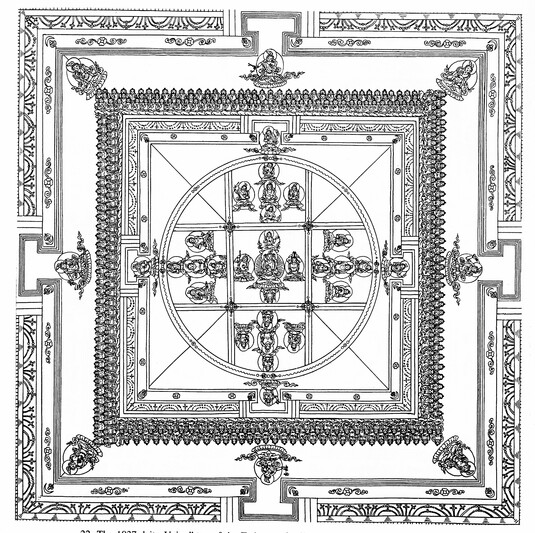


The latter depicts the female Prajnas. They match the previous iteration--Red or West is up. Here they are hovering in Indigo Akash.
Vajradhatu uses a whole series of sub-mandalas to activate it. The Trailokavijaya from stage Five is part of the process. This makes the Sambhogakaya of Vairocana in company with the other Dhyanis. The practice is accompanied by Sarva Durgati Parisodhana: Cleansing and Purification of All Durgas.
This is an advanced stage of the Name Initiation and indicates formation of Vajra body with all components.
Shingon is based on Mahavairocana Sutra and the text with this Vajradhatu Mandala, the Vajrasekhara Sutra, believed to be the first appearance of five dhyanis, while also mentioning Vajradhara. This sutra and a small commentary which mentions thirty-seven deities are posted here:
https://docs.google.com/viewer?a=v&p...U0Nzc5Y2Q1YmQx
https://docs.google.com/viewer?a=v&p...I1Mzc3ZmFmODFh
The Slokas are:
Fourteen Verses on the Great Mandala of Vajradhatu
(28) Like this is the Buddha (Manjushri), the Vanquishing Master Surpassing All, the Fully Enlightened: he’s born from the syllable a, the foremost of all phonemes, the syllable a, of great meaning, the syllable that’s deepest,
(29) The great breath of life, non-arising, rid of being uttered in a word, foremost cause of everything spoken, maker of every word perfectly clear.
(30) In his great offering festival, great longing desire’s the provider of joy to limited beings; in his great offering festival, great anger’s the great foe of all disturbing emotion.
(31) In his great offering festival, great naivety’s the dispeller of the naivety of the naïve mind; in his great offering festival, great fury’s the great foe of great fury.
(32) In his great offering festival, great greed’s the dispeller of all greed; he’s the one with great desire, great happiness, great joy, and great delight.
(33) He’s the one with great form, great enlightening body, great color, great physique, great name, great grandeur, and a great and extensive mandala circle.
(34) He’s the great bearer of the sword of discriminating awareness, the foremost great elephant-hook for disturbing emotions; he’s the one with great renown, great fame, great luster, and great illumination.
(35) He’s the learned one, the bearer of great illusion, the fulfiller of aims with great illusion, the delighter with delight through great illusion, the conjurer of an Indra’s net of great illusion.
(36) He’s the most preeminent master of great generous giving, the foremost holder of great ethical discipline, the steadfast holder of great patience, the courageous one with great perseverance,
(37) The one abiding in the absorbed concentration of great mental stability, the holder of a body of great discriminating awareness, the one with great strength, great skill in means, aspirational prayer, and a sea of deep awareness.
(38) He’s the immeasurable one, composed of great love, he’s the foremost mind of great compassion, great discrimination, great intelligence, great skill in means, and great implementation.
(39) Endowed with the strength of great extraphysical powers, he’s the one with great might, great speed, great extraphysical power, great (lordly) renown, great courage of strength.
(40) He’s the crusher of the great mountain of compulsive existence, the firm holder of the great vajra; the one with great fierceness and great ferociousness, he’s the great terrifier of the terrifying.
(41) He’s the superlative guardian with great pure awareness, the superlative guru with great hidden mantra; stepped up to the Great Vehicle’s mode of travel, he’s superlative in the Great Vehicle’s mode of travel.
---------------------------------------------------------------------------------
Kanchipuram: Shankaracharya--who, properly is called Adi Shankara--lived here. He re-established the yoga of Sri Yantra in the temple of Kamakshi (a form of Parvati). There are no other Parvati temples in town, which is unusual. It is the main abode of Kamakshi and her town. She is Sri Vidya--goddess tantra. Kama akshi: desire eyes literally. Sodashi Locana from the stages we just did.
Kamakshi is a different goddess from Kama. What's the difference? Eyes. What is she there? Of singular importance. What is her yoga, if not a focus in the eyes. Also, with the same menorah model as used for the solar system, the heart is the main core. On the body, the crown is the north pole and the root is the south. Similarly, the ajna is more or less the north pole to swadisthana. Is not the yantra a means of aligning those poles? So that's where ajna is placed, transmuted from the exoteric version where it is swadisthana. Deeper into the Mirror.
Mystery: Dharma
Force: Adi (Original) 1
Planet: Sun
Color: Orange
Principle: Prana Jiva
Skandha: Rupa (form)
Prajna: Yogini Dhatvishvari (White Tara) -- Protector Maha Sahasra Pramardani
Heroic Buddha: Vipawsi
Chohan: Paramatman and Daivi Prakriti Purusha Tattva
Ray: Sushumna, first or the sun's nervous ether via the moon.
Avatar: From Tara, Lord Rama was incarnated
Mother: Brahmani or Sarasvati
Sister: Kushmanda
Maha Vidya: Matangi
Lore:
The obscuration of Sarasvati is Mada which is pride. Her mount is the Hamsa or swan, the title of adepts in Adwaita. Part of her Nirmanakaya.
Maha Sahasra Pramardana is assigned with Vairochana. Supreme Subduer of the Great Thousand (Destructions and Lands She Defends). She has her own Sutra which refers to Seven Buddhas. About her, Buddha said: kaye gatanusmrti shamatha vipashyana, and for her abilities, rattled off every numbered list ever written. Her text is rare. It kind of sounds like she's protecting the crown center from whatever knots and shadows we're cleaning here in the ajna.
The Vidya of Matangi is that speaking the truth purifies. The "expressed word".
Kushmanda is the form of Parvati interior to the sun, giving it the energy to broadcast.
Before proceeding, it must be explained, that, having established a table of correspondences, the rest of the Path concerns the Pratyeka only. And so the only plane we are really teaching and mastering is Manas. We may gain light from the higher two, but it must not be supposed that just because Buddhic plane is here for descriptive purposes, that we are somehow crossing or passing it as we did with the worlds of form. Likewise, even though we may show one Force instructionally, they do not operate in isolation; everything is interblended. So the rest of the practice is Manasic and its whole design is to merge into Buddhi.
Here we gain White Vach Devi Sarasvati, the Sambhogakaya of White Tara, and we are going to Enter Union with her. Our occult light has us at the Sun and in terms of Life Force and Universal Spirit. We have vaporized the "Path of the Eye" and have come to the Ajna as a result of sending Heart prana. We are going to Gaze at the White Voice of Om, seen by Sodashi Locana, Hug her with our Sambhogakaya, and Enter Union with her to gain the Prajna of Maha Akasha Dhatvishvari.
Kushmanda means "a little" "warmth energy" "cosmic egg". Sodashi is the darkness upon which the world egg was born; Kushmanda is that warm golden egg. That is to say, this world egg is the reflection of her from the Formless worlds. She is Sarasvati, Lakshmi, Shakti, the flaming eye powers that were reflected later on as Chandi, combining Kushmanda once more to defeat Mahish Asura. She was part of the Smile that formed the Lower worlds, so we may Smile back and Gaze at this Sister and have Heat and Light in our Sambhogakaya. Adi Shakti becomes Kushmanda when she "finds nothing around her"; Kali or Zero Energy exists, but for Vishnu to awaken, Kushmanda must arise as the egg.
We must use this to get to a higher level of goddess or Mother and we already know how to Hug. So we are able to aim this Hug at Matangi.

Matangi is a Wrathful Sarasvati with drunk Varuni eyes. She has an Active form and an Om form. The Active Ucchishta-Matangini is seated on a corpse and wears red garments, red jewellery and a garland of gunja seeds. The goddess is described as a young, sixteen-year-old maiden with fully developed breasts. She carries a skull and a sword in her two hands, and is offered leftovers. She has a Blue form with noose, a sword, a goad, and a club. Emerald Raja Matangi accompanied by parrots plays the veena, or may have four arms with the same equipment as Sodashi.
At the worst she is waste, residue, pollution, outcasts. In some of her stories she is a Candala or outcast. She is Madhyamaka or middle moment of the translation of ideas to speech. She is prana of the Throat center added to that of the Heart moving to Ajna. She is the secondary Siddhi Vidya.
She is also related to Ganesh and is uniquely referred to as having Elephant Power. She is an erotically dominant elephant woman whose name means "She whose limbs are intoxicated with passion”. Because her limbs tremble with passion, this represents the dark or laya mulaprakriti invested with the thrilling energy of the egg or Kushmanda. To which we have associated the Prana Jiva or individual life force of man.
Even though by now we say we know what it is to have a bond with peaceful deities, it is not full and steady, and now we become sensitive to residues that may cause fluctuating forms.
I need to keep Warm Light Kushmanda in my Sambhogakaya in order to melt the vestitures of Matangi.
Drunken Red with a Formless Corpse (Yantra):
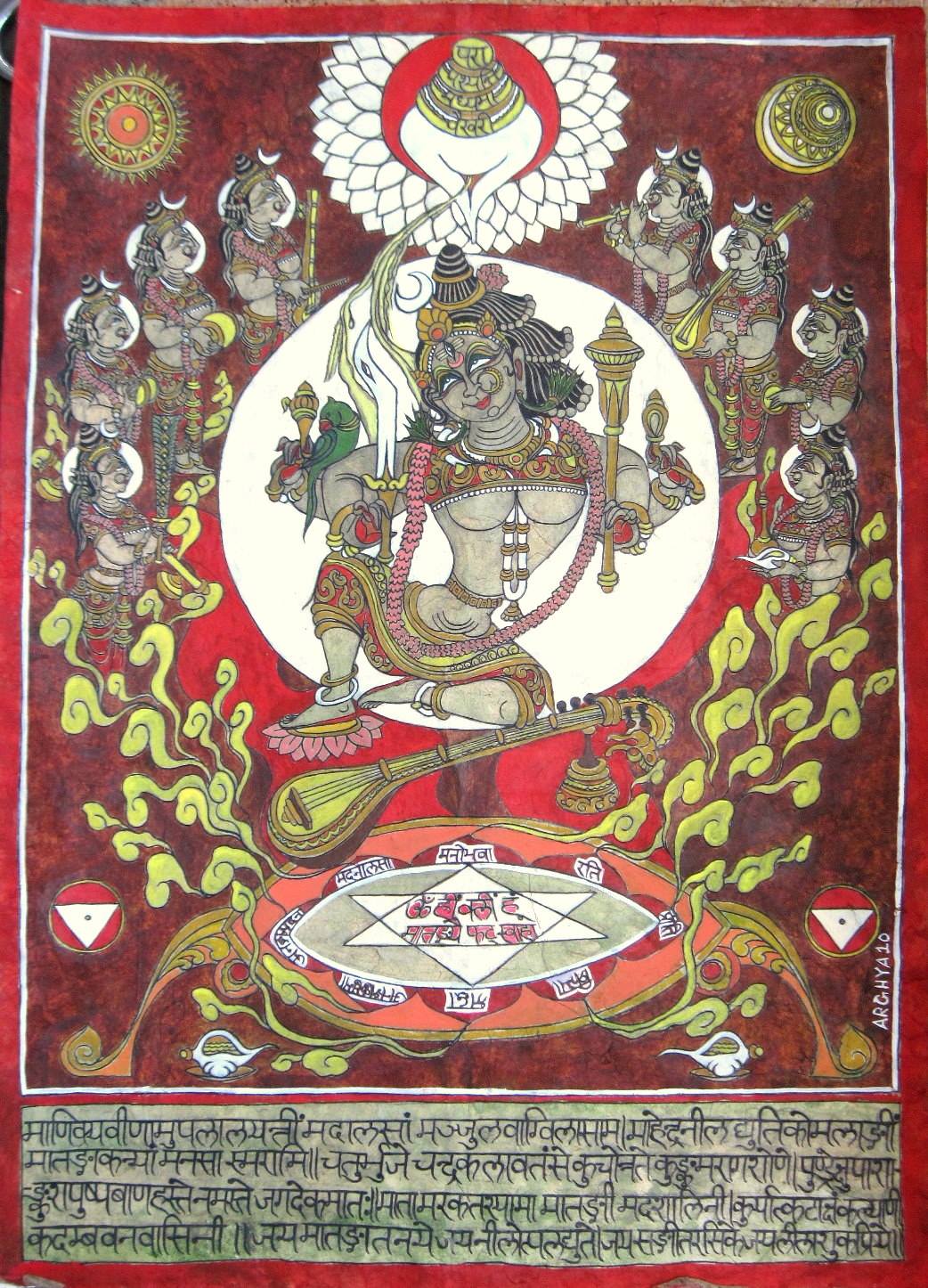
Blue:

Om:


As her title "Uchchhishta" means "scraps", we may find that the most obscure Hindu Tantra is that of Ganesh, Uchchhishta Ganapati.
Her red garments also show divine desire but she may not keep them.
What happens with the scraps intensifies the flow of kundalini:

So that is the Hug which is really the starting point here. Hugging Matangi Sun and Earth--Rupa Skandha.
He actually marries two wives, Buddhi and Siddhi, and then holds the triple fire Jnana, Iccha, and Kriya. We can only have one right now.
The irony is perhaps wasted unless you see a trunk, which comes from between the throat and ajna, shown as using kundalini in a manner indicating Bliss, the Sambhogakaya, with an Elephant lady who shares his name, Scraps, who comes in with Varuni already flowing, and who herself is the energy from throat to Ajna. Ganesh wants to marry Buddhi and we are contemplating the Buddhic plane at the moment needing a ceremony so they can get married and consummate.
That ceremony is Vajradhatu.
The mandala is to be consecrated and protected by the All-purpose mantra of Noble Acala, the Unbearable One: Ham Kotaya Same Maha-Candali Hum Phat. This is for transforming the array of everyone assembled in Akanistha-Sambhogakaya into: That Which Reveals the Arising of Buddhas in World Systems Where there are No Buddhas.
This is being addressed to Vajrapani, Lord of Secret Ones, and produces Great Mandala of Secret Ones--Vajradhatu. One becomes Vajrasattva and establishes the Dharmadhatu.
One adds the Eye in the Triangle--Lotus: Namah Sarva-Buddha-Bodhisattvanam Sarva-Tranaka Svaha.
The Wish-Fulfilling Gem: Namah Sarva-Buddha-Bodhisattvanam Samanta Amrte Jvala Svaha.
Sword inserted into mandala: Namah Sarva-Buddha Bodhisattvanam Vajra Raja Mala Svaha.
One adds the symbols Dharma Wheel (i. e., Vairocana), Buddha's bowl and robes, Gagana Locana like an Usnisa resting on a Lotus, Vajra-varada or a vajra placed on an utpala, Maitreya's water jar, the symbol of Acala, and the symbol of all Vajradharas.
Then symbol of all messengers, symbol of female messengers (Noose & Hook), male servants (Sword), female servants (curved knives and vajra spikes).
Vajrapani attains the samadhi called: Arising of the Realm of Tathagatas. At that point, Vairocana speaks. Vairocana enters the samadhi called: Banner of Dharma on the Highest Summit (Akanistha) and reveals his vajra tongue: mantra is the initiation into Womb Realm, the secret language of the Dharmakaya's three mysteries inaccessible to us at this point. Then follows mantra of the Queen (Vidya Rajni) of the Light of the Great Protection.
All Tathagatas utter:
Namah Sarvatathagathebhyah
Sarvabhayavigatebhyo Visvamukhebhya
Sarvatha Kham Raksha-Mahabale Sarvatathagata-Punyanirjate Hum Hum Trat Trat Apratihate Svaha
Kham is kha (pure empty space) with the pure nasal ending anusvara, meaning perfection of the attached syllable: Sunyata--Prajna.
Hum is realization (Fruit) of Hetu or Cause; the cause is Vajra Bodhi.
Trat is the protection of Mother Lion's Roar.
This is the seed of all mantras, aligning speech with Vairocana's Breath.
Namah Samantabuddhanam Asame Trisamaye Samaye Svaha
(entry into unity with Dhyanis, samaya with the female who is the unity of Three-in-One)
Namah Samantabuddhanam Dharmadhatu-Svabhavatmako Ham
(unity with Dharmadhatu and emergence from its womb state)
Namo Samantavajranam Vajratmako Ham.
(name initiation, unity with Vajrasattva)
Bodhisattva Vajradhatu will go to the Middle and merge with Mahavairocana. Thence providing the Seventh Dhyani.
The explanation of the Great Secret Matrix (Vajradhatu) is the Gate of Infinite Sounding Forth of Melodious Sounds and the Vidya Queen "Melody which Defeats the Four Maras". She is Unsullied like Space and Mother of All Buddhas or Sarva Buddha Dakini. Her peerless vajra verse is A Maha-Vismaye Hum Kham:
Namas Try-Adhvikanam Buddha-Gate Pratisthitebhyo
Apratihata-Sasanebhya Maha-Krpebhyah Gagana Amala-Rupa-Dharani
Tathagata-Rupa-Bhavena
Para-Rupa-Dhare Maha-Krpe Vimale
Sarva-Gate Visodhani.
There are no Buddha-Fields where Tathagatas do not expound and utter this Vidya Queen. To enter Vajradhatu mandala and gain its Samaya: "I shall engage in this Queen of Bodhisattva practice by way of mantras."
We contemplate the nature of the Abhisambodhis or direct revelations, which use the same Sanskrit names for the Wisdoms we have studied. These begin from "inside the Mirror":
First is Akshobya: cittaprativedham karomi: I perform thought penetration (into the intrisic purity of voidness). White Moon.
Second is Ratnasambhava: Om bodhicittam upadayami: Om, I generate Bodhi Mind. Red Moon.
Third is Amitabha: Tistha vajra: Stand up thunderbolt!
Fourth is of the Vajradhatu mandala. The completion of Name Initiation is to have all vajra elements created and available by the Name, Vajradhatu. Vajratmaka Abhisambodhi is Revelation resulting from Thunderbolt Composition: Kaya-vajra-dhatu, Vag-vajra-dhatu, and Citta-vajra-dhatu, what we call the Trinity. The Adi-vajra, or first Five-pronged vajra of the Heart: this original vajra is "previously awakened--not expanded". This is where we see the end of the path of asceticism and non-vajra practices. Buddha-avibiddha becomes Buddha-vibuddha. This is the full Knowledge of Procedure-of-duty or krtyanusthana-jnana of Amogha-siddhi.
Fifth is Mahavairocana: Om Yatha Sarvatathagatas Tatha Ham: Om, like all Thusly-gone Ones, so am I. It is called sarvatathagata samata: Revelation resulting from equality with all Tathagatas. Completion of this makes Abhisambuddha, the Complete Manifest Buddha.
So here we are learning their natures and the final stage will be their performance.
We make these three, Vajrakaya all together, here, and then will do something with to the goddess next.
The explanation of Direct Enlightenment is not given by Kalachakra, Hevajra, or Samvara. According to Anuttara of Guhyasamaja, it has two lineages, Aryadeva and Jnanapada. There are no divergences between these two. Again, from all past teachings, and ones such as Prajnaparamita, Buddha did not know how to pass the Fourth Abhisambodhi, and was guided directly by the Tathagatas or Dhyanis, who plainly said that even the samadhi he had would not make Abhisambuddha.
They summoned Tilottama, daughter of the gods to give him the Name Initiation; at that point, they explained the Abhisambodhis. At Midnight he dissolved the Three Voids, viewed the Artha Prabhasvara, and emerged in reverse order in a full vajra body. At Dawn, by means of Vajropama Samadhi, he became Vajradhara.
Mahavajradhara took abode in the Akanistha--Samboghakaya and emanated Nirmanakaya, such as the son of King Suddhodana: Sakyamuni.
These teachings do not give the preliminaries and they only work if linked together.
The highest group is composed of the divine Flames, so-called, also spoken of as the “Fiery Lions” and the “Lions of Life,” whose esotericism is securely hidden in the Zodiacal sign of Leo. It is the nucleole of the superior divine World. They are the formless Fiery Breaths.
Subba Row described the ray as having its permanent element (Amitabha) and its indwelling divine presence (Avalokiteshvara). Amitabha is located in the Western Paradise from the tradition that the last great Adept of that Ray lived at Shamballa and there established "The Brotherhood". Though each man belongs to a particular Ray of his own, it is only the first two Rays that have ever given rise to universal religions. In the case of the other five Rays, a man is merely concerned with his own particular Ray, but in the case of these two every Adept will have to come under the influence of every other Ray. There are two ways in which these two Rays minister to the spiritual needs of mankind. Buddha is the outward teacher, the teacher par excellence, and through Him spiritual light and wisdom are supposed to come to the neophyte or even Adept. But in the case of Amitabha, his manifestation is internal light and not external symbols. The last great Adept of that Ray, when going to Nirvana, leaves the Ray behind Him, until His Successor shall appear.
This is the mysterious power which pervades the whole of this planet in the shape of the "still small Voice". It is potentially in every man's heart: it is not one of his 7 principles, nor does it always exist there. At a certain stage in a man's spiritual progress, it begins to sound in his heart, as described in Light on the Path. It gives him the supreme directions he has to receive, opens out the further path of progress, points out the way and disappears.
It is everywhere and nowhere. You cannot locate it on any one plane. It seems to be on all the planes. When it does incarnate, it begins to sound like the voice, and remains in the man and establishes a relation with his principles for the time being. Then you say it has incarnated.
It is this mysterious presence which is so unaccountable. It cannot be seen by the highest Adept. It seems to be omniscient and omnipresent. It seems to be its business to help as many human beings as it can, and it has been looked upon as God by all great Initiates. It is not Parabrahman. It is the indwelling Presence of the first Ray Logos, the mysterious power always present in it, and left here, left as a substitute for himself by the last great Adept who reached Nirvana. He will remain here till the next Adept appears and then it will ascend its mercy seat on the throne. It is itself the whole Christian Trinity. But the first Ray has a Holy Ghost of its own - the Light of the Logos of the first Ray. That light is the emanation of the two principles of the Logos combined.
That Holy Ghost is a matter of very little account to people in general, because only a man of the first Ray has to do with it. The Christian Holy Ghost is one of the elements that enters into Avalokitesvara. It is one and yet divisible, and can put forth infinite varieties of manifestations, because it is already in every man's heart, whatever his Ray. It can only be appropriated by a man of that particular Ray, yet every man can claim its assistance, and every man is bound to accept its help before he passes the last Initiation. That is the reason why Buddhism and the first Ray have given rise to universal creeds. The other five Rays, though of course important, have not given rise to universal religions, because not applicable to all people.
This is an infallible voice and must be obeyed. It comes but once and gives directions, and tells you the meaning of your own Ray, points out the path to your own Logos, and then goes away. It will not come before you are prepared for it. Some, when they hear it, think it is some astral sound. Some think some astral sound is this turiyanandam. It is that which the Upanishads say will be heard by the man who dies at Benares. It is the song of life, and only comes when you are in a condition as it were of torpor, and then it begins to whizz round you till you wake up. Vide Prasna Upanisad for "Song of Life."
But in the case of the first Ray there are two elements that form together a complete thing: when one is seperated, the life current does not flow from what remains there. Only when they are joined, comes forth the general influx of life current from it, and that is "the tree of life".
In some very peculiar sense Krsna [Krishna] is the real Christ. Your Christ is simply a feeble image, as it were, of Krsna - a mere reflection. It is from the standpoint of that mysterious Voice that Krsna is speaking in the Bhagavad-gita. It is that Voice that is speaking. Hence the importance of that book. It contains more of the real teaching of Christ than any other book which now exists. But it is open to any man to obtain the teaching of Christ in himself from the "still small voice".
We do not show Amitabha on this ray; even reduced to a trinity, Lotus would still be apart from Tathagatha Family. However, reduced to a unity, it is possible for Amitabha to remain as the Fountain of Limitless Light.
6. Taparloka. That state, whether incarnate or not, of the Ego, when through many lives of devotion, etc., the Ego is invulnerable, etc. The forces on the material plane which produced the body used by such a Yogi have a force which may result in the production of a new body devoid of soul but protected from any entry by vicious influences of any kind. Such a body will be good, but being without soul is in the Vitala state. In Vitala the loss of the soul is complete. As applied to those who have lived wickedly, the soul is lost in the life when this state is reached and the whole trend of what is left physically, astrally and mentally, is wicked, and vicious. But the forces must exhaust and will produce a new body which is soulless from birth and wholly vicious.
In Vitala, some change for the better. This “better” is from the point of view of matter, in that more matter enters into it, i.e., matter becomes more differentiated. This is an ancient occult term. Here are the hierarchies of the celestial Buddhas or Bodhisattwas, who are said to emanate from the seven Dhyâni-Buddhas. It is related on earth to Samâdhi, to the Buddhic consciousness in man. No Adept, save one, can be higher than this and live: if he passes into the Âtmic or Dharmakâya state (Alaya) he can return to earth no more. These two states are purely hyper-metaphysical. Buddhic; the sense of being one with the Universe, the impossibility of imaging oneself apart from it.
The sixth dhyana takes equanimity and one-pointedness to a state called vijñānānantyāyatana, wherein space is no longer a barrier; there is only infinite or boundless consciousness. You enter the sixth dhyana by realizing that the infinite space you occupy includes your consciousness. You may feel “at one” with all nature and existence, but do not be fooled, this is not full enlightenment.
Last edited by shaberon; 1st August 2018 at 00:16.
-
-
24th January 2018 05:12
Link to Post #247
Avalon Member
Re: The Serpent, the Black Sun, HPB & St. Germain
7: Jalamaya Net of Illusion: Vajradhara, Desaka "Instructor in the Law" or Sarva All Family, Manjugosha
Dharmadhatu Vagisvara Mandala:
In this mandala, Manjushri is Manjugosha -- Vairocana Atman. Maha Akshobya is East, united with Prajna or Lochana. Then Ratnasambhava and Mamaki, Amitabha and Pandara, and Amogasiddhi and Tara. We are in Sambhogakaya.
According to Padmavajra, Manjugosha as Dharmakaya is the set of planets and asterisms, the non-oozing ecstasy of dwelling in the Akanistha, and those who have transcended the ecstasy (realizing the "Net of Illusion"), and the gods dwelling in the wind who have nonapperception.
Because this is "non-two", Manjugosha is not other than the array of items; he can be understood as the central element (manda) while the rest are the containing element (la) and these are "non-two" or manda-la.
In this Ngor version, his inner ring consists of Yellow Usnisa deities:
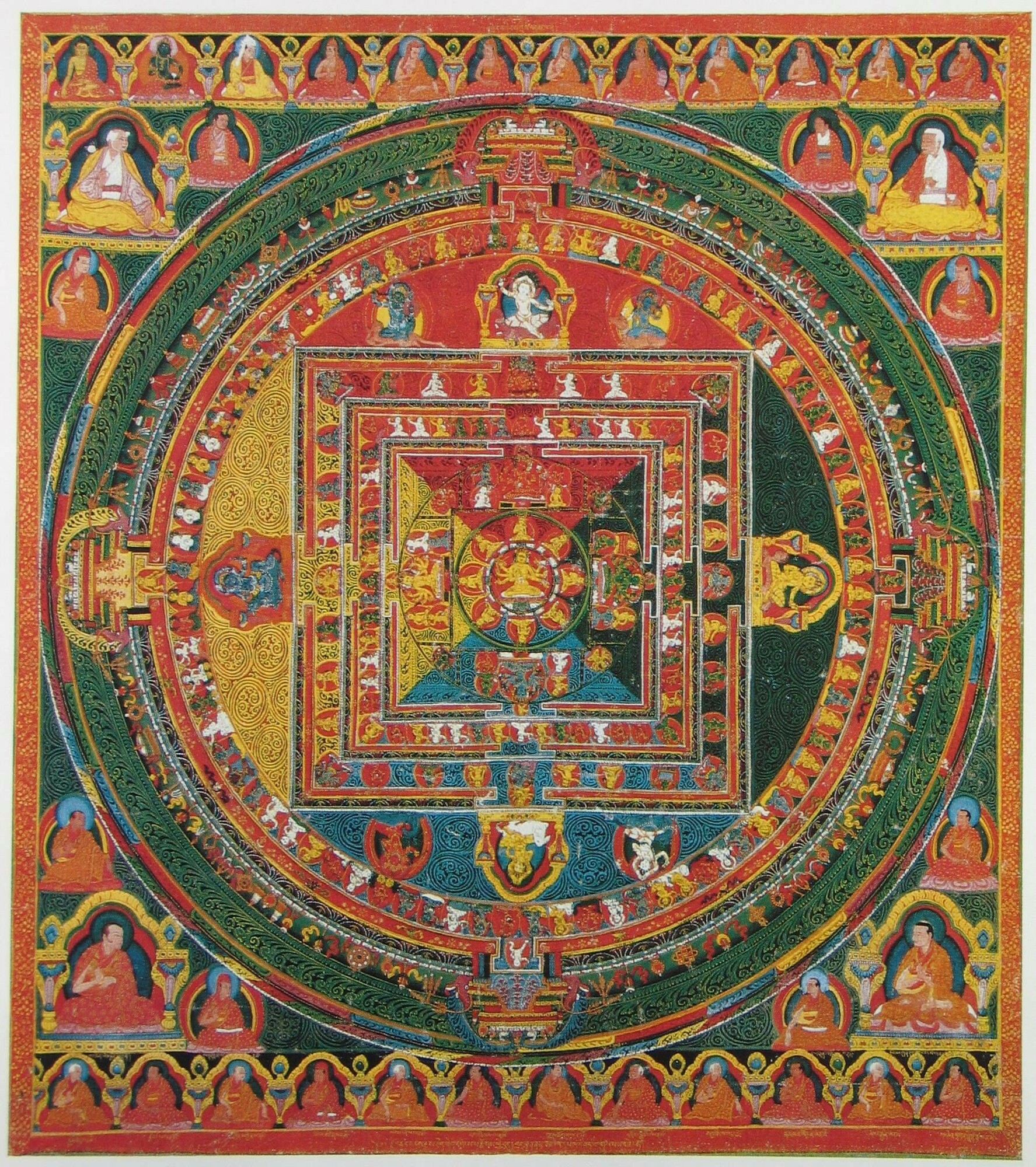
Himalayan Art consistently says there are seven Namasangiti mandalas. This one uses all the basic deity classes, with special Pratisamvit gatekeepers, and the others such as Paramitas are in Ratna's quadrant, and so on.
At the bottom of this one, we find White Tara with two Acalas and Green Tara with two Jambhalas:
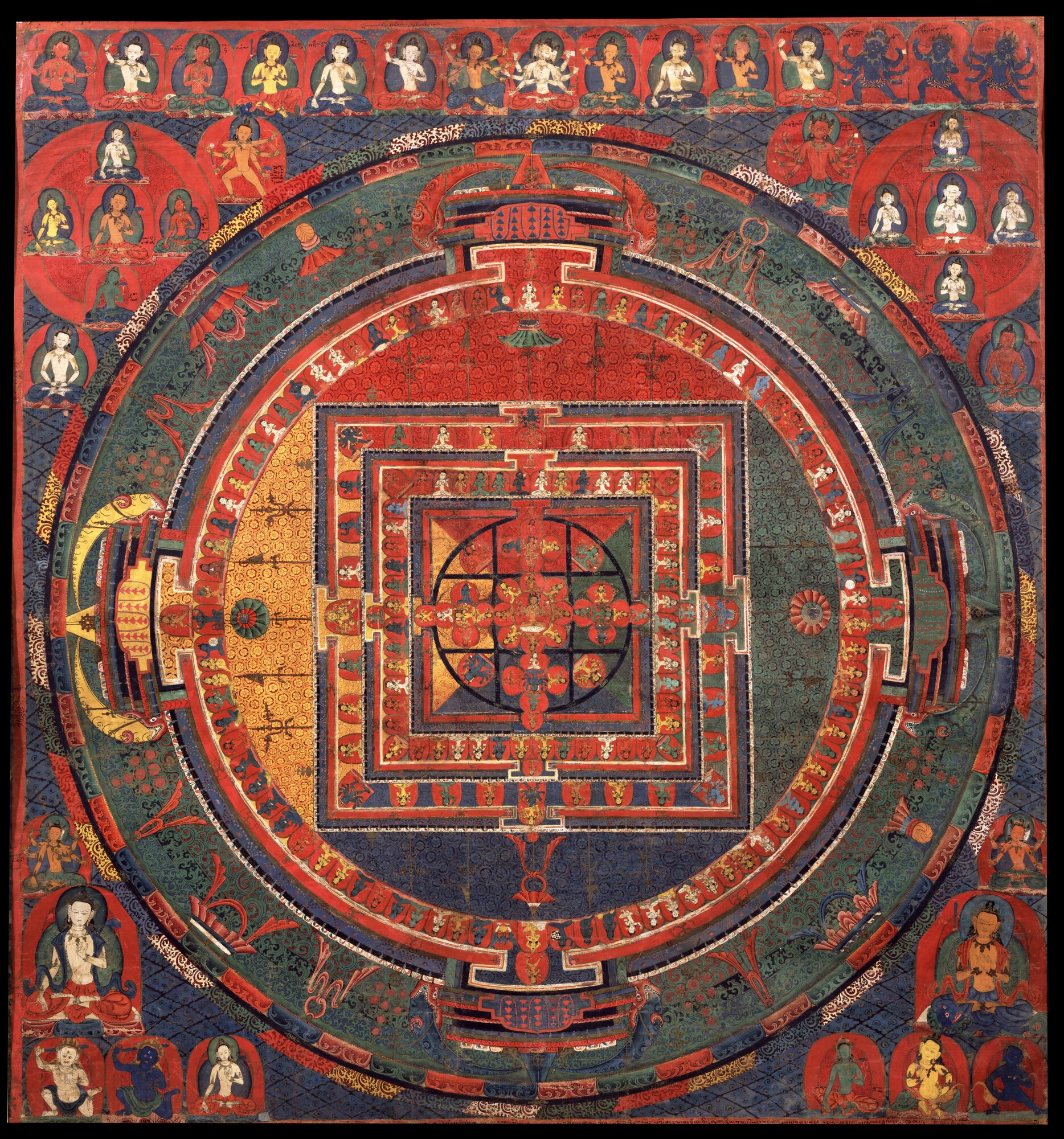
The Dhyani ring uses Four Activities as Gatekeepers, The second ring of four kinds of twelve special goddesses uses Pratisamvits. Outside of that are Bodhisattvas and Ten Wrathfuls, and Offerings and Dances and every other kind emerge. So the unique-ness is from the second ring inwards. The rest of it is like everything else in the system camped in one place. Vajrasattva Family has Manjughosha; Manjughosha [Vairocana] Family has Akshobya plus four, Usnisa, and Locana. Locana (Yellow) starts in an intermediate corner, and if anything, would be paired with Akshobya. Manjughosha is is Vairocana's place, there is no Vairocana or his Family. Then Akshobya Family has Vajrasattva plus three, Mamaki, Vajrankusi. Ratna has Vajraratna and winds up with Sabda Offering Goddess. Mamaki (Blue), physically, if anything, is paired with Ratna. Pandara and Tara are then beside Amitabha and Amoghasiddhi in a standard way. Amoghasiddhi also has Sparsa, and there fails to be specific mention of Tara in his or any Family. We can see Blue Akshobya Mamaki and Yellow Manjughosha Locana are color-tagged to their families while they are potential consorts or shaktis of other Dhyanis.
Manjughosha's mantra is also Om Vaigisvara Muh. He is an Akshobya deity. It may be correct to say that Dhamadhatu Vagisvara is a separate form being combined here.
The Slokas are:
Three Verses on the Steps of Manifest Enlightenment by Means of Illusion's Net
(25) Proclaimed the verse of the Master of Words, endowed with the sixfold mantra king, (concerning) the nondual source with a nature of non-arising:
(26) “A a, i i, u u, e ai, o au, am a:. Situated in the heart, I’m deep awareness embodied, the Buddha of the Buddhas Occurring in the three times.
(27) Om – Vajra Sharp, Cutter of Suffering, Embodied Discriminating Deep Awareness, Enlightening Body of Deep Awareness, Powerful Lord of Speech, And Ripener of Wandering Beings (Ara-pachana) – homage to you.”
(Those are the Six Manjushri Names, being Vajratiksna, Duhkhachedda, etc.)
------------------------------------------------------------
Ujjain: the ancient kingdom Avanti was originally ruled by a clan of Haihayas. They captured the southern city Mahishmati (Mysore) from the Nagas (initiates) under Karkotaka. Took it from Karkotaka sabha, the Assembly of Black Serpents, devotees of Shiva. The descendants of Karkotaka Naga are today settled in Rajasthan and are known as Katewa. Karkotaka names an astrological situation of Rahu-Ketu in 8th & 2nd House.
The Haihayas ruled the whole earth from Mahishmati, in the Ramayana. Ujjain became the capital later, during the Buddhist Magadha empire. The naga temple remains in Ujjain, Karkoteshwar Mahadeva.
Vajranaka's (?) son Taraka was slain by Kartikkeya (exoterically Mars). Rambha and Karambha (Danavas or sons of Danu) next became the chief Asuras. Indra slew Karambha. Agni granted Rambha that his son would rule over the three worlds. Mahish was the son of Rambha and Shyamala (Yamini) in buffalo form. Through an intricate process of pregnancy and incineration, Rambha died but was simultaneously born as Mahish's brother Raktibija. Mahish Asura was slain by Durga. Just as the Nagas, these Daityas-Asuras are the carriers of occultism, opposed to useless ritualism and puja. And Durga is more or less exploited commercially.
This area was a major center for astrology. They located their first meridian here; the Tropic of Cancer is in it--Karkataka.
The Swayambhu Purana refers to a time when Nepal was filled with a central lake, Naga Vasa, which was inhabited by Karkotaka or chief of the nags then. This goes to Root Manu and all the oldest Buddhas. A story unfolds of the whole line of adepts going through cycles of greater and lesser influence during all human kingdoms.
Mystery: Buddha
Force: Taijasa (Fire) 5
Planet: Mars
Color: Red
Principle: Kama rupa
Skandha: Drishti Skandha, the cause of grasping, which is any self-view. Becomes Padmavajra's Dharmadhatu Kaya.
Prajna: Red Vajravarahi (Prajnaparamita), Red Bhagavani, White Vajrayogini, Blue Vajradhatu Ishvari; or Vidyadhari
Heroic Buddha: Konagomana
Chohan: Kshetrajna and Kriyashakti Niyati Tattva
Ray: Sannaddha or Sapadsawa
Avatar: From Chinnamasta, Lord Narasimha was incarnated
Mother: Varahi, Narasimhi
Sister: Brahmacharini
Maha Vidya: Bagalamukhi
Lore:
The obscuration of Varahi is Asuya or malice.
Brahmacharini is not Brahmani, but the second form of Durga, after her Kushmanda form, particularly during her asceticism (Devi Tapaswani) while hoping to marry Shiva. She is attached to Mars.
The Vidya of Bagalamukhi (stop speech) is paralysis; unity of opposites; the power of truth stuns confusion and doubt.
We have Entered Union with Maha Tara and the corresponding stage over the Six system is we Remain in Union to Dissolve the Three Voids and Emerge in Reverse Order. Sister Brahmacharini is no longer all that noticeable, however, we must think of her as all the human sisters who themselves are on the Sambhogakaya Path.
Mother Varahi is a completely different story and the Path to Secret Prajna Vidhyadhari.
Bagalamukhi is the most magical of the Maha Vidyas, the primary giver of Siddhi over Matangi; among her other meanings, she is "Complete Stoppage" in the same sense as Kalachakra uses it. She slays enemies, which, esoterically, is the ego; and brings cessation of the thousands of subtle winds, the samadhis of increasing time and power in paralysis (Stambhana). She revolves on issues of speech and deceit; hypnotic. Some consider her the leader of the army of Shaktis. Her chakra is the soft palate or Indra Yoni where all the senses are conjoined. When sound becomes manifest as light, Tara becomes Bagala. When the brilliant light of speech comes forth, then Tara gains the effulgence of Bagala and causes all things to become still. Bagala is thus the stunning radiance that comes forth from the Divine Word and puts the human or egoistic word to rest. Intoxication; amazement. With Matangi (her twin), she specifically confers vak siddhi. This goddess spans from marana, killing by will, to the most profound samadhi.
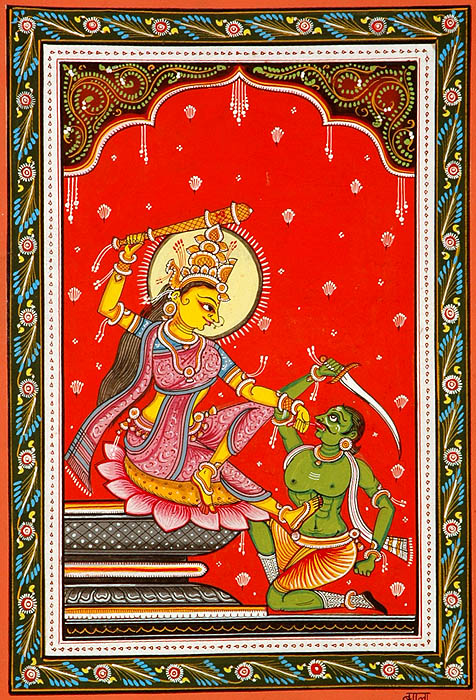
Varahi has so many stories and versions that we cannot sort them all. Nepal gives her a Matsya Varahi form, who is both a Durga and an Ajima or Mother. She holds a fish (matsya), and offering cup; the fish is a specifically tantric item. And she is the origin of the famous and multi-faceted Vajravarahi. Buddhism shows her initially as a Sarva Maitri in Hell, converted to Buddhism by Vajrapani. She becomes the attendant of Marichi, and Seven Sows are the same as Seven Horses or Rays. In Kashi, she is called Patala Bhairavi. She is a night goddess honored by Vamacara in a temple of Kalaratri.
Marici the Dawn goddess is either single or with Vairocana. In rare forms, she has the sow at her ear (Vajradhatvishvari Marici or Kalpoktam). The charioteer is either her, legless, or Rahu. These goddesses are not identical, because Varahi was in hell and then elevated to the sun. Vajravarahi is taken as an emanation of Vairocana. Golden Marici is considered to have Dharmakaya. Her texts do not explain her. I cannot think of a difference between Ushas (a kumari) and Marici, other than the addition of Varahi.
Varahi's mount is most frequently a buffalo, but she may take Sesha, Garuda, an elephant, or a horse named Jambini. Most of the Mothers (except Chamunda) are always shown slender, but Varahi is pot-bellied or pregnant, i. e. Lambodara without the name. Most consorts are equipped similarly to the gods, but Varahi only takes the boar head of Varaha. Devi Purana calls her the Mother of Varaha, and also names her Vaivasvati (Yami), potentially the shakti of Vivasvan (Yama). She is associated with the three lower chakras fused into one unit. Varahi is not going to work unless the lower chakras, lower worlds, are passive, or negative to the heart and higher centers.
The Pig stands for ignorance, and the secret way she is related to the Vajravarahi-Vajrayogini group is because the pig does not stand for ordinary worldly ignorance, but ignorance of one's own vajra nature. Tilo received teaching directly from Vajrayogini, and as the Dharmakaya she is called "Body-less Dakini" as in Glorious Vajra Bodiless Dakini Dharma. They distinguish "body-less" from "formless", the point being to perfect the Dharmakaya, which is the definition of "body-less".
Vajravarahi, Dorje Phagmo, or Vajrayogini only exists in Anuttara Yoga and is considered Prajna Paramita. Overall, she moves us from the minor siddhis of Green Tara to the powerful ones. Marpa did not receive her lineage and she mostly is known to the Sakyas, Kagyu, and Newars, being only retro-fitted to Gelug and still not a part of the canon in tantric colleges.
So we are in Union with Sambhogakaya Tara, attempting to gain Dharmakaya or Tara Atma, another process of colored lights until arriving at the White.
Root Guru Vajradhara is the Dharmakaya which uses Buddha's form to teach tantra while beaming the mandalas as lights (it is said Heruka-Vajrayogini ones did not dissipate). He does not use a physical body to do this.
The blue consort is his reflection, whereas the red and white ones are perhaps the two drops. Blue Vajradhatu Ishvari is New Translation for Samantabhadri. White Vajrayogini or White Khechari is called Prajnaloka. She has a Yellow severed head form like Chinnamasta. Her tulku is Samding Dorje Phagmo, called Female Living Buddha Dorje Palma. She is believed to be a tulku of the human yogini Machig Labdron, who originated Chod in Tibet, also named Dorje Wangchuma, herself thought to be Yeshe Tsogyal. This tulku is the third highest in Tibet after Panchen and Dalai Lamas. She follows the very rare Bodong-pa or Nepali Kalachakra and has a special hat similar to Karmapa. This Vajrayogini is White, leg half-raised, and says: “The origin of all demons is in mind itself. When awareness holds on and embraces any outer object, It is in the hold of a demon.”
Trikaya Vajrayogini is her name as Chinnamasta, usually accompanied by a red or dark Vajravanani and a yellow Vairochani.
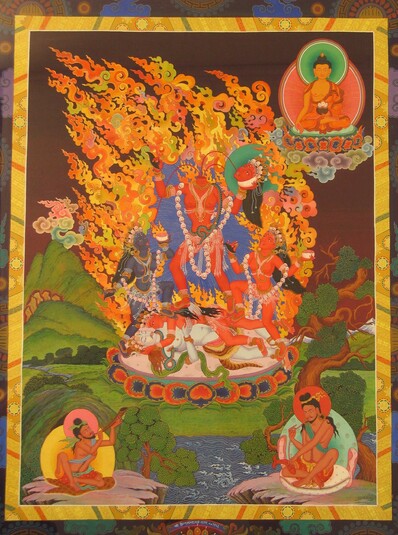
Red Vajrayogini is the most prominent form.
Vajrayogini is the Queen of Dakinis or sky-goers. Red and White are also called Sukhasiddhi, a female teacher of Khyungpo Naljor, who started Shangpa Kagyu; she received this from Virupa. Those two are considered secret forms and revered in Nepal. They are over the Citipati who protect cemeteries. The Citipati are perhaps where Tibetanism veered from Indian Guhyasamaja.
Vajrayogini herself started three lineages, with Naropa, Maitripa, and Indrabodhi. Those are the Three Red. Kurukulla being one of them, or the name of Red Tara generically; Usnisa Sitatapatra being a form of White.
If we're not doing Chakrasamvara and we need a consort for Vajravarahi, she can go with Jinasagara, Red Avalokiteshvara. Her practises are less ritualised and more streamlined to meditation than most tantra.
The Newars give four Vajrayoginis as Vajrayogini (Naropa's Khadga Dakini at Shanku, Amogha-siddhi), Vajravarahi (Indrabhuti's all-source) at Guhyeshvari, Raised Foot Vajrayogini (of Pharping, Phampi Yogini), and Vidyadhari--Akash Yogini at Vidyeshvari (Maitripa's Red Raised Leg). A Raised Foot dancer (Vajradakini) is the Activity of Durga. Vidhyadhari is called Bhagavani Devi Vidyadhari Viramante, the ‘Divine Pleasure-giving Knowledge Holder Goddess’.
Standing Warrior, Dancer, Sky-goer. So we have to meet her and go up.
Pharping is at the entrance of Asura Cave. This is another red form, and the site has a self-arisen Tara and a self-repairing Ganesh. Pharping gives the spark to the eternal flame at Sankhu. If this has a lineage, Padmasambhava and Vajrakilaya, Sakya Devi. This is also where Naropa stashed his Vajrayogini lineage instead of sending it to Tibet with Marpa.
Varuni--emanation of Guhyeshvari and Vajravarahi--remains the Cup in all these rites. Amrita flowing in the Cup makes Vajrayoginis--Activity of Durga. Below Varuni is Vajravarahi surrounded by Five others. Flanking are Khadga and Vidyadhari. Below are Phampi and Akash--between them is an unnamed Red with her legs splayed up. Below them are Eight Matrika Directional Guardians, standing on lesser guadians. Heruki Guhyeshvari is her name as the source of all her forms, according to Swayambhu Purana, she is Adi Prajna. She is Sarva Buddha Janani and has Sahasrar or Thousand Arms form like Avalokiteshvara. She is vase-of-plenty, Kalasha, similar to her well at Phulbari. Below her are Armor Goddesses white Sanchasani and blue Yamini who flank Varuni. I cannot find a good image of this, but it is the lynchpin hypostasis of the whole system.
If we look at the origin of hell-redemption, it is Amitabha-Avalokiteshvara emitting Tara. In 21 Taras, Red Tara is first, called in Tibetan, Jetsun Drolma Nyurma Pamo (Fast Heroine). She comes around in other colors, and the second red is Kurukulla. The Reds are Lotus Family, Fire is the root element, and mostly deals with form desire versus divine desire. Tara later pacifies another of his emanations, Ganesh.
These Vajrayoginis confer Mahamudra Vidyadhara. Those who have not been able to purify their bodies but whose minds have ripened into the deity’s body are known as matured vidyadharas. Those who have the ability to purify the ordinary body with the fire of concentration and transform it into a subtle body acquire the power of immortal life and are called vidyadharas with power over life. Those who are on the second to the ninth bhumis are mahamudra vidyadharas. Then, at the end of the path, at the moment buddhahood is reached, they are spontaneously accomplished vidyadharas.
So those are the Red, White, Chinnamasta, and Black.
In black, Krodikali or Troma Nakmo, she administers the Chod rite, where her Wrathfulness is not considered anger but the intensity of her compassion. Vajravarahi can also do Chod. Troma is inseparable from the lama as Dharmakaya: Kuntuzangmo (Samantabhadri, or Vajradhatvishvari, Prajnaparamita), Samboghakaya: Dorje Palmo (Vajravarahi), Nirmanakaya: Troma (Vajra Khrodikali). So Prajnaparamita equates to Dharmakaya, which, we started making a Dharmakaya on step Five and it takes a lot of components to build. This is instructing us to raise Vajravarahi in our Sambhogakaya.
White Sow Vajraghona and Noble White Vajrayogini are rare and related, the only Dakinis with Akshobya for a seal, and they are Wrathful. Conjured from emptiness rather than the navel (Sow from the heart). She stands and has no offering cup. The Cup is the Activity of Durga. So these actually sound like preliminaries--no dance and no cup and possibly the only way to have Akshobya involved with the Yogini cycle. In her intermediate White Khechari form she will raise both legs behind her head. This is probably the most sexualized image in tantra and is used to transmute lust for sex into an equally strong urge for Bodhi. Matsya Varahi has this pose extremely rarely. Khechari has Vayu Mudra (tongue thrust into soft palate--Bagalamukhi is Khechari), and the corresponding Maha Mudra is a seated position with a leg extended, similar to Raised Foot Yogini. Khechari helps kundalini flow past the throat, and, remember, Shiva got a blue (poisoned) throat (Kantha).
The seeds or drops White Bindu Moon is Brahma and Red Rajas Sun is Shakti. Again, our practice is the reverse of the form, so we say feminine moon, male sun to do the practice. Male invokes female opposite who is really the same and so forth.
Lion-face Dakini (Vajra Dakini Simhamukha or Simhavaktra) is the secret Vajrayogini who can also do Chod. She is Wrathful but Red-Black instead of Blue. Sengdongma Pacifies the Mamos and is considered a Tramenma or Wrathful Bodhisattva. Technically, Simhamukha was the collective compassion of the Buddhas that overpowered the demoness Tramenma Sengdongma, who took an oath. She is an attendant of Dharmapala Palden Lhamo--the only Female Protector of Panchen and Dalai Lamas, usually considered Blue Sarasvati and Sri Devi. Her other attendant is Crocodile Head Dakini Makaravaktra leading a mule--Kalaratri. This is a New Translation and not related to the similar older one. Buddha is said to have taught her practice for taming the Mamos.
Sri Devi--Blue Sarasvati--Simhamukha--Narasimhi. A secret secret yogini.
Four Maras (Kleshas) are terrified of her.
There is the secret Vajrayogini; that is none other than the primordial base-of-all of all sentient beings, the clear light mind that has been pure from the beginning. In interdependence with that, there is there is the inner Vajrayogini [taking the form of] a short A, or in this system a VAM syllable, in the middle of a triangular matrix of channel-knots at the navel. In dependence on this there is the co-emergent sambhogakaya Vajrayogini who abides in the Akanishta heaven, arising as an appearance of the outer nirvana and samsara. Further, there are the field-born nirmanakaya [vajrayoginis] that abide in the twenty-four, thirty-two etc. sacred places of Jambudvipa.
So if we're doing it right, Boar Head is gone and Vajrayogini is in our Sambhogakaya and the Red Drop becomes charged.
She requires initiation but in Kagyu Guru Yoga we are allowed to transform ourselves into Vajrayogini.
Catuskoti of the Three-in-One:
Mars: Vidyadhari Guhyeshvari (throat center secret way; Narasimha, lord of Mars avatar born from Chinnamasta)
Rahu: Trikaya Vajrayogini Chinnamasta Gauri (Varaha, lord of Rahu avatar born from Bhairavi)
Ketu: Ganapati Hridaya Marici Dhumavati Siddhidhatri (Matsya or first avatar from Dhumavati)
Navagraha Laghana: Bhairavi (future avatar born from Bhuvaneshvari)
Mars is the Veil because of it being Skanda-Peacock which would easily wrap everything up in the system of Six and maybe lose some pieces. The last two Durgas are Gauri the bridal gown, which sounds correct as Trikaya Vajrayogini, and Siddhidhatri as the bride. Then Durga is complete and you are producing the future via Bhuvaneshvari. Your Horizon (Laghana) is no longer Kama Loka but Nava Graha or All Spheres.
Mother Matsya Varahi holding Fish and Offering Cup. This is our Lady of Mars. Her Wrahful Form is called Patala Bhairavi. There is a famous film by this name.
There is a also a temple dedicated to Paatal Bhairavi in the town of Rajnandgaon in the Indian state of Chhattisgarh. The temple is Barfni Dham. The temple is constructed in three levels. The bottom level is for Patal Bhairavi, next is for Navadurga or Tripura Sundari and the upper is for Lord Shiva. She specifically is the Wrathful Form of Mahavidya Bhairavi. Goddess Bhairavi represents transforming heat, ‘Tapas’, and also Divine radiance, ‘Tejas’. Tapas is not just asceticism, it is a heightened aspiration that consumes all secondary interests and attachments. Bhairavi is the transformation that comes with destruction, which is not necessarily negative. She personifies light and heat that can burn away the imperfections in the soul. Her mount is Lion. Also Shubmkari "good mother".
The Mother of Mars is the same as the Mahavidya at the end of the system. The Vajrayoginis, Durgas, Mahavidyas, Vishnu Avatars, and Ganesh involved, are all interlaced from their inherent symbolism and meanings.
If Bhairavi is Varahi, she is relevant for the rest of the system. Her vidya is the fire of truth that burns impediments to spiritual progress in the heat of tapas (asceticism). The "flaming word". Very similar to Brahmacharini's character and Bagala as the Light of Om. These highest stages of the path are not so much new elements, but represent only the most subtle imperfections, instead of forms of crude ignorance to be reversed. To call her Vajravarahi harnesses Varahi for protection and indicates the meaning we are trying to give.
Images of Matsya Varahi are rare:
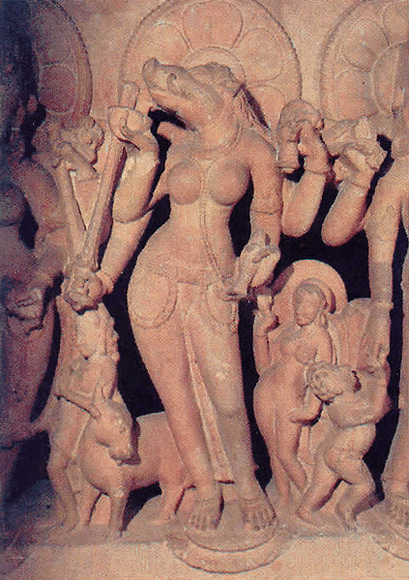
Mother level Purified Elements Protect the Wheels of Time:

Remember what White Vajrayogini said and we have left hell but we're still in the clouds. Mother isn't finished yet. Outer Objects are already defined as Material Sisters which is Durga. They can either be the possession of demons, or, if I do not embrace them with awareness, Durga.
This represents a high stage of Pratyahara or sense withdrawl.
And if you Stay in Union with her, she will hop on Sesha and run you through the higher Talas.
She inherently is Patala Bhairavi which means of the Earth so she is always around you. She can cast all colors in any of the realms.
Plump or Lambodara Bhairavi:

Teaching in Flame:
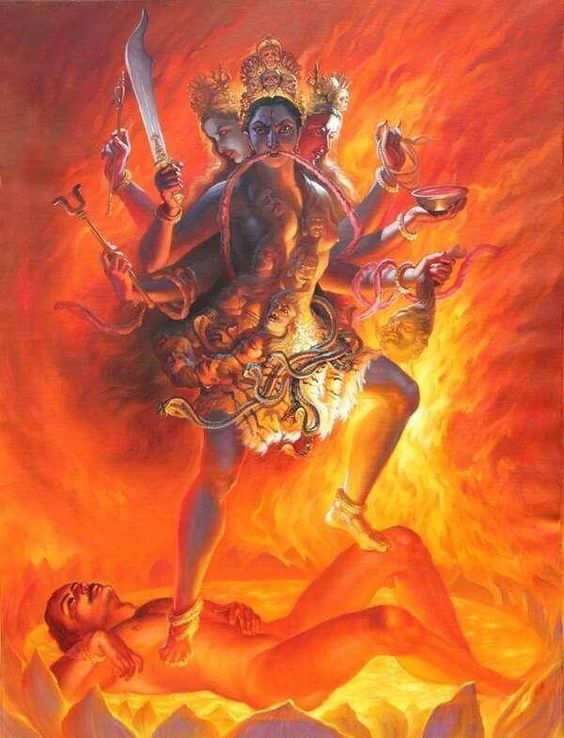
This will stir up your Karmic Winds. So you need Wind Horse here which is a high stage of Pranayama or Subtle Breath regulation. Bhairavi's consort is Dakshinamurti.
We have covered the Seven Rays with Mars the Fiery Veil and are left with the Three Voids or Three-in-One Formless Fire, which do not have physical planets.
There are two Durgas left: Rahu is also Gauri; Ketu is also Siddhidatri, the female half of Ardhanarishvar. Ganapati Hridaya or Ganesha's Heart Wife also for Ketu. He's coming to marry this last Durga.
In Rahu you are going to drape Chinnamasta with Gauri Shakti, or Sattva Devi Mahasarasvati (Vach Devi). Gauri means white or bright, briliant. Mentally it is the full Dharmakaya of Tara.
This is crucial because Ketu is the Karmic Wind.
If we are powering it with Amrita Kundalini then it goes through Ganesha's Heart Seed takes Siddhidhatri for his second wife. Her Mother form is Dhumavati. The Wind is balanced and aligned across the whole solar system.
The logos of this Ray is Kshetrajna (Knower of All States) who wields Kriyashakti. This second marriage gives Ganesh the set of powers: iccha, jnana, kriya. So it is only here that one could be said to have kriya. The way to understand the Ksetrajna as different from the "Phenomenal Self" of Bhutatman is that Kshetrajna is the Hridaya Vastu or the violet flame in the heart, the real life of the soul seated there.
The germ of Prajna is called Kutashtha Caitanyam, the permanent or reincarnating part of the fifth principle of manas (neutral--sattvic). The option for manas is either this germ or to be the subject of Kama. According to Sarvasaro Upanishad, the original Avidya is the hridaya-granthi or heart knot, seed of the subtle linga; but the caitanya or consciousness reflected in it is Kshetra-Yagna; Kutastha is the eternal, invariant animation of consciousness. When anahata reverberates, it makes the mind waves; when still, the germ may be found.
The second marriage ceremony is 1,000 lights head center or full Sahasra Avalokiteshvara--Guhyeshvari. Buddhism doesn't like to use the name Shakti, but she is. Any phrase "power of the Buddha" would be Shakti of the Buddha. We call her Prajna to emphasize Wisdom rather than the material aspect.
Parabrahma roopam Ganesham bhajema: unlike most other deities who have one shakti or power as consort, Ganesh collects them all.
In a standard form of Buddhist Eight Direction protectors, Southwest, the most unfavorable direction, is protected by the syllable "Ksham". They use it as a seed for Nirrti-Rakshasa and Mother Khadgadharini, Sword Holders. These are placed with Rahu due to the Swords. So this would be more appropriate with Naro's Khadga Vajrayogini.
Ksham also happens to be the seed for somebody else we kept on the fringe, Narasimhi. Ham Ksham or I am Narasimhi are the syllables for each wing of the Ajna. Ksham also means Prithivi or Earth. Her full mantra is:
Om Ksham Paksha Jvala Jihve Karala Dhamstre Kalaratri Pratyangira Ksham Hrim Hum Phat.
Paksha refers to the Waning Moon Fortnight.
Northwest is usually given to Root Mother Yogeshvari, Chandi or Narasimhi. She gets mixed up with Chamunda, who we basically placed in the northwest and used at stage one. And at this point, we are not thinking root mother of manifestation, but of the formless. So, to the extent there is an eighth direction, we are trying to describe a Formless Root Mother as Yogeshvari, Chandi, Narasimhi, associated with Rahu. Her Wrathful Form is Chinnamasta and her Peaceful Form is Gauri or Vajrayogini.
Now as we have seen, Lion-face Dakini is a Tramenma or Wrathful Bodhisattva. Mother Varahi has a Boar head. The animal components represent higher stages of enlightenment to be achieved. Once completed, then perhaps you have Devi Chandi as the reformed Varahi and Mother of Bodhisattva Narasimhi. Chandi is Brahman Sakti as well as ferocious in form, the complete Durga. She is "extraoridary traits" and Mahalakshmi.
Simhamukha is not an oath-bound protector (srung-ma), but Guhyajnana Dakini in Wrathful Form, Lotus Family. She is Nirmanakaya, her Sambhogakaya is Vajravarahi, her Dharmakaya is Vajradhatvishvari. Very little difference from Durga, Queen of Dakinis in that system. She can do all Four Enlightening Activities. Her black form is Vajra Nairatmya. She uses Hum (Vajra syllable) in the Dharmodaya (hexagram). Deep in her rites, she is called Pratyangira, a name for Narasimhi. Any sacred ritual space for tantra is a Ganachakra, "gathering circle". She is Fire, or the element that pervades all elements.
Lion-face is an oath-bound protector as well as the Bodhisattva that bound her, this Bodhisattva being in Lotus Family, an emanation of Vajravarahi, and evidently equal to Narasimhi. If we go Lotus way, then, this congrues with Avalokiteshvara and the Fire or Agni that propels all. That is the only reason I would suggest Narasimhi over Kadgadharini, although Sword may be something Chinnamasta needs to use.
Narasimhi is of Blue Sarasvati and Sri Devi. The latter's respectful prefix obtains from Shri sevayam meaning to take refuge, to serve, to cling to, to depend on. Devi is luminosity, and implies Durga. So Narasimhi is of "I take refuge in Durga" and the Voice. This is straightforward although her friend Makara is Mystery.
You wouldn't think Tibetan Buddhism had a secret way of taking refuge in Durga, but there it is. Special Protector.
If there is a question about Durga, Seven, and Chandi, she has a Devi Mahatmya named for seven hundreds of chapters, Shri Durga Saptashati. Its other important name is Chandi Path. Here is a twilight decoding that tells us she is the only Purana usable with the Hotri, i. e. Agni, and the code obtains her seed syllable Hrim. Tibetan Simhamukha sadhanas.
Hrim is Maya Mantra for Magnetizing or Red Tara. It is the root syllable of Kurukulla. It directly implies Hridaya and also Hrit Chakra from the solar plexus to heart, ananda kanda, bulb of bliss.
This is the guha or cave of the heart. Its Padma or Lotus is the city of Brahman in the Hidden Chamber. So this is what is within the larger Anahata whose petals we energized as the Peaceful Deities.
Traditionally there appear to be two rites with Sow Head before proceeding to Rahu:
Vajrasattva + Jnanadakini Vajravarahi
Mahamaya + Buddhadakini Vajravarahi: Mahamaya is one of Sati's parts in Ujjain, and generally Mahamaya is a feminine male, or she became a man in the Mahamaya Tantra.
Trikaya is the same as Chinnamasta, Vajrayogini called Narodakini and Sarvabuddhadakini: om sarvabuddhadakinlye om vajravarnanlye om vajravairocanlye hum hum hum phat phat phat svaha.
Her rite is well-known for instance page 94.
So she comes in with boar head and removes it and then you have Vajrayogini who removes her whole body. Ganesh marries a wife with no body because she is the fully developed Dharmakaya with all vajra ignorances removed and replaced with vajra--Vajrakaya or Rainbow. That takes care of Ketu, Siddhidhatri and Dhumavati, and, after getting married, we are going to Remain in Union to Dissolve the Three Voids and Emerge in Reverse Order. The marriage creates Ardhanarishvar, or the absolute sexless unity of Shiva, who is the disciple's samadhi.
Past which there are no more planets or Mothers because we have already been using Bhairavi as she was Mother Varahi to begin with.
Mars then is the stage of Boar Head Dakini, Vajravarahi. She does not have the full boar head of Mother Varahi; instead, she looks like Red Vajrayogini with a small, additional boar head coming out of right ear or top of head, sometimes called "two faced".
Rahu is the stage of less boar, and more dancing and flying Dakinis.
Lajja Gauri is Aditi Adi Shakti often shown with her legs splayed. The Durga form for Rahu however is Maha Gauri, "Great White". One time Shiva turned Parvati black. She did a lot of penance and bathing and shucked off her black skin, which became another person. Cleansed Parvati was then Maha Gauri. Since then, she can swap skins with the other person and become Kali. She is a very young--eight years--girl dressed in white who rides the white Nandi bull. Remember she started on this on stage one, Alpha or Taurus, home of the Pleiades, definition of the Fixed Cross when the Pole Star was Thuban. On her own, she has no fierceness whatsoever. We have to hang her like a Gown on Mahavidya Chinnamasta. Her vidya is to stop mind and desire is liberation. So we just got Bagalamukhi who can stop anything. In Rahu, we need to be experiencing the stoppage and liberation, because that is the bridal clothing, Trikaya Vajrayogini.
Shedding the Black Snake's skin for Solar Purposes. The Sun is the Life which pushes our Winds. We're leaving the Talas.
Ketu is the stage of the new wife, who does not exist or work right unless we have supreme mastery of Wind Horse. So we shed the skin.
Siddhidhatri, Ganesha's Heart, is the last or ninth Durga meaning "giver of powers". The prime power is realizing that she alone exists. But she conveys the higher siddhis which we would call magical powers or kriya. She is the female half of Ardhanarishvar or absolute sexless unity. The Mahavidya with her is Dhumavati--smoke. The end of one's energies, the decrepit remains, a widow goddess. She may ride a crow or a horseless chariot. She is the end. All that remains after Sesha spews Bala-rama to end the worlds. She also grants siddhis. She is not known outside of the circle of Mahavidyas. Always hungry and thirsty, never finished, she is the stable void between worlds, so the First Avatar will come from her in the next cycle.
Dhumavati's vidya is enlightenment found in the blessing of suffering; let the unreal be covered by the smoke of suffering. Enjoy sorrow and find potential beyond pain. She sounds similar to Kali, but of them all, is the one closest to the unmanifest and pralaya. If she is Nirrti, this means lack of Rta. Alakshmi is the opposite of Lakshmi, or without energetic radiance. She carries a winnowing basket and makes a begging gesture. Or else she holds a bowl of fire and the basket is Viveka (discrimination)--asking you what type of grains you really want to deposit in eternity. She is the only Mahavidya without a consort.
She's not particularly nice unless you are nice to her:

Ganesh is more or less going to Stay in Union with Siddhidhatri, and while he does, she basically dissipates into the void Dhumavati. He has to hang on as tight as ever and emerge in reverse order without being fazed. Such is the Dharmakaya.
Shad Mudra or Six Seals are the Armor Deities, simply the Wrathful Dhyani Buddhas and Prajnas. So with seven Dhyanis, we would have Sapta Mudra, seven sets of Wrathful Deities in Union, to wear as a coat of armor. This means all reflexive mental activity is completely quiet--Nirakara Vijnana. And you need this Armor to undergo the Talas so you light up the 1,000 with Vajra Tara Akashadhatvishvari Marici--Daivi Prakriti.
Kama Rupa, the principle under scrutiny, is only a body under two conditions: conscious control by an adept, or death. In light of the previous training, this degree would seem to be the performance of the perfectly full samadhi of suspended animation. Kama-manas in its regular use is just its pile of thought forms, Kama Rupa.
According to Buddhism, there are two ways to form the Trinity; HPB seemed to make a similar suggestion with color; and there is the action in the subtle body of the Red and White Drops in the Central Channel. Red Blood is the Female around the solar plexus, White Seed is the male in the sahasrar. The process of pranic perfumery invests them with a finer blend of energy and melts the knots in the subtle nerves. This allows the drop to enter the central and merge in the Heart. This is where for a living female to actually do it, you need to consider some of the Chinese sources which take into account that her heart is strongly tied to her womb, or else when you melt the knots, your feminity will go away with it.
The Three Family Lords are Bodhisattvas Avalokiteshvara (Padmapani, or Lotus Holder), Vajrapani (Thunderbolt Holder; also Guhyapati, Vajra Family), and Manjushri (Prajnaparamita, Tatagatha Family). The Families generally consist of its Buddha, its Bodhisattva or Lord of the World, its Mother or Dakini, an Ushnisha, a Wrathful Deity, other Bodhisattvas, Nagas, and Yakshas. We have used a Method of Manjushri which is Vajra. This is Fire, Lightning, Sun as it stands.
There are two ways to resolve the Trinity, the first being given as Jewel merges with Lotus and Karma merges with Tathagatha. Those Five Families may be reduced to the Trinity by Ratnasambhava (Jewel) merges into Amitabha (Lotus) -- another meaning of the jewel in the lotus mantra. Amogasiddhi (Karma) merges into Vairocana (Sun), who has the Chakra or Tathagatha (Buddha) Family, him, i. e. action merges with wisdom. So Vairocana, Amitabha, and Akshobya remain as the Trinity.
The same Trinity may also be resolved by switching those merges. This is in closer accord to vajra explanations.
The Jewel Family may merge into the Tathagatha Family to form the Thunderbolt of Body, kaya vajra, and the Karma Family may merge into the Lotus Family to form the Thunderbolt of Speech, vag vajra.
The mind is Mahamudra Bodhicittavajra or Akshobya plus vajra elements. So to say, Mahamudra Amoghasiddhi merges into Akshobya; Vajra Family is Thunderbolt of Mind, chitta vajra.
Tathagatha Mothers are called Pancha Raksha, Mahavidya, and Marici. If Pancha Raksha (Jewel Family) is a Tathagatha Mother, it sounds like Jewel merged with Tathagatha to form Kaya Vajra. And so far, Mars Catuskoti asks to transmute varahi or vajra ignorances into Marici or Bodhi of the Sun.
Original key and more Vajrayogini continuation of Path.
Padma Family has Mother Tara; Wrathfuls Hayagriva-Vajravarahi Chintamani.
Vajra Family has Mother Vajra and Wrathful Amritakundali.
The three deity mandala of White Tara:
White Tara with four hands. The first two perform the utpala gesture. The lower right holds a wishing gem together with [the gesture of] supreme generosity. The lower left [holds] bunches of utpalas. [Having] the same ornaments, garments and seated posture. At the right on a moon is yellow Marichi, holding in the right [hand] a white yak-tail fan and in the left a branch of the ashoka tree. Wearing a red inner garment and a blue lower garment. At the left on a moon is green-yellow Maha Mayuri, holding in the right [hand] a yak-tail fan [and in] the left a peacock tail feather. Wearing various garments.
The Fifth group is a very mysterious one, as it is connected with the Microcosmic Pentagon. The fifth group of the celestial Beings is supposed to contain in itself the dual attributes of both the spiritual and physical aspects of the Universe; the two poles, so to say, of Mahat the Universal Intelligence, and the dual nature of man, the spiritual and the physical. Hence its number Five, multiplied and made into ten, connecting it with Makara, the 10th sign of Zodiac. … It becomes the task of the fifth Hierarchy – the mysterious beings that preside over the constellation Capricornus, Makara, or “Crocodile” in India as in Egypt – to inform the empty and ethereal animal form [i.e. in the early period of humanity’s evolution on this globe in this Fourth Round] and make of it the Rational Man. Many are those among the Spiritual Entities, who have incarnated bodily in man, since the beginning of his appearance, and who, for all that, still exist as independently as they did before, in the infinitudes of Space. … To put it more clearly: the invisible Entity may be bodily present on earth without abandoning, however, its status and functions in the supersensuous regions.
"There are seven cavities in the Brain which during life are empty, in the ordinary sense of the word. In reality, they are filled with Akasha, each cavity having its own color, according to the state of Consciousness in which you are. (The colors are only visible, of course, to the purified vision.) These cavities are called in Occultism the “Seven Harmonies,” the scale of the Divine Harmonies, and it is in these that visions must be reflected, if they are to remain in the Brain-memory. These are the parts of the Brain which receive impressions from the Heart, and enable the memory of the Heart to be impressed on the memory of the Brain.
The fourth of these cavities is the Pituitary Body, which corresponds with Manas-Antaskarana, the bridge to the Higher Intelligence; it contains various essences. The fifth cavity is the Third Ventricle, empty during life except for pulsating light, though filled with a liquid after death. The sixth cavity is the Pineal Gland, also hollow and empty during life; the granules are precipitated after death. The Pineal Gland corresponds with Manas until it is touched by the vibrating light of Kundalinî, which proceeds from Buddhi, and then it becomes Buddhi-Manas. When Manas is united to Buddhi, or when Buddhi––and therefore Âtman also––is centred in Manas, it acts in the three higher cavities, radiating and sending forth a halo of light, and this sometimes becomes visible in the case of very holy persons. The fires are always playing round the Pineal Gland; but when Kundalinî illuminates them for a brief instant, the whole universe is seen. This is what occurs occasionally in deep sleep when the third eye opens. And such opening is good for Manas, who profits by it, even though the Lower Man is not then reached and therefore cannot remember. The seventh cavity is the synthesis of all, the cavity of the skull itself, as filled with Akasha. This corresponds with the Âtmic Aura, the sacred Auric Egg.
Perception, brain perception, is located in the aura of the Pineal Gland, while the Pineal Gland itself, illuminated, corresponds with Divine Thought. The Pituitary Body is the organ per se of the psychic plane. Pure psychic vision (not ordinary clairvoyance) is caused by the molecular motion of this body, which is directly connected with the optic nerve, and thus affects the sight, and gives rise to hallucinations. Its motion may readily cause flashes of light, seen within the head, similar to those that may be obtained on pressing the eyeballs, and so causing molecular motion in the optic nerve. When molecular action is set up in the Pituitary Body, these flashes are seen, and further action gives psychic vision, as similar motion in the Pineal Gland gives Spiritual Clairvoyance. Drunkenness and fever cause disorderly motion in the Pituitary Body, and so produce illusions of sight, visions, hallucinations. This body is sometimes so affected by drunkenness that it is paralyzed, and the strict forbiddance of alcoholic liquids to all students of Occultism turns on this effect which alcohol produces on the Pituitary Body and Pineal Gland.
The Pineal Gland is the focus of the spiritual, hence inorganic, sensorium. Its action has nothing to do with the circulation of the Blood, but it is concerned with the spiritual fiery emanation that proceeds from the Blood. Further: the Pineal Gland, at the upper pole of the human body, corresponds with the Uterus (in the female and its analogue in the male) at the lower pole; the peduncles of the Pineal Gland corresponding with the Fallopian Tubes of the Uterus. The Pituitary Body is only the servant of the Pineal Gland, its torch-bearer, like the servants carrying torches that run before the carriage of a princess. Man is androgyne, so far as his head is concerned.
The Corpora Quadrigemina corresponds with Kâma-Manas, bringing Kâma thus within the Mânasic division of the human brain.
Kâma itself has for its correspondence the Cerebellum, which is the centre and storehouse of forces. The Cerebellum furnishes the materials for ideation. The frontal lobes of the Cerebrum are the finishers and polishers of the materials supplied by the Cerebellum, but they cannot create these materials for themselves.
The correspondence of Kâma in the lower part of the Body is the Liver, with the Stomach.
Thus the Brain, the vehicle of the Lower Manas with Kâma, as said, has its subdivisions corresponding with the subdivisions, or aspects, of Manas in activity, and has also the cavities related to the heart, rendering possible the making of impressions on the physical consciousness, and by the action within these cavities rendering possible the action of Buddhi-Manas on the physical plane, and the development of Spiritual Clairvoyance.
The seven physical Nâdîs extend up the vertebral column from the sacrum to the atlas. The superphysical are within the head, and of these the fourth is the Pituitary Body. The physical Nâdîs correspond to regions of the Spinal Cord known to anatomists. There are six or seven Nâdîs, or plexuses, along the Spinal Cord; but the term “Nâdîs” is not technical; it is used as descriptive of any knot, centre, ganglion, or similar body. The Sacred Nâdîs are those that are situated above Sushumna, along its length. Six of these are known to Science, while the seventh, near the atlas, is unknown. Even the Târaka Râja-Yogis speak only of six, and will not mention the sacred seventh.
The pure Akasha passes up Sushumna; its two aspects pass up Idâ and Pingala. These play along the curved walls of the Cord in which is Sushumna. They are semi-material, one positive and one negative, one solar and the other lunar, and these two start into action the free and spiritual current of Sushumna. They have distinct paths of their own, otherwise they would radiate all over the body. By concentration on Idâ and Pingala is generated the “sacred Fire,” and these are the “sentries on either side”, by the action of which alone the Sushumnic current can be roused into activity. Sushumna, Idâ, and Pingala, are the three vital airs, and are symbolized in the Brâhmanical thread. When these vital airs are active a circulation is set up which passes through the whole Body, originating in and returning to the central canal. This is why man has been represented by a tree, with its circulation rising up the inner, and descending along the outer, parts of the wood. Hence the use of trees in symbolism, and the representation of the Dhyâni-Chohanic Body as a tree."
7. Satyaloka is that next step or stage for the Yogi who had reached Taparloka and it need not require in every case a new incarnation of the Ego. In this the great choice is made as inevitably as Atala follows Vitala. The Yogi becomes Nirmânakâya.
Atala. The exhaustion of the forces produced by the persistently wicked, and by which is brought forth the new, soulless and wicked body referred to under Vitala, above. Atala is the point where the physical disappears or is disappearing into the noumenal, as Satyaloka is the state wherein the Yogi is truly joined with the All. Hence we may, from the standpoint so far taken, make a correspondence with Âkâśa, Satyaloka, Atala, the next unnamed state and Arûpa, for at this point form, as imposing any limits to perception, has disappeared. Atala is a continuation physically of Vitala because the physical force must be exhausted; it properly designates the next rebirth after that one in which the soul was lost, and therefore it opposes Satyaloka wherein the great choice may be made, whereas in Vitala no choice whatever is possible. With Atala, we will then describe the state thus: “that in which there is a continuation of combination of molecules of different planes into a living form devoid of a soul which had fled in a preceding life; and that may be either from spiritual or unspiritual causes.”
Atala, no place. The Âtmic or Auric state or locality. It radiates directly from the periodical manifestation in ABSOLUTENESS, and is the first something in the Universe. Its correspondence in Kosmos is the hierarchy of non-substantial primordial beings, in a place which is no state. This hierarchy contains the primordial plane, all that was, is, and will be, from the beginning to the end of the Mahâmanvantara; all is there. This statement should not, however, be taken to imply fatality, kismet: the latter is contrary to all the teachings of Occultism. Here are the hierarchies of the Dhyâni-Buddhas. Their state is that of Para-Samâdhi, of the Dharmakâya; a state where no progress is possible. The entities there may be said to be crystallized in purity, in homogeneity. Auric, Âtmic, Alayic, sense of taste. One of full potentiality, but not of activity.
But at the same time there are many in the Atala or Vitala state that are inactively bad, doing nothing much of any sort, and only carrying out the law of nature which provides for the dissipation in the right way of all those elements which have to be ground out, so to say, in the great mill of the Gods.
The seventh dhyana carries equanimity and one-pointedness into ākiṃcanyāyatana, wherein there is no consciousness, but infinite or boundless nothingness. It is entered by realizing that the content of the infinite consciousness is basically empty of any permanent nature. There is nothing in the universe that has any permanent essence to it. We realize that everything is in constant flux.
Last edited by shaberon; 14th May 2019 at 18:38.
-
-
24th January 2018 06:39
Link to Post #248
Avalon Member
Re: The Serpent, the Black Sun, HPB & St. Germain
End of initial Sapta Mudra sequence.
From here, after more than a year of working, there are probably over a hundred supporting posts. It is impossible to search per post, and so we need to take some space to list them and their subjects in attempts to make this more cohesive. The original post here contains Namasangiti mantras and the note that Sati is Guhyeshvari and a bit about Nepal, so that can stay at the end.
249: Seven Rays, Five Buddhas, and Six Yoga Dakinis
250: HPB's real Esoteric Theosophy and the tantric Inverted Stupa with more Kalachakra Six Yogas
251: Occult key generated from applying HPB's definitions, more Six Yogas and Vajrayogini
253: Mars, Cinnamasta, and Ganesh's first wife
254: Dhumavati and Vairocana tantric basics
255: Ketu, Marici, Wars in Heaven, Mahavidyas
256: Ardhanarisvar, Parasol, Abhisambodhis and Voids
257: Agni and Talas as reflections of Lokas
258: Mars and Mahavidyas
259: Daiviprakriti
260: Stanza Seven
page 14:
261: Mahavidyas and some astrology
262: Agni and Talas
263: Agni Yoga
264: Sita and Theosophy on Puranas and Buddhism
265: Seven Jewels of Enlightenment and Visuddhimagga
266: Lakshmi tantra, Phurba, Lankavatara Sutra
267: HPB, Nepal, Subba Row, Alex Wayman, Brian Hodgson
269: Dhvajagrakeyura, Wind Horse, Hayagriva, Lakshmi, Black Tara
270: Vijnana, Skandhas, Dharmadhatu
272: Tara, Gauri
274: main Tara post, revisiting 21 forms
279: textual or scriptural canon
page 15:
282: Jubilee
289: Bodhi Mind
290: Nirakara and Sakara
293: Three Jewels and Seven Mysteries
296: Nirmanakaya and Historical or Heroic Buddhas
page 16:
302: Chohans
305: expansion of "three worlds", astrology
313: Agni and Tara
315: Fratres Lucis
316: classical European theosophists
317: Florentine Academy
319: Cipher Manuscript
page 17:
321: Cernunnos
322: Baphomet and St. Germain's manuscript
323: Fratres Lucis
324: Druze
325: Nerval
326: Voice of the Silence, B. P. Wadia
327: Red and Drum deities, Khasarpana, Tara
328: Saraha, Kurukulla, tantric Tara
329: Jnana Dakini and Mahamaya
330: Dhanada, Durgottarini, Jewel mantra, Niguma
331: Adi Shakti, Bhu and Sri, Parasu, Reversals, Golden Light
332: Tara, Durga, Six Chakravartins, Black forms, corpses
333: Mudra, Dharmacakra, Humkara
334: Amoghasiddhi, Jampa Gompa, and Tson Khapa's Amoghasiddhi commentary
335: Nagarjuna, Naga Raja, serpents
336: Achi, Owl Face, Hayagriva, Garuda, Longchen Nyintik, notes on various Taras
337: Yidam and Sherab, female Mahasiddhas
338: Bhutadamaru, Wrathful Kumari, deity clusters in Rinjung Lhantab
339: Vajra Tara, Janguli, exercise on Three Families
340: Sri
page 18:
341: Sri, Prajnaparamita, Dharmachakra
342: Mahattari and Kubjika
343: Prajnaparamita, Vajrapani, Stupa, Svacchanda Bhairava
344: Parnasabari and Vasudhara
345: Sita, Parasol and Aparajita
346: Parasol, Grahamatrika, Dhvajagrakeyura
347: Marici and Ekajata
348: various deities, Jewel Family
349: Vajradhatvishvari
350: Prajnaparamita and Vajra Muttering
351: Nine Moods
352: source texts, Vasudhara and Jambhala
353: Vasudhara and Jambhala absorb Radish Ganesh
354: Composite of all composite mandalas, Lakshmi and the Mallas
355: Sita, Khecari, Chamunda, Dharmakaya, Guhyajnana
356: Vajravarahi
357: Sadhanamala, Parnasabari, Vasudhara, white deities
358: seed syllables
359: seed syllables
360: Six Arm Sita and several deity clusters
page 19:
361: Green Tara, Cinnamasta, Hundred Deities
364: Cintamani
365: Lakshmi and example of practice pantheon
366: Sita, Parasu, and Sitavati, with Shanti mantra recording
367: Avalokiteshvara and Sukhasiddhi
368: Six Syllable Avalokiteshvara, Jnana Dakini, Virupa
369: Amitayus, Mandarava, other mysterious females
370: Mystery Dakini
371: Sevenfold scale, Vilasini
372: Vajrapani
373: Upeksa and Nairatma
375: Samputa and Hevajra
376: Seven Syllable Avalokiteshvara
377: Varuni, Mamaki, Bhagavani
378: Varuni, Vajramrita, Completion Stage
379: Seven Paramitas, Amritakundalin
380: Samvara, Humkara, Manjusri, Amrita Guna, Vairocana, Janguli
page 20:
381: Vajravidarana and Sarvadurgati
382: Mahakala and Hexagram
383: Nagas, Varuna, Agni, Bhu
384: Paramadya, Tara forms, Mayuri and Janguli, Pancha Raksha, Vajra Tara
385: Vajragandhari, Vairocana Abhisambodhi, Sahaja
386: Vajrasattva with mantra recordings
387: Dharmadhatu Vajra and Manjuvajra
388: Bodhisattvas and Vajrasana
389: Permissions, Guhyajnanadakini and Lakshmi
390: Nagas
391: Charnel Grounds
392: Cemeteries or Gauris and Generation Stage
393: Sarvabuddha Samayoga Dakini Jala and tantric Paramitas
394: elements of Kriya and Yoga Tantra
395: Abhisambodhi and Tilottama
396: Guhyeshvari and Varahi--Samvara
397: Jalandhara and Khandaroha
398: Varuni
399: Varuni in the Crescent of Inverted Stupa
400: Lotus Family
Page 21:
401: Padmajala and Khandaroha
402: Prasanna, Cunda, Mahamaya Vijayavahini, and Vajrasarasvati, links to Sanskri Buddhist Canon
403: Mahamaya Vijayavahini and Dharanis
404: Mahakarunika, Simhanada, Sosaling, Konchog Bang
408: Munda Mala
411: Orissa, Viraj, Ziro Bhusana
415: Mahacina and Sudhana Kumara, Amoghapasha
416: Lotus and Vairocana; Rosary and Garland; Avalokiteshvara and Sri
Page 22:
421: Alakshmi and Dhumavati
422: Vajrasattva, bhumi, four activities
425: Dharanis in Namasangiti and other fashions
427-430: Serpents, Nepal, Kirats, Naga Kingdom
433: All Sadhanas/The Absolute; Candi; Cunda and Parasol recordings
434: Cunda, Usnisa, and Prajnaparamita recordings
436: Tara and Avalokiteshvara recordings
438: Cunda and Guhyasamaja Manjuvajra, with Lakshmi and Prajnaparamita recordings
439: Usnisa, Marici, Prajnaparamita recordings
440: large collection of Hindu and a few more Buddhist recordings
Page 23:
446 Namasangiti Short Mantra; Long Mantra recording
447 Nagas
449: Citta, Sarvadurgati, 21 Taras in Sanskrit with recording
451: HPB, Shurangama, RGV, Matangi
454: Matangi, Varuni, Jewel Family, Great Coronal Dome picture
455: HPB on Cinnamasta and tantric auras
456-7: Cinnamasta hypostases
458: Varahi and Tara, rare Taras
459: Tara and Varahi, Cinnamasta, Marici, Padmajalini, Vilasini
460: Dharanis, Marici and Varahi, and The Secret Doctrine of Yoga
Page 24:
461: Dharmadhatu and Deities
462: Dakini Jala and Manjuvajra to Ziro Bhusana Yoga Lineage
463: Fiery Water and many esoteric details
464: Amrita Tantra and Ratna Family, Dakini Jala
466: Paramadya and Dakini Jala
468: Horse Deities, Parasol, Vajramrita, basic Taras
469: Yulokod and Khadira
470: Noose, Kurukulla, and Turquoise
471: Generation Stage ending section; Aparajita, Janguli, Sumbha, Dakarnava
472: Charchika and Shrnkala
473: Bell, Parnasabari, Marici and Sita
474: Flask Review and Continuity
475: Dakini Jala and Varuni
476: Dharmodaya and Ghasmari
477: The Triangle rehersal
478: Triangle of Inverted Stupa
479: Cam, Charchika, Candali
480: Vajrayogini and Vajradakini
Page 25:
481 Vajrayogini and Vajradakini
482-483: Vairocani (Durga Suktam, Renuka Cinnamasta)
486: index to discussion thread
487 Arya Tara Bhattarika, Golden Light, Kunti, Lankesvari
488 Pithas, Mahalakshmi, Vindhya, Vajra Tara, Parnasabari, Mayuri
489 Adbhuta, Mayuri
490 Vasudharas
492 Vipula Siddhi, Mahalakshmi, Samputa, Yogacara in The Secret Doctrine
496 Utpala Mudra, Blue and White Hum, Vistara, Sitabani
497 Cittavisrama, Vajrayogini, basic syllables and lotuses
498 South India, Sukhavati, White Vajrapani and Mamaki, Aparajita and Aparajita
Page 26:
501: Padma Tara
502: Prajnas
503: Lotus and Karma and Malini; Thirty-seven Yoga Tattvas
504: Kubjika, Padma Tara, and Pranayama; Samvartamandala
Some of the pictures have broken. What we find is there definitely is a System of Seven in Buddhism, which specifically refers to an attainment in yoga, by using Nirakara or Kalachakra meditation to begin an Abhisambodhi sequence and reveal purified White deities. While this mainly focuses on a central transcendent life which has six powers, it is intended to simultaneously be a fusion of Four Activities, Four Roaming Brahman Virtues, Ten or Twelve Paramitas, and so forth.
HPB's presentation was heavily Puranic and Vedic, and, when we see the original Indian system, that is exactly how it is. Her main error is in being a bit harsh to "historically known" Asanga about sexual tantra while maintaining a view that Tson Khapa taught against it. Any vinaya or monastic rule forbids it. But for humanity as a whole, this is not what is said, in fact Tson Khapa was one of the few individuals to include sex as the beginning of Completion Stage. Any competent teacher will say that in the highest stages, thoughts of sexual pleasure vanish, so while this idea is still true in a way, it does not say you must immediately renounce sex in order to begin the Path. If a vow of celibacy seems unnatural or like something you would not keep, it is best not to make it. Breaking vows makes some of the worst karma. Amitabha covers sex and death rather extensively, since these are major concerns of most beings. Aside from that, she is very true to the philosophy, not just in terms of understanding the words, but from the view of a person who has a quite powerful experience with the meaning.
We were warned about imitators or new priestly hierarchies and told to "stick to the original", which was aimed at Seven Dhyanis and Seven Skandhas, and while this would remain absolute nonsense to a cursory look at widely-available publications, it turns out to be valid.
I don't think we have the full Namasangiti mantra with commentary. This is a copy of an archive of it from Nalanda University in the Ayurveda section:
Manjushri Nama Samgiti Mantra:
Om Sarva-Dharma 'bhava-Svabhava-Vishuddha Vajra (Chakshur) A Aa Am Ah. Prakruti-Parishuddhah Sarva-Dharma. Yad Uta Sarva-Tathagata-Jnana-Kaya-Manjushri-Parishuddhitam Upa-dayeti A Aah. Sarva-Tathagata-Hridaya. Hara Hara Om Hum Hrih. Bhagavan-Jnana-Murté. Vagi-Shvara Maha-Pacha. Sarva-Dharma-Gagana-Mala-Supari-Shuddha-Dharma-Dhatu-Jnana-Garbha A Ah.
Manjushri Nama Samgiti Mantra Commentary:
Om Sarva-Dharma 'bhava-Svabhava-Vishuddha Vajra (Chakshur) A Aa Am Ah.
Chandrabhadrakirti says this is the upa-hridaya (near heart mantra) of Vajra-Tikshna (Diamond Sharp) Manjushri. The mantra means "Om. All natures are intrinsically pure like the Abhava [unsubstantial - like the moon in water]. Om Diamond (Vision)! - A Aa Am Ah." A is the means (Upaya), AA is insight (prajña), arising from these two is AM, the conventional (samvriti) bindu, and AH is the absolute unsubstantial.
Manjushri-Mantra-Vinyasa:
Prakruti-Parishuddhah Sarva-Dharma
Yad Uta Sarva-Tathagata-Jnana-Kaya-Manjushri-Parishuddhitam Upa-dayeti A Aah.
Chandrabhadrakirti says this is the upa-hridaya (near heart mantra) of Duhkha-Ccheda (Suffering Cutter) Manjushri. The mantra means "Manjushri Mantra Exhibition: All natures are intrinsically pure, to the extent one takes on the purity of Manjushri, the knowledge body of all the Thus Comes Ones. A Aah." A is means (Upaya), Aah is insight (prajña), and with these two one may assume the rank that is given the name "Manjushri the knowledge body."
Sarva-Tathagata-Hridaya
Hara Hara Om Hum Hrih.
Chandrabhadrakirti says this is the upa-hridaya (near heart mantra) of Prajna-Jnana (6th and 10th Paramita) Manjushri. The mantra means "O, heart of all the Thus Come Ones. Remove, remove! Om, Hum, Hrih." Heart means the "knowledge body" abiding in the heart of the all Thus Come Ones. Remove, remove (Hara, Hara) means asking their heart, the heart of Body, Speech and Mind, to remove all defilements of the ordinary body, speech, and mind; Om Hum Hrih, thus becoming the Body, Speech, and Mind.
Bhagavan-Jnana-Murté.
Chandrabhadrakirti says this is the upa-hridaya (near heart mantra) of Jnana-Kaya (Knowledge Body) Manjushri. The mantra means "O World Honored One, the Knowledge Body" -- to whom belongs the previously mentioned Body, Speech, and Mind.
Vagi-Shvara Maha-Pacha.
Chandrabhadrakirti says this is the upa-hridaya (near heart mantra) of Vagishvara Manjushri. The mantra means "O Lord of Speech, the great cooking." Vagishvara while cooking changes the colors of the knowledge body of everything non-two.
Sarva-Dharma-Gagana-Mala-Supari-Shuddha-Dharma-Dhatu-Jnana-Garbha Aah.
Chandrabhadrakirti says this is the upa-hridaya (near heart mantra) of Arapachana Manjushri (A-Ra-Pa-Cha-Na). The mantra means "Om womb (garbha -- also means matrix, store, or treasury) of the pure Dharma-Dhatu Wisdom where all natures are pure like the sky (gagana)! Aah." Aah means dissolves into the non-arising (the absolute).
That's for a Six Buddha system, which leaves Manjughosha without such a mantra and comment. However, the Lord of Speech is "Endowed with Six Mantra Kings", and so, at least for a long time, we are trying to make this into Enlightened Use of Six Families Equally.
---------------------------------------------------------------------
I had a good guess but it was backwards. According to tradition: "The lower private organs of Sati got thrown into 2 different places. Amongst the primary 51 seats, her private parts – the ovaries & uterus fell at Kamakhya Devi in Gauhati, Assam, India – and the vagina & cervix fell some distance away at Guhyeshwari Devi in Kathmandu, Nepal."
So Sati is Guhyeshvari -- the One who rewarded Manjushri by teaching him Chakrasamvara and Vajravrahi. Guhya means "secret" and Vari is the feminine of Vara, so, instead of "lordliness", maybe we say "lady-ness". Now we have her as "Lady-ness of Secrets". She prefers to remain secret so her consort Shiva can work on his penance.
Shiva as Lord Aalok Pashupati (Lord of All Animals) has the oldest Hindu temple in Kathmandu, from at least 400 B. C. In one account, the Twelve Jyotirlinga are the Body, and this one is the head over the body. He has a massive temple complex and Guhyeshvari has an old, almost abandoned one. Pashupati is almost a "national" deity, having five faces, facing West, North, East, South and Zenith respectively, and represent Hinduism's five primary elements namely earth, water, air, light and ether. Sadyojata, Vamdeva, Tatpurusha & Aghora are the four faces, the fifth is Ishana, unknowable even to the seers.
So when we say, stamp it with Pancha Jina, is this related to something in Hinduism...yes, quite closely. His seal is:

Chakrasamvara and Vajravarahi are Wrathful Anuttara Yoga Deities. Vajravarahi is the Wrathful Vajrayogini. Samvara is a Jain term for "stoppage" -- same principle of Mahayana of destroying karma -- so "Wheel of Stoppage". Because it is only Anuttara Yoga, their meditation would begin with the deities paired in union.
Namasangiti provides the Fruit of Manjushri having mastered Chakrasamvara-Vajravarahi. This is a Mother Tantra system of Six Buddhas. And so adding Manjushri's Fruit brings it to Seven Buddhas. I am not sure if it actually says this somewhere, but that's how it seems.
Pashupati's faces are the same Pancha Jina as in most Vajrayana; the most illusively veiled Guhyeshvari opens all Seven as shown in the relatively simple Mandala of Vajravarahi:

-------------------------
Notes from improved Taranatha translation:
8. "Ocean of Milk" White Sarasvati
9. Six-Limb Tara, i. e. Sadanga Yoga Tara of Nyen Lotsawa
10-12. Red Kuru, Takki, Gana
14. Akshobya Vajrasana with Vairocana Maitreya and Amitabha Avalokita
49-51. Nageshvara Raja
52-71. Completion Stage deities such as Guhyasamaja, Mahamaya, Samvara, Seven Syllable, Hevajra, Armor Deities
74-75. Red Yamari & Vajrabhairava
76-99. Varahi & Dakinis
104. Bhikshuni Lakshmi Avalokiteshvara
132. Jinasagara
136. Day-Night Tara
137. Pitheshvari of Saraha
138. Brim-arising Yellow Ratna Tara of Ratnaraksita (Plucking Fruit & Offering)
140. Dhanada with retinue, permission as 134, Sakya Pandita or Kashmiri lineage
145-9. Nagarjuna Five Deity Tara
151. Blue-green Kapali Tara
152. Red Cunda with Fruit
153-162. Vajrapani
163-172. Hayagriva
173-178. Acala
179-184. Amitayus, Amaravajra, Life Deities
185-194. Sherabs such as Manjughosha, Prajnaparamita, Sarasvati
195-200. Vajrasana deities
201-210. Red subjugation deities ending with Guhyajnana
211-213. Vajra Vidarana
216. Pratisara
217. Parasol
218-222. Parnasabari
223. Grahamatrika
232. Black Manjughosha
233. Sramana Devi. Extension of White Tara not requiring empowerment.
234-235. Simhamukha
247-251. Five Bodhisattvas
258-271. "Weird" Vajrapani, Mamaki, Hariti, Aparajita, etc.
314-321. Jambhala
325. Mahalakshmi
326-329. Vasudhara
334-336. Ganapati
340-354. Mahakala
355. Candika Mahakali
356-393. Mahakala
394-403. Sri, Remati, etc.
415-417. Five Dakinis
Narthang Gyatsa section:
This Gyatsa is arranged as Body/Speech/Mind, focusing on Three Families and ranks of deities.
424. Sitatapatra
425. Usnisa
426-428. Manjughosha
429. Pratisara with Sitavati moved north
430. Marici
432-3. White and Blue Acala
441. Lotus Parnasabari
442. Lotus Sarasvati
444. Sutra Vajrapani
447. Ucchusma Bhurkumkuta
450-1. Jambhala and Vasudhara
452. Prajnaparamita
454. Ten Kalachakra stacked syllables
Vajravali section:
458. Forty-three deity Vairocana Manjuvajra with with Vajradhatvishvari
460. Black Yamari
461-4. Nine Deity Hevajras (Heart/Mind/Body/Speech)
465. Pancha Daka
466-7. Nairatma
468. Kurukulla
469. Vajra Tara with retinue
470-3. Seventeen-deity Hevajras
474. Samputta Vajrasattva
475-7. Sixty-two deity Samvara
478-80. Thirty-seven deity Varahis
481. Humkara
482-7. Six Monarchs of Samvara based around Vishnu Vajradaka
488-491. Vajramrita deities
492-496. Buddha Kapala, Maha Maya, Jnana Dakini
498. Fifty-three deity Vairocana Vajradhatu
499. Thirty-seven deity Nine Usnisas
500. Dharmadhatu Vagisvara
502. Twenty-five deity Marici
503. Thirteen-deity Pentagon Pratisara
504. Nineteen-deity Vasudhara
505. Grahamatrika
506. Usnisa
It ends with Yamantakas up to 510, Black Yamari.
Sadhanamala Prajnaparamitas (Parnasabari is right before her, and Prajnaparamita seems to also be an Akshobya deity):
:
151 is White, using Pram and Prajnavardhani mantra.
152 is Gold, uses om ah dhih hum and eight offering goddesses.
153 is Yellow with a dhih-based mantra.
155 is White using Prajnavardhani mantra.
156 is Gold and adds gih and jjih.
157 Two Arm form uses Om Sunyata Jnana Vajra Svabhavatmako Ham (same as White Vajra Tara 96) and Om Ah Hum.
158 is Gold using Om Ah Dhih Hum.
159 uses Om Ah Dhih Hum and retinue of Dhyanis, Prajnas, Offering Goddesses.
Tibetan Deities:
190 is White, has concentration om, prajnavardhani mantra, crowned with Amitabha. (105 in older Rinjung Gyatsa which adds om ah hum in her three places)
191 is Yellow, Ah based, having heart wheel with Heart Sutra mantra. (104 in older Rinjung Gyatsa)
452 White form uses white om heart syllable to invite blue hum. Holds lotus and orange text.
According to H. H. D. L. in Kalachakra Tantra, Rite of Initiation, Kalachakra and Viswamata are fused deities. Kalachakra is made of Akshobya and Vajrasattva; Viswamata is made of Prajnaparamita and Vajradhatvishvari.
The deities are developed separately. When separate, Akshobya is with Blue Prajnaparamita, and Vajrasattva is with Dharmadhatvishvari. However in the very next word, he calls her Vajradhatvishvari (Green). Kalachakra is using those two names equivalently, at least while Vajrasattva is developing.
In Circle of Bliss, Dharmadhatvishvari is Jnanadakini and Varahi. She is also considered the consort of Vairocana, or White Tara. This is what we are tying to call Akashadhatvishvari.
Because Guhyajnana is the esoteric root of Jnanadakini, this also makes her Dharmadhatvishvari. This is Dharmadhatu Ishvari, or the Yidam or enlightened meditation deity corresponding to the purified Offering of Dharmadhatu Vajra, the sixth sense object.
If I am not doing Kalachakra, then it looks to be that Dharmadhatvishvari refers to Red and White Celetial Women. Akashadhtvishvari is space element, white, related to flying energy as White Maitri Dakini, and increasing nectar as White Kurukulla. Red is Lotus Family Guhyajnana, who increases as red Vairocana deities, Varahi and red dakinis.
Other Yamantaka-crowned forms of Sri say "complete with the charnel ground requisite". Therefor it seems Green Mahalakshmi should not be approached without cemetery training. Guhyajnana could spontaneously arise, or she may be directly approached by going to the Dharmadhatu. So she is probably our first main meaning or goal in development or the meditative queen of the whole system of six.
Last edited by shaberon; 7th June 2023 at 08:37.
-
The Following User Says Thank You to shaberon For This Post:
-
25th January 2018 00:39
Link to Post #249
Avalon Member
Re: The Serpent, the Black Sun, HPB & St. Germain
HPB made the generally rejected claim that the real occult system of Buddhism reckoned Seven Dhyani Buddhas and Seven Bodhisattvas. There happens to be one classical commentator, Smrti, who stated that Namasangiti used a system of Seven Mandalas, but he did not explain this. We only know of one person, Mr. Wayman, who attempted this riddle. He was highly expert in Buddhism. I've seen nothing suggesting anything to do with Theosophy.
Even from the point of view of greater Hinduism, Nepal hosts a major Talking Head, the Lord of All Animals. Everything about him is more or less a mask over a Secret Vagina. Not to use her secret name anymore, we may just say Vajrayogini, and with her Mandala, immediately recognize her as the underlying key. The Lord of All Animals is with her because that states he has conquered the animal soul, the Lower Four Principles or Lunar Self.
Buddhism has a system of Three Family Lords (Avalokiteshvara, Vajrapani, Manjushri), and the Eight Bodhisattvas are five more added onto these. Theosophy maintains that it is really Seven Bodhisattvas, because Avalokiteshvara has no independent existence, he is nothing other than the aggregate or sum of the rest. Same as white is just the whole spectrum. The Rays are not monochromatic; each simply has a dominant color. So the Seven and the Seven-in-One are given:

If you understand the scale, you see that when nature descends from the high note si it lands on the low red do. But instead of starting with red, go up the scale do-re-mi-etc. and we go Violet, Indigo, Blue, Green, Yellow, Orange, Red, and watch what happens to it that way.
Mathematically, there is no monochromatic light. Even if I set a laser to say, 650 nm, that's only a peak wavelength on a very narrow spectrum, say 648-652 nm. According to the equations of physics, monochromatic light cannot even exist unless it occupies all time.
Our Lady's Mandala is of prime consequence, as, the Sixfold system is canonically established. We are trying to figure out the seventh, under the principle that "systems of six are hiding the seventh". In elaborate forms, it may include the lineage of Karmapas, as this is a very special system to the Kagyu, as well as numerous other figures. The Pancha Jina is Vajrayogini, and Yoginis above is red Khandaroha, to the right green Lama, below dark blue Dakini, and to the left is yellow Rupini. Or, Above is red Padma Dakini, to the right is green Karma Dakini, below is dark blue Vajra Dakini, and to the left is yellow Ratna Dakini. All have the same hand objects, ornaments and posture as the central figure. Situated on a black background, the central figures are surrounded by three successive rings of skulls, gold vajras and the five coloured flames of the fires of pristine awareness.
In the center of the composition are two crossed triangles, red in color, appearing as a six-pointed star. In fact, what is depicted here are two tetrahedrons, four-sided pyramids, merged together with the two points facing down. Mandalas are architectural plans and all architectural forms need a foundation. The foundation for all mandalas is a tetrahedron and for most of those it is a single tetrahedron. The Yoginis are most often depicted above a double tetrahedron (Sanskrit: dharmodayo, dharmakara) but not in all cases. So immediately surrounding the Pancha Jina, the Hexagram points then take Six Dakinis.
Hevajra Tantra gives equivalencies to Hinduism. In Tibetan, Gautama Buddha is called Sangyas, same term as the Mahatmas used.
Vairocana is Brahma; in Tibetan, Shanpa or Entrance to Nirvana (apratisthitanirvana).
Vishnu is Akshobya; he establishes Dharmadhatu Knowledge and enters the reality of intrinsic nature (svabhava) which pervades all things.
Amoghasiddhi is Shiva, whose krytyanusthaya-jnana continually provides all beings with goods and supra-mundane goods.
Ratnasambhava is Sarva because through samata-jnana he establishes the full comprehension of the nature of all things.
Amitabha is Tattva because he establishes pratyaveksana-jnana which comprehends reality (tattva) and with sublime joy is like the sky.
Vajrasattva is Vibuddha (expanded) because he has expanded to states of the great "co-natal joy" (shajananda) while fully comprehending them.
Their corresponding Goddesses, Dakinis, are given as:
Crow-Faced, pratyahara (withdrawal);
Owl-Faced, dhyana (meditation on the nature of Tathagathas));
Dog-Faced, pranayama (control of the winds in five colors with diamond-muttering, vajrajapa);
Boar-Faced, dharana, retention with purification of mind (cittta-visuddhi) and personal blessing (svadisthana);
Yama's Messenger, anusmrti or recollection, so as to proceed in reverse order withrevelation-enlightenment (abhisambodhi);
Yama's Cremation Ground, samadhi "consummation", with yuganaddha, the pair united.
__________________________________________________
Last edited by shaberon; 14th July 2018 at 06:13.
-
The Following User Says Thank You to shaberon For This Post:
Jayke (2nd February 2018)
-
25th January 2018 04:49
Link to Post #250
Avalon Member
Re: The Serpent, the Black Sun, HPB & St. Germain
Esoteric Theosophy
In the same vein, HPB claimed Hinduism had an occult system of seven tattvas (principles of reality, elements, or elemental forces). This is what Subba Row was opposed to her giving out. But, she says, the policy of guarding the seven was gradually changed, and, in 1879, she was ordered to start teaching it (aside from other qualifications, both of her adept co-authors were Punjabi Brahmins). She explained the Pancha system generally as responsible for only the physical point of view and so it was important to start replacing it. The Pancha or Pentagram is the Microcosm, which is to merge with the Hexagram or Macrocosm, in order for the system of seven to function. It is the geometric equivalence of "om mani padme hum" shown plainly in Our Lady's Mandala.
The seven tattvas are Adi, Anupadaka, Akasha, Vayu, Taijasa, Apas, Prithivi.
Adi is One Existence and Anupadaka is self-arising, without parents, uncompounded, but having variety like a spectrum, as the Dhyani Buddhas.
Her variations from the exoteric format are: Akasha is shown black or colorless, whereas, corresponding to Manas, it is indigo; Vayu is made blue, whereas, corresponding to the Lower Manas, it is green; Apas is made white, whereas, it is violet, the color of the Astral Body, with a silver, moonlike white substratum; Tejas, red, being the only color given correctly.
The exoteric Pancha system is based on visible light. Her reason for changing the coloration of the exoteric system is very much in line about the difference we found between terrestrial light and occult light: "The greater the intensity of vibration of light or radiation, the lower or more material in the scale that light is.". Same analogy we found where the "powerful" visible light "eclipses" the faint harmonic light.
We would see low intensity light in dark areas. Full sunlight would be the most material kind of light. So the esoteric thing she is working at, completely and utterly changes our relation from the visible world to the invisible.
The first Septenaries were given according to the exoteric colors; her changes from "Diagram II" show the occult alterations to exoteric color symbolism:
Mars, 1 and 10, "Do", Iron, Red, Kama-rupa
Sun, 2, "Re", Gold, Orange, Prana -- (Agreed as the occult color, complementary to--) "...the true color of the Sun is blue, and it appears yellow only owing to the effect of the absorption of vapors (chiefly metallic) by its atmosphere. All is Mâyâ on our Earth."
Mercury, 3, "Mi", Quicksilver, Dove or Cream, Buddhi -- Esoterically, yellow, because the color of the Sun is orange, and Mercury now stands next to the Sun, in distance, as it does in color.
Saturn, 4, "Fa", Lead, Black, Kama manas -- Esoterically, green, there being no black in the prismatic ray.
Jupiter, 5, "Sol", Tin, Purple, Auric Egg -- Esoterically, light blue. As a pigment, purple is a compound of red and blue and in Eastern Occultism; blue is the spiritual essence of the color purple, while red is its material basis. In reality, Occultism makes Jupiter blue because he is the son of Saturn, which is green, and light blue as a prismatic color contains a great deal of green.
Venus, 6, "La", Copper, Yellow, Manas -- Esoterically, indigo or dark blue, which is the complement of yellow in the prism. Yellow is a simple or primitive color. Manas being dual in its nature, as is its sidereal symbol, the planet Venus, which is both the morning and evening star, the difference between the higher and the lower principles of Manas, whose essence is derived from the Hierarchy ruling Venus, is denoted by the dark blue and green. Green, the Lower Manas, resembles the color of the solar spectrum which appears between the yellow and dark blue, the Higher Spiritual Manas. Indigo is the intensified color of the heaven or sky, to denote the upward tendency of Manas towards Buddhi, or the heavenly Spiritual Soul. This color is obtained from the indigoferra tinctoria, a plant of the highest occult properties in India, much used in White Magic, and occultly connected with copper. This is shown by the indigo assuming a coppery luster, especially when rubbed on any hard substance. Another property of the dye is that it is insoluble in water and even in ether, being lighter in weight than any known liquid. Therefore Eastern symbologists from the earliest ages have connected the spiritual and animal minds of man, the one with dark blue (Newton’s indigo), or true blue, free from green; and the other with pure green.
Moon, 7, "Si", Silver, White, Lingasarira -- Esoterically, violet, because perhaps violet is the color assumed by a ray of sunlight when transmitted through a very thin plate of silver, and also because the Moon shines upon the Earth with light borrowed from the Sun, as the human body shines with qualifications borrowed from its double––the aërial man. As the astral shadow starts the series of principles in man, on the terrestrial plane, up to the lower, animal Manas, so the violet ray starts the series of prismatic colors from its end up to green. There exists the same law of relation between the Moon and the Earth, the astral and the living body of man, as between the violet end of the prismatic spectrum and the indigo and the blue.
The Seven Principles of Man cannot really be numbered, because, they are not "stacked in order" but they are "simultaneously inter-penetrating", and therefor, different people will have different principles as their number 1 or dominant principle, and so on. Prana could not even have a number, since it penetrates all the other principles (exoterically, or Jiva, temporary life form) it would have all numbers, as does the Egg (esoterically, or permanent living aura).
All the mental, emotional, psychic and spiritual faculties are influenced by the occult properties of the scale of causes which emanate from the Hierarchies of the Spiritual Rulers of the planets, and not by the planets themselves. This scale, as given in Diagram II, leads the student to perceive in the following order: (1) color; (2) sound; (3) the sound materializes into the spirit of the metals, i.e., the metallic Elementals; (4) these materialize again into the physical metals; (5) then the harmonial and vibratory radiant essence passes into the plants, giving them color and smell, both of which “properties” depend upon the rate of vibration of this energy per unit of time; (6) from plants it passes into the animals; (7) and finally culminates in the “principles” of man.
The set of principles applies strictly to the Microcosm, which we are trying to place in the Macrocosm.
So the Numbers are going to stick to the Planets, Wisdoms, etc. The scale of manifestation is:
Chhâyâ, Shadow or Double Violet Si 1 Ether
Higher Manas, Spiritual Intelligence Indigo La 2 Critical State, called Air in Occultism
Auric Envelope Blue Sol 3 Steam or Vapor
Lower Manas, or Animal Soul Green Fa 4 Critical State
Buddhi, or Spiritual Soul Yellow Mi 5 Water
Prâna, or Life-Principle Orange Re 6 Critical State
Kâma-Rûpa, the seat of Animal Life Red Do 7 Ice
The above is on the manifested plane; after which we get the seven and the Manifested Prism, or Man on Earth. With the latter, the Black Magician alone is concerned.
When the individual consciousness is turned inward a conjunction of Manas and Buddhi takes place. In the spiritually regenerated Man this conjunction is permanent, the Higher Manas clinging to Buddhi beyond the threshold of Devachan, and the Soul, or rather the Spirit, which should not be confounded with Âtman (the Super-Spirit), is then said to have the “Single Eye.”
The Spiritual Man corresponds directly with the higher “colored circles,” the Divine Prism which emanates from the One Infinite White Circle; while physical man emanates from the Sephîrôth, which are the Voices or Sounds of Eastern Philosophy. And these “Voices” are lower than the “Colors,” for they are the seven lower Sephîrôth, or the objective Sounds, seen, not heard.
(So there is a Divine Prism and a Physical Prism. If Kama governs the Kama manas it is Red, otherwise, Green).
(In this diagram) we see that physical man (or his body) does not share in the direct pure wave of the divine Essence which flows from the One in Three, the Unmanifested, through the Manifested Logos (the upper face in the diagram). Purusha, the primeval Spirit, touches the human head and stops there. But the Spiritual Man (the synthesis of the seven principles) is directly connected with it.
Now, on this plane of illusion, there are three fundamental colors, as demonstrated by physical Science, Red, Blue, and Yellow (or rather Orange-Yellow). Expressed in terms of the human principles they are: (1) Kâma-Rûpa, the seat of the animal sensations, welded to, and serving as a vehicle for the Animal Soul or Lower Manas (Red and Green, as said, being interchangeable); (2) Auric Envelope, or the essence of man; and (3) Prâna, or Life Principle. But if from the realm of illusion, or the living man as he is on our Earth, subject to his sensuous perceptions only, we pass to that of semi-illusion, and observe the natural colors themselves, or those of the principles, that is, if we try to find out which are those that in the perfect man absorb all others, we shall find that the colors correspond and become complementary in the following way:
Violet
(1) Red--------------------- -------- -------------------Green
(2) Orange----------------- -------- --------------------Blue
(3) Yellow----------------- -------- --------------------Indigo
Red is the color of manifested duality or male-female. Green is interchangeable because Green absorbs Red.
So in the following diagram, we have: Circle (Shiva) -- Triangle (Vishnu), followed by an unexplained square, which we understand as the Mystery of Inscribing the Ineffable Word. From this arises a Septenary, Brahma, and then a Septenary, Man. It is not his Seven Principles, but his Septenary Forces on the Scale of Manifestation:

“All the different colors of the solar spectrum originate in the sun and are represented on our earth in the form of light, in the form of forces––forces in the sun, every color of which is the outflow of a distinct swabhava or individual energy, or solar logos. The sun is the vehicle of a divinity; whatever flows forth from it is rooted in the divine. There are seven (or twelve) solar forces or element-principles, and therefore seven (or twelve) swabhavas making up the grand swabhava of the sun. From these solar individualities, powers, forces, minor logoi, flow streams of substance-energy, combined in the light which we receive as daylight, white light. Pass this solar beam through a prism, and it will be broken up into its component colors. These seven rays of the spectrum are seven auric flows of vitality from the solar heart, and these swabhavic energies combine to make light as we perceive it. Not one of the colors in essence is superior to any of the others.
So long as man has not thoroughly mastered this preliminary study, it is idle to anthropomorphize the formless. By “formless” I mean the higher and the lower Gods, the supermundane as well as mundane Spirits, or Beings, which to beginners can be revealed only in Colors and Sounds. For none but a high Adept can perceive a “God” in its true transcendental form, which to the untrained intellect, to the Chela, will be visible only by its Aura.
Here is how Buddhism explains HPB's diagrams. The shape is a stupa. Our interest in working with the "inverted divine prism" is shown exactly here: right-hand tantra makes phenomenal existence a reflection of the divine. Left hand severs physical existence on its own and makes it a "physical representation of the divine". It's the same thing she just explained, and then she added occult color and tattva correspondences. If you put her Divine & Human Prisms together, inverting the divine, they would form a reflection, exactly the same thing as shown in right-hand tantra:

Venus-Earth Master Key.................Earth, orphaned
Those images are the Kalachakra syllables below. They are also Triangle + Square = 7, and the detailed symbol is Three in One. HPB will explain this as living spiritual entities in a moment.
The full occult explanation is that whole diagram is upside down. If you rotate it so the Noumenal or Divine figure is upright, you will see that the orphaned copy is removing itself, whereas the reflection is adhering itself in to the prototype. This is why we have introduced occult light for the seven fold system. There will be an exoteric system continuing to use the exoteric colors, and it will show what left handed really means (grasping for truly-established existence in the bardo).
This one at least has yellow Earth and indigo Akash.
The orphaned copy (human body) does not partake in the direct pure wave of the divine essence so it should not be copying the colors. The attached reflection is the synthesis of the psychological person, attached only at one point (via samadhi). This point is the only experience in which a human is threaded to the First Logos.
This may be a doggerel of semantics right now, but this point and thread are where the whole Practice leads.
From the Icosahedron (Higher Decad of Cosmos + Lower Decad of Man) proceeds the Dodecahedron, on which the physical plane is built. That is the geometry of an astral blueprint materializing in the physical world.
"The Classes of spiritual beings which infill our solar system are twelve in number, often however referred to as ten, of which three are spoken of as residing in the silence, and seven as being manifested.
The 3 pertain to the spiritual world of the Absolute, and therefore to the three higher principles in Man. The 7 belong to the spiritual, psychic and physical worlds and to the body of man. The 10, or the sum total of these, is the Universe as a whole, in all its aspects, and also its Microcosm––Man.
As the Universe, the Macrocosm and the Microcosm, are ten, why should we divide Man into seven “principles”? This is the reason why the perfect number ten is divided into two, a reason which cannot be given out publicly: In their completeness, i.e., super-spiritually and physically, the forces are TEN: to wit, three on the subjective and inconceivable, and seven on the objective plane. Bear in mind that I am now giving you the description of the two opposite poles: (a) the primordial triangle, which as soon as it has reflected itself in the “Heavenly Man,” the highest of the lower seven––disappears, returning into “Silence and Darkness”; and (b) the astral paradigmatic man, whose Monad (Atman) is also represented by a triangle,
Thus three of the ten, containing in the archetypal world only ideative and paradigmatic potentiality, i.e., existing in possibility, not in action, are in fact one. The potency of formative creation resides in the Logos, the synthesis of the seven Forces or Rays, which becomes forthwith the Quaternary, the sacred Tetraktys. This process is repeated in man, in whom the lower physical Triangle becomes, in conjunction with the female One, the male female creator or generator. The same on a still lower plane in the animal world. A mystery above, a mystery below, truly.
This is how the upper and highest, and the lower and most animal, stand in mutual relation.
A faint violet, mist-like form represents the Astral Man with an oviform bluish circle, over which radiate in ceaseless vibrations the prismatic colors. That color is predominant, of which the corresponding principle is the most active generally, or at the particular moment when the clairvoyant perceives it. Such man appears during his waking states; and it is by the predominance of this or that color, and by the intensity of its vibrations, that a clairvoyant, if he is acquainted with correspondences, can judge of the inner state or character of a person, for the latter is an open book to every practical Occultist.
In the trance state the Aura changes entirely, the seven prismatic colors being no longer discernible. In sleep also they are not all “at home.” For those which belong to the spiritual elements in the man, viz.: Yellow, Buddhi; Indigo, Higher Manas; and the Blue of the Auric Envelope will be either hardly discernible, or altogether missing. The Spiritual Man is free during sleep, and though his physical memory may not become aware of it, lives, robed in his highest essence, in realms on other planes, in realms which are the land of reality, called dreams on our plane of illusion.
A good clairvoyant moreover, if he had an opportunity of seeing a Yogi in the trance state and a mesmerized subject, side by side, would learn an important lesson in Occultism. He would learn to know the difference between self-induced trance and a hypnotic state resulting from extraneous influence. In the Yogi, the “principles” of the lower Quaternary disappear entirely. Neither Red, Green, Red-Violet nor the Auric Blue of the Body are to be seen; nothing but hardly perceptible vibrations of the golden-hued Prâna principle and a violet flame streaked with gold rushing upwards from the head, in the region where the Third Eye rests, and culminating in a point.
If the student remembers that the true Violet, or the extreme end of the spectrum, is no compound color of Red and Blue, but a homogeneous color with vibrations seven times more rapid than those of the extreme Red, and that the golden hue is the essence of the three yellow hues from Orange-Red to Yellow-Orange and Yellow, he will understand the reason why: he lives in his own Auric Body, now become the vehicle of Buddhi-Manas. On the other hand, in a subject in an artificially produced hypnotic or mesmeric trance, an effect of unconscious when not of conscious Black Magic, unless produced by a high Adept, the whole set of the principles will be present, with the Higher Manas paralysed, Buddhi severed from it through that paralysis, and the red-violet Astral Body entirely subjected to the Lower Manas and Kâma-Rûpa (the green and red animal monsters in us)."
Buddhist meditation is an esoteric reversal of the system popularized by Patanjali and widely called Yoga and meditation.
"Dharana (meditation) is the meditation of one's own Mantra on the
heart, and the placing of it on the Pranabindu (heart centre) after
restraining the jewel of sense-organs. When this is done Nimittas
(signs) make their appearance. These signs are of five kinds and appear
in succession. The first is the sign of the Maricika (mirage), the second
is that of smoke, the third is of fire-flies, the fourth is of light, and the
fifth of constant light like a cloudless sky."
Correspondences from Kalachakra:
kṣa – The essence of Pratyāhara, the awareness of bliss and emptiness developed by contemplating the emptiness of appearances through bringing the activity winds into the central channel, thereby creating the experience of empty-forms. These are the ten signs, like smoke, and so forth.
ha – The essence of Dhyāna, the awareness of bliss and emptiness absorbed in the emptiness of the appearances of empty-forms through having perfected and increased the appearance of the empty-forms of the ten (types of) signs.
ya – The essence of Prāṇāyāma, the awareness of bliss and emptiness that arises once the ability has been developed to direct the empty-forms to such places as the centres and channels, have them remain there without moving, and this having been stabilised, bind the winds and dissolve the ten winds of the heart centre into the central channel.
ra – The essence of Dharāṇā, the awareness of bliss and emptiness that is developed by having stabilised the dissolution of the ten winds in the central channel, they dissolve into the drops (bindu) in the six centres, the winds and drops become merged, and the drops are bound without melting (emission).
va – The essence of Anusmṛiti, the awareness of bliss and emptiness that develops once the blending of the winds and drops and the binding of the drops have been stabilised, by the use of whichever is suitable of the three mudrās, through the blazing and melting within the central channel from the six centres arise the awareness of the radiation of all the various divine empty-forms (the classes of deities in the maṇḍala).
"Anusmrti (memory) is the constant meditation of the object for
which the psychic exercise is undertaken, and by this Pratibhasa (revela-
tion) takes place. After commingling the two elements Prajna (know-
ledge) and Upaya (means) the whole objective world should be concei-
ved as contracted in the form of a lump, and this should be meditated
upon in the Bimba (icon-circle). By this process the transcendental
knowledge is suddenly realised by the worshipper and is known as
Samadhi (visualisation)."
la – The essence of Samādhi, the attainment of the Vajrayāna path of vision and the realisation of the embodiment of the awareness of Kālacakra, the "body of maturation". This has the nature of a meditative absorption on such a form and awareness. Here, the emotional and conceptual obscurations are shed, and the paths of vision and cultivation and the ten levels are traversed.
"For the purpose of visualisation it is necessary that the process should
be continued for six months and this is done according to the Guhyas-
amaja always while enjoying all kinds of desired objects If within six
months the deity does not show herself the process should be repeated
thrice while following the rules of restraint duly prescribed."
ma – The essence of the five awarenesses of the path, similar to the five enlightened awarenesses.
bindu – The essence of body-vajra.
visarga – Speech-vajra.
nāda – Mind-vajra.
"As explained before, the four letters (la, va, ra & ya) represent the four main centres, and "kṣa" represents the secret lotus. By becoming proficient in the practice with these the tummo at the secret place blazes; this melts the white element at the crown, which descends and blends with the tummo creating the essence of great bliss. The visarga represents the blazing (red) tummo, the bindu the white seed that descends, and the nāda the essence of bliss developed in the mind.
He also mentions that in general, the ten letters represent the ten signs that occur in Pratyāhara and Dhyāna, the binding of the ten winds at the navel in Prāṇāyāma and Dharāṇā, the ten situations of desire in Anusmṛiti, and in Samādhi, the suppression of the movements of the ten winds, and the ten skandhas and elements (five each) freed from obscuration.
The Fruition form:
ya – The essence of the deities of the wind-class such as Amoghasiddhi, the nature of the purification of the skandha of response.
ra – The essence of the deities of the fire-class such as Ratnasambhava, the nature of the purification of the skandha of sensation.
va – ...water-class ... Amitābha ... interpretation.
la – ... earth-class ... Vairocana ... form.
kṣa – ... awareness-class ... Akṣobhya ... awareness.
ha – ... space-class ... Vajrasattva ... consciousness.
ma – Kālacakra, embracing all classes.
bindu – The nirmāṇakāya of Kālacakra.
visarga – The sambhogakāya of Kālacakra.
nāda – The essence of dharmakāya: the svabhāvakāya and awareness-dharmakāya of Kālacakra.
Here, Khedrupje only gives two points: that the letters "haṃ" and "kṣa" represent the five and six letters of great emptiness; "haṃ" indicating the awareness of great bliss and "kṣa" the secret lotus of Mahāmudrā. The two of these in inseperable union purify of obscurations all the six elements, and this is indicated by the five and six letters of great emptiness.
Last edited by shaberon; 14th November 2019 at 19:06.
-
-
25th January 2018 08:15
Link to Post #251
Avalon Member
Re: The Serpent, the Black Sun, HPB & St. Germain
It was necessary to give the Seven Principles to prove or at least show that we mean something inside a human being that faces a power of Seven.
We created a system of correspondences from a "top down" view to study metaphysics. This key portrays the scale of existence from "Si" to "Do". However, we must not simply "stand under" this on the Path of the Eye. It would only cast downwards through the elementals into physical matter. The spiritual practice is to run up the scale from "Do" to "Si". So that is why the Namasangiti chapters are reversed in terms of the Path.
Since the Tattvas are elements, you expect to see them in a descending order; here, I have tabulated using occult color for the correspondences, so things don't fit the way they have always looked from Assyrian astrology and tattva vision. We are no longer representing the "descending arc", but what we reverse to make the practical path.
It looks rather strange, but, Sun is with Vairocana. If I think in terms of initiations, it would be in reverse order as the Path. First would be Moon; makes sense, we have placed this at a medium stage of practice where we should have purified the Lunar Self by generating Bodhi. It is Square and the first four things. Next initiation would be with Venus, who granted our Solar Self and let us fall fully consciously into matter. Then with the Son, the Deva Guru, Jupiter, Rta.. Then with the Father, Saturn.
From there is only a Triangle or Trinity, started by Mercury-Toth the Initiator, followed by the Sun, or Mahavairocana. Leaving nothing to face but Vairocana Atman, Central Sun.
We have Seven Vajra Mysteries from Ratna-gotra Vibhaga, one of the most important classical texts. These do not have planetary or color correspondences and are simply given in order across the top. Although this seems arbitrary, they fit what is needed in those places.
___1_______2________3___________4________5__________6________7
_Buddha__Dharma___Sangha______Dhatu____Bodhi________Guna____Karma
_Taijasa ___Adi______Prithivi_______Vayu___Anupadaka____Akasha____Apas
__Mars____Sun_____Mercury______Saturn____Jupiter______Venus_____Moon
__Red____Orange____Yellow_______Green____Light Blue____Indigo____Violet
Jalamaya_Vajradhatu_Dharmakaya___Mirror___Discriminate___Equality__Action
Dharmadhatu_form___formations__consciousness_perception_sensation___jnana
____________rūpa____saṃskāra____vijñāna____saṃjñā_____vedanā
Hevajra_Vairochana_Amoghasiddhi_Akshobya_AmitabhaRatnasambhavaVajrasattva
Vajravarahi__White Tara_Green Tara_Lochana__Pandara____Mamaki__Vajragharvi
It looks strange because the customary list has 1, Violet 2. Indigo and so on, but this way has disposed of the visible physical model. So first initiation is through the Moon, and it is Violet for the physical plane exactly because it depends on the most ethereal matter in the body, so in this sense, is a higher vibration just as Violet.
----------------------------------------------------------------------------
Pancha Raksha, Six Dakinis, Seven Yoginis
Maha Pratisara Vidya Rajni
Maha Mayuri Vidyarajni
Maha Sahasra Pramardana
Maha Mantra Anudhari
Maha Sita Sitavati
Pancha Raksha are often the entourage of White Vajradarana.
In Pancha Raksha Mandala, they are surrounded by rings of: Eight Bodhisattvas, Nine Nava Graha (Planets), and then ten Lokapalas or Dharma Protectors.
This is quite good for the main Pancha Raksha mark:

Maha Pratisara's symbol is Chakra. In Preliminaries, she is allowed a place in Guru Mandala.
Mahapratisara and sometimes Vajrayogini are emanations of and consorts to Ratnasambhava. Vajravarahi of Vairochana. By comparison, Marici is only ever occasionally shown in union with Vairocana; Vajravarahi gets around. The Peaceful White Vajrayogini is often not paired with a consort. Her 12th tulku resides in Lhasa, where she is known as Female Living Buddha Dorje Palma by the Chinese.
The Dakinis' common association is with Eight Limb or Ashtangha Yoga. This is one of the first things we are going to throw in the Mirror of Mahamudra. Our Six Yoga system is a collapse and reversal of Hatha Yoga. It derives more from Yajnawalkya Samhita, where we can find the same seed syllables we use for chakras and an idea about the same change that moves towards Six Dakinis as the yoga stages of Kalachakra.
We could just give the stages, but, we want to point out the difference in removing the physical stages and moving in the inner and formless direction.
The eight limbs of older yoga according to Patanjali: The eight limbs are: yama (observances), niyama (disciplines), asana (postures), pranayama (breath control), pratyahara (control of senses), dharana (concentration), dhyana (meditation), and samadhi (absorption).
Yama of course means "death", but is also "restraint", death only being a final and total restraint. So Patanjali has Five Yamas (controls), self-regulating behaviors (Ahimsa: nonviolence. Satya: truthfulness. Asteya: non-stealing. Brahmacharya: non-excess; Aparigraha: non-possessiveness, non-greed).
Niyama: Five Niyamas or internal regulations: Shaucha (purification), Samtosha (contentment), Tapas (asceticism), Svadhyaya (self-study), Ishvara Pranidhana (devotion). Note that Tapas is a very broad term for incubational heat and is a gestational period; so as was said of Damodar, "he is at his Tapas", meaning he had been clubbed by rigorous testing and attained a point of calm to do lengthy, undisturbed meditation.
Patanjali's Yama and Niyama are subsumed in our Common Preliminaries. Parts of Niyama are identical with what we have: Shaucha (purification) is Vajrasattva Purification, and Ishvara Pranidhana (devotion) is what we have looked at with using One form of Bhadracarya Pranidhana (part of the Avatamsaka Sutra or Arborescent Array): in Sanskrit, Samantabhadracarya Pranidhana. Dhyani Buddhas themselves may be called Pranidhana-Natha or Lords of Unceasing Devotion. In Ceylon, Buddha's "Anatma" doctrine came out as "Anatha", or Utterly Helpless Especially Regarding Conditions of Rebirth. And he said Sentient Beings have Anatha. So Natha was the opposing force to this, Bodhi, so the name ultimately means Unceasing Devotion to Help Especially Regarding Conditions of Rebirth.
Asana: (unused in Raja Yoga--removed along with Preliminaries)
In comparing Six Dakinis of Kalachakra to Patanjali, one is left out that is not present in his list: anusmrti or recollection. This stage should be after pranayama. There is a Dakini that knows this important term that is not in the normal yoga books.
We overlook the first three limbs, and adding anusmrti, which would bring the total to six. HPB calls Pratyahara the initial stage of Practical Raja Yoga. She regards these stages as "Six Paramitas of Perfection" or six stages of dhyana itself. She is not a Cittamara or follower of exoteric Patanjali and Aryasanga, so, we expect difficulty in getting exoteric texts to directly show what we're looking for.
From my experience, I would say that the key difference between the exoteric, Patanjali-Cittamara system, and the esoteric system depicted by HPB and exists in Vajrayana is exaclty this: the stages of meditation as given by the Kalachakra symbols are an inner mirror of the basic system as given by Patanjali. Specifically, how his Pranayama breathing exercies are "mirrored" across, from starting earlier, to the other side of the stage of Pratyahara; they come after Relaxation and Concentration because it uses the inner subtle winds. Asana is wiped out and replaced with Anusmrti, and Samadhi is after this. If you train the Common Preliminaries in just the Shamatha style, you did zero asanas or any specialized physical breathing.
So if you look at how the puzzle pieces move, our occult "system of samadhi" is a completely reversed mirror way to get samadhi. And from there, it teaches samadhi of increasing power.
The Six Paramitas are: the perfection of giving (dana paramita); the perfection of morality (shila-paramita); the perfection of patience (kshanti-paramita); the perfection of energy (virya-paramita); the perfection of meditation (dhyana-paramita); the perfection of wisdom (prajna-paramita).
Extended Paramita lists from the Avatamsaka Sutra make these the ten Bhumis or Perfections of a Bodhisattva. It gives Pranidhana Paramita its own category, and adds Upaya Paramita (the capacity to select and apply suitable teachings, practices, or methods in order to help others on the path to enlightenment, according to place, time, and individual circumstance, desha-kala-patra), Bala Paramita (Spiritual Power), and Jnana Paramita (Knowledge).
Because the important Dakinis did not start with the preliminary Eight Limbs until Pranayama, we should now find Six Dakinis to match Six Paramitas, and, at least, five limbs of the Eight Limb form. Anusmrti did not match it to begin with.
-------------------------------------------------------------
Kalachakra uses Six Dakinis for the stages of meditation:
1. Crow-Faced Dakini, Pratyahara* (withdrawal or Relaxation).
2. Owl-Faced Dakini, Dhyana (Contemplation on the nature of Tathagathas).
3. Dog-Faced Dakini, Pranayama (control of the winds in five colors with diamond-muttering, vajrajapa). (the gathering of prana.)
4. Boar-Faced Dakini, dharana, retention with purification of mind (cittta-visuddhi) and personal blessing (svadisthana). Dharana, the positive Concentration of that which results from Pratyahara.
5. Yama's Messenger Dakini, anusmrti or recollection, so as to proceed in reverse order with revelation-enlightenment (abhisambodhi).
6. Yama's Cremation Ground Dakini, Samadhi "consummation", with yuganaddha, the pair united.
*Pratyahara: Control of ahara or "food": physically, the five elements; mentally, the senses or skandhas; and associations (with people). There are four main forms of pratyahara: indriya-pratyahara—control of the senses; karma-pratyahara—control of action; prana-pratyahara—control (withdrawal) of prana (from the senses, etc.); and mano-pratyahara—withdrawal of mind from the senses. All the withdrawals from the "outer" transfer consciousness to the "subtle" and assist in visualisation.
Related to pralaya; a dark night of the mind. HPB called it the preliminary training in practical Raja Yoga.
-----------------------------------------------------------------
Of Vajrayogini, whose lineage went straight to Nepal instead of India:
"The source Tantra, in the Condensed Root Tantra of Heruka, explains there are ten key spiritual benefits to practice, many not available from other practices:
Easy to practice: although a Highest Yoga Tantra practice, the visualitions of the mandala are “relatively” easy, the sadhanas are “relatively” short and the mantra is “relatively” easy. Relatively being the key word.
Ideal for this “degenerate” age: Unlike other practices, Vajrayogini brings fast benefits, since Heruka and Her mandalas are closer to us than other deities.
Vajrayogini’s mantra is supreme for attainments. Although somewhat long, it is easy to memorize. It is said that Vajrayogi’s mantra alone is all a practitioner would ever need, provided they have faith.
Powerful blessings: not just blessings, but quick blessings.
Can accomplish all attainments: many of the great Mahasiddas accomplished Enlightenment and other realizations from Her practice.
Can practice both generation and completion stage together: if you don’t know what this means, teacher guidance is best.
Overcomes attachments: Vajrayogini’s sensuous nature and red colour signify she is suitable for overcome desires and cutting attachments (hence, her flaying knife!)
Although a short practice, Vajrayogini’s practice contains the essence of ALL practices.
There are also two relatively more secret (due to complexity) benefits; in other words benefits that aren’t easily understood unless you are already a practitioner. We won’t explain them here, since they are too profound as topics to cover here, but we list them for reference:
Uncommon Yoga of Inconceivability
Special body mandala practice"
The outstanding features are that it refers to Generation and Completion in one practice, and that it has the essence of all.
Tilopa is the Kagyu lineage head, who received Mahamudra directly from Vajradhara, as well as Chakrasamvara direct from Vajrayogini. Mahamudra was given to Naropa and Marpa, whereas the Yogini teachings went straight from Ghandola to Nepal. His interaction with the dakinis is here http://www.khandro.net/dakini_orders.htm.
We find him pursuing speech of seven syllables (similar to Namasangiti) and a five pointed vajra jewel (similar to Abhisambodhi). He also acquired what came to be known as "Six Yogas of Naropa": from Saryapa he learned of tummo (inner heat); from Nargajuna he received the radiant light and illusiory body teachings; from Lawapa, the dream yoga; from Sukhasiddhi, the teachings on life, death, and the bardo (between life states, and consciousness transference); from Indrabhuti, he learned of insight (prajna); and from Matangi, the resurrection of the dead body.
For clarity, the name Yoga is used for Six Kalachakra Yogas. Naropa gave the aspects of Completion Stage and these are Doctrines or Dharmas. In other words, once a skill at the full Six Yogas is attained, the eventual purposes or powers of it lie in the inner transformations of the Dharmas. So the samadhis of Inner Heat begin first, which leads to changes in dreams and the subtle body, and so on.
_______________________________________________
Vajrayogini is the closest you can get to tantra without an actual guru. To do it may seem strange; the furthest you are allowed to go is her initial generation and invoking her into you; i. e. any male practitioner becomes a female.
This itself is not even slightly unusual because Mamaki and all the Rakshas have rites where you would do the same thing. And then in most other sytems you would just get a little bit of her while running the whole Chakrasamvara cycle and then you still wouldn't have her particular practice. We cover the equivalent of Chakrasamvara with what's already here. Plausibly, since we know how Varuni works, we could self-initiate at Mirror Wisdom; not to Anuttara, but to the associated ideas. This Wisdom itself is what forms the Trinity. So one may be thought of as baptized with blood at Varuni and then with Fire at Vajrayogini. If so, then you need far fewer initiations and cycles to complete the Path. I'm not sure if anyone has fully figured her out, but I'm going to try.
If it would be debated whether our Chapter Four should really be an additional Wisdom with this proclivity, without analyzing the text to find three voids, I can just read its self-description: if you see through it, it says Three Verses on Abhisambodhis by Means of Illusion's (100 Deity Mandala) Net (the net of Prajnas who melt the knots in the Illusion).
First of all Vajraghona is kind of a joke because Ghona means a nose. "Nose" is a small pig head sticking out of her ear. "Face" is like Varahi with her face being pig.
Yeshe Tsogyal thought to be the source of the White, got a straight dose of the Red when she was 61. She was on the brink of death and called out to "the Teacher". A naked red woman appeared and thrust her bhaga against Yeshe's mouth and she drank from the copious flow of blood. She was filled with the health and strength of a Snow Lion and went deeper in emptiness. She gained rainbow body and silken hair. She then became known as Sukhasiddhi. She was Damema, Marpa's wife, and the secret consort of Birwapa.
White appears to be of Akshobya and a basic series to generate her. In some way they are considered Wrathful.
Basic warrior pose White seems to be the first met, as Noble White Vajrayogini (conjured from emptiness) and White Vajraghona (conjured from the Heart). White is also called Sukhasiddhi and this is the pose where her legs are spread up. This form represents the feminine or downward-pointing triangle in a hexagram. As Machig Labdron, White Dancer of Vairocana.
This is more or less the beginning of the Vajrayogini cycle which has Chinnamasta in the middle and ends with Marici.
Red Vajravarahi as an individual only has the Ghona, not the full Varahi face. As well as Buddhadakini she may be called Vajravairocani. She Dances in Ardhanaryanka. She also Stands in a Pratyalidha pose and is the embodiment of Sahaja with Four Dakinis. Her Arya form stands in Alidha on a corpse. Whereas the first two are nude in a loving way, this one is fierce and terrible.
Naro Dakini is or Narhajid usually a Standing Red Vajradakini, staff almost flat across her shoulder, but also comes in Yellow, standing on corpses.
Indrabhuti's usually is a Dancer, staff held normally or vertically.
Maitri's is a Raised Leg Flyer.
Raised Leg Guhyeshvari Vidyadhari is her flying form and equivalent to Akashadhatvishvari or Sambhogakaya. With Dharmakaya she then has full Tri-kaya which is Chinnamasta. Chinnamasta will create her full Vajra Kaya that has Six Armor Goddesses. Vajrayogini Armor Goddesses are White Mohini, Light Blue Chandika, Green Samtrasani, Yellow Sanchalani, Red Vajravarahi, and Dark Blue Yamani.
Her basic form is not different from Maitri's, until you see her with nine human and animal heads and twelve arms, Dark Blue on the Five Corpse Throne. Her bottom corners include four-armed forms of white elephant-headed Ganapati, and his ‘youthful’ red half-brother Kumara. She is with the Mothers in almost the identical manner we have them, for example second is Vaishnavi on Garuda. For seven they have Mahalakshmi on White Lion and last Chamunda; these are in order of the Directions.
As Red she has two known rites of Vajrasattva + Jnanadakini and Mahamaya + Buddhadakini.
Chinnamasta has a Red form but then also Yellow. This completes Tri-kaya and so generates her Vajra components.
It appears her full Vajrakaya is Marici. This is who we want for our Dawn when we emerge in reverse order. I am not sure, but if from "future avatar" we reverse the order of the list, we get Matsya (first), Varaha, then Narasimha. This may be an indication of emerging from three voids because at least they are in chronological order. As Pralaya Varaha, emerging from the Waters of the Deep after Cessation, he is only shown with Bhuvaneshvari as a consort.
Naro Dakini starts with two E syllables in the source of Dharma--Dharmadaya or Hexagram--in the Heart. Within this, on a Moon disk is a Red Vam, surrounded by Dakini mantra counter-clockwise. This melts the knots and makes a powerful red light permeating from the meditator, the light forming Red Vajrayogini merging with him.
Next she does standing pose in her Akanistha. Above her is Buddha Vajradharma, a Red form of Adi Buddha Vairocana. He has the non-dual Samvara couple in his Heart. He is likened to Red Amitabha and Speech. He is any Root Guru so for us he is Vajradhara. We have of course been using Vajradhara for ages, but this gets him into Completion Stage:
I request you my precious Guru, the essence of all Buddhas
Please bless me to be successful in the profound practice of tummo meditation,
Please bless me to generate the union of great bliss and wisdom realizing emptiness by gathering my inner winds within the central channel,
Please bless me to pacify all Outer, Inner, and Secret Obstacles.
He enters your Heart. This allows you to become Vajrayogini and continue. This is Naro's Standing form sacred in Sakya.
Indrabodhi's Dancing Form (Ardha Paryanka) specifies the Dharmodaya as white outside and red inside, a narrow stem and a large top domed like a tortoise. Remember this is made of two tetrahedrons rising vertically. Within it, Pam sprouts a lotus with a yellow corpse, its heart is Om which emits a Sun Disk on which is Vam, and from here she comes as before. In her navel is a Sun Disk with Red Vam, and navel, heart, mouth, brow, crown, and limbs have the syllables for her Armor Deities. Her main face is laughing, fierce, lusty goddess, and she has a second Varahi face, in this case Ghona.
With Chinnamasta one will cut off one's own head for the Cup. One fills it with defilements, becomes Vajrayogini and consumes it. This is one of her larger rites. And this kind of Cup specifically represents the Inverted Stupa or Inverted Divine Prism. This is described as the Noumenal chakra system, and was the basis for using occult color. The liquid is brewed orange hot, then adding white bodhicitta it becomes mercury, and finally amrita. HPB basically revealed Chinnamasta in a subtle way appropriate for the Victorian era.
There are 1,000 Armed Avalokiteshvaras in Red and White; Red Guhyeshvari special to Nepal has 1,000 and so does White Usnisa Sitatapatra, special to Mongolia.
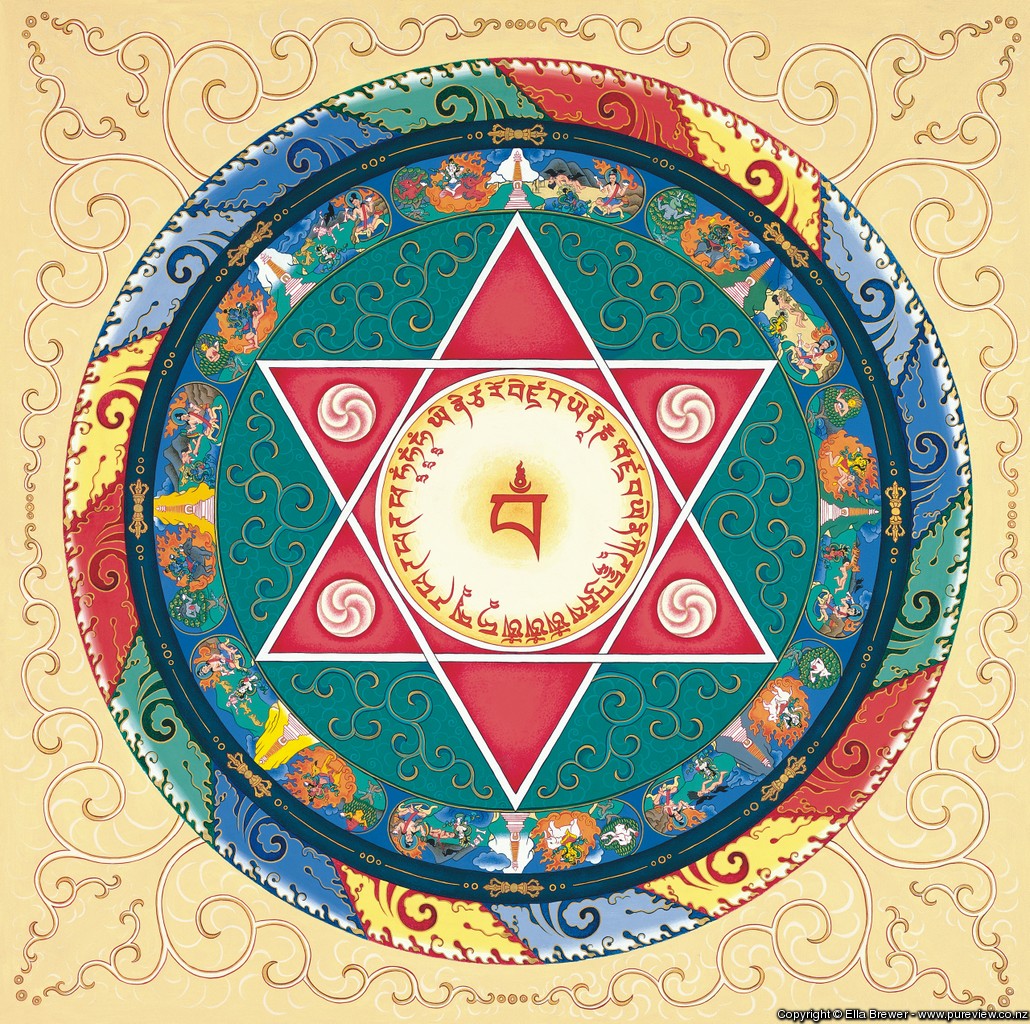
Rising:

Vajravarahi with Blue Ghona and Six Attendants:
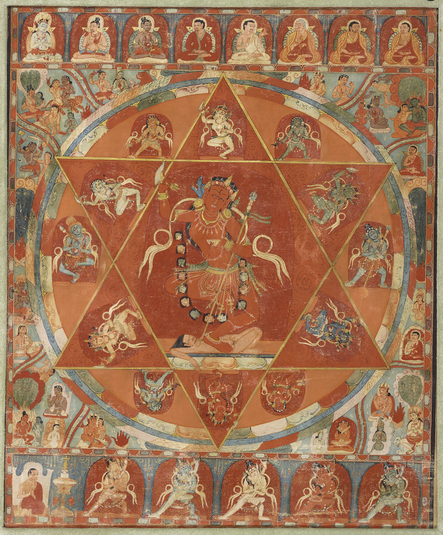
Inside her temple, Guhyeshvari has the same rare pose as Sukhasiddhi:

Her Akanistha or Pure Land--Buddha missing but you can see her yellow Chinnamasta and Blue Varahi:

Rare Red Vajravetali on Red Rakta Yamari; he is Manjushri, she is an emanation of White Sarasvati, and usually Blue:

Under Red Maitri Khecari and White Sukhasiddhi:
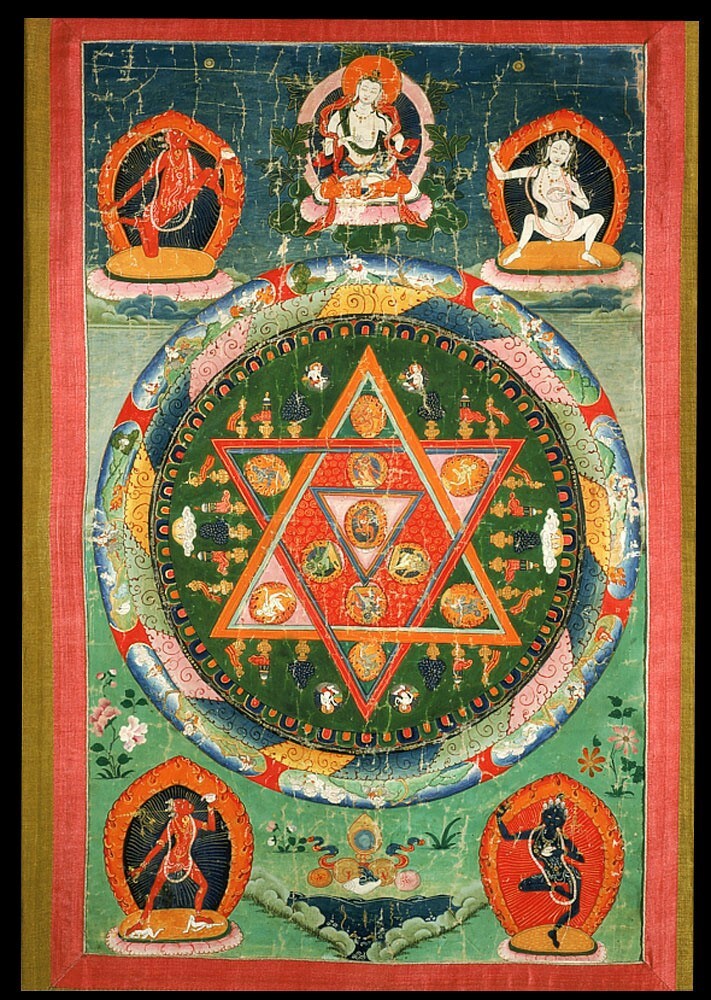
Indrabhuti's mandala captures almost everyone: Vajradhara and White Consort on top. Kalachakra + Vishvamata on one side, with White Vajrayogini Kachod Karmo a Raised Leg flyer or Maitri Dakini special to Shangpa. Other side, Hevajra + Vajra Nairatmya and Naro's Dakini. Bottom center is un-named White yogini with twelve arms on a buffalo. On one side, Chanda Maharoshana (Acala) + Consort and Standing Red Charchika. Other side, Sera's very secret Hayagriva Heruka + Consort and then either Krodhakali or Vajra Nairatmya. Between the Palace and Circle, nothing but cemeteries. Yoginis in the hexagram and she is in a downwards triangle:
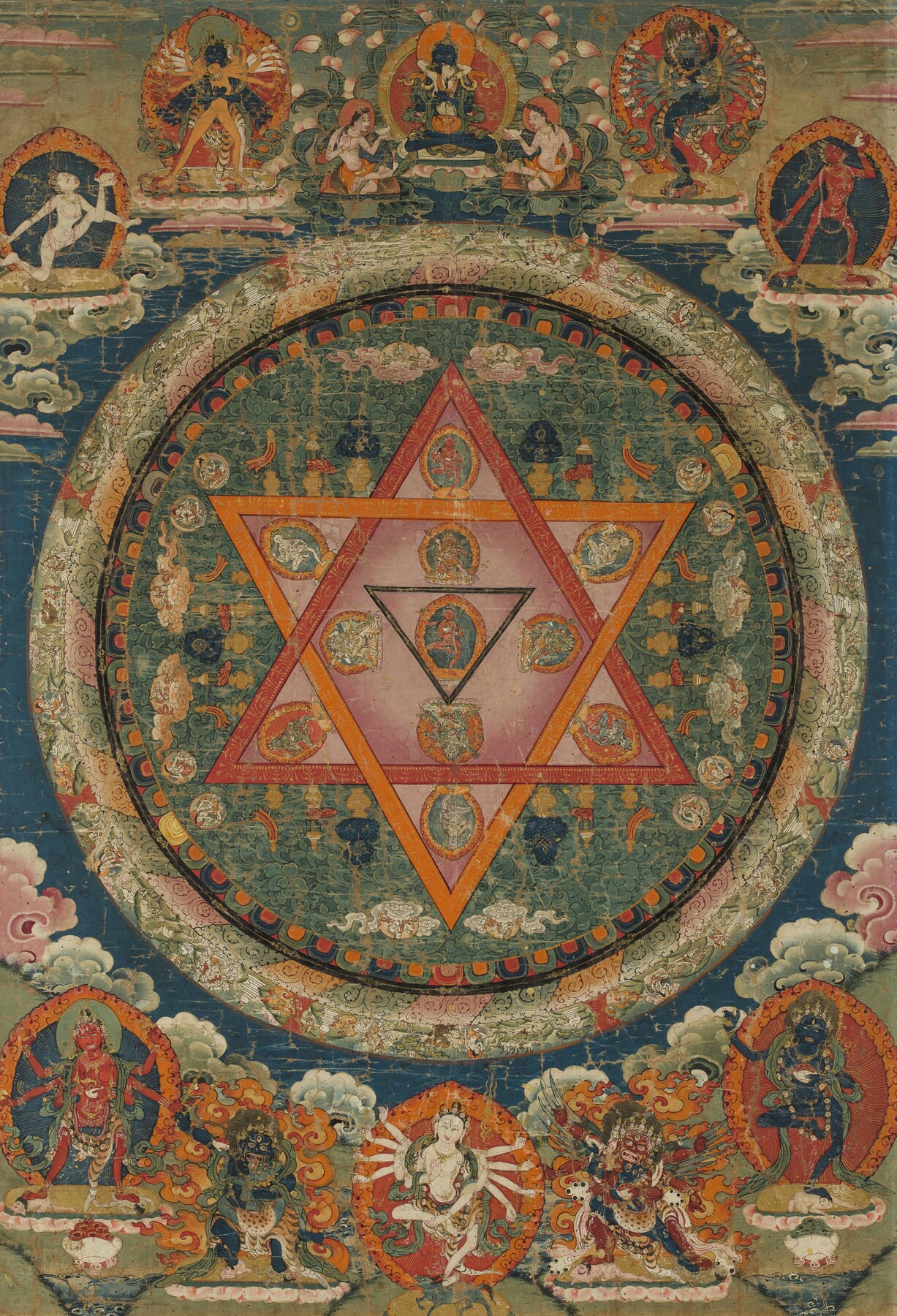
Charchika is one of the oldest Shaktis special to Orissa, eight arm Red Chamunda. They were apparently doing something similar with her, Ugratara, Vaseli, Dakesvari.
Chinnamasta Path to the Trinity or Tri Kaya just below in post 253.
Last edited by shaberon; 2nd June 2019 at 03:43.
-
-
25th January 2018 08:48
Link to Post #252
 Avalon Member
Re: The Serpent, the Black Sun, HPB & St. Germain
Excellent as usual. Post #250 will be a goldmine for me. Thanks shaberon!
-
The Following User Says Thank You to Feritciva For This Post:
shaberon (25th January 2018)
-
25th January 2018 09:15
Link to Post #253
Avalon Member
Re: The Serpent, the Black Sun, HPB & St. Germain
Enjoy! I've not seen anyone run with the color changes as given. I think it will work if you see how it matches the Seven Buddha concept.
----------------------------------
To get Chinnamasta, consider that from amongst the colors in her depictions, she lacks white. Same with the Six Rays shown as Armor Goddesses on Red Vajrayogini.
Dressing her with Gauri is activiating the White Moon or the Male Seed. In the Ceremony her 1,000 White form is Usnisa Sitatapatra, born from the Usnisa or crown of Buddha. Whereas Red Thousand Guhyeshvari is a well to the earth in Nepal, Blood or Red Moon Female Seed.
The Male Manjushri must bring the White in Himself. Avalokiteshvara original White 1,000. He has the ability to touch the Red Seed by also having a 1,000 Red Form produced by Throat Vajra. Not inherent to Nature, same as the White Usnisa.
We make our trinity with Akshobya Vajrapani, Vairocana Manjushri, and Amitabha Padmapani. We will do this in vajra method to produce Vajradhatvishvari.
Sword Manjushri has generally been the counterpart of Chain Tara, and to go through here, there is going to be Sword Dakini. Once we get together, we're cutting off both our heads.
We will meet Vajrayogini on Mars in White, and she will soon turn Red for the rest of the way.
Vajrasattva joins Jnanayogini. We are going to Gaze at Red Vajrayogini at the Sister level--Activity of Durga. And this one is Brahmacharini meaning a nun.
Brahmacharini:

This celibate student is going to merge with the most sexualized image in tantra, Sukhasiddhi. For the remainder of Mars, she won't get back any clothes. She has a very large vagina, and her nipples are always aroused.
She appears to lack any vehicle of her own to access a world of form. We're not likely to find her outside of Sambhogakaya.
She comes in as Vajraghona, which is Vajravarahi, and becomes Noble White Vajrayogini as a result of removing vajra ignorance of the former. She is able to Dance, which is a Vajradakini--Activity of Durga. So we get back in Sambhogakaya. They don't say this much, but sambhoga almost completely means sex. It steps just shy of rati by also conveying bliss.
So the White Vajradakini goes until she throws her legs up, and can take a 100 form here with one face. These have no offering cup. We should be able to enter this Sambhogakaya just by Smile. Then she will start as the Red or overall Female Seed of Nature.
At this point, Standing Red Khadga Sword Dakini. Emanational Rites to make the warrior cooperate. My Nirmanakaya Protector is Narasimhi. Hopefully it will be easy to Smile. She has a rare Yellow form as well.
Dancing Vajradakini of Pharping--Sambhogakaya. If my Protector is Narasimhi, this harnesses and controls Vajravarahi, who is Narasimhi's Sambhogakaya, and we diminish vajra ignorance from Face to Ghona to gone.
Flying Akashadhavtishvari Vidyeshvari. Vajradhatu Wisdom applied to her. We should be able to get to this level by already having this Wisdom and the new part will be her Vajrakaya. All Six Armor Goddesses.
Mahamaya joins Sarvabuddhayogini. We are going to Hug her and try to get her at Mother level. So when we do this, she's full on Varahi and Bhairavi. We have to extend our Wisdom on an axis of Vajra ignorance and death. Seen through Taijasa and Fire which permeates all.
All-form Guhyeshvari. Her Wrathful form is Narasimhi. If she's my Protector, her Dharmakaya is Vajradhatvishvari. This is the full Consort of Vajradhara and we can go to Rahu. As Mother, she starts with pig face and we arrange her until she is a good looking Blue Woman. We have gotten her in Blue, then we are going to meet her in Red and Yellow in Rahu and produce her White form.
Mars is to gain the full Root Consort, the first form of Blue Vajradhatvishvari. Chinnamasta is obtained in the unity with Sarvabuddhayogini. So we gain that on Mars as Mahamaya and use it to proceed. Inside Guru's Consort, Vajradhatvishvari, we will perfect her Tri-kaya, cut both our heads off, and turn her corpse into the sun.
The interior stage Rahu-Ketu-Horizon establishes the Trinity of Formless Agnishvattas or Triple Fire. The Vairaja Nirmanakayas are said to be in Tapar Loka and they just have enough Manas to have any relation to the Form Worlds. Similarly to Indra on the plane of Kama Loka, these are the Nirmanakaya of Janar Loka.
The Marriage transfers us to the corresponding part of Manas which is wed to Buddhi. Ganesh's crowning achievement to his collection. So this is what we have in mind by the Nirmanakaya of Chinnamasta. The most subtle petals around the Kshetrajna. Gain it by emanational rites, then shine her full tri-kaya with Gauri--Sambhogakaya.
To go on Rahu and meet Chinnamasta, she will have Vajravairocani and Vajravanani with her. The second means Vajra desire and more in the sense of wish. She has nothing White and we have to give her Gauri: the Sambhogakaya of White Vach Devi Sarasvati. We may also describe this as Devi Chandi because my Protector is Narasimhi. If so, we perfect Trikaya Vajrayogini with the Dharmakaya of Chinnamasta. This is so to speak, the Gown for the Consort including vajra components. Chinnamasta is already a Mahavidya, so she is her own Mother.
She appeared in the world where Sati's feet fell. At that point she had a head.
On Viraratri Day when Mahamaya was a woman, she was having sex with Shiva. When he ejaculated, she became wrathful and spawned the two attendants. Here she is Chandi becoming Wrathful Chandi. Later, her story from Narada-pancharatra is that once in Mandakini River, Parvati became sexually aroused. This turned her black. Her attendants Dakini and Varnini (Jaya and Vijaya) were very hungry; she beheads herself with her own nails. In other places another attendant is Vaironi.
Buddhism does not explain the loss of her head, but it represents a-manasikara, a state of dealing purely with the seventh skandha. We got ahold of her by being Mahamaya, which turns out, was her originally as Chandi. The rites up to Mahamaya are very streamlined; on Ketu they get more involved.
Chinnamasta has never been depicted in an outright battlefield. An alternate name of her is Sarvasiddhi, also Prachanda Chandika, as whom she self-decapitates after slaying the demons. This is a way to say Wrathful Chandi. Chanda on its own can be wrath and heat, also pleasing, alluring, and pearl ornaments. Close to the name of Moon and outcast--Chandala. Combined with Pra, a going forward or Pravritti. Her temples are mostly in North India and Nepal, she is not widely worshipped; not much noticed outside of the Mahavidyas. Two Mahasiddha sisters, Mekhala and Kankhala, as well as Lakshminkara, are said to have cut off their heads.
She is usually hibiscus red with a blue lotus heart. She wears a serpent as a sacred thread. Dakini or Vairocani is fair and Tamas guna, while Varnini is red and conveys Rajas. This Red Chinnamasta stands on a couple in rati. That is the difference between her and her Yellow Vajrayogini form. In samadhi she is seated in her own navel, formless and invisible.
Special Newari Red:

She also has a four-armed form holding her head and Brahma's, with her attendants as skeletons. Sometimes she is called Ratiragavivriddhini, Engrossed in the Realm of Rati, and Shiva is in Union with her rarely. She is very rare with a consort as Bhairavi and Dhumavati never really are. Varahi very rarely with Shiva or Vishnu.
It appears we would meet Red and have to get her to Yellow to do the actual rites. If you look at her attendants, it looks like we do Om Mani Padme Hum and merge Jewel to Lotus. Then Ketu looks like Jewel merges to Sun to form Kaya Vajra, or Vajrakaya.
Srim hrim klim aim Vajravairocaniye hum hum phat svaha
As Chinnamunda Vajravarahi, she is invoked shortly after dawn. Do vajra muttering and get the Sattvasamaya or pledge-being in the navel on a white lotus. On the lotus becomes a Sun Disk with Hrih like a flower. From Hrih arises a multi-colored lotus and it has a Sun Disk. Call the Dharmodaya in the disk and another Hrih. That Hrih becomes Yellow Bhagavati Vajravarahi, who is slightly reddish and has cut off her head. Vajravairocani is Yellow and Vajravarnini is Green. Meditate on this and she arises from Hri in Vajra form. Make offerings and recite Om Sarvabuddhadakiniyai Svaha, and also Om Vajra Varninyai Hum Svaha and Om Vajra Vairocanyai Hum Svaha. Offerings and mention Uddiyana, Phulliramalagiri, Kamalakhya, Srihata. Praise the Trikaya and Mahasukhakaya. Om Sarvabuddhadakinyai, Om Vajravarninyai, Om Vajravairocanyai, Hum Hum Hum Phat Phat Phat Svaha. May be done at the house of a Chandika; attributed to Srimatidevi.
Images in this configuration based on Yellow are almost impossible to find:

That is the first phase and next you do her Trikaya. It starts at the navel with a Red Sun Disk with Dharmodaya upon which is a Lotus with a tawny red triangle having four chakras. This has a Yellow Hrim and Yellow Vajrayogini in the central channel. The attendants guard the Solar and Lunar nerves. The four chakras (pleasing seat) and three paths are the residence of Sarvabuddhadakini Trikayavajrayogini standing in Pratyalidha. With Green Vajravanini and Yellow Vajravairocani, whose hands and feet are reversed. One praises and refers to no longer dwelling in the Six Realms, being abandoned by Mara, fulfill Illusory and Vajra bodies and gain all siddhis. You dissolve her lights, and resolve to be Vajrasattva and achieve Mahamudra. This is from Virupa.
We attempt to Gown her with Gauri and raise her to White. We will have exchanged kundalini through a bizarre rite of cutting off our heads for the cups. And if this takes, we may finish Rahu with a White Vajrayogini distinguished by wearing a Snake:
This becomes Vajravetali or Vajra corpse which is Marici's first form in Ketu. Ketu's Mother Mahavidya is She Whose Form is Rati.
Vajravetali, a ghoul or vampire, is the consort of Vajrabhairava, or Vajrakaya of the meditator.
For Rahu, eighth dhyana there is naivasaṃjñānāsaṃjñāyatana, the most discrete possible state of mind, "neither perception nor non-perception". You enter the eighth dhyana by letting go of the sense of no-thingness and enter a very natural, calm place. In the eighth dhyana there is very little recognition of what is happening, but you are also not totally unaware of what is happening. There is such a peaceful state and you have gone beyond the duality of perception nor non-perception that it is easy to be fooled that you have experienced full enlightenment.
Ketu is intended to produce Marici Vajradhatvishvari. She starts as Vajravetali (Rolangma, Blue Sarasvati), holding a Double Vajra, and a Noose instead of Cup. So she is the unity of Amogha-siddhi and Akshobya, Mahamudra Bodhicitta Vajra. Unshake-able Adamantine Mirror. Meet her as Corpse Vampire, the corpse last stage was Rati, and Mother's Form is Rati. In Ketu, Mother's form is a corpse that loves intercourse.
Then Uddiyana Marici with Chakra--Sun and instead of a Cup, Khatvanga Kapala or Skull Mace. So she is Tathagatha and Jewel Family, Vajra Kaya. Secret Sun of Infinite Buddhas. We have the Gem of Wishes and want to make an offering. It has to do with the Gown I've made. Her secret Sun inside needs to come out.
Marici Vajradhatvishvari has the elephant goad and Skull Offering Cup. Karma Family merges to Lotus Family, Vach Vajra. Om and Voice of the meditator makes this offering flow. Sambhogakaya Activity to Gaze at Her. If this goes right, she'll put on the Gown of Gauri and the Sun will shine.
Here in Ketu we would raise Vidya of Dhumavati until we are able to marry Siddhidhatri. This Sambhogakaya Action perfects her Tri-kaya which is Chinnamasta then finally her Vajra Kaya which is Marici Vajradhatvishvari. Resurrection from Corpse to Sun Queen with full Vajrakaya. Gaze at her at this level until we are ready to move on.
Start the Gaze on Siddhi, Ganesh's Nirmanakaya Heart Bride:

Vach Devi Sambhogakaya Activity:
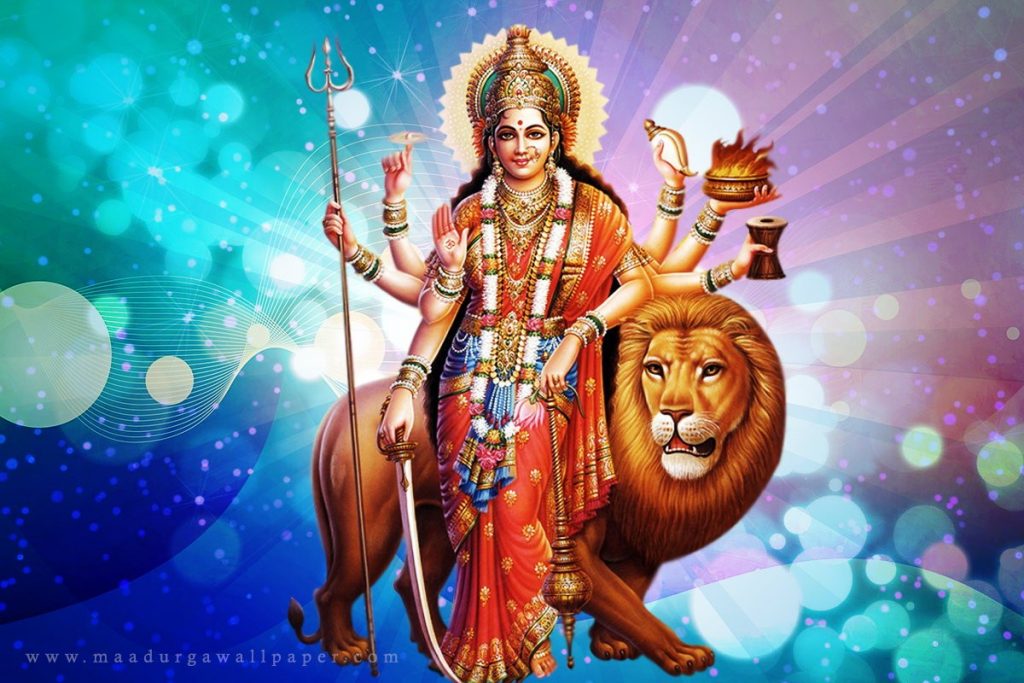
Formless:


Siddhi:

We are in Sambhogakaya with Marici Vajradhatvishvari as Siddhidhatri and have to go to Dharmakaya and Hug her.
To raise her to Mother level is to get Dhumavati, the Vidya of Ketu, who is creepy but she is really lonely and would like some company. If we are nice to her, she'll clean up and come around with a bowl of fire and with her we will deposit kundalini as a seed.
Continues next post.
Last edited by shaberon; 13th July 2018 at 07:20.
-
-
26th January 2018 07:26
Link to Post #254
Avalon Member
Re: The Serpent, the Black Sun, HPB & St. Germain
Crow is Pratyahara. We've done pratyahara with all kinds of Taras and Dakinis in all centers, but we have not started sense withdrawl by a Mother whose Vidya is hers.
She may be a crone but she's kind of a thermometer, and will perk up according to the energy we bring. If we don't do it right, Prajna will lack Sukha, feel very cold, and we could fall into serious trouble. A slight imbalance of nerves or contaminated prana will have terrible consequences. So we want to try to conjure the form of her with a fire bowl. Produce her like a Daughter with Mantras.

She is called She Whose Form is Rati. Her lowest form is only Nirmanakaya of Janar Loka. It is intercourse and a corpse. Smile.
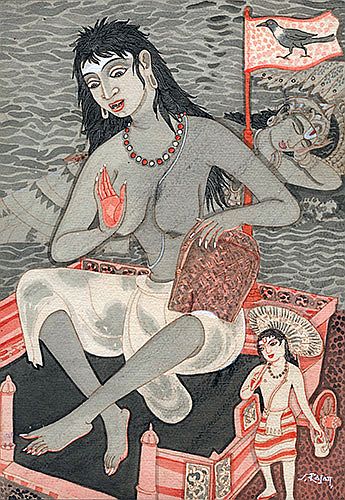
Then she'll come to us in her Activity level:


She transcends the Durga components. Her Sambhogakaya is intercourse and a secret sun. Gaze.

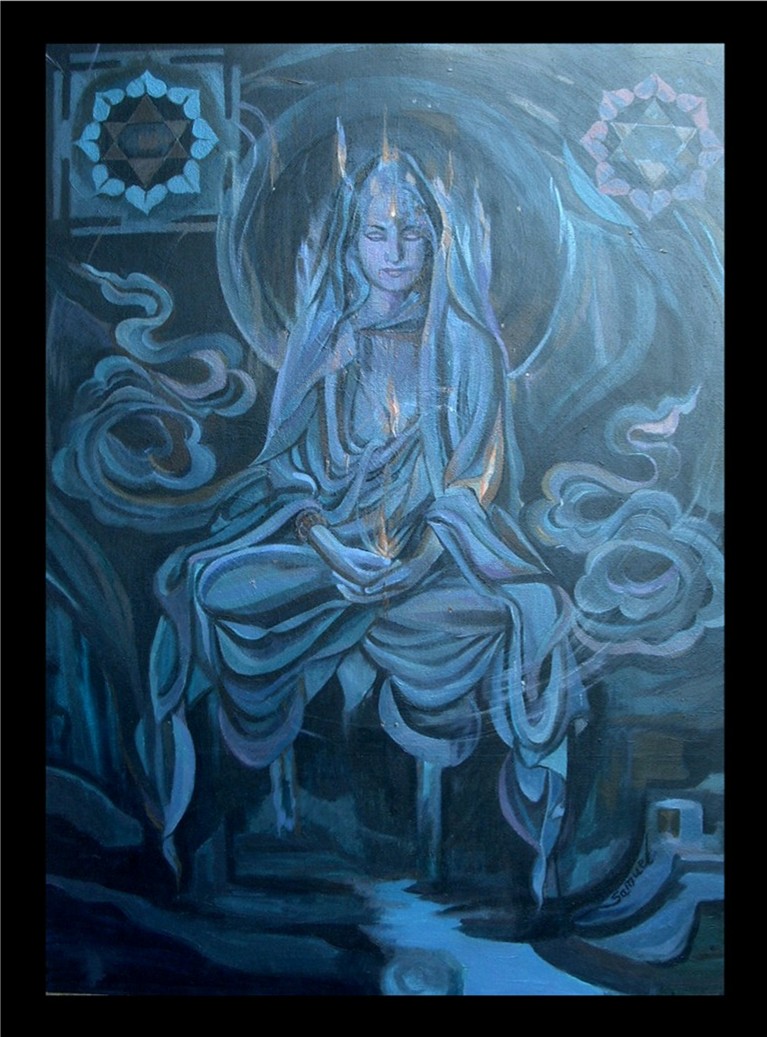
We take her Dharmakaya which is body-less. Hug, and enter Union. This is how we pass the Night of Enlightenment.
In Nepal, she has a secret Dakini existence:


She has a peacock and only wears pearls. And she carries a mirror.
As long as we desire to transcend Her force, She will continue to taunt us, for Hers is not a force to be transcended but surrendered to. In several forms of sadhana, the focus is to plunge deep into the very source of ignorance. In this inquiry, one can dive deep into the dark Void of Non-Being (Dhumavati). This Void takes us away from the pain of existence and here we experience deep peace and bliss. It is tempting to stay here, away from the other darkness of our hidden demons (also Dhumavati). Thus, She is both the darkness of ignorance as well as the merciful darkness of the Void. Like Her winnow that holds the grain along with its impurities of stones and dirt, She holds both of these aspects of darkness within Her austere form. When this Void is known, there is often the strong temptation to remain here, to not engage in life at all and to view the world to be a non-existent illusion (Maya). This nihilistic viewpoint drains one of “juice” and sooner or later, Dhumavati emerges again, bringing up all the submerged stuff of our unresolved darkness. In this, Dhumavati’s compassion is unmatched. Her insistence upon our full processing and embracing of our dark side is manifested so that we can sever all those filaments in the cord of our perceived separation.
Dhumavati is known as the darkness within darkness. This welcoming and loving embrace is the alchemical process where Dhumavati as Alakshmi transforms into Lakshmi. Thus, as this great Void, She is the Non-Being prior to existence (the evolution of practice) and that which remains after its dissolution (surrender to stoppage or samadhi).
Dhumavati eats Shiva. She's the burned corpse of Sati come to life. The whole thing, not pieces scattered around. That's why she's a widow with no consort, until we make her Root Consort.
As Dhumravarna, Ganesh destroys Ahamkara:
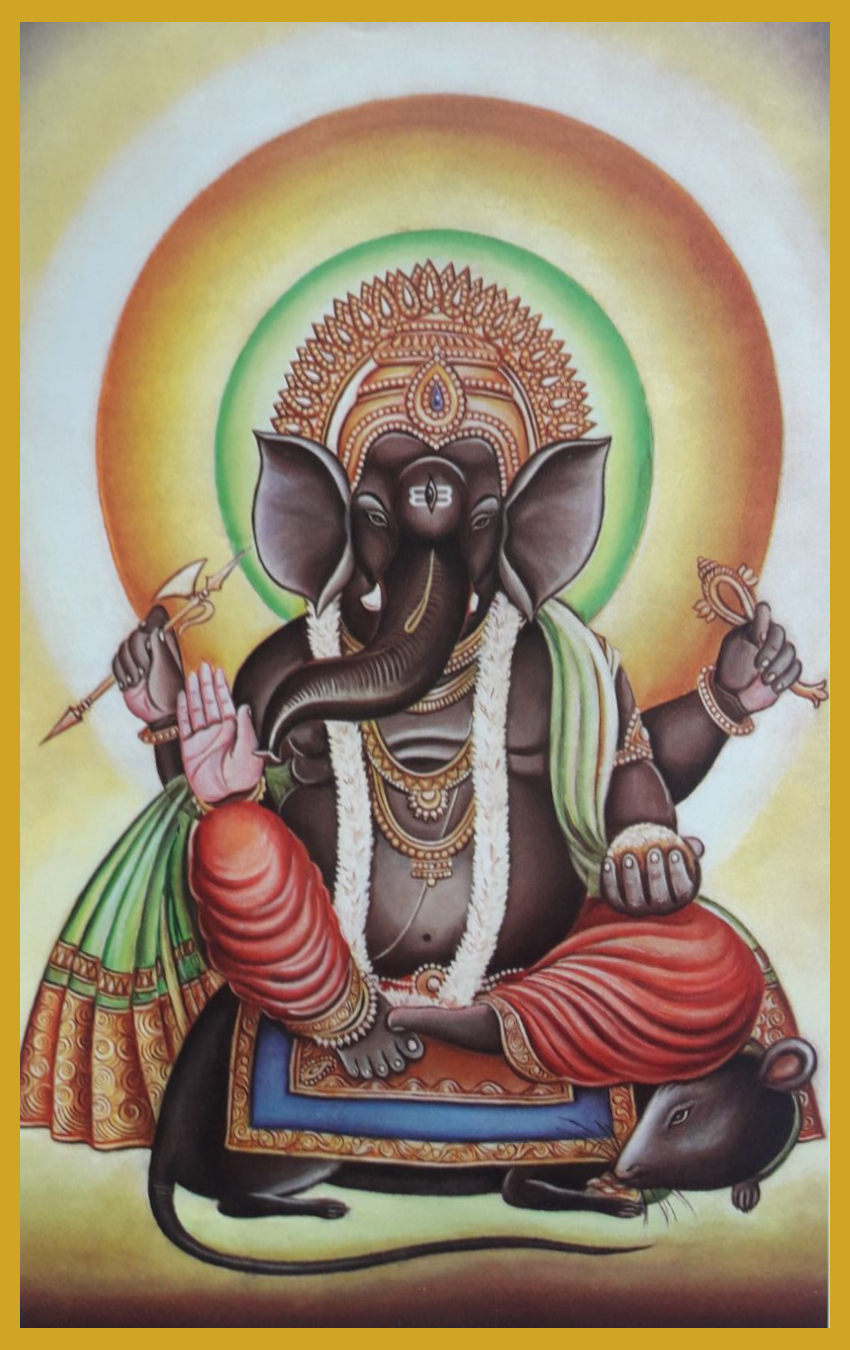
We are ridding ourselves of Dristhi Skandha, Atta ditthi, any self-view, to make the full Dharmadhatu Kaya. Smoky Ganesh happens to do this with Dhumavati.
That rite is powerful enough to release you from the process of reincarnation for the rest of the planetary round. We have one more.
There is only one last sphere after Ketu and no one else is there. Marici has them all and Ganesh married them all. We are going to do this because the Tathagatas say it is the only way to become Anuttara Samyak Sambuddha.
What we attain from this Ketu rite is Ardhanarishvar, the absolute sexless unity of Shiva. That is the Marriage of Ganesh and Siddhidhatri. Full Union of Smoke.
In Ketu, in terms of a ninth dhyana, this is cessation (Nirodha-Samapatti), which may appear unconscious or cataleptic. Nirvikalpa.
With respect to Samvritti, or relative, conventional truth, "vikalpa" means "discrimination" as in Samkhya, discriminating the real from the unreal. In terms of ultimate truth, vikalpa means any imagery, reflexive thought, etc., which is stopped by Nirvikalpa meditation. Because this is a system of "Two Truths", it is important to understand this difference in discussions of ultimate truth.
Nirvikalpa is viewed as happening fully only in the final three bodhisattva degrees, which perhaps makes it understandable to ignore or deny it in some of the preliminary teachings, but since we are able to assess the whole Path, then yes, it should be distinctly featured. Nirvikalpa or Nirakara seems to be what makes a distinct, obscure Yogachara school that equates to Adwaita. This ego-less, neti neti "nothingness", empty of everything other than itself, is ultimate reality according to these doctrines.
Ketu continues right below in post 255.
-------------------------------------------------------------------------------------
Most Vajrayana Pancha Jina practice would appear to be Vairocana tantra. He is in the middle.
That is a beginner stage. It graduates to Akshobya Tantra. Akshobya goes to the Middle Space, which is a good name for it, since it is the Space Element.
Chakrasamvara-Vajravarahi uses a Six Buddha system as Akshobya Tantra.
In order for this to happen, Shiva, as Amoghasiddhi, must gain Paramartha Mahamudra Family. When this happens, Akshobya moves to the Middle Space, and Vairocana goes to the East. Mahavairocana, the Sambhogakaya, then emanates Vajrasattva to go to Karma Family. He does not have a room in a Pancha Jina Mandala. Nothing has indicated that Amoghasiddhi changed rooms, just Family. Vajrasattva does not fit in the Pancha Jina stamp.
Namasangiti takes the format of Akshobya in the Middle Space; however, it is a different lineage (Guhyasamaja Tantra); it is actually a Vairochana Tantra. It appears to include Akshobya Tantra as its basis and extend it; presumably, Manjushri mastered the Akshobya system, and we have gained the Fruit of his efforts as: a Six Buddha system of Vairochana Tantra (as it exists), which may likely have a Seventh Buddha according to Smrti. Regardless of the text, Fruitional Vajradhara makes complete sense in practice. Mahavajradhara emanates Mahakshobya to begin his cycle. That's what makes Seven. By the end, Akshobya has moved East and Mahavairocana is back in the Middle Space.
The introductory Nidana of Guhyasamaja:
evam mayA shrutam | ekasmin samaye bhagavAn sarva-tathAgata-kAya-vAk-chitta-hRidaya-vajra-yoShid-bhageShu vijahAra ||
Literally this would translate thus: Thus I have heard; once upon time the bhagavan had penetrated the bhaga[-s] of the damsels [who are] the [vajra] body, the speech, mind, heart and [phallus] of all tathagatas. The reference to the maithuna of the buddha with the ladies of the kula is at the surface an explicit indicator of Shringara being the upaya (basis) of becoming a siddha.
A Seven Buddha system is not known to exist, so the current work is not intended to represent actual Newari practice. It is intended solely as a Primer to examine Seven Seals or Sapta Mudra, in the order of chapters along with information related to the development of subtle consciousness in a seven-fold key, some of which has been altered from the known versions.
For example, one should be able to look at only the Yogini layer of text and find seven meditative steps. It is likely that anyone ever doing a practice like this, has experienced samadhi. So we are not saying this is a ladder where you only do Pratyahara at a given Mandala or initiation stage. It's a Primer to house the scale. Many of its parts occur simultaneously.
Namasangiti is said to contain Kalachakra, which itself seems to have the same scale. We are seeking to work up this ancient root system in order to reveal Kalachakra as its Renaissance or grand elaboration.
In trying to assemble the Yoginis or Dakinis, we may find them forming different hosts instead of 1:1 with given consorts. Maybe they can switch around. Yogini would be the female half of a Dhyani Buddha and Raksha would be her Wrathful form. Who are they...Prakriti or Matter.
Stripped of the personifications, development is consciousness harnessing forces and discovering matter in its higher states.
It's likely intended for a person to do Pancha Jina as the first training method, and then move to a Six Buddha Chakrasamvara-Vajravarahi prior to attempting the final Seven. Most pre-tantric training uses meditations based on Four (Noble Truths, itself preceded by the Triple Gem), so if we look at the existing canonical classification, that is the exact pattern.
Bu-ston placed Mother Tantra in seven groups, using the Buddha or Jina emphasized:
1. Desaka; all Buddhas equally. No correspondence in the six groups of Father Tantra.
2. Heruka (Akshobya), including Samvara, Hevajra, Buddhakapala, Mahamaya
3. Vairochana
4. Vajraprabha (Ratnasambhava)
5. Padmanartesvara (Amitabha)
6. Paramasva (Amoghasiddhi)
7. Vajradhara
Bearing in mind that every stage of practice can be months or years, the entire skeleton runs:
Take refuge, recite Heart Sutra and practice Shamatha.
Triple Gem
Four Noble Truths
Add Bodhichitta, Vajrasattva Purification and Seven-Limb.
Guru Yoga (Vajradhara and Vajravarahi may be embedded)
Generation Stage; Father Tantra such as Guhyasamaja and use of Pancha Buddha or the Pentagram of the Microcosm. Usually considered as Anger redirected to Bliss.
(When the World Mother experiences Transcendental Wisdom, the Father or Purusha of the practitioner experiences Great Bliss)
Mother Tantra. Yogini is added, as per Chakrasamvara-Vajravarahi. This starts a procedure of changing the Deity in the Middle Space, starting from the end of Bu-ston's list and going up, using Six Buddha or the Hexagram of the Macrocosm to get to Akshobya. If Father Tantra succeeds, then Mother will display Prabhasvara.
Completion Stage relating to the All Family is a Vairocana Tantra containing Namasangiti and Kalachakra, proposing the use of Seven Buddha or Pentagram placed inside Hexagram.
_________________________________________________
Vilasavajra explains the concept of "Guhya" or "secret" as three kinds: secrets of Nature; Hidden (initiatory); and Obscure (bestowed by a guru). Another expression of the Triple Gem. At one time, this process was involved with the establishment of law and rulers, but no longer. It is expressed through Sandhyabhasa (twilight language), coded words and gestures, much as the ritual practice is Mantra and Mudra.
Guhyagarbha Tantra, itself, is not known to have a precise textual compilation.
Guhyagarbha uses two mandalas, a Peaceful similar to Guhyasamaja, and a Wrathful. Hevajra (used in Sakya and Kagyu) is a non-dual yogini (Nairatmya) tantra based on Guhyasamaja (Akshobya Tantra), Tattva Samgraha, Manjushri Mula Kalpa, and others. Hevajra's "solitary" form is Heruka.
So to formulate a Seven Dhyani system, we are looking at its Peaceful aspect as being the Namansangiti Mandalas, and its Wrathful aspect being with Vajravarahi. The Sixth Dhyani is Vairocana emanates Vajrasattva, and the Seventh in Guhyasamaja is Mahavajradhara emanates Mahakshobya (in whose heart is Jnanasattva).
Guhyagarbha Tantra has two streams, the standard Zur tradition of Nyima, and the uncommon or profound tradition of Rongzom Chökyi Zangpo and Longchenpa's tradition, based on the perspective of Suryaprabhasingha (Jalamaya Web of Illusion, Mahavairocana Tantra, also known as the Mahāvairocana Abhisaṃbodhi Tantra, or more fully as the Mahāvairocana Abhisaṃbodhi Vikurvita Adhiṣṭhāna Tantra. In Tibet it is considered to be a member of the Carya class of tantras. In Japan where it is known as the Mahāvairocana Sūtra, it is one of two central texts in the Shingon school, along with the Vajrasekhara Sutra.). The Mahāvairocana Tantra is the first true Buddhist tantra, the earliest comprehensive manual of tantric Buddhism. It was probably composed in the middle of the 7th century, in all probability in north-eastern India at Nālandā. The Sanskrit text of the Mahāvairocana Tantra is lost, but it survives in Chinese and Tibetan translations.
The Mahavairocana Tantra does not trace its lineage to Shakyamuni Buddha, the founder of Buddhism. Instead it comes directly from Mahavairocana. The lineage begins, according to the Shingon tradition, with Vajrasattva, the disciple of Mahavairocana Buddha in this sutra.
Chapters
I - The sutra begins in a timeless setting of Mahavairocana Buddha's palace (symbolizing all of existence), with a dialogue between Mahavairocana Buddha and his disciple Vajrasattva. In chapter one, Mahavairocana Buddha expounds the Dharma to a great host of bodhisattvas, with emphasis on the relationship between form and emptiness.
II-VI Three chapter on the mandala of the Body Mystery with detailed instruction on the laying out of the mandala and the abhiṣekha ritual. This mandala is also known as the Mandala of the Womb Realm (Sanskrit : Garbhakosha). Chapter 2 of the sutra also contains four precepts, called the samaya, that form the basic precepts esoteric Buddhist practitioners must follow:
Not to abandon the true Dharma
Not to deviate from one's own enlightened mind
Not to be reserved in sharing with others the Buddhist teachings
Not to bring harm to any sentient beings
VII-IX Three miscellaneous chapters originally at the end of the text. They are at the end in the Chinese version.
X-XII Three chapters on the mandala of the Speech Mystery. Includes a series of glosses on meditating using the letter of the alphabet in various combinations.
XII-XVI Five chapters on the mandala of the Mind Mystery
XVII A stand alone chapter that may once have circulated separately.
XVIII-XIX A further chapter regarding meditating on the letters of the alphabet which involves placing them around the body while visualising oneself as the Buddha.
XX A standalone chapter address to bodhisattvas
XXI-XXV Four chapters on the 100 syllable meditation.
XXVI-XXX Five miscellaneous chapters including the six homa rites.
Hevajra Tantra establshes a female supremacy; "the wise man should always worship and honor the lady" and ties in four Goddess Pithas. In order to begin Six Buddha practice, one must be initiated in Hevajra or equivalents (Chakrasamvara, Kalachakra; i. e, Anuttara Yoga initiation).
The Mandalas are said to exist in reality whether anyone arises to discover and practice them or not. This has been pointed out as early as Karandavyuha Sutra (Array of Caskets); however, no commentator has really addressed how or why the inner experience of tantra could be secret from the Buddhas and Bodhisattvas themselves. The "guhya" of Guhyasamaja is the Assembly of the Mandala.
From the point of view of traditional Hinduism, "Namasangiti is the first major Nastika contribution in a fairly old Hindu tradition – that of the sahasranamas...They also have a long uttarabhaga to the Namasangiti which is like phalashruti of the sahasranamas. It is also interesting that phalashruti provides a long list of Astika devatas who will protect the Nastika if he performs the Namasangiti."
"In the major kriya tantra, the Arya Manjushri Mula Kalpa, he becomes an important deity after absorbing Kumara as has been described earlier. In this text it is mentioned that as Kumara he will perform the deeds of the buddha in the world.
In the yoga tantras (the Manjushri Jnana Sattvasya Paramartha Namasangiti or the Manjushra Namasangiti) and yogini tantras (e.g. Kalachakra tantra) he rises to be the Adibuddha and he is in the heart of the Shad-buddhas. In the yoga tantra phase he starts acquiring elements of the bhairava of the shaiva tantras.
avaivartiko hy anAgAmI khaDgaH pratyeka-nAyakaH |
nAnA-niryANa-niryAto mahAbhUtaika-kAraNaH || 51
Some of these names are clearly distinctive features of Nastika tradition, e.g. the rhino (khadga), which is considered a chief pratyekadbuddha by virtue of its solitary peregrination, named in this shloka. The term mahabhutaika-karanah (is) the single cause amongst the primal elements...
The absorption of Shiva:
amoghapAsho vijayI vajrapAsho mahAgrahaH |
vajrA~Nkusho mahApAsho vajrabhairava bhIkaraH || 66
krodharAT ShaNmukho bhImaH ShaDnetraH ShaDbhujo balI |
daMShTrAkarAla ka~NkAlo halAhala shatAnanaH || 67
yamAntako vighnarAjo vajravego bhayaMkaraH |
vighuShTavajro hR^idvajro mAyAvajro mahodaraH || 68
kulishesho vajrayonir vajramaNDo nabhopamaH |
achalaikajaTATopo gajacharmapaTArdradhR^ik || 69
In these series we notice the name Shanmukha which is an inheritance from his kumara syncreticism of the earlier stage. The names vajrabhairava (the “vajrified” bhairava), halahala, yamantaka, vighnaraja, gajacharmapatardradhik ,are all indicative of his absorption of Shiva’s attributes. The nastika Acharya Chandrabhadrakirti explains halahala as the poison that makes the neck blue...
At the same time we also see an absorption of Vishnu underway:
samantadarshI prAmodyas tejomAlI sudarshanaH |
shrIvatsaH suprabho dIptir bhA bhAsurakara-dyutiH || 102
The tathagata Smriti explains that these names describe Manjushri as the unconquerable preserver who holds the blazing chakra in his hand and has the shrivatsa in the heart. Thus the identification with Vishnu is clear though he avoids mentioning Vishnu by name. The absorption of the famous features of Vishnu are also apparent in:
trailokyaika-krama-gatir vyoma-paryanta-vikramaH |153ab
One who covers the worlds in a stride and one who covers the sky with a stride."
Last edited by shaberon; 13th July 2018 at 07:23.
-
-
1st February 2018 05:48
Link to Post #255
Avalon Member
Re: The Serpent, the Black Sun, HPB & St. Germain
In Ketu, Corpse arrives:

Marici has three known stages for the end of the Path:
Ubhayavarahanana has twelve arms and two of three faces are Varahi. Her main face is white and peaceful. She is Red and of Vairocana. She resides in the womb of a Stupa in Alidha pose. Stupa represents the human aura so the womb is the Dharmadhatu. Her attendants are Varttali, Vadali, Varali, and Varahamukhi. These are unexplained as are the sows. The chariot tramples well-known gods. We know what it means without being written. It would be very unusual to be Red and have White face.
Ten Arm or Dasabhujasita Marici distinctly has four legs. She has five faces and the red one is Varahi. Vairocana is her head emblem and she has three attendants: Blue Vajravarahi (one face) riding Makara with a Vajra and Tarjani. Red has multiple faces one Varahi, and third one is Red, one of three faces Varahi, with four arms. These are unnamed but likely from the first set of attendants. The chariot is over Nine Planets. Somehow she changed a pair of arms into legs.
Six Face Twelve Armed form is called Vajradhatvishvari Marici, Uddiyana Marici, and Vajravetali. These are almost identical. Her sixth face is on top of her head and is Blue Varahi. All reside in the womb of a Stupa, stand in Alidha, and are of Vairocana. Among other items, she carries the Parasu Axe and the severed head of Brahma. Uddiyana replaces the Goad with a Chakra. Vajravetali carries a Double Vajra instead of those, and apparently uses two nooses. Since Vajravetali already came up as a name with Vajrayogini, this is probably the transition. She is usually dark blue, consort of Yamantaka, she straddles life and death and resurrection. Vetali is a ghoul or vampire.
In the Newari text Sadhana Mala, Uddiyana is the source of Trailokyasamkara, Kurukulla, Marici, and Vajrayogini. An alternate mantra for Vajravarahi is Om Vajravetali Hum Phat. This text givers her six forms and Shantideva gives her sadhana. Needle and string are her main implements for sewing eyes and mouths (called Arya Marici with these). Nispannayogavali gives her mandala. Hindu gods make obeisance to her. So she has an excess of forms and a lack of explanation.
This Brahma head makes her at least equal to Kalachakra. She got her arms back to take it. Kalachakra uses Vajradhatvishvari, however this name is almost always on its own and I have not seen it pinned to an identity other than Marici. And Marici only comes up with this given group of Red Tara and Vajrayogini.
Vam is the root syllable of Vajradhatu mandala and Vajrayogini. Sounds more like Bam and in Nepal almost every V is a B.
Tibetan Marici Mandala:

Simple Form of Marici with hands like Vajradhara--called Vajra Humkara Mudra, and being non-dual union:

Union:

Indigo Akash 3...Blue Sarva Vasu 2...
1...Starting to Dissolve:

In the previous images, she usually shows up with Red and White Moons. These are what we intend to blend, so our vajra practices make a new kind of Dawn.
Varahi imbued to the Sun:

Our seed in the basket makes Ardhanishvar in the heart just past some notes.
------------------------------------------------------------------
Shakti (Power) is the Matrikas (Mothers who Protect Time Cycles)
Adi Parashakti (bindu or zero feminine, Param Prakriti) manifests via her Trinity (Tripura Sundari or Prakriti) firstly as Sati--Dakshayani, the pre-cosmic trinity, then Parvati (Durga) as a material trinity. From her third eye, Mahasaraswati was born first. Mahalakshmi was born second when she opened her right eye (buddhi). She opened her left eye (manas) and Mahakali (Parvati) was born. Her smile before her eyes opened, created the entire universe.
First form, as Sati-Dakshayani, Vidya Shakti, she is the mother of Pancha Brahma, and the Ten Wisdoms (Mahavidyas). Daksha invoked Adi Parashakti to become his daughter; she said yes, but when you insult me, I return to celestial form and disown you. Before long, this happened, then Sati burned herself and got scattered all over the place, forming the Shakti Pithas or stone temples. The next phases of creation are:
Tarakamaya, war between the Devas and Asuras.
Second form (Parvati) as Yogeshvari (Durga-Parvati, Mahalakshmi, Material Shakti) vs. Andhaka the Serpent
Second form vs. Mahish Asura the Buffalo
Second Deva War or creation of man.
Earthly war of Titans
Buddha referred to the Sapta Matrikas (or Mothers; originally the Pleiades) as Raksha. They are Wrathful Protectors. Lower Protectors such as Lokapala and Dikapala guard the Ten Directions, and specific locations, but the Mothers protect Time.
Nepal counts eight mothers, adding Durga or Yogeshvari (kama). She was produced by Shiva to defeat Andhaka. Siva is the spirit of Vidya, knowledge. Andhaka represents ignorance or the darkness of Avidya. The more Vidya attacks Avidya the more it tends to arise and increase. This is represented by the multiplication of Andhaka and secondary asuras (each drop of his blood made a new serpent). Unless the eight evil qualities, Kama, krodh, lobha, mada, moha, matsarya, paisunya and asuya are completely brought under the control of Vidya and kept under restraint, it can never succeed in putting down Andhakara. That is the normal legend; esoterically, we look at Serpents and Blood much differently.
In Nepal, northwest is given to Durga Mahalakshmi or Yogeshvari, from whom the Matrikas emerged; Shiva formed her to defeat Mahish Asura while the devas were subjugated by asuras. Also called Narasimhi or Chamunda (Praytangira) in India, as Adi Parasakti, she was formed by Shiva to calm Narasimha after he slaughtered Hiranyakashipu. Mahish was the son of Rambha and Shyamala (Yamini) in buffalo form.
She was discovered nameless by sages Angiras and Pratyangira and demanded a name. Through her, one reaches the highest attainment, the lotus feet of Sri Lalitha Tripura Sundari. Her Trinity (Tripura Sundari) is Parvati, Mahalakshmi, Sarasvati (Shiva used these to manifest Durga Mahalakshmi). Also called Ashta (Eight) Lakshmi; similarly to Avalokiteshvara, the synthesis of all seven. Nepal does not use the name Narasimhi.
These Devis or goddesses are the seven-fold divisions of Shakti: the goddesses are Brahmani (mada, stubborn pride, jealousy), who emerges from the god Brahma; Maheshvari (krodh, anger), who emanates from Shiva; Kaumari or Karttikeyani (moha, avidya or ignorance), the counterpart of Kumara; Vaishnavi (lobha or raga, kama, lust, desire, attachment), the female energy of Vishnu; Varahi (asuya, envy, finding fault in others), the partner of Varaha, the boar incarnation of Vishnu; Indrani or Vajri (matsarya, greed, miserliness), the ‘shakti’ of Indra (chief of sidereal gods); and the fierce, skeletal personification of energy, Devi Chandi, Kali or Chamunda (paisunya, malice, deceit).
1. Brahmani, Sarasvati
2. Maheshvari
3. Karttikeyani
4. Varahi, Yami
5. Indrani
6. Vaishnavi
7. Kali, Chamunda: the one Devi Shakti (Devi Chandi), not split from a god; i. e., the root of them all. Chandi is Durga plus Kali, the Shakti of Brahman.
8. Durga, Mahalakshmi, Parvati, Yogeshvari, Narasimhi (sometimes Chamunda)
With consorts:
With the Newars, the Maitrikas are with the Eight Bhairavas or the wandering forms of Shiva. So these are really directional guardians.
1. Asitanga + Brahmi
2. Ruru + Maheshwari
3. Chanda + Kaumari
4. Krodha + Vaishnavi
5. Unmattha + Varahi
6. Kapala + Indrani
7. Bheeshana + Chamundi
8. Samhara + Chandi
The seven Sapta Matrikas as with the Kholagaun Chhetris usually protect time.
_______________________________________________
The first two Maha Vidyas are Kali (with Mahakala) and Tara (with Akshobya), then Tripura Sundari. So there are ten Mahavidyas. The Adi Mahavidyas are Kali, Tara, Tripura Sundari; perhaps we allow the first three as Shaktis of the Trinity, and have seven left. They do not have consorts, are not seen as mothers or anything to do with fertility. The trick is that, Shaktis are not logoi, they are states of matter corresponding to tattvas, which we have rearranged with occult color. That makes an altered seven-scale, and Shaktism is based on five, the whole "Pancha" scheme is Samkhya:
In the Samkhya doctrine there are 25 Tattvas:
1. Purusha (Transcendental Self)
2. The uncreated (unmanifest) Prakriti (primordial nature)
3. Mahat/Buddhi (intellect)
4. Ahamkara (ego, consciousness of self)
5. Manas (mind)
6-10. The five sense-organs
11-15. The five motor-organs
16-20. The five subtle elements
21-25. The five gross elements
2 & 3 are Adi (Egg shape) and Anupadaka (crescent moon with radiant white sun) in occult terms. As elements, Adi is "The One", the beginning of manifestation, and Anupadaka is Mahat or World Soul, the first differentiation. Akasha is the force of the third logos.
Mahat is the first development from Mulaprakriti. It produces manas and ahamkara.
Hindu Tantra adds a "Shiva-Shakti" tattva, bringing them to six elements.
Samkhya also lists Ashta Prakriti or Eight Elements as the five, plus manas, buddhi, ahamkara (kama-manas). Theosophy doesn't seem to have room for ahamkara to be placed as an element. Kama-manas is really just a particular usage of manas and can be dissipated.
1. Adi: Mulaprakriti, "The One"
2. Anupadaka: Mahat; parent-less, unproduced, but with variety like a spectrum
3. Akasha (Space)
4. Vayu (Air)
5. Taijasa (Fire)
6. Apas (Water)
7. Prithivi (Earth)
These should be Shaktis of the Maha Vidya, which, according to HPB, is an almost universal knowledge held by the highest initiates.
Tattva is an interpretive word. It can mean element, as just a part of something, like sense of sight. We are trying to mine its essential meaning: seven root elements of all manifestation. Sense of sight is just a response to a certain root element. In the following Shiva Tantra diagram, it has 36 tattvas. All of the Samkhya system is the lower third part (Odic). The top third has five tattvas, for the divine plane, only. The middle section, Vidya Tattva, has seven (Actinodic). How? Notice the Purusha is part of man, as well as part of Vidya Tattva. This is what it means to say, only at the one high point of Purusha, does the human being interact with the First Logos:

1. Purusha Tattva (Adi)
2. Kāla Tattva- time (Anupadaka)
3. Vidya Tattva- causes misperception, limited knowledge (Akasha)
4. Rāga Tattva - responsible for desire (Vayu)
5. Niyati Tattva - limitations of causality (Taijasa)
6. Kalā or 'Akāla Tattva - limited power (Apas)
7. Maya Tattva (Prithivi)
The Sri Yantra is for union with Ardhanarishvara (whose halves share a common third eye) at its center, via the ajna, where the three primary nerves meet, so to balance the winds from all of the extensions of body & consciousness. In describing this Father-Mother, Skanda Purana adds, "The body of the companion of Kubera shone with a single breast".
And the Maha Vidyas, Wisdoms of Shakti:
1. Kali – The ultimate form of Brahman, "Devourer of Time". Saturn. Eternity; to die daily; detach from body consciousness and attain samadhi.
2. Blue Tara (Ekajati from Bon) – The Goddess as Guide and Protector, or Who Saves. Who offers the ultimate knowledge which gives salvation (also known as Neel Saraswati). Jupiter. Silence. Move across the mind guided by the star of silence and the void, hearing nada or om, the primordial sound. Breath in which the sound originates is the carrier (transporter –Tarini) of knowledge conveyed through the sound of speech. Tara is the un-manifest speech that resides in breath and consciousness--the "piercing word". This Tara is accompanied by a ten-headed serpent called Akshobya.
3. Tripura Sundari (Shodashi, 16) – The Goddess Who is "Beautiful in the Three Worlds" (Supreme Deity of Srikula systems); the "Tantric Parvati" or the "Moksha Mukta". Mercury. Pure perception of undifferentiated seer/seen.
4. Bhuvaneshvari (Queen of the Universe) – The Goddess as World Mother, or Whose Body is the Cosmos. Moon. Space. The fullness of inner space merges with the cosmic womb of outer space. Love of infinite space. Associated with Earth and Varahi.
5. Bhairavi (Terror)– The Fierce Goddess. Nine planets.The fire of truth. Burns impediments to spiritual progress in the heat of tapas (asceticism). The "flaming word".
6. Chhinnamasta (Chopped-off head)– The self-decapitated Goddess. Rahu. To stop mind and desire is liberation.
7. Dhumavati (Beholder of smoke) – The Widow Goddess, or the Goddess of death. Ketu. The blessing of suffering; let the unreal be covered by the smoke of suffering. Enjoy sorrow and find potential beyond pain.
8. Bagalamukhi (Stop speech) – The Goddess Who Paralyzes Enemies. Mars. Unity of opposites; the power of truth stuns confusion and doubt.
9. Matangi (Intellect) – the Prime Minister of Lalita (in Srikula systems); the "Tantric Saraswati". Sun. Speaking the truth purifies. The "expressed word".
10. Kamala – The Lotus Goddess; the "Tantric Lakshmi". Venus. Share the wealth, for karma and spiritual growth.
These goddesses come with astrological equivalents, and that's mostly it. With those correspondences, Adi Shakti trinity would be Saturn, Jupiter, Mercury, which appears to be correct, from the point of view of initial evolution and descent into matter.
We switched it around for the practical path of return: Mars, Sun, Mercury, which would place Bagalmukhi and Matangi with Tripura Sundari.
Because this is a list of ten which lacks any of its own design other than being a list of descent, temporarily at least, it would make sense to me to form the trinity with the representatives of Nine Planets, Rahu, and Ketu, which leaves the Seven Sacred Planets to be used with our format. The Hindu format just seems to tell you to work on whichever one sounds appealing. Because these are Shaktis, we need them to match the Logoic force appropriately, and we have rearranged the forces differently from the descending scale of creation.
Although this would rearrange the inherent trinity of Shaktism, it leaves Tripura Sundari at the practical trinity threshhold of Mercury or the One Initiator. It is additionally confusing because the Maha Vidyas do not even match the Puranic trinity of White Sarasvati, Lakshmi, and Parvati, but we may find them to be alternate or equivalent names.
Maha Vidya Format:
Triple Goddess: Bhairavi (Nine Planets), Chinnamasta (Rahu), Dhumavati (Ketu).
Seven Skins:
1. Mars--Bagalamukhi: Taijasa, Niyati Tattva
2. Sun--Matangi: Adi, Purusha Tattva
3. Mercury--Tripura Sundari: Prithivi, Maya Tattva
4. Saturn--Kali: Vayu, Raga Tattva
5. Jupiter--Blue Tara: Anupadaka, Kala Tattva
6. Venus--Kamala: Akasha, Vidya Tattva
7. Moon--Bhuvaneshvari: Apas, Akala Tattva
1-7 of the Wrathfuls will fall into place by the appropriate Planet or consort.
Vedic Astrology splits the consorts: Indra (Jupiter)--Indrani or Lakshmi (Venus, Deity or teacher of the Asuras). Vedas are stuffed with exoterics and varying lists, so this will have to be sifted. At first, Asuras (Agni, etc.) are considered divine, then Asuras are demons; people seem to have picked extra names to attribute the planets. Puranas are muddled on purpose. So the sifting exercise is necessary.
1. Mars: Called in Sanskrit Mangala (Giver of Good Fortune). Also depicted as the son of Bhumi Devi or Skandha, Angaraka (Radiant One or Fire Star), Kuja (Son of Earth). Earth fire, the fire inherent in matter, from the planetary core out through the metabolic heat of nature and kundalini. Violence transmutable by tapas. Divine will in manifestation, through which truth conquers falsehood. Kumara, Divine Child of Sun and Moon. Hanuman, the chief of Rama's army. Quite strongly in the Vedas, he is Kartikkeya, who kills the seemingly invincible demon Taraka, and releases the Devas from Taraka's oppression. Kuja, son of Bhumi or Prithivi, born when Varaha raised her from the depths of water. Kuja, also a tree, an adept; or of the Daitya Naraka (conquered by Krishna). Theosophically, the globe for our next round. (exoteric yellow)
A most esoteric planet with difficulty moving it from Kartikkeya (war) to tapas unleashing earth-fire. Skanda Purana calls it Mangala. The Radiant One, Angaraka in Sanskrit, is named after the celibate god of war who owns the signs of Aries and Scorpio, and teaches the occult sciences. Mars is the secret flame hidden in matter. This secret energy demands manifestation in material form.
Mangala fought against Andhaka (pre-cosmic). Mangalnath, Ujjain (only Mars temple in the world?) is regarded as the birth place of Mars, according to the Matsya Purana. In ancient times, it was famous for a clear view of the planet and hence suitable for astronomical studies. Mahadev or Shiva is the deity which is worshipped in the temple of Mangalnath.
Also called Subramanya or Lord of All Serpents, spawned to kill Taraka. At Subramanya town, Sri Shankaracharya camped here for a few days during his religious expedition (Digvijaya). Shankaracharya referred to this place as 'Bhaje Kukke Lingam' in his 'Subrahmanya Bhujangaprayata Stotram'.
As Virabhadra, he decapitated Daksha. He may have originally been Kartikkeya, but makes more sense esoterically as Kuja becoming Anagaraka. Not all authorities agree with the Kartikkeya designation, seeing it as more relevant to the Pleiades. Also Santa Kumara and Guhya.
Obviously Kartikkeya the slayer of demons exoterically, but we have pinned Kartikkeya to Jupiter and explained Asuras not as demons, but divinities entering matter. A. P. Sinnett was told to forget about the relation of Mercury to Mars, a secret of the highest initiation. In our scheme, passing Mercury opens initiation with the Sun, (veiling the Earth, so Mars would be Son of Earth); however, Viswakarmin crucifies Surya-Sun on a lathe and cuts out 1/8th of his rays, making a dark aureole about his head, also a mystery of the last initiation. Perhaps this helps explain this most occult planet.
2. Sun: triple Brahma--Vishnu--Shiva; or Brahma alone. Agni. (exoteric red)
3. Mercury: Vishnu (exoteric green)
4. Saturn: Shiva, Yama, Kali. Deity or teacher of Brahma Prajapati. (exoteric black or violet)
5. Jupiter: also called Brahmanaspati, agent of Brahman, in the exoteric sense, then in his turn, the deity or teacher of Brahma. Indra. (exoteric yellow)
6. Venus: Indrani or Lakshmi (exoteric white)
7. Moon: triple Sarasvati--Lakshmi--Parvati; or Mahadevi or Parvati alone. Apas is Soma (Amrita). (exoteric orange)
Rahu--Ultra-violet Wrathful Mother
Ketu--Infra-red Wrathful Father
Hinduism also has Guardians of the Eight Directions, same as Newari or Kalachakra. They become ten directions with Nadir and Zenith. In this system, a planet resides in each spot; an associated deity is the "wisdom" or method of transmuting a planet's maya into good works.
N: Mercury, Mother Kaumari, Kubera (Vaisravana) & Kauberi
S: Mars, Mother Varahi, Yama & Yami
E: Sun, Mother Indriyani, Indra & Sachi
W: Saturn, Mother Varuni, Varuna & Nalani
NE: Jupiter, Mother Maheshvari, Ishana & Parvati
SE: Venus, Mother Meshavahini, Agni & Svaha
NW: Moon, Mother Mrigavahini, Vayu & Bharati
SW: Rahu, Mother Khadgadharini, Nirrti & Khadgini
Zenith: Ketu, Mother Brahmani, Brahma & Sarasvati
Nadir: Laghna, Mother Vaishnavi, Vishnu & Lakshmi
Vishnu Purana switches a couple deities for Vivaswat and Agni. In Buddhism, Dharmapalas (Dharma protectors) have two categoies: Lokapala are usually Four Kings (Lipika) and the eight are called Dikpalas. Again, the Eight are Wrathful. Tibetan : Mahakala, Yamantaka, Kubera, Hayagriva, Palden Lhamo, Changpa, Yama, and Begtse.
One of the terms for "south" is Dakshina, as in Dakshina-murti; the traditional term for the right hand path is "south", because if you face the dawn, south is to your right.
Tripura Sundari divides herself to Material Shakti i.e. Durga (Parvati) who splits herself to operate nine planets to maintain cosmic order. As Durga Shakti She is the one who splits herself to NavaDurga and provides direction and energy to all planets.
Sun is Governed by Kushmanda Shakti.
Mahagauri operates Rahu.
Kaalratri governs Shani.
Ketu is governed by Goddess Siddhidaatri.
Provider of Knowledge i.e. Bhrasapati is governed by Goddess Katyayini
Provider of All Fortunes i.e. Mangal is governed by Goddess Brahmacharini
The effect of moon is overcome by Goddess Shailaputri
Budh Planet is governed by Goddess Skandamata
Shukra Planet is operated by Goddess Chandraghanta
Durga is her oldest proper name; as such, she has her own ten-day festival, and another nine for the NavaDurga. These devis are pre-cosmic; Kushmanda created six divine couples, then became the heat of the sun, then the universe was formed by Ardhanarishvara, half-Shiva, half-Shakti.
Vidya Shakti is Sati as the source of ten wisdoms, and only subsequently, as source for ten incarnations of Lord Vishnu.
With Vishnu's Ten Avatars:
From Dhumavati, Lord Matsya was incarnated (Ketu)
From Bagalamukhi, Lord Kurma was incarnated (Saturn)
From Bhairavi, Lord Varaha was incarnated (Rahu)
From Chinnamasta, Lord Narasimha was incarnated (Mars)
From Tripurasundari, Lord Vaamana was incarnated (Jupiter)
From Matangi, Lord Parashurama was incarnated (Venus)
From Tara, Lord Rama was incarnated (Sun)
From Kali, Lord Krishna was incarnated (Moon)
From Kamala, Lord Buddha was incarnated (Mercury)
From Bhuvaneshvari, Lord Kalki will be incarnated (Nava Graha)
All these incarnations came into being with a significant percentage of paramatmamsa (supreme essence) than jivatmamsa (living essence). Rama, Krishna, Narasimha and Varaha avataras had only paramatmamsa. Other living beings are born with a significant percentage of jivatmamsa and a little of paramatmamsa from the planets.
Inclusion of Buddha is generally seen as a Vaishnava ploy to stick Buddhism into its milieu. Buddhists do not accept Buddha as such an avatar, being initially imperfect, or one who struggled to achieve Buddhahood during his lifetime. So, sometimes Krishna is extracted (as Shiva) and replaced with Bala-rama, or Buddha replaced by Jaganath. HPB viewed this list as organic evolution: starting from a simple fish, going through a boar, up to half-man, etc.; on the planetary scale, this would appear correct, but would not be as relevant in the historical scale.
One version begins with Varaha as the first avatar, Narasimha next, followed by Kurma and then Matsya and so on. Most likely, Bala-rama was Shesha, and since Jaganath is used in east India where Buddhism was influential, he seems a better candidate. Another version uses eleven and places Hayagriva second. Another suggestion is Mohini (female).
"Also Agam doctrines support this 10 Avatar associating with 10 Maha Vidyas of Tantra."
Maya Shakti is her veiling power, associated with the number two, which is useless.
Before Parvati incarnating as Uma, she appeared to King Himalaya: She is a manifested (Lord Brahma), un-manifested (Lord Vishnu) and transcendent (Lord Shiva) divinity. She then displayed her scarcely seen form to him: Satyaloka was located in her forehead; the created universe were her hairs; the sun and moon were her eyes; in her ears were the four directions; the Vedas were her words; death, affection and emotion were her teeth; maya was manifested by her smile.
Lalita Tripurasundari is living on the top of Maha Meru mountain. Her abode is pictorially represented as Sri Chakra. She is the mother of Brahma, Vishnu, Shiva, Maheswara and Sadashiva collectively called Pancha Brahma. Sarasvati "without form" is the Primordial Sound; Lakshmi, formless, is light; Parvati, formless, is heat.
Adi Shankara used a Pancha Devi system: Shiva, Vishnu, Devi or Durga, Surya and an Ishta Devata such as Skanda. Also used by the Udasi, Sikhs later pressed towards Hidusim. If a person don't have any Guru then he/she can consider Lord Dakshinamurthy as their Guru.
Narasimhi's yantra:

According to HPB, Tara is the personification of the powers of one initiated into Gupta Vidya (secret knowledge).
The Sambhoga Kaya of Tara emanates Vajrayogini, Vajravarahi, Mother Dhyani Buddhas, Mother Dakinis. Her Nirmanakaya has 21 emanations, which have to do with 21 knots or blockages in the subtle body.
In our scale, that places Sambhogakaya Tara as White Tara or Vajra Akasha Dhatvishvari (Space Mistress), the consort of Sambhogakaya Mahavairocana.
Her pattern has her as Wrathful Maha Pratisara or Mamaki, an emanation of Ratnasambhava, as chief of the "Five" pattern. Seemingly next as Vajra Dhatvishvari, of Six, and perhaps concentrated to Vajrayogini for Seven.
This brings us closer to realizing we believe in matter alone and this goddess secretly lies behind all the symbolism and practice.
Tara's seventh principle is Sarva Buddha (Source of Buddhas or Tathagathagarbha) and Vidya Dhari (Knowledge Holder).
Sarva Buddha Yogini is Prajnaparamita.
Sarva Buddha Dakini, Wrathful form is Chinnamunda where she has cut off her own head and holds it by her side. Blood pours from her torso into her mouth, into the mouths of two more dakinis.
If Dharmadhatu Vagisvara is Vairocana Atman, then Akasha Dhatvishvari Atman is:
Vidyadhari, the 'Knowledge Holder', who manifests as one of the four principal aspects of Vajrayogini in the Newar Buddhist tradition, where she is commonly known as Bidjeshwori Devi, or Akash-yogini, the ‘Sky or Space-going’ aspect of the goddess Vajrayogini. The Bijeshwori temple in Kathmandu is situated above the western bank of the Vishnumati River on the road to Swayambhu, and its Newar name is derived from Vidhyeshvari, meaning the ‘Wisdom Goddess'. The presiding goddess of this temple is specifically associated with the Indian Mahasiddha Maitripa, who practiced and attained the realization of this flying aspect of Vajrayogini at this site, so she is also known as Maitri-dakini, or Maitri-khechari.
The temple of Bahal Bidjeshwori was once at the centre of a great cremation ground that was sacred to Vajravarahi, and its main image was Bhagavani Devi Vidyadhari Viramante, the ‘Divine Pleasure-giving Knowledge Holder Goddess’. She is the heart-dakini of Maitripa, who brought this symbol of his realization from India. On the right side of the goddess is Urdhvapada Varahi, with her left leg extended high in the sky to Brahmaloka, and her other foot pressing down upon a golden Maheshvara. On her left side is Vajravarahi (Tib. Dorje Palmo), and then the twelve-year-old virgin form of Vajrayogini as Naropa’s Dakini (Skt. Naro Khechari) or Chakreshvari, the consort of Chakrasamvara.
In the Newar Buddhist tradition the four aspects of Vajrayogini appear as the four ‘Heart Yoginis’ that form the inner circle of Great Bliss of the Chakrasamvara and Vajravarahi mandalas. These are: (1) Vajrayogini as Naropa’s Dakini or Naro Khandroma, whose temple is located at Shanku. (2) Vajravarahi as Indrabhuti’s Dakini, or Indra Yogini, whose temple is located at Guhyeshvari. (3) The ‘Raised Foot’ form of Vajrayogini, whose temple is located at Pharphing. (4) Vajrayogini as Akash Yogini or Vidyadhari, whose temple is located at Bijeshwori.
Vidyadhari Vajrayogini is beautiful, playful and lusty, and youthful like a sixteen-year-old. She is the colour of a red hibiscus flower, with three lotus-like eyes, and an expression that combines the sentiments of passion and slight wrath. She is shown leaping into space in the flying posture of a ‘sky-going’ dakini, with her right leg bent back at the knee, and her right leg extended in ‘raised foot’ (Skt. urdhvapada) posture and held in the crook of her left arm, such that her thighs are fully splayed. Her nubile body is perfect in proportion, with a narrow waist, and firm round breast with aroused nipples.
Her long tresses of black hair flow freely behind her back, and her head is adorned with a golden crown of five jewel-topped and carved white skulls, with loops of bone beads hanging beneath below each little skull. She wears the golden ornaments of jeweled earrings, a heavy neck choker decorated with the serpent-devouring head of a garuda, wide Newar bracelets, armlets, anklets, and finger rings. A golden breast ornament loops around her chest, with small coins hanging from its upper thread, little round bells from its lower thread, with a small endless knot and reliquary box (Tib. gau) joining the threads together between her breasts. From her golden belt hang the sixty-four filigree beaded strands of her bone apron, the joined loops of which are embellished with pendant-emblems of auspicious symbols and swans, with the large pendant near her right knee displaying a small carved image of the goddess Vidyadhari herself. An embellished Newar medallion on a long silver chain swings out behind her neck, and around her shoulders she wears a long garland of dry white skulls that are described as being fifty in number.
Vidyadhari's face is inclined upward to her left as she drinks a stream of fresh blood from the tilted skull-cup she holds in her left hand. Her drinking of blood symbolizes that she is consumed with great bliss, and her inclined posture of flying towards the left represents the importance placed upon 'left-hand rituals' within the yogini or mother-tantra traditions. With her lowered right hand she circles a vajra-handled curved knife towards the ten directions, with her index finger raised in the threatening tarjani gesture, symbolizing that she terrorizes all obstructive demons. Across her left shoulder she carries the golden staff of her tantric-staff or khatvanga, which is equal in height to her own body and represents her male consort, Chakrasamvara. The top of her khatvanga is sealed with a golden crossed-vajra and a nectar vase, the impaled blue head of Bhairava, a freshly severed head, a dry white skull, and a crowning half-vajra. A billowing silk ribbon, and a damaru and bell hang from a chain near the top of the khatvanga’s shaft.
https://en.wikipedia.org/wiki/Vidhye..._Yogini_Temple
HPB spoke of Seven Wars in Heaven: first, Tarakamaya between Devas and Asuras, the latter victorious under Hrada--prior to the Solar System. In this, Vishnu in the form of Indra kills Vairocana. Second War, of the Devas, the "creation" of man; these two purposefully blended in the Puranas. Second war, Vajrapani--Vajrasattva defeats Rahu. Amrita is churned from the ocean and the Dragon swipes some and falls out of Heaven. Third War (on Earth), of the Titans, between the Initiates of the Sacred Island and the Sorcerors of Atlantis. Adepts are thereafter referred to as "trees", usually left-handed in India, but also the righteous cedars of Lebanon.
Fourth, between the Sons of Man and the Sons of Wisdom: adeptship, the Dragon-Slayer, becoming a Son of the Serpent, shedding his skin to be reborn "in a new body".
Fifth--in the future: between the Lodges, when occult forces are used for creature comforts as electricity is now, the materialistic lodge will be annihilated.
Sixth, between Light and Darkness at the end of the Fourth Round. In the middle of the Seventh Race, Buddhi will no longer be challenged by Kama-manas. Men will rise from the dead and die no more. Until then, the battle rages unabated.
Seventh, the End of Time. The Triple Deity retreats into silence and darkness. The Sun will perish and the Central Sun remain. Atlas and the Pleiades die off; Hercules moves to unveil the Central Sun, which incinerates the visible sun.
In the Vedas, Brihaspati had a wife by the name of Tara. Brihaspati represents the planet Jupiter. Tara means “star.”
Tara was the beautiful, buxom and the young wife of Brihaspati. Once Tara visited the land of Chandra, the moon and both fell madly in love with each other. Tara was so enamoured by the looks and his mastery in the skills of love-making that she decided to stay back with Chandra.
Chandra came out and ridiculed Brihaspati by saying that what would an old man like him do with such a beautiful woman like Tara, when he couldn’t even pleasure her appropriately? It was sad that men of scriptures had such beautiful wives when they had no idea how to satisfy them. He went on to challenge Brihaspati by saying that he could do whatever he wanted to and would not give Tara to him, unless of course she wanted to go all by herself.
Tara falls in love with Chandra and gets pregnant. Brihaspati is angered and curses the child to be asexual. The child is Mercury-Budha or Taraka. This caused the war between Devas and Asuras: Tarakamaya or "First War in Heaven". Chandra was assisted by Shukra-Venus or the "Daitya Guru".
As Bhuda grew up, he lamented to his mother, “What am I supposed to do? Should I live as a man? Should I live as a woman? What is my dharma? Should I become an ascetic? Should I get married? Should I marry a man or a woman?” Tara said, “Existence has space for all these billions and billions of stars, all the other kinds of things, and a variety of creatures who are neither men nor women nor gods nor devils. When existence has space for all that, don’t you worry – for you too, there is space. For you too, there will be a life. You simply be. Life will come your way.”
To me, it sounds like a conjunction of Jupiter-Moon at the beginning of the Zodiacal clock. It's telling me something about the astral sidereal light (Tara-star) in the sub-lunar realm compared to the harmonic radiance of self-existent light.
According to HPB, Brihaspati did not receive Soma or the moon-drink (asclepias acida) reserved for initiates. "Plainly speaking, Soma is the fruit of the Tree of Knowledge forbidden by the jealous Elohim to Adam and Eve or Yah-ve, “lest Man should become as one of us." It is Tara his wife — the symbol of one who, though wedded to dogmatic worship, longs for true wisdom — who is shown as initiated into his mysteries by King Soma, the giver of that Wisdom. Soma is thus made in the allegory to carry her away. The result of this is the birth of Budha — esoteric Wisdom — (Mercury, or Hermes in Greece and Egypt). He is represented as “so beautiful,” that even the husband, though well aware that Budha is not the progeny of his dead-letter worship — claims the “new-born” as his Son, the fruit of his ritualistic and meaningless forms."
Esoterically, the Asuras, transformed subsequently into evil Spirits and lower gods, who are eternally at war with the great deities — are the gods of the Secret Wisdom.
The Asuras, formed from the breath of Brahma, are not heavenly gods (Suras). They are the Usanas, or the “host” of the planet Venus; the progeny of the “Sons of God” and the “Daughters of Men.” Their generic name shows their alleged character, and discloses at the same time the secret animus of the Brahmins: for they are the Krati-dwishas — the “enemies of the sacrifices” or exoteric shams. These are the “hosts” that fought against Brihaspati, the representative of exoteric popular and national religions; and Indra — the god of the visible heaven, the firmament, who, in the early Veda, is the highest god of Cosmic heaven, the fit habitation for an extra-Cosmic and personal God, higher than whom no exoteric worship can ever soar."
Orthodox Hinduism may be taken to task for mixing the Asuras (Asu, breath) or Devas of the heavenly creation into A-suras of the next creation as no-gods. In the oldest part of Rig Veda, Asuras were the primeval gods, and the meaning was later changed. Similarly with the Daityas, Titans or Giants, not all of whom were evil. They may be lower states of being, but evil-ness only stems from the way in which one uses the forces.
Mahasura (Ravana, Kumbahkarna and Bivhashana) would usually be given as "great not-god" or a Hindu Satan, exoterically. Occultly, a sacrifice fallen into a material, sinful condition--yet rather than eternal damnation, through the path of yoga, may return in the one-ness of samadhi.
Last edited by shaberon; 4th July 2018 at 22:09.
-
-
2nd February 2018 09:16
Link to Post #256
Avalon Member
Re: The Serpent, the Black Sun, HPB & St. Germain
We toss a grain, a seed, into Dhumavati's basket. This is merging in the Heart after opening all the petals and entering the Cave.
1...

We understand something now about why they have the Bull and Lion. And Lion led to Snake, or the motion of kundalini:


Even in images not from our lineage, they wind up with Vajrayogini's symbol close to the right area:

Abhisambodhis of Direct Revelation are not necessarily unique to us. Hatha Yoga might give you the first couple. You'd say you were enlightened and rest. Raja Yoga can give you the Third and you can take Pratyeka Buddha and exit the realms of rebirth, resting forever.
Only Vajrayana does the rest. You use Lotus Speech to call a Vajra Pentagram, which you personally composed.
The seed tossed to Dhumavati is this Germ Syllable. It is so to speak, our whole Vajradhatu mandala that starts spinning and gets smaller. When small enough, it makes an open link to the Loka you are really in. And its components are your self-made Hand, the Vajra Pentagram that comes next.
We need our Vajradhatu charged to the point where what comes out of the Pentagram is Vi-Buddha: expanded. In its original form, it is "awakened--not expanded".
They begin in Akanistha Abode on Red Lotus Seat--sun and moon discs flat and together. Peaceful Deities will get a moon disc, wrathfuls the sun. Lotus is all the wheels and channels, sun is the inner heat, moon is white inverted Ham in the crown. By controlling vital air, heat gathers from solar plexus and rises to melt the white drop. Unchangeable bliss in this seat. The deity's seed syllable is entrance to void.
In meditation, you are using the deity to purify the sexual union of sperm and egg in which people are reborn. Instead, when you mix the mystic drops, the seed syllable turns into the deity's hand emblem. The cycles of radiation purify embryonic consciousness related to womb entry of rebirth. So you are examining causes of rebirth and rejecting your addiction to it. A lot of Anuttara Yoga is spent in doing this as a visualization exercise. However when you get to Maha Sunya this is mostly an automated process with no mind as we know it.
You purify your bardo or intermediate consciousness by vital air in the union of the drops. This produces an embryo whereby eventually the hand emblem is born as the deity. You are burning the causes of rebirth and purifying your connection with them. So the seeds and emblems change as you work on different deities. Five prong vajra is the basic hand emblem; the emblem is usually the item in the deity's main right hand.
The inner meaning of Anuttara is the same thing as the rest of the Path we can explain with more basic meditations and the Sutras and commentaries of this subtle stage.
The teachings about this are about this seventh Drishti Skandha, and concern the Alaya, which, like the Dharmadhatu, is obscured and then unobscured. The Alaya specific to Nirakara and Shentong is what we pursue to understand this. Full expansion is Vishnu and we have mostly equated him to Alaya.
Done this way, our Abhisambodhis--that special moment of kundalini, where it's not simply moving around, but really hits home and gets other-worldly--continue to increase as the Alaya becomes Stainless.
The Horizon--Ascendant is the Mirror behind the Mirror Wisdom
We are in Vajrakaya Union with Dhumavati--Bhairavi--Varahi.
We will Remain in Union to Dissolve the Three Voids and Emerge in Reverse Order.
We are trying to enter and come out with both halves of Daivi Prakriti and continue the Bodhisattva Path. When the Male and Female Trinities combine, they go into Red and White Thousand and there is the Activity of the Drops. This will do 1,000 Lights Ceremony.
If we do it right, Dawn comes up with Lajja Gauri. She has no correspondence or assignment. We are trying to mean the Shakti we personally have melts the pig off the sun. If we successfully imbue this to Marici Vajradatvishvari, then we are Vajradhara and she is our Consort. That is full Buddhahood. We will likely spend kalpas perfecting this ceremony.
There Will be Red & White God & Goddess. Red 1,000 Arm Goddess is secret to Nepal, Guheshvari. She's inherently the Red Drop. Our ability needs to produce her in White. This is Usnisa Sitatapatra, very special to Mongolia. She was Born from Buddha's mind. We're doing the same thing.
"The White and Red Forms: By means of particularly exalted supplications and meditational topics one arouses the solar- and lunar-colored (forms of) the Victoriously Transcendent Vajra-Lady (Bhagavati-Vajrayosit) and the Inner Heat of the unity of bliss and emptiness, which is based on both passion and its dissolution in the four centers, blazes up. Supported by that one comes to voyage in the space of supreme unity." She is the heart, hrdaya, as well as the body, speech, and mind of all Buddhas.
If this is done correctly, the marital mixture will reflect from the Cave of the Heart to the Caves in the Head, vacant save for occult light. We've enhanced it as well as we can, and we get what we bring. The Seven at the top of her head are sages of the Great Bear:

You can go back and understand the Bear on the Newari Vajrayogini Thangka.
If we emerge properly in reverse order, the samadhi is stable. Tara also "carries us across" back out.
In the Completion practice, the Red and White Drops merge in the Central Channel.
It is the familiar Caduceus as the core and branch nerves. Samadhi has its stages, starting from the point where enough subtle winds are balanced to result in the movement of portions of the drops into the central channel. We have practiced a True Stoppage on the Wheel of Karma for years to subdue these winds, and at some point, the samadhis arise.
The full practice develops this to the point where *all* of the subtle winds are quelled and all of the drops merge. This puts a True Stoppage to the Wheel of the Body and it stops moving and ceases breath. That is suspended animation. This is what I'm attempting to call the occult Aswins.
The first True Stoppage was dangerous and this one is very dangerous. Because a woman's subtle body works differently, if she follows the male-formulated technique successfully, the feminine parts of her psyche will burn off like a witch at the stake. The Chinese systems are more explicit about the difference, and should be translated prior to any practice. It perhaps would not be amiss to consider HPB might have been such a sacrifice by fire.
Abhisambodhi is given as a sequence of five. It clearly indicates mental stages which plunge all the way to the conditions of death:
Abhisambodhis
1. Moon
2 Red Moon
Those are hetu vajradhara -- the symbolic death for (5). We, Vajrasattva, die.
3. Germ syllable
4. Hand syllable
Those are the Intermediate State; generate five pronged vajra as hand symbol from germ syllable.
5. Perfect Image, phala vajradhara; fruitional rebirth, which must be the result of something that died.
Merging the drops brings a certain kind of death to the practitioner, whose consciousness enters a "germ" and then a "hand" before arising as a Perfect Image; it passes through "intermediate stage" which is like death bardo. Perfect Image is Vajradhara. If we are doing it right, the experience to the mind is the same as death, but without having butchered the lower principles. Ours have Rta but no portion of our mind.
Jnanapada explains the Abhisambodhis a bit differently, giving Buddha the third initiation, Prajnajnana-abhiseka, same as the "name" initiation, before the sequence begins. He had been given the garment and diadem initiations prior to the Abisambodhis. Artha-prabhasvara is what is eventually seen, and he attains the fourth initiation and the rank of Vajradhara, beyond learning. They mention three voids, citta, caitta, and avidya.
Having used Name Initiation with Vajradhatu mandala, and that this Wisdom only got him to the next to last initiation, it appears that teaching of Abhisambodhis was afterwards. Again here, the Jnanapada method seems closer to the framework of Namasangiti.
The "Mantra school" of abhisambodhis says that Paramitas can only make a tenth-stage bodhisattva; Anuttara or Mantra is necessary to become a Manifested Complete Buddha, Abhisambuddha. "Abhi" pertains to being revealed or manifested.
1. White Moon is Akshobya: cittaprativedham karomi: I perform thought penetration (into the intrisic purity of voidness).
First is called Pratyaveksana; resulting from discrimination and the attainment of Mirror Wisdom (which is transmutation of alaya-vijnana according to Lva-ba-pa). Its mantra is Citta Prativedham Karomi: I perform thought penetration. One faces the svabhava visuddhi, intrinsic purity, of sixteen kinds of sunyata--voidness, which become the sixteen vowels on a moon disk in the heart.
2. Red Moon is Ratnasambhava: Om bodhicittam upadayami: Om, I generate Bodhi Mind. Red Moon.
Second is called Paramabodhicittopada, its mantra is Om Bodhicittam Upadayami, and so this is generation of bodhicitta. With this, one attains Equality Wisdom of Ratnasambhava, freedom from defilements, and the consonants occupy a (red) moon disk in the heart.
3. Germ Syllable is Amitabha: Tistha vajra: Stand up thunderbolt!
The third is called Drdha Vajra, firm vajra, and its mantra is Tistha Vajra, which is a command to vajra to stand up, and it puts a five-pronged thunderbolt in the heart. It is the attainment of the Discriminative Wisdom of Amitabha, which itself has the same name as the first Abhisambodhi. The concept is that something previously awakened, but unexpanded, becomes newly awakened and expanded.
4. Hand Syllable is of the Vajradhatu mandala. The completion of Name Initiation is to have all vajra elements created and available by the Name, Vajradhatu. Vajratmaka Abhisambodhi is Revelation resulting from Thunderbolt Composition: Kaya-vajra-dhatu, Vag-vajra-dhatu, and Citta-vajra-dhatu, what we call the Trinity. The Adi-vajra, or first Five-pronged vajra of the Heart: this original vajra is "previously awakened--not expanded". This is where we see the end of the path of asceticism and non-vajra practices. Buddha-avibiddha becomes Buddha-vibuddha instead. This is the full Knowledge of Procedure-of-duty or krtyanusthana-jnana of Amogha-siddhi.
Fourth. Upon successful Vajradhatu or Vajratmako Ham, when this happened, the vajras and perfections of all Tathagatas streamed into the five-pronged vajra in his heart. This accomplished the perfect action wisdom of Amoghasiddhi.
5. Perfect Image: Om Yatha Sarvatathagatas Tatha Ham: Om, like all Thusly-gone Ones, so am I. It is called sarvatathagata samata: Revelation resulting from equality with all Tathagatas. Completion of this makes Abhisambuddha, the Complete Manifest Buddha.
Fifth is called Sarvatathagata Samata, equality with all tathagatas, its mantra being Om Yatha Sarvatathagatas Tatha Ham. At this point, Artha Prabhasvara came into direct view, accomplishing the Dharmadhatu Wisdom (or we could say Dharmadhatu Kaya). This is when he became a Manifest Complete Buddha.
Abhisambodhi sequences will happen without us fully becoming Vajradhara. So you're tuning it.
So we have to toss a vajra coterie into a sensitive kundalini reaction and come out equal with all Tathagatas. Dissolve the Three Voids in Infinite Perfection.
According to HPB, "Up to the day of the Yogacharya school the true nature of Paranirvana was taught publicly, but since then it has become entirely esoteric; hence so many contradictory interpretations of it. It is only a true Idealist who can understand it. Everything has to be viewed as ideal, with the exception of Paranirvana, by him who would comprehend that state, and acquire a knowledge of how Non Ego, Voidness, and Darkness are Three in One and alone Self-existent and perfect."
Thus, while the Yogacharyas say that Alaya is the personification of the Voidness, and yet Alaya is the basis of every visible and invisible thing, and that, though it is eternal and immutable in its essence, it reflects itself in every object of the Universe “like the moon in clear tranquil water”...the whole “Three in One”, or Space, which is the First (unmanifested) Logos, which is forever in the state of pariniṣpanna."
In Shentong, Dolpopa explains these three states as the way to understand Prajnaparamita. The three Sanskrit terms are: abhāva, “non-existent,” nâbhāva (na abhāva), “not non-existent,” and sad-bhāva, “truly existent.” These correspond well to the three natures taught in Yogācāra texts: the imagined, the dependent, and the perfect; parikalpita, “imagined,” vikalpita, “conceptually differentiated,” and dharmatā, “true nature”. Those sets of synonyms are a bit complex.
Secret Doctrine version:
pariniṣpanna absolute existence
paratantra dependent existence
parikalpita imaginary existence
Paratantra is that, whatever it is, which exists only through a dependent or causal connexion, and which has to disappear as soon as the cause from which it proceeds is removed — e.g., the light of a wick. Destroy or extinguish it, and light disappears.
Parikalpita is error, made by those unable to realize the emptiness and illusionary nature of all; who believe something to exist which does not."
We will examine error in terms of the Seventh Skandha and the Three Voids and Triple Fire.
The Gayatri is the daiviprakriti of the two halves of the first ray united (Ardhanarishvar). Daivi Prakriti is the direct reflection of the formless triple fire.
"The Seven Beings in the Sun are the Seven Holy Ones, Self-born from the inherent power in the matrix of Mother substance. It is they who send the Seven Principal Forces, called rays, which at the beginning of Pralaya will centre into seven new Suns for the next Manvantara. The energy from which they spring into conscious existence in every Sun, is what some people call Vishnu, which is the Breath of the ABSOLUTENESS. We call it the One manifested life -- itself a reflection of the Absolute......... "
Central Spiritual Sun. Ardhanishvar constantly experience paranishpanna, perfect existence, because they are three in one: Non Ego, Voidness, and Darkness. They have created a formless triple fire and three shaktis called Iccha, Jnana and Kriya. Agni and Svaha (formless aerial flame) produce Pavaka, Suchi, and Pavamana, witnessed later by light, heat, and moisture.
Limited space, under the name of ākāsa-dhātu (space-element) belongs to derived corporeality(upādā-rūpa), and to a sixfold classification of elements.
Unconditioned Space is the home of the "three voids": bhūtatathatā, sunyata, anatman.
There you have the "three-in-one, which is space": Suchness (Bhutatathata), Ultimate Meaning (Paramartha), and No-essence (Anatman) in the way to use them as Buddha. Dharmadhatu--Tathagarbha exists as "potential for bodhi", imaginary Parikalpita ceaselessly pours energy into Paratantra-Alaya. Alaya is usually described as something to be destroyed or overcome, which is to quit grasping at imagination, and when that happens, the Paratantra or Alaya is Perfection. This for a Buddha justify renaming Alaya to Amala.
So the tri-svabhava, "three natures" are Parikalpita (imagined, which has no essence), Paratantra (other-dependent or Karmic, Suchness is not), and Parinishpanna (perfection or Paramartha). From the root text, Samdhinirmocana Sutra, Tathagata says:
"Furthermore, Subhuti, if, like all the aggregates, like all the
bases, dependent co-arising, sustenance, truth, realms, recollection,
true severance, supernatural abilities, sense faculties, powers, factors
of awakening, and factors of the path, all of which are described
by differentiating one from the other; if, like these, suchness, ultimate
meaning, and no-essence had descriptive marks that
differentiated one from the other, then these would issue from
causes, they would be caused. And, if they arose from causes, they
would themselves be conditioned. And, if conditioned, they would
not be ultimate meaning. And, if they were not ultimate meaning,
then one would once more have to seek the truth of another ultimate
meaning. It is because suchness, ultimate meaning, and the
no-essence of all things are not said to be caused, do not arise from
causes, and are not conditioned that they are the truth of ultimate
meaning.
Subhuti, in empty space there are differences in the multiple
varieties of color, while [space itself] remains unmarked,
undifferentiated, and unchanged by them. Rather it encompasses
all those marks within its one taste. In a similar fashion, the truth
of ultimate meaning is in all things, which are of different natures
and do have differing marks; and it encompasses all those marks
with its one taste.
...so when the pattern of other-dependency no longer has
imagined images in it, it is also in fact without [their] reality or
essence, and is then the pattern of full perfection.
Furthermore, Gunakara, the imagined pattern can be understood
as caused by the interplay between images and words. The
other-dependent pattern can be understood as caused by the grasping
of those imagined images upon that other-dependent pattern.
The pattern of full perfection can be understood as caused by the
absence of grasping the imagined pattern upon the other-dependent
pattern."
Citta into Caitta into Avidya. Sunya into Atisunya into Mahasunya.
Parinispanna into Paratantra into Parikalpita.
Paramartha into Suchness into No Essence.
Vajra is the Abhasvara or light (Sarva-sunya) that is the source of: Light, Spread of Light, Culmination of Light.
Prajna-Sunya Void is Aloka-Jnana or light gnosis; Upaya or Means, Ati Sunya, is Spread-of-Light Gnosis, Alokabhasa Jnana; Samapatti is Equal Entrance in Great Void Mahasunya bringing Culmination-of-Light Gnosis, Aloka Palabdhi Jnana (Avidya). Avidya, itself from the Light, triggers thought reactions and then mind, reversing it. We have been exorcising Avidya into Jnana Kaya for a long time, and it will still be there to send us right back in the opposite direction.
Vajra Universal Void Sarva-sunya is referred to by the sun's true color at dawn without shine.
So in Ketu we got Nirodha--cessation and Nirvikalpa--no image. And what will happen is we will violate this Skandha of the Four Noble Truths and there will be a Drishti or self-view which reverses it.
So this is an energy ball. Vajradhatu seed made it. Attempting to make Perfect Image. It Dawns and Expands. It rolls your sphere of Perfection into your sphere of Imagination. Samadhi is Non-Duality in Mahasunya, and it lasts as long as you have Nirodha--cessation. The moment there's a self view, it rewinds and goes away.
Many people can get small feints of this kind of energy. And if it gets in your head center, you'll know exactly what it is. Atma Vidya.
We are going to polish our self mirror until it becomes Stainless, Amala, and the Abhasvara Light can spread and culminate perfectly.
Maha Sunya is such that from it evolves: consciousness desiring sound and so the Space we call Akash arises.
Over eons of kalpas it makes the woman Sruti, who can retain light without perishing. Then Air and Water emerge from the light. With Brahma she produces Nirakara, a type of Ardhanishvar. He meditates eons of kalpas and then creates worlds. He does not make living beings, and later forms the creative trinity. Govinda's guru abadhut says so: srusti tattva. That seems to answer to the light, heat, and moisture that are "witnessed later" by Agni and Svaha producing the Formless Fire, which itself must be of the Maha Sunya.
The point is you Culminate in a void of space subtler than Akash. It only works until Klisto manas kicks you out. Or, an unconscious desire for sound could do it. Akash, Maha Sunya, Sarva Sunya are the three highest planes in practice. So only the end of Klisto-manas makes the thing work right. This is why any self-view prevents you from being Buddha: you can not run this light show in a Stainless and Equal Way.
Only the Voice of the Silence can get past the subtle consciousness desiring sound.
Maha Sunya is consciousness on the Buddhic plane.
I am not sure about Buddhism, but the Nath tradition of abadhut (Siddha Sidhanta or Vijnana Bhrairavi) teaches that the full head center can only work in a certain way, secret of the throat. Here is what they say.
Ajna is the seat of Triple A-U-M. This center can prevent sliding lower, but cannot get one higher. That is the privelege of the Throat. Nirodhini is the barrier, Ardhachandra is the unified consciousness that lets us proceed. The bindu proceeds to Talu and Visuddha.
Brahma Randra is the small opening in the skull with 1,000 Lights. The single unified Om here passes to no sound and silence in the higher centers. Meditate on streams of smoke, thin as a needle.
Above this is Vajra Danda:"Pillar of Dawn-like Mist"; beautiful dawn-like vapors enter the higher yoni beyond the next three centers. Not really a center itself, but the climb of distilled prana, and having the same name as Skull Mace carried by deities. This is considered a planet in mandala of nine planets of the Moon--riding a Tortoise (Kashyapa).
Then Ghantika Center (Bell Ringer, which has Hrim Sakti, Kama bija, and Vach devi), Jalandhara Center (Thunder...mind's end, end of maya, sphere of sunya), Five kinds of Akash Center (handled by Khecari Mudra, seat of Bhutatman). These reach noticeably off the head.
Serpent Force is trying to push its way upwards past Bell Gatekeeper to enter Higher Yoni Downward Triangle within void Center. This center is reflected in the first and seventh centers of the body (Both are called Brahma chakra), the lowest being shakti kanda, a stalk or bulb. The Higher Triangle is the unseen source of all universes.
And finally Maha Sunya Place of Purna Giri Pitha. From Maha Sunya, Amrita is delivered into Talu Chakra, the soft palate center--her feeling of Vastness. Purna Mountain Abode.
In Voice of the Silence, Thunder is the last of the Celestial Sounds. After that is Silence.
Nath agrees this Maha Sunya is the ultimate goal of practice--Anuttara.
No one has anything to say about Maha Sunya, other than we find it the realm of Agni and Svaha (formless aerial flame), the Ardhanishvar of Fire with Pavaka, Suchi, and Pavamana, or three shaktis called Iccha, Jnana and Kriya, as in Vayu Purana.
Bhutatman cannot perceive this, it is unassembled in terms of mutiple elements of the phenomenal self, which end in Akash.
This is the Aditya level, so we are not concerned about incarnations and actiivities where Agni becomes Ram Rider (Mesha), or that Svaha as the Pleiades is the mother of Skanda--Mars. We approach him as Dhumketu: He whose sign is smoke.
Union with Dhumavati is his herald, more Agni in the next post past a diagram.
Kalachakra:
bindu – The essence of body-vajra.
visarga – Speech-vajra.
nāda – Mind-vajra.
The number 360 also refers to the sets of 360 breaths we take in 60 cycles every day (adding up to 21,600 breaths per day).
21,600 is the number of nerves or winds to quell to put a True Stoppage to the Wheel of the Body.
-----------------------------------------------------------------------------
Properly, a tanmatra is a change in purushic consciousness that produces an effect in prakriti called a tanmatra. So the trinity should have its three higher tanmatras and tattvas, then seven manifested. This is seen in the following pattern of emergence if you zoom in:

Five elements is not esoteric, but, you get something at "four" reminiscent of the Word. The third dimension or pyramid comes into play with the separation of duality; it raises a point off the triangle, so to speak. And, that higher trinity is mostly left alone. From our point of view, the seven planes are really: the seven planes of our lower four principles.
We really don't deal with the cosmic plane.
If you really examine Sri Yantra, it is almost the same thing as the Buddhist Hundred Deity Mandala or Mt. Meru. A map of consciousness and the subtle body. Scaled for a human being, with methods to improve the consciousness in life and so-called death.
If I peel Kartikkeya away from Mangala-Mars and cherish the Asuras, that more or less obliterates all exoteric Hinduism. But they are in the odd position of Indra, an Asura, slaying another Asura, because Asuras are evil. But I never took that stuff literally. The personifications are a delicate thing. Just a manner of speaking. If I say it's not raining today, I could call that someone killing Indra. Then he could be reborn next week. So if Mangala-Mars happens to be more relevant as Anagaraka, then it is fair to question why someone pinned the Kartikkeya story to him, and send it somewhere else. Moving Ujjain to the head center with this version of Mars is digging up some unusual things.
Last edited by shaberon; 13th July 2018 at 08:26.
-
The Following User Says Thank You to shaberon For This Post:
Jayke (2nd February 2018)
-
2nd February 2018 21:10
Link to Post #257
Avalon Member
Re: The Serpent, the Black Sun, HPB & St. Germain
Agni
Here we have perhaps the central divinity from Rig Veda, the oldest scripture.
It is the most difficult puzzle, and I am combing her dishevelled hair with Vajra, a relatively new and seemingly unassociated system.
He was originally cast in three roles: Garhapasya, Ashvaniya, Dakshina. His first category was for his own essential divinity. The second is a "welcoming" form, of other deities, or physically, toward's one's guests--the custom of lighting lamps--and in temples, the ever-burning lamps. This makes much of ghee or clarified butter, for eating and burning, as well as what that says towards respect of the cow. Dakshina is his guard against evil, seen as coming from the southern direction; esoterically, from the south pole; and is the term for the right hand path, when facing the eastern dawn, south is to the right, and you shield it.
He is described in Vishnu, Vayu, Brahmanda, and Matsya Puranas, and has his own, which doesn't help. Here we are mostly interested in the three sons and shaktis, Triple Formless Fire, of the non-dual unity, Maya: Agni Abhimani with Svaha (Aerial Flame). That is Swayambhuva. It is all we can say about Maha Sunya.
I don't think we have the right idea about it, or, at least in terms of forty-nine fires. They all seem to have specific roles, and the main meaning of Fire is Light and Heat. Electric Fire is not even a good term, it should be Watery Fire; those all have their origin in Water, and one of them happens to be lightning. The heat of digestion lacking brilliance is not electric, or what I would call a state of consciousness, but it is among the first Watery Fires in the world of form. Followed shortly by cremation fire, something with no redeeming value.
The higher level fires are of interest, and the Fixed Fires that obtain those. Tri-Shakti Tri-Kaya. Its mysteries are the Aswins and the Curse of Vishnu. Also, Maha Sunya is a pre-cosmic level wherein Tara is still with Jupiter, above the First War in Heaven so to speak. In Vayu Purana, the three fires existed in Swayambhu Manvantara, so pre-cosmic.
In the daily ghee offerings, the invocation is to Svaha, Agni's wife, whom we mention in Buddhism all the time.
Svaha represents the star Zeta Tauri, which is the tip of one of the horns of Taurus. Svaha was desperately in love with the god of fire, Agni. Unfortunately, Agni was infatuated with the seven Krttika, who were married to the seven Rishis of the Bear. Svaha then disguised herself as the Krttika and conquered Agni's love. Six times, Svaha made love to Agni, who believed that he had conquered the attractive wives of the seven Rishis. Svaha could mimic only six of the Krttika since the seventh sister, Arundhati, was too devoted to her husband to be imitated. After a while, Svaha gave birth to a child that she named Skanda. With his birth, rumors began to spread that six of the Rishis' wives were his mother. The seven Rishis divorced their wives. Arundhati was the only one that remained with her husband as the star Alcor. The other six Krttika went away to become the Pleiades. She is the only one invoked in the regular daily ghee offering.
So Skanda--Mars is really the son of Aerial Flame in Maha Sunya, of Svaha acting as Six Bear Shaktis, with the Seventh fully veiled or uninvolved. I think this explains both why we have Mars detached from his mother as a Fiery Veil pursuing a secret shakti in a hexagram under Varahi, and why the role of Taurus is stamped as a time reference for the Fixed Cross. It also suggests an interaction of electric fire and Varuni.
We will base from the Vayu list and change if appropriate:
Three Fires:
Pavaka--Subterranean (Form): Electric, or Magnetic (Vaidyuta) when mixed with Water (Varuni), Watery Flame, Amrita; Dakshina ritual fire; parent of Saharaksa Asura fire
Pavamana--Terrestrial, from Friction: fire of Humans, Laukika (Mundane), Taijasa; Garhapatya ritual fire; parent of Kavya-vahana Pitri fire
Suchi--Solar, Saura (Celestial), Formless: Prajna Akasha, Aerial Flame, Ahavaniya ritual fire; parent of Havya Vahana Deva fire, Sarva Vasu, and Mahish Asura
Those are Fixed Fires (Sthavara). Cardinal Cross or Fixed Cross plus Fixed Fire.
Fire by Friction in the Secret Doctrine is the occult Marriage. I believe we could say after knowing and practicing Horizon as Kama Loka up to that point, afterwards it is Pavamana or Fire by Friction.
Agni Vaisvanara dies while carrying Havya offerings to the gods.
Consequently, Bhrigu has a son named Atharvan, and his son named Angirasa (or just Atharvan himself, as Terrestrial Fire) Churns the Cloud to produce the fire Puskarodadhi--Atharva Alaukika Agni or Dakshina Agni--by non-rubbing or without friction. Called Dadhyan in the Brahmanda. With those names, Churning the Cloud makes Right-Hand Paranormal Fire of Watery Curds. The second name Dadhyan makes it an actor. Dakshina is a Fixed Fire in our abode to the south.
Interaction with Deep Water Varuni who if anything is Red and for a vehicle is Makara--Crocodile.
Sometimes considered the father of Agni, Atharvan is the terrestrial fire (in the ocean), Bhrgu (father of Surya), and churned amrita in puskara (the waters); from him come Dadhyan (earth or matter, worldly fire) and Angiras. Bhrgu also fathered Sukra-Venus (also attributed to Pavamana). Atharvan a Great Bear (married Shanti and spread Yajna) is the father of Venus and Surya and Angiras.
Atharvan can sire Surya and you go back to the world of Seven Rays, then Solar Fire has Mahish Asura, who is killed by Durga. The Durga powers we use are the Sister or Subterranean class, Watery Fire, while purifying our Human Fire to rejoin Venus via Amrita. Formation of the Trinity or three Vajra Dhyanis should keep us in Maha Sunya with limited company.
When you slip out, Agni son of Samvatsara (60 year cycle) is Rta. It attempts to merge the Dead Son Agni Visvhanara of Tejas--Pavamana Fire by Friction--with its Father Agni Vishvanara of Pavaka by purity. Or, friction is really the action of Bodhi sticks--i. e., Bodhi Mind, so there really only is Fire by Friction if there is Purified Bodhi Mind, otherwise this is all forms of Taijasa, subjective, including dreams, delirium, etc. Aside from this, everything is made of Form and Formless, the other two fires.
Atharvan and Angiras are thought to have written Atharva Veda. The trick is 1/7 of it corresponds to Rig Veda, parts of which they also composed. Athar, Fire. Agnit, flickering, moving torturously, curling. Agni rasa, fire radiant body, Brihaspati Guru. Athar Zoroaster to the Persians.
All three fires appear to converge "in the ocean" in a few generations after Dhisnis.
Root Names and Second Generation:
Vayu and Matsya do not read the same about Agni. Vayu gives Vaidyuta as the first born, father of Agni Bharata, who is father of Vaisvanara, Mahar, Kavya (Venus or a priest), Apamrasa. In Matsya, Pavamana is the father of Vaisvanara and Agni Bharata. In Vayu, Saha Raksa is the descendant of Pavaka. In Matsya, it is son of Pavamana, but still Asura Fire. The Vayu equates Atharvan to Bhrigu. Matsya says Bhrigu, Atharvan, Angiras is the descent. Venus-Sukra is said to be son of Bhrigu and Kavya Mata (Usana); in the Vayu, son of Pavamana.
One time Sukra was on Mt. Kailas, devas took advantage of his absence, Usana protects the asuras from devas, puts the devas to sleep, paralyzes Indra, was killed by Vishnu, Bhrigu curses Vishnu to incarnate, and resurrects Usana with holy water or a mantra (in some versions, Usana curses Vishnu). Bhrigu is the ancestor of Axe Rama incarnation. This suggests Bhrigu is the right husband. Buddhism seems to be the only thing that separates his identity from Atharvan.
Pavaka........Pavaki
Pavamana....Samsya Havya Vahana and Sukra his second son
Suchi...........Havyavahamukha (in Matsya); Havyavaha and Havya Vahana (in Brahmanda)
The confusing part about the similar words is I don't believe the Vahana is a vehicle like Mayuri riding a Peacock, or Agni on a Ram. This vehicle goes the other way, from the person to the fire: either Pitris or Devas.
Havyavaha is Agni Vaisvanara who dies carrying Havya offerings, and Atharvan's (Angirasa's in Matsya) response is Fire called Puskarodadhi (Matsya), or Dadhyan (Brahmanda). However by the second name it becomes an actor. This is one we need to thematize as Dadhyan with Fire of Watery Curds.
Havya Vahana is Fire Vehicle. Havya is offering to Fire (ghee), also Adya, Atreya (Great Bear; the Avadhut "Freedom" or Dattatreya, Sadguru of Nath is "Giver of Atreya"), Sukha, Mukhya Gana (Lord of Hosts of the Face). Fire vehicle of Fire. The Fire god invoked by fire. Fire by Friction appears to have Samsya Havya Vahana, who loves sixteen rivers, as well as Kavya Vahana. In Matsya, this Havya Vahana is also called Agni Abhimani Ahavaniya.
Kavya can simply mean Venus, or also a priest, seven sages, deities of Angiras class, offering to Pitris. Kavya Vahana, or the vehicle of Kavya (Pinda offering), is the Vahni (Soma); Ram is Vahni Bija. Kavya is Usana Sukra, Acharya of Devas and Asuras. Classical ornate poetry. Ram is also bija of Rama avatar of Solar Dynasty, and also may be chanted Sita Ram (similar to rum, jaya and jaya jaya at intervals). Agni Vaisvanara comes to a rite at the time of mantra.
Havyavaha "Fire" Mukha "Face" (Matsya). Jivanmuktas, channels of sound that is light.
Agni may be called two-faced by taking offerings to Devas and Pitris.
40 sons & grandsons compose the rest of the forty-nine fires. Without naming them all, we see it's not really 7 x 7 Rays crossed Planes, but more of a Maha Sunya over Sambhogakaya and Nirmanakaya.
Complex descent of Agni--Svaha from Matsya Purana Chapter 51, Vayu Chapter 29:
Brihaspati, Atharva, Ushana the main families.
Their first son was Pavaka, fire from water (Abgharba, worshipped with Varuna) or lightning (also Daksinagni or Vaidyuta). His descendant fire is Saha raksa, fire of the asuras. Pavaka just means brilliant and pure. Vaidyuta is lightning, but it would have to be called Sikhin-Vaidyuta to be fire of lightning. Sikhin on its own can be peacock or Ketu. From Pavaka, the fetus of waters, come Avabhrtha, Hrcchaya (in the belly, digestion), Jathara (gastric, in the belly), Manyuman (lord of living beings), Samvartaka (consumes ocean's waters, mare-faced, Brahma's region), Saharaksa, Ksama (burns human habitations), then Kravyid (consumes the dead). Vaidyuta is missile of the gods, Water Thunderbolt, from the clouds: Varuna explained this to Atharvan.
Sikhin (Peacock--Ketu) Vaidyuta appears to be a special case of lightning related to Varuni and Atharvan in the (purified) Human fire. Fire of Lightning is Ketu Peacock Apas Vajra. Atharvan's Vidya of Varuna. Buddha Sikhin had a crested Usnisa and was said to be named for Sikha, flame; Sikhin as a word can be fire or peacock and is the adjective of Sikha meaning crested or tufted. Also happens to be Ketu, which is Dhum. Fire and smoke, meteors for sparks, what is the fuel and cinder?
Second son Suchi or Saura (Ahavaniya, drinker of waters), which is solar fire (Ayus, 2nd principle of ether); his descendant fire is Havya vahana, fire of the devas. From Suchi, son of the sun, kindled by Gandharvas and Asuras by Friction, come Ayus (in the animal), Adbhuta, down to Rukmavan (in gold, jewels, shinys). In the lesser fires, it looks like anyone can be a Havya Vahana, or carry sacrifice away. Vayu makes these fourteen Vahnis of Suchi.
Third son Pavamana (Garhapatya) is fire from churning the Arani, or friction. Arani is sticks from the Bodhi Tree. His descendant fire is Kavya vahana, fire of the pitris--in this sense, "Vahana" is a vehicle, specifically for the pinda or riceball offering, i. e. bindu. Pavamana, itself, means "purified"; also a name of Soma. Its descent includes first son Samsya ("Problem"), identified as Havya Vahana in the Vayu, and Pavamana's second son is Sukra--Venus. Samsati--Samsya had two sons Sabhya and Avasathya, and then the Samsya Havya Vahana was happy about sixteen rivers. Then the Ahavaniya (Havya vahana) fire "loved sixteen rivers", from Sita in the Tarim to south India.
He (Samsya--Havya Vahana) cut himself into sixteen pieces and dallied with the river goddesses when he was attracted to dhisnis, which move about in the sky (caused to move by Krittikas). Dhisni means "altar"; Dhisnis are "nadi wives"; their mother is Dhisni or Dhisana, their sons are Nadiputras. So these enter the nerves, nadis, symbolized by rivers geographically. Dishnis for Flying Dakinis, nadi wives. Three Upastheyas are Fixed: Vibhu, Pravahana, Agnidhra (Rtu, Pravahana, Agnidhra in the Vayu)--the other Thirteen Viharaniyas Move (syllables of Vajrayogini). Dhishniyas, Hotri Fire Altars.
Fixed Fires, sons of Samsya, include the Ocean Fire, Rtudhama in Udumbara Forest with Brahma Jyotir Vasu, and Aijakapat (Grhapati) in the front of a sacrifice hall. A fire of no Sacrificial or Celestial merit has its place in cremation.
There are various kinds of portable fires; Vayu gives Vyahriti (Vyaratti) as the son of eighth fire Marjali (Marjaliya). Further sons of Pavaka are stolen by Gandharvas and Asuras.
Viharaniyas have sons from the nadi wives. Matsya:
1. Hotri has Barhisa
2. Prasamsya has Pracheta.
3. Svambha Agni called Setu has its origin in the Waters, seen as the Soma.
4. Pavaki along with Varuna is seen as the purifying bath; Pavaka Viharaniya produces fetus of waters.
5. Hrcchaya's son digests food, etc.
6. Manyuman's (Mrtyuman) or Ghorasamvartaka's son is Fire by Friction in the ocean, drinking water in the mouth of Vadava, consumes all beings. The son of Ocean Fire Samudravasi is Saharaksa who lives in houses. Saharaksa son of submarine fire. In the Vayu, Avabrhta is fire in the ocean (Samudravasi). It has Hrcchaya or Jathara (belly) then Manyuman. Manyuman's son is the terrible Samvartaka, mare-faced, drinking waters. Saharaksa is Samvartaka's son in the Vayu. Avabrhta is fire for oblations in watery regions (the Belly through Rukhmavan).
Neither Vayu or Matsya gives all eight.
The son of Fire by Friction Lord Ayu lives in sacrificial fire. Raksohayatikrit is the deity presiding at Kamya sacrifices. They presided in Swayambhu Manvantara and now are moving around. Seven more sons of Friction and then six sons of Suchi Solar Fire are stated but not given. Vayu and Brahmanda claim all fourteen for Suchi:
Suchi son of the Sun was kindled by gandharvas and asuras by friction. Fourteen fires called Vahnis are called progeny of Suchi; in Matsya only six or seven. Vayu then gives Suchi's fourteen sons including Ayus (animal), Mahiman, Adbhuta, Raksoha. So they both end the higher world at the Dhisnis in a similar manner.
It (the Vayu) explains Daksha, Pitris, and seasons next. Matsya says these are all in the past and will tell you about the present. Buddhism adds the Maruts for womb-entry and states Pavamana's sons include Mangala, Suchi, and Surya. Changes several names but that's about it. Says Pavaka was first. Being Asura fire from Rig Veda when Agni was an Asura.
This appears to be the map of subtle consciousness that wants to hear sound. The last son of Pavaka is Vyahriti, the fiery words, World of Seven Rays, and then come fourteen Vahnis that sound like Lokas and Talas. That is our lowest edge, and we just need Three Families in Maha Sunya. The descent of Ayus (Suci) includes Mahisa (Mahishasura), Adbhuta (one element) and Vasu (multiple elements). Slipped out of the voids.
Vishnu Purana refers to the Vayu. Bhagavata shows Svaha as Sati's sister, and couples Kala with Marici, Kyati to Bhrigu, Arundhati to Vasishtha, Santi to Atharvan. Vishnu P. says Vasishtha and Urja (Arundhati) are the parents of Sukra.
If we assemble three families:
Atharvan: Fixed Watery Fire
Usana: Fixed Garhapatya Terrestrial Fire, Sukra son of Bhrigu and Usana, Guru of Devas and Men
Bhrihaspati: Fixed Rtudhama Aerial Fire, Tara's first husband Brihaspati, Angirasa son of Angiras
Here we see pre-Tarakamaya or first war in heaven; Tara with Jupiter before Mercury-Budha is born from Soma. Svaha (Manyauti or Manyanti) is a form of Prakriti that cannot burn, is present in all matter, and must be used in every invocation to Agni, much like in Buddhism. She is last or 14th daughter of Daksha. We have considered this pre-cosmic, and prior to Rahu (Svarbhanu) and Amrita. Mahabarata calls her daughter of Brihaspati, having three agni sons, Kama, Amogha, and Uktha.
Fixed in the body are Garhapata or Jatharagni (stomach), Ahvaniya or Darshanagni (face, for invocation), and Jnana or Dakshinagni (heart).
Buddha gives Bhrigu and Angiras as two individuals, and the Matsya does not distinguish Angiras from Angirasa, giving the descent Bhrigu-->Atharvan-->Angiras.
We basically are wanting to match these three to Sun, Vajra, and Lotus Families, our trinity in practice. We are not looking for a body of light that can move freely in space as we know it, but what could only be called a fiery breath that is fixed in space inconceivably. The only shaktis are Iccha, Jnana, Kriya. Sun is Kaya Vajra (Jewel in Sun), Lotus is Vach Vajra (Karma in Lotus), Vajra is Chitta Vajra (Mahamudra in Vajra).
Iccha--Sarasvati (Vach, Throat, Prithivi Human Fire)
Jnana--Lakshmi (Heart--Vaidyuta placed in the Heart)
Kriya--Gauri (Yoni or Head--Higher Yoni; Prajna).
This appears to be the meaning, although for the time being, the Agni mantra indicates different centers and fires. We are trying to leave the body, triangle of solar plexus and lower centers must come up to the higher three.
Agni Abhimani + Svaha have Three Shaktis and Sons:
Iccha: Sarasvati & Pavamana, Vach Vajra, Amitabha Usana, Fixed Sacrificial Fire, Right-Hand Paranormal Fire of Watery Curds
Jnana: Lakshmi & Pavaka, Chitta Vajra, Akshobya, Atharvan Varuni, Fixed Watery Fire (Avabrhta)
Kriya: Gauri & Suchi, Kaya Vajra, Vairocana, Brihaspati Tara, Fixed Aerial Fire (Rta)
Entry to Iccha is mantra, to Jnana is a fiery intersection under the Waters, and to Kriya the Forest with Brahma Jyotir Vasu. These must pass Samsya "Problem". Re-assembly of Samsya is the reborn Agni Vaisvanara of this plane, Maha Sunya. He is of Iccha: will or kama-manas in the human being, root impulse of muscular movement. Here purified to drive a type of motion in Fixed Space. Vairocana Atman relies on Gauri to drape Chinnamasta, melt Marici's pigs and come up anew as Lajja Gauri. A Face whose True Face is the Sarva Sunya Dawn Void, Great Bear, and plane of Paramatman. Experienced as Abhisambodhis in Maha Sunya, the Anuttara of Nath and Vajrayana.
If you slip, she will put on five bodices or underwears in the Akash, Seven Rays will manifest, Tara will make Mercury with the Moon, Sati and Parvati will take multiple forms and Durga "kills demons of death". Otherwise, your Abhisambodhi remains in this Maha Sunya trio of Formless Fire. We want to keep this awake and Expand it as Agni Vaisvanara and become Lorrdliness of the Hosts of the Face. And realize non-dual Electric Fire and Solar Fire. This is Vajradhara. This space is not Akash but Prajna Akash, Formless Varuni and the Face itself. As Vaisvanara grows, it becomes Lord of Solar Fire, which makes the Perfect Face of Marici, which is the Perfect Image of Vajradhara.
Akshobya is Vishnu and winds up here paired with Lakshmi. He views Shiva's Infinite Light (Gauri). Abhiman can cover all meanings from conceit to true respect of the uncovered reality. So back to Klisto-manas. Least lack of Rta and Tara leaves Jupiter.
Om Vaisvanaraya Vidhmahe Lalelaya Dhimahi Tanno Agni Pracodayat.
In English: Om Let us know Him who burns inside of us, let us meditate (and absorb His energy) to Him with the 7 tongues, may Agni inspire and guide us.
In the Agni Purana, there are fifty-one maruts. The children of Agni are given separately, not numbered. They include the agnishvatta, “tasted by the funeral fire”, themselves without fire, and the barhisada, with fire. In Theosophical writings the Agnishvattas are one of two classes of Pitris, the other one being the Barhishads. The Agnishwatta, are represented in the exoteric allegory as Grihasta (Brahman-householders) who, in their past births in other Manvantaras, having failed to maintain their domestic fires and to offer burnt sacrifices, have lost every right to have oblations with fire presented to them. Whereas the Barhishad, being Brahmins who have kept up their household sacred fires, are thus honoured to this day. Thence the Agnishwatta are represented as devoid of, and the Barhishad as possessed of, fires.
But esoteric philosophy explains the original qualifications as being due to the difference between the natures of the two classes: the Agnishwatta Pitris are devoid of fire (i.e., of creative passion), because too divine and pure; whereas the Barhishad, being the lunar spirits more closely connected with Earth, became the creative Elohim of form, or the Adam of dust. Manasa Dhyânis are the highest Pitris in the Purânas; the Agnishwatthas, or Solar Ancestors of Man, those who made of Man a rational being, by incarnating in the senseless forms of semi-ethereal flesh of the men of the third race. The Agnishwatta, devoid of the grosser creative fire, hence unable to create physical man, having no double, or astral body, to project, since they were without any form, are shown in exoteric allegories as Yogis, Kumaras (chaste youths), who became “rebels,” Asuras, fighting and opposing gods, etc., etc. Yet it is they alone who could complete man, i.e., make of him a self-conscious, almost a divine being—a god on Earth. There are seven classes of Pitris, three incorporeal and four corporeal; and two kinds, the Agnishwatta and the Barhishad. And we may add that, as there are two kinds of Pitris, so there is a double and a triple set of Barhishad and Agnishwatta.
The esoteric name of the agnishvattas is, literally, the ‘Lords’ (Nath) of ‘persevering ceaseless devotion’ (pranidhana).
We will have a bit more information, and conclude with Agni mantras and subtle teachings of the three voids.
The Vyaya, later the Brahmanda, Purana ("Suta says") states them to be forty-nine. Almost identical to Vayu, and defines Pitris as agnishivattas and barhisads. Although the pitris are a separate list, being time and the seasons, "It is Samvatsara (the year) that is considered and remembered as Prajapati. Agni, the son of Samvatsara, is called rta by scholars. Since they are born of Rta, they are called Rtus. Artavas are fathers and the Rtus are grandfathers. When they come together, the subjects of the Prajapati are born. " That's circular; the pitris are born from Agni, so they must be the fires.
"Dharani (the wife of Meru) is remembered as the mental daughter of Barhisads."
Those fragments tell us a few things. Who ever told you that "electric fire" was "fire of water"? Or that Venus and Mahishasura are in there, and what they are (pitris). They are in the "fire by friction" which is "purified".
"Demigod Vidyadhara was very proud of his looks and taunted at the ugly features of the great sage Angira. He was cursed by the great sage for his pride to assume the form of a serpent. But this curse turned out to be a blessing for Vidhyadhara. As he tells the Lord that had he not assumed the body of a serpent and he would not have been kicked by Krishna and thus freed from the materialistic world.
Once he is also said to have cursed Indra, who turned into a hog on the earth. Such is the power of the attraction of Maya that Indra was unwilling to return to heaven. Even a hog does not wish to part with its earthly possessions."
Angirasa with Pratyangira brings forth Narasimhi who was nameless at the time. She originally takes the name Pratyangira. Angira "attacking", Prati "reverse". She comes from both and is mainly named for one. Adi shakti grants her the defensive boon of invincibility to all, including Adi shakti. Her second boon is invincibility (or un-stoppability) in any attack she commits. Atharvana Bhadrakali names Narasimhi as controlling Atharva Veda and Kali (or Durga's Mother).
Brihadaranyaka Pavamana (Soma) mantra:
„Om Asatoma Sadgamaya,
Tamasoma Jyotirgamaya,
Mrityorma Amritamgamaya,
Om Shanti, Shanti, Shantihi.”
Unreal to Real, Darkness to Light, Death to Immortality.
Yajna or Agni Mysteries:
"Tri-Agni Maha Dyan Yagna Vidya is the three fires, we worship the three fires, first Human fire. It is the fire
“ OM PRITHVI STHANIYA BHOM AGNYE SWAHA”
It is the first fire of Nabhi, Mani-Pura, Brahnma Granthi, Vishvanar
Another fire is the fire of Heart
“ OM ANTARIKSH STHANIYA VIDYUT AGNYE SWAHA”
It is the fire of Anahat Chakra, Tejas, Vishnu Granthi
Third fire is the fire of Ajna Chakra
“ OM DHYOH STHANIYA SAVITUR AGNYE SWAHA”
It is the fire of prajna, the inner knowledge, Rudra Granthi,
The knowledge of Soul, WISDOM,
We are worshiping the three fires.
Once you ignite the fire, chanting the Mantras and you offer the homage then the deities become the happy and start to descend in forms of three fires. Then we are sitting in the Meditation with open hand and chant the Mantra
“ TRI-AGNI MAHA SHAKTI VIDMAHE
DATT SAVITRI DHI MAHI
KALYAN ARTHE PRACHODAYAT"
O Lord of mother Savitri pls welcome, welcome to my heart. The lord of Savitri is nothing but our own Soul energy. It is pure Golden light energy that we are inviting. And only and only once the soul energy, the Golden energy descends, is please to descend. Once it came to your heart it penetrates three levels, Mental, Astral and Physical. So it purifies these three levels. No devils and demons manipulation can control, no negatives can affect you. Everything will be transform, no other way is there, it is pure scientific.
Particularly these three fire, Tri-Agni Maha Dyan Yagna Vidya is connected with every human beings whether he is spiritual or non spiritual, doesn’t matter. Every human beings works with three fires, Physical, Astral and Mental and without these three energy, human life does not exist. Once you are working, you are living with these three fires; you must require the blessings of these three energies. So the first sloka “ OM PRITHVISTHANIYA , whatever I lived , lived 100% with my full of my heart on this planets it is my first homage. Whatever I lived and I follow my heart only not to follow A B C D thoughts. Purely I follow my heart and your first energy of your own soul, the Vishvanar, is pleased and blesses you. So your Vishvanar become the free.
Now you come to the Antriksh, the Astral once your Antriksh-Agni will purify through meditation and disciplines of Dharma, your Antriksh-Agni pleased and bless then your Tejas, Illumine Body will taken birth, Tejas is like the Phoenix. It burn out all your emotions and everything and its come out with illumine body. Then you require more and more meditation other wise lots of accidents will be happen. It is the second and third phase of Sadhana and there are many Black Tantriks, they are many devils, they are many negativities are there in Astral and Mental levels. The Tejas,Illumined Body will not aware of these deadly things of Mental and Maha-Mental level unless and until your Tejas, your illumind body will transform 100 % into the Pragneya,the pure knowledge of Soul, the wisdom body. Without blessing of your Soul Energy, the Pragneya, You cannot know what is happening in Astral and Mental levels.
By the only sitting in Dhou Agni, By sitting in your Soul-Body you will come to know what is happening there in Astral and Mental and what these negative entities can do. So be aware my dear friends,those who are experiencing the Shukshma Sharira, the illumine body, Vishvanar or Tejas. Be sit more in Meditation of your own Soul, do not go here and there in physical level and also within Meditation (Such as lots of visions and massage will come, lots of entities will come in different forms). Fire all of them by the name of your own soul and be Soul-Centric. Pls refer Soul-Centric Initiation, where I have given all instructions and disciplines to maintain purity. This is very dangerous point, it is most dangerous than physical life, be aware."
According to HPB, ""The Yajna," say the Brahmans, exists from eternity, for it proceeded forth from the Supreme One, the Brahma-Prajapati, in whom it lay dormant from "no beginning." It is the key to the TRAIVIDYA, the thrice sacred science contained in the Rig verses, which teaches the Yagus or sacrificial mysteries. "The Yajna" exists as an invisible thing at all times; it is like the latent power of electricity in an electrifying machine, requiring only the operation of a suitable apparatus in order to be elicited. It is supposed to extend from the Ahavaniya or sacrificial fire to the heavens, forming a bridge or ladder by means of which the sacrificer can communicate with the world of gods and spirits, and even ascend when alive to their abodes. This Yajna is again one of the forms of the Akasa, and the mystic word calling it into existence and pronounced mentally by the initiated Priest is the Lost Word receiving impulse through WILL-POWER."
So we see this includes the origin practice of A-u-m and the pinnacle in Maha Sunya.
More notes follow, or continue Agni here.
"In the Gnostic Pistis Sophia the Rabbi Jesus in speaking to his disciples says: “Nothing therefore is more excellent than the mysteries which ye seek after, saving only the mystery of the seven vowels and their forty and nine powers, and their numbers thereof; and no name is more excellent than all these vowels. A name wherein be contained all names, all Lights, and all (the forty-nine) powers, knowing it, if a man quits this body of matter, no smoke (i.e., no theological delusion), no darkness, nor Ruler of the Sphere (no personal genius or planetary spirit called God), or of Fate (karma) shall be able to hold back the soul that knoweth that name. . . If he shall utter that (Name) unto the fire, the darkness shall flee away. . . And if he shall utter that name. . . . all their Powers, nay, even unto Barbelo, the Invisible God, and the triple-powered Gods, so soon as he shall have uttered that name in those places, they shall all be shaken and thrown one upon the other, so that they shall be ready to melt, perish and disappear, and shall cry aloud, ‘O, Light of all Lights that art in the Boundless Light, remember us also and purify us!’ ”
It is easy to see who this Light and Name are: the light of Initiation and the name of the “Fire-Self,” which is no name, no action, but a Spiritual, ever-living Power, higher even than the “Invisible God,” as this Power is Itself. " The Forty-nine Refers to the seven states of manifestation of the one life with its various septenary subdivisions — whether these seven states of manifestation be in the kosmos or in an individualized entity. Thus cosmically it refers to the seven cosmic principles with their respective seven subdivisions. When applied to the individual it refers to its seven principles with their septenary subdivisions: To man, it gives all that it bestows on all the rest of the manifested units in nature; but develops, furthermore, the reflection of all its Forty-nine Fires in him. Each of his seven principles is an heir in full to, and a partaker of, the seven principles of the ‘great Mother’ ”
"Now, the Secret Doctrine furnishes a key which reveals to us on indisputable grounds of comparative analogy that Garuda, the allegorical and monstrous half-man and half-bird, — the Vahan or vehicle on which Vishnu (who is Kala, “time”) is shown to ride — is the origin of all other such allegories...The mysteries of the seven gnostic vowels, uttered by the thunders of St. John, can be unriddled only by the primeval and original Occultism of Aryavarta, brought into India by the primeval Brahmins, who had been initiated in Central Asia. And this is the Occultism we study and try to explain, as much as is possible in these pages."
“I baptize you with water, but . . . . he shall baptize you with the Holy Ghost and with fire,” says John of Jesus (Matt. iii. 2); meaning this esoterically. The real significance of this statement is very profound. It means that he, John, a non-initiated ascetic, can impart to his disciples no greater wisdom than the mysteries connected with the plane of matter (water being a symbol of it). His gnosis was that of exoteric and ritualistic dogma, of dead-letter orthodoxy; while the wisdom which Jesus, an Initiate of the higher mysteries, would reveal to them, was of a higher character, for it was the “Fire” Wisdom of the true gnosis or the real spiritual enlightment. One was Fire, the other the Smoke. For Moses, the fire on Mount Sinai, and the spiritual wisdom imparted; for the multitudes of the “people” below, for the profane, Mount Sinai in (through) smoke, i.e., the exoteric husks of orthodox or sectarian ritualism...In the Cycle of Initiation, which was very long, water represented the first and lower steps toward purification, while trials connected with fire came last. Water could regenerate the body of matter; fire alone, that of the inner Spiritual man."
So far, our scheme starts with Apas-Amrita-Water, and ends with Fire.
"Now it is as well ascertained as any tradition can be, that it was at Hardwar (or Gangadwara, the “door or gate of the Ganges”) at the foot of the Himalayas, that Kapila sat in meditation for a number of years. Not far from the Sewalik range, the “pass of Hardwar” is called to this day “Kapila’s Pass”; and the place, “Kapilasthen,” by the ascetics...The Sankhya philosophy may have been brought down and taught by the first, and written out by the last Kapila...Kapila, besides being the name of a personage, of the once living Sage and the author of Sankhya philosophy, is also the generic name of the Kumaras, the celestial ascetics and virgins; therefore the very fact of Bhagavata Purana calling that Kapila — which it showed just before as a portion of Vishnu — the author of Sankhya philosophy, ought to have warned the reader of a blind containing an esoteric meaning. Whether the Son of Vitatha, as Harivansa shows him to be, or of anyone else, the author of Sankhya cannot be the same as the Sage of the Satya-Yuga — at the very beginning of the Manvantara, when Vishnu is shown in the form of Kapila, “imparting to all creatures true Wisdom”; for this relates to that primordial period when “the Sons of God” taught to the just created men the arts and sciences, which have been cultivated and preserved since then in the sanctuaries by the Initiates. There are several well-known Kapilas in the Puranas. First the primeval sage, then Kapila, one of the three “Secret” Kumaras; and Kapila, son of Kasyapa and Kadru — the “many-headed Serpent,” (See Vayu Purana placing him on the list of the forty renowned sons of Kasyapa), besides Kapila, the great sage and philosopher of the Kali Yuga. Being an Initiate, “a Serpent of Wisdom,” a Naga, the latter was purposely blended with the Kapilas of the former ages. "
"Pure Cosmic Fire (without, so to speak, fuel) is Deity in its universality; for cosmic fire, or heat which it calls forth, is every atom of matter in manifested nature. There is not a thing or particle in the universe which does not contain in it latent fire. Occultism sums up the One Existence thus: "Deity is an arcane, living (or moving) FIRE, and the eternal witnesses to this unseen Presence are Light, Heat, Moisture" -- this trinity including, and being the cause of, every phenomenon in nature. For all we know, FIRE may have been pure Akasha, the first matter of the Magnum Opus of the Creators and "Builders." The Initial Existence is ... a Film for creative or formative purposes. It manifests in seven states, which, with their respective subdivisions, are the forty-nine Fires mentioned in the sacred books. ... To man, IT gives all that it bestows on all the rest of the manifested units in nature; but develops, furthermore, the reflection of all its forty-nine fires in him...Fire, in the occult sense, is æther, and æther is born of motion, and motion is the eternal dark, invisible Fire. MOTION is eternal, per se. In the manifested kosmos Motion is the alpha and omega of that which is called electricity, magnetism, sensation -- moral and physical; of thought, and even life, on this plane. Thus fire, on our plane, is simply the manifestation of motion, or life."
"If the Absolute deity can be referred to as Darkness or the Dark Fire, the light, its first progeny, is truly the first self-conscious God. For what is light in its primordial root but the world-illuminating and life-giving Deity? Light is that which, from an abstraction, has become a reality. No one has ever seen real or Primordial Light: what we see is only its broken rays or reflections, which become denser and less luminous as they descend into form and matter. Fire, therefore, is a term which comprehends ALL. Fire is the invisible Deity, "the Father," and the manifesting light is God "the Son," and also the Sun. Therefore, says the Teaching: "Light, or the cold Flame (Chaos) is a cold Fire, a cool Radiance, colourless, formless, devoid of every quality. Motion is the One Eternal is, and contains the potentialities of every quality in the manvantaric worlds...Fire is the father of light, light the parent of heat and air (vital air). Light sets in motion and controls all in nature, from that highest primordial Æther down to the tiniest molecule in space... the forty-nine original fires -- personified by the Sons of Daksha's daughters and the Rishis, their husbands, "who with the first son of Brahma and his three descendants constitute the forty-nine fires".
" Sankaracharya, the greatest of the esoteric masters of India, says that fire means a deity which presides over Time (kala)... Says the Catechism, with regard to the "fires" physical, spiritual, and intellectual, of Man: "It is from the material Worlds that descend they, who fashion physical man at the new Manvantara. They are the inferior lunar Spirits, possessed of a dual body (an astral within an ethereal form), the fashioners and creators of our body of illusion. Into the forms so projected by the lunar spirits (Lha) the two letters (the Monad, called also 'the Double Dragon') descend from the spheres of expectation. But they are like a roof with no walls, nor pillars to rest upon. Man needs four flames and three fires to become One on earth, and he requires the essence of the forty-nine fires to be perfect. It is those who have deserted the Superior Spheres, the Gods of Will, who complete the Manu of illusion. For the 'Double Dragon' has no hold upon the mere form. It is like the breeze where there is no tree or branch to receive and harbour it. It cannot affect the form where there is no agent of transmission (Manas, 'Mind') and the form knows it not. In the highest worlds, the three are one. ..." The (four) flames are evanescent and only periodical; the Fires -- eternal in their triple Unity."
"When used in a general sense, "The Flames, or 'Fires', represent Spirit, or the male element, and 'Water', matter, or the opposite element". The term is also used in relation to the principles in human beings: Man needs four flames and three fires to become one on Earth, and he requires the essence of the forty-nine fires to be perfect. (The “Three Fires,” Pavaka, Pavamâna, and Suchi, who had forty-five sons, who, with their three fathers and their Father Agni, constitute the 49 fires. Pavamâna (fire produced by friction) is the parent of the fire of the Asuras; Suchi (Solar fire) is the parent of the fire of the gods; and Pavaka (electric fire) is the father of the fire of the Pitris (See Vâyu Purâna.) But this is an explanation on the material and the terrestrial plane. The flames are evanescent and only periodical; the fires—eternal in their triple unity. They correspond to the four lower, and the three higher human principles...In works such as the Hindu Puranas, the fires are personified in Agni-Abhimani and his 48 descendants, each one of which might likewise be called a brother of Abhimani, each being a particular representation or aspect of fire. The term is also applied to the Dioscuri and kabiri."
So the permanent fire is clear, cold, and resident in the Central Sun. It evolves not just seven, but seven times seven or forty-nine fires. This brings us to the intense subject of Lokas and Atalas. In this diagram, A-G are the globes of Earth, which occupy the lowest four planes. B'-F' are the divine globes, which do not exist outside of the three higher or formless, arupa planes. The Lokas and Atalas are the (Mayavic) "doubling" of the planes. They are inseparable; the Lokas are the spiritual spheres, the Talas their polar opposites or the Seven Hells:

This article begins the subject of Lokas and Talas: http://www.theosociety.org/pasadena/...r-meanings.htm
In that, we pleasantly find Mars rendered as Anagaraka, which is mildly encouraging towards my attempt to peel Kartikkeya from him.
The following diagram is fairly close to the previously posted Shiva-Tattva diagram. Physical Man below; Maya Tattva in the middle; and the divine on top. The one thread of Purusha remains the only direct contact to the first logos. The merely physical is disregarded entirely, being nothing but an effect:

From Isis Unveiled, this one corresponds to the upper portion, with East on top like most mandalas:
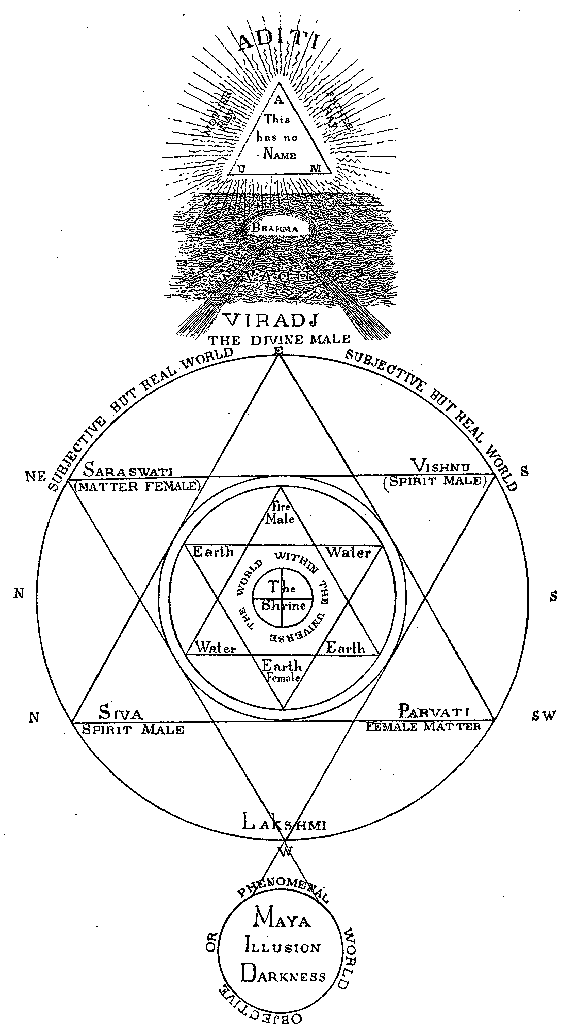
Brahmanda Purana may be the best version.
The actual Agni Purana is quite unusual. It has few stories, and most of what it has is summarized. It is mostly filled with ritual, and teaches the meaning of Vedas and Upanishads. This was one of the later Puranas, so it presumes familiarity with older material, and repeats it less than it explains it. It contains astrology and all other subjects, and teaches Adwaita. It says it was written in the Ishan Kalpa. It places Varaha avatar third.
In one version, Rudra is said to be Agni and the forty-nine maruts are the fires (usually airs). Agni called Rudra has forty-nine Maruts with Diti. Indra sliced her womb seven times seven times, so she would not be pregnant a hundred years. Four times seven of these gain liberation each manvantara, to be replaced by other persons born as such in the next.
In the Vishnu Purana, Agni's descendants are fory-nine, but nothing is said about them.
The only full account of them appears to be in the Vayu Purana. This one is the opposite of Agni Purana: being possibly the oldest one. It has a close relation to Shiva Purana.
Agni Purana is "Agni says", and he describes Vishnu, in the same fashion as placing Vishnu as the "first Logos". Shiva is both beyond Vishnu as well as within him--in such a way that, within the first few chapters, he is seduced by Vishnu's illusory power or Maya. He then becomes the first one to transcend it by tapas. Even so, it is unclear who or what all of them are supposed to be. Some names are omitted.
As fragmented as that is, these are the forty-nine fires which occupy the Lokas and Talas. Each Loka-Tala has seven states or tattvas ("for which there is no definite name"). Their groups are tanmatras (inner and outer senses), bhutas (elements), jnanindriyas (sense organs), and karmindriyas (organs of action). Elements have a regular order, but fire pervades them all.
HPB's explanation of the forty-nine seems a bit strange to me, because it does not appear to use the seven divisions, but five like the exoteric format. This actually has a reason in practice: "Esoterically, Buddhi reaches perception only through the Higher Manas, so only the twenty are reckoned in the esoteric classification". So Buddhi and Atma perceive only through Manas. This contrasts some exoteric formats which add Buddhi as another factor due to the notion it perceives; or say a "definition of buddhi kosha" = perception; that's not directly true. I agree that it's not active across all the lower principles.
"Each group has a positive and negative of each of its members, and the positive and negative sets each have a "subjective" state. This makes 48 "cognitions of Buddhi". Maya includes them all as the 49th fire. Once that you have reached the cognition of Mâyâ, you are an Adept."
To summarize:
5 positive + 5 negative Tanmâtras + 2 subjective.
5 positive + 5 negative Bhûtas + 2 subjective.
5 positive + 5 negative Jñânendriyas + 2 subjective.
5 positive + 5 negative Karmendriyas + 2 subjective.
======= ================== =========
20 positive + 20 negative + 8 aubjective
20 + 20 + 8 + Mâyâ = 49.
These are forty-nine states of consciousness which can occur in fourteen worlds. Hatha Yoga can only open the rupa worlds or the four lowest. The infernals actually get worse as they increase, opposite of the divine lokas.
1. Bhûrloka, the earth
2 Bhuvarloka, space between the earth and sun (Munis).
3. Svarloka, the space between the sun and the polestar (Yogis)
4. Maharloka, the space between the earth and the uttermost limit of the solar system. "Spaces" denote the special magnetic currents, the planes of substance and the degrees of approach that the consciousness of the Yogi or Chela makes towards assimilation with the inhabitants of the Lokas
5. Janarloka, beyond the solar system, the abode of the Kumâras who do not belong to this plane.
6. Taparloka, still beyond the Mahâtmic region; the dwelling of the Vairâja deities.
7. Satyaloka, the abode of the Nirvanîs.
Buddhism already classes eight cold and eight hot hells (Naraka, "of man") with the worst being Avichi, a term widely used in occultism. The Jaina already have a tidy set of seven hells: Ratna prabha, Sharkara prabha, Valuka prabha, Panka prabha, Dhuma prabha, Tamaha prabha, Mahatamaha prabha. Those are various kind of messed-up light or prabha; e. g., Dhuma prabha = smoky light.
She says the first mystery is Akasha--Space--Ether--Sound, which we have learned as anahata or "unstruck" sound, voice of the silence. But is is also the vibrating sound-board in all seven of its divisions. Of the primary Akasha, the first three are Aditi, Diti, Shakti. All physical phenomena proceed from the primary akash or Shakti.
Last edited by shaberon; 10th July 2018 at 04:18.
-
The Following User Says Thank You to shaberon For This Post:
Jayke (3rd February 2018)
-
3rd February 2018 08:18
Link to Post #258
Avalon Member
Re: The Serpent, the Black Sun, HPB & St. Germain
Mars and Mahavidyas
"...we find the author of “The Source of Measures” enunciating our very esoteric teachings in his Kabalistic researches. Thus he says:
“Now Mars was the lord of birth and of death, of generation and of destruction, of ploughing, of building, of sculpture or stone-cutting, of Architecture...of all arts. He was the primeval principle, disintegrating into the modification of two opposites for production. Astronomically, too, he held the birthplace of the day and year, the place of its increase of strength, Aries, and likewise the place of its death, Scorpio. He held the house of Venus, and that of the Scorpion...He held the cardinal points, and as Cain, or Vulcan, or Pater Sadic, or Melchizadek, he was lord of the Ecliptic, or balance, or line of adjustment, and therefore was the just one. The ancients held to there being seven planets, or great gods, growing out of eight, and Pater Sadik, the Just or Right One, was lord of the eighth, which was Mater Terra."
Because Mars rules Aries, that includes the Lunar Mansion, Aswini, with the asterism of the Aswins, the most occult deities. Scorpio is the more recent, terrestrial mystery, so to speak, from when Virgo was a much larger sign, to when Libra-Scales and Scorpio split the Zodiac from ten to twelve signs; sexual separation and the 4th Race "Fall". I am not sure about the Vulcan-Melchizedek names; and Venus seems to be more of the esoteric earth lord; but at least the other Kabalistic traits seem correct.
Although HPB did not question whether Karttikeya was really Mars, she does say, "All such stories differ in the exoteric texts. In the Mahabharata, Karttikeya, “the six-faced Mars,” is the son of Rudra or Siva, Self-born without a mother from the seed of Siva cast into the fire. But Karttikeya is generally called Agnibhu, “fire born.” "
We did not really change Karttikeya's planet so much as we attached him to Amitabha (or we did so with Kartikkeyani). As the Buddhas and their consorts move around in certain ways, perhaps that is what happened. For the current purposes, Angaraka seems to be a much better fit for Mangala-Mars. Physically, Angaraka relates to charcoal and/or glowing charcoal, i. e. potential and kinetic light--heat.
This is aside from the fact that, Mars's physical globe life-wave is dead, and the whole thing is in pralaya. Also, “Mars has two satellites to which he has no right ...Phöbos, the supposed inner satellite, is no satellite at all”.
Mars, usually considered fiery, and the sun, usually considered fiery, appear to be masked by the various Wars in Heaven and Fall into Matter. It goes hand-in-hand with the attribution of Asuras and Serpents being evil, so, if that is the teaching of Maya, which is dual, it must have something on the other side of the veil of Wrathful Maha Vidyas.
The Wars have one basic meaning with respect to the process of manifestation: "Cosmologically, then, all the Dragons and Serpents conquered by their “Slayers” are, in their origin, the turbulent confused principles in Chaos, brought to order by the Sun-gods or creative powers."
Characterizing some of the manifesting hierarchies:
"Danu, a Hindu primordial goddess, is mentioned in the Rigveda, mother of the Danavas. The word Danu described the primeval waters which this deity perhaps embodied. In the Rigveda (I.32.9), she is identified as the mother of Vritra, the demonic serpent slain by Indra. In later Hinduism, she becomes the daughter of Daksha and the consort of Kasyapa."
Dewi Danu is the water goddess of the Balinese Hindus, who call their belief-system Agama Tirta, or belief-system of the water. She is one of two supreme deities in the Balinese tradition. Her name is the root word for many rivers, even in Europe.
Mahabali, or Great Bali was a benevolent Asura King in ancient Hindu antiquity. Mahabali was the great great grandson of sage Kashyapa Prajapati (son of Marichi) and Diti, great grandson of Hiranyakshipu, the grand son of Prahlada and son of Virochana, during Manu Caksusa (form of Indra) age. Vairocana ruled Prahlada's kingdom for a while, then Mahabali took over. Mahabali's reign contained the "Churning of the Ocean". The Asuras could use the nectar to raise the dead, but the Devas could not. The Devas were not on good terms with Mahavishnu, so Sukra-Venus urged Mahabali to start a war. He was killed in battle, then was resurrected and overthrew the Devas. He took over heaven and Sukra anointed him as Indra. Vishnu impregnated Aditi and became Vamana in response. After Mahabali failed to fulfill his promise to provide three paces of land for Vamana, Vamana strode the whole earth (seven atalas) in one step, heaven (seven lokas) in a second, and Mahabail (seven principles) as the third; this step sends Mahabali to live in the netherworld for some period. Asuras then became inhabitants of Patala.
So we just put forty-nine fires in the man in hell on earth. He may not be born yet; perhaps this is his prototype.
Indra slew Vairocana in the Taraka war. Vairocana had spoken of five souls, Atman, Cetanatman, Paratman, Niratman, Antaratman. In one version, Vairocana is the source of Brahma-Vishnu-Shiva; whereas Dhativishvari is the same thing as Locana. Shingon is in the interesting position of having been able to sift the Chinese systems (older than Tibet), which had no Vama Marga, to develop a unified Vairocana tantra; so what it has, is relatively uncontaminated or mixed-up compared to Tibet. In the Buddhist Mahavairocana Sutra, Vairocana teaches the Dharma to Vajrasattva, but it is utterly incomprehensible, so Vairocana provides esoteric techniques and rituals to help conceptualize the Dharma beyond verbal form. It was this sutra that prompted the Japanese monk, Kukai to journey to China to learn more about Tantric Buddhism. Probably close to Vilasavajra's Namasangiti, uninfluenced by Vimalamitra.
"The story told is, that Taraka (called also Kalabhana), owing to his extraordinary Yoga-powers, had obtained all the divine knowledge of yoga-vidya and occult powers of the gods, who conspired against him. Here we see the “obedient” Host of Archangels or minor gods conspiring against the (future) Fallen angels, whom Enoch accuses of the great crime of disclosing to the world all “the secret things done in heaven.” It is Michael, Gabriel, Raphael, Surgal and Uriel who denounced to the Lord God those of their Brethren who were said to have pryed into the divine mysteries and taught them to men: by this means they themselves escaped a like punishment.
Kasyapa is called the Son of Brahma, and is the “Self-Born” to whom a great part of the work of creation is attributed. He is one of the seven Rishis; exoterically, the son of Marichi, the son of Brahma; while Atharva-veda says, “The Self-born Kasyapa sprang from Time”; and esoterically — Time and Space are forms of the One incognizable Deity. As an Aditya, Indra is son of Kasyapa, as also Vaivasvata Manu, our progenitor. In the instance given in the text, he is Kasyapa-Aditya, the Sun, and the Sun-god, from whom all the “Cosmic” Demons, Dragons (nagas), Serpent, or Snake-gods, and Danavas, the giants, are born. The meaning of the allegories given above is purely astronomical and cosmical, but will serve to prove the identity of all.
The children of Surasa are the “mighty Dragons.” The Vayu Purana replacing “Surasa” (of Vishnu Purana) by Danayas or Danavas — the descendants of Danu by the sage Kasyapa — and those Danavas being the giants (or Titans) who warred against the gods, they are thus shown identical with the “Dragons” and “Serpents” of Wisdom.
Rahu, the Dragon’s head, played a prominent part in the mysteries of the Sun’s (Vikarttana’s) initiation, when the candidate and the Dragon had a supreme fight."
Within the historical period:
"The tradition of the Dragon and the Sun is echoed in every part of the world, both in its civilized and semi-savage regions. It took rise in the whisperings about secret initiations among the profane, and was established universally through the once universal heliolatrous religion. There was a time when the four parts of the world were covered with the temples sacred to the Sun and the Dragon; but the cult is now preserved mostly in China and the Buddhist countries.
Furthermore, the “War in Heaven” is shown, in one of its significations, to have meant and referred to those terrible struggles in store for the candidate for adeptship, between himself and his (by magic) personified human passions, when the inner enlightened man had to either slay them or fail. In the former case he became the “Dragon-Slayer,” as having happily overcome all the temptations; and a “Son of the Serpent” and a Serpent himself, having cast off his old skin and being born in a new body, becoming a Son of Wisdom and Immortality in Eternity.
The fallen Angels are made in every ancient system the prototypes of fallen men — allegorically, and, those men themselves — esoterically."
Part of the point of Buddhism is to largely disregard the Devas, luminous beings with no experience of entering dense matter, and to take refuge in those who have and who have perfected the forty-nine fires: and these were all mortals like you and me.
The Maha Vidyas were created twice: once by Sati, then again by Parvati. Their planetary associations seem fairly firm, however, their equivalent Vishnu incarnations are given differently by various sources such as the Todala Tantra or the Chamunda (Kali, Dakshina) Tantra.
Todala Tantra attempts to bridge Vishnu to the incarnations of Shiva: Describing about the ten incarnations and their corresponding power (Shakti), Sutji said- The first incarnation of lord Shiva was as Mahakal and his Shakti was called Mahakali. Lord Shiva took his second incarnation as Tar and his Shakti was called 'Tara'. The third incarnation of Lord Shiva was as Bhuvaneshwar and his Shakti was called 'Bhuvaneshwari'. Lord Shiva took his fourth incarnation as 'Shodash' who was also known as 'Srividdyesh' and his Shakti was called 'Shodashi' or 'Shri'. Lord Shiva took his fifth incarnation as Bhairav and his Shakti was called 'Bhairavi'. The sixth incarnation of Lord Shiva is famous as 'Chhinamastak' and his Shakti by the name of 'Chhinamasta.Lord Shiva took his seventh incarnation as 'Dhoomvan' and his Shakti was known as 'Dhoomvati. The
eighth incarnation was as Baglamukh and his Shakti as Baglamukhi. The ninth incarnation of lord Shiva became famous as Matang and his Shakti as 'Matangi'. Lord Shiva took his tenth incarnation as 'Kamal' and his Shakti as Kamala. If these ten incarnation of Shiva are worshipped along with his ten Mahavidyas then a man attains salvation.
According to Shaivaite, Narasimhi is an incarnation of Goddess Shakti and she appeared from the wings of Sarabheswara, the ugra (wrathful) avatar of Lord Shiva.
In practice, a female half of Shiva...would split off as Maya and seek or give birth to Vishnu for re-unification.
Chamundi, herself, is placed with the Seven Mothers at the Ellora and Elephanta caves, and, again, is directly from Devi Chandi, not a god. In this system, the Yoginis are daughters of the Matrikas. She has a temple at Chamundi Hill, Mysore (Mahish), where as Wrathful Durga she slew the buffalo; and she was of paramount importance for centuries to the Maharajah of Mysore.
Agama is "Hindu Tantra" overall, but by usage, tantra usually means "Shakti Agama", which has sixty-four texts. Those are grouped as Dakshina marga (right-hand) and Vama marga (left-hand). It is probably the origin of those terms. Agama stages are "pada": Kriya, Charya, Yoga, Jnana, more or less the same as Buddhist tantra.
Considering there were Upanishads and Tantra prior, Adi Shankara, as a proponent of Dakshina Marga, pretty much sets that as the main stamp to put on the material. "According to the Shakta Scriptures, Veda in its wide sense does not only mean Rig, Yajus, Sama, Atharva as now published but comprises these together with the generally unknown and unpublished Uttara Kanda of the Atharva Veda, called Saubhagya, with the Upanishads attached to this."
Because one is not always free of Vama Marga, it may be transmuted in the following stages: literal, figurative (substitute ginger for meat), esoteric (no meat, learn the practice as allegory).
The Ellora cave has Seven Mothers: Chamunda with owl, Indrani with elephant, Varahi with boar, Lakshmi with garuda, Kaumari with peacock, Maheshwari with bull and Sarasvati with hamsa or goose. The north wall contains the images of Bhavani or Durga, Gajalakshmi (Elephant), Varaha, the boar incarnation of Vishnu, Vishnu and Lakshmi.
And Vishnu: The south wall has the representations of Govardhanadhari Vishnu (Krishna), Sheshasayi Vishnu (on Shesha), Vishnu on garuda, Varaha, the boar incarnation of Vishnu, Vamana Trivikrama avatara of Vishnu, Narasimha avatara of Vishnu.
From the teaching about Kashi, we understand the significance of sites such as Elephanta and Ellora. The Indian Lodge wanted to place their esoterics in symbolic form, as a response to the deterioration of Egyptian hieroglyphics. So the stone monuments in question are not the archaic monoliths that evens the Todas could not explain, nor the most ancient architecture, but the series built around year 600-800. This is roughly Adi Shankara's time, and then the start of the Mahasiddhi period, which absorbed the Dakshina Tantra. Presumably, this is the outward trend of Buddha's original system or Yogacharya, which is much older than Cittamatra Buddhism or the Prasanghika of the Gelugs. We find it concentrated in Newari & Kagyu, with the only real expansion (publicly) as Kalachakra.
If Chamunda with the owl is at Ellora, and intertwined with Mysore-Mahish that deeply, this is a good name to use for the daughter of Devi Chandi directly with no god. Chandi herself is Kali-Durga; Lion Woman, Shakti of Brahman; the name Narasimhi is out of another book and different story, but is a parallel: Nara is human being, simhi is female lion. And so I think this is a good choice, since Narasimhi (Bhavani at Ellora; Jagdamba, "World Mother", another name; and Pratyangira) directly relates to Vishnu as Narasimha, and we might look at what it means for the "female half" of Sarabheswara to go out and merge with Narasimha; there she would meet the Vidya, Chinnamasta. So Narasimhi is her as the root of all the other kinds. Chamunda would be her as the female counterpart to Avalokiteshvara, the aggregate of all seven flavors of her manifestation.
At Elephanta, the main sculpture is a three-faced Shiva (Mahesa murti): Vamadeva (female) looks to its left, Rudra right, center is Tatpurusha. He is surrounded by Ardhanarisvara on its left and Gangadhara to its right. Outside is a broken statue some say is Tiger Goddess Vaghesvari. I've never heard of that before, but it calls up Vagisvara and Vadisimha. It also has a Seven Mothers frieze.

The irony is wasted on non-speakers, but Vama means woman or left with only a slight change in pronunciation. So that's her name looking left on the statue. Anyway, the Mothers are protectors.
The protected are the Maha Vidya. These are wrathful too but they are really her mysteries and/or her meditations. They are the same as the protectors but unveiled.
The Yoginis are the enlightened daughters or the ones who did the unveiling.
In one view, the seven grouping is the consonants Ka, Cha, Ta, ta, Pa, Ya, and Ksha, and when the eighth is added, it is the vowel A (Shiva blew fire to form Yogeshvari to stop Andhaka's blood flow).
So I suppose these groups don't share the same kind of interior relationships as their male counterparts. But these are not something like men's and women's basketball teams: males are states of purusha and females are states of prakriti and the two cannot actually be removed from each other.
.........Material Shakti; Parvati.................Vidya Shakti; Sati
..................Mother....................................Maha Vidya............................Yogini
.................Durga...................................Tripura Sundari.......Akasha Dhatvishvari
A. Sarasvati............................................Chinnamasta....................Vidyadhari
B. Lakshmi................................................Dhumavati.....................Vajrayogini
C. Parvati...................................................Bhairavi......................Vajravarahi
1. Narasimhi........................................Bagalamukhi........................Vidyadhari
2. Sarasvati..............................................Matangi.......................Dhatvishvari
3. Indrani................................................Sodashi.......................Samaya Tara
4. Maheshwari...........................................Kali..................................Locana
5. Kaumari.............................................Blue Tara.............................Pandara
6. Lakshmi............................................Kamala.................................Mamaki
7. Varahi...........................................Bhuvaneshvari.....................Vajragharvi
(8). Chamunda
Left column is semi-exoteric or just a list of associations. The two right columns are worked out by the planets. The left column is slightly redundant as the Pancha Raksa--Maha Pratisara form would be the same as five of them.
The Mothers list is slightly less important, because they are the outpouring and come up as Bodhisattva level guardians. But I would take the Indian Ellora list as more fundamental than Nepali or elsewhere.
The Yoginis are the power of a Buddha. Their thing is, they kind of emerged slowly as a practice. As Maha Vidyas, they are a more solidly-established set and practice. I am not sure which one to call Maya Shakti and give her the Maya Tattvas.
Subba Row said that as Virgo was the sixth sign, there are six shaktis, spawned from a seventh: Parashakti, light and heat; jnanashakti; icchshakti; kriyashakti; kundalinishakti (magnetism); mantra shakti (whose crown is the ineffable word); daiviprakriti (astral or logoic light, the root; Fohat). These are the hierarchies of the Dhyan Chohans, which we have determined to be the principles of Vishnu. These are the actual Rays. Material Shakti I suppose.
Vidya makes parashakti turn towards the Self, which is life and the jivas; avidya turns it towards the unreal and it becomes aparashakti, moving outwards and producing excess phenomena or samsara. Daivi prakriti is those two together which is maha vidya which isn't really knowledge so much as energy which uses knowledge for its processes.
Last edited by shaberon; 3rd February 2018 at 22:25.
-
The Following User Says Thank You to shaberon For This Post:
Jayke (3rd February 2018)
-
3rd February 2018 21:55
Link to Post #259
Avalon Member
Re: The Serpent, the Black Sun, HPB & St. Germain
The mass of material being sifted is a litany which can only result in two things: it will destroy you, or you will gain mastery of the human body.
The outward motion of the Great Breath--which it's doing now, and will so for the foreseeable future--when viewed through avidya or ignorance, results in the pushing away of parashakti (life and the jivas) from the divine source, down through the elementals and shadows. This basically happens everywhere; its exception being samadhi. That is the only condition wherein parashakti truly merges with reality. Most of the universe works against this. Only a dedicated choice can make it through.
The maya of daiviprakriti comes from Bhagavad Gita 7.14 and then its real nature at 9.13, which explains this condition as that of a mahatma.
So we find the principles of Vishnu running through all space and affecting prakriti to engender its varying degrees. This Dhyan Chohanic evolution forms Chidakasam or the bare field of consciousness. Film is a word useful in two ways. This bare field of consciousness is like a blank film, into which incarnating jivas are born, and they develop it into its many pictures.
Also, since the atma is not really in man, the seventh principle is like a film or container that scoops a certain amount of the universal principle to become the auric egg, then forming the permanently reincarnating spiritual soul.
In that this is all very abstruse, complex, and slightly overwhelming, HPB's advice for the initial stage of meditation was quite simple and elegant:

That's not bad to start. She did refer to tantric practice being used later: a magical process of engaging all of the parts of one's mortal being by the personified deities and transcending them, or esoterically killing them. Because she was not around long enough to establish her full system, this is the motivation to take the clues and patch in the missing parts, to the extent we are able.
-
-
4th February 2018 09:05
Link to Post #260
Avalon Member
Re: The Serpent, the Black Sun, HPB & St. Germain
Stanza Seven of The Secret Doctrine
1. First, the divine vehicle, the one from the mother-spirit; then the Spiritual ; (again) the three from the one , the four from the one, and the five, from which the three, the five and the seven...these seven are the three-fold and the four-fold downward; the “mind-born sons of the first Lord " the Shining Seven (the “Builders”; Great Bear). It is they who are thou, me, him, O Lanoo; they who watch over thee and thy mother, Bhumi.
2. The one ray multiplies the smaller rays. Life precedes form, and life survives the last atom. Through the countless rays the life-ray, the one, like a thread through many beads.
3. When the one becomes two — the “three-fold” appears. The three are one; and it is our thread, O Lanoo, the heart of the man-plant, called Saptaparna.
4. It is the root that never dies, the three-tongued flame of the four wicks . . . The wicks are the sparks, that draw from the three-tongued, flame shot out by the seven, their flame; the beams and sparks of one moon reflected in the running waves of all the rivers of the earth.
This is almost the exact same thing as shown above in the Shiva tantra diagram:
These two (The One: Paramatman and Daiviprakriti--Ananda) are inseparable. Surrounding them are the three Shaktis of the supreme called Iccha, Jnana and Kriya. That is the divine trinity. The Central Sun and Three Formless Fires of Agni.
Next is the impure creation or veil of maya. Maya Tattva is said to wear five kanchukas or bodices. Two of these are parallels of Shiva and Shakti — limitation in respect of space and time. These two primordial restrictions give rise to three others, which themselves are reflections of Iccha, Jnana and Kriya.
So this veil of Maya is the (again) of verse 1, and also the bounded circle, 3.1415 or pi. The first "five" being the "Pancha Buddha" of the divine plane, only. From that divine plane next issue our manifested trinity, Pancha Buddha, and Septenary Scale. The three-tongued flame is our thread or the highest reality in samadhi.
Change in consciousness........................Effect or Power over matter
Vishnu Tanmatra..................................Shakti Tattva
1. Paramatman....................................Daivi Prakriti Purusha Tattva (Adi)
2. Atman...........................................Parashakti Kāla Tattva- time (Anupadaka)
3. Indriyatman.....................................jnanashakti Vidya Tattva (Akasha)
4. Bhutatman.......................................icchshakti Rāga Tattva (Vayu)
5. Kshetrajna.......................................kriyashakti Niyati Tattva (Taijasa)
6. Bhrantidarsanatah...........................kundalinishakti Akāla Tattva (Apas)
7. Viswabhavana..................................mantrashakti Maya Tattva (Prithivi)
As there are Twelve total creative hierarchies, reflected in the Zodiac, five are beyond our plane, and our path is with the manifested seven. So the pairing of Vishnu Tanmatra with Shakti Tattvas are the Dhyan Chohans. From these proceed all the other hierarchies or what we call Families in Buddhism: the Dhyani Buddhas and all their reflexes and reflections, or the bodies and faculties of Brahma, etc.
So we understand that the Central Sun is a reservoir of Daivi Prakriti. Were this energy released from its container, it would annihilate the solar system. We have to work with it rather carefully. Being the Rays, this group multiplied by itself would be the forty-nine fires. Right now we are just going to work it in to the system of correspondences. Fully expanded, you'd get the icchshakti of atman, parashakti of kshetrajna, etc.
One can immediately see what takes place. The first initiation in water or Apas utilizes kundalinishakti. The initiation at Mercury will have mantrashakti, whose crowning glory is the Word or Tetragrammaton I suppose. The final initiation of fire would be into kriyashakti. That order makes a lot of sense.
Compared to the divine plane, these Chohans "personify the Fifth Principle [manas] of Cosmic Nature, or of the “Mother” in its Mystical Sense."
The Manifested Creative Hierarchies:
1. The highest group is composed of the divine Flames, so-called, also spoken of as the “Fiery Lions” and the “Lions of Life,” whose esotericism is securely hidden in the Zodiacal sign of Leo. It is the nucleole of the superior divine World. They are the formless Fiery Breaths.
2. The second Order of Celestial Beings, those of Fire and Aether (corresponding to Spirit and Soul, or the Atma-Buddhi) whose names are legion, are still formless, but more definitely “substantial.” … As the name shows, they are the prototypes of the incarnating Jivas or Monads, and are composed of the Fiery Spirit of Life.
3. The Third order corresponds to the Atma-Buddhi-Manas.
4. “The Fourth are substantial Entities. This is the highest group among the Rupas (Atomic Forms). It is the nursery of the human, conscious, spiritual Souls. They are called the “Imperishable Jivas,” and constitute, through the order below their own, the first group of the first septenary host – the great mystery of human conscious and intellectual Being.”
5. The Fifth group is a very mysterious one, as it is connected with the Microcosmic Pentagon. The fifth group of the celestial Beings is supposed to contain it itself the dual attributes of both the spiritual and physical aspects of the Universe; the two poles, so to say, of Mahat the Universal Intelligence, and the dual nature of man, the spiritual and the physical. Hence its number Five, multiplied and made into ten, connecting it with Makara, the 10th sign of Zodiac. … It becomes the task of the fifth Hierarchy – the mysterious beings that preside over the constellation Capricornus, Makara, or “Crocodile” in India as in Egypt – to inform the empty and ethereal animal form [i.e. in the early period of humanity’s evolution on this globe in this Fourth Round] and make of it the Rational Man. Many are those among the Spiritual Entities, who have incarnated bodily in man, since the beginning of his appearance, and who, for all that, still exist as independently as they did before, in the infinitudes of Space. … To put it more clearly: the invisible Entity may be bodily present on earth without abandoning, however, its status and functions in the supersensuous regions.”
6. The sixth and seventh groups partake of the lower qualities of the Quaternary. They are conscious, ethereal Entities, as invisible as Ether … this Sixth group evolves no more than the future man’s shadowy form, a filmy, hardly visible transparent copy of themselves. … This sixth group, moreover, remains almost inseparable from man, who draws from it all but his highest and lowest principles, or his spirit and body, the five middle human principles being the very essence of those Dhyanis.
7. The terrestrial Spirits (elementals) which gradually form, build, and condense the physical body.
So these Chohans are really the launchpoint that everything stacks on top of. With them, directly, we have little to do, for it is the Dhyani Buddhas that directly relate them to human consciousness. The only slight distinction between the Chohans and Buddhas may be the Chohans are automatic at the beginning of a cycle, and the Buddhas can add increased power during the cycle.
It is interesting about group one and Leo, seeing as how the Lion aspect came up rather prominently on many of the Shaktis.
Last edited by shaberon; 17th June 2018 at 08:55.
-
 Posting Permissions
- You may not post new threads
- You may not post replies
- You may not post attachments
- You may not edit your posts
Forum Rules


 Reply With Quote
Bookmarks