-
8th May 2018 15:06
Link to Post #1741
 Avalon Member

 Re: Calling all light warriors - the Bees need you!
Bee Venom Extract Market Foreseen to Grow exponentially over 2027
Press release from: Future Market Insights
Bee venom also known as apitoxin is a colorless and bitter liquid. According to American Apitherapy Association, bee therapy or Apitherapy is the therapeutic usage of products made by honeybees such as bee venom and bees. The bee venom treatment uses the venom commencing the bees to treat ailments that do not respond to traditional western medicine. Few of the functions of bee venom are curing arthritis, anti-inflammatory, pain relief, and other claims include acne, psoriasis, and scarring from skin cancer. Almost 10,000 bee stings are required to make one gram of bee venom. This makes venom almost seven times more valuable than gold.
Global Bee Venom Extract Market: Drivers and Restraints
One of the major factor driving the bee venom market is the extensive usage of the medicinal products. For instance, bee venom is used majorly in Europe from several decades especially for the treatment of rheumatic diseases. The live bees, as well as the venom extracts, are used for the treatment in Europe.
People are also entering the bee venom business as it is one of the most profitable companies and the collector can increase his income by almost 200%. Another major factor, affecting the bee venom market is the innovation in the bee extraction equipment’s which makes it easy for the manufacturers to extract the bee venom from the hive. The device fits under brood chamber of a colony of the bees. However, the major restraint while collecting the bee venom is the holder techniques and this results in the death of the bee if not handled properly. As a result, dropping its stinger in the collecting device. Earlier the bees were caught when the bees return to their hive. They are given shock waves with electricity and pressed between the rolls so that they sting. However, during this process many of the bees are crushed and also the venom gets contaminated. In another method, the bees are triggered to sting into the plastic or rubber dam.
Global Bee Venom Extract Market: Segmentation
By Form:
Powder
Liquid
By Application:
Pharmaceutical
Cosmetic & Personal care
Global Bee Venom Extract Market: Segmentation Overview
The Bee venom is used in the recovery of many diseases, and few of the major diseases are completely healed. The bee venom is used for the treatment of rheumatic diseases, multiple sclerosis, rheumatic fever, high blood pressure, sciatica, psoriasis, hematomas, various skin conditions, and burns, among other. According to the Russian Institute, the bee venom cures cancer and destroy the AIDS virus. The powder form of venom is gaining traction in the market. The venom bee is costlier and costs around $ 80 per gram. Bee venom has numerous therapeutic applications. The bee venom has a stimulating effect on the heart muscles and also controls the cholesterol levels of the body. Bee venom also has antibiotic properties.
Global Bee Venom Extract Market: Regional Outlook
The global bee venom market is segmented by regions into North America, Latin America, Western Europe, Eastern Europe, Middle East & Africa (MEA), Asia-Pacific excluding Japan (APEJ), and Japan. Bee venom is not much used in the U.S. The primary reason being the lack of availably of beehives in the country. Honey bees are never available in sufficient quantities in the country for analysis and clinical testing. Bee venom is mostly used in Russia, Japan, America, New Zealand, and in the eastern countries where their apitherapy is irreplaceable owing to the variety of products offered.
Global Bee Venom Extract Market: Prominent vendors
Few of the prominent players in the global bee venom extract market are Bee Whisper, ApiHealth NZ Ltd, Fernz, and Abeeco Pure, among others. Few of the strategies adopted by the key players in the market are partnership and collaboration with other operators, expansion into the untapped market, and joint ventures with the organizations in emerging countries to gain the strong foothold in the market.
About Us
Future Market Insights is the premier provider of market intelligence and consulting services, serving clients in over 150 countries. FMI is headquartered in London, the global financial capital, and has delivery centres in the U.S. and India.
FMI’s research and consulting services help businesses around the globe navigate the challenges in a rapidly evolving marketplace with confidence and clarity. Our customised and syndicated market research reports deliver actionable insights that drive sustainable growth. We continuously track emerging trends and events in a broad range of end industries to ensure our clients prepare for the evolving needs of their consumers.
Website: www.futuremarketinsights.com/
https://www.openpr.com/news/1040534/...over-2027.html
-
The Following 5 Users Say Thank You to william r sanford72 For This Post:
Bluegreen (8th May 2018), Cidersomerset (12th May 2018), Ewan (8th May 2018), Foxie Loxie (8th May 2018), Star Tsar (19th June 2018)
-
8th May 2018 15:15
Link to Post #1742
Avalon Member
Re: Calling all light warriors - the Bees need you!
Glyphosate formulations more toxic than their active ingredient, tests show
After more than 40 years of widespread use, new scientific tests show glyphosate herbicide formulations have higher rates of toxicity to human cells
The summary of the US National Toxicology Program's new findings on glyphosate and its formulations is here:
https://usrtk.org/wp-content/uploads..._GBF-paper.pdf
Weedkiller products more toxic than their active ingredient, tests show
Carey Gillam
The Guardian, 8 May 2018
https://amp.theguardian.com/us-news/...ive-ingredient
After more than 40 years of widespread use, new scientific tests show formulated weedkillers have higher rates of toxicity to human cells
US government researchers have uncovered evidence that some popular weedkilling products, like Monsanto’s widely-used Roundup, are potentially more toxic to human cells than their active ingredient is by itself.
These “formulated” weedkillers are commonly used in agriculture, leaving residues in food and water, as well as public spaces such as golf courses, parks and children’s playgrounds.
The tests are part of the US National Toxicology Program’s (NTP) first-ever examination of herbicide formulations made with the active ingredient glyphosate, but that also include other chemicals. While regulators have previously required extensive testing of glyphosate in isolation, government scientists have not fully examined the toxicity of the more complex products sold to consumers, farmers and others.
Monsanto introduced its glyphosate-based Roundup brand in 1974. But it is only now, after more than 40 years of widespread use, that the government is investigating the toxicity of “glyphosate-based herbicides” on human cells.
The NTP tests were requested by the Environmental Protection Agency (EPA) after the International Agency for Research on Cancer (IARC) in 2015 classified glyphosate as a probable human carcinogen. The IARC also highlighted concerns about formulations which combine glyphosate with other ingredients to enhance weed killing effectiveness. Monsanto and rivals sell hundreds of these products around the world in a market valued at roughly $9bn.
Mike DeVito, acting chief of the National Toxicology Program Laboratory, told the Guardian the agency’s work is ongoing but its early findings are clear on one key point. “We see the formulations are much more toxic. The formulations were killing the cells. The glyphosate really didn’t do it,” DeVito said.
A summary of the NTP work stated that glyphosate formulations decreased human cell “viability”, disrupting cell membranes. Cell viability was “significantly altered” by the formulations, it stated.
DeVito said the NTP first-phase results do not mean the formulations are causing cancer or any other disease. While the work does show enhanced toxicity from the formulations, and show they kill human cells, the NTP appears to contradict an IARC finding that glyphosate and/or its formulations induce oxidative stress, one potential pathway toward cancer. The government still must do other testing, including examining any toxic impact on a cell’s genetic material, to help add to the understanding of risks, according to DeVito.
The NTP work informs a global debate over whether or not these glyphosate-based weedkilling chemical combinations are endangering people who are exposed. More than 4,000 people are currently suing Monsanto alleging they developed cancer from using Roundup, and several European countries are moving to limit the use of these herbicides.
“This testing is important, because the EPA has only been looking at the active ingredient. But it’s the formulations that people are exposed to on their lawns and gardens, where they play and in their food,” said Jennifer Sass, a scientist with the Natural Resources Defense Council.
One problem government scientists have run into is corporate secrecy about the ingredients mixed with glyphosate in their products. Documents obtained through Freedom of Information Act requests show uncertainty within the EPA over Roundup formulations and how those formulations have changed over the last three decades.
That confusion has continued with the NTP testing.
“We don’t know what the formulation is. That is confidential business information,” DeVito said. NTP scientists sourced some samples from store shelves, picking up products the EPA told them were the top sellers, he said.
It is not clear how much Monsanto itself knows about the toxicity of the full formulations it sells. But internal company emails dating back 16 years, which emerged in a court case last year, offer a glimpse into the company’s view. In one 2003 internal company email, a Monsanto scientist stated: “You cannot say that Roundup is not a carcinogen … we have not done the necessary testing on the formulation to make that statement. The testing on the formulations are not anywhere near the level of the active ingredient.” Another internal email, written in 2010, said: “With regards to the carcinogenicity of our formulations we don’t have such testing on them directly.” And an internal Monsanto email from 2002 stated: “Glyphosate is OK but the formulated product … does the damage.”
Monsanto did not respond to a request for comment. But in a 43-page report, the company says the safety of its herbicides is supported by “one of the most extensive worldwide human health and environmental databases ever compiled for a pesticide product”.
Website: http://www.gmwatch.org
https://mailchi.mp/2c8d88d6f86e/glyp...w?e=eb54924245
-
The Following 4 Users Say Thank You to william r sanford72 For This Post:
Cidersomerset (12th May 2018), Ewan (8th May 2018), Foxie Loxie (8th May 2018), Star Tsar (8th May 2018)
-
8th May 2018 15:21
Link to Post #1743
Avalon Member
Re: Calling all light warriors - the Bees need you!
New tool to identify endangered ecosystems
May 8, 2018, Universidad Politécnica de Madrid
https://phys.org/news/2018-05-tool-e...cosystems.html
A team of researchers from Universidad Politécnica de Madrid, University Centre for Digital Art and Technology and Universidad Francisco de Vitoria has developed a new tool of visualization of bipartite biological networks, like the visualization between pollinators and plants or between diseases and genes, which identify their interactions and anticipate corrective measures.
BipartGraph is a data visualization tool that allows researchers to predict what fauna and flora species are endangered, establishing corrective measures and predicting the consequences of the variations suffered in the natural ecosystems in each country.
This tool was developed by a team of researchers formed by Javier García Algarra, from Centre for Digital Art and Technology; Javier Galeano and Juan Manuel Pastor, researchers from the group of Complex System at Universidad Politécnica de Madrid and Mary Luz Mouronte, a professor at Universidad Francisco de Vitoria.
This tool is very useful for ecologists that require more visual and numerical results of ecological interactions. Thus, the user can, for example, identify the plant species threatened by the disappearance of pollinators. This task is very relevant since there are dozens of species and hundreds of interactions.
The importance of the species is related to the position they occupy in the network, that is, the disappearance of the main species can provoke a tragic effect called "cascade effect" that would lead to the disappearance of both the plant and its pollinators.
This work included the design and development of two new types of visualization using the graph theory. Firstly, Polar Plot that works reducing the information of new magnitudes in just one graphic. Secondly, Ziggurat Plot that provides a better vision of the connectivity thanks to a spatial grouping.
Ecologists from diverse groups of researchers are already using this free software that helps identify endangered species caused by diverse factors: climate change, water stress or displacement of their habitats by human pressure. This software can also be used in other areas of research such as biotechnology by studying the networks among hereditary diseases and genes that cause them.
This open source software is freely available for the entire scientific community and any other potential user. Researchers used the "R" programming language and the software is available at https://github.com/jgalgarra/bipartgraph
This type of progress is an example of how digitalization, big data, data analytics and interactive tools of visualization contribute to the scientific progress and have direct application in the development and preservation of the environment.
Explore further: Domino effect—the loss of plant species triggers the extinction of animals
More information: J. Garcia-Algarra et al. A Structural Approach to Disentangle the Visualization of Bipartite Biological Networks, Complexity (2018). DOI: 10.1155/2018/6204947
Provided by: Universidad Politécnica de Madrid
Read more at: https://phys.org/news/2018-05-tool-e...stems.html#jCp
-
The Following 4 Users Say Thank You to william r sanford72 For This Post:
Cidersomerset (12th May 2018), Ewan (8th May 2018), Foxie Loxie (8th May 2018), Star Tsar (8th May 2018)
-
8th May 2018 15:26
Link to Post #1744
Avalon Member
Re: Calling all light warriors - the Bees need you!
Bit O Music from All them Witches.."Cowboy Kirk"
Rock on...
Last edited by william r sanford72; 8th May 2018 at 16:21.
TRUTH and BALANCE
-
The Following 4 Users Say Thank You to william r sanford72 For This Post:
Bluegreen (8th May 2018), Cidersomerset (12th May 2018), Foxie Loxie (8th May 2018), Star Tsar (8th May 2018)
-
8th May 2018 15:37
Link to Post #1745
Avalon Member
Re: Calling all light warriors - the Bees need you!
Just found this insightfull and interesting..
Did These Bees Just Kill A Squirrel?
628DirtRooster
Published on May 6, 2018
Here I am with one of my least favorite types of hive removals. Being in a precarious position on a ladder on a roof with a twelve foot eve drop is not my favorite things to do. Thankfully it was a relatively low pitch and I had shade most of the time. After an hour or so up there I was pretty confident the ladder wasn't going to slide down and off of the roof with me on it but by the time my nerves were getting under control my feet were starting to hurt. No problem, only four more hours to go. It took about a half hour to set up and start removing the soffit and then it was so glued in with propolis it was another ten minutes just opening the soffit. I wasn't too far along in the process when I spotted a skeletonized animal. I said "whoa, did these bees just kill a rat?". The only reason I noticed it was that I was pulling and prying on this propolized blob or something that was partially holding the vinyl soffit in and little pieces of what looked like bone were breaking off. Then it hit me. I'm tugging on a dead rotting animal. As you can see in the video it took a few seconds for the extreme heat to allow my brain to reform my analysis of the situation and realize it was a squirrel and not a rat. Total cut out and repair time was about five hours.
-
The Following 3 Users Say Thank You to william r sanford72 For This Post:
Ewan (8th May 2018), Foxie Loxie (8th May 2018), Star Tsar (8th May 2018)
-
11th May 2018 17:33
Link to Post #1746
Avalon Member
Re: Calling all light warriors - the Bees need you!
Research Confirms: (Insect) Moms Are the Best
By Adrienne Antonsen
Insects are exceptionally skilled at developing adaptations to increase their evolutionary success. One way to promote a species’ survival is through effective parenting, and in some standout insect species mothers go the extra mile for their young.
Some well-known insect supermoms include lace bugs, who will jump on predators and sacrifice themselves to protect their developing offspring, and Strepsiptera, whose mothers are eaten from the inside out by their young. In honor of Mother’s Day, here are some exciting new research discoveries in entomology about insect mothers that go to awe-inspiring lengths to care for their babies.
Earwig Moms Take Extra Care of Eggs at Risk of Pathogen Exposure
Earwigs make great mothers. They have previously been lauded for their devout commitment to protecting their young, spending months watching over them without food and moving their entire nest of babies if threatened. Now, research shows that earwig mothers can even sense the presence of dangerous pathogens in the environment and increase their level of parental care accordingly.
After briefly leaving their nest in response to a predator, earwig moms (such as the one pictured atop this post) returned quicker in environments with pathogens than in pathogen-free areas. By rushing back to her young, an earwig mother gets to spend more time cleaning her eggs to protect them from potential infection. Due to mom’s extra diligence, earwig larvae reared in the presence of pathogens survive just as well as those without exposure.
Ancient Cockroaches Evolved a Novel Body Structure to Protect Their Eggs
Cockroaches may be maligned by human society, but they deserve recognition when it comes to motherhood. Their predecessors possessed long ovipositors to lay eggs externally, but long ago cockroaches developed special structures called oothecae, external protein-based egg cases that females attach and carry around with them.
This development led to a diversification of reproduction modes in cockroaches, with some dropping their ootheca shortly after mating and others carrying them until the eggs hatch. Researchers in China recently discovered the oldest known cockroach fossil with an attached ootheca that dates back to the Early Cretaceous, 125 million years ago.
With the development of oothecae, cockroach mothers increased their offspring’s chances of survival by protecting them from threatening predators and dangerous conditions. The adaptation continued to change in some lineages, and some modern cockroaches now carry oothecae internally; meanwhile, one species has even become viviparous, eliminating the ootheca and giving live birth like most mammals do. The ootheca and its derivations exemplify yet another reason to marvel at the impressive survival ability of cockroaches.
Burying Beetle Mothers Defy the Odds When Facing Adversity
A burying beetle mother feeds her babies regurgitated food from the mouse carcass they are living on. (Video by James Hataway, University of Georgia.)
For burying beetles, home is where the carcass is. These fascinating creatures bury the remains of a small vertebrate corpse then mate and lay eggs within the crypt. Both the mother and father then tend their young together, feeding upon the carcass and regurgitating it for the babies to eat. In fact, burying beetles represent the earliest known example of active parenting on Earth.
While both parents help raise their offspring, the mothers are the heavy lifters. Researchers in the United Kingdom recently discovered that female burying beetles engage in more fights with intruders and are better able to defend their brood than males are.
In a separate study, scientists from the same research group also tested what would happen if mother burying beetles were handicapped. In most animal species, handicapped mothers provide less care to their young. But, to the researchers’ surprise, when lead weights were attached to the mother burying beetles’ bodies, the mothers actually spent more time provisioning food to their offspring. By consuming more food than their weight-free counterparts, the weighted mothers powered through their extra burden to provide even better care for their brood.
Flower Beetles Plan Ahead to Ensure Their Young Will Stay Well Fed
Flower beetles are a type of scarab found worldwide that typically don’t provide any parental care. One species, though, Dicronocephalus wallichii, bucks this trend by constructing intricate nests for its offspring. Females spend several hours on each individual nest, digging a hole in the soil and then filling it with cut pieces of dead leaves. Each nest houses just one egg. This effort results in this species of flower beetle laying far fewer eggs over time than other scarab beetles.
Scientists recently investigated if the dead leaves laid down by the flower beetle mothers influenced offspring survival and growth. The researchers reared flower beetle eggs on soil with either high or low nutrients and either with or without dead leaves. In the end, if larvae were raised on nutritious soil, they did just fine regardless of whether dead leaves were present. If, however, the larvae were raised on soil of poor nutrition, nearly all of them would die if no dead leaves were provided. So, it appears mothers of this unique species of flower beetle go to great lengths to provide their young with well-stocked nests in case the surrounding soil is of low quality. Thanks to mom’s hard work, these flower beetles can thrive in environments where others aren’t able.
Aphid Wasp Performs a Never-Before-Seen Maternal Care Strategy
Most bees and wasps lay eggs, leave some food, and then go on their merry way. Scientists recently discovered an anomaly, however, in the aphid wasp species Pemphredon fabricii. Mothers of this wasp species use abandoned plant galls previously created by fruit flies to house their young and then provide them with paralyzed aphids to feed on.
Researchers monitored nesting behavior of wasp mothers in the Czech Republic and found, to their surprise, mothers revisiting their nests late in their offspring’s development to provide them with additional food. While some wasps are known to return to early-developing offspring to supply them with fresh food, a phenomenon known as truncated progressive provisioning, none have ever been known to resupply their late-developing young with food. The scientists termed this new behavior “late progressive provisioning.” This discovery just goes to show how great insect mothers are at continually developing new ways to better care for their babies.
To all the moms out there—human or insect—happy Mother’s Day! You’re amazing!
https://entomologytoday.org/2018/05/...-are-the-best/
-
The Following 5 Users Say Thank You to william r sanford72 For This Post:
Bluegreen (11th May 2018), Cidersomerset (12th May 2018), Ewan (11th May 2018), Foxie Loxie (6th June 2018), Star Tsar (26th May 2018)
-
11th May 2018 17:41
Link to Post #1747
Avalon Member
Re: Calling all light warriors - the Bees need you!
The secret agents protecting our crops and gardens
May 11, 2018 by Lizzy Lowe And Manu Saunders,
Insect pests cause a huge amount of damage to crops globally. In Australia alone, pests are responsible for around A$360 million of crop losses a year. Controlling pest outbreaks is crucial for food security and human health. Since the 1940s, our primary defence against crop pests has been synthetic pesticides. But using pesticides comes at a huge cost.
Not all bugs are bad!
Bees, flies and butterflies help to pollinate our plants. Decomposers like beetles and worms help break down wastes and return nutrients to the soil. Meanwhile, predators and parasites help control the species that are pests. One of the biggest environmental problems with pesticides is that they can affect these beneficial species as well as the pests they're targeting.
Predatory insects and spiders control pests with none of the health and environmental risks of chemicals. So when we kill these species with insecticides, we are shooting ourselves in the foot.
Losing insects also has flow-on effects for larger animals that rely on them for food. Because invertebrates have such important roles to play in our environment, losing them to insecticides can completely change how ecosystems function.
An alternative to insecticides
Biological control (or biocontrol) relies on "secret agents" – the natural enemies (predators and parasitoids) of pests that live freely in the ecosystems around us.
There is a huge range of predatory invertebrates that eat pests. They include dragonflies, preying mantids, beetles (including ladybugs), lacewings, spiders, mites, wasps, and even some flies.
Parasitoids, meanwhile, are insects that lay their eggs in the bodies of other invertebrates. Their larvae extract nutrients from the host during their development, which ultimately kills the host. Wasps are best known for this strategy but there are also parasitoid flies and beetles.
Predators and parasitoids are useful because they use pest insects, like caterpillars and aphids, as food to reproduce and grow their populations. We walk past many of these hard working agents every day without knowing it.
One biocontrol method that gardeners and land managers use is called augmentation. This simply means raising lots of live individuals of particular natural enemies, like ladybirds or wasps, and releasing them into an area to control pests.
Alternatively, gardeners might change the local environment to encourage these natural enemies to move in on their own. They might include natural insectariums or planting different types of vegetation to encourage diverse invertebrate communities. There is increasing evidence of the success of these strategies in organic farming so we should be thinking about using them more broadly.
Selecting your insects
If you want to release biocontrol agents, you need to choose them carefully, just like human special agents. Like any introduced plant or animal, there is a risk that good bugs could become pests (if they feed on the wrong insects, for example).
Selecting biological control agents requires close collaboration between managers, skilled entomologists and other scientists. For each new species, they identify the pest and some potential predators. They look at the predator's life cycle and resource needs, and consider how it interacts not just with pests, but with other insects too. If agents are coming in from overseas, they also need to be cleared by government biosecurity.
Parasiotid wasps, lacewings, predatory mites, ladybird beetles, and nematodes are all common biocontrol agents. These species are relatively easy to raise in large numbers and
work well when released into the field. Spiders are also a really important predator of many pest insects, but they're often overlooked in the biocontrol game because they are harder to breed—and for some reason people don't always like releasing large numbers of spiders.
Many biocontrol agents are enemies of pests in general, preying on aphids, caterpillars and fruit flies alike. It's important to have generalists around for every day pest control, but sometimes a more targeted approach is needed. This is when specialised predators or parasitoids come in. These are species that only target specific pests like leaf miners, beetles, scale insects or spider mites. This way the target pest can be managed with no risk of the parasitoids accidentally attacking other beneficial invertebrates.
Raising good bugs
Once a biocontrol agent has been selected, greenhouses or lab facilities start raising a large population. This is an emerging market in Australia, but there are already a number of companies in Australia who specialise in rearing biological control agents.
This is a tricky job because demand for the product is variable and is not easy to predict. Warmer seasons are the peak time for most pests, but problems can arise at any time of the year. In most cases the biocontrol company will maintain breeding colonies throughout the year and will be ready to ramp up production at a moment's notice when a farmer identifies a pest problem. Each company usually provides 10-20 different biocontrol agents and are always looking for new species that might be useful.
When it comes to getting the agents to the farmers, the bugs can be shipped as eggs (ready to hatch on arrival), or as live adults ready to disperse and lay their own eggs. The packages are express posted in boxes designed to keep the insects cool and safe.
Once the farmer or natural resource manager receives the bugs, applying them is quite simple. The secret agents are released among the crops, usually by hand, but in some special cases they may be airlifted in via specialised drones!
It's important to monitor the pests and the biological control agents after release to check that the agents are working. Some farmers are happy to do this themselves but most biological control companies have experts to visit the farms and keep an eye on all parties.
Can I use good bugs in my garden?
If you have a problem with a pest like aphids it is possible to buy predators such as ladybirds or lacewings to quickly deal with the problem. But for long term pest control, there are probably already some natural enemies living in your garden! The easiest and cheapest way to help them is to put the insecticides away and ensure your garden is a friendly environment for secret agents.
Explore further: Five reasons not to spray the bugs in your garden
Provided by: The Conversation
https://phys.org/news/2018-05-secret...s-gardens.html
-
The Following 3 Users Say Thank You to william r sanford72 For This Post:
Cidersomerset (12th May 2018), Ewan (11th May 2018), Star Tsar (26th May 2018)
-
11th May 2018 17:50
Link to Post #1748
Avalon Member
Re: Calling all light warriors - the Bees need you!
Scots urged to help save ‘frugal’ native honey bee
By:Ilona Amos
A new project has been launched to identify and count native Scottish honey bees in an effort to save the hardy and “mild-tempered” insects from extinction.
Native honey bees have been around since the end of the ice age and are specially adapted to thrive in Scotland’s harsh climate. Research has shown they possess many beneficial traits, including mild temper, above-average activity levels at lower temperatures, good nectar-gathering and improved ability to survive Scottish winters.
But populations of the BEES have crashed in recent years due to cross-breeding with alien species and attacks by a deadly parasite. Now experts fear the species is in danger of vanishing if urgent action is not taken.
The first phase of the initiative is to conduct a Scotland-wide survey, with beekeepers asked to send in photographs of any of their stocks they believe visually resemble the Scottish native dark bee.
All submissions will be examined by a team of experts and those showing the closest conformance to the characteristics of the species, Apis mellifera mellifera, will be put forward for DNA analysis to establish their genetic purity.
It’s hope pure-bred examples can then be used to establish new colonies with the widest possible gene pool.
The newly formed Scottish Native Honey Bee Society (SNHBS) is behind the scheme. “Disease and hybridisation are putting the native honey bee in real trouble in our country,” said Ian Lennox, SNHBS project co-ordinator.
“We know, thanks to modern genetics and morphology, that small pockets of native honey bees do still cling on in some parts of Scotland. Having populated these lands for something like 8,000 years, these native dark bees deserve the chance to avoid extinction.”
Ironically, according to Mr Lennox, some of the problems facing the Scottish bee come from a renewed interest in bee-keeping as a hobby.
“It’s good to realise that there are so many new and enthusiastic beekeepers today, but many of the bees available to them are derived from imported stocks of non-native bees and when these cross with our native strain it begins to dilute the authenticity of the true Scottish strain,” he said.
“Scottish native honey bees are a brown bee with a reputation for frugality, which helps them withstand even the dreichest of Scottish weather.
“But, like the Scottish Wildcat, it has been getting increasingly difficult to find good pure examples, and if we don’t take action to reverse their decline we may see them disappear for ever.”
Read more at: https://www.scotsman.com/news/enviro...-bee-1-4738076
https://www.scotsman.com/news/enviro...-bee-1-4738076
-
The Following 4 Users Say Thank You to william r sanford72 For This Post:
Cidersomerset (12th May 2018), Ewan (11th May 2018), Foxie Loxie (6th June 2018), Star Tsar (26th May 2018)
-
11th May 2018 17:54
Link to Post #1749
Avalon Member
Re: Calling all light warriors - the Bees need you!
Music for some light reading..King Tuff - Circuits in the Sand.
Rock on...
-
The Following 4 Users Say Thank You to william r sanford72 For This Post:
Bluegreen (11th May 2018), Cidersomerset (12th May 2018), Foxie Loxie (6th June 2018), Star Tsar (26th May 2018)
-
12th May 2018 22:17
Link to Post #1750
Re: Calling all light warriors - the Bees need you!

Cuckoo bee species 'hiding in plain sight'
By Matt McGrath
Environment correspondent
12 May 2018
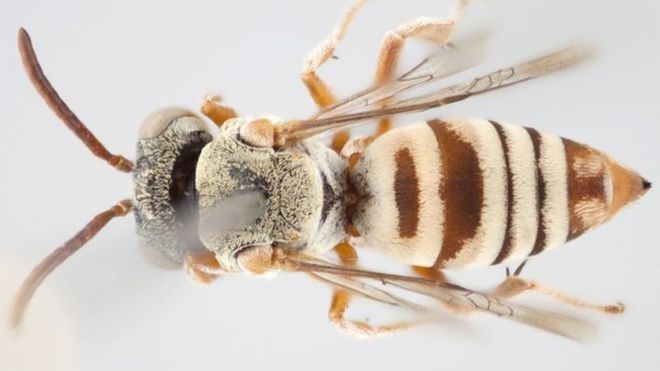
A female from one of the newly discovered Attenborough species of cuckoo bee
Scientists have discovered 15 new species of cuckoo bees hidden in North American
museum collections and in an ancient thesis.Like their avian counterparts, cuckoo
bees lay their eggs in the nests of other bees, usually solitary dwellers.When the
cuckoos hatch they kill off the usurped bees' larva and are raised by the unsuspecting
host. Researchers say that this type of behaviour is common in bees and up to 15%
of species are cuckoos.While there are many different genera, or types, of cuckoo
bees, all the new discoveries relate to one genus, Epeolus. The new findings bring to
43 the total of Epeolus species in North America.
These cuckoos are said to look more like wasps than other bees, with a smoother,
less fuzzy look. This is because they don't have the body hairs that other bees use
to collect pollen for their young, as they rely on the hosts to do that for them. They
also tend not to be seen near flowers, but are often found hovering close to the
ground searching for host nests. They are sometimes seen in the early morning
"resting" on leaves as they don't have any nests of their own."I've been going across
the US and Canada visiting museums and institutions where these bees were collected
some time ago and labelled as Epeolus but without a species being assigned," said
Thomas Onuferko, a PhD student at York University in Toronto.
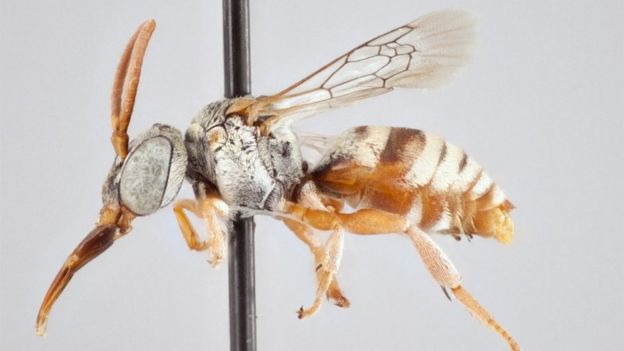
A male example of the new bee species
"Some were morphologically distinct so that it was easy to recognise them as unidentified
species - the rest are what we call cryptic species, very similar to already described species,
and it was only through DNA bar-coding that we were able to tell that they were distinct,"
he told BBC News. One of the new species has been named in honour of the naturalist Sir
David Attenborough, who celebrated his 92 birthday on 8 May. Epeolus attenboroughi has
very short black, white, red and yellow hairs that form attractive patterns.
"To my knowledge, this is the first bee that has been named after him," said Thomas Onuferko.
"It felt appropriate; he's one of the greatest naturalists of our time." Scientists say that
understanding more about these new species will enable other bee researchers to keep an eye
out for them. They are rarer than many other species so having a good idea about their numbers
may be a useful indicator for the state of health of the environment. Thanks to advances in
technology, the team at York believes that there will be many other new bee species discovered
in dusty collections around the world.
"There are about 20,000 described species of bees worldwide. That's more than all birds and
mammals combined," said Thomas Onuferko."I'm certain there are many more that are waiting
to be discovered."The study has been published in the open access journal, ZooKeys.
http://www.bbc.co.uk/news/science-environment-44045331
-
The Following 3 Users Say Thank You to Cidersomerset For This Post:
Foxie Loxie (6th June 2018), Star Tsar (26th May 2018), william r sanford72 (13th May 2018)
-
12th May 2018 22:24
Link to Post #1751
Re: Calling all light warriors - the Bees need you!
This man drove 40 miles with 3000 bees loose in his truck
Published on 5 May 2018
http://kdvr.com/2018/05/03/man-drive...-in-truck-cab/
-
The Following 3 Users Say Thank You to Cidersomerset For This Post:
Foxie Loxie (6th June 2018), Star Tsar (26th May 2018), william r sanford72 (13th May 2018)
-
15th May 2018 14:31
Link to Post #1752
Avalon Member
Re: Calling all light warriors - the Bees need you!
Is NRCS Effort Merely A Band-Aid On A Gushing Wound?
Published on May 14, 2018
Recently, the USDA’s NRCS which stands for the (Natural Resources Conservation Service) made some changes to its Conservation Enhancement Activity (E595116Z2) available to corn and soy farmers.
This Conservation Enhancement is designed to "Eliminate routine use of neonicotinoid seed treatments to reduce risk of pesticides in surface water by reducing the total amount of chemical applied and reducing the potential for delivery of chemicals into water bodies that would impair water quality and fish and wildlife habitat" Is this a step in the right direction or an effort to put a band-aid on a gushing wound?
www.theorganicview.com
-
The Following 3 Users Say Thank You to william r sanford72 For This Post:
Cidersomerset (15th May 2018), Foxie Loxie (6th June 2018), Star Tsar (26th May 2018)
-
17th May 2018 09:00
Link to Post #1753
 Avalon Member
Re: Calling all light warriors - the Bees need you!
Hi William,
Once again, thanks for keeping this thread alive!
Can I also, once again urge everyone to think locally native when they are wondering what to plant in their gardens?
I do think this is really important,
This is what I am doing at the moment, (still). If its not a herb, vegetable, fruit that I need or bee plant, its a local native species.
Good things take time though.
Things have been going really well. my fruit trees are producing beautifully, my bees are going into their second winter looking really good. My vegie garden is hanging in there, not the greatest but I do get to eat lovely organic vegies.
I managed to get hold of some plastic small cell frames for my hive and put these in. The best time would have been in spring, but I only found them in time to get them into the hive in summer.
So far, i have not had to use any harsh chemical treatments. I did use the Food grade mineral oil fogging method over the first winter and into spring. I ran into a bit of trouble with Deformed wing virus in late spring early summer and moved over to treating with the essential oils treatment- Apilife var. I havent seen DWV since.
I am only doing any treatment if I see there is a problem and havent for months now.
The colony isnt huge in comparison to other beekeepers in my area, per their reports, but is bigger than it was going into winter last year.
This has been such a fantastic learning curve and I am still loving every minute of it.
If others are interested in keeping bees in their own back yard, I recommend a long hive rather than a vertical type AND with an observation window, so you can see what is going on in there without having to constantly open it up and in the process, upset your bees.
I have found the mesh screen along with the solid bottom board trays to be another excellent way of seeing what is going on in the hive. I keep the trays very well oiled after noticing that this does a better job of trapping any mite that fall onto it, as well as trapping the wax moth.
One thing I did that I can't remember if I have already mentioned it, is to put some ceiling grade insulation over the inner covers of the hive.
One day in winter, I noticed that I could feel the heat of the bees through this and realised that this heat should not be escaping like it was. A small piece of insulation from my own roof space that is made of wool, has made a huge difference.
This year, I again have brassicas growing- turnips,black radish,mustard, mustard lettuce. these have been specifically sown so that they will just bolt to flower around mid/late winter and will continue to grow right through til late spring when other things will be available.
Sometimes I have mild winters, like last year and the bees are flying even in winter. These and the Rosemary provide some very welcome food for our little friends.
All going well, I will have a go at expanding my hive numbers from one to three.
One of the concerns I have, is the over population of hives in a given area.
Ideally, I would like my colony to do the natural thing and swarm, but....I cant guarantee that they will choose one of my new hives.
In my area, if they do swarm, they are likely to die or wind up in the hands of a beekeeper who thinks that the best way to keep them is to pour in harsh chemicals and pillage hard won honey with no real regard to the results of their actions.
If they do manage to swarm successfully, the chances are that due to current mentality, the swarm will be removed rather than left to survive or will be destroyed. the mentality here is that swarms are diseased and should be rehomed where they can be properly medicated... or destroyed so they dont spread diseases.
Errr, didnt actually want to finish on such a sour note, so.. a little about the new hives I have got ready for next year.
I said I prefer long hives and I do, but the new ones are double deep langstroth hives, not quite like Layens or built per a book I got on Layens hives, but as close as I could get without having to build the whole thing myself...AND I am also using the Small cell frames in these too.
These new ones are being put in spots around my back yard so that there is at least 10-15 metres between each.
I cant wait for spring to see how it all works out.
-
The Following 4 Users Say Thank You to mischief For This Post:
Foxie Loxie (6th June 2018), Star Tsar (26th May 2018), ThePythonicCow (17th May 2018), william r sanford72 (17th May 2018)
-
22nd May 2018 17:22
Link to Post #1754
Avalon Member
Re: Calling all light warriors - the Bees need you!
Monsanto in Epic Fail with attempted attack on Global Glyphosate Study
In attempting to discredit a study that found that glyphosate-based herbicides affect rats' health, Monsanto got three crucial facts wrong
EXCERPT: Monsanto’s Mr. Partridge continued by telling the Guardian; “All the research to date has demonstrated that there is no link between glyphosate and cancer.” Does this not seem to be a bit off topic Mr. Partridge? There is no suggestion in the short-term studies, which he was being asked about, that glyphosate is linked to cancer.
---
Monsanto in Epic Fail* with attempted attack on Global Glyphosate Study
Sustainable Pulse, 22 May 2018
https://sustainablepulse.com/2018/05.../#.WwRPckxFy02
[links to sources at the URL above]
The peer-reviewed accepted manuscripts from the pilot phase of the Global Glyphosate Study were revealed last Wednesday in a Press Conference at the European Parliament.
The results of the short-term pilot study showed that glyphosate-based herbicides (GBHs) were able to alter certain important biological parameters in rats, mainly relating to sexual development, genotoxicity and the alteration of the intestinal microbiome, at the ‘safe’ level of 1.75 mg/kg/day set by the U.S. Environmental Protection Agency (EPA).
As is normal practice for Monsanto, their Public Relations department was soon in action to try and crush the scientists involved and the study results, which could cause major damage to the product that supports their whole business model – the glyphosate-based herbicide Roundup.
However, this time their PR campaign against the Study was only met with contempt and disdain from journalists, politicians and the public in countries across Europe.
Monsanto’s epic fail began with their comments in The Guardian newspaper:
Scott Partridge, Monsanto’s VP for global strategy told the Guardian: “The Ramazzini Institute is an activist organisation with an agenda that they have not disclosed as part of their crowdfunding efforts. They wish to support a ban on glyphosate and they have a long history of rendering opinions not supported by regulatory testing agencies.”
There are many things that are ‘interesting’ about Scott Partridge’s comment:
Epic Fail #1: Monsanto attacked the wrong Institute
The excellent Guardian article was mainly discussing a study on the microbiome of the rats, hence the title: “Glyphosate shown to disrupt microbiome ‘at safe levels’, study claims”. This study was actually carried out at Icahn School of Medicine at Mount Sinai in New York on samples provided by The Ramazzini Institute.
The truth is that Monsanto has never been faced with an independent study on glyphosate and glyphosate-based herbicides, in which multiple Institutions and Universities are involved. They are used to attacking one single scientist or a small institution.
The Global Glyphosate Study involves The Ramazzini Institute, the University of Bologna (Faculty of Agriculture, Veterinary Science and Biostatistics) the Genoa Hospital San Martino, the Italian National Institute of Health, the Icahn School of Medicine at Mount Sinai in New York and the George Washington University.
Monsanto have now shown that they will struggle to attack this group of well-respected Institutions!
Epic Fail #2: Monsanto suggests expert cancer scientists are activists
Monsanto’s Mr. Partridge was obviously having a bad day, as he also suggested that “The Ramazzini Institute is an activist organization”. This could not be further from the truth. In fact they are expert scientists who have been protecting public health for over 40 years.
The activities of the Ramazzini Institute (RI) focus primarily on the experimental identification and quantification of carcinogenic risks and on the evaluation of the efficacy and safety of drug therapies and active ingredients that may be used to prevent the development and/or progression of cancer.
The Ramazzini Institute’s long-term studies on Formaldehyde, Vinyl Chloride and Benzene, amongst others have led to global regulatory change on these chemicals.
The RI study design closely mirrors the human condition, in which persons may be exposed to agents in all phases of life for varying lengths of time. A distinctive characteristic of most RI carcinogenicity studies is that rodents are treated from prenatal life and kept under observation until natural death or at least 130 weeks of age. This lifespan protocol is in contrast with most laboratories where rodents are treated starting from adulthood and sacrificed at 110 weeks of age (representing about 2/3 of the lifespan) and corresponding to 60-65 years in humans. This practice means that the researchers miss a significant proportion of cancers induced by early exposure during pregnancy and that might show up in old age.
Sorry Mr. Partridge and Monsanto, you cannot change the truth!
Epic Fail #3: Monsanto claims no link between glyphosate and cancer… off topic
Monsanto’s Mr. Partridge continued by telling the Guardian; “All the research to date has demonstrated that there is no link between glyphosate and cancer.”
Does this not seem to be a bit off topic Mr. Partridge? There is no suggestion in the short-term studies, which he was being asked about, that glyphosate is linked to cancer.
However, if Monsanto really want to bring up this topic, we would suggest they have a chat to the International Agency for Research on Cancer (IARC), who classified glyphosate as a “probable human carcinogen” in 2015.
Oh… I forgot they are currently also trying to campaign against IARC too, including an attempt to stop the U.S. government from funding the Agency. I wonder why that is…..
It is time that we all stop Monsanto in their tracks and support the Global Glyphosate Study, which is being funded by the public worldwide.
* Urban Dictionary - Epic Fail: A mistake of such monumental proportions that it requires its own term in order to successfully point out the unfathomable shortcomings of an individual or group.
Website: http://www.gmwatch.org
https://mailchi.mp/f87ff3047d77/mons...y?e=eb54924245
-
The Following 3 Users Say Thank You to william r sanford72 For This Post:
Alekahn2 (25th May 2018), Foxie Loxie (6th June 2018), Star Tsar (26th May 2018)
-
25th May 2018 17:32
Link to Post #1755
Avalon Member
Re: Calling all light warriors - the Bees need you!
The influence of temperature and photoperiod on the timing of brood onset in hibernating honey bee colonies
Fabian Nürnberger, Stephan Härtel, Ingolf Steffan-Dewenter
May 25, 2018
Author and article information
Department of Animal Ecology and Tropical Biology, Bayerische Julius-Maximilians-Universität Würzburg, Würzburg, Germany
Abstract
In order to save resources, honey bee (Apis mellifera) colonies in the temperate zones stop brood rearing during winter. Brood rearing is resumed in late winter to build up a sufficient worker force that allows to exploit floral resources in upcoming spring. The timing of brood onset in hibernating colonies is crucial and a premature brood onset could lead to an early depletion of energy reservoirs. However, the mechanisms underlying the timing of brood onset and potential risks of mistiming in the course of ongoing climate change are not well understood. To assess the relative importance of ambient temperature and photoperiod as potential regulating factors for brood rearing activity in hibernating colonies, we overwintered 24 honey bee colonies within environmental chambers. The colonies were assigned to two different temperature treatments and three different photoperiod treatments to disentangle the individual and interacting effects of temperature and photoperiod. Tracking in-hive temperature as indicator for brood rearing activity revealed that increasing ambient temperature triggered brood onset. Under cold conditions, photoperiod alone did not affect brood onset, but the light regime altered the impact of higher ambient temperature on brood rearing activity. Further the number of brood rearing colonies increased with elapsed time which suggests the involvement of an internal clock. We conclude that timing of brood onset in late winter is mainly driven by temperature but modulated by photoperiod. Climate warming might change the interplay of these factors and result in mismatches of brood phenology and environmental conditions.
Read More:https://peerj.com/articles/4801/
-
The Following 3 Users Say Thank You to william r sanford72 For This Post:
Alekahn2 (25th May 2018), Foxie Loxie (6th June 2018), Star Tsar (26th May 2018)
-
25th May 2018 17:39
Link to Post #1756
Avalon Member
Re: Calling all light warriors - the Bees need you!
Robo-Bees Can Infiltrate and Influence Insect Societies To Stop Them From Going Extinct
Written By
Dan Robitzski
https://futurism.com/robo-bees-infil...nt-extinction/
Right now, there are swarms of robots that are so good at blending into their surroundings that they have been unquestioningly accepted into society. Their mission? Learn how the organisms they’ve been sent to study operate and socialize, then use their new knowledge to steer the cultures they’ve infiltrated towards what their creators decide will be a better future.
Thankfully, this isn’t about highly sophisticated androids seeking to destroy human society from the inside out (those don’t yet exist… at least not as far as we know).
Nope, we’re talking about bees.
This month, a five-year European research initiative called FOCAS (Fundamentals of Collective Adaptive Systems) came to a close. The purpose of the study: to learn the ways that social animals communicate. To accomplish that goal, researchers made swarms of robots designed to fool bees and zebrafish that looked and acted enough like the real thing to take part in the animal’s society.
This means the researchers got an unprecedented look inside the literal hive-mind that is a honeybee colony, and may even be able to use these robots to steer the bees towards adaptation and survival as they face potential extinction.
These robots are the result of years and years of work in swarm robotics. It’s not enough to build a little drone that can do bees’ characteristic waggle dance; the researchers needed to create a team of tiny bots that have a hive-mind of their own. They also needed to be able to move, act, and learn as a unit rather than a jumbled mess of machinery.
For example, engineers from the University of Graz used artificial intelligence to evolve the robots’ behavior to be more like that of real-life bees as the drones themselves became more sophisticated. They also got two robotic swarms to interact with each other, flying around as cohesive units without individuals flying off on their own, or crashing into one another.
All of these minor, incremental improvements were intended to progress the bots towards the ultimate goal: robo-spies so advanced that the real animals would accept, communicate with, and even follow them. After being plopped into a colony and acting like they belong there for long enough, the robots seem to pass as the real thing. While species-saving programs aren’t in play quite yet, the team’s work shows that real bees will go along with the robotic insect’s programmed behavior, and the insider’s perspective of a honeybee colony can help scientists understand exactly what environmental factors are putting pressure on bees and other animals.
The robotic Spies Who Stung Me could have more uses than simply keeping bees alive — they could also help manage livestock and agriculture. That may help explain Walmart heavily invested in and patented similar technology earlier this year.
While the idea of replacing dead honeybees with robotic pollinators is somehow both depressing and wildly impractical, these new swarms coming out of FOCAS can give us a much better idea of how animals like bees operate, and how best to help them survive as they face the prospect of their demise.
https://futurism.com/robo-bees-infil...nt-extinction/
-
The Following 3 Users Say Thank You to william r sanford72 For This Post:
Alekahn2 (25th May 2018), Foxie Loxie (6th June 2018), Star Tsar (26th May 2018)
-
30th May 2018 16:36
Link to Post #1757
Avalon Member
Re: Calling all light warriors - the Bees need you!
Bees adjust to seasons with nutrients in flowers and 'dirty water'
May 30, 2018, Tufts University
Researchers at Tufts University have discovered that honey bees alter their diet of nutrients according to the season, particularly as winter approaches. A spike in calcium consumption in the fall, and high intake of potassium, help prepare the bees for colder months when they likely need those minerals to generate warmth through rapid muscle contractions. A careful inventory of the bees' nutrient intake revealed shifting sources (from flowers to mineral rich 'dirty water') and how limitations in nutrient availability from these sources can have implications for the health of both managed and wild colonies.
The study, which is available in the May print edition of the Journal of Insect Physiology, examined mineral content gathered by and contained in adult bees and in their sources of food, exploring how they maintain the right nutritional balance of micronutrients. For most of the minerals tracked, it was found that the bees sought alternate sources to complement variation in the floral supply.
"We typically think of honey bees as gathering all the food they need for the colony from flowers, but in fact, our research showed that bees search strategically among different sources, including water, to boost their stores of calcium and maintain potassium levels in preparation for the cold season," said Philip Starks, associate professor of biology in the School of Arts and Sciences at Tufts. "Honey bee nutritional requirements are quite complex, and they can face limitations because of levels of micronutrients in their environment."
The study findings build on previous research led by Dr. Rachael Bonoan from the Starks lab that revealed that honey bees use water sources to complement, and sometimes supplement, the minerals in their floral diet. For example, as magnesium levels drop in pollen during the summer and fall, the bees pick up the difference from mineral rich water.
Alternatively, calcium levels in gathered pollen increase in the fall, but so do the bees' preference for calcium in water, perhaps reflecting a shift from brood rearing to overwintering, the researchers speculate. Ample calcium and potassium are useful for the muscle activity needed to generate heat in the hive during the winter months.
"These results have implications in the field," said Rachael Bonoan, lead author of the study and recent Ph.D. graduate from the Starks Lab. "Ultimately, one of the goals of studying mineral needs of honey bees is to create season- or crop-specific supplemental diets for beekeepers. Beyond honey bees, we can support wild pollinators by planting diverse floral, and thus nutrient-rich, sources."
There are many factors that have been blamed for the recent decline of bee populations, including the use of pesticides, the emergence of parasites and pathogens, and climate change. While diversity in the food supply may be one factor, its relative impact on the honey bee crisis has not yet been determined. This particular study, however, expands our understanding of the dynamic nutritional needs of bee colonies and provides further insight as to how we might manage the health of honey bee populations that support the natural environment and our food supply.
Also contributing to the study was Tufts University undergraduate Luke O'Connor, whose work formed the basis of his senior honor's thesis.
Explore further: Despite few taste genes, honey bees seek out essential nutrients based on floral resources
More information: Bonoan R.E., O'Connor L.D., Starks P.T. Seasonality of honey bee (Apis mellifera) micronutrient supplementation and environmental limitation, Journal of Insect
Physiology. (May-June 2016) 107:23-8; DOI: 10.1016/jinsphys.2018.02.002
Provided by: Tufts University
Vid and visuals in the link:https://phys.org/news/2018-05-bees-a...nts-dirty.html
-
The Following User Says Thank You to william r sanford72 For This Post:
Foxie Loxie (6th June 2018)
-
31st May 2018 18:30
Link to Post #1758
Avalon Member
Re: Calling all light warriors - the Bees need you!
Tips on Working Bees By Randy Oliver.. NY Bee Wellness.
Randy Oliver of scientificbeekeeping.com..NY Bee Wellness Workshop, Good for beginning beekeepers. Basic management of bees, disease identification.
Take notes, pause, playback, watch over.
http://scientificbeekeeping.com/
-
The Following 3 Users Say Thank You to william r sanford72 For This Post:
Foxie Loxie (6th June 2018), Star Tsar (19th June 2018), ThePythonicCow (31st May 2018)
-
3rd June 2018 19:16
Link to Post #1759
Avalon Member
Re: Calling all light warriors - the Bees need you!
The Times They are a Changin...
NY Bee Wellness.
Randy Oliver scientificbeekeeping.com; Current topics on beekeeping, apiculture; NY Bee Wellness workshop
http://scientificbeekeeping.com/
-
The Following 2 Users Say Thank You to william r sanford72 For This Post:
Foxie Loxie (6th June 2018), Star Tsar (19th June 2018)
-
3rd June 2018 19:22
Link to Post #1760
Avalon Member
Re: Calling all light warriors - the Bees need you!
bit o music..Geinō Yamashirogumis AKIRA - Kaneda's Theme.
Rock on...
-
The Following 2 Users Say Thank You to william r sanford72 For This Post:
Bluegreen (3rd June 2018), Foxie Loxie (6th June 2018)
 Posting Permissions
- You may not post new threads
- You may not post replies
- You may not post attachments
- You may not edit your posts
Forum Rules


 Reply With Quote


Bookmarks