


 Iapetus, the mysterious moon of Saturn
Interesting find you might enjoy reading. I searched the forum, and whilst mentioned en passant here and there, it does not appear to have yet been discussed.
A friend of mine put me onto this a while back with the most eloquently phrased subject line, which I will not repeat here. It is a rather long read, but well worth the effort.
For those of you who noticed Charles' mention of Arthur C. Clarke, perhaps this is a part of, and/or a lead towards what he had meant.
'A Moon with a view; what did Arthur C. Clarke know, and when did he know it?'
http://www.enterprisemission.com/moon1.htm
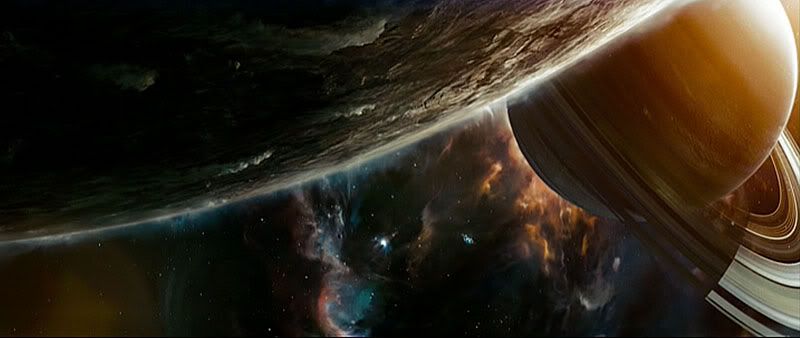
Iapetus [eye-AP-i-tus] is the seventeenth of Saturn's thirty three currently known moons, and the third largest. It was named after a Titan -- the son of Uranus and the father of Prometheus and Atlas (the latter said to be the 'fathers of Mankind'). Thus, in Greek myth, Iapetus was also an ancestor… a progenitor… of 'Homo Sapiens.'
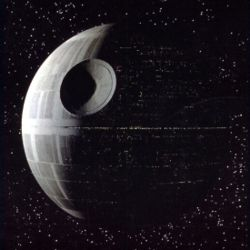
Do you notice the 'ridge', going straight through the entire centre of this 'moon'?
The questions that quickly draw ones attention are, if Iapetus is not a natural satellite at all, but a 900-mile wide spacecraft, an artificial 'moon'; what is or was its purpose, and what can we learn from it?
In the overexposed sunlit portion, the limb of the moon – rather than being round (like Mimas or Dione) – is plainly composed of a set of sharply slanted planes …. The exact number is difficult to reconstruct (because of the overexposure and the viewing angle), but the outlined areas appear to mark at least six (tetrahedral?) amazingly flat “sides” – each measuring hundreds of miles in length.
NASA stated on releasing this image that, '… the image shows mainly the night side of Iapetus; part of the far brighter sunlit side appears at the right and is overexposed due to the long integration time of 180 seconds. Despite this long exposure time, almost no blurring due to the spacecraft’s motion is apparent.''…One hemisphere of the satellite, which, like its companions, turned the same face always toward Saturn, was extremely dark, and showed very little surface detail. In complete contrast, the other was dominated by a brilliant white oval, about four hundred miles long and two hundred wide. At the moment, only part of this striking formation was in daylight, but the reason for Iapetus’s extraordinary variations in brilliance was now quite obvious…'
Arthur C. Clarke
It gets even more interesting from there. Apparently, the moon is noted to be redirecting incoming radar energy away from any radar source. Once this was ascertained, unfortunately, those in the position to do so have swept information regarding this 'moon' under the rug, so to speak. Gag order. Official silence.
Bill, if you happen to be interviewing someone who may be privy to information regarding this, a question or two about Iapetus may prove interesting to say the least.
If you are someone in the know on this, I would like to hear from you. You may private message me if you please, and you will remain anonymous if you so request.
- Home
- Forum
- Chat
- Donate
-
Site Links

-
Avalon Library
-
External Sites
- Solari Report | Catherine Austin Fitts
- The Wall Will Fall | Vanessa Beeley
- Unsafe Space | Keri Smith
- Giza Death Star | Joseph P. Farrell
- The Last American Vagabond
- Caitlin Johnstone
- John Pilger
- Voltaire Network
- Suspicious Observers
- Peak Prosperity | Chris Martenson
- Dark Journalist
- The Black Vault
- Global Research | Michael Chossudovsky
- Corbett Report
- Infowars
- Natural News
- Ice Age Farmer
- Dr. Joseph Mercola
- Childrens Health Defense
- Geoengineering Watch | Dane Wigington
- Truthstream Media
- Unlimited Hangout | Whitney Webb
- Wikileaks index
- Vaccine Impact
- Eva Bartlett (In Gaza blog)
- Scott Ritter
- Redacted (Natalie & Clayton Morris)
- Judging Freedom (Andrew Napolitano)
- Alexander Mercouris
- The Duran
- Simplicius The Thinker


 Reply With Quote







Bookmarks