Thought I would share a cool math function series today.
Have you ever noticed that multiplication is a series of repeated additions? Many people have! Did you then notice that exponentiation is a series of repeated multiplications? Many people have not! Did you ever consider that you can repeat a series of exponentiations? What the hell would that do!?
What we're asking questions about has been called hyperoperation and is defined as following:
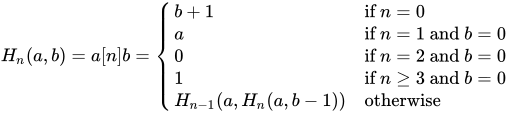
In Python code, it looks like this recursive function:
Code:
def h(n, a, b):
    if n == 0:
        return b + 1
    elif n == 1 and b == 0:
        return a
    elif n == 2 and b == 0:
        return 0
    elif b == 0:
        return 1
    return h(n - 1, a, h(n, a, b - 1))
So what is going on?
`n` defines which level of binary operation to perform, althougn `n = 0` is a unary operation as it ignores `a`. If we picked `n = 1` we are performing addition between `a` and `b` by succeeding (adding one to) `b``a` times. If we picked `n = 2` we are performing multiplication between `a` and `b` by adding `b` to itself `a` times.
The operator notation is as follows:
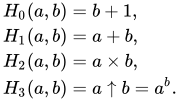
And to test the Python function you can run this code:
Code:
print(h(0, 3, 4))  # succession
print(h(1, 3, 4))  # addition
print(h(2, 3, 4))  # multiplication
print(h(3, 3, 4))  # exponentiation
print(h(4, 3, 4))  # pentation
Pentation is the operation that comes next after exponentiation. It's almost never used.
Things like this always strike me when it comes to human thinking. We can consider a first order effect quite easily, like position. A second order effect, velocity, is comprehensible as well. Third, acceleration, we can still understand. But not even by the fourth order effect, jerk, we start to lose easy metaphors for. No joke, the next derivatives are snap, crackle, and pop. Even the names are ridiculous. If we took the integral of position, we get absement, which is actually quite unintuitive.
What's my point? That our brains are "comfy" within some limited set of orders of thinking, whether that is succession, addition, multiplication, and exponentiation or position, velocity, acceleration, and jerk. Anything "below" or "above" those orders quickly become unintuitive and typically not practical -- but it doesn't mean they aren't there -- we just don't like thinking about them!
Why is that important? Because transcendence, by definition, ultimately escapes us! Always! Yet we try. We keep chasing the dragon, wanting more, wanting answers. For questions that we can never answer. For utopias that can never exist. For simulacra that can never replace the real thing.
Anyways, back to math. The above algorithm works on whole-number operations, or discrete operations. I still struggle with defining an algorithm that can perform exponentiation on fractions, I just don't really understand it that well. Yes, ChatGPT could solve this pretty easily, but some questions I like not having spoiled until I "get" it. 


 The Hyperoperation Sequence

 Reply With Quote
Bookmarks