


 What are the results of Putin's 20 years in power? We examine them based on irrefutable facts.
What are the results of Putin's 20 years in power? We examine them based on irrefutable facts.
What did Putin do after being in power for more than 20 years?
Before I give a detailed, precise answer, based on statistics and facts, I'd like to remind you that when considering the pros and cons of Putin's actions, we need to be aware of the kind of country we live in.
Yes. I'm still saying the same thing: our country lost its sovereignty in 1991 and essentially became a neo-colony.
83) 😡 Russia paid tribute to the United States at $1 billion a day.
https://projectavalon.net/forum4/sho...=1#post1684561
Therefore, standard definitions of a politician's performance are not entirely appropriate here. It's like dwelling on the horse's insufficient speed in fetters while ignoring those fetters. This is crucial!
And let's not look at the situation through the distorted notion that Russia is a separate state in a vacuum, independent of anyone.
But let's consider the real picture as a whole: Russia is still dependent on the West (especially until 2022), compared to, for example, the USSR.
That's the first point.
Secondly, we must be objective and rely on the facts. Today, the position of "President," although the most important in our country, has far less power relative to others than the position of head of state, for example, the Soviet Union.
I am a Putin supporter. In this article, I'll explain why.
Firstly, because he is restoring sovereignty. And all the positives I attribute to Putin in politics and economics are precisely a manifestation of this return of independence. But I also admit that they are meager compared to what could have been in a sovereign country.
You know, we can talk at length about Putin's achievements, but if we compare them, for example, to Stalin's five-year plans, his current achievements pale in comparison.
For example, during the Third Five-Year Plan, a new enterprise opened every seven hours. And the economic growth rate averaged 25-30% per year.
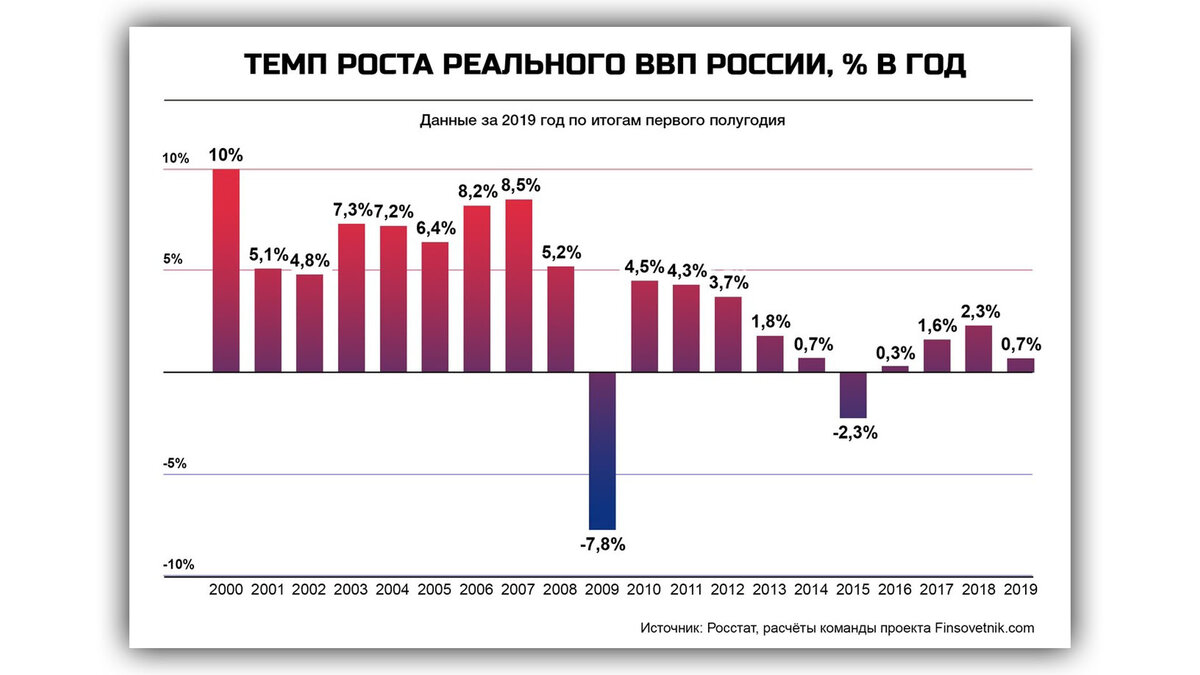
For comparison, in 2019, Russia's economic growth rate was 1.3%. During the best years of Putin's rule, it was 10%.
Russia's real GDP growth rate, % per year
But, as I've already said, one cannot draw conclusions without taking into account the geopolitical situation. For example, economic growth during the Great Patriotic War was naturally negative.
Now the question: isn't a war being waged against Russia today, both through "cold" methods—sanctions, destabilization of neighboring fraternal republics, attempts to destabilize the situation within Russia (all manifestations of the war against Russia)—and also through a "hot" phase: essentially, NATO countries are fighting against us (with their weapons, instructors, and mercenaries) on the territory of country 404; they bomb border towns and carry out terrorist attacks on our territory (for example, the attacks on the Crimean Bridge).
And most importantly: the economic damage from the Great Patriotic War was less than the economic damage from defeat in the Cold War.
Also, Stalin headed a sovereign state.
Putin, however, is the head of a neo-colony with limited powers. Although, I repeat, over the past year there has been a significant strengthening of Russia's sovereignty.
Even when they say that Stalin took over an agrarian country in ruins, one must take into account that the country was sovereign, and the United States of America helped restore it with its knowledge and technology. More precisely, Stalin utilized the experience of American engineers.
For example: Albert Kahn, the architect of Detroit, was invited to the USSR in 1928 to participate in industrialization. He arrived in Moscow with 25 engineers and, over the course of two years, trained more than 4,000 specialists. Between 1929 and 1932, he designed and organized the construction of 521 facilities (according to other sources, 571 facilities). These included, first and foremost, tractor (i.e., tank) factories in Stalingrad, Chelyabinsk, and Kharkov; automobile factories in Moscow and Nizhny Novgorod; forge shops, and much more. In other words, Roughly speaking, Stalin bought up technology from the United States and created his own based on it.
And another example: our famous Moskvich was built on the American Ford chassis.
Our automobile industry was crippled by the Revolution and Civil War. Meanwhile, the Russian Empire produced more than 10 brands of automobiles. The first car appeared in 1896.
But today, advanced countries are not planning to help develop Russia's industry and economy. All this must be taken into account. Whether Stalin, for example, could have developed today as he did in the 1930s is a big question.
But let's return to the topic at hand.
So what did Putin do?
As you understand, answering this question requires taking into account many nuances that should be taken into account. And not to downplay his achievements.
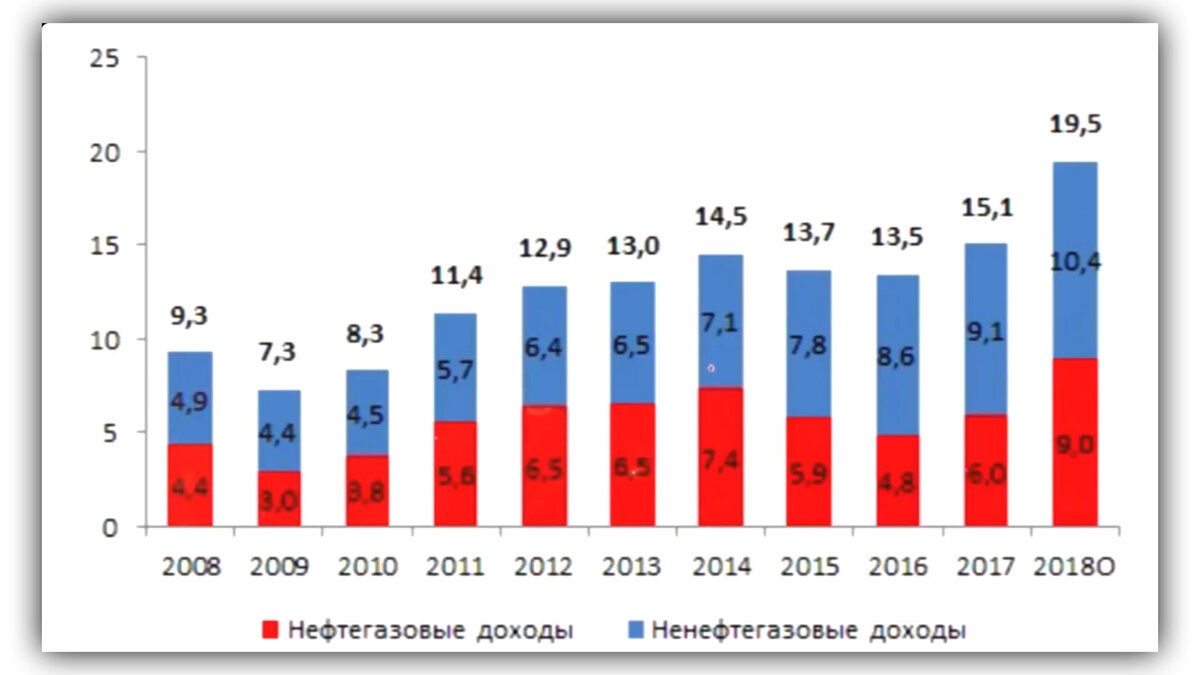
Putin nationalized the oil industry and forced the oligarchs to pay taxes, and these funds began to contribute more than 50% of the Russian budget.
Red is oil and gas revenues, blue is non-oil and gas revenues
There are undeniable facts of Russia's return to power, i.e., the return of sovereignty. Specifically, we need to look at how things were before Putin and how they are now.
And now, the figures from Putin's presidency (official data).
Gross domestic product (GDP) grew by 80%.
The government's external debt has been halved.
International reserves increased 42-fold to $549 billion (as of December 20, 2019).
Federal budget revenues increased 17.6-fold to 20.6 trillion rubles.
Annual inflation fell from 20.2% to 3% (from November 2018 to November 2019).
Industrial production grew by 60%.
Manufacturing grew by 70%. Agricultural exports increased 19-fold to $25 billion.
Grain exports increased 40-fold, reaching 50 million tons.
Real wages increased 3.5-fold. These figures, by the way, defy any manipulation. So, a manipulator might tell you that life in Russia has only improved for Putin's friends. But no! This is a real increase in wages for the entire population, taking into account inflation and all other factors.
Unemployment fell 2.3-fold to 4.6%.
Life expectancy increased to 73 years (including for men, from 59 to 68.5 years, and for women, from 72 to 78.4 years).
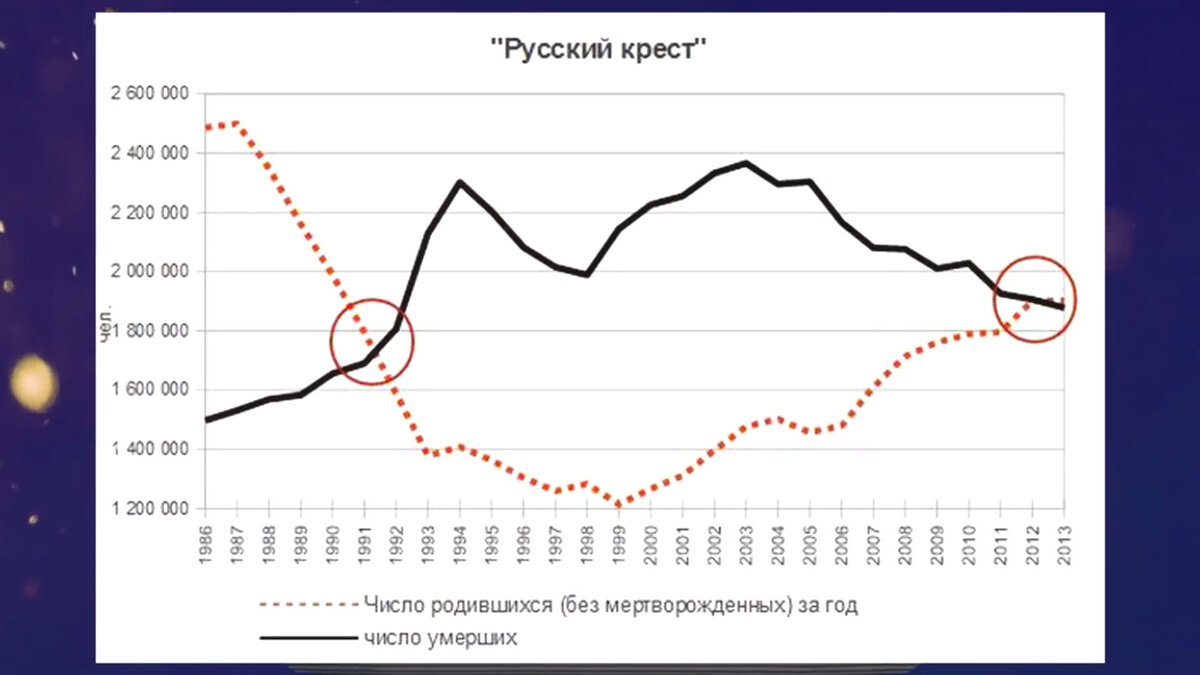
The Russian Armed Forces are over 70% equipped with modern weapons. This information suggests that our army is supposedly made up of Soviet weapons. Adults remember very well what the Russian cross was like when the mortality rate exceeded the birth rate.
The dotted line is the number of births, the line is the number of deaths (Russian cross)
Everyone knows perfectly well when the cross was placed on the cross.
Yes, Russia is currently experiencing a demographic problem again, but this has nothing to do with politics.
Incidentally, Russia has the highest maternity capital in Europe. In 2023, the maternity capital for the birth of a first child will be 589,500 rubles, and for a second child, 779,000 rubles.
By all indicators, crime has been declining during Putin's presidency. Murders, rapes, and robberies—all of these have dropped significantly.
Terrorist attacks have decreased more than fourfold. At least people are now more or less at peace about their children.
Even with military action in August 2023, Russia became the world's fifth-largest economy by gross domestic product (GDP), calculated using purchasing power parity. This follows from the World Bank's ranking.
These are fundamental things. And those who disagree with this take some negative fact, the cause of which lies, for example, in the absence of sovereignty, and exaggerate it for all of Russia, without mentioning the reasons for this fact. Namely, the country's neo-colonialist status for many years.
And here one can ask the manipulators: "What, for example, did Yeltsin and Gorbachev accomplish together before Putin, with the support of the entire West?" So, liberals, come on, tell us about the golden age since 1985. Putin is trying to correct their entire fifteen-year period of activity, the negative results of which are simply unimaginable. And yes, there is overall progress.
I know many will say that Putin's economic achievements are mainly due to the high price of oil. This is partly true. Exactly partly.
First of all, our successes are not limited to economic ones. Secondly, oil and gas revenues currently account for less than 30% of Russia's total budget revenue. In the best years, it was 50%. So, the price of oil isn't factored in everywhere.
And, yes. Why did oil waste become 50% of this budget? That's right. Because Putin cancelled virtually all production-sharing agreements, which had kept our natural resources under the ownership of foreign companies. Because Putin and his entourage essentially nationalized Yukos, and then other oil companies.
And here, I advise anti-Putinists and liberals to listen to the statements of someone from your own camp about whether there was economic growth under Putin.
Andrey Illarionov (economist):
Over the 10 years from 1998 to 2008, the Russian economy doubled in size, GDP per capita doubled, and private consumption per capita more than doubled. By any international benchmark, these are very good indicators. Simply brilliant! This is what economists call an "economic boom," and some journalists, even those with a soft spot for economists, call an "economic miracle."
Let's be honest: this is the best economic period in Russian history. Never before, nor ever since, has the Russian economy grown at such a rate. And never has the well-being of Russian citizens increased at such a rate.
Some might object, saying, "But you yourself say that all the factories and enterprises are offshore, i.e., foreign-owned." Yes, that's true. But physically, they are located in Russia. And if full sovereignty is restored, there will be nationalization and a revision of privatization. So, today is yours, tomorrow is ours."
And here's more data, cited by Russian scientist, philosopher, and political scientist Oleg Matveychev.
Oleg Matveychev:
In fact, over the past 17 years, between 200 and 500 new workshops, factories, and plants have opened in Russia every year.
For example,
in 2012, there were 487 enterprises,
in 2013, 307 enterprises,
in 2014, 357 new factories.
In 2015-2016, the number of factories opening was indeed slightly lower, but still over 200 per year.
Experts have calculated that over the past 17 years, an average of five factories have opened in Russia per week, or one factory every workday.
Some people will probably be skeptical of my words, because we have a "Soviet" understanding of the word "factory." A factory is something enormous, located in the middle of a large city, served by commuter trains and buses, and sometimes stretching for several kilometers. Indeed, in Soviet times, during the industrial era, factories were exactly like this. Nowadays, modern factories are typically located outside the city limits for environmental and convenience reasons. And they employ not hundreds of thousands of people, but literally tens or hundreds. These modern factories are fully automated, but nevertheless, they produce for both the country and the global market.
Next, regarding Putin's personal qualities.
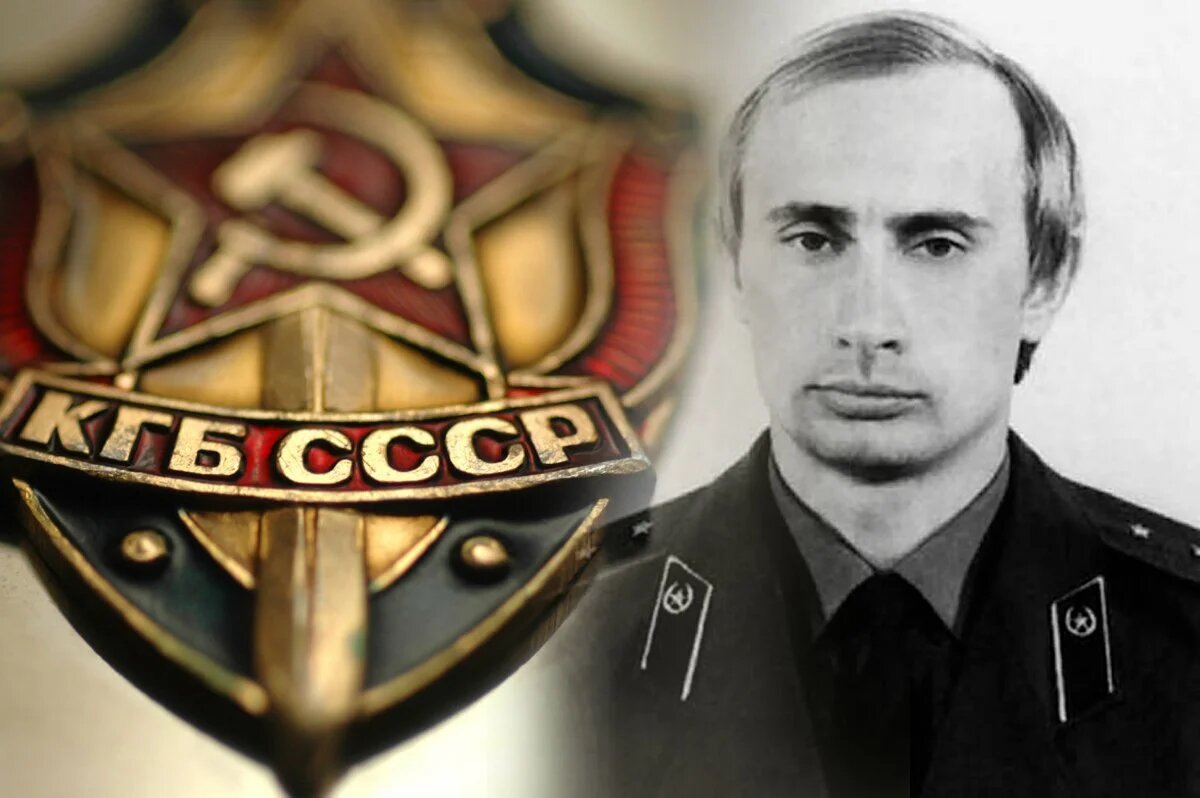
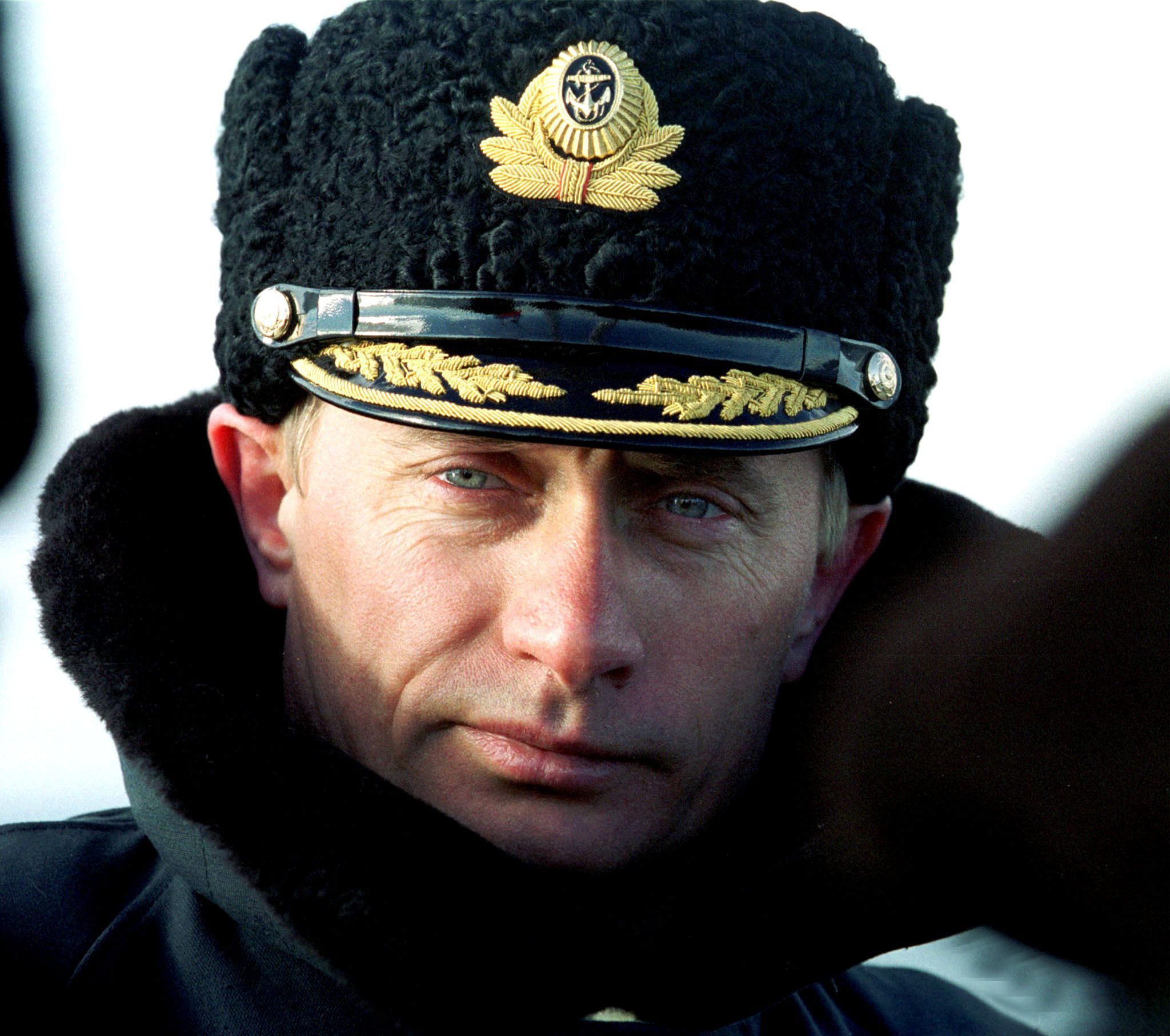
For me personally, I believe Putin is a man for whom you're not just not ashamed, but one who makes you proud—he always carries himself well. This is true even when compared to all the world's politicians; he doesn't exhibit any embarrassing tendencies (like some). He leads a healthy lifestyle, is athletic, educated, literate, and reserved; He's from the common people, a former KGB officer, and his parents were heroes of the Great Patriotic War.
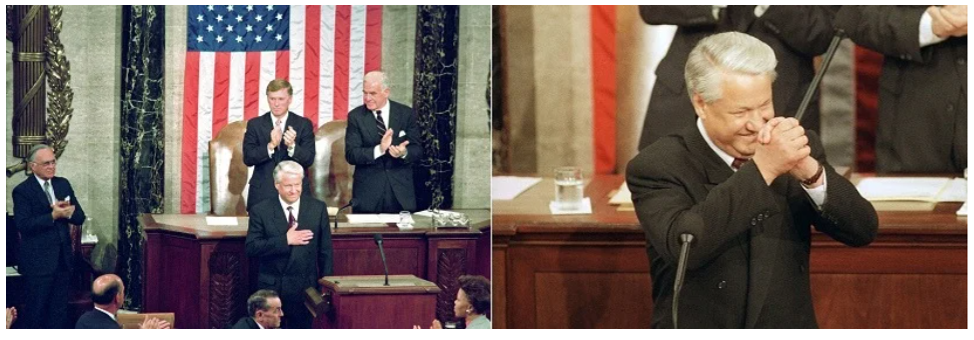
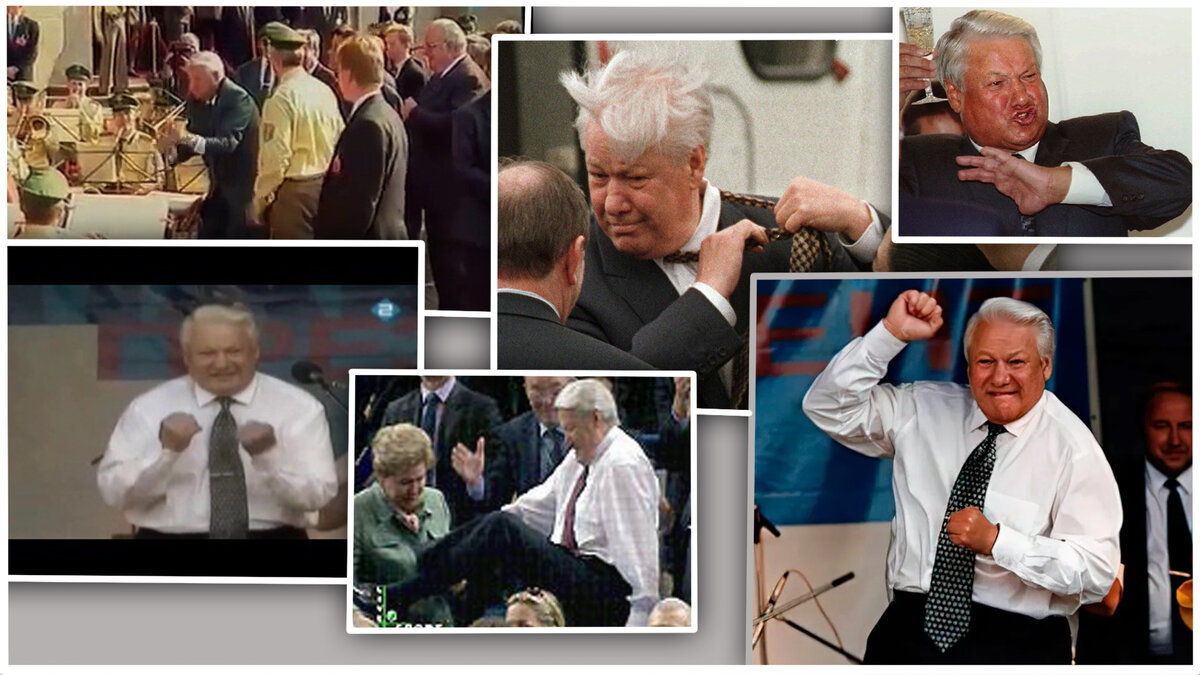
Just compare him to his predecessor, who brought shame on the entire country with his drunken antics. The whole world laughed at our president. The people were ashamed of him.
Looking at Putin's words and actions, you're generally filled with respect for this man. He's also the man who has restored respect for our country.
The main criticism leveled at the President is that Putin is very kind. Despite what pro-Western liberals may say about Putin being an authoritarian tsar, he is actually soft in his political actions. Even the Russian people demand a firm response to the West and America's provocations.
Also, I'd like to conclude with another quote from Stalin: "If our enemies criticize us, it means we're doing everything right." You can decide for yourself: who are Russia's enemies criticizing, and who are they defending and protecting? Do Russia's enemies criticize Putin? Absolutely! And for me, this isn't the most important factor, but it is a key one.
I'll list five of Putin's main actions that have displeased the collective West. From the Munich speech to the LGBT ban.
The question "Why does the West hate Putin?" may seem strange to many. Many reasons can be listed, from various perspectives: from both patriotic and Russophobic ones.
However, it's possible to identify several, so to speak, benchmarks, i.e., starting points, several turning points, after which opinions about Putin changed dramatically. That is, there were some events that, so to speak, Putin was forgiven for because they weren't unacceptable to the West. And there were other actions committed by Putin for which the West never forgave him and began to hate him fiercely.
There were approximately five such large-scale actions, which, naturally, I will list below. But to understand their significance, we need to talk a little about the context in which they were done.
1999, when the Americans learned that Yeltsin wanted to appoint Putin as his successor.
The late 1990s marked the heyday of the American empire, a unipolar world where they could do absolutely anything they wanted, without regard for world public opinion or international law.
1999 was the year of the bombing of Belgrade, the capital of Yugoslavia, a fraternal country to Russia. So to speak, right before our eyes, the Americans humiliated our brothers and destroyed their country. Naturally, in violation of all norms and rules.
Yeltsin, who led Russia, was more like a vegetable then. And the main power was in the hands of the seven bankers – oligarchs controlled by the same United States. Russia no longer had the international prestige it once had. It's painful to admit, but the once-powerful country begged for handouts, even for food, and was regularly humiliated and had its interests undermined.
Nevertheless, Yeltsin, even in his illness, was a very proud man who didn't easily accept humiliation.
And perhaps that's why he chose to replace himself not with a pro-Western liberal, like Nemtsov, willing to continue to bow his back to the American master, but with someone capable of restoring at least some respect to the country.
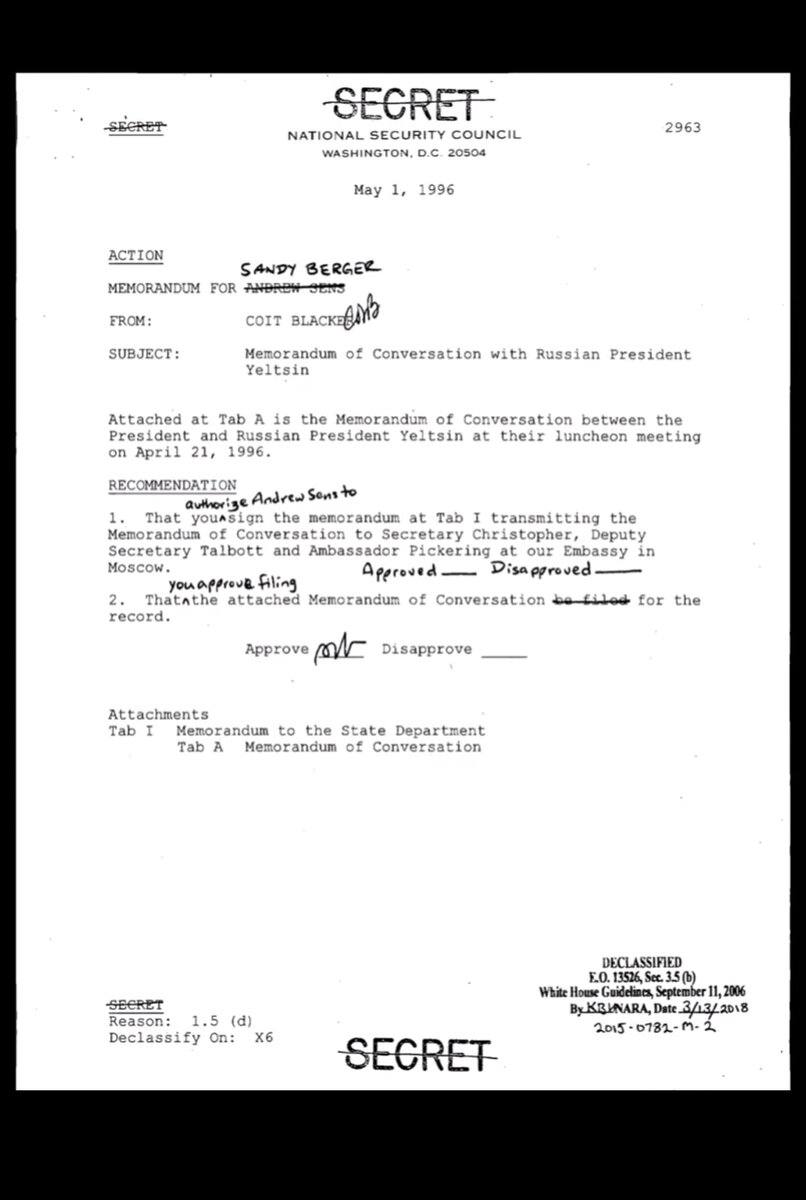
This is, of course, an assumption that can neither be proven nor disproved. But it still exists. Putin was appointed despite the opinion of the United States (as evidenced by declassified conversations between US President Bill Clinton and Yeltsin).
Yeltsin assured Clinton back then that Putin was a good man, a democrat, that he knew the West, and so on. Basically, he was trying to persuade Clinton to accept Putin. Which the West did, hoping for complete subordination to the Western system.
But, as we know, something went wrong.
And here's what:
The United States entrusted Putin with the role of an obedient errand boy who would strengthen American power in Russia and facilitate the export of natural resources.
At that time, no one knew anything about Putin. The famous question "Who is Mr. Putin?" was posed at the Davos Forum in 2000. Journalists posed this question to Chubais. For some reason, Chubais couldn't answer right away, and the whole room laughed.
By the way, today at the Davos Forum there's no laughing matter, and they wake up and go to sleep with Putin's name. Such an irony of fate.
It became clear almost immediately that Putin had ambitions.
For example, in 2000, that is, right off the bat, he attempted to rein in the Central Bank.
Here's a news story from October 11, 2000:
"Passions have long been raging around the new law on the Central Bank. But until recently, the president hadn't intervened. At the end of September, Vladimir Putin introduced his amendments—incidentally, a month and a half after the official deadline for their submission had expired; the Duma Banking Committee had to extend it specifically, otherwise they couldn't have been legalized. The purpose of the presidential amendments is to nationalize the Central Bank."
We won't go into the Central Bank issue now, but it's clear that Putin was either testing the waters or seriously attempting to subjugate the monetary authorities. Naturally, this didn't work. Why that was is another matter entirely.
But the fact is that the Western establishment disliked Putin from the very beginning. Since 2000, Western newspapers have been indoctrinating their populations with the idea that Putin is "an authoritarian wolf in sheep's clothing, General Pinochet with a human face."
Basically, the Western press will call anyone this way who doesn't voluntarily lick the boots of their elite and enrich themselves.
⏩ This is the first reason for the hatred of Putin. Because he prioritized Russia over the interests of American oligarchs, he turned out to be a patriot.
True patriots in various countries pose a real, mortal threat to the unipolar American world.
From the American perspective, they are separatists.
Then you're struck by Putin's cunning: he didn't start delivering anti-Western speeches like a revolutionary or openly attacking the US and Europe. On the contrary, he positioned himself as a friend of the so-called developed countries. He spoke of friendship and peace.
Vladimir Putin (2000, interview on the BBC program "Breakfast with Frost"):
Russia is part of European culture. And I can't imagine my own country separated from Europe and from what we often call the so-called civilized world.
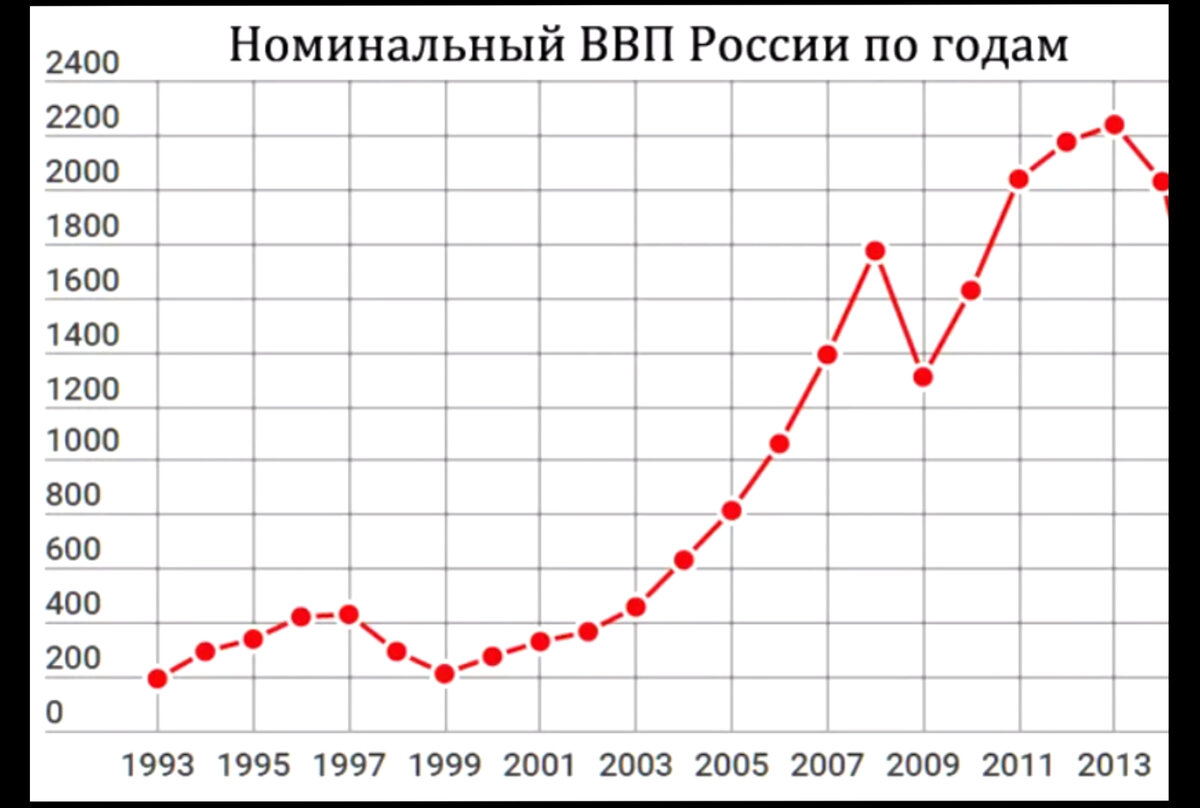
But while lulling people into a stupor with these speeches, he continued his policy of saving Russia, as is clearly evident from the graph.
Russia's nominal GDP by year
Some time passes, Russia gains some weight, Putin gains authority (by this point, everyone knows Mr. Putin), and our president makes attempts to transcend national boundaries and discuss global order. Specifically, to point out the pernicious nature of a unipolar world.
This is Putin's famous Munich speech in 2007.
Vladimir Putin (Munich, 2007):
I believe that for the modern world, a unipolar model is not only unacceptable, but also completely impossible. And not only because, with sole leadership in the modern—and specifically modern—world, there will be insufficient military-political and economic resources. But more importantly, the model itself is unworkable, since it lacks, and cannot have, the moral foundation of modern civilization.
Putin's speech at the Munich Conference on Security Policy
And yet, Putin framed his speech very cleverly. He didn't say this as, so to speak, an enemy of a unipolar world. He said it in the context of saying that we are one whole and this world order is destructive for everyone. It's not like I'm asking for myself—I'm worried about you, my dears, you'll die. And it has nothing to do with me.
And basically, he's right. Western hegemony will fade, but they'll be hated for a very long time.
Besides, this was 2007. Putin had one year left in his presidency. According to the Constitution, he couldn't run for another term. And at that moment, seemingly concluding his presidential career, he went all-out—he began telling the whole world the truth.
⏩ And this was another turning point, after which the West began talking about a new Cold War, about Russia's aggression, its ambitions, and so on.
After saying this, Putin retreated into the shadows and began to observe how his opponents would react.
I'll repeat: the main confrontation between Russia and the West, or other countries and the collective West, is that the West wants to plunder, while other countries resist.
Because of diplomacy, this is rarely discussed openly, but the essence is this: we are only to blame for the fact that someone wants to eat. That's all.
This core essence is veiled by various tales about democracy, individual freedom, media, and other liberal values.
And speaking of Putin's speech, its essence is that he says: "Stop robbing and humiliating other countries, including us. It's destructive. And destructive even for you."
Then, as we know, Dmitry Medvedev becomes president. The Americans liked him because he was a relatively weak leader.
But by 2012, Medvedev's presidential term was coming to an end, and Putin, again according to the Constitution, could run for two terms.
And look at the situation among the US and European elites: they have a strong leader – Putin, who is productive, intelligent, and cunning, who is pulling Russia out of slavery, thereby depriving the West of vast sums of money.
And on top of that, before leaving office, after his Munich speech in 2007, he essentially created a global national liberation movement.
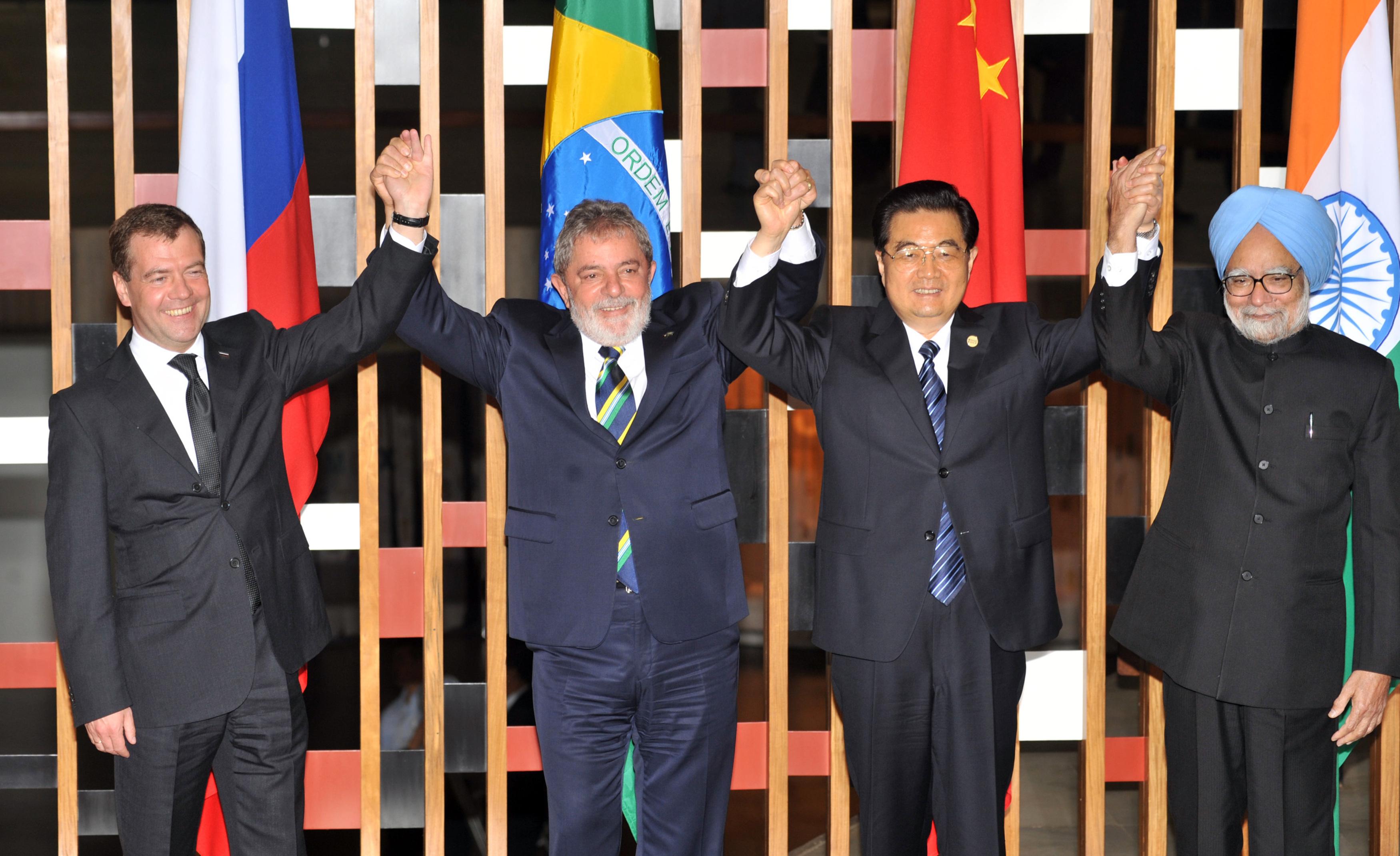
And even created a kind of alliance called BRICS.
The first BRIC summit. June 16, 2009, Yekaterinburg. Participants in the meeting of the BRIC heads of state
So, preventing Putin from running in the 2012 elections was the West's top priority. After all, they already knew what kind of "beast" he was. For them, Putin truly was a wolf in sheep's clothing.
And again, I repeat: for the West, anyone who demands equal rights is a wolf in sheep's clothing.
So, the West lives at the expense of other countries. And other countries should only be colonies or vassals.
The West's dire expectations came true: Putin announced that he would run for president again.
⏩ And this decision was another turning point in the relationship between the collective West and our president.
⚠️ Remember what happened then? Mass rallies took place that almost led to a coup d'état. They were called the "Bolotnaya Revolution," the "Snow Revolution," the "White Ribbon Revolution," and so on. These so-called protests lasted from 2011 to 2013.
Back then, the American embassy in Moscow served as a sort of headquarters where various opposition groups received instructions on what to do and how to proceed.
There were communists there, as well as "A Just Russia," whose leader, Sergei Mironov, even ran around the State Duma with a white ribbon on his chest—the symbol of this very same color revolution.
Then the Americans essentially united the entire opposition, and hundreds of thousands of people took to the streets across the country. And these weren't just rallies. At the same time, tens of thousands of people staged various marches, pickets, protests, and so on.
Around the same time, Alexei Navalny began to gain popularity.
American companies, without hiding it—I repeat, WITHOUT HIDING IT—funded their activities and paid for all the media.
Central television initially resisted somewhat, not covering the events in Moscow, but after news anchor Pivovarov refused to broadcast on NTV without covering the protests, a story about the protests aired on NTV and other federal channels.
Back then, almost everything was on the Americans' side.
This can be compared to the Maidan in Ukraine. Basically, it was the same process.
One can only guess how Putin miraculously won back then. But he became president again. And then, in 2012, the West changed its goal regarding Russia.
If before 2012, our country was perceived as a colony worth simply plundering, then afterward, they began making plans to eliminate it as a threat to the American empire.
On the one hand, more and more money is being poured into the opposition, on the other, an "anti-Russia" project is being created, which will actively begin its work in 2014.
Then, in 2012, everything became completely clear to everyone: a huge confrontation was coming. Putin was beginning to squeeze American influence out of Russia ever more tightly (as much as possible), banning LGBT propaganda—and this was a very serious matter for Americans!
⏩Here, one could say, another turning point—the struggle of ideologies.
Also in 2012, the president gave the order to organize patriotic movements to counter the liberal ones. And so the struggle began.
⏩The next turning point, of course, was Crimea.
Incidentally, many believe that the Americans themselves forced the annexation of the peninsula to Russia so that the confrontation with Russia could be taken to a new level: imposing sanctions and waging a more aggressive information war.
After all, there had never been such a large-scale pretext for this before.
And then, as a logical continuation—2022.
And look. Essentially, it's all interconnected. Of course, we can argue about who's right and who's wrong. Let's say Gorbachev, Yeltsin, and those who organized the Maidan are all to blame.
But I'd like to define all of this, so to speak, more globally. And I've already mentioned this.
We're only to blame for all of this because the collective Western elite wants to eat.
But they have to cut back on their rations because Russia is getting stronger. And they don't want to cut back, so those in power abroad are trying to punish Russia. And they're resorting to any means necessary.
But if they couldn't do it 12 years ago, they certainly won't succeed now. And, by the way, this is simply a fact that must be acknowledged in order to build a new world order without bloodshed. Which, again, Putin has repeatedly proposed.
If it weren't for Putin, the country would have fallen apart and ceased to exist.
Putin told how he purged CIA employees from the government!
In the mid-1990s, as advisers, official employees of the government of the Russian Federation, there were, as it turned out later, cadres of the Central Intelligence Agency (CIA) of the United States, said Russian President Vladimir Putin.
"Look at this – the mid-1990s – early 2000s. In the early 2000s, I had already cleaned out everyone there, but in the mid-1990s, as advisers, official employees of the government of the Russian Federation, we had, as it turned out later, staff members of the Central Intelligence Agency of the United States," RIA Novosti quoted Putin as saying at a meeting of the Council for the Development of Civil Society and Human Rights. human Rights (HRC)."They were later criminalized in the United States for violating American law and participating in privatization," the president stressed. According to him, "this is just one example" of attempts to interfere in Russia's affairs. "In fact, there are many more of them," Putin pointed out.
According to him, "everything along this line was under the known control of certain countries." "American specialists were sitting at our nuclear weapons complex facilities, they came to work there every day from morning to evening – there was a table and an American flag. They lived and worked there. They didn't need such subtle instruments of interference in our political life, as they already controlled everything," the head of state is convinced.
He stressed that, "of course, the situation has changed, the country has become different, it has become more independent, more sovereign, the capabilities of the armed forces are growing, and attitudes towards Russia have begun to change."
Putin called for remembering "how the attitude towards the first president of Russia, Boris Nikolaevich [Yeltsin], developed." "Everything was fine, everyone was happy to pat him on the shoulder.All he had to do was raise his voice in defense of Yugoslavia and illegal actions – and you and I understand that these are absolutely illegal actions that violate international law in relation to Yugoslavia, when bombing takes place without any authorization from the UN Security Council, this is a gross violation of international law – it only took Boris Nikolaevich Yeltsin to defend international law and the rights of peoples Despite the fact that they were treated in a civilized manner, immediately the attitude towards Russia changed, and towards him personally," Putin stated.
"Therefore, as soon as Russia began to declare its interests, that it had them, and began to increase its sovereignty, economy, and the capabilities of the armed forces, other instruments of influence on our domestic political life were needed, including rather subtle instruments through various organizations that receive funding from abroad." – the Russian leader is convinced.In his opinion, "nothing new has been invented here. Such a law has been in force in the United States since 1938 or 1937, and it is still being applied <...>, including in relation to our organizations.", – Putin noticed.The head of state categorically disagreed with Reznik, who noted that "Russia has become hostile to the whole world." "It's not like that! Russia did not become hostile to any part of the world at all. A certain part of the world considers us its opponents," Putin said.
"Have we written in our institutional documents of a strategic nature that we declare someone an enemy? No! They're announcing us!" the Russian leader explained.Earlier, Russian President Vladimir Putin, at a meeting with the Council for the Development of Civil Society and Human Rights (HRC), commenting on the speech of director Alexander Sokurov, said that Russia is a multinational and multi-religious country, and not Muscovy, which NATO would like to make it.
To understand what we are talking about, read the entire article from the very beginning!
Topics related to Vladimir Putin (Putin's politics):
50) 🤝❓💥(The Russian view) Why did Russia and the USSR try to join NATO 4 times? The Russian view. Why did Stalin and Putin need it?
https://projectavalon.net/forum4/sho...=1#post1672625
44) 💥(History, Policy) The story of how Russia became an "aggressor". The history of relations between Russia and the West.
https://projectavalon.net/forum4/sho...=1#post1672075
44.2 💥⚔️About the Chechen war
https://projectavalon.net/forum4/sho...=1#post1672127
44.2 💥I want to answer about Crimea. Whose Crimea?
https://projectavalon.net/forum4/sho...=1#post1672115
44.1 💥Read NATO verbally assured the USSR that it would not expand to the east.
https://projectavalon.net/forum4/sho...=1#post1672076
1989: an interesting historical fact from the life of KGB lieutenant colonel Vladimir Putin
https://projectavalon.net/forum4/sho...=1#post1672303
47) 💼The Political Voice of the Russian Bear
https://projectavalon.net/forum4/sho...=1#post1663607
- Home
- Forum
- Chat
- Donate
-
Site Links

-
Avalon Library
-
External Sites
- Solari Report | Catherine Austin Fitts
- The Wall Will Fall | Vanessa Beeley
- Unsafe Space | Keri Smith
- Giza Death Star | Joseph P. Farrell
- The Last American Vagabond
- Caitlin Johnstone
- John Pilger
- Voltaire Network
- Suspicious Observers
- Peak Prosperity | Chris Martenson
- Dark Journalist
- The Black Vault
- Global Research | Michael Chossudovsky
- Corbett Report
- Infowars
- Natural News
- Ice Age Farmer
- Dr. Joseph Mercola
- Childrens Health Defense
- Geoengineering Watch | Dane Wigington
- Truthstream Media
- Unlimited Hangout | Whitney Webb
- Wikileaks index
- Vaccine Impact
- Eva Bartlett (In Gaza blog)
- Scott Ritter
- Redacted (Natalie & Clayton Morris)
- Judging Freedom (Andrew Napolitano)
- Alexander Mercouris
- The Duran
- Simplicius The Thinker
 Reply With Quote

Bookmarks