


 Medical Assistance In Dying - The Canadian MAID Program
When euthanasia became legal in some countries, I thought it was wrong on every level, but over time, I began to see the wisdom in assisted suicide. But now that those thoughts have matured, I am no longer convinced it is a good thing. Dr Aron Kheriaty best describes the problem.
Canada Sets New World Record For Euthanasia - MAIDDr. Aaron Kheriaty, a psychiatrist and director at the Ethics and Public Policy Center, cautions that once society accepts the premise that doctors can kill patients, it becomes extremely difficult to impose meaningful limits on such practices, highlighting the "slippery slope" argument as increasingly relevant in Canada's expanding Medical Assistance in Dying (MAiD) program. He notes that the logic of the euthanasia movement—based on autonomy or suffering—can be invoked for an ever-widening range of conditions, including mental illness and non-terminal disabilities, making it hard to draw ethical boundaries after the initial threshold is crossed.
This is information that I pulled from AI. I have checked the dates, numbers and basic facts with a second source, and it all appears to hold up.
Canada's euthanasia program, officially known as Medical Assistance in Dying (MAiD), was legalized in June 2016 for individuals whose death was reasonably foreseeable. Initially, eligibility required a serious and incurable physical illness causing intolerable suffering. However, the law was significantly expanded in March 2021 through Bill C-7, which removed the requirement for death to be reasonably foreseeable and extended access to those with a "grievous and irremediable" condition, including people with disabilities alone.
Under current law, two types of MAiD are permitted: a physician or nurse practitioner may directly administer a lethal substance, or they may prescribe it for self-administration. To qualify, applicants must be at least 18 years old, eligible for government-funded health services, have decision-making capacity, and provide informed consent after being informed of alternatives such as palliative care. They must also experience unbearable physical or mental suffering from an illness, disease, disability, or state of decline that cannot be relieved under conditions they find acceptable.
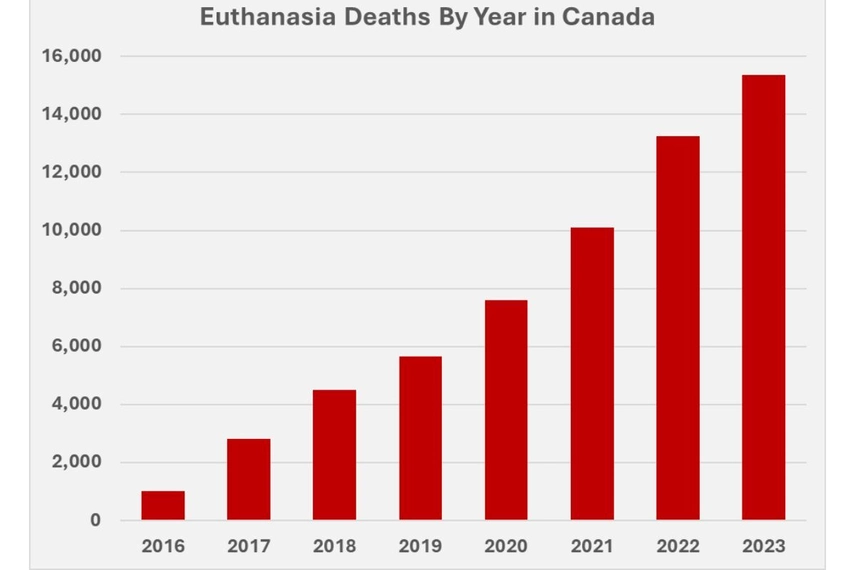
The program has seen rapid growth since its inception. In 2017, 2,838 people died via MAiD; by 2024, that number had risen to 16,499, accounting for one in twenty deaths in Canada. This expansion has made Canada one of the most permissive jurisdictions globally regarding assisted dying, comparable only to the Netherlands and Belgium. By 2022, MAiD had become the fourth leading cause of death in the country, having grown thirteenfold since 2016.
A controversial aspect of the program is the planned inclusion of individuals whose sole underlying condition is mental illness. Originally scheduled for March 2023, this expansion has been delayed and is now set for 2027 due to concerns about safeguards and ethical implications. The delay is currently being challenged in court, and the issue remains highly contentious, drawing criticism from UN human rights experts and disability rights groups who warn of potential coercion and devaluation of vulnerable lives.
Critics argue that in the context of austerity, housing crises, and rising inequality, some individuals may feel pressured to choose MAiD due to lack of adequate social or medical support rather than a genuine desire to die. As of early 2025, income inequality in Canada reached a record high, with the top 20% holding nearly two-thirds of the wealth, while 45% of Canadians reported difficulty meeting daily expenses.
While federal law does not compel healthcare providers to participate in MAiD, some provinces require objecting practitioners to make an effective referral to another provider. Safeguards include assessments by two independent medical professionals, a written and witnessed request, and the option to withdraw consent at any time. For those whose death is reasonably foreseeable, a waiver of final consent—known as Audrey’s Amendment—allows MAiD to proceed even if the person loses capacity before the procedure.
Additional articles and some food for thought:
- Canada's Euthanasia Machine Overloaded as Demands for Death Skyrockets
- Canada Moves Forward To Euthanize 12 Year Old Children
- Canada is Euthanizing its Poor and Disabled
- The Profitable Business of Euthanasia Gives Food For Thought - Canada
- Canada's Dark Path: Hundreds of Unreported Abuses of Euthanasia Laws
- Canada is turning the euthanasia program into a source of donor organs: Euthanasia has become a business in Canada
- Health Care Workers Grappling With Patients Request To Die
- Is Death in Canada an Escape from Suffering
- I Could Live 30 Years But Plan To Die
- Canada Has Arguably the Most Permissive System of Euthanasia
- Home
- Forum
- Chat
- Donate
-
Site Links

-
Avalon Library
-
External Sites
- Solari Report | Catherine Austin Fitts
- The Wall Will Fall | Vanessa Beeley
- Unsafe Space | Keri Smith
- Giza Death Star | Joseph P. Farrell
- The Last American Vagabond
- Caitlin Johnstone
- John Pilger
- Voltaire Network
- Suspicious Observers
- Peak Prosperity | Chris Martenson
- Dark Journalist
- The Black Vault
- Global Research | Michael Chossudovsky
- Corbett Report
- Infowars
- Natural News
- Ice Age Farmer
- Dr. Joseph Mercola
- Childrens Health Defense
- Geoengineering Watch | Dane Wigington
- Truthstream Media
- Unlimited Hangout | Whitney Webb
- Wikileaks index
- Vaccine Impact
- Eva Bartlett (In Gaza blog)
- Scott Ritter
- Redacted (Natalie & Clayton Morris)
- Judging Freedom (Andrew Napolitano)
- Alexander Mercouris
- The Duran
- Simplicius The Thinker
 Reply With Quote


 I think there will be a time though, when I get older, that I will be ready to die. And I hope when that time comes it will be relatively painless


Bookmarks