


 The Tiny People Phenomenon, Witnessed by Hundreds Every Year
I believe that mushrooms represent an untapped, natural resource that has the potential to heal our bodies and expand our consciousness when used correctly. I am curious what others think and any experiences they may have had.
Doctors treat hundreds of patients annually who report seeing pint-sized, 2 cm tall "little people", described as marching under doors, crawling on walls, or clinging to furniture after eating a mushroom dubbed lillputian. It is so consistent that 96% of affected people report the same experience.
'They saw them on their dishes when eating': The mushroom making people hallucinate dozens of tiny humans
Only recently described by science, the mysterious mushrooms are found in different parts of the world, but they give people the same exact visions.
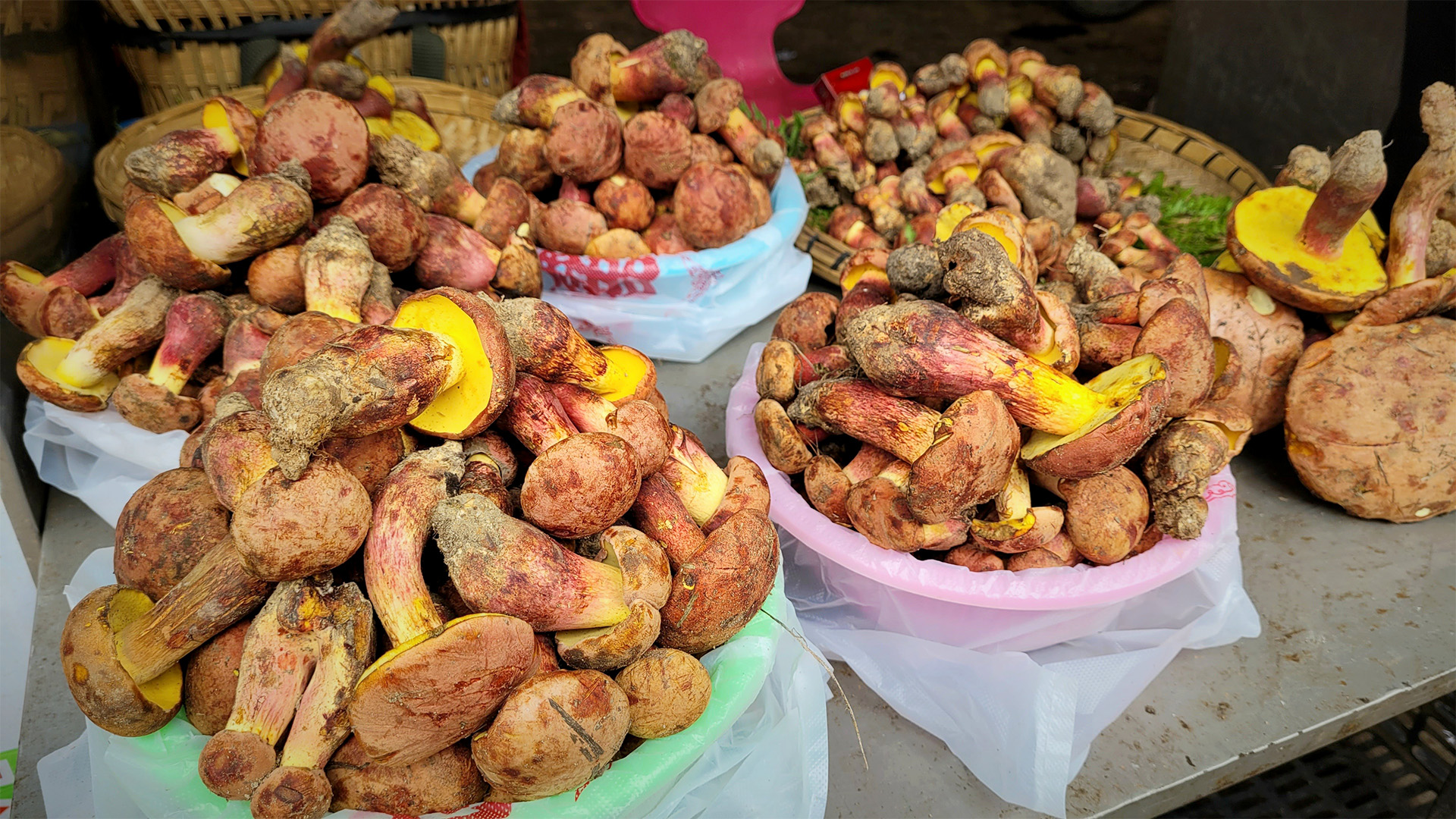
Every year, doctors at a hospital in the Yunnan Province of China brace themselves for an influx of people with an unusual complaint. The patients come with a strikingly odd symptom: visions of pint-sized, elf-like figures – marching under doors, crawling up walls and clinging to furniture.
The hospital treats hundreds of these cases every year. All share a common culprit: Lanmaoa asiatica, a type of mushroom that forms symbiotic relationships with pine trees in nearby forests and is a locally popular food, known for its savory, umami-packed flavor. In Yunnan, L. asiatica is sold in markets, it appears on restaurant menus and is served at home during peak mushroom season between June and August.
One must be careful to cook it thoroughly, though, otherwise the hallucinations will set in.
"At a mushroom hot pot restaurant there, the server set a timer for 15 minutes and warned us, 'Don't eat it until the timer goes off or you might see little people,'" says Colin Domnauer, a doctoral candidate in biology at the University of Utah and the Natural History Museum of Utah, who is studying L. asiatica. "It seems like very common knowledge in the culture there."
But outside of Yunnan and a couple of other places, the strange mushroom is largely an enigma.
"There were many accounts about the existence of this psychedelic [mushroom], and many people who looked for it, but they never found the species," says Giuliana Furci, a mycologist and the founder and executive director of the Fungi Foundation, a non-profit group dedicated to discovering, documenting and conserving fungi.
Domnauer is on a quest to solve the decades-old mysteries about this fungi species and identify the unknown compound responsible for its unusually similar hallucinations – as well as what it can potentially teach us about the human brain.
Domnauer first heard of L. asiatica as an undergraduate from his mycology professor.
"It sounded so bizarre that there could be a mushroom out there causing fairytale-like visions reported across cultures and time," Domnauer says. "I was perplexed and driven by curiosity to find out more."
The academic literature provided a few breadcrumbs. In a 1991 paper, two researchers from the Chinese Academy of Sciences described cases of people in Yunnan Province who had eaten a certain mushroom and experienced "lilliputian hallucinations" – the psychiatric term for the perception of tiny human, animal or fantasy figures. It is so named after the small people who inhabit the fictional Lilliput Island in the novel Gulliver's Travels.
The patients saw these figures "moving about everywhere", the researchers wrote – usually, there were more than ten tiny beings on the scene. "They saw them on their clothes when they were dressing and saw them on their dishes when eating," the researchers added. The visions "were even more vivid when their eyes were closed".
Already in the 1960s, Gordon Wasson and Roger Heim – the American author and French botanist who brought the existence of psilocybin mushrooms to the attention of Western audiences – came across something similar in Papua New Guinea. They were searching for a mushroom that a team of missionaries who visited 30 years earlier had said caused the locals to go "insane", a condition that an anthropologist later dubbed "mushroom madness".
Unbeknownst to them, what they encountered actually sounds strikingly similar to the current reports from China. They collected specimens of the suspected species and sent them to Albert Hofmann, the Swiss chemist who discovered LSD, for testing. But Hofmann failed to identify any molecules of interest. The team concluded that the stories they heard from the field must have been cultural tales rather than having any pharmacological basis, and no further research was done.
It was not until 2015 that researchers finally formally described and named L. asiatica, still without much detail about its psychoactive properties.
o Domnauer's first goal has been to pin down the species' true identity. In 2023, he travelled to Yunnan during the peak summertime mushroom season. He surveyed the province's sprawling fungi markets and asked sellers which of their mushrooms "makes you see little people". He purchased the ones that the giggling vendors pointed to, then brought the specimens back to the laboratory to sequence their genomes.It's NOT psilocybin that's giving the L. asiatica mushrooms their lilliputian effect
This confirmed L. asiatica's identity, he says. In research he is preparing for publication, chemical extracts from lab specimens produced behavioural changes in mice similar to those reported in human. After being administered the mushroom extracts, the mice experienced a period of hyperactivity followed by a long stupor where the rodents did not move much.
Domnauer also visited the Philippines, where he had heard rumors of a mushroom causing similar symptoms as those from the historical records from China and Papua New Guinea. The specimens he collected there looked slightly different from the Chinese ones – they were smaller and light pink compared to the larger, redder Chinese mushrooms, he says. But his genetic testing revealed that they were indeed the same species.
In December 2025, Domnauer's supervisor also visited Papua New Guinea to search for the mushrooms from the Wasson and Heim records, whose identity, Domnauer says, "is still a big question mark". They failed to find any, however, so the mystery still stands.
"It could be the same species, which would be surprising because Papua New Guinea typically doesn't share species found in China and the Philippines," says Domnauer. Or it could be a different species, which would be even "more interesting from an evolutionary perspective", Domnauer says. This would mean the same lilliputian effects have evolved independently in different mushroom species in completely different parts of the world.
There is precedent for this happening in nature. Scientists, including some working in the same laboratory as Domnauer, recently discovered that psilocybin, the psychedelic molecule found in magic mushrooms, independently evolved in two distantly-related types of mushrooms.
But it's not psilocybin that's giving the L. asiatica mushrooms their lilliputian effect, says Domnauer.
Read the full story on BBC: https://www.bbc.com/future/article/2...ee-tiny-people
- Home
- Forum
- Chat
- Donate
-
Site Links

-
Avalon Library
-
External Sites
- Solari Report | Catherine Austin Fitts
- The Wall Will Fall | Vanessa Beeley
- Unsafe Space | Keri Smith
- Giza Death Star | Joseph P. Farrell
- The Last American Vagabond
- Caitlin Johnstone
- John Pilger
- Voltaire Network
- Suspicious Observers
- Peak Prosperity | Chris Martenson
- Dark Journalist
- The Black Vault
- Global Research | Michael Chossudovsky
- Corbett Report
- Infowars
- Natural News
- Ice Age Farmer
- Dr. Joseph Mercola
- Childrens Health Defense
- Geoengineering Watch | Dane Wigington
- Truthstream Media
- Unlimited Hangout | Whitney Webb
- Wikileaks index
- Vaccine Impact
- Eva Bartlett (In Gaza blog)
- Scott Ritter
- Redacted (Natalie & Clayton Morris)
- Judging Freedom (Andrew Napolitano)
- Alexander Mercouris
- The Duran
- Simplicius The Thinker

 Reply With Quote


Bookmarks