 Posted by Bluegreen
(here)
Posted by Bluegreen
(here)
 Webb Captures Striking Edge-On Views of Two Planet Nurseries
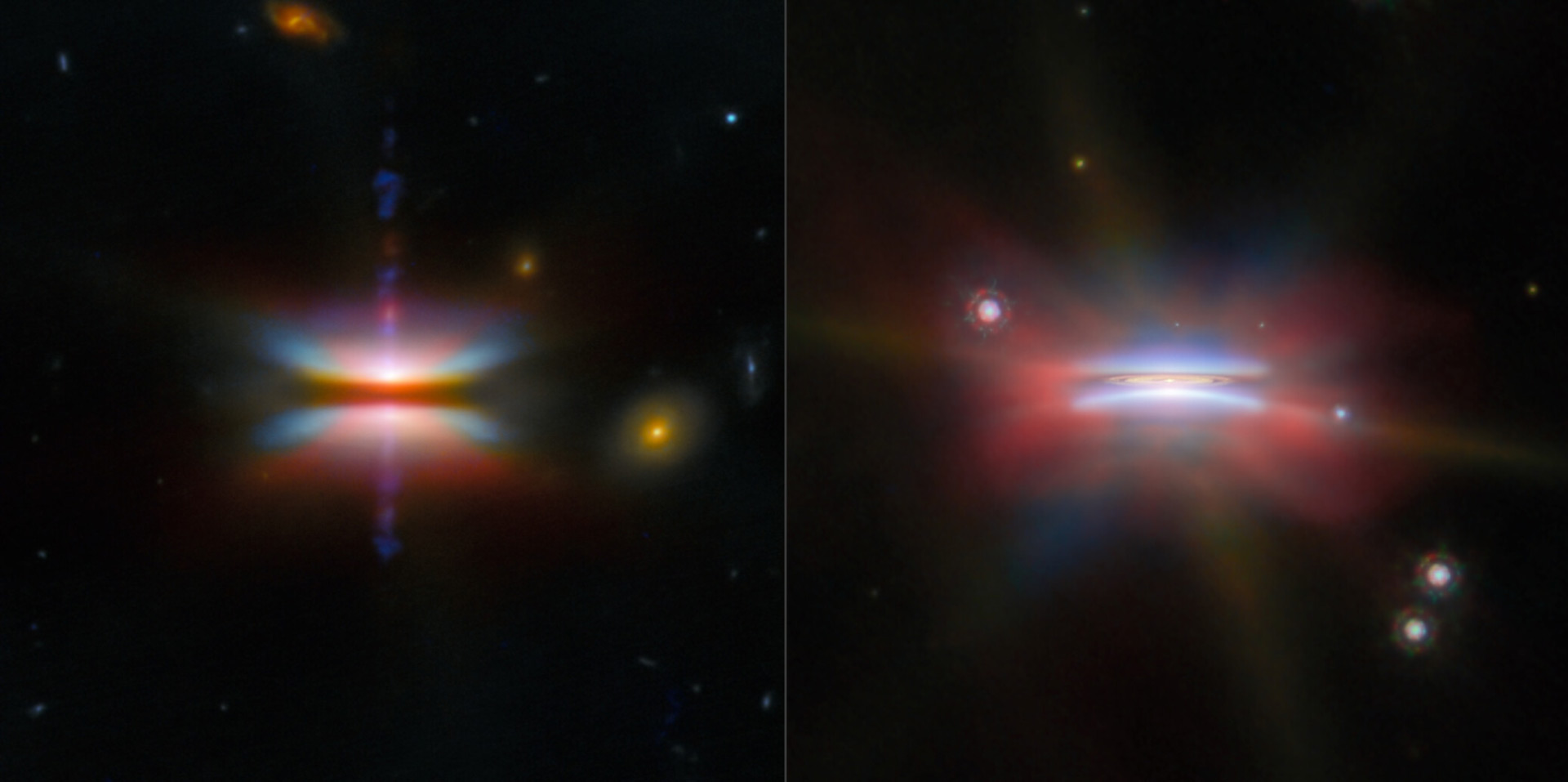 New images from the NASA/ESA/CSA James Webb Space Telescope reveal two young stars surrounded by planet-forming disks, Tau 042021 (left) and Oph 163131 (right), offering a rare edge-on glimpse into how worlds like our own may take shape.
____
“Protoplanetary disks appear around stars that have recently been born,” the Webb astronomers said in a statement. “When a clump of gas inside a larger molecular cloud collapses to form a star, unused gas and dust is left orbiting the star in a thick disk.”
"Over time, this dust too collides and collapses, slowly forming planetesimals which can, in turn, develop into planets. The planetesimals which can’t make the jump to being a fully-fledged planet are left behind as asteroids and comets orbiting the star.
Gas that isn’t consumed by this process is blown away by the new star’s radiation over the course of tens of millions of years, ending the protoplanetary disk.
This is how our own Solar System formed in the distant past, creating the asteroids, comets, gas giants and terrestrial planets we know today.”
Published 8th April 2026 by Enrico de Lazaro - SciNews.com
https://www.sci.news/astronomy/webb-...ies-14683.html


 Re: Up At The Ranch And Beyond


 Reply With Quote


 UFOmania











 Saturday Morning Cartoons


Bookmarks