+ Reply to Thread
Page 19 of 19 FirstFirst 1 9 19
Results 361 to 373 of 373

Thread: Vintage film, TV, documents, and photographic footage from down the years

  1. Link to Post #361
    Scotland Avalon Member Ewan's Avatar
    Join Date
    24th February 2015
    Location
    Ireland
    Age
    66
    Posts
    2,786
    Thanks
    85,343
    Thanked 22,496 times in 2,741 posts

    Default Re: Vintage film, TV, documents, and photographic footage from down the years

    I'd predict this would be too long for most folks interest to see them through, but.....


    Quote 1,359,596 views 1 Jul 2025 #WaterWheel #EarthScience #Craftsmanship
    In this "Earth Uncovered" full immersion documentary, watch the oak log from previous episode transformed into a water wheel axle. See mill experts hew it into an octagonal beam, shape it into a precise cylindrical shaft on the pivot bearing, and fit iron pins with glowing rings. Perfect for history buffs—subscribe for more every few days!

    Original source material: Sabershausen / Hunsrück 1964. Gabriel Simons, Das LVR-Institut für Landeskunde und Regionalgeschichte. CC 4.0.
    Die Dorfmühle 2 - Drehen einer Mühlenwelle
    / @alltagskulturenimrheinland

  2. The Following 12 Users Say Thank You to Ewan For This Post:

    Alecs (6th March 2026), Bill Ryan (7th March 2026), Brigantia (6th March 2026), Chip (10th March 2026), grapevine (6th March 2026), Harmony (7th March 2026), mountain_jim (9th March 2026), rgray222 (7th May 2026), Satori (9th May 2026), skogvokter (9th March 2026), Tintin (8th March 2026), Yoda (6th March 2026)

  3. Link to Post #362
    UK Moderator/Librarian/Administrator Tintin's Avatar
    Join Date
    3rd June 2017
    Location
    Project Avalon library
    Language
    English
    Age
    56
    Posts
    8,143
    Thanks
    89,826
    Thanked 70,621 times in 8,110 posts

    Default Re: Vintage film, TV, documents, and photographic footage from down the years

    16th Century Manuscript which includes Galileo's Handwriting
    Shared by a church deacon Daniel Silliman on X. Here's the Smithsonian article published February, 27th
    A Scholar Recognized the Inscriptions in the Margins of This Manuscript. The Scribbles Turned Out to Be Galileo’s Handwritten Notes

    Found in a 16th-century copy of an ancient astronomy treatise, the annotations suggest that the trailblazing scientist studied Earth-centric models before lending his support to heliocentrism

    Christian Thorsberg - Correspondent
    February 27, 2026
    Link: https://www.smithsonianmag.com/smart...tes-180988269/


    Galileo's handwritten notes in a 1551 copy of Ptolemy's Almagest: National Central Library of Florence
    Notes, annotations and a Bible verse handwritten by a young Galileo Galilei around 1590 have resurfaced in a copy of the ancient world’s most influential astronomy text. Experts say the discovery could reshape the public’s understanding of Galileo’s motivations and the beliefs that led to his world-changing scientific contributions.

    Historian Ivan Malara spotted the inscriptions in January while leafing through a 1551 copy of the Almagest at Italy’s National Central Library of Florence. Malara realized that a loose page in the text—a second-century C.E. astronomical manual by the Greco-Roman polymath Ptolemy, which asserts that Earth is at the center of the universe—contained a transcription of Psalm 145. The handwriting was reminiscent of Galileo’s, an astronomer often lionized as the “father of modern science.” Additional annotations in the book’s margins similarly matched Galileo’s hand.

    “Archival research does not always repay the efforts of those who undertake it; more often, it results in patient waiting, silences, false trails,” writes Malara for Il Sole 24 Ore, according to a translation provided by the Italian newspaper. “Sometimes, however, it happens that perseverance, together with a bit of luck, is rewarded by a discovery capable of changing the perspective of a gaze that has become accustomed.”

    Malara sent a late-night email to two of Italy’s leading Galileo experts, who quickly confirmed his hunch, reports Science magazine’s Joshua Sokol. The handwriting match is supported by two accounts of the astronomer’s proclivity for praying before studying the Almagest—a habit that would explain the Bible verse’s presence. Several annotations also closely match the language of passages written by Galileo around this time.

    “I regard the attribution of the marginal notes to Galileo as fully secure,” Michele Camerota, a historian at the University of Cagliari who was one of the scholars first contacted by Malara, tells Science.

    Science lovers might be surprised to learn that Galileo was captivated by Ptolemy’s Earth-centric teachings in youth. Today, the astronomer is perhaps best known for championing Nicolaus Copernicus’ heliocentric model, which (correctly) posited that Earth and the other planets orbit the sun. Galileo defended this view, which rivaled the teachings of the powerful Catholic Church, at the expense of his freedom. He was ostracized and, in 1633, placed under house arrest for the remainder of his life.

    The new discovery offers a more complete picture of why and how Galileo came to diverge from his geocentric roots in favor of the Copernican model. Although the two schools of thought are fundamentally opposed, they’re based on similar mathematical and astronomical structures, notes the Florentine library in a statement.
    “[Galileo] has been presented as a big-picture sort of guy—not interested in the nitty-gritty technical details of astronomy,” James Evans, a historian of astronomy at the University of Puget Sound, tells Science. Galileo’s careful study of the Almagest, however, indicates that he was “a profound connoisseur of Ptolemy’s sophisticated mathematical demonstrations,” writes Malara for Il Sole 24 Ore.
    Malara plans to publish his findings in the Journal for the History of Astronomy in the coming months. The historian’s forthcoming paper will include a more systematic analysis of Galileo’s annotations, placed in the context of previous investigations.
    ______________________________________________

    Here's the image with the Psalm 145 margin scrawl:

    “If a man does not keep pace with [fall into line with] his companions, perhaps it is because he hears a different drummer. Let him step to the music which he hears, however measured or far away.” - Thoreau

  4. The Following 10 Users Say Thank You to Tintin For This Post:

    Bill Ryan (8th March 2026), Brigantia (8th March 2026), Chip (10th March 2026), Ewan (8th March 2026), grapevine (8th March 2026), Harmony (8th March 2026), mountain_jim (9th March 2026), skogvokter (9th March 2026), Sue (Ayt) (9th March 2026), Yoda (8th March 2026)

  5. Link to Post #363
    UK Avalon Founder Bill Ryan's Avatar
    Join Date
    7th February 2010
    Location
    Ecuador
    Posts
    39,455
    Thanks
    288,611
    Thanked 523,641 times in 37,990 posts

    Default Re: Vintage film, TV, documents, and photographic footage from down the years

    Party at the top of the Great Pyramid of Cheops in the 1940s:


  6. The Following 12 Users Say Thank You to Bill Ryan For This Post:

    Brigantia (9th March 2026), Chip (10th March 2026), Ewan (10th March 2026), grapevine (9th March 2026), happyuk (10th March 2026), Harmony (10th March 2026), leavesoftrees (10th March 2026), Mike Gorman (12th March 2026), mountain_jim (9th March 2026), skogvokter (10th March 2026), Tintin (9th March 2026), Yoda (9th March 2026)

  7. Link to Post #364
    UK Moderator/Librarian/Administrator Tintin's Avatar
    Join Date
    3rd June 2017
    Location
    Project Avalon library
    Language
    English
    Age
    56
    Posts
    8,143
    Thanks
    89,826
    Thanked 70,621 times in 8,110 posts

    Default Re: Vintage film, TV, documents, and photographic footage from down the years

    With thanks to Melissa at Truthstream Media for the heads-up on this fascinating piece of footage, filmed July 20th, 1969 by a Texas family recording how the Apollo moon landing was broadcast, in real time


    And just for fun, and for the record, US Army Secretary Dan Driscoll's comments to Fox News last June (2025) concerning "(we spoke to)..astronaut, who's a soldier, on the moon...."

    “If a man does not keep pace with [fall into line with] his companions, perhaps it is because he hears a different drummer. Let him step to the music which he hears, however measured or far away.” - Thoreau

  8. The Following 7 Users Say Thank You to Tintin For This Post:

    Bill Ryan (2nd April 2026), Brigantia (2nd April 2026), Ewan (2nd April 2026), Harmony (2nd April 2026), mountain_jim (2nd April 2026), skogvokter (3rd April 2026), Yoda (2nd April 2026)

  9. Link to Post #365
    UK Moderator/Librarian/Administrator Tintin's Avatar
    Join Date
    3rd June 2017
    Location
    Project Avalon library
    Language
    English
    Age
    56
    Posts
    8,143
    Thanks
    89,826
    Thanked 70,621 times in 8,110 posts

    Default Re: Vintage film, TV, documents, and photographic footage from down the years

    This isn't really about me here, really, but it's just a heads-up to my now 7 years old page on the Internet Archive where I've selected older and I think important information with mainly older videos and documents that I feel really need another place to be stored as well as being in our library. I only yesterday finally got around to posting both Bill's Anglo-Saxon Mission explainer video, and the related Camelot/Avalon interview transcript. Of course these reside in our library too.

    Anyone interested can of course pay it a visit if they wish to: https://archive.org/details/@tintin_quarantino

    Pretty remarkably I didn't return a search record at all for the A-S M video so at least it's saved there now.
    “If a man does not keep pace with [fall into line with] his companions, perhaps it is because he hears a different drummer. Let him step to the music which he hears, however measured or far away.” - Thoreau

  10. The Following 9 Users Say Thank You to Tintin For This Post:

    Bill Ryan (17th April 2026), Brigantia (18th April 2026), Ewan (17th April 2026), grapevine (17th April 2026), Harmony (17th April 2026), kudzy (9th May 2026), mountain_jim (17th April 2026), skogvokter (19th April 2026), Yoda (18th April 2026)

  11. Link to Post #366
    UK Moderator/Librarian/Administrator Tintin's Avatar
    Join Date
    3rd June 2017
    Location
    Project Avalon library
    Language
    English
    Age
    56
    Posts
    8,143
    Thanks
    89,826
    Thanked 70,621 times in 8,110 posts

    Default Mundus Subterraneus (Underground World) | Published 1678 - Athanasius Kircher

    Really I should probably start a new thread for this, and maybe I will, however this is most definitely vintage: at over 900 pages and a whopping +180MB is also way to large to embed, but it's truly fascinating. I had heard of Athanasius Kircher before but hadn't really got around to paying him greater attention than remembering mentions of him in different texts over the years.

    The library copy is saved here now and takes a while to load: https://avalonlibrary.net/Vintage_Fi...%281678%29.pdf

    ___

    This is a very informative article providing some outline to both Kircher and the text:

    Source: Public Domain Review
    Essay By John Glassie
    Published: November 1, 2012

    Athanasius, Underground
    With his enormous range of scholarly pursuits the 17th-century polymath Athanasius Kircher has been hailed as the last Renaissance man and "the master of hundred arts". John Glassie looks at one of Kircher's great masterworks Mundus Subterraneus and how it was inspired by a subterranean adventure Kircher himself made into the bowl of Vesuvius.


    Portrait of Kircher at age 53 from Mundus Subterraneus (1664).


    Just before Robert Hooke’s rightly famous microscopic observations of everything from the “Edges of Rasors” to “Vine mites” appeared in Micrographia in 1665, the insatiably curious and incredibly prolific Jesuit scholar Athanasius Kircher published what is in many ways a more spectacular work. Mundus Subterraneus (Underground World), a two-volume tome of atlas-like dimensions, was intended to lay out “before the eyes of the curious reader all that is rare, exotic, and portentous contained in the fecund womb of Nature.” There is an “idea of the earthly sphere that exists in the divine mind,” Kircher proclaimed, and in this book, one of more than thirty on almost as many subjects that he published during his lifetime, he tried to prove that he had grasped it.

    As a French writer put it some years later, “it would take a whole journal to indicate everything remarkable in this work.” There were extended treatments on the spontaneous generation of living animals from non-living matter, the unethical means by which alchemists pretended to change base metals into gold, and the apparent tricks of nature we now recognize as fossils. The book included detailed charts of “secret” oceanic motions, or currents, among the first ever published. The author’s more or less correct explanation of how igneous rock is formed was also arguably the first in print. According to one modern scholar, Kircher “understood erosion,” and his entries “on the quality and use of sand” and his “investigations into the tending of fields” had their practical use.

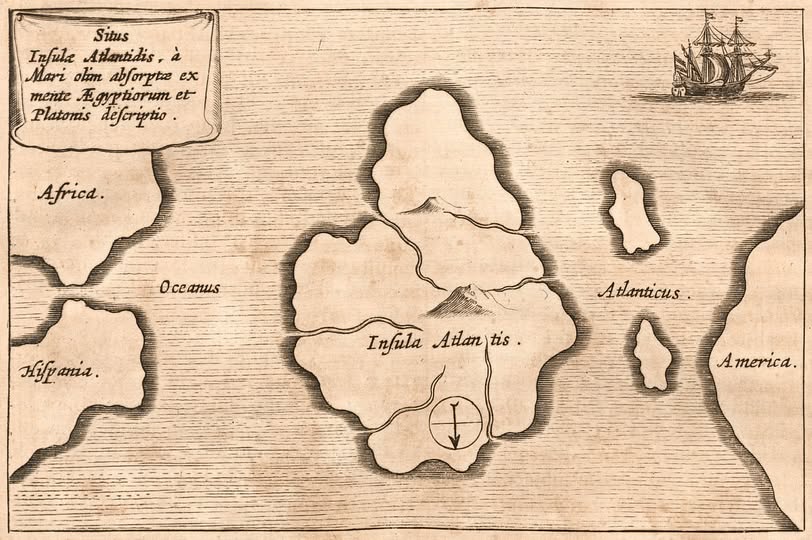
    Mundus Subterraneus identified the location of the legendary lost island of Atlantis (something that modern science hasn’t been able to accomplish) as well as the source of the Nile: it started in the “Mountains of the Moon,” then ran northward through “Guix,” “Sorgola,” and “Alata” and on into “Bagamidi” before reaching Ethiopia and Egypt. Kircher offered a lengthy discussion of people who lived in caves (their societies and their economy). He reported on the remains of giants (also mainly cave dwellers) found in the ground. And he went into detail on the kinds of lower animals who belong to the lower world (including dragons).


    Depiction of a Giant featured in Mundus Subterraneus.


    Depiction of a Dragon featured in Mundus Subterraneus.


    In short, Mundus Subterraneus covered almost every subject that might relate to the realm of earth, as well as many that wouldn’t seem to, such as the sun and “its special properties, by which it flows into the earthly world” and the “nature of the lunar body and its effects.” These correspondences and influences were nothing new, though perhaps only the always-inclusive Athanasius Kircher would choose to publish a series of moon maps in a book about the world below.

    All these other subjects notwithstanding, it was Kircher’s theory about the interior of the earth that captured, or at least deserved, the most attention. As he explained, “the whole Earth is not solid but everywhere gaping, and hollowed with empty rooms and spaces, and hidden burrows.” Deep down, it holds many great oceans and fires, interconnected by a system of passageways that reached all the way to its core. In his view, volcanoes, however awful and awe-inspiring, “are nothing but the vent-holes, or breath-pipes of Nature,” and earthquakes are merely the “proper effects of subterrestrial cumbustions” that are sure to go on constantly. The “prodigious volcanoes and fire-vomiting mountains visible in the external surface of the earth do sufficiently demonstrate it to be full of invisible and underground fires,” he wrote. “For wherever there is a volcano, there also is a conservatory or storehouse of fire under it . . . . And these fires argue for deeper treasuries and storehouses of fire, in the very heart and inward bowels of the Earth.”

    According to Kircher, “the fire and water sweetly conspire together in mutual service.” The tides, caused by the nitrous effluvia of the moon, push “an immense bulk of water” through “hidden and occult passages at the bottom of the Ocean” and thrust it “forcibly into the intimate bowels of the Earth.” The resulting winds “excite and stir up” and otherwise feed the subterraneous fire like a huge bellows. The seas, which would stagnate and freeze without the fires, keep the fires from getting out of hand, preventing “unlimited eruptions,” which would “soon turn all to ruins.” The “secret make-up of the mountains” is that they are hollow and serve as reservoirs. Hot baths, hot springs, and fountains are produced where underground water passageways come near or interconnect with the fire channels.


    Kircher’s diagram showing the interconnectedness of fire inside the earth, featured in Mundus Subterraneus


    Kircher’s diagram showing the interconnectedness of water inside the earth, featured in Mundus Subterraneus.


    More than once, Kircher compares the movement of the earth’s water to the circulation of the blood in the body as described by William Harvey. The water of the oceans follows its “secret motions” up and around the globe toward the North Pole. Somewhere off the coast of Norway (the actual site of a major whirlpool system called the Moskenstraumen), he declared, is a giant maelstrom through which the water enters the earth — as if passing through a great drain — and runs through it, cooling it down, providing it with nutriments in particulate form before being eliminated through a nether opening at the South Pole. Sometimes the analogies referred more to the continuing process of the digestive system than the cycling of blood, but no matter: “You see therefore the manner and way of the Circulation of Nature.”

    Kircher didn’t just (or didn’t entirely) make up his ideas about the interior of the earth. He’d first “learned the great secrets of Nature,” as he put it, almost thirty before, under circumstances of “great danger.”

    Kircher was about thirty five years old, and had been based at the flagship Jesuit college in Rome for about three of four years — attempting to decipher the hieroglyphics of the ancient Egyptians — when in 1637 he was assigned to accompany a young German prince on an extended visit to Malta. If he was initially upset about being dragged away with an immature prince to some rocks in the middle of the Mediterranean, his curiosity quickly kicked in. He made magnetic and astronomical readings, and studied geological formations. There were four-hundred-foot cliffs, natural arches, and a place where the tides had carved human-looking shapes into the earth. He explored Malta’s megalithic temples, catacombs, and grottoes, and was especially fascinated by its inland seas and underground passageways: how far down did they go?


    Diagram showing the sympathies between the macro and microcosm, featured in Mundus Subterraneus.


    After about a year, Kircher was finally allowed to return to Rome, but he took his time getting there and lingered in Sicily for a long while. “I found such a Theater of Nature, displaying herself in such a wonderful variety of things, as I had with so many desires wished for,” he wrote later. “Whatever thing occurs in the whole body of the Earth that is wonderful, rare, unusual, and worthy of admiration, I found contracted here.”

    He was especially intent on exploring Sicily’s outcroppings, cliffs, and volcanoes. And he wanted to look into stories about a type of fish that lived in the Straits of Messina, the body of water that flows between Sicily and Calabria on the Italian mainland. The fish was supposed to be susceptible to a certain kind of song “by which,” Kircher wrote, “mariners are wont to allure it to follow their vessels.” But those plans had to be put aside because of the earthquakes that devastated much of Calabria in the spring of 1638.

    Kircher recalled that the earthquake began as he and some others crossed the straits in a boat. The sea was “raging beyond what is usual” and began “stirring up huge whirlpools.” The island volcano of Stromboli was “throwing up huge billows of smoke,” and there was “a certain subterranean lowing, if you will, which we were reckoning to be the cracking of the earth and which seemed to conspire with the odor of sulfur to insinuate the complete, fatal and funereal destruction of Calabria and Sicily.”

    Despite a “cracking racket” and a “noisome odor,” and the fact that the “sea itself was boiling,” Kircher and his party made it across to the mainland side. But soon enough came “a subterranean racket and din, similar to chariots driven at top speed.” The earth “leapt up from below with so forceful a motion that I, no longer able to stand on my feet, was laid low, suddenly dashed down with face flat on the ground.”

    Kircher experienced “the intolerable frenzy of the earth,” and at one point even the feeling of his soul being “loosened from its corporeal fetters,” but survived to witness the resulting devastation. Through subsequent days of walking, his group “came upon nothing but cadavers of cities and the horrific ruins of castles,” he remembered. “Considering the men straggling through open fields as if extinguished for their fear, you would have said that at that very moment the day of final judgment was looming.”

    Kircher’s firsthand experience of this earthquake, which killed something like ten thousand people, might have put him off his investigations into the “miracles of subterraneous nature.” But these horrible occurrences had also presented him with an opportunity for study. “After having diligently searched out the incredible power of Nature working in subterraneous burrows and passages,” he wrote, “I had a great desire to know whether Vesuvius also had not some secret commerce and correspondence with Stromboli and Aetna.”


    Illustration of Mount Etna, featured in Mundus Subterraneus.


    There was only one way, in his view, to find out. Vesuvius at that time was merely smoking. But its first major eruption in centuries had occurred seven years earlier, in 1631. Kircher hired “an honest country-man, for a true and skillful companion,” and the two began hiking their way up to the forty-two-hundred-foot summit at midnight. (Perhaps the reason for leaving at that hour was to be able to see in the dark anything that might be molten. Or maybe the idea was to allow for a full day of exploration once they got there.) The way was “difficult, rough, uneven, and steep.”

    When they finally reached the top, Kircher looked down into the crater. “I thought I beheld the habitation of Hell,” he wrote, “wherein nothing seemed to be much wanting besides the horrid fantasms and apparitions of Devils.” He heard “horrible bellowings and roarings” and there was “an unexpressible stink.” The smoke and fire and stench “continually belch’d forth out of eleven several places, and made me in like manner belch, and as it were, vomit back again, at it.”

    When the morning light came, Kircher recalled, “I chose a safe and secure place to set my feet sure upon, which was a huge Rock, of a plain surface, to which there lay open an avenue, by a descent of the mountain very far . . . . And so I went down unto it.”


    Illustration of Mount Vesuvius into which Kircher climbed, featured in Mundus Subterraneus.

    The inside of the volcano was, “all up and down everywhere, cragged and broken.” But there was no gradual decline; the volcano’s chamber was “made hollow directly and straight.” The bottom was “boiling with an everlasting gushing forth, and streamings of smoke and flames, and employed in decocting Sulphur, Bitumen and the melting and burning of other kinds of Minerals.”

    Because the vapors and gases “know not how to be contained” within the molten matter, they did so “scatter the burden that lay upon them, with such great force and violence, accompanied with horrible cracklings and noises, that the mountain seemed to be tossed with an earthquake or trembling.” Those spewings caused “the softer parts of the Mountain,” made of, Kircher suggests, ashes, cinders, rains, and “the refuse of minerals,” to be shaken to pieces and loosened; they fell “like Hills, into the bottom of the Hellish gulph.” And that made the kind of sound that even “the stoutest and most undaunted heart would scarce venture to suffer.”

    It was within this hollow mountain that Kircher really began to develop the theories he set down so many years later in Mundus Subterraneus, to envision what it might be like even deeper within the earth, and how the mountains and fires and rivers and oceans might somehow all be connected. Calculating the significance of that moment in the history of science is a lot harder than mentioning what appear to be two direct influences on culture: The creation of Bernini’s Fountain of the Four Rivers in Rome was certainly informed by Kircher’s ideas about the interior structure of the earth as well as his ideas about the mystical nature of the universe (that’s another story). And the spirited, bumbling polymath-dreamer of Jules Verne’s A Journey to the Center of the Earth, who leads a subterranean descent through an old volcanic crater, certainly seems to be based on Kircher himself.

    ____________________________________

    John Glassie has written for The Believer, The New Republic, The New York Times Magazine, The Paris Review Daily, and The Washington Post, among other publications. This essay was adapted from his biography of Athanasius Kircher, A Man of Misconceptions: The Life of an Eccentric in an Age of Change, which was a New York Times Book Review "Editors' Choice".

    _____________________________________

    And the famous map of 'Atlantis'


    Last edited by Tintin; 6th May 2026 at 20:00.
    “If a man does not keep pace with [fall into line with] his companions, perhaps it is because he hears a different drummer. Let him step to the music which he hears, however measured or far away.” - Thoreau

  12. The Following 9 Users Say Thank You to Tintin For This Post:

    Bill Ryan (6th May 2026), Ewan (7th May 2026), grapevine (8th May 2026), Harmony (7th May 2026), Kryztian (7th May 2026), mountain_jim (8th May 2026), rgray222 (7th May 2026), skogvokter (6th May 2026), Yoda (6th May 2026)

  13. Link to Post #367
    Avalon Member Kryztian's Avatar
    Join Date
    16th September 2012
    Language
    English
    Posts
    4,567
    Thanks
    29,272
    Thanked 40,111 times in 4,505 posts

    Default Re: Vintage film, TV, documents, and photographic footage from down the years

    Silly and Fake news reals from the 1930's

    Babies and President (1935) - begins with a baby parade footage where parents aspire to have their child crowned most beautiful baby. Then, film segues into an effusive song venerating the American Presidents up to FDR. Back from the days when Americans could actually admire their elected leaders.


    Goofytone Newsreel #8 (1934) -From the days when fake news was charming and benign, well perhaps a bit racist and sexist. All crisis actors here, but with much of a crisis to contend with.

  14. The Following 8 Users Say Thank You to Kryztian For This Post:

    Bill Ryan (7th May 2026), Ewan (8th May 2026), grapevine (8th May 2026), Harmony (7th May 2026), mountain_jim (8th May 2026), skogvokter (12th May 2026), Tintin (8th May 2026), Yoda (7th May 2026)

  15. Link to Post #368
    UK Moderator/Librarian/Administrator Tintin's Avatar
    Join Date
    3rd June 2017
    Location
    Project Avalon library
    Language
    English
    Age
    56
    Posts
    8,143
    Thanks
    89,826
    Thanked 70,621 times in 8,110 posts

    Default Re: Vintage film, TV, documents, and photographic footage from down the years

    A powerful image from Nuremberg April 1945: the Red Army destroy a swastika symbol on top of the Nazi headquarters building in Nuremberg
    “Anyone who loves freedom owes such a debt to the Red Army that it can never be repaid.” – Ernest Hemingway
    “If a man does not keep pace with [fall into line with] his companions, perhaps it is because he hears a different drummer. Let him step to the music which he hears, however measured or far away.” - Thoreau

  16. The Following 10 Users Say Thank You to Tintin For This Post:

    Bill Ryan (8th May 2026), Ewan (8th May 2026), grapevine (8th May 2026), Harmony (8th May 2026), Kryztian (8th May 2026), kudzy (9th May 2026), mountain_jim (8th May 2026), rgray222 (8th May 2026), skogvokter (12th May 2026), Yoda (8th May 2026)

  17. Link to Post #369
    UK Avalon Founder Bill Ryan's Avatar
    Join Date
    7th February 2010
    Location
    Ecuador
    Posts
    39,455
    Thanks
    288,611
    Thanked 523,641 times in 37,990 posts

    Default Re: Vintage film, TV, documents, and photographic footage from down the years

    I do think this belongs here. (Posted by Ravenlocke on the Life in Russia thread)

    ~~~

    Russian restoration specialists have used AI tools to repair footage of scenes filmed in Berlin immediately after Germany’s surrender at the end of WW2.

    https://x.com/BrianMcDonaldIE/status...16298451222932


  18. The Following 8 Users Say Thank You to Bill Ryan For This Post:

    Ewan (8th May 2026), Harmony (9th May 2026), kudzy (9th May 2026), mountain_jim (9th May 2026), Ravenlocke (8th May 2026), skogvokter (12th May 2026), Tintin (9th May 2026), Yoda (8th May 2026)

  19. Link to Post #370
    UK Moderator/Librarian/Administrator Tintin's Avatar
    Join Date
    3rd June 2017
    Location
    Project Avalon library
    Language
    English
    Age
    56
    Posts
    8,143
    Thanks
    89,826
    Thanked 70,621 times in 8,110 posts

    Default Re: Vintage film, TV, documents, and photographic footage from down the years

    Quote Posted by Bill Ryan (here)
    I do think this belongs here. (Posted by Ravenlocke on the Life in Russia thread)

    ~~~

    Russian restoration specialists have used AI tools to repair footage of scenes filmed in Berlin immediately after Germany’s surrender at the end of WW2.

    https://x.com/BrianMcDonaldIE/status...16298451222932

    More here:

    The historical Yuri Levitan broadcast from Moscow May 9th, 1945 announcing the unconditional surrender of German forces that had taken place on May 8th, and confirmation of victory in the Great Patriotic War, followed by more footage of Red Army soldiers in Berlin which can be enjoyed without the audio overlay


    Last edited by Tintin; 9th May 2026 at 12:25.
    “If a man does not keep pace with [fall into line with] his companions, perhaps it is because he hears a different drummer. Let him step to the music which he hears, however measured or far away.” - Thoreau

  20. The Following 7 Users Say Thank You to Tintin For This Post:

    Bill Ryan (9th May 2026), Ewan (10th May 2026), Harmony (9th May 2026), Kryztian (11th May 2026), mountain_jim (9th May 2026), skogvokter (12th May 2026), Yoda (9th May 2026)

  21. Link to Post #371
    UK Avalon Founder Bill Ryan's Avatar
    Join Date
    7th February 2010
    Location
    Ecuador
    Posts
    39,455
    Thanks
    288,611
    Thanked 523,641 times in 37,990 posts

    Default Re: Vintage film, TV, documents, and photographic footage from down the years

    This very beautiful, traditional Russian song is presented here against moving archive footage of returning Russian soldiers in WWII. It absolutely belongs in this thread.


  22. The Following 6 Users Say Thank You to Bill Ryan For This Post:

    Harmony (10th May 2026), Kryztian (11th May 2026), mountain_jim (10th May 2026), skogvokter (12th May 2026), Tintin (10th May 2026), Yoda (10th May 2026)

  23. Link to Post #372
    UK Moderator/Librarian/Administrator Tintin's Avatar
    Join Date
    3rd June 2017
    Location
    Project Avalon library
    Language
    English
    Age
    56
    Posts
    8,143
    Thanks
    89,826
    Thanked 70,621 times in 8,110 posts

    Default Apollo 11 Post-Flight Press Conference | Building 1-JSC | August 12th, 1969

    With the current regenerated interest in matters relating to UFOs here's one for the archives from August 1969.

    “If a man does not keep pace with [fall into line with] his companions, perhaps it is because he hears a different drummer. Let him step to the music which he hears, however measured or far away.” - Thoreau

  24. The Following 6 Users Say Thank You to Tintin For This Post:

    Bill Ryan (10th May 2026), Ewan (10th May 2026), Harmony (10th May 2026), mountain_jim (19th May 2026), skogvokter (12th May 2026), Yoda (19th May 2026)

  25. Link to Post #373
    UK Moderator/Librarian/Administrator Tintin's Avatar
    Join Date
    3rd June 2017
    Location
    Project Avalon library
    Language
    English
    Age
    56
    Posts
    8,143
    Thanks
    89,826
    Thanked 70,621 times in 8,110 posts

    Default Re: Vintage film, TV, documents, and photographic footage from down the years

    I've been dithering here as to whether to start a new thread with this, or include it here. Although from 1988 it has a vintage pedigree. This discussion really had me riveted, totally absorbed over this past weekend. A great many of the participants here have now passed on which is hardly surprising as many were born in the 1920s, but the wealth of experience and quality of their anecdotes on display really takes some beating. I strongly recommend this as the insights thrown into view absolutely relate to what's happening in the British Isles today and remain completely relevant. Yes, it's over 3 hours, and I've a half hour left still to go.

    I used to watch these Open Media After Dark Channel 4 discussions, and engage in dialogue around them with friends, post-pub, back in the day: the very highest quality discourse. Many years ago I'd posted the similarly excellent roundtable intelligence discussion featuring Tony Benn here, and this one follows a similar theme, and aired a few months before.

    Two things any interested viewer will notice: firstly, so very few people actually speak this way any more. Each of the participants talks in an older fashioned English way, with excellent diction, and we'll I expect rue the day when this may eventually be a real thing of the past; maybe only chaps like Peter Hitchens, or Alastair Crooke, are left articulating like this. (And, alcohol is available in the studio too!)

    Secondly, this is as broadcast so it's just as interesting seeing some of the adverts during the breaks; they, along with the participants on the panel, don't make them this way anymore, more's the pity

    I've added links to biographies to the participants as well.

    Trust me, it's well worth the time invested:

    ~~~~~~~~~~~~~~~~~~~~~~~~~~

    AFTER DARK - BRITISH INTELLIGENCE

    With Gary Murray, author, Air Commodore Alastair Mackie, Merlyn Rees MP, Robin Ramsay, Jock Kane, Robert Harbinson (aka Robin Bryans) & H. Montgomery Hyde. Hosted by John Underwood.

    First shown: 16 July 1988

    Avalon library copy here: https://avalonlibrary.net/1988-07-16...16_1988%29.mp4


    ~~~~~~~~~~~~~~~~~~~~

    Anyone who missed out on these gems may be interested in this paper, here:

    After Dark: Channel 4’s innovation in television talk
    Source: https://eprints.whiterose.ac.uk/id/e...onredacted.pdfhttps://eprints.whiterose.ac.uk/id/e...onredacted.pdf
    Last edited by Tintin; 19th May 2026 at 11:12.
    “If a man does not keep pace with [fall into line with] his companions, perhaps it is because he hears a different drummer. Let him step to the music which he hears, however measured or far away.” - Thoreau

  26. The Following 6 Users Say Thank You to Tintin For This Post:

    Bill Ryan (19th May 2026), grapevine (Yesterday), Harmony (19th May 2026), mountain_jim (19th May 2026), skogvokter (Today), Yoda (19th May 2026)

+ Reply to Thread
Page 19 of 19 FirstFirst 1 9 19

Posting Permissions

  • You may not post new threads
  • You may not post replies
  • You may not post attachments
  • You may not edit your posts