


 Re: Up At The Ranch And Beyond
A Planetary Nebula With Cosmic Buckyballs
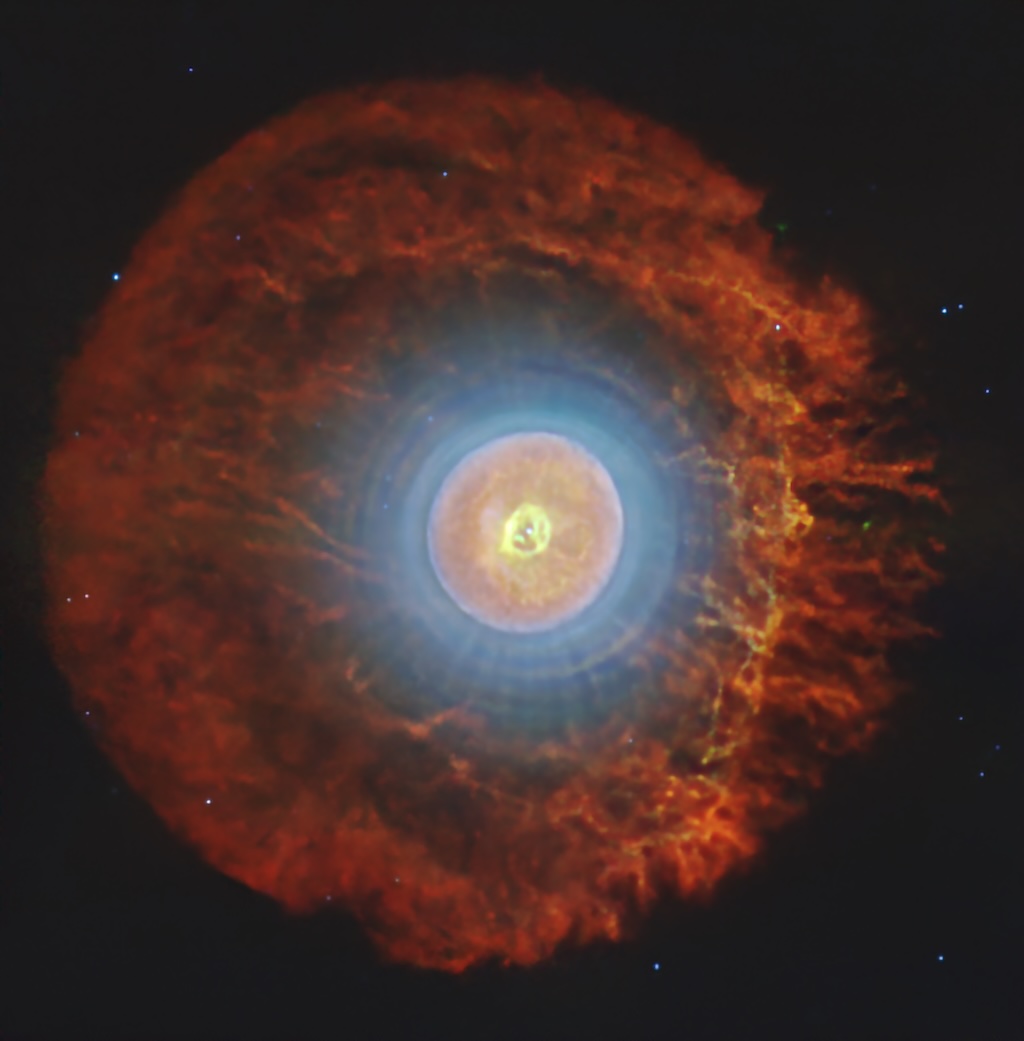
What is happening inside this unusual nebula? Planetary nebula Tc 1, captured here in exquisite detail by the James Webb Space Telescope, is the celestial site where buckyballs were first identified in 2010.
Buckminsterfullerene — as buckyballs are officially called — is a molecule with 60 carbon atoms (C60) arranged in the shape of a soccer ball. The molecule is named for architect Buckminster Fuller because of its resemblance to the geodesic dome he helped popularize. Webb’s new data reveal where the C60 molecules live in this nebula, and the geometry is striking: they populate a thin spherical shell around the central star, visible here as the bright edge of the nebula’s glowing orange central region.
Look closely near the nebula’s heart and a more perplexing feature emerges: a delicate structure shaped uncannily like an upside-down question mark, fitting punctuation for the many questions this nebula still poses.
(3:41)
- Home
- Forum
- Chat
- Donate
-
Site Links

-
Avalon Library
-
External Sites
- Solari Report | Catherine Austin Fitts
- The Wall Will Fall | Vanessa Beeley
- Unsafe Space | Keri Smith
- Giza Death Star | Joseph P. Farrell
- The Last American Vagabond
- Caitlin Johnstone
- John Pilger
- Voltaire Network
- Suspicious Observers
- Peak Prosperity | Chris Martenson
- Dark Journalist
- The Black Vault
- Global Research | Michael Chossudovsky
- Corbett Report
- Infowars
- Natural News
- Ice Age Farmer
- Dr. Joseph Mercola
- Childrens Health Defense
- Geoengineering Watch | Dane Wigington
- Truthstream Media
- Unlimited Hangout | Whitney Webb
- Wikileaks index
- Vaccine Impact
- Eva Bartlett (In Gaza blog)
- Scott Ritter
- Redacted (Natalie & Clayton Morris)
- Judging Freedom (Andrew Napolitano)
- Alexander Mercouris
- The Duran
- Simplicius The Thinker

 Reply With Quote












Bookmarks