


 Re: What Supplements Might be Missing from your Health Regimen?
Posted by Bill Ryan (here)
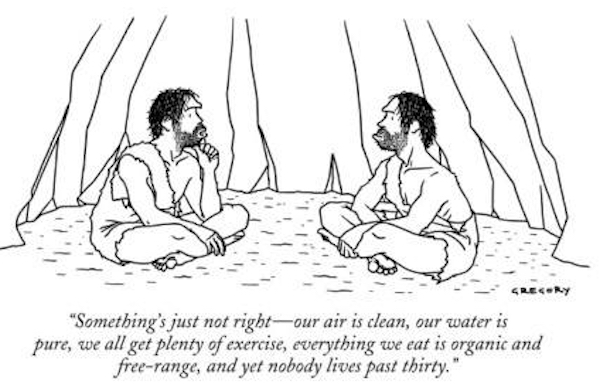
This inspired New Yorker cartoon somehow seems relevant!
The shorten version of my thoughts:I want to move in a different direction. I’m approaching this as an experiment that our bodies come equipped with built-in repair systems. Over time, that natural balance can get lost. I want to see how well the body can function when it’s properly supported.
But it poses an excellent serious question I've always asked myself and never found a really good answer to. (Surely not every one of our ancestors died way before their time from disease or conflict?)
I posed the same question to Wade Frazier yesterday, and overnight he impressed me with a long and detailed reply. I found it so very interesting and packed with hard information that I felt I had to copy it here.
~~~From Substack:
The video of this post is here.
This post is in response to Bill Ryan’s post at Avalon. Bill and I go back a ways. Making this series of posts reflects not only thinking about my family, going back a few centuries, but going all the way back to the beginning of life on Earth. My previous post sketched the eon of complex life that led to humans.
Bill specifically asked about hunter-gatherers, and this post will address them. Chimps hunt and forage, but the Wikipedia article attributed the beginning of the hunter-gatherer lifestyle to Homo erectus about 1.8 million years ago. I can go with that. Around that time, Homo erectus had invented Acheulian stone tools, may have controlled fire, and began driving African megafauna to extinction as Africa’s apex predator.
There was almost two million more years of evolution before behaviorally modern Homo sapiens appeared on the scene. I recently referred to this article as a good summary on the state of the science of why behaviorally modern humans conquered the world. That conquest happened during the hunter-gatherer phase of the human journey, which I call the Second Epoch. Those are fascinating, if often grim, topics, but what about the lives of hunter-gatherers themselves?
For starters, from gorillas to the Industrial Revolution, only about half of offspring reached adulthood. A generation ago, a famous paper explored hunter-gatherer life expectancy. Here is a good discussion of it. Only 56% of prehistoric hunter-gatherers made it to age 15. Less than one-in-200 made it to age 65. Most of those childhood deaths may have been due to infanticide, as the parents could not afford to feed them. About 25% of men died violently, generally in territorial disputes with neighboring bands. The skeletal evidence is stark. In aboriginal Australia, which was the best “lab” that we had of hunter-gatherer societies before the rise of farming, the skeletal evidence shows that a quarter of the men and a third of the women had healed skull fractures from interpersonal violence (women got it from their “husbands”). That is likely why aboriginal Australians have skulls twice as thick as the rest of humanity’s.
It is true that prehistoric hunter-gatherers did not have much infectious or degenerative disease. Those came with the agrarian Epoch. But the lives of hunter-gatherers were very rough. Nearly everything that we take for granted in modern life did not exist for prehistoric hunter-gatherers. They did not have roofs over their heads, unless they were “lucky” enough to live in a cave. They were always on the move, seeking food. They continually came into violent conflict with neighboring societies, especially after the short-lived golden age of the hunter-gatherer was over. To “trespass” into another band’s territory was to risk death. Those societies often had “no-man’s lands” between them, to reduce the violence. A minor cut could be enough to cause death from infection. Neanderthal skeletons were full of fractures, which came from either interpersonal violence or the hazards of killing large animals without projectile weapons.
The favorite hunter-gatherer war tactic was like what chimps do: the surprise raid. Hunter-gatherers usually did it at night, just before dawn, and they would slaughter the entire sleeping encampment while often sparing the women, who became their “wives.” Stealing women was standard hunter-gatherer practice, so much so that in many hunter-gatherer societies, any strange man was killed on sight, as the usually accurate assumption was that he was there to steal a woman.
One common practice was almost funny. In Arctic societies, which almost entirely relied on hunting, boys were prized and girls were killed by their parents. It got so bad that the boy-girl ratio got as high as two-to-one. Then the society had a shortage of women. The “solution” was a sneak attack on the neighboring society, kill all the men, and take the women. The combined numbers “solved” the problem of the sexual imbalance. Scientists have also argued that it was an inadvertent way to keep the populations within the land’s carrying capacity. What one way to do it.
I have seen a lot of romanticizing of hunter-gatherers, even within my family, and it is a bunch of fantasy. One day in a hunter-gatherer society would convince nearly all modern peoples that they prefer homes, underwear, plumbing, refrigerators, and beds.
Best,
Wade
- Home
- Forum
- Chat
- Donate
-
Site Links

-
Avalon Library
-
External Sites
- Solari Report | Catherine Austin Fitts
- The Wall Will Fall | Vanessa Beeley
- Unsafe Space | Keri Smith
- Giza Death Star | Joseph P. Farrell
- The Last American Vagabond
- Caitlin Johnstone
- John Pilger
- Voltaire Network
- Suspicious Observers
- Peak Prosperity | Chris Martenson
- Dark Journalist
- The Black Vault
- Global Research | Michael Chossudovsky
- Corbett Report
- Infowars
- Natural News
- Ice Age Farmer
- Dr. Joseph Mercola
- Childrens Health Defense
- Geoengineering Watch | Dane Wigington
- Truthstream Media
- Unlimited Hangout | Whitney Webb
- Wikileaks index
- Vaccine Impact
- Eva Bartlett (In Gaza blog)
- Scott Ritter
- Redacted (Natalie & Clayton Morris)
- Judging Freedom (Andrew Napolitano)
- Alexander Mercouris
- The Duran
- Simplicius The Thinker


 Reply With Quote




Bookmarks