+ Reply to Thread
Page 577 of 577 FirstFirst 1 77 477 527 567 577
Results 11,521 to 11,534 of 11534

Thread: WADE FRAZIER : A Healed Planet

  1. Link to Post #11521
    UK Avalon Founder Bill Ryan's Avatar
    Join Date
    7th February 2010
    Location
    Ecuador
    Posts
    39,630
    Thanks
    290,798
    Thanked 525,518 times in 38,166 posts

    Default Re: WADE FRAZIER : A Healed Planet

    Quote Posted by Wade Frazier (here)
    From Substack:

    The video of this post is here.

    This post is in response to Bill Ryan’s post at Avalon. Bill and I go back a ways. Making this series of posts reflects not only thinking about my family, going back a few centuries, but going all the way back to the beginning of life on Earth. My previous post sketched the eon of complex life that led to humans.

    Bill specifically asked about hunter-gatherers, and this post will address them. Chimps hunt and forage, but the Wikipedia article attributed the beginning of the hunter-gatherer lifestyle to Homo erectus about 1.8 million years ago. I can go with that. Around that time, Homo erectus had invented Acheulian stone tools, may have controlled fire, and began driving African megafauna to extinction as Africa’s apex predator.

    There was almost two million more years of evolution before behaviorally modern Homo sapiens appeared on the scene. I recently referred to this article as a good summary on the state of the science of why behaviorally modern humans conquered the world. That conquest happened during the hunter-gatherer phase of the human journey, which I call the Second Epoch. Those are fascinating, if often grim, topics, but what about the lives of hunter-gatherers themselves?

    For starters, from gorillas to the Industrial Revolution, only about half of offspring reached adulthood. A generation ago, a famous paper explored hunter-gatherer life expectancy. Here is a good discussion of it. Only 56% of prehistoric hunter-gatherers made it to age 15. Less than one-in-200 made it to age 65. Most of those childhood deaths may have been due to infanticide, as the parents could not afford to feed them. About 25% of men died violently, generally in territorial disputes with neighboring bands. The skeletal evidence is stark. In aboriginal Australia, which was the best “lab” that we had of hunter-gatherer societies before the rise of farming, the skeletal evidence shows that a quarter of the men and a third of the women had healed skull fractures from interpersonal violence (women got it from their “husbands”). That is likely why aboriginal Australians have skulls twice as thick as the rest of humanity’s.

    It is true that prehistoric hunter-gatherers did not have much infectious or degenerative disease. Those came with the agrarian Epoch. But the lives of hunter-gatherers were very rough. Nearly everything that we take for granted in modern life did not exist for prehistoric hunter-gatherers. They did not have roofs over their heads, unless they were “lucky” enough to live in a cave. They were always on the move, seeking food. They continually came into violent conflict with neighboring societies, especially after the short-lived golden age of the hunter-gatherer was over. To “trespass” into another band’s territory was to risk death. Those societies often had “no-man’s lands” between them, to reduce the violence. A minor cut could be enough to cause death from infection. Neanderthal skeletons were full of fractures, which came from either interpersonal violence or the hazards of killing large animals without projectile weapons.

    The favorite hunter-gatherer war tactic was like what chimps do: the surprise raid. Hunter-gatherers usually did it at night, just before dawn, and they would slaughter the entire sleeping encampment while often sparing the women, who became their “wives.” Stealing women was standard hunter-gatherer practice, so much so that in many hunter-gatherer societies, any strange man was killed on sight, as the usually accurate assumption was that he was there to steal a woman.

    One common practice was almost funny. In Arctic societies, which almost entirely relied on hunting, boys were prized and girls were killed by their parents. It got so bad that the boy-girl ratio got as high as two-to-one. Then the society had a shortage of women. The “solution” was a sneak attack on the neighboring society, kill all the men, and take the women. The combined numbers “solved” the problem of the sexual imbalance. Scientists have also argued that it was an inadvertent way to keep the populations within the land’s carrying capacity. What one way to do it.

    I have seen a lot of romanticizing of hunter-gatherers, even within my family, and it is a bunch of fantasy. One day in a hunter-gatherer society would convince nearly all modern peoples that they prefer homes, underwear, plumbing, refrigerators, and beds.

    Best,

    Wade
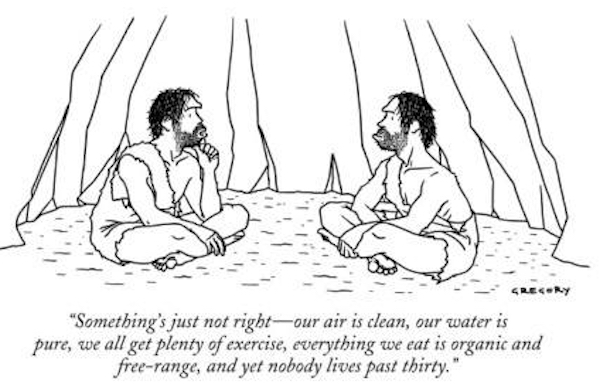
    Wow! What a terrific mini-thesis. I took the liberty to copy it in full to the Avalon thread titled What Supplements Might be Missing from your Health Regimen?, where I'd originally posted the cartoon. I prefaced my copy with this intro:

    ~~~

    I posed the same question to Wade Frazier yesterday, and overnight he impressed me with a long and detailed reply. I found it so very interesting and packed with hard information that I felt I had to copy it here.
    ~~~


  2. The Following 5 Users Say Thank You to Bill Ryan For This Post:

    Ewan (16th June 2026), happyuk (17th June 2026), Sue (Ayt) (19th June 2026), Sunray (18th June 2026), Yoda (16th June 2026)

  3. Link to Post #11522
    United States Administrator ThePythonicCow's Avatar
    Join Date
    4th January 2011
    Location
    North Texas
    Language
    English
    Age
    78
    Posts
    30,851
    Thanks
    37,757
    Thanked 154,940 times in 23,710 posts

    Default Re: WADE FRAZIER : A Healed Planet
    Quote Posted by Bill Ryan (here)
    But I've never heard what feels like a satisfactory answer to the question. I know life back then was supposed to be nasty, brutish and short — but why was it short?
    Was it the average that was short, or the older end of the "age at death" statistic that was short? In other words, did many infants die while at the same time many of the survivors lived to a ripe old age, or did most births live to adulthood, but not to forty years of age ... and questions like that?

    Beware that a high rate of infant and childhood deaths sharply lowers the overall average age of death, but is quite different from having most people die in their young adult 20's and 30's years.

    Then for a given "fatality rate versus age" curve, we can ask why so many did, or did not, survive a given age range.

    When I was a child in a farming community that had not changed much in 200 years, families were often large, with the realization that some infants and children (and birthing mothers and hunter or warrior fathers) wouldn't make it. But for a wee bit of luck a few times, I'd have been one of those casualties, as were some I knew. But we still had our elders, in their 80's and 90's, often more fit and spry than many such elders these days.
    My quite dormant website: pauljackson.us

  4. The Following 7 Users Say Thank You to ThePythonicCow For This Post:

    Bill Ryan (16th June 2026), Ewan (16th June 2026), guenonsbitch (Yesterday), Sue (Ayt) (19th June 2026), Sunray (18th June 2026), Wade Frazier (16th June 2026), Yoda (16th June 2026)

  5. Link to Post #11523
    United States Avalon Member Wade Frazier's Avatar
    Join Date
    6th January 2011
    Location
    Seattle
    Posts
    8,272
    Thanks
    806
    Thanked 59,543 times in 8,269 posts

    Default Re: WADE FRAZIER : A Healed Planet

    Thanks Bill. Thanks Paul. My post only addressed Bill’s question on prehistoric hunter-gatherers. As I stated, less than one-in-200 made it to age 65. Only half made it to age 15, and when reaching age 15, they could expect less than 20 more years of life.

    Coming up will be agrarian peoples, then industrial. Each had their benefits and detriments. Of course, in the Fifth Epoch, when everybody eats fresh, whole food, everybody will live to 100, will be healthy the entire way, and medical interventions will be largely unknown.

    Best,

    Wade
    My big essay, published in 2014, is here.

  6. The Following 6 Users Say Thank You to Wade Frazier For This Post:

    Bill Ryan (16th June 2026), Ewan (16th June 2026), Sue (Ayt) (19th June 2026), Sunray (18th June 2026), ThePythonicCow (17th June 2026), Yoda (16th June 2026)

  7. Link to Post #11524
    United States Avalon Member Wade Frazier's Avatar
    Join Date
    6th January 2011
    Location
    Seattle
    Posts
    8,272
    Thanks
    806
    Thanked 59,543 times in 8,269 posts

    Default Re: WADE FRAZIER : A Healed Planet

    From Substack:

    The video of this post is here.

    My previous post dealt with the lives of hunter-gatherers before the rise of farming. By about 12,000 years ago, the conquest of Earth by behaviorally modern humans was complete. When that conquest began about 60,000 years ago, there were about ten other human species, the Americas and Australia were full of megafauna, Eurasia was still well populated with megafauna, and even Africa had vastly more megafauna than it does today.

    During the next 50,000 years, all other human species went extinct, as well as all of the world’s easy meat. Our ancestors did all of that. In one of the many tawdry episodes in the history of science, academic cottage industries sprang up to deny that Homo sapiens was responsible for that spasm of extinctions that “coincided” with their arrival. Those were ludicrous positions to hold, as well as the idea that pre-farming or pre-civilized peoples were largely peaceful. Those academics tried to turn the bloody history of humanity into something resembling a Disney movie. Those who deny that humans are causing Global Warming are just more of the same, as they all bolster the human collective ego and deny our collective responsibility. The study of paleology makes the connection between carbon dioxide levels and global temperatures obvious. This year might finally silence them, but human denial can be something to behold. I have watched people embrace certain death rather than question their beliefs.

    By 12,000 years ago, several trends culminated in the invention of farming. The easy meat was gone, the brief interglacial period had arrived, which made Earth warmer and wetter, and the warmer ocean “exhaled” carbon dioxide, as did lands liberated from ice sheets. Over the next several thousand years, people began to domesticate plants and animals, in several places, independently. That first happened in what is called the Fertile Crescent, which is in today’s Middle East. There were hundreds of times as many people on Earth than before the global conquest began. Those mouths had to be fed somehow.

    Keith Otterbein argued that domestication of plants was effectively impossible where megafauna were hunted, as that style of hunting and warfare were conjoined, as the same tools worked for each activity. Only when hunting and warfare declined could people, largely women, experiment with domesticating plants. Otherwise, they were too vulnerable to marauding hunters.

    Women likely invented farming as an adjunct to their gathering duties. Many of those early farming societies became matrilocal, which broke up gangs of related males, and those were the most peaceful preindustrial societies, which Otterbein called “Type B” societies.

    When people began farming, the hunter-gathering lifestyle was doomed. Farming produced orders of magnitude more food per acre than hunting and gathering did, which allowed people to become sedentary. Some hunter-gatherers were able to become sedentary, at least for a time, such as villages on mammoth migration routes (until they drove the mammoths to extinction), or the Pacific Northwest culture, which relied on migrating salmon. But the rise of farming was when humans widely began their sedentary phase of existence.

    Farming began spreading from its centers of origin, and hunter-gatherers did one of three things:
    • Adopt farming;
    • Get pushed to marginal environments where farming was not feasible;
    • Go extinct.
    Hunter-gatherers often fought back, but they were greatly outnumbers by farmers. One outcome was that hunter-gather women married the relatively prosperous farmers and hunter-gatherer men largely vanished from humanity’s gene pool.

    Scientists have found that most historic groups had population bottlenecks, which has been discovered through DNA testing. About 7,000 years ago, when agriculture began spreading, there was a DNA bottleneck of men, with various violent and peaceful explanations proffered, but what is not disputed is that it arose from patrilineal descent, in which prominent men became overrepresented, as far as their descendants went. Chimps have the same issue, as high-status males father a disproportionate share of offspring (one of the perks of high status).

    That situation reflects the relative investment that men and women have in their offspring. Agrarian potentates could play studs to huge harems. Europe has been the site of several recent population replacements, beginning with Neanderthals, who were displaced by Homo sapiens hunter-gatherers, who were displaced by Neolithic farmers, who were displaced by steppe herders. Gore Vidal once said that human history was the little more than the bloody migrations of tribes. When I began seeing the results of those DNA studies, Vidal’s statement began making a lot more sense to me.

    Scientists are constantly finding mass burials in Europe of the violently killed during the Neolithic and later, and a cannibalism operation has been discovered. That initially peaceful expansion of farming turned highly violent, especially as population pressures mounted once again.

    There was an initial honeymoon for farming, with intact forests and soils, no “pests” yet, and relatively easy farming. But that soon ended, as populations expanded, forests and soils were degraded, “pests” adapted to crops, and there was a forest-to-farm-to-desert dynamic. Then it was back to the brink of survival, but with far larger populations, and farmers shrank in stature compared to their hunter-gatherer ancestors. The lives of farmers became drudgery until well into the Industrial Revolution, and even until today.

    Europe is far from unique with those population displacements. Virtually every inhabitable spot on Earth has a bloody human past. Some remote islands (and Antarctica) might be exempt from that dynamic, but that is about it.

    In four places on Earth where farming was independently developed, around 5,000 years after the invention of farming in each region, humans independently invented civilization. The rise of civilization comes next.

    Best,

    Wade
    My big essay, published in 2014, is here.

  8. The Following 4 Users Say Thank You to Wade Frazier For This Post:

    Bill Ryan (17th June 2026), Ewan (17th June 2026), Sunray (18th June 2026), Yoda (17th June 2026)

  9. Link to Post #11525
    United States Avalon Member Wade Frazier's Avatar
    Join Date
    6th January 2011
    Location
    Seattle
    Posts
    8,272
    Thanks
    806
    Thanked 59,543 times in 8,269 posts

    Default Re: WADE FRAZIER : A Healed Planet

    From Substack:

    The video of this post is here.

    A good comment by a reader inspired this post. This is a good point in this narrative to address the issue. In 1979, Brian O’Leary was sipping his sherry at Princeton, while smugly agreeing with his colleagues, several of whom had won Nobel Prizes, that any and all accounts of the paranormal were mistaken, fraudulent, etc. That same year, however, Brian had his first paranormal experience, and he realized that his ridiculing colleagues had no idea what they were talking about. That happened five years after I had the same experience while performing the same exercise. We were both ruined as mainstream scientists by those events. We could no longer drink the Kool-Aid of materialism. Materialism is a religion that is erected on a false foundation.

    The day that I met Brian, I took him to give a speech on the need for a new science, which would be liberated from materialism and other limitations. In Noam Chomsky’s political-coming-out essay, he wrote that intellectuals had a responsibility to call out the ruling class’s deceptions. Noam argued that Ed Herman’s Propaganda Model was only a special case of the constraints that all intellectuals in capitalist societies are subjected to. Noam is a kind of anarchist, which comes with its own ideological baggage, which I will deal with some in this post.

    Lawrence Keeley’s War Before Civilization was a watershed work, published in 1996. When Keeley was an anthropology student in the 1960s, he exhumed skeletons along San Francisco Bay. Many burials were of people who had obviously been killed, but the dogma of the time was that ancient humans were all peaceful. Keeley’s bachelor’s thesis was about how Mesoamerican civilizations in the millennia preceding the Spanish conquest were all peaceful. A generation later, Keeley realized how wrong he was, and how wrong anthropology was in general. When Keeley found obviously defensive Neolithic fortifications in Europe and made a proposal to study them further, he was denied a grant because such an idea flew in the face of the day’s dogma. In his book’s preface, Keeley described his own long journey, to finally accept what his eyes told him (his awakening). All of anthropology had that problem, that dogma was not generally overturned until the 21st century, but there are still battles in academia over it.

    I have read that the general “Rousseauian” stance of anthropology, with its “peaceful savage” dogma, was a reaction to the prodigious violence of the World Wars. There was a yearning for a more peaceful time, so the fantasy was concocted that the human journey was peaceful until the rise of civilization (or farming). Postmodernism was born from the same traumas, and it rejected science altogether, and has led to abominations such as the trans craze, as children are sterilized in the name of ideology and women have their safe spaces invaded by men who call themselves women.

    My previous two posts were on the lives of hunter-gatherers and pre-civilized farmers. My posts rely on the state-of-the-art science on those issues. To this day, there are scientists who deny that humans had a violent past or that they drove megafauna to extinction. I see both instances as where ideology trumped reality, but both positions are finally waning, in light of the evidence, or really, just taking off the ideological blinders.

    Theories are ideologies, in that they are a set of ideas about the nature of our reality, and theories are ideally tested against the evidence. As Einstein said, every theory dies at the hands of a new fact. Einstein expected that his relativity theories would one day become obsolete, but that the best parts of his theories would survive in the new ones.

    I know for a fact that antigravity and free-energy technologies are on the planet and older than I am, but almost no scientist can be engaged on that topic, as they almost always react in denial and fear when the topic is broached. Their most common dismissals are to cite the “laws of physics” to deny free energy’s possibility, and to dismiss evidence of organized suppression as a “conspiracy theory.” As Brian said, there are no “laws” of physics, but just theories. To even use “law” is to invoke religion. When my friend witnessed antigravity technology, the so-called “law of gravity” became something else: an incomplete theory. As Bucky Fuller said, scientists are deeply naïve, in their soft academic berths, sipping their sherry.

    I believe in the ideal of science, like I believe in the ideal of a free press, but in the real world, those ideals have never come close to being realized. Ed wrote about the misuse of scientific findings for propaganda purposes, but Ed never wrote about the corruption of the scientific process itself. I tried to introduce Ed to Brian several times, but Ed was not interested.

    Noam called himself a kind of anarchist, in which authority always has to justify itself. The Propaganda Model is really a conflict-of-interest model, but Noam seemed oblivious to conflicts of interest in science. I was not too surprised when he advocated that those who refused to submit to COVID vaccination become pariahs. Noam could not seem to fathom the corruption of biomedical science, which even the defenders of science call its flimsiest and most corrupt branch. One of my college roommates was crippled by the COVID vaccine, the other surviving one was likely killed by it, while the other one was killed by his cancer treatment.

    Noam has likely blurbed hundreds of books, and two are relevant to this post. One was when he blurbed War, Peace, and Human Nature, which was edited by Douglas Fry, who has been the leading “peacenik” anthropologist for many years. Fry’s work does not fare well in Azar Gat’s work, or in this book, which is the best that I have seen on the subject. Fry was of that school that Keeley was first immersed in: ancient peoples were all peaceful. That school has largely collapsed, with Fry and friends as holdouts.

    Noam also blurbed The Dawn of Everything, written by anarchists, one of whom was a disciple of Marshall Sahlins, whose book on hunter-gatherers inspired this post. Sahlins argued in the 1960s that hunter-gatherers were affluent, because most of their days were spent in leisure. I replied to it here. No society in which half of its children died can be called affluent, particularly when maybe half of those deaths were inflicted by the parents, as they could not afford to care for the children. That is not affluence. Sahlins was part of the 1960s ferment, and his book was a kind of counter-culture critique of modern society. For all of the failings of our societies, and they are many, that does not make hunter-gatherers affluent or something to emulate.

    I was kind of dismayed when the authors of The Dawn of Everything (the primary author was a pupil of Sahlins) compared the Pacific Northwest (“PNW”) culture, with its slavery, to California’s natives, who didn’t have it, and attributed it to the sensibilities of Californian natives. Slavery only made sense in sedentary populations, and California’s natives never had the thousands of years of reliable salmon runs to base their economy on, to become sedentary like the PNW culture did. Slavery naturally followed from there.

    I have studied the Californian natives quite a bit. The Chumash had an acorn economy at times, so that they could be relatively sedentary, but they had times of famine with the usual violence. But when the Spanish encountered them, they were matrilocal (Keith Otterbein’s “Type B” societies) and relatively peaceful.

    Gat’s magnum opus I thought was very good in taking on the “killer ape” and “peaceful savage” hypotheses, which have been opposing camps. Humans are not hardwired for peace or war, warfare is also not something that humans only learned with the rise of farming and civilization. Peace and war are outcomes of decisions that humans make (as well as chimps, etc.), depending on their circumstances. Gat stated is as succinctly as I have seen: the biological compulsion to survive and reproduce in a world of scarcity is the root of all violence. Eliminate scarcity, and we eliminate the root of violence.

    Einstein said that our theories can determine what we observe, and it is important to never get too attached to our points of view, especially when they are not built on experience, but what we were taught. I was taught a bunch of bunk while growing up.

    I have seen this schism between ideology and reality for most of my life. My Epochal framework is a structural framework to help explain how human societies operated over the human journey and why. In each succeeding Epoch, human energy capture and surplus energy increased, and that made those societies more humane, because they could afford to be. On an individual basis, violence has declined over the Epochs. If I was born 10,000 years ago, my odds of dying violently were maybe 50%, from either my parents or assailants. Today, almost nobody from my social class is ever subjected to violence, even though I live in the most violent industrial nation (1). The human past was prodigiously violent, and our lives are far less so today, because of the benefits of industrial life that rides on the energy of fossil fuels.

    In summary, the study of the human past has been hampered by ideological baggage, which is slowly being shed. Laying aside our conditioning to honestly look at today’s world, its past, and potential future, is very hard to do, for everybody. But it is not only the key to my understanding of our world and its past, but also how it can be, and soon, if enough of us can shed that baggage.

    Best,

    Wade
    Last edited by Wade Frazier; 18th June 2026 at 06:06.
    My big essay, published in 2014, is here.

  10. The Following 5 Users Say Thank You to Wade Frazier For This Post:

    Bill Ryan (18th June 2026), Ewan (18th June 2026), Sunray (18th June 2026), ThePythonicCow (18th June 2026), Yoda (18th June 2026)

  11. Link to Post #11526
    United States Avalon Member Wade Frazier's Avatar
    Join Date
    6th January 2011
    Location
    Seattle
    Posts
    8,272
    Thanks
    806
    Thanked 59,543 times in 8,269 posts

    Default Re: WADE FRAZIER : A Healed Planet

    From Substack:

    The video of this post is here.

    Chimps and orangutans build nests and shelters, and living in caves is millions of years old. Nomads do not build cities and monumental architecture, and the oldest constructed settlement yet found is in today’s Turkey, built nearly 12,000 years ago, with the beginning of agriculture. It had carved rocks, in what has been described as the first temple.

    Civilization first appeared in what we call Sumer today, more than 7,000 years ago. It was one of the great watershed moments in the human journey. Many dynamics were set in motion with the beginning of civilization, which included the rise of:
    Cities were only possible on low-energy transportation lanes, almost always bodies of water, as water transportation only needed 1% of the energy that overland transportation did. City-dwellers use less energy per capita than those in the country, which was one big reason for cities.

    It did not take long before other effects began to appear, such as the rise of:
    Many of humanity’s greatest blessings and evils came with the rise of civilization. Agrarian civilizations were all built on the energy of forests and crops, but they were never sustainable. They only provided a thin energy surplus that was subjected to the vagaries of the climate, and all early civilizations collapsed. Civilization has never been sustainable, and today’s industrial civilization is burning up its primary energy source a million times as fast as it was created. From the beginning, civilizations conquered each other, and rising and falling empires have characterized civilizations ever since.

    All early ruling classes came to power violently, but soon invoked divine status or sanction to bolster their rule. In virtually all agrarian civilizations that I have studied, relatives slaughtered each other to sit on the coveted thrones. What I find striking about the four pristine civilizations was how similar they were. I see that as a kind of convergent evolution, as behaviorally modern humans invented similar solutions in similar environments. Life was relatively good, if one was a professional or elite, but it was generally terrible if one was a slave or a peasant. Slaves and peasants comprised at least 80% of the population of early civilizations, and their lives were rough. Agrarian peasants were smaller and generally unhealthier than their hunter-gatherer ancestors, but there were many times more of them. In “democratic” Athens, slaves outnumbered citizens. Life expectancy in cities was lower than in the hinterland until the 20th century.

    The first written laws that survive attest to the brutality of the times. The death penalty was liberally used and a significant proportion of the laws dealt with the treatment of slaves. The Epic of Gilgamesh is one of the earliest written stories, and Gilgamesh specifically waged war against the forest. Even then, it was known that deforestation leads to local aridity, and the forest-to-farm-to-desert dynamic is very clear in the Fertile Crescent. A forest ran from Morocco to Afghanistan before the rise of farming and civilization. It is almost entirely gone today, much of it has turned to desert, and ancient cities in the region are buried in the silt of deforestation.

    For all of the “advances” of civilization, half of the children still died. Infanticide generally declined, but more succumbed to diseases, and famine was a regular risk in agrarian civilizations. Climate-cooling events at 8.2, 4.2, and 3.2 thousand years ago collapsed societies and civilizations, because of droughts. Droughts spelled the end of many agrarian civilizations.

    I briefly mentioned the four population replacements in Europe, beginning with the demise of Neanderthals, in what Gore Vidal called the bloody migrations of tribes. That was a global phenomenon, as invasions and bloody migrations have characterized the human journey from the beginning.

    In the agrarian phase of the human journey, which I call the Third Epoch, more people lived to a ripe old age, but being worked to death became common. Instead of one-in-250 hunter-gatherers living to be 65, in ancient Rome, about one-in-10 did.

    An agrarian person’s fate could become far better or worse than during the hunter-gatherer phase of the human journey, but the vast majority of people in civilizations lived the brutal and short lives of peasants or slaves.

    Next comes the rise of the West and the culture that my ancestors came from.

    Best,

    Wade
    My big essay, published in 2014, is here.

  12. The Following 6 Users Say Thank You to Wade Frazier For This Post:

    Bill Ryan (18th June 2026), Ewan (19th June 2026), Sue (Ayt) (19th June 2026), Sunray (18th June 2026), ThePythonicCow (19th June 2026), Yoda (18th June 2026)

  13. Link to Post #11527
    UK Avalon Founder Bill Ryan's Avatar
    Join Date
    7th February 2010
    Location
    Ecuador
    Posts
    39,630
    Thanks
    290,798
    Thanked 525,518 times in 38,166 posts

    Default Re: WADE FRAZIER : A Healed Planet

    So fascinating, Wade, your last few posts (since my cartoon ). Thanks!

  14. The Following 6 Users Say Thank You to Bill Ryan For This Post:

    Ewan (19th June 2026), Sue (Ayt) (19th June 2026), Sunray (18th June 2026), ThePythonicCow (19th June 2026), Wade Frazier (18th June 2026), Yoda (18th June 2026)

  15. Link to Post #11528
    United States Avalon Member Wade Frazier's Avatar
    Join Date
    6th January 2011
    Location
    Seattle
    Posts
    8,272
    Thanks
    806
    Thanked 59,543 times in 8,269 posts

    Default Re: WADE FRAZIER : A Healed Planet

    From Substack:

    The video of this post is here.

    I am going to briefly sketch the fragility and ephemeral nature of civilization. The three greatest food crops on Earth are maize, rice, and wheat. They are all grasses with annual life cycles. Maize is completely dependent on humans to plant it, and maize is so radically changed from its natural progenitor that there was intense controversy about just what maize’s progenitor was, which was only resolved through DNA studies.

    Today’s crops are entirely dependent on human intervention, and it took centuries of experimentation to develop those crops. The process of destroying an ecosystem to grow crops is perilous in many ways, and one is the reliance on rainfall. The energy surplus derived from agrarian-era farming was always thin, and if the rains did not come as expected, it meant a failed crop. Too many failed crops and there was famine. Crops could also fail from “pests,” late snowfall and freezes, and soils not fit for crops, among other hazards. A hailstorm could wipe out a wheat crop in minutes. In the early 1300s, Earth began cooling down into the Little Ice Age from the Medieval Warm Period, and for three years straight, constant rains ruined Europe’s crops, which resulted in an epic famine. Globally, the difference between the Medieval Warm Period and the Little Ice Age was about one degree Fahrenheit. In comparison, in my lifetime, global temperatures have increased by two degrees Fahrenheit and much more is coming. That is why I state that the biggest risk to humanity in the coming years will be epic crop failures.

    Copper is in the same elemental family with gold and silver. Their non-reactivity is why they were found in nuggets and were the first worked metals and the first three discovered elements. The only other metal found in nature is the iron in meteorites, which Stone Age peoples found and used. There was a Copper Age before a Bronze Age, as people learned to make alloys, and tin and copper became the standard components of bronze.

    Metal tools were obviously far superior to stone tools, and no culture that ever smelted metal went back to stone. While copper was relatively plentiful, tin wasn’t, and the Bronze Age in today’s Middle East relied on trade networks for tin.

    As I wrote, early civilizations always collapsed, for various reasons, but the main one was running out of food, and droughts were always the main reason why. In my previous post, I mentioned global cooling events and their subsequent droughts, at 8.2 and 4.2 thousand years ago. They had dramatic impacts on the Fertile Crescent. The 4.2 event ended Egypt’s Old Kingdom and the Akkadian Empire.

    A millennium later, another drought event hit, which collapsed many Bronze Age civilizations. There has been plenty of debate about the causes, but I think that they can be ranked into ultimate and proximate causes, and climate change was likely the ultimate one, as usual. Not only did famine cause chaos, but it also wiped out the trade networks that brought in tin. While iron needs higher temperatures than bronze to melt, and it was technical feat to achieve those temperatures (the invention of blast furnaces), one big advantage that iron had was that it did not needed imported tin. So began the Iron Age. Steel was superior to bronze for weapons, for instance, and iron implements became far more common.

    Bronze Age Mediterranean civilizations collapsed with that 3.2 event, and Greece entered its Dark Age while Phoenicians had their day in the Sun after being driven from their homes. When Greece began its rise again after several centuries, it was an Iron Age civilization. I see that rise of Greece as the beginning of the West’s rise.

    Several factors have been identified in the rise of the West, and one of which was the influence of the East. Many Chinese inventions made their way to Europe. The Americas did not have anything like the Silk Road that connected the Americas or their coasts, but maize made it to South America, as it was the staple of the Americas in 1492. The innovations of Classic Greece and its descendants are legion. Athens was constantly at war, and its eventual loss to Sparta and Persia ended its reign. A century later, Alexander the Great conquered everything that he could and died in Babylon while planning new wars.

    From Sargon to Alexander, that part of the world saw endless rising and falling empires, and each empire conquered whatever it could. Potentates had their attendant harems, few had peaceful reigns and lived to ripe old ages, and they were often killed by their relatives and court officials. That was the standard for thousands of years, and then came Rome.

    Initially a republic, Rome prevailed over everybody and conquered the entire Mediterranean periphery, including the Egyptian breadbasket, which fed Rome. Alexander razed Thebes to the ground, Rome did it to Corinth and Carthage, and the survivors (primarily women and children) were all sold into slavery. After conquering the entire Mediterranean, Rome had civil wars, became an empire, and had a couple of centuries of relative peace before it began to unravel. Forcing people to kill each other for entertainment was a sign of the times.

    Contemporaries described the environmental devastation of the Athenian and Roman hinterlands, as forests turned to deserts. There are theories of catabolic collapse, the reduced return on investment in energy extraction, the loss of the ability to profitably invest in complexity, and others. They are all different ways of saying that those civilizations ran out of energy. Rome scoured the Mediterranean of wood for its baths. Those were only the later and more intense efforts that wiped out the forest that stretched from Morocco to Afghanistan 10,000 years ago.

    Rome conquered Western Europe, clear to Scotland, before its empire began unravelling. Rome and the Han Empire in China contemporaneously ruled over more than half of humanity about two millennia ago.

    As Rome collapsed, the empire’s seat moved to Byzantium (Constantinople), where a fragment of the empire continued for several more centuries until Crusaders sacked it.

    Rome’s influence on Europe likely cannot be overstated. In the aftermath of the collapse, one Greek invention that Romans adopted – the waterwheel – began to spread in Western Europe. Northwestern Europe was very wet when compared to Mediterranean lands, with the precipitation from the North Atlantic, so waterwheels became the central technology in what has been called the Medieval Industrial Revolution, which happened during the Medieval Warm Period. Europe thereby began its rise to world conquest.

    Best,

    Wade
    My big essay, published in 2014, is here.

  16. The Following 4 Users Say Thank You to Wade Frazier For This Post:

    Bill Ryan (20th June 2026), Ewan (20th June 2026), Servant Limestone (21st June 2026), Yoda (20th June 2026)

  17. Link to Post #11529
    United States Avalon Member Wade Frazier's Avatar
    Join Date
    6th January 2011
    Location
    Seattle
    Posts
    8,272
    Thanks
    806
    Thanked 59,543 times in 8,269 posts

    Default Re: WADE FRAZIER : A Healed Planet

    From Substack:

    The video of this post is here.

    In my previous post, I mentioned the Medieval Warm Period, which began around 950 CE and lasted for three centuries. It was a time of building cities in Western Europe. The dominant institution in medieval times was the Roman Catholic Church, which owned about a quarter of Europe’s land. The Holy Roman Empire was founded in 800 CE, and it was an attempt to recapture Rome’s glory. Several years earlier, Vikings began their raids, which ranged far and wide. They invaded the British Isles and today’s France, made it all the way to Kiev and even Constantinople. They settled Iceland, Greenland, and even made it to North America. Most of Iceland’s women were Scottish and Irish. Here is where my recent ancestry begins to come into it.

    In 2019, a DNA test showed that the stories of Indian blood in my ancestry were a myth. A year later, I was sent another analysis, and I got another one just this past week, below.

    My mother had Scandinavian heritage, mainly Norwegian but also a quarter Swedish. My mother’s birth surname was Ford, which was an Americanization of Forde, which means fjord in Norwegian, and the reason for that is obvious, as that DNA traced to fjord country in western Norway. Part of the family lore is that I am descended from an illegitimate son of the king of Norway (there were probably many of them). I can only imagine the brutality that attended the Viking invasions.

    Vikings “settled” in northern France (Normandy), from which they launched the conquest of England by William the Conqueror, in 1066. I also have DNA from France, and I have to wonder about my bloody heritage regarding the Vikings and British. I previously noted the several population replacements in Europe, from Neanderthals to steppe herders, and the British Isles had more than its fair share of that, from Picts to Celts to Vikings to Germanic tribes such as the Angles. The British Isles were frequently slaked with blood.

    During the Medieval Warm Period, also called the High Middle Ages, Western Europe was deforested and put under the plow. They were the days of feudalism, as peasants worked the lands under local lords. As I noted, the watermill began its rise in Medieval Europe, and who controlled the mills was constantly contested, as they were literally a source of power.

    Celts came from central Europe and invaded Ireland before the arrival of the Romans. The Celts on the British Isles, who became Gaels, were a remnant of that original expansion. That more recent DNA test showed, that my heritage was 97% from Norway, Sweden, and the British Isles, with the 3% remainder Germanic. It must have all been bloody.

    The High Middle Ages were a time of wars, from the “Reconquest” of the Iberian Peninsula to the Crusades. One side effect was the reintroduction of ancient Greek writings that the Catholic Church had destroyed as “pagan.” That began the rise of humanism in Europe. Also, returning Crusaders brought back Catharism, so the Pope called for a Crusade on France, which killed about a million people. It was a prelude to religious wars in Europe that killed millions of people, the rise of the Inquisition, and other wonders.

    One the positive side was the rise of troubadours, who sang of courtly love. Watermills were central to what is called the Medieval Industrial Revolution. In the Domesday Survey of 1086, as William the Conqueror counted his loot, England and Wales were recorded as almost completely deforested, and England turned to coal, with its resultant air pollution, which led to an ineffectual ban on coal in London in 1306.

    The Medieval Warm Period ended in the late 1200s, and a preview of what was coming was when three years of rains caused a huge famine in Northern Europe, from 1315 to 1317, in which at least 10% of the population died. A generation after that was the Black Death, which killed up to half of Europe. Europe’s social fabric collapsed. Troubadours were culturally replaced by the Danse Macabre, and an endless series of wars began. England and France were at war for more than a century. There was such a shortage of labor that European wages were high for the next two centuries.

    Constantinople never really recovered from the sacking that the Fourth Crusade gave it. The Mongol Hordes killed off perhaps 10% of humanity in the 1200s, and Islam never fully recovered from it. In Northern Italy, in the late 1300s, there was a rise in humanism that became known as the Renaissance. But the triggering event to Europe’s coming conquest of Earth was when Ottoman Turks conquered Constantinople in 1453. It not only drove scholars to Europe, which hastened the rise of humanism, but it also inspired European attempts to find a new route to Asia’s spice trade.

    Portugal was the early leader in the quest for spices, sailing along Africa, which led to the rise of a new era of slavery and a lust for gold. In 1488, Portugal rounded the southern end of Africa, and its inspired Christopher Columbus’s ill-advised attempt to find a short-cut to Asia’s spice trade, and he stumbled into the Americas. The oceangoing sailing ship was history’s greatest energy technology to its time, which was essential in the coming conquest of the world.

    I earlier sketched some of the West’s advantages over other peoples. Australia’s aborigines were still hunter-gatherers. In the Americas, they were almost entirely still in their Stone Age, and the only draft animal was the llama in South America. Africa south of the Sahara was hunter-gatherers and subsistence farmers, and the Arabs had been slaving in Africa for centuries. The peoples of those continents never stood a chance when Europeans arrived in their ships. Europe’s conquest of Earth is humanity’s greatest demographic catastrophe so far. Even imperial apologist Steven Pinker called the invasion and settlement of the Americas by Europe history’s greatest crime.

    The Spanish freebooters who followed Columbus had “unrestrained greed” as their primary quality. But Spanish priests demonstrated some conscience about the affair, led by Bartolomé de Las Casas, although their impact in practice was minimal. The Spanish king’s advisors cautioned that simply importing boatloads of gold and silver would not make Spain any wealthier, and the Spanish crown entered into a string of bankruptcies about a generation after the tremendous plunder of the Americas began rolling in.

    The Dutch threw off Spanish rule at the beginning of a series of catastrophic wars, and the Dutch had the first modern economy. The Dutch had a proto-industrial economy that inspired nearby England. By 1650, the Dutch had less than 40% of its workforce in agriculture, which was a first in world history. The Dutch and English attacked Portugal’s spice trade and formed the forerunners of modern corporations. The Dutch and English invaded North America, as did the French, which accelerated the North American genocide that the Spanish began. The greatest genocide in the Americas was inflicted by the Spanish, but they did not really intend to inflict genocide. It was just the outcome of the diseases that they brought with them and working the Indians to death, which led to bringing in African slaves.

    The English, however, intended to inflict genocide from the beginning, even cheered on by religious figures such as Cotton Mather, and I will take up my family history again in the next post, and how I ended up being born in Seattle.

    Best,

    Wade
    Attached Thumbnails Attached Thumbnails Click image for larger version

Name:	wade dna 2026.png
Views:	2
Size:	71.3 KB
ID:	56974  
    My big essay, published in 2014, is here.

  18. The Following 5 Users Say Thank You to Wade Frazier For This Post:

    Bill Ryan (22nd June 2026), Ewan (22nd June 2026), Vicus (22nd June 2026), Violet3 (24th June 2026), Yoda (22nd June 2026)

  19. Link to Post #11530
    United States Avalon Member Wade Frazier's Avatar
    Join Date
    6th January 2011
    Location
    Seattle
    Posts
    8,272
    Thanks
    806
    Thanked 59,543 times in 8,269 posts

    Default Re: WADE FRAZIER : A Healed Planet

    From Substack:

    The video of this post is here.

    If the theme of these posts is not clear yet, let me be more explicit: my ancestors lived rough lives that I have a hard time imaging. In Brian Fagan’s The Little Ice Age, he wrote about the medieval farming community of Winchester, in southern England.

    As I wrote about the human journey, half of all children died before the Industrial Revolution. The end of childhood death is the biggest event in the human journey so far. In Winchester in 1245, for farmworkers who survived childhood, they could expect to die at age 24. Fagan wrote of the stark evidence that came from excavations of medieval cemeteries. The remains showed that spinal deformations were common, from the literally backbreaking labor of plowing, carrying loads, and harvesting. Virtually all adults had arthritis. Fishing professionals almost always had osteoarthritis from the rigors of their lives. Agrarian medieval life was grim, in a never-ending cycle of labor that never quite provided enough proper nutrition. Food shortages were common, and the culture developed ways to avoid famine. And all that was in the “good old days” before the 1300s and the Little Ice Age, which lasted from about 1300 to 1850. I earlier wrote about the famine that began in 1315 and killed at least 10% of the population, and the Black Death came a generation later, which killed up to half of Europe, soon after England and France began a series of wars that lasted more than a century. And that was well before a series of religious wars (1) devastated the region, in France, England, Germany, and the vicinity. For centuries, a city rarely went a generation without one of these: famine, epidemic, warfare.

    It is hard to imagine that people from those times would have had enlightened contact with the world’s indigenous peoples as Europe began conquering the world. I will get into some of the details of that conquest soon, but this post will focus on a related trend: the Scientific and Industrial Revolutions.

    I earlier wrote that the reintroduction of Ancient Greek writings to Europe spurred the rise of humanism, which found its flower in the Renaissance, which began in the late 1300s in northern Italy. The first works of what is called the Scientific Revolution were published in 1543, which were books by Copernicus and Vesalius. Copernicus died before seeing his work’s impact, which demoted Earth from the center of the universe. Vesalius wrote the first book of modern biomedical science, as his work overturned a millennium of Galenic dogma on human anatomy. Copernicus may have been fortunate to have died before his book was published. Vesalius endured such harsh attacks by his peers that he tried to destroy his work.
    Several European men (including Brahe and Kepler) furthered Copernicus’s astronomical work, which culminated in Galileo’s house arrest. In order to avoid Church censors, Galileo couched his work in math instead of observation, which has been argued to have sent science awry. Newton had a similar strategy, as the so-called Scientific Revolution was under siege from religious authorities from the beginning, which distorted it. Science became the new religion in many corners, and scientists became the new priesthood. When Brian O’Leary sipped his sherry as his colleagues ridiculed accounts of the paranormal, science had become a cult unto itself. It is still that way. What my friend witnessed turns today’s physics textbooks into doorstops, but few scientists can be engaged on the topic, as they regurgitate their textbooks, oblivious to the irony of their stances.

    But the Scientific Revolution directly influenced the Industrial Revolution. Ancient Greeks once again led the way, as they invented the first uses of steam power. It took another two millennia for steam power to rise again, and the first precursor to the modern steam engine was invented by Denis Papin, in consultation with scientists of the day, such as Robert Boyle. Papin made his mark in England, and was banned from France for his Protestant faith. Thomas Savery soon followed in Papin’s wake, which led to Newcomen’s steam engine in 1710. That was the year after Abraham Darby began smelting iron with coke, which is coal with the impurities baked out of it. To me, those were the watershed moments of the Industrial Revolution, as they were the first commercial uses of motive power and the fuel to make the Industrial Revolution’s leading material. In a case of positive feedbacks, Newcomen’s engine was first used to haul water from coal mines, so that miners could dig deeper for coal. Newcomen’s engine was not feasible without that ready supply of coal. The energy of coal made it all possible, which some economists have incredibly denied.

    More than anything else, the Industrial Revolution began today’s Epoch of energy-powered machines, which has eliminated most human drudgery in industrialized societies and initiated vast changes in the human journey. Those Winchester farmers could not imagine my life today.

    The English had a head start of about a century over their European rivals as England rapidly industrialized. It was no coincidence that England rode the Industrial Revolution into becoming the world’s first global empire, as a tiny and somewhat backward island nation conquered much of the world, and its Western rivals were not far behind. That led to the migration of my direct ancestor from Scotland to Pennsylvania in the 1730s, and that tale comes next.

    Best,

    Wade
    My big essay, published in 2014, is here.

  20. The Following 4 Users Say Thank You to Wade Frazier For This Post:

    Bill Ryan (24th June 2026), Bruce G Charlton (24th June 2026), grapevine (24th June 2026), Violet3 (24th June 2026)

  21. Link to Post #11531
    UK Avalon Founder Bill Ryan's Avatar
    Join Date
    7th February 2010
    Location
    Ecuador
    Posts
    39,630
    Thanks
    290,798
    Thanked 525,518 times in 38,166 posts

    Default Re: WADE FRAZIER : A Healed Planet

    Quote Posted by Wade Frazier (here)

    As I wrote about the human journey, half of all children died before the Industrial Revolution. The end of childhood death is the biggest event in the human journey so far. In Winchester in 1245, for farmworkers who survived childhood, they could expect to die at age 24. Fagan wrote of the stark evidence that came from excavations of medieval cemeteries. The remains showed that spinal deformations were common, from the literally backbreaking labor of plowing, carrying loads, and harvesting. Virtually all adults had arthritis. Fishing professionals almost always had osteoarthritis from the rigors of their lives. Agrarian medieval life was grim, in a never-ending cycle of labor that never quite provided enough proper nutrition. Food shortages were common, and the culture developed ways to avoid famine. And all that was in the “good old days” before the 1300s and the Little Ice Age, which lasted from about 1300 to 1850. I earlier wrote about the famine that began in 1315 and killed at least 10% of the population, and the Black Death came a generation later, which killed up to half of Europe, soon after England and France began a series of wars that lasted more than a century. And that was well before a series of religious wars (1) devastated the region, in France, England, Germany, and the vicinity. For centuries, a city rarely went a generation without one of these: famine, epidemic, warfare.

    Wade, was this only the case in Europe in the Dark Ages and early Medieval times? Did the Greeks, Romans, Persians, Indians, Egyptians, Phoenicians, Incas, Mayans, and Native Americans have the same issues?

  22. The Following 7 Users Say Thank You to Bill Ryan For This Post:

    Bruce G Charlton (24th June 2026), Ewan (24th June 2026), grapevine (24th June 2026), jc71 (24th June 2026), Violet3 (24th June 2026), Wade Frazier (24th June 2026), Yoda (24th June 2026)

  23. Link to Post #11532
    England Avalon Member Bruce G Charlton's Avatar
    Join Date
    23rd January 2023
    Location
    England
    Language
    English
    Age
    67
    Posts
    541
    Thanks
    1,482
    Thanked 6,365 times in 541 posts

    Default Re: WADE FRAZIER : A Healed Planet

    I agree that the huge decline in combined intra-uterine, neonatal and childhood mortality; from probably about 2/3 overall (but nearing 100% among the poorest classes), to 1% or less, is a massively important biological fact. All sources of evidence converge on this very high percentage of deaths - not least that, through most of world history, a large majority of women probably had at least six pregnancies, yet total population was stable in most places and most eras - so most were dying, and most of these in childhood (as confirmed by demographic measures of fertility in studies of a wide range of preindustrial societies):

    https://charltonteaching.blogspot.co...hange-and.html

    This amounts to a near removal of selection pressure due to death, and the takeover by selection pressure based on fertility. I mean that the composition of past societies were shaped by the minority of those who survived conception, birth, childhood - and by the factors that increased survival. The societies with the lowest death rates grew the most.

    Whereas now societies are shaped by "who has the most children" (because almost all survive) and what factors lead to high fertility.

    Now: the population of societies or sub-populations with the lowest death rates are shrinking, because of sub-fertility (in some places, women are having only about half the minimum replacement level. The most intelligent women in The West have been having only about a quarter of minimum replacement level, for the past century!).

    Whereas the nations, societies and groups with the highest fertility are growing very fast despite also having the highest neonatal/ child mortality rates (and often the lowest life expectancies). Because these higher average death rates are, in modern societies, way too low to make a significant difference to population growth.

    The differences in population structure between nations as of 2026 are unprecedented - although obscured by the last couple of decades of mass migration. We have some nations (East Asia, Western Europe) where the median average age of the (native) population is into the late forties, and others (in parts of Sub-Saharan Africa and the Middle East) where median age is just late teens!

    It's a fascinating subject!

    All this has (very likely) had far greater influence than most people acknowledge, and this impact is (probably) ongoing and with more to come:

    https://mouseutopia.blogspot.com/
    Last edited by Bruce G Charlton; 24th June 2026 at 13:48.

  24. The Following 5 Users Say Thank You to Bruce G Charlton For This Post:

    Bill Ryan (24th June 2026), Ewan (24th June 2026), happyuk (24th June 2026), Wade Frazier (24th June 2026), Yoda (24th June 2026)

  25. Link to Post #11533
    United States Avalon Member Wade Frazier's Avatar
    Join Date
    6th January 2011
    Location
    Seattle
    Posts
    8,272
    Thanks
    806
    Thanked 59,543 times in 8,269 posts

    Default Re: WADE FRAZIER : A Healed Planet

    Hi Bruce:

    In what I call the Fifth Epoch, the world will end as we know it. The demographics of such a world will likely be unrecognizable to today’s. I don’t regard visits to future Earths, like Michael Roads’s, to be fictional. I know psychonauts who have taken similar journeys. Scarcity will no longer shape the human journey.

    Bucky Fuller said that children are born geniuses, and our societies beat it out of them. I think that horizons of the human potential will be explored that are hard to imagine today. So, I think that current and past trends will become meaningless, and the nuclear family may become quaint. In the Fifth Epoch, everybody will live to be 100, they will be healthy the entire way, with almost no medical interventions. I suspect that the average IQ there would be considered in the genius range today. I doubt that it will become an idiocracy. I don’t know if humanity will then decide that it is better to have one billion people or 20 billion. Because humanity will have almost no ecological footprint, it won’t matter, as far as Earth’s ecosystems go.

    Evolution will continue to march onward, but as with human societies since humans became behaviorally modern, its effects will likely be dwarfed by humanity’s technological and social changes.

    Thanks for writing.

    Best,

    Wade
    My big essay, published in 2014, is here.

  26. The Following 7 Users Say Thank You to Wade Frazier For This Post:

    Bill Ryan (24th June 2026), Bruce G Charlton (24th June 2026), Ewan (24th June 2026), happyuk (24th June 2026), jc71 (24th June 2026), Servant Limestone (Yesterday), Yoda (24th June 2026)

  27. Link to Post #11534
    United States Avalon Member Wade Frazier's Avatar
    Join Date
    6th January 2011
    Location
    Seattle
    Posts
    8,272
    Thanks
    806
    Thanked 59,543 times in 8,269 posts

    Default Re: WADE FRAZIER : A Healed Planet

    Hi Bill:

    That is a big topic. There was always some kind of variation between various societies, but the basic dynamics of agrarian societies were all the same. Agrarian farming was always brutal. In Eurasia, they often had draft animals, and that muscle power helped. But until the rise of Europe, about all agrarian societies had at least 80% of the population involved in farming, with the thin agricultural surplus. That was really the main constraint.

    That is why all agrarian civilizations looked similar. Only so much variation was available within that constraint. The New World’s civilizations did not have domestic animals like Old World civilizations did. On one hand, it meant less draft animals, milk and meat, but on the other, they did not seem to have epidemics like in the Old World, as the pathogens generally came from domestic animals.

    But life as a peasant was always hard. Some had it better than others, but all agrarian civilizations had some form of forced servitude, and that usually meant farming and mining. Slaves were worked to death in many Old World cultures, which took on new levels with the transatlantic slave trade.

    With the thin agricultural surplus, all agrarian societies were subjected to the vagaries of the weather, and droughts ended many agrarian civilizations around the world.

    When the Dutch achieved less than 40% of the workforce involved in farming, that was a first in the human journey, when so few of a society’s members were involved in acquiring food.

    With all of its watermills and its Medieval Industrial Revolution, Western Europe in the High Middle Ages was about the wealthiest in the human journey. It energy capture per capita was far higher than China’s, for instance.

    All of those cultures that you mentioned had their variations, but the child death toll was always around 50%, they all had their rises and falls, and those falls were always grim affairs, as wars, famine, and disease outbreaks often accompanied the declines of Old World cultures.

    There was an early honeymoon with the spread of agriculture, with intact forests, soils, and a lack of pests. The British Isles went from hunter-gatherers to farmers in something like a century or two, as farming was such a winner. But the easy days eventually ended, and it was back to the brink of survival, but with far larger populations. Agrarian farmers became smaller and unhealthier than their hunter-gatherer ancestors.

    Medieval Europe was different in ways than other agrarian cultures, but not all that dramatically. The basics were the same in all of them. In some cultures the growing seasons were longer, and some even had multiple crops per year. But Western Europe had fewer droughts. Its mountainous terrain spared it the Mongol Hordes.

    So, all agrarian cultures had their ups and downs, but half of the children died, often enough through infanticide, but none of them could be realistically compared to industrial societies. It was a radically different ballgame.

    That is why I state that I can barely imagine what their lives were like. More is coming on that soon.

    Best,

    Wade
    My big essay, published in 2014, is here.

  28. The Following 5 Users Say Thank You to Wade Frazier For This Post:

    Bill Ryan (24th June 2026), Ewan (24th June 2026), jc71 (24th June 2026), Servant Limestone (Yesterday), Yoda (24th June 2026)

+ Reply to Thread
Page 577 of 577 FirstFirst 1 77 477 527 567 577

Similar Threads

  1. Is Our Planet A Crystal?
    By Grizzom in forum Movies, TV, and Games
    Replies: 0
    Last Post: 20th June 2010, 19:57
  2. They Came From Planet Earth
    By Grizzom in forum Movies, TV, and Games
    Replies: 0
    Last Post: 19th June 2010, 07:22

Tags for this Thread

Posting Permissions

  • You may not post new threads
  • You may not post replies
  • You may not post attachments
  • You may not edit your posts