+ Reply to Thread
Results 1 to 6 of 6

Thread: Medical Assistance In Dying - The Canadian MAID Program

  1. Link to Post #1
    Avalon Member rgray222's Avatar
    Join Date
    24th September 2010
    Language
    English
    Posts
    3,533
    Thanks
    14,231
    Thanked 32,572 times in 3,421 posts

    Default Medical Assistance In Dying - The Canadian MAID Program

    When euthanasia became legal in some countries, I thought it was wrong on every level, but over time, I began to see the wisdom in assisted suicide. But now that those thoughts have matured, I am no longer convinced it is a good thing. Dr Aron Kheriaty best describes the problem.

    Quote Dr. Aaron Kheriaty, a psychiatrist and director at the Ethics and Public Policy Center, cautions that once society accepts the premise that doctors can kill patients, it becomes extremely difficult to impose meaningful limits on such practices, highlighting the "slippery slope" argument as increasingly relevant in Canada's expanding Medical Assistance in Dying (MAiD) program. He notes that the logic of the euthanasia movement—based on autonomy or suffering—can be invoked for an ever-widening range of conditions, including mental illness and non-terminal disabilities, making it hard to draw ethical boundaries after the initial threshold is crossed.
    Canada Sets New World Record For Euthanasia - MAID

    This is information that I pulled from AI. I have checked the dates, numbers and basic facts with a second source, and it all appears to hold up.

    Canada's euthanasia program, officially known as Medical Assistance in Dying (MAiD), was legalized in June 2016 for individuals whose death was reasonably foreseeable. Initially, eligibility required a serious and incurable physical illness causing intolerable suffering. However, the law was significantly expanded in March 2021 through Bill C-7, which removed the requirement for death to be reasonably foreseeable and extended access to those with a "grievous and irremediable" condition, including people with disabilities alone.

    Under current law, two types of MAiD are permitted: a physician or nurse practitioner may directly administer a lethal substance, or they may prescribe it for self-administration. To qualify, applicants must be at least 18 years old, eligible for government-funded health services, have decision-making capacity, and provide informed consent after being informed of alternatives such as palliative care. They must also experience unbearable physical or mental suffering from an illness, disease, disability, or state of decline that cannot be relieved under conditions they find acceptable.


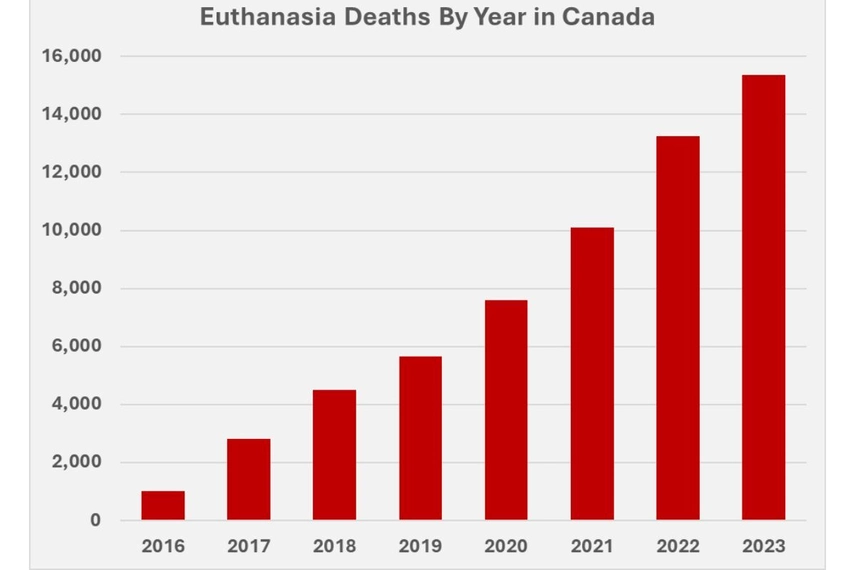
    The program has seen rapid growth since its inception. In 2017, 2,838 people died via MAiD; by 2024, that number had risen to 16,499, accounting for one in twenty deaths in Canada. This expansion has made Canada one of the most permissive jurisdictions globally regarding assisted dying, comparable only to the Netherlands and Belgium. By 2022, MAiD had become the fourth leading cause of death in the country, having grown thirteenfold since 2016.

    A controversial aspect of the program is the planned inclusion of individuals whose sole underlying condition is mental illness. Originally scheduled for March 2023, this expansion has been delayed and is now set for 2027 due to concerns about safeguards and ethical implications. The delay is currently being challenged in court, and the issue remains highly contentious, drawing criticism from UN human rights experts and disability rights groups who warn of potential coercion and devaluation of vulnerable lives.

    Critics argue that in the context of austerity, housing crises, and rising inequality, some individuals may feel pressured to choose MAiD due to lack of adequate social or medical support rather than a genuine desire to die. As of early 2025, income inequality in Canada reached a record high, with the top 20% holding nearly two-thirds of the wealth, while 45% of Canadians reported difficulty meeting daily expenses.

    While federal law does not compel healthcare providers to participate in MAiD, some provinces require objecting practitioners to make an effective referral to another provider. Safeguards include assessments by two independent medical professionals, a written and witnessed request, and the option to withdraw consent at any time. For those whose death is reasonably foreseeable, a waiver of final consent—known as Audrey’s Amendment—allows MAiD to proceed even if the person loses capacity before the procedure.

    Additional articles and some food for thought:
    Last edited by rgray222; 22nd December 2025 at 17:35.

  2. The Following 18 Users Say Thank You to rgray222 For This Post:

    Bill Ryan (22nd December 2025), Brigantia (22nd December 2025), ExomatrixTV (Yesterday), grapevine (22nd December 2025), Harmony (23rd December 2025), HopSan (22nd December 2025), Ioneo (22nd December 2025), JackMcThorn (22nd December 2025), kudzy (22nd December 2025), meat suit (22nd December 2025), Mike (22nd December 2025), Nasu (27th December 2025), Passingthrough (Yesterday), petra (Yesterday), skogvokter (23rd December 2025), Sue (Ayt) (23rd December 2025), Wilbur2 (24th December 2025), Yoda (22nd December 2025)

  3. Link to Post #2
    UK Avalon Member Brigantia's Avatar
    Join Date
    29th May 2019
    Location
    Near Chizzit Land
    Language
    English
    Posts
    1,579
    Thanks
    30,777
    Thanked 15,720 times in 1,569 posts

    Default Re: Medical Assistance In Dying - The Canadian MAID Program

    I remember reading of a young woman in Canada with depression who was offered MAID in order to end her suffering.

    Our House of Commons in the UK has passed a bill to legalise euthanasia, introduced by some mad-looking Labour woman MP, but that is being resisted in the House of Lords. It needs to be passed in the Lords in order to become law; hopefully they will stop this happening as I believe it is diabolically wrong on all levels and glaringly open to abuse. Doctors have said how difficult it is to determine a patient's future lifespan; patients that they believed would only have a few months to live have recovered and gone on living for years.

  4. The Following 13 Users Say Thank You to Brigantia For This Post:

    Bill Ryan (22nd December 2025), grapevine (22nd December 2025), Harmony (23rd December 2025), HopSan (22nd December 2025), JackMcThorn (23rd December 2025), kudzy (22nd December 2025), Nasu (27th December 2025), petra (Yesterday), rgray222 (22nd December 2025), skogvokter (23rd December 2025), Sue (Ayt) (23rd December 2025), Wilbur2 (24th December 2025), Yoda (22nd December 2025)

  5. Link to Post #3
    Avalon Member rgray222's Avatar
    Join Date
    24th September 2010
    Language
    English
    Posts
    3,533
    Thanks
    14,231
    Thanked 32,572 times in 3,421 posts

    Default Re: Medical Assistance In Dying - The Canadian MAID Program

    I believe that Canada's program has begun to go off the rails when it began to include people who are not terminally ill, especially those with a mental illness. (Oddly, Canada has begun to kill itself.) The law, as amended in 2021, allows for individuals with grievous and irremediable medical conditions, even if death is not reasonably foreseeable, to take advantage of assisted suicide. There have been several high-profile cases, such as the 51-year-old woman with chemical sensitivities who chose MAID after failing to find affordable housing, that have fueled concerns that MAID is being used as a solution to social and economic challenges rather than medical ones. Human nature dictates that the easiest path is usually (but not always) chosen, so turning death into an alternative to addressing society's failures is simply wrong. Killing people is a lot easier than funding and researching mental illness. Killing people is a lot cheaper than giving people access to healthcare, housing or food.

    I believe Canada is now on the slippery slope, and it will be almost impossible to slow down the expansion of this assisted death program. The MAID program devalues all life but especially that of physically and mentally ill people.

  6. The Following 9 Users Say Thank You to rgray222 For This Post:

    Bill Ryan (23rd December 2025), Brigantia (23rd December 2025), Harmony (23rd December 2025), JackMcThorn (23rd December 2025), kudzy (24th December 2025), Nasu (27th December 2025), petra (Yesterday), skogvokter (23rd December 2025), Yoda (24th December 2025)

  7. Link to Post #4
    Avalon Member
    Join Date
    3rd August 2025
    Posts
    74
    Thanks
    159
    Thanked 513 times in 73 posts

    Default Re: Medical Assistance In Dying - The Canadian MAID Program

    On a slightly perverse and morbid note: If they made medically-assisted dying totally legal, in Canada and elsewhere, without there being ANY qualifying prerequisites, apart from being of the age of majority and capable of consenting, I bet there would be hundreds of thousands taking the option each year in most countries. In fact (and even more morbidly - sorry) it would form a pretty good metric of the standard of living in a country!

  8. The Following 7 Users Say Thank You to Wilbur2 For This Post:

    Bill Ryan (24th December 2025), Brigantia (24th December 2025), Harmony (24th December 2025), kudzy (24th December 2025), Nasu (27th December 2025), rgray222 (24th December 2025), Yoda (24th December 2025)

  9. Link to Post #5
    Avalon Member Passingthrough's Avatar
    Join Date
    9th July 2026
    Language
    English
    Age
    57
    Posts
    4
    Thanks
    6
    Thanked 25 times in 3 posts

    Default Re: Medical Assistance In Dying - The Canadian MAID Program

    I remember taking the time to write thoughtfully about MAID in a mainstream forum some years ago, only to have my perspective quickly erased.

    My own journey has been shaped by a long trail of suicides involving close friends and family, alongside my own struggles. Having shared in their pain, and at times the very same institutions, I came to understand why they did as they did and ultimately came to respect that such a decision belonged to them.

    I appreciate that many believe we incarnate to learn, grow, and work through difficult experiences. That may well be true, or maybe not. I tend to see it more like a farm with many paddocks, each separated by another locked gate. We may believe we've found freedom, only to discover another enclosure beyond it. Either way, what I struggle with is the certainty with which some conclude they know what another person's lesson is, or that prolonged suffering is somehow part of it. Perhaps compassion also means accepting that we cannot fully know another's path.

    What concerns me just as much is the institutional gatekeeping that too often prolongs suffering in the name of care. For all the moral language surrounding the issue, too little weight is given to individual sovereignty and the right of a competent adult to decide when enough is enough.

    Far less attention is given to what it says about us that so many people reach the point of wanting to leave in the first place, despite the constant insistence that life is such a wondrous gift. Perhaps that is simply the burden of becoming aware. We are the only animals that know what awaits us, and for some, seeing the fences for what they are brings not only understanding, but profound isolation. Before deciding that more suffering is what someone needs, perhaps we should first ask what it is they have come to see.

  10. The Following 7 Users Say Thank You to Passingthrough For This Post:

    Bill Ryan (Yesterday), Harmony (Yesterday), petra (Yesterday), Sue (Ayt) (Yesterday), Tracie (Bodhicee) (Yesterday), wondering (Yesterday), Yoda (Yesterday)

  11. Link to Post #6
    Canada Avalon Member
    Join Date
    7th July 2016
    Location
    Newfoundland, Canada
    Age
    46
    Posts
    2,393
    Thanks
    7,850
    Thanked 6,942 times in 1,954 posts

    Default Re: Medical Assistance In Dying - The Canadian MAID Program

    Somewhat mentally ill person here!

    I remember wanting to be euthanized. I had lost ALL my memories. I was left with one memory of playing chess with my mom and thats it. I tried to convince the mental institution to kill me and I argued why is this acceptable for animals but not for people??

    My memories come back though thankfully and I am glad they did not kill me I think there will be a time though, when I get older, that I will be ready to die. And I hope when that time comes it will be relatively painless

  12. The Following 3 Users Say Thank You to petra For This Post:

    Harmony (Yesterday), Passingthrough (Yesterday), Sue (Ayt) (Yesterday)

+ Reply to Thread

Tags for this Thread

Posting Permissions

  • You may not post new threads
  • You may not post replies
  • You may not post attachments
  • You may not edit your posts