+ Reply to Thread
Page 3 of 3 FirstFirst 1 3
Results 41 to 42 of 42

Thread: Great women in history

  1. Link to Post #41
    UK Moderator/Librarian/Administrator Tintin's Avatar
    Join Date
    3rd June 2017
    Location
    Project Avalon library
    Language
    English
    Age
    56
    Posts
    8,522
    Thanks
    92,096
    Thanked 73,254 times in 8,491 posts

    Default Re: Great women in history

    Sayoko Yamaguchi

    With thanks to Historic Vids for the prompt:

    ----------------------------------

    Source: https://x.com/historyinmemes/status/2084859441279815780
    Sayoko Yamaguchi, widely regarded as one of the most influential models to emerge from the 1970s fashion scene.

    Sayoko Yamaguchi was a revolutionary force in fashion and arguably the most influential Asian model of the 1970s. With her distinctive doll-like features, sharp bob haircut, and dramatic eyeliner, she challenged conventional beauty ideals and helped redefine the global fashion landscape by bringing Japanese aesthetics to the forefront.

    After making her Paris runway debut in 1972, Yamaguchi quickly became a favorite of visionary designers including Issey Miyake, Kenzo Takada, and Kansai Yamamoto. In 1973, she signed an exclusive worldwide contract with cosmetics powerhouse Shiseido, becoming the face of a campaign that showcased Japanese beauty and design to international audiences while reshaping perceptions within the fashion industry.

    Her international impact was further recognized in 1977, when Newsweek named her among the world’s six leading fashion models. That same year, her unforgettable image appeared on the cover of Steely Dan’s acclaimed album Aja. Rejecting the idea of being merely a model, Yamaguchi described herself as a “wearist,” viewing fashion as a form of expression and performance. Her influence was so enduring that mannequin designer Adel Rootstein created highly sought-after life-sized mannequins modeled after her iconic appearance, preserving her image as a symbol of fashion history.


    “If a man does not keep pace with [fall into line with] his companions, perhaps it is because he hears a different drummer. Let him step to the music which he hears, however measured or far away.” - Thoreau

  2. The Following 6 Users Say Thank You to Tintin For This Post:

    Bill Ryan (5th August 2026), Ewan (6th August 2026), grapevine (6th August 2026), Mark (Star Mariner) (5th August 2026), petra (24th August 2026), Yoda (5th August 2026)

  3. Link to Post #42
    UK Avalon Founder Bill Ryan's Avatar
    Join Date
    7th February 2010
    Location
    Ecuador
    Posts
    40,078
    Thanks
    296,941
    Thanked 530,336 times in 38,618 posts

    Default Re: Great women in history

    Copying this new post by Bluegreen on his thread: (I'd never heard of Saint Christina before)

    ~~~

    The True Story of St Christina the Astonishing

    Indestructible Miracle-Woman


    Patron saint of the mentally ill

    So, Christina the Astonishing is sort of a saint.

    She lived in the late 12th century and early 13th century, right around the time the Church was forming the modern canonization process, and she’s never been been formally canonized. Nonetheless, she was popularly considered a saint for centuries after her death. Her relics have been preserved, she was included in a version of Butler’s Lives of Saints, and was even honored on local liturgical calendars at various points.

    But what about that title? What made her so “astonishing”?

    Just about everything. If anyone deserved such a title, it was Christina.

    Born in 1150 in a small town in present day Belgium, Christina was orphaned as a teenager and worked as a shepherdess. Then, sometime in her early 20s, she suffered from a massive seizure. When the episode passed, she was lying on the ground completely limp. Unable to see breathing or hear a heartbeat, those with her pronounced dead. Soon after, a funeral was held at her local parish.

    In the middle of the funeral service, she suddenly woke up. Full of energy, she stood right up like nothing had happened. When she realized she was surrounded by a large group of people, she started levitating, and flew up to the roof.

    This wouldn’t be the only time she levitated. She levitated often, she said, because she couldn’t bear the spiritually stinky smell of sinful people.

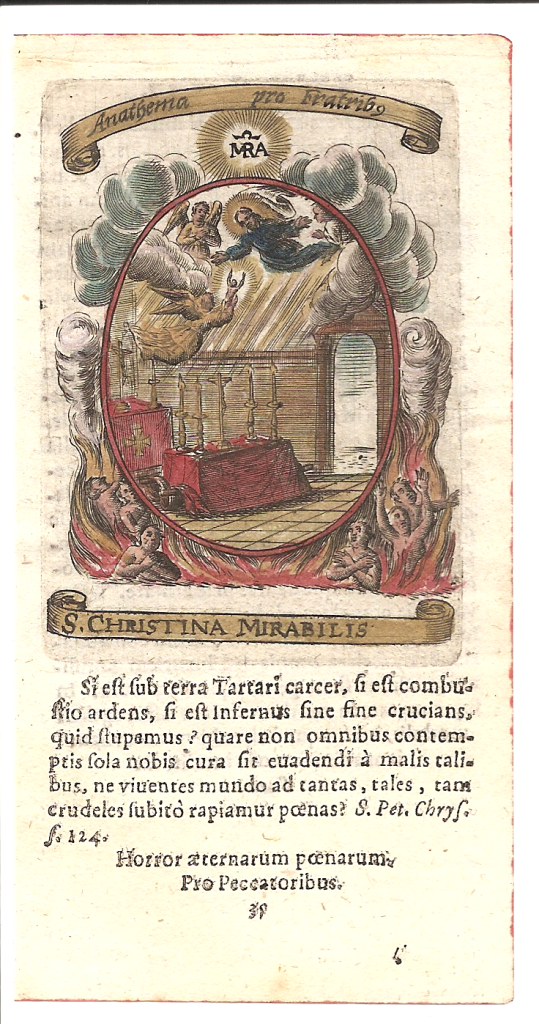
    When she finally stopped levitating at the funeral, she explained she had in fact died. After her soul separated from her body, she was given a glimpse of the horrors of purgatory. God then gave her a choice: either remain dead and go to heaven, or return to earth and do penance for those in purgatory. Moved to zeal at the sight of those suffering in Purgatory, she chose the latter. The next moment, she came back to life.

    She took her charge to do penance very seriously.

    She voluntarily lived in extreme poverty, wearing only rags and living without a home. She avoided human contact as much as possible. But deprivation wasn’t enough: she also sought out suffering to increase her penance.

    People watched her intentionally throw herself into fires and remain there for extended periods of time. She would appear to be suffering greatly, with terrible shrieking, but then would exit the fire completely unscathed.

    She allowed herself to be attacked by dogs and would intentionally run her body through thickets of thorn bushes.

    And in winter, she would immerse herself in a nearby river and remain in the nearly freezing water for hours or even days on end. As if this wasn’t extreme enough, she would apparently even allow herself to be sucked into water wheels of nearby mills, getting spun around.

    Again, as painful and harmful as these things seemed to be for her, she would always emerge seemingly unharmed.


    .
    Public opinion was divided about her: Was she just insane? Was she a holy woman sent to warn people of the fires of purgatory? Or she was perhaps demon possessed? Government officials jailed her twice, though both times only briefly.

    After being released the second time, she joined a Dominican monastery. Her prioress said that, despite her extreme behavior, she was always obedient. Her reputation spread across the region, and both rulers and other holy people sought her out for advice and spiritual aid.

    Amazingly, despite all of her physical abuse, she died at the ripe age of 74 of natural causes.

    If this is all just too unbelievable for you, here are a few things to note: First, in addition to the many peasants who witnessed her behavior, the historian and Cardinal Jacques de Vitry claimed to have been a personal witness of her incredible behavior, such as going into fires and emerging unharmed. Second, as mentioned, some contemporary saints held her in high regard and sought her advice. Third, Thomas of Cantimpré – writer, theologian, and student of St. Albert the Great – researched her life within a few years after her death and wrote a report, with memories of her life still fresh in people’s minds.

    There remains a strong devotion to her in Belgium.

    https://www.churchpop.com/christina-...uctible-woman/


    Her page in a 17th century calendar of saints


    Fr Steve tells the story.

    (3:21)

  4. The Following 11 Users Say Thank You to Bill Ryan For This Post:

    Ewan (25th August 2026), Johan (Keyholder) (24th August 2026), kudzy (24th August 2026), leavesoftrees (24th August 2026), Mark (Star Mariner) (24th August 2026), Mike Gorman (24th August 2026), Open Minded Dude (24th August 2026), petra (24th August 2026), Sue (Ayt) (24th August 2026), Tintin (24th August 2026), Yoda (24th August 2026)

+ Reply to Thread
Page 3 of 3 FirstFirst 1 3

Posting Permissions

  • You may not post new threads
  • You may not post replies
  • You may not post attachments
  • You may not edit your posts