+ Reply to Thread
Page 1 of 7 1 7 LastLast
Results 1 to 20 of 121

Thread: What Happened to Egypt’s Pharaohs?

  1. Link to Post #1
    Portugal Avalon Retired Member
    Join Date
    11th July 2010
    Location
    Planet Earth
    Posts
    2,322
    Thanks
    1,009
    Thanked 3,776 times in 1,173 posts

    Default What Happened to Egypt’s Pharaohs?


    http://www.thetrumpet.com/?q=8024.0.133.0

    The Black Pharaohs

    An ignored chapter of history tells of a time when kings from deep in Africa conquered ancient Egypt.
    By Robert Draper
    National Geographic Contributing Writer

    In the year 730 B.C., a man by the name of Piye decided the only way to save Egypt from itself was to invade it. Things would get bloody before the salvation came.

    “Harness the best steeds of your stable,” he ordered his commanders. The magnificent civilization that had built the great pyramids had lost its way, torn apart by petty warlords.

    For two decades Piye had ruled over his own kingdom in Nubia, a swath of Africa located mostly in present-day Sudan.

    But he considered himself the true ruler of Egypt as well, the rightful heir to the spiritual traditions practiced by pharaohs such as Ramses II and Thutmose III.

    Since Piye had probably never actually visited Lower Egypt, some did not take his boast seriously. Now Piye would witness the subjugation of decadent Egypt firsthand—“I shall let Lower Egypt taste the taste of my fingers,” he would later write.

    North on the Nile River his soldiers sailed. At Thebes, the capital of Upper Egypt, they disembarked. Believing there was a proper way to wage holy wars, Piye instructed his soldiers to purify themselves before combat by bathing in the Nile, dressing themselves in fine linen, and sprinkling their bodies with water from the temple at Karnak, a site holy to the ram-headed sun god Amun, whom Piye identified as his own personal deity.

    Piye himself feasted and offered sacrifices to Amun. Thus sanctified, the commander and his men commenced to do battle with every army in their path.

    By the end of a yearlong campaign, every leader in Egypt had capitulated—including the powerful delta warlord Tefnakht, who sent a messenger to tell Piye, “Be gracious! I cannot see your face in the days of shame; I cannot stand before your flame, I dread your grandeur.”

    In exchange for their lives, the vanquished urged Piye to worship at their temples, pocket their finest jewels, and claim their best horses.

    He obliged them. And then, with his vassals trembling before him, the newly anointed Lord of the Two Lands did something extraordinary: He loaded up his army and his war booty, and sailed southward to his home in Nubia, never to return to Egypt again.

    When Piye died at the end of his 35-year reign in 715 B.C., his subjects honored his wishes by burying him in an Egyptian-style pyramid, with four of his beloved horses nearby. He was the first pharaoh to receive such entombment in more than 500 years.

    A pity, then, that the great Nubian who accomplished these feats is literally faceless to us. Images of Piye on the elaborate granite slabs, or stelae, memorializing his conquest of Egypt have long since been chiseled away.

    On a relief in the temple at the Nubian capital of Napata, only Piye’s legs remain. We are left with a single physical detail of the man—namely, that his skin was dark.

    Piye was the first of the so-called black pharaohs—a series of Nubian kings who ruled over all of Egypt for three-quarters of a century as that country’s 25th dynasty.

    Through inscriptions carved on stelae by both the Nubians and their enemies, it is possible to map out these rulers’ vast footprint on the continent.

    The black pharaohs reunified a tattered Egypt and filled its landscape with glorious monuments, creating an empire that stretched from the southern border at present-day Khartoum all the way north to the Mediterranean Sea. They stood up to the bloodthirsty Assyrians, perhaps saving Jerusalem in the process.

    Until recently, theirs was a chapter of history that largely went untold. Only in the past four decades have archaeologists resurrected their story—and come to recognize that the black pharaohs didn’t appear out of nowhere.

    They sprang from a robust African civilization that had flourished on the southern banks of the Nile for 2,500 years, going back at least as far as the first Egyptian dynasty.

    Today Sudan’s pyramids—greater in number than all of Egypt’s—are haunting spectacles in the Nubian Desert. It is possible to wander among them unharassed, even alone, a world away from Sudan’s genocide and refugee crisis in Darfur or the aftermath of civil war in the south.

    While hundreds of miles north, at Cairo or Luxor, curiosity seekers arrive by the busload to jostle and crane for views of the Egyptian wonders, Sudan’s seldom-visited pyramids at El Kurru, Nuri, and Meroë stand serenely amid an arid landscape that scarcely hints of the thriving culture of ancient Nubia.

    http://ngm.nationalgeographic.com/20...-draper-text/1

    Namasté
    Last edited by MariaDine; 13th March 2011 at 20:12.

  2. The Following 26 Users Say Thank You to MariaDine For This Post:

    Amenjo (17th March 2011), Anna (13th March 2011), Aqua marina (13th March 2011), crosby (20th August 2011), delaware (14th March 2011), Flash (14th August 2011), giovonni (13th March 2011), greybeard (14th September 2011), iceni tribe (3rd May 2011), InCiDeR (17th March 2011), John Parslow (18th August 2011), jorr lundstrom (14th March 2011), Karma Ninja (11th May 2011), kersley (17th September 2012), king anthony (13th March 2011), Limor Wolf (16th March 2011), PHARAOH (3rd May 2011), pharoah21 (29th April 2011), raregem (22nd January 2014), Realeyes (26th February 2014), RedeZra (3rd May 2011), Ria (5th May 2011), shadowstalker (16th March 2011), Steven (3rd May 2011), str8thinker (14th March 2011), W.C. (30th April 2011)

  3. Link to Post #2
    Portugal Avalon Retired Member
    Join Date
    11th July 2010
    Location
    Planet Earth
    Posts
    2,322
    Thanks
    1,009
    Thanked 3,776 times in 1,173 posts

    Default Re: What Happened to Egypt’s Pharaohs?

    https://youtube.com/watch?v=PxEw5J2gU1w part 2

    https://youtube.com/watch?v=hUpOR...eature=related part 3

    ¤=[Post Update]=¤

    The winds of revolution sweeping Egypt today aren’t the first that have ravaged that nation.

    Most history textbooks open with a description of ancient Egypt as a towering civilization that, for more than a millennium, led mankind’s intellectual, political and cultural advancement. Each year, millions of visitors marvel at the pyramids jutting from Egypt’s dunes, at the mummified remains of the ancient pharaohs, and at Egypt’s mountains of other artifacts and relics—all testimony to the power the civilization once held.

    But perhaps the most striking facet of Egyptian history is its precipitous fall.

    Modern-day Egyptians, after all, are not descended from those ancient societies that constructed the Giza Pyramid Complex, the Great Sphinx, and other momentous structures. They have no connection to the early dynastic peoples that pioneered new frontiers in science, mathematics and art, and that once dominated the civilized world. Today’s Egypt is inhabited and ruled by Arabs; before that it was under British control; before that it was controlled by various Muslim peoples, including the Ottomans; before that it was the Romans; before that the Greeks; and before that the Persians.

    Egypt has resurfaced intermittently in the past 2,500 years of world history, but always as the territory of a foreign nation or empire. What happened to ancient Egypt—the unique and independent civilization established by the pharaohs, the nation that once reigned over mankind? That Egypt has clearly vanished.

    Don’t you wonder why?

    Who Were Native Egyptians?

    There is a great deal of confusion among historians about the race of native Egyptians. Archeological evidence, ancient Egyptian art and hieroglyphics indicate the presence in ancient Egypt of both Semitic (Caucasian) people and Negroid peoples (including various shades of brown).

    In the 19th and 20th centuries, when artifacts were uncovered indicating the presence of black pharaohs, prejudiced historians and scientists generally downplayed the notion that a great Nubian civilization had once existed in Egypt. Today, however, many Egyptologists recognize that the indigenous peoples of ancient Egypt originated from the same racial strain as their counterparts in Africa.

    In February 2008, the National Geographic cover story spotlighted the substantial historical and archeological evidence indicating the presence of a predominantly black civilization in early Egypt: “Only in the past four decades have archaeologists resurrected their story—and come to recognize that the black pharaohs didn’t appear out of nowhere. They sprang from a robust African civilization that had flourished on the southern banks of the Nile for 2,500 years, going back at least as far as the first Egyptian dynasty” (emphasis mine throughout).

    Moreover, scientists have also investigated the remains of the early Egyptians, including their dna, bone structure and teeth, and concluded that early Egyptians are of the same racial strain as the black people of Africa. Even the historical record indicates early Egypt was settled, at least partially, by people of black skin. Among the ancient historians who recognized this fact was Herodotus, the fifth-century Greek who referred to the ancient Egyptians as “melanchroes,” meaning black-skinned.

    The science indicating the presence of a black civilization in Egypt supports the biblical account of the origins of the early Egyptians. In the book of Psalms, for example, mostly written around the 10th century b.c., the psalmists often recall the history of the Israelites in Egypt. In Psalm 105:23, for example, King David writes, “Israel also came into Egypt; and Jacob sojourned in the land of Ham.” In Psalm 78, Asaph remembers God besieging the Egyptians with plagues, writing that God “smote all the firstborn in Egypt; the chief of their strength in the tabernacles of Ham” (verse 51).

    At the time of King David, Egypt was known as the “land of Ham.” The Bible clearly reveals Ham as Noah’s son, the husband of a black woman and the father of the black race. More specifically, the Bible indicates that the ancient Egyptians descend from Ham’s son Mizraim (Genesis 10:6). The Hebrew word everywhere used in the Old Testament for Egypt is Mizraim. In fact, the Revised Standard Version identifies “the sons of Ham” in Genesis 10:6 as “Cush, Egypt, Put, and Canaan.”

    So when it comes to ancient Egypt, science and the Bible agree: Early Egypt, like the rest of Africa, was largely comprised of blacks, descended from Ham, father of the black race!

    But what of the wealth of archeological evidence, especially art, that clearly reveals the presence in ancient Egypt of a Semitic people?

    http://www.thetrumpet.com/?q=8024.0.133.0 - Read more here

  4. The Following 7 Users Say Thank You to MariaDine For This Post:

    Anna (14th March 2011), giovonni (13th March 2011), InCiDeR (17th March 2011), Karma Ninja (11th May 2011), PHARAOH (3rd May 2011), raregem (22nd January 2014), shadowstalker (16th March 2011)

  5. Link to Post #3
    Portugal Avalon Retired Member
    Join Date
    11th July 2010
    Location
    Planet Earth
    Posts
    2,322
    Thanks
    1,009
    Thanked 3,776 times in 1,173 posts

    Default Re: What Happened to Egypt’s Pharaohs?


    King Tut royal Blood - DNA results of ancient egyptian boy king Pharaoh King Tut of Egypt, decended from caucasian rb1 haplogroup bloodline

DNA tests confirm the genetics of King Tut as being caucasian.
    Last edited by MariaDine; 13th March 2011 at 23:01.

  6. The Following 6 Users Say Thank You to MariaDine For This Post:

    Anna (14th March 2011), delaware (14th March 2011), giovonni (13th March 2011), InCiDeR (17th March 2011), Lord Sidious (13th March 2011), slvrfx (14th March 2011)

  7. Link to Post #4
    Palestinian Territory Unsubscribed
    Join Date
    4th January 2011
    Location
    Coruscant
    Age
    57
    Posts
    7,236
    Thanks
    37,899
    Thanked 33,087 times in 6,275 posts

    Default Re: What Happened to Egypt’s Pharaohs?
    From what I recall, the nubians moved in when the Egyptians were at a weak period and took over.
    They didn't build the empire, the conquered it.

  8. Link to Post #5
    Portugal Avalon Retired Member
    Join Date
    11th July 2010
    Location
    Planet Earth
    Posts
    2,322
    Thanks
    1,009
    Thanked 3,776 times in 1,173 posts

    Default Re: What Happened to Egypt’s Pharaohs?


  9. Link to Post #6
    Unsubscribed
    Join Date
    16th March 2010
    Posts
    22,426
    Thanks
    18,297
    Thanked 93,628 times in 20,439 posts

    Thumbs up Re: What Happened to Egypt’s Pharaohs?

    Good stuff ~ quite insightful my Friend

  10. Link to Post #7
    Portugal Avalon Retired Member
    Join Date
    11th July 2010
    Location
    Planet Earth
    Posts
    2,322
    Thanks
    1,009
    Thanked 3,776 times in 1,173 posts

    Default Re: What Happened to Egypt’s Pharaohs?

    The Union of Arab Archaeologists called on the Egyptian caretaker government to rescue the country’s monuments and artifacts.

    In a statement on Saturday, Ali Radwan, the union's head, said Egypt's heritage is facing a very real threat for several artifact storehouses and museums have been recently robbed.
    The union, which has more than 3000 Arab archaeologists as members, called for an urgent board meeting to discuss ways to protect Egyptian monuments. The statement said it is putting all its resources in the hands of the Egyptian government in order to prevent the loss of heritage.
    Egyptian Television, meanwhile, cited Abdel Halim Nour, the former head of the Supreme Council of Antiquities, as saying that heritage sites in Egypt are being exposed to unprecedented organized thefts.

    Nour also said that the Egyptian Museum had been subject to a planned robbery, as people who boke in during the January 25 uprising headed directly to the treasures of Tutankhamun despite the building being dark at the time. Many of the robbers not been arrested yet.

  11. The Following User Says Thank You to MariaDine For This Post:

    delaware (14th March 2011)

  12. Link to Post #8
    Unsubscribed
    Join Date
    20th March 2010
    Location
    Within a few kilometers of Avalon
    Age
    78
    Posts
    1,702
    Thanks
    3,990
    Thanked 7,178 times in 1,466 posts

    Default Re: What Happened to Egypt’s Pharaohs?

    In may be of interest to note: ruins of a much older civilization (predating what we know as historic Egypt by some 200,000 years has been discovered further south on the African Continent.

    Is there a possibility this (yet unstudied) civilization was an ancient precursor of what became the Nubian progenitors of the Egyptian Civilization?

    http://viewzone2.com/adamscalendarx.html

    Could this ancient civilization possibly be the "human race created for slave labor to work in the gold mines" talked about in the Sumerian Tablets?

    Did these humans eventually migrate North and create great civilizations that are (even now) ancient to us?

    It must be obvious that everything we are told is a lie....

  13. Link to Post #9
    Palestinian Territory Unsubscribed
    Join Date
    4th January 2011
    Location
    Coruscant
    Age
    57
    Posts
    7,236
    Thanks
    37,899
    Thanked 33,087 times in 6,275 posts

    Default Re: What Happened to Egypt’s Pharaohs?

    Nubians weren't the progenitors, they came after that.

  14. Link to Post #10
    Unsubscribed
    Join Date
    20th March 2010
    Location
    Within a few kilometers of Avalon
    Age
    78
    Posts
    1,702
    Thanks
    3,990
    Thanked 7,178 times in 1,466 posts

    Default Re: What Happened to Egypt’s Pharaohs?

    Quote Posted by Lord Sidious (here)
    Nubians weren't the progenitors, they came after that.
    The progenitors of what was known as the Kingdom of Nubia (or later Southern Egypt) were, in fact from this same region as the later Nubian Pharaohs. I agree the Nubian Pharaohs came much later in history.

    [edit]In ancient Egypt, Upper Kingdom and Southern Egypt are one in the same thing; Lower Kingdom and Northern Egypt are likewise referring to the same common area.

    http://www.clscc.cc.tn.us/Courses/ng...ilizations.htm

    But, the region later known as the Southern Kingdom was first known as Naqada, and is in the same geographic area as what was later called Nubia.

    So, you can see the progenitors of the area known as the Southern Kingdom were genetically African.

    http://en.wikipedia.org/wiki/Naqada

    Which brings me back to my point: "Everything we think we know is a lie"....
    Last edited by observer; 14th March 2011 at 04:07. Reason: add clarification

  15. Link to Post #11
    Palestinian Territory Unsubscribed
    Join Date
    4th January 2011
    Location
    Coruscant
    Age
    57
    Posts
    7,236
    Thanks
    37,899
    Thanked 33,087 times in 6,275 posts

    Default Re: What Happened to Egypt’s Pharaohs?

    Quote Posted by observer (here)
    Quote Posted by Lord Sidious (here)
    Nubians weren't the progenitors, they came after that.
    The progenitors of what was known as the Kingdom of Nubia (or later Southern Egypt) were, in fact from this same region as the later Nubian Pharaohs. I agree the Nubian Pharaohs came much later in history.

    http://www.clscc.cc.tn.us/Courses/ng...ilizations.htm

    But, the region later known as the Southern Kingdom was first known as Naqada, and is in the same geographic area as what was later called Nubia.

    So, you can see the progenitors of the area known as the Southern Kingdom were genetically African.

    http://en.wikipedia.org/wiki/Naqada

    Which brings me back to my point: "Everything we think we know is a lie"....
    You are saying something different to me.
    I said the nubians aren't the progenitors of the Egyptians, not what you replied with.

  16. Link to Post #12
    Unsubscribed
    Join Date
    20th March 2010
    Location
    Within a few kilometers of Avalon
    Age
    78
    Posts
    1,702
    Thanks
    3,990
    Thanked 7,178 times in 1,466 posts

    Default Re: What Happened to Egypt’s Pharaohs?

    Quote Posted by Lord Sidious (here)
    Quote Posted by observer (here)
    Quote Posted by Lord Sidious (here)
    Nubians weren't the progenitors, they came after that.
    The progenitors of what was known as the Kingdom of Nubia (or later Southern Egypt) were, in fact from this same region as the later Nubian Pharaohs. I agree the Nubian Pharaohs came much later in history.

    [edit]In ancient Egypt, Upper Kingdom and Southern Egypt are one in the same thing; Lower Kingdom and Northern Egypt are likewise referring to the same common area.

    http://www.clscc.cc.tn.us/Courses/ng...ilizations.htm

    But, the region later known as the Southern Kingdom was first known as Naqada, and is in the same geographic area as what was later called Nubia.

    So, you can see the progenitors of the area known as the Southern Kingdom were genetically African.

    http://en.wikipedia.org/wiki/Naqada

    Which brings me back to my point: "Everything we think we know is a lie"....
    You are saying something different to me.
    I said the nubians aren't the progenitors of the Egyptians, not what you replied with.
    I am confirming what I said in my original comment with documentation.

    Which Egypt are you referring to with your first retort? It is generally accepted history that both Upper and Lower Egypt were already unified at the time of the first Egyptian Pharaoh. Therefore, what I have said consistently, is that the progenitors of much of what later became Egypt were African.

    I'm not denying the historical progenitors of Lower Egypt were Mediterranean in origin, but all of that came nearly 200,000 years after a civilization thrived further south on the African Continent.

    Do you see my point now?
    Last edited by observer; 14th March 2011 at 04:06. Reason: add clarification

  17. Link to Post #13
    Palestinian Territory Unsubscribed
    Join Date
    4th January 2011
    Location
    Coruscant
    Age
    57
    Posts
    7,236
    Thanks
    37,899
    Thanked 33,087 times in 6,275 posts

    Default Re: What Happened to Egypt’s Pharaohs?

    Quote Posted by observer (here)
    Do you see my point now?
    I did indeed see something fly by very quickly, but I didn't see what it was before I shot it down.
    Sorry about that.


  18. Link to Post #14
    Unsubscribed
    Join Date
    20th March 2010
    Location
    Within a few kilometers of Avalon
    Age
    78
    Posts
    1,702
    Thanks
    3,990
    Thanked 7,178 times in 1,466 posts

    Default Re: What Happened to Egypt’s Pharaohs?

    The generally accepted geographic border between what is known as the Upper Kingdom and the Lower Kingdom is in the area of Cairo at the beginning of the Nile Delta. The Lower Kingdom which was the dominant culture in predynastic Egypt was a relatively small geographical area covering the Nile Delta.

    The Upper Kingdom (theoretically) stretched for the remaining length of the Nile. Which, in antiquity, extended well over 6,000 miles (9,700 km+). Tectonic activity in the African Riff Valley has shortened the reach of the headwaters of the Nile approximately 900 miles (1,500 km+)

    (Source reading) - here: http://en.wikipedia.org/wiki/History_of_ancient_Egypt
    (And) - here: http://en.wikipedia.org/wiki/Nile

    No one has researched when the Lower Kingdom was taken-over by the light skinned Mediterranean inhabitants. Modern Egyptologists have always assumed the dominant Lower Kingdom inhabitants were the 'builders' of the complex at Giza.

    Recent investigations have speculated the construction of the Spinx structure to 35,000 years ago (possibly to even 70,000 years). Whatever the truth, the Sphinx is much older than modern Egyptologists are willing to accept - as could also be the situation with the Cheops Pyramid.

    (Source reading) - here: http://www.morien-institute.org/sphinx.html

    Since Michael Tillinger's discovery of an (200,000 thousand year old) ancient 'gold mining' civilization located within relatively close proximity (geographically) to the headwaters of the Nile, it is not inconceivable these ancient humans migrated down the Nile to populate the entire Nile valley over the course of this 200,000 year span of time.

    Source reading) - here: http://viewzone2.com/adamscalendarx.html
    (Source video) - here: https://youtube.com/watch?v=V8nMJCO3nyg

    It is also not inconceivable to imagine these (Nubian) ancestors were used as the labor to build the monumental structures found all along the Nile Valley - assuming Sitchin's interpretations of the Sumerian clay tablets are correct, and 'The Gods Who Came Down' created the human species as slave labor and further controlled the evolution of civilizations. (accepting the understanding the Sumerian records were discovered in a completely different river valley) It should also be noted the ancient Egyptian word for gold was 'nub'.

    Two hundred thousand years of human evolution is a LONG TIME. When one comes to the realization that one common element has directed the course of human evolution over that span of time, an entirely NEW perspective is introduced into the Big Picture.

    They are very clever at what they do....
    Last edited by observer; 14th March 2011 at 15:12.

  19. Link to Post #15
    Portugal Avalon Retired Member
    Join Date
    11th July 2010
    Location
    Planet Earth
    Posts
    2,322
    Thanks
    1,009
    Thanked 3,776 times in 1,173 posts

    Default Re: What Happened to Egypt’s Pharaohs?


    The debate is centered in this issue :

    «Some Eurocentrists, once pressed in a corner will reluctantly concede that the Black Nubians did conquer Egypt at some point and ran it for over a century. But what they refuse to concede is that the Black Nubians conquered the 'Black' Egyptians. »

    The DNA evidences are the a way to discover the facts, but there is still much work to be done and there are no certainties.


    Ps - This video link is better
    Last edited by Ilie Pandia; 18th August 2011 at 18:27.

  20. Link to Post #16
    Portugal Avalon Retired Member
    Join Date
    11th July 2010
    Location
    Planet Earth
    Posts
    2,322
    Thanks
    1,009
    Thanked 3,776 times in 1,173 posts

    Default Re: What Happened to Egypt’s Pharaohs?


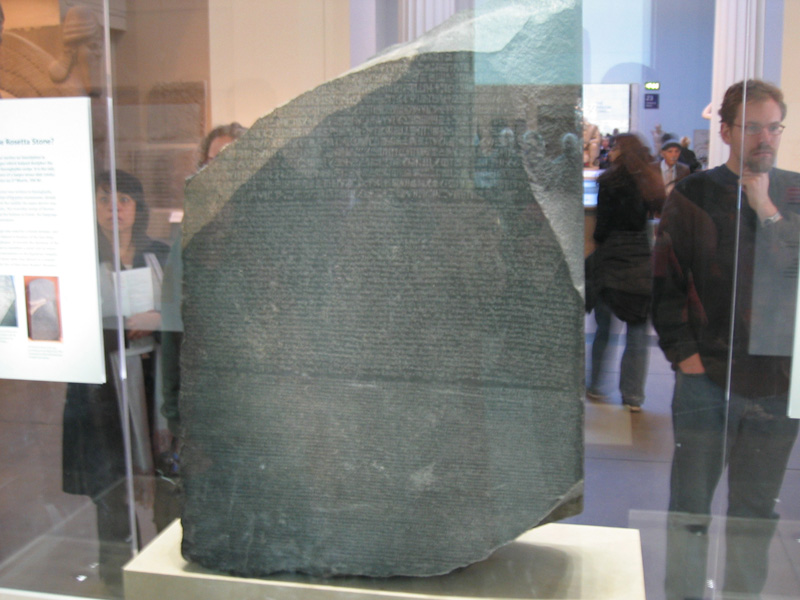
    The rosseta stone doesn't give a literal translation, just the general meaning of the hieroglyphs text in the other 2 scripts .

    http://en.wikipedia.org/wiki/Rosetta_Stone

  21. Link to Post #17
    Portugal Avalon Retired Member
    Join Date
    11th July 2010
    Location
    Planet Earth
    Posts
    2,322
    Thanks
    1,009
    Thanked 3,776 times in 1,173 posts

  22. Link to Post #18
    Portugal Avalon Retired Member
    Join Date
    11th July 2010
    Location
    Planet Earth
    Posts
    2,322
    Thanks
    1,009
    Thanked 3,776 times in 1,173 posts

    Default Re: What Happened to Egypt’s Pharaohs?


    The queen Amanitore from Nubia, she reigns in the same time of Jesus .She was part of the Meroitic historical period and her reign began in 1 BC. The rule of her successor, Amanitaraqide, was complete by 50 AD.

  23. Link to Post #19
    Portugal Avalon Retired Member
    Join Date
    11th July 2010
    Location
    Planet Earth
    Posts
    2,322
    Thanks
    1,009
    Thanked 3,776 times in 1,173 posts

    Default Re: What Happened to Egypt’s Pharaohs?


    More «food» to the fire !!!
    5.000 years old city in Nubia !!!

  24. The Following User Says Thank You to MariaDine For This Post:

    Anna (4th May 2011)

  25. Link to Post #20
    Unsubscribed
    Join Date
    20th March 2010
    Location
    Within a few kilometers of Avalon
    Age
    78
    Posts
    1,702
    Thanks
    3,990
    Thanked 7,178 times in 1,466 posts

    Default Re: What Happened to Egypt’s Pharaohs?

    Quote Posted by MariaDine (here)


    ....[snip] 5.000 years old city in Nubia !!!
    At around 5 min., 30 sec. the statement is made (I'm paraphrasing) "at 5,000 years old, this is the oldest city found in Africa".

    This is simply not accurate. Michael Tellinger is investigating the ruins of a thriving city in South Africa that dates back 200,000 years.

    I'm (in no way) attempting to discredit the plight of the Sudanese with regard to the willful destruction of their heritage. I'm simply attempting to show there is much more to the story than is being presented....

+ Reply to Thread
Page 1 of 7 1 7 LastLast

Posting Permissions

  • You may not post new threads
  • You may not post replies
  • You may not post attachments
  • You may not edit your posts