+ Reply to Thread
Page 25 of 51 FirstFirst 1 15 25 35 51 LastLast
Results 481 to 500 of 1019

Thread: From Bill Ryan -- the Ultimate Hypothesis

  1. Link to Post #481
    Avalon Member AnthonyBacala's Avatar
    Join Date
    8th January 2011
    Age
    38
    Posts
    138
    Thanks
    192
    Thanked 714 times in 115 posts

    Default Re: From Bill Ryan -- the Ultimate Hypothesis

    1997 Congressional Testimony on the effect of EMP Blasts on the national infrastructure in the House Committess on National Security

    http://commdocs.house.gov/committees/security/has197010.000/has197010_1.HTM

    A long, fascinating, and very revealing read. Here's an excerpt:

    Quote The subcommittee is meeting here today to explore in more detail EMP effects on our military systems and the civilian infrastructure, how confident we are that we can predict these effects, our potential vulnerabilities, what policies and practices guide our efforts to protect our systems, and the steps we have taken and can take to ameliorate these vulnerabilities.

    EMP can be generated in several ways, but the widest effects are caused by a high-altitude nuclear blast, although we will ask questions about other than nuclear blasts causing EMP. All of us here understand that the threats posed to our military systems and civilian infrastructure by high-altitude EMP are not new. Atmospheric nuclear tests in the 1950's and 1960's revealed a number of then unanticipated results, including electrical and communications disruptions hundreds of miles from the test sites.

    There may be, however, new dimensions in vulnerabilities that we need to look at more carefully. In the 1950's, electronic systems used vacuum tubes, not very sophisticated, but resistant to EMP. Today, computers with more and more microcircuits packed into smaller and smaller chips are key to the efficiency of virtually all commerce in the United States. These have much more computing power, but are also much more sensitive to disruption and more easily disabled by EMP. As our reliance grows, so does our potential vulnerability.

    Likewise, potential military vulnerability may be growing. The revolution from military affairs has brought with it a much greater dependence on information technologies. The ability to generate raw data, process it into usable form, and communicate information to the right people and systems is critical to military success, yet the sensors, computers and communications assets essential to this revolution could be vulnerable.


    For example, 95 percent of our military communications go through commercial channels. Are we confident that EMP will not disable or disrupt these commercial communications systems? How confident are we that the military could continue to communicate effectively if commercial systems were disrupted or completely disabled by EMP? How thoroughly do we protect our weapons systems from EMP? Are we confident they will continue to function?

    At the same time our vulnerabilities may be increasing, the subcommittee is worried about complacency in this area. It is true the cold war is over and the threat of a deliberate nuclear attack by Russia is much lower. That does not necessarily mean we have nothing to worry about. The proliferation of nuclear weapons and ballistic missiles continues. If we come into contact with a rogue nation in possession of just a very few nuclear weapons, perhaps just one, our adversary may or threaten to use one of those weapons to blind our military or to damage our economy or that of an ally.

    Yesterday we invited the intelligence community to provide us with their most up-to-date material on EMP threats. We received documents that were 10 years old, interestingly enough, written at that time by a member of our staff, who now is an expert with us, Peter Pry, who at that time was with the agency and the expert on EMP.

    We understand that no NIE has been issued on EMP since the 1980's, and this is 1997. We also understand that some of our EMP testing sets have been dismantled or are in disrepair.
    Quote Mr. PICKETT. Thank you, Mr. Chairman. I wanted also to welcome our witnesses here today.

    This is an issue that probably has not gotten as much attention as it should have received. I know it is one that concerns everyone in this room and certainly on this committee. EMP is something that has tremendous adverse potential for our Nation as we move more and more into the electronic age.

    I welcome the calling of this hearing by you, Mr. Chairman. I think it is way past the time we should have it. I look forward, as you do, to hearing from the witnesses today and also trying to understand what it is we can do from a policy standpoint to improve our Nation's capabilities to deal with this kind of phenomenon.
    Quote Dr. SMITH. Thank you very much. The laboratory that I represent is located in Howard County, MD. Before I begin, Mr. Chairman, I would request permission to insert my full testimony into the record and to confine my remarks this morning to just a brief summary.

    The Applied Physics Lab operates under about a dozen task order contracts with a number of major sponsors, covering between 200 and 300 separate tasks in any given year. All of our funding is derived from programs. We have no line-item support. About 80 percent of our funding comes from sponsors within the Department of Defense, and about 15 percent from the National Aeronautics and Space Administration. The rest of the funding comes from various Government departments and agencies.

    Recently, as you know, Mr. Chairman, Congressman Bartlett asked me to advise him on the subject of this particular hearing, the electromagnetic pulse produced by a high-altitude nuclear explosion, and the implications for defense systems and capabilities and for the civilian infrastructure. My staff has completed a limited assessment based on a review of the literature, an examination of the basic tenets and interviews with responsible and knowledgeable professionals in the field. I am prepared today to present the results of that assessment.

    In short, we have found that the phenomenon is very real, as you have already stated, and is well understood by the nuclear weapons effects community; that our strategic systems and their command, control and communications infrastructure have been designed and built to survive and operate effectively in such an environment; that there would likely be pronounced effects on the civilian infrastructure from such a pulse; that the magnitude and extent of these effects is difficult even to estimate; and that it is probably not feasible to completely protect the entire infrastructure from the effects of such a pulse.

    In this testimony, I will first consider electromagnetic pulse—or EMP, as it is called—phenomenology, and I will identify specific EMP-related vulnerabilities for ground system components of the civilian infrastructure. My full testimony discusses protection against EMP as well as nuclear threats to space-based elements of the infrastructure. It specifically reviews threat environments and the effects of prompt and delayed radiation exposure on satellite systems.

    Due to the limitations of time this morning, I will not address those aspects in these remarks.

    To begin with, electromagnetic energy is really invisible energy traveling in waves which is capable of doing useful work. Such energy exists throughout our environment, and the basic property allows such things as radio and television to work in a useful manner. But electromagnetic energy, even at low levels, can disrupt our lives if we are not careful.

    For example, if we put a wristwatch too close to an electric motor, it may cause the watch to become magnetized and run erratically. Everyone also knows that computer floppy disks have to be kept away from magnetic fields or they can be erased or damaged.

    Figure 1, which my colleague, Mr. Ron Wiltsie, is illustrating, and which is also on page 2 of your copy, shows the basic phenomenology of an EMP event. The detonation of a nuclear weapon produces high energy gamma radiation that travels radially away from the burst center. When the detonation occurs at high altitudes, greater than about 40 kilometers, the gamma rays directed toward the Earth encounter the atmosphere, where they interact with air molecules to produce positive ions and recoil electrons called Compton electrons, after the man who discovered the effect.

    The gamma radiation, interacting with the air molecules, produces charge separation as the Compton recoil electrons are ejected and leave behind the more massive positive ions. The Earth's magnetic field interacts with the Compton recoil electrons and causes charge acceleration, which further radiates electromagnetic energy. EMP is produced by these charge separation and charge acceleration phenomena, which occur in the atmosphere in a layer about 20 kilometers thick and about 30 kilometers above the Earth's surface.

    The area of the Earth's surface directly illuminated by EMP is determined entirely by the height of burst. All points on the Earth's surface within the horizon, as seen from the burst point, will experience EMP effects as depicted in figure 2, which is on page 3 of your handout. Note that a burst on the order of 500 kilometers in altitude can cover the entire continental United States.

    Mr. WELDON. What strength burst would that be?

    Dr. SMITH. It is not terribly burst-strength dependent; almost any burst will produce that kind of radiation. The strength of the field will change at the various radii from the burst point, but it will cover the same area regardless of the strength of the burst.

    The amplitude, duration and polarization of the wave depend on the location of the burst, the type of weapon, the yield, and the relative position of the observer. The electric field resulting from a high-altitude nuclear detonation can be on the order of 50 kilovolts per meter with a rise time on the order of 10 nanoseconds and a decay time to half maximum of about 200 nanoseconds. It is very fast.


    A localized lightning strike, by comparison, 10 meters away, has a higher peak amplitude by about an order of magnitude, but it rises more slowly than the EMP peak, and therefore it may be simpler to protect against.

    It is important to point out, however, that the peak amplitude, signal rise rate, and duration of the EMP wave are not uniform over the illuminated area; the largest peak intensities of the EMP signal occur in that region of the illuminated area where the line of sight to the burst is perpendicular to the Earth's magnetic field. At the edge of the illuminated area, that is, farthest towards the horizon as seen from the burst, the peak field intensity will be about half of the maximum levels, and the EMP fields will be somewhat longer lasting than in the areas where the peak intensities are the largest.

    The EMP threat is unique in two respects. First, its peak field amplitude and rise rate are high. These quantities depend upon the rate of rise and the energy of the gamma ray output of the weapon. These features of EMP will induce potentially damaging voltages and currents in unprotected electronic circuits and components.

    Second, the area covered by an EMP signal can be immense. As a consequence, large portions of extended power and communications networks, for example, can simultaneously be put at risk. Such far-reaching effects are peculiar to EMP. Neither natural phenomena nor any other nuclear weapon effects are so widespread.

    Much of what we depend on today would be susceptible to EMP effects, both in the military and civilian infrastructure. An electromagnetic field interacts with metallic conductors by inducing currents to flow through them. A television antenna, for example, is a collection of metal conductors arranged to facilitate the induced current flow in the frequency range allocated for television broadcasting and to transfer the signal to the receiver.

    Other conducting structures, such as aircraft, ships, automobiles, railroad tracks, power lines, and communication lines connected to ground facilities, also effectively serve as receiving antennas for EMP coupling. If the resulting induced currents and voltages, which can be large, are allowed to interact with sensitive electronic circuit and components, they can induce an upset in digital logic circuits or cause damage to the components themselves.


    Ground facilities, for example, those housing the large computers central to the functioning of our financial systems, are typically nodes in a larger network and are connected to overhead or buried cables for power and communication. They are also connected to buried pipes for water supply and waste disposal and are typically equipped with communication antennas and distributed security systems of various types. All of these features can direct EMP energy into the facility.

    Analyses and simulated EMP testing have shown that currents carried to a facility by long overhead or buried conductors can reach thousands of amperes. Shorter penetrating conductors can carry hundreds of amperes into facilities. Direct EMP penetration through the walls and windows of an unshielded building can induce currents of tens of amperes on illuminated interior conductors.

    When EMP energy enters the interior of a potentially vulnerable system, it can cause a variety of adverse effects. These effects include transients, resettable or permanent upset of digital logic circuits, and performance degradation or burnout of electronic components. The collected EMP energy itself can cause malfunction or device failure directly, or it can trigger the system's internal power sources in unintended ways, causing damage by the power sources within the system itself.

    In summary, EMP introduces two collectively unique features to the overall picture of system susceptibility to nuclear effects. These features, taken together, distinguish EMP from all other forms, both natural and man-made, of electrical stress and response. First, stresses induced by EMP can significantly exceed those ordinarily encountered in system circuits and components and can thereby increase the probability of upset and burnout occurring in electrical and electronic systems. Second, EMP can cause this increase to occur nearly simultaneously over a large area, about one million square kilometers for a high-altitude burst.

    These unique features, together with the lack of occurrence of EMP-like phenomena in the normal day-to-day environment, cause great difficulty in attempting to deal with EMP as a normal engineering problem. In particular, EMP can induce multiple, simultaneous upsets and failures over this wide area.

    The coverage and levels that would ensue from an EMP attack are well understood. However, the overall effects on specific terrestrial systems are not as well understood. How much of the telecommunications systems would fail and for how long, how much of the power grid would be disrupted and for how long, how many cars would stop and/or would not start are things that are extremely difficult to predict.

    However, just consider what would happen if even a small fraction of the cars on the beltway stopped, and expand that to all the roads throughout the country.

    It is also clear that the infrastructure, in general, has become more vulnerable to EMP because of the solid state technology proliferation and the increase in more sensitive components.


    I hope that I have been able to give you an idea of the phenomenology associated with EMP and the qualitative effects on our civilian infrastructure. This concludes my statement.
    Last edited by AnthonyBacala; 13th July 2012 at 01:58.

  2. The Following 8 Users Say Thank You to AnthonyBacala For This Post:

    Bill Ryan (13th July 2012), blufire (13th July 2012), CdnSirian (13th July 2012), Chester (13th July 2012), NancyV (14th July 2012), seko (13th July 2012), steveofengland (13th July 2012), toothpick (13th July 2012)

  3. Link to Post #482
    United States On Sabbatical
    Join Date
    30th June 2011
    Location
    The Seat of Corruption
    Age
    46
    Posts
    9,177
    Thanks
    25,610
    Thanked 53,737 times in 8,696 posts

    Default Re: From Bill Ryan -- the Ultimate Hypothesis

    Quote Posted by AnthonyBacala (here)
    EMP a Real Threat to Hams and the USA

    http://www.eham.net/articles/21592

    Quote
    One second after……

    One second after what, you may ask? The answer to this question is in the form of a new novel by William R. Forstchen, “One Second After”.
    Good book, a bit dramatic; but honestly probably a good guess at what things would be like with a complete loss of the power grid in the US (in a smaller town setting).

    the DIY faraday cages are interesting but are they effective against the kind of EMP from a large class X CME? I would get paper back up of pure survival info just in case they aren't.


    Kiind of Ironic that we just had an Xclass (1.4) CME shoot right at us, I read it should be here around the 14th...


    Quote -FLARE! Big sunspot AR1520 unleashed an X1.4-class solar flare on July 12th at 1653 UT. Because this sunspot is directly facing Earth, everything about the blast was geoeffective. For one thing, it hurled a coronal mass ejection (CME) directly toward our planet. According to a forecast track prepared by analysts at the Goddard Space Weather Lab, the CME will hit Earth on July 14th around 10:20 UT (+/- 7 hours) and could spark strong geomagnetic storms. Sky watchers should be alert for auroras this weekend.
    http://spaceweather.com/
    Last edited by TargeT; 13th July 2012 at 01:03.
    Hard times create strong men, Strong men create good times, Good times create weak men, Weak men create hard times.
    Where are you?

  4. The Following 9 Users Say Thank You to TargeT For This Post:

    AnthonyBacala (13th July 2012), Bill Ryan (13th July 2012), blufire (13th July 2012), Hervé (13th July 2012), Jeffrey (13th July 2012), NancyV (14th July 2012), seko (13th July 2012), toothpick (13th July 2012), Wookie (13th July 2012)

  5. Link to Post #483
    Avalon Member AnthonyBacala's Avatar
    Join Date
    8th January 2011
    Age
    38
    Posts
    138
    Thanks
    192
    Thanked 714 times in 115 posts

    Default Re: From Bill Ryan -- the Ultimate Hypothesis

    TargeT, I actually just posted that very question on the comments section. If i get a reply, I will post it here.

  6. The Following 3 Users Say Thank You to AnthonyBacala For This Post:

    NancyV (14th July 2012), TargeT (13th July 2012), Unified Serenity (13th July 2012)

  7. Link to Post #484
    France Honored, Retired Member. Hervé passed on 13 November 2024.
    Join Date
    7th March 2011
    Location
    Brittany
    Posts
    16,763
    Thanks
    60,315
    Thanked 96,062 times in 15,482 posts

    Default Re: From Bill Ryan -- the Ultimate Hypothesis

    Quote Posted by Vivek (here)
    Exerpt from http://home1.gte.net/poofalow/moon11.htm

    The Puzzle of the Glassy Surface on the Moon: Lunar explorations have revealed that much of the moon's surface is covered with a glassy glaze, which indicates that the moon's surface has been scorched by an unknown source of intense heat. As one scientist put it, the moon is "paved with glass."

    [...]
    More on this which, in part, solves it:


    Nanoparticles Found in Moon Glass Bubbles Explain Weird Lunar Soil Behavior

    ScienceDaily (June 13, 2012) — A stunning discovery by QUT soil scientist Marek Zbik of nano particles inside bubbles of glass in lunar soil could solve the mystery of why the moon's surface topsoil has many unusual properties.


    A stunning discovery by QUT soil scientist Marek Zbik of nano particles inside bubbles of glass in lunar soil could solve the mystery of why the moon's surface topsoil has many unusual properties. (Credit: Image courtesy of Queensland University of Technology)


    Dr Zbik, from Queensland University of Technology's Science and Engineering Faculty, said scientists had long observed the strange behaviour of lunar soil but had not taken much notice of the nano and submicron particles found in the soil and their source was unknown.

    Dr Zbik took the lunar soil samples to Taiwan where he could study the glass bubbles without breaking them using a new technique for studying nano materials call synchrotron-based nano tomography to look at the particles. Nano tomography is a transmission X-ray microscope which enables 3D images of nano particles to be made.

    "We were really surprised at what we found," Dr Zbik said.

    "Instead of gas or vapour inside the bubbles, which we would expect to find in such bubbles on Earth, the lunar glass bubbles were filled with a highly porous network of alien-looking glassy particles that span the bubbles' interior.

    "It appears that the nano particles are formed inside bubbles of molten rocks when meteorites hit the lunar surface. Then they are released when the glass bubbles are pulverised by the consequent bombardment of meteorites on the moon's surface.
    "This continuous pulverising of rocks on the lunar surface and constant mixing develop a type of soil which is unknown on Earth."

    Dr Zbik said nano particles behaved according to the laws of quantum physics which were completely different from so called 'normal' physics' laws. Because of this, materials containing nano particles behave strangely according to our current understanding.

    "Nano particles are so tiny, it is their size and not what they are made of that accounts for their exceptional properties.

    "We don't understand a lot about quantum physics yet but it could be that these nano particles, when liberated from their glass bubble, mix with the other soil constituents and give lunar soil its unusual properties.

    "Lunar soil is electro-statically charged so it hovers above the surface; it is extremely chemically active; and it has low thermal conductivity eg it can be 160 degrees above the surface but -40 degrees two metres below the surface.
    "It is also very sticky and brittle such that its particles wear the surface off metal and glass."

    Dr Zbik said the moon had no atmosphere to cushion the impact of meteorites like Earth had.

    "When they hit the moon there is a very violent reaction. Huge temperatures are generated which melts the rock. The pressure goes and a vacuum is created. Bubbles occur in the molten glass rock like soft drink bubbles trying to escape the bottle.

    "Our work now is to understand how those particles evolve from this process. It may also lead us to completely different way of manufacturing nanomaterials."
    Dr Zbik and his research team's study was published in the International Scholarly Research Network Astronomy and Astrophysics.

    To find out more and also view a 3D image from inside the lunar bubble using transmission X-Ray microscopy go to http://youtu.be/omRoS2SntMU . You can see what is inside the lunar bubble with 3D glasses.


    Story Source:
    The above story is reprinted from materials provided by Queensland University of Technology.
    Note: Materials may be edited for content and length. For further information, please contact the source cited above.

  8. The Following 10 Users Say Thank You to Hervé For This Post:

    Bill Ryan (13th July 2012), Chester (13th July 2012), D-Day (13th July 2012), fourty-two (13th July 2012), Jeffrey (13th July 2012), NancyV (14th July 2012), seko (13th July 2012), steveofengland (13th July 2012), toothpick (13th July 2012), Unified Serenity (13th July 2012)

  9. Link to Post #485
    Brazil Avalon Retired Member
    Join Date
    28th June 2011
    Location
    Belo Horizonte, Brazil
    Age
    42
    Posts
    3,857
    Thanks
    18,436
    Thanked 24,132 times in 3,536 posts

    Default Re: From Bill Ryan -- the Ultimate Hypothesis

    Quote Posted by TargeT (here)

    Kiind of Ironic that we just had an Xclass (1.4) CME shoot right at us, I read it should be here around the 14th...
    Hey mate,

    X1.4 is not too much of a trouble.

    X6.0 or higher, shooting directly at us, is where the problem begins.

    Cheers,

    Raf.

  10. The Following 7 Users Say Thank You to RMorgan For This Post:

    AnthonyBacala (13th July 2012), Chester (13th July 2012), Hervé (13th July 2012), Maunagarjana (13th July 2012), NancyV (14th July 2012), Ron Mauer Sr (13th July 2012), seko (13th July 2012)

  11. Link to Post #486
    Ecuador Unsubscribed
    Join Date
    3rd February 2011
    Location
    California
    Age
    38
    Posts
    1,584
    Thanks
    3,721
    Thanked 10,195 times in 1,429 posts

    Default Re: From Bill Ryan -- the Ultimate Hypothesis

    They are saying nanoparticles, is that another way of saying cosmic dust?

  12. Link to Post #487
    United States On Sabbatical
    Join Date
    30th June 2011
    Location
    The Seat of Corruption
    Age
    46
    Posts
    9,177
    Thanks
    25,610
    Thanked 53,737 times in 8,696 posts

    Default Re: From Bill Ryan -- the Ultimate Hypothesis

    Quote Posted by RMorgan (here)
    Quote Posted by TargeT (here)

    Kiind of Ironic that we just had an Xclass (1.4) CME shoot right at us, I read it should be here around the 14th...
    Hey mate,

    X1.4 is not too much of a trouble.

    X6.0 or higher, shooting directly at us, is where the problem begins.

    Cheers,

    Raf.
    yeah, but still coincidental that the thread would be on this topic and right as I replied I saw that on space weather, most CME's miss us, bad trend if SOL is getting better at "Kentucky windage" (if ya know what I mean...)
    Hard times create strong men, Strong men create good times, Good times create weak men, Weak men create hard times.
    Where are you?

  13. The Following 4 Users Say Thank You to TargeT For This Post:

    AnthonyBacala (13th July 2012), Chester (13th July 2012), NancyV (14th July 2012), RMorgan (13th July 2012)

  14. Link to Post #488
    France Honored, Retired Member. Hervé passed on 13 November 2024.
    Join Date
    7th March 2011
    Location
    Brittany
    Posts
    16,763
    Thanks
    60,315
    Thanked 96,062 times in 15,482 posts

    Default Re: From Bill Ryan -- the Ultimate Hypothesis

    Quote Posted by Vivek (here)
    They are saying nanoparticles, is that another way of saying cosmic dust?
    That's what I would be inclined to consider.

  15. The Following 3 Users Say Thank You to Hervé For This Post:

    Chester (13th July 2012), Jeffrey (13th July 2012), NancyV (14th July 2012)

  16. Link to Post #489
    Ecuador Unsubscribed
    Join Date
    3rd February 2011
    Location
    California
    Age
    38
    Posts
    1,584
    Thanks
    3,721
    Thanked 10,195 times in 1,429 posts

    Default Re: From Bill Ryan -- the Ultimate Hypothesis

    Where Are All the Deep Underground Military Bases? (Part 2)

    By Dr. Richard Sauder
    With Commentary By Shepard Ambellas & Alex Thomas
    theintelhub.com
    April 17, 2012

    (This is Part 2 of an ongoing and exclusive underground base series with excerpts from the book Hidden in Plain Sight provided to theintelhub.com by the publisher, including commentary by Shepard Ambellas and Alex Thomas.)

    Read part 1, “Nazi Engineers, Secret U.S. Military Bases, and Elevators To The Subterranean and Submarine Depths.”

    In the continental USA there are numerous underground bases. I will briefly list just some of the bases that my research has uncovered over the last 17 years. There are assuredly many more than those listed here.

    Maryland
    ■ Camp David, the Presidential retreat, is immediately adjacent to Catoctin Mountain Park. On the surface there are some cabins and lodges, and conference rooms for Presidential use. But most of this facility runs like a labyrinthine anthill under Catoctin Mountain, just west of Thurmont, Maryland, along Rte. 15 between Frederick, Maryland and Gettysburg, Pennsylvania.

    The facility is operated and maintained by the U.S. Navy Seabees. The U.S. Marines provide military security. I have spoken to an individual who used to work there on a classified maintenance contract.

    My source informed me that the underground portions of Camp David are so extensive and elaborate, and there are so many miles of secret tunnels, that it is doubtful that any one person would have a complete map of the facility in his or her mind.

    In other words, we hear or read the words, Camp David, in the mainstream news media, but understand virtually nothing of what really happens there, or what the full nature of the installation really is.

    Commentary from Alex Thomas: The fact that they have moved the G8 meetings to Camp David indicates that G8 nations may be actually doing their most important meetings within the underground base near Camp David.

    ■ Fort Meade, near Laurel, Maryland, midway between Washington, D.C. and Baltimore, Maryland. My research, from a variety of sources, indicates that there is a huge underground maze beneath Fort Meade.

    Fort Meade is operated by the U.S. Army, but the National Security Agency (NSA) has its largest, publicly known operations center there. The NSA has literally acres upon acres of super computers underground at Fort Meade, stacked level upon level, going down and down and down, like a gargantuan subterranean stack of hi-tech digital pancakes.

    The NSA is notorious for the ECHELON spying program and other unconstitutional spying activities. It is something like a high-tech KGB or Stasi surveillance agency, spying on the American population’s electronic and digital communications.

    ■ FEMA alternate underground command center, off of Riggs Road, not far from Olney, Maryland, to the north of Washington, D.C. When I visited the place back in the 1990s, only a few shabby, almost dilapidated looking buildings were visible through the security fence.

    A few vent pipes poked above the ground here and there. There were a few largish antennae and radio masts visible. The casual onlooker would probably just drive right by, unaware that the real activity was taking place below ground.

    I spoke with one man who had been in the facility and he described a multi-level base crammed full of sophisticated electronic gear. He had been to level seven underground, but did not know if the base extended deeper than that, or whether it was connected via deep tunnels with other underground bases in the region.

    ■ Site R, also known as Raven Rock or the Underground Pentagon, is about 6 miles north-northeast of the Camp David facility, not far from the Maryland-Pennsylvania state line. This enormous facility is the alternate underground command center for the Pentagon.

    In recent years Dick Cheney reportedly spent a lot of time underground at Site R. I have heard that Site R and Camp David are connected by underground tunnels, and I am inclined to believe the rumors are true.

    Site R is now under the command of Fort Detrick, in Frederick, Maryland, to the northwest of Washington, D.C.. Fort Detrick is the U.S. Army’s infamous biological warfare research facility.
    Virginia
    ■ Mount Weather, near Bluemont, Virginia on Rte. 601, is the major underground command center for the Federal Emergency Management Agency. FEMA has a 400 acre complex on the surface of the mountain. The underground base is very large, and actually qualifies as a high-tech, subterranean town. This base dates to the 1950s.

    ■ The Pentagon, in northern Virginia, the national military command center, across the Potomac River from Washington, D.C.. The Pentagon was built directly on the site of Robert E. Lee’s former plantation.

    I have been told that there are multiple underground levels beneath the Pentagon. I don’t know how deep the complex goes, but elsewhere in this book I discuss plans dating to the 1960s to build a very deep base at the 3,500 foot level. I consider it likely that something like this has been done.

    ■ U.S. Army Warrenton Training Stations A and B, in the near vicinity of Warrenton, Virginia are ostensibly U.S. Army facilities. But in reality, my research showed that there is a CIA presence there. As for what sorts of operations take place there – who knows? I visited these places in June of 1992 and found Station A on Rte. 802; Station B is on Bear Wallow Road.

    There are also Stations C and D elsewhere in the region, which I did not visit. In the course of my research, I called up Col. Fletcher Prouty, the well-known author of the book, The Secret Team.

    For many years, at the height of the Cold War, Prouty was a liaison officer for the Air Force, helping the CIA with its clandestine activities worldwide. I surmised that if anyone ought to know something about what was going on at Warrenton it should be Fletcher Prouty.

    So I put the question to him point blank, and asked him what the CIA was doing underground at a U.S. Army training installation in Warrenton, Virginia. To begin with, he confirmed that the CIA was indeed present in Warrenton, and was using the U.S. Army as a cover.

    I asked him what was going on underground. He responded, “Well, you have to understand that that gets into the realm of Special Operations and that’s classified.” And that was all that I could pry out of him. I suspect the entire locale is tunneled out underground.

    The palpable Alice in Wonderland aura exuded by the Warrenton U.S. “Army” Training Stations continues to linger in my memory, even with the passage of 17 years.

    ■ Before leaving Virginia, I also want to say something about another low profile CIA facility. Camp Peary is located just a few miles from Colonial Williamsburg. It is sometimes referred to as “The Farm” in popular parlance.

    Though it is hard to find out much about the base, enough is known to say with confidence that Camp Peary is the CIA’s main training and operations base in the USA. As with the Warrenton Training Stations, the CIA uses a thin U.S. military cover at Camp Peary; in this case, maps indicate that Camp Peary is a U.S. Navy Reservation.

    I am a native Virginian, from the Tidewater region, and spent my early childhood in a community just 20 miles away from Camp Peary. In the 1970s I attended the College Of William & Mary, in Colonial Williamsburg. Camp Peary lies just to the east of the town of Williamsburg, on the northern side of Interstate Highway 64. I have driven past the place numerous times over the years and it has always seemed darkly brooding to me.

    Camp Peary lies on the York River; immediately to the southeast lies the U.S. Navy’s Cheatham Annex, a major weapons supply depot for the U.S. Navy’s Atlantic Fleet, part of the Yorktown Naval Weapons Station. This interests me, because many years ago I spoke with a woman whose father worked at the Cheatham Annex/Yorktown Naval Weapons Station complex in the years after World War II.

    He was a construction worker, and at that time, about 60 years ago, the U.S. Navy was building a facility deep below the water line. The whole site lies only a few feet above sea level, so the water table is very close to the surface. The Navy used high powered water pumps to instantly pump out the brackish ground water that was rushing in, to keep the excavation from filling with water.

    My acquaintance told me that her father said they used a fast setting concrete. She did not know the purpose of the facility. The instructive part of the story is that even then, 60 years ago, military engineers had the capability to construct facilities below the water line, using high powered pumps and quick setting concrete.

    Moreover, the Navy’s Cheatham Annex lies immediately adjacent to the CIA’s secretive Camp Peary base, nominally administered by the U.S. Navy. Considering the Navy’s construction activities 60 years ago, and recalling that the Camp David Presidential retreat in Maryland is also administered by the U.S. Navy and lies above a major underground base hidden beneath it, I conclude that there is a high probability that the Camp Peary/Cheatham Annex area along the York River is underlain by an underground complex, too.
    Washington, D.C.
    ■ The White House has a very large, deeply buried facility underneath it. One of my close friends was taken down into this facility during the Lyndon B. Johnson administration in the 1960s. She entered an elevator in the White House and was escorted straight down.

    She believes that the elevator went down 17 levels. When the door opened underground she was escorted down a corridor that appeared to disappear to the vanishing point in the distance. Other doors and corridors opened off of that corridor. That was what Washington, D.C. was really like underground almost half a century ago.

    ■ My research indicates that Washington, D.C. has a veritable labyrinth of tunnels beneath it. Some of the tunnels are publicly known, such as the Metro tunnels and the underground train tunnels that members of Congress use to travel from their office buildings to the Capitol building.

    As I discuss elsewhere in this book, I have been told and read stories of other tunnels that are more secret. In light of the available evidence, I incline to the view that these stories contain an appreciable degree of truth.
    Texas
    ■ Medina Annex, at Lackland Air Force Base, in San Antonio. This facility lies in southwest San Antonio, on the south side of Rte. 90, immediately west of the junction of Interstate 410 and Rte. 90. This is one of the original Q Areas built by the Pentagon back in the late 1940s and 1950s for the storage and assembly of nuclear weapons.

    Local lore has it that the underground portion is very large. I have been told that the underground base is very deep and cold, for whatever reason. The National Security Agency (NSA) also has a major presence at the Medina Annex with thousands of personnel. I have on occasion driven by the Medina Annex on Rte. 90 and the base has a very dark, ominous presence.

    ■ Camp Bullis, in northwest San Antonio, Texas, not too far from Interstate Highway 10. This is an Army training base, immediately adjacent to neighboring Camp Stewart, another Army base that keeps a much lower profile. I have been told that the Camp Bullis/Camp Stewart reservation is the site of an underground base.

    ■ Fort Hood, near Killeen, Texas, 70 miles north of Austin. This was also the site of one of the original Q Areas. I have been told that the area of Fort Hood, and the former Killeen and Gray Air Force Bases, are the site of a secret underground complex. I communicated with one ex-Fort Hood soldier whose duty area was at a checkpoint two miles inside a tunnel leading to an underground area, near the former Gray Air Force Base.
    Nebraska
    ■ Offutt Air Force Base has had a major underground facility for decades. During the Cold War it was the underground command center for the Strategic Air Command. George Bush flew there for protection on Air Force One during the 9/11 attacks.
    New Mexico
    ■ Since the late 1940s there has been a major underground base at Kirtland Air Force Base. The base is beneath a foothill of the Manzano Mountains. It was originally constructed as a super-secure nuclear weapons assembly and storage facility for the military.

    Today the base is used by other agencies. The Air Force has built another, state of the art, facility for nuclear weapons storage at another location at Kirtland AFB. The Department of Energy’s Sandia National Laboratory is immediately adjacent to Kirtland Air Force Base, on the southeast border of Albuquerque.

    I talked with one of the men who helped to build the Manzano base in the years after World War II. He spent his entire career as a hard rock miner for federal agencies, working on underground projects all over the western USA. While excavating the Manzano base, security was extreme.

    The miners were blindfolded when they were transported to and from their work site. When they were taken from the area where they were working to another part of the facility they were always blindfolded. The practical result of this procedure was that not even the miners who built the underground base knew its layout.

    All they ever saw was the immediate chamber or tunnel section they were currently working on. It was a strictly compartmentalized project in every sense of the word. I suspect that this facility has been expanded over the years.

    ■ Los Alamos is one of the U.S. Department of Energy’s national research laboratories, to the west of the state capitol of Santa Fe. I have been informed that the underground work space beneath Los Alamos is even greater in extent than the sprawling surface facility, reaching as much as one mile deep in its farthest reaches.

    Two of the main missions of Los Alamos are nuclear and genetic research. Presumably classified projects related to these fields are among the secret activities carried out underground.

    ■ White Sands Missile Range, in south-central New Mexico, is the largest military base in the USA. It was the site of the first test explosion of an atomic bomb in 1945. White Sands was the launch site for test firing of captured Nazi V-2 rockets after the military defeat of the Third Reich.

    Today it is still an operational military missile range, and also serves as an alternate space shuttle landing site for NASA. Underground facilities beneath White Sands are reportedly devoted to cutting edge research in lasers and conscious super-computing. The sum of my research strongly indicates a major underground component at White Sands. Nothing would surprise me where White Sands is concerned. Nothing whatsoever.
    Nevada
    ■ The notorious Area 51 of UFO fame and the Tonopah Test Range/Nevada Test Site/S-4/Nellis Air Force Base reservations in southern Nevada are all in relatively close proximity to each other.

    My research and sources point to major, massive underground facilities in this region. A great deal of ultra-sensitive military R&D takes place here. Much popular lore has arisen around the theme of captured UFOs held in secret by the American military at Area 51.

    In my estimation, these stories are probably true. Ryan Wood and other researchers have accumulated a great deal of evidence over the years that indicates that American military agencies are lying and that they do have captured UFOs. Area 51 is reportedly one of the places where this sort of technology is sequestered and studied. It is my informed guess that White Sands Missile Range in New Mexico is another site for the study and R&D of exotic technologies.
    Colorado
    ■ Cheyenne Mountain, near Colorado Springs, was the major underground command center for NORAD during the Cold War. It is a very deep, highly secure base.

    While Cheyenne Mountain is still in use, most of NORAD’s daily operations have now been switched to Peterson Air Force Base in Colorado. This underground base has been featured in many motion pictures and television programs.

    ■ The Denver Federal Center, on the western edge of the Denver metropolitan area is the location of a FEMA underground command center. Many people are concerned about the Denver airport as being the site of an alleged underground base, but for my money the Denver Federal Center installation is more important.
    Tennessee
    ■ Naval Support Activity Mid-South is a huge U.S. Navy base, in Millington, Tennessee just 21 miles north of Memphis. It is an enormous facility, covering thousands of acres. I have been told that there is a deep underground facility beneath this base.

    Remember that the U.S. Navy operates and maintains Camp David, which is also the site of a major underground facility.
    California
    ■ China Lake is a massive U.S. Navy R&D reservation in eastern California that has long been rumored to be the site of a major underground base.

    While I can offer no direct proof, short of taking a live video crew underground to take a look around, the bulk of my research comes down on the side of a massive complex beneath the China Lake Naval Weapons Center, along Rte. 395, in the general vicinity of the town of Ridgecrest.

    ■ Reported massive, very deep underground installations are said to run out of Nevada and into eastern California. So much of the region is controlled by Federal departments and agencies, whether the Pentagon, Department of Interior, Department of Agriculture, Department of Energy, or unknown agencies, as in the case of Area 51, that that entire area of the country is essentially one large Federal Government Multi-Agency Reservation.

    Numerous military bases sprawl across the landscape, and then there are National Forests, National Monuments, and other lands under Federal control. This provides the Feds with the opportunity to move almost any necessary personnel and equipment around without attracting undue attention.
    Commentary from Shepard Ambellas: The very idea of underground bases has fascinated me ever since I was a kid. In fact, I lived near an area in which I believe a deep underground/undersea base is located.

    My general consensus is not based off speculation, rather it is backed by major observation and collaborating encounters of others in the area.

    Many close friends and local people in the area including myself had experienced strange phenomenon.

    On several occasions I, and others I know, witnessed (what I believe to be) possible secret government “Black Craft” technology (as mentioned by the late Phil Schneider during presentations he gave exposing the New World Order’s covert activities before he was allegedly murdered), such as the TR-3B triangle craft.

    At this time I will not go into detail of an extremely close encounter myself and others had with a massive craft, but I will divulge the location.

    Naval Submarine Base Bangor, Washington State in my opinion serves as a massive underground/undersea hub for black bag projects.


    An excerpt from global security.org reads:
    In June 2004, SUBASE Bangor merged with Naval Station Bremerton. The new command was named Naval Base Kitsap.

    The U.S. Naval Submarine Base (SUBASE), Bangor is located on the east shore of Hood Canal. The pier facilities of the base are located along two nmi of waterfront. The primary berthing facilities at SUBASE Bangor consist of four separate pier complexes: “KB” Docks, Delta Pier, Marginal Pier, and Explosive’s Handling Wharf. Trident submarines berth at Marginal Pier South and at Delta Pier North and South. They also use the Explosives Handling Wharf and the drydock on Delta Pier. According to harbor authorities, submarines are rarely nested, and when they do, are nested only for a day or two. Pier decks have a nominal height of 20 ft above mean lower low water. Alongside water depths vary from 45 ft at Marginal Wharves North and South, to 60 to 115 ft at the Delta Piers.

    The primary berthing facilities at SUBASE Bangor consist of four separate pier complexes: “KB” Docks, Delta Pier, Marginal Pier, and Explosive’s Handling Wharf. Trident submarines berth at Marginal Pier South and at Delta Pier North and South. They also use the Explosives Handling Wharf and the drydock on Delta Pier. According to harbor authorities, submarines are rarely nested, and when they do, are nested only for a day or two. Pier decks have a nominal height of 20 ft above mean lower low water. Alongside water depths vary from 45 ft at Marginal Wharves North and South, to 60 to 115 ft at the Delta Piers.

    No anchorages exist at SUBASE Bangor. Mooring buoys for barges are available near the KB docks. SUBASE Bangor has a complement of three 2,000 hp YTB tugboats and a twin-screw 1,600 hp commercial tug. Local authorities state that pilots are used for all submarine arrivals at Bangor. Pilots can be picked up at any point in the area from Foul Weather bluff at the entrance to Hood Canal southward to off Bangor, as requested. If a submarine commanding officer has passed through the Hood Canal Bridge once, a pilot is optional on departures. If tug assistance is required, pilotage is mandatory

    Southwesterly winds directly impact Bangor’s dock facilities due to the orientation of Hood Canal. Winds are amplified as they are funneled northeastward through the canal by the orientation of the canal with respect to the adjacent topography. Operations at the Explosives Handling Wharf, Delta Drydock, and the Magnetic Silencing Facility will cease if wind velocities reach 25 kt. Wind alone is not a problem for moored submarines, but it does cause waves to wash over their hulls.

    The KB Docks are used by small craft from the Naval Undersea Weapons Engineering Station (NUWES) at Keyport. Bangor harbor pilots state that lines are doubled and dead-man lines and buoys are used to prevent excessive motion of moored vessels during periods of strong southwesterly winds. Most vessels are moored on the inboard side of the piers, but YTT’s (torpedo recovery boats – 135-140 ft long/1,600 tons) moor to the outside of the piers and are exposed to whatever conditions exist in Hood Canal.

    The only identified hazard at SUBASE Bangor is a strong southwesterly wind funneling through Hood Canal. Because of their low hull profile, wind does not pose a direct hazard to submarines. It can, however, impact the ability of tugs to work alongside submarines. It would also affect the operations of small craft and YTT’s from NUWES Keyport utilizing the KB Dock complex. Anytime winds approach 50 kt, the Hood Canal Bridge is closed to auto traffic and kept in an open position to reduce wind stress on the bridge structure. The floating bridge was partially destroyed by winds/waves on February 13, 1979 during an extremely strong wind storm.

    The southwest berth of Delta Pier and the KB docks experience four to six ft swell during periods of strong (up to 60 kt) winds. As long as access hatches on submarine hulls are closed, the waves do not pose a direct problem to submarines. However, if tugs are alongside a submarine, wave motion may cause the tugs to pitch up and down with potential damage to the submarine hull. To preclude such damage, normal tug operations are suspended in strong wind situations.
    I will be doing a massive in depth article on this base and some of the phenomenon in the area as an addition to this exclusive underground base series provided by Dr. Richard Sauder.

    I encourage anyone to comment regarding the locations provided in the article (in the comments section).

    * * *


    This list should give you a brief idea of what is under our feet. I am sure that there are many more facilities than those I have just discussed above.

    Please take due notice that many of these installations are gargantuan. An expert source once described to me an excavated underground space he was familiar with that was inside a mountain: it was approximately 1,000 feet high, 600 feet wide and 1,000 feet long.

    He wanted to give me an idea of the state of the art in hard rock, underground excavation. I was impressed, as I suspect you would be too.

    We are faced with a global system that is so secretive and so wildly out of control that the vast majority of us have no earthly clue as to what is going on, on this, the planet that we inhabit.

    The Elevator to the Sub-basement

    During the course of my research I have spoken to several people who allege to have been escorted down into secret or highly secure underground facilities. A long, deep elevator ride is a common feature of their accounts.

    Right about here, I imagine you are thinking to yourself: “How deep do the elevators go?”

    The short answer is that the documentation in the open literature suggests that the answer would be anywhere from hundreds to thousands of feet, based on the capabilities of high-rise elevators built by companies such as Otis and ThyssenKrupp.

    The testimony of the people I have spoken with comports well with that information. I have also run across softer, undocumented information from time to time that suggests that some facilities go even deeper, several or even many miles deep.

    I have little interest in doing an exhaustive survey of the elevator literature, but let me provide you just a few brief ideas of the state of the art in that industry.

    Keep in mind that an elevator system that is installed in an interior elevator well and goes to the top of a high building could just as easily be installed in a vertical shaft that goes straight down underground. Multiple elevators could be staggered on multiple levels to go down and down, as deeply as you desire. The same technology can be used in either case, whether you are going up, or down.

    Otis Elevator Co. announced plans in 2002 to install high speed Skyway elevators in the new 880 foot tall Eureka Tower in Melbourne, Australia, that rise at 1,800 feet per minute.

    Otis also planned to install its innovative Gen2 flat belted elevator hoist system on the same project, that utilizes a permanent magnet machine, which is quieter and takes up less space than the traditional elevator machine room.8

    Another article I encountered referred to a “mile-high, multidirectional elevator being developed for Otis Elevator Co. for use in extremely tall buildings of the future.”
    Obviously, if a company can develop a mile-high elevator, it can also develop a mile-deep elevator. Toshiba /G.F.C. Elevator installed two high-speed elevator cars in the Taipei 101 tower that zoom up to the 89th floor observation deck at an ear-popping 3314 feet per minute.

    That will give you a little idea from the open literature of how fast and how high modern elevators can go – very high and very fast!

    As I dug into the elevator literature a little more I happened to read a book by Jason Goodwin about the Otis Elevator Company. The book is entitled, Otis: Giving Rise to the Modern City.

    I did not know who Mr. Goodwin was until I read his book, but I quickly came to understand that he is an extremely knowledgeable man in the field, having worked for Otis in a variety of important positions for 37 years, and then having formed his own elevator consulting company after his retirement form Otis.

    I read the book carefully and I found out a few interesting things for my research:
    1. Elevators can be located in, and I quote verbatim: “…the legs of a deep-sea oil production or oil production platforms, and in many other extraordinary locations.”

    2. There are very large platform “lifts for extremely special applications” that may use a variety of lifting technologies, including “screw jacks.”

    3. And in a very brief summary at the conclusion of his most informative book, Mr. Goodwin briefly mentions the elevators “that are never mentioned but are needed to service the extensive infrastructures that make the cities run – the power plants, refineries, factories, and underground facilities (my emphasis).
    Amen brother, underground facilities and the elevators that service them. That is what this book is about. Mr. Goodwin doesn’t really elaborate about that topic to any appreciable extent. But to his credit he does indeed mention elevators that service underground facilities beneath the nation’s cities.

    His mention of the “extremely special applications” that require large platform lifts instantly caused me to reflect on David Adair’s description (elsewhere in this book) of a mammoth, football-field-sized platform elevator supported by huge screws the size of giant sequoia tree trunks that took him underground at Area-51 in Nevada.

    As for the mention of elevators in the legs of giant oil production platforms, and in “many other extraordinary locations,” the implications for access to manned undersea bases is clear. The Gulf of Mexico and North Sea are dotted with myriad oil production platforms, with their legs sunk into the seabed.

    Any of those platforms could potentially serve as an entry point to the sub-seafloor environment via elevators in their legs, which would permit personnel to travel to the platform and then travel down below the seafloor. I strongly suspect this is the case in some instances.

    In his book, Alien Contact, Timothy Good mentions a NORAD offshore platform in the Gulf of Mexico that superficially resembles an oil production platform, but is not in reality an oil platform. The mission of the strange platform seems to be to serve as a sort of monitoring station to watch the air space of the USA for UFO activity.

    Of course, this begs the question as to how many ostensible offshore petroleum production platforms are not really oil rigs at all, but only resemble oil platforms as they perform other functions entirely? How many such cases are there? Only the oil companies and major governments would know the answer to that.

    The average person absolutely lacks the means to ascertain those facts. But thanks to Jason Goodwin’s book, we know that oil platforms have elevators in their legs. Please note that Mr. Goodwin is not alleging that elevators in oil platform legs can go below the seafloor and access undersea, manned installations.

    That is a conclusion that I am drawing from the available evidence. I am not saying that every offshore oil production platform has elevators in its legs that access the sub-seafloor environment. However, it is clear that some platforms certainly could serve in this way as entry points to manned, undersea installations.

    Source: http://theintelhub.com/2012/04/17/wh...-bases-part-2/

  17. Link to Post #490
    Avalon Member Carmody's Avatar
    Join Date
    19th August 2010
    Location
    Winning The Galactic Lottery
    Posts
    11,389
    Thanks
    17,597
    Thanked 82,374 times in 10,236 posts

    Default Re: From Bill Ryan -- the Ultimate Hypothesis

    Quote Posted by peace (here)
    gah.
    the day we start relying on bruisch's word is a sad one. i'm not calling him crazy. i'm saying he's probably not honest. and the venom his website spits out about project camelot is just atrocious.

    again, not crazy. more than likely a liar.


    and this should be taken into account. it should be. the way this man, or more appropriately, his handlers, conduct themselves in the public eye should be taken into account when listening
    to.
    anything.
    they.
    say.

    just because a few dots line up, doesn't mean we have a picture. doesn't mean we should trust the dots.

    the internet is big, isn't it possible mr. deacon read up on mr. bruisch and made it coorelate?
    and lets not forget, mr. bruisch also wasn't the first to bring up this theory, and the term j-rod was being used years before he ever said any of the things he probably didn't do.

    let's stop believing these people, folks ...
    Say what you will, but Burisch's descriptions of Looking glass and Yellowbook are -scientifically speaking- ......spot on.

    As for mines and depth, and their size of excavated cavities...I have a relative who worked in one of the world's biggest and deepest, for about 4 years. Over 7000 feet down.

    They were not using insulation techniques, they were using air flow techniques. Simply due to costs, IIRC.

    The mining tunnels are not meant for permanent habitation.

    We have expensive to implement ,make, and produce in volume 'insulation materials' that would alleviate much of the issues that he dealt with. over 90% of the thermal issues, in fact. EASILY so. over 95% of the thermal issues cured, permanently.... would be a safe guess.

    In a permanent install, with the best 'finished build' techniques in use....the heat (running or continual) removal costs would be rather low. high priority with regard to implementation and maintenance, but not difficult. Just expensive.

    And when it comes to military and government work, those two words or issues (difficult/expensive) mean virtually nothing. Consider it done.

    thus, after a few installs, techniques and methods would be stable and normalized, and thus costs would drop as efficiency and build quality went up.

    I mean..hell... I can figure out what needs to be done. What I'm trying to say, is that it is no great stretch to get to a deep install, of humungous size....with permanent habitation and near zero thermal issues.

    Logistics and money only......as all the solutions exist, and are in the open literature and science, as existing items.
    Last edited by Carmody; 13th July 2012 at 01:53.
    Interdimensional Civil Servant

  18. The Following 7 Users Say Thank You to Carmody For This Post:

    Bill Ryan (13th July 2012), blufire (13th July 2012), Chester (13th July 2012), D-Day (13th July 2012), Hervé (13th July 2012), mountain_jim (13th July 2012), NancyV (14th July 2012)

  19. Link to Post #491
    Avalon Member Carmody's Avatar
    Join Date
    19th August 2010
    Location
    Winning The Galactic Lottery
    Posts
    11,389
    Thanks
    17,597
    Thanked 82,374 times in 10,236 posts

    Default Re: From Bill Ryan -- the Ultimate Hypothesis

    Here's a simple known one, at 7000 ft down.

    http://en.wikipedia.org/wiki/SNOLAB

    Floor space: 77,636 ft²/7215 m²

    Volume: 1,647,134 ft³/46648 m³


    SNOLAB is a Canadian underground physics laboratory at a depth of 2 km in Sudbury, Ontario in Vale's Creighton nickel mine. The original Sudbury Neutrino Observatory (SNO) experiment has ended, but the facilities have been expanded into a permanent underground laboratory.

    SNOLAB is the world's deepest underground lab facility; the deeper Kolar Gold Fields experiments ended with the closing of the mine in 1992,[1] and the planned DUSEL laboratory is not expected to begin construction before 2012.[2]

    Although accessed through a dirty commercial mine, the laboratory proper is maintained as a class-2000 cleanroom, with very low levels of dust and background radiation. The 6800 ft (2070 m) overburden of rock provides 6010 metres of water equivalent (MWE) shielding from cosmic rays, providing a low-background environment for experiments requiring high sensitivities and extremely low counting rates.

    Last edited by Carmody; 13th July 2012 at 02:41.
    Interdimensional Civil Servant

  20. The Following 9 Users Say Thank You to Carmody For This Post:

    Chester (13th July 2012), D-Day (13th July 2012), fourty-two (13th July 2012), Hervé (13th July 2012), Jeffrey (13th July 2012), NancyV (14th July 2012), taurad (14th July 2012), toothpick (13th July 2012), Unified Serenity (13th July 2012)

  21. Link to Post #492
    Ecuador Unsubscribed
    Join Date
    3rd February 2011
    Location
    California
    Age
    38
    Posts
    1,584
    Thanks
    3,721
    Thanked 10,195 times in 1,429 posts

    Default Re: From Bill Ryan -- the Ultimate Hypothesis

    Excerpts from: http://www.viewzone.com/expandox.html

    Has the 2012 Doomsday Begun Already?

    © 2011 By Gary Vey

    Has "doomsday" begun already?

    The horrific earthquake and nuclear meltdown in Japan has shaken the world. There's a discussion ensuing on the internet that the "2012 Doomsday" has begun. It seems appropriate to write about this, since everything else pales in significance. So we dare to ask, "Has the doomsday finally begun?"

    Quote Editor's Note: I know that attention spans on the internet are short. I will therefore tell you that, yes, I believe a kind of doomsday has begun and it is caused by a cyclical interaction between the Earth and the Sun. I will attempt to explain this as best I can later in this article. It's only a theory for you to consider and I strongly advise viewzone readers to do your own research.
    In researching this story I considered some of the most popular prophets of doom on the internet. I've written about them before, but I will describe them again for those who are new to this sort of thing.

    The "Time Wave" Theory of Doomsday

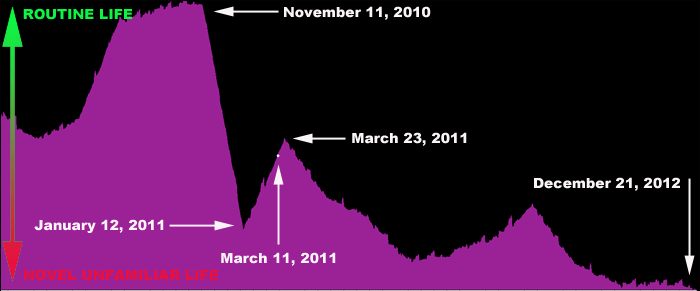
    Terrence McKenna was a genius who focused his vast intellect on the I-Ching (among many other complex issues), an ancient Chinese system for predicting future trends. His "discovery" was that, hidden in the structure of the I-Ching, there was a fractal pattern of time that could describe the events of human civilization in terms of routine and novel life. Routine life was when civilization copes well and makes quick adjustments to their changing world. This is contrasted by novelty, when civilization struggles to cope with unfamiliar circumstances.

    McKenna produced a graph that plotted these trends over time. He called this graph the "Time Wave" and he noted that the graph ended in maximum novelty on the traditional doomsday, December 21, 2012.

    We first reported about McKenna's Time Wave Theory, in the Spring of 2010 and noted that some pivotal event was predicted to occur in early July when routine life plateaued. This was believed by many to be the "beginning of the end" for humanity. But this never happened. Another significant date was November 11th of that year when the Time Wave dropped sharply, plunging to the depths of novelty. But that also failed to prove significant.

    So, in light of the catastrophe in Japan on March 11th, we thought we'd see how the Time Wave plotted this particular disaster -- certainly a novel event for almost everyone in the Pacific area. The chart below shows the Time Wave predictions.


    OK. Unless something dramatic happens with the Japanese nuclear meltdown on March 23rd, it's pretty much a bust. Anyone who knows about McKenna will also be aware that he consumed many hallucinogenic substances and wrote extensively about psychedelics. Does that figure in his obvious miscalculations? Maybe. We'll have to see.

    Clif High's Web Bot Program

    The Web Bot is a computer program that scans the internet and looks for subtle changes in language, how certain words are used, and analyses this information to predict certain trends in our changing human culture. The web bot has been able to predict the future so well that the it has been used by economists and stock traders with a good to excellent rating.

    I've written about the web bot for viewzone before. I became interested when the program's designer, Clif High, started applying his linguistic analysis to social phenomenon and natural disasters. Clif publishes a series of quarterly predictions that foretell "doomsday" in some detail.

    Clif High has quite a following. But that following dropped precipitously when he linked doomsday to the BP Gulf oil disaster back in 2010, and even more so when his "Israeli Mistake" -- a nuclear disaster resulting from Isreal's raid on the nuclear facilities in Iraq -- didn't happen.

    Clif was quiet for a while and many thought he was finished with his predictions. But he had one last bit of future insight up his sleeves -- the "Expanding Earth Theory". It's not a new theory, and it's not Clif's. But he did always mention some linguistic clues about a "Sun disease" that, in hindsight, mesh with this doomsday theory and could save his credibility. Let's take a look.

    ...

    What about that DOOMSDAY?

    So if the earth was smaller in the past, and is growing larger every year, how does this figure into the doomsday scenario?

    According to Clif High, the reason that Earth grows in size has to do with what's inside of it. He suggests that the core of the planet is not made of molten iron, as the Plate Tectonics theory proposes. Clif considers the new plasma paradigm that is rapidly winning over astrophysicists as the basic substance of the universe -- slowly but surely pushing aside the gravity model to explain how things are made and held together.

    Plasma is the fourth state of matter (different from solid, liquid and gas) and it's everywhere in the universe. Plasma has unusual properties that explain how matter is created from pure energy. While we may not yet understand these properties, the existence of matter in the plasma universe is proof that it is so. That same process is supposedly going on inside our planet -- new matter is being created from streaming plasma that comes from our Sun and possibly other sources such as Gamma Ray Bursts [10].

    But wait... there's more!

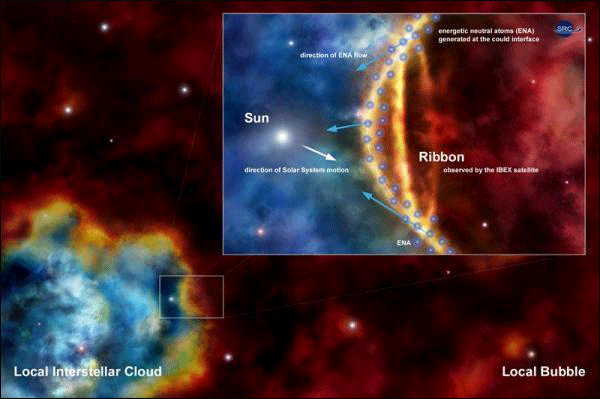
    This stream of plasma doesn't just trickle through the solar system. NASA has detected a portal through which our Sun's magnetic field connects directly to Earth's magnetic field about once every eight minutes.[11] While that could account for the average yearly increase in matter, there's something even more significant. Our Sun has cycles of 11,500 to 12,000 years where it ramps up its blasts of plasma, sending huge vollies of energy in the form of Coronal Mass Ejections and flares that rapidly increase the Earth's expansion. [12] And, according to Cliff High, we have just entered one of these cycles.

    We've written about this cycle in the past (see The Last Doomsday) in some detail. It's real and based on sound scientific evidence. We'll be writing more about this in our next installment of this series which will discuss the superwave theory developed by Dr. Paul Laviolette.

    Our previous speculation was that a powerful solar blast would produce atmospheric disturbances and fry electrical circuits on Earth -- bringing us back to the pre-electric, pioneer days. We failed to see the link between seismic disturbances -- earthquakes, tsunamis and floods -- until Cliff made the Expanding Earth connection. The 9.0 quake in Japan reinforced this link.

    Mega-Flares and X-Flares
    "Over the last 48 hours, ten (10) M-Class flares have fired off from at least three separate sunspot regions. Space Shuttle was put on alert and lands safely prior to elevated solar activity ... Forty-eight hours after the first set of flares, a 7.2 mag. earthquake hit Japan setting off a small tsunami. Ten hours later, a series of "straight-line winds" along with several tornadoes hit the southeastern United States."
    Then, the next day, this report came from the Space Weather Observatory:
    Space Weather News for March 10, 2011
    http://spaceweather.com
    X-CLASS SOLAR FLARE: March 9th ended with a powerful solar flare. Less than an hour before midnight (UT), Earth-orbiting satellites detected an X1.5-class explosion from behemoth sunspot 1166. First-look data suggest that the blast did hurl some material toward Earth. Check spaceweather.com for movies of the flare and updates on its possible effects.
    Then, on March 11, 2011, the unprecedented 9.0 earthquake hit Japan causing a massive tsunami that killed an estimated 16,000 people. Coincidence?

    Pole Shift Madness

    For a while here on viewzone we have been hearing from readers who believe that the crust of the Earth will slip around the mantle, re-arranging the continental plates and causing what is curiously referred to as a "pole shift". This is a theory that was put forth by Charles Hapgood (again, we have written about this HERE).

    The most popular version of this doomsday scenario has a rogue planet -- planet-X -- entering the solar system and disturbing the gravity of our planet. This prediction features most prominently on Nancy Lieder's website "zetatalk.com" and has an international following. Nancy claims to receive her information from grey aliens called "Zetas" who have the star system Zeta Reticuli as their origin and communicate with her telepathically.

    While one could spend considerable time debating her predictions, the following information seems to bear witness against her. First, the typical "Grey" alien made popular by Whitley Strieber in his book Communion is not a Zeta. The term "Zeta" originated from the UFO encounter with Betty and Barney Hill back in the 1960s. According to Betty Hill, she was shown a star map of the alien's home planet which she later drew under hypnosis. Analysis of this drawing showed that it was remarkably similar to the star system we call Zeta Reticuli, thus the name. But the aliens that Betty described looked nothing like the big-eyed, grey skinned aliens depicted by Strieber. In fact, Betty was asked outright in an interview if she met the Greys and she emphatically said "No!" Her abductees -- the real Zetas -- were more human like in appearance.

    Then there is the problem with planet-X. This has its origins in the rogue planet first described by Zecharia Sitchin in The Twelfth Planet. This wandering giant supposedly has an orbit of 3600 years around our Sun and periodically enters the vicinity of Earth, causing gravity problems and tidal waves. The flood of the Bible and the Sumerian legend of Utnapishtam is supposedly related to one of its more recent passages near our planet. Nancy Lieder relies on this planet -- called "Nibiru" by Sitchin -- to trigger her pole shift doomsday. But before he passed away, Sitchin was asked specifically about Nancy's prediction and whether this planet could be involved in a 2012 doomsday scenario. Sitchin totally distanced himself from her predictions stating that Nibiru was still 1200 years away in its outer orbit.

    And lastly, there is the belief that pole shifts have happened in the past, giving credence to the validity of Nancy Lieder's predictions.

    As we have discussed in this article, core samples were taken on both sides of the mid-Atlantic ridge to determine the age of the oceanic crust. These samples also revealed the direction of the earth's magnetic field when they were created. These core samples go back millions of years and show that the earth has never had its crust oriented to a different magnetic pole (other than those times when the poles naturally reversed polarity), nor has the Earth's crust ever been displaced by a so-called pole-shift. Totally busted!

    We will write more stories about predictions in the coming weeks. For now, it looks like the problems we will encounter -- or are currently already experiencing -- are from our Sun, coupled with our own human ineptness in relying too much on vulnerable technologies.

    ...

    Dr. Paul LaViolette's Galactic Super Wave Theory

    Although he does not inject himself in to the 2012 controversy, Dr. Paul LaViolette has developed a theory that seems to explain many aspects of the "doomsday" scenario. These ideas were once considered "out there" by many scientists, mainly because they portrayed a world view that was full of apparent chaos and destruction. But in the last decade, his work has been validated -- often by his former critics -- and scientists are now realizing that chaos and destruction are endemic in the universe [7].
    We've written about Dr. LaViolette before. Rather than sending readers to another page, we'll recap some of our highlights here in this article. We'll focus mainly on how this new understanding of our universe can literally impact our Sun, and in turn, our planet. Here's the story:

    Glazed donuts on the Moon

    Let's begin back in the 1960s with the Apollo 11 manned landing on the moon. On one of their EVA's (extra-vehicular activities), the astronauts photographed and took samples from some small craters, about 20cm to 1.5 meters across. When they examined the floors of these craters they noticed what looked like glazed donuts. These were actually chunks of moon dirt that were coated by glass.
    The glazed areas are clearly concentrated toward the top surfaces of protuberances, although they exist also on some sides. Points and edges appear to be strongly favored for the glazing process. In some cases, droplets appear to have run down an inclined surface for a few millimeters and congealed there.
    Hardly anyone in the general public was made aware of this discovery and, even if they were, thay could hardly have realized the significance.

    But in 1969, an article in Science by T. Gold [1] proposed a theory of how they were made. Glass, as we know, is made from melting sand. It occurs naturally near sources of high temperature, such as volcanos and meteor impacts. The atom bomb tests in New Mexico's White Sands area produced a small "lake" of glass at ground zero. So it was never a question about the lunar glass also having been created by something very hot.

    The fact that the glaze was confined to small patches, 0.5 to 10mm, suggested to scientists that the surface had been zapped rather than slow-cooked. And the likely source of this zap was our Sun. Gold estimated that the solar luminosity would have had to increase by 100 times what it is normally, for a duration of from 10 to 100 seconds.

    Also, because of the lack of debris or dirt covering this glass, it must have occurred within the last 30,000 years. This made Gold propose that the Sun -- our Sun -- does this every 10,000 years or more. He suggested that future research should look for a "trigger" event -- possibly a large comet or asteroid impacting the surface of the Sun. He estimated this would only have to be 100 km and weigh 3 x 10²¹ grams.

    Decades passed and this theory didn't receive much attention. Then, as it often does, the theory got a fresh look by a genius, Dr. Paul LaViolette. He was not satisfied with the source of the glass being caused by a solar blast, mainly because the output would have had to be on the scale of a nova, not just a flare. He envisioned another possibility.

    LaViolette envisioned a large solar flare or coronal mass ejection (CME) that would become magnetically entrapped in the Earth's magnetosphere. The magnetosphere would then hold on to this fireball of radiation like a magnetic thermos bottle, allowing the Moon and Earth to be exposed for a duration of time long enough to really "flash bake" their surfaces.

    Critics quickly denounced Gold's propositions citing evidence of "cosmic dust" and rare elements in the lunar glass and concluding that the heat source was from a meteor impact.

    But LaViolette proposed that this cosmic dust was likely present on the surface of the Moon during the time it was melted into the glass. In fact, he proposed that the entire solar system was full of this cosmic dust at the time of this solar eruption. He was vindicated when polar ice cores showed unusual cosmic dust deposits at strata marking the end of the last ice age [4]. This time period, about 12,950 BCE [10], approximates the current age of the Moon glass and the intense heat that must have produced it. So where did all this cosmic dust come from?


    Like Earth, our entire solar system has its own atmosphere, called the heliosphere. This "bubble" surrounds the Sun and planets as it travels through galactic space. Like our earth's magnetosphere, the movement of the heliosphere creates a rounded "head" and a narrowing "tail" (called the heliopause). Actually, it's more egg shaped (see above). Until recently, astronomers believed that our solar system was a region relatively free from cosmic dust. The cosmic dust and frozen material of space were kept outside this protective bubble.

    This was confirmed when the IRAS and Ulysses spacecrafts showed infrared images of the solar system, surrounded by whispy clouds of cosmic dust that increase in density just beyond Saturn.

    So if the cosmic dust is surrounding the heliopause, what would make it suddenly enter the heliosphere and how would this coincide with huge solar flares? LaViolette envisioned something disrupting the heliosphere from the outside, impacting it and drawing cosmic dust inside with it and energizing the Sun. The energy of such an impact would be immense. The most logical place to look for such enormous energy was the Milky Way Galaxy.

    The smoking gun

    Examining the shape of the cosmic dust clouds, the IRAS satellite team reported that the cloud was tilted relative to the solar system's ecliptic -- the narrow plane containing our planets. LaViolette realized that this odd alignment tracked back to the Galactic center. This was quickly verified by NASA's Ulysses spacecraft and New Zealand's AMOR space radar observatory. Whatever caused the last ice age to end, the Sun to flare up and caused the glass to form on the Moon, came from the center of the Milky Way Galaxy. The plot was getting more interesting.

    Astronomers have known about intense radiation from space since the 1970s. Multiple bursts of powerful gamma rays were routinely detected and believed to originate from stars in the Milky Way. Assuming this energy originated locally, astronomers concluded this type of gamma ray burst was insignificant and harmless. Then, in December 1997, they had the technology and good luck to catch a strong gamma ray burst and track it. The source was not inside the Milky Way Galaxy. It was from a distant galaxy billions of light years away.

    A review of other bursts showed that their assumptions had been wrong. All of the gamma ray bursts they were observing were from other galaxies far, far away. The amount of energy coming from objects so distant was a real shock. No one had ever imagined such powerful bursts could be generated by galactic centers. The thought of a burst coming from our own Milky Way galactic center was abysmal. A burst of the same intensity as the 1997 event, originating from inside the Milky Way, would deliver 100,000 time the lethal dose of radiation, killing every life form that was exposed. Could that really happen to us?

    This question was answered on August 27th, 1998 when an unusual 5 minute gamma ray pulse was located just 20,000 light years away in the constellation of Aquila. This may sound like a huge distance, but to astronomers this is just "next door." The Milky Way Galaxy, for example, is just 100,000 light years from end to end and Earth is just 23,000 light years from our Galaxy's center.

    The 1998 event was close enough and strong enough to ionize Earth's upper atmosphere, damage a couple of spacecraft and disrupt global communication. Since then astronomers place gamma ray bursts from the Galaxy's core at the top of the list of things we don't want to happen.

    Before Aquila, scientists just feared exploding stars -- novas and supernovas. Now things are different. It's like living in a ghetto and fearing drive-by shootings and random bullets. Then one day you learn that there's a nuclear bomb down the street, waiting to explode

    Ancient warnings from past experience

    The Hopi are an Native American Indian tribe who have not sold out or assimilated in our modern culture. They view themselves as the "keepers of the truth" about our purpose and place in the universe. Anyone who has ever visited their small reservation in Arizona has experienced how private they are -- forbidding photographs or copies of their art and culture. For centuries they have kept an oral tradition which describes human history in terms of "worlds" -- successive eras which end in natural disasters, culling humanity and initiating a rebirth of civilization.

    According to their teachings, the Hopi describe three prior worlds. We are currently in the fourth world, about to enter the fifth.

    The Hopi elder, White Feather, of the spiritually important Bear Clan, describes nine different signs signaling the end of this Fourth World. Some believe all but the last sign has already happened. The final warning is as follows:
    "And this is the Ninth and Last Sign: You will hear of a dwelling-place in the heavens, above the earth, that shall fall with a great crash. It will appear as a blue star. Very soon after this, the ceremonies of my people will cease." --www.burlingtonnews.net/hopiprophecy.html
    In Dr. LaViolette's scenario of the Galactic SuperWave, the explosion emanating from Galactic nuclear bulge, would make its initial appearance as a flood of cosmic ray electrons that would illuminate the dust clouds normally obscuring the Galactic center. As seen in many other galaxies, this would appear as a glowing blue light. The appearance of the "blue star" would signal the arrival of a shock wave which would counter the solar wind and bring the surrounding cloud of cosmic dust inside our solar system. This would initially energize the Sun, causing it to throw off flares and coronal mass ejections which would undoubtedly impact Earth (and the Moon). But eventually the cosmic dust would obscure the Sun's light, reminiscent of other predictions:
    "When he opened the sixth seal, I looked, and behold, there was a great earthquake, and the sun became black as sackcloth, the full moon became like blood... -- Revelations 6:12
    This cloud of cosmic dust would plunge the Earth into a cold climate fairly quickly. What forms of life that did not die from radiation and heat would surely struggle to keep going in a dark and cold world.

    ...

    But wait... Theres more!

    The problem with understanding the cyclic periodicity of solar "doomsdays" derives from the fact that our Sun is travelling through a local and galactic environment. Within the arm of stars and interstellar gas and dust, our solar system is moving through many different densities of space.

    Just recently astronomers discovered that a strange phenomenon called a "cosmic ribbon" was in the path of the heliopause -- the bubble that encloses the solar system. The mystery was solved when the IBEX satellite revealed that the "ribbon" was the boundary of a blob of gas about 10 light years across with a temperature of 7000 degrees kelvin. No worries, though. We're already inside of this one, called the "local interstellar cloud" and the heliopause protects us pretty well.

    But the local cloud is itself inside something called the "Local Bubble" which is much larger and hotter. How hot? It's over a million degrees kelvin... and we're heading straight at it.


    [above] The Sun traveling through the Galaxy happens to cross at the present time a blob of gas about ten light-years across, with a temperature of 6-7 thousand degrees kelvin. This so-called Local Interstellar Cloud is immersed in a much larger expanse of a million-degree hot gas, named the Local Bubble. (Vivek: Maybe no bowshock.)

    The ribbon that astronomers first noticed is actually the boundary where the Local Interstellar Cloud ends and the Local Bubble begins. It's a strange region full of energetic neutral atoms (ENA). These atoms are born out of ions (protons) speeding from the very hot Local Bubble when they exchange charge with the relatively cool atoms "evaporating" from the Local Interstellar Cloud. The newly created ENA have no electrical charge and therefore can dash freely in straight lines from their birth site, oblivious of the impeding magnetic fields. Some of them reach Earth orbit and are detected by IBEX.

    What possible effect will the ENA have on our Sun? We'll discuss some strange new particles already coming from our Sun's core that could not only impact the Earth, but could even alter our DNA...

    Is the Sun emitting a new particle?

    In previous discussions in this series, we have shown how scientists are reluctant to let go of paradigms. That's not necessarily a bad thing. It forces new thoeries to provide a better explanation of how things work and cautiously advances our knowledge and understanding of the universe.

    One of the basic paradigms in modern physics has to do with atomic decay. This refers to the action whereby unstable atoms shed particles in their nucleus to make them stable. We know much about this decay and about which kinds of atoms shed which types of particles. We even know how long it takes for a certain mass of unstable atoms to shed these particles. This is known as the rate of decay and it is considered to be very stable and predictable. But we don't know precisely when this decay will happen. It's always random.

    A chunk of radioactive cesium-137, for example, may decay at a steady rate overall, but individual atoms within the chunk will decay in an unpredictable, random pattern. Thus the timing of the random ticks of a Geiger counter placed near the cesium might be used to generate random numbers...

    ...In Part 1 of this series, we explored the Expanding Earth Theory. Perhaps the main objection voiced by skeptics is how any solar radiation, such as plasma, could penetrate the Earth's core and actually transform matter. I think the phenomenon described in this article reveal that such an occurrence is not only possible, but is likely already a reality.

    Plamsa contains neutrinos, as well as other types of radiation. Since they can pass through the planet, they can certainly have an effect on the core. As we have seen with the atomic decay anomalies, this effect can transmute matter -- causing atoms to become different elements. This anomaly appears to be something that occurs in cycles related to solar activity. Since we are in one of the most predicted active solar cycles we may well expect some epic changes here on Earth.

    These same changes may also be happening in our bodies, which contain numerous unstable atoms. Are we in a state of transformation that will not only effect our planet -- but our species as well?

    Continue reading here: http://www.viewzone.com/expando33.html
    Last edited by Jeffrey; 13th July 2012 at 02:58.

  22. Link to Post #493
    Ecuador Unsubscribed
    Join Date
    3rd February 2011
    Location
    California
    Age
    38
    Posts
    1,584
    Thanks
    3,721
    Thanked 10,195 times in 1,429 posts

    Default Re: From Bill Ryan -- the Ultimate Hypothesis

    The US Military is Stocking Up On a Massive Amount of Anti-Radiation Pills In Preparation for Nuclear Fallout

    April 2012
    The US Military is currently seeking a large amount of potassium iodide, this according to a listing on the FBO.gov website by the Defense Logistics Agency.

    In the listing it is made clear that they want to be ready in the event of nuclear fallout which has lead many to speculate that this could be in response to the Fukushima nuclear disaster or perhaps in anticipation for an attack on an active Iranian nuclear facility.

    The DLA is apparently looking for upwards of 400,000 dollars worth of the thyroid protecting tablets at a time when many government officials have openly told American citizens NOT to buy potassium iodide.
    Full Article: http://theintelhub.com/2012/04/11/th...clear-fallout/

    Another possibility that the article failed to consider is fallout after generators fail at the plants (if a huge CME fried the grid).
    Last edited by Jeffrey; 13th July 2012 at 03:49.

  23. Link to Post #494
    Ecuador Unsubscribed
    Join Date
    3rd February 2011
    Location
    California
    Age
    38
    Posts
    1,584
    Thanks
    3,721
    Thanked 10,195 times in 1,429 posts

    Default Re: From Bill Ryan -- the Ultimate Hypothesis


  24. Link to Post #495
    Ecuador Unsubscribed
    Join Date
    3rd February 2011
    Location
    California
    Age
    38
    Posts
    1,584
    Thanks
    3,721
    Thanked 10,195 times in 1,429 posts

    Default Re: From Bill Ryan -- the Ultimate Hypothesis

    How a Cloud of Space Dust Could Wipe Out Life on Earth
    Seemingly innocuous specks could throw off the whole solar system—and we might not see them until it's too late.

    by Jeffrey Winters

    From the Whole Universe special issue; published online December 30, 2008


    In the 1980s, scientists looking for an astronomical explanation for large-scale extinctions that seem to occur regularly in the fossil record dreamed up Nemesis, a dim companion star to the sun that would swing by every 32 million years to disturb the Oort cloud and rain death on Earth. No one found any evidence of such a star, and the theory is now largely discarded, but if there is a free-range Nemesis in Preston’s data, it would have to be a star named Gliese 710. Right now it’s an ordinary-looking, dim red star 63 light-years off, but it is racing toward us so that in a mere million years it will be just three-quarters of a light-year from the sun—roughly 1,000 times farther out than Pluto but well inside the Oort cloud. To be sure, this prediction is based on some pretty rough estimates, and it may turn out to be wrong. But even if Gliese 710 misses us, it’s fairly likely that some other star out there is headed our way. Even a near miss of the Oort cloud by a passing star might be enough of a gravitational tug to redirect some comets toward the inner solar system; Gliese 710, by current estimates, will pass right through.

    Preston hastens to add that this near miss probably won’t cause too much disruption. A slow-moving star that lingers close to the Oort cloud would have time to deflect lots of comets our way. Gliese 710, by contrast, will streak by quickly, thus disturbing fewer comets. But don’t relax too much: A closer, more destructive pass could be waiting to be discovered.

    Aside from rogue stars, there are plenty of other things in the galactic neighborhood we can barely see that can be just as bad for our health. Brown dwarfs, stars too small to keep their nuclear fires burning, cool off over time and become difficult to detect. Although brown dwarfs have a mass more like Jupiter’s than like the sun’s, if one of them passed through the Oort cloud it could still send plenty of comets our way. Astronomers have found hundreds of brown dwarfs within just 100 light-years of us but know distressingly little about the total number of them out there.

    Then there is the stuff between the stars. We tend to think of interstellar space as utterly empty, and with good reason. A cubic inch of liquid water on Earth contains 10 trillion trillion molecules; in the interstellar medium that surrounds the solar system, one needs to search one cubic inch to find just one or two atoms. Put another way, to attain the emptiness of interstellar space, a shot glass full of water would have to expand to fill a volume 2,500 miles on a side.

    The interstellar medium is mostly hydrogen and helium, peppered with heavier atoms, a few molecules, and some dust—pretty benign stuff, on the whole. Even if something harmful should drift along, we get ample protection from the solar wind, an outward-flowing stream of electrically charged particles that extends from the sun for billions of miles, forming what’s called the heliosphere. Since the solar wind is electrically charged, it carries a magnetic field, which wards off much of the interstellar medium, including cosmic rays, the charged particles that streak across space at great speeds.

    Probes of the outer solar system, especially the long-lived Voyager and Ulysses spacecraft, have sampled traces of the interstellar medium that managed to seep through the heliosphere, but most of what we know about the medium comes from looking at the way it blocks light. Atoms in interstellar space absorb certain frequencies of starlight; by finding what light from any given star is “missing,” astronomers can figure out how much gas there is between us and that star. What this number, called a column density, won’t tell you is just how this gas is distributed—is it thinly spread out over 10 light-years or is it bunched into a tight knot? So astronomers find the column density of the gas between us and another star, and another. They also carefully study the frequencies of light the gas absorbs, looking for signs of a shift in wavelength that would be a clue that the gas is moving toward us or away from us. By taking the column density of gas between us and many stars in the same general direction and by looking for telltale shifts in the absorption spectrum, astronomers can surmise where a cloud of gas and dust lies, how thick it is, and in what direction it is moving.

    As astronomers have gained access to better spectrographs, including one on the Hubble Space Telescope, they have built up a crude three-dimensional map of our locale. It appears that for most of the last 5 million years we have been sailing through what is, even for the rarefied interstellar medium, empty space. But that happy state of affairs could change. One nearby cloud is less than 1 trillion miles away—just 250 times the distance to Pluto. Even if the cloud is on the thin side, it can still contain relatively dense and potentially destructive wisps of gas.

    At present speeds, we can expect to collide with this cloud momentarily, in cosmic terms—in about 2,500 years. Then again, some small, dense wisp may be sitting undetected between us and this big cloud, in which case there will be a collision even sooner. Although this is not at all likely, nobody really knows.

    We probably would not discover such a dense cloud until we ran right into it, says Gary Zank, an astronomer at the University of Alabama in Huntsville. Zank has developed one of the first models that incorporate discoveries about the interstellar medium to predict what will happen when the solar system runs into a big, bad cloud. At present, the edge of the heliosphere holds up a dense sheet of gas, what astronomers call the “hydrogen wall.” In essence, instead of flowing around stars like water past a stone, some of the gas and dust bunches up against stellar winds like vast snowdrifts. Zank’s models show that if we were to plow into a cloud a mere 100 times denser, the leading edge of the heliosphere would begin forming an incredibly large wall, one too heavy for the solar wind to hold back. “The effect is pretty rapid,” Zank says. “If you ran into a sharply defined interstellar cloud, the solar wind would shrink very quickly.” In a decade the hydrogen wall, now thought to be four to five times as distant as Pluto, would crowd in between the orbits of Saturn and Uranus.

    Although the solar wind should still keep most interstellar gas and dust from reaching Earth, according to Zank, at least some would get to us. The effect on Earth’s climate could be disastrous. If the cloud were dense enough, hydrogen atoms might flow into the atmosphere and react with oxygen, depleting our vital atmospheric gases.

    The cloud would also make us more vulnerable to cosmic rays by compressing the heliosphere until its boundary lay just beyond Jupiter’s orbit. Ripples in the heliosphere’s magnetic field protect us by slowing and redirecting incoming rays much the way a warehouse full of pillows would stop all but the most powerful bullets. “If you remove several rooms full of pillows,” Zank says, “many more bullets will get through.” There would also be more bullets in total: Cosmic rays would ricochet between the boundaries of the soupy cloud of gas and the heliosphere until they picked up enough energy to escape. At least some of them would head our way. The only line of defense left to us would be Earth’s meager magnetic field. Overall, Zank says, the number of cosmic rays hitting our atmosphere would skyrocket.

    A sharp rise in cosmic radiation would be troublesome, to say the least. Cosmic rays wreak havoc on the internal electronics of satellites and threaten the health of astronauts. When cosmic rays smack into atoms in our upper atmosphere, they release showers of gamma rays, X-rays, or subatomic particles. At present, radiation caused by cosmic rays is one of the largest sources of natural radiation exposure. It is unclear what biological effects doubling or tripling it would have.

    Would a doomsday cloud be survivable? It’s hard to say. Earth probably passed through such a cloud at some point in the distant past. If it happened in the last 100,000 years, it might be possible someday to extract traces of its effects from deep within the polar ice caps. Life may well have weathered this kind of challenge before.

    The galactic forecast, though, is not good. Virtually every corner of the sky is filled with some tale of woe. There are supernovas and black holes and gamma-ray bursts. Old stars are coming unglued on the way to becoming white dwarfs—and astronomers confidently predict that in 5 billion years the sun will be an old star. If any of our descendants escape that catastrophe, they will be able to see another, far greater one looming overhead: the Andromeda galaxy, which just might slam into the Milky Way some 6 billion years from now, to who knows what effect.

    It is one tough universe out there.

    Source: http://discovermagazine.com/2008/who...tart:int=1&-C=

  25. Link to Post #496
    United States Avalon Member Dennis Leahy's Avatar
    Join Date
    14th January 2011
    Location
    North Carolina
    Language
    English
    Age
    71
    Posts
    6,865
    Thanks
    48,684
    Thanked 50,132 times in 5,941 posts

    Default Re: From Bill Ryan -- the Ultimate Hypothesis

    Quote Posted by Vivek (here)
    Gee, I wonder why Colorado is the new CIA headquarters.

    Dennis


  26. The Following 2 Users Say Thank You to Dennis Leahy For This Post:

    fourty-two (13th July 2012), Jeffrey (13th July 2012)

  27. Link to Post #497
    Ecuador Unsubscribed
    Join Date
    3rd February 2011
    Location
    California
    Age
    38
    Posts
    1,584
    Thanks
    3,721
    Thanked 10,195 times in 1,429 posts

    Default Re: From Bill Ryan -- the Ultimate Hypothesis

    Quote Posted by Dennis Leahy (here)
    Quote Posted by Vivek (here)
    Gee, I wonder why Colorado is the new CIA headquarters.

    Dennis
    I was particularly interested in Colorado as I'm not too far from there. Based on that map, the D.U.M.B. there, and the mountains - it's a fortress.

  28. Link to Post #498
    Ecuador Unsubscribed
    Join Date
    3rd February 2011
    Location
    California
    Age
    38
    Posts
    1,584
    Thanks
    3,721
    Thanked 10,195 times in 1,429 posts

    Default Re: From Bill Ryan -- the Ultimate Hypothesis

    Last edited by Jeffrey; 13th July 2012 at 03:48.

  29. Link to Post #499
    United States On Sabbatical
    Join Date
    30th June 2011
    Location
    The Seat of Corruption
    Age
    46
    Posts
    9,177
    Thanks
    25,610
    Thanked 53,737 times in 8,696 posts

    Default Re: From Bill Ryan -- the Ultimate Hypothesis

    Quote Posted by Vivek (here)
    Quote Posted by Dennis Leahy (here)
    Quote Posted by Vivek (here)
    Gee, I wonder why Colorado is the new CIA headquarters.

    Dennis
    I was particularly interested in Colorado as I'm not too far from there. Based on that map, the D.U.M.B. there, and the mountains - it's a fortress.
    Nuclear sites & radiation seem to not be an issue (at least not anywhere near what we've been told)

    https://projectavalon.net/forum4/show...-nuclear-scam-

    So at least that "fear" can be set aside.
    Hard times create strong men, Strong men create good times, Good times create weak men, Weak men create hard times.
    Where are you?

  30. The Following 2 Users Say Thank You to TargeT For This Post:

    Chester (13th July 2012), Jeffrey (13th July 2012)

  31. Link to Post #500
    Ecuador Unsubscribed
    Join Date
    3rd February 2011
    Location
    California
    Age
    38
    Posts
    1,584
    Thanks
    3,721
    Thanked 10,195 times in 1,429 posts

    Default Re: From Bill Ryan -- the Ultimate Hypothesis

    Ancient Sites & Solar Changes with Robert Schoch on Coast to Coast AM.

    http://www.coasttocoastam.com/show/2012/03/19

+ Reply to Thread
Page 25 of 51 FirstFirst 1 15 25 35 51 LastLast

Posting Permissions

  • You may not post new threads
  • You may not post replies
  • You may not post attachments
  • You may not edit your posts