


 3/11/11: Was Japan Hit by a "Tsunami Bomb" or a "Prompt Global Strike"?
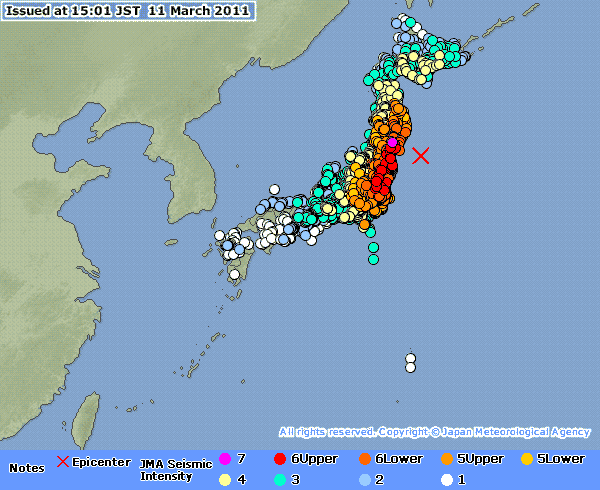
For nearly three years now I have posited that I do not believe that the great Japan earthquake of 2011 was entirely natural. For the conspiracy theorists on here, I want to present two alternative views to the common belief that Japan suffered a "natural disaster" and not a created one.~TWTCS
__________________________________________________________________
The Tsunami Bomb (courtesy of NN and PP websites)
Planned secret tidal wave bomb aimed to destroy coastal cities
J. D. Heyes
Natural News
March 1, 2013
The U.S. and New Zealand conducted secret tests of what is being described as a “tsunami bomb,” which experts said was aimed at devastating coastal cities by using a series of underwater explosions that would result in massive tidal waves.
The tests, which were initially carried out around the waters of New Caledonia and Auckland during World War II, “showed that the weapon was feasible,” Britain’s Telegraph newspaper reported recently.
The paper said a series of 10 large offshore blasts were enough to potentially create a 3-foot tsunami that would be capable of swallowing a small city along a coastline.Prompt Global Strike
PGS
http://en.wikipedia.org/wiki/Prompt_Global_Strike
__________________________________________________________________
The PGS system will be designed to complement existing American rapid-response forces, such as Forward Deployed Forces, Air Expeditionary Groups (which can deploy within 48 hours) and carrier battle groups (which can respond within 96 hours).[5] Possible delivery systems include:
~a rocket similar to existing ICBMs, launched from land or via submarine
~an air-launched hypersonic cruise missile, such as the Boeing X-51 or Advanced Hypersonic Weapon
~a kinetic weapon launched from an orbiting space platform (rods from god)
In 2010, the United States Air Force prototyped a PGS system based on a modified Minuteman III ICBM.[3] In March 2011, Air Force Major General David Scott stated that the service had no plans to use a sea- or land-based ICBM system for Prompt Global Strike, as they would be expensive to develop and potentially "dangerous." Instead, efforts would focus on a hypersonic glider.[6] However, the following day, Air Force Chief of Staff Norton Schwartz said that an ICBM-based PGS system was still an option.[7]
"As early as World War Two, Allied scientists knew that deadly tsunamis could be created by the controlled serial detonation of powerful explosives and/or kinetic weapons."__________________________________________________________________
http://en.wikipedia.org/wiki/Kinetic_bombardment
____________________________________________________
From Wikipedia, the free encyclopedia
"Kinetic strike" redirects here. For the political euphemism, see kinetic military action.
For the generic concept of attacking a planetary surface from orbit, see Orbital bombardment.
A kinetic bombardment is the act of attacking a planetary surface with an inert projectile, where the destructive force comes from the kinetic energy of the projectile impacting at very high velocities. The concept is encountered in science fiction and is thought to have originated during the Cold War.
Non-orbital bombardments with kinetic projectiles, such as lobbing stones with siege engines such as catapults or trebuchets are considered siege warfare, not kinetic bombardment.
Projekt Thor
________________________________________________________
Project Thor is an idea for a weapons system that launches kinetic projectiles from Earth orbit to damage targets on the ground. Jerry Pournelle originated the concept while working in operations research at Boeing in the 1950s before becoming a science-fiction writer.[1][2]
The most described system is "an orbiting tungsten telephone pole with small fins and a computer in the back for guidance". The weapon can be down-scaled, an orbiting "crowbar" rather than a pole.[citation needed] The system described in the 2003 United States Air Force (USAF) report was that of 20-foot-long (6.1 m), 1-foot-diameter (0.30 m) tungsten rods, that are satellite controlled, and have global strike capability, with impact speeds of Mach 10.[3][4][5]
The time between deorbiting and impact would only be a few minutes, and depending on the orbits and positions in the orbits, the system would have a world-wide range.[citation needed] There is no requirement to deploy missiles, aircraft or other vehicles. Although the SALT II (1979) prohibited the deployment of orbital weapons of mass destruction, it did not prohibit the deployment of conventional weapons. The system is prohibited by neither the Outer Space Treaty nor the Anti-Ballistic Missile Treaty.[4][6]
The idea is that the weapon would inflict damage because it moves at orbital velocities, at least 9 kilometers per second. Smaller weapons can deliver measured amounts of energy as small as a 225 kg conventional bomb.[citation needed] Some systems are quoted as having the yield of a small tactical nuclear bomb.[5] These designs are envisioned as a bunker buster.[4][7]
In the case of the system mentioned in the 2003 USAF report above, a 6.1m x 0.3m tungsten cylinder impacting at Mach 10 has a kinetic energy equivalent to approximately 11.5 tons of TNT (or 7.2 tons of dynamite). The mass of such a cylinder is itself over 8 tons, so it is clear that the practical applications of such a system are limited to those situations where its other characteristics provide a decisive advantage - a conventional bomb/warhead of similar weight to the tungsten rod, delivered by conventional means, provides similar destructive capability and is a far more practical method.
The highly elongated shape and high density are to enhance sectional density and therefore minimize kinetic energy loss due to air friction and maximize penetration of hard or buried targets. The larger device is expected to be quite good at penetrating deeply buried bunkers and other command and control targets.[8] The smaller "crowbar" size might be employed for anti-armor, anti-aircraft, anti-satellite and possibly anti-personnel use.[citation needed]
The weapon would be very hard to defend against. It has a very high closing velocity and a small radar cross-section. Launch is difficult to detect. Any infra-red launch signature occurs in orbit, at no fixed position. The infra-red launch signature also has a small magnitude compared to a ballistic missile launch. One drawback of the system is that the weapon's sensors would almost certainly be blind during atmospheric reentry due to the plasma sheath that would develop ahead of it, so a mobile target could be difficult to hit if it performed any unexpected maneuvering.[citation needed] The system would also have to cope with atmospheric heating from re-entry, which could melt the weapon.[9]
While the larger version might be individually launched, the smaller versions would be launched from "pods" or "carriers" that contained several missiles.[citation needed]
The phrase "Rods from God" is also used to describe the same concept.[10] A USAF report called them "hypervelocity rod bundles".[11]
More on the Tsunami Bomb:
http://www.livescience.com/25949-tsunami-bomb.html
http://www.foxnews.com/tech/2013/01/...zealand-coast/
Marc Lallanilla, Life's Little Mysteries Assistant EditorDate: 03 January 2013 Time: 11:53 AM ET
The military has a long and honorable history, but part of that history includes some weapons' experiments that in hindsight seem downright wacky, and some even evil.
Everything from a "gay bomb" that tried to incapacitate soldiers through uncontrollable homosexual urges to extrasensory perception (ESP) experiments that attempted to give soldiers psychic vision have been the subject of serious — and failed — military investigations. And during World War II, the U.S. military devised a way to create a "tsunami bomb," reports the British newspaper the Daily Telegraph.
The tsunami bomb, developed in cooperation with authorities in New Zealand, was designed to inundate an enemy city under a 33-foot (10-meter) tsunami wave. Code-named "Project Seal," the top-secret military operation was created in 1944 after E. A. Gibson, a U.S. naval officer, noticed how using explosives to destroy coral reefs around Pacific islands would often generate large waves, reports the Daily Telegraph.
A series of tests were conducted around New Zealand during the war to evaluate the feasibility of the tsunami bomb — and when done correctly, it worked, according to Ray Waru, a New Zealand author whose book, "Secrets and Treasures" (Random House, 2012), outlines some of the military's lesser-known follies, including extensive UFO investigations.
Apparently, the correct way to create a large tsunami wave is through not one, but several bombs using some 2,200 tons (2 million kilograms) of explosives arrayed in a line about 5 miles (8 kilometers) offshore, according to the Daily Telegraph.
"If you put it in a James Bond movie it would be viewed as fantasy, but it was a real thing," Waru told the Daily Telegraph. "It was absolutely astonishing. First, that anyone would come up with the idea of developing a weapon of mass destruction based on a tsunami ... and also that New Zealand seems to have successfully developed it to the degree that it might have worked."
Concern over the effectiveness of an atomic bomb was the impetus behind Project Seal's tsunami bomb. "Presumably, if the atomic bomb had not worked as well as it did, we might have been tsunami-ing people," Waru told the Daily Telegraph.
The program was abandoned in 1945 before the war ended, though New Zealand authorities continued to produce reports on Project Seal's tsunami bomb into the 1950s, the Daily Telegraph reports.
Follow LiveScience on Twitter @livescience. We're also on Facebook & Google+.
US reportedly tested secret 'tsunami bomb' off New Zealand coast
Published January 02, 2013
FoxNews.com
Casey Chan
We've all seen the destruction that tsunamis can cause. It doesn't play around. But back in 1944, the US military wanted to play around with tsunamis in hope of creating a man made tsunami bomb—basically setting off 10 large blasts in the ocean to create a 33-foot tsunami that would pulverize and drown a city.
New Zealand author and filmmaker Ray Waru discovered these manmade tsunami bombs were set off in the top secret operation of "Project Seal" during World War II. Around 3,700 bombs were detonated during the testing and the tests revealed that a successful tsunami bomb would require "about 2 million kilograms of explosive arrayed in a line about five miles from shore." Not exactly chump change.
Waru told The Telegraph:
"Presumably if the atomic bomb had not worked as well as it did, we might have been tsunami-ing people," said Mr Waru. "It was absolutely astonishing. First that anyone would come up with the idea of developing a weapon of mass destruction based on a tsunami ... and also that New Zealand seems to have successfully developed it to the degree that it might have worked."'Presumably if the atomic bomb had not worked as well as it did, we might have been tsunami-ing people.'
- New Zealand author and filmmaker Ray Waru
- Home
- Forum
- Chat
- Donate
-
Site Links

-
Avalon Library
-
External Sites
- Solari Report | Catherine Austin Fitts
- The Wall Will Fall | Vanessa Beeley
- Unsafe Space | Keri Smith
- Giza Death Star | Joseph P. Farrell
- The Last American Vagabond
- Caitlin Johnstone
- John Pilger
- Voltaire Network
- Suspicious Observers
- Peak Prosperity | Chris Martenson
- Dark Journalist
- The Black Vault
- Global Research | Michael Chossudovsky
- Corbett Report
- Infowars
- Natural News
- Ice Age Farmer
- Dr. Joseph Mercola
- Childrens Health Defense
- Geoengineering Watch | Dane Wigington
- Truthstream Media
- Unlimited Hangout | Whitney Webb
- Wikileaks index
- Vaccine Impact
- Eva Bartlett (In Gaza blog)
- Scott Ritter
- Redacted (Natalie & Clayton Morris)
- Judging Freedom (Andrew Napolitano)
- Alexander Mercouris
- The Duran
- Simplicius The Thinker









Bookmarks