+ Reply to Thread
Results 1 to 6 of 6

Thread: Do Solar Storms Actually Correlate with the Sun Absorbing Comets? Fizzle...

  1. Link to Post #1
    Unsubscribed
    Join Date
    20th November 2012
    Location
    gone
    Age
    42
    Posts
    4,873
    Thanks
    15,814
    Thanked 18,722 times in 4,284 posts

    Default Do Solar Storms Actually Correlate with the Sun Absorbing Comets? Fizzle...

    (>@_@)> "Can't We All Just Get Along?" <(@_@<)

    Quote
    Disclaimer: this is NOT a doomtardation thread. It's a discussion about relatively minor solar storms and their correlation with comets (and other objects I guess) being eaten by the Sun.


    COMETS AND THE SUN


    I don't buy the mainstream party line nonsense regarding comets and the sun, and neither should you.

    In fall of 2011, there was actually a very large solar disturbance during a three-day-window, and would you believe it, a comet was discovered literally the day before the Sun ate it alive. But why does the media insist on claiming that this collision had nothing to do with the solar storm before Sept 14 2011?

    In a separate thread this year, some users and yours truly had a very brief discussion about interactions between the Sun and incoming comets. It didn't amount to much and was buried beneath other posts. Sigh, le Internet!

    However, I found a snippet in archives from last year:

    Quote https://projectavalon.net/forum4/show...-s-Perihelion&

    Tesla_WTC_Solution
    17th December 2012, 18:10


    have you guys heard of the dynamo theory, and the electromagnetic capacitance theory of centaur objects (chimera comets that are very massive and hot)?

    some believe that the comet gathers dust in deep space, then converts this into energy that feeds our sun as it approaches the star.

    ionic strings (or something like that) create portals between earth and the sun, and between any energized body that comes into the sun's fields, can be strengthened or broken entirely, wreaking havoc on the normal balance of things.

    comet lovejoy was cool to me because it went so close to the fire and survived it.
    just like its namesake.
    Well obviously I'd missed the Sept 14th 2011 comet story, as of December 2012. I've told my readers before that I am quite a novice when it comes to astrophysics and basic astronomy. I suppose my interest in space tends to lean toward discord; i.e. events which are not harmonious or particularly conducive to developed lifeforms.

    Update: I came back at 7:41pm to finish this article off, because I found another source of information about comets interacting with the Sun.

    http://guardianlv.com/2013/11/comet-...-thanksgiving/

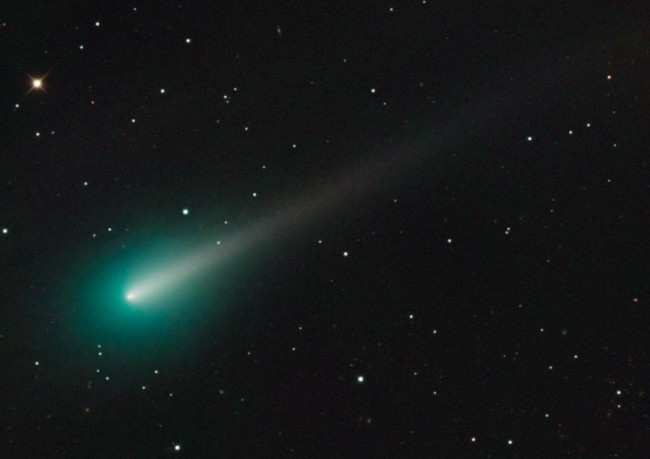
    Quote Comet ISON to Face Brutal Coronal Mass Ejection This Thanksgiving?
    Added by James Fenner on November 26, 2013.
    Saved under Comet ISON, James Fenner, Science
    Tags: comet ison


    Astronomers believe that Comet ISON could be heading towards a brutal solar storm this Thanksgiving, on Thursday Nov. 28. During this time, ISON is expected to fly just a few million kilometers above the surface of the sun.


    Comet Encke and the 2007 CME
    Moment Comet Encke lost its tail

    The moment Comet Encke lost its tail, during a 2007 coronal mass ejection.
    Back in 2007, Comet Encke was battered by a powerful solar storm, with observations gathered by NASA’s Solar Terrestrial Relations Observatory (STEREO) spacecraft showing a coronal mass ejection (CME) event transiently ripping off its tail; later, the tail rematerialized, as the comet continuously released streams of dust and gas.

    Comet Encke demonstrates the shortest orbital period around the sun of any known comet, and was discovered in Pierre Méchain in 1786.

    Meanwhile, the same fate could befall Comet ISON, as it hurtles towards the sun’s grueling atmosphere. It is also of note that, during the upcoming solar storm, ISON will be around 30 times closer to the Sun than Comet Encke was during 2007.

    Angelos Vourlidas of the Naval Research Laboratory, and member of NASA’s Comet ISON Observing Campaign (CIOC), talked about the differences between the two events:

    “… the year 2007 was near solar minimum. Solar activity was low. Now, however, we are near the peak of the solar cycle and eruptions are more frequent.”
    However, as with Comet Encke, ISON is unlikely to be placed in jeopardy during the CME. Karl Battams, astronomer at the Naval Research Laboratory, hopes the brutal solar storm will come to fruition, as it will provide astronomers with a unique opportunity to investigate the influence of extreme conditions on the comet’s tail.

    How Will the CME Affect Comet ISON?

    Coronal mass ejections are enormous bursts of magnetized plasma clouds, hurled into space by the explosions of sunspots, and typically span millions of miles. Although the precise reason for CME events is not fully understood, recent research suggests that it may be caused by a process called magnetic reconnection, occurring when two oppositely directed magnetic fields are brought together; this process is subsequently accompanied by a massive explosion, releasing massive amounts of matter and electromagnetic radiation into space.

    Comet ISON will pass over the sun’s equator on Thanksgiving, around a recent cluster of sunspots – a region that has one of the highest probabilities of CME emission.

    The gases inside a CME are not very dense, so the impact is unlikely to inflict any serious damage to the comet. However, its tail is extremely fragile and, as evidenced by Comet Encke’s 2007 solar passage, remains vulnerable to these volatile interactions. Vourlidas elaborates on the exact mechanism by which Encke originally lost its tail:

    “The CME that ran over Comet Encke back in 2007 was slow, barely creating a pressure pulse by compressing the solar wind ahead of it… It was this compression which caused the Encke’s tail to fly off.”

    Since ISON will be closer to the sun, he goes on to explain how the comet is likely to endure a much faster CME, consequently pummelling it with a shock wave with a stronger magnetic field. Vourlidas confesses that astronomers are simply unable to predict what might happen.

    The NASA STEREO-A spacecraft’s HI-1 camera recently recorded both Comet ISON and Comet Encke plunging towards the sun, as the solar winds cause their tails to rhythmically wag, back and forth. The imagery was acquired between Nov. 20 and Nov. 22, 2013.


    NASA’s STEREO-A satellite recorded Comet ISON and Comet Encke heading towards the sun, between Nov. 20 and Nov. 22, 2013. (N.B. Comet ISON is shown entering from the bottom left of the capture)

    During a press release, NASA explains the benefit of two comets experiencing a CME at the same moment in time. The space agency explains that the comets would serve as “solar probes,” sampling the storm at two entirely separate locations; this could provide astronomers with unique insight into the 3-dimensional structure of the CME.

    NASA officials await Nov. 28 with great anticipation, as Comet ISON potentially squares up against the brutal solar storms of our sun.

    By James Fenner

    http://science.nasa.gov
    /science-news/science-at-nasa/2013/24nov_isoncme/
    http://guardianlv.com/2013/10/sun-em...-solar-flares/
    http://guardianlv.com/2013/10/comet-...laze-of-green/
    http://guardianlv.com/2013/08/nasa-o...ath-run-video/
    http://www.sciencedaily.com/releases...1108071925.htm
    http://www.npr.org/2013/11/26/247180...anksgiving-day
    (I should thank my inner guide more often)

  2. Link to Post #2
    Avalon Retired Member
    Join Date
    17th December 2010
    Age
    58
    Posts
    486
    Thanks
    851
    Thanked 3,145 times in 403 posts

    Default Re: Do Solar Storms Actually Correlate with the Sun Absorbing Comets? Fizzle...

    Tesla - It's a DY-namic universe where relationships between celestial bodies are intimately connected. A solar system is a dynamically tuned system in which Perturbations in one system will create changes in another. There seems to be a lot of these comet collision-CME pathway type reactions if you troll back through the SDO images and I suspect it's an old dynamic.

    What's worth adding to the soup mix is ET intervention in solar dynamics and comet management.


  3. The Following 2 Users Say Thank You to Bright Garlick For This Post:

    Tesla_WTC_Solution (27th November 2013), Wind (27th November 2013)

  4. Link to Post #3
    Unsubscribed
    Join Date
    20th November 2012
    Location
    gone
    Age
    42
    Posts
    4,873
    Thanks
    15,814
    Thanked 18,722 times in 4,284 posts

    Default Re: Do Solar Storms Actually Correlate with the Sun Absorbing Comets? Fizzle...

    http://www.cnn.com/2013/11/27/us/iso...html?hpt=hp_t2

    Comet ISON possibly destroyed by sun
    By Amanda Barnett, CNN
    updated 2:20 PM EST, Thu November 28, 2013

    (CNN) -- It's not looking good for Comet ISON, according to experts taking part in a NASA Google Hangout. ISON is making its closest approach to the sun, skimming about 730,000 miles above its surface.

    "I'm definitely worried about how the tail narrows," Karl Battams with the NASA Comet ISON Observing Campaign told the hangout.

    It was hoped that ISON would survive its Thanksgiving Day close encounter with the sun and emerge to put on a big sky show in December.

    The glare of the sun has blocked most ground-based observations for days, but there's a fleet of spacecraft watching ISON plunge toward the sun, including NASA's STEREO satellite, the European Space Agency/NASA SOHO spacecraft and the Solar Dynamics Observatory.

    Members of the observing team say at this point, it is difficult to know if the comet is intact. Bottom line: Experts don't know yet if ISON survived, but they are not optimistic.

    Comets are giant snowballs of frozen gases, rock and dust that can be several miles in diameter. When they get near the sun, they warm up and spew some of the gas and dirt, creating tails that can stretch for thousands of miles. Most comets are in the outer part of our solar system. When they get close enough for us to see, scientists study them for clues about how our solar system formed.

    Astronomers Vitali Nevski and Artyom Novichonok discovered ISON in September 2012 using a telescope near Kislovodsk, Russia, that is part of the International Scientific Optical Network. ISON -- officially named C/2012 S -- was 585 million miles away at the time. Its amazing journey through the solar system has been chronicled by amateur astronomers and by space telescopes.

    If ISON has somehow survived, the comet will make its closest approach to Earth on December 26. And, no, it won't hit us.

    2013: The year of the comet (we hope)

  5. Link to Post #4
    Unsubscribed
    Join Date
    20th November 2012
    Location
    gone
    Age
    42
    Posts
    4,873
    Thanks
    15,814
    Thanked 18,722 times in 4,284 posts

    Default Re: Do Solar Storms Actually Correlate with the Sun Absorbing Comets? Fizzle...

    P.s. guys, notice the baaaaaaad weather all over the world for the past week or so?

    Could it... *drumroll* have anything to do, perhaps, with "fallout" from this 90% sun-eaten comet?


    I couldn't find much information on solar storms or comets grazing the sun having anything to do with strange weather patterns,
    but considering that this was not simply a passage but almost a merger (lol) of ISON and the Sun,
    it would not be too far-fetched to assume that this could have affected our weather down here.

  6. Link to Post #5
    Unsubscribed
    Join Date
    20th November 2012
    Location
    gone
    Age
    42
    Posts
    4,873
    Thanks
    15,814
    Thanked 18,722 times in 4,284 posts

    Default Re: Do Solar Storms Actually Correlate with the Sun Absorbing Comets? Fizzle...

    p.p.s.

    By Soumya Karlamangla
    December 7, 2013, 10:27 p.m.

    Call it "Icepocalypse" or "Icemageddon" — a bout of wintry precipitation and bitter cold air has brought unusually icy weather to a large swath of the country.

    Subfreezing temperatures made Saturday the coldest Dec. 7 on record in much of the Great Plains and Tennessee Valley, said Brian Hurley, a meteorologist with the National Weather Service. In two locations in Montana, temperatures plummeted to minus 42 degrees.

    The Eastern Seaboard, which had been mostly spared by the storm thus far, will see snow starting Sunday, with ice storms in the mid-Atlantic region. Moderate snow will start in West Virginia on Sunday before moving across portions of the mid-Atlantic into New York by Monday morning.

    Major Eastern cities such as Washington and Baltimore are not expected to see too much ice accumulate on roads, but interior parts of the mid-Atlantic could see a dangerous quarter-inch of ice or more, Hurley said. Freezing rain, which he called the "main weather story" for Sunday, is expected to continue through Monday.

    In the West, the weather system that brought as much as 10 inches of snow to parts of Oregon on Friday has moved east, carrying snow to the Rockies.

    Though the storm has passed, Oregon's temperatures remain much lower than normal. In Eugene, temperatures are expected to get as low as minus 4 early Sunday morning, the lowest since 1972, said Andy Bryant, a National Weather Service hydrologist in Portland.

    Bryant said that the cold would continue at least through Monday. The storm caused the University of Oregon and Oregon State to cancel classes Friday.
    "It's hard to say how long it's going to take for us to get back to our typical cold and rainy weather — the kind of weather that the Ducks and Beavers are more familiar with," he said, referring to the universities' sports mascots.

    Though some parts of the country are used to frigid weather, it has proved to be particularly problematic for the Dallas-Fort Worth area, where the temperature Saturday afternoon was 25 degrees.

    Over the last few days, the region saw sleet and freezing rain that covered much of the cities in ice, inspiring the name "Ice Friday." Residents took to social media, posting photos of frozen fountains, cars covered in ice and trees brought down by heavy coatings of ice.

    "The residential streets are almost like ice skating rinks," said Dennis Cain, a National Weather Service meteorologist in Fort Worth.

    The roads are so slick that Satori Ananda, who lives in Arlington, skipped the Kanye West concert that she had tickets for Friday night in Dallas.

    "I can't leave my house because of all the ice in the street," Ananda, 37, said in a phone interview Friday night.

    Because of the dangerous conditions, the Dallas-Fort Worth International Airport canceled at least 400 departures Saturday, which is about half of its usual schedule.

    The MetroPCS Dallas Marathon scheduled for Sunday was also canceled.

    Cain said the region's temperatures would break above freezing Sunday, so some of the ice compacted on roads will melt. Once the sun sets, however, the water will refreeze, and it will still be impossible to drive on the roads. Cain said the cold should ease by Monday afternoon.

    soumya.karlamangla@latimes.com


    http://www.latimes.com/nation/la-na-...#ixzz2mwODSDXd

  7. Link to Post #6
    Unsubscribed
    Join Date
    20th November 2012
    Location
    gone
    Age
    42
    Posts
    4,873
    Thanks
    15,814
    Thanked 18,722 times in 4,284 posts

    Default Re: Do Solar Storms Actually Correlate with the Sun Absorbing Comets? Fizzle...

    Deaths rise, travel havoc in coast-to-coast freeze
    By Ralph Ellis, Josh Levs and Holly Yan, CNN
    updated 9:15 PM EST, Mon December 9, 2013


    Quote (CNN) -- The frigid weather that's enveloped virtually the entire United States won't be leaving any time soon, and that could mean more dangerous travel and more deaths.

    At least 12 people have died because of the weather, mostly in traffic accidents. Eight died in Oklahoma alone, including a 6-year-old who fell through ice on a creek in Tulsa and men who died in house fires in Westville and Tulsa, the state Department of Emergency Management reported on Monday.

    In Nevada, a family of two adults and four children went out to play in the snow Sunday and has not come home, the Pershing County Sheriff's Office said Monday.
    Falling ice crushes cars in Texas

    James Glanton, 34, and Christina MacIntee, 25, are missing, along with a 10-year-old, two 4-year-olds and a 3-year-old, the sheriff's office said. A search including a Navy helicopter went on through Sunday night and, after suspending for a couple of hours, resumed Monday morning.

    Photos: Ice storm spreads across U.S. Photos: Ice storm spreads across U.S.

    Temperatures across the country are expected to stay very low, usually 10 to 20 degrees below normal, in regions struggling after days of wintry weather, according to the National Weather Service. Dallas is still trying to shake off the effects of a weekend ice storm and had about 20,000 customers without power on Monday, according to power company Oncor. Anchorage, Alaska, has been warmer than St. Louis and Denver.

    "It's very unusual," CNN meteorologist Dave Hennen said. "This literally spreads across the entire U.S., and we're 12 days from the official start of winter."

    Even if snow leaves, the cold will remain. More sleet and freezing rain will smack Washington on Tuesday morning. The storm will move off the East Coast in the afternoon and night, the National Weather Service said, but the mercury won't rise above freezing until Friday. The forecast is about the same for Philadelphia and New York City, though those cities won't see temperatures above 32 until days later.

    Portland, Oregon, should have more snow and freezing rain this week; Chicago, too.

    The nation's airports appear to be getting back to normal. The website Flightaware.com says only 304 flights have been canceled for Tuesday, up from 1,700 on Monday and 2,600 on Sunday.

    Florida is pretty much the only place in the country to escape the cold, with Punta Gorda, a town on the Gulf Coast, reporting Sunday's national high temperature of 87 degrees. Mimi Huddleston, a bartender at Harpoon Harry's, has a message for the rest the country, and to her credit, it's not "nyah nyah."

    "We live in paradise," she said Monday. "Snowbirds" from the North who come in for a drink are always talking about the weather back home. "They say it's too cold for them and they like it here."

    The country's coldest spot on Monday was Daniel, a community of about 150 people in western Wyoming. It registered 29 degrees.

    Rachel Grimes of the Sublette County Chamber of Commerce said people are busy "recreating" on skis and snowmobiles. "We normally don't get cold weather like this until after the holidays," she said. "The wind is blowing today, so it feels colder."

    Tuesday's storm in the East could drop up to 5 inches of snow in Virginia before moving out to sea, the National Weather Service said. Much of the Plains and Rocky Mountains will stay very cold through Wednesday, with the lowest temperatures probably found in the higher elevations of the Great Basin eastward through the Dakotas and into Minnesota.

    Travel will remain hazardous in spots.

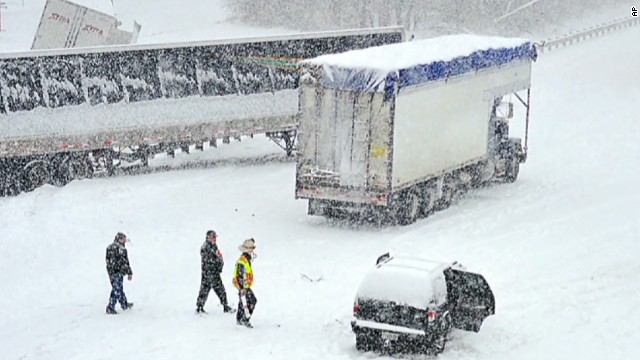
    In Arizona, a Saturday night snowstorm stranded 300 vehicles along Interstate 15. Rigs jackknifed and passenger cars slid into rigs, causing chain-reaction crashes and an enormous backup, Arizona Department of Public Safety Officer Bart Graves said. Authorities shut the interstate for more than 12 hours to clear it.

    "We had travelers running out of gas. They provided them food, water and blankets," Graves said.

    Some residents in the Dallas suburb of Plano had to deal with an unusual danger: sheets of ice cascading from buildings to the sidewalks and streets.

    "The apocalypse has started," one man said shortly before layers of ice fell onto cars.

    Late Sunday night in New York, there was a 20-car pileup on the Bronx River Parkway. Forty people were injured, none seriously, authorities said.

    Along Interstate 95 outside Stamford, Connecticut, Paul Lee captured frightening video of cars sliding and spinning across ice.

    Freezing rain is expected to fall from central Virginia to southeast New York on Monday. Some parts could see up to a quarter-inch of ice.

    CNN's Indra Petersons, Judson Jones, Ed Lavandera, Dave Alsup and Emily Minner contributed to this report.

+ Reply to Thread

Tags for this Thread

Posting Permissions

  • You may not post new threads
  • You may not post replies
  • You may not post attachments
  • You may not edit your posts