+ Reply to Thread
Page 17 of 32 FirstFirst 1 7 17 27 32 LastLast
Results 321 to 340 of 627

Thread: Japan nuclear agency upgrades Fukushima alert level

  1. Link to Post #321
    UK Avalon Member Cidersomerset's Avatar
    Join Date
    16th May 2011
    Location
    Bridgwater somerset UK
    Age
    65
    Posts
    22,333
    Thanks
    33,460
    Thanked 79,818 times in 18,702 posts

    Default Re: Japan nuclear agency upgrades Fukushima alert level

    Atomic Mafia? Yakuza cleans up Fukushima, neglects basic workers' rights


    Published on 20 Nov 2013


    Japan's mafia is reportedly cashing in on the Fukushima
    disaster by running the clean-up efforts at the damaged
    nuclear plant. Workers complain of being understaffed
    and mistreated by contractors who think nothing of
    throwing them into areas of high radiation.
    RT's Aleksey Yaroshevsky reports from Japan.

  2. The Following 4 Users Say Thank You to Cidersomerset For This Post:

    panopticon (24th November 2013), RMorgan (21st November 2013), Rocky_Shorz (21st November 2013), sian (21st November 2013)

  3. Link to Post #322
    UK Avalon Member Cidersomerset's Avatar
    Join Date
    16th May 2011
    Location
    Bridgwater somerset UK
    Age
    65
    Posts
    22,333
    Thanks
    33,460
    Thanked 79,818 times in 18,702 posts

    Default Re: Japan nuclear agency upgrades Fukushima alert level

    Fukushima666.Arnie Gundersen talks


    Published on 15 Nov 2013


    Something Is Killing Life All Over The Pacific Ocean -- Could It Be Fukushima?
    Michael Snyder
    Activist Post

    Why is there so much death and disease among sea life living near the west coast
    of North America right now? Could the hundreds of tons of highly radioactive water
    that are being released into the Pacific Ocean from Fukushima every single day
    have anything to do with it?

    When I wrote my last article about Fukushima, I got a lot of heat for
    being "alarmist" and for supposedly "scaring" people unnecessarily. I didn't think
    that an article about Fukushima would touch such a nerve, but apparently there are
    some people out there that really do not want anyone writing about this stuff.

    Right now, massive numbers of fish and sea creatures are dying in the Pacific
    Ocean. In addition, independent tests have shown that significant levels of cesium-
    137 are in a very high percentage of the fish that are being caught in the Pacific
    and sold in North America. Could this have anything to do with the fact that the
    largest nuclear disaster in the history of mankind has been constantly releasing
    enormous amounts of radioactive material into the Pacific Ocean for more than two
    years? I don't know about you, but to me this seems to be a question that is worth
    asking.

    Since I wrote my last article, major news outlets have reported that large numbers
    of sea stars living off of the west coast of North America appear to be "melting"...
    Divers were out in Puget Sound waters Saturday to see if they can help solve a
    mystery. Scientists are trying to figure out what's causing one species of starfish to
    die in parts of Puget Sound and the waters off of Canada.

    Seattle Aquarium biologists Jeff Christiansen and Joel Hollander suited up in scuba
    gear in their search for answers. "We're going to look for both healthy and
    potentially diseased sea stars," Christiansen explained. "We've got some sea stars
    that look like they're melting on the bottom."

    The same thing is happening in the waters near Canada and nobody's sure why.
    If scientists don't know why this is happening, perhaps there is an unusual
    explanation for this phenomenon.


    Could it be Fukushima?

    The following is what one invertebrate expert quoted by National Geographic says
    is happening to the starfish...
    [The starfish] seem to waste away, 'deflate' a little, and then just ... disintegrate.
    The arms just detach, and the central disc falls apart. It seems to happen rapidly,
    and not just dead animals undergoing decomposition, as I observed single arms
    clinging to the rock faces, tube feet still moving, with the skin split, gills flapping in
    the current. I've seen single animals in the past looking like this, and the first dive
    this morning I thought it might be crabbers chopping them up and tossing them off
    the rocks. Then we did our second dive in an area closed to fishing, and in
    absolutely amazing numbers. The bottom from about 20 to 50 feet [6 to 15 meters]
    was absolutely littered with arms, oral discs, tube feet, gonads and gills ... it was
    kind of creepy.

  4. The Following 4 Users Say Thank You to Cidersomerset For This Post:

    Rocky_Shorz (21st November 2013), sian (21st November 2013), spiritwind (22nd November 2013), Sunny-side-up (22nd November 2013)

  5. Link to Post #323
    UK Avalon Member Cidersomerset's Avatar
    Join Date
    16th May 2011
    Location
    Bridgwater somerset UK
    Age
    65
    Posts
    22,333
    Thanks
    33,460
    Thanked 79,818 times in 18,702 posts

    Default Re: Japan nuclear agency upgrades Fukushima alert level

    Fukushima radiation so high even robots not safe


    Published on 14 Nov 2013

  6. The Following 5 Users Say Thank You to Cidersomerset For This Post:

    mahalall (29th December 2013), panopticon (24th November 2013), RMorgan (21st November 2013), Rocky_Shorz (21st November 2013), sian (21st November 2013)

  7. Link to Post #324
    United States (Rocky_Shorz passed away on 5 June 2021)
    Join Date
    15th March 2010
    Posts
    10,068
    Thanks
    12,891
    Thanked 32,308 times in 7,756 posts

    Default Re: Japan nuclear agency upgrades Fukushima alert level

    quakes hitting close...


  8. Link to Post #325
    Avalon Member Cognitive Dissident's Avatar
    Join Date
    18th January 2011
    Location
    In a galaxy not too far away from where you are right now
    Posts
    453
    Thanks
    2,003
    Thanked 2,359 times in 410 posts

    Default Re: Japan nuclear agency upgrades Fukushima alert level

    The latest on the SPF extraction. TEPCO have posted this video of one of the fuel assemblies being lifted out (but not moved) - you get a good view, but limited.

    Anyway, it looks from this video as if most of the assemblies in view are in place OK, although of course they could be damaged out of view.

    At least it's good that we get a good view of some of the process.

    http://photo.tepco.co.jp/en/date/201...31120-01e.html

  9. The Following 3 Users Say Thank You to Cognitive Dissident For This Post:

    Cidersomerset (23rd November 2013), panopticon (24th November 2013), sian (25th November 2013)

  10. Link to Post #326
    Australia Avalon Member panopticon's Avatar
    Join Date
    6th February 2011
    Posts
    2,591
    Thanks
    8,262
    Thanked 8,009 times in 2,305 posts

    Default Re: Japan nuclear agency upgrades Fukushima alert level

    Quick rundown of the week @ Fukushima:
    • TEPCO have completed the first run moving 22 unused assemblies to the combined pool from SFP #4 (source 1 [video of containment vessel removal; video of transfer from containment vessel @ common pool into longer term storage]; source 2). Only 8 more trips and they can start on the used fuel rod assemblies...
    • The IAEA have sent a team to do a 2nd assessment of TEPCO's handling of the decommissioning process (source).
    • The 'Voice of Russia' are claiming that TEPCO used homeless people who weren't paid and worked unprotected at Fukushima (source).
    • The head of TEPCO, Naomi Hirose, told the Guardian that nuclear power wasn't completely safe and he had lots of experience to share with the British nuclear industry (source 1; source 2).

    Other than that all the rest of the data I've seen seems to be within parameters (bit of a rise in E1 a few days ago but it's returned to post Wipha levels). Just keep an eye on them earthquakes off the coast line.

    Official TEPCO background video explaining extraction/transport process (can anyone say "propaganda"):


    Cheers,
    Pan

    ***

    Just a quick reference for myself to re-read TEPCO's advisory report about the dangers of information being reported by news agencies in relation to schedules of transfers etc and potential issues from this of sabotage by groups unknown...
    Last edited by panopticon; 25th November 2013 at 13:18.
    "What we think, or what we know, or what we believe is, in the end, of little consequence.
    The only consequence is what we do."

  11. The Following 3 Users Say Thank You to panopticon For This Post:

    Cidersomerset (18th December 2013), RMorgan (25th November 2013), sian (25th November 2013)

  12. Link to Post #327
    Australia Avalon Member panopticon's Avatar
    Join Date
    6th February 2011
    Posts
    2,591
    Thanks
    8,262
    Thanked 8,009 times in 2,305 posts

    Default Re: Japan nuclear agency upgrades Fukushima alert level

    The Government of Japan is introducing new wide sweeping "secrecy" legislation in an effort to clamp down on people talking out about a large range of topics. This is being seen by many as a way for the State to further centralise power and stop disclosure of information that may be harmful to the Government. The following reports are on that subject. Notice that the key word "terrorist" (and its derivatives) has been appearing with increased regularity in reports from both TEPCO and the Government of Japan.

    ###

    Japan cracks down on leaks after scandal of Fukushima nuclear power plant
    By David McNeill. 26th November 2013.

    In April 2011, while Fukushima’s fires still smouldered, journalists scrambled to find sources who could shed any light on the nuclear crisis.

    In a car park 25 miles south of the plant, a nervous maintenance worker on a rare break told The Independent that conditions onsite were chaotic and dangerous. Workers were exhausted; nobody at the top seemed to know what they were doing.

    Nearly three years later, Japan’s parliament is set to pass a new state secrecy bill that critics warn might make revealing such conversations impossible, even illegal. They say the law dramatically expands state power, giving every government agency and ministry the discretion to label restricted information “state secrets”. Breaching those secrets will be punishable by up to 10 years in prison.

    The Prime Minister, Shinzo Abe, denies he is trying to gag the media or restrict the public’s right to know. “There is a misunderstanding,” he told Japan’s parliament today as the Lower House prepared to pass the bill (to be enacted on 6 December). “It is obvious that normal reporting activity of journalists must not be a subject for punishment.”

    Few people outside the government, however, seem to believe him. The legislation has triggered protests from Human Rights Watch, the International Federation of Journalists, the Federation of Japanese Newspapers Unions, the Japan Federation of Bar Associations and many other media watchdogs. Academics have signed a petition demanding it be scrapped.

    “It represents a grave threat to journalism because it covers such a wide and vague range of secrets,” said Mizuho Fukushima, a former leader of the opposition Social Democratic Party. She pointed out that the bill casts its net so wide it even includes a clause for “miscellaneous” secrets.

    Inevitably, perhaps, debate on the new law has been viewed through the prism of the Fukushima crisis, which revealed disastrous collusion between bureaucrats and the nuclear industry. Critics say journalists attempting to expose such collusion today could fall foul of the new law, which creates three new categories of “special secrets”: diplomacy, counter-terrorism and counter-espionage, in addition to defence.

    During deliberations in November, Masako Mori, the minister in charge of the bill, admitted that security information on nuclear power plants could be designated a state secret because the information “might reach terrorists.” The designation would mostly be left to elite bureaucrats.

    The government has attempted to steer debate away from Fukushima and toward rising tensions in Asia. Japan’s government says the secrecy legislation has been introduced partly to head off pressure from the US, its key military ally. Washington is still struggling to put out its own diplomatic fires started by whistleblowers Edward Snowden and Bradley Manning.

    One possible application for the new law could be seen in November, when Japan held some of its largest-ever military exercises near the southern prefecture of Okinawa.

    Opponents of the bill say Japan’s mainstream media is in any case already largely compliant. The latest (2013) World Press Freedom survey, published by journalism watchdog Reporters Without Borders, ranks Japan just 53rd, behind most advanced democracies and Lithuania and Ghana.

    “Why do we need another law,” asks Taro Yamamoto, an independent politician. “What the government is truly trying to do is increase the power of the state.”

    Source

    ###

    At Fukushima hearing, all speakers criticize state secrets bill
    The Asahi Shimbun. 26th November 2013.

    FUKUSHIMA--The ruling Liberal Democratic Party invited Namie Mayor Tamotsu Baba to speak about the state secrets protection bill, expecting support by a leader near the Fukushima nuclear disaster site to quell criticism against the legislation.

    The party’s plan, however, backfired.

    “I am afraid no clear bounds were established about what should be designated a state secret,” Baba told a hearing on the bill here on Nov. 25. He also said he cannot trust a government that tends to keep information under wraps.

    In fact, all seven speakers at the hearing criticized the bill, saying its ambiguous wording leaves open the possibility of abuse and its harsh penalties could keep citizens in the dark about matters that directly affect their lives.

    The ruling coalition, which railroaded the bill through a Lower House committee on Nov. 26, organized the hearing in the prefectural capital. Apart from speakers and politicians, only 50 members of the public could attend after obtaining admission tickets from Diet members.

    Since the bill was submitted to the Lower House late last month, calls have grown for specific guidelines on what constitutes a state secret under the legislation.

    But the ruling coalition and opposition parties failed to clearly define such state secrets in closed-door meetings and the debate at the Lower House’s special committee on national security.

    The administration of Prime Minister Shinzo Abe tried to reassure leaders of Fukushima Prefecture that the designation of state secrets will not concern information about nuclear power plants.

    But experts at the hearing agreed there is room for officials to stretch the bounds of the legislation, and that the government has already given contradictory views about nuclear plant information.

    The LDP expected Baba to show an understanding to the necessity of the legislation. The ruling party noted that nuclear power plants are not specified in the bill.

    But Baba instead mentioned the government’s bungling of information in the early stages of the disaster at the Fukushima No. 1 nuclear power plant in March 2011.

    The government failed to quickly release data from the computer-simulated System for Prediction of Environmental Emergency Dose Information (SPEEDI). Much like a weather map, the system shows the predicted spread of radioactive materials following an accident.

    Lacking the SPEEDI information, many Namie residents fled toward areas of high radiation levels during the evacuation.

    Residents in Fukushima Prefecture are particularly worried about the concealing of information under the legislation, in light of the water leaks and other problems at the Fukushima No. 1 plant, as well as the decommissioning process that is expected to take decades to complete.

    “The general public is concerned about officials’ broad interpretation of state secrets,” said Yumiko Nihei, professor of law at Sakura no Seibo Junior College who was invited by the opposition Democratic Party of Japan to give her views at the hearing.

    Nihei, who called for a halt to the bill, also said the government should respect the opinions of the public. The government solicited views from the public on its website in September. Of the 90,480 comments posted, 77 percent were opposed to the legislation.

    Nobuyoshi Hatanaka, a professor of the Japanese Constitution at Iwaki Junior College, stressed the importance of the government having a well-informed public before making a crucial policy decision.

    “Defense and diplomacy are the central government’s sole prerogative, but how can the central government facilitate the benefit for the public without keeping the public informed?” he said.

    He spoke on the invitation of New Komeito, the LDP’s junior coalition partner.

    The bill lists four areas of protection for state secrets: defense, diplomacy, the prevention of harmful activities, such as spying, and the prevention of terrorist activities.

    Hiroyasu Maki, vice chairman of the Fukushima Bar Association and a speaker at the hearing, said the government has varied its language about security measures concerning nuclear power plants.

    “On one day the government says ‘routine security measures are not state secrets,’ whereas on another day it says ‘a security plan drawn up in response to tips on possible terrorist activities at potentially targeted nuclear power plants may be designated as state secrets,” he said.

    Maki, invited to the hearing by the DPJ, said this occurred because the bill’s clauses are ambiguous and can cover a wide range of issues.

    The government bill sets a maximum 10-year prison term for violators who leak state secrets. With no clear guidelines on what constitutes a state secret, potential whistle-blowers and journalists hoping to expose government corruption may back off to avoid arrest. That, in turn, could undermine the public’s right to know.

    Kiyohiko Toyama, a New Komeito member of the Lower House, stressed at the hearing that legitimate news-gathering activities will not be punished.

    He said “extremely unlawful acts” by journalists, as defined in the bill, include deception, assault, blackmail, property theft, intrusion and gaining illegal access.

    Maki countered that reporters may be significantly discouraged from digging for the truth because the bill can allow investigative authorities to arbitrarily determine an “extremely unlawful act” in news gathering.

    Mitsugi Araki, a lawyer invited to speak by the Japanese Communist Party, said the simple act of distributing fliers to residences could be punished as an unlawful intrusion under the legislation.

    Even LDP members of the Fukushima prefectural assembly expressed concerns about the bill after the hearing.

    The Fukushima prefectural assembly in October adopted a statement calling on the government and the Diet to proceed with caution in discussing the legislation.

    After the hearing, Shoichi Kobayashi, an LDP assembly member, echoed the criticism that the scope of designated state secrets remains blurred.

    “I’m afraid that the government and the Diet themselves have not had sufficient debate over that point,” he said.

    Source
    "What we think, or what we know, or what we believe is, in the end, of little consequence.
    The only consequence is what we do."

  13. The Following 3 Users Say Thank You to panopticon For This Post:

    Cidersomerset (18th December 2013), mahalall (29th December 2013), RMorgan (27th November 2013)

  14. Link to Post #328
    United States (Rocky_Shorz passed away on 5 June 2021)
    Join Date
    15th March 2010
    Posts
    10,068
    Thanks
    12,891
    Thanked 32,308 times in 7,756 posts

    Default Re: Japan nuclear agency upgrades Fukushima alert level

    28 signs the West coast is under extreme radiation from Japan's Fukushima...

    Quote (Before It's News)

    I did not write the below, I have copied it for record keeping purposes. It is a great summary. There are so many “signs”. The goal is to sway those who are on the fence, and to get people to protect themselves, AND to mobilize to shut down the EVIL nuke industry.

    Here is the source.
    http://www.globalresearch.ca/28-sign...ushima/5355280

    The map below comes from the Nuclear Emergency Tracking Center. It shows that radiation levels at radiation monitoring stations all over the country are elevated. As you will notice, this is particularly true along the west coast of the United States. Every single day, 300 tons of radioactive water from Fukushima enters the Pacific Ocean. That means that the total amouont of radioactive material released from Fukushima is constantly increasing, and it is steadily building up in our food chain.
    Ultimately, all of this nuclear radiation will outlive all of us by a very wide margin. They are saying that it could take up to 40 years to clean up the Fukushima disaster, and meanwhile countless innocent people will develop cancer and other health problems as a result of exposure to high levels of nuclear radiation. We are talking about a nuclear disaster that is absolutely unprecedented, and it is constantly getting worse. The following are 28 signs that the west coast of North America is being absolutely fried with nuclear radiation from Fukushima…
    Fukushima Radiation
    1. Polar bears, seals and walruses along the Alaska coastline are suffering from fur loss and open sores…

    Wildlife experts are studying whether fur loss and open sores detected in nine polar bears in recent weeks is widespread and related to similar incidents among seals and walruses.
    The bears were among 33 spotted near Barrow, Alaska, during routine survey work along the Arctic coastline. Tests showed they had “alopecia, or loss of fur, and other skin lesions,” the U.S. Geological Survey said in a statement.

    2. There is an epidemic of sea lion deaths along the California coastline…

    At island rookeries off the Southern California coast, 45 percent of the pups born in June have died, said Sharon Melin, a wildlife biologist for the National Marine Fisheries Service based in Seattle. Normally, less than one-third of the pups would die. It’s gotten so bad in the past two weeks that the National Oceanic and Atmospheric Administration declared an “unusual mortality event.”

    3. Along the Pacific coast of Canada and the Alaska coastline, the population of sockeye salmon is at a historic low. Many are blaming Fukushima.
    4. Something is causing fish all along the west coast of Canada to bleed from their gills, bellies and eyeballs.
    5. A vast field of radioactive debris from Fukushima that is approximately the size of California has crossed the Pacific Ocean and is starting to collide with the west coast.
    6. It is being projected that the radioactivity of coastal waters off the U.S. west coast could double over the next five to six years.
    7. Experts have found very high levels of cesium-137 in plankton living in the waters of the Pacific Ocean between Hawaii and the west coast.
    8. One test in California found that 15 out of 15 bluefin tuna were contaminated with radiation from Fukushima.
    9. Back in 2012, the Vancouver Sun reported that cesium-137 was being found in a very high percentage of the fish that Japan was selling to Canada…
    • 73 percent of mackerel tested
    • 91 percent of the halibut
    • 92 percent of the sardines
    • 93 percent of the tuna and eel
    • 94 percent of the cod and anchovies
    • 100 percent of the carp, seaweed, shark and monkfish
    10. Canadian authorities are finding extremely high levels of nuclear radiation in certain fish samples…

    Some fish samples tested to date have had very high levels of radiation: one sea bass sample collected in July, for example, had 1,000 becquerels per kilogram of cesium.

    11. Some experts believe that we could see very high levels of cancer along the west coast just from people eating contaminated fish…

    “Look at what’s going on now: They’re dumping huge amounts of radioactivity into the ocean — no one expected that in 2011,” Daniel Hirsch, a nuclear policy lecturer at the University of California-Santa Cruz, told Global Security Newswire. “We could have large numbers of cancer from ingestion of fish.”

    12. BBC News recently reported that radiation levels around Fukushima are “18 times higher” than previously believed.
    13. An EU-funded study concluded that Fukushima released up to 210 quadrillion becquerels of cesium-137 into the atmosphere.
    14. Atmospheric radiation from Fukushima reached the west coast of the United States within a few days back in 2011.
    15. At this point, 300 tons of contaminated water is pouring into the Pacific Ocean from Fukushima every single day.
    16. A senior researcher of marine chemistry at the Japan Meteorological Agency’s Meteorological Research Institute says that “30 billion becquerels of radioactive cesium and 30 billion becquerels of radioactive strontium” are being released into the Pacific Ocean from Fukushima every single day.
    17. According to Tepco, a total of somewhere between 20 trillion and 40 trillion becquerels of radioactive tritium have gotten into the Pacific Ocean since the Fukushima disaster first began.
    18. According to a professor at Tokyo University, 3 gigabecquerels of cesium-137 are flowing into the port at Fukushima Daiichi every single day.
    19. It has been estimated that up to 100 times as much nuclear radiation has been released into the ocean from Fukushima than was released during the entire Chernobyl disaster.
    20. One recent study concluded that a very large plume of cesium-137 from the Fukushima disaster will start flowing into U.S. coastal waters early next year…

    Ocean simulations showed that the plume of radioactive cesium-137 released by the Fukushima disaster in 2011 could begin flowing into U.S. coastal waters starting in early 2014 and peak in 2016.

    21. It is being projected that significant levels of cesium-137 will reach every corner of the Pacific Ocean by the year 2020.
    22. It is being projected that the entire Pacific Ocean will soon “have cesium levels 5 to 10 times higher” than what we witnessed during the era of heavy atomic bomb testing in the Pacific many decades ago.
    23. The immense amounts of nuclear radiation getting into the water in the Pacific Ocean has caused environmental activist Joe Martino to issue the following warning…

    “Your days of eating Pacific Ocean fish are over.”

    24. The Iodine-131, Cesium-137 and Strontium-90 that are constantly coming from Fukushima are going to affect the health of those living the the northern hemisphere for a very, very long time. Just consider what Harvey Wasserman had to say about this…

    Iodine-131, for example, can be ingested into the thyroid, where it emits beta particles (electrons) that damage tissue. A plague of damaged thyroids has already been reported among as many as 40 percent of the children in the Fukushima area. That percentage can only go higher. In developing youngsters, it can stunt both physical and mental growth. Among adults it causes a very wide range of ancillary ailments, including cancer.
    Cesium-137 from Fukushima has been found in fish caught as far away as California. It spreads throughout the body, but tends to accumulate in the muscles.
    Strontium-90’s half-life is around 29 years. It mimics calcium and goes to our bones.

    25. According to a recent Planet Infowars report, the California coastline is being transformed into “a dead zone”…

    The California coastline is becoming like a dead zone.
    If you haven’t been to a California beach lately, you probably don’t know that the rocks are unnaturally CLEAN – there’s hardly any kelp, barnacles, sea urchins, etc. anymore and the tide pools are similarly eerily devoid of crabs, snails and other scurrying signs of life… and especially as compared to 10 – 15 years ago when one was wise to wear tennis shoes on a trip to the beach in order to avoid cutting one’s feet on all the STUFF of life – broken shells, bones, glass, driftwood, etc.
    There are also days when I am hard-pressed to find even a half dozen seagulls and/or terns on the county beach.
    You can still find a few gulls trolling the picnic areas and some of the restaurants (with outdoor seating areas) for food, of course, but, when I think back to 10 – 15 years ago, the skies and ALL the beaches were literally filled with seagulls and the haunting sound of their cries both day and night…
    NOW it’s unnaturally quiet.

    26. A study conducted last year came to the conclusion that radiation from the Fukushima nuclear disaster could negatively affect human life along the west coast of North America from Mexico to Alaska “for decades”.
    27. According to the Wall Street Journal, it is being projected that the cleanup of Fukushima could take up to 40 years to complete.
    28. Yale Professor Charles Perrow is warning that if the cleanup of Fukushima is not handled with 100% precision that humanity could be threatened “for thousands of years“…

    “Conditions in the unit 4 pool, 100 feet from the ground, are perilous, and if any two of the rods touch it could cause a nuclear reaction that would be uncontrollable. The radiation emitted from all these rods, if they are not continually cool and kept separate, would require the evacuation of surrounding areas including Tokyo. Because of the radiation at the site the 6,375 rods in the common storage pool could not be continuously cooled; they would fission and all of humanity will be threatened, for thousands of years.”

    Are you starting to understand why so many people are so deeply concerned about what is going on at Fukushima?
    About the author: Michael T. Snyder is a former Washington D.C. attorney who now publishes The Truth. His new thriller entitled “The Beginning Of The End” is now available on Amazon.com.

    link to original story

  15. Link to Post #329
    United States Avalon Member GreenGuy's Avatar
    Join Date
    25th November 2013
    Age
    75
    Posts
    473
    Thanks
    2,028
    Thanked 1,954 times in 424 posts

    Default Re: Japan nuclear agency upgrades Fukushima alert level

    Quote Posted by Ernie Nemeth (here)
    I'm not sure if radioactivity is as dangerous as we have been lead to believe.
    Well, we blasted Bosnia and Iraq with "depleted" uranium. A little googling will confront you with some of the horrific birth defects that have resulted. And of course the wind blows this stuff all over the planet. I think the nature of radiation may be different than what we've been told in some ways, but I doubt it's good for us. Marie Curie, pioneer in radiation studies, died of aplastic anemia, generally thought to be the result of radiation exposure. The longterm effects of the Hiroshima bombing included cancers, birth defects, low birth weight and reduced intelligence in children.

    We have embarked on a grand experiment to see just how deadly it may be. Polar bears and seals around Alaska are losing their fur and showing bleeding lesions. Various populations of Pacific animals, from whales to starfish, seem to be collapsing. I'm aware of some positive signs that certain fungi can mitigate radiation, and without a doubt a percentage of individuals of many species will prove to be able to tolerate higher levels than others. In any event, there's no putting the genie back in the lamp at this point.

  16. The Following User Says Thank You to GreenGuy For This Post:

    Cidersomerset (18th December 2013)

  17. Link to Post #330
    Australia Avalon Member panopticon's Avatar
    Join Date
    6th February 2011
    Posts
    2,591
    Thanks
    8,262
    Thanked 8,009 times in 2,305 posts

    Default Re: Japan nuclear agency upgrades Fukushima alert level

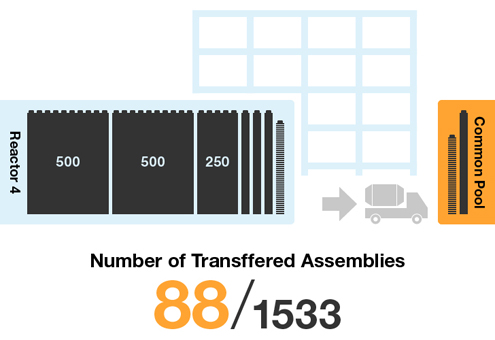
    Current status of fuel assembly removal process from Unit #4 to common pool (9th December 2013) (image automagically updates):


    • Numbers of transferred assemblies:
      Spent fuel: 44 assemblies out of 1,331 assemblies.
      Unirradiated (New) fuel: 22 assemblies out of 202 assemblies.
    • Number of times of cask transportation: 3 times.
      Source

    Spike in radiation detected in Well 1-16 since 28 November up to 1,300,000 Bq/l (up from ~800,000 Bq/L) (source).
    This has been put down to a combination of rain event on 26th November (source) and success of the improved containment measures for contaminated ground water.

    Gross Beta particle detected has continued to drop in the E-1 from a high in mid November of 710,000 Bq/l down to 12,000 Bq/l on 10th December (source). H-3 detection has also dropped from 790,000 Bq/l (mid October) to 410,000 Bq/l (source).

    Report on measures to combat onsite tank leakage (due to building tanks on a bloody slope without appropriate ground works [ie they just put down a mesh and laid a pad on on it so the tanks are at a lean]) have been initiated with training of staff to recognise that tanks are on a lean and can't hold their full capacity (particularly the tank at the bottom of the series into which the up-hill tanks flow!). Also chalking has been undertaken around top seam/lip of tanks and rain gutters installed (source).

    Reports from TEPCO available on fish and crustacean contamination levels from within 20 k radius (source) and 1-3 k area (source).

    TEPCO reported that on investigating the exhaust stacks of Units #1 & #2 a rate of 15 Sv/h and 25 Sv/h was estimated at ground level near the gas treatment system for expelled gas from the reactors (source).

    A study has found that Typhoon's have been moving Caesium from the mountains and into Japanese waterways which of course lead into the sea (source).

    -- Pan
    Last edited by panopticon; 16th December 2013 at 05:59.
    "What we think, or what we know, or what we believe is, in the end, of little consequence.
    The only consequence is what we do."

  18. The Following User Says Thank You to panopticon For This Post:

    Cidersomerset (18th December 2013)

  19. Link to Post #331
    Australia Avalon Member panopticon's Avatar
    Join Date
    6th February 2011
    Posts
    2,591
    Thanks
    8,262
    Thanked 8,009 times in 2,305 posts

    Default Re: Japan nuclear agency upgrades Fukushima alert level

    From Reuters:

    Fukushima contractor sanctioned by Japan labour regulator
    By Antoni Slodkowski. December 13th, 2013.

    Japanese labour regulators have sanctioned a construction firm involved in the decommissioning of the Fukushima nuclear power plant for improperly employing workers to repair another nuclear plant, also damaged by the 2011 earthquake.

    ABL Co Ltd, based in Okuma, where the Fukushima plant is located, managed at least eight workers who had been supplied illegally by several layers of subcontractors for inspection and repair work at the Tokai Daini nuclear plant, which is managed by Japan Atomic Power Co, officials said.

    The practice of having workers hired by a broker but managed by another company is banned under Japanese law to protect workers from having their wages skimmed and to clarify who is responsible for their safety.

    The rare public sanction - there were only 24 such business improvement orders issued in Japan in the year to March 2013 for labour violations - covered July-December 2011, when ABL was found to have improperly employed the workers at the Tokai plant.

    The Tokai plant, 110 kms (68 miles) northeast of Tokyo, automatically shut down in the March 2011 earthquake. Its turbines and other equipment were damaged, and repair work continued into 2012.

    ABL said it did not dispute that it improperly employed workers at Tokai, and said it was asking regulators to inspect its operations again to verify it had tightened its compliance practices. "We were not aware these workers were employed by multiple layers of subcontractors. Our awareness was low," said Osamu Watanabe, general manager at ABL.

    Takeshi Iwami, an inspector at the Fukushima Labour Standards Office, said ABL should have better understood the rules. "These were all very basic things they should have been fully aware of as an experienced contractor," he said.

    Fukushima labour regulators said they were still investigating Hayashi's complaint. ABL, which employs about 200 workers in decommissioning the Fukushima plant, declined to comment on the former worker's claims.

    Tokyo Electric, or Tepco, has promised to improve working conditions at the Fukushima plant.

    Source
    "What we think, or what we know, or what we believe is, in the end, of little consequence.
    The only consequence is what we do."

  20. The Following User Says Thank You to panopticon For This Post:

    Cidersomerset (18th December 2013)

  21. Link to Post #332
    Australia Avalon Member panopticon's Avatar
    Join Date
    6th February 2011
    Posts
    2,591
    Thanks
    8,262
    Thanked 8,009 times in 2,305 posts

    Default Re: Japan nuclear agency upgrades Fukushima alert level

    The Japan Times reports that water pumped into reactors 1 to 3 on the days following the 2011 accident did not reach the core and was a contributing factor for the meltdowns.

    ###

    Water from fire trucks didn’t reach Fukushima No. 1 reactor cores: Tepco

    It is extremely likely that coolant water injected by fire trucks into the wrecked reactors of the Fukushima No. 1 nuclear plant immediately after the 2011 catastrophe did not fully reach the cores, Tokyo Electric Power Co. has admitted.

    If all of this coolant water had been successfully injected into the three reactor cores, the melting of the fuel inside could have been slowed down, Tepco conceded Friday.

    Tepco, which has been looking into developments at the plant in the early days of the disaster, said Friday it has confirmed that coolant water pumped in by fire trucks flowed into some pipes that didn’t lead to the cores of reactors 1 to 3, which suffered meltdowns.

    It said the amount supplied by fire trucks as an emergency measure was several times that needed to cool reactor cores, but part of the coolant water was diverted to pipes not connected to the cores. Tepco also admitted workers could not operate valves to keep the coolant water from flowing into the wrong pipes due to sky-high radiation levels.

    The company examined water flow in the reactor pipes after confirming the existence of a vast amount of water at a steam condenser of the reactor 2 building in late March 2011.

    Tepco also said it is possible that the amount of water injected into the core of reactor 3 had fallen before workers manually stopped a high pressure coolant injection system.

    As for the sharp fall in pressure of the reactor 3 pressure vessel on March 13, 2011, Tepco said it is probable that a valve opened to reduce pressure as the automatic decompression system was turned on unintentionally. The company had previously suggested the pressure vessel had a hole.

    Source
    "What we think, or what we know, or what we believe is, in the end, of little consequence.
    The only consequence is what we do."

  22. The Following User Says Thank You to panopticon For This Post:

    Cidersomerset (18th December 2013)

  23. Link to Post #333
    UK Avalon Member Cidersomerset's Avatar
    Join Date
    16th May 2011
    Location
    Bridgwater somerset UK
    Age
    65
    Posts
    22,333
    Thanks
    33,460
    Thanked 79,818 times in 18,702 posts

    Default Re: Japan nuclear agency upgrades Fukushima alert level

    Sending the drones to Fukushima ......

    Lady Barbara Judge...The culture of Tempo was efficiency above safety....


    Published on 17 Dec 2013


    A team from Bristol University may have come up with a tool that
    can help clean up the Fukushima plant in Japan - a lightweight
    flying drone that can detect radiation without putting people at
    risk.Sign up for Snowmail, your daily preview of what is on
    Channel 4 News, sent straight to your inbox,
    here: http://mailing.channel4.com/public/sn...
    Last edited by Cidersomerset; 18th December 2013 at 21:59.

  24. The Following User Says Thank You to Cidersomerset For This Post:

    panopticon (30th December 2013)

  25. Link to Post #334
    UK Avalon Member Cidersomerset's Avatar
    Join Date
    16th May 2011
    Location
    Bridgwater somerset UK
    Age
    65
    Posts
    22,333
    Thanks
    33,460
    Thanked 79,818 times in 18,702 posts

    Default Re: Japan nuclear agency upgrades Fukushima alert level

    Record Radiation: Handling of Fukushima cleanup is 'comedy of errors'


    Published on 23 Dec 2013


    Japan is breaking its own radioactive records - as huge amounts of beta-ray
    emitting substances have been discovered at another reactor at the crippled
    Fukushima power plant. Meanwhile the government says the decontamination work
    scheduled to be completed by March - may take another 3 years. For more we're
    joined by Alex Kerr - an expert on Japan.

  26. The Following 2 Users Say Thank You to Cidersomerset For This Post:

    bennycog (29th December 2013), panopticon (30th December 2013)

  27. Link to Post #335
    UK Avalon Member Cidersomerset's Avatar
    Join Date
    16th May 2011
    Location
    Bridgwater somerset UK
    Age
    65
    Posts
    22,333
    Thanks
    33,460
    Thanked 79,818 times in 18,702 posts

    Default Re: Japan nuclear agency upgrades Fukushima alert level

    U.S. Navy Sailors Sue TEPCO over Cluster-Fukushima Snafu

    Monday 23rd December 2013 at 03:22 By David Icke


    ‘“Why has this not made national headlines??? The Aircraft Carrier Ronald Reagan
    is nuclear powered. Radiation detection equipment did not pick up on this?? Why
    have these sailors and marines medical records been removed from permanent
    tracking. Criminal implications galore. This should be all over mainstream media.
    Someone please forward all these ene reports to the media…. Tepco is the lowest of
    snakes. Hari Kari for the lot of em!!”’

    Read more: U.S. Navy Sailors Sue TEPCO over Cluster-Fukushima Snafu

    http://www.globalresearch.ca/u-s-nav...-snafu/5362417

    http://www.davidicke.com/headlines/

  28. The Following 2 Users Say Thank You to Cidersomerset For This Post:

    bennycog (29th December 2013), panopticon (30th December 2013)

  29. Link to Post #336
    Avalon Member pine boy's Avatar
    Join Date
    10th October 2010
    Posts
    62
    Thanks
    319
    Thanked 241 times in 53 posts

    Default Re: Japan nuclear agency upgrades Fukushima alert level

    I know no one on this planet wants to read this but to me its important that all the information is out in the open.It appears that reactor building 3 is venting.Here is an excerpt from the third party report.

    "Nuclear energy experts have told TRN that the ONLY way this could be happening is if radioactive material previously ejected from the reactor explosion in March, 2011 has mixed together with other materials and has begun its own self-sustaining reaction(s), also known as a "criticality." Put simply, another "meltdown" may be taking place.

    There are basically two possibilities if another meltdown is in progress:

    1) Pellets of radioactive fuel, ejected when the reactor exploded, have mixed together and "mini" meltdowns are taking place with those small clumps of pellets. This would not be a horrific problem and may be manageable, OR;

    2) Pellets of radioactive fuel, ejected when the reactor exploded, went into the spent fuel pool located above the reactor and have begun melting down so seriously they are boiling off the water in the spent fuel pool."


    Read more in the link.

    http://www.turnerradionetwork.com/news/146-mjt

    God bless

  30. The Following 4 Users Say Thank You to pine boy For This Post:

    bennycog (29th December 2013), Cidersomerset (29th December 2013), mahalall (29th December 2013), panopticon (30th December 2013)

  31. Link to Post #337
    Australia Avalon Member panopticon's Avatar
    Join Date
    6th February 2011
    Posts
    2,591
    Thanks
    8,262
    Thanked 8,009 times in 2,305 posts

    Default Re: Japan nuclear agency upgrades Fukushima alert level

    Hey Pineboy,

    As I said in another thread the auto-translated report from TEPCO indicated that there wasn't any change in coolant temperature. This would make it doubtful that a melt-down was occurring. There's also been no change in recorded radiation levels @ the Daiichi plant over the last month:

    http://new.atmc.jp/pref.cgi?p=07#d=m

    I don't know what the cause of the steam reported is but I'm not thinking it's a further core problem (what's left of the core anyway). There are high levels of radiation recorded at the exhaust stacks of units #1 & #2 but you'd need to be standing fairly close to the source (for more than a couple of minutes) to receive a fatal dose. Other than that I would need to have a look at the last weeks data a bit closer (damn holidays), and wait for the TEPCO "prompt" report to come out in English on the steam inside the #3 unit, to have a clearer idea.

    Hope this helps.

    -- Pan
    "What we think, or what we know, or what we believe is, in the end, of little consequence.
    The only consequence is what we do."

  32. The Following 3 Users Say Thank You to panopticon For This Post:

    Cidersomerset (30th December 2013), onawah (31st December 2013), pine boy (30th December 2013)

  33. Link to Post #338
    United States On Sabbatical
    Join Date
    30th June 2011
    Location
    The Seat of Corruption
    Age
    46
    Posts
    9,177
    Thanks
    25,610
    Thanked 53,743 times in 8,696 posts

    Default Re: Japan nuclear agency upgrades Fukushima alert level

    this thread is spiraling down the logical fallacy tube of misinformation with a few interjections of actual facts to help float it a long a little...

    I found this a particularly good post that summarizes a lot of what seems apparently going here:
    Quote Posted by Mozart (here)
    I am against the use of nuclear energy for power, as well as weapons; however, the situation at Fukushima is a massive disinfo campaign that's designed to make people feel powerless.


    Here's two links that, as far as I understand, gives the most accurate pictures of what really is going on with Fukushima:

    http://www.southernfriedscience.com/?p=15903

    http://deepseanews.com/2013/11/true-...hima-disaster/


    The comments section at the base the Southern Fried Science site's article alone are worth the read.


    Jim's site ... http://www.jimstonefreelance.com/ ... is also a very good source of good info about Fukushima.


    I've been in email contact with Jim (a while ago, not now) and he's on the run from several alphabet soup agencies, as Jim himself is a former NSA agent, so he really knows a lot of deep, accurate info on numerous topics of which the vast majority of us are misinformed/underinformed/brainwashed.


    Jim is a real deal and his information is highly accurate.
    Hard times create strong men, Strong men create good times, Good times create weak men, Weak men create hard times.
    Where are you?

  34. The Following 3 Users Say Thank You to TargeT For This Post:

    Cidersomerset (30th December 2013), onawah (31st December 2013), panopticon (31st December 2013)

  35. Link to Post #339
    UK Avalon Member Cidersomerset's Avatar
    Join Date
    16th May 2011
    Location
    Bridgwater somerset UK
    Age
    65
    Posts
    22,333
    Thanks
    33,460
    Thanked 79,818 times in 18,702 posts

    Default Re: Japan nuclear agency upgrades Fukushima alert level

    Epidemiologist back from Fukushima: ‘We’re talking about a sacrifice zone and
    millions of people live in this area’ — Exceeds allowable radiation dose for nuclear
    workers 40 kilometers from Fukushima plant

    Monday 30th December 2013 at 04:42 By David Icke


    ‘Epidemiologist Dr. Steve Wing, University of North Carolina — Chapel Hill,
    discusses the human impacts of the Fukushima nuclear disaster based on his visit
    to the area:

    This reading here, just to put it in perspective, the guard there if he stood there for
    a year, right where he is now in this picture, he would exceed the allowable
    radiation dose for a nuclear workers inside a plant. And this is 40 kilometers away.
    So we’re talking about a sacrifice zone, and millions of people live in this area.

    So the guard — can you see on the ground behind the guard there’s a metal plate?
    He’s supposed to stand on that metal plate, and that’s his protection. And he’s
    wearing a surgical mask, and he has a helmet. It made me feel kind of bad, that
    here is someone that’s working in a radiation exposed job and he’s been issued a
    surgical mask and a helmet as though he’s supposed to feel protected.’


    Published on 9 Dec 2013


    Epidemiologist Dr. Steve Wing discusses the human impacts of
    the nuclear disaster at Fukushima based on his experience visiting the area.


    http://www.davidicke.com/headlines/

  36. The Following 2 Users Say Thank You to Cidersomerset For This Post:

    halffull (30th December 2013), panopticon (31st December 2013)

  37. Link to Post #340
    Australia Avalon Member panopticon's Avatar
    Join Date
    6th February 2011
    Posts
    2,591
    Thanks
    8,262
    Thanked 8,009 times in 2,305 posts

    Default Re: Japan nuclear agency upgrades Fukushima alert level

    G'day TargeT,

    Those are good articles aren't they.

    There is no scientific evidence that I've seen showing that the US is in any danger from a nuclear "plume", it's the Japanese that are the ones that the Fukushima Daiichi accident has affected.

    From corruption in Government to Corporate cronyism, from farmers working in caesium-137 contaminated fields to leaking coolant storage tanks with concrete pads shoddily built on slopes with no ground preparation, from inadequate initial safeguards to contractors associated with criminal organisations ripping off their workers and providing sub-standard protective equipment. That's where the bloody problems are.

    My other concerns at the moment, in relation to Fukushima Daiichi #4, are to do with problems occurring during the fuel removal process. However, if something were to happen, it too would be a localised event (ie relevant to Japan) and have virtually no effect on the US.

    There is also the potential of a false flag operation around the removal process. The risk of terrorist strikes has been mentioned on a number of occasions in press releases from TEPCO, Japan's Nuclear Agency and Government.

    I agree with you, there is way too much uninformed commentary on the dangers of radioactive particles and thank you for coming back to this thread to help keep it a balanced place for people who are interested in understanding the science.

    -- Pan
    "What we think, or what we know, or what we believe is, in the end, of little consequence.
    The only consequence is what we do."

  38. The Following 3 Users Say Thank You to panopticon For This Post:

    Cidersomerset (31st December 2013), kirolak (31st December 2013), onawah (31st December 2013)

+ Reply to Thread
Page 17 of 32 FirstFirst 1 7 17 27 32 LastLast

Posting Permissions

  • You may not post new threads
  • You may not post replies
  • You may not post attachments
  • You may not edit your posts