+ Reply to Thread
Page 1 of 2 1 2 LastLast
Results 1 to 20 of 35

Thread: Erupting Volcano of Mount Kelud on Java island Indonesia

  1. Link to Post #1
    Unsubscribed
    Join Date
    23rd June 2013
    Location
    North America
    Age
    74
    Posts
    6,884
    Thanks
    12,723
    Thanked 29,293 times in 6,140 posts

    Default Erupting Volcano of Mount Kelud on Java island Indonesia

    14 Feb 2014 Massive Volcanic Eruption Java Island Indonesia

    Forcing evacuations of between 100,000-200,000 people, having already killed 3


    The explosion was heard 125 miles away, 200 km.

    Ash and grit fell to earth in towns and cities across the region, including Surabaya, Indonesia's second-largest city after Jakarta, with a population of about 3 million.

  2. Link to Post #2
    Unsubscribed
    Join Date
    23rd June 2013
    Location
    North America
    Age
    74
    Posts
    6,884
    Thanks
    12,723
    Thanked 29,293 times in 6,140 posts

    Default Re: Erupting Volcano of Mount Kelud on Java island Indonesia

    From Nature World News, Mount Kelud data

    ref: http://www.natureworldnews.com/artic...h-blankets.htm


    Mount Kelud erupted late Thursday on Indonesia's Java island, eruptions continuing into Friday.

    Indonesia's National Disaster Mitigation Agency (BNPB) issued an evacuation warning about an hour before the volcano - which had been rumbling for days - erupted, for people living within 10 kilometers (6 miles) of Mt. Kelud.

    Of the three that died, two people died of smoke inhalation and a third died from falling debris.

    Mt Kelud is also a Strato-Volcano, similar to the one (Vesuvius) which destroyed Pompeii and Herculaneum. The strato-volcano Tungurahua in Ecuador has been erupting since about the 1st February. Similar gas clouds and pyroclastic flows of ash and debris were emitted. Scientists predict that the next eruption of Mount Vesuvius will be violent, having erupted last in 1944.

    Stratovolcanoes are the world's most dangerous volcanoes.

  3. Link to Post #3
    Unsubscribed
    Join Date
    23rd June 2013
    Location
    North America
    Age
    74
    Posts
    6,884
    Thanks
    12,723
    Thanked 29,293 times in 6,140 posts

    Default Re: Erupting Volcano of Mount Kelud on Java island Indonesia


    "Indonesia has approximately 130 active volcanoes. Due to its population density and the fertile soils that volcanic slopes provide, hundreds of thousands of Indonesians live close to active volcanoes. They have learnt to live with the rumblings and frequently ignore orders to leave."

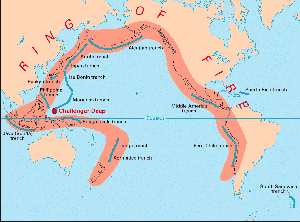
    "The huge archipelago sits between the most active seismic region in the world, the Pacific Ring of Fire, an area where a large number of earthquakes and volcanic eruptions occur, and the Alpide Belt."

    ref: http://www.independent.co.uk/news/wo...e-9128148.html - eruption in Indonesia

    The Alpide Belt is among the most seismically active zones in the world. The Ring of Fire, or the circum-Pacific belt, is the world’s greatest earthquake belt, according to Live Science, because of fault lines running from Chile to Japan and Southeast Asia.

    These fault lines are breaks in the plates of the Earth’s crust and are where earthquakes are likely to occur.


    http://www.livescience.com/8823-indo...explained.html - Indonesia's Explosive Geology on the Ring of Fire

    "Precariously located above the grinding and mashing of several tectonic plates, and ringed by a chain of fire-breathing volcanoes, the country's islands are located in one of the most volatile regions in the world. The eruption of a volcano and the shaking of a tsunami-generating earthquake this week is just one reminder of Indonesia's fiery foundation.

    "As the world's largest archipelago — spread across 17,500 islands — Indonesia sits between the world's most active seismic region — the notorious Pacific Ring of Fire — and the world's second most active region — the Alpide belt. Being sandwiched between such seismicity has meant the islands experience some of the strongest earthquakes and most powerful volcanic eruptions known on Earth."

  4. Link to Post #4
    Unsubscribed
    Join Date
    23rd June 2013
    Location
    North America
    Age
    74
    Posts
    6,884
    Thanks
    12,723
    Thanked 29,293 times in 6,140 posts

    Default Re: Erupting Volcano of Mount Kelud on Java island Indonesia

    Both of Indonesia's most active volcanoes – Kelut and Mount Merapi (meaning "mountain of fire") – sit on Java Island.

    And both have a history of explosive eruptions. Mount Merapi erupted today (Oct. 26), with preliminary reports of 100 people killed, according to the USGS. Merapi is located in central Java, roughly 310 miles (500 kilometers) southeast of the capital Jakarta.

    Mount Merapi last erupted in 2006, killing two, but its violent history includes more than 1,300 killed in a 1930 eruption and possibly 70 killed in a 1994 eruption.

    Other colossal volcanic eruptions that have occurred in Indonesia include the eruption of Krakatau, which reportedly generated the loudest sound ever heard in modern history when it exploded in 1883, killing 40,000 people. Krakatau is a volcanic island located between the islands of Java and Sumatra.

    The Toba supervolcano located on the island of Sumatra, which erupted 70,000 years ago, was a global catastrophe, creating six years of volcanic winter.

    ref: http://www.livescience.com/8823-indo...explained.html


    Dr Steven Godby, an expert in natural hazards at Nottingham Trent University, said Kelud is regarded as one of the most dangerous volcanoes on Java because of its frequent eruptions and deadly 'lahars'.

    "Lahar is an Indonesian term used to describe the hot or cold mixture of water, rock and ash that can flow down the slopes of a volcano or along river valleys", he said. "Kelud’s typically short but violent eruptions cause the ejection of water from a crater lake at its summit."
    Last edited by Bob; 14th February 2014 at 19:24.

  5. Link to Post #5
    Unsubscribed
    Join Date
    23rd June 2013
    Location
    North America
    Age
    74
    Posts
    6,884
    Thanks
    12,723
    Thanked 29,293 times in 6,140 posts

    Lightbulb Re: Erupting Volcano of Mount Kelud on Java island Indonesia

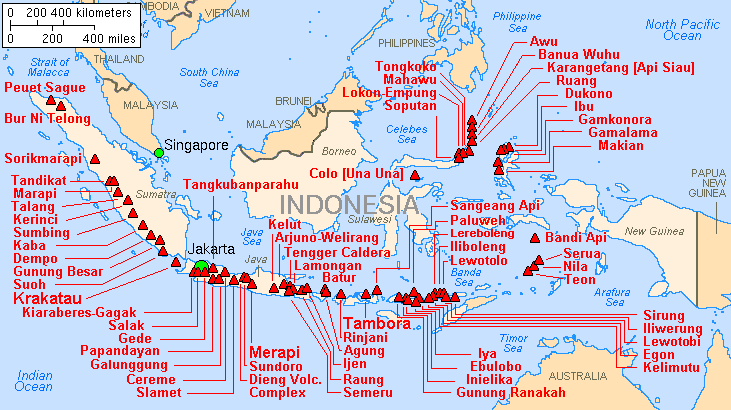
    Map of Major Volcanoes of Indonesia


    The volcanoes in Indonesia are among the most active of the Pacific Ring of Fire.

    They are formed due to subduction zones of three main active tectonic plates namely the Eurasian Plate, Pacific Plate, and the Indo-Australian Plate.

    Some of the volcanoes are notable for their eruptions, for instance, Krakatau* for its global effects in 1883, Lake Toba for its supervolcanic eruption estimated to have occurred 74,000 years ago that was responsible for six years of volcanic winter, and Mount Tambora for the most violent eruption in recorded history in 1815.

    The eruption of Mount Tambora in 1815 caused wide spread harvest failures in Northern Europe, the Northeastern United States, and eastern Canada in 1816, which was known as the Year Without a Summer.

    The most active volcanoes are Kelud and Mount Merapi on Java island which have been responsible for thousands of deaths in the region.

    Since AD 1000, Kelud has erupted more than 30 times, of which the largest eruption was at scale 5 on the Volcanic Explosivity Index, while Merapi has erupted more than 80 times.

    Krakatoa, or Krakatau (Indonesian: Krakatau), is a volcanic island situated in the Sunda Strait between the islands of Java and Sumatra in Indonesia.

    The name is also used for the surrounding island group comprising the remnants of a much larger island of three volcanic peaks which was obliterated in a cataclysmic 1883 eruption, unleashing huge tsunamis (killing more than 36,000 people) and destroying over two-thirds of the island.

    The explosion is considered to be the loudest sound ever heard in modern history, with reports of it being heard up to 3,000 miles (4,800 km) from its point of origin. The shock waves from the explosion were recorded on barographs around the globe.

    ED NOTE:

    It is important to pay attention to the volcanic eruptions happening in Indonesia, the "Ring of Fire" - these events are potentially world class as evidenced in the not so far back history.
    Last edited by Bob; 14th February 2014 at 20:26.

  6. Link to Post #6
    Unsubscribed
    Join Date
    23rd June 2013
    Location
    North America
    Age
    74
    Posts
    6,884
    Thanks
    12,723
    Thanked 29,293 times in 6,140 posts

    Default Re: Erupting Volcano of Mount Kelud on Java island Indonesia

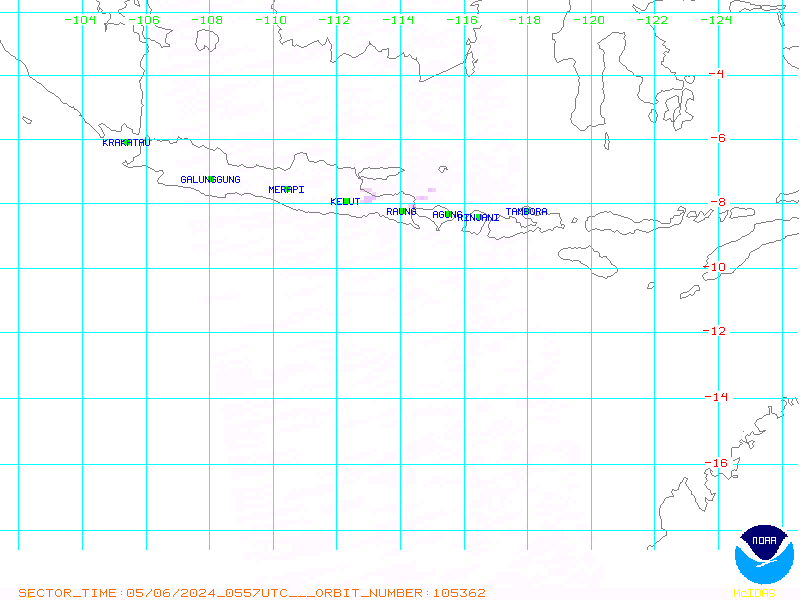
    Infra-Red Satellite temperature of the region centered on the eruption


    ¤=[Post Update]=¤

    Spectacular Ash generated Lightning from the Volcano

    http://images.volcanodiscovery.com/u...-lightning.jpg


  7. Link to Post #7
    Unsubscribed
    Join Date
    23rd June 2013
    Location
    North America
    Age
    74
    Posts
    6,884
    Thanks
    12,723
    Thanked 29,293 times in 6,140 posts

    Default Re: Erupting Volcano of Mount Kelud on Java island Indonesia

    From the Volcanic monitoring website - The ash plume from last night's major eruption (possibly sub-plinian or even plinian in size) of Kelut is drifting rapidly to the west above the Indian Ocean. It is estimated to be as high as 55,000 ft (16 km) and extends several hundred kilometers in both N-S and W-E directions.

    An important warning for aircraft using routes in this part of SE Asia was issued by VAAC Darwin. The eruption plume is well visible on satellite data.

    According to VSI, the eruption started at 21:15 local time, following a rapid build-up in seismic activity during the same day. Monitoring staff were forced to evacuate their observation post as the eruption began to increase and a heavy rain of gravel-sized lapilli set in.

    The Concern:

    It is still unclear how large exactly the eruption was and what type exactly is was.

    An important question is whether fresh magma was involved (which seems rather likely) or whether it was phreatic (no new magma involved) and simply the result of a brutal release of pressure that had accumulated beneath the 2007 lava dome.

    In the first scenario, there would be a significant amount of fresh, viscous magma that has come to explosion. In this case, the eruption might still continue for a while, possibly with new violent explosions, until the portion of the new gas-rich magma that is able to erupt has been vented. It could then end with the emplacement of a new lava dome at the end of the eruption, corresponding to the last, relatively degassed magma that is able to reach the surface.

    In the other case (no fresh magma involved) the eruption is likely to remain a single, short-lived event.

    Samples of the ash (being taken) should help get a picture about the origin of the eruption.

    Kelut is notorious among Indonesia's volcanoes for its violent, and often deadly explosive eruptions.

    One of the worst disasters occurred during the 1919 eruption, when the then very large crater lake drained and produced extensive mud-flows (lahars) that killed at least 5160 people.

    An eruption in 1586 is believed to have caused even more than 10,000 fatalities. The most recent prior explosive eruption in 1991 caused more than 50 deaths due to pyroclastic flows that swept down the flanks of the mountain. In contrast, the 2007 eruption was almost purely effusive and built a new lava dome, replacing the previous lake. This lava dome was with all likelihood completely destroyed during last night's explosion.

    VSI raised the alert level to 4 (out of 4) and advises to stay at least 10 km away from the mountain. In particular, any valleys and low-lying areas should be avoided.

    Eruptive activity continued at least until the morning. Local newspapers reported heavy ash falls in areas up to 200 km distance and that the explosion sound was heard in Yogyakarta (170 km distance). The ash plume forced the closure of several important regional airports, including Yogyakarta, Solo, and Surabaya.

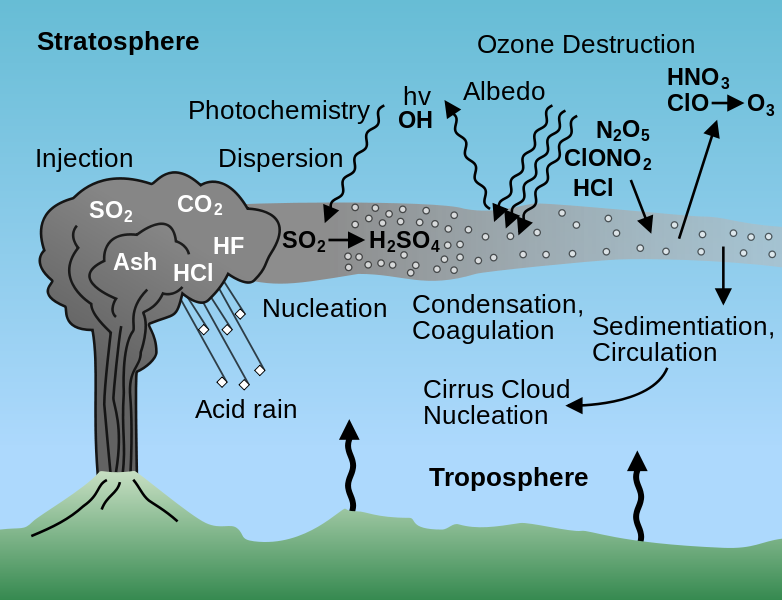
    As described in the News and Updates Ecuador volcanic eruption thread, this volcano is also a stratovolcano, and the explosive eruptions happen when the magma plugs up the vent/throat of the volcano, resulting in massive explosions when the plug blows. Large amounts of toxic Sulfur Dioxide gas build up under the plug and are part and parcel to the deaths of humans and animals. Sulfur dioxide plus water create sulfuric acid, and form acid rains.

    VSI raised the alert status to the second highest level 3 (out of 4), "Siaga" (meaning eruption warning). In its latest report, VSI informs that an ongoing slight deformation, suggesting magma intrusion, has been detected since September and that a strong increase in seismic activity started on 7 February.

    On 7 February, the Ecuadorian Volcano on the other side of the Ring of Fire belt, Tungurahua, was erupting strongly as well.

  8. Link to Post #8
    Unsubscribed
    Join Date
    23rd June 2013
    Location
    North America
    Age
    74
    Posts
    6,884
    Thanks
    12,723
    Thanked 29,293 times in 6,140 posts

    Lightbulb Re: Erupting Volcano of Mount Kelud on Java island Indonesia

    The SO2 Cloud currently, 14 Feb, was heading west into the Indian Ocean as shown


    Factors leading up to the eruption:

    PVMBG reported that during 3-10 February seismic activity at Kelut was dominated by both shallow and deep volcanic earthquakes; earthquake hypocenters were 3 km below the summit. RSAM values increased on 6 and 9 February.

    Inflation was detected at one station.

    Crater lake water temperatures increased since September 2013, particularly during 23 January-9 February. Temperatures decreased slightly on 10 February.

    Based on increased seismicity, inflation, and higher water temperatures, PVMBG increased the Alert Level to 3 (on a scale of 1-4) on 10 February.

    Visitors and residents were prohibited from approaching the crater within a 5-km radius.
    13-14 February the Volcano erupted.
    Last edited by Bob; 14th February 2014 at 21:02.

  9. Link to Post #9
    Unsubscribed
    Join Date
    23rd June 2013
    Location
    North America
    Age
    74
    Posts
    6,884
    Thanks
    12,723
    Thanked 29,293 times in 6,140 posts

    Default Re: Erupting Volcano of Mount Kelud on Java island Indonesia

    The ashcloud was captured on the Soumi Npp satellite as it passed overhead


    ref: http://www.nnvl.noaa.gov/

    "17:30 UTC on February 13, 2014, the Suomi NPP satellite passed over the Indonesian island of Java, capturing the ash cloud emanating from the Mount Kelud volcano. Mount Kelud erupted just hours before.."

    ref: http://volcano.ssec.wisc.edu/imagery...daterange:1440 shows this animation, it is very spectacular


  10. Link to Post #10
    Brazil Unsubscribed
    Join Date
    4th April 2013
    Age
    56
    Posts
    1,453
    Thanks
    11,308
    Thanked 7,529 times in 1,350 posts

    Default Re: Erupting Volcano of Mount Kelud on Java island Indonesia

    Quote Posted by Bobd (here)

    Spectacular Ash generated Lightning from the Volcano

    Hello Bobd.

    This photo of the volcano is spectacularly crazy.
    Slightly below and right of interception in 'X' created by lightning, I see the top of the face of a gray et, with huge black eyes.

    Grateful friend.

    Naste.

    PS: Sending positive vibes for these people.
    Last edited by naste.de.lumina; 14th February 2014 at 21:21.

  11. Link to Post #11
    Avalon Member Sidney's Avatar
    Join Date
    12th April 2010
    Location
    down the Rabbit Hole
    Posts
    5,040
    Thanks
    14,238
    Thanked 20,945 times in 4,419 posts

    Default Re: Erupting Volcano of Mount Kelud on Java island Indonesia

    Quote Posted by Bobd (here)
    Both of Indonesia's most active volcanoes – Kelut and Mount Merapi (meaning "mountain of fire") – sit on Java Island.

    And both have a history of explosive eruptions. Mount Merapi erupted today (Oct. 26), with preliminary reports of 100 people killed, according to the USGS. Merapi is located in central Java, roughly 310 miles (500 kilometers) southeast of the capital Jakarta.

    Mount Merapi last erupted in 2006, killing two, but its violent history includes more than 1,300 killed in a 1930 eruption and possibly 70 killed in a 1994 eruption.

    Other colossal volcanic eruptions that have occurred in Indonesia include the eruption of Krakatau, which reportedly generated the loudest sound ever heard in modern history when it exploded in 1883, killing 40,000 people. Krakatau is a volcanic island located between the islands of Java and Sumatra.

    The Toba supervolcano located on the island of Sumatra, which erupted 70,000 years ago, was a global catastrophe, creating six years of volcanic winter.

    ref: http://www.livescience.com/8823-indo...explained.html


    Dr Steven Godby, an expert in natural hazards at Nottingham Trent University, said Kelud is regarded as one of the most dangerous volcanoes on Java because of its frequent eruptions and deadly 'lahars'.

    "Lahar is an Indonesian term used to describe the hot or cold mixture of water, rock and ash that can flow down the slopes of a volcano or along river valleys", he said. "Kelud’s typically short but violent eruptions cause the ejection of water from a crater lake at its summit."
    I do not mean to derail you thread in any way. the situation seems pretty dire for that area, but i couldn't happen to notice the HAARP "appearance" of the clouds above the volcano in this particular photograph, and wanted to make note of it.

  12. The Following 4 Users Say Thank You to Sidney For This Post:

    Bob (16th February 2014), Holly Lindin (18th February 2014), sheme (15th February 2014), spiritwind (15th February 2014)

  13. Link to Post #12
    United States Avalon Member ghostrider's Avatar
    Join Date
    6th February 2011
    Location
    Sand Springs Ok
    Age
    60
    Posts
    7,427
    Thanks
    9,893
    Thanked 28,845 times in 6,635 posts

    Default Re: Erupting Volcano of Mount Kelud on Java island Indonesia

    Sydney you may be right , haarp could have set the whole thing off ...
    Raiding the Matrix One Mind at a Time ...

  14. The Following 2 Users Say Thank You to ghostrider For This Post:

    sheme (15th February 2014), Sidney (15th February 2014)

  15. Link to Post #13
    Unsubscribed
    Join Date
    23rd June 2013
    Location
    North America
    Age
    74
    Posts
    6,884
    Thanks
    12,723
    Thanked 29,293 times in 6,140 posts

    Default Re: Erupting Volcano of Mount Kelud on Java island Indonesia

    Thankyou very much for offering a suggestion that the ionospheric heater across the world was responsible for something thousands of miles away - however this thread is not for discussing HAARP.

    It was pointed out a while back HAARP was shut down. - http://earthsky.org/earth/crazy-weat...-haarp-anymore

    What I do suggest taking a look at is Mitch Battros's research about his theory that when solar storms light up and send particles to the Earth that the Earth has to absorb that amount of energy. He has stated that this creates a heating of the plates, more so than the normal friction induced by the plates subducting, or moving over each other. Mitch's website is: http://earthchangesmedia.com/mitch-b...h-endorsements

    It's well worth looking at Mitch's theories as they make sense, more so than suggesting that a very low power in comparison radio transmitter in Alaska has anything to do with melting plates across the world which require trillions of watts of power. HAARP has 3.6 million watts, compared to the solar particle energy influx hitting the Earth that has to be absorbed, it is insignificant.

    That's it on HAARP please.

    The Ring of Fire and the multiple plates interacting in that area have been creating volcanic issues for thousands of years.

    I suggest that someone start a thread doing a correlation between the solar CME's, or coronal mass ejections, and how quickly earthquake and volcanic activity happens, especially when solar earth pointing particle storms hit, what part of the Earth is exposed when that happens.

  16. Link to Post #14
    Unsubscribed
    Join Date
    23rd June 2013
    Location
    North America
    Age
    74
    Posts
    6,884
    Thanks
    12,723
    Thanked 29,293 times in 6,140 posts

    Default Re: Erupting Volcano of Mount Kelud on Java island Indonesia

    The death toll might rise in Indonesia after the eruption of Mt Kelud the 13th/14th.

    8:49 pm February 14, 2014 local time.

    There is concern that rooftops will collapse from the weight of the falling ash. Ashfall continues throughout Java Indonesia.

    This is what a volcanic ash-cloud plume looks like as it comes out of the volcanic cone:


    Authorities are advising that people do NOT try to return to their homes despite the eruption having calmed and diminished, although there is a white cloud appearing to be coming from the volcano.

    Authorities are advising that people wear dust respirator masks to prevent breathing in the ash cloud. People are being advised to wear the masks INSIDE as well because the particles are so fine (and dangerous).

    "Evacuees were crowded into an evacuation shelter in Malang, East Java, when the structure collapsed, said Sriono, a local resident who sought refuge in the building.

    “At the time there were about 30 people [in the room],” Sriono told the Jakarta Globe. “We were waiting for a shuttle to be evacuated to the city of Batu [East Java] when the roof and walls suddenly collapsed. It was unable to withstand the [weight of the] falling ash.”

    ref: http://www.thejakartaglobe.com/news/...elud-eruption/ - ashfall, residents fleeing

    ASH-FALL causes flights to be cancelled

    "Flights grounded, tourist sites are now closed down."

    Transportation officials temporarily suspended all flights into and out of seven airports in Java as international flights to Bali were forced to turn around.

    “All flights to those airports have been cancelled, and other flights, including some between Australia and Indonesia, have been rerouted,” Transport Ministry director general of aviation Herry Bakti told AFP.

    "Virgin Australia was forced to cancel flights that flew near the affected area on Friday, explaining in a statement that “the safety of our customers is the highest priority.” Australian nurse Susanne Webster, 38, was on a late-morning Virgin flight from Sydney to Bali that was turned around.

    “About two hours in, the pilot announced over in Indonesia there was a volcano that erupted and that we were turning the plane back,” she told AFP, adding they were still in Australian airspace at the time.

    Australian airline Qantas, Singapore Airlines and Cathay Pacific all cancelled or postponed flights to Jakarta and Surabaya on Friday and Saturday. Low-cost carrier AirAsia said 21 flights were affected by the eruption on Friday.

    “The ashes could… compromise the safety and performance of the aircraft, such as [cause] permanent damage to the engine,” AirAsia said in a statement.

    Garuda Indonesia cancelled flights to Malang, Semarang, Surabaya, Solo and Yogyakarta due to poor visibility.

    The airline expects the situation to remain poor for the next three days, Aminuloh, a station manager with the airline, told the Jakarta Globe on Friday."

    The ash-plume reached a height of 19 miles up and poses a serious risk to air craft flying. The ash can serious damage and stall out jet engines.

    The Darwin Volcanic Ash observatory:

    http://www.bom.gov.au/info/vaac/


    (regional ash-fall is able to be determined and posted on this website)

    "Nine Volcanic Ash Advisory Centres around the world advise the international aviation industry of the location and movement of clouds of volcanic ash. The area covered by the Darwin Volcanic Ash Advisory Centre includes Indonesia, Papua New Guinea and part of the Philippines. This area has seen some of the biggest eruptions known to history."
    Last edited by Bob; 15th February 2014 at 04:06.

  17. Link to Post #15
    Unsubscribed
    Join Date
    23rd June 2013
    Location
    North America
    Age
    74
    Posts
    6,884
    Thanks
    12,723
    Thanked 29,293 times in 6,140 posts

    Lightbulb Re: Erupting Volcano of Mount Kelud on Java island Indonesia
    One of the most DEADLY effects of a volcano are what happens from breathing what is put into the air. Dangerous toxic gases, frequently Sulfur dioxide suffocate, and kill with the toxicity. Sulfur dioxide gas creates dangerous corrosive sulfuric acid when it comes in contact with water. (battery acid).. Other acids present are Hydrochloric acid and Hydrofluoric acid. Both acids are highly dangerous and toxic. HF (Hydrofluoric acid can dissolve skin in seconds, or any carbon substance). HF dissolves rock easily as well.

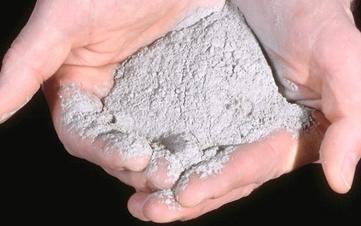
    The ash, consists of very microscopic fine particles of ROCK plus acids.

    These particles go upwards into the atmosphere, and slowly FALL-OUT of the atmosphere up to thousands of miles away from the event (the eruption). Meaning a volcano up to 1000 miles away or more can create a cloud which saturates the air.

    Depending on the severity of the eruption, the ash-cloud can literally circulate the earth. (see above posts on nuclear-like winter from ashclouds).


    Government officials in Java are recommending that everyone wear a respirator mask, even INDOORS as the particles are small enough to make their way through small cracks.

    Impacts on Human Health

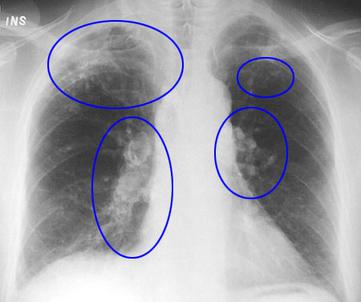
    --Silicosis


    A picture of silicosis of the lung

    Inhalation of volcanic ash can be very detrimental to human health, due to the harmful aerosols and poisonous gases the ash is made up of. Health effects include respiratory problems, eye problems, and skin irritation.

    1. Respiratory symptoms (short-term)

    runny nose
    sore throat/coughing
    wheezing/shortness of breath
    possible bronchitus

    2. Eye symptoms (short-term)

    may become itchy or bloodshot
    corneal abrasions or scratches
    can result in conjunctivitis
    tearings

    One long-term effect of volcanic ash is silicosis.

    Silicosis is a disease resulting in lung impairment and scarring, from exposure to particles of free crystalline silica.

    Minerals that are associated with silicosis include quartz, cristobalite, and tridymite, all potentially present in volcanic ash.

    Volcanic ash can also contaminate the water supply.

    Ash-fall can persist for many days.


  18. Link to Post #16
    Avalon Member Lifebringer's Avatar
    Join Date
    18th December 2010
    Posts
    4,393
    Thanks
    6,808
    Thanked 11,797 times in 3,541 posts

    Default Re: Erupting Volcano of Mount Kelud on Java island Indonesia

    Looks like the red spirit of the wolf comes via the ring of fire. I hope they can evacuate on time, before they get the pulling of the crust volcanic action. Plates will be moving, some slow, some jolting, but move they must, and so must the people to higher ground and with covered openings of the body, even the ears. Microscopic glass and metal particles with dust and ash not to mention the heat.

    L.U.P.

  19. The Following 3 Users Say Thank You to Lifebringer For This Post:

    Bob (15th February 2014), Chanlo23 (15th February 2014), tessie999 (15th February 2014)

  20. Link to Post #17
    Great Britain Unsubscribed
    Join Date
    23rd January 2013
    Age
    75
    Posts
    2,006
    Thanks
    7,723
    Thanked 7,391 times in 1,757 posts

    Default Re: Erupting Volcano of Mount Kelud on Java island Indonesia

    Thanks for your efforts Bobd this is a huge event, I recall mount St Helena and the dramatic sunsets here in UK. I hope that the people are safe and the event is created for the improvement of mankind.

  21. Link to Post #18
    Unsubscribed
    Join Date
    23rd June 2013
    Location
    North America
    Age
    74
    Posts
    6,884
    Thanks
    12,723
    Thanked 29,293 times in 6,140 posts

    Default Re: Erupting Volcano of Mount Kelud on Java island Indonesia
    15 Feb 14 - Mount Kelud-update

    Weather dot com reports now 4 dead out of the possible thousands which could have been harmed or perished. TG

    There is a media player on the reference website: http://www.weather.com/news/volcano-...kelud-20140214 - Mount Kelud Volcano Erupts in Indonesia; 4 Dead As Clean-Up Begins - weather.com Volcano Forces Thousands to Flee

    "Though volcanic activity calmed on Saturday, authorites warned that secondary effects, such as landslides, could threaten surrounding towns and villages.

    "As a result, the Indonesian army banned people from returning to towns and villages within six miles of the volcano. "


  22. Link to Post #19
    United States Avalon Member seeker/reader's Avatar
    Join Date
    7th March 2013
    Posts
    600
    Thanks
    3,199
    Thanked 3,046 times in 541 posts

    Default Re: Erupting Volcano of Mount Kelud on Java island Indonesia

    Quote Posted by Bobd (here)

    Stratovolcanoes are the world's most dangerous volcanoes.
    I believe supervolcanoes outrank strato-volcanoes. There is a super volcano in Indonesia, which is under Lake Toba on the island of Sumatra. Lake Toba actually fills the caldera of the supervolcano, which is easily seen on a map. Its eruption is believed to be responsible for the genetic bottleneck of human DNA seen by geneticists.

    Geologist believe that supervolcanoes are sourced by large deep mantle plumes who's systems can be intact for many many years. Some even postulate they are tied to a meteor/asteroid impact event that occurs on the opposite side of the globe. The event is so traumatic it produces a long-lasting mantle plume, an interior wound, that reveals itself as a later supervolcano opposite to the site of impact. Strato-volcanoes are tied to subduction, which would produce smaller volumes of magma due to their tectonic setting. At least that how they teach it in school.

    None the less, I am praying for all those affected by the eruption of Mt. Kelud.


    Taken from Wikipedia http://en.wikipedia.org/wiki/Lake_Toba

    Lake Toba (Indonesian: Danau Toba) is a lake and supervolcano. The lake is 100 kilometres long, 30 kilometres wide, and up to 505 meters (1,666 ft) deep. Located in the middle of the northern part of the Indonesian island of Sumatra with a surface elevation of about 900 metres (2,953 ft), the lake stretches from 2.88°N 98.52°E to 2.35°N 99.1°E. It is the largest lake in Indonesia and the largest volcanic lake in the world.[1]

    Lake Toba is the site of a massive supervolcanic eruption estimated at VEI 8 that occurred 69,000 to 77,000 years ago,[2][3][4] representing a climate-changing event. It is the largest known explosive eruption on Earth in the last 25 million years. According to the Toba catastrophe theory, it had global consequences for human populations: it killed most humans living at that time and is believed to have created a population bottleneck in central east Africa and India, which affects the genetic make up of the human world-wide population to the present.[5]
    Last edited by seeker/reader; 15th February 2014 at 23:08.

  23. The Following 2 Users Say Thank You to seeker/reader For This Post:

    Bob (15th February 2014), tessie999 (15th February 2014)

  24. Link to Post #20
    Unsubscribed
    Join Date
    23rd June 2013
    Location
    North America
    Age
    74
    Posts
    6,884
    Thanks
    12,723
    Thanked 29,293 times in 6,140 posts

    Default Re: Erupting Volcano of Mount Kelud on Java island Indonesia

    If any supervolcano erupts I think the world will certainly know about it.

    The strato-volcanoes though currently erupting worldwide, especially in the Ring of Fire certainly because of their proximity to population are in-fact the more dangerous - from life which has been lost in recent times. That is the point about them being the most dangerous - people are living on them and there have been recent events, dramatically killing thousands, especially in Indonesia.

    People insist on living on or near such volcanoes, and apparently don't realize the danger. Look at Vesuvius in Italy. People everywhere, farms, businesses..

    These Stratovolcanoes periodically light up. I haven't seen any supervolcano TG light up with as much regularity as the stratovolcanoes.. That's the point, what is dangerous now, because such is being ignored, and the frequently erupting patterns.

    Post 5 above has some good references about some of the bigger eruptions and some time tables. (and I did point out Lake Toba's event - life in Africa would not have known about an Indonesian event, just that something strange caused the sky to darken during the day and there would have been a temperature reduction, odd weather..)

    As you are mentioning the dangers of a super-volcano, no question, take Yellowstone Park in Wyoming/Montana/Idaho - that supervolcano should it light up fully would take out or create an extinction event.. There are threads on this Forum about Yellowstone.

    No matter, volcanoes are something to be watched and understood as well as what drives them. There is no ignorance is bliss possible with these systems as shown.

    b.
    Last edited by Bob; 15th February 2014 at 23:12.

+ Reply to Thread
Page 1 of 2 1 2 LastLast

Tags for this Thread

Posting Permissions

  • You may not post new threads
  • You may not post replies
  • You may not post attachments
  • You may not edit your posts