
As part of the inaugural reread series on Reality Sandwich, Erik Davis, author of TechGnosis and Nomad Codes, spoke with me recently about the "High Weirdness" of Philip K. Dick and the postmodern pink-gnosis of VALIS, a partly autobiographic scifi novel where Dick literally wrote himself into fiction, and, as it were, "hacked the Hero's Journey". Erik tells us about how he first discovered Dick's work when he was no pop culture icon but a pulp cult underground writer.
VALIS is loaded with half-fiction, half-truth narratives told by a multitude of personas. Philip K. Dick. Phil Dick. Horselover Fat. As Erik Davis will tell us, there is a method to this madness, PKD was always more than one author, and Dick may have ended up writing himself.
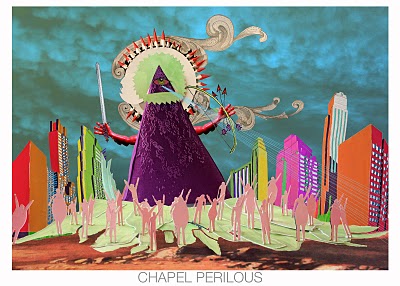
Just watch your step through the hallucinatory fiction this side of Chapel Perilous.
 J: While doing some research myself, I noticed in this article you mention studying Philip K. Dick for your senior thesis. Your interest clearly goes way back.
How did you first come across Philip K. Dick’s work? What made it so compelling?
E: I was turned onto PKD by a very strange fellow I met in a place called Barrington Hall, which was by far and away the most notorious of the student-run co-operative apartments around the Berkeley campus in the mid-80s, when I briefly lived there. At the time, PKD was very much a cult author, and getting the handoff was like being handed a secret key to high weirdness. I didn’t start reading him in earnest for another year or so, back in New Haven, which had a bookstore called Book World that stocked his books alongside other arcana, like Crowley and Robert Anton Wilson and early cyberpunk. Back then most of his stuff was out of print, so you had to hunt for these marvels in used shops, like fragments of the True Cross.
We’re starting our ReRead series with VALIS. One of the first things we notice about this book is that it disregards any clear distinction between fiction and autobiography. The effect, to me anyway, is a very intense sympathetic connection both with Horselover Fat, and thus by extension, Philip K. Dick (or later in the book, Phil Dick). In some regard this could be P.K.D.'s attempt, intentional or not, to make the reader slip into multiple worlds. Multiple realities, as it were. You become Horselover Fat, phasing in and out of hypothesis as to what happened, and what is happening to him (and just who he actually is). You become Phil Dick and Philip K. Dick, without a clear sense of where you can lean for objectivity. The book loses you in it in a non-traditional sense.
Could you speak to this a little?
Part of the effect of the book is formal, as you say, not just thematic. I mean that its messages or meanings are conveyed to you through the unusual formal structure of the book as well as its dialogue and plot events. So even though it is a very readable work, it confuses you about where to draw the line between reality and fiction, brutal autobiography and crazy fantasy, religion and satire. The more you know about PKD’s “real” life, the more confused in some ways you are about how to take it. It uses the criss-cross and confusion between different genres to create a kind of reading event in the reader (or some readers anyway) that would be impossible with more straight story-telling. One of the trickiest things is that you can’t tell or infer what the author Dick’s attitude towards his two alter egos. Is he trying to exorcise Horselover Fat by giving him a fictional home, or is he rather trying to communicate the vibrations of Valis directly to the reader by framing the story as a hallucinatory fiction rather than a religious or New Age tract? The question is unresolvable, because “Philip K. Dick” was always more than one author—a multiplicity that is reflected in the novel’s formal structure.
What interests you about this book, VALIS, of all of P.K.D.’s work? What stands out about it? Does it have more relevance today than 1981? Does it shed any light -- perhaps even missing perspectives – on contemporary ‘transformational culture?’
VALIS is a masterpiece whose power partly lies in its ability to disorient and enchant the reader. I suspect that for readers today it continues to resonate, as our world in many ways has simply become more PhilDickean. I am reminded of Robert Anton Wilson’s idea of “Chapel Perilous”. Wilson had somewhat similar experiences in 1974—cosmic conspiracies, syncronicities, blasts of insight—and he suggested that there was a stage of the path, a kind of dark night of the soul, where the seeker can’t tell what’s paranoia and what’s reality. There is a surfeit of meaning—after all, there is definitely something like too many synchronicities. Valis is Dick’s Chapel Perilous, and he brings readers along for the ride. Some of them never quite get off. But Chapel Perilous is a place to pass through, not to call home.
Is there a particular chapter in VALIS you’d be interested in taking on -- if briefly -- to comment on? Something that really struck you about it that seemed to speak to the thematics of the novel and Dick’s core philosophy?
Part of the challenge or creative trial of VALIS is not about extracting a message or core philosophy, but about watching it reflect your own desire and strategies to find or extract such a message. So what reference are you going to look up on wikipedia? What parts do you want to accept or reject? It’s a reflexive book, in other words, which is partly how you open the doors to Chapel Perilous. Along these lines, one of the most important chapters is chapter 9, which is the hinge in the book between the more-or-less autobiographical section and the more-or-less SF-fantasy section. And what does Dick and his pals do there? They go to see a trashy SciFi movie and they look for hidden messages, just like you are doing with the book VALIS. Read that chapter closely, think about how they interpret the film, and more importantly, how they interpret it together, in an enthusiastic conversation between turned-on pals. These kinds of far-ranging, critical, and speculative conversations are a key part of the path, though they can lead in wayward directions. And they also hold out the sense that popular culture can be the vehicle of gnosis.
Professor Richard Doyle, who recently held a class on Synchcast for P.K.D., warned his students that reading Dick’s novels could induce what he calls an “involutionary” affect -- meaning one’s life might start getting taken up by synchronicities and uncanny moments. I know you’ve mentioned in some previous presentations that you have experienced these moments (we might call them P.K.D. moments) where the book seems to become a divinizing tool for bibliomancy.
What do you think is happening here, if anything? And secondly: isn’t it interesting that this phenomenon seems to occur regardless of the perceived value of the text? It seems to happen as readily to a pulp scifi novel as the Bible.
The specific “occult” practice of bibliomancy is key to PKD. The first time I gave a talk on him, which was my first public lecture back in 1990 or something, I realized I hadn’t prepared an adequate definition of “Gnosticism.” With five minutes to go, people already sitting down, I panicked, and opened the book randomly and my eyes fell precisely on Dick’s pithy definition: “This is Gnosticism. In Gnosticism, man belongs with God against the world and the creator of the world (both of which are crazy, whether they realize it or not).” These sorts of gestures are also made by the characters in many Dick novels, a number of which feature oracular books that are opened to any page, or accessed with other random processes, like the I Ching in The Man in the High Castle. Researchers and scholars know these synchronicities well, however you might think about them, and Dick was very interested in seeding those sorts of connections in his novels. Reading, drawing connections, in a sense is invoking these kinds of uncanny links. For Dick, writing itself is alive.
You’re currently doing a dissertation on Philip K. Dick through Rice University. It would be excellent to hear a little about that, and how your interest in Dick’s work has evolved as a result of an academic approach. How does one approach the life and work of P.K.D. from a religious studies perspective?
My project has actually expanded beyond Phil Dick into a study of “High Weirdness” in the early 70s. I’ll be looking at other figures—Robert Anton Wilson, Terence McKenna, etc-- who also had strange and strong “gnostic” experiences in the period that involved cosmic downloads, cybernetic mysticism, and hosts of synchronicities. I am actually very happy to be approaching these topics in a scholarly format. Although the book that eventually results will be written for a wider audience, writing in academic terms can help restrain the temptation to plunge down the rabbit hole—and with PKD and VALIS, you are really talking about a matrix of rabbit holes. As I mentioned above, there is such a thing as too many synchronicities! Plus I also wanted to locate PKD in his time and place, and realized that it was a time and place shared with these other fascinating characters. So it’s pretty much of a blast. I am getting a PhD in high weirdness.


 Fascinating Story of the Man Who Remembered The Future - Philip K. Dick




Bookmarks