+ Reply to Thread
Page 17 of 25 FirstFirst 1 7 17 25 LastLast
Results 321 to 340 of 484

Thread: This evening in Israel

  1. Link to Post #321
    Australia Avalon Member panopticon's Avatar
    Join Date
    6th February 2011
    Posts
    2,591
    Thanks
    8,262
    Thanked 8,009 times in 2,305 posts

    Default Re: This evening in Israel

    There have been some very disturbing articles coming out of the Israeli main stream media over the last little while.

    Questions around genocide of Palestinians in the Gaza Strip yesterday by a blogger for the Times of Israel and this little gem from last weeks Jerusalem Post.

    This is why I say it's important to examine the fringe because that way we can understand how the mainstream gets formed. If we aren't aware of the fringe then we are surprised when an Israeli author writes questioning whether Palestinian Genocide is permissible (source for copy of deleted article) or, as in the below article, posits that:

    Quote The only durable solution requires dismantling Gaza, humanitarian relocation of the non-belligerent Arab population, and extension of Israeli sovereignty over the region.
    So Sherman proposes relocating 'the non-belligerent Arab population'.

    I will leave it up to the reader to work out what he wants to do with those who are part of the belligerent Arab population that "will not comply"...

    Maybe a little yellow crescent moon to wear on their shirt so they can be identified easily...

    ###

    Into the fray: Why Gaza must go
    By Martin Sherman 24th July, 2014


    Givati brigade in Gaza Photo: IDF SPOKESMAN'S OFFICE

    The only durable solution requires dismantling Gaza, humanitarian relocation of the non-belligerent Arab population, and extension of Israeli sovereignty over the region.

    We have before us an ordeal of the most grievous kind.... You ask, what is our policy? I will say: It is to wage war, by sea, land and air, with all our might and with all the strength that God can give us; to wage war against a monstrous tyranny... That is our policy. You ask, what is our aim? I can answer in one word: victory; victory at all costs, victory in spite of all terror, victory, however long and hard the road may be; for without victory, there is no survival.

    – Winston Churchill, May 13, 1940

    We cannot solve our problems with the same level of thinking that created them.

    – Albert Einstein

    At the time of writing this column, ground operations in Gaza were still going on and reports of increasing casualties were coming in with depressing frequency. This should, therefore, be a time for national cohesion and solidarity, with unity and support for the war effort, and criticism of the government suspended.

    Sadly, however, the government has given the public little coherent indication of its aims, or of the realities it is striving to create.

    Ill-defined and inadequate objectives

    Worse, not only is there no clear indication of where the country is going, there seems to be little willingness to recognize how we got here.

    In the third week of Operation Protective Edge, the government is still waffling on its objectives. These keep morphing from one vague, vacuous formulation to another, as developments on the battlefield make each succeeding definition of the operation’s goals appear abysmally inadequate and ineffectual.

    Initially, the government declared that all it aspired to was to “restore calm” – i.e.

    to reinstate the status quo – and if Hamas would cease fire, so would Israel.

    Just how myopic that would have been is starkly underscored by what has become chillingly apparent during the operation – the devastating potential of an elaborate tunnel system developed by the terror organizations in Gaza.

    Had a cease-fire been implemented in such circumstances, Hamas would have been free to continue developing its deadly subterranean potential, which it could activate at a moment of its choosing.

    This appalling prospect makes deeply disturbing questions, regarding the competence and/or judgment of the nation’s leadership, unavoidable, even as the battles rage on. Unless the reasons for the current predicament are understood, no effective remedy can be found.

    Deeply disturbing questions

    We must weigh the only two possibilities before us: (a) either the government was aware of the deadly menace posed by the network of tunnels; or (b) it wasn’t.

    If it was, then willingness to agree to a cease-fire before the danger was eliminated reflects a disturbing readiness to reconcile itself to the dangers and expose the country’s civilian population to murderous consequences in the future.

    If it was oblivious to these dangers, this reflects a grave ignorance of deadly threats facing the country, a sign of just how out of touch the leadership of the nation has been with the ominous reality we inhabit.

    Although I rarely find occasion to quote Haaretz as a corroborating source, my eye could not help catching the pungent title of a piece written by veteran defense correspondent Amos Harel: “Hamas’ terror tunnels – a national strategic failure for Israel”.

    Harel points out: “A week ago, Israel announced its willingness to accept a cease-fire in Gaza... This means one of two things. Either the ministers and generals were willing last week to let these tunnels, every one a ticking bomb, tick softly under kibbutz dining rooms until the next escalation, or they weren’t aware of the seriousness of the risk.”

    He continues: “So either they were taking a calculated risk of unusual [read “gigantic” – M.S.] dimensions, or they didn’t have enough intelligence [information] before the operation (which doesn’t quite square with a senior officer’s claim...

    that ‘never before has the army had such quality intelligence before an operation’).”

    Prescient prediction

    It is difficult to accept that the government was totally unaware of Hamas’s tunneling endeavor. As early as 2006, Hamas used a tunnel to abduct Gilad Schalit and kill two of his comrades near Kerem Shalom, eventually attaining the liberation of 1,027 convicted terrorists. Last October, the discovery of an almost 2-km.-long tunnel near Kibbutz Ein Hashlosha was widely reported, and according to several sources, its objective was a kindergarten, located close to its exit point, 300 meters inside Israel.

    The threat imminent in Hamas’s burrowing enterprise, and the conditions under which it might be employed, were presciently predicted 10 months ago by Harel. In an article, carrying the ominous headline: “Hamas’ strategic tunnels: Millions of dollars to spirit kidnapped Israelis into Gaza” (October 13, 2013), he warned of the likely reaction of Hamas should it feel weakened, precisely what Israeli politicians were crowing about just prior to the current round of violence. He cautioned: “... if Hamas decides to try to overcome its present distress by reigniting the front against Israel, using the tunnels to launch an attack could be one of its main options.”

    His prediction proved chillingly precise.

    Figuring the flaccidity factor: Impotence not ignorance

    Given that it is highly implausible that the government was unaware of the danger looming under its very nose (or rather, feet), how are we to account for the flaccidity of its response – which, but for good fortune, could have precipitated outcomes of unthinkable tragedy.

    Former Jerusalem Post Editor in Chief Bret Stephens, in a recent Wall Street Journal piece (July 14), provides a partial explanation for the phenomenon, suggesting that Israel’s “real weakness is a certain kind of vanity that confuses stainlessness with virtue, favors moral self-regard over normal self-interest, and believes in politics as an exercise not in power but in self-examination.”

    For all its admirable eloquence, Stephens’s diagnosis relates more to the symptoms of the malaise, rather than its causes.

    In numerous columns, I have been at pains to explain the roots of this enervating phenomenon (which I have designated “The Limousine Theory of Israeli politics”) and warned of the ruinous results it will inevitably wreak upon us.

    The underlying reason for the inadequate responses to clearly apparent dangers is that Israel’s leaders have been cowered into this moralistic masochism by an aggressive and intolerant triad of left-wing civil society elites (in the legal establishment, the mainstream media and academe), who, through their unelected position of privilege and power, have taken control of the political discourse in the country.

    The political discourse determines the elected political leadership’s perception of policy constraints and policy possibilities.

    Through dominance of the discourse, these elites can control the parameters of Israeli policy-making and impose their worldview of political appeasement and territorial concessions on it.

    Sacrificing lives for a ‘two-state deity’

    These elites have, to a large degree, mortgaged their personal prestige and professional positions, and much of their livelihood, to the two-state concept and the land-for-peace doctrine on which it rests.

    Were this doctrine to be discredited, all these benefits – material and otherwise – would be jeopardized. They, therefore, have a vested interest in preserving a perception that it is valid – no matter how incongruent with reality and rationality it proves – and must endeavor to prevent the adoption of any policy measures that put paid to the two-state formula.

    Since the attainment of strategic victory in Gaza calls for measures that preclude any agreement on a Palestinian state, the policy-relevant discourse, which these elites mold, has been devoted to ridiculing such measures as impractical or infeasible, and to promoting measures that can only bring about a temporary respite to the fighting. These respites have always been exploited by the enemy to enhance its capabilities for the inevitable next round – and the next inevitable batch of casualties.

    Oblivious to facts, and impervious to reason, in a desperate attempt to sustain an unworkable paradigm, Israeli left-wing elites perpetuate bout after escalating bout of violence, callously sacrificing ever more lives on the altar of the false deity of twostates- for-two-peoples.

    ‘Mowing the lawn’ won’t cut it

    The reluctance to face unpalatable realities has spawned new terminology to paper over intellectual surrender, and mask unwillingness to accept the need for regrettably harsh but essential policies.

    First, we were told that since there was “no solution” to the Israel-Arab conflict, we should adopt an approach of “conflict management” rather than “conflict resolution.”

    Now we have a new term in the professional jargon to convey a similar perspective: “mowing the grass.” This is the name for an approach that entails a new round of fighting every time the Palestinian violence reaches levels Israel finds unacceptable.

    Its “rationale” – for want of a better term – was recently articulated by Efraim Inbar and Eitan Shamir of the Begin-Sadat Center for Strategic Studies, Bar-Ilan University, as: “The use of force, not intended to attain impossible political goals, but rather [as a] long-term strategy of attrition designed primarily to debilitate the enemy capabilities.”

    Sadly, what we have seen is that far from “debilitating the enemy capabilities,” because said enemy keeps reappearing, spoiling for a fight, ever bolder with ever-greater capabilities.

    It is an open question just how many more rounds of “mowing” the residents of southern Israel will endure before losing confidence that the government will provide adequate protection and choose to evacuate the area.

    No, periodically mowing the lawn is not a policy that can endure for long – it simply will not cut it. The grass needs to be uprooted – once and for all.

    Gaza: What would Einstein say?

    Albert Einstein famously said that one could not solve a problem with the level of thinking that created it.

    Clearly, the problem of Gaza was created by the belief that land could be transferred to the Palestinian Arabs to provide them a viable opportunity for self-governance.

    Equally clearly, then, the problem of Gaza cannot be solved by persisting with ideas that created it – i.e. persisting with a plan for Israel to provide the Palestinian Arabs with land for self-governance.

    The problem can only be solved by entirely abandoning the concept that Gaza should be governed by Palestinian Arabs. Any effective solution must follow this new line of reasoning.

    Any other outcome will merely prolong the problem. If Hamas comes out stronger from this round of fighting, it will be only a matter of time before the next, probably more deadly, round breaks out.

    If Hamas comes out weaker from this round of fighting, it is only a matter of time before it will be replaced by an even more violent extremist-successor – and thus, once more, only a matter of time until the next, probably more deadly, round breaks out.

    The only durable solution requires dismantling Gaza, humanitarian relocation of the non-belligerent Arab population, and extension of Israeli sovereignty over the region.

    That is the only approach that can solve the problem of Gaza.

    That is the only approach that will eliminate the threat to Israel continually issuing from Gaza.

    That is the only approach that will extricate the non-belligerent Palestinians from the clutches of the cruel, corrupt cliques who led them astray for decades.

    That is the only approach that will preclude a need for Israel to “rule over another people.”

    Gaza: What would Herbert Hoover say?

    Former US President Herbert Hoover, dubbed the “Great Humanitarian” for his efforts to relieve famine in Europe after WWI, wrote in The Problems of Lasting Peace: “Consideration should be given even to the heroic remedy of transfer of populations...the hardship of moving is great, but it is [still] less than the constant suffering of minorities and the constant recurrence of war.”

    How could anyone, with any degree of compassion and humanity, disagree?

    Martin Sherman (www.martinsherman.org) is the founder and executive director of the Israel Institute for Strategic Studies.www.martinsherman.net

    Source
    "What we think, or what we know, or what we believe is, in the end, of little consequence.
    The only consequence is what we do."

  2. The Following 3 Users Say Thank You to panopticon For This Post:

    Akasha (2nd August 2014), learninglight (2nd August 2014), Realeyes (2nd August 2014)

  3. Link to Post #322
    Australia Avalon Member panopticon's Avatar
    Join Date
    6th February 2011
    Posts
    2,591
    Thanks
    8,262
    Thanked 8,009 times in 2,305 posts

    Default Re: This evening in Israel

    The UNRWA has just announced that 460,000 people are now classified as "displaced" in Gaza. This means that a quarter of the population are not living in their home.

    UNRWA have also said that over 60,000 people have no home to go back to and that 'even if a permanent ceasefire is reached, reconstruction is not feasible under the current access regime imposed by Israel.' They also report that all their 90 shelters are severely overcrowded with 'the average shelter hosting 2,800 displaced people. One shelter in Jabalia has almost 10,000.'

    There are at least 254,188 displaced Palestinians reliant on UNRWA shelters.

    -- Pan
    "What we think, or what we know, or what we believe is, in the end, of little consequence.
    The only consequence is what we do."

  4. The Following 4 Users Say Thank You to panopticon For This Post:

    Akasha (2nd August 2014), learninglight (2nd August 2014), Realeyes (2nd August 2014), Rich (2nd August 2014)

  5. Link to Post #323
    Unsubscribed
    Join Date
    26th January 2011
    Location
    The Void - Omniverses & Earth
    Posts
    804
    Thanks
    11,170
    Thanked 6,322 times in 735 posts

    Default Re: This evening in Israel

    Not sure if this has already been posted. George makes some very good pure reasoning points in his speech - well worth listening to.

    Published on 26 Jul 2014 - George Galloway speaking in Bolivar Hall on the Gaza/Israel conflict.


  6. Link to Post #324
    Avalon Member Tesseract's Avatar
    Join Date
    19th October 2012
    Posts
    834
    Thanks
    1,740
    Thanked 3,418 times in 744 posts

    Default Re: This evening in Israel

    Nelson Mandela answering some questions about his support for the Palestinian cause:


  7. The Following 5 Users Say Thank You to Tesseract For This Post:

    Akasha (2nd August 2014), learninglight (2nd August 2014), panopticon (3rd August 2014), Realeyes (2nd August 2014), Wind (2nd August 2014)

  8. Link to Post #325
    Australia Avalon Member panopticon's Avatar
    Join Date
    6th February 2011
    Posts
    2,591
    Thanks
    8,262
    Thanked 8,009 times in 2,305 posts

    Default Re: This evening in Israel

    Israel has done this before. This is nothing new.

    Why I carefully examine the wording & timing of Israeli reports is I remember that in the past there have been many reports that have been "inaccurate". The tactics used by Israel in this assault is not much changed from those in the past.

    Israel bombs somewhere claiming a "right to self defence" and the West is "outraged". People protest against Israel's use of force on civilians while political "leaders" in the West condemn in the "strongest manner possible" Israel's actions (all while getting a pat on the back from the Israeli lobby, and promises of future campaign funding etc, for doing very little).

    In the modern age (with all its social media, instant updates and live video feeds) there is a way to examine what is happening as it is happening. What is said, as it is being said. Trained reporters can write what they actually think on their personal feeds/websites without editorial re-writes. In addition to trained reporters there are also now a new breed: The "citizen reporter".

    The citizen reporter writes what they see and posts personal photographs of things they are witness to. While their reporting is not anywhere near objective, it can be an important tool for examining the veracity of official reports. For example: a report from an official State spokesperson, as to the timing & reasons for an "incident", can be contextualised within reports from individuals who were posting "on the ground" what they saw in the lead-up to the "incident".

    While it is possible for an individual to say "There is massive bombing in my neighbourhood" 2 hours before the official timing of an event occurred it is less likely that 20 apparently unrelated people, from different areas within the conflict zone, can conspire to report the same or similar things. It is possible, though less likely, that a carefully crafted propaganda machine could construct that sort representation. However, in the instance of citizens reporting in an active conflict zone, it is more likely that the State actor is misrepresenting the facts of a situation for propaganda or tactical reasons.

    This instant "on the ground reporting" never existed in the past. Now we can look back on history and see what similarities there are in the reporting of the present assault to those of the past. We can use all these different things as a gauge when examining what is the truth of a matter being presented.

    Back in 1982 Israel behaved exactly the same and from an equally flimsy starting point. So in comparison to Nobel Peace Prize winner Barak Obama's response Reagan in 1982 was down right militant:
    Quote In early July, Reagan pressed Israel to lift the blockade of West Beirut and to restore water and electricity. In late July, he put a hold on cluster bombs sent to Israel. On July 31st, Robert Dillon, the American Ambassador to Lebanon, angrily cabled Washington, “Simply put, tonight’s saturation shelling was as intense as anything we have seen. There was no ‘pinpoint accuracy’ against targets in ‘open spaces.’ It was not a response to Palestinian fire. This was a blitz against West Beirut. Our 21:00 ceasefire announced in advance over local radio stations was transformed instead into a massive Israeli escalation.”
    ...
    At the meeting the next day, the President told Shamir, “When P.L.O. sniper fire is followed by fourteen hours of Israeli bombardment, that is stretching the definition of defensive action too far.” Both men were noticeably grim-faced in the official photographs.
    Source
    Have a look at the UN resolutions, in relation to Israel-Lebanon, from 1982 (they aren't very long). They will give an idea of how ineffectual the UN was/is in relation to violent conflict (which of course we know given the number of slaughters their "peace keepers" have just watched happen over the years [eg Rowanda, Bosnia]):
    http://www.un.org/docs/scres/try/scres82.htm

    Anyway, here's the article from The New Yorker that the above Lebanon quotes came from.

    -- Pan

    ###

    Another Siege: Israel’s War on the P.L.O.
    By Robin Wright, August 2, 2014


    For forty years, my mother kept every article and letter I wrote from war zones, revolutions, and uprisings on five continents. She collated them, with her notes from our telephone conversations, in bulbous legal binders. I now have a hundred and twenty-six of them stored, floor to ceiling, in two closets that have been converted into bookshelves. This week, as the events in Gaza dominated the news, I pulled out the volumes from the summer of 1982.

    I returned to Beirut, off a turbulent flight from the Gulf, just as Israeli warplanes began bombing Palestinian sites near the airport on June 5, 1982. Amid the deafening blasts and sirens that followed, the few of us on the plane scrambled across the tarmac to seek cover in the terminal.

    Yasir Arafat’s Palestine Liberation Organization had moved its headquarters from Jordan to Beirut twelve years earlier, and Lebanon had been Israel’s biggest threat ever since. Palestinian rockets landed on Israeli settlements in the northern Galilee. A fragile ceasefire, brokered by the United States, had held for almost a year, with only one violation. But a sense of looming confrontation had been building since Israel’s annexation of the Golan Heights the previous December. All it needed was a spark.

    Two days before I arrived, a Jordanian gunman shot Shlomo Argov, the Israeli Ambassador in London, as he left a diplomatic banquet at the Dorchester Hotel. Israel blamed the P.L.O. (Britain subsequently tied the attack to the Abu Nidal Organization, a radical group named after a renegade who had turned against Arafat. Its goal was apparently to discredit the P.L.O., which had been gaining acceptance in Europe, amid a peace initiative proposed by the Saudis. Prime Minister Margaret Thatcher later said that a hit list, uncovered in the investigation of Abu Nidal’s London cell, included the P.L.O. representative in London.)

    Israeli warplanes immediately pummelled Palestinian targets across Lebanon, especially in the warren of refugee camps near the airport. On the day I landed, President Reagan, pledging to increase U.S. diplomatic efforts to resolve the conflict, urgently appealed to Israel’s Prime Minister, Menachem Begin, for restraint along the border.

    The next day, twenty-five thousand Israeli troops invaded Lebanon by land, sea, and air. Three long columns of tanks barrelled across a thirty-three-mile frontier, blitzing past seven thousand U.N. peacekeepers in a border buffer zone and through the olive and orange groves of southern Lebanon, on a mission to destroy Palestinian positions concealed in caves, wadis, and refugee camps. Begin assured Reagan that Operation Peace for Galilee sought only to push the Palestinians back twenty-five miles, beyond rocket range of the Galilee. “The bloodthirsty aggressor against us is on our doorstep,” he wrote. “Do we not have the inherent right to self-defense?”

    Over the next week, Israeli troops, under the command of General Ariel Sharon, penetrated twice as far, capturing about a third of Lebanon and encircling the capital. The siege of West Beirut had begun.

    About a half million people lived in the Muslim-dominated half of the capital, a densely packed area of about ten square miles that was home to both the P.L.O. and the American University of Beirut. The Israelis dropped hundreds of thousands of leaflets—white one day, pink, blue, or yellow on other days—that warned the Lebanese against sheltering guerrillas and advised civilians to leave. I remember thinking that it looked, in the middle of the torrid summer heat, as if snow were falling on Beirut. I found one of the pink leaflets in my mother’s volumes.

    Lebanon had already endured seven years of sporadic civil war, largely street battles with vintage weaponry. The Israeli invasion, with its battleships, advanced U.S.-made bombers, and high-tech tanks, was far more serious. The smell of war’s detritus—the bitter cordite and stench of decaying bodies, mixed with uncollected garbage—was inescapable. I’d covered many conflicts by then, but the bombs and sonic booms from warplanes rupturing the night scared me.

    “The windows (now crisscrossed with masking tape to lessen the implosion of glass from bombs) began to rattle from the rockets landing nearby from Israeli gunboats,” I wrote to my parents. “I can’t decide which is worse: the thunder and shaking from shelling or the whizzing rumble of warplanes as they dive on us to offload their bombs.”

    It was a summer of chaos and fear, often without water, electricity, or phones, and with dwindling food stocks. I used to go to fetch water from a UNICEF pump and then carry it up seven flights to my apartment. The siege went on week after week, ceasefire after broken ceasefire.

    At one point, I reported, “Many private wells are now dry, including the one at Red Cross headquarters,” where officials warned that the cutoff of electricity and fuel for emergency generators threatened all of West Beirut’s hospitals with imminent closure. The local UNICEF director was particularly frustrated by his inability to get permission from the Israelis to bring in baby food, milk, and basic drugs to deal with rampant gastroenteritis among children.

    Senior Israeli military officers repeatedly insisted that their mandate was to destroy the enemy while avoiding civilian casualties. I did see Palestinian fighters among the dead and wounded, but the P.L.O. had hidden its fighters, as well as tons of war matériel—rockets, mortars, howitzer shells, ammunition, and more—in an extensive network of tunnels. The subterranean corridors, which I toured after the war, were reinforced with concrete and included a conference center, showers, and a kitchen. One tunnel had three floors. Some storage areas were large enough to conceal small trucks. I saw thirty rooms and still didn’t see them all. Palestinian commanders had reportedly visited Vietnam in the nineteen-seventies and modelled their network on the tunnels used by the Vietcong fighting the Americans.

    The civilian toll far exceeded the damage to either the P.L.O. forces or the organization’s infrastructure. The Israeli use of U.S.-made cluster bombs, which explode mid-air, unleashing many smaller grenade-size explosives, was particularly lethal among children. Phosphorous bombs were equally deadly—and controversial. “The bombardment has become more and more indiscriminate, killing hundreds of civilians,” I reported. “Famous landmarks have been erased. Buildings have been reduced to mass graves. … Among the facilities hit by Israel over the past nine weeks are five UN buildings, 134 embassies or diplomatic residences, six hospitals or clinics, one mental institute, the Central Bank, five hotels, the Red Cross, Lebanese and foreign media outlets and innumerable private homes and office blocks. While some of these may conceivably have been used as cover for the PLO, what is much more striking is how many undeniable PLO facilities have remained intact.”

    Washington condemned the P.L.O. repeatedly, but, as the siege dragged on, relations between the United States and Israel grew increasingly testy over the plight of civilians. In early July, Reagan pressed Israel to lift the blockade of West Beirut and to restore water and electricity. In late July, he put a hold on cluster bombs sent to Israel. On July 31st, Robert Dillon, the American Ambassador to Lebanon, angrily cabled Washington, “Simply put, tonight’s saturation shelling was as intense as anything we have seen. There was no ‘pinpoint accuracy’ against targets in ‘open spaces.’ It was not a response to Palestinian fire. This was a blitz against West Beirut. Our 21:00 ceasefire announced in advance over local radio stations was transformed instead into a massive Israeli escalation.”

    On August 1st, on the eve of a meeting with Israel’s foreign minister, Yitzhak Shamir, Reagan told reporters, “The bloodshed must stop,” adding that he would make sure that the Israelis “understand exactly how we feel about this.” Pressed on whether he was losing patience, Reagan replied, “I lost patience a long time ago.”

    At the meeting the next day, the President told Shamir, “When P.L.O. sniper fire is followed by fourteen hours of Israeli bombardment, that is stretching the definition of defensive action too far.” Both men were noticeably grim-faced in the official photographs.

    Reagan had begun to feel repercussions at home and abroad. The American media savaged his Administration as weak and without direction. Time’s Walter Isaacson wrote,
    Israeli attacks on West Beirut reinforced the impression that the U.S. is a helpless giant that can neither influence Israeli actions nor come to grips with events in the Middle East. Signs of U.S. ineffectualness in the current crisis have been conspicuous since the day in June when Reagan sent a well-publicized message from the Western economic summit meeting at Versailles urging Begin not to invade Lebanon. Begin sent his troops in the next day. … The stability of the Middle East and the credibility of American diplomacy hinge on whether words or rockets settle the status of the PLO in West Beirut.
    The siege lasted ten weeks. More than seventeen thousand Lebanese and Palestinians died; most were civilians. Lebanese officials claimed that a quarter of them were under fifteen years old. Israel lost more than three hundred and sixty troops. In the end, Israel got some of what it wanted. The P.L.O. was badly battered; Arafat and three-fourths of his fighters were forced into exile. I watched while they fired final rounds from their Kalashnikovs as they marched to ships waiting to divvy them up in eight distant lands. Signs along the road exhorted, “Palestine or Bust” and “This is not Goodbye.”

    The Israeli campaign did little, however, to solve the problem of rival nationalisms vying for land to call their own. And its consequences triggered an entirely new set of challenges. The Arab world had given only lip service to the P.L.O. during the siege. Iran was the only country to step in, dispatching eighteen hundred Revolutionary Guards to Lebanon’s eastern Bekaa Valley. They did not engage Israel—they quietly fostered, funded, and armed the embryo of what became Hezbollah. After the P.L.O. departed, Hezbollah launched its first suicide bomb—then a novel tactic—against Israeli military targets. On April 18, 1983, a car bomber attacked the American Embassy in Beirut, killing sixty-three people. Six months later, suicide bombers blew up a barracks housing U.S. Marines who had deployed to oversee the Palestinian withdrawal. Two hundred and forty-one American servicemen died.

    In 1985, Israel’s defense minister, Yitzhak Rabin, looked back on the war and reflected,
    I believe that, among the many surprises, and most of them not for the good, that came out of the war in Lebanon, the most dangerous is that the war let the Shiites out of the bottle. No one predicted it; I couldn’t find it in any intelligence report. … If, as a result of the war in Lebanon, we replace P.L.O. terrorism in southern Lebanon with Shiite terrorism, we have done the worst [thing] in our struggle against terrorism. In twenty years of P.L.O. terrorism, no one P.L.O. terrorist made himself a live bomb. … In my opinion, the Shiites have the potential for a kind of terrorism that we have not yet experienced.
    Israel ended up lingering in Lebanon, at various troops strengths, for nearly two decades. It even made peace with Arafat, temporarily, before finally withdrawing, in 2000, under pressure from Hezbollah. It was the first time that Israel withdrew unilaterally from territory it occupied—without a peace treaty or any tangible political gain.

    Source
    "What we think, or what we know, or what we believe is, in the end, of little consequence.
    The only consequence is what we do."

  9. The Following User Says Thank You to panopticon For This Post:

    Bob (3rd August 2014)

  10. Link to Post #326
    Australia Avalon Member panopticon's Avatar
    Join Date
    6th February 2011
    Posts
    2,591
    Thanks
    8,262
    Thanked 8,009 times in 2,305 posts

    Default Re: This evening in Israel

    Al-Qassam Brigades statement about 1st August ceasefire breakdown and Goldin's capture.

    ###


    Ezzedeen Al-Qassam Brigades

    Statement Clarifying the Zionist Enemy’s Violation of the Humanitarian Ceasefire, the Claim of the Disappearance of One Soldier, and the Clashes East of Rafah

    The Zionist Enemy violated the humanitarian ceasefire yesterday, Friday, 1 August 2014, by moving forces to the East of Rafah, the continued artillery shelling, and the deployment of snipers on many fronts in the Gaza Strip. In addition, Enemy Forces committed a terrible massacre against civilians in Rafah, killing dozens; and the killing of Palestinian civilians continues. The Zionist Enemy claims the disappearance of one soldier. In this regard, Ezzedeen Al-Qassam Brigades, after conducting an internal review in the relevant circumstances, affirms the following:
    1. Zionist Enemy Forces used the talks about a humanitarian ceasefire to advance troops more than two kilometers inside the Gaze Strip to the east of Rafah. Our assessment is that one of our deployed ambushes clashed with the advancing troops. The clash started around 7:00 a.m., before the humanitarian ceasefire. Enemy artillery and air force directed its fire on civilians after 10:00 a.m. in a flagrant violation of the ceasefire, under the pretext of searching for a missing soldier.
    2. We lost contact with the troops deployed in the ambush; and assess that these troops were probably killed by enemy bombardment, including the solider said to be missing, presuming that our troops took him prisoner during the clash.
    3. Ezzedeen Al-Qassam Brigades has no information till this moment about the missing soldier, his place, or the circumstances of his disappearance.
    4. We informed the mediators who participated in arranging the humanitarian ceasefire of our agreement to cease fire against Zionist cities and settlements; and that we cannot operationally cease fire against troops inside the Gaza Strip that conduct operations and move continuously. These Enemy Forces could easily come in contact with our deployed ambushes, which will lead to a clash.
    "What we think, or what we know, or what we believe is, in the end, of little consequence.
    The only consequence is what we do."

  11. Link to Post #327
    Australia Avalon Member panopticon's Avatar
    Join Date
    6th February 2011
    Posts
    2,591
    Thanks
    8,262
    Thanked 8,009 times in 2,305 posts

    Default Re: This evening in Israel

    The head of Israel's Military Rabbinate has announced that the Israeli soldier, Lt. Hadar Goldin, has been 'officially listed as a fallen IDF soldier whose burial place is unknown'.

    ###

    Soldier Hadar Goldin is dead, not kidnapped, IDF tells family
    By Times Of Israel Staff, August 3, 2014, 2:42 am


    Army’s chief rabbi, defense minister bring the bitter tidings to Givati officer’s parents, siblings and fiancee, as large crowd mourns outside

    Israeli soldier Lt. Hadar Goldin was killed in Gaza on Friday morning, the IDF’s Chief Rabbi Rafi Peretz and other officials told his family late Saturday night.

    The family said it accepted the news with deep sorrow. Goldin is officially listed as a fallen IDF soldier whose burial place is unknown.

    The military said in a statement that “findings in the field” were such that it could be established that Goldin was dead. Peretz headed a special panel that confirmed Goldin’s death late Saturday night.

    According to Israel Radio, Goldin, an officer in the Givati Brigade, was part of a group of soldiers who had found a Hamas tunnel in a rural area near Rafah overnight Thursday-Friday, and they were working on decommissioning it when they were attacked on Friday morning.

    Goldin’s group was targeted, and two other soldiers close to him, Benaya Sarel and Liel Gidoni, were killed in an explosion, apparently detonated by a Hamas suicide bomber.

    Goldin was seized by other gunmen, and other soldiers who reached the scene tried to chase after the kidnappers, into the tunnel, but they were unable to thwart the kidnapping.

    IDF troops had been searching throughout Friday and Saturday for Goldin in the Rafah area.

    Hamas denied it had any information on a kidnapped soldier.


    The family said it accepted the news with deep sorrow. Goldin is officially listed as a fallen IDF soldier whose burial place is unknown.

    The military said in a statement that “findings in the field” were such that it could be established that Goldin was dead. Peretz headed a special panel that confirmed Goldin’s death late Saturday night.

    According to Israel Radio, Goldin, an officer in the Givati Brigade, was part of a group of soldiers who had found a Hamas tunnel in a rural area near Rafah overnight Thursday-Friday, and they were working on decommissioning it when they were attacked on Friday morning.

    Goldin’s group was targeted, and two other soldiers close to him, Benaya Sarel and Liel Gidoni, were killed in an explosion, apparently detonated by a Hamas suicide bomber.

    Goldin was seized by other gunmen, and other soldiers who reached the scene tried to chase after the kidnappers, into the tunnel, but they were unable to thwart the kidnapping.

    IDF troops had been searching throughout Friday and Saturday for Goldin in the Rafah area.

    Hamas denied it had any information on a kidnapped soldier.

    Earlier on Saturday night, hours before the family heard the news, Prime Minister Benjamin Netanyahu had been evasive about the case, saying that he empathized with the Goldin family, and that “the State of Israel will continue to do its utmost to bring home its MIAs.”

    He said he would speak to the family later in the evening.

    Defense Minister Moshe Ya’alon, Peretz, and IDF Manpower chief Orna Barbivai delivered the news of Goldin’s death to the family.

    Outside, a large crowd had gathered, and was praying and singing in solidarity with the family, hoping that Goldin was still alive. When the news of his death was reported, many in the crowd broke down in tears.

    Shortly after the end of Shabbat, and before Netanyahu’s press conference, the Goldin family had reacted to news that the IDF was partially withdrawing from Gaza by pleading that Israel not leave Goldin behind.

    At an emotional press conference outside their home in Kfar Saba, the family, which is religious and did not listen to news during the Sabbath, said they were taken by complete surprise when they heard some troops were leaving Gaza. They said they had not heard from Netanyahu, though they said this was probably because tShabbat was only just over.

    Hadar’s father Dr. Simha Goldin said he could not “imagine that the IDF will abandon its combat soldier.”

    “I am a reserve battalion commander. I did reserve duty until age 50… my personal commander was [IDF chief of staff] Benny Gantz and I know it’s impossible that he would give an order to leave [the Gaza Strip] while there’s a soldier inside…I know Givati Brigade Commander Ofer Winter. I can’t believe he would forsake an officer anywhere,” said Simha Goldin.

    “The soldiers we sent… my sons …went out to protect the people of the Gaza periphery,” Simha said. “I can’t believe the people of the Gaza periphery will lend a hand to the abandonment of a soldier in the field, who went out there to protect them.”

    Goldin’s mother Hedva, said: “I demand that the state of Israel not leave Gaza until they bring my son back home.”

    “He’s our smile,” Hedva said. “He’s the child who saw the good in everything.”

    Goldin’s older sister, Ayelet, said that “if a captive soldier is left in Gaza, it’s a defeat,” and called for Goldin’s return. “It’s important to say this… Hadar was sent by the country and was abducted by a terror organization and he’s alive. He’s alive now and I will not allow for any other terminology to enter the lexicon,” Ayelet said.

    Hadar’s fiancée Edna addressed him directly, saying: “I love you and I miss you. I’m waiting for you, waiting to dance at our wedding.”

    Goldin’s father told the press that the military knew what it needed to do — bring his son home. “We’ve done more complicated things. We made it to Entebbe,” he said, referring to the 1976 rescue operation in Uganda which brought back 102 Israeli hostages.

    “Hadar’s alive,” his twin brother Tzur said. “He went in alive, he’ll leave alive.”

    “I will do everything for you,” said his brother Menahem, echoing the declaration that to leave him would be a defeat.

    IDF sources had stressed earlier on Saturday, discouragingly, that Goldin was very close to the other two soldiers who were killed — Major Benaya Sarel, 26, from Kiryat Arba, and 1st.-Sgt. Liel Gidoni, 20, from Jerusalem.

    Goldin, 23, one of four children, was raised for part of his childhood in England while his parents taught at Cambridge University. He got engaged just weeks before Operation Protective Edge sent him to the Gaza Strip.

    Goldin’s family is reportedly distantly related to Defense Minister Ya’alon. The family raised Goldin to love his people and his country, he told Israel National News in an October 2013 interview upon finishing his officer’s training — which he completed along with twin brother, Tzur.

    “In life, you can choose to do things for yourself and you can choose to do great things,” Hadar said of his motivation to become an officer.

    He added that both his grandfathers were Holocaust survivors who participated in Israel’s War of Independence in 1948.

    The twins, Hadar and Tzur, went to school in Kfar Saba together, studied together for exams, attended the Beit David premilitary academy in Eli together, became combat soldiers at the same time — although they didn’t serve in the same unit — and later were trained as officers together.

    “We think everyone should know how to give of oneself, not necessarily in combat but in any area,” they said in the joint October interview. “You must always be prepared to carry the stretcher together (in other words, to shoulder the burden), out of a commitment to the people and the country.”

    Source
    "What we think, or what we know, or what we believe is, in the end, of little consequence.
    The only consequence is what we do."

  12. The Following User Says Thank You to panopticon For This Post:

    naste.de.lumina (3rd August 2014)

  13. Link to Post #328
    Brazil Unsubscribed
    Join Date
    4th April 2013
    Age
    56
    Posts
    1,453
    Thanks
    11,308
    Thanked 7,529 times in 1,350 posts

    Default Re: This evening in Israel

    Hilltop Spectators


    By freefall

    Contributor

    I’ve been waiting for this for awhile now. It’s another key indicator of a degenerate society on its way out. With the cage matches currently going on in America, I figured that they would be the first. I was wrong.

    Israel has now created a spectator sport of watching Palestinians die.

    Granted, they still haven’t quite reached the level of ancient Rome. The distance is too great as they can mostly only see the bombs going off. The close-up of watching Netanyahu giving the thumbs down to an Israeli soldier waiting to cut the throat of a small child has yet to be attained. I suppose that is coming soon.

    This behavior coupled with organ harvesting has turned Israel into the Hannibal Lecter of the planet. It makes one wonder if the soldiers are now being trained how to kill Palestinians without damaging vital organs. I suppose that the ghosts of John Wayne Gacy, Jeffrey Dahmer and Ted Bundy are now wondering why such a fuss was ever made over them.

    I don’t generally watch the nightly news anymore on television, but somehow I doubt that much has been said regarding the “Hilltop Spectators.” For all I know, they may even have “The Dancing Israelis” performing during periods of ceasefire.

    One thing that many of these creatures watching the show fail to realize is that their conscription for duty will soon be expanded until the end of their lives. The world has had enough of this Predator State.

    I suppose that the book worshippers must be having a difficult time of it these days. “God’s Chosen People” have now brought their vampiric ways fully into the light of day. This is as it should be. Choices must be made regarding whom to serve and the illusion of behavioral compatibility with blind faith has now been revealed. Such is the way of things at the end of an age.

    But in this story, the vampire has shoved a stake in the heart of the one country that should have stopped this horror. Israel is a parasite that has fed upon its host for so long that it will end up killing it off along with itself.

    The Christians in America are about to be thrown to the proverbial lions after the next Mossad-inspired false flag hits. But I’m not seeing many protests of outrage coming from other countries when this occurs.

    This is not going to end well; not for any of us. We have allowed evil to flourish for far too long. A return to balance is coming. If enough of us pursue this balance both inside and out, the amount of suffering could still be diminished greatly.

    All will be revealed before this is over. We need only follow the path that continues to be illuminated in front of us.

    Source: http://www.zengardner.com/hilltop-spectators/

  14. Link to Post #329
    Australia Avalon Member panopticon's Avatar
    Join Date
    6th February 2011
    Posts
    2,591
    Thanks
    8,262
    Thanked 8,009 times in 2,305 posts

    Default Re: This evening in Israel

    • IDF Spokesperson Lt Col Lerner said that he 'didn't feel the need to' provide evidence to back up the Israeli version of events in relation to the capture/death of Lt. Goldin (source).
    • In the following news statement Lt Col Lerner clearly is lead by the hand by the commentator who makes use of the "within Israel's lines" point I made yesterday. Be aware that the commentator, Wolf Blitzer, is a former Israeli journalist & AIPAC editor (source). In addition, given that the Military Rabbinate has now said that Goldin is dead (ie there must have been some form of evidence to support this from the beginning), why did the IDF bomb Rafah so heavily in response to the alleged capture of Lt. Goldin? If the IDF wasn't aware of the capture of Lt Goldin prior to 9:30 (later revised to 9:00) why had they already started their heavy bombing campaign of Rafah by at least 8:45? Given that there would have needed to be a "chain of command" decision making process in relation to appropriate action to take in the instance of a soldier having been capture by enemy combatants, why had the IDF already started bombing at least 15 minutes before they knew Lt Goldin had been captured and before any "chain of command" decision process could have been undertaken?

    • 14 people were arrested during a peaceful anti-war rally in Tel-Aviv because the protest lacked a permit... The protesters were then redirected to a park where they continued their protest unhampered (source).
    -- Pan
    "What we think, or what we know, or what we believe is, in the end, of little consequence.
    The only consequence is what we do."

  15. The Following User Says Thank You to panopticon For This Post:

    161803398 (3rd August 2014)

  16. Link to Post #330
    Australia Avalon Member panopticon's Avatar
    Join Date
    6th February 2011
    Posts
    2,591
    Thanks
    8,262
    Thanked 8,009 times in 2,305 posts

    Default Re: This evening in Israel

    Here are a few incident from March that illustrate some of the problems faced by both sides:


    March 1st:
    Israeli forces shoot, kill Palestinian woman in southern Gaza

    A 57 year old mentally disturbed Palestinian women was shot and killed by IDF soldiers as she approached the border fence. Ambulance crews were not permitted to assist.


    March 5th:
    Israeli forces demolish Bedouin homes in Negev

    IDF soldiers use a bulldozer to destroy houses in an Israeli-Bedouin village. These villages (predating "Israel") are not recognised by Israel and receive no infrastructure assistance (electricity, roads, water, sanitation etc).

    Egypt ban on Hamas could lead to 'Israeli attack on Gaza'

    Timely warning from Khalil al-Hayya. Might explain to some Egypt's role in the "ceasefire" non-negotiation talks.


    March 10th:
    Israeli forces shoot dead Palestinian at Allenby Bridge crossing

    A 38 year old Palestinian Judge was shot dead by Israeli troops at a crossing check point. He had no militant ties yet supposedly attempted to "seize the weapon of an Israeli soldier" and was shot. After he had been shot he attacked the soldiers with a metal bar he had (somehow) grabbed from one of the soldiers. The soldiers used deadly force because of the attack...


    March 28th:

    Israeli forces shoot, injure man in northern Gaza

    Soldiers fired on protesters who approached the border fence near Jabalia shooting one in the leg. 'He was taken to Kamal Adwan hospital with moderate injuries.'


    There are a lot more than these few just for March.

    This is not a simple situation for either side.

    -- Pan
    "What we think, or what we know, or what we believe is, in the end, of little consequence.
    The only consequence is what we do."

  17. The Following User Says Thank You to panopticon For This Post:

    Bob (3rd August 2014)

  18. Link to Post #331
    Australia Avalon Member panopticon's Avatar
    Join Date
    6th February 2011
    Posts
    2,591
    Thanks
    8,262
    Thanked 8,009 times in 2,305 posts

    Default Re: This evening in Israel

    Another Israeli air strike on a school housing 3000 "displaced refugees" leaves at least 10 dead and 30 injured (multiple sources). Reported that the missile hit the schools entrance.

    Please tell me this wasn't so that Hamas resumed rocket fire (which they have) and so the peace talks in Cairo will falter...

    ###

    Israeli air strike hits UN school in Gaza

    Ten people killed and dozens wounded in new missile attack on UN-run school in Rafah, according to witnesses

    An Israeli air strike has killed at least 10 people and wounded about 30 others in a UN-run school in the southern Gaza Strip, witnesses and medics said, as dozens died in renewed Israeli shelling of the enclave.

    The Israeli military declined immediate comment on the attack, the second to hit a UN school in less than a week.

    A missile launched by an aircraft struck the entrance to the school in Rafah, the witnesses and medics said.

    Witnesses said there was an explosion at about 10.30am just outside the gates of the Rafah Preparatory A Boys school.

    A group of children and some adults were buying sweets and biscuits from hawkers.

    There have been a considerable number of air strikes in the area overnight and on Sunday morning. About eight metres from the school gates there was a deep hole in the ground that witnesses say is new, and blood on the floor that is being cleaned up.

    More than 2,000 people were thought to be seeking refuge in the school, many of them from the east of Rafah where there has been very heavy bombing since Friday, with at least 100 people thought to have been killed in the last few days.

    Last Wednesday, at least 15 Palestinians who sought refuge in a UN-run school in Jabalya refugee camp were killed during fighting, and the UN said it appeared that Israeli artillery had hit the building.

    The Israeli military said gunmen had fired mortar bombs from near the school and it returned fire in response.

    Earlier on Sunday, Israeli shelling killed at least 30 people in Gaza, a day after the prime minister, Benjamin Netanyahu, vowed to keep up pressure on Hamas even after the army completes its core mission of destroying a tunnel network that extends into Israel.

    Source
    Last edited by panopticon; 3rd August 2014 at 09:48.
    "What we think, or what we know, or what we believe is, in the end, of little consequence.
    The only consequence is what we do."

  19. The Following User Says Thank You to panopticon For This Post:

    avid (3rd August 2014)

  20. Link to Post #332
    Australia Avalon Member panopticon's Avatar
    Join Date
    6th February 2011
    Posts
    2,591
    Thanks
    8,262
    Thanked 8,009 times in 2,305 posts

    Default Re: This evening in Israel

    Health system collapse expected in Gaza over the next few days.

    Channel 4 News' Paul Mason reports from Gaza that with the break down in infrastructure (electricity/water/sewage), in conjunction with a medical system almost at breaking point , Dr Ghassan Abu-sitta says that it has only days until it collapses.
    "What we think, or what we know, or what we believe is, in the end, of little consequence.
    The only consequence is what we do."

  21. The Following User Says Thank You to panopticon For This Post:

    avid (3rd August 2014)

  22. Link to Post #333
    Australia Avalon Member panopticon's Avatar
    Join Date
    6th February 2011
    Posts
    2,591
    Thanks
    8,262
    Thanked 8,009 times in 2,305 posts
    "What we think, or what we know, or what we believe is, in the end, of little consequence.
    The only consequence is what we do."

  23. The Following User Says Thank You to panopticon For This Post:

    avid (3rd August 2014)

  24. Link to Post #334
    Australia Avalon Member panopticon's Avatar
    Join Date
    6th February 2011
    Posts
    2,591
    Thanks
    8,262
    Thanked 8,009 times in 2,305 posts

    Default Re: This evening in Israel

    Article from a reporter who can't take being objective any more.

    NZ News presenter Rachel Smalley says Israel is a 'callus anti-Palestinian killing machine' that 'put[s] no value on a Palestinian life.'

    She even did the unimaginable: Mentioned Israel committing war crimes.

    Good one Rachel (oh, and kiwi chicks are heifers? You got a death wish saying that in NZ, even if you think the mike is off!)

    ###

    Rachel Smalley: Israel a 'killer regime'
    By Rachel Smalley, 1st August 2014


    I can’t sit on the political fence anymore on the Israel-Palestine situation. It has always been a difficult conflict to report on, to balance the position of both sides. There is no place for judgement.

    Well, not anymore. Not for me.

    I can’t report the situation in Gaza with balance anymore because there simply is none. Israel’s actions are abhorrent. The killing, the targeting of civilians, the toddlers and the babies who are dying every day. It reveals the Israeli regime for what it is - a callus anti-Palestinian killing machine.

    Israel’s conflict should be with Hamas, but it’s not. It’s with the Palestinians. Almost two million people who live in the Gaza Strip, entrapped and caged in an area that is 40 kilometres long by ten kilometres wide. The bombardment of Gaza is akin to caged lion hunting in South Africa. There is no escape - only terror as bombs and bullets rain down.

    The Israelis say they ‘regret’ when a civilian is killed. Rubbish! They regret nothing. They put no value on a Palestinian life.

    And then there is the latest war crime - the bombing of a school.

    The UN says it gave the school's co-ordinates to Israel 17 times. 17 times it gave Israel the co-ordinates and said the building was housing children and displaced civilians. And yet Israel bombed it. They bombed it and killed every civilian inside.

    Ban Ki-moon, the UN Secretary General, is clearly angry. “It is outrageous,” he says. “It is unjustifiable. This demands accountability and justice."

    How has Israel responded? It has responded by calling up another 16,000 reservists. Is there a more arrogant and antagonistic administration in the world today?

    So what are we doing about? John Key has said the killings are a “blot on the world”. The killings are not a blot on the world - they are a gaping wound in the side of humanity. And we should, we must take a much stronger position.

    I say send the Israeli ambassador home. Send Yosef Livne home. Send him back with a message for Benjamin Netanyahu that New Zealand does not sanction the killing of civilians and children. That New Zealand does not condone the bombing of schools. That you can't indiscriminately kill and maim. That is the position our government should take today. Call Yosef Livne to a meeting today and tell him he's going back to Israel.

    Israel can no longer claim to be defending itself. It's not. It's a killer regime that right now is unstoppable.

    Source
    "What we think, or what we know, or what we believe is, in the end, of little consequence.
    The only consequence is what we do."

  25. The Following 2 Users Say Thank You to panopticon For This Post:

    Bob (3rd August 2014), Sierra (3rd August 2014)

  26. Link to Post #335
    Netherlands Avalon Member Observer1964's Avatar
    Join Date
    14th December 2010
    Location
    somewhere in holland
    Posts
    512
    Thanks
    467
    Thanked 2,071 times in 457 posts

    Default Re: This evening in Israel

    Examine all things and retain the good.

  27. The Following 4 Users Say Thank You to Observer1964 For This Post:

    Bob (3rd August 2014), panopticon (3rd August 2014), PathWalker (3rd August 2014), Sierra (3rd August 2014)

  28. Link to Post #336
    Australia Avalon Member panopticon's Avatar
    Join Date
    6th February 2011
    Posts
    2,591
    Thanks
    8,262
    Thanked 8,009 times in 2,305 posts

    Default Re: This evening in Israel

    UN warns of 'rapidly unfolding' health disaster in Gaza
    2nd August, 2014


    Weeks of intense fighting has left medical services and facilities in the Gaza Strip “on the verge of collapse,” according to senior United Nations officials in the region who today warned that a health disaster of widespread proportions is rapidly unfolding as the conflict grinds on.

    “We are now looking at a health and humanitarian disaster”, warned James W. Rawley, the UN Humanitarian Coordinator in the occupied Palestinian territory, adding: “The fighting must stop immediately.”

    This latest warning comes in the wake of the collapse yesterday of a humanitarian ceasefire brokered by the United Nations and the United States, which led a “profoundly shocked and disappointed” Secretary-General Ban Ki moon to state that: “Instead of giving both sides, especially Gazan civilians, a much needed reprieve to let them attend to their injured, bury their dead and repair vital infrastructure, this breach of the ceasefire is now leading to a renewed escalation.”

    Joining Mr. Rawley in sounding the alarm today about the looming health catastrophe as a result of the ongoing violence are Robert Turner, Director of Operations in the Gaza Strip for the UN Relief and Works Agency for Palestine Refugees in the Near East (UNRWA), and Dr. Ambrogio Manenti, acting Head of Office of the UN World Health Organization (WHO) operations in the West Bank and Gaza Strip.

    In a joint press release, the officials also expressed grave concern regarding the lack of protection for medical staff and facilities, and the deteriorating access to emergency health services for the 1.8 million Palestinians in the Gaza Strip.

    After more than three weeks of intense conflict, Gaza's medical services and facilities are on the verge of collapse. One third of hospitals, 14 primary healthcare clinics and 29 Palestinian Red Crescent and Ministry of Health ambulances have been damaged in the fighting.

    According to the United Nations, at least five medical staff have been killed in the line of duty and tens of others have been injured. At least 40 per cent of medical staff are unable to get to their places of work such as clinics and hospitals due to widespread violence and at least half of all public health primary care clinics are closed.

    In addition, in the last 24 hours, anonymous calls were made to staff at both the Najjar Hospital in Rafah and Al Shifa Hospital in Gaza City warning of imminent attacks, causing major panic and chaos among patients and staff. Najjar Hospital was evacuated and remains closed due to fighting nearby.

    The hospitals and clinics that are still functioning are overwhelmed: since 7 July, more that 8,000 people have reportedly been injured, many seriously. Critical supplies of medicines and disposables are almost depleted and damage and destruction of power supplies has left hospitals dependent on unreliable back-up generators, says the press release.

    Al Shifa, the main referral hospital in the Gaza Strip, is inundated with casualties and people seeking safety in its grounds. “The ability to provide necessary healthcare is being severely compromised. This puts the lives of thousands of Palestinians in needless danger”, said Dr. Manenti.

    Compounding this already-grave situation, an estimated 460,000 people have been displaced and are now living in overcrowded conditions in schools, with relatives or in makeshift shelters. This, coupled with lack of inadequate water and sanitation, poses serious risks of outbreak of water-borne and communicable diseases. “Hundreds of thousands of people are sheltering in terrible conditions, pushing UNRWA's coping capacity to the edge”, said Mr. Turner.

    Mr. Rawley stressed that “international law sets out clear obligations on the parties to the conflict to respect the status of hospitals and medical facilities as protected objects, to respect the status of and ensure the protection of medical personnel, to ensure the protection of civilians and to respect the fundamental human right to health."

    The three officials also paid tribute to Gaza's medical staff for working tirelessly in dangerous and difficult conditions to continue to provide urgently needed healthcare.

    Yesterday, Mr. Rawley, along with the Minister of Social Affairs and Agriculture of the State of Palestine, Shawqi Issa, appealed for $369 million to meet urgent needs in Gaza.

    Source

    ###

    "You can't be Neutral on a moving train" -- Howard Zinn documentary (excerpt)

    "What we think, or what we know, or what we believe is, in the end, of little consequence.
    The only consequence is what we do."

  29. Link to Post #337
    Australia Avalon Member panopticon's Avatar
    Join Date
    6th February 2011
    Posts
    2,591
    Thanks
    8,262
    Thanked 8,009 times in 2,305 posts

    Default Re: This evening in Israel

    Troops ordered to pull back in Gaza, but the killing didn’t stop
    by Paul Mason 3rd August, 2014

    Last night, Binyamin Netanyahu thanked his allies, Britain and America, and ordered a pullback of Israeli troops.

    But the killing didn’t stop.

    Rafah, the border town that is home to the smuggling tunnels that keep Gaza alive, has been sealed off since yesterday morning.

    This was the area where Lt Hadar Goldin was alleged to have been captured on Friday. This was the area where farmers were shot down in their fields as the Israelis frantically searched for him.

    But as much of the world’s news media reported, without qualification, the Israeli claim of his capture, it turned out Lt Goldin was dead.

    And so are around 20 people in Rafah, killed in an Israeli bombardment overnight, on top of maybe 60 killed in the Rafah-Khan Younis area yesterday.

    Rafah’s acute hospital is evacuated. By phone we heard there are maybe 400 injured. We headed south to get there but only got as far as Khan Younis, approx 7km away.

    As we tried to go down the road to Rafah, local people told us “Are you mad?”

    Israel imposed a curfew. Then, amid the targeting of homes full of civilians - a drone strike hit a motorcycle passing the entrance to the UNRWRA school in Rafah. At least seven are dead.

    I spoke to witnesses in Khan Younis hospital. The ICU there is full so they have set up a makeshift one.

    Let me describe a makeshift ICU: three beds, three pathetic antiquated heart monitors, three drips and a doctor on the verge of tears.

    One man moans intermittently, another lifts his head to talk: one side of his body is ripped by shrapnel. The third occupant is two years old. She will live but the doctors believe her entire close family were wiped out.

    The IDF’s Rafah operation is a different kind of war.

    Surrounding a town, allowing only serious casualties out and no civilian traffic in; refusing to give any information to us when we call to ask for a safe route in; bombing relentlessly; forcing a hospital to close.

    Nowhere else have we seen this yet in this three-week Gaza conflict.

    I’ve heard Foreign Secretary Philip Hammond has an email inbox full of concern from Brits over “what they’re seeing on TV”. I can tell you they will be concerned some more when they see what is happening in Rafah.

    Whatever the British government is getting in return for “unshakeable” support for Israel, it is not restraint.

    Source
    "What we think, or what we know, or what we believe is, in the end, of little consequence.
    The only consequence is what we do."

  30. The Following User Says Thank You to panopticon For This Post:

    Bob (3rd August 2014)

  31. Link to Post #338
    Australia Avalon Member panopticon's Avatar
    Join Date
    6th February 2011
    Posts
    2,591
    Thanks
    8,262
    Thanked 8,009 times in 2,305 posts

    Default Re: This evening in Israel


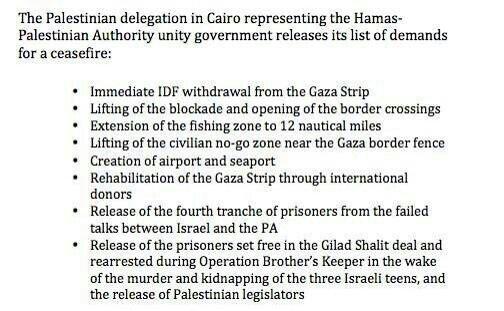
    Notice no pressure on Egypt. Hard for el-Sisi to justify saying no.
    Also notice the use of the title 'Hamas-Palestinian Unity Government'.
    My belief is that part of the reason this all started was to ram a wedge between Hamas & Fatah's formation of a Unity Government (interim formed early June)...
    Ball in Bibi's court...

    Continuation of ground & air assault with reports that the IDF were finished destroying "terror tunnels" being changed as the IDF is now saying they have found at least 2 more.

    Remember: Lt Goldin's alleged capture allowed the Israeli Government to shift International sentiment in their favour. Hamas never said they had captured an IDF soldier, only that their troops had been engaged in fierce combat in the hours leading up the ceasefire as Israel tried to push their line forward East of Rafah. The shift in International sentiment is now moving away from Israel again with the latest UN shelter shelling (reported from a drone). Especially as the UN has said that the IDF had been given the coordinates of the UN emergency facility 33 times. One of those times was an hour before the drone strike that left at least 10 dead and 30 wounded.

    BTW Chris Gunness is reporting that there are '269,793 displaced people in 90 UNRWA schools across Gaza, an average shelter population of 2,998' (source).

    -- Pan
    Last edited by panopticon; 3rd August 2014 at 15:34. Reason: UNRWA tally
    "What we think, or what we know, or what we believe is, in the end, of little consequence.
    The only consequence is what we do."

  32. The Following User Says Thank You to panopticon For This Post:

    Bob (3rd August 2014)

  33. Link to Post #339
    Australia Avalon Member panopticon's Avatar
    Join Date
    6th February 2011
    Posts
    2,591
    Thanks
    8,262
    Thanked 8,009 times in 2,305 posts

    Default Re: This evening in Israel

    U.N. chief calls Gaza school attack a 'criminal act'
    United Nations, August 3rd, 2014

    (Reuters) - U.N. Secretary-General Ban Ki-moon described a deadly attack on a U.N. school on Sunday as a "moral outrage and a criminal act" and called for those responsible for the "gross violation of international humanitarian law" to be held accountable.

    In a statement, Ban strongly condemned the shelling of the school in Rafah in southern Gaza that killed at least 10 civilians. The school was sheltering 3,000 displaced persons and Ban said the "Israel Defense Forces have been repeatedly informed of the location of these sites."

    Source

    ###

    UN CHIEF: ATTACK AT SCHOOL IN GAZA 'CRIMINAL ACT'
    United Nations, August 3rd, 2014

    NEW YORK (AP) — U.N. Secretary-General Ban Ki-moon says an attack that killed 10 people at a U.N. school in the Gaza Strip is a "moral outrage and a criminal act."

    Ban says the attack Sunday "is yet another gross violation of international humanitarian law, which clearly requires protection by both parties of Palestinian civilians, U.N. staff and U.N. premises, among other civilian facilities."

    In a statement, the U.N. chief said the attack "must be swiftly investigated and those responsible held accountable. It is a moral outrage and a criminal act."

    Source
    "What we think, or what we know, or what we believe is, in the end, of little consequence.
    The only consequence is what we do."

  34. Link to Post #340
    Netherlands Avalon Member Observer1964's Avatar
    Join Date
    14th December 2010
    Location
    somewhere in holland
    Posts
    512
    Thanks
    467
    Thanked 2,071 times in 457 posts

    Default Re: This evening in Israel


    Palestine before 1948

    Examine all things and retain the good.

  35. The Following User Says Thank You to Observer1964 For This Post:

    panopticon (3rd August 2014)

+ Reply to Thread
Page 17 of 25 FirstFirst 1 7 17 25 LastLast

Posting Permissions

  • You may not post new threads
  • You may not post replies
  • You may not post attachments
  • You may not edit your posts