+ Reply to Thread
Page 20 of 25 FirstFirst 1 10 20 25 LastLast
Results 381 to 400 of 484

Thread: This evening in Israel

  1. Link to Post #381
    Australia Avalon Member panopticon's Avatar
    Join Date
    6th February 2011
    Posts
    2,591
    Thanks
    8,262
    Thanked 8,009 times in 2,305 posts

    Default Re: This evening in Israel

    There is still no long term ceasefire agreement.

    Various reports indicate that Hamas are not moving from some of their more extreme demands (eg airport) while Egypt is evidently back to not really acting as mediators (they're just saying no to requests by Hamas & factions without consulting the Israeli delegation for suggestions etc).

    It was reported that in the Israeli Cabinet meeting the other day Netanyahu presented a very hard-line case to the ministers saying that a full ground invasion would cost the lives of 100's of IDF soldiers (source).

    Anyway, IJ has been reported as saying that there will be an outcome in a few hours. What that means who knows.

    I did say that Abbas learnt the diplomatic game from the best so is a bit predictable. Hamas & co are no where near that and it is equally likely that they'll call for rockets to start launching again and turn it into a battle of attrition...

    Egypt is the one evidently causing the real problems. Looks like the Europeans are going to have to step in and do the negotiating (paywalled article from earlier today on that here).

    Next thing they'll be suggesting the Quartet reconstruction/rehabilitation plan...

    Who knows if this is pantomime or high drama. With Hamas etc in the mix no-one can be certain.

    -- Pan
    "What we think, or what we know, or what we believe is, in the end, of little consequence.
    The only consequence is what we do."

  2. The Following User Says Thank You to panopticon For This Post:

    Bob (7th August 2014)

  3. Link to Post #382
    Unsubscribed
    Join Date
    23rd June 2013
    Location
    North America
    Age
    74
    Posts
    6,884
    Thanks
    12,723
    Thanked 29,293 times in 6,140 posts

    Default Re: This evening in Israel

    -- Pan - what you said above is EXACTLY precisely to the "T" what was pushed last nite on Fox, scripted out - there were Israeli kids playing table tennis this nice sweet chickie you would think with pigtails if that was in fashion again, saying how much the family is important how much the state takes care of everything, i thought i was going to vomit it was so sweet and so scripted.. This thread and how things progressed exactly details the war-crimes, the spins. I would think anything from off-site, should be downloaded and archived before IT is made to evaporate in the "new story". This typifies exactly how history is re-written by those with the bigger guns, the larger oppression. It is a lesson to understand how psyops works.

    This is one of those MUST READ priority threads. It is about understanding how the systems work, how people are kept slaves. At least imho ..

    Quote There is a well known process whereby children learn how to see the world, how to understand what is going on around them and their place within that society.

    Different theorists describe this in different ways depending on their underlying opinion of what explains the social world, their "grand narrative".

    Anyway, almost every person is taught from an early age that they belong. They belong to a family, to a country, maybe to a religion. The list goes on.

    It helps us all understand who we are. Our individual identity is largely constructed through this process and our values formed from it. They can alter later in life but in general our underlying understanding of the world, our habitus, comes from this period.

    That is why I know there will be a re-write.

    We are told that the Nation-State is good. US citizens are told the their Natiom-State is good. British citizens are told their's is good. Australian, Israeli, Norwegian etc., all are told their Nation-State is good. Sometimes mistakes are admitted to and there is a whole lot of belly staring that goes on within the media etc about why these things happened.

    Usually this progresses/encourages the construction of the "Nation-State is good" narrative because "surely only a good country can admit to and then look at its faults so we can rectify them. This proves we are a good country."

    What is happening now in Israel and the US (to a lesser extent elsewhere) is this narrative. The controlled examination via politicians and media talking heads of this story.

    It is being deconstructed before our eyes and a new narrative will be constructed to replace it.

    For this new story to take root it needs to be carefully tended, ground work must be done and it must be trained in just the "right way" to gain acceptance.

    There must be reasons given to explain actions taken.

    The Nation-State must be shown to be "good".

    Voices saying "this is not right" must be accepted or marginalised depending on how dominant they are within society.

    (reference original Post here: https://projectavalon.net/forum4/show...l=1#post862060 )
    Last edited by Bob; 7th August 2014 at 16:29.

  4. Link to Post #383
    Australia Avalon Member panopticon's Avatar
    Join Date
    6th February 2011
    Posts
    2,591
    Thanks
    8,262
    Thanked 8,009 times in 2,305 posts

    Default Re: This evening in Israel

    SENIOR OFFICIAL SAYS HAMAS NOT EXTENDING TRUCE
    By MOHAMMED DARAGHMEH, August 7th, 2014


    CAIRO (AP) — A senior official says Hamas has decided not to extend a 72-hour cease-fire with Israel because Israel has rejected all of the group's demands in indirect talks in Cairo.

    The cease-fire is to end at 0800 (0500 GMT) Friday.

    The official spoke on condition of anonymity because he was en route to informing Egyptian mediators of the decision.

    The official says the Hamas delegation met for several hours early Friday with Egyptian officials. He says that in exchange for extending the truce, Hamas had demanded that Israel agree in principle to end Gaza's border closure and allow the rebuilding of Gaza.

    He says Hamas was told by Egypt that Israel rejected those demands.

    Earlier, two rockets were fired from Gaza at Israel, landing in empty fields.

    Source
    "What we think, or what we know, or what we believe is, in the end, of little consequence.
    The only consequence is what we do."

  5. The Following User Says Thank You to panopticon For This Post:

    Bob (8th August 2014)

  6. Link to Post #384
    Australia Avalon Member panopticon's Avatar
    Join Date
    6th February 2011
    Posts
    2,591
    Thanks
    8,262
    Thanked 8,009 times in 2,305 posts

    Default Re: This evening in Israel

    Detainee "fell during interrogation, and died later on" -- Israel Govt

    A Jordanian man who was detained after participating in a pro-Palestine protest in Israel died due to multiple injuries allegedly inflicted while being held by the Israeli Prison Administration.

    Take away:
    Quote A Jordanian security source said Jordan formed a committee to oversee the autopsy that would be performed at a Jordanian Hospital, adding that initial examination shows clear bruises, and fractures, in the head, chest and several other body parts.

    It also revealed that a sharp blow to the head caused brain hemorrhage, that eventually led to death. An official report will be issued at a later stage.

    Israel alleges Wa’el “fell during interrogation, and died later on”
    ###

    Jordanian Family: “Israel Tortured Our Son To Death”
    by Saed Bannoura, August 07, 2014

    A Jordanian family is accusing Israel of arresting and torturing their son to death, after detaining him during a protest, in Tel Aviv, in solidarity with the Palestinians in Gaza.

    The family in Ein Abous in Zarqa – Jordan told Aal-Balad News Agency in Jordan that Wa’el Salim Mustafa, 39, was detained by the Israeli police during a protest against the Israeli war on Gaza, was subject to extreme torture by Israeli interrogators, and died around a week ago, on the third day out the Muslim feast of al-Fitr.

    His brother, Qotaiba, stated that the Israeli Authorities contacted the family asking them to come over and sign documents permitting Israeli doctors “to perform a needed surgery”, but once the family arrived in Tel Aviv, they were told he was dead.

    Qotaiba added that the body of his brother showed clear marks of extreme torture, and also had a swollen face, swollen eye sockets, several broken ribs, and various cuts and bruises all over his body.

    On April 5, the al-Balad said that Jordanian Legislator Mohammad Thahrawi, conducted enormous efforts that led moving the body of Mustafa to Amman, where the legislator and hundreds of family members and citizens gathered across the border.

    Jordanian Ministers and security devices also helped in the coordinated efforts that led to moving the body of Mustafa back to Jordan.

    His funeral was held Thursday, August 7..

    [EDIT: Video in original article not included in post -- follow article link to view]

    Transcript of video: …. Reporter: What’s the name of the martyr?
    “Wa’el. Wa’el”
    Reporter: “Wa’el what?”
    “Wa’el Salim Mahmoud Mustafa”…
    Reporter: martyrWa’el Salim Mahmoud Mustafa, todays date August 7 2014, This is the funeral of martyr Wa’el Salim… Mahmoud Mustafa”. Where is her from?
    “Ein Abous, al-Jawaz”. (Zarqa’ Jordan)

    Mustafa left Jordan around 18 months ago, and travelled to Tel Aviv and Haifa, where we worked construction jobs.

    Israel is refusing to provide further details on the issue, while the family has filed an official complaint against Israel and the Israeli Prison Administration, and is asking for another autopsy to reveal the causes of death.

    A Jordanian security source said Jordan formed a committee to oversee the autopsy that would be performed at a Jordanian Hospital, adding that initial examination shows clear bruises, and fractures, in the head, chest and several other body parts.

    It also revealed that a sharp blow to the head caused brain hemorrhage, that eventually led to death. An official report will be issued at a later stage.

    Israel alleges Wa’el “fell during interrogation, and died later on”.

    Israel and Jordan signed a peace agreement in 1994. Despite the fact that all Israelis can travel to Jordan, most Jordanian males are not allowed to travel to Tel Aviv, and are forced to go through the Arab side of the border terminal with Jordan, thus, are “granted” access to the West Bank and not to historic Palestine, including Jerusalem.

    Source
    "What we think, or what we know, or what we believe is, in the end, of little consequence.
    The only consequence is what we do."

  7. The Following 2 Users Say Thank You to panopticon For This Post:

    Akasha (13th August 2014), Bob (8th August 2014)

  8. Link to Post #385
    Australia Avalon Member panopticon's Avatar
    Join Date
    6th February 2011
    Posts
    2,591
    Thanks
    8,262
    Thanked 8,009 times in 2,305 posts

    Default Re: This evening in Israel

    Wasn't going to bother posting this as it will be fairly well known by the time anyone reads this but at exactly 8:00 (Gaza time) rockets were launched from Gaza.

    There were reports that earlier a few rockets had been launched before the end of the ceasefire but Hamas denied responsibility.

    Israeli military planes are over Gaza and reports of a possible drone strike in Northern Gaza.

    This is early stages so may just be Hamas trying to get the negotiations moving along in Cairo...

    Sabre rattling from Israeli Government 'Minister Uri Ariel: Israel can't let a terror organization set the rules. Cabinet must order the IDF to topple the Hamas regime in Gaza' (source)

    -- Pan
    "What we think, or what we know, or what we believe is, in the end, of little consequence.
    The only consequence is what we do."

  9. The Following 2 Users Say Thank You to panopticon For This Post:

    Akasha (13th August 2014), Ulyse30 (7th September 2014)

  10. Link to Post #386
    Canada Avalon Retired Member Ulyse30's Avatar
    Join Date
    12th February 2014
    Posts
    53
    Thanks
    3,616
    Thanked 148 times in 41 posts

    Default Re: This evening in Israel

    Vive l'Écosse,!!!! Et tout les autres pays avec du bon sens,pour aider ceux qui sont dans le pétrin,!!!!
    Last edited by Ulyse30; 8th August 2014 at 05:38.

  11. The Following 2 Users Say Thank You to Ulyse30 For This Post:

    Akasha (13th August 2014), panopticon (8th August 2014)

  12. Link to Post #387
    Australia Avalon Member panopticon's Avatar
    Join Date
    6th February 2011
    Posts
    2,591
    Thanks
    8,262
    Thanked 8,009 times in 2,305 posts

    Default Re: This evening in Israel

    Evaluation of timing around the capture of Lt Goldin, Rafah bombardment and the timing of the ceasefire from Haaretz.

    Would appear my projected timing of it all was fairly accurate (though some of the other things in this article I do not agree with).

    I do think that the timing of the Hamas operation that led to the capture of Lt Goldin was earlier than the IDF records show. Unlike Haaretz I'm not running things past the Military Censor so I can say that it is possible for those records to have been altered. Remember, it's not what is said it's the context in which it's placed. Haaretz mentioning that it would be difficult for the records to be altered needs to be viewed through that contextual lens.

    -- Pan#

    ###

    What happened in Gaza's Rafah on 'Black Friday'?
    By Amos Harel and Gili Cohen, August 8th, 2014


    A Palestinian man looks out over destruction in part of Gaza City's al-Tufah neighbourhood in Gaza, August 6, 2014.
    Photo by AFP


    Israeli attempts to stop the capture of 2nd Lt. Hadar Goldin are likely to be a major focus of international efforts to determine if the army acted appropriately during Gaza conflict.

    The information available is patchy when it comes to the dramatic events in south Gaza on August 1, in which three soldiers and at least 130 Palestinians were killed in Israeli efforts to thwart the abduction of an officer. The incident, however, is likely to draw international attention in the coming weeks.

    The efforts to stop the capture of 2nd Lt. Hadar Goldin raise many issues: Who breached the humanitarian cease-fire that collapsed following the incident in Rafah, the many Palestinian dead — figures range between 130 and 150, mostly civilians — and the IDF debate on the so-called Hannibal procedure – permission to risk the life of a captured soldier to stop the abduction itself.

    These are likely to be a major focus of international agencies trying to determine if the Israel Defense Forces acted appropriately during its four-week Gaza offensive.

    The information available to Haaretz on the events is partial and based on sources from the Israeli side only. Realizing the possibility of legal proceedings abroad, the IDF is in no hurry to volunteer all the details.

    The humanitarian cease-fire, brokered by the United States and the United Nations, was to begin at 8 A.M. Friday August 1. Israel interpreted the understanding as permission to continue operating against Hamas tunnels in territory it had taken over.

    On Thursday night it emerged that a tunnel had not been destroyed on the northeastern edge of Rafah. Soldiers from the Givati Brigade’s reconnaissance force, under the command of Maj. Benaya Sarel, were told to advance a few hundred meters to look for the entrance shaft. According to a senior officer, the force finished its task at about 5 A.M.

    After 8 A.M., Sarel noticed a suspicious movement inside a building. He consulted with his commanders and according to one version, which has not been confirmed, was told to check the structure.

    Sarel checked the structure with the team’s commander, Goldin, and the company commander’s radio operator, Staff. Sgt. Liel Gidoni. The rest of the force was under the command of the deputy company commander, whose name has been given as Lt. Eitan. These troops remained a few dozen meters away behind a building. Sarel, Goldin and Gidoni were killed on the spot by Hamas fire.

    Because of the firing, time lapsed before other troops reached the scene and found the three dead. A few minutes later they realized that one of them was a Hamas militant wearing an Israeli uniform, according to one version.

    At that point it was unclear whether Goldin had been taken alive. The soldiers also spotted the opening to the tunnel through which Goldin had been taken. Eitan has told the daily Yedioth Ahronoth that he decided to enter the tunnel to find Goldin, but permission to do so was denied at first.

    Eitan’s decision to enter the tunnel went against procedure due to fears that tunnels may be booby-trapped. “I knew the risk but I decided to act,” he said.

    Eitan and two soldiers entered the tunnel after Col. Ofer Winter, commander of the Givati Brigade, told Eitan to throw a grenade into the shaft before entering. The three soldiers moved ahead hundreds of meters in almost complete darkness. They discovered that the tunnel ended in a mosque and found gear belonging Goldin that suggested he had been mortally wounded.

    According to the IDF, Sarel’s force was fired on at 9:16 A.M., about an hour and a quarter after the cease-fire began. American reporters suggested that the Israelis might be lying about the timing of the incident — that it had taken place about 30 minutes before the cease-fire, based on tweets from accounts linked to Hamas that reported an assault on Israeli soldiers east of Rafah.

    But based on the information available to Haaretz, the IDF’s version seems correct. The official report on the incident appears on computerized operational systems, which would be difficult to falsify due to the many soldiers with access.

    At first Hamas’ political wing proudly announced the capture of a soldier. But it then retracted the claim amid concerns about the diplomatic fallout. It then said the members of the Hamas force and the soldier had been killed by an Israeli strike.

    The IDF believes that the abduction attempt was a local initiative at a low-level of command. When the Hamas fighters realized that the force under Sarel had entered the tunnel, they opened fire and then fled with Goldin’s body.

    The Givati command headquarters near Rafah then used the Hannibal procedure to find Goldin. They did so without the immediate authorization of the Gaza Division and Southern Command.

    This was the most aggressive action of its type ever carried out by the IDF, military sources said. In addition to the use of special forces, an armored column moved quickly about one kilometer into Rafah’s built-up area. The mosque was searched, as was a nearby Hamas command post firing to prevent the removal of Goldin. Israeli air support was also called in.

    This procedure takes a risk with the life of a captured soldier to stop the abduction. But officers in the General Staff said this week the procedure does not permit the killing of a captured soldier to thwart the abduction. Still, some soldiers and junior officers might believe the killing of the abductee is preferable to an abduction.

    The extreme measures to thwart the abduction apparently stemmed from Israelis’ shock in the last decade over the release of hundreds of security prisoners in exchange for abducted soldiers. An abduction is often considered something to be avoided at almost at any cost.

    Thus, in this incident, many civilians were killed because of the heavy fire the IDF laid to thwart the abduction. Under the Hannibal procedure, there was no time to warn them to leave their homes.

    Source
    "What we think, or what we know, or what we believe is, in the end, of little consequence.
    The only consequence is what we do."

  13. The Following 3 Users Say Thank You to panopticon For This Post:

    Akasha (13th August 2014), avid (8th August 2014), Ulyse30 (7th September 2014)

  14. Link to Post #388
    Australia Avalon Member panopticon's Avatar
    Join Date
    6th February 2011
    Posts
    2,591
    Thanks
    8,262
    Thanked 8,009 times in 2,305 posts

    Default Re: This evening in Israel

    Israeli delegation left Cairo an hour before the ceasefire was to end (ie 07:00).

    This means that there was no breaking of the ceasefire. It simply ended and IJ/PCR started firing again (notice Al Qassam reportedly didn't).

    Netanyahu & Yaalon order IDF to retaliate and retaliate they do.

    Shelling reported in Gaza.

    PA reports negotiations to continue in Cairo...

    -- Pan
    "What we think, or what we know, or what we believe is, in the end, of little consequence.
    The only consequence is what we do."

  15. The Following User Says Thank You to panopticon For This Post:

    Akasha (13th August 2014)

  16. Link to Post #389
    Australia Avalon Member panopticon's Avatar
    Join Date
    6th February 2011
    Posts
    2,591
    Thanks
    8,262
    Thanked 8,009 times in 2,305 posts

    Default Re: This evening in Israel

    Gaza Tension Stoked by Unlikely Alliance Between Israel and Egypt
    By Adam Entous in Jerusalem and Nicholas Casey in Gaza, August 6th, 2014


    The plan was simple: Israel and the new military-led government in Egypt would work together to ratchet up pressure on their shared enemy in the Gaza Strip - Hamas. But their miscalculations triggered a crisis. WSJ's Adam Entous joins the News Hub to discuss. Photo: Getty

    Strategy of Squeezing Hamas Was Effective, but Helped Lead to Open Warfare, Officials Believe

    Israel and Egypt quietly agreed to work in concert to squeeze Hamas after Egypt's military coup in 2013, a strategy that proved effective but which some Israeli and U.S. officials now believe stoked tensions that helped spur open warfare in Gaza.

    When former military chief Abdel Fattah Al Sisi rose to power in Egypt after leading the overthrow of Islamist President Mohammed Morsi, Israel found the two countries had a common interest in suppressing the Islamist group that ruled Gaza. They worked to bring pressure on their shared enemy.

    But a reconstruction of events leading up to the conflict over the past month found that in their determination to hem in Hamas, Israeli and Egyptian officials ignored warning signs of an impending explosion, U.S., Israeli and U.N. officials said.


    A Palestinian enters a smuggling tunnel beneath the border between Egypt and Gaza in September. Zuma Press

    The U.S. encouraged Israel and Egypt to forge a close security partnership. What Washington never anticipated was that the two countries would come to trust each other more than the Americans, who would watch events in Gaza unfold largely from the sidelines as the Israelis and the Egyptians planned out their next steps. (See an hour-by-hour breakdown on cease-fires in Gaza.)

    The seeds of the latest Israel-Hamas conflict were sown in 2012, when Hamas broke ranks with longtime allies Syria, Iran and Lebanon's Hezbollah and threw its support behind the rebels fighting to unseat President Bashar al-Assad in Syria's civil war.


    Hamas, which ruled Gaza for the past seven years, came to rely on cash supplied by Qatar transferred through Egypt, with the assent of Mr. Morsi, and on revenue from smuggling goods through tunnels reaching into Egypt. As long as Hamas controlled cross-border attacks, Israel tolerated the Islamist movement at its southern doorstep, Israeli officials said.

    That pressure got dialed up when Mr. Morsi was deposed and Mr. Sisi rose to power. Israeli officials knew Egypt was as committed as they were to reining in Hamas when Mr. Sisi sent word earlier this year that his forces had completely destroyed 95% of the tunnels under Egypt's border with Gaza.

    At first, Israeli intelligence officials said they didn't know what to make of Mr. Sisi, a devout Muslim who in previous posts treated his Israeli counterparts coldly, a senior Israeli official said. As Mr. Sisi moved to take control of the government, Israeli intelligence analysts pored over his public statements, writings and private musings, Israeli and U.S. officials said.

    The Israeli intelligence community's conclusion: Mr. Sisi genuinely believed that he was on a "mission from God" to save the Egyptian state, the senior Israeli official said.

    Moreover, as an Egyptian nationalist, he saw Mr. Morsi's Islamist group, the Muslim Brotherhood, and its Palestinian offshoot, Hamas, as threats to the state that needed to be suppressed with a heavy hand, the Israeli official said.

    Israeli intelligence analysts interpreted Mr. Sisi's comments about keeping the peace with Israel and ridding Egypt of Islamists as a "personal realization that we—Israel—were on his side," the Israeli official said.

    The revelation that Hamas was equally abhorrent to Mr. Sisi as it was to the Israeli government spurred efforts to reward him. Israel used its clout in Washington to lobby the Obama administration and Congress on his behalf, in particular arguing against a U.S. decision to cut off military aid to Egypt, Israeli officials said.

    Mr. Sisi followed Israel's lobbying effort closely and was appreciative, the Israeli official said.

    "It came at a very formative time for him" and helped cement a trusting relationship between friends who realized they were vital to each others' national security, he said.

    Cooperation with Israel is highly sensitive in Egypt and Egyptian officials declined to discuss in detail the partnership between the neighbors against Hamas.

    In Gaza, there was shock at the events unfolding in Cairo.

    Under the protective umbrella of Mr. Morsi's Islamist-led government, Hamas had imported large quantities of arms from Libya and Sudan, as well as money to pay the salaries of government officials and members of their armed wing, Israeli and U.S. officials said. His successor abruptly changed that.

    "One day we had been sitting having great conversations with Morsi and his government and then suddenly, the door was shut," Ghazi Hamad, Hamas's deputy foreign minister, said in an interview last month.

    From having contact at "every level" of the Egyptian government under Mr. Morsi, now Hamas's only contact with Cairo was a military intelligence officer handling the Hamas brief who was more anti-Hamas than the Egyptian leader, U.S. officials said.

    Washington was sympathetic to Mr. Sisi's concern that the tunnel trade along Gaza's southern border with Egypt was creating a warlord-style economy directly benefiting hard-line Islamist groups.

    But U.S. officials didn't agree with what they saw as Mr. Sisi's "conspiracy theories" about Hamas threatening the Egyptian state. They feared his heavy hand against Islamists in Egypt would drive them underground and might set off a civil war. The criticism only deepened the bond between Mr. Sisi and Israel, U.S. and Israeli officials said.

    Egypt secretly coordinated with senior Israeli officials led by Maj. Gen. (Res.) Amos Gilad, the director of the political-military affairs bureau at Israel's Defense Ministry, who is known in the Israeli security establishment as the "granddaddy" of the Israeli-Egyptian channel, Israeli officials said.

    Mr. Gilad and other Israeli officials shuttled between Israel and Egypt and spoke to their Egyptian counterparts by phone. Officials said the two sides spoke every day, more often during crises. Although there were disagreements, Mr. Gilad forged a personal relationship with the Egyptian leader, officials said.


    Egyptian President Abdel Fattah Al Sisi in Cairo in July Egyptian Presidency handout/Reuters

    A senior Israeli official said the two governments wanted to advance their shared interests and increase pressure on Hamas. But he insisted there was no master plan to squeeze it to the point that "something would explode."

    Yet when Mr. Sisi closed nearly all of the tunnels along Egypt's border with Gaza but didn't compensate for the loss of those avenues by allowing the passage above ground of needed supplies, some Israeli officials said they privately began to raise alarm bells about the severity of Cairo's decisions.

    "They actually were suffocating Gaza too much," one Israeli official said.

    In Gaza, the situation grew desperate.

    At the start of the year, Hamas realized that Egypt's campaign to destroy the tunnels was edging it toward bankruptcy.

    In April, Hamas abruptly agreed to form a government of technocrats under Western-backed Palestinian Authority President Mahmoud Abbas, reconciling with the group that governed the West Bank after years of rivalry.

    The growing dangers about Hamas's precarious position were flagged to Washington by the U.S. Consul General in Jerusalem, Michael Ratney. He saw the pressures building in the spring and concluded that Hamas was in desperate straits, unable to pay salaries to its 40,000 government workers in Gaza, and was now reaching out to the Palestinian Authority to try to relieve the pressure.

    Mr. Abbas privately told diplomats afterward that he never expected Hamas to agree to the unity deal.

    Mahmoud Zahar, a top Hamas leader in Gaza, said the group's inability to cover its monthly payroll forced it to reach out to the Palestinian Authority and Qatar, which pledged $60 million for three months. But U.S. and Israeli officials said Arab banks wouldn't make the transfer.

    At the height of Hamas's distress, three Israeli teenagers were kidnapped in the West Bank in June and subsequently found dead. Israel quickly concluded that Hamas was responsible and rounded up its activists in the West Bank, infuriating the group's armed wing in Gaza.

    After the abduction, which U.S. officials believe was carried out by Hamas members without the approval of their leaders in Gaza, Israeli intelligence officials warned policy makers that "overly pressuring Hamas will lead to a conflagration," according to another senior Israeli official.

    Palestinian officials told diplomats they were making a last-ditch effort to get the money for salaries to Gaza, believing that doing so might help defuse tensions but nothing came of it, diplomats said.

    Rocket fire from Gaza escalated, and Israel began to respond with airstrikes.

    U.S. officials, who tried to intervene in the initial days after the conflict broke out on July 8 to try to find a negotiated solution, soon realized that Mr. Netanyahu's office wanted to run the show with Egypt and to keep the Americans at a distance, according to U.S., European and Israeli officials.

    The Americans, in turn, felt betrayed by what they saw as a series of "mean spirited" leaks, which they interpreted as a message from Mr. Netanyahu that U.S. involvement was neither welcomed nor needed.

    Reflecting Egypt's importance, Mr. Gilad and other officials took Mr. Sisi's "temperature" every day during the war to make sure he was comfortable with the military operation as it intensified. Israeli officials knew television pictures of dead Palestinians would at some point bring Cairo to urge Israel to stop.

    "We knew we could not do something that went beyond what they could digest," a senior Israeli official said of the Egyptians. Egypt's view mattered more than America's, Israeli officials said.

    When a tentative deal finally came together in Cairo to stop the fighting, Washington found itself outside looking in on the Israeli-Egyptian partnership once again.

    The Obama administration knew from Palestinian contacts earlier this week that representatives of Israel, Egypt and the Palestinians were working on a new cease-fire proposal but didn't know details because they were left largely out of the discussions. (Compare cease-fires proposed and broken since the most recent conflict began in Gaza.)

    Key American officials said they first heard about the breakthrough from Twitter and the media, rather than from their Israeli or Egyptian counterparts.

    Source
    "What we think, or what we know, or what we believe is, in the end, of little consequence.
    The only consequence is what we do."

  17. The Following User Says Thank You to panopticon For This Post:

    Akasha (13th August 2014)

  18. Link to Post #390
    Australia Avalon Member panopticon's Avatar
    Join Date
    6th February 2011
    Posts
    2,591
    Thanks
    8,262
    Thanked 8,009 times in 2,305 posts

    Default Re: This evening in Israel

    Reports that a new ceasefire might come into effect @ 20:00 (Gaza time) which is in around 70 minutes from now. Difficult to know if this is going to be another 72 hour ceasefire or more limited (if it happens at all -- once bitten twice shy).

    While Bibi made a big deal out of his public directive to the IDF that they should retaliate hard.
    The reality was quite limited though still resulted in the death of at least one child and injuries to a number of other non-combatants.

    Israeli Government officials have reportedly said they will not negotiate while Israel is under fire.
    Seems like more game playing as Israeli government representatives had walked away from the negotiations at least an hour before the end of the last ceasefire.
    This prompted IJ & PRC to fire off rockets (30+) after the ceasefire ended.

    Reports of progress of the ceasefire talks vary by who is reporting.
    Egypt is saying that most points are agreed on just a few remaining to be done and that the agreement is almost done (sounds familiar doesn't it)...
    The Israel Government is saying, well not much except: stop firing rockets.
    Palestinian delegates(Fatah-Hamas PA govt & factions) are saying that Israeli Government negotiators have rejected all their proposals...

    IDF hasn't remobilised reservists so at least that's something...

    Protests have been on-going in the West Bank & occupied territories.

    -- Pan
    "What we think, or what we know, or what we believe is, in the end, of little consequence.
    The only consequence is what we do."

  19. The Following 2 Users Say Thank You to panopticon For This Post:

    Akasha (13th August 2014), Bob (8th August 2014)

  20. Link to Post #391
    Australia Avalon Member panopticon's Avatar
    Join Date
    6th February 2011
    Posts
    2,591
    Thanks
    8,262
    Thanked 8,009 times in 2,305 posts

    Default Re: This evening in Israel

    Massive pro-Palestine rallies around the world today.

    200,000 marched in South Africa and tens of thousands marched in London.

    Really not much news out of Israel today (it is the Sabbath after all).

    Israel is bombing/shelling Gaza, Hamas &/or factions are firing rockets into Israel, large protests after Friday prayers in the West Bank with a number wounded and some killed in clashes with IDF etc.

    Sabbath ends in about 3 hours so maybe there'll be some sort of negotiations start again in Cairo.

    There have been reports from Palestinian media that a temporary ceasefire has been agreed to by Hamas & co but Israel is denying it (hopefully that is just political posturing).

    Good evaluation from yesterday by Daniel Nisman (Al Jazeera interview). Notice how Nisman brings in the Suez Canal extension I was muttering about the other day? That's a big deal (Billions of USD) and having any form of instability in the region is something that Egypt does not want as it might increase costs & construction time while also possibly reducing the final projects short-term profitability. Plus, el-Sisi is in a fight against any form of Islamic fundamentalism which matches up nicely with many of the US & Israeli interests (this might also explain to some extent why Israel & US are allowing Egypt to act as a non-negotiator and not complaining about it very much, if at all):


    Source: http://www.dailymotion.com/video/x23...nd-israel_news

    -- Pan
    "What we think, or what we know, or what we believe is, in the end, of little consequence.
    The only consequence is what we do."

  21. The Following User Says Thank You to panopticon For This Post:

    Akasha (13th August 2014)

  22. Link to Post #392
    Australia Avalon Member panopticon's Avatar
    Join Date
    6th February 2011
    Posts
    2,591
    Thanks
    8,262
    Thanked 8,009 times in 2,305 posts

    Default Re: This evening in Israel

    Article about 4 Israeli's arrested for counterfeiting $77 million in US $100 bills since 1999 (there were 13 people arrested all up in relation to the ring).

    Feds arrest 4 Israelis for manufacturing $77 million in fake bills

    Also, here's an article on South Africa's announcement that it might start prosecution of "its" citizens who are serving in the IDF:

    South Africa warns citizens it may prosecute those serving in the IDF

    -- Pan
    Last edited by panopticon; 9th August 2014 at 15:04.
    "What we think, or what we know, or what we believe is, in the end, of little consequence.
    The only consequence is what we do."

  23. The Following User Says Thank You to panopticon For This Post:

    Akasha (13th August 2014)

  24. Link to Post #393
    Australia Avalon Member panopticon's Avatar
    Join Date
    6th February 2011
    Posts
    2,591
    Thanks
    8,262
    Thanked 8,009 times in 2,305 posts

    Default Re: This evening in Israel

    War crime allegations in shooting of unarmed man in Shajaia (20th July) made against IDF:


    -- Pan
    "What we think, or what we know, or what we believe is, in the end, of little consequence.
    The only consequence is what we do."

  25. The Following 2 Users Say Thank You to panopticon For This Post:

    Akasha (13th August 2014), avid (10th August 2014)

  26. Link to Post #394
    Australia Avalon Member panopticon's Avatar
    Join Date
    6th February 2011
    Posts
    2,591
    Thanks
    8,262
    Thanked 8,009 times in 2,305 posts

    Default Re: This evening in Israel

    Palestinian negotiator: Palestinians to quit Gaza war talks Sunday unless Israeli team returns (AP)

    Testimony taken by B'Tselem ('The Israeli Information Center for Human Rights in the Occupied Territories') from paramedic shot by IDF on the targeting of ambulances by line of sight tank shelling & machine gun fire:
    Testimony: Ambulance driver Rami 'Ali recounts attacks that killed paramedic 'Aaed al-Bura'i and injured team sent to rescue him, both despite coordination with Red Crescent
    Last edited by panopticon; 10th August 2014 at 11:43.
    "What we think, or what we know, or what we believe is, in the end, of little consequence.
    The only consequence is what we do."

  27. The Following 2 Users Say Thank You to panopticon For This Post:

    Akasha (13th August 2014), avid (10th August 2014)

  28. Link to Post #395
    Australia Avalon Member panopticon's Avatar
    Join Date
    6th February 2011
    Posts
    2,591
    Thanks
    8,262
    Thanked 8,009 times in 2,305 posts

    Default Re: This evening in Israel

    It seems fairly certain that the Israeli assault will continue.

    No Israeli Government representative @ Cairo talks.
    Palestinian delegation about to leave.
    All Israeli Ministers are saying is: finish Hamas.
    Netanyahu saying it will take time...

    -- Pan

    ###

    Netanyahu: Israel shunning truce talks until fire from Gaza stops
    Reuters - 10th August, 2014

    JERUSALEM, Aug 10 (Reuters) - Prime Minister Benjamin Netanyahu said on Sunday that Israel would stay away from Egyptian-mediated truce talks with Hamas as long as Palestinian rocket and mortar attacks from the Gaza Strip continued.

    "Israel will not negotiate under fire," Netanyahu said in broadcast remarks at the weekly meeting of his cabinet, in Tel Aviv.

    "At no stage did we declare (Israel's military offensive) was over," he said. "The operation will continue until its objective - the restoration of quiet over a protraced period - is achieved. I said at the beginning and throughout the operation - it will take time, and stamina is required."

    (Writing by Jeffrey Heller; Editing by Dan Williams)

    Source
    Last edited by panopticon; 10th August 2014 at 09:06.
    "What we think, or what we know, or what we believe is, in the end, of little consequence.
    The only consequence is what we do."

  29. The Following User Says Thank You to panopticon For This Post:

    Akasha (13th August 2014)

  30. Link to Post #396
    Australia Avalon Member panopticon's Avatar
    Join Date
    6th February 2011
    Posts
    2,591
    Thanks
    8,262
    Thanked 8,009 times in 2,305 posts

    Default Re: This evening in Israel

    Gaza talks: Hamas says Israel not serious about Cairo summit
    Patrick Kingsley in Cairo and agencies, Sunday 10th August 2014


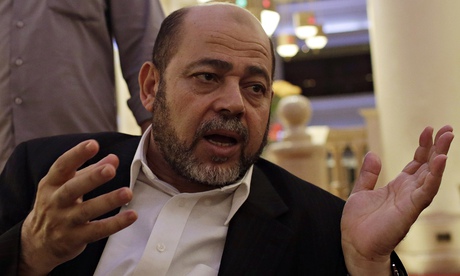
    Hamas negotiator Moussa Abu Marzouk in Cairo. Israel has been accused of not taking the talks seriously.
    Photograph: Asmaa Waguih/Reuters


    Negotiations mediated by Egypt in chaos as Israelis accused of going through motions and Palestinians threaten to leave

    Attempts at talks between Palestinians and Israelis aimed at ending the Gaza conflict look in danger of breaking down following warnings from both sides.

    Hamas's lead negotiator said the Palestinians may abandon the Cairo-based negotiations if Israel does not take them more seriously, and says that the Islamist group may continue its war of attrition if its demands are not met. Israel said it would not return to the talks as long as Palestinian militants in Gaza kept up cross-border rocket and mortar fire.

    In an interview with the Guardian Hamas's deputy chairman, Moussa Abu Marzouk, said that the Palestinian delegation would decide on Sunday whether or not to leave Cairo – where they have negotiated indirectly with their Israeli counterparts for a week.

    "There will be a meeting in order to decide if we are going to continue the talks or not – because there is no seriousness from the Israeli side about the talks," Marzouk said late on Saturday night, in the hotel where negotiations have centred.

    Israel's prime minister, Binyamin Netanyahu, said on Sunday: "Israel will not negotiate under fire. At no stage did we declare (Israel's military offensive) was over.

    "The operation will continue until its objective – the restoration of quiet over a protracted period – is achieved. I said at the beginning and throughout the operation – it will take time, and stamina is required." Israeli air strikes and shelling killed three Palestinians in Gaza on Sunday, including a boy of 14 and a woman, medics said, in a third day of renewed fighting that has jeopardised international efforts to end the conflict.

    Hamas has complained that throughout negotiations – conducted via Egyptian intermediaries – the Israelis had never formally responded to any Palestinian demands, which centre on ending an eight-year blockade of the Gaza strip. Marzouk also claimed that the Israeli delegation had made no attempt to negotiate since the end of a temporary ceasefire on Friday morning, when the Israeli team flew back to Jerusalem to observe the Jewish sabbath, and did not return. "They don't talk about peace or ceasefire during their religious ceremonies," said Marzouk. "But they can kill and destroy as they did in Gaza on Saturday. It's open season for killing."

    Marzouk said Hamas had not made a final decision about escalating its own attacks on Israel, should the talks fail – but claimed that "all the options are available to the Palestinian people in order to them to gain their rights." He said: "If we don't have justice and rights, we will keep resisting our enemies until we get them … If they don't give us our rights today, we will continue the battle."

    Marzouk said the concession Hamas most wanted from Israel was the right to build a port and airport in Gaza, facilities promised to the Palestinians under the Oslo peace deal. In return, he said Hamas had no problem with relinquishing power to a Palestinian Authority-led unity government that "should control everything in Gaza", including its border crossings.

    But he said Hamas would not agree to disarm while the Gaza strip was still occupied. "Disarming is out of the question. There is no discussion. It's not on the negotiation table. There is no force that can take away from the Palestinian resistance their right to resistance, nor their tools to resist."

    Marzouk also denied that Hamas should down its arms in order to protect innocent lives in Gaza, saying that it was Israel's responsibility to stop bombing civilians. He also denied that Hamas fighters endanger civilians by firing rockets from civilian areas.

    "I cannot understand how [Hamas's critics] always blame the weak, the party that gets attacked. Who started the battle? … Did Israel really have to kill all this number in order to get their targets? To demolish all these houses in order to achieve their goals? The ones who should be blamed are the Israelis."

    Marzouk said it was hard for Hamas fighters to avoid civilian areas in such a densely populated tract of land as Gaza, and argued that Israel had the sophisticated military equipment necessary to avoid killing any civilians. "Why do they keep killing all these civilians even though they have these weapons, these delicate weapons? They don't miss the target even by a few centimetres … The fact is unquestionable. They kill for the sake of killing."

    Source
    "What we think, or what we know, or what we believe is, in the end, of little consequence.
    The only consequence is what we do."

  31. The Following User Says Thank You to panopticon For This Post:

    Akasha (13th August 2014)

  32. Link to Post #397
    Australia Avalon Member panopticon's Avatar
    Join Date
    6th February 2011
    Posts
    2,591
    Thanks
    8,262
    Thanked 8,009 times in 2,305 posts

    Default Re: This evening in Israel

    Just as an aside, evidently Egyptian reps are saying that a 72 hour ceasefire will come into force when the Israeli delegation arrives in Cairo...

    Of course nothing has been announced officially so probably yet another attempt to manipulate the "negotiations"...

    Anyway the Palestinians are in Cairo to meet with the Arab League so we'll see what happens.

    I don't think any of this has gone to plan as Netanyahu was really pushing for a ceasefire (can't take over Gaza - costs in IDF live & money too high) but can't be seen to be backing down.

    Meanwhile all the right wingers (Bennett etc) are happily screaming from their fringe position that the only solution is to invade.

    Meanwhile Hamas and co (as well as some non-aligned Palestinians in Gaza) are saying better a fast death than a slow one from the siege.

    Very, very messy.

    Oh and I missed this earlier, the Kerem Shalom border crossing (the only crossing where aid gets into Gaza from Israel) was closed by the IDF this morning due to security concerns (source) so no humanitarian aid got into Gaza today.

    ###

    Palestinians to stay in Cairo for Arab League meeting on Gaza
    Reuters - 10th August 2014

    CAIRO, Aug 10 (Reuters) - Palestinian negotiators will remain in Cairo for an urgent meeting with the Arab League on Monday to discuss the Gaza crisis, Egypt's state MENA news agency said.

    The Palestinian delegation had said it was likely to abandon Egyptian-mediated talks on Sunday unless Israel agreed to return to the table without pre-conditions.

    Israel has said it will not take part in truce talks while violence is ongoing. Palestinian factions in Cairo for the negotiations declined to extend a 72-hour ceasefire that expired on Friday, saying Israel had refused to accept demands including an end to the blockade of Gaza and the opening of a seaport. (Writing by Lin Noueihed; Editing by Catherine Evans)

    Source
    Last edited by panopticon; 10th August 2014 at 12:57.
    "What we think, or what we know, or what we believe is, in the end, of little consequence.
    The only consequence is what we do."

  33. The Following User Says Thank You to panopticon For This Post:

    Realeyes (10th August 2014)

  34. Link to Post #398
    Australia Avalon Member panopticon's Avatar
    Join Date
    6th February 2011
    Posts
    2,591
    Thanks
    8,262
    Thanked 8,009 times in 2,305 posts

    Default Re: This evening in Israel

    Palestinians Accept New 72-Hour Cease-fire Offer
    By Mohammed Daraghmeh and Karin Laub, August 10th, 2014

    CAIRO (AP) — Palestinian negotiators in Cairo say they have accepted an Egyptian proposal for a new, three-day cease-fire with Israel.

    The decision aims to clear the way for renewed negotiations with Israel on a long-term truce arrangement in the Gaza Strip.

    The officials, representing various Palestinian factions, spoke on condition of anonymity because they were discussing sensitive negotiations.

    Israel walked away from negotiations over the weekend after rocket fire resumed, saying it would not negotiate under fire.

    Heavy fighting between Israel and Gaza militants has killed more than 1,900 Palestinians, as well as 67 people on the Israeli side.

    Source
    "What we think, or what we know, or what we believe is, in the end, of little consequence.
    The only consequence is what we do."

  35. The Following 2 Users Say Thank You to panopticon For This Post:

    Akasha (13th August 2014), Realeyes (10th August 2014)

  36. Link to Post #399
    Australia Avalon Member panopticon's Avatar
    Join Date
    6th February 2011
    Posts
    2,591
    Thanks
    8,262
    Thanked 8,009 times in 2,305 posts

    Default Re: This evening in Israel

    The Greenhouse propaganda—How Gazan history is being rewritten to dehumanize Palestinians
    By Justin Schwegel, August 10th, 2014


    Gazan workers harvest carnations in one of the enclave’s huge greenhouses. (Photo via palstreet.blogspot.com)

    Erase memory and you wash away the blood from the perpetrator’s hands, you undo the done deed, make it disappear from history. Erase memories of atrocities and you tempt future perpetrators with immunity - Miraslov Volf

    In recent weeks, as Israeli bombs and artillery have slammed into the tiny strip of land that is home to nearly 2 million Palestinians in Gaza, the propaganda war has been raging with equal vigor. Israeli spokespersons have consistently denied any blame for civilian victims and even claimed that civilians are acting as human shields for Hamas operations, blaming the victims of this humanitarian catastrophe for their own suffering.

    While it will take time and independent investigation to determine if the Israeli Defense Forces’ claims that Hamas is using civilians as human shields turn out to be as baseless as past IDF human shielding allegations against Hamas and Hezbollah, other claims made by Israel supporters can be easily dispelled now.

    Pro-Israel politicians and pundits have rewritten the history of the demise of an agricultural project in the Gaza Strip to blame the victims of an economic tragedy for their own hopeless situation. During the past few weeks, several pro-Israel political pundits including Ezra Levant, Charles Krauthammer, Richard Chesnoff, Jeffrey Goldberg and Alan Dershowitz have taken this line of victim-blaming. Notably, Hillary Clinton also advanced the Israeli effort to rewrite history.

    According to the history being written by Clinton and Krauthammer, Ariel Sharon made the decision to pull out of Gaza as a goodwill gesture toward peace and left the greenhouses behind so that Palestinians in Gaza could prosper. Palestinians decided to destroy the greenhouses because, according to Clinton “the leadership said, We don’t want anything left from Israel, [and they] destroyed it all.” Her version, which is by no means the most extreme, implies Palestinians destroyed the greenhouses in a self-destructive, anti-Semitic rage. This version of events is far removed from historical reality.

    Why did Israel withdraw from Gaza?

    Israel apologists view the 2005 withdrawal from Gaza as an altruistic act. In reality there is not much land nor many natural resources in Gaza, aside from a couple of offshore natural gas reservoirs. Prime Minister Ariel Sharon knew that allowing settlers to remain in the Gaza strip posed a massive “demographic threat,” an Israeli term for the threat that Palestinians might become the majority in Israel thereby making it impossible for Israel to be both Jewish and democratic. There were about 1.5 million Palestinians at the time who would have become Israeli if Israel had tried to swallow Gaza whole. The demographic threat was the reason for the withdrawal, and the reason for Gaza’s being quarantined from the outside world, not the hope that Gaza would become peaceful and prosperous.

    What really happened to the greenhouses?

    According to the New York Times, two months prior to the withdrawal, in July of 2005, Israeli settlers demolished about half of the greenhouses, “creating significant doubts that the greenhouses could be handed over to the Palestinians as ‘a living business.’” There are other reports that rather than leave their greenhouses behind for the Palestinians some settlers decided to burn them to the ground.
    Notwithstanding the destruction that had already been wrought, wealthy American philanthropists led by the Gates foundation and James Wolfensohn, the US Special Envoy for Gaza Disengagement, bought the remaining greenhouses from the Israeli settlers on behalf of the Palestinians in Gaza for $14 million. Wolfensohn contributed $500,000 of his own money.

    Admittedly, Palestinian looters took to the greenhouses when they were transferred to Palestinian control in mid-September 2005, hauling away some of the irrigation pipes, water pumps, plastic sheeting and glass, but leaving the greenhouses themselves structurally intact.

    Bassil Jabir was the CEO of the Palestine Economic Development Company (PED), the organization founded by the Palestinian Authority to take charge of the greenhouse project after it was turned over to the Palestinians. The PED invested more than $20 million into the project. Jabir said that as a result of the destruction by Israeli settlers and Palestinian looters the PED had to invest an additional $5 million into the greenhouse project to revive it.

    Despite the initial setbacks, the greenhouses were up and running by mid-October. By late November, the New York Times reported that the Palestinians were preparing to harvest a crop of peppers, strawberries, tomatoes and herbs worth $20 million. Presciently, in the same article, Palestinians expressed concern that if Israel did not keep the Karni border crossing open, it could result in the demise of the greenhouse project.

    In mid-December, the greenhouses made their first export of 8 tons of peppers. Speaking to the Associated Press about the success of the project, Jabir said, “It makes us proud. This land was a symbol of occupation and many people were doubting our ability to rehabilitate [it], but now we have proven that we, as Palestinians, are able to manage our lives, to farm our land and to do our own business.”

    That hope and pride soon turned to despair. According to Jabir, in order for the project to be successful, it would require moving at least 25 truckloads of produce a day through the Karni crossing. On rare days when the Karni crossing was functioning smoothly he was only able to move 3 truckloads. A crossing that was supposed to be open 24/7, per an international agreement to which Israel was party, was only open sporadically and unpredictably. Israel cited security concerns. The Palestine Economic Development Corporation and its Israeli distribution partner Adafresh were losing hundreds of thousands of dollars every week.

    By February 2006, the BBC reported that because the farmers could not get their produce through the crossing, trucks were dumping perfect, ripe produce onto a wasteland to be eaten by goats. Bassil Jabir joked that because cows were eating their strawberries after they had rotted in the harsh sun next to the checkpoint, they had developed perfectly natural strawberry-flavored milk. According to Special Envoy Wolfensohn, “Instead of hope, the Palestinians saw that they were put back in prison.”

    The BBC reported in February 2006, “Palestinians were convinced that Gaza was being deliberately strangled.” In March, Israeli daily Haaretz quoted the Commander of the IDF’s Gaza Division and the head of the Southern Command as stating there was no security-related reason for the closure of the Karni crossing. The Israeli Defense Minister ordered the closures to continue. Speaking to the BBC about Israeli border closures, Mr. Jabir stated, “This is a message to every investor: ‘Don’t come – there’s no hope of any investment flourishing.’” According to a PED report in early March made to Special Envoy Wolfensohn, the closures had cost the greenhouse project $5.4 million in the first two and a half months of 2006.

    By April 2006, after months of border closures, there was no money left to pay the agricultural workers, and the project was shut down. Bassil Jabir quit as CEO of the Palestine Economic Development Company in 2006 and left the Gaza Strip in frustration.

    During Israel’s June 2006 “Operation Summer Rains,” the United Nations Development Programme estimated that Israel inflicted $23.5 million in damage on Gaza’s agriculture, including damage to the greenhouses. Due to lack of project funds, no crop was planted that fall. During the next harvest season Israel kept the crossings open despite no noticeable change in security threat. Tentative plans were made to lease the greenhouses to independent farmers the next season, but when Israel and Egypt officially began the Gaza siege in 2007, the export-driven project was dead with no hope for revival.

    At the beginning of 2008, Hamas militiamen blew a hole in the wall separating Gaza from Egypt. Many Gazans crossed into the Sinai to purchase goods and sell what they could. Farmers who had been prohibited from exporting their agricultural produce for years sold these same greenhouses to Sinai farmers who were not faced with similar export constraints and were happy to have them. Some greenhouses remained. Many were deliberately destroyed by the IDF during operation Cast Lead, which caused nearly $16 million in damage to Gaza greenhouses. Others have been destroyed by the most recent bombardment.

    What does the lie accomplish?

    The answer to this question depends on context. Hillary Clinton used the lie in a non sequitur to rebut Jon Stewart’s question of why Gazans cannot look to Hamas as their “freedom fighters.” Ezra Levant used it to argue that Palestinians are anti-Semites.

    One of the Palestinians’ demands as a condition for a ceasefire during the present conflict is an end to the economically devastating siege and access to a UN-monitored seaport. If pro-Israel pundits admit that Israel killed the Gaza greenhouse project (and the rest of the Gaza economy) through border closures they might also have to admit that this request is reasonable.

    The foundation of the lie inevitably denies Israel’s responsibility for destroying a lucrative business while simultaneously implying that Palestinians would rather engage in self-destructive sabotage than build a functioning economy. Indeed, the logic goes, if Palestinians cannot be trusted to keep a profitable greenhouse project running, how could we ever expect them to run a State?

    The greenhouses are just one example of an industry choked to death by the Israeli siege. There are hundreds of others.

    I caught up with Bassil Jabir this week, and he was not hesitant about what killed the greenhouse project. “All the problems I told you about were problems that we could handle or had handled. If we could have exported our produce we would have made $25 million after recovering our investment. [It was] not what the Israeli settlers did, not what the Palestinian looters did. Yes, it was bad, yes, it was costly, but if we got to export our produce we would have recovered in our first year. The closure [of the Karni crossing] was the evil from which we could not recover…It was my dream project and it was destroyed in front of me.”

    The Greenhouse project is dead and with it died the dreams of many Palestinian farmers. Eight years ago the BBC reported on a murder by strangulation. Thanks to American revisionists like Hillary Clinton and Charles Krauthammer, it is now being portrayed as a suicide.

    Source -- Links contained in original article
    "What we think, or what we know, or what we believe is, in the end, of little consequence.
    The only consequence is what we do."

  37. The Following 2 Users Say Thank You to panopticon For This Post:

    Akasha (13th August 2014), avid (11th August 2014)

  38. Link to Post #400
    Australia Avalon Member panopticon's Avatar
    Join Date
    6th February 2011
    Posts
    2,591
    Thanks
    8,262
    Thanked 8,009 times in 2,305 posts

    Default Re: This evening in Israel

    Tell me again this assault is about anything other than Money, Control & Power...

    Just as the West Bank is a testing zone for anti-protest equipment Gaza is an R&D/demonstration site for new military equipment:
    Quote Image aside, for several years IMI has very quietly been developing more sophisticated products than bullets, rifles or hand grenades. For example, its new, super-smart MPR-500 multipurpose rigid bomb, which is designed to penetrate reinforced concrete structures and other difficult targets, was first used operationally in Protective Edge. Today, back orders for the bomb total 5.6 billion shekels.
    That's $1.6 billion (USD) from this single bomb!

    Why is this important?

    IMI is looking at being privatised next year so getting sales up and a higher successful profile is good for the Israeli Governments bottom line...

    Defense Update tells us about the MPR-500:
    Quote As a blast fragmentation warhead, the MPR packs 26,000 fragments, sending a dense curtain affecting an area of 2,200 square meters around the impact point for maximum lethality.

    Nevertheless, this lethality effect is focused to a small area, limiting collateral damage to 60-100 meters. In fact, the effect of the current MPR 500 is comparable to that of Mk84 general-purpose bomb, whose use in urban setting is limited, due to the large collateral damage radius of the Mk84, which covers hundreds of meters, limiting its use in support close to friendly forces.
    Source
    Let me repeat that: 'use in urban setting is limited, due to the large collateral damage radius.'

    IMI's page on the MPR-500 here.


    ###

    For Israel’s arms makers, Gaza war is their top salesman
    By Shuki Sadeh, August 11, 2014


    Israeli soldiers from the armoured corps gestures atop tanks after returning to Israel from Gaza August 5, 2014. Photo by Reuters

    Factories worked around the clock turning out munitions as the army tested their newest systems against a real enemy. Now, they are expecting their battle-tested products will win them new customers.

    Far from the fighting in the Gaza Strip and the rocket attacks that have pummeled Israel from south to the Sharon, some 300 employees of Israel Military Industries in Nazareth haven’t left their assembly lines for a minute in the past four weeks. They have been working in shifts, 24 hours a day, to ensure a regular supply of 5.56 mm bullets to Israel Defense Forces soldiers. Others have been hard at work turning out highly sophisticated Kalanit and Hatzav tank shells for the Artillery Corps. The shells, which are fired above the heads of militants armed with anti-tank weapons, exploding in midair above them and releasing shrapnel, were both used on a massive scale for the first time in Operation Protective Edge.

    For some years now the state-owned IMI has had an image problem, in part due to it enormous debts and management’s cozy ties with the union locals and the political establishment. Next to the two other big government-owned defense companies, Rafael Advanced Defense Systems and Israel Aerospace Industries, until recently IMI looked decided dowdy, low-tech and crony-ridden. Three months ago the state signed a recovery accord with IMI, which offered a generous severance package of 1.3 million shekels ($370,000) to any employee who took voluntary early retirement. Early next year the government plans to hold a tender to privatize the company, and by early 2016 IMI should be in private hands.

    Image aside, for several years IMI has very quietly been developing more sophisticated products than bullets, rifles or hand grenades. For example, its new, super-smart MPR-500 multipurpose rigid bomb, which is designed to penetrate reinforced concrete structures and other difficult targets, was first used operationally in Protective Edge. Today, back orders for the bomb total 5.6 billion shekels.

    IMI has built the foundations for a more successful business, and in a market where violence erupts every few years a new round of violence erupts, a dependable customer with the IDF and a classroom to test its equipment.

    “IMI cooperates with the IDF and the defense establishment in adapting quick solutions for changing needs,” says UMI chairman Maj. Gen. (res.) Udi Adam. “The defense industry is in a perpetual learning mode together with the IDF and the Defense Ministry to examine the weapons systems that were introduced for initial operational use in Operation Protective Edge, as well as weapons systems that have been in operational use for a long time.”

    One unit of IMI has already been privatized. Israel Weapon Industries, which makes the Tavor assault rifle that is used today by most of the infantry, is owned by Samy Katsav and is considered one of the world’s six leading light-weapons manufactures. The SK Group comprises several companies that supply the IDF.

    Israel Shipyards, for example, makes missile boats and the Shaldag patrol boat for the Israeli military, while Meprolight manufactures sights for sniper rifles and night-vision equipment. As is the case for all companies in the group, Meprolight’s most important customer is the IDF, even if 90% of the company’s sales are to foreign countries,.

    “After every campaign of the kind that is now taking place in Gaza, we see an increase in the number of customers from abroad,” says Meprolight CEO Eli Gold, adding, “Of course, we marketing abroad aggressively, but IDF operations definitely affect marketing activity.”

    Protective Edge’s marketing edge

    “Battle-tested” is the best marketing slogan for defense industries the world over, so for Israeli military manufactures Operation Protective Edge has yielded a major competitive edge.

    “For the defense industries this campaign is like drinking a very strong energy drink — it simply gives them tremendous forward momentum,” says Barbara Opall-Rome, Israel bureau chief for the U.S. magazine Defense News. “Combat is like the highest seal of approval when it comes to the international markets. What has proven itself in battle is much easier to sell. Immediately after the operation, and perhaps even during, all kinds of delegations arrive here from countries that appreciate Israel’s technological capabilities and are interested in testing the new products.”

    That was also the opinion of veteran military correspondent Amir Rapaport, editor of Israel Defense, which covers the local defense industry. “From a business point of view, the operation was an outstanding thing for the defense industries,” he says. “There are two main reasons for that. First, the cloud of budget cuts and project cancellations has been lifted. I believe that after the operation, Israel’s defense budget will be increased and projects that were frozen will be revived. Second, during the weeks of the war, new products were introduced for the army’s use. The war is an opportunity to cut red tape. Weapons systems that have long been under development suddenly became operational during the course of the fighting.

    Operation Protective Edge saw many weapons systems and other technology that had been under development since the time of the Second Lebanon War in 2006 enter the field of battle, for instance a unique communications system designed to link air, sea and ground forces to the same infrastructure. “It’s very difficult to defeat an enemy like Hamas, which is a guerrilla organization, but in terms of technology the victory is quite clear,” says Rapaport.

    “The operation has a potential to promote defense exports, mainly systems that have proven themselves,” says Maj. Gen. (res.) Danny Yatom, who now deals in defense equipment and other business. “The industry will also benefits as the [Israeli] defense establishment rebuilds inventories. Also, in this war we saw that the army has new needs, especially in regards to tunnels. In my opinion, there will now be an accelerated process of development for that. There’s a financial incentive both for the developers and the manufacturers.”

    Yatom contends that the course of Operation Protective Edge shows that future weapons systems must be designed to combat guerrilla organizations rather than conventional armies. One example of the likely change is increased demand for thermal-imaging night-vision equipment, rather than the Starlight technology, based on available light, that is currently more common in the IDF. “Thermal-imaging night-vision equipment is not affected by glow of bombs and by urban lighting, so it makes identification easier,” he explains.

    Gold confirms that the army is already thinking about this issue. “During the war the IDF took an interest in this subject,” he says. “But still it’s hard to estimate how things will turn out, because the IDF has yet to formulate a view on the matter. The product itself is not new, and we’ve already sold it to various armies worldwide.”

    On the other hand, not everyone thinks that a successful campaign means an increase in defense exports. Maj. Gen. (res.) Isaac Ben Yisrael, a former director of the Defense Ministry’s Research and Development Directorate, cautions that the success in Israel of a certain military system does not necessarily carry over to foreign sales.

    “Iron Dome, for example, is one of the main developments in this war,” he says, “but there’s no demand for it in the world, because other countries don’t face a similar threat. Besides, after the war most of the money channeled into the defense budget will be used for restocking inventories, so that the money that would normally be directed toward developing combat systems will decrease.”

    He says that despite the criticism being heard about the size of the defense budget, Israel has no choice but to increase the army’s R&D spending. That should be done by channeling profits from the government defense industries into the IDF’s R&D units, he says, rather than handing them over to the Finance Ministry, which funnels this money into the general state budget.

    Source
    Last edited by panopticon; 11th August 2014 at 06:00.
    "What we think, or what we know, or what we believe is, in the end, of little consequence.
    The only consequence is what we do."

  39. The Following 3 Users Say Thank You to panopticon For This Post:

    Akasha (13th August 2014), avid (11th August 2014), Ulyse30 (26th September 2014)

+ Reply to Thread
Page 20 of 25 FirstFirst 1 10 20 25 LastLast

Posting Permissions

  • You may not post new threads
  • You may not post replies
  • You may not post attachments
  • You may not edit your posts