
The International Space Station silently orbits the Earth, black of space above, blue of ocean below. An astronaut floats in the cupola, a dome of glass and steel that faces the planet underneath, smiling to himself as he takes one photo after another of our home world. What he doesn’t know is that a Russian missile is about to make his life very interesting.
Suddenly, a flash of light: Out of one eye, he catches motion, quickly turns, and to his astonishment sees an expanding cloud of white vapor in the far distance. He grabs a camera with a telephoto and starts snapping. What could this be? he thinks. A launch of some kind? He downloads the shot and innocently tweets it, not knowing what will happen next …
This is not a deleted scene from Gravity. By coincidence it reads very much like the story from the movie, but it’s real.
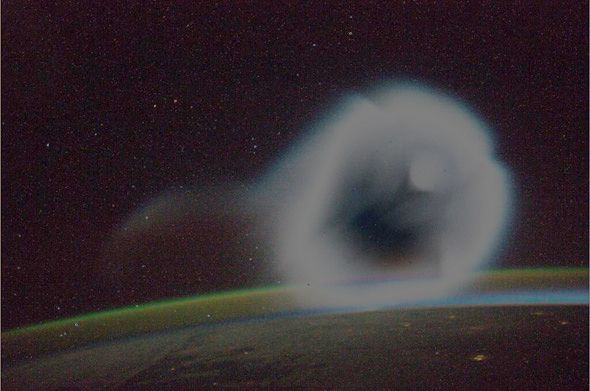
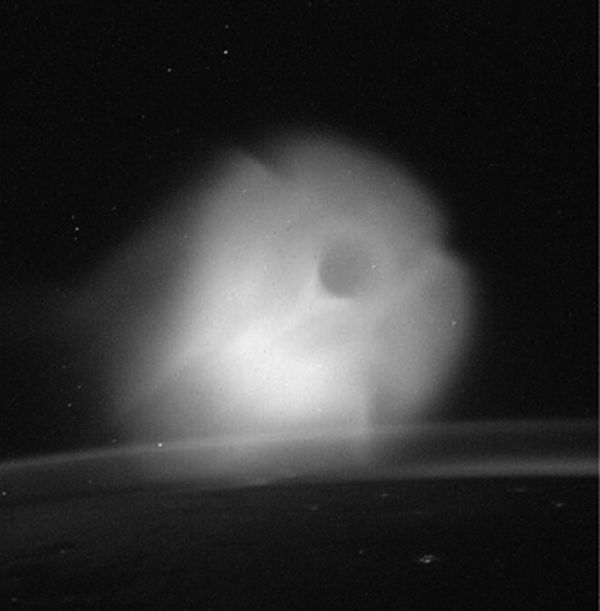
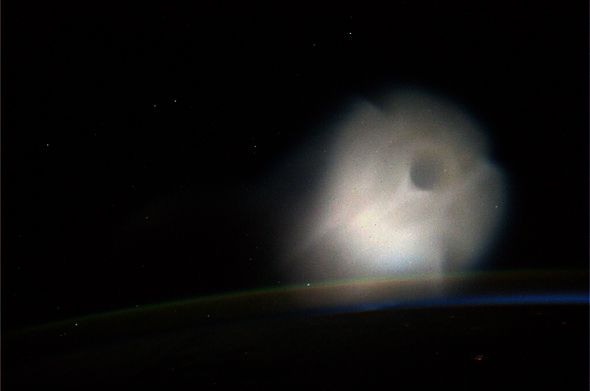
On Thursday, American astronaut Mike Hopkins tweeted that he saw something weird in the sky and posted a somewhat shaky image of it.* A few hours later Italian astronaut Luca Parmitano posted a sharper shot, the one shown above. The cloud of light is obvious; you can see the curve of the Earth below, a few stars in the sky, and the thin green line caused by airglow, a chemical process that causes air molecules to glow faintly at night.
I knew right away this phenomenon was from a rocket, possibly a fuel dump from a second stage, and went online for info. At first, I found no mention of a rocket launch at that time.
However, Edit Koczó on Twitter (UPDATE: She got her info via ISS101) posted a link to an article from the Russian Strategic Nuclear Forces website, a site that gives the public and politicians information on Russian weapons information. The article claimed a Topol missile had been launched at 13:39 UTC. Russia Today also has an article about it.
This matches. The missile has three stages (like the old Saturn V rockets that took humans to the Moon), and what the astronauts saw may have been a fuel dump from the second stage or the last of the fuel leaking away after the booster phase was complete. In space, the cloud would expand more or less freely, moving rapidly as it traveled along with the booster in its path. In the photo, you can see a slight streaking to the cloud, most likely due to motion. [UPDATE: Matthew Greene on Twitter told me the Topol missile uses solid fuel as propellent (he is correct), so it cannot have been a dump that the astronauts saw. I'm not sure now what caused the cloud, but it's clearly associated with the missile itself. I'll continue to investigate.]
To clinch this, Parmitano also tweeted a picture of the launch itself, or at least the vapor trail from the missile as it went up:


 Re: What Can Be Told - by Gordon Duff, VT


 Reply With Quote




Bookmarks