


 JAXA ~ major breakthrough in wireless power transmission ~ Japan SOLAR
Wonderful news (well, hopefully!) about breakthroughs in harnessing the abundant solar energy passing close by our planet
This should render obsolete, with luck, some of the movements backing nuclear power and particle physics as the "sole hope" of free energy's future.
Personally, I believe that there are countless ways to harness solar energy and also less conventional forms of energy, such as geothermal -- cheap and relatively clean energy sources.
Last year we heard a lot about companies who are looking to build "solar towers/solar arrays" in desert regions such as Arizona -- but now it seems that JAXA has possibly found an amazing workaround that will leave old-school scientists behind and scratching their heads.
http://www.engadget.com/2015/03/12/s...=rss_truncated
Scientists make strides in beaming solar power from space
blogger-avatarby Andrew Tarantola | @terrortola | 2 hrs ago
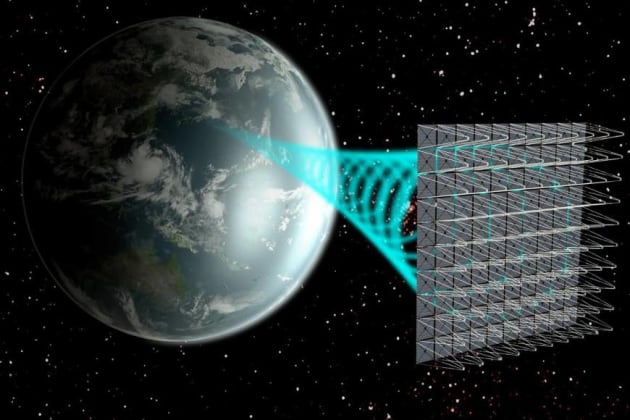
The idea of powering humanity by gathering an endless supply of solar energy from space has taken a huge step towards becoming a reality. Scientists working for JAXA, Japan's space administration, have announced a major breakthrough in wireless power transmission ... in that they've actually been able to do it with a high degree of accuracy for once. The team reportedly beamed 1.8 kilowatts, enough juice to power an electric tea kettle, more than 50 meters to a small receiver without any wires. Up next: scaling the technology for use in tomorrow's orbital solar farms.
The researchers were able to do so by first converting the electrical signal to microwaves, then beaming them to a remote receiver, and finally converting them back into electrons. This successful experiment is the first time scientists have been able to move electrons over any appreciable distance with such a high degree of accuracy, one JAXA researcher explained to the AFP.
JAXA has been diligently working on this technology for years as part of the agency's SSPS (Space Solar Power Systems) effort. The program aims to harness the constant supply of solar energy directly from space using orbital solar farms, then beaming it back to Earth (and into a global grid) via microwave transmission. What's more, these orbital arrays would never have to deal with obscuring cloud cover or darkened nights as their terrestrial counterparts do.
Of course, the SSPS is still far closer to science fiction than science fact but JAXA's latest success clears one of the biggest and most fundamental hurdles facing the program: delivering power from space without having to run an extension cord out to Low Earth Orbit.
[Image Credit: JAXA]
SOURCE: PhysOrg
¤=[Post Update]=¤
More info on solar farms:
http://en.wikipedia.org/wiki/Photovoltaic_power_station
A photovoltaic power station, also known as a solar park, is a large-scale photovoltaic system (PV system) designed for the supply of merchant power into the electricity grid. They are differentiated from most building-mounted and other decentralised solar power applications because they supply power at the utility level, rather than to a local user or users. They are sometimes also referred to as solar farms or solar ranches, especially when sited in agricultural areas. The generic expression utility-scale solar is sometimes used to describe this type of project.
The power conversion source is via photovoltaic modules that convert light directly to electricity. However, this differs from, and should not be confused with concentrated solar power, the other large-scale solar generation technology, which uses heat to drive a variety of conventional generator systems. Both approaches have their own advantages and disadvantages, but to date, for a variety of reasons, photovoltaic technology has seen much wider use in the field. As of 2013, PV systems outnumber concentrators by about 40 to 1.
In most countries, the nameplate capacity of a photovoltaic power stations is rated in megawatt-peak (MWp, sometimes MWDC) and refers to the solar array's DC power output. However, Spain, Japan and some parts of the United States use the already converted and slightly lower AC output (MWAC). A third and less common rating is the mega volt-amperes (MVA). Most solar parks are developed at a scale of at least 1 MWp. As of 2015, the world's largest operating photovoltaic power stations have capacities of 550 megawatts and projects up to 1,000 MW are planned. About 21,000 MW or 15 percent of worldwide deployed PV capacity consists of solar farms larger than 4 MW.
Most of the existing large-scale photovoltaic power stations are owned and operated by independent power producers, but the involvement of community- and utility-owned projects is increasing. To date, almost all have been supported at least in part by regulatory incentives such as feed-in tariffs or tax credits, but as levelized costs have fallen significantly in the last decade and grid parity has been reached in an increasing number of markets, it may not be long before external incentives cease to exist.
¤=[Post Update]=¤
http://www.extremetech.com/extreme/1...-farm-in-space
Japan’s 25-year plan to put a gigawatt solar power farm in space
By Graham Templeton on April 28, 2014 at 7:25 amComment
Scientists from the Japan Aerospace Exploration Agency (JAXA) have planned a series of pilot projects which, if successful, should culminate in a 1-gigawatt space-based solar power generator within just 25 years. Its energy output would be on par with some of the largest modern conventional power plants, thanks to fact that it’s above the atmosphere, which reflects or absorbs most solar energy that falls on Earth. Collecting solar power above the atmosphere means you could have access to almost 150% of surface amounts — and if we can find a way of beaming that power back down to Earth, our reliance on every other form of energy would vanish overnight.
Here at ExtremeTech, we publish a fair number of articles about improvements to solar power. That makes sense since, until fusion power comes of age, solar will remain the only green technology that could even theoretically provide for our global power demands. The sun blasts our planet with so much power that the world’s deserts absorb more energy in a single day than the human race uses in a year. Yes, Earth’s surface is a phenomenal place to collect solar energy — but astronomers know about somewhere even better.
A greatly simplified diagram of the multi-point coordination required by wireless power transfer from space.
Space solar power arrays have many advantages, such as avoiding most forms of wear, the entirety of our ground-based day/night cycle, and all occluding weather formations. JAXA’s main proposed design incorporates two enormous mirrors, articulated to dynamically bounce sunlight onto the solar panels 24 hours per day. Taking this into account, some optimistic estimates say that a well-designed space array could bring in more than 40 times the energy of a conventional one. (Read: The hunt for alien, star-encompassing Dyson Spheres begins.)
The biggest and most obvious difficulty with collecting power in space is that, once collected, all that precious energy is still in space. Though we would certainly be able to collect more power above the atmosphere than below it, that fact becomes rather meaningless if the gain is immediately lost to inefficiency during transmission back to Earth. For some time, lasers were assumed to be the best solution, owing mostly to their ease in aiming; even with a receiving dish several kilometers across, it will take extreme coordination to maintain a precise, unbroken connection between one object in orbit and another on the ground.
For all their potential though, lasers seem to be a research dead-end due to the much-dreaded “bloom” effect when travelling through air, which causes them to quickly lose focus. By contrast, a pioneering study from 2008 made the case for microwaves as a possible solution. This experiment transmitted 20 watts of power between Maui and the island of Hawaii, more than 150 kilometers (93 miles) away. Though only about a microwatt was collected at the receiver, the study was seen as a major success. The team believes that the concept is feasible for space, since an orbiting projector would only need to transmit its power through roughly 2 kilometers of the densest air, not 150. The biggest downside of microwaves is that they are generally feared by the public, but that’s offset by research showing that even multiple generations of microwave-blasted animals show zero negative health effects.
The International Academy of Astronautics thinks we could collect up to 43 times as much solar energy in space.
As is the case with so many scientific proposals, such as the space-elevator-by-2035 proposal that we covered recently, this study assumes certain advances over the next 20 years or so, from light-weight materials to increased solar efficiency. By far the biggest challenge though, or the one that looks to be giving the least ground to researchers, is power transmission — so that’s where JAXA is focusing. With an estimated final mass of 10,000 tonnes, a gigawatt space solar array will require significant work from other scientists to improve things like the cost-per-kilogram of launch to orbit (where, funnily enough, a space elevator would really help matters). Still, the trends are encouraging, and few of their estimates for research timelines seem all that pie-eyed or optimistic.
The International Academy of Astronautics (IAA) recently published an enormous study in support of space solar power. That study names JAXA as the most likely source of early space-based power projects, though like the Japanese agency it notes that a larger-scale project would require international cooperation. Much like the Large Hadron Collider before it, a gigawatt space-based generator would have to be a global project — though unlike the supercollider, its output would have far less global value. Unless the first launch significantly reduces the cost of a second, it’s questionable whether, for instance, Germany will see value in spending tens of millions to help power Japan.
JAXA has long been the world’s biggest booster of space-based solar power technology, making significant investments in research and rallying international support for early test projects. This makes sense when you consider that Japan packs over a third of the US population onto an island the size of Montana — even before the Fukushima disaster, Japan knew it needed to look at alternative sources of electricity or be doomed to stagnation. With few easily exploited natural resources, the country was forced to look skywards for their answer. As little as a decade from now, we may very well find ourselves doing the same — after all, as our editor Sebastian Anthony likes to regularly remind us, we are all slaves of electricity.
¤=[Post Update]=¤
Of course the mandatory CERN naysaying at the bottom of the older articles...
"not worth the money" my ass...
¤=[Post Update]=¤
Cern's budget measured in units of a million francs:
http://press.web.cern.ch/facts-and-f...udget-overview
when CERN measures their budget in terms of 1100 million CHF that's roughly 1100 million dollars per year,
that's $1 billion $100 million reported expenditure per year
for a piece of crap.
- Home
- Forum
- Chat
- Donate
-
Site Links

-
Avalon Library
-
External Sites
- Solari Report | Catherine Austin Fitts
- The Wall Will Fall | Vanessa Beeley
- Unsafe Space | Keri Smith
- Giza Death Star | Joseph P. Farrell
- The Last American Vagabond
- Caitlin Johnstone
- John Pilger
- Voltaire Network
- Suspicious Observers
- Peak Prosperity | Chris Martenson
- Dark Journalist
- The Black Vault
- Global Research | Michael Chossudovsky
- Corbett Report
- Infowars
- Natural News
- Ice Age Farmer
- Dr. Joseph Mercola
- Childrens Health Defense
- Geoengineering Watch | Dane Wigington
- Truthstream Media
- Unlimited Hangout | Whitney Webb
- Wikileaks index
- Vaccine Impact
- Eva Bartlett (In Gaza blog)
- Scott Ritter
- Redacted (Natalie & Clayton Morris)
- Judging Freedom (Andrew Napolitano)
- Alexander Mercouris
- The Duran
- Simplicius The Thinker




 Reply With Quote


Bookmarks