+ Reply to Thread
Results 1 to 6 of 6

Thread: Multi-Wavelength Laser

  1. Link to Post #1
    France Honored, Retired Member. Hervé passed on 13 November 2024.
    Join Date
    7th March 2011
    Location
    Brittany
    Posts
    16,763
    Thanks
    60,315
    Thanked 96,071 times in 15,483 posts

    Default Multi-Wavelength Laser

    'No tissue charring': New Russian laser could revolutionize medicine, smartphones

    Published time: May 14, 2015 11:30
    Edited time: May 14, 2015 12:21


    Reuters / Brian Snyder

    Scientists at a Russian university have developed a unique metal-vapor laser, which can cut through bones, tissue or glass without burning or damaging them. They say the technology could be used in a wide range of fields – from medicine to smartphones.

    Researchers at Tomsk State University are excited by the new laser because it is multi-functional and has the potential to be used in a number of different spheres. For example the ability to cut bone and tissue with no side effects could prove revolutionary for the medical industry.

    The new device developed by the scientists is a strontium vapor laser and has the ability to operate at 10 to 12 different wavelengths, which researchers say is “exceptional” for vapor lasers, as it gives them so much versatility.

    “There is no such laser anywhere else in the world, and there is a lot of interest in it,” said 73-year-old Professor Anatoly Soldatov, who is dean of the Innovative Technology Department, told the Siberian Times. He added that its optimum wavelength was 6.45 microns.

    Technology giant Samsung has already shown interest in the revolutionary lasers. The company’s electronics’ department had sent the scientists some glass samples to test with the strontium vapor laser and the results proved to be an eye-opener.
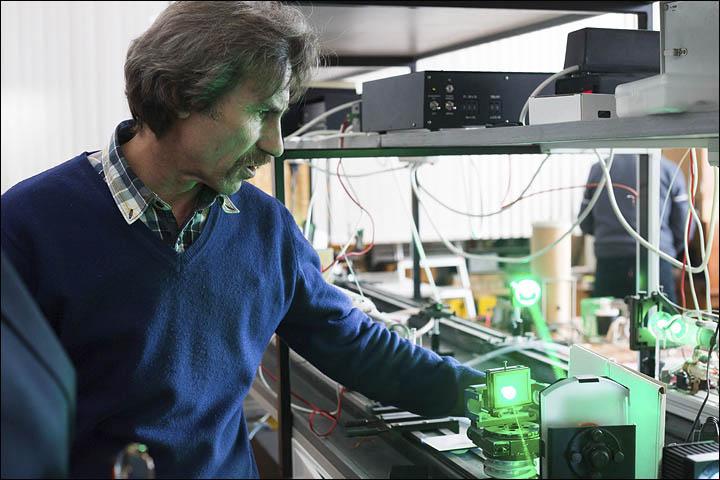

    Tomsk scientists created world's first multi-use metal-vapour laser

    Industrial devices normally used to cut glass for smartphones and tablets normally use carbon dioxide lasers at a wavelength of 10.6 microns. This laser does not actually cut through the glass, rather it heats it up. However, this process means that between 20 percent and 30 percent of the glass cut has to be thrown away because of defects such as chipping.

    “We have a multi-wave system that combines both surface and in-depth thermal detachment which results into a perfect surface. A study with an electronic microscope showed that the number of imperfections [when cutting glass with a strontium laser] is one-hundredth the size compared to cutting with carbon dioxide laser,” Soldatov told the newspaper.

    The scientists are now looking to perfect their technology in order to cut live tissue. They are also working to shorten the pulse duration to just a few nanoseconds, which will increase the energy density and thus its power.

    The development of lasers in Tomsk dates back over half a century, with the first one launched in 1963. Over the last few decades the university has produced a number of different lasers, including helium-neon, argon, carbon dioxide and nitrogen.

    Soldatov added that after the millennium, Vanderbilt University in the US became interested in researching a free-electron laser. They were trying to find a perfect wavelength for drilling through bone and the cutting soft tissues, due to its potential importance for research into transplants.

    “The first thing they determined was the best wavelength is 6.45 microns. At this wavelength it was possible to make good incisions and you can choose the mode in which the tissue charring practically does not occur,” he said. However, they were still looking for the best laser to carry out this task.

    They eventually got in contact with Tomsk State after coming across an old publication from 1983. Following some more tests, Soldatov realized that the strontium vapor laser was the most suitable, due to its ability not to induce any burning or damage while operational.

    source: http://siberiantimes.com/science/cas...mobile-phones/

    Read more:
    Russian scientists create ‘bio-cement’ for human bones

    ==============================================================

    Getting a lot closer to those Star Trek adjustable "Phasers"
    Last edited by Hervé; 14th May 2015 at 13:44.

  2. The Following 18 Users Say Thank You to Hervé For This Post:

    avid (19th May 2015), ceetee9 (14th May 2015), conk (14th May 2015), Daughter of Time (14th May 2015), Elisheva (15th May 2015), Flash (14th May 2015), fourty-two (21st May 2015), justntime2learn (14th May 2015), Magnus (14th May 2015), meeradas (15th May 2015), seko (15th May 2015), Sierra (14th May 2015), Snoweagle (14th May 2015), Star Tsar (19th May 2015), Tesseract (15th May 2015), toppy (15th May 2015), yelik (14th May 2015)

  3. Link to Post #2
    Avalon Member
    Join Date
    18th April 2015
    Posts
    106
    Thanks
    131
    Thanked 287 times in 89 posts

    Default Re: Multi-Wavelength Laser

    Hi,

    help me with my lack of knowledge in this field.

    I thought that lasers heat up matter to a melting point in a focused beam?

    Are they now proclaiming they can 'wobble molecules apart' to achieve a 'cut'?

    regards

  4. The Following User Says Thank You to looking-glass For This Post:

    avid (19th May 2015)

  5. Link to Post #3
    France Honored, Retired Member. Hervé passed on 13 November 2024.
    Join Date
    7th March 2011
    Location
    Brittany
    Posts
    16,763
    Thanks
    60,315
    Thanked 96,071 times in 15,483 posts

    Default Re: Multi-Wavelength Laser

    Quote Posted by looking-glass (here)
    Hi,

    help me with my lack of knowledge in this field.
    [...]
    regards
    Well, like the rest of us, your favorite search engine and encyclopedia might prove to be your best bet for increasing your knowledge in that field

  6. The Following User Says Thank You to Hervé For This Post:

    avid (19th May 2015)

  7. Link to Post #4
    Avalon Member
    Join Date
    18th April 2015
    Posts
    106
    Thanks
    131
    Thanked 287 times in 89 posts

    Default Re: Multi-Wavelength Laser

    Quote Posted by Hervé (here)
    Quote Posted by looking-glass (here)
    Hi,

    help me with my lack of knowledge in this field.
    [...]
    regards
    Well, like the rest of us, your favorite search engine and encyclopedia might prove to be your best bet for increasing your knowledge in that field
    Hi Herve,

    alas, my scientific knowledge in certain fields is lacking and I don't always know what quick key phrases to use to get a quick result like I do in my field of expertise.

    So, I get lazy in areas of expertise that I don't know and (maybe misguidedly) like to ask the advice of others to get a qucker response/ opinion. I then investigate their opinion.

    It's a from of love and trust in a way.

    Regards

  8. The Following User Says Thank You to looking-glass For This Post:

    Hervé (21st May 2015)

  9. Link to Post #5
    France Honored, Retired Member. Hervé passed on 13 November 2024.
    Join Date
    7th March 2011
    Location
    Brittany
    Posts
    16,763
    Thanks
    60,315
    Thanked 96,071 times in 15,483 posts

    Default Re: Multi-Wavelength Laser

    Quote Posted by looking-glass (here)
    [...]

    Are they now proclaiming they can 'wobble molecules apart' to achieve a 'cut'?

    regards
    Hello looking-glass,

    the answer is in your question... which means you ask "good" questions

    Heat, in an object, is the result of the degree of atomic "agitation" whether it be cauterization of retina blood vessels or heating one's cup of coffee/tea in a microwave. The thing is to find/generate the appropriate radiation wavelength to produce the intended result on the desired material as well as whether to obtain an in depth or just a surface result. Hence a multi-wavelength laser beam allows for all the above

    I do not know the exact mechanism, all I know, from the article, is that they achieved that result of clean-cutting bones without turning the surrounding into cinders

  10. Link to Post #6
    Avalon Member
    Join Date
    18th April 2015
    Posts
    106
    Thanks
    131
    Thanked 287 times in 89 posts

    Default Re: Multi-Wavelength Laser

    Quote Posted by Hervé (here)
    Quote Posted by looking-glass (here)
    [...]

    Are they now proclaiming they can 'wobble molecules apart' to achieve a 'cut'?

    regards

    Hello looking-glass,

    the answer is in your question... which means you ask "good" questions

    Heat, in an object, is the result of the degree of atomic "agitation" whether it be cauterization of retina blood vessels or heating one's cup of coffee/tea in a microwave. The thing is to find/generate the appropriate radiation wavelength to produce the intended result on the desired material as well as whether to obtain an in depth or just a surface result. Hence a multi-wavelength laser beam allows for all the above

    I do not know the exact mechanism, all I know, from the article, is that they achieved that result of clean-cutting bones without turning the surrounding into cinders


    Hi Herve,

    I aways thought as a child that if atoms / matter wobbles, then time is just movement, so if all atoms stopped 'wobbling', we could 'freeze time' .

    So as a child, time is only movement, if all atoms stopped 'wobbling' i.e reduced to zero Kelvin 'or below' then there would be no 'motion' in the 'universe' and therefore no time.

    Brain freeze was a certain synchronity 'kitty youtube'

+ Reply to Thread

Posting Permissions

  • You may not post new threads
  • You may not post replies
  • You may not post attachments
  • You may not edit your posts