+ Reply to Thread
Page 19 of 26 FirstFirst 1 9 19 26 LastLast
Results 361 to 380 of 504

Thread: The Serpent, the Black Sun, HPB & St. Germain

  1. Link to Post #361
    United States Avalon Member
    Join Date
    1st April 2016
    Posts
    6,506
    Thanks
    33,747
    Thanked 36,931 times in 6,152 posts

    Default Re: The Serpent, the Black Sun, HPB & St. Germain

    Dragon's Tail and Green Tara

    After never paying attention to the "thing" called Nodes of the Moon, a year or so ago we did some study on this and found them to be Dragon's Head and Tail which are essential to Indian mythology. Then we had a super example of the Head at the North American solar eclipse, and now comes an unusually strong, three times a century, intense fanning of the Tail for a Blood Wolf Super Moon eclipse in a few days.

    Before we were working with Manjushri and it is now Tara. This was to take a very pro-Nagarjuna look at it, under the presumption that first of all he was the main author and secondly that his system was disrupted. Thirdly this is the system that is about the awakening mind itself (Profound View of Manjushri). Nagarjuna is explaining this because he is the entity sometimes called One Initiator. That is why we are trying to pick up his method.

    This presumption turns out to be true, and we can show most of the differences. The significance of this is that it gives the material used to create a circle and the Mt. Meru of cosmology. You can actually get more advanced material and try it, but the results will be papery, sort of an elemental imitation. This is the foundation. We'll use a Cinnamasta mantra later as an example. Without the practice, the higher one does not work right. The practice is all the ingredients that could make an advanced one have any value. And so this practice is an explanation from basic Green Tara to Nagarjuna's Vajra Tara. The full set of basics.

    It could be said the Twenty-one Taras serve as a mnemonic for the Taras that one chooses to learn. There isn't exactly a "right or wrong" way--the scripture does not name them--so we are just using it to attempt the same with Nagarjuna and other Sadhanamala forms. However, the verses are not in a good arrangement to see the goddess's evolution. So we are trying to arrange those same articles that blend information with practice in a good order that covers everything that belongs.

    The central theme here is that Nagarjuna's White Tara is Vajra Tara in her minor form. And she simply gets more intense by degrees. While these degrees could be said to be knowledge, it is experience, and certain physiological states or samadhis, of the meditator. So we would just start with the most basic white forms, and then it turns out to be Janguli that looks like the first major inner change as a result of Tara practice.

    As practice, it mainly means things that can be done within Guru Yoga. There are the additional Dharanis and so forth, but we are more or less adding quintessence to Guru Yoga.

    Twenty-something of them are worth learning, but the main group focused here is:

    Prajnaparamita

    Janguli is in Vajra Tara's post because she will be the second degree Vajra Tara.

    Parnasabari through Vasudhara, several posts.

    Sita or White Tara leading to Parasol in the following post.

    Mahasri in several posts.

    The last takes multiple posts which came out backwards so they are linked. This is the scheme to get the set of Five Buddhas, and, it would then increase through the other numbers until doubling to Ten Directions or mature Vajra Tara.


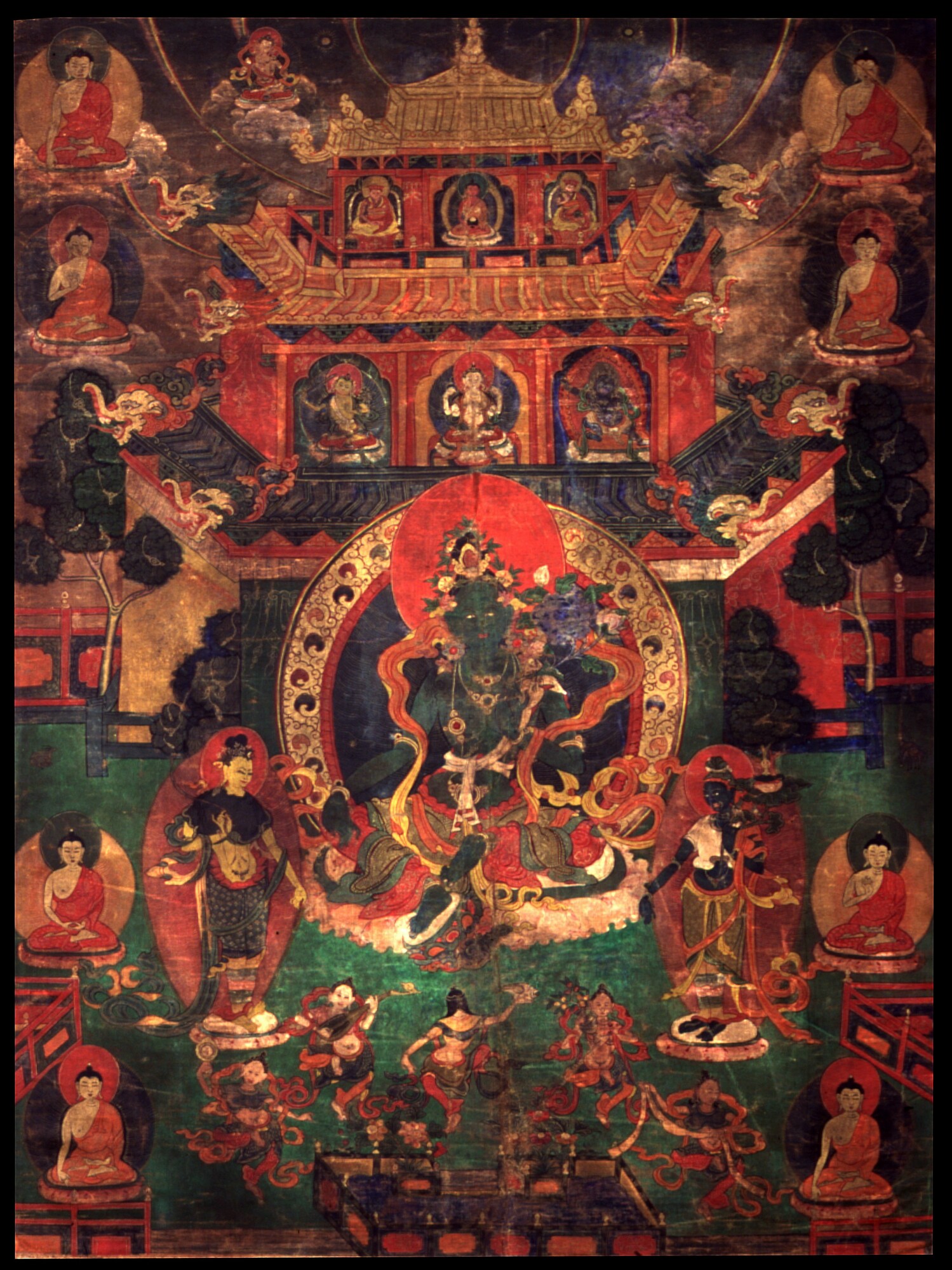
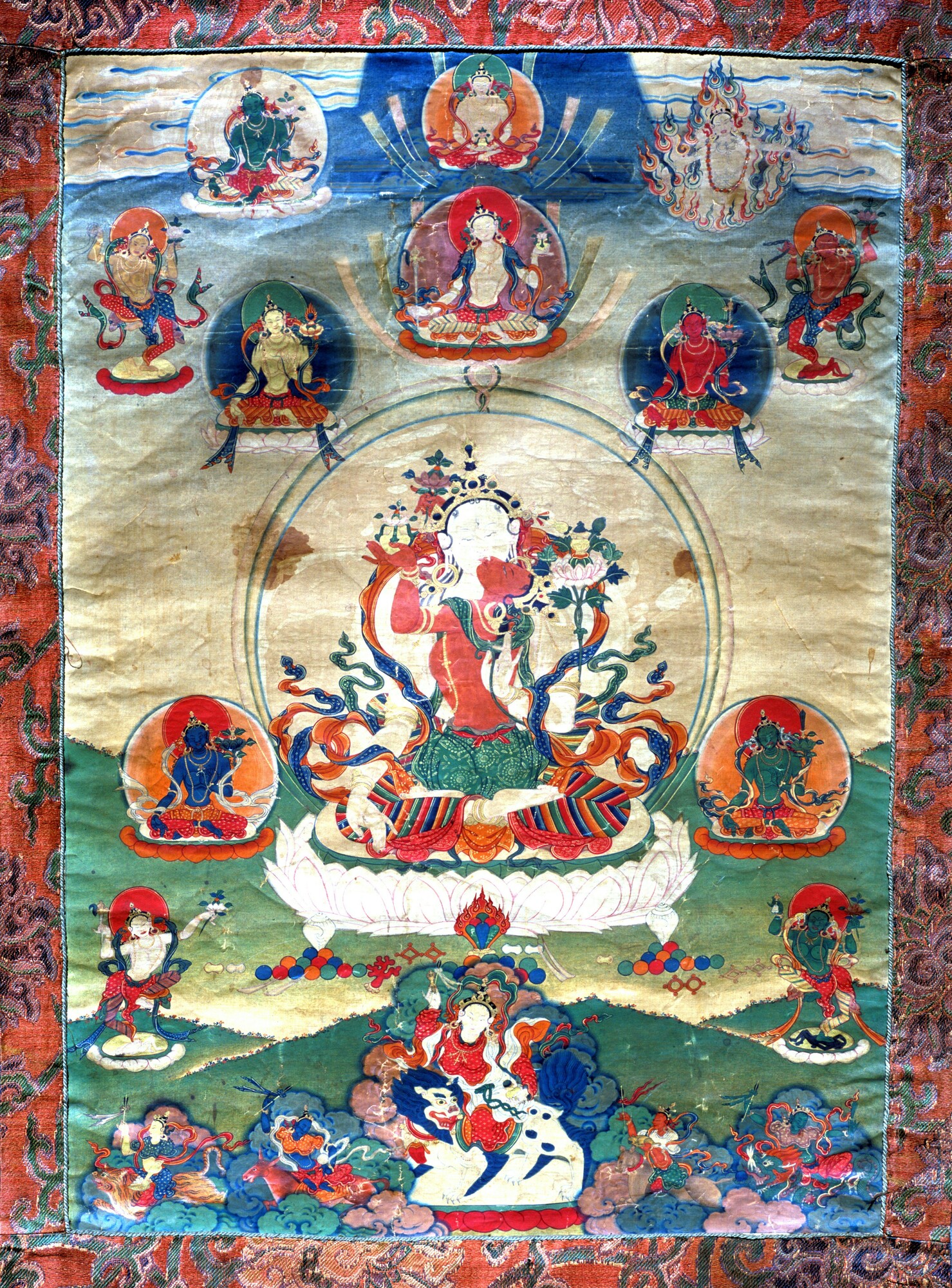
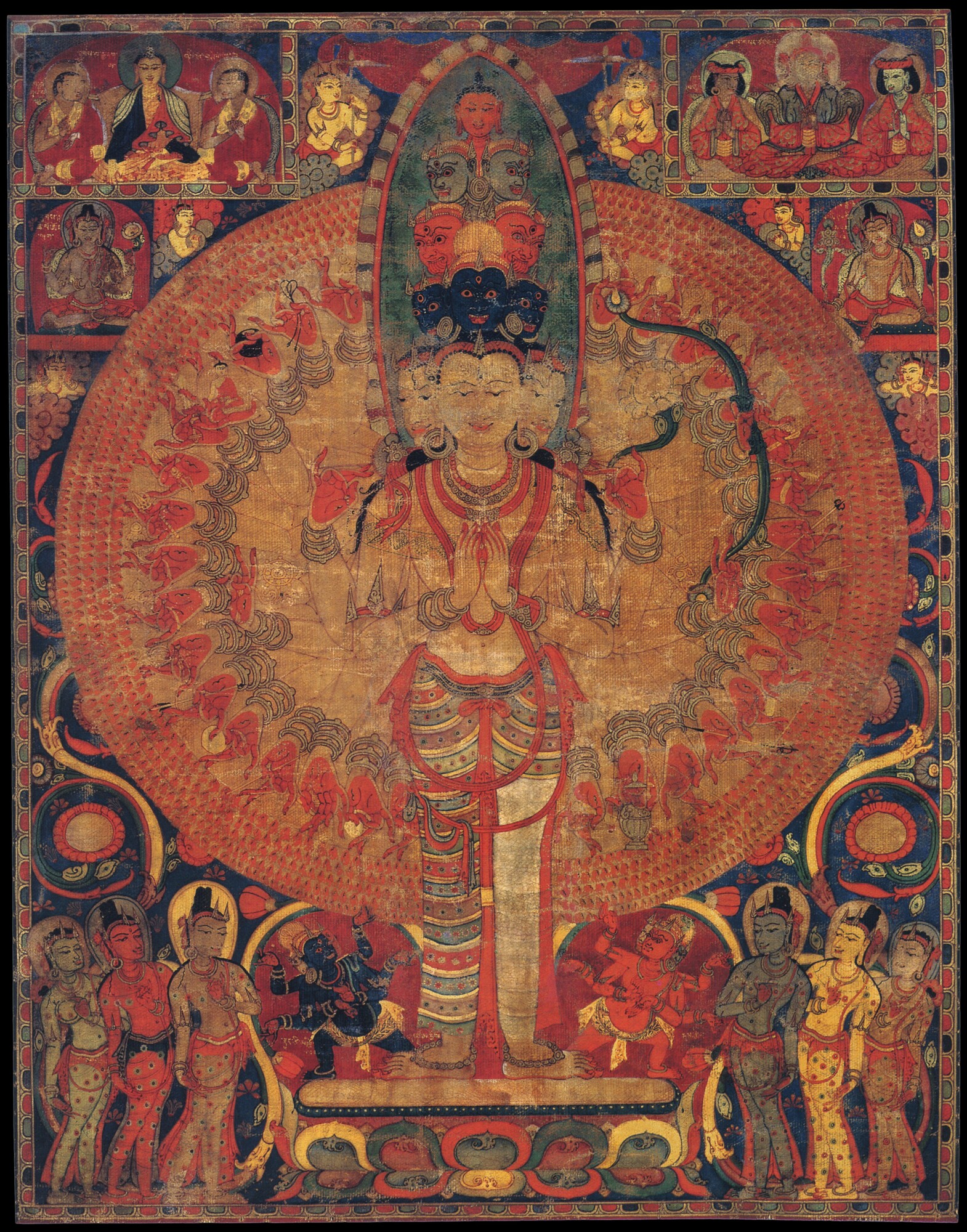
    This first Green Tara is hard to find in Buddhist imagery which is mostly Tibetan in character. They routinely include her companions, Marici and Ekajati, but they are always under Amitabha. According to Nagarjuna in Sadhanamala, Khadira is supposed to have Amoghasiddhi for sire. She is first in almost any classification, and is the first goddess in Sadhanamala. So here is an approximately correct solo image, then some retinue scenes under Amitabha, and then a translation of what Nagarjuna said about his Khadira Tara.

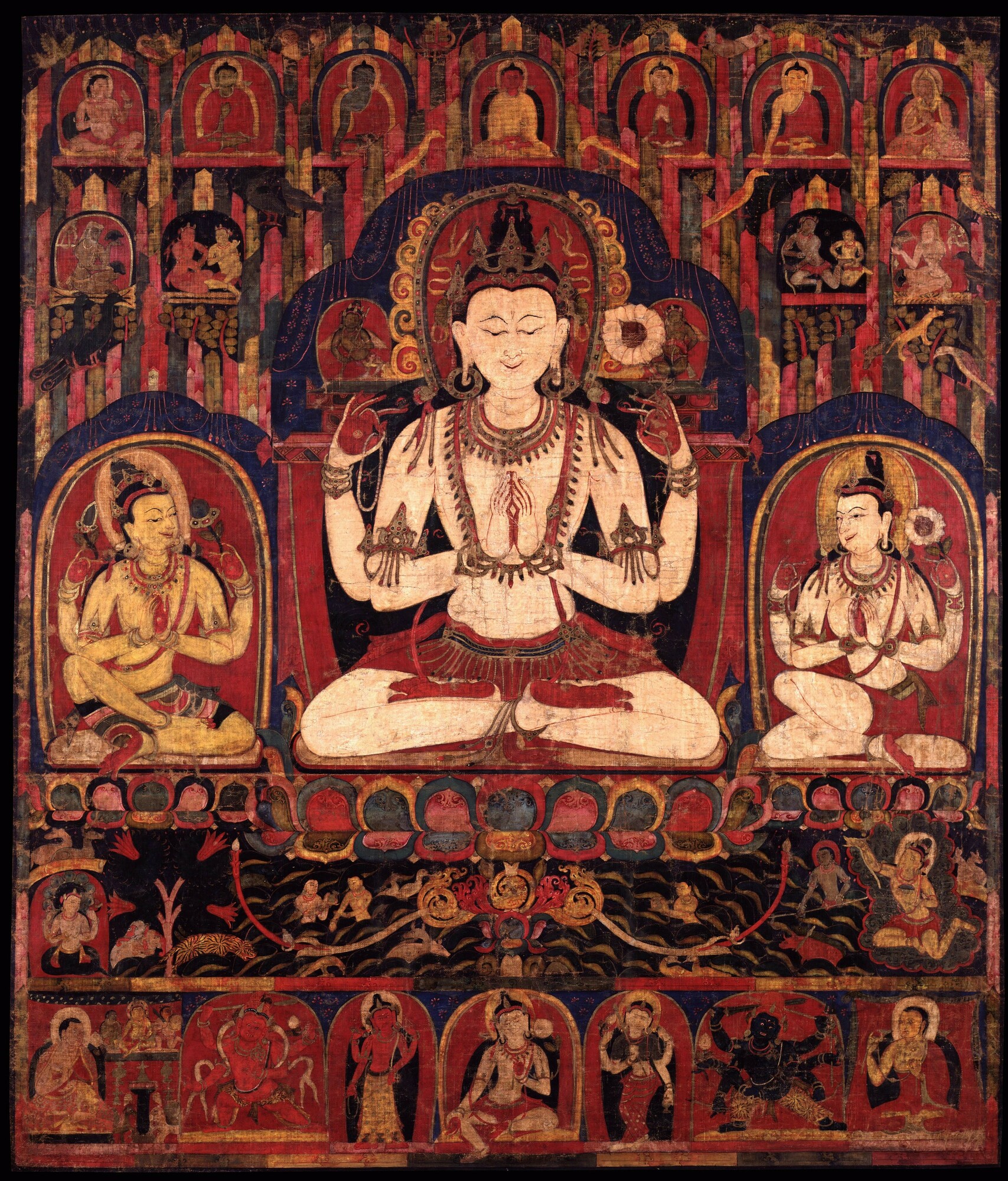
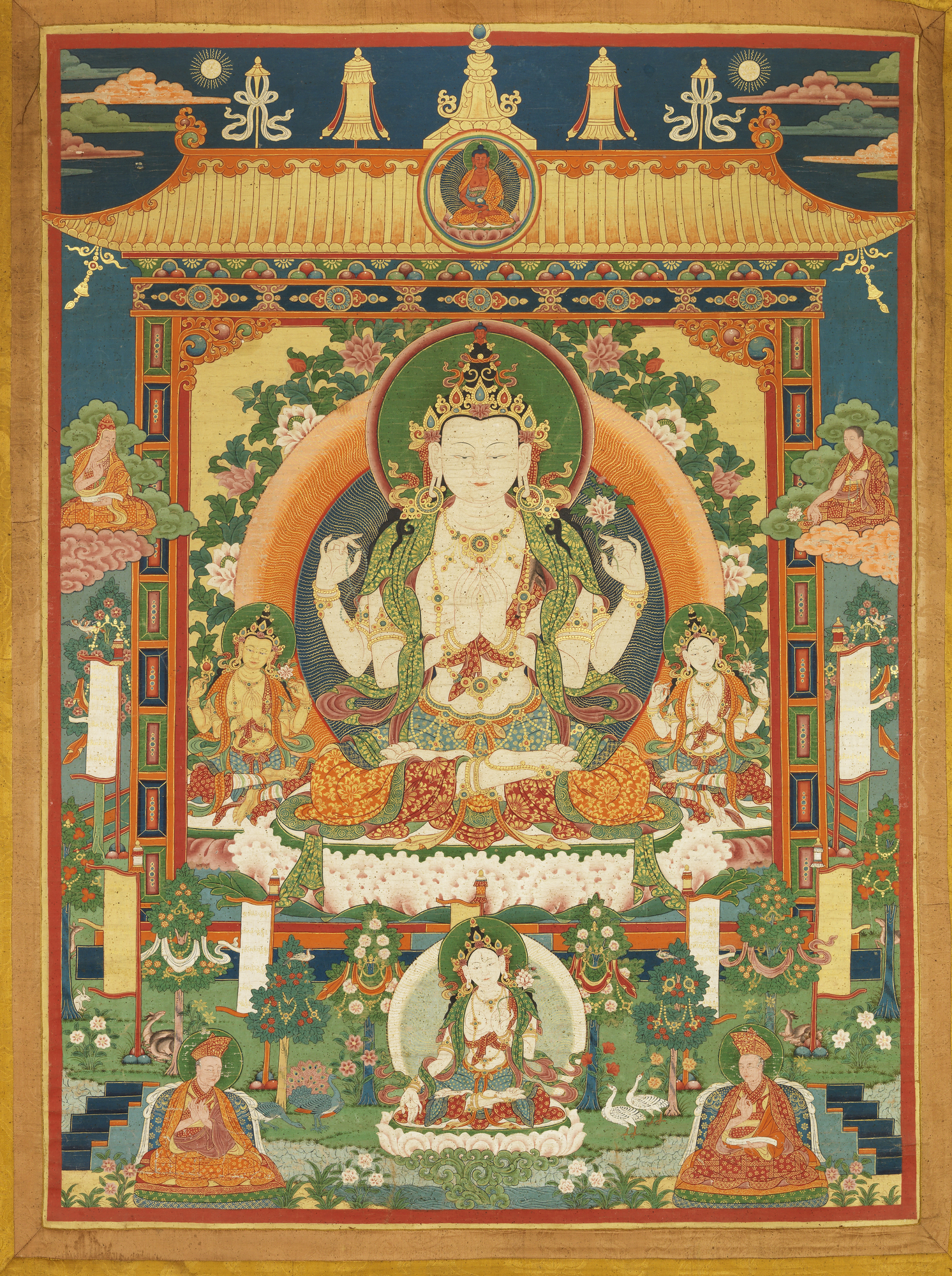
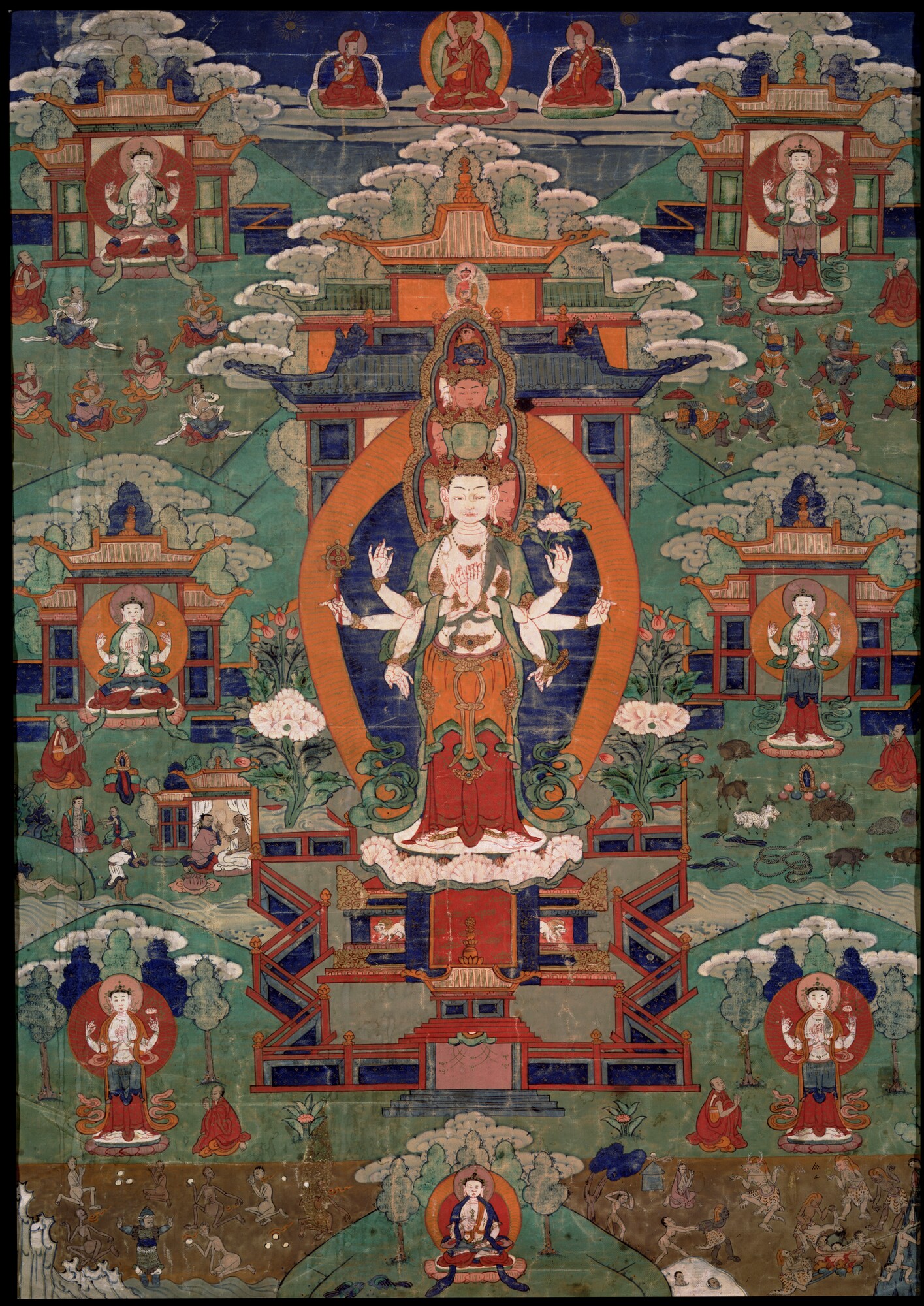
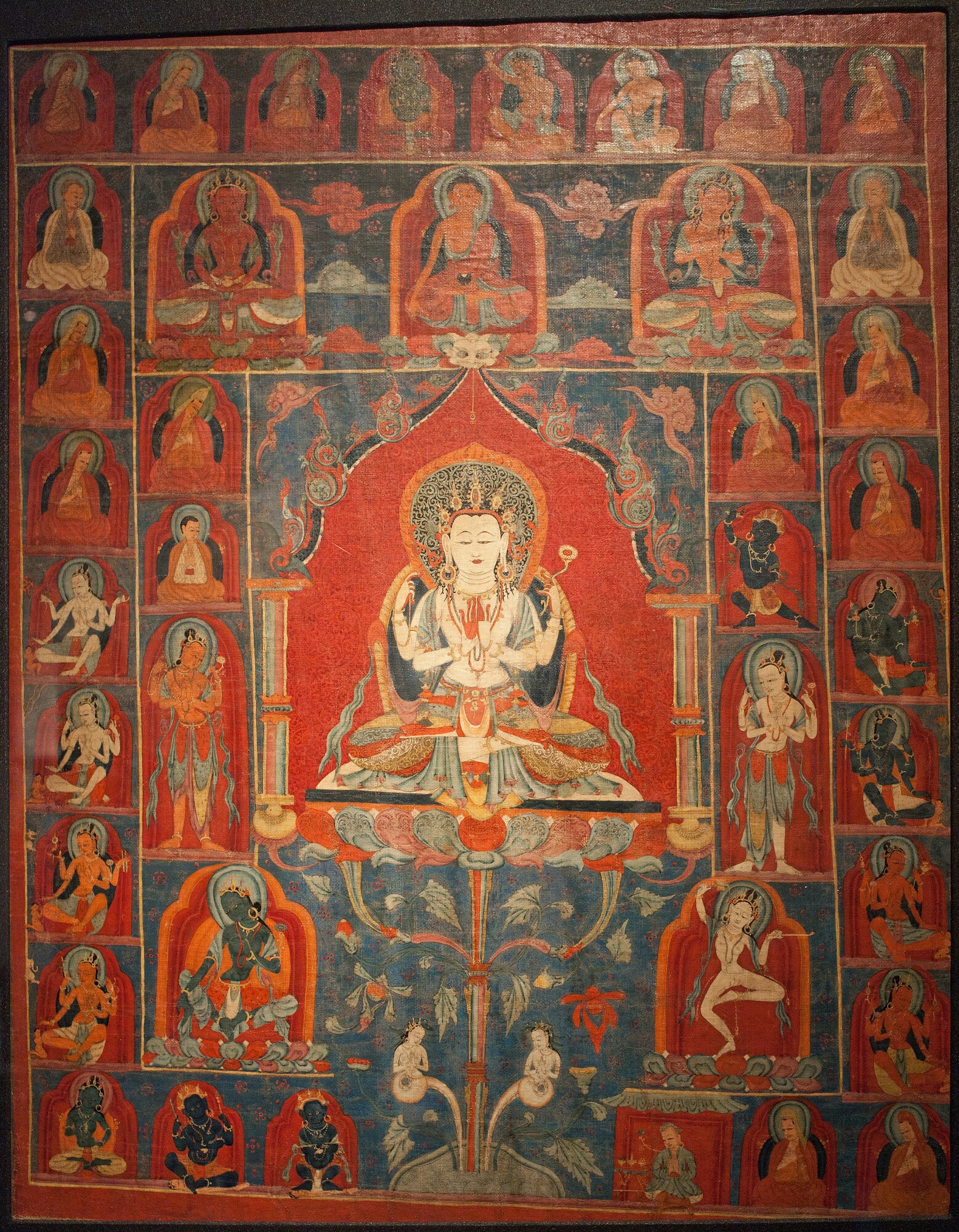
    Cleveland houses one of the oldest surviving images, ca. 1260s Newari style from Tibet. This throne is perhaps topped by a bear. According to Himalayan Art, "Tara is seated in a temple structure with a seven tiered roof. At the top are three stupas. Slightly below the middle stupa, in a small niche, is the Buddha Amoghasiddhi, green in colour, with the right hand in a gesture of blessing at the heart. On the lower left and right of the tiered roof are niches containing three figures each. On the left side is Prajnaparamita and two attendant figures. On the right side is Chaturbhuja Avalokiteshvara and two attendant figures":


    Marici and Ekajata are easy to find, but, they never come with Amoghasiddhi:


    Here is a fuller version, where the lower retinue has the unusual feature of someone's back being turned:


    There are only the two Sanskrit and about four Tibetan sadhanas reliably attributed to Nagarjuna. The first Tara in the book is his. And here is his praise of her:

    Khadiravani-tara-stotra

    By Nagarjuna

    Homage to Arya-Khadiravani-Tara!

    1 Arya-Tara's palace is in the Khadira Forest,
    A grove of glomerous figs, khadiras, jujube
    trees. Banyans, sandal, three thousand fruits, nutmeg
    and cloves, a pleasant leafy place of flowers open and closed.

    2 Among the close-packed trees and fruit, ripe
    and unripe, there sweetly trickles water with the eight
    qualities;* sweet, joyous cries of peacocks, parrots and
    cuckoos resound; tigers and leopards run, stags frolic and bears
    leap.

    3 Jackals sing, monkeys play and antelope calves
    suck; youthful heavenly maidens play music in the
    woods. Bhiksu Nagarjuna acts as a mahasiddha
    In Khadira Wood; to the land Tara comes from,
    homage and praise!

    4 On the flower of an emerald lotus from unborn
    Compassion's lake, and moon, fair woman beautified with the finest
    of jewels. Going with gait like a goose and looking with
    elephant's pride. Tender with a Sugata's Pity, You show forms at
    will.

    5 With golden lotus earrings, and ribbons of
    utpalas, on the jewel crown on Your head sits
    Amoghasiddhi as crest. Hanging strings of fused pearls and coral adorn
    Your neck, Beauty with anklets, bracelets, armlets and silken
    sash!

    6 Compassionate Saviouress from satrtsdral (?)
    Goddess born From the tears of Him with Lotus in Hand, by
    the power of the vow of Amitabha; most loving, striving for others'
    good, Young maiden of the pure supreme place,
    Khadira Forest!

    7 Your lotus face is pleasing, a face like the full
    moon; Your lovely lotus eyes are long, clear white and
    black. Your hair is adorned with golden pores and black
    as bees. And smooth as the lord of mice; Your urna
    curls like a conch.

    8 In Your hands-the two Truths-open utpalas
    dispel delusion's darkness in self and others: at Your heart's budding lotus,
    the utpala Held in Your left [hand] increases
    Wisdom-knowledge; the right
    Opens its blue flower to the bees of migrating
    beings.

    9 To benefit sentient beings, who've fallen into
    samsara in sorrow and lamentation. You rise and leave
    Khadira Forest, O youthful maiden possessing breasts swollen
    with milk, Who by all means stirs and moves [us in] samara
    and Nirvana!

    10 One with bull's eye[lashes], graceful. Whose
    navel bears a lotus, Endowed with the excellent fragrance of
    nutmeg, cloves and magnolia, Hands and feet red like a lotus, unstained by
    faults of samsara, Adorned above and below with divine silks and
    pancalikal

    11 Your Body's non-local, pervading, a Body of
    Deeds of Compassion, A perfect boat for the sea of the Sage's
    Teachings, in essence Seen in the forest, slowly bearing the great load
    of beings. Ferrying them to Peace from samsara' s
    impervious thickets.

    12 Old woman of youthful appearance, following
    all the Buddhas, You the mere recollection of Whose name
    delivers from fears! Unwearied by long in samsara, not resting in
    Nirvana, Compassion of Conquerors' Offspring with
    mastery of the Ten Stages!

    13 Ven'rable One! I cannot describe Your infinite
    virtues. Dharmakaya, free of imag'ning, possessed of
    Gnosis! Unshakeable Body going about in Khadira
    Forest! Forest maid free by nature of samsara! Homage
    and praise!

    14 On right and left come yellow Marici and blue
    Ekajata, Peaceful and fierce; their two hands hold vajra,
    asoka and kartr. Going before and after, with unmatched
    devotion they honour You. Beauty Marici and Ekjata wait on! Homage and
    praise!

    15 Worshipped and followed by parasol-bearers
    and maids, queens of knowledge,
    Who satiate with chowries, cymbals, shawms,
    vinas, songs and dances!
    Fifteen daughters of gods with adornments and
    beautiful dresses in manifold forms hold off'rings: to this display,
    homage and praise!

    16 By the excellent, inexhaustible merits of my
    giving praise to the beautiful, virtuous Forest Goddess and
    Her attendants, May all migrators, their klesha cleansed by the
    water of Mercy, go from samsara 's thicket to the grove of Peace!

    The Praise in sixteen stanzas to the youthful Khadiravani-
    Tara, by Master Arya-Nagarjuna, is complete.

    sarva-mangalam!


    Here is a Hindu example of a Cinnamasta mantra from Elizabeth Bernard:

    Srim Hrim Klim Aim Vajravairocaniye Hum Hum Phat Svaha

    What you can't do is make a few mental associations and get it to do its thing right. So, if you look at how this works, then Prajnaparamita is teaching us Hrim. We make a personal relationship with this, and then we can take it where we need it to go. It's not something that's just there or that just happens incidentally. It only has the power we put into it. So we do it this way first.

    Every syllable in the mantra has a deity:

    Srim Lakshmi
    Hrim Manobhava in the Lajja syllable
    Klim "the goddess who always destroys the five great sins"
    Aim "the goddess who has transcended all distinct powers and bestows liberation and knowledge"
    Va Varuna
    I Indra
    Ra Agni, eater of oblations
    Va Vishnu, lord of earth
    Ai Tripuradevi
    Ra Tripurasundari
    O Trailokyavijaya
    Ca Candra
    Na Ganesh Vinakaya
    I Kamala
    Ya or Ye Sarasvati
    Hum Prakriti
    Phat Vaikhara
    Sva Kamadeva
    Ha Rati

    I'm not sure we do it the same way, it's just for comparison. We have a lot of common ground. The explanation at hand would only do minimal good. So the early mantric exercises from Nagarjuna's method include Hum and Hrim and that post is pretty solid. Everything is out of order so I am trying to make this way of using internal links for the subjects. So far it seems entirely possible to at least partially restore something related to the original systems of Ellora and Ratnagiri.

    ----------------------------------------------

    The Short A Syllable with Manjushri and Hundred Deities of the Bardo

    Going back to Nyingma, which is based more from Guhya Garbha tantra, they have now released a much better explanation in "The Complete Nyingma Tradition". This is a different naming and syllable style, but, they have profound details, especially in the sense of indicating layers of deities, and so the Bodhisattvas etc. have specific physiological and spiritual functions. Deities like Vajrasattva, Heruka, etc., sixth and seventh element, are kernels, in which fivefold form or microcosm or pentagram stands.

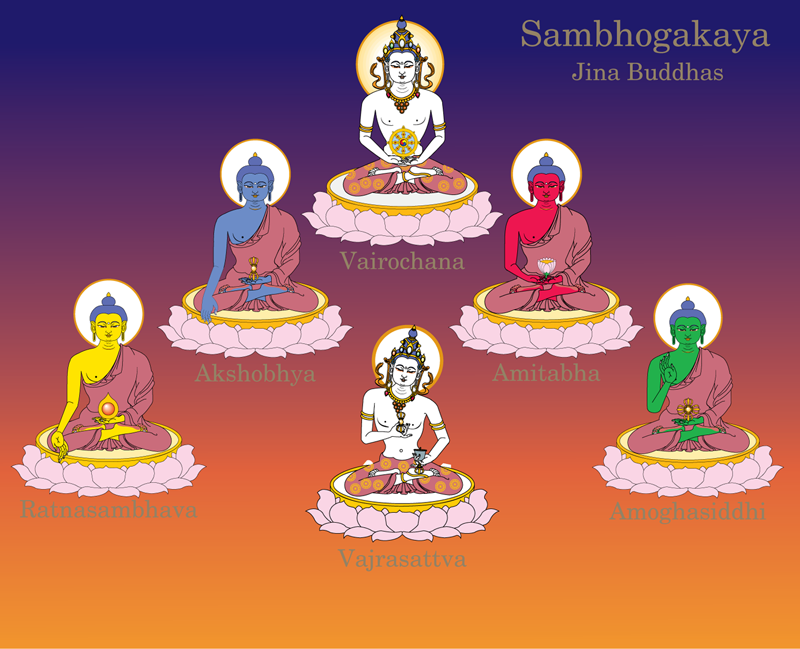
    Its structure is Vairocana = Sight in the center, and Mamaki is in Jewel Family, basic Five Buddha format. It concerns death and the experience of lights, even though it is related to Bardo Thodol or Bardo Hearing.

    In book sixteen, it expresses the dawning of the deities. One of the first and immediate concepts is "incandescence". Post-mortem Deities are made incandescent by Samantabhadri, and this is the same sort of effect meditationally as with Vajra Tara and flames. So we will put this together with the thought that Manjushri "builds" the A syllable.

    According to Nyingma, A is the nature of emptiness and expanse of reality, Samantabhadri [Vajradhatvishvari]; all the other deities and symbols follow, and after the Four Female Gatekeepers finally comes Ksa, the nature of appearances and pristine cognition, Samantabhadra [Vajradhara]. These are the female and male incandescence, A and Ksa.

    They then present unusual, out-of-order syllables for the tiers of deities. The main Family syllables for Buddhas and Prajnas is the same. It is not initials, nor compound syllables, it is the sequence Tha, Ta, Da, Dha, Na. Although Buddhas and Prajnas seem to have identical syllables, the Buddhas are made from the “retroflex set” which places a dot under the consonants; Prajnas are the “dental set” lacking this dot.

    Buddhas and Prajnas.

    Dhyani Buddhas are called "Magical Emanations" because they show a magical aspect of skillful means, according to which the skandhas are pure. Prajnas are called "Net" because they are non-dual awareness revealing the Elements to be pure. Starting with Vairocana, the Dhyanis or Magical Emanations are described as Indestructible, Apparitional, Wish-fulfilling, Pure, and Omnipresent in the Four Times, and are the skillful means which comprehends the real nature of their respective skandhas. Starting with Akashadhatvishvari, the Prajnas or Nets are described as Manifest Perfect Enlightenment, Manifest Stability, Manifest Illuminating Rays, Embracing, and Real Nature Beautiful in All Aspects.


    Four male Bodhisattvas.

    These are called "Buddha mind" because they show the nature of mind is purity. The “velar set” represents Inner Male Bodhisattvas and gatekeeper. Here, one notices that this Vairocana-centered arrangement places sight as the central element. Esoterically, we say this is sound. The equivalent would be to move Akshobya to the middle, as in Kalachakra, which is centered on sound. Actually, they simply aren't using sense of touch. These are groups of four plus a gatekeeper who isn't attributed to a sense.

    Ka is for Ksitigarbha, or Buddha mind of Buddha eye, the purity of visual consciousness. Kha is for Vajrapani (sound), Ga for Akashagarbha (smell), Gha is Avalokiteshvara (taste), and Na is gatekeeper Yamantaka, who comprehends sense consciousness yet is their Destroyer, since he purifies attachment to body, speech, and mind.

    From their incandescence, Yamantaka, who shows that they subdue the obscuration of knowable phenomena


    Four Female Bodhisattva consorts.

    Sku or Buddha body, who show that apparitional objects appearing to the senses are pure. The “palatal set” is Inner Female Bodhisattvas and gatekeeper, indicating sense objects, each being “Buddha body” of the respective senses. Ca is Lasya, purity of visual forms, and so on with Cha is Gita, Ja is Malya, Jha is Narti, Na is gatekeeper Mahabala, wrathful deity of Buddha body, and again a Destroyer, purifying grasping.

    From their incandescence, Mahabala, who shows they subdue afflictive mental states of clinging to sense-objects.


    From the speech of the Five Families come Four Bodhisattvas of Buddha speech arise. Outer male Bodhisattvas are simply called the sense organs and Buddha speech. They have the “labial set” starting with Pa for Maitreya, Buddha speech of Buddha eye, and so on with Pha for Nivaranaviskambin, Ba is Samantabhadra, Bha is Manjushri, and Ma is gatekeeper Hayagriva, Destroyer of egotism.

    Hayagriva arises, who shows they purify all obscurations of speech.


    Four Female Bodhisattvas.

    Indicative of time, who are the apparitional objects perceived by the male bodhisattvas, are revealed, illustrating that Buddha speech exists in all four times. Female Bodhisattvas indicative of time have the “semi-vowel” set. Ya is Dhupa, who is the actual reality that is pure with respect to creation of things in the past, Va is Puspa (abiding—present), Ra is Aloka (destruction—future), La is Gandha, pure with respect to emptiness, occupying the Four Times.

    Four Female Gatekeepers arise, illustrating that the nature of the female bodhisattvas transcends the four extremes [Catuskoti]. These are called chos nyid or "Actual reality" because benefit for living beings is spontaneously accomplished through the Four Activities. Lastly the “spirant set” is the Four Female Gatekeepers, who are pure with respect to the Four Extremes or Catuskoti. Sa is Ankusa who is the purity of eternalism, all things are without inherent existence. The next pronunciation of Sa is for Pasa who is purity devoid of nihilism. The third Sa is Sphota who is purity that all things are devoid of the extremes of eternity and nihilism and are without self. And Ha is Ghanta who is purity that all things are without entity and sign.

    Ksa appears, showing all the former arise from the disposition of Samantabhadra. At the end of the Peaceful Deities, Ksa is Samantabhadra who then is followed by the Sages, Vidyadharas, or Nirmanakaya, in other words the secret assembly of the Throat produced by vajra methods which is non-operational in the ordinary person,


    Sages appear, with the syllable of Amritakundalin. After Ksa, the Sages represent the descending Six Realms, so this is I for Sakra—deva realm, then a similar I is Vemacitra, U is Sakyamuni, a different U is Sthirasimha, E is Jvalamukha, and then Ai is Yama in hell. These syllables release karuna [Avalokiteshvara] or compassion, gateway to the voice of Brahma [Vach Devi].

    Finally Heruka and the syllable Om appear, which is the basis for the Wrathful Deities. The final gatekeeper is O for wrathful Amritakundalin. This destroys conceptual elaborations of body, speech, and mind. Then Aum, destruction of all, releases the Wrathful Deities. Au is the syllable through which the incandescence of the Peaceful Deities manifests as the wrathfuls. It is therefor the destruction of subject—object. Made into chantable form, Aum, it becomes Heruka, endowed with the five pristine cognitions. The wrathfuls' nature is taming, training, disciplining arrogant beings. They are frequently referred to as “ground”. These as well as the sages are spontaneously self-existent in all world systems.

    The wrathfuls are the direct radiation from the peaceful deities of the heart into the head center.

    The cloud mass of letters actually abides primordially as the essential nature of Buddha body and pristine cognition, without conjunction or disjunction.

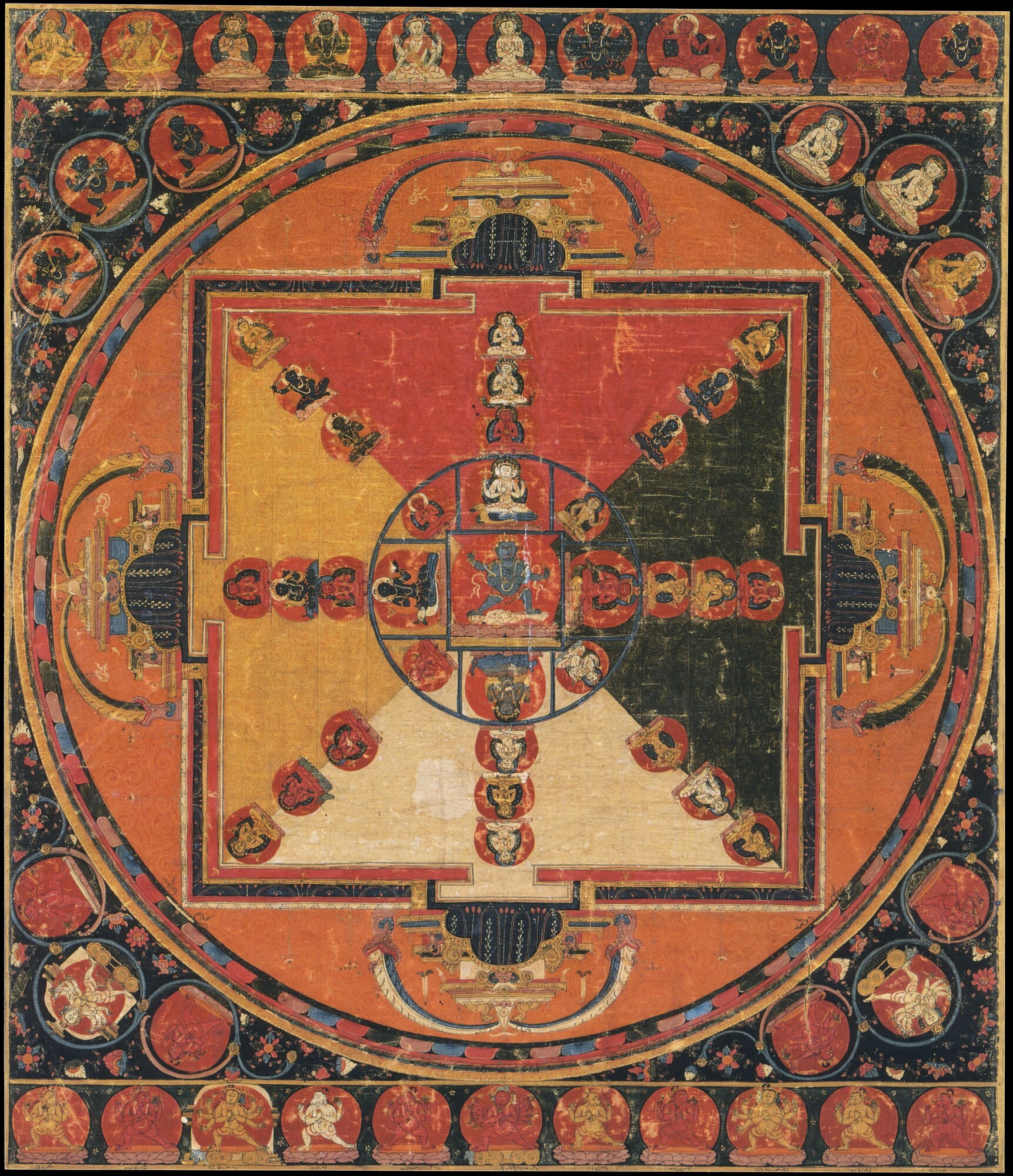
    They must be using a Vairocana-centered mandala. Four Dhyanis in their sub-mandalas have two each male and female bodhisattvas, and then a male and female Wrathful Gatekeeper.

    Akshobya and Locana have Ksitigarbha, Maitreya, Lasya, Dhupa, with the gatekeepers Yamantaka and Ankusa [Hook].

    Ratnasambhava and Mamaki have Avalokiteshvara, Nivaranavisvakambin, Malya, and Puspa, with the gatekeepers Mahabala and Pasa [Noose].

    Amitabha and Pandara have Akashagarbha, Samantabhadra, Gita, and Aloka, with the gatekeepers Hayagriva and Sphota [Chain].

    Amoghasiddhi and Samayatara have Vajrapani, Manjushri, Narti, and Gandha, with the gatekeepers Amritakundalin and Ghanta [Bell].


    ---------------------------------

    Vilasavajra describes Namasangiti practice in the Vajradhatu mandala, which has moon seats that only later become populated by means of the recitation of the Name-mantras presented in Chapter 5, within which Bodhicittavajra apparently replaces Mahāvairocana as the principal divinity. Vilāsavajra clearly describes Bodhicittavajra as occupying the central seat of the Vajradhātumahāmaṇḍala: ‘One should visualise Bodhicittavajra, transformed out of the syllable A, white in colour, possessing the Erotic Sentiment, crowned with the five Buddhas, seated in a state of Diamond-pride, adorned with every ornament, holding a vajra and bell, placed as before, at the centre of the maṇḍala’.

    Verse 14:

    The Buddha, the Dharma and the Saṅgha which are present here, existing within (this pillar of glory), should be seen in this jewel of visible objects as the destroyer of Desire’s malevolence.

    Here ‘the destroyer of Desire’s malevolence’ can be equated with the ‘Destroyer of Suffering’ epithet for the Mantrarāja of the vajrakula and with ‘should be seen’ as well as ‘jewel of visible objects’ also being potential allusions to the Mirror-like Awareness of the ‘great family of the sight of the worlds’ (lokālokakula), as the vajrakula is alternately designated in the NS.

    Verse 2:

    (a) [Pay homage unto Him] the Lord (lokeśa<ṁ> = Bodhicittavajra) who dares to bear on his head even the Lord of the Worlds Amitābha; (b) Pay homage unto Him, the Lord illuminating in all the directions (= Mahāvairocana); and (c) [pay homage unto [Him] the Lord of light (= Vairocana).


    Lokesa, alternately spelled Lokeza or Lokesh is—mercury.

    ‘Bodhicittavajra was... the most important jina, and, as mentioned in the first chapter of the
    Guhyasamāja, all the other jinas were seen to reside in his heart.... [But] Bodhicittavajra was soon supplanted by the figure of Mahāvajradhara, who combined within himself the functions of Ādibuddha as well as the jina at the head of the sixth kula’ (Davidson 1981: 4).

    In Ch. 4 Namasangiti, Adi Buddha is in the heart of Bodhicittavajra, and Mahavairocana is the center of the mandala. Bodhicittavajra is the only Tathāgata mentioned by Vilāsavajra to have the syllable ‘A’ in his heart other than the
    Ādibuddha residing in the heart of Mahāvairocana. Ch. 5 is then "Vajradhatu mandala of Mahavairocana". In the full Vilasavajra sadhana, one self-generates as Mahavairocana, and Bodhicittavajra is separate with the normal Five Buddhas, so this Vajradhatu system already uses seven Tathagatas. Bodhicittavajra is pretty straightforwardly Vajrasattva; Vajradhara is expounding this tantra, so instead of putting himself in it, he could simply be giving Mahavairocana his role; if the names are closely equivalent anyway, then it is about the same. Generally in Guhyasamaja, the designations Bodhicittavajra, Vajrasattva, Mahāvairocana, Mahāvajradhara, and Vajradhara are used interchangeably. In Sarma, there is of course a difference between Vajradhara and Vajrasattva in the same "in the heart of" manner.

    In that case, this mandala itself uses Seven Dhyanis, and the DDV, even if added later, is not another Tathagata, but a really potent degree of Manjushri. The words are tied in knots, but it pretty much is a seventh individual above and beyond the Six Mantra Kings.

    Verse 40 describes the Knowledge-Being Mañjuśrī as ‘the splitter of the great mountain of existence, Mahāvajradhara’. To me, it sounds like moving the gnosis (Manjushri) from the infinite (Vajradhara) to the finite (one's self) over the bridge Vajrasattva.

    Lokeśvara substitutes for Amitābha in the segment of the Guhyasamājatantra that describes Bodhicittavajra generating the quintessence of the ‘family of passion’, e.g. the padmakula, by means of the samādhi ‘vajra birth of the great passion of all the Tathāgatas’. Therein Lokeśvara is also qualified as being the ‘Lord of the great mantra’ (mahāvidyādhipati) ĀROLIK signifying that quintessence. Additionally, the designation ‘Lord of the Worlds’ is closely related to the name given to the
    padmakula in the NS: the ‘worldly and super-worldly family’ (lokalokottarakula).

    The Family mantras, Vajradhrk, etc., are intended as quintessence of the Family.

    Namasangiti lacks Name mantras for the Four Female Gatekeepers. These are included in the Sarvatathagatatattva Sangraha (STTS) Vajradhatu mandala, on which the Namasangiti version is based, but Vilasavajra apparently does not include them in his version of the assembly. He does explain that the tenth degree Bodhisattva Manjushri is not the same as the Jnanasattva Manjushri of Namasangiti, which is non-dual gnosis itself, advayajnanam, the Perfection of Wisdom. The term for “syllable, akshara, is not (a-) perish (ksara), in other words unchanging. The supreme syllable, Paramaksara, the short A, is the nature of every mandala deity arising as a yogin.

    Verse one is a four way praise of Aksara and Jaya.

    jaya lokeśvarasugatapadākṣara jaya bhadreśvarasugatapadākṣara /

    jaya viśveśvarasugatapadākṣara jaya – – śvarasugatapadākṣara// (1)

    According to Go Lotsawa, both Vilasavajra and Manjushrimitra were instructors of Buddhasrijnana, founder of the Jnanapada school. According to the Blue Annals, Vajravali and Abhayakaragupta were in Jnanapada. However that was written by Go Lotsawa and Vilasavajra does not appear.

    In any case, the usage of Manjushri has been clearly stated not to be the Bodhisattva, but to be Swayambhu Adi Buddha or advayajnana or non-dual gnosis itself.
    Last edited by shaberon; 23rd April 2019 at 04:01.

  2. Link to Post #362
    United States Avalon Member
    Join Date
    1st April 2016
    Posts
    6,506
    Thanks
    33,747
    Thanked 36,931 times in 6,152 posts

    Default Re: The Serpent, the Black Sun, HPB & St. Germain

    Valentine's in the Underworld

    I took a short break from working on the textual project from the preceding pages, and wound up with an experience which is along the lines on how this all translates into simple terms or what it can do for me.

    First of all, it's how you fix toxic relationships, women's panic attacks, and unemployment.

    It's just like Avalokiteshvara. You have to go to hell and weep for who you find. Ok, toxic relationship, eight years, unemployment, three years, and whatever's behind panic attacks can make me lie down and starve to death if I let it.

    So, a couple days beforehand, I could sense something unusual was about to happen. A different type of argument, which, if I could, I would always resolve through peaceful means, but, in this case, I needed wrathful deities.

    With all the information available, that sounds like one would begin a ritual, and use the names, procedures, etc., but this is not what I did. I did it because I know what the stuff means from the inside. So I summoned the wrathfuls just by willpower. This placed me in a condition that would almost certainly be defined as psychosis, and had no problem keeping me awake for five days, with about an hour of sleep twice. That was basically my condition when I entered the ring. Virtually no sleep or food during this time.

    I have no experience with panic attacks, other than a general description. Long ago, I was going to help one other woman with her panic attacks, but she's dead, so I can't. And so here was my second chance to try. No practice, no review, wasn't planning on it, I just knew something was coming so I went psychotic to encounter whatever was going to happen.

    And so that was my first experience of a woman's panic attack. You can go out and read the descriptions, and look at all the advice or professional help that's out there, struggle, and then perhaps commit suicide like my first friend. Ok. Not all that helpful.

    When I saw my first one, it's what I would call possession.

    So, this thing I had been stalking for about a week, finally appeared. It tried to use its earthly power in the form of property ownership to banish me. Instead, I banished it. It tried to use all the fury of a woman scorned to threaten me with a gun. I killed it. In two worlds. One living and one dead woman, boom, violently blasted out of hell by the wrathful deities. Now, if I am haunted, it's a happy ghost, which keeps the others away.

    After the kill shot, the former host dropped into a near coma, and that's when the voodoo blues player wrote a song about it, and I just listened and picked it up, and hope to become a strong enough earthly vessel to sing this little tune.

    That's "amusement". Not writing music bit by bit, but, it's just there, from the beyond, and all you do is handle it.

    This basically only worked for a couple of reasons. It was really wrathful, scared the little dog away from me for two days, but now he is fine. I had to do an ultra loud verbally abusive tirade that went on for a pretty good while. Most of what was said would be considered outright rude to say the least. You have to be able to wield this force with no single instant of actual anger, fear, or doubt. If it doesn't work, you're prepared to kneel down in the back yard and be executed. Just the same way as explained in the mental meditations about how important it is not to have discursive thought, etc.

    That's absolute heart centered calm without an ounce of stress beyond the muscular exertion to keep yelling.

    You do it in hell without any regard for "yourself" because there isn't one to worry about.

    And if you succeed, it's only because the other person really does have a soul and really loves you and was possessed and it's gone. You get normal conversations that never came up in eight years that completely reverse your feelings about the situation and the other person. Your sick goat starts eating again and so do you. Jobs come in. Everyone is happy.

    It's shakti or power. One can go back through and find Bagalamukhi and her stambhana or paralysis which can also kill. Obviously that was a possible outcome, no shortage of bullets around here. I didn't do any of her particular exercises or anything like that, but, let's just say that the sleepless days definitely summoned a big Remati/Palden which definitely has the types of junior extensions as described and that Bagala's club is something like an optional accessory to this thing. And that if you flinch for just a second against her presence that you are going to be really screwed up.

    That's why I don't understand the millions of people with these problems and all the things said about it and how they treat it. I didn't know what it was. When I saw it, I destroyed it, just by brushing up on the Four Activities. And then what that means is that what we call the real person in the heart is now operational in more people. This took place in an area where all my clothing or any personal items are banned. Despite that, the former host had selected my image of Sarasvati, which of course isn't a regular image but has been enchanted by me a long time ago. I was just operating my artifact, a false power tried to stop me, but I stopped it instead. And from there, we just go on to a Parnasabari--Broom to purify common areas. Doesn't matter if anyone else knows what all the terms and details mean. I know how it works from the inside. If anyone needs a concept of what a Buddhist does besides happy lotus meditation, this is an example. Or why I personally disregard most other resources and turn to this for guidance.

    When this comes around again, I intend for it to be the resonant effects from what we describe as the bell or fourth activity, which, seems to me, to be healing two humans, an earthwalker, and our pet goat. That's what makes the Broom work. That's when you can meet what we call the Peaceful Deities. So this is now the Path. To me, it just finishes the panic attack lesson I tried to do another way almost twenty years ago. Right before the presence of the same tutelary deity as emphasized in the meditations. I have no other way to describe what I am talking about, and, I haven't really come across anything quite as effective in removing these sorts of problems, and what this does is invoke the final Family that goes with the textual material which comes straight from the underworld shepherd. The first parts are probably down to some fine tuning. The final is the only possible guide I know of because I would strongly discourage anyone from attempting what I did. Someone could get killed, most likely yourself. It will just go to show that Peacefuls and Wrathfuls are a completely real thing and that if you are not in such a drastic situation then the common Pacifying the Mamos is the normal way to prevent it.

  3. The Following User Says Thank You to shaberon For This Post:

    what is a name? (26th February 2019)

  4. Link to Post #363
    United States Avalon Member
    Join Date
    1st April 2016
    Posts
    6,506
    Thanks
    33,747
    Thanked 36,931 times in 6,152 posts

    Default Re: The Serpent, the Black Sun, HPB & St. Germain

    The unseen horizon was when an ordeal seems complete, and then someone else stabs you with a spear and they toss you into a hole. A few days go by until there's an unintended Jesus and Mary Magdalene type of moment. Fairly big things happen aside from this. As recently seen, there was a big Dragon's Tail, and so I am finishing four Jupiter transits and then a whole bunch of stuff is erupting from other people in what astrologers would call the house of the House and the house of Death. It's own separate kind of whirlwind while I am trying to put down basically a Thor's hammer and it's just energy that likes to be used and sits there pulsing while this tomb thing is happening.

    I realized some things and did a little white magic and remain in the continually difficult position of how to explain it to anyone.

    It's not a metaphor. I realized the original impact that Easter nearly twenty years ago from the spoken words death--suicide was a copy of the fatal injury. As might happen to anyone, I was pretty much psychologically blown into a million pieces that really have never come back together until returning the blow the other day. Just like stepping out of a wormhole. Between these almost twenty years, "I" never did anything really focused and passionate, it was all just routine motions, until this happened and "I" started to operate in one piece.

    After that, I turned off the self-imposed locks from even longer ago, maybe two Jupiter transits, against the richer parts of mysticism and true inner peace. This was from not getting such a good guide and from deciding it would not mix with the normal life of work and school. I turned it off intentionally against my better judgment to attempt this kind of artificial life, which tried to kill me anyway. So all that is done, and those locks were easy enough.

    So this hammer is sitting here cooking while it's cooling off and I need something quick because karma has entombed me. I have this once in a two Jupiters true inner peace and so without further preparations I let if flow. It went straight to the simple Vajra Tara of Nagarjuna in exactly the way of her singular Hook ray of pure peace. It began around midnight with Ekajata just as she is shown there. She's not angry there. She's just Ekajata. Midnight, a big bundle of Wrathful power is being bundled and returned to storage, Ekajata is cool.

    This became an Abhisambodhi or direct revelation, not on par with Tathagatas, but it took three hours.

    I invited Tara and made a new acquaintanceship based from this wormhole and that it must be a wormhole for her too, in this condition, knocked into the dust since medieval India. So we were able to relate fairly well. Since this was good, the next thing is the true Emptiness mantra where you dispel everything until complete clarity and yield yourself to her. This also works.

    I need something from this to help me and following the same concept, Vajra Tara is like a torch, and will come like this to take us new places some day. Right now, I'm in no position to do the full circle, and owing to the needs, I walked right into Peaceful Green Janguli, pretty much as she is there in the article. She works in many ways. In Four Activities, the first syllable is Jah, which is her syllable. This is for Hook, and we're using a big pacifying hook right now. And then the syllable specifically for Green is Hoh, or, the last syllable from Four Activities, meaning transcendental wisdom. The second syllable is Hum, she's an Akshobya goddess, and Hum is part of the basic training, and this is it as manifested through her. This form is Sambhogakaya or Enjoyment and I really don't need any help in getting to personal peace, but do need a way to spread Enjoyment in that astrological house of the House.

    Her main personal power is Poison Kiss with results shown as Peacock and also the Hydra which is the skandhas as she cures them and transmutes them into a proper vessel for Amoghasiddhi.

    In this case Janguli becomes Yidam or Perfect Enlightenment Deity. In other words the power now centered on me isn't Bagala's mace, it's Poison Kiss. It works.

    The meaning of her personal mantra is something like this:

    "Jihva" and "kaya" are tongue and body and here are grammatically altered in a way meaning something like "in the hold of".

    Asijihve: Sword-tongued

    Srulajihve: Here, it could be said that Sruta has a meaning of knowledge received by listening. Once the Sruta has been imparted and experienced for one's self, it becomes Srula. So it's another way of saying gnosis, which is flavored by Janguli.

    Vajrakaye: vajra kaya, mental body of transcendental wisdom

    Grasa: to bite, to remove something by mouth

    Jvala: blaze; powers

    Mahajvale: great blaze; i. e., wisdom, Sambhogakaya aura

    Mahayogeshvari: same as Durga or Parvati. Particularly effective when you have just employed the Queen of Witches at full strength and understand how only the one Queen of All Space is the only wisdom being among them. How to harness and use this power safely.

    Om asijihve srulajihve vajrakaye grasa grasa jvala jvala mahajvale mahayogeshvari hum hum phat phat svaha

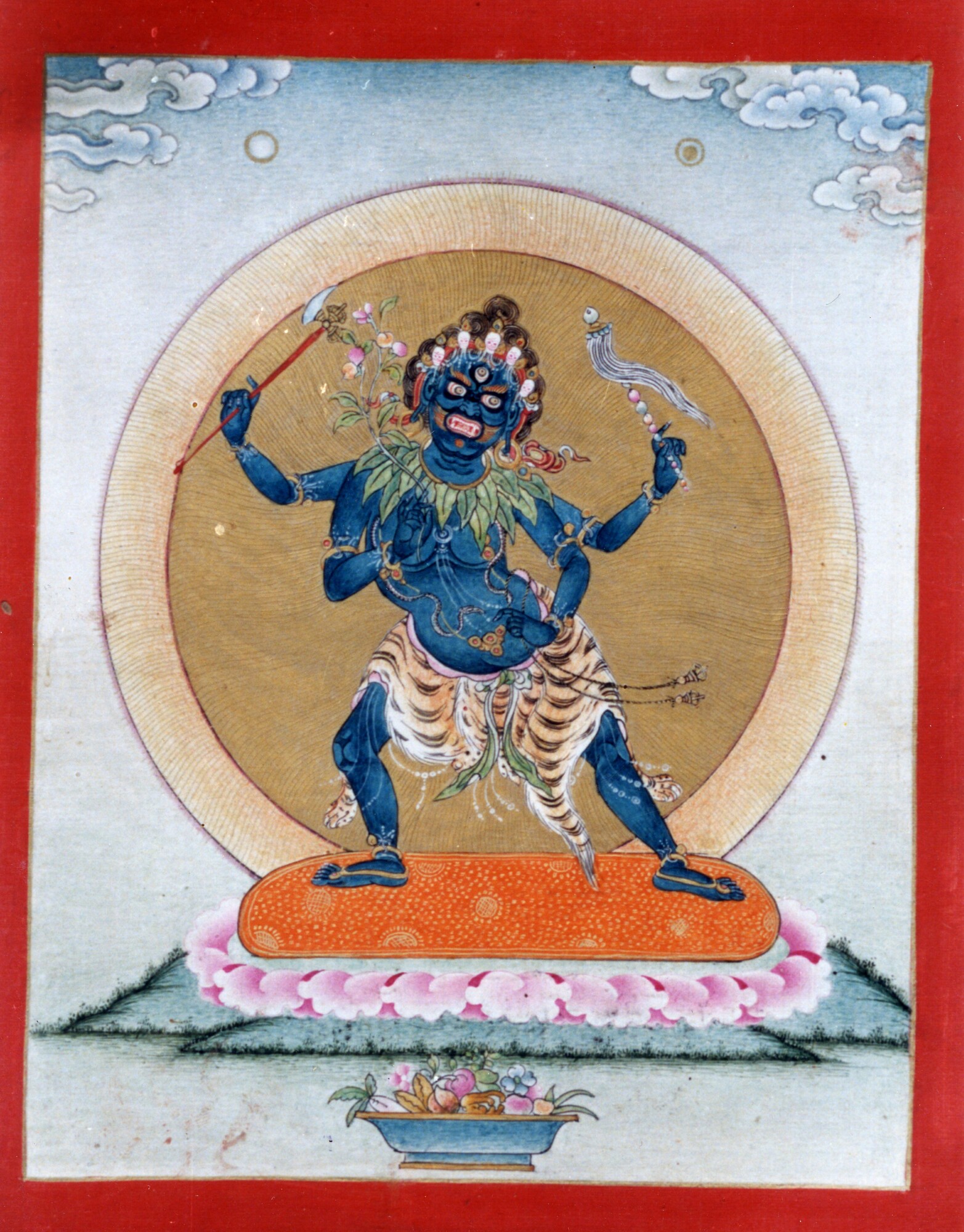
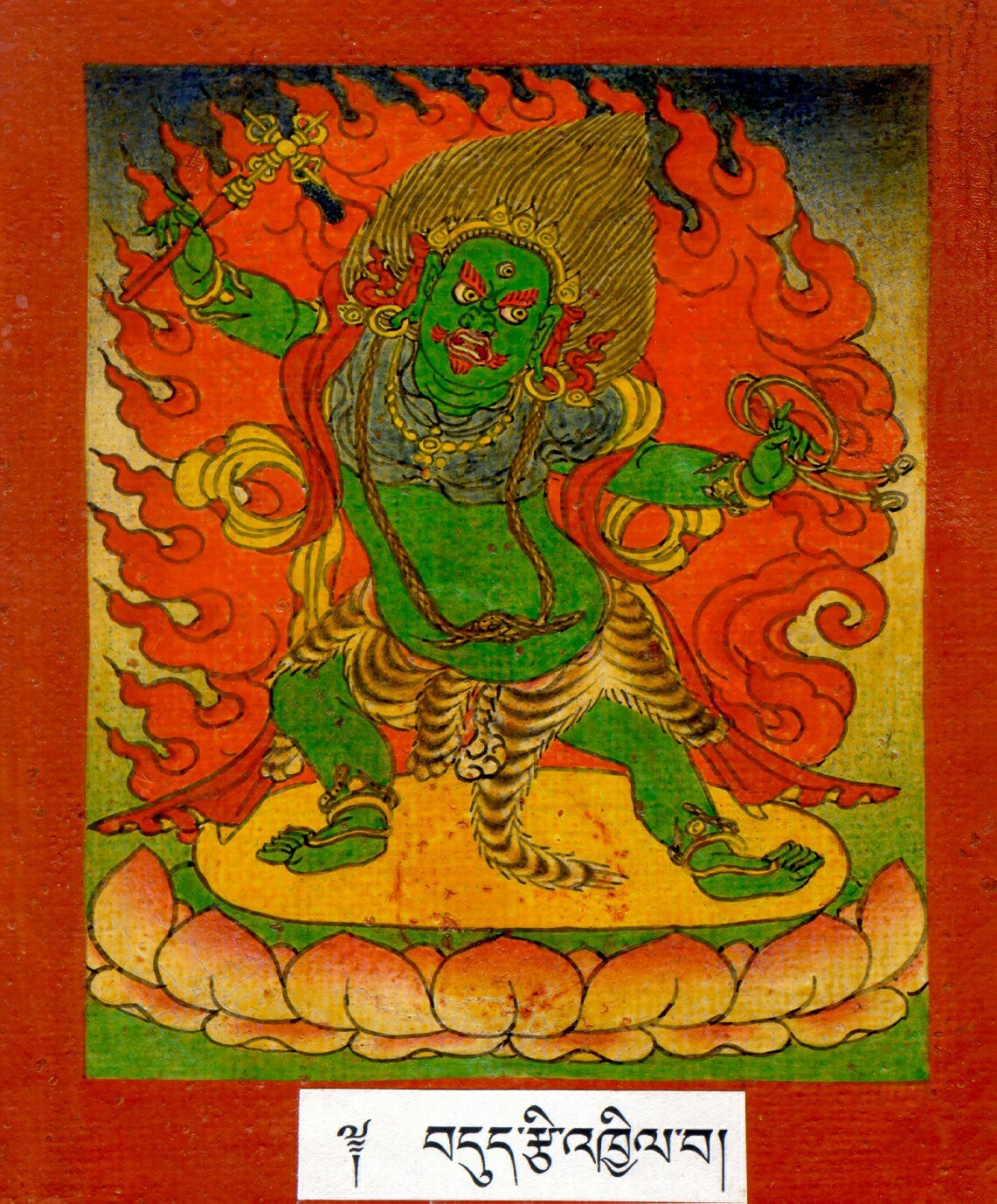
    And so one gets a Yidam and the fact remains that karma keeps sweeping around like a giant lawnmower and you still need some kind of a weapon or a wrathful power that is used to remove obstacles. And then just from the meditations aimed at this level and the fact that we desperately need a Broom then we can employ Parnasabari. And she has a Wrathful from that is a little weird. This is an Amoghasiddhi deity, in other words, relates to the increase of Janguli's Hydra. But since we are really trying to be as peaceful as possible, we don't need a furiously rushing broom. Instead, this one is called Sky Blue by Taranatha:


    And so we go to her primary right hand and her item is Deva Tree which means a self luminous tree with fruit. This pacifies diseases.

    Her other items are fairly straightforward examples of Four Activities. Her lasso binds the evil influences, her axe is an anti-chain that severs any tie of friendship, and her jewelled switch or staff dispels them. Her main activity is not particularly angry, in fact it is more magical and can easily be seen as related to the other meditations on Vasudhara.

    Janguli and Parnasabari in these forms are both solar, they can have a sun disk or back. This Parnasabari arises from blue Pam syllable and just uses her normal mantra:

    Essence:

    Om pisachi parnashavari hri hah hum phat svaha

    Action:

    Om pisachi parnashavari sarva jvara prasha manaye svaha

    Those mantras call her a pisacha or a bound ghost, or, like me, some other type of suffering being who has been converted to Dharma. Hri is a shorter form of Hrih, and Hah is a longer form of Ha or throat--akash syllable. It is often used similarly to Phat and is the main ending syllable for destructive spells. Perhaps that could be considered a jolt of pure akash. In short form, it is for instance four times in Vajrasattva's mantra, as syllables of the four immeasurables, the four empowerments, the four joys, and the four kāyas. Jvara is a fever, especially a mental or soul fever, and then I believe prasha calls her something like a spear and manaye is a type of devotion, so, her action seems along the lines of taking this "Hah" seed syllable and devotedly using it as a blast of emptiness that pacifies fevers--diseases, including mental ones.

    One would typically employ such a wrathful ritual once a month or so pursuant to the days suggested by Buddha as a type of mental housekeeping. Hopefully nothing more than a magic fruit tree will be needed to purify and protect common areas, mostly by Shanti or Pacifying.

    I asked Tara about the fact that there were probably no lineages of her like this, and that I probably can't ever get to the real lineages of anything, but going from her meaning and the current reality, is this ok, and it's ok. I think she is that powerful and that's why you can't just pick up Vajra Tara and get results casually. All of the prior basics are still there. I'm just out from a wormhole and ready to take a more serious look at the next dhyanas.

    In the standard format, we would probably do good to tie on a Peaceful White Protector and so forth, but, this helps explain different forms and why different Yidams work for different people. I still believe that similar results can be achieved by White Voodoo, or lots of kinds of indigineous shamanism, but those are total life styles that you can't just step in to. Our training is very portable and very complete, reliable, and, as far as I can tell so far, means exactly what it says and works.
    Last edited by shaberon; 28th February 2019 at 18:04.

  5. The Following User Says Thank You to shaberon For This Post:

    what is a name? (26th February 2019)

  6. Link to Post #364
    United States Avalon Member
    Join Date
    1st April 2016
    Posts
    6,506
    Thanks
    33,747
    Thanked 36,931 times in 6,152 posts

    Default Re: The Serpent, the Black Sun, HPB & St. Germain

    The reason the Parnasabari above won't work for me is because I don't have her primary item.

    This type of tree starts on Vasudhara (Cintamani) who is sort of inflexible or universal to everybody.

    Her syllable is hard to find but is the same as in the standard Jupiter mantra:

    Om Brim Brihaspatiyai Namah

    ॐ बृं बृहस्पतये नम:।


    So it is the second character there, and one can find the "r" as the lower hook on the character, same as in Hrim. This is almost the same, just as fundamental. But in particular, our system jerks the rug out from under it. Normally the Jupiter color is yellow, but we changed it. So with the basic Yellow goddess, Cintamani, we have the ordinary Jupiter color and symbol that gets specifically altered.

    It rejects the standard Jupiterian exoteric priesthood, and refers to real inner meaning, rather than ritual and superstition. It rejects material wealth, and refers to the real unknown. Tara specifically left Jupiter for the Moon but was later re-united. So the boomerang effect that stands out in the advanced meditations is that Jupiterian Rta or Order is absolutely vital, it just means the real inner one.

    In terms of the meditational colors, this one is the major change. The others only have perhaps a more complete version of White Peaceful, Blue Wrathful, Red Powerful, Green Successful, but yellow is totally different, and the small amount of information to support this, is the only information. Therefor this Cintamani won't work for anyone without a good grasp of that change. Once you have that, then there is basically an un-populated Jewel Family that really is just going to be staffed by esoterics.

    This is a sneaky color and something I am personally weak in, and remains necessary to achieve Quintessence. This has been explained, but the personal result is the real inner Guru:


    And so the Janguli--Hydra process is to transform a normal human body into this. From this view, physical light is a black, solid obstacle. So this is Sambhogakaya or perfection of all form, resulting in something that is not really a body but at most a mental body with zero dimension or no extension in space as we understand it.

    It definitely is experienced by a person in their body before it is seen on its own plane.

    In terms of the Path, it is one of the Dharmas of Completion Stage. But in order to make a real one, we bump into things like Amoghasiddhi is going to knock me out of this level, since, owing to a lack of Yellow, I am out of balance with those who have not had to endure this kind of ongoing insanity for karma. The easiest answer is to turn on some Yellow. This suggests maybe this or a coming Sunday to use Vajra Tara to manifest Cintamani. Parnasabari can't possibly help until this is working.

    Chances are that other people may have a better connection to Yellow and it would be easier for them to gain this type of deity at an earlier point in their lives.

    I barely know what it is, and there is not much other option than for it to start working. It will require protection. Achi Chokyi seemed to be a perfect example for study, that we should not invoke without the lineage. Mahasri seems to remain the universal basis of the local individual kinds.

    It makes the framework here at home into:

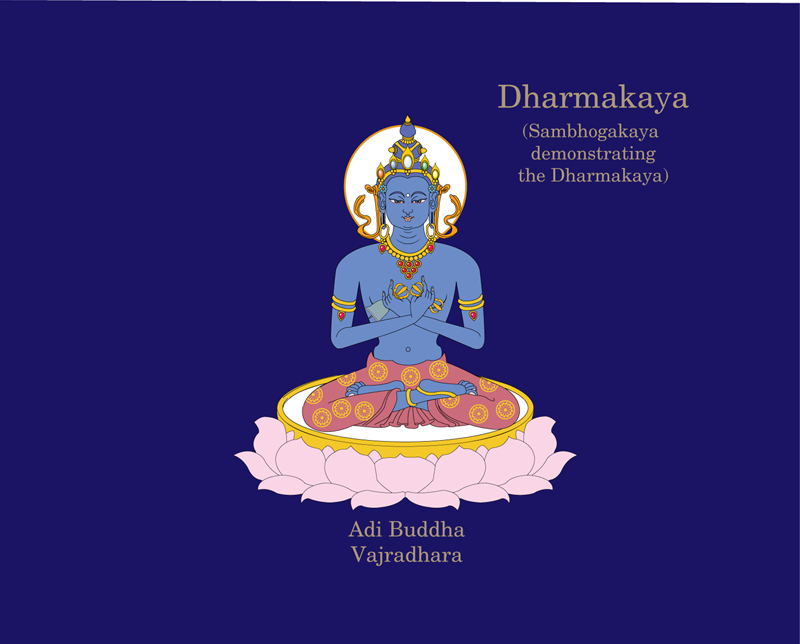
    Guru Vajradhara
    Yidam Janguli
    Wrathful Parnasabari
    Protector Peaceful Mahasri
    Dakini ?

    Which is not something picked and chosen, but impressed by nature onto me. Within the system of Vajradhara, others would use the combination appropriate to their mind and karma. And then we could say there is a system of Guru Avalokiteshvara, or Samantabhadra, and these work mostly the same way. But what we are using is Kagyu Vajradhara with the tantras for Namasangiti Manjushri and Nagarjuna style Tara. If we look at the real initiatory system of Nepal, that's exactly the outer court, Vajrasattva --> Vajradhara, Manjushri, and Vasudhara Tara. From their explanation, they do not mean Bodhisattva Manjushri, but in this case, Vajradhara and Manjushri both resolve to Adi Buddha. Essentially all male Dhyani Buddhas are given by Namasangiti and all female Shaktis or Prajnas by Tara.

    This kind of template can remain in effect for years if not ever. It's not unreasonable to think that at some point in life, one might be able to get a single useful Dakini initiation, or something like that. This is all about the inner meaning, which also suggests to me that one should not begin haphazardly tinkering with Vajrayogini just because the ritual is available. I'm only proceeding from prior experience, and doing that threw it off. From the wormhole I still find it very true when Buddha says the second dhyana will kick you out and you'll lose everything. That is why a good guide and right training is important. From here it simply makes sense that the third dhyana will shed breathtaking rapture, which, itself, certainly interferes with work and school. So in technical terms, those first two dhyanas are stabilized. Seems to fit fairly well with the third Manjushri or solar plexus.

  7. Link to Post #365
    United States Avalon Member
    Join Date
    1st April 2016
    Posts
    6,506
    Thanks
    33,747
    Thanked 36,931 times in 6,152 posts

    Default Re: The Serpent, the Black Sun, HPB & St. Germain

    Before Cintamani, it is probably best to establish a Protector.

    Lakshmi has two aspects, Sri and Bhoo Devi. The second one is mostly Vasudhara in Buddhism, including Cintamani, Ila, etc. The first aspect, Sri, is mainly responsible for being the Protector. And so one of the primary Buddhist sources for her is Golden Light Sutra, which is relatively brief and highly meritorious on its own accord.

    It is from Sanskrit and carries the same type of classification, with Sarasvati, followed by Sri and Earth devis.

    It is less advanced than Lakshmi tantra, and uses older names for the Dhyanis, Ratnaketu and Dundubishvara. It is highly related to these two, which makes it highly related to Tara, although it is not presented as a method of Tara. Same anyway.

    The system seems to indicate that Vajra Tara should bring Sri in, and that it is safest to operate Yellow afterwards, within her protection. Given the Sutra's name, and that Buddha defines golden fire as "Lakshmi, Completer of Wisdom", and that this seems to work with Lakshmi Tantra and Agni Homa, then we probably need a safe house in which to be placing this mature form of radiant gold. The order of those three particular chapters is Sarasvati, Sri, Bhoo.

    The Sutra explains Sri's origin and her palace called Adakavati, in a Pure Land named Suvarnadhvaja, made of Seven Jewels. This is unexplained, but, having placed every kind of sevenfold classification with the Method of Manjushri on page fourteen, it already works in several ways.

    Part of the rite is simply in reciting the name of the Sutra and the name of the Tathagata under whom she attained realization. This name is huge and her mantra is similar to a dharani, or, at least it is untranslated. As well as cleaning self and dwelling, it asks for white robes, and says this starts seven years of observing Eight Precepts. It requests a word of truth which is not a proper term and is not defined. Flowers, incense, and food are offered to the deities.

    From Tibetan Buddhism, you could, with perhaps some difficulty, extract her as Palden, but this one is pan-Asian and still common to her Aryan roots. And so if anyone can get Sarasvati--Prajnaparamita in a Buddhist way, then, Lakshmi is the eventual momma to her, with this being her main authentic resource in Buddhism.

    The sadhana would be fairly simple:

    Namo Samantabuddhanam
    Namo Samantabodhisattvanam
    Namo Maitreyai

    Invoke her Tathagata's name three times:

    Namo Ratnakusumagunasagaravaiduryakanakagirisuvarnakanchanaprabhasashri

    Invoke the Sutra of Golden Light three times:

    Namo Arya Suvarnaprabhasottamasutrendararajamahayanasutra

    Say the word of truth.

    Invoke Sri three times:

    Namo Mahasriyeyai

    SAYADAYATHEDANA / PRATIPURNAVARE / SAMANTADARSHANE / MAHABIHAGATE /SAMANTABEDANAGATE / MAHAKARAMYAPRATIPRABANE / SATTVAARTHASAMANTANUPRAPURE / AYANADHARMATA MAHABHOGINE / MAHAMAITREUPASAMHIHE / HITAISHI SAMGRIHITE / TESAMARTHANUPALANI

    "When conferring the initiation from the crown, these are unfailing words that perfectly grant realization of emptiness in one mantric word of suchness. Beings who are placed in the middle, with roots of virtue free from unspeakable negativity, should recite and hold this mantra for seven years and observe the eight-precept ordination. Then, so that they and all sentient beings may complete the wisdom of the omniscient, they should offer flowers and incense to the buddhas in the morning and afternoon and say, “May my wishes be swiftly fulfilled.”

    Whether in a monastery or forest retreat, they should clean that dwelling, draw a circle of cow dung, offer incense and perfume and provide clean seats. Scattering loose flowers on the ground, they should be seated. Then in that very moment the great goddess Shri will appear and remain in that place. She will ensure there is never poverty in that house, village, city, town, monastery or forest retreat. That place will be replete with all equipment, gold, jewels, wealth and grain. Beings will be made comfortable with everything that provides comfort. Whatever roots of virtue they gather, the major share should be offered to the great goddess Shri. Then, as long as they live, she will remain in that place and all their wishes will be fulfilled."

    I cannot explain the mantra--dharani very much, but it appears to refer to Samanta Darshana, which would mean all lineages or philosophies that honor her. We find her closely related to Jagganatha and the concept of at least an underlying exoteric universal truth. This involves Sandabhasya or Twilight Language as a basis in all kinds of tantra. This is why it is fairly accurate to say that even as a "certain kind" of Buddhist, our knowledge base is almost the same as Vaisnava with a few philosophical differences, almost the same as any Durga cult with a different interpretation, and that our Nirakara or Shentong is identical to the Illusionist view of Adi Shankara, who composed the major part of the Shakti cult, which is what we say is intertwined with us in trans-Himalaya. We are mostly agreeing with HPB in that this system is the purest fruit from that of Yajnawalkya, Brihadaranyaka Upanishad, and this seems to work perfectly with Namasangiti Manjushri.

    Sadhanamala is not really necessary here, since it only has one later version of a specific form. Golden Light does not require a whole lot of meditative or ritualized detail. It is of course good to read on its own, and, to actually do the stuff, one would probably recite the opening chapter about forming the Assembly. And so one could easily do Assembly + Sarasvati invocation to gain her if not familiar. If one has recently triggered a personal cataclysm based from a twenty-five year old Sarasvati icon, this is not necessary. The Sri invocation as given here does not explain its "mantric word of suchness", but this specifically refers to one of the Three Voids. Mahamudra is the overall technique of making something from that difficult dharani that compresses into one word which effectively dissolves a void world. We could guess this could turn out to be her seed syllable, Srim, or something close to it. That will be developed by Gopala Vasudhara. We don't need it right now, apparently, to make it really work, the sadhana must be done "from the crown", Usnisa-born, which is silent. That is not simply a silent mental recital (manasa vacayen), but an actual psychic or hydra-like apparatus which could at least be sensed by another sensitive person. Everything up to that point is training. So the beginning Golden Sutra is for the protection, then Yellow Vasudhara does the fruit (Ila, Bhoo) and milk (Srim, Gopala, Bharati).

    The way I would use this for White Peaceful Protector stems from the phrase "watch over the house" as mentioned in the Sutra. Esoterically, I am not really invoking her as Mammon as is widely done. I am really seeking her protection so that we work together in the future unknown, which is the basis for any material prosperity, but especially for the Yellow power, which will be found to have much to do with the deva fruit, and eventually the deva cows and curds. That sort of thing should probably be taking place after/within her protection, and symbolically, verdance and lush growth, is her full manifestation as a goddess. This requires whatever other Sherabs or minor forms the meditator needs to get there.

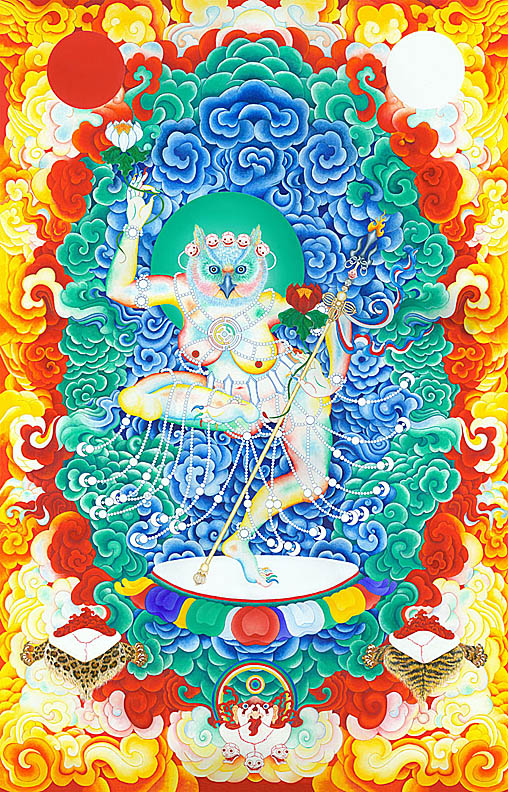
    Her peaceful image around the bottom of page seventeen works pretty well as Virgo with Six Shaktis, especially if things like justice and equality among beings have anything to do with what she means. The post about her human manifestations really highlights her whole existence, and states that the important preliminary yogas are Guru Yoga, Yidam (Deity) Yoga, and Illusory Body. If there was an empowerment worth hunting for in the future, Aro's Owl Head Dakini has a lot going for it, in relation to what we might call a Method of Niguma. Closely examined, most of the male-based teachings can be read and self-trained, however, Niguma's ladies' club initiation is like a magic wand for Completion Stage. So for outsiders, who don't have the luxury of getting multiple initiations since they were a baby, and it's a rarity, it makes a lot of sense to do the outer trainings and look for something within Shangpa and the few related ones, such as Owl Head.

    As far as I can tell, this is a Buddhist way of generating a protector that is not dark or wrathful and is not tied to a location like Tseringma is. She is the spine of the major part of the female esoteric lineages. Nothing else can say that.

    For me personally I was pretty tight with Remati recently, grisly and dark reddish as she is, and so if we quit provoking her, this Peaceful one is what she settles into. In this sense, "my" Sarasvati has grown into Janguli, and, like most people that know anything about her, Lakshmi has always been some kind of pleasant whisper off in the background. Now she's here and so a conscious seal of her into the Nirmanakaya is optimal. Here again, with better guides and practice, this should not take so long in life.

    Most Lakshmi chants refer to yellow. There are a few images of Sita who is almost an entirely different subject, aside from the fact that Lakshmi is Sri and Bhoo, or White and Yellow.

    "Invoking Lakshmi" also has a piece which leads to 108 names, but, at that level, or Rosary, we have Vasudhara in mind. However, the beginning is very good and speaks to Lakshmi as Indrakshi or Indra Shakti, which has everything to do with placing Mahasri as the unified center of quintessence.

    Glorious Eyes of Indra is Sri Indraksi. This is her song or strotam. Mahalakshmi is its seed (bija), Bhuvaneshvari is its animating power (caitanya), Bhavani is its nail (phurba). It achieves success (Amoghasiddhi) in that which is desired (Jewel Family).

    The lines all use:

    Om, on my (part), namo...

    Thumbs...Indrakshi
    Forefingers...Mahalakshmi
    Middle Fingers...Supreme Lady (Mahasri)
    Ring Fingers...Lotus Eyed (Kamala Locana)
    Little Fingers...Katyayani
    Palms and tops of the hands...Maiden (Kumari)
    Heart...Glorious Eyes of Indra
    Head...Mahalakshmi, svaha
    Top Back of head...Supreme Lady, Vausat
    Armor (torso)...Lotus Eyed, Hum
    Third Eye...Katyayani, Vausat
    Weapons (hands)...the Maiden, Phat

    Om bhur bhuvah svarom (The directions have been secured)

    Om aim hrim srim klim klum
    Namo Indrakshi

    There is another story of Buddha healing Indra through a curse of thousand eyes that became vaginas all over his body. Yellow has much to do with how Buddha taught Indra.

    When critically examining the modernized knowledge base, it comes to this. Nepal is Buddha's birthplace, and within the teachings, it is the residence of both Self-existing Pure Royal Light as well as Mystery Lady of Dark Secrets and Space for the foreseeable future. This important goddess, Sri, is always Lakshmi and specifically Sita, starting esoterically in the ancient Ramayana. Nepal area also claims her birthplace. Furthermore, Sri as specifically Sita or White Lakshmi is found as the deity of Malla kings. The closest thing to a universal occult system would have to be called the twin Buddhist and Sri cult that characterizes Nepal and other trans-Himalayan states. She is the junction and patron there, as well as the gate to Buddhist Tara at Ratnagiri in India.

    In the Hindu view, her meditations include Wrathful, Bhairavi, and Kama experiences, almost the same as Buddhism. In symbolism, she has Nine Treasure Vases, and is also all Nine Durgas. The only thing really beyond her is Tenth or Vijaya which really pertains to internal or vajra or occult ignorances or imperfections.

    In both systems she reigns in Sri Nagara or solar plexus and works almost identically and this is noted as the first major occult change to a person, as the lower chakras are only capable of purification. This one is City of Jewels. She motivates erotic Vilasini. This is as extremely powerful as her Remati and Palden aspects. For the most part, we are trying to attain her in Abode or Palace, i. e. Sambhogakaya.

    And by "Jewel", we are replacing her common Yellow aspect with something very different. Even Golden Light Sutra goes on to speak of Yakshas who are the Host of this esoteric yellow change. In Prajnaparamita, there are no Yellow Lotuses, because aquatic ones are used, and Yellow is of fire. This explanation makes sense with the occult change to Yellow--Earth Element, which has made it more "of fire", shown by Sita and Horsehead rite. Closer to the Yellow Agni, Kamala and/or the various boons to Indra.

    So it makes a lot of sense to study and invoke Sita first. She is an intensification of normal Sarasvati but is non-tantric. Her tantric forms are White Janguli and Golden Kamala. Her secret forms are Guhyeshvari, Guhyakali, Ekajata. She may consort with Hayagriva. Or as Vilasini she is with Lord of the Dance, Padmanarta.

    Especially if there has been no peace in your life and nothing else stands a chance unless it is protected, it makes more sense to have her available at a universal, basic level, as she is almost secretly in Tibet. When you have to surrender children that you can't feed, that's who you would likely choose to protect them.

    When we do this, we come across another invocation, Vausat, which is meaningless in ordinary language. It is similar to Phat, it is a feminized extension of vasat which is a bolt of destructive speech. Equal to the front of a thunderbolt, beginning with va, like vajra. The word is traditionally used with a homa or fire offering. In Buddhism, Namah is Pacifying, Svaha is Welfare, Phat is Phurba--Kilaya. Vasat is for Subjugation, whereas Vausat is considered Attraction. "Maya Divine and Human" explains this fairly simply.

    Once she falls into place, then, at least the way we are currently doing it, creates the following pantheon of deities:

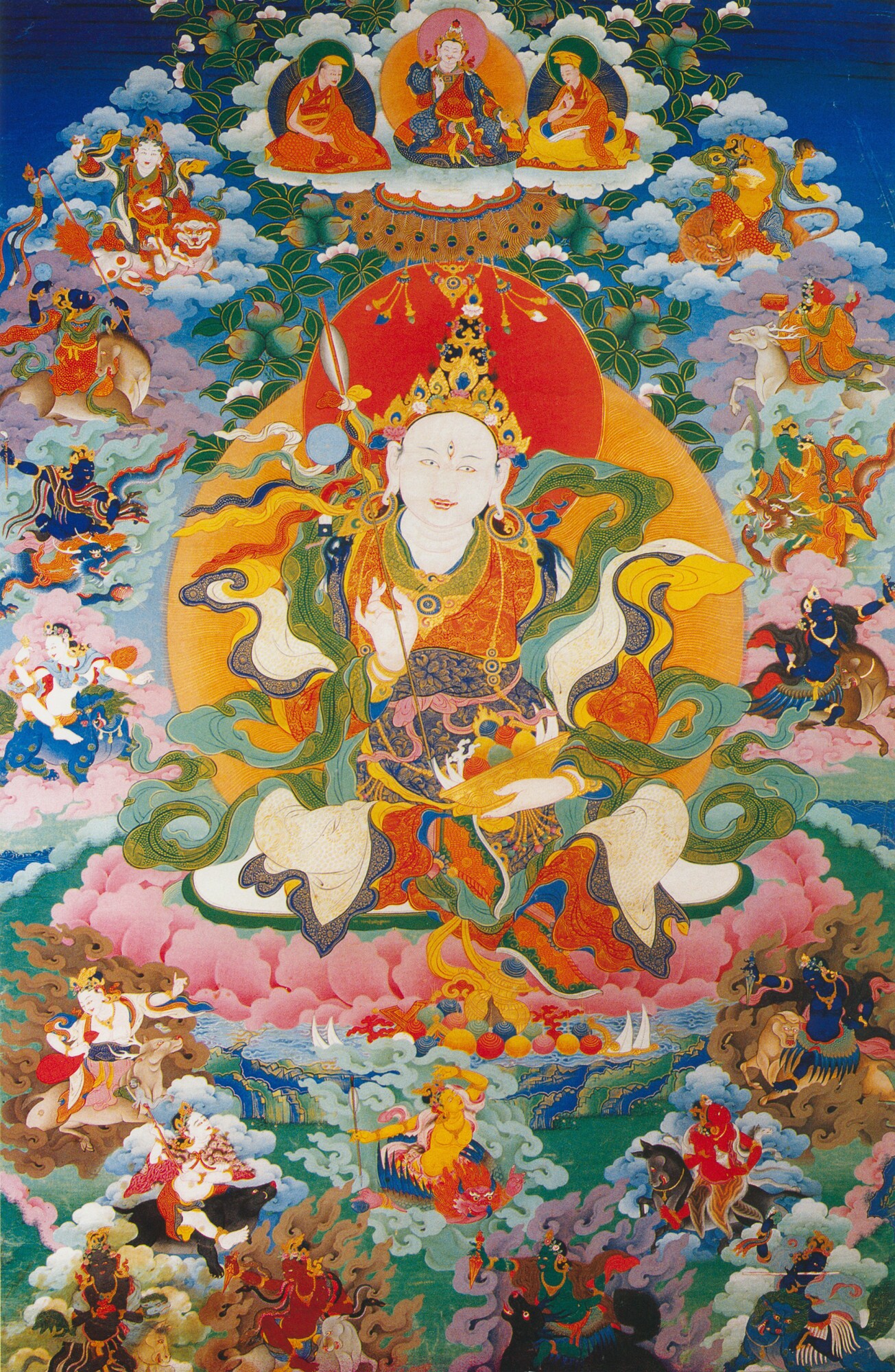
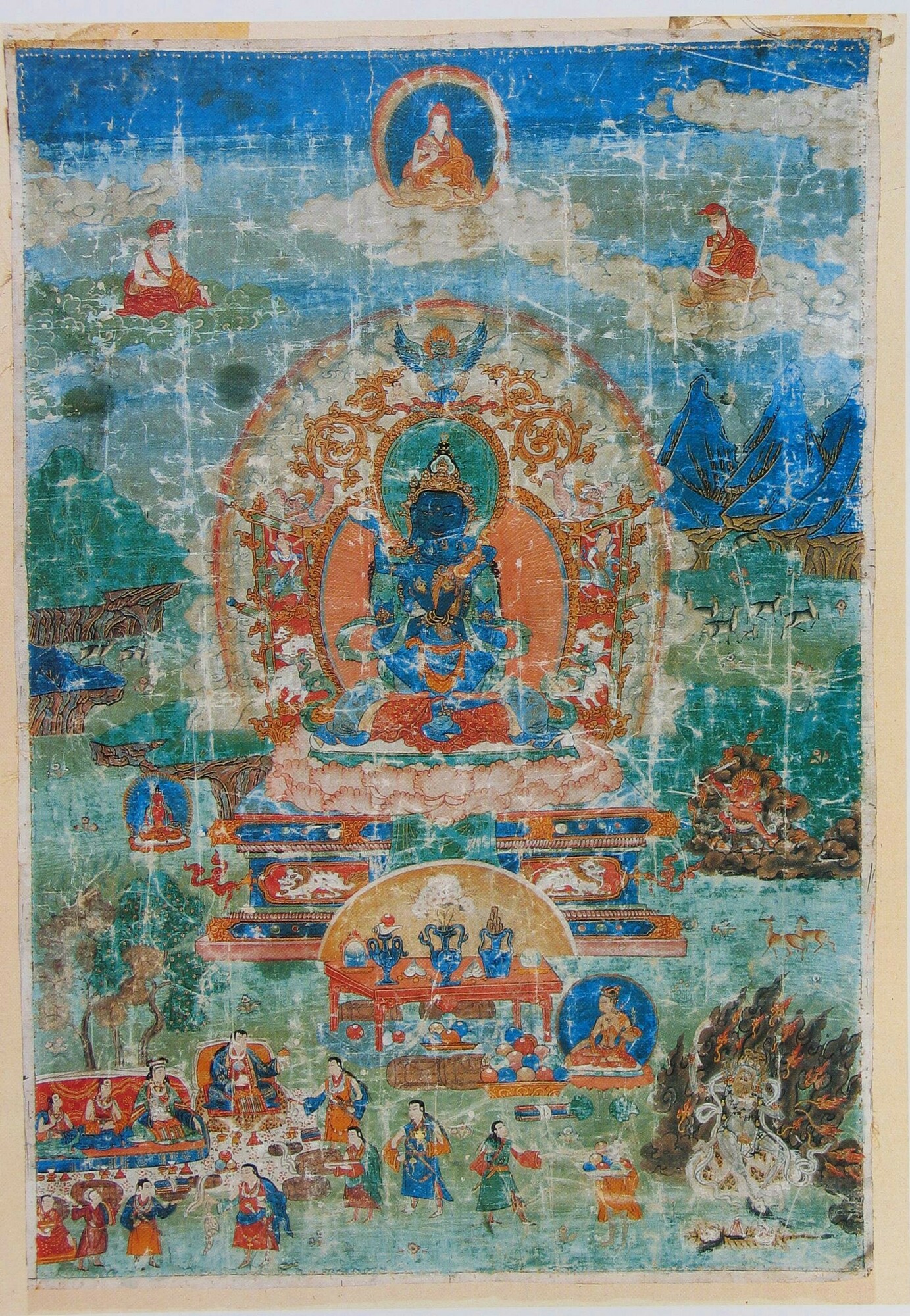
    Guru Vajradhara under Garuda:


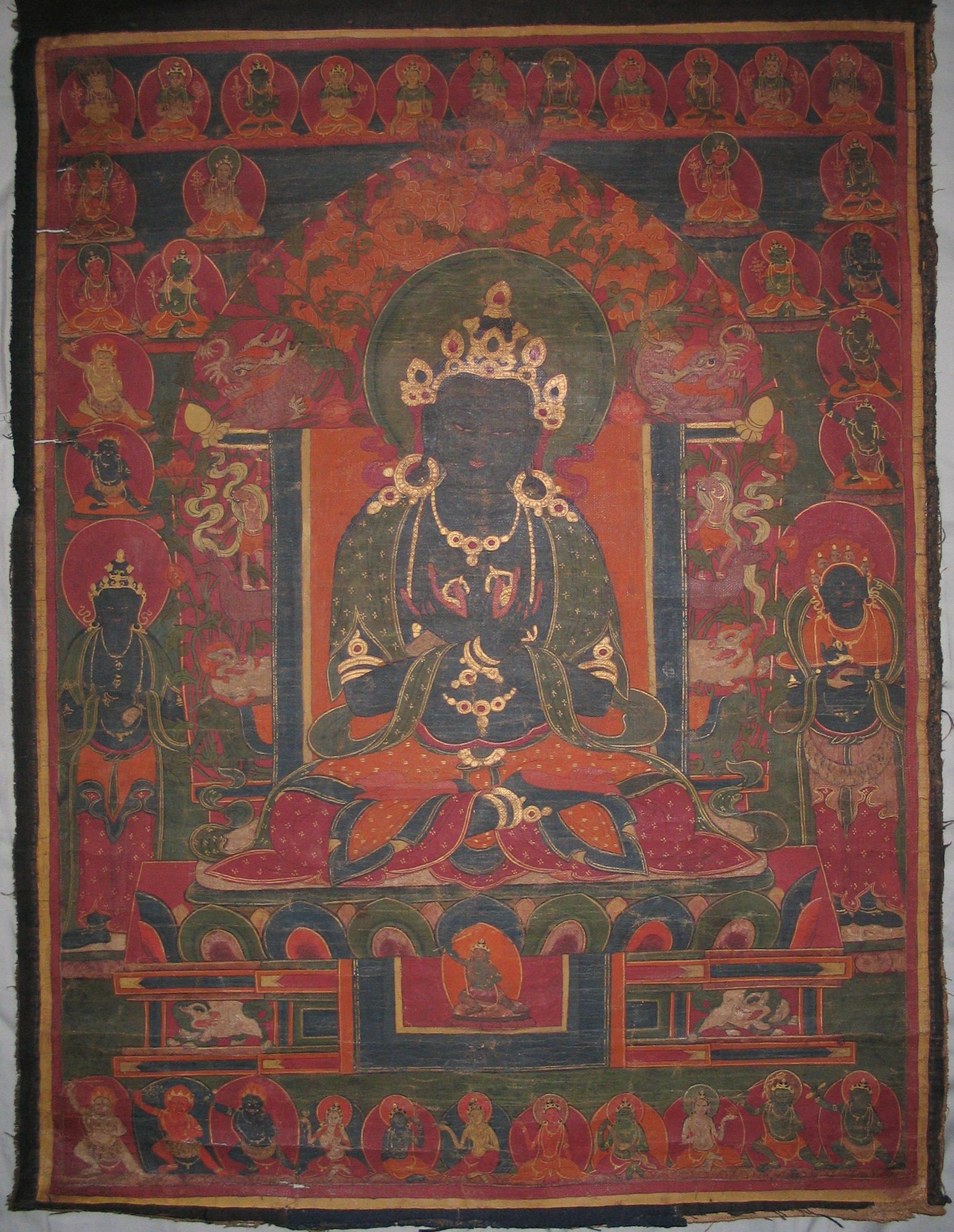
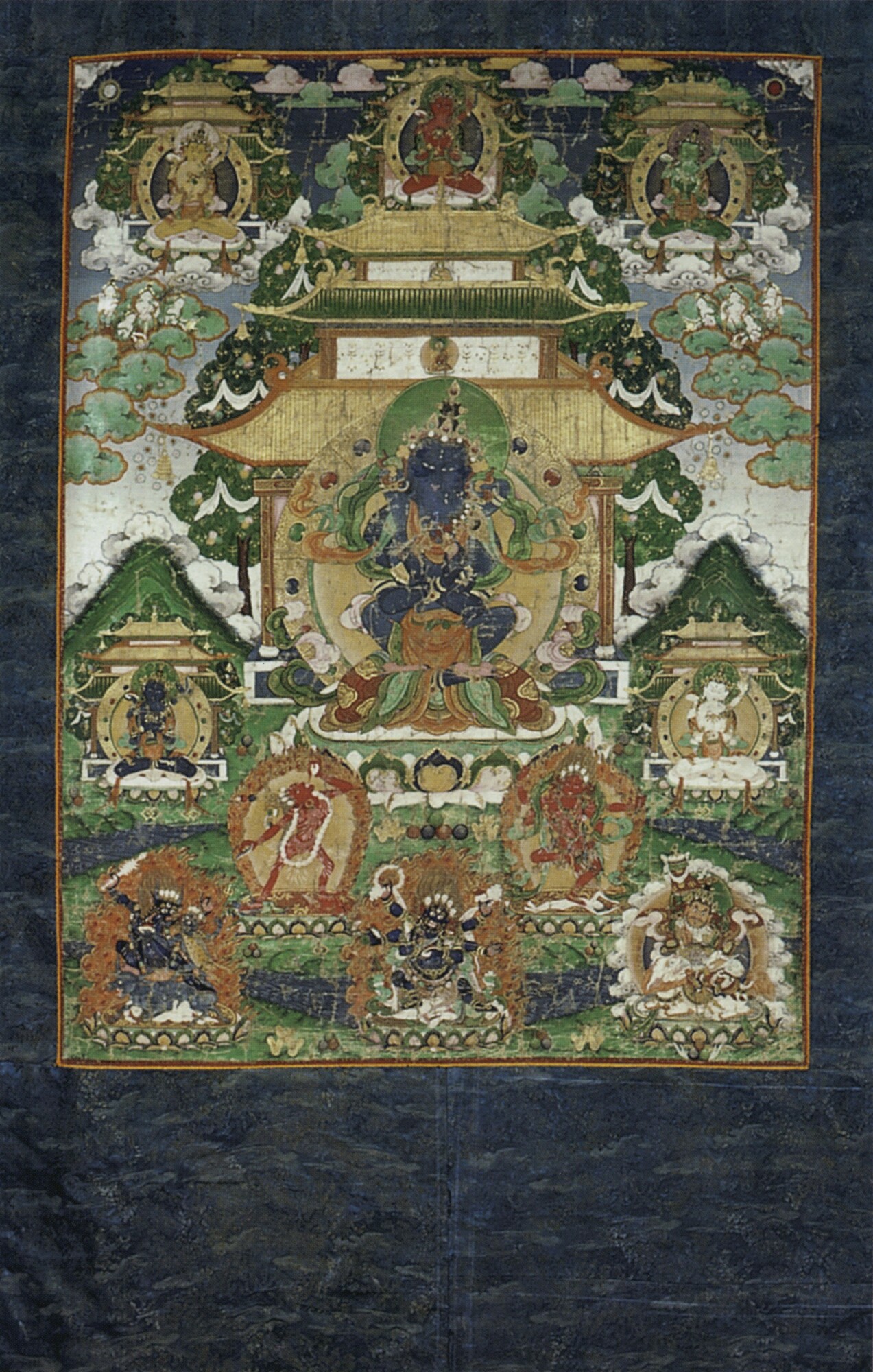
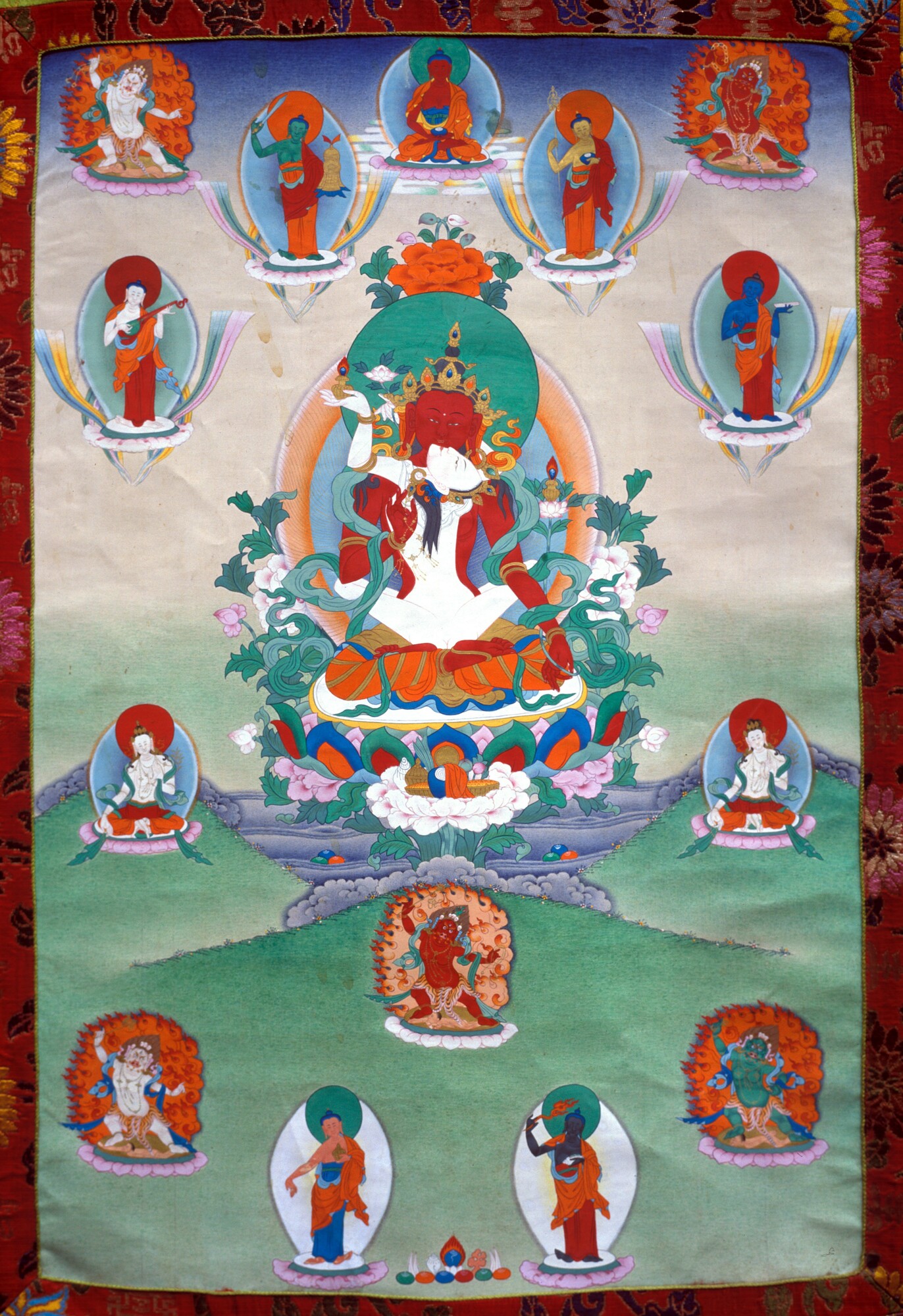
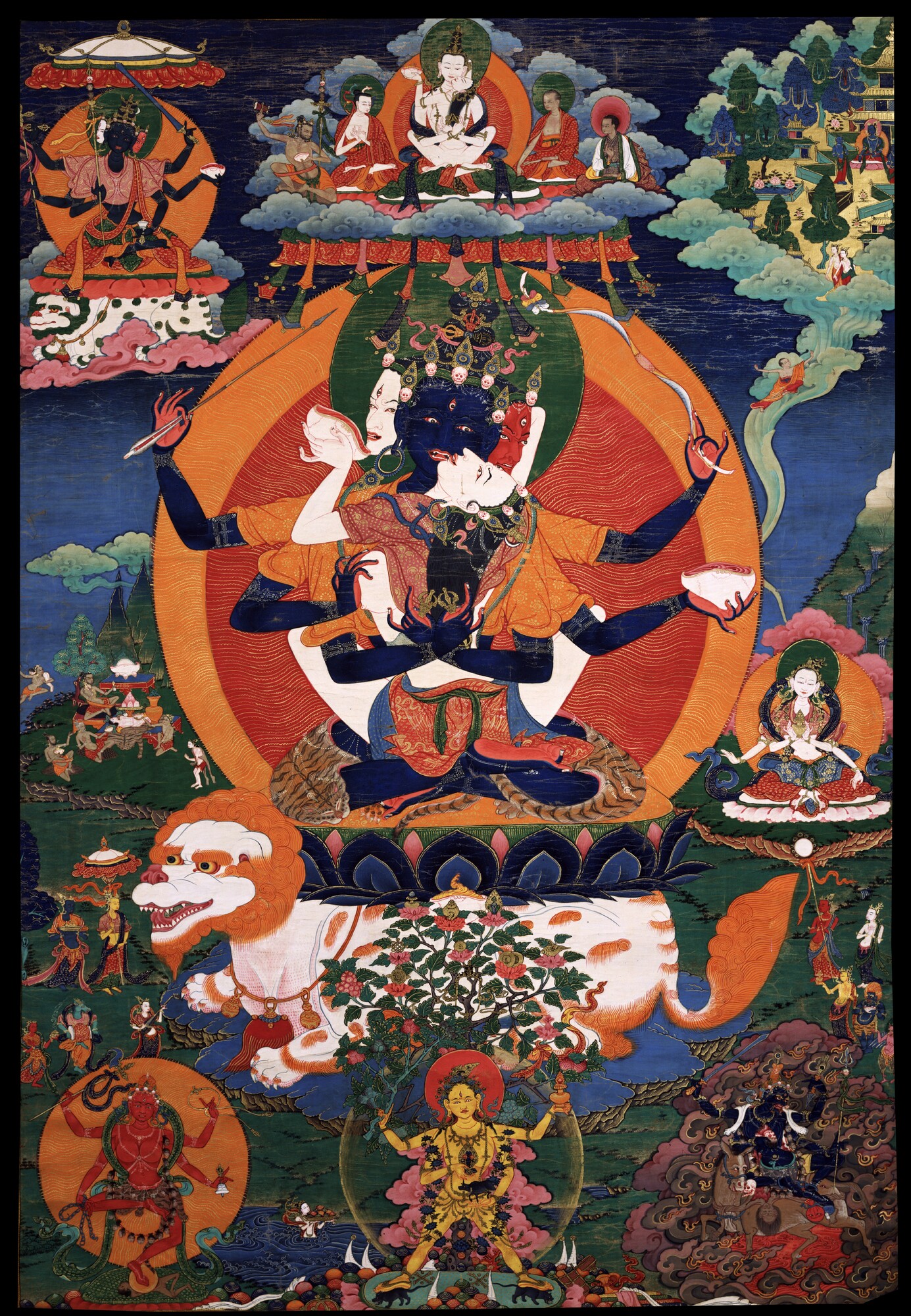
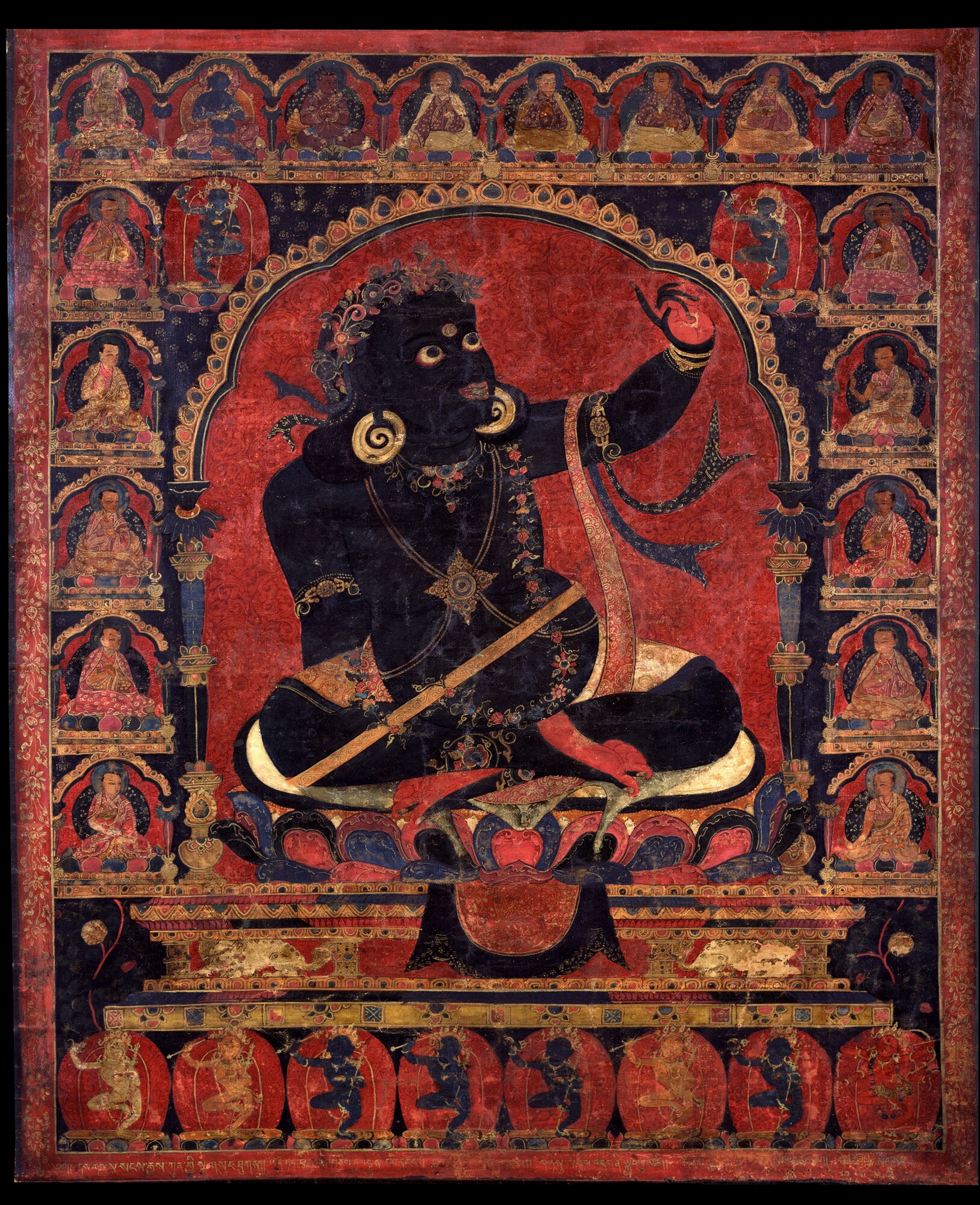
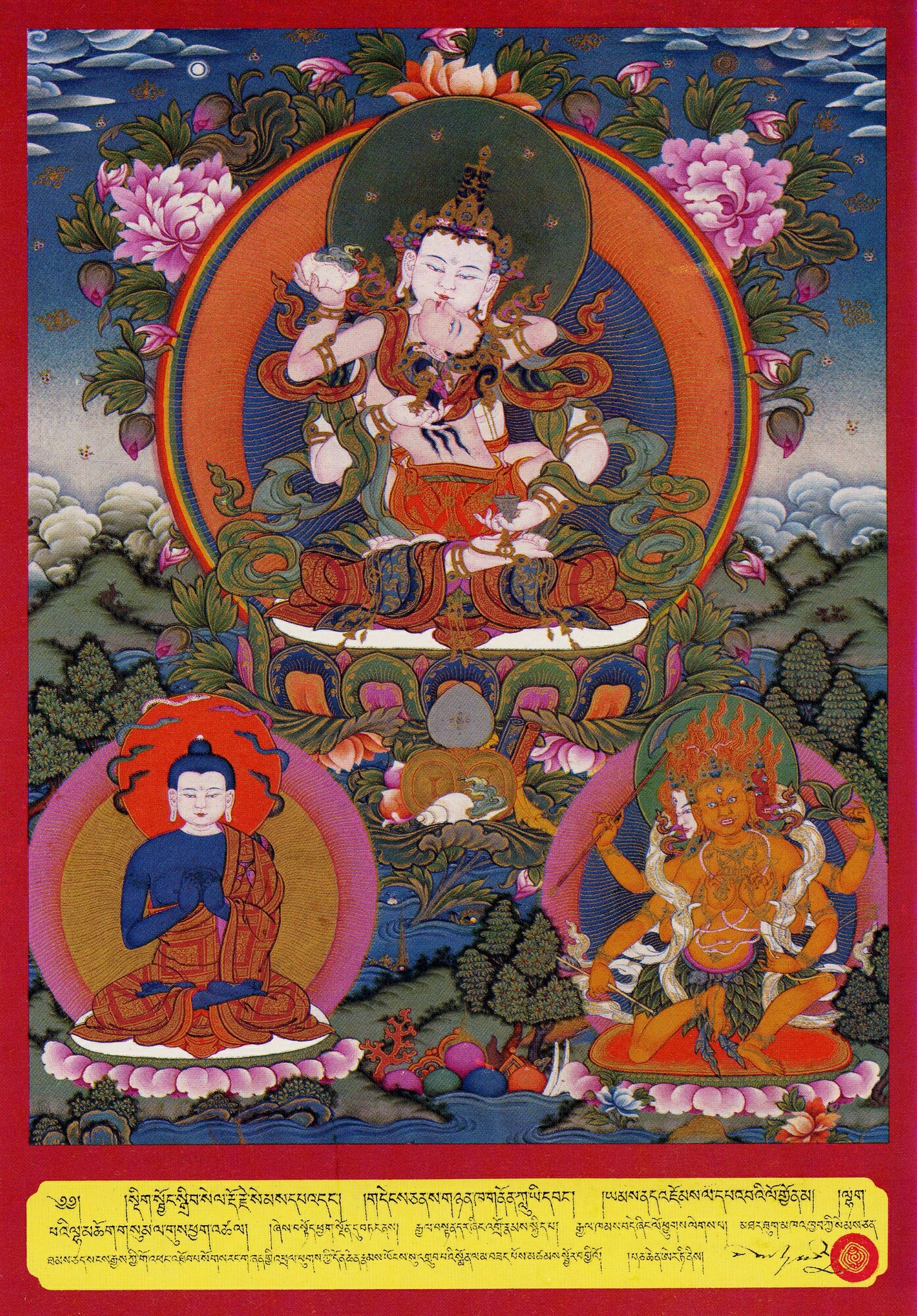
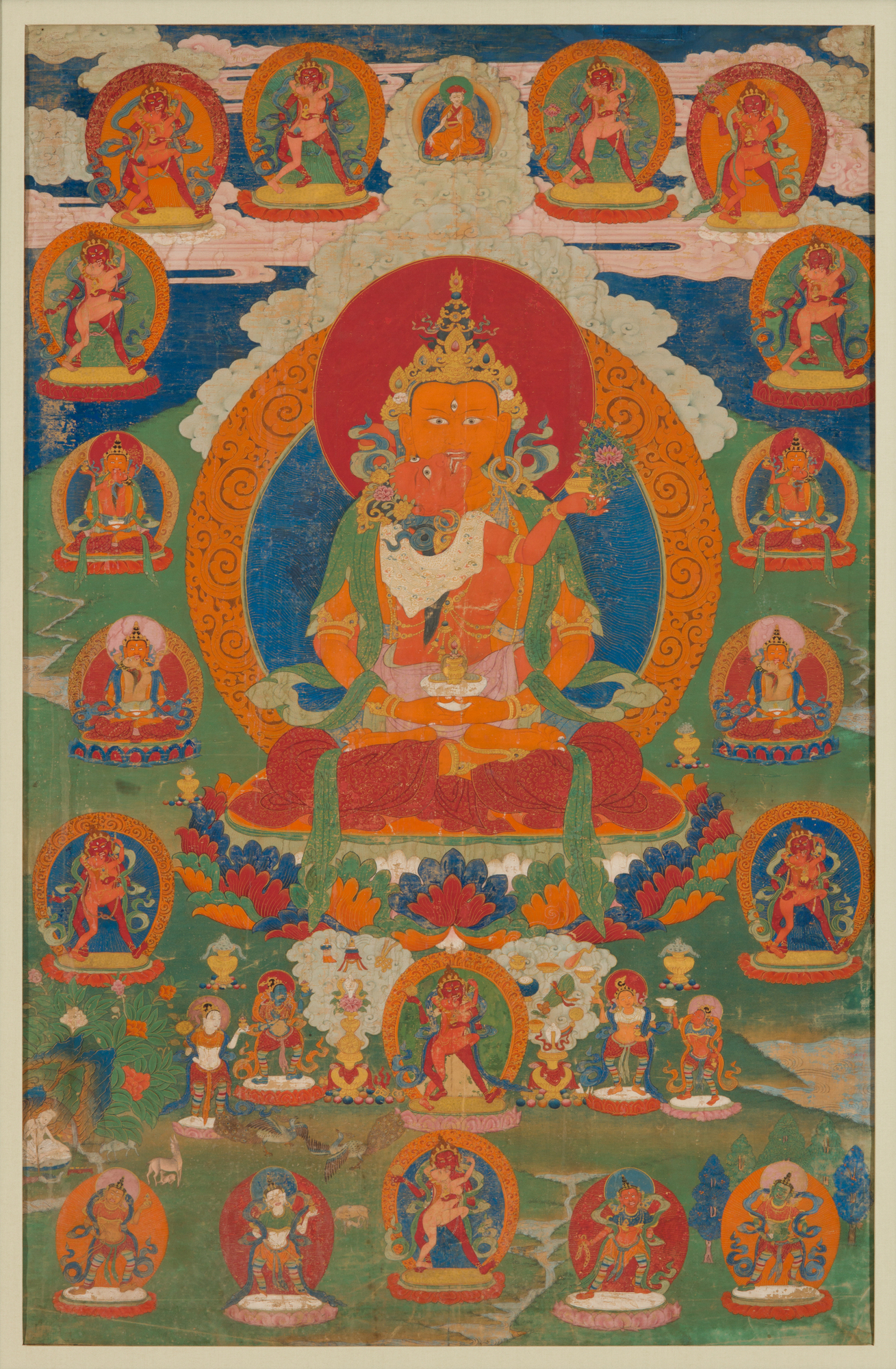
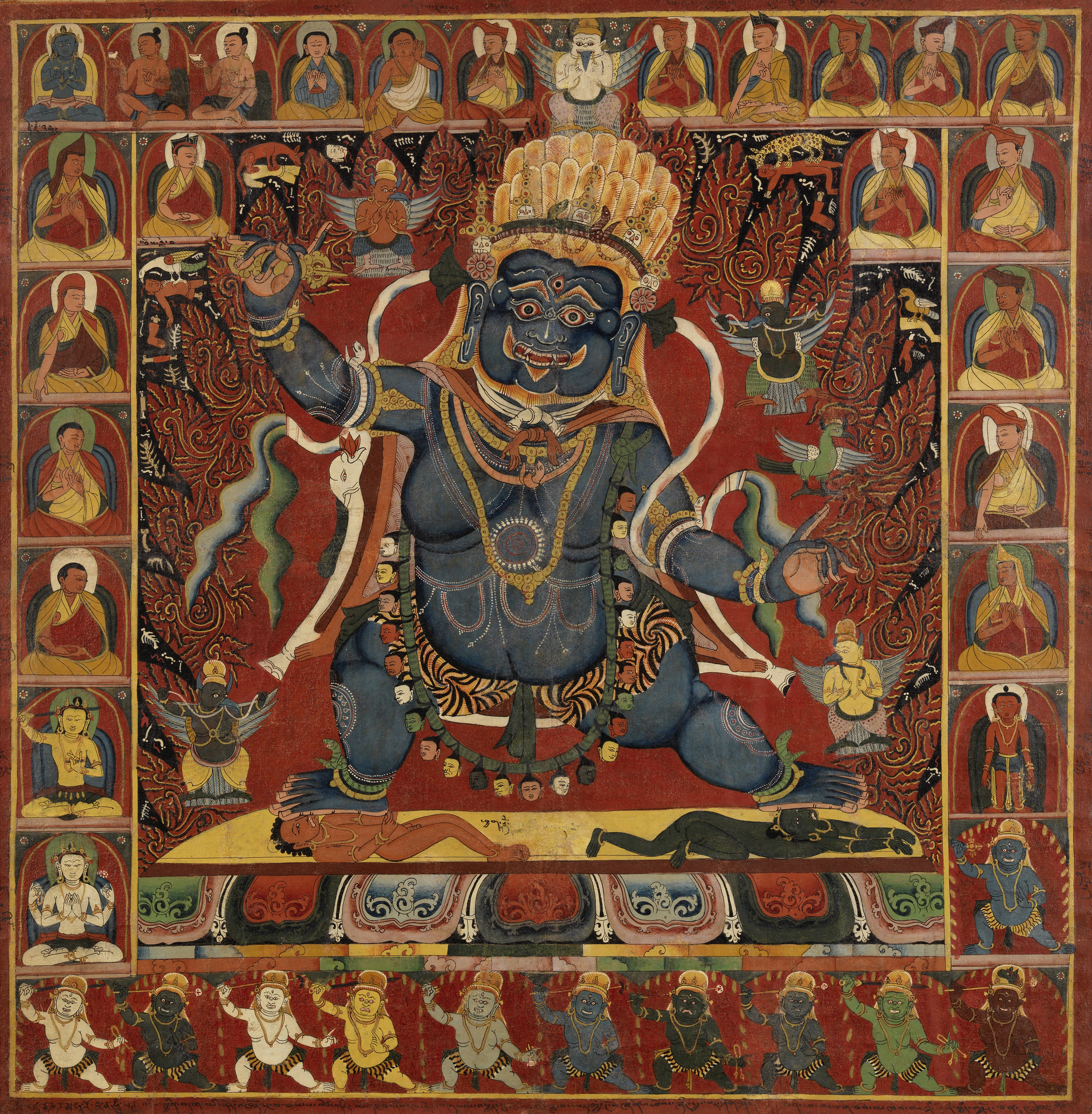
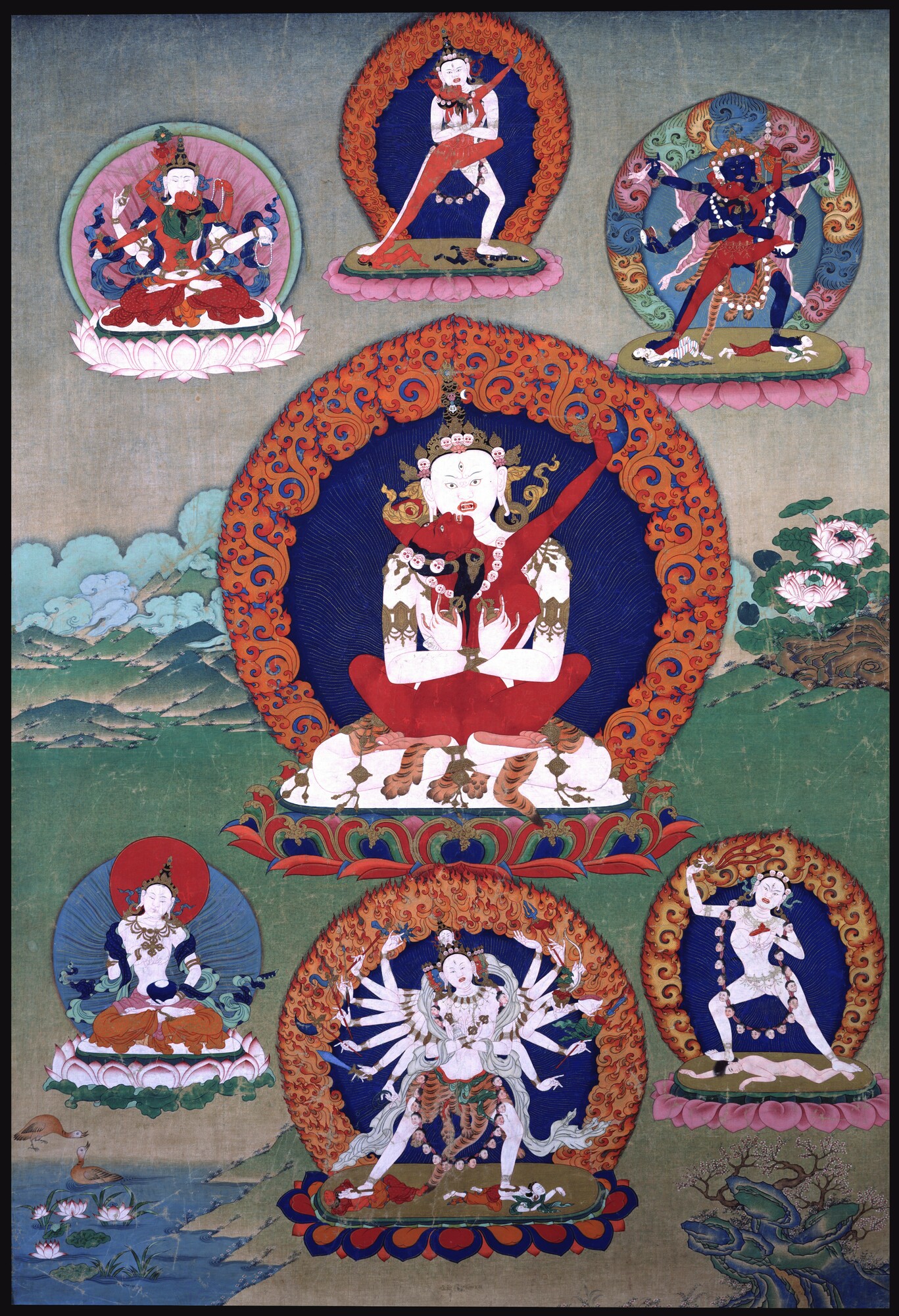
    He sometimes has a consort Red Bhagavani, sometimes is Yellow, and also has a Five Families view with the Drokpa. This is easily seen here, where he is not exactly under the other Dhyanis, but surrounded by them:


    That one is from China, and even so, he is over Kurukulla, as well as what's called Vajrayogini, but we know more specifically, it is Naro Dakini drinking blood, which is basic Buddhadakini.

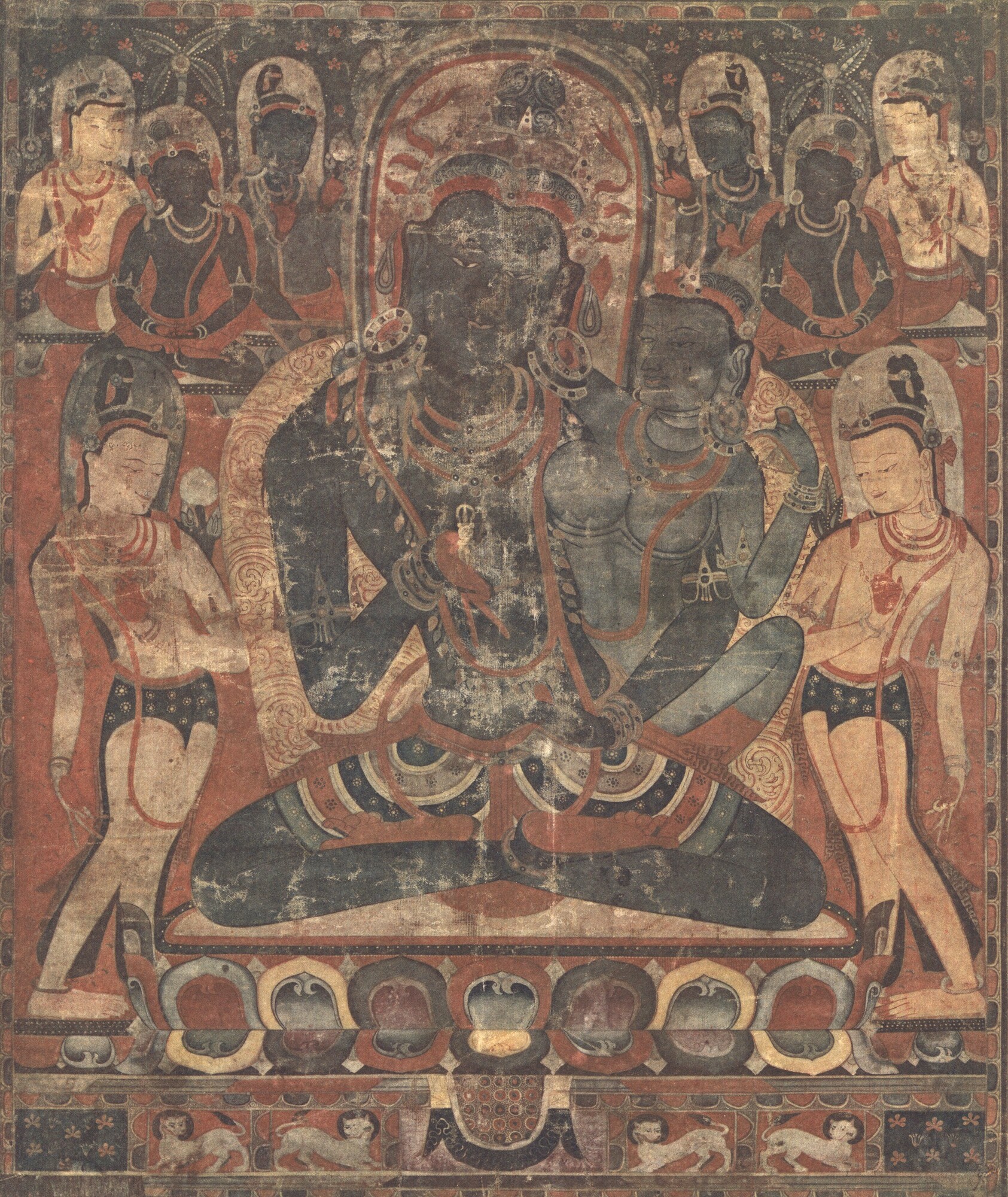
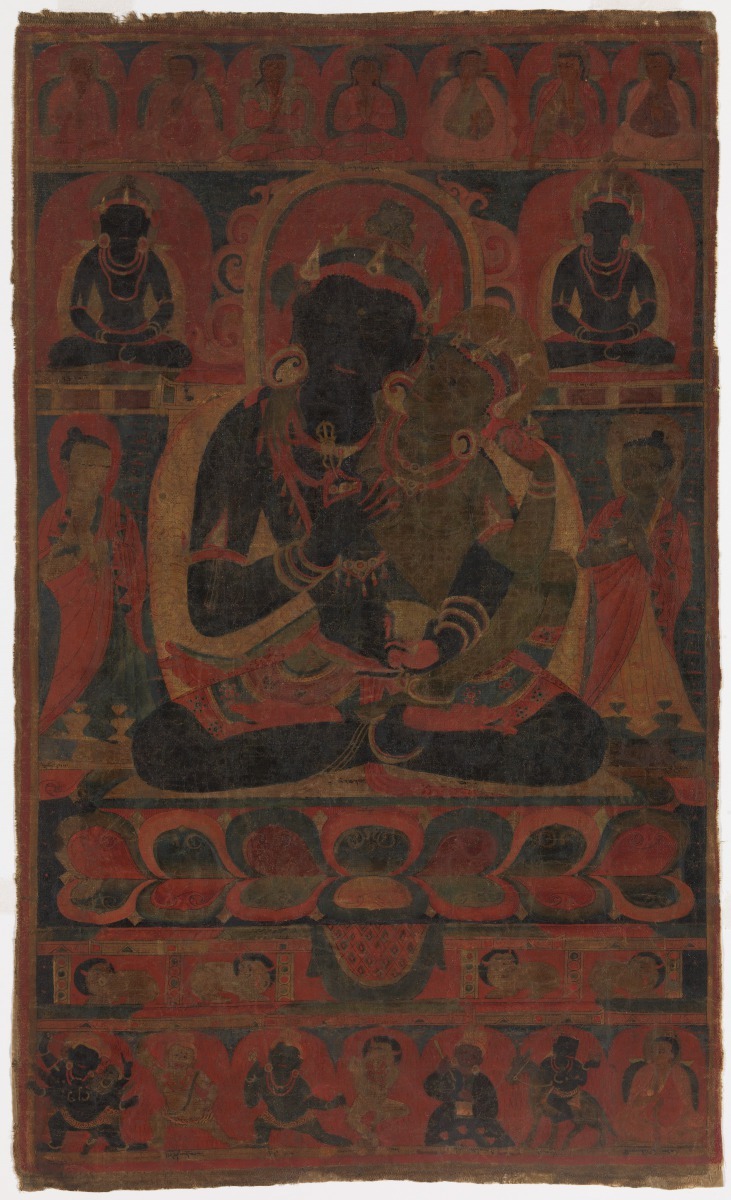
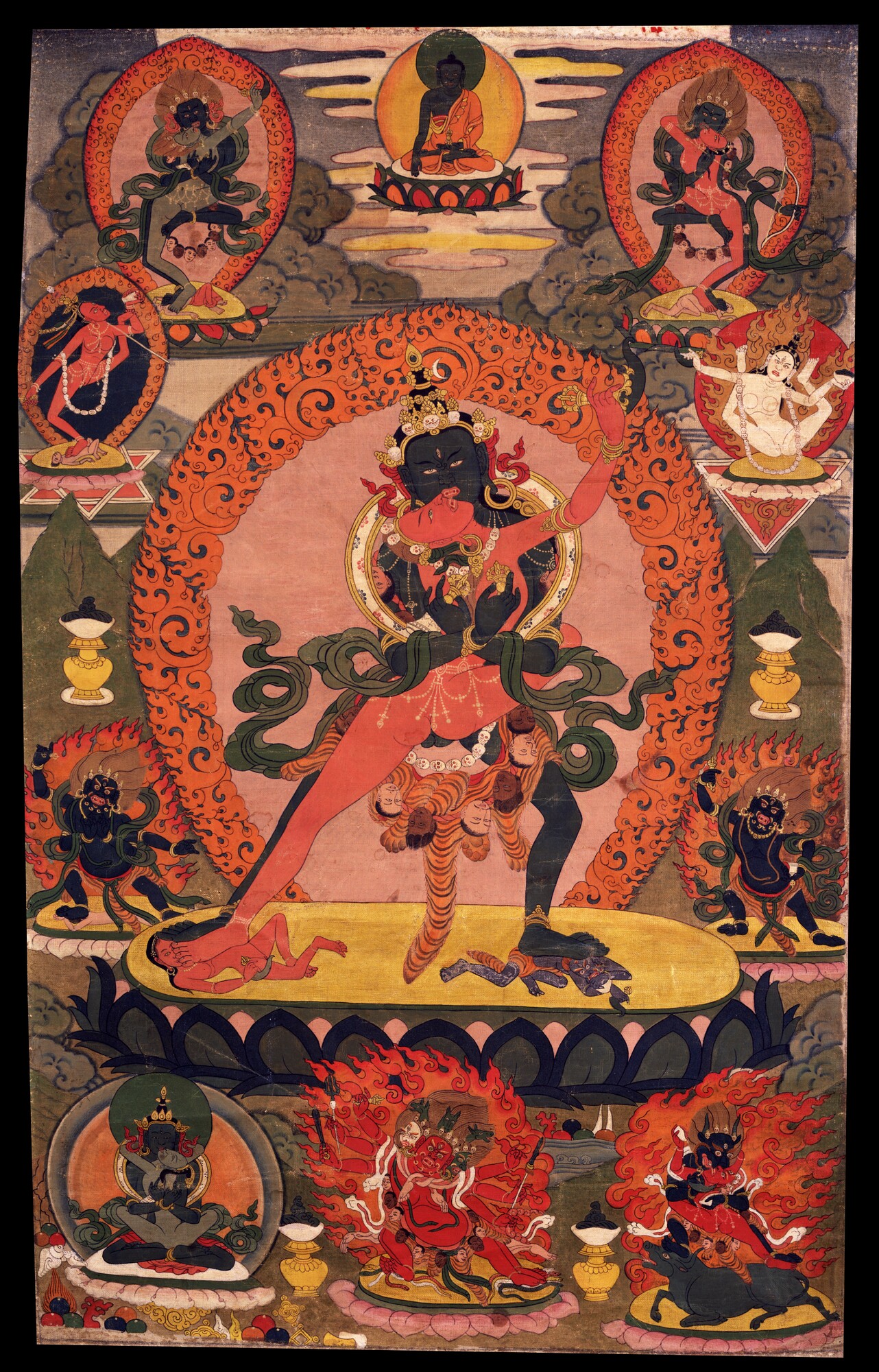
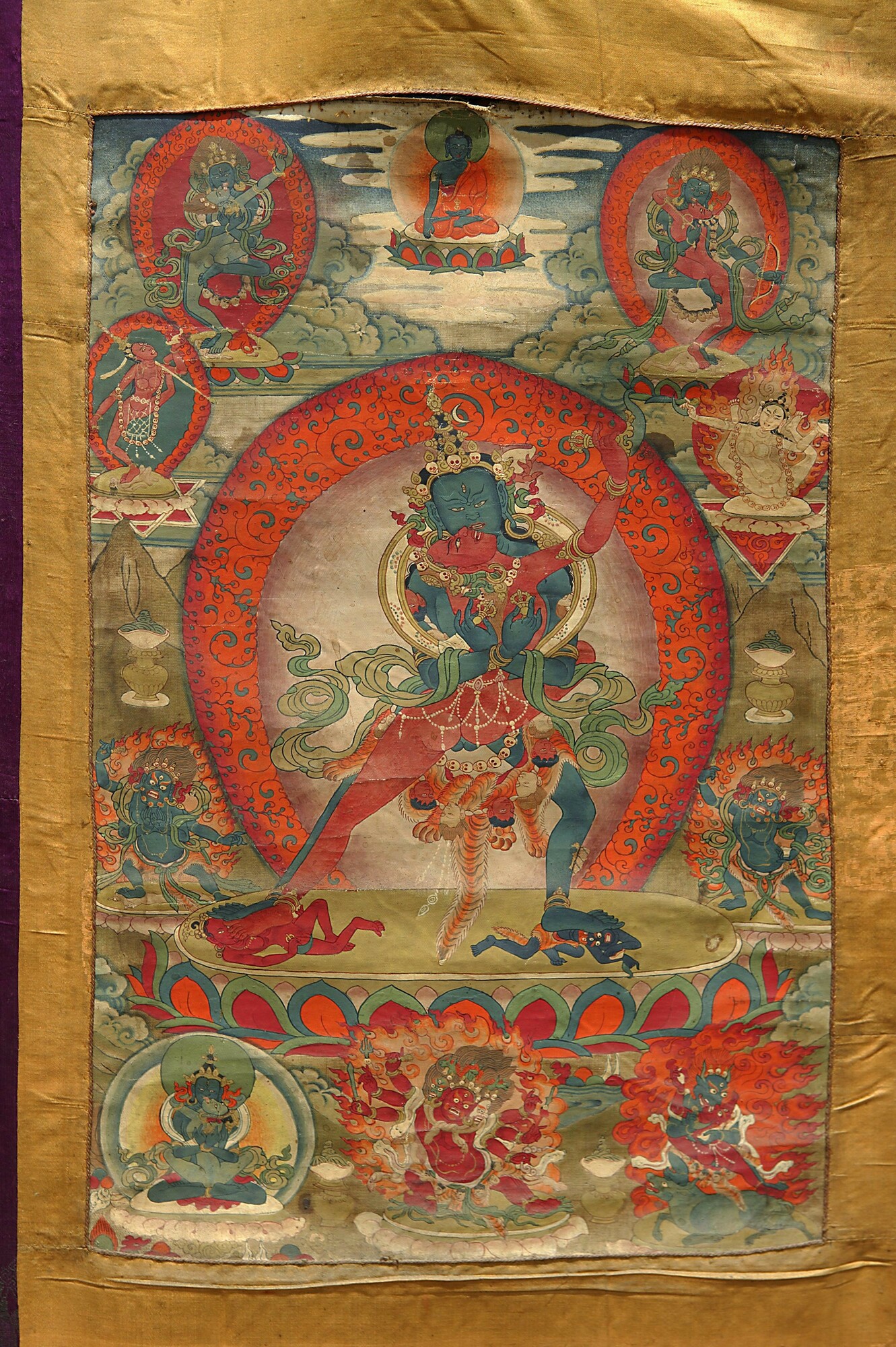
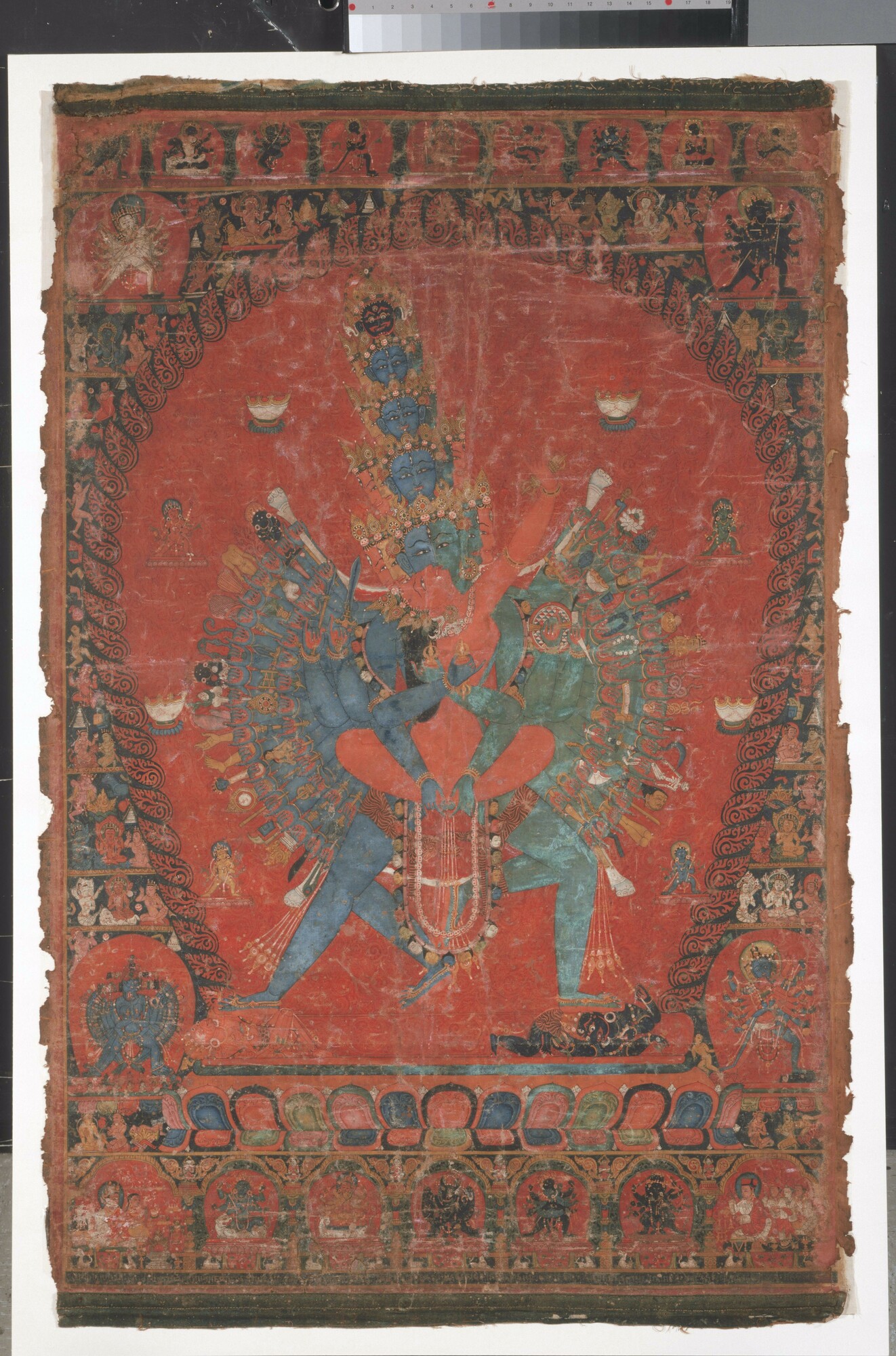
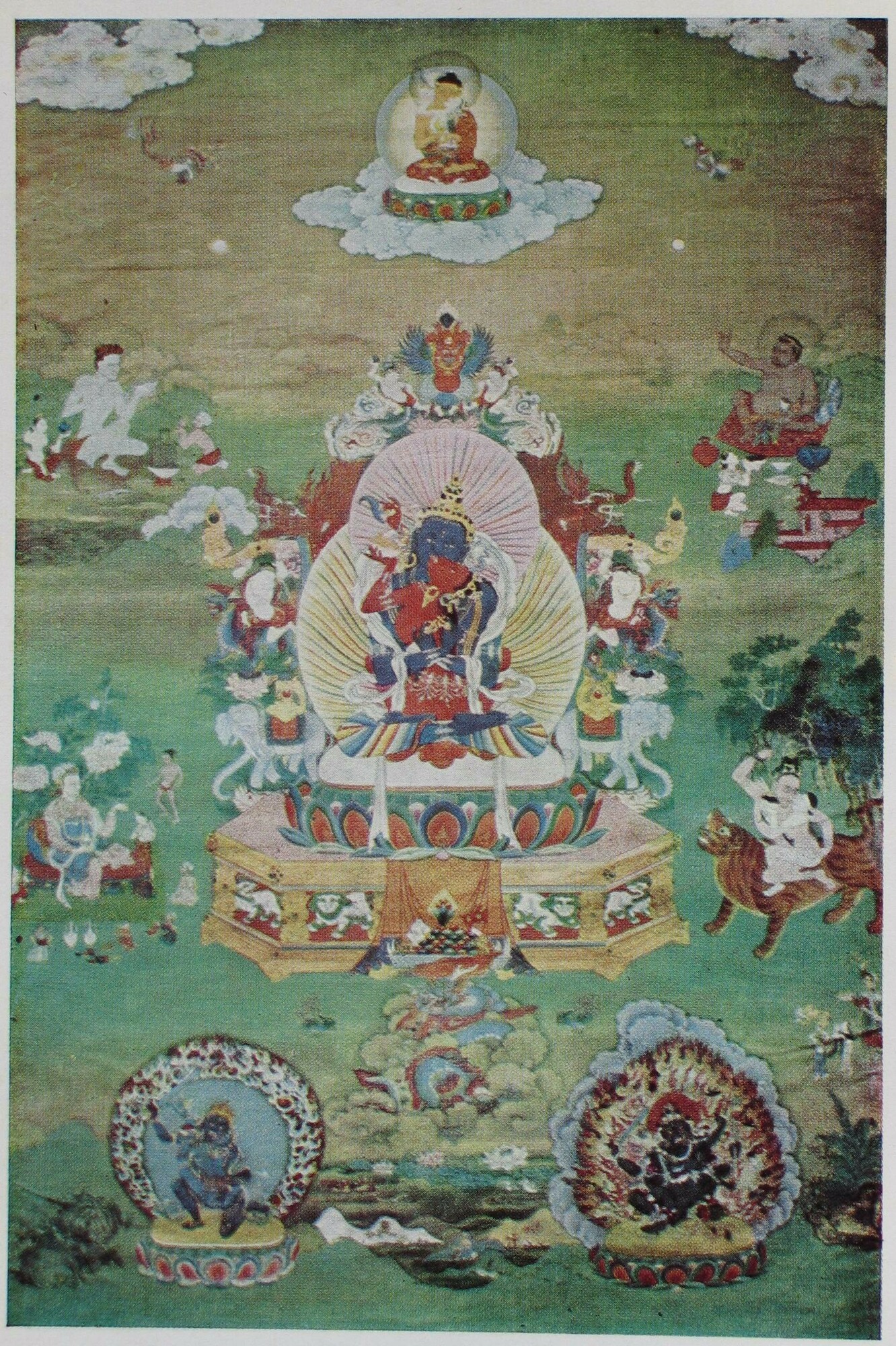
    Here he is from one of the oldest pieces. Tibet closely copied Indian style up to around the 1500s. This is with a matching, unnamed consort, who appears to only be holding a Bell, unlike most newer ones that use wrathful implements. Or, it looks like it takes both of them to hold Vajra and Bell, which is exactly the male/female correspondence. The image is nothing more than an Embrace, so it is allowed for meditation:


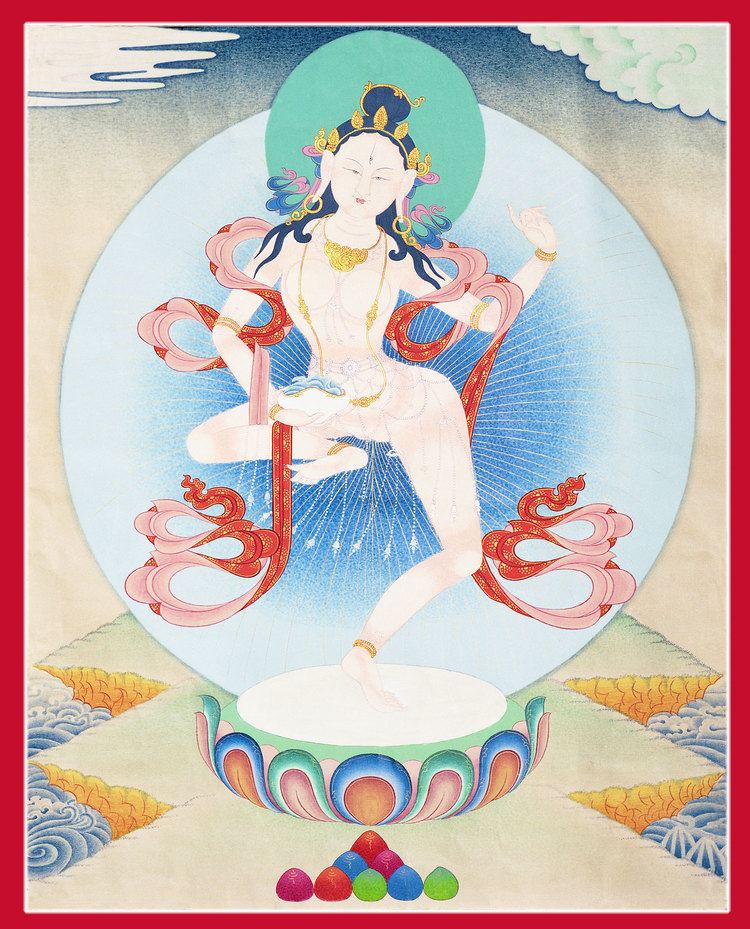
    From also having prior connections to basic Green Tara and Sarasvati, this works to pick up the forgotten Vajra Tara as we have her, a primordial peaceful Hook ray important on her own for Emptiness Mantra, which works to hook other forms. The next three are just other Taras which is just Voidness acquiring various forms that work in particular ways. Janguli and Parnasabari seem pretty well interposed here at this stage, having other forms that work a little differently. The forms are shaktis or powers that function mentally, associated with moods and activities.


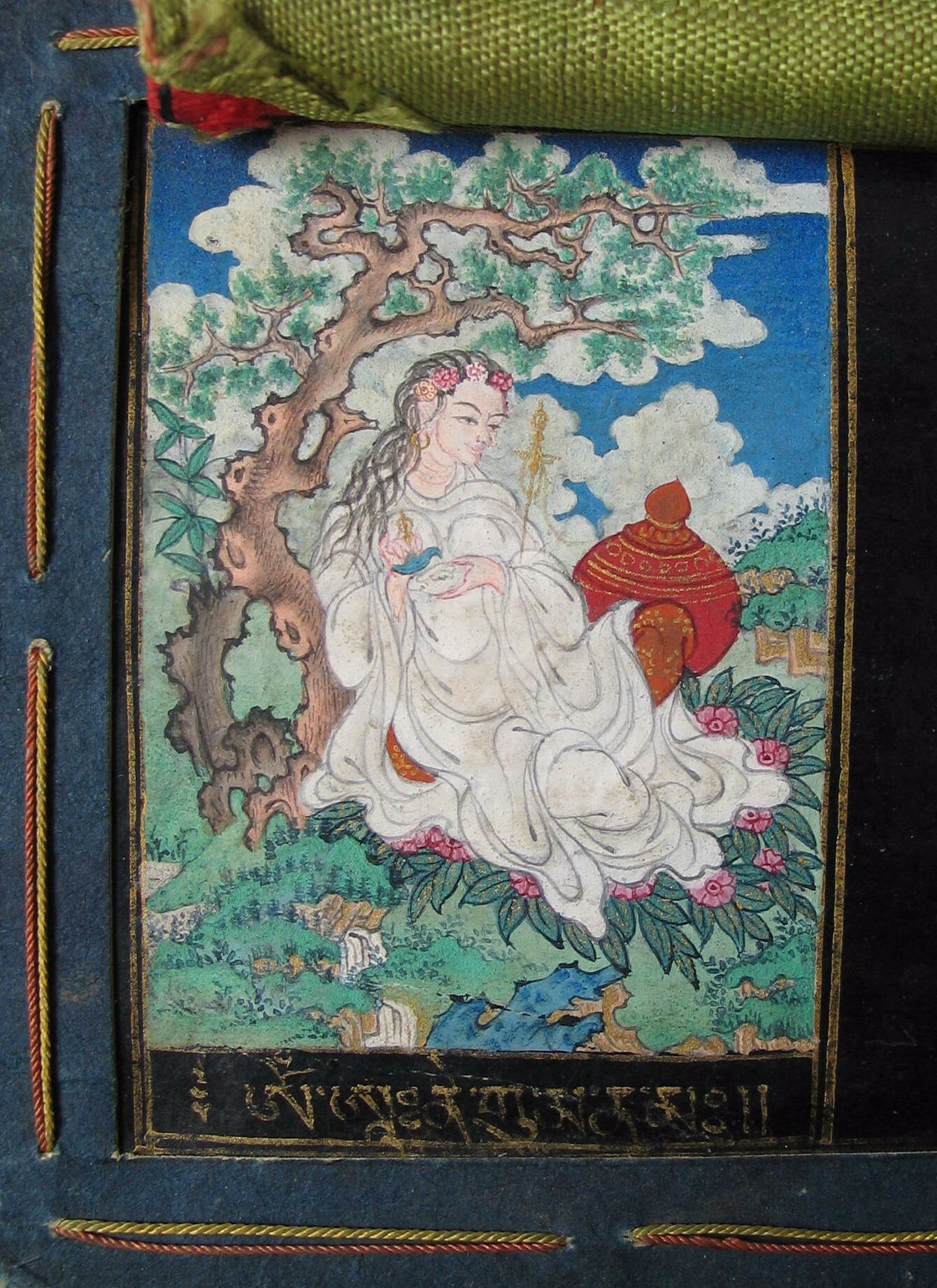
    Yidam or Meditational Deity Janguli:


    Just as has been done with the color Yellow, we are discarding her more folklorish attribute of curing snakebites, harnessed her, and changed it into a mental process. If you get bitten, you probably need a hospital, but if you see how she works with Nagarjuna--Nagaraja--Amoghasiddhi, she becomes a viable deity.

    Wrathful Parnasabari:


    She has not been changed much from her basic form, which continues today, with a 51 day festival taking about 100,000 people each day. Although a Hindu rite, there, we see they allowed a few Buddhist elements to slip in. Even in exoteric Buddhism, she is still popularly used the same way.

    Her main Yellow form is one of the odd Akshobya emanations; her Green form comes from Amoghasiddhi. Sadhanamala contains her Dharani, or, one of the missing pieces to Dharmadhatu Vagisvara mandala. It does not list this blue form, which Taranatha calls Namkha, which is both the art of weaving, and also just means sky or space. When this is shown as daytime or light sky blue, that is a tint upon White. The extremely wrathful, usually dark blue or krishna, for her, has become Black, Nagmo. Her sky blue form is not "extremely", just wrathful, and comes from Amoghasiddhi, and if this is the correct interpretation, that makes it a code for White Parnasabari. The Weaving itself is a Yoga wherein "thread" = "tantra", and it talks a little about moving the elements. So that is another Aro tradition related to Quintessence. Parnasabari can be considered to have five colors, but not Five Buddhas.

    The first one that does is called Sita Tara which is the rare Four Arm version of Ngor.

    Protector Mahasri:


    She has the least semi-wrathful feature of a third eye which is just awareness that Remati and the rest are right there. The eye closely parallels her blank mirror. If you put bad seeds before it, Remati will jump out by surprise, which won't be nice. Much more information about her is in the middle of post 269, including a traditional Friday observance. That post is a bit messy, it is Wind Horse followed by Hayagriva and Ganesh, with Lakshmi waking Vishnu, etc., with the technical terms for her divine Gunas, related to the Voids and Agni.

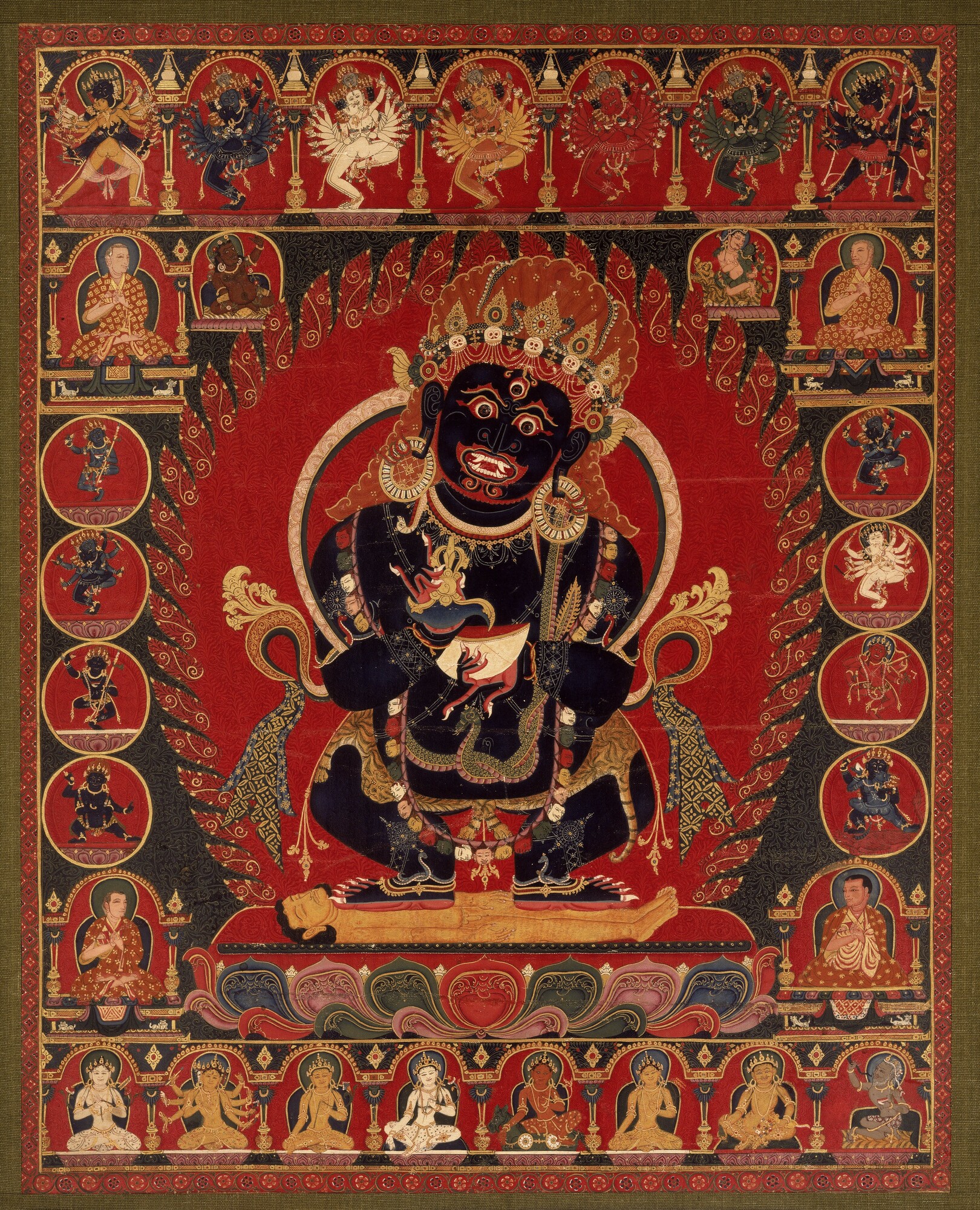
    "Offerings" are to Protectors, so, almost always wrathful, but hers is the exception. The deity is removed from her scene and it represents offerings to invite her:


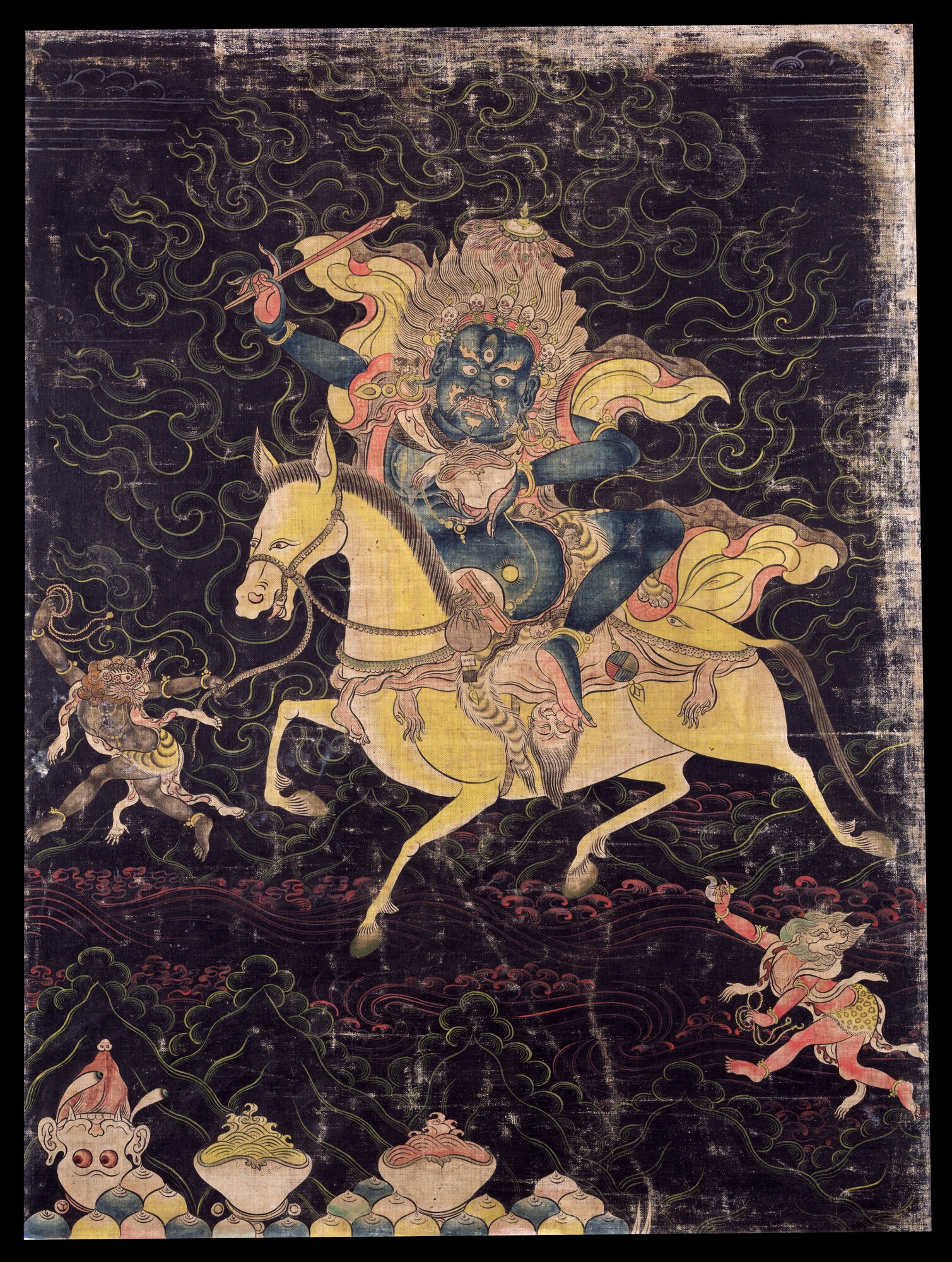
    So it would probably be more correctly stated that White or Sita Lakshmi is known in Tibet as Palden Lhamo, but that her Black Wrathful reflex (Magzor) is very dominant. "The Degree of propitiation Arya Avalokitesvara by performing the rite of fasting was preached by the nun Laksmi (dpal mo) personally blessed by Arya Avalokitesvara. She taught it to the pandita ye shes bzang po [Jnanabhadra] blessed by her. He [it to] bal po pe nya ba, blessed by him. They all were saints. The Bodhisattva Candradhvaja obtained (the Doctrine) from him (pe nya ba).[onward tp Pamo Dru]" (Blue Annals)

    In The Golden Garland of Drikung Throne Holders, Bhikshuni Sri is recorded as being from Sri Nagara.

    So Tibet has a totally different Avalokiteshvara lineage, from Padmasambhava, versus this one, from a Nun of Lakshmi. This is "a method of taking a vow through the rite of the Mental Creative Effort towards Enlightenment, as well as the degree of transit meditation according to the Madhyamaka system written by the Bodhisattva Candradhvaja [Avalokiteshvara incarnation]." This is closer to the Panchen lineage of Tashi Lhunpo. Their own claim is that Celestial Avalokiteshvara revealed himself to an otherwise unnamed nun (bhikshuni) of Lakshmi who is at the head of this lineage (Gelongma Palmo), which she gave to Jnanabhadra, and on to Pamo Dru of Tibet (see Buddhists of Kashmir). This lady is confused for, but is not, Laksminkara.

    Full Gelongma Palmo Fastingtext.

    Dakini is not too important right now, but Aro's Ulukha Mukha fits quite well:


    Dakini should be considered a subtle energy that lacks much use until the meditator is firmly centered in Sambhogakaya, which is what the prior deities are doing, and will be shown eventually by Mahasri in her Abode. Other deities of course can also be found in Abodes, such as Khadira Green Tara. If we compare the two, the White Sherab forms remain mostly stable, whereas green is kind of weird, because it gets hit with Wrathful White, and triggers Inversion. This seems to result in Peaceful Green Mahasri, if one successfully handles the dancing, flying, sexual activities.

    In other words, there is a primarily peaceful, white, physiological or nectar-based way, common for pretty much everybody, especially as seen in Long Life Trinity, which is why there is a core or pith based in White Vajra Tara. This is heart-centered. The Green involves the mind and wrathful aspects, so it gets weirder and more complex, which requires more forms to help a variety of minds. No matter how this goes, it has to fold in with the White Sherab and the overall stages of Vasudhara, who is mostly the Bhoo Devi couterpart of Sri Lakshmi. Vasudhara is all about concatenating everyone into Sambhogakaya, which is the only way to really transcend Akash and/or Mind or Manas into Buddhi and/or Dharmakaya, Vajrakaya, Deathless or Formless nature. We can't just start this level because it intellectually makes sense. It only works by transforming the skandhas which takes persistence and time.

    Just taking the Lakshmi layer from #269:

    Salutation to Lakshmi, holder of illusory powers in Sri Pitha:

    namastestu mahāmāye śrīpīṭhe surapūjite ।
    śaṅkhacakragadāhaste mahālakṣmi namo'stute ॥
    Om̃ hrīm śrīm klīm mahālakṣmi mahālakṣmi ।
    yehi yehi sarvasaubhāgyam dehi me svāhā ॥

    Namastestu Mahaa-Maaye Shrii-Piitthe Sura-Puujite
    Shangkha-Cakra-Gadaa-Haste Mahaalakssmi Namostute ||2||

    Meaning:

    1.1: Salutations to the Mahamaya (the Great Enchantress), Who is Worshipped by the Devas (Suras) in Sri Pitha (Her Abode).
    1.2: Who has the Conch, Disc and Mace in Her Hands; Salutations to that Mahalakshmi.

    Namaste Garudaarudhe Kolaasura Bhayangkari |
    Sarva Paapahare Devi Mahaalakshmi Namostute ||2||

    Meaning:

    2.1: I Worshipfully Salute Devi Mahalakshmi Who is mounted on the Garuda, and Who is the Terror to Kolasura,
    2.2: (I Worshipfully Salute) the Devi Who Removes All Sins (when we Surrender to Her); I Worshipfully Salute Devi Mahalakshmi.

    Sarvajnye Sarva Varade Sarvadushta Bhayangkari |
    Sarva Duhkhahare Devi Mahaalakshmi Namostute ||3||

    Meaning:

    3.1: (I Worshipfully Salute Devi Mahalakshmi) Who is All-Knowing (Knowing even our Innermost Thoughts), and Who Gives All Boons (When Her Compassion is Aroused); (I Worshipfully Salute Devi Mahalakshmi) Who is the Terror to All the Wicked(Destroying our Evil Tendencies),
    3.2: (I Worshipfully Salute) the Devi Who Removes All Sorrows (When Her Grace is Aroused); I Worshipfully Salute Devi Mahalakshmi.

    Siddhi Buddhi Prade Devi Bhukti Mukti Pradaayini |
    Mantra Murte Sadaa Devi Mahaalakshmi Namostute ||4||

    Meaning:

    4.1: (I Worshipfully Salute) the Devi Who Bestows Accomplishments (When She becomes Gracious) and Intelligence (to direct our Lives properly with those Accomplishments); (I Worshipfully Salute the Devi) Who Bestows both Worldly Prosperity as well as directs our lives towards Liberation (Merging in Her Lotus Feet),
    4.2: (I Worshipfully Salute) the Devi Who Always Abide by the Subtle Form of Mantra (behind Everything in Creation and Within our Hearts); I Worshipfully Salute Devi Mahalakshmi.

    Aadyanta Rahite Devi Aadya Shakti Maheshvari |
    Yogaje Yogasambhute Mahaalakshmi Namostute ||5||

    Meaning:

    5.1: (I Worshipfully Salute) the Devi Who is Without Beginning (Aadi) and End (Anta), being the Primordial Shakti (behind Everything); I Worshipfully Salute that Great Goddess,
    5.2: (I Worshipfully Salute Devi Mahalakshmi) Who is Born of Yoga (out of the Great Consciousness) and Who is always United with Yoga; I Worshipfully Salute Devi Mahalakshmi.


    Adyanta-rahite devi
    adyasakti mahesvari
    Yogaje yoga-sambhute
    mahalaksmi namo stu te.

    Meaning -

    O ! Goddes Maheshwari,with you is the begining and with you is an end,you are the energy source of the universe born of yoga,O ! Mahalakshmi I always worship you.


    Sthula-suksma-maharaudre
    mahasakti-mahodare,
    Maha-papa-hare devi
    mahalaksmi namo stu te.

    Meaning -

    O ! Mahalakshmi,you are the life of all the beings in ultra fine,you are the great power,who has great prosperity and you are the remover of all sins,O ! Mahalakshmi I always worship you.


    Padmasana-sthite devi
    parabrama svarupini,
    Paramesi jagan matar-
    mahalaksmi namo stu te.

    Meaning -

    O ! Mahalakshmi,seated on a Lotus flower,who art lord Brahma ,who is the great lord and look after your devotees like a mother , you are the source energy of the Universe.O ! Mahalakshmi I always worship you


    Svetambara-dhare devi
    nanalankara-bhusite,
    Jagat-sthite jagan-matar-
    mahalaksmi namo stu te.

    Meaning -

    O Goddess,who is in white saree,decked with very precious ornaments,you are the mother of the Universe and the energy support fo it,O Mahalakshmi I always worship you.

    She who is Forgiving , Pure ("Satva") , who is worshiped by Gods without whom the world is Lifeless , the one who is Everywhere in Everyform , The one who causes the Cosmic/Celestial Dance , The one who feeds all forms of Life .

    The one who is "Parvati" in 'Kailasha',
    "Sindhukanyaka" in 'Sheeroday' ,
    "SwargaLakshmi" in 'Swaraga(Heaven)',
    "MartyaLakshmi" in 'Bhutala' (the Bottom of the Earth) ,
    "Mahalakshmi "in 'Vaikuntha'(Celestial Abode of Lord Vishnu) ,
    The Goddess of Gods as Saraswati ,
    Who is in form of "Ganga" , "Tulsi" and "Savaitri" in 'Bhramaloka'(Conciousness) ,
    The one who is Life force of Krishna ,
    One who is "Radhika" in 'Gauloka'(The place where Krishna used to reside) ,
    The one who is the Master/Ruler of the Entire Cosmic Dance / Cycle,
    She is the one who Mitigates Sorrows and makes every being in this Cosmos Happy.

    Here is a large Hrudayam for once weekly use from Atharva Rahasya or secret atharva. Her observance is on Friday night. The chant is probably ten times the size of the material above. That's completely traditional, Venus is Friday. At least in some way, it would be beneficial to give her some time on Friday. This is for her Yellow form, so, to me, at least, this type of thing would be done after Cintamani.

    Lakshmi has few temples considering her image is everywhere. Amba Bai is in Kolhapur and has a swayambhu monolith. She is described as mulaprakriti and in the shakti pitha of Vrindaban (Tulsi or Holy Sage) near Mathura. This is a Katyayani Pitha. She also resides in Vaikuntha. Vaikuntha is located in the direction of the Makara Rashi which coincides with the constellation of Capricorn.

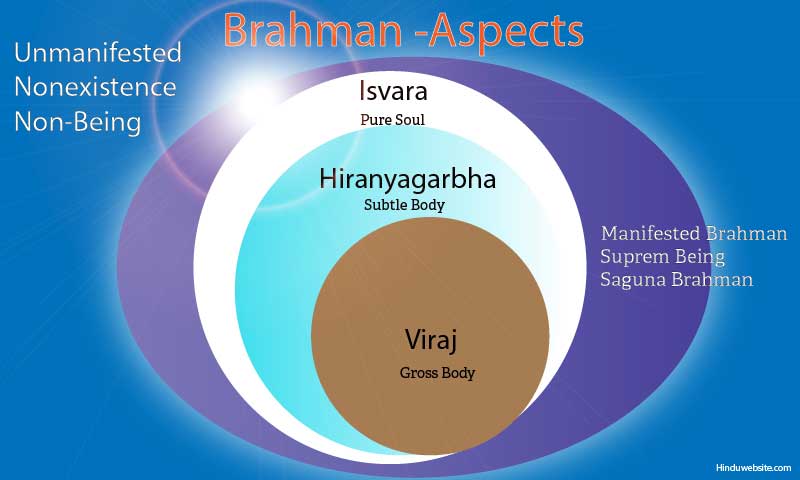
    Lakshmi is Shakti of Nirguna Brahman and our highest teaching or object of knowledge is Lakshmi Shakti of Sadguna Brahman. Ultimately this meditation becomes Nirvikalpa or Nirakara. This is her Maha Maya.

    Her Yoga Maya works the Alaya. The Alaya is the flow of mind minus the Kleshas (obscurations). The Alaya itself does not have these; sentient beings do.

    Goddess Mahakali, Mahalaxmi and Mahasarswati have their pedestals in the power-triangle situated at Varanasi of three shakti pitha.

    This is a transcendental description, and she must also be considered to have a manifested description that has one relationship with Vishnu (Rama, Krishna, etc.), and another with his brother, Bala-rama or Hercules, being at once the Central Sun, a human Zodiacal labor, as well as the fire of the underworld which will eventually terminate the planet. This is much like the syllable Hum as described as passing from the sun through the underworld, influenced by us.

    It is the esoteric expansion from her normal three Gunas of the downward triangle Rajas--Impulse, Tamas--Resistance, Sattva--Equilibrium, and her story of the relationship between Divine and Form Gunas is sort of the spine of occult cosmology. This is very close to learning the three sons or main fires of Agni, and, in Buddhist terms, achieving Sambhogakaya and dissolving the Voids.

    Sad Gunas or three pairs of gunas (Lakshmi Divine Gunas):

    This does not pertain to our world, and states that each element of the Trinity has a pair of attributes, unlike in manifestation.

    Samkarsana (Bala-rama, Sesha-tamas, or an ammonite fossil; literally, act of drawing together, contracting, attracting, ploughing, furrowing) has the pair:

    Jnana (Omniscience), defined as the power to know about all beings simultaneously
    Bala (Strength), which is the capacity to support everything by will and without any fatigue

    Pradyumna has the pair:

    Aishvarya (Sovereignty), derived from the word Ishvara, which consists in unchallenged rule over all
    Virya (Vigor), which indicates the power to retain immateriality as the supreme being in spite of being the material cause of mutable creations

    Aniruddha has the pair:

    Tejas (Splendor), which expresses self-sufficiency and the capacity to overpower everything by spiritual effulgence.
    Shakti (Power or Energy), which is the capacity to make the impossible possible

    The Six Gunas:

    Jnana
    The term jnana means omniscience or the capacity to know everything at the same time. Nathamuni explains the term as the capability of having direct vision of everything as it is simultaneously. Unlike our perceptual knowledge, the perception of Ishwara is not dependent on the mind and sense organs. This knowledge is also not subject to contraction and expansion. It is eternal (nitya) and self-luminous (svayamprakasa). It is in this sense in the Mundaka Upanishad as sarvavit (omniscient).

    Bala
    The word bala means strength. It signifies the quality by which Ishwara supports, without any effort everything in the universe, both sentient beings and the non-sentient material world; to hold all the created entities such as the heaven, planets, the physical universe etc., in their respective positions. It is in this sense that the Brhadaranyaka Upanishad says that Brahman is the causeway (setuh) that serves as the supporter to keep apart the different worlds. The same truth is reiterated by the Bhagavad Gita and Vishnu Purana.

    Aisvarya
    Aisvarya means lordship. It signifies the quality of controllership of the entire universe by unchecked freedom. This is a significant attribute because by virtue of this quality it is sarvesvara. The Brhadaranyaka Upanishad describes Brahman as sarvasya vast, or the controller of all and sarvadhipatih or the Lord of all. It also designates Brahman as sarvesvara.

    Virya
    Virya means energy. As an attribute of Vital Air, it signifies the special quality by means of which the Supreme Being remains unaffected by changes (vikararahita) in spite of being the material cause of the universe, the ground and inner controller of everything.

    Tejas
    The general meaning of tejas is splendour. It signifies the power of self-sufficiency. It is defined as the power which is not in need of any external aids (anyana peksata). That is, it is a special power to create the universe without the aid of any other accessories.

    Sakti
    The general meaning of the term sakti is power. It is understood in the sense of omnipotence. Like omniscience, sarvasaktitva (omnipotence) is equally important.

    Sadguna is itself Maya and what we are going to experience personally. Aishvarya-vira has been explained as used to start the cosmos, however, Jnana-bala is the ultimate Path once a Tejas-shakti Path is established. Part of its means are attracting and ploughing. We know Rama and Sita, but we do not yet know Bala-rama and Sita, because it is the mindlessness of the meditator meeting Kavya Mata--Venus--Agnishvattas--Lakshmi--Vajra Ocean Fire. Bala-rama is in the process of expanding to full Avalokiteshvara.

    It, so to speak, is Abhisambodhi or direct revelation of avyakta or Nirguna, unmanifest. Bala plowing Lakshmi for Sita.

    Pradyumna is really beyond our control. We may meditate and have a calm mind, but, chances are, it takes very little to throw it into an uproar. Similarly, we may be able to gauge our consciousness against the thirst to take rebirth in a fertilized egg, but actually we have very little say in the process of rebirth.

    In the Ramayana, Bala (Lakshmana) marries Sita's sister Urmila. Later he tries to stand guard on their exile for fourteen years. Nidra Devi told him this was unnatural; someone would have to pay for the sleep debt. Urmila agrees and is plunged into deep slumber for fourteen years so Lakshmana can stay awake. Urmila Nidra refers to deep sleep, and Yoga Nidra is sleep not for lucid dreams, but a form of pratyahara for the emergence of the unthinking witness, related to Vishnu on Sesha. Nidra is Maha Maya (Tamas). The Egg of Brahma has formed; Maha Maya leaves Vishnu and goes to Brahma (sattva, who is struggling with rajas and tamas), thus, free of Tamas, Vishnu awakes, from desiring to hear sound.

    The Egg is formed:


    She leaves him to help Sattva in the Form Worlds.

    Sita's sister Urmila is Deep Sleep Lakshmi.

    Devi Kavacham (Armor Goddess) is related to Yoga Nidra or Sleep Yoga.

    Sita has generally been overlooked as a deity until around 16th century as Radha. A few existing mantras for her:

    Om sim sitayae namH’iti moolmantraH

    (Her root mantra is Om Sim Sitayae Namah. This says her seed is the syllable Sim.)

    Sita Gayatri:

    Om jankjayae vidhmhe rampriyayae dhimhi ! tannH Sita prachodyat !

    Or:

    Om Janaka Nandinyai Vidhmahe

    Bhumijayai Dheemahi

    Thannah Sita Prachodayath.

    Om, Let me meditate on the daughter of Janaka Oh, daughter of earth, give me higher intellect, And let Sita illuminate my mind.

    White Tara mantra for Increase:

    oṃ tāre tuttāre ture mama [______] puṣṭiṃ kuru svāhā

    One could place Punya (merit), Jnana (Wisdom), and so on (nominative singular case). Mama or "mine" could be replaced by the name of someone else to receive the benefit. Pustim kuru has the sense of to drive, to make. This is less of a plea for assistance, than it ls like a polite command, like "Kettle, boil water for me!"


    White Tara mantra for Pacification:

    oṃ tāre tuttāre ture sarva [______] śānti kuru svāhā

    This could be against Grahan (planetary spirits), Jvaran (fevers), and so on (accusative case).


    White Tara mantra for Protection:

    oṃ tāre tuttāre ture sarva [______] raksaṃ kuru svāhā

    This could be against Grahebhyo (planetary spirits), Vyadibhyoh (diseases), and so on (ablative case). The -bhyo is, generally speaking, the ablative meaning 'from', the base for is -bhyaḥ but it changes to -bhyo when followed by r. This is the syllable for Ekajata.
    Last edited by shaberon; 8th March 2019 at 07:49.

  8. The Following User Says Thank You to shaberon For This Post:

    what is a name? (4th March 2019)

  9. Link to Post #366
    United States Avalon Member
    Join Date
    1st April 2016
    Posts
    6,506
    Thanks
    33,747
    Thanked 36,931 times in 6,152 posts

    Default Re: The Serpent, the Black Sun, HPB & St. Germain

    I added some of the Lakshmi material above. She turns out to have a unique "Offerings" icon, which would be really useful to invite her.

    We are trying to invoke her as a basic white form, Sita, who, herself, has never much been placed as a deity. Generally you are not supposed to devote to her without including Rama. This is the tendency of most of the male-based Hindu systems, is just to slap the female onto a corresponding male, mostly just as a copy. At the basic or outpouring or creation level, it makes sense just to say Indra has Indra Shakti, but then once you start looking, those are really offices that can be occupied by different individuals. And our take-away is Ganesh, who collects all the Shaktis. And then at least in Buddhism, consorts get switched around, because we really consist of a Hydra or all elements, instead of being cast into a sort of mono-role like the planetary lords stuck with one shakti.

    There is not and never really has been any sort of Sita cult, but, she is a major figure in the first epic literature or Ramayana. She performs as pure purity, immune to a normal "Trial by Fire", sent from and returning to earth. As an individual, she is often remembered with Five Virtuous Women, such as Draupadi, in a very exoteric, fictional, soap opera look at their characters. Otherwise, she is only really known as Rama + Sita, or Krishna + Radha. However, studying her occultly places her as premier, particularly with Fixed Fire of the Stomach, and the cooling or dissipation of internal heat (tapas), which already indicates the strange female touch to the male White Drop we use in Buddhism.

    The two primordial kinds of Avalokiteshvara are Khasarpani and Jinasagara. Jinasagara eventually consorts the Vilasini form of Lakshmi. The important concept is that there are Red and White males, and Red and White females, in distinction to saying for instance the Red Drop is only female or only responds to feminine energy.

    "Tibetan Buddhism" would more or less mean Atisha's White Tara of Five Buddhas and Seven Eyes. There is nothing wrong with this, although she is specific to Tibet and Mongolia. Also, we cannot really claim to have Five Buddhas' influence until we really do. When we look at the older Indian system, Sita corresponds fairly directly to basic Vajra Tara, and her close counterpart Cheating Death or Mrtyuvacana Tara. When we say tantric Sita is Janguli, we should also keep in mind that most of the advanced forms are not called Sita or White, but become like Sukla Janguli, which is more like moonlight.

    Sita's seed syllable is Sim.

    That is more basic and simple than Srim (Sri), Hrim (Sarasvati), Brim (Cintamani), or Jrim (Vajrapani). Srim refers to moonlight, or sukla, and so this very slight change progresses from Sim--Sita--White, to Srim--Sri--Moonlight. If Vajra Tara is pure peace and emptiness, then, this closely corresponds to Sita. She works by ignoring the Atisha version and requiring familiarity with Indian lore. Or, one could say that Vajra Tara is the real or only Sita cult.

    If so, then the best bet would be to use Vajra Tara to invite Sita into that empty coat. Set her up as the peace and purity itself, before using Protector Mahasri. Sita is even more basic than Sarasvati.

    With Vajra Tara doing the inviting, this is somewhat to say, we are using these Hindu deities in a Buddhist way. Any Hindu would be a Buddhist if they renounced Moksha (Liberation) and pledged to manifest Annapurna--not in the normal yellow meaning of wealth and abundance, but, when we study her esoterically as the height of Agni Yoga, similar to Tenth Durga or Vijaya, this is sort of the new yellow or the yellow deities who confirmed Buddha's enlightenment. This is more or less his story, taming and binding deities. The violent (Rudra) was hit with Destruction, lust (Mahadeva) was hit with Subjugation, yellow powers have been re-defined, white if anything is being revealed.

    For me, personally, I was asked for peace from the poor soul I had the incident with. So it's resolved at the basic level. Realistically due to karma it will be indefinite time before being able to provide the right kind of house for Mahasri. Therefor it will be a matter of spending a lot of time in sort of the generation stage of Sita and Mahasri on just the most basic, individual level. A whole bunch of that is in order before Cintamani (Vasudhara and Lakshmi).

    Here is a translated traditional Song of Sita, and another, untranslated, for Sita Lakshmi.

    The song is great (copied below) and that site has a good mouseover for Sanskrit. Jānaki means the daughter of Janaka and Maithili as the princess of Mithila (Nepal--India border). Her father Janaka had earned the sobriquet Videha due to his ability to transcend body consciousness; Sita is therefore also known as Vaidehi. The further connection of Buddhism and Yogacara is that Janaka specifically hosted Yajnawalkya and some of their conversations are in the Upanisad. So this is the same area, and not long before the time of Buddha.

    A medium-length version of Sita Names refers to the permutations of syllables in Sita, Rama, Sri, and Tara. I am not quite sure why Tara = TaSi, but, the equivalency of Sita and Tara is here given by a non-Buddhist source. As Vaidehi, this is "body-less" or a synonym for Dharmadhatu awareness. As the daughter of Videha, this is only so by a magical rite of adoption; she is considered self-existent, parent-less, and was simply invoked.

    Buddhism has an abbreviated Ramayana that excludes the war. Nevertheless, it accepts Sita as a manifestation of Vasudhara, who herself lacks a white form.

    Sita may also refer to the phase of the moon, and, in astrology and Matsya Upanishad, is White Sukra (Venus). Also interpreted as "cool". She is also called Sitavati or Suddhavati in Svacchanda Tantra. Buddhist Protector Sitavati is a Four Armed Red Amitabha deity, Her syllable is "Jim" and she has rosary, varada, vajra, and book to her chest. This one is perhaps "holding coolness" like Usnisa holds Amitabha himself. He has few other emanations--Bhrkuti and Kurukulla. We have found Kurukulla's rare White form, sort of the inverse of Sita's Red form here.

    Sita:

    सीता

    Om Sim Sitayai Namah (Root mantra)

    Here are twenty-four Gayatri mantras. The common Sita Gayatri refers to her as Janaka's daughter and Rama's beloved. This one is a little more independent:

    Om Janak Nandiniyei Vidmahe
    Bhumijayei Dhimahi
    Tanno Sita Prachodayat

    It is tolerance and penance-oriented, similar to the Ramayana. Nandini is just a woman who brings joy. Bhumijayei means lives in the earth.

    Sita's Song:

    Sri Janaki Stutih

    Jaanaki Tvaam Namasyaami Sarva-Paapa-Prannaashiniim ||1||

    Meaning:
    (Hanumanji said)
    1.1: O Devi Janaki, I salute You; You are the destroyer of all Sins,

    Daaridrya-Ranna-Samhartriim Bhaktaana-Abhisstta-Daayiniim |
    Videha-Raaja-Tanayaam Raaghava-[A]ananda-Kaarinniim ||2||

    Meaning:
    2.1: (I Salute You) You are the destroyer of Poverty (in the battle of life) and bestower of wishes of the Devotees,
    2.2: (I Salute You) You are the daughter of Videha Raja (King Janaka), and cause of Joy of Raghava (Sri Rama),

    Bhuumer-Duhitaram Vidyaam Namaami Prakrtim Shivaam |
    Paulastya-[A]ishvarya-Samhatriim Bhakta-Abhiissttaam Sarasvatiim ||3||

    Meaning:
    3.1: I Salute You, You are the daughter of the Earth and the embodiment of Knowledge; You are the Auspicious Prakriti,
    3.2: (I Salute You) You are the destroyer of the Power and Supremacy of (oppressors like) Ravana, (and at the same time) fulfiller of the wishes of the Devotees; You are an embodiment of Saraswati,

    Pativrataa-Dhuriinnaam Tvaam Namaami Janaka-[A]atmajaam |
    Anugraha-Paraam-Rddhim-Anaghaam Hari-Vallabhaam ||4||

    Meaning:
    4.1: I Salute You, You are the best among Pativratas (Ideal Wife devoted to Husband), (and at the same time) the Soul of Janaka (Ideal Daughter devoted to Father),
    4.2: (I Salute You) You are very Gracious (being Yourself the embodiment of) Riddhi (Lakshmi), (Pure and) Sinless, and extremely Beloved of Hari,

    Aatma-Vidyaam Trayii-Ruupaam-Umaa-Ruupaam Namaamyaham |
    Prasaada-Abhimukhiim Lakssmiim Kssiira-Abdhi-Tanayaam Shubhaam ||5||

    Meaning:
    5.1: I Salute You, You are the embodiment of Atma Vidya, mentioned in the Three Vedas (Manifesting its Inner Beauty in Life); You are of the nature of Devi Uma,
    5.2: (I Salute You) You are the Auspicious Lakshmi, the daughter of the Milky Ocean, and always intent on bestowing Grace (to the Devotees),

    Namaami Candra-Bhaginiim Siitaam Sarva-Angga-Sundariim |
    Namaami Dharma-Nilayaam Karunnaam Veda-Maataram ||6||

    Meaning:
    6.1: I Salute You, You are like the sister of Chandra (in Beauty), You are Sita Who is Beautiful in Her entirety,
    6.2: (I Salute You) You are an Abode of Dharma, full of Compassion and the Mother of Vedas,

    Padma-[A]alayaam Padma-Hastaam Vissnnu-Vakssah-Sthala-[A]alayaam |
    Namaami Candra-Nilayaam Siitaam Candra-Nibha-[A]ananaam ||7||

    Meaning:
    7.1: (I Salute You) (You as Devi Lakshmi) Abide in Lotus, hold Lotus in Your Hands, and always reside in the Heart of Sri Vishnu,
    7.2: I Salute You, You reside in Chandra Mandala, You are Sita Whose Face resembles the Moon,

    Aahlaada-Ruupinniim Siddhim Shivaam Shivakariim Satiim |
    Namaami Vishva-Jananiim Raamacandre[a-I]sstta-Vallabhaam |
    Siitaam Sarvaan-Avadya-Anggiim Bhajaami Satatam Hrdaa ||8||

    Meaning:
    8.1: (I Salute You) Your Form gives Joy to all, You are the Sati (Devoted Wife) Whose presence is Auspicious and confers Siddhi and Liberation,
    8.2: I Salute the Mother of the Universe, Who is the Beloved of Ramachandra,
    8.3: I always Worship You in my Heart, O Mother Sita, You are Beautiful in entirety, the Beauty which cannot be expressed in words.

    At the end, Shiva is simply called "Liberation" and "Auspicious". Near the beginning, Sita is called Prakriti, or matter. So even this basic peaceful song only makes sense occultly. Shiva is usually just considered one's personal thread to the absolute, empowered by mentally purifying the many veils of matter.

    There are several major Peace or Shanti mantras, the only one I know, from Brihadaranyaka Upanisad 5.1:

    Auṃ pūrnamadaḥ pūrnamidam
    pūrṇāt pūrṇamudacyate
    pūrṇasya pūrṇamādāya
    pūrṇamevāvaśiṣyate

    oṃ śāntiḥ śāntiḥ śāntiḥ

    Sense is that infinite universes flow from Brahman, infinite universes dissolve into Brahman, and Brahman remains unchanged (Absolute). The three shantis are for physical compound (Bhautika, external), divine (deva or ghost, demi-god, etc.), and internal (body, mind) wheels of time. Purna, in the sense of Annapurna, used here repetitively. Fullness. Emptiness is full. Or, in Shentong, void is empty of natures other than its own. One Life.

    If I give her an Upanishadic song, this is to take the Warrior Kings' lineage that the Brahmin or priest caste had to ask for, and offer it freely to the service of this pure maiden.

    Most versions of this Shanti mantra are very mild. This version is hard to find, and has been retained in Italy. There are a few other ones where the third line still has a bridge feel, but this one is very energetic and traditional. This is what I learned it from almost thirty years ago, when I had little idea what it was, but now there is a much better picture of its background. This is repetitive, probably 108 times, and whereas there are moments for softer mantras, this flat out rocks:


    To strengthen Sita's case, the British Museum has an almost one-of-a-kind artifact, being a medieval Ramayana with 400ish royally-commisioned paintings. Here is their digitized text and imagery. Most Ramayanas are about the same; Valmiki, the Adi Kavya or primordial poet, authored, by writing, something collected from spoken tradition. This is found to be a major power conferred by Agni Yoga. The main difference between books is the ending; here is the relatively brief Valmiki ending.

    A horse sacrifice is involved, or the inner meaning of Brihadaranyaka Upanishad and Hayagriva. The "normal way" is drastically interrupted by Sita's sons, which, here again, plausibly sets them as a type of horsemen or Aswins. We see one of the sons is Kush for kusha grass. And it does not go on, but, historically, these sons become part of Shravasti and Kushinagar, all part of the same area, and, historically, highly relevant to the life of Gautama Buddha. It is referred to in Prajnaparamita, and was part of the Malla kingdom.

    In the time of the Buddha Metteya, Kusavati will be known as Ketumati (Anagat.v.18).

    Giving her any look beyond that of "Vishnu's perfect wife" really is an orientation to the Path as it is shaped. White Sita prior to Yellow Lakshmi is almost the same as White Vajra Tara before Yellow Vajra Tara.

    As well as "white" her name also means "furrow". Her "mother", so to speak, is earth, or Yellow.

    From her humble, overlooked origin, one can find White Protector--Mahasri, White Yidam or Meditational Deity--several, including the Sherab or self-development, White Wrathful--yes, Day/Night Tara, Dakini--yes, White Shangpa Buddhadakini.

    Theosophy does not explain Sita but does state that every line of the epics is esoteric. Furthermore, it is highly entwined with The Dream of Ravan. This is a dream which could have taken place at a certain point in Ramayana.

    It is often suggested as Koothoomi's work; it was published anonymously in 1854 at University of Dublin and conveys one of his main points (Gunas) and generally consists of more Sanskrit esotericism than was available in Europe at the time. It takes as its source a work called Dnyaneshwari, which HPB also refers to at the beginning of Voice of the Silence. If we look at the fist excerpt, it explains that a yogi who attains body-lessness is a Khecara Sky-goer. So this is a major Buddhist theme, related to Janaka and Sita, who were body-less in yogic tradition and this story is about her, so it cannot be any different subject. Dnyaneshwari is seen as a masterpiece, expanding Bhagavad Gita to 9,000 verses relying on Veda, Purana, and Upanishad, written by someone about sixteen years old. He translated Sanskrit into Marathi, the common language of Maharashtra, where it has probably been the most influential book for 800 years.

    Sita was an adept of Agni Vaisvanara and we see in this Mahabarata commentary that the same term Khecara as used in Buddhism already means the same thing in this non-Buddhist tradition that was the immediate precursor to Gautama. If we spelled out the source, it would be Jnana Ishvari, which is none too far from Jnana Dakini, considering it already says Khecara. Same thing.

    The relatively modern equivalent of Dnyaneshwari would be Parasu Rama Kalpa Sutra. This is quite unique for instance, being a Shakta text, has Shiva talking and repeats his tattva system. It explains how the left hand path is one thing for those of low realization, and transmutes into another meaning for initiates. It attempts to tie Dattatreya at the head of a historical truncation of spiritual teachings resulting in Tripura Sundari. The whole thing and commentary are much larger than those verses.

    Another look at Parasu explains coconut as the Wish-fulfilling Tree and so in South India it is sacred like the cow. Its fruit is Water Vase. This follows the view that South India was a powerful source of Mantrayana (Shurungama Sutra, etc.), and it was mantra (mind protection) which grew to tantra (tattva or element of reality plus mantra). So "Water Vase" is a completely different thing in Kerala than in Nepal, nevertheless, functionally, they are the same. Consequently, if it does not literally have to be a coconut or a pitcher, it could be completely mental, i. e. Varuni. And if anything, she unfolds as crocodile deities. But everyone will use the Vase or Cup.

    A look at Mother India explains a lot very quickly about Buddhist Theosophists who mostly worked in the interest of Indian Hindus. There are many articles presumed by B. P. Wadia and it looks just the same as HPB continuing, because, he uses her original system. He mentions Ramayana and then, for example, the Puranas, being a method to publicize initiated teachings. However, those, too, are nationalistic, in other words, Vishnu speaks for areas where he was popular, or else it is Shiva, Agni, etc., so they aren't really intended to contradict or compete with each other. Just a way of making it acceptable to an audience. And so this wide variety was distilled into Dnyaneshvari (ca. 1290), clearly making a tradition of sort of pan-Puranic philosophy, or to link the common deep truths, so composing a non-Buddhist Secret Doctrine which itself was only a tool of primarily pilgrims.

    Historically, this is right after the Indian Buddhist system was annihilated. South India was still resistant.

    Eventually the white goddess results in 1,000 Arm White Parasol. That is, if it can be seen that it makes sense that Nagarjuna's White Vajra Tara is really non-different from Sita, except that it means an esoteric, tantric, or inner state of being, personal experience, or atma vidya.

    The more natural or inherent Red Lady, Varuni--Guhyeshvari, is not really advisable without grounding in the above.

    In both cases, the Red and White Avalokiteshvaras, Khasarpani and Jinasagara, are there, but this just describes the mind or "I" of the meditator. The ladies are the power that flows through. This shapes and informs the entire samsara. If one is going to emerge from meditation and do anything, power is what you are doing, all the time, whether in terms of the animating electrical energy, work done by the muscles, and so on. But we are shaping it mentally and verbally by the real person in the heart.

    There is another medieval Nepali Pancha Raksha wherein Mantranusarini becomes the Red Amitabha goddess, and then Sitavati becomes Green, apparently an Amighasiddhi emanation:


    The Yellow Mayuri/Green Sitavati format is from Sadhanamala #206. Her color is "Haritam" or the mid-toned green which looks right on the manuscript.

    These relatively peaceful protectors are sometimes grouped around Vasudhara or Amoghapasha Lokeshvara.

    Wisdom Library has set up a number of important works online. They have useful Sutras (Lankavatara, Lotus, Paranirvana, Prajnaparamita), as well as Alice Getty's Gods of Northern Buddhism, and Bhattacharya's Indian Buddhist Iconography, the partial translation of Sadhanamala. It includes a lot of the original plates, but not all. Doesn't have all the unsearchable errors like on most other sites. Getty's page on Feminine Deities is still an 80% quick intro to Taras or Prajnas--incomplete, with a couple of mistakes, but still a clear and solid overview today as it was in 1914. Their dictionary is amazing.
    Last edited by shaberon; 3rd July 2019 at 03:16.

  10. The Following User Says Thank You to shaberon For This Post:

    what is a name? (5th March 2019)

  11. Link to Post #367
    United States Avalon Member
    Join Date
    1st April 2016
    Posts
    6,506
    Thanks
    33,747
    Thanked 36,931 times in 6,152 posts

    Default Re: The Serpent, the Black Sun, HPB & St. Germain

    I added a bit more to the Sita and Lakshmi posts above.

    They are inextricably laced into Buddhism in a way that is not obvious, but profound, shaping meanings for the Path that are often concealed.

    It focuses the main lineages we are trying to pursue:

    There are two "Methods of Tara and Avalokiteshvara", and for the most part, we are leaning towards Manjushri's Profound View (awakening mind) rather than Asanga's Extreme Deeds (more formal).

    This Profound View was used by Nagarjuna, who has been confused for himself; first Nagarjuna lived around 2-300, "Sutra Nagarjuna" who provided Prajnaparamita Sutra. Second or "Tantra/Alchemist" Nagarjuna was one of the early figures in the Mahasiddha Movement, and it is his collection of Khadiravani and Vajra Tara that we are attempting to preserve. When the Mahasiddhas were destroyed by invaders, Sakya Sri was the final abbot who wound up in Tibet founding Ngor lineage, which uses the same White Sherab deities, Four Arm Sita, White Varahi, etc.

    By focusing on Sarma, or "New Tanslation", this leans towards Lakshmi Avalokiteshvara, as well as Niguma and everything related to her. We also use Kagye or Hundred Deity Peaceful and Wrathful, which is from Nyingma, but around the 1300s or Sarma period.

    So this recognizes it was a human female devotee of Lakshmi who started the practice of a 1,000 Arm White male deity who is principal to the Panchen lineage. This is about as basic as indicating that Nagarjuna started Vajra Tara who, upon further examination, is more or less a personal or esoteric Sita. In practice, she could eventually become 1,000 Arm White Parasol, but in both male and female cases, we are suggesting the complex deities are stages of inner growth, rather than names to invoke for protection or luck.

    When we put together what we see as a "Drum Goddess", first of all this recalls Tara and Amoghasiddhi from the previous universe, and it shows us something a little different from the knives and other wrathful implements. A drum is frequently used by most of the human ladies like Siddharajni, Niguma, and Achi, and then it is also used by Shangpa White Buddhadakini.

    There is a White Varahi and also Red Varahi. These basic Varahis or Guhyajnana progress through Jnanadakini, Buddhadakini, Sarvabuddhadakini, Chinnamasta, Marici, to Vajradhatvishvari. Red Buddhadakini starts with Naro Dakini drinking blood, more wrathful than white.

    Red Guhyajnana (female Padmanarta) is the primordial female or goddess lineage in that color. Peaceful Guhyajnana is considered part of Nirmanakaya. This color includes Lakshmi as Vilasini, and we find Red Avalokiteshvaras as Padmanarta and Jinasagara (who goes with Sarvabuddhadakini). Guhyajnana is Vajra Prajnaparamita or the text goddess of Kagye, who may consort with Hayagriva or Jinasagara. The texts themselves are ordered:

    Prajnaparamita: essential Mahayana and Emptiness teachings (Sarasvati)

    Kagye: requires working knowledge of all Families, reaching Completion Stage (Guhyajnana)

    So the White Sarasvati deities should be obtained first; Red Guhyajnana is a higher degree, not really used until Manjushri stage four, starting as Cup, and the advanced Vasudhara forms. The other colors are involved, more or less to support the Two Drops, which, if we go to Completion Stage, we may address as Red and White Celestial Women, Khecchari, Sukhasiddhi, and so forth.

    We don't need forty-two Avalokiteshvaras, but just the main ones that are necessary. Hayagriva practice is crucial to this. Amoghapasha (Red, White, or Yellow, who perhaps rarely is with Mahattari or Bhrkuti), is a Nirmanakaya, to which, Sky-goer or Khasarpana is Sambhogakaya, usually Two Arm White and seated like Tara. Despite the name, he has no dancing or flying images, always very simple.

    Original "Lord of the Dance" is Six-syllable Shadakshari Avalokiteshvara, who has a "Shadakshari goddess", and this dance is just mantra and compassion in the world of incarnation. It may be accurate to say that Jinasagara is simply (Red or White) Amoghapasha. Sorting these started in post 327.

    1100s Avalokiteshvara with White Shadakshari Mahavidya goddess:


    They are under the Dhyanis and over Five Deity Khasarpana with Amoghapasha, Bhrkuti, Hayagriva, Ekajata. There is a newer Bhutanese version, where Shadaksari goddess seems to be over White Buddhadakini.

    Six Syllable form generally has four arms. Taranatha has a very basic Three and a Half syllable Avalokiteshvara using Om Arolik (Unstained) on a moon disk at his heart. White Two Arm form in blue robes, reverses bad dreams, pacifies diseases, grants long life. In Taranatha's collection, this is the only form not using Hrih. It is closer to Om Arolika Svaha or Lotus Family mantra, and separate from the rest. In other words, this is like a general invocation of Lotus Family, to which the slightly advanced syllable, Hrih, will be added. Of course, this is not very advanced, as if we have already done the Solar or Sarasvati "Hrim" syllable, we have extended it. But this is kind of the "other half", of Ha, Hayagriva, who will come out and shriek it without adding any "m".

    "Relaxing the Mind Itself" is Taranatha's White Khasarpana, a Hrih deity who emits five-colored light. His mantra is simply:

    Om Ah Hrih Hum

    Taranatha's Secret Accomplishment Avalokiteshvara (Mitra tradition) is a Two Armed, Three Eyed, White form with reddish radiance, an Amitabha Hrih deity with Red Guhyajnana Dakini (Sangye) in the aspect of Varahi with a drum and skullcup. They are seated and he embraces her with his left arm. She becomes a simple extension to the mantra:

    Om Manipadme Hum / Dakini Ha Ri Ni Sa Hum

    Mitra White Lokeshvara with Guhyajnana, not seated:


    Here is a Gelug view of the Lakshmi lineage, which includes simple Avalokiteshvara in the upper left, and Bhikshuni Sri is in the upper right with her head shaved:


    The rest of them are scads of lineage holders and other deities already known.

    This is an old Kagyu Vajradhara, with Five Deity Jinasagara (including Wrathful Hayagriva, Guru Siddharajni or Padmasambhava, Guhyajnana Dakini, Mahakala or Protector) towards the upper right:


    As Ocean Victor (Jinasagara), he personally contains Hayagriva and Guhyajnana. Taranatha gives him as an Amitabha Hrih deity, with Hayagriva in his heart, and Guhyajnana--Sangye (possibly four armed, using a drum and sword) in his navel. All three have Om Ah Hum in their three places. Their mantra is:

    Om Ah Hum Hri Om Manipadme Hum / Dhuma Gaye Nama Ha Ri Ni Sa Raca Hrih Ya

    That trio gives Hayagriva and Guhyajnana Dakini and would leave Guru and Protector as empty slots.

    Wrathful Guhyajnana becomes Lion Face or Simhamukha, strongly associated with Chain, or Third Activity; Amoghapasha pertains more to the Second Activity, Lasso.

    Simhamukha started Prayer Wheel by request of Nagarjuna, which broadcasts Six Syllable or Om Manipadme Hum. This is almost Om Ah Hum, where Ah has been replaced by manipadme, which is one word, Jewel-Lotus, which suggests a secret or tantric Yellow Lotus (Fiery, not used with the other lotuses), going along with the meaning of Yellow Jewel Family, "that which satisfies the desire", which requires a change in Red Lotus Family, to change Desire from operating in the plane of illusion to the divine plane. This has much to do with Pandara or Sita white deity vs. inner heat.

    Both Red Jinasagara and White Achi can be used within a five-fold pattern of Guru, Yidam or Meditational Deity, Wrathful, Protector, and Dakini. This is not quite the same as Quintessence, which would be the advanced or inner Guru obtained by this process. Both Tara and Avalokiteshvara are sending out ways to help us find them in an Abode, Palace, or Sambhogakaya, and to be complete, we need both of these in full Red and White, which accesses the indestructible or unified Heart Drop. It is all making the mind (White) and solar plexus (Red) dissolve into that, and then the ways of the fully awakened and balanced Indestructible Drop are the higher Bodhisattva stages.

    I am not really too sure what to do with Avalokiteshvara. I was unable to use him effectively as a Guru since I don't have much Gelug connection and was able to get more meaning from Vajra terminology, Sarma, and/or Kagyu Sangha. This does nothing to change the fact that he is what he is, male counterpart of Tara, sum total of consciousness. However, so far, he seems to work in the reverse of Hinduism. If we look at that as using mostly male deities, of whom females are copies, then we can almost see Tara as providing the forms, of which Avalokiteshvara becomes a copy. In other words, if you can operate those female forms/planes/powers, then the mind of the meditator (male aspect) must be whatever it needs to be, in order to do this. Even so, we are going with a reversed meaning, changing Avalokiteshvara from the sense of someone else watching over you, into the dawn of natural self-luminosity. It is this which is Adi Buddha, which, in the selected sadhanas or spiritual practices, is called Manjushri, Avalokiteshvara, or Vajradhara, which always works with Vajrasattva as a Sixth Dhyani.

    From what I can tell, the only way to legitimately use Achi for Guru and replace Vajrasattva with "Ah" is by initiation. It seems appropriate to grant all these female Mahasiddhas the title Siddharajni. There are ways to recognize and draw from Achi and Niguma as an outsider, but, should really respect who holds their guru parampara, and look more at universal sadhanas for Lakshmi and Guhyajnana.

    Avalokiteshvara is found in Kandhavyuha Sutra emanating nine Hindu deities, but his color is not given. In Red, he has a Vajradharma form that looks like Amitabha--same name as Vajradhara's bodhisattva, but that one generally has items. And in Red, he has only a single 1,000 Arm form, Shristhikantha Rakta Lokeshvara of Nepal:


    This can only be called non-standard, rare, perhaps not even used in Tibet. But this is showing male influence to the Red Drop, just as we have found the whole pattern of female influence to the White Drop. In simple Red form in Tibet, he may be called Pagpa with a consort Sangyema.

    If you can see through him, then he is the fruit or phala of Hayagriva. We can use a wheel to churn billions of Om Manipadme Hums each day, and this is Nirmanakaya. Ultimately all any of it can do is lead to Khasarpana (Sambhogakaya). Hayagriva is a much more active Bodhisattva-level gate in one's own mind.

    Hayagriva is a neglected Vishnu incarnation which, on the male perspective, can be found broadly across Sanskrit literature pointing out some unusual traits of the Path, just as female Sita is doing. These can both easily be shown to pose a specific, uncommon set of "starting conditions". Jambhala and Vasudhara characterize entry to the inner levels.

    Taranatha gives several Avalokiteshvara practices, from a simple Cintamani, five deity Amoghapasha, Bhikshuni Shri's version, and so on. They do not really introduce new syllables, but do use Tara, Ekajata, and Bhrkuti. And then we find seed syllable for the latter is given as Bhrim, making it a slight extension from Brim. Her name legitimately refers to furrowing the brows, but her original forms with Avalokiteshvara are totally peaceful without doing this. That makes a strong suggestion that the meaning has nothing to do with her appearance or mood. Sadhanamala makes her mantra Om Bhrim Svaha and does little with her; she may be found with Khasarpana or Padmanarta; the one with Padmanarta is White and holds a Yellow Lotus. In this form, Padmanarta embraces Shakti Pandaravasini (#30 in Sadhanamala). They are on an eight-petaled lotus with eight more goddesses, including Green (Harita) Tara, Bhrkuti, various padma and vajra goddesses, up to Visvavajra, who holds a double multi-colored lotus. It includes Vilokini, related to a mantra, Om Vilokini Svaha, said to procure mastery of treasures; vilokin means to behold, perceive, become aware of. This Padmanarta mantra is similar to Vajra Tara's:

    oṃ kāya vāk citta vajra svabhāvātmako 'haṃ

    Bhrkuti is a strange Amitabha deity usually white or yellow, in this one example, holding the forbidden or at least rare yellow flower, very similar to Kamala. So in this configuration, something about White mixing with Yellow is being demonstrated. This is a tricky complement to the semi-esoteric view of White Usnisa holding a Red Amitabha effigy, Pandara being Red-White, Kurukulla having a White Sherab form, Sita or Sitavati turning Red while cooling.

    Bhrkuti appears in Kubjika tantra as a Duti or messenger in Dutichakra. She is found as early as Manjushri Mulakalpa with Arya Tara and Vidyarajnis. One old Khadira Tara is attended by Sita (with white lotus) and Bhrkuti (stupa in her hair). In these pairings, white is often karuna or upaya, and so Bhrkuti would be wisdom or prajna. This is perhaps the earliest goddess trio, in which Green Tara has substituted for Avalokiteshvara. Later, the customary companions are Marici and Ekajata.

    Similar groupings are carved as early as 6th century at Aurangabad. Sita and Bhrkuti may be found with Padmapani, White Sukhavati Avalokita, or Amoghavajra. In his Sangha or Bodhisattva classification, Hodgson pairs Bhrkuti with Padmapani.

    Royal Asiatic Society finds a Sri Khecara Avalokita (Palden Khachod; appears as Padmapani), who comes with Vajrasattva, Sita, Green Tara, Bhrkuti, and Yellow Vasudhara. Also one called Amoghababritha with Vasudhara and naga kings Nanada and Upananda (vavritha, or sacrificial gem). They place Khasarpana with Vasudhara, Green Tara, and Yellowish-White Bhrkuti. They mention a Blue Lokesvara of seven letters who embraces Red Lasya. White Dharmesvara Vajra with Tara, Bhrkuti, Vasudhara.

    This is Avalokiteshvara's Cintamani form, with someone who seems really close to female Cintamani:


    If he means "Wish-fulfilling wheel", then he gets the appropriate title Cintamani Cakravarti, which seems to have been entirely skipped on Tara's part. Taranatha has no sadhana for him as basic Tree Cintamani, but a few with a wheel. Obviously he had the fruit picker meaning long before.

    In astrological mantras, Brim and Bhrim are distinct. With the "h", it becomes the seed for Rahu:

    Om Bhram Bhrim Bhrum Sah Rahave Namah

    This pertains to a "Nine Planets" version. In Seven Planets, Brim is with Jupiiter; with the expansion, Jupiter has Jrim fomula, and Brim goes to Mercury. With Kubjika, we find Bhram, Bhrim, Bhrum invoked just before Bhairavi. So this is a type of border, as we would not usually want to fling the average person wide open into Rahu, or into a bhairava state unaware.

    Again, there is a trail, if we invoke Brim--Jupiter--Cintamani first, then, with evolution, Yellow, and Brim, move to Mercury, and his consort is Ila, a slight progression of Cintamani. Avalokiteshvara himself does not show this evolution, but seems to receive the results, for instance, gains the epithet "Bharat", or the male form of Bharati Vasudhara. Basic Bhrkuti remains close to him and has little other use, but apparently puts the "h" in Bhrim. So his Padmanarta Lotus retinue is probably as important as Vajra Tara's Lotus retinue.

    The following related items are all from Private Collection Four. This is almost entirely unidentified, and we can only try to read it for any clues.

    Red Avalokiteshvara with unnamed white consort, among several Jambhalas and Hayagrivas:


    White Tara reverses a red deity, over Sri, having a unique type of Wisdom Flame deity upper right:


    Sukhasiddhi, described by the Shangpa as Root Guru:


    It may be possible to extract Sukhasiddhi as a title, like Siddharajni, and find a usable Guru method for her. Vajradhara is itself a title, referring to Buddha's inner method of teaching, or that the Dharmakaya, itself, does not teach, but can only do so as an esoteric root guru, which itself cannot really affect the lower planes, but can be found from there.

    Kagyu generally is based around Naro, but Shangpa specifically adds his sister Niguma (dark, wrathful) and Sukhasiddhi (light, peaceful) in such a way as that all three transmitted the Six Doctrines of Completion Stage. Niguma has more text, but Sukhasiddhi is considered the central master. Gyurme Dechen gives Niguma the invocation, Om Ah Niguma Nama.

    The two female adepts are also the Khechari, Red and White Celestial Women, and with Shangpa, it is accurate to use Bhagavati Vajrayoshid for Victorious Transcendent Lady who has both those sun and moon colored drops. This is the same title from older tantras for lady or ladies of the heart.

    The main Shangpa Guru Yoga comes from Shavaripa, through Maitri and Rahula, and is still based on Vajradhara, with White Mahakala (Protector, outer obstacles), Vajrayogini (bliss and heat), Avalokiteshvara (compassion), and Green Tara (inner obstacles).

    Sukhasiddhi herself was initiated by Virupa, who was Avadhutipa with his own consort Avadhutima, and became his secret consort, Bhagavati Damema. The busy-looking thangka goes with Jamgon Kongtrul's lineage recital for her. As a Yidam, perhaps White Khechari is the right term; she often appears under Six Syllable Avalokiteshvara, suggesting she is Shadakshari goddess. Red is perhaps intended as Dakini; at least, White remains as Father (method) and Red is Mother (wisdom). She rarely if ever has a drum like Niguma; usually Varahi items (knife, bowl). According to some, there is also an adept, Mahasukhasiddhi, with a lineage from Tsaryapa.


    The Melody of Great Bliss: A Supplication to the Wisdom Dakini Sukhasiddhi
    by Jamgon Kongtrul

    Bestower of uncontaminated, coemergent bliss;
    Radiant with the full splendor of sixteen-year-old youth;
    Leader of every assembly of dakinis in the three locations—
    Venerable Accomplishment of Bliss [Sukhasiddhi], to you I pray.

    You manifested in a pauper’s home in Kashmir
    And trained in realization on the path.
    Having completed the force of faith and great compassion,
    You diligently gave gifts without attachment; to you I pray.

    Millions of eons ago, you perfected the cultivation of merit and wisdom
    And the result of your training manifested.
    The awakening of your karmic connections
    Made you renounce home life; to you I pray.

    In the land of Oddiyana, source of great mysteries,
    Men were spiritual warriors; women, female warriors.
    Just by your reaching the center of that gathering,
    The power of your enlightened potential awakened; to you I pray.

    You demonstrated the skillful means of illusory conduct as a vendor of delicious alcohol.
    You gave twice-strained rice alcohol to a female adept.
    This created a connection through faith
    With a tantric practitioner in the forest; to you I pray.

    Noble Virupa accepted you as his disciple
    And gave you the full four empowerments into secret practice.
    Instantly, your ripened karmic body of sixty-one years
    Became that of a sixteen-year-old maiden; to you I pray.

    Taking the inner path, you truly traversed in a single moment
    The major vajra stages of awakening,
    And you appeared in an uncontaminated, vajra rainbow body.
    Powerful one of the celestial realms, to you I pray.

    You became the manifest form of coemergent wisdom, Buddha Selfless One,
    To remain until the end of cyclic existence.
    You watch over the three realms’ beings during the six periods of day and night.
    Honored female buddha, to you I pray.

    You manifestly bless those who pray to you
    And lovingly watch over your children who preserve your lineage, never parting from them.
    You bestow common and supreme accomplishment in a matter of months or years.
    Powerful one of great compassion, to you I pray.

    Vajra Yogini, perfection of transcendent knowledge,
    You appear to help beings in a body that has form.
    The exquisite flower of your body, which one never tires of seeing,
    Blooms with the marks and signs of physical perfection; to you I pray.

    In the Teaching’s infinite gates, which have the nature of emptiness,
    You speak according to beings’ dispositions.
    Your speech, invincible sweet sound in every situation,
    Flows imbued with the sixty tones of Brahma’s voice; to you I pray.

    Inseparable bliss and emptiness, the true vajra of space,
    Pervades all animate and inanimate life.
    Your sublime enlightened mind of luminous Great Seal
    Is coemergent and uncontaminated; to you I pray.

    Epitome of the qualities of freedom and maturity,
    You have an inconceivable life.
    Just hearing your voice inspires uncontaminated bliss.
    Sublime wish-fulfilling jewel, to you I pray.

    You unite in pleasure with all victors and bodhisattvas.
    Your emanations reach the four elements’ limits.
    Like an excellent vase, a gem, or a wish-fulfilling tree,
    Your enlightened activity is spontaneously present; to you I pray.

    Your compassion knows no distance and embraces all equally.
    You guide fortunate persons on the path to the celestial realms.
    Your loving face wears the conscientious smile of compassion.
    Friend to all beings, to you I pray.

    To your child who preserves the lineage and who prays to you,
    Show your loving face and joyfully grant me your supreme prophecy.
    Bestow the empowerment of great vajra wisdom,
    And bless me that I merge inseparably with you.

    A much more difficult manuscript is Kongtrul's Bindu of Great Bliss, which quickly runs by Jnana Dakini as Guru and then evokes Red Vajrayogini.

    A dark male drummer is Padampa Sanggye (11th century), the founder of the Shije, 'Pacifying' tradition, and the root guru to Machig Labdron (emanated by Gold Prajnaparamita).

    The Avalokiteshvara pattern makes some kind of swelling in Jewel-Lotus as if it were one word, Manipadme, becoming two Families. Lotus Family remains fairly small, and Jewel Family conjures whatever it needs, re-defines it, and uses the alternate meaning as the goddesses who testify to Buddha's Enlightenment, or Vajradhara's success in becoming Samyak Sambuddha or Vibuddha. Physiologically, Jewel is the nectar itself (Amrita).

    Lasso or Pasha Activity would normally be Yellow, South, Jewel Family. Generally, this particular Lasso is Karuna or compassion. Taranatha says the main Amoghapasha can be White or Yellow and are otherwise identical. His (Bari tradition) retinue is Red Amoghapasha (Vairocana, East/front), Extremely Wrathful Hayagriva (Ratnasambhava, south), Extremely Wrathful Ekajata (Akshobya, west), and Bhrkuti (Amoghasiddhi, north). Here, this Four Armed Dancer White Bhrkuti is referred to as Pandarani; Red Amoghapasha as Trailokya Vijaya. Bhrkuti and the central Amoghapasha look at each other, so this central deity looks to his personal left.
    Last edited by shaberon; 10th March 2019 at 14:10.

  12. Link to Post #368
    United States Avalon Member
    Join Date
    1st April 2016
    Posts
    6,506
    Thanks
    33,747
    Thanked 36,931 times in 6,152 posts

    Default Re: The Serpent, the Black Sun, HPB & St. Germain

    Drukpa Shadakshari

    Continued from Avalokiteshvara above, this is one of those hidden corner pockets:


    The special thing here is not exactly the image. We know it is from Karanda Vyuha and is one of the most original forms, based on one of the most well-known mantras in the world. With a little study, it becomes apparent he is going to all Six Realms.

    But if you go to the brocade inscription, it immediately gives formulas for Six Kayas, Six Dhyanis, Six Prajnas, and Six Dakinis. More pertinently, it gives Shadaksari goddess the highest spot, over Samantabhadri--Space Element.

    So far, Shadaksari is in no way a "goddess", which would mean she would have a sadhana, however brief. This inscription is the only thing that really defines her. This would place her as daughter and consort of Avalokiteshvara; they over-wrote Akshobya with Vajrasattva. I personally have usually seen Vajrasattva more as a descent of White Avalokiteshvara, as shown in this Drukpa version:


    The side images are Shadaksari in the Six Realms, with Vajrasattva bottom center in his standard Two Arm form. Since this is Amitabha-centered, it may have reason to treat Akshobya weirdly, deities might get emanated by different dhyanis, we understand about naming conventions and how things sometimes move around. The main thing is the whole "system of Six" is already present in the oldest, most basic form, so, it cannot be that esoteric, and then as soon as we mention Vajradhara, there's Seven.

    Shadaksari is the main temple in Shalu near Shigatse. Here is Shadaksari goddess on a mural there:


    In a newer Bhutanese version, Shadaksari appears to be over Shangpa Buddhadakini:


    So she lacks much goddess-ness and almost no mention anywhere, just a name slapped on a copy. The actual clue goes back to Brian Hodgson. It's a note right before he explained Ninefold evolution. Now firstly, the only other name for her is Shadaksari Mahavidya, which means she is a shakti or power resulting from use of the mantra. Then, Hodgson explains that the common six syllable mantra is only one of three for the Triad:

    Om Sarva Vidya Hum

    Om Prajnaye Hum

    Om Manipadme Hum

    By "Triad", he means (Adi) Buddha (A), (Adi Prajna) Dharma (U), (Padmapani) Sangha (presumably M). This Padmapani holds Jewel and Lotus, and Nine Hindu Deities issue from him. Adi Prajna is Lakshmi or Prajnaparamita, Arya Tara, mother of Adi Buddha, wife of Buddha, Desire, Akasa springs from her, Trikonakara Yantra or Yoni or downward triangle with bindu, Dhyanarupya, Modesty, Prosperity.

    The first mantra in that list is incorporated in the mantra of Grahamatrika Mahavidya. Those all have six syllables. Shadakshari goddess translates into Prajna and all the rest. So if you see what is happening here, system of six, with the goddess carrying her full set of meanings, is right there in the oldest, most basic form, and it is "hiding the seventh", or Vajradhara. Buddhism never exactly was Five Buddhas with mysterious extension; this is already six, with a seventh "allowed".

    Actually, Sadhanamala number...Six...is for Shadakshari Mahavidya, sukla colored, four armed. This one uses for example Vajrasattva Jah Hum Vam Hoh, Emptiness mantra, then the six-syllable mantra, and hundred syllable Vajrasattva mantra. It is for Avalokiteshvara/Manidharin/Mahavidya, but, is titled Mahavidya, and separate from the other Shadasksaris. When they are just a couple, this Mahavidya is Yellow with two hands, holding a jewel, in Virasana. This last term is mentioned in sadhana eleven, but I can't get much from it.

    We also found Six Families plainly depicted in Sat Chakravartin mandala. The sixth here is Vajrasattva, who becomes called Jnana Daka, and his consort is Jnana Dakini, also called Varahi. The Jinas are intended as Armor Deities. Furthermore, they are explained as Grounds or Bhumis of the Bodhisattva Path, and, interestingly, Vajrasattva comes first.

    Vajrasattva is Pramudita (Joy), Vairocana is Stainless (Vimala), Ratna is Providing Radiance (Prabhakari), Amitabha is Intense Radiance (Arcismati), Akshobya is Difficult to Achieve (Sudurjaya), Amoghasiddhi is Highest Face (Abhimukhi). This is from Abhidhanottara commentary on Chakrasamvara. The central deity is Blue Vajrasattva and Red Jnanadakini, whereas Akshobya is actually zenith, and nadir is an empty dharmodaya, which is in the Nirmanakaya; most deities are in Akanistha--Sambhogakaya; Akshobya is in Dharmakaya.

    Interestingly, the mandala prior to this in Circle of Bliss, is Buddhakapala, reversed Completion Stage of Samvara; its colors are backwards, and uses the Inverted Stupa. Generation Samvara is the phenomenal world; completion Buddhakapala is the noumenal world. In other words, this is literally the point where occult color starts. Buddhakalpa expresses nine moods; one of his consorts is Red Vishvasukha Matri. Taranatha gives a similar Sahaja Heruka, with Blue (Akshobya) Heruka and Red (Vairocana) Varahi. Heruka is just a class of enlightened wrathful deities, or Samvara or any male deity in Mother tantra. Heruka Vajrasattva would generally be Vajrakilaya; Heruka Avalokiteshvara is Hayagriva; Heruka Manjushri is Yamantaka, and so on. In Sarma, Herukas usually have complex forms, and a simple two armed one. So there is a simple White Heruka with Red Varahi, which could not be much different than White Samvara with her. As a complex Blue, Hevajra would probably be with Nairatma.

    Taranatha includes Yellow Vajrasattva, radiating white light, who arises from yellow Hum. This uses the Hundred syllable mantra, except therein, he is called Padmasattva.

    In Sadhanamala, when Heruka embraces intoxicated Citrasena, he becomes Buddhakapala, with three rings of eight more goddesses. The inner ones are variegated, the two outer rings are blue. Their names match almost nothing, although Sundari is included. Citrasena was Kubera's wife, Indra saw her, and had Kama shoot her, and she becomes his shakti. They should be together in twenty-five deity version. Citra has many meanings, including bright star Alpha Virginis, associated with Tvastir, and, in Ayurveda, the plant Indravaruni, which is, however, also a term for equality between Indra and Varuna. Citra is also the top of the Avadhut to the Brahmarandra.

    Starting at the end of page 247 is the story of how Citrasena got the Buddhakapala text. This mixes sex, death, and mantra, in a way that reverses the spectrum as we know it.

    Six works excellently with the Six Yogas of Kalachakra, and for Completion Stage.

    Naro's name for the Six Doctrines of Completion Stage is "The Vajra Verses: An Instruction to Jnana Dakini". Later, by Tsonkhapa and others, it is called "the Oral Instruction Transmission for Achieving Liberation in the Bardo."

    The highest doctrines, Bardo and Transferrence, come from Sukhasiddhi. Transferrence is based in Mystic Kiss and Vajra Chaturpita or Four Vajra Thrones tantra. Samputa is the common explanatory tantra. All doctrines stem from Inner Heat; Dream is another; and Illusory Body and Clear Light, both from Nagarjuna.

    Jnanadakini generally equates to Vimalasri, Vajradhara Niguma. She has no non-tantric existence and is a transition to Completion and is more or less text goddess of Kagye and the Six Doctrines. Transference is non-death, and when we think of this, we really stop talking about death. Again, she is Mahamudra, comes by degrees, therefor with extended rites and names.

    In Chaturpitha, White Jnana Dakini is with Blue Yogambara (Namkhai Naljor):


    Yogambara's Vajravali mandala:


    Virupa, the initiator of Sukhasiddhi, himself has eight Activity Dakinis:


    (1) Vajra, white in colour, holding a curved knife in the right hand and a skullcup to the heart with the left, performing the activity of stambhanam [paralysis or stoppage]. (2) Gauri: orange, holding a hook and a lasso, performs the activity of vashyam [enchanting or vasya dhikara]. (3) Variyogini: dark blue, holding a hammer and skullcup, ucchatanam. (4) Vajrayogini: dark blue, holding a vajra stick and skullcup, vidveshanam. (5) Nairatmya: black, holding a curved knife and skullcup, abhicharukam. (6) Khechari: orange, holding a hook and lasso, akarshanam [magnetizing or attracting]. (7) Bhuchari: dark blue, holding a curved knife and skullcup, maranam [death]. (8) Kurukulle: red, with one face and four hands holding a bow, arrow, hook and lasso. She performs the various activities of subjugation. All have a katvanga staff leaning against the left shoulder (except Kurukulle).

    Taranatha uses the root Vajra Dhrk in Sahaja Guhyasamaja, with Six Arm Blue Vajradhara and Vajradhatvishvari. Their corresponding mantras are:

    Om Ah Vajra Dhrk Hum Hum Svaha

    Om Ah Vajradhatvishvari Hum Svaha

    Seven-syllable Avalokiteshvara is a Wrathful Blue Hum deity, Maha Sri, inseperable from Heruka. He has a Red Archer consort named Gegmo; they arise from one "Hum". Mantra is a bit redundant:

    Om hrih ha ha hum hum phat

    From the remaining syllables are six more deities, Blue Herukama, Yellow Jigma, Red Dragmo, Green Wangjema, Smoke Namtama, and White Vajra Dakini.

    Kurmapadi is Vairocaniye, as is Reversed White Vajrayogini.
    Last edited by shaberon; 24th April 2019 at 02:58.

  13. Link to Post #369
    United States Avalon Member
    Join Date
    1st April 2016
    Posts
    6,506
    Thanks
    33,747
    Thanked 36,931 times in 6,152 posts

    Default Re: The Serpent, the Black Sun, HPB & St. Germain

    After gathering the supporting information, I believe Alex Wayman was wrong in a particular way.

    His complaint was that the Nepalis did not have all the Namasangiti mandalas; and that's just because they aren't. The mandala is really a magic circle, which we find very lucidly explained by Dhanada. This is not some casual handout, but an intricate exercise that takes years. The first parts of Namasangiti do not need this. Instead, it should be clear about the Vajrasattva "system of Six" as described above. From his research, it seemed to imply you should have already completed Guhyasamaja, with all its mandalas and deities. That doesn't really mix with stage one. It should be more of a "knowledge base", and stage one would remain mostly just Vajrasattva, perhaps to the intensity of Contact Goddess or Sparsha Vajra. But the Six, and how a Pledge Being works, would be the main thing here.

    The next two stages are just Manjushri forms that don't need mandalas. So this just continues Guru Yoga with what could be called outer deity practices.

    Ratnaparamita legitimately characterizes the introduction, or Pancha Jina, mostly the same across many systems, such as Ayurveda, Pythagoras, Bodhidharma--Zen, and so on. If we then take a hidden meaning of Sita, and even her father, as "body-less", this comes up again at stage five, where tantra uses "body-less dakini", or sends in Prajnaparamita as a consort to Vairocana, but, this niche in the mandala remains empty. This is an attempt to be in Sambhogakaya and move towards Dharmadhatu Wisdom. This body-less dakini depends on the restraint of wrath and fear from the previous stages, since the Wrathful equivalent of her is Queen of Space, or Durga Queen of Witches, the one where if you can't figure out her enlightened control, there will be problems. Just by setting up the correspondences, it placed Kalaratri at the beginning of Mirror Wisdom, and it turns out that Buddha subjugating her is a large part of why any of this works.

    One goes, so to speak, "inside the Mirror Wisdom", and we have found that Buddhakapala and Tara Vajrayogini both turn inside-out and colors come out backwards or negative. This is mostly the same as saying that Sambhogakaya on its own plane is a flow of self-existent lights, which sees physical light as a black hole or shadow. Looking towards the inner mental plane of Akash moves into Void Space which is sort of a non-dimension. Around this stage, we would need to complete Dhanada, which is any magic circle, and then once you have her in a basic way, the rest follow more easily. She gets you past Mt. Meru, into this reversed state, where the cosmic plane would be found. And so those two deities are extremely esoteric and subtle. I personally only ever came across Inverted Stupa explained in some obscure place I can't remember. Now it's obvious, and has a male and female that both represent it.

    At that point, the highest and very famous mandalas, Vajradhatu, and then Dharmadhatu Vagisvara Manjughosha, would be significant. But a lot of the legwork can be done with mantra and simpler visualizations. So I will redo some of the Manjushri posts, because the impression was they were heavily tantric or intensively mandala-using, but their main use is to compose Seven Wisdoms, starting with Vajrasattva, ending with Vajradhara. This is reinforced by finding others have also placed Vajrasattva at the start, like a cause, instead of being the highest synthetic deity, as he is in most of the exoteric systems.

    Tantra may be thought of as a thread of continuity, or Shiva or the thread of subtle consciousness to the absolute. This basic idea may be expanded by Namkha weaving, which would be a good way to learn the Pancha Jina, and then it can represent moving them around, by changing the color patterns, without going into all the details. Vajrasattva is an outer deity, but in the earliest tantras, he becomes Bodhicittavajra, a mix of Bodhi mind and Mahamudra intensity. The outer Vajrasattva is perhaps more of an Amitabha--Avalokiteshvara deity, which implies Long Life Trinity with Amitabha--Amitayus--Ushnisha Vijaya, which is among the most common practices. We are trying to study this in Shangpa, which is a little different, but still an Amitabha meditation.

    Vajra terminology indicates esoteric meanings that assist one in reaching Completion Stage of Six Doctrines. It is sometimes said there is also a Perfection Stage of Ultimate Meaning (dzog rim gyi naljor). That itself is the Third Void. So, if we need a Seventh Doctrine for Vajradhara, this seems to fit. Vajrasattva can get you to the Six, and this last one definitely does not exist on its own, but is only the fruit or phala of the vajra process. So, Manjushri stage one should be more of Vajrasattva explanation with vajra method, how it works, rather than seeming like an announcement we have already graduated Chakrasamvara or anything like that.

    This is one of the oldest surviving images, ca. 1200s, Guhyagarbha version, with Blue Akshobya Vajrasattva and Vajradhatvishvari (inscribed):


    Vajrasattva's consort is sometimes named Vajrasattvamika, or Vajragarvi. Vajrasattva with "consort", Nagaraja, and Parnasabari:


    In that one, he has been aligned with a mystery of deities we have found to work with the original Tara or Prajnaparamita system. Sky Blue is Namkha Parnasabari, sort of a code for White, the center for her own Five Family form. It uses a really subtle energy I don't think I even have, but, her more common and energetic forms definitely whip out a broom that keeps wanting to be used after you're done with it. She arises from Pam, same as Pandaravasini (Mandarava), Amitabha's consort. Nagaraja is usually in Confession Buddhas and/or Medicine Buddha; I have not seen anyone else attempt to explain his relation to serpent-hooded deities such as Parnasabari. Dour dakinis with musical instruments is a feature from Medicine Buddha.

    Ushnisha Vijaya and Amitayus both use the seed syllable Bhrum. This syllable could be seen as the top of Dhanada's magic circle. The syllable itself is accessible in outer practices. For instance I give the short Usnisa mantras to animals:

    Om Bhrum Svaha

    Om Amrita Ayur Da De Svaha

    This assists them from being reborn in low realms. The syllable and its deities can come to life long before its use of gating the esoteric or Celestial realm. It is difficult to find their practices in the original way. Siddharajni (Mandarava) contributed two Amitayus sadhanas that are considered nearly identical:

    Tshe dang ye shes dpag tu med pa zhes bya ba'i sgrub thabs

    Tshe dang ye shes dpag tu med pa'i grub thabs


    Specifically to Jnanadakini Siddharajni, most likely also her, are attributed a Hayagriva sadhana (part of the Great Play of the Quintessential Lotus and the Treasury of One Thousand Essential Instructions of Tantra on the Union of Hayagriva and Vajravarahi), as well as Aparimitayur jnana nama sadhana, Aparimitayur homa vidhi sadhana, Aparimitayur jnana sadhana, Bhagavad Aparimitayur jnana mandala vidhi nama.

    These are systems of Drubpai Gyalmo (Mandarava) passed to Jamgon Kongtrul. Chime Soktik is also her tradition.

    In Tibetan, Amitabha is 'od dpag med or Infinite Light. Amitayus is tshe dpag med or Infinite Life. Amitayus, spiritual source from which Avalokiteshvara emanates, is a word play from Ayur, Life, into aparimitayur, Infinite Life. This phrase is straight from Prajnaparamita Sutra, where it is used in this exact way.

    The original texts:

    Arya Aparimitayur Jnana Nama Mahayana Sutra

    Arya Aparimitayur Jnana Hrdaya Nama Dharani

    Arya Aparimitayur Jnana Dharani Hrasva Dvaya

    That is pre-Mandarava, and post-her is Rechung. The Sutra is among the oldest, it started the teaching of Amitabha--Avalokiteshvara (Padmapani), and was translated into Chinese by ca. 150. A slight recension records Akshobya for the second known Dhyani. Amitayus does not seem to show up in Sadhanamala, except somehow is mentioned as amitayus tathagataih in a sadhana for Nairatma.

    Rechung has a famous explanation why Hayagriva is related.

    Rechung's Nirmanakaya Orange Amitayus:


    Bhrum

    Om Vajra Ayushe Saraha Karare Sharare Hum Phat

    Om Amarani Jivanti Ye Svaha

    Om namo bhagavate / aparimitayur jnana / subinishcitate jora jaya / tathagataya / arhate samyak sambuddhaya / tadhyate / om punye punye / maha punye / aparamita punye jnana sambharo / bhacite / om sarva samskara parishudda dharmate gagana samudgate svabhava vishuddhe maha naya parivaraye svaha

    (mostly identical to the version in Long Life Sutra, but less Tibetanized)

    Taranatha calls him orange in maroon robes. His mantra invokes Saraha, the first Mahasiddha, who we found entwined with Arrow Dakini in a nameless state. In Tibetan, sprul sku, or nirmanakaya of Amitabha. He may also use the mantra for White Amitayus, long one included there, from the simple Two Arm form with seed syllable A. This lacks even being Ah, and I think is only otherwise used by Manjushri. So for instance, if one has the syllable from Manjushri, then this basic white form is not really necessary, and one could go right to Orange. If one has already chanted Usnisa, then you already have Bhrum. One can easily access this deity without even specifically paying attention to him. Then, at least with Taranatha, he has a White Four Arm form for Anuttara Yoga, where he is in union with Red Padma Kundali. Here he becomes crowned with Vairocana, the other dhyanis are in his chakras, and thousands of tiny Hayagrivas burst from his pores. However his syllable is simply Om. The text uses the term "Embrace". They are allowed to hug or get naked as long as we don't do full sexual union. This and the minor white one appear to be attributed to Padma Karpo. The "amarani" mantra for the complex one is also used by Orange, nothing else to it.

    Padma Karpo's Abundant Peaceful Deities includes a Tseringma-based purification of Five Skandhas as its empowerments. The opening reads:

    Amitayus [with] sixteen lunar shares,
    Embracing delight amid Siddharajni's hundred thousand white lights,
    Through the kindness of Rechung's trickling nectar,
    We request to all bestowing the deathless.

    He is another lineage holder. So, if we extrapolate Tseringma back to Mahasri, we would have the universal concept. Here again, if one had the karma for the initiation, it should be done that way. If not, we can learn and use at least some of the material in a limited way, such as if you have the karma to be around animals. Either way, this stuff is the beginning of deathlessness. It cannot be completed without every other Dharma in the world, but it's not terribly difficult to start.

    Minling De Kun Amitayus initiation card set. I believe this is related to Mindroling, and is fairly simple, you can almost read the whole thing.

    Mandarava in a snip from Ripa lineage called Orissa Dakini, which looks like it came from Drukpa:


    Mandarava in a Pancha Dakini:


    Sukhasiddhi as dakini:


    Shangpa Sukhasiddhi:


    Niguma in peaceful mode, 1600s Ngor and Shangpa view:


    Hindu view of Padmavati, consort of Kalki avatar, or special class of Lotus Yoginis, appearing to have a serpent hood:


    A female named Vajravati composed Red Pitheshvari Tara. Yasodatta and Yasobhadra are thought to have composed female Vagisvara and male Manjushri.

    All Three Reds, such as Naro Khachod (Dakini), have the second term meaning the same as Khecara, or in other words are Red Khecara or Red Celestial Woman.

    White Sri has the name Shankhapali; Wrathful seems to be called Uddhata Vajra Paksha. The first is a feminized Shankhapala (serpent of Patala), the yellow, thousand-headed serpent king of the northwest cemetery, who sometimes inhabits the sun. Shankha is also Conch, or a treasure of Kubera (like Padma). Shankhapala is used as early as Guhyasamaja.

    In Tibetan, Shankhapali is Dungkyongma (naga queen). She was involved with Machig Labdron. Machig was visited by seven dakinis and told to enter union with an Indian manifestation of Buddhakapala, Bhadraya or Topa Bhadra. Then White Dungkyongma appeared by orders of Topa Bhadra.

    White magic and immortality do not occur, aside from the use of Amitayus or Usnisa Vijaya. They would have to be installed in order for Cup goddess to possibly function. So they should be tied to the relatively early Amitabha stage. His is a weird kind of Wisdom that is something like knowing all details at once by knowing the one thing. Lotus emanates limited, but essential deities: Kurukulla, Bhrkuti, Sitavati, the known males, plus one kind of Mahabala. The Vajradharma form of Avalokiteshvara is Reddish White, rides a peacock, is in the stupa, with Five Buddhas influence, magically causes a sixteen-petaled lotus to blossom, and in this form is said to be the source of Bodhi. In the Sanskrit Sadhanamala, Lokeshvara Vajradharma is mentioned with a few other forms, then seems to be given on his own as "Vak sadhana" (66), which has a curious reference to Maya Marici. This is hidden in Manjushri's section, but its mantra uses Hrih, which makes it seem to pertain to Lotus.
    Last edited by shaberon; 6th April 2019 at 16:16.

  14. Link to Post #370
    United States Avalon Member
    Join Date
    1st April 2016
    Posts
    6,506
    Thanks
    33,747
    Thanked 36,931 times in 6,152 posts

    Default Re: The Serpent, the Black Sun, HPB & St. Germain

    Makaravaktra

    Makara is the Mystery Beast, Capricorn, whose symbol is the only one not made of pieces of circles and crosses.

    It often translates as "crocodile", the vehicle of Varuna. It is also considered Elephant Crocodile.

    She is rarely shown, but is common on the Wrathful Sri Devi of Tibet. It is a little confusing, because they use the name Sri for two deities. On the first one, Wrathful Sarasvati, Magzor or Shrimati Parvati Rajni (from Dakinyagnijihajvala Tantra), she has only two arms, and two attendants. One of them is Simhamukha, who holds Varahi items (knife and bowl), who is already considered Wrathful Sarasvati as well. The Makaravaktra who accompanies them always holds the mule's reins:


    The two attendants are said to appear "after her dance". This style almost looks mostly elephant, and you just have to accept that part crocodile is intended. Gelug almost exclusively uses Magzor; Kagyu and others use the following as Dudsolma Wangchukma (pertaining to initiation).

    The proper Sri is Lakshmi (mostly from Mahakala), Palden Lhamo, who in this style (Kamadhatvishvari), has four arms. Only Makaravaktra is shown, the two kinds of Sarasvati have vanished:


    Here, Makaravaktra is part Kila with Lakshmi as Chaturbhuja Nagi Remati:


    "Kila" is an interpretation of "shakti" here.

    This shows a kind of truncation which follows what we perceive in Agni Yoga. In this, Sarasvati--Fire by Friction--Fixed Fire of the Body, as a state that once achieved, stabilizes and fades into Lakshmi--Venus. In the body-less state, the form, or Nirmana and Sambhoga Kayas, will similarly fade. When Wrathful Activity is no longer needed, it rests as Armor.

    Coming out of nowhere to tow the mounts of Sarasvati and Lakshmi is a bit of an unusual affair. Although this is heavily wrapped in protection, it also applies to divination, or seeing the future, with the extra eye on the mule. Makaravaktra is leading the thing that sees the future.

    There is very rarely an independent Makaramukhi Dakini, who dances on a victim, and has tantric flame swept hair with a five skull crown:


    We do not currently have any scriptures or sadhanas that explain her further.

    We are going to tie in the remaining Bodhisattva level deities. I am not quite sure if Acala should be considered Wrathful Akashagarbha; both seem to fall around the same place in symbolism, both are related to Manjushri's wisdom and have a sword. Vajrapani, Lord of Secrets, is the main one left to contend with, along with Cunda and Ekajata.
    Last edited by shaberon; 16th March 2019 at 08:38.

  15. Link to Post #371
    United States Avalon Member
    Join Date
    1st April 2016
    Posts
    6,506
    Thanks
    33,747
    Thanked 36,931 times in 6,152 posts

    Default Re: The Serpent, the Black Sun, HPB & St. Germain

    At this point, I am now a little surprised why people in the past asked why Buddhism does not have the Sevenfold Scale as Theosophy insists.

    HPB was ordered to start giving this out in 1879 by a group who had combed Europe since approximately the French Revolution looking for someone to do this.

    However, it is not really even hidden if you take probably the most obvious suggestion, Seven Syllable Avalokiteshvara. It does this so readily, it's just about like building with Legos. It snaps right into place with the whole Namasangiti setup. The idea is that the Preliminary post which I have signature linked grabs the "semi-esoteric" Buddhist basics in a way that has something to do with Tibet, but, really, is Indian, and pretty much welded to Nepal and Sanskrit literature. The deity not only fits into place, he is the crux or origin of all higher tantric deities, such as Heruka and Chakrasamvara.

    Avalokiteshvara may have been a little slow to figure out, since, if you research the deity Vajradaka, then you come away with a variation on Vajrasattva purification. To explain it requires explaining how Vajradaka functions as an esoteric deity, which at least moves from Five to Six Buddha patterns. And so the first post after the Preliminary explains how Vajrasattva gets to the Sevenfold scale, and then Vajradaka simply takes his other places in the rites. It may have an academic format, but, at his level, it contains the definite meaning of a physiological change to the human body. The changes that take place are the goddesses.

    Naro Dakini is the initial Varahi rite that uses her to produce Trikaya goddess and the triple mantra by getting in Union with Vajrasattva. This is an Emanational Rite, and the next is Enjoyment.

    When we add some missing Sanskrit to Taranatha's Maitri Dakini, we discover she is Vidyadhari Vilasini. She is Bright Rose Red with a leg raised. She is in no way different, Vam arising and triple mantra, but she is the Two Drops stage, Khecari, or Red and White Celestial Women. As Vilasini, she appears with certain forms of Avalokiteshvara, and she is really a form of Lakshmi. Buddha calls Lakshmi "Completion of Wisdom", and, she begets the color Gold, Buddha is also colored gold, so this is very easy to see. From this Khecari level forward would be defined as Completion Stage.

    Looking at the Seven syllables and attempting to say they can only stand for the Seven Jewels would be to totally overlook the fact that the deity it is built on already has all the other kinds of symbolism for Skandhas and Families. And so then what happens is he becomes the same "Character with Six Shaktis" as Namasangiti and as in Brihadaranyaka Upanisad. This is the same character at Yogacara, Generation Stage, and Completion Stage levels, Sadguna Brahman.


    Or, in Saiva Agama, one would say Ardhanarishvar (Absolute) has the Trinity of Shadashiva (Bhoga), Isvara, and Shudda Vidya. So Sadashiva is their name for Sadguna Brahman in the Void Realm. This Vidya is purified by mantra, and Isvara is full awareness, so this is little different from Buddhist Trikaya, in a way placing Sambhogakaya as the path or entry to Sadguna.

    Its sevenfold aspect is Purusha (Asha) with Maya (Sixth Element) in Five Veils of Vidya, Kala (Power), Raga, Kala (Time), and Niyati (Space, “the illusion of space and the idea that we are located there”, or Mother level of finite, conditioned Akash).

    We have not really changed this basic pattern, although Isvara is called Yidam, which is Perfect Enlightenment, which is Atma. Yidam Meditational Deity has many forms but they all serve the same role, are the individual's perception of, or link to, the highest or Seventh Principle.

    The Sevenfold scale is pretty clear in the old system without anything from Kalachakra except the Six Yogas.

    So perhaps the main thing that people said made HPB some kind of artificial Buddhist is right there, Avalokiteshvara in one of his most esoteric and ignored forms, Seven Syllable, without fudging his general mantra. His picture is unidentified online. We know exactly what it is because it comes from our book. Her Occult Color is Buddhakapala. You can see this immediately if you know how a mandala works, but not if you don't. The Inverted Stupa is her same symbol, Reversed Divine Prism.

    What this means is she was basically giving out tantric Completion Stage without hardly using the Tibetan Buddhist canon.

    It didn't work because there were only three or four people in her group that might have accomplished the Preliminaries. There are a lot more candidates now.

    This Avalokiteshvara deity form is unidentified, has only been published in one tiny spot without exactly explaining itself, but as far as I can tell, totally ties everything together. His mantra literally strings together everything that gets more elaborately detailed as Samvara--Varahi. The original basic Vajrasattva is usually an Amitabha deity, and in this Union, is Akshobya--Vairocana. The complicated part is really not that there are Seven Families, but Ratna and Amoghasiddhi have fairly precise roles needing limited numbers, and this refers to the appearance of illusory and occult color.

    In this sense, Varnani is a product of the Empty Niche. Ideally she should refer to the physiological condition of occult color, as described as entering Sambhogakaya and then leaving Form.

    Kalachakra does use Seven Child (Chela) initiations, but these are done over the weekend and repeated across four kayas. The first is Water Vase with Five Body Elements and Five Prajnas, and the whole series is preparation for Generation Stage. This does not match Tsonkhapa's Seven Initiations, and could not be the Masters' system, since those were major initiations years apart. Kalachakra also has higher initiations for Completion Stage, which perhaps (to them) is a chela or child. Chances are, they were referring to the Dhyanas; as we study these, it is more likely the Sixth Dhyana would put you in suspended animation, moreso than the sixth initiation in any of these exoteric formats. The few things we know are that Morya gave Subba Row (a non-Buddhist) the first when he was about thirteen, causing him to remember the Vedas; Hilarion traveled to Asia to get something unavailable in Europe; and Koothoomi achieved the sixth, which kept him entombed for three months. In his own terms, he was an adept, but not a full adept, such as the Chohans, who are the disciples or chelas of Bodhisattvas.

    It may also refer to seven skandhas/kayas, for instance Nirmanakaya accomplishes waking yoga, Sambhogakaya accomplishes dream yoga, Dharmakaya accomplishes deep sleep yoga, and so those are aspects of Completion Stage, having six known kinds, plus, perhaps, Perfection or Ultimate Meaning. The Masters' intent is for these as permanent states, not a weekend empowerment you mess up on Monday.

    A great part of focusing on Nagarjuna's Vajra Tara is Emptiness Mantra and also her being kundalini or inner heat generally; not so much a taste of it, but the function of it. I personally know what this means, and, now having a much more thorough and accurate guide about how she is supposed to work, this is much better. This means an entire spectrum of components for Magic Circle and Mt. Meru cosmos and the subtle body. Harnessing her through this method is superior to running loose.

    By comparison, we have found most Hindu and Buddhist tantra shares a wide vocabulary and a similar pantheon. For instance, we are able to find the name Sundari used as a solar plexus yogini in both systems. The similarity ends because Hindu systems use Tripura Sundari for the full solar plexus goddess, and I, at least, have not found this reflected in any Buddhist system. Elizabeth English does not fully explain this, but she says that, by extraction, Vilasini gains the mantra:

    em nlim rim rum blim

    Which are the syllables of Tripura Sundari's Five Flower Arrows (she also has Noose, Hook, and Sugarcane Bow). These are the inner senses delighting in meditation, whereas her throne is five gods of form. She and her consort are generally the Sixth Element over the fivefold bundle of form. Seven Tripura mantras, or Sri Yantra substantial details.

    Generally, Vilasini is sexual yoga with intent of Mahamudra and Sahaja leading to a condition called Vilaksana. This means "a state without any distinguishing marks for which no cause may be found", which leads exactly to how Buddha explained No Ego, Suchness, and Ultimate Meaning to Subhuti. It is a strange term, which, as an adjective, is sort of its own opposite, and would indicate having differences.

    The root word appears to be "Vilasa", which can have a general meaning of amusement, luxury, sport, etc., or more specifically mean lust and sex play. It seems to have the combining form "vila", to which has been added "ksana", a moment, or a leisure moment. So Vilasini and Vilaksana is a clever concatenation of enjoyment, generally, to sex, to Dharma and an uncaused blissful state.

    The sexual aspect is described in terms of "Churning the Ocean" and so Buddhism persistently uses this Hindu story. Manthana Andolitam, churning and swinging, male and female. The Ocean of Amrita is perhaps the most important thing in either Aryan or Buddhist systems.

    The implication would be that the name Tripura Sundari has been replaced by Vilasini in Buddhism, which itself is very close to Tripura's nickname Lalita "she who plays". And we can see how Vilasini works with Jinasagara Avalokiteshvara easily enough. The main thing is they have to be understood as meta-sexual deities. All sexual language translates into "body-less" terms meaning equivalent passion for Dharma. Sexual activity is provisional, not ultimate. It's forbidden with any forbidden person, but, otherwise, we're neither going to push celibacy, or aggressively promote the fact that it can be accepted that sex from a different frame of mind can really improve a person in various ways, as well as accomplish Mahamudra. Bliss is necessary, so it is not exactly sex, or the lack of it, but the physiological condition broadly summarized as Maitri Dakini that should be developed. Non-release of orgasmic bliss is part of vajra kaya.

    Mahattari is a female title we have used to catalogue as much of the full Six Buddha system as possible, with Kubjika and Saiva Agama, and her name is possibly not different from Mahottara Heruka. He may also directly apply here; his title is another way of indicating Great Bliss. The process is something along the lines that Vajra Tara begins tantric Sri Lakshmi, who is then experienced in various planes or skandhas, and then her fully-rounded experience is Mahattari. Here, we have in mind things like full Armor Deities and full Vajradhatu Mandala, hardly different from any of the other systems, other than selecting certain Sanskrit names.

    If Shentong and a Seventh Skandha are valid, this indicates the ever-transcendent root of all the above, whose gnosis is full Buddhahood. One "becomes a Vajradhara" (10th deg. Bodhisattva) until one performs at equality with the Tathagatas. This corresponds to a Yogacara Character with Six Elements. By using the name Yogacara to indicate this philosophy, it means this character from Brihadaranyaka Upanisad, then Namasangiti, and Avalokiteshvara. Within Buddhism, we would mean that dovetail of the older Yogacara with Prasangika, i. e., Shentong. This is the popular Tibetan title by Jonang Dolpopa, which, if given in Sanskrit as Nirakara, then relates to lesser-known but important figures such as Haribhadra. We have found this school was introduced in China, but did not survive.

    This is how HPB explained it, and it makes sense, exactly this way, and there isn't exactly another way or different information about it. It is true there are many systems that would not explain it this way, but, if we look at this style, there aren't really any contradictions. At worst, it is sort of like taking Jonang, which relies almost exclusively on Kalachakra, which we are not initiates of, with some forgotten things from Sanskrit, which can be done in a permissible, outer way, for a long time. As Buddhists, we are also allowed to use other things such as Lakshmi Tantra, Savitri Gayatri, and Agni Homa, these are virtually identical to what we do, and really all we are doing is adding Mahayana commitment. Instead of changing their intricate meanings, they fit like a glove.

    The pith of what we have is that Sadguna Brahman is symbolized by Guhyasamaja Couple of Vajradhara--Vajradhatvishvari, as they have become Non-dual Union at the center of Six Powers. However, instead of using this as a template to say "what it is", it refers to the mental process of becoming and using it.

    Lastly it would be accurate to say Indra Dakini includes "Terrible" closely related to the destruction of final impediments or the subtle flaws in vajra kaya.

    Either Lalita or Vilasini is precursor to Cinnamasta in either Sri or Buddhist tradition. Arguably, the Buddhist tantra itself is the source of Sri tantra. Both systems use almost the same thing to establish a goddess in the solar plexus who is the foundation of Cinnamasta.

    Heruka suffers from a bad back-translation as "blood drinker", but is really three seed syllables, He, Ru, Ka.

    "He" is masculine, causal, compassion or karuna, same concept as He-Vajra or causal vajra.

    The Aryan system places the Androgyne or Ardhanarsivar in the throat (sometimes as Sadasiva), or pharyngeal plesus, where spine and medulla meet. This version also uses seed syllable Ha, Akasa element, and Sabda or Sound. It has sixteen additional syllables, which, minus diacritical marks, are a, a, i, i, u, u, ru, ru, lu, lu, e, ai, ao, auo, am, ah. This is one of the few sources of "Ru".

    Ru as in Gu Ru means "collection", sometimes called in Buddhism, its opposite, "absence of gathering". It is the female half, which carries into Tibetan, La Ma, with ma as mother.

    Ram Yam Kam is "in the state of emptiness".

    There are variations on how these syllables assemble into Heruka; a consistent one is "He [pron. hei] is the nature of emptiness of all dharmas or phenomena, present here and now. Ru -- like the wind bowing through a channel -- the nature of emptiness of all beings, and Ka -- the union of bliss and emptiness."

    Samvara is also a blissful title of Shiva. This is appropriate when an Amoghasiddhi deity emerges.
    Last edited by shaberon; 29th March 2019 at 01:19.

  16. Link to Post #372
    United States Avalon Member
    Join Date
    1st April 2016
    Posts
    6,506
    Thanks
    33,747
    Thanked 36,931 times in 6,152 posts

    Default Re: The Serpent, the Black Sun, HPB & St. Germain

    Vajrapani

    Although he does have an Anuttara form called Mahachakra who may have a consort, he is also an outer deity or has solo forms. Most of these are Wrathful. He has an important form containing Hayagriva and Garuda. In a Mitra sadhana, he is granted Five Garudas in the Five Colors. However, in this very old 1300s Kagyu version, he has Six Garudas:


    An extra one is around his fingertip, and, due to appearances, it arguably is not a Garuda. However, the careful eye of the critic informs us that all six birds are marked with the syllable "A", suggesting that they are six of a kind around him. The teachers represent most of the Kagyu lineages. Vajradhara or Akshobya is almost always his Dhyani, which illustrates his more transcendent relationship; Vajrasattva is not seen. His two main companions, Manjushri and Avalokiteshvara, have also been found as the center of six elements. In this painting, someone has committed a blatant violation of the sadhana due to some reason for them thinking it was ok to just stick something extra there. So, it might mean something that is not expressly recorded or taught exoterically, or, in other words, it matches "Systems of Six are hiding a Seventh". Vajrasattva and Vajradhara are sort of like extensions of Akshobya, mentally produced, and so they effectively function as two more Dhyanis, although as Vajra Family executing new roles, Pledge Being and Knowledge Being. Vajradhara could be seen as the Knowledge Being behind the Knowledge Beings of other Families, or the same Root Guru teaching every Yidam, and so could be called All Family. He is Adi Buddha which is also known by other names.

    In this view, Vajradhara is the beginning of all Kagyu in the sense of Vajrapani in Six Elements, surrounded by animals (the cemeteries) and very different wisdom flames of Sambhogakaya nature. The only other deities are Manjushri and Avalokiteshvara. The right side appears to show Padmapani over the same Wrathful Vajrapani who displays himself across Ten Directions at the bottom. So the scene implies everything we have, extended to the level of full Ten Directions Vajra Tara.

    The thangka also contains his mantra:

    Om vajra chanda maha roshana hum phat

    This is still a bit perplexing as Chanda Roshana is also a title of Acala.

    Bhutadhamaru Vajrapani is from Vajravali and is in a set of thirty-three deities:


    The roster is only given in NSP. He has four rings of eight mostly Hindu deities. The first ring is Mahesvara, Visnu, Brahma, Katrttikeya, Ganapati, Aditya, Rahu, Nandi.

    Second ring is female including Sri (1), Tilottama (2), Surasundari (7). Third is another set of male Dikpala such as Sakra (Indra), Yama, Varuna. The fourth are almost completely unknown goddesses, starting with Lion Banner, including Padmavati (3).

    Beginning on the left side are: Janguli or Yellow Tara, Arya Janguli, Yellow with Three Faces and Six Hands, Vishvamatra, Janguli, Green with One Face and Four Hands, Chunda, Vajradhara, Ekajati is all the rest. Below the top register on the upper right side is White Tara with one face and four arms (Sita of Ngor), along with two retinue deities. On the upper left side are three forms of Ekajati. Above the bottom register on the right and left sides are forms of Marichi riding atop chariots pulled by seven sows, along with two attendant retinue deities each. The two principal Marichi's are forms of the white Kalpoktam Vidhina Sita Marichi. In front of the chariot a crocodile is resting, above is black Great Devi Pig Face with one face and two hands. In the right direction is red Great Devi Pig Face with four hands. The right [hands] hold a hook and needle, the left, a wrathful gesture together with a lasso and thread. In the left direction is red Great Devi Pig Face with four hands. The first two [hands] hold a bow and arrow drawn near to the ear, the lower two, a vajra and branch of the ashoka [tree].

    The bottom register is populated with three forms of Marichi and retinue figures. At the center of the register is the single figure of Oddiyana Marichi. On the far left side of the register are five figures belonging to the Kalpoktam Marichi Mandala. In the south is yellow Vadali with four hands, the right hold a branch of the ashoka [tree] and a needle, the left a vajra and lasso. In the west is white Varali with four hands, the right [hold] a vajra and needle, the left a lasso and branch of ashoka [tree]. In the north is red Varahamukhi with three eyes [and] four hands. The right hold a vajra and arrow, the left a lasso and branch of the ashoka [tree].

    On the right side of the register again are five figures who are very similar in appearance to the Kalpoktam Marichi set of five deities on the left. The Marichi on the right has three faces and eight arms. The principal face is yellow and the right white and left a blue sow's face. Two of the retinue figures are red in colour and two are yellow."

    Bhutadamaru is Demon-Subduing Gesture, and I don't know all those mainly Hindu deities in the rings, but, I can say that Padmavati is the Jain name for Amba Bai Mahalakshmi. The Jain Guru she protects uses the same Serpent Hood, and, Mahalakshmi is Mahakala's consort and is the Dhatu or Element of Kama Loka. In other words, she is beyond Yamantaka, or, her rite is in the higher planes of Kama Loka beyond Yama. Vajrapani seems to be giving us a glimpse of a popular or public form of her, while starting her meditative line.

    "..now, for the Non-dual Anuttara uncommon explanatory Tantra to the Hevajra, called the Vajrapanjara, it is said; Trailokyavajra's greater and lesser Bhutadamara meditations are based on this - which is found in the Sadhanasamgraha [Sadhanamala]." Part of the explanation for this is, prior to other retreats, you should have Acala or Vajrapani, equivalents for Trailokyavijaya. "Conqueror of Three Worlds", faces death, like Vajrabhairava.

    Vajrapani is crucial to Sarvadurgati. It has a Five Families pattern, but everything else is done by Vajrapani (Eight Directions, Four Kings, Eight Nagas) and Trailokyavijaya (Eight Mahadevas, Eight Planets, Nine Bhairavas).

    This is the culling ground prior to Yamantaka and its fruit could perhaps be "Marici in stupa".

    Trailokyavijaya by definition is Humkara Mudra or Humkara deity. According to NSP, Humkara "is given the epithet Trailokyavijaya". His mandala is really just the Ten Wrathful Ones, Ten Directions, but most are re-named. The standouts are Yamantaka is Vajradanda, Padmantaka is Vajrosnisa, Amritakundali is Vajra Kundali, Mahabala is Mahakala, and Sumbha is Vajrapatala. I don't know how they explain it, but, esoterically, Vajra Danda is a definite "organ", which here is first, or prior, in the East, and Nadir has become Vajra Hell.

    Vajrapani shares mantra and consort with Acala, although they are supposed to be distinct, or, distinct from Trailokyavijaya.

    I am not yet sure about all the intricacies that happen in all those formulas, however, the "Thirty-three" at least calls to mind "Tryastrimsa heaven of thirty-three", and, the two main Vajrapanis overcome the first two planes of Kamaloka, Heaven of the Four Kings and Tryastrimsa.

    Vajrapani is usually said to come from Alakavati.

    Vajrapani and the Four Kings, Nepali influenced 1400s Ngor:


    Vajrapani, white in colour, with one face and two hands, holding in the right a vajra to the heart and with the left a bell at the left hip; adorned with jewelled ornaments and garments of silk, with a green aureole and nimbus behind. In the surrounding four main and intermediate directions on a large eight sectioned dais are the 4 Great Kings of the Directions each with one face and two hands holding their own unique symbols; wearing flowing garments, adorned with jewel and gold ornaments. Four initiation vases are placed in the intermediate directions.

    The floor of the palace is divided into four colours; red, green, yellow and blue. The outer square enclosure composed of variously coloured lines are the four palace walls, with a red veranda outside, adorned with 16 offering goddesses of various colours. Each of the four doors (T shaped) has a guardian. The outermost stylized square represents the ornate roof. The palace rests on a circle of decorative lotus patterns surrounded by the ring of five coloured flames of pristine awareness. Each corner is adorned with a vase and lotus motif enriched with green vines, white circular blossoms and auspicious emblems.


    Some of his wrathful forms are elaborate, but some lack almost all of the standard wrathful items. However, he consistently has Naga Kings. This is brought forward by his Ngor peaceful form from Sarvadurgati where Nagas are his retinue:


    Vajrapani, white in colour, with one face and two hands, holding in the right a vajra to the heart and with the left a bell at the left hip; adorned with ornaments of jewel and garments of silk, with a green aureole and blue nimbus behind. In the surrounding four main and intermediate directions on a large eight petalled lotus are the Eight Great Nagas and consorts: Ananta, Takshaka, Karkota, Kulika, Vasuki, Shankhapala, Padma, and Varuna; blue, white, red and yellow in colour, with one face and two hands holding their own unique symbols each embracing a consort in the same appearance as themselves. The heads are crowned by the hoods of five snakes with the lower body in the form of a snake with a spotted coiled tail; adorned with jewel and gold ornaments.

    The floor of the palace is divided into four colours; red, green, yellow and blue. The outer square enclosure composed of variously coloured lines are the four palace walls, with a red veranda outside, adorned with 16 offering goddesses of various colours. Each of the four doors (T shaped) has a guardian. The outermost stylized square represents the ornate roof. The palace rests on a circle of decorative lotus patterns surrounded by the ring of five coloured flames of pristine awareness. Each corner is adorned with a vase and lotus motif enriched with green vines, white circular blossoms and auspicious emblems.

    As well as showing the entire set of symbolism previously, here is a White Sherab or Heruka (i. e., simple two armed) version where Nagas are crucial. So with Nagas and Garudas, this still consistently means Infinite Duration or Timelessness "cut" into the Universal Cycle as well as all smaller time cycles, and Varahi as hellfire or the embodied radiance of Ananta at the bottom of the Talas. This is why the syllable "Hum" is vajra or is the pure solar power reflected through the Talas, conditioned by whatever we put into it. And so this is what we start doing firstly by Vajra Muttering Om Ah Hum and feel the same energy flowing through sun/underworld/earth or kama loka horizon/ourself, instantly. This is why we want to make purified (Shudda) harmonious (Sattvic) emanations instead of ignorant (mogha) helpess (anatha) ones.

    There is a set of Peaceful Cemeteries beginning with Sitabani, however, the Nagas are in the Wrathful Cemeteries. These cemeteries are really the struggle. So this is the prelude to Vajrabhairava which defeats Yama Heaven on the fourth plae of Kamaloka. To go through here is the way to Vajra Panjara, or the explanatory system for Hevajra. So this is what Pratisara and Vajra Tara are also for. Success in Vajrabhairava or Yamantaka is necessary for Vajra Sarasvati, Lakshmi Kamadhatvishvari, Nairatma.

    Sarvadurgati is a process of cleansing rebirth, or, bardo consciousness. And so this Naga mandala which by extension defines the cemeteries is a close parallel to Six Arm Sukla Tara, who invokes Acala.

    So the Cemeteries are our main barrier as novices.

    A Gelug version of Vajrapani's Three Deity form says:

    "Guhyapati Vajrapani with a body blue-black in colour, one face and two hands. The right hand holds a five pointed vajra. The left raised to the heart is pointing in a wrathful gesture; yellow hair twisting upwards amongst which is a Horse head, neighing sharply three times over-powering the Three Realms. The neighing of the Horse on the right over-powers the male lineages. The neighing of the Horse on the left over-powers the female lineages. The neighing of the middle Horse bestows attainments on the practitioner. On the crown of the head of the Horse is the King of Birds, Garuda, with a body white in colour, beating the sword-wings, having turquoise horns; adorned with a blazing jewel between the horns. Guhyapati's hair is adorned with a white spotted snake of the Kings Race, yellow spotted - Nobles Race for earrings and armlets, red spotted - Brahmins Race for necklace and belt, green spotted - Craftsmans Race for bracelets and anklets, black - Outcastes as a long necklace."

    The jewels, or snakes in this case, represent the binding of the winds and non-outflow to the senses. Guhyapati is fairly close to a masculine version of Guhyeshvari (Red Vidyadhari).

    If he is mixed with Acala somehow, this may help. Here, Acala has a consort called Mamaki, who specifically uses both legs like Buddhadakini:


    The conceptual difficulty here is not that Mamaki has changed partners, but, this one is a Bodhisattva, not a Tathagata. This is completely bizarre if there are even any other examples of it. Offhand, I would guess it indicates the meditator having completed something major enough to have removed Space. Mamaki's higher meaning is "all selves are mine" and this jnana or gnosis would have all to do with transcending space; there is no distance to the one life, which is everywhere. The rite show the meditator in full union with this.

    According to Taranatha, Together-born Vajrapani is also with Mamaki. He has a white form that does it with her white form that has a bluish tinge, and a blue-black Vajrapani is with Blue Vidyadhari. However, in her mantra, she is called kulandhari; the next sadhana, for Sapphire Blue Mamaki, refers to her as kulanda. Like Pandara, Mamaki is white, mixed with a color.

    He is now almost indistinguishable from Acala, whose Wrathful Female aspect is Mamo Botong. This is a step shy of saying she is the illusion of Space, and he is the illusion of Time, since he has nagas and garudas, the mortal enemies, or, infinite and finite time.

    The intricate Prajna stage at higher levels is still the same as other Aryan tantra, Cinnamasta. Along with her is a collusion of Varahi and Varnani to Marici and Vajradhatvishvari. This is more or less a translation of Cinnamasta from Trikaya goddess to Vajrakaya goddess. It would start with Sambhogakaya with Dharmadhatu, Vajradhatu, Armor, and all Kagye hosts, or all the deities assembled in all levels and Families.

    This simple solo Bhrkuti of Sadhanamala is Four Arm Yellow with the mantra:

    Om Bhrim Svaha

    From seed syllable Yellow Bhrim.

    There is a Bhrkuti mudra, and an "amitabhamudritam". She is significant to Khasarpana and Padmartanesvara, Ekajata, Marici, Candamaharoshana. In other places, if intended as "frowning", the phrase appears to be "bhrkutimuktim", specific to the face. She rarely if ever has this, but sometimes has a third eye. In #15, she has a stupa in her hair.

    In Vairocana Abhisambodhi, she is invoked with:

    Namo Samanta Buddhanam Sarva-Bhaya-Trasani Hum Sphotaya Svaha

    Terrifier of all fears, Hum, Smash asunder, Svaha.

    This is unusual since she is commonly known as an Amitabha deity, and here, and in Tara's verse eleven, there is Bhrkuti and Hum. In this way she would blend Bhrim and Hum which produces Bhrum. In this practice, she comes immediately prior to Pandaravasini, so they are distinct.

    Her mudra is described as, "Bhrikuti mudravara khyata mahabhayahari". Also, in the Mahamudrapatala visara, Bhrikuti is said to have originated from the heart of Buddha (Bhrikuti cha tatha devi Buddhanam hrdayodbhava).

    I was going to ignore her because she seemed too mixed up with the Tibetan Queen, but, this isn't going to work, since she pre-dates Vajrayana and was always an original counterpart of Tara and Avalokiteshvara. Her specific mudra is important, and, that section of Vairocana Tantra is a gigantic set of mudras. In this area, they seem to mostly be doing Sixteen Bodhisattvas, and part of the sequence is Avalokiteshvara, Maha-sthama-prapta (Lotus mudra),Tara, Bhrkuti, Pandaravasini, Hayagriva. Tara is Tare Tarini Karunodbhave, meaning, born of Karuna, which would usually be Avalokiteshvara. And here, he is called Sarva-Tathagatavalokita-Karuna-Maya, or, he is a mayavirupa, full of compassion, the Avalokita of All Tathagatas, which, to us, means we see lordliness transcending the world, not that someone is watching us. For some reason, he interrupts the Bodhisattva list by revealing several members of Lotus Family, while Avalokiteshvara is not just a chief of Panca Jina, but the Bodhi of All Tathagatas. Lotus Family is the chief of our whole planet, and provide the Life meditations which are universally applicable to anyone, aside from any other deity paths they may find.

    The Jonang-pa give Tara's verse eleven to Black Jagad Akarsana, generally Kali or dark equivalent of Jagad Ambika or Cosmos Mother. We don't need that as we have just done Ekajata. What we notice is they preserve the term Akarsana from the verse and summarize the other part with Jagad. But if we keep to the words it is closer to:

    Namah, able to magnetize All Earth Kings and Hosts, Vibrating Bhrkuti, Humkara, liberator to those who have no place (or are in the wrong place).

    As well as being a gesture, humkara is also just a standard term like omkara or hrihkara that just means the deity is based in that syllable. Also that "calad" means moving or quivering and is a separate term from Bhrkuti. So by implication she would refer to vibration in the brow, which sounds more like a physiological reference to activity in the head.

    And the three syllables Bhram, Bhrim, Bhrum are also used to invoke Rahu. She has intercepted something Jupiterian (Brim) and moved it to Rahu (Bhrim) while it is also explained as an instantaneous vibration from the sun through the earth (Hum) expanding to eternal life (Bhrum). She is informing this to the Yakshas or custodians of the, to us, unknown.

    NSP may be the only place she has a consort. Her Sri Potalake image in Cambridge's Prajnaparamita has her reclining on a bed. In the Tibetan visions of Buddhaguhya and others, Arya Tara preaches at the foot of the hill, Bhrkuti is at the middle preaching to asuras and yakshas. Mostly she is peaceful, thought of as a tapasi or ascetic, withdrawn from worldly affairs. Tanjur has a mention of her with Amoghapasha in Reddish-Yellow color. In Genzu Taizo Mandara, she is one of six companions to Avalokiteshvara.

    What we see is that in the War in Heaven, Tara left Jupiter, rejecting caste, orthodoxy, ritually compulsive behavior, etc. However in practice, Jupiterian Rta is essential and appears to deal with Yoga Maya or Deva Maya, pertaining to the fact the human may not enter the sun and the Aswins handle higher orders and so forth.

    A Nepali laity ritual for the eighth day of the bright phase of the moon is for Amoghapasha, from Pam, A, Hrih, and the Five Deity Mantras:

    Om Amoghapasha Hrih Svaha
    Om Sum Sudhana Kumaraya Svaha
    Om Tam Taraye Svaha
    Om Ham Hayagrivaya Svaha
    Om Brim Bhrikutiyai Svaha

    For the really big Ekajata, sweat-born of Buddha, she is In an extremely happy mood, she rides a corpse, is youthful, appears resplendent with terrible laugh, wears a Jatamukuta, which is brown and fiery and which bears the image of Aksobhya on it.

    Manjughosha is the only member "of" Vajrasattva's Family, whereas Vajrasattva is in Akshobya's Family.

    Mahasri is a female Manjuvajra. In the Orissan research, she is thought of as a conflation or fusion of Sarasvati and Lakshmi, in the way that Yamantaka has Durga aspects; they say Yama plus Antaka (Durga). According to Wisdom Library, Antaka is simply "the end" and is a sub-Yama, and so may ordinarily be added to Yama's name. So they have not really explained the fusion, just stated it.

    Royal Asiatic Society found the consort of Seven Letter Avalokiteshvara to be Lasya, who we have as the first Dance Goddess, usually red. What no one seems to mention is this is the female counterpart of Tandava or Shiva cosmic dance. Her name comes from the same "las", play or frolic, as Vilasini. Parvati, the consort of Lord Shiva taught it to Usha (daughter of Sage Banasura). As far as I know, Shiva Tandava is not honored one time in Buddhism, but here is more or less a Sri equivalent, or we have collected his Shakti.

    Bhurkumkuta is a difficult name. In a mantra for him, it manipulates "Bhur", which ordinarily means earth as in lowest plane. The rest seems partially meaningless, there is no word starting with bhurk- and there is not seemingly any word or adjustment spelled as "kum". The last part, kuta, has many meanings, one being a mystical name of Ksha. He/she is related to Ucchusma practice and Vajrapani.


    Virupa, usually one of the darker-colored adepts, is very important for Sakya Pandita's line, the source of Ngor as well as Sakya which led to Jonang and Bodong. Strangely, the Gelug maintain that Panchen is Sakya Pandita's reincarnation. He was considered liberated by Akshobya and to reside in East Pure Land. Panchen is mainly believed to be Amitabha. Sakya Pandita specifically said he did Six Yogas of Kalachakra, without mentioning the entire rite; however, he says he joined six exegetical traditions of Namasangiti, which means he studied six different schools or philosophies of it.

    Shiva's Song for Chandi and Chamunda makes some interesting use of seed syllables and similar phrasing as some Buddhist material. It is called Kungika or Kunjika.

    A survey of Ratnagiri relics tells us nothing really new, except we find Buddha Kapala accepted as a synonym for Heruka and Hevajra. Seven-syllable Avalokiteshvara is no mystery, and another name for his consort is given as Vajravarani. Durgottarini is also prominent, as is "slapping" Aparajita. Here was the original system with all the broken and forgotten deities we can now largely explain, without the Tibetanizations such as "Bhrkuti is frowning", which cannot really be found in the original.

    Guhyasamaja Pindikrta sadhana attributed to Nagarjuna discusses historical problems of who Nagarjuna was, and what the Arya and Jnanapada lineages are. This is an Arya text which is different from the Jnanapada version. Again, we think there was a "tantric Nagarjuna" instead of one guy living 600 years, and the difference in the lineages is only slight, because we believe Shentong is a valid interpretation of Nagarjuna, compared to the, perhaps, more strictly literal Prasangika, which refutes it.

    Both in Vairocana tantra and Vajrabhairava, Avalokiteshvara is given a Red Ram syllable. Vajrabhairava may be the only place we find Vajrapani using the syllable "Jrim". This is similar to making "Vajra" from the two syllables, Va, or Vam, for Varahi, then Jra, or Jrim, Vajrapani. The syllable vaj in this case was taken to mean "to feather an arrow", i. e., the stabilizers, to keep the arrow's shot straight through the Avadhut or central channel.

    Whether this makes Vaj + Ra, or Va + Jra, I am not sure, Sanskrit does not seem to explain it as a compound.

    Heruka is He + ru + ka, however, Hevajra is a trickier He + Vajra. Hevajra at least explains Vajradhara as the phala or "fruit", whereas "he" is usually the impulse or cause, compassion, karuna, or vajrasattva, the upaya or means that unites with Prajna.


    In Orissa, almost all of these deities were all over the place in stone. At Ratnagiri is one major artifact: Slightly more complex is the Mandala on stupa 37 at Ratnagiri from the monolithic stupa near Monastery 2 where the Prajnas of each Tathagata is inserted into the caitya medallion above.

    Khadiravani, Mahattari, Mahasri, Dhanada, Four Arm Sita, Durgottarini, and Vajra Tara figure very prominently. Dhanada is even a bit of a spy or shows up in Hindu temples.

    Vajramrta is the sole god in Amoghasiddhi family, and is not found in Orissa. Nor Mahasitavati.
    Last edited by shaberon; 17th July 2019 at 04:57.

  17. Link to Post #373
    United States Avalon Member
    Join Date
    1st April 2016
    Posts
    6,506
    Thanks
    33,747
    Thanked 36,931 times in 6,152 posts

    Default Re: The Serpent, the Black Sun, HPB & St. Germain

    A little push from Janguli goes a long way.

    She brought the Four Roaming Brahmin Virtues, the highest of which is upeksha. This is often simply given as "equanimity", but, the specific instruction here is "indifference to harsh persons". And then to go a little further with it, the same thing is the highest of the Seven Jewels of Enlightenment, as well as in the original Pali Ten Paramitas or Perfections, Upeksha is the Tenth and highest Bodhisattva Perfection. This is somewhat lost in the Mahayana term "Jnana" and should probably be clarified by a combining term meaning Gnosis achieved with Indifference. It is also seen as the final ingredient for Quintessence.

    Apathy is its dim foreshadowing.

    This quality is important for the Third Dhyana.

    I had not asked to be directed towards the, which I did not realize at the time, apparently, classically, the highest virtue. If nothing else, I would call it Akshobya, or at least I have a strong sense of this being the Dhyani behind this. Currently we have found he also had to do with the gathering of Janguli and Parnasabari for Krishnayamari, which is Wrathful Manjushri Facing Death, which would fall into the third and fourth stages of Namasangiti, which, at least, are tabulated with the Third and Fourth Dhyanas. Right back to where I already am. By "Akshobya", this is also a way of saying Mirror Wisdom is kind of weird and this is just a crisp look at those ultimate stages, but, it is really just a low grade of Mirror Wisdom attempting to set in. More closely along the lines of ingathering to one's fifth element than the actual doubling to the tenth perfection. These things are all degrees, and rhythms, and once you can taste Mirror Wisdom then you sort of taste the whole thing, but the temptation is always to say "that's it" and rest. No, it doesn't end here. Mirror Wisdom is not produced by being left in peace--it is from remaining calm in the line of fire.

    Manjushri Yamantaka is the Red and Black Yamaris and Bhairava. This is death but still the subtle body at the same time. Yama's sister Yami is associated with the sacred river Yamuna, connected to the main Subtle Channel (nadi) on the left, the "Path of Death". She is related to Chamunda (the emaciated yogini and Mother Goddess of the cremation-ground) and Durga (the mystic form of Shiva's consort Uma/Parvati/Kali). The eight Bhairava-forms of Shiva have the eight Mother Goddesses (matrikas) as magical consorts or "sisters", and are further connected to eight Great Cremation-grounds which become the main places for Tantric initiation and are usually depicted around the outer edge of Tantric mandala paintings from Nepal and Tibet, whenever a wrathful form is at the center. Yamari's consort Vetali is therefor Chamunda, Wrathful Green Tara, Wrathful Cinnamasta, which all truncate into the left channel, Varnani. Manjushri's death rites involving Janguli and Parnasabari are clearly affecting this.

    "Equanamity" is an understatement and, this is not about sensitivity issues, it's rolling with death, guns, prison, that sort of thing.

    So I am being given a taste of upeksha and I have an Aversion to it which is a weakness. Therefor, killing this Aversion is to transform the "skandha" into a "kaya", and this provides gnosis or jnana made out of one's self. That is the entire principle of Vajra Tara is to empty all those out. I am still at the stage of just sort of landing her as Sita. Vajra Tara is kundalini, and, since this is really what my personal experience is with, all I can do is affirm that, exactly, her, is a much safer and reliable method than without. As I see it, this would still leave a ton of spiritual exercises before going to the first set of gatekeepers, even though they are "only" the first major chakra. This initial Sita or basic White Vajra Tara is something like a spark of purification in the lower two chakras, which are not considered major, also like Shailaputri. This begins a series of adjustments of inner/outer relations, and, Lakshmi certainly won't come to "make your house", you have to do a good enough job to attain her grace, which has to do with expanding the kundalini aura in size. In other words, you can keep a small peace Sita in a tiny room or even if you live in a camper or something, but Lakshmi, so to speak, takes territory. They are of course the same thing, but, using different names to explain "how she works" moreso than "what she is".

    Upeksha is therefor the final quality represented by Seven Letter Avalokiteshvara, whom the Royal Asiatic Society found to be partnered with Lasya. Buddhism does not even explain her, much, so far, but if you know the least thing about Hinduism, you'll see through it.

    Even more challenging, this seventh letter is Vajradakini. As much as I think one should not grab at this type of deity because you see it, now she appears as the mode of survival I already use. But it would be more correct to say she maintains Sambhogakaya without losing it, and so is much more powerful than an initial realization of her.

    Then if we go to Tara's verse eleven, we find the phrase "calad Bhrkuti", which, in the plainest terms, is "vibrating brow", so, I am thinking, not necessarily an emotional expression, but success of the ajna. We think this is not quite a true center, but mostly a pass/fail gate, and Bhrkuti's character strongly resembles "pass" without having any presence outside. Her syllable is Bhrim, and it is noticeable that Usnisa is the evolution of it into Bhrum. Or, Bhrkuti, herself, rarely may become associated with Hum, as in verse eleven, which would show her as combining Bhrim and Hum into Bhrum. Tibetans have stated the syllable is made of Bam and Hum, however, Bam is how they mispronounce Vam, which would be different. The Sanskrit syllables seem to be pretty consistently starting with B.

    The syllable itself develops from Brim--Jupiter, when you add the nodes of the moon, to Bhram-Bhrim-Bhrum--Rahu--Dragon's Head. Bhrkuti is a very weird Amitabha emanation, often Yellow, and so the pattern appears to call Yellow Cintamani (Brim) first, then Bhrkuti, and additional Vasudharas. Sita is also accepted as a form of Vasudhara.

    If this is so, then, by knowing Sita, she is the immediate forerunner of Vasudhara and Vajra Tara. Here again, her syllable, Sim, would likewise develop into Srim for Lakshmi. I had never paid attention to "The Dream of Ravan", although it is set in Sita's story or Ramayana, and involves her. Its Indian reprint, at least, has a foreword from Sophia Wadia, which seems fitting. This is based on a relatively popular Secret Doctrine, Dnyaneshwari, which was most successful amongst the Vaibhakari or pilgrim cult. The original Mahatmas were pilgrims whether in Hindu or Buddhist lands. So this is very interesting to have been published in 1854, not all that long after the earliest translations such as Bhagavad Gita. HPB told everyone about it in 1880, not by any means due to having been a student in Ireland, although it would be correct to say she had been in London in 1851. It is not out of the question than Morya stuck it in her pocket while finding a way to get it published. Nothing can be proven, other than it being the first appearance of the Secret Doctrine in English, and most of the rest of her literature is basically a grand exposition of it, adding in lots of arguments by European men. In that way, the Secret Doctrine is another Purana or Dnyaneshwari, targeted at the intellectual audience of the time and place. It isn't anything different, but is intended to be more accurate than translations and interpretations done by "orientalists", and we immediately start using these corrections on very basic terms like Bhagavad Gita and Avalokiteshvara.

    Sita's father, king of Nepal's frontier, was friends with Yajnawalkya, and so this is the same area, shortly before the birth of Buddha. Therefor, taking Namasangiti Manjushri to be a "slight change" to Brihadaranyaka Upanisad does seem continuous. We can then find this pattern in many deities, however, Namasangiti has an ascending scale and is unique in forgotten ways like the older Taras, such as having Twelve Paramitas plus Dharanis as found in Forbidden City. This means the same thing as saying a Yogacara school, became mixed with Nagarjuna, resulting in Shentong, very Mahamudra, Catuskoti.

    The ironic Jesus reference continues for me. The thing that's behind someone's panic attacks came at me again and found it was banished, so that didn't work, however, it has presented its victim with epilepsy. That is what I understand he mainly called devils and cured. This situation has a peculiar similarity. Myself and the other person have the same kind of nerve trouble. Starting from right foot and goes through right side of the body and into the brain. Aggravated by driving I believe.

    I've become sensitive to it and from times of having local petit mal seizures like twitching and so forth, have managed to wash it off. So of course I can physically feel it in another person and if they are usually in animal realm and the mind is mogha (completely ignorant) and anattha (utterly helpless) compared to what I personally know is an effective means of removing this damage, and, further, harnessing the bio-electricity and causing it to work for the true power, this leaves me confident that I know what it means and can do it and can't pass it along for free. In other words, the opposite, or these kinds of problems, reinforces the fact that Vajra Tara is a disciplined reversal of the same thing. Same power works one way or the other, up or down. One is interesting and the other is epilepsy, schizophrenia, and other major malfunctions.

    Many people simply lack power and those will mostly be erased.

    That's why most professional treatment is ineffective, those people have no power.

    To be able to control it for evil purposes may keep you going for a long time, but, eventually, it just doesn't work. The ultimatum I made was "let me work", and, the use of power has achieved this. Nothing else, it doesn't fix another person who never follows the same and only advice I can give. Never seen anything like that. If whatever I am going to work on, is helpful, and it's not accepted, then it doesn't work, and I don't know how to do anything else. Something like a repair drone.

    I never really use esoterics in these situations, but, when you find major problems as described in their own Gospel, and even some of those basics like the Lord's Prayer or Sermon on the Mount would definitely be useful, then, crusading against me is about as hypocritical as summoning Alakshmi (filth) while wishing it away. I have less Jesus--guru connection than to Padmasambhava, which is negligible; the closest I can come to any of them is the classical Kagyu lineage holders must be in the background somewhere, which makes me comfortable enough to have them in Guru Yoga. From there, I can see the outer adaption of Janguli and Parnasabari is directly applicable to Vajrabhairava, fourth in Namasangiti. This is when Kalaratri is overpowered and Manjushri joins Sarasvati as Vetali (corpse), prior to dakini and body-less dakini. This is a type of emotional reversal; preliminaries focus on Abhaya or the removal of fear, but here, the meditator is Bhairava, Terrifying to Fear and Death. They leave.

    Stages three and four are therefor the first major ones, and very powerful. Roughly put, it begins with protecting the solar plexus from being agitated by stimuli, and leads to a flaming heart that scares away "bad spirits" to a large radius. Because the solar plexus is the "second brain" at the level of reflex, and, it intakes the sun, there is a massive re-wiring to be done here first, and where you will start finding power. Tara's literature lacks the built-in categorizing ability of Namasangiti, but, she definitely has a pattern, mainly as Vasudhara, from Sita to Dhanada. This makes the full magic circle, which would probably be necessary for Bhairava. This can perhaps be done entirely by outer meditations, and, somewhere around this point, one would want a real empowerment. If you have this entire world already prepared for higher deities, they would be ready to go, it would have seamless continuity.

    For someone like me, what it means is, eventually, the kundalini will come back. For others, once the body learns to have a seizure as a type of discharge/reset, chances are it will seek to go to that point again. I think it is the same thing, I am simply redirecting the seizure through power centers instead of it raging uncontrolled.

    Nairatma

    If anything, she would probably be considered a completion stage of Varuni. According to NSP, her inner ring should have three goddesses, Vajra, Gauri, and Vajradakini. The second ring is Gauri again and her group. "Above" her in the East and West are Khecari and Bhucari. And this detail, or, a trio of those two with Nairatma, are used by Vajra Tara in Sadhanamala #95, Om Ah Hum arises as them. She is the heart of Vajra Tara #110, which is a massive explanation right before Durgottarini. Nairatma involves Varuni to brew up Panchamrta, or Five Nectars, and then it looks like Vajra Tara takes the whole thing and transmutes the Buddhas and Prajnas to emit Heruka.

    Virupa's personal retinue is almost identical to hers: Vajra, white, holding a curved knife in the right hand and a skullcup to the heart with the left, performing the activity of stambhanam [paralysis or stoppage]. Gauri: orange, holding a hook and a lasso, performs the activity of vashyam [enchanting or vasya dhikara]. Variyogini: dark blue, holding a hammer and skullcup, ucchatanam. Vajrayogini: dark blue, holding a vajra stick and skullcup, vidveshanam. Nairatmya: black, holding a curved knife and skullcup, abhicharukam. Khechari: orange, holding a hook and lasso, akarshanam [magnetizing or attracting]. Bhuchari: dark blue, holding a curved knife and skullcup, maranam [death]. Kurukulle: red, with one face and four hands holding a bow, arrow, hook and lasso. She performs the various activities of subjugation.

    Dombi Heruka version of Nairatma is the last in the available Sadhanamala. She is:

    pañca yoginyaḥ pañcāmṛtadharā matāḥ

    Mother Quintessence of yoginis and nectars.

    She is at the level of:

    prākāratatpañjarabandhanaṃ

    Fence and Tent are tied to a mantra or to something of hers.

    indre vajrā yame gaurī vāruṇyāṃ vāriyoginī /
    kaubare vajraḍākī ca madhye nairātmyayoginī

    Nairatma is between feminized deities such as Varuni and Vajradaki. This ring is unexplained anywhere else. It is surrounded by the Gauris and her two upwards attendants. She contains the unusual term "amṛtabhṛtaiḥ" and divides the human being amongst deities:

    rūpaskandhe bhaved vajrā gaurī vedanayāṃ smṛtā /
    saṃjñāyāṃ vāriyoginī saṃskāre vajraḍākinī //
    vijñānaskandharūpeṇa sthitā nairātmyayoginī

    Vijnana or what we have roughly associated with a Sixth Skandha is Nairatma's form.

    Prithvi becomes involved with the Gauris somehow, and she uses a mantra like Namasangiti, a strand of vowels. Khecari is followed by a dharmadhatu term:

    sparśe ca bhūcarī khyātā khecarī dharmmadhātutaḥ

    Those deities are well-known terms in Pratyabhijnahrdayam, which is Kashmiri Adwaita. Described in Secret of Self-Recognition or The Doctrine of Recognition. Here are the basic Slokas. Here is the larger text.


    So she is not quite "complete", symbolized by Vajra Tara plucking Nairatma's trio, and so by adding the remaining steps, bringing one at least to the start of Completion Stage.

    All the other goddesses are copies of her:


    Vajra Tara is in the lower right. Mandala is based from Samputa tantra:

    Vajra (E), Gauri (S), Variyogini (W), Vajradakini (N). Each figure is iconographically identical to Nairatma. The intermediate points of the compass bear skullcups atop vases, said to contain perfumes and nectars [each is "a" Varuni]. The second circle of deities are dakinis, also identical to Nairatma in their iconography: Gauri (E), Cauri (S), Vetali (W), Ghasmari (N), Pukkasi (NE), Sabari (SE), Candala (SW), Dombini (NW), Khecari (zenith; here, in the western gate), Bhucari (nadir; here, in the eastern gate).

    In Hevajra terms, Vajra is Rupa Skandha, Gauri is Feeling/Sentient or Vedana Skandha, Variyogini is Perception or Samjna Skandha, Vajrayogini is Conception or Samskara Skandha, Nairatmya is Consciousness or Vijnana Skandha. The first goddess is not specified as Vajra Tara, Vajrayogini, or anything. Evidently, when they join, Nairatma's retinue replaces Hevajra's. When explained by Virupa, we see that Variyogini, feelings skandha, develops the power of ucchusmanam, "overthrow, causing to quit, eradicating". So the Nairatma retinue has a fairly straightforward meaning.

    Eyes are Moha or Nescience Vajra, Ears are Dvesa or Aggression Nairatmya (or Vajri, Vajra One with Knowledge of the Void), Nose is Matsarya or Avarice Gauri (Paisunya is also called Guptagurika or "hidden Gauri" of the inner circle, or the first Gauri), Mouth is Raga or Passion Variyogini, Body is Irsya or Jealousy Vajradakini. So the "two Gauris" used here are intentional; in Hinduism, Gauri is also a name for Varuni, so this is not a contradiction, and perhaps the group in Dombi Heruka's sadhana are re-iterations of these.

    Mind is Nairatmya, Form is Gauri, Sound is Chauri, Smell is Vetali, Taste is Ghasmari, Touch is Bhucari, Dharmadhatu realm of mind is Khecari.

    Pukkasi is earth, Sabari is water, Candali is fire, Dombini is air.

    Buddha explains Nairatma as where the method of production meets the method of non-production. Or, the visualized colors., etc., begin to arise on their own, and one "rejects" the productions. This is the utpada and pralaya of the One of Vajra Family, Akshobyta, who is teaching this "switch of method", he intervenes and vanishes or goes extinct. Nadir and Zenith yoginis are produced by the specific nature of samsara and nirvana. So this, overall, is a type of gauge of the degree of ignorance and skandhas restricting a perfect non-production.

    According to NSP, there is the inner ring, then the Gauris, there are also four deities of Vamsa musical group, Vamsa (flute) Vina (violin), Mukunda (kettle-drum) and Muraja (drum). Her Gatekeepers are animal faced Hayasya (Horse), Sukarasya (Sow), Svanasya (Dog), and Simhasya (Lion). This is half of the full animal-headed set which includes bird faces, crow, owl, etc. In Hevajra tantra, Hayasya, etc., become associated with Four Activities.

    NSP fails to include Variyogini as found in other retinue descriptions.

    With Four Musicians and Gatekeepers added:


    In the first circle are Vajra (E), Gauri (S), Variyogini (W), and Vajradakini (N). In the second circle are Gauri (E), Cauri (S), Vetali (W), Ghasmari (N), Pukkasi (NE), Sabari (SE), Candali (SW), and Dombini (NW), with Khecari marking the zenith, and Bhucari, the nadir of the mandala. Four musicians appear at the intermediate points, just inside the mandala palace: Vamsa (NE), Vina (SE), Mukunda (SW), Muraja (NW). The door guardians are bi-colored and bear the heads of animals: horse-headed Hayasya (E), pig-head Sukarasya (S), dog-headed Svanasya (W), lion-headed Simhasya (N).

    It seems to be the same as NSP; Sadhanamala presents two sadhanas of her, but the publication ends at the first. The Dombi Heruka version may be different.

    This is Nairatma herself with the Ngor Meditation Beyond Thought lineage. Root Guru Vajradhara is above. Below is not exactly Sita, because, she has three eyes:


    In the roster are Indrabhuti and Lakshminkara.

    In Hevajra's system, he mainly consorts with Nairatma, but also gets Vajravarahi and Vajrashrinkala. Hevajra's inner ring, according to NSP, is always the group of eight beginning with Vajraraudri. This unit is also in Samputa Vajrasattva mandala as the second ring. It is hard to tell what they are; they are of mixed nature, such as two beings, Yakshi and Dakini, one sense, Sabda, and one element, Prithvi. Sabda is usually the "invisible", or non-represented person, when Seven Offerings are symbolized. The rest of the sense deities replace the second four offering goddesses: Adarsi (mirror, sight), Rasa, Sparsa, and Dharma. This last is later fully named Dharmadhatu Vajra. This is, of course, not really a physical sense, and would seem to correspond more to something like Vijnana Skandha (Nairatma).

    It suggests Dharmadhatvishvari, to whom, is applied a Vajra method, implying a subsequent Vajradhatvishvari. Correspondingly, Prajnaparamita could be said to be replacing "Jah" Janguli in her retinue with "jjih", which remains obscure.

    Vajraraudri has one instance in the Armor of Seven Syllable Avalokiteshvara, as also found in an image at Ratnagiri. She exists there, and in this ring used by Vajrasattva and Hevajra. She is Samadhi, or Sixth Yoga, last before Upeksha, quite similarly to Nairatma being Sixth Skandha. Raudri is equivalent of Maheshvari or Yogeshvari, the Green Tara that is Amoghasiddhi's consort. His particular Activity Goddess, Vajrashrnkala, is part of Janguli's retinue in Krsnayamari tantra. Apparently, starting from Vajrasattva, through Nairatma, Vajraraudri or Vijnana Skandha is heavily focused and more or less a chief. This makes complete sense, as male Vajrasattva is the same skandha; Amoghasiddhi does not have to be, until one is ready for Vajrakilaya, Extremely Wrathful Vajrasattva.

    Nairatma's "gauge" lacks most Prajnas and heavily refers to its deities as Skandhas associated with sins.

    The splicing of deity "types" of the Vajraraudri group is a considerable break in the usual symmetry of things, and the group is filled by Vajrabimba, Ragavajra, and Vajrasaumya. The odd name "Bimba" has one instance in Sadhanamala:

    tad eva vajrabimbaṃ dvādaśamukhāṃ mahākṛṣṇavarṇāṃ caturviṃśatibhujāṃ

    Vajrabimba twelve faces, very dark colored, twenty-four arms. This is the great big Ekajata. This may be Vajrabimba's only instance in existence. The likely most appropriate meaning of bimba is "shadow".

    Ragavajra is generally a title of Ganesh. It is allowed to mean other deities. Ganesh is usually the Atisha version, but Nairatma's is female. Saumya is nice, pleasant, lovely, although it could have many meanings, including Moon or Mercury planet.

    The unusual Vajraraudri group as per Hevajra is also shown in this description of Vajrasattva Samputa mandala. These are almost in pairs: Vajraraudri and Vajrabimba (Armor Deity and Ekajata), Ragavajra and Vajrasaumya (Passion and Peace), Vajrayakshi and Vajradakini (Subterranean and Aerial secrets), Sabdavajra and Prithvivajra (Sound and Earth Element). Commonly, of course, Touch or Smell is related to earth, but this starts to crack the shell of "earth of earth" or the first dissolution. Similar to Hum syllable and Bhumisparsha or earth-touching gesture.

    Hevajra seems to inherently lack Buddhas and Prajnas in his retinue, being much closer to Vajraraudri and her ilk.

    Hevajra Sadhana

    So if Nairatma is a charged-up Varuni, at the level of "Tent", the meaning is something like this. Samputa is the root explanation for Hevajra and Samvara; and it is Hevajra that continues to Panjarnata or Vajra Panjara or Lord of the Pavilion Mahakala. This is the Black one. Samvara, on the other hand, produces White Mahakala, via activity of the Drops.

    Here are the four main kinds of Hevajra, Body, Speech, Mind, Essence, with White Mahakala below, and Usnisa above. She is an outer deity, but, ultimately, her syllable, Bhrum, is the apex or change from tent to Completion Stage:


    "Above" in NSP should be filled by Innate Sahaja Hevajra, or, Heruka or simple two arm form. That retinue is the same as for his sixteen arm form. Body mandala is Two Arm Weapon Bearing form, seventeen deities. Speech mandala is Four Arm with Blue Varahi, thirteen deities. His Mind mandala has two stages, Abbreviated and Complete. In the first he is with Blue Six Arm Vajrashrnkala, who is perhaps a bit darker, and in the final one, it is Two Arm Light Blue Vajrashrnkala. Both of these have seventeen deities, with the difference being their color change.

    NSP calls this four-way permutation "Heruka Mandala", or, that seems to mean Four Hevajra tantra mandalas. The particular Hevajra mandala they refer to, is Samputa tantra, with one ring of Vajraraudri group, then just Musicians towards the corners, and Gatekeepers. This two arm form has the name Trailokyaksepa, retinue is the same with four and six arms. This would be seventeen deities.

    Bhattacharya and others agree the name and say coupled with Nairatma. They lack any mention of different retinues. The group is the same as Samputa Vajrasattva's second ring; his first includes Buddhas and Prajnas that Hevajra lacks. Vajrasattva lacks Gauris. But if we examine Samputa Hevajra mandala set, the Sixteen Arm form has a white western or upper deity surrounded by bluish ones; the rest of the mandalas show a red surrounded by smoky ones. According to NSP, the Sixteen Arm is the change that shows the Gauris, so the others would be Vajraraudris, since these obviously are different inner rings. They may not be identical to Hevajra tantra Gauris, since they have four arms.

    If they are Vajraraudris, the west or upper one is Ragavajra, with Sabda and Prithvi beside her. Gauris would have Yellow Vetali, with Purple Candali and variegated Dombini. On his own, or, in Hevajra tantra, the mandala is nine deities with a Gauri ring that is easy to identify and much more common. The larger, seventeen deity mandala, is from Samputa tantra, or i. e. the same as Vajrasattva tantra explanation that also uses Vajraraudris. The Samputa goddesses also have Four Arms. So since Ragavajra is Red and has Four Arms, this Vajraraudri ring is very easy to spot. There is really no way to mix up these two rings visually, even if Himalayan Art copies the Gauri list onto every Hevajra, this is to skip the original Samputa explanation. Only 4/40 chapters of this tantra are translated, which doesn't get far enough to tell why or how they are there. One would tend to guess that Vajra Yakshi means Hariti, who has been picked up around Vajrapani's process. As a Yidam she is Yellow-Red with Hook and Noose whose heart emits Yamantaka with Club and Noose.

    Vajraraudri is Wrathful as an Armor Deity where she is Smoky; here, White, and probably considered semi-wrathful. Vajrabimba is Yellow and in Ratna quadrant, which strongly resembles Ekajata as Protector of Vajramrita tantra. Vajrayakshi is White, Vajradakini is Yellow or Orange. Sabdavajra is Purple or Smoky, and Prithvivajra seems Dark Green; Vajrasaumya almost identical to her.

    White Hayagriva with a second Blue Horse Head has Blue Ekajata as consort; they emit Green Hayagriva and Light Blue Vajra Claws. Ekajata is also called a yakshi. She has knife and cup and would look much like Blue Varahi; Vajra Claws has a sow's head, drum and cup. The "secret frontal deity" is amrita bhavodbhava.

    Since the Gauris are basically the solar plexus, Samputa tantra looks much like crossing the Gatekeepers to go to Hevajra tantra where the Gauri ring is focused. If Raudri is female Rudra, who was blasted apart and re-formed as Mahakala, using her makes sense to progress to the entire Tent or Canopy.

    There is a rare Samputa Chatur Yogini or Four Yogini tantra explanation, which has four yoginis joined at the mouth.

    This is one of the few additional glimpses at Samputa Hevajra. These goddesses have four arms, so, there is no Dombini, it is White and Green Prithvi. Similarly, Sabda looks Red and Blue, Vajradakini is Yellow and Red. Compared to the cleaner picture, one would ask if Red--Blue became Purple, and Red-Yellow became Orange, and whether these are two spectral colors not included in "Five Colors":


    Finally, at the Met, he is completely mis-labelled as the Hevajra Tantra version. We see perhaps purple is blue, "minor adjustments", whereas the goddesses have Four Arms:


    When Vetali is with Red Yamari, above (west) is red Raga Yamari embracing the consort white Sarasvati. To the right (north) is green Irshya Yamari embracing the consort light green Gauri, below (east) is white Moha Yamari embracing the consort black Charchika, to the left (south) is yellow Matsarya Yamari embracing the consort light yellow Varahi. So those are "Yamaris that are not quite Dhyanis" with a light green Gauri in Green Tara's spot, and Yellow Varahi in Ratna quadrant. These goddesses are stirred, Sarasvati is not usually with Lotus, Vetali is another form of her, Charchika is usually a name for Green Tara, Varahi is almost entirely from Vairocana, and Gauri may be Varuni. Or, the male has managed to collect a Shakti that is not his default or limitation to one only.

    Hevajra also has a misleading Pancha Daka format because he is the Sixth in the middle of his Five Families view, with a generally lighter shade Nairatma. The Families use their normal colors and have Akshobya Nairatma, Vairocana Locana, then Ratna Tara, Pandara, and Syama Tara. The generation of all these mandalas is then used for Completion Stage meaning the centered Candali begins to affect the subtle body.

    This is more than fulfilled here: On the outside of the mandala circle starting at the left is solitary Hevajra, blue, with one face and two hands, accompanied by two wrathful figures. On the right is Hevajra, blue, with one face and four hands embracing the consort blue Vajravarahi, accompanied by two wrathful figures. At the bottom right is Hevajra, blue, with three faces and six hands embracing blue Vajrashrinkhala, accompanied by two wrathful figures. At the bottom left is the Essence Shri Hevajra, blue, with eight faces and sixteen hands embracing Vajra Nairatmya, accompanied by two wrathful figures (likely ones from her own practice). The only difference is that it grants Vairocana Pink Vajradhatvishvari, and Ratna has Orange Locani. The terminology would seem to mean Buddha Eye sees Dharmadhatu of Ratna nature, and is possibly the only example of her moving here:


    All Dhyanis have a Gauri ring, and it not only has his simple Two Arm Heruka, but highlights him with his two, perhaps, unexpected consorts. He not only has some kind of Ratna achievment, use of all Six Families equally, but then his Completion Stage is represented by a very elusive Chain that was Amoghasiddhi's. Concurrently, Hevajra is very close to Vajraraudri, or Amoghasiddhi's consort, and perhaps since she has been close to him, he increases via means of snagging the Green Chain and turning her Blue like he did Varahi.

    I believe it would be fair to say this Vajradhatvishvari acquires Marici and migrates towards Vajradhara. This meditation is the point where you would get the real Marici in her stupa as a Vairochana deity. The "explanation" of her is the experience of Kurukulla, Amaravajra, and so on, or, White Deities that are not established by Purification, but by the flow of Nectar, just as indicated by Candali entering the central. There is a Hevajrakrama Kurukulla, produced by the method of Hevajra, as well as a Tarodbhava Kurukulla, her nature or svabhava or non-dual reality is that of Tara.

    The Sixteen Arm form has four Maras under his four legs.The first is Skandha Mara in the form of Brahma of yellow colour, the second is Klesa Mara in the form of Visnu of blue colour, the third is Mrtyu Mara in the form of Mahesvara of white colour, and the fourth is Devaputra Mara in the form of Sakra (Indra) of white colour.

    This is a phenomenal Shangpa lineage Hevajra, with Vajradhara remaining Root Guru, but among the goddesses is a stellar Six Color Dombini. She embraces Hevajra during initiations:


    This is a Karma Kagyu version, where he is over his Body, Speech, and Mind Versions, shown with each consort, Nairatma, Varahi, Shrnkala:


    Vajrashrnkala has three appearances in Sadhanamala, Six or Eight Arm Green (Haritam) Chain deities of Amoghasiddhi Family. Her larger version has upwards-flowing tantric hair and is crowned with Amoghasiddhi and has an unusual cat skin scarf. Hevajra's consort is said to be "his own creation". Her characteristic, or likely difference from Sphota Chain, is that Shrinkala Chain is surmounted by a Vajra. This implies some kind of Amoghasiddhi initiation before Hevajra can complete.


    Gauri ring:..in the east black Gauri, right hand holding a curved knife, left a rohita fish; south red Chauri, right hand holding a damaru, left a pig; west yellow Vetali, right hand holding a tortoise, left a skullcup; north green Ghashmari, right hand holding a snake, left a skullcup; north-east blue Pukkashi, right hand holding a lion, left an axe; south-east white Shavari, right hand holding a monk, left a monk's staff; south-west purple Chandali, right hand holding a wheel, left a plough; north-west multi-coloured Dombini, right hand holding a vajra, left a wrathful gesture. Also, all have one face, two hands, three eyes and yellow hair flowing upward; naked, adorned with five ornaments of bone; a crown of five human skulls and a necklace of fifty skulls. With the left leg extended and the right in a half-lotus posture, in a dancing manner, they stand in the middle of a blazing fire of pristine awareness.
    Last edited by shaberon; 19th May 2019 at 22:36.

  18. Link to Post #374
    Japan Unsubscribed
    Join Date
    21st March 2019
    Posts
    315
    Thanks
    218
    Thanked 609 times in 227 posts

    Default Re: The Serpent, the Black Sun, HPB & St. Germain

    The Serpent is obviously the Biblical Satan who in the Sumerian writing is Enki, brother of Enlil who is Yahwe.
    Neither of them is totally bad or totally good; two entities embroiled in power struggle, especially in the ownership of Planet Earth and the slaves (read humans).

    Enlil is merciless and does not hesitate a minute to kill all of the humans once he determines them to be too noisy, getting on his nerves.

    Enki somehow likes humans and sees a potential for his own growth and evolution by mixing his DNA in the humans, for which he was punished. But what's done is done, and the dormant DNA in humans is awakening, just as Enki had planned.

    Enki and Enlil had their hands in all religions to varying degrees. Buddhism is not a New Age type philosophy and has its share of cruelty and proselytizing just as Judaism. (Around the time of Jesus, Judaism was already a proselytizing religion.)

    The Enki vs Enlil duality is found everywhere: the concepts Yin and Yang, good and evil, and the Black Sun, symbolized by the Nazi SS (Schuetzstaffel, or schwarze Sonne), the alter ego of the sun, etc.

    The concept of the New World Order is not a new one. It is neither good nor evil. But the NWO in the hands of the ruling elite will turn this planet into a very dark place.

  19. Link to Post #375
    United States Avalon Member
    Join Date
    1st April 2016
    Posts
    6,506
    Thanks
    33,747
    Thanked 36,931 times in 6,152 posts

    Default Re: The Serpent, the Black Sun, HPB & St. Germain

    Quote Posted by Didgevillage (here)
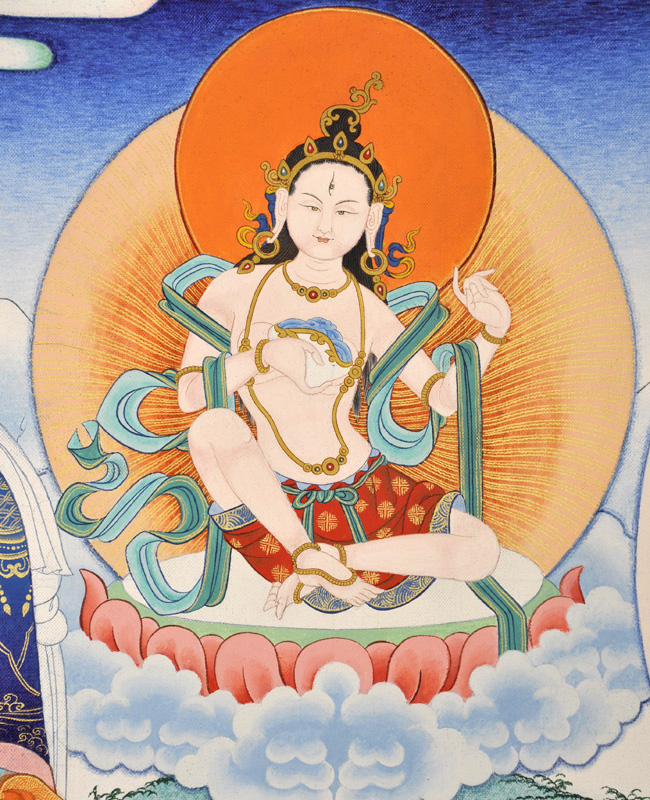
    The Serpent is obviously the Biblical Satan who in the Sumerian writing is Enki, brother of Enlil who is Yahwe.
    The Serpent in the Garden of Eden was one of its aspects; is there a Biblical Satan? There is a ha satan, an adversary, something like an opposing attorney or protagonist, although I really am not sure what form it took. "Be as wise as serpents".

    Serpent has many more meanings which the Bible has no clue about, and it is these we are after, having long since confessed that we fell into matter and became evil.

    In India, the destructive aspect of Shiva (Rudra) resembling Enlil was blown to pieces by Buddha and re-formed as Mahakala. Duality has been rejected as well. So the Sumerian or Manichean stamp on so many things has been dismissed, or, never arrived. Unfortunately it has dominated the West.

    This is a bit painstaking and hard to see. Himalayan Art calls these seventeen mandalas every one from Hevajra, Samputa, and Nairatmya, and leaves is at that. Circle of Bliss examines it, and it is mostly inscribed. So the center right is White Mahakala with ten deities. Opposite that, however, is an unidentified white deity, with what they claim are seven deities. This only makes sense if one realizes the three around the mandala are not more Hevajras, but a white, blue, and perhaps multi-colored winged deity. They say it is likely White Samvara--Varahi:


    The top center is Sahaja Hevajra or Sixth Family, over a Pancha Jina of himself. He is flanked by Padma Hevajra and Kurukulla. The upper left is Samputa Vajrasattva (with Varahi). This uses the same Vajraraudri group, however the main four are called Vajrachandi, Vajrarupini, Ragavajra, and Vajrashanti. We generally understand Wrathful Green Tara as Raudri or Chandi, or really, Camunda is Usnisa-born from Candi with no assistance from a male. Shanti means the same as Saumya. Rupini and Bimba would seem to be Form and Shadow. Rupini is from a standard format of Four Goddesses, Vajradakini, Vajralama (North), Khandarohi (Red, West) and Vajrarupini (Yellow, South). So in this case she would remain in Ratna quadrant and apparently secretly known as, or protected by, Ekajata (Bimba). Aside from this, the names seem flatly equivalent. These four, Samvara's Dakinis, have also at one time all been emanated in Ratna Family. In this version, we might say Green Tara (Raudri--East) and White Tara (Saumya--North) have traded places.

    Speech Hevajra with Varahi is under Amitabha, and Shrnkala is in Abbreviated and Complete forms, under Kurukulla and White Samvara. This Kurukulla mandala is described as a Red copy of Nairatma. The Sixteen Arm Heart Essence Hevajra has a Skullcup form and a Weapon form (lower left). Central Hevajra is also Skullcup or Kapaladharin trampling Four Maras.

    The upper register contains (among others) Rakta Yamari, Dharmadhatu Vaigishvara Manjughosha, the cluster of Mahamaya, Yogambara, and Buddhakapala, and ends on Vajramrita. Janguli and Parnasabari are fifth and sixth from the right across the bottom. From the offerings on the left, it is Prajnaparamita, Green Tara, Usnisa, and Panca Raksa.

    One of the Sixteen Arm forms has presumably the same Four Arm Samputa goddesses, although colored differently:


    Thirty-seven deity Samputa Vajrasattva is such a fundamental basis that you'd think it would be easy to find. Well, it is in the upper left of that seventeen mandala maze above. Otherwise, very hard to get. This is the outline:


    Buddhas and Prajnas are in his grid-like inner ring; the second ring is Vajraraudris, even without color, you can see the four hands. One can find easily thirty-seven deity Vairocana or Varahi. This one however contains a special ring that is only shared by one other entity, Hevajra. Therefor it would seem to be a piece of meaning about Vajrasattva summoning Vajradhara.

    Vajraraudris or Samputa Vajrasattva--Hevajra shared ring of Four Arm goddesses:

    East: Vajraraudri or Vajrachandi
    South: Vajrabimba or Vajrarupini
    West: Ragavajra
    North: Vajrasaumya or Vajrashanti
    Northeast: Vajrayakshi
    Southeast: Vajradakini
    Southwest: Sparsavajra
    Northwest: Bhucari

    According to Jamgon Kngtrul, the special expositions for Samvara are Six Key Instructions and Three Unions; for Samputa, it is Seven Secrets. These perforce almost certainly refer to the Six Doctrines and to the Seven Vajrapada or RGV mysteries.

    Samputa's main formula of thirty-seven deities is also used by Avalokiteshvara (Thousand Arms), Kharamukha Chakrasamvara (Donkey Face or "can't be distracted"), Mahavarahamukhi (Red Varahi), Navoshnisha Shakyamuni, Sarvavid Vairochana, Vajradhatu Mandala (Samputa Tantra), Vajrayogini.

    This is a Hevajra Panca Daka that includes the simple Heruka Nairatma and Hevajra at the top. The row ends with Durjayachandra, author of Seven Syllable sadhana:


    In the four corners framed within large circles are the goddesses blue Gegmo (Varahi), yellow Lumo, red Shangma and green Garma. So this may be called or styled as Five Families, but, there is more under the hood if Herukas and Durjayachandra are present.

    Shangpa or Niguma uses Five Deity tantra, centered on Samvara, with Hevajra--Nairatmya upper left, Mahamaya--Buddhadakini upper right, Guhyasamaja--Vajradhatvishvari lower left, Vajrabhairava--Vetali lower right:


    Top has the two flowers, or Red and White Khecari, solar and lunar colors of Bhagavati Vajra Yoshid, and Hayagriva at the bottom. Middle left is Vajrapani, with Vajravidarana across from him.


    This next piece is a rare Sakya form of Black Mahakala, specific to Vajra Panjara tantra, where he has no stick. Nagarjuna's lineage, and Ngok, also lack the stick. First, we are told that the seven deities across the top start with Kalachakra, then Five Families of Hevajra, and then Samvara. So without being told, we see the central top deity here is Ratna Hevajra. This places it as one of the most poignant indications one could find that Ratna, as a fairly singular deity from Vajramrita tantra, the core of Kagye, whom with Dharmadhatu Vaigishvara Manjughosha grants all the Perfections of the Bodhisattva Path, is usefully tied to the straightforward operation of Varuni. She continues with Hevajra as a main or higher Gauri which is likely intended as Mother level or as wife of Varuna, not as her own daughter as she has been.


    Descending are two, four, and six armed Hevajras; then, zigzagging, and across the bottom are: Samputa Vajrasattva, Vajra Nairatmya, Kurukulla, Bhutadamara Vajrapani, Chanda Maharoshana/Achala, White Prajnaparamita, Yellow Vajra Tara, Maitreya, Avalokiteshvara, Orange Marichi, Yellow Vasudhara, Yellow Jambhala, Brahmarupa (Human form) Mahakala. The Indian teachers closest in are Virupa and Dombi Heruka.

    Prajnaparamita is the main Mahayana text and philosophy, and a meditational deity or Yidam useful all the way through Vajra Tent. Mahakala is pretty much The End. All Generation Stage is functional. The large mass of Tibetan tantras stops around Samputa Vajrasattva and Mahakala.

    Bhurkumkuta, Nairatma, and Mahakala have a line of Black forms that can hardly be distinguished from Varuni, since it involves purifying you with Nectar, and making at least a Nectar Quintessence. Ratna Family Vajra Tara is found summoning Nairatma, and at this level, her full instruction is deployed. Vajra Tara pertains to both Heruka and Hevajra.

    This is an ancient 1300s Kagyu Twelve arm Vajrayogini. She's very suggestive of multiple Quintessences covered by their own Armor Deities:

    Last edited by shaberon; 23rd May 2019 at 00:38.

  20. The Following User Says Thank You to shaberon For This Post:

    Didgevillage (8th April 2019)

  21. Link to Post #376
    United States Avalon Member
    Join Date
    1st April 2016
    Posts
    6,506
    Thanks
    33,747
    Thanked 36,931 times in 6,152 posts

    Default Re: The Serpent, the Black Sun, HPB & St. Germain

    Saptaksara

    I had waited as long as I could to not mention Vajrapani.

    When I did, he swiftly proclaimed the deity who, as far as I can tell, defines the entire esoteric system that we have set up with Namasangiti.

    It is readily seen in one place, the White Samvara thangka. We already studied it and didn't know what we were looking at.

    Sarma, or New Translation, may be comparatively new to Tibet, but, it refers to material that gestated in India far more. Atisha's Tibetan Seven-eyed Tara does not expressly contain the symbolism; and Herukas as used in Nyingma have concealed it. This is because they translate as "blood drinker", which is not correct in this case, and then they refer to their own Herukas, which are not the same way. We are not saying those systems are wrong, just that they are not what we are talking about. Heruka is a physiological state that may be experienced and has a lot of peace to it.

    The thangka shows there is such a thing as a White Sherab, that Long Life as commonly practiced is a minor goal of its main work, which is Amaravajra, and then, out of forty or more forms that are used everywhere else, they selectively attach Seven Syllable Avalokiteshvara. This speaks fairly strongly of his relevance to one of the most explicit White deity layouts ever made. When we see this and put it together with Sita and Vajra Tara and understand it as a method of Lakshmi, we have the original pith, unclouded by local variations, tertons, or the predominantly wrathful scenery of many images. Elsewhere, the same painting style mostly uses Atisha's White Tara, but even that is not found here. Add in the basic white deities with the full Vasudhara explanation and we have returned to Ratnagiri while largely solving Ellora and Forbidden City.

    We are able to find his same symbolism in Kalachakra--united deities in Six Elements--but this of course is another initiated lineage. We definitely use what I believe is called Kalachakrayana--meaning, the Six Kalachakra Yogas are the style of meditation, and the seed syllables seem to work the same way--but mostly, its peculiar deities and ritual properly belong to itself.

    Most of us are unlikely to obtain that many deity empowerments. But because Heruka Avalokiteshvara can be explained, which the previous seven pages are more or less doing, and, we can derive the entire process and all the components which summon the Circle, Dharmadhatu and eventually Buddha's Enlightenment, we can do most of it with outer meditations, which have a whole heap to do with why two Earth goddesses witnessed Enlightenment and why Akshobya keeps touching the floor. This particular Avalokiteshvara is his only Akshobya or Vajra form (or at least one of not many). We see he is not just an Amitabha deity on the same thangka that shows us there's much more under the hood of the usual Amitabha Long Life practice. Amaravajra is another Akshobya deity. Akshobya normally starts in the white, eastern, dawn direction, and moves. At the same time, the thangka corrects the understanding of Heruka to three syllables just meaning male, female, non-dual union.

    It may remind us that the name Sita is not used in Buddhism no White Taras are actually Sita, except for Nagarjuna's Taras, and then Four-arm Sita from Ngor which is part of this lineage. So in our use, it means Ramayana Sita, plus Mrtyuvacana, Ngor Four Armed, and Vajra Tara, who is sort of a tutelary for learning her complete form, which is mostly a non-consorted deity explaining the entire system. Eighth Tai Situ was a major patron of arts, was an artist himself, mostly painted white deities, and mostly painted White Tara in a very basic style. Called Palpung school and based on a plainer Chinese style background and deity auras that are almost circular. The big Samaya Tara in the main Tara post is this style.

    White Samvara thangka is relatively not that old, but it marks continuity from Situ Panchen, to Taranatha, Sakya Sri, Marpa, Maitri-pa. It still uses the very old but largely unexplained Six Yoginis of Nagarjuna from the first page of Dharma Sangraha. Instead of showing any deviation from Sadhanamala, it displays one of the rarest esoteric deities, Amaravajra, with an Avalokiteshvara that can't currently be found being put to any other use. What we are trying to do is not use him to describe seven planes, since Savitri Gayatri already does that, but to speak of the incarnated person, who is only on five planes, nevertheless, the seven-fold scale repeats itself, in a way that should show a transcendent being that has six powers, Sadguna Brahman. Namasangiti and Heruka Avalokiteshvara both do this. There is only a slight difference, and the goddess explains it.

    Manjushri (Namasangiti, etc.) is with Sarasvati, and, she remains distinct, because, in the Agni rite, she is the Fixed Fire of the Stomach. This may be called Fire by Friction, which could be literal, but has more to do with nirmanakaya and the process of mantra for our purposes.

    The higher part of the path is with Lakshmi, which handles what is usually called Electric Fire, but, the more complete term is Ocean Fire.

    Solar Fire is more automated and appears just to be a direct consequence of however well we may have done our rite as Ganesh or that aspect of the meditator who has collected all of the Shaktis, unlike most of the devas, who only have one.

    Outer Sarasvati is a scholar and so Namasangiti is a basket for all the full explanation. It becomes compressed into this Avalokiteshvara Heruka; he doesn't exist in any other way than as the sum total of all the components, which include the entire Vasudhara or the whole Generation Stage. His Varahi is that Varahi who already has her Armor, so they have all Six Buddha Families, attached to themselves as a non-dual, transcendent seventh element. She is Lasya, a response to the vibration of Shiva, by which we mostly mean she is a response to samadhi. Their mantra is the key that is also used by Heruka and Samvara, and these relate to other deities called Heruka and perhaps Sahaja or Together-born. These individual Herukas are powers of Avalokiteshvara; the deities arise from Heruka, or, Svabhavikakaya, Divine Androgyne, Prajna Upaya. The explanations and outer meditations generate this condition, and the esoteric deities are formed by it.

    On the same first page, Nagarjuna specifically defines Tathagatas as Seven Heroic Buddhas, separate from Dhyanis. Of course, there are limitless Tathagatas, but he is calling our attention to a Nirmanakaya especially relevant to those of us here on earth.

    Taranatha's book is in sections; for example, the last section is Suryagupta's Taras. Near the end was the Vajrapani--Mamaki group. Her name in this, Kulandhari, is also used in Vajra Family Prajna mantra. She does generally originate with Jewel Family. Several symbols indicate that Jewel makes a type of offering to Vajra, as Mamaki is offered to Vajrapani. It may be accurate to say this means Vajradhatvishvari originates here and moves up and through Vajra to Vajradhara as her destiny. This seems to underlie the saga of Marici who can hardly be excelled as a seven-rayed gate to the cosmic plane or fourth void, or sustained voidness of the three voids we use in abhisambodhi.

    Between these sections is a quite weird set attributed to Devasambhava, guru of Droding, Pandita Purnavajra, and Sakya Raksita. The first ones, Pandara, Usnisa, and Cunda, are not that strange, but then comes Aparajita with Aparajita. Then there is White Hayagriva with Blue Ekajata, and they emanate Green Hayagriva and Vajra Nakhi (Claws, or Dorje Dermo), who has a pig face, drum, and skullcup, apparently a type of Varahi. Next is Red Acala with Vajra Candi, who has a drum and flower garland. Then come Orange Marici in her chariot, Dhvaja, Black Vetali, Orange Hariti who emanates Yamantaka, fat Yellow Radish Ganapati looking at a bowl of sweets, Orange Akshobya Manjushri who emanates Yamantaka, Avalokiteshvara who emanates Hayagriva, then green or blue Vajrapani with green or blue Amrita Kundali, who carries an axe.

    What makes Avalokiteshvara Heruka different from Six Buddha systems is the addition of Vajrabhairavi. If not, we would look at it and say, same as Varahi. Instead, this has Varahi (or really the couple) as the source of, Six Shaktis, individually named. Now it is Seven Mothers or Sapta Matrika format, but the main difference is, we are not saying what they are, but what you do to them. So then we would correctly call them Vajravarahi and Vajracharchika, meaning we have harnessed them and applied a method to them. Vajrabhairavi would be understood as Vetali, literally, a corpse, interperatively, a vampire.


    A strand of Anuttara deities runs from around Guhyasamaja Couple through Seven Syllable Avalokiteshvara.

    Kalachakra shows the same pattern:


    He is in a red room, so, what looks like an inner ring are petals attached to his room. Around that are six rings: or "weapon wheels", jnana, bhumi, vari, jvala, vayu and akasha. Vari is Pali for water, so, this is again Six Elements around the central deity.

    This is a Jonang symbolic view of the same thing, where he obviously is the same Quintessence:


    Kalachakra uses intricate symbolism, some of which is arbitrary and mnemonic; first part of the mantra, Ham Ksha, can stand for Kalachakra and Visvamata, but then in the yogas, we see those syllables first and backwards, as Owl and Crow, or the normal two guardians of Nepali shrines.

    The Six Yogas are by no means arbitrary and mnemonic, and so we find that Smrti is Sri Heruka, or, this is Completion Stage. We see that this involves "Ten Winds", stabilized in the center or heart, and, this is the same idea as having an early Vajra Tara that uses Five Buddhas, which double to Ten Directions. In each case, five-fold form has been abstracted, withdrawn, reversed, aimed within, and up. The external is completely purified and released, and this completes the mandala and accesses transcendental deities.

    Seven Syllable mantra therefor marks Completion Stage, Avalokiteshvara, inseparable from Heruka, is from Hum, evidently an Akshobya deity. "Heruka" means a simplified form, and Blue Two Arm Heruka is Chakrasamvara, an Akshobya deity, there is also a White Two Arm Heruka, possibly an Amoghasiddhi version, and both of those are similar to Vajrasattva, holding vajra and bell. They have consorts. Either naming convention only means Svabhavikakaya, non-dual union of Prajna-Upaya, which again would indicate Completion Stage.

    Maitri's sadhana also uses Kalachakra's elemental syllables (ya, ra, va, la).

    It uses these deities for Seven factors of Bodhi:

    Sri Heruka is Smrti (recollection, Completion Stage, Svabhavikakaya, who would have to be Sati, maintained awareness of Dharma or Reality)

    Blue Heruki is Dharma Pravicaya, investigation of the nature of Dharma or Reality

    Yellow Vajrabhairavi is Virya, energy, determination, effort

    Red Ghoracandi is Priti or Joy, Pramudita, etc.

    Green (Haritam) Vajrabhaskari (Light Maker) is Prasrabdhi, relaxation, tranquility

    Smoky Vajraraudri is Samadhi

    Sita Vajradakini is Upeksa, to accept reality as-it-is (yatha-bhuta) without craving or aversion

    The last Yoga after Smrti is Samadhi; a samadhi deity is included here; and smrti is explained as launching samadhi from within itself. So this is like Mahamudra; as you give better input to smrti, then, increasingly powerful samadhis result. And although Samadhi is the Sixth Yoga, Upeksa is the Seventh Factor of Enlightenment, as it is also the highest Pali Bodhisattva Paramita. So this sadhana very specifically structures the Six Yogas around a seventh element seen as Perfection, or Ultimate Meaning, or the full Bodhisattva Path.

    This employs basic Sita, evolved into Vajradakini. A Smoky deity indicates the Ucchusma and Candalis. Ghora Candi is Terrible Chandi, or Chamunda.

    All of the dakinis have dishevelled hair, fierce appearance, three eyes and the quarters as garments. They carry the resounding Damaru and the Ghanta in the first pair of hands, and the human skin in the other pair. They stand on the orb of the sun placed on a corpse. Their head-dresses are decorated with rows of skulls, and they stand in the Alidha attitude.

    Heruka is the mind of the meditator at the Smrti stage, and, in relation to the other factors, it is recommended that joy or rapture, investigation, and energy are to be developed when experiencing sloth and torpor. Relaxation, concentration, and equanimity are to be developed when experiencing restlessness or worry. Mindfulness (Sati) should be constantly present to remain aware of physical change as well as mental change in either skillful or unskillful direction. So Svabhavikakaya becomes constant, and, this is no longer Bodhi generation, but Bodhi of Adi Buddha, which is the practice of Dhyana, this part becoming significant to the third, or, upeksha replaces rapture at this time.

    Maitri's sadhana contains Fence, Tent, and Blaze, or the magic circle components given by Vasudhara. This sadhana is not present in the Nyingma Herukas. Completion Stage requires the blessing of Heroes and Heroines (Armor) on the channels and drops of the subtle body. As we see, the set of Drum Goddesses is for this. He has given a different naming convention. Taranatha's sadhanas use Vajrasattva with five wrathful dhyanis, then Varahi similarly, or in other words it takes a whole Six Buddha system and places it on Heruka or Samvara, on six chakras, and so the deity remains one figure with six attached elements. In any case, the Armor is intended as Wrathful Dhyanis and Prajnas.

    Varahi's armor has White Mohani on a moon disc, and the dakinis have a drum, but also skull, staff, and knife, so different features on them, and uses Six Arm Varahi (in the navel) with Brahma's head. This appears to be armor for solo Varahi instead of the couple. Varahi also skips the skandhas/senses/elements empowerments. This leaves her a bit incomplete, and, so far, Maitri has explained Seven Syllable the most.

    The central deity is equivalently Vajrasattva, Avalokiteshvara, Samvara, Heruka, Hevajra, or Buddha Kapala, depending on what is being emphasized, and they are all mostly Akshobya. Manjushri, comparatively, has a form where he is emanated by both Amitabha and Akshobya. As Manjughosha, he becomes the only one in Vajrasattva's Family, and the latter joins Akshobya. Kalachakra is Akshobya. Almost all Completion Stage is in Vajra Family. Since Buddha Kapala is Occult Color, this entire Namasangiti presentation depicts Completion Stage.

    Seven Syllable sadhana also contains six mantric pairs:

    Om Vam -- Ham Yom -- Hrim Mom -- Hrem Hrim -- Hum Hum -- Phat Phat

    This is the same mantra as for Taranatha's #20 Blessing of Six Armor-like Heroines. Although the sadhana appears to be for Vajradaka, this is elaborated as Vajradaka Mahasukha, closely tied to Samvara. The Heroines are Varahi plus Five, which suggests she is elevated and replaced, when entering Union. Taranatha uses mostly Tibetan names, except for Smoky Chandika, so this version is the same as we already have with White Mohini and the rest. This Varahi Armor rite inherently lacks the skandhas empowerments, since it is intended to adhere to the one that does.

    The whole pattern sticks to Heruka Avalokiteshvara, because, it is already there; what looks like related parts in Taranatha's book is fully assembled in the back half of Sadhanamala. This does call him Vajradaka, who is Hum-arising and sarvalaksanalaksitam, I'm guessing meaning in white flames, with Varahi, basically the same as Avalokiteshvara, who is dancing. Vajradaka already has complete Five Buddha and Six Buddha rites, and here, at Seven, we find he is the same as Avalokiteshvara, Heruka, and so on. If this presents a Seventh Element, it comes from Akshobya--Vajra Family, and, if this is Vajradhara, it is Full Buddhahood, not conventionally a part of a human being.

    Taranatha's Tibetan Seven Syllable Avalokiteshvara is with Red Gegmo, and the Six Dakinis are Blue Herukama, Yellow Jigma (Fearless), Red Dragmo (Mari Rabjam, Wrathful Queen, the keeper, vulture with vajra wings, a Tenma riding a wolf or dog, or white, riding a deer, a Yakshini), Green Wangjema (possibly Drolma Dudjom Wangchukma, eighth Tara in some systems, Mara Mardaneshvari, or just Ishvari or Mahayogeshvari on its own) , Smoke Namtama.

    According to Pratima Kosha, Vajra Dakini is one of the six minor goddesses in the
    mandala of Hevajra (Saptakshara). She is white in her body-colour, and has a frightening form. Three-eyed, entirely nude and with hair untied and dishevelled, she flaunts on her (?) a row of gaping skulls. She stands in the posture in the solar orb which is perched upon a corpse. She has four arms; she carries hand-drum in one of the hands, and bell in another; the remaining two hands hold the human skin. The other goddesses who keep her company are Heruki (blue), Vajra-varahi (yellow), Ghora-chandi (red), Vajra-bhaskari (green) and Vajraraudri (grey).

    Guhyeshvari (Jnanadakini) taught the Samvara--Varahi rite to Manjushri. We found a special Varuni to start the Cup procedure, which includes White Sanchasani and Blue Yamini, some of the Armor goddesses, posed under Guhyeshvari. Varuni's character is similar to Citrasena and Matangi, her essence is the embodied radiance of Ananta at the bottom of the Talas, but she is also her own Mother, transcendent or formless. Varahi is her motion from ignorance that entraps one in Talas, through the ever-increasing revelation of Marici and the Two Fires.

    The Armor goddesses really just come right off the first page of Nagarjuna's Dharma Sangraha, where they are just called Six Yoginis. Varahi is used in his list. It appears that her "promotion" is given by Vajrabhairavi taking her place in the Six. She is rare, but for example at Spituk Gompa in Ladakh, another interesting shrine is the one dedicated to Vajra Bhairavi, a tantric guardian deity of the Gelug-pa order. This chamber is distinctly spooky and houses a row of veiled ferocious faces, which are unveiled, only once a year. After waving incense smoke before them and muttering some mantras (prayers), the key-keeper lama will pass around handfuls of sweets newly infused with protective power.

    Almost by definition, she would be the consort of Vajrabhairava (Vetali). When alone, he may be Yellow, or have a Sahaja Heruka form. This comes pretty close to saying the Bhairava rite must be completed to move from Six to Seven. It changes the Armor deities and moves Varahi up, similar to what generally happened to Buddha Families due to Vajrasattva.

    Sublime Path to Khecara Paradise explains Varahi a bit better, still leaving us in the lurch. Armor is "moon cushions" just under the skin, whoe syllables emit rays, which are really the armor. The syllable pairs are intended as male-female, so for instance Om Vam is Samvara--Varahi, covering navel to sex organ.

    Yom is Yamini (heart), Mom is Mohani (throat/mouth), Hrim is Sanchalani (forehead), Hum is Santrasani (crown), Phat is Chandika (limbs and anywhere not covered). Heruki and Yamini are both Blue; Vajrabhairavi and Sanchalani are Yellow. That goddess name is rare; "sanchalana" means a stepping movement or march, motion, or shaking. There is a kriya practice called Shabda Sanchalana based on the Soham mantra, intended to move kundalini from the root through the rest of the system. It means "sound vibration". Santrasana means alarming or the act of terrifying. Mohani is enchanting and charming.

    These are simply Wrathful Prajnas, which does not mean they are protectors, and it does not mean they are storming around or violent. It is only the extension of the Peaceful Prajna of the Heart reflected into the Mind. Wrathful really just means Mind, or Head, compared to Throat and Heart.

    The organs of the primary partners become a blue five-pronged vajra in a red eight-petaled lotus, if one was initiated to to the Union, that is part of what would happen.

    We have seen this before, but it makes much more sense now. It is not that old (1700s) from Sakya Sri lineage. It centers on White Samvara, which is his Yidam form. The topmost is his own Bodhi Siddha form. It works with Taranatha's outlay, so, long life is his minor aspect--Rechung's Amitayus is there, and Amaravajra.

    What we did not know and that they identify is that the colorful one is Avalokiteshvara Heruka:


    On the left is Vijaya, on the right, Varahi.

    This is perhaps the only place he is identified at all. White Samvara inherently has no retinue; this was commisioned by a Situ Panchen, so, he had a motivation to assemble deities in this manner. Normal artistic protocol would suggest the term Heruka means having two arms, so, this is identified strictly to the sadhana, there is no room for error. If nothing else, the composition reveals male and female white Yidams related to deathlessness, and to the Avalokiteshvara you will hardly be able to find.

    Amaravajra is different from Usnisa in the following way: she arises from Heruka. Bhrum and the short Usnisa mantras apply to her, however, she may be emanated by Vairocana or Akshobya. She is different from standard Long Life practice because she is Vajrakaya or deathless body, Transference and Bardo Doctrines of Completion Stage.

    These do not display properly, but if you go back to 1200s cave murals in Dunhuang, China, there are two forms of Samvara Heruka that appear to have six four-armed dakinis:

    https://www.himalayanart.org/items/3...-1476,2057,-58

    https://www.himalayanart.org/items/3...5,-1597,2181,0

    If so, those are the first we could literally say are Seven Syllable Deity with Six Shaktis. Buddhism always wants to use the rings of four, or eight. Anyway, we can find the correct deity, if not the mandala.

    It is not completely clear which of the Prajnas go with which Shakti.

    Red: Varahi
    Blue: Yamini or Heruki
    Yellow: Sanchalani or Vajrabhairavi
    Red: Ghoracandi
    Green: Santrasani or Vajrabhaskari
    Smoky: Chandika or Vajraraudri
    White: Mohani or Vajradakini

    Varahi's Armor Deities are given as herself with Akshobya, Yamini--Locana with Vairocana, Mohani--Pandara, Sanchalani--White Tara with Vajrasattva (or Yellow Vajradhara--Vajradhatvishvari if Varahi is with Vajrasattva), Samtrasani--Mamaki, Chandika (Charchika--Mangala)--Green Tara. So that is a Six Buddha system, prepared to give her to Vajrasattva. In Chaturpitha, Vajrasattva becomes Blue and gains White Jnanadakini.

    He's got to give Varahi up to Vajradaka. Mohani is correct as Pandara, however, since it drops that name, and adds a second red goddess, we could probably safely guess that Pandara becomes Ghoracandi. If so, it would result in:

    Red: Varahi (Akashadhatvishvari)
    Blue: Yamini or Heruki (Locana)
    Yellow: Sanchalani, Vajrabhairavi (Vajradhatvishvari)
    Red: Ghoracandi (Pandara)
    Green: Santrasani or Vajrabhaskari (Mamaki)
    Smoky: Chandika or Vajraraudri (Maheshvari) (Green Tara)
    White: Vajradakini (Akshobya Family)

    Locana can be said to appear in Tathagata Family; she and Mamaki are the main ones that change around. In most of these consortings, Varahi is still considered Vairocana Tathagata Family. Locana and Mamaki are relatively free to switch between Jewel and Vajra.

    It makes sense to place Pandara as a red deity, since White Tara under Amitabha is very common, and Red Tara is less apparent and mostly within tantra. If we go back to the explanatory thangka, we see White Amitayus that has managed to turn her red, completely opposite of what is usually seen. This suggests the Pandara used here is red, even if white forms and the name Mohani are appropriate for other configurations. Ghoracandi is a puzzling name, since, it is basically the same as Chandika, which is established as Green Tara, which is Maheshvari, which is Raudri.

    Moharati is Peaceful Locana with Vairocana in Guhyasamaja. It is simpler and does not change colors or names when these are wrathful. It only has Five Buddhas and puts Sparshavajra with Akshobya; Mamaki is with Ratnasambhava, even though she "is like Akshobya".

    It's not straightforward since we are looking at something that is not entirely in the books and schools, in fact, is partly blinded by them. Although we can plainly find Seven Syllable Avalokiteshvara in a prominently influential position to the white deity scheme.

    What it suggests to me is that the Heruka-based Completion Stage efforts would raise Vajradhatvishvari to the top or center with Avalokiteshvara. Red Varahi is representing something normally white (akash in the head), which essentially translates to clear, who was only an empty niche, body-less. The spot becomes occupied, so to speak, by something that can hardly be described in any other terms than innate bliss and a kind of immortality propelled by dissolving subtle layers of varja or esoteric ignorance. Vajradhatvishvari is ultimately blue or full dharmakaya, yellow when wrathful, as Varahi was at the beginning, and in almost trivial terms, she could just be a percentage of "how much vajra I consist of", until 100% permanently is the highest form.

    The full explanatory retinue Saptaksara is called Vajradaka or Hevajra. In one variation, instead of holding skin, Varahi has bow and arrow. Bhattacharya confuses this by placing it in emanations of Akshobya, whereas it also has to do with Amoghasiddhi.So in using Vajradaka, it must be based from Sat Chakravartin. Here, the outer world is dismissed, there is only dharmodaya (reality source) and Nirmanakaya in the samsaric plane. You have sealed the outward directions with some kind of mantra or Nirmanakaya deity and it's done. Vajrasattva or Jnanadaka is the center of Quintessence on Sambhogakaya plane Akanistha. Vajradaka remains Akshobya and is Dharmakaya, zenith or above in void. As Heruka he is now Svabhavikakaya.

    Red Varahi (Akashadhatvishvari, Buddhadakini) with Blue Vajradaka (Akshobya)
    Blue: Yamini or Heruki (Locana)
    Yellow: Sanchalani, Varahi, Vajrabhairavi (the added seventh dakini)
    Red: Ghoracandi (Pandara, Padmadakini)
    Green: Santrasani or Vajrabhaskari (Mamaki, Ratnadakini)
    Smoky: Chandika or Vajraraudri (Maheshvari) (Green Tara, Visvadakini)
    White: Vajradakini

    What the consort does is use Four Activities mantra to summon the shaktis. It gets slippery, because the family a goddess is in, stops matching the family she goes to. Roughly, Vajradakini is now herself a support for the central couple who are mixing families to produce a new kind of white deity. The main Vairocana goddess who would expectedly be white is red, it's not a White Pandara, it is a Red Akashadhatvishvari Buddhadakini, who could not be said to be occupying Vairocana's empty niche.

    The newer publication (Himalayan Passages) shows Vajradaka and Heruka as name, Varahi as consort and Bhairavi in the retinue; the older one (Bhattacharya) uses Hevajra, Varahi as consort, and Varahi in the retinue. Otherwise, both appear to be the same thing, Saptaksara with retinue. Vajradaka arises from Hum and is crowned with crossed vajra; no further clarification is there. Six Arm Blue Hevajra elsewhere consorts with Green Vajrashrinkala, Amoghasiddhi's Chain. Although she is called "his own creation", and she is easily mixed up with Vajrasphota or the normal red chain. This suggests something to do with Blue and Green Vajradaka and Vajrapani. Seven Syllable may also be turned into a wheel in the left palm which works as a summoning hook.

    All I can figure is that a Blue male deity, closer to Akshobya, is getting consorts from Vairocana and Amoghasiddhi; this rite seems to start with Akshobya and move to Amoghasiddhi. The central explanatory character is Vajradaka, who was the center of a Pancha Jina or Five Buddha system, then, in Shad Chakravartin or Six Buddhas, and then Saptaksara or Seven Buddhas. Other deities are involved, but, in terms of mandalas that show it, his series is the one that does it.

    Despite the mess, it is still explaining Armor deities as the Seven Jewels of Enlightenment, when they are attached to the seventh element. That element is Sati or Mindfulness, probably one of the most basic tendencies in any Buddhism, but at this level, it means mindfulness produced by Heruka or non-dual union.

    White or Sulka Kurukulla is Seven Syllable mantra's only mention in the first half of Sadhanamala. Its first use is soon followed by Nagakanya; second, by saptavaranabhimantrya (revelation of obscurations), then, seven bijas seem to become jnanasattvarupam (form of the gnosis being), then it says repeat Saptaksara mantra where it seems to be talking about the avadhut and six vijnanas, and then it may be saying the seven syllable mantra becomes a seven word mantra:

    oṃ hrīḥ amukī me vaśam ānaya svāhā

    According to Bhattacharya, she wears the Naga Kings and exudes nectar, a white Amitabha deity receiving offerings from Bodhisattvas and Tathagatas. She has three eyes, rosary, and a cup of nectar. Because this is a simple two armed form, this is her Heruka. I don't understand hardly anything in it, but, if the fragments are accurate, then she seems to be an increase to Varahi. This would be a Red Vairocana goddess producing a White Amitabha one. They seem to indicate definite stages of Jnanadakini, since Sukla Kurukulla shows all the parts put together and the whole system or aura is saturated with amrita.

    Taranatha's Reversed White Vajrayogini that also uses Seven Syllable mantra arises from Hum, apparently an Akshobya form. In most of these, it is not stated or clear that there is a Dhyani (no crown, etc.), just a syllable or symbol. Sadhanamala uses Vajrayogini mostly as a name for Kurmapadi and Yellow Cinnamasta, and for a red cemetary form, and that's all; white is from somewhere else. It does consider her the main Heruka consort.

    The first NSP mandala, Manjuvajra, uses six yoginis with simple names, Sparshavajra, Gandhavajra, etc.; however, in his larger mandala (20), Manjuvajra is Maha Vairocana, and so it is not much different from Vajradhatu; Manjughosha is the same. NSP describes Buddhakapala as having the five deity crown; his consort Citrasena is of Mahavairocana, Its deity array is unusual; the inner ring is all Ratna, families are separated by rings, not directions, until the outer gatekeepers are Amoghasiddhi.

    Bhattacharya differentiates Herukas by consort; Heruka + Citrasena is Buddhakapala; Heruka with Vajrayogini (Buddhadakini) is Mahamaya. Heruka with Varahi is Vajradaka, who appears as Samvara (simple form) or Saptaksara (Six Arms). In all of those, the male is Dvesa Family (Akshobya).

    Vajradaka is closely related to Advayavajra (Maitri), who seemed quite keen on elaborating this pattern together with the Six Kalachakra Yogas moreseo than Kalachakra itself.

    One will almost always see the "Fire Offering" Vajradaka, but here is the mature form, Samvara Vajradaka, Nepali 1500s:


    1800s Ngor mural:


    That is at Dege Gonchen college, which was not destroyed by the Chinese. In those multi-headed forms, he has blue and green; the root deity arises from Akshobya and has an Amoghasiddhi crown. This is why people are confused about Akshobya tantra seems like Shiva. Shiva is not Akshobya, Shiva is Amoghasiddhi. On the outer path, we see Akshobya Janguli make a full Amoghasiddhi Hydra, which brings us to Bhairava. When Vajrapani meets Amrita Kundali, they are blue or green. With Vajradaka, we see the more put into Smrti, the more powerful the Samadhi. The deity is like an axis or vortex when you look at the subtle technicalities; the Hydra is the increasing input. Akshobya is something like the simple fact of going through it, Shiva is the intensity. The primal consort is Lasya and she moves based on Shiva's intensity.

    Here, Vajradaka (Tibetan: be mchog rdo rje mkha 'gro or Demchog Dorje Khandro) is lower left with other forms of Samvara all around:


    Central figure is from Tong Drel tradition. Upper left is Abhidana, upper right is Samvarodaya, and lower right is Vajrasattva Samvara. All are identified by inscriptions and considered Palpung style. Those are the Indian tantric lineages considered to have come from Vajradhara and Vajrapani, through Saraha and most of the important Mahasiddhas, to Sakya, Kagyu, and Jonang, which were later accepted by Gelug. The origin with Vajradhara we hold to be tied to Manjushri as Swayambhu Adi Buddha of Nepal.

    If we are not blinded by his Fire Offering form--which of course is still valid--then the name Vajradaka shows the whole stream of five, six, and seven deities, even though in the last, oddly, he is not with Vajradakini. He could perhaps be said to be with Vajrayogini as Vajravarahi, which indicates Jnanadakini on her ascending scale. The only difference I can figure is that dakini is her initial khecari or sambhogakaya state, which just always remains as it is as a sixth element. The difference is quite subtle. But this is mostly the same subtle difference between Shentong and Prasangika.

    Prasangika or the main Gelug philosophy is still accurate and probably the most accessible method for a greater population, we are not really trying to subvert it, but maintain that Shentong or Nirakara is as valid, and the roots run back to non-Buddhist systems which are almost the same, minus the Mahayana commitments.

    Without having a full English explanation, there seem to be all the pieces which show this to be real, although heavily obscured.

    According to Jamgon Kongtrul,

    "The Mahamaya comprises the lesser yoga of shape [deity form], the profound
    mantra yoga,
    The ultimate yoga of reality, and the auxiliary practice of the
    triad of illusions—
    Those of daytime experiences, dreams, and the intermediate state [bardo and transference].

    The Buddhakapala system comprises practice with a focus that
    entails
    Subtle wind yoga, vital-essence yoga with body as method, and
    enhancement ways;
    And practice without a focus [Nirakara], which involves the branches of
    withdrawal
    And absorption, plus the other four branches, which arise as
    their results [Six Kalachakra Yogas]."

    Mahamaya (sGyu ma chen po) belongs to the vajra family and is depicted as the blue, four-faced, four-armed Vajradaka, in dancing mode, embracing his consort, Vajradakini, who resembles him. See Elements of Tantric Practice.

    Mahamaya's consort is Vajradakini increased to Buddhadakini. So this rite is Vajradaka and Vajradakini at a new stage, having new names. The intrigue here is that Mahamaya "was" a female deity, who, apparently, has enwrapped the male so entirely that she possesses his body and then gets back into union with herself. It's a bit bizarre, but, here we are dealing with Great Illusion. It has something to do with Deva Maya or Yoga Maya, that we cannot control the sun, itself, but that it has a definite power that flows through us, which we can. This further indicates the central spiritual sun.

    Kazi Dawa Samdup published a sadhana based on Samvara, Vajrayogini, Mahamaya, and Tara, Circle of Bliss uses this to explain Samvara; at Completion Stage, it is explained that the rite begins with a Blue Samvara, there is an intense activity and movement of the drops, and the result is non-dual White Samvara. This white form generates the mandala. It is Prabhasvara, Dharmakaya, and No More Learning.

    This non-dual seventh element is not simply like giving it the highest title, one consort, and praising it. The thing is more like a pinwheel or the axis of a kaleidoscope. The mandalas it could generate are theoretically limitless, they wax and wane in world systems according to merit, and so we have a certain amount that work here, permanently established by Vajradhara. Like amphibians leaving water to shed their gills, we are a type of creature that can leave the mundane world and enter the mandala.

    According to Circle of Bliss, "Ritual Manuscript of Chakrasamvara’s Sixty-Four Animal Headed Forms...The manuscript begins with the standard visualization of the twelve-armed Chakrasamvara as the Guru and culminates with the goddess, Guhyeshvari as the primordial source of Newar Buddhist system. Her thousand arms and multiple heads, depicting the five Jina Buddhas with their respective colors further indicate her universal nature. Unique to Nepal, Guhyeshvari, "Secret Goddess," is both Prajnaparamita and an aspect of Vajrayogini.

    Chakrasamvara Mandala: In a brilliantly articulated visual language, this magnificent painting allows the practitioner to visualize step-by-step the process of the complex meditations on Chakrasamvara and Vajravarahi. The vertical axis of the painting contains the exact forms of Chakrasamvara and Vajravarahi encountered during the generation and completion stages of the three-fold meditations (Tri Samadhi), specific to the practices found in Newar Buddhism. The meditations begin with the two-armed white Chakrasamvara seen at the top center and continue with visualizing the complete mandala of Chakrasamvara represented at the center. Finally, the meditation culminates in the completion stages with Vajravarahi, depicted here at the bottom center. As a meditational instructional tool, the painting enables the practitioner to understand the process to identity him or herself with the central deities Chakrasamvara and Vajravarahi.

    White (Sita) Chakrasamvara/Vajravarahi as the Progenitors of White Wisdom Great Black One (Sita Jnana Mahakala) and His Mandala: In Tantric Buddhist iconography, Mahakala often functions as an exoteric manifestation of Chakrasamvara. Iconographically rare and complex, this painting demonstrates this little-known nuance that white Wisdom (Jnana) Mahakala is inherent in the completion state of Chakrasamvara/Vajravarahi.

    In the center of this exquisite painting is White (Sita) Chakrasamvara /Vajravarahi , surrounded by the four Yoginis of the inner circle of the mandala. Across the bottom is an abbreviated mandala of the Wisdom Mahakala, with five forms of Mahakala and eight animal-headed Dakinis. In the completion-stage context, they are all appropriately shown in their purified white-bodied states.

    The Buddhakapala Mandala emphasizes the process of collapsing the physical world into realizing the state of the absolute void, part of the completion stage of the Chakrasamvara meditations. The name Buddhakapala refers to Chakrasamvara, for in Tantric methodologies it is not unusual for a deity to be given a different name at each stage in the meditational practice. The name Buddhakapala means “Skull-Cup of the Enlightened Being,” implying that the purification rituals need to reach Buddhahood have been completed and the practitioner is now ready for attainment.

    The Shat Chakravarti refers to the six Buddha families: the five Jina Buddhas and Vajrasattva, representing the five transcendental insights and Vajrasattva, who generates them. They are also known as the “Armor Deities” in the Chakrasamvara meditations and after the completion of the generations stage are placed in the meditations They are essential to the transformative practices of the Chakrasamvara Tantra as they protect and purify the practitioner’s mind in preparation for the completion stage meditations.


    In the practices of the Highest Yoga Tantras, the concept of “reversed innate birth” symbolizes the nondual state of enlightened beings, in which the positions of the male and the female respective to the viewer and respective to the direction that they face in the mandala is reversed. This rare painting is an example of this concept, as Green Tara/Vajravilasini is facing the viewer, atypical of most images, but emphasizing the understanding that the two deities are completely equally in their nonduality. Vajravilasini “Adamantine Amorous Playfulness,” is a manifestation of Vajravarahi, and is visualized in the “sahaja-reversed” position, with Vajravarahi as the principal figure, embraced by Chakrasamvara. Her most important aspect is her compassionate nature, hence her dual identification with Green Tara, the great protectoress and remover of the Eight Great Perils.

    Kalachakra: The normal color of the five Victor Buddhas has been altered as well as the locations of the principal Buddhas. Thus, in the east there is a black Amoghasiddhi whose female aspect is yellow Lochana; in the south there is red Ratnasambhava with white Mamaki, In the west is yellow Vairochana with black Tara; and in the north is white Amitabha with red Pandara. In the intermediate corners, Buddha Pandara embraces a white Amitabha in the southwest, and so on. All are conceived as emanating from Vishvamata’s womb.

    Guhya Jnana Dakini. “Sky-goer of Secret Insight,” a form of
    Vajravarahi. Her visualization states that she manifests a red Avalokiteshvara and his mantra, HRIH, in her heart-mind. Also called Khadgayogini. Rare form in Tibet, but a principal aspect in Nepal.

    guhyapatra abhisheka. “Empowerment of the secret skullcup.”
    Initiation into the protection of secrets, of the substances contained within the skullcup. These are the purifying substances, symbolizing the elixir of enlightenment.

    Guhyeshvari. “Female lord of Secrets, also Secret Goddess.” In Newar
    Buddhism, she is the primordial teacher of the Chakrasamvara tradition. Divine source of the Newar Buddhist practice.

    buddhatva phaladayini: “Giver of the fruit of the state of Buddhahood.” An epithet of Guhyeshvari in the Newar Buddhist tradition, according to the Newar cosmogonic legend, the Svayambhu Purana."

    The system remains based in Samputa Vajrasattva and makes it quite clear that a minor white invocative deity we use for purification and to begin a Samaya is hardly the same thing as its future ability, which mostly continues to remain as a white deity, but produces other stages distinctly marked by other deity names.

    So if Six Arm White Tara legitimately is Vajraprakaradi or Fence, Mahakala is Panjarnata, pavilion, or tent. This means the large or infinite canopy that makes the fence a complete enclosure. So then if we go to Seven Syllable Vajradaka, we find the list that includes fence and tent, and that the real Mahakala is not simply a Protector, but is also produced at a certain circulation of nectar in the subtle body.

    In this teaching, it all begins solar plexus, Vam, the red goddess understood as Varuni, who has her own complex story that challenges many standard definitions like "asura". Therefor, if we learn Armor Goddesses intellectually, it is only through this type of Varuni they would properly arise as physiological entities indicated by the practice. This is more or less the esoteric or inner aspect of Vasudhara, who includes the cow and forest goddesses that show paths to the tree of initiation and the slopes of Mt. Meru.

    One needs many of those outer meditations, depending on what it takes to identify oneself with the subtle body and change its operation. In most cases, authorities like Kongtrul or Bu-ston will say that once a certain function is learned and sealed, you no longer remain with that type of outer lesson, and go to a new stage.

    That is why I think it is really important to know the pattern, to be able to stabilize: "to feather an arrow", i. e., Vajra, feathers are stabilizers. Plenty of energy in any arrow, but thousands of ways to miss the avadhut (central channel). Meaning that the kundalini or Kubjika, etc., can easily start to uncoil. If it does really get going, this is like a spiritual emergency, which asks for a real initiation quick. However, with an understanding of at least most of the outer pattern, with Cemetery, Fence, and so on, if followed properly, this will be a much more reliable guide than guesswork. Or, as the personal confession of how not to do it, thirty years ago, I went from a fuzzy concept of Dhyanis and some Vajra Muttering into self-generation as Vajrayogini and Chod, thereby skipping all of this intermediate stuff, and the outcome was unstable. None of this is real if it is not cumulative.

    I can only do so much with the untranslated Seven Syllable Vajradaka and White Kurukulla, which becomes the new apex or extension of the esoteric knowledge base. We would be able to say more about elaborate completion stage deities like Cunda, Ekajata, and Marici. But this is less important that a solid Mt. Meru with its obscure details, such as Dhvajagrakeyura, which is now included.

    Here we go, 1100s Nepali Six Dakini Retinue:


    Avalokita Chakrasamvara and the consort Lasya, accompanied by six female retinue figures and surrounded by a palace, mandala circle and extensive cemetery scenes according to the tradition of the Indian siddha Advayavajra as found in the teachings of Mitra Yogin. A description for this deity and retinue can also be found in the edited Bhattacharya version of the Sadhanamala Sanskrit text (see #250) where the tradition is attributed to the Indian siddha Durjayachandra.

    The lower register is Dhanada, Tarodbhava Kurukulla, Prajnaparamita, Cunda, and (likely) Vasudhara. The oldest Seven Syllable sadhana, only preserved in Tibet, is from Krisnacarya. The main initiated deity practice in Nepal is Two Arm Samvara, Seven Syllable, and then Twelve Arm Samvara. The original mantra is from Heruka Abhidana (Laghu Samvara or Gray's Discourse of Sri Heruka), and a later Nairatma tantra attempts to combine the versions with the Hevajra system. Durjaya's version calls itself an extraction and a summarized summary (samksipta). Because the male donor in the lower left is not a Vajracharya, it is thought the Durjaya version is for non-monks, as it does not include the anointments or tantric initiations from the goddesses, the water initiation, the diadem, the vajra, and so forth.

    So this non-monk who commissioned the art, used a personal selection of deities for the lower register, beginning with Dhanada. Here, the very detailed Himalayan Passages study is silent about the meaning and profundity of this. We have already filled it in.

    Amoghasiddhi is the Dhyani of Six Arm White Tara and Green Vasudhara Dhanada. As the center of Pancha Jina, Dhanada keeps Jewel and Lotus Families fairly standard. Akshobya deities are East as Black Vajra Tara and Black Vajra Hook. Vairocana deities went North as White Buddha Tara and Yellow Bell Lady. She is a Quintessence or Five Families including Prajnas, Offering Goddesses, and Activity Goddesses, three levels.

    Taranatha soon follows this with Amoghasiddhi Five Deity Blue-Green Tara. East is White Pratisara (holding a white lotus with a vase with a jewel), South is Yellow Marici (with a vajra and twig), West is Red Varahi, and North is Extremely Wrathful Black Ekajati (these two having knives and cups). These use Four Activities with the invocations such as "vausat".

    Solo or Ekavira Blue-Green Amoghasiddhi Tara is called Jetsunma Kapali, female expression for Buddha Kapala. She is a basic Tam-arising Ten Syllable Tara, but she does one dharmachakra, and her varada hand holds a blue utpala. She rests against a tree.

    Here, we could easily find Kapali shown as one who does Four Activities, then turns White for the Cemetery Fence, and then completes the entire Meru mandala, in a way implying use of Vasudharas of other families. We have found Dhanada to be that Vasudhara who indicated the full mandala needed to feed into the Seven Syllable deity. The ancient image of the deity suggests something close to the same. Dhanada is beside a deity still used in the Second Cycle of Three Reds; nothing more specific can be said than they represent Completion Stage from a broad base of Prajnaparamita, but Dhanada is conspicuously present in this.

    Krishnacharya is frequently associated with other things, but he is also said to have original authorship on the Seven Syllable sadhana:

    Last edited by shaberon; 29th April 2019 at 06:30.

  22. Link to Post #377
    United States Avalon Member
    Join Date
    1st April 2016
    Posts
    6,506
    Thanks
    33,747
    Thanked 36,931 times in 6,152 posts

    Default Re: The Serpent, the Black Sun, HPB & St. Germain

    We're there. Directly above is a 900 year old Nepali painting whose only representation in Roman characters was published just a few years ago. It is not translated, but we have already cracked the oyster.

    This painting and the mess of information strewn around White Samvara in post 373 is exactly what we mean, together with the special red goddess of Nepal. The "common" explanation is Samputa Vajrasattva, meaning that Vajrasattva starts it; he also starts many other traditions, but we are putting all the beads that need to go on the string, instead of every bead on every possible string.

    The idea with the signature-linked starting post is to immediately move from the Five Buddha system that is basically the same thing in Ayurveda or Pythagoreanism and go to Vajradaka Six Buddha system. Then the first explanatory post is about Vajrasattva, and also gives Six Buddha Avalokiteshvara and then Seven Buddha Avalokiteshvara. His exact mantra is then used by Seven Buddha Vajradaka and several other deities.

    Vajradaka is the name used in the recent publication based from the untranslated part of Sadhanamala, so, regardless of any way we try to refute it, this is the only deity name centered in mandalas that use the Five, Six, and Seven Buddha systems. And so this Seven Syllable mantra is the most important thing of all. It is just like a capstone on the Mahavairocana Six Buddha System. Its practice is a re-iteration of all the explanatory material, such as Four Activities, circle casting, and so on. It contains the entire Sanskrit outer path linked to Nepal. If someone can understand what it is and how it is the key that opens Completion Stage, they have done well. Straightening out the quotes and links will probably help, but it really is not too difficult.

    It was difficult to sift three languages with multiple spelling and naming conventions to bring together some things that otherwise are scattered, and get that together with a faded image that does not draw attention to itself on its own link. However, as soon as we look at what's already provided with the White Samvara and Seven Syllable Vajradaka images, the public information is already there. It is hidden and meaningless until you put it together like this, but, there are 84,000 outer teachings that all lead here.

    The important thing is we do not pick this up and try to do something with it. Seven Syllable Avalokiteshvara is like a shining star that as uninitiated lay disciples we are simply learning about, and, if anything, practice the basics, Vajrasattva and so forth. I personally am not going to move from basic Sita for a while, and I have already established Guru Yoga a long time ago. Avalokiteshvara did not work for me since I did not have that type of connection, but obviously, since he works in this way, he applies to me as he does to all universally.

    I do not claim to know anything about Masters other than what I have gathered from public information, but I would challenge eternity itself to show that HPB's occult color was anything other than Buddha Kapala. I honestly believe she gave the secret of what this Seven Syllable mantra can do. By plugging it in to Aryan and Buddhist occultism, everything fell perfectly into place, including Bhairava and Kalaratri, which almost all of the esoteric deities are standing on. All we have done is take Seven Vajra Mysteries, make seven posts based from Manjushri and the occult key, and seven pages of explanatory material including Agni, Tara, and Lakshmi.

    I believe it has clarified HPB without finding much to dispute her on. At the same time, it would largely relieve us of any others who claimed to have her status, or their own special version, or some kind of innovative thing. None of this is new or anything other than itself. In terms of Practical Path, HPB left an extraordinary gap between the syllable Om and Buddhakapala, and so we have started from fuller explanation of Om, and added every step to Seven Syllable Avalokiteshvara, which generates Buddha Kapala at will.

    I can't come up with any other explanation, or find anything wrong with this one. If I did not have a massive kundalini and gnosis experience, it might not seem very important, but since I physiologically know exactly what they mean about winds and drops and so on, I can assure anyone that this is reality.

    Circle of Bliss is a terrific resource, and the difficulty with it, is that it explains Chakrasamvara, and we can't legitimately do that. Dhanada, Six Arm Sukla, and Varuni, are Yoga deities, that could be used. They cover all but the last step of the procedure for Samvara:

    1) The puja to the teacher (Guru Puja) 2) The Generation-Stage meditation, in which the yogin prepares the environment and creates the phenomenal realm 3) The Inner Offering meditation, which is the ultimate purification 4) The Completion-Stage, in which the yogin dissolves the phenomenal world into the noumenal world.

    We can explain the meaning of 4) in many ways, but, there is no such thing as a Yoga version of Samvara, so we cannot actually use the material.

    The flow is:

    To Guru, he or she presents the offering of the Mount Meru mandala. With the offerings, the entire Mount Meru world system is recreated. It consists of 23 precious objects: 4 continents 8 subcontinents 7 precious jewels The treasure vase The sun The moon Mount Meru itself.

    Four Empowerments (Vase, etc.)

    The Generation-Stage Meditation

    (Outer mandala) As part of the preparation for the meditation, the yogin prepares a space by cleansing it, pouring a circle of water and decorating it to the best of his ability as the mandala palace atop Mount Meru. The Mount Meru world system is the location both of the total “real world” and the place of all transformations is in Akanishta paradise. No matter what the real setting, the grandest of temples or a teacher’s mud hut, the practitioner is always seated on the Vajrasana at Bodhgaya. It is both in Akanishta heaven and Akanishta exists only in his or her own heart-mind (chitta). Conventionally, the mandala palace that resides in Akanishta is depicted above a Mount Meru that has vishva vajra (universal Vajra) protruding from the four sides. Usually the heaven worlds are omitted in three dimensional representations, but it is understood that the mandala palace is in Akanishta.

    There is a series of elemental chakra syllables, until DHRUM emerges from the torso and converts the torso into the great mandala palace. Beyond the core of the mandala is the ring of protection and beyond that are the eight charnel fields. The eight charnel fields are the beginning of the transformative process. The flames the consume the body are considered the final purification of all transgressions. To ascend to Akanishta, the practitioner must symbolically cross the life-death threshold by traversing the cremation fires and the charnel fields where one’s own dead body is devoured by the flames and carrion-eating animals. There is a ritual song that is sung going through the entire eight charnel fields that surround Mount Meru and the mandala field in Akanistha.

    (Inner mandala) To do so he must completely understand the six energy centers (chakras) and the three channels (nadis). Here is where a permissible or Yoga version is Guhyeshvari Armor, and Vajradhara is teaching as Varuni, and the basic meaning of this is still the same as Samvara's:


    In Vajradaka's system, that would be Akshobya-centered. Vajradhatu uses Vairocana as shown here.


    Varuni explains how to use the stupa upside-down:


    Which will bring us to inner heat and the full or initiated version. She starts from the point at the top, and the crescent is a bow; whatever else Arrow Dakini may be, she is inseparable from Avadhut. Varuni will move the energy into the mostly undefined earth square. On the ordinary stupa, it is based on Mt. Meru. This is what we call Deity Stupa or Divine Prism, it belongs to them, they are perfect enlightenment, not us. That is why ours are inverted and backwards. That is why there is a sublime touch to a deity form shown in a stupa, since this is from the Dhrum that opens a residence for them. It is the same word as in short Usnisa mantra but it is not in mundane consciousness.

    At the level of the Vajradhātu that is governed by the five jina buddhas that appear both outside and within the caitya, the maṇḍala of the caitya is occurring in a jeweled pavilion atop the peak of Sumeru [Mt. Meru]. At the level of the Buddha Vairocana who generates the Vajradhātu maṇḍala atop Meru, the location is none other than the highest heaven of the Sumeru system, Akaniṣṭha.

    This is the plane of Pure Lands or Seventh Heaven, uppermost plane of Kama Loka. One sits there and collapses form completely. This is Abhisambodhi.

    Reversed, the Yellow Earth Square would appear to have something to do with connecting to a real Sambhogakaya deity's stupa. This is viewed as governed by the Yaksha kingdom or hidden inner treasure, Mercury, Ila Budha planet, and so forth. Distilled, Varuni is Mercury.

    Inverted Stupa is used by two deities, Varuni, and, not only Buddha Kapala, but a strand of Completion Stage deities related to Seven Syllable Avalokiteshvara and so to Varahi and Jnanadakini. Varuni could perhaps be said to have her union stages as Mamaki, with Acala and Vajrapani, at least. Cemetery Sukla Sita invokes Acala, and has no other appearance, other than casting vajra ground and fence and the era of "traditional song" with the attempt to cross. This again is a physiological adjustment on the part of the meditator in casting that part of Meru.

    In the correspondences, Acala comes up with plane of Akash--Space--Manas, and this corresponds to entering Sambhoghakaya--Kama Loka and achieving a "Body-less" condition, which means, "only mental", meaning also, no astral body, eventually transcending this plane into a "marriage" of manas and buddhi. That is space itself and the subtle minds or voids.

    So these are the Lunar and Solar nerves, not inherently, but noumenally, or reversed out of form, Varuni and Jnanadakini--Varahi. By mostly relying on Yoga deities, we can, substantially, cover everything without needing Anuttara methods that we should not use. Nairatma or Non-ego is another aspect of Guhyeshvari which transcends the void of space or, non-ego masters all the illusory divisions of space in manas or mind. However the two nerves seem to be the main part of the system.

    Mamaki definitely has some kind of adventure. Here she is among the Six Syllable version:

    Om mani padme hum. Applied to the Six bodies, om is the dharmakaya, ma sambhogakaya, ni nirmanakaya, pad svabhavikakaya, me abhisambhodikaya, hum unchanging vajrakaya; to spontaneously obtain the six bodies [rely on] the six syllables.

    Applied to the Six Families, om is all families combined as the Great Compassionate One [Avalokiteshvara], ma Vairochana, ni Vajrasattva, pad Ratnasambhava, me Amitabha, hum Amoghasiddhi; even the buddhas of the Six Families, reciting the six syllables, obtained the [result].

    Applied to the six consorts, om is all families combined in the mother Shadakshari, ma space Samantabhadri, ni earth Buddha Lochana, pad fire Pandara Vasini, me water Mamaki, hum air Samaya Tara; even these five pure elements rely on the recitation of the six syllables.

    Applied to the dakinis, om is the mistress of all dakinis Vajrayogini [Jnanadakini], ma flesh Buddha Dakini, ni mind Vajra Dakini, pad warmth Ratna Dakini, me blood Padma Dakini, hum breath Karma Dakini.

    So this is Avalokiteshvara-centered and places Vajrasattva in Vajra Family in place of Akshobya. Then Locana is originally in Vajra Family, and here, Mamaki is water, as is Amitabha and Padmadakini, and Ratna corresponds to Pandara and Ratnadakini. This is a bit odd, but, it is Samaya Vajrasattva well before union with Jnanadakini.

    This is a basic mnemonic, and here, this very advanced Gelug view is centered on Mamaki with Guhyasamaja. The top deity is Vajradhara flanked by Amitayus and Heruka Vajrasattva (Vajrasattva with Jnanadakini). Amaravajra is here, parallel to Vajrabhairava, and the shoulder level is Samvara and White Samvara:


    This is a Five Families system wherein Guhyasamaja operates as Manju, Akshobya, and Lokeshvara, so they are using Three Families as a type of Trinity for Five-fold form. In the Seven Families view, we would expect Guhyasamaja couple to eventually arise as Vajradhara and Varadhatvishvari. This version strongly suggests Vajrabhairava as a basis for Samvara in the Seven Syllable and White Completion aspects. It is otherwise excessive with Mahakalas, he is, however, indispensable as Pavilion or Tent.

    Taranatha does not categorize Locana but she is completely white and holds a wheel with an eye. In the Six Syllable form, she is earth, Vajra Family, Vajradakini. What she seems to actually be is the ability of Mirror Wisdom to see the Dharmadhatu. He explains Amaravajra as an Akshobya deity.

    Prior to her, Usnisa's retinue may be the only place where Acala (Sword) and Vajrapani (Vajra) are distinguished. She also has Avalokiteshvara (Lotus), Takki (Hook), Niladanda (Staff), and Mahabala (Trident). She is crowned with Vairocana. She is with Avalokiteshvara (Amitabha) and Vajrapani and Four Wrathful deities (Akshobya). Her heart has a white Bhrum on a variegated vara.

    This Nine-deity retinue is so widespread, it is hard to trace. It may just be shown as her with Acala and Vajrapani. It may be expanded to have any number of lineage holders and other deities. The catch is that the missing two deities are un-named Devaputras who pour nectar on her, so, she has six "actual" ones. Avalokiteshvara stands on the Moon, Vajrapani is on the Sun, and the rest are Four Wrathful Deities using their implements. This makes a concise view, which simply adds Vajrasattva above and below her:


    Usnisa's primary item is Crossed Vajra.

    This shows the junction where the outer long-life deity has increased Bhrum to be the summit of the mandala. This activates the Seven Syllable form, which can release Completion Stage deities such as Amaravajra.

    In a more complex view, Usnisa's stupa points to Vairocana, and appears to have Varuni in the base:


    If correct, it shows Varuni's role in harnessing Bhrum or Dhrum from outer to the inner side, which is full Generation Stage, able to produce esoteric deities.

    Usnisa has pre-empted Manjushri's place with Lokeshvara and Vajrapani, at a point implying Manjushri and Prajnaparamita have produced Dhih. This vacates Vairocana's consort niche, which then is at least once filled by White Vajradhatvishvari, in the Reversed Green Tara format, which has Mamaki with Akshobya and Locana with Ratnasambhava.

    She does have six individual powers, although they do not span all families like Armor deities. All that is here is Tathagata, Lotus, and Vajra, or Kaya Vak Citta, which seems to remain the intended outcome. We haven't quite thrown away the essence of Guhyasamaja, but, sought a fuller explanation, which has been explained as given out or published by degrees, according to whether there was anyone to understand it. These mandalas are considered available in all world systems and arise according to merit. Buddha is giving magic circles to whoever will use them.

    When Mamaki is with Acala (lower left), Vajradhara is with Bhagavani. They have elephants, snow lions, makara sea creatures and a red garuda bird at the peak, and are with the first major group of mahasiddhas, including Dombi Heruka, who rides a pregnant tigress with a consort, having a halo of six serpents, using the seventh as a whip. The topmost Buddha is not named:

    Last edited by shaberon; 7th May 2019 at 05:46.

  23. Link to Post #378
    United States Avalon Member
    Join Date
    1st April 2016
    Posts
    6,506
    Thanks
    33,747
    Thanked 36,931 times in 6,152 posts

    Default Re: The Serpent, the Black Sun, HPB & St. Germain

    I have refined it a bit more, so, now, in the intro or signature-linked post, it dives right into the Six Buddha system, and then, in the first supporting post, we describe the normal, traditional Six Syllable Avalokiteshvara, and then land on what is more or less newly revealed, Seven Syllable Avalokiteshvara. Here, a "system of six" was definitely hiding a "system of seven". Avalokiteshvara is the master key to Completion Stage and it all makes perfect sense now. After going around for years with hunches and clues, that is what I was after, and so now it pops up right at the beginning, not as an incident or part of a list, but as how it works in practice.

    It is one of the only examples that shows what Buddhism mostly conceals, a retinue of six. About the only other place this is done is with the very secret Varuni of Nepal. We have slightly less information about her, but still enough to find her function, which, would be accurate to say she becomes available once you have Cup Vasudhara. She perhaps could be said to mark the end of Generation Stage, since she is a Yoga deity, i. e. not in union, whereas Heruka Avalokiteshvara only exists in union. Both of them of course have lower, outer forms to learn them. Neither retinue is much different from the standard Varahi Armor deities; in Varuni's case, she is simply placed at the top, and in the other, Vajrabhairavi replaces Varahi who goes to the top. So the Two Drops, Red and White, are somewhat functionally different. Varuni and Varahi could both be Vam, solar plexus; however, Varahi is a Vairocana deity going to affect the White male seed, whereas Varuni is Mamaki (Mam). Varuni is a Jewel from the Churning of the Ocean, Mamaki starts in Jewel Family and appears destined for Vajradhara via the Completion Stage processes. Also, Pratisara is Mamaki, and may be called immediately. Mamaki is a Prajna or highest-level deity, so, she's not really a blessing to invoke, but an inner experience, guarded by Pratisara.


    Om Jaldeviyay Namah or Om Varuniye Namah


    See Bühnemann, Gudrun. 2017. ‘Churned from the Milk Ocean, Invoked into a Skull-Cup: The Goddess Vāruṇī in Nepal’.

    Varuni is invoked twice, first into the "Secret Flask" of alcohol. There is also a khay pot which contains the meats. These two are blended in the third Red and White Skullcup arisen from Ah, into which Mam-arisen Eighteen Arm Varuni is invoked. This could be done with tea and biscuits, or completely mentally, if one observes the pollutions going in, and follows the transformation and purification.

    Varuni is the agent of transcendental wisdom; her name derives to Varunani, to Varnani. Her weird pose usually involves a strap around her knees, and, this royal palace version has her on fish that are going into her cup. Usually her gesture is called bindumudra, or, flicking a drop from the cup. Sometimes considered "counting", although of time, or what, is not explained, it has been surmised as rhythm. Her common name is Bala Kumari. So the Cinnamasta attendants are based on Reversed Vajrayogini and Varuni, therefor, the two attendants are Red and White continuations of what we find going into the unique seven deity systems. This is seamless.

    Kalachakra uses a Staff to make the Four Activities "of one taste" using the syllable Hi. It mentions Varuni one time, as the consort of Agni. In this format, Samudra (Varuna) is with Varahi. It explains that Green Akshobya crown-seals Blue Vajrasattva (a cause crown-seals a result), that Gnosis Family is an aspect of Vajra Family. Hindu Cinnamasta also uses Dakini and Varuni as attendants, the solar and lunar nerves. Varuni is not a subject of study, she is extremely hard to find, outside of Nepal, but she is a major common element in Hindu or Kalachakra systems.

    Varuni is the Crocodile Makara goddess and also Nagini Shakti with Shesha-Ananta. In Atharva 6.42.2 and 6.46.1,2 Varunani is the mother and Yama is the father of Aruru (dreams). Varunani holds a noose. In Atharva, Nritti is called Varunani. Nritti is the opposite of Rta; reflected in the disorderliness of mundane alcohol versus the transmuted kind. In Rgveda 1.22.12 Indrani, Varunani and Agnayi are called "spouses of Heroes" and "have full wings". Also in Rig she is called the one who encompasses all as maayaa.

    Varuni--Ganges (astral plane) received six mayavic Agni seeds from the seduced Pleiades. She does not have the pure Arundhati (Tara). Compare to the sun, which lost part of itself in the same lower creation, and Samjna, daughter of Samjna. Varuni in this sense is the ocean of chaos, matter; Vairocaniye is solar, and similar, with the pure daiviprakriti being its real energy, concealed in six attributes.

    Eighteen Arm Varuni with her Six Armor Deities:


    Red Vajravåråhï (lower right side); Vam is Varahi (Tathagata), covering navel to sex organ
    blue Yåminï (centre right); Yom is Yamini (Vajra, heart)
    white Mohinï (upper right), Mom is Mohani (Lotus, throat/mouth)
    yellowish-brownish Samcålinï (upper left), Hrim is Sanchalani (Jnana, forehead)
    green Samtråsinï (centre left), Hum is Santrasani (Jewel, crown)
    yellowish-brownish Candikå (lower left), Phat is Chandika (Amoghasiddhi, limbs and anywhere not covered)

    The change for Seven Syllable adds Vajrabhairavi and changes the retinue, and is for an Anuttara deity. Varuni here is a Yoga deity with a thread to her involving Pratisara and that each of those Yoginis represents Quintessence of a Family; she, as Vajradhara Family, has all this. She will take all of the symbolism built in Dhanada and guide Inner Heat, all of the pre-conditions for Father-Mother.

    So she is the most important capstone-type meditation in terms of the lunar nerve. Her Dhyani is Vajradhara or seventh one. This eighteen-armed goddess is a rare representation of Varuni, the "Goddess of Alcohol." As a secret form of Vajravarahi, she symbolizes the purifying nectar of immortality (amrita) contained in the skullcup that practitioners drink to experience the bliss of the nondual union of Chakrasamvara and Vajravarahi. Her role in the Newar Buddhism is very important, since it is through her power that alcohol is transformed into the transcendent knowledge of immortality. Alcohol is central to Tantric Buddhist rituals, and spirituous liquor is equated with Vajravarahi, the agent of transcendent wisdom. By drinking this substance, the practitioner is prepared to begin the meditations of Vajravarahi. Emerging from the skullcup, Varuni also symbolizes the sky element and the unending ocean.

    Varuni is surrounded by the six Armor Goddesses, who are placed in the energy centers of the yogin’s subtle body as protective shields to proceed with the completion-stage practices, in which Vajravarahi’s purifying fire awakens the inner chakras. These goddesses are imagined as surrounding the Vajravarahi, who is at the center of the double-triangle.

    A Samvarodaya-based sadhana of Varuni says:

    Trisamådhividhipustakam: visualization (dhyåna) for the (skull) vessel
    (consecrated by) mantras (mantrapåtra).

    Om Ah Hum

    The skullcup or karota in void arises from Ah and then Varuni from Mam. She is called Sura Sundari and has the following mantra:

    Om namo devi Varuni amrte amrtesambhave
    Sarvasattvavasamkari amrte hrim akham praticcha svaha

    Originally, Mamaki is of the family of Ratna Sambhava, and here she is called Amrita Sambhava, Born from Nectar. Vasikarana is Magnetizing Chain, usually Red Lotus Tara. Lalita's name #697, Sarva loka vasam kari – She who keeps all the world within her control, matches Chain, described as "bringing under control the good qualities, life force, and powerful energies of the three worlds", also being a Bandha or tie of friendship to a deity. Sri Tantra even uses a Sarva Vasam Kari Mudra which means the seeker is experiencing siva-sakti union, and equanamity, which is nice of them to include the generic title of Jewel Wisdom, the higher meaning of Mamaki, equality with all selves, which must be necessary to perceive the one life, which is not different anywhere. Varuni clealry is also control of the outer pranas in the worlds.

    Akham Praticcha is tricky; probably "worthy", similar to "arhat", and "of your hopes, attention, or respect", pratiksha. The solar syllable, Hrim, might not seem to fit, unless we remember the magic mirror held by Hrim deities.

    A recent paper by Berlin Indological Studies has revealed Varuni (Sura Devi, Amrita Devi) from the Newar tantra Samvarodaya. She is an emanation of Vajradhara. She actually is Mamaki and arises from Mam. She is Red Eighteen Arm with a Six Dakini retinue as above. She dances on a skullcup, which itself is on one or more snakes.

    She has Banner, but no Parasol. She is the mandala chief of Armor deities. Varahi has been dropped back into them: Red Varahi starts lower right, and they go counter-clockwise, Blue Yamini, White Mohini, Yellow Brown Samcalini, Green Samtrasini, Yellow Brown Chandika. Vajrabhairavi is gone and this is the basic Varahi Armor deities, attached to a seventh element, a single female, who, as Mamaki, inappropriately enters union with a lower-ranked deity from another family (Vajrapani).

    Varuni is a Jewel from the Ocean of Nectar, and, describing the motion of this Jewel from its root family to Vajradhara, seems to be part of the highest tantra.

    In the most obvious symbols, the White Goddess has Parasol or a cooling effect, like Sitabani, a feminine influence on the basically male white seed. This Guhyeshvari is explained as a different aspect than Guhyeshvari of the Three Reds. This Red Varuni works a little differently and must be more like Vajradhatvishvari, who has been thought of as Yellow or in Jewel Family, as well as in Vajra Family, and with Vajradhara, his consort. Mamaki is of Jewel--Ratnasambhava to begin with, is called Vajra Goddess Mamaki when she does this thing with Vajrapani, and here, is worshipped in one of the most potent Prajna sadhanas as in Vajradhara Family, as one of the most important esoteric teachings (Churning of the Ocean), which itself is almost identically reproduced in Shiva rites. Much the same as the Daiviprakriti of the sun.

    In the Tanjur, Mamaki is the one who personally requests the Vajra Amrita Tantra to be given. Taranatha gives Black Or Green Akshobya-arising Amrita Kundali as an essence deity of Vajrapani. The small Vajradaka Fire Offering uses Blue-Green Vajra Amrita Kundali as Protector, however, even the commentator does not seem sure if the deity has two or three names.

    Jamgon Kongtrul categorizes Mother Tantras by Family: Vajrasattva (including Kalachakra, Buddhasamayoga, and Secret Moon Essence), Heruka Akshobya (most Tantras), Vajraditya Ratnasambhava (Vajra Amrita), Padmanvarteshvara Amitabha (Kulalokanatha), Ashvottama Amoghasiddhi (Tara Yogini).

    According to Guimet, "The six-armed god Vajramrita is portrayed seated in the centre of the composition embracing the goddess Svabhaprajna. Bright green is used to convey the “priyangu flower color” of his skin. The couple is surrounded by eight other goddesses within the petals of a centrally placed lotus. The overall layout of the composition is constructed around the shape of this flower. Two male and two female guardians protect the access to the divine sphere: blue Bhrikutitaranga to the East, white Bhayabhisana to the South, red Hayarupa to the West, and green Gananayaka to the North." Their picture is tiny, but colored fairly standardly as described. This is in fact Green Vajramrta from NSP (without the consort), where it says "because he is green, he appears to be of Amoghasiddhi", and Bhattacharya amplifies this to saying he "is" of Amoghasiddhi. Svabhaprajna more commonly is with Yamari, and even Vajradhara. The term itself is used in a Mahamaya Sadhana that salutes Vajradaka, and uses Mahamaya as a Heruka called Karuna Acala Vajra, 240 from Sadhanamala. Vajravali apparently groups the Amrita deities, but we lack this image. They are explained in Abhidhana Tantra.

    Rinjung Lhantab has Green Vajramrita with a yellow consort.

    Christie's identifies this as Vajramrita, it is hard to tell much except Yellow Ratna has been removed (or, centered) and the directional colors are extremely strange:


    It seems bizarre, but, perhaps, is the only tantra focused on Jewel Family. This appears to have the meditator facing South, occupied by Akshobya, unlike Buddhakapala, which appears to have one facing North.

    Acala (or Vijaya), Yamantaka, Hayagriva, and Amrita Kundalin are generally the Four Male Gatekeepers in union with Four Activity goddesses. Yamantaka has the South and so perhaps is Jewel Family, which makes moderate sense if he shared a consort with Vajramrita, who then perhaps is changed to Amrita Kundalin. Mahottara, Chemchog, or Amritaguna is Jewel Heruka, the source of wrathful deities. Vajramrita is considered the "tantra of awakened qualities (guna)". See Kongtrul's Treasury of Knowledge. Tent Mahakala is given as Amoghasiddhi tantra, and is the Seventh Family or the one that uses six families equally.

    Seventh Family could perhaps also be considered enlightened Body/Speech/Mind above the six centers: Concerning the ayatana-deities, the Sarma tradition says: In the eyes is the lady of Vajra Dullness; in the ears is the lady of Vajra Anger, in the nose is the lady of Vajra Greed; in the mouth is the lady of Vajra Passion; in the body is the lady of Vajra Envy, in the mind is the Non-Ego Yogini (six ayatanas). And, at the crown of the head is the lady of Vajra Body, at the throat is the lady of Vajra Speech, and at the heart is the lady of Vajra Mind.

    Samvara explanation clearly states Seven Yoginis of Seven Families, with the last explained as universal Heruka and Dharmadhatu Varahi. It also uses the Four Wrathful Ones or Gatekeepers, which are also used in Ten Wrathful Ones of Vajrabhairava. The standard bardo Ishvari groups indicate Vajrayogini and Amrita in the south (Jewel or increasing), and has Varahi and Varuna devi in the north (Amoghasiddhi or subjugation). The very last would mean Varuni. I do not know the explanation for the Ishvari or Yogini groups, however, this looks a lot like Varuni having "moved across" various Amrita deities to the very end. Whatever is happening here, is intended as something to do with Amritaguna arising as chief Heruka. It clearly involves Vajradaka since the outer practice of Vajramrita is there, and Vajradaka is the main theme that continues into Heruka as Akshobya.

    These are just increasing degrees of wrath of Vajrasattva as he goes through Vajradaka, Vajravidarana, Vajrapani, until his final Extremely Wrathful is Kilaya Vajrakumara, Amoghasiddhi Family.

    Kagye is actually centered on Chemchok, i. e. Amritaguna, and separates Yangdak Heruka to the East, calling this Wrathful Vajrasattva, Citta, similar to Samvara, Yangdak means Sri or Samyak, sometimes mistakenly called Vishuddha, but actually Vajrapani is also included here. So this implies Vajradaka, Amritakundalin, and so on. Vajra Family Heruka.

    Kagye Pancha Jina: Centre - Chemchok Vajradhara qualities, East - Yangdak Heruka Vajrasattva mind, South - Yamantaka Manjushri body, West - Hayagriva Avalokiteshvara speech, North - Vajrakilaya activity.

    These five are the Transcendent deities compared to the three worldly ones Mamo Botong (sorcery, Akashagarbha), Lokastrotapuja (mantra or praise, Ksitigarbha), and Vajramantrabhiru (wrathful mantra, Maitreya). They are apparently explaining Vajradhara (Samantabhadra) as merged with a complete Jewel, Chemchok, Vajramrita Mahottara, or Amritaguna. Fortress and Precipice of the Eight Teachings are these sadhanas as used in Nyingma prior to Guhyagarbha tantra. Each mandala could be understood as a charnel ground.

    Chemchok is usually Maroon. I don't know if it is taught this way but it appears as a furtherance of Vajramrita tantra.

    HPB specifically says Amrita is beyond any guna because it is unconditioned. The real meaning of it is a-mrtyu or no death. If something was conditioned, it would have or experience death. It has all qualities equally without being affected, although, she says, in manifestation, it is mixed with death and poison. No free handouts without purification.

    This appears very close to using the Four Male Gatekeepers as retinue. It is intriguing because there never have been many people in Jewel Family, except mostly to demonstrate Amrita, which is more like a process that, in this view, reaches Vajradhara. This seventh family doesn't exactly have anyone, but in very basic terms Kaya Vak Citta, runs from the beginning, to the three subtle minds associated with the seventh aspect, three voids, and the highest Bodhisattva stages. It is more like a seed from which families and wheels spring. It is a mind that is only a fruit of what Vajrasattva has accomplished.

    This format seems inclusive of Vajradhara having used Varuni to demonstrate the full spectrum of seven, all that has already been done to obtain these Herukas. Kagye as a mandala of death uses peaceful and wrathful forms of a seed to produce the entourage of deities.

    Vajrabhairava also uses the mantra:

    Om Amrita Svadana Svabhava Atmako Ham

    Vajramrita's related Vajravali forms are Amrita Humkara, Amrita Krodha and Amrita Kundalin. There is evidently also a Vajra Maha Amrita Kundalin Buddhia Usnisa Sutra. This apparently Jewel assembly is wrathful with at least one member promoted to a higher level and perhaps a different family. It is not currently clear how Amritaguna is involved as he seems to be mostly in Nyingma.

    The Monist vol. 10 is kind enough to record an Amitayus rite where beer becomes Amrita and the priest invokes his personal wrathful deity and Hayagriva. This moment uses the mantras:

    Om namo Tathagata Abhi-hhita samayasriri hum
    Nama candra vajra krodha Amrita hum phat

    An audience then receives life blessing.

    There is some kind of male movement from Ratna to Amoghasiddhi similar to Mamaki's movement towards Vajra Family. It concerns awakened qualities, or Guna, the sixth Vajra Mystery.

    Standard Aghori Directional Guardians presents Matrikas as guardians; so in the South (Jewel Family of Buddhism), Varahi is of Mars (Mangala), syllable Mam is used there, attribute is Staff, couple is Yama--Yamini. Then in the West (Lotus Family of Buddhism) Varuni is of Shani (Saturn), syllable Vam is there, attribute is Noose, couple is Varuna--Nalani. It seems that we have switched this, by neglecting their role as a basic existence and harnessed them into an operation done in the microcosm, Varuni becomes Mam in Jewel Family, Varahi becomes Vam, both move around and rise to higher degrees, Amrita and Prabhasvara. Varahi begets Vairocaniye, active radiance, Prabhasvara, as a Jnana Sattva, Varuni begets Varnani, the true clear color of Vajra, by the flow of Amrita. There is no tantra that does not attempt to use these two as the basis for the central, but the details are very different in various schools.

    Mantra karota, “Mantra skullcup.” Reference to the four skullcups placed in the inner circle of the Chakrasamvara mandala. The skullcups and their contents purify the practitioner to attain the state of enlightenment. mantra patra puja, mantra patra puja. Mantra Skull-cup Worship, a purification visualization dedicated to the goddess Varuni. This literally starts with beer or alcohol; she becomes Kshira Sagara, Ocean of Milk, in the Trisamadhi rite. Saraha drank beer against his monastic judgement prior to meeting Arrow Dakini.

    She also appears in Mayuri sadhana. Amoghapasha is an outer form of Trisamadhi Samvara; Varuni's skullcup (of Jnana Amrita) is used after the mandala of Samvara--Varahi. Success of the overall thing generates Prabhasvara. So she is directly involved in the practice of Red and Blue deities emanating a new White one, where a sadhana refers to a cup or gathering of five elements, etc., it is generally referring to Varuni consecration.

    In a house deity installation (Akshobya), a priest will do the above and then operate Agni (Jnanagni) also by using an Agni Pledge Being (Samayagni). Agni is in Samvarodaya like this, but their additional step, drawing Agni into the body, has no known source. Nepali Trisamadhi is kind of a basket for visualization, not really a central scriptural source. However, it shows the important pattern, which is Guru Yoga (Meru mandala offered to Vajrasattva), followed by the use of Varuni and Red-Blue couple and even Agni, to obtain its power or esoteric deity. We are simply seeking to reproduce the explanation and the related meditations we are able to do. We can do Guru Yoga and a limited Deity Yoga and Buddha himself recommended an Inner Homa or Agni rite. Vajradaka's outer form is a Fire rite. The main thing is the pattern, and really, if you go along with the meaning, there is still some variety to what you can do, since there could be different gurus or Taras that may help on an individualized basis. For instance, if someone was having success with the Suryagupta system, there is no reason to discard it, just because we have found more information about Mahamaya Vijayavahini. In order to be any good at Generation Stage, people have different sorts of emotional afflictions to clear, or may not understand Quintessence, or some technical term, and so it's about making the whole package. Usually we stand on our greatest strength, and attack our most obvious weakness, instead of going through hundreds of minor things at once.

    The first Completion Stage tantra is usually Chaturpitha, Four Pithas or sacred sites, enacted by Jnanadakini and Yogambara. The next are Mahamaya and Buddha Kapala. These are incredibly specific as to what they are. So I think it is better to sort of Platonically announce this in the first post and then explain it, rather than leaving them until the end of saying why we think there is a system of seven or what is it that seemed to be missing. There is such a thing, and that's it.

    These deities have to do with the totality of illusion and they eliminate the world as we know it and therefor are depicted in environments that are shattered and reversed. Seven Syllable Avalokiteshvara directly produces Reversed White Vajrayogini--Samvara. In this case, we have found her to be Vajra Vairocaniye, as is Kurmapadi. This reinforces the notion that the Yellow we have in mind is something special developed from an enlightened White. At least in Sadhanamala, Cinnamasta is started as Yellow Vajrayogini still having her head, not much different from Kurmapadi standing straight.

    Without being reversed, Samvara--Vajrayogini are this:


    This shows Reching's White Amitayus with Red Pandara, a color reversal from the more common Red Amitayus with White Usnisa. Then, Akshobya has a Green Consort; we found that Vajrapani with Mamaki can be "blue or green"; and then Vajradaka, or, the explanatory form of Seven Syllable Avalokiteshvara, is himself blue on one side and green on the other. Amoghasiddhi is with a Smoky Yogini, and, I am not sure that he ever has that color, but it shows Ucchusma or Scraps deities have something to do with him. Suryagupta's Taras are intended to produce Reversed Green Tara. The last major part of Completion Stage is Tara, or, Cinnamasta, or Tri-kaya, the perfection of all Kayas which again we would count as seven, simply by adding Perfection or Ultimate Meaning to the six of regular Six Syllable Avalokiteshvara.

    The main Completion Stages are summarized in Vajravali, Buddha Kapala 25 Deity, Buddha Kapala 9 Deity, Mahamaya 5 Deity, Yogambara (Chaturpita) 58 Deity, Jnana Dakini (Chaturpita), 13 Deity:


    Jnanadakini's Blue Form has a largely indiscernable retinue, but starts with Vajradakini in the East, then Ghoradakini, Vetali, Candali. Chaturpitha then uses White Jnanadakini as Yogambara's consort. Buddhakapala manifested White Lakshmi, Shankhapali or Naga Queen, to Machig Labdron. Buddhakapala tradition comes from Bodong, Pamo Dru, Densatil.

    In NSP, the bigger Buddhakapala assembly is rings of Families, Jewel, Lotus, Tathagata, and then Amoghasiddhi Gatekeepers. His smaller assembly of eight yoginis begins with Citrasena in the East, Akshobya Family, so she is one who also changes to a Mahavairocana emanation when she goes to the middle with Buddhakapala in Heruka form in the larger mandala. Closest to them are four kapalas (Varunis). Most of his Dakinis do not color-match their families; his personal retinue has no Amoghasiddhi expression, the larger one lacks Akshobya unless considered as chief in the Five Buddha Crown.

    In his larger mandala, the couple are surrounded by Jewel Family and Four Varunis. Citrasena herself is Varuni-like, intoxicated, but Varuni is Mamaki of Jewel Family. Conceivably, this inner ring makes a Pancha Varuni as well as a Pancha Ratna, sort of like two kinds of fivefold Jewel influence, focused on a non-Jewel couple. This suggests much to do with what appears to be a Jewel-based offering through Vajra Family to Vajradhara. I am not sure if a specific teaching explains this, but we seem to keep seeing it in Yellow, Earth, and Jewel deities.

    Citrasena is specifically shown moving from Vajra Family to Tathagata Family. With these mandalas complete, there are Red and White Celestial Women in mature form. This is an inner replica of Vasudhara's alchemy.

    Circle of Bliss explains a Buddhakapala mandala inside a Samvara mandala. This is 62 deity Samvara, generation of the phenomenal world; Buddhakapala is completion in the noumenal world. His mandala is a mirror image: Samvara uses the normal directional colors, but Buddhakapala is reversed. This reflection is the basis for the Inverted Stupa or Inverted Divine Prism that is Occult Color. In the Vajravali version, Nine Deity Kapala is a turn and flip of the directions. If you were in the center, facing out any direction, then the code shows a left-right reversal, just like in a mirror. If I face green north (downwards), then red west is to my right, which is backwards. This deity is in himself reversed without using a consort to show it. Actually, Yogambara and Jnanadakini show a Reversal, and Buddhakapala turns it; also it looks like Green is Blue in a few places.

    In a Vajravali detail centered on Yogambara with White Jnanadakini, we find Eighteen Arm Varuni lower right:


    Guhyeshvari is two distinct Reds, Varuni (Mamaki) and Varahi (Vajravairocaniye). Guhyeshvari is also considered to be Nairatmya, who is also the center of a Pancha Raksha format, but she is a Blue Akshobya emanation. This is similar to Pratisara, but Nairatma has no outer preliminary that I know of. She becomes the consort of the Hevajra system. She perhaps is more relevant when Mamaki starts mingling with Vajra Family. She is "almost" Blue Varahi. Her intention is non-ego. Nairatma copies Seven Syllable sadhana into her practice. The ideal way to really do Seven Syllable is to self-generate as Vajrasattva, which means having the empowerment. I suppose it would really be the first main one to have.

    The trinity of Kaya Vak Citta we have been looking at is Jewel merges in Tathagata (Kaya, body), Mantra Vajrasattva into Lotus (Vak, speech), and Mahamudra Amoghasiddhi into Vajra (Citta, mind). So as much as Armor Deities are a body mandala drawn from an outer one, here, Jewel (Mamaki) would merge into Tathagata (Varahi), as implied by all that Jewel and Mamaki focusing on a Vairocana female deity, which, so to speak, makes Buddha's body, which is golden. Mamaki--Varuni parallels Dhvajagrakeyura (Banner), an obscure, but, according to Buddha, vital to Indra, component of real immortality or unwavering Completion Stage. This Buddha body shows the lunar nerve, Varuni, merged to the solar, Vairocaniye, Mamaki into Varahi. So the rest are the ever-more-subtle Completion Stages of Cinnamasta, Marici, Ekajata, Amaravajra, and the others, or full Vajradhatvishvari, which is almost not the name of a family member, but an alchemical cauldron that brews and purifies subtle vajra ignorances and imperfections. Maitri called an initiate the same as a beginner--"one who lacks perfect insight".

    It all begins with Vajrasattva, who has the short mantra Om Vajrasattva Hum, and so it makes sense there is an initiated lineage that replaces his practice with the syllable Ah. If you really hold that lineage, it would work, but this is not something we are able to make into a general outer practice. Vajrasattva is indispensible for the purifying and the ability to make a bond. From that point, one can see how he begins to operate as a Pledge Being, none of the other stuff works without this. So if we have put something obscure and fairly powerful on page one, it doesn't matter, because it is inert. It's only describing what Vajrasattva will do, so, if any of it was to happen, it goes through him.

    There is an obscure mention that one of Tinuma's (Suryagupta) retinue Taras holds a Fire Pot shaped like the tetrahedron or dharmodaya, same as Agni. So far, this is the first thing that suggests to me why she is important in Sakya or what makes her unique. That is something like saying the fully-established Varuni is a power in the palm of her hand.

    Here is Tinuma with Fire Pot Tara Who Burns Suffering:


    The top part is only called "Vajrasattva with long life deities". The Taras are four brought from Suryagupta: At the middle left, holding a red triangular object, is Tara Burning Suffering. At the middle right, holding a vase, is Tara Giving Rise to Attainments. At the bottom left riding a bird is Tara Greatly Increasing. At the bottom right riding a buffalo is Tara Accomplishing the Complete perfection.

    These are, perhaps, another type of Four Activities, and the fire motif is also the use of Agni as another deity. In Buddhism, we can find specific instances of Agni being honored in what seems to be a traditional way.

    Vajrapani has Hayagriva and Garuda attached and he goes to Amrita Kundalin and Mamaki (Varuni). Mamaki is also with Acala, if he is indeed any different from Vajrapani.

    The flipside of that is saying Buddha Eye Locana goes to Ratnasambhava. Her main definition seemed to be seeing the Dharmadhatu. This means quick attainment of Body-less like Sita and transmuting fivefold form into Five Nectars. Perhaps something like seeing how the Jewel process operates, since it is very Vajra, but, also, all to do with amrita and kundalini. We found a similar confusion about these names as Gatekeepers, and that is probably also because they have starting locations and move. This is why in many cases it is somewhat inaccurate to say a deity "is" something, but that it "does" something. For instance the Hook power is passed around; there is a Red and a Green Chain. Parasol seems to drop her item for a while so outer deities can serve her.

    These details are of the nature of junctions and switches in the circuit of kundalini being re-fashioned, Viswakarman-like, into a new state of being.

    This succinct Nectar article relates it to the Two Drops and finds some of the same crossover. So the Varuni cup is a third (white outside, red inside), after Long Life Vase and Skullcup of Blood. Om Ah Hum is mixed into the cup, almost every deity uses this, Heruka, Kalachakra, Vajrabhairava, and so on. They all tend to have a Five Families view, and a rite involving this cup. Here, a Five Family Simhamukha shows the three kinds of vessels on her Yellow form in the lower left:


    Deity practice begins with Vajrasattva, and all also use Varuni for Completion Stage.

    Here is an example from a Kandaroha sadhana:

    Within emptiness, from YAM comes wind, from RAM, fire, from AHs, three human-head tripod, and upon it, from AH, a skullcup, broad and vast. Inside it, from OM, KAM, AM, TRAM, and HUM, come the five nectars, and from LAM, MAM, PAM, TAM, and VAM, the five meats, marked by the letters. Wind blowing and fire blazing make the substances inside the skullcup melt. An upside-down khatvanga arisen from HUM above melts down into the skullcup, turning the nectar the color of mercury. Three stacked garlands of ALI KALI above transform into OM, AH and HUM. Light rays from these hook back from the hearts of all Tathagatas, Viras and Yoginis throughout space, nectars of transcendent wisdom. Mixing in, they make the nectar vast and expanding! OM AH HUM (3x)

    Other deities would change the Kali symbol to their own. The wind is originally downward wind; Banner indicates they are fluttering upwards. Fire is usually red triangle, which melts and pulls the winds to the central (tummo or inner heat, smrti). Three heads are white appearance, red increase, black near-attainment; red and white skullcup is the eighth sign, Prabhasvara, of the dissolution of winds into the central channel. The harder and more unconscious you hit the black, the stronger is the outcome in Prabhasvara or clear light. This is "consciousness seeking rebirth" or bardo consciousness we attempt to purify at Completion Stage.

    Untrained, this is Psychic Geometry; it is both the stages of death and Kalachakra meditation. If done strongly enough, breath completely stops. Completion Stage is therefor identical to death, except the body may be inhabited again; at death, the drops leave, and we attempt to regulate it in this same way.

    Here is a Guhyasamaja version, almost identical:

    All becomes empty. From within emptiness, Yaṃ emerges and transforms into a wind maṇḍala. Above that is Raṃ which becomes a fire maṇḍala. Above that is Oṃ Āḥ Hūṃ which become three human heads that serve as a hearth. On top of the hearth is Āḥ, from which comes a skullcup, vast and big. In the base of that is Āḥ from which comes a lotus marked with Āḥ. Above the lotus are the five meats and five nectars, each marked with its respective name syllable as well as the syllable
    Oṃ. Above the skullcup is Hūṃ which becomes a vajra marked with Hūṃ, from which light shines forth. This light strikes the wind maṇḍala, causing the wind to blow, which causes the fire to blaze, and as a result all of the substances in the skullcup melt and boil.

    The vajra and Hūṃ descend into the skullcup, and through their melting all faults of color, odor and potential are purified. The lotus and Āḥ that are under the substances melt, and through their melting, the substances are transformed into the essence of nectar. The light rays of the Oṃ syllables marking the substances invoke nectar from the hearts of all buddhas which is added to the nectar in the skullcup and causes it to increase and multiply.

    According to Circle of Bliss, "Inner Offering Mandala", or Varuni Skullcup, is the same thing as the Inverted Stupa. That is its shape, and its meaning is noumenal chakra system. Bindu is Void; a Blue Yam arises, making a Blue Wind Mandala, which is the crescent shape, with white banners at the horns over two vases. It is a drawn bow, representing the lower center. Then, Red Ram is Fire Triangle, pointing downwards, or towards you, solar plexus, Varahi. Over the triangle are White, Blue, and Red Ah syllables; white is east/down/closest, north is red, south is blue, these become the three colored heads. In the center of them is White Ah which becomes the White and Red Skullcup, inside of which, Jnanasattva and Heruka occurs. The Yellow Earth Square is outmost/furthest away/implied. That is the stupa's base, now the top.

    Bodhicitta nectars are skandhas and kayas, Prajna meats are elements and delusions (Varahi is human meat, or a corpse; bodies are "boneless", skins stuffed with ground meat). That transformation takes place in the cup, the heat of fire mandala purifies and boils them into an orange liquid, under a Hum (mind of Samvara). Hum becomes a white inverted Khatvanga, which is of the substance of bodhicitta. It melts into the cup, and the liquid becomes sweet, cool mercury. It has the qualities of Medicine, Life, and Wisdom, which remove Disease, Death, and Delusion.

    From there would be Completion Stage, usually white, red, and blue letters merging into Om Ah Hum and then into a mandala. So in Nepal, the meaning and function of the cup are the same as everywhere from Guhyasamaja to Kalachakra, it is just revealed to be Varuni who is her own type of Guhyeshvari different from Varahi. Perhaps she is Makara Dakini who leads Wrathful Sri's horse. In any case, she is a slightly different aspect of Inverted Stupa, and a necessary ingredient that works into Seven Syllable deity as the goal of Generation Stage.
    Last edited by shaberon; 10th May 2019 at 17:28.

  24. Link to Post #379
    United States Avalon Member
    Join Date
    1st April 2016
    Posts
    6,506
    Thanks
    33,747
    Thanked 36,931 times in 6,152 posts

    Default Re: The Serpent, the Black Sun, HPB & St. Germain

    Two Halves United

    The "system of seven" is sitting right there all along and now we can simplify it.

    This is heavily related to Maitri and Shangpa Kagyu, with the Red and White Khecari or Celestial Women, who are famous enough on their own, and are used to structure Completion Stage.

    In Buddhism, seven is almost never used or shown, you can ream the entire milieu and nothing is there, except these two deities, Heruka and Varuni. We have found the artwork that shows this exactly and posted it above. On the website, this Heruka is filed in an obscure, unexplained way, and Varuni is unidentified, just a number. These seven-fold systems are the well-known Solar and Lunar nerves, which become Cinnamasta's attendants, same as in Hindu tantra.

    These deities explain and practice the entire Generation Stage, and, themselves, personally, are the triggers to Completion Stage.

    The entire Heruka teaching can be found in the books, and Varuni is unique to Nepal. The first is white magic or produces all the White Completion Stage deities, and the second is Nectar, Amrita, Immortality, Kundalini, etc. They work a little differently, since these are the Two Drops.

    What we have compared to these two deities is, first, no alternative, and, second, all the supporting material with the ability to streamline it, particularly since Heruka is equivalent to Vajradaka, who centers and explains the Five, Six, and Seven Buddha systems. Varuni is a prelude to Jnanagni or Wisdom Agni, which makes use of our study of Agni Homa. So it takes a seven-rayed being and ties her to Agni or the Two Fires, or the Visible and Central Suns.

    It does rely much more on the Puranas and Sanskrit epics than on the Tibetan language or variations. It is very consistent with the method in Nepal, which would begin with Vajrasattva and extend to Manjushri, which is unavoidable, since Vajrabhairavi is required for Heruka and she would have to come from Manjushri Vajrabhairava, and also to goddess Vasudhara, who employs the earliest yogic aspects of Rig Veda, and who will help create the whole Mt. Meru cosmos and magic circle necessary for the seven-rayed deities.

    Completion Stage is also structured and shows the reversal or Occult Color originally used to make our planetary correspondences.

    These are the two aspects of Guheshvari, the real red one (Varuni) is by herself, but there is not an individual male like this, Heruka only exists in union, with the more well-known Guhyeshvari as Jnanadakini, Naro Dakini and so forth. She looks red, but makes white deities. The further the system goes, the more it is a mix and change, rather than a static picture.

    It seems to me that, in Buddhism, Seven would be the best thing for a person to aim for, in terms of gathering complete knowledge and meditative practices to assist on the Path. The state of being represented by accomplishing this whole Seven is utterly different than that of a worldly or mundane person.

    The Dhyanis of Six Buddha format are Boddhisattva Bhumis, taking Five to overcome the first subtle mind, and Seven to overcome the second, related to opening the Dharmadhatu. These Bhumis or Grounds are Armor on the body, while the Wrathful Prajnas, Seven Jewels of Enlightenment, are Armor on the chakras or subtle body. By using a system of seven, we are using these to distill Prajna Paramita or white deities, which covers the entire "reversible" stage of the first seven Bhumis and Paramitas. Eight and up is "irreversible" and there are no more dhyanis except complete Vajradhara.

    This is just Sat Chakravartin mandala, centered on Vajrasattva and Jnanadakini, mixed only with Seven Syllable Heruka, or the crown of Generation Stage. Or, Six Buddha Vajradaka and Seven Buddha Vajradaka. It determines or provides our own key back to us. The Seven Rays "are" Vishnu contacting different grades of matter, but Mahayana explains how to use them. Dhyanis are defined as the Bhumis or Grounds, Wrathful Prajnas are the Seven Jewels of Enlightenment. Both are Armor which is the Rays.

    Discipline.......Ground....................Paramita...........Dharani

    Citta.............Pramudita (Vajrasattva)...Dana........Ratnolka
    Pariskara........Vimala (Vairocana)......Sila (Marici)...Usnisavijaya
    Karma...........Prabhakari (Ratna)..........Ksanti.........Mari
    Upapatthi.......Arcismati (Amitabha).......Virya.........Parnasabari
    Rddhi............Sudurjaya (Akshobya).....Dhyana........Janguli
    Adimukti..........Abhi-mukhi (Amoghasiddhi)..Prajna...Ananta-mukhi
    Pranidhana......Durangama................Upaya.............Cunda


    Incomparable mind: First, joyful through giving (Pramudita from dana); Second, purity through morality (Vimala from sila), Third, luminous through forbearance (Prabhakari from ksanti), Fourth, radiant through striving (Arcismati from virya), Fifth is mediation or difficult to achieve through meditation (Sudurjaya from dhyana).

    Unfathomable mind: Sixth is Facing through insight (Abhimukhi through prajna), Seventh is Far-going through great means (Durangama through upaya-kausalya). So even from the list, Akshobya is difficult, and Amoghasiddhi is beyond this, on the level of Prajna Paramita.

    In both ways of looking at it, in Vajrayana, the seventh element casts Completion Stage to infinity, and in Mahayana terms, it includes the Irreversible Bodhisattva Stages as its own perfection, control of the Inconceivable Mind, Third Void and so Great Void, cosmic or Pleiades and Great Bear. The Irreversible is what we are calling the Trinity, or Three in One, or the energy of the Central Sun, one becomes Vajradhara.

    The Paramitas as a whole are Ratnagiri Taras, for whom we lack complete information, such as Durgottarini, I have not found these correspondences, except for Marici. The first personal term in Durgottarini's mantra is "vire", and she is a twin emanation of Akshobya and Amitabha. Khadira is another one, Vajra Tara, and Sita, making Prajnaparamita's system of Six. In this terminology, Vajra Tara is indicated in Ratna Family. Tantric Sita is Janguli. Khadira is Samaya Tara (jñānasattvena) like Vajrasattva is to Adi Buddha. Those are the fragments of meaning I have, which would sort them in that way.

    MSD4 has the retinue at first as Green Janguli with snake, Green Mayuri with plume, Durgottarini, Khadira, and Vajra Tara. Then, it is a higher-ranking scheme with Krsna Yamari, etc., that has Eight Arm Vajra Tara and puts Eight Arm Marici and Two Arm Sita in place of Janguli and Mayuri. This shows Sita as a potential consort to Vajrasattva, and already showed Durgottarini and Khadira with Krsna Yamari and Vignantaka. The un-coupled Hevajra and Samvara would be suggested with Eight Arm Marici and Vajra Tara. Prajnaparamita would mate with Enlightenment. This male enlightenment deity is "ambiguous", "possibly Manjuvajra", but is given the name Maravijaya. This is a Yellow Six Arm form in a "shrine", with a sword, bow and arrow, flower, with the principal arms crossed in front of the chest. So Six Arm Vajrasattva-Manjuvajra is thought to be the one under this one, who would merge with Two Arm Sita. This is about all that can be said for a damaged manuscript that uses Ratnagiri Taras.

    Receptacle of the Sacred also explained MSD3 as Prajnaparamita becoming Vajradhatvishvari by appropriating Six Arm Arch (Stupa) Marici and radiating light. This Arch form is rare and not among most known sadhanas. The authors believe this to be the Esoteric form of Prajnaparamita, i. e. generated by Prabhasvara. Quoting Sarvarahasyatantra, they say the goddess residing in the heart, causing the yoga of the yogin, the Mother of All Buddhas, is called Vajradhatvishvari (Queen of the Diamond Realm).

    This implies the outer deities Janguli and Marici unveil Sita and Marici for Completion Stage.

    The Seven Bhumis are for defeat of the Maras. Buddhaguhya interprets eight and up as the Perfections of the Seventh Bhumi. First Bhumi is stream-entry, path of seeing, darshana marga. Meditation or bhavana marga is 2-7, the last ones are consummation. Seven covers the entire Path, except for the Irreversible Bodhisattva Path.

    We found that one of two things is necessary to operate all Seven Prajnas--Vajrabhairavi (for Heruka) or Varuni (for herself). Both are necessary for Cinnamasta. Vajrabhaskari is Mamaki or Ratna Dakini, which matches Ratnasambhava (Prabhakari) here. The simplicity of Varuni (Mamaki and Pratisara) is that she is a Yoga deity, emanated by Vajradhara or Seventh Dhyani, and has a specific function which we could pursue in outer form as Cup Vasudhara. She concerns Quintessence, which, we more or less must have with all Families.

    Janguli and Parnasabari are the outer path of Manjushri Vajrabhairava as Vajrasattva and Avalokiteshvara are of Heruka--Jnanadakini.

    It's not so much that the two Seven-Rayed deities "are" the Solar and Lunar nerves, but they are what we do to them. Something definitely happens with Mamaki as a Yidam--Ishvari that is different than her inherent or primordial state as a Prajna. The same has been said of Green Tara; as a Samaya being or Yidam, she is not the Prajna consort of Amoghasiddhi. The meditations "do" something since each ray has all the others in it, no plane is a separate bubble, no principle of man exists in isolation, there is constant interaction and change. So a certain ray is "heavily conditioned" by Ratnasambhava, even if his consort goes to many other people, what can this be, but a practice of mixing, rather than a static, settled category.

    The bodhisattva insights from Bala Jnanagni Mahendra:

    1. Sthanasthana Jnana Bala: knowledge of possible and impossible.
    2. Karma Vipaka Jnana Bala: knowledge of consequence of actions
    3. Dhyana Vimoksha Samadhi Samapatti Jnana Bala: knowledge of concentrations, samadhis, and attainments
    4. Indriya Parapara Jnana Bala: knowledge of the relative qualities of beings
    5. Nanadhimukti Jnana Bala: knowledge of the intentions of beings
    6. Nanadhatu Jnana Bala: knowledge of the various states of beings
    7. Sarvatragamini Pratipajjnana Bala: knowledge of the ways in which beings go everywhere

    And then we would say that beyond death, Marici is another death and immortality goddess, but here, she is the Bodhisattva's death of non-Buddha-ness, or, is the irreversible stages after this group.

    There is a good paper by Gerd Mavissen which takes a detailed look at deities related in Vajravali that also use astrological entities, and we have already looked at this and it is mostly White or Yellow Vairocana deities such as Marici, Pratisara, Usnisa, and Grahamatrika. Vasudhara is related, more as a preliminary. There are a lot of good observations here so we will quote a bunch of it:

    "Aparajita [white destroys grahas] belongs to the Enlightenment complex of the Buddha and is closely related to MarÏcÏ and Vairocana. Her images predate those of her successor MarÏcÏ in the sites of Bodh Gaya and Nalanda.
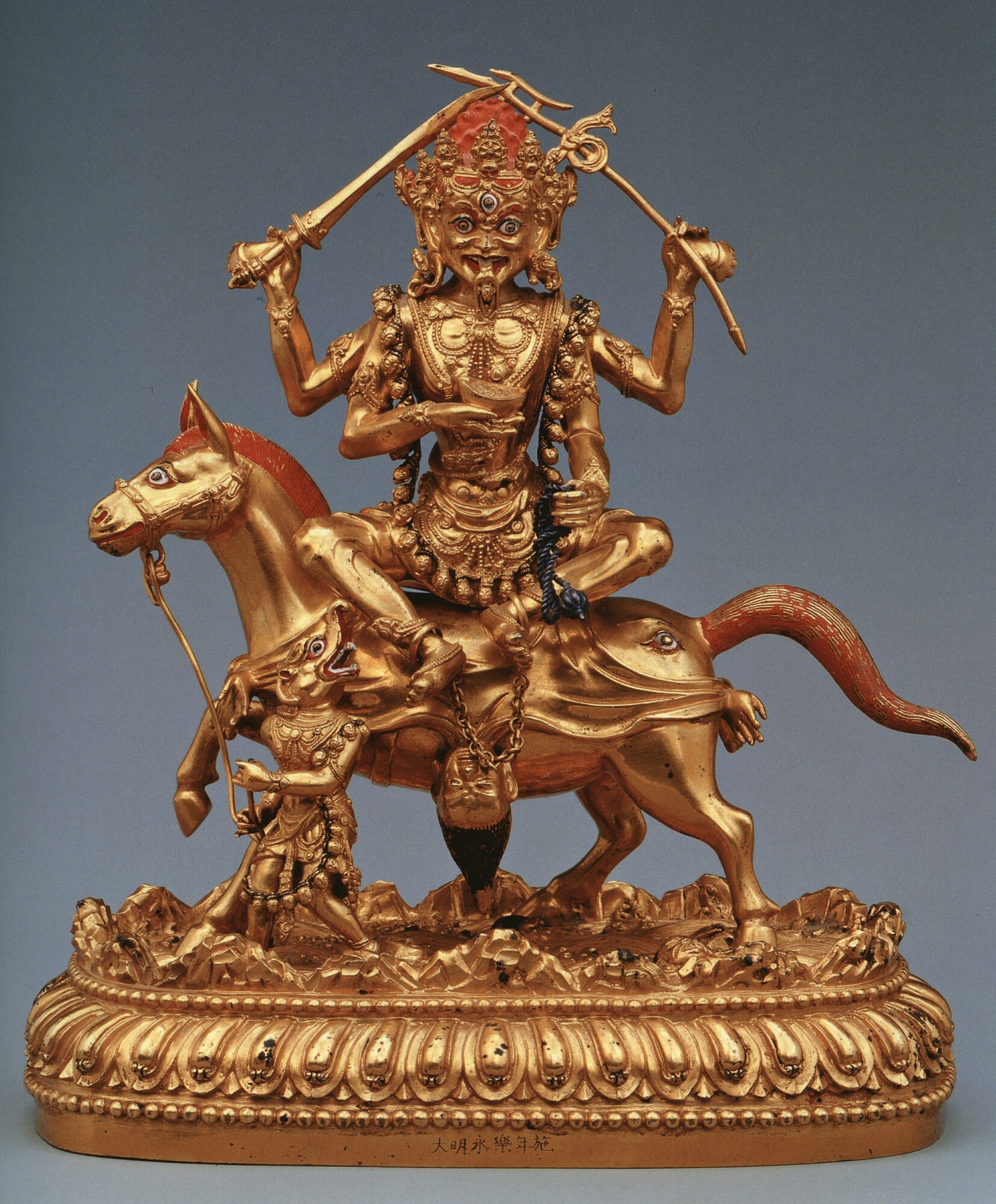
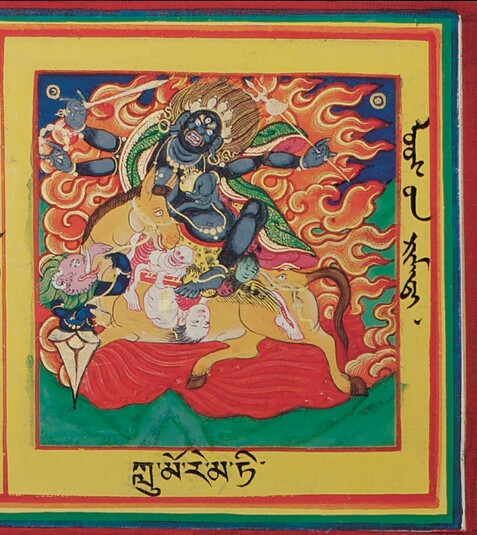
    The navagrahas appear collectively as adorants of the yellow MahamayurÏ (SM 206) and of the white MarÏcÏ. The sun and the moon figure as personifications of two of the eight dangers in the description of the white Mrtyuvancana-Tara (SM 103, 112). The grahas are also invoked in SM 206 (Pancaraksa) and SM 223 (Mahamaya).

    Aditya and the other nine [!] grahas, who symbolize disease, death, famine and distress, are noted to be overcome by MarÏcÏ’s chariot drawn by seven pigs.

    The caitya/stupa that is mentioned in the sadhanas [of Marici with Rahu, Sun, and Moon] as the place where she resides, often represented in the images, links the goddess to the topic of death, viz. the death and final end of the pre-enlightenment life of the Bodhisattva followed by the victory of the Buddha over the powers of darkness."

    In Sadhanamala 206, Panca Raksa, the planets are with Pramardani, and the lunar mansions are with Mayuri.

    Some of these goddesses appear almost as a "sixth raksa" and in one version, Pratisara is eventually replaced by Tent Mahakala. Marici's sewing needle is shown as if pulling thread from a curtain, which is disappearing as she uses it up.

    The paper reinforces the presence of Aparajita and Mrtyuvancana as related deities, and that Usnisa is with Vajra Tara. Pramardani's mantra was used against Saturn at Vasali.

    Here is Nepal's Varuni-corresponding Red Rakta Avalokiteshvara:


    The piece is largely unidentified, but we notice the nature of Six Arm beings across the top, then what appears to be Red and White Maricis, and we find Red Ganapati and White Varahi. and Vasudhara, Brahma, Grahamatrika, and a line of Naga deities based on a white serpent. I think there is also Vajrapani with a Hayagriva head. This suggests a male influence to the normally female Red seed. Ganesh is tantrically profound and goes to the sun for us, interacting with the Aswins (which is almost the inverse of Hum). There is the vaguest hint of Varahi aspiring towards Marici or something like that. There is a strong chance the corresponding attendant is Varuni or Varnani, but, in this purified form, she lacks identifying features other than darker color. Both could be said to have Six Armor Deities, Varahi's including Red Varahi. That is something like she has self-produced herself at a higher level.

    Rinjung Lhantab gives this as Vajramrita:


    He is more or less considered wrathful; Nyingma does not use "Heruka" like we do, to them, it means wrathful, so the transcendental Heruka deities are really Vajramrita and Samvara. He is consistently identified as Jewel Family, and the only tantra which explains this family.

    These are the available smudges of his Vajravali mandala, where he is in union with Svabhaprajna:


    This is his symbolic view from the Qing Dynasty, inscribed as 21-deity format, twenty-seventh in Vajravali:


    His gates show Hook, Rope, Chain, and Bell, there are Eight Offering Goddesses, and, perhaps eight Gauris. The outer part is standard, but in the inner circle, they are all vajras. Even if he is with a goddess, such a figure is usually counted as one deity, so it is he and/or they plus twenty more.

    He is followed in Vajravali by Amrita Humkara (29 deity), Amrita Krodha (21 deity), and Amrita Kundalin (13 deity) mandalas 28-30. Before this is Seventy-two deity Shadchakra Samvara, and after it is Buddhakapala. In other words, we have information and some explanation for just about everything else in Vajravali, except these Amrita deities.

    Vajramrita practice came from Vimalamitra.

    Amrita Humkara:


    Amrita Krodha:


    Amrita Kundalin also has a card in that set, but, more emphatically, he is on this ancient 1100s Kagyu Gaganaraja Avalokiteshvara (Namkha Gyalpo), at his feet with Hayagriva:


    The final or Amrita Kundalin also has a Two Arm form, which, artistically, is considered a Heruka:


    Varuni's Jewel Armor Goddess is Green, so, there appears a correspondence of the male wrathful Jewel person turning Green. Varuni would be considered Jewel if Vajradhara was not behind her, and here, the wrathful Jewel person becomes Vajradhara in Kagye.

    Insofar as you can make Vajradaka Fire Offering and use Amrita Kundalin banishing mantra, one could reason that Vajra and Jewel are already "doing their thing" in that basic format. Or, Blue and Yellow make Green. Many tantras do not explain themselves; Samvara does not. Vajradaka is, so to speak, the full explanation of Samvara, based in the advancement of Vajrasattva.

    Accomplishment is Kilaya or Extremely Wrathful or most magical, Amoghasiddhi and Tara. Or, Green is going to flash with White and eventually disintegrate. Ultimate Vajradaka accomplishes Seven Syllable and begins to transcend Sambhogakaya and arise as esoteric deities.

    From a recording of a Rinchen Terdzo retreat, they give Amrita Kundalin (purifying), Humkara (fumigation) and Mamaki together. This is after Vase Empowerment and Guru Yoga based on Vajramrita. Before this is Amrita Guna, and Vimalamitra sadhana about Four Empowerments of Amrita medicine, pill, etc. for long life. Amrita Guna is preceded by Vajrapani. These are mostly all Jamgon Kongtrul versions of various tertons. Amrita Guna's protector is Ekajata. Vimalamitra trained around Bodhgaya and also at Wu Tai Shan and was a major author on all Mother Tantra and Troma rite or Ekajata as protector. Humkara seems to have originally come as Vajra Humkara, and also appears to have a plainly re-stated name as Amrita Humkara of Jewel Family.

    There are portions of Completion Stage such as Rainbow Body and the retreat moves on to Kilaya. So they spend three or four days with Yangdak and Vajrapani, then Amrita Guna, and finally Kilaya, in other words, they provide numerous practices on each transcendent deity. It takes months to give out these hundreds of practices (this is the Swift Path).

    The untranslated parts of Vajravali are the major basis of Guhyagarbha or Nyingma, and have to do with various Vajra deities entering Jewel Family. Jambhala is mainly of these two.

    The typical faces on a Kilaya or Phurba are White Yamantaka, Blue Amrita Kundalin, and Red Hayagriva. or hatred/aversion, delusion, and clinging/greed. Here, Amrita Kundalin is almost certainly Vajra Family, as in Taranatha's sadhana.

    As the major Nyingma deities are also in the Ten Wrathful Ones of Vajrabhairava, Bhattacharya asserts that the Ten in Vajrahumkara's mandala are the same with different names, i. e. Sumbharaja is the same as Vajrapatala, and so on. DDV changes a few of them again.

    Amrita is also important to Kurukulla and Prasanna, and Namasangiti Manjushri also makes the gesture of sprinkling drops.

    Amrita overall sounds much alike Daiviprakriti. On its own, it is pure or unconditioned, but in manifestation, is mixed with poison and death. Poison is the skandhas and kleshas, which become purified and transmuted in the Cup of Varuni and eventually function as Amrita Guna, meaning six poisons converted into six wisdoms, and all increased to equal power. This is closely tied to the syllable Hum, which comes from the Sun and passes through Varuni or the radiance of Ananta at the bottom of the underworld, or Talas or objective mind, which is experienced by wrathful Vajra means.

    This means the quality of Deathlessness enters the worst regions of the mind, yet remains unaffected by any temptation, fear, doubt, or distraction. So in the "blocks" of meditation, there is emphasis on Unshakeable Vajra Mirror, Akshobya, Vajrabhairava, before Jewel Family or Amrita Guna. One starts with a "trickle" or "thread", Vajrasattva and Varuni, until there are things like fully assembled Armor Deities and the ability to change partners or families.

    As to why they can be changed, this is at least partly to break concepts like "earth is earth", "water is water", and so on. Varuni--Mamaki could be said to be bringing water to the sphere where earth normally is. With practice, this becomes Mercury.
    Last edited by shaberon; 13th May 2019 at 22:45.

  25. Link to Post #380
    United States Avalon Member
    Join Date
    1st April 2016
    Posts
    6,506
    Thanks
    33,747
    Thanked 36,931 times in 6,152 posts

    Default Re: The Serpent, the Black Sun, HPB & St. Germain

    The Revenge of Death

    I don't know the psychic details of whatever I am attempting to counter. It may be a suicide demon, it may be a "Borg" of them, it may just be the Demiurge or western mentality. I can't figure it out, I just know how to stop it personally, but not like an exorcist, I can't do anything for people who do not invite help.

    So it killed another person, proximally caused by poisoning, but, was preventable, and would have been prevented, if it were not for decisions that an adult would generally know to be fatal, i. e. suicidal. In their mind, they were being helpful. But what I saw was the same thing: I'm just going to lie here and not move. Same thing that tried to kill me over the winter when I let it dominate, and that killed my other friend who used an overt method of suicide. So after I kicked it out of my presence, within a couple months, it succeeded on someone else. Same mentality was happening: I don't move, I really don't even eat.

    That makes two losses, mental in origin, from what, as far as I can tell, yes, I know what it's like to feel this way. Same thing happens to me. This is why I'm pretty sure it is an opposite truth that proves the Path. Neither one of those cases had any shortage of western treatment from the system of medicine, psychology, religion, general advice of friends, etc., these were not people who had lost everything and were really at the end of the line. Normality, or at least basic function, was available to them, except in their minds. I see the result.

    I suppose it is why I operate by mostly replacing those influences.

    The important part is that there is a System of Seven and it is based on an individual Seven Syllable mantra that produces all the White deities of Completion Stage. Its complement is Varuni, and, if the picture above were defined to be centered on her, it would be the same thing. And Varuni is built in to the Seven Syllable sadhana. They go together, and it is not much different from general information, it's just complete.

    In browsing "Himalayan Passages", this contains a pretty detailed study on the actual Seven Syllable Heruka painting that goes with the mantra. The paper is rigorous enough to refuse to identify the very common Yellow Vasudhara and call it "likely", I suppose due to the lack of an inscription. She is the last one in the lower row of goddesses, who have no standard relationship, in other words, those are a personal selection by the donor. He picked Gold Prajnaparamita for the middle one. However, they have no problem telling us the one closest to him is Dhanada.

    But they just give the name and nothing else.

    She is among the most significant of "forgotten Taras" because we have already studied her and discovered that she teaches the entire Circle Casting rite.

    These Seven Syllable Heruka and Varuni studies just came out in 2017, and just by glancing at them, we see how the entire thing builds together into one unit, which is largely taught by Dhanada. She is identified in art, but not really explained, and yet she is right there in the 1100s picture which can only be based with the Ratnagiri style Taras, not mixed up with Atisha and other versions. Looking at this one shows us she is the major door from the outer courtyard to the accomplishment of the esoteric deity. So we will work with large articles on Seven Syllable and Varuni posted above, linked to the early parts of the Dhyana posts, and Dhanada is already built into the system of Tara. It is vast, but it is really truncating the maze of all possible names and versions into a main working order.

    The Inverted Stupa or occult color perhaps begins in Chaturpitha, which produces White Jnanadakini. However, it turns out that the construction of the stupa is Varuni. She has a type of visualization, which starts at the point at the top of a stupa, and moves outward/down/away towards the base. This is simply the proper procedure towards the Dhyana meditation, built right into the sadhana. So instead of those available teachings which are presented from the view of Completion, instead, we are looking at the entire Generation Stage, which is under the belts of Heruka and Varuni, which we mostly already have as the explanation of some of the rarest material in Buddhism which clearly shows and uses a System of Seven.

    If one was to get the flow of it and had the opportunity for a real empowerment, Vajrabhairava jumps out. The system placed him with Kalaratri, and we find most of the esoteric deities are standing on them. He seems necessary to gain the Seventh Dakini used by Heruka. Varuni emerged in his post, so we will link her article there. His outer path is with Janguli and Parnasabari; Varuni could use Pratisara. Maha Pratisara is among the first deities we saw blended into Guru Yoga, and this uses Vajra Muttering or Om Ah Hum, which remains a fairly consistent method in many exercises.

    So here is Sixty-two Deity Chakrasamvara from Krsnacharya tradition. This is the whole phenomenal world, and, Buddha Kapala mandala eventually appears in the middle of it, showing inversion. Also, Krsnacharya composed the Seven Syllable sadhana, and in his view, Samvara is over two forms of Krsna Yamari (Six and Three Faced), and in the upper right is Vajrabhairava; upper left is Hevajra. Immediately "below" the whole thangka would be Parnasabari and Janguli, and "through" it is Completion Stage:


    Samvara-Varahi are Akshobya-Vairocana emanations as usual, around them is a Dakini ring, and Citta, Vak, Kaya rings. However this turns out to be like Buddhakapala's large mandala: the Four Dakinis (Kandaroha, Rupini, etc.) of the inner ring are all in Ratna Family. This even violates their coloration. Deities in the other rings are all Blue, Red, and White, but these dakinis that are always taught as all being different, here, belong to Ratna Family. Crow and Owl and various Yama outer gatekeepers outside the main rings are not explained. Buddhakapala is the next mandala, and these two statements appear side by side, the inner rings of both Samvara and Buddhakapala are Jewel Family. Namasangiti has all Bodhisattva Paramitas as Ratna emanations, and is the only system to give a sort of bonus initial perfection called Ratna Paramita. Ratna is a thread of deities after Vajrapani, and the nucleus of Kagye.

    A ring of deities migrated to a single family is like the Ten Wrathfuls of Vajrabhairava are all in Vajra Family. The same ring is used by Akshobya and Vajrasattva in NSP 2 and 3. Vajrasattva is the Sri Samputa tantra version meaning basic explanatory method on which the other systems are based. This is closer to a Five Families formula, but these are the Families including Four Activities:

    Akshobya: Vajrasattva [Vajradhara], Tathagatas, Mamaki [consort of Ratnasambhava], Sabdavajra, Gita, Sparshavajra, Dharmadhatuvajra.

    Vairocana (East): Locana, Vajraraudri, Prithvivajra, Puspa, Hasya, Vamsa, Vajrankusi.

    Ratna: Vajradakini, Vajrabimba, Dhupa, Lasya, Vina, Vajrapasi.

    Amitabha: Pandara, Vajraragi, Dipa, Gandha, Mukunda, Vajrasphoti.

    Amoghasiddhi: Tara, Vajrasaumya, Vajrayaksi, Nrtya, Rasa, Muraja, Vajraghanta.

    By appearance, Mamaki would be presumed to be in Jewel Family, but the instruction says otherwise. However, Vajradakini and Lasya are in it, and those goddesses move later. The instructions call the mandala Vajradhara, it is understood as Vajrasattva, who is in Akshobya's Family with all Dhyanis as well as Mamaki. So for instance, Akshobya Vairocana has as consort Vairocana Locana.

    Akshobya's mandala includes the ring of Ten Wrathfuls, and is similar, but adds Eight Bodhisattvas. It names Six Families:

    Vajrasattva Family: Akshobya, Samantabhadra [Vajradhara]

    Akshobya then has his own Family. The odd thing here is the Ten Wrathfuls, usually all in this, are now spread around. So he includes Tathagatas, Mamaki, Vajrapani, Manjughosha, Usnisa, Sumbharaja.

    Vairocana: Locana, Rupavajra, Maitreya, Ksitigarbha, Yamantaka, Acala

    Ratna: Sabdavajra, Khagarbha, Prajnataka, Takkiraja

    Amitabha: Pandara, Gandhavajra, Padmantaka, Niladanda

    Amoghasiddhi: Tara, Rasavajra, Sparsavajra, Viskhambin, Vignantaka, Mahabala.

    First in NSP is Manjuvajra, same as first Namasangiti mandala. He is an Akshobya emanation, and it gives Sixth Family as Vajradhara including Dharmadhatu Vajra. This indicates the "sixth sense" after Sparsavajra and the others.


    They are renamed in the Vajra Humkara mandala, and he is equated with Trailokyavijaya, that is what his mandala mainly shows. There is a normal Vajra Humkara version, but, without any other known changes, this mandala also reverses:


    NSP goes from Vajra Humkara to Samvara, and the 62-Deity version includes Vajra Humkara. In the "renamed" wrathfuls, Amrita Kundalin becomes Vajra Kundalin, and this represents most of the changes, they get some type of vajra title. Although there clearly is a Vajra Humkara, we do not know how it matches or relates to Amrita Humkara. I suspect it is within Trailokyavijaya itself, as this name or role is fulfilled by Acala and others. Humkara simply names, and, I believe, always does, the gesture or mudra itself. For this full set of Wrathful Deities, all Akshobya emanations, Vajrabhairava refers to the defeat of Yama or Fourth plane in Kama Loka. And so it makes sense this is necessary prior to full Sambhogakaya or meditation in the Pure Lands or Akanistha or highest plane of Kamaloka. Vajrapani will intercede and the creepy thing about him is that in one instance, he appears with only the Four Kings, or lowest plane of Kamaloka.

    This is a complete tour of the underworld. After this, Akash is like peeling layers of an onion, skins of space, body-less, mental only. From a residence in Pure Lands or Summit of Meru, Dharmakaya arises. In that perspective, Vajrabhairava gates deities, which gate further deities, saturating the spectrum, and using Nirakara meditation to indraw it.

    Vajra Humkara could be said to increase an order of magnitude with the addition of a Bowl:


    The textual or ritual evolution of Ratna remains hazy, but here, we are observing a Nepali secret substitute, Varuni. The special direct teaching of Varuni uses Vajradhara as her Dhyani, and so we can switch them around and understand her and the Three Vases below him:


    Namasangiti is a fusion of almost every form of Manjushri with every class of deity, and the unique parts are the Usnisas, Pratisamvits, and Families of Paramitas and so forth. The first main form is Manjuvajra, "Manjushri of the nature of Vajrasattva", from Guhyasamaja. We could say, Guhyasamaja is the root tradition of Five Families taken to the Anuttara level. However, Namasangiti states a Six Family view, and, according to various authorities, is "allowed" to involve Seven Families. By using a power that at first, is somewhat external and distant, Dharmadhatu Vajra, it interiorizes, and we find names such as Dharmadhatu Vagisvara and Dharmadhatu Varahi as Yidams.

    Manjushri is welded to Prajnaparamita who uses entirely different literature.

    Prajnaparamita "absorbs" Sarasvati and begins her own distinct motion.

    Manjushri does something that is far less "with consort" but is perhaps an entire drama he does with Sarasvati. Her White Form becomes Janguli and she also turns Blue and Wrathful. Manjushri gains a lion and a sword but ultimately he becomes Bhairava and his only choice is to defeat Yama--Death and enter union with her as Corpse--Vampire.

    Subsequently, Prajnaparamita will emerge as "Body-less", and she and Manjushri will use a conflux of related deities to charge all Six Powers equally before going to what we would call Completion Stage and the secret doctrines or only occult siddhis we really care about, which transcend every sphere of consciousness and trigger abhisambodhis, and for most purposes the doctrines amount to No Death, although there are subtle vajra imperfections that prevent full Buddha from manifesting, until, it is thought, for most people, many lifetimes on Bodhisattva Path.

    Lion represents a worldly vehicle or way of appearing in the mundane world, by means of Fire by Friction, Nirmanakaya practice, mantras and offerings and so forth. So Manjushri does this, but, can be shown to rise with Sarasvati to the next level without the vehicle:


    The Lion itself, in parallel, may be shown to indicate solar plexus, Four Activities, Gatekeepers, and Lion Head deity such as Narasimhi, Simhamukha. Seen in this way is the way to heal and protect the center, which is the one we are going to use. In practical terms, this is a gate, step, crossing, a change with an observable meaning.

    Sarasvati has changed due to Three Vases. I am not sure what Manjushri's symbol is, it may be a Visva Vajra or type of Quintessence. If we follow what appears to be the trail, then, this goddess is destined to reside in the Cemeteries. She will have Six Arms and invoke Acala while making this difficult journey. White Tara with Acala resides in Dharmadhatu Vagisvara mandala. That is why this "absent or missing" Six Arm form is explanatory.

    Manjushri principally is a Vairocana deity, and there is plenty of reason to study Vairocana tantra and consider Vairocana as primary source of Vajradhatu and has much to do with the oblivion of Form and existence of Atman or Swayambhu Adi Buddha. However, as Manjuvajra, Manjushri clearly has obtained an Akshobya tantra power. This necessarily forces him through the Wrathful rite. And then Ratnasambhava never seems to keep any of his Family members. He borrows some and gives them away. After the Wrathful rite, the teachings indicate Ratnasambhava rite, and this consists almost solely of Vajramrita, which must engage a commerce between Vajra and Jewel. We lack its explanation, but, starting with Ratna Paramita, we can find a consistent web of symbolism expressing some kind of alchemy this family does.

    Manjushri knows this:


    He profoundly explains all Paramitas as Ratna Family, and, as the Path, these are ultimately what we seek to grow and perfect within ourselves. And so Prajnaparamita is the chief of these.

    #48 is Vajrayogini explanation of Vadiraj. Here, he has Vajra Fence, and invokes Pratisara:

    oṃ maṇidhari vajriṇi mahāpratisare rakṣa rakṣa māṃ huṃ phaṭ svāhā

    This appears related to a Puspam or Flower that is then offered to the deities as Vajrapuspe. He also invokes Yakshini Hariti. In other places, Manjushri invokes Vajrasattva, but this is a complex affair or majority of a mandala, He raises another "Pra" deity, apparently in Jewel Family, who is the outer form of Mamaki.

    Manjughosha is entwined with other forms, there is some sense that Vadiraj is a Samaya being of him, there is a part in #59 that specifically hooks him using akarsya, and his syllables become Hrih Jah. A common mantra is Om Vagisvara Muh, but Vadiraj #46 uses Om Dharmadhatu Vagisvara Muh, as does Vadiraj #51, whereas Dharmadhatu Vagisvara uses Namasangiti mantra and syllable Hoh in 61-62, and in #64 obtains a Varuna Mandala or disk, arising from void, where usually a Moon Disk or similar is used.

    The Usnisa deities in Dharmadhatu Vagisvara Manjughosha mandala include Mahosnisa, usually interpreted as "Great Coronal Dome", or Ratna Family in Namasangiti. It includes Sitatapatra Usnisa; we have already found Sitatapatra losing her Parasol and turning Yellow. Since these Usnisas are all yellow, again, here is at least a suggestion that the inner ring is Jewel Family. However, Manjughosha Family has Akshobya and "others numbering four", Usnisa, and Locana. So this may mean "all usnisas". Manjoghosha is in Vajrasattva Family, who is in Akshobya's. Or, they may be the un-named "others" in each family.

    The outer portion is thorough enough to include Varahi on Owl, Camunda on Corpse, and Ganapati on Mouse. Hariti is the Queen of Eight Yaksa Kings. NSP does not appear to describe what looks to be a Pancha Jina of each Dhyani; it places them on mounts.

    The mandala after this, Durgatiparishodana, is Lion Buddha, Vairocana Family, who uses Dharmachakra. Mahavairocana's Family includes Vajrosnisa, who is the first in the Inner Ring, consisting of Usnisa deities with several changed names. The first four Usnisas here mean the Dhyanis, and so Vajrosnisa is Akshobya. The Families of these four Usnisas is everything in a Quarter and Intermediate Direction. Akshobya (and three others, likely all Dhyanis) is in Vairocana's Family, while others are in his. According to Bhattacarya, these Usnisas are all male, ending with Chhatrosnisa, whose name Chhatra means Parasol, the deity being White. This mandala lacks a Prajna class while having Offerings and Activities. The Usnisa name set is different since this actually seems to be a distinct set. Here, the Dhyanis are Usnisas, as they are Dakas elsewhere. Lion Buddha or Sakya Simha has his own Navoshnisa Mandala using these, implying he is also an Usnisa. The intermediate deities are holding Sun, Cintamani Banner, Sword/Book, and Parasol.

    Around them are standard Bodhisattvas and so forth, and then the outer part is very weird. It begins with Nilakantha on Nandi with no Shakti, and then all the rest have them. Manjuvajra is with Vajrasanti on a Swan. Male Vajrakundali is with female Vajramrita, in a chariot of seven horses, standing in for the sun. All the planets are cast as Vajra couples. The Quarters include Nagaraja and Vajramakara on Makara, and Vajrabhairava and Vajravikata on a Ghost. This contains Shiva, Visnu, Sri, and Sarasvati, and ends with Simhadurga. Beyond them are Prithvi and worldly beings such as goblins, birds, people, etc. Here again, visually, Vajrosnisa would be presumed to belong to Akshobya if the instruction were not otherwise.

    I am not sure there is a way to feminize names like Vajrosnisa and Vajramrita, like Aparajita, there is no quick way to tell if a male or female is meant. One couple in here has identical names, like Aparajita with Aparajita. Vajramrita is in the role of Marici. It would be hard not to make this connection, and know it as the name for the only Ratna tantra. Whether it is meant as a sex changing deity, or a male-female of itself like Aparajita, I do not know.

    This teaching culminates in a 37 element Sarvavid Mahavairocana, and, it has a similar sequence to the Nyingma version: Sarvavid Vairochana with 37 principal deities, 2. Body-Shakyamuni (8 deities), 3. Mind-Vajrapani with 4 deities, 4. Speech-Amitayus with 4 deities, 5. Qualities-Chakravartin (numerous deities), 6. Activity-Jvalanala with 12 deities. So #5, Chakravartin--Qualities, appears to have the similar role to Amritaguna. He has no description, but in this outline, his mandala shows the unusual feature of worldly scenes:


    After that, Bhutadamaru has Surasundari in the northwest of his second ring, which is a veil for Varuni. Otherwise, his retinue seems purely Hindu, including the mysterious Padmavati to the West of his outer ring. If I didn't know otherwise, I would take it that Bhutadamaru is harnessing everything Aryan, and Sakya Simha in Durgatiparishodana subjugates it to Vajra methods. Seems like a conversion.

    Then, Pancha Daka is self-adjusting in that any court may be moved to the center, and this one splits goddesses into classes. Amoghasiddhi (Visva Daka) has all the Prajnas. Vajradaka has the Gauris. Sat Chakravartin is almost incomprehensible, but, in Ratna's court, has Vajrahumkara with Surabhaksi.

    On the goddess side, there is a striking match.

    In Sadhanamala #156, Gold Prajnaparamita embeds Amritaguna while explaining special seed syllables and another mantra:

    pūrvapatre namaḥ, āgneyyāṃ patre bhagavatyai, dakṣiṇapatre
    prajñāpāramitāyai, naiṛtyāṃ amṛtaguṇāyai, vāruṇapatre
    bhaktivatsalāyai, vāyavyapatre sarvatathaṅatājñānaparipūritāyai,
    kauveraputre sattvavatsalāyai, aiśānapatre tad yathā, oṃ dhīḥ
    karṇikāyāṃ, pūrveṇa śru, āgneyyāṃ ti, dakṣiṇe smṛ, naiṛtyāṃ
    ti, vāruṇe vi, vāyavye ja, kauvere ye, aiśāne svāhā,

    It arranges one mantra "Namah Bhagavatyai Prajnaparamityai, Amritagunayai," etc., and another one, Om dhih karnikayam sruti smirti vijaye svaha. This is the only occurrence of Amritaguna in the entire first half of Sadhanamala. Prajnaparamita herself is nominally an Akshobya goddess in these practices, arisen from Pram. She adds Dhyanis and Prajnas and Offering Goddesses and uses Four Activities and the emptiness mantra of Vajra Tara. Here, she also has the seeds gih and jjih, which may be unique to her.

    I only see Prajnaparamita shown in Ratna Family in Dharmadhatu Vagisvara Manjughosha mandala. At the same time, it shows me Akshobya Vajra Mamaki who is with Ratnasambhava. Prajnaparamita becomes Vajradhatvishvari. This arrangement looks underway here. Ratna Family has little emphasis, until we find this undercurrent, along with Ratna Gotra Vibhaga, which nearly says Jewel Family Doctrine, being Seven Vajra Mysteries and Catuskoti.

    Varuni (Mamaki, the major axis of the flow of Amrita at all and between two families) will give the subtle and physiological aspects of the Generation Stage as the Inverted Stupa. Simultaneously, the mental aspects of Mt. Meru and the deities populating Vajradhatu, Namasangiti and Prajnaparamita, Dhanada, etc, are done. Both can mostly be done as Yoga tantra meditation, as well as others such as Usnisa and Marici. So even from an outside or non-initiated basis, there remains a refuge and guide, in the sort of Nagarjuna view of Awakening Mind itself, and Mahamudra. This is why we are seeking a more universal meaning based from Ratnagiri and the core Sanskrit version, this is what it is.

    Tsonkhapa on Naropa. This book uses "Yogas" for the Completion Stages, however, "Dharmas" or "Doctrines" is better, using Yogas as Kalachakra style meditation, which aims at basically the same thing as Abhisambodhi. It is a process or sequence that can be triggered, and we are training how to do it not randomly and weakly, but thoroughly and competently.

    Here is a sizable Mahamudra preview that closely examines Inner Heat and subsequent meditations. The usual estimate is four to six years working in the solar plexus to gain control with bringing the heat to the central. It explains sex and other types of yoga as being able to raise heat in the body and other ways, but the training is specifically to center it.

    After that, the centered heat melts the white drop, and the goal is to merge them in the heart, not in any other center, which other yogas may do. Then, bliss stages are practiced as descending crown to root, then rising back. The goal is mastery of the three subtle minds, white, red, and black. This process is identical to Death and in both cases the impulse of the subtle mind heavily conditions the transitional stage, Clear Light or Prabhasvara. In meditation, one would slowly awaken and emerge in reverse order, through black, red, white, and on out into the gross mind and skandhas. In death, these would happen in the same way, on the bardo plane or kama loka.

    The main impediment in the subtle minds is "grasping" or "seeking rebirth" and it is this type of bardo consciousness that is first purified. Sometimes, Illusory Body is considered a part of this; sometimes, it is called part of Dream Yoga. Tsonkhapa explains this and uses Karmamudra instead. This is sexual yoga. Normal sex is undesirable at Completion Stage, but he recommends tantric sex at three stages. He didn't do it because he did not want to set an example where people would start seeing it as something other than it is. He also explains Transference as entering another human body (which is now lost in Tibet); in his time, he says there is a reversed Transference, which places someone else into your body. But then he says the gurus "don't teach it publicly", so he doesn't explain it. Now we are only meaning transference to Akanistha.

    For ordinary death, one should train heavily in all stages for six months prior to decease.

    The worst thing we could do is read through it and try to copy it. Nothing will happen. We can see the whole scheme, conceptually, with a little study, but the outer meditations and Generation Stage are very meticulous and slow.

    Ultimate success or Enlightenment is witnessed by Bhu, who may have anjali mudra, which is the normal prayer-style namaste, or carry a bowl. The companion is slapping Aparajita, rare in our texts, however Puranic Yellow Aparajita, a destroyer Durga, also arises from the womb of earth, like Sita, assisted by Vajrayogini. She destroys rajas-tamas, sweeps dirt, alakshmi, and is the tenth day after Nava Durga (Vijaya Dasami). This is the Tenth Durga, Jaya, Vijaya, Aparajita. She rides a lion (peaceful). Bhu's companion has also been explained as Ila and Sri. The main Jewels from the Ocean of Nectar are Sri and Varuni, or close equivalents of Ila and Bhu, so it is pretty obvious they come from Nectar of Immortality and witness the defeat of death.

    Aparajita appears to be a special kind of Parasol and Bhu appears to be a special Banner, i. e., Varuni has Banner, and Bhu--Vasudhara has all to do with Vase and Cup, or a pilgrimage to Mt. Meru, Varuni being the complete empowered vessel used there, Banner and Parasol being the top portions, Inverted Stupa being the way through.

    Their Yellow Earth forms are a complete manifestation of the inner 1,000 Arm White Parasol and 1,000 Arm Red Varuni Guhyeshvari, the Two Drops and Solar and Lunar nerves.

    In practice, energy has passed well beyond the 1,000 petal lotus, the crown is really just an aperture of a superior structure. So if we have a close bond to a deity, like Vajrasattva, in outer practice, we are allowed to do Pride of the Deity, which sits their lotus throne on top of your head. The deity and its higher center would merge into yours. This is quite powerful. I think of front generation as introductory, so something new like Janguli is facing like a conversation.

    Janguli is a precursor stage that makes much use of snakes and the number seven. Further along, there is a specisl set of Usnisa deities, and also Armor. If we look at Armor, what is it protecting? Upeksha, the highest part of Four Roaming Brahman Virtues, Seven Jewels of Enlightenment, and the Pali account of Bodhisattva perfections. As the "real" Armor, Prajnas, this function is automatic. As "preliminary armor", skandhas, it is not. If one "used all Six Prajnas equally", Upeksha would be like Akshobya or Acala, undisturbed by anything. Janguli certainly appears as a preliminary method to dig at all skandhas and start extracting the poison. Even if you are no good at visualization or never initiated into a mandala, the philosophical meaning is still the same. The exercises make it happen faster and stronger, but the state is the same, whether achieved in one lifetime by mantra, or several, by meditation alone.

    Sadhanamala appears to have one use of Green Janguli in #121. It seems to say the mantra becomes a Green (Harita) Kumari, one face, four arms, who is saptaphaṭvirājitamūrdhajaṃ, or sapta phat virajita murdhajam, Seven Phat syllables (eminent, brilliant, adorned) (in her hair or head-born from her). She seems to have trisula and mayuri piccha or plume; sarpam or sarpa is the term for serpent here in another hand, and the fourth is "prasāritābhayam". This seems to be a type of Abhaya mudra.

    sarvāṅgena "pervaasive through the whole body" nūpura "anklet" mekhalā "girdle" valaya "bracelet" kuṇḍalādīn "earring" sarpākārān "form or shape of a snake" citayet "meditate". This indicates that her form has several jewels that represent binding of the winds from going down or out, and, also has some kind of snakes, which seems generally to be taken as her hood.

    I cannot be sure what it literally says, but, it is not too far from each serpent in the hood being a Phat that attacks hindrances and purifies skandhas.

    It uses Agnijvalam, and has "akrsya tato daka", or hook this daka.

    "calaṃ ca viṣaṃ yaṃ yam evāṅgaṃ muñcati tasmin tasmin sthāne mṛttikayā saptajaptayā dhāraṇībandhaṃ sarpākāravalayayogena kārayet" has calam, probably motion, visam, poison, yam or wind syllable, then evangam, probably "in that condition", muncati "loosens, releases, emits", tasmin sthane "in that residence" and gives us something called mrtti kaya which would mean death kaya, followed by, recite seven times her dharani (serpent [hand or maker] [bracelet, circle, mandala] yogini) (is compelled or becomes known).

    Next, "sarpakarau mudra" or some kind of serpent hand, followed by huhkara, which does something that results in "evaṃ karmasiddhir bhavati nānyathā".

    "Huh" would seem to have no particular use, however, the Aryan Kriyakalagunottara uses it in Nilakantha's Meghamala Vidya or Garland of Clouds, whose purpose is to free one from all poisons. If bitten, it then invokes "Lady whose form is nectar" to determine which caste of serpent caused the wound, and responds with various seed-syllables. This is from a study of Garuda Tantras.

    It is a linguistic seed, in that huh plus ah or ha makes the sound of laughter (Tathagata Family). Same root as Hah or Hoh. If it appears anywhere other than Garland of Clouds, I am not sure. Sarpa occurs once in Rig Veda where Ahi is usually found.

    Janguli is present with Mahasri, and also related to Krsna Yamari. All three of her colors come from Akshobya, and then it is Parnasabari who has Five Families. Her Sadhanamala dharani is the text of her as a Dharani Goddess of DDV. Bhattacharya also noticed she is alike Manasa Devi and Visahari; visam seems to be the word for poison in her sadhana.

    Her Yellow form introduces the syllable Phuh, uses Eight Offering Goddesses, Yellow Mayuri, Red Bhrkuti, Dark Parnasabari, and Blue Vajrashrinkala; Feathers, Gourd, Branch, Chain.

    After Mahasri is Sadhanamala's Janguli sequence. The order of her mantras per sadhana is:

    oṃ namaḥ śabarakumāri
    ye cūrcchacāḍi cālaya cuccālaya saṃghaṭṭani mattamātaṅgi
    aḍaviddhe ahe oṃ jaḥ svāhā

    That is for Yellow Form (in verse). Motion, repeated motion, then Samghattani is probably "sagghatana", encouters, meets, is in close union with, Mata Matangi. Ahe is "a particle", adaviddhe is probably a play on adhi vidya, science, or has acquired knowledge from. Hard to say for sure, but, in white, she got Sarasvati's syllable, and the lute, also used by Matangi, and this also makes her seem as a bridging goddess between a general outer one, and a highly charged magical one.

    Then her large dharani is given. Next:

    oṃ jāṅguli sarvaviṣapraśamani huḥ svāhā (Yellow form prose)

    Then there is a Mahavidya expansion of her dharani, then the Green form. Then the last, White, is based from Ah Hrih Hum. It refers to jnanasattva samaya and Four Activities, and Hrih is her seed here. So White Janguli is not far from Sarasvati and Prajnaparamita, with the addition of a snake.

    For her white form, after several depictions of "sukla", there is:

    sukhāsanopaviṣṭo jagati maitrīkaruṇāmuditopekṣāṃ

    Something about sukha, or bliss, then Jagad Maitri (world mother) Karuna Mudita Upeksa.

    Her visualization starts from Pam, emits a White Lotus, then a Moon Disk, upon which is Hrih. Shortly thereafter:

    'kṛṣya gaganasthān jñānasattvasamayasattvān ekīkṛtya vibhāvayet
    jaḥ huṃ vaṃ ho prayogeṇeti / punar api hrīḥkāraraśminākṛṣṭāḥ
    sarvatathāgatā gaganasthāḥ sattvārthodyataṃ māmabhiṣiñcantu

    Sthan is the same as "stan", home or residence of. So it twice refers to Gaganastan meaning Sky or Space is the residence. Akarsya (hook) (from her abode in space or sky) (gnosis being, samaya being) (gathered or unified) (causes to arise or appear) (four activities) (accomplishes yoga).

    It goes on to recite Hrih seven laks (= 100,00), and something about seven white flowers. So we could say seven us a number highlighted by, or characteristic of, Janguli.

    She is a samaya being who is not quite available at the beginning stage, but could be used not long after Vajra Muttering, and would remain serviceable through Yamari, Prajnaparamita, and Sri.

    I will never figure out Jainism, but there is also some consideration that the mysterious Padmavati is Janguli.
    Last edited by shaberon; 21st May 2019 at 19:58.

+ Reply to Thread
Page 19 of 26 FirstFirst 1 9 19 26 LastLast

Posting Permissions

  • You may not post new threads
  • You may not post replies
  • You may not post attachments
  • You may not edit your posts