+ Reply to Thread
Page 13 of 61 FirstFirst 1 3 13 23 61 LastLast
Results 241 to 260 of 1219

Thread: Does Anybody Else Have Clear Body Experiences?

  1. Link to Post #241
    United States Avalon Member
    Join Date
    1st April 2016
    Posts
    6,937
    Thanks
    35,592
    Thanked 39,576 times in 6,585 posts

    Default Re: Does Anybody Else Have Clear Body Experiences?

    Quote Posted by Old Student (here)
    Quote So there is aspiration/meditation/devotion to Sunya itself. Surrender is also perhaps fitting, as long as we keep in mind what is being surrendered to what. The Emptiness mantra is largely intended to sacrifice ego to void-gnosis.
    This is how I had interpreted "surrender" so this works. The list I extracted from your longer explanation before of the paramitas, contains in each of them a "formula" for personal yogic control within the body (withholding sperm, channels, directing bodhicitta from the jewel tip to the crown, etc. It doesn't make much sense in the order they're given to interpret pranidhana as many of the definitions but it does if it is final fulfillment of a Bodhisattva's vow, or surrender or annihilation. These all end up seeming like things that are stages, accomplishments in the shaking exercises given by the Dakinis if this is interpreted as the dissolve.
    Yes, it is like a matter of degree. For instance, I would think it is possible for a normal person to apply a bit of devotion and get a "taste" of Acala Bhumi, although this is a far cry from saying one has or is on Acala Bhumi which means it is permanent and cannot be removed by any known means. The categories of teachings are meant to be somewhat simultaneous. If I am upholding Kshanti Paramita, I cannot be too far from Prasrabdhi Bodhyanga. So this is why the common Thirty-seven point enlightenment has redundancies and we are sort of taking the creme de la creme by focusing Seven Jewels and Four Brahmavihara.

    However, specific to the Yoga Path are thirty seven what we might call yoga to tantra points, which more or less begins with the definition of divinity from Kriya--Charya and moves to the important sadhana components. I can scrape this together.


    Quote and it usually did not include either Mongolia or Manchuria.
    If I recall correctly, Manchuria is a "retrofit" to Manjushri. There was a pilgrimage route from Tibet to Wu Tai Shan since before Padmasambhava's time. In a couple of cases we seem to have found China altering scriptures to make a lineage connection based in this, which does not seem to agree with the original sources. Anyway, the legend of Manjushri leaving Wu Tai Shan to create Nepal, not exactly Kathmandhu but Pattan, is held by the Kirats or Mahacina themselves. Even though they would have to be considered the recipients of Indian Buddhism, the Manjushri legend is as crucial to them as it is to Nepalese Chakrasamvara.

    Quote Yes, sapphire generally, or blue-black sapphire particularly.

    I asked because my clear body has been very very dark the last few nights, but very transparent. I have not been focused on it, I had too many other things to try to juggle at one time, but I did notice it to the point of commenting on it in last night's notes, it corresponds to the recent feeling of being empty inside much of my torso with the whole being filled up with something like an electric charge.

    Although I do not quite fully grasp all of your dakini visions--yes, this electrification sounds like part of what is expected to happen.

    It sounds to me like you have a largely functional subtle body, minus a few degrees of what we call Vajra Ignorance. You have this motor mostly starting to crank, except for a few missing contacts or missing channels in the evidence of not being able to select "breeze" at will.

    This probably has mostly to do with the non-dualization of many fine nerves. Duality is perhaps like the two ends of a ping pong table, the ball is constantly flying one way or another, and non-duality is like the players bring their paddles closer and closer together, until the ball is not flying to any side, but can only vibrate in a balanced manner over the center.

    In terms of the Paramitas, it turns out there is such a thing as the dharani of the paramita herself.

    Within Nepal there is a big thing relatively similar to Sadhanamala, using some of the same deities, except it is not visualizations, it is all Dharanis, therefor called Dharani Samgraha--similar to Dharma Samgraha, which is a "list of lists" used in defining most of the Prajnaparamita philosophy, such as the Six Armor Deities, Seven Jewels of Enlightenment, and so on.

    Interestingly, this has the contents at the end. The roster is fairly massive, and it is written in an accent, like "vaja barahi", but it preserves Janguli, it has Vidarani and Ganapati Hrdaya, and Swayambhu Purana, it has Guhyeshvari and Vijaya Vahini, and Twenty-one Taras, and if we see where the "Cotton" mantra as Vajrasarasvati has threaded its way (she cycles), then it weaves Sadhanamala to the Nepalese basket:


    (526)

    ? śrī vajrasatvakāya nāma ? śrī saptasatīkā prajñāpāramitānāma ? śrī paṁcaviṁśatikā prajñāpāramitānāma ? śrī svalpākṣara prajāpāramitānāma ? śrī advayaśatikā prajñāpāramitā ? śrī saptabuddha stutināma dhāraṇī ? śrī vajasatvakāyodbhava nāma dhāraṇī ? śrī varocara nāma dhāraṇī ? śrī musamantravidyānāṁ dhāraṇī ? śrī māyājālamantradhāraṇī ? śrī akṣobhyanāmadhāraṇī ? śrī ratnasambhavanāmadhāraṇī ? śrī amitābhanāmadhāraṇī ? śrī amoghasiddhīnāma dhāraṇī ? śrī nāmasaṁgītināma dhāraṇī ? śrī mañjuśrīpratijñānāma dhāraṇī mañjuśrī pratijñā nāma dhāraṇī ? śrī mañjuśrīnāma dhāraṇī ? śrī amṛtabhakṣonāma dhāraṇī ? śrī arapaṁcanamañjuśrīsādhananāma dhāraṇī ? śrī maitrīpratijñā nāma sutraṁ ? śrī maitrīya nāma dhāraṇī ? śrī amoghapāśanāmadhāraṇī

    (527)

    ? śrī khasaryya nāma dhāraṇī ? śrī abhayaṁkarināmadhāraṇī ? śrī mahamrabhujalokeśva ? śrī siṁhanādanāma dhāraṇī ? śrī mokṣapradanāma dhāraṇī ? śrī āryyavalokiteśvara siddhinikā ? śrī ṣaḍakṣarī nāma dhāraṇī ? śrī nīlakaṇṭha lokeśvara nāmadhāraṇī ? śrī padmahasta nāma dhāraṇī ? śrī sahastracarkānāmadhāraṇī ? śrī ṣaḍakṣarastuti nāmadhāraṇī ? śrī jamarājastuti ? śrī umāmaheśvarakṛti stuti ? śrī lokeśvara śatanāma dhāraṇī ? śrī sarvalokeśvara nāma dhāraṇī ? śrī lokeśvara aṣṭottaranāma ? śrī hemāṁgānāma dhāraṇī ? śrī kṣatāśani dhāraṇī ? śrī kṣatāśani nāmadhāraṇī ? śrī sarvamaṅgala nāmadhāraṇī ? śrī jātismara nāmadhāraṇī

    (528)

    ? aparimitānāmadhāraṇī ? bhadracarī nāmadutraṁ ? durggatipariśodhana nāmadhāraṇī ? gandhavyuha nāmadhāraṇī ? samādhirāja nāmadhāraṇī ? laṁkāvatāra nāma dhāraṇī nāmadhāraṇī ? śākyamunī nāmadhāraṇī ? karṇṇayopānāma dhāraṇī ? sarvapāpa haraṇanāmadhāraṇī ? vajasarasvatī nāmadhāraṇī ? puṇyavivardhūnī nāmadhāraṇī ? sadharmma puṇḍarīkā nāmadhāraṇī ? gāthādvayanāmadhāraṇī ? sugata vajanāmadhāraṇī ? bhaiṣa nāmadhāraṇī ? cuḍānāma dhāraṇī ? dhvajāgrakeyūranāmadhāraṇī ? mahāsaṁcara nāmahṛdaya ? candramahāroṣaṇasamārdhināhṛdaya ? herukaprasavaroganāmadhāraṇī

    (529)

    ? vajavārāhīnāma dhāraṇī ? guhyeśvarī nāmadhāraṇī ? āryyatārānāmadhāraṇī ? āryyatārānāmadhāraṇī ? yogāṁbara nāmadhāraṇī ? ugratārānāmadhāraṇī ? jāṅgulīhṛdayanāmadhāraṇī ? daśakroṭanāmadhāraṇī ? uṣṇīṣavakravarttīnāmadhāraṇī ? lokāgītastavaiḥ ? vajayogiṇī nāmadhāraṇī ? trailokyavījayonāmadhāraṇī ? vajapāṇimahārakṣā ? tāroṣṭottaraśatanāmadhāraṇī ? tārāsragdharāstuti ? ekajaṭādhāraṇī ? svayaṁmbhupurāṇaḥ nāma ? vasaṁndhārāvratarāja nāma ? vasūndhārā nāmadhāraṇī ? vasundhārā aṣṭottaraśatanāma ? vajavidāriṇī nāmadhāraṇī ? gaṇapatīhṛdayanāmadhāraṇī

    (530)

    ? uṣṇīṣaṇijayonāma dhāraṇī ? parṇṇaśabarī nāmadhāraṇī ? māricināmadhāraṇī ? grahamātṛkānāmadhāraṇī ? rāhuśāntināmadhāraṇī ? ketuśānti nāmadhāraṇī ? vinghātakanāmastotram ? sāhastrapramardvaṇīnāmadhāraṇī ? mahāmāyurīnāmadhāraṇī ? śītavatī nāmadhāraṇī ? pratisarā nāmadhāraṇī ? mantrānusāriṇī nāmadhāraṇī ? mahāpratyugiṁrā nāmadhāraṇī ? vijaya vāhinī nāmadhāraṇī ? mahāvaja sarasvatī nāmadhāraṇī ? mahāvaja bārāhī nāmadhāraṇī ? saddharmmapāṭha nāmadhāraṇī ? vajatārā nāmadhāraṇī samāptaḥ

    (531)

    dānapāramitādhāraṇī śīlapārāmitānāmadhāraṇī kṣāntipārāmitānāmadhāraṇī vīryyapāramitānāmadhāraṇī dhyānapāramitānāmadhāraṇī prajñāpāramitānāmadhāraṇī prajñāpāramitānāmadhāraṇī cūndānāmadhāraṇī jambharendrasyanāmadhāraṇī ugratārānāmadhāraṇī mahāmeghasūtra vaorocanīdhāraṇī ādaśākṣaradāraṇī cintāmaṇilokeśvaranāmadhāraṇī buddhabhaṭṭārakanāmadhāraṇī padmāttamanāmadhāraṇī sarvabuddhabodhi satvanāmadhāraṇī āryyatāro viṁśatistotraṁ

    (532)

    caturbhuja mahākāla sādhana nāma dhāraṇī


    So it includes the three "highest Prajnas" Hodgson referred to, it has all this stuff, yet it does not bring up much of Hevajra, Chakrasamvara, Cinnamasta, etc., these are all mostly Yoga deities starting from Vajrasattva, Prajnaparamita, Seven Historical Buddhas (Sangha), that which is born from the body of Vajrasattva: Vairocana, Maya Jala and the other Buddhas, and Manjushri. Then it is Sadaksari and various Lokeshvaras until you get to a list of Sutras. Then several Taras and Paramitas and even what looks like Vairocani.


    Miranda Shaw is practically convinced that Marici is Durga. She says the way the sadhana works is oneself is inside the Stupa.

    Arya Marici means Needle Marici, and it is Asoka who is her companion form with other goddesses.

    Asoka is the state flower of Orissa, the species name in western taxonomy, and the singlemost thing associated with Yakshis across all India.

    Asokakanta is most commonly used as Marici's name when a companion of Tara, which will immediately solve a mystery.

    Here is a shining example of something from Sadhanamala which, according to historical knowledge, is the major artifact from Ratnagiri, but otherwise without any evidence--forgotten. The following information was collected at a private house. This is based on a small paragraph which apparently is a major artery of mysticism.

    There is an instance of Mahattari in current use, as the origin of a multi-Tara Sapta Vidha Anuttara Puja from Nepal.

    They suggest the exercise starts with solo Mahattari, who becomes another Tara with companions, and proceeds until you hook Sambhogakaya Tara. This is what I have been floundering around with for years, I filed most of the Kubjika information under "Mahattari", and said all I can say is that she is related to Sambhogakaya and Mahasri, because there is not a text that asserts this. So this is exactly that.

    Tara with companions would be called Varada if doing that gesture, but, if she does Dharmachakra, it is Mahasri. Without color, she might be confused for Prajnaparamita, so here is Mahasri from the 1400s with original paint.

    Mahasri with unusual Asokakanta and Ekajati.


    In Sadhanamala, the closest thing to Arya Tara is Dhanada (invoked that way), then Durgottarini, then Arya Tara Bhattarika, Mahacina; or Vasyadhikara or Vistara.

    Mahattari however in Sadhanamala is defined as: this ritual, Saptavidhanuttarapuja. It has Sukla and Dhanada in relatively prominent placement.

    The value is something like this. Anyone who ever meditated on Green Tara in some way, if you want to think of her in Lotus Family, I think there is only one option, Day-Night Tara, who happens to match the only one in Twenty-one Taras where a form is actually described--Amitabha and crescent moon in her hair. Just about any other kind of Green Tara is an Amoghasiddhi Tara. And so if we look at this thing and clip off the self-generation, then we have an elucidated basis to use it as a "Saptavidha Tara" framework in a similar manner to how Sarvadurgati is like a "Trisamadhi framework".

    She is going to swipe the Vajradhatu mandala, which again, is like a power level, like Trailokyavijaya. It is the common exoteric one. If we had a similar Six Family Wheel but perhaps based in Dakini Jala, we would meditate that instead. We might use a few different individual Taras. You don't, for instance, change a deity's name mantra or something dumb like that, but, if you are following the teaching and have a parallel detail that fits, that is ok.

    This is the whole Mahattari article, for which there is a Sanskrit original, and it is fairly close as if translating from Sadhanamala:


    (116) Journal of Indian and Buddhist Studies Vol. 55, No. 3, March 2007

    A Study of Tantric Rituals in Nepalese Buddhism

    Samadhi of Tara in Saptavidhanuttarapuja

    BAJRACHARYA Manik

    1. Introduction

    Most of the major rituals in Newar Buddhism consist of a stage where a
    Vajracarya priest contemplates the nature of a certain deity as a, part of the main
    rites. The rite is called 'samadhi danegu' and it consists mainly of contemplating his
    own tutelary deity, which in most cases is the Samvara. The samadhi of Samvara,
    called tri-samddhi, is so common among Newar Buddhists today that it is worshipped
    in most of the rituals performed by Vajracaryas, regardless of the deity in
    question. This is true also in the case of Saptavidhanuttarapuja (hereafter SP), which
    is one of the most popular and fully developed exoteric Newar Buddhist rituals. The
    ritual of SP employs the Sevenfold Supreme Worship') and the deity to be worshipped
    in it are in most cases Tara, Lokesvara, or Sakyamuni Buddha.
    Exceptionally, in the SP that I observed on August 28, 2004 in a private house at
    Lalitpur city, a samadhi of Tara was performed instead. Depending on the ritual
    performed and the manuscript of the ritual manual used on that day, I will describe
    the samadhi below. The manuscript, which is a private collection of Dharmaraja
    Vajracarya, has 43 folios with 14 lines per folio. It is dated as Nepal Era 1061 (1941
    AD) and compiled by Siddhiraja Gubhaju of Bubaha, Patan.

    2. The samadhi of Tara

    The samadhi rite is the beginning of the main rites. It is performed after the preliminary
    rites like suryargha (reception of the Sun), gurupddargha (reception of the
    Vajrasattva and the priest), the purification, and the gurumandala. The Tarasamadhi
    of SP can be described in the following stages:

    [I] Salutations: In the beginning, salutations are made to the triple gems. Then the Bud-
    dhas and Bodhisattvas are requested to be present in every direction.

    [II] Contemplation of Mahattaritara: A syllable Tam is visualized at the middle of a moondisk
    in one's own heart. Buddha and Bodhisattvas are arisen from the ray of light streamed
    from the syllable. Then the text describes that one should first perform exterior and interior
    worships (bahyadhyatmyapuja) and then the sevenfold supreme worships. Then sunyata
    is conceived followed by the pronunciations that all the phenomena and the self are
    pure in nature. Then from the Tam syllable, a white utpala flower is generated in which
    another syllable Tam is present. From that syllable, Mahattaritara is generated who is fully
    ornamented and seated cross-legged (paryanka) over a great-moon-disk (mahacandrasana)
    on a lotus. She is green in color and has no companions. She is granting boon (varada)
    with her right hand and holding a stalk of blue lotus (indivara) in the left. Then conceiving
    the posture of samayamudra, one visualizes oneself as Mahattaritara. Pushpendra Kumar
    discusses, by referring to several labelled images, that Mahattaritara was also known as
    Mahattarayi, and Mahat-tara. He also gives iconographic variations of this form of Tara
    as being flanked by two female companions and other one as being seated in lalitasana.

    [III] Contemplation of Varadatara: The second samadhi is that of Varadatara. After contemplating
    sunyata as in the former samadhi, one visualizes in oneself a all-sided lotus
    (visvakamala) born from the syllable Pam. A green colored syllable Tam is then visualized
    on a moon-disk which is born from the syllable A in the middle of the lotus. Then from
    the syllable Tam, the green colored Varadatara is generated.
    She is distinguishable by her four female companions. She is holding a water-lily (nilotpala)
    in the left hand, granting wishes (varada) in the right and seated in the ardhaparyanka
    posture. She is flanked by Asokakanta and Mahamayuri in the right side and by
    Ekajata and Aryajamguli in the left side. Asokakanta is yellow in color, and holding a
    branch of Asoka tree and a Vajra with her left and right hands. Mahamayuri, yellowish in
    color, holds a peacock-tail-feather (mayurapicchika) and a yaktail-fan (camara) in her left
    and right hands. Ekajata is dwarfish, dark colored, and holding a tiger skin (vyaghrajina).
    She has three eyes and terrible tusks. She has. blazing hair and is also holding a chopper
    (kartr) and a skull-cup (kapala). Similarly, Aryajamguli, green in color, is holding a black
    snake (krsnoraga) and a fan (camara) with her left and right hands. Then one visualizes
    these deities as oneself.

    [IV] Adhisthana: After that, one performs the empowering (adhisthana) of the moon, the
    sun, one's hands, conch-shell, flowers, the bali, the ritual ground, and one's body, speech
    and mind, etc.

    [VI Nyasa: This is followed by nyasa, a process where mantras of various deities are implemented
    into different parts of the worshipper's body. A total of 26 mantras are implemented
    using both right and left hands.

    [VI] Akarsana: At this point, one meditates that Aryatara who is in the Akanistha heaven
    is invoked into the mandala. The mantra Om Tare Tuttare Ture Svaha is muttered 108
    times to her.

    [VII] Worshipping: In the next stage, Aryatara is worshipped with five transcendental
    Buddhas. It is followed by the worshipping of 40 Taras.

    [VIII] Concluding rite: At the conclusion of the samadhi, one recites praises to the transcendental
    Buddhas, Aryatara, Mahattaritara, and Prasannatara followed by the worshipping
    of the crown (makuta).

    3. Conclusion

    -The samadhi of Mahattaritara described in the text is almost similar to the sadhana
    no. 90 of the Sadhanamala. The text misses the parts where vikacotpalamudra
    is performed and the mantra Om Tare Tuttare Ture Svaha is muttered. On the other
    hand, in Sadhanamala, we do not find the line where Mahattaritara is identified
    with the self.

    -In the second samadhi
    , the text does not mention the name of the central deity.
    But the sadhana no. 91 of Sadhanamala is identical to the samadhi. As in the former
    samadhi, the text misses the mantra Om Tare Tuttare Ture Svaha. Considering
    the similarity, we may assume that the samadhis of both the Taras were extracted to
    this SP text from the Sadhanamala.

    -The process of nyasa in this samadhi is different than that of the trisamadhi. In
    the trisamadhi, 24 seed syllables are implemented in 24 parts of the body (caturvimsaty-anga-nyasa)
    using the middle finger of the right hand. In the case of present
    samadhi, 26 mantras are implemented using both right and left hands.

    The Text


    1 taraya samadhi dane. jaki svam svapotane.
    om namah sritriratnabuddhaya. samanvaharantu mam buddhah asesadiksu samsthitah.


    2 hanam jaki jvane. om namah sriaryatarayai.
    prathamam svahrdaye indumadhyasthatambijavinirgatarasmibhirnispannan gurubuddhabodhisattvan
    dhyayat. tamsca bahyadhyatmya pujabhih sampujya tadagre
    saptavidhanuttarapujam kuryyat. om sunyatam vibhavya om svabhavasuddhah
    sarvadharmah svabhavasuddho'ham iti uccarayet. tat candre tamsambhuta-sitotpal
    asthatamkarodbhutam taram syamam dvibhujam ekamukham daksine varadam
    vame sanala [in] divan sarvabharanabhusitam mahacandrasane paryyankanisannam
    cintayet. [samaya] mudram bandhayet. mahattaritaratmanam bhavayet.


    3 om purvavat sunyataparyantam vibhavya pamkarajavisvabjadalamadhye akarenacandre
    syamatamkarajam taram syamavarnam sarvalamkaradharam. vame nilotpalavatim
    daksine varadam ardhaparyarnkanisaanm. daksinaparsve asokakantam
    nanaratnamakutam vamadaksinahastayorasokapallavakulisadharam. tatha mahamayurim
    vametarakarayoh mayurapicchikacamaradharinim. vamaparsve ekajatam
    kharvam krsnam vyaghrajinadharam trinetram damstrakaralavadanam jvalatpingalordhvakesam
    kartrkapaladharinim. tatha aryajamgulim syamam vamadaksinahastayoh
    krsnoragacamaradharinim svabhavayet.


    4 mandale tane. thana bhavana yaye. om akarena candramandalam. javam. om
    akarena suryamandalam. khavam. om vajrapadmahastau hum. sahkha thiye. om
    sarnkhadhisthana hum. pujabhah thiye. om puspadhisthana hum. bali. om tisthavajre
    hum. mandale. om vajrabhume hum. sire thiye. om ah hum.


    5 thana nyasa yaye. laha jvalapa. om ah hum aryatarayai hum. javagu laha puyeke.
    om akarena candramandalam. khavagu puyeke. om akarena suryamandalam. javagu
    ahgu raniya. om krum am jim kham hum. khavagu raniya. om lam mam
    pam tam krum. javagu laha- cakamka kyane. om ah hum svasvaha. khavagu
    cakamka kyane. om vajrayaksa hum. sire thiye. om aryatara hrim. kathusa thiye.
    om jayayai hum. nugalay thiye. om vijayayai hum. tyapusa thiye. om jayavijayai
    hum. pall thiye. om hum svavaladayai hum. pamcariga laha nipam cakamke. om
    hum ha abhayapradayai hum.
    khavam yayegu. sire thiye. om maitrye hum. kapale. om ksitigarbhe hum. mhutusa.
    om tare hum. nugale. om manjughose hum. tyapusa. om sarvanivarnaviskambhi
    hum.
    javagubaha thiye. om ajitaya hum. khavagubaha thiye. om aparajitaya hum.
    khvale thiye. om marasainyapramardanaya hum. nugale thiye. om hum kalamrtyuprasamanaya
    hum. javagu pull thiye. om hum dhanadayai hum. khavagu puli thiye.
    om vasudharayai hum. jadhu thiye. om amitabhaya hum svaha. laha nipam
    kyane. om aryatarankusa jah hum vam hoh svaha.


    6 thana jaki jvana laha jvalape. om hrdisthitapamkarajarasmim mudraya samharya
    akanisthabhuvanasthittm sriaryataram mandale akarsanena bhavayet.
    japayaye. dhah 108. om tare tuttare ture svaha.


    7 svabhavasuddha padyadi taye. srimatsrisriaryataramandale padyacamanargham
    praticcha svaha. om aryatarayai vajradhatumandale svaha. om dharmadhatave
    namah svaha. aryavairocanaya svaha. om aksobhyaya svaha. om ratnasambhavaya
    svaha.
    om amitabhaya svaha. om amoghasiddhaye svaha. aryatarayai svaha. puspatarayai
    svaha. dhupatarayai svaha. dipatarayai svaha. gandhatarayai svaha. rasatarayai
    svaha.
    prasannatarayai svaha. suklatarayai svaha. dhanadatarayai svaha. locanatarayai
    svaha. mamakitarayai svaha. pandaratarayai svaha. tarayai svaha. bhrkutitarayai
    svaha. saptalocanitarayai svaha. svetatarayai svaha. nilatarayai svaha. pitatarayai
    svaha. raktatarayai svaha. syamatarayai svaha. siddhilocanitarayai svaha. vajratarayai
    svaha. ekajatitarayai svaha. yogatarayai svaha. bhuvanatarayai svaha. candratarayai
    svaha. suryatarayai svaha. mangalatarayai svaha. hasyatarayai svaha.
    lasyatarayai svaha. rasarangatarayai svaha. mahamangalatarayai svaha. sumangalatarayai
    svaha. sampurnaghatatarayai svaha. dviparajatarayai svaha. basantatarayai
    svaha.
    dharmatarayai svaha. punyatarayai svaha. sriaryatarayai svaha. vajratarayai svaha.
    om vajrapuspam praticcha svaha.


    8 puja. lasya. stuti. om namo sriaryatarayai namah.
    om aksobhyam ca mahabodhim sriratnasambhavaya namo namah/
    amitabham ca maharagam amoghasiddhaye namamy aham//
    aryataramahadevimahattaritarayai namo namah/
    prasannataradevim Sri to to tare namastu to//
    om namaste taradevinam tare ture vire tuttare bhayanasanam/
    ture sarvakaram svahakaram namamy aham//
    om sarvavyapibhavagryagryam sugatadhipatijinam/
    traidhatukam namaskaromi sarvabhayanasanam//


    naivedya. mata. yedharma.
    thana makutapuja yaye. iti sriaryatara samadhi samaptam.


    So for example, if I want to do a different Nyasa, there is a Ten syllable Tara Nyasa, or just Armor Deities, you can modify that kind of detail. If I don't understand all those Taras but might want to use Mahasri Sutra's Twelve Names, it would be possible. This Akanistha Tara is not properly named, it says Sri Arya Tara, and then the Merit Field appears around Srimatisri Arya Tara. At most, "Arya" is not a name, but a form or role, and Sri is a name, and so the closest conclusion is that Akanistha or Sambhogakaya Tara is Mahasri. Her Samaya Mudra is Mahattari or Tara alone.

  2. The Following 2 Users Say Thank You to shaberon For This Post:

    Old Student (25th August 2020), william r sanford72 (29th August 2020)

  3. Link to Post #242
    United States Avalon Member
    Join Date
    1st April 2016
    Posts
    6,937
    Thanks
    35,592
    Thanked 39,576 times in 6,585 posts

    Default Re: Does Anybody Else Have Clear Body Experiences?

    I am glad to get a good Buddhist description of Mahattari because we have found one thing and lost another.

    The reason I filed Kubjika under Mahattari is because Mahattari has a main role in Kubjika Tantra--unfortunately the source archive has been removed and I only have the note:

    In Sat Sahasra Samhita is where we find Mahattari as the superior of a Pancha Jina--i. e., not the center of it, but beyond it.

    In this text,the first component of the Astavimsatikrama (a process or initiation) is the series of Four. It consists of the four Mahapithas Odiyana, Jalandhara, Purnagiri, and Kamarupa--this is non-Buddhist, but same components there.

    Next, Astavimsatikrama has a set of Five Syllables and Five Goddesses including Matangi and Sabari, who collectively make the continuous stream of Kulakula, which is Kula and Akula, or Shakti and Bhairava, unidentified place of Mahattari.

    Next, the Six of Kriya are in the "Place of the Jar" or Throat, including Sundari, who have an opposite Wrathful Six.

    Next, the Four of the Heart, Mitranatha, Oddanatha (or Jyotisa), Sasthanatha, and Caryanatha. So this includes the Natha or Lords Uddiyana Natha and Sastha Natha, Sastha again being Root Guru of Ayyapa. It goes on with further classifications of chakras and deities, less strongly related to our theme, but this 4-5-6 is certainly an esoteric progression that starts in Uddiyana, and goes through Matangi to Mahattari and Sundari. What they call Nathas of the Heart are not very different from Bodhisattvas.

    The Mahattari is in the transcendent position above the Five Goddesses, and is the place or residence of the stream. This suggested addition to the standard group of five is barely hinted at, not mentioned until halfway through the book, so it is still semi-esoteric where it is mentioned at all.

    Kubjika Tantra equates Matangi to Candali. Kubjika's technical relation to Seven Shaktis is given by Sri Kamakoti who also found that Tara is Arundhati--the seven are explained in Katyayani Tantra.

    Kubjika Tantra (which lists 42 pithas) mentions Viraja as the goddess of Uddiyana.

    Mahattari in Soundarya Lahiri as Kundalini goddess.

    Kubjika is a hunchback who is a secretive tradition in Nepal. In her tantra, you get Mahattari in an important central role, Matangi who is Janguli, and Picu Vaktra, which perhaps explains Picuva Marici.

    Mahattari re-appears in a form with companions, and then summons Akanistha Tara, called Sri.

    In Sadhanamala, Mahasri starts from a Harita colored Tam syllable, but is herself Syama. She resembles Prajnaparamita by having two hands that are both doing Dharmachakra, although it is called an older name, by definition (vyasthana) mudra. She is Lakshmi but quite possibly also Durga--she is on a Golden Lion and is verdant with bunches of flowers such as Asoka, Campaka, and Nagesvara:


    suvarṇasiṃhāsanopari apāśrayādiśobhāṃ nānā-
    puṣpāśokacampakanāgeśvarapārijātakādibhīrājitām amoghasiddhimakuṭinīm


    In some artwork we are able to find verdant Taras that have been called Khadira, who is really Acacia Grove. If it is this replete of a flower garden, I am not sure anyone besides Mahasri has it.

    In this garden, she is with a purely tantric Fat Ekajati having raised hair, red-crowned Asoka Marici whose main item is really a Vajra, Janguli who is the same color as Mahasri, Mayuri whose color is not specified, and this is not a mandala, but seems just to be cast left-right-left-right of her, more like a Yoga retinue or assembly based from the Sutras, which is her Samaya sealed by doing Utpala Mudra or Blue Lotus Mudra (I believe that was from Sita):


    mahāśrītārāyāḥ pārśve ekajaṭām ardhaparyaṅkopaviṣṭāṃ
    nīlavarṇāṃ kartrikapāladahrāṃ sakrodhāṃ lambodarāṃ piṅgalajaṭāvibhūṣitāṃ
    vyāghracarmāmbaradharām, dakṣiṇe pārśve aśokakāntāṃ
    pītavarṇāṃ raktamukuṭinīṃ vajrāśokadharām, punar vāme
    āryajāṅgulīṃ śyāmavarṇāṃ sarpavaradahastām, dakṣiṇe mahāmāyūrīṃ
    māyūrapicchavaradahastām / bhāvanāvasānasamaye
    utpalamudrāṃ bandhayet / tato 'lātacakrākāraṃ paśyan mantraṃ
    japet oṃ tāre tuttāre ture dhanaṃ dade svāhā /

    jājalīlāsthitā devī mahāśrīḥ karuṇānvitā /

    Jaja (warrior) Lila (divine sport, transcendental effort) Asthita (Abode) Devi

    (nothing else has a similar name)

    Also:

    Līlā (लीला, “sportive mimicry”) refers to one of the ten “natural graces” of women (svābhāvikā), according to the Nāṭyaśāstra chapter 24. These natural graces, also known as svabhāvaja or sahaja, represent one of the three aspects of graces (alaṃkāra) which forms which forms the support of sentiments (rasa) in drama. The natural graces (such as līlā) are defined according to the science of sāmānyābhinaya, or “harmonious representation”.

    Mahasri Karunanvita (endowed with karuna, name of Shiva)

    She is not a mandala, but she is almost mantricly identical to Dhanada, who is. The idea behind fulfilling Dhanada's mandala is that the crown opens Sambhogakaya. The two are very close to the same "power level" and it is something like Mahasri has more to do with Akanistha, i. e. her own Pure Land or Inner plane, and Dhanada is a fully manifested magic circle of it.

    So this duo is similar to the tantras, which say you dissolve into void, and then emerge knowing all the Family rites and planes of manifestation.

    For some reason, the Akanistha Sri Arya Tara from Nepal iterates the presence of Prasanna twice, the first time followed by the Amoghasiddhi Taras Sukla and Dhanada, in a very unusual way that separates the Buddhas from Prajnas.

    And so from studying those and all we can cay are that they are definitive "cap" deities that mean the entire subject of the Cemeteries and the entire subject of Mandala, which the "real" Mahasri is above and beyond.

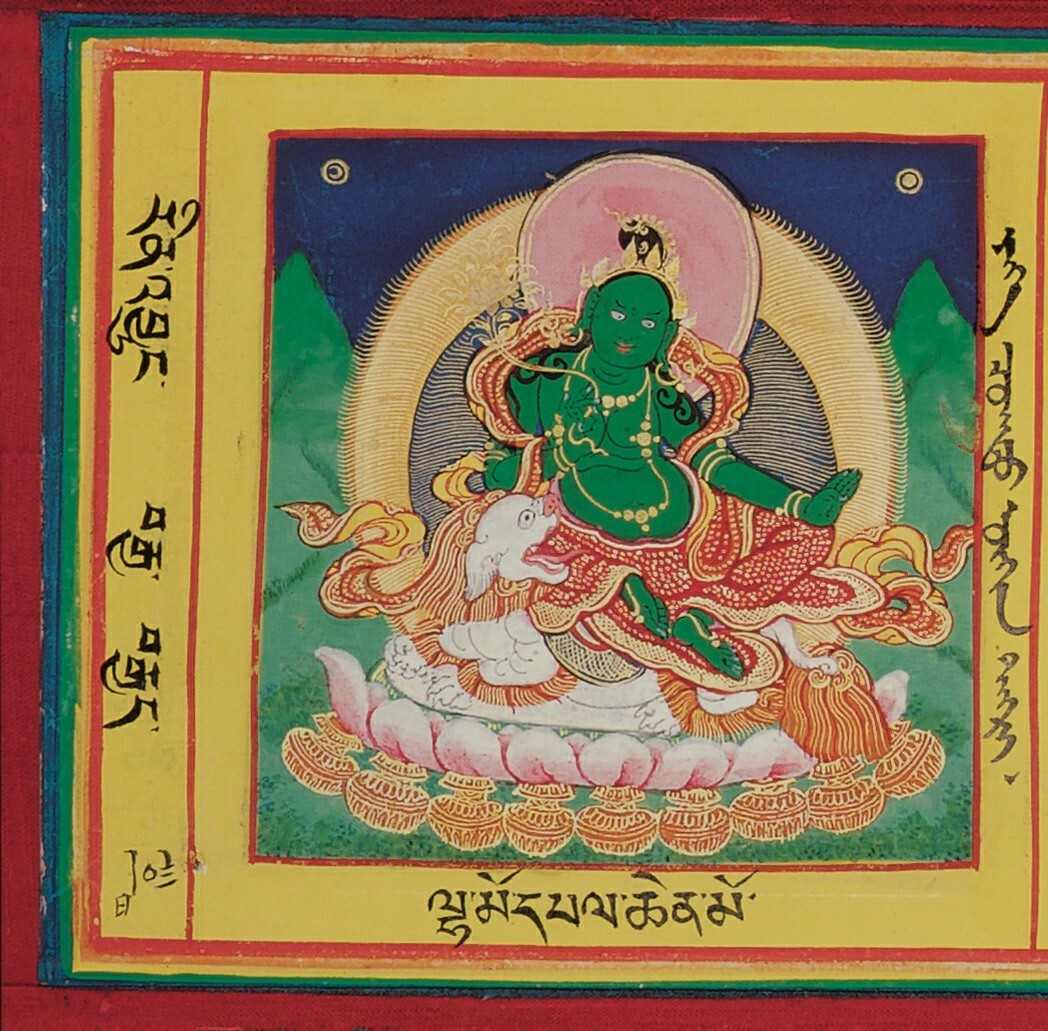
    Lion-mounted Green Mahalakshmi, crowned by Yamantaka, surrounded by Yakshis, is 325 in Tibetan Deities. This has Nine Treasure vases, uses Srim syllable, and is not the same mantra as Mahasri, but it says she is Sri Devi for her Offerings. She is called a Prajnaparamita goddess who emerges from Gagana Ganja Samadhi:


    This one comes between a large amount of Jambhala and the minor Vasudhara devis. Her syllable is common in Hinduism, but in Sadhanamala, Kurukulla is the only one to use it. Kurukulla also uses Prasanna, as does Vajra Vina Sarasvati. Prasanna appears to enter Vajramrita Tantra as Amrita Locana. Locana continues to appear as "Buddha Perception" of the Dharmadhatu, which arises in stages (Bodhisattva Bhumis). And so by saying Prasanna, it is something like seeing the world from the view of the Nectar suffusion process. This is one of the largest Taras having sixteen arms and among many, a "Gagana Syama" (Dark Sky) face, as well as an upwards smoky one, like Dhvajagrakeyura.

    Exploring Sadhanamala Taras is suggested by the Jonang Foundation.

    Prasanna is big, but, she is kind of sneaky in the tantras. She stands out with Mahattari however.

  4. The Following 2 Users Say Thank You to shaberon For This Post:

    Old Student (25th August 2020), william r sanford72 (29th August 2020)

  5. Link to Post #243
    United States Unsubscribed
    Join Date
    24th May 2020
    Language
    English
    Posts
    668
    Thanks
    607
    Thanked 1,434 times in 639 posts

    Default Re: Does Anybody Else Have Clear Body Experiences?

    Quote Yes, it is like a matter of degree. For instance, I would think it is possible for a normal person to apply a bit of devotion and get a "taste" of Acala Bhumi, although this is a far cry from saying one has or is on Acala Bhumi which means it is permanent and cannot be removed by any known means.
    I was referring to the other descriptions, which are internal accomplishments -- retaining sperm, clearing away distractions, activating channels, moving bliss from one place to another. I don't have any experience of grounds (bhumi) except that bhumi devi was mentioned in one shaking, which isn't the same thing. The exercises do produce permanent results, but they have a purpose that seems a bit more mundane.

    Or not, since the purpose seems to be to fill me from top to bottom with rainbows and then go through the very cold place which is already announced as death. Whether metaphorical or this is near the end game for me I have no idea and no way of knowing for sure, but I believe I am to survive it and return, because of the rainbows, and would not, otherwise. As far as I know, they are going to do this to show it to me, because according to them, I wanted it. I would assume that the place on the other side of that was someplace different, and perhaps one could call it a bhumi, although it doesn't fit the scheme of them, but more likely it is something else.

    To give an example of how everything points that way, the breeze thing is apparently some kind of mastery of the plane over my palate (which I've sometimes refered to as the suprapalatine plane in my notes). It isn't an end in itself, it's towards filling that level with rainbow liquid and then moving onward (upward).

    As for the internal descriptions, some of them are not hard, and that makes them seem like either they are being used in a multiple meaning (likely) or they are out of order from some original (possible). But there is another place where such an inversion occurs with the bhumi. The dharmokaya is an early entry even though it is the very most non-self of the trikaya.

    (I do hope all of that wasn't too nonsensical).

    Quote There was a pilgrimage route from Tibet to Wu Tai Shan since before Padmasambhava's time. In a couple of cases we seem to have found China altering scriptures to make a lineage connection based in this, which does not seem to agree with the original sources. Anyway, the legend of Manjushri leaving Wu Tai Shan to create Nepal, not exactly Kathmandhu but Pattan, is held by the Kirats or Mahacina themselves.
    A long time ago (3rd/4th c.) the area comprising some of Kanishka's empire and the kingdom of Khotan was thought of as "North India" by the inhabitants of Khotan at least, if not also by the inhabitants of Balkh (Bactra). They originally thought Manjushri was their guy, at some point they were convinced by probably pilgrims that he was at Wutai Shan, and began pilgrimages. I think those were probably the first. Some of the creation mythology of Khotan surfaces again in Nepal, all rewritten to be Nepali landmarks, after Khotan was gone so long that people (esp. Tibetans and Kashmiris) forgot where the place had been (Khotan was destroyed by genocide by the Qarakhitans in 1003).

    Quote Although I do not quite fully grasp all of your dakini visions--yes, this electrification sounds like part of what is expected to happen.

    It sounds to me like you have a largely functional subtle body, minus a few degrees of what we call Vajra Ignorance. You have this motor mostly starting to crank, except for a few missing contacts or missing channels in the evidence of not being able to select "breeze" at will.
    This is reassuring. I am getting better at the breeze thing, my main problem is that the dissolve is far from effortless. I also have times when I can't get it to happen when instead the breeze "steams" off of me, meaning that there are places (right side of torso in particular) that steam off "me" and I feel "in the breeze" just beyond them.

    Quote (531)

    dānapāramitādhāraṇī śīlapārāmitānāmadhāraṇī kṣāntipārāmitānāmadhāraṇī vīryyapāramitānāmadhāraṇī dhyānapāramitānāmadhāraṇī prajñāpāramitānāmadhāraṇī prajñāpāramitānāmadhāraṇī cūndānāmadhāraṇī jambharendrasyanāmadhāraṇī ugratārānāmadhāraṇī mahāmeghasūtra vaorocanīdhāraṇī ādaśākṣaradāraṇī cintāmaṇilokeśvaranāmadhāraṇī buddhabhaṭṭārakanāmadhāraṇī padmāttamanāmadhāraṇī sarvabuddhabodhi satvanāmadhāraṇī āryyatāro viṁśatistotraṁ
    At first I thought there had been a typo because prajñāpāramitānāmadhāraṇī is named twice, then I realized the first six are the classic six paramitas (the last one being prajna) and those after are names, Prajnaparamita, Cunda, Jambharendrasya, Ugra Tara, Mahamegha, Vairocana, Adasaksdara, Cintamani Lokesvara, etc.

  6. Link to Post #244
    United States Unsubscribed
    Join Date
    24th May 2020
    Language
    English
    Posts
    668
    Thanks
    607
    Thanked 1,434 times in 639 posts

    Default Re: Does Anybody Else Have Clear Body Experiences?

    Quote Kubjika Tantra equates Matangi to Candali. Kubjika's technical relation to Seven Shaktis is given by Sri Kamakoti who also found that Tara is Arundhati--the seven are explained in Katyayani Tantra.
    The list of seven Shaktis seems to have a lot in common with the ten Mahavidyas. Why?

  7. Link to Post #245
    United States Avalon Member
    Join Date
    1st April 2016
    Posts
    6,937
    Thanks
    35,592
    Thanked 39,576 times in 6,585 posts

    Default Re: Does Anybody Else Have Clear Body Experiences?

    Quote Posted by Old Student (here)
    Quote Kubjika Tantra equates Matangi to Candali. Kubjika's technical relation to Seven Shaktis is given by Sri Kamakoti who also found that Tara is Arundhati--the seven are explained in Katyayani Tantra.
    The list of seven Shaktis seems to have a lot in common with the ten Mahavidyas. Why?


    Mahavidyas are from Sri Kula, which is Shakti, not Durga. Both are astrological, with different numbers of planets. The astrologers actually use the Moon as a reference point to determine whether someone should take the corresponding Durga from Nine Planets, or to use the corresponding Mahavidya which is the system of Ten by adding the ascendant.

    Mahavidyas were prominent in Kamakhya, the Ugra Tara there is the Mahavidya Tara.

    The Mahavidyas also tell us something about how the devis relate to the incarnations of Visnu. This is again like a fractal which represents the formation of a planet, or the development of a fetus. Also, of course, spiritual development by Mantra and Yoga.

    Sadhanamala uses Mahavidya a few times, particularly with Sadaksari and Janguli, and defines Mahavidyeshvari as Jvala Mukhi (form of Varahi). Nepal will add Grahamatrika and probably several others classed the same way.

    Cinnamasta is perhaps the major Mahavidya goddess who is non-Vedic, and since this is shared with Buddhism, which probably started it, again we are in a position of wondering if the Mahavidya system per se is a Buddhist idea incorporated into the popular realm.

    Durga is almost un-named in Buddhism, aside from Durgottarini Tara, and Simha Durga as the last deity in Sarvadurgati Parishodana mandala. However the very beginning of Sadhanamala says:


    śrīmātrisamayaṃ vande sarvasampatmukhodayam /
    bhavadurgatikhinnānāṃ cintartnam ivādbhutam //


    It is not a proper name; Durga is "fortress", but Durgati is "Evil Destiny", such as hell or bad rebirth, Khinna is "distress". So it is talking about samaya to Maitri or Love which challenges pain and a horrible future.

    Mukha is often "face", or, can be specifically the mouth, and so also a door, gate, or entrance (and a synonym of Moksha). That is how Ananta Mukhi means Infinite Gate instead of the face of the serpent Ananta. So this Love Samaya is Vande "praising" All Sampat (wealth or process of attaining wealth) of the source (daya) of the gate or entrance, about misery, possible typo for Cintaratna, then "vad", to be spoken or told.

    Maitri is basically absent as a deity name, but omnipresent as a divine attribute. So if I interperet the Four Brahmavihara, one easily gets Maitri--almost anything divine, Karuna--Avalokiteshvara, Mudita--Vajrasattva, Upeksa--Vajradakini.

    What you said about the inner experiences being more germane than the Bhumis is sort of what I was getting at--we can learn and experience these even if we are not sure what the real Bhumi actually is. The first would be a permanent state of Vajrasattva, which I, sadly, lack. I can access it, but I cannot have it.

    One aspect of Bhumi is the daughter of Bhumi Devi.

    Sita Gayatri:

    Om Janaknandiniye Vidmahe
    Bhumi yaye Dhimahi
    Tanno Sita Prachodayat

    Bhumis may also be called Vihara, so again, is like a detailed Buddhist expansion of Four Brahma Vihara.

    Tara operates during the Path of Seeing (first Bhumi): There are twenty-two knots between the central channel and the two lateral channels. As they become freed, pair by pair, the meditator attains the successive bhumis, from the first to the eleventh, up to buddhahood.


    Namasangiti does us the favor of adding a special introductory Bhumi.


    Discipline--Vasita...........Ground--Bhumi.....Paramita..........Dharani

    Ayur............................Adimukticarya..... ...Ratna .............Vasumati Mahalakshmi


    To make Twelve Bhumis, Namasangiti has "dropped down" the Disciplines to the beginning slot--Ayur is normally first, so this is not an addition, just a small twist.

    The first Bhumi is Zeal (or mode of conduct determined by zeal), and it is hard to find a difference between its discipline and Ayurveda. According to Ayurveda, "The word “Ayu” is the root for the English words ever, never, aye, nay, eon, eternal, medieval, primeval, and utopia. All of these have a common thread, which is that the word “Ayu” means: “vital force, life, eternity.” When you say, “aye!” (yes!), you are asserting that something has life force and existence. When you say “nay” (no) you are negating that. The sound and letter “N” is a negation across multiple languages, including English and Sanskrit. The same for “ever” and “never”– one has eternity, or Ayu, behind it- the other doesn’t." Same as Ayus in its conventional meaning. Ayus is also the Aerial Flame form of Agni which is conveyed to living beings which we also learn restraint of.

    So health-wise, they try to remove N's, things that prevent the life force freely flowing from Sat-Chit-Ananda forever.

    Here is an unusual classification of Bodhisattva insights:

    The ten bodhisattva insights from Bala Jnanagni Mahendra:

    1. Sthanasthana Jnana Bala: knowledge of possible and impossible.
    2. Karma Vipaka Jnana Bala: knowledge of consequence of actions
    3. Dhyana Vimoksha Samadhi Samapatti Jnana Bala: knowledge of concentrations, samadhis, and attainments
    4. Indriya Parapara Jnana Bala: knowledge of the relative qualities of beings
    5. Nanadhimukti Jnana Bala: knowledge of the intentions of beings
    6. Nanadhatu Jnana Bala: knowledge of the various states of beings
    7. Sarvatragamini Pratipajjnana Bala: knowledge of the ways in which beings go everywhere
    8. Purva Nivasa Jnana Bala: knowledge of former abodes
    9. Cyutyu Papada Jnana Bala: knowledge of death and rebirth
    10: Asrava Ksaya Jnana Bala: knowledge that the defilements have been extinguished


    Vairocana provides a Maras Mantra: A Vira Hum Kham. Defeat of them is necessary for eighth Bodhisattva Bhumi or the Irreversible Path. Buddhaguhya interprets these as the Perfections of the Seventh Bhumi: Bala, perfection of strength and ability to manifest like a vajra without impediment; Parartha, "perfection of others' aim" or liberation from the realms of rebirth; Sarvajna Jnana or perfection of knowledge; perfection of eliminaton or Prahana is defeat of the Maras, and this is simply avoiding and overcoming the unwholesome, while fostering and cultivating the wholesome. Prahana starts in the Sixth Bhumi, is accomplished in the Seventh, and is powerful enough for nirvana. Bala may be seen as Eighth and Ninth Bhumis. Parartha Tenth, and Sarvajna Jnana the "eleventh" or Samyaksambuddha. Vira or "hero" often refers to Dharmakaya.

    The fourth Bhumi is for the cultivation of all Thirty-seven points.

    The Bhumis are, however, also characterized as the Three Subtle Minds, which is our interface to the Three Voids:

    Penetration of the Dharmadhatu is with the three subtle minds: first of which (incomparable) opened by the first Five Bhumis, second (unfathomable) by the Seventh, and the third (inconceivable) is in the irreversible bhumis eight and up.

    Incomparable mind: First, joyful through giving (Pramudhita from dana); Second, purity through morality (Vimala from sila), Third, luminous through forbearance (Prabhakari from ksanti), Fourth, radiant through striving (Arcismati from virya), Fifth is mediation through meditation (Sudurjaya from dhyana).

    Unfathomable mind: Sxth is Facing through insight (Abhimukhi through prajna), Seventh is Far-going through great means (Durangama through upaya-kausalya).

    Inconceivable mind: Eighth is Motionless through strength (Acala from bala), Ninth is good-minded through aspiration (Sudhamati from pranidhana), Tenth is cloud of doctrine through wisdom (Dharma-megha from jnana).


    The minor philosophical difference between Indian Buddhism and most of China is in relation to the Alaya. As far as I know, the matching southern Ti-lun school dissipated, was too abstract for anyone to understand, and was replaced by a slightly more exoteric style. From Indian philosophy, we know that Para Sunya (Shentong) is the "void beyond void" as in the Shiva Agamas, and there is an ultimate link to Nirguna Brahman in meditation called Nirakara Vijnana Vada.

    Nirakara is an advaya or non-dual view of "emptiness only" (Prasangika), and "mind only" (Cittamatra), much like centering that Catuskoti.

    The Chinese attribute Ratna Gotra Vibhaga or RGV to Sthiramati, which is our core doctrine of Seven Mysteries and Refuge of One (Ekayana).

    Encyclopedia of Chinese Philosophy: "In India after Dharmakirti this position was called sakaravada, or the view (vada) that consciousness is always endowed with (sa) an image (akara). Conversely, Indian Yogacarins such as Vasubandhu and Sthiramati state that for enlightened beings of the eighth bhumi and above, this bifurcation between "grasper" and "grasped" is seen to be pure fabrication or imagination...in the final stages, consciousness, pure and radiant, is fundamentally without an image; this position was also called nirakaravada, or the view that consciousness is fundamentally devoid of (nir) an image."

    Sthiramati contends the paratantra-svabhava is the source of "grasper and grasped" because of false discrimination, so it is empty; paranispanna is not empty, or it is "empty of other natures".

    If we turn to HPB, she has an iron grasp on the Three Natures, i. e., the three voids, very good for an English version.

    These are scriptural standards in Trisvabhāvanirdeśa. According to Vasubandhu, all phenomena possess three distinct, yet interrelated natures (svabhāva). These are: (1) the imagined nature (parikalpita-svabhāva), (2) the other-dependent nature (paratantra-svabhāva), and (3) the consummate nature (paranispanna-svabhāva).

    So one is imagined/false/unrealistic, and two is mired in the web of dependent arising. Basically all we are doing is fixing how they work. The Parikaplita does not cease to exist--it ceases to be distinguished from Paranispanna, Infinite Completion obtained by Paramartha, Ultimate Meaning.


    1. parikalpita-svabhava (realistic)

    The imagined nature in which the individual and phenomena are

    seen as distinct, self-existent objects or as the subject of

    experience


    2. paratantra-svabhva (causal interdependence)

    This view encompasses causality and dependent arising of all

    phenomena but still recognizes a subject-object distinction.


    3. parinispanna-svabhava (totality)

    The "absolutely accomplished nature", the ultimate reality, in which all subject-object duality has been eliminated.


    The simple terms for overcoming these are No Ego, Suchness, and Ultimate Meaning.

    No Ego prevents you from imagining artificial garbage that is not part of nature, Suchness cleanses you of attachment to dependent arisings.

    So to dissolve the voids, you cannot have any individual thought out of tune with reality. You cannot have a seed of karmic wind. You will at most hover in Sky or Space. If it was just Space, it would be meaningless, but we say the meaning is imputed not by ourselves but by the Paramitas, or the Dharma, or Bodhi. Here again is where the system of Seven is like the main basic spectrum and scale, since there are Seven Vajra Mysteries, and no Mental Object can exist without seven cetasika or skins--it can have more, but at least seven, and it is seven which is said to penetrate the dharma realm.


    "Sthiramati, in his commentary on Triṃśikākārikā (Triṃśikābhāṣya) argues that the three natures and the three naturelessnesses are equivalent. His understanding of the three natures as equivalent to the three naturelessnesses of the Saṁdhinirmocana-sūtra is adopted uncritically by such Tibetan doxographers as Tsong khapa and mKhas grubje." (Jay Garfield) In this case, finding uncritical continuity accepted by these two sages, carries a lot of weight. The three natures, afflicted, produce samsara and suffering, but are rendered inert by three voids or natureless-nesses.

    Gunamati and Sthiramati were active at Valabhi University in modern Gujarat. In China, this is only "Old Yogachara" of Ti-lun and She-lun. There is a limited continuity through the Himalayas, considering Sthiramati to be largely ignored or de-activated.

    All of those systems shuffle together simultaneously.


    As it becomes more intricate, we find that poetry and acting are tied in, and I still think the Dakini Jala Gauris sound like actresses. The little-understood Picuva Marici is the exemplar of Nine Moods, which previously were individualized on single deities:


    Shringar or Rati, pale green, Vishnu; Hasya, white, Harata or Ganesh; Bhaya, black, Kala; Bibhasta, blue, Shiva; Santa, white, Vishnu; Adbhuta or Vismaya, yellow, Brahma; Karuna (tragedy), grey or dove, Yama; Raudra or Krodha, red, Rudra; Vira, pale orange, Indra.

    Originally there were eight, and the ninth, Santa, was added by Abhinavagupta after considerable struggle for three hundred years. This and later additions do not have a concrete color and deity scheme.

    If that is the case, it refers to ca. 1,000s, whereas the moods including peace were already in Buddhism:

    "Vajrarudra appears already in the Sarvabuddhasamayoga in a passage
    that associates the nine dramatic sentiments (rasah) with Vajrasattva, Tathagata,
    Vajradhara, Lokesvara, Vajrasurya, Vajrarudra, Sakyamuni, Arali (or perhaps
    Aralli), and Sasvata (Vairocana) respectively. Vajrarudra's is the sentiment of ter-
    ror (bhaydnakarasah) and it is probable therefore that we should understand Vajra-
    rudra to be Heruka."

    They are in the Nepalese system:

    Nine Moods was oddly found by Brian Hodgson in a Newari parallel of Dharmasamgraha, and does eventually coalesce on Nine Moods Marici.


    We cannot yet say the moods "are" the Durga-esque Nine Families; and, occultly, Vajra Rosary speaks of experiencing six life-winds, the Families, nine ways, which perhaps are the moods, for a total of fifty-four combinations. Doubling it is the Rosary, 108.

    Nepal's Nine Dharma Families compared to regular six families use Vajradhatvishvari--Vairocana, Locana--Vajra, Mamaki--Ratna, Pandara--Lotus, Tara--Amoghasiddhi, Vajrasattvatmika--Vajrasattva.

    The female Dharmas it adds to the Six Family version are Vasudhara, Pratyangira, Guhyeshvari. The Buddhas of these families are Vajraraja, Vajradharma, and Vajrakarma (aspects of Vajradhara). That naming convention is used in Thirty-seven deity Sarvavid Vairochana in Sarvadurgati, and Vajra Karma is a multi-colored deity in Sarvadurgati and in Vajradhatu mandala. Vajrakarma Paramita is also the multi-colored highest Paramita of Namasangiti, which would be "extra" or eleventh compared to the Sutra list of ten. Even though there are systems which describe ever more-refined Bhumis, I am not aware they have any more Paramitas.

    Vira Vajradharma is Red Vajradhara as a Celestial Bodhisattva with a drum, as the Buddha of Mother tantra, also used in Khandaroha sadhana; and at the end of Sakya's Three Great Reds. He is perhaps what inspired Drum Dakinis. Amoghasiddhi is Dhundub Isvara, Drum Buddha who inspired Tara as Jnana Chandra in the prior cosmos; wrathful Amoghasiddhi may be called Paramasva, and his peaceful forms in the early days were Kusuma or similar names related to flower and blossoming. Drumming and/or Thunder is the most liberating sound, especially in terms of layers of Primordial Sound beginning with Vina.

    The red and green view on drums are at the least different colors, and then different moods, before even considering how they might be different in the subtle body.

    Bhattacharya explains Moods:

    "...the deities themselves have no real or independent existence, they are merely manifestations in a variety of forms of the One, Undifferentiated Sunya. But it cannot be denied that these images were very useful, since the forms they presented, in accordance with the Dhyanas, to the gaze of the worshippers undoubtedly helped the latter to visualise the deities with whom they were asked to identify themselves. As they had no real existence, these deities had to be attracted to the mind-sky from unknown regions in the firmament by the luminous rays of light issuing from the BIja mantras uttered by the worshipper. The Sunya takes the form of a divinity in accordance with the germ-syllable uttered, and exists only as a positive idea in the mind of the worshipper who identifies himself with that transformation of Sunya.

    The question may be raised as to the necessity of a variety of gods and goddesses when one Sunya would have been sufficient. In answer to this a number of things have to be considered. It may be remembered that Sunya, which was
    identified with Compassion by the Vajrayanists was conceived as manifesting itself in different forms in accordance with the different functions it had to discharge. For instance, if any disease is to be cured, Sunya takes the form of Simhanada ; when it is a question of snake-bite, Sunya becomes Janguli ; when destruction of the wicked is needed, Sunya takes the form of Mahakala ; when again, diseases and pestilences are to be prevented, Sunya is conceived as Parnasabari ; for success in love-affairs, Sunya is invoked in the form of Kurukulla ; and when forcible submission is required in love-affairs, Sunya becomes Vajrananga, and when finally, Buddhahood is wanted by the worshipper, he should conceive himself as Heruka. From the above it appears that the conception of the multitude of Buddhist deities emerges from the one grand conception of sunya in accordance with the various functions it is supposed to discharge, as a mark of compassion towards the Buddhists.

    Secondly, the number of gods and goddesses increases when Sunya manifests in different forms the nine "Rasas" or dramatic sentiments. For instance, Sunya will be Khadiravam or Lokanatha when benign (Karuna), Marici when Heroic (Vira), Vighnantaka, Heruka or Mahakala when awe-inpiring (Bhaya), Aparajita when wrathful (Raudra), Vajracarcika in its moments of disgust and loathsomeness (Blbhatsa), Prajnaparamita when peaceful (Santa), and so on.

    Thirdly, the number of deities increases as objects such as the Three Jewels ; philosophical conceptions such as the Paramitas, Bhumis or Pratisamvits ; literature such the Prajnaparamita, the Dasabhumika Sastra, the Dharinis and the like ; desires such as for eating, drinking, sleeping and the rest ; the directions such as the north, south, east and west ; the musical instruments such as the flute, the violin, and the drum ; and other innumberable ideas and objects, are required to be worshipped in the forms of gods and goddesses, By these and various other ways the number of deities in the Buddhist pantheon increased phenomenally.

    As all these deities centre round the one grand conception of Sunya so also the host of weapons revolve round the one grand conception of Bodhicitta or the Will to Enlightenment. As these weapons are required to discharge different
    functions, the Bodhicitta resolves itself into so many different forms of weapons. For instance, when the darkness of ignorance is to be dispelled Bodhicitta becomes a sword by which the veil of ignorance is cut asunder. The sword is also to be used to destroy the Mara hordes who disturb the worshippers. Bodhicitta becomes the Ahkusa (goad) when the hearts of the wicked are to be pierced. It is conceived as a noose when the Mara hordes are to be securely bound. It becomes a needle and a thread when the eyes of the wicked have to be sewn up. Bodhicitta becomes a Kartri (knife) when the wicked have to be chopped. It is a Bhindipala (javelin) when Maras have to be attacked from a distance, and a bow and an arrow if the distance be greater."


    So this term Rasa is teaching your feelings in unity with life winds, and is the Taste goddess which is a high position related to Nectar, usually occupied by Vetali or Ghasmari. It is said to be "one taste" in acquiring the gnosis of all the different sadhanas, and also Mercury, important to alchemy and tantra.

    Rasa is an essence, but particularly taste, and emotion. There are sometimes longer mood lists with mercy, fraternity, etc., but Marici has nine, Navarasa. So these can be experienced many ways on any deities, and concatenate in her. Vajradhatvishvari, or, i. e. the life-winds, can also be learned other ways, but arise consciously in her.

    All that is beyond Nine Moods is her White Ten Arm form, and Oddiyana and Vajradhatvishvari.

    This is why Nagarjuna's Khadira Tara is favorable; she comes with Marici and Ekajati. Mahasri Tara will add Mayuri and Janguli, but, these are fairly accessible mantra deities. Marici and Ekajati are both cosmic and highly tantric. They perhaps are more difficult to get ahold of. And so, like an evolution, instead of attempting the whole Sapta Vidha Anuttara Yoga, you could just do Mahattari and clear her and get Khadira. This style of erasing a deity to just bring it right back is actually typical. And so I would just be taking the kind of general Green Tara that I already know and acknowledging she is Amoghasiddhi Tara and asking her to introduce me a couple friends.

    Mahattari just takes Ten syllable mantra and does Varada and holds:

    sanālendīvaradharāṃ

    Sa Anala (with fire) Indivara (unusual name for Blue Lotus)

    She also has Vajra Feet, and virtually no image of Green Tara is like this.

    She does Samayamudra (cf. Lokeshvara, Dharmadhatu Vagisvara, Tarodbhava Kurukulla) which appears to involve Vikata Utpala, Blossoming Blue Lotus Mudra. She is pretty close to the 1941 Nepal manuscript, the moon and a White Utpala are in her spawn sequence. That one tells you to self-generate, whereas Sadhanamala only says of her:

    samayamudrāṃ bandhayet / hastadvayena
    sampuṭāñjaliṃ kṛtvā tarjanīdvayena madhyame pidhāyāṅguṣṭhāgralagne
    vikacotpalamudrā /

    and Mutter Tara mantra.

    That is about as Blue Lotus Tara as can be. Nothing else to it.

    Samaya Mudra may be defined a couple different ways, as a woman, or a tantric seal, and it also fits a commentary related to the Three Natures:

    It is like this:

    What we call the bhaga of the Vajra Queen of the Vast Expanse has the nature of the gateways to liberation—emptiness, signlessness and wishlessness. This essence of the sugatas (sugatagarbha), the ground continuum, which is the inconceivable dharmatā nature, the natural state of pure awareness, is the karma mudrā, the basis of practice.

    So it is the Tri Vimoksa as mentioned previously with Marici, which is not far off from the Three Voids and Ekayana.

    The article goes on to the other ones; and so the Four Mudras may also equate to the Four Activities; or, Samaya may be the the "Mind" of Body/Speech/Mind/Secret.


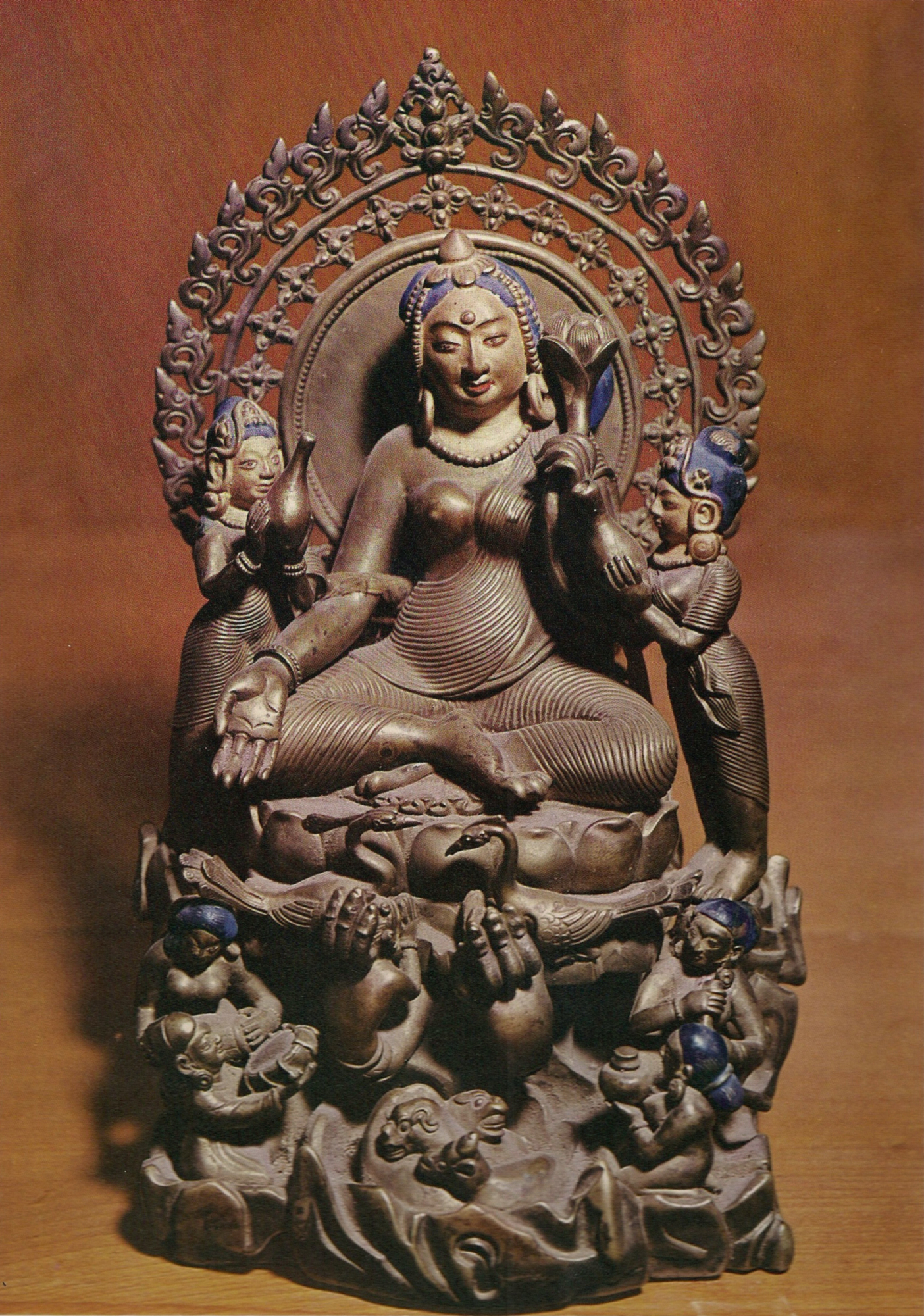
    It is hard to tell color on a figurine, but Bhattacharya identified this as a Nepalese Mahattari:


    Similar ones are almost always White Tara, who should have two lotuses.

    Here is an impressive similar one with one lotus:


    Mahattari is supposed to be alone, but, this is not a normal mandala retinue, they are pouring pitchers on her. It is from a larger set thought to have been made by Choying Dorje, which has "this" Tara alone, and then a few versions of these other people approaching her.
    Last edited by shaberon; 27th August 2020 at 16:03.

  8. The Following 2 Users Say Thank You to shaberon For This Post:

    Old Student (27th August 2020), william r sanford72 (29th August 2020)

  9. Link to Post #246
    United States Unsubscribed
    Join Date
    24th May 2020
    Language
    English
    Posts
    668
    Thanks
    607
    Thanked 1,434 times in 639 posts

    Default Re: Does Anybody Else Have Clear Body Experiences?

    Sorry for falling behind, I had too many meetings in one day, will catch up tomorrow. I'm up to here:

    Quote The minor philosophical difference between Indian Buddhism and most of China is in relation to the Alaya. As far as I know, the matching southern Ti-lun school dissipated, was too abstract for anyone to understand, and was replaced by a slightly more exoteric style.
    Ti-lun or Di-lun, is short for shidi jinglun (十地經論), quite literally, the Ten Grounds Classic Treatise -- Di () means "place" (地方) or "ground" (地土) is a direct translation of "bhumi".

  10. Link to Post #247
    United States Avalon Member
    Join Date
    1st April 2016
    Posts
    6,937
    Thanks
    35,592
    Thanked 39,576 times in 6,585 posts

    Default Re: Does Anybody Else Have Clear Body Experiences?

    Quote Posted by Old Student (here)
    Sorry for falling behind, I had too many meetings in one day, will catch up tomorrow. I'm up to here:
    Here's the thing.

    Well in a way we are just kind of looking at some ancient languages.

    The difference between these and for example the Rosetta Stone or something else is that by looking at fragments of Egyptian or Eleusinian Mysteries and so forth, at best you get a missing system.

    That is a pretty decent knowledge of Chinese. I am only familiar with a tiny amount. Because I cannot remember the names, I would have to fish around for the story in how this was presented to the Emperor, no one could understand the Buddhist emissary at first, until they wound up building a Hall of Mirrors to represent what he was trying to say.

    Due to the erosion of time, the Chinese are also unable to explain the presence of an entire Dharmadhatu Vagisvara Manjughosha statuette set found in Forbidden City. Because this includes its system of Twelve Bhumis with Dharanis, then learning this is the same as a part of Ming era Buddhism they no longer have.

    Similarly, Adi Shankara refuted every kind of Buddhism, except he never knew the Shentong or Para Sunya view. And under scrutiny, we conclude they are the same or that Shentong agrees to the basic definition of Parabrahm in Shankara's Adwaita, which he promoted through Sri Yantra and the Sakta sect. So these should be very similar.

    Most of the splintering of Buddhist sects is due to disagreements about the meaning or nature of Alaya. And so what I have been working with could be called a "minority view", but the point is, it all validly exists in Buddhist Abhidharma, and so this is a complete and continuous system, unlike western Mysteries.

    Then by looking at Sadhanamala, we are just seeing the original Tara system, which is related to Vajravali, which means it also uses Agni.

    When we do that, we get a totally different White Tara than known through common practices, and we can say that both Sita and Mahattari do a Lotus or Blue Lotus Mudra. The second is a samaya Green Tara who has a direct role to enter the Akanistha; and this is a main path Tara should be doing. The first matches the point that eventually it is a self-arisen White Heruka which produces purified white forms of deities and so forth.

    Some day I will probably pass away through the Eight Dissolutions exactly how Tara says. That is Citta Mani except with perhaps Smoke as the first vision, especially since that is Wrathful Amoghasiddhi Tara, something like the apex of the preparatory rite and "switch" to the dissolving process.

    And so going on hunches about Sadhanamala, then, yes, although Mahattari only has a small paragraph, it does in fact mean she begins the whole Tara Pure Land. The same name is also used by Hindus for the place of Kula and Akula, which is Samarasa or perfect assimilation, the cause of the flow of nectar. If you look at it in general terms, it is discussed in all the schools; if you call it Mahattari, that is only in Kubjika Tantra, as far as I know.

    Mahattari has maybe two relics at Ratnagiri. At Acutrajpur, she has vajra feet, flaming halo, varada mudra, holds one lotus. Flowing clothing, richly adorned. She changes but not much, for example, sattvaparanyaka. So this definitely is an individual name that was prominent in her Sanskrit system and now is pretty well submerged.

    Her major broken Ratnagiri image is hard to distinguish from Varada Tara or Mahasri because of the companions. It is an Amoghasiddhi All Buddhas Tara with Janguli, Marici, Ekajata, Mayuri. Also with Avalokiteshvara and Manjugosha. It is still a vajra feet, varada mudra, one lotus, and with lavish clothing. There are lion supports (Simhanada) and people reading a book, The halo is plain. She is not Black but Syama on a moon and lotus cushion.

    Here is an old Archeological Survey assessment of a Mahattari statue from stupa 189 at Ratnagiri: "Dressed in a sati and chest-cloth, Mahattari Tara (pi. XCVI A) is seated in the vajra-paryahkasana attitude on a visva-padma with her right palm, in the vara-mudra, resting against the knee and raised left hand holding the stalk of an utpala. She is adorned with valayas, beaded armlets with a triangular piece, a beaded necklace of the chhannavira type, ear-rings and a mukuta with three ornate triangular pieces. Tied by a string, the major part of the hair is arranged on the crown in the form of a bun, while a few coiled locks fall on the shoulders. Behind the head is the elongated halo, pointed at the crown, on either side of which is a garland-bearing vidyadhari flying through clouds towards the goddess."

    There she has "not exactly" a retinue like the group with the pitchers. In Kubjika Tantra, she is over Matangi, Sabari, Kubjika, Campaka and Pulindi. In the version available, note on p. 79 however spells it "Mahantari". The full Sadhanamala name is "Mahattari Tara". I cannot tell a difference if the prefix is spelled Mahan or Mahant, it is like "Maha", although the Nepalese spelling Mahat Tara is the same but also expressed as a Tattva.

    In the Indian spelling, a Satsahasra note starting with Pratyangira--Siddhalakshmi tells us:

    "The mighty kubjikA, the mistress of the paschimAmnAya, is worshipped with the glorious 32 syllabled samayavidyA. She is mediated as seated on the lap of her spouse, mahAdeva as navAtman. She is indescrible as one can only experience her upon ‘seeing’ the flash of the mantra.

    -The most peculiar vidyA of mahAntArI of 15 syllables is used with fire oblations in the Ajyahoma. The manifest form of mahAntArI for all those who know the vidyA emerges directly out of the aNgas of kArttikeya. She has 6 heads and twelve arms as result."

    This has used Ananda Shakti or Ananda Bhairavi to generate a Six Face deity related to Mars.


    Bhattacharya described Utpala Mudra in the one sadhana he treated more fully, 98, which is Vistara, composed by Sthavira Anupama Raksita who was a well-known Tantric author and who flourished before 1165 and whose works, five in number, are preserved in translation in the Tibetan Tangyur. The whole Sadhanamala cannot be from the 5th century, and so for instance this form which has never really come to our attention lacks the stature and antiquity of Mahattari.

    Here is the Chinese extension which was based on Seven consciousnesses from Paramartha's Evolution of Consciousness. This particular piece focuses literally on what we have been trying to knock the dust off of: a doctrine of three svabhavas or three subtle minds/subtle voids, combined with seven states of consciousness:

    "Fa-shang (495-580). From the extant literary fragments of Fa-
    shang's Shih-ti lun i-shu , we can speculate about Southern Ti-
    lun's notions of Dharma Body, Dharma Nature, and the seven
    states of ordinary cognition. Material in the Shih-ti lun i-shu has
    not been thoroughly analyzed by contemporary Buddhologists
    in their reconstructions of the Southern Ti-lun branch of Bud¬
    dhist doctrine. It has been established, however, that the school
    of Southern Ti-lun asserts that the support for all experiences of
    phenomena is reality as it is (tathata), termed Suchness, and is
    based in part upon Gunabhadra's translation of the Lahkavatara.
    Fa-shang described seven kinds of "evolutions of conscious¬
    ness" (shih chuan) suggesting a theory of seven consciousnesses
    in his commentary, Shih-ti lun i-shu :

    The Dharma Body is the body of the Dharma Nature (fa-hsing). Mind
    ( hsin ) is [the name for] the seventh state or mind. Ideation (i) is the
    sixth state or ideation. Consciousness (shih) is [the name for] the five
    states of consciousness. Therefore, the Lankavatara-sutra states: "Mind
    is the chief collator. Ideation broadly collates. The phenomenal, acting
    states of consciousness ( hsien-shih ; khydti ?) discriminate in five ways.
    Separate from these seven kinds, consciousness evolves into wisdom."
    Therefore, it is said: "Only wisdom is the ground ( i-chih)."

    Fa-shang explains what he means by wisdom in terms of the
    three-natures theory ( trisvabhava ):

    There are three kinds of shared aspects to wisdom. First, it is condi¬
    tioned ( yuan-ch'i ). Second, it is false conceptualization. Third, it is Such¬
    ness. The "conditioned" ( paratantra ) refers to the seventh state, the
    alaya-vijnana, which is the foundation (pen) for samsara. "False concep¬
    tualization" ( parikalpita ) refers to the six states of consciousness (shih)
    and mind (hsin), falsely generating discriminations that become at¬
    tached to six sorts of sense data (ch'en). "Suchness" refers to the abso¬
    lute truth of the Buddha Nature, supreme Emptiness. These three are
    understood as having different names but the same aspect .

    From the above passages we see a clearer picture of Fa-shang's
    epistemological schema. Mind, the seventh state, is the alaya-
    vijnana , and corresponds to the "conditioned" aspect of wisdom,
    paratantra-svabhava or the nature of dependence in Yogacara
    Buddhism. Ideation, the sixth state, and the consciousnesses of
    sensation and perception are the "false conceptualization" as an
    aspect of wisdom, parikalpita-svabhava or the nature of false dis¬
    crimination. One other feature or aspect of wisdom remains,
    namely, reality as it is. Suchness, the absolute truth of the Bud¬
    dha Nature identified with Emptiness, and parinispanna-svabhava.
    This feature of wisdom is not explicitly enumerated as an eighth
    state of consciousness. "

    Fa-tsang is fairly interesting.

    He placed China's only Empress, and, since no-one could understand him, he built a big hall of mirrors.


    In Pali are found seven universal types of consciousness (sabbacittasādhāraṇa cetasikas). These seven factors are: Phassa - contact (Sparsha); Vedanā - feeling; Saññā - perception; Cetanā - volition (Samskara); Ekaggata - one-pointedness; Jīvitindriya - life faculty; Manasikāra - attention.


    From Vishuddhimagga, the Tamraparniyas state that Hrdaya-vastu (Heart seed) is the seat of Mano-vynana-dhatu (Manas or soul); it exists in Formless arupa loka, that there is Formless "arupa matter". Northern Abhidharma knows of hrdaya-vastu as mana indriya or mano-dhatu. "Dhatu" or "element" may also be called gotra (seed--lineage) or akara (source; not a-kara, "handless" or inactive). Hṛdaya-vastu [hadaya-vatthu] means heart-basis. The heart is considered as the physical support of all cittas other than the two sets of fivefold sense consciousness which take their respective sensitivities as their bases. The hṛdaya-vastu is described as the seat of thought and feeling -- the basis of mind. It is the seat of the divine intuition and of the Buddha-nature.

    It has been said that all the dharmas of the constituted world are included in one skandha i.e. Rupaskandha, one ayatana i.e. Mana-ayatana, and in one dhatu i.e. Dharmadhatu only. Tathagata garbha is 'suchness with defilement', which is the emptiness of the minds of sentient beings. Dharmakaya is 'suchness without defilement', which is the emptiness of the omniscient mind of a buddha. Defilements or klisto manas constrain the Alaya to being Alaya Vijnana, known to the Sinhalese as Bhavanga Vijnana. Alaya is automatic; quit defiling it, and it shines.

    The vijnana-skandha is the mana-ayatana consisting of seven dhatus: Six vijnanas (Intellect plus five senses) and the mano-dhatu or the Mind.

    Samskaraskandha is so called because it conditions (abhisamskaroti) the conditioned dharmas (samskrtas); that is to say, it creates and determines the five skandhas of the future existence...The Samskaraskandha is regarded as one of the seven things (dravyas) which are called Dharmayatana and Dharmadhatu, the other six things being the Vedana-skandha, the Samjna-skandha, Avijnapti, Akasa, Pratisamkhyanirodha and Apratisamkhyanirodha.


    Avijnapti is "no information" or un-manifest, imperceptible form or action, in a group which ends with:

    1) Asaṃskṛta (असंस्कृत, “unconditioned”) refers to a set of “three unconditioned things” as defined in the Dharma-saṃgraha (section 32):
    ākāśa (space),
    pratisaṃkhyā-nirodha (observed cessation),
    apratisaṃkhyā-nirodha (unobserved cessation).

    That is like a view of seven skins or mental components without respect to Rupa Skandha or the senses--so it is a body-less or mental-only dharmadhatu, whereas usually it is obscured by its own action:

    Pravritti vijnana is further divided into seven vijñānas, namely, cakṣu, ghrāṇa, śrotra, jihvā and kāya-vijñānas representing the five sense-cognitions, and mano-vijñāna or normal consciousness, and a seventh, kliṣṭa-manovijñāna, representing continuous consciousness, is added to them. There is a sort of intermediary between the sixth manovijñāna and the Ālaya. By the first five vijñānas, an object is imagined or rather sensed; by vijñāna (manovijñāna) it is ‘thought’; by manas (kliṣṭa-manovijñāna) it is perceived; and at the background of these all is the synthetic unity of ‘apperception’ called citta or Ālaya.


    So there is an argument for a system of Seven, which "is" man, which kicks away the Alaya itself (it is automatic and all we are doing is changing the way we handle it, rather than claiming it as Eighth Consciousness). Seven is clearly exemplified by the Seven Mysteries of RGV, and, while this bundles them as the operating environment for Refuge of One, Ratna Gotra Vibhaga 1.52 is a straight copy of Bhagavad Gita 13.32, replacing atman with dhatu:

    Bhagavad-gītā 13.32:

    yathā sarva-gataṃ saukṣmyād ākāśaṃ nôpalipyate |
    sarvatrâvasthito dehe tathâtmā nôpalipyate || 13.32 ||

    Just as all-pervading space, due to its subtlety, is not tainted, so the ātman, everywhere established in the body, is not tainted.

    Ratna-gotra-vibhāga 1.52:

    yathā sarva-gataṃ saukṣmyād ākāśaṃ nôpalipyate |
    sarvatrâvasthitaḥ sattve tathâyaṃ nôpalipyate || 1.52 ||

    Just as all-pervading space, due to its subtlety, is not tainted, so this [the dhātu], everywhere established in the living being, is not tainted. ("Ayam", meaning "this", refers to the dhatu of verse 1.49)


    And the Seven Mysteries are just an expanded Refuge Vow. If we look, these or their synonyms are found as Lha Sku or Divine Body of Five, like the basic version of Families, and so these are probably a complete version which would work with Seven Skandhas and Seven Kayas, which are the practical elements derived from the philosophies of seven:

    Buddha, Dharma, Sangha, Dhatu, Bodhi, Guna, Karma
    Last edited by shaberon; 27th August 2020 at 17:58.

  11. The Following 2 Users Say Thank You to shaberon For This Post:

    Old Student (27th August 2020), william r sanford72 (29th August 2020)

  12. Link to Post #248
    United States Unsubscribed
    Join Date
    24th May 2020
    Language
    English
    Posts
    668
    Thanks
    607
    Thanked 1,434 times in 639 posts

    Default Re: Does Anybody Else Have Clear Body Experiences?

    So trying to continue from last night, if I condition my search engine (Google likes to think it's smart but if you search the same thing over and over you can game it), and use both the transliteration and the characters, you can get to, from a Nichiren site,

    Quote Treatise on the Ten Stages Sutra, The [十地経論] (Chin Shih-ti-ching-lun;  Jūji-kyō-ron): A work by Vasubandhu, translated into Chinese in the sixth century by Bodhiruchi and Ratnamati. It is a commentary on the Ten Stages Sutra, which is identical with the “Ten Stages” chapter of the Flower Garland Sutra. The ten stages are the stages of the bodhisattva practice leading to enlightenment. The Treatise on the Ten Stages Sutra (Ti-lun) school in China was based on this work. The work was also valued by the Flower Garland (Hua-yen) school.
    (Their 3rd character looks different than mine because it's simplified, being Japanese).

    My knowledge of Chinese is somewhat less than fluently reading a newspaper, but I did take 3 semesters of classical, and once in the dim and distant past could recite all of Laozi chapter and verse from memory in Chinese -- perfectly on the day I had to be able to for the final exam, and ebbing away quickly from there.

    She-lun is 攝大乘論釋, She dacheng lun shi, "Mahāyāna-samgraha", literally, the compilation Mahayana treatise Buddhism.

    These two, Ti-lun and She-lun refer to specific texts in translation on Yogacara. Probably the reason they died away as schools is because they were so narrowly defined, in addition to whatever status Yogacara had later.

    Quote Vajrarudra's is the sentiment of terror (bhaydnakarasah) and it is probable therefore that we should understand Vajrarudra to be Heruka.
    I would have thought Bhairava would be terror.
    Quote Secondly, the number of gods and goddesses increases when Sunya manifests in different forms the nine "Rasas" or dramatic sentiments. For instance, Sunya will be Khadiravam or Lokanatha when benign (Karuna), Marici when Heroic (Vira), Vighnantaka, Heruka or Mahakala when awe-inpiring (Bhaya), Aparajita when wrathful (Raudra), Vajracarcika in its moments of disgust and loathsomeness (Blbhatsa), Prajnaparamita when peaceful (Santa), and so on.

    Thirdly, the number of deities increases as objects such as the Three Jewels ; philosophical conceptions such as the Paramitas, Bhumis or Pratisamvits ; literature such the Prajnaparamita, the Dasabhumika Sastra, the Dharinis and the like ; desires such as for eating, drinking, sleeping and the rest ; the directions such as the north, south, east and west ; the musical instruments such as the flute, the violin, and the drum ; and other innumberable ideas and objects, are required to be worshipped in the forms of gods and goddesses, By these and various other ways the number of deities in the Buddhist pantheon increased phenomenally.

    As all these deities centre round the one grand conception of Sunya so also the host of weapons revolve round the one grand conception of Bodhicitta or the Will to Enlightenment.
    So two things from yesterday I should mention: 1st was that it seemed that some of these Dakinis and other deities were actually just each other in different contexts. 2nd was that I didn't have much of a shaking the night before last, instead what happened was the whole dark electricity/clear body thing happened and stayed constant for the duration of my having coffee and reading the paper -- I could make this minor shift and be that and then shift again and be me reading the paper. It lasted some twenty minutes.

  13. Link to Post #249
    United States Unsubscribed
    Join Date
    24th May 2020
    Language
    English
    Posts
    668
    Thanks
    607
    Thanked 1,434 times in 639 posts

    Default Re: Does Anybody Else Have Clear Body Experiences?

    Quote Fa-tsang is fairly interesting.
    He placed China's only Empress, and, since no-one could understand him, he built a big hall of mirrors.
    Yes, he is, he is Huayan school's founder. The mirrors thing is Huayan's concept of interpenetration, related to many things (conjoining, but also everything being in each thing and Indra's net the Mayajala). You set up the mirrors to point to each other and you can see everything repeating to infinity. His "worlds" are translated as Dharmadhatu.

    And directly - in fact completely - related to the jewel I perceive at my throat during shaking, which is maintained by Kurukulla. On the occasions when I end up looking into it, there are vast infinities inside always, and always changing.

    Quote From Vishuddhimagga, the Tamraparniyas state that Hrdaya-vastu (Heart seed) is the seat of Mano-vynana-dhatu (Manas or soul); it exists in Formless arupa loka, that there is Formless "arupa matter"....The vijnana-skandha is the mana-ayatana consisting of seven dhatus: Six vijnanas (Intellect plus five senses) and the mano-dhatu or the Mind.
    I spent two hours of shaking last night mostly in pursuit of something important at my heart, where in this version of things there was a bundle of branching nerves or vessels or something. I still haven't figured out what it was yet, but this helps, Thank you.

    Quote And the Seven Mysteries are just an expanded Refuge Vow. If we look, these or their synonyms are found as Lha Sku or Divine Body of Five, like the basic version of Families, and so these are probably a complete version which would work with Seven Skandhas and Seven Kayas, which are the practical elements derived from the philosophies of seven:

    Buddha, Dharma, Sangha, Dhatu, Bodhi, Guna, Karma
    This is certainly interesting.

    So last night, similar to what has been happening recently, my shaking hollowed me out in torso, and was just sparking electricity running over the surface and various forms (colors and consistencies) of bliss moving through the insides, a huge push to open stuff up including the jewel at my throat (see above, interpenetration), and the plane above my palate, and then a complete focussing on figuring out or finding something at my heart, which was like a bundle of nerves or something similar. I spent hours, some waking some asleep, in pursuit of something there some detail or quality or bliss or something at that bundle at my heart. I was in a state that was like the dissolve in that it lacked a sense of self, but not like the dissolve because things weren't, well, dissolving (no reduction to formlessness passing through it).

    I'm not sure what the thing is at my heart, but the search for it powered the rest of the night, bliss-wise. The searching itself was generating the energy somehow.

    I'm saying that because it is interesting that there are three kinds of minds. I began to be aware during this of three "views": The infinite interpenetration view at the jewel at my throat, the infinite plane in which viewing seems equivalent to being something outside of me, and the view of the tan dancer/rainbow shakti thing, which used to be landscapes and used to be activated by putting my hands on my sides (I was taught that at one point). Since it coalesced as a shivshakti, I'm not sure what would happen if I accessed that view, definitely landscapes but not sure what else, as the rainbows used to be part of the pillar (string from perineum to crown that has multiple forms) one of which uses was that I could go inside it while I was shaking and experience lucent dreams and then return to the shaking by going back out. It's also the place from which on rare occasions I end up seeing/being in outer space, including one odd occurrence when Ekajati put me there and then kind of switched off my "me-ness" so that my (clear body) boundaries disappeared and I was just in empty outer space without any me.

    They may not line up with the three minds you have laid out so carefully (thank you), but they are three completely different perceptions of reality, none of which is the ordinary one.

  14. Link to Post #250
    United States Avalon Member
    Join Date
    1st April 2016
    Posts
    6,937
    Thanks
    35,592
    Thanked 39,576 times in 6,585 posts

    Default Re: Does Anybody Else Have Clear Body Experiences?

    Quote Posted by Old Student (here)

    They may not line up with the three minds you have laid out so carefully (thank you), but they are three completely different perceptions of reality, none of which is the ordinary one.
    I am not sure? How much is in the Turiya or Fourth State? Is "not ordinary" or "not me" psychological, the non-formation of regular thought and perception?

    There are something like three minds of form, and a reversed three subtle minds of the voids.

    Manas has a dual role--up or down--which becomes apparent in Yogacara, as per Vasubandhu.


    "Eight consciousnesses" is perhaps a misinterpretation of Vasubandhu's Trimsikaika Karika or Thirty Verses. It was "found" in Nepal in 1922, fortunately Levi's first translation has been revised a few times and there is a fairly full Translation and Commentary:

    Because "ālaya-vijñāna" does not deliberate at all, it is not a "vijñāna" in the strict sense of the word, but as it is the base of the others, it is included as one.

    Or i. e., immutable blind law or Parabrahm.

    Then there are only seven operative principles to the human aura.

    Manas can, so to speak, experience either of two sets of seven objects--one is Rupa Skandha and the senses. The other is Nama Skandha, space, and cessation. Transforming these seven Vijnanas into Jnana and facing the Three Natures or Tri-svabhava
    is Yogacara or the Path of Bhumis. The sixth consciousness, Mano-vijnana, is the vessel of Vajrasattva, and the seventh, Manas or Klista Manas, that of Vajradhara. That is how I understand the Buddha Families. If the Rupa Skandha or Pancha Jina is non-elaborated and withdrawn, then one is conveyed into the mental plane.

    Textually, Vijnanavada can be traced to at least as far back as ca. 150 in the Samdhinirmochana Sutra. Lankavatara and Avatamsaka Sutras (including Gandavyuha) are critical in it. The origin and authorship of those is unknown. Later exponents include Dignaga and especially, Dharmakirti, Shantaraksita (author of Tattvasamgraha, first transmission to Tibet), Kamalashila and Ratnakirti, influential to the Mahasiddhas. This system is the basis of those in China and Japan. Vasubandhu was the teacher of Dignaga, and this line may be called Sautantrika or Svatantrika Yogachara. These, however, undermined Vijnaptimatrata (Mind-only) by describing it as momentary: motion is an illusory sequence of immobile states.


    There was originally nothing surprising that Mahattari says Sapta Vidha Anuttara, since this is Seven Limb Worship as popularized by Santideva. It seems to be used in the Nepalese sadhana this way. And so it is not really the presence of that, but the fact that Mahattari proceeds to be the root of greater forms which seek the Akanistha, is the main thing.

    On this related group, the Indian study says:

    According to Sādhanamālā the classical Tārā mantra ‘Oṁ Tāre Tuttāre Ture
    svāhā’’ is only reserved for 11 forms of Tārā and in Odisha all these forms are
    found except Mṛtyuvañcana Tārā and Vasyadhikara Tārā. On the other hand we
    have evidence of Caturbhuja Sitā Tārā.

    Chapter Six gives a table of Indian Tara relics and describes them. The big Ratnagiri Tara is an enigma, since she has Mahattari's Vajra Feet, and Mahasri's retinue.

    In comparing Sadhanamala to the Nepalese ritual, Mahattari's sadhana begins "Prathama", "first", followed by Varada, which starts "Purvavat", or "next". Although a few other sadhanas start with Purvavat, few seem to follow first and next. Curiously, one of them is the first Tara, Khadira. The order looks like Khadira "next", Mahattari "first", Varada "next", and then Vasyadhikara is just there. She apparently is however, Jnanasattva, and adds a change in the mantra.

    Jnanasattva is important because it comes up over fifty times. Khadira has one.

    It is usually near something magnetic, or hooking, or the Four Activities, or a Samayasattva. With White Ekajati, curiously, it is Samarasa which is the "one taste" of tantras, as well as a founding principle of Nath.

    Vasyadhikara's mantra change is followed by a massive wave of Vajra Tara, who uses the normal mantra, as well as changed ones similar to that of Vasyadhikara. At this point you might call it the Book of Vajra Tara. The Vasya in Vasyadhikara's mantra is vasam anaya, controlling/subjugating misfortune, injustice, calamity, etc. The mantra itself is used by Vajra Tara and Kurukulla, and male Vajrananga. In Vasikarana mantras of Kamakhya devi, Amuki is the targeting command, followed by "me" or "name of person". Amuka may also be Cemetery. You may also find Vasi Karan using Matangi and Pisachi, the latter of which formulates Bell Activity or Vasi Kuru, at the Cemetery. Bell is normally Amoghasiddhi position in a mandala. Matangi does it as Ucchista Candali.

    Mahattari is identified once as "Varendra Vana Iccha" or Bengal Forest Iccha Shakti; Iccha is will or desire, something like Samsara Skandha, which primarily manifests as nerve currents towards the muscles. Iccha is also the main root for "desire", of which there are different kinds, such as Kama, Raga, Karuna, or Viragya.


    The first Green Taras are separated from Mahasri by a wide margin. If I looked at how Mahasri might be arranged in Sadhanamala, she is followed by most of her retinue: Janguli in major detail, Ekajati in major detail, (tiny blurb of Cunda), Marici in major detail. Mahasri appears detached, but, her mantra is almost that of Dhanada, followed by things that might make you say no, this is the Book of Marici. Kurukulla and Varahi are rather vast, but, most of the rest of it is only one or two sadhanas per deity.

    It appears that Mahattari is basic Green Tara samaya, to whom her three "neighbors" are slight modifications, Dhanada and Durgottarini are major developments, and then Mahasri sounds simple but is Sambhogakaya or Akanistha.

    Vikata or Kusuma were early names for Amoghasiddhi, Mahattari appears important for her mudra of Blossoming Blue Lotus, Khadira and Mahasri both have Akanistha forms which are based in Greenery. Most other Pure Lands are made of jewels.

    It is something like they "are not" the Lotus, they are the Activity that expands it.

  15. The Following 2 Users Say Thank You to shaberon For This Post:

    Old Student (29th August 2020), william r sanford72 (29th August 2020)

  16. Link to Post #251
    United States Avalon Member
    Join Date
    1st April 2016
    Posts
    6,937
    Thanks
    35,592
    Thanked 39,576 times in 6,585 posts

    Default Re: Does Anybody Else Have Clear Body Experiences?

    I found another thing I couldn't remember.

    Ladakh gives royal support to a few Kagyu institutions, but, Gelug is more numerous and popular. Therefor it should not be a big surprise if Koothoomi traveled from Ladakh to Tibet, or was in the company of Gelugs--this circuit has been traveled for centuries; Alchi is the oldest continuously-operating Buddhist institution.

    At Alchi, there is a famous Six Arm Green Tara; some want to call it Dhanada, although it does not match her.

    It was not there, but, at Likhir Monastery, Cultural Heritage of Ladakh recorded a unique Tara set, made of statues brought from the Indian plain that are said to be the same size, shape, and color. What they use starts almost exactly like the Tibetan Deities book that uses Rinjung Lhantab which we get so many of the standardized color prints from. Their Twenty-one Taras are:

    1. White Tara of Atisha
    2. White Tara of Bari
    3. White Tara of Nyan
    4. White Tara of Vanaratna
    5. White Sarasvati
    6. Sadanga Tara of Nyan
    7. Kadam Lha jo nam gi drolma
    8. Green Tara of Sakya Sri
    9. Green Tara Syama
    10. Sakya Red Tara
    11. Dhanada
    12. Yellow Tara, grol ser mo, tso khor sum
    13. Pavicatmike Tara
    14. Pratisara
    15. Marici
    16. White Tara of Sakya Sri
    17. Varada Tara
    18. Khadira
    19. San's Kusunita Tara
    20. Dukha sadhana Tara
    21. Sukha Sadhana Tara

    Well, why would you use four almost identical ones at the start? I am not sure.

    They do however have two of Nyan's Taras. Sadanga is Six Limb Yoga; this Tara is a basic Green Tara who adds a dharani, and draws Venerable Tara from Potalaka. So it perhaps is similar to "Mahattari plus someone" in a single sadhana. She does not teach Six Limb Yoga, but, implies it would be used to do this, just like Sapta Vidha Anuttara Puja means you learn it from something else.

    It is a mix of older Indian Taras such as Dhanada with Tibetan ones who perhaps are just names slapped on Indian statues.

    It does not even pretend that Atisha or Suryagupta gave "The Twenty-one Taras" and it resembles nothing.

    So again, I simply ask a few things like, if a verse says she has Amitabha in her hair, why would this not be Day--Night Tara, the only one who does? The one Green Tara who actually is in Lotus Family?

    If the first is usually Pravira, who is not in Sadganamala, but a large red form resembling Pitheshvari, who sets most of the important tantric definitions, why not have Pitheshvari first?

    Obviously it is ok to use obscure ones like Dhanada and Khadira.

    There is a Nyingma set which, like at Likhir, does not really have a name, and comes closer to the way we see it from the view of Indian Taras, but I am not sure I can find it again.

    As I see them, there is not enough difference in Amoghasiddhi Green Taras to split Khadira from Varada from Dhanada, or to split up almost the same White Tara. If they are close, then they are kind of the same verse, like Sarasvati and Cunda can be alternates in the same spot. But then Usnisa Vijaya and Parasol are usually considered different, and separated.

    For a verse that vaguely refers to a form, such as Humkara, then we have an important deity Amaravajra who displays it. So the song can just as well do its own Dharmachakra teaching moment by helping to map the whole system, rather than being its own disjointed affair.

    Now if you have some luck with Amoghasiddhi Green Tara, then, the initiatic Suryagupta system would work, because it is a mandala practice that leads to Reversed Green Tara. Aside from that, Tara's is the most reliable Pure Land, filled with yoginis doing Tara's song in Sanskrit along with expert musical lines. That is to say, Tara's Acacia Grove or Forest of Turquoise Leaves is the fastest attainment in terms of either ego dissolution or entering the Akanistha.

    That is why in the rings of goddess symbolism, there are multiple Lamps, and why it is notable to have a standard set of Offerings, and a second set of Five ending with food.

    Seven Limb practice may be in conjunction with seven visible offerings. The eighth is music or sound, which does not have an item or offering bowl, since it would be produced by a person. And so in inner Yoga, this process is repeated with another lamp which brings heat to the Skullcups for boiling Nectar.

    If this continues, which is Suksma Yoga, then, if the second set of five offerings are like Five Dissolutions, then if we think of Turquoise Lamp as a stable coalescence of Khadyota or "Fireflies", then we are finally set at the Food Offering--Sky Element cusp, which in Vajrayogini terms, is like the end of Dakini Jala, and here it will only become the teachings relevant to the Three Subtle Minds and the Three Voids.

    What this is saying is there is Dhuma or Smoke, something perhaps wavy or vibrant, which in Yogacara terms refers to Prana, and then Marici. Here it means "mirage" but it is Water into Fire, and then Fire into Air is sparks, comets, meteors, or "Fireflies", and these experiences typically cause a being to believe that its body is burning, or other hallucinations, and so terror and pain follow. This is what we attempt to overcome by cleansing the Bardo consciousness and so forth. And then you can still get the cold, creepy death feeling if there is not Bliss.

    If you "lose solidity" then you are in Dhuma, repealing the Earth Element. This maybe is not too hard to start working with. The ensuing parts are another story that is very difficult to navigate. Victory Banner is Ratnolka--Dhvajagrakeyura--Meteor Face, which is an invulnerable Armor that Indra got from Buddha, which is an equal need to Parasol, as top level items before the tantric Sun and Moon. It is something like if this protection gets these fireflies to quit harassing you, then you are taking Sitabani and Cool Forest and Turquoise Lamp to try and settle into a purified, peaceful, lucid condition. You have to manifest this in what will become Empty Sky or Bare Space until the White Moon arises, first Void.

    That is why I think for instance being able to show a samaya bond as done by Mahattari Tara is significant towards what she can actually do.

    Many of those Green Taras are just mantricly identical, they do not quite have personal names that they are invoked by. Mostly, they are called Arya Tara, same as used for example in Khasarpana's retinue. This name is also used for Sragdhara, Bhattarika, and Mahacina, who are not identical. It is, however, on Vasyadhikara and Durgottarini, and "is" Dhanada, who "does" Dhanada Krama. Contrariwise, Arya Khadira is Tara; some of these are plain Tara. Mahasri could be described as a name that replaces Arya; she has absorbed Dhanada's mantra and overwritten her title. Durgottarini is a green Mahayogeshvari like Janguli, is a bit more of a dharani, with Ten Directions which are Dhruvam or balanced/aligned. Dhanada has Ten Syllable Nyasa and mandala retinue of Four Family Taras, Four Offerings, and Four Activities. Dhanada looks like the main teaching of Tara/Arya Tara, with Durgottarini adding the finishing touch of the poles or vertical axis. However it also looks like Vasya is significant--if not directly as part of the Krama, then as a shared power to Vajra Tara and Kurukulla.

    It is a common word, but there are only a few "specific" Kramas in Sadhanamala: Sadaksari, Maya Jala, Mahacina, Sodasodbhava of Sita Tara, Tara Japa Vidhi of Bhattarika, Svadisthana Krama Marici, Paramartha Krama Prajnaparamita, Hevajra Krama Kurukulla, are the ones that suggest themselves as particular "subjects" like Dhanada Krama.

    Mahasri then looks like the "next level" from Dhanada--all her relations combined with perhaps Mahasri Sutra and Mahalakshmi. If this "happens", we would probably say, yes, this is spiritual, not a rote performance. And we see there is a Green Mahalakshmi on a Lion, and, when she becomes an Amoghasiddhi goddess as the first of his Dharanis, she manifests as Ila Devi. Vasumati is the final Northern goddess in the small retinue of Golden Vasudhara 213, as well as the first Dharani, in this Ila Devi form which is identical for all in that sadhana.

    Gold Vasudhara x Green Mahalakshmi is something like what is taking place there as a "parallel" for the minor amount of things directly about Mahasri.

  17. The Following 2 Users Say Thank You to shaberon For This Post:

    Old Student (29th August 2020), william r sanford72 (29th August 2020)

  18. Link to Post #252
    United States Unsubscribed
    Join Date
    24th May 2020
    Language
    English
    Posts
    668
    Thanks
    607
    Thanked 1,434 times in 639 posts

    Default Re: Does Anybody Else Have Clear Body Experiences?

    Quote I am not sure? How much is in the Turiya or Fourth State? Is "not ordinary" or "not me" psychological, the non-formation of regular thought and perception?

    There are something like three minds of form, and a reversed three subtle minds of the voids.
    Okay, I'm not sure how my experiences are fitting in with a lot of these things, I'm pretty much reading through and seeing what feels right, because I have no other way to do it. I am sure about what it feels like in some of the "not me" situations.

    In the dissolve, it is so strongly 'there is no me' as to be no self and a destruction -- a melting or dissolve -- of form itself, complete enough that the first dozen or more times it happened I blanked during it because my mind could not handle it. It always, even if only part of me is dissolving (which can happen), begins with a decision point in which I have to consciously give up my existence with no guarantee of it returning.

    When I am disembodied, I'm a whole scene or location of things none of which can be called me, so I am rotting mud and a stream with some dead tree branches and there's no me.

    The time that Ekajati took me into outer space and erased all my boundaries I was similarly disembodied but there was nothing in the scene, so there's no me and nothing at all corporeal.

    When I've managed to be the breeze I'm the breeze. It isn't corporeal, it doesn't think it just feels cool and presses on things and moves or something like that.

    Last night I had a very complicated series of events including both a dissolve (later) and apparently setting off the carbon monoxide alarm for two cycles of four beeps.

    The answer to what I think is part of your question is no, there is no thought during it. In most of these situations, there is no 'point of consciousness' from which to do so. I read some things about turiya and maybe. It certainly isn't waking thought, dream thought, or deep sleep. Formless applies to the state of mind most of these do not have a context that is devoid of everything.

    Quote Vikata or Kusuma were early names for Amoghasiddhi, Mahattari appears important for her mudra of Blossoming Blue Lotus, Khadira and Mahasri both have Akanistha forms which are based in Greenery. Most other Pure Lands are made of jewels.

    It is something like they "are not" the Lotus, they are the Activity that expands it.
    Since things like this started happening, I've become a whole lot more appreciative of this kind of explanation.

    I'm going to quote from my notes from last night, I hope this will be understandable.
    Here goes, the dissolve is near the end:

    Quote [...]As is usual with this electric kind of bliss, the need for some sort of motion built rapidly, but the events in my body were too encompassing and powerful for my physical body to do much but make ultra-fast motions that moved in some direction or other whenever they were run over by the traveling ends of a spark. Nevertheless, I was building a sort of “move at all costs” “pressure” within my entire body. Mandarava identified as the explosion of this need to move and held. My arms went to several positions and held while she was holding, each one a form of “exultation” or a sort of “joy of victory”. She directed me to, “get things working”, and then gave a push or a press at my chest, which I took to be a reminder of the question there that I had worked on the night before. I tried to bring my attention and listening to bear there, instead I initiated a sequence that was some kind of “backwards Phowa”. A huge bundle of electricity condensed to a purple and powder blue streaked bliss liquid just above my heart, very deep in, and it pushed downward into my abdomen. At my abdomen it heated and became mostly reddish and green and brown and consolidated itself into a narrower stream concentrated deep inside along my centerline and then pushed down into my pelvis. When it hit the bottom my body began shaping itself into the pregnant bandha pose from the bottom up, and motions went out and up my sides, and I finished in pregnant bandha, all full of electricity, black and green as per usual recently and arcing over and glowing with the orangy red sparks.
    When this upward movement got to my nipples they erupted in another round of rapid contractions and lightning, once again filling me up. Kurukulla was pushing at the jewel and the sides of my neck felt like transparent leather flapping in the wind. My body went into a protracted lotus-jewel, with an open argument, as there had been once before, between the plane over my palate and the jewel at my throat. I went in and out of lotus jewel, the time spent not in it were spent in Samantabhadri’s dance and everything just a formless mass of arcing sparks. The question had reappeared, it was back in my chest, it looked this time like a very hot fire with a lot of writhing worms – that branched as they had the night before – at the center back of my chest at my heart. My arms and legs flexed into her dance and then went to lotus-jewel and then flexed into her dance, and then sort of gave up on form and started to just shake and dance and move about, because by this time I was nearly totally consumed in sparks and fire. There was another surge upwards into my neck, the jewel lit up and stayed in my listening consciousness, which even though it doesn’t actually have a shape, felt like the jewel was attached to the front underside of it however that might happen, in the same relative position as my throat to my palate. Each surge now went through the jewel and surfaced as another explosion of fluids in my mouth, and they pressed backwards and upwards against the plane and I burst into the top periodically on each wave until I just burst there and was also in there.
    I was pressed into the question again and into Samantabhadri’s dance and then into the pushing at the back of my mouth and all the saliva and the arcing. My body was moving continuously, limbs would writhe and then shake and then try to find a position to be in but were only comfortable trying to find it because they were moving. I dissolved, with the question sort of directly in front of me. I regained form and thought briefly I must be the breeze because I was not corporeal. I looked down and was surprised to see I was visible. I had about a second or so to appreciate that I was the tan dancer in shivshakti form and then popped out of it and the dissolve ended. I writhed a few more minutes with sparks, and sent a few feelers out from my side about the breeze, and then realized I would stay as long as I was willing in this condition of being a mass of arcing sparks, and I got up. Sitting up with sparks going on was an interesting feeling.
    As you can see, I made it to the tan dancer, but so briefly that I had time only to realize I was there and then pulled back again.

  19. Link to Post #253
    United States Unsubscribed
    Join Date
    24th May 2020
    Language
    English
    Posts
    668
    Thanks
    607
    Thanked 1,434 times in 639 posts

    Default Re: Does Anybody Else Have Clear Body Experiences?

    Quote 1. White Tara of Atisha
    2. White Tara of Bari
    3. White Tara of Nyan
    4. White Tara of Vanaratna
    [...]
    Well, why would you use four almost identical ones at the start? I am not sure.
    I looked these "of"s up and it seems like they are four different people who had visions of her. So perhaps somewhere in reading these four's writings the people in Ladakh decided they had seen different things or something. Of course there's also the explanation that they didn't have knowledge of 21 Taras and knew the number should be 21 so they made stuff up.

    Quote If you "lose solidity" then you are in Dhuma, repealing the Earth Element.
    The truly smoky parts are not many -- the tunnel that goes towards death had smoke in it, the outer space place is ringed with clouds that have the color of smoke. But there's a lot that has no solidity.

    In one of your lists is a Jambhavendrasya, who has a dharani. My attempts to try to figure this one out come to maybe somebody who embodies the thunderbolt of Indra? Anything else about her anywhere?

  20. Link to Post #254
    United States Avalon Member
    Join Date
    1st April 2016
    Posts
    6,937
    Thanks
    35,592
    Thanked 39,576 times in 6,585 posts

    Default Re: Does Anybody Else Have Clear Body Experiences?

    Quote Posted by Old Student (here)
    I looked these "of"s up and it seems like they are four different people who had visions of her. So perhaps somewhere in reading these four's writings the people in Ladakh decided they had seen different things or something. Of course there's also the explanation that they didn't have knowledge of 21 Taras and knew the number should be 21 so they made stuff up.


    In one of your lists is a Jambhavendrasya, who has a dharani. My attempts to try to figure this one out come to maybe somebody who embodies the thunderbolt of Indra? Anything else about her anywhere?
    Atisha is the founder of Kadam, influential to Gelug.

    Bari is a major transmission in Sakya.

    Nyan was a contemporary of Bari, who gave his own sadhanas of the Taras, Mahakala, and Red Lion Face Vajrayogini called Ziro Bhusana. If Nyan's Taras are grouped with Varada, Khadira, and Dhanada, then perhaps using Sadhanamala Taras to raise Ziro Bhusana is not so terribly awkward.

    The dharani you mentioned refers to a male, Bhagavate Jambhara (Citron). It is almost Jambhala or Vaisravana, but the name in the dharani is Manibhadra:

    Māṇibhadra (माणिभद्र) refers to [one of the] eight Yakṣa kings, commonly depicted in Buddhist Iconography, and mentioned in the 11th-century Niṣpannayogāvalī of Mahāpaṇḍita Abhayākara.—The Yakṣas are a semi-mythical class of beings who are supposed to preside over treasures and shower wealth on mankind when propitiated. They are all collectively described in the dharmadhātuvāgīśvara-maṇḍala in one brief sentence:—“The Yakṣa kings [viz., Māṇibhadra] hold in their hands the bījapūra (citron) and the nakula (mongoose) in the right and left hands respectively”.—Māṇibhadra is yellow in colour.

    The name at the end of the dharani looks garbled. There are mistakes. For example, the index says "Vaorocani" but this Vairocani one is actually a song:

    || 115 || om namo bhagavatyai āryya śrīvūjavairocanī devyau || davītvameva girijā karmmalā tvameva ṣadamāvatī tvaṁ mamāsitārāṇī devamātā prajñā samūhaḥ balāmṛta pūrṇṇa virajā sahajā svabhāvāḥ | vakratrayāṁta parivārttiyaḥ viśvamātā vidayanprabhāvasvara jñānagamyāḥ tubhyaṁna vajavairocanaṇī devīsvamāyadayadā vichitaṁ siddhidītubhyaṁ namostumamasāva vuṣā girānaḥ || iti śrīvairocaṇī devīstava strotraṁ samāptaṁ

    She is Purna (Full) of Viraj and Sahaja, followed by Viswamata and Prabhasvara, which fits.


    It sounds to me like you have some amount of non-apperception, formlessness, and bliss. I simply do not understand the physical stuff. I have been mulling over the Push Hands against inner tension, but, anything I do etherealizes me, is more like paralysis. It dissipates all the Vrittis, or Samsara, or Karmic Wind, is very still and slow.

    There is such a thing as a waking physical bliss, but, it seems to me, in Sahaja, or the rise of Purified Mercury, it is an experience of altered or Bardo consciousness. The body is forgotten and the mind is not a mind as we usually mean, but, awareness of the Bardo state. That is where you can catch yourself swooning, or blanking, etc., and have to find the way through, towards the Prabhasvara, or i. e. Bardo of the Moment of Death is something we are going to stretch out, slow down, and control. I think that is how you get through the voids of it--"take a closer look".

    All of the deities of mind, body, and so on, are the method that supports it. If you can do this Yoga then you can do the Transference leaving your body and entering the Jnana Sattva or Full Enlightenment aspect of a deity.

  21. The Following 2 Users Say Thank You to shaberon For This Post:

    Old Student (30th August 2020), william r sanford72 (29th August 2020)

  22. Link to Post #255
    United States Avalon Member
    Join Date
    1st April 2016
    Posts
    6,937
    Thanks
    35,592
    Thanked 39,576 times in 6,585 posts

    Default Re: Does Anybody Else Have Clear Body Experiences?

    Dharmadhtu Vagisvara Manjughosha mandala is really superb for arranging Dharanis with the Bodhisattva Bhumis. It simultaneously inhales almost anything from the astrological system, to groups like the Yaksha kings, and yet has the strangest Gatekeepers who are quite academic.

    Dharani Samgraha is a Nepalese basket of hundreds of dharanis, which have multiple systems and uses, and so the Manjushri style is by no means exhaustive, although it is unique and highly instructional.

    In Buddhism, we have found several Taras who are types of Lakshmi, and that when they arise as the Twelve Dharani goddesses, the first is Vasumati (Vasudhara) Mahalakshmi, to which we have a parallel Mahasri Sutra.

    Here is how cryptic and fiendish the whole thing is.

    Lakshmi Tantra was composed around the 9th-12th century. Like Samputa, it is a synthesis of older material, re-worked to highlight the salient points. It is, of course, unique for positioning Devi as the reality to whom the male god is merely an adjunct, while giving her a type of Hindu Catuskoti--"I am Brahman and not-Brahman". It also deals with Union. Tara is easy to find, along with others such as Vistara and Sragdhara which are seed syllables; Mahasri is a mudra; so it shares common names with Sadhanamala.

    The tantra is also directly and almost purely occult; it skips Kriya, has little to do with Charya, and does not deal much with architecture, funerals, and other public topics found in many of these.

    One of the basic occult ideas is Three Gunas, as taught in Dnyaneshvari, whereas Lakshmi explains the whole twisted evolution of form and describes her transcendent Non-dual Divine Gunas. It is very subtle and profound.

    The Dream of Ravan was written as a series of cliffhangers, which ends with a large amount of quotes from Dnyaneshvari. Many of these became the Voice of the Silence, accepted as a Mahayana Buddhist work by the Panchen Lama, D. T. Suzuki, and others. This appears to be how a Vairagya Paramita got included.

    There is a cult of pilgrims called Varkari in the Bombay area. Dnyaneshvari in Sanskrit and English is the spine of the esoteric program around there for centuries. It is at least in part a Bhagavad Gita commentary; and we see that RGV is a Gita transfer into Buddhism.

    This is the same neighborhood Kolhapur is in, and the temple of Amba Bai or Mahalakshmi.

    Also, the Kubjika Tantra describes the center of Orissa, the Sri Mandira in Puri, the abode of Mahalakshmi: mahalakshmimaya pitha uddiyanamtah param. In the tantra, Mahalakshmi presides at Kolagiri (Kolhapur)--and this is the same as in Vajradaka Tantra, with the alternate name Jvala Mukhi. A comparison shows Vajradaka uses a lot of exclusively Hindu terminology like this. A Vajradaka study elaborates this, and says Vajradaka begins from Dakini Jala. Or in Tantra vol. IV, also has divinity as defined in tantra.

    So from either a Vaisnava or Shaivite (Kubjika) background, she leaps to eminence, characterized by the Namo Stu'te song posted a while back. Both of these are interlaced to Buddhism, and are perhaps necessary to explain it. It may still be possible that Buddhism absorbed the exoteric names, put them into tantric practice, and backfed it into Hinduism, to some extent.

    Mahalakshmi is over Eight Lakshmis, such as Dhana[da], Vara[da], and Dhanya (grain, or Ila Devi). She is said to possibly appear with 1,000 arms, but may be worshipped in eighteen arm form.

    Here is a Puja talk on Mahalakshmi that was given at Kolhapur by her Guru. It is a type of Sahaja Yoga; there is the rising of kundalini, Laya Yoga, and so on. So the temple on its home page looks completely exoteric, but, the inner tradition still goes on.

    I have not seen much in Buddhist tantra that unfurls any famous male deities like Krishna or Shiva. It is all Lakshmi. At least in one view of Kubjika, Mahalakshmi occupies the Sun Mandala of Khecari Chakra on or above above the head, which is what the commentary also seems to say about Mahattari. Similar to Nath, this is like an "exchange" area which must be energetically penetrated to reach the goddess of supreme form, or Purnagiri Pitha or Para Sunya, much like the cusp of void, through "the voids", into Great Void.

    It could perhaps be said that in manifestation, she is like Vasudhara and holds the Yaksha kingdom, but, with Ekajati and Vajrapanjara Tantra, it also lands on her being utterly un-manifest, much as she says in Lakshmi Tantra.

  23. The Following 2 Users Say Thank You to shaberon For This Post:

    Old Student (31st August 2020), william r sanford72 (30th August 2020)

  24. Link to Post #256
    United States Unsubscribed
    Join Date
    24th May 2020
    Language
    English
    Posts
    668
    Thanks
    607
    Thanked 1,434 times in 639 posts

    Default Re: Does Anybody Else Have Clear Body Experiences?

    Quote Nyan was a contemporary of Bari, who gave his own sadhanas of the Taras, Mahakala, and Red Lion Face Vajrayogini called Ziro Bhusana. If Nyan's Taras are grouped with Varada, Khadira, and Dhanada, then perhaps using Sadhanamala Taras to raise Ziro Bhusana is not so terribly awkward.
    When I had looked them up they were all explicitly (except Atisha, who would have been bringing teachings from abroad) stated to have had visions of Tara. Nyan maybe wrote his up as sadhanas, might the others as well? That would account for thinking the 21 included 4 separate White Taras.

    Quote The dharani you mentioned refers to a male, Bhagavate Jambhara (Citron). It is almost Jambhala or Vaisravana, but the name in the dharani is Manibhadra:
    Thanks. I did find this guy, I had thought since it had an "endra" maybe it was more related to Jambhari but it doesn't really fit together, it would be Jambharindra instead.

    Quote It sounds to me like you have some amount of non-apperception, formlessness, and bliss. I simply do not understand the physical stuff. I have been mulling over the Push Hands against inner tension, but, anything I do etherealizes me, is more like paralysis. It dissipates all the Vrittis, or Samsara, or Karmic Wind, is very still and slow.
    Non-apperception meaning seeing things without self or relation to self? I haven't heard this term before.

    The pushing hands, if it is the way I was using it isn't heavy or even pressing against something it's following something by "listening" to it and sort of "encouraging" it along. I did shaking as more of a therapeutic thing before this kind of shaking I'm doing now started, working my way into a joint or sore muscle and letting it move until the pain unraveled, which causes it to shake. At this level, the shaking happens by the body being just a little bit in tension with itself. If you hold your arm and hand out in front of your face with the hand relaxed and about maybe 2 feet in front of your face, and just hold it there and try to notice everything down to the smallest little twitch or shake of the fingers, you can get a feeling for not telling it what to do but encouraging it when it does something. That's pretty much push hands -- if it were an opponent, you would feel for what they were doing, not try to stop it but kind of encourage it to go a little further than they expected to go -- which makes them topple over.

    If you are trying to get shaking going to go further than that, it has to be combined with bliss generated from something about the strength of a large orgasm, like using Tummo or similar practices to generate the energy that powers the shaking. After a while it just starts by itself upon waking, but in the beginning you have to cultivate that bliss part because that's what powers everything. Also after a while, the bliss can be generated at other places in the body, most easily near the solar plexus or just below the clavicular notch. If that bliss generation is part of the equation then the pushing hands feeling is the feeling of sitting at the fulcrum of the bliss and moving in initially very tiny ways and very tiny muscles to keep it at the fulcrum and gradually pulling it inward.

  25. Link to Post #257
    United States Unsubscribed
    Join Date
    24th May 2020
    Language
    English
    Posts
    668
    Thanks
    607
    Thanked 1,434 times in 639 posts

    Default Re: Does Anybody Else Have Clear Body Experiences?

    Quote The tantra is also directly and almost purely occult; it skips Kriya, has little to do with Charya, and does not deal much with architecture, funerals, and other public topics found in many of these.

    One of the basic occult ideas is Three Gunas, as taught in Dnyaneshvari, whereas Lakshmi explains the whole twisted evolution of form and describes her transcendent Non-dual Divine Gunas. It is very subtle and profound.
    I will listen to the Puja talk. I'm not sure I understand these three as something non-dual and divine.

    I think that it may very well be the fact that the female (Shakti) is the energy or primordial wisdom, and not solely that my clear body is female that makes for all of the Dakinis and deities that occur in my shaking mostly being female (there have been some male visions but none of the teaching deities is male).

  26. Link to Post #258
    United States Avalon Member
    Join Date
    1st April 2016
    Posts
    6,937
    Thanks
    35,592
    Thanked 39,576 times in 6,585 posts

    Default Re: Does Anybody Else Have Clear Body Experiences?

    Quote Posted by Old Student (here)
    I'm not sure I understand these three as something non-dual and divine.

    I think that it may very well be the fact that the female (Shakti) is the energy or primordial wisdom, and not solely that my clear body is female that makes for all of the Dakinis and deities that occur in my shaking mostly being female (there have been some male visions but none of the teaching deities is male).
    I am not sure I understand the Divine Gunas either. I am working on it. The main idea is close to what in English we call "planes", which are represented in the Puranas by Wars in Heaven.

    Lakshmi says there is only Darkness when Vishnu sleeps; he experiences a subconscious desire for sound, and she tickles his feet to wake him up, which begins the process of manifestation from homogeneous Root Matter. And then they start in a very subtle divine plane--when this is doubled or reflected, projected to a lower plane, Lakshmi commands the deities to wife swap--reality "twists". And then to eventually make the physical plane, it is buried/covered.

    Yes, Shakti is the main perception, the main agent, dominant in most ways, and although I do not really experience dakinis, the same principle says that meditative goddesses are a great guide, and so this is what I have been reading, without asking the males any questions. However Manjushri and Vajrapani barge their way in by being highly explanatory. I can, by comparison, ignore Hayagriva and try to learn what Horse Head rite is about--the Aswins, or, Aswin Shakti. Or, it may be evident that the back story of any deity is what I am after. It never did me much good to hear that Amoghasiddhi is Green which represents Jealousy and is associated with Air. Too static. When we learn him as something like the Drum Guru of Tara from another universe, his older names like Vikata and Paramasva, and what it means for the sense of touch to be associated with Air, but, tantricly redirected elsewhere, once we get an idea of what he is about and what he is doing, then the image has a quality.

    Just as we do not exactly worship pictures, and saying something like Om Amoghasiddhaye Kham Svaha would just be mummery, once you make the mental associations, it can really come to life.

    Someone once said Amoghasiddhi is Amogha (Not Ignorant) about Siddhi (occult powers). He knows it all. And, he knows you. You might not be aware of this, but, if you get near where he is, you will start to remember.

    Newer and better translations from Sanskrit have given "English" Buddhism a few stock phrases, such as Discursive Thought, replacing "Monkey Mind". Another one:

    Apperception is thus a general term for all mental processes in which a presentation is brought into connection with an already existent and systematized mental conception, and thereby is classified, explained or, in a word, understood; e.g. a new scientific phenomenon is explained in the light of phenomena already analysed and classified. The whole intelligent life of man is, consciously or unconsciously, a process of apperception, in as much as every act of attention involves the appercipient process.

    Example
    A rich child and a poor child walking together come across the same ten dollar bill on the sidewalk. The rich child says it is not very much money and the poor child says it is a lot of money. The difference lies in how they apperceive the same event – the lens of past experience through which they see and value (or devalue) the money.

    The Gods Dwelling in the Winds have Non-Apperception. This, according to psychology, is a state that a normal human being is never in, they think you are sick or broken if you quit doing it. As far as I can tell, by medical diagnosis, the mental or non-mental states on the Path are utterly insane. But, it actually is sane, it is like having control over some strange power that usually would result in a grievous psychotic or demented experience.

    Non-dual Gunas mean that they are made of a couple, made of male and female deities. Another thing to be aware of is the brother of Vishnu. They reincarnate together, and there are many intrigues in this saga, such as the Curse of Vishnu, which come from the Puranas, and it continues in the national Epics with Rama (Ramayana) and Krishna (Mahabharata). So to really talk about Vishnu takes volumes of thousands of pages, but, we can glean Lakshmi if we rake through a handful of teachings and sadhanas.

    These notes may need to be re-worked. I am not sure if any of the Guru's talks will be all that informative; this is skimming from the book. I don't fully get it yet, but, can get some fuzzy inkling of different levels of existence and the moving and merging of different entities. Lakshmi Tantra says:

    Her rest state is Absolute Brahman and her first differentiation is four-fold Aum, called transcendental existence and knowledge, first deviation from tamasic inertia. This is to say the Three-in-One, a u m + silence.

    Samkarsana "contraction" fills the void (Iccha).

    Pradyumna then causes greater activity (Jnana).

    When the momentum of activity then causes her to be swayed by will, she is Kriya Shakti.

    First deviation is seen as unmanifest, or Sarva Sunya. Mostly the same as Kanya or Kumara or Agnishvattas, and lacking body which is of the Barhishads or Lunar Pitris. This is Great Void which is called different things in different systems, but, the Shaivite term is Para Sunya, which is an equivalent name for Shentong philosophy.

    The names are even twisted; Mahavidya does not produce Vidya.

    Mahalakshmi in Pralaya is Tamas or Mahamaya. Rajas is Mahasri. Sattva is Mahavidya. They mentally produce three pairs of male-female when active:

    Mahalakshmi with Pradyumna makes her pair Brahma and Rajas Mahasri/Padma/Lakshmi, which is pregnant with the Egg, Hiryanagarbha, or egg of the cosmos.

    Mahamaya's pair has Ishvara/Rudra/Samkara and Tamas Trayi/Sarasvati/Vidya.

    Mahavidya's pair is Hrisikesa/Vasudeva and Sattva Gauri/Sati/Chandi.


    She then orders Gauri to marry Rudra, Trayi to marry Brahma, and Padma to marry Vasudeva. Later commands Samkarsana and Gauri to break the Egg open. This makes Avyakta, the unmanifest, into Water. Pradhana of the Egg, which is of the nature of void, becomes Water (cosmic plane of Varuna, the Great Deep). It is this phase which we would recognize as the expected couples, Shiva--Sati, Brahma--Sarasvati, Vishnu--Lakshmi, of the normal Three Gunas or Tri-Shakti.

    And the Divine Pairs are switched around. As you see, Lakshmi orders them to twist into different sets outside of Pralaya. We are not in a Pralaya so we are in Water, not Passive Mulaprakriti. It is the Formlessness or Kumaris of an active phase of the One Life. Even as Formless Water, it is the same Pradhana as void, and we realize them to be non-different. Pradhana is Mulaprakriti, which, in its active condition, is Water, Chaos, Great Void. It occupies a Prajna Space which is without relation to the space occupied by bodies or forms as we know them. Space related to the senses is twisted, inverted, and negativized from it.

    When it moves towards Form:

    In this Water, Vishnu--Hrisikesa sleeps accompanied by Padma and Vidya. Padma becomes Rajas, Maya is Tamas, Vidya is Sattva. Svaha gives Six Agni Seeds to Ganga. These are the ones from the Pleiadian trick. And from that point, Time and Form develop, i. e. cosmos and lower planes and the material Water element.

    Lakshmi's prime power is Pradyumna: "Pre-eminently mighty one", "The Illuminator"; first son of Krishna, Kama-Eros. Also Manas. Kama and Manas. Love. Bhaga. As Bala-Rama's son, Sanat Kumara. With this Vyūha, the duality of Spirit (Puruṣa) and Matter (Prakṛti) makes its appearance, by means of the aiśvarya guṇa. It is not the first power from Deep Sleep, but the first she uses when active.

    Linguistically, Pradyumna is also the only name in Sanskrit with all the 3 letters joined.

    Now what was an aisvarya guna. Well, it could be the list of Sadguna that the male deity has, a string of attributes, but Lakshmi renders them into pairs:

    Vijnana--bala (Samkarsana), Aisvarya--virya (Pradyumna), and Shakti--tejas (Aniruddha; kriya). Deep sleep, dream, and waking.

    Vasudeva, characterized by the six gunas, is sometimes called the first Vyuha (separation or array). From Vasudeva emanates three more vyuha: Sankarshana (Deep Sleep) in whom jnana and bala alone get manifested. From Sankarshana comes Pradyumna (Dream) to whom belong aishvarya and virya. From Pradyumna emanates Aniruddha (Waking) to whom shakti and tejas appertain.

    Jnana is called vijnanaghana of Brahman or his svarupa; omniscience. Tejas is nirmanakaya and jyoti. Aisvarya is freedom and lordliness. Bala is several aspects of our preparatory path (mindfulness, sraddha, virya, samadhi, prajna), directly realized and developed at the eighth bodhisattva level, fully realized in ten ways by a Samyak Sambuddha.

    Aniruddha rules all souls, seated in the secret heart lotus (Kshetra).


    Avatars are sent by the Vyuha, but are not the transcendental Sadguna Brahman, because they are Vishnu.

    She gives her own aliases: Mahalakshmi is the highest (mahat). Mahasri is the ultimate resort of the noble (mahat). She is Candi, Bhadra, Kali, Mahamaya, Mohini, Durga, and Bhagavati. She has slurped up some names of Shiva's wife, but, in this tale, Mahalakshmi is the One Reality, and Shiva's wife is a division or partial projection of her, the fates of Sati take place after the Mind-born generation of Brahma within the planetary creation, so they are after the Wars in Heaven and other pre-cosmic events staged by Mahalakshmi.

    I can't yet explain how the Gunas are all that different in the world systems, but, it definitely is a subject. On the most superficial level, this is all the next thing to saying Buddhist Tara is Mahalakshmi, and therefor why she can be Candi and Durga, which would never match any standard correspondences. It is remarkably close to the same. If we know Vajradaka employs Kolagiri Mahalakshmi, which means Kolhapur Mahalakshmi, which is replicated at a Yoga level by her heading the Dharani goddesses, we would be hard pressed to say it is irrelevant to Buddhist tantra. This one will tell us something about the relation of Sound to Touch, which is obviously in Buddhism when we look at the movement of Sparsha Vajra, but it is difficult to extrapolate what it is trying to say.

    It seems to me the thing should be called Mahalakshmi Tantra. It is around 180 pages of descriptive information, and then at least 200 pages of sadhanas. And of course the Yogachara view means that the verbal technical information is really just a background for Yoga practice. Even if I did not use this system--such as its mantras and deity forms--its inner meaning should be quite applicable for Tara practice. And this is why Buddhist Tara does not really cover creation and so forth, because it is done here, so it definitely is a supplement. Or, it takes this to explain why we have almost any Taras. Several of the ones from Sadhanamala that just seem "miscellaneous" are rooted here.

    An exception would be Nagarjuna's Khadira Tara. And it is almost impossible to know the authorship of most sadhanas or how they came to be. Sakya sadhanas are mostly from Bari and Sakya Sri, as transmitters, nothing says they wrote the stuff. Most tantras claim Jnana Dakini or Vajradhara as the actual author, who imparted it to some earthly individual. So we should think of most of these as direct initiations from the deity, rather than a human trial-and-error process that experimentally worked out. From what I can tell, Nagarjuna and Nyan are the main contributors of their own personal revelations into sadhana form of Yoga deities useful to the Path.

    It has been said that Nyan was always accompanied by Tara. And so when we look at his version of Vajrayogini, she is above Guhyajnana and the Four Dakinis. This is virtually the same description of Mahattari from Kubjika tantra. But a slightly different approach. Rather than using it explicitly as the crown chakra, it has to do with Lotus Family, and the attachment of fivefold form to the sixth principle of mind, and therefor what is a Dharmadhatu Vajra. It, the Mental Object, can either be turned outward, whereby the five are sensory, or, if turned inward and form is cut off, you are left with Feeling, Perception, Samsara, Mind, Akasha, and two stages of cessation. By definition, it seems to say this is the inner Dharmadhatu Vajra. And so if we ground this in a Lotus Family way, with mantra and the intent of Sambhogakaya and Samapatti--Gauris, this is the grounding for the higher stage when it does mean crown chakra and entrance of void. It is like saying the Four Dakinis are alternately Four Chakras, or the inner ring of Jnana Chakra--a mobile pattern.

    I cannot say Nyan's Vajrayogini is the only way to do it, but I can say it follows the teaching closely, in a rare method which requires less of the male-based memorization or rote performance, because it relies on experiential Yoga goddesses, mainly Sarasvati and Tara.

  27. The Following 2 Users Say Thank You to shaberon For This Post:

    Old Student (31st August 2020), william r sanford72 (30th August 2020)

  28. Link to Post #259
    United States Unsubscribed
    Join Date
    24th May 2020
    Language
    English
    Posts
    668
    Thanks
    607
    Thanked 1,434 times in 639 posts

    Default Re: Does Anybody Else Have Clear Body Experiences?

    Quote Apperception is thus a general term for all mental processes in which a presentation is brought into connection with an already existent and systematized mental conception, and thereby is classified, explained or, in a word, understood...
    Yes, I am aware of this definition. It is what makes everything fit into a 3.5lb brain. The general lack of apperception over an event would normally cause something close to PTSD or something.

    If one makes the duality perception-apperception, then the implication is that perception is the taking in of information without the apperceptive piece.

    What I take away from this is perhaps what people mean using this duality is that there is a perception of something without prejudice from prior experience, or a perception completely free from application of such. And what would come of a non-dual version which is neither perception nor not perception nor apperception nor not apperception is that in order for that to be an unordered experience completely, there would have to be some kind of order innate to the perceived world.

    So when I perceive "not me" as I said, there are various ways and some of them perhaps have no apperception but have perception and some of them perhaps don't have either, but there is also a state of perceiving, and perhaps also apperceiving, but with no "I" and even no possibility of "I".

    This is why I say I don't understand it. I write three paragraphs in which I mix writing about what one feels with the logic native to the words and end up with nothing. But "not me" or "formless" are not that confused, they just aren't ordinary or sometimes easy to do, they are very clear in their perception and were the first time they are encountered which means they need no apperception to recognize them. Now if it can be argued that they are absorbed into consciousness without the use of percepts, then perhaps they are non-dual perception-apperception. But again, so many words for something that is so "such", because analytical words are normally used for logic.

    Quote It seems to me the thing should be called Mahalakshmi Tantra. It is around 180 pages of descriptive information, and then at least 200 pages of sadhanas. And of course the Yogachara view means that the verbal technical information is really just a background for Yoga practice. Even if I did not use this system--such as its mantras and deity forms--its inner meaning should be quite applicable for Tara practice. And this is why Buddhist Tara does not really cover creation and so forth, because it is done here, so it definitely is a supplement. Or, it takes this to explain why we have almost any Taras. Several of the ones from Sadhanamala that just seem "miscellaneous" are rooted here.
    The whole creation myth you outlined (thank you) makes a lot of things more clear. I noted you said there was an intertwining and a switching of names. In Daoism (you probably know this), there is a whole literature around the ba gua (八卦 - literally eight symbols, eight trigrams). They have elemental characteristics, air, water, earth, fire, metal and then thunder, mountain, lake and wind. There are all sorts of things these need to be cultivated and combined and so forth and so on in Nei dan (内丹 literally, inner cinnabar --> inner pill, inner elixir) which is "Daoist alchemy". But there are two sets of ba gua oriented to different places on the compass or in the body, one for pre- and one for post-, which people take to be pre-born and post-born.

    I thought of this when you talked about how as the creation myth is creating, the forms shift and switch and intertwine.

    There is one piece that I am intensely interested in right now, and why I had asked you about jambharendrasya. Marici is the light, spec. the first light, so she is in some respects the essence (although not I guess the shakti) of Surya, who is the sun, and this acknowledges the difference between the two. Indra's vajra is the thunderbolt, Indrani/Vajri/Mahendri, etc. is his shakti, but who is the essence of the bolt itself?

    I quoted you from my notes, you can see from that that there is a new form of bliss which has started, I also mentioned it before that I think, which is all electricity and sparks and such. It has become very "equal" with the liquid bliss, and even, like the liquid, has differentiating colors and places forming.

    But lightning in Indian Buddhist/Hindu thought is always the output of the vajra, although vajra in modern common usage does mean lightning, not the weapon. There seems like there should be a female, shakti-ish, non-form deity of its power, that is not an astra, but what emanates from one.

    I spent much of last night as a "world", my "ground" was liquid, was bliss, was my torso, and my "sky" was my ribcage, which had faded to almost invisible and become a dark sky crackling and thundering everywhere with lightning. There is something having to do with branching, sometimes writhing, wires or tubes at my heart, so I did appreciate the point of view, since I was inside my chest looking out, but some part of the puzzle is that lightning "pre-essence", if she, energy/shakti is she, we agree, has a name.

  29. Link to Post #260
    United States Avalon Member
    Join Date
    1st April 2016
    Posts
    6,937
    Thanks
    35,592
    Thanked 39,576 times in 6,585 posts

    Default Re: Does Anybody Else Have Clear Body Experiences?

    Quote Posted by Old Student (here)

    What I take away from this is perhaps what people mean using this duality is that there is a perception of something without prejudice from prior experience, or a perception completely free from application of such. And what would come of a non-dual version which is neither perception nor not perception nor apperception nor not apperception is that in order for that to be an unordered experience completely, there would have to be some kind of order innate to the perceived world.

    It is difficult to express, but yes, we could say we are attempting to use a Purified Perception--a purified Samjna Skandha. From the Puranas, there is the Spiritual Samjna and the Shadow Samjna, and this is perhaps the first major esoteric "thing".

    Concurrently, we would say everything follows Law, or Dharma, whatever is perceived is still part of a Dhatu or Realm, and so it is ordered and we should be neither too intrigued nor too repelled by whatever may arise. Again when we say Space, this is bare space without any object, however, such space is full of Life with full potential to create an entire cosmos mentally. That is closer to the meaning of Akash. It pulsates or vibrates unconsciously until producing Unstruck Sound and so on.

    These two things are what I would abide in when the normal brain goes "whoosh", Samjna and the Akash.

    Varuni is the process of personally transforming such Akash into Nectar. White Akashadhatvishvari Tara or Maitri Dakini are the Akash of the head when the broken boxes and cobwebs are swept away and it gets ready to respond to the Heart.

    Buddha does not think. If we ask him a question, we get an automatic answer, like an echo, which was pre-set to respond to us personally in complete detail. That is why he is Tathagata. Wherever we are going, he was already there. He does not apperceive, does not take any information from us and process it against a library.


    Quote There is one piece that I am intensely interested in right now, and why I had asked you about jambharendrasya. Marici is the light, spec. the first light, so she is in some respects the essence (although not I guess the shakti) of Surya, who is the sun, and this acknowledges the difference between the two. Indra's vajra is the thunderbolt, Indrani/Vajri/Mahendri, etc. is his shakti, but who is the essence of the bolt itself?

    I quoted you from my notes, you can see from that that there is a new form of bliss which has started, I also mentioned it before that I think, which is all electricity and sparks and such. It has become very "equal" with the liquid bliss, and even, like the liquid, has differentiating colors and places forming.

    But lightning in Indian Buddhist/Hindu thought is always the output of the vajra, although vajra in modern common usage does mean lightning, not the weapon. There seems like there should be a female, shakti-ish, non-form deity of its power, that is not an astra, but what emanates from one.
    That is a good question.

    The inner Marici is radiated by us.

    As essence of the thunderbolt, I could say for sure Agni, but, then we are in a bind, if Agni is male, how is it a Shakti?

    Shakti itself means a weapon--a spear. It may not be remiss to simply call lightning, Shakti, who as a whole could be called Mahalakshmi.

    Marici is not the wife or Shakti of Surya, but again more like a daughter. Just as when we look around physically, we would have to report that all forms are just a transformation of solar energy, we are also saying that consciousness is a ray of the sun, what we call our mind is just a transformation of "this" kind of solar energy. Then if we accept this is totally full of love, healing, and wisdom, we would be after the most purified grade, or maybe this just means uncontaminated by earthly garbage. Either way, man does not partake directly in the Absolute, but only via the thread of the most sublime samadhi, using or making us at one with the best kind of energy.

    Correspondingly, the "crucified" Surya with his head gouged out, represents that a hidden drop of energy lives in man's head, and that melting the White Bodhicitta is the First Joy. It may be in the form of Shiva's Moon Sword, but what is the lunar form if not a reflection of the sun?

    Garuda or Thunderbird could perhaps be considered electric. Since we have found the Hindus did not call it lightning, per se, they called it Ocean Fire...and in terms of consciousness, we are noumenally doing something like conjuring a lightning bolt from Varuna which is the Vast Deep, Chaos, Tiamat, and so on, formless, equivalent to the Buddhic Plane.

    I will sniff around the Marici material or wherever we might find something else that suggests lightning or electricity. Kalaratri is for instance depicted with Lightning Jewelry, but I cannot remember what she called it in Sanskrit. I can practically promise something is there in Hindu alchemy. The Buddhist Vajra is mainly taught in Five Prongs as Rainbow Light, the Winds--Families. But they come in a single to a Nine Prong form, which perhaps is one to Nine Families.


    Some of this ties together with the names of obscure Taras. Vasyadhikara Tara means she has authority in the office of Vasya, subjugation. Vasikara is "enchantress" but also from the old yoga books, it is a degree of Vairagya: "Vairagya means dispassion for worldly and heavenly objects. A person who is satisfied with the worldly objects craves for Swarga- heavenly pleasures. A person who knows this world as an appearance do not crave for money, power and sex and do not acquire worldly objects except the bare necessities. This is called Vairagya. It comes after discrimination." Firstly one refrains from obstacles, then sees objects as appearances and hindrances while still having subtle attachments, in the third stage one burns off the subtle attachments, and the last or Vasikara stage is the knowledge path resulting from freedom and elimination of citta vrittis. Vairagya has also been called Samjna, so Vasikara Samjna means the same as this, which would be Purified Perception.

    We have talked about formlessness and the potential use of a system of Nine. Tiphupa was a teacher of Rechung and gave the Kagyu lineage the "nine-fold cycle of the formless Dakinis". Siddharajni's only biography is in that of Rechung. Tiphupa composed a song to her. He calls her Vajravarahi, Vajrayogini, and Pandaravasini and says she met Vajradhara, Chakrasamvara, Avalokiteshvara, Hayagriva, all the dakinis of the sacred sites, and Simhamukha. She has a skullcup and knife. She is also shown with dorje, bell, and third eye. She transmitted the Padmanarta--Guhyajnana meditation, wherein the Four Arm form is the beginning and Two Arm is secret practice. She calls the fact that anger is baseless, Hayagriva, and that desire has no root, Guhyajnana.

    I am not sure what that ninefold cycle is, but, concerning the Nepalese Buddhist Nine Amnaya or Families:

    These are from Dharma Samgraha as given by Pandit Amritananda to Brian Hodgson. It must not be the same as the published Dharma Samgraha, which was compiled by a Japanese student of Max Muller. It follows a customary system of Six, and for Seven, just has the Heroic or Historical Buddhas--and then makes these nine by adding Sakyamuni Buddha and Dipamkara.

    The lists are intended to designate mandalas, which is why the numbers look out of order. The first one of the series of nine is Nine Misrita (mixed) Prajna and Buddha Families, centered on Vairocana with Vajradhatvishvari, with the usual ring of Akshobya and the others, then Locana and the rest. This would standardly be called a nine deity configuration, since the central couple is counted as a single entity. Nothing unusual here unless you wonder if this Vajradhatvishvari is Marici. But usually we would still see this as Five Families, who are not all in Union, thereby making nine deities.

    Then it gives Nine Dhyani Buddha Families, extending the five usual ones with Vajrasattva, Vajraraja, Vajradharma, and Vajrakarma. This matches Nine Dhyani Prajna Families, meaning Vajradhatvishvari and the regular ones, then Vajrasattvatmika, Ratnavajrini, Dharmavajrini, and Karmavajrini.

    This is followed by two lists of the Sangha which are Bodhisattvas.

    Then there are Nine Sutras, which are the Root of Puja Krama.

    Then there is a Sangha of nine female Bodhisattvas, which are unique here: Bhrikuti, Maitrayani, Pushpa Tara, Sita Tara, Ekajati, Vagisvari, Dhupa Tara, Dipa Tara, and Gandha Tara.

    Then there are Nine Devi Prajna Families, which means standard dharani goddesses plus Vajra Vidarini and Ganapati Hrdaya.

    Then comes the Misrita (mixed) Nine Dharma Families, which are the same six Prajnas, plus Vasudhara, Pratyangira, and Guhyeshvari. And so what makes this unique is being called Dharma, as if meaning Dharmadhatu. We have Dharani and Sutra and Family classifications from any number of sources, but I am not aware of anything like this, except for the Bodhisattva Path itself as being stages in the opening of Dharmadhatu, and the vernacular of Dharmadhatu Vajra and Dharmadhatu Ishvari.

    The whole thing is an explanation of Sri Ekamnaya--Navamnaya--Devatah, meaning One to Nine Families of Devatah, meaning they are reliable in the use of their mantras. "One" is called Upaya, Adi-Buddha, and Mahavairocana, whose female correspondence is Prajna and Prajnaparamita. "Two" is Upaya--Prajna and Prajna--Upaya, which is a bit like saying Father and Mother tantra, meaning there is emphasis on one side or the other.

    So the Nine Dharmas are intended as some kind of ultimate truth which has acquainted itself with all the Dhyanis, the Sutras, and Dharanis. The Dharanis and Dharmas lack a corresponding male set.

    If we look at what the Dhyani Families are being described as, we would obtain:

    Vajrasattva with Vajrasattvatmika

    Vajraraja with Ratnavajrini

    Vajradharma with Dharmavajrini

    Vajrakarma with Karmavajrini

    It looks innocuous enough, but is a bit problematic. Firstly, the male names would not indicate Buddhas, they are Bodhisattvas in STTS and Vajradhatu mandala and so forth. Vajrakarma is simply a multi-colored Bodhisattva in Karma Family, and Vajradharma is a Bodhisattva in Lotus Family, which was originally called Dharma Family, which more clearly could be called
    Dharma Speech Family.

    We could have gotten this nice rendition of Vajrakarma if we had been on time with $316k:


    There is, however, a red form of Vajradhara, which is supposed to be called Vira Vajradharma. It is perhaps his single emanation as a Celestial Bodhisattva. In this guise, he uses a Drum and Skullcup. Here he is with Naro in the process of conjuring Naro Dakini:


    His Blue Dharmakaya form does not, itself, teach, but emanates the Red for this purpose:


    Under the lotus and draping in front of the elephant throne is a decorative fabric adorned with the monogram of the Kalachakra mantra, the 'Ten Powerful Syllables,' gold lettered, written in Ranjana script and framed in a leaf pattern. This is likely one of the earliest appearances of the Kalachakra monogram in a Tibetan scroll painting.

    Slightly above the two central figures is a Tibetan lama with the hands in the vajra embracing gesture, wearing monastic robes, and red pandita hat. There is no inscription or any attributes in the hands, or above the shoulders, but he is likely to be Ngorchen Kunga Zangpo the founder of the Ngor sub-school of the Sakya Tradition. To the left is Heruka Vajrabhairava, buffalo headed, blue in colour, with one face and two hands holding a curved knife and skullcup - without a consort - standing atop a blue buffalo. On the right side is Rakta Yamari, red in colour, one face and two hands, with a consort, standing atop a red buffalo.

    Between the Lama, Vajrabhairava and Rakta Yamari are three small figures. These three figures are called the 'Marmo Kor Sum' - the Cycle of Three Red Deities - Naro, Maitri, and Indra Dakinis.

    It has Margapala Hevajra and Luipa Chakrasamvara. Another unique image rarely seen in paintings is the depiction of the two Pamtingpa brothers, included in the Chakrasamvara lineage, seated together on one throne and in one register window of the composition. It almost looks like a mistake of the artist or a double exposure of a camera. The identity of the Pamtings or Pharpings is obscure, it is possible they were only Dharma brothers; they resided in Nepal and held Vajrayogini lineages that Atisha never had. Nepal has those Three Red Dakinis, plus something we would have to call Mahacina Tara, Guhyajnana Dakini, and Guhyeshvari, who likes Manjushri.

    At the lower left are three red deities known as the 'Mar Chen Kor Sum' - the Three Great Red Deities - Takkiraja, Kurukulla and Maharakta Ganapati. Now in the art and academic world they often skip the "Middle Three Reds" being Tarodbhava Kurukulla, Bharati, and Tinuma Vajrayogini. Tinuma is mantricly similar to Nyan's Ziro Bhusana, both are a kind of Red Vajrayogini, and so it should be pretty clear why saying a practice of Guhyajnana Dakini and Ziro Bhusana is an "energetic parallel" of both the Small and Middle Three Reds, it is an outer Yoga equivalent to them, meshes right into their system.

    This thangka is considered unique.

    The trouble with Vajraraja is it may mean Manjushri or Amoghasiddhi. Vajraraja--Amoghasiddhi is for instance found on a unusual "Hand" practice of Armor Deities, where Elizabeth English repeats the mistake that Paramasva is Hayagriva, he is not, but can apparently be called Vajraraja.

    STTS p. 48 indicates all four of these names are the most important Bodhisattva Mahasattvas, just before its rendition of Abhisambodhis.

    Vajraraja makes an unusual appearance in Beale's Catena of Scriptures from the Chinese.

    It looks to me like the Nine Buddha Families involve the Mahasattvas from STTS, which implies that Vajraraja is Jewel Family, or, i. e. is attached to Ratnavajrini, which will be difficult, since in the STTS the Karma and Jewel Families seem to be combined as one.

    Vajradhara never does much of anything, and the Dharma Samgraha scheme is centered on Mahavairocana, which suggests it is based on STTS and Vajradhatu mandala, which is an exoteric, public affair in Nepal, just like the lists of Sutras and Devis or Dharanis. It is only by looking at the Nine Dharmas that anything really stands out. I am not quite sure yet what the difference between a Prajna and a Dharma is supposed to be, especially since most of them are the same. In representations and practice, Prajnas are simple and do not do much, whereas the Dharmas can be associated with anything up to 1,000 Arm forms and are infused with the entire tantric system, although they do not require Union. Or, the ones of them who are extensions to the main Six Prajnas are like that.

    Vajradhara's consort is sometimes just called Bhagavani, meaning she holds six transcendent virtues, which could be said to be him. If his name possibly means Lightning Holder, that could be said to be her.

    The original Six Elements is Vasudeva, who is held by Vasudhara, who is considered the Seventh Dharma.

    Vajrasattvatmika means she is made or composed of Vajrasattva. So if I understand Buddhist tantra, the first five are primordial and inherent to anyone, whereas Vajrasattva is Bodhi Mind. So it is like saying I have to develop a Shakti of Bodhi Mind to even knock at the door of Vasudhara. I would say that is kind of a big deal since it has Forest Maidens, Varahi, Shamballah, and Yakshas, which are Life Winds in the Cemeteries and beyond to realms of Apsaras and Gandharvas. It is something other than Dakinis.

    The employment of Vasudhara followed by the two last Dharmas makes perfect sense to me, even if I cannot quite make out how the Dhyani Families work. If they are Mahasattvas, you could consider them in the state of Vajradhara, about to become Vajradhatu Buddhas or something like that. The aspect of that system where it uses Sixteen male Bodhisattvas is difficult to me, even though it is ordinary knowledge from Nepal to Japan. I am familiar with what could be called the system of Tara dovetailing into Vajrayogini teaching Dakini Jala, which is a Six Family Wheel and thereby an energetic parallel to Vajradhatu. I personally never blinked as soon as HPB said there were Seven Buddha Families owing to Vajrasattva and Vajradhara. It is that simple to me, although showing it in the Canon requires overlooking STTS and Vajradhatu and most of what you would actually find. Almost every curious detail we look into comes down to a single example, or a concentrated thread through time.

    I suppose as a culmination we would say System of Seven is demonstrated by Vajradaka Tantra, which, itself, blossoms into the 1,000 deity Heruka in Dakarnava.

    Either kind of Family Wheel can show the root key which at once is to dissolve all voids thoroughly into Prabhasvara, and then to Emerge in Maha form in Full Sambhogakaya. That is what Buddha did, so, that is where Buddhist Yoga goes, which is a certain method of Nirguna and Sadguna Brahman. Part of the debate or dispute is that, in our school, we would say Nirguna or that which resides in Nirakara meditation is real, and it is achievable--easily so for those on the Eighth Bhumi, but, with effort, by others as well. Other schools also called Yogacara will tend to say that mind can only be Sakara, with an image, Citta Matra or Vijnapti Matra, changeable from moment to moment, or satisfy themselves with Bhakti of Sadguna Brahman.

    Part of Emergence is called Perfect Image. And so in tantric evolution, at first there is Jnanadakini; then there is Buddhadakini, which means more of a "class", having four arms; and eventually Buddhakapala is with Citrasena--"she who paints". However that point is thoroughly reversed and nearly impossible to describe since it is the perception of Occult Color.

    Vajradhara with Nairatma, Luipa, and Kanha:


    Edit:

    Sadhanamala's off-the-cuff response to Lightning is that:

    Panca Raksa have a lightning cloud.

    Usnisa Vijaya has:

    sadvidyudvajrasampātapralāyāmbhodaniḥsvanāḥ /


    Six Vidyut (Lightning) Vajra (Lightning?) and some kind of pralaya.


    The big Ekajati is Vidyujjvala (Lightning bolt) Karali, who is likely intended as the second Hora or Hour Goddess in Vajradaka. Midnight is Krsna, which makes sense, Midnight Blue, like an Indranila, or certain Lotuses, or the Dharmakaya. Karali could also be a tongue of Agni, or, a pisachi or raksasi with Maha Mayuri, but the second hour makes her equivalent to "First deviation" as in Lakshmi Tantra.

    I knew this was her name but do not know of anything electric internal to her description. There could be blends or synonyms or something. Vidyut, at least, is not found with Marici.
    Last edited by shaberon; 31st August 2020 at 08:04.

  30. The Following 2 Users Say Thank You to shaberon For This Post:

    Old Student (1st September 2020), william r sanford72 (31st August 2020)

+ Reply to Thread
Page 13 of 61 FirstFirst 1 3 13 23 61 LastLast

Tags for this Thread

Posting Permissions

  • You may not post new threads
  • You may not post replies
  • You may not post attachments
  • You may not edit your posts