+ Reply to Thread
Page 3 of 5 FirstFirst 1 3 5 LastLast
Results 41 to 60 of 97

Thread: Neo-Platonism vs. Capitalism

  1. Link to Post #41
    United States Avalon Member
    Join Date
    1st April 2016
    Posts
    6,142
    Thanks
    30,262
    Thanked 34,424 times in 5,789 posts

    Default Re: Neo-Platonism vs. Capitalism

    Eden in Sri Lanka


    It appears to be a fairly mainstream Islamic belief that Eden is in Sri Lanka.

    At first this does not seem to make sense, least of all because Islam is a late-comer to the use of the Book of Genesis, which would make them least entitled to innovate upon it.

    But the doctrine is not exactly Islamic; it is Arabic.

    As usual, we have to pull teeth to figure it out the hard way.

    It turns out to be a shared belief with the Mandaeans.


    Mandaeism is quite difficult because it is syncretic, and prevailing attitudes have said it must have been coined in the 300s, in order to collect its ingredients. Those include Shamish or i. e. Shammash the solar deity, along with pre-Islamic Arabic mixed with para-Aramaic Mandaean language, Judaism, and Jesus.

    That makes it sound close to Manicheism but the two are drastically different.

    Mani says that evil runs the world, and he threatens people with hell, because only his way can save them.

    Mandaeism simply accepts it and loves the Darkness too, considering it just a lower servant of Light.

    More interestingly it has the very distinct creed about multiple Adams, multiple Sun gods, and multiple Ruachs, in the way that any Gnostic creed relies on in order to express itself.

    Now of course, there is little trace of any such thing as pre-Christian Gnosticism, except for the Essenes, and, possibly, Nasoreans. And I am not sure that we can show physically that any of the rather unusual Mandaean scriptures had a written form at that age.


    As people they do not consider themselves much of anything other than a form of Jewish dissent. They are not Christians, either, although some seem to say that Jesus personally was allright, the problem comes from his followers. This at least superficially appears to resemble what Paul was saying, even though he personally may have had nothing to do with John or Jesus.

    To the Mandaeans, John is the most important prophet.

    Their lore is similar to the Jewish, with glaring variations. Compared to the normal racial branches in Genesis, agreeing with Ham as the black ancestor, they give:


    Yam of the white nations, Abraham
    and the Jews; and Yafet of the gypsies (Kauliyah).


    So "Shem" is spelled "Yam", inclusive of:


    Abraham was of our people — we called him Bahram.

    They give a second Bahram as an initiator of John the Baptist. The first is not much cared for. This version of the name is Arabic or Sassanid Persian, or more likely Parthian (Mithraic).


    Instead of Japeth founder of European nations, they give us a term which is not really a dance:


    General information we find in research and the media support a theory that the Kawliya are gypsies of Indian origin. However there are other theories that claim they are the indigenous people of old Iraq (Mesopotamia). There are no proven theories of their origin and we Iraqis call them the “Puzzle of Iraq”.


    It is said for them that they originate from India.

    They speak Domari as distinguished from Romani.

    Found from Pakistan to Morocco, the Arabic name for them is Nawar, mostly concentrated in Syria.


    The Mandeans equate themselves to Jews that Moses quarreled with.

    Likewise, they refer to humanity as descended from Adam, but at the astonishing age of 483,000 years ago.


    They say he was in Serandip, which is Sri Lanka. This is the Islamic belief. That makes it look like they may have copied the Quran, which would not be helpful, since it is a relatively late text. When I first encountered this, I got stuck because I could not find such a name before the medieval period. It however is mentioned by Britannica who cites nothing:


    Arabic Sarandīb, name for the island of Sri Lanka (Ceylon). The name, Arabic in origin, was recorded in use at least as early as AD 361 and for a time gained considerable currency in the West.


    If no one can tell me what it is recorded by, then, it very nearly discounts the information being offered.

    Well, even lacking the specific name, we can reason that it is not implausible from an outside reference:


    “The first mention of Arabs in Ceylon appears to be in the Mahavansa (Ancient Sri Lankan history) account of the reign of the King Pandukabhaya, where it is stated that this king set apart land for the Yonas (Muslims) at Anuradhapura”.

    Again that is anachronistic, since there were no Muslims at the time. This older use of the name is possible:

    Pandukabhaya (474 BC – 367 BC)

    Normally it would mean "Ionian", although in south Indian Kannada:

    1) [noun] a man belonging to a foreign country esp. to Greece or Turky; a foreigner.

    2) [noun] an adherent of Islam; a muslim.

    Pali yona is from Ionia, and is a general term for the Greek cultural sphere.


    Chances are, they would not have known any difference between this and the Arabs of the time.


    And now we are able to find in a paper from M. Shukri:


    The Phoenicians, the Semitic forebears of the present day
    Arabs and Israelites were a great maritime and trading nation around 1,000 B.C. During the
    time of their great king Hiram they had gained access to the Indian Ocean via the Arabian Sea
    through Eilat port on the Gulf of Aqaba.

    This was rendered possible by their close
    understanding with David and Solomon who were Hiram's contemporaries and whom the
    Phoenicians helped with material and skilled labour to build their temple and palace. These
    Semitic sea going people were pre-Greek. Only in recent times, since the beginning of the
    Christian era, and immediately before the birth of Islam, that a particular and the most
    numerous branch of the Semitic people came to be referred to as Arabs - after Yareb son of
    Khatan.

    These Arabs became the rightful heirs to the nautical knowledge and trading
    experiences of the Phoenicians.


    "In the second century B.C. the trade with
    the Island was wholly in the hands of Arabs. But this position successfully comes to be
    challenged by the Greeks, Romans and Persians. At the beginning of the 7th century of the
    Christian era the trade with China through Ceylon received a great impetus. So in the middle
    of the 8th century Arab traders are found in great numbers in Canton".


    So there probably was a Ya'rub:


    He is the grandson of Abir being the son of Qahtan and the ancestor of the Himyarite and Sabaean kings of Yemen.

    A similar account places Ya'rub as Qahtan's grandson (Ya'rub bin Yashjub bin Qahtan) and holds that he is the forefather of al-'Arab al-'Ariba ("the arab arabs" or "pure arabs"), who are generally identified with the Qahtanites and its two main tribes, the Himyar and the Kahlan. Some legendary accounts relate that Ya'rub was the first to speak Arabic and that the language was named for him. Shams-i Qais Razi, writing in the 12-13th century CE, traced the origins of Arabic poetry to Ya'rub and he is also credited with having invented the Kufic script.

    Ya'rub was said to be one of greatest Arab kings; he was the first to rule the entire lands of Yemen (southwestern Arabia). He expelled or destroyed the remaining Adites (the ones who survived the destruction of their former kingdom) and consolidated the empire of Yemen, and gave to his brothers Oman and Hadhramaut. His grandson was the king Saba or Sheba, the founder of Saba or Sheba kingdom, mentioned in the Qur'an.


    Similarly, Hebrew has been found to slightly pre-date King David to perhaps 1,000 B. C. E.

    The Torah however not until Ezra, Second Temple Period. The books of Ezekiel and Isaiah probably reach back to the captivity.

    In other words, most of the Torah is a construction from around 500 B. C. E., partly based on a few traditions, mixed with grossly wild exaggerations like 100,000 Canaanites getting struck by lightning and so forth. Exodus may be partly true, but, again, in a very basic way without its dramatic moments. Genesis may be an acquisition. Even most Jewish scholars agree along these lines.


    At Eilat:


    Archaeological excavations uncovered impressive prehistoric tombs dating to the 7th millennium BC at the western edge of Eilat, while nearby copper workings and mining operations at Timna Valley are the oldest on earth.

    Ancient Egyptian records also document the extensive and lucrative mining operations and trade across the Red Sea with Egypt starting as early as the Fourth Dynasty of Egypt.

    When King David conquered Edom, which up to then had shared a common border with Midian, he took over Eilat, the border city shared by them as well. The commercial port city and copper based industrial center were maintained by Egypt until reportedly rebuilt by Solomon at a location known as Ezion-Geber (I Kings 9:26). In 2 Kings 14:21–22, many decades later, "All the people of Judah took Uzziah, who was sixteen years old, and made him king in the room of his father Amaziah. He rebuilt Elath, and restored it to Judah, after his father's death." Later, in 2 Kings 16:6, during the reign of King Ahaz: "At that time the king of Edom recovered Elath for Edom, and drove out the people of Judah and sent Edomites to live there, as they do to this day."


    The "ships of Tharshish" of Solomon and Hiram started from this port on their voyage to Ophir. It was the main port for Israel's commerce with the countries bordering on the Red Sea and Indian Ocean.


    Tarsish is unidentifiable as a location, although also mentioned by Akkadia and Phoenicia, and from the Jewish encyclopedia it is simply "a class of large ships".

    Hebrew says the word may be Persian.


    2 Chronicles 9:21 Ships of Tarshish went to Tarshish and returned every three years bringing gold, silver, ivory, apes, and peacocks.


    The existence of Tarshish in the western Mediterranean, along with any Phoenician presence in the western Mediterranean before c. 800 BC, has been questioned by some scholars in modern times, because there is no direct evidence. Instead, the lack of evidence for wealth in Israel and Phoenicia during the reigns of Solomon and Hiram, respectively, prompted a few scholars to opine that the archaeological period in Mediterranean prehistory between 1200 and 800 BC was a 'Dark Age'.


    Gathering momentum:

    The Hebrew term has a homonym, tarshish, occurring seven times and translated beryl in older English versions.

    It is associated with the Tribe of Asher, and has been identified by the Septuagint and Josephus as the "gold stone" χρυσόλιθος (whose identification remains in dispute...)


    Some scholars argue that the name of Asher may have to do with a deity originally worshipped by the tribe, either Asherah, or Ashur, the chief Assyrian deity; the latter possibility is cognate with Asher


    On the breastplate, no one really knows what sapir is, either:


    Exodus 24:10 describes the sapir as resembling the clear-blue sky.

    Indeed, tradition teaches that not only were the Tablets which Moshe brought down from Mount Sinai made of sapir rock, but so was Moshe’s staff.

    The prophet Ezekiel also lambasts Hiram, the king of Tyre, for having attained the pinnacle of wisdom and for having been in the Garden of Eden where he had access to all sort of precious gems...


    That makes sense if Eden is in Sri Lanka.

    It is pretty unmistakable as a fountain of several of the most desired kinds of gems.

    Considering what else they claim to be cargo:


    Peafowl are native to Sri Lanka in India, where they are the national bird.

    The two Asiatic species are the blue or Indian peafowl originally from the Indian subcontinent, and the green peafowl from Southeast Asia; the one African species is the Congo peafowl, native only to the Congo Basin.


    Unless they sailed to Congo, then Chronicles is pretty much saying they went to India. Of course, we already found Lapis Lazuli traded by ship to Egypt at the dawn of written records. So by the time of Hiram and Solomon, it looks like you have to add the more distant Sri Lanka. Although they were not "Arabs", it does appear that such Arabs commandeered the business before the Greeks.


    Again, we would not think that Adam started counting in year 1, and when it got to 483,000, the Mandaeans wrote it down. The number does, however, correspond to hominid fossils found in Sri Lanka. And then it has an Anatomically Modern Human at about 38,000 years ago, Balangoda man.

    Then it shows signs of continuous habitation until we get to its natives called Veddas. When we sample their mitochondria from living populations in two studies:


    ...the Vedda were found to carry predominantly haplogroups U and R and to carry maternal haplogroup M at about 17%, unlike the Indian Tamils of Sri Lanka and many mainland Indian tribal groups, among which haplogroup M is predominant.

    ...belonging predominantly to the mitochondrial haplogroup N (which "exists in almost all European, Oceanian, and many Asian and Amerindian populations.") and its subgroups U and R (with those comprising about two thirds of their maternal lineages), differing from other South Asian groups (such as the Sri Lankan Tamil, Sinhalese, and several Indian Tribal groups) among whom haplogroup M is predominant. The study also found that "South Asian (Indian) haplogroups were predominant" in the three Sri Lankan groups (including the Vedda) but that the Sinhalese, Sri Lankan Tamil, and Vedda populations also "had a considerable presence of West Eurasian haplogroups." One phylogenetic study on mitochondrial DNA hypervariable segments HVI and part of HVII showed the Vedda to be "genetically distinct from other major ethnic groups (Sinhalese, Sri Lankan Tamils and Indian Tamils) in Sri Lanka." Another study on alpha-2-HS-glycoprotein allele frequency showed the Veddas and Sinhalese to be more biologically related to each other than to most other ethnic groups in Asia.


    When looking at ancient remains, two kinds have been found:


    Haplogroup M18'38

    Haplogroup M18 – found among Tharus in southern Nepal and tribal people in Andhra Pradesh Haplogroup M18a was also found in Mesolithic Sri Lanka.

    Haplogroup M38 – found with high frequency among Tharus from Morang District of southeastern Nepal and as singletons among Tharus from Chitwan District of south-central Nepal and Hindus from New Delhi


    Haplogroup M35 – Nepal (Tharu)

    Haplogroup M35a – Sarikoli, Armenia, Mesolithic Sri Lanka


    Being related to Tharus was perhaps expected; Armenians maybe not, but, aside from Adam being placed here, it has been said that Noah landed on Samaritan Ararat, Adam's Peak.

    That was challenged by Fabre' d'Olivet as a transliteration perhaps similar to wheel of light, but when the Samaritan goes missing, it also shows up in the Arabic Pentateuch.


    Ptolemy's map shows nothing Semitic but it does say Mount Malaya:


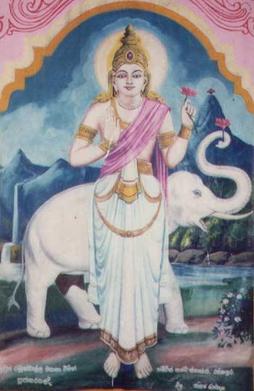
    which has its own resident deity, Sumana:


    Semites were there as early as the days of Solomon, and, specifically Arab ones in the pre-Christian era.

    Strangely, no local stories say that Manu had anything to do with it. So it does not seem to be an Arabic interpretation of any Hindu legend. They for some reason have made the determination on their own.

    Genesis uses Mesopotamian rivers around Eden, meaning it perhaps simply is a Babylonian story. If Ezekiel is perhaps primal, scholars already think it means a different location, because it has the King of Tyre, then it probably is in Lebanon.

    Obviously that line of thought rolls out to all kinds of fanciful ideas, such as the Mormons thought it was in Mississippi.

    When you don't care and have nothing to prove, and are just curious why the Mandaeans would say such things, it goes a little differently.


    A study of the first century Periplus of the Erythryaean Sea does not quite figure this out, but says:


    "Brahui" is thought to refer to the hero of the tribe, Braho, a name having the same root as Abraham.

    These people are probably the same
    as those called by Herodotus (III, 94) "Asiatic Aethiopians,' ' and
    again (VII, 70) as 'Aethiopians from the sunrise, " who were similar
    to the Aethiopians of Southern Arabia...

    Wellsted (I, ch. v) noted the strong racial similarity between the Beni Genab in South Arabia and the people found on the Makran coast. Holdich {Geographical Journal, VII, 388) finds the island of Haftalu off the Makran coast—the Astola of Ptolemy, a center of the sun-worship—locally known as Serandip; a name which the Saracens gave to Ceylon...

    The knowledge concerning Ceylon which reached the west
    through Onesicritus, Eratosthenes and Strabo, was of the island before
    its conversion to Buddhism under the missionary zeal of Asoka.


    Most of the basic facts about Sri Lanka are simply fascinating. It is "first" in quite a few categories. It also--at least in older times--was a peaceful crossroads for numerous religions, something like a capital of the "Maritime Silk Road".

    It simply takes a bigger ship to get there, than you could have used in the Persian Gulf before the "Tharshish".

    Except you could simply walk to it when the sea level was lower, on Adam's Bridge.

    This is like an inside-out version of the Hiram Abiff of Freemasonry, which most likely is a 1700s English invention.

    The Jewish article on Sri Lanka accepts both the Adam and Noah stories without qualification.

    Sassanid Mazdeism paved Parthian Mithraism.

    Topics such as Mandean Hawa Kasia are appearing piecemeal if you know to ask about it.

    Drower's main text finds this to be odd and inexplicable, i. e. why they have such a specific disagreement with a Mesopotamian or northern Eden. She simply has accessed material which was only said to exist in Theosophy, and, it mostly bears out all of the main doctrines collectively called Gnosticism. It even appears to be a closer match than that of the Druze. But the Druze are mostly just refugees from Cairo ca. tenth century, perhaps derived from Christian Gnostics. The Mandaeans are pre-Christians who probably bugged out of Jerusalem just before the destruction of the Second Temple around the year 70. Somehow they survived. That is hard to do. They refuse to fight. It is even harder to do it that way. If they give up now just because their children do not feel modern enough, then, this too shall lapse into a literary relic.


    If taken as "source of four rivers", Genesis matches the pattern of sacred mountains of India and China--and of Sri Pada:


    As one local inhabitant of the forest told researcher Anoja Wickramasinghe: “This is a huge living organism… This Excellency nurtures the life forms and maintains diversity across the terrain… Its superiority cannot be explained, but should be understood.”

    The watersheds of four major rivers, the Kelani, Kalu, Walawe, and Mahaweli, are in the forests of Samanala Adaviya.


    In that sense, yes, it very well matches the pattern of spiritual man and his movements from heaven to earth.
    Last edited by shaberon; 6th August 2023 at 07:48.

  2. The Following 4 Users Say Thank You to shaberon For This Post:

    Blastolabs (7th August 2023), Bo Atkinson (9th November 2023), pounamuknight (30th October 2023), william r sanford72 (15th November 2023)

  3. Link to Post #42
    United States Avalon Member
    Join Date
    1st April 2016
    Posts
    6,142
    Thanks
    30,262
    Thanked 34,424 times in 5,789 posts

    Default Re: Neo-Platonism vs. Capitalism

    Harran


    We will get there, but, the curious thing is how.

    It is in consequence of thinking about spoken tradition vs. written formats.


    This is partly to de-construct those versions which are perhaps a bit too artificial and arbitrarily spread and passed down our generations. It is not really to install another kind as being literally true in the historical sense, that is, not in a one-by-one series of details from the beginning of human memory--but they are perhaps more useful in revoking an iron fist of assertions on some of the details, and giving a more useful aspect of the metaphorical and subjective meanings.


    For example, that which is called pagan or polytheistic is not inherently a contradiction of monotheism. It is, however, a contradiction of a great deal of what has come to be defined as monotheistic, along with some of its conclusions such as souls created at birth, and devices such as Vicarious Atonement, which could be described as utterly new, strange, and foreign to practically all of the pre-existing beliefs.


    Historically, India has a preference for spoken traditions, whereas China records everything. The western neighbor of India is quite heavily inveigled with everything that developed in the west. Specifically, Zoroaster, whose lack of written records has determined his existence to be:


    before 500 BC, likely 1000–1500 BC


    Then, when it comes to writing, this is the case of his Avesta:


    Several centuries later, one of the Parthian emperors named Valaksh (one of the Vologases) supposedly then had the fragments collected, not only of those that had previously been written down, but also of those that had only been orally transmitted (Dk 4C).

    The legends of an Arsacid-era collation and recension are no longer taken seriously. It is now certain that for most of their long history the Avesta's various texts were handed down orally, and independently of one another, and that it was not until around the 5th or 6th century CE that they were committed to written form.


    Close to the same as the Indian Vedas, not just in terms of the lack of written evidence, but the language they were spoken in, and that they say nearly the same thing. To understand India, the original Vedic "Asura" is a "breath", that is, the deities themselves, similar to the Avestan:


    Beside Ahura Mazda is the ancient Indo-Iranian god Thvarshtar ("Artisan"). Thvarstar also appears under the name Spenta Mainyu ("the Beneficient Spirit") in Zoroaster's system of the Beneficent Immortals. In the creative aspect Thvarshtar functions in many ways as Ahura Mazda.

    Among some Iranians and in Zoroastrianism the daivas were considered demons, but this view was not universal. The ahuras ("lords") were noble sovereign deities.


    These are some of their terms for deities and hymns:


    Yasht

    Yazata


    And currently, rather than being called Zoroastrian, the spoken system is considered Ancient Iranian.


    However, we suspect that the older Zoroastrianism has perhaps been re-worked, and its more direct descent is found with the:


    Yazidi


    whose writings *are* eventually syncretized--limitedly--in the 1100s:


    Sufi influence and imagery (especially taken from Mansur al-Hallaj) can be seen in the religious vocabulary, especially in the terminology of the Yazidis' esoteric literature, but most of the theology, rituals, traditions, and festivals remains non-Islamic. Its cosmogony for instance has many points in common with those of ancient Iranian religions.

    Some western scholars derive the name from the Umayyad Caliph Yazīd ibn Muʿāwiya (Yazid I). However, all Yazidis reject any relationship between their name and the caliph. The word Yazidi means 'the servant of the creator'. Other scholars derive it from Old Iranian yazata, Middle Persian yazad, divine being.


    So the major basis of Yazidism is the closest thing to original spoken Zoroastrianism. It made a voluntary agreement with a bit of Sufism; it has not been overhauled and made into an imitation of itself. While this cultural tradition shows its continuity, even less agreement is found about their migratory pattern or physical origin:


    Kurds are an Iranian people; the first known Indo-Iranians in the region were the Mitanni, who established a kingdom in northern Syria five centuries after the fall of Gutium, however the Mitanni spoke an Indo-Aryan language more akin to Sanskrit and Hindi than to an Iranic language.


    The Mitanni existed:


    c. 1550–1260 BC, earlier called Ḫabigalbat in old Babylonian texts, c. 1600 BC.

    Hurrians made up the main population of Mitanni, that was firstly known as Ḫabigalbat, at Babylonia, in two texts of the late Old Babylonian period, during the reign of Ammi-Saduqa, (c. 1646–1626 BC), in middle chronology.


    The spoken language is Sanskrit-ish--but it was often written in a Semitic script:


    The earliest attestation of the term Ḫanigalbat can be read in Akkadian, along with the Hittite version mentioning "the Hurrian enemy," in a copy from the 13th century BC of the "Annals of Ḫattušili I...

    10 Mitanni-era tablets were found, in Babylonian cuneiform written in Akkadian, bearing Hurrian names...


    Kingdom of Mitanni at its greatest extent under Parshatatar c. 15th century BC:


    Their neighbors, near the site of Ionian Apollo:


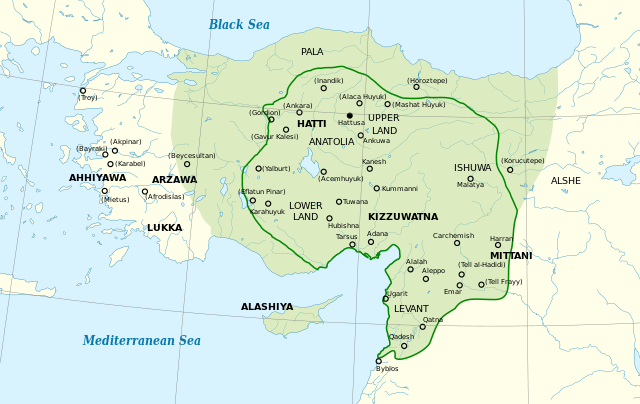
    Along with the closely related Luwian language, Hittite is the oldest historically attested Indo-European language, referred to by its speakers as nešili, "the language of Nesa".


    The Hittite domain at its peak, c. 1350–1300 BC, represented by the green line:


    who also are using Semitic script:


    During sporadic excavations at Boğazköy (Hattusa) that began in 1906, the archaeologist Hugo Winckler found a royal archive with 10,000 tablets, inscribed in cuneiform Akkadian and the same unknown language as the Egyptian letters from Kheta—thus confirming the identity of the two names. He also proved that the ruins at Boğazköy were the remains of the capital of an empire that, at one point, controlled northern Syria.

    The ancestors of the Hittites came into Anatolia between 4400 and 4100 BC, when the Anatolian language family split from (Proto)-Indo-European. Recent genetic and archaeological research has indicated that Proto-Anatolian speakers arrived in this region sometime between 5000 and 3000 BC.


    Then as we found, the Hittites became a Hindu kingdom in the 1300s B. C. E., leaving the first written Sanskrit in stone.

    From this background:


    Zoroaster appears to have been the first religious figure to develop an eschatological myth about a future saviour to rescue the world from evil. This idea plays an important part in Zoroastrianism. It was probably also influential in introducing the concept of the messiah in exile Judaism.


    I have no idea what a Zoroastrian savior is. No, I don't think it is from the Vedas. The picture that is forming suggests that what went into the captivity with the Judeans would have been tales of Moses, a few Kings, and Prophets, and what came back out included the Babylonian Flood Myth called Genesis, and the Zoroastrian savior. They already had messiahs. These were of a consecratory nature. King Cyrus of Persia was a messiah because he liberated them. The futuristic eschatology appears to be the new idea merged into this.

    Zoroastrianism as the name is used today stems from a noticeably later era when it, too, began to undergo revisions:


    The surviving texts of the Avesta, as they exist today, derive from a single master copy produced by collation and recension in the Sasanian Empire (224–651 CE). That master copy, now lost, is known as the 'Sassanian archetype'.


    No one can say for sure. What we can say is that Sassanian behavior does not resemble the older epochs.


    There were some number of Jewish land owners who had remained in Judea. And so we cannot tell either physically or by writing where the dissenters were, but, ideologically, their split was from Moses, so they are definitely not Jews:


    Mandaeans have nothing to compare with the
    Gospels, which, in their claim to recount the life and teach-
    ings of Jesus, have a certain unity, or of Manichaean books
    containing the actual doctrines of Mani. The Mandaean
    religion has no 'founder', indeed, from the critical stand-
    point, few religions can be said to have 'founders' or to be
    'new'.


    Well, the Vedas have as many founders as the Sages that composed them. Most religions have "a founder", except most such founders wrote nothing. Mandeans see no difference between the Jews and their captors:


    Yahutaiia, which word is used throughout as mean-
    ing both 'Chaldeans' and 'Jews'. (In Legend VI the
    narrator called Nebuchadnezzar 'the king of the Jews'.)


    The Mandeans lacking a human founder do, however, have a type of origin at a mountain called:

    Tura d Madai

    Still more inexplicable is the assertion
    that the Egyptians were co-religionists, and that the
    original ancestors of the Mandaean race went from Egypt
    to the Tura d Madai.


    This origin, like most founders, did not acquire a written form for quite some time, until their history was written in:

    Haran Gawaitha


    'The interior of the Haran (i.e. Harran) admitted them, that
    city which has Nasurai in it, so that there should not be a road
    (passage?) for the kings of the Yahutaiia (Chaldeans). Over them
    (the Nasurai) was King Ardban. And they severed themselves from
    the sign of the Seven and entered the mountain of the Madai, a
    place where they were free from domination of all races. And they
    built mandis {mandia) and dwelt in the call of the Life and in the
    strength of the high King of Light.'


    This most likely refers to King Atarbanus II of Parthia, c. 12 to 38/41 AD.

    After distancing themselves from the Jews, they do the same with the Sassanian reformed Zoroastrianism:


    ...the learned Sabians of the
    Caliph's capital chose to assume Neoplatonic terms in
    speaking of their religion in order to lend an air of
    scholarship and philosophy to their tenets. Magianism
    was still alive and hated, and any semblance of relationship
    with Persian beliefs was to be avoided. The existence of the
    name Zahrun amongst these court philosophers may be
    adduced as a proof of their identity with the Mandaeans,
    for Zahrun is one of the Mandaean spirits of light who,
    together with Shamish (Shamash), ride in the sun-vessel
    across the sky.


    In other words, they did this while under the rule of an Islamic Caliph.

    Their book's title translates to:


    Revelation of Inner Harran


    According to the Mandaean Union:


    They themselves believe that, as their religion was founded by the World of Light, they were not concerned with the history of this world.

    In contrast to the Parthian rulers, under whom the Mandaeans obviously prospered, relations with the Sassanians were bad. The same scroll refers to considerable reduction in the number of the Mandaean Temples at that time. It is also clear from the inscription of the Zoroastrian high priest Kartar that those practicing non-Iranian religions – and the Mandaeans were among these – were persecuted during the reign of King Shahpur I.

    Islam renewed oppression, in spite of its toleration of the Sabians as a "people of the book".


    That indicates some, later, caliphs and Persian kings, who were not always so tolerant.

    The Parthians on the other hand were into the eventually-Roman-bound Mithraism. There are details on the similarities of the Mandaic and Mithraic Zodiacs that we will post further along.

    Physically, Parthia is in northeastern Iran; significantly, it got rid of the Seleucid Empire, and, continuing westward, gave the Romans one of their worst defeats ever:

    After the collapse of the Seleucid Empire, Harran became part of the Kingdom of Osroene in 132 BC, ruled by the Nabatean Arab Abgarid dynasty and most frequently a vassal state of the Parthian Empire.


    So, the main Mandaean center was really in the north, and the group around John the Baptist was a branch from it. So he obviously is not a "founder".


    The Mandaic language clearly distinguishes Nazareth:


    Christians {krastinaiia) and were
    called after Nazareth (Nisrath mdinta).'

    Nazareth is identified with the city of Qum !

    The miraculous birth of John (Yahya Yuhana) follows
    (the account differs from that in the Drasha d Yahya), and
    the story of his rearing in the 'white mountain' Parwan, of
    his baptism, education, and initiation into priesthood in
    the Mountain of the Madai...'which is called the Inner Harran'.

    The importance of the document lies in the implication
    that the Nasurai are identical with the Parthians, since the
    latter correspond most nearly with the bnia dbnia d Ardban
    Malka , who came from the Tura d Madai. That this was
    a mountainous country and stretched to Harran is clearly
    indicated, also, that not all the 'Madai' were Nasurai.

    Maddai or Mandai
    originally had no reference to religion.

    Greek learning first became accessible to Europe
    through Arab translations of the classics, and amongst the
    first translators into Arabic were Harranian Sabians at the
    Caliph's capital city.


    Qum was the domain of the Essenes, who appear superficially similar to Mandeans, but in fact practice different doctrines. The easiest clues are that Mandeans oppose violence to humans, such as to one's own body, such as Jewish circumcision, and they are not extreme ascetics such as the Essenes.

    "Nasurai" therefor means the priestly or initiated class, and Mandeans are the lay followers, of their *own* Nasurai, and not the similarly-titled leaders of any different system.


    Around 1851, a Latin version of their book was published as Codex Nazareus:


    Paul must have belonged to this class of initiates, for he himself tells the Galatians (i, 15) that he was separated or "set apart" from the moment of his birth, and that he had his hair cut at Cenchrea, because "he had a vow" (Acts xviii. 18), i.e., had been initiated as a Nazar; after which he became a "master-builder" (I Cor. iii, 10). Joseph is styled a Nazar (Gen. xlix, 26). Samson and Samuel and many more were also Nazars.

    The Codex Nazareus, the "Book of Adam" (the term being used in the sense of Man or Humanity, anthropos), is written in the Chaldeo-Syriac dialect mixed with the mystery language of the Gnostics. It is almost incomprehensible. Still, while we see the few translators of the Kabala, the Nazarene Codex, and other abstruse works hopelessly floundering amid the interminable pantheon of names, unable to agree as to a system in which to classify them -- for one hypothesis contradicts and overturns the other -- we can but wonder at all this trouble, which could be so easily overcome. For every philosophy, whether of one or another nation, has its key in the Hindu sacred works.

    ...the disciples of John were but a dissenting branch of the Essenes.

    Such was the faith of Paul, when Tertullus the orator accused the apostle before the governor Felix. What he complained of was that they had found "that man a mover of sedition . . . a ringleader of the sect of the Nazarenes"; * and, while Paul denies every other accusation, he confesses that "after the way which they call heresy, so worship I the God of my fathers." ** This confession is a whole revelation. It shows: 1, that Paul admitted belonging to the sect of the Nazarenes; 2, that he worshipped the God of his fathers, not the trinitarian Christian God, of whom he knows nothing, and who was not invented until after his death; and, 3, that this unlucky confession satisfactorily explains why the treatise, Acts of the Apostles, together with John's Revelation, which at one period was utterly rejected, were kept out of the canon of the New Testament for such a length of time.


    The "written dialect" HPB refers to is called by Drower:

    Parthian chancellory script

    The earliest confirmed Mandaean scribe was Shlama Beth Qidra, a woman, who copied the Left Ginza sometime around the year 200 CE.


    They do include a tenet on inter-planetary people:


    'There is a star inhabited by men, the descendants
    of the Hidden Adam (Adam Kasia), but they are semi-spiritual in nature,
    and not gross like ourselves. This star is called Merikh, and is the star of the
    morning.'

    A similar, interesting tract for the northern Arabs--having only a spoken tradition which may trace to those sailors who reached Sri Lanka--is the rather mysterious:


    Nabatean Agriculture


    So the area they dwelt was the same as where Abraham stopped before reaching Zamzam:

    Harran


    The earliest known settlements in the region surrounding Harran date to 10000–8000 BC and settlements in its close vicinity are known to have existed by 6000 BC.

    Harran was founded at some point between the 25th and 20th centuries BC, possibly as a merchant colony by Sumerian traders from Ur.

    Harran was from early on associated with the Mesopotamian moon-god Nanna (later known as Sin).

    The Harranian moon cult of Sin proved to be enduring and lasted long into the Middle Ages, known to have existed as late as the 11th century AD. Harran was captured by the Rashidun Caliphate in 640 and remained an important city in the Islamic period. It flourished as a center of science and learning and was the site of both the first Islamic university (the Harran University) and the oldest mosque in Anatolia (the Harran Grand Mosque [tr]).

    Under the Byzantine Empire, the city continued to be called Carrhae (Kάρραι) but was also sometimes referred to as Hellenopolis (Eλληνóπoλις), "city of the [pagan] Greeks", in reference to the strong pagan traditions there.

    Harran was incorporated into the Mitanni kingdom in the 16th century BC.

    Harran was conquered from Mitanni by the Assyrian king Adad-nirari I (r. 1305–1274 BC).

    After the collapse of the Seleucid Empire, Harran became part of the Kingdom of Osroene in 132 BC, ruled by the Nabatean Arab Abgarid dynasty and most frequently a vassal state of the Parthian Empire. Abgarid rule may have encouraged the local moon cult; the moon was important in both the ancient Bedouin and Nabatean Arab religions.

    Harran developed a rivalry with the nearby city of Edessa due to the cities having polarised attitudes concerning Christianity. Whereas Edessa adopted the new religion very early, Harran remained a pagan stronghold for centuries and became the largest center of pagan cults in eastern Syria.

    The local Harranian religion continued to develop as a blend of ancient Mesopotamian religion and Neoplatonism and Harran remained notorious for its strong pagan traditions long into the Islamic period.

    The deities worshipped at Harran for instance began to at times be referred to by the names of corresponding ancient Greek deities but their ancient Mesopotamian names also continued being used.


    The Harranian pagans considered themselves the heirs of ancient star-worshipping civilizations such as Babylonia, Greece, India, Persia and Egypt. In addition to pagans, Harran was also home to Muslims, Christians, Jews, Samaritans, Zoroastrians, Manicheans, and other groups.

    Al-Ma'mun asked the populace if they were Muslims, Christians or Jews ("people of the book" protected under Islamic law). Unable to claim that they were, the people of Harran instead claimed that they were "Sabians", a mysterious religious group also protected according to the Quran but who no one at the time knew who they were. Upon being inquired who their prophet was, the Harranians claimed that their prophet was the legendary Hellenistic figure Hermes Trismegistus.

    [cf. Drower: It was easy for them to camouflage the
    Mazdean name Hormuz, Hirmiz, Hirmis (Ahura-Mazda)
    into the name Hermes, and proclaim that the Egyptian
    Hermes was one of their 'prophets'.]

    The toleration of paganism at Harran was at last revoked for the final time under the Numayrids in the 11th century and the last moon temples were closed and destroyed.

    Harran was in the 12th century still renowned for its ancient origins; a now lost work by Hammad al-Harrani made the claim that Harran had been the first city founded after the great flood.


    It is the city of "beehive houses"--unknown in Anatolia and rare elsewhere:


    Harran is similar to how we have seen Alexandria, where many of these same cultures intermingled--except it is much older and lasted a lot longer. Its name is roughly "crossroads", suggestive of Hecate. We have already found the overland transmission of Lapis Lazuli into Anatolia, which almost certainly passed through here. Secondarily, it passes by sea to Egypt, already from the very beginning of anything that is known about that culture. This frames an extremely ancient connection, Balochistan <--> Harran, in terms of the earliest known evidence, and perhaps every trace and increment of religion and culture there is to be had. Nothing about the Mandaeans possibly pre-dates this, but, rather, shows them as the survivors of all the many oppressions which ultimately favored the major Abrahamic religions.

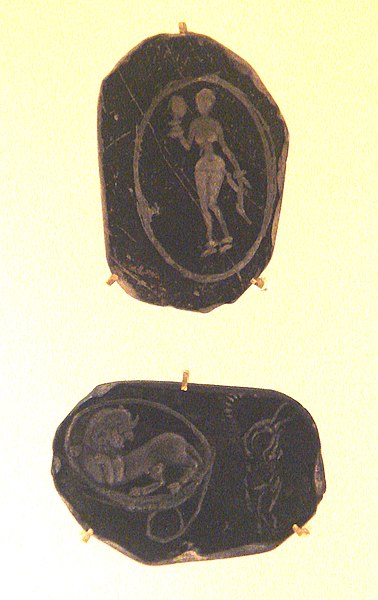
    Here is a bit more about them. Drower describes a ring similar to that of Solomon:


    The skandola is the talismanic seal-ring, and bears in-
    cised representations of the lion, scorpion, bee (or wasp),
    and serpent. The latter, mouth to tail, forms a frame to
    the others.

    The snake is said by them to be 'the
    serpent without hands or feet', i.e. c Ur, the great earth
    dragon. It may mean 'life' — Mia, for snake (M. hiwa:
    Arabic hayya) is symbolical of both water and life. The
    serpent, carved and coloured black, is placed sometimes
    above Subbi door-lintels as a protection, recalling the large
    black serpent portrayed beside the door of the Yazidl
    temple at Shaikh c Adi.

    The lion may be Aria of the Mandaean Zodiac, and the
    scorpion is probably the Zodiacal Scorpio (Mandaean
    Arqba). Mandaeans say they are Krun and Hagh, two
    of the five lords of the underworld.

    Now the scorpion, snake, and lion are found almost
    invariably in Mithraic bas-reliefs, and the bee is common
    on Mithraic gems (see Cumont, Monuments, &c). The
    Mithraic scorpion is usually attached to the genitals of the
    sacrificed bull; the serpent's attitude and position varies.
    Sometimes it is shown drinking the blood of the victim.
    The lion's position varies also; sometimes both the lion
    and scorpion are represented in conventional form with
    the Zodiacal circle which not infrequently appears on
    Mithraic monuments.

    Taking into account these Mithraic parallels it may be
    safe to assume that the Mandaean snake, lion, and scorpion
    are also Zodiacal, and of Iranian origin. The Mithraic bee
    differs from the Mandaean, in that it is seen from above.

    A priest told me that the skandola was the talisman
    brought back by Hibil Ziwa from the worlds of darkness
    when he brought Ruha to the upper world. Hirmiz said
    of the skandola :

    'There are four signs on the skandola: the hornet above, the lion
    in the centre, the scorpion beneath, and the serpent around them
    with his head lifted towards Awathur (Abathur). The three first,
    the scorpion, lion, and hornet, take worldly souls, those which have
    lived in uncleanness, and throw them into the mouth of c Ur. In
    the belly of c Ur there is fire one hour and ice the next. At the end
    of the world, when it is time for all that is material to dissolve and
    disappear — and c Ur with them — the lion and hornet will come to
    c Ur and say, "Give back the souls you have eaten" ! c Ur will reply,
    "There are none. I have none!" They will answer him, "Do
    not lie! You are about to end your existence. Tell us the truth."
    Then he will render back the souls which have been punished, and
    they will go to Awathur.


    For all astrological information the priests consult the
    astrological codex Sfar Malwasha, the 'Book of the Zodiac'.
    Mandaeans say that Hibil Ziwa gave Adam Paghra the
    Sfar Malwasha so that he might be able to foresee coming
    events in its pages.


    The Signs of the Zodiac and their numerical values are
    as follows:


    Umbara (New Year), Lamb or Ram

    Taura, Bull

    Silmia, Scales (Gemini)

    Sartana, Crab

    Aria, Lion

    Shumbulta, Ear of Corn

    Qaina, Reed

    Arqba (pron. Arqwa), Scorpion

    Hatia, Mare

    Gadia, Kid or Goat

    Daula, Camel (or bucket ?)

    Nuna, Fish


    For the Planets:


    Hiwel Ziwa put each child into a planet. The planets are creatures
    of God and each has a spirit in it. The names of these
    seven are Shamish, Sin or Sera, Nirigh, Bel, Enwo, Liwet,
    and Kiwan. At a second birth she
    produced the Signs of the Zodiac.


    Venus, Libat, or Dilbat

    'Sitting-on-the-mountain-of-Shamish"
    is her name: seven names she has'. Libat is often invoked
    in sorcery. Her peculiar function is either to help in
    matters of love and generation or to give information about
    the unknown.

    Mars (Nirigh ) is the 'Lord of Clouds and Thunder,
    who makes rain and draws, together with Shamish, water
    from earth and sky'.

    Jupiter (Bil or Bel ) is rarely mentioned except in exor-
    cisms of disease-demons, such as the Pishra d Ainia. It is
    probable that his functions were gradually absorbed by
    such beings as Yawar Ziwa, Hibil Ziwa, and Malka Ziwa.
    Mercury ( c Nbu, Enwp), 'lord of writing and books',
    'lord of wisdom and knowledge', and Saturn (Kiwan),
    appear little in magic except in exorcism rolls. Qmahia
    written in c Nbu's name cure madness.

    Every Mandaean has two names, his Mal-
    washa, or Zodiacal name, and his laqab or worldly name.
    The latter is usually a Muhammadan name and is used for
    all lay purposes, the former is his real and spiritual name
    and is used on all religious and magic occasions. This
    spiritual name is linked with that of the mother instead of
    the father, suggesting some period at which paternity was
    attributed to some ancestor on the female side, or a god.


    Here is a basic form of the astrological Cardinal, Fixed, and Mutable Crosses:

    Each season is subdivided into three: First, Middle,
    and Last (Awwal, Misai, and Akhir or Khir).

    Each year is named after the day with which it began,
    e.g. the Year of Habshaba, the Year of Sunday; or Year
    of Rahatia, Year of Friday.


    Ages or Epochs:


    The history of Man on earth is divided by the Man-
    daeans into four epochs. At the end of each, mankind was
    destroyed with the exception of one human couple. From
    the creation of Adam and Eve to the destruction of the
    race by 'sword and plague' was a period of 216,000 years.
    One pair, named Ram and Rud (Sky and River), survived
    disaster. Just as in the case of the first pair (see Legend I,
    Book II), a union took place between the male survivor
    and the light-double of his spouse to ensure the con-
    tinuance of the Mandaean race, whilst the rest of mankind
    proceeded from the ordinary union of the pair. After
    156,000 years a second disaster resulted in the perishing
    of the human family through fire. A second pair survived,
    Shurbai and Sharhabi'il (the word shurbai seems to mean
    a spreading out, or propagation — root shrb, 'to spread
    out'). The processes of reproduction of Mandaean s and
    Gentiles were repeated in the case of each successive couple.
    A hundred thousand years later the Flood again obliterated
    the human race with the exception of Nuh and his wife
    Nhuraitha or Nuraitha. (The word nuh comes from a root
    meaning 'the calming of tempest' and nhuraitha has, of
    course, a 'light' meaning.)

    There is to be a fourth destruction of the world in the
    791st year of the sign of the Fish (Nuna). This will be
    by 'wind' or 'air'.


    It is perhaps worth mentioning that the Yazidi Malak
    Tawus or Peacock Angel (the Prince of Darkness) has a namesake in the
    Drasha d Yahia, where Tausa is the name given to a malka who bewails
    that he has sinned against the Great Life and allowed his pride to lead him
    into rebellion.


    That is not strictly the Yazidi interpretation, wherein the original Malak Tawus was commanded to bow to none, and so the later request to bow to a created man was a test to see if he recalled the first.

    As to these classes, the 'uthra are beneficient, the melka are of mixed nature, and the malak are of the earth earthy, troublesome and requiring discipline.


    Jerusalem, archaeologically, was an old encampment area--not as old as Harran--eventually built up as a city:


    By around 1550–1200 BCE, Jerusalem was the capital of an Egyptian vassal city-state...The city's inhabitants at this time were Canaanites, who are believed by scholars to have evolved into the Israelites via the development of a distinct Yahweh-centric monotheistic belief system.

    From the Mandaean perspective:


    Moses was Kiwan, and Abra-
    ham was Shamish. They travelled and travelled until they
    came to c Ur shalam (Jerusalem), which they called "Uhra
    shalam', 'The-road-is-complete. They wanted books and
    Melka d Anhura said, 'A book must be written that does
    not make trouble for the Mandai', and they sent one of the
    melki — Tawus Melka (i.e. Peacock King, cf. p. 94) to
    write the Torat (Old Testament). The Jews had no
    priests, so Anush c Uthra put seed into the Jordan and the
    Jewish women drank and became pregnant and brought
    forth 365 priests. 'Inoshvey, too, drank of the water, and
    she brought forth Yahia, and all the men who were born
    of the seed sown in the Jordan were baptized and became
    priests.

    Six thousand years later, the planets, who are the
    children of Ruha and c Ur, built the Sacred House, that is
    c Ur Shalam — Jerusalem. (The Kaaba was built by Abra-
    ham.) In Jerusalem Ruha gave a share of her kingdom to
    Musa (Moses) of the Beni Israiil.


    The Jews were unable to affect the northerly Mandaeans:


    Musa pursued them, but when he reached the Tura
    d Maddai, he could go no further and so returned and
    went to 'Urshalam.


    This could not be less Jewish or Christian, and it is definitely Adamic or the religion of Adam. Not literally as a scripture or even an item that has been passed down, but, in terms of the basis of doctrine. Everything else classed as Gnosticism is simply a version of this, re-cast with different divinities and so forth. All of the western similarities, from ancient Egypt to the Neo-platonic systems is defunct, or, else with the Druze, who perhaps are moderately different and far later than the Mandaeans.

    Therefor it would appear more closely related to Indian systems, or, "Eastern original Zoroastrianism", that have not suffered being overwhelmed, revised, and concocted, at least some of them.

  4. The Following 2 Users Say Thank You to shaberon For This Post:

    Bo Atkinson (9th November 2023), pounamuknight (1st November 2023)

  5. Link to Post #43
    United States Avalon Member
    Join Date
    1st April 2016
    Posts
    6,142
    Thanks
    30,262
    Thanked 34,424 times in 5,789 posts

    Default Re: Neo-Platonism vs. Capitalism

    These are just a few minor additions along the lines of "Judaism, the religion" contrasted to "Jewish, the culture or ethnicity"--the latter being more of a determining factor. Modern Israel accepts both Messianics as well as atheist Jews. In that sense, Mandaeans are Jews, although they do not live there or seek Aliyah or any "right to return", since this can obviously be argued away both in religious terms and culturally. And, they are clever enough to understand "Jordan" as not literally being a single river, but, symbolic for anywhere appropriate.


    The "Lost Tribes" that must have been important to someone, can only, possibly, be said to indicate the Mountain Jews of Azerbaijan. It is possible that their first move was in consequence to Shalmaneser wrecking the old Israeli kingdom. Like the Mandaeans and other Jews, they, of course, have no written records of this time period, and because they were joined by post-captivity wanderers, it could easily be ignored.

    They have a strong Kabalistic ethos, which is strongly indicative of Babylon.

    It is remotely possible they were syncretized before this, especially if they left Israel before there was such a thing as the Jewish religion. If they may have Persian or pagan elements, this is perhaps sensed in a brief view of the Mountain Jews:


    In the cycle of wedding, birth, and funeral rituals are a number of pre-Judaic and premonotheistic concepts, including belief in the purifying strength of fire, water, amulets, and talismans against evil spirits (water nymphs, devils, etc.). Some believing families have preserved the Judaic talisman called mazuze. Oaths are rendered by the Torah and the Talmud, but also by the hearth.

    The great majority of Mountain Jews today are nonbelievers, in part because of efforts in this direction by members of the community.


    There is a strong possibility that ancient Judaism was simply Canaanite paganism with the laws of Moses attached. We can get a considerable amount of information about this from a study on the Persian Diaspora. I am not sure everything in there is completely correct, although it does strongly reinforce the idea that the post-Captivity religion was very different from anything known previously. In fact, the paper goes on to a fair amount of post-Captivity tweaking as well, to the point where a crisply-defined Judaism cannot be established until around 200 B. C. E.

    This is not very good for any kind of belief that relies on something particularly special from old characters like Moses and Saul. It is good if one is thinking that such beliefs were concocted and simply given to people as a kind of surprise identity.

    If they are given a re-branded Zoroastrian Saoshyant as "the Messiah", then, of course, the subsequent church is able to say that this is really Jesus.

    The Greek savior or Soter, on the other hand, was a wide variety of individuals, again truncated and reduced to Jesus. Cyrus the Great of Persia would qualify as a messiah and soter in their traditional generic meanings.

    The individual Soter was a Daimon, that is, a demon in the art of re-writing the Greek language.

    That is akin to saying one is supposed to have unreasonable, groundless Faith--Pistis (demon) in Jesus the Soter (demon), dues to repetitively being told so about some largely unaccountable events.

    Judaism cannot be guilty of that, and, lacking a Pope or anything similar, can be said to allow multiple views about "messiah", one of which being that a new Israel should not be created unless it actually is by the real Messiah. Or, that it does not legitimately have any futuristic eschatological meaning, that there may be messiahs, which Israel in no way represents.

    Without all the various ideas being cooked into a somewhat unpalatable stew, the "final battle of evil" was decreed by Zoroaster as himself personally doing it. The Hindu Kalki avatar, while similar, is a much later idea, but is also not a particularly good fit, because it would be on a schedule which is still over 400,000 years away. Neither of those are very strongly oriented into the notion anyway.

  6. The Following 2 Users Say Thank You to shaberon For This Post:

    Bo Atkinson (9th November 2023), pounamuknight (6th November 2023)

  7. Link to Post #44
    United States Avalon Member
    Join Date
    1st April 2016
    Posts
    6,142
    Thanks
    30,262
    Thanked 34,424 times in 5,789 posts

    Default Re: Neo-Platonism vs. Capitalism

    The Barrator


    This may be a decent mnemonic for western audiences that may help the point attempted to be made.


    It is kind of a rebound from looking at King Harsha Vardhana of India.

    The book about him by his court poet is, of course, considered to be exaggerated, obvious favoritism.

    He also appears in the Buddhist Manjushri Mulakalpa in a symbolic way, not specifically named. He is praised, but not at great length, or in such an extraordinary way. What is noticeable is the king of Bengal whom he defeats. This king goes to Avitchi and five other hells, and the animal, hungry ghost, and Yama realms, thousands of times, for eons.

    Most sinful kings in this text go to hell on a quite temporary basis and then spend ages in heaven.

    If he was not as personally perfect as his poet suggests, in the Buddhist view, he defeated the most evil force that had been seen for quite some time.

    He not only let the rival live, in fact he kept his job.


    Europe hasn't really got any literature from this time (600s).


    But if we look at some of its most significant works, they do, in a similar manner, describe a situation that remains undefeated.


    The most visible aspect currently being Zionism, it seems fairly well established that, Oliver Cromwell, acting on some amount of intellectual precursors, made the machine, that is, a government that implemented this policy which has been continued by every British government since.

    As an example, in my heritage, my ancestors were not Puritans, but at a certain point they joined Cromwell's side. However when King Charles was simply executed, they, and many others, walked out.

    The symbolic depiction of Cromwell as the devil is done in Milton's Paradise Lost. And this is pretty quick and easy to understand with a few excerpts from a slightly longer essay on Broken Promises:


    Following his defense of the regicide of Charles I, Milton was appointed Secretary of Foreign Tongues in 1649, acting in an unofficial capacity to produce propaganda for the Commonwealth government.


    His later book is:


    ...Milton’s attempts to reconcile his idealistic beliefs with the reality of the destruction that Cromwell and his supporters brought to England.

    While initially motivated by lofty and high-minded goals, Oliver Cromwell’s government devolved into a cruel, petty dictatorship, losing sight of the principles that had guided the Roundheads to revolt against King Charles to begin with. Cromwell’s regime sought to kill and oppress for no other reason than because it could, a far cry from the Roundheads’ original goal of freedom.

    His dream of a republican England where freedom was the highest virtue was betrayed by Oliver Cromwell and his allies, who sought to use the English Civil War to implement their own brand of tyranny.


    A more powerful piece of resistance work would, presumably, come from someone who was aware and entrenched at an earlier stage.

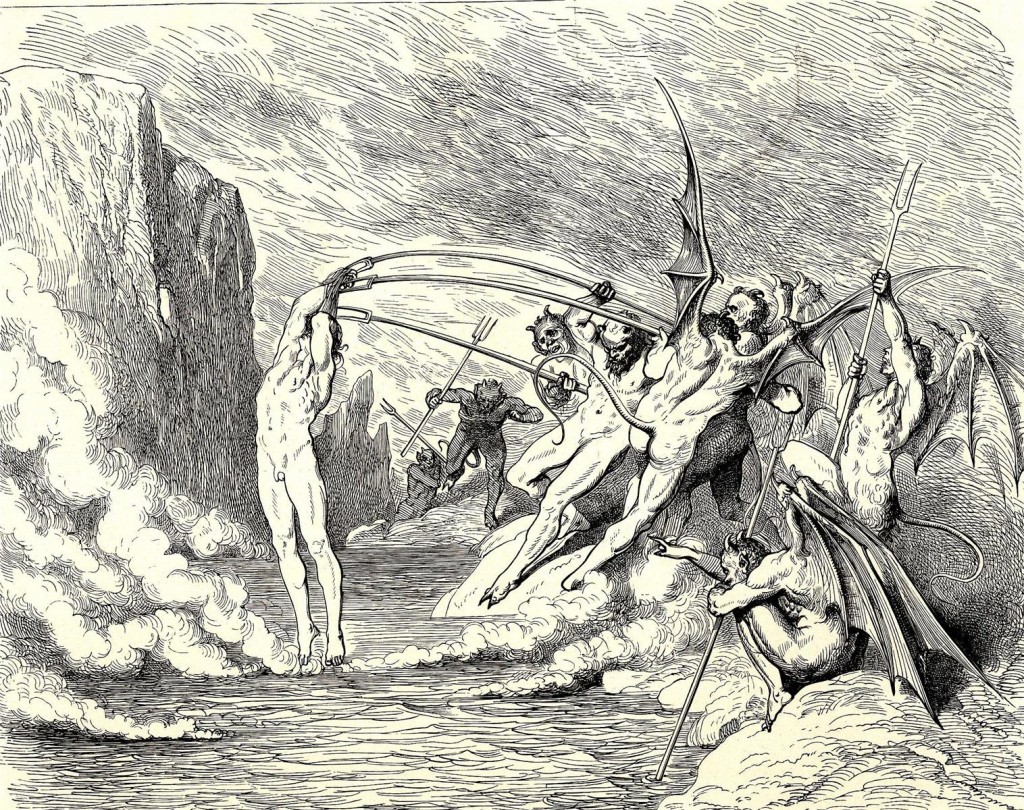
    This would be Dante, especially in Inferno Canto XXI or Flatulent Demons:


    The example of its superiority to English would be if we look at what both our dictionaries and laws have done with the Barrator:


    ...a legal term that, at common law, described a criminal offense committed by people who are overly officious in instigating or encouraging prosecution of groundless litigation, or who bring repeated or persistent acts of litigation for the purposes of profit or harassment.

    Although it remains a crime in some jurisdictions, barratry has frequently been abolished as being anachronistic and obsolete.


    What? Let's ask this sketch of the Canto by William Blake 1826–7:


    A ‘barrator’ sells political power or favour for money. Dante describes Ciampolo being punished for this sin by devils called the ‘Malebanche’ (Evil Claws). Blake, however, gives the devils the faces of respectable gentlemen, using elegant sticks and hooks to tear at Ciampolo. Their humanisation and sophistication may add a sinister edge to their unpleasantness, suggesting the hidden side of ostensibly upright members of society.


    Ok. So Dante was well-known as a Ghibilene and White Guelph, that is, the anti-papal faction. That is the running theme whose culmination is in Purgatorio XXVII, where Virgil tells him to be his own emperor and pope, that is, to have freedom of political and religious thought. And this Canto on the Barrators is a very specific segue':


    “sale or purchase of positions in the state.”

    Quote Because this sin is so similar to simony, which was punished in a recent canto, we can understand that Dante means for the reader to undergo a sequential experience—as our thoughts move from simony to barratry—and that the theme of this canto is motion. Following this theme, we can also see Dante go from a state of confusion and horror as the canto begins, and then to a state of fear as he encounters demons, and finally to a feeling of faith as he learns to trust the demons.

    Dante spends a lot of time describing a vile lake that surrounds him and Virgil. It is made of boiling pitch—similar to modern-day tar—in which the sinners are forced to swim. The great detail he uses to describe this lake of boiling pitch (nine lines are dedicated to a small story telling the reader how it reminds Dante of Venetian ship makers) shows that he is clearly both captivated and terrified by it. Eventually, Dante sees a demon that further moves him into a mindset of absolute fear. He warns Virgil, who is less concerned. Dante then describes the way the beasts chase down a sinner who has come to the surface of the pitch, and how they rip him apart, because the sinners are supposed to stay below the surface. Already Dante has gone from a foggy notion of his surroundings to a very concrete sense of fear.

    After the demons tear apart the sinner in a gruesome display, Virgil tells Dante to hide behind a rock for his safety. This is one of the only times in the book that Virgil has warned Dante to take cover and has given him instructions to ensure his safety. This fact sets this scene apart as one of extreme danger. Virgil then goes out, and as he is about to be attacked, he speaks to the leader of the demons and convinces him that he and Dante are on a divine journey and should not be harmed. After the negotiation, he calls out to Dante and almost mocks him for hiding, saying, “You there, cowering among the broken boulders of the bridge, now you may come back to me in safety.” This is the beginning of the third step in Dante’s transformation from fear to faith, as he learns that Virgil has secured them safe passage. The demons try to attack Dante, but the leader warns them not to, and puts together a team to take Virgil and Dante to their next destination.

    Dante' has associated the greatest fear with the Venetian Barrators, who are already inveigled with England in Chaucer's time, pushed for the Cromwellian agenda, and here we are. They were, in a sense, "everywhere" or were the first known country to place an ambassador in every European country, and we see where the greatest results are. Most of the European history is heavily conditioned by this rivalry against the Pope.

    Dante' is trying to get rid of both sides.


    Despite the advent of the printing press, no, you could not just print anything.

    Because of this restriction on publication, Europe is not known to have anything that would be considered a spiritual Path. Jewish copies of Kabbalistic manuals would be the closest.

    The original Theosophical Society was formed to publish such a thing, of course from eastern sources, which were unknown.

    And from reviewing it, we find that there are only a handful of loyal adherents, meaning, they delve into classical materials that have been lost or unavailable. And so in the east, you have Alice Cleather and what actually happened at Kalimpong which we have posted on previously.

    In Europe, most of them deviated towards the Golden Dawn type organizations. An exception would be G. R. S. Mead, "the father of Gnosticism", meaning the west had zero until his work. The branches of Western Adepts such as Serapis Bey, who, e. g., were not published writers, never came to light. Nothing reliably demonstrates their continuance after the first few years they were mentioned.

    So, there turned out to be one group who was said to have "discovered how to operate a spiritual path". Not the adepts. In fact, people without names, writings, or even a list of sources or what they were doing. It was so secretive that all we know is that it was four working-class friends in Swabia. That's how repressive the environment was.

    This gives another simple mnemonic because Dante mostly wrote about Italy, and this is completely adjunct to what he said.


    The main Germanic identity is Swabia:


    Quote By the mid-3rd century, groups of the Suebi form the core element of the new tribal alliance known as the Alamanni, who expanded towards the Roman Limes east of the Rhine and south of the Main. The Alamanni were sometimes referred to as Suebi even at this time, and their new area of settlement came to be known as Suebia.

    By the late 5th century, the area settled by the Alemanni extended to Alsace and the Swiss Plateau, bordering on the Bavarii to the east, the Franks to the north, the remnants of Roman Gaul to the west, and the Lombards and Goths, united in the Kingdom of Odoacer, to the south.


    The major dynasties that arose out of medieval Swabia were the Habsburgs and the Hohenzollerns, who rose to prominence in Northern Germany. Also stemming from Swabia are the local dynasties of the dukes of Württemberg and the margraves of Baden. The Welf family went on to rule in Bavaria and Hanover, and are ancestral to the British Royal Family that has ruled since 1714.
    On one side, we have found that Rudolph II Hapsburg, and Wurttemburg generally, were really big on something that must have been driven completely underground in the Theosophical era.

    We see Welf (Guelph) and the post-Cromwell British Royals, and what the page does not mention is the 1800s establishment of Bavarian Greece.

    Let's draw a line. Bavaria is primarily eastern Swabia:


    Those seem to be three mainstream things that summarize our western points very well.

    It's not dealing with the back history and level of detail that is available, but a quick, related synopsis.

    Milton's error was perhaps:


    Fundamentalism


    It is not the same as "Conservatism", perhaps more like "Obsession".

    It pertains to clutching on to any ideology in such an extreme manner as that ideology becomes more important than life.

    In other words, you are prepared to kill "for our cause", mainly to kill someone just for who they are or what they think.

    Perhaps with Cromwell, this was "Freedom".

    It is held to be the same thing, whether as Zionism, Wahhabism, Hindutva, American Exceptionalism, or obviously any kind of racism. The role of government or religion ought to be, rather, our servant to protect us from this happening, and to actually promote well-being.

    Dante and King Harsha are almost exactly the same in this way.

    Either thing is propaganda. It means "to make you do something". To start with that one line of Virgil may be the more honest and useful propaganda.

    Similarly, Hitler and Harsha were both autocrats, Harsha being of the kind called Enlightened Monarch, which Europe borrowed from the Chinese in the 1600s.

    So, for example, it would be completely correct to say propaganda in favor of the autocrat Harsha who pushes an ideology, which is the diametric opposite of the idea that you just fight or kill someone. You have to do it in actual situations of injustice, i. e., some kind of an act, not over banned words or something frivolous.

    It is the neither or the non-side of the left and right of domination.

    If you do nothing, one or both of those will arise.

    Only they can be Barrators.

  8. The Following 3 Users Say Thank You to shaberon For This Post:

    161803398 (11th October 2024), Bo Atkinson (9th November 2023), pounamuknight (7th November 2023)

  9. Link to Post #45
    United States Avalon Member
    Join Date
    1st April 2016
    Posts
    6,142
    Thanks
    30,262
    Thanked 34,424 times in 5,789 posts

    Default Re: Neo-Platonism vs. Capitalism

    Inversion of Paul, Eusebia, and Hesychia


    The smoke seems to be clearing from what has been hard to see about the problems of religion.

    I have no pet theory or destination in mind. This is more like reaping the whirlwind of a hundred years of "no Jesus", mixed with multiple sects, blended into dominance by what looks like someone else's pet theory reshaping a certain amount of material while disposing of the rest.


    With a sharp eye to what has been changed, I think we can easily show the aberrations of western religion with a result that is relatively simple. This is not something that I, personally, am trying to hew from the rough Ashlar, because it is going to speak for itself. You just ask the right questions.


    Almost all scholarship verifies Paul as the first "New Testament" guy, which is probably because he was the most important to wrap into a ball of preconceptions, to make him lose his identity. We saw one idea it may have been because Paul was Apollonius, but, these are common names. Not much to go on besides that.

    The important point is that Paul was probably not a Christian and knew nothing about Jesus.

    This is buried in the conflation of "Chrestos" and "Christos".

    That is an important parallel because without any reference point, it is easy to get lost in the sheer volume of conflicting texts and their variations.

    These are excerpts from a longer article that positions Paul as a Jewish military man. This makes sense in context, and would remove Apollonius from consideration. I am not going to include all the military stuff, but the conclusion is that his god may have been the Caesars. We can begin with a very relevant question about Paul:


    If Paul wasn’t writing in response to a historical Lord Jesus Christ, how are we to understand his constant references to this character? Or was he?


    Well--probably not. So far I have been able to find that all old manuscripts contain Nomina Sacra, that is, abbreviations for certain terms; I have not seen it conclusively said that they contain *only* abbreviations. In Paul's case--especially drawing from the first "New Testament" of Marcion--it is only an abbreviation:


    Quote It has long been recognized that all the early manuscripts contain some sort of shorthand or abbreviations. Copies of manuscripts from later centuries spell out names and titles where those abbreviations occurred in the earlier codices.

    The identification of those abbreviations has always been assumed to be the fully spelled out names as they appear in manuscripts from later centuries. I question that assumption.

    The full spelling is the way it appears in the various critical Greek texts. I would point out that the critical text is an interpretation which may or may not be accurate. The critical text does not exist in reality. It is a reconstruction of all the available manuscripts with the printed reading representing the best assessments of textual critics as to how the “autographs” most likely appeared.

    The presupposition of the traditional understanding of the origins of Christian beliefs in general and the assumption that centuries later, the copyists who filled in the blanks knew the original intent. This is the critical issue. How much certainty can be assumed that over a period of development and usage of the text, that the later copyists knew the intent of the author? That problem is brought to the fore as we look at fourth century textual families where some render XS as Christos and some as Chrestos. It is evident that those copyists were engaged in some type of guesswork.

    However, we can go back to Marcion, a second century theologian who claimed that the God revealed by Paul was not the same God as Yahweh who he considered to be a lesser deity with a bad attitude. Neither was IS (Jesus?) the Christ or Messiah; he was the revealer of this previously unknown God’s identity. His Pauline based religion was based on a hitherto unknown and superior God of love and mercy. This new religion was in no way a progression based on the Jewish scriptures or religious tradition. It was totally other. Marcion claimed Paul to be the only authentic religious authority and based his understandings entirely on his writings.

    Marcion’s manuscripts contained the Nomina Sacra abbreviations. And we can be equally certain that he didn’t understand all of them in the same way as later copyists.

    Marcion filled in the missing letters in some of the abbreviated terms differently than did the later copyists.

    All evidence points to the following differences:

    Abbreviation Traditional Spelling Marcion’s Spelling
    ΧΣ Χριστός (Christos/Christ) χρηστός (Chrestos)
    ΙΣ Ἰησοῦς (Iesous/Jesus) ΙΣ (IS)


    The earliest (Christian) inscription is from a Marcionite church building in Lebada, Syria near Damascus, ca 318, was dedicated to “IS Chrestos”

    Other early fathers also used Chrestos, and called his followers Chrestianoi, including Clement of Alexandria who wrote, in Book II of the Stromata, “All who believe in Chrestos both are, and are called, Chrestianoi, that is, good men.” This all indicates that there was not clarity on the meaning of the abbreviations of the Nomina Sacra in the second century CE. Even the Pagan Tacitus, writing in the second century about this religious group (and he would have derived the spelling from them) uses the “e” in Chrestos rather than an “i” for Christos.

    We can be certain that Paul is talking about IS Chrestos. No, it is not honest to go to a two hundred years' later interpretation that is trying to snuff him and say, well, of course that means Jesus Christ. That is like one of those "tricks of the devil". As to the terms:


    Quote Chrestos was also attested as a title for a ruler, as the king of Pontus was known as Chrestos Mithradates or Socrates Chrestos, king of Bithynia.

    The Codex Sinaiticus in Acts 11:26, 26:28, and 1 Peter 4:16 refers to the believers as Chrestianoi Whereas the Alexandrian text uses Christianoi.

    Moving on to IS which later scribes spelled out as “Jesus”, Marcion kept the abbreviation and referred to his holy messenger as IS or in the genitive ISU. Or to put it another way, his Pauline text evidently contained the Nomina Sacra which he kept without interpretation for the name of this deity, not understanding it as Jesus (or the Aramaic Yeshua). The only point where Marcion actually spells out the name “Iesous” is in his Euangelion where he references Pilate allowing Jesus Barabbas to be released.


    Whether Marcion was right or wrong in his interpretive spelling, we can deduce that his Pauline text was using the Nomina Sacra abbreviations, and that the earliest attestation for them neither used the name “Jesus” or “Christ” for the spelling or meaning. Can we have certainty that the later proto-orthodox scribes were rendering the abbreviations according to their original intent? If not, then the critical Greek text is assuming too much and reading orthodox Christianity back into the Nomina Sacra.

    IS could be filled out IoueS, which we would transliterate Joves, the old Roman name for Jupiter. Alternatively, IS could be filled out IuliuS, transliterated as Julius. KS could be filled in as KurioS as noted above, and in context it fits. However it can also be filled in as KaisaroS, transliterated into English as Caesar. Suggested renderings: The Benevolent Iulius Kaisaros, god, and son of a god. Or The Merciful Iulius Divus Imperator, god, and son of a god. Imperator forever. Or more fully, Paulus, appointed a commander by The Merciful Julius Divus (Divine Julius), god, son of a god, Imperator forever.

    *Every proclamation Caesar made for the Jews was a “euangelion”, a gospel.

    *To the losing fighters, including Jews, who fought on the side of Pompey in the civil war, he offered clemency (Charis--Grace) in return for an oath of loyalty (Pistis) to himself. In fact, Caesar’s clemency was his defining characteristic.

    I would submit this paradigm for further examination; that Paul’s letters, perhaps in mixed pages, sat unused for decades. They were then discovered at some point up to the time of Marcion ca 144 CE, who found the teachings useful, in the milieu of Hellenized Judaism, to fully divorce his movement from Yahweh and the Jewish scriptural tradition; he would have been countering the emergence of Rabbinical Judaism with its internalization of the law, and he found in Paul’s letters, the identity of a new god of mercy and love, with all the arguments in place to show the error of Torah adherence. In opposition to Marcion, the proto-orthodox party likely edited those Pauline letters and created a new biography and context for Paul (Acts) which placed him into the paradigm of Christianity superseding Judaism but remaining a part of the continuum of the Jewish revelation.

    That is more persuasive than Apollonius.

    Paul wrote extensively in period-appropriate military terms. He was shipwrecked three times, which would be highly unusual for anyone besides a naval fighter. That is what makes this original article more than twice as long--but it rejoins a couple things that are otherwise significant:


    Quote But how else does Paul identify himself in military terms? Over and over, he calls himself an "apostolos" (note that Acts never gives Paul that status). But what is meant by "apostolos"? For the second century author of Acts, it was one of the original 12 (minus Judas plus Matthias) who saw the physically resurrected Jesus. But that shouldn't be read back into Paul's letters. He recognizes the existence of many “apostoloi”, some of whom are his enemies.

    First, we should note that in the NT, ἀπόστολος is rarely translated from the Greek text. It is transliterated into "apostle" without translation. It has become a technical term to be defined by theological understanding rather from prior attested usage. The reason for this may be because a translation from prior attestation may not make good sense, due to the expectations of the translators.

    Appending "apo" to "stolos" indicates the commander of the fleet or ship. Secular Greek writer Demosthenes gives a word picture of "apostolos" noting that it was used to describe a cargo ship (sometimes called "apostolic") sent out with a specific shipment to accomplish a mission. In secular Greek apostolos was used of an admiral of a fleet sent out by the king on special assignment.

    Paul wrote to assemblies located in Galatia, but where was that? Reading Paul through the lens of Acts, Galatia was in north central modern Turkey. And there was certainly a Roman province located there. But there was another Galatia...same word; it was the Greek name for Gaul, divided into Cisalpina Gaul (this side of the Alps) and Transalpina Gaul. Cisalpina Gaul (Galatia) was assigned to Julius Caesar ca 57 BCE. It was located in Modern northeastern Italy extending to the border of Illlyricum in the east. The legionary headquarters (the permanent praetorium) was located in Aquilea at the northern tip of the Adriatic Sea, close to modern Trieste. At that time, when the legions were there in winter, it was the second largest city after Rome.

    When reading about Paul's travels in his own letters, there is no sequence of travel which would show him ever heading so far inland if Asian Galatia was intended. As an apostolos, potentially a naval commander, visiting the legionary Praetorium at Aquilea while in Illyricum would have been very reasonable. Additionally, if he had been writing to groups in Aquilea, Galatia (Γαλατία), it is almost certain that he was writing to fellow soldiers.


    The comparison of Capitol to Golgotha in the original is also interesting. Caesar's wounded body on a set of stauros sticks as well. It is almost eerie how strongly his iconography sounds like that which was put to use by the New Testament people.


    In Georges Ory's 1963 Analysis:


    Quote The divine person of Chrestos — from which we get our word “chrétien” — is another
    vestige. His confusion with Christus prepared the way for his assimilation with the Anointed,
    i.e. the Messiah. This evolution must have taken some time, since, at the time of Lactantius
    around 280, the pagans were still calling Christ “Chrestos”.

    We now read in our texts that the god of Paul was the Christ; Paul was, around 50–60,
    the apostle of the first Christians, who were later declared to be heretics by the new Jewish
    Christians. Paul’s Christians were Gnostics; their saviour god could not have been a man; they
    established communities and Churches throughout the Near East (in Asia Minor, Greece,
    Alexandria, and Rome, but not in Palestine).


    That is why it is hard to discuss, because anyone would say in the Bible it says things about Paul and Jesus, which is of course the point. His actual message was so very different, it had to be defrayed into support. So you get interpretations and translations, definitely not the original manuscript, and just trust it.

    I don't, and, so far, combing inconsistencies across multiple Indian Puranas along with Tibetan commentaries is much easier than unraveling this one book.

    Consequently, it is intriguing that if Paul was trying to blot out "Christians" by giving a distinct spiritual doctrine, what might that be about?

    It's not that different from Buddha, or, Buddha told most meditators that one of their problems was that they had no emphasis on love for other beings. And he seemed to say there were fake priests and real ones. The most "radical" part about him would be trying to get rid of the influence of fake priests.


    Putting together some dates with the early writings:


    Quote We believe that no Gospel existed in its written form before Marcion. Marcion averred
    (according to Adamantius) that the first apostles preached without writing, and that the names
    of the evangelists were Judaizing deceptions.

    Jesus the man was introduced timidly in the New Testament around 145, and his
    biography took form little by little through borrowing from works of the greatest variety.

    The starting point for this Roman policy of achieving supremacy was after the appearance
    of Marcion and his anti-Jewish Christianity, i.e. around 150. Marcion had published several
    Epistles from Saint Paul and the unique Gospel of the Christians that Paul had spoken of.
    Thus, two Christianities were in competition with each other in Rome and throughout the
    world: one of Gnostic origin (Marcion) and one of messianic origin (the Roman community).

    That was when the name “Christian” appeared and the Gospels called Mark, Matthew,
    Luke, and then Pseudo-John were written in opposition to Marcion’s Gospel — not as the texts
    we possess today, but in a much simpler form. It was in 177 that the four Gospels were
    mentioned for the first time by Irenaeus.


    Around the year 120, Suetonius, in his Life of Nero, mentions the persecution of the
    Christians without giving the name of the sect’s founder, but in his Life of Claudius, he happens
    to mention the expulsion of the Jews from Rome who were engaged in an insurrection under
    the instigation of Chrestos. Again, this is about the Jews, but who was this Chrestos? Was he
    an unknown Jewish agitator or the Christ? If he was the Christ, we must note that Suetonius
    places this event under the reign of Claudius, i.e. between 41 and 54. In that case, this Christ
    could not be the one that had been crucified in Jerusalem around 29–30. He would correspond
    rather to Paul. It is problematic that Suetonius does not mention Christians in that passage,
    and we have reason to doubt the expulsion.

    Tacitus does not name Jesus; he speaks only of the Christ,
    and he takes this cultic title to be a proper name. Would these happen to be sectarians whose
    repressed movement had suddenly just been reborn? Was it really the same “religion” that had
    drawn the attention of the Roman authorities in Palestine around the year 30? Tacitus was
    writing three generations after the events that he recounts. He is simply reporting hearsay. He
    is not a direct witness, and it is surprising that he knows more about the Christians than the
    Jewish and Roman historians who preceded him and knew nothing about the crucifixion in the
    year 30. He is confusing the messianists that existed under Nero with the new Christian sect in
    the time of Trajan.

    However, early Christian tradition is silent with regard to
    Neronian persecution and the account by Tacitus. The Epistles of Paul make no reference to it.
    Nor does the first Epistle of Peter; nor does Revelation know about the collective martyrdom of
    Christians accused of setting fire to Rome. Clement of Rome, Ignatius, and even Melito (bishop
    of Sardis around 170 who provides the earliest Christian reference to the cruelty of Nero: For
    this had never happened before, that the pious race should now suffer persecution…) — none of these
    clergymen was aware of this persecution of the Christians in 64.

    Nor do Nero and his crimes qualify for Dante’s Inferno.

    Recall that the god Serapis was surnamed Chrestus, and that his followers could just as
    easily be confused with our Christians. The same name was applied to the subterranean
    mystery gods of Samothrace as well as to Hermes, Osiris, and Isis. The emperor Hadrian wrote
    after 130 that — in Egypt — “the worshippers of Serapis are also Christians and those who call
    themselves the bishops of Christ are devoted to Serapis.” Is this text about Christus and not
    Chrestus?

    Chrestus is also the simple name used in Codex Mediceus, the only manuscript
    of Tacitus. It was later corrected by a scribe who scratched out the e and put an i in its place.
    The term “Christian” occurs only three times in the New Testament (in Acts and I Peter),
    and not in the Gospels; it is absent from the Epistles of Paul; nor can be found in the writings
    of Polycarp or Tatian.

    Lastly, the oldest Christian inscription that we posses is from a Marcionite church at
    Lebaba (near Damascus); it dates to 318–319; in this inscription, it is “Chrestos” (the Good)
    who is named, not “Christus” (the anointed), and with no mention of Jesus.


    Around 165, the
    doctrine of the Trinity was established thanks to Montanus’s Holy Spirit, which was added to
    the Father and the Son.

    About the year 250, Gallic Christianity, which had been Greek and Eastern until then,
    started to become Latin and Roman.

    In reality, the papacy is an institution absolutely opposed to the practices of the early
    Christian church and the ideals of the Christ whom it claims to serve.

    So "Christian" appears in what are probably the most spurious works.

    Anything having to do with Peter is among the most deceptive portions, and the most arbitrary demands of your attention.

    Caesar was known for mercy and taking allegiance from prior enemies? Amnesty?? That sort of thing is news to me. All I said was he eradicated the Druids for hegemony, not for the iron wall of thought control.

    As we see, it is not just Sinaiticus, but other texts received the same "Christos" edit. Two hundred years later, it is easy to say, oh, spelling error. And then this shows us how readily some people will just edit whatever they want.

    If they will forge the lord's name in vain, no telling what they are capable of.

    Anyone could presume it means crypto-Jews working their way up the Roman Empire.

    They say something on purpose, someone else turns around and makes it an article of faith, and the trace is hidden.

    After all, they *were* Jews, and it is a matter of how much they may have deviated from the laws and practices.

    Judaism was already compromised, if not defiled, by Edom, who didn't necessarily change the scriptures.

    Later, of course, it is harder to blame individuals for a religion they have simply been taught, and have no basis for comparison. I would not think in the 700s that the Catholics would tell the congregation, "We're not following Orthodoxy, we are using our authority to make these particular changes, here they are". I suppose the way the teaching was delivered to non-believers was rather abrupt. That is why on a human level, the Orthodox are respectable enough to not require a noisy opposition, as they do not exhibit the crusader and colonialist mentality. Some Jews are like this. Those groups are ok and they can take all the time they need to figure out why they don't agree on some things.

    The better side of the Protestants still do not seem to mind that what they are following is not the religion of Jerusalem.

    Otherwise in the west, you have a choice between Zionism and Popery.

    Neither one of those is thought of as acceptable on a humanistic level.

    They don't even pass Aleister Crowley's standards.


    If there was not already a scholarly consensus that half of Paul is ghostwritten, I might not press these points that much. But, since that is the case, and Marcion closely matches a basic and more likely Paul, then we do get the picture that he is probably not talking about Jesus. He probably is talking about something that can bring salvation to the Jews, but it is not Jesus.

    Dharma is opposite of religion, and we found its Platonic translation is "Eusebia". In most myths she is the daughter of Zeus and Themis; in only one source she is a parent:


    NOMOS & EUSEBIA (Orphica Frag 159)

    of Dike (Justice and Astraea--Virgo).


    leading to Hesychasm:

    Pindar, Pythian Ode 8. 1 ff :

    "Hesykhia (Hesychia, Tranquility), goddess of friendly intent, daughter of Dike (Justice)."


    In the Bible, it is used in the most contested parts, Acts, pseudo-Paul, and Peter.

    "Eusebeia" enters the New Testament in later writings, where it is typically translated as "godliness," a vague translation that reflects uncertainty about its relevant meaning in the New Testament.

    The word εὐσέβεια as it is used in the Greek New Testament carries the meaning of "godliness", and is distinct from θρησκεία (thrēskeia), "religion". Eusebeia relates to real, true, vital, and spiritual relation with God, while thrēskeia relates to the outward acts of religious observances or ceremonies, which can be performed by the flesh. The English word "religion" was never used in the sense of true godliness. It always meant the outward forms of worship. In 1Ti 3:16, the Mystery, or secret connected with true Christianity as distinct from religion, it is the Genitive of relation. (This specific meaning occurs only in Act 3:12.)

    The word was used in Classical Greece where it meant behaving as tradition dictates in one's social relationships and towards the gods. One demonstrates eusebeia to the gods by performing the customary acts of respect (festivals, prayers, sacrifices, public devotions).

    In ancient Greek religion and myth the concept of eusebeia is anthropomorphized as the daimon of piety, loyalty, duty and filial respect.


    For some reason, Biblical writers sound fishy about that, although it still seems to be common knowledge:


    Apuleius, The Golden Ass 11. 15 ff (trans. Walsh) (Roman novel C2nd A.D.) :

    "Lucius, you have reached [in your spirit] the harbour of Quies (Quiet) [Hesykhia] and the altar of Misericordia (Mercy) [Eleos]."


    in older versions:

    Pindar, Pythian Ode 8. 1 ff (trans. Conway) (Greek lyric C5th B.C.) :

    "Hesykhia (Hesychia, Tranquility), goddess of friendly intent, daughter of Dike (Justice), you who make cities great, holding the supreme keys of counsel and of wars."


    Also a Thespian princess, mate of Heracles, mother of the colonists of Sardinia.


    Hesychia is the Orthodox and neo-Platonic ideal state, is the beginning of the Coptic Sayings of the Desert Fathers and Mothers:


    1 An Exhortation of Holy Fathers on Advancing toward Perfection
    2 Every Effort Should Be Made to Pursue Hesychia


    Jan. 5 Feast of St. Syncletica:


    Obviously at least to a certain extent, Dharma, neo-Platonism, and Orthodoxy share the main part of their core.

    It does not appear to be known in the west, whose English defines religion as the opposite. Again this title by Beza:


    Concerning the Rights of Rulers Over Their Subjects and the Duty Of Subjects Towards Their Rulers


    suggests the reverse of Dharma, which gives kings less rights, and more duties. But then Dharma does not come with a Ten Commandments to install itself, in fact, leaves man rather helpless with the necessity of debate. You have to think on your feet. The temporal aspect is up to the best judgment of the participants.


    All have duties, which is the premise of Dharma in Mimamsa:


    Quote Without application, knowledge is vain; without action, happiness is impossible; without action human destiny cannot be fulfilled; therefore, right action (Dharma) is the sine-qua-non of a meaningful life on earth.

    “Dharma” cannot be known through empirical means such as cognition. It can be known only either through intuition or through a impersonal source of knowledge. The problem with relying on reason or intuition is that individuals will come to differing conclusions about what the ultimate nature of the “Good” is. There are endless controversies on most if not all ethical issues by “experts” who take one side or the other. The best and most universal source of Dharma therefore, would be an “impersonal” source such as the Vedas.

    Dharma is that act which is enjoined by the Veda through its injunctive passages and which is conducive to the happiness of all beings.


    Therefor, if laws, attitudes, or policies lead to misery, that is untrue, or not real. Basically just one criterion to determine of something "works".


    So on the one hand, this practically proves there was a unifying philosophy of east and west, something that was torn and shrouded.

    This does not necessarily condemn religious forms, but it is an attempt to eradicate Fundamentalism in any of them, that which would dictate to nations, or vilify a class of persons or cause feelings of supremacy.

  10. The Following 2 Users Say Thank You to shaberon For This Post:

    Bo Atkinson (9th November 2023), pounamuknight (9th November 2023)

  11. Link to Post #46
    United States Avalon Member
    Join Date
    1st April 2016
    Posts
    6,142
    Thanks
    30,262
    Thanked 34,424 times in 5,789 posts

    Default Re: Neo-Platonism vs. Capitalism

    In Rome


    There are not external sources about Paul, but, there are surrounding circumstances.


    Superficially resembling Paul, for Marcion:


    Rhodo and Tertullian, young men in Marcion's old age, described him as a "mariner" and a "ship-master" respectively.

    Some time in the late 130s, Marcion traveled to Rome, joined the Roman church, and made a large donation of 200,000 sesterces to the congregation there. Conflicts with the church of Rome arose and he was eventually excommunicated in 144, his donation being returned to him.

    He is said to have gotten his influences from the Syrian Cerdo, a follower of Simon Magus. In Rome, he was likely also an associate of the Alexandrian Valentinus, who attempted to become a bishop, likely meaning "pope". Clement of Alexandria records that his followers said that Valentinus was a follower of Theudas, and that Theudas in turn was a follower of Paul the Apostle. Valentinus said that Theudas imparted to him the secret wisdom that Paul had taught privately to his inner circle, which Paul publicly referred to in connection with his visionary encounter with the risen Christ (Romans 16:25; 1 Corinthians 2:7; 2 Corinthians 12:2–4; Acts 9:9–10), when he received the secret teaching from him. Such esoteric teachings were downplayed in Rome after the mid-2nd century.

    Cerdo and Valentinus both went to Rome in the time of Pope Hyginus, around 136 or 138. So Pius I excommunicated Marcion and marginalized the Valentinians. This is part of their "primacy" argument, although it really represents "authority", rather than "right view".

    It seems unlikely that one generation would stretch from Paul to Cerdo, which is still probably a good seventy years.

    Glancing at previous Popes, there is nothing doctrinally notable about them, i. e. no schisms such as the above. Going back to Clement, it is not even certain what he believed, i. e. sola fide or synergist. And there are a lot of pseudo-Clementines, in fact a pile of forgeries came out in the 9th century. In the first Pope Clement's time:


    A large congregation existed in Rome c. 58, when Paul wrote his Epistle to the Romans.

    Eusebius, in his book Church History, mentions Clement as the third bishop of Rome and the "co-laborer" of Paul. A tradition that began in the 3rd and 4th century, has identified him as the Clement that Paul mentioned in Philippians 4:3, a fellow laborer in Christ.

    Clement was born ca. 35, and held office around 88-99. We might think a bit younger than Paul, and possibly could have met him, as Clement was from Rome.


    Paul does not mention Christ, so that idea cannot be correct. He might have been called "fellow chrestos". The large congregation in Rome may have been "chrestoi". IS could even be "Ichthus".

    I have heard an idea that the Pisos were behind most of the cult-making and forgery, but again that seems to be a suspicion without evidence. They are, however, significant to the Emperor around the time of Paul. This is from a coin bearing Jupiter Cutos, Nero, and Augustus:


    Quote The second major event in this time was the plot on Nero’s life by the Pisonian conspirators. This was one of the most extensive plots targeting the life of a leading figure since the assassination of Julius Caesar. According to Tacitus (Annals, 14.65.1) this plot had been in development since 62 CE. Members of this plot included centurions, tribunes of the praetorian guard, senators, equestrians and even the prefect of the food supply, Faenius Rufus, who had held the office for ten years (Annals, 15.50). Due to incredibly poor decision making and excessive public openness, news of the plot reached Nero on multiple occasions. This led to a flurry of executions by Nero including, at Nero’s delight, Seneca, his tutor, and Lucan, his rival in poetry. Tacitus describes a dire scene after these events, with many families preparing funerals. This incident involved figures from many prominent families who were inevitably executed. It is very likely this created bitterness within the upper classes of Rome in this period.

    And previously:

    Out of all Regions of the roman empire, Judea where the ones that Honored Caesar the most, Temple Mount was built to honor Julius Caesar


    Julius was assassinated and divinized; Nero usually gets a bad reputation, but this may be excessive. The conspiracy against him failed; on the page for Nero:


    Quote Piso then became a powerful senator during the reign of Emperor Nero and in AD 65 led a secret initiative to replace Emperor Nero that became known as the Pisonian Conspiracy. By AD 65, the city had endured the Great Fire of Rome, spurring groups of conspirators to come together under the leadership of Piso with the goal of killing Nero.


    The Greeks apparently liked him, *and* gave him a resurrection myth:

    Quote Eastern sources, namely Philostratus and Apollonius of Tyana, mention that Nero's death was mourned as he "restored the liberties of Hellas with a wisdom and moderation quite alien to his character", and that he "held our liberties in his hand and respected them". Modern scholarship generally holds that, while the Senate and more well-off individuals welcomed Nero's death, the general populace was "loyal to the end and beyond, for Otho and Vitellius both thought it worthwhile to appeal to their nostalgia".

    After Nero's death in AD 68, there was a widespread belief, especially in the eastern provinces, that he was not dead and somehow would return. This belief came to be known as the Nero Redivivus Legend. The legend of Nero's return lasted for hundreds of years after Nero's death. Augustine of Hippo wrote of the legend as a popular belief in AD 422.

    Contrariwise, Sybelline Oracles, a late pastiche mostly Jewish and Christian by design, speak of Nero returning to "bring destruction", which in turn was considered "the Anti-Christ".


    The Jews, however, garbed him in fiction:


    Quote Nero said, "He desires to lay waste His House and to lay the blame on me," whereupon he fled and converted to Judaism to avoid such retribution.

    Roman and Greek sources nowhere report Nero's alleged trip to Jerusalem or his alleged conversion to Judaism.


    The Talmud adds that the sage Reb Meir Baal HaNess lived in the time of the Mishnah, and was a prominent supporter of the Bar Kokhba rebellion against Roman rule. Rabbi Meir was considered one of the greatest of the Tannaim of the third generation (139–163). According to the Talmud, his father was a descendant of Nero who had converted to Judaism

    There is also no record of Nero having any offspring who survived infancy.


    It is questionable if he persecuted Christians:


    Quote Suetonius also mentions Nero punishing Christians, though he does so because they are "given to a new and mischievous superstition" and does not connect it with the fire.

    Suetonius ("Twelve Caesars", year 119) writes that, "since the Jews constantly made disturbances at the instigation of Chrestus, the [emperor Claudius] expelled them from Rome" ("Iudaeos impulsore Chresto assidue tumultuantis Roma expulit"). These expelled "Jews" may have been early Christians, although Suetonius is not explicit.

    In 139 BC the Jews were expelled after being accused of missionary efforts. Then in AD 19 Tiberius once again expelled Jews from the city for similar reasons.

    Some scholars indicate difficulties trying to use Acts for strict chronological indications. Collins and Harrington state that Luke's account may be a conflation of various traditions and not entirely accurate. Jerome Murphy-O'Connor indicates that Acts 18 is "much less precise than appears at first sight." The passage may suggest that in the mid-first century the Romans still viewed Christianity as a Jewish sect. Historians debate whether or not the Roman government distinguished between Christians and Jews prior to Nerva's modification of the Fiscus Judaicus in AD 96. Lane states that the cause of the disturbance was likely the preachings of Hellenistic Jews in Rome and their insistence that Jesus was the Messiah, resulting in tensions with the Jews in Rome.

    In contrast, E.A. Judge states that Suetonius later introduces Christians "in a way that leaves no doubt that he is discussing them for the first time" (i.e. in Nero 16), bringing into doubt an interpretation that Suetonius is dealing with Christians in Claudius 25. The Claudius expulsion would force one to admit there was no "christos" at the time. Looking at Nero's record, that does not tell us "christian", either, so one is not sure why Judge says this. Claudius expelled them ca. year 50. In other words, Jews were expelled around 19, 50, and 64, for political reasons.


    And slightly questionable about Paul:

    Quote Bishop Eusebius of Caesarea (c. 275–339) was the first to write explicitly that Paul was beheaded and Peter crucified in Rome during the reign of Nero. He states that Nero's persecution led to Peter and Paul's deaths, but that Nero did not give any specific orders. However, several other accounts going back to the first century have Paul surviving his two years in Rome and travelling to Hispania, before facing trial in Rome again prior to his death.


    By the fourth century, a number of writers were stating that Nero killed Peter and Paul.
    Nero and Peter are distorted almost completely; Paul is not, when reduced to what he, personally, wrote, in its actual form and not re-branded as "Christian".


    Caesar also has a somewhat different background than one may suppose.


    It turns out that there were some partial forgivings, but no Roman state ever had a full Debt Jubilee. It came very close, one time, as mentioned in an unfavorable view, where terms such as "entitlement" and "welfare state" are common:


    Quote Less than two decades after Sulla, Catiline, the infamous populist radical and foe of Cicero, campaigned for the consulship on a platform of total debt forgiveness. Somehow, he was defeated, likely with bankers and Romans who actually repaid their debts opposing his candidacy. His life ended shortly thereafter in a failed coup attempt.

    In 60 BC, the rising patrician Julius Caesar was elected consul, and he continued the policies of many of his populist predecessors with a few innovations of his own. Once again, Rome was in the midst of a crisis. In this period, private contractors called tax farmers collected taxes owed to the state. These tax collectors would bid on tax-farming contracts and were permitted to keep any surplus over the contract price as payment. In 59 BC, the tax-farmer industry was on the brink of collapse. Caesar forgave as much as one-third of their debt to the state.


    I do not like the attached argument, because "welfare state" would be a slur against the government doing its job. It is supposed to *insure* this welfare by *protecting* it against, particularly, those people who clutch onto wealth while others are starving.

    For example, the Soviet system which would provide a small, shared apartment, and a way to get something to eat, was admirable. If you wanted to, you could try to work your way to a big independent house, but while you are a poor little nobody, at least your basic needs will be met.

    The excuse not to do it is that you don't care about human beings or human life.

    Right before Caesar, there was an outspoken activist named Catalina:


    Quote If we are to believe Sallustius, Catalina stressed, along with this group of confirmed partisans, the contrast between their own poverty and debt on the one hand, and on the other hand the wealth and arrogance of those in power who abused their political position to appropriate money paid by foreign sovereigns in tribute or by immigrants from Rome in taxes. He promised them tabulae novae, meaning the abolition of debts. At the same time, he was already speaking to them of seizing power, banishing adversaries and the loot to be gained from the war.

    It is a slogan which refers to the complete abolition of debts resulting from monetary loans. This slogan, which was very popular amongst the common people of Rome, obviously met with a great deal of hostility from money lenders and all creditors. The abolition of debts could be achieved by passing a law. If Catalina had been elected and passed this law, would it have also prohibited the lending of money with interest for the future? We do not know, it is uncertain. The abolition of debts is one thing, the prohibition of lending with interest is quite another.

    Catalina and his partisans demanded an abolition of all debts, a demand which the consul Cicero and the majority of his senators refused. Years later, in the treaty of Duties (De officiis) written in 44-43, Cicero once again justifies the radical nature of his policies regarding debt.


    Cicero had five of Catalina’s chiefs arrested, including the money lender Lentulus, who was discharged on 3 December. The execution of such high profile Roman citizens in virtue of the emergency state was not a foregone conclusion and Cesar, for example, appealed to the Senate against the death penalty (he recommended keeping them under supervised custody and judging them after the complete defeat of Catalina’s troops).


    In one passage, which I will cite below and which dates between 44-43, Cicero repeats that there has never been so much debt in Italy as during his consulate. He repeatedly links the existence of the conspiracy to the debt crisis.

    It is significant that in 49 Cesar banned anyone from keeping more than 60,000 sestertia in cash.

    Of course, here, the Jews would be a sticking point, since the Torah or Leviticus actually does uphold the tradition of Debt Jubilee.

    Part of the job of Christianity seems to be to write this out of the picture.

    Rome tried two different kinds of partial relief:


    Quote In 33 AD, half a century after the collapse of the republic, Emperor Tiberius faced a panic in the banking industry. He responded by providing a massive bailout of interest-free loans to bankers in an attempt to stabilize the market.

    Over 80 years later, Emperor Hadrian unilaterally forgave 225 million denarii in back taxes for many Romans, fostering resentment among others who had painstakingly paid their tax burdens in full.

    Considering this to be an Art:

    Quote According to Earl Hamilton, one of the pioneers of economic history after World War II, public debt is "one of the few economic phenomena that does not have roots in the ancient world."

    If anything, there were personal debts of specific rulers. And this is what really changed in Europe in medieval times, such as:


    Quote The history of French public debt begins with the first major loan taken out by King Louis IX in the 13th century. But it did not last long...Francis I launched the first perpetual loan in 1522, via the City Hall of Paris, which had a better financial reputation than the Royal Palace.

    This is, of course, with war becoming more expensive, and, these public debts in turn becoming the cause for the next war.

    "Perpetuity" or "immortality" of an organization is something no personal debtor can claim.

    Roman Law was fairly influential to Europe despite the end of Rome.

    German legal theorist Rudolf von Jhering famously remarked that ancient Rome had conquered the world three times: the first through its armies, the second through its religion, the third through its laws. He might have added: each time more thoroughly.

    — David Graeber, Debt: The First 5,000 Years


    Points are made about "everyday communism" in 5,000 Years:


    Quote A major argument of the book is that the imprecise, informal, community-building indebtedness of "human economies" is only replaced by mathematically precise, firmly enforced debts through the introduction of violence, usually state-sponsored violence in some form of military or police. A second major argument of the book is that, contrary to standard accounts of the history of money, debt is probably the oldest means of trade, with cash and barter transactions being later developments. The book argues that debt has typically retained its primacy, with cash and barter usually limited to situations of low trust involving strangers or those not considered credit-worthy. Graeber proposes that the second argument follows from the first; that, in his words, "markets are founded and usually maintained by systematic state violence", though he goes on to show how "in the absence of such violence, they... can even come to be seen as the very basis of freedom and autonomy".

    Graeber argues that debt and credit historically appeared before money, which itself appeared before barter. This is the opposite of the narrative given in standard economics texts dating back to Adam Smith.

    By comparing the evolution of debt in our times to other historical eras and different societies, the author suggests that modern debt crises are not the inevitable product of history and must be resolved in the near future in a way similar to the solutions, at least in principle, as applied during the last 5000 years.

    Yes, it is an apparently unnatural innovation. Permanent debt on states and oppressive debts on citizens, which makes a war machine. Combine that with innovations on the scriptures. Seems to make an ignorant, uncurable mess, which perhaps benefits a few.

  12. The Following 2 Users Say Thank You to shaberon For This Post:

    Bo Atkinson (9th November 2023), pounamuknight (9th November 2023)

  13. Link to Post #47
    United States Avalon Member
    Join Date
    1st April 2016
    Posts
    6,142
    Thanks
    30,262
    Thanked 34,424 times in 5,789 posts

    Default Re: Neo-Platonism vs. Capitalism

    NSR and Baal


    There is such a big division between "Bible believing websites" or i. e., churches, and lucidity.

    Just look at "Nasorean" or "Nazarene" and it is all about explaining a town Jesus frequented.

    As usual, the view is backwards, if someone wrote the opinion in the fourth or fifth century, that is taken as the real explanation of how things started. Sometimes this may be the case, but, when there is the appearance of foregone conclusions being applied to alter or diminish historical precursors, then, no, it is less likely to be accurate.


    In many of these topics, we may do *less* academic rigor than those larger arguments. If we are concerned with original, authentic Paul, then it is going to derive mainly from the Marcionite canon, and exclude the Bible. Similarly, if we want to consider the possibility of an Aramaic Jesus, then one would turn to Thomas. Both of these apostolic characters were Aramaic-speaking Jews. And then we simply don't care about the historicity or confusion about Nazareth.


    Now to see what it was.

    G. R. S. Mead translated Pistis Sophia and perhaps a few other things. Some have taken such materials and attempted their own Gnostic revival. E. S. Drower actually went to the Mandaeans and compiled a lot of useful information from them. And one of the first points is that "Mandaean" is the society, it may mean "knowledge", which is that as held and practiced by householders. Their equivalent of Sages or high priests is "Nasurai".

    Mandaic is a dialect of Aramaic. From Drower:


    ...the obvious connexion between
    the word 'Nasurai' and the Arabic word for Christians —
    Nasara.

    In Mandaean manuscripts and legends, however, the
    word Nasurai is generally used in the sense indicated
    above, namely, 'one skilled in religious matters and white
    magic', while the Christians are usually called mshihiia y
    that is to say, 'followers of the Messiah', or kristianaia,
    'Christians'. Magic rolls bear the inscription, 'this is
    written from the nasirutha (i.e. priestly craft) of So-and-
    So'.


    This is partially understood in Arabic:


    Nasrani نصرانى is the singular of Nasara نصارى that means the follower/s of Christianity religion under the holy Quran.

    It’s originally Jewish and Hebrew word, and not Arabic, and under the Judaism it was referring to Jewish followers of the Torah even before appearance of Jesus christ.


    Arabs are not concerned about Nazareth, even if their religion upholds Jesus to some extent, based around what was available to them 600 years later. Finding it purloined:


    Quote The title Nazarenes, “men from Nazareth,” is first applied to the Christians by Tertullus (Acts 24:5), though Herod Agrippa II (Acts 26:28) uses the term “Christians” which had first been used at Antioch (Acts 11:26).

    Muslims believe that the original biblical message has been distorted or corrupted (tahrif) over time.

    Taḥrīf (“distortion, alteration”) is an Arabic term used by Muslims for the alterations which Islamic tradition claims Jews and Christians have made to the revealed books, specifically those that make up the Tawrat (or Torah), Zabur (possibly Psalms) and Injil (or Gospel).

    Traditional Muslim scholars, based on Qur’anic and other traditions, maintain that Jews and Christians have changed the word of God.

    Well, yes, probably so, especially in the Acts there quoted. At least they think there are pristine and contaminated versions of both traditions. So we have to agree with the Muslims to a certain extent.

    In Abrahamic tradition then, one could say the Mandaeans objected to Moses. Paul effectively objected to Moses. It is not sure he even heard of "Jesus" since around 58-64 or ca. Nero's time, he did not like the cult of "Chrestos", which, possibly meant certain Jews, and it looks a bit like Paul was trying to sort out what a Jewish Chrestos should be, meaning the one who had released out of Yahweh to what Paul preached.

    Thomas summarizes practically all of Eastern Christianity, and James started the church of Jerusalem which became Orthodoxy. Both of those are somewhat similar to Judaic practice, although they mean something different.

    Mandaeanism dislikes Jesus, or, they mainly mean his followers distorted the rites.

    It is unclear if they think he taught a substantially different inner meaning, but they do think the practice is a travesty. Particularly the single baptism in still water. Generally they say it is simplified and dumbed-down. I am not sure they say it is objectionable in the way of disregarding Mosaic law, that you should avoid what it says. But you should not be satisfied by the rites, and no reason to personally worship the figurehead.


    Stemming from G. R. S. Mead, according to modern Nazarenes:


    Quote The Mandeaens do not accept Yeshua (Jesus) as either the Messiah or a true prophet. They call Christians by the term "Kristiyane." This distinction can be traced back to at least 275 AD. The Karter inscription, found at Naqsh-i-Rustam, speaks of the Nasurai people as being officially distinct from the Kristiyane people. It is our understanding that this distinction goes all the way back to the days of John the Baptist and Yeshua.

    Of course it does, except it goes back to at least Moses. Remember, this is a living tradition in a closed society, not fragments kicked around for centuries. The worst we can accuse them of, is not having manuscripts that remained intact for thousands of years. They must have "evolved" or syncretized at least partly, because it would not make sense for the "religion of Adam" to contain the same Psalms as the Torah. I would suggest it does not even mean any "religious practices transmitted by Adam", but that he is the "subject of" the religion itself, which would be esoteric and very similar to the Indian Manu.

    If you take both of those esoterically, they make great sense and are almost the same.

    Mandaeanism does not have "a Savior", but, a "salvational force" that periodically emanates along this Adamic chain of being.


    If we tentatively allow "nasurai" to possibly merge through an Aramaic Gospel Jesus, from the Indian Nasrani:


    Quote Early Christianity from Saint Thomas, the Apostle in the Malabar Coast was among traders whose language was Aramaic. These Christians of Malabar came to be known as Nasranis in the later centuries. Therefore in India, this word refers to the group of Christians that follow the traditions of St. Thomas, the Apostle. During the British occupation, they came to be also known as Syrian Christians erroneously.

    Primary aim of Nasrani Foundation is to promote and preserve Aramaic language (Syriac) - the language that Jesus spoke. Due to a number of reasons the language is dying. We are a fellowship of likeminded Saint Thomas Christian laymen who are concerned about the language and identity of their mother Church – the Church of Mar Thoma Nasranis in India that is divided into different Churches due to historical and political reasons.

    Historically, Nasranis, irrespective of their denominations were always in the forefront for preserving and promoting the richness of their Apostolic Christianity in India. This can be seen in various efforts of Thomas Christian laymen in the past by their commitment and leadership to preserve their traditions and faith against the might of the colonial forces.

    This fellowship of young professionals got evolved in 2005-06 period over Internet though social networks. The group tried to defend their mother Church by exposing the attempts to dilute the rich traditions by over enthusiastic adoptions from the Western Churches by advocating for the importance of an ecclesial life centred on liturgy of the church which is in East Syriac tradition and raising their voice against the liturgical abuses that is happening in the Church.

    He did not really "go to India", he went to Taxila and probably heard there were Cochin Jews in Kerala, which of course would have sparked his interest tremendously. This was before and independent of any known Gospel writings, but now, recovering the pre-1500 state of the Keralites may not be possible. There is no Cochin New Testament manuscript of the 200s or anything remotely close. We don't expect them to have that much firepower to identify an "original Thomas" as distinguished by any later influences.


    And so we would have to question if the following uses the right word. Pertaining to Romans 16:7, McGrath on Paul and women:


    Quote He did not, as far as we know, ever meet the historical Jesus in person during his lifetime, or even catch a glimpse of him from a distance for that matter. He may have, there is nothing implausible about it, but he doesn’t tell us so and neither does any other relevant source from around his time.

    We learn from his letter to the Romans, however, that he had relatives who were part of the movement that eventually became known as “the Christians” before he was. That might, I think, give us some indication as to why he opposed the movement, and I suggest this in the book. We may have dislike for a religion that we’ve heard about. But if we find out that a relative has joined it, that dislike may turn into active opposition.

    Paul’s relatives, mentioned in the greetings he sends them in Romans 16:7, are there called Junia and Andronicus. Paul says they were in Christ before him and are prominent among the apostles. Whoever Junia was, she was not merely a fellow Jew but an actual relative in the narrower sense of that term. Paul greets many Jews in this passage, but only singles out some of them as “relatives.”

    Paul mentions being of the tribe of Benjamin (Philippians 3:5). That tribe historically lived in the region around Jericho. That is an area where Jews, Idumaeans, and Nabataeans coexisted. Joanna married a man named Chuza who served as part of Herod’s household as his property manager. Chuza is a Nabataean name. Herod had Nabataean and Idumaean connections through ancestry and/or marriage, as well as Jewish heritage.

    The Nabataeans lived in what in that time was referred to as Arabia. Scholars have long wondered why Paul went to Arabia after he ceased persecuting the church. Was it because he had been persecuting a movement associated with his relatives who had not only his shared Jewish/Benjamite ancestry but also Nabataean connections? Is that why he went to Damascus, a city under the control of Nabataean king Aretas, and were Paul’s movements on that ruler’s radar because of his relatives and their connection with the household of Herod, since Herod had been involved in tensions with Aretas not least because of his divorce of his daughter (in order to marry his brother’s former wife, Herodias, a story you likely know).

    Note that we cannot give a Marcionite version because he does not include Chapters 15-16.

    He may have eliminated them, it may have been an independent text, or:


    The Byzantine text eliminates chapters 15 and 16 altogether. Romans jumps from 14:23 to 16:25-27.


    Melissa Cutler on trying to reconstruct Marcion:


    As far as it is known, no copies of the Marcionite
    Bible have survived to modern times.

    The surviving manuscripts therefore
    provide us with no relevant information about which version was the original.


    Following from the previous post, if old manuscripts used Nomina Sacra, it is impossible to claim Marcion wrote on "Jesus Christ" or that this was the discussion at all. He had dedicated churches which centuries later cast in stone IS Chrestus.


    The almost-as-old Pauline Epistles are found in the ca. 175-200 Beatty P46 known in Egypt. The provenance of the papyrus is unknown. Kenyon believed this codex and the other Beatty Biblical Papyri came from the region of the Fayyum. The coptologist Carl Schmidt was told that the books were found in "‘Alâlme, a village on the east bank of the Nile in the area of Aṭfiḥ, ancient Aphroditopolis."

    P46 uses Nomina Sacra, which are auto-completed by their presumed meanings.


    There are sample pages at U-Michigan such as Galatians I : 2:

    This line of text contains three examples of nomina sacra, which are readily identified by the horizontal ink stroke above them. Can you identify the complete forms of the words that are being abbreviated here?


    Yes, that is what we are working on. Forms of "XS" are "Chrestos", while forms of "IS" do not have a definite answer. One cannot satisfactorily reconstruct Marcion by using the interpretation of his enemies.

    We are told in P46 that sometimes "Spiritus" is written in full, and:


    The text also inconsistently uses either the short or the long contracted forms of Christ.


    But without the examples, it may again be "Chrestos" attributed with its assumed meaning, it may be a scratched-out "E" like in Codex Sinaiticus, or, the scribe may have even pasted his own assumption. Again, the negation of the assumption is easily proved by the stonework at the Marcionite church. So, these may be the same Epistles, however they are slightly later, and Marcion appears to be from north Anatolia.

    Actually, that doesn't say "spelled out", it says "long contraction", i. e. three letters:

    ΙΗΣ ΧΡΣ

    (IĒS), theoretically ΙΗΣΟΥΣ


    His point is that Yahweh is the inferior Demiurge, so, he is wholly replacing Judaism, not coining a "Christianity" that depends on it.


    Phillip describes an evolution "into" Christian:


    Quote ‘ΙΗΣ the Nazoraios Messias’, from ‘Nazara’, Truth

    Of course the NT fakes their Jesus and disciples and apostles against their own Christian background, but that is an anachronism spanning one or more centuries - we have to pick one of the stories and choose either the Chrestian Jesus, disciples, apostles (and apostolics) or the Christian Jesus, disciples and apostles

    Yet you do have a point Mac, and perhaps Paul is talking about the Chrestian apostles, and of course the Synoptics put on stage Christian apostles when they invent their Jesus sending out their apostles after the resurrection invented by them - a scene that couldn't possibly have existed in the Chrestian tradition.


    Borrowing from a pro-Hebrew argument which is as anti-Masoretic as it is anti-Marcionite, even in the Epistle of Peter:


    Quote The fact that we find Chrestus
    written in the Codex Sinaiticus, and the placeholder ΧΡΣ written in P72 in the same place in this
    passage, we have an early affirmation that the Divine Placeholder representing the title
    ―Ma‘aseyah was based upon the Greek Chrestus, not Christos.

    "Ch" is a type of Masoretic alteration which makes "meshiach" or "messiah" as commonly known.

    Explaining that the only chrio- "Anointed" refers to Collyrium:


    Quote ―I advise that you…rub (egchrio – smear) your eyes with
    medicinal cake (kollourion – a drug preparation for tired and sore eyes known as the cake which
    glues together) in order that you might see. (Revelation 3:18)

    Divine Placeholders used in the Greek text to represent
    the Ma‘aseyah were based upon Chrestus, not Christos.

    Chrestos is a reasonable Greek translation of Ma‘aseyah.

    Author does not like Paul's rejection of what must have been a Masoretic Yahweh, and indeed traces Hebrew scribal and rabbinical problems to the Captivity. Says there cannot be any New Covenant anyway. Apparently is afraid of pagans.

    Linguistically, the proper order appears to be Phoenician -- Aramaic -- Hebrew. So of course we are not really in the business of asserting Hebrew primacy either. But, yes, in relation to modern English terms, it consistently proves them to be dust. Almost nothing is valid about it.

    That is the side benefit of the Hebrew work:


    Quote I‘m going to methodically destroy the
    credibility of the following names, titles, and words: Lord, Jesus, Christ, Christian, Bible, Old
    Testament, New Testament, Gospel, Grace, Church, and Cross.

    Same for "God" as well.

    That's sort of why you can't use it, English is scrambled to begin with. You cannot quite "translate" other languages into it, either. As soon as I know the Greek Eusebia and Hesychia, it has a completely obvious parallel to Sanskrit, so does Mandaeanism and even Apollo. The two gods of Paul are similar.

    If Paul had any influence, it is perhaps possible that others such as Phillip may have "evolved" Chrestos to Christos in some adequate way, and others took advantage of this and did other things, the bishops of Rome being Petrine, and possibly numerous ideas in the Greek sphere. I'm not sure we know what a Marcionite service is. A few letters that explain a basic principle don't convey any spiritual practice or tell you why you would gather or what you could do, but they made some kind of churches for two centuries or so despite being excommunicated by Rome.

    Throughout that process, then we will only say that Orthodoxy winds up being humanistic, the proceedings of Rome are grim, and Protestantism basically as soon as it hits the modern English language inflates with Zionism.

    I can't support any "freedom of religion" that promotes supremacy or crusades, i. e. Fundamentalism.

    I certainly can't agree that much of the English resource is particularly spiritual either. Largely incorrect as noted.

    It is a near parallel of the same "English and Indian" errors such as "caste" and so on.

    Therefor, Modern English is the wrong conversation, completely. We can use it perhaps to make explanations for the older languages, but it has no translations for "Chrestos", "Eusebia", or "Dharma", and if there may be a few exceptions for other terms, they do not stand out in memory.

    Nazareth is irrelevant, because it is Nasurai or Nasorean which would be comparable to Indian Sages. Because it is an Aramaic word, it does, eventually, refer to Aramaic Christians.

    Because the west has no spiritual practices or path, it is impossible to qualify anyone new as having a spiritual state that might vouch for them as someone able to comment scripture. Here, we do see that because the Orthodox have Hesychasm, that they, at least, have something along those lines.

    Elijah in the Chronicles of Kings seems disturbed by the presence of Baal, who could go anywhere and acquire local names or merge with extant mythologies. Then from the Hebrew side, Yahweh, only another one of these local entities, is then leveraged to overpower and overtake the whole Baal, or El. This was aimed at Ekron, which did indeed reach its end after 604 B. C. E. when attacked by Babylon. It seems to have faded away and not be re-settled again, after some 2,000 years of existence. Zebub or Zebul appear to be used as epithets by both Elijah and Jesus to distinguish their god from that of Ekron.


    However, Baal normally requires a suffix:


    Because “Baal” is a title and not a name, it was used by Jewish people to refer to the Hebrew God for some time, but eventually disregarded because it was too closely associated with other gods.


    Baal is related to El, and Elijah is essentially having a showdown against it:


    According to Canaanite mythology, Baal was the son of El, the chief god, and Asherah, the goddess of the sea. Baal was considered the most powerful of all gods, eclipsing El, who was seen as rather weak and ineffective. In various battles Baal defeated Yamm, the god of the sea, and Mot, the god of death and the underworld. Baal’s sisters/consorts were Ashtoreth, a fertility goddess associated with the stars, and Anath, a goddess of love and war.


    Baal had an ancient myth cycle from Akkadia:

    Baal's popularity is attested by the many copies found of the stories that make up the so-called Baal Cycle which relates how Baal conquers death and assumes the kingship of the gods. The story of Baal's descent to the underworld and return has often been cited as an early example of the dying and reviving god motif but this has been challenged as Baal does not actually die and return to life.

    His eventual cult center was Baalbek.


    Yahweh, in theory, would be among the other minor local Baals, same as all the rest.

    The idea that there is more to this than simply "Yahweh defeats Baal" was a relatively new idea in English in 1996.

    There is even a view of Allah which suggests El is universal and Baal is personal.


    The ensuing view of Pagan Mythology:


    Quote The original name for the God of the bible was called El and the pantheon of gods that he ruled over was called the Elohim. The reason right through the Bible ‘God’ is called ‘Lord God’ is because the word ‘Lord’ is translated from the word ‘Baal’.

    This means saying that one worships the Lord God is actually saying that you are worshiping the ‘God Baal’. This is the God that all the churches now say is a bad or false God.

    In Genesis the word ‘God’ is incorrectly translated from the word ‘Elohim’, which is plural and means ‘gods and goddesses’. It was only because the churches were trying to falsely claim that there is only one God that it wasn’t translated correctly.

    The Elohim was the name for the pantheon of Gods under El. This means that the text in Genesis should have been translated, ‘In the beginning the gods and goddesses created the heavens and earth’, or ‘the gods and goddesses said, Let us make man and women in our own likeness and image’, etc.

    The Met, explaining from the discovery of Ugarit 1928 and the target of Ezekiel:


    Quote Although described as a creator, there exists no biblical-type creation story in Ugaritic literature. El’s dwelling place is at the edge of the world at the “source of the two rivers,” a place where the waters of the heavens and earth meet.

    El is often associated with the epithet “bull,” indicating strength and possibly dignity. No temple is dedicated to his cult, and his image cannot be clearly identified among excavated reliefs and statues.

    Baal was enthroned on Mount Zaphon, identified with Jebel Aqra, the highest mountain in Syria located 25–30 miles north of Ugarit.

    The myth, by recounting the conquest of Baal over his cosmic enemies, both celebrates the institution of divine human kingship and explains that rule by a warrior king is necessary to bring order to both earth and the heavenly abode. It also provides a mythological explanation for the change of seasons from harvest to winter, a time when Baal descends into the Underworld and fertility ceases.

    Palestine:


    Quote I have dedicated significant effort to clarifying the meaning of the inscriptions invoking YHWH and his asherah as well as the mythological imagery on the Kuntillet ‘Ajrud (KA) pithoi, but another text discovered there of great importance for the reconstruction of Israelite-Judahite religion is the plaster wall inscription 4.2 from the Western entrance of the Bench-room complex. Although the inscription is fragmentary and only partially preserved, it represents one of the few known examples of literary text recovered from Iron Age Palestine and is also the only inscription found to date that contains both the divine names El and Baal.

    ...it seems that the high god or pantheon head recognized by Israel at the time was not YHWH but El, who was also identified as Baal.

    Many lines of evidence confirm that Baal-El had been the original ancestral god of Israel-Judah. The anti-Baal narrative tradition of the Bible is therefore an example of the “invention of tradition.” The biblical authors acknowledge that Baal-El had been a prominent feature of Israelite-Judahite worship from premonarchic times, but they construct a period prior to settlement in the land of Canaan when YHWH worship was instituted in order to show that YHWH cult was primary and to distinguish it from the traditional Baal religion of Israel-Judah. In this way, Baal worship is portrayed as a deviation, a corruption mediated by Canaanite peoples of an earlier pristine devotion to YHWH alone. However, the notion that the people of Israel-Judah and their cult had originated outside the land is ideological fiction. The Israelites were Canaanites and their religion a local variant of Canaanite religion (Niehr 2010: 27). Throughout most if not all of Israel-Judah’s history, Baal-El worship had been traditional and entirely normative. This is shown particularly by the fact that the majority of Israel and Judah’s kings are reported to have sponsored and practiced the cult.


    As a consequence, we should not take the depiction of Baal in the Bible as an accurate reflection of the origin and development of Baal worship in Iron Age Israel-Judah, or that there had been in fact a conflict of alternating loyalties to YHWH and Baal experienced in the cult. Rather, the biblical authors have projected their own cultic norms and realities into the past and constructed narratives to delegitimize the cult of El in favor of the cult of YHWH. Whereas the Baal cult is iconolatrous, the YHWH cult is strictly aniconic. Whereas the Baal cult is distributed to multiple sanctuaries, the YHWH cult is centralized to Jerusalem. Whereas Baal cult is polytheistic and involves the worship of a hierarchical pantheon, the YHWH cult is singular in focus. In other words, the conflict between YHWH and Baal-El is a literary fiction. Israel did not in reality have two pantheon heads (who are both like El!) competing for worshippers among the same people during the Iron Age. As his name suggests, in the context of Israel-Judah Baal-El was the de facto and undisputed king. It was only at some later point when the cult of Jerusalem had become isolated from the traditional Baal-El cult of the surrounding country and there was opportunity for a reorganization of the pantheon that YHWH supplanted Baal-El as national patron deity. This role of YHWH as chief ancestral and royal deity was then read back into the premonarchic and monarchic history of Israel-Judah by the community responsible for writing the Bible.


    Baal worship was treated as a threat by the biblical authors because at the time of their writing, it actually was. People do not tend to give up ancestral gods or traditional religious practices very lightly. We can assume that innovation in the cult of Jerusalem would have been fairly limited in influence and that in the regional cult of the surrounding hill country things would have mostly gone on as before, with the worship of Baal, Asherah, and their astral children and use of cult icons of one form or another.


    In sum, the Bible is an invaluable resource for clarifying the identity of Baal, since it contains many clues about his role and nature as national patron god of Israel-Judah. But it is also a curated and partisan presentation that reflects significant cultural changes that occurred in the wake of the destruction of the Israelite and Judahite monarchies, including a reorganization of the pantheon itself. The information about Baal must therefore be evaluated critically and carefully.


    Yes, of course. Again, understanding mythology even a little bit, there is no trouble to see how a son or manifest Baal would in some sense overthrow a "heavenly father", since such a being is helplessly unable to act in the world. This is the point of "Adamic religion" or "Manu". Or any "Emanations" or the reasons that most of these cultures have a pantheon, rather than the "one god" that does everything.

    Here, also, we would tend to suspect an original Judaism which, perhaps, understood how to attach a local Yahweh in a sense that *was not in theological conflict* with a myth cycle that was already a thousand years old in its time, followed by a priestcraft that started changing this around.

    Elijah probably started this around 870 B. C. E.

    Solomon was probably around 970 B. C. E., and at that link it is evident that Kings is the main story of him.


    The Book of Kings is almost certainly revisionist:


    Biblical commentators believe the Books of Kings were written to provide a theological explanation for the destruction of the Kingdom of Judah by Babylon in c. 586 BCE and to provide a foundation for a return from Babylonian exile. The two books of Kings present a history of ancient Israel and Judah, from the death of King David to the release of Jehoiachin from imprisonment in Babylon—a period of some 400 years (c. 960 – c. 560 BCE). Scholars tend to treat the books as consisting of a first edition from the late 7th century BCE and of a second and final edition from the mid-6th century BCE.


    We might not jump to the conclusion there is no such thing as King Solomon, but question the way he is portrayed as a kind of errant excuse for Yahweh to arise.

    Or, if there was such, it was at a time when understood as a "local Baal" that was connected to the overall mythology.

    The Mesha Stele bears the earliest known reference (840 BCE) to the Israelite god Yahweh.

    Solomon has the benefit of association with a great trade network which has newly become able to cross the Indian Ocean. That does not mean he knew who Moses was.


    Objectively, for Moses:


    Quote During the 20th century, archaeology and textual analysis revealed that there had been no exodus of Hebrews from Egypt, nor was there a military conquest of Canaan by Hebrews invading from the south or east. Rather, the Hebrews were indigenous Canaanites who transformed from a semi-nomadic pastoral culture to a literary and bureaucratic polity in the late second millennium BCE. Crucial to this transformation was the role of the Levites, a priestly caste who were not a Hebrew tribe, held no tribal lands, followed Egyptian customs such as circumcision, and were highly literate.

    As it turned out, the presence of the Levites was most easily explained in the same way that the presence of the Hebrews was explained — they were already there. The Egyptian empire allowed locals to join the priestly bureaucracies in areas they controlled. The withdrawal of the Empire from the Levant in the Late Bronze Age would have left Egyptianized Hebrew priests in their wake. In order to retain their livelihood, it’s natural that these priests would have formed power-sharing agreements with the Hebrew tribal leaders.

    This new theory explains why and how the Levitical caste arose, why they had Egyptian names like Moses and Aaron, why they had no tribal lands, why there is only one person named Levi in the Hebrew writings and why he was added to Simeon’s blessing rather than having his own, why two Hebrew polities arose in the former locations of the Egyptian administrative regions of Sechem (Israel) and Urusalim (Judah), why the Hebrews came to practice circumcision, and how the Hebrews managed to develop a literary and bureaucratic culture so quickly.

    Moses was among this group of Levitical leaders. And while his actual history has been replaced with legends which were developed to support Levitical power as divinely sanctioned authority and to craft a revisionist history of a pan-Hebrew past that never existed (probably to justify and support a united monarchy which arose in the late 11th century BCE), there are a few things we can conclude about him:

    He probably lived sometime around 1250–1150 BCE. We know the Hebrews did not exist as a defined polity in the 1300s BCE because they do not appear in Egyptian administrative records of the region from that time. We know they did exist by the late 1200s because they are mentioned in an Egyptian inscription from that period. We know that Israelite and Judahite accounts of the Abrahamic through Mosaic periods written after the United Monarchy share a common core of material which, we can assume, must predate them both and which appear to serve the propagandistic purposes of the United Monarchy. Because we also know that this core content is largely fictional, it could not have been written immediately after Moses’ actual lifetime. So there is probably at least a century between Moses’ death and the composition of these (now lost) ur-versions of the Mosaic legends.


    From the Guardian suggesting he may have been scizophrenic:


    Quote Cyprian Broodbank, the Disney professor of archaeology at Cambridge University, wrote in his recent history of the Mediterranean that the exodus was “at best a refracted folk memory of earlier expulsions of Levantine people” following the reconquest of the Nile delta by the Egyptian king Ahmose around 1530BC.

    This date is about 900 years earlier than the period in which the Hebrew Bible is supposed to have been codified and written down, including its first five books that were supposedly written by Moses himself.

    Egyptian and Assyrian documents of a much later date than the supposed exodus clearly mention the Hebrews, and archaeology shows that the inhabitants of inland Palestine, which is now the occupied West Bank, were refraining from pork by about 1000BC, while the people nearer the sea, in what is now Israel, were happily eating pigs.

    That is practically the same thing as the Caste Brahmins of India.

    Moreover, Elijah appears to match their era as well. However it looks like they had to begin by collating and revising their material, whereas the Bramins only had to comment the organic or uncontaminated Vedas. It could perhaps be that Psalms are like the Rg Veda, and testify to a less-modified practice based in a mythos that was at least partially understood by most people. Again, this whole thing was totally connected to India for at least two thousand years. One should therefor expect similarities, such as myths having a similar meaning in different languages, and similar ways of priestcrafting a select caste with political authority. Solomon would have employed people in a position to figure this out.

    I could understand Paul rebuking it.

    It's not physically possible to have Jewish dissent on Yahweh and Moses, that could only be a person who was born Jewish and essentially rejecting tradition, which they would not be able to do by converting to Christianity. You might, however, quietly doge the issue with the Kabala:


    Quote Ein Sof and YHWH are NOT the same.

    In the original language the text says “that Jacob ( is) the allotment (ḥe-ḇel) of His (Yahweh's) inheritance (na-ḥă-lā-ṯōw)”

    The returning priests from exile in Babylon brought back the first true belief in Monotheism, that is there is only one God in existence. Isaiah 44:6 contains the first clear statement of monotheism: "I am the first and I am the last; besides me there is no god". Prior to this there was a belief in heno-theism during the first temple period, that is the worship of a sole national God but still recognising that other nations have their own god. The book of Isaiah is a product of 3 writers, Deutero-or second Isaiah (chapters 40–55), it is the work of an anonymous 6th-century author writing during the Exile and is the author of the passage quoted. This is the model of monotheism which became the defining characteristic of post-Exilic Judaism, and finally the basis for Christianity and Islam.

    I am not familiar with anything from the Kabala which would necessarily require you to profess Judaism. It just traveled among those who may have had but little choice other than to make a show of it, they may have been crypto-Jews in that sense. Perhaps stayed in Babylon.

    It is weird that if we have a story about the king of Israel getting in trouble about consulting Ekron for an oracle, wouldn't you ask why he might be doing that in the first place?

    It is like a slip of the tongue, and then numerous stories about the consequences and how the neighbors are overwhelmed.

    The king had not heard of his neighborhood priests?

    Ekron may now be gone, but, if we understand that Hebrew and Israel were relatively new, Ekron was already ancient then. Maybe it had a reputation of authority. And then we are going to upend history because of a simple yes or no question. He asked for a get-well card and got Pandora's Vase from his own people.


    About these Psalms:

    Quote Some of the psalms show influences from related earlier texts from the region; examples include various Ugaritic texts and the Babylonian Enūma Eliš. These influences may be either of background similarity or of contrast. For example Psalm 29 seems to share characteristics with Canaanite religious poetry and themes. Not too much should be read into this, however. Robert Alter points out that the address to "sons of God" at the opening "are best thought of the flickering literary afterlife of a polytheistic mythology" but that "belief in them...is unlikely to have been shared by the scribal circles that produced Psalms".

    Many scholars believe the individual Psalms were redacted into a single collection during the Second Temple period.

    Muslims believe David (Dāwūd) received Psalms, or Zabur (cf. Q38:28). God is considered to have authored the Psalms.

    Wilson concluded that the collection was redacted to be a retrospective of the failure of the Davidic covenant, exhorting Israel to trust in God alone in a non-messianic future.

    Seems likely to be some number of original, authentic ones, generations of a mixed nature, and a final edited version.

    Solomon certainly did not write the Book of Kings, but he may have been involved with a few Psalms.

    Solomon may have had a hand in Psalms, and he may never have heard of Yahweh or Moses.

    Historically, it may show the covenant failed because Elijah went berserk about a later king who perhaps understood Ekron as specializing in medicine, like Apollo and Pythagoras.

    The last time I checked, the real oracles were like a chain of transmission from Asia Minor around the Aegean, without using a monotheistic region to make a crass comment dominating someone's philosophy. That whole thing just seems wrong to me. Most of us would understand how Pantheism is Hylozoistic or that it is a one-ness. Yahwism is a very crude beatdown of it, certainly not something I at least would want to be broadcast.

    There probably is a Hebraic Solomon's Psaltery, and a non-Yahwistic Kabala, that you could perhaps call Judaic.

    Attributing them all to the reign of the early kings is groundless:


    A careful examination of the authorship question, as well as the subject matter covered by the psalms themselves, reveals that they span a period of many centuries. The oldest psalm in the collection is probably the prayer of Moses (90), a reflection on the frailty of man as compared to the eternity of God. The latest psalm is probably (137), a song of lament clearly written during the days when the Hebrews were being held captive by the Babylonians, from about 586 to 538 B.C.


    Considering that they amount to about one Mandala of the Rg Veda, this is their current state of study:


    Quote The Book of Psalms is an anthology of pre-existent material, probably compiled by the 2nd century BCE at the latest.

    The headings of each psalm appear to have been added during the process of compilation of the book. This took place a long time after the composition of individual psalms (see Interpretation). The headings may indicate the thematic content of the psalms, and even give some clues as to the original contexts in which they were written, but scholars would generally not attribute authorship of the psalms to the historical figures named in the headings. So, for example, headings to many of the psalms claiming that David wrote them are not to be taken seriously. There is no way of reliably identifying the particular author of any given psalm.

    Among psalms sometimes assigned an early date, the ‘royal psalms’ were thought for most of the 20th century to have been early, having originated from the royal cult at Jerusalem, before the monarchy at Jerusalem formally ended in the early 6th century BCE. Therefore, those scholars, who identified a large number of psalms as ‘royal,’ tended to understand a large portion of the book of Psalms to have been composed before the 6th century BCE. This view still draws support, but other scholars now hold that these psalms are imaginative reconstructions of the rituals or histories of monarchy. Still others argue that even if ‘royal psalms’ date to the time of monarchy, they were substantially edited at later dates. A small number of scholars date at least some of the ‘Royal Psalms’ (see above) to the 2nd century BCE, when the Hasmonean dynasty was imitating the royal dynasty of David.


    Some psalms, such as Ps 18, use language which scholars believed to indicate early forms of Hebrew. Language within psalms such as these bears similarities with language in other biblical texts that scholars have understood to have been written early in the history of the composition of the Old Testament. This may suggest that such psalms may pre-date even the 10th century BCE, in which the Old Testament claims the united kingdom of Israel was founded.

    Some scholars contend that a few psalms correspond so closely to texts written before the 10th century BCE that they must originate from the same contexts. These include Ps 29, and also Ps 104 which bears similarities with an Egyptian hymn to Aten (‘A Hymn of Akhenaten’) composed in the early 14th century BCE.

    Among psalms said to be written by exiles in Babylon in the mid-6th century BCE, Ps 137 is particularly noteworthy as it describes the experiences of exiles. Even this psalm, however, is now held by some scholars to be a later portrayal of the Babylonian exile, rather than something written by the exiles themselves.


    Also:


    Quote The Hebrew title for the Book of Psalms is Tehillim, which means “praises.” Yet, this term is found only once in the Psalms’ titles (i.e, Psalm 145). The Greek versions use the word Psalmoi to name the Psalms, which comes from the Hebrew word, mizmor, meaning “song.” Mizmor, on the other hand, is commonly used in the titles of the Psalms, and psalmoi is the name by which the New Testament writers knew the book (e.g., Lk. 20:42).

    ...some psalms that are attributed to David simply seem uncharacteristic of David. For instance, the superscription of Psalm 51 claims Davidic authorship shortly after his episode with Bathsheba. Yet, it is unlikely that David would have written, “Against you alone have I sinned” (v. 4), or that David would ask Yhwh to rebuild the walls of Jerusalem (v. 18) shortly after his sin.

    Other psalms describe Yhwh as King of both Israel and the entire universe (Ps. 96:1).


    Because, of course, Hebrew was not always a common language. Kind of came and went.

    I am surprised how crippled that is. Says that until recently everyone believed they were all Davidic. Seems shallow especially if the internal subject matter obviously contradicts this. And if it is supposed to be the underpinnings of human knowledge.

    If Paul did not know Jesus, and David did not know Yahweh, then I suppose some constructions would not hold together very well. However those two would.

    It would make a type of Judaic Chrestianity that actually does go together.

  14. The Following User Says Thank You to shaberon For This Post:

    pounamuknight (11th November 2023)

  15. Link to Post #48
    United States Avalon Member
    Join Date
    1st April 2016
    Posts
    6,142
    Thanks
    30,262
    Thanked 34,424 times in 5,789 posts

    Default Re: Neo-Platonism vs. Capitalism

    Synarchy and LaRouche


    We may be able to see through many things very quickly.

    It may have been mentioned before that ISGP has a reaction to LaRouche that his information is usually reliable and you just have to weed out his personal propaganda. From the outset, the idea is a pro-America intelligence network to make up for the CIA's uselessness, and what this mainly means is "everybody against the Communists". That seems to be his main adversary. A political ideology. And of course he ran it as a business, kind of like Amway, a crude pyramid scheme. We don't really care what he said. Just if he was able to report things which were being covered up.

    It seems to have started that way in the late 70s.

    Tarpley fished out information that led to the bust of P2. LaRouche attributed the report to the Italian Government. Perkins came back and essentially reversed the report to make out Mr. Orsini into the Gray Pope. It is true he comes from a bloodline that held a papal office. The office is basically a ceremonial function--nothing that would hold power comparable to the Jesuit General. As to what it may mean on a personal level, we cannot be sure, because there is no evidence and no story.

    We cannot find a reason to jump to that conclusion. Curiously, however, Orsini is married to a Jew, so, any kind of exclusion principle has fallen away there.


    Wiesenthal is easily able to frame LaRouche as anti-Semitism, which has to be defended in this manner:


    Quote Such statements are in violation of German law and in contravention of the anti-racist provisions of the European Union and the Organization for Security and Cooperation in Europe. They are as illegal as the grounds for the arrest by Germany of American Gary Lauck and Canadian Ernst Zundel, and by Austria of Briton David Irving.

    He does have that tone and it is not hard to find where it comes from.

    First we must keep in mind that Rockefeller heavily manipulated South America, where "collective security arrangement" was used to bring "Nazi Argentina" into the U. N. and have a "security clause" for that body, which, in turn, is the mechanism conveyed into NATO. That's like twenty years of work.


    Slightly later the Synarchy was written this way by Juan Peron. His actual meaning is to distinguish "Zionists" from "Jews" but at first his tone comes out like what gets LaRouche in hot water.


    It is very noticeable in the Right Wing Calderon 1976. The "international Jewish conspiracy" is part of "the Synarchy", so, in other words, to "discredit anti-Semitism" would simultaneously "discredit Synarchy" here, and the whole thing collapses as myth.

    Peron is slightly inaccurate because he is talking about post-World War II. The important part about Synarchy is it being older, with a long-term plan of which that war was the major goal.

    A few examples are quoted in Koch 2020:


    Quote A 1966 letter reveals how Perón saw the "international
    synarchy." He wrote that Marxism and capitalism "march closely together," along with allies in
    Zionism, Freemasonry, and some conservatives in the Catholic Church.


    When asked if Argentina would experience a
    popular revolution, he countered that overcoming the synarchy's opposition to "continental
    integration" was the priority. He explained that the synarchy, which he specified was composed
    of capitalism, communism, freemasonry, the traditional clergy, and local traitors, the liberal
    faction of the military, had plotted his overthrow in 1955 to prevent Latin America's integration.
    He told the reporter he did not resist because he did not want to see Argentina destroyed in a
    civil war or give the United States an excuse to send in the Marines, which would have hampered
    regional integration indefinitely. He said this experience taught him that liberation could only be
    consolidated through a program of continental collaboration and integration that corresponded to
    the will of the people. He said the continental "revolution" to replace "neoliberalism" reflected
    Justicialismo's platform of economic independence, which he argued was the only way to
    consolidate the popular sovereignty required to enact social justice programs.


    So that is roughly true, Zionism became a "player" at this point, from its previous "design" phases. It does not really imply that Jews run the whole thing.

    The notice of its active phase as the plotter of the wars was discovered by the CIA 1988:


    Quote Approved For Release 2010/06/03: CIA-RDP90-00845R000100310004-9 EIR Special Report


    Debray is acting on behalf of Soviet Russian state policy because his controllers within the French Synarchist circles are acting out their strategic deal with Moscow. (The Synarchy was the secret racist organization which spawned both the Nazi and communist movements in France in the 1920s, '30s, and '40s.) The most prominent among the "old families" directing Debray's treachery is the Schlumberger family, Swiss Protestants who founded the 16th-century Banque Schlumberger, Neufliz, Mallet, and one of the principal financial backers of the Mitterrand presidential campaign. The Schlumbergers have been a controlling factor in every "jacobin" movement in France since the time of the French Revolution, including the French Communist and Socialist parties today. Nevertheless Schlumberger heiress Dominique Schlumberger de Menil, a resident of Houston, Texas, is a converted Sufi dervish and a leading patroness of avowed Hitler-lover and Muslim Brotherhood fanatic Ahmed Ben Bella. Madame de Menil's deceased husband, Jean de Menil, was a board member and shareholder in the Permindex Corporation of Montreal, named as the masterminds of the 1963 assassination of President John F. Kennedy, and a proven funding conduit for the Synarchist Secret Army Organization (OAS) assassination plots against French President General Charles de Gaulle throughout the early 1960s.


    Even the Washington Post says that officials began using LaRouche's information in Reagan's first term.

    This link picks up five or six times the CIA included his reports.


    So in that CIA release I kept seeing EIR quite a few times. Evidently it is true, to an extent, they thought LaRouche had information that was additionally useful to them. They are not investigating his club. They are researching what they call Soviet Imperial Power. This is news to them which is the same CIA that said we should have been pursuing the medical aspect of plasma like the Soviets were doing.


    The whole thing comes out in excruciating detail, in information that is being supplied to the LaRouchian Schiller Institute by Baudry 2005:


    Quote The problem that the youth of today are face with is that the truth about the
    French Revolution, about Napoleon Bonaparte, about the Synarchy,
    about the destruction of the Third Republic, or about Vichy has never
    been told. So, either the truth comes out now, and finally exorcises the
    French population as a whole, once and forever, or else the French
    nation is doomed to repeat the same mistakes of the past, again and
    again.

    In order to do that, he first has to explain the Spanish Civil War.

    It is thought the problem there was illiteracy and lack of enlightened dialogue. That made it easy to inflame by divide and conquer.

    He also quickly brings in the Fabian Society. The role of George Orwell is emphasized. So those are not theories, but the subject, "synarchy", is colloquial in these French and Spanish affairs. The point being made or what is new and modern about it is the internationalist collective. That, and, Nazi experimental genocide of the Basques via the Luftwaffe and so on.


    Here is a 1996 thesis on France and French Belgium with the more benign subject "collaboration". It begins with three ideological factions, which, although different, "work together" to bring this mess to you.


    As to the fellow who came up with the name Synarchy:


    Joseph Alexandre Saint-Yves d'Alveydre (26 March 1842 – 5 February 1909)

    Quote In 1877, he published the "Lyrical Testament", a collection of poetry, and "Keys of the Orient". In the latter book, he presents a solution (based on developing a religious understanding between Jews, Christians and Muslims) to the "Question of the Orient", brought about by the decay of the Ottoman Empire which caused tensions in the Near and Middle East.

    In 1880, he was granted the title of Marquis of Alveydre by the government of San Marino.

    His book the Mission des Juifs (1884) was favourable to Jews. The material from it was used for The Secret of the Jews, an anti-semitic tract attributed to Yuliana Glinka.

    The term "Synarchy" appears in La France vraie ou la Mission des Français, 1887.


    Note that he is a writer, and idealist. He isn't suggesting anything violent, has harmony as the intent. He is not visibly a "collaborator" and it looks like his idea was taken and used in ways other than intended.

    Fabianism is probably similar. Started as an ideal, a debate club, and got seized by vested interests of the London School of Economics, around the same time.

    "Synarchy" is an idea, not the name of anything, so when you discover a body of transnationalists in the 1890s, they simply embody the creators-of-greater-reality, it would automatically be the right name, if not the right behavior the author may have had in mind.

    Considering the LSE, "Captialism" would also be apropos.

    "It" cannot have a name, since it employs communists or fascists as needed. Neither "it" nor "Jews" run the world. At most, this is something with London as its headquarters. Therefor, if one wants to accuse China of having their own "synarchy", it is outside of this or not "under control". Japan is. Formally. But not everywhere. Some connections break, e. g., Syria, was assisted by Nazis and an epicenter for early Islamicism, but Syria and Russia are no longer cooperating with it.


    What LaRouche said above is on the right track but I believe he made a wrong guess by hyping the first name he saw. Anyone could have been inspired to do this if they had been reading the New York Times:


    Feb 18, 1972 — De Neuflize Schlumberger, Mallet & Cie, 1 of France's oldest banks, repels bid for control from Banque de Paris et des Pays Bas...


    The first name in the list is the last to join if we get the real version straight from France:


    L'origine de cette banque est très ancienne, puisqu'elle remonte, pour une part, à 1667, avec la fondation par David André de la banque David André et Cie...et d'autre part, à 1713, avec la création de la maison de banque Mallet.

    Les Schlumberger, Neuflize et Mallet, sont de grandes familles protestantes de la finance qui ont marqué le capitalisme français en particulier au cours de ces deux derniers siècles.


    Ok, so it is true there is a consortium. Looking through the links for the families one can only say they are large and wealthy. Is there something that suggests what might be going on here? Yes:


    Famille de négociants à Rouen, de confession protestante, elle se réfugie à Genève au xvie siècle.

    Paul-Henri Mallet (1730-1807), anobli en 1765 par le roi Frédéric V de Danemark, du fils duquel il a été le précepteur, et qui refusa de devenir celui de Paul, fils de la tsarine Catherine II.


    In that direction, we are already aware about Denmark and Prussia and the increase of that Bank.

    France has a Huguenot diaspora. They have dispersed to places like Amsterdam and Geneva because France is too brutal. There is this establishment in 1677:


    Le consul de Gênes, mentionne ces protestants comme animateurs d'une communauté active qui accueille de nombreux réfugiés fuyant les persécutions de la période de la Révocation de l'Édit de Nantes. Les générations suivantes développent le commerce de la soie, entre Nîmes, Gênes et Genève où les André ont noué des alliances matrimoniales avec de grandes familles patriciennes.

    Ce sont notamment eux qui vont commercialiser la serge de Nîmes (« Denim »).


    Well, this is easy to identify. It isn't Scottish plaid. This network becomes that network:


    Puis, à Gênes, Guillaume I (1685-1746) et Jean III (1689-1764) transforment la maison de négoce en maison de banque, reconnue comme telle en 1728. À cette époque, la famille André, grâce à des correspondants huguenots à Londres, Francfort et Hambourg, est à l'apogée de sa fortune et de son rayonnement social.


    They certainly were not behind every Jacobin movement in 1791:

    La défense des intérêts commerciaux de son entreprise et de celles de nombre de ses pairs ainsi que les excès des tribunaux révolutionnaires le poussent à suivre avec une certaine sympathie l'insurrection bourgeoise appelée « Fédéralisme », dont les foyers les plus actifs sont dans le sud de la France avec Nîmes, Marseille et Toulouse. Mais les réactions ne tardent pas ; de nombreuses arrestations ont lieu à Nîmes, où la Terreur s'installe dès les premiers jours de janvier 1794. Jean André est arrêté le 17 janvier 1794 ; son procès brutalement expédié par les sans-culottes, fait plutôt figure de règlement de comptes intenté à un « riche négociant », qui doit payer pour les ennemis de la Révolution et il est exécuté le 11 juillet 1794.


    Who was he arrested and executed by?


    The Jacobins worked collaboratively with the Sans-Culottes but were separate from this movement.


    It is much more of a style than an ideology called sans-culottes:


    Quote The term sans-culottes is French for ‘without britches’. It was initially a humorous term, describing a young man caught in an embarrassing situation with a woman. It first appeared in a political context in 1790, to describe townsmen who wore pantaloons (long trousers) instead of the knee-length britches favoured by the nobility and wealthy bourgeoisie. It was first used in royalist newspapers, to ridicule working class members of the Jacobin club. Before long the phrase sans culottes was in common use, describing urban workers, artisans or small businessmen, especially those who supported the revolution. Later, the popular perception of a sans-culotte was a political radical from the working classes and sections of Paris.

    Some also attended meetings of the political clubs – most notably the Society of Cordeliers, which was open to all, and later the Jacobins. The majority of sans-culottes, however, remained outside organised politics. They obtained their political news from the inflammatory press and secondhand reports, which made them susceptible to rumour and conspiracy theories.

    By the autumn of 1793, the Jacobins and their supporters were beginning to embrace a cult of democracy and egalitarianism. At the centre of this were the sans-culottes, who were celebrated as working-class heroes and the political vanguard of the revolution. Propagandists painted a stereotype of the typical sans-culotte: hardworking and humble, politically alert, watchful and prepared, always ready to take up arms to defend the revolution.

    But while perceptions of the sans-culottes shaped revolutionary culture, by late 1793 the political influence of the sans-culottes was beginning to wane. The National Convention was now dominated by Maximilien Robespierre and the Jacobins, who moved to centralise their power and unfurl the Reign of Terror. This involved some curtailment of sans-culotte political activity.

    Those families were not Swiss, they were refugees.

    You might think it strange if someone tells you the Protestants were behind the Jacobins.

    The result is one of the members being executed by them.


    So, if maybe he went on a historical lark, could it be meaningful about the first name of the company. Yes. Schlumberger is neck deep in Permindex and AOS, the successful assassins of Kennedy, and the fascist would-be assassins of de Gaulle.

    It also had members in the Trilateral Commission, and directors such as Georges de Menil and CIA Director John Deutch.

    Quote In addition, Oswald handler Georges de Mohrenschildt was a friend of John de Menil , once again linking the Schlumberger's to the Kennedy assassination.

    De Menil became a board member of the notorious Permindex firm, which was evicted in Italy for being a CIA front and was accused of involvement in the assassination attempts on Charles De Gaulle and the successful assassination of JFK.

    In Pierre's other volumes:

    I & II

    IV


    There is not really anything on the French Revolution. Napoleon and the 1900s. He uses Napoleon as the prototype of modern fascism. We have found that Robespierre warned of something he would not mention, which in most respects seems to mean London-based Capitalism. We're not going to find anything about it there. But he may be pretty good for the modern countries.


    Crypto-Jews at first joined with the Moravians and then the Huguenots. It is all, of course, a means of opposing the Catholics, and it makes sense that in order to do so, one must discredit their doctrines. So a view of Rome as the Beast of the Apocalypse is standard among most dissenters. A timeline of many Christian Zionists is at a Hall of Fame including the Moravians and Blackstone.


    The reciprocal view from Rome is born out in Sancy's Hell Illuminated (Aubigné, Agrippa d', 1552-1630, London: Printed for L. Curtis, 1679.):


    Quote More∣over there are no Catholics so zealous, or that do more mischief to the Huguenots, then your new Converts. For proof whereof, I will make an Apology for the Jesuits, who are accus'd for setting all the World together by the Ears; for thereby they shew themselves true followers of J.C. coming as he did, to raise War against Fa∣ther & Son, and to set Father & Son at variance; not to be the messengers of Peace, but to carry Swords. And these are those
    little weapons, which they slide out of their sleeves, when they find it convenient to rid the World of a Monarch that will not submit to their Maxims. 'Tis requi∣site that Proselytes should sign their zeal with the blood of their former Compa∣nions. And Fougasse, Tutor to the Prince of Conde, has promis'd me, that he will breed up his Pupil to be the most treache∣rous and bloody Enemy of those, who have followed his Grand-father and Father, up∣on all occasions, where he can kill them, without being kill'd himself.


    They are adverse to that Beza associated with the Geneva Bible while apparently knowing there was no "early church":


    Quote This is the Confession of de∣ceas'd Beza, who bequeaths all to his Wife, and the rest to the Franciscans, dyes a good Roman Catholic, and this is that which became of him. I am told, an old arch Heretic read this book with a great deal of pleasure. I would make a slight answer; but perhaps he will burst himself with laughing, which would be an argu∣ment to prove Miracles, which is the subject of the book. I know abundance of Ca∣tholics look upon the supposition of his death as a strange thing. But in a book that treats of wonders, can any discourse be thought Miraculous? For my part I affirm and maintain it to be as true as other Miracles, That Beza is dead.

    Think you that that same book of St. Clement, which Capil the Ve∣netian found in the Isle of Crete, has not mainly conduc'd to the establishing private Masses. For all the World has not such a quick understanding, when they see the let∣ter by which St. Clement advertiz'd St. James of St. Peter's death, to know that St. James was dead seven years before the other. 'Tis a great benefit for an ingeni∣ous man to understand who tells truth, whether Anaclete, who stiles himself Suc∣cessour
    to Clement, or Ireneus and Eusebius, who say that Clement succeded Anaclete, who notwithstanding that, wrote a very compleat Letter to Clement after he was dead. He speaks of the Temple of St. Peter, but it was an hundred years before the Christians had any Church.

    IF ever any Prince would raign so exact∣ly, That neither Justice nor the word of God should have any cause to blame his Government, it behoves him to extermi∣nate the Huguenots...

    The belief in "Celtic Christianity" or Joseph of Arimithea is used in England from a Wiki on Fake Archaeology such as at Hill of Tara in Ireland. Some of the English are a little different because the original le Loyer's "Lost Tribes" included Europeans, but they develop an argument that this is not so because the only legitimate heirs are British:


    Quote The first figure to articulate the British-Israelist doctrine in its modern iteration, however, was John Wilson (1799–1870). Wilson was a Scottish autodidact historian who, in the 1830s, gave a series of lectures on the Israelite genealogy of the people of Northern Europe. Wilson originated the claim that the people of Britain were specifically descended from the tribe of Ephraim. His lectures were collated in a book, which was published in 1840 under the title Our Israelitish Origin (Wilson 1840). In the same year, Wilson gave a lecture which was attended by a teenager named Edward Hine (1825–1891). Hine claimed that Wilson had ‘lodged a thought in [his] mind’ and from that day on he studied the biblical evidence for Britain’s identification with Israel. Hine adopted a slightly different position from Wilson, claiming that the English-speaking peoples alone, rather than the people of Northern Europe collectively, were ‘of Israel’ (Hine 1879). He established the British-Israel Identity Corporation in 1880 with the intention of promoting this theory.

    However, the modern Jewish ethnic group is—according to many British-Israelists—the product of miscegenation. The tribe of Judah is believed to have been contaminated by intermarriage with Edomites during the period of the Hasmonean dynasty (Cottrell-Boyce 2021). British-Israelists also, typically, subscribe to the Khazar hypothesis, which suggests that Ashkenazi Jews are Turkic rather than Israelitish in origin (Koestler 1976). Furthermore, British-Israelists interpret a passage from the third chapter of Isaiah—in which the Lord promises that the ‘faces’ of the people of Judah will testify to their sinfulness—as evidence that the physiognomic characteristics of the Judahite ethnic group were altered by divine intervention as punishment for their rejection of Christ. All of these theories are offered in support of the claim that Britain-Israel is more authentic a claimant of Israelite descent than Jewry.

    Since British-Israelists believe that the corporate people of Israel is not identical with the Jewish people, their narrative of these events is different. British-Israelists believe that the hearts of the people of Israel will be converted in the millennium.


    It is not a pro-Jewish Zion because they believe that the Jews are merely tools with the ultimate purpose of conversion.

    Therefor the British are a Master Race with the only true Christianity.

    It is had to know the right name to use, since there, one would still find those who perhaps are "continental" or sympathetic to Jewry. But the obviousness of the imperial supremacist religion should make it clear there is an extreme of the extreme.


    This is why we would say there is something of English suspicion which rebounded on France in the later stages of her revolution, and became solid through the Napoleonic era, which perhaps is what Baudry knows well.


    Erich Zuess is also pretty good starting around the theme of Truman's Empire:


    Quote Where international dictatorship (i.e., empire) exists (and this is the system that Truman imposed and which has grown since), then democracy isn’t even possible. FDR was working on a solution to that problem, but it got terminated on 25 July 1945 by Truman.

    Subsequently, that Trumanism became called “neoconservatism,” and it is pervasive on both sides of the aisle in Congress, but it’s really a support for the U.S. Government to win control over the entire world. FDR had the opposite aim: to outlaw ANY empire.

    What Christopher Black is denouncing is Trumanism=neoconservatism=Rhodesism.


    Truman was a self-appointed Cyrus the Great. One can link to the Zionist Hall of Fame and easily see this.


    On the current Aristocracy:


    Even if Hamas’ leadership is toppled, it would be all but impossible to eradicate pro-militant sentiment from the Gaza population, raising the threat of new attacks, including suicide bombings, against whomever assumes power.


    It is dreadful they should have to do that largely thanks to some English Bibles. It is, however, revealing some kind of rift that at least the general public is not much supporting what appears to mainly be a fanatical belief that is still strong with the leadership. Nor does it work to just blame the Arabs for everything. Perhaps the regime will collapse partially or totally. It doesn't handle adjustments very well, but, the ire of the rest of the world may badger it into acquiescence, slowly. Not sure. Tis the season when millions bury their head in cement of delusion as if it were all a blessing.

  16. The Following 2 Users Say Thank You to shaberon For This Post:

    Bo Atkinson (9th November 2023), pounamuknight (12th November 2023)

  17. Link to Post #49
    United States Avalon Member Bo Atkinson's Avatar
    Join Date
    8th January 2011
    Language
    English
    Age
    76
    Posts
    972
    Thanks
    2,740
    Thanked 3,733 times in 866 posts

    Default Re: Neo-Platonism vs. Capitalism

    Shaberon That's a big lodestone puzzle.
    What if the magnetic compass spins around?


    Manly P. Hall pictured Appollonius as a bright hope in the musty old empire...

    Magically engaging tyrants for various local situations, even including five Roman Emperors! That many?

    Hall and others date Appollonius' birth long after after Jeshu's biological organism passed ... Switching over to excerpts from hylozoics, the time line jumps back to explain:


    The Life of Jeshu born 105 B.C.
    ...wealthy parents were gnosticians
    ...age of 12 years he entered the Essene Order...
    ....he saw the hopelessness of remaining in that irremediably petrified dogmatism or trying to infuse a “new spirit” into it . . .
    ... He travelled further to India and Tibet, where he stayed in a monastery until the fixed time had come for him to return to Palestine. This was in 76 B.C., when he was 29 years old.

    ... 76 B.C. Maitreya took over that physical body which Jeshu had carefully fashioned for his task. During the following three years he was active chiefly in Palestine.
    ... To the people he preached the glad tidings of the divinity of life, of omnipotence as the loving father, of the “kingdom of heaven” within us all, of man’s inalienable share in this glory, which everybody could find if he but sought to contact it.

    ... 72 B.C., when by order of the Essene Order the Sanhedrin in all secrecy sentenced Jeshu to death . . . . It was not Christos who was stoned but Jeshu, since he had by then retrieved his lent organism.

    All from: http://www.laurency.com/L1e/kl1_2.pdf


    So much there for wonder and transcendence; however, political powers harshly rewrote history, as long as we the people ignored initiates. (Been there done that ~ probably even as bad or ugly guys, sometime or other, in past lives.)

    Initiates may well 'sacrifice' when born anew ... To serve mankind anew, and not to serve by decreed-deaths, not to atone wrathful-operatives, (as was decreed by emperors). So how would two, named, legendary individuals fit one such initiate? Would they ever reincarnate along such a path?

    Again, hylozoics puts this into perspective, not for beliefs but for objective investigation, when people are ready for piecing a workable system together, hypothetically at first, organizing sequenced consequences second.

    Saul/ Paul may have chanced upon an authentic gnostic secret order of knowledge, becoming very inspired by symbols, (subsequently banished), involving Christos. He would "write home" during his travel to Damascus, wanting to share his elevating experience, but drastically transliterated his inspired impression.

    Perhaps in excessive eagerness to share something of Christos' system he foolishly-omitted gnostic lessons made available back then, and instead suggested a basis of atonement for sin.

    His drastic explanations nailed it for the west. Then unfortunately those letters would be saved by his contacts back home.

    And then hundreds of years later, these letters fell into the hands of Eusebios, hungry for such samples, under a big commission from Emperor Constantine, who wanted an effective doctrine.

    The popular stories near Palestine were already referring to original, symbolic-gnostic-works. What a catch, just wash out the source. Crush any remnant, voila!

    Emperor Constantine would hijack the popular symbols and sentiments, to get them wrongly re-authored, to suit his aims, and his "family honor".

    This could liven up the long-sagging Roman deification. Typical human irony, all to promote power and glory for empire.

    The masses were illiterate ... No wait ... The "personal book" was not commonly printed in those times! 'Couldn't buy one.

    Most of the people were contented with word-of-mouth. Plus archeology lacks written records, (to see gnostic influences down the generations).

    After the public had "forgotten the wonderful avatar"...

    Gnosticians "used gnostic locutions very freely and popularized them".

    "With their glad tidings of the glory and divinity of life, the gnosticians won many followers. It was a new message that life is happiness and not misery, that all higher worlds are filled with divine hierarchies who live in order to serve life."

    Long story short, a tidal wave of public interest then suddenly beached the inspired stories out of the ocean-deep and sky high emotionality, (ie: the stories transcended emotionality to glimpse the fifth natural kingdom ...or... the kingdom of heaven).

    Clearly the Roman emperors, with their huge wealth would prioritize coverups, (of gnosticism, hylozoism and neoplatonism). Given a sober chance at this, human kind is capable of using that Platonic teaching:


    "Knowledge is but remembrance"


    Knowledge is built up gradually life after life, which the whole western world lost track of, because we tend to over-indulge the fun-loving-times. But at lower emotionality, it's all on our own responsibility, (our own sowing & reaping).

    Subjective systems of knowledge serve the emotional world, sometimes beautifully, (and sometimes like a stuck lp record on a turntable).

    Objective systems of knowledge like hylozoics remind us of Platon's world of ideas... First we would bypass the world of illusions, bypass lower emotionality...


    It may be that Paul's flash-bulb intention was good but foolishly blind to the dire probabilities, passing down through the centuries.

    So that satanic smarts could use his cue, to hijack his blunder, to subjugate the whole western world under a collective-sin, which then promises eternal hell for all outsiders and dissidents.

    Hindsight may say that Paul could have focussed his letters on brotherly love and god as love, and a love far above the hormonal type of love, much higher up the chakras, at a higher plane to which all have access, all in an evolutionary process of self development, (because we are really on our own free will, our own task).

    That's another catch, as the organism can turbo-charge the urges, seemingly for the majority of people.

    Hey, let's super charge the emotions!

    Capitalism and other ploys seriously provoked that.

    Higher consciousness got side-stepped by the lower emotional world. How then are thrills worn out?

    We still fail unless and until remembrance anew is worked up, life after life, even if cognition just barely comes into view...

    Where the subconscious had collected impressions life after life, if we could experience things straight up.

    Or perhaps eventually desensitize light-heartedness, because higher values come streaming in.

    Last edited by Bo Atkinson; 6th November 2023 at 20:09.

  18. The Following User Says Thank You to Bo Atkinson For This Post:

    shaberon (8th November 2023)

  19. Link to Post #50
    United States Avalon Member
    Join Date
    1st April 2016
    Posts
    6,142
    Thanks
    30,262
    Thanked 34,424 times in 5,789 posts

    Default Re: Neo-Platonism vs. Capitalism

    Quote Posted by Bo Atkinson (here)
    Hall and others date Appollonius' birth long after after Jeshu's biological organism passed ... Switching over to excerpts from hylozoics, the time line jumps back to explain:


    [I]The Life of Jeshu born 105 B.C.
    ...wealthy parents were gnosticians
    ...age of 12 years he entered the Essene Order...
    ....he saw the hopelessness of remaining in that irremediably petrified dogmatism or trying to infuse a “new spirit” into it . . .
    ... He travelled further to India and Tibet, where he stayed in a monastery until the fixed time had come for him to return to Palestine. This was in 76 B.C., when he was 29 years old.

    ... 76 B.C. Maitreya took over that physical body which Jeshu had carefully fashioned for his task. During the following three years he was active chiefly in Palestine.
    ... To the people he preached the glad tidings of the divinity of life, of omnipotence as the loving father, of the “kingdom of heaven” within us all, of man’s inalienable share in this glory, which everybody could find if he but sought to contact it.

    ... 72 B.C., when by order of the Essene Order the Sanhedrin in all secrecy sentenced Jeshu to death . . . . It was not Christos who was stoned but Jeshu, since he had by then retrieved his lent organism.

    That, perhaps, is one suggestion.

    It begins with asserting that Jeshu ben Pandera which is a Jewish story is the explanation of historical Jesus.

    It adds Maitreya without any reason.


    However the Sefer Toledot Yeshu is not a source material from that time, but, perhaps a ca. 180 satire:

    Quote Robert M. Price states that the Toledot Yeshu is "dependent on second-century Jewish-Christian gospel", and Alexander argues that the oral traditions behind the written versions of the Toledot Yeshu might go all the way back to the formation of the canonical narratives themselves.

    which continues to accrete:


    Quote ...some manuscripts of the Toledot (called the Helena-recension and unattested before the 13th century) refer to Christian festivals and observances that only originated after the 4th century.

    It is something like a running joke which is a Jewish insult against the Gospel.


    Here we are trying to make the point that Paul never calls himself "Saul" and never said anything about "Christos":


    Quote Saul/ Paul may have chanced upon an authentic gnostic secret order of knowledge, becoming very inspired by symbols, (subsequently banished), involving Christos. He would "write home" during his travel to Damascus, wanting to share his elevating experience, but drastically transliterated his inspired impression.

    The point being that the earliest Epistles are firstly against Yahweh and that secondly the redeeming quality is called:


    IS Chrestos


    and that it can be vaguely determined he was arguing against some Jewish followers of Chrestos.

    The New Testament was already compiled as Codex Sinaiticus and then edited to where the "E" becomes an "I" spelling "Christos" before this:

    Quote Emperor Constantine would hijack the popular symbols and sentiments, to get them wrongly re-authored, to suit his aims, and his "family honor".

    Well before him, all through the 1-200s appear to be waves of authors ghost penning texts, which is why it is important to make the critical comparisons to try to decide which are authentic. Cumulatively, over time, there is this effect:


    Quote Clearly the Roman emperors, with their huge wealth would prioritize coverups, (of gnosticism, hylozoism and neoplatonism).

    But it perhaps is a mater of "which" emperors, because a lot of the influence is really from bishops. It may be that Nero never heard of Christians. This actual name does appear on the tax rolls of year 96. Something changed over about thirty years after whatever happened with Nero and Paul.

    By process of assembly, I suppose Yahweh got written back in:


    Quote It may be that Paul's flash-bulb intention was good but foolishly blind to the dire probabilities, passing down through the centuries.

    So that satanic smarts could use his cue, to hijack his blunder, to subjugate the whole western world under a collective-sin, which then promises eternal hell for all outsiders and dissidents.

    Hindsight may say that Paul could have focussed his letters on brotherly love and god as love, and a love far above the hormonal type of love, much higher up the chakras, at a higher plane to which all have access, all in an evolutionary process of self development, (because we are really on our own free will, our own task).

    Combining Paul back into the Yahwistic practice he was refuting may mean it is covering Paul as Apollonius.


    Most of what is known in detail about Apollonius depends on URL="https://classicalwisdom.com/people/philosophers/apollonius-of-tyana-the-pagan-jesus-christ/"]Julia Domna[/URL]:


    Quote Damis, his earliest disciple, collected a series of notes on the life of his teacher. These were used by the 2nd century AD Athenian Sophist Philostratus to compose his biography of the Greek. Unfortunately, this biography is not considered to be very reliable. Many researchers believe that it was written on the instructions of the Empress Julia Domna, the wife of the Emperor Septimius Severus and the mother of the bloody tyrant Caracalla.

    Some historians believe that the Empress commissioned the biography by Philostratus in order to counteract the popularity of Christianity. She wanted to strengthen paganism in the Empire and was worried about the threat from the Christians.

    This means that the real figure of Apollonius may have been lost. Philostratus may have misrepresented him in order to turn him into a pagan alternative to Jesus Christ. This appears to have been successful and Apollonius was honored by many, including the Emperors Julian and Aurelian and his image was worshipped in many temples for centuries after his disappearance.
    This was not enough to stop the growth in the Christian Church. The worship of Apollonius declined after Constantine made Christianity the official religion of the Empire.

    The result is perhaps a distribution of three people:


    Quote Over the centuries, not a few people have noticed a resemblance between the lives of the ancient sage Apollonius of Tyana and the Christian savior Jesus Christ, a comparison most notably brought to light by the “very important Roman official” Sossianus Hierocles in the fourth century.

    It is difficult to determine what, if any, of Philostratus’s Life of Apollonius constitutes history, although there appears to be confirmation at least of Apollonius’s existence. In fact, from the odd coincidences between his life and that of Jesus, it has been suggested by not a few people that Jesus Christ is a fictional character based in large part on Apollonius of Tyana, although Christians beginning in early times cast the accusation of plagiarism in the opposite direction.

    In addition to this possible development are striking correlations between the lives of Apollonius and the apostle Paul, who, like Jesus, strangely finds no place in contemporary history, despite claims to his having made quite a ruckus in a populated and well documented part of the world. It appears that the stories of both Jesus and Paul were in part fabricated from that of Apollonius. The opposite is also possible, although, in this author’s studied opinion, unlikely. It also may be that both Apollonius and Jesus were historical figures who did and said everything they are reported to have done and said, in which case we would be dishonest in accepting one without the other, both representing “God on Earth.”

    The following table outlines germane events and characteristics in the lives of the three men, as recorded in various sources, particularly the Life of Apollonius and the Bible. It should be noted that just as the Bible does not acknowledge “Apollonius of Tyana,” nor does Apollonius’s biography mention Christ, Paul, Christians or Christianity.


    The link continues with columns of details similar among the three.

    What might be added on Paul's behalf is not just the testimony of Marcion, but, also of being the author of the oldest manuscripts from ca. 175-200, i. e. those same Epistles. That means for some reason, this particular collection was copied and spread from Egypt to Galatia in North Anatolia. He arguably did have a type of independent following for a couple of centuries.

    When he says "Chrestos" it would already be meaningful in the military and to slaves.

    It is plausible that since Paul's material altogether does not say very much, that, there perhaps is a reason that "a chrestos" evolves into "christos". This then would come under the rubric of "gnostic heresies" as compared to the static state "Jesus" "is" "Christ" if one were trying to promote that sort of biography. And that definitely involves blotting "chrestos" out of the literature wherever found.


    I have not looked into it much.

    This, however, seems to put itself together, that Yahweh is not involved with David and Solomon, Mandaeanism, Kabala, or St. Paul.

  20. The Following User Says Thank You to shaberon For This Post:

    Bo Atkinson (9th November 2023)

  21. Link to Post #51
    United States Avalon Member Bo Atkinson's Avatar
    Join Date
    8th January 2011
    Language
    English
    Age
    76
    Posts
    972
    Thanks
    2,740
    Thanked 3,733 times in 866 posts

    Default Re: Neo-Platonism vs. Capitalism

    With all due respect, I gambled on posting here, having absorbed just circumscribed fragments throughout life, with more time now to reshuffle many kinds of thoughts, from a range of subject matters. The search has been stimulating and learning about other views is appreciated.

    New-found presentations along that line have interested me, where objectivity appears evident. Platon, Appollonius and Paul seemed relevant in this thread, and your references appeared widely open. So hylozoism might be a relevant approach added as well.

    The distress and confusion of world affairs today might inspire people to look further afield and disregard the status quo.

    "
    Quote shaberon: The following table outlines germane events and characteristics in the lives of the three men, as recorded in various sources, particularly the Life of Apollonius and the Bible. It should be noted that just as the Bible does not acknowledge “Apollonius of Tyana,” nor does Apollonius’s biography mention Christ, Paul, Christians or Christianity.

    [...]

    It is plausible that since Paul's material altogether does not say very much, that, there perhaps is a reason that "a chrestos" evolves into "christos". This then would come under the rubric of "gnostic heresies" as compared to the static state "Jesus" "is" "Christ" if one were trying to promote that sort of biography. And that definitely involves blotting "chrestos" out of the literature wherever found.
    ---End Quote---

    'Gnostic' PDF linked The previously linked above inferred that the self-consciousness which incarnated as Jeshu, had just decades after that lifetime, gone forward to incarnate in the personage known as Appollonius. Developments in research may add more later, such as further evidence, this way or that.

    Sequenced lifetimes might come to light with developing technological tools. Knowledge may integrate previously intolerant disciplines.

    Several years now of reading this hylozoic source does rearrange histories while pointing out the vacuum in which doctors of literature had to work. We simply had to live through pains of limitations had, and separately other salient explanations are given too, to examine man's 'idiotization' worldwide.

    Quote shaberon:"...unable to agree as to a system in which to classify them -- for one hypothesis contradicts and overturns the other -- we can but wonder at all this trouble, which could be so easily overcome. For every philosophy, whether of one or another nation, has its key in the Hindu sacred works..."
    Might such a key become traceable through sequenced incarnations, and not be restricted alone to travelers east and west? Not solely depend on cultural exchanges, diplomacy or commerce. Rather through huge breakthroughs, could the subtle human bodies, the etheric body become displayed with new technological tools, along with many ramifications for the future?

    I forgot to include this quote before:

    Quote: As all esotericians know, the word bodhisattva is the Indian term for the “world-teacher”, the head of the second department (department of education) of the planetary hierarchy. The present world-teacher is Christos–Maitreya, who succeeded to his office when Gautama became Buddha (and so as a 42-self passed to the second divine kingdom). Gautama had then been the world-teacher for some 50,000 years, during which time he had instituted esoteric knowledge orders in India as Vyasa (some 45,000 years ago), in Egypt as Hermes Trismegistos (some 40,000 years ago), in Persia as Zoroaster or Zarathustra (29,700 B.C.E), and in Greece as Orpheus (7000 B.C.E).

    [/URL]


    Understandably, the western introduction of incarnation has remained taboo, which might unsettle accreditation of academic institutions. Yet time may bring us revolutions of knowledge which answer uncertainties of history, only were new knowledge to agree with scientific testing. Exposing malfeasance seems to energize the due process, and rationalizing historical questions would help too.

    linked presentations, and this source was actually first noticed here on PA. Could past lives account for our personal talents and interests, potentially more-so than heredity? For that matter, could we have been Mandean, Hindu or others? Could we be reincarnated beings who develop from one life to the next by retaining subconscious memories, to build out our consciousness development in subsequent lives?

    My linked content has filled-in so many unsolved questions, as attempts were always made to explain the phenomena of life. So long as common sense could apply to books, preferably with systems offered, the continuing interest could be maintained.

    Please let me know if my posts are distracting, otherwise it is assumed that wider integration of world view and life view is acceptable in your thread. Theoretically we could move my or our input to a separate thread. There are very few places to bounce ideas back and forth, so PA is much appreciated.
    Last edited by Bo Atkinson; 9th November 2023 at 17:45.

  22. The Following 2 Users Say Thank You to Bo Atkinson For This Post:

    pounamuknight (13th November 2023), shaberon (9th November 2023)

  23. Link to Post #52
    United States Avalon Member
    Join Date
    1st April 2016
    Posts
    6,142
    Thanks
    30,262
    Thanked 34,424 times in 5,789 posts

    Default Re: Neo-Platonism vs. Capitalism

    French Capitalism


    It is easy to focus on England being first in the substantial aspects of capitalism, such as a recurring national debt and a central bank to manage it. Such national debts generally mean "war debt". We do not typically hear of governments getting into a pickle over schools or a hunger relief program. The United States was formed to consolidate war debt in such a manner. Germany could be called a late comer, not being unified until 1870. It appears that France was a much more meaningful player in the transit from money matters to fascist takeover. After fighting England for centuries, you definitely see a turnaround with the Entente and everything since then. We are trying to sort out the factions and what they really did. We can't just say "sans-culottes" or "Masons" because these are a hodgepodge of multiple views. Nothing matches Catholic top-down decrees, and, while Protestants were essentially correct in refuting it, they did not look for the answer in the right place, that is, the actual Christian church. Subsequently there is a huge difference between "tolerant" Protestants and the intolerant ones.


    So far the impression I am getting is that France has its equivalent of the Rockefellers. Families that were not really powerful bloodlines, but, emerged in the early industrial revolution and became Oil Tycoons. In this case, perhaps more along the lines of the drilling equipment than the finished product. Currently known as SLB. They married into the de Witt family, having a Dutch representative in Switzerland in the early 1800s. Marguerite de Witt is the mother of Schlumberger bank founder Maurice.


    That means LaRouche was somewhat incorrect for perhaps assuming the first name in a modern company had been the invisible hand for events for centuries. The French information being fairly open does not give them a patriarch before:


    Nicolas Schlumberger (1782-1867), industriel à Mulhouse


    Nicolas Schlumberger est issu d'une famille d’industriels. Ses parents Pierre Schlumberger et Catherine Hartmann appartiennent tous deux à de vieilles familles originaires de Mulhouse, où son père est fabricant d'indiennes. À l'âge de 15 ans, après la mort de sa mère, il part étudier en Suisse, à Vevey. Il fait ensuite son apprentissage dans l'entreprise « Jean Hofer et Cie » dont son père est l'un des associés. Il effectue par la suite de nombreux voyages en Angleterre, où il découvre l’application des méthodes industrielles dans la production textile.

    De 1819 à 1861, il est conseiller général du Haut-Rhin avec une courte éclipse sous la IIe République, Conseil qu’il présidera même de 1832 à 1833.


    Since the ball of antecedents stops, and, we are sure this is not origin in a vacuum, we would look for more signs around Mulhouse which is Alsatian, which in modern times would be well-known as an industrial battleground. It has historical layers such as Stone Age, Celtic, Julius Caesar defeats the Swabians, republic feudatory to Frederick Barbarossa, Swiss Alliance, Austrian takeover, France.


    There is a notable internationalist phase at Mulhouse:


    Propulsée dans l'aventure industrielle en 1746 et réunie à la France en 1798, elle devint un des premiers pôles industriels d'Europe et fut longtemps surnommée le « Manchester français ».


    Ok. It's no particular secret they say we are talking about French capitalism, although considering mom's name it happens to border on the east the foret de la Hardt qui est la plus grande charmaie naturelle d'Europe.


    Mulhouse was a Hospitallers site:


    La chapelle Saint-Jean est l'œuvre de l'ordre de Saint-Jean de Jérusalem, qui est alors un des plus influents de la ville. La chapelle a été consacrée en 1269, soit à une époque antérieure à la fondation de la Stadtrepublik mais charnière pour l'histoire de la cité.


    The main internal problem it had was that under the Hapsburgs, the Marquis of Mulhouse did not control the outlying minor nobles of the province. This led to conflicts:


    En 1326, la guerre éclata entre les Mulhousiens et la noblesse locale. Les Mulhousiens finirent par prendre de force et réduire en cendre les possessions de la noblesse proches de ses murs. En réaction les nobles alliés à Albert II d'Autriche assiégèrent la ville et finirent par s'en emparer. Mulhouse fut pillée.


    The Austrian presence is inducive towards alliances with Swiss cantons.

    Going from around the times that more conflicts led to Huguenot dispersal:


    Quote À partir de 1523 et après d'importants débats et divisions, Mulhouse adhéra à la Réforme qui s'opéra par étapes jusqu'au colloque de Berne en 1528, ce dernier finalisant la réforme en 1529 avec l'établissement complet et exclusif du culte protestant. Les catholiques ainsi que les Juifs furent chassés de la ville. Ces derniers s'établirent essentiellement à Dornach.

    Parce qu’elle était alliée à la Confédération Suisse, Mulhouse fut épargnée par les conflits environnants, tels la Guerre de Trente Ans, qui frappa violemment la région. Mulhouse servit alors de refuge aux habitants des alentours. En 1629, la peste se déclara dans la ville, qui était alors surpeuplée et, en 1638, le nombre de réfugiés fut bien supérieur à celui des Mulhousiens. En 1648, par le traité de Westphalie, l'Autriche céda au royaume de France une partie de l'Alsace, principalement le sud de la région. La république de Mulhouse, exclue du conflit, conserva son statut de ville indépendante mais se retrouva enclavée dans les terres du Royaume de France.

    En 1753, le Grand Conseil de la République de Mulhouse statue sur le cas des manufactures d'indiennes et autorise le secteur industriel à déroger au système des corporations qui constitue pourtant le socle des institutions républicaines de la cité.

    Quand en 1759, le conseil d'État du Royaume de France légalise les indiennes, l'industrie mulhousienne a déjà pris une avance considérable sur l'industrie française. En quelques années, la petite cité artisanale que Mulhouse était encore au xviiie siècle fut profondément transformée.

    Mulhouse entretient alors des relations privilégiées avec la Louisiane, d'où elle importe du coton, ainsi qu'avec le Levant.

    En 1798, le Grand Conseil de la République de Mulhouse vote son rattachement à la toute jeune république française, après un blocus de l'armée française, qui voulait mettre fin aux privilèges fiscaux et douaniers hérités de l'Ancien Régime. Le rattachement a lieu le 3 janvier 1798, à l'époque du Directoire. La fête de la « Réunion » se déroule le 15 mars de la même année. Lors de cette fête, les symboles de l'indépendance séculaire de la République sont détruits (épée de justice brisée en plusieurs morceaux, canons de l'Arsenal saisis).

    En 1798, la communauté juive de Dornach rédige le Memorbuch du même nom. Il contient des prières en la mémoire des victimes des persécutions en Allemagne, en Autriche, en Bohème, en Espagne, en Pologne et en Hollande. En 1803, les catholiques et les juifs peuvent à nouveau s'installer dans la ville.

    This perhaps interacted with John Law in Louisiana. That is what re-installed the Paris-Duverney brothers in 1720.


    Mulhouse evicted the Jews who lamented persecutions in six other European places.


    Near the center of Europe's industrial pentagon:


    In that background you can install Schlumberger who comes back in the 1900s with Permindex.

    At first, Nicholas appears to represent a type of English collusion interior to France, shortly after the Revolution. He may not quite be the cause of it, but, certainly, an early participant.

    What is the "Synarchy" between the early Schlumbergers and Permindex.


    There is a thesis it is Petain disinformation.


    LaRouche 2004 says there were prior French and American investigations looking at a post-Versailles group. He also alleges that Coudenhove is Venetian. There is plenty to look at, just being aware that "synarchy" is not a named political party, but a shared mentality among people who may work in any number of parties. In Brazil also mentioning Encyclopedists:


    Synarchic, synarchism, synarchy are used to refer to the materialist system of morality that gives value to things in so far as they produce. There is not English equivalent for the Portuguese "sinárquica".


    Subsequently:


    By demonstrating the
    continuities of institutions and individuals in French industrial organisation from 1940 to
    1946, or l’entre-deux-républiques, this thesis contributes to the history of Vichy and post-war
    France and re-evaluates the origins of the Monnet Plan and of the European Coal and Steel
    Community, the forerunner to today’s European Union.


    That would be the successful achievement of the synarchist plans which ran the war.


    Following his belief in the Templar myth:


    Quote Encausse’s death in 1916 resulted in a schism in the Martinist Order over its involvement in politics. The activists, under Victor Blanchard – head of the secretariat of the Chamber of Deputies of the French Parliament – formed the breakaway Martinist and Synarchic Order, which established the Synarchic Central Committee in 1922, designed to pull in promising young civil servants and “younger members of great business families.” The Committee soon became the Synarchic Empire Movement, or MSE (Mouvement Synarchique d’Empire) in 1930, under dedicated firebrands Jeanne Canudo and Vivien Postel du Mas.

    Girodias said of Postel du Mas’ magical salons: “I saw at his feet men of science, company directors, and bankers.”

    Maurice Girodias’ involvement with the synarchists began as a 16-year-old when, at a Theosophical Society lecture in 1935, he was intrigued by a group in flamboyant Templar garb led by Postel du Mas and Canudo. He was told they were “schismatic theosophists with political designs, and they are linked to Count Coudenhove-Kalergi… who is a champion of the United States of Europe… Their aim is to launch a pan-European political party and to institute in the entire world, commencing with Europe, a society obedient to a spiritualist idea.” In conversation with Girodias Postel du Mas named Coudenhove-Kalergi as one of the two major promoters of his and Canudo’s plans.

    The prime mover was actually Jean Monnet, the most influential businessman and economist in post-war Europe. Period. The massive international power base he had built up before and during the war gave him immense political influence while keeping out of the public eye.

    The ‘Schuman Declaration’ was the result of intrigue, trickery and subterfuge by Monnet, his most audacious trick being to get French and West German governments to set up a supranational organisation to co-ordinate their industries without realising exactly what they had signed up to. This radical new concept, of an organisation with control over individual nations’ industries but with its own, outside autonomy, laid the foundation for all that came after. Unsurprisingly, Monnet became president of the new body, called – with a chillingly Orwellian tone – the High Authority. Shuman became the first president of the European Parliament in 1958.


    So, it is not exactly Martinist or Masonic, but could be classed as a Martinist schism. Again it seems to have flawed understandings of the Templars and Agartha. All that represents is sloughing from the troth of myth. They are baying at an ideology and do not have much that is occultly sound. Self-styled experts.


    Prior to the Revolution, we have mentioned the arrangement of
    Beaumarchais and Duc de Choiseul with:


    Joseph Paris-Duverney, France’s preeminent arms
    manufacturer...The Paris brothers, and Joseph Paris-Duverney in particular, were titans of
    eighteenth-century France—the most powerful financiers in the Ancien Régime. They
    enjoyed significant influence throughout Louis XV’s reign, having established key
    relationships with various court figures.


    They were opposed by St. Germainwho says they:

    Quote ...who alone cause all the trouble of France. It is they who corrupt everything, and thwarted the plans of the best citizen in France, the Marshal de Belle-Isle. Hence the disunion and jealousy amongst the Ministers, who seem all to serve a different monarch. All is corrupted by the Brothers Paris; perish France, provided they may attain their object of gaining eight hundred millions!

    That is internal, and also French hegemony towards Spain.

    Belle-Isle is quite complicated, and passed away in 1761 after:


    Belle-Isle was a close friend of Count Saint-Germain and in 1760 allowed him to travel to The Hague in order to secure a peace treaty, obtain funding for France, and set up a whole separate company to manage France's treasury. The French Foreign Minister, Duc de Choiseul, was strongly against this and tried to have Count Saint-Germain arrested.


    He had made reforms against Colonel appointments being hereditary. Here, we can definitely identify "two sides", Belle-Isle and St. Germain attempting to press for peace along with Mme. Pompadour and Comte de Bentinck-Rhoon. Then we would have to say they are not ultimately successful.


    Shortly following, the Revolution also being very complicated, this too was a type of loss despite resulting in a Constitution.


    Synarchy would imply that France is subjugated by foreigners. It would be oligarchic rather than national politics. It is not considered to have a pre-Revolutionary aspect, but perhaps flinches during the Napoleonic era. Robespierre does not mention banking. His ideals were the citizen soldier and that only the Legislative Branch could declare war:


    Quote ...the pattern of a plot was apparent in Robespierre’s speech, as he denounced “one of the most formidable conspiracies that has been hatched against the salvation of a great people, to be launched against a peaceful power”.

    Rœderer denounced “the counter-revolutionary plans pondered by M de Condé and the foreign princes”, once again taking up Mirabeau’s stance on the return of discipline.

    The Nancy mutiny thus lent credence to the theory of a conspiracy devised by the military aristocracy. For Robespierre, this was a civil war, the uprising of the army against the Constituent Assembly engineered by the aristocracy who were hostile to the Revolution. Rapidly joined by Marat, who strongly denounced the attitude of La Fayette, Robespierre was not the only one to describe a veritable internal war encouraged by the aristocracy 

    Robespierre cultivated an original stance with respect to the plan presented to the Jacobins. He strongly criticised the cult of discipline specific to the ancien régime, sweeping away the proposals of the Jacobin committee. In his opinion, the military machine should not just be purged. Robespierre focused more on military culture: removing the aristocratic ethos was a necessity, not to ensure a return to order among the troops, but to revolutionise the very direction of the armed forces. Robespierre discussed the possible treason of the aristocrats as a prelude to a counter-revolution within the borders of France.

    The reversal was thus complete with respect to the military customs of the ancien régime. Not only was Robespierre delegitimising the nobility in its traditional role as the warrior elite, but he made it suspect of treason, along with all those who would defend it. This was the first time that Robespierre had mobilised, so clearly, the internal enemies/external enemies pairing in a speech. The officers thus became the agents of the European despots. What Robespierre basically feared was a war of independence, where France would have to defend her sovereignty against her former nobility, allied with foreign elements representing the same “hydra”: the despotism whose only strength resided in permanent war against the people.

    But what Robespierre was fighting against most of all was the militarisation of the National Guard and its constitution as an auxiliary army.

    “It is a fine thing to set ourselves up as if we wanted to conquer Europe! It is our domestic enemies, without whom the others can do nothing against us and the conspirators who are plotting our ruin and our servitude, that should be concerning us”.


    Joseph Cambon, the minister of finance, detested him.

    So the main flaws with French law would be presidential power to declare war, or dismiss the Legislature. No, at least on paper, this does not match America. That is actually kind of hardcore and suggests you are temporarily enjoying a sensation of democracy while one man can issue destiny if he so chooses.


    For investors since the American Revolution:


    Quote France’s aid to the United States indebted the nation leading to new taxes that fed a revolt against the king and the aristocracy.

    Just as the ancien regime collapsed during the French Revolution, so did the country’s finances. Investors were unable to sell their shares and bonds and fled to England where, at least, they wouldn’t lose their lives. As the Napoleonic Wars dragged on, other countries defaulted on their debts. The Swedes, Dutch, Portuguese, Spanish and Russians all suspended interest payments at some point during the Napoleonic Wars. Only English finances survived the Napoleonic wars intact.

    Napoleon established the Banque de France in 1801 to provide France with a central bank similar to the one that England had.

    or:


    Quote This article argues that popular revolution was closely tied to the establishment of capitalism. Contrary to the revisionist George V. Taylor’s view that the Revolution had nothing to do with the advance of capitalism because financial and productive capital were divided from one another, this article contends that the Revolution played a critical role in tying them together. Prior to the Revolution financiers began to make limited investments in wholesale trade, manufacturing and mining. But during the revolutionary crisis the sans-culottes pushed the Jacobins to create a national money and to curb speculation in order to foster production and exchange and reduce unemployment. With speculative activity blocked by popular resistance and state interference, bankers and other capitalists increasingly turned to productive investments and forged a link between financial and productive capital which proved crucial to further capitalist accumulation.


    Westphalia


    From a review of those treaties intended to cease hostilities, except for Westphalia, they all appeared to me to carry the seeds of future discord. This is quite similarly posted by Schiller in 10/23:


    There is no possibility of actually solving the British imperialism-originated “Middle East crisis” without the kind of long-term, meticulous, even tedious deliberations that took place from 1644-48 in Westphalia, Germany, to end the murderous Thirty Years War in Europe.


    It is considered the principle of Westphalian Sovereignty and:

    The Holy See was very displeased at the settlement, with Pope Innocent X calling it "null, void, invalid, iniquitous, unjust, damnable, reprobate, inane, empty of meaning and effect for all time" in the bull Zelo Domus Dei.


    This turns out to be the theme of Synarchy II to explain why perhaps St.-Yves had a bad idea:


    Saint-Yves attempted to compose a grand synarchist
    synthesis of "the law of history with the law of Judeo-Christianity,"
    otherwise identified as a synthesis of "Empirocracy and Theocracy,"


    A key article published by Jean-Louis Martin, in {Le Phare de la
    Loire}, December 1940, entitled {Synarchy, or the Union of the governing
    and of the governed}, makes the connection between Saint Yves d'Alveydre
    and the Synarchy Movement of Empire (M.S.E.) which had just taken over
    the Vichy government of France, six months before. The article reads:
    "{This synarchy 'French, Christian, and Aristotelian', as the author qualified
    it, after explaining these epithets, was the one that built a strong Europe of
    the 14th century, then a united and strong France, until the time she applied
    the roman caesarist system under the despotic absolute monarchy of Louis
    XIV, then from the Legislative (the National Assembly)...


    The cited article refers to Louis XIV, the anti-Hapsburg monarch in 1648. In this sense perhaps Westphalia "interrupts" Synarchy until the Revolution. Further along:


    The government described by Saint
    Yves is therefore precisely the type of apparatus that usurped power over
    Europe under the Vichy government, during the Mussolini and the Hitler
    regimes, as well as those of Franco and Salazar, and became known as the
    Synarchist Movement of Empire (S.M.E.). However, the most damning
    indictment against Saint Yves d'Alveydre is his explicit hatred of the Peace
    of Westphalia, and of its influence on the American system of Constitutional
    Republic.

    It is important here to recall that at the Peace of Westphalia of 1648,
    Cardinal Mazarin had established an ecumenical principle handed down to
    him by the tradition of Henry IV and Sully, which itself had been inspired by
    the tradition of Nicholas of Cusa and of Louis XI, and which had been
    accepted by all of the European countries for a period of 141 years, until the
    Martinist led French Revolution of 1789 attempted to destroy it. This
    principle, identified as the {Advantage of the other}, was written in the
    Treaty signed at Osnabruck by the Protestants and at Munster by the
    Catholics, and became the principle of strategic defense of each and all of
    the countries of Europe since that time.

    This ecumenical principle, based on what Leibniz had termed
    "Charity of the Wise", {Agape}, is the only principle in the history of
    mankind, which guaranteed mutual respect and religious tolerance between
    peoples and nations, and guaranteed to put a stop to the unending clashes for
    competing territorial claims. This new policy of benevolence meant that true
    justice could be established between nations, such as had been promoted by
    Wilhem Leibniz in the years following the Peace of Westphalia. The
    application of such a principle to all sovereign nation-states of the world
    represented a true peace and the just application of an {ecumenical principle
    of strategic defense}, based on the defense of the common good for the
    {general welfare of all the peoples of the world and their posterity.} Such
    was also the Leibnizian inspiration, which Benjamin Franklin had enshrined
    in the American Constitution, as late as 1787. That principle also offered a
    guarantee of immortality for the human species, not only because it favored
    the growth of the world population, an {increase in the relative potential
    population density} per square mile, but also because it included the true
    embodiment of the Christian principle of redemption within the political
    domain.

    2.2 AGAINST THE PEACE OF WESTPHALIA AND AMERICA.

    Synarchism is an oligarchical reaction to the limited success of the
    historical Peace of Westphalia of 1648, that is, the unique American
    Revolution. As arch-synarchist, Saint-Yves d’Alveydre put it, in his
    {Mission des Souverains}, synarchy was created against « the monument of
    immorality and of iniquity of 1648: the general Government of ruse and of
    force. »


    He believes it was a missed opportunity for an "E. U." and then tries to change things:


    It was, then or never, the
    chance to constitute a General Government, to institute a tribunal of Public
    Rights, and a Code of Nations.


    First, Saint Yves denounces the Peace of Westphalia as a "diplomatic
    ruse" and as a subversion of the "synarchist project" that Henry IV and
    Elisabeth I had put forward before the rulers of Europe.

    Here, Saint Yves completely distorts history by making the claim that
    Henry IV had been working with Elizabeth, for a period of twelve years, to
    establish a grand design of the synarchy. This is not only completely false,
    but Saint Yves deliberately ignored that the very explicite policy of Sully
    and of Henry IV, for the creation of a {Christian European Republic}, and
    with the total support of Elizabeth, was precisely based on the principle of
    the {advantage of the other}, which later became the centerpiece of the
    Peace of Westphalia, and which Saint Yves does not even mention once.

    The actual European policy of the {advantage of the other} was, indeed
    initiated by Henry IV and his advisor, the Duke of Sully.

    In fact, in 1601, Henry IV offered to give his own Dukedom of
    Navarre, and the Roussillon to Spain, and went on to propose that Austrian
    controlled Burgundy and Alsace should become part of a newly formed
    republic of Switzerland (Helvetius).


    It is primarily a type of Christian Fascism:


    The Council of Churches is the key one, because it represents
    essentially the totality on the teaching bodies of the nation to be headed by
    the national primate of the Orthodox Catholic faith. The whole scheme is
    essentially based on a One World Free-Trade Empire, under the Authority of
    a European Oligarchy, as opposed to the authority of an Ecumenical
    Community of Principles of Sovereign Nation-States. Count Coudenhove
    Kalergi founded his Pan-European constitutional project on this Saint Yves
    program, which is currently being implemented by synarchist leader Valery
    Giscard d'Estaing.


    Another underlying assumption of this whole utopian
    system is that Saint Yves d'Alveydre was calling for a European
    Constitution, which was aimed at the inclusion of Israel, but with the
    exclusion of Islam.

    There is no ambiguity here. It is clear that for Saint-Yves d'Alveydre,
    the enemy of Judeo-Christianity is Islam, and then further down the road,
    Russia and China. What this Synarchy {Mission des souverains} represents,
    in fact, is a united front of Judeo-Christianity aimed at taking over by
    assimilation or by destruction, the other great religions of the world.

    In his {Mission des souverains}, Saint-Yves explains his total hatred
    of Plato and his principle of justice of the Republic, {agape}.

    The Synarchy of Moses became
    for Saint-Yves, the model of theocratic rule, the "best form of government
    by a legislator-priest."


    After WWII, another Martinist leader, Jacques Weiss, had called upon
    Dwight Eisenhower to adopt the Synarchy as a model form of government
    for the United States.

    In the political domain, Left and Right were invented to create
    fascism. Because of their romantic attachment to their bloody Marseillaise,
    and their obstinate refusal to establish a true Constitutional Republic,
    following the example of the United States, in 1789, the French people had
    finally adopted, after 8 constitutional failures, a parliamentary democracy
    called the Third Republic of 1875, which was entirely under the whims and
    control of the private central banking system, and was actually run by a
    Martinist/Synarchist Oligarchy from behind the scene.

    ...modern fascism was not born in Italy, or
    Germany, but was born in France, and had been hidden under the disguised
    name they continue to call the French Revolution.

    ...one must trace back its origins to the period of the 1789 French
    Revolution, and discover that the poisoned abscess which finally had to
    burst, in 1940, was the ultimate consequence of the folly of having rejected
    the principle of the 1648 Peace of Westphalia. The present report will cover
    from the beginnings of the Third Republic of 1875 until the end of the
    Second World War, in 1945.

    First and foremost, the American reader must understand that since
    1789, the French political system has been dominated by an actually insane
    Left versus Right political division, whose sole purpose was to maintain a
    disciplinary control over French political assemblies.

    There was another more hidden reason, however, for maintaining such
    a Left and Right artificial political system alive. The Cartesian division of
    Left and Right was used to profile the political groups that the freemasonic
    Lyon Martinist Order had established in the French Revolution under the
    slogan {Liberte, Egalite, Fraternite}, which stood for {Liberalism (Right),
    Communism (Left), Martinism (Right and Left}, or as Habsburg synarchist
    asset, Count Richard Coudenhove Kalergi would later put it: {Capitalism,
    Communism, Fascism}. These Cartesian categories were established for the
    explicit purpose of eradicating the {power of reason} from the political map
    of Europe; that is, eliminating the use of {agape} as a governing principle of
    sovereign nation-states, the principle of the {Benefit, Honor, and Advantage
    of the other} established by the Great Cardinal Mazarin at the Peace of
    Westphalia, on October 24, 1648.

    It is only from the vantage point of this hidden underlying assumption,
    behind this Left and Right system of political control, that the failures of the
    Jacobin Revolution, of the Bonaparte Revolution, of the restorations of the
    Bourbon and Orleans Monarchies that followed, can be understood.

    The Third Republic established the function of a President with the
    executive authority to dissolve the Chamber of Deputies, with the consent of
    the Senate. This is how the Third Republic of 1875 was created against the
    general welfare of the whole French population and its posterity, by securing
    an arbitrary clause that pitted the Executive Branch against the Legislative
    Branch. The French legislators had "forgotten" that the Executive Branch
    and Legislative Branch had to be balanced, not exclusive. Thus the President
    of the Third Republic became an authority figurehead under the control of
    Central Bankers and separated from the body of government. This
    Constitution lasted for 65 years, until 1940, the longest period of any
    Constitution in all of French history


    It is precisely this constitutional rule
    of {power to dissolve}, which has kept the synarchist private financial elite
    of France in power, behind the scene, since the revolution of 1789.

    The real aim, in fact,
    was to use the education of the children and the religious factor to
    exacerbate a population into taking a position in the continuing Left and
    Right confrontation and cause massive shock and awe in the general
    population. There had never been a more passionate issue than the education
    of the children to get the parents riled up, and the synarchists were out to
    abuse the population, and break their will.

    It is important to remind the reader that both the Dreyfus Affair and
    the Church-State conflict were part of the same Synarchist scenario to
    weaken the resolve of the French population and its leaders, and prepare
    them for a fascist banker's dictatorship. From that standpoint, the French-British Entente Cordiale was also very much part of the Synarchist design to
    integrate the two central banking systems together, as was exemplified by
    the Lazard Freres banking arrangements.


    In a report written around 1954 by a French investigative Agency
    entitled {The Paris-Lazard Bank and the Lazard-Monnet team}, the author
    identified the Lazard Freres banking group, based in Paris, London, and
    New York, as being the center of conspiracy to establish in France a banker's
    dictatorship, based on a team of expert-technicians controlling the key
    ministries of Finance, Labor and Industry. "Around 1930, a group of British
    Bankers, including Sir Robert Molesworth Kindersley of Lazard Brothers,
    Sir Charles Addis of the Bank of England, and Montague Norman, Governor
    of the Bank of England, devised, for the benefit of the Council of the
    Reichbank, a long plan of international credit aimed at restoring the
    economic systems of European countries that had been devastated by the
    war." In other words, the plan was in fact a way to beef up the militarization
    of the up and coming Hitler project, and prepare the French government to
    serve that end.

    (By a law of 1810, the beast-man Bonaparte had turned all of the
    national control of mines to private ownership. This was Napoleon's way of
    thanking the families that put him and maintained him in power. In a
    message to the Senate in 1808, Bonaparte had declared: "It is for us to assure
    the well-being and the fortunes of the families which place themselves
    entirely at our service." Napoleon made sure that even his empire would be
    at the service of the central bankers. It was Napoleon who created the
    Banque de France, which made its narrow circle of investors very, very rich.
    Shirer reported "It was around the citadel of the Banque de France, whose
    shareholders became immensely wealthy without having had to risk any
    money or even put up much, that the important business and financial
    interests entrenched themselves.


    As the Robert Husson report on the synarchy stated, "{In 1932, the
    Synarchist Movement of Empire S.M.E. had taken over the {inferior
    secret societies}, such as the Theosophy Society and its dissident
    branches; by 1934, it controls the leadership of the Cagoule; and by
    1935, it has penetrated the Council of the Order of the Grand Orient of
    France, and the Federal Council of the Grande Loge de France. This is
    all done without the knowledge of the members of these
    organizations…}


    Baudry is probably fairly accurate from the 1800s about France, he just does not seem to touch on England or on the Huguenot diaspora which may have alternately helped or hindered the Synarchy. While we actually do have a type of United States of Europe, what went into it and what it does seem highly objectionable. The United States less so until Lincoln's Empire.

  24. The Following User Says Thank You to shaberon For This Post:

    pounamuknight (14th November 2023)

  25. Link to Post #53
    United States Avalon Member
    Join Date
    1st April 2016
    Posts
    6,142
    Thanks
    30,262
    Thanked 34,424 times in 5,789 posts

    Default Re: Neo-Platonism vs. Capitalism

    Quote Posted by Bo Atkinson (here)
    Please let me know if my posts are distracting, otherwise it is assumed that wider integration of world view and life view is acceptable in your thread. Theoretically we could move my or our input to a separate thread. There are very few places to bounce ideas back and forth, so PA is much appreciated.


    I think I see where this is going.

    Yes, of course reincarnational drift is a consideration for everyone who believes in the continuity of consciousness. Perhaps mostly the future ones.

    However this is mostly subjective and ideas about Hierarchy require the re-ification of someone else's psychic projection.

    The point of posting HPB and the Masters is that original Theosophy does not involve this. It has nothing new. It is an attempt to look at classical systems and compare them in a favorable light, rather than under the religious dogmatism that was typical at the time.

    What we get with the Hierarchy is what would be called in political science "word salad".

    For example what is an objective record of Hermes 40,000 years ago? None. But shortly after its discovery, the Dendera Zodiac was thought to have "three Virgos" meaning it recorded three Great Years, giving it a 40,000+ year tradition. But there is only one Virgo. It's just a Zodiac Wheel.

    And so it does not match classical systems. It is painfully oblivious about Bodhisattva. You can't just take names like Gautama and Maitreya and pin them to some innovation.

    Similarly with Christos, this does not appear in the Epistles of Paul, nevertheless, it becomes the central focus of Orthodoxy. Therefor the Roman and any further uses of it are innovations.

    Orthodoxy and Buddhism both contain spiritual practices, the one being called Hesychasm, and the other called Yoga. Aside from this I am not really aware of any spiritual practices that are true to living traditions (aside from closed societies). There are of course other Indian Yogas.


    As a value judgment, I would suggest people gravitate towards one or the other of those lines, they are not the same, but they are compatible enough to share a planet.

    Hierarchy is just as soon the belief of the Synarchy.

    That is why I would call Alice Bailey a Jesuit.


    In India she contacted but was unable to join Suddha Dharma Mandala:

    name of an ancient Hierarchy which watches over the evolutionary progress of the Humanity.


    and so these ideas are nearly inseparable from Synarchy.


    In the 600s Empress Wu adopted a type of Manichean Buddhism and announced herself as being Maitreya:


    Her narrative was intentionally crafted to persuade the Confucian establishment, circumvent the Five Impediments that restricted women from holding political and religious power, and gain public support.


    And so even there, we would see a process of assembly rather than a real incarnation of Maitreya. Even though this is physically objectively recorded and believed by many. She is one of the best and most important figures in Chinese history. That still does not grant her the ability to manufacture theology.


    Her heritage was from Shanxi, the heart of Chinese industrialism. Her father, Wu Shiyue, worked in the timber business and the family was relatively well off...on account of Empress Wu's almost absolute authority, her mother Lady Yang had been made the Lady of Rong, and her older sister, now widowed, the Lady of Han, and Lady of Rong and Lady of Han wealth surpassed that of all the Chang'an noble families, and they settled in the imperial palace.

    She was definitely a Tyrant and an Autocrat:

    Her rise to power was steeped in blood.

    "To the horror of traditional Chinese historians, all members of the shih class, the continued success of the T'ang was in large measure due to an ex-concubine who finally usurped the throne itself....Though she was ruthless towards her enemies, the period of her ascendency was a good one for China. Government was sound, no rebellions occurred, abuses in the army and administration were stamped out and Korea was annexed, an achievement no previous Chinese had ever managed."


    She used spies and secret police to purge internal rivals, and took over western China.

    However her domain appears to be quite progressive and thriving.

    For that reason I would not call her a Synarchist, but, an Enlightened Monarch.


    I suppose the attempt is to "cut off" things that cannot be substantially linked to their claimed origin. If it can be shown that the "Psalms of David" were written mostly from 500-200 B. C. E., then, David himself probably only knew a few of them, and most are probably later attempts to form a belief. Similarly, there is no need to take what Empress Wu or anybody else said about Maitreya, because we know what he said and it is not that.


    And so, rather than the symbol of Eight Great Religions, generally we would need to categorize Indian Dharma as the opposite. "Religion" is "rituals", which is the translation of Threskeia:


    Paul's enigmatic mention of the religion of angels (COLOSSIANS 2:18). From this word comes:
    Together with the verb θελω (thelo), to want: the noun εθελοθρησκεια (ethelothreskeia), meaning voluntary worship, or worship that comes from one's intimate desire rather than peer pressure or someone's command (COLOSSIANS 2:23 only).

    ...to anyone who understands why students perform rituals (namely to develop the mental equivalent of muscle memory), the endless repetition of rituals without the hope of actually achieving some useful skill is utter nonsense.


    So, unless you make those certain exceptions, who knows what that rite is. One hesitates to take what someone says and just do it. India, at least, does not have a one book congregation enforcing repetition of what it says. Instead, the Ashokan Inscriptions tell us that Dharma is Eusebia:


    piety, loyalty, duty and filial respect


    who is still understood in the Roman Empire:


    "Pietas (Duty) [Eusebia], most high among gods, whose heaven-favoured deity rarely beholds the guilty earth, come hither with fillets on thy hair and adorned with snow-white robe, as when still a present goddess, before the violence of sinful men had driven thee away, thou didst dwell among innocent folk in a reign of gold; come to these quiet obsequies, and look upon the duteous tears of sorrowing Etruscus, and brush them from his eyes with words of praise."


    At greater length:


    Quote "Long time, offended alike by earth and the company of the gods, had Pietas (Piety) [Eusebia] been sitting in a remote region of the heavens, with unwonted dress and troubled countenance, and fillets stripped from off her hair: she bewailed the fraternal strife [of the brothers Eteokles (Eteocles) and Polyneikes (Polynices)], as though a hapless sister or anxious mother of the fighters, and loudly chiding cruel Jove [Zeus] and the guilty Parcae (Fates) [Moira] protested she would leave heaven and the light of day, and descend to Erebus, for already she preferred the abodes of Styx. ‘Why, sovereign Natura (Nature) [Physis], dist thou create me to oppose the passions of the living folk and often of the gods? Nought am I any more among men, nowhere am I reverenced. Ah! what fury! alas! mankind, alas! dread Promethean skill! How blessed was the vacancy of earth and sea after Pyrrha's time! Behold the race of mortals!’

    She spoke, and watching an occasion for her aid : ‘Let me but try,’ she cried, ‘though my attempt be fruitless.’
    Down from the pole she leapt, and beneath the darkened clouds a snow-white track followed the footsteps of the goddess, sad though she was. Scarce has she set foot upon the plain, when a sudden peace stilled the fury of the warriors, and they were all conscious of their crime; then tears bedewed their faces and breasts, and a silent horror stole upon the brethren [Eteokles and Polyneikes]. Clad in feigned armour also and manly dress she cries now to these, now to those : ‘Forward! Be moving! withstand them! ye who have sons at home or brothers, or pledges held so dear. Even here--is it not plain, the gods unasked are pitiful?--weapons are falling, steeds wavering, and Fors (Chance) herself resists.’

    She had somewhat stirred the doubting lines, had not grim Tisiphone marked her deceit, and swifter than fire from heaven darted to her side reproaching her: ‘Why hinderest thou the bold deeds of war, O sluggard, peace-devoted deity? Hence, shameless one! this battle-field, this day is mine; too late no defendest thou guilty Thebes. Where wert thou then when Bacchus [Dionysos] made war and the orgies drove the matrons to arms and madness? Where wert thou idling, while the Snake of Mars [Ares] drank the unhallowed flood, while Cadmus ploughed, while the Sphinx fell defeated, while Oedipus was questioned by his sire, while by my torch's light Jocasta was entering the marriage-chamber?’

    So she upbraids, and threatens her with hissing hydras and brandished torch, as she shrinks from her gaze and far withdraws her shamefast face; down over her eyes the goddess draws her mantle and flees to lay her complaint before the mighty Thunderer [Zeus]."

    Eusebia drops like a rock in the Bible, being used en passant to reinforce the Gospel, by parts that were probably mostly fabricated in order to do so (Acts, Peter).

    Ashoka's Dharma does not specifically mean Buddhism, but all Indian philosophy. At the time, it was compatible with Greece and Rome by common understanding of Eusebia. And what happened to this? Instead you get a religion used to support the Divine Right of hereditary kings and their power over the people, which is the antithesis of Dharma, which largely disposes of a king's personal rights.

    Correspondingly, is there a high degree of compatibility between Indian and Greek paganism, yes. Not identical in every detail, but very much the same to a significant degree.

    The amount of further details uncovered since original Theosophy is staggering, including Nag Hammadi, Qumran, Ugarit, Indus Valley, Elam, archives of Sanskrit manuscripts, and troves of cylinders and seals, and this could be called "progress" because it is an extension of the same thing. It adjusts a few minor mistakes like the Three Virgos, adds layers of explanation, and continues to validate the more important core ideas.


    This is a Bhutanese Maitreya:


    It is a famous scene called Dialogue with Manjushri.

    The way to understand it is that we say that whatever may be good, useful, and true in the Vedas, or in the scriptures or traditions of other languages, these were all given by Manjushri.

    Although he is almost always shown brandishing a Sword, there you will see it surmounted on a lotus flower.

    They are in heaven over a Vimana, or, i. e. one's personal "flying craft of the heavens", provided you are able to build one. It is made by merit, not psychic exercises.

    This is of course completely subjective. I have no need to explain how he transmitted:


    Ram's Horn (יוֹבֵל, yobel', Jos 6:4,13; elsewhere "jubilee," "trumpet")


    once I find out that Jubilee is an actual debt relief used to prevent insurrections, it came from Manjushri. I don't know how. Maybe he reincarnates, maybe he transmits psychic messages to meditators. From my mortal standpoint I am unable to place a limit on the consciousness of Manjushri.

    That is what I personally know.

    I don't know how "christos" evolved or became part of a literature and it appears more difficult because there seem to be two or more opposing views from the start. I also don't understand what is convincing about a theology that ties so much to just one person who had a preaching career of three years.

    There seems to at least be external reference to such a person at the time of Pontius Pilate. So there is more likely evidence for "historical Jesus" than there is Yeshu bin Pandera. That is a similar derogatory humor as Baalzebub (Lord of the Flies) for the deity of Ekron rather than Baal Zebul (Lord of the Celestial Realm).

    So far I have not found anyone willing to represent a positive application of "Christos". It may have subjective value as Man on the Fixed Cross of the Zodiac. I do not think it would be accurate to equate this to Krishna or Maitreya.

    At the end of the day, I am just a Buddhist so I don't know about anything like Kabalism that may not require the typical Yahweh, or a Christos that is a spiritual path rather than an object of prayer. So, yes, part of the point of what I am doing is to hold open a window for the possibility of something good and useful from a different background.

    I got that from original Theosophy. Otherwise I might easily have become radical enough to be in favor of book burnings and persecutions--maybe a step shy of execution like the Puritans were doing--but I am not the worst kind of sectarian. I am against false doctrines projected through the political sphere, which is unmistakably erupting in Ukraine and Israel. I would have to say India too, although that is mostly internal.

  26. The Following 2 Users Say Thank You to shaberon For This Post:

    Bo Atkinson (13th November 2023), pounamuknight (15th November 2023)

  27. Link to Post #54
    United States Avalon Member Bo Atkinson's Avatar
    Join Date
    8th January 2011
    Language
    English
    Age
    76
    Posts
    972
    Thanks
    2,740
    Thanked 3,733 times in 866 posts

    Default Re: Neo-Platonism vs. Capitalism

    Quote Posted by shaberon (here)
    I think I see where this is going.

    Yes, of course reincarnational drift is a consideration for everyone who believes in the continuity of consciousness. Perhaps mostly the future ones.
    The verbs 'drift' and 'evolve' are both operative in "the fourth natural kingdom of man" and prime us for the discussion at hand; however, the next-higher, "fifth natural kingdom" operates otherwise, without requirements of incarnations into flesh bodies.

    Limited human words attempt to describe "cosmic evolution" or "inter- stellar consciousness expansion".

    Quote http://laurency.com Knowledge of Life Four
    The entire consciousness development is an unsurveyable series of ever higher levels of development from the mineral kingdom to the highest cosmic kingdom. We human beings look up to our elder brothers in the planetary hierarchy who look upon us as our brothers, they too, but that does not imply that they consider us members of their natural kingdom.

    Quote Posted by shaberon (here)
    However this is mostly subjective and ideas about Hierarchy require the re-ification of someone else's psychic projection.
    Pythagorean hierarchy and hylozoics are usually spelled with a lower case 'h'. The higher worlds beyond ours simplify meanings for us to grasp, by using our generic meaning of 'hierarchy'.

    Quote Posted by shaberon (here)
    The point of posting HPB and the Masters is that original Theosophy does not involve this. It has nothing new. It is an attempt to look at classical systems and compare them in a favorable light, rather than under the religious dogmatism that was typical at the time.

    What we get with the Hierarchy is what would be called in political science "word salad".
    The word 'hierarchy' can be taken that way but this is not political science.

    Quote Posted by shaberon (here)
    For example what is an objective record of Hermes 40,000 years ago? None. But shortly after its discovery, the Dendera Zodiac was thought to have "three Virgos" meaning it recorded three Great Years, giving it a 40,000+ year tradition. But there is only one Virgo. It's just a Zodiac Wheel.
    Radiocarbon dating doesn't test for avatars.

    Esoterics explains it has predated ordinary histories, and has held its knowledge secret to avoid misunderstandings and persecution for its participants.

    They say on average that barely any progress is made in thousands of lifetimes through reincarnation, and that currently a new reach has begun to pick-up where we had left off at Atlantis, (they date that at 12,000 years ago). Actually restore their guidance, knowing that human affairs are otherwise on verge of self-annihilation, if we continue trusting political science.

    Inexplicably Objective Finding ~ The Richat Structure.
    https://www.google.com/search?client...bih=1042&dpr=1

    Quote Posted by shaberon (here)
    And so it does not match classical systems. It is painfully oblivious about Bodhisattva. You can't just take names like Gautama and Maitreya and pin them to some innovation.
    So esoteric and traditional facts differ. Traditional systems were left on their own initiative, complete or incomplete.

    Planetary teachers do not belong to single nations alone, and not even the oldest national status guarantees correctness.

    Hylozoics offers new foundational objectivity, summed up with three inextricable, foundational parts of existence, matter, motion and consciousness. This proves practical. "Energy is matter" if we say "matter is energy". Therefore something apart from matter is the prime mover.

    The distinguishable aspect called 'motion' is not matter. Much finer spectra of matter in motion comprise ordinary understandings of 'energy'. Simply smashing atoms has not provided tools to build or usefully affect matter for practical inventions.

    India obviously beat the west in developing consciousness, the third foundation of existence, (hylozoic explanation).

    Quote Posted by shaberon (here)
    As a value judgment, I would suggest people gravitate towards one or the other of those lines, they are not the same, but they are compatible enough to share a planet.

    Hierarchy is just as soon the belief of the Synarchy.

    That is why I would call Alice Bailey a Jesuit.
    Why Blavatsky turned over her organization to Bailey lends more trust to Bailey. Blavatsky read motives of others and also accessed physical records outside her own head, to write her books. This ability is had in the next higher, fifth natural kingdom, which apparently Blavatsky could access.

    https://projectavalon.net/forum4/sho...ight=theosophy

    Quote Posted by shaberon (here)
    In India she contacted but was unable to join Suddha Dharma Mandala (https://www.scirp.org/journal/paperi...perid=100255):

    name of an ancient Hierarchy which watches over the evolutionary progress of the Humanity.

    and so these ideas are nearly inseparable from Synarchy.
    That sounds friendly of Bailey to have reached out to Suddha Dharma Mandala.

    Thousands of generations passing may have born progeny who eventually guarded secrets jealously.


    HPB's Theosophy was later on abandoned by the hierarchy (lower case 'h' like hylozoics), only after Bailey passed, (according to Laurency). Successors still operated on their own separated initiative, and not in touch with the fifth natural kingdom.


    Quote Posted by shaberon (here)
    And so even there, we would see a process of assembly rather than a real incarnation of Maitreya. Even though this is physically objectively recorded and believed by many. She is one of the best and most important figures in Chinese history. That still does not grant her the ability to manufacture theology.
    Hypothetically, tens of thousands of years passing injects all kinds of influences, taking us into the Pleistocene influences and disruptions.

    The sinking of Atlantis was explained more like a shuffling of earths crusts, wiping out so much life, necessitated by a mutinous priesthood who abused magic to enslave humans as we still enjoy today, because those priest still overpower the emotional world, having severed their own access to the fifth natural kingdom.

    Humans today are pressed between all the self absorbed miscalculations and this unseen, haunting priesthood. Our elder brothers announce their imminent arrival to offer guidance based on higher laws, to back us out of the twisted squeeze and end this deranged occupation.

    This perspective seems to gain focus in the global arena of today. It won't happen without an appreciation for the next higher natural kingdom, and a final rejection of our Hierarchical abusers.

    Quote Posted by shaberon (here)
    I suppose the attempt is to "cut off" things that cannot be substantially linked to their claimed origin...


    ... Similarly, there is no need to take what Empress Wu or anybody else said about Maitreya, because we know what he said and it is not that.
    I get the point, to question authority.

    Religion can be taken as a whole, which provides practices, comforts and rest from the hard lives which humans live through.

    Quote Posted by shaberon (here)
    At the end of the day, I am just a Buddhist so I don't know about anything like Kabalism that may not require the typical Yahweh, or a Christos that is a spiritual path rather than an object of prayer. So, yes, part of the point of what I am doing is to hold open a window for the possibility of something good and useful from a different background.

    I got that from original Theosophy. . . .

    I like the explanation of higher world cosmic currents flowing down to lower worlds, heterodyning functions to lower worlds all the way down to the bottom, where physically embodied beings densify into our thick comprehension.


    Quote Posted by shaberon (here)
    . . . . Otherwise I might easily have become radical enough to be in favor of book burnings and persecutions--maybe a step shy of execution like the Puritans were doing--but I am not the worst kind of sectarian. I am against false doctrines projected through the political sphere, which is unmistakably erupting in Ukraine and Israel. I would have to say India too, although that is mostly internal.
    Mom instilled a sense of agnosticism in me at a young age, which then endured a wide variety of system explorations. Two of my siblings practice their chosen forms of Buddhism.

  28. The Following 2 Users Say Thank You to Bo Atkinson For This Post:

    pounamuknight (16th November 2023), shaberon (13th November 2023)

  29. Link to Post #55
    United States Avalon Member
    Join Date
    1st April 2016
    Posts
    6,142
    Thanks
    30,262
    Thanked 34,424 times in 5,789 posts

    Default Re: Neo-Platonism vs. Capitalism

    Quote Posted by Bo Atkinson (here)
    Pythagorean hierarchy and hylozoics are usually spelled with a lower case 'h'. The higher worlds beyond ours simplify meanings for us to grasp, by using our generic meaning of 'hierarchy'.

    So the principle is "other worlds" which a person would not normally understand?


    Quote The word 'hierarchy' can be taken that way but this is not political science.

    Radiocarbon dating doesn't test for avatars.

    I cannot find a difference between this and the political.

    What does test for avatars? What are those?


    Quote Esoterics explains it has predated ordinary histories, and has held its knowledge secret to avoid misunderstandings and persecution for its participants.

    Where? By who?


    Quote Hylozoics offers new foundational objectivity, summed up with three inextricable, foundational parts of existence, matter, motion and consciousness. This proves practical. "Energy is matter" if we say "matter is energy". Therefore something apart from matter is the prime mover.

    The distinguishable aspect called 'motion' is not matter. Much finer spectra of matter in motion comprise ordinary understandings of 'energy'. Simply smashing atoms has not provided tools to build or usefully affect matter for practical inventions.

    In Theosophy, those are the same. Distinguishable on the objective pane, but, ultimately, nothing exists besides matter, nothing separate or distinguishable from it.


    Quote Why Blavatsky turned over her organization to Bailey lends more trust to Bailey. Blavatsky read motives of others and also accessed physical records outside her own head, to write her books. This ability is had in the next higher, fifth natural kingdom, which apparently Blavatsky could access.

    That sounds friendly of Bailey to have reached out to Suddha Dharma Mandala.

    HPB turned her organization over to Annie Besant.

    Why anyone would trust Bailey is extremely dangerous, dark, and dry. She tried to join the SDM just like she joined the "Back to Blavatsky" movement because ignorant of both (the Indian group never sent her a reply). She trained in a normal Theosophical group for about two years after being raised in a Fundamentalist background.

    She "reached out" to the UN in a very friendly manner, claiming it was impelled secretly by adepts, who turn out to be Rockefeller manipulating Nazi Argentina into the flock and subsequently providing the "security mechanism" for NATO.

    Her goal in Externalization of the Hierarchy is for Jesus to return as Pope.


    Quote Thousands of generations passing may have born progeny who eventually guarded secrets jealously.

    Who? What?


    Quote HPB's Theosophy was later on abandoned by the hierarchy (lower case 'h' like hylozoics), only after Bailey passed, (according to Laurency). Successors still operated on their own separated initiative, and not in touch with the fifth natural kingdom.

    It was abandoned by the followers of "Indian Jesuits" (Annie Besant) and by CWL (presumed author of "hierarchy"). It was abandoned by all of its followers except the ULT. They did not "stick with the original"--which is what HPB called the most important thing.

    There is an impassable divide between Theosophy and pseudo-Theosophy.

    The one is a reflective contemplation examining real traditions of attempted spiritual practice, and what may be better or worse in them. The other is innovation.


    Quote I get the point, to question authority.
    Only as needed.

    The point with Empress Wu is that Chinese Buddhism does not match the Indian either. Sometimes by mistake or lack of understanding, sometimes by intentional change. It is the same principle that as soon as human hands get into something, there is a tendency to modify, to change the story. It is the same in Buddhism, Abrahamism, Theosophy, in each case, whatever may have been genuine was blanketed and re-directed by something else.


    Quote Religion can be taken as a whole, which provides practices, comforts and rest from the hard lives which humans live through.
    I don't know.

    It may. But according to Ashoka, Indians and Greeks were not practicing a religion. It is Dharma and Eusebia, which entail hard work, discomfort, and difficulty.

    The major difference would be that religion will say something like "Moses talked to god, and zap! Here are the rules for society". Dharma does not have this and forces you to find out from trial and error what works or not.


    Quote I like the explanation of higher world cosmic currents flowing down to lower worlds, heterodyning functions to lower worlds all the way down to the bottom, where physically embodied beings densify into our thick comprehension.

    Well, that sounds like it has something to do with Transcendence, which in our school depends on a "mental body" made of "mental matter". That is pretty much the extent of it. There is such a thing as actually releasing from physical limitations and seeing endless worlds, although it may be surprising how relatively ignored these "other worlds" are. Because they are "difficult", it is not something much discussed in general teachings.

    The advanced material is more secretive or limited to personal transmissions. It was not hammered out like the Ten Commandments, because of the principles "no one to understand it" and "the question had not been asked".

    Human understanding has not changed much, other than now we have excavated much more evidence than was available in the nineteenth century, and the English presumptions about it are being wiped off. Taken in their own light, they resemble almost nothing of what has been said of them.


    So I would have to suggest that authors such as CWL, Laurency, and Bailey are the false of the false. I have just read that original Theosophy was abandoned by their expertise. The motives and explanations are their own claims. At best, they are impressionable tools of some counter force, or, they are liars.

    I am about to post something painful and dry about Hierarchy, including disputing the main author on some of their other findings. To go through it with the understanding that HPB said her precursor was Mesmer, may help to sort out what is going on. It is tremendously confusing because Europeans created so many "lodges", most of which consisted of people that did not agree with each other, this aspect is difficult to deal with. The Theosophical view is that most of them were headed down one or more wrong tracks, however, it is at least supportive towards some of the historical figures such as Thomas Paine. I do not think the author Baudry understands this at all, but he probably is more insightful about what really happened in France.

    I do not see that the later circles of "Theosophical authors" are doing anything other than fishing out any world myth and applying a grandiose claim. Indians will tell me that Ireland belonged to India in 11,000 B. C. E.; I don't believe that just because some Indian said it. It is the same with Hermes or Maitreya, etc., all that is available is some type of claim which is connected to nothing at all. In the same way that a Jew has no interest in discussions about Jesus, a Buddhist has no interest in external opinions about Maitreya. On the other hand, "Indian Jesuits" have a fixation on proving that "Krishna is Christ", and that, at best, Maitreya is an attachment to this.

    Crippling review of hierarchy incoming.

  30. The Following 2 Users Say Thank You to shaberon For This Post:

    Bo Atkinson (16th November 2023), pounamuknight (18th November 2023)

  31. Link to Post #56
    United States Avalon Member
    Join Date
    1st April 2016
    Posts
    6,142
    Thanks
    30,262
    Thanked 34,424 times in 5,789 posts

    Default Re: Neo-Platonism vs. Capitalism

    Larouchians and Jesuitry


    This one was another example of separating their propaganda from the facts.

    As I suspected there are huge issues with the Martinist background as drawn in Synarchy I.


    In its parent directory, it is linked with an almost prophetic LaRouche on Ukraine 2013, to the extent of its population getting slaughtered.

    But the whole first part of the pdf is dangerous. It is an unspecified pro-Christian rant. It does this with anti-Masonic (veiled) and anti-Gnostic (explicit) diatribes.

    It lacks sourcing and ostensibly re-circulates stock phrases such as St. Germain being a thirty-third degree mason, while Masonry has four degrees, and St. Germain was not a mason. It is all recognizable as the lens of common, basic pro-Christian literature from around 1800. I'm not going to pick at it piecemeal, but, suggest the whole thing should be replaced.

    We are really asking these guys about modern politics, and so what, on legal and political levels and so forth, happened. The thesis forthcoming from that messy intro was that Storming the Bastille was a false front, a manipulation. Maybe on the part of some, but not all? We think that patiently-stalking British forces tied the knot after Robespierre. The above asserts everything was orchestrated by Britain.

    It refers to unnamed assets or agents in France but at least says who they were working for.

    Baudry believes the hidden hand is that of the Whigs:


    Quote By focusing on the links between Bentham and Shelburne, this chapter will clarify the meaning of the phrase ‘the Bowood Circle’, when used in connection with Bentham. As first used by Charles Milner Atkinson in 1905, it referred in a generic way to the people Bentham had met during his stays at Bowood, Shelburne's Wiltshire residence in the 1780s. It was taken up by Jarrett in his 1955 thesis entitled ‘The Bowood Circle, 1780–1793. Its Ideas and its Influence’. Jarrett narrowed down the definition of that circle to Bentham, Etienne Dumont and Samuel Romilly, who were all close to Lord Lansdowne in the years 1788 to 1793. More recently, the phrase has been used by scholars to refer in a broader sense to Shelburne's entourage at the time of the French Revolution, ranging from Price and Priestley to Fox and Sheridan, and also including Dumont and Romilly. Leaving politicians and aristocrats such as Fox and Sheridan aside, this chapter focuses on the relationships between Lansdowne and some of his protégés during the 1780s in order to put Bentham's relationship with the aristocrat in context.

    Ok. There definitely was an influential Bowood Circle, and, one of its more powerful members was not Bentham:


    Quote Although his work came to have an important influence on political philosophy, Bentham did not write any single text giving the essential principles of his views on this topic. His most important theoretical work is the Introduction to the Principles of Morals and Legislation (1789), in which much of his moral theory—which he said reflected “the greatest happiness principle”—is described and developed.

    In 1781, Bentham became associated with the Earl of Shelburne and, through him, came into contact with a number of the leading Whig politicians and lawyers. Although his work was admired by some at the time, Bentham’s ideas were still largely unappreciated...his influence was, arguably, still greater on the continent. (Bentham was made an honorary citizen of the fledgling French Republic in 1792, and his The Theory of Legislation was published first, in French, by his Swiss disciple, Etienne Dumont, in 1802.)

    He also left a large estate, which was used to finance the newly-established University College, London (for those individuals excluded from university education—that is, non-conformists, Catholics and Jews).

    In his earliest work, A Fragment on Government (1776), which is an excerpt from a longer work published only in 1928 as Comment on Blackstone’s Commentaries, Bentham attacked the legal theory of Sir William Blackstone. Bentham’s target was, primarily, Blackstone’s defense of tradition in law.


    However this whole thing reflects the practice of Patronage:


    Quote However, if
    England could be said to have had an Enlightenment comparable to that in Scotland,
    France or America, it was largely composed of protégés of Lord Shelburne.

    William Pitt who
    became the Earl of Chatham in 1766, his attempt to secure peace, despite the conflicting
    demands of the Americans and French.

    Because of his French
    connections, as well as his conciliatory position with respect to the Americans, George III chose
    him as first minister in 1782 in the attempt to come to terms with both the Americans and the
    French.

    These people admire Catherine the Great, who *is* an Enlightened Monarch, whereas Britain hasn't ever got any.

    Shelburne became influential due to pacifistic notions.

    If there is some kind of ideology which affects France, it may be that of Shelburne and Price:


    Quote Burke’s opposition to the French Revolution was sparked by Richard Price’s paean of
    praise to the dawning New Jerusalem. Price was Shelburne’s protégé and Burke took aim,
    through Price, at Shelburne. In Reflections on the Revolution in France, Burke attacked
    Shelburne’s circle at Bowood when he assaulted Price for his connections “with literary
    caballers, and intriguing philosophers; with political theologians, and theological politicians,
    both at home and abroad” and may have alluded to Shelburne’s pensioner, the chemist and
    radical, Joseph Priestley, when he characterized the revolutionary spirit of freedom as “the wild
    gas, the fixed air is plainly broke loose.”

    As he wrote to Philip Francis, while composing his
    Reflections: “I intend no controversy with Dr. Price or Lord Shelburne or any other of their set. I
    mean to set in a full View the danger from their wicked principles and their black hearts;...”

    Shelburne is not mentioned in Burke’s Reflections or in his Letter to a Noble Lord, written in
    response to the Whig peers who attacked Burke’s acceptance of a pension for his Reflections, but
    it is clear that Burke had a visceral hatred of landed aristocrats who would not stand up for the
    interests of their class, and relied on commoners, like Burke, to maintain the proper balance of
    property.

    Shelburne was an Englishman (although despised by the English as Irish) who was not an
    enemy of the American and French Revolutions, and who supported many friends of these
    revolutions. His reputation from the 1760s through the 1790s as disloyal, treacherous and
    ambitious may have been attributable to his political positions rather than his character.

    If England could be said to have had an Enlightenment, it was produced by a
    man who gathered his intellectual superiors and social inferiors at Bowood.


    He was a Dissenter and a Unitarian. The almost-American Welsh Price is:


    ...one of the architects of the American Declaration of Independence.

    Price was a friend and confidante of Benjamin Franklin (right), John Adams and Lord Shelburne (Prime Minister of Britain, 1782–83). He knew, and was an important influence on, Mary Wollstonecraft, and he was praised by Thomas Paine on the opening page of The Rights of Man (1792).

    And possibly inspirational to the American Constitution.


    So when looking at these groups, then we know for instance John Adams is going to come forward with an opinion that does not represent the revolutionary background, but comes from Wall Street, as a way to nationalize the war debt. No commercial bank was present until 1781 and Adams becomes the second President.

    If Pierre's thesis is that America was such a good thing, he should not condemn Price by way of association to something.

    Initially working in insurance and finance, Price:


    Quote In 1771 Price published his Appeal to the Public on the Subject of the National Debt (ed. 1772 and 1774). This pamphlet excited considerable controversy, and is supposed to have influenced William Pitt the Younger in re-establishing the sinking fund for the extinction of the national debt, created by Robert Walpole in 1716 and abolished in 1733. The means proposed for the extinction of the debt are described by Lord Overstone as "a sort of hocus-pocus machinery," supposed to work "without loss to any one," and consequently unsound. Price's views were attacked by John Brand in 1776. When Brand returned to finance and fiscal matters, Alteration of the Constitution of the House of Commons and the Inequality of the Land Tax (1793), he used work of Price, among others.


    He responded to an observable de-population:


    Quote In 1769, in a letter to Benjamin Franklin, he made some observations on life expectancy, and the population of London, which were published in the Philosophical Transactions of that year. Price's views included the detrimental effects of large cities, and the need for some constraints on commerce and movement of population.

    In particular, Price took an interest in the figures of Franklin and Ezra Stiles on the colonial population in America, thought in some places to be doubling every 22 years. A debate on the British population had begun in the 1750s (with William Brakenridge, Richard Forster, Robert Wallace who pointed to manufacturing and smallpox as factors reducing population, and William Bell), but was inconclusive in the face of a lack of sound figures. The issue was of interest to European writers generally. The quantitative form of Price's theory on the contrasting depopulation in England and Wales amounted to an approximate drop in population of 25 per cent since 1688.

    However there is apparently a difference about the French Revolution in his view:


    Quote Both Price and Priestley, who were millennialists, saw the French Revolution of 1789 as fulfilment of prophecy. On the 101st anniversary of the Glorious Revolution, 4 November 1789, Price preached a sermon entitled A Discourse on the Love of Our Country, and ignited the pamphlet war known as the Revolution Controversy, on the political issues raised by the French Revolution. Price drew a bold parallel between the Glorious Revolution of 1688 (the one celebrated by the London Revolution Society dinner) and the French Revolution of 1789, arguing that the former had spread enlightened ideas and paved the way for the second one. Price exhorted the public to divest themselves of national prejudices and embrace "universal benevolence", a concept of cosmopolitanism that entailed support for the French Revolution and the progress of "enlightened" ideas. It has been called "one of the great political debates in British history".

    At the dinner of the London Revolution Society that followed, Price also suggested that the Society should send an address to the National Assembly in Paris. This was the start of a correspondence with many Jacobin clubs in Paris and elsewhere in France. Though the London Revolution Society and the Jacobin clubs agreed on basic tenets, their correspondence displayed a sense of growing misunderstanding as the French Jacobins grew more radical and their British correspondents, including Price, were not prepared to condone political violence. The Society's Committee of Correspondence, which included Michael Dodson, took up the contact that was made with French Jacobins, though Price himself withdrew. At the same time, the Revolution Society joined with the Society for Constitutional Information in December 1789, at Price's insistence, in condemning the Test Act and Corporation Act as defacing the British polity, with their restrictions on Dissenters.

    Price is not referring to Cromwell but to House of Orange:

    In April 1689, Parliament made William and Mary joint monarchs of England and Ireland. A separate but similar Scottish settlement was made in June.

    While the Revolution itself was quick and relatively bloodless, pro-Stuart revolts in Scotland and Ireland caused significant casualties. Although Jacobitism persisted into the late 18th century, the Revolution ended a century of political dispute by confirming the primacy of Parliament over the Crown, a principle established in the Bill of Rights 1689.


    Their November 1789 address to the French National Assembly would inspire the creation of the first French Jacobin Club.

    The Society continued its activities in 1790–1792 but after 1792 the radical momentum shifted from the London Revolution Society back to the SCI and the London Corresponding Society (LCS). The LCS was arguably the most influential and the longest-surviving of the societies.

    LCS was a type of sans-culottes eventually put on trial by Pitt for treason:


    From the beginning, the LCS was viewed with suspicion by the British government, and was infiltrated by spies on the government payroll. In addition to domestic subversion, the state authorities feared collaboration with French agents, against whose entry and circulation within the country they had introduced the Aliens Act of 1793.


    This whole thing kind of disintegrates, and therefor cannot refer to a consortium of bankers that opportunistically seized France as a consequence of the Revolution.


    At the beginning, then, some English were influential to some of the French, but we are still looking for an eleventh-hour sneak in.


    The French Bank comes from the ashes of John Law 1716-1720:


    The collapse of the Mississippi Company and the Banque Royale tarnished the word banque ("bank") so much that France abandoned central banking for almost a century, possibly precipitating Louis XVI's economic crisis and the French Revolution.


    In 1803, financial power in France was in the hands of fifteen members of the Haute Banque...

    These high bankers were deeply involved in the agitations leading up to the French Revolution. When the revolutionary violence got out of hand, they orchestrated the rise of Napoleon, whom they regarded as the restorer of order. As a reward for their support, Napoleon, in 1800, gave the bankers a monopoly over French finance by giving them control of the new Bank of France (Banque de France).


    Allright. John Law was liquidated by Paris-Duverney, and so theirs, and Lazard and I suppose some others operate as private banks in their own regions with perhaps a limited kind of connectivity. The "national banking" of France however comes up under a thing with a funny French name:


    Caisse d'Escompte


    The first Caisse liquidated itself from 1767-1769. Then:


    La famine au Bengale de 1770 affaiblit à son tour la Compagnie britannique des Indes orientales, le tout déclenche une grave crise financière en 1772, et provoque une série de faillites en cascade partout en Europe. C'est dans ce climat que va s'imposer la création d'une nouvelle caisse.


    Without getting into whether the famine of Bengal was perhaps man-made, it means that the relatively small private banking houses started to fold. After this, you definitely *do* see some kind of British economic theory going to France:


    Quote Créée par arrêts du Conseil le 24 mars et 22 septembre 1776, avec l'appui de l'administrateur des finances Turgot, par le banquier britannique Isaac Panchaud, théoricien de l’amortissement et admirateur de la révolution financière britannique, conseillé par le négociant Thomas Sutton de Clonard, la nouvelle Caisse d'escompte eut pour mission d'escompter les lettres de change et autres effets de commerce afin de faire baisser le taux d'intérêt du crédit commercial et de fluidifier les échanges.

    L'un des grands promoteur du rôle de la Caisse à un niveau national fut Jacques Necker, qui dès 1783, tente de persuader Louis XVI d'en transformer les statuts sur le modèle de la Banque d'Angleterre.


    If we look around here, we don't find Price or any Martinists. The first Caisse could not issue notes--and now that has stepped in. The British financial revolution means the Bank of England 1694:


    L'aspect le plus important de la "Révolution financière" britannique fut la création et l'accroissement d'une dette publique de plus en plus considérable, qui était étayée par une lourde fiscalité (principalement indirecte).


    Necker is going to add the cost of the American Revolution (560 million). So they are effectively using a British system to revolt against Britain.

    Leading up to the French Revolution:


    Quote Lorsqu'en 1787 Calonne devint contrôleur général aux Finances, il voulut élargir le capital de la Caisse à de plus nombreux souscripteurs...

    Une nouvelle crise éclate, cette fois durant l'été : un arrêt du conseil du roi est signé le 17 août [1788] déclarant le cours forcé des effets de caisse. Les conséquences seront désastreuses : d'abord parce qu'avec cette décision arbitraire, l’État reconnait ne pas avoir assez de numéraire pour couvrir les effets (on parlait alors de 70 millions nécessaires) en suspendant leur paiement à vue ; ensuite que cet arrêt, suivi de deux autres, ne font qu'amplifier la méfiance des commerçants, artisans et autres intermédiaires, alimentant les mouvements de panique conséquents ; personne n'est donc prêt à accepter ces effets comme mode de règlements entre particuliers.

    It means they could not convert their paper obligations to coins (cours force'). Payments got cut off.

    This second Caisse was liquidated in 1793:


    Quote La Caisse est liquidée par décret le 24 août 1793 après une série de procès, et les députés Cambon et Delaunay d'Angers sont nommés vérificateurs des comptes placés sous scellés.

    Le même jour, Cambon instaure le Grand-Livre de la Dette publique avec l'idée de rallier les rentiers à la cause de la Révolution.

    Cependant, la Caisse d'escompte permit de lancer indirectement une politique d'emprunts publics à l'époque où l'armée et l'industrie se modernisaient. Jacques Necker y fit nommer de grands banquiers français (dont l'armateur Jean-Baptiste Magon de La Balue) et utilisa son réseau de contacts européens, ainsi que celui d'Isaac Panchaud, pour placer les emprunts dans l'Europe entière et faire baisser leur taux d'intérêt. Lors de la guerre d'indépendance des États-Unis, la Caisse se mit à négocier les effets publics, notamment sur le marché international.

    Elle fut mise en liquidation par la Convention en 1793, un siècle exactement après la création de la Banque d'Angleterre.

    So the Necker plan is world war debts, even those of the United States, straddled on national economies.

    When this institution is dissolved:

    Quote La Caisse d'escompte ne doit pas être confondue avec la Caisse d'escompte du commerce, qui naîtra, elle, en 1797. La Caisse renaîtra en définitive de ses cendres sous le nom de Caisse des comptes courants en 1796, au moment de la vague de réorganisation et de libéralisation bancaire mise en place par le Directoire. De par son histoire, elle peut être considérée comme l'ancêtre de la Banque de France, de la direction du Trésor et de la Caisse des dépôts et consignations.

    The principals of the 1796 Caisse are nearly identical to those of the Bank of France, two thirds, maybe more.


    It includes those such as of Worms who worked in the establishment of French Israelism:


    Le Consistoire central israélite de France est l'institution créée en 1808 par Napoléon Ier pour administrer le culte israélite en France, sur le modèle des deux autres religions officielles (catholique et protestante).

    À partir de 1831, les rabbins sont des fonctionnaires salariés par l'État.


    As we have met before, there is a Mallet.

    One can also find a Catholic such as Perier.

    I think we would have to say that a scheme officially proposed by Necker in 1783 was not finished until the last Caisse and other independent banks are poured into the Bank of France in the early 1800s.

    Again it seems an important missing qualifier is "private central bank" as opposed to "national central bank". The question is about private businesses indebting states.

    Napoleon does pull a lot of this together. It is only after him that Jews are able to occupy offices of power. Here we still see a Christian-idealized invitation to Zion, not a Jewish-controlled formation of Israel.

    So from there, onwards, Baudry has a pretty reasonable explanation of France, but I think it is difficult for people to understand secret societies. It tends to magnify the weakness of assuming a strong bond just due to proximity in time and space. Russian Martinism is thoroughly different. With the bias of wanting to make anything that sounds like Communism or paganism into an error, that seems to clearly color the writing.


    The American Revolution was mostly against Parliament, rather than the King or monarchy per se.

    Overlooking his incapacity to handle Martinists and Masons, this is his more tangible summary of events:


    In his official capacity as correspondent of the Ministry of Foreign affaires
    from Sardaigne to Lausanne, Switzerland, Senator Joseph de Maistre became
    personally acquainted and involved with Geneva bankers, Jacques Necker, and
    Mallet du Pan, and began to write against the idea of a Constitutional framework
    for European countries, such as was established by the United States of America,
    in 1789. The intent of those three British agents was to have France adopt a British
    Parliamentary system.

    These attacks against the idea of an American constitutional form of
    government were obviously aimed at sabotaging the Constitution framework that
    Jean Sylvain Bailly and Lafayette had introduced in the French National
    Assembly, as early as 1789, which had the intention of implementing a {public
    credit based} American type of Constitutional Monarchy. The 1789 creation of the
    American Constitution had become, everywhere in Europe, the political event of
    the century, and the central bankers swore to never have anything similar be
    implemented in Europe, and especially not in France.

    During the period preceding the establishment of the American
    Constitution, from about 1783 until 1789, the European enemies of the United
    States, especially the two Geneva bankers, Jacques Necker and Mallet du Pan, in
    association with the British Government of Prime Minister Shelburne, were
    seeking out oligarchical specialists, who were trained in law, to look into the
    means by which, European nations would be capable of countering the mounting
    popularity of the American Constitution which had just been made public in 1789.
    Joseph de Maistre was approached by those two Geneva bankers, in
    Lausanne, to provide them with some constitutional arguments that would prevent
    revolutionary France, especially, from adopting a constitutional framework,
    which, like the Americans had done, would incorporate in its Constitution an
    explicit article, calling for the authority of government to issue {public credit},
    and thus, take that decisive authority out of the hands of central bankers.

    ...an intermediary body of advisors, such as the {Privy Council},
    which must assure that the authority over the issuance of credit were to be
    controlled and maintained strictly in the hands of central bankers.


    The central issue that Maistre undertook was to find legal ways and means
    to circumvent the problems represented by the separation of powers; that is,
    between the executive and legislative powers within a constitutional monarchy. In
    other words, will the keys of the King's Treasury be in the hands of a Minister of
    his choice, or will they be in the hands of a legislative body, such as the National
    Assembly. Necker and Mallet du Pan saw, only too clearly, that leaving the control
    of {credit extension} in the hands of the National Assembly, as Bailly and
    Lafayette had made an explicite requirement in their constitutional proposal,
    meant that a massive purge of {venal public office} would have to take place, and
    that the bankers would loose their central banking prerogative of credit issuance at
    usurious interest rates.

    All three, Necker, Mallet
    du Pan, and Joseph de Maistre finally agreed that France had to adopt the British
    parliamentary system. That meant establishing legal means for the creation of what
    Maistre called an {intermediary body} between the King and the National
    Assembly.

    Mallet made the claim
    that John Adams, former Minister Plenipotentiary of the United States in London,
    during the Peace Negotiations of 1783, had “written three volumes proving the
    correctness and the excellence of the principles of the English Constitution.


    These two statements against {population growth} and against economic
    {protectionist measures} show only too clearly the evil intention behind Maistre's
    choice of policy. The {invisible hand} is the master of human destiny, and
    national leader must respond primarily, not to the needs of the people, but to the
    needs of the {little green men} under the floor boards of the stock markets. Thus,
    Maistre's preference for the British parliamentary system as the best of all possible
    world.

    Maistre admires the British constitution primarily because it holds together
    only by default. "It stands only by its exceptions." Comments Maistre, "The
    {habeas corpus} for example has been so often suspended and for such a long
    time, that it is permitted to doubt if the exception has not become the rule." (p.7)
    It is not very difficult, indeed, to show the weaknesses of the British Constitution,
    since England has never had a real constitution, and that is why Maistre like it so
    much.

    The reason for Maistre's preference of the British parliamentary system to
    any other system, it is because it is run by secrecy, by a {Privy Council} of the
    King. In fact, the British Government is able to solve all of the problems that the
    French constitutional system was unable to solve, because the {Privy Council}
    decides on all possible conflicts between the King and the House of Commons,
    between the executive and the legislative.

    But why does de Maistre insist that the {Privy Council}, the real governing
    Body of England, is superior to the American constitutional framework? It is for
    the same reason that the fundamentalist neo-conservatives believe in their
    Armageddon theory. The issue is blind belief that {Man is inherently evil} and
    that "only God can establish a constitution." As long as people believe that, the
    little green men under the floor boards will continue to have their way.


    Plausibly, there is an intent to create a President with authority to dissolve the Legislature and declare war, while the constraint on him is not the checks and balances of any of the governmental theory books, but, a special council of banking interests.

    America did not have this weakness although its Constitution permits the infringement of the like. It did not have to deal with this kind of establishment. Europe has piles of old world bankers who figure out ways to circumvent Constitutions to begin with. That is why what Napoleon was able to do in a few years is not really reflected in America until the Federal Reserve.

    After that one would look at how the Bank of Prussia was fattened and brought to heel.

    Here there is not really any sense of a British secret agent in charge of France. It is really an avid body of Frenchmen eagerly pursuing these measures by clear intent, in fact are doing a lot of work to carefully methodize something. It is totally a British inspiration, but, beyond that, they are not forcing anything on anyone, are hardly involved. The situation is amplified because starting with France, the idea is preventing *all* European countries from "going American", in the sense of this "money power", which is mostly a hardcore addiction to a cluster of operating principles. The Europeans are to be dominated by the private banks.

    When by one's own admission, LaFayette, Thomas Paine, and most of the Americans were in opposition to that, then there must be something in Masonry that is redeeming. That is why the introductory section of that book needs help. We already have more information on persons named there under a blanket of suspicion.

    Looking at the circle of French bankers from the Caisse to Bank of France, they are non-descript. Only a few stand out in some way, they are not controversial writers, or big mouths in the public sphere. However that is a very identifiable political platform.

    It does seem to require some concessions to the usual Protestant and Catholic torments. Moving forward a "seamless gown" of this nature appears forthcoming.

    It is impossible to know exactly what St. Germain was doing in The Hague in 1760, but, if I understand rightly, the financial fortune in question was based in Choiseul and Paris wanting to industrialize the military, with academies and so forth. It wasn't quite the later Constitutional argument, but was, so to speak, an attempt to harness the industry on France. Then he is really more of a clue about Prussia.

    Theosophy would suggest the important person of the time was Mesmer. That which is called Hypnotism is a dangerous sub-branch of it and is given as the impulse which rules Europe like an autocrat. This is what rolls out with a thing that does not have the name, Capitalism, or, Synarchy, but it will. It is easy to see what happens to other countries and their Constitutions and banks.


    You get the briefest of notes from the Fed:

    The story of central banking goes back at least to the seventeenth century, to the founding of the first institution recognized as a central bank, the Swedish Riksbank. Established in 1668 as a joint stock bank, it was chartered to lend the government funds and to act as a clearing house for commerce. A few decades later (1694), the most famous central bank of the era, the Bank of England, was founded also as a joint stock company to purchase government debt.


    I may be over-emphasizing their status as Private:


    It is shown that only the central banks of Belgium, Greece, Italy, Japan, South Africa, Switzerland, Turkey and the United States (US) Federal Reserve Banks allow shareholding other than by the government of the respective countries, although not in all instances by the general public. This paper considers private shareholding in this eclectic group of central banks, despite the trend of nationalising central banks that commenced in 1935.


    BoE was nationalized by Attlee in 1946. So I am not sure how you rate that. Nearly three centuries of private operation including
    everything through World War II.

    The legal powers of banks to overwhelm Presidents like Jefferson and Jackson must outweigh the private ownership factor.


    With better detail, Sweden did not have a Napoleonic Bank:


    Quote It was founded by the Swedish parliament in 1668 as a government bank in order to separate it from the scandalous collapse of a commercial bank that had strong financial links to the king. Nevertheless, the Riksbank operated in much the same way as any other private bank and only became a central bank in the modern sense of the word sometime in the years after the First World War.

    The distinction of being the archetypal central bank, therefore, falls to the Bank of England, the world’s second oldest central bank, chartered in 1694 to quickly raise loans for the Royal Navy.

    From the outset it was the “government’s bank,” exclusively privileged to handle government finances.

    ...the Bank of England emerged as the one bank that effectively set the minimum lending rate across the entire economy. All other banks and financial institutions set their own interest rates in constant reference to what (until 1972) was simply referred to as “Bank rate.”

    Other nations, despite initial misgivings and long, cautious indecision, were sufficiently impressed by the Bank of England’s performance in the 18th century that they set out to establish their own central banks in the “long” nineteenth century: the Bank of France in 1800, the Bank of the Netherlands in 1814, the Bank of Austria in 1817, the National Bank of Belgium in 1850, the Reichsbank of the newly federated Germany in 1875, the Bank of Japan as the first non-European central bank in 1882, the Bank of Italy in 1893, and the Bank of Taiwan in 1899, which along with the Bank of Korea, re-chartered in 1911, controlled the finances of Japan’s colonies.

    That article is more substantial starting with Lloyd George 1914. Also a few things about what made this bank new, different, and powerful, such as using Pounds across an Empire.

    All of that would generally be private, including the Federal Reserve, and I suppose more modern ones are not.

    I, at least, should revise the view somewhat about "private central banking", and, also, it does not require a specific technique such as fractional reserve lending. The complaint appears more sharply defined as legal favoritism especially at the Constitutional level. But when we see the case for example of African countries kicking France out, it is true that even in the 2020s they were requiring a gargantuan something like 40% reserve of the African currency in order to do business with France. So regardless of how those political offices were set up, the net result is definitely an enforced favoritism towards the Bank that enjoys favors.

    One notices two things, that the "long" nineteenth century is still close to the same private banks as today, and also it is like fox hunting on the trail where original Theosophy suggests a handful of Western adepts operated. If they are described as being flushed out of Paris, Vienna, and Berlin, then it looks like St. Germain failing to stop the Bank and then something similar happening twice. Then we are reverted to St. Petersburg which is a different story.


    Synarchy I ends with notes from a single biography on Joseph de Maistre. It adds another Masonic jab which may be inaccurate. The bio colorizes w basic match for the Wiki page on this unpalatable de Maistre:


    After the invasion of Savoy by the French troops in 1792, Maistre moved to
    Lausanne Switzerland, and was employed by the Ministry of Foreign Affairs of
    Turin, as correspondent in charge of secret service information bureau of Savoy.
    Maistre was involved in the preparation of an Austro-Sardinian offensive against
    France, which failed in 1793. In 1795, he participated in another failed coup, the
    Quiberon plot, and was involved in the union project of Savoy with Switzerland.
    In a sense he was a Swiss agent working with his close friend Mallet du Pan.
    Mallet du Pan helped Maistre publish his first works.

    At the beginning of 1797, he moved from Lausanne to Turin, then to Aoste,
    and finally ended up in Venice on a false passport. The victories of Souvorov
    brought him back to Turin where he became regent of Sardaigne in Cagliari, in
    1800. After three years on the Island, he was sent away from his wife and children,
    as the Sardinian Ambassador to Saint Petersburg. The King of Sardaigne had
    become dispossessed and was forced to live in Rome on a pension from the British
    Government, and the Tsar of Russia. Thus Maistre was both a British and a Swiss
    agent. Maistre's only official function as Ambassador was to maintain the flow of
    funds for his King's pension, on which he was himself, living. He spent fifteen
    years in Russia, writing, listening, and profiling the orthodox population. This is
    where Maistre wrote most of his works.

    Maistre had also been the key promoter of the Jesuits in Russia. In 1812,
    when he though he was going to have a great impact on the policy of the Tsar, he
    was first isolated, then pushed out of Russia along with the expulsion of the
    Jesuits. He then returned to Turin, in 1817, where he was nominated the head of
    the Grand Chancellery, with the title of Minister of State. His last book, {The
    Pope} and the {Evenings of Saint Petersburg} became the political doctrine for
    the restoration of Louis XVII in France.


    Mareshal Foch

    Albert Camus {L'homme revolte}


    So, he's not really French, he just has plans on how to run France. That is because he is highly Jesuitical. Yet according to multiple authors 2011:


    Quote Although Joseph de Maistre has long been regarded as characterising the Counter-Enlightenment, his intellectual relationship to eighteenth-century philosophy remains unexplored. In this first comprehensive assessment of Joseph de Maistre’s response to the Enlightenment, a team of renowned scholars uncover a writer who was both the foe and heir of the philosophes. While Maistre was deeply indebted to thinkers who helped to fashion the Enlightenment – Rousseau, the Cambridge Platonists – he also agreed with philosophers such as Schopenhauer who adopted an overtly critical stance. His idea of genius, his critique of America and his historical theory all used ‘enlightened’ language to contradict Enlightenment principles. Most intriguingly, and completely unsuspected until now, Maistre used the writings of the early Christian theologian Origen to develop a new, late, religious form of Enlightenment that shattered the logic of philosophie.

    A more detailed bio of him for instance places him in a fraternal lodge called Black Penitents.


    His masonic writing is oriented to the Duke of Brunswick.

    Similarly it is a plan for reforming French Masons.

    This is spawned straight out of English Jesuit Masonry.

    This is imported to Savoy by the "Marquis de Marches" considerably prior to de Maistre.

    Willermoz and de Maistre consist of "what was not accepted" in the Masonic Continental Congresses of the 1780s. The Templar doctrine was the main thing, but, also, "Martinism in the rites". All that story can tell us is how confused Europeans are getting about masonic rites. What is true is that English masonry is Jesuitical, or Jesuit masonry is English. It would be de Maistre who is not French. In general this is Jacobinism.

    Brunswick's questions are what really come up empty-handed from the Continental Congress. De Maistre primarily believed in an initiatic true religion which was in the Old Testament and was also Christianity.

    He talked about Apocalypse in Russia.

    What perhaps is more telling is that Savoy Masonry is called a "secret society between two worlds", and for the influential brain child of Savoy Masonry:


    ...1785, créateur avec les Frères de sa loge, de
    l’école des mines de Moûtiers, qui inspirera Napoléon Bonaparte, et bien
    sûr Joseph-Marie de Maistre.


    French Mining History


    Peisey-Moutiers is a mining school in the region of Lead, which sounds like bullets. Necker created a governmental department to get behind such mining, and so the late 1700s are just set-up. Again, it is something like a warlike project pushed by Paris-Duverney, which is a finished product, or, functioning national war industry for Napoleon.

    Political historian Isaiah Berlin considered Maistre a forerunner to the 20th-century movement of fascism, claiming that Maistre knew the self-destructive impulses in human nature and intended to exploit them.

    "Joseph de Maistre and the Origins of Fascism,"


    Across the gamut of multiple Constitutions, from Rouanet 2021:


    Quote Each of the topics covered in this dissertation have in common that they analyze how the government and its agents raise resources, whether it be through price controls, conscription, inflation or the creation of a central bank, for the benefit of some segments of the population.

    I argue that the Bank of France was the product of rent seeking behavior rather than the pursuit of public interest, as is commonly supposed. I explain how the changing institutional constraints faced by both politicians and bankers can account for changes in France’s monetary constitution. The creation of the Bank in 1800 followed the fall of the Directory and the establishment of Napoléon’s autocratic regime. I argue that as parliamentarism and the separation of powers were weakened by Napoléon, the cost of establishing and maintaining a monopoly privilege in banking evaporated and the creation of the Bank of France became more likely.

    In 1993 the Banque de France was granted independent status, which freed it from state control.

    So in France you get this league of strong Catholicism mixed with Protestant Israelism, which, according to some, is the true "initiatic religion". Via the later Synarchy, this plants roots as "hierarchy" of invisible governments from Agartha and the like, which is the fascist machine that ran two world wars, then set up the debatable UN and the essentially fascist NATO, while still, of course, "controlling the money". We still have it as establishment.

    Of course, de Maistre and the Bank of France have never been "looked at" or offered for study as to what happened, and so this old information is basically new to us.

  32. The Following User Says Thank You to shaberon For This Post:

    pounamuknight (17th November 2023)

  33. Link to Post #57
    United States Avalon Member
    Join Date
    1st April 2016
    Posts
    6,142
    Thanks
    30,262
    Thanked 34,424 times in 5,789 posts

    Default Re: Neo-Platonism vs. Capitalism

    It is not the lack of a knowledge base about the French Revolution. The catch is that almost all of that is a maelstrom of social tenets such as what are rights, who should vote, how many representatives, and numerous minor affairs, which we would not say are irrelevant--they simply do not address any "invisible hand" if financiers do not care about religions or governmental details, but only care about a few simple principles that favor them. In turn, these "abstractions" are not discussed by common people, or, a major part of the political debate, since they are new, slick, and concealed behind the turmoil of other issues.


    In the Revolutionary pamphlets, we see a nearly blind devotion to an ideology called "freedom" or "liberty", generally lacking the platform of what this may mean. It does not in fact ever appear to carry the meaning as in Leviticus of Debt Jubilee. At the most basic, it is "slave or free", then, "religious freedom". Perhaps, finally, "voting". But we know that "voting" is not such a good deal, since an elected body is as oppressive as an overlord. The vote in and of itself does not give much guidance about good and evil. The "religions" of the time also did not have much intellectual leeway. But it is from around this time that we can find nearly everything in print, there is plenty of evidence to witness a concrete transformation into Capitalism.


    We found that Savoy was not part of France, but, out of Savoy Masonry comes a mining school and industry of obvious military value. That would be an example of a single lodge that "did something". This can only reflect on those members, not on "Masonry".


    Coming from an in-depth study, the possible topic of "Masons" would mostly be that of young lawyers in Toulouse 1740-1793:


    Freemasons used the vocabulary of the Enlightenment without having any real commitment to its meaning.


    Ok. What this paper finds is that the majority of lodges, representing hundreds of members, were "social". Especially in the case of attorneys, this meant stratification--they did not want shopkeepers in their lodges. Exceptions to this are very few:


    The socially-mixed lodges, “Arts et Sciences liberaux,” “St. Joseph des Arts,” and “Encyclopédique,” recruited members on the basis of professional specialty. The objective was to have all branches of human endeavor represented. Hence, artisans mixed with liberal professionals.

    “No one,” declared the constitution of the Peace lodge, written by barrister Londois, “may be received as a Mason or an officiate who is not of a profession nearly equal to that of most brothers in the lodge.”


    "Penitents" were slightly older fraternal orders:


    There was a popular saying, originating in the early seventeenth century: “Noblesse des Bleus, Richesses des Noirs, Antiquité des Gris, Pauvreté des Blancs.”


    Not only was there hardly any discussion of ideology, it may have been next to impossible to do so:


    Quote In Toulouse, documentary and circumstantial evidence seems to support the sociable view of Freemasonry. Only one register of lodge deliberations has survived, and it contains very little ideological content. The Masons in this lodge, United Hearts, composed of merchants, barristers, and liberal professionals, deliberated almost exclusively about trivial matters or procedural formalities. The constitution of the lodge Peace (De la Paix), dominated by barristers, specifically excluded discussions of religion or of the state. Moreover, the one lodge that definitely had a dynamic social commitment, the Encyclopédique, founded in 1787, did not remain within the Freemason movement. By 1789, it had become an “Encyclopedic Society” which held weekly public meetings to debate “the most interesting question to humanity, the support of the poor.” On the eve of the Revolution, Toulousan Freemasonry was being mocked for its mysterious and empty rituals.

    So, if you were a Mason, and, interested in ideology, or, passionate about any religious doctrine, you would have been frustrated and probably bounced around from lodge to lodge without obtaining much. However, as an attorney:

    Others served as legal counsel to the Order of Malta, to which the most important Toulousan aristocrats belonged.


    No, it is not Masonry, and yes, it was a type of initiatic center until Napoleon stopped it. It has only a few representatives, who are not named or cited as an influence in this paper.


    Ok. There is something deeper still. Turns out to be older than any East India Company. A parallel but separate track. There is a quite large report on corporatocracy in Toulouse 1372-1946:


    Quote Sicard (1953) points out that under the Roman and Visigothic laws that governed the
    city prior to the 9th century a river was not subject to private ownership. However in the
    Carolingian era, control of navigable rivers was conferred to the monarch or feudal lord,
    who in turn could alienate it via gift, perpetual lease or term lease. This new property
    right established the basis for economic development of the Garonne. It also created a legal
    foundation for the development of a corporation as a nexus of private contracts without the
    need for an explicit government charter (see Mahoney, 2000). Once a perpetual property
    right was acquired, a corporation can be thought of as a set of agreed-upon rules specifying
    how to share in its benefits.


    I would think that is a terrible idea. Navigable rivers are infrastructure and private ownership of this sounds like asking for trouble. And for the East India Companies, as stock ventures, we may note that this was a pretty straightforward process of asking for investment so more ships could be built because the volume of available goods was extensive. Makes sense you could own a ship, not the ocean it is going on.

    Then in the early United States, corporations were limited to a twenty-year charter, were mostly for construction, and would be dissolved at any sign of corruption.

    It is like a monarch or king. I, at least, am not "rejecting" the existence of a stock market, or the use of corporations.

    Like the early Americans, I would say they need to be limited and under sharp control, unlike de Maistre and others of his school.

    That article is very large so for now, good enough to know that there was a native French system of this kind.


    It is not that the common person could not understand it. What seems to be happening is their plate is stuffed with all kinds of issues so there is no focus or awareness of corporate and banking developments.


    It seems to me like an extended session of make-it-up-as-you-go-along.


    "Privy Council" is probably the wrong name because in France the financial department is rather small:


    Until 1715, the council met twice a week. After this date, financial decisions were made by the king in one-on-one meetings with the contrôleur général des finances, and the council merely rubber-stamped their decisions without much debate.


    In 1661, the last Superintendent of Finances, Nicolas Fouquet, was arrested by order of King Louis XIV and charged with embezzlement, so that subsequently Jean-Baptiste Colbert became head of the royal financial and tax collection administration, at first with the title of intendant général, then, from 1665, with the title of Contrôleur général des Finances. The title Superintendent of Finances was abolished.

    Under Colbert's competent and dynamic administration, the Controller-General's responsibilities were greatly redefined. King Louis XIV suppressed the two already existing positions holding the title of Controller-General as he wanted to replace these with a sole homonym office with cabinet rank in charge of all the finances and taxes of France. Furthermore, this new position was no longer transmissible as the head of state could revoke the respective commission at his pleasure at any time. In addition, the new position was far better connected with the Royal Finance Counsel (Conseil royal des finances) than the previous charge of Superintendent. In these ways, the Contrôleur général des Finances became a true senior governmental post.


    The position was renamed Minister of Finances in 1791 which, along with all other ministerial positions, was abolished in 1794, but restored with the advent of the French Directory in 1795. Nowadays the position is called (with exceptions) Ministre de l'Économie et des Finances (Minister of the Economy and Finance).


    In most respects, this office is very powerful:


    Quote Colbert, first of the Controllers-General with subsequent power, was also head of two other senior government posts equivalent to present-day ministers (from a total of six): Secretary of State of the Navy and Secretary of State of the Maison du Roi (Royal Household), both from 1669 till his death in 1683. In addition to those cabinet posts, he had also several important posts as administration chief, such as Surintendant des Manufactures et Bâtiments du Roi (Superintendent of the King's Manufacturers and Buildings; 1664–1683).


    The Controller-General's responsibilities were manifold:

    the control of State expenditures
    the control of State revenues (taxes and fees)
    the control of external and internal customs (traites)
    the management of the national economy
    the control of manufacturers and merchants
    the management of most of the civil services and public infrastructure, including bridges and roads (ponts et chaussées), ports and canals
    the control of the merchant navy

    The position was very well paid: in addition to 200 000 livres tournois (French pounds) by year (the average income of a worker was about 250 to 300 livres per year), the Controller-General could also gain 20 000 livres as Minister of State, not to forget the bribes he would receive during the renewal phase of contracts to the Ferme Générale ("General Lease", meaning the selling to private companies or individuals of the time-limited right to collect all the indirect taxes plus bonus fees in a defined portion of the country, an extremely lucrative business for the leaseholders).

    The Controller-General participated in a number of the King's Councils. He was always member of the Conseil des dépêches ("Counsel of messages", which dealt with the news from the provinces), the "Royal Finance Counsel" (Conseil royal des finances) and the "Royal Commerce Counsel" (Conseil royal de commerce). He was nearly always a Minister of State (the highest ceremonial rank for a cabinet member), which allowed him to attend the "High Counsel" also known as the "State Counsel" (Conseil d'en haut or Conseil d'État, the paramount institution of the royal government). In the French language exists only one word for the English words "Council" and "Counsel": Conseil. Therefore one can find in the literature both English words as translations of the French Conseil names.

    The Controller-General was generally chosen from among the regionally based Intendants of Finances or from the Maîtres des requêtes (literally "Master of Requests", an earlier form of public prosecutor). Of all ministerial positions, the Controller-General was the least stable, especially during the reigns of Louis XV and Louis XVI, to such a point that the Controller-General's official seat was called the "Residence of Removals" ("hôtel des déménagements").


    This powerful office manufactures for itself, a way of being filled by attorneys.

    Definitely has the form of an octopus:


    Quote In the same way, the Controller-General was assisted by four and, later five, Intendants (généraux) du Commerce. The Contrôle Général had a rather large personnel staff compared to other government departments. The central services were either in Paris (notably at the Palais Mazarin, Rue Neuve-des-Petits-Champs), close to the bankers and financiers that the ministry dealt with, or at the Royal Palace in Versailles.

    However, the important collaborators of the Controller-General were the Intendants established in the different regions of France.

    ...the real power in the regions shifted towards the Intendant, who since 1666 had the official title of "Intendent of Police, Justice and Finances and Commissioner sent in the Généralités of the Realm for the Execution of the King's Orders" (Intendant de police, justice et finances, Commissaire départi dans les généralités du royaume pour l'exécution des ordres du Roi), or in short Intendant (de généralité).

    There were 33 of them...

    Subsequently the Intendants saw their powers and competences increased at such a level, that they were nicknamed "the right hand of the King in the province".

    Here we may introduce the Monneron Family:


    Ils sont issus d'une famille de juristes huguenots, originaires d'Annonay en Ardèche. Leur père, maître Antoine, était avocat au Parlement. Il avait acheté les charges de receveur du grenier à sel et des gabelles d'Annonay en 1788. La fortune de la famille était importante.

    Jean-Louis:


    ...entre en maçonnerie en 1771 à la prestigieuse loge négociante de l'Ile de France, Orient du Port-Louis (BN/Mss/FM580).

    Les quatre frères négociants fondèrent une banque à Paris et obtinrent en 1791, le droit de frapper monnaie de cuivre.

    Ce sont ces frères qui obtinrent en 1792 l'autorisation de frapper des pièces de monnaie de cuivre de confiance de deux et de cinq sols; remboursables en assignats, qu'on appelle des "monnerons".


    Il fut membre des Amis Réunis de Pondichéry (1771).

    ...la deuxième loge de Pondichéry Les Amis Réunis s'y installe grâce à une loge brestoise Les Élus.

    Plus tard il s'associa à son frère Augustin Monneron pour fonder une banque à Paris, et fut assez heureux pour se retirer de l'association avant sa chute.


    Out there it may be the French were slave trading while opposing slavery.


    "Amis Reunis" is such a common title, it appears extensively in a very detailed scouring of the Romance of Barruel and Robison. I have manually done this by suggestion of Theosophy, and, without looking into it, I will guess that study at least found something similar that I did, and probably more. Those are probably some of the most important points about anti-Masonry and why lodges in general are very different than the broad brush that usually paints them.


    Significant, heavy-handed changes come with those such as Augustin:


    Sous le Directoire, Augustin Monneron devint Directeur général de la Caisse des comptes courants. Il fit banqueroute en 1798.

    En juin 1796, il crée avec un autre négociant, Jean Godard, une banque d’escompte appelée Caisse des comptes courants (le terme de banque est banni de France depuis l’expérience de la Banque générale de John Law). La société s’installe à l’hôtel Massiac, place des Victoires dans les anciens bureaux de la Compagnie des Indes, d’où son surnom de Caisse Massiac.

    Rapidement, quelques financiers se joignent aux deux fondateurs dont Le Couteulx et Médard Desprez. Nommé en 1798 directeur de la Caisse des comptes courants, il se vit accusé de malversations à hauteur de 2,5 millions de francs après avoir pris la fuite : il fut acquitté, grâce, semble-t-il, à l’intervention de Barras.


    The under-reported Monneron Incident is briefly translated in a thesis on Economic Impunity in Britain and France 1720-1830:


    ...since this study is alert to financial scandals, it should be mentioned that in 1798 the director, Joseph
    Augustin Monneron, went bankrupt and absconded with 2.5 million francs of the Caisse’s money, but there
    were no long-run consequences.


    The French page says a defensive audit was published in three days, but, eventually, the Caisse was sold as a bail-out:


    Le 15 novembre 1798, Monneron prend la fuite, emportant près de 2,5 millions de francs. La Caisse traverse cette crise qui dure deux mois sans difficulté apparente, sous la direction générale de Martin Garat, publiant le 18 novembre 1798 un rapport d'audit certifiant que tous ses billets sont échangeables à hauteur de près de 14 millions et affichant un bénéfice de plus d'un million. En réalité, la Caisse d'escompte du commerce lui est venue en aide.


    Ah. Yes, there may be some sign of collusion and grafting before the name "Bank of France" appears. No, it does not have much to do with a Bill of Rights or god, or other lively topics of the time.

    It does mix such finances with Toulousian permanent property rights, and the primal clash of Israelism and Jesuitry working for the same Franc.

    French EIC was a slow start and also complicated by:


    Law approached the Crown with a scheme to construct a national bank and introduce paper currency, which would facilitate France's shift to credit economy. The company failed to found a successful colony on Madagascar, but was able to establish ports on the nearby islands of Bourbon and Île-de-France (today's Réunion and Mauritius). By 1719, it had established itself in India, but the firm was near bankruptcy. In the same year the Compagnie des Indes Orientales was merged under Law's direction with other French trading companies to form the Compagnie Perpétuelle des Indes. This merger resulted in the company being involved in importing slaves to Louisiana, as the colony operated on a plantation economy. The French economy crashed drastically in 1721 due to Law's reforms.


    As for their settlement "Pondicherry" which they did not release until 1962, in the old world:


    Poduke is a Roman name and is also said to be a corrupted version of the Tamil name Potikai, meaning a "meeting place", also known for the local Poduvar clan.


    The made-up name Arikamedu was a Roman trading center from the pre-Christian era. One of the first Brahmas is found there, and:


    It carried on until maybe the eighth century. A text devoted to the site shows the diversity and volume of trade as actually on par with...the modern factory ways of the colonialists...

    That just happens to be an arbitrary name based on finding a statue, while the original name is probably an attempt to say Pothigai.

    Its trading vessels are thought to have come from the Red Sea, which meant it used the Eilat to Gaza route. Decline, in this case, was almost certainly not due to India, but problems in the west. Otherwise how could you just not know where you were doing business for centuries. I mean how can you just not know that. This is industrial output of wine and olive oil. And then you just dig it up again a thousand years later, hello, what's this?


    Translating the Gaulish language is about as "new" as these "Sanskrit re-discoveries".

    The site and the name are not identical to modern "Pondicherry" which may be referring to Pandya kings. But the French "discovered" it.

    Around 1674:


    There were newer occupational groups like Sowcars (money lenders), Sarrafs (bankers) and Kavarai Chettis (traders of precious metals and stones) who settled here as well.


    So of course we can find hundreds of articles on how France gave India modernization in terms of government, architecture, or nearly anything. As cultural and intellectual reciprocity, generally:


    ...during the colonial period, the French management of the religious and cultural
    diversity of its citizens has promoted an “assimilassionniste” model, which is based on
    integration and requires everyone’s adaptation to French laws and customs, ignoring the notion
    of religious or ethnic minorities. For instance, Hindus were forced to convert to Catholicism in
    the overseas territories, especially in La Réunion (Ghasarian 1997). The French policy, with
    regard to the treatment of cultural, religious, and ethnic diversity, is not a multicultural model
    at all, but a “uniformist” one: All French citizens are considered the same, without any
    distinction—be they ethnic or religious—which implies that there is no data on ethnic origins
    or religions collected by the French census, and which makes the evaluation of the Hindu
    presence in France difficult.


    The presence of Hindu populations in France, which was already attested to in the 1720s...
    In the seventeenth and eighteenth centuries, the first Hindu newcomers were sailors (called
    “lascars”) from the Compagnie Française des Indes Orientales, who settled confidentially
    (sometimes clandestinely) in the port cities of Nantes, Bordeaux, and La Rochelle (Noël 2002),
    and servants coming with merchants and noblemen from the French trading posts in India.
    However, most of these domestics had converted to Christianity. A few students belonging to
    the Bengali and Parsi elite also came to study French culture and literature, and they socialised
    with the French intellectual elite (Niklas 2006).

    The opening of the Suez Canal in 1869 shortened travel time between India and Europe by
    several weeks. From this period until the beginning of World War I, many companies of Indian
    dancers, acrobats, musicians, snake charmers, yogīs, and elephant trainers came to France from
    Ceylan—notably through the intermediary of Carl Hagenbeck’s family (Thode-Arora 2002)—
    and from Pondichéry (Servan-Schreiber 2002).

    Ulrike Niklas (2006) notes that a number of Indian merchants, including R. D. Tata, the cousin of the founder
    of the “Tata empire,” came to settle in France in the nineteenth century, especially to trade
    pearls. Hindu intellectuals, businessmen, students, and other rich people, including Gujarati
    and Bengali families, also used to come or even settle in Paris during this period. The first Jain,
    Parsi, and Hindu businessmen, most of whom were jewellers, settled there around 1900, and
    they increased to approximately fifty families in the 1920s.

    From 1905 onwards, anti-British
    activists began to settle in France. Among them were the Parsi lady Bhikaiji Cama (1861-1936),
    a prominent figure of the indepent movement, who moved to Paris in 1905, and Vinayak
    Damodar Savarkar, the famous author of the ideological pamphlet Hindutva: Who is a Hindu?
    (1923), who stayed in Madame Cama’s house for a while before being arrested in 1910 (Niklas
    2006).

    Paris was the first place in Europe where oriental manuscripts could be found, and
    French was the main scholarly language in use in Europe during the Enlightenment (Lardinois
    2018: 71)...; by 1744, the Académie des Inscriptions Belles Lettres started to think of the history of India as being worthy of study in itself.


    Crediting the Theosophical Society as the first non-specialist or non-scholastic response to Hinduism, this is what happened to it in France:


    On request of the Jesuits, a Roman decree in 1919 not
    only forbade Catholics from becoming members of the Theosophical Society, but it also
    forbade them from attending their conferences or reading their publications (ibid.: 649–650).
    The “most bitter and lasting condemnation,” which sounded the death knell for the expansion
    of the movement in France, however, came from the publication, in 1921, of the book
    Theosophy: History of a Pseudo-Religion by the famous “unclassifiable intellectual” (Philippe
    Faure) René Guénon (1886-1951), which qualified the Theosophists as “the most dangerous
    mistake for the contemporary mentality” (ibid.: 667).

    Hindu based community-life experiments in France have been quite unsuccessful in comparison to the
    numerous Buddhist monastic communities...


    Guenon et. seq. such as Gurdjieff, etc., are not representative of Theosophy. Valentine de Saint-Point illustrates this somewhat:

    Quote His work contributed some details to her understanding that were interesting, but “not indispensable.”

    One writer who seems to have been more indispensable for Saint-Point was an earlier French esotericist, Alexandre Saint-Yves d’Alveydre (1842-1909), who was also appreciated by Guénon. This, and the fact that the circles Saint-Point had inhabited in Europe connected with those that Guénon had inhabited, probably explains the close relationship between Saint-Point and Guénon.

    Saint-Yves was best known for a political system, “synarchy,” that he proposed as an alternative to anarchy. He was also known for his description of Agarttha, a subterranean synarchical utopia located somewhere in Asia, probably in India.

    Mission de l'Inde does not deal directly with the question of the Mahatma, which may have been added as a subtitle by Papus to improve sales. This question was raised by the Theosophist Helena Blavatsky (1831-91), who claimed to be in receipt of communications from enlightened adepts known as Mahatmas. It was never made clear who these Mahatmas were. Saint-Yves’ book suggests an answer: they were inhabitants of Agarttha, initiates who guarded the ancient, esoteric Tradition (given a capital T by Saint-Yves).

    Guénon addressed the issue of Agarttha (now generally spelled Agartha) in Le roi du monde (The King of the World, 1927), treating accounts of it primarily as myth, and comparing them to other, similar myths. It seems, however, that he did on balance accept that Agarttha, or something like it, actually existed.

    Saint-Point’s commitment to the Orient was political and activist, unlike Guénon’s. This was the motivation for her journal and the cause of her political difficulties, resolved only through the personal intervention of the French foreign minister, Aristide Briand (1862-1932), who knew Saint-Point’s ex-husband, Charles Dumont (1867-1939), a member of the French Senate who was twice minister of finance. Briand knew that Saint-Point was not a Bolshevik. Her anti-colonial agitation was probably inspired by Theosophy.

    Agartha comes from the 1885 personal testimony of St.-Yves:

    Quote His work on "L'Archéomètre" deeply influenced the young René Guénon.

    After Saint-Yves's death, portions of the writings he left behind were compiled by a group of his friends and devotees driven by Gérard Encausse alias Papus into a volume entitled l'Archéomètre. The title is Saint-Yves's name for a color-coded diagram he developed, showing symbolic correspondences between elements in astrology, music, alphabets, gematria, and other areas. This book has been translated into Spanish, and was translated into English for the first time in 2007 (publication pending).

    During 1885, Saint-Yves was allegedly visited by a group of Eastern Initiates, one of them being named prince Hardjij Scharipf. It was then that he associated synarchy with "ascended masters" based in caverns of Agarttha, who supposedly communicated with him telepathically. He wrote about this secret location in his "Mission de l'Inde en Europe" published in 1886. Worried he had revealed too much and apparently under the influence of his oriental contacts, he destroyed all but two copies of this book. One of which was owned by Gérard Encausse alias Papus, who edited and published it in 1910.

    Saint-Yves believed that an ancient synarchist world government was transferred to Agarttha (or Aggartha) within a hollow Earth at the start of the Kali Yuga age, around 3,200 B.C. Saint-Yves d'Alveydre was the man who really introduced the concept of Agartha to the Western world.

    Blanchard and the Polaires are just plain weird. Synarchy IV puts him at the beginning of the "operative Synarchy" of the 1920s. Generally he is considered influential to the Thule Society.

    That is pretty close to what you would have to call anti-Theosophy starting even while HPB was still alive.

    Nothing can be more different than a guy making sudden claims, to someone who was asked to write for a group that was well-known in their home countries. They simply have pseudonyms. Theosophical Mahatmas are not fevered, ephemeral visions had by anyone. Least of all what St.-Yves has in mind.


    Hodgson, the first Resident of Nepal, asked questions and got good answers which to this day are probably one of the best seed fractals for Buddhism. Comparatively, in the French melange, for a place once known as Veda Puri, only when colonialism takes a drubbing:


    It was in 1955 that Jean Filliozat took up special efforts for the setting up of an interdisciplinary research centre in Pondicherry to study indian culture. Under the treaty of cession of French territories to the Indian Union the French Institute of Pondicherry (IFP) was founded which is under the tutelage of the French Ministry of Foreign Affairs.


    It has gathered about 11,000 Saiva Siddhanta manuscripts.


    Sakta and Vaisnava libraries were already known, and so this actually is the first Shiva compilation of modern times. This includes the Yamalas, which I, for one, have already heavily made comparisons to, and Vinasikha.


    This is a little odd that "Kashmir Saivism" is bundled in Tamil Nadu, being probably the largest "Indian cult" and yet the last to make its way towards any publishers.

    By now we are too clever and already realize it is a change of "Rudra" from the Vedic Age.

    It is not physically possible any Europeans could have understood much about this, maybe even less now, since what is popular cannot match the refined points we have made.

    The reason I do, is not so much due to the increased material that has starting showing up since ca. 1995, but, that it took only a tiny pin head's worth of yoga experience to utterly convert me from western and Golden Dawn-derived ideas about magic. Correspondingly, me asking ever more subtle and in-depth questions to yoga follows the timing of more Sutras, Tantras, and commentaries becoming available, particularly Nepalese. Of course I would add that non-Buddhist yoga still *is* a foothold on this path, while it is unclear to me, whether any other kind of system, is.

    My next guess would be Taoism. But I consider it Chinese and not part of the same language or astrology as India, which is instead more like that of the west.


    So if "Pondicherry" is a recent twist on a Roman attempt at Tamil "Pothikai", that would be extremely significant since for example in Buddhism, Avalokiteshvara taught Tamil to Sage Agastya:


    The Pothigai hills are mentioned as Potiyil, Potiyal, Pothikai and Potalaka in historical sources largely in relation to the river Tamraparni and the ancient Sage Agastya (Akattiyan).

    The Egyptian Greek cartographer Ptolemy names the mountain "Bettigo", from where three rivers rise, including Solen (Tamraparni River), meaning chank - the river was famous for its pearl fishing.


    It is barely given is own meaning, although there is Malaya maruta:

    The south wind, from mount Pothiyam in the south.


    and in 2018 Research:

    The Tamirabarani rises on a noble conical mountain called Pothigai, more commonly called Pothiyam or Pothiya-ma-malai, the
    meaning of which is probably “a place of concealment”, as will be explained below.


    This mountain is the highest in the Tirunelveli range of ghats, being 6,800 feet in height, and is regarded by native poets as the
    distinguishing mountain of the Pandyas, one of the titles of the Pandya King being “Lord of Pothiyam”. This mountain stands
    back nearly ten miles from the rest of the mountains of the range, so that the Tamirabarani which takes its rise upon it drains a
    considerable extent of mountain country before it emerges into the plains.


    but it does not explain "concealment".

    The closest generic definitions I can find are a bundle, parcel, book, scripture.

    Greco-Romans found some reason to go around to the Indian east coast other than Sri Lanka.

    It's not a small or minor request.

    Europe's Dark Age prevented any normal development and lost all that work, which is why it is all brand new all over again.

  34. The Following User Says Thank You to shaberon For This Post:

    pounamuknight (24th November 2023)

  35. Link to Post #58
    United States Avalon Member Bo Atkinson's Avatar
    Join Date
    8th January 2011
    Language
    English
    Age
    76
    Posts
    972
    Thanks
    2,740
    Thanked 3,733 times in 866 posts

    Default Re: Neo-Platonism vs. Capitalism

    Quote Posted by shaberon (here)
    Quote Posted by Bo Atkinson (here)
    Pythagorean hierarchy and hylozoics are usually spelled with a lower case 'h'. The higher worlds beyond ours simplify meanings for us to grasp, by using our generic meaning of 'hierarchy'.

    So the principle is "other worlds" which a person would not normally understand?
    Normal understanding is very-gradually picking up in the differentiations of emotional world, mental world and physical world, each containing a differing spectrum of physical vibrations, vibrations of matter-in-motion or energies. There is that-vast-a-range described as consciousness of matter. Natural forces at work may be considered that way.


    Quote Posted by shaberon (here)
    Quote The word 'hierarchy' can be taken that way but this is not political science.

    Quote Radiocarbon dating doesn't test for avatars.

    I cannot find a difference between this and the political.


    In Theosophy, those are the same. Distinguishable on the objective pane, but, ultimately, nothing exists besides matter, nothing separate or distinguishable from it.


    What does test for avatars? What are those?
    Quote Oxford Definition of avatar:noun 1 mainly Hinduism a manifestation of a deity or released soul in bodily form on earth; an incarnate divine teacher.
    Particularly used by: laurency.com: The Gnostic Secret Order of Knowledge

    ...Hylozoics offers new foundational objectivity, summed up with three inextricable, foundational parts of existence, matter, motion and consciousness...
    ---End Quote---

    [...]

    Pythagoras introduced this to the world
    :
    By hylozoics, or spiritual materialism, Pythagoras did away with the opposition of spirit and matter, clarifying that spirit is the same as the consciousness of matter. (Couldn't' box this with edit).


    Quote Thousands of generations passing may have born progeny who eventually guarded secrets jealously.

    Quote Posted by shaberon (here)
    Who? What?

    OK, my earlier post here, starting this quote was my lazy memory of it.

    Laurency was apparently not referring to one person but rather to how many westerners suddenly sought the greater soul of India, all trough these centuries. So now elaboration comes from Laurency:

    Quote
    (Fourth Paragraph Down)
    "http://laurency.com/L3e/L3e7.pdf"
    The brahmins or the priestly caste watched jealously lest outsiders read their so-called sacred writings. Besides, there was only a scant risk of their being understood by anyone at all, since they were composed in a language that was not spoken any longer.


    Laurency cites and corrects many Bailey quotes too. Many very serious errors are corrected as she used her subconscious-sensitivities to pick up and translate into her consciously Christianized vocabulary, truly for her Christian circle, because she was also limited as most all humans are limited to their circle, in surrounding circumstances of their time.


    Quote Posted by shaberon (here)
    HPB turned her organization over to Annie Besant.

    Why anyone would trust Bailey is extremely dangerous, dark, and dry. She tried to join the SDM just like she joined the "Back to Blavatsky" movement because ignorant of both (the Indian group never sent her a reply). She trained in a normal Theosophical group for about two years after being raised in a Fundamentalist background.

    She "reached out" to the UN in a very friendly manner, claiming it was impelled secretly by adepts, who turn out to be Rockefeller manipulating Nazi Argentina into the flock and subsequently providing the "security mechanism" for NATO.

    Her goal in Externalization of the Hierarchy is for Jesus to return as Pope.

    Here is what laurency.com offers to explain the hidden, great manipulator of all time. See The Black Lodge.
    https://laurency.com/L5e/L5e23.pdf"
    They hate transcendence. They tweak organizations and men like pawns, especially including elites, in much finer forms of matter than man can detect with current technology.

    I leave it there because Political Science hasn't revealed countless, finer sensitivities of matter yet, (as mentioned above) and Political Science drums up war operations. ("black lodge" at it again)

    [...]


    The Pythagorean school got attacked and none dared elaborate about it on pain of death, (anciently). Its students and teachers kept rules of total silence, all these centuries, which explains its little known existence. Today comes the clarification or its knowledge, continually acquired and updated through pertaining centuries, (by this school).

    Persecution was lethally violent in ancient times up through the middle ages. Laurency mentions that Pythagorean source records should rise to the surface to eventually settle the linage of those teachings. I'm just in awe.

    Quote Posted by shaberon (here)
    It is the same principle that as soon as human hands get into something, there is a tendency to modify, to change the story. It is the same in Buddhism, Abrahamism, Theosophy, in each case, whatever may have been genuine was blanketed and re-directed by something else.
    The Black Lodge using black magic to trick humans, (while a major segment of humans still confuse emotions with thoughts and even read emotions as if these were physical manifestations. This results from lack of necessary disciplines, because teachers were removed by persecution and also by human rejection of needed, "already transcended teachers" to educate us, ever since we the people voted in leadership pawned by the Black Lodge withers black magic).

    [...]


    Leadership is needed to save man from itself. Saving it from self demise. That speaks most to me. Common sense was lost from east to west. While all deserve to master common sense.

    With common sense, the drive toward unity best overcomes wrongful hijackings of governance, and even allows exchange of ideas among those that freely differ in orientation.


    Homestead projects and endless improvements for winter, will keep me away. Ciao for now. hello~goodbye

  36. The Following 2 Users Say Thank You to Bo Atkinson For This Post:

    pounamuknight (8th December 2023), shaberon (18th November 2023)

  37. Link to Post #59
    United States Avalon Member
    Join Date
    1st April 2016
    Posts
    6,142
    Thanks
    30,262
    Thanked 34,424 times in 5,789 posts

    Default Re: Neo-Platonism vs. Capitalism

    Quote Posted by Bo Atkinson (here)
    Normal understanding is very-gradually picking up in the differentiations of emotional world, mental world and physical world, each containing a differing spectrum of physical vibrations, vibrations of matter-in-motion or energies.

    Okay. You are mainly relying on one source. I am not very familiar with it, although it came up years ago. At a glance, this is what I reacted to originally:


    - a Besant "system of planes" involving "emotional body". This does not exist in Theosophy, Buddhism, or the Puranas. It would effectively be the same as "mental body". It is not just semantics, because it alters the way in which the whole system works.

    - a CWL "Masters and the Path" psychic declaration about adepts, which also has no antecedent.


    I found that, because someone told me it was the same as Theosophy or was an equivalent.

    It is not.


    Quote Oxford Definition of avatar:noun 1 mainly Hinduism a manifestation of a deity or released soul in bodily form on earth; an incarnate divine teacher.


    Descent; entrance; the number Ten.

    It could be an animal, it could be the attainment of a state of morality, and there is no such thing as a deity's avatar in the Rg Veda.

    The way it would commonly be used is the system of Vishnu Avatars, which again are not scriptural, but, stories that developed over time.

    The first human avatar is Parasurama. Unless one has a strong backbone, this is a really difficult subject. I do not believe he was called an avatar--I would have to go back and check, but, he is either a subject or an author in the Rg Veda. None of the others can claim this. So, of course, if any strand of them are meaningful, it would be important to understand the first one first.

    It may be used for Shiva and other deities, possibly for a distinguished person, or:


    ...an atrocious, world-appalling villain; for a wild, violent, refractory child.

    Used of one who starts off into wild, violent, disorderly, dissolute conduct...


    So as a stand-alone word, it is nearly useless. "Shiva" is not in the Rg Veda, and there are often strong disagreements between followers of Shiva and Vishnu, and nothing will work as a unit without identifying those doctrines that block the unity.

    Speaking as a Buddhist, then, I have to utterly refute the doctrine that Buddha is the Ninth Avatar of Vishnu.

    Buddha is not an Avatar, he is "Buddha" because out of any number of Buddhas, he is the one with a ring of disciples currently living.


    The question was if carbon dating does not test for avatars, what does?


    Quote Pythagoras introduced this to the world

    He has probably popularized, that is, taught into the public sphere, his version of Greco-Egyptian Mystery.

    I would agree this is profound and important, as well as his follower, Aristotle, reversing it.

    Properly understood, neo-Pythagoreanism and Theosophy could be called "against Aristotle".

    On the other hand, Jesuitry could be called "Aristotle".

    This theme makes sense with the more modern and political Against Oligarchy, which adds why the Venetians could be called "Aristotle".

    Aristotle purged Pythagoras and Greek learning out of Europe by around the 600s.

    It came back later, most likely with the Johannite "Heresy" through the hands of Rosenkreuz, the Templars, and Hospitallers, which attempted to publicize itself through the Medici Renaissance, but was overwhelmed by the Guelphs, and was blown to Prague, then Vienna, Berlin, and finally to St. Petersburg.

    Some alchemists and astronomers probably retained some aspect of it, in veiled writings, such as Elias Ashmole or Cornelius Agrippa, but we do not find it having schools, centers, or political influence outside of a narrow and diminishing spectrum. That is, in the west.


    So for example with something axiomatic such as Noos we are going to favor the Platonic line more than Aristotle.

    Just a little further along, we find in the Greek New Testament, no God, but Theos. Curiously, this only has the meaning "to move, run, wander", and is the same as the Planets (Theoi).

    On an intellectual level, the Celts/Druids were curious and adaptable to Greek, and merged enough that no matter which planet you chose, it could be understood in Ireland or India. I have never seen any pagan culture exhibit a beatdown where they were trying to crush and re-write anyone else's knowledge. They all seemed to translate and exchange. It is mainly the Aristotelian method that goes against it.

    So, yes, Pythagoras is key, not because everyone after him was "enlightened", but because we can find true and artificial followers.


    Quote Laurency was apparently not referring to one person but rather to how many westerners suddenly sought the greater soul of India, all trough these centuries. So now elaboration comes from Laurency:

    The brahmins or the priestly caste watched jealously lest outsiders read their so-called sacred writings. Besides, there was only a scant risk of their being understood by anyone at all, since they were composed in a language that was not spoken any longer.


    St. Germain was one of the first to do this, in the 1750s.

    It was around Madras, where the Theosophical Society Headquarters were established.

    The TS was definitely "planned" by a south Indian yogi years before the Founders knew they were doing it.


    Internally to India you would consider some Brahmins as Jesuits, because Caste Law is not in the Rg Veda. It is an interpretation which appears to have taken effect by around 700 B. C. E., was thwarted by Buddha and King Ashoka, came back again maybe around the year 200, and was a dominant establishment everywhere by around 800 or so.

    Again this is a split much like what we just described as following Pythagoras.

    Now firstly as a Buddhist I am compelled to respect the Vedas, and for that matter if a priest wants to get in the way, then I break your arm and discard you in a heap. My understanding is that this is how some westerners feel towards the offices of Catholic Priests. So I can relate to that part.

    The first English translations out of Sanskrit started with Bhagavad Gita around the 1750s I believe.

    Rg Veda had been translated by the time HPB started writing, and again, shortly after her around 1896. Griffith prefaced it with "My translation is conjecture". Nevertheless, westerners took it as concrete reality and fed false doctrines back into India. And so most Indians actually believe English distortions about their own material.

    Rg Veda is a scripture, which is identical from Kashmir to Kanyakumari, and from Gujarat to Assam. It hasn't got any versions.

    The Brahmins sealed it off to non-Brahmins.

    So instead of being knowledge you could know, it faded into hymns you could hear, and since there are over a thousand, then unless you put something into it, you cannot understand it.

    Buddhism is Angiras Gotra, is the line of the source of the Rg Veda.

    Its latest verses are practically identical to modern Sanskrit, and you can see much more of a linguistic simplification as you rewind the years that are in that book. The language barrier is not such a terrific issue. It would be, in some Indian states, if you were uneducated, but actually the point is to use the language.

    Anything that is not the Vedas is not scripture, is some kind of commentarial tradition, and from there we may dispute if some of them are more useful or accurate. It is like the Gospels; several of them contradict each other.

    For our purposes, in line with modern India then we might say that Sri Aurobindo "increased" public or published knowledge about the Rg Veda around the 1930s, and then I am going to say that G. Talageri much more so since 1993 to present. So it is not physically possible for anyone to have ever done what we are able to do now rather quickly.


    Quote Laurency cites and corrects many Bailey quotes too. Many very serious errors are corrected as she used her subconscious-sensitivities to pick up and translate into her consciously Christianized vocabulary, truly for her Christian circle, because she was also limited as most all humans are limited to their circle, in surrounding circumstances of their time.

    I am of the opinion that she may have really telepathically communicated with someone who was himself a liar.

    Djwal Kul from the Theosophical Society is definitely not the same person who copied the name as "the Tibetan".

    Alice lacked any kind of significant experience, she walked a narrow path, and hardly anything is available about her or Foster except her own Autobiography.

    HPB only asked that her family be left out of it, and her life after 1875 was an open book, encyclopedic in stature.

    In their defense, I might say Ms. Besant was simply influenced by those around her, and Alice Bailey may have personally believed in her source of inspiration.


    Quote The Black Lodge using black magic to trick humans, (while a major segment of humans still confuse emotions with thoughts and even read emotions as if these were physical manifestations. This results from lack of necessary disciplines, because teachers were removed by persecution and also by human rejection of needed, "already transcended teachers" to educate us, ever since we the people voted in leadership pawned by the Black Lodge withers black magic).

    Leadership is needed to save man from itself. Saving it from self demise. That speaks most to me. Common sense was lost from east to west.

    Theosophy is not a spiritual practice, but a set of intellectual weapons to combat Dead Souls Materialism and Religious Fundamentalism.

    Such tricks are nothing really to worry about, except in the case of those who lack any weapons.

    The political administration of it is a huge concern.

    That is why we have numerous examples, especially the real Cagliostro and French Revolution versus the Jesuit one.

    Theosophy, per se, is not political at all, aside from numerous examples in some of HPB's articles on injustice, which land on most things from vaccination to Rothschild banks that we are still dealing with.


    As a Buddhist, one of the things that troubles me was the same thing that Mahatma Koothoomi said. Against his preferences, the Mahachohan had said that Anna Kingsford should be President of the London Lodge. He thought that if she was allowed to promote Hermetic Magic, it would be seen more favorably, whereas if he tried to promote Buddhism, it would be seen as sectarian. And then all that really happened is the Lodge went under the umbrella of Golden Dawn; it just lapsed. Less and less attention is generally paid to anything Indian.


    After having posted several issues we find in Judaism, here are a few things from Theosophy about it.


    Due to her timing, HPB was just slightly before "Zionism" was a well-known movement. So to appearances' sake, she does nothing against it. She does, however, excoriate its fundamentals. By now it takes a little extra work to understand what she is saying, such as in Progress and Culture:


    Quote Buddhism with its spiritual aspiration heavenward, and its ascetic tendencies, is, with all its defects, most undeniably more spiritual and humanitarian than Judaism ever was especially modern Judaism with its inimical exclusiveness, its dark and despotic Qahal, its deadening talmudic ritualism, which is a Jewish substitute for religion, and its determined hatred of all progress (Novoye Vremya).
    "New Voice", 1868 to:


    The paper was looked down on by the liberal intelligentsia of the early 20th century and despised by the Bolsheviks. The day after the October Revolution, November 8 [O.S. October 26] 1917, Lenin shut it down.


    Kahals were legal in Poland since the 1200s. A disgruntled ex-member eventually accuses them of being "controlled" by the Alliance Israelite' Universelle. So that is several centuries of argument she summarized in a single word. Then she is suggesting similar forces were against the Russian satire newspaper, and they indeed forced its shutdown after her lifetime.


    The French organization is not quite Zionism, although a close parallel which still exists:


    Quote In 1870, Charles Netter, a founding member of Alliance israélite universelle, received a tract of land from the Ottoman Empire as a gift and opened the Mikveh Israel agricultural school, the first of a network of Jewish schools in Palestine before the establishment of the State of Israel.

    The Alliance founded a free school in Jerusalem in 1868. This was followed by Mikveh Israel near Jaffa in 1870. In 1882 a secondary school for boys was established in Jerusalem. Amin al-Husseini was one of their pupils.

    After decades of teaching in French exclusively, the schools began teaching Hebrew to their students after the eleventh Zionist Congress insisted, amidst the modern revival of the Hebrew language, that it be included in the curriculum.

    Hebrew was not the original Old Testament language either. It cannot compare to Sanskrit.


    We can find she is fairly scornful about the "Lost Tribes", such as in Notes on Israelism:


    Quote I have just finished reading the excellent article in Lucifer’s French contemporary, l’Aurore, on the ten lost tribes of Israel. It would appear from the weighty proofs in the context that it is the English, the Anglo-Saxon nation, after all, which are those lost tribes. Well, may they prosper better in the bosom of Abraham than they are likely to in that of Christ. But there is a little difficulty in the way.

    Ecclesiastical History teaches, and profane science does not deny, that since the days of Tiglath-pileser, who carried three tribes and one-half a tribe beyond the Euphrates (2 Kings, xv, 29; 1 Chron., v, 26); and Shalmanaser, King of Assyria, who carried also beyond the Euphrates the rest of the tribes, there was “the end of the Kingdom of the ten tribes of Israel.” In other words, no one heard of them any longer. “The tribes never did return,” the good old Crudens tells us. Nor were they ever heard of. This was in 758 and 678 B.C.

    ––––––––––

    But—and here comes the rub. If this is so, then the Septuagint—the ark of salvation of all the Protestant Churches and its hundreds of bastard sects—is a living lie, name and all. For what is the history of the famous Septuagint? Ptolemy Philadelphus, who lived some 250 years B.C., curious to read the Hebrew law in Greek, “wrote to Eleazar,* the high priest of the Jews, to send him six men from each of the twelve tribes of Israel to translate the law for him into Greek.” Thus say Philo Judaeus and Josephus, and add that six men of each tribe were sent, and the Septuagint written.

    Query: Considering that ten tribes out of twelve had been lost nearly 400 years before the day of Ptolemy, and had “never returned”—whom did Eleazar send to Alexandria? Spooks may have been rife in those days as they are in ours?

    Then she denies the mythology of St-Yves when arguing with Abbe' Roca 1888:


    Quote La Mission des Juifs est un fort beau roman, une fantaisie admirable; seulement le Rama qu’on y trouve n’est pas plus le Rama des Indous que la baleine qui a avalé Jonas n’est la baleine zoologique qui se promène dans les mers du Nord et du Sud. Je ne m’oppose pas du tout à ce que les Chrétiens avalent baleine et Jonas, si l’appétit leur en dit, mais je me refuse absolument à avaler le Rama de la Mission des Juifs. L’idée fondamentale de cette œuvre pourrait sourire à ces Anglais qui tiennent à l’honneur de prouver que la nation Britannique descend en ligne directe des dix tribus d’Israël; de ces tribus perdues avant d’être nées, car les Juifs n’ont jamais eu que deux tribus dont une n’était qu’une caste, la tribu de Juda, et celle de Lévi, la caste sacerdotale. Les autres n’étaient que les signes du Zodiaque personnifiés. Que peut avoir Rama à faire avec tout cela?

    The Mission des Juifs is a very fine romance, an admirable fantasy; but the Râma found therein is no more the Râma of the Hindus than the Whale that swallowed Jonah is the zoological whale that disports itself in the northern and southern seas. I do not at all object to the Christians swallowing whale and Jonah if they have the appetite, but I absolutely refuse to swallow the Râma of the Mission des Juifs. The fundamental idea of that work would delight those English people who seek the honour of proving that the British nation descends in direct line from the Ten Tribes of Israel; from those tribes that were lost before they were born, for the Jews never had but two tribes, of which one was but a caste, the tribe of Judah, and the other, that of Levi, the priestly caste. The others were only the personified signs of the zodiac. What can Râma have to do with all that?

    Although that does not contest the term "Synarchy", when you undermine the nuts and bolts of which something is made, you are not a fan of the finished product, either. Synarchy is no part of Theosophy. Its author is delusional. Again, he is also the author of telepathic occult hierarchy government, as followed by Guenon and Alice Bailey.


    She frames an argument that "Hebrew" is not the ancient Jewish language, and, moreover, that the old characters such as Moses are supposed to be symbolical and allegorical, not factual and dynastic. This is seen in reference to Kabala:


    Quote The five books that now pass current under his name, the Pentateuch, are not withal the original Mosaic Records.* Nor were they written in the old Hebrew square letters, nor even in the Samaritan characters, for both alphabets belong to a date later than that of Moses, and Hebrew––as it is now known––did not exist in the days of the great lawgiver, either as a language or as an alphabet.

    The great Orientalist and scholar, Klaproth, denied positively the antiquity of the so-called Hebrew alphabet, on the ground that the square Hebrew characters in which the Biblical manuscripts are written, and which we use in printing, were probably derived from the Palmyrene writing, or some other Semitic alphabet, so that the Hebrew Bible is written merely in the Chaldaic phonographs of Hebrew words.

    The late Dr. Kenealy pertinently remarked that the Jews and Christians rely on

    A phonograph of a dead and almost unknown language, as abstruse as the cuneiform letters on the mountains of Assyria.


    The Hebrew Bible is precisely as if Homer were printed, not in Greek, but in English letters; or as if Shakespeare’s works were phonographed in Burmese.


    As to our statement that the present Old Testament does not contain the original Books of Moses, this is proven by the facts that:

    (1) The Samaritans repudiated the Jewish canonical books and their “Law of Moses.” They will have neither the Psalms of David, nor the Prophets, nor the Talmud and Mishnâh: nothing but the real Books of Moses, and in quite a different edition.* The Books of Moses and of Joshua are disfigured out of recognition by the Talmudists, they say.

    (2) The “black Jews” of Cochin, Southern India––who know nothing of the Babylonian Captivity or of the ten “lost tribes” (the latter a pure invention of the Rabbis), proving that these Jews must have come to India before the year 600 B.C.––have their Books of Moses which they will show to no one. And these Books and Laws differ greatly from the present scrolls. Nor are they written in the square Hebrew characters (semi-Chaldaic and semi- Palmyrene) but in the archaic letters, as we were assured by one of them––letters entirely unknown to all but themselves and a few Samaritans.

    (3) The Karaim Jews of the Crimea––who call themselves the descendants of the true children of Israel, i.e., of the Sadducees––reject the Torah and the Pentateuch of the Synagogue, reject the Sabbath of the Jews (keeping Friday), will have neither the Books of the Prophets nor the Psalms––nothing but their own Books of Moses and what they call his one and real Law.


    For what does Josephus tell us? He says that Ptolemy Philadelphus, desiring to read the Hebrew Law in Greek, wrote to Eleazar, the highpriest of the Jews, begging him to send him six men from each of the twelve tribes, who should make a translation for him. Then follows a truly miraculous story, vouchsafed by Aristeas, of these seventy- two men from the twelve tribes of Israel, who, shut up in an island, compiled their translation in exactly seventy-two days, etc.

    All this is very edifying, and one might have had very little reason to doubt the story, had not the “ten lost tribes” been made to play their part in it. How could these tribes, lost between 700 and 900 B.C., each send six men some centuries later, to satisfy the whim of Ptolemy, and to disappear once more immediately afterwards from the horizon? A miracle, verily.

    We are expected, nevertheless, to regard such documents as the Septuagint as containing direct divine revelation: Documents originally written in a tongue about which nobody now knows anything; written by authors that are practically mythical, and at dates as to which no one is able even to make a defensible surmise; documents of the original copies of which there does not now remain a shred. Yet people will persist in talking of the ancient Hebrew, as if there were any man left in the world who now knows one word of it. So little, indeed, was Hebrew known that both the Septuagint and the New Testament had to be written in a heathen language (the Greek), and no better reasons for it given than what Hutchinson says, namely, that the Holy Ghost chose to write the New Testament in Greek.

    The Hebrew language is considered to be very old, and yet there exists no trace of it anywhere on the old monuments, not even in Chaldaea. Among the great number of inscriptions of various kinds found in the ruins of that country:

    One in the Hebrew Chaldee letter and language has never been found; nor has a single authentic medal or gem in this new-fangled character been ever discovered, which could carry it even to the days of Jesus.

    Close to the same argument is made in terms of Zoroaster:


    Quote Magism (the Magavas or the “Mighty Ones”) became at one time the universal religion of the whole Central Asia. It is now called “monotheistic” on the same principle that vulgarized Magianism became the monotheism of the later Israelites. If the attributes of Ahuramazda or Ormazd are said to strongly resemble those of the Jewish Jehovah (albeit far more practical), it is not because either of the two was the true Mystery Deity—the INCOMPREHENSIBLE ALL but simply because both are human ideals evolved from the same stock. As Ormazd springing from Primordial Light, which itself emanated from a Supreme incomprehensible essence called “Zeruane-Akerene,” the Eternal or Boundless Time, comes but third in the deistic evolution; so Jehovah is shown in the Zohar as the third Sephiroth (moreover a feminine passive potency) denominated “Intelligence” (Binah) and represented by the divine name Jehovah and Àralim. Hence none of the two ever were the ONE “Supreme” God.

    She has a long argument about the objectified status of women thanks to Christianity. Here are corruptive influences in Marriage:

    Quote The bloodthirsty ancient Israelites, the sensual Jews, as in the Old Testament, followed the instinct of all savages and regarded the female as a thing to be captured and used, and of which a conqueror would scarcely have too much. The iniquities of their bloody wars were perpetrated under the direct command of “the Lord thy God” (see Hosea xiii, 16), also carried out by Christian conquerors. The woman might be the property of all the males in the tribe. The Book of Ruth, if it is taken as most Jews take it, in its literal meaning, decidedly inculcates the principle of polyandry. Of course, occultists are acquainted with its real significance; meanwhile, female believers in the dead-letter text would be fully justified in clamouring for their rights of practicing polyandry on the same authority.

    As slavery brought money into the pockets of slaveholders, in America, the whole clergy supported the iniquitous claims of the Southerners by Biblical texts. While the Jews were polygamising and polyandrising, and Baal and Astoreth elevated their fanes beside that of the Ineffable, the prophets of Israel (not Judah) preserved the Secret and Sacred Doctrine amid many vicissitudes. They were the real custodians of Truth, into which they were initiated. The Jews around them knew nothing of their doctrine, as their religious duties chiefly consisted in selling doves, changing money, and slaughtering oxen in the Temple. But the real high places of Samaria told of the worship of the God of Truth. The hut circle on the mountain side, with its divine Á, told worshippers what to worship, and where Deity should be worshipped. Protest after protest was made by these Tannaïm, the Initiated, against the brutalising influence of the Jews; but the intruders had learnt that the Promised Land abounded in milk and honey, and that if they went east they would be beaten by the Arabs. The day of Karma came, and the Jews were successively beaten by Babylonians, by Romans, and centuries later by Christians. The knowledge of the Á became forgotten. The Jews learned social decency for the first time, when they copied the outward bearing of Roman courtezans, who at least taught them a higher morality than they knew of in their own land. In the time of Cicero (Oratio pro Flacco), we see that the Jews had a different code of morals in sexual matters, and a far lower one than even the not over-pious Romans, the latter being always chary to admit such sensualists into their midst. Polygamy might be tolerated by the Roman soldier, but polyandry was too strong for the Roman matron. The nation had not yet been so debased through contact with the Jews and their immoralities, the profligacy of the higher classes of the Empire notwithstanding.


    ...the Israelites accepting the dead letter sought to use it for selfish purposes, or black magic.

    Curiously, she talks about topless and naked dancing as if it were normal, which of course it is. It is in the context of exposing Christianity for vilifying and objectifying women. She could not have known about Ugarit and the universality of Baal Asherah.


    The outcome of Judeo-Christianity is described as the Eighth Wonder:


    Quote And thus ended the last of the Wonders of the old Pagan world, to make room for the wonder of the Christian era—the ever-speculating, money-making Jew. There is a legend in Slavonian Folklore—or shall we say a prophecy?—that after the lapse of untold ages, when our globe will have become decrepit and old through wear and tear, underground speculation and geological zeal, this “best of the possible worlds”—in Dr. Pangloss’ estimation—shall be bought at auction by the Jews—broken up for old metal, pounded into a formless head, and rolled into balls as shares. After which the sons of Jacob and Abraham will squat around the sorry relics on their haunches, and hold counsel as to the best means of transferring it to the next Jewish bazaar and palming off the defunct globe on some innocent Christian in search of a second-hand planet.

    Few are those Potentates who do not find themselves head over ears—golden thrones and breadless subjects—in debt with one or other king of Jewry. After all, the “Lord,” by whose grace they are all enthroned, from the late King Soulouk to the latest Prince of Bulgaria, is the same El-Shaddai, the omnipotent, the mighty Jehovah-Tsabaoth, the god whom they, or their fathers—which is all one to him “to whom a thousand years are as one day”—have unlawfully carried off from his “Holy of Holies” and confined in their own altars. The sons of Israel are, in fact and justice, his legitimate children, his “chosen people.” Hence it would only be a piece of retributive justice, a kind of tardy Nemesis, should the day come when the Jew, claiming his own, shall carry off as old material the last of the kings, before he proceeds to paint afresh, as new goods, the globe itself.

    Notwithstanding that the Mosaic Books which we think we have in the Old Testament, cannot be more than two or three centuries older than Christianity, the Protestants have nevertheless made of them their Sacred Canon, on a par with, if not higher than, the Gospels. But when the Pentateuch was written, or rather rewritten after Ezdras, i.e., after the Rabbis had settled upon a new departure, a number of additions were made which were taken bodily from Persian and Babylonian doctrines; and this at a period subsequent to the colonization of Judea under the authority of the kings of Persia. This re-editing was of course done in the same way as with all such Scriptures. They were originally written in a secret key, or cipher, known only to the Initiates. But instead of adapting the contents to the highest spiritual truths as taught in the third, the highest, degree of Initiation, and expressed in symbolical language—as may be seen even in the exoteric Purânas of India—the writers of the Pentateuch, revised and corrected, they who cared but for earthly and national glory, adapted only to astro-physiological symbols the supposed events of the Abrahams, Jacobs, and Solomons, and the fantastic history of their little race. Thus they produced, under the mask of monotheism, a religion of sexual and phallic worship, one that concealed an adoration of the Gods, or the lower aeons.


    That is to blame Christians for accepting the worldliness of Jewish interpretations--it will come full circle and reverse on them.

    She is alluding to the symbolic Israel, i. e. it is possible by rolling back the Yahwistic and secular interpretations, one is left with the equivalent of the Egyptian, Chaldean, Magian, etc., esoteric tradition, which has only minor adaptations to make it readable in local languages. In that case, yes, the "real El" as it were, could perhaps rise to prominence. Otherwise, the equivalent will happen thanks to the worldly Yhwh.

    I suppose it is possible. But there is not enough to go by to assert a pre-Elijah Judaism based in universal symbolism. For example Egypt is "the body" and so Exodus refers to "leaving" physical appearance for the higher deity of the spirit. It could have been this way. Instead, all we can really be sure of is that the Exodus story about leaving the country of Egypt is a historical novel. I can personally only support the method of showing the distortions, inaccuracies, and revisions, and I certainly am not doing that for the benefit of the "real Moses", especially if there is no Kabalist left who is doing so. If there was, we would use them as a resource as the anti-Jewish Judean, or something like that.

    India does not have this problem. Its revisions and over-literalizations simply crowd the symbolic view, which has never disappeared or been broken. It is not too hard to find those who do not take some of these Puranic ideas seriously; they are just a fairly quiet minority.

    The Pythagorean view would discard the scriptures, and replace them with mythology. Many of these myths are quite close to those of India, and it would be a lot easier if we could just do things this way. But there may be something salvageable once the distortions are hammered out.


    The first trouble I have in trying to understand most people is that everything is put in terms of "God", which isn't in any kind of scriptures to begin with. If we don't know which non-scriptural commentarial lineage that could possibly mean, it won't help to make any references to it. When we know there is a type of invasive name, from the view of a critic:

    Kaballists and their ilk don't deal with Yahweh, the God of the Bible...


    then, seemingly answering the question if this can be Jewish:

    "Ein Sof" literally means "no end" and is also the Hebrew term for 'infinity'.

    Speaking for myself, I definitely believe in infinity, as in "there is an infinity of natural numbers". ([Yesh] Ein sof misparim tiviyim, if you want to get all Hebrew about it.)

    I suppose to a practical extent, all moderately educated Jews believe in some form of infinity, so yes, [almost] all Jews believe in 'Ein Sof'.

    I do not believe in God (or YHWH in any form and similarly many other Jewish people do not either.


    As an outsider, I am still not sure how to sort all that, but I am pretty sure there is a way to do it that does not equate to political Zionism.

  38. The Following User Says Thank You to shaberon For This Post:

    pounamuknight (30th November 2023)

  39. Link to Post #60
    United States Avalon Member
    Join Date
    1st April 2016
    Posts
    6,142
    Thanks
    30,262
    Thanked 34,424 times in 5,789 posts

    Default Re: Neo-Platonism vs. Capitalism

    Austria and Byzantium


    Recently posted are some dreadful allegations which cast modern France in about as dismal a light as the British Empire. One could almost summarize the nineteenth century as beginning with Napoleon centralizing the Bank, and ending with Synarchy, which is why Pierre Baudry calls it the cradle of Fascism.

    They do not have a complete stock of ideas, nor can we say there was a whole lot foisted on them by either Britain or the Jews. The Huguenot diaspora voluntarily acquired those influences, much like the conservative Catholic impulse was ultramontane, that is, uttered by Rome. Neither of those is particularly French to begin with. Corporatism is, and so are their own projects with central banking, even if the latter is a reflex to the British.

    On the one hand, there is Industrialization, which provides more, but it also takes more. It mainly takes health and wealth.

    Along the way, it creates its own innovative system, after which we are told there is no other way.

    No way particularly besides modern medicine and banking. They have the Panacea, so they claim.

    To this, Michael Hudson makes a very good response. It seems whenever someone may have mentioned something resembling Debt Jubilee, the resounding chorus is that such practices would reduce us to the situation where no one would work and nothing would get paid. He calls that Orwellian double speak to hide the moral crime of the perpetual system of wealth transfer, that is, partly by charging interest, but more importantly by taking collateral.

    On this, here is the summary from the side of the self-congratulatory:


    Quote The period from 1815 to 1870 was private bankers’ golden age and is discussed in this chapter. Banking activities expanded while competition from the nascent joint stock banks was very limited. The leading houses, above all Rothschild and Baring, established themselves, raising loans for European states and Latin America, primarily in London, and played a part, along with other private bankers, in providing the liquidity that enabled international trade to recover. The mid-nineteenth century was a period of accelerating economic growth throughout Europe and attention is paid to the contrasting experiences of private banking in the Rhineland, France and England on one hand; and to the role played by London merchant banks and the Parisian haute banque in international finance on the other hand.


    Seen as trends in the overall Commercial Revolution:


    Quote It increased the financial divide between the lower class and the other social classes in Europe. It also resulted in the proliferation of banks and joint-stock companies...the development of new forms of dealing with the economy, such as bills of exchange and the increase in banking institutions.


    That is key, "new forms" are man-made experiments without precursor. And so we want to review this by some being nefarious in intent, and perhaps some being callous in incompetence.

    Neither type of failure is any kind of good excuse going forward.

    If it was mean, or if it didn't work good, no reason to push it.


    The first "obstacle", so to speak, was Paper Money. In France, the system of John Law did fractional reserve lending and in only a few years, there was a run, and when people tried to convert their paper notes, the bank ran out of coinage rather quickly.

    Through numerous wars, the government put itself in debt rather deeply.

    This becomes a contributing factor to the Revolution. The next experiment with Paper Money was based from the rather draconian policy of the government seizing or nationalizing the lands of the Catholic church. With no sympathy for that beast, we have to keep in mind that even if we don't like it, at a certain level, it is helpful to some on a material basis.


    The value of the land was divided into shares and emitted as Assignats:


    Quote The National Assembly quickly worsened the fiscal crisis by abolishing some of the taxes that fell disproportionately on commoners. Of course, 1789 already saw a large state debt and deficit. These were going to get worse soon, as wars against Great Britain, Austria, Spain, and Prussia lied not far in the future. However, one of the first major acts of the National Assembly offered a potential solution to this mess. Politically ascendant figures of the French Revolution called for the confiscation of Church property. Even the politically-savvy future diplomat Charles-Maurice de Talleyrand, himself a bishop, supported the move. The decision to make Church property “national goods” was of great significance. The value of the landholdings confiscated by the Assembly stood at 2-3 billion livres, a sum large enough to repay most of the state debt.

    With the public finances still in shambles, the nationalized landholdings were useful for raising new funds. Eventually, the property confiscated from the Catholic Church was used to back a new currency, the assignat. However, the assignats were initially a debt obligation, not a medium of exchange. The first were issued in December 1789 and paid 5% in interest. The confiscated property secured the bonds, which were issued in denominations of 200 to 1000 livres each. The initial issuance of 400 million livres worth of assignats in 1789 was massive, the entire state revenues for the prior year were perhaps just under 500 million livres, for comparison.

    From there, the assignats quickly came to be used as a currency; they were defined as legal tender within a few months of their introduction. They formed a curious kind of currency, backed not by any precious metal nor were they quite fiat money either, but they were backed by land. Regardless though, any monetary standard is only as strong as the state’s commitment to it and in France the property backing the notes was simultaneously being sold off to raise funds for the state. This may not have been a problem had issuance stopped there.

    By 1796, they were worth as little as 0.25% of their face value; there had been about 45 billion livres in assignats issued by then.


    That year, the assignats were replaced by the ‘mandats’, a new currency also backed by confiscated land. They were issued by the Directory, yet another French government established as the Revolution waned.

    The mandats met a similar fate and were replaced the following year with metal coins. The end of these monetary experiments came with the coup that brought Napoleon Bonaparte to power. The government established by Napoleon created the Banque de France and introduced France to bimetallism and free coinage, a monetary standard based on both gold and silver and which allowed anyone with precious metal to exchange it at the mint for coins. This approach, though it would encounter its own problems in later decades, would define the 19th century French monetary system as well as those of several other countries.


    Before long, here comes the person who became dedicated to cheap credit. His vision is for the country to have a good credit rating, and, avail itself of good rates. What can this do but open the door for someone with a permanent answer. Consequently we find a new and different thing rolled out by Napoleon:


    Quote Mounting indebtedness and high borrowing costs prompted at least three defaults on the government debt before 1780. The inability of the monarchy and the entire ancien régime to resolve the fiscal trouble triggered the French Revolution.

    The elimination of regulation prohibiting the formation of banks allowed several to be founded; the Revolution liberalized the financial markets in France.

    One of the earliest acts of the consulat was the creation of the Banque de France, established in January 1800 by the new Finance Minister, Martin-Michel-Charles Gaudin.

    Napoleon was perhaps surprisingly concerned with the private, and not only public, benefits of the central bank. Curiously enough, it was is Britain where the central bank was largely founded with an eye to serving the public finances, while that of the étatiste French was more concerned with serving private business, such as by discounting bills for private bankers.

    The Banque’s vision was to support French industry and commerce and Napoleon encouraged the provision of cheaper and cheaper credit. It helped that the state’s needs were provided for by the large payments France received from its defeated neighbors as means for supporting its large armies abroad. A sum of 500 million francs was extracted out of the Kingdom of Prussia alone between 1806 and 1812.

    Napoleon ordered the Banque de France’s establishment, deposited money with the bank, and ordered the state to invest in it. He endowed it with various powers he was earlier skeptical of and used those powers to extend credit to French business.

    Napoleon strongly supported the Banque de France despite a supposed distaste for paper money after the experience with the assignats and his phobia for debt. His approval may have been encouraged by the fact that prominent bankers supported the coup the brought him to power and the financial community was among the most powerful in Paris especially. Napoleon deposited money with the Banque de France and encouraged others, including in his family and generals, to do the same. The state also became one of its investors, perhaps its largest, by purchasing 5,000 shares in the company. The share subscription list included the future King of Spain and Napoleon’s brother, Joseph Bonaparte, and generals Christophe Duroc and Joachim Murat.

    Napoleon Bonaparte drove many economic reforms during his rule as First Consul from 1799 to 1804. These included the establishment of a monetary standard based on both gold and silver, moving on from the assignat experiment. The franc also replaced the old livre as the national unit of account and new coins were minted. Taxes were increased and repayments of the national debt in bullion and coin resumed. A sinking fund was also established to pay down that large public debt.


    As well as the simple Bank Run as exemplified by John Law, there now become alternate scenarios called Panics or more complex sorts of "financial emergencies", some perhaps by intent to seize collateral, others possibly from other crimes or just the bad design of the thing. And you would need a kaleidoscope to see through 1848:


    Quote The revolution ushered in renewed financial panic. There was yet another credit crunch as creditors called in loans and bank customers withdrew deposits. Banks closed, at least momentarily locking up firms’ cash. There were 829 banking bankruptcies between 1846 and 1848. This came just as vendors began demanding cash payment, no longer accepting purchases on credit.

    Discounting bills, that is buying short-term commercial obligations at a small discount, was the principal way central banks interacted directly with the money markets at the time. By discounting bills, a bank was essentially providing credit for commerce. In 1847 alone, the Banque de France had discounted 960,000 bills, averaging 1,380 francs each, for an average term of 46 days.

    In March, new government-backed discount banks were formed across the country to discount bills which could then be re-discounted by the Banque de France. The government provided capital to these new banks in the form of equity investments and loans extended to them. The measure allowed commercial credit to revive. The government also supported the existing banks. When the firm Caisse Gouin and Co. closed on account of not getting a large enough loan from the Banque de France, the government stepped in to give it a larger loan and the bank re-opened.

    The provisional government established upon the monarchy’s overthrow also sought to guarantee work to all citizens, then a novel aim. In the short run though, the government was unable to increase spending on new public works given its poor financial position; the credit markets were not open enough to permit large scale borrowing. Instead, the state budgets after 1848 cut spending to reduce the budget deficit. However, by 1850-51, investors’ confidence in the state had increased.

    The post-revolution period also changed the Banque de France, which saw new leaders installed in the 1850s. Change did not happen often; Count d’Argout, the bank’s governor, had served as the head of the bank from 1836 through 1857. The subsequent years saw more active management of interest rates. Whereas the Banque de France did not change interest rates once in the twenty-seven years leading up to 1847, it would now be adjusted an average of twice per year, and even more often later in 1850s and 1860s.

    French political and financial life was changed in the aftermath of 1848. As French economic historian Hubert Bonin put it, France became a ‘bondholder’s democracy’. Universal male suffrage had the potential to usher in a new era without revolutions. Public debt was also democratized as the number of holders of public bonds grew from 280,000 at the time of the revolution to nearly a million by 1851. Despite the panic, there was growing mass interest in securities, at least safer debt securities, and the emergence of large new joint-stock banks in the aftermath of the destruction.

    The events in Paris kickstarted a wave of revolutions in Europe that would see changes in government, new constitutions, or both, in several other countries.

    We perhaps were interested in a description of central banks and how any revolutions may be related to that:


    Bank of the Netherlands in 1814, the Bank of Austria in 1817, the National Bank of Belgium in 1850, the Reichsbank of the newly federated Germany in 1875, the Bank of Japan as the first non-European central bank in 1882, the Bank of Italy in 1893, and the Bank of Taiwan in 1899, which along with the Bank of Korea, re-chartered in 1911, controlled the finances of Japan’s colonies.


    The Belgian Revolution was 1830, and you find the bank twenty years later.

    The next one is twentyish years after 1848:


    Quote The economic Panic of 1847 increased urban unemployment: 10,000 Viennese factory workers lost jobs, and 128 Hamburg firms went bankrupt over the course of 1847. With the exception of the Netherlands, there was a strong correlation among the countries that were most deeply affected by the industrial shock of 1847 and those that underwent a revolution in 1848.


    Historian Priscilla Robertson posits that many goals were achieved by the 1870s, but the credit primarily goes to the enemies of the 1848 revolutionaries, commenting: "Most of what the men of 1848 fought for was brought about within a quarter of a century, and the men who accomplished it were most of them specific enemies of the 1848 movement. Thiers ushered in a third French Republic, Bismarck united Germany, and Cavour, Italy. Deák won autonomy for Hungary within a dual monarchy; a Russian czar freed the serfs; and the British manufacturing classes moved toward the freedoms of the People's Charter."

    In the post-revolutionary decade after 1848, little had visibly changed, and many historians considered the revolutions a failure, given the seeming lack of permanent structural changes.
    Prussia is a descent from the Teutonic Knights and Junkers which did not establish itself until 1701. Its property chain is evident in translations of French and German charters including Caisse d'Escompte and:


    Hamburger Bank of 1619: Maybe one of the first, if not the first complete central
    bank with lending operations acknowledged and specified in the legal acts
    establishing the bank. It achieved convertibility and stability of central bank
    money for more than 250 years and was the oldest central bank in the world
    between 1815 and 1875 when it was absorbed by the Prussian Bank which itself
    was transformed into the Reichsbank. It conducted full-scale LOLR operations as
    early as 1763. The Hamburger Bank may, moreover, be regarded as the oldest
    origin of the Eurosystem balance sheet.

    Prussian Royal Bank in Berlin of 1766: This bank, founded by Friedrich the Great,
    was the main predecessor of the Reichsbank and the Bundesbank (although, as
    mentioned above, it absorbed the Hamburger Bank in 1875). It provides an
    example of a badly designed charter which was not applied in practice. Its
    deposit business was significant, but deposits were not used for giro-payments
    (i.e. they were savings deposits) and banknote issuance remained limited.


    It becomes the Reichsbank as we know it in 1875.

    In this "golden age", along with wars and old styles of financial collapse, with new kinds of financial disasters, then besides runs on coins, one invents a new disaster describable as Panic harmed Industrialization, starting around 1848 and perhaps without ceasing. Out of the many unfolding revolutionary events, one could say that a significant cluster of them was the Austrian Empire:


    Quote Notable liberal clubs of the time in Vienna included the Legal-Political Reading Club (established 1842) and Concordia Society (1840). They, like the Lower Austrian Manufacturers' Association (1840) were part of a culture that criticized Metternich's government from the city's coffeehouses, salons, and even stages, but prior to 1848 their demands had not even extended to constitutionalism or freedom of assembly, let alone republicanism. They had merely advocated relaxed censorship, freedom of religion, economic freedoms, and, above all, a more competent administration. They were opposed to outright popular sovereignty and the universal franchise.


    Early "Austrian revolutionaries" were not anti-monarchist.

    We have thought that around Maria Theresa, there was some understanding of Humanism and the danger of Money Power, which is probably reflected in governmental critics being relatively softcore.

    Here, the momentum comes from the Napoleonic treaty and from losing sight perhaps of Enlightenment.


    Quote The events of 1848 were the product of mounting social and political tensions after the Congress of Vienna of 1815. During the "pre-March" period, the already conservative Austrian Empire moved further away from ideas of the Age of Enlightenment, restricted freedom of the press, limited many university activities, and banned fraternities.

    Much of the revolutionary activity had a nationalist character: the Empire, ruled from Vienna, included ethnic Germans, Hungarians, Slovenes, Poles, Czechs, Slovaks, Ruthenians (Ukrainians), Romanians, Croats, Venetians, and Serbs; all of whom attempted in the course of the revolution to either achieve autonomy, independence, or even hegemony over other nationalities. The nationalist picture was further complicated by the simultaneous events in the German states, which moved toward greater German national unity.


    When Napoleon was defeated:


    Quote Austria took part as a leading member of the Holy Alliance at the Congress of Vienna, which was largely dominated by Francis' chancellor Klemens von Metternich, culminating in a new European order and the restoration of most of Francis' ancient dominions. Due to the establishment of the Concert of Europe, which resisted popular nationalist and liberal tendencies, Francis was viewed as a reactionary later in his reign. Francis died in 1835 at the age of 67 and was succeeded by his son, Ferdinand I.

    This is not Synarchy. It attempts to balance the spheres of influence of:


    Austria, France, Prussia, Russia, and the United Kingdom.


    This was at least partially successful, until the final surmounting of that viper called Entente:


    Quote ...in practice, Congresses were held on an ad hoc basis and were generally successful in preventing or localizing conflicts. The more conservative members of the Concert of Europe, members of the Holy Alliance (Russia, Austria, and Prussia), used the system to oppose revolutionary and liberal movements and weaken the forces of nationalism. The Concert faced a major challenge in the Revolutions of 1848 which sought national independence, national unity, and liberal and democratic reforms. The 1848 Revolutions were ultimately checked without major territorial changes. However, the age of nationalism ultimately brought the first phase of the Concert to an end, as it was unable to prevent the wars leading to the Italian unification (by Piedmont-Sardinia) and Germany (by Prussia) in 1871 which remade the maps of Europe. Following German unification, German chancellor Otto von Bismarck sought to revive the Concert of Europe to protect Germany's gains and secure its leading role in European affairs. The revitalized Concert included Austria (at the time a part of Austria-Hungary), France, Italy, Russia, and Britain, with Germany as the driving continental power. The second phase oversaw a further period of relative peace and stability from the 1870s to 1914, and facilitated the growth of European colonial and imperial control in Africa and Asia without wars between the great powers.

    The Concert of Europe certainly ended with the outbreak of World War I in 1914 when the Concert proved ultimately unable to handle the collapse of Ottoman power in the Balkans, hardening of the alliance system into two firm camps (the Triple Alliance and Triple Entente), and the feeling among many civilian and military leaders on both sides that a war was inevitable or even desirable.

    There was the relatively early formation of the Austro-Hungarian Bank:


    Quote After peace was restored by the Congress of Vienna, and on advice from statesman Johann Philipp Stadion, Emperor Francis I established the privilegirte oesterreichische National-Bank by imperial patent on 1 June 1816. Its shareholders were private individuals, in contrast to the municipality-owned Wiener Stadtbank.

    On 2 October 1841, Emperor Ferdinand I renewed the Bank's issuance monopoly, and on that occasion altered its governance to increase government control.

    The Bank's notes suffered depreciation during the successive episodes of financial stress associated with the revolutions of 1848–1849, the Autumn Crisis of 1850 with Prussia, and the Crimean War mobilization from 1853 to 1856.

    It was liquidated in the financial turmoil following the collapse of the Habsburg Monarchy in late 1918, and was principally succeeded by the Oesterreichische Nationalbank in Vienna, the Hungarian National Bank in Budapest, the National Bank of Czechoslovakia in Prague, and the National Bank of the Kingdom of Serbs, Croats and Slovenes in Belgrade.

    It was replacing the Vienna Banco del Giro, not the Venetian one.

    Stadion was a career anti-Napoleon politician (Ambassador and Foreign Minister), who then, as minister of finance (1815–1824), he founded Austria's central bank Oesterreichische Nationalbank in 1816.

    Looking over its evolution:


    Quote Maria Theresa, the great empress who reigned over Austria from 1740 to 1780, was considering the foundation of a central bank. In 1761, a draft was drawn up to set up a bank according to the model of the Bank of England, but it did not occur until half a century later, in 1816, after the Napoleonic wars.

    Austria was much bigger then than now, so it was not from Vienna that Emperor Franz I signed the edict for the foundation of the Austrian National Bank, but from Milano; already, the first central bank of Austria was given independence from the state. The prohibition to grant loans and credits to the state followed later.

    After World War I, the Austrian-Hungarian Bank had to be liquidated in 1919, according to the peace treaties.


    So, we would suggest the older Austria-Hungary Bank is not like the Napoleonic Bank of France, which is more akin to the 1918 Bank of Austria, after the destructive processes. We have suggested some Austrians were wary about something in financial matters. What does it mean to say she was wary of Money Power but interested in a central bank?


    In Austria starting with Maria Theresa:


    Quote She also tried to encourage her nobility to take a greater interest in serving in the officer corps, creating a school for officers called the Theresianum at Wiener Neustadt and introducing military orders as rewards for good service.

    Maria Theresa realized, however, that no military reform would be effective without financial reform, and in this area she achieved her greatest accomplishments. Before Maria Theresa came to the throne, Habsburg finances were to a great extent based on the contributions offered by each of the monarchy’s crown lands, or provinces. The crown lands were governed by estates sitting in diets (parliamentary bodies made up of representatives of the nobility, the church, and the towns). These bodies negotiated annually with the ruler regarding the amount of taxes (i.e., the contribution) that each crown land would pay to the central government. Following the advice of Friedrich Wilhelm, Graf (count) von Haugwitz, a Silesian who had fled the Prussians in 1741, Maria Theresa proposed negotiating with each diet only every 10 years, setting the amount to be collected annually for an entire decade. The estates were generally not happy with the proposal, but she made certain that each agreed to it in one form or another. The results were a steady income upon which reliable budgets could be based and an erosion in the power of the diets—which, although never abolished, lost much of the influence they had held in the past.


    The result in 1756 was the “reversal of alliances,” a treaty system intended to isolate Prussia. With the two sets of irreconcilable enemies being France and Great Britain on the one hand and Prussia and Austria on the other, the reversal refers to Austria’s abandoning Great Britain as an ally in favour of France and Prussia’s abandoning France as an ally in favour of Great Britain. However, it may be argued that the switch was made possible by Empress Elizabeth of Russia’s determination to do in Frederick II and Frederick’s seeking out Great Britain to intercept a Russo-British accord. In any case, when war erupted in 1756, Austria, France, and Russia seemed to have formed an alliance that Prussia, with only Britain as a friend, could never resist.

    Although it was not obvious at the time, for all intents and purposes the war ended with the death of Empress Elizabeth in January 1762. Her successor, Peter III, worshipped Frederick II and was determined not only to end Russia’s war against Prussia but also to join Prussia in fighting against Austria and France. Before he could implement such a radical change in policy, however, he was deposed by conspirators supporting his wife, Catherine II (later called the Great), and their policy was simply to end the war. With Russia out of the conflict and France defeated throughout the world, Maria Theresa and her advisers could see no alternative but to negotiate a settlement with Prussia based on the status quo ante (Treaty of Hubertusburg, 1763), meaning that once again Prussia retained Silesia.

    As modern as some of these elements were, the government that introduced them was not thinking of long-range goals but was dealing with immediate problems, the most important being recovery from the Seven Years’ War. The area requiring urgent attention was finance. The cost of the Seven Years’ War had added so much debt to the treasury that, for the remainder of Maria Theresa’s reign, servicing that debt while providing for the costs of defense and governmental operations became the obsession of many of her advisers.

    The basically mercantilist policy of Charles VI’s reign and earlier was revised in line with the influence of physiocratic and so-called populationist theories (see physiocrat). Thenceforward human labour, and not precious metal, was gradually to become the yardstick of national wealth.

    Maria Theresa’s government was fully aware that most taxes came from society’s lower elements, and so it was eager to make certain that those lower elements had the wherewithal to bear their burden. In 1767 she imposed a law on Hungary regulating the rights and duties of the serfs and their lords with the intent of bettering the condition of the peasants, which was not good at all.

    In response to a serf revolt in 1774 protesting not only oppression but also hunger, Maria Theresa issued a law in Bohemia in 1775 that restricted the aristocratic practice of exploiting the work obligations of the peasantry. She also had plans drawn up to change the dues of the peasantry from various forms of service to a strictly rent-paying system. Such a system was introduced on lands owned by the crown, but she did not enforce its extension to privately held lands.

    The threat of war diminished, however, owing to the intervention of Frederick II, who suggested as a solution to the crisis the annexation of Polish territory by the three great eastern European powers and the maintenance of the Ottoman Empire in its entirety in Europe....in 1772, Austria, Prussia, and Russia participated in the First Partition of Poland, which added the Polish province of Galicia to the monarchy.


    Joseph’s most radical measures in church matters were the Edict of Toleration (1781) and his monastic reforms. The edict and the legislation attached to it gave Lutherans, Calvinists, and Orthodox Christians near equality with Roman Catholics and gave Jews the right to enter various trades as well as permission to study at universities. In this respect, the difference between Joseph and his mother was fundamental. While Maria Theresa regarded Protestants as heretics and Jews as the embodiment of the Antichrist, Joseph respected other Christian denominations, believed Jews did good service for the state, and had at least entertained the thought of an Austrian church independent of Rome.

    As to the monasteries, Joseph held that institutions not engaged in useful work for the community—above all agriculture, care of the sick, and education—should be dissolved. Consequently, about a third of the Austrian monasteries ceased to exist, their former members being ordered to learn skills adapted to secular life. The property of the dissolved institutions was used to pay for the upkeep of parishes and to finance the establishment of new parishes.

    In November 1781 he issued a decree allowing any peasant to move away from his village, to engage in any trade of his choosing, and to wed whomever he wished, all without asking permission of his lord. Labour service required of a peasant’s children was abolished, except for orphans.

    Joseph issued decrees providing for peasant appeals to the central government for redress of grievances; this was to make certain that the feudal courts, controlled by the lords, could not sabotage these reforms by issuing decisions against peasants who wanted to exercise their new rights. Such changes were preludes to Joseph’s most daring reform, a proclamation in 1789 that all land, whether held by nobleman or commoner, would be taxed at the same rate of 12 2/9 percent of its appraised value and that all dues and services paid by a peasant to his lord would now be commuted to a cash payment not to exceed 17 2/9 percent of the peasant’s production.

    To muster popular support for these and other reforms, Joseph II in 1781 also substantially eased official censorship, which had been a characteristic of Theresian rule that had undergone a good bit of criticism even in the 18th century. His immediate purpose was to generate support for his religious policies by unleashing those popular writers eager to condemn Roman Catholic clericalism and especially the pope, and for the first few years he was not disappointed. These very writers soon began to find fault with Joseph’s policies, however, and the emperor began to respond in ways that reduced considerably the initial liberalization. Censorship was reimposed, and in 1786 he issued secret instructions to the police to concentrate their attention on monitoring public opinion at all levels of society. By 1789 the police reports contained almost exclusively news on agitators and potential unrest.


    The political victory of German capitalism took place at the very moment of a severe economic crisis. The opening of the Vienna International Exhibition of 1873 was seen as a manifestation of the material progress and economic achievements of the Habsburg monarchy. The so-called Gründerjahre, or years of expansive commercial enterprise during the late 1860s and early 1870s, however, were characterized not only by railroad and industrial expansion and the growth of the capital cities of Vienna and Budapest but also by reckless speculation. Warning signs of an imminent crisis were disregarded, and in May 1873, soon after the opening of the exhibition, the stock market collapsed.

    A far-reaching consequence of the stock market crash of 1873 was the permeation of anti-Semitism into Austrian politics. Jews were accused of being responsible for the speculative stock market activities, even though official investigations proved that many elements of the population, including some ministers and aristocrats, had participated in the Gründungsfieber, or “speculative fever,” and the attendant scandals.


    The active, rich cadre of do-nothing beneficiaries here is not Jews, but interior nobility in a union formed by collective defense against Ottomans:


    Quote In 1926 Rudolf Goldscheid declared: ‘The sociology of finance coincides mostly with the sociology of war. Or in other words: It is impossible to practice finance ignoring that most of all principles and practices are products of wars, the preparation of wars and their consequences.’ Some years earlier Joseph Schumpeter stated: ‘The most important causes [for the crisis of state finance around 1500] were the growing expenses for warfare’.

    Ernst Hanisch, an Austrian historian, declared: ‘Modern Austria originates from a crusade-Empire – from the battle against the external enemy, the Ottomans, and against the internal enemy, Protestantism’

    To solve the credit problems of the monarch in 1706 the Vienna City Bank and in 1714 the so-called ‘Bancalität’ were established. While the City Bank, based on some Imperial funds and on the credit of the City of Vienna, should have served the debts, the ‘Bancalität’, also funded with some Imperial revenues, was responsible for raising new loans. Many things changed during the first two decades of the reign of Maria Theresa. While the Vienna City Bank persisted, the ‘Bancalität’ was dissolved. From 1761 a short-lived ‘Estates Credit Deputation’ created ‘a “national credit” which all Europe would regard as secure’. By 1760 a commission to serve all debts had been established.

    Secondly, who were the creditors of the Habsburg monarchy – did the Habsburgs depend on foreign creditors or credit markets and what role was played by the Court Jews?

    It is well known that the most important creditors of the Habsburg monarchy during the sixteenth century were big trading enterprises from southern Germany, especially from the Imperial city of Augsburg, such as the Fugger, Welser, Manlich, Paler and others. Thanks to a preserved register of encashed debt obligations we can roughly estimate the structure of the creditors of the Habsburg kings and emperors from the early sixteenth to the early seventeenth century. In this period more than 50% of the credits came from Augsburg without taking into account the Fugger and the Welser Company. Augsburg was undoubtedly the financial capital of the sixteenth century in central Europe.


    The second important group of creditors belonged to the nobility and/or were office bearers of the Habsburg provinces. Merchants from Vienna only became important from the end of the sixteenth century.

    From the 1680s the period of the Viennese Court Jews began. The most famous of those was Samuel Oppenheimer, who started as a military supplier granted almost 50% of the annual credits for the year 1695. After the bankruptcy of his enterprise in 1703 the financial administration of the Habsburg Empire had to be reformed by establishing the Vienna City Bank in order to maintain the creditworthiness of the emperor. Oppenheimer and other Court Jews such as Samson Wertheimer granted loans with a volume of almost 80 million florins between 1698 and 1739. Like the sixteenth-century Vienna-based Italian and some German bankers, members of the financial authorities or of the domestic nobility and ecclesiastical institutions served as creditors. The total of their loans was quite high. As Bérenger concludes: ‘au moins 60% du crédit était fourni par des capitalistes habitant les pays héréditaires’.

    In Amsterdam these loans were secured by the revenues of the important mercury mine of Idria (Idrija) in today’s Slovenia, by the copper mines and by the contributions of Silesia and Bohemia. In London successful credit negotiations only took place during the first and fourth decades of the century. These British loans were like subsidies. In the 1730s the emperor also borrowed money in Genoa.

    During the reign of Maria Theresa external borrowing became more frequent. The most important foreign financial centres were Amsterdam and Genoa. Politically closely linked with the Habsburg monarchy were the Austrian Netherlands, from which most of the loans came, and the Imperial city of Frankfurt.

    The main features of lending during the age of Maria Theresa are described by Peter Dickson. He observed that short-term credits were given by Jewish and non-Jewish bankers of Vienna, who also invested in copper and quicksilver. The creditors of medium- or long-term loans were ecclesiastical or charitable institutions such as brotherhoods, cathedrals, orders, hospitals or poorhouses, the provincial Estates or members of the nobility of the Habsburg monarchy. Many investors in obligations of the Vienna City Bank came from the Austrian Netherlands and Genoa.

    To sum up: it is quite difficult to distinguish foreign from domestic creditors. Subjects of the Habsburgs, especially office bearers, noblemen, cities and ecclesiastical institutions, were always important lenders to the emperors. They often could not refuse credit applications from the Crown. On the other side the emperor could serve their loans with tax relief, awarding titles or seigniories. The merchant bankers of Augsburg and later of Vienna were interested in Austrian or Hungarian mines, monopolies or access to the growing market of Vienna like the Court Jews. These bankers, bill-brokers and military suppliers were the links between the Imperial Court and the financial markets. Even if the emperor himself took some loans in Amsterdam or London, the majority of his creditors and the biggest part of the credit amounts came from the Habsburg provinces or the closely related Holy Roman Empire, the Spanish or later Austrian Netherlands and northern Italy, especially Genoa.


    Only the capital markets of London and Amsterdam were beyond the sphere of influence of the Habsburg monarchy.

    In Bavarian Swabia, Augsburg:


    Quote It was a Free Imperial City from 1276 to 1803 and the home of the patrician Fugger and Welser families that dominated European banking in the 16th century. According to Behringer, in the sixteenth century it became "the dominant centre of early capitalism", having benefited from being part of the Kaiserliche Reichspost system as "the location of the most important post office within the Holy Roman Empire" and the city's close connection to Maximilian I.

    Augsburg's economic boom years occurred during the 15th and 16th centuries thanks to the bank and metal businesses of the merchant families Fugger, Welser and Hochstetter. These families held a near total monopoly in important industries.

    Monopolies were considered criminal in contemporary laws and these families' practices were criticized by Martin Luther himself, but as Emperor Charles V needed their financial assistance, he cancelled the charges in the 1530s.

    Even when the Habsburg empire began to extend to other parts of Europe, Maximilian's loyalty to Augsburg, where he conducted a lot of his endeavours, meant that the imperial city became "the dominant centre of early capitalism" of the sixteenth century, and "the location of the most important post office within the Holy Roman Empire". From Maximilian's time, as the "terminuses of the first transcontinental post lines" began to shift from Innsbruck to Venice and from Brussels to Antwerpt, in these cities, the communication system and the news market started to converge. As the Fuggers as well as other trading companies based their most important branches in these cities, these traders gained access to these systems as well (despite a widely circulated theory which holds that the Fuggers themselves operated their own communication system, in reality they relied upon the imperial posts, presumably from the 1490s onwards, as official members of the court of Maximilian I).

    Augsburg 1555 did not help Protestant minorities, as was compensated by Westphalia 1648, the one being considered the crude forerunner of the other.

    Welser was given Little Venice (Venezuela) from 1528-1546, having it taken away since they were so bad. Fugger is primarily who Martin Luther revolted against for selling Indulgences, while they also petitioned the Pope to allow Usury. Both families seem to recede from influence by the 1800s.


    So, as Austria comes clear as a distinct unit from France or Prussia, from the view of the Pinnacle:


    Quote The “stadtholder system” refers to
    the almost complete monopoly over senior dignities of state by the aristocracy and its control
    of provincial administration through lieutenancy councils.

    In one of the most oft-quoted passages from the reports of the long-serving
    Habsburg State Chancellor, Count Wenzel Anton Kaunitz-Rietberg, to Empress
    Maria Theresa the minister gave vent to his feelings about an attempted aristocratic reaction to the centralizing administrative reforms of the empress...He was seconded in these sentiments by the young crown prince, the Archduke
    Joseph. In a scathing and violent confidential memorandum to his mother he
    recommended that it ought to be the future policy of the dynasty “to pull down
    and impoverish” the aristocracy.

    Thus, while as a beneficiary of the society of orders Kaunitz had no reason to
    question the basic assumptions of the traditional hierarchical system (something
    that would have been highly implausible in the 1730s), he early on understood
    privilege to entail responsibility, duty and public service. As has been pointed out,
    Kaunitz became “the most prominent … example of aristocratic adaptation to the
    changing conditions of eighteenth-century Court service.” His strong words as
    cited at the beginning of this article described his feelings about peers who failed
    to do so, and in this he remained consistent into old age.

    Domestically, Estates’ credit – effectively noble credit – was the precondition
    to a victorious war. Most officials in the Monarchy’s financial ministries were
    suspicious of a governmental bonds-scheme, modeled on the most successful
    short-term English government bonds (the so-called ‘Exchequer Bills’), as proposed with Kaunitz’s support by his protégé, Ludwig von Zinzendorf. By 1761, however, the situation had become so desperate that objections to the scheme were
    overcome and a bond issue of 12 million gulden was released, whose sinking fund
    was to be covered by an additional compulsory issue of 6 millions to be assumed
    by the Estates. To this end an ‘Estates Credit Deputation’ was set up to which the
    Austrian and Bohemian Estates were ordered to dispatch delegates to Vienna. The
    first meeting of the ‘Estates Credit Deputation’ was addressed by Kaunitz with an
    earnest appeal to patriotism, and the initial impact seemed to be positive, as
    agreement with the Estates delegates was reached very quickly. But in the end the
    bonds failed to bring anywhere near the revenues of English Exchequer Bills.
    Major creditors with large cash reserves found it much more profitable to speculate in the standard loan notes the government had taken out since 1756. These
    were trading as much as 30% below face value so that adventurous speculators
    could potentially realize profits far in excess of the mere 6% offered by the Estates
    bonds. Patriotism clearly took second place to profit.


    Kaunitz is speaking in western terms for the principles that qualify him as a practitioner of Dharma.

    As a person of means, he speaks out against parasitism by the aristocracy and rather says it is their job to do otherwise.


    Zinzendorf proposed linking the Estates with the Vienna City Bank.

    He studies many banks and finds three political trends.

    He seems to favor French cash outs to English annuities. He did not like that the English took on new debt before paying the old debt, and that the payments were dictated by Parliament.

    He did not want to tax burden the public, or rely on expensive credit from wealthy capitalists, who already had tailor-made processes for doing so. Most financial arrangements benefitted the aristocracy.

    He was aware the intellegentsia had all books from science to erotics that were censored to the people, and believed in Enlightenment education being spread to all.

    He attempts to develop and perfect the "French system", with only a few English tidbits such as transparency.

    So for the time, this is the broadest comprehensive review of finances that has been done.


    Jacques de Serrione' published:


    Quote La richesse de l’Angleterre (The
    riches of England) in Vienna in 1771.

    In La richesse, Sérionne took aim squarely at the American colonies, which
    he felt had sapped the English commercial system. From Sérionne’s perspective
    a country could only count on its material wealth for economic strength. England, with its vast resources in timber and minerals, enjoyed a stable footing but
    the establishment of colonial projects had turned this economic system towards
    venture capitalism. Public credit served no one and private enterprise sequestered away the resources of the state. He noted how the American colonies had
    all been founded by private companies and had become their “richest branches
    of trade.” In agreement with authors like Taube, Sérionne echoed the vitality of these American colonies but rather than praise their might, he predicted
    inevitable conflict. “It is astonishing,” he wrote in La richesse, “that a nation as
    enlightened as the English, has not foreseen in the projects of its plantations
    of North America, that those colonies which gather the same fruits and which
    have exactly the same industry as their metropolis, must necessarily become its
    rivals and therefore infinitely harmful.” Sérionne went further with added
    prescience. He awaited the eventual independence of the American colonies.

    Written during his Hungarian employment in 1771, Sérionne lamented how
    it was too late for the British. The Americans had already been allowed to become too powerful for them to be subjugated indefinitely. “The Englishmen
    of America are as good as the Englishmen of Europe,” he warned, “and three or
    four thousand troops, which are about all that a European nation can transport
    to America, would not be enough of an army for them.” True, he acknowledged, the path to American independence had begun with the Stamp Act crisis, but it was fuelled by the “unceasing” rivalry of trade between the two sides.
    It would be completed only when the “embarrassment of such division” would
    interest all the “other industrious nations of Europe.” In other words, not one
    but two commentators under the Habsburg Monarchy expounded the strengths
    of the American colonies and predicted the course of the War of American Independence several years before its outbreak.

    Crystal ball.


    From within the Empire, we find Ruthenians and a Ukrainian language, but they are not Khazarian, Khazars basically being obliterated without a trace.

    Some of them allied with the Hungarians before their own empire was wiped out.

    Otherwise, there is not much trace of them past the 1200s.

    I would ask what suggests that there is.

    For one thing, Khazars are not Jewish:


    Quote The polyethnic populace of the Khazar Khaganate appears to have been a multiconfessional mosaic of pagan, Tengrist, Jewish, Christian and Muslim worshippers.

    Where the Khazars dispersed after the fall of the Empire is subject to many conjectures...The late 19th century saw the emergence of the theory that the core of today's Ashkenazi Jews are descended from a hypothetical Khazarian Jewish diaspora which migrated westward from modern-day Russia and Ukraine into modern-day France and Germany. Linguistic and genetic studies have not supported the theory of a Khazar connection to Ashkenazi Jewry. The theory still finds occasional support, but most scholars view it with considerable scepticism.
    There are "some" Jewish Khazars, what is that, a 10-20% minority?

    The expert about "bloodlines" turns out to be the human body.

    Trying to dig deep for the lost connection, there is a 25-author multi-national genetic study from Wayne U. of 1,774 samples from 106 Jewish and non-Jewish populations:


    Quote No evidence from genome-wide data of a Khazar origin for the Ashkenazi Jews

    It has been claimed, however, through a reanalysis of some of our data, that a large part of the ancestry of the Ashkenazi population originates with the Khazars, a Turkic-speaking group that lived to the north of the Caucasus region ~1,000 years ago. Because the Khazar population has left no obvious modern descendants that could enable a clear test for a contribution to Ashkenazi Jewish ancestry, the Khazar hypothesis has been difficult to examine using genetics.

    Employing a variety of standard techniques for the analysis of population-genetic structure, we found that Ashkenazi Jews share the greatest genetic ancestry with other Jewish populations and, among non-Jewish populations, with groups from Europe and the Middle East. No particular similarity of Ashkenazi Jews to populations from the Caucasus is evident, particularly populations that most closely represent the Khazar region. Thus, analysis of Ashkenazi Jews together with a large sample from the region of the Khazar Khaganate corroborates the earlier results that Ashkenazi Jews derive their ancestry primarily from populations of the Middle East and Europe, that they possess considerable shared ancestry with other Jewish populations, and that there is no indication of a significant genetic contribution either from within or from north of the Caucasus region.


    It goes the way of the "Aryan Invasion" of India, another 19th-century theory that never really happened. They only have a small, minor incursion of Steppe DNA from a relatively late era.

    Just about every branch of the diaspora shares what could be called Middle Eastern Jewish origin, with a minority of admixture, closely resembling the traditional paths of their travels.

    I have overlooked the single author "study" as described here:


    Quote Though intermittently evoked by several scholars since that time, the Khazar-Ashkenazi hypothesis came to the attention of a much wider public with the publication of Arthur Koestler's The Thirteenth Tribe in 1976. It has been revived recently by geneticist Eran Elhaik, who in 2013 conducted a study aiming to vindicate it.

    One person with a conclusion in mind found "something" to support this, which is on NIH as well. Most genetic studies require a team of five or six people, at least.


    From the western view, Austria was a bulwark against the Ottomans. Previously, the Byzantine Empire had been expended, which was then misunderstood as Greek Independence. It did not really regain Byzantium. This means something.


    It had been intended as heaven on earth, but not quite literally while maintaining that heaven is not of this world. Governing a state means the belief in religious liberty, so, those issues across Europe that Americans could later claim to be free of is moot. In fact, it was a very different if not opposite system compared to the theocracy of the Pope. It considered itself "New Rome" so when Charlemagne was designated Holy Roman Emperor in 800 it was a surprise to all. It was an independent papal decree. According to a report on Orthodox Church, State, and Liberty:


    Quote The Orthodox Church is theologically not committed to
    any special form of political institution, culture, or society. Actually she is more oriented toward the desert
    (Abraham, Moses, Elijah, St. John the Baptist, Christ, St.
    Paul [Gal. 1:17-24; 2:1], the desert Fathers), but at the
    same time committed to do everything possible to sanctify, as much as possible, society, culture, political institutions, and nature.

    At the same time Orthodox Christians are committed to
    a Eucharist-centered self-definition which is central to
    the doctrine that the church as the body of Christ is a
    universal nation which exists within many nations without being identified with anyone or group of them. The
    church has a right to be legally recognized as such, and
    not merely as one private association among many.


    The Orthodox understanding of divine love means that
    one cannot believe that he has a special claim on God’s
    love because of membership in any special church or
    society. There is a real equality between God’s love for
    the saved and the damned, for the rich and the poor, for
    the healthy and the sick, and for the powerful nation and
    the weak nation. This means that one cannot pride himself over others because he is a member of any special
    church, class, society, race, or nation. One must, therefore, treat those outside his own group in realization of
    this.

    Although the
    church is not committed dogmatically to any form of
    government, she is committed to order, justice, and the
    general welfare of society. In most cases, the church can
    be expected to do no more than accept society as it is
    and to do everything possible to influence it for the better. The characteristic attitude of the Orthodox toward
    the state is willingness to cooperate without compromising dogma and inner spiritual freedom for the general
    good of society. In exceptional circumstances Orthodox
    leaders have supported revolutionary movements
    against injustice and have and are serving as political
    leaders when called upon to do so by the people.

    However, the Greek churches of the Roman Empire never
    confused Imperial universalism with church universalism.
    The elements of Roman administration were built into
    canon law, but never elevated to the status of dogma. In
    contrast to this, the Latin churches lent themselves to the
    expansionist designs of the Franco-Germanic Empire,
    and bishops became in practice feudal vassals of the
    kings and only in theory vassals of the Pope. The Pope
    theoretically claimed for himself the relation the emperor
    already had with his vassal bishops. The papal centraliza-
    tion which evolved out of this was justified on a convenient exegesis of scripture and elevated to dogma.


    It is impossible to try to apply the church-state categories arising out of the conflict between caesaropapism
    and papocaesarism within medieval Latin Christendom
    to the Greek churches of the Roman Empire. Those who
    do so usually fail to take into consideration the administrative structure of the Orthodox churches and interpret
    an East Roman emperor’s interest in the election of the
    bishop of the capital city as a general interference in the
    election of bishops. There is no doubt that the emperors
    showed an interest in the election of bishops of the capital cities, but the provincial bishops were elected without
    state interference. Exactly the opposite was true in the
    Latin West.

    Latin churches were involved in the very same church-state relations as the
    Greek churches, until the barbarian invasions gave occasion to the papacy to revolt against the Roman Empire
    by accepting the status of a vassal feudal kingdom of the
    Frankish Empire. The actual result of this arrangement
    was the enslavement of the church to powerful secular
    interests, since the election of pope and king of the Papal States became one identical event, and since the
    election of bishops was generally put into the hands of
    the kings of Europe. In order to liberate the papacy and
    the churches of the West from secular interests, strict
    clericalism and papo-caesaristic theories were evolved,
    which, however, proved in the long run much more successful on paper and in the imagination of pious Catholics and some Protestants than in practice. There are still
    alive many members of the last generation to witness
    the centuries-old veto power exercised over papal elections by the Emperors of the Holy Roman Empire and
    Austria.

    Quite similarly to the potential danger of an iron ring of Nobles, the main difference between east and west for progress of society is in the role of Bishops. This is mentioned along with the lack of "orders" of monasticism in a description of Imperial Byzantium:


    Quote The ideology that had prevailed since Constantine (4th century) and Justinian I (6th century)—according to which there was to be only one universal Christian society, the oikoumene, led jointly by the empire and the church—was still the ideology of the Byzantine emperors. At the heart of the Christian polity of Byzantium was the Emperor, who was no ordinary ruler, but God's representative on earth. If Byzantium was an icon of the heavenly Jerusalem, then the earthly monarchy of the Emperor was an image or icon of the monarchy of God in heaven; in church people prostrated themselves before the icon of Christ, and in the palace before God's living icon - the Emperor. The labyrinthine palace, the Court with its elaborate ceremonial, the throne room where mechanical lions roared and musical birds sang: these things were designed to make clear the Emperor's status as vicegerent of God. 'By such means,' wrote the Emperor Constantine Vll Porphyrogenitus, 'we figure forth the harmonious movement of God the Creator around this universe, while the imperial power is preserved in proportion and order.''


    The life of Byzantium formed a unified whole, and there was no rigid line of separation between the religious and the secular, between Church and State: the two were seen as parts of a single organism. Hence it was inevitable that the Emperor played an active part in the affairs of the Church. Yet at the same time it is not just to accuse Byzantium of Caesaro-Papism, of subordinating the Church to the State. Although Church and State formed a single organism, yet within this one organism there were two distinct elements, the priesthood (sacerdotium) and the imperial power (imperium); and while working in close co-operation, each of these elements had its own proper sphere in which it was autonomous. Between the two there was a 'symphony' or 'harmony', but neither element exercised absolute control over the other.

    This is the doctrine expounded in the great code of Byzantine law drawn up under Justinian (see the sixth Novel) and repeated in many of the Byzantine texts.

    ...behind all the shortcomings of Byzantium can always be discerned the great vision by which the Byzantines were inspired: to establish here on earth a living image of God's government in heaven. The authority of the patriarch of Constantinople was motivated in a formal fashion by the fact that he was the bishop of the "New Rome," where the emperor and the senate also resided (canon 28 of the Council of Chalcedon, 451). He held the title of "ecumenical patriarch," which pointed to his political role in the empire. Technically, he occupied the second rank—after the bishop of Rome—in a hierarchy of five major primates, which included also the patriarchs of Alexandria, Antioch, and Jerusalem. In practice, however, the latter three were deprived of all authority by the Arab conquest of the Middle East in the 7th century, and only the emerging Slavic churches attempted to challenge, at times, the position of Constantinople as the unique centre of Eastern Christendom.

    The relations between state and church in Byzantium are often described in the West by the term caesaropapism, which implies that the emperor was acting as the head of the church. The official texts, however, describe the emperor and the patriarch as a dyarchy (government with dual authority) and compare their functions to that of the soul and the body in a single organism.

    On the one hand, the Byzantines considered the entire Western world as a part of the Roman oikoumene of which the Byzantine emperor was the head and in which the Roman bishop enjoyed honorary primacy. On the other hand, the Frankish and German emperors in Europe were challenging this nominal scheme, and the internal decadence of the Roman papacy was such that the powerful patriarch of Byzantium seldom took the trouble of entertaining any relations with it. From the time of Patriarch Photius (patriarch 858-867, 877-886), the Byzantines had formally condemned the Filioque clause, which stated that the Holy Spirit proceeded from the Father and from the Son, as an illegitimate and heretical addition to the Nicene Creed, but in 879-880 Photius and Pope John VIII had apparently settled the matter to Photius' satisfaction. In 1014, however, the Filioque was introduced in Rome, and communion was broken again.


    After the Battle of Manzikert (1071) in eastern Asia Minor, Byzantium lost most of Anatolia to the Turks and ceased to be a world power. Partly solicited by the Byzantines, the Western Crusades proved another disaster: they brought the establishment of Latin principalities on former imperial territories and the replacement of Eastern bishops by a Latin hierarchy. The culminating point was, of course, the sack of Constantinople itself in 1204, the enthronement of a Latin emperor on the Bosporus, and the installation of a Latin patriarch in Hagia Sophia. Meanwhile, the Balkan countries of Bulgaria and Serbia secured national emancipation with Western help, the Mongols sacked Kiev (1240), and Russia became a part of the Mongol Empire of Genghis Khan.

    This utopian scheme came to an end when the Crusaders replaced the Greek patriarchs of Antioch and Jerusalem with Latin prelates, after they had captured these ancient cities (1098-99). Instead of reestablishing Christian unity in the common struggle against Islam, the Crusades demonstrated how far apart Latins and Greeks really were from each other. When finally, in 1204, after a shameless sacking of the city, the Venetian Thomas Morosini was installed as patriarch of Constantinople and confirmed as such by Pope Innocent III, the Greeks realized the full seriousness of papal claims over the universal church: theological polemics and national hatreds were combined to tear the two churches further apart.

    The "metropolitan of Kiev and all Russia," who was appointed from Nicaea or from Constantinople, was a major political power, respected by the Mongol Khans. Exempt from taxes paid by the local princes to the Mongols and reporting only to his superior (the ecumenical patriarch), the head of the Russian Church—though he had to abandon his cathedral see of Kiev that had been devastated by the Mongols—acquired an unprecedented moral prestige. He retained ecclesiastical control over immense territories from the Carpathian Mountains to the Volga River, over the newly created episcopal see of Sarai (near the Caspian Sea), which was the capital of the Mongols, as well as over the Western principalities of the former Kievan Empire—even after they succeeded in winning independence (e.g., Galicia) or fell under the political control of Lithuania and Poland.

    One of the major reasons behind this power struggle in the northern area of the Byzantine world was the problem of relations with the Western Church. To most Byzantine churchmen, the young Muscovite principality appeared to be a safer bulwark of Orthodoxy than the Western-oriented princes who had submitted to Catholic Poland and Lithuania. Also, an important political party in Byzantium itself favoured union with the West in the hope that a new Western Crusade might be made against the menacing Turks. The problem of ecclesiastical union was, in fact, the most burning issue during the entire Palaeologan period.


    In 1337 Barlaam the Calabrian, one of the representatives of Byzantine Humanism, attacked the spiritual practices of the Hesychast (from the Greek word hesychia, meaning quiet) monks, who claimed that Christian asceticism and spirituality could lead to the vision of the "uncreated light" of God.

    After much debate, the church gave its support to the main spokesman of the monks, Gregory Palamas (1296-1359), who showed himself as one of the foremost theologians of medieval Byzantium. The councils of 1341, 1347, and 1351 adopted the theology of Palamas, and, after 1347, the patriarchal throne was consistently occupied by his disciples. John VI Cantacuzenus, who, as emperor, presided over the council of 1351, gave his full support to the Hesychasts. His close friend, Nicholas Cabasilas, in his spiritual writings on the divine liturgy and the sacraments, defined the universal Christian significance of Palamite theology. The influence of the religious zealots, who triumphed in Constantinople, outlasted the empire itself and contributed to the perpetuation of Orthodox spirituality under the Turkish rule. It also spread to the Slavic countries, especially Bulgaria and Russia. The monastic revival in northern Russia during the last half of the 14th century, which was associated with the name of St. Sergius of Radonezh, as well as the contemporaneous revival of iconography (e.g., the work of the great painter Andrey Rublyov), would have been unthinkable without constant contacts with Mt. Athos, the centre of Hesychasm, and with the spiritual and intellectual life of Byzantium.


    From what I can tell, Orthodox, Buddhist, and Islamic teachings all direct us to a non-denominational effort of what is called in the west, Charity. And then it is rare to hear someone like Kaunitz echo or perhaps even "discover" it. Instead we have to sift for this fairly closed loop of arch villains who are shielding themselves in the opposite behavior.

    The main unit represents the survival of the Bank of England, of France, and of Prussia.

    Austria appears far less ideological, and more studious about bad plans and consequences. And then it is "downgraded", that is, split and reborn as banks of individual countries that are not that big. It admired Jesuits for their scientific endeavors. Correspondingly it was somewhat Confucian. It had peace for about forty-five years under Franz Joseph.

    You then see two world wars and the issue of German national identity, occupation by the other "powers", and finally the living definition of Neutrality 1955.

    I would call that an extreme reduction.

    Prussia is the blueprint for the U. S. Federal Reserve and gold confiscation:


    Quote The Reichsbankers knew a war was coming, so they took action in decreasing the amount of gold coins in circulation, and to print more fiat paper notes in order to finance the upcoming war. President Rudolf Havenstein of the Reichsbank demanded on June 18, 1914, that all banks hand over all gold to the Reichsbank vaults, this was ten days before Archduke Franz Ferdinand would be assassinated in Sarajevo.

    As always, the central bank printed more paper fiat notes then there was actual redeemable gold in the banking system. So, on July 31, 1914, the Reichsbank closed its doors to prevent bank runs until finally August 4, 1914, when the convertibility of the mark to gold was banned. Ludwig von Mises in his book Human Action (p. 472) states:

    The inflationists are fighting the gold standard precisely because they consider these limits (bank runs, and no easy money) a serious obstacle to their plans. The governments were eager to destroy it, because they were committed to the fallacies that credit expansion is an appropriate means of lowering interest rates.

    With gold no longer a problem, as gold premiums, deals, and exports of gold were made illegal, the Reichsbank was now free to expand money to finance the war.

    It was clear that Germany was turning into two countries: an urban Germany, dependent on food imported from abroad or the countryside; and a rural Germany, which was self-sufficient and reluctant to release what it grew or reared unless the price was right. This division will continue well into the unhappy peace.

    Not only did the central bankers and politicians ruin the economy of Germany, but they also successfully divided the people against each other.


    The Austrian Physiocrat may be the opposite extreme, that Agricultural Economy is the only real wealth. If Industrialization, that compromises the society, may be questionable, the general industrial process of tool making is certainly something of interest to agriculturalists.

    The 1781 Secret Treaty could be seen as Austrian support for Catherine's "New Greece" project or the restoration of Orthodox Byzantium.


    Maria Theresa


    Ultimately we are going a step beyond what is observed by Patel 2018:


    Quote Despite the fascinating personalities and individual studies of Catherine the Great
    of Russia and Marie Antoinette of France, there exists no sustained scholarly comparison
    of these famous contemporaries. In theory, it is Catherine who would seem to have been
    at a disadvantage: she was a minor German princess with a rather ambitious mother
    whose ill-advised intrigues while in Russia earned her the scorn of Empress Elizabeth
    (Memoirs 13). Marie Antoinette, by way of contrast, was the daughter of Maria Theresa
    of Austria—a woman who had been a central player in European politics for decades.
    Nevertheless, it is Marie Antoinette who could not bring herself to embrace her new
    subjects, nor was she seemingly capable of assuming the ponderous responsibilities that
    her birth and marriage required of her. Catherine, however, embraced Russia fully,
    learning Russian and converting to Russian Orthodoxy—despite her Lutheran father’s
    protests—and left a legacy of strong but enlightened rule that has withstood the carping
    criticism of her detractors notwithstanding the fact that she came to the throne by way of
    a coup d’etat.

    Both queens were married to weak, ineffectual men. While Marie Antoinette was
    married to a good man whose incompetence was arguably the result of his trust in his
    aristocratic advisers, Catherine was married to a grown child who was mentally and
    emotionally incapable of governing. Both women were unfaithful to their husbands.

    Ultimately, Catherine literally
    got away with Peter’s murder (for this is what the public perceived at the time, even if
    she was not, in fact, guilty) while Marie Antoinette was made the scapegoat for France’s
    problems and was executed more as a symbol than as a human being.

    The two both have attention from St. Germain, of whose politics we can tell but little. He has attempted to thwart the money and arms industry that became France, because the royals were too weak, and then he acted in a contra-Prussian manner by most likely being involved with the installation of Catherine, also evidenced by his remaining days spent at one on the areas of concern, Schleswig Holstein. He was not a Mason because it is likely he was not even Christian.

    The Swabian Mesmer was much more public, having a broad, but diffuse influence--his Lodge eventually taking in Savalette des Langes. He does not really have much to do with "Austrian Jacobins", although magnetism and politics become entwined as his subjects. He is more like a conversation starter for free thinking and experimentation. He does not provide a Panacaea. Just goes on the trail beyond establishment and censorship. Likewise, his "politics" is relatively mild when published at the end of his life and, if anything, shows him to be Republican:


    Quote Mesmer’s last work, published one year before his death, in 1814, with the title Mesmerismus, oder System der Wechselwirkungen (Mesmerism or system of influences). Under the title "Morality", we find texts on the organization of society, legislation and government, education, justice and worship, as well as a draft constitution, which indisputably show that Mesmer had fixed political ideas, closely linked to his theory of animal magnetism and his moral philosophy. Nonetheless, they have only rarely attracted the attention of his biographers and the commentators on his work

    Mesmer’s political thinking, as we know it from his writing, was in fact closely linked to his medical thinking. It associated, as we will see, the idea of magnetic fluid with that of social harmony, the basis of political organization. To understand its origins, we have to go back to the origins of the doctrine of animal magnetism, to the time when Mesmer studied and then practised medicine in Vienna. His leanings were then fully in favour of the enlightened despotism promoted by Maria Theresa and her advisers, as illustrated by his role in the Gassner affair. It was during his time in Paris, as he came up against the official institutions, that he gradually moved towards criticism of ministerial despotism. This change was coupled with a more fundamental transformation of his medical ideas, since he moved in just a few years from a theory of magnetism focused on the physical existence of a magnetic fluid to a much wider vision of the relationships between the harmony of the physical body, the harmony of the social body and universal harmony.

    Music, to which Mesmer gave great importance right from the start, makes universal harmony perceptible and may thereby have therapeutic virtue. However, harmony should also be that of men in society, with Mesmer stating that this meant society as it should be, in other words "the one that results from the relationships that our well-ordered organization should produce".

    This transfer, said Mesmer, is not a sacrifice of freedom for the individual, because it takes place "on the sole condition that it [society] will contribute to his happiness".

    Mesmer put forward the idea, novel in his day, of the proclamation of the rights of the child. They were natural rights: they concerned perinatal and paediatric care, which involved both the mother and the child (for example, the right to be nursed by the mother) – which led to his interest in the question of tying the umbilical cord in connection with the debate over vaccination –, and education, which consisted both of the development and improvement of the child’s abilities and the harmony of their customs with the rule of society.

    Mesmer also proposed, to avoid the concentration of wealth, some measures on the division of inheritances, which he presented, during his stay in Vienna, in opposition to Hebenstreit’s communism. As for the public debt, he suggested representing it by a single type of negotiable paper, bearing 3% interest per year and reimbursable from a Caisse nationale d’escompte.


    He makes suggestions. He's not dictating to kings and he does not have the iron grip of high financiers. Half of what he says is not very noteworthy. Some of it is. Obviously right after this publication, the real Austria-Hungary Bank was begun by Stadion, a regular employee, not a controversial healer.


    The bitter end was brought on by overconfident military men and foreign diktat:


    Quote On the day of the assassination of Archduke Franz Ferdinand, Tisza immediately traveled to Vienna where he met Minister of Foreign Affairs Count Leopold Berchtold and Army Commander Count Franz Conrad von Hötzendorf. They proposed to solve the dispute with arms, attacking Serbia. Tisza proposed to give the government of Serbia time to take a stand as to whether it was involved in the organisation of the murder and proposed a peaceful resolution, arguing that the international situation would settle soon. Returning to Budapest, he wrote to Emperor Franz Joseph saying he would not take any responsibility for the armed conflict because there was no proof that Serbia had plotted the assassination. Tisza opposed a war with Serbia, stating (correctly, as it turned out) that any war with the Serbs was bound to trigger a war with Russia and hence a general European war. He did not trust in the Italian alliance, due to the political aftermath of the Second Italian War of Independence.

    Some members of the government, such as Count Franz Conrad von Hötzendorf, had wanted to confront the resurgent Serbian nation for some years in a preventive war, but the Emperor, 84 years old and an enemy of all adventures, disapproved.

    But now the leaders of Austria–Hungary, especially General Count Leopold von Berchtold, backed by its ally Germany, decided to confront Serbia militarily before it could incite a revolt; using the assassination as an excuse, they presented a list of ten demands called the July Ultimatum, expecting Serbia would never accept. When Serbia accepted nine of the ten demands but only partially accepted the remaining one, Austria–Hungary declared war. Franz Joseph I finally followed the urgent counsel of his top advisers.

    The Bolshevik Revolution of November 1917 and the Wilsonian peace pronouncements from January 1918 onward encouraged socialism, on the one hand, and nationalism, on the other, or alternatively a combination of both tendencies, among all peoples of the Habsburg monarchy.

    Early in September 1918 the Austro-Hungarian government proposed in a circular note to the other powers that a conference be held on neutral territory for a general peace. This proposal was quashed by the United States on the ground that the U.S. position had already been enunciated by the Wilsonian pronouncements (the Fourteen Points, etc.). But when Austria-Hungary, after the collapse of Bulgaria, appealed on October 4 for an armistice based on those very pronouncements, the answer on October 18 was that the U.S. government was now committed to the Czechoslovaks and to the Yugoslavs, who might not be satisfied with the “autonomy” postulated heretofore. The emperor Charles had, in fact, granted autonomy to the peoples of the Austrian Empire (as distinct from the Hungarian Kingdom) on October 16, but this concession was ignored internationally and served only to facilitate the process of disruption within the monarchy: Czechoslovaks in Prague and South Slavs in Zagreb had already set up organs ready to take power.

    On October 27 a note accepting the U.S. note of October 18 was sent from Vienna to Washington—to remain unacknowledged. On October 28 the Czechoslovak committee in Prague passed a “law” for an independent state, while a similar Polish committee was formed in Kraków for the incorporation of Galicia and Austrian Silesia into a unified Poland. On October 29, while the Austrian high command was asking the Italians for an armistice, the Croats in Zagreb declared Slavonia, Croatia, and Dalmatia to be independent, pending the formation of a national state of Slovenes, Croats, and Serbs. On October 30 the German members of the Reichsrat in Vienna proclaimed an independent state of German Austria.

    and:


    Quote The 1917 October Revolution and the Wilsonian peace pronouncements from January 1918 onward encouraged socialism on the one hand, and nationalism on the other, or alternatively a combination of both tendencies, among all peoples of the Habsburg monarchy.

    The Austro-Hungarian monarchy collapsed with dramatic speed in the autumn of 1918. Leftist and pacifist political movements organized strikes in factories, and uprisings in the army had become commonplace. These leftist or left-liberal pro-Entente maverick parties opposed the monarchy as a form of government and considered themselves internationalist rather than patriotic. Eventually, the German defeat and the minor revolutions in Vienna and Budapest gave political power to the left/liberal political parties.

    As the war went on the ethnic unity declined; the Allies encouraged breakaway demands from minorities and the Empire faced disintegration. As it became apparent that the Allied powers would win World War I, nationalist movements, which had previously been calling for a greater degree of autonomy for various areas, started pressing for full independence. In the capital cities of Vienna and Budapest, the leftist and liberal movements and opposition parties strengthened and supported the separatism of ethnic minorities. The multiethnic Austro-Hungarian Empire started to disintegrate, leaving its army alone on the battlefields. The military breakdown of the Italian front marked the start of the rebellion for the numerous ethnicities who made up the multiethnic Empire, as they refused to keep on fighting for a cause that now appeared senseless. The Emperor had lost much of his power to rule, as his realm disintegrated.

    Wilson signed up for Zionism, the Federal Reserve, and commanded the breakup of a multi-polar order.

    That makes him

    a) the most compliant tool ever

    b) proof of Totalitarian Democracy

    c) the architect of lingering problems

    d) the glorification of empty slogans


    By the last, it is in this breakup that the "powers" are able to assert "just as we gave x to the y, why should we not give Palestine to the Jews?"

    Well, I mean nobody was arguing whether the Hungarians actually lived in Hungary. No questions about European ethnicity or "states' rights" have been answered here, it is force, labeling, and map making:


    Quote In regard to areas without a decisive national majority, the Entente powers ruled in many cases in favour of the newly-emancipated independent nation-states, enabling them to claim vast territories containing sizeable German- and Hungarian-speaking populations.

    The decisions contained in the treaties had immense political and economic effects. The previously rapid economic growth of the imperial territories initially stalled because the new borders became major economic barriers. Many established industries and infrastructure elements were intended to satisfy the needs of an extensive realm. As a result, the emerging countries were often compelled to considerable sacrifices in order to transform their economies. A major political unease in the affected regions followed as a result of these economic difficulties, fueling in some cases extremist movements.

    So, with the breakup of Austria-Hungary Bank, then the handful of five main new ones is set up for "sacrifice of a country" to make the economics work in a way that does not match the background.

    The Four Year Plan pre-empted Finance Minister Schacht in 1936. The 1940 Funk Plan was the intent to make a Eurocurrency based on the Reichsmark.


    In the view of three conspirators:


    Quote The task of mobilizing the German economy for aggressive war began promptly after the Nazi conspirators' seizure of power.

    It was entrusted principally to Schacht, Goering, and Funk.

    Schacht was appointed President of the Reichsbank in March 1933, and Minister of Economics in August 1934. The world did not know, however, that the responsibility for the execution of this program was entrusted to the office for the Four Year Plan under Goering (EC-408). Nor did the world know that Schacht was designated Plenipotentiary for the War Economy on 21 May 1935, with complete control over the German civilian economy for war production in the Reich Defense Council, established by a top secret Hitler decree.

    On the invitation of Goering, approximately 25 of the leading industrialists of Germany, together with Schacht, attended a meeting in Berlin on 20 February 1933. This was shortly before the German election of 5 March 1933. At this meeting Hitler announced the conspirators' aim to seize totalitarian control over Germany, to destroy the parliamentary system, to crush all opposition by force, and to restore the power of the Wehrmacht. Among those present at that meeting were Gustav Krupp, head of the munitions firm, Alfried Krupp, A.G.; four leading officials of the I. G. Farben Works, one of the world's largest chemical concerns; Albert Vogler, head of United Steel Works of Germany; and other leading industrialists. This meeting is described in the following affidavit of George von Schnitzler

    The annexation of Austria was apparently a goal which Schacht had long sought, for in a speech to the employees of the former Austrian National Bank he declared:

    "* * * Austria has certainly a great mission, namely, to be the bearer of German culture, to insure respect and regard for the German name, especially in the direction of the southeast. Such a mission can only be performed within the Great German Reich and based on the power of a nation of 75 millions, which, regardless of the wish of the opponents, forms the heart and the soul of Europe."

    "We have read a lot in the foreign press during the last few days that this aim, the union of both countries, is to a certain degree justified, but that the methods of effecting this union was terrible. This method which certainly did not suit one or the other power was nothing but the consequence of countless perfidies and brutal acts and violence which foreign countries have practiced against us * * *."

    He says that as if Austria had not been a long-time adversary.

    The union, or Anschluss, was forbidden by Wilson, then taken in force by Hitler, then broken by force.

    On the first page of Mein Kampf, Hitler had written, “German-Austria must return to the great German mother-land.”

    This work was known to the American Ambassador to Vienna in 1933.

    The 1937 French Accords gave Germany a Debt Jubilee and tripled French export volume--and this was done by the Popular Front of Leon Blum. Re-arm it to get attacked in three years and surrender. Hmm. This trade pact was reported in the NY Times. Instigated by the French since January:


    Baron Constantin von Neurath, the German Foreign Minister, dined by invitation last night at the French Embassy with Ambassador Andre Francois-Poncet...


    As well as "Synarchy", this has been reported as "industrial self-government" versus "laissez-faire":


    Quote In the days when Appeasement was in full flower, from
    the 15 September 1938 Munich Conference to the 15 March, 1939
    occupation of Prague, the governments of both Great Britain
    and France invited Reichsgruppe Industrie, the "peak organization" for business in national socialist Germany, to join
    their national industry associations in the formation of
    cartels to divide global markets, international consortia to
    undertake turnkey projects in the colonies, and joint·ventures
    to reconstruct the economy of fascist Spain. The businessmen
    of the Reich were, then, called upon to "save the peace" by
    joining with their Anglo-French colleagues in exploiting the
    rest of the world for their mutual benefit.

    By 1938, over 85 percent of world steel exports were
    directly under its control.

    More importantly, the
    leaders of the cartel headed off a succession of political
    crises. In so doing, they forged the-bonds of a "community
    of interest," which, in its essentials, has survived up to the
    present.

    These arrangements created within France a powerful
    interest group whose aim it was to promote economic and political cooperation with the Reich. Its fortress was the Comite'
    des Forges, a body dominated by the Laurent and De Wendel
    families of Lorraine. It numbered a few prominent supporters
    from within industry (such as Henri de Peyremhoff of the comite
    de houillieres, Rene Duchemin of Ets. Kuhlmann), the technocracy
    (Coutrot, Branger), and the world of opinion-making (such as
    the publicist Wladimir d'Ormesson, the historian Lucien Romer,
    and the sociologist Andre Siegfried). It could count on favorable treatment from an influential section of the press.

    From September 1931
    to October 1938 the group was well-represented in Berlin,.
    namely by the French Ambassador Andre Francois-Poncet. He
    was a director of both the Comite des Forges and the foundry
    Ets. Japy. His first speech, a plea for Franco-German industrial cooperation, would provide the leitmotiv of the tenureship of "Hitler's favorite ambassador. And he, 'along with
    his colleagues in France, were determined to make it work even
    in the face of political obstacles.

    The third bond linked Great Britain to the "Continental
    Group." It grew out of a crisis deliberately provoked by a
    March 1935 increase in the British steel tariff to 50 percent.
    The immediate purpose. behind it was to force the producers of
    Belgium, France and Germany---all major exporters to Britain
    ---to enter negotiations leading to British entry into the
    international steel cartel. Here the National Government was
    pursuing its long-term strategy of-promoting "industrial self-government" through international agreements. Negotiations
    were in fact swiftly concluded.

    Thanks
    to interventions by the Bank of England,_ 60 percent of steel
    production had been concentrated into vertical combines.

    The "community of interest" in the heavy industry of
    Western Europe was, then, a fact of life after 1933. The
    governments of the Reich, France, and Great Britain {not to
    mention Belgium) could either ignore it at their own peril or
    use it for their own purposes. They could not, however, override it. What was in fact the relationship between it arid the
    foreign policies of the Great Powers? The matter requires
    much closer examination than it has yet received.

    Britain pursued "appeasement" first, since around 1927, which used a manipulation to make them join the cartel.


    Quote From 1933 to 1936,
    Franco-German trade relations were allowed to deteriorate
    alarmingly~ Change in economic policy towards Germany, when
    it came in early 1937, was presented as mere "normalization"
    when, in fact, behind it was the hope, cultivated by the
    Comite des Forges, that mutual rearmament would bring
    reciprocal benefits to both nations. Under Foreign Minister
    George Bonnet, finally, "economic appeasement" became official
    French foreign policy. For France it was even more of an
    absurdity than for Britain.

    The coke-ore agreement was the nucleus of the 10 July
    1937 trade treaty signed with fanfare by ReichsbankprAsident
    Schact and French Foreign MinisterDelbos at the Paris Exposition.

    Two agreements, one defining future commercial relations and the other providing for payments, were signed at the Quai d'Orsay.

    On 22 February 1939,
    a "Centre Economique-Franco Allemand" was founded.

    They [cartels] had been set up with a view primarily to protecting the interests of the Reich's creditors.

    The actual schemes of quotas, rates of exchange, reserve requirements, and so on, were not especially beneficial for English and French businesses.


    Quote French officials, at the same time, stood by with apparent
    helplessness as the rigidities built into the July 1937 agreement brought on a near-collapse in commercial relations with
    the Reich. The reaction is puzzling, to say the least. The
    fall in Franco-German trade cannot be attributed simply to the
    declining French production index because, in 1937-1938,
    volume increased.


    In Benelux, but above all in France, defeat
    appeared as a blessing in disguise to technocratic visionaries
    such as Bichelonne, Pucheu, Lehideux, and the men associated
    with Banque Worms. ·They welcomed the opportunity to
    Germanize the structures of the French economy, expand the
    apparatus of "industrial self-government" to include responsibility for raw materials allocation, "rationalization" and
    long-term planning, and to enlist the Reich in setting up
    European multinational enterprises in the fields of chemicals,
    automobile manufacture, and steel production.

    Of perhaps still greater interest, however, is the fact that in occupied Europe continuity of business tradition was preserved. - The pre-war cartels in Western
    European heavy industry survived even the aftermath of German
    defeat. They emerged from it re-baptised as the European
    Coal and Steel Community. The formation of the Common
    Market, then, can be regarded as a distant echo of the hopes
    expressed by the "economic appeasers" of the post-Munich
    period: that the "community of interest" in West European
    coal and steel could be broadened to include industry as a
    whole.

    The Reichsmark and the German-dominated cartels "won the war", so what happened to the country and its nationalists becomes irrelevant. That is to say, Capitalism won it, no matter the cost.


    The long-term Germanic responses to papistry are generally distinguishable as:


    Guelph--Hanover and Brunswick, Venetian--Bavarian, allied to Hohenstaufen (Prussia), Hannover Protestant English monarchs

    Ghibelline--Italian Habsburg allies--Rudolf I Habsburg taking Vienna in an epic manner

    Sirmione Castle:


    The della Scala family of Verona had been the chief Ghibelline family of Northern Italy since the mid-13th century when Ezzelino III da Romano died. As part of the family moved to Sirmione, just 20 miles west of Verona, in the late 1200's, the wealthy mercantile Guelphs were waxing over the more agricultural Ghibellines and the first order of business of this incredibly wealthy family was to protect itself.


    While rumors of a personal feud between Dante and Argenti abound, the only thing we know for certain is that he was a politician: a member of the Black Guelph party in Florence. Dante was a White Guelph.

    Guelph originally denoted Italian supporters of Papacy against those of the Holy Roman Emperor—who was, in turn, supported by the Ghibellines. The fracture came in the wake of Boniface VIII’s election to the Chair of St. Peter. The Blacks continued to serve the Pope and the old nobility, while the Whites threw their lot in with the merchant class and, on occasion, the Ghibellines.


    Musically:


    Quote During the Risorgimento, the conventional Mazzinian perspective was deeply hostile to the Habsburgs and conditioned the wars of Italian unification against the Habsburg monarchy. Italian opera, however, especially Rossini's Guillaume Tell (1829), Verdi's Ernani (1844), and Verdi's Don Carlos (1867) indicate a complex operatic perspective on the Habsburgs in Risorgimento culture.

  40. The Following User Says Thank You to shaberon For This Post:

    pounamuknight (8th December 2023)

+ Reply to Thread
Page 3 of 5 FirstFirst 1 3 5 LastLast

Posting Permissions

  • You may not post new threads
  • You may not post replies
  • You may not post attachments
  • You may not edit your posts