+ Reply to Thread
Page 3 of 3 FirstFirst 1 3
Results 41 to 56 of 56

Thread: The Indus script, aka the Harappan script, aka the WTH? - Deciphered.

  1. Link to Post #41
    Costa Rica Avalon Member
    Join Date
    13th February 2021
    Location
    In a Log Cabin in the Mountains
    Language
    English
    Posts
    844
    Thanks
    809
    Thanked 6,866 times in 814 posts

    Default Re: The Indus script, aka the Harappan script, aka the WTH? - Deciphered.

    [[Because the script is so limited, others have already said it is probably "ideas" rather than "words", and so if I understand what Jim is saying, it is also to read "meanings" without necessarily knowing any letters or exact words.

    This is not unfamiliar to us at all, since something like "6" can be "read" as a considerable variety of words, which have the same meaning.]]

    Thanks for your information. I believe that each symbol does in fact have a word or word part assigned, and my reason for that is the use of these symbols by surrounding civilizations - Hurrian, Hittite, Elamite, Sumerian, Amorite-Babylonian, and paleo Hebrew, Canaanite, Ugaritic, Syriac, etc. - all use a symbol for a word part. In the case of the Semitic families - Amorite, Hebrew, Akkadian, Canaanite, Phoenician, etc, often these were consonants only, and vowels were not included.
    The Akkadians used vowel parts, but not as often as the others, and actually most of what they used they borrowed from others.
    The Easter Island and Indus scripts are brothers (or cousins if you will), and my opinion is that we will be able to decipher most of both of these with work. What underlying language or languages they use I do not know. Frankly, that's also not my field - I leave that to the scholars to argue over. I like to think that my position or part in this story of language and communication, is to identify the symbols and assign ideas to them. Whether they be symbols from the Americas, the Pacific, the Middle East or Asia - man thinks. Man writes. Man expresses his joys and most often his sorrows. It's the historical yearning for understanding that we should appreciate by translating it into signs that ring true with us.
    There was once one language, writing that is, planet-wide. My opinion, based on what the Sumerian and Hurrian tablets tell me, is that the sky-gods taught it to them. Who those sky-gods were, and whether they were some lost race of the North, of Atlantis, of the South Poles, or from further out in the depths of space will be identified with time.

    Each kernal of new language that we can decipher, among those that are considered "untranslatable" by our paid scholars, is another piece of humanity regained. Some day, and I hope to help bring this about to some small extent, someday we will be a united mankind, one that no longer fears for its future because it has a true understanding of its origins and past. I truly believe the Sumerians when they tell us that we were brought here from other planets. And the planets that they speak of are, not coincidentally, also the ones that our scientists tell us have the best chance of being earth-like. When we begin to embrace the idea that most of the universe looks like us to a good degree, and not small green things or grey things, then we will be one step closer to where we belong. [Yes, there probably are greys, and others, but most of these, from their actions, appear to be AI or constructs. ]

  2. The Following 3 Users Say Thank You to Jim_Duyer For This Post:

    Bill Ryan (20th December 2023), mountain_jim (21st December 2023), shaberon (20th December 2023)

  3. Link to Post #42
    United States Avalon Member
    Join Date
    1st April 2016
    Posts
    6,162
    Thanks
    30,380
    Thanked 34,519 times in 5,809 posts

    Default Re: The Indus script, aka the Harappan script, aka the WTH? - Deciphered.

    I don't quite have an idea, and remain skeptical.

    Otherwise it would be really easy to simply seize upon one of the most important glyphs and tie it to one of the more important undercurrents in Indian Yoga such as seen in an unusual Tamil Visvakarman, Rama, and Buddha invocation:


    Hail! Sri Haribhadra, vanquisher of desire, mighty one who has attained
    nirvana, source of illumination, who emanates rays of six colors, lord of three
    worlds, possessor of the three-fold power, we venerate you.


    The corresponding symbol should not really be a "wheel", since it had not been invented yet. The Toy Carts from ca. 2,300 B. C. E. have solid wheels. IVC should not be able to talk about a spoked wheel, or iron.


    That is the same view on the Rg Veda timeline; Talageri does not deal with IVC, but he does promote Out of India Theory against Witzel et al.

    This one for IVC is actually another argument.


    I personally liked Farmer's streamlined presentation of the basics, but the rest of it is his own conjecture. And, it turns out, this is the camp of "Indus is illiterate", which is Farmer + Witzel.

    On the other side, Bharatkalyan claims to have essentially translated IVC to Sanskrit, except I really don't see any of his reasoning. To his credit, it is a more likely explanation of why IVC seals are in Akkadia and Elam. Trading purposes.


    Without necessarily agreeing with either one, they are among the few sources of information.


    On the most common glyph, Farmer has "Tree" where here we find rim-of-jar.

    This is the result of analysis on Mesopotamian copper:


    Quote During the earliest period the isotopic signature of ores from Central and North Anatolia is dominant; during the next millennium this region loses its importance and is hardly present any more at all.

    As source of such copper we suggest Gujarat/Southern Rajasthan which, on general grounds, has been proposed before to have been the most important supplier of copper in Ancient India. We propose this Indian copper to have been arsenic-poor and to be the urudu-luh-ha variety which is one of the two sorts of purified copper mentioned in contemporaneous written texts from Mesopotamia to have been in circulation there concurrently.


    And to make Bronze:


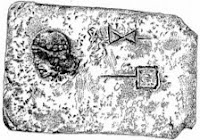
    Quote That the source of tin for the Tin-Bronze revolution came through India is clearly seen in the decipherment of three pure tin ingots with Indus Script insciptions discovered in a shipwreck in Haifa, Israel.

    Tin ore was made into tin ingots by artisans of India and traded the ingots specifying the cargo on Indus Script inscriptions written on the tin ingots.


    Does that qualify? I am not sure.


    I figured out what he means about the Black Obelisk--it is the animals that are Indus Script. Such as one of them being Monkey dressed as a Woman, and another is the Indian Rhinoceros which even the museum said it looked like the artist had never seen a real one.

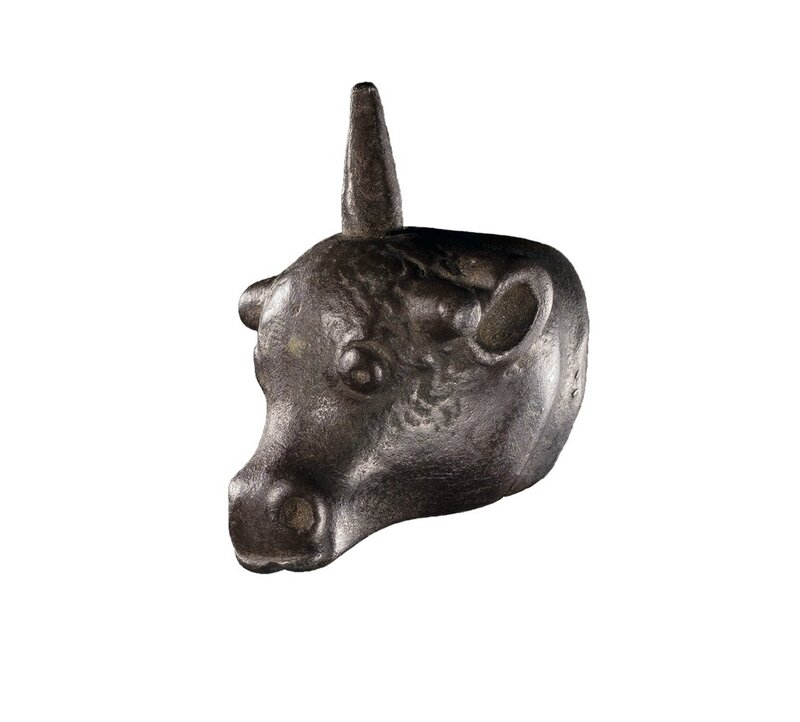
    And so for example the Unicorn:


    The field symbol of young bull with spiny horn and standard device signifies wealth produced by goldsmith, lapidary guild.


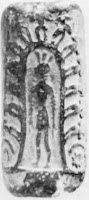
    This is what I called Sabari with a Branch Crown:


    Person wearing a diadem or tall W head-dress standing within an ornamented arch; there are two stars on either side, at the bottom of the arch.


    Old bird:


    Unicorn with Swan?


    Weird:


    As examples of the possible anachronism he is creating:


    I submit that Sign51 reads bichā 'scorpion' PLUS 'ears'; thus bichā kāra 'iron worker' or 'ironsmith'.


    For the "Goat":

    Banawali 9 Field symbolHieroglyph:9204 miṇḍāl 'markhor' (Tōrwālī) meḍho a ram, a sheep (Gujarati)(CDIAL 10120) Rebus: mẽṛhẽt, meḍ 'iron' (Munda.Ho.) PLUS koD 'sprout' rebus: koD 'workshop'.Thus, iron workshop.


    For example, the picture of an elephant or trunk part of the elephantant is signified by the cipher text (picture) Meluhha words karibha, ibha , 'elephant'.

    Similar-sounding words constitute the plain text of Meluhha words -- karba, ib which mean 'iron, ferrite ore'.

    Rhombus or bun ingot oval shape signifies muh 'ingot' mūhā mẽṛhẽt = iron smelted by the Kolhes and formeḍinto an equilateral lump a little pointed at each end


    Well, it is probably correct about Mundas and Kols. But at that age? I believe meteoric iron had been used in Anatolia, but even if it was known in India, I do not think you could have made a guild out of it.


    However he manages to scrape up a term used for instance in RV VI.3.5:

    Archer-like, fain to shoot, he sets his arrow, and whets his splendour like the edge of iron:
    The messenger of night with brilliant pathway, like a tree-roosting bird of rapid pinion.


    What? We just said there was no such thing. But for Ayas:


    1) Ayas (अयस्):—n. iron, metal, [Ṛg-veda] etc.

    2) an iron weapon (as an axe, etc.), [Ṛg-veda vi, 3,5 and 47, 10]


    We might have to argue that is an interpretation, because:


    3) Gold.

    4) A metal in general.


    The dictionary can only reflect someone has suggested it was iron in RV. Line 1 seems to admit it may be generic.

    If we cannot find worked iron at the age of the older IVC seals, I cannot understand how they could possibly be involved.


    For me to get the hang of them, the "Tree" and the "Wheel" seem like the essentials.

  4. The Following 2 Users Say Thank You to shaberon For This Post:

    Bill Ryan (20th December 2023), mountain_jim (21st December 2023)

  5. Link to Post #43
    Costa Rica Avalon Member
    Join Date
    13th February 2021
    Location
    In a Log Cabin in the Mountains
    Language
    English
    Posts
    844
    Thanks
    809
    Thanked 6,866 times in 814 posts

    Default Re: The Indus script, aka the Harappan script, aka the WTH? - Deciphered.

    OK I understand your reluctance, no problem.
    [[On the other side, Bharatkalyan claims to have essentially translated IVC to Sanskrit, except I really don't see any of his reasoning. To his credit, it is a more likely explanation of why IVC seals are in Akkadia and Elam. Trading purposes.]]
    IF the IVC seals translate to Sanskrit, then Bharatkalyan should be able to use the same symbols with Sanskrit as the underlying language to translate the Easter Island symbols, right? But he can't. Not evidence perhaps, just my common sense.

    And he's off with the copper as well. The earliest copper sources were in Anatolia. And the Sumerian word for copper is, wait for it, a borrowed word from the Hurrian, who originated as neighbors of the Sumerians when they both lived in Anatolia. BTW - my evidence of an Anatolian origin has not been published yet and will not meet with scholarly accord at first. But I have tons of it, and all substantiate the fact of their origin in northern central Anatolia and on into the areas of the southern Caucasus range.

    IF, and I say, IF the Sumerians had journeyed to Easter Island, from the Middle East to the Pacific in general I should say, then we would see more of their proto shapes there, and we do not. That means that either the Indus Valley people did journey to the Pacific, bringing their symbols, or another group from somewhere not in those areas introduced it to both of them.

    I'm leaning towards the second option because I don't believe that the Sumerians created their proto symbols either - they share quite a bit in common with the very earliest European symbols. So there was a wash-backwash situation - some knowledge went from (I believe the North Pole) the European area to the Middle East and some went from Anatolia to Eastern Europe - since the Tartara tablets are written in Sumerian, and I have translated them fairly easily.

    And none of the above explains why there was a city, with pillars and columns and great buildings, hidden inside of a very small valley enclosed by high mountains, in the north of Brazil area. And it contained writings which we have a record of, and they resemble none of the above. They do, however, resemble some of the other writings from South America - the ones that our scholars brush under the rug. This is the same lost city of the jungle that the English explorer (Fawcett?) died searching for. In fact, he used the same archival copies from the governmental library in northern Brazil that I have copies of. So yes, there are not one, not two, but several mysterious writing groups and areas, and all of them appear to have been linked at one time. All of them by humans, although perhaps some advanced group. I have never studied the Atlantean lore deeply, but that would be the closest analogy that most would be aware of. Personally I use the DNA and admixture that we have proven, scientifically, forms a part of every European - one part locals, one part from the Russian steppes area and one part form this Northern group. It's easy for me to contemplate a kingdom that sank beneath the waves for two reasons - one they have lots and lots of volcanic activity in the polar region, and two we have the reports from the Anglo-Saxons, Old Norse and Old Welsh writings, which I discovered when I translated (again, and properly) Taliesin the Welsh Druid poet extraordinary.
    So in 530 King Arthur took a journey there to obtain a cure for the plague which was killing his people. He died of the plague and the ones he searched for had gone - only ruins remained, and he describes them in detail.
    Why did he journey to the North polar region? Because he was educated. And the Greek classics from 700s BC are full of stories of groups from that Polar North region visiting Greece, and that they had a cure for the plague. The Greeks wrote this well before the big outbreak of the plague, and some 1000 years before Arthur.

    So the world is not always at it seems, with many connections not laid on the table yet.

  6. The Following 3 Users Say Thank You to Jim_Duyer For This Post:

    Bill Ryan (20th December 2023), mountain_jim (21st December 2023), shaberon (21st December 2023)

  7. Link to Post #44
    United States Avalon Member
    Join Date
    1st April 2016
    Posts
    6,162
    Thanks
    30,380
    Thanked 34,519 times in 5,809 posts

    Default Re: The Indus script, aka the Harappan script, aka the WTH? - Deciphered.

    Quote Posted by Jim_Duyer (here)
    IF the IVC seals translate to Sanskrit, then Bharatkalyan should be able to use the same symbols with Sanskrit as the underlying language to translate the Easter Island symbols, right? But he can't.


    My first inclination is to say there is likely to be a strong difference in northern and southern hemispheres because of the visible stars.

    I would like to see comparative images of the basics and trends of the writings from various areas.

    I tend to use the general terminology "Lemuria" for a time when the lands masses may have been much different and the Pacific region may have been more traversable.

    "Atlantis" was pretty similar to now except for some islands and the Ice Age.

    The possibly real "racial memory" that I can think of is not quite a Great Flood, however, Buddhists say that Manjushri came to Nepal from Wu Tai Shan, and split open Chobhar Gorge. This drained the inland sea out of Kathmandu Valley, making it inhabitable. The Japanese have done a geological analysis on the gorge and determined it was an actual event that took place about 38,000 years ago.

    It is not impossible there was a migration of Mongolians to an "India" that was sparsely inhabited by Australics.

    They may have already known about "Indonesians" and so on.

    The Buddhist belief is shared by the native or Limbuwan shamans.

    In the Ice Age, "Turanian" is a fair enough term for "Central Asian", which is the origin of Indians and Ethiopians. I don't know how large we could say it really was, but, north from the Himalayas for quite some distance is believed to have been a paradise. Nevertheless, MA-1 or Malta Buret boy must somehow be related to Europeans who show variations at a much greater age. Theoretically, before the Ice Age there may have been some accessible worldly commerce and migration. If we consider the Denisovans of some ca. 45,000 years ago in Russia, the strongest carriers of their genetics are in New Guinea.


    We know the following is a Meluhhan Goat--the question is, is it an IVC Goat and if so--is it a Vedic Goat:


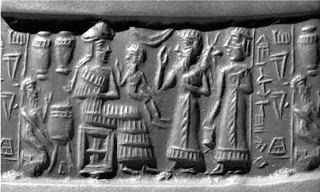
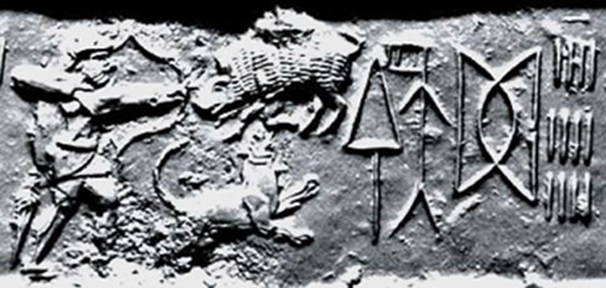
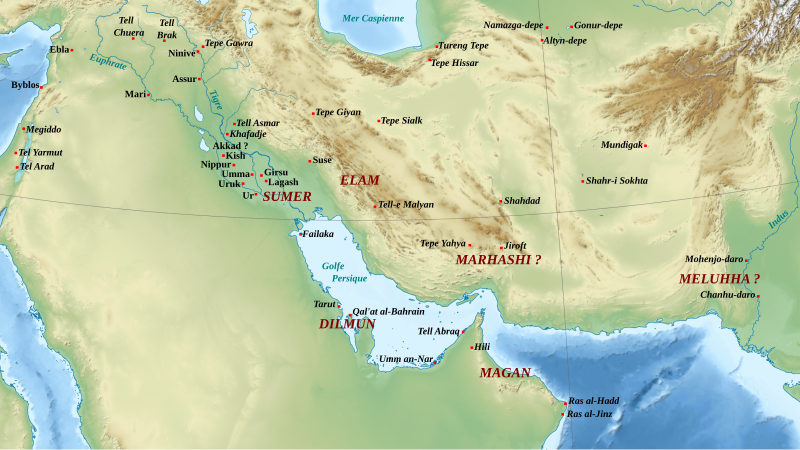
    Glyptique de l'époque d'Akkad, 2340 - 2200 avant J.-C., Louvre Museum.

    Shu-ilishu's Cylinder seal. Courtesy Department des Antiquities Orientales, Musee du Louvre, Paris. The cuneiform text reads: Shu-Ilishu EME.BAL.ME.LUH.HA.KI (interpreter of Meluhha language)


    Quote The Meluhha traders carry hieroglyphs which signify their identities: mlekh 'goat' rebus: milakkhu 'copper'.(Meluhha merchant); ranku 'liquid measure' rebus: ranku 'tin'

    Top register of the cylinder seal shows a crucible and two storage pots.

    That the Meluhhan traders (shown carrying a goat and a liquid measure) are transacting for trade in tin and copper is archaeologically attested by the surprising find that most of the copper of Ancient Near East came from Gujarat and Rajasthan.


    Copper from Gujarat used in Mesopotmia, 3rd millennium BCE, evidenced by lead isotope analyses of tin-bronze objects; report by Begemann F. et al.


    Is this an IVC Fish:


    Formation and evolution of Indus Script writing system is related to metalwork trade as seen from the archaeologically attested Susa pot containing metalwork equipment, weapons,metalware and tools.


    Context for use of ‘fish’ glyph. This photograph of a fish and the ‘fish’ glyph on Susa pot are comparable to the ‘fish’ glyph on Indus inscriptions. Fish hieroglyph: aya 'fish' rebus: ayas 'alloy metal'.


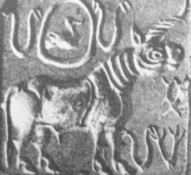
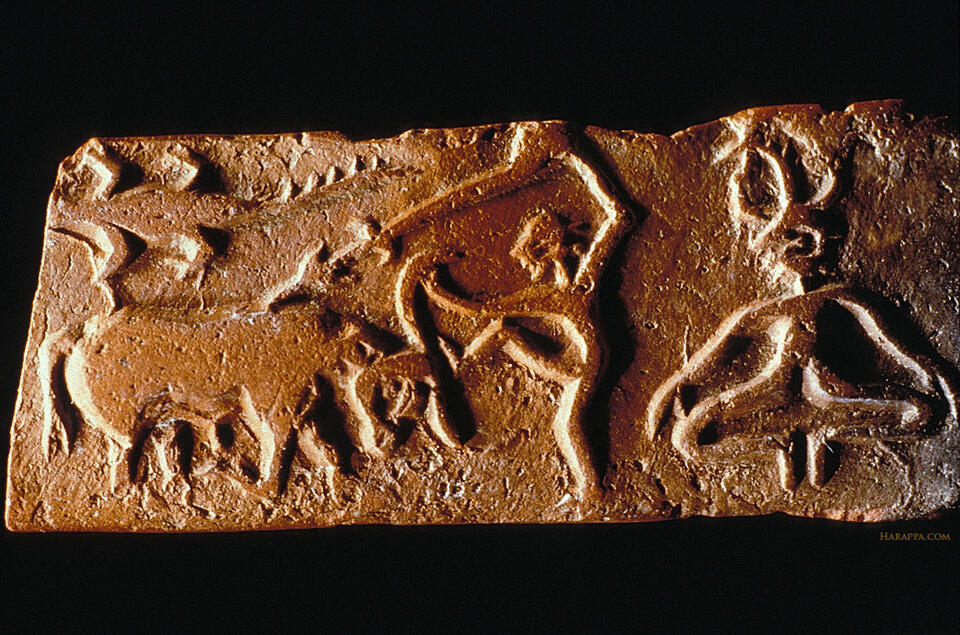
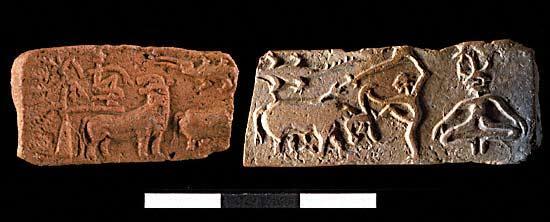
    When it comes to the Black Obelisk something weird is going on. The writings tell all the campaigns of Shalmaneser III, but only a few of them were selected as pictoral scenes. Most of the kings are offering tribute such as precious metal, weapons, chariots, but the King of Musri offers animals. At IVC there is a realistic Rhinoceros and so the case in point is already famous with Unicorn Hunters:


    Unicorn and "Tree" with Fruit:


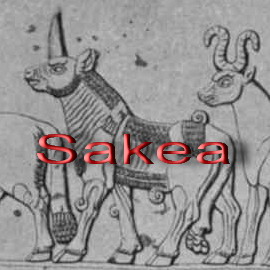
    Quote # Camels whose backs are doubled [i.e. Bactrian Camels as distinct from Arabian camels that have only one hump], a river ox [hippopotamus], a sakea, a susu [antelope], elephants, baz'u [and] uqupu [monkeys], I received from him.#
    The sakea is interpreted as a rhinoceros but it does not look like one and almost certainly is not one...

    There is no "Hippopotamus" such as in Musri = Egypt if the more likely candidate is Buffalo.

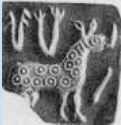
    It is not an IVC Antelope, has branched horns.

    If Musri = Iraqi Kurdistan, I am not sure why they might use the meanings of a system that perished a thousand years previous. The scene is not about traders, it is said to be actual gifts from this person.

    The tone of this thing is much more serious about the king who followed Elijah:


    Quote Jehu is famous in the Bible for bringing the dynasty of Ahab to an end. 2 Kings 9 tells how Jehu, one of the commanders of the Israelite army, was anointed by a servant of the prophet Elisha as king of Israel. Jehu proceeded to assassinate both Joram, king of Israel, and Ahaziah, king of Judah — a son and a grandson of Ahab, respectively — and then to wipe out most of the remaining family of Ahab.

    Jehu went on to initiate his own dynasty, and four generations of kings of Israel were descended from him. It was under these auspices that Jehu, in 841 BC, took a tribute to the Assyrian king, Shalmaneser III (who reigned from 858 to 824 BC). Shalmaneser had been campaigning to the north of Israel against King Hazael of Aram-Damascus, and Jehu was undoubtedly attempting to keep Shalmaneser from attacking Israel. This event is not mentioned in the Bible, but its relevance for Shalmaneser’s royal ideology is evident in the fact that he not only mentioned it in his inscriptions, but he portrayed it on a monument called the Black Obelisk.

    And it is the first known mention in his thirty conquests:


    I descended upon Parsua. I received the tribute of the kings of Parsua. I captured the rest of Parsua, who were not loyal to Assur; I captured their cities; I carried off their spoil and property to Assyria.


    The whole thing is completely violent.

    As to why the IVC Unicorn may resemble the others, I have no idea.

    The significance of the Jar is that it seems to be used for everything. So I can understand why he might guess the most common glyph has this meaning.

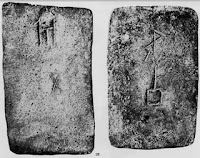
    Here it is as a single stamp from Daimabad:


    This Sign 342 on Indus Script inscriptions (over 8000 inscriptions have been found so far, dated from ca. 3300 BCE) signifies authentication of cargo maritime trade transaction by the writer, scribe.


    Here is a chart of human figures:


    He offers this suggestion:

    Gadd seal 1, Ur. Water-carrier pictorial motif which evolves as Sign 12 of Indus Script.


    and they make this combination:


    It seems to me indisputable that the primary meaning must come from the Goat.

    That is, if Meluhha is equivalent to IVC or at least a portion of it, approximately Balochistan.

  8. The Following 2 Users Say Thank You to shaberon For This Post:

    Bill Ryan (21st December 2023), mountain_jim (21st December 2023)

  9. Link to Post #45
    United States Avalon Member
    Join Date
    1st April 2016
    Posts
    6,162
    Thanks
    30,380
    Thanked 34,519 times in 5,809 posts

    Default Re: The Indus script, aka the Harappan script, aka the WTH? - Deciphered.

    Continuing to dredge the theses that have been applied to the IVC Seals, here is the idea that the ubiquitous "Tree" or "Jar" is actually a:


    Bull


    for which the term is "Uksha".

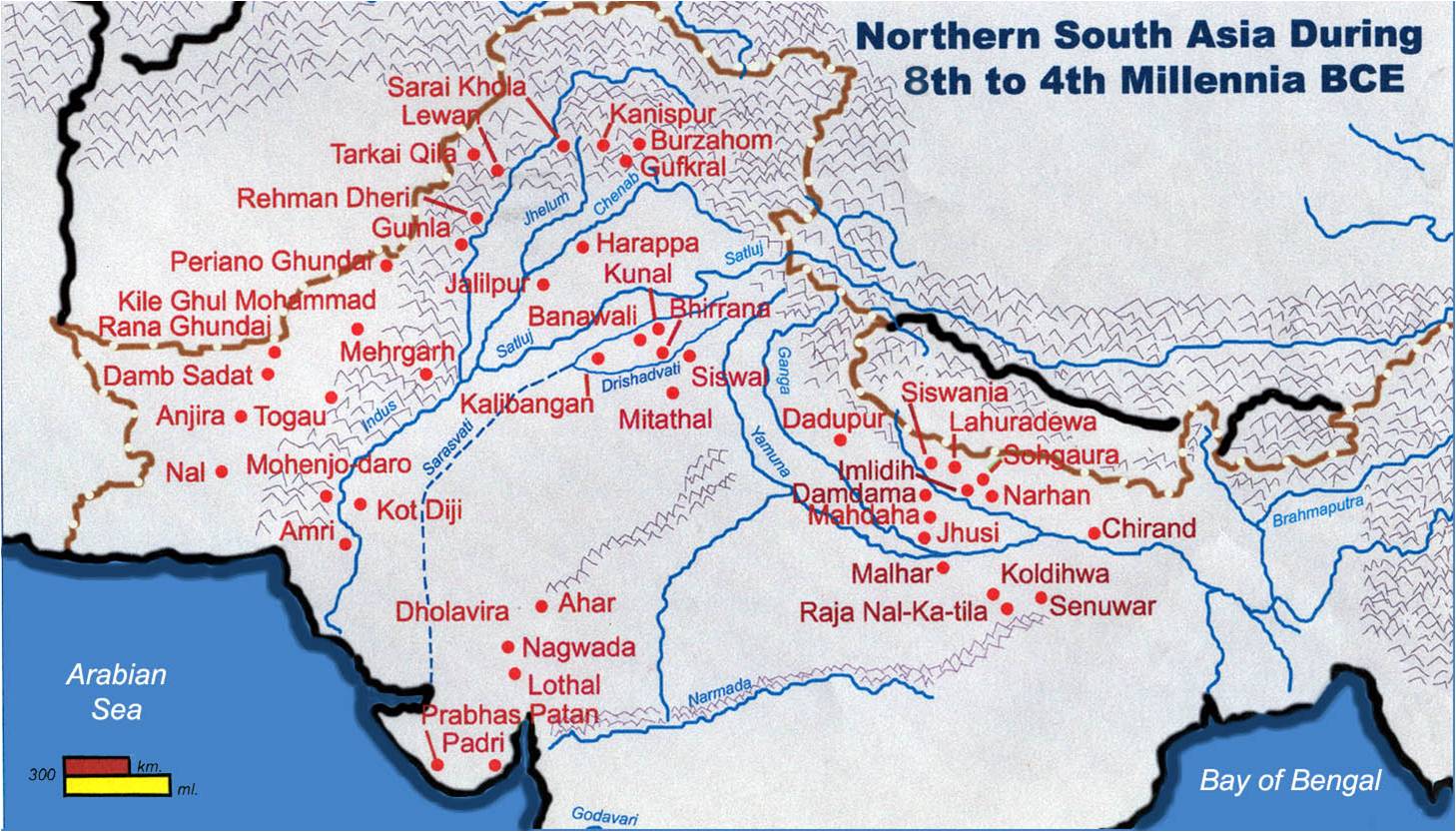
    That is from Ranajit Pal, who refutes several of Witzel's points, and lands in the zone that the main battle in Rg Veda was around 1,800 B. C. E.. So far, to me at least, this seems reasonable or most likely, or it cannot be shifted very far in either direction. Of course, this means it is mixed with the ending of IVC--whatever that actually is.


    He is trying to adapt to Rakhigarhi primacy:


    Quote This paper suggests that Magadha included Patna but its early center was the Rakhigarhi area. Kikata appears to be related to a bird-type Harappan symbol that seems to designate the chicken and may be read as „Kika‟. In the Rigveda, Pramaganda of Kikata is placed near Kurukshetra. He appears to be the same as king Gandhara of the Puranas.


    Quote Rakhigarhi was older, and probably also larger than Mohenjo Daro, and seems to have been culturally distinct. There was cultural continuity from early Harappan period to mature Harappan, though not up to the late Harappan phase. As G.Possehl writes, the early use of baked bricks at Rakhigarhi is distinctive and graffiti signs found here may be the harbingers of the Harappan writing system.

    So you have a Vedic Kikata, which was almost certainly in the northwest, and then a later use of the name for the area around Patna, Bihar. A few of his points:


    The glyph resembling "X" was taken as Mitra/Mithra in Persia, which may be related to the Indian meaning.


    Quote One aspect of the so-called ‘facelessness’ is that the ancient name of the Rakhigarhi area (and of other Harappan regions) is unknown.

    The boundary of Magadha kept shifting over the centuries; the Rigveda mentions Kikata, not Magadha, which appears to be an adjacent territory.

    In the Atharvaveda, fever is wished away to the lands of the Gandharis, Mujavants, Angas and Magadhas. As the first two people were North westerners it is unlikely that Magadha of this Veda was Bihar.

    The discrepancy is still contained in definitions of Kikata:


    1c) —(c)—the land in which the Buddha was born; its people became purified by their devotion to Hari; noted for the sacred Gayā and the garden park rājagṛha, also for the āśrama of Cyavana. Other sacred spots fit for śrāddha offerings were Vaikuṇṭha, Lohadaṇḍa, Gṛdhrakūṭā and Śoṇaka.

    Kīkaṭa (कीकट).—The name of this people occurs only in one passage of the Rigveda, where they appear as hostile to the singer and as under the leadership of Pramaganda.


    and it is found in Yoga Vasistha in the section for Speech of Crow and Cuckoo:


    Quote It is well when the cunning consort with the cunning, as the crow and the crab meeting at a pool; or the rook and the owl joining in an arbour; for the two rogues though seemingly familiar, will not fail to foil one another by their natural enmity (ka ko lu kika).

    The cuckoo associating with the crow, and resembling him in figure and colour; is distinguished by his sweet notes from the other; as the learned man makes himself known by his speech in the society of the ignorant.


    Pal suggests a combined or multiplex use of the IVC glyphs:


    While some of the seals were of commercial nature, many others had an archival role. The seals appear to be logographic although there may have been a phonetic tendency later.


    Quote ...has been read as the votive formula ‘Mahakal Dvaŝa Uksha’ which is linked to the great Mahakal temple of Mohenjo Daro (the great Bath). Mahakal (Mekal) was a highly respected world deity .


    Quote ...appears in seal no 2396 00 and may be read as Maha Sapta Dvara. Saptadvara may be linked to names such as Bodhisatta, Mahasatta etc. The term Mahasattva may not be limited to Buddism.

    In the Aitareya Aranyaka, people of Vanga and Magadha (Vagadha) are likened to birds and chided for having no proper religion. This leads one to suspect that Kikata-Magadha, may have been associated with the bird symbol. Kikata echoes the Sanskrit term ‘Kukkuta’ for chicken which is believed to have been first domesticated in the Indus-Saraswati Valley and is a unique contribution of India-Pakistan to world culture.

    It must have had a special significance and it is natural to expect its symbol in the seal archive. The root of the word chicken may be ‘Kika’ which corresponds to German ‘Kϋken’, English ‘cock’ and ‘Kukkutah’.


    Note that the ziggurat of Elam is *prior* to the ziggurat of Ur. Conjecturally, it is similar to the Indian Stupa.


    Quote ...occurs in several seals and seems to be an important name of the Indus-Saraswati era. If the bird symbol is read as
    ‘Kika’ the symbol pair becomes Kika-Ketu or Kukkutah. The second symbol (from the right) is a depiction of a flag ‘ketu’, which has an administrative and geographical significance. Ketumala was a country-name and the site-name Katelai echoes the Tamil Kotiayi. J. E. Mitchiner rightly asserts that the seals ‘contain the names of towns and regions, both within and beyond the
    Indus Valley’.

    In later linguistics:


    Quote Panini (5th century BC?) mentioned the Damanavadi Sangha about which almost nothing is known. The present writer has suggested that the ubiquitous Sudda Yauda Damana of the authentic Persepolis Fortification tablets, (also known as Sudda Yauda Saramana) was Suddhodana, the father of Gautama Buddha.

    Sedda Saramana of the tablets appears to have been Siddhartha Gautama.


    Of greater importance may be the Persepolis tablet No PF 79 which belonged to Sedda Saramana. Garrison and Root note that PFS 79 always occurs alone in the tablets that it seals which shows that it belonged to a very important functionary. The five-pointed dentate crown of the hero of PFS 79 may remind one of the Panchalas. It was worn by Darius-I himself and only three other vassal kings.


    Quote The bird-headed winged lion creatures
    that the hero holds may be significant.

    Similar to the Hero and Tigers in IVC.

    Is Darius "taking" a Bactrian bird, or "defeating" it?

    Are those the Simorgh or Griffon?


    In a general overview:


    Quote There was considerable socio-cultural diversity in the Harappan era; the rulers were
    not all ‘Deva’s or ‘Sura’s. A striking feature of Rakhigarhi was that here the roads did not follow the square grid pattern typical of many cities but radiated from a central zone. This may illustrate one cultural difference between the Devas and the Danavas. A mature Harappan era cemetery has been found at Rakhigarhi having eight interments. The grave pits were often brick-lined, with one wooden coffin as in H-37 Cemetery at Harappa. This cemetery is of great importance in DNA studies as few human remains from the mature Harappan period have been found. B. B. Lal writes about the ethnic diversity;

    The Indus population, particularly of the cities, was a cosmopolitan one. It included Mediterraneans, Proto-Australoids, Alpines, and Mongoloids. In keeping with such a mixed population, there was a wide variety of religious practices.


    Many sites of the Indus-Saŝaswati era had ‘Daro’ name-endings. In Akkadian language ‘Duru’ means ‘fortified city’. This suggests that the root of the term Druhyu may be Duru. The Druhyus are mentioned in many passages of the Rigveda; they are often mentioned together with the Yadus, Turvasas, Anus and Purus suggesting that these are the famous five peoples of the Rigveda. The Druhyu king and his allies were defeated by king Sudas in the famous ‘Ten kings battle’.

    King Mandhatr is said to have driven the Druhyu king Angara out of the Punjab. Pargiter wrote that the next Druhyu king, Gandhara went to the Northwest and settled there. They have been criticized in many texts but a proper study reveals that they played a crucial role in the 2nd millennium BC. M. Witzel wrongly considers the Druhyus to be akin to the aboriginal Dasas and Dasyus and overlooks that they correspond to the Derusiaeans of Herodotus who, in the 6th century BC were the subjects of king Kurash (Cyrus).


    Why exactly Visvamitra,once the chief priest of Sudas, became his great enemy is not clear. Sudas and Visvamitra had previously conquered two minor native kingdoms and then Sudas started planning to subjugate the entire land west of the Parusni (Ravi). At this stage he sacked Visvamitra and appointed Vasishtha as the chief priest. Visvamitra led the alliance of ten kings against Sudas and lost. One of the losers, not mentioned in the main hymns was Pramaganda of Kikata. He was a wealthy ruler. RV 3.53.14 runs as follows:


    Among the Kikatas what do thy cattle? They pour no milky draught, they heat no caldron. Bring thou to us the wealth of Pramaganda; give up to us, O Maghavan, the low−born.


    The name Pramaganda is usually split as Pra-Maganda and Maganda is likened to Magadha
    but as the Sanskrit teŝm ‘Pramatha’ means ‘smiter’ an alternative approach may be to split it
    as Prama-Ganda. This does not lead to any inconsistency as Ganda resembles Gandhara, the name of the famous Druhyu King. Sudas had defeated the Druhyus.

    Thus king Gandhara of the Puranas may be the same as the Rigvedic Pramaganda of Kikata/Magadha. Witzel blindly accepts the Jonesean notion of Kikata to be a region of Bihar and mocks at Talagheri’s reference to Pramaganda of Magadha as the hymn in question, RV 3.53.14, speaks of Kurukshetra and surroundings.


    Rakhigarhi was ‘the easternmost capital of the Harappan civilization’ where Pramaganda was active although he may have been a great king whose area of operation was much wider and included Gandhara. The Druhyus are said to have perished in the waters which may be a metaphorical way of saying that they left India in boats. Pramaganda is given the mysterious epithet ‘naichasakha’ which may have the sense of ‘low-born’. It is interesting that Sargon the great, Nabo-Na’id and the Nanda kings
    are also said to be ‘low born’.

    A couple of his other articles:


    Narayana and Lakshmi in the Dholavira Signboard

    Bharata War


    And his case for the hump-backed Zebu:


    Magadha which is a synonym of the Sanskrit term Maha Uksha. This is the parent word of Melukkha which designated the Harappan cities.


    The inscription can be read straightaway as Tri-Śiva which echoes Teshub of the Hittites.

    The name Teshub links Sanskrit to the deepest layers of pre-history.


    The term Magadha (Mah-Gud in Sumerian) stands for the ‘great bull’ and its Sanskrit counterpart, ‘Maha Uksha’ is the parent word for Melukkha - a name of the Indus-Saraswati cities. Thus at some stage, Magadha may have had a similar connotation.


    From another paper on X, Phoenicians as Vedic Panis, and for the Kassites:


    They worshiped the Vedic gods Indash, Suryash and Maruttash.
    Their first king Gandash seems to be Pramaganda of the Rigveda
    (iii. 53, 14).


    The ornate leaf symbol has the frequency of 42 and the triple strokes and horn at its top(as in the Vŗş symbol) reminds one of
    Soma who was concieved as a white bull.


    He thinks the underlying language was something like "Sumerian Akkadian Dravidian Sanskrit". Numerous examples of his Sanskrit interpretations.


    Unfortunately, this leads him to the conclusion that what we know of Buddhism is a Nepalese Forgery:


    The primacy of the North-west is shown by that the great Asoka was Diodotus-I of Bactria.


    I don't think we attempted to say that Nepal was an ancient, teeming metropolis, of course it is not going to rival IVC with seals and commercial artifacts. We can say that its Kiratic kings appear to be fallout from the Rg Veda, and Buddhism derives from a commentary by a single person, it is not a comprehensive review of multiple semi-related cultures. If anything, Ashoka was a recipient, an absorber, who promoted it to the national and international level. He did not get it from Nepal; I think it may have been Orissa. Every time someone turns to this "northwest primacy", they have overlooked Orissa, which obliterates pre-Ashokan Buddhism which had already made the Amaravati Stupa.

    Buddhism and Jainism both originated in Bihar because the founders realized it was a suitable area for rice-begging; it had surplus. Therefor, the Sramana or wandering mendicant lifestyle was both possible and not a burden to the inhabitants. And again, you cannot really use ca. 500 B. C. E. as a root explanation for something two thousand years older.


    Just because he may enter a few blind alleys, "Bull" is still a reasonable contender for the glyph. In parallel, the OIT from Punjeet Gupta is Astrological.


    He says the "Shiva Pasupati" is Dattatreya and:


    Goddess with two tigers and two sugarcane plants Adi Mata Tripura Sundari or Ma Lalitha is strongly associated with Adi Avadhoot sect and tradition is still alive in Nepal and all over North and South India.


    Avadhut = Dattatreya, and, the archaic names for Lalita may be Hingula or Renuka. These all push the Rg Veda envelope, by not being actually mentioned in it, but, fairly reliably being jammed back in time and space that they probably were non-Aryan local divinities of some kind.

    This guy references an IVC specimen found in Mesopotamia as a star chart or astrological legend:


    Mrig-Sheera Nakshatra; Tiger as Mula Nakshatra; Buffalo the vehicle for deity of Deathlike poisonous snake as Vasuki of Rudra; Garud represent the Vishnu and Rhinoceros as the immortal domain.


    Quote God is nothing but a spiritually enlightened form of human being.


    These Vedic celestial track depicting various deities related to 1) trinity of mortal world (three males; Brahma, Rudr, Mahesh; & related female counterparts of Sharda, Sati, and Vaishnavi respectively) as well as 2) one male and one female representative of
    Divine immortal world.

    Yogi is shown in the seal; sitting on a swing with traditional sitting platorm (chauki); hanging with help of two strands (symbolic of space travel during Samadhi). The Yogi is adorned with blended headgear of Adi Dev (primordial God) having power to manifest all six deities (compact power, Advait, Bindu, owner of all, master power of everything in cosmos) of Indian pantheon
    (Brahma, Rudr,Vishnu; Saraswati, Sati and Vaishnavi). This conglomerated form is called AdiNarayan/ Adi Purush and Adi Narayani/ Adi Ma/ Amma in Vedic and related later Indian sects.


    Another thing we may observe is cattle used as food in IVC and the Vedas; at some later point, it was established that you may not kill them at all. There is nothing particularly vegetarian about the older societies. Later Dharmic development may very well suggest "limiting" the use of meat, but I am not sure it is "strictly prohibited" by anything from scripture.

    This Astrological study has not really uplifted "Bull" in any remarkable way, such as we might find by rolling back to the Age of Taurus.


    What catches our attention there is, for instance, the ancient temple of Aswan, Egypt, is aligned with Spica (Alpha Virginis, or the wheat or rice stalk held in her hand). This is observational, and, of course, it would take centuries for anyone to realize something was amiss. In the west, this results in the "magic equinox" being "fixed in time" so that the physical stars rotate around it. In India, it is simply that Spica is "fixed" and determines the new year inversely:


    Quote The starting point for the nakshatras according to Vedas is "Krittika" (it has been argued because the Pleiades may have started the year at the time the Vedas were compiled, presumably at the vernal equinox), but, in more recent compilations, the start of the nakshatras list is the point on the ecliptic directly opposite to the star Spica called Chitrā in Sanskrit, which would be Ashwinī, a part of the modern constellation Aries, and these compilations therefore may have been compiled during the centuries when the sun was passing through the area of the constellation Aries at the time of the vernal equinox.

    So, yes, when the Krttika-Pleiades no longer marked the equinox, then a concrete definition was imposed, which disregards equinoxes. You just watch the stars in their actual courses. If the timing of the seasons becomes inconvenient, you make a correction by adding extra days to the year.

    Reasonably, the Age of Aries means marking the year by the region opposite Spica (one of the more powerful stars).

    Comparatively, the Persian Royal Stars would have already been obsolete by the time of their first mention--Aldebaran in Taurus had not marked the vernal equinox for over a thousand years.


    Since they are recorded after 1,000 B. C. E., there is a decent case for them matching the Creatures of Ezekiel:


    Quote William D. Mounce noted a belief that the living creatures may have been associated with the four principal (or fixed) signs of the zodiac (Taurus, Leo, Scorpio, and Aquarius), but other scholars have doubted this interpretation.

    "Michael is the 'lion-headed', Raphael the "human-headed", Uriel the "bull-headed", and Gabriel the "eagle-headed".


    "Eagle" = Aquila = Aquarius, while the Scorpion and Man are interchangeable.

    Uriel, Tauriel, Bull El, appears to be the main Canaanite deity.


    I have long been of the opinion that it is this group which shows the old understanding between east and west.

    Originally, the Bull would have shown its primacy, and then in the Age of Aries you would have been shocked and flabbergasted and forced to figure out what was happening.

    I have no reason to suspect that anyone previously said the equinox had been marked by Gemini or any other star.

    Whereas the very beginning of any of these ancient writing systems features a Bull, and, Aswan is among the first of any temples of this kind.

    This makes the traditional Krishna's Death Chart very cool, but, I am going to disallow it because it is the arbitrary declaration of a 500s astronomy text. Yes--it is a good text in that its methods are accurate within about a 24-48 hours of what we can get from a computer today, but that does not mean that using this calculation for a historical event is correct.


    If we think of major historical bounds then there was an Ice Age, which mostly went out something like 8,000 B. C. E., and then even if it was not quite planet-wide, there was an era of Great Drought ca. 2,200-1,900 B. C. E., which is believed to have played a significant role in eradicating the IVC as well as the original civilizations in China, Mesopotamia, and Egypt.

    At this same point we discovered the arising of an Eagle from an Iranian and/or mixed northwestern source, which seems to totally change the production of IVC Seals, and then there are the battles of the Rg Veda which seem to be fairly specifically against this. There is some intrigue about its own Sages switching sides, but then if we consider that area then we find Avestan and Zoroaster must have this as background.

    By using the term "scripture" for Sanskrit, this has a very precise meaning. It is simply uncanny that the same Rg Veda is identical everywhere in India. As the IVC glyphs appear mostly unchanged for 700 years, the Veda as a spoken transmission did the same until was eventually compiled by Veda Vyasa. However the older commentaries inform us there were *two* Atharva Vedas. The one kept in India is Angiras Atharva Veda, or Atharvangiras.

    The other one that has no attested copies is Bhrgu Atharva Veda. And so from the Vedic view, we have reason to believe that Sages of the Bhrgu line having the dominant view of deity Varuna went northwest and mixed with the Eagle, so to speak. Although Zoroaster is a Fire Philosophy, one of the differences I have found is that its flame is supposed to be "clean", whereas the Indian version is about "offerings", meaning you throw stuff in it.

    I don't like the translation "sacrifice" because that sounds like you are going to stick a knife in something, or else, destroy something of considerable actual value.


    My personal interest has an attached value judgment, which could perhaps broadly be classed as "Yogacara" which allows for pre-Buddhist origin, such as for example the very beginning of Yajnawalkya's Brhadaranyaka Upanishad is about Symbolic Sacrifice. Buddhism is like a fine-tuning of this as summarized in the expression "You do not understand Samadhi", as would at least be depicted in the Astrological thesis of IVC.

    "Yoga" might be a way of saying something like "realizing the Vedas", because they haven't got a subject, they aren't about anything. There is no "story". Sometimes there are "scenes", such as the performance of a battle, which is why putting together the whole package of everything that happened takes a bit of work.

    One exception is Pururavas and Urvashi, which is the oldest love story in Sanskrit, maybe in the world.

    Well, as soon as you understand the material to be cumulative, then what is strange is that this story is found in the last or newest book (i. e., has nearly Paninian format), but the event must have taken place prior to the first/oldest book.


    There is a similarity to "Rudra" (noisy, crying) if Pururavas is a combination meaning:


    Man of Many Cries

    or

    Mind of Many Cries


    Pururavas is semi-Adamic, except, again, we do not think he is quite incarnate because Urvashi is a Nymph.

    "This" or "he" is ancestral to one of the Vedic kings, and so it must be completely subjective, because there is no way it even suggests a "first man" like a progenitor. It can only be "accepted" as a paramount figure in a spiritual lineage.


    The implication, to me at least, is that the story must have existed in prose form until it was eulogized.

    So the Veda, itself, isn't quite "about" anything, but I would argue that the commentarial explanation as well as yoga are indicated by the expression "Atharvan". It's not a job you can be assigned, like you might be given a job to memorize Riks or Samas and that would be what you did and why the recording is good. "Atharvan" is the chief source of inspiration because it is also the realization. During a period of time, it was possible to become a Sage, which we say means trance possession by Agni. In that state you are able to utter divine hymns. You do not make them, it flows from the deity. That is what the Vedas are "about" or what one is trying to "do".

    Then, if we say the period of Sages "ended", we are no longer at a point where we might need to add to the 1,000+ Hymns of Rg Veda. And so Yoga continues as something like the "manner of Atharva Veda", which is the personal, portable version. The "rites" were intended for a Householder or Priest. Yoga is inherently unorthodox while simultaneously utilizing "Atharvangiras".


    The non-scriptural Hingula Mata is unusually pivotal in the turn of events, because, firstly, she requires the Warriors to become Weavers, and sends them to Gujarat, which appears to be what IVC as a whole did when the early sites collapsed.

    I thought she must be an important Cinnabar Mine, but, no, she is the Tika Mark of Sati herself.

    What that means is that concerning any of the Indian Sati Pitha systems, she is the first one, the top of the head, the Head Chakra of India so to speak.

    The view of Bull and Astrology is perhaps summarized as:


    for the side-by-side "Pasupatis":

    1) Mohenjo-Daro seal m-1181 of Avadhoot mantra 2) Mehrgarh seal(Avadhoot audience by Avatar Parashurama)


    Quote The Avadhoot and celestial pathway of spiritual liberaton (moksha) is depicted by individual animals like that in Mohenjo-Daro seal of Avadhoot with different animals (whereas a composite animal is a mix-up of many animals) that make celestial Vedic Nakshatras of Mrig-shira ( deer); Adra (human face); Mula (tigerpaws); Purv-ashadha (elephant) and Indian trinity; Vishnu (Garud); Yama (Buffalo); Rudra (snake Vasuki); Narayan Dham the domain of immortality(Rhinoceros).This celestial knowledge (ancient humankind's astronomy) was then made available for use and modification to Sumerians, Greeks, and Romans. Thus, the sacred celestial path (Samadhi Moksh Marg of Kriya Yog) knowledge was sent out of ancient Harrapan India to the humankind and laid the foundation of future astronomy, astrology, space travel, sea travel and maritime activity using astronomy.

    That's deep, it says the IVC is showing a non-Vedic character speaking to Parasurama, which closely physically matches what we just said about Hingula Mata.


    He says of the Goolar or Audumbara Tree:


    Related with Adi Yogi Avadhoot tradition in general and not with a single individual;


    If this is at all correct, it would suggest the Yoga or Dattatreya explanation--which relies on at least some of the Vedic mythos--is older than some of the events or presumed compositions in the Vedas. That is not impossible, if the hymns are similarly speaking to an audience that was already familiar with the content.

    Are those the main characters of the seals? Avadhoot and Shakti?

    Being conservative, I can't say that they *are* what is in there. If one is to say "the seal is the mantra" this should be clarified.
    Last edited by shaberon; 22nd December 2023 at 07:00.

  10. The Following 2 Users Say Thank You to shaberon For This Post:

    Bill Ryan (22nd December 2023), mountain_jim (27th December 2023)

  11. Link to Post #46
    United States Avalon Member
    Join Date
    1st April 2016
    Posts
    6,162
    Thanks
    30,380
    Thanked 34,519 times in 5,809 posts

    Default Re: The Indus script, aka the Harappan script, aka the WTH? - Deciphered.

    So far, the interesting exterior evidence is, I think, the Meluhha Merchants on the Akkadian seal. IVC hasn't got pictures of Merchants. And so the scene is basically Akkadian style except it looks like a stylistic choice to copy an IVC Goat.

    In that case it would be an Animal Hieroglyph.

    I can understand Shalmaneser III perhaps liking the Unicorn with no idea where it came from, but it looks to me like the Akkadian was using the Hieroglyph.


    Although a Bull is another obvious IVC picture, it may also have a glyph.

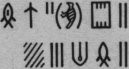
    Suggestions for the most common glyph and its suggested usage have been:


    Tree -- Agricultural Magic

    Rim-of-Jar: scribal receipt on mercantilism

    Bull -- Astrological Yoga


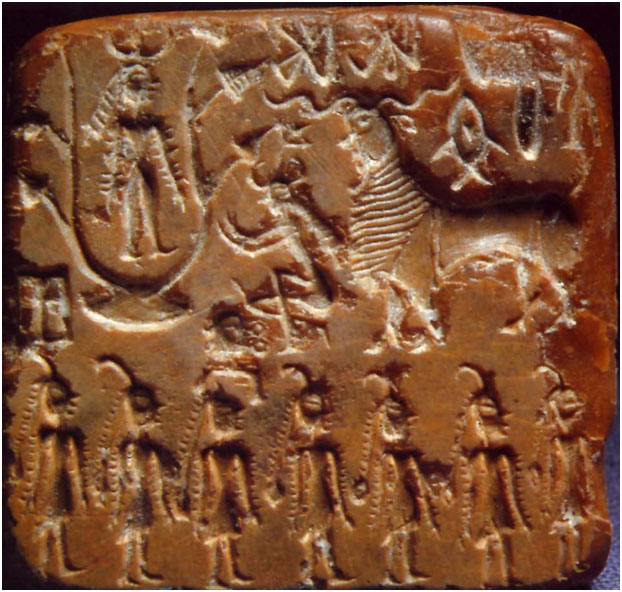
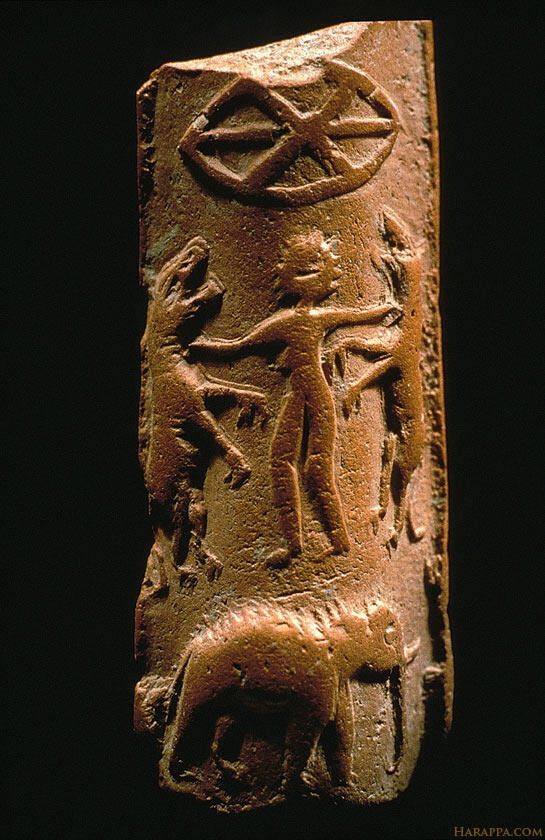
    In the last cluster of pictures posted, we find a pair of Bulls surrounding a ring or sphere. Above is a character with branched horns unknown from the art, holding two snakes. Author takes this to be Rudra and Vasuki.


    The next line I thought was very telling because it shows some kind of main character in one case with the common glyph. Here, he also has two attendants. Author claims one to be Parasurama and the character to be Dattatreya. Character is most famous for the cluster of individual animals which may be a star chart around Orion, or they may represent guilds, or are mythological symbols.

    Parasurama is not really an avatar due to the avatar idea not being present in the Vedas.


    I am trying to neither assume nor deny the seals are Sanskrit.

    It cannot quite be avoided to examine the Indian lore that was most likely in place by ca. 1,500 B. C. E. when the use of IVC seals expired. This may only be the Rg Veda, Atharva Veda, and, debatably, parts of Ramayana, but that is already a lot of stuff. Most of the basis can be retro-fitted to around 2,000 B. C. E., and then we cannot be sure how much older the language may be. There is nothing in the Rg Veda before its own beginning, it has no ancient kingdoms, prior prophets, or anything like this. It goes about as far as perhaps referring to the grandparents of its active characters. So, we are nearly forced to conclude that a recognizable portion of the language and lore must have been in use at the same time as the height of the use of seals.

    This will be more about what that is, rather than posting seals.

    Seeing the common glyph combines with what appears to be someone's head, then, Man with Bull Head is a little more familiar than Tree Head or Jar Head. However I would not be surprised if these things did not have at least a dual meaning. There is a way to say "best one". Like if I say "Best Mare" it immediately means Samjna, unless I am prepared to argue why one is better than her. So the glyph might mean "best" and when the category is animals, means a bull, when plants, a or some kind of tree; it might be flexible. Especially if there are not that many glyphs.


    I bumped in to a vocabulary builder from the "Astrological thesis".


    Reconsidering old translations, from the previous page there was Wilson for VI.27.7:

    bright prancing horses


    where instead I quoted Griffiths on Meluhha:

    two red Steers


    for the original:

    gā́vāv aruṣā́


    Which is aruna, "rosy color of dawn" and a plural of "gau".

    It is so obviously not "horses", that is dejectionable.

    The term I expect for "Bull" is "Vrsabha"--and so it was informative to see "Uksha", which in the oldest books is correct for VI.64.5 and VII.79.1 as the "oxen" of Ushas (Dawn).

    These have the senses:


    oxen (wealth to your worshippers)

    she has shed light with her lustrous oxen


    It is also found in VII.83.11, Agni "eater of oxen" or rather "having oxen as food".


    One may almost suspect the etymologies:

    go --> cow

    uksha --> ox

    And finally here we find it in a very syncretic sense in the late book X.31.8:


    naitāvad enā paro anyad asty ukṣā sa dyāvāpṛthivī bibharti | tvacam pavitraṃ kṛṇuta svadhāvān yad īṃ sūryaṃ na harito vahanti ||


    “Not such (is their power); there is another greater than they; the creator, he sustains heaven and earth; possessed of might, he makes a pure skin, before his horses bear it to the sun.”


    Sayana says:


    ...the creator: ukṣa = liṭ, the bull, the sprinkler of seed, i.e., the creator of people, hiraṇyagarbha; extremely subtle, in the form of wind, consisting of the liṅga (i.e., the subtle body that accompanies the soul in its migration, not being destroyed at death, when the outer gross body is destroyed) entering the waters supports heaven and earth; before his horses bear it to the sun: i.e., before creation; the creator took upon himself a bodily form, before creating other forms.


    E. ukṣ to wet


    So it also has the meaning "to sprinkle", subsequently, "to consecrate".

    Sayana has just said Uksha the Bull is Hiranyagarbha, the Mundane Egg.

    Yes, it is a late Puranic-type comment being applied to the much older Veda--is it more explanatory, or a mistake or sectarian split?


    Let's see. The hymn appears to have an antiquated author:


    Ṛṣi (sage/seer): kavaṣa ailūṣaḥ [kavaṣa ailūṣa];
    Devatā (deity/subject-matter): viśvedevā

    Name of a Ṛiṣi (kavaṣa ailūṣa); Ṛgveda 7.18.12.

    Name of a Ṛṣi (son of Ilūṣa by a slave girl, and author of several hymns in the tenth Maṇḍala of the Ṛg-veda; when the Ṛṣis were performing a sacrifice on the banks of the Sarasvatī he was expelled as an impostor and as unworthy to drink of the water, being the son of a slave; it was only when the gods had shown him special favour that he was readmitted to their society), [Ṛg-veda vii, 18, 12; Aitareya-brāhmaṇa ii, 19]


    In other words, it looks like the same Kavasa in Books Seven and Ten, which is not unworkable.


    Many of the hymns are "split", or change subject or addressee. Shortly before the appearance of "uksha", there is:

    Aryaman, giver of cattle in Verse Four.

    Five:

    “May this (our praise) be accessible like the earth at dawn, when the glorious (gods) assemble in their might; may the Vājas, the dispensers of happiness, come to us, soliciting the laudation of this (their) adorer.”


    The "dispensers" (?):


    Vāja (वाज).—A son of Sudhanvā, whose father was Aṅgiras. It is mentioned in Ṛgveda, Maṇḍala 1, Aṣṭaka, 1, Sūkta 111, that Sudhanvā had three sons named Ṛbhu, Vibhvan and Vāja.

    Vāja (वाज) refers to a “domestic cock” and is a synonym (another name) for the Kukkuṭa

    all birds are Vāja (winged)

    Vedic vāja strength

    Vaja includes food, a feather, a horse, and so on, multiple uses already in the Rg Veda.


    This will become significant in a moment--"Earth at dawn":


    uṣasām iva kṣā


    This also has "asuras" as lords or deities.

    In this translation it is Bull 1--gauh, and Bull 2--uksha starting from Verse Six:


    This Bull's most gracious far-extended favour existed first of all in full abundance.
    By his support they are maintained in common who in the Asura's mansion dwell together.

    What was the tree, what wood, in sooth, produced it, from which they fashioned forth the Earth and Heaven?
    These Twain stand fast and wax not old for ever: these have sung praise to many a day and morning.

    Not only here is this: more is beyond us. He is the Bull, the Heaven's and Earth's supporter.
    With power divine he makes his skin a filter, when the Bay Coursers bear him on as Surya.

    He passes o' er the broad earth like a Stega: he penetrates the world as Wind the mist-cloud.
    He, balmed with oil, near Varuna and Mitra, like Agni in the wood, hath shot forth splendour.

    When suddenly called the cow that erst was barren, she, self-protected, ended all her troubles.
    Earth, when the first son sprang from sire and mother, cast up the gami, that which men were seeking.


    "Vaji" is "the courser" of the last line:

    To Nrsad's son they gave the name of Kainva, and he the brown-hued courser won the treasure.
    For him dark-coloured streamed the shining udder: none made it swell for him. Thus Order willed it.


    "The Bull", if anything, grammatically may refer to the "lord" of Verse Four:


    Svapati (स्वपति):—[=sva-pati] [from sva] m. (sva-). o°’s own lord, [Ṛg-veda]


    An unspecified deity; any of them.

    Such seems to be the administrator of "dravina" or "wealth" which is the intent here--regulated by Rta, meditation, spirituality, and generosity.


    These have been given as equivalent translations using "Uksha":


    the creator, he sustains heaven and earth

    the Bull, the Heaven's and Earth's supporter


    Uksha dadhar prithwim utadyam is an inscrutable verse used by DS to say uksha = sun, whereas its more generic meaning is more like tirtha and water. Or:


    The Uksha or Rishabh is a medicinal herb found in the Himalayan range of
    mountains in the north of India. It is said to so powerful that it makes a man as potent as a
    bull; it is said to improve fertility and manliness, virility and masculinity. It is also known
    as the legendary Som plant in ancient texts.

    The Samhita likens the Maruts to Uksha in I.87.2, I.64.2, I.85.2, V.52.3, as it is in further places, for "libations" etc. as resembling rain. We see that it has one dedicated section of text, only, and in other areas is just an accessory, using a generic meaning.

    The Uksha in its section is involved with:


    dyavaprithvi bibharti


    which is a dual deity, SkyEarth. Another example would be Mitravaruna.

    The phrase however is rare; "bibharti" is in Atharva Veda Prithvi Suktam. In a study of it, the term is translated as Nurturing. So the Bull is "supporting" or "sustaining" by "nourishing", rather than "creating".

    It also comes up in IX.83 (a Soma hymn) which has a massive occult commentary on an un-copiable page. That one is worth spending some time on.


    It is important, being the only place that suggests "Bull". The translations are:


    “The chief sun of the dawn (the Soma) shines forth; sprinkler (of water), he nourishes the worlds, wishing (to have them) food; by his intelligence the intelligent build, the pitṛs, the beholders of men, support the germ (of vegetation).”


    and:


    The foremost spotted Steer hath made the Mornings shine, and yearning after strength sustains all things that be.
    By his high wisdom have the mighty Sages wrought: the Fathers who behold mankind laid down the germ,


    for the original:


    árūrucad uṣásaḥ pṛ́šnir agriyá ukṣā́ bibharti bhúvanāni vājayúḥ
    māyāvíno mamire asya māyáyā nṛcákṣasaḥ pitáro gárbham ā́ dadhuḥ


    The relevant expression is "Prsni", "dappled", meaning "many-hued".

    Prsni, Mother of the Maruts.


    In Atharva Veda:


    The enlightenment of the undisclosed universe is attributed to this Pṛśni or Āditya. Pṛśni is also spoken of as causing rain. From these references, Pṛśni seems to be a male deity. But, in certain references, femininity is also observed in connection with Pṛśni. Maruts are called pṛśnimātṛn, i.e. those whose mother is Pṛśni. Here, Sāyaṇācārya interprets Pṛśni as mādhyamikā vāk. Thus, Pṛśni seems to be a female one too.

    From the above you can make the rough equivalent that sprinkler-of-water = Best Spotted Steer.

    It would also be meaningful in Buddhism. The "germ" scales up, i. e. seed in nature, embryo in the womb, Bodhisattva or Buddhist Disciple. Garbha. Womb if they were honest. One might even question if the Pitrs "behold" men, or, if humans, nara, are simply visualized by them, projected as an image.


    Here are some more references:


    The Mahabharata relates how the Vasus, led by "Prithu" (presumably here a male form of Prithvi), were enjoying themselves in the forest, when the wife of Prabhasa (also referred as Dyu) spotted an excellent cow and persuaded her husband Prabhasa to steal it, which Prabhasa did with the agreement and aid of Prithu and his other brothers. Unfortunately for the Vasus, the cow was owned by the sage Vashishta who learned through his ascetic powers that the Vasus had stolen it and immediately cursed them to be born on earth as mortals. Vashishta responded to pleading by the Vasus by promising that seven of them would be free of earthly life within a year of being born and that only Prabhasa would pay the full penalty.

    The Five Cows or Gomata are also the Senses, with the "excellent" Prsni or Kamadenhu being Cintamani or "Wish-granting".

    From a post on Ila and Apri Hymn:


    Vayu is the calf of Ila.

    Ila is the rain and the milk above Bharati and Sarasvati, who flow on her stream, the last being visible and five-fold; when the milk becomes luminous and multicolored, that cow is Prsni.


    This is taken from Gavesanam, or, on the Track of the Cow, which has several viewable pages. This concerns two Lakshmis, Sri and Bhu, or Ila and Bharati, having to do with cultivated nature and raw nature.

    A tract called Suparna says the Veda discusses Srshti Vidya at two levels, macrocosm and microcosm of creation. This, of course, underlies the entire scheme, such as two kinds of suns (visible and mental), two kinds of Earth Mother (natural and tended), and so on. There is always the knowledge that manifestation is the outcome of an ethereal process, and, viewed on its own, is illusory and full of suffering.

    It has Gau, Uksha, Prsni, which may be a ranking scheme.


    Entangled here is a rare class of beings who are "fusions".

    All three main male deities fused into Dattatreya, who may be in the IVC seals with "his mantra", but what is that? There are in fact numerous Dattatreya Mantras.


    His father Atri seems to be one of the middle Vedic Rishis:


    The hymn 5.44 of the Rigveda in Atri Mandala is considered by scholars such as Geldner to be the most difficult riddle hymn in all of the Rigveda.

    While the fifth mandala is attributed to Atri and his associates, sage Atri is mentioned or credited with numerous other verses of the Rigveda in other Mandalas, such as 10.137.4.


    and is also in the Ramayana. This Epic could perhaps be in the "Late Vedic Period" rather than after the end of compilation. At any point of time, someone could have referred to "three Vedas", meaning "three knowledges", of hymns, songs, and rituals. All that means is stuff separated by categories--not necessarily "complete" or "final", let alone written.

    As far as I know, Dattatreya is not really in the scriptures.

    When you ask Indians if he is in the Vedas, they typically answer from Ramayana and the Upanishads. Generally for the recension:


    Ved Vyasa is regarded as the Guru of all Gurus and the Guru Purnima is dedicated to him. Vyasa edited the four Vedas, wrote the 18 Puranas, the Mahabharata, and the Srimad Bhagavata. He also taught Dattatreya, who spread Vyasa’s knowledge to the other gurus.


    who is conflated with:

    Krishna Dwaipaayana, the son of the illustrious sage Parasara, who is considered the father of Vedic astrology, for it is held widely that it was he who composed the famous astrological text ‘Brihat Parasara Hora Sastra’. Parasara was the grandson of Vasishta, the greatest among sages.


    This second one truly "wrote" Mahabharata and at least influenced Srimad Bhagavata Purana. The original Vyasa transmitted "the" Purana or Purana Samhita, splitting it among three disciples, which eventually grew to eighteen major ones that mostly contradict each other, so, no, that is not the status of "scripture", but, rather, attempts to explain and provide context for it.


    If Dattatreya is "guru of gurus" at an age that would include him within scriptural events, then Veda Vyasa cannot be "guru of gurus" since he is much later and essentially makes a library.

    His mother Anasuya is the sister of Kapila, the founder of Samkhya or "enumeration".

    It is perplexing, because Atri is mind-born and they stride across the Manvantaras:

    Anasūyā was his wife in both lives. In the first, she bore him three sons, Datta, Durvāsas and Soma; in the second, she had two additional children, a son by name Aryaman and a daughter called Amalā.

    Attr, "one who eats".


    According to devotees:


    Dattatreya tatwa is AVYAKTHA, NIRGUNA, NIRAAKAARA, NIRANJANA, NISHKRIYA, PARABRAHMA, SAGUNA SWAROOPA and it is SHREEMANNARAAYANA, PARAMESHA TATWA. The Upanishads are clearly telling that, “DATTA VEEJASTHAM JAGATH SARVAM” …means total Universe is Datta swaroopa.

    Nepal has an ancient Dattatreya temple on anasuya parvata.


    The Tripura-rahasya refers to the disciple Parasurama finding Dattatreya meditating on Gandhamadana mountain, Near Rameswaram, Tamil Nadu.


    He has little to do with the Vedas, but with the Honey Doctrine laced throughout them.

    That bears superficial resemblance to "Atharvan", or, that an explanatory power was prior to the specific hymns produced by it.

    Shandilya Upanishad and Dattatreya Upanishad are part of Atharva Veda. To Shandilya, he is Mahesvara (as well as Brahman and Atman), and there are Three Vedas.


    For centuries, most Indians were illiterate, had little to do with the Vedas, and were raised on spoken Puranic stories. With these, we are lucky if it makes any sense. One of the worst fallacies applied by scholars to kings and gurus alike is "assume an average term of twenty years". A king might be there for one or seventy. There may be gaps. Some of the "generations" may have been cotemporaneous people. This mess was compared to the information on Dattatreya in a large article by Shirvaikar 2009:


    Quote Puranas are silent on chronology however the above analytical studies especially the corrected lists of the Solar and Lunar dynasty kings enabled construction of a Chronological frame which when used with various other information from the above sources leads to approximately 2450 BC as the most plausible birth time of Dattatreya and conclusively proves the Puranic birth legend to be a myth composed by the wise probably to cement the traditional conflicts between Vaishnavaites and Shaivaites.

    In fact it has been shown that the entire story of Dattatreya’s birth to Atri and Anasuya is a myth. Atri is a gotra or lineage to which different persons belonged in different times and ages but the Puranas call all of them by the generic name “Atri Rishi” with wife’s name as Anasuya.

    Hindu readers are conditioned to consider ancient texts to be holy and their contents sacrosanct. Very few are bold enough to express doubts about even obviously absurd or conflicting parts of the texts for the fear they may be committing a sin or sometimes because these texts explicitly contain threats of dire consequences of different kinds of hell if any doubt is expressed about them. However, a careful reading of these texts, especially the epics and the Puranas will show glaring absurdities and contradictions within the texts, with other works and with reality.

    It will be seen from the forthcoming discussions that except for Rigveda, the other sources have been subject to many spurious changes and additions at different stages in time.

    These analyses have established that only Rigveda Samhita has remained largely uncorrupted while in the case of both epics redactors have made alterations in the original texts and added a very large volume of new text. Unfortunately not many people know or bother about these redactions and take the texts at face value with great piousness. Regarding Puranas, all the 18 Puranas of today have evolved from an original single Purana Samhita by Maharshi Vyasa each with its own variations from the original.

    In Atharvaveda V (XI 7, 24) also it is mentioned that there did exist a Purana. Maharshi Vyasa must have composed the original Purana Samhita based on this Vedic Purana.

    According to Vayu and Matsya Puranas this Purana Samhita was the basis of the 18 Puranas of today. These new Puranas are of sectarian nature but they have a common feature that all give the list of kings of the Aryan ruling dynasties. The first three Puranas: Brahma (also known as Adi Purana or the First Purana), Vayu and Matsya were written by Vyasa’s disciples based on this original Purana Samhita during the reign of king Adhiseemakrishna.

    Re-appearance of the river that Talageri suggests for "Yavyavati" of Rg Veda:


    Quote Vayu Purana was narrated to a group of rishis performing a twelve year sacrifice in Naimishya forest on the bank of the sacred river Drishadvati by Suta Lomaharshna or his son Ugrashravas and must have been narrated elsewhere also.

    In de-Kiratizing Valmiki:


    Quote Responsibility of these aberrations lies mainly with Skandapurana, Adhyatma-Ramayana and one of the redactors of Mahabharata with the intention of somehow explaining the Rishi’s name “Valmiki” by relating it to Valmika meaning an anthill. In reality Valmiki belonged to the lineage of Bhrigu and Chyavana. According to Vishnu Purana his personal name was Riksha.

    The dynasty lists cannot be relied upon without careful vetting. In order to arrive at the dates of personalities in the Dattatreya legends the author himself once tabulated the Solar and Lunar dynasty lists from Bhagwata Purana starting from Vaivaswat Manu. It was a shock to find that this list showed a ridiculous scenario in which Yudhishtira lived earlier to Krishna by nearly two centuries and Rama one and half centuries later than Krishna. Even though this was glaringly apparent it is surprising that no historian seems to have investigated this incongruity.

    Maharshi Vyasa is related to Vasishtha, the royal priest of Dasharatha through the following lineage: Vasishtha > Shakti > Parashara > Vyasa.


    The name Atri in early days, according to Talageri (See Bibliography) was used to mean the Sun. It is used for Rishi Atri only later. Many references to Atri in the older Mandalas (VI, VII, II) of Rigveda, also refer to the Sun and not to the Rishi; e.g. verse VII.68.05 praises Ashwins the gods of twilight as follows: “Wonderful, verily, is the wealth that is yours; you have liberated from the cave Atri, who is dear to you, and enjoys your protection.”, which implies the sun being rescued from darkness of the night at dawn. Elsewhere (II.8.5) the word Atri is also used as an epithet for Agni (who is literally the earthly representative of the Sun). There are attempts in some hymns in the Mandala V (e.g. hymn 40) where Atri the Sun is deliberately transformed into Atri the Rishi (V.40). In later Mandalas (I, X) the Rishi Atri is fully identified with the mythical Atri.

    The only Atri who had a wife named Anasuya is mentioned in Ramayana. This Atri is a historical person and was Rama’s contemporary.

    This story is part of the original Valmiki Ramayana (YR: Ch I) and hence this Atri and Anasuya are historical persons and not mythical as the Kardama’s daughter married to Atri of the saptarshis.

    When we examine the birth legend in this context it is obvious that the story of the goddesses getting jealous or the Trinity visiting Anasuya to test her claim of being a pativrata can only be a myth.

    Ramayana does not mention any children born to this Atri.

    Also:


    Quote There are no hymns attributed to Soma the person in Rigveda.

    That Soma was a real person and not the name of the planet Chandra personified is proved by the two Rigvedic hymns by his son Budha. In one hymn (RV X.101) Budha refers to himself as Budha Saumya or Budha son of Soma. In this hymn Budha calls upon people to prepare for ploughing using horses, tending to cattle etc. and prayers to Indra the son of Aditi who would then give then food. Another hymn (RV: V.1) by Budha is co-authored with Gavishtira Atreya. However there are no hymns ascribed to Atri’s son Soma though an entire Mandala [IX] is devoted to Soma the plant or its juice.

    Parashurama mentions in Tripura Rahasya of his meeting Dasharathi Rama who defeated him sending him into depression, one of the reasons why he was seeking Dattatreya. This shows that the story of Parashurama’s meeting Dattatreya is a story composed after Suta added to Ramayana, for it has been shown by Yardi that this story is false.

    The trouble is, he used Bhagavata Purana--the most popular, and perhaps most misleading one.

    The oldest/most basic is perhaps Brahma Purana.

    The most useful I have found to be Vayu Purana and its later edition, the Brahmanda. Secondly, Devi Bhagavata Purana.

    All of their lists and chronologies must be viewed with extreme caution. It has little effect when thinking of Dattatreya as a principle. Therefor we lack an equivalent of a cast-in-stone Egyptian Dynasty, which provides a fairly accurate framework. We are left with he is "said to be" a fusion, according to certain sources, and just is not scriptural even remotely.


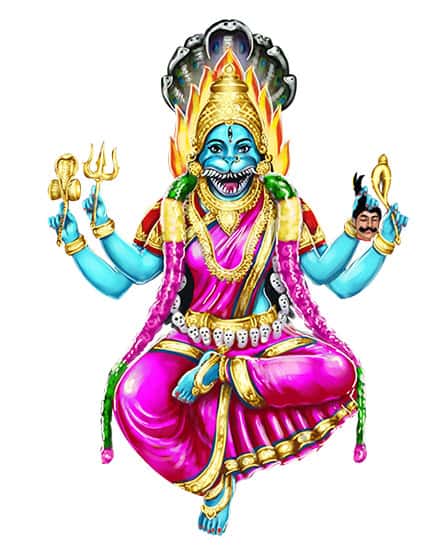
    A female fusion is:


    Atharvana Bhadrakali (Pratyangira)


    She is the text goddess of Atharva Veda, Lion Face Lakshmi.


    She is not a primordial emanation, but a discovery. For Pratyangira Devi:


    Quote Two rishis in the ancient times, Pratyangira and Angiras, in their deep meditation, discovered this goddess through her mula mantra in the ethereal waves of the sound current. And though this Mother is nameless, she honored these Rishis by giving the blessings to be named after them. She has hence been known as Sri Maha Pratyangira Devi.

    In Shaktism, Pratyangira is Siddhilakshmi, a form of Guhya Kali.
    In Vaishnavism, Pratyangira is Narasimhi, the power of Narasimha avatar.

    The goddess is associated with Lord Bhairava and hence is called Bhairava Patni.

    Adi Parashakthi at an earlier time during the war between Her and Bhandasura gave two boons to Pratyangira that the protection offered by Pratyangira is invincible and no god can overcome it.


    Lion as her riding animal; having three eyes and a trident: praised by Paraśurāma;5

    5) Brahmāṇḍa-purāṇa III. 39. 33, 44 to 53.

    Bhadrakālī (भद्रकाली) was mentally created by Śrīdevī in order to destroy Dakṣa’s sacrifice, as mentioned in chapter 3 of the 10th century Saurapurāṇa: one of the various Upapurāṇas depicting Śaivism.—Accordingly, [...] Śrīdevī informed Lord Śaṅkara about the sacrifice of Dakṣa in which the later is not invited. She could not tolerate the insult of Siva and requested the latter to destroy the sacrifice. Immediately Śiva created Vīrabhadra of fierce appearance. The dreadful Bhadrakālī was born from the wrath of Śrīdevī. Lord Śiva then ordered Vīrabhadra with Bhadrakālī to destroy the sacrifice of Dakṣa. Vīrabhadra reached there and destroyed the sacrifice in no time. Seeing this Dakṣa was panic-striken and immediately sought refuge in Vīrabhadra. Then Vīrabhadra advised Dakṣa to go to Vārāṇasī and worship Śaṅkara by whose grace all his vices would be destroyed.


    A possibly sectarian point I make is that Mahalakshmi is Annapurna, Mahakali and Bhadrakali:


    Quote In Lakshmi Ashtakam, why is the goddess Lakshmi called Maheshwari and Parameshi, which are the names of the goddess Parvati?

    Mother Lakshmi has been called Maheshwari and Parameshi because she is the complete Adi Shakti. Mahalakshmi is the Supreme Goddess that's why she is known as Maheshwari and Parameshi. Parvati and Saraswati are also part of Shri Lakshmi.

    ( Mahalakshmi Ashtakam )

    Adyanta Rahite Devi Adi Shakti Maheshwari Yogaje Yoga Sambhute Maha Lakshmi Namoostute

    The Devi who is infinite and represents the primordial energy, Maheshwari, One who is born out of yoga and is in the minds of all yogis, I bow to you Goddess Mahalakshmi.

    Mahalakshmi is the source of all powers, that's why she is Narayani. She is Vaishnavi, the Supreme Power of Lord Vishnu and Yogmaya or Mahamaya, the Supreme Maya of Lord Vishnu.

    ( Shri Suktam of Rig Veda Khila Bhaga )

    Siddha Lakshmi Moksha Lakshmi Jaya Lakshmi Saraswati Sri Lakshmi, Vara Lakshmischa prasanna mama sarvada

    As the Lakshmi who bestows all the siddhis (super natural powers), as the giver of Salvation, as the one who gives Victory and even as Goddess Saraswati (Goddess of Knowledge and speech) As the Lakshmi who brings auspiciousness and as fulfiller of wishes, be pleased on me forever.

    Vedas have declared Maa Lakshmi as the Supreme Goddess. Shri Mahalakshmi is Moolaprakriti and Pradhana Prakriti. She is Madhavi the wife of Lord Vishnu and she is Kshir-Sindhu-Vilasini.

    Lalitopakhyāna, Brahmānḍa Purāṇa:


    The Śaktis beginning with Tripurā are her own incarnations. She herself was Mahālakṣmī.

    Māhāvīdyā Bhuvaneshwarī is Māhālakṣmī Devī.

    To that Maṇi Dvīpa the auspicious Devī Māhālakṣmī departed after She had been praised by the Gods, to that place where sports always the eternal Bhagavatī Bhuvaneśvarī, the incarnate of Para Brahmā.

    ~Devī Bhāgvatam, Canto 5, Chapter 20 (Departure of Mahishāmardinī Māhālakṣmī to her abode Maṇidvīpa)


    In other words, if you read the whole Purana (not just the battle scene), Mahalakshmi is "behind all these shaktis".

    Look almost anywhere and "Mahishmardini is Durga"--except in the actual sources, she is Viraja and Mahalakshmi. Something got flipped mostly backwards because there is a vast difference between Atharvaveda and Bhagavat Purana.

    "Parvati" for instance is not a Vedic goddess, like "Durga" or "Shiva" are not present. Lakshmi is:


    bhadraiṣāṁ lakṣmīrnihitādhi vāci

    —Rig Veda, x.71.2

    In Atharva Veda, transcribed about 1000 BCE, Lakshmi evolves into a complex concept with plural manifestations. Book 7, Chapter 115 of Atharva Veda describes the plurality, asserting that a hundred Lakshmis are born with the body of a mortal at birth, some good, Punya ('virtuous') and auspicious, while others bad, paapi ('evil') and unfortunate. The good are welcomed, while the bad urged to leave. The concept and spirit of Lakshmi and her association with fortune and the good is significant enough that Atharva Veda mentions it in multiple books: for example, in Book 12, Chapter 5 as Punya Lakshmi. In some chapters of Atharva Veda, Lakshmi connotes the good, an auspicious sign, good luck, good fortune, prosperity, success, and happiness.

    Narada Purana describes the powerful forms of Lakshmi as Durga, Mahakali, Bhadrakali, Chandi, Maheshwari, Mahalakshmi, Vaishnavi and Andreye.

    Bhudevi is the representation and totality of the material world or energy, called the Apara Prakriti, or Mother Earth; Sridevi is the spiritual world or energy called the Prakriti.

    (cf. Skambha Sukta)

    Sri Suktam:


    O Mother, You (indicated by Dhanam) are the Power behind Agni (the God of Fire), You are the Power behind Vayu (the God of Wind), You are the Power behind Surya (the God of Sun), You are the Power behind the Vasus (celestial beings).

    20.2: You are the Power behind Indra, Vrhaspati and Varuna (the God of Water); You are the All-Pervading Essence behind Everything.


    This is from Padma Purana, where Varuni goes to the "demons". It is also the source for Mahalakshmi Astakam of Kolhapur.


    So you get heaps of Puranic confusion over an Atharva Veda goddess, usually saying Uma, Durga, or Parvati emanates Kali, Lakshmi, etc., the more popular version.

    In Nepal, Annapurna is Mahalakshmi, and Adbhuta Ramayana has her emanate Mahakali.

    Lakshmi Tantra obviously places her in the commanding role.

    Moreover, she is a totally different Pitha set--Sati Pithas represent her body parts falling on the ground, Lakshmi Pithas are where she took birth/emanated/resided, and so that gives us another chronological sequence.


    Narasimhi's Gayatri:


    || Om Aparijithayai Vidmahe
    Chatru Nishoodinyai Dhimahi
    Tanno Prathyangira Prachodayat ||


    But her most basic mantra is Ham Ksham.

    "Ksha" is of course the "x" syllable, but, it is also the Earth syllable, from the Rg Veda to Bodhisattva Ksitigarbha.


    That is in line with the "Post", the "Lump", the Boar and Lion incarnations, lifting or separating the Earth from Water.

    Once this is done, I suppose you could say the Earth and Sky rub and produce a child, as in turn the two sticks produce terrestrial fire, as in turn that is how mantra is performed.

    It is possible she has a mul mantra, Ksham, which may be apparent in Rg Veda, employed by the Sages--we just quoted it above. This is how you "start" something, compared to Ushas who is of inscrutable age prior to the hymns. Angiras can do this and store it in the Angiras Atharva Veda. Although she may have Puranic and traditional variations, she is scriptural.

    Buddhism is also a continuation of these:


    Atharvangiras

    Atharvana Bhadrakali


    This text may have been finished last, however, it begins with language as old or even older than Rg Veda Old Books. This gives it the appearance of a running process over a millennium whereas the other books are momentary bouts.


    There is the dangerous offspring of Agni called Aurva, who is the sub-oceanic Mare's Mouth Fire, or the gastric fire. He is a combination of multiple flames.

    Agni's levels are explained with a very rare statue of him having Two Heads:


    Quote Though he consumes everything, but
    this destruction is requisite prelude to renewed creation. Agni being the originator of
    sacrificial rites; he is considered to be the oldest of all priests. A myth about his birth
    hints towards that tradition which made him the presiding deity of Earth. It is that he
    is thrice‐born (Ions 1967): that is, he was born and constantly reborn in heaven as the
    flame of Sun. Second time he was born in the tempest clouds and descends to earth in
    the form of lightning and in the third time on earth, when he was lit up not only by the
    priests but also by the hands of every man whom he warms and protects in the form of
    health fire.

    The end should probably read "hearth fire".

    Sun, Lightning, and Terrestrial or Household Fire.

    Those are external, but of course symbolic for the subjective and internal.

    Most Indian iconography uses multiple faces--not usual to see heads on different necks.


    Aurva is in RV VIII.102.4.


    Sound like Valmiki?


    ...in later mythology he is called Aurva Bhārgava as son of Cyavana and grandson of Bhṛgu...


    Mahabharata version:


    Quote Cyavana Maharṣi married Āruṣī, daughter of Manu. Aurva was her child who was the grandfather of Jamadagni and the great grandfather of Paraśurāma.

    The Preceptors of the Bhṛgu dynasty were the hereditary gurus of the Kings of Hehaya.

    Kṛtavīrya died and his sons did not very much like the Bhārgavas (Bhṛgus) becoming rich by the wealth of their ancestors. Knowing this the Bhṛgus started burying their wealth under the earth.

    Aurva bore a deep grudge against the Kṣatriyas who had massacred his forefathers. Aurva started doing rigorous penance and by the force of his austerities the world started to burn. At that stage the Pitṛs appeared before him and persuaded him to withdraw from his penance. Aurva then told them thus: "Pitṛs, while I was lying in the thigh-womb of my mother I heard hideous groans from outside and they were of our mothers when they saw the heads of our fathers being cut off by the swords of the Kṣatriyas. Even from the womb itself I nurtured a fierce hatred towards the Kṣatriyas. No helping hand was raised before the pitiable wails of our mothers".

    The Pitṛs were astounded at the firmness of the vow of Aurva and horrified at the thought of what would happen if the penance was continued. They pleaded again to cease his austerities and then submitting to their request Aurva withdrew the fire of his penance and forced it down into the sea. It is now believed that this fire taking the shape of a horse-head is still living underneath the sea vomiting heat at all times. This fire is called Baḍavāgni.

    Brahmanda Purana:

    Quote Ayodhyā was once ruled by a celebrated King of Ikṣvāku dynasty named Subāhu. He had as his wife Yādavī a good natured and well behaved woman who was a gem among queens. One day Tālajaṃgha a King of the Hehaya line of rulers who was then the King of Māhiṣmatī defeated Subāhu in a battle. Yādavī was then pregnant. Jealous co-wives poisoned her; Yādavī did not die but the poison affected the child in the womb.

    After the defeat, Subāhu and Yādavī went and stayed with Aurva in his āśrama. For seven years they lived there and then Subāhu died. Grief-stricken Yādavī was about to jump into the funeral pyre and end her life when Aurva stopped her from the act pointing out that she was soon to deliver a child. After a few months she delivered a son and Aurva called him 'Sagara' meaning one with 'gara' (poison) in him.

    also:

    Quote When Garuḍa made Aurva acquainted with the pitiable tale of his sister Aurva decreed that Sumati should marry a Kṣatriya instead of a brahmin and thus tide over the curse. He then asked Sagara to marry Sumati and blessed them saying that Sagara would one day become an emperor and perform an Aśvamedha yāga. Aurva then sent Sagara along with the people to Ayodhyā where Sagara after defeating all his enemies became the emperor of Bhāratavarṣa.

    and:

    Quote All the Bhārgava ṛṣis together once stayed in the āśrama of Aurva. Paraśurāma visited the āśrama one day during that time and paid respects to Bhṛgu, Khyāti, wife of Bhṛgu, Cyavana, son of Bhṛgu and Aurva, son of Cyavana.


    If Parasurama is in Rg Veda, could he have done anything as told in Ramayana and Puranas?

    Could he be on a Mehgarh seal with Dattatreya?


    As shown in 2017:


    Large Procession:


    Seems to be a story before the Cross-legged Man comes out of the Tree as in Farmer's examples.

    The Six-spoked Mehrgarh Wheel is found unlikely to represent a real object, but does match the symbolism of RV I.164.12 according to New Indology:


    Quote The word ṣaḷ-ara means 'having six spokes' and it is the Rigvedic equivalent of ṣaḍ-ara, found in a repetition of st.12 placed in AV (Śaunaka recension) 9.9.12

    The same stanza 12 is cited in the Atharvavedic Praśna Upaniṣad, commented by Śaṃkara, who recognized the symbolism of the year and seasons. About ṣaḍara, he glossed with the compound ṣaḍ-ṛtu-mat- 'having six seasons'.

    AV IX.9 uses it in the sense of a physical chariot, whereas in RV there are just wheels, there is no "ratha" although the translator thinks it is implied.

  12. The Following 2 Users Say Thank You to shaberon For This Post:

    Bill Ryan (24th December 2023), mountain_jim (27th December 2023)

  13. Link to Post #47
    Costa Rica Avalon Member
    Join Date
    13th February 2021
    Location
    In a Log Cabin in the Mountains
    Language
    English
    Posts
    844
    Thanks
    809
    Thanked 6,866 times in 814 posts

    Default Re: The Indus script, aka the Harappan script, aka the WTH? - Deciphered.

    Here's an off the wall idea that might just have some merit, and surprises as well:
    Are you sure that the underlying language for the Indus script is not related to the Amorite and Elamite mixed cousins of the Hebrews, the Ism'alites that once occupied areas of modern Saudi Arabia, and then became known as the Hyksos, when they ruled Egypt about 1750s BC? They were called in the Bible the Kenites, as in, the sons of Cain, and they married into the Hebrews via Moses, and in fact introduced Yahweh to Moses, according to the texts. They are known to have traded with India later on - about the 1800s BC, but they would have been in the area about 3200 BC. That would make Sumerian (proto) more likely, and is easily explained by the fact that they were translators and scribes (as was Abraham) for the Sumerians. Their Elamite heritage is also noted among the Indus or Harrapan peoples.

    The term Dasht-e Yahudi literally translates to "Jewish Desert" in Urdu and "Jewish Wasteland" in Pashto. It is an archaic term that first appears in Persian and Mughal texts.
    The term "Yahudi" was a reference to the alleged Jewish origin of the Pashtun people.
    The Pashtun tribes are a large ethnic group who speak the Pashto language and follow Pashtunwali, the social code of conduct for Pashtuns. They are found primarily in Afghanistan and Pakistan and form the world's largest tribal society, comprising over 60 million people and between 350 and 400 tribes and clans. They are traditionally divided into four tribal confederacies: the Sarbani , the Bettani , the Ghurghusht the Karlani and a few allied tribes of those that are Ismailkhel, Khel, Ludin, Sakzai, and Zai.
    In Persian and Mughal historical texts and rarely in Afghan texts, the term Yahudi is always found with another closely related term: Qil Yahudiya or Qila Yahudi. The word "Qil Yahudiya" literally translates to the "Jewish citadel/fort".

  14. The Following 2 Users Say Thank You to Jim_Duyer For This Post:

    Bill Ryan (24th December 2023), shaberon (25th December 2023)

  15. Link to Post #48
    United States Avalon Member
    Join Date
    1st April 2016
    Posts
    6,162
    Thanks
    30,380
    Thanked 34,519 times in 5,809 posts

    Default Re: The Indus script, aka the Harappan script, aka the WTH? - Deciphered.

    Not sure yet.

    Reading it this way as a hypothesis:


    Quote Posted by Jim_Duyer (here)
    ...the underlying language for the Indus script is...related to the Amorite and Elamite mixed cousins of the Hebrews, the Ism'alites that once occupied areas of modern Saudi Arabia, and then became known as the Hyksos, when they ruled Egypt about 1750s BC? They were called in the Bible the Kenites, as in, the sons of Cain, and they married into the Hebrews via Moses, and in fact introduced Yahweh to Moses, according to the texts.

    Firstly yes I would think the "Hyksos" like the "Sea People" came to Egypt from somewhere and left it for somewhere.


    I am only semi-fluent with this region's string of events, so, from the view of Egypt:


    Quote Some Hyksos names were Semitic, others were Hurrian (the Hurrians were a horse-taming people from Eastern Armenia and Mitanni), and this also suggests an Israelite identity for them, because the ancient Israelites used to take Hurrian wives. The Hyksos kings of Egypt were Sakir-Har, Khyan (1620 BC), Apophis (1595-1555 BC) and the last was Khamudi (1555-1545 BC), who was expelled by a coalition that included the Egyptian Ahmose.


    A technologically sophisticated people the Hyksos were known for their crop and animal breeding, bronze work/pottery and musical instruments. They introduced the horse and chariot to Egypt and made use of composite bows and battle axes when fighting. The fortification techniques that they employed were also advanced.

    On a cultural level the Hyksos practiced horse burial and worshipped a storm god not to different to that of the Egyptian deity, Seth.


    it appears that the establishment of Hyksos rule was mostly peaceful and did not involve an invasion of an entirely foreign population. Archaeology shows a continuous Asiatic presence at Avaris for over 150 years before the beginning of Hyksos rule, with gradual Canaanite settlement beginning there c. 1800 BC during the Twelfth Dynasty. Archaeological chemistry of the inhabitants of Middle Kingdom and Second Intermediate Period Avaris support a gradual Canaanite settlement. Further, this study found more women being born outside the northeast Nile Delta and migrating to Avaris, suggesting economic and political ties rather than militaristic invasion.


    They likely absorbed Set from the nome priests, and used Ra in their personal names.

    They seem to be indistinguishable from "Canaanites" and appear to have been banished back there ca. 1545 B. C. E.

    This Egyptian name just means "foreigners", like Sanskrit "mleccha", and they are low on personal identifiers other than the military tech.

    They brought horses, and, here again I would argue the Arabian was developed at about the same time as the Yamnaya, ca. 2,200-2,000 B. C. E., and the Arabian was probably the first sent to India.


    There seems to be another idea with the Shasu:


    Quote There is an 'old' idea called the Kenite Hypothesis. It is so old , a lot of young historians might think they are reinventing the wheel....but, a lot of old timers thought Moses 'borrowed' YHWH iao Ya Io from the local Midianite tribes who already worshiped him. When Moses is talking to God , God tells him "I was known to Isaac , Abe and Jake as El Elyon and El Shaddai, but my real name is (tetragrammaton). Moses had just been living with his Father in Law the 'priest of Yhwh (Shasu?).... Nomadic Herders in the Eastern Sinai and Northern Arabian peninsula

    Those Shasu chronologically and Geographically line up better with the Midianites then the Hebrews (apiru, Habiru) who are already pretty entrenched in the Hill country by the time of the Amarna Letters (Amenhotep III and Akhnaten)

    I am not good with chapter and verse BUT YHWH in the psalms and a few other poetry pieces is linked with Mt Seir and Edom. Later Idumeans (like Herod the Great) were sort of proto-Jews since they worshiped the same God...all of that is in the direction of the midianites. And unlike other natrions God tells them to destroy, Edom and Kenites are always given a pass...worshiping the same God has it's advantages!

    or:


    Quote Shasu-Sutu or Seti sons of Seth. Shasas or Rak-shasas were Hindu Assuras descent from Varuna from India , migrate from India to Cannan around 2500-2300BC. Shasu were Kentites/Gypsies indeed.


    ...one in Moab /Edom ,second in Salem they were Yahweh worshipers Roma Gypsies descent from them ,also Jethro father of law of Moses, the third clan of Kenites were in Arabic penisula known as Nabatheans. Shasu-Sutu from Moab they became Hyksos latter Hitties -Hurrian empire


    which does not sound quite right since that Indian root would be "raksa", and the suffix as split would depend on the accent:


    1) Śaśa (शश, ‘hare’) is found once in the Rigveda, where it is said to have swallowed a razor. The animal is occasionally mentioned later also.

    2) Śāsa (शास) denotes in the Brāhmaṇas a ‘sword’ or ‘knife’.

    3) Sasa (सस) in the Rigveda denotes ‘herb’ or ‘grass’. The word is also applied to the Soma plant and the sacrificial straw.


    I am not yet persuaded the Shasu are Rakshasas, but in the view there was no Exodus because the Jews were "already there", this hypothesis lines up according to its own origin and revival:


    Quote Yahweh was originally the God of the Kenite tribe prior to the Israelite settlement of Canaan.

    This view of Yahweh’s introduction to Israel became known as the Kenite or Midianite hypothesis.

    Archaeological evidence for the name Yahweh is comparatively sparse. The earliest epigraphic evidence (inscription) from Palestine that refers to Yahweh is the Mesha Stele from about 840 BCE. In it, king Mesha of Moab boasts of a campaign in which he devoted the “vessels of Yahweh” to Chemosh after conquering the city of Nebo from Israel.

    Two Egyptian texts, however, mention “Yhw in the land of the Shasu (nomads)” in lists of toponyms around Edom. These date to the reigns of Amenophis III (14th century) and Ramses II (13th century). It is generally thought that Yahweh must have originally been associated with a mountain of the same name in or near Edom.

    The ruins of Kuntillet ‘Ajrud in the Sinai peninsula, which may have been a shrine in the late 9th and early 8th centuries BCE, have inscriptions that make reference to “Yahweh of Teman” and “Yahweh of Samaria” along with El, Baal, and Asherah. This is further evidence that Yahweh was worshipped in Edom (Teman) and in Israel (Samaria) from an early date.

    The early extra-biblical evidence is thus consistent with the possibility that Yahweh was first venerated by nomadic Bronze Age tribes in Edom, and later adopted in Samaria to the north.

    And then the author of Genesis changed everything: he turned Cain from a warrior to a murderer and reused the names from Cain’s genealogy to create a new genealogy for Seth’s superior lineage. Some scholars even think that in an earlier version of the story, it was Cain who was “the first to invoke the name Yahweh”, an honour now afforded to the obscure Enosh (Wyatt 86).

    But that’s another story for another article. The point is, the Kenites’ own origin story saw themselves as devotees to Yahweh from the first, even if that fact is obscured by the present text of Genesis.

    From these and other references to Edomite and proto-Arabian tribes in Judah, many scholars have concluded that Judah was settled early on by a loose federation of semi-nomadic clans — Kenites, Kenizzites, Calebites, Othnielites, Simeonites, Reubenites, and so on — and that their settlement traditions were later attributed to Judah (Weinfeld 395). In fact, according to renowned Orientalist Edward Lipinski, there was never a tribe called Judah; the name comes from ’eres yehūdă, meaning “land of ravines” (Lipinski 367). In early biblical stories about the tribes (e.g. the Song of Deborah), Judah is conspicuously absent. Later in the biblical texts, Judah rises in prominence, while the tribes of Simeon and Reuben disappear — even though the fiction of “twelve tribes” is maintained

    The archaeological evidence is consistent with this view of Judah’s late emergence. There is no evidence for a Judahite state based in Jerusalem until the 8th century; Judah’s first appearance in the historical record is a mention in an Assyrian clay tablet dated to 733 BCE.

    Qos, Yahweh, and the Canaanite Baal are now thought to have been local manifestations of the ancient Syrian storm-god Hadad (Kelly 260).

    It must be concluded that either Yahweh and Qos co-existed in Edomite religion, or they were two names for same god (Kelley 266; Blenkinsopp 150-151). It is notable that the Bible distinguishes Yahweh from the gods of other neighbours — the Philistine Dagon, the Ammonite Milcom, the Moabite Chemosh, and so on — but never mentions Qos in all Israel’s dealings with Edom. Edom’s religion is never denounced or rejected.


    Asia was primarily responsible for the Rise of Egypt in this view of the Hyksos:


    Quote During this period it is evident that Asiatic traders had already threaded their way past the indigenous Egyptians of Upper Egypt by boat and donkey to trade with the Nubians. The donkey was alien to Egypt. The Egyptians, in fact, had no pack animals during the entire pre-dynastic period. The earliest remains of donkeys were found in various communities of Asiatic origins in the Delta. Donkeys were conspicuously present in Ma'adi, a village of Asiatic people which was established south of present-day Cairo. Significant evidence of trade both with Asia and Nubia was found among the artefacts recovered from its ruins.

    The Ma'adians were not only expert in husbandry but were accomplished metallurgists and craftsmen. A copper axe-head spoiled in casting and masses of copper ore indicate that copper was being processed at Ma'adi. Ma'adi is the oldest site in Northern Egypt in which copper artefacts have been found.

    The people of Ma'adi were among the many communities of Asiatic peoples who had been active in Northern Egypt for centuries at the time it was invaded and destroyed by the kings of the First Dynasty.

    These terms are commonly transformed into "Hyksos", a word which is not confined to the chieftains but is mistakenly applied to the Semitic people (termed the Aamu by the Egyptians) from which they stemmed. Although the hegemony of these "Asiatic" included all Egypt, Canaan and extended into a major portion of Mesopotamia, they established no dynasties. They were elected by the village chieftains (the Hyk-Khase) of the Aamu villages, and therefore can be properly designated as the chief-of-chiefs.

    The Hyk-Khase worshipped a single God and made no statues of Him. Many archaeologists, disappointed by the lack of gigantic monuments, self-glorifying statuary and self-serving temples such as those which so often drained Egypt, dismally stated that during this period art declined. Museums petulantly concur, for lack of imposing mausoleums, mummies and exotic statuary of beastly idols to display. The lack of such artefacts cause museums to pass by the vibrant, prosperous and progressive two centuries of Egyptian history with scarcely a mention.

    During the rule of the Semitic chieftains Egypt leaped forward into a new era, advancing enormously in every field of knowledge and endeavour. Wise men came and taught astronomy, and medicine, and mathematics. The great mathematical Rhind papyrus, now in the British Museum, was produced during this period. Thus, although the chieftains sculpted no great statues of themselves, nor fashioned idols of fabulous gods, the arts they infused into Egyptian culture were of a rather subtle nature, more durable than the stone of which the statues were carved, and benefited all Egyptians.

    The Egyptians had been sailing the Nile in feluccas, simple boats which were handled adeptly on the river. These boats, however, could not be managed easily on the high seas, for they had no keel. The Aamu (Hyksos) had long incorporated a keel, which stabilized their ships and made them easier to manoeuvre, safer and seaworthy. They probably learnt from Canaanites, better known in history as Phoenicians. Consequently, trade with the islands of the Mediterranean blossomed, and Egypt became a more essential factor in the region's economy. A most important impact upon Egyptian economy and life was the engineering by the Semites of an effective control of water resources.

    Wheels and wheeled vehicles, and the horses and oxen to draw them, were unknown in Egypt until the time of the rule of the Semitic chieftains. Wheeled chariots, hitched to teams of Asiatic horses, were introduced for hunting and for war, and the potters of Egypt began to throw their ware upon swiftly whirling wheels with newly won ease.

    The Semites cultivated new fruits in Egypt – pomegranates, figs, olives, new grains and vegetables. Even the cornflower, a common Canaanite flower, became the favourite of Egyptian noblemen, and their tomb painters employed them lavishly.
    Tools were refined and perfected. The Semites taught the people of Egypt how to set the helve, or handle, into a socket instead of tying the head crudely onto it. The simple bows the Egyptians used were no more than bent branch. They were replaced by the superior bows of the Aamus, cunningly constructed of bone and wood laminated into a composite curve. The shape and composition of swords and daggers were modified to make them more effective and durable.

    More important than weapons was the introduction of abiding inventions of peaceful use: new spinning devices and the upright loom; new fibres and new fast dyes made fabrics more durable and colourful; and added another dimension to the quality of life. The introduction of gently arts likewise contributed to a richer Egyptian culture. A variety of new musical instruments, the harp, the lute, the lyre, the oboe and the tambourine, long played in the Mesopotamian milieu, now appear in Egypt. With the new music came new forms of dance, and its graceful images became forever inscribed into the graffiti of the nobles, princes and pharaohs of Egypt since that time.

    Semitic peoples, called the Aamu or "Asiatic" by the Egyptians, established a colony on Yeb and on the Eastern Nile bank at Syene (now Aswan) to trade with the Nubians in the same period. Artefacts excavated on the island by members of the German and Swiss Archaeological Institutes include uniquely Canaanite earthenware, which, together with other characteristic materials, clearly establish the ethnicity of the settlers. The pottery from Yeb proved to be a virtual replica of those recovered from the ancient Canaanite city of Ugarit and elsewhere in Canaan.

    Where did Yitzhak and Yakov get their wives from? Haran (the land of Hurrians).


    All this, similar to the events of Rg Veda, does not shake the idea that Yhwh was a local Edomite deity, not "invented" by Elijah, but, rather, elevated by him to a royal status by overthrowing the House of Omri.


    For this, yes, I think most likely a route from Gaza to Kerala was functioning:


    Quote They are known to have traded with India later on - about the 1800s BC, but they would have been in the area about 3200 BC. That would make Sumerian (proto) more likely, and is easily explained by the fact that they were translators and scribes (as was Abraham) for the Sumerians. Their Elamite heritage is also noted among the Indus or Harrapan peoples.

    "They" meaning Ismailites or Nabatheans?

    I think you could practically link Nabatheans to Kerala by King Solomon's time, ca. 1,000 B. C. E., and probably Sri Lanka by then.

    You could probably add Cochin Jews not much later at a point where it probably was not the full blown Judaism as we know it.

    I am not sure how that would make Sumerian or Semitic the underlying language of IVC Seals.

    So far the visuals seem to be developed in Mehrgarh--Nausharo ca. 3,000-2,500 B. C. E.; is there a Sumerian word for "tiger", "unicorn", etc., that would fit?

    They seem to be uniform and stable ca. 2,500-1,800 B. C. E.

    Then their form briefly changes and they cease being used.

    As far as I know, there is no further evidence of writing from India until some Brahmi characters maybe ca. 500 B. C. E.

    Those are some notable artistic finds in Balochistan, however, again on a human scale, that which is called IVC is shown to have originated in Haryana--and even this site is layered over an older village of pit dwellers.

    The older IVC is said to have phases of Black and Red Wares, and then it goes to grafitti decorations and seals. I still have no reason to suspect that the use of seals is a native Indian concept.

    So far, all I can think is that it was a "design scheme", which was physically bounded on the west by the mountains and deserts of Balochistan, which made the Makran port very important. It reproduced a village on numerous sites that were only a few acres. They may not have been intended as permanent habitations. It may have been planned for some number of generations and then you move on.

    It is hard to be certain it represented a single language, culture, or government. It might be something like we would call an "architectural style" like Gothic or Corinthian, except there was basically one of them.

    Except for Rakhigarhi being radial.


    My inclination would also be OIT for Sanskrit, i. e., probably is of Gangetic in origin kindred to Tamil.

    I am pretty sure we see a hybrid in Nirmand in HP. It probably was founded in IVC styles by Aryas. In other words it looks like an alliance between a local king and a king of Haryana.


    If the question is raised about a spoked wheel of Mehrgarh compared to the Rg Veda, it comes in one of the New Books in such a way that short circuits logic.

    Tis is from a page that collects a few numerical patterns, and several of them happen to be from the same hymn. A lot of it is presumably time-related based on the year.

    And in the beginning of it we do find "ratha" which could be a "chariot":


    1:164:2

    SAPTA yunjanti rathamekachakrameko ashva vahati SAPTANAMA |
    TRInabhi chakramajarmanarva yatrema vishvaa bhubanadhi tasthuh ||

    These SEVEN are fixed with the chariot, that has ONE wheel, A horse with SEVEN names drives the wheel. This wheel has three centers. This time wheel is ever moving and devoid of any halt. In this wheel exists the whole world.


    "Chariot", of course, has a military sense and later artwork, but a better choice is simply "car" because it could be any kind of wheeled vehicle yoked to anything. The "horse" is perhaps simply "energy".

    Then when we come to the verse that has "six spoked wheel", it does not really have a "ratha" or "chariot":


    1:164:12

    PANCHA padam pitaram DVADASHA akritam diva aahuh pare ardhe puriisanam |
    Atheme anya upare vichakshyanam saptachakre salara aahurarpitam ||

    According to some, the Sun resides in half of the sky, and has twelve images and five feet. Others say, it is in a chariot which has six spokes and seven wheels.


    Curiously:


    1:164:41

    Gaurirmimaya salilani takshyatyekapadi dvipadi saa chatuspadi |
    Astapadi navapadi babhuvusi sahasrakshyara parame vyoman ||


    The cows create a wave on water by their sound. This sound is divided in different chhandas based on ONE, TWO, FOUR, EIGHT or NINE vowels. With combination of THOUSANDS of such vowels, they spread into the sky.


    It is tricky, because it is not a scene of a king in his war chariot, in fact no kind of actual car has one wheel with three centers, so it barely makes sense.

    Even if IVC originated in Haryana, that does not mean it had to be an Indian language. I tread lightly with it, I am not sure how to take the common glyph and the Wheel, and why does it look like the Akkadian scribe was trying to stylisticly copy an IVC Goat.

  16. The Following 2 Users Say Thank You to shaberon For This Post:

    Bill Ryan (25th December 2023), mountain_jim (27th December 2023)

  17. Link to Post #49
    Costa Rica Avalon Member
    Join Date
    13th February 2021
    Location
    In a Log Cabin in the Mountains
    Language
    English
    Posts
    844
    Thanks
    809
    Thanked 6,866 times in 814 posts

    Default Re: The Indus script, aka the Harappan script, aka the WTH? - Deciphered.

     1800 BC during the Twelfth Dynasty. Archaeological chemistry of the inhabitants of Middle Kingdom and Second Intermediate Period Avaris support a gradual Canaanite settlement. Further, this study found more women being born outside the northeast Nile Delta and migrating to Avaris, suggesting economic and political ties rather than militaristic invasion.
    ---End Quote---\

    First - Merry Christmas or Happy Holidays - Seasons Greetings to one and all.

    No they did not take it by force - that's not their style. They are swarmers. They swarmed around the wall built to contain them and took Sumeria - putting an end to that civilization once and for all, and then assimilating the local populace. That the Amorites (of Abraham's Father). They were not Hurrians. It has been proven that this old idea has no merit. They were the Cainite, Kenite, Sim'alites, same thing, branch of what was later called the Hebrews. It's very clear.

    They have always swarmed, and they did the same thing when they introduced Communism in Russia - no direct confrontation, but suddenly all of these people gather together and they are the new ones in charge. Not all of them, of course, were Jews - just the leaders.

    In Sumerian: There are words that mean lion, and the translators indicate it could mean tigers as well. Why do they do this? IDK.
    No unicorns in Sumerian - they knew better. Even the Serpent or Great Dragons of their epic tales were written in by later conquerors such as the Akkadians, Elamites, Amorite (Hebrews), etc., and did not exist in the earliest tales. Now, extraterrestrials did, and they knew about and write about their crafts of light that traveled to the home planets. No rockets (that's Sitchin's folly), but some were described as boomerang shaped - which is what we saw in California prior to Roswell.

    Mark Smith is the smartest scholar that I know in regards to the history of that region and especially the Hebrews. He tells us that Yahwey was first introduced to the Hebrews by the family of Moses, the Kenites. He fully supports the Kenite Hypothesis, but with evidence. One desparate scholar pointed to a text in Ugaritic that mentioned "Ya" but then he was shown other examples that explained that this was another name for the Sea god, Yam, and not Yahweh. Nothing, and I mean nothing, written or manufactured, prior to about 1200 BC, mentions Yahweh, and those are some of the Amarna texts from Egypt. But, oddly they are not shown to us. Why? Because they speak of the Hebrews being thieves in their tradings with Egypt and this is dated to 1380s, which is supposedly too late for the Bible narrative, but in addition they state that the Hebrews were finally convinced to leave, peacefully. So, not slaves, no Exodus. Big Problem. The only time, and they were indeed in Egypt for a long time, as rulers and not as slaves, the only time that they were actually forced to leave was when, as Hyksos, they were driven out by the southern rulers of Egypt.

    After the Kenites introduced Yahweh, they joined (some of them) the tribes and went with Moses. They became, later, the scribes of the temple. So when Jesus said "Your Father is not My Father, your Father was a Murderer from the beginning", he is speaking of these Kenites, now Hebrews, whose ancestry is from the "murderer from the beginning" or Cain, the first murderer. Jesus's ancestry is from Seth, not Cain, so indeed, his Father (El) was not their Father (Yahweh). None of His parables are that hard to understand - what we face is a group of scholars and religious leaders who do not want to unravel them, and do not want us to either. They protect the story and the Jews at all costs, thinking that their whole platform will collapse if they do not. The truth is, that we don't need the OT, nor their platform, unless we seek to expand upon what is written by going off on some tangent. These tangents cause new versions of denominations to arise, further splitting Christianity, and performing the task that Satan desires, while at the same time making the new leaders rich in the process. Sad, but true.

    Now, some don't know this but the Kenites were ancestors of Abraham. And Moses was brought up/taught in On, aka Heliopolis, in the mystery schools of Ra. And Joseph married the daughter of the head Egyptian priest of Ra at On as well. So they were, in that time period, somewhat off of EL and somewhat prior to Yahweh, and basically worshiped the Egyptian gods, under one name or another.

    BTW, when we see the admiration placed on Egypt by the Masons (the higher ups only), it is due to their knowledge that the sons of Cain, Sim'alites, were connected very, very deeply with the worship of Ra and the governance of Egypt. Through the Hyksos, down to Moses, but also in the earliest period when the Edomites (another name for the Kenite group of Sim'alites) wrote those tablets that they claimed were Canaanite and I proved in another post were written in Sumerian, and by Sim'alites who lived on the northern borders of Sumeria in Elamite territory. So they have been in Egypt since 3200 BC, almost at the modern dynamic beginnings. Who do you think inspired the magical tablets and the writings on contacting spirits for advice? Yes, the same Cain group who later were called Hebrews and occupied the kingdom of Judah. We see the same love for spirit contact, magic, numerology etc., all the way up to the Middle Ages. Kabalists or Cabalists they were called.

    Some spawn of Satan has laid the rumor that Jesus was also a student at On, the religious capitol of Ra in northern Egypt, but that's a lie that has never been supported with any scraps of evidence. He and his family did escape to that region in the Nile Delta, and perhaps near On, but he was about 3 years old - hardly a student yet.

  18. The Following 3 Users Say Thank You to Jim_Duyer For This Post:

    Bill Ryan (25th December 2023), mountain_jim (27th December 2023), shaberon (27th December 2023)

  19. Link to Post #50
    United States Avalon Member
    Join Date
    1st April 2016
    Posts
    6,162
    Thanks
    30,380
    Thanked 34,519 times in 5,809 posts

    Default Re: The Indus script, aka the Harappan script, aka the WTH? - Deciphered.

    This is some nuts and bolts on the Mitanni.


    Thinking of Hyksos <--> IVC goes right to the circular whirlwind with Vedic Sanskrit.

    Again, Hyksos is not even a good name either, since it is a later Hellenization of the Egyptian, so we might use the original to push it aside.


    It sounds to me that "Hyksos Invasion", like "Aryan Invasion", never happened. Northeastern Egypt housed Canaanites or Semitics since ca. 1,800 B. C. E., and they were routed ca. 1,545 B. C. E.. The Egyptians called them Amu or Aamu, and they are said to be part Hurrian or Mittani, particularly with respect to horses. This is supposed to be visibly distinguishable from Semitic; and so it looks like Egypt is hosting two foreign cultures, who eventually elected leaders.


    Sanskrit is found in the Hittite--Mittani treaty of ca. 1,380 B. C. E.; the Witzel-ism is to use this to say the horse, Sanskrit language, etc., then somehow invaded India and installed itself in a way that did not happen here.

    The treaty is found at Bogazkoy, the site of the older double-headed Eagle seal which was said to have Indus Script, but I have not seen information about the two basic glyphs used.


    In this treaty the Sanskrit users appear to be the submitted ones; however the treaty appears to be a continuation of previous cultural saturation.

    It is generally believed that an Indo-Aryan-speaking people settled in upper Mesopotamia and northern Syria, and established the kingdom of Mitanni following a period of political vacuum, while also adopting the Hurrian language.


    Witzel's information for the presence of Sanskrit in Mitanni:


    Quote In a treaty between the Hittites and Mitanni (between Suppiluliuma I and Shattiwaza, c. 1380 BC), the deities Mitra, Varuna, Indra, and Nasatya (Ashvins) are invoked. Kikkuli's horse training text (circa 1400 BC) includes technical terms such as aika (Vedic Sanskrit eka, one), tera (tri, three), panza (pańca, five), satta (sapta, seven), na (nava, nine), vartana (vartana, round).

    Another text has babru(-nnu) (babhru, brown), parita(-nnu) (palita, grey), and pinkara(-nnu) (pingala, red) for horse colours.

    The Mitanni warriors were called marya (Hurrian: maria-nnu), the term for '(young) warrior' in Sanskrit as well, formed by adding the Hurrian suffix -nnu.

    Sanskritic interpretations of Mitanni names render Artashumara (artaššumara) as Arta-smara "who thinks of Arta/Ṛta", Biridashva (biridašṷa, biriiašṷa) as Prītāśva "whose horse is dear", Priyamazda (priiamazda) as Priyamedha "whose wisdom is dear", Citrarata as Citraratha "whose chariot is shining", Indaruda/Endaruta as Indrota "helped by Indra", Shativaza (šattiṷaza) as Sātivāja "winning the race prize", Šubandu as Subandhu "having good relatives" (a name in Palestine), Tushratta (tṷišeratta, tušratta, etc.) as *tṷaišaratha, Vedic Tveṣaratha "whose chariot is vehement".


    The context suggests that the "Sanskritization" which perhaps is "Mitanni" was all about some horses, not a Vedic Crusade that replaced the local deities. Also suggesting numerous Tamil sources for the vocabulary, this is a look at the actual Mitanni system from Jayasree:


    Teshub before whom the tablet of the Shubbiluliuma- Mattiuaza treaty was placed. The following image is that of Teshub of Mitanni.


    Teshub is holding an axe in one hand and a triple thunderbolt in the other. The bull is sacred to him.

    Quote This description is exactly that of God Shiva. Axe and trident (Trishul) are the weapons of Shiva. What researchers call as triple thunderbolt in this image is actually a trident. The bull is the associated with Shiva. The myth of Kumarbi biting and swallowing his genitals also conveys a parallel with Shiva. Shiva is depicted as a phallus and Kumar was his son in the Indic traditions. Why don’t Witzel and his ilk show this as a proof of pre-Aryan presence in Mitanni? The fact is that it is more logical to interpret the concept of this image as having gone from India to Mitanni than the other way round.

    Well, of course he is slightly off because there is no Shiva identifiable at this age.

    Some think shiva was a title applied to various rebels or warrior kings in the post-Vedic age, i. e. after this Teshub, but if you want to say this is Indian, you have to find it as Rudra or in the IVC Seals.


    Returning to his mythological comparison:


    Quote The list of Gods found in the Shubbiluliuma- Mattiuaza treaty (Appendix-1) shows a complete collection of all gods that they have heard but not necessarily worshiped. The treaty being concluded by the king of Hatti and the king of Mitanni, one can expect their Gods taking centre stage – something we see in the treaty. Shamash was the God of Hittites and Teshub was the God of Hurrians (Mitanni). Copies of the treaty were placed in front of these deities only in Hatti and Mitanni respectively but not in front of or by invoking the Vedic Gods or any other Gods.

    The 130 names of Gods found in this treaty include Gods of regions outside Hatti and Mitanni. Names such as Sin are Ashur came from outside their regions. The list includes the Gods of enemies too, such as Irrites. There is a long list of Teshub Gods of Mitanni but none of them are associated with the Vedic Gods. There is also no way to establish which of the Gods found in the treaty were from Hatti or Mitanni. If association of Teshub indicates Mitannian origin of the Gods, there is no such association with the Vedic Gods that appear in the list.

    Anu et al were Sumerian Gods, but among them Anu underwent change in Hittite myths. Anu’s son Kumarbi bit off Anu’s genitals and banished him to underworld along with old Gods. This gives an impression that the Sumerian pantheon was replaced by a new set of Gods by Hittites. But the myth goes on further.

    The swallowed genitals gave rise to the birth of Teshub (Mitanni God) by Kumarbi who in turn was banished by Teshub. This explains why Kumarbi is not found in the list. But Teshub turns out to be a later creation after Anu. Teshub remains as a God of a variety of things such as trade, camp, relief and mounds (applicable to transiting merchants) and also some names of unknown entities. But there is no explanation for why the same group of Anu et al appears again in the same treaty.

    Where we expect only Teshub of many entities, we are seeing Samash (Hittite) Sin, Anu, Antum, Enlil, Ninlil and the Vedic Gods (Mitra, Varuna, Indra and Nasatya). As the first six are accepted as gods of their respective lands, what prevents Witzel and others from accepting the Vedic Gods as having originated in India? The answer is simple – they need a proof for AIT!

    That was the same impression I got. It is not quite a theology, it is more like calling on one or more deities from numerous countries perhaps as witnesses to the signatories, Shamash and Teshub.

    What is doubly curious that the Hittites as well as India begin to have Iron and the horse-drawn chariot at about this same time.

    It is not because of a great overland route across the Iranian Plateau.

    The necessary ports are laden with IVC Seals.


    From an article by Cotticelli with a considerable digest of personal names:


    Quote The acknowledgment of the presence of Indo-Iranian people in the ancient Near East in the second millennium BCE predates the discovery and interpretation of Hittite texts. The letters sent by Tušratta of Mittani to Amenhotep III and Amenhotep IV, found at Tell el Amarna beginning in 1887, contain names of the kings and nobles that had already been recognized as Indo-Iranian when Winckler (1907) pointed out the presence of Vedic god names in the cuneiform tablets found at Boğazköy that preserved the treaty between Šuppiluliuma I and Šattiwaza of Mittani

    ...a Hittite ritual text (CTH 395) in which the name of the Indic god Agni was found. These discoveries provided further support for the previous identification of the Kassite Sun god name Šuriya with the Vedic sū́riya-. Moreover, an Indo-Iranian etymology seemed to be available for relevant words and place-names in texts concerning Mittani from different areas (Alalah, Egypt, etc.)—for example, mariyanni and Waššukanni—and some terms referring to horse colors with a likely Indo-Aryan etymology were later identified in texts from Nuzi.


    An ambiguous group of Indians were part of the Mittani, at apparently the same time at the Mittani were part of the ambiguous Amu of Egypt.

    It is not a question about whether Mittani royals were involved with marital alliances to the Pharaohs.


    On the setting of the treaty from Arya Akasha:


    Quote This is one of the world’s oldest surviving international peace-treaties. Dating from the mid-14th century B.C., it seeks to solemnize an end to the conflict between two then-prominent Near Eastern regional powers – the waxing Hittite Empire under Suppiluliuma, and the seriously waning Mitanni by this stage under Shattiwaza.

    The treaty in question is written in an *Indo-Aryan* language, rather than an Anatolian I.E. one; and makes direct reference to several strongly important Vedic Gods and concepts.

    Now, in order to ‘set the scene’, we should probably briefly introduce the respective agonists of the agreement. And by this, I do not mean the rulers whose names are baked into the terms of the tablet; but rather, the polities, the peoples for whom they stood. Because that’s where things start to get interesting.

    The Hittites should already be relatively familiar. They turn up just about everywhere dealing with the period – rampaging down to Babylon, fighting Ramses II at Kadesh (in what is probably one of history’s first recorded instances of deliberately promulgated “Fake News”, as applies Ramses’ presentation of the outcome of the battle as a crushing Egyptian victory), likely making war on the Greeks quite to the west, and potentially even turning up in the Bible – which is probably where most of us know the name from. In the mid-1300s, they’re a real regional Great Power, pretty much at the apex of their suzerainty.

    Despite the fact that they’re *unquestionably* the *severely* dominant party to this peace-treaty (it’s really more of an imposition than an equal-footing act of diplomacy, in realpolitik terms; the Mitanni’s position after this is effectively that of a client-state of the Hittites, sealed with the marriage of Suppiluliuma’s daughter to the Mitanni’s new ruler Shattiwaza … who’d effectively been placed upon the throne *by* Suppiluliuma following a period of considerable instability amidst the Mitanni characterized by a string of assassinations and overthrows), the Hittites are not supposed to be the stars of *this* show.

    Instead, that honour goes to the Mitanni – or, more specifically, to their courtly language and religious customs. Which, as I noted somewhere towards the intro, aren’t exactly what you’d expect in Northern Mesopotamia/South-Eastern Anatolia.

    ...the Mitanni are coming at a similar starting situation from the opposite angle. Literally. As in, from the *East*, as far as we can tell.

    And instead of conquering and assimilating the Hurrians into an Indo-European dominant culture, the Mitanni’s Indo-European ruling elite find themselves increasingly Hurrian-ized, to the point that by the time this treaty is signed, it seems that they themselves are likely speaking Hurrian on a day-to-day basis, with their own original language having become increasingly reserved only for ‘special occasions’ – the incredibly serious and indelibly closely related fields of formalized politics/matters of state and religion.

    I do not consider it to be coincidental that it is in the religious realms, the courtly realms, and the horse-training realms that the Indo-Aryan language features, indeed names and nouns, are seemingly most strongly preserved. All are, after their own way, effectively sacred, sacral actions; and the reign-names of their rulers – which often directly included elements around divinity and/or horses and chariots – are effectively at the apex of all three.

    There is therefore, in the treaty in question, little surprise that we have *exactly* the right – indeed, the *rite* – Indo-Iranian/(Pre-)Vedic deities invoked, with highly recognizable names to scholars or speakers of Sanskrit (admittedly, in at least one case with the addition of a Hurrian grammatical suffix), rather than the situation prevailing in many other texts from, say, the Hittites, wherein theonyms (or even entire deities) from the cultures they were in contact with are straight-imported and placed alongside or otherwise overlain over the top of the Hittites’ own Indo-European theology.


    Why does this matter? Because somewhere smack in the middle between where the Mitanni were, and where the core of Vedic society had set up amidst the Seven Rivers, there are the early Iranians – the Persians, and other such peoples. Who speak a different branch of Indo-Iranian languages, and who at some point come under the thumb of the religious inverter Zoroaster – one of whose ‘reforms’ specifically demonizes Lord Indra.

    It’s *possible*, to be sure, that some of this *could* be explained by impressively long-distance trade and cultural contacts with the Vedic Aryans far to the east, which somehow bypass the (Old) Iranians somewhere in the middle; however while this *may* account for the technical terminology around horse-training etc, I suspect that this would be a pretty unsatisfying explanation for the presence of (Proto-)Hindu conceptry in reign-names and the apparent pantheon of the Mitanni’s ruling elite.

    The *better* explanation – at least, to my mind; as well as being the more immediately ‘useful’ one – is that this all suggests that the Zoroastrian heresy was considerably *later* and more marginal in its earlier phases than some have otherwise sought to suggest.

    There’s this incredible duality between the Deities mentioned in this text – assumedly, the deities the Mifanni held dear – and the Mitanni themselves. Hell, even the Hittites in whose imperial mouth(piece) They (the Gods) are Invoked.

    See, of the Mitanni, we know if not “next to nothing”, then hardly too much more than that. We have a few fragments of Imperial correspondence, a horse-training manual (that is surprisingly – and I mean *surprisingly* – almost ultra-modern in its techniques), some scattered inscriptions here and there, and pretty much what can be untangled from the accounts of the people by those who lived in their immediate vicinity and warred against and/or intermarried with them (usually in that direct order). Even when it comes to the actual, physically baked hard-text in front of us, so much of what we present as fact about them is, ultimately, simply well-informed (albeit quite likely via inference) conjecture.

    We can, in short, barely even tell you who or what they were as a people. It’s gotten to the point wherein we’re not even entirely sure if they’re *a* people, or just what precise role these Indo-Aryans among their midst *actually* played within the kingdom itself – warrior elite binding together a confederacy? royal family and upper aristocracy at the heart of an empire by then in decline? expatriate professionals within the relevant fields of war and equestrianism (and perhaps *especially* both at once) from further East who may have seen an opportunity for some “vertical integration” and taken it? We just simply don’t know.

    ...why these *specific* Indo-European deities are strongly resonant with the concept of (inter)National treaty-making and diplomacy, alliances, in the first place … and, for that matter, whether Suppiluliuma *really* meant to suggest that necromancy was one of the Cassus Belli for this *particular* war-effort against his neighbouring rivals...

    They vassalized the Amorites. There is a fairly clear track of details on the Mitanni up to the 1,200s:


    Hurrians made up the main population of Mitanni, that was firstly known as Ḫabigalbat, at Babylonia, in two texts of the late Old Babylonian period, during the reign of Ammi-Saduqa, (c. 1638–1618 BC), in low middle chronology.


    Hurrians are mentioned in the private Nuzi texts, in Ugarit, and the Hittite archives in Hattusa (Boğazköy).


    Those are the populace, whereas its state name is most likely Sanskrit, from mitha/maitha, and so it is "united kingdom". Do these resemble anything?


    Shaushtatar, defeated Assyria ca. 1465 B. C. E.:


    The cuneiform legend reads "DUMU Par-sa-ta-tar" and "LUGAL Ma-i-ta-ni"


    nude male, griffins, monkey, lion, goat, c. 15th/14th century BC, Mitanni:


    The riddle of Iron creeps in with the suggestion that Tutankhamun's dagger was Mitanni:

    Quote Tutankhamun’s iron dagger, known as crafted of iron ore taken from a meteorite, reached Egypt as an import from the ancient Empire of Mitanni, according to researchers from Japan’s Chiba Institute of Technology (CIT), who published an article in the journal Meteoritics & Planetary Science.

    Unlike Egypt, the populations of Anatolia are known to forge iron daggers from octahedral meteorites already from at least around 2300 BC, with the oldest such dagger excavated at Alacahöyük, Turkey.

    However, this is not really unique and the material probably came from Egypt's Kharga Oasis:


    Quote ...there were at least 18 other meteoric iron objects in the assemblage, consisting of a model headrest, a wedjat eye and 16 model chisels, these are pretty standard objects for an Egyptian burial, they are just made of meteoric iron instead of copper or bronze.

    The Egyptians had been sophisticated goldsmiths for centuries already and this only became more elaborate with the New Kingdom and trade with Hatti and Mitanni. It is therefore almost impossible to trace workshop source based on a metallurgy technique or a raw material in the 14th c. BCE, also because the kings were gleefully melting down each other’s gifts and reworking them in their own workshops.

    When Tutankhamen was buried, ca 1323, Hatti (the Hittites) had already removed Mitanni and its allies from the map of the Near East in rather aggressive battles across Syria, and was bang up against Egypt's borders (ca 1350 BCE).

    The dagger with iron blade named in Tushratta of Mitanni’s letter to Tutankhamen’s likely grandfather Amenhotep III (EA 22.III.7-8) is not proof of workshop origin, nor that the iron of that dagger was the same type of iron, particularly when the letter from Tushratta names ḫabalkinnu (an iron alloy) and not parzillu (AN.BAR / 'metal from heaven’ – the normal Akkadian term for iron).

    This letter is evidence for royal gift exchange involving precious materials, it is not evidence for the source of materials in the Near East, for example the lapis lazuli mentioned here was imported from northern Afghanistan, yet in the Egyptian daggers the 'stone' inlays are glass (lapis of the kiln).

    It negates the presence of industry, such as an Iron Age, which implies that IVC Seals should not discuss iron if that would have been unintelligible to traders.

    Indian iron appears to have been first worked by "tribes", so it is of uncertain origin compared to any writings, although in turn, writing would pretty clearly mark "Iron Age".

    The Mittani may be Bhrgus who vanish from India.

    This is not a "port colony" as is familiar from many places, a concerted effort has been made to cross into northern Syria. Why Indians might be more important for horses than the nearer Nabatheans who had bred them is doubly strange. The timing of it with the "Hyksos" or Amu even more so.

    Hurrians, Ugarit, and the Kassites all dissipate around the 1,100s, something like a big reversal to perhaps a collaborative mythological understanding.


    Writing about the Indian Ocean, Sanjeev Sanyal says that Indians acquired iron about five hundred years previously, and managed to share the knowledge with the two northern countries, the Hittites and Mitanni, who then fought over the choice locations for ore extraction.

    Another work attributing the first mention to Hittite King Anittas suggests it probably started over Kizawadana in the mountains of Armenia.


    In parallel, towards the south, from the Midian-Kenite hypothesis, something similar happened with regard to copper at Timna and Wadi Arabah.


    In terms of their ancestry it is loosely said:

    Genetic testing at Shahid Beheshti University in Iran has shown that the Mitanis are close to the Kurds!


    And while there is not any "confirmed Mitanni DNA", there is this possibility:

    Note that one of the Bronze Age females from Alalakh, labeled ALA019, appears to have ancestry from Turan and the Eurasian steppe. She may well have been a Mitanni of Indo-Aryan origin.


    Target: Levant_Alalakh_MLBA_o:ALA019
    Distance: 2.4057% / 0.02405669
    47.6 IRN_Shahr_I_Sokhta_BA1
    32.0 UZB_Bustan_BA
    15.8 KAZ_Zevakinskiy_MLBA
    4.0 PAK_Loebanr_IA_o
    0.6 RUS_Sintashta_MLBA
    0.0 IRN_Shahr_I_Sokhta_BA2
    0.0 Irula
    0.0 KAZ_Dali_MLBA
    0.0 PAK_Butkara_IA
    0.0 PAK_Gogdara_IA
    0.0 PAK_Katelai_IA
    0.0 PAK_Katelai_LBA
    0.0 PAK_Loebanr_IA

    Yup, she looks related to the mitanni migration all right. Also related to the folks who got elephants, water buffaloes, zebus into the near east in mid 2nd mill bce.

    But sadly, she has very little andronovo related ancestry as compared to bmac and east iranian. That too is closer to LBA steppe (more east asian mixed) than pure sintashta type.


    There is a Hasanlu specimen ca. 1350 B. C. E. also called "Mitanni" that is almost all BMAC and no Sintashta.


    On the Hasanlu Bowl, swords and post-Harappan seals in India being BMAC and that the Alalakh lady was violently killed and thrown in a well.


    The above suggests Mitannis were BMAC people, physically, who spoke Vedic Sanskrit, which is not impossible if they were Bhrgus and influential to west India at the same time. Or, it may have been a "court language" to them.

    It is closer to the New Books, since the enemies in the Old Books had no rites.

    Because it makes a new style of IVC seals, one might not think it had to do with their *original* language. But maybe it is just a new story in the old language.


    The genetics of India show a lot of expansion from its own south after the Ice Age, and:


    There is also evidence of movements from the Arabian Peninsula/Near East; the branch R0a2 + 11152 (~7.1 ka) is the most striking example. One case, H2b, might trace its source to Eastern Europe and may have entered South Asia through Central Asia a little later, as we discuss below.


    Most likely:


    The Hittites also recorded that the Mitanni people were great innovators when it came to designing the light war chariot. They were supposedly the first ones to use spoked wheels rather than wheels made of solid wood, making their chariots lighter and faster.


    Linguisticly, many of their names and accoutrements from the OIT view:


    Quote Except for the redacted hymns, not even a single hymn in the old Books has a name with these prefixes or suffixes but only in the later parts of the Rigveda (as per Witzel, Oldenberg and Proferes) strongly suggesting the Mitannis came after the later parts of the Rigveda since they have elements from it.

    Asian elephant skeletal remains have been found in West Asia from 1800 BCE onwards (around the same time as the arrival of Mitannis) and not before that. If Mitannis brought these Elephants then they could've only brought them from India since India is the only Indo-European land that has Elephants.

    Moreover, the textual/inscriptional evidence of Elephants in West Asia about the presence of these 'Syrian Elephants' is also found and attested only from the time of Mitannis and onwards...

    All the references to Syrian elephants in the Egyptian records contain direct or indirect references to the Mitanni: "the wall painting in western Thebes of the Vizier Rekhmire, who served under Thutmose III and his successor and regent Amenhotep II. In this tomb, men from the Levant and Syria bring various precious objects as tribute such as [….] and a Syrian elephant (Davies 1944ls.21-23)" (HIKADE 2012:843).


    Same with peacocks (which are also found only in India among all Indo-European lands)...

    "This fits in perfectly with the fact that peacocks and the peacock motif also appear prominently in West Asia along with the Mitanni. This was brilliantly presented in a paper by Burchard Brentjes as far back as 1981, but the paper has, for obvious reasons, been soundly neglected by most academic scholars discussing related issues. As Brentjes points out: "there is not a single cultural element of Central Asian, Eastern European or Caucasian origin in the archaeological culture of the Mittanian area [….] But there is one element novel to Iraq in Mittanian culture and art, which is later on observed in Iranian culture until the Islamisation of Iran: the peacock, one of the two elements of the 'Senmurv', the lion-peacock of the Sassanian art. The first clear pictures showing peacocks in religious context in Mesopotamia are the Nuzi cylinder seals of Mittanian time [7. Nos 92, 662, 676, 856, 857 a.o.].

    There are two types of peacocks: the griffin with a peacock head and the peacock dancer, masked and standing beside the holy tree of life. The veneration of the peacock could not have been brought by the Mittanians from Central Asia or South-Eastern Europe; they must have taken it from the East, as peacocks are the type-bird of India and peacock dancers are still to be seen all over India. The earliest examples are known from the Harappan culture, from Mohenjo-daro and Harappa: two birds sitting on either side of the first tree of life are painted on ceramics.


    A Peacock is certainly distinguishable from an Eagle.

    The time of the apparent "migration" is almost the same as the "Hyksos expansion".
    -
    https://www.jstor.org/stable/3596367
    Ca. 1,900 B. C. E. leader or Hyksos of the Aamu with what is called a Nubian ibex:


    From the Aamu procession:


    I am not sure there would be enough reason for Indic influence at this point to say, well, they have an IVC Antelope and Unicorn, although it does not look hugely different.

    If they did inhabit southern Palestine, then, yes, approximately through this era, there must have been some kind of Indian landing that rolled up to Syria. Either through here or Elam.


    Kassite Centaur with a Scorpion Tail similar to a Biblical Locust:


    It may be that BMAC Eagle x Indian Bhrgus = Mitanni, whereas their more commonly known descent is Zoroaster and the Kurds.

    For an additional reference, here is perhaps a useful edition of the Vedic Samhita.

  20. The Following 2 Users Say Thank You to shaberon For This Post:

    Bill Ryan (27th December 2023), mountain_jim (27th December 2023)

  21. Link to Post #51
    Costa Rica Avalon Member
    Join Date
    13th February 2021
    Location
    In a Log Cabin in the Mountains
    Language
    English
    Posts
    844
    Thanks
    809
    Thanked 6,866 times in 814 posts

    Default Re: The Indus script, aka the Harappan script, aka the WTH? - Deciphered.

    Witzel's information for the presence of Sanskrit in Mitanni:

    Again, like the scholar who tries without hope to translate the Gobekli Tepe writings with a language that was not even formed, nor were it's people assembled into tribes, until nearly 8,000 years after GT was buried under the sand, what the Mitanni did, and their connection to Sanskrit, even if interesting, does not have a bearing on the origin of the underlying language for Indus Script, sorry.
    It took me years, literally, to form an understanding of the players, their inter-connected natures, and the timelines of the various groups in the Middle East and Levant. It becomes even more complicated by two groups: archaeologists aligned to Christianity, and here we find examples from the Univ.of Penn, Yale, and Oxford, among others, and archaeologists aligned to the governments, who wish their version of history to not contain anything that lends hope to the poor losers who hope to get some of their lands back. Both are biased, and in my opinion, both are evil characters who violate their implied trust towards humanity to tell us the truth. They are bought and sold like candy, but cheaper.

    The Kassites rose as a people, and in 1595 BC they threw out the Amorite-Abraham-Babylonians who had ruled Sumeria for some four hundred years. But only for a time and then they too were thrown out by Syrians comprised partly of Hebrew generals and leaders. The Kassite origins are said to be unknown. They spoke a PIE type language, and could not write in any form that the others could understand, if they could write, and so they used local scribes. It is possible, no, very possible, that this is the connection you seek for that time period - they may well have come from Afgan stock or perhaps even Sythian or Hindu. But again, that's 1595 on the upper scale, so no help in Mohenjodaro.

    We will find something from one of the poles. And just today I noticed that they have found some type of constructions or perhaps a civilization under the ice at Antarctica. I would love to hear more about that. Hopefully, and I have all fingers crossed, they will exhibit their style of writing, so I can connect further dots.

    My most important project, that I need to get out before the language ones, is coming along well. It's expanded a bit because I wish to include info from two other book research projects so I do not have to write them later as well. I'm trimming down and going for the big finale. Due to a certain stalker on here I will not release any further details about the books, titles, release dates, etc. I will only post what I do not intend to later publish, but that group is growing daily as I am weary of all the research into the Levant - it's extremely depressing for me when I expose all of the lies we have been told, and I understand that there is actually nothing that I can do to change this. It would not be widely spread if I tried. So I will do the parts that I can, quickly, and I will be checking in from time to time. Excuse my absences please. Jim

  22. The Following 3 Users Say Thank You to Jim_Duyer For This Post:

    Bill Ryan (27th December 2023), leavesoftrees (27th December 2023), mountain_jim (27th December 2023)

  23. Link to Post #52
    United States Avalon Member
    Join Date
    1st April 2016
    Posts
    6,162
    Thanks
    30,380
    Thanked 34,519 times in 5,809 posts

    Default Re: The Indus script, aka the Harappan script, aka the WTH? - Deciphered.

    Quote Posted by Jim_Duyer (here)
    No they did not take it by force - that's not their style. They are swarmers. They swarmed around the wall built to contain them and took Sumeria - putting an end to that civilization once and for all, and then assimilating the local populace. That the Amorites (of Abraham's Father). They were not Hurrians. It has been proven that this old idea has no merit. They were the Cainite, Kenite, Sim'alites, same thing, branch of what was later called the Hebrews. It's very clear.

    Ok.

    It looks like the Egyptian term, Amu, pertains to two types of foreigners. Hurrians and Canaanites were distinguishable; however they settled in the same area. If I recall correctly, "hapiru" is considered to be Egyptian for the people that eventually spoke "Hebrew", it may be a type of caste that the language developed within, rather than the other way around.

    The tone I am getting is that Sumeria was like a Mark I with no true offspring.

    That, of course, is similar to the Rg Veda--whatever it represented was replaced by Vedic commentaries such as the Manu laws and then the Puranas, and the true form was forgotten until the twentieth century. And it is strangely like this:


    Quote In Sumerian: There are words that mean lion, and the translators indicate it could mean tigers as well. Why do they do this? IDK.
    No unicorns in Sumerian - they knew better. Even the Serpent or Great Dragons of their epic tales were written in by later conquerors such as the Akkadians, Elamites, Amorite (Hebrews), etc., and did not exist in the earliest tales.

    Vedic Sanskrit is the same way--Simha or Sardula *now* means a lion, but may have also been "tiger" then.

    Because it is unclear, I hesitate to say the tiger-centric saga of the IVC Seals is continued in any significant way in the Vedas.

    The specific term for tiger, "vyaghra", appears just once in the New books, as a Sage's name; the term has no etymology or related phrases anywhere.


    We do not think the modern horse was bred in India; it was in the Pontic Steppe and northern Arabia about the same time, ca. 2,200-2,000 B. C. E.

    The Mitanni added the spoked-wheeled chariot, but it seems all their advances were eventually engulfed by the Hittites.

    We don't know how they got there, unless, perhaps, we consider the Vedic Flora and Fauna article on the cow:


    Quote They had also heard that genetics had provided the proof. As Michel Danino has shown, the extant genetic studies, while by no means final, rather support an Indian homeland. I particularly like that paper on cow genetics showing that the Ukrainian cows have a fair percentage of Indian cows among their ancestry. Migrant Aryan cowherds will have taken along their livestock, so this findings supports the reverse movement from what the AIT teaches.

    They conspicuously fail to pinpoint any migration corresponding to the putative Aryan entry in India, but occasionally do show evidence of emigrations from India arguably related to the IE expansion. Thus, genetic evidence for Indian cows’ genes in Ukrainian cows shows an Indian presence on the steppes: “However, in some areas of the Eurasian continent, phenotypically humpless cattle are known to have been influenced by historical admixture from zebu cattle (...) In this study, the Ukrainian Whitehead and the Central Asian Ala-Tau breed displayed zebu-specific mtDNA haplotypes. (...) This study suggests that the Ukrainian and the Central Asian regions belong to hybrid zones where taurine-zebu crossbreds have existed.” (Kantanen 2009)

    So, in the company of human emigrants from India, Indian cattle migrated all the way to Ukraine. A Russian geneticist commenting on an excavation of cattle in Kaunchip, Uzbekistan, adds: “This find permits us to assume that the true zebu appeared in Central Asia during 3000 to 2500 years B.C” (Verdiev 2007),-- just when the Indo-Europeans were dispersing towards their respective historical habitats. Indologist Giacomo Benedetti (2012) comments: “Then, the presence of zebu genes and representations in Asia and Europe seem to be a promising ground of research, and certainly a confirmation that there was an important movement from South Asia to the West. It is difficult to think that this movement was only of cattle without herders, particularly where we find strong archaeological and historical signs of a common culture. (…) Actually, scholars have always thought of Indo-Europeans as the people of the horse and searched for horses in order to find Indo-Europeans. But they were also, and I would say more, the people of the cow”.

    Significantly, the "Near Eastern migratory term" taurus borrowed from Semitic referred to by Gamkrelidze is missing in the three eastern branches (Indo-Aryan, Iranian and Tocharian) but found in all the other western branches, indicating that it was a non-IE word borrowed by the west-emigrating branches as they passed through the Semitic areas].

    There were two major areas of domestication: one in the area that is now Turkey, giving rise to the taurine line, and a second in the area that is now Pakistan, resulting in the indicine line.

    The evidence of the Harappan cattle goes even farther in establishing the validity of the OIT: while the taurine cattle of the west appear in India only in colonial and modern times, the emigration of the indicine cattle (obviously along with Indo-European speakers migrating out of India) is being established by more and more scholarly studies: recent scientific genetic studies of cattle have confirmed that the Indian humped zebu cattle, domesticated in the Harappan area since thousands of years, suddenly started appearing in West Asia as well as Central Asia around 2200 BCE, and by 2000 BCE there was largescale mixing of the Indian zebu cattle, bos indicus, with the genetically distinct western species of cattle, bos taurus, in West Asia.

    In short, the concentration of high lactase persistence in the northwestern parts of India, in spite of the fact that the whole of India is a milk-consuming society, gives strong testimony to the comparative stability of the population all over India from Harappan times, to the presence of Dravidian speakers in the South since at least those same Harappan times, and to the identity between the Harappan and Rigvedic civilizations.


    The last line is a little obtuse depending on what is meant by "identity" and "civilizations".

    "Taurus" is a definitively western breed that has no Sanskrit roots like "cow" probably does, but, it does have some Zebu DNA.

    That is like most Neanderthals have some modern human DNA.

    Let's see...the cow was wealth, and, it is in all these myths.

    It is not necessary for an Indian person to have traveled to Ukraine.


    I have a difficult point of view on the Pentateuch/Torah as it seems to me that major parts of it, such as Exodus, were penned during the Babylonian Captivity. Same with Kabala.

    Moses could have been invented, or pulled from some story that was going around in the background.

    Yhwh probably was a local Moabite or Edomite entity, and, the overthrowers of the House of Omri entered a blatant alliance with this. Some describe it as the Order of Melchizidek being usurped by Levites. Something changed drastically and then this new king pledges vassalage to Assyria.


    So, for example, what would King Solomon have known.

    Well, the Mandaeans consider themselves the same people, who reject and deny Moses.

    It's completely non- or anti-Jewish and it says some different things based on some of the same characters. But not completely; it is Aramaic. Of course, they have no stone carvings or archaic manuscripts, and so most of their current writings are alleged to be Islamic derivatives. I don't quite think that accounts for all of the background.


    Around the destruction of the Second Temple around year 70, there were various repercussions, such as the Qumran manuscripts apparently deposited with the Essenes, although they are not Essene documents; and, the Mandaeans abandoned the area.

    They were there because of John the Baptist. It turns out what they say is that he was the "southern branch", i. e., John really was on the fringe, and the "they" again is relative, since the "Mandaeans" are the whole society of followers of the priests called "Nasoreans".


    So at one point in time this made sense:


    Aryas : Rishis

    Mandaeans : Nasoreans

    Canaanites: Melchites


    Considering the lore to perhaps be a translated version similar to that of the Arabic Nabatheans, or the Yemeni Sabeans, except they are telling us of a different priestly lineage that increases farther north of the Jordan.


    This turns out to be very meaningful because you follow it to what the Greeks probably called Hecate:


    Quote The earliest records of Harran come from the Ebla tablets, c. 2300 BC. Harran's name is said to be from Akkadian ḫarrānum (fem.), "road"; ḫarrānātum (pl.).
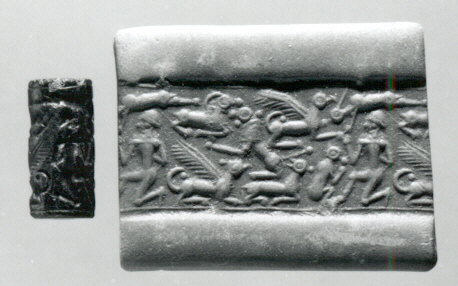
    Harran was founded at some point between the 25th and 20th centuries BC, possibly as a merchant colony by Sumerian traders from Ur.

    The Harranian moon cult of Sin proved to be enduring and lasted long into the Middle Ages, known to have existed as late as the 11th century AD.

    Harran is situated at an important geographical crossroad, both between the Euphrates and Tigris rivers and at the border between the ancient Mesopotamian and Anatolian cultures. The earliest known settlements in the region surrounding Harran date to 10000–8000 BC and settlements in its close vicinity are known to have existed by 6000 BC. The region initially shifted between the control of the Sumerians and Hittites before being occupied by ancient Semitic-speaking people around 2750 BC. The earliest written records concerning Harran suggest that the city itself was founded c. 2500–2000 BC as a merchant outpost by traders from the Sumerian city of Ur.

    Harran was from early on associated with the Mesopotamian moon-god Nanna (later known as Sin) and soon became regarded as a sacred city of the moon. The Ekhulkhul ("Temple of Rejoicing"), Harran's great moon temple, was already present in the city by c. 2000 BC. Sin was a major deity in Ur, which also housed his main temple.


    Another prominent deity in the city was Sin's son Nusku, the god of light.

    The religious authorities of Harran, speaking on behalf of Sin, were considered suitable guarantors and signatories in political treaties. Already c. 2000 BC, a peace treaty was sealed in the Ekhulkhul between Mari and the Banu Yamina, an Amorite tribe. Further treaties signed that invoke Sin of Harran include a 14th-century BC treaty between Šuppiluliuma I of the Hittites and Shattiwaza of Mitanni, and an 8th-century BC treaty between the Assyrian king Ashur-nirari V and Mati'ilu of Arpad.

    So that has 3,000+ years of continuity for "Moon God" who doesn't seem to mind being translated. "Mandaeism" amounts to an Aramaic account of it. Yes, Aramaic would be mostly north from Jordan:


    Yes, you can also find Eilat and Gaza which ought to be part of the functional unit.

    I don't remember a tablet implied by this:


    Quote ...Sumerian, and by Sim'alites who lived on the northern borders of Sumeria in Elamite territory. So they have been in Egypt since 3200 BC

    I think you said the cuneiform script was discontinued after that time.


    Initially:


    The oldest reports of North Mesopotamia are in the Amarna Tablets (q.v.), and show the region as being at the time under the control of the Mitanni. The rule of the mitanni was overthrown by Assyria 200 years later, when Shalmaneser I. assumed the title king of Kisshati.

    The city would not be firmly incorporated into Middle Assyrian Empire until the 1100s BC, before which it was often occupied by Arameans.

    Is it these you are trying to say are ancient Sumerian, that were found at a site developed by Akhenaten?


    Early in his reign, Akhenaten, the pharaoh of Egypt, had conflicts with Tushratta, the king of Mitanni, who had courted favor with his father, Amenhotep III, against the Hittites. Tushratta complains in numerous letters that Akhenaten had sent him gold-plated statues rather than statues made of solid gold; the statues formed part of the bride-price that Tushratta received for letting his daughter Tadukhepa marry Amenhotep III and then later marry Akhenaten.


    We go to something they are possibly discussing.

    This is the unique Beehive City:


    From a hoard of details, a few samples:


    Quote The Semitic moon god Su’en/Sin is in origin a separate deity from Sumerian Nanna, but from the Akkadian Empire period the two undergo syncretization and are identified.

    Sin had a beard made of lapis lazuli and rode on a winged bull. On cylinder seals, he is represented as an old man with a flowing beard and the crescent symbol.

    The bull was one of his symbols, through his father, Enlil, “Bull of Heaven”, along with the crescent and the tripod (which may be a lamp-stand).

    During the period in which Ur exercised supremacy over the Euphrates valley (between 2600 and 2400 BC), Sīn was considered the supreme god. It was then that he was designated as “father of the gods”, “head of the gods” or “creator of all things”.

    Ningal was daughter of Enki and Ningikurga. She is chiefly recognised at Ur, and was probably first worshipped by cow-herders in the marsh lands of southern Mesopotamia.

    The two chief seats of Nanna’s/Sīn’s worship were Ur in the south of Mesopotamia and Harran in the north.

    It was at Ur that the role of the En-Priestess developed. This was an extremely powerful role held by a princess, most notably Enheduanna, daughter of King Sargon of Akkad, and was the primary cult role associated with the cult of Nanna/Sin.

    A sanctuary for Sin with Syriac inscriptions invoking his name dating to the 2nd and 3rd centuries CE was found at Sumatar Harabesi in the Tektek Mountains, not far from Harran and Edessa.

    Sin was also the name of the pre-Islamic god of the moon and riches worshipped in Hadhramaut in South Arabia. The name is of ancient origin, and is retained in the name of the Hadhramaut Governorate of Yemen.

    She is daughter of Khirkhibi, the Summer’s King, and is married to the moon god Yarikh, who gave her necklaces of lapis-lazuli. Their marriage is lyrically described in the Ugaritic text “Nikkal and the Kathirat”.

    The oldest incomplete annotated piece of ancient music is a Hurrian song, a hymn in Ugaritic cuneiform syllabic writing which was dedicated to Nikkal.

    Adad and Iškur are usually written with the logogram 𒀭𒅎 dIM – the same symbol used for the Hurrian god Teshub. Hadad was also called Pidar, Rapiu, Baal-Zephon.

    The bull was portrayed as Adad/Iškur’s sacred animal starting in the Old Babylonian period (the first half of the 2nd millennium BCE). He is identified with the Anatolian storm-god Teshub, whom the Mitannians designated with the same Sumerogram dIM. Occasionally Adad/Iškur is identified with the god Amurru, the god of the Amorites.

    Harran was a centre of Assyrian Christianity from early on, and was the first place where purpose-built churches were constructed openly. However, many people of Harran retained their ancient pagan faith during the Christian period, and ancient Mesopotamian/Assyrian gods such as Sin and Ashur were still worshipped for a time.

    The Cave of Treasures adds an ancient legend that not long thereafter, Tammuz was pursued to Harran by his wife’s lover, B’elshemin, and that he (Tammuz) met his fate there when the city was then burnt.

    The pagan residents of Harran also maintained the tradition well into the 10th century AD of being the site of Tammuz’ death, and would conduct elaborate mourning rituals for him each year, in the month bearing his name.

    After the Suppiluliuma I–Shattiwaza treaty (14th century BCE) between the Hittite Empire and Mitanni, Harran was burned by a Hittite army under Piyashshili in the course of the conquest of Mitanni.

    In its prime Harran was a major Assyrian city which controlled the point where the road from Damascus joins the highway between Nineveh and Carchemish.

    Harran was called Hellenopolis (meaning “Greek city”) in the Early Christian period.

    The Mandaeans are Semites and speak a dialect of Eastern Aramaic known as Mandaic.

    In Islam, the “Sabians” (Arabic: al-Ṣābiʾūn) are described several times in the Quran as People of the Book, alongside Jews and Christians.

    During the late 8th and 9th centuries Harran was a centre for translating works of astronomy, philosophy, natural sciences, and medicine from Greek to Syriac by Assyrians, and thence to Arabic, bringing the knowledge of the classical world to the emerging Arabic-speaking civilization in the south.

    Baghdad came to this work later than Harran. Many important scholars of natural science, astronomy, and medicine originate from Harran.

    In 1032 or 1033 the temple of the Sabians was destroyed and the urban community extinguished by an uprising of the rural ‘Alid-Shiite population and impoverished Muslim militias.


    "Sabian" in actuality is the term that had originated from Yemen, but, had become a sort of umbrella for a number of variants, including the Mandaeans and Harranians.

    Within this realm, we find the Adad or Hadad that is first attacked by Yhwh via Elijah, which among other things is the first if not only "this god is false" claim I can think of. Comparatively, I would not question that Teshub is said to be spawned in a particular way, and yet is just another participant in a milieu with Sin and the rest, even Indra. These are generally "real" enough that even "enemy gods" are summoned as witnesses.

    There is an early church, an early and important mosque, and paganism is tolerated through most of the Byzantine Empire.

    Because it, the crossroads, was getting started at the time when India was somehow shipping cows to Ukraine, and, as part of the odd culture they gave horsemanship to, these sorts of things should probably be at least suggested here.


    Cows must have been all over the place, and, eventually, iron might start coming from one place.

    As usual, when I bump into some arcane Armenian legend, I ask The Mysterious Zet:


    Quote GarSTANG, J.—The Sun-God[dess] of Arenna (VI, 109-118. This is a discussion of the well-known description of the official seals of the Hittites, as
    stated in the Egyptian treaty. A difficulty in understanding it has been in the sun deity being stated to be feminine. This has, however, been found also on
    a tablet from Boghaz-Keui ; as parallels there may be mentioned the Semitic
    Shemash and the teutonic Sonne, both feminine. It might be an important clue
    to some ethnography to classify all people by the sex attributed to sun and moon,
    as it is a very primitive idea. The broad result is that the queen was heiress of
    Arenna, and high-priestess of the Sun-goddess there ; while similarly the Hittite
    king was high-priest of the Sun-god at Boghaz-Keui. In each case a minor
    fellow-deity was associated ; the male Teshub with the Ishtar of Arenna, and
    Ishtar-Kybele with the Teshub-Hadad of the Hittites. The position of Arenna,
    as capital of Kizawaden, is next considered. The indications are that Kizawaden
    is Kataonia, as stated in Student's History, III, 68.


    That this may be the right track is found in the history of Weaponry:


    Quote The Iron Age marked the first true revolution in metal weapon technology. The discovery of iron manufacture is often attributed to the Hittites sometime around 1300 b.c.e., when

    Weapons the Hittite king Huttusilis III sent an iron dagger as a gift to the king of Assyria. The actual invention of the process of producing iron blooms to obtain raw iron which could then be hammered into shape is attributed to a tribe living in Kizawadana in the Armenian mountains, who may have passed the secret to the Mitanni. There is, however, substantial evidence that iron making may have occurred in central India in the fourteen century b.c.e. Of greater importance is that the Indians seem to have made iron weapons in the form of double-edged daggers, socketed axe heads, flat axes, spearheads, and arrowheads at this early date. Whenever iron was first manufactured in the Near East, it was not widely used for weapons until around 900 b.c.e., bronze remaining the preferred metal for weapons because it was much easier to melt and cast. It was not until the time of Sargon II of Assyria (721–705 b.c.e.) that we encounter an army that was mostly equipped with iron rather than with bronze weapons.

    possibly this suggestion:


    Kazawatana or Kizawadana (cf. called. Carchemish)


    Around 1,300, the Hittites had suppressed the Mitanni and had an iron supply that they declined to share with Assyria.

    Past this point I am not sure you can find anything Indian being established here.

    For instance Vedic origins of Judaism is another Aryan Invasion shill:


    Quote The Vedic gods that the Mitanni worshiped would later form the Hindu pantheon, which lends credence to Aristotle’s assertion that,

    “Jews are derived from the Indian philosophers; they are named by the Indians Calami, and by the Syrians Judaei, and took their name from the country they inhabit, which is called Judea.”

    No, Mitanni honored all the foreign gods, and probably had reason to include Indian ones since the domestication of cattle into the iron age. The Indians could have known where to prospect for iron and introduced it on-site. Then there is no more sign of them sticking around.


    That makes two characteristic loops coming out of Makran:


    By 4,000 B. C. E. if not even earlier, there appears to be sea trade along the coast which results in Lapis Lazuli being the foundation stone of divinity whether in Mesopotamia, or Egypt, or as we just saw in Harran, etc., which is true in the writings and in the artifacts. I am not sure if anyone has asked if it would be meaningful in IVC Seals.

    By 2,000 B. C. E. and perhaps earlier, Indian Cattle--Go, or Uksha--are bred into Ukrainian stock.

    One does not find any of the traditionally invasive markers into India until a later period, and then only minorly until the famous examples Alexander the Great, etc.


    While quietly peering around the fact...those may be IVC houses...Harran has had Bedouins, Kurds, Manicheans, just about any kind of name that might be possible was there.

    What's this?


    “Jews mostly manifest genetic affinity with the Kurds, and to some extent, with the Armenians... the Jews and Kurds had common ancestors who resided in the borderline areas of the modern Iraq and Turkey... " Nebel et al. (2001)

    According to Ariella Oppenheim "The genetic connection was strongest between Jews and Kurds ... This suggested that the ancient Israelites may have originated in the Kurdistan region."

    So the answer is yes, Abraham was born in either Urkeš (Ur Kasdim) or Harran, both sites are located in Kurdistan. And in early Bronze Age they were part of the ancient kingdom of Kurda.


    Not sure what to make of him.

    Or what concretely places him or Moses in any certain thing.

    I can see that Edomite factions punched a theological hole in something that appears to have been multi-lingual at Harran, and a temporary competition where the Sun God slipped out of Letoon as Apollo until the final Mithraic temples ca. 500s, and then we have a one book culture in the west.

    Almost any of the tenets or beliefs associated with Abrahamism are not present in India.

    It does import some amount of mathematics and astronomy, such as the Tetraktys.

    I believe that is a modernizing development beyond IVC or even the Vedas. I think you can determine things like "sound waves" without having a precise knowledge of their amplitude and velocity. You could probably have done coastal navigation based on observational astronomy. You can compile tables and get good working estimates without being 100% accurate. We, in fact, do this, with NASA's help. In astrology, the historical positions of objects are recorded in an Ephemeris. If I want to know where Venus was in 1,380 B. C. E., I can find out with trigonometry, but, there are so many iterations, it still takes a computer a long time to run it. Instead, there are simply recordings of it, so I can use a program to ask the computer a question and it is just going to read a database. I can't quite recall but the Ephemeris is compiled to something like 4,000 B. C. E.


    It is only at this later period that India seems to gain a Flood Myth similar to Noah.

    Again it seems to me that the mythologies just have Cosmic Water and the lifting up of Earth, and then they talk about rain and rivers, and there is no "event".


    This is a strange kind of circle; physically since the Chalcolithic at Ulug Depe:


    Quote Genetic data obtained from several archaeological sites show a strong genetic continuity between the Neolithic and the beginning of BMAC, with only a limited genetic contribution of other groups. BMAC displays the first structured proto-urban cities of the area gathering thousands of individuals, and a deep social structuring.

    For still unknown reasons, the Late Bronze Age (ca. 1800–1500 BC) corresponds to a major cultural, economic, and ideological shift in southern Central Asia, leading to the disappearance of the Oxus Civilisation and is characterized by deterioration in the quality of the craft industry and the disappearance of long-distance exchanges within the Middle Asia Interaction Sphere. However, contacts with neighboring steppe Andronovo cultural community increased during the Late and Final Bronze Age period (Rouse and Cerasetti, 2014).

    The people are the same, until a sudden mixing, and eventually the culture disintegrates.

    According to Iran:

    The date 2300 B.C. is suggested for the beginning of BMAC in southern Bactria

    It seems correct that this culture continued to exist in southern Bactria
    until about 1400/1300 B.C.


    In the sense there is a "new culture" arising in "old people", Parpola's information without the extra AIT agenda:


    Quote The Bactria and Margiana Archaeological Complex (BMAC) or Oxus civilization rose in southern Central Asia under Elamite influence. Gonur and other fortified sites of its urban phase (c. 2500–1700 BCE) have palaces, temples, and cemeteries with ornamented scepters, wine cups of silver and gold, figurines, and uninscribed seals with “Trans-Elamite” iconography. Decapitated horses, a BMAC chariot grave.

    A chariot seal and BMAC signal trumpets from Tepe Hissar in north Iran, and Syrian motifs on BMAC seals, trace the trail of Indo-Aryan chariot-warriors to Mitanni, ruled c. 1500–1300 BCE by kings bearing Indo-Aryan names, swearing oaths by Indo-Aryan gods, and spreading chariotry all over West Asia and Egypt.

    Again, this could very easily be summarized as the Bhrgus.

    If they have art from Elam, they might have Sanskrit from India. They were closest neighbors of Shortugai IVC.

    It is as possible the Mitanni were Bactrian Bhrgus as any other way of making that work.

    Many of these authors are consistently trying to say the Mitanni and/or Bactrians took over all India. It seems more like they simply vanished. BMAC went out like many of the others, possibly resulting from drought. Whatever was in Syria is simply never heard from again. These Bhrgus are not known to exist.

    That is only a suggestion, while there are plenty of reasons to disregard the Mitanni or Bactrians to have subsequently devoured India.

  24. The Following 3 Users Say Thank You to shaberon For This Post:

    Bill Ryan (27th December 2023), Jim_Duyer (27th December 2023), mountain_jim (27th December 2023)

  25. Link to Post #53
    Costa Rica Avalon Member
    Join Date
    13th February 2021
    Location
    In a Log Cabin in the Mountains
    Language
    English
    Posts
    844
    Thanks
    809
    Thanked 6,866 times in 814 posts

    Default Re: The Indus script, aka the Harappan script, aka the WTH? - Deciphered.

    Well, the Mandaeans consider themselves the same people, who reject and deny Moses.

    I have researched the Mandaeans, and read most of their writings. Now they live in the area of Syria and Iraq, but at the time of Jesus and before they lived near Jerusalem. Their ancestors mentioned Jesus, and they knew him and John the Baptist, as a living person. Funny that this part never seems to be published much when people say that Jesus never lived. Anyway, they, as well as Jesus, understood that Yahweh was not EL, the Creator. So they are much like the Gnostics in that respect, but without all the Archon imagery. They also understood that the ones that were behind the Crucifixion were the scribal workers in the Temple who were the ancestors of the Kenites, or the Cain group.
    Again, your Father is not My Father - your father is Satan, from the NT.

  26. The Following 2 Users Say Thank You to Jim_Duyer For This Post:

    Bill Ryan (27th December 2023), mountain_jim (27th December 2023)

  27. Link to Post #54
    United States Avalon Member
    Join Date
    1st April 2016
    Posts
    6,162
    Thanks
    30,380
    Thanked 34,519 times in 5,809 posts

    Default Re: The Indus script, aka the Harappan script, aka the WTH? - Deciphered.

    Quote Posted by Jim_Duyer (here)
    Their ancestors mentioned Jesus, and they knew him and John the Baptist, as a living person. Funny that this part never seems to be published much when people say that Jesus never lived.

    Jesus is not necessary for John to have been a known individual.

    The Mandaeans mainly complain about the "followers of Jesus", as if the references to Jesus are second-hand reports.


    Quote Anyway, they, as well as Jesus, understood that Yahweh was not EL, the Creator. So they are much like the Gnostics in that respect, but without all the Archon imagery. They also understood that the ones that were behind the Crucifixion were the scribal workers in the Temple who were the ancestors of the Kenites, or the Cain group.

    The Gnostics are like the Mandaeans because "manda" means "gnosis", so it is the other way around.

    "Gnosticism" is most likely a development from *within* Judaism, indistinguishable until the point they may seem to bother or contradict authors.

    That seems to be the scholarly consensus, which is not different from saying the Mandaeans are non-Jewish Semites from the same scene.


    The main "internal Gnostic" problem is Manicheanism, the extreme duality that re-ifies the lower powers/forces of darkness and exalts them as a type of cosmic conspiracy of evil.

    Generally, Yahweh, Archons, or lower ranks are the Creator(s).

    But Mandaeanism is again similar, it is a dual layer, meaning these lower workers are supposed to be compelled into the subservience of the higher god(s).

    This, I think, is the crude birthing of modern religions.

    The new ones are creator-centric.

    Yahweh is normally held to be the Archon of Saturn. The exact reversal may be found in Virgil's Ecologues. The original Saturn was a refugee from the Trojan War (i. e., Luwian or from near Letoon), who settled Latium ca. 1,200 B. C. E., beginning a Golden Age marked by peaceful relations with the Etruscans.

    City of Rome ended that.

    Virgil's wish for a new Golden Age of Saturn has been taken as a prophecy of Jesus.

    The main trick is that "creator", who gave the "breath of life", in the lower sense just means the physical body and it becoming animate. This focus in turn erases whatever was being said or practiced about the higher realms.

    The main clue is that the Seven are basically identical from India to Germany, and, the fuller understanding is simply them having higher and lower natures, beneficial and malefic aspects.


    Since I, at least, am not that familiar with the nuances of the mid-east, I was curious about the older-to-younger track of it.

    In questioning the time frame, whether Elam influenced IVC seals--almost certainly not the glyphs, but, maybe, animal hieroglyphs--or, influenced BMAC--we can get the entire corpus from Roach 2009:


    Quote Elamite cylinder seals have not previously been studied in detailed reference to one another, nor has there been an established paradigm of stylistic development articulated. This study addresses this lacuna by compiling all the published cylinder seals from Elam (as defined here, thus incorporating the historical provinces of Khuzistan, Luristan and Fars), from their earliest appearance (c.3500 BC), throughout the era of their typological dominance (over stamp seals, thus this study departs c.1000 BC)

    It's five pdfs.


    The Walters has a match for a Mehrgarh Six-spoked Wheel used on a chariot--neo Elamite, ca. 7th-8th century B. C. E., and:


    A seal’s owner rolled impressions in wet clay to secure property such as baskets, letters, jars, and even rooms and buildings. This clay sealing prevented tampering because it had to be broken in order to access a safeguarded item.


    A general art survey starting from 4,500 B. C. E. also says they are Jar Tags:


    Proto-Elamite tablets were found together with clay stoppers and with clay tags; two of the tablets were sealed indicating the storage of goods under some form of administration.


    The seals have almost no presence of human figures; instead, some are simply geometrical, and thought to have looked like this:


    They perhaps accidentally give the Unicorn and Zebu Bull:


    In contrast to the slimmer, non-humped bulls in the previous seal, this bull has a stocky body, frontally depicted horns, hairy chest, tufts of leg hair, and angular tail with long triangular tip.


    and mention a Hybrid Eagle:


    ...a griffin with the head, wings, and clawed feet of a bird of prey and the body and rear legs of a lion.


    and discover what I would take to be a pantheon:


    ...a triangular “lion mastering bulls” and a pentagonal “bull mastering lions”. Each frieze contains three complete triangles (bull-mastering-lions) and two pentagons (lion-mastering-bulls).


    Ca. 3,000 B. C. E.:


    Animals in boats


    In one view, the curved-horn Ibex is Rain.This also points out the regular appearance of the "Maltese cross".

    Is a Pipal Leaf being used as the "tail tip" above? Are those IVC boats that have unrealistic animal hybrids?


    Elam defeated Ur ca. 2,600 B. C. E., and then you find a slightly different art and language around 2,300 B. C. E. where there is distinctly an Eagle as Etana.


    That is considerably more prominent than it was in the older series which is mostly bull and lion (perhaps Innana--Ishtar).

    Later there is the eight-rayed star of Ishtar and crescent of Sin.

    So yes I think there might be something in the Elamite "meanings" rather than the words/script, which is at least partially similar to the lore of neighboring regions.

  28. The Following 2 Users Say Thank You to shaberon For This Post:

    Bill Ryan (28th December 2023), mountain_jim (29th December 2023)

  29. Link to Post #55
    United States Avalon Member
    Join Date
    1st April 2016
    Posts
    6,162
    Thanks
    30,380
    Thanked 34,519 times in 5,809 posts

    Default Re: The Indus script, aka the Harappan script, aka the WTH? - Deciphered.

    Instead of a helpless subcontinent suddenly mastered by horse-riding supremacists, it appears that India was trading cattle as wealth by the beginning of any civilizations.

    I had never thought of the mythological Bull in terms of what *kind* of Bull.

    The oldest Elamite seals show a Zebu around 3,000 B. C. E., and it was bred with Ukrainian cattle by 2,000 B. C. E..

    It is a domestication of the wild Aurochs, a feat not done by Native Americans. It was abundant. The Aurochs roamed every temperate zone from Morocco to Korea.

    As to what is a Zebu:


    Quote Zebu cattle were found to derive from the Indian form of aurochs and have first been domesticated between 7,000 and 6,000 YBP at Mehrgarh, present-day Pakistan, by people linked to or coming from Mesopotamia.

    Why do they feel the need to say this? What people went there from Mesopotamia?? That is not supported.


    Quote Its wild ancestor, the Indian aurochs, became extinct during the Indus Valley civilisation likely due to habitat loss, caused by expanding pastoralism and interbreeding with domestic zebu. Its latest remains ever found were dated to 3,800 YBP, making it the first of the three aurochs subspecies to die out. The Indian aurochs has been found to be ancestral to both the Sanga (Bos taurus africanus) and the zebu (Bos taurus indicus) subspecies of domestic cattle. The last common ancestor of Indian aurochs and Eurasian aurochs (B. p. primigenius) is estimated to have lived about 150±50 ka BP,


    The Indian aurochs was most likely domesticated in the Indus River valley, now the Baluchistan region of Pakistan around 9,000 YBP, with subsequent breeding efforts eventually leading to zebu or indicine cattle. The domestication process seems to have been prompted by the arrival of new crop species from the Near East around 9,000 YBP. Human pastoralism, enabled by domestic cattle, spread throughout the subcontinent around 5,500–4,000 YBP.

    Zebu breeding is virtually identical to IVC.

    Are they found to expand?


    Quote Archaeological evidence including depictions on pottery and rocks suggests that humped cattle likely imported from the Near East was present in Egypt around 4,000 YBP.

    Domestic zebu are recorded from the Indus region since 6,000 BC and from south India, the middle Ganges region, and present-day Gujarat since 3,500–2,000 BC. Discounting gayal and banteng, domestic cattle seem to have been absent in southern China and southeast Asia until 2,000–1,000 BC, when indicine cattle first appeared there.

    Again, that seems to fit the mix. Ca. 3,500-2,000 B. C. E. is what we are calling the Gangetic origin of the Aryas. However it depended on Rice from China and Cattle from IVC.

    Egypt received these cattle...about the same time as Ukraine and China.


    So far it seems Indian cattle flowed on the same route as Lapis Lazuli. However, IVC Seals are not the oldest form of writing. The older Elamite ones have hardly any glyphs or script, if it exists there, and it may have something in common with something Indian that also lacks lettering of any kind.


    India has a non-IVC site, which was inhabited from the dawn of time until about 100 B. C. E., and is remembered as a Buddhist site. Very difficultly, there is an image at Bhimbetka depicting a humpless bovine.

    The site contains the world's oldest stone walls and floors.

    Ca. 8,000-3,000 B. C. E.:


    Its art is divided roughly into two periods; the "historical period" has people on horses with weapons having battles. The "pre-historical" is mostly animals, hunting and/or mythological styles; in one example, a group runs from a rhinoceros.

    Tigers are either not present or scarcely noticeable.


    Quote Of the numerous shelters, the Auditorium cave is one of the significant features of this site. Surrounded by quartzite towers which are visible from several kilometres' distance, the Auditorium rock is the largest shelter at Bhimbetka. Robert G. Bednarik describes the prehistoric Auditorium cave as one with a "cathedral-like" atmosphere, with "its Gothic arches and soaring spaces". Its plan resembles a "right-angled cross" with four of its branches aligned to the four cardinal directions. The main entrance points to the east. At the end of this eastern passage, at the cave's entrance, is a boulder with a near-vertical panel that is distinctive, one visible from distance and all directions. In archaeology literature, this boulder has been dubbed as "Chief's Rock" or "King's Rock", though there is no evidence of any rituals or its role as such.
    Towers:


    Auditorium:


    Quote At least some of the shelters were inhabited more than 100,000 years ago.

    The Bhimbetka site has the oldest-known rock art in India, as well as is one of the largest prehistoric complexes...seven hills and over 750 rock shelters distributed over 10 km (6.2 mi).

    The site consists of seven hills: Vinayaka, Bhonrawali, Bhimbetka, Lakha Juar (east and west), Jhondra and Muni Babaki Pahari.

    The art is agreeably dated to 10,000 B. C. E., although there is conjecture some of it may go to 40,000.

    Then we are given this oddity:


    Quote (Early historic): The figures of this group have a schematic and decorative style and are painted mainly in red, white and yellow. The association is of riders, depiction of religious symbols, tunic-like dresses and the existence of scripts of different periods. The religious beliefs are represented by figures of yakshas, tree gods and magical sky chariots.


    Okay.

    Like everything else, we would want to break down a sea of material into its first parts, and the sequence of design and is anything remarkable.


    From a brief description of these Paintings:

    Quote Sometimes, instead of being colored, the body of an animal is filled-in with another animal, suggesting a more conceptual style. For instance, some paintings depict an elephant painted within the outline of a deer, which could suggest a fantastical and possibly humorous approach to depicting subjects.

    Boar Rock

    Also known as Bhimbetka Shelter III F-19 and Bull Rock, this rock shelter derives its name from its depiction of a large, boar-like creature and is prominent among the hundreds of structures that comprise the Bhimbetka cave paintings. The animal depicted in the painting has a large head, horns and what appears to be fur on its back. It appears to be charging leftwards, towards two figures—a human and a crab. The painting is rendered in deep red, which is believed to have been obtained from hematite, and is known for its magnitude, which is over 1.2 meters tall and .87 meters wide.

    Unlike the other hunting scenes depicted in the Bhimbetka rock shelters, the scene illustrated at Boar rock depicts a human figure being attacked by, and fleeing, a wild animal. While paintings of boars appear in several other instances in the region, scholars believe that the animal at Boar Rock is mythical and seems to be a combination of a boar, an ox, and an elephant.


    The figures must be sorted by age because in a certain sense, this is irrelevant:


    In some, there are clear depictions of gods such as Ganesha and Shiva, representations of the Mother Goddess and symbols such as the trishul and swastika.


    Discovered in 1957, the works are compared to those of Australia, Botswana, and France. A tiger is at the Auditorium.

    There is a very modest arrangement by Pathak 2014:


    Quote Dr Vishnu
    Shridhar Wakankar, their discoverer, used
    to say that, when travelling along the hills
    on a train, he noticed the spectacular sandstone rock formations along the ridge. He
    got fascinated by them and by their surrounding landscape. He got down from
    the train to explore and he thus discovered
    Bhimbetka! From that momentous time, he
    started studying the numerous painted shelters and he never stopped until his death in
    1988.


    It has an enhanced boar picture.

    The bulk of the gallery is:


    2330 humans, mostly males

    1377 animals


    The rare mentions are:


    only 1 cheetah,
    1 rhinoceros, 1 black buck
    (Antelope carvicapra), 1 sloth bear, 1 hyena, 1 wolf, 1
    monkey (Macaca mulatta) (with a red face)


    Distinctively:

    561 images of horses have been found and
    all belong to historic times.


    Characteristically:

    5 images of mythical boar (three
    of them with horns)

    We know 20 hunting scenes and 285 figures
    of hunters. We may stress the fact that nine
    of them show women as hunters.

    Some inscriptions, in Ashoka
    Brahmi (300-100 BC), have been deciphered
    by Wakankar: “Sihakasa Lene” means the
    cave of Sihakasa. In the Gupta and PostGupta script (300-900 AD), Pisach is the
    name of a person.


    Concerning wild boars and the regional tribes, Korku worship them, Gond sacrifice them.


    Shelters:


    During the absence of writing, this may be a bridge through the Copper Hoard ca. 1,500 B. C. E.:


    Kheri Gujar, in the state of Haryana

    The figure has a cast relief on its chest of a unicorn-like animal, similar to motifs found on seals of the Harappa culture, which thrived until around 1900BC.

    (image is encoded, view at link)


    Boar Rock was perhaps ca. 2,000 B. C. E.

    The Boar is not prominent in IVC seals. Comparatively, IVC raised:


    Evidence of cultivation of rice in Lothal and Rangpur ( Gujarat) only .

    Sheep, goat, humped and humpless bull , buffalo, boar...

    Lion was not known to Indus people .

    Indus people were the first to produce cotton in the world.


    And there is debatably "Rudra and his dog" vs. wild boar:


    Is that the person who was chased towards the Crab turned around?

    If you live in the foothills, you probably know the crab is at the beach.


    We might say Elam had its own "hybrid", the griffin, while lions and eagles were not big in IVC. India had a boar, which has no major role there either.

    Around the Vindhyas where this site lies, the occupants themselves are migrants from the undiscernable past.


    Gonds are Dravidian or Telugu, para-Hinduized and associated with Bhima and Kali.


    Korku are Mundas.

    Isolated from Munda speakers:


    Korku are a bit like Dravidian Brahui, some type of expansion that got sliced off the connecting part.

    Mundas can be said to be present 30,000+ years ago, while Dravidians only from the Ice Age.

    Both may have been at the site by 10,000 B. C. E.. Australics are thought to have mainly settled coastal areas, and slowly made their way up the rivers, not an "invasion" that rapidly covered the whole land.

    It ceased being a "township" around 100 B. C. E., but was used by hermits and monks thereafter.

    Locals call them vampire's teeth and avoid them:


    Some animal species, particularly two-horned rhinos, shown in the rock paintings indicate that the region was once home to these animals, which have since disappeared from the area.


    So, they have things apparently not even known to IVC, diminishing post-Ice Age species that ceased to be.

    They do have a few things perhaps more cathartic.


    Rock art Honey Collection is glyphic "water bearer".

    This relatively northern area is a little different:


    Quote Such battle scenes were not prevalent in Deccan plateau or in southern peninsular India. In southern India, majority of rock art sites are related to megalithic burials. Recent explorations have traced visual materials on ethnic conflict in Nilgiri Hills, Tamil Nadu. In Jharkhand, rock art is intimately associated to the folklore and myth of ‘Kohbar’ or marriage booth of a legendary royal bridal couple.

    Mathpal 1994 is about the only catalogue of these and he says fifteen tigers.

    Multiple pdfs are available for it.

    List of illustrations shows what came to his attention.


    From the categories:


    Another painting shows a man extracting honey from a honey comb.

    Bulls whose feet are trapped in a basket.


    Admired by beekeepers:


    Descriptions and illustrations are given of 4 rock paintngs discovered in the Bhimbetka region in 1983; all depict scenes of honey collection from Apis dorsata nests in the branches of trees. Two other paintings in the Panchmarhi area depict honey being collected from nests under a rock, or hanging from rocks. Illustrations are given also of honey collection scenes in paintings previously discovered at Ganeshghati near Bhopal.


    Along with a good entrance picture:


    Women
    are painted both in the nude and clothed


    Finding a honey scene along with a handprint, a deified boar shoots semen, and Mother Goddess has a spider shape. A boar chases a crab over a woman. Gonds eat the pork which is taboo to the Korku.


    This shelter complex is called Bhima's Repose, he was said to be here in exile.

    Is Bhima a Rg Veda character? No.

    He is said by some to be implied by the Manyu Suktam:

    83 and 84 in the 10th mandala


    which is a Madhva interpretation not accepted by Vaisnavas.

    It deals with three avatars of Vayu as in Vayu Purana.


    The idea of "Madhva" as the third of these is in Balittha Suktam:


    Rig Veda 1.141


    which is at least dealing with the three births of Agni.

    Well, Vayu must be very similar. It is three levels, cosmic, planetary, and human or physical if so.

    If we were not thinking it was supposed to be a person, here is the generic translation from the hymn's Meluhha version:


    What time from out the deep, from the Steer's wondrous form, the Chiefs who had the power produced him with their strength;
    When Matarisvan rubbed forth him who lay concealed, for mixture of the sweet drink, in the days of old.

    nír yád īm budhnā́n mahiṣásya várpasa
    īšānā́saḥ šávasā kránta sūráyaḥ


    yád īm ánu pradívo mádhva ādhavé
    gúhā sántam mātaríšvā mathāyáti


    The implied avatar sequence is Bhima --> Madhva.

    My first response is that it is just like Atharvangiras --> Soma.

    The second ones not really being a person, but, some kind of stuff a person might be known for gathering; "soma" is not considered a "being" in Rg Veda--is "madhva", sweetness or honey? Probably not. It is also unlikely to be a prophecy of someone born 2,000 years later.


    Bhima's on-paper thesis is as from Sugarcane Bow:


    Quote Bhima (a powerful warrior, and son of the god Vayu) proposed that Kama is the primary life-aim. His argument is that:

    “One without kama does not strive for artha, one without kama does not wish for dharma; one without kama is not striving for anything; therefore kama is pre-eminent.”

    Bhima’s argument in favour of kama also reflects a key theme in Indian religious & philosophical texts – that what might be otherwise be seen as an impediment to spiritual progress can, paradoxically, lead to progress. There is also the recognition that desire is inescapable.

    Are these scenes part of the Aryas?


    Quote India's oldest sacred book, the Rig-Veda, contains many mentions to bees and honey. This book was probably compiled between 2000 and 3000 BCE, and was written in Sanskrit. The Sanskrit word for honey is madhu, which is etymologically identical to the Greek methu and the Anglo-Saxon medu, or mead.

    Kama, the god of love, who carries a bow with a string made of bees. And that is not the only bee-related weapon: the twin horsemen, the Asvins, lords of light, have a whip dripping with honey known as Madhukasa. These horsemen ride in a chariot known as Madhuvahana, or "honey-bearing". By sprinkling honey from their whip, the Asvins were said to prolong the peoples' lives. There is even a hymn written specifically about the honey whip in the Atharva-Veda!

    "When the honey-lash comes bestowing gifts, there life's breath, and there immortality has settled down.

    As the bees carry honey upon honey, thus in my person, O Asvins, luster shall be sustained.

    O Asvins, lords of Brightness, anoint me with the honey of the bee, that I may speak forceful speech among men."


    "Soma" was said to be hidden "in all the plants", or, pantheistically, throughout nature.

    "Madhu" alludes to itself similarly. After a strand of wilderness locations, in I.90.8:


    May Vanaspati be possessed of sweetness towards us; may the sun be imbued with sweetness; may the cattle be sweet to us.


    Such is why Vanaspati or lord of the wilderness is able to be involved with Soma.


    Bhima's relative Balarama likes "wine made from honey", or Brandy, Sura, or Varuni.

    Lakshmi and Varuni are sisters from Churning the Ocean of Milk.


    Bhima, who used to eat a lot and could not remain without food because of Vrik Agni - Hunger Fire in his stomach


    or:


    Jitagni, also called Vrikagni, is present in our stomach.


    as to his character:


    Quote Bheem, the person who was also a fierce battle fighter, but he specialized in warfare without equipment, on-field. He was the one Pandava who had single-handedly destroyed many devils like Hidimbasur, Bakasur, Jatasur, Keechak, Jarasandh, and the like. This was why he was nicknamed Bheemkarma or the Bheem that gives the result of Karma.

    Bheem was not just an excellent fighter, he was an avid eater as well. He was so foodie that normal people have a Jatharagni (small fire in the digestive system that digests food), but Bheem had Vrikagni (excessive fire in the digestive food capable of digesting a huge amount of food). This was why Bheem was also referred to as Vrikodar or the person with Vrikagni.

    This bulky-bodied Bheem was the owner of the conch shell named Paundrik, which meant as fierce the owner as the voice. It was also referred to as Mahashankh, or the master conch shell, which was the loudest and a very very fearful voice showing the exact characteristic of Bheem as well.


    Using IVC glyphs for honey bee & comb, in astrology, these are postulated as Ashwins and Aries:


    Quote A series of soft-stone artefacts associated with middle Asian Interactive
    sphere was carved with a number of stylistically coherent motifs. These include
    combat snake motif, humped bulls motifs and other figures, - lion headed bird, hut
    motifs, date palms and rosettes along with simpler portrayals such as mats, squares
    and whirls. Since these motifs are wide spread within the Middle Asian Interactive
    sphere and across a number of cultural regions, it is called the ―Inter Cultural‖
    style. The south Asian Zebu is the best example of these motifs. In a broad level,
    the inter cultural style is a shared set of symbols, brought together in stylistically
    coherent set of motifs, carved on stone that is very much the same wherever it is
    found.(L.Possehl, 2003).

    It is what was called a "flag" previously--slanted line (branch) with a ridged triangle (hive) hanging from it. Which seems more likely?

    As a hypostasis:


    Quote Later
    Zodiacs were modified to keep the hero figure in the centre fighting the animal,
    two lions or two bulls, which is a common motif in Middle Eastern seals. Many of
    the Middle Eastern seals show worship of the naked goddess. Hemtun concludes
    that this naked goddess (Inanna) is representing asterism Auriga, because in one
    seal, she stands on the ‗oxen‘ in ‗Indian style‘. Note the similarity between this
    Sumerian seal and the Indus seal depicting ―deity of tree‖ in the ―goat seal‖. This
    seal illustrated here is from Syria (circa 1800 BC) and the naked goddess was the
    symbol of rain and fertility in Levant

    The "important" oxen or bulls in the mid-east are Zebu, smaller ones being similar to the unicorn, which in IVC more strongly resembles a bull than a goat.

    And for something that may secretly be "honey gatherer" in India:


    Quote This
    amulet was found in Sumer and it is influenced by the Indus
    Symbolism as per observation of Hemtun. This image of
    water carrier represents a deity but generally these kinds of depictions are not there
    in the Sumerian style. Because of that reason, Benght Hemtun concludes that this
    design of this amulet has been influenced by Indus culture.

    Does Sumer have "water carriers" of its own? Is that what they really are??


    In a slightly more detailed look, unicorn's filter is Varuni. This study believes the Gharial--Makara (crocodile) couples with the Tiger Goddess. Certainly in one seal:


    Gharial watches from the sky while the woman spears a Buffalo.


    This study thinks Mesopotamian lions are consciously replaced by tigers.


    Considering the Contest:


    Quote This drama is depicted on at least two other seals from the ancient Indus metropolis. In other scenes from Harappa, this is a female deity standing on an elephant with a spoked wheel sign above her head

    Asko Parpola writes: "The 'contest' motif is one of the most convincing and widely accepted parallels between Harappan and Near Eastern glyptic art. A considerable number of Harappan seals depict a manly hero, each hand grasping a tiger by the throat. In Mesopotamian art, the fight with lions and / or bulls is the most popular motif. The Harappan substitution of tigers for lions merely reconciles the scene with the fauna of the Indus Valley ... The six dots around the head of the Harappan hero are a significant detail, since they may correspond to the six locks of hair characteristic of the Mesopotamian hero, from Jemdet Nasr to Akkadian times,"


    Quote Throughout south India, until relatively recently, village goddesses have been worshipped through water-buffalo sacrifices. The goddesses have been associated with a male deity call the "buffalo king," represented by a wooden post or a pillar made of stone, or by the pipal tree (Biardeau 2000).

    In the form of worship at Kannapuram, a south India village in Tamil Nadu studied by Brenda Beck (1981), the tree-truck (known as kampam in Tamil, from Sanskrit skambha ("pillar") in front of which the sacrificial buffaloes are decapitated, is said to be the husband of the goddess. At the end of the annual marriage rite, after the last victim has been slaughtered, this trunk is uprooted and the goddess divested of her ornaments like a widow. The pillar and its uprooting correspond to Siva's phallus and its castration. The sacrificial post used to be burned after the divine marriage festival."

    Later Parpola continues: "If the buffalo sacrifice is common in south Indian village religion, it is absent from north Indian village religion. The reason is probably the conscious efforts of Vedic Brahmans to eradicate it. Extravagant buffalo sacrifices were at first adopted by the Rigvedic Aryans in the Indus Valley (RV 5,29,7-8 etc.), but thereafter this mode of worship is not heard of. In the later Vedic literature (to Varuna) is mentioned in only a single context, in a list of hundreds of different animals offered as subsidiary victims in the horse sacrifice. It appears that generally speaking , the Brahmins have been fighting against bloody sacrifices from Rigvedic times onwards. In the Rigveda, the cow is called aghnya, "not to be slain," and while the Grhyasutra rules (apparently reflecting the behavioral code of the Atharavavedic India-Aryans) include the slaughter of a cow when a guest of honor is received, a later rule leaves it to the guest to decide whether this is done or the cow is set free. The Brahamana and Srautasutra texts record, even mentioning the names of the Brahmins concerned, how in the Vedic sacrifices human, horse, and other animal victims were successively discontinued, and a final rule says the proscribed victims should be made out of rice and barley paste."


    So, yes, of course there is a Sacrificial Post to which a victim is tied--except this is neither the original nor correct idea. Both some tribals and some Aryas have taken it literally, and, that group that can afford to dispose of livestock rather uselessly is probably more powerful and dominant than those who don't. So we think they speak a little louder.


    Above the head of the hunter is a gharial, a small species of crocodile with a narrow snout that was once common in the Ravi and Indus rivers, but is now almost extinct.


    This probably is even part of a set with Cross-legged man coming out of a tree over a tiger:


    Subsequently, this is informative to the oldest iconography and historical records of Shaktism. At Jaipur, Orissa, Dharma performs a sacrifice, and Mother Earth arises as an altar, who is Viraja, Stambhesvari, or Vindhya Vasini, most likely related to Atharva Veda.


    She is on the edge of extreme conflation:


    The Brahmayamala Tantra has a hymn, "Aadya Stotra", dedicated to Shakti. In the hymn, Vimala is the goddess of Puri and Viraja (Girija) is the goddess worshipped in the Utkala Kingdom, which became Odisha.

    According to the Tantra Chudamani, Sati's navel fell in the Utkala Kingdom, also known as "Viraja kshetra".

    (an Oddiyana is an ornament worn by a woman around her navel).


    This form has only two arms, and a spear, not trident:


    In other words, the most basic pantheon of Orissa derives from Viraja, while in most places, Durga or Candi, etc., is considered an aspect of Vimala, and Viraja disappears from view.

    Except for her headgear, which is probably a later addition, Viraja is the closest continuity to an archaic, two armed, spear-using Buffalo slayer or Mahishmardini, the role essentially lifted by Durga. Viraja also makes tons of sense read in the Vedic light. Therefor, we see a fused compatibility of Arya rites and tribal or Sabari shaktism, which seems to be a goal of it all. In other words, rather than suppress/eradicate "native beliefs", they are harnessed/employed, because they are not false. Quite different to what happened to El in Canaan.
    Last edited by shaberon; 29th December 2023 at 20:23.

  30. The Following User Says Thank You to shaberon For This Post:

    mountain_jim (29th December 2023)

  31. Link to Post #56
    United States Avalon Member
    Join Date
    1st April 2016
    Posts
    6,162
    Thanks
    30,380
    Thanked 34,519 times in 5,809 posts

    Default Re: The Indus script, aka the Harappan script, aka the WTH? - Deciphered.

    More animals and wars...

    I find this fascinating, almost refusing to draw conclusions, because the same information is used by two diverse schools of thought:

    The Aryan Invasion Theory (AIT) is *still* prevalent in most western research, they think everything proves a Caucasian force projection that took over India.

    Many Indians believe the opposite, based on astrological data and rumor, they think for example India took over Ireland in 11,000 B. C. E..


    I like the Great Year of the Zodiac, but even this is no more accurate than most of our information. In archaic times we are speculating in a way that probably is within about 1-400 years of the real answer, which is about the accuracy of those Ages. So for example if the Meghalayan Age means a series of droughts from around 2,200-1,900 B. C. E., it is not quite an exact moment, just like the beginning of the Age of Aries. Or is it the end of the Age of Taurus. Even a computer cannot really define it due to unknown perturbations that accelerate the process by unknown amounts.


    Rummaging through the finds that fairly easily give "epochs", I ran into an idea that gives something a little more precise--a date.

    This page uses something similar, a series that we are going to upgrade; Bhimbetka begins Rock Art about 10,000 B. C. E., and shows signs of continuous habitation and corresponding images. It is not terribly far from Sanchi, and these are near the center of India. It is possible the cupules and some carvings are a quarter million years old. Nevertheless, the paintings begin prior to almost anything considered to be known.


    Bhirrana begins about 7,000 B. C. E. and also has signs of each continuous "layer". It is near the center of IVC.

    Rolling along, the article emphasizes Lothal:


    Quote If we examine the archeological evidence in the Sarasvati- Sindhu phase of Indian history, we find that the entire civilization was completely peaceful. There is zero evidence of war. The entire geographical area was peaceful and extremely prosperous. It was very well planned and was an Urban civilization. There were no palaces, there is no monumental. The most prominent buildings were the assembly halls, public baths, and civic buildings. So the buildings serve the people of that area.

    There are clusters of cities underwater in the gulf of Cambay region. The submerged cities are exact copy layouts of the other sites.

    It had multistoried buildings, it had roads, and streets laid out in a grid format. It was an extremely high-tech civilization or the most high-tech civilization anywhere in the world at that time. It had standardization of weights and measures across the whole region. There is evidence of dentistry in this phase of time. Precisely in Lothal. It had long-term grain storage and massive silos of grains for tackling problems. This is how they prevent famines.

    It had very sophisticated hydroengineering, massive harbors, and ports.

    It has evidence of silk cultivation that dated back to 5200 BCE ( similar dates to Chinese silk cultivation) which proves that silk cultivation was Independently in India and not came from china.

    It has evidence of cheese making and trading from other civilizations of the world at that time. Trade with Mesopotamia, trade with Elam.
    [IMG]https://miro.medium.com/v2/0*oYl6gYK2lIm09uua.jpg[/IMG]


    And so this was thrown in there briefly and unclearly. But when we follow through on the date given, it leads to one of the most important crises of all time, Enheduanna:


    Quote Oddly enough, it seems that Rimush was not all that loved in his empire. Not just by his subjects - for whom it would be normal to hate him - but by his nobles and his own people too. History does not remember the exact reasons for this animosity towards Rimush. One interesting inscription from the era shows us that Rimush was even disliked by his own family. This inscription is related to the daughter of Sargon of Akkad, Rimush’s sister - Enheduanna (2285 to 2250 BC). This noble lady was a poet and a high priestess of Goddess Inanna. What is more, she is known as the first known female poet in history.

    Except, perhaps, for Rg Veda Sages, but she is the one with a date.

    We usually say that Sargon of Akkadia begins a fairly continuous flow of writing, and, beginning the Empire or war of conquest which only occasionally pauses since then.

    Sargon's daughter is the mistress of moon magic:


    Quote Enheduanna was devoted to her job of a high priestess, and dedicated her entire life to serving Goddess Inanna, the lady of love and fertility. But when Sargon of Akkad died, Rimush was quick to remove her from this position and replace her with a different woman. A surviving poem of Enheduanna shows her plea to the Goddess for the return to her previous position:

    “Me who once sat triumphant, he has
    Driven out of the sanctuary.
    Like a swallow he made me fly from the
    window,

    My life is consumed.
    He stripped me of the crown appropriate
    for the high priesthood….
    It was in your service that I first entered

    The holy temple,
    I, Enheduanna, the high priestess.
    I carried the ritual basket,
    I chanted your praise.
    Now I have been cast out to the place of
    lepers.
    Day comes and brightness is hidden
    around me.
    Shadows cover the light, drape it in
    sandstorms.
    My beautiful mouth knows only confusion…”

    Why was she cast from her position we do not know. But it is likely that Rimush wanted only his people around him, and perhaps had doubts towards his sister. Either way, we know that he earned widespread animosity, but we simply do not know why.


    That angle gets confused, whereas we can definitely say something was done for the first time by Rimush:


    Quote Rimush introduced mass slaughter and large scale destruction of the Sumerian city-states, and maintained meticulous records of his destructions. Most of the major Sumerian cities were destroyed, and Sumerian human losses were enormous: It appears that the city of Shuruppak was spared.

    Tradition gives that he was assassinated, as the Bārűtu, “art of the diviner”, a first millennium BC compendium of extispicy, records “If the heart is like a testicle - an omen of king Rimuš, whom his courtiers killed with their cylinder seals”.


    It turns out to invoke India when we begin looking at his foes. Thought to be in Makran, Marhasi, in earlier sources Waraḫše, ca. 2,270 B. C. E.:


    Quote "Rimuš, the king of the world, in battle over Abalgamash, king of Parahshum (Marhashi), was victorious. And Zahara and Elam and Gupin and Meluḫḫa within Paraḫšum assembled for battle, but he (Rimush) was victorious and struck down 16,212 men and took 4,216 captives. Further, he captured Emahsini, King of Elam, and all the nobles of Elam. Further he captured Sidaga'u the general of Paraḫšum and Sargapi, general of Zahara, in between the cities of Awan and Susa, by the "Middle River". Further a burial mound at the site of the town he heaped up over them. Furthermore, the foundations of Paraḫšum from the country of Elam he tore out, and so Rimuš, king of the world, rules Elam, (as) the god Enlil had shown..."

    It is also documented that once he returned from his campaign in Elam, Rimush showed his piety by thanking the God Enlil. He made a lavish offering in the form of “30 mana of gold, 3,600 mana of copper, and 360 slaves.”

    So, although Meluhha is already famous for being pictured trading with--I think it is a Sargon seal?--here, they are allied to Elam, in one of the first military things of this type. If Sargon was difficult, this is atrocious.

    There is this battle, and around this time we find what is supposed to be Elamite influence raising an Eagle motif in Bactria, there are the Ivory Birds, and then it seems to replace the original library of IVC Seals.

    There are some abrupt endings with the onset of Meghalayan Droughts.


    Moving through that, there is also a particular time frame comparing technologies, because Indians still believe there was Mahabharata before IVC:


    Quote Now the recent excavations at Sinaulli revealed three chariots dating between 1900–2100 BCE. They are beautiful chariots, very advanced from their time, very decorative as well. Below picture is a depiction of the Sinaulli Chariot as prepared by archeologists and shown on the Discovery Channel documentary as well.


    Quote If you see this is a small chariot, NOT spoked wheel and can only be pulled by two horses. Although the chariot in itself is the most advanced chariot of its time in the whole world.

    Comparison

    If you compare the Sinaulli chariot with the chariot as described in Mahabharata. It is easy to conclude that the Sinaulli chariot predates Mahabharata chariot. This is a good archeological evidence to conclude that the Mahabharata occurred after 2000BC.

    Absence of swords in India before 2000 BC

    We don’t find swords in Indian subcontinent prior to 2000BC. But the sword is well known in the Mahabharata. This points out to the fact that Mahabharata happened after 2000BC. Now if you look at the Rigveda and Atharvaveda, the do not know the swords at all but only knives. What does that imply? It implies that the Rigveda and Atharvaveda could not have been composed after 2000BC. This is also one of the strong evidence against the so called Aryan invasion/migration theory.

    Rigveda Late books and Mitanni archeological record

    Now, Srikant Talageri has done a very rigorous analysis of the Rigveda. It turns out that the Mitanni kingdom rulers were the descendents of the original Sanskrit speakers who likely left Indus region around 2200–2000BC. The remnants of Sanskrit are found in the archeological data of Mitanni kingdom and also of Kassite (Mitanni like people who rules Sryia-Iraq area from 1750 BCE)

    There are cultural elements common between the Late Rigveda books (5,1,8,9,10) and Mitanni archeological data such as King names, god names, language etc This indicates a common cultural development of proto-Mitanni, proot-kassite and Late Rigveda books in the later half of 2nd millennium BCE.

    Around the same time, the mention of Elephants starts to come into the records of lower Mesopotamian area as documented by Chakirlar & Ikram in detail.

    The Mitanni are about Spoked Wheels and Iron.

    It is either an Indian exploration towards the highlands of the rivers, or, ambition in finding such an opportunity already in progress. They will eventually lose to the Hittites, and seem to vanish.

    This information is also arranged somewhat dryly an an Ancient India flipbook. It is kind of like a lot of bullet points. We're looking for the shape of a story.


    It begins in Rock Art, and then the next closest thing to a clock is Bhirrana.


    ...on the basis of radio-metric dates from Bhirrana the cultural remains of pre-Early Harappan horizon go back to the time bracket of 7380 BC to 6201 BC representing the Hakra Ware Culture.

    It has been found by Mani that the clay ‘Mother Godess’ figurines from the levels dating back to c.6000 BC from both Mehrgarh and Bhirrana have marked similarity.


    The advantage is, this is fairly physically definable.


    Quote The study conducted now suggests that while the earliest levels at Mehrgarh were of Neolithic age and separate from the subsequent levels, the earliest levels at Bhirrana yielded ceramics having some of the types continuing in the later periods and thus suggesting a continuity in culture, right from the middle of the 8th millennium BC onwards which continued at the site till about 1800 BC. This is well attested by radiocarbon dates.

    Period I (Pre-Harappan) c.7500-6000 BCE
    Period IIA (Early Harappan) c.6000-4500 BCE
    Period IIB (Late Early Harappan) c.4500-3000 BCE
    Period III (Mature Harappan) c.3000-1800 BCE

    This makes Chalcolithic Bhirrana in Haryana, on the Saraswati River,
    contemporary or even earlier than Neolithic Mehrgarh. The difference between the
    two sites is that Bhirrana has clearer cultural continuity than Mehrgarh from
    the lowest levels to the Mature Harappan phase.

    Surely, "Harappan" would be the least useful name you could give it. Now, if we think this is going to be an incrementally detailed parallel of the Bhimbetka Shelter Dwellers, Period I is Pit Dwellers:


    This culture is characterised by structures in the form of subterranean dwelling pits, cut into the natural soil. The walls and floor of these pits were plastered with the yellowish alluvium of the Saraswati valley. The artefacts of this period comprised a copper bangle, a copper arrowhead, bangles of terracotta, beads of carnelian, lapis lazuli and steatite, bone point, stone saddle and quern.


    IIA:

    The settlement was an open air one with no fortification. The houses were built of mud bricks of buff colour in the ratio of 3:2:1.


    and some newer products:


    ...pendents, bull figurines, rattles, wheels, gamesmen


    IIB:


    The entire settlement was encompassed within a fortification wall. The twin units of the town planning; Citadel and Lower Town came into vogue. The mud brick structures were aligned with a slight deviation from the true north.


    III:


    The important artifacts of the period consisted of Seals of steatite, terracotta spoked wheels...


    Some of that seems copied from the official Bhirrana site which has agreeably called Period I Hakra Wares.

    The stuff is very plain, it is not an artistic upgrade from Rock Art, just the use of pottery among other crafts.

    From 10,000 B. C. E., you could say there are ages of Shelter Dwellers, Pit Dwellers, Brick House Dwellers, Castle Dwellers, and then users of Seals.

    That is similar to what "Ages" seem to be in Purana Samhita.


    If Bhirrana stops, Nirmand starts, and probably does have something to do with conquest of the highlands of the Beas River, where for example Vyasa is said to have compiled Four Vedas.

    It was territory gained by the adventures described, or some of them.

    Or, one might say the two oldest sites moved a few miles, Mehrgarh --> Nausharo, and Bhirrana --> Rakhigarhi.


    Something bad seems to have happened, which is perhaps why almost nothing Mesopotamian is found in India.

    Rimush defeated Meluhha.

    Then a series of droughts begin.


    Meluhha conveys Eagle iconography from Elam, which seems to take hold in Bactria and IVC.


    This would have been nothing new by the time of that battle:


    Bactrian Steatite seal with Eagle and Winged Lion

    Bactrian, 3500 - 2500 B.C.


    If it is derived from Elam, we found those placed around 3,000 B. C. E., and it seems IVC was less interested in them, and no reason why Bactria could not have followed suit more directly. That is, voluntarily, but perhaps later than suggested above.

    As to the mythology, they say:


    Quote One of the latter is often represented, similar to our seal, looking like a winged griffin which is sometimes identified as an incarnation of the evil powers.


    It is probable that the production place of these objects was in Central Asia as it is indicated by a big concentration of seals found there. The fact that they are found in the vast area proves the existence of neighboring relationship in the region.


    The Altyn Tepe (Golden Mount) site in Turkmenistan provides with the indication of the use of such objects. A big number of seals found in the male tombs were placed at the pelvis level of the buried person thus indicating that initially these stones were suspended from the belt. According to the archaeologists the ‘seals’ which usually bear engravings on both sides had symbolic or apotropaic (magic) function. They probably expressed the belonging to a social group or to a site. On the other hand, the imprints of the engraved seals were found on the bases of ceramic vessels as potter’s marks.


    There is a late Eagle Lamp.

    The Eagle is kept on much later Graeco-Bactrian coins with Athena.

    By around 1,700 B. C. E., the Eagle seal is Syrian, Hittite, and found on Cyprus and Crete.

    Happens to be the same time and space as domesticated Saffron.


    The two-headed Eagle masterpiece is at The Met and is really an Axe:


    ...a bird-headed hero grappling with a wild boar and a winged dragon. This creature is distinguished by folded and staggered wings, a feline body, and the talons of a bird of prey in the place of his front paws. Its single horn has been broken off and lost.


    Usually a "dragon" is a reptile, this is obviously a griffin.


    This is not given any accurate date or provenance, but thought not to be younger than 1,000 B. C. E.

    One cannot automatically say the boar represents ancient India and the griffin Elam, but we know there is more about them in those respective places.

    Ancient Bactria and Margiana were areas along the Oxus and Murghab rivers in modern Uzbekistan, Tajikistan, and Afghanistan. While these areas were sparsely inhabited during much of the third millennium B.C., by about 2200 B.C. permanent settlements with distinctive forms of architecture, burial practices, and material culture had been established, supported in part by active trade with parts of Iran, Mesopotamia, and the Indus Valley.


    This, and, it almost immediately picks up Yamnaya DNA, it truly is a crossroads like an eastern Harran.

    The Mitanni appear to have Arya culture as well as Bactrian ancestry.


    Neither the Rock Art nor the tribes show anything that is definitively Vedic; rather, around p. 61, Bhagheshwar Deo and Panjurli remain significant in these cultures.


    Kerala's Irulars worship the tiger, Gonds and Korku worship Baghdeo

    This is fairly common in Karnataka:

    Panjurli is the divine spirit of a male wild boar worshipped as a part of Bhuta Kola. Panjurli in Tulu means a wild boar offspring. In Tululand many wild boars used to destroy cultivated crops of farmers and hence farmers started worshipping the spirits of wild boars.


    Obviously, boars would have been attracted to farmland for all times. Without some metal fencing, you have a problem. A tiger doesn't care about your crops. They are called "The Guest" and considered to be an omen of good harvest in a study comparing Rock Art to Saora, Gond, Korku, Warli, from drum circles and dancing, to painting being a ritual and rituals done based on paintings.

    Some people have tried to say the pictograms are "pre-verbal communication", however, they are intended to be acted out. At least these tribes continue these traditions. I think the painting started first, it makes a lot of sense, because these are not children's scribbles or graffiti spammed on any available surface; the designs are ordered and limited compared to what could have been done.

    In terms of what they know and believe in picto-oral tradition, as words, yes, we would say it must be amalgamated, because for example they have taken in non-Vedic Shiva:


    Quote The history of Bhuta Kola is unknown but some scholars suppose that this tradition was probably originated during 700 BCE by the migration of early tulu tribes introducing the worship of Bermer (Brahma), Panjurli (the boar spirit) and other spirits although Bhuta Kola is a modified form of prehistoric religious rituals.


    That sounds like syncretism.

    Note the year given and they are not talking about Vedic Indra or any of the like. These are mainly southern tribes nowadays. So they only partially reflect the original Bhimbetka, which is one of the few if not only places that appears to show a Vedic battle. Meluhha certainly became aware of a new kind of warfare by 2,270 B. C. E.; we do not know if horses were involved. And this point in time is probably the early settlement of Kashi, and around the origin of Vedic lineages that we can only say are material that supports a particular rite, Soma Offering. Otherwise we cannot say they invented Sanskrit, or the mythology of Indra and other deities. My personal guess would be the events are in the aftermath of Rimush. The psychology of Rg Veda is such that the enemy were cattle thieves, however, upon dominating them, Sudas and the Aryas were partially sympathetic in understanding the western chiefs were just coping with drought and other devastation. Again, perhaps the best way of near-dating them is to accept the Kiratic kings of Nepal--which requires the interpretation of the dynasty being kicked out of power in 158 by Manadeva. No, it did not lead to another stable dynasty, but, from the Kirat view, they were finished.

    This again is the suggestion that Kirats were ejected particularly around Nirmand and Manali, they retreated and became military overlords of those who were genetically close cousins.

    The Sinauli chariots which are probably from shortly after that date suggest something similar.


    Bhimbetka however is more reminiscent of south Indians.

    "Australic" is a terrible name for a language, it has nothing to do with Australia, nor what I am given to call "Australic genetics" of south Asia and Indonesia, Oceana, etc.; the genetic group being much older; the "language" consists of only about three groups:


    Munda (Kol or Kolarian), Mon-Khmer, and Khasi–Khmuic


    Differentiated from their neighbors:


    Manipuri belongs to the Kuki-Chan group of Tibeto-Burman language family.


    so the Korku are an isolate of this:


    which means they are closely related to the matriarchal Khasi:


    Quote This nature-loving tribe calls the wettest place on Earth their home. The village of Mawsynram in Meghalaya receives 467 inches of rain per year.

    Historians suggested that the Kamakhya temple of Assam's Nilachal Hills was an ancient sacrificial site for an Austroasiatic tribal goddess, locally called or known as “Ka Mei Kha” (literally: old-cousin-mother), of the Khasi tribe supported by the folk lores of these very peoples.

    According to the myth, a heavenly ladder resting on the sacred Lum Sohpetbneng Peak (located in the present-day Ri-Bhoi district) enabled people to go freely and frequently to heaven whenever they pleased until one day they were tricked into cutting a divine tree which was situated at Lum Diengiei Peak (also in present-day East Khasi Hills district), a grave error which prevented them access to the heavens forever.


    So they are in the area that physically determines "drought" at the beginning of "Meghalayan Age". And, again, I have found this significant to the early outreach of Buddhism to Assam (ca. 600), combined with the message of "bloodless ritual" and cotton/weaving.

    Moreover, the Ladder to Heaven is that as used by Buddha.

    In prior times from these Khasi, there is no explanation about a western branch arm of the language, or, why there would be enough of a mass migration that the settlement is still there today.

    If they were not quite "natives", they most likely had shown up by around the beginning of IVC or 8,000 B. C. E., and for some reason they are hanging out near the Rock Art site with towers and auditorium as Korku.


    It is impossible to live somewhere more naturally, the shelters are great, the land is fertile, and there is plenty of easy game and good water sources.

    Bhuts--over three hundred kinds--are about trance possession, and, the Sages use trance possession by Agni.

    That is a curious similarity.


    Who knows what this is.


    The standard name for the tiger deity is Waghoba. This mentions the Garo of Meghalaya.

    The Garo people are a Tibeto-Burmese ethnic group who live mostly in the Northeast Indian state of Meghalaya...They are the second-largest tribe in Meghalaya after the Khasi and comprise about a third of the local population.


    The Khasi however are Were-tigers.


    As in:


    My aunt was closely associated with these two were-tigers in her younger days. One was a Khlaphuli and the other was a Nangkhruk(female were-tiger).


    No-one seems to be asking if the IVC Tiger may have anything to do with an Indian one, which perhaps is already revealed. There are not many of them painted; could they be significant, possibly:


    Quote One of the caves is known as the Auditorium due to its long shape and is 39m long and 70m high at the western end. The painting displays bulls, buffaloes, deer, antelope, peacock, tiger and a left hand print of a child. The Auditorium also has some cupules that have been made in the rock. These are considered by some scholars as man’s earliest manifestation of abstract creativity (because the art here is depicted in the form of the shape of cup rather than pictorial paintings), probably associated with Lower Palaeolithic Period.


    One of the few is said to be at an entrance


    And a slightly better arrangement than most blogs is given by Bradshaw Foundation:


    Two-tone:


    Zebu at entrance:


    After the Mughals, the site was abandoned:


    Quote These caves contain the oldest known petroglyphs in the world, some of the most impressive galleries of ancient paintings and even the remnants of Buddhist temples and paintings from the 11th – 14th century AD.

    Back then these hills were deserted and inhabited by a few Gonds – tribal people. Gonds considered that caves in hills were created by the witches.

    First inhabitants or Adivasi continued to mostly live right off the land, until being given a bad deal by the British Raj, and, evidently, a worse one by the independent government.

    Korku have a weird tale with the Crab in a myth of Creation and Death.

    In a more detailed astronomical survey, this detail is omitted. From interviews conducted around nine villages, variations can easily be found on the stars or constellations or their stories.


    I would think if anyone made astronomical observations and noted cataclysms, they would record the Supernova.

    Due to two luminaries on a stone, it has been speculated one is recorded at Burzahama, Kashmir:

    SN HB9 Near α Auriga


    It happened around 4,500 B. C. E., and was about as bright as the Moon.

    As we found when the remnant was studied, 1991 Large Radio Galaxy behind it.


    2014:

    A 5.5-yr Fermi LAT gamma-ray observation shows significant extended emission at the position of the supernova remnant HB9 (G160.9+2.6).


    2021:


    HB9 (G160.9+2.6) is a mixed-morphology Galactic supernova remnant (SNR) at a distance of ∼0.6 kpc. Previous analyses revealed recombining plasma emission in X-rays and an expanding shell structure in HI and CO emission, which were correlating with the spatial extent of HB9.


    The region happened to be mentioned in the astronomical survey:


    Korku have an interesting
    visualisation of the Orion-Taurus-Auriga-Gemini
    region. They identify Auriga as a well [Kunva], which is
    unusual, as is their identification of Castor and
    Pollux as two women taking water from the well.

    [da Hinda, Raike and Chaike]

    Yet these elements surely reflect the importance
    of water for successful agricultural production.
    The identification of mashed cow meat in the
    Pleiades by the Korku also is interesting. The
    Korku also recognise the existence of Venus but
    note that the distance between it and another
    object, which we identify as Mars, varies.


    This may be an agricultural change from the arboreal villages:


    They know Auriga as a bird’s nest, with
    Capella as the bird and the southern
    stars as eggs.

    Auriga contains the story of the invention of the four-horse chariot. Alpha Aurigae or Capella marks the Charioteer’s left shoulder or the goat he is carrying. It represents Amalthea, the goat that suckled Zeus; it is near the Hyades. Delta Aurigae is called Prajapati, which means “the Lord of Creation” in Sanskrit.

    or:


    Auriga is called Ratha saarathi mandalam in Sanskrit.

    We imagine a man carrying a goat (Capella being the goat) as Auriga.

    or:


    Quote Agrahaayani – Year beginning, once year beginning was happening in Mrigashirsha( Vernal in Mrigashirsha was happening during 4400 BCE).

    Greek got influenced by the word Agrahaayaani and named Indian Invakā as Aurigae with the swap of R and G they got Auriga from agra. They not only swapped R and G but also the meaning of haya to “agere” from which Auriga comes.

    Auriga the charioteer carries a goat-kid with it. This is the mnemonic of head of Daksha cut by Rudra-Shiva which was replaced with goat’s head in Mṛgaśīrṣa nakshatra.

    I identify Capella as Kapila. The Rigveda X.27.16 mentions Kapila (daśānām ekam kapilam), Sayana considered him to be a sage but Chakravarti in 1951 and Larson in 1987 consider it unreliable. Chakravarti suggested that the word refers to one of the Maruts. Indeed, I would also go with them for Kapila to be a Marut as Bhojdeva has recorded in his commentary– “Maruto devataa invakaa nakShatram iti shrute”–Has heard that Marut is the deity of Invakaa. This evidence also separates Invakā from Mṛgaśīrṣa.
    or:


    Quote Within Taurus is the star Rohit or Suravi, (a.k.a. Aldebaran, a bright orange star which represents a red deer) and the v-shaped asterism, the Hyades (making up the bull’s mouth) which is supposed to contain the red deer Rohini, daughter of
    Kalaparusha or Prajapati.

    Brahma Rasi or Pushan (Auriga)

    The best of the charioteers. He drives his chariot (which holds the sun and is pulled
    by goats) across the heavens around Polaris. Capella or Brahma Hridaya is the main
    star in Auriga, the constellation of the goat-headed fire god.

    This also reflects the weird name of the Pleiades--Krittika or "cutters"--which is partial towards the Korku thinking of them as mincemeat.

    Possibly:


    Parsu-Rama (Perseus)

    So in this star/constellation, you have one of the biggest supernovas ever, a legend appropriate for poastorals, then irrigation (a well), finally a chariot. This is at the west end of the Vindhyas, however, other Viundhya vasinis are thuopght to have encouraged stable agriculture to the Gangetics--at first Indian wild rice, then domesticated Chinese rice ca. 3,000-2,000 B. C. E. which has not much possibility other than coming through Assam.


    There is even reason to say India once had the two-horned Rhinoceros:

    Fossil remains in the Shiwalik Hills show that the Sumatran rhinos existed in India
    during Pliocene.


    But that was over two million years ago.

    The original inhabitants of Bhimbetka have not been determined, however, the Stone Age explanation would be that the Sumatran was present in Assam, therefor Bhimbetka should represent a westward move of peoples such as the Korku.

    The current one-horned rhino is found in Assam, Bengal, and Nepal.
    Last edited by shaberon; 2nd January 2024 at 04:55.

+ Reply to Thread
Page 3 of 3 FirstFirst 1 3

Posting Permissions

  • You may not post new threads
  • You may not post replies
  • You may not post attachments
  • You may not edit your posts