+ Reply to Thread
Page 3 of 3 FirstFirst 1 3
Results 41 to 58 of 58

Thread: The Ethiopian Bible

  1. Link to Post #41
    Belgium Avalon Member
    Join Date
    6th April 2014
    Location
    France
    Language
    Dutch, French
    Age
    76
    Posts
    1,212
    Thanks
    15,200
    Thanked 9,881 times in 1,196 posts

    Default Re: The Ethiopian Bible

    Quote Posted by Ravenlocke (here)
    Text:
    🇪🇹 Ethiopia Celebrates Orthodox Christmas in Lalibela

    Ethiopia, one of the earliest nations to adopt Christianity, saw thousands of Ethiopian pilgrims and international visitors gathered in the historic town of Lalibela to celebrate Orthodox Christmas at its rock-cut churches.

    Built in the 12th century during the reign of King Lalibela, these UNESCO World Heritage Sites are carved directly into solid rock and remain.

    Orthodox Christmas, known as “Lidet,” is celebrated on January 7th with a three-day festival of religious ceremonies and family gatherings. This year, thousands of worshippers attended services at Lalibela.


    https://x.com/ethiopia_a7227/status/1877066546213728485

    What beautiful photographs!

  2. The Following 6 Users Say Thank You to Michel Leclerc For This Post:

    Bill Ryan (8th January 2025), Nasu (14th January 2025), Ravenlocke (9th January 2025), shaberon (10th January 2025), Tintin (9th January 2025), Yoda (9th January 2025)

  3. Link to Post #42
    Avalon Member Ravenlocke's Avatar
    Join Date
    28th September 2011
    Posts
    24,186
    Thanks
    14,058
    Thanked 203,459 times in 24,177 posts

    Default Re: The Ethiopian Bible

    That is really a special place to celebrate Christmas, the church itself, Lalibela church, as I understand was carved out of a single rock in the shape of the cross. Beautiful Christmas celebration! Very comforting visually, love the white dressing and candle lights, as well.

    Here are some more Orthodox Christmas celebration photo, videos and singing,

    https://x.com/RT_com/status/1876782794333909362


    https://x.com/Shewalem_Asfaw/status/1876532434776523097


    https://x.com/KasayeRH/status/1877003782699053389


    https://x.com/ChristianEmerg1/status...79198172020873


    https://x.com/KnightsTempOrg/status/1876968284592943606


    https://x.com/coptsg/status/1876928669991514520


    https://x.com/coptsg/status/1876922274931950056

    "Hope is the thing with feathers that perches in the soul and sings the tune without the words and never stops at all."
    - - - - Emily Elizabeth Dickinson. 🪶💜

  4. The Following 6 Users Say Thank You to Ravenlocke For This Post:

    Bill Ryan (9th January 2025), Michel Leclerc (10th January 2025), Nasu (14th January 2025), shaberon (10th January 2025), Tintin (9th January 2025), Yoda (9th January 2025)

  5. Link to Post #43
    Avalon Member Ravenlocke's Avatar
    Join Date
    28th September 2011
    Posts
    24,186
    Thanks
    14,058
    Thanked 203,459 times in 24,177 posts

    Default Re: The Ethiopian Bible

    Text:
    In the heart of Ethiopia, nestled amidst the rugged mountains of Lasta, lies the ancient town of Lalibela. It's a place where time seems to stand still, and the air is infused with a sense of mysticism. Lalibela is renowned for its remarkable rock-hewn churches, a UNESCO World Heritage site that captivates visitors from around the globe.

    The story of Lalibela's churches begins in the 12th century, during the reign of King Lalibela, a visionary ruler with a deep spiritual calling. Legend has it that Lalibela was inspired by a divine vision, instructing him to create a "New Jerusalem" in Ethiopia. Fueled by this celestial mandate, the king embarked on an ambitious project to build a series of churches carved from solid rock.

    Over the course of several decades, Lalibela's architects and artisans carved these magnificent structures into the volcanic rock of the Lasta mountains. The result is an extraordinary collection of eleven medieval churches, each a masterpiece of craftsmanship and engineering. The churches are connected by a network of tunnels and passages, creating a sacred pilgrimage site for Ethiopian Orthodox Christians.

    One of the most awe-inspiring churches in Lalibela is Bet Giyorgis, dedicated to St. George. Carved in the shape of a cross and standing free from the surrounding rock, it is a symbol of architectural genius and unwavering faith. Pilgrims flock to Lalibela, especially during religious festivals, to trace the footsteps of their forebears and pay homage to the divine.

    As centuries passed, Lalibela's churches became more than mere religious edifices. They evolved into a testament to the enduring spirit of a people and a nation. Despite political upheavals and the passage of time, Lalibela has remained a sacred site, a place where the ancient and the eternal converge.

    Today, as visitors explore the underground labyrinths and marvel at the intricately carved interiors, they are transported to a different era. The rock-hewn churches of Lalibela continue to be a living testament to the skill, devotion, and unwavering faith of the people who carved them into existence.

    Lalibela stands not only as a UNESCO World Heritage site but as a beacon of Ethiopia's rich cultural heritage. It is a place where the spiritual and the architectural merge, inviting all who visit to contemplate the divine and to marvel at the ingenuity of humanity throughout the ages.

    https://x.com/Afrika_Stories/status/1723665208260829235

    "Hope is the thing with feathers that perches in the soul and sings the tune without the words and never stops at all."
    - - - - Emily Elizabeth Dickinson. 🪶💜

  6. The Following 6 Users Say Thank You to Ravenlocke For This Post:

    Bill Ryan (9th January 2025), Michel Leclerc (10th January 2025), Nasu (14th January 2025), shaberon (10th January 2025), Tintin (9th January 2025), Yoda (10th January 2025)

  7. Link to Post #44
    United States Avalon Member
    Join Date
    1st April 2016
    Posts
    6,237
    Thanks
    30,679
    Thanked 34,901 times in 5,886 posts

    Default Re: The Ethiopian Bible

    Quote Posted by Michel Leclerc (here)
    Dinanukht: the Dinnus version seems a simplification from the time the name was no longer understood. “spoke in accordance with", maybe. I will look at the etymological dictionary of Persian verb roots. The name seems to be a merger, rather of Din (Daena ,yes; the Persian Dharma – absorbed by Islamic Arabic: dīn, plural adyān, religion) and anukh, which looks like the very name Enoch. Then the question is: what does the name Enoch mean? If it is Semitic, then it has an uncanny similarity with the 1rst personal pronoun, anokhi, “I”, …which happens to be Hamitic as well (Egyptian). “The book of the prophet I/Me”... I am who am...


    The typical Mandaic spelling is Anush -- the Semitic figures are always noticeable. I just discovered that "Iranian equivalent", which is the riddle, how "foreign" concepts are applicable to "our" concepts.


    Quote Another point. “Normative” opinion on the precedence of the Greek Gospel your write. That should not be normative for us, should it?

    No -- just a starting point. The known Greek texts precede the Aramaic. However, I would add the first known sermon of Jesus is based in a Greek text. Again, yes, of course, there is some trouble filling a two-hundred-year lacuna, when everything that comes out of it is contradictory. Such as:


    Quote Although I do not share the fashionable "Vatican bashing” and criticism of the Roman Catholic version of Christianity (because I think that Filioque is a vastly significant improvement upon the Orthodox version, Islam etc. – from a theological point of view – it is clear that Rome (but also Constantinople!) has always had enormous interests vested in their primacy. Fighting such “imperialist Christianity” does not necessarily imply rejecting its theology. The sad thing is that it is the other way round. The "imperialists" have the better theology. Those with the more hazardous theology (Orthodox, Islam) are however a lot more sympathique.

    Well, you're allowed to do that. Such an "upgrade" takes place some nine or ten centuries distant from any lessons by Jesus, so, in terms of authenticity, this has the weakest leg to stand on.

    There was plenty of time to discuss the Spirit, and that kind of confusion is what we get.

    I found something far more difficult that addresses this. I will have to post it later. It may revoke some primacy. Take the toys out of their hands. With reference to the above, Den Yasht (16) is the hymn of goddess Chista (Wisdom), which is older. The cover-up may be applicable here.

  8. The Following 4 Users Say Thank You to shaberon For This Post:

    Bill Ryan (10th January 2025), Michel Leclerc (11th January 2025), Nasu (14th January 2025), Yoda (10th January 2025)

  9. Link to Post #45
    Belgium Avalon Member
    Join Date
    6th April 2014
    Location
    France
    Language
    Dutch, French
    Age
    76
    Posts
    1,212
    Thanks
    15,200
    Thanked 9,881 times in 1,196 posts

    Default Re: The Ethiopian Bible

    Anteriority has no role to play in spiritual matters, Shaberon. But people who claim that A came before B and therefore should have more worth should be reminded of that, occasionally.

    If we forget the spiritual plane (but why would we, really?), then the argument stands firm that we do not know what was lost.

    And finally, the argument has been made that the anteriority claim of the Greek versions is just wrong. Maybe you could try and widen your array of sources.

  10. The Following 2 Users Say Thank You to Michel Leclerc For This Post:

    Bill Ryan (10th January 2025), shaberon (11th January 2025)

  11. Link to Post #46
    Belgium Avalon Member
    Join Date
    6th April 2014
    Location
    France
    Language
    Dutch, French
    Age
    76
    Posts
    1,212
    Thanks
    15,200
    Thanked 9,881 times in 1,196 posts

    Default Re: The Ethiopian Bible

    Dinanukht. Indeed, the end of the name (ukht) must be the Indo-European wek-, ‘to speak‘, which one finds also in the Indian cognate vac- with the same meaning, the Greek cognate wep- which shed the w- to become the ep- of epos and epic, and in Germanic, up to the modern Dutch verb gewagen (prefix ge-) meaning ‘to refer to’, ‘to evoke’ etc. The possibility that -ukht might be wek- struck me when reading the translation you offered but the second n (dinanukht) made me seriously question that.

    The solution lies in the fact that this -n- is the trace of a prefix. However that could be anu- or ni-, both coinciding in a final nawākht with quite different meanings: ‘(he/she cursed’ or the past participle ‘cursed', or 'he/she spoke friendly, kindly, played (an instrument)' or 'spoken kindly of, played (said of the instrument)'. Let us discount the 'cursed' possibility, then we will get 'spoken kindly of by Religion’, 'caressed by Religion’.

    The entire name is Iranian, which is also simplest and most probable. No need for a Semitic Enokh or Enosh!
    Last edited by Michel Leclerc; 10th January 2025 at 21:18.

  12. The Following 2 Users Say Thank You to Michel Leclerc For This Post:

    Bill Ryan (10th January 2025), shaberon (11th January 2025)

  13. Link to Post #47
    United States Avalon Member
    Join Date
    1st April 2016
    Posts
    6,237
    Thanks
    30,679
    Thanked 34,901 times in 5,886 posts

    Default Re: The Ethiopian Bible

    Quote Posted by Michel Leclerc (here)
    Anteriority has no role to play in spiritual matters, Shaberon. But people who claim that A came before B and therefore should have more worth should be reminded of that, occasionally.

    No, it doesn't.

    It does, in intellectual history, in the development of ideas and language.

    All I am trying to do is stack them in order. Such as, ca. 300 B. C. E., Jewish sources reduce a sensible Greek "kakodaimon" to the inappropriate "daimon", and basically decapitate the language and change everything forever, providing us the meaningless word, "demon". In this sense, the older "Agathodaimon and kakodaimon" is more valuable. Especially because any mechanism or rationale for changing it is missing.


    Compared to the oldest doctrines as written in Old Kingdom Egypt and Mesopotamia, I would say, at most, those are kind of crude. The point would be in taking these archaic notions and refining or developing them into a superior format. The later Veda and Avesta are huge strides in this. I'm not sure other things are. The Vedic view simply disposes of anything previous, eradicates man's previous notions; and Zarathustra apparently met tremendous resistance by those attached to their previous practices. These "As" have more value than their "Bs", not because of age, but because the later literature is less useful (with certain exceptions).


    Quote If we forget the spiritual plane (but why would we, really?), then the argument stands firm that we do not know what was lost.

    And finally, the argument has been made that the anteriority claim of the Greek versions is just wrong. Maybe you could try and widen your array of sources.

    I asked.

    Make one point that assists "the Aramaic New Testament is older". I haven't found one, yet. On the other hand, I'm not saying it was entirely composed in Egypt and simply given to people on the other coast. The logic is in the real activity of the Apostles, leading to a difficult paradox about John.

    I'm not sure why we would fish for a missing Aramaic NT, in the same step as denying the Mandeans have a West Aramean origin. Both simply lack period-appropriate written evidence.

    In cases of other things, we often find stray quotes or references to such "missing works", which is a better lead. This is the case in Buddhism and Zoroastrianism (twenty Nasks for example). There are a lot of specific references to missing entities, whereas, comparatively, most of the Biblical lore seems to concern alternate manuscripts of the *same* entities.

    From other postings, Aramaic primacy doesn't gain any traction. Little supports it, and too many issues give it a Greek likelihood. That's not to ultimately say no "parts" of it may have come from Aramaic. Just that I, at least, can conceive of Aramaic having primacy over Semitic languages, more easily than its application in this particular setting, where anything "fit to publish" was Greek.


    I accidentally struck upon a backstory for language that is recycled there.


    Here is something that was lost from spiritual affairs.


    We received a vocabulary lesson that is Rehsok, that is, it has never been touched by a rabbi.

    I'm going to attempt a pro-Semitic move by washing a language family.

    Now, if it sounds strange to us that a group of Semites would come out of Egypt, spend forty days crossing the narrow Sinai while collecting a pet rock, there is something very normal about Semites and Egypt. That is, by 3,000 B. C. E., Byblos was the source of all the coniferous wood used in Egyptian construction. In Lebanon, you find the copper axes engraved with hieroglyphs, and, offerings from these Egyptians to Our Lady of Byblos.

    And now for some reciprocity.

    In the older Ugaritic texts from ca. 1,500 B. C. E., "Dagon", or, the character


    "fisherman of Athirat" (dgy aṯrt)

    is personally named

    qdš w amrr

    Qudshu-wa-Amruru


    and he is sent on a mission to Egypt, to ask the Ugaritic deity Kothar to make a present. Around Memphis, there are a few minor attestations of such a Kothar. This is almost literally meaningful.


    There is something bigger.

    So we are having some obscura on the Holy (qds) Spirit. And the same Semitic term is the name of this male deity, or, it is also an epithet of El.

    Something new changes that, and we are going to learn how to read.


    Stele of Qetesh / Kadesh, Dynasty XIX (1292–1186 BC)


    Now, if it was just me, I would say that shortly before the time of King Solomon, Semites have ported "Qds" into Egypt in a way that is much more strongly commemorated than the first instance, be satisfied with that, and probably not care.

    This is a standard image distributed in various copies.

    They have focused Holy Goddess and stamped her with Hathor, in terms of the horns, and also the curved hair style, resembling an inverted omega. Her standing on a lion is visibly equivalent to Syrian Goddess on seals from centuries earlier. So by plain appearance she is a merger of Syria and Egypt. This is elaborated by the male on the left, Min, who is pre-dynastic Egyptian and iterates with the Apis Bull and the "mobile" sun god, over a time period I might say they are "working on" spiritual ideas that *might* be present here. The male on the right is Semitic Resheph, who is described in the earliest Ebla tablets as the spouse of Adamma -- who, interestingly, is probably the first precise use of the stem *-adm to have the meaning of "life", which is unclear in Akkadian. Moreover, Eblaites syncretized Resheph to Nergal -- making him the syncretic deity through the Parthian Empire.


    He's not static, he goes to Egypt with Qedesh who becomes Hathor.

    Hathor comes out of Egypt and becomes Our Lady of Byblos, Baalat Gubal, until as recently as the fifth century B. C. E. (if not later). And she is the syncretic deity, which scholars have tried to pick which "one" of them she is, the correct answer seems to be "any and all". This would include Qds as found in Ugaritic middle texts:


    In Ugarit she is called Athirat,
    but is also known to us as Asherah, Elath, and Qudshu

    The Kirta epic is a myth that is about a man, Kirta, who is
    desperate to be married and have sons so that he can secure his
    posterity. At first he approaches El who promises him that he will be
    successful in his quest to obtain Hurriya as a wife and that she will bear
    him children. Not satisfied, on the way to take Hurriya he comes to
    Athirat and seeks her blessing also, identifying her as Qudshu, Athirat
    of Tyre, and Elath of Sidon.


    This is a nascent iconography; see for example Anat and Qudshu as Mistress of Animals.

    So you have the precursor term for the Holy Spirit, as knowable in the town that is the precursor for "Bible". And as they co-develop, we will find *-qds in the Old Testament at least 890 times in a way that has nothing to do with the above.

    It remains in current expressions for Spirit.

    Arabic:


    Rúḥu 'l-Quds (or Rūḥu 'l'Qudus)


    Mandaic:

    Ewath, (ruha d qudsa)


    which in this case is female, like Semitic Qudush.


    Those deities very clearly show acceptance and everyone working together, which is the antithesis of the authors of the OT.


    The counter-argument is that Asherah and Qds were Vanquished by the way the terms were rendered stale and impotent.


    So, we are able to find -- by inscriptions and texts, rather than guesswork -- that certain deities are understood as "regional variations" of each other, and identified as equivalents. I had no clue that Egypt had anything to do with it until a few days ago. Now we have to say that by or before 1,200 B. C. E., it had joined a Semitic conversation on the level of ideas. Same amalgamation that happens everywhere, except nothing Jewish or Hebrew is ever attached to it. In order to do that, we are relegated to Enoch.

    I'm willing to accept -- or even *promote* -- that it contains two items of value. Of course, these resemble the facets of "syncretic deity", and for fairness and accuracy, we should enquire of these in any culture. Similarly, in this case, so far the proof is in the Aramaic Enoch Fragments which runs over four hundred pages. The result is that original Enoch was based upon the common, civil, universal, catholic, or orthodox concern:

    Astrology (The Year)

    and the Enoch compilation contains another important main subject:


    Journey in Other Realms


    The point of such a Journey is to experience something of the Afterlife in this life, an aspect of gnosis. The trouble with scriptures is they practically ignore this. The ability of a Spirit of Wisdom would seem to be to assist you.


    The remaining curiosity from Ugarit is a theological increase.

    It is something I can get from the Vedas, and I am not sure in the Avesta. It seems to be in medieval Rosicrucianism and Alchemy. Otherwise rather elusive. Careful hunting through the library reveals the subject of:


    Divine Marriage


    Just to tie this back in, it can also be found in what I would say is the intent of Sukla Yajur Veda, Household Religion:


    Rashpu is named in the deity lists (in various manifestations and even in the plural
    rPpm) and is a regular recipient of offerings (e.g., ewes, rams, cows) in the ritual
    texts. He is usually thought to be a god of pestilence and a lord of the underworld
    due to his equation with Nergal in the deity lists and his mention as Shapshu’s
    “gatekeeper,”


    Ugarit has no material that deals with Seven Planets.

    This is considered the only "potential" one, i. e. Resheph "might" be Mars due to positioning.

    Going back to the marriage, it is unusual because it describes the border to the underworld or land of the dead in a strange way:


    Scholars are uncertain about the meaning mdbr qds


    The border is expressed again by the refrain:


    28 The field is {the field} of El,
    Field of Athirat waRahmay

    raḥmu, "womb."


    That's at a pretty deep level of metaphorical meaning, why marriage or even pregnancy are linked up with death. Moreover, the text introduces one of the most important Ugaritic deities, Sun Goddess Shapshu, of obscure or uncertain origin. She is in the Amarna letters. But she lacks pointers or equivalencies.

    That's noticeable, right? Assur, Shamash, Ra, Apollo, are not in short supply. There are not many places where a Young Sun Goddess enters the picture to interface with Divine Marriage. The Rg Veda is one of these. In particular, it appears to elaborate the idea within itself, to create it.

    It seems to me that both Naram-Sin and Old Kingdom Pharaohs had a "consecratory" form of spiritual practice, that is, they associated Heaven with values such as morality and justice. I'm not solid enough on the Sumerian and Egyptian cycles to recognize a parallel to what was just made. I can see that the Akkadian root *-qds has the meaning of "purify", and, over the course of a thousand years or so, passes through a syncretized Ugaritic pantheon in a way that manifests what I would call those "basic doctrines". Certainly not every tale of "marriage" has enough subjective material to qualify as the meaning sought. At the more basic level, we might say Underworld Hero is readily valid anywhere in Greece as Herakles, that there is an unmistakable public standard. Beyond that, I am not sure what else may be directly comparable to the Ugaritic archive.


    Just like with Hathor, it has a section on Semitic deities merging with Hittite ones, and the new hybrids coming to Ugarit. In this context, the suggested inspiration is a Hittite continuity of Hattian sun goddess Estan, later equated to Hurrian Hepat of Aleppo.

    In particular, she has a daughter or an additional aspect as Taknas:


    Quote The Sun goddess of the Earth, as a personification of the chthonic aspects of the Sun, had the task of opening the doors to the Underworld. She was said to cleanse all evil, impurity, and sickness on Earth.

    In the Hurrian-Hittite "Song of the Ransom," the Sun goddess of the Earth / Allani invites the king of the gods, Tarḫunna/Teššub and his brother Šuwaliyat/Tašmišu to a feast in the Underworld and dances before them.

    The older Semitic sources, on the other hand, merely succinctly state the existence of a female solar deity, perhaps implicitly the sun's wife, by feminizing Sumerioan "Utu". Here, though far more extravagant, the Hittites are still speaking in agricultural or astrological terms, i. e., it is a deity who descends to the underworld, not "you".

    If one is able to see a refinement of Anatolian Sun Goddess into Ugaritic Divine Marriage, I would say this is mirrored by the early part of the Rg Veda. And, I think it is providing something about Spirit which is not available in the OT. It also provides the deity, El, which Jesus spoke of.


    We see that a simple image like the one posted may speak volumes.

    It, of course, is like a "key" to the heraldic language displayed on thousands of Syrian seals older than Ugarit. They are very technical. They make the IVC artists look like amateurs, or even asleep. They may have been IVC artists who got a new gig. One might surmise that the Horse on the seals means India. I don't know. We do know in modern terms:


    ...the English word holy is an English equivalent for the Hebrew word qds and the
    Greek word hagios...


    Exactly what are the Lebanese doing with this "Hebrew word" in Egypt at the time of Moses allegedly?

    It may not have utmost detail, but it has one thing, external corroborating evidence.

  14. The Following 2 Users Say Thank You to shaberon For This Post:

    Bill Ryan (11th January 2025), Michel Leclerc (11th January 2025)

  15. Link to Post #48
    United States Avalon Member
    Join Date
    1st April 2016
    Posts
    6,237
    Thanks
    30,679
    Thanked 34,901 times in 5,886 posts

    Default Re: The Ethiopian Bible

    Quote Posted by Michel Leclerc (here)
    Let us discount the 'cursed' possibility, then we will get 'spoken kindly of by Religion’, 'caressed by Religion’.

    The entire name is Iranian, which is also simplest and most probable. No need for a Semitic Enokh or Enosh!

    I don't think it was meant as an etymology, but an equivalent character.

    I was unaware of it as a separate legend; this is how it appears in the Mandaic appropriation of 130 Middle Persian terms:


    Quote Proper names of celestial beings (see below) Abāthur, Bihrām, Rām, Yāwar, or of the legendary figure Dīnānūkht (Av. daēna naoxda, MPers. dēnānūxt “talking in according with religion”).

    In terms of importance, the article correctly states the *most* important one is Bihram -- Verethragna, *and* it fails to connect this with the distinctly non-Iranian practice, weekly baptism. But, some of the Mandeans think Bihram is Abraham. And we are still not told where this "figure" came from, how could it possibly have an Avestan name.

    Although not their own name for themselves:


    Quote The cult hut (temple): mandi (MPers. māndan, “to remain,” mān “house, temple”; the older, classical term is maškna, Hebr.“place of worship”).


    As far as I can tell, Dinanukht comes from Mandean scripture, only, where he interacts with Ruha d Qudsha and travels through heavenly realms. He happens to have the form of Avestan Sraosa (half book), and evidently has one instance, in Book 6 of the Right Ginza. This tale obviously mashes together multiple Iranic and Semitic characters.


    Anush Uthra is directly absorbed from Semitic lore and simply "enhanced".


    Skimming the contents of Right Ginza, Anush is in multiple places. It heavily relies on its non-Jewish "Aramaic Old Testament", even though it is begun by Iranian Mana. The Dinanukht chapter is just sort of slipped in there, doesn't really fit the flow very well. Because this is a late text (700s) and this character -- unlike most others -- has no background, and, the half-book Sraosa image traces to the 400s, that is why one might guess that Sraosa is being sublimated. It's a unique form; anyone would see through it. There, of course, where Ruha d Qudsha assimilates to "everything", such as Kusta, she is much more Holy Spirit than All Evil.

    He sits by the waters between the worlds, reading himself:

    Last edited by shaberon; 11th January 2025 at 10:36.

  16. The Following User Says Thank You to shaberon For This Post:

    Bill Ryan (11th January 2025)

  17. Link to Post #49
    Belgium Avalon Member
    Join Date
    6th April 2014
    Location
    France
    Language
    Dutch, French
    Age
    76
    Posts
    1,212
    Thanks
    15,200
    Thanked 9,881 times in 1,196 posts

    Default Re: The Ethiopian Bible

    First the language … that is my position and principle, Shaberon.

    In Ugarit she is called Athirat, but is also known to us as Asherah, Elath, and Qudshu.

    Those are not given names. They are plain adjectives, with quite unambiguous feminine suffixes in -at(h), or -a. Athir means “leaving traces”; “effective” we would say, in management jargon; and then, because leaders effect things: “noble”;
    “ashir” means "lively”, "dynamic” in management parlance;
    “el” means "high" (Allah; Lât in the Qur'an also means the (female) High One);
    qudshu has the masculine ending -u, “qudsh” means “holy”.

    Any deity is noble, effective, dynamic and holy.

    I can be terribly wrong. On Dinanukt I was. However, my present suggestions for its Iranian meaning are better than the boring "in accordance with" your source says. In this case, a descriptive adjective has become a given name. Its construction is typically Indo-European, as Persian is. Hundreds of given names in our cultures are built like that.

    ***

    addendum:

    Re-reading your post. What is the link between Lebanon and Hebrew?

    You cannot be serious.

    They spoke the same language Shaberon. “Canaanite", or "Canaanite-derived” languages.
    Last edited by Michel Leclerc; 11th January 2025 at 19:08.

  18. The Following 2 Users Say Thank You to Michel Leclerc For This Post:

    Bill Ryan (12th January 2025), shaberon (12th January 2025)

  19. Link to Post #50
    United States Avalon Member
    Join Date
    1st April 2016
    Posts
    6,237
    Thanks
    30,679
    Thanked 34,901 times in 5,886 posts

    Default Re: The Ethiopian Bible

    Quote Posted by Michel Leclerc (here)
    In Ugarit she is called Athirat, but is also known to us as Asherah, Elath, and Qudshu.

    Those are not given names. They are plain adjectives

    Any deity is noble, effective, dynamic and holy.

    ...my present suggestions for its Iranian meaning are better than the boring "in accordance with" your source says. In this case, a descriptive adjective has become a given name. Its construction is typically Indo-European, as Persian is. Hundreds of given names in our cultures are built like that.

    Good, yes, this is an issue in intellectual history that you might become helpful with.

    I got this out of responding to nineteenth-century academia. It is the tendency to "re-ify", in the sense that an "object" turns into a "kingdom" or something like that. It seems to have been assumed that everything was about proper names, which leads to inventions, such as "Aryan Invasion" theory. Or for example, similar to Zoroaster's adversary "Druj", in the Vedas a group of "Druhyus" is fought on more than one occasion. Then we go off looking for this kingdom, and it is never found, because it is an adjective.

    "In Ugarit, she is called Effective" would not lead us to search for a lost kingdom.

    We would just need to distinguish when the generic adjective, "effective", is being used in a mundane sense. And in the nineteenth century, they probably made a lot of generic words into personal names, or countries, and started trying to force-fit things that were never there.


    Quote What is the link between Lebanon and Hebrew?

    You cannot be serious.

    They spoke the same language...

    I speak the same English words as everyone in my surroundings, but we are barely speaking the same language. Seems to be a matter of degree. At times, opposite.

    The Hebrew version of the same "qds" appears to have a different intent that is incompatible with its surroundings.

    Most of the surroundings appear to be fine with any titles, languages, or names for "Lady of Heaven", and then there is this change.

    The Old Testament appears to be altering the meaning of words spontaneously and arbitrarily. Concerning afterlife, it is, at best, recalcitrant.


    Things I post in many cases would not be surprises to anyone who is an expert in their field, but, to me, it is all mostly "new" because of discoveries that have been made in my lifetime, and the number of projects and explorations and whatnot is really a lot. And so I am trying to parse it out by epochal events such as to when an idea is attested, or a word changes. It seems when I find a subject, it has a tendency to answer the question itself without me necessarily looking for anything. Here it goes.

    These are the new "poster children" of the Lebanese Tourism Industry:


    1,500+ of them collected.

    Suggestive of Rephesh. There are barely a few corresponding females, and, a few other kinds. They come from the Temple of Our Lady.


    What we call "Byblos" was the main export center for Egyptian papyrus, a reed product, and primarily for writing, at which they appear to have invented the Alphabet. But Byblos is like a coastal "Aleppo", it witnessed everything before that.

    "Our Lady" is thought to translate as "a well", GBL, as also seen in Akkadian:


    dNIN ša uruGub-la, read as Bēltu ša Gubla, occurs in the Amarna letters


    She will answer the question I asked in a previous post:


    Quote Due to contacts between Byblos and Egypt, Baalat Gebal came to be identified with Hathor. Egyptians referred to the latter goddess as the “Lady of Byblos” (nbt kpn), a reflection of Baalat Gebal’s name. She could also be referred to as “Lady of Dendera who dwells in Byblos”. The oldest attestation of the connection between the two goddesses occurs in the Coffin Texts appearing around 2,100 B. C. E.:


    An Osirian afterlife is offered to everyone, and the deceased is even referred to as "the Osiris-[name]."


    In the relevant passage, Hathor is addressed as the “Lady of Byblos” while she is invoked as a protector of the passengers of the solar barque.


    It is possible that this phenomenon had an ideological dimension, as interpreting foreign goddess as Hathor made it possible to present payments made to local temples in areas such as Byblos and Punt, possibly made to acquire local goods, as a display of piety towards an Egyptian deity. In a text from the reign of Thutmose III, the official Minmose lists the temple of “Hathor, Lady of Byblos” among these belonging to Egyptian deities, and it is possible that the connection was reinforced by Egyptian involvement in local construction projects. No references to the connection between Baalat Gebal and Hathor postdate the New Kingdom, both due to less frequent contact with Byblos and due to the latter being partially replaced by Isis in Egyptian religion.

    It's a genre of literature. By this description, Old Kingdom beliefs are summarized as "Pyramid Texts", and here we go. In terms of intellectual history, Egypt "baptizes", so to speak, Lebanon, or draws it into this realm of "afterlife for everyone", evidently in one and the same motion of first recording it. Hathor has five other syncretic sites -- all in Egypt.

    Would the corresponding Vedic belief be as old as "this kind" of Osiris, yes, I think it could be, and in terms of would it be "anterior", most likely not.

    What is clear in India is that this is a learned or discovered reality. As soon as the Coffin Texts say "Osiris means that we can do this", they are the same. I take it as important, profound. When we get to the OT, this element is reduced back again.

    Baalat persisted until "the Roman period", or, that is, finalization of the New Testament.

    My suggestion is the "Book of the Dead", slightly later than the Coffin Texts, is a form of meditation.

    I think it is attempting exercises based on increasing personal perception of "the Afterlife".

    From that, I, at least, get a sense of Spirit or spirituality, which makes me curious how it could be improved on or disfigured.


    Hathor of Byblos protects those on the "solar barque", which, iconographically, manifests before "solar chariot". The pictographic symbol may also work in the Old Kingdom and similar mythologies, and so here, the meaning has importantly been changed to "you" are on it.


    Heracles on the sea in the golden bowl of Helios, c. 480 B. C. E.:


    This is doubly satisfying, because, my criticism of Egypt would be, there is no continuity. It influenced nothing. Whatever interesting spiritual practices may have developed under the core Osirian belief, are extinguished. This must be partially incorrect because Byblos was quite heavily Egyptianized all through it.

    Because they were interested in the corresponding land corridor, it is not surprising they got aggressive towards the Assyrian Empire. In what is one of the most bizarre military decision known to man, King Josiah attacked the Egyptian force. It wasn't successful; Pharaoh was bewildered as to why or what the king was thinking. It's inexplicable.


    In virtually the same environment as Hathor of Byblos, Old Syrian Seals are a "genre" considered as being issued ca. 1,850 - 1,600 B. C. E.. And if we took this in the most default assignment, it would say Iran Syria Egypt:


    This seal shows a smiting weather god wielding a mace and a sickle sword, approached by a goddess wearing a square, horned miter and a long garment. Behind her stands a nude goddess wearing a brimmed cap, and a galloping ibex above a seated lion. A number of objects are arranged in the empty spaces of the pictorial field including a crescent, a sun disk, and ankh symbols.


    Concerning the letter gamma, gimmel, camel, or C to be of any antiquity, the beast is not found as an Arabian Dromedary until after 1,000 B. C. E., but from the land of Zoroaster or Zarat Ustra:


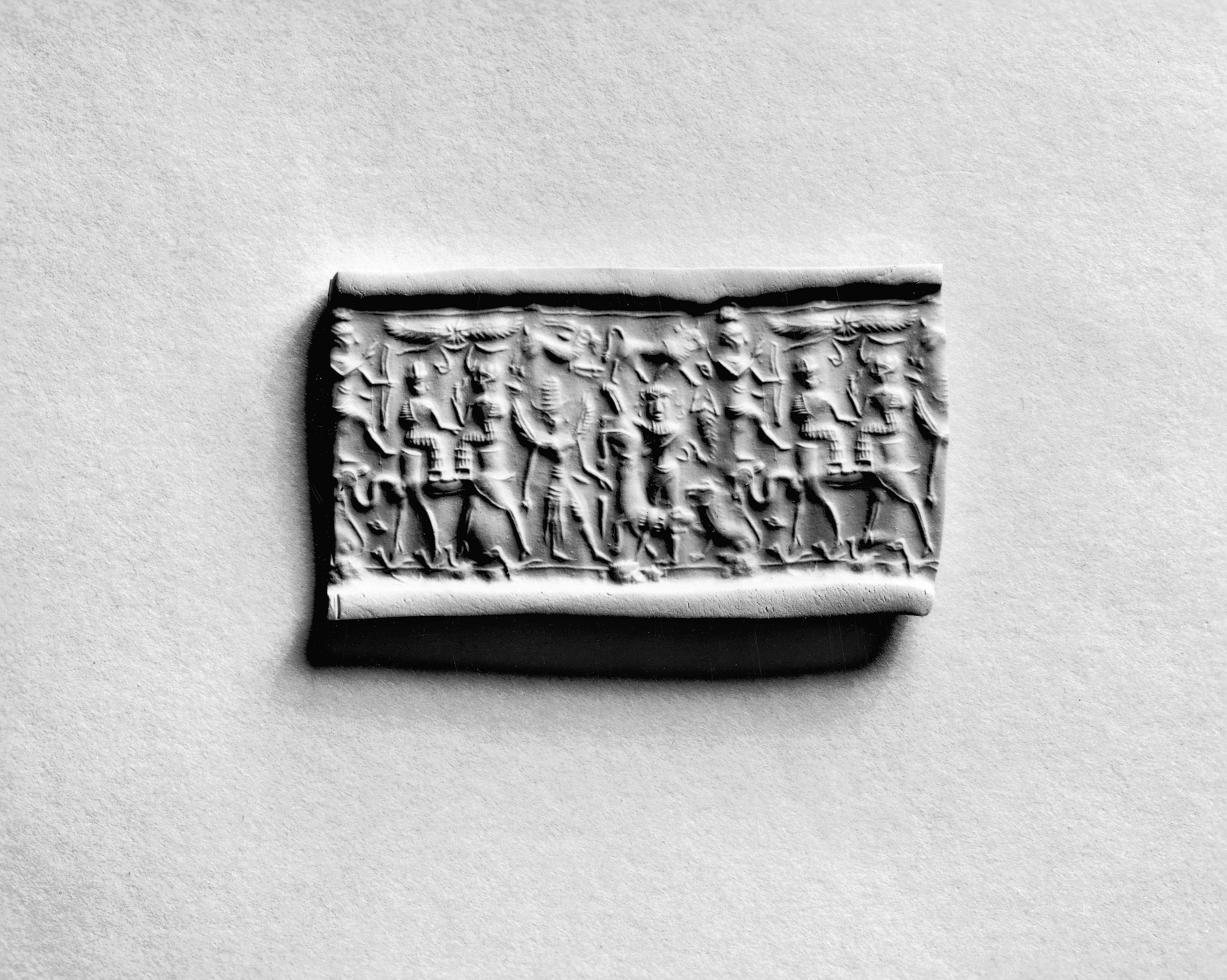
    This seal shows a divine couple sitting on the two humps of a Bactrian camel, one of the earliest images of this animal. Above them hovers a winged rosette, which is a protective emblem. A smaller figure holding a bow stands on the head and neck of the camel. A winged female deity, stands off to the side, facing a contest between a man and a beast. The surrounding space is filled with a variety of animals, including a lion, scorpion, bull, and gazelle.


    We have reason to think these may not just be stylistic copies of something the artist had never seen. Those could be entire stories, like taking pictures of a play done by actors. It appears the mind was ready to engage the meaning of an Ankh at a level that looks like it would be more complex and sincere.


    In this same Old Syrian layer are found the oldest remains of Indian animals (e. g., elephants). Something extraordinarily fusionistic started going on, here, consisting of Immortality, multiple suns, the Bull as a shared or universal icon, and the ability to articulate increasingly vivid ideas.

    Such an ideal situation must not have remained intact, very long, for we are then told everyone went off and made his own Vedas, Gathas, Hermetic or Orphic Hymns, and it seems very divergent.

    And yet the outcome of "syncretic deity" (such as, most likely, the metal figures above), is the "Bahram" from Mandean baptism. It's not the original Avestan one from East Iran, or Bactria, etc., it's the Verethragna Herakles off the statue.


    I find it impressive, against the hard forces of nature with somewhat low technology, that human beings could have assembled that kind of a "crossroads", even only if temporarily.

    The Coffin Texts appear to cover an arc from personal afterlife up to the famous symbol of the Scales. I'm not familiar enough with it to say anything about the textual evolution of entities or subjects, but I would be willing to guess there are studies on this.

    I am interested in how the positive aspects of that evolve, and, for what I am doing to work, I require the New Testament. That is for Melchizedek. The simple reason is because Jerusalem is not a place of peace and righteousness. The more adequate text in this class is Apocryphal Enoch. In a slightly different vein, I could probably accept that Jesus "should" have had a political career. I would "vote" for him. I can see why that probably would have been a good idea to many Greeks and Jews of the time. It didn't work, and the idea appears to have been changed to Eschatology. My questioning here lies along the lines of, what is said or expressed here in philosophy or spirituality that would not have come along since the Osirian expression?

  20. The Following 4 Users Say Thank You to shaberon For This Post:

    Bill Ryan (12th January 2025), Irminsül (26th September 2025), Michel Leclerc (14th January 2025), Nasu (14th January 2025)

  21. Link to Post #51
    Avalon Member Ravenlocke's Avatar
    Join Date
    28th September 2011
    Posts
    24,186
    Thanks
    14,058
    Thanked 203,459 times in 24,177 posts

    Default Re: The Ethiopian Bible

    https://x.com/BereketWL/status/1876915324827627763

    "Hope is the thing with feathers that perches in the soul and sings the tune without the words and never stops at all."
    - - - - Emily Elizabeth Dickinson. 🪶💜

  22. The Following 2 Users Say Thank You to Ravenlocke For This Post:

    Bill Ryan (26th September 2025), shaberon (28th January 2025)

  23. Link to Post #52
    Avalon Member Ravenlocke's Avatar
    Join Date
    28th September 2011
    Posts
    24,186
    Thanks
    14,058
    Thanked 203,459 times in 24,177 posts

    Default Re: The Ethiopian Bible

    https://x.com/BereketWL/status/1875702836648083572

    "Hope is the thing with feathers that perches in the soul and sings the tune without the words and never stops at all."
    - - - - Emily Elizabeth Dickinson. 🪶💜

  24. The Following 2 Users Say Thank You to Ravenlocke For This Post:

    Bill Ryan (26th September 2025), shaberon (28th January 2025)

  25. Link to Post #53
    Avalon Member Ravenlocke's Avatar
    Join Date
    28th September 2011
    Posts
    24,186
    Thanks
    14,058
    Thanked 203,459 times in 24,177 posts

    Default Re: The Ethiopian Bible

    https://x.com/BereketWL/status/1876180471266373934


    https://x.com/BereketWL/status/1876585207240728751

    "Hope is the thing with feathers that perches in the soul and sings the tune without the words and never stops at all."
    - - - - Emily Elizabeth Dickinson. 🪶💜

  26. The Following 2 Users Say Thank You to Ravenlocke For This Post:

    Bill Ryan (26th September 2025), shaberon (28th January 2025)

  27. Link to Post #54
    Avalon Member Ravenlocke's Avatar
    Join Date
    28th September 2011
    Posts
    24,186
    Thanks
    14,058
    Thanked 203,459 times in 24,177 posts

    Default Re: The Ethiopian Bible

    https://x.com/BereketWL/status/1876623477152825829

    "Hope is the thing with feathers that perches in the soul and sings the tune without the words and never stops at all."
    - - - - Emily Elizabeth Dickinson. 🪶💜

  28. The Following 2 Users Say Thank You to Ravenlocke For This Post:

    Bill Ryan (26th September 2025), shaberon (28th January 2025)

  29. Link to Post #55
    Avalon Member Ravenlocke's Avatar
    Join Date
    28th September 2011
    Posts
    24,186
    Thanks
    14,058
    Thanked 203,459 times in 24,177 posts

    Default Re: The Ethiopian Bible

    https://x.com/BereketWL/status/1883558010473402643


    https://x.com/BereketWL/status/1883556361843417283

    "Hope is the thing with feathers that perches in the soul and sings the tune without the words and never stops at all."
    - - - - Emily Elizabeth Dickinson. 🪶💜

  30. The Following 3 Users Say Thank You to Ravenlocke For This Post:

    Bill Ryan (26th September 2025), Irminsül (26th September 2025), shaberon (28th January 2025)

  31. Link to Post #56
    Avalon Member Ravenlocke's Avatar
    Join Date
    28th September 2011
    Posts
    24,186
    Thanks
    14,058
    Thanked 203,459 times in 24,177 posts

    Default Re: The Ethiopian Bible

    https://x.com/BereketWL/status/1878756120803803519

    "Hope is the thing with feathers that perches in the soul and sings the tune without the words and never stops at all."
    - - - - Emily Elizabeth Dickinson. 🪶💜

  32. The Following 3 Users Say Thank You to Ravenlocke For This Post:

    Bill Ryan (26th September 2025), Irminsül (26th September 2025), shaberon (28th January 2025)

  33. Link to Post #57
    Avalon Member Ravenlocke's Avatar
    Join Date
    28th September 2011
    Posts
    24,186
    Thanks
    14,058
    Thanked 203,459 times in 24,177 posts

    Default Re: The Ethiopian Bible

    Sputnik Africa,

    🇪🇹✨ Faith alight: Ethiopian Orthodox Christians mark Meskel — Festival of the Cross — in Addis Ababa

    The UNESCO-recognized celebration brought together church leaders, government officials, diplomats, and thousands of faithful.

    ☦️ This annual Ethiopian Orthodox Tewahedo Church festival honors the discovery of the True Cross by Empress Helena. The celebrations include prayers, bonfires, music, and community activities.

    https://x.com/sputnik_africa/status/1971592365589635568

    "Hope is the thing with feathers that perches in the soul and sings the tune without the words and never stops at all."
    - - - - Emily Elizabeth Dickinson. 🪶💜

  34. The Following 6 Users Say Thank You to Ravenlocke For This Post:

    Bill Ryan (26th September 2025), bojancan (26th September 2025), Ewan (28th September 2025), Irminsül (26th September 2025), shaberon (27th September 2025), Yoda (26th September 2025)

  35. Link to Post #58
    Avalon Member Ravenlocke's Avatar
    Join Date
    28th September 2011
    Posts
    24,186
    Thanks
    14,058
    Thanked 203,459 times in 24,177 posts

    Default Re: The Ethiopian Bible

    From EBC WORLD

    Ethiopia is celebrating the Meskel Festival, which begins with the lighting of the iconic Demera (bonfire) ceremony, the eve of the main religious holiday.

    Meskel is a major religious festival commemorating the traditional finding of the True Cross—the cross on which Jesus Christ was crucified. The celebration honors the finding of the Cross by Empress Helena after it was unearthed from where it had been buried.

    #Ethiopia #Meskel #findingofthetruecross #EBC

    https://x.com/ebczena/status/1971599587812028464

    "Hope is the thing with feathers that perches in the soul and sings the tune without the words and never stops at all."
    - - - - Emily Elizabeth Dickinson. 🪶💜

  36. The Following 6 Users Say Thank You to Ravenlocke For This Post:

    Bill Ryan (26th September 2025), bojancan (26th September 2025), Ewan (28th September 2025), Irminsül (26th September 2025), shaberon (27th September 2025), Yoda (26th September 2025)

+ Reply to Thread
Page 3 of 3 FirstFirst 1 3

Posting Permissions

  • You may not post new threads
  • You may not post replies
  • You may not post attachments
  • You may not edit your posts