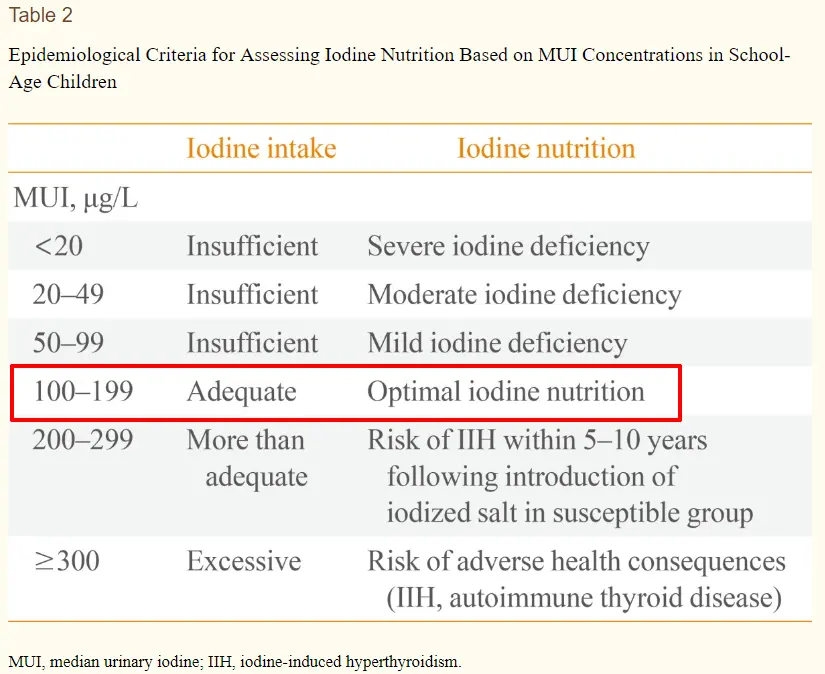
This image includes the various ranges of iodine intake and how they relate to whether it is a sufficient amount for your body.
Notice that the dosages are in the MCG (microgram) range and not the milligram range.
Per this chart, an excessive amount of iodine is classified as more than 300mcg taken per day.
The adequate range is defined as 100-200mcg per day.
When you take into iodine intake, it’s important to realize that your body has the capacity to store a certain amount of iodine in both your thyroid and other tissues.
So, it may be necessary to take higher than normal amounts of iodine temporarily to replete this store if you are deficient for a period of time.
Consider this example:
If you go 6 months consuming less than 20mcg of iodine per day you may run the risk of depleting the iodine storage in your body.
In this case, it wouldn’t be enough for you to consume 100mcg per day because this wouldn’t allow for you to utilize iodine and replete your storage.
Instead, you may need to temporarily consume 300mcg or more per day for a set period of time.
I find that most people do well when supplementing between the 100 to 200mcg range per day and this range will keep you out of the excessive dose and reduce your risk of negative consequences.
How to Supplement Safely with Iodine
Does all of this mean that you should avoid using iodine at all?
No, not at all, and that’s not what I’m trying to say.
Instead, my recommendation for using iodine is to use only enough to meet your needs and to slowly titrate up (increase your dose) only if necessary at that point.
According to several studies, and my own personal experience in treating patients, I believe that using around 50 to 150mcg per day is a very safe range.
That’s why I put no more than 75mcg of Iodine in my
T3 conversion booster.
So, how should you proceed if you want to try using an iodine supplement?
I recommend starting out in the 50 to 150mcg range. To get there you may need to use a small supplement (not a highly concentrated supplement such as Lugol’s solution).
There is a lot of fear out there regarding the nuclear contamination of kelp and seaweed from the nuclear leak at Fukushima.
I’ve found that this fear is largely unfounded considering recent studies show that the
vast majority of that radiation would have been cleared a few years after the leak (8).
Another concern some people have is heavy metals.
But, again,
recent studies show that the levels of heavy metals in seaweed and kelp are very minor (9) and not in sufficient quantity to cause problems.
You should, therefore, be fine using iodine from seaweed (by eating it) or using supplements that contain iodine from seaweed.
If you also have
T4 to T3 conversion issues then I would consider
using a supplement that contains other ingredients such as zinc and selenium which can also be thyroid-protective.
Conclusion
The bottom line?
While iodine is an essential nutrient required for thyroid function it is not something that you should consume in incredibly high amounts.
Contrary to popular belief on the internet, high iodine intake has been associated with an increased risk of several conditions including
autoimmune thyroiditis,
thyroid cancer, and
hypothyroidism.
While it may be true that some people can tolerate incredibly large doses of iodine that doesn’t mean that all people can or that all people should even consider doing so.
In my experience, using an appropriate amount of iodine is sufficient to replete iodine levels in the body and maximize thyroid function.
Using high doses of iodine may be tempting if you believe that you can ‘reverse’ your thyroid condition, but it may actually cause the opposite.
When in doubt, make sure you look to the clinical studies as a guide (not anecdotal evidence).
References:
#1.
https://www.ncbi.nlm.nih.gov/pmc/articles/PMC4192807/
#2.
https://www.ncbi.nlm.nih.gov/pmc/articles/PMC4356974/
#3.
https://www.ncbi.nlm.nih.gov/pubmed/9349576/
#4.
https://www.ncbi.nlm.nih.gov/pubmed/8543389/
#5.
https://www.ncbi.nlm.nih.gov/pubmed/11751062/
#6.
https://www.ncbi.nlm.nih.gov/pubmed/22841183/
#7.
https://www.ncbi.nlm.nih.gov/pubmed/11396708/
#8.
https://www.ncbi.nlm.nih.gov/pmc/articles/PMC4833270/
#9.
https://www.ncbi.nlm.nih.gov/pmc/articles/PMC5824826/