+ Reply to Thread
Page 1 of 2 1 2 LastLast
Results 1 to 20 of 29

Thread: Subtle Yoga in Buddhism: Mantra, Life Wind, Luminescence

  1. Link to Post #1
    United States Avalon Member
    Join Date
    1st April 2016
    Posts
    5,927
    Thanks
    29,291
    Thanked 33,542 times in 5,576 posts

    Default Subtle Yoga in Buddhism: Mantra, Life Wind, Luminescence

    For Brother Fergus,


    all others, thank you for your consideration.


    I am curating a combination archive and workshop consisting primarily of Sanskrit Buddhism, for which I will give a brief explanation why and what this is, and in the space at the end of the post, we will over the future update with links that are probably hundreds of supporting articles.


    The reason I personally do this is as if I had authored this praise by Candragomin:

    For me, in all my lives to come,
    May I recall the chosen deity Tārā


    We have the sense that we do this and come back in another life to do it again. I would describe it as searching for the way to express something nebulous in the intuition, and not only is it already explained, it is like re-learning it from another existence.


    Part of that is about something that is coldly the same for all beings, Death, and the other part is about spiritual practices.


    With such practices, I, personally, have a great deal of experience from the manner such as described by the strange case of Gopi Krishna:

    Quote But my immoderate indulgence in psychic enjoyment, excessive mental exertion, and neglect of organic needs had,
    without my detecting it, depleted my vitality to an alarming extent, creating a poisoned state of the nervous system,
    which prevented me from noticing the extremely slow deterioration, in time to take appropriate precautionary measures.

    It took him seventeen years to reach something that took me about six months. A glorious revelation brought on by agencies of Nature. This Inconceivable stage of his story I have skipped to make this counter-point. He becomes personally aware of some serious underlying problems, and goes off to a career as a scientific quest about it.


    I, like many others, found a way in through Upanishadic Yoga, meaning an ability to alter Life Wind from its normal course in Ordinary Waking Consciousness.

    Accurately speaking, Buddha was the exact same way, such as this remark:


    Quote Three discourses in the Bhojjhanga-Samyutta present the claims of non-Buddhist wanderers that they too develop Buddhist-style meditating samādhi.
    They ask the Buddha what the difference is between their teachings and his.

    He does not respond by teaching right view, but by telling them that they do not fully understand samādhi practice.

    While the Buddha was not the first to attain the formless meditative absorption, the stratification of particular samādhi experiences into the four jhānas seems to be a Buddhist innovation.

    More specifically, Buddha had a teacher who had attained Neither-Perception-nor-Non-Perception, and what he is doing is revealing why this is Incomplete.

    This has a swift start in the Pali Suttas; Bojjhaṅga saṁyutta is a basket on Seven Jewels of Enlightenment. It has perhaps forty or more brief scenarios.

    They apply in this brief summary:


    Quote In the sutta, The Noble Search, the Buddha outlines how Alara Kalama taught him the meditation of the Sphere of Nothingness, while Uddaka Ramaputta taught him the meditation of the Sphere of Neither- Perception-nor Non Perception. These are the two highest Sammapatis, often wrongly called Jhanas. They are incredibly subtle states of samadhi (concentration) but do not of themselves usher in the state of Awakening. For this reason the Buddha left these teachers and began his own meditation to attain enlightenment. I cannot really explain in words what the difference is between the two states, you have to experience them yourself. Suffice it to say that as these are Formless States using the Formless Energies, they are well beyond the realm of thought and appearances (Form). After passing through the practices of Jhana and Vipassana you will explore these energies when meditating on Emptiness in the more subtle advanced Mahayana and Mahamudra methods.
    In themselves the "states" are insufficient for Bodhi. Therefor, we have "advanced methods" rather than merely criticizing. The difference is not explained by disputing anything about the states themselves. It has to do with Bodhisattva motivations that cause missing components to be employed, in a catharsis pre-Buddhist Yogacara already knows as an established fact.


    The intention in creating a thread is effectively to review a historical Age of intellectual and linguistic development to raise these same Seven Jewels at tantric levels.


    This flows from the origin of Mahayana Sutras in the 100s, and continues until we find it recorded in Tibet over a thousand years later. The transmission is found in a work by H. H. III Karmapa Rangjung Dorje held in the Avalon Library:


    Luminous Heart


    Correspondingly, here is a summary of his Treatise on Dhatu:


    Quote de bzhin gshegs pa'i snying po bstan pa'i bstan bcos
    The Treatise on Pointing Out the Tathāgata Heart

    SOURCE TEXT

    The Third Karmapa's treatise on buddha-nature written in verse, which is essentially a synopsis of the Uttaratantra. According to Schaeffer, "This verse text (De bzhin gshegs pa'i snying po gtan la dbab pa, or De bzhin gshegs pa'i snying po bstan pa) blends scriptural quotations from both sūtra and tantra with Rang byung's own words, creating an evocative picture of the relation between the primordially pure enlightened state- symbolized by the Enlightened Heart (snying po)- human existence, and Buddhahood. While Rang byung has relied heavily on the Ratnagotravibhāgaśāstra, (known in Tibet as the Uttaratantra, or Rgyud bla ma), the syncretism of various strands of Mahāyāna and Vajrayāna apparent in the text is particular to Tibet. Tathāgatagarbha, Madhyamaka, Yogācāra, Mahāmudrā, and Annuttarayogatantra all coalesce in this work, which is a testament to the hundreds of years of appropriation and synthesis of Indian and Tibetan Buddhist thought that preceded it. - Kurtis Schaeffer, from the introduction to The Enlightened Heart of Buddhahood.

    Significantly, the highlighted text which we shall abbreviate to RGV is both the main and most important starting point, as well as being relatively "hidden".
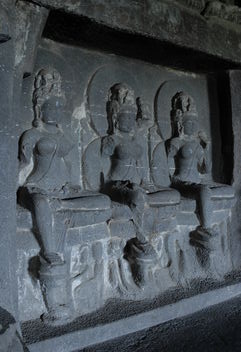
    So what we are getting into is not Tibetan in the conventional sense of the lineage, philosophy, or deities of Atisa.


    At issue are the Maitreya Books and corresponding presentation of doctrine.

    Although Maitreya is a meditation deity found in statuary dating to the 100s, for historical purposes we will consider it a teaching spread in the world by Asanga.

    Importantly, it is a Sastra, that is, an explanation of Mahayana Sutras as mentioned above:


    Yogacara, or psychology, from Samdhinirmocana Sutra ca. 150 and others

    Tathagata Garbha, a small number of Buddha Nature Sutras


    The famous Nalanda was rather small; Asanga and Vasubandhu were very successful and expanded it; and then for reasons that are unclear, their four disciples go to Vallabhi University in Gujarat, and Nalanda is occupied by at least three generations of Logicians. At some point in the 600s, Candragomin who uses Asanga's Bodhisattva Precepts, wins it back. From that point we begin to find a rather concrete Yogacara transmission which has both adversaries and deviations.


    As an unrelenting critic, what made me want to look into this is Madame Blavatsky, or, preferably HPB, by way of discarding whatever is not useful and look at what remains standing. Mentally, she seems to have absolutely fiended on a particular line from Emil Schlagintweit's 1863 Buddhism in Tibet:


    Quote Mysticism appears for the first time...

    which he is saying with respect to Kalachakra.

    What he says is basically true. She uses its own contents to make the opposite argument. But first of all this is not really part of our core system. We react to the fact it says Buddha is an avatar of Vishnu; that is a non-Buddhist doctrine.

    Secondly she takes the fact that some Tibetan RGV colophons have the signature "Aryasanga" or, i. e. Arya Asanga which she has taken to mean as "eldest, first" as a disciple of Buddha which is meaningless. All his works are a synthesis of Mahayana Sutras.

    If one notices the format of that page, it is very suggestive that HPB used it as a major basis. It goes on to a reasonable enough assessment of the Dhyani Buddhas. But these are the main stamp on Buddhist Yoga.

    She seems to mistake the expression "primordial" to represent "first in order, dawn of time" in order to rank the Dhyanis as the direct teachers of original humanity. That is not what it means. I doubt she could understand what it means. Gopi Krishna could have.


    She had siddhis in the sense of worldly powers and psychic abilities, and she may have done Lamrim or Ngrondro, but I do not think she has a very deep exposure besides maybe knowing something about the contents of some of what is listed in scriptural archives.

    The value is that in terms of inner meaning, she does all in her power to indicate teachings that basically just revert to historically-known Asanga. When pressed to the point on what her "Esoteric Yogacara" is, we get a glimpse of what it is actually about. This turns out to be the real thing:


    Quote Sva-samvedana (Sanskrit) Sva-saṃvedana Self-examination, self-knowledge; mystically regarded as self-analyzing reflection. The highest and purest form of knowledge, because essentially intuitive knowledge of the spiritual self. Consequently it is synonymous with paramartha. “The condition of Paranishpanna, without Paramartha, the Self-analysing consciousness (Svasamvedana), is no bliss, but simply extinction (for Seven Eternities). Thus, an iron ball placed under the scorching rays of the sun will get heated through, but will not feel or appreciate the warmth, while a man will” (SD 1:53-4).

    She has a decent understanding of the Three Natures or Tri-svabhava, and this is exactly our position:


    The philosophical position of Ratnākaraśānti was quite complex and does not easily
    fit into the traditional categories of Buddhist thought represented in Tibetan doxographical
    literature (grub mtha’, siddhānta).

    In brief, Ratnākaraśānti articulated a Middle Way based
    on Yogācāra principles that incorporated the theory of the three natures (trisvabhāva) with an
    emphasis on self-awareness (svasaṃvedana) as equivalent to luminosity (prakāśa, gsal ba). For
    Ratnākaraśānti, self-awareness as luminosity constituted the intrinsic nature of all dharmas
    and was the highest form of valid cognition (pramāṇa).

    Ratnākaraśānti also refuted Candrakīrti’s “what
    is renown in the world position” for conventional reality and advocated the means of valid
    cognition (pramāṇa) for realizing ultimate reality while Atiśa strongly opposed the means of
    valid cognition for realizing ultimate reality.


    So, yes, Pramana or Valid Cognition arguments array Buddhist followers one way or another; the meaning just given is also that of the Samputa Tantra:


    2.40 “His self-awareness will become gnosis,
    Devoid of discrimination between self and other.
    Pure and empty like the sky,
    It is the ultimate nature of existence and nonexistence. {2.1.40}


    The Sanskrit equivalent is to say Svasamvedana becomes Jnana.


    But one finds in Tibetan chronicles, the career of Ratnakarasanti is mocked, and, to some extent, censored, and in a similar way the biography of Maitri is confused so it looks like he was from somewhere else. Consequently, what is obscured is this very RGV transmission to Kagyu as re-instated here:


    In his description of the diffusion of zhentong, [Jamgon] Kongtrul Lodro Taye
    claims that it goes back to Nagarjuna's and Maitreya's commentaries of the
    final dharmacakra (i.e., Nagarjuna's collection of hymns and the Maitreya
    works except the Abhisamayalamkara), which were further commented
    upon by Asanga, Vasubandhu, Candragomin, Santipa, and Sajjana. Both
    Ngog Loden Sherab and Tsen Kawoche are mentioned as having received
    these teachings from Sajjana.


    In most Tibetan portrayals, Ratnakarasanti is called Santipa. However this leaves about a five hundred year gap going back to Candragomin. The difficulty is Nagarjuna's "collection of hymns" is an accretion. Of course, we also have the other five centuries implied by their brief hints.


    The reason for posting is not merely informational, because what we can do is Sutra Mahamudra. That is to say, an area where a person may become attuned to, convert to, and practice Mahayana Buddhism. What this means is to read, process, and interiorize the well-founded propositions of the Mahayana Sutras. This means anyone; the title Gomin refers to a lay person; so does the character from the first Sutra on "secret mantra", the Licchavi Vimalakirti; neither is a monk.

    Then, it means a set of meditational practices that respond to the fact that human beings have different sensitivities to Life Force. Further, it is not other than Deity Yoga as addressed by Vajrasattva.


    For general purposes, to call it Yoga is a type of ruleset suggesting "everything is symbolic". In that sense it does not matter if you do meditation in an ordinary comfy chair. Any arrangements or special items are optional. We refer to ritual items in the sense that is the way symbols are based; and in this way, what would be required is an imaginary bowl of flowers for example. And I cannot advise anyone to self-generate a deity. If you visualize one, it is in what is called a Yoga view, that is, externally, like having a conversation.


    If you adhere to that format and follow the teachings as closely as possible, by self-effort you will initially be able to penetrate the Dharma to some degree. The design is such that all the psycho-physiological powers of harnessing the Life Winds are within this operating field. We could call this the First Siddhi.

    This is a certain kind of Yoga, definable by Two Siddhis, Generation and Completion Stages.

    Those are operated by Vajrasattva.


    It's not anyone. It's Jnana Kaya, a Gnosis Body made of Mantra and Life Wind.

    Comparatively, if we were to say in the Mahayana Sutras, the goal is:


    Anuttara Samyak Sambodhi


    Vajrasattva is:


    Bodhi Citta

    or, i. e. that mind with resolve to ardently cultivate the former.


    In Vairocana Abhisambodhi Sutra (VAS), we find Vajrasattva as the querent, and the actual description of Buddha's Enlightenment which had not been given. The answer is in Yogacara terms. This is among the last Sutras, from around perhaps 650, and then Vajrasattva Heart Mantra is recorded in China in 723.


    This is because the role of Asanga was such that he was very pleased and fulfilled with philosophy and Sutra and so forth, but he said that what was provided as meditation training was lacking in power, it was not helping him transit to any kind of supra-mundane condition or any kind of advancement. In the end, he does not actually give much about detailed sadhanas, because it takes multiple generations to develop the language.


    It overtakes the negations of textbook Prajnaparamita philosophy on The Four Foundations of Mindfulness (smṛtyupasthāna):


    Quote Why? The worldly person (pṛthagjana), who has not yet entered into the Path, is deluded about these four things and produces four mistakes (viparyāsa): 1) the mistake that consists of taking what is impure to be pure (aśucau śucir iti viparyāsa); 2) the mistake that consists of taking what is suffering to be happy (duḥkhe sukham iti viparyāsa); 3) the mistake that consists of taking what is impermanent to be permanent (anitye nityam iti viparyāso); 4) the mistake that consists of taking what is not a “self” to be a “self” (anātmany ātmeti viparyāsa).

    In order to destroy these four mistakes...

    So that is this subject, clearing obstacles.


    But if we look at the tantric Four Dakinis, they are the exact same subject, however now they are actually manifesting Suchness or Tathagatagarbha:


    Quote [The first] of these are the bringers of awareness (anusmrtyupasthanas) because they oppose the four inverted views (viparyasas) , [namely: that what is not pure, pleasurable, permanent, or possessing a self really is] pure, pleasurable, permanent, [and possessing] a self.


    These are the first four factors in Thirty-seven Point Enlightenment, from which Tara's Song is based.


    The argument of Asanga is that in order to be Empty, there must be something which is empty of something else. In response to the negationist arguments, after establishing the Skandhas are Not Self, then whatever remains after the elimination of such entities is Self.

    That is why a tantric Dakini is a type of energy level, that is, it means something that dawns on the other side of the delusions cloaking it. That is our point as a Middle Way school, that is, negation is still definitely applied wherever there is something to be negativized. The more apt expression is releasing the Grasper and the Grasped, Grahya Grahaka, and reposing in non-Duality, Advaya.

    The Four Dakinis are effectively Generation Stage so it is good to begin with this foundation. If it is a critical argument for Tathagatagarbha, this is like a crucible of lasers. They are re-enacting principles of the RGV. They are a nucleus in all the tantras. And that is the very radical argument, it expresses the Absolute, or the Ineffable, That which is Empty of unreal apprehension killed by negative reductions.

    There we have two groups, one from the basic Pali dissemination and another from the intermediate level of Chakrasamvara, some of the most effective tools for success, not often discussed, now a starting point. Likewise, the RGV is useful to any intelligent reader, whereas it is generally confined to a brief senior-level study.

    The worst mistake of HPB is corrected by H. H. III Karmapa. She re-ified the Alaya, taking it as a kind of "universal storehouse" like Vishnu. This is backwards; it is the "storehouse of mental patterns" which, according to the teaching, is effectively removed by practice. Therefor Kagyu speaks of Seven Minds rather than eight, by not referring to Alaya as another "mind" or level of consciousness. This area is where we see other authors such as Paramartha changing the system.

    By focusing the original, we will find the classification by Seven actually does work to develop a surprisingly large amount of fundamentals.


    We will leave room for a Table of Contents; today we will post an example of remarkable use of Sanskrit by a non-native.


    The Song of Tara is very interesting because it only directly refers to certain Dharmas. It does not strictly give "Twenty-one Taras", those are all derived into four major and some number of other sets. And so all commentaries are immediately compromised, because they are really only dealing with forms of Tara from one of these systems.

    In some cases, there is agreement between them, and so to learn it we have a way based from a starting point, with undefined territory remaining.


    The capability of the song is like an upgraded dharani system. If we say Tara Four is Usnisa Vijaya, this is meaningful because at other times, Usnisa Vijaya is a deity in her own right. And so the Song brings together a number of individual experiences and amplifies them.


    Interestingly, "Usnisa" is really a class of deities, who consist of telepathic emanations of Buddha.

    Here is a high quality Usnisa Vijaya long dharani in Sanskrit done by the Chinese Tinna Tinh during the Covid shutdown, four rounds of it I believe:


    -------------------------------------------------------------------------------------------


    This is an approximate outline we will update with links.

    We will work in three fields, Sutras and general information. tantric material and commentary, and actual practices. The main key to practice is stability and consistency.

    To arrange it in order, some of the dates are suggestive approximations, however most of the Sutras are able to show the time when translated to Chinese.


    Although they are Sutras, this is a kind of Magic called Lokottaravada:


    150 Asvaghosha (Saundarananda, Amrita doctrine)

    180 Lokaksema (Lokanuvartana Sutra)

    200 Nagarjuna (Niraupamya Stava, Madhyamaka Root Verses, Letter to a Satavahana King)

    Nagarjuna does not even use any Sutras, and is absent from Chinese translations until a much later time. The idea that he wrote or acquired Prajnaparamita Sutra is a much later attribution, and his ca. 400 commentary on it is most likely spurious.


    291 Dharmaraksa (Dharanisvararaja Sutra)

    320 Po Srimitra (Mahamayuri Vidyarajni Sutra)

    440 Gunabhadra (Srimala Devi Sutra, Angulimaliya Sutra, Lankavatara Sutra without verses)

    508 Maitreya (RGV, Ratnagotravibhaga Mahayanottaratantrasastra)


    Maitreya is mostly working in the same library that Gunabhadra has recently taken to China.

    The Sastra that Tara attaches to is his:

    Abhisamayālaṃkāra

    ...a commentary on the hidden meaning of the Prajñaparamita Sutras, describing the entire journey of the bodhisattva, from the generation of bodhichitta to the attainment of full omniscience.


    Vasubandhu does not comment this one; Vimuktisena does.


    His other material is Mahayana Sutra Alamkara, which is gigantic, comparable to previous texts on the Ten Bhumis and all Sutras categorically. Then he has small texts on Madhyanta (Middle Between Extremes) and Dharma Dharmata (Phenomena and Reality). If those things are rather general, then we see he focuses a class of Sutras (Prajnaparamita in AA), and then with RGV it is a suite of Tathagatagarbha Sutras. It must have coalesced ca. 400 in several former Asoka territories via the main Stupa.


    In modern coursework, RGV and Dharmadhatustava are back-to-back advanced studies, whose required texts are those of Brunnholzl, and recent Tibetans no further back than Jamgon Kongtrul. How is it so "advanced" if they give it the title "Uttaratantra" and still do not understand this correctly?


    650 Candragomin, who is credited with numerous dharanis, such as Pratyangira, Hayagriva, Namasangiti

    900 Bhavyakirti (refutes Candrakirti II)

    1000 Ratnavajra (Central Pillar of Vikramasila who taught Five Maitreya Books and then tantra)

    1050 Ratnakarasanti, usually considered the "best writer" even by theoretical opponents such as Alex Wayman


    The later individuals are needed because AA results in a different Prajnaparamita philosophy than the mainstream one devised through Haribhadra. Therefor the response to Sutras by Ratnakarasanti is significant.


    The shift from Sutra to Tantra is sometimes thought to have a primary source:


    Prajnaparamita in 150 Lines

    It also relies on Jnanalokalamkara, Vimalakirti Nirdesa Sutra, Subahu Paripriccha Tantra.


    650 Vairocana Abhisambodhi Sutra

    700 Sarvabuddha Samayoga Dakinijala Tantra, Vajrosnisa or Dhyanottara


    At that point, we reach an Uttara or continued explanation of Dhyana, which in this case turns out to be the definition of Divinity. These are called Kriya or Kriya-Charya instructions, and are a transitional area for someone who is unfamiliar with Yoga. The format behind all of this, even to the extent of Mahayoga in Tibet and Shingon in Japan, is Tri-samaya Raja with Vairocana and Vajrapani. This is to orient you in the outer-to-inner process.


    Perhaps mid-Eighth Century are some very influential figures, such as Saraha, Kukkuripa, Laksminkara. Importantly and just slightly later:


    770 Luipa, Darika (Manjughosha), Jnanapada, Vikramasila University


    Four Bindus and Four Seals


    supported by a series of commentators:


    Jnanapada

    The Ninth Century Vikramasila Pandits Dipamkarabhadra, Jayabhadra, and Sridhara

    800 Caturpitha Tantra, Jnanadakini, Mahamaya Tantra

    850 Vajramrita Tantra, Vajramala Tantra, Aryadeva (CMP)

    Nagarjuna II (Caturmudranvaya)

    Saroruha

    Jalandhara

    Krsnacarya (author of Vasanta Tilaka)


    The Tenth Century, Bhavabhadra (Vajradaka Tantra with Samputa Vajrasattva) and Durjayachandra (Seven Syllable Vajradaka)

    950 Samvarodaya Tantra

    Naro (Jnanadakini and tantric Asraya Paravrtti)

    Ratnakarasanti (Vajra Tara, Mahamaya, Sahaja Hevajra)

    1050 Vagisvarakirti (Mrtyuvacana Tara)

    1100 Abhayakaragupta, King Ramapala, Maitri

    Caturmudranvaya, Dakini Jala Rahasya, Vajrayogini, Nyan Lotsawa, Dharani Samgraha, Abhiseka Nirukti, and Subhasita Samgraha

    1200 Mitra Yogin


    Those are the salient points. There is a colossal amount of material here that is all related. Ratnakarasanti excels at this art as well. For example, his actual commentary on Mahamaya Tantra makes the English version on 84000 look disposable. As I have said, Hevajra has no beginner stage; if one is able to surmount what we will provide here, then you can take this Sahaja Hevajra Empowerment from H. E. Garchen Rinpoche. This part still is a living tradition.


    The intention is to interiorize comprehension of those Dharma baskets, along with images and mantras there are some recordings of. At some point you need to excavate at least a quiet, dedicated spot which is adequate; I prefer having a shrine, although without many ritual items. The main thing is Bell and Dorje.


    We will develop practice sessions or Sadhanas from this kernel:


    I. Guru Yoga

    II. Prajnaparamita Deity Yoga, Nine Nets (Samapattis)


    Everything else to be developed is simply a variation on that Guru and Deity Yoga.


    III. Inverted Stupa, Four-fold Om and Four Activities, Muttering
    Last edited by shaberon; 8th October 2025 at 02:51.

  2. The Following 7 Users Say Thank You to shaberon For This Post:

    Bill Ryan (6th October 2025), cascadian (6th October 2025), gini (2nd November 2025), Harmony (7th October 2025), Ioneo (6th October 2025), Open Minded Dude (6th October 2025), Sunny-side-up (16th October 2025)

  3. Link to Post #2
    United States Avalon Member
    Join Date
    1st April 2016
    Posts
    5,927
    Thanks
    29,291
    Thanked 33,542 times in 5,576 posts

    Default Re: Subtle Yoga in Buddhism: Mantra, Life Wind, Luminescence

    Entering the Stream


    I added an outline to the opening remarks. It's like putting a millennium in a bottle. A lot of those subjects must be highly elaborated. But we also want to be able to nest this in a way that is accessible and relevant for a general audience. The intended recipients are ordinary lay folk, who have little chance of acquiring a personal guru in the traditional sense. The point is that success on the Path could be reached by anyone.

    There is a lot of religious and political jousting that goes on most of the time around here, which is not really what I do. I'm taking Refuge in the Dharma. That is to say, I spend more time with this, and less on those other things. A consensus or ideal is not often seen. That's what spills forth from other influences.

    I am speaking of something that is based from a counter-point.

    Or, this is a completely different discussion. Buddhism does not attempt to explain the structure of the universe, or its ultimate origin; that can be called the path to madness. We're not asking the same questions or striving for the same answers that seem to be of great concern in many threads. I consider myself to have no religion and politics, which is atheist and anarchistic. Except these are crude terms, because I don't deny life after death, and it doesn't mean the utter destruction of government. For the purposes of this thread, it's mostly just two passive things, reading and meditation.


    There is no need to be biographical or objective about Gautama Siddartha. Almost everything we use is from someone else. He had over fifty years to speak as Buddha to anyone, but there is hardly any trace of it for over two centuries.


    On a cold, clinical basis, the first attestation of Buddhism is by the Mauryan Empire from around 268 B. C. E..

    It covers most of India, inscribed on boulders and pillars from Kandahar to the south, and implies it was transmitted to Greece and Egypt. However, the main subject in question is not Buddhism but Dharma. This lands in a dual role; there is a personal aspect, which, for Emperor Ashoka, means Buddhism, but it has the more general meaning of common or social Dharma, the principles about the regulation of society, cooperation, and order.

    The interesting parallel is we can find this translated into such dual words in the Edicts of Ashoka:


    dhamma, an earnest attempt to solve some of the problems that a complex society faced

    Interestingly, the Greek versions of these edicts translate dhamma as eusebeia (piety)


    and in Aramaic:

    qšyṭ’


    Therefor, one could say a Buddhist conversation began with the Parthian Empire during the era of Greco-Iranian syncretism. The Aramaic is relevant to the partnership of Byblos in Lebanon to Egypt, which dates from perhaps 3,000 B. C. E.. It has an ancient and powerful significance to them when it is equated to Dharma in this relatively late period. Maybe it already had been.

    Because we know this conversation was wrecked, we cannot claim to interface with later ideologies.

    It should have been similar to Alexandria and the era of Therapeutae, which, with the murder of Hypatia in the 400s, went extinct. From this perspective, only distortions progressed through Europe and into the English language as an ongoing Dark Age. Despite superficial changes, it still seems to be there.


    Linguisticly, the Edicts are the original Dharma Kaya or body of teachings, which, on an intellectual basis in our version, becomes something much more. Something more like the body that they were teaching about.

    I take this to heart and generally consider it none of my business if someone is in a different Buddhist school, or honors Thoth or something foreign. This is not about bashing or oppressing anyone. However it is the opposite of what we find in medieval Europe:


    Dharma says that the king or ruler works for the well-being of the populace and does not own private property; has little freedom, many responsibilities

    Divine Right says a king owns the people, who have little freedom, many responsibilities, in order to serve


    That's a huge change from that tri-lingual starting point.

    Our Dharma does not correspond so easily to "religion".

    It would make sense in India general; many of them like to characterize their belief as "Santana Dharma" or, that is, timeless, eternal. On the other hand, "Buddha" is switched around to an adjective in order to say Bauddha Dharma.


    Here is the scope of Buddhism manifesting through its first identifiable expression.

    The central stupa at Sanchi was built during the Mauryas, and enlarged during the Sungas, but the decorative gateway is dated to the later dynasty of the Satavahanas:


    Most of these Stupa and Pillar sites were not maintained for centuries. The connection is that original Nagarjuna is perhaps most strongly attested by his Letter to a Satavahana King, and a minor trend that a few kings in south India also become Buddhists.

    The post-Mauryan northern syncretic region persisted through the Pax Kushana. Most of the Indian sub-continent began to represent sectarian rivalries. It goes into those weird creatures the Saraba and the Double Eagle.


    This is non-different from our teaching on the Universal Emperor or Chakravartin. The first one was Buddha himself in a Jataka or previous life when he was Mandhata. This is very insightful to the Rg Veda because Mandhata must have been among the first followers of the Vedic system itself. In fact it probably had to do with the Ikshvaku Vasisthas in Bihar. The idea is that he marshalled forces from what was then east India, to defend an area on its west. Because of this, the Veda has a period that could be called fragmentary, black, or Taittiriya, because the salvaged area crumbles, and its main saga begins with a reconquista by Divodasa.

    The actual hymn by Mandhata ends with a verse by a female companion named Godha who says that the Veda is a Mantra Vada. If we take this as one of the oldest statements known in the language, it becomes clear that Rik is the art of poetical meters that has been elaborated to make its own mantric system. There is nothing in it that is not mantra. But this expression "rik" was probably coined during the Rg Veda. Possibly there were pre-Vedic mantras.


    Perhaps like some others, because of Yoga I am basically a student of Mantra which is identical to archaic Sanskrit, who has converted to Buddhism. Obviously I have no material connection to old India. I have however taken a Path that has this for its domain.

    That's by comparison through having visited churches of multiple denominations, but also covens and various Yoga branches and of course all the subjects like Alchemy and Tarot and so on.

    Here, we can conceive of the Chakravartins as Mandhata, Ashoka, and Harsha Vardhana of the 600s. The items of a Chakravartin represent the Seven Jewels of Enlightenment. There is an utterly mysterious Sapta Ratna in the Rg Veda (twice), and something similar is perhaps even found in the IVC seals. So you can see Chakravartin is the state of fully prepared to become a Buddha in this life, at which, it is said Mandhata failed by predictable means of temptation into the vices of wealth. To the practitioner, obviously this is symbolic of the practice itself.


    I was first exposed to Buddhism by martial arts. Most of them simply incorporate "a moment of Zen". I don't recall paying attention to it, as I cared mostly about the physical training.

    A little further along, I read something about it, and I wasn't hooked. That is because I encountered the spectrum with Space as an Element. I thought, obviously not, these guys must be painters with some goofy ideas.


    That is basically what blocks everybody. For example, C. Jung did not "get" Emptiness because he tried to get it from the words. The first Jesuit that translated Buddhism to European languages had the same problem. The translator of CMP doesn't quite understand it. This is where we deviate from most Greek philosophy, which exalts the rational mind and the physical body. That is even the point of Resurrection. Pythagoras refers to Tartaros but we rarely see much beyond that.

    Formlessness is not the property of Buddhism, it still challenges the Geshes to define us as different from the Upanishads; I read a Tibetan recently saying "I think maybe I am a Hindu". Well, we agree they have Wisdom but they do not have Great Wisdom (Prajna).

    It is as simple as Buddha considered changing his meditation style due to remembering child-like spontaneous joy.


    And so I don't know how difficult it is for people. I had a mind that was specifically closed for a couple of reasons, and that changed when what brought me to more of an interest in Buddhism was because of reincarnation. By releasing some predictable blinders, suddenly it became very easy.

    The reason I mentioned Lokottara in the opening post is not because a "school" thrived through the ages, but because the term itself continues to the inner meaning of Yogacara where it is a name of supra-mundane or transcendental consciousness. Obviously, this must include the higher or Arupa planes of Theosophy, but in all of Buddhism they are scarcely used. They are referred to by increasingly negative and infinite terms.

    So, yes, of course, part of what we are dealing with is this riddle of Sunya -- Emptiness. Because I did not get it from Buddhist Yoga, then I would have to agree, without further information, you would be compelled to pursue the states themselves, maybe even like Gopi Krishna. This is really hardwired into our training, especially when understood as a disagreement on Reality.


    To call the system we profess Nirakara Yogacara is to operate with Form and Formlessness under the criterion that only Lokottara is Pramana or Valid Cognition is real.


    Sakara Yogacara is a deviation that does not consider consciousness without Form and allows that Mundane Consciousness is Valid Cognition or is real.

    Sunyata Vada is not Yogacara and does not allow Valid Cognition; reality is unfindable. This is the mainstream doctrine.


    Because that is all Mahayana, I take this seriously meaning I don't oppose those people, I just don't hold those tenets and am being as clear as possible so a person will be aware that there are these kinds of choices. I personally am entirely biased because of a non-Buddhist realization of the first kind that I am trying to improve.

    I came into this backwards, by picking out pieces to stick onto a kind of self-arisen Yoga practice, so I pretty much missed the beginning:


    Prajnaparamita


    This concerns the first part of our Courtyard meditation. This is an idiom from Vikramasila, because it could host up to six guru-type teachers, and most days they would do a kind of open meditation in a public area for Buddhists and non-Buddhists alike. Later they would take their accepted students and train them further. As far as we can tell, this is where our structure of Guru Yoga comes from.


    Of course, at first, there isn't a guru, you're just meditating. But as we said, anyone can use a Sutra. And so the way Kagyu centers run is of course not by having an advanced lineage holder in every facility, but, they have someone who is trained to a degree at retreats and so forth. Maybe you could call them a deacon. It begins by reciting Prajnaparamita Heart Sutra.


    It confused me, because it is short, maybe about three pages. I went and learned about "the Prajnaparamita Sutra" which was apparently something else. More correctly it is a genre. In relation to "the Sutras", we can say a Karosthi fragment has been found that carbon-dated to around the year 75, which is probably the oldest readable bit of manuscript in Asia. Among works by this title, one has 25,000 verses, and the one most commented has 8,000. There are multiple smaller versions from about 3,200 on down.

    What is odd is one does not find Prajnaparamita in the early transmissions to China, and, when parts of it start showing up, they may be compromised. This is a literary fact that translations contain some to many errors, and some of them contain false information or may be entirely forged. One bad idea that has gotten in circulation is that the Shurangama Sutra was transmitted in 200; but effectively it is just the intro which was taken with books on math and astronomy. In these early times, that is correct, math was a tremendous international book market, and on this we would credit the Greeks for Spherical Trigonometry. If the remains of its descent were to be salvaged, one should look at how Music of the Spheres takes this up.


    What came to be called "Mahayana" at first had various names, but the thing is, it rather plainly and vividly depicts a Magic Buddha, which may have been horrifying to the traditionalists. What Ratnakarasanti did in his Courtyard meditations that may have been displeasing to some, was to similarly preach Prajnaparamita as an Immanent Deity.


    For this, we have one of the best examples of inter-textual continuity.


    First of all, the idea in question proceeds into Tantra as well. Sasvatavajra's Sri Chakrasamvara Abhisamaya Vyahkya starts almost immediately with Causal Vajradhara, and it goes right into Five Buddhas and Wisdoms. The whole Chakrasamvara practice is taking for granted that you know Panchakara, or the Five Secrets, or about the Vajra itself. It expects you can do some Pranayama with a bit of fluency. Without going to this extent yet, the couple in the last section have an ancient characteristic:


    prajñā śūnyatā


    upalambha svabhāvāddinastu bhagavān | anupalambhasvabhāvatvādyoginī rātriḥ |


    It is a heresy or Drsti, reliance on perceiving, ascertaining, recognition, the process of perception itself. Therefor in Prajnaparamita Heart Sutra:


    ...rather than denying the existence of form, or the noble truths, the Heart Sutra is describing the results of a meditation practice—the yoga of nonapprehension (an-upalambha-yoga).


    Upalambha (उपलम्भ) refers to “(that which is) graspable” (as opposed to Anupalambha—‘ungraspable’)

    By absence of nature we mean the ungraspable emptiness (anupalambha-śūnyatā). Here, absence of nature is ungraspable and emptiness itself is ungraspable.

    “conception (of appearances)”

    Prajna is:


    ...a word for no darkness because it has no conception (upalambha) of appearances.


    Rather than referring to things in the massive compendiums, our reading is just telling us to now do Anupalambha Yoga. Prajnaparamita Heart Sutra is quite possibly a later pastiche that was not part of the original Sutra. Nevertheless, it is accurate to the material as well as the Pali:


    Quote The practice of nonapprehension (anupalambha-yoga) of dharmas is central to the Prajñāpāramitā.

    Just such a practice of withdrawing attention from sense experience is outlined in the Majjhima-Nikāya (MN 121) and so this material is relevant for early Buddhism enthusiasts as well.

    By withdrawing attention from sense experience, using meditative techniques, we can bring sense experience to a halt without losing consciousness. In the ensuing state, the processes which give rise to experience (i.e., the skandhas) are not apprehended. Nor are the objects of the senses. This state feels like being in infinite space. If we also withdraw attention from cognitive experience, then we cease to apprehend thoughts and it feels like infinite consciousness.

    Through several more refinements that are more difficult to explain, one ends up in the state of emptiness in which there is only a kind of base awareness; one is conscious, but not of anything. Subject and object do not arise. Self does not arise. No dharmas arise in this state. And this is what the Heart Sutra is describing.

    The Heart Sutra draws mainly on a tradition of attempts to communicate from the ārupaloka.


    I did not have this when I did various exercises that spawned a corollary.

    Anupalambha is ancient, and Chakrasamvara basically deifies this and gives it a detailed practice.


    Then we will find that the explanation of Anupalambha with Dhatu is in either Nagarjuna or RGV. The first is making an expected discourse on Pratityasamutpada, or Dependent Origination, a philosophy on that which is to be cut.


    Nagarjuna's Karika, seventh and final verse:


    nāpaneyamataḥ kiñcit prakṣepyaṃ nāpi kiñcana|

    draṣṭavyaṃ bhūtato bhūtaṃ bhūtadarśī vimucyate||7||


    or RGV:

    nāpaneyamataḥ kiṃcidupaneyaṃ na kiṃcana|

    draṣṭavyaṃ bhūtato bhūtaṃ bhūtadarśī vimucyate||154||


    That is face value. RGV re-cycles Nagarjuna. You don't do this to demolish an antagonistic school, it is for uttaratantra, or continued explanation.

    RGV commentary is plain this is on Tathagatagarbha and Tathagatadhatu.


    For RGV I.154 translated, there is Kano (2016):


    There is nothing to be removed from it (i.e. from Buddha-nature) and
    nothing to be added. The real should be seen as real, and seeing the real,
    one becomes liberated.


    You see how pervasive this style of writing is; the term is "Tathagata", not "Buddha", and the text itself perhaps has something to say on its -garbha and -dhatu usages. Because Dhatu is one of its Seven Vajra Pada, this section may be of interest. As we see, it has directly quoted Nagarjuna, as if his whole career was in its service. This evidently is one of the most enduring verses in the language:


    Sthiramati (c. 510–570) comments on Uttaratantra I.154 in the context of the well-known four prayogas of Yogācāra.


    In his comments on Nāmasaṃgīti VI.5, Līlāvajra glosses the meaning of "reality" as "profound dependent origination" and, in support of that, refers to Nāgārjuna as the author of what corresponds to Uttaratantra I.154.

    Jñānacandra (eighth century) also directly quotes Uttaratantra I.154.


    Again, we have to interpret translators, because we can only see he quotes the verse. We are not sure Jnanacandra gave his source. He uses it on the Three Natures of Yogacara:


    Quote Thus, the imaginary, dependent, and perfect natures are taught by this example as what are to be understood, to be relinquished, and to be directly perceived, respectively.


    Maitrīpa’s comment on the definition of the innate nature of the mind in line 20d of Saraha’s Dohākośagīti ("People Dohā") quotes Uttaratantra I.154 and explains that that in which there is nothing to be removed or to be added is innate bliss.


    Jamgon Kongtrul says:


    ...lines 91–94 in the Third Karmapa’s Pointing Out the Tathāgata Heart are literally Uttaratantra I.154.


    From Asanga:


    In the context of explaining the correct understanding of emptiness, the Bodhisattvabhūmi contains a prose passage that is similar to Uttaratantra I.154:


    One does not set up [anything], nor does one reject [anything]. One realizes, in accordance with true reality, what is in accordance with true reality—suchness, whose nature is inexpressible.


    The only thing much different from Nagarjuna there is that he specifically mentions Suchness, or Tathata.

    As Suchness is also Luminous Mind, then, Prajnaparamita as a deified Anupalambha meditation is an immanent luminosity.

    Prajnaparamita is an immanent deity who is the Wisdom that guides Vajrasattva's mind; the practitioner is becoming Vajrasattva.

    But we see how the psychology arranges itself towards Perfection and Bliss. It may be easier to define these as a Buddhist goal if they are clear from the beginning. This is the Jnana or Gnosis of Vajrasattva. The idea of permanency in Buddhism does not re-ify this to its own eternal independent existence; it means that it is always found when you get yourself out of the way.

    That is the important reason why we have particular meditations; they have been verified by multiple masters as stable.


    I went backwards by having a forced realization of the Prajna of Air, missing the subject that Prajnaparamita is the Mother of All the Buddhas. A person may have a strength, but we are faced with a library on All Families Equally.


    By evidence, Prajnaparamita may be the first Sutra of its kind, and at any rate it is a massive corpus. However, there are a few specimens that are also tantric. That is to say, cusp-like literature thought to be an early introduction of tantric elements. Then, the major systems like Paramadya and Vajrasekhara are designed as enlargements of it.


    How does this work?


    Due to uncertainty about text length, I was confused about another Prajnaparamita, revealed in some notes from Matsunaga:

    According to Jnanamitra, Candrakirti quotes Prajnaparamita in 150 Lines in the Prasanna, on Nihsvabhava; he also quotes something called, in Tibetan, Dpal dam pa, thought to be a shortened Sri Paramadya. From Kukuraja, Indrabhuti got Agama and Upadesa, and extracted these from Dpal dam pa for Gomadevi in Nayasatapancasatika. She "developed" the traditions and secret instructions, and created the current "Sriparamadi" or Dpal dam pa, if that is the right name. This short version seems to have been in use in Amoghavajra's time, and was later expanded.

    The same commentator on Heart Sutra:


    Jnanamitra says, "Regarding hridaya, there is nothing profound or sublime in the Perfection of Wisdom in One Hundred Thousand Lines that is not contained in this small sutra" (Donald
    Lopez, Elaborations on Emptiness, p. 142).

    Sri Simha Heart Sutra commentary that was sent with Vairocana to King Trisong Detsen.


    150 Lines is very different from Heart Sutra. Its translator Amoghavajra also has a Marici Dharani that was recently translated to Tibetan by H. H. XVII Karmapa.

    The Sanskrit was hidden in a Pancha Raksha, and is in Nepali script estimated as eleventh-century. It includes "Sambhogakaya". Stanzas 1-50 are generally matching; the Sambhogakaya insertion is an anomaly. Amoghavajra's additional verses are described as tantric.


    So we are looking at a career around 750 based on a huge transfer of Vajrasekhara and other books to China from Tamraparna or Sri Lanka. Notably on his behalf:


    Quote Amoghavajra's Visuddhipadas in Liqu Shijing match those in Anandagarbha's Paramadya commentary.

    So the Chinese and Indian systems are the same on this point.

    That is based in Prajnaparamita.


    Of two recensions in Japan:

    Quote Prajñāpāramitā in 150 Verses (Adhyardhaśatikā Prajñāpāramitā, also known as Prajñāpāramitā-naya-śatapañcaśatikā)

    Amoghavajra's version (Rishukyō) or its source text. (I could tell by the presence of the seed syllables - which Xuanzang's text doesn't have.) Xuanzang's translation (Rishubun) is more verbose - and bowdlerized? - and overall reads more like a standard Prajñāpāramitā scripture, with little esoteric content.

    For a brief summary:

    Quote It contains fifteen chapters, fourteen of which are spoken by a number of Buddhas, who expound the various methods of Prajñāpāramitā. Each expository chapter is summarized by means of a mystic syllable. The text survives in the Sanskrit original and in translations: into Chinese (six translations and two comment; extant), Tibetan, Mongol, and Khotanese. The Khotanese version was one of the earliest Khotanese texts to be studied.

    It is thought to be "proto-tantric" as these Bija or Seed Syllables distinguish the text. They may be found in the translation by Conze p. 184. That is a whole book of "short Prajnaparamitas".

    It is more recently published in 2009 with additional Sanskrit text in relation to Paramadya, as can be seen in the contents.


    Of course that one is not freely available. We have this entire Sanskrit Prajnaparamita in 150 Lines. Here it has "Buddha Nature" or Tathagata Garbha:


    sarvasattvāstathāgatagarbhāḥ samantabhadramahābodhisattvasarvātmatayo (yā ?)| vajragarbhā sarvasattvā vajragarbhābhiṣiktatayā, dharmagarbhāḥ sarvasattvāḥ sarvavākpravartanatayā, karmagarbhāḥ sarvasattvāḥ sarvasattvakaraṇatāprayogatayā iti||


    Looking carefully, you find this character:

    mahāsukhavajrāmogha


    It then clearly iterates at least around fourteen of the Visuddhipadas found in Paramadya Tantra.

    This is Purification.

    More broadly, that is a method of Locana, who in tantra, applies Visuddhi to the Dharmadhatu, which arises in stages. "Sarva Dharma Visuddhi" at the beginning of this text is synonymous. This transfer of roles from Prajnaparamita to Locana is visible in Vairocana Abhisambodhi Sutra. There is also a standard scene in Nepal where the Consort of Vairocana is represented only by an Empty Niche.

    As you can tell, it is rather like she disembodies herself, and other aspects of Prajna arise. That is to say, it is a class of deity, such as Locana. Obviously, this is something in the subjective phase of Lokottara, and in the Nepalese Trinity of the Three Jewels:


    The Prajnas are the Dharma itself.


    We don't know them because of not having the Seven Jewels of Enlightenment.

    We are deeply rooted in ignorance by not residing in that Wisdom.

    150 Lines is laterally inter-textual in Purifications and by "Mahasukha" to Paramadya. What clearly begins here is purification by deities, or transformations of lower or defiled traits by the superior. It is accomplished there.

    This is also an Abhiseka or Initiation, and has the Kaya Vak Citta structure and Seals.


    In our proliferous Ocean, there are several stand-alone Prajnaparamita sadhanas. So this is true she is a text goddess.

    In actuality, this text is one of specifically-Buddhist institutions, whereas the same principle is freely available to all the Shaktis. I would suggest there is a sort of friendly conversion that takes place with Lakshmi and others as based around the myth Churning the Ocean of Milk. The more sectarian forces and breakdown of social order are under the common tantric myth Maheshvara Subjugation. For this, there is even a Wrathful Prajnaparamita known in Tibet as Chod, which is so intense it has failures who roam around with burned-out brains and never seem to recover. We're not just going to pick this up and start doing it.


    I am trying to deal with the fact that Buddhist Yoga is supposed to be grounded in itself in order to become Asraya Paravrtti or Revolution of the Basis at Sutra and Tantra levels. This is what I mean by it is the tantric one I personally know. But without adequate Mahayana input, I do not have most of the benefits and wisdoms that make this version unique and excellent. I see how it fits with the part I understand. I think this is important for someone who might be interested in meditation or yoga generally. This is a very gradual method. We want you to take the time to consider what it is about first. If you are going to do it, it has to have the basics like the moral values and so forth. The additional factors that make this apparently slow and indirect compared to some other yogas is very worthwhile.


    The meaning of her mantra is Wisdom of the Other Side. Param Ita, Beyond It Crossed To. She is through the Asraya Paravrtti into the Lokottara. These are words about a realization to be had. Therefor this Anupalambha is valid from the Sutras up through a difficult height in Yoga practice.


    We already have one major work on Saratama, this re-orientation to the main underlying Sutra:


    For Ratnākaraśānti, Prajñāpāramitā is a proper topic to be investigated, since
    Prajñāpāramitā can be recognized by reflexive awareness (svasaṃvedana), but
    cannot be found (avidita) by ordinary consciousness (citta) with a grasper and
    grasped.


    Perhaps justification in the eyes of current institutions will be achieved by current work in Austria from D Cheung:


    Quote This project aims to explore how the 11th-century Indian Buddhist scholar-monk Ratnakarasanti employed arguments from the Buddhist logico-epistemological school to justify mandala rituals and spiritual (yogic) practices within a tantric framework.

    Scholars have only recently begun to examine the interconnectedness of these two currents...the project aims to shed light on the relationship between Buddhist epistemology and tantra, as well as between Buddhist theory and practice.

    That's on the level of a paradigm shift. We are doing it by inner meaning from his and many other source texts.


    The most basic level of meditation is just you don't do anything. Heart Sutra is read to you and then it is just Shamatha or stillness.

    In spreading our practices, mantras are untranslatable, while frame narratives are mostly given in the common language of wherever it is going. An English example of the recital is the top one at Vajra Sound. It is a reading of the thing that specially launched this, which is the translation done for the purpose of spreading new centers in 1975; the text edition linked here matches the recording. And so when I came to Kagyu, I saw a slightly different picture than the basis of this brief Sutra, because something had happened. Other literature was presented rather than anything about the recital we were using.

    This is public, or without commitment. Therefor it is valid to listen to the Sutra and meditate in silence while learning about Dharma from a general interest level.


    What may be noticed there is that anything done in a Tibetan style as above has that fast cadence. However in Sanskrit we find the use of varying tempos.

    There are things we should not hold against the devotees because of occasional mistakes, or that they are not certified in the performing arts of the 600s. In classical Sanskrit there was a rule for Dharanis which tells you not to say "Tadyatha" because this expression is in all of them, saying "this way, it goes like this". And for the part you read, you only say Om the first time. So we enjoy things as performances given based on a literal reading of the text.

    This is a Sanskrit Prajnaparamita Heart Sutra which fades in with what sounds like the mantra without Om:

    Gate Gate Paragate Parasamgate Bodhi Svaha


    Timing is not always the best but on some of these you can follow the words and it is not really that difficult to start picking it up. Different Sanskrit version:


    Here is one that is relatively similar to a sadhana on its own with lots of repetition. It lacks the words onscreen, but is sung Sanskrit for six minutes of Prajnaparamita invocation:


    Oṃ Namo Bhagavatyai Ārya-prajnāpāramitāyai

    Om sarvajñāya

    then the Sutra, then six minutes of Maha Mantra, Gate Gate Paragate Parasamgate Bodhi Svaha, sort of like cabaret:


    While this last piece resembles a sadhana, it is more like a Dharani. This designation infers "portable". It can be used in a sadhana, but it can also be used on its own, in the wild, basically at will. Some of them are the short name or root mantras; and they get rather long. And yet a Dharani is a fiber of Complete Enlightenment. This was the system of the Sutra era, which is, so to speak, codified in STTS and re-worked in precise ways.


    Guru Yoga is relatively old, while a Refuge Tree is relatively modern, first showing up in the 1700s. Some are fairly compact, and others are like a city. In this case there is something that is a very good example of what happens beyond the Sutra reading.


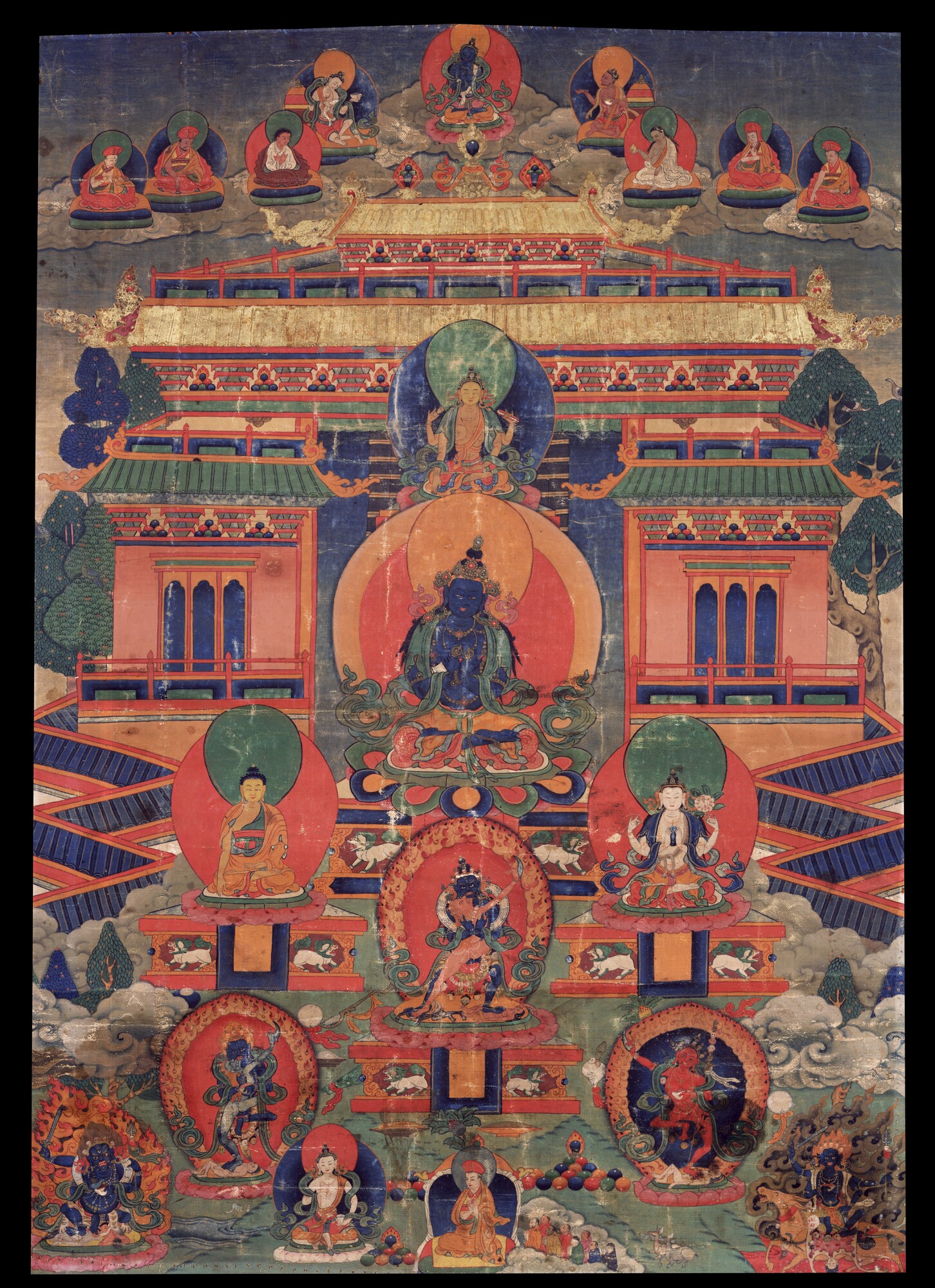
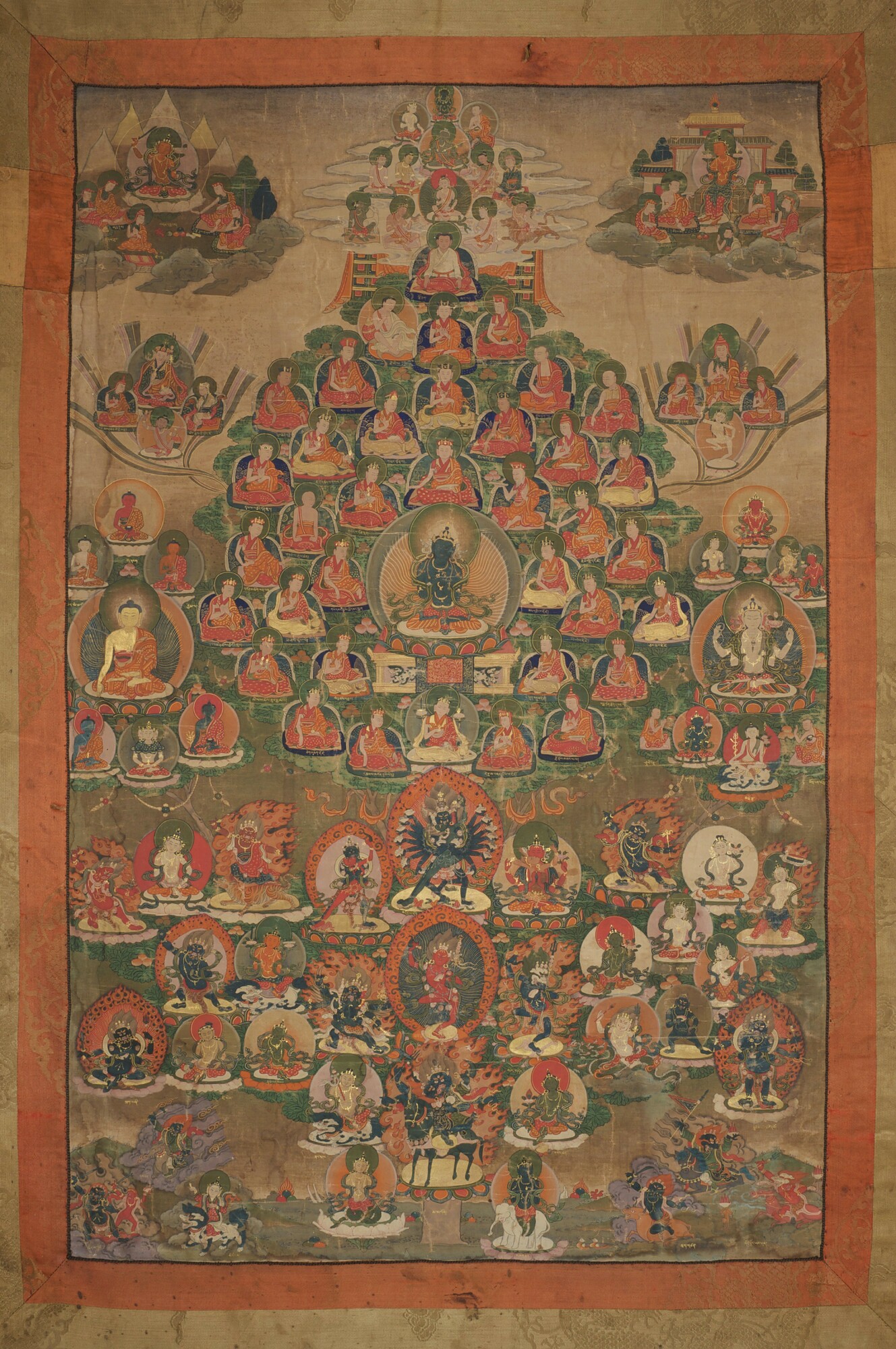
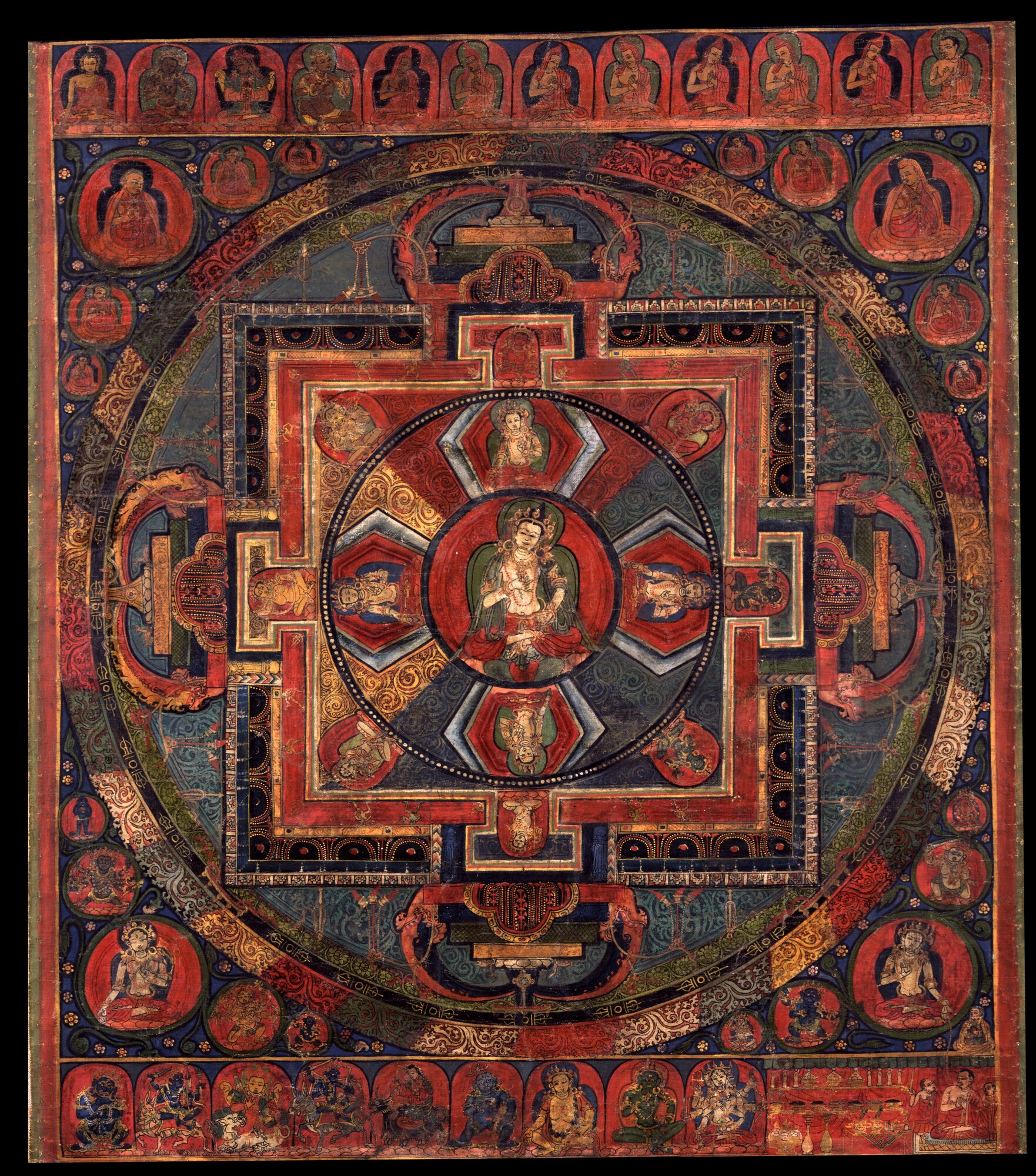
    Here is an image with Prajnaparamita very well-positioned. She appears as an ideal deity to our Guru Vajradhara. She is frequently identifiable by holding a Prajnaparamita text. The forum compresses these into previews, which are usually larger and more detailed if you right-click and open in a new tab.

    It belongs to Drikung Kagyu, whereby a member of the order is in the lower register speaking to Vajrasattva.

    The upper register however is the same as ours, with a type of Celestial Vajradhara surrounded by Naro and Tilo, then Marpa, Mila, and Gampo. That makes this the same thing that I personally use:


    Compared to the institution, I for example would not benefit by reviewing thirty-four generations of Tibetans like some of the services actually do. I know nothing about them. However, we can be sure that the "umbrella" as above is behind all of our denominations, and Bhutanese Kagyu actually has some of the best artistic examples of Sadhanamala, which is what we will be using.

    Most of Tibet does not have most of its material.

    The above rather plainly represents a change from Courtyard Prajnaparamita to a fully Buddhist sadhana.


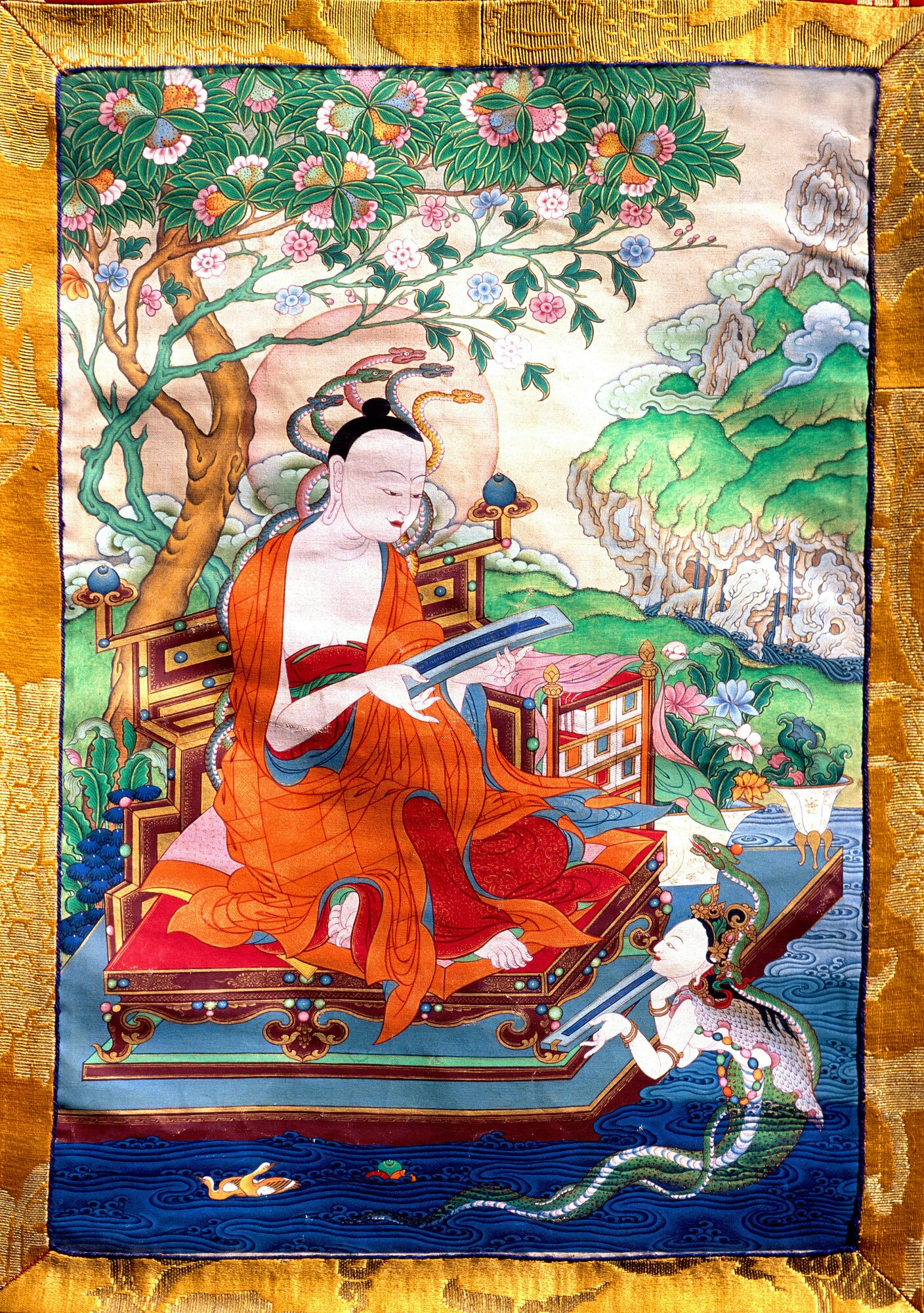
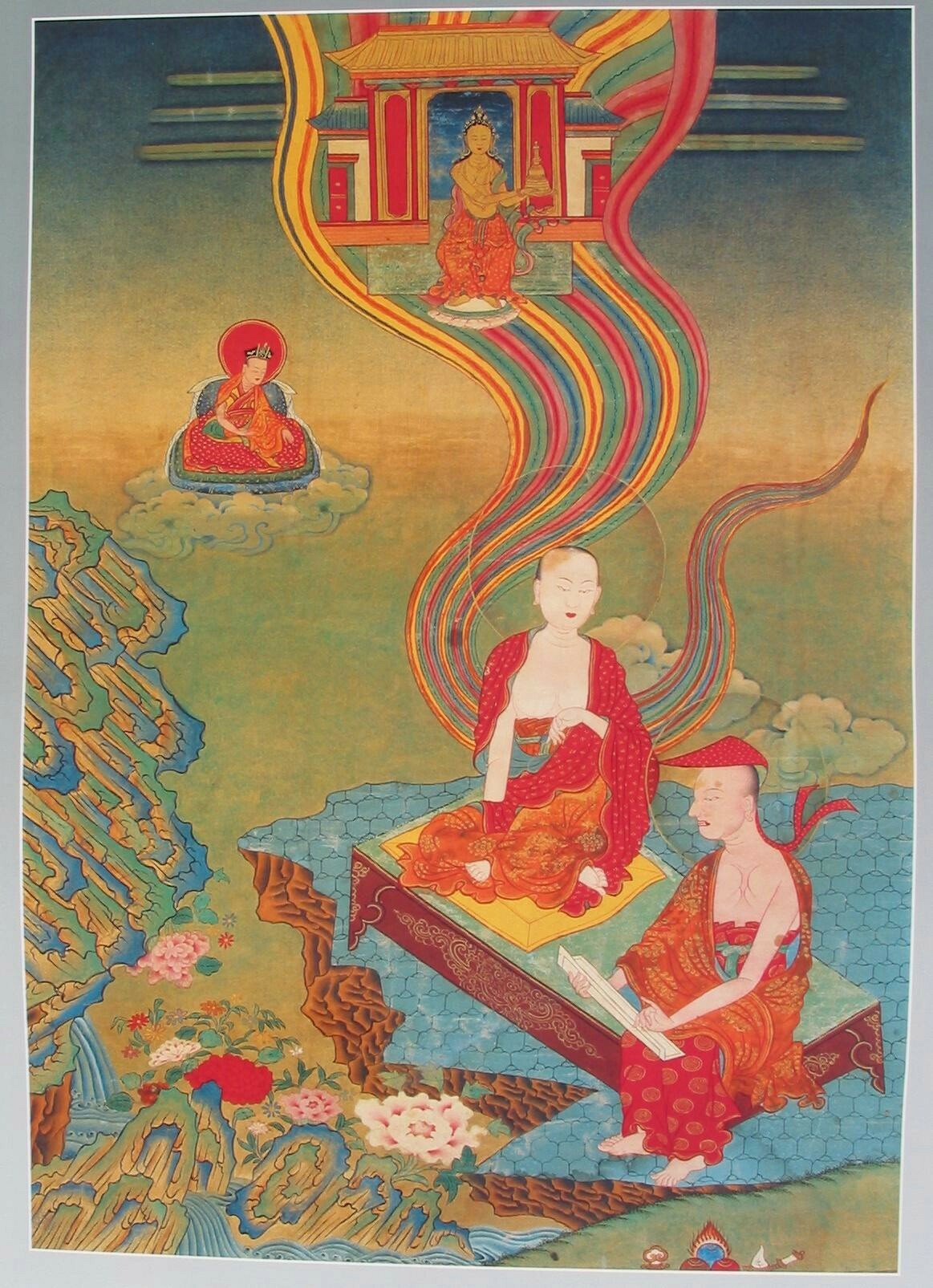
    Around 1900, the idea was meticulously developed for H. H. XV Karmapa. It has the Mahamudra lineage to Saraha. The linked page is virtually a major study of the entire Karma Kagyu ethos. Every figure is inscribed. This is notable because it also has Orange Maitreya talking to short-haired Asanga, beside Vasubandhu, with Candragomin beneath:


    This is the whole pantheon. It's not exactly what we are going to work, which is partially similar but also involves the missing centuries between Saraha and Candragomin to Tilo:


    What is going on here is that Kagyu is the original Tulku lineage. That's simply H. H. Karmapa, same as wrote Luminous Heart.

    Balanced on the other side of Maitreya is Manjushri.


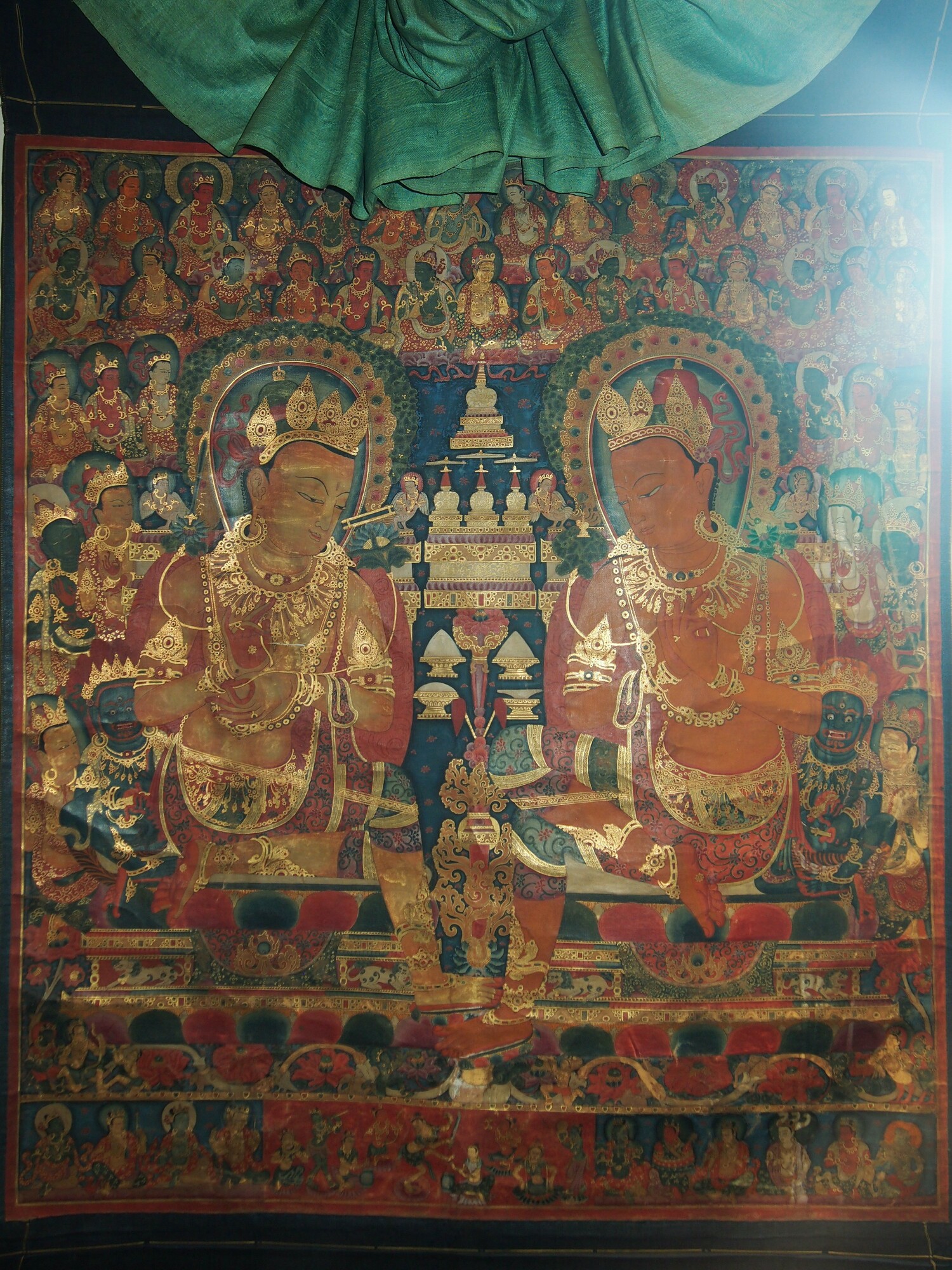
    There is a famous artistic theme of Dialogue of Manjushri with Maitreya.

    Gandhavyuha Sutra is an instruction of Manjushri to Sudhana, who quests through twenty-seven other teachers before reaching Maitreya.

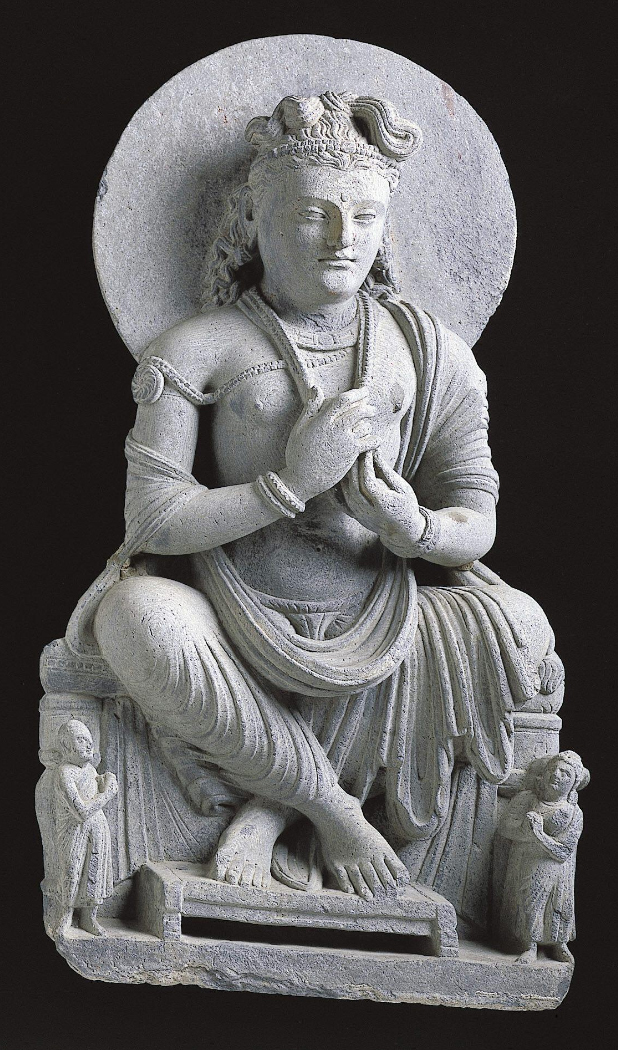
    Maitreya is probably the most static Buddhist deity.

    That is because he is said to reside in Tusita Heaven waiting to be born.

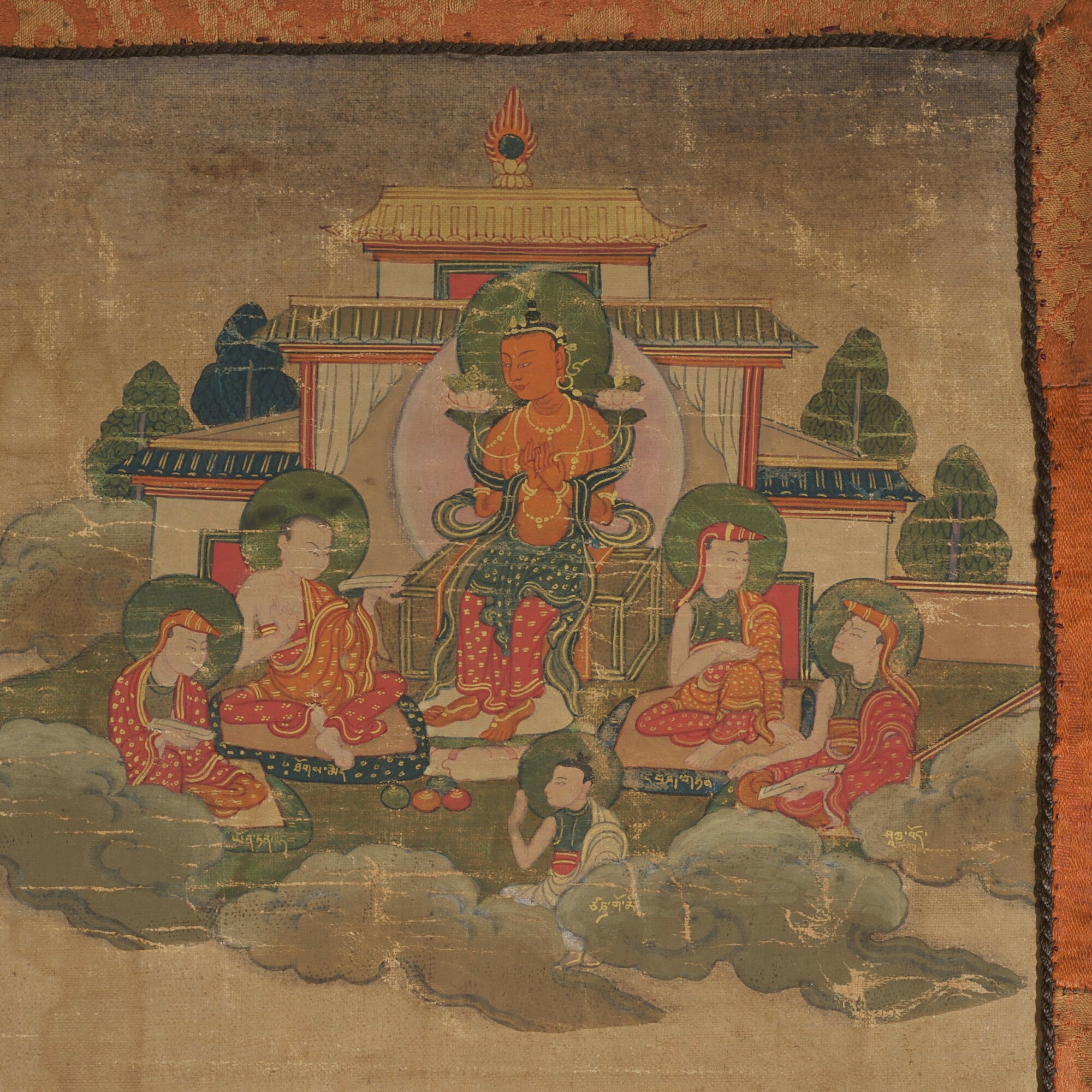
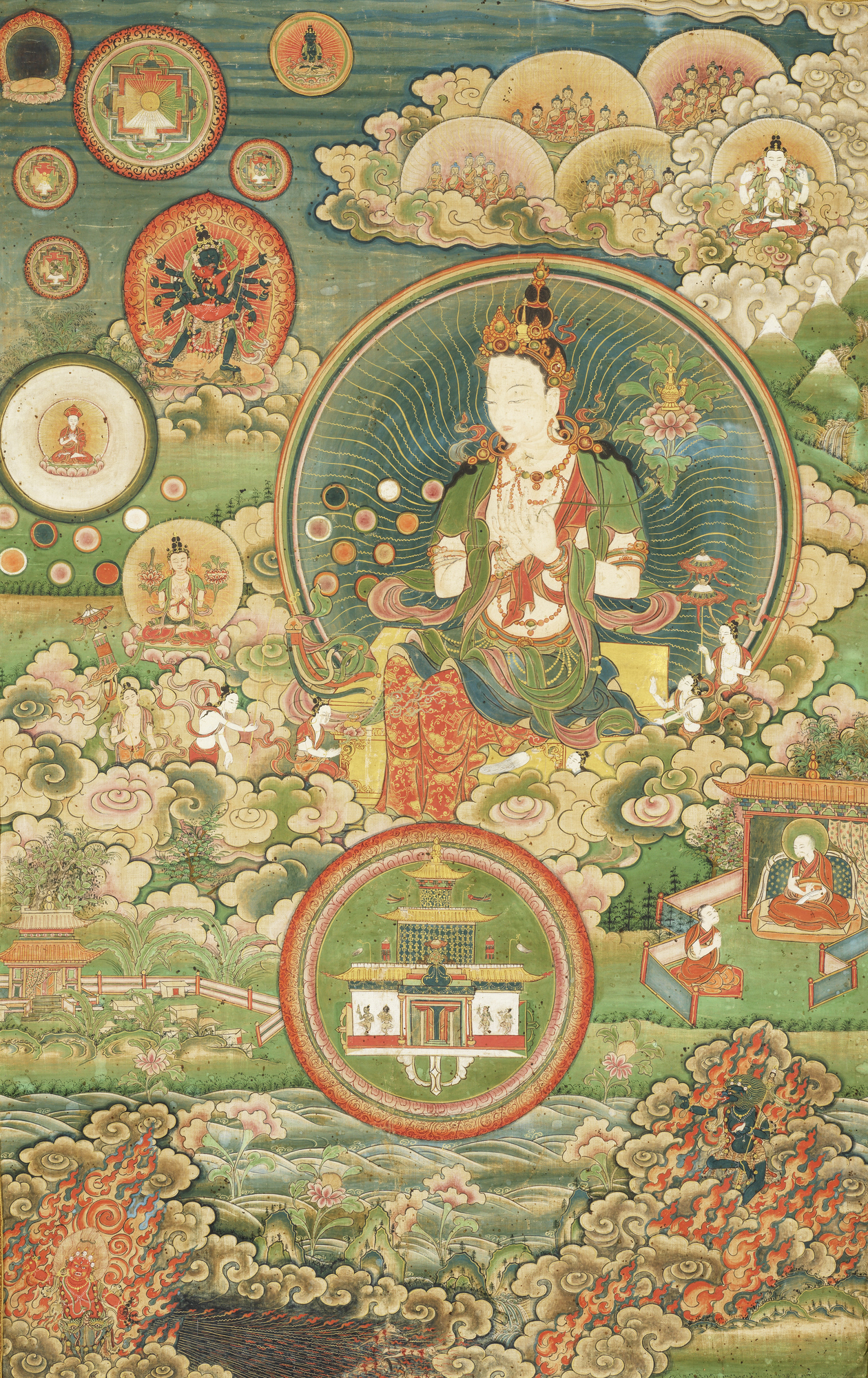
    Most of the Dialogue scenes are ordinary Bodhisattva appearance. There are, in general, two kinds of this art, formulaic standards and personalized variations. This is a Bhutanese Maitreya where Manjushri is visiting him, but you get an effect of energy orbs or Bindus which seem more appropriate for a heavenly plane:


    Manjushri has a quite large number of forms, but is frequently identifiable by having a Prajnaparamita text.

    Manjushri can typically appear with a half vajra on the crown of the head. Maitreya is iconographically known for having a stupa.


    Maujushri is a vast system. His primary text Manjushri Mula Kalpa is translated and it is so huge I think the Glossary is over two hundred pages. It may be the first encyclopedia. It is certainly like that, in terms of Indian literature and history. It may have parts from the 500s, but it accretes multiple layers over the course of centuries. And so it is this huge reference but it is almost unreasonable like the Avatamsaka Sutra. The main body of it is literally something like 1,400 pages.


    Maitreya has expounded the Sutras and in Nepal, Manjushri has the personal origin of Chakrasamvara Tantra:


    Khaganana Guhyesvari to Manjushri

    Shantikar Acarya


    First of all, Guhyesvari is "Our Lady of Secrets", and, the historical personage referred to was possibly as early as the 600s. This is obviously before any such known tantric lineages. Another Manjushri with Chakrasamvara seems to be the motive for establishing Vikramasila University. This represents India around the time Padmasambhava goes to Tibet.

    For the most part, our objective riddles are there with Manjushri in Nepal. Could this plausibly have happened in the 600s along with Vajrasattva coming from Bengal?

    Assam and Bengal have none of their own history besides whatever evidence comes forth from Buddhism.

    Manjushri is the reason to consider objective and non-Buddhist things as well, since, agreeably enough, we would say there is Wisdom to be found elsewhere. As far as I can tell, that is already true at the dawn of known writing. Whatever is good and useful in these areas came from Manjushri. And yes we can cover Namasangiti as a system of Seven Mandalas inspirational to the original Maitreya temple in Upper Mustang, Nepal, as well as to at least one more in Tibet almost all the way to Sichuan.

    In terms of tantric practices, Guhyesvari is a Prajna.

    In Nepal, Shakti is acceptable enough for goddesses, but this seems to irritate certain sensibilities.

    It turns out this is "systematized" in a way that is a bit different from Tibet. Mahayana had a lot of generally independently-circulated Dharanis. Asanga and Vasubandhu give some coherence to this. It is the most vernacular thing in the world because you do not have to do a sadhana to do this. But once it is explained as a type of Yoga intended to induce transcendental consciousness, they are no longer mere luck charms. The late Sarma period in Nepal has two purely Sanskrit resources which are:


    Dharani Samgraha


    which is hundreds of deities in a formatted fashion similar to the Tibetan month-long retreats that transmit very nearly the same thing. Some dharanis are one line and some are more like ten pages.


    Sadhanamala


    is also hundreds arranged in a similar manner. This however is Dhyana or is anything from a simple visualization up to very complex behavior involving deities that progress into the Chakrasamvara and Hevajra Completion Stages.


    That was how I, personally, discovered Ratnakarasanti, because he contributes a massive Vajra Tara in there that came screaming off the page. This has also been found by other reviewers to be one of the most lucid and complete sadhanas. The author's name meant nothing to me at the time. The work is self-distinguished. It is more related to the Hevajra system. His career does not do much with Chakrasamvara commentary. It is more suitable for gradual development and is what most of this is related to.

  4. The Following 3 Users Say Thank You to shaberon For This Post:

    Bill Ryan (10th October 2025), Ernie Nemeth (11th October 2025), grapevine (11th October 2025)

  5. Link to Post #3
    Canada Avalon Member Ernie Nemeth's Avatar
    Join Date
    25th January 2011
    Location
    Toronto
    Age
    67
    Posts
    6,047
    Thanks
    27,812
    Thanked 40,085 times in 5,768 posts

    Default Re: Subtle Yoga in Buddhism: Mantra, Life Wind, Luminescence

    The history of Buddhism, to me, points to another fact entirely, Shaberon - that I contemplate often during meditation.

    To me it points to the fact that there was a long time ago, another civilization with advanced understandings beyond even our own.

    The history does not point to its discovery but its recovery - from the hazy unformed subconscious of our species.

    In meditation it is often the case that the body holds memories, usually trauma, that must/can be acknowledged and dissolved. In my case the legs and feet. These memories are deep within the psyche, in the subconscious, which seems to store a hodgepodge of such distractions. For me the legs and feet represent the repressed, unnoticed, least important trivialities my mind cannot free resources to sort through.

    But in my deepest revelries I find a timeless wisdom, an eternal unformed presence. Not The Source, perhaps, but its highest acolytes. Creations with a history of revelation.

    Our species has forgotten more than it ever knew at any one point in time. We are ancient.


    One day, maybe one of your posts will prompt me to expound on the void, which is the thing that lies beneath all phenomena and reality itself.
    Empty your mind, be formless, shapeless — like water...Now water can flow or it can crash. Be water, my friend. Bruce Lee

    Free will can only be as free as the mind that conceives it.

  6. The Following 3 Users Say Thank You to Ernie Nemeth For This Post:

    Bill Ryan (11th October 2025), grapevine (11th October 2025), shaberon (12th October 2025)

  7. Link to Post #4
    United States Avalon Member
    Join Date
    1st April 2016
    Posts
    5,927
    Thanks
    29,291
    Thanked 33,542 times in 5,576 posts

    Default Re: Subtle Yoga in Buddhism: Mantra, Life Wind, Luminescence

    Quote Posted by Ernie Nemeth (here)
    ...the void, which is the thing that lies beneath all phenomena and reality itself.

    That is perhaps a para-Buddhist view.

    It may be similar to Theravada; I am not an expert on this ethos, but it is simply divested of the elaborations and deities we use.

    Mahayana has a view similar to what else you mentioned, that is, Dipankar Buddha was around the beginning of humanity, and there were other Historical Buddhas. The difference being what we call Buddha has a transmission lineage still intact, whereas the Historical lineages rose and fell.

    What catches me about your reply is that it says advanced understandings, rather than advanced technology. To suggest that 300,000 years ago, there were Eskimos and Bushmen who were way better humans than me, I would probably swallow it wholesale, unblinkingly. Machinery? Not.


    Most languages have something that is at least similar, Chaos, or Waters of the Deep, or Tohu Vohu with Zoroaster; of course, these are usually linear creation sequences and it never comes up again.

    The Rg Veda certainly has a nameless area where it is just the pronoun "That" which was before creation; and so in Sanskrit, Tatha Gata, Gone to That-ness, or, slightly nicer sounding, Suchness.

    The purpose for the thread I suppose could be described as this in layers. It is relatively easy to express this in terms of brain quiescence, which is not all that hard to do. It is more difficult to express it as Life Wind or Prana. My reaction is to say that it is a process of Prana as a practice of Yoga that is why we have a thousand years of treasure about this. It is almost all about Entering and Emerging, which is the part we can control. Because I have a lot of experience with it, I am in a position to understand and confirm almost the entire thing. I mean it at the level of a medical condition, in the way that a seizure or a bad acid trip are the negative polarity of something else.


    This is a lead-in towards the next subject, which is effectively the beginning of intellectual history for Mahayana, and we can sift it for Void attestation.


    First, from the last post, I checked to see how our cousin branch works, and, it is about the same. In the Drikung Curriculum, after four years of philosophy:

    Quote The following three years

    Main subjects:

    Gongchig (“the same intention”, Jigten Sumgön)
    Prajanapramita (“perfection of wisdom”): The five treatises of Maitreya (1. Abhisamayalamkara, 2. Mahaynasutralamkara, 3. Dharmadharmtavibhanga, 4. Madhyantavibhanga, 5. Anuttaratantrasastra)

    What I am posting as "general information" mostly Sutra-based is equal to a seven-year degree, and I am telling you that the title of 5. is wrong and everything that is important about it.

    The last post referred to some Prajnaparamita texts that are obscure, and we want to prevent confusion and mistakes like that. To be careful about making wrong attributions:


    According to New History of Tantric Literature in India, almost no textual development was linear. Kukure or Kukupa was the transmitter of Dakini Jala to Indrabhuti's son Sakrabhuti; and that his daughter Govadevi received and transmitted Nayasatapanchasatika (Toh 489) and Sri Paramadi, of which Sri Paramadya is probably an extraction. However if we account for this spelling, it seems to be that this is just on the cover and Govadevi is actually a name of the text.

    The prefix Ardhya- means that the title actually says "hundred and a half", although some copies do seem to be called a hundred and fifty as above. These are still different from something called Satapanchasatika Stotra. That's not in the genre, it's something else.


    Connecting errors is sometimes a favorite pastime for those who are pushing an assertion. It may also happen to more innocuous researchers.


    Going back to our "origin point" and why I, at least, am so considerably different from those around me for it to constitute a communication barrier, here it is.


    Buddha was a person who was so vexed by how meditation should work differently, he renounced a position of power in order to walk to Afghanistan and back. On this journey, he subdued Yakshas, and each time he did, he entered a Bodhisattva Bhumi or stage of the Path. He naturally re-lived up to the condition he held as Mandhata.


    In the western-linked arm of our conversation, there is something fully explanatory. This is a bit like Giuseppe Tucci was able to get a collection of photographs of things that were in Tibet that got destroyed in the Chinese conflict. The following was in Afghanistan until destroyed by the Taliban around 1992. The lack of it crippled my memory, until, again, an older photograph appears online.

    Tapa Shotor, Buddha with Herakles and Tyche:


    From that, all of the international syncretism can be revealed, and we do this in other threads.

    What is less apparent is the thing that was really what was spread everywhere, was the Palaestra or hall of combat sports that was part of every Gymnasium or school. After the glory of Greece, the Roman Empire did not continue this tradition, whereas it spread all over Asia where it remains to this day. And so people like me have attached ourselves to a Palaestra that has Buddhism coursing along with it. Apparently this is very physically different from the normal person around here. Without a single Sutra, this is something of a radical anomaly.

    You can see the correspondence Greek Herakles to Shaolin Vajrapani, and this was the deity until...well the Mandeans still have it.


    For this thread, there is definitely someone of epic proportions. This particular area being very arid is the main reason that manuscripts preserve better. But some of the writing is of south Indian origin. As soon as we start to find anything, it starts off big.

    In fact, there is an author whose work is still being sent from Ceylon to China in the 700s.


    Asvaghosa


    The Chinese Zen Patriarchs lineage includes Asvaghosha, but, it is about Bodhidharma, not Maitreya; the Tibetan Mahayana lineage omits Asvaghosha, and has a tendency to sound like Nagarjuna and Maitreya are different systems. Upon examination, neither one of them seems to be completely accurate. Also, most studies on Yogacara have mostly been about Vasubandhu lensed through varieties of Chinese and Tibetan variations. Point being there isn't a lineage that can be viably determined coming from here.


    There is a likely source for the too-early Chinese Asvaghosa from another simple mistake:


    Fo-pan-hhin-kin, or the Buddhakarita-sutra (?) (taken by Julien for a translation of the Lalita-vistara), 5 fasc. a. d. 68. (lost)


    is later, this:

    1352 San-kie-lo-kha-su-tsi-fo-hhin-kin.

    Sutra on the practice of Buddha (or Buddha-karita-sutra), compiled by Sangharaksha.
    Translated by Sanghabhuti, A. d. 384.


    whereas Asvaghosha wrote:


    1351 Buddhakaritakavya

    Fo-su-hhin-tsan-kin (not found in Tibet)

    Translated by Dharmaksema along with Mahasamnipata and Mahaparinirvana Sutras.


    So then he is not really that early as the year 68. You perhaps have an entire Bodhidharma legend based from a wrong title. The basic difference is that he wrote Kavya, "poetry".


    It is like the turning of a page to get to Asvaghosa:


    Quote He is believed to have been the first Sanskrit dramatist, and is considered the greatest Indian poet prior to Kālidāsa.


    He was the most famous in a group of Buddhist court writers, whose epics rivalled the contemporary Ramayana. Whereas much of Buddhist literature prior to the time of Aśvaghoṣa had been composed in Pāli and Prakrit, Aśvaghoṣa wrote in Classical Sanskrit.


    It is now believed that Aśvaghoṣa was not from the Mahayanist period, and seems to have been ordained into a subsect of the Mahasanghikas. Some recent research into his kavya poems have revealed that he may have used the Yogacarabhumi as a textual reference, particularly for the Saundarananda, which opens up the possibility he was affiliated with either the Yogacara or the Sautrantika school.


    Well, he may have used the Bodhisattva Bhumi, which is incorporated into Asanga's Yogacarabhumi.


    So if we trace what seems to be a teaching in the early days:


    Quote The Mahāvastu is the Vinaya of the Lokuttaravāda school. Lokuttaravāda (Lokottaravāda) is a branch of Mahāsaṅghika.

    Despite bearing this name, all sub-sects of the Mahāsāṃghikas seem to have accepted forms of supramundane or transcendent teachings.

    While the Mahāsāṃghikas initially flourished in the region around Magadha, the Lokottaravādins are known to have flourished in the Northwest...It is likely that the Lokottaravādins had no major doctrinal distinctions to distinguish them as different from Mahāsāṃghika, but that the difference was instead a geographic one.

    The Sanskrit text of the Mahāvastu was preserved in the libraries of the Mahayana Buddhists of Nepal.

    that's better than "competing sects". What you have is "similar beliefs" that may be described with different names in different areas.


    It is not obvious, but if you scavenge the Mahasanghika page, the result is quite simple. It does have a canon. It has only one Sutra! And that is the Lokanuvartana Sutra.


    Scholars have attempted to trace about eight of these sub-sects. But one has little recourse to very much pre-1000 writing. So we do not expect that concrete discovery of another sub-sect can tell us much. We can probably agree that the somewhat unspecific "Lokottaravada" became more specifically defined by "Mahasamghika" in any of its appellations. The latter having the sense of "greater assembly" such as lay people.


    You can still get Mahasanghika or Mahavastu ordination, but, of course, the "school" based around it is subject to change. For example, Xuanzang visited a Lokottaravāda vihara in the 7th century CE at Bamiyan, having in its collection:


    Mahāparinirvāṇa Sūtra

    Śrīmālādevī Siṃhanāda Sūtra


    In other words, "Lokottara" by name was flourishing in the northwest, but, that is not enough on its own to tell us what it was. Those texts do.


    From trying to determine Asvaghosa's Affiliation:


    Quote Traditionally it was understood that Sarvastivada, Sautrantika, and Yogacara were three distinct traditions, but this framework has been seriously questioned in recent years.

    ...the methods of meditation practice described in the latter portion of the Saundarananda are closely related to those in the Sravakabhumi section of the Yogacarabhumi. Second, as we might expect from the foregoing discussion, most of the Sautrantika-like elements found in Asvaghosa’s works are also found in the Yogacarabhumi.

    After suggesting Asvaghosha was a "Bahusrutika", Johnston's translation of Asvaghosha's Buddhacarita mentions Tattvasiddhi or:


    Professor Demioville has however lately discovered
    fragments of Paramartha's lost commentary on Vasumitra's
    treatise on the Buddhist sects, in which the Satyasiddhi is said
    to be a work of the Bahasrutika section of the Mahasanghikas.


    Either is a way of saying "Reality Siddhi", meaning reality as known in yoga. They are alternate title of a text by Harivarman ca. 250 - 350. He argues strongly for the recognition of the role played by the mind in the construction of reality through the medium of concepts and intellectual constructions (prajñapti).


    Slightly earlier, Asvaghosa is famous for two primary books:


    Buddhacarita and Saundarananda


    Note the "second half" format:


    Quote The latter half of the Saundarananda consists of the Buddha’s exposition of the way of practice (Cantos 12-16), a description of Nanda’s actual process of practice (Canto 17), and the approval of his achievement by the Buddha (Canto 18).


    And that this is in everything:


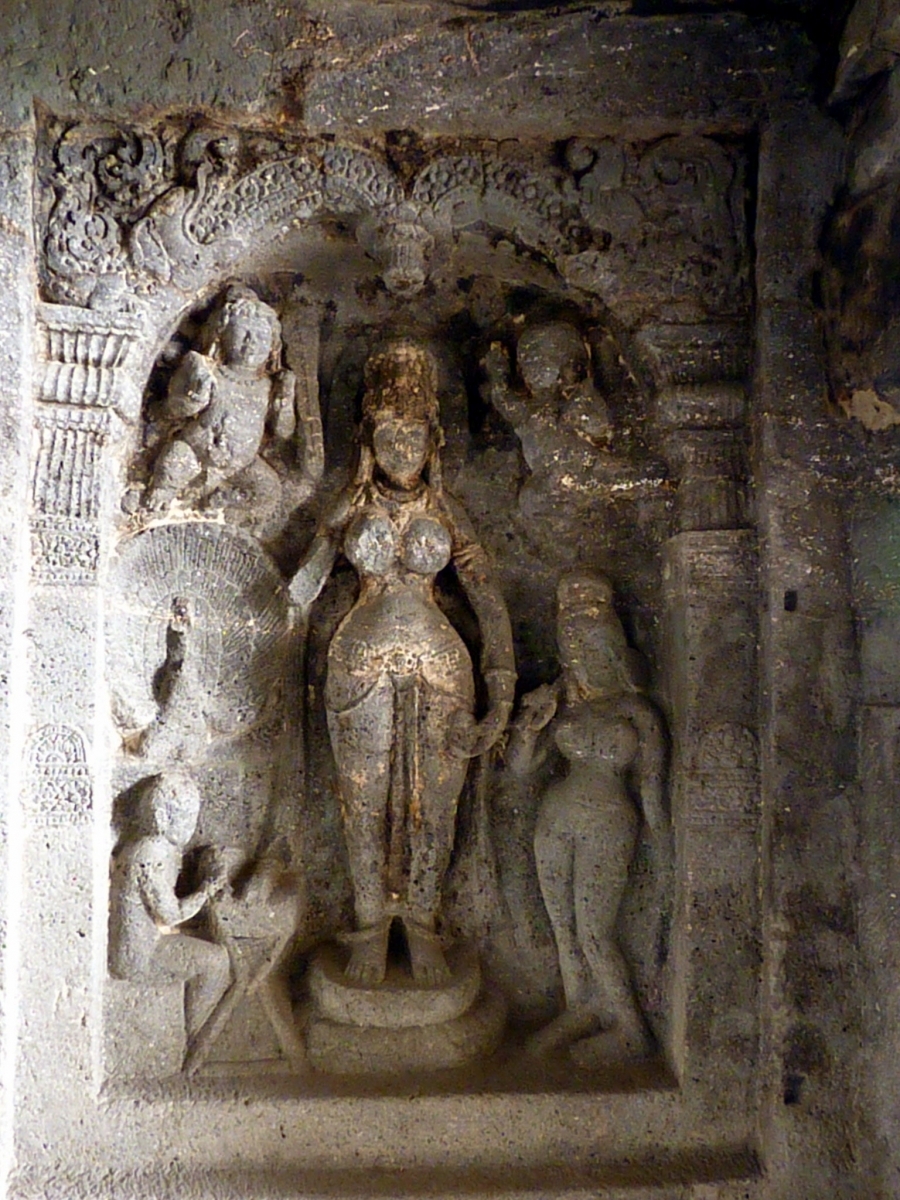
    Quote ...the pictorial representation of Nanda legend in Ajanta Cave 16 is based on the Saundarananda.


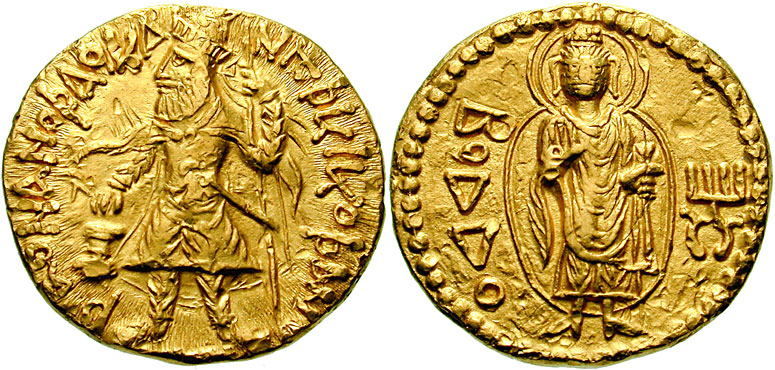
    Asvaghosha is considered in some way involved with King Kaniska, who stamped Maitreya on coins ca. 150. Here it seems likely that most legends and traditions about Kaniska are embellishments and revisions inspired from Asoka. Chances are, that he took an interest in, and possibly converted to Buddhism, in the last part of his life. Context suggests that Kaniska was interested in Asvaghosha compiling a Sutra basket or at least some texts, which most likely are represented by what Lokaksema takes to China in 178.

    It is possible that Asvaghosha is the author of Vajrasuci, but Sutralankara Sastra and Mahayanasraddhotpada Sastra almost certainly are not by him.


    We could say he could not have composed Mahayana texts because there was not that name, there was not most of that vocabulary, and his known writings do not easily reflect it. What we would be looking for is, does this match a Lokottara view which, in time, is where Mahayana could grow, and that would seem to be yes.


    Lamotte found two Nepalese Saundaranandas, and nothing in Tibet. Here is the Saundarananda transcript and translation.


    Before we get angry that this text is against women, it is really against worldly people:


    Quote It is wrought out of the figurative expression of kāvya poetry in order to capture an audience whose minds are on other things...

    It is very well-written, however, it is like Nagarjuna; seems to reflect Pali Buddhism, and almost nothing of Mahayana. For instance, his goal is Liberation, Moksha or Vimukti. It is Arhat or Mahatma training, not Bodhisattva. It is mostly a coaching on meditation at the level of subduing gross impediments or Kleshas. The saving grace is that although it does heavily rely on Sunya, this is just a means to realize Dharma and Svasamvedana, which does not appear in that specific term, but does with phrases using "smrti" and other older synonyms.

    One time it does mention Lokattara as the Path.

    That battles the Kleshas, and manifests the Bodhyanga or Jewels of Enlightenment:


    Quote ...with the seven elephants of the limbs of awakening he crushed the seven dormant tendencies of the mind.

    Asvaghosha is heavily critical of people who just go around in circles getting resources to replace pain with pleasure. That is, he criticizes the mentality. Of course, this is the majority of what we still see today. Aimless circles about stuff and nothing about the inner person.


    One seemingly willful mistake is that HPB was told by the Mahatmas to use Amrita for the reincarnating principle rather than Monad. She does not, although she does have an unusual doctrine for Amrita-yana as if something had this name. Close, but Madhu Vidya is a quite standard name for Honey Doctrine in Yoga, of which we are doing a variant or refinement. Amrita (Nectar) is the major concept of the Saundarananda.


    There at least is also mention of Karuna as the motive. So it begins with Buddha's Enlightenment, and, if this book has a "flavor" at all, that is because Karuna motivates him to teach Nectar:


    Quote avabudhya caiva paramārtham ajaram anukampayā vibhuḥ |
    nityam amṛtam upadarśyituṃ sa varāñasīparikarām ayāt purīm ||


    3.10 Awake to the one great ageless purpose, and universal in his compassion,
    He proceeded, in order to display the eternal deathless nectar, to the city sustained by the waters of the Varaṇā and the Asī – to Vārāṇasī.

    Nectar has multiple appearances, such as:


    Quote phalam amṛtadharmasiddhayoḥ |

    or, with respect to Svasamvedana:


    Quote The nectar exists in the hands of him for whom awareness pervades the body.

    There are no Paramitas, although Prajna is included:


    Quote tataḥ pītvā prajñārasam amṛtavat tṛptahṛdayo viviktaḥ saṃsaktaṃ viṣayakṛpaṇaṃ śocati jagat ||


    Then he drinks the essence of wisdom as if it were the deathless nectar and his heart is filled.

    And towards the end, it is the whole point of the imparted practice:


    Quote The 17th Canto of the epic poem Handsome Nanda, titled “Obtaining the Deathless Nectar.”

    I believe you could call it "Lokottaravada"; although this term only appears once, the Buddha is "supernatural", emitting Golden Light. He takes Nanda to Vajradhara = Indra Heaven, where he is amazed by the nymphs. Then he is shown that even this realm is perishable.


    It matches the "surface" of Buddhist metaphysics, since it talks about crossing Kamadhatu to enter the state of Anangamin, and then the Four Form Dhyanas to become an Arhat, at which point he has to add "Viraja" to describe the realized state:


    Quote śānte ’smin virajasi vijvare viśoke saddharme vitamasi naiṣṭhike vimuktaḥ ||

    To be released into this quieted, dustless, feverless, sorrowless, ultimate true reality, which is free from darkness.

    Then basically it stops.

    The Skandhas are mentioned one time, but, you would have to do a lot of outside work to figure out what this means. Then as the synonym Nama Rupa:


    Quote yadaiva yaḥ paśyati nāmarūpaṃ kṣayīti taddarśanam asya samyak |

    When a man sees psycho-physicality as subject to dissolution, that insight of his is accurate


    yathāsvabhāvena hi nāmarūpaṃ tad dhetum evāstagamaṃ ca tasya |
    vijānataḥ paśyata eva cāhaṃ bravīmi samyak kṣayam āsravāṇām ||

    16.46 For in him who sees psycho-physicality as it is, and who sees its origin and passing away,
    From the very fact of his knowing and seeing, I predict the complete eradication of the pollutants.

    So there is not exactly a Transformation into Nirmana and Sambhoga Kaya, but again something closer to what we could get in the Pali. In the ending section, the Arhat displays Bodhisattva-like behaviors, without any kind of vow or other details, for example:


    Quote avāptakāryo ’si parāṃ gatiṃ gato na te ’sti kiṃ cit karaṇīyam aṇv api |
    ataḥparaṃ saumya carānukampayā vimokṣayan kṛcchragatān parān api ||

    18.54 Walking the transcendent walk, you have done the work that needed to be done: in you, there is not the slightest thing left to work on.

    From now on, my friend, go with compassion, freeing up others who are pulled down into their troubles.

    So, he skipped some details, which is where we go to figure out what are these Skandhas, They are aggregates or heaps of impurities. Such a translation does not quite convey the way in which they are more technical than a simple tag for something already defined.

    Buddhist Skandhas are like a processor cycle or clock; an algorithm or program. It deals with how psychology works rather than just describing portions of it as bad.

    Perhaps an apt description is "hamster wheel" and each Skandha is a step going round. The brain runs in loops of input and output.


    Nama Rupa is an acceptable synonym for them: Name and Form.

    That is how it changes the basic psychology descriptions; Form includes the Senses as one bundle. It's the total packet to the brain. In Ordinary Waking Consciousness, the brain applies up to 90% of its power for vision, so, Appearance and similar terms may be equal to Form. A person is generally confused that processing the sensory inputs is real.

    "Name" refers to the Skandhas that have a purely mental nature. Sentience or Sensation is the reaction to sensory inputs; good, bad, or neutral. Buddhism is primarily oriented to Sentient Beings. If something can feel, we care about it more than an inanimate object.

    Perception is the associative thought that builds memory patterns; that is how, for instance, we determine a particular object is a chair. Then it differentiates to a particular chair I like, another one I don't, and so on. Animals can do this.

    Samsara is a total projection. It invents make-believe realities. It directs Will or Desire at Perceptions and their memories, and attempts to make, do, control, etc., the fleeting environment. It cannot possibly succeed.

    The fifth or Vijnana Skandha could be considered exclusively mental; impressions left by the experiences, ideas rolling behind the threshhold of activity.


    And so of course this is normally taken as human psychology, that's "me", and people are just setting themselves on a course of more Skandhas. Obviously, we say there is no such "me" and are trying to see through it. So we are going in the totally opposite direction from those Greek and western experts' trends of ideas. It is that from which we seek Liberation.


    That truly is the Grounds for the Path. This is where you should take some time learning to watch the stuff. Get a feel for this process or cycle and identify it internally. Otherwise it is just information. It becomes of practical value when you apply it. And of course these things are fast. You might readily discover a big, slow lump sum of them, but it is also minute, like Megahertz or even faster.


    This was the most helpful thing to me, as an aficionado of non-Buddhist Prana manipulation. You murder the Skandhas and the Dhyani Buddhas or Tathagatas arise in their place. This is what we mean by Families. It's why a Vajra has five spokes. The quality of the experience results from the quality of the effort. It tremendously helped me to do the Pranic Yoga itself, but I did not have enough information to develop Wisdom in All Families. This is the core driver, it really is like a living drill, which I would recommend understanding first.

    That is the reason for Dakini Jala Samvara, that is, Vajrasattva plus the Families.

    Although each Skandha is associated with a negative emotion, they are really aspects of the pulse of every moment. One should observe it as a mechanical cycle.


    Gold Kanishka backed by Buddha:


    However, if you look at Kanishka with Iranian coins, he is plainly an Iranic revival with a good part of Zoroaster's pantheon.

    Well, Buddha himself walked there, and then, this wave of literature cruises through there, and I think Vajrasattva and the Families as well as Buddhism might be partly influenced by Zoroaster. Some of it is simply the same.

  8. The Following 2 Users Say Thank You to shaberon For This Post:

    Bill Ryan (12th October 2025), Ernie Nemeth (12th October 2025)

  9. Link to Post #5
    United States Avalon Member
    Join Date
    1st April 2016
    Posts
    5,927
    Thanks
    29,291
    Thanked 33,542 times in 5,576 posts

    Default Re: Subtle Yoga in Buddhism: Mantra, Life Wind, Luminescence

    Lokanuvartana Sutra


    So far, studies on the ancient Chinese transmission have focused on the more famous Parthian translator An Shigao.


    We're not exactly looking at China. We're looking for something from India. It arrives in the hands of Lokaksema, the translator of Lokanuvartana Sutra:


    The Kushan Lokaksema (Ch: 支谶, Zhi Chan), first translator of a Mahayana sutra into Chinese


    He was a Sramana of the country of Yueh-zi, who came to China in a. d. 147,
    or 164, and worked at translations till A.D. 186 in Lo-yan.


    As well as a Pratyutpanna Samadhi, he also has dhyana texts such as Akshobhyasya Vyuha and Amitayus or Long Sukhavati. It may be the earliest mention of Prajnaparamita Sutra. And yet at least parts of his material had come from South India.

    What we are looking for is generally omitted from attributions to Lokaksema.

    His Samadhi Sutra is based on Bhadrapala's experience from a previous lifetime with a prior Buddha.


    Aside from circumstances, we can't say this directly pertained to Kaniska, but it at least appears to be an integrated movement attached to the beginning of White Horse Monastery in China. We find something very shortly after Asvaghosa, which is not poetry, but a variety of Buddhist Sutras. Compared to him, we will find clear expansions of intellectual development, consisting of terms that open the Mahayana view. At the same time, there will be intrigue with the hymns of Nagarjuna.


    In fact, this comes from a study on Nagarjuna's Niraupamyastava and its relation to Tathagatagarbha:


    A similar, nearly parallel source for this hymn is:


    Loka¯nuvartanasu¯tra


    Part of that is the simple, "front and back" construction, such as also in Saundarananda.


    Ruegg says for verses in Nagarjuna's Dharmadhatustava and four Candrakirti works:


    The source appears to be the *Lokanuvartanasutra.


    So, pre-100, we have fragments and records of lost translations, which is evidence but it is not enough to determine anything like an evolution of ideas. Asvaghosa reflects something rather mature, even if it is a Sanskrit version of Pali. Perhaps that is mainly what he does. They are not that different. Because my personal background is heterogenous, I have Pali rolling around as basically equivalent, mixed in.


    Another intellectual faux pas we can quash by use of the forum is stray quotes taken out of context. That largely summarizes humanity's understanding of the Rg Veda, and, to an extent, Buddhism by study or even from inside it. So we can examine this for questions about an early testament of Mahayana:


    Lokanuvartana Sutra 807


    is an English translation that says it was in the first (surviving) Chinese transmission. It "is" a Mahasamghika text--one of three, the only Sutra -- and yet it travelled with the Gandharan 8,000 Line Prajnaparamita Sutra.


    There is a bit of prior insight on it:


    Harrison 1992 considers it the likely origin of the Mahayana view of the Dharmakaya.


    Harrison on Manjushri tells us that he appears in Lokaksema's Prajnaparamita Sutras and probably half of his works, while Avalokiteshvara is nearly invisible.


    Guang Xing 2006 did not question the Lokanuvartana's Sutra's authenticity, and published in Sri Lanka. The basis of it is Manjushri's inquiry about how a Bodhisattva knows the Buddha Dharma? And the reply also includes the Tri-yana doctrine of Mahayana because:


    Quote The arhats and the pratyekabuddhas cannot know, how much less so the worldly people...

    It does so without the term "mahasattva", which seems to be used in later texts to differentiate a Mahayana Bodhisattva from one pursuing paramitayana or older Sutra doctrines. It is difficult for me to unbind "Avalokiteshvara the Bodhisattva Mahasattva" from being one word like it is in Heart Sutra, which is one of his only uses in the whole Prajnaparamita genre, which doesn't have much directly to do with him but they join.


    That is a clean, sharp, crisp statement; the subject must be beyond prior training, but, it is primarily an extension to what was done before, according to Lamotte:


    ...the doctrine of the multiple teaching of the master, in conformity with current ideas ( lokanuvartana)
    is already proposed by the Purvasaila Hinayanists (Madh. avatara, p. 134); the Purvasilas had the
    Prajnaparamitasutra written in Prakrit, and the Mahavastu, of Hinayana origin, already taught the stages in the career
    of the bodhisattva and the practice of the paramitas (Grub mthah of Manjughosa in Wassilieff, Buddhismus, p. 264):
    the theory of the Alayavijnana, the central piece of the Idealist school, was already proposed in the Ekottaragama,
    the agamas of the Mahasamghika and the Mahisasaka, and in the sutras of the Ceylon school of the Tamraparniya
    (Samgraha, p. 26-28; Karmasiddhiprakarana, p. 106; Siddhi, p. 178-182).


    That's fine. The high range of our practice uses the Seven Jewels of Enlightenment, which are directly from Pali Buddhism, and culturally from the Chakravartin which is, so to speak, formalized in the Atharva Veda, and, I think, suggested in all prior epochs.


    If it is supposed to go with Prajna Paramita, it is an Upaya (Method) text.


    Manjushri says:


    Quote [How do the Bodhisattvas see] the suchness without any differentiation between knowledge (jñāna) and skillful means (upāyakauśalya) as sealed with the seal of the Tathāgata?


    As in the later Srimala Devi, there is no Sambhogakaya, but:


    Quote The Buddha can manifest himself in numerous bodies (nirmanakaya)...

    Matching this:

    Quote This is probably the first sutra in which the Buddhas of the ten directions of the world are spoken of.


    Lokasema’s translated texts in the second-century state the Buddha of the Ten Directions, “if one’s heart is focused on Amitabha one will be reborn in sukhavati, the Western Pure Land presided over by Amitabha.”


    One Tibetan translation was used, and some Sanskrit fragments as well, along with the Chinese. The Tibetan is in verse, the Chinese being "suggestive" of verse due to the repeated refrain. In cases like this, where something early and Chinese resembles something later and Tibetan, it is understood that it was "something" in India, not a fabrication of either. As we have seen, not all works have this benefit.

    The teaching that was being countered was that Sarvastivada said that Buddha performed austerities due to karma; Lokottaravada rejects this, substituting "a show". Also, we have found that being offered food was the trigger that made him reconsider austerities and think there might be something else to Enlightenment.

    For "anuvartana":


    Quote ...according to the Lokottaravādin school, this conformity to worldly life on the part of the Buddha is a mere ‘imitation’ or ‘reflection’, as in a mirror, bimbe kanakabimbābhe eṣā °tanā Mahāvastu i.168.15; this passage is a locus classicus for this doctrine; in 168.8—9 lokānuvar- tanāṃ buddhā anuvartanti laukikīṃ, prajñaptim anu- vartanti yathā lokottarām api; in what follows, Buddhas are said to imitate worldly actions (the care of the body, etc.), tho they have no need to, since everything about them is lokottara, transcending the world.

    It dispenses with any concept that Buddha was a normal man making wise statements. It describes him as a magic being who put on a magic show for the benefit of other beings. It's not just the title, it's the main, possibly the only, subject.


    Every verse here has the refrain:


    Quote It is in conformity with the ways of the world that he makes such a show.

    The "show" is living, or anything he does:


    Quote The Bodhisattva was not born from the sexual union of father and mother. His body is magically produced, like illusion.

    Then we are told that Prajnaparamita must have been a really old accomplishment as a disciple:


    Quote Since many thousand myriad kotis of asamkheyakalpas ago the Buddha has accomplished prajnaparamita.


    The Sutra does contain the statement that the Skandhas, Dhatus, and Ayatanas are Empty, however this is quite brief, not drawn out like in Ratnavali. Instead, if I thought the Sutra was getting at something "beyond Prajnaparamita", it would be:


    Quote The Buddha abides in suchness (tathata) l So he does not come and does not go.


    ...the suchness (tathata) of the Dharma pervades everywhere.


    The suchness of the Dharma cannot be surpassed because the past, present and future are empty.


    The suchness of (the Dharma) is without birth and extinction (nirodha), but pervades everywhere.


    If it would have said "sunya", it would sound like Nagarjuna's Ratnavali, but it does not, instead we see Tathata, concerning the Buddha.


    Of course, it was physically with Prajnaparamita Sutra. It has a mark of Manjushri and Upaya, and Prajna Upaya or Prajnopaya is certainly one of the main themes throughout the tantric commentaries. So, the form of Manjushri carrying a Prajnaparamita text is already meaningful.


    The roughly-sketched subjects here, Prajnaparamita, the Ten Bhumis, and the Dharmakaya are in a certain sense still the major theme of Asanga and Maitreya. As a whole, with who knows how many additional Sutras in train, it is draped over existing Hinayana institutions, who record up to something like eighteen sects, and we find that "frustration" is the key to certain characters such as Asanga, Harivarman, and Xuanzang.

    The Lokanuvartana has told us there is a type of gnosis inaccessible to the pratyeka and arhat intents and practices.

    A relatively narrow focus in Sutras are adequate to develop the doctrines. The sense of abundance would apply to Dharani Sutras, that is, varieties of mantras for yoga practice. Asanga does figure out how to render this into a functional apparatus.

    We would have to be almost positive that Asvaghosha and Lokaksema's Sutra basket were part of Nagarjuna's background, and, nothing much additional is. There is no reason to think the question would come up is he refuting Samdhinirmocana Sutra. There are none of those reasons. The question would be if he is most like an early step based from this. Traditionally he is seen as a devotee of Manjushri. As we see, this simple, basic Sutra says some rather astounding things, and it is veiled in Nagarjuna's hymns that accrete through the eleventh century.


    There are things about additional deities and "Vyuha" is dealing with a magical array using a term that is also found in the Pancaratra system, whose Lakshmi Tantra is worth looking at. With Lokaksema, it is about Abhirati Pure Land.

    Moving forward, we will find a relatively limited number of what we might want for doctrinal Sutras, and a massive amount of Dharani sources. In general, there are centuries of a crude arrangement of mantric practices without any detectable Vajrasattva, until some time not long after Asanga, we begin to get a Vajrasattva-led precise arrangement of deities.


    If we look at the Khasama which has come to us, it is not a 100,000 verse root tantra, in fact, you could almost call it Vajrasattva's doctrine that lacks sadhanas or mantras that would deserve the title "tantra". Paramadya is definitive towards Vajrasattva as Prajna -- Upaya and emanates deities which are said to be used in several other tantras; this seems to be along the lines of Offering Goddesses, particularly music and dance. For example, Paramadya is still represented in a much later work:


    dpal mchog lha mo bcu gnyis dang rtse mo'i gsang ba yum bzhi'i mchod gar

    Content synopsis: directions for the sacred dance performances (nrtyapuja) performed by the 12 devis of the paramadya tantra and the four guhyamatr of the vajrasekhara tantra
    toh: 5128


    Nothing about Vajrasattva appears in the early (ca. 300-600) dharanis taken to China. There are Matangi and Mayuri, who have their own Sutras. Around 600 you see Mahabala. That is the first, closest thing that resembles a "system of Vajrasattva" since he is a major part of the Wrathful Ones. In turn, Mahabala is said to cite mantras from Vidyottama Mahatantra (362 manuscript pages). We have been through this; Davidson shows it is original for gathering the Seven Mothers to Vajrapani. And then it becomes the backbone of Vajrakilaya. In the words of the critic who finds them similar to the yoginis of Heruka:


    Quote Here the tathAgata, calls the Astika goddesses rAkShasI-s and asks them to be a part of his maNDala, surrounding the bodhisattva vajrapANi. They are to be worshipped on the day before a full-moon with mada, mAMsa and rakta by a bauddha mantra-vAdin in order to attain extraordinary siddhi-s.

    That suggests a pre-600 Vajrapani related to Kila as the basis for Vajrasattva and related tantras.

    Moreover, this Dharani system does not obsolesce, but, happens within mandala sequences of Wrathful Deities in the late Nispanna Yogavali (NSP).

    And so I think that, formally, we will find this most broadly as Tri-samaya Raja Vyuha, which is initiations of Vairocana and Vajrapani.

    Because this has a wrathful side related to Kila practice, it then attaches to goddesses and dharanis.


    The terton Kila lineage describes itself as:

    primordial Buddha Samantabhadra to Vajrasattva, Vajrapani, Karmendrani, Padmasambhava...

    Quote Dakini Karmendrani (Skt. Ḍākinī Karmendrāṇī; Tib. མཁའ་འགྲོ་མ་ལས་ཀྱི་དབང་མོ་, Khandroma Lékyi Wangmo, Wyl. mkha' 'gro ma las kyi dbang mo) — the dakini to whom Vajradharma entrusted the teachings of Kagyé which had been sealed in caskets and placed within the stupa of Shankarakuta (Tib. Deché Tsekpa) in the Cool Grove charnel ground in India. In turn she entrusted these teachings to the eight vidyadharas.
    Leykyi Wangmo, Skt. Karma Indranila, Karmeshvari.

    She is also known as Kungamo (kun dga' mo)

    Kungamo (Skt. Anandā; Wyl. kun dga' mo) - the chief of wisdom dakinis also known as Lekyi Wangmo, Nyida Ngödrub or Sangwa Yeshé.

    Guhyajñana (Skt. Guhyajñāna; Tib. གསང་བ་ཡེ་ཤེས་, Sangwa Yeshé, Wyl. gsang ba ye shes) is also known as the Secret Wisdom Dakini, or Vajrayogini.


    Kagye or Sadhana teachings is the Nyingma branch of what we retain as Dakini Jala Samvara. It is a more famous system that may be more familiar to people, and it is largely the same in a parallel sense with one important difference. One of its retinues are the guys whose lower half of their body is just a big Kila and they have wings. This is what their system calls a Heruka. That is the part we have to strike as a non-sequitur which is incompatible, and we need to reserve Heruka for meanings that still happen to be in the Kagye'.


    My suggestion for contemplating the Kila is to think of it as Boundary. That is to say, a vast protective circle made of a fence of Kilas. Its intent is to seal distractions outside of meditation.


    Again, we see Mahayoga attributing its origin to Sitabani Cool Grove in Bihar. In turn, we will document its relevance before and after this Nyingma attestation. It's not a university.

    It's part of the region of Buddha's Enlightenment. Of the Five Protectors or Pancha Raksa goddesses, three of them are named with terrestrial references, and, they have Sutras that occur in this region. They refer to it being used by Historical Buddhas. And I would say they are their own Dharani system, that is, yoga with folk magic symbolism. It is in the dual meaning of Bodhisattva in the Womb. It could be physical babies and pregnancy, or, that is obviously symbolic of the mind in a cathartic stage of trying to refrain from worldliness and truly find the Bodhisattva Path within. That is like a novice yoga practice. And yet consider the momentum of Sitabani through that plethora of naming conventions.


    Circularly, Bihar remains the same with Mahasanghika:

    Quote Although traditional accounts of the second council, at Vaiśālī (now in Bihār state), attribute the split to a dispute over monastic rules (see Buddhist council), later texts emphasize differences between the Mahāsaṅghikas and the original Theravādins (“followers of the Way of the Elders”) regarding the nature of the Buddha and of arhatship (sainthood). The Mahāsaṅghikas believed in a plurality of buddhas who are supramundane (lokottara) and held that what passed for Gautama Buddha in his earthly existence was only an apparition.

    Areas Of Involvement: Buddhism Mahayana

    The school was first located in the area of Vaiśālī and spread also to southern India, with centres at Amarāvatī and Nāgārjunakoṇḍa. Its texts were written in Prākrit. It further divided into several subsects, of which the best known was the Lokottaravāda (so called because of its views on lokottara).

    I am not terribly sure about "sects", but this is a One Sutra doctrine whose name is going to be written into Yogacara as Lokottara Citta, the transcendent mind evoked by its practices.

    What we do find are Sutra baskets that are effectively libraries, similar to Mayayoga and Vajrasekhara each meaning a set of eighteen texts.

    To keep this fairly concise, I'm going to treat "the Sutras" as a subject that lands between Lokanuvartana Sutra relevant to lay people, and Asanga as a grand symphony composed of them.

    What we mean is two things. Sutra-yana involves reading and meditation of a mental nature; and can perhaps be called Paramita-yana as it will at least cause you to embody these virtues. The difference with Yoga is the use of Life Winds. And this is where Asanga's explanatory power runs out rather quickly. Roughly put, he knows that some people are able to attain transcendental vision of Akshobhya or Amitayus, etc., but there is no knowledge base about using Life Wind as shaped by the Dharanis which transforms the whole organism. It will be the cumulative development of Vajrasattva.

    I've used citations taken as significant, and provided the complete source. That's mostly what we will do.

  10. The Following User Says Thank You to shaberon For This Post:

    Bill Ryan (13th October 2025)

  11. Link to Post #6
    United States Avalon Member
    Join Date
    1st April 2016
    Posts
    5,927
    Thanks
    29,291
    Thanked 33,542 times in 5,576 posts

    Default Re: Subtle Yoga in Buddhism: Mantra, Life Wind, Luminescence

    Mahayana and Vaipaulya Sutras


    This is an extraction that has not been taught.


    In questioning whether the Zen Patriarchs lineage is feasible, the answer turns out to be instead that China actually has "History" in a very straightforward and objective manner.

    Moreover, it evidences a book industry that grows to a colossal stature around the 700s, and kind of peaks off and dissipates and ceases maybe around the 1,000s with the decline of Indian Buddhism. And what you can tell is that in the later period, the vividness of the transmissions actually decreases compared to Pala-era India.

    The following is drawn from the Chinese Tripitaka, Japanese edition I think. This pdf has additional information not seen in the online versions. Those are for the ease of being able to click on something if they have it.


    The Chinese canon is amazing compared to the fact that India cannot really tell you when Nalanda changed hands over the centuries, and that's going from a meager approximation about Asanga and Vasubandhu.


    If we ask it about any signs of what might become Mahayana intellectual history, it is potentially in the second Chinese translation, now lost, of:


    Dasabhumi-klesa-kkedika(?)-sutra, 4 fasc. A.D. 70.


    Some of the earliest ones are missing. But this is about a guild of scribes and they are recording facts about work that was done. The canon records the work, and simply informs us if no such product has been found. Here is something that at least has the sound of a wrathful Cutter practice, although it may be more benign and Pali. For these translations, there is considered to be a gap, since there must have been a Sanskrit original for perhaps some twenty years prior, in order to be a candidate for distribution.


    For clarity, the date range is given by the translator. A number associated with a book is just its catalog listing.


    The canon has its own way of arranging genres.

    In China, Prajnaparamita is called a "class", as is Avatamsaka Sutra. Both of these collect Sutras which had circulated independently before.

    The "Maharatnakuta" and "Mahasamnipata" classes have no equivalents in India or Tibet. Several of the individual pieces do, but not the collections. There is an early mention of something which sounds like, but is not, Maharatnakuta:


    An Shigao 147-180

    251 Ratnakuta-sutra

    Pao - tsi - san - mei - wan - shu - sh'- li - phu- sa - wan - fa - shan - kin.

    Sutra on the Ratnakuta-samadhi and Dharmakaya, asked by
    the Bodhisattva Manjusri.

    An earlier translation of no. 51.


    51 Ratnakuta Sutra

    Zu-fa-kie-thi-sin-kin.

    ' Sutra on entering the substance and nature of the Dharmadhatu,' or ' Dharmadhatu-prakrity-avatara-sutra(?).'

    11 leaves, translated by Jnanagupta ca. 600


    The name, Ratnakuta, and its topic, are primordial. Obviously, the idea sounds like it matches Lokanuvartana Sutra and Nagarjuna's Niraupamya Stava. It is kind of small, so there is no way this is a compendium of multiple works. It is doubly close to Lokanuvartana because asked by Manjushri.


    It seems to be of lasting value. According to Winternitz:


    Quote Maitreyanatha quotes the Ratnakuta in his Mahayana-Sutralamkara XIX, 29.

    He does? Okay, so further detail about this nebulously early Chinese attestation is given by Maitreya. And what is it?

    U. Pune, India Asanga Mahayana Sutralamkara for "hermeneutic" purposes.


    Rigpa Wiki's Sutralamkara outline is off probably by a redundant "Chapter One".


    19. The [thirty-seven] Harmonies with Enlightenment

    is really

    20. Enlightened Qualities


    which is better than Thurman's translation. From his Mahayanasutralamkara 2004:


    Ratnaküta (corresponds to Käsyapaparivarta) XIX.28-29


    Quote 28—29. The brave (bodhisattvas) show their authentic application
    in giving without expectation, in being moral without desire for
    good rebirth, in tolerance in all situations, in endeavor in the production of all virtue, in contemplation without (addiction to)
    formlessness, and in wisdom integrated with liberative art.

    As it is stated extensively in the Jewel Heap Scripture: "By giving without expectation of evolutionary benefit" and so on.


    That is what they refer to, and it is also similar to Kasyapa Parivarta Sutra, and the quote is replayed in Bodhisattvabhumi and in Abhisamayalamkara.

    If Maitreya's texts are "graded explanations", then AA is mostly on Prajnaparamita; this one, MSA, is more generic and broad-based and covers a span from Prajnaparamita to Srimala Devi; and then RGV focuses the latter, supported mostly by Yogacara works.

    Obviously, in India, centuries after An Shigao, Ratnakuta Sutra must have been so in-stock that referring to it so casually would be meaningful. And that it was brought in again.

    The translation "Qualities" is more informative towards the likelihood this is about the Dharmakaya.

    So, without even reading it, we might reasonably expect "this" Manjushri Sutra resembles Lokanuvartana Sutra, even if nothing else can claim to be the sole original Sutra of Mahasamghika.


    The 100s are Maitreya-dominant, in terms of sculpture, and yet the Sutras are with Manjushri and other deities. We can't quite boil it down to a singular beginning. That is why I would suggest Lokanuvartana as the One Sutra of Mahasamghika. It has a certain gravity that renders it moot to think if it was the first in sequence. Maybe these are all reactions from Prajnaparamita. It's impossible to tell. But to go through the timeline, that will give us a pretty concrete idea about development.


    Ku Khien 223-253

    147 Vimalakirti Nirdesa, 355 Ananta Mukha Dharani, 708 Sreshthi Manjughosha Sutra...


    There is already "proto-tantra". That's one of the most important Dharanis, and Vimalakirti is heavily welded to "secret mantra" and is the basis of Mahayoga, five hundred years later.


    Then we find the independent version of something which goes in the basket of Tathagatagarbha:


    291 Dharmaraksa (Dharanisvararaja Sutra)


    It is originally within:


    79 Tathāgata­mahā­karuṇā­nirdeśa, 28 chapters


    In the Chinese Tripiṭaka, it appears as Taishō 398, an independent sūtra translated by Dharmarakṣa in 291 ᴄᴇ.

    This is an earlier translation of part i, chapters 1, 2 of No. 61 (Maha-vaipulya-mahasannipata-sutra by Dharmaraksa II)


    This is remarkable because it contains the subjects Maitreya attempts to explain in RGV. It is simply referred to as "Chapter Two" here. Nothing ushers us towards any particular significance of it. We had to feed the information from outside. RGV primarily explains Dharanisvararaja, which traces back to here.

    The same translator also has:


    49 Subahu-pariprikka

    74 Aksharamati-nirdesa-sutra


    Then we soon find one of the earliest and most important dharanis:


    Po Srimitra, 320

    309 & 310 Mahamayuri Vidyarajni


    This one is very close to being a mandala vidhi, and, it is further interesting because Maitreya casts a spell here. Mayuri is an outstanding goddess whose origin is inscrutable, because peacock-plumed yoginis are found on IVC seals. This could have been about as shockingly inappropriate as a Magic Buddha. Suddenly a female has become powerful on the spiritual path, which would seem to contradict what had been said before. This is so strange that in the Orient, they also have a male Mayura, which isn't from any Indian source, it's like they thought there must have been a mistake.

    She is approachable and sometimes considered the leader of the Pancha Raksa.

    I, at least, think this is hugely important, and will post everything on her.


    Then there is the re-appearance with intrigue:


    61. Mahavaipulya-mahasannipata-sutra.

    Translated by Dharmaksema, of the Northern Lian dynasty, 397-439.


    It has what becomes Nagarjuna's Dharmadhatustava:


    Amoghavajra's version was called Ksitigarbha enquiring about Dharmakaya from the Mahasannipata Sutra.


    Satasahasragatha-mahasannipata-sutra (No. 61)-ksitigarbhabodhisattva-pariprccha-dharmakaya-stotra.


    which again resembles Manjushri. This is a Stotra, or song, which changes contents to become Nagarjuna's.


    Next in Mahasamnipata, there is:


    84 Ratnatara Dharani Sutra, later (627) translation of no. 61, part 2.


    perhaps meaning:


    3. The Jewel Maiden Sūtra


    and also as a chapter in this appears:


    The Gaganacakṣus Sūtra / Gaganagañjaparipṛcchā


    Reciprocally in this Sutra:

    Quote Accordingly as The Lord said: “O Śāriputra, the Bodhisattva, the great being, Gaganagañja is coming here to see, praise, serve me, and attain this exposition of the dharma (dharma-paryāya), A Chapter of the Great Collection (mahāsaṃnipāta-parivarta).
    Does that mean Gaganaganja was written specifically to go in this bundle? I am not sure how else to take that. This probably is the "anchor tenant" of Mahasamnipata.

    Anyway, they have for some reason taken the name Ratna Tara for re-translating the source material for RGV. The material under treatment is also the basis of a hymn by Nagarjuna. We see how this is shuffling and a little weird compared to the fact that, while plainly stating it is a response to the Sutra, Maitreya is a one-time burst that we don't have to ask if re-iterates or accretes or whatever. It's set. The hymn perhaps winds up saying almost the same things, because it is drawn from, not necessarily, the identical source, but, a pool, several times. Could the same person realistically have written Niraupamyastava and Dharmadhatustava?

    What I would try to call "Nagarjuna II" would not be until the 700s; I am not sure there is one that would land in the range of an evolving Mahasamnipata.


    Let's say that's its own affair. That type of library is not found in India. It's being re-worked.

    Instead, snapping at its heels is the key to the era.


    The closest match to Maitreya's explanatory sources is from:


    Gunabhadra, 435-443

    He was a Sramana, of Central India, who was
    a Brahmana by caste, and nicknamed the Mahayana,
    on account of being well acquainted with the doctrine of Mahayana. In A. d. 435 he arrived in China and
    worked at translations till a.d. 443, and in A.d. 468 he
    died in his seventy-fifth year.


    59 Srimala-devi-simhanada (S. M.).

    154 & 155 Sandhinirmocana-sutra.

    175 Lankavatara-sutra.

    434 Angulimaliya-sutra.

    Yan-khu-mo-lo-kin

    Angulimaliya-sutra.


    which should not be confused with the Mahasamnipata translator:


    Dharmaraksa 266-313

    621 ' Angulimalya-sutra.'

    Fo-shwo-yan-kue-mo-kin.

    Sutra spoken by Buddha on Angulimalya.

    Angulimala Sutta, a completely different work included in the Majjhima Nikaya of the Pali Canon. In the neighborhood of Śrāvastī, a stūpa marked the place where Aṅgulimāla was converted. This monument was mentioned by the Chinese pilgrims Fa hien and Hiuan-tsang.


    Maitreya and Asanga are primarily commenting Gunabhadra.

    That type of career would be relevant around 450.

    Here are some Zen notes that cannot be confused for Pali:


    ...the origins of Mahayana Buddhism and the Mahāparinirvāṇa Sūtra are entwined.

    ...these texts were first circulated in South India and they then gradually propagated up to the northwest, with Kashmir being the other major center. The Aṅgulimālīya Sūtra gives a more detailed account by mentioning the points of distribution as including South India, the Vindhya Range, Bharuch, and Kashmir.


    From a Nepalese description of Angulimaliya Sutra:


    Quote The Angulimaliya Sutra provides a detailed account by mentioning the points of distribution as including southern India, Bharukaccha, and Kashmir.

    This compilation was done in the Mahasamghika environment. Later in the 6th [sic] century CE, Paramartha mentioned that the Mahasamghikas deeply respect the Angulimaliya Sutra which teaches the Tathagatagarbha.

    ...the Angulimaliya Sutra shares with the Mahaparinirvana Mahasutra group Tathagatagarbha buddha nature preached as explicitly connected with Atma-dhatu and concealed by defilements, the eternity of the Tathagata, the secret teachings, the promotion of faith toward the teaching of tathagatagarbha, and concern with the worst sinners, including the icchantika.

    The sutra is most insistent that the Tathagatagarbha and the self, both are real. The sutra denies their existence is to lapse into a state of dangerous spiritual imbalance. Thus, to seek out the Tathagatagarbha is deemed of great value.


    To "seek" it is to do the meditation that is being taught.

    Here, Buddha is explaining this to Manjushri.


    Quote ...people who discern the presence of the dhatu think to themselves that they shall become a Buddha. They, therefore, maintain the moral discipline and engage in the holy life. The Buddha further adds that if there were no dhatu, the holy life would have been pointless.

    He teaches the Dharma and for its doctrine that at heart of all beings are in one unifying principle- the buddha-dhatu or Tathagatagarbha.


    This text that went to China in a strategic package, was, so to speak, "verified" by a pilgrim (Paramartha) two hundred years afterward.


    In the meantime, the same package was used by Maitreya to explain even older things.

    It claims to have painted a broad stripe across India, without Kerala or Bengal. That sounds reliable.


    When I say strategic, what that means is no one else has Gunabhadra's tuning of the material. The brief objectivity we can give him is:


    Sanghavarman III "became a disciple" of Gunabhadra when he got to China and translated, from 506-520, the Bodhisattva Pitaka Sutra 1103, as well as Mayuri and Anantamukha Dharanis. Chaudhuri shows something similar to a lineage, placing Gunabhadra after Sanghavarman II (who started the Chinese nuns with a migration from Sri Lanka) and before a nobleman.


    That's quite notable. We haven't seen some of this stuff previously, since they are late Sutras from the 300s. Most poignantly, among these works, what is a Samdhinirmocana Sutra:

    Unlocking the Mysteries (Cleary)
    Explanation of the Profound Secrets (Keenan)
    Elucidation of the Intention Sutra or Unravelling the Thought (Powers)
    The Explication of Mysteries, L'explication des mystères (Lamotte)
    Sutra which Decisively Reveals the Intention


    It "means" using the Yogacara terms Alaya and the Three Natures and is believed to do so by way of introducing them. At any rate, this is a great authority in India.

    We should probably not post that it "is" from 150; that is just speculatively possible. I have not seen the comparison what it quotes from/what quotes from it, which is the normal way to establish a relative chronology of texts, the order they came in. In my view, this is secondary to the meaning. It is crucial for Yogacara. Maitreya does not actually quote Lankavatara Sutra. Nevertheless, it is among the most important. It may have been too new to be well-known enough for him to use it. This first version of Lankavatara lacks the verses that appear later. One would certainly think it is drawing from Samdhinirmocana rather than vice-versa.

    This makes its own mnemonic, because the name, Gunabhadra, begins with Guna or Qualities, which is a subject in RGV as well as another name for Ratna or Jewel Family. If anything, in the Chinese Tripitaka, you can tell that Jewel Family has a widespread and highly acclaimed distribution. It is not the tantric Jewel Family of the South, but it is at the very least self-referential to Mahayana.

    There in the 400s is the curriculum of Indian Yogacara.


    Chinese Yogacara in the Maharatnakuta is considerably later:


    23, Maharatnakuta, arr. Bodhiruci II in 713, 49 Sutras


    Bodhiruci translated some of the texts, and included others which had been previously translated.

    According to the Nikāyasaṅgraha (a Theravādin text), the Ratnakūṭa Sūtra was composed by the "Andhakas", meaning the Mahāsāṃghika Caitika schools of the Āndhra region.

    The collection may have developed from a "Bodhisattva pitaka" attributed to some of the early Mahayana schools. Pagel's Bodhisattva Pitaka thesis refers to Maharatnakuta quite heavily.


    Well, an old Theravadin text is not likely to refer to a post-700 Chinese collection. They are more likely talking about the similarly-named text with An Shigao. They did not say "Maha" which seems to mean the name of the extensive version or "class".


    Nancy Schuster found an evolution in Mahasanghika Ratnakuta Sutras about Changing the Female Body. I would say yes, when you are somewhat familiar with the contents of these things, that appears as something noticeable here.


    This collection includes:

    12. Phu-sa-tsan-hwui.

    ' That (spoken at) an assembly on the Bodhisattva-pitaka.' Bodhisattva-pitaka.

    First translation by Xuanzang, 645, 12 chapters.

    48. Śrīmālā-devī-siṁhanāda


    1234 Maharatnakuta Sutra Sastra

    Commentary on the 43rd Sutra (Kasyapa Parivarta) of no. 23, tr. Bodhiruci.


    And so this does seem specifically crafted and arranged. It has various women's Sutras leading up to one of the most potent Tathagatagarbha Sutras. However it no longer represents anything new. Although it might be the only "class" that represents "Chinese intent". In the case of the first Bodhiruci, alterations are evident for this purpose, as with Dharmadhatustava. Our understanding is these maneuvers serve an "orthodox Yogacara" purpose against Ratnamati, who translated RGV. Then a hundred years after them, Xuanzang for example is not satisfied with the disarray of teachings in China.


    Around the time that we have to convert to Vajrasattva, China is repeating what it already did.

    Here is what happens when you take the clear, concise message of Gunabhadra and swamp it with greater numbers:


    They attribute ten works to Maitreya, none of which match what we know of, except Madhyantavibhaga in 661.

    However, the attributions start around 414-431, e. g. Bodhisattvacharyanirdesa. We would question that, because it sounds too much like other things, which, I am not sure we should call them hoaxes, but, attempts to use trust in a tradition for one's own purposes.


    Some of those references turn out to be sections of Bodhisattva Bhumi. RGV does not have his name attached, and then there is a strange gap and the rest of his translations are done from 557 all the way up to 1,000, and of course a few of those are probably not real either.

    They have a dozen Asanga works starting in a timely manner at 531.

    Suddenly there are three dozen Vasubandhu works, minus two "Vasu" titles from the 400s:

    Sata Sastra (commentary on Aryadeva), 404

    Bodhicittotpadana Sastra, 405


    We trust the canon is an accurate record of texts that were recorded. That says nothing about the contents. No one in China would have a clue what was happening in India. And I think we get a lot of drama pouring from this vulnerability.

    Asanga and Vasubandhu at least sound like a reasonably brief delay from when they probably existed.

    Does this go round in a pattern of ghost writing?


    Asvaghosha -- Sutralankara Sastra, 405

    Nagarjuna, Mahaprajnaparamita Sutra Sastra, 402-405


    Neither one of them ever referred to any kind of Sutras.

    Some of that was with Kumarajiva, who was essentially released from imprisonment since 383 into translating around 401. He was a Mahayana convert, but nothing says he was especially trained in anything. This also makes it sound like he was given material to work on. He creates biographies of Asvaghosha, Nagarjuna, Aryadeva. This is an odd situation.

    In turn, he was probably the most influential factor for a while, and then if we asked about Yogacara, we would get twenty Vasubandhus. There is quite a bit over the late 500s. He is useful for a few things but in general I would rather have Asanga and Maitreya speak for themselves.


    Otherwise there is nothing resembling Five Maitreya Books in this catalog. He is said to speak a lot of parts that go in Bodhisattva Bhumi, but these do not come as a set. This of course is contradictory if he is the pre-eminent authority on Yogacara.


    We have to add a special reference for the translator of RGV, Ratnamati 508:


    Quote The Southern Di lun school was represented by Ratnamati's foremost pupil, Huiguang (468–537)...

    because this does not last much longer. They have at least this transmission and it goes away. Presumably the Maitreya work was complete around 500 for this to happen.


    Its title according to a summary:


    Quote Jiujingyichengbaoxinglun


    ...the śāstra pays particular attention to the connotation of Gotra in its technical role as soteriological principle within the variant traditions of the Mādhyamika and the Vijñānavāda.

    It does. That's why that's the title. Ratna Gotra is the thing to be explained in great detail.


    Curiously, the name, Ratnamati, re-appears as Vajradhara transmitting Mahamudra to Saraha, that is, a partial or fragmentary lineage that joins a known one leading to Gampo to H. H. Karmapa.


    In terms of China, if you put Gunabhadra and Ratnamati together, you ought to at least get a "class", like Mahasamnipata or Ratnakuta. But they don't. But this is the way we have it around the Mahamudra lineage. We are adding a backstory with Ratnakarasanti, King Ramapala, and Karopa that precisely means to be using the same Sutra kernel as we have shaped.


    That is why Sutra Mahamudra validly designates what we are talking about, called Sahajayana from within itself, with respect to the tantric era.


    Going through Pali and Mahayana Sutras in a certain sense is gathering lists.

    What is used in practices is groups of things.


    There is an example of compiling only a group of lists called Dharma Samgraha:


    The text is attributed to Nāgārjuna at the conclusion, and although this attribution seems
    unlikely, the text does seem to have been influenced by Nāgārjuna’s thought, and the
    attribution may be taken as indicating the school to which it belongs.


    That link has links to groups of groups, or, it is on a scrollable pdf. Just to make an appropriate use of it for this level, this section is inviolable in all Mahayana:


    16. Four Spiritual States

    Catvāro brahma-vihārāḥ,
    There are four spiritual states, they are:

    {1} Maitrī,
    {1} Friendliness,
    {2} karuṇā,
    {2} kindness,
    {3-4} muditopekṣā ceti.
    {3-4} gladness, and equanimity.

    17. Six Perfections

    Ṣaṭ pāramitāḥ,
    There are six perfections, they are:

    {1} dāna-pāramitā,
    {1} the perfection of generosity,
    {2} śīla-pāramitā,
    {2} the perfection of virtue,
    {3} kṣānti-pāramitā,
    {3} the perfection of patience,
    {4} vīrya-pāramitā,
    {4} the perfection of energy,
    {5} dhyāna-pāramitā,
    {5} the perfection of meditation,
    {6} prajñā-pāramitā ceti.
    {6} the perfection of wisdom.


    More descriptively, we call the first part Abodes of a Wandering Brahman. Linguistically, this refers to a mantrin or user of mantra. The idea is they are Immeasurable or Infinite:


    Metta Mudita Karuna Upekka


    They are Love, Joy, Compassion, and Resolve. They are always available from within. I refresh it constantly, usually because of going through mundane routines and the brain winds up in a pile of distractions. Whenever I mentally drift into the fog, I turn to this first.

    Buddhism doesn't have a particular love deity because all of them are. Mudita is Vajrasattva.

    That just happens to be listed right beside the main meaning of Prajnaparamita, which is apparently expressed through behaviors.

    Among these it says to train the Perfection of Meditation.

    Prajna is the only truly internal aspect here, meaning a synthetic Wisdom composed of and drawn through the five behavioral factors.


    That is how those two go together, Prajnaparamita and Vajrasattva, at this most basic level. Infinites and Perfections are how we are, that is the way to go through the day in all situations and so on. Any advanced training must have this as the foundation. This is very self-correcting; I am unable to flinch from these commitments. I would explode Faust-like and probably just be a quivering heap. It's not possible to experience our "higher" practices unless they are made of this in flesh and blood. It sounds nice, but it isn't easy.

    The most difficult and powerful one is Upeksa.


    Because, you know, Joy, that's easy. It's attractive and compelling. You generally want this. In actuality, your attempts to compassionately help may fail; or those you bond with may even turn against you. That is why you have to have the Resolve to continually re-start and never give up. In time, this will overpower your imperfections and mistakes. This was, for example, the main strength of HPB; rugged loyalty and unswerving devotion. Just not the mindless kind. We want this to spread because of personal interest, not because of enforced repetition, but by examination leading to a definite choice.

    That's how it was for me. There wasn't some big event like Kalachakra empowerment or even a smaller one that happened. It was just conviction through comparative analysis. It's an agreement that was reached. Nothing was given to me or suggested. It was a re-directed interest in Ceremonial Magic, i. e., the reason HPB says the precursors of Golden Dawn deviated from what she was trying to do. Those things are their own arbitrary declaration; it's ad hoc. To the contrary, we are advocating a type of Raja Yoga that requires nothing. More difficultly, when a new person attempts to do the routines, you can't do it without practice notes. With effort it is then a ceremony of the mind. Otherwise it might be the same as Upanishadic Yoga. It is similar and continues to be so during the Shakta era, whereby we have a reconciliation by denying a real conflict with Adi Shankaracarya.

    Like many people of non-Buddhist persuasion, he was heavily influenced by Nagarjuna.

    He debated Logical Buddhists at a time when a Yogacarin was unavailable, not present.

    Nagarjuna and Adi Shankara may both be compatible pre-cursors to the system of Asanga, rather than different systems by reason of opposition.

  12. The Following User Says Thank You to shaberon For This Post:

    Bill Ryan (16th October 2025)

  13. Link to Post #7
    United States Avalon Member
    Join Date
    1st April 2016
    Posts
    5,927
    Thanks
    29,291
    Thanked 33,542 times in 5,576 posts

    Default Re: Subtle Yoga in Buddhism: Mantra, Life Wind, Luminescence

    Nagarjuna


    It has been accepted by nearly everyone that there must have been an "early Nagarjuna", and then a "Nagarjuna II" ca. 800. If you ask H. H. D. L. or the Gelugs in general, they just shrug and have nothing to say.

    In each case, we think the actual historical personalities were endowed with ghost writings and implausible interpretations, such that the 11th century transmission to Tibet is almost a decoy. The same perhaps applies to Kumarajiva in fifth-century China.

    This is going to run to a chapter-sized post, which is intentional in order to be thorough. It may take more than one session. The insights that come together are that, considering the likely time frame, this is not very different from Asvaghosa because it contains little of the recognizably triumphant assertions of Mahayana; and that further historical compilation is like a device which editorializes Prasangika into its current form.

    When we look for the original Indian Nagarjuna:


    Quote The earliest surviving accounts were written in Chinese and Tibetan centuries after his death and are mostly hagiographical accounts that are historically unverifiable.

    According to Walser, "the earliest extant legends about Nāgārjuna are compiled into Kumārajīva’s biography of Nāgārjuna, which he translated into Chinese in about 405 c.e."

    Tibetan hagiographies also state that Nāgārjuna studied at Nālanda University. However, according to Walser, this university was not a strong monastic center until about 425. Also, as Walser notes, "Xuanzang and Yijing both spent considerable time at Nālanda and studied Nāgārjuna’s texts there. It is strange that they would have spent so much time there and yet chose not to report any local tales of a man whose works played such an important part in the curriculum."

    The archaeological finds at Nāgārjunakoṇḍa have not resulted in any evidence that the site was associated with Nagarjuna. The name "Nāgārjunakoṇḍa" dates from the medieval period, and the 3rd-4th century inscriptions found at the site make it clear that it was known as "Vijayapuri" in the ancient period.

    There are hundreds of inscriptions from the second- to fifth-century recording gifts to monastic orders of land, money, slaves, villages, relics etc., but not a single reference exists of a gift or patronage to the Mahayana as a group until the end of the fifth or the beginning of the sixth century.


    So if we quit thinking of him as doctrinally different, he was just in south India, under the non-Buddhist Satavahana dynasty. And yet it is correct to attribute them with most of India's major stoneworks that *do* begin to portray Mahayana, while keeping Asvaghosha's story intact.


    Drawing from the outlook he may have followed a primitive version of Tathagatagarbha, his Letter to a Satavahana King and the Ratnavali fall in to this with:


    ...the time of composition as during the reign of Yajña S´rı¯ (175–204).


    Most Western scholarship on Nagarjuna assumes that his intended audience is either his
    Mahayanist supporters or his philosophical opponents (i.e., the Sarvastivadins,
    the Samkhyas and others). However, Walser says, “What is elided by such
    arguments is a third and functionally more important audience — those monks
    and laypeople in control of the resources that the Mahayanists needed.”


    ...a very interesting feature of Buddhism in Andhra is that to a very
    large extent it progressed independent of the patronage of kings, but almost all
    Buddhist monuments restored or constructed during the third century were the
    result of donations made by royal ladies and pious private citizens.

    Especially during the reign of S´rı¯ Virapurisadatta, the son of S´rı¯ Chantamula,
    royal ladies “vied with one another in making donations to the Buddhist
    Church.” The king himself does not seem to have had an active part in obtaining
    religious merit by founding the religious monuments of Nagarjunakonda -- but all
    the highest-ranking ladies from the royal court, including his mother, his aunt
    and his wife, obviously had a very active role. From Vogel’s and especially from
    the Rao’s et al. edition and translation of the text of the inscriptions one finds
    these ladies’ names, ranks, and relationships to kings. Practically each pillar of
    the monument of Nagarjunakonda is erected by their devoted patronage.
    The flourishing of Buddhism under the lavish support of these royal ladies at
    the time when all kings were supporters of the Brahmanical tradition is a
    unique occurrence among Buddhist centres. In comparison, on the inscriptions
    from Mathura¯ in the Kusana ¯ period, one finds names of merchants, nuns, sons
    and daughters of ordinary people, but nothing that brings the attention to the
    queens and ladies from the court. The situation is similar in other centres.


    From the study on Ratnavali:


    Quote For the attainment of welfare and happiness in both the worlds (ubhaya-loka-hita-sukha) and of Nirvana has erected this stone pillar (skambha), in the sixth year of (the reign of) King Siri-Virapurisadata, and the sixth fortnight of the rainy season, the 10th day. From the inscriptions of Nagarjunakonda Sites 1, 5, and 43.

    This noted the gift of a stone pillar by the Mahadevi (Queen) Rudradharabhatarika, King Siri-Virapurisadata’s daughter from Ujjeni (Skt. Ujjayini), while the Mahachetiya (great stupa) was raised by the ladies, the Mahatalavaris, Chamtisitinika of (the family of) the Pukiyas.

    Something about that was successful, in fact it was dominated by females, such as the Queen of Ujjain or Avanti. This is one of the main explanations in Ratnavali, i. e. the making of monuments and images, meditative contemplation on the like, and thought to be commentarial towards the Ten Bhumis or Dasabhumika Sutra.

    That follows a pattern; Ratnavali is large, relatively exoteric, and agrees with the idea that Prajnaparamita Sutra plus something about the Ten Bhumis is where the magical idea of "Lokanuvartana" is nested.


    Mulamadhyamaka Karika


    We also do not think Adi Shankara was a heavy reactionary against Buddhism, as he was influenced by Nagarjuna, particularly by the Catuskoti or tetralemma, which is a huge deal in philosophy and math. But it is not much different from the Upanishadic "neti, neti", although perhaps like an upgrade.


    Catuskoti is the major theme of Nagarjuna's Madhyamaka Root Verses (MMK below), although not quite original to it.


    The Catuṣkoṭi was employed particularly by Nagarjuna who developed it and engaged it as a 'learning, investigative, meditative' portal to realize the 'openness' (Sanskrit: Śūnyatā), of Shakyamuni's Second Turning of the Dharmacakra, as categorized by the Sandhinirmocana Sutra.


    Some prior background from Westerhoff 2006:

    Quote In the Kandaraka Sutta the four alternatives are employed as a classificatory tool for distinguishing four classes of ascetics, those which torment themselves, which torment others, which torment both and which torment neither. In this case the fourth alternative is explicitly recommended by the Buddha as the ideal to be emulated.

    A case of the rejection of the four alternatives concerning the question whether the Tathàgata exists after death by the Buddha can be found in the Aggivacchagotta Sutta and the Cülamálunkya Sutta.

    That is picked up by Nagarjuna, as shown in Deconstruction:


    ...in the 17th verse
    of the MMK XXV it states: “It is not assumed that Bagavan exists
    after death. Neither is it assumed that he does not exist, or both, or
    neither.”


    And we are introduced to "three kinds" of Catuskoti. The third is really difficult; however, the second is an inverse of negation:


    Sarvam tathyam na va tathyam tathyam catathyam eva ca,
    navivatathyam naiva tathyam etad buddhanuwasanam

    (MMK XVIII.8)

    Everything is real, not real, both real and not real, and
    neither real nor unreal. This is the Buddha’s admonition.


    Also as mentioned by Wayman:


    All (sarva) is genuine (tathyam), or is not genuine, or is both genuine and
    not genuine, or is neither genuine nor not-genuine. That is the ranked instruction (anusaisana) of the Buddha.


    According to Candrakirti's commentary "all" means the personality aggregates
    (skandha), the realms (dhatu), and the sense bases (ayatana).


    We are going to accept that, mostly, Candakirti's commentary is in line with Bhavaviveka and others, in terms of basic information.


    So in the Pali Samyutta-Nikaya (II, 19-21),
    the Buddha, replying to questions by Kassapa (Kasyapa), denied that suffering
    is caused by oneself, by another, by both oneself and another, or neither by
    oneself nor by another. Then, in answer to further questions, the Buddha
    stated that he knows suffering and sees it. Then Kassapa asked the Buddha
    to explain suffering to him, and was told that claiming the suffering was done
    by oneself amounts to believing that one is the same person as before, which
    is the eternalistic view; while claiming that the experiencer of the suffering is
    different from the one who caused it, amounts to the nihilistic view. Thereupon
    the Buddha taught the Dharma by a mean, namely, the series of twelve members
    which begin with the statement 'having nescience as condition the motivations
    arise' and continue with similar statements through the rest of dependent
    origination (pratltya-samutpada). The Buddha proceeded to teach that by the
    cessation of nescience, the motivations cease, and so on, with the cessation of
    this entire mass of suffering. In agreement, Nagarjuna's Madhyamaka-karika,
    I, 1 states:

    There is no entity anywhere that arises from itself, from another, from both
    (itself and another), or by chance.

    In this case the given element is called the 'entity' (bhava)...

    And he believes the negation reveals something:


    While I have insisted that the ultimate nature is affirmed by the four denials...

    Candrakirti explains the svabhava of MK XV, 1-2, as the "true
    nature" [dharmata] of the scriptures, and in a manner equivalent to the dharma-sun of
    the Ratnagotravibhaga passage.


    So this "Nihsvabhava school" is forced to have a Svabhava? In this case, it seems to bear on the "positive presence" indicated by the "second kind" of Catuskoti.


    Indeed, study of the two main traditions of the Madhyamika,
    Candrakirti's Prasangika and Bhavaviveka's Svatantrika, will show that both
    of them insist on adding qualifications, especially in terms of the two truths
    (samvrti and paramartha), their disagreement stemming from how such qualifications are made.

    This method of interpretation does not only appear in Pingala’s
    commentary. The same principle of interpretation also appears in two
    other famous commentaries, Bhāvaviveka’s Prajnapradipa and
    Candrakirti’s Prasannapada, although the details in them are
    different. Regarding the 8th verse of the MMK XVIII, Bhavaviveka’s
    explains:

    In addition, in regard to those inner sources and outer objects
    such as form and so on, from the concept of conventional
    reality, all are real. From the perspective of ultimate reality,
    those inner sources and outer sources arise in terms of
    interdependent arising. They are like an illusion and cannot
    be perceived because they are not like what is to be seen
    Hence, all are unreal. From the perspective of the relative
    relation between the two realities, all are both real and unreal.
    When a practitioner attains enlightenment, because one has
    gained the reality of all dharmas and does not calculate,
    he/she does not see the real and the unreal. Hence, [Buddhas
    proclaimed that] all are neither real nor unreal.

    Candrakirti offers an
    explanation of the same verse:

    First, the Buddha speaks of phenomena as if they were real,
    in order to lead beings to venerate his omniscience. Next, he
    teaches that phenomena are unreal, because they undergo
    modifications, and what is real does not undergo
    modifications. Thirdly, he teaches some hearers that
    phenomena are both real and unreal ― real from the point of
    view of worldlings, but unreal from the viewpoint of the
    saints. To those who are practically free from passions and
    wrong views, he declares that phenomena are neither real nor
    unreal, in the same way that one denies that the son of a
    barren woman is white or that he is black.


    So those are "graded explanations" of reality, or to different audiences. Plain translations like "admonition" lose the sense of "ranked instruction" (anusaisana).


    So we could almost say the Root Verses, is also what becomes the main division in schools. Nagarjuna's verses are like quips and snippets, nearly impossible to follow, intended to be filled with commentary:


    Quote As a kārikā-style text, the Mūlamadhyamakakārikā presents only aphoristic, often enigmatic and extremely short verses, much like the sūtra works of the various Hindu philosophical schools. Since they served primarily as pedagogical or mnemonic aids for teachers, commentaries were required to make the meaning of this type of text more explicit to the uninitiated reader.


    The verses are aphoristic, often enigmatic, and extremely short. The text's arguments are presented in a highly compressed and concise form. This is because the text is a karika-style work. Such texts were meant to be memorized as an aid to learning by students. The text's arguments would be filled out through the oral commentary of a master. As such, the karikas are like a verse outline of the major philosophical arguments of an oral tradition.

    ...his philosophy is also often termed Niḥsvabhāvavāda (the no svabhāva doctrine).

    Nāgārjuna's main contention with svabhāva theories was that they contradicted the fundamental Buddhist doctrine of dependent origination (pratītyasamutpāda). Furthermore, essence theories are not in agreement with the Mahāyāna sutras Nāgārjuna would have been familiar with. These sutras, particularly the Prajñāpāramitā sūtras, teach a kind of comprehensive illusionist ontology that sees all dharmas, even nirvana and Buddhahood, as being empty and like an illusion.


    ...Most scholars agree that Nāgārjuna was a Mahāyāna Buddhist who believed all things (dharmas) to be empty, or without an intrinsic existence and nature (svabhāva). Beyond that, little can be said about him with certainty.

    In the Mūlamadhyamakakārikā, "[A]ll experienced phenomena are empty (sunya). This did not mean that they are not experienced and, therefore, non-existent; only that they are devoid of a permanent and eternal substance (svabhava) because, like a dream, they are mere projections of human consciousness. Since these imaginary fictions are experienced, they are not mere names (prajnapti)."


    The Mūlamadhyamakakārikā is Nāgārjuna's best-known work. It is "not only a grand commentary on the Buddha's discourse to Kaccayana, the only discourse cited by name, but also a detailed and careful analysis of most of the important discourses included in the Nikayas and the Agamas, especially those of the Atthakavagga of the Sutta-nipata.


    It is a grand commentary on a one page Pali Sutta.

    This illusionism was not totally new, since similar ideas about emptiness can be found in the early Buddhist texts (see: Samyutta Nikaya 22:95, as well as Samyukta Āgama 335 and 297).

    Quote ...the explanation of "right-view" as being a middle way between saying that "everything exists" (referring to the view of permanent existence: Pali: atthitā, Skt. astitva) and saying that "everything does not exist" (non-existence; Pali: n'atthitā, Skt nāstitva). This middle way is then defined as the 12 principles (dvādaśāṅga) of dependent origination.


    Allright. If we reach the point where, let us say, the opening invocation of Root Verses may likely be important, and then we will immediately face the quality of different translations, such as the Hsun-chung-lun focuses from beginning to end on the dedicatory stanzas of Nagarjuna's Madhyamakakarika and their themes of prapanca and the eight negations:


    I bow before universal wisdom—

    "Not passing away and not arising,
    Not annihilated and not eternal,
    Not one and not many,
    Not coming and not going,
    Buddha taught dependent co-arising
    To sever all prapanca—
    Thus I bow my head in reverence
    Before the best of all Dharma teachers


    Or from a Tsadra translation of the whole work:


    Quote "I bow down to the most sublime of speakers, the completely awakened one who taught contingency (no cessation, no birth, no annihilation, no permanence, no coming, no going, no difference, no identity) to ease fixations".


    Well, the first one told me "prapanca", and so I have a Sanskrit yogacara term which is more specific.


    In the GRETIL Sanskrit, this opening is not found.


    From the related Free full text:


    anirodhamanutpadamanucchedamasasvatam .
    anekarthamananarthamanagamamanirgamam ..
    yah pratityasamutpadam prapancopasamam sivam .
    desayamasa sambuddhastam vande vadatam varam ..


    And then here is a tidy version from the Nepalese recording project:


    anirodham anutpādam anucchedam aśāśvatam |
    anekārtham anānārtham anāgamam anirgamam ||

    yaḥ pratītyasamutpādaṃ prapañcopaśamaṃ śivam |
    deśayām āsa saṃbuddhas taṃ vande vadatāṃ varam ||

    Homage to the perfectly awakened one, the best of speakers,
    Who taught dependent arising, which is
    Without cessation, without arising,
    Without annihilation, not eternal,
    Without one thing, without separate things,
    Without coming, without going.
    It is the pacification of proliferation, [ultimate] peace.


    What is translated as the first line of homage is really the fourth line beginning with:


    Desaya (देसय) in the Prakrit language is related to the Sanskrit word: Deśaka.


    Deśaka (देशक) refers to “one who teaches (the dharma)”, according to the Gaganagañjaparipṛcchā: the eighth chapter of the Mahāsaṃnipāta...

    Deśaka (देशक).—[diś-kartari ṇvul]

    1) A ruler, governor.


    followed by the title "sambuddha" as in Pali Sutras:


    On the difference between the Tathagata who is a fully enlightened one and a monk who is freed by insight. S.iii.65 f.

    Sammasambuddha:

    It is by knowledge of the Four Ariyan Truths that a Tathagata becomes a fully Awakened One. S.v.433.


    Sambuddha gains the connotation "Fully Expanded", similar to "Vishnu". In Prajnaparamita Sutra:


    Quote Why is the Buddha called Samyaksaṃbuddha < [Chapter IV - Explanation of the Word Bhagavat]

    and Cundi Dharani Sutra:


    Quote If there are sentient beings with little merit, who lack good roots, natural ability, and the Factors of Bodhi, if they obtain hearing of this dhāraṇī method, they will quickly realize the attainment of Anuttarā Samyaksaṃbodhi.

    "Vada" is not necessarily just "a speaker", but, "an explanation", such as "Vijnanavada" as an "explanation" of Vijnana under meditative scrutiny.

    Interestingly enough, Desaka or "giver of the law" is much later allowed by Bu ton as a name for Vajradhara as the Seventh Buddha Family. Asvaghosha's reference to Indra is part of him, and then so is this Desaka.


    If you keep looking at Nagarjuna's text, soon there is a Comparison of multiple translations.


    The reaction of Kalupahana in composing his Root Verses book:


    My suspicion that Nagarjuna and Candrakirti were upholding two different
    philosophical standpoints compelled me to take a fresh look at
    Kumarajrva's Chung-lun, which is at least two centuries prior to Candrakirti. Translating the entire Chung-lun into English and comparing it with Nagarjuna's original Sanskrit text, I was pleasantly surprised by their
    similarities. I found no justification whatsoever in looking at Nagarjuna
    through Candrakirti's eyes when there was a more faithful and closer disciple of Nagarjuna in Kumarajiva.


    Niraupamyastava


    As we see in modern institutions, Nagarjuna's Dharmadhatustava is taught at an advanced level like RGV. But we are going to suggest it is an accreted text which has been continually revised to reach that point. Instead, he does have other hymns as given in the early reports, such as for Niraupamya Stava:


    Candrakirti who, as can be learned through Harisson’s critical analysis, quoted eight verses
    that closely resemble the sutra, on one occasion naming the source as the
    Lokanuvartanasutra and ascribing it to the Purvas´aila.


    These hymns were probably originally separate, and later bundled as "Catuhstava":


    Catuḥstava (Four Hymns): Lokātīta-stava (Hymn to transcendence), Niraupamya-stava (to the Peerless), Acintya-stava (to the Inconceivable), and Paramārtha-stava (to Ultimate Truth).


    Here is M. B. Sakya's brief translation of two hymns.

    Here are Sanskrit Paramarthastava and Niraupamyastava, the originals he translated.

    Then, a larger project collecting English and Sanskrit Four Hymns.


    Reconsideration finds Niraupamyastava quoted in tantric Nagarjuna's Pancha Krama and Aryadeva's CMP.


    We would suggest that CMP is a Yogacara text, thereby taking the hymn back from Candrakirti.


    Our attention is drawn to the obscure hymn by the study on Tathagatagarbha:


    This article examines several verses from the Niraupamyastava, where Nagarjuna
    makes explicit references to the non-empty aspects of the doctrine of emptiness—a
    topic systematized and crystallized in the doctrine of Tathagatagarbha, thought to
    have appeared later than his date and to have been unknown to him.


    The Niraupamyastava, a hymn ascribed to Nagarjuna by traditional and contemporary scholars, contains some very unusual statements:


    Since the dharmadhatu cannot be differentiated, there can be no different vehicles,
    o Lord. [But] the three vehicles have been preached by you for the sake of ushering
    the beings into [the path].

    Your body made out of dharma is eternal, imperishable, auspicious, victorious.
    But, for the sake of the people who need to be trained, [entering into the final]
    cessation (nirvrti ° ) has been shown by you.


    ...there is a very close resemblance both in terminology
    and in logic behind some doctrinal claims between the Niraupamyastava
    and the S´rı¯malasimhanada-sutra, that is, between Nagarjuna’s doctrine of
    dharmadhatu and S´rı¯malasimhanada-sutra’s doctrine of tathagatagarbha.

    ...the S´rı¯malasimhanada-sutra could be concurrent with the Avatamsaka ° but definitely predates the Lankavatara sutra since the latter quotes it.


    The content of verse 23 of the Niraupamyastava is also not easy to grasp:


    But in the countless worlds you are seen anew by your devotees eagerly longing [for]
    your descent, birth, perfect enlightenment, teaching and [entering into the final]
    cessation.

    The words bhakti (devotion) or bhakta (devotees) are not used in the
    Mulamadhyamakakarika or the Ratnavalı. Here, not only is bhakta used, but it
    also stands in the same sentence with seeing the Buddha.

    Perhaps the S´rı¯malasimhanada-sutra can provide insight: bhakti is exactly the
    relationship that the queen has with the Buddha.

    It is also possible that seeing the Buddha refers to the
    practice of evoking the Buddha (buddhanusmrti ¯ ) similar to the one described in
    the S´rı¯malasimhanada-sutra. At the beginning of the first chapter one reads that
    the queen evokes the Buddha (buddhanusmrti ¯ ), who approaches in his inconceivable body.

    The casual manner in which the practice is introduced suggests
    that it was well known. Buddhanusmrti ¯ may not have been Nagarjuna’s own
    practice or maybe not his chief practice — he may have been primarily
    concerned with reasoning into emptiness, even though in the Ratnavalı¯ he pays
    attention to generating merit more than to anything else. Nonetheless, it is
    certain that he makes clear allusions in the Niraupamyastava to using it.


    If we do not think Madhyamaka is any different from buddhanusmrti, Yogacara, etc., this reads a little differently:


    ...Nagarjuna’s very clever attempt to address a difficult
    topic, pleasing his audience by using stock phrases they would understand
    and accept, while not compromising his own Madhyamaka position. In other
    words, if that is the case, then Nagarjuna conveniently endorses the noncontroversial doctrine of dharmadhatu, describes it in tathagatagarbha terms to which his audience is accustomed (presuming that would bring him their
    acceptance), but never actually endorses the new doctrine. Perhaps, between
    the lines one should read caution for the new doctrine and attempt to illustrate
    how all the positive content of the doctrine can be retained (through
    dharmadhatu) without endorsing something with such a close resemblance to
    atman.

    Even the most basic examination of the form of the Niraupamyastava will show that most of
    the verses make direct reference to the Buddha as if he were personally present and Nagarjuna
    spoke directly to him. Out of twenty-five verses, the first being salutation and the last dedication
    of merit, twenty-two address the Buddha directly. Furthermore, the majority of the verses evoke
    qualities of the Buddha (one section dedicated to the qualities of his mind, the other to the qualities
    of his body) — one of the most commonly used ways of practising anusmrti.


    Nagarjuna chooses the genre of devotional poetry to
    introduce for the first time an important, possibly controversial, topic, the
    dharmadhatu, in terms so very close to the new doctrine. In doing so, he
    travels a very narrow line in this hymn and enters into a cataphatic description
    of reality, contrary to his apophatic practice in the Mulamadhyamakakarika.
    Perhaps this is the testimony to the importance he gives to the real audience.
    So great was that importance that he almost went too far by endangering his
    Madhyamaka doctrinal position.


    ...what is the significance of the
    positive description of reality for Nagarjuna (found in verse 22 of the Niraupamyastava)? In the S´rı¯malasimhanada-sutra, that language is connected to a
    very significant complement to the doctrine of emptiness involving the as´unya
    and s´unya aspect of the garbha: the tathagatagarbha is s´unya because it is
    empty of kles´as, but it is as´unya because it is endowed with buddhadharmas
    that are inseparable from the dharmakaya.

    The Ratnagotravibhaga does not declare that the
    Prajña¯paramita sutras are incorrect in their assertion that everything is empty
    (sunyam ´¯ ° sarvam) but offers the correction that the word sarvam means sarvakles´a, which excludes the Buddha Qualities. Therefore, the word s´unya implies
    as´unya — not empty of the qualities of Buddhahood and of the garbha.

    In what sense is Nagarjuna using the positive assertions? At present, I cannot
    find any other plausible answer but that Nagarjuna is also suggesting the
    as´unya aspect of the doctrine of emptiness.


    There actually is a difficulty with the older beliefs. Although the Pali works contain many of the underlying definitions and categories that are still in use, the problem is that they believe a person can only become a Bodhisattva by being graced by a living Buddha. The principle of Lokottara or Transcendence is required to claim that a Buddha is always accessible somehow or another. Even Candrakirti is basically saying that Dharmakaya comes from Lokanuvartana Sutra and Nagarjuna's Niraupamya Stava, which takes care of it. The two things are quite similar on this.


    The results are visible in Satavahana stonework, the spread of Buddhism into Kerala, and a Buddhist Pallava king. Not much more can be said about this period. The oldest mention of a tantric goddess is ca. 300, a woman offers gold to Parnasabari. There is actually some older, external evidence, which is a ca. 100 legal injunction in Kinnaur which penalizes Buddhists for having sex with Kinnari women. In Orissa there is certainly the origin of Shakti goddesses Stambha and Viraja.

    The principle of Catuskoti is effectively the tantric Gatekeepers. They shear off the limbs of the Four Extremes so one remains centered.


    Right after Nagarjuna is a large number of Sutras, and eventually there are two where it could be accurately described that the female heroines quit turning into men, Srimala Devi and Gangottara. Already we get the idea that written works are probably subsequent reflections of their ideas being part of conversation. The reality of an All-Pervasive Dharmakaya so that you could become a Bodhisattva, and that this was equal for women, was probably belief and practice before it was written down. But that does not match traditional conservative Nikaya Buddhism. You would think it might be more interested in gaining Hindu converts.


    The next few centuries are in these Sutras because they do not have authors and lineage transmissions. They have records of being received in China, which helps give an idea how it worked. In this sense, most reviews are going to say that Yogacara "begins" with Samdhinirmocana Sutra, and "ends" with Lankavatara Sutra ca. 400.

    If we go through that section with an eye to the fact that the expression of Root Verses and the meaning of Dharmakaya as a sort of magical Buddha who can grant you the Bodhisattva Path are going to continue, then the presence of Nagarjuna is justified.


    Comparatively, there are hundreds of studies on Catuskoti, and nothing on Niraupamya Stava. If we take a look at the first group of translations, it just casts Catuskoti onto Buddha:


    Paramartha stavah

    1. Lord! Since you are non-originated, residing in no place, transcending any worldly similes, indescribable through the path of words, how can I praise you?

    2. Although you cannot be praised thus, yet I with great devotion shall praise you in behavioral pattern concerning ultimate truth.

    3. Since you have the nature of non-originated, for you there is no-origin, no coming, no going,(In other words you have no coming and going in this samsara.) obeisance to you who unborn nature!

    4. You are neither existent nor non-existent, neither eternal nor non-eternal, neither permanent nor impermanent. Obeisance to you who are beyond any dualism!

    5. No color is found in you, neither green nor red nor scarlet, neither yellow nor black nor white. Obeisance to you who have the nature of colorlessness!

    6. You are neither big, nor small, neither long nor spherical. You have reached the stage of immesuarability. Obeisance to you who has the nature of immesuarability.

    7. You are neither far away nor near, neither in space nor on the earth, neither in Samsara nor in Nirvana. Obeisance to you who resides nowhere!

    8. You do not stay on any dharma but are gone into the stage of Dharmadhatu. You have reached the stage of supreme deepness. Obeisance to you who are the nature of unfathomableness!

    9. Thus praised let you be praised, or is He praised? When all dharmas are without essence, who is praised or by whom can He be praised?

    10. Who can praise you are devoid origination and decay and for you who there is neither end nor middle, neither perception nor perceived?

    11. Thus praising the Sugat who is neither gone nor come and is devoid of any going, through the merits thus acquired may this world practice the path of Sugata!


    Niraupamyastavah

    1. O incomparable One! Obeisance to you who knows the insubstantiality of all things. You make efforts for the benefit of this world is devoid of pure views.

    2. Through your enlightenment eye no thing is seen by you, Lord! sublime is your view which perceives ultimate reality!

    3. Ultimate there is neither knower nor thing to be known. Oh! You (Lord Buddha) know the dharmata which is very difficult to comprehend.

    4. You have neither created any dharma nor destroyed any, but you attained Great Enlightenment seeing them with equanimity.

    5. You did not desire for Nirvana seeing the faults of Samsara, O Lord! you attained Peace (Nirvana) without getting rid of Samsara.

    6. You have realized that affliction and since no discrimination is possible in (dharmadhatu of affliction and dharmadhatu of cessation) so you are completely pure.

    7. O Master! You have uttered not a syllable, yet you satisfied the trainees by raining down the nectar of profound teaching.

    8. You have no attachment in the Aggregates, Sense spheres and Elements of Existence, You whose mind is the nature of space do not dwell in any dharmas.

    9. O Lord! you have no notion of being at all, but you have infinite compassion towards miserable sentient beigs.

    10. O Lord! Your intellect mind does not adhere to various dualistic imagination as regards pleasure and pain, soul and no-soul, permanent and impermanent things.

    11. You held the view that there is no coming or going of the things neither are there anything deposited somewhere else ultimately.

    12. Although you prevail everywhere yet you are born nowhere. Although you manifested birth (in Lumbini) yet your body is the nature of dharmakaya. O Lord of the Stages! It is indeed inconceivable.

    13. You, the irreproachable one, preached that in this world there is neither creation nor destruction just as sound and echo are neither the same nor different, neither there is one nor many.

    14. O Lord! you have realized that this world is just like dream or magic play neither having eternal nor impermanent neither having Signs nor without Signs.

    15. You have gained complete victory over the river of afflictions from its roots. But you earned the nectar of (Nirvana) by knowing the very nature of afflictions.

    16. O Courageous one! you who are of the nature of sign less se from as ‘no-from’. But your dazzling body has appeared to us endowed with Thirty two Auspicious marks.

    17. Even if one sees the form it is not the “seeing”. If one sees the dharma dharma it is then well-seen but dharmata cannot be seen.

    18. Your body is neither hollow nor have any bone, flesh and blood (as mortal beings have) Still you have manifested a body just as the rainbow in the sky.

    19. It is not possible that you have hunger, thirst, impurity and disease in your body but you showed as worldly activities according to worldly convention.

    20. O Sinless one! you do not have even the slightest obstruction of Karma still out of great compassion you showed the world the law of cause and effect as infallible.

    21. O Lord! From the point of view of wisdom there is no difference between various yanas. Yet you showed the Triple vehicles in order to lead sentient beings to the right path.

    22. O peerless conqueror! Your dharma body is eternal, imperishable and auspicious yet you manifested the Great Pari Nirvana to the world for the sake of trainees.

    23. In the countless world systems the devotees will behalf you again descending upon earth, taking birth, attaining Enlightenment, preaching the dharmacakra, and entering into Nirvana.

    24. O Lord! you have neither thoughts, nor differentiation nor any intentions yet you are accomplishing in this world the duty of a Buddha (for the welfare of sentient being) without attachment.


    Thus by offering the above mentioned flowers of prayer to the Buddha endowed with inconceivable and boundless virtues. If any virtues are then by these merits may all then by these merits may all sentient beings be the vessels of the supreme and deep doctrines of Lord Buddha.


    Where the translation "Lord" is given, the corresponding original term is:

    nātha


    Natha Sutta

    Two suttas on the qualities which give protection to a monk: virtue, learning, good friends, affability, skill in performance of duties, fondness for truth, energy, contentment, mindfulness, wisdom. A.v.23f. 26f.

    Nātha (नाथ, “lord”) refers to a term to be used by women in love addressing their beloved during amorous union, according to the Nāṭyaśāstra chapter 24. Accordingly “he who maintains an intercourse with a woman by sweet words (sāma, lit. conciliation), gifts (dāna), providing enjoyment, caress and maintinance, is called ‘lord’ (nātha)”

    Nātha (नाथ).—The Siddhas and their sons are referred to as -nāthas (e.g. Macchandanātha, Guḍikānātha) and the consorts as -ambās (e.g. Koṅkaṇāmbā/Kuṅkaṇāmbā, Illāī-ambā).


    Nātha, (Ved. nātha, nāth, to which Goth. nipan (to support), Ohg. gināda (grace)) protector, refuge, help

    —anātha helpless, unprotected, poor


    As a conjecture towards spoken Pali, it has been suggested that the customary "Anatta" or "non-self" doctrine is actually this, Anatha. It means ordinary beings are ignorant and utterly helpless, especially in matters pertaining to rebirth. Buddha is Natha, or, utterly helpful especially in matters pertaining to rebirth.

    Those certainly sound as if Nagarjuna is doing Buddhanusmrti, visualizing a type of permanent Buddha which had lived and died on earth as a show.

    If this reflects common language of anyone interested, then it might just seem as if Buddhapalita and Candrakirti came up with a meaningless diversion.

    Concerning the hymns, they have no personal practice, aside from implied imitation. In Paramarthastava, the first one, the Catuskoti is explicit in line four, and, doubling this, we get:


    8. You do not stay on any dharma but are gone into the stage of Dharmadhatu. You have reached the stage of supreme deepness. Obeisance to you who are the nature of unfathomableness!


    asthitaḥ sarvadharmeṣu dharmadhātugatiṃ gataḥ |

    parāṃ gambhīratāṃ prāpto gambhīrāya namo'stu te || 8 ||


    The second line does not have any negations. It says Param Gambhiram, "infinitely profound". And we do not see a "stage" such as "Bhumi" or "Krama". We see the word for "Realm", "Gati", which is a conjugation of the same as in "Tathagata" and "Parasamgate". From Pali:


    (lit. 'going'): 'course of existence', destiny, destination.

    "There are 5 courses of existence: hell, animal kingdom, ghost realm, human world, heavenly world" (D. 33; A. XI, 68).

    Of these, the first 3 count as woeful courses (duggati, s. apāya), the latter 2 as happy courses (sugati).


    Same as in the later "Sarvadurgati Parishodhana" Tantra, "Prevention of All Evil Destinies".

    "Sugata" has an obvious meaning.


    Historically, around this time, you see Buddha and Prajnaparamita in an immaculate perfection, gone away from, and beyond us. Perhaps you can mystically commune with it. But they have not said much about actively infusing yourself.

    The idea that the realm or destiny of Bodhisattva practice would be the Dharmadhatu is, of course, agreeable.


    These hymns are like Vajrasuci. Neither one contains advanced vocabulary of a more modern text placed in a famous author's name. Vajrasuci, at least superficially, does sound like Asvaghosha. As to the nature of these hymns, no, they do not really sound like Nagarjuna, in fact they are overlooked because a larger, and more unlikely, attribution to him, Dharmadhatu Stava, is still buried in "advanced studies".


    Here again he would be making a new assertion, because Dharmadhatu is not considered a realm in the known scheme of things. Candrakirti becomes relatively pointless, to me at least, because I am not really trying to use language to "prove" something to a skeptic. After a brief introduction who cares? We agree to live in a way where nobody's particular liturgy is enforced or forbidden. If anything, that is the use of his Pramana opponents, who more or less logically validate Mind as Svasamvedana. And this dispute takes place after the whole trend of Nagarjuna to Maitreya. Everyone involved in it happens to say these hymns originally came from Nagarjuna.


    With respect to Nagarjuna, the Satavahana Dynasty is helpful, but not all that long-lasting:


    Pulumavi IV, the last king of the main line, ruled until c. 225 CE. During his reign, several Buddhist monuments were constructed at sites including Nagarjunakonda and Amaravati. It indicates "tolerance", since most of the funding was done by "everyone", although in a few instances there is a concentration of women.


    Then they are reduced to a northern fragment for about another hundred years, and the Pallava dynasty is the southeastern fragment of the former kingdom.

    Simhavarman II was a Buddhist unlike most other Pallava Kings who were predominantly orthodox Hindus.

    Reign 436 - 477 AD


    Evidently he is very close to Nuns in Nanjing 434.

    We have been told that Kerala tradition suggests that Bodhidharma was the son of this Simhavarman.

    Around that point, Buddhism enters Kerala, which is the abode of Avalokiteshvara, Mt. Potalaka. Because this is geographical, his legends are unlikely to have existed without the territory. Moreover, this is a very complex chain that can be traced from Daimabad, the latest IVC site, Rishi Agastya, the spread of Megalith Culture, and then the lack of Brahmanical institutions to encase the deep south. That is what was going on until we get this clearly Mahayana Bodhisattva Mahasattva.

    Until then, it is quite unlikely he would have been influential to Nagarjuna. It would be easier to say there were earlier devotional practices, on Buddha, or Manjushri, Maitreya, Amitayus, Vajrapani, Akshobhya, Prajnaparamita. There are Dhyana images mixed with Upanishadic Breath Yoga. So there is not a good reason to suggest that Nagarjuna could or would not have been doing that.

    This is pivotal because it does require Transcendentalism to make sense to begin with. It lacks immanence, because there is nothing really on how "you" enter Suchness of the Dhatu. For the most part, this is the ongoing subject of Yogacara through the eleventh century.

    There is a lot to suggest that mantra is mainly south Indian, such as areas that say it uses Dravidian languages. Several songs are Oriya or Bengali. This is something not covered at any length around the time of Nagarjuna. Over time, it is like a modulating set of experiences framed into ever-increasing details on the practices involved but only implied here. Nagarjuna's main work already gives an "inverted" Catuskoti which may be "Asunya", or not empty of those qualities which it holds in perpetuity. Then he appears to meditate on a "You" that has this.


    Nagarjuna was probably active in the late 100s. As to whether it means he authored a Prajnaparamita Sastra in the 400s, while there is a paucity of anything like that in his verifiable authorship, seems unlikely. He probably did have something to do with the early expansion of Buddhism in south India, which is probably the inspiration for "Nagarjuna Kunda" and "Avalokiteshvara" and such things that were not present in the older vocabulary.

    The Catuskoti itself is like a set of weapons. It is irresolvable in the verbal and ordinary cognitive sense; so I have taken it as an axe to the roots of those thought patterns it eliminates. This is desirable, since, in terms of Prana, when such thoughts arise, it is pulled from the center out into those artificial limbs. This is indeed where Nihsvabhava applies. And, yes, there is a subtle refinement from this first layer which kind of says "Nothing", through some additional steps until, rather than ending existence, removal of illusory projections must reveal whatever it is not void of.

  14. The Following User Says Thank You to shaberon For This Post:

    Bill Ryan (16th October 2025)

  15. Link to Post #8
    United States Avalon Member
    Join Date
    1st April 2016
    Posts
    5,927
    Thanks
    29,291
    Thanked 33,542 times in 5,576 posts

    Default Re: Subtle Yoga in Buddhism: Mantra, Life Wind, Luminescence

    Asanga


    This is much different from the previous post.

    With Nagarjuna, you have someone who ranks as an influential Buddhist personality, to which, there is simply no one else to compare it to. We have notices of Sutras and archeological evidence, beyond which there are no tangible people with teachings or explanations. This changes drastically because with Asanga, we have someone who is so heavily Sutra-saturated that it would be meaningless to speculate if he could have existed before around 450. This will switch from what we would have to call the relatively minor records of Nagarjuna to an Encyclopedia.


    This post will be a general overview, and it will take a few more to cover specific titles.


    The objectivity here was maligned in the early 1900s by an interpretation believing Asanga lived around 300; and that he created the Guhyasamaja Tantra, therefor, elaborate tantrism must be that old. Asanga and Vasubandhu worked with Gupta kings, who used "Vikramaditya" as an epithet more than once. It was assumed the first was meant. We can get rid of this with the lower bounds of the institution:


    Kumaragupta I (r. ca. 415-455) almost certainly established Nalanada Mahavihara. Fa Xian does not mention its existence by 411.


    At Nalanda:


    Quote ...a seal identifies a monarch named Shakraditya (Śakrāditya) as its founder.

    Shakraditya is identified with the 5th-century CE Gupta emperor, Kumaragupta I, whose coin has been discovered at Nalanda.

    You see the pattern; "Vikramaditya", "Sakraditya", etc., are honorifics, not birth names. And all events are recorded in a format like "the 22nd year of King X". Everything has to be judged rather closely, but once it starts coming together, it works better and better. So I am sure we have a more accurate picture of the Gupta dynasty than there was a hundred years ago.


    This may be plausible:

    Quote With the composition of the Abhidharmakosha, Vasubandhu came to enjoy the patronage and favor of two Gupta rulers, Vikramaditya and his heir Baladitya, who can be identified respectively, as Skandagupta (ruled circa 455-467 C.E.) and Narasimhagupta (ruled circa 467-473 C.E.).

    Narasimhagupta Baladitya (r. ca. 495-510, son of Purugupta), according to contemporary writer Paramartha, was brought up under the influence of the Mahayanist philosopher, Vasubandhu. His clay sealing has been found in Nalanda. The name of his queen mentioned in the Nalanda sealing is Shrimitradevi. According to the Manjushrimulakalpa (c. 800 CE), king Narasimhsagupta became a Buddhist monk, and left the world through meditation (Dhyana).

    We will focus on one Asanga, because there may be Three Vasubandhus, considering his Hinayana book and the same with commentary are distinct entities:


    Quote Two works on Abhidharma exist, both said to have been written by authors called Vasubandhu. One is the famous Abhidharmakosa, or "Treasury of Metaphysics", composed in Peshawar, the other, is the Abhidharmakosabhasya composed some centuries later in Ayodhya. The Vasubandhu who authored the latter (i.e., the Abhidharmakosabhasya) is known to us as having been the disciple of a renowned Abhidharma-master named Buddhamitra, and was appointed, according to Paramartha, by King Vikramaditya of Ayodhya to be tutor to the crown-prince Baladitya. Vikramaditya and Baladitya belong to the fifth century. The author of the Abhidharmakosa, on the other hand, resided in Peshawar, belonged to the Kashmiri Vaibhasika school of Sarvastivada metaphysics.

    That's for a sense of timing. Vasubandhu was already "important", perhaps was a clone of a Theravadin, and refuted what he knew as coming from Asanga. He spent most of his life resisting Mahayana. So it may be important that Asanga's disciples were able to convert him with Aksayamati Nirdesa, thereby capturing whatever resources he had.


    It seems likely that Nalanda was originally a small vihara which began to get expanded, and he and Vasubandhu got involved with this. However, there is a second location to be aware of.


    Ayodhya is Vedic Sanskrit for the origin of the Ikshvakus, which, I would contend, is not an objective place but a definition. The meaning "invincible" has to do with it being symbolic of the human aura and "ten doors" out which prana usually flows. The "yogic intention", i. e. to seal the doors, makes the aura invincible, immortal, etc., is that of the Atharva Veda. As usual, it was used as the name of a place that was settled perhaps in the early Brahmanical period maybe 900 B. C. E.. Most of the towns that come to be known in Buddhist scriptures are old, but, not really any older than that.

    This is a Jain sculpture of classical Ayodhya:


    Ayodhya -- Oud is nearly due north of Benares towards Nepal, almost to Gond:


    Buddhist scriptures say that Gautama Buddha spent most of his time in the Kosala kingdom at Sravasti and Saaketa after attaining enlightenment. The diaries of Faxian and Xuanzang also mention this fact. It had been a Buddhist center through Mauryan times; but the Guptas revived Brahmanism, and it went to ruins. So the once-extensive site of Veluvana (Bamboo Grove) near Ayodhya had been abandoned. After his Maitreya experiences, Asanga placed eight disciples here. Vasubandhu re-instated four active facilities near here. Then in about a hundred years, there are nearly a hundred that Xuanzang sees.

    So, yes, early Guptas probably would not have cared for Asanga or Nalanda. Something must have happened to mollify their opinion.

    Asanga was influential to Ayodhya at a time when it was probably the capital of Bihar. And we may observe that Sitabani "Cool Grove" charnel ground really has a close namesake in "personal grove of Sita" from Roopa Lekha:

    The asoka is intimately associated with Sita. When she was in Lanka, a captive
    of Ravana. she was sheltering in a grove of asoka trees. Where the Kosi river leaves the
    mountains there is a beautiful grove of asoka trees, and legend has it that Sita and Rama
    were so much enchanted by the beauty of their flowers that they made this grove, their
    home for some time. As the author of Skanda Purana relates. “Sita was charmed
    by the beautiful forest, and said to Rama. ‘It is the month of Baisakh, let us stay in
    this wood and bathe in the water of the river'.’ So they made their abode there, and on
    their return to Ayodhya, the name of the place was changed to Sitabani, or the Grove
    of Sita. Sita did not forget the charm of the forest trees and pleasures of the bath in the
    river. Surrounded by the palace luxuries of Ayodhya on return from exile, she still pine'
    for the jungle. Says she to Rama. “I long once more to wander through the shades of
    the brown woods, and plunge amidst the waves of Bhagirathi's cool translucent
    stream.”


    The scan crumbles a bit, but, realized some Buddhist Lotuses are "unidentifiable", especially the ones from around Pakistan, because they are asokas.

    There is such a thing as the Buddhist Ramayana that lacks any war. Here, at least, we can be sure the name is Sita's Grove, whereas "Cool" is taken from Tibetan readings about some place in India they know by name only. Rather obviously, a ca. 900 B. C. E. Ayodhya-based "story of Rama" is entirely possible, and the larger legend was composed by a Kirat.


    Asanga's cave was really in Bihar near Sitabani, where there has recently been installed a Kagyu Stupa:


    Quote The Stupa was dedicated to Buddha Mitreya, Maha Kassappa and Arya Asanga. According to texts, the latter meditated for twelve years in this hill top cave.


    Maitreya is believed to obtain robes from Kasyapa when he comes to Earth.

    HPB says Ananda gave the Eye Doctrine--that is, he spoke the first "set" of scriptures--but, Kasyapa had the spoken, inner, or Heart Doctrine.

    Kasyapa is the querent in Maha Pari Nirvana Sutra which makes a blatant critique from a Yogacara view:


    Quote The possession of the true Dharma is also handed over to Mahakasyapa. You should know that the earlier practice of the ideas of impermanence and suffering are not genuine.

    How does one attain a long life span?
    Or that indestructible body of adamantine?

    and so on. The context is that it is Buddha's last day and these are the last questions put to him, and what comes out is the esoteric garbha. It is saying that focus on the lack of self of persons and phenomena is inadequate, i. e. that the garbha is existential, and so this is what is furthered by Maitreya in RGV. Maha Kasyapa is believed to be in a type of slumber (Nirodha Sampatti) waiting for Maitreya. This idea seems to be singly-sourced from the Divyavadana.

    Alice Getty tells us that Maitreya is the human form of Amoghasiddhi and Viswapani, and:


    Quote The stupa in the crown of Maitreya is thought to refer to the belief that a stupa on Mount Kukkutapada near Bodh-Gaya covers a spot where Kasyapa Buddha is lying. When Maitreya leaves the Tusita heaven, he will go to the mountain, which will open by magic, and Kasyapa will give him the garments of a Buddha.

    Maitreya is found in a triad with Gautama Buddha and Avalokitesvara, and also with the goddesses, Kurukula and Bhrikuti.


    This ethos is as close as it is possible to be to the Buddha and the future Buddha.

    It housed the direct expansion of Asanga's Yogacara in the 600s, right before the arising of tantric Sitabani of the 700s.


    As someone who has relatively recently opened the books of the actual Asanga, I am not sure he invents much. He does a certain amount of right-or-wrongness of view, and, he does a larger amount of what might be called waveform collapse by reduction through parallel statements. That is to say, Sutras share certain "groups" like we posted in Dharma Samgraha, and he reflects this by finding equivalencies. Is it the same basis as an algorithm, yes, probably so.


    Asanga was keenly sensitive to the shiftiness of language. Part of his reasoning is that language could be compressed or expanded, such as there could be two to ten truths, depending on the amount of explanation needed. And then we would find language, per se, as only a tool in the Two Truths:


    Quote Such strings of synonyms for paramārtha are common occurrences in Asaṅga’s texts, perhaps the best known example
    being the synonyms (paryāya) for śūnyatā in Madhyānta-vibhāga 1:15:


    tathatā bhūtakotiśca-animittam paramārthatā | dharmadhātuśca paryāyaśūnyatāḥ samāsataḥ

    (“In sum, the synonyms for emptiness are tathatā, the limits of reality [bhūtakoṭi], animitta, paramārthatā, and dharmadhātu.”)

    Pre-figuring Dignāga’s defnition of perception as thoroughly excluding all forms of language and conceptualization (kalpanāpoḍha), Asaṅga here offers the same exclusions to define paramārtha-sat, adding prapañca, prajñapti, and language as a whole to the list of exclusions.

    Asanga has accepted Hinayana as valid, but recommended certain advancements, and then the major basis of his explanations becomes Dignaga's Pramana. If so, we would tend to think that Dignaga is reinforcing Yogacara, and not necessarily refuting it by an eleventh-century claim about certain words. Obviously no process of language is the goal, neither is:


    Quote Prajñapti (प्रज्ञप्ति) refers to “thought construction” or “mental images”, according to the The Laṅkāvatāra Sūtra chapter 3.—“the triple world is no more than thought-construction (prajñapti), there is no reality in its self-nature; by means of this thought-constructed reality, logicians go on discriminating. Individual form, reality, thought-construction, — these are [only] a mental disturbance; transcending all this, my sons will walk where there is no discrimination”.

    It is told by the Blessed One, again, that [true] knowledge is gained independent of any object supporting it, and whatever statements one makes about it are no more than thought-construction, and that as this thought-construction is not to be seized as real, the seizing act of the seizer itself ceases, and when there is thus no seizing, knowledge which is known as discrimination no more evolves.


    There is a hook into Asanga's work from the peculiar provenance of certain historical documents.


    It's a gift including Asanga's explanation in the Yogacarabhumi (which is not used in Tibet) while drawing from a Sutra that contradicts most of the prevalent teachings these days. This is from a paper on Sanskrit Fragments of Asanga's Viniscayasamgrahani:

    The first fragment is in a bundle of Nepalese manuscripts sent by H. H. XIII Dalai Lama to Tsar Nicholas II:


    Nirvikalpa Pravesa Dharani (complete)

    Viniscayasamgrahani (fragment, folios 13-24)

    Buddhavatamsaka Sutra (fragment, Samantabhadracharyanirdesa)

    Third Bhavanakrama (complete)


    The remainder of it was found by Rahul Sankrityayan:


    Potala Palace (folios 25-122)


    Hu Jintao ordered a survey of Sanskrit manuscripts in Tibet, which was completed in 2011 and essentially sealed, even to Chinese scholars.

    This package stands out, because it is not random or trivial. Samantabhadra is explaining, which, I would tend to agree is a good deity to expose a foreigner to. There is a meditational Dharani and something from Asanga. Finally he has got part of Nagarjuna's Pancha Krama (PK), and, what is odd here is not just that, rightly understood, it amounts to basically the same program I am going to elaborate over many posts. It's by Sakyamitra. Nagarjuna did not compose the entire PK, and sending it away is a bit like disposal of evidence.

    That package is kind of hardcore. It sounds like it is for someone who is like Asanga, that is, dedicated to practice. The fragment is not a torn half of a page, but a slab which is probably enough to be doctrinal. What is this thing they kept a much larger portion of?


    Matsuda 1995 published a Viniscayasamgrahani from "Bendall's" Nepalese collection, which also has the fourth section of Yogacarabhumi, the Paryayasamgrahani (Synonyms).


    The I --Basic section and II -- Viniscayasamgrahani constitute almost the entire Yogacarabhumi.


    The first chapter of Viniscayasamgrahani discusses Alaya Vijnana, in the first twelve folios not sent to St. Petersburg. He got some Abhidharma and a section on Skandhas. In its fifth chapter, Boddhisattvabhumi-viniscaya:


    Quote ...the full text of the Samdhinirmocana-sutra is quoted except some introductory sentences at the beginning of each chapter.

    That more or less qualifies as a "school", by having Samdhinirmocana stratified into the basis of Yogacara.


    From Wayman's Defense of Yogacara, the first chapter of Viniscayasamgrahani concerns:


    Quote ...the abode of seeds (alaya-vijnanam bijasrayah). Asanga claims that this is a secret teaching of the Bhagavat, citing a well-known verse from the Samdhinirmocana-sutra about the adana vijnana, the consciousness that 'takes' [seeds].

    "Alaya vijnana" is said to have that and other synonyms back into Pali Buddhism. Or at least the "seeds" are. Asanga is found to start using the term "klista":


    Quote About the 'defiled mind', Asanga's Paramartha-gatha, 9-41, contains these points: "The defiled mind (klista manas) always arises and ceases together with defilements (klesa)"; "On another occasion it is born pure"; and "That which was defiled, here in the end is purified, with its intrinsic light (prakrtibhasvara).
    also, using Nagarjuna's Acintyastava:


    Quote Convention, with dependence on other(s) (paratantra), rises from a cause and from conditions. This dependence on other(s) has been announced (by Thee). The Absolute is not fabricated. (44)

    It (the Absolute) is termed self existence (svabhava), primary nature (prakrti), reality (tattva), substance (dravya), abiding essence (vastu), the really existent (sat). An entity (bhava) when imagined does not exist, but (exists) when its dependence on other(s) is found. (45)

    Asanga has just encapsulated the entire Subtle Yoga doctrine. What is necessary is how to explain Klista Manas is not really Big Evil, it is very subtle.


    He is using it as a flourishing touch on a summary of loose conglomerates which obviously relied on Samdhinirmocana Sutra, as well as a by-then longstanding devotion to Maitreya.


    We have an ancient Maitreya sadhana which is quite interesting; also, there were individuals already credited with "seeing" Maitreya, such as Buddhabhadra in Kashmir who had this ability.

    Buddhabhadra (359-429 CE) translated the first Chinese Avatamsaka Sutra. Buddhabhadra's views in turn stemmed from those of Buddhasena's dhyāna school in Kashmir and their meditation manual was translated by Buddhabhadra at behest of Huiyuan...this Indian meditation manual preserved in Taishō Tripiṭaka 618 is typically called the Yogācārabhūmi Sūtra. He is sometimes confused for the slightly later Shaolin abbott. Translator Buddhabhadra disagreed with Kumarajiva in 406, or worked with him but Buddhabhadra did not like Kumārajīva’s students. He later translated Mahasamgika Vinaya and Mahaparinirvana Sutra with Fa Xian. Buddhabhadra, by working in these Dhyana Sutras, translated mindfulness of breathing with visualization and mandala techniques from Dharmatrata.


    The material in Dharmatrata's Meditation Sutra appears to come from Simha to Basiasita, then to Punyamitra and Prajnatara, who were the elders of Dharmatrata and Buddhasena.

    The material is:

    Yogacarabhumi of Buddhasena of Kashmir (T 618, AKA Dharmatrata Dhyana Sutra)


    with perhaps an older layer ca. year 100:

    Xiuxing dao di jing (*Yogācārabhūmi of Saṅgharakṣa)


    That is to say, his whole personality trend is nationalistically representative of Kashmir for generations. Why would he need to critique it? That is what we shall see. He is moving from an intelligent general synopsis, to something special from Maitreya. He is at least supposed to be recognized for a step others had not taken. What is being passed around is basically "Yoga training ideas". They have specifically penned what we call the Second Yoga, Dhyana.


    The similarly-titled Bodhisattva Bhumi does specifically contain in its early subjects:


    "aspiration for enlightenment" (bodhicittotpada)

    In the colophon of the present ms, it is stated that its author was, Kara Asatigapada.

    The author does not recognize all types of Yogacara, because it spends a lot of time on Triyana:


    Unlike the ekayana
    position taken in certain Mahayana works that do present the Mahayana as truly
    exclusive, the triyana position of the BBH credits validity to all levels of Buddhist
    practice, with each having its duly appointed teachings and procedures to follow.


    They realize its schema of Grounds is not universal:

    Asanga's Abhisamayalamkara describes a series of paths (marga)
    that correlate the Mahayana insight development, albeit in a very different configuration
    than in the BBH.


    It has a few ways that one enters Gotra based from some form of hearing, reading, etc., Mahayana doctrines, but it also allows for a different possibility--you might come in as a result of reflecting upon the evils of the world.

    Two points that it makes is that Paramitas are not, really, ladder rungs one at a time, but, are a matter of intensity of six at once. You are doing them all simultaneously. The six Paramitas are also the six kinds of Gotras of Bodhisattvas--which are quite straightforward for what they are supposed to be, with the sixth, "all sciences":

    innate wisdom (sahajaprajna)


    which are recognizable as Buddha Families.

    For Bodhisattvabhumi:


    Quote One of its major tasks is the need to disentangle the concept of emptiness from nihilist interpretations. The “rightly grasped emptiness” is the realization of the fact that a phenomenon is empty of wrong conceptual and linguistic attributions but not of “that which actually exists there.” The latter is understood to be the “thing-in-itself” (vastumātra), identified with the inexpressible Ultimate Reality (tathatā). The Bodhisattvabhūmi also offers concrete spiritual recipes for internalizing this philosophy such as contemplation methods (samādhi) aimed at having all ideations accompanying a meditative object eliminated in order to attain the thing-in-itself.


    It is the third Gotra in Yogacarabhumi, a much larger text ending with "supplements", such as:


    Quote Viniścayasaṃgrahaṇī (Compendium of Ascertainment). This compendium discusses and provides a clarification (viniścaya) on aspects of the seventeen bhumis from the Basic Section. This section also contains a "detailed treatment of ālayavijñāna and at the same time quoting and making use of the Saṃdhinirmocanasūtra."

    In total it is not exactly about "Bodhisattva Bhumis" as the term is more generic:


    Quote However, according to Ulrich Timme Kragh, "in the present context, the word bhūmi appears in many cases to imply a 'foundation' in the sense of a field of knowledge that the Yogācāra acolyte ought to master in order to be successful in his or her yoga practice."


    Being recent, I am not sure we can link a complete translation of either.

    It is influential to the Mahāyānasūtrālaṃkāra, the Abhidharma-samuccaya and the Mahāyānasaṃgraha.

    That is to say, the Maitreya works contain Asanga references.

    These are some of the primary sources so far:


    Sanskrit Bodhisattvabhumi

    Sanskrit Yogacarabhumi (three parts)

    Samdhinirmocana Sutra 2020

    Asanga and Jnanagarbha's commentaries


    He has found a lot to go on that says his personal belief was quite common among advanced devotees. If there were an obstacle to this, a prevailing counter-doctrine trying to blot out Yogacara, then he might be famous for fierce vindications. He exalts the Bodhisattva over the other paths, but does not appear to have much need for "combating heresy". Where do we look for something that might have taken a shallow Nagarjuna quote out of context?


    The obvious would be that if Nihsvabhava Madhyamaka was entrenched, very different from Yogacara, that Asanga would have spent his life refuting it. In fact, there is no example of this. More difficultly, he barely seems to be aware that Nagarjuna ever existed.

    Well, rather than taking latter-day contentions about it, what does he have to say?


    In this case, again owing to China, we find that he actually believed Nagarjuna was giving Prajnaparamita philosophy, and that he dealt with this, probably before meeting Maitreya, in Shung chung lun:


    ...there does exist a commentary
    by Asanga which interprets the Mahaprajnaparamitasutra through
    Nagarjuna's Madhyamakakarika.


    Unfortunately no Sanskrit version is extant and
    apparently no Tibetan translation was made. The sole source
    for our consideration then is the Chinese translation made in
    543 by Gautama-Prajnaruci, a translation which was characterized
    by Ui Hakuju as "rude" or "immature."

    The Hsun-chung-lun focuses from beginning to end on the
    dedicatory stanzas of Nagarjuna's Madhyamakakarika and their
    themes of prapanca and the eight negations.


    I bow before universal wisdom—

    "Not passing away and not arising,
    Not annihilated and not eternal,
    Not one and not many,
    Not coming and not going,
    Buddha taught dependent co-arising
    To sever all prapanca—
    Thus I bow my head in reverence
    Before the best of all Dharma teachers


    Asanga agrees that
    the Tathagata preached the doctrine of the two truths, but points
    out that in so doing in fact he was preaching the suchness of
    things and it is incorrect to understand the two truths as two
    disparate levels of truth:

    [Nagarjuna] neither rejected [the truth of ultimate meaning] nor
    bifurcated [it from the truth of worldly convention]. If in the
    two truths one regarded ultimate meaning as disparate, then the
    suchness of beings would be separate from things true in the
    world.


    also from a scan:


    Quote The text is clearly Indian, delving into the intricacies of formal logic and argumentation in a way few early Chinese attempted.

    Asanga's interpretation of Nagarjuna's stanzas should amply convince the scholar of later Tibetan and Chinese disputes between Madhyamika and Yogacara that Asanga himself, at this stage at least, fully accepted and affirmed the basic Madhyamika notions, and, inasmuch as he never is recorded to have repudiated Madhyamika in any later text, that he maintained his commitment to Madhyamika throughout his entire career.

    The anonymous author of the brief introductory note explains:

    Quote Nagarjuna Bodhisattva was a master of the basic teaching and, relying on the Mahnprajnaparamita, composed the full text of the Madhyamika-sastra. But he did not exhaust its ramifications. The Mahayana sastra master Asanga understood points not yet clarified and composed this article in a discerning manner.

    Frauwallner:

    Quote Asanga himself wrote a commentary to Nagarjuna s Madhyamakakarika, the Madhyamakanusara (T 1565)

    Or, as probably scanned poorly in Indian Historical Quarterly:

    He also translated a well-known work called Madhyanta nuga mamstra ,
    (Nanjio 1246), composed by Nagarjuna and Asanga, the latter having
    explained the text of the former.


    It seems enfolded from the onset to me.

    He doesn't go on to an extensive review of Nagarjuna, because Nagarjuna is not a huge mass of centuries' worth of Sutras. He is acclaimed for this set of verses that Asanga takes as if it belonged to the Kashmiri Dhyana school. Around this time, it has expanded its facilities all the way to Sogdia. If I were to quickly characterize Zoroaster, it would be similar to Sukla Yajur Veda with some basic teachings that are made rather obvious. We may be agreeing with these.


    Now, if we put ourselves in Asanga's initial bind, it could be said the Dhyanas were not much besides Upanishadic Yoga with Buddhist imagery. And although it would be an anachronism to specifically place tantra in his hands, there is a fairly clear transition by something defining itself as Buddhist.


    Dharani


    Like some others, I mainly turned to Buddhism as a student of Mantra, which simply is the Sanskrit language in its originally-known form. And here, we are coming to a mantra practice of a certain determination, which at first is highly generic and portable -- usable in a sadhana or elsewhere -- and eventually becomes the technical name of the Fourth Yoga, which contains the entire psycho-physical process that reveals the Prakrtiprabhasvara just mentioned.

    We are therefor talking about a "stage" that begins anytime and remains effective until one is fully prepared for -- capable of -- a true Completion Stage initiation.

    This is the self-effort that will, so to speak, unlock mysterious passages.

    In the modern sense of their ongoing use in Nepal:


    Quote Dharani literature is one of the least-studied of the Buddhist scriptural traditions, in spite of the importance of practices related to it going back at least two millennia across the full geographic spread of Buddhist traditions in Asia, from India to China and Japan, and from Korea to the Philippines. This is particularly the case among the Newar people of Nepal, where manuscripts of these little studied works in the original Sanskrit still abound.

    Davidson 2009 began an excellent series of studies to remedy this:


    In distinction to the position of previous scholarship, this paper will argue that
    dharani is a function term denoting ‘‘coding.’’ Consequently, the category
    dharani is polysemic and context-sensitive, capable of being applied within all
    the various activities so often included within the method of dharani: memory,
    recitation, protective mantras, inspiration, summary texts, and extended
    Mahayanist works.


    Behold, two of the most fundamental Dharanis are used to fuse the "rival" principles:


    Ananta Mukhi Dharani gives the doctrine of Sunyata, and that of Sanmukhi, Vijnapti Matra.


    This is observed by Weinberger looking at early Chinese tantric components, which also observes that this system is aimed at lay practitioners, through the use of sadhanas, which promote divinity, and include sexuality. Similarly in Tibet one finds:

    sadhanas based on the Sanmukha dharani (No. 928)


    According to Indian Buddhist Dharani, it is a system largely related to Klesa Varana as discussed previously. They make an example with Cunda as a visualization and also as Manasa Japa. "Mukhi" has more of the meaning of "mouth", so, iconographically it usually means "Face"; but linguistically it can also be "Gate", or, here, "Door". And in its own words, Prajnaparamita Sutra is a Mahavidya. It is a Dharani system; Dharani is a quality of Bodhisattvas. In fact the Tenth Stage is mastery of Dharani-Mukha and Samadhi-Mukha. The Tenth Stage of the Path consists of:


    Dharani-Mukha and Samadhi-Mukha


    By ca. 300, there are orders to keep the Arapacana syllabary. The use of dharanis, however, begins in the way Janguli was described:


    Quote To klesavarana, rooted in the belief in a self that clings to ‘I' and ‘mine', the Yogacara added jneyavarana, that ‘covers over the indefectible [i.e. unfailing] nature of knowables and causes them not to appear in the mind', because the belief in a self that clings to all imagined things, mental states of ignorance, the love to things, and affection for malicious thoughts.

    Dharanis are aimed at Klesas, mostly the Hindrances and then the "Three Poisons" Moha, Dvesa, Raga, which will become the Three Families.


    Quote Owing to the dharanis condensing large teachings within their syllables, reciting/contemplating these entailed a drastic reduction of the time required to master them, hence, dharanis became a ‘short-cut to enlightenment and the lucky sea to release . A bodhisattva, having epitomized all the meditations in one string [i.e. dharani], would suddenly be elevated in rank and approach supreme enlightenment’ (Chou, 1945: 258). Given that each Dharani-sutra describes its own approach to attain enlightenment, it will described below just two examples from the most representative ones.

    Perhaps the simplest approach is shown by the Sanmukhi-dharani (‘Six Doors dharani'), where six experiences/knowledges are described by the Buddha:

    (1) making known the suffering experienced by the Buddha, (2) sharing with all beings the Buddha's spiritual bliss, (3) acknowledging one's own harmful actions, (4) knowing that Mara acts against the Buddha, (5) identifying the supreme knowledge concerning all beings with the Buddha's wholesome roots, and (6) knowing that Buddha's liberation is useful to beings if oneself does not remain either in samsara or in nirvana (Sanm: 10-11).

    According to Vasubandhu's commentary, those ‘Six Doors' are related to six goals (artha) valid for all dharanis in general, that can also be applied to the Sanmukhi-dharani thus: (1) the completion of insight, (2) the power of compassion's purity, (3) the purification of one's stream of being, (4) comprehension of impediments caused by others, (5) summation of the factors of awakening, and (6) the reality and correct knowledge which are these factors' fruit (Davidson, 2009: 139). The Sanmukhi-dharani's formula, uttered by the Buddha from his residence in the Suddhavasa heavens, refers to the complete purification of the body, speech, and mind from all defilements, and the accomplishment of the ultimate reality (Skt. paramartha). The formula have to be recited six times a day, and if one remains detached from all kinds of acts, one will attain quickly the supreme enlightenment (Sanm: 11).

    One of the names of the Dharani Scripture Arya Mahabala-Nama-Mahayanasütra is that of being the ‘magical transformation (vikurvama) of the Tathagata', in the sense that such Scripture ‘will accomplish the Tathagata's acts' after his parinirvana.

    Some Dharani-sutras make such hierarchical principle explicit: the Sitatapatra-vidyarajni’s power is higher than all non-Buddhist mantras and other Buddhist mantras considered inferior.

    I don't know how they know that. I found it by pursuing the meaning within certain mandalas; that turns out to be the explanation. The Dharanis themselves implicitly have that meaning for Mahabala and Parasol.

    Note again the remedy for non-presence of Buddha in the world. What we call Arhat training is such due to the belief Bodhisattvahood only happens by his direct consecration.

    According to "Mandalas on the Move" not finding mandalas in China prior to the ninth century:


    Some treatments of Esoteric Buddhism tend
    to over-intellectualize the tradition by focusing on the mental component.
    Esoteric ritual involves all three components, mental, sonic, and somatic.
    When siddhi is considered from the perspective of ultimate enlightenment,
    anuttarasamyaksambodhi, then one refers to it simply as siddhi or more
    specifically as lokottara siddhi.


    That's sort of it, if by "sonic" you mean "mantric", since in each case the "meaning" describes an experience induced by that particular practice. Sanmukhi has given a Yogacara principle, that is, in the abstract, a Kriya deity leads to Completion Stage.

    By extrapolation, Vasubandhu giving a generic format from Sanmukhi to indicate all Dharanis have this purpose, makes it a Yogacara workhorse. It has a wide dynamic range from very musical to flatly monotonous. What irritates scholars is a lot of them have made-up junk words, "itte vatte" and a whole bunch of stuff like that. Therefor it was considered meaningless. We'll just say some parts take a bit of mental pliancy. Lighten up. These express different sentiments at different times. This is effectively the whole Yoga system if we take it from the stance that we do not understand Samadhi. It may have a basic meaning of "concentration", but then let us take this again as having layers.

    For instance, at the very base level of meditation, many people will suffer one of two faults. You try to do it and then you have "flighty" reactions; or you fall asleep. That is like the Courtyard meditation, i. e. primarily aimed at Shamatha or stillness with mindfulness. Then if you say Klesa Varana, those are still rather obvious things. What is Samadhi.

    It starts as one thing and becomes another and ultimately the true one is practiced in Completion Stage. So we kind of don't know what it is. We can't do it. That is what this thread is for.


    We are not sure about something from the collection of Taranatha:


    At a later date Asanga composed the Mayajalatantra
    and Maitreya-sadhana.


    We can show there was Maitreya sadhana before Asanga, but I do not think any source has attributed him with Mayajala until Taranatha does. He was said to have first gotten established in Magadha and then:


    King Gambhirapaksha’s son invited several monks to Ushmapura
    vihara and maintained them. Asanga taught here the Tripitaka of the
    Sravakas and about 500 Mahayana sutras.


    Ūṣmapura (ऊष्मपुर):—n. Name eines buddh. Tempels [Sārasundarī]

    Sārasundarī (सारसुन्दरी):—[=sāra-sundarī] [from sāra] f. Name of [work]


    Ushmapura, the city, is identified with Sagara in the Yavana Kingdom.


    The "name of a work" is surprising because it is unfamiliar. However it appears meaningful in the art world according to Miss Plump:


    The term Sarasundari refers to any one of the beautiful women who adorn the walls of mediaeval north Indian temples.

    This superb sculpture was once an upright post for a railing that circumscribed a gateway or a stupa from the Mathura region of Northern India. On each side is a yakshi (nature goddess), who with their large breasts and wide hips represent the Indian pinnacle of female beauty and motherhood.


    The emphasis in her name, sāra-sundarī matches:

    sāra (सार).—m n (S) Essence, substance, the essential or vital part (of a thing generally); sap, pith, marrow, cream, spirit, lit. fig.


    The accents are valid in Vedic Sanskrit such as the core of an axle compared to sisu -- floor:

    khadirasya sāram


    and as per a later comment:


    soma that has lost its strength: ṛjīṣa, apagata sāraḥ somaḥ

    again:


    Spiritless soma: ṛjīṣin = from ṛjīṣa, vigata sāraḥ somaḥ, the Soma of which the essence is gone


    That is just indulging the chance the statues ought not to be Surasundari. But there is at least a record that matches the spelling used.


    Saying "Magadha" was probably historically inaccurate as an Empire, but, in geography:

    Quote This theory is also supported by the Purana, as argued by the proponents, that mention the territory of the early Gupta kings as Prayaga, Saketa, and Magadha (Patna and Gaya, Bihar) areas in the Ganges basin.

    The mountain could probably be called "Magadha", and then Veluvana near Saketa or Ayodhya would have been relevant after that, but it is not far away, and probably another part of the same Gupta Kingdom anyway. Anticipating a minor error in what Taranatha calls his second destination, Usmapura, he went to the region of:


    Yavanas (transliteration of "Ionians")

    Menander I's capital was at Sagala in the Punjab (present-day Sialkot).

    He was favorable to Buddhism, and the area has a lengthy history, reciprocally inscribed at Nagarjunakonda. In fact the best descriptions of Sagala come from the conversion of Menander.

    The region was noted in the Mahabharata for the "loose and Bacchanalian" women who lived in the woods there.


    Asanga then lived in Nalanda and Rajgrha, and then Taranatha says:


    Soon after them appeared many Mahayana followers, practising Anuttara-yogatantra, which
    spread widely, and many attained Vidyadhara stage. Guhyamati and
    other preached the Mantrayana, maintaining secrecy. The secret
    mantras were handed down from teacher to disciples,
    i.e. from Sri Saraha to Tantric Nagarjuna.


    Yes but it remains speculative. "Soon" is some two hundred years. He has reported what is probably a rumor or attribution about Mayajala.

    What remains viable is that there is a Dharani Gate which is like Generation Stage, and a Samadhi Gate which is like Completion Stage, and this is siddhi.


    Curiously enough, the Prajnaparamita genre is also a Dharani system. Conze has a summary saying Prajnaparamita Heart Sutra is possibly as old as 350, which may have been referred to by Kumarajiva, possibly has statues by his time around 400, and was personally practiced by King Harsha and Xuan Zang.

    Overall, eventually it is a system of Twenty-five Doors shared by 150 Lines and Sri Paramadya.

    Amoghavajra adds thirty-six dharanis to the seventh chapter of Prajnaparamita, by installing the Sutra on how benevolent kings may protect their country. He also uses a Prajnaparamita mandala with Ten Paramitas and others.

    Her 108 Names adds a typical Buddhist Dharani. The litany of names and the Kings Sutra are in the full version of the "short" Texts where the names include:


    Bhutakoti and synonyms just given above

    34 free from prapanca

    49 Sri Lakshmi

    This is where Mother of the Buddhas is plainly stated. She takes this position, and the idea is the Twenty-five Doors and at least fourteen Visuddhipada are clipped from her and re-iterated a certain way by Vajrasattva Paramadya.

    Vajrasattva is the Mind of the practitioner in a state of Gnosis; Prajna is the Object which is thereby known, which is Wisdom, defined as Reality.

    I don't think Asanga describes this in deity names. In the era of Candragomin, it would be a similar system of Manjushri and Tara.

    I found worthwhile guidance in Asanga's work. We will post it, not for formality but because of content. It is not completely exhaustive, so, Ratnakarasanti will give it a polish by adding Lankavatara Sutra. He remains faithful to Asanga primacy, while of course accepting everything agreeable after that as built on the same legacy. It's really just the teaching, itself, that we are trying to uphold, which is remarkably consistent when seen this way.
    Last edited by shaberon; 23rd October 2025 at 22:47.

  16. The Following User Says Thank You to shaberon For This Post:

    Bill Ryan (19th October 2025)

  17. Link to Post #9
    United States Avalon Member
    Join Date
    1st April 2016
    Posts
    5,927
    Thanks
    29,291
    Thanked 33,542 times in 5,576 posts

    Default Re: Subtle Yoga in Buddhism: Mantra, Life Wind, Luminescence

    Asanga's Compendiums


    This is not meager.

    To thoroughly study them all on an individual basis would probably be close to a four-year degree.


    We have to rebound from a deficit, which is that a considerable quantity of books were freely available on two or three foreign servers, and those have gone away. I think there might be one left. It used to give me a lot of momentum into this research on Buddhism, but, for the time being, it is reduced to notes and some excerpts. This has affected modern translations of Asanga and so on. We have raw manuscripts, graduate and professional papers, and older publications such as those by Conze still accessible. Not so much the candyland of copyright violations, which is not enforced some places, but that doesn't mean hosting lasts forever.

    This is like handling glass eggshells gingerly, being that Asanga is a verbose individual with a long career, and Maitreya is a point of total contention that I am going to suggest is nothing other than the Sastra or inner meaning of Buddhist Yoga.

    Of course, it can easily be alleged he was a normal human teacher, or, that Asanga was just psychotic, or, a writer of fiction. We could hurl skepticism at it, or we could go the other route and try cranking prophecies "It is to come..." and both of those directions are futile, since I, at least, am only here as a listener to their Yoga ideas, because they are Mahayanists.

    For this post, we will work out their library with some brief explanations about what is going on with it. This is also an arbitrary decision, since the Chinese collection includes some of what we are looking for, *but* it contains things from irregular time periods we have no clue about. I'm not going to lift a finger about it, since, if any of those actually exist, they have been sealed by the Chinese government. So we are nominally closer to the traditional Tibetan Five Maitreya Books, except Sanskrit is the true source.

    Asanga, the individual, either felt a certain need to address different audiences, or, he simply gained wisdom which improved the synoptical power.


    This to me seems like a message to us diaspora folk:


    Yogacara is based on a Trinity, which is written into Stanza One of The Secret Doctrine.

    These Three Natures are talking about the state of mind of the practitioner. They consist of Parikalpita (imaginary, false, pretend), Paratantra (Other-Dependent), and Parinispanna (perfect, consummate). The choice to be made should be obvious.

    If things were really that simple, we would just stick to one Sutra and it would not need commentary.

    It is usually expressed in terms of the Object, i. e., you see a false or true Object.

    The correct expression for Object is really the Knowable:


    jñeya

    the natures of the knowable ( jneyalaksana )

    Abhimukhī (अभिमुखी) refers to “appraisable objects that are directly evident” representing one of the three types of prameya (“appraisable objects”).—Accordingly, “The terms ‘object’ (viṣaya; yul), ‘knowable’ (jñeya; shes bya), and ‘appraisable’ (prameya; gzhal bya) are all essentially equivalent, [...] it is the defining characteristic of the ‘appraisable’ that it is to be understood through valid cognition”.


    The Object or the Knowable are equivalents.

    What we are studying has this for one of its leading topics.

    Valid Cognition is Gnosis which is Reality. We have already installed this tenet. There are opposing views about this, to which I would say, no need to follow; different school; go and do whatever. This is the meaning of Lokottara Citta or Transcendence. This is something a person can do, which is in our interest to cast in a Mahayana framework. A person could just as easily pursue Yoga of some other kind. We say the two go together. Or, I would say Buddhism handles this very well, which is what lands my interest; if it were no more than just sayings, I would think it was fit for fortune cookies.


    From a review of Asanga:


    Quote This doctrine is also found expounded in earlier Yogācāra works, but Asaṅga sets forth an original view that the imagined and the consummated natures are two divisions or two aspects of the dependent nature.

    Is it original? Perhaps so. In this outlook, Paratantra is "in charge", mainly because it will not stop hurling the mind into the false, and, there is only one way to actually stop it, which consequently delivers you to perfection.

    The false, imaginary things of Parikalpita cannot be too different from anyone who has a theory of Maya, whereas Paratantra is a pretty specifically Buddhist philosophy, which is the famous quote from Nagarjuna's Root Verses that actually has been passed through almost every set of hands that were picking things up.

    There are three, possibly more, ideas that are in Yogacara about how the Paratantra specifically works. It's like a direction of perpetual motion that has two choices, up, or down. So you could call this a form of Liberation such as this Russian response:


    Quote But the feature of the interpretation Asanga was, . that as a base, he saw not the first, . the second level of reality - the images of objects of knowledge (dependent on the 'fingerprint' of previous experience, . stored in the 'accumulated consciousness'), . whereas the first level corresponds to a false idea of the actual objects, . imposed on their 'image', . and the third - the absence of this 'overlay',


    I would say we think of that "overlay" far less as a noun, more of a verb. But, yes, the third nature. Perfection, is found in an absence. The Paratantra is a bit like a "fingerprint" causing the next instant of creation to resemble the previous. This is what beings cling to most desperately.

    The Parikalpita is, in a certain sense, weak, because education, discipline, and meditation will make a lot of it go away rather quickly. Those falsehoods are produced by Vijnanas and Skandhas. It is possible to suppress these by Dhyana. However, this will not stop the Alaya Vijnana, which has produced a "continuity of moments" made of these diminutive and erroneous views since beginingless time. And in this case, Mahayana meditation (Asraya Paravrtti) is that which effectively removes and eliminates the Alaya Vijnana.


    That is the underlying proposition of what is to be developed.

    As HPB said, views on Alaya are the main "split" between Yogacara schools, same with Paratantra. Because I understand it, I am compelled to say the Paratantra is a switch that gets flipped, an axis that is reversed, I think Asanga may be onto something. How to take 500 Sutras that might be overwhelming to the ordinary person, and compress it and come out with something that can be sensed and used and increases with something palpable as a spiritual practice.


    We already linked Dharma Samgraha and described something very close to this, "lists of lists" as being the wheels and gears of practice, with examples being Six Paramitas, and Seven Jewels of Enlightenment. Tantra is a "continuum" of this subject, which is a non-scriptural class, Abhidharma:


    Quote The works of Buddhaghosa (5th century CE), particularly the Visuddhimagga, remains the main reference work of the Theravāda school, while the Abhidharmakośa (4–5th century CE) of Vasubandhu...

    Paramārtha also notes that the Lokottaravāda school held "that the mundane factors have arisen from perversion (viparyāsa) and are only nominal (prajñapti)." However, in contrast to the other schools, they also held that the supramundane dharmas (nirvana etc.) were not nominal but real.

    A key problem which the Abhidharmikas wished to tackle was the question of how rebirth and karma works if there is no self to be reborn apart from the five aggregates. The Patthana includes the earliest Pali canonical reference to an important answer to this question: bhavanga, or 'life-continuum'. Bhavanga, literally, "the limb on which existence occurs" is 'that substratum which maintains the continuity of the individual throughout that life.' The Sarvastivadins had a similar term, nikayasabhagata. This concept is similar to the Yogacara doctrine of the storehouse consciousness (alayavijnana), which was later associated with the Buddha nature doctrine.

    Yogācāra Abhidharma can be found in the works of figures like Asanga, Vasubandhu, Sthiramati, Dharmapāla, Śīlabhadra, Xuanzang (Hsüan-tsang), and Vinītadeva.

    The Yogācāra masters inherited the mystical approach of the Prajñāpāramitā texts. However, they did not reject the validity of theoretical Abhidharma. Rather they attempted to construct a critical understanding of the consciousness that underlies all meaning, both mystical and theoretical. Their focus was on doctrine, but as it flowed from the practice of meditative centering (yoga), rather than as it was understood in acts of conceptual apprehension.

    Conze also notes that the later Prajñāpāramitā sutras have been expanded by the insertion of various doctrinal Abhidharma lists.

    The Dà zhìdù lùn was translated into Chinese by Kumārajīva (344–413 CE) and his student Sengrui. The work claims it is written by Nāgārjuna (c. 2nd century), but various scholars such as Étienne Lamotte and Paul Demiéville, have questioned this, holding that the author was instead a Sarvāstivāda monk learned in Abhidharma who became a Mahāyānist and wrote this text.

    Abhidharma originates from Pali, which bears a unique stamp of what it calls permanent:

    The seven universal mental factors (sabbacittasādhāraṇa cetasikas) are common (sādhāraṇa) to all consciousness (sabbacitta).

    Phassa – contact
    Vedanā – feeling
    Saññā – perception
    Cetanā – volition
    Ekaggata – one-pointedness (also called samādhi, concentration)
    Jīvitindriya – life faculty
    Manasikāra – attention


    This is interesting because Mahayana compresses this set, leaving something that obviously implies Five Skandhas. And this matches Vajrayana or "tantric Buddhism" as it unfolds to Five Dhyani Buddhas. This is to say that Asanga is a junction point who is incomplete compared to further understandings based from Ratna Gotra Vibhaga that will increase it back to Seven, similar to the Pali Cetasikas.


    Here, we will start with a look at Asanga's works and maybe a few summary quotes, before a few detailed posts on certain things.


    Kashmir mainly had Sarvastivadin Abhidharma, from which we can be practically positive there were at least two Vasubandhus, the authors of Abhidharma Kosa and of Abhidharma Kosa Bhasya.


    Asanga must have been different. He did not comment ("Bhasya") the standing Kashmir iteration, but produced a different title:


    Abhidharma-samuccaya


    It was commented by Sthiramati.

    According to Xuan Zang, Asanga was ordained Mahisasaka:


    Quote [It is] sufficiently obvious that Asaṅga had been a Mahīśāsaka when he was a young monk, and that he incorporated a large part of the doctrinal opinions proper to this school within his own work after he became a great master of the Mahāyāna, when he made up what can be considered as a new and Mahāyānist Abhidharma-piṭaka.

    The Mahīśāsaka school practice dhyāna, and penetrate deeply. They wear blue robes.

    If it is bothered to point out what they were wearing, that is a Vaisnavite transgression. Suffice it to say, members of the Vaisnava or Vishnu devotion are forbidden to wear blue, because it belongs to Vishnu. This "apparel motif" is permanent with respect to Buddhist iconography. They don't stop transgressing. I believe it is intentional. It is like they are stealing Vishnu from other Indians who are wrong about this color. They're breaking a human custom in order to re-work it their own way.


    We think what Asanga "made up" was rather small, compared to the fact that two of his other titles are also mainly Abhidharmic elucidations, but they are also layered or accreted:


    Yogacarabhumi Sastra

    Quote It caused many debates, particularly around the notion that certain beings did not have the gotra, or spiritual disposition, to attain awakening.

    The text deals with Dhyanas up to Nirodha Samapatti and:


    Quote The fourth type of general foci is the perfection of the aim [of meditation] (kāryapariniṣpatti), where the meditative image is transcended, one reaches the dhyanas and attains the vision of non-conceptual, direct knowledge (nirvikalpam pratyakṣaṃ jñāna-darśanam).

    The whole template is posted, and, it is massive.

    There you have the "unfortunate" argument of Gotra. It's not condescending; it means some beings have not made the Mahayana commitment although they could; some would refuse or would in fact be so dark that nothing like that is possible. If we are to say that Yoga harnesses a non-Buddhist fact of nature, this is the opposite corollary. It's something that is broadly true, and, therefor, a spur to the Mahayana Path. It's literally self-promotion. This is fairly important, whereas to say all beings have Buddha Nature contradicts it. They have the invitation, but if you don't use it, nothing happens.

    Quote ...the YBh also exherted a clear influence on the tantric tradition of Indian Buddhism of the sixth to fourteenth centuries (and the works of exegetes like Ratnākaraśānti), and the YBh is itself aware of the use of mantras and subjugation rituals that would become common to the tantric tradition.


    A similar Abhidharmic process, with sharper resolution and compacted in ten chapters:

    Mahayana Samgraha


    It starts from the Alaya and goes to Dharmakaya.


    Still partially Abhidharmic, this starts from Prajnaparamita and goes to the Dharmakaya:


    Abhisamaya Alamkara

    Quote According to Makransky, the AA was designed to impose a Yogācāra framework and vocabulary onto the PP. AA commentator Arya Vimuktisena preserves this Yogācāra reading; however, Makransky sees Haribhadra's reading as an attempt to "Mādhyamika-ize" the AA. Later Tibetan commentators broadly follow Haribhadra.

    Xuan Zang never heard of it. But it is the most universally-distributed Maitreya book.

    We meet with many verses
    which have nearly the same contents, and one which is exactly the
    same in both the Abhisamayalamkara and the Uttaratantra.


    Kongtrul in SKK bands Maitreya, Nagarjuna, Asanga, Vasubandhu, Candragomin, and Ratnakarasanti as patriarchs of four Maitreya books, minus AA.

    I suppose he doesn't know about it. But a couple of works respond to it:


    Dignāga's Prajnaparamitarthasamgraha-karika.

    Ratnākaraśānti's Prajñāpāramitopadeśa.


    Sanskrit Abhisamayalankara

    AA Conze translation


    It is important for further reasons, such as being the major basis for the song Twenty-one Praises of Tara and the plain beginning of meditation. I didn't know they were mantrifying me; that is, Kagyu transmits the Heart Sutra Maha Mantra without letting anyone know anything about mantra. Then when you look into it, the meaning of the mantra is to learn everything associated with it. And I can only surmise that India must have been flooded with Prajnaparamita, it probably was older and more widely available, which would make the brief Heart Sutra more directly relevant. Unless we inform ourselves through Abhisamaya Alamkara, for example, I am largely ignorant of 8,000 Lines, except for occasional quotes. I only know the pith of Prajnaparamita because I am reverse-engineering this from later material.

    With this it is to be understood that Nalanda generally does not favor it, and, post-origin, I am not sure it ever catches on again. This part, at least, must have gone on elsewhere, as Ratnakarasanti will explain.


    Another likely accreted title:


    Bodhisattva Bhumi

    MSA IX is about Asraya Paravrtti:

    However, like the BBh, our text is silent on exactly what it is which undergoes the transmutation.


    Sanskrit Bodhisattvabhumi


    What is missing? Two Karikas and two Vibhagas by Maitreya.

    Thrangu Rinpoche discusses the Five Maitreya Books. It includes the part where Maitri took RGV from a Stupa, similar to other cases like Mahayoga where actual books are found. From his view, Mahamudra and Dzogchen are the two major Tibetan subjects following the meaning of Maitreya.


    Xuan Zang is in the chapter Harsha and Nalanda, because, although he is there shortly after King Harsha passed away, the situation still reflects his establishment. He discusses the educational system and four of eight Sastras effectively being Asanga's, i. e., the Abhidharma, Mahayana Samgraha, Mahayana Sutralamkara, and Madhyanta Vibhaga. Bhaviveka deals with the latter text.


    ...there is another interesting fact which shows Bhaviveka and
    Avalokitavrata's familiarity with the MV (Bh). That is their explanation
    of Yogacara's thought about the relationship between Three Natures
    and Five Categories (panca vastuni 五事 or panca dharmah 五法) composed of
    nimitta "cause", naman "name", vikalpa "imagination", samyagjnana "right
    cognition", and tathata "thusness", which was differently interpreted
    even in Yogacara's works. For instance,


    (1) both the Yogacarabhumi (YBh) 4) and the XSh 5) attribute the first four categories to the paratantra-svabhava "the other-dependent nature" and the last, tathata, to the parinispanna-svabhava "the perfected nature".

    (2) The MV (Bh) 6), on the other hand, refers naman to the parikalpita-svabhava "the imaginary
    nature", nimitta and vikalpa to the paratantra-svabhava, and samyagjnana
    and tathata to the parinispanna-svabhava.

    (3) The Lankavatara-sutra (LA) 7 attributes both nimitta and naman to the parikalpita-svabhava, vikalpa to
    the paratantra-svabhava, and samyagjnana and tathata to the parinispannasvabhava.

    Bhaviveka criticizes Yogacara's attribution of naman to the parikalpita-svabhava. This attribution of naman
    corresponds with that found in MV (Bh) and LA, but not in YBh or XSh.


    That is curious a Maitreya book would match a Sutra it does not use.


    Sanskrit Madhyantavibhaga Karika


    In one reference:


    ...shunyata and svabhava are normally found
    together in Buddhist texts. Vasubandhu quotes in his commentary
    at the beginning of Maitreya's Madhyanta-vibhaga a classic
    definition of shunyata, as something that exists, and not just
    the emptiness of everything including itself:

    > Thus, 'where something does not exist, that [place] is empty
    > (shunya) of that [thing];' [seeing] in this way, one sees in
    > reality. Again, 'what remains here, that, being here, exists;'
    > [knowing] in this way, one knows in reality. In this way, the
    > unmistaken definition of shunyata arises.

    [Madhyanta-vibhaga-bhasya, 1.1 in G. Nagao ed.; or 1.2 in R.
    Pandeya ed.: evam yad yatra nasti tat tena shunyam iti
    yatha-bhutam samanupashyati yat punar atravashistam bhavati tat
    sad ihastiti yatha-bhutam prajanatity aviparitam
    shunyata-laksanam udbhavitam bhavati. This is also quoted in
    Asanga's Ratna-gotra-vibhaga-vyakhya on 1.155; in Asanga's
    Abhidharma-samuccaya; and in Asanga's Bodhisattva-bhumi.]


    Next, Dharma Dharmata Vibhaga is almost exclusively an Alaya Vijnana text:


    Quote Phenomena is described in detail by giving its characteristics, its constituents or elements, and finally its source which is the mind. Discussed are the eight consciousnesses especially the alaya consciousness and how it creates the appearance of this world.


    It goes on to explain what Transformation is, and, at least briefly, how to meditate.
    It is included in Cha 1996 which is also copied to Archive.


    Mahayana Sutra Alamkara


    This is translated by Thurman 2004. Additionally, here is an Archive.

    Bagchi 1970 gives the Sanskrit:

    Mahayana sutralankara of Asanga with its Svavrtti


    Bagchi 2000:

    Mahāyānasutrālaṅkāra


    Chinchore 2013 uses it as a base for hermeneutics.


    MSA gives the sense that because Asanga was dissatisfied with Sarvastivadin Hinayana:


    Quote He was then initiated by Maitreyanatha in the 'Sunya' doctrine.

    Asanga, during his sojourn in that celestial abode received Yogacarabhumishastra...


    Srimala Devi appears to be the crux for Gunabhadra, it is mentioned in Mahayana Sutralamkara, it is the crux of RGV, and it probably is again the crux of Maharatnakuta. And it is nowhere near as complex as Prajnaparamita. It may not quite be original, since its view on Tathagatagarbha may well be borrowed from other Sutras. However, it is a slick message. This is a completely different teaching from "you must personally meet a living Buddha". It says even girls can do this! And you will get more mileage by reading and processing Mahayana Sutras than other ways. This is the context in which it is quoted a single time in MSA XI, Investigating the Dharma:


    Quote Because they delight in Nirvana, they both are considered slow to progress,
    since their perfect enlightenment is long delayed. Too frequently they indulge their
    habitual disciple's attitude, (always) associated with revulsion (for life).

    59. Not having accomplished her purpose, and born in a time
    without a buddha, she strives to achieve the contemplations, longing to become an emanation (buddha). Relying upon that, she attains supreme enlightenment.

    The non-dispassionate one who has seen the truth has not accomplished her
    purpose, having more to learn. Being born in a time when there is no buddha, she
    strives for the sake of contemplation, longing to become an emanation (buddha).
    Vasubandhu then quotes a passage which is not found in any known version of Srimala Devi. Notice his actual comment is not much more than a repetition of the verse. The passage is a criticism of Anangamins, those who have transcended Kama Loka. Again we see that the uninspired withdrawal to Nirvana is not considered equal to Anuttara Samyak Sambodhi.


    The actual quote has Emanation -- Nirmana:


    so 'kṛtārtho hyabuddhe ca jāto dhyānārthamudyataḥ|

    nirmāṇārthī tadāśritya parāṃ bodhimavāpnute||59||


    The Image process itself is eventually found to be unreal. Its emptiness is the Dharmadhatu, according to MSA Chapter Six.

    Lankavatara does not contain this subject about Image.

    MSA on Equality Wisdom:

    It is accompanied by great love and compassion at all times and it shows the
    buddha image to beings in accordance with their faith. It is for this reason that
    some beings see blue transcendent lords, some see yellow transcendent lords, and so
    on.


    According to the Vajra Rosary study:


    If not persuaded by the contents of the Upayakausalya Sutra, we should consider
    Asanga’s...Mahayanasutralamkara or Universal Discourse Literature.
    There, in the course of advocating the “transmutation” of the five sense faculties, Asanga
    says, “In the transmutation of (sensation, even in) sexual union, highest mastery is
    attained in the station of the buddhas’ bliss, while in the unaddicted vision of the
    consort."


    This is true but missed the obvious. The quote is from Chapter IX, Enlightenment. We also found this by sifting some of the chapter's features, following mostly the Sthiramati notes:


    äsraya is here the group of five psychophysical systems. [skandhas]


    The Sanskrit AA is on one page, which makes it easily apparent this also has a tri-kaya doctrine involving sambhogakaya. MSA has this plus sex. These two topics together you could say have "never been explained before". RGV says that Bliss is an attribute of Tathagatagarbha, although this is not really new. That does seem significant that Asanga has entered Sambhogakaya into probably at least three texts, and yet nothing takes notice of this.


    In most respects, it probably is the emphasis of all of the sadhanas and tantras.

    I put that a couple of titles "go to the Dharmakaya" because that is my understanding of Sunyata. You basically just enter it. It doesn't. It is, so to speak, one's link to Formless existence. It only is. And if that was all there was to it, it might still just be fancy Buddhist talk for Adwaita.

    The difference and what is more difficult are the Form bodies of a Buddha, the Sambhoga and Nirmana Kayas. I, as a practitioner, am willing to state that yes, these Kayas refer to actual states of being in a mental sense where the Knowable is quite different in each case. I'm not very good at these. They are produced by using the Method to fry the Skandhas. What I started to realize when I practiced Subtle Yoga on a regular basis that the reason for some of these descriptions is so we will slow down a potentially very rapid process in order to get a closer look at it.

    The physiological psychic centers are like a series of gyroscopes.

    The reason that everyone has basically the same potential is because the Subtle Yoga process is so natural that a normal person experiences it nightly, for a span of about two seconds and primarily unaware, but, nevertheless, actually "doing it". The things that can be experienced in any of the Yogas are riding on this. And because we are talking about energy, there is a tendency to go fast. The Buddhist way is going to be a bit more like making a fine porcelain doll.

    Asanga has at the very least, taken Mahayana input and discovered a transformational reality. It's hazy and cumbersome, because, for example, if you look at the Abhidharmic fifty-one mental factors, it may be useful and basically true, but it is not quite a design. We are trying to slow down an energetic natural process and get it to resemble a certain configuration that has to be crafted like a work of art. That's why it keeps coming back to the Skandhas.


    I would have to agree as a partial Sunyatavadin that the entire line of Prajna-to-Dharmakaya is a yogic and physiological first step that has to be attained before any of the rest of it begins. It's not a "philosophy", but a personal experience of something emphasized by this genre.

    Goddess Tara contains this outer Prajnaparamita Sutra divinity, the line just described, and the other steps as further accessories, manifesting in various forms having their own Dharanis.


    We have gathered all of Asanga and Maitreya except Ratnagotra Vibhaga.

    That stands on its own. I have at least some captures of the translations to go into more detail from some of the titles. Here is a bit from the first mentioned.

    Post-Candrakirti, Xuan Zang observes "two kinds" of Buddhism. Abhidharma Samuccaya is the source for the following from Early Yogacara and its relationship with Madhyamaka:


    Again, if we examine Asanga's explication of sunyata, we find a similar
    understanding of its appropriateness:

    Emptiness is logical when one thing is devoid of another because of
    that [other's] absence and because of the presence of the empty thing
    itself.

    Asanga continues,

    Wherever and in whatever place something is not, one rightly observes
    that [place] to be void of that [thing]. Moreover, whatever remains in
    that place one knows (prajanati) as it really is, that "here there is
    an existent." This is said to be engagement with emptiness as it
    really is and without waywardness. . . Without that wayward view, he
    neither affirms nor denies the given thing. . . Not otherwise would he
    rid himself of the object of consciousness (alambana) and dwell with
    equanimity.

    All other interpretations are described by Asanga as "emptiness wrongly
    grasped" (durgrhita sunyatety). (Interestingly this is the same term that
    Nagarjuna uses in his Madhyamaka-karika when criticizing those who take
    sunyata to be a view.) Thus, for Asanga the designation 'empty' (sunya)
    is only predicable of an existent thing, since "emptiness is only logical
    if something exists." Again we find Madhyanta-vibhaga 1.13 declaring
    that

    The nonexistence of duality is indeed the existence of nonexistence;
    this is the definition of emptiness. It is neither existence, nor
    nonexistence, neither different nor identical.

    The 'existence of nonexistence' turns out to be the specific definition of
    sunyata found throughout the early Yogacara literature. In the
    Abhidharmasamuccaya, Asanga states that emptiness is "the non-existence of
    the self, and the existence of the no-self." In fact, within this text
    Asanga espouses a conception of the Middle Path based upon the Mahayana
    notion of the other-dependent nature (paratantra//pratityasamutpanna) of
    all dharmas:

    The real meaning of pratityasamutpada is the fact that there is no
    creator (nihkartrkartha), the fact of causality (sahetukartha), the
    fact that there is no being (nihsatvartha), the fact of dependence
    (paratantrartha), the fact that there is no mover (nirihartha), the
    fact of impermanence (anityartha), the fact that all is momentary
    (ksanikartha), the fact that there is an uninterrupted continuity of
    cause and effect (hetuphalaprabhandhanupacchedartha), the fact that
    there is a conformity between cause and effect
    (anurupahetupha-lartha), the fact of the variety of causes and effects
    (vicitrahetuphalartha), and the fact of the regularity of cause and
    effect (pratiniyatahetuphalartha).

    Moreover, dependent origination is momentary, but one can also find
    stability within it. Dependent origination consists of nonmoving
    conditions, but these conditions are also functional
    (samarthapratyaya); dependent origination does not admit of a being
    (nihsatva), but it can also be understood in terms of a being.
    Dependent origination does not admit of a creator, but there is an
    uninterrupted flow of actions and their results. It does not arise
    from itself, nor from another, nor from both. It is produced neither
    from its own action nor from the action of another, nor is it without
    cause (ahetu).

    Pratityasamutpada is to be understood in terms of a realm of causally
    efficient but existentially dependent (paratantra) occurrences (dharmas).
    For an explanation of the causal process in terms of the
    paratantra-laksana, we need look no further than Asanga's own
    Mahayanasamgraha.

    If the dependent nature is representation-only (vijnaptimatra), the
    support of the manifestation of objects (arthabhasasraya), why is it
    dependent and why is it so called? Because it arises from its own
    trace-seeds (vasana-bija), it is dependent upon conditions. Because,
    after its birth, it is incapable of subsisting by itself for a single
    instant, it is called 'the dependent'.

    In this work we see a new gloss put upon the traditional Madhyamaka
    explanation of the dependently arisen as that which arises dependent upon
    trace-seeds (vasana-bija). Nevertheless, there is still a
    characteristically Madhyamaka refusal to use the dualistic language of
    'existence' and 'nonexistence'. No dharma has an independent self, being
    dependent (paratantra) upon all other dharmas for its existence. Thus, a
    dharma "exists" only insofar as it participates in the causal network of
    interdependent dharmas. As the Abhidharma had pointed out, no dharma has
    independent existence, since it occurs as the result of a long and complex
    chain of interdependent factors (dharmas), which themselves are produced in
    dependence upon other conditions. Thus, a dharma is 'empty of itself but
    not of another'. Dharmas, then, are in one sense existent (bhava), but not
    in the everyday sense of being a definable and independent "entity" or
    "object."

    Dharmas are not existent (bhava) in the everyday sense of the term, since
    they are not distinguishable and separate 'entities'; they have no
    independent self in their constructed nature (parikalpita). Nevertheless,
    dharmas are not totally nonexistent (abhava), either, since they are by
    definition (svalaksana) factors (dharmas) of experience; that is, they are
    cognizables. Nevertheless, dharmas are not as they appear to unenlightened
    minds. They are not 'objects' in that they do not possess the existential
    substantiality required in order to be "existent" (viz. that they are
    persistent and independent "entities" distinguishable from one another and
    definable in terms of a name or designation, prajnapti). Thus, we find in
    the Yogacara, as in the Madhyamaka school, a pointed refusal to become
    involved in an ontological debate.


    That sets it in place. There are a few sections from some of the books we can post on their own. The sources of course can be used for reference at will. We have gotten a scheme of something like Paratantra vs. Alaya, which is basically loaded in the quote from Nagarjuna's Root Verses that is used routinely in Yogacara to support its Tathagatagarbha doctrine.

    That's very yogic and mystical, while we might say You vs. Parikalpita is what it starts from.
    Last edited by shaberon; 23rd October 2025 at 22:56.

  18. The Following User Says Thank You to shaberon For This Post:

    Bill Ryan (22nd October 2025)

  19. Link to Post #10
    United States Avalon Member
    Join Date
    1st April 2016
    Posts
    5,927
    Thanks
    29,291
    Thanked 33,542 times in 5,576 posts

    Default Re: Subtle Yoga in Buddhism: Mantra, Life Wind, Luminescence

    Mahayana Samgraha


    I came at this from the problem that assigning the Guhyasamaja Tantra to Asanga in the 300s was almost certainly wrong. The first challenge is that he does not seem to use Vajrasattva, whom we are not sure was a subject until the 600s. If not, then, it is practically impossible to tie Asanga to what we might strictly call tantric or Vajrayana in any way. The main difference however is that I would say he is on the upswing of the very words, language, and intellectual ideas necessary to express those later statements. Mostly we are running on the premise "had not been asked before", and, following this line of approach, I found what appear to be valid results, with a heavy concentration in the above title we will mainly cite.


    Here are some salient points from the Yogacara Sastras.

    There is a large amount from Mahayanasamgraha. At the beginning is additionally something from Bodhisattvabhumi and Abhidharma Samuccaya, and at the end, Mahayanasutralamkara.

    This is information I have taken previously, once I started to find issues with the "easy" answers about Nagarjuna and Maitreya. It cannot be understated how abundant the idea of magic and spells was throughout India and virtually any culture they contacted. It is this which is being delved into.


    Indian Buddhist Dharani tells us that there were two main authors who taught the subject of Dharanis: Nagarjuna and Asanga. On the dharani mastery of Asanga and Vasubandhu, see Chimpa/Chattopadhyaya, 1970: 166172; Davidson, 2009: 139; and sections 2.2.2. and 3.1.1.


    The Nagarjuna teaching is of the bold, declarative kind, i. e. there "is" a higher state "and" a dharani bonds you to it, and then nothing really of details, or how, or what you do. And so in this case, Asanga upgrades the somewhat hollow shell, as if the lack of a good explanation of practices was frustrating.


    Our idea is to use it for purposes of Perfection:

    Quote To klesavarana, rooted in the belief in a self that clings to ‘I' and ‘mine', the Yogacara added jneyavarana, that ‘covers over the indefectible [i.e. unfailing] nature of knowables and causes them not to appear in the mind', because the belief in a self that clings to all imagined things, mental states of ignorance, the love to things, and affection for malicious thoughts.

    and as for these spells:

    Quote ... the identification of dharani as mantra is still not made fully explicit by [Nagarjuna's] Mahaprajnaparamita-sastra, to do that, it should be turned to the fourfold dharani definition according to the Asanga’s Bodhisattvabhumi:


    -‘Dharma-dharani: By her/his memorizing and wisdom faculties, the Bodhisattva retains innumerable teachings (Dharmas) in their names, phrases, and phonemes.

    -Artha-dharani: It is the same as the previous one, but here the meanings (artha) of those teachings are retained.

    -Mantra-dharani: i.e., ‘a dharani that is a mantra'. Because of her/his samadhi mastery, the Bodhisattva ‘spiritually supports' (adhisthita) the mantra-words (mantra-padas), becoming thus ‘supremely effective and infallible' to appease the distresses of sentient beings.

    -Bodhisattva-ksanti-labhaya-dharani: i.e., ‘the dharani which give rise to the receptivity of a Bodhisattva'. It consists in meditating on the sense of a mantra promulgated by the Buddha as ‘tadyatha iti miti kiti bhiksanti padani svaha', until it is realized that these mantra-words have no meaning, this, namely ‘no-meaningness' (nitarthatha), is indeed their meaning. Then, the Bodhisattva realizes the meaning of all dharmas as follows: the meaning of the ‘own being' (svabhava) of all dharmas is not completely revealed by any number of words; the absence of expressible essence is the meaning of their essence.

    Concerning mantra-dharani, Asanga adds to the standard dharani qualities as protection, memory, and knowledge, a key soteriological one as ‘suffering's allayer', which indicates a tendency developed later for those dharanis focused on the removal of karmic obstructions.

    according to the Asanga's Aryadesanavikhyapana-sastra, a dharani-mukha is the ‘accomplishment of the penetration of syllables ... With this power of recollection, within a single letter he can illuminate, distinguish, and fully reveal every kind of object, whether indicative of defilement or purity'.


    The Theravada Nikayas rejected the vidyas (P vijja) ‘Gandhara' and ‘Manika' as proper means to attain the powers of invisibility and reading others' minds (DN.11.5-7), however, the Abhidharmakosa accepted those vidyas (Kosa.VII.47c-d, 56b). With his mastery of the gandhari-vidya, it is said that Asanga was able to transfer himself instantaneously to the Tusita heaven.


    Interesting. Cosmology would say Tusita is not the apex of Heaven, therefor, it is attainable by siddhi which is not Lokottara. Asanga is going there to enquire about this.

    The meaning of meaningless sounds.

    Notice that was quoted because the potency of mantra is unclear in a Sastra attributed to Nagarjuna that he almost certainly did not write.

    Because we have developed meditations that are generationally upgraded compared to Asanga's, we focus the same subjects, but with a shifted emphasis that does not employ all of the same classifications. His era was based on Dhyana and "the Dhyanas", classed as four, and then additionally up to nine.


    Asanga is digging for a more subtle expression than "stop thinking", something else that is held to resemble the psychological sub-conscious.

    The Nine Dhyanas or Sampattis have different naming conventions which may reflect "spheres" rather than the concentration or cessation involved. The package of nine is briefly summarized, and, the important distinction between "the two philosophies" is in Asanga's Abhidharma Samuccaya:


    Quote [2] the attainment of nonperception (asamjni-samapatti), [3] the attainment of cessation
    (nirodhasamapatti),

    « [2] What is the attainment of non-perception (asamjnisamapatti)? It is a designation indicating the cessation (nirodha)
    of the unstable mind and mental activities (asthavaranam cittacaitasikanam) by means of attention (manasikara) preceded by
    the perception of release (nihsaranasamjna) in a person who is
    free from craving (vltaraga) in the "wholly pure" state (subhakrtsna), but who is not yet free from the craving beyond that.

    « [3] What is the attainment of cessation (nirodhasamapatti)?
    It is a designation indicating the cessation of the unstable mind
    and mental activities by means of attention preceded by the perception of a state of peace (santavihara) in a person free from
    craving in "the sphere of nothingness" (akincanyayatana) and
    who is emerging from the "summit of existence" (bhavagra).

    So there is a heavy underlying premise that most spiritual seekers are going to rest in "non-perception" of the Fourth Dhyana, which is not the way of the Bodhisattva, because it only temporarily suppresses Klista Manas. The idea that only the Bodhisattva successfully penetrates the higher Dhyanas is in Prajnaparamita:

    Quote To define them, the Pāli and Sanskrit texts (df. Dīgha, III, p. 265–266; Anguttara, IV, p. 410–414; Śatsāhasrikā, p. 1445–1446) repeat the words of the old Dhyānasūtra, the text of which has been given above, p. 1024F. Dīgha, III, p. 266, and Anguttara, IV, p. 410–414, explain that these nine absorptions are acquired by nine successive cessations (nirodha) eliminating in turn: 1) bad desires (kāma), 2) investigation and analysis (vitarkavicāra), 3) joy (prīti), 4) inhalation and exhalation (āśvāsapraśvāsa) or indifference and happiness (upekṣāsukha), 5) the concept of substance (rūpasaṃjñā), 6) the notion of infinite space (ākāśānanatāyatana), 7) the concept of infinite consciousness (vijñānānantyāyatana), 8) the concept of nothing at all (ākiṃcanyāyatana), 9) the concept of neither identification nor non-identification (naivasaṃjñānāsaṃjñāyatana) and finally, all concept (saṃjñā) and sensation (vedanā).

    Moreover, [the successive absorptions] are acquired by the āryas only, and their great benefits are not found in the samānantaka ‘threshold absorptions’: this is why the latter are not ‘successive’ (anupūrva).


    Samadhi


    This text is more concise than some, while it also may be more comprehensive:


    Mahayanasamgraha (Lamotte, 1973) Lamotte auto-embedded commentary from Vasubandhu's Vimsatika and the Trimsika Vijnaptimatratasiddhi.

    Keenan 1992

    Sanskrit Mahayanasamgraha


    It is here that I found the counter-point why Seven should be the number of that which is going to be developed.

    We are going to start from the view that "Alaya Vijnana is not separate or eighth":


    Quote According to Kalupahana, this classification of eight consciousnesses is based on a misunderstanding of Vasubandhu's Triṃśikaikākārikā by later adherents...

    Because it is not separate, it just means the karmic mix of the "individual principles" as a package. And you can see it defined by its opposite:


    Quote The active consciousness (pravrtti-vijñana) of present experience grows from these seeds. According to Asanga, humans are just this stream of consciousness formed from the ālayavijñāna and the "active consciousness" arising from it and planting new seeds in the storehouse consciousness.

    That is still the current expression in Nepal. Pravrtti or Samvrtti is "thrown forward" or "into everything", meaning mundane, ordinary waking consciousness. Nirvrtti is "reversed", such as Dreams, or in meditation. So every individual experiences some kind of ongoing rotation of the two. Therefor, the opposite of Pravrtti is not necessarily "transcendent", but, transcendence must be a specialized sub-category of Nirvrtti.

    Because the Alaya is mostly attached to the Paratantra, as we said, this is a polarity. It's one unit that has two options, positive and negative, up or down, in or out, with Pravrtti or Ordinary Waking Consciousness accustomed to choosing the false side. We are basically trying to throw it the other way while giving it a good cleaning job.


    Asanga used the term Alaya versus Lokottara Citta, which arises from the Dharmadhatu. It is not Alaya and then "Alaya Wisdom". Lokottara Citta is that which interrupts and eventually replaces Alaya Vijnana. Nothing could be more important, since Yoga is trying to train the Two Stages of Lokottara Siddhi through the Dhatu.

    The ālāyavijñāna therefore is not an eighth consciousness, but the resultant of the transformation of consciousness:


    Quote Instead of being a completely distinct category, alaya-vijnana merely represents the normal flow of the stream of consciousness uninterrupted by the appearance of reflective self-awareness [Svasamvedana].

    So Pravrtti Vijnana is along the lines of "ordinary waking consciousness", therefor placing Alaya Vijnana as what we might call subconscious. It governs the flow to ordinary consciousness because of Dependent Origination. In meditation, Svasamvedana is equal to Suchness or Tathata, which is exactly what is used to "interrupt" the default awareness.


    According to Lamotte, its references to Bodhisattvapitikasatasahasrika = Samdhinirmocana.


    Mahayanasamgraha contains ten subjects neatly arranged in ten chapters:


    Quote In its first chapter, the compendium offers the most extensive analysis of the Yogacara concept of "storehouse consciousness" of any early Yogacara text. According to Asanga, this is a subliminal consciousness in which impressions (vasanas) from past experiences are stored as the seeds (bija) of future experiences. The active consciousness (pravrtti-vijñana) of present experience grows from these seeds. According to Asanga, humans are just this stream of consciousness formed from the ālayavijñāna and the "active consciousness" arising from it and planting new seeds in the storehouse consciousness.

    1. Jñeyāśraya ("The Support for the Knowable", or "The Foundation of What is to be Known")

    The ālaya-consciousness is taught as the foundation of what is to be known.


    2. Jñeyalakṣaṇa ("The Distinguishing Characteristics of the Knowable" or "The Characteristics of What is to be Known")

    The three natures—the dependent, the imaginary, and the perfect [natures]—are taught as the characteristics of what is to be known.


    3. "Penetrating the Characteristics of What is to be Known" - discusses the path to awakening (mārga)

    Mere cognizance [Vijnapti Matrata] is taught as penetrating the characteristics of what is to be known.


    4. "The Causes and Results of this Penetration", discusses the six perfections (ṣaṭpāramitā),

    5. "The Divisions of Cultivating These Causes and Results" discusses the ten stages of a bodhisattva (daśabhūmi).

    6. "Training in Superior Discipline" (śīla)


    7. "Training in Superior Samādhi"

    Samādhis such as Heroic Stride [Shurungama] and Sky Treasure [Gagana Ganja] are taught as the superior mind [adhicitta] within this [division of cultivation].


    8. "Training in Superior Prajñā"

    Nonconceptual wisdom is taught as the superior prajñā [adhiprajna] [within this division of cultivation].


    9. "The Relinquishment That is the Result of This training", discusses the “transformation of the basis” (āśrayaparāvṛtti)

    The nonabiding nirvāṇa is taught as the relinquishment that is the result of this [training].


    10. "The Wisdom That Is the Result of This Training", discusses Buddhahood, the Dharmakāya.

    The three kāyas of a buddha—the svābhāvika[kāya], the sambhogakāya, and the nirmāṇakāya—are taught as the wisdom that is the result of this [training].


    These Samadhis are as given in Dharma Samgraha.

    It shows a coupling of Adhicitta and Adhiprajna. That sounds like the basis of non-dual union. If these are used properly, you re-arise in the Bodies of a Buddha. This practice, Vijnapti Matrata, is the Path, Marga. Everything that I am going to do adheres to this framework. Upon examination, this appears to be correct.


    Following the Mahayanasamgraha:


    THE SUPPORT OF THE KNOWABLE

    ( jneyasraya )


    it was said that the store-consciousness (alayavijnana ) is the support of the
    knowable (jneyasraya).

    Of what is it the cause? Of dharmas, but only of afflicted
    (samklesika) dharmas and not of pure (vaiyavadanika) dharmas ... (For srutavasana, the
    cause of pure dharmas, cf. below, § 45-49). This store-consciousness is also the common
    basis of all dharmas, in the capacity of support (nisraya) and not as cause. Nisraya is
    synonymous with asraya, but cause (hetu) is not synonymous with support. Indeed, the
    support ( asraya ) and the entity supported (asrita) are two distinct things.

    The store-consciousness and the active
    consciousness ( pravrttivijnana ) being mutual conditions ( anyonyapratyaya ), are lodged
    one within the other ( parasparam allyante ).


    In the Mahayanasamgraha (MS I.45-48) Asanga maintains a clear-cut distinction
    between an alayavijnana and a supramundane mind that arises from the
    seeds of the dharmadhatu (or its outflow). The line between pure and
    impure mind is so clearly drawn that ordinary beings are implicitly not
    included in the dharmakaya and only have the alayavijnana as a basis.


    Asanga deals with a few historical synonyms of Alaya Vijnana, such as Bhavanga, in a way characterizing these older texts as incomplete or provisional. He makes a three-fold distinction:


    Citta is the store-consciousness; manas is the twofold manas; vijnana is the six active
    consciousnesses ( pravrttivijnana ).

    Then we will observe that the sum of active consciousness, Pravrtti Vijnana, is "mutual" with Alaya Vijnana:


    10. Why is this mind (citta) not called store-consciousness or appropriating
    consciousness in the Vehicle of the Sravakas ( sravakayana )? - Because it pertains
    ( samgrhita ) to the subtle object (suksmajneya): the sravakas are not instructed
    ( paryapanna ) to recognize all phenomena ( sarvajneya ). Although someone
    preaches the store-consciousness to them, they succeed (pmsidhyanti ) in
    knowledge ( jnana ): that is why they are not taught the store-consciousness. But
    the bodhisattvas are instructed to recognize all phenomena: that is why the
    store-consciousness is taught to them. Without this knowledge, it would not be
    easy for them to acquire ( adhigam -) omniscience {sarvajnana).

    27. These two consciousnesses, store-consciousness and active consciousness, are
    mutual conditions ( anyonyapratyaya ). A verse of the Abhidharmasutra (cf.
    Madhyantavibhanga, p. 34)...

    Abhidharmasutra is not a text, is more like a category, for which it makes a suggestion in verse four:

    an agama, the Samdhinirmocanasutra


    Citta Matra from these sources means the Image:

    alambana or pratibimba


    used during Samadhi. The same is given in SNS Chapter Eight. In Mahayanasamgraha Chapter Two, the Lord gives this teaching to Maitreya.


    Alaya Vijnana was not related to the Knower, but, to the Knowable, and what Yogacara calls the Three Natures, are not really "of the mind", but of the Knowable:


    ii. The natures of the knowable: namely, the three natures, imaginary ( parikalpita ),
    dependent ( paratantra ) and absolute ( parinispanna ).

    iii. Entry into the natures of the knowable: this is the way or the means
    of entering, namely, Concept-Only ( vijnaptimatrata ).


    Here, we are somewhat readily told that Paratantra is the yoga practice of Vijnapti Matrata:


    Thus, by entering into the mental speech ( manojalpa ) which is the apparent
    object ( nirbhasarthalaksana ), the bodhisattva has entered into the imaginary
    nature (parikalpitasvabhava ); by entering into Concept-Only ( vijnaptimatra ), he
    has entered into the dependent nature ( paratantrasvabhava ); how does he enter
    into the absolute nature (parinispannasvabhava) ? - He enters by abandoning
    ( nirakarana ) even the notion of Concept-Only (vijnaptimatrasamjna) .

    When the bodhisattva abides in name-without-
    concept in regard to all objects ( sarvarthesu nirvikalpakanama), when he abides
    in the fundamental element ( dharmadhatu ) by means of direct perception
    (pratyaksayogena), then he attains the nonconceptual knowledge
    ( nirvikalpakajnana ) in which the object ( alambana ) and the subject of
    consciousness ( alambaka ) are completely identical ( samasama ). This is how the
    bodhisattva enters into the absolute nature.

    Thus this bodhisattva, by entering into Concept-Only ( vijnaptimatrata ), has
    entered into the natures of the knowable ( jneyalaksana ). By means of this entry,
    he has entered into the first bhumi, the Joyous (pramudita ), he penetrates
    thoroughly ( supravidhyati ) the fundamental element ( dharmadhatu ), he is born
    into the family of the Tathagatas ( tathagatagotra ), he acquires the mind of
    equality ( samatacitta ) in regard to all beings ( sattva ), in regard to all the
    bodhisattvas and in regard to all the Buddhas. Such is the path of seeing
    (darsanamarga).

    Again, for what reason does he enter into Concept-Only ( vijnaptimatra )? By
    means of a supramundane ( lokottara ) cognition of tranquility and discernment
    (samata vipasyanajnana) concerning mixed dharmas (samsrstadharmalamhaka),
    by a subsequent cognition (prsthalabdhajnana) of every type of concept
    (nanavijnapti) , cutting (prahanya ) all the seeds (bija) of the store-consciousness
    with their images ( sanimitta ), the bodhisattva cultivates the seed of contact
    ( sparsabija ) with the dharmadhatu. Transforming his support (paravrtt asraya ),
    securing all the attributes of the Buddha ( buddhadharma ), he attains
    omniscience ( sarvajnajnana ): for this reason he enters into Concept-Only.


    Asanga says that Mental Speech is Parikalpita, and that Vijnapti Matrata is Paratantra, which is the Gotra and the Dhatu, the precious spiritual concern of Ratnakarasanti and Triyana.


    Mahayana-samgraha 11.2 says that the paratantra-laksana is
    'the locus for the manifestation (abhasasraya) of nonexistent (asat) and
    illusory objects (bhranta-artha)'. Alayavijnana is described as the 'locus
    of the knowable (jneyasraya)'.


    In Mahayanasamgraha Chapter Two, Asanga is not talking about the Asta Vijnana system. He is speaking in reference to the Ayatana system of six sensory and mental members. From it you get 6 X 6 + 1 = 37 Point Enlightenment. Not quite numerically, it does account for Klista Manas by smuggling it in a suitcase as an aspect of Manas:


    2. What is the dependent nature {paratantralaksana)? It is the concepts ( vijnapti )
    that have the store-consciousness as seed ( bija ) and that pertain to ( samgrhita )
    erroneous imagination (abhutaparikalpa). What are these concepts?

    i) - iii) dehadehibhoktrvijnapti : the concept of the body (five sense organs), of
    the possessor of the body (klistam manas) and of the enjoyer (manodhatu).


    dehadehibohoktrvijnapti: “deha is the five dhatus, eye, etc.; dehin is the
    klistamanas; bhoktr is the manodhatu.” (Bh) - As will be seen below (§ 5), these are the
    six internal elements ( adhyatmikadhatu ), eye, etc. Among them, the manodhatu, the
    support of the five consciousnesses, visual consciousness, etc., is called dehivijnapti. The
    manodhatu, the support of the sixth consciousness or mental consciousness
    (manovijnana) is called bhoktrvijnapti .” (U)


    Asanga is not trying to answer about the Asta Vijnana, and mainly distinguishes the three mental levels:

    ...(citta), manas and consciousness ( vijnana )."

    which the translator takes as:


    Mano represents intellectual functioning of
    consciousness, while Vinana represents the field of sense and sense-reaction
    (“perception”) and Citta the subjective aspect of consciousness.


    Manas as the sixth principle is said to have its first role in re-building the moments through Alaya Vijnana, and:

    manas is twofold ( dvividha )...

    The second is the afflicted manas ( klistamanas ), always associated
    (samprayukta) with the four afflictions ( klesa ), i.e., wrong view of the self
    ( satkayadrsti ), pride of the self ( asmimana ), attachment to the self
    ( atmasneha ) and ignorance ( avidya ). It is the support of the defilements
    (samklesa) of the consciousnesses {vijnana).

    The consciousnesses arise because of the first manas as support; the second one
    is defilement.

    Asanga distinguished two manas: the manodhatu of the Lesser Vehicle, also called mana-
    ayatana or mana-indriya (cf. Kosa, I, p. 31-33) and the klistamanas. The latter is studied
    in Trimsika, p. 22-23 and Siddhi, p. 225-274.


    So, perhaps owing to the lack of a seventh element, he concludes that Klista Manas is a specialized function of Manas. The Manas is mainly involved in pushing Concepts, supporting the momentary impulses through the sensory vijnanas and so on. However, there is a discernible resilience of this Klista Manas that just won't stop--Addiction--which survives even if you do that yoga which punches normal Manas out of function, leaving the body mindless:


    The asamjnins are unaware because they lack
    any active consciousness ( pravrttijnana ), but they retain a seventh consciousness, the
    klistamanas, always associated with belief in a self: Yogacara therory.


    And so it is pretty much left at that, and, is not really developed in Mahayanasamgraha as a seventh consciousness. Nevertheless, it is distinguished as an operation that continues even when Manas is paralyzed.


    Because this is a technical psychological axiom, it is used as part of an important point about the Nine Samapattis, and he is trying to say they are not really doing the Buddhist Ninth Samapatti, which is not simply non-conceptualization. The cessation of concepts takes place in a prior samapatti:


    ...the nirodhasamapatti would be reduced to a simple
    interruption of conceptualization ( samjnasamuccheda-matra ), which is
    erroneous because another mental stabilization ( samadhi , namely, the
    asamjnisamapatti) has this power (prabhava ).


    ...they differ by the presence of the klistamanas in the
    asamjnisamapatti and its absence in the nirodhasamapatti.


    So Klista is Very Subtle Defilement, a form of addiction or compulsion residing in the sub- or un-conscious, which is, so to speak, revealed by Buddhist hermeneutics, and treated by Mahayana meditation. As a practitioner, I would say, yes, this is very valid and highly important. It's basic idea that is as simple as Mind, Subtle Mind, and Very Subtle Mind; brain, intellect, shadow; five senses, "sixth element", and the unknown.


    We do not find much recognition of Asta Vijnana or "Eight Consciousnesses". Except we do see it slipped in, interpretively, via the commentary, whereas the verse says nothing of the sort:


    Chapter X calls the Svabhavikakaya the basis of sovereignty, and, the Dharmakaya achieves sovereignty. Contact and development of the Dharmakaya performs Asraya Paravrtti.


    5. By how many masteries (vibhutva) does the dharmakaya acquire sovereignty?
    In brief (samasatah), it acquires it in five ways (pancavidha)...


    Here, he gets to the actual face of tantric Buddhism, that is, going against the Skandhas:


    v) By the transformation of the consciousness aggregate
    (vijnanaskandhaparavritti), it acquires sovereignty over the mirror-like
    knowledge ( adarsajnana ), the knowledge of sameness ( samatajnana ), the
    knowledge of contemplation (pratyaveksanajnana ) and the knowledge of the
    accomplishment of what had to be done ( krtyanusthana-jnana ).


    Commentary:

    v) By means of the transformation of the eightfold consciousness aggregate, store-
    consciousness ( alayavijnana ), etc., it acquires the four marvelous knowledges: the
    mirror-cognition, etc...


    It is an implication, because he has named the Wisdoms or Prajnas who go by the collective name "Jnana", which are opened by stopping their respective Skandhas, which is why we want to get a slow, careful look. In the way that each Skandha is like a particular waveform in one cycle, so each Prajna is like an individually-present flavor of One Taste.


    Here, the difference from the previous section is that it is not dealing with Ayatanas, it is Skandhas. In that case, we have to assess what Vijnana Skandha is. From the view of the Skandhas, Form or Rupa Skandha means the entire bundle of sensory vijnanas. Vijnana Skandha is more like Manas and Manovijnana, or contains all six of the Ayatana Consciousnesses.


    This is not a bad chart showing how Rupa gathers the ordinary senses, and is somewhat pulled into Vijnana Skandha, which in the lateral direction, collects the mental equivalent of everything. And then in a sort of vertical parentage view, it normally proceeds through the activity of the other Nama or mental-only Skandhas:


    It also shows something like a purified Vijnana Skandha can proceed to the other side, where the same Ayatanas could be used to perceive unconditioned phenomena. Regardless of similarity to Asta Vijnana vocabulary, it is this arrangement that Asanga is talking about here. This is important, since the Skandhas *are* a specifically-Buddhist teaching. This very idea is simply the Pancha Jina or Five Victorious Ones of "tantric" or "esoteric" Buddhism as basically the only kind of Mahayana known in Nepal.


    For the most part, he uses the more familiar Ayatana terminology, which just has the sixth principle of Manas, which is understood to have a persistent Klista Manas not counted as a distinct principle. From this view, he states that Manas is Parikalpita:


    Imagination is the mental consciousness ( manovijnana ) because it is
    furnished with conceptions ( savikalpaka ). It has its own speech propensities
    (svabhilapavasana) as seed...

    The thing imagined is the dependent nature (paratantrasvabhava )

    the dependent nature (paratantrasvabhava ) is the concept-only
    ( vijnaptimatra ) basis of the object ( arthabhasasraya)


    Mahayanasamgraha II.29:


    29. In the Abhidharmasutra, the Bhagavat said: “There are three dharmas: that
    which is part of defilement ( samklesabhagapartita ), that which is included in
    purity (vyavadanabhagapatita) and that which is included in both
    ( tadubhayabhagapcitita ). What did he mean {kim samdhaya ) by speaking in this
    way?

    i) The imaginary nature ( parikalpitasvabhava ) which occurs in the dependent
    nature (paratantrasvabhava ) falls into the defilement part.

    ii) The absolute nature ( parinispannasvabhava ) which occurs in the
    dependent nature falls into the purity part.

    iii) As for the dependent nature (paratantrasvabhava ), it falls into both parts.

    It was with this intention that the Bhagavat spoke thus.

    Is there an example (drstanta) for this? The example of gold-bearing clay (sa
    khon na gser yod pa = kancanagarbha mrttika, Mahavyut. 7650). Thus, in gold-
    bearing clay, three things are noticed ( upalabhyate ): the earth element
    ( prthividhatu ), the earth (prthivi) and the gold (kancana). In the earth
    element, the earth, which is not there, is seen (upalabhyate), whereas the gold,
    which is there, is not seen. When one has burned (dah-) the earth element by
    means of lire (agni), the earth does not appear, whereas the gold appears.

    The earth element, when it appears as earth, has a false appearance
    (mithyabhasa); when it appears as gold, it has a true appearance
    (tattvabhasa). Consequently, the earth element falls into both parts [both the
    earth and the gold]. Similarly, when one has not burned concept (vijnapti) by
    the fire of nonconceptual wisdom, the false imaginary nature
    (abhutaparikalpitasvabhava) contained in this concept appears, whereas the
    true absolute nature ( bhutaparinispannasvabhava ) does not appear. When
    one has burned concept by the fire of nonconceptual wisdom
    (nirvikalpakajnana), the true absolute nature contained in this concept
    appears, while the false imaginary nature does not appear. Consequently, the
    dependent nature which consists as idea to wrong mental construction
    {abhutaparikapa vijnapti) is included in both parts [participates in both
    defilement and purity] and is similar to the earth element in the gold-bearing
    clay.

    30. In some places (e.g., in the Lankavatara, p. 115-116), the Bhagavat said that all
    dharmas are eternal ( nitya ); elsewhere he said that they are transitory ( anitya ),
    and yet elsewhere he said that they are neither eternal nor transitory. What was
    his intention (kim samdhaya) in proclaiming them to be eternal? - The dependent
    nature (paratantrasvabhava ) is eternal in its absolute part (parinispannabhaga ),
    transitory in its imaginary part {parikalpitabhaga ), neither eternal nor transitory
    in its two parts together. It was with this intention that the Bhagavat spoke in
    this way.

    Commentary:

    “In some places the Bhagavat said that all dharmas are eternal, etc.: The paratantra, in
    its dhannata or tathata, is eternal: in its mentally constructed part, it is transitory because
    it does not have eternity. That which is not eternal is called transitory and not that which
    has birth and cessation ( utpadanirodha ). In its two parts together, the paratantra is neither
    eternal nor transitory: this is the fact of being neither one nor the other ( advayatva ).
    Happiness ( sukha ) is the absolute part of the paratantra; sadness ( duhkha ) is the
    imaginary part; their advaya is the paratantra itself, and so on.”


    Paratantra has two modes of operation:

    ...dependence in respect to the propensity seeds (vasanabija), and dependence
    consisting of a fundamental non-differentiation ( svabhavaparinispanna ) in
    regard to defilement (samklesa) and purification (vyavadana).


    For the Madhyantavibhanga, p. 16-17, the [alaya] vijnana arises in a threefold appearance:
    arthasattvapratibhava ( = alayavijnanam sasamprayogam), atmapratibhasa ( = klistam
    manah sasamprayogam), vijnaptipratibhasa ( = sasamprayogam caksurjnanadisatkam).


    If we consider how he distinguishes Klista Manas as a very subtle and un-stoppable manas that can only be overcome by a Bodhisattva, that gives a lot of momentum to dredging it out of the depths so we can follow this more clearly.


    1) He enters as a result of mental discourse ( manojalpa ) derived from the
    hearing-propensity ( srutavasananvaya ) resulting from correct attention
    ( yonisomanasikara samgrhita), which has the appearance of texts and theses
    (dharmarthabhasa) that are equipped with vision (sadarsana).


    A bit further in, it is going to reprise most of its technical terms in a flow about Ultimate Nature. This is almost all Asraya Paravrtti according to Asanga:


    Thus, when any reality {bhutartha) has been denied {nirhrtya) to the six types
    of mental words {manojalpa) which appear as phoneme or as thing
    {aksararthabhasa) - just as the notion of snake is abandoned by means of the
    notion of rope - the notion of Concept-Only {vijnaptimatratabuddhi)
    underlying the mental words should be abandoned by means of the notion of
    the absolute nature (parinispannasvabhavabuddhi ), just as the notion of rope
    is abandoned by means of the notion of color, etc.


    Vasubandhu's Commentary:

    Similarly, in the
    Quote paratantra (mental discourse appearing as
    phoneme and thing)
    , there is really no parikalpita (the six objects, name, etc.), because
    the parikalpita does not exist. - (ii) The notion of snake is abandoned by means of the
    notion of rope. Similarly, the notion of parikalpita, i.e., the six objects, is abandoned by
    means of the notion of paratantra which is defined as Concept-Only (cf. chap. II. § 3). -
    (iii) Finally, the notion of rope is abandoned by means of the notion of the subtle
    elements ( suksmabhaga ) that make up the rope, color, etc. Similarly, the erroneous
    notion ( viparitabuddhi ) of paratantra is abandoned by means of parinispanna.


    Is that right? This says "mental discourse" is parikalpita:


    9. Thus, by entering into the mental speech ( manojalpa ) which is the apparent
    object ( nirbhasarthalaksana ), the bodhisattva has entered into the imaginary
    nature (parikalpitasvabhava ); by entering into Concept-Only ( vijnaptimatra ), he
    has entered into the dependent nature ( paratantrasvabhava ); how does he enter
    into the absolute nature (parinispannasvabhava) ? - He enters by abandoning
    ( nirakarana ) even the notion of Concept-Only (vijnaptimatrasamjna) . Then, for
    the bodhisattva who has destroyed ( vidhvams -) the notion of object
    ( arthasamjna ), the mental words ( manojalpa ) resulting from the propensity of
    the dharmas that have been heard ( srutadharma-vasananvaya ) have no
    possibility ( avakasa ) of arising in the appearance of an object and consequently
    no longer arise as an idea either. When the bodhisattva abides in name-without-
    concept in regard to all objects ( sarvarthesu nirvikalpakanama), when he abides
    in the fundamental element ( dharmadhatu ) by means of direct perception
    (pratyaksayogena), then he attains the nonconceptual knowledge
    ( nirvikalpakajnana ) in which the object ( alambana ) and the subject of
    consciousness ( alambaka ) are completely identical ( samasama ). This is how the
    bodhisattva enters into the absolute nature.

    11, Thus this bodhisattva, by entering into Concept-Only ( vijnaptimatrata ), has
    entered into the natures of the knowable ( jneyalaksana ). By means of this entry,
    he has entered into the first bhumi, the Joyous (pramudita ), he penetrates
    thoroughly ( supravidhyati ) the fundamental element ( dharmadhatu ), he is born
    into the family of the Tathagatas ( tathagatagotra ), he acquires the mind of
    equality ( samatacitta ) in regard to all beings ( sattva ), in regard to all the
    bodhisattvas and in regard to all the Buddhas. Such is the path of seeing
    (darsanamarga).

    12. Again, for what reason does he enter into Concept-Only ( vijnaptimatra )? By
    means of a supramundane ( lokottara ) cognition of tranquility and discernment
    (samata vipasyanajnana) concerning mixed dharmas (samsrstadharmalamhaka),
    by a subsequent cognition (prsthalabdhajnana) of every type of concept
    (nanavijnapti) , cutting (prahanya ) all the seeds (bija) of the store-consciousness
    with their images ( sanimitta ), the bodhisattva cultivates the seed of contact
    ( sparsabija ) with the dharmadhatu. Transforming his support (paravrtt asraya ),
    securing all the attributes of the Buddha ( buddhadharma ), he attains
    omniscience ( sarvajnajnana ): for this reason he enters into Concept-Only.

    This subsequent cognition (prstalabdhajnana ), which considers every creation
    ( prabhava ) coming from the store-consciousness and every object of concept
    ( vijnaptinimitta ) as a magic show ( maya ), etc., is, in its essence free of errors
    ( prakrtyaviparlta ). Thus, in the same way that the magician ( mayakara ) is free of
    doubt about the things produced by magic ( mayakrtadharma ), so this
    bodhisattva is always unmistaken ( viparyasa ) when he speaks of cause (hetu) and
    result (phala).


    This is telling you to enter the Vijnapti Matrata or Paratantra and do something to it and then exit it. It does not say to ignore the thing because you believe in something superior. Again, perhaps simply by making up his own word based on "Prakasa", Ratnakarasanti is elucidating exactly this. When you have done some transformation, you start to go to the Ultimate Nature.

    Where he goes on to Hevajra Tantra, at this point, what Mahayanasamgraha calls Samadhi is the Method of the Three Lights of the tantras, or at least two of them by name:


    13. In the course of this entry into Concept-Only ( vijnaptimatratapravesa ), there
    are four factors leading to penetration ( nirvedhabhaglya ) which rest on four
    concentrations ( samadhi ). How?

    1) By the four investigations (paryesana ) during the lesser patient
    acceptances regarding the non-existence of the object ( arthabhave
    mrduksantih), there is a concentration called acquisition of light
    (alokalabdhasamadhi) which is the basis ( asraya ) for the factor leading to
    penetration called heat ( usmagata ).

    2) During the greater patient acceptance regarding the non-existence of the
    object (arthabhave adhimatraksantih), there is a concentration called increase
    of light (alokavrddhisamadhi) which is the basis of the summit ( murdhan )
    state.

    3) In the course of the four correct cognitions (yathabhutaparijnana ), the
    entry into Concept-Only (vijnaptimatratapravesa) and the certainty of the
    non-existence of the object (arthabhavaniscaya) constitute the concentration
    penetrating a part of reality ( tattvarthaikadesanupravistasamadhi ): it is the
    basis of the patient acceptance furthering the truth ( satyanulomiki ksantih).

    4) Next ( tadanantaram ), the abandonment of the concept of Concept-Only
    ( vijnaptimatrasamjnavidhvamsa ) constitutes the concentration immediately
    preceding the path of seeing ( anantaryasamadhi ): it is the basis of the highest
    worldly dharmas ( laukikagradharma ).

    These four concentrations are close to the complete understanding
    ( abhisamaya ).


    14. Thus the bodhisattva has entered into the bhumis, has acquired the path of
    seeing (darsanamargo) and has entered into Concept-Only ( vijnaptimatrata ).
    How does he practice the path of meditation (bhavanamargo) ?

    In the ten bodhisattva bhumis as they are described (yathoktavyavasthana ) and
    that are ( upasthita ) the totality (samgraha) of all the sutras, the bodhisattva
    practices ( abhyasyate ), over the course of many thousands of cosmic periods
    (sambahulasatasahasranayutakotikalpa), the supramundane ( lokottara ) gnosis of
    tranquility and discrimination ( samathavipasyanajnana ) concerning mixed
    dharmas (samsrstadharmalambaka), as well as the subsequent cognition
    (prsthtalabdhajnana) . In that way, he transforms his basis (asrayaparavrtti) ; then
    he exerts himself ( prayuhkte ) to attain the three bodies ( trikaya ) of the Buddha.


    Verse Twelve is like an instruction, paravrtt asraya, and the end in Fourteen is like a completed form, asraya paravrtti. Something like "he drains the afflictions" and "he has drained the afflictions". While he "drains" them, omniscience is experienced, i. e. transcendental state of a Buddha. So the Bodhisattva does experience what a Buddha does, except, he cannot spontaneously arise in all three kayas as magnificently. Not the full Transformation.


    Well, from the view of having practiced this without having heard of Asanga, one immediately detects the main praxis of Subtle Yoga, Usma and Murdhan.


    He hasn't invented it, he's reporting on it with the intent to make better use of it. The idea certainly continues, although this vocabulary is dated. It recurs in a blind way in lineages of the tantras, for instance when it says Maitri received training from Sabari, the Old Man of the Mountain, it was a symbol for this same Murdhan. It's not an individual. It was a yoga retreat.


    Usmagata is Tapas from the Pali Abhidharma. The term continues with Prajnaparamita and Asanga, and then appears to go defunct. "Gata" being "realm or residence of", the inhabitant is not very mysterious:

    Ūṣmā (ऊष्मा).—The son of the Agni (Fire) named Pāñcajanya. (Mahābhārata Vana Parva, Chapter 221, Stanza 4)

    Us, burning, when feminized becomes Usas, dawn.


    Since we are being aware of things that come up as singular lines in places like Mahabharata, and, we already have a great deal of information on this Agni, the "son" here may not be far from the "son of Mars" as found in Maitreya Vyakhyana.

    "Heat" happens first, and the next stage is Murdhan or "summit", same as, for example, Sekhara. This is strongly similar to the (later) Mahayoga system as represented by Vajrasekhara and other synonyms. These are not followed by the next two names of the "light stages", but, they are followed by two more stages, which constitute "almost the entire understanding". So this still comes across as highly suggestive of the tantric Three Lights and Clear Light. I think he must be talking about the same thing, without the benefits of tantric vocabulary. This is not a Sutra or Tantra; it is just Asanga saying what Mahayana means. It takes a whole book, and another book, and, it just doesn't stop, thousands of cosmic periods is a long time and a lot of books--as long as they are Mahayana. It starts in Vijnapti Matrata, and then you bypass even that.


    Asanga says that Mental Speech is Parikalpita, and that Vijnapti Matrata is Paratantra. Entering Vijnapti Matrata equals:

    Entering the Three Natures of the Knowable

    Dharmadhatu

    Tathagatagotra

    the First Bhumi


    The First Bodhisattva Bhumi is Mudita, which is Joy, which is Vajrasattva. The Hundred Syllable Mantra is a dharani to establish this Ground. That is how I am able to answer him there. In other words, despite lacking centuries' worth of new terminology, he has the complete skeleton of what we mean by Yoga, which is mostly Usma and Murdhan related to the Bhumi.

    The main reason Klista will be postulated as a Seventh Consciousness owes to the fact that it is mostly affected by Prana.

    I would have to say what is summarized there largely defines what will be named Vajrasattva, who, conspicuous by absence, must have required this description in order to answer to it.


    This text is a Samgraha, which is a collection for a purpose, like Dharma Samgraha, Dharani Samgraha, and Subhasita Samgraha, which are actually layers of Sutra-to-Tantra.


    That is his individual work which is less of a scholastic response to oceans of Sutras, and more of their application. In his personal experience, we take it this resulted in an ability not to see Maitreya, as had been reported for two generations, but to receive further Sastra on their shared interests. From this, we find the cusp of something newer.


    Mahāyānasūtrālaṅkāra...is the only treatise (śāstra) quoted in the Ratnagotravibhāga.


    In its turn, MSA begins as something like proselytization of Mahayana to an incredulous public. Its task is to draw from a substantial number of Sutras, including:


    Dasabhümika-sütra VII.4; XIV.4-6; XVIII.55
    Prajnäpäramitä 1.6; VI1; XI.77
    Srimälä-sütra XI. 59

    The passage from the Srimäläsütra is not found in any extant version of that work.


    It is dealing with a considerable genre. It is preaching it to the public and explaining it moderately to enthusiasts. If we try to take him literally word-for-word, it is never going to work, since some of the Sutras have vanished for centuries. And he is basically saying "read Mahayana" not "read all the Sutras", so, quality may outshine quantity. As we have seen, if you can learn six of them thoroughly, you are a boss. Well, New Nalanda probably does not work that way any more.


    MSA's section on Asraya Paravrtti is not quite the same as in Mahayanasamgraha, it is similes and praise more or less. It is followed by affirmations of the Tathagatabarbha.

    As various kinds of transmutations, it includes:

    46. In the transmutation of (sensation, even in) sexual union,
    highest mastery is attained in the station of the buddhas' bliss,
    while in the unaddicted vision of the consort.


    The unmatching Srimaladevi quote is in a section describing the slow-progressing varieties of Bodhisattvas:

    57. One type advances through life by the power of his vows; and
    the other becomes involved (in the world) through emanations created by his application of his non-returner status.


    The second of which is commented by Vasubandhu and Sthiramati:

    Anägämi (LI, p. 69.21). The third of the four degrees of discipleship in the individual
    vehicle. Those who attain it are never again born in the desire realm (kämadhätu), according
    to traditional doctrine. Yet, as Sthiramati explains (D Mi 200b-201a), they can take rebirth
    voluntarily by the power of their samädhi, creating mind-made {manojo) emanation bodies
    with which to accomplish the aims of beings.


    The misappropriated verse was rejected by Alex Wayman in 1974. After fifty years, that could, perhaps, be reconsidered for an update; the material says:


    59. Not having accomplished her purpose, and born in a time
    without a buddha, she strives to achieve the contemplations, longing to become an emanation (buddha). Relying upon that, she attains supreme enlightenment.

    The non-dispassionate one who has seen the truth has not accomplished her
    purpose, having more to learn. Being born in a time when there is no buddha, she
    strives for the sake of contemplation, longing to become an emanation (buddha).
    Relying upon such an emanation, she gradually attains supreme enlightenment.
    Hinting at these three stages, the Lord said in the Srimälä Sütra: "Having been a
    disciple, he becomes a hermit buddha, and finally a buddha; as in the example of
    fire." When she is first in the state of seeing truth, in a time deprived of a buddha, she strives for contemplation for herself. She renounces her natural body and acquires a magical emanation body, and finally attains supreme enlightenment.


    It certainly stands out because you are following a generic "his" with a few Sutra references here and there.


    There are other places where what would appear to be magic continues.


    Sambhogakaya:

    61. In all universes, the beatific body is distinguished by its gathering of hosts, its buddha-lands, its names, its bodies, its spiritual beatitudes, and its activities.


    On Equality Wisdom:

    It is accompanied by great love and compassion at all times and it shows the
    buddha image to beings in accordance with their faith. It is for this reason that
    some beings see blue transcendent lords, some see yellow transcendent lords, and so
    on.


    Meditation also has thirty-seven kinds.


    It does teach Ekayana, which, the commentary says means that followers of the lower vehicle convert to Mahayana, which is the one vehicle. That is why it is promoting it. This is an unabashed conversion process. It is aimed at "outsiders", but, especially intelligent and literati types. And so now the same word is its opposite, and, this again was maybe a culture shock or something which made sense at the time. Once you have already voluntarily converted to Mahayana for a long time, a great deal of this material is extraneous.

    It refers to meditation practices without going into any specifics, but, has obvious suggestions of tantric retinues and Thirty-seven Point Enlightenment.

    That is really a simple beginning though, anyone could choose to do it, and interiorizing some Sutra ideas is all you need to do. Until you have it, you are trying to go into Vijnapti Matrata as he is describing it. Even though it is the main, basic subject, it means a long-term achievement from inner heat in Mahayanasamgraha, allied to this MSA text which is suggestive of visualized Akanistha and Jnana Sattva and apparently related practices.


    Those reviews were sufficient to show these meditations have gained awareness of most of the core components of Yoga. Dharma Dharmata Vibhaga is more verbalized and clearly attaches Nirvikalpa and Anupalambha. In the total material we find this reaches the point of colored deities. What we will be doing is like adjusting the focus on a kaleidoscope.

    The DDV study also covers Atma Drsti, the sin of Klista Manas as "the craving beyond" Sakkaya Ditthi.

    This makes a seven-fold pattern in a somewhat gestational phase, but this is what is most noticeable about Ratna Gotra Vibhaga. This we will cover extensively for its own sake.


    What we mean by Six Yogas ending on Samadhi is not terribly different from the six steps presented in Dharma Dharmata Vibhaga.

    It uses two Preliminaries, then Decision, then Sparsa -- Contact which means to Suchness and therefor Reality, then Smrti, which uses Thirty-seven Point Enlightenment to remove remaining Stains from the already-perceived Suchness. The sixth and final part is the "actualization" of Suchness, that is, to find it everlastingly when Suchness is free of Defilements.


    Those are effectively similar to our later calling the Fourth Stage Dharana which might easily imply "related to Dharanis", but, it also means this very same Sparsa or Contact with Reality or Gnosis. This is Yoga practice, whereas the ordinary person could not even do Smrti, because it requires the use of this evidently difficult power.

    This is moving the Luminous closer to the reach of devotees, because it is this at a high level of power and skill that is ideal for the commitment of initiation in one of the Completion Stage lineages. By this, I mean something I have personally experienced as Clairvoyance of a very interesting nature. And now we have found the Sutra Samadhis as gates for the elusive Three Lights or The Method, which is again this same kind of adeptship leading to Smrti. This is discussed for example in Nagarjuna's Pancha Krama as well as Aryadeva's Caryamelapakapradipa, which are Yogacara works as can be easily shown.

    Yogacara around 500 contains Heat and Summit, it has the Three Lights, transcendent deities, dharanis, Tri-kaya, Suchness, and Luminosity.

    To this, RGV is a Mahayana Uttaratantra Sastra. It designates itself as an extension of what we have just covered. I'm not quite thinking it should be a free pamphlet at the front door, but you probably just need enough background information to get the setting and context. Once you are comfortable with the way Sutras and Sastras work, and get some of the basic ideas and vocabulary, then any reasonably intelligent person ought to be able to benefit from RGV. I find this to be the case after probably over twenty years of Buddhism without it. That is why we will cover it extensively.

  20. The Following User Says Thank You to shaberon For This Post:

    Bill Ryan (23rd October 2025)

  21. Link to Post #11
    United States Avalon Member
    Join Date
    1st April 2016
    Posts
    5,927
    Thanks
    29,291
    Thanked 33,542 times in 5,576 posts

    Default Re: Subtle Yoga in Buddhism: Mantra, Life Wind, Luminescence

    Ratna Gotra Vibhaga Mahayanottaratantra Sastra


    This book is effectively "secret" for reasons that are somewhat unclear, but have kept it in a dim corner for ages. Its content is, arguably, the very spine of the advanced teachings to come. I would say it is probably the best Dharma guide, maybe not from day one, but when you have enough Mahayana to comprehend the material. Then it becomes something you can "get" fairly easily and realize you are "doing" it. If I was to characterize something as immanent, it would be RGV, definitely.


    The title alone is instructive, since "Uttaratantra" is just a genre of "continuing explanations", like "Mahayana Samgraha" means sayings about/within/from Mahayana, RGV would be "above/beyond" that. And Gotra has the meaning to be discussed, not the popular cliche'. The real subject is Gotra.


    This of course does not belong to me, I have sought it merely as a student who had spent a long time with the relatively late views of Taranatha and his corresponding ethos.

    It turns out that this is strongly connected, perhaps not by text but by an unusual devotion forced to deal with, I think, an indirect transmission of Yogacara through the difficult arguments of Tibetan schools.


    We have interesting information about the relation of Theosophy to Kalimpong, Sikkhim, which has everything to do with the modern resurgence of Buddhism in India and to the west. There is another branch that was consistently revered by the Mahatmas, who worked with the Khutuktus and Hobilgans of Mongolia:


    Quote Zanabazar was a descendant of Chinggis Khan (ca. 1162–1227) and was enthroned as the First Jibzundamba reincarnation of the Tibetan historian of the Jonang tradition, Taranatha (1575–1634), at the age of five.

    Zanabazar’s recognition of this new lineage connecting to Jonang tradition was a Mongol initiative and was later “confirmed” by the Fifth Dalai Lama of Tibet (1617–1682), who sent him a letter from the Potala Palace in 1645, and by the Fourth Panchen Lama (1570– 1662) in 1651.

    in 1655 he made a shorter visit to Tashilhunpo, the main seat of the Fourth Panchen Lama. It was at Tashilhunpo, that Zanabazar took his monastic novice getsul vows and received important teachings and initiations from the Panchen Lama, whom he considered his main teacher.


    So, that is the same Panchen office that appears to attempt the pre-Theosophical networking of the 1700s, participates in the Rime' movement, and so on, and, like Alchi, Mongolia may have nominal Gelug affiliations, but I do not know that means they have to champion Prasangika over Yogacara. That is to say, the Gelugs harassed the Jonang in Tibet, while it flowed through the reincarnation of Taranatha. As Zanabazar, he promoted metalwork (among many other things), and designed a unique form that is being used for a new national symbol:


    Quote The Mongolian interest in Maitreya continues to this day, as Zanabazar’s Maitreya sculpture is now developed into a new monumental statue for a state-of-the-art satellite town on the outskirts of Ulaanbaatar (fig. 9). When completed, the new colossal Maitreya will measure 177 feet (54 meters) in height.


    I don't know exactly what they're devoted to, or how they train. I do know it is among the least-contaminated by modern advances. I hope they will choose wisely without selling all that beautiful nature to industry. For now, we are going to uplift one of the most meaningful Sastras in all Mahayana by the figure cherished above.


    This once-obscure text has been worked several times.

    The intent is described in a late translation by:

    Fuchs from Kongtrul 1999:


    In the unequaled tradition of the Dhagpo Kagyü, there are three lines
    of teachings on the Great Seal or Mahamudra. These are Sutra, Mantra,
    and Heart-Essence. Sutra-Mahamudra is the name the incomparable
    Dhagpo Rinpoche, Gampopa, lent to the view expressed in the Uttara
    Tantra Shastra. He did so in order to soothe the hearts of those who
    wanted to receive Mahamudra instructions but were not capable of
    fully comprehending the meaning behind them. He presented Sutra
    Mahamudra as a means to guide these disciples towards the understanding of its latter two types.


    The original translation is Obermiller's 1940 Sublime Science of the Great Vehicle (from Tibetan). It is not garbage and it is not really that satisfying, but, at least partially usable as reference.

    Johnston 1950 English introduction and Devanagari text

    Nakamura 1961 Romanized Sanskrit


    The more readable with many more Sanskrit context insertions is:

    Takasaki 1966 study and translation, also on Archive.

    Takasaki Four Languages

    Nepalese Sanskrit RGV by Chapters

    GRETIL Sanskrit RGV

    Tsadra Compound RGV -- the link for "Verse Page" gives the different Tibetan, Chinese, and Sanskrit texts and combines multiple translations. You can start the "Verse Page" and then keep hitting "Next".

    Of the variations, the decision at least was made "they share a common ancestor".


    RGV is about one third quoted material, it has twenty known sources, and eight unknown. Srimala Devi is noticeably relied on more than anything.


    However, two very important characters are found together in Lalitavistara Sutra:


    Quote The narrative starts with his [Buddha's] descent from the Tusita heaven and continues to his first sermon at Varanasi.

    The Assembly watching this begins with:


    Quote tadyathā - maitreyeṇa ca bodhisattvena mahāsattvena / dharaṇīśvararājena ca bodhisattvena mahāsattvena /


    This is curious because RGV has Seven Vajra Pada [points, words, feet, mysteries] as its subject.

    They are explained in diverse texts, however, the total group is drawn from a source studied by Shaoyong 2021:


    Tathāgatamahākaruṇānirdeśa or Dhāraṇīśvararāja


    Or, his study is on a proto-Nagari manuscript taken from Tibet and kept in China.


    From the 84,000 Tathagatamahakarunanirdesa:


    Quote One notable characteristic of the text of the sūtra is its highly structured presentation of topics, which are set out, despite the format of dialog and discourse, in a systematic fashion almost like that of the later Indian treatises. In particular, the teaching that the Buddha delivers to Dhāraṇīśvara­rāja follows a sequential order based on the evolution of awakening from the state of ordinary being, through the gradual development of the features of a bodhisattva’s realization on the path, to the qualities and activities of buddhahood.
    That sounds Mahayana-esque. And we have been informed of how Maitreya worked. He is not really attempting to give a line-by-line commentary, or complete explanation of this Sutra as a whole. He really just uses seven terms as the basis for what he wants to describe. Two of them were just mentioned. And, at least the modern introduction recognizes this:


    Quote It seems to be that sequentially structured nature of this text that singled it out as the explicit source text for the similar structure on which the Ratnagotra­vibhāga, the most important and influential Indian treatise on buddha nature, is based. The Ratnagotra­vibhāga explains how the influence of (1) the Buddha, (2) the Dharma, and (3) the Saṅgha act on (4) the buddha nature or “element” (Skt. dhātu, Tib. khams) ever present within all sentient beings to purify it of the adventitious stains that obscure it, revealing (5) the awakened state (bodhi) and (6) its buddha qualities (guṇa), which then manifest (7) the buddha activity (samudācāra) that continues the sequence anew. In explaining its own sequential structure in these terms, the treatise calls them the “seven vajra topics” (vajrapāda), and explicitly cites this sūtra as the scriptural source of these topics as a complete, interlinked set (while other scriptures are cited as sources for each individual topic).

    If the Sutra was adequate on its own, he would not have composed a Sastra which kind of just takes it for inspiration. That seems to be represented by the lacuna:


    Quote Despite the treatise [Sastra] borrowing this thematic structure from the sūtra, it is important to note that the ways in which the actual content for each topic is presented in the treatise and the sūtra are very different. This is a complex subject that has received some scholarly attention but merits further research.


    The sūtra is therefore closely associated with the Ratnagotra­vibhāga, but that does not mean that it contains any direct discussion of buddha nature itself; indeed it does not contain even the standard terms for buddha nature at all.


    ...the text explicitly identifies itself as belonging to the “irreversible turning,” a term that the Tibetan commentarial tradition associates with the third turning.

    Ok. That sounds odd, like a hijacking. As if he lifted words from the Sutra in order to change it. However, we are considering "that kind of language" as simply not being present in the older layer, and so the point is extrapolating the better explanation over time. Dharanisvararaja may be assigned a minimum age, because translated by:


    Dharmarakṣa (竺法護) in 291 CE, titled
    Da-ai jing (大哀經,T no. 398)


    And so if it's not as advanced as Maitreya will make it, that is probably because it is about a different subject:

    Quote This sūtra has received little attention in modern scholarship, the notable exception being its treatment in Ulrich Pagel’s in-depth research on historical and doctrinal interrelationships among a group of early Great Vehicle sūtras dedicated to the bodhisattva ideal, in which he has compared the text with the Bodhisattva­piṭaka (Toh 56), the Akṣayamati­nirdeśa (Toh 175), and the Jñānālokālaṃkāra (Toh 100). In his study of the sources for the dhāraṇīs listed in the Mahāvyutpatti (entry no. 748), Pagel was able to confirm that the set of eight dhāraṇīs in this sūtra appear as the first eight of the twelve dhāraṇīs mentioned in the Mahāvyutpatti, and concluded that their presentation in this sūtra is one of the earliest and most detailed discussions of dhāraṇī practice in the Great Vehicle sūtras as a whole.

    That's the original concern, right? The "Dharani system" on its own lacked a path-like or comprehensive analysis of what you were doing. It's like telling someone, say a million, you'll go to heaven. And this "Dharani system" contains all of the Vajra points in RGV, nothing else does. Therefor, it makes sense, to me at least, that this would be the "answer" to Asanga's qualms about why previous training was minor or inadequate.


    The Sutra is a bit overpowering, as it is in a style like Avatamsaka Sutra. It contains not simply doctrines, but, entirely too many of them. It is completely magical, beginning with a view at the planes of Kama Loka followed by the Brahma Realms ending on Akanistha. It rebukes Sravakas and Pratyekabuddhas, and distinguishes itself as something triumphant. Where Sanskrit is available, it is easy to find the use of the same important teachings, Suchness = Tathata and Luminosity = Prabhasvara, along with Vajropama samadhi, Dharmadhatu, and Alaya. The distinction from older teachings is as one example wrapped in a single expression:


    Limit of Reality

    bhūtakoṭi

    This term has three meanings: (1) a synonym for the ultimate nature, (2) the experience of the ultimate nature, and (3) the quiescent state of an arhat to be avoided by bodhisattvas.


    We do not actually get the Sanskrit dharanis. However, it reaches a point where Maitreya is invoked in his normal manner, and then extensive descriptions about these dharanis are given. As an idea of the size of the thing, here he is near the end.


    Then, the bodhisattva Maitreya recited this pair of verses to the Blessed One:

    “In order to safeguard the holy Dharma,
    I will likewise praise
    People who set out for awakening,
    And I will act as their unsolicited spiritual guide.

    2.­741

    “Having resided in Tuṣita,
    With the Buddha’s blessing
    I pledge to make this sūtra
    Flourish widely.”


    Well, yes, I suppose RGV would be fulfillment of that.

    And of course we have suspended disbelief, because this means Maitreya is referring to something he said centuries ago. According to the doctrine, this is fine, since he can remain in that state indefinitely.


    Simply enough, what are called Tathagatabarbha Sutras due to their vocabulary are relatively late and few in number. So, I would not hold the lack of this vocabulary against the older ones as if it were a dispute, but, rather, the outcome of further contemplations from doing the practice. Let us take a relevant passage, where it may not have certain terms but it does have Vajra in the guise of Vajropama Samadhi:


    Quote Thereupon, the bodhisattva Dhāraṇīśvara­rāja said, “Alas, Blessed One! The full extent of this unsurpassed complete and perfect awakening of the blessed buddhas has been precisely ascertained. What is taught by way of words is infinite, and what is accessed by way of meanings is infinite, yet it is difficult to access by those who are not diligent. It is profound since it is realized in accordance with dependent arising. It is difficult to fathom by those who engage in duality. It is difficult to see for those who rely on the six sense fields. It is difficult to trust for those dedicated to the lower vehicles. It is not for śrāvakas or pratyekabuddhas but is the provenance of bodhisattvas.

    2.­705
    “This awakening is the seal of all phenomena. It is the equality of the realm of phenomena and thus inseparable from it. Having the characteristic of space, it does not become defiled. Since it is totally transcendent, it is not a substratum. It has knowledge of the behaviors of all sentient beings and knowledge of all causes.

    2.­706
    “This awakening is the illumination of the perfection of wisdom. It is the source of deliverance. It is the method of the roots of virtue. [F.239.b] It is what is discerned by those who have attained discriminating knowledge. It liberates those who have attained superknowledge.

    2.­707
    “This awakening consists in the realization of equality by those who abide in the single way. Not being multifarious, it is not differentiated among practitioners. Since it is the same as space, it is equal. But since is not a counteragent, it is unequal. Since it is equal to all buddhas, it is both equal and unequal. Since it is distinguished by way of cessation, it is free of dualism. It is not something to be analyzed by letters.

    2.­708
    “This awakening is truly established as real. It is something known by language, yet ultimately it does not exist as something expressible. It exists conventionally, it is endowed with the might of the Three Jewels, it is conceived of in terms of the three vehicles, it is shown to be the three gates of liberation, it totally transcends the three realms, and it consists in the comprehension of threefold awareness.

    2.­709
    “This awakening generates the vajra-like absorption. It is the abode of all phenomena. It has arisen from the wisdom of the Buddha. It is the sustenance of all beings. Being made clearly present by all buddhas, it is truly wonderful!

    2.­710
    “Blessed One, sons or daughters of noble family who have faith in this vast account of the awakening of the blessed buddhas, who generate the thought of unsurpassed complete and perfect awakening, who listen to this sūtra in order to retain the holy Dharma, who are faithful, and who recollect it, uphold it, read it, master it, or teach it in detail to others‍—they, Blessed One, will generate a vast amount of merit. They will thereby pay homage to and repay the kindness of the tathāgatas.”


    The Sutra also resembles the "prayer in seven lines" of the Absolute which is the basis "of all these sadhanas". This seven-fold classification is rare in Buddhism, although it appears to be matched with Seven Syllable Deity and the Seven Jewels of Enlightenment. This is our own conclusion from previous study, and not what it actually says here, since those tantras are later. This is at a time where nothing was never said about a book that it is not obvious in. The fact that any Buddhists would be familiar with the Three Jewels is the starting point. RGV locates the Three Jewels with respect to the Sutra as:


    One should know respectively the [first] three subjects
    From the introductory chapter in the Dhāranirāja—sūtra
    And the [latter] four from [the chapter on] the distinction
    Between the qualities of the Bodhisattva
    and those of the Buddha.


    The second four are dispersed somewhere in over seven hundred verses, so they do not exactly jump out.

    This will make more sense in a few seconds. Dharanisvararaja interiorizes seven things Maitreya is interested in, which are compared to their meanings from some other sources.

    RGV also says the Three Jewels are in:


    Drdhâdhyāśaya-parivarta


    and then gives other sources for Dhatu:

    Anūnatvâpūrnatvanirdeśa—parivarta (Neither Increase nor Decrease Sutra)


    Bodhi:

    Ārya Śrīmālā-sūtra


    Guna:


    Anūnatvâpūrnatvanirdeśa


    Karma:


    Tathāgatagunajñānâcintyavisayâvatāra—nirdeśa


    There we find Bodhi expressed by a late Tathagatagarbha Sutra. So far, we do not find Prajnaparamita or in fact any expected thing stepping up. This is drawing from sources that are practically unheard of, except in China, Dharanisvararaja becomes part of the Mahasamnipata canon. The whole list of quotes may have something recognizable, but so far it is this Sutra mixed with those Nirdesas, forming a shape that is probably pretty close to a select stream of what is going to China.

    We can ask if, having a Sutra I had never heard of in a canon, have they independently distilled it to Seven Vajra Pada, probably not.


    It is said that once gaining communion, Asanga spent fifty years taking teaching from Maitreya.

    When I got here as a student of mantra, from intense experiences that the tantras are better explainers of, RGV is like sticking a lightning bolt in the eyes. As a fledgling of Sanskrit or Buddhist Yoga, these subjects are a mnemonic worth reciting in its own right:


    Buddha Dharma Sangha Dhatu Bodhi Guna Karma


    The structure of the book is such that Chapter One is the Three Jewels and Dhatu, II -- Bodhi, III -- Guna, IV -- Karma, V -- conclusion (Merit).


    Now, what I'm going to do, is a style I can't remember the name of. It's not a line-by-line commentary. I'm going to pick up certain features for linguistic and intellectual development, while veering between various translations as they bring different results. This is so we may know about it. My reaction is, yes, this appears to be the nucleus of what I, personally, do, and no, it can't really be found prior, I don't think I would somehow "get" this even by having a few of the Sutras. Here's how it works.


    Right at the beginning, Maitreya explains why these seven subjects are not pulled out of a hat, but run like a circuit:


    From the Buddha comes the Doctrine,
    Owing to the Doctrine there is the Holy Community,
    In the Community exists the Matrix, which is
    The element of Wisdom, aiming at its acquisition;
    Its acquisition of the Wisdom is the Supreme Enlightenment,
    Which is endowed with the Qualities, 10 Powers and others,
    And accompanied by altruistic Acts for all living beings. //3//


    Encountering its Yogacara terminology, Obermiller adds notes based around the terms Lokottara, Sambhoga and Akanistha, and Nirmana or Emanational Bodies. This is identical to tantric practice. Neither one of them attach any significance to the repetitive appearance of the word "Vajra", they just translate it as a metaphor of diamond, thunderbolt, or adamantine. However it characterizes everything here.


    Takasaki says Buddha has:


    [supernatural] power
    (śakti)


    Obermiller explains it briefly:

    The power of the Buddha. Having raised the sword of
    Commiseration and Wisdom he cuts down the sprout of Phenomenal Existence as
    it is contained in the 12-membered Causal Chain and, particularly, in its fourth
    member—that of the physical and mental elements (nama-rupa = min-dan gzugs).
    Raising high the thunder-bolt of Mercy and Wisdom, he breaks down the wall of
    doubt which is surrounded by the dense thickets of the various false doctrines.


    The Sword and Vajra are both imbued with Prajna and Karuna, which is non-duality in the tantras, Prajnopaya, Wisdom and Method.

    Go Lotsawa adds:


    To summarize, the similarities between RGV V.5 and the
    Samdhinirmocanasutra do indeed suggest that the latter sutra is being followed
    and that the third dharmacakra (and thus the Tathagatagarbhasutra)
    is taken to have definitive meaning.


    Those materials may not have been produced until the 300s. But close to the beginning, RGV continues the by-then ancient quote which currently explains Paratantra:


    Dharma


    I bow before the sun of-the Doctrine,
    Which is neither non-being nor being,
    Nor both being and non-being together,
    And neither different from being nor from non-being;
    Which cannot be speculated upon and is beyond explanation,
    But revealed [only] by introspection and is quiescent;
    And which, with rays of light of the immaculate Wisdom,
    Destroys passion, hatred and darkness
    with respect to all the basis of cognition // 9 //


    This alternative proposition is called ' catuskotikā '

    Cf. Madhyamaka-kârikā I, 7, Mahāyānasūtrâlañkāra VI, 1, Lañkāvatāra p. 122, J. 4-8, etc.


    It's not even the first time Maitreya has used it.

    I'm not sure if it's usually framed with praise and Luminous Wisdom as it is here.


    The first part of the chapter is aimed at the Three Jewels. A standard Refuge Formula is with Buddha, Dharma, and Sangha. The summary mainly relies on Srimala Devi to explain why Buddha is the only real Refuge:


    Quote SMS 221 a. This ' ekayāna '-theory is one of its main points of teaching

    This is in comparison to the Dharma and Sangha. It is *not* a refutation of the Tri-yana which is necessary for there to be a Bodhisattva Path.


    It *is* about the Gotra of the Bodhisattva Path. The One Refuge in the original verse says:


    jagaccharaṇamekatra buddhatvaṃ pāramārthikam|


    which is in Obermiller's translation:

    Quote the Buddha.

    However Takasaki has it more elaborately as the subject that is being taught here:


    From the ultimate standpoint,
    Buddhahood is the sole Refuge of the world,
    Because the Sage has the body of the Doctrine,
    And because in that the Community sets the ultimate goal. // 21 //


    Because:

    ...[impurity] is removable from them and when they remove it
    by realizing its accidental nature, i. e. when they accomplish the purification,
    they become the Buddha. Because of this possibility, the sattvadhātu
    is the ' gotra ' of the Buddha, and its pure innate mind is
    regarded as the Buddhahood (buddhatva) or the Essence of the Buddha
    (buddhadhātu).

    Those are the essential characteristics of the tathāgatagarbha, which
    at the same time constitute the core of the doctrine described in this
    text.


    The Dhatu is the Gotra, which as Pure Innate Mind is Buddhahood. That is because according to Obermiller:


    ...The same element [Dhatu] viewed
    empirically is a force which governs the spirit of the living beings and makes
    possible the origination of the saintly {lokottara = hjig-rten-las-hdas-pa) elements.


    The difference between this subject [Bodhi] and the first which is Buddha-
    hood, is that here Enlightenment is viewed as something to be attained (by the
    person proceeding) on the Path himself, whereas before it has been taken from the
    standpoint of the element [Dhatu] already attained by another personality.


    He did a fairly good job on the logic of those mental or subjective terms.


    However, I am not sure he has expertise with Yogacara, since in another area, we see Obermiller uses "knowledge":


    16. Through the Wisdom which penetrates into the background of
    everything cognizable,

    They perceive the Essence of the Omniscient [13 b. 1.]

    As it exists in all living beings.

    This is their knowledge of the Empirical Reality.

    Here the (perception of) the Empirical Reality (with the
    Mahayanist Saint) is known to (have the following character):—On
    the basis of the cognition of the Ultimate Essence of all things, (the
    Saint), by his Transcendental Wisdom, perceives the existence of
    the Germ of Buddhahood in all the living beings without exception,
    even in those who are born in the form of beasts. The origination
    of this intuition of the Bodhisattvas dates from the first Stage, since
    there they (first) perceive the all-pervading character of the Absolute.


    Takasaki:


    Unlimited Extent of Perception (yāvad-bhāvikatā).

    Their extent [of perception] is * as far as ',
    Because they perceive the existence
    Of the nature of Omniscience
    in all living beings,
    By the intellect
    reaching as far as
    the limit of the knowable. // 16 //

    Here, 'being as far as (yāvadhhāvikatā)' should be understood thus:

    because [with respect to the extent], they perceive the existence of the
    Matrix of the Tathāgata in all living beings, up to those who are in the
    animal kingdom, by means of the supermundane intellect (lokottara-prajñā)
    which reaches as far as the limit of all knowable things. And this
    perception of Bodhisattvas takes place in the first Stage of the Bodhisattva,
    because [verily in that Stage], the Absolute Essence is realized in the sense of all-pervading ' (sarvatraga).


    Where Takasaki has "Knowable", this is a Yogacara point, because it is really "Three Natures of the Knowable". If Maitreya is using Yogacara, we would expect to see "Jneya":


    yāvadbhāvikatā jñeyaparyantagatayā dhiyā|

    sarvasattveṣu sarvajñadharmatāstitvadarśanāt||16||


    Commentary:

    tatra yāvadbhāvikatā sarvajñeyavastuparyantagatayā lokottarayā prajñayā sarvasattveṣvantaśastiryagyonigateṣvapi tathāgatagarbhāstitvadarśanādveditavyā| tacca darśanaṃ bodhisattvasya prathamāyāmeva bodhisattvabhūmāvutpadyate sarvatragāthane dharmadhātuprativedhāt|


    And so what the Bodhisattva first perceives is the Dharmadhatu, which, because it is perceived universally, the Dhatu is simultaneously all-pervasive in all lives, and only seen or experienced by the Bodhisattva.

    It's in a Bodhisattva's perception.

    You don't have it.


    The same kind of logic excludes us from the Dhatu, which is why we have this ongoing Preliminary Yoga or Sutra Mahamudra, so we might begin to get to it.

    That makes sense. Unless you admit there is something beyond you, beyond most of us, there is nothing to train. If this is so for a person inspired by the Sutras, how much more the case for ordinary beings. First, one must become unified to the "Element", which, if a bit vague-sounding, has a corollary.


    Chapter One does something Buddhists are unaware of. That is, Tibetans and Chinese would have no clue of the following, which, on the other hand, would have made sense when it was composed.

    We were shown an equivalency of Atman <--> Dhatu based on inter-textuality by V. V. Gokhale 1955:


    Bhagavad-gītā 13.32:

    yathā sarva-gataṃ saukṣmyād ākāśaṃ nôpalipyate |
    sarvatrâvasthito dehe tathâtmā nôpalipyate || 13.32 ||

    Just as all-pervading space, due to its subtlety, is not tainted, so the ātman, everywhere established in the body, is not tainted.


    Ratna-gotra-vibhāga 1.52:

    yathā sarva-gataṃ saukṣmyād ākāśaṃ nôpalipyate |
    sarvatrâvasthitaḥ sattve tathâyaṃ nôpalipyate || 1.52 ||

    Just as all-pervading space, due to its subtlety, is not tainted, so this [the dhātu], everywhere established in the living being, is not tainted.


    That's it. We have stealth loaded Atman into the entire praxis to be developed.

    This mode of "plagiarism" turns out to be standard in Sanskrit. This was the first time I had heard of it. For didactic purposes, you might say "And here I am quoting Nagarjuna....", but the lack of attribution plies the education of the readership base. Just as you would be expected to know the beginning was from Nagarjuna, this middle part is from the Gita, obviously. Remember, all worldly knowledge, from math and science to Indian classics, is presumed to be under the belt of the Bodhisattva. It is normal to do this with something famous, while the texts Maitreya specifically names are abstruse.

    This paradigm is even done a few times in the Rg Veda. I have started to call it the Black Veda, or i. e. like Krsna or Taittiriya Veda, that it does have a pattern or nucleus, that no one else has noticed as far as I can tell. But yes, it shares a general behavior of taking a phrase or line from someone else. I find it extremely interesting and to be taken whole cloth as Kriya Deities. There's nothing to refute.

    Moreover, here is relatively famous Vedic logic from Book Ten:

    Quote Nāsadīya Sūkta (after the incipit ná ásat, or "not the non-existent")

    Nasadiya Sukta begins with the statement: "Then, there was neither existence, nor non-existence."

    ...the conventional English title Hymn of Creation is perhaps misleading, since the verse does not itself present a cosmogony or creation myth akin to those found in other religious texts, instead provoking the listener to question whether one can ever know all the details of origins of the universe.

    We are given tantric vocabulary:


    paramé vyoman


    And here is the Tat of Tathata where we see the pronoun "That" refers to nothing in the words of Prajapati Paramesthin:


    “The non-existent was not, the existent was not; then the world was not, not the firmament, nor that which is above (the firmament). How could there by any investing envelope, and where? Of what (could there be) felicity? How (could there be) the deep unfathomable water?”

    “Death was not nor at that period immortality, there was no indication of day, of night; That One unbreathed upon breathed of his own strength, other than That there was nothing else whatever.”


    There's no name; and so I am not sure how "gone to That-ness" or i. e., Tathata, needs any further source. If we try the Vedic riddle, this person may even be an early Rishi who has simply been filed under "miscellaneous subjects", with a type of non-creation where we also find multiple versions of creation such as Hiranyagarbha and Devi.

    That's some root vocabulary. Here, we have noticed Chapter One has grabbed two of what may have been the most famous things in the world. It reads very differently if you understand this.


    RGV starts with not just two such implications, but at least three.

    Chapter One freely takes one of the most famous Mahayana verses from the end of Nagarjuna's text just used:


    Here there is nothing to be removed
    And absolutely nothing to be added;
    The Truth should be perceived as it is,
    And he who sees the Truth becomes liberated. // 154 //


    which was found with pseudo-Nagarjuna and Asvaghosha II, and these more substantial sources:


    4) Saundaranandakāvya of Aśvaghosa, XIII, 44;
    5) Abhisamayâlañkāra, V, 21,
    7) Bodhisattva-bhūmi, Wogihara's ed. p. 48. (not in verse);
    8) Madhyântavibhāga-vyākhyā by Sthiramati (as a quotation, it is identical with
    that in the Abhisamayâlañkāra);

    The originality of the Ratna. on account
    of this verse lies in its application to the explanation of ' garbha—śūnyatā—arthanaya '
    shown in the second verse (v. 155).


    That sounds a lot like taking Asvaghosha's basic intent and converting it to Mahayana. It is pointed at the next verse:


    The element of Buddhahood is by nature devoid

    Of the accidental (defiling forces), which are different from it,

    But it is by no means devoid of the highest properties,

    Which are, essentially, indivisible from it.


    or:

    The Essence [of the Buddha] is [by nature] devoid
    Of the accidental [pollutions] which differ from it;
    But it is by no means devoid of the highest properties
    Which are, essentially, indivisible from it. // 155 //


    which is followed by quoting Srimala Devi again, on the statement that there is Voidness, and something Remains.


    So has it been ascertained before ';
    But now, in this 'ultimate' Doctrine (18),
    In order to remove the 5 defects [caused by the previous teaching],
    It is shown that the Essence of the Buddha [Dhatu] exists. //160//


    1 8 )
    uttara tantra, T. bla-mahi rgyud, This is the word which gives
    this work its title. Here the term ' tantra ' has nothing to do
    with Tantric Buddhism. The meaning is simply ' doctrine ' or ' philosophy '.
    Significance lies more in the word ' uttara' than in ' tantra ' since by the term ' uttara', the author
    of the Ratna. declared his aim and the position of this theory in the currency of Buddhist
    philosophy. In one sense, this theory is opposite to that of ' pūrva', by which is
    meant here clearly the doctrine of the Prajñāpāramitā and of the Mūlamadhyamaka,
    since the ' former ' one emphasizes ' śūnyatā \ i.e. unreality of things, while this ' latter *
    one emphasizes ' astitva ' of buddhadhātu. In another sense, however, this doctrine is not
    against the former, but a real successor of the former, as being the ' answer '—giver to the
    problem which has never been explained ' before '
    ; in other words, as we had already
    known by previous passages, this ' buddhadhātvastivāda' is a synthetic śūnyavāda of
    śūnya and aśūnya, and hence it is the ' ultimate '. T. ' bla-ma" shows this sense.


    Chapter Two


    This may modify my findings. I looked around independently, and found Gunabhadra as solely and specifically using the Sutra basket that RGV is based on. Just as an estimate, I figured Asanga might be slightly after this.

    The second chapter uses Nine Similes from Tathagatagarbha Sutra.


    Quote ...most likely the Mahāsāṃghikas of the Āndhra region (i.e. the Caitika schools) were responsible for the inception of the Tathāgatagarbha doctrine.

    The Tathāgatagarbha Sūtra is considered "the earliest expression of this [the tathāgatagarbha doctrine] and the term tathāgatagarbha itself seems to have been coined in this very sutra."


    You'd think that makes sense, except it is not given in detail or against other synonyms like Dhatu, etc., so we cannot be terribly sure it is the earliest. The information was taken from a comparative analysis by Zimmerman 1999, who suggests the following order of evolution:


    Lotus Sutra --> Tathagatagarbha Sutra --> Ratnagotra Vibhaga --> Lankavatara Sutra


    While I figured Gunabhadra's Lankavatara Sutra was early, minor, and not used in RGV, Zimmerman thinks it not only draws from RGV but in fact quotes Vasubandhu's Trimsika.

    That would be in 443. I thought we might have a good estimate based around the likely kings involved. This would not be a big difference, because we are treating Lankavatara as a separate commentarial stream anyway, such as the use of Asta Vijnana. Koothoomi uses this (your spiritual "I") in a letter to Sinnett. It's just one of those things we should consider "additional", since, by far, what we want to try to experience are the Skandhas.


    He does a translation:

    Tathagatagarbha Sutra 2002


    and a note appears "it may be possible" Faju had this around 300.

    As for this Sutra, it does not attempt to explain how Sunyata is really tied to Yogacara, because it does not deal with it at all.


    Quote According to some scholars, the Tathāgatagarbha does not represent a substantial self (ātman)...This interpretation is contentious. Not all scholars share this view. Michael Zimmermann, a specialist on the Tathāgatagarbha Sūtra, writes for instance: "the existence of an eternal, imperishable self, that is, buddhahood, is definitely the basic point of the Tathāgatagarbha Sutra.

    Zimmermann also declares that the compilers of the Tathāgatagarbha Sūtra "did not hesitate to attribute an obviously substantialist notion to the buddha-nature of living beings," and notes the total lack of evident interest in this sutra for any ideas of "emptiness" (śūnyatā): "Throughout the whole Tathāgatagarbha Sūtra the term śūnyatā does not even appear once, nor does the general drift of the TGS somehow imply the notion of śūnyatā as its hidden foundation. On the contrary, the sutra uses very positive and substantialist terms to describe the nature of living beings.

    Lamotte and Frauwallner have seen the tathagatagarbha doctrine as diametrically opposed to the Madhyamika and representing something akin to the monism of the atman/Brahman strain.

    RGV obviously does not "oppose" it; instead, it rather provocatively "opposes" Hinayana, and the level or teaching of Arhats, which repetitively is the basis of comparison for the term "Inconceivable" (to them).


    Now, what is this ' Reality free from Pollutions ' ? It is that which is called
    ' the Perfect Manifestation of the Basis (i.e. the Germ of the Buddha) '
    (āśrayaparivrtti), since, in the Immaculate Sphere of the Buddhas, [this
    Reality] is [absolutely] freed from all kinds of pollutions.


    Cf. AÂS Chapter III (Bodhi-parivarta), 470 c-473 c.


    It was noted here in RGV you find the prefix "pari-" instead of paravrtti like in most Yogacara texts. In other places, it has more of a sense of "going in to" and "the act of", whereas in the Tathagatagarbha teaching, it appears to mean "accomplished" or "in the state of".


    A Buddha definitely has two kinds of consciousness, Transcendental, and Worldly:


    (The cause which brings about the attainment of Enlightenment
    is) the Highest Wisdom (of a Saint), which is of two kinds, viz. the
    supermundane [lokottara], non-dialectical [nirvikalpaka], and the mundane [laukika] that is acquired
    after (the termination of the trance). This mundane and super¬
    mundane knowledge is the cause of the metamorphose.


    To my surprise--or perhaps I just can't remember--RGV expresses a Tri-kaya doctrine including "Sambhoga", which was said not to be found in Srimala Devi Sutra, and was a presumably "modern" word being used here:


    svabhāvikasāṃbhogikanairmāṇikaiḥ


    On the use of this term:


    Not in Abhidharmakośa Index.

    not named, in Saddharmapuṇḍarīka

    Perhaps saṃbhogo Laṅkāvatāra-sūtra 314.2 refers to this; compare Suzuki, Studies, 145, and see niṣyanda- buddha.

    The Sutralankara uses the term Sambhogakaya for Nisyanda Buddha and Svabhavikakaya for Dharmakaya. The Lankavatara Sutra calls the Sambhogakaya a Dharmatma (Nisyanda) - Buddha.

    It has been suggested that sūtras such as the Trikāyasūtra may have evolved after such Yogācāra treatises as the Mahā­yāna­sūtrālaṃkāra.


    :
    According to Xing 2002:


    Quote Of the three bodies of the Buddha, the sambhogakaya was the last to have been formulated (circa, the third to fourth century CE) To date, scholars have not established any substantiated theory with regard to its origins.


    The term sambhogakaya, denoting the body of enjoyment of the Buddha, first
    appeared in the Mahayanasutralamkara (MSA IX, 60). According to Habito and
    Makransky, it was in this text that the earliest systematic explanation of the trikaya
    doctrine was formulated.

    According to Suzuki on Lankavatara Sutra:


    Quote ...the Nishyanda-Buddha is a Buddha into whom Dharmata flows and
    who shines in splendour.

    ...the Sung by Gunabhadra has $t$|}
    i-fo, $£ meaning "to depend," "to rely upon." The latter
    is nearer to the sense of the Sanskrit nishyanda.

    Gunabhadra's Lankavatara did not have the Verses -- Gatha where the expression is found:


    Quote ...no "Sambhogakaya,"
    (except once in the "Sagathakam," p. 314, g. 384)


    Nisyanda is said to lack a description of "enjoyment" which is found in Asanga's texts. It is a bit uncanny that only by trying a more likely date for Asanga, that it most closely matches the issuance of Verses to Lankavatara Sutra, and, behold, he appears to have made a subject out of a word that has either been used one time -- unless the verse is taking from him.

    Everyone in Buddhism uses this, with no idea where it came from.

    The original Lankavatara Sutra uses the opposite, Abhoga, as a projection from the Alaya.


    MSA IX is the "Enlightenment" chapter, which mostly begins with Buddhatva, passes through Asraya Paravrtti and over a dozen iterations of "sambhoga", and ends in Bodhicitta. Here, we find the Suvarna-prabhasa is another text which shows the addition of something similar:


    ...the chapter on "The Trikaya" in the Suvarna-prabhasa is missing in the Sanskrit text in our possession, evidently this
    being a later addition. The two Chinese translations of the
    Suvarna-prabhasa, one by I-tsing and the other by
    Paramartha contain this Trikaya chapter where both translators have ying-shen for the second Body.

    The earliest translation is by Dharmaraksha of
    the Northern Liang (397-439) and does not contain the Trikaya
    chapter.


    Ying sen is not "sambhogakaya" and is more like "response" (like nisyanda). It is what Paramartha uses in Mahayana Samgraha. No Chinese directly translates it.


    Let's think about this. Asanga was going to Heaven. He then iterates something we know as Sambhoga Kaya. It was interpolated into at least two existing texts. The Chinese language however does not carry the same connotation.

    But this is a vital aspect of "Buddhism" since we agree that going to the Dharmakaya is at least superficially similar to other yogas that teach dissolution or formlessness, while here we have a precise statement that Buddha's Wisdom causes something to Spontaneously Arise. And yes, that accurately describes the experience of Subtle Yoga competently handled. Maitreya just said that members of the Sangha go to the Dharmadhatu and become the Tri-kaya. To me, what he is saying is not stating some kind of ideal, it's not a theory about the universe, or a dogma, it's a Yoga session.


    Chapter Three


    This Chapter is on Guna -- Qualities that a Buddha has, i. e., which remains close to saying he "has" a Sambhoga Kaya. Maitreya refers to Maitreya:


    Cf. AĀS Chap. IV (Tathāgataguna-parivarta), pp . 473 c-475 c.


    Apparent synonyms for Dharmakaya are used, such as we find here:


    paramārthakāya


    Then we get something at the beginning of verse two I am not sure can be translated:


    ātmasaṃpattyadhiṣṭhānaṃ śarīraṃ pāramārthikam|


    Obermiller:


    1. The ultimate aim of oneself and of others (respectively)
    (Consists in) the Body which, represents the Absolute Reality,
    And the worldly emanations which are founded upon it.
    These Bodies are the result, of purity and perfection,
    Possessed of the properties that appear in 64 varieties.—
    What is said here?

    2. The position of perfect bliss for one’s own self

    Is the Body which represents the Absolute Truth, 6

    6 Dar. 198 b. 3—4.—The immutable Body of Absolute Existence ( svabhava-
    kaya) and the Body of Absolute Wisdom ( jnana-dharma-kaya ).


    Takasaki does not note it and gives the more literal:


    The Body which represents the Highest Truth
    Is the support for the completion of one's own [aim]


    Atma Sampatti Adhisthana

    What they seem to be missing is the understanding of Sampatti related to meditation. The loosest meaning is that you become so entranced that you lose touch with external stimuli. That can easily happen to a lot of people, at a sort of mild, introductory level. However it becomes so strong that it would appear to others as a coma, or even death.

    Adhisthana is also an invocation for "placement", "fixation to", "yoga with".

    The text obviously uses "Atma" in an existential manner. Yogacara continues to do this for a large number of centuries. It, so to speak, is only found in the core of practices, it has no mundane relevance that I know of.


    Neither one of them highlight the word "Vajra" when it comes up:


    4. The Powers (of the Buddha) are like a thunderbolt,

    Breaking the impediments caused by ignorance;


    But this book is a "Vajrayana", it says take these seven Vajra steps. You can't translate it.


    This refreshes a Sutra title that describes Qualities:


    These 64 properties are to be understood,
    Along with their causes for attainment,
    One after the other, according to [the same] order,
    Through the investigation of the Ratna-sūtra (103). //27//


    103) _ Ratnadārikāsūtra (Chap. III of the Mahsamnipātasūtra)

    "Jewel Maiden Sutra" as we have seen.


    This actually means two rupa kayas because of "Dvaya":


    nirmāṇadharmasaṃbhogarūpakāyadvayāśritāḥ||38||


    The Apparitional Body and the Body enjoying the Truth. // 38 //


    And to that which completely enjoys the Truth, 1

    1 The Body of Bliss ( sambhogakaya )


    negated negation:

    —without effort, 2

    2 anabhoga


    Chapter Four:


    Karma is Effortless and Uninterruptable:


    And having works of no termination, [The Buddha]
    Acts ' uninterruptedly ' as long as the world exists. // 12 //

    It is said that [the Buddha has] a resemblance to the form of Indra.


    The Path is:

    Consisting of meditation, the immeasurable mind
    And the absorption in the Immaterial Sphere (232).

    232 )

    dhyāna, apramāna, ārūpya, respectively. ' dhyāna"" stands for the 4 kinds of
    dhyāna (Cf. Mvyut. 67), 'apramāna'' stands for those, maitrī, karunā muditā & upeksa
    (Cf. Mvyut. 69), and 'ārūpya', for the sampatti in 4 kinds of ārūpyadhātu (Cf. Mvyut. 162).


    In the last chapter, RGV's final Chapter Five starts by denying you can "think" Buddhahood:


    Buddha element, buddha awakening,
    buddha qualities, and buddha activity
    cannot be thought, not even by purified beings.
    They are the field of experience of their guides.


    Shortly followed by the regular form of Asraya Paravrtti:


    The basis [of Buddhahood] (17), its transformation (18),


    1 7 )
    āśraya, T. gnas. It denotes ' dhātu' or 'tathāgatagarbha'.


    18) this is the only case where the term ' parāvrtti ' is used instead of ' parivrtti '.


    Kongtrul commenting 5.7 as the sole mention of Asraya Paravrtti, for some reason, attaches Candragomin's explanation:


    Sunyata of Alaya Vijnana transforms into the Dharmadhatu

    Clarity of Alaya Vijnana transforms into Mirror Wisdom

    Klista Manas transforms into Equality Wisdom

    Manas transforms into Discriminating Wisdom

    Vijnana or the Five Senses transform into All-Accomplishing Wisdom


    I am not sure if that is used much. Again, the Skandhas are primarily taught as transforming into these Wisdoms. Here, it is notable that Klista Manas is drawn out as an independent entity with its own transform. I can't say this set is wrong, but I understand it less and suggest the normative one is more useful. After all, this must be the main event, Asraya Paravrtti, and the best bet is to slow it down and watch closely. That's a big difference I find between Buddhist training and Upanishadic yoga, is that without this guidance, the tendency is to want energy to go really fast. Someone who slows it down and carefully studies what we will post on how the Sambhoga Kaya works will be able to do it better than me.


    In RGV's last chapter, there is also a deity:


    May all living beings come to perceive
    The Lord Amitāyus endowed with infinite light


    teneyaṃ janatāmitāyuṣamṛṣiṃ paśyedanantadyutiṃ


    anantadyuti, T. mthah-yas hod-mnah. An epithet of the Lord Amitāyus

    This prayer to the Lord Amitāyus
    is also found in the Mahāyāna-śraddhotpāda-śātra


    Just to throw this out there, the Mahatmas almost certainly intended Amitayus as their translation of the One Life. He is the same Dhyani Bodhisattva as Avalokiteshvara, but in a relatively plain, simple form. From Nepal, we will take the equivalency Avalokiteshvara = the Sangha, and, moreover, all manifested lives. It is a matter of degree. Amitayus is the major basis of Long Life practice in every Tibetan school. So life subjectively perceived within is Amitayus, whereas Avalokiteshvara is Karuna or, i. e. Compassion, which implies separation into different beings. It means caring because you believe the same life is inside others. To "perceive" it as per the quote is another matter entirely.


    That's another type of mistake I made when trying to get started. I didn't want to ask for Long Life because I thought it sounded like favoritism and, on a mission of praying for karmic seeds to quickly ripen, I would have to accept untimely demise. The counterpart to this prayer, however, is Immortality, which cannot be the same as in the Greek meaning. All it can mean for us is rather a continuity of consciousness across the Bhavanga or stream of existence, which must, in reality, not be whatever the Parikalpita would like to guess it is, but, must be more like one's inner Amitayus. The better description of it is deathless. It doesn't mean physically not dying, it means a mind unaffected by the process and proceeding to a lucid destiny such as a Pure Land.

    The request is that living beings conjugate this at Amitayus:


    Paśya (पश्य).—a. What sees or looks on

    1) Paśya (पश्य):—[from paś] a mf(ā)n. seeing, beholding, rightly understanding


    It happens by training as described.

    The entire series of posts I am going to make could be understood as this Amitayus and Sambhoga Kaya. This is going from a simple concept to a profound experience that is impossible for the normal person. And so it will be done slowly and thoroughly.


    Ngog rejected a certain RGV due to an Extra Verse, thought to be added in by a self-contented person. However, this verse and the slightly different multi-verse summary most likely reflect a far older version:


    Quote ...the current Sanskrit version of RGV 5.19 can be trace-able to this
    Mahāyānasamgraha commentary and extends back at least to the date of its Chinese translation, A.D. 563. Moreover, RGV 5.26–28 of Paramārtha’s translation also matches the current Sanskrit and Tibetan versions precisely.

    Accordingly, we know that if Paramārtha had obtained his knowledge of the Ratnagotravibhāga when he was still in India, then the same version of RGV 5.26-28 preserved in the current Sanskrit and Tibetan texts was already circulating in India (in particular, his homeland Ujjainī) before A.D. 543...
    The problematic RGV ending summary was almost a copy of Mahaparinirvana Sutra which:

    Quote ...says that the Buddha first taught people the absence of
    ātman as a provisional teaching in order to steer them away from this mistaken non-Buddhists' idea, and later taught them the true ātman (i.e., tathāgatagarbha) as a definitive teaching.

    5.19 began with a reference to non-Buddhist teachings written by woodworms (Ghuna), which is basically the same line as Mahaparinirvana Sutra saying non-Buddhist teachings on atman were written by woodworms.

    In the 500s in Ujjain was already this visible nucleus of RGV, along with a Maitreya sadhana referring to the son of Mars.


    Internally the Sastra describes the twin paradox of Atma Nairatmya. It does so while expressing a magical Buddha who is occultly perceptible, in some areas saying "the Buddhas" as well. The RGV is its own seven subjects, it does not say and is not intended to be a Yogacara commentary. It does involve exactly those same components, but, its main subject, is Gotra. It gives the synonymous relationships with Dhatu, Samala Tathata, Garbha, and even Atma. At first it importantly distinguishes "this" Gotra from other practices of Liberation, and then it is very profound about how only this interacts with Bodhi.


    One of the criticisms here is "depression", which is rarely mentioned compared to Disturbing Emotions, but in RGV it is a significant impediment. Everything here is attitude-charged and without the right motivations you get nothing. Therefor, if you agree with it, it's actually kind of easy.

    Towards the end, it also explains the principle of Buddha Speech. If anyone says something that falls within the parameters, then it has the same value as studying Sutras. For example, if someone reads a Sutra, obviously that would qualify. If someone recites Prajnaparamita Heart Dharani, that is equal to the Buddha's actual sermon. But it is a way of evaluating anything said.

    Asanga says "I made this exclusively for my own benefit".

    He was not sponsored or programmed by anybody. What he got from Maitreya was out of sheer personal effort. The RGV is a strand of guarantees.


    That's the setting and brief overview. The first chapter is dense and heavy, and then they get briefer and simpler. I find it compelling because it says that you experience what Buddha experiences. It's all the same. The difference is you are temporary and weak. But it is saying you go into meditation and become the Tri-kaya. That's a remarkable assertion. We have nothing to add that would be "next". There are meditations beyond mere quiescence that cause the cycle he describes to run more intensely.


    Here is some processing and influence.


    Yonghua 2014 is a fairly good Tathagatabarbha thesis, somewhat more from Chinese texts and therefor viewing Sthiramati as the author of RGV. However, it is very direct and traces synonyms back to Pali. Here, we will find that the main forward-moving operative principle, Bodhicitta, is sourced from Anunatvapurnatva:


    Especially, the main point of doctrine of Dharmadhātvaviśesa-śāstra,
    the bodhicitta which is synonymous with citta-prakṛti, and hence is nothing but the
    tathāgatagarbha, the tathāgatagarbha is usually translated “Buddha Nature.”

    The Dharmadhātvaviśesa-śāstra...is mainly based upon two sūtra-s, the Śrīmālā-sūtra and the ANP discuss
    the bodhicitta, which is as the tathāgatagarbha, it is equal as
    the dhamadhātu and is citta-prakṛti, it is polluted by the defilement (āgantuka-kleśa).
    And Sthiramati says: “nirvāṇa, dharmakāya, Tathāgata, tathāgatagarbha, paramārtha,
    buddha, bodhicitta, bhūtatathatā—all these terms signify merely so many different
    aspects of one and the same reality and dhamakāya (law-body) or bhūtatathatā (Suchness
    of existence), it manifests itself in the human heart, and its purification or negatively, it
    liberates from all egoistic impurities, it constitutes the state of nirvāṇa.” Thus, for
    Sthiramati, the bodhicitta is common with the Saṃdhinirmocana-sūtra, the bodhicitta is
    equal to the tathāgatagarbha as it manifests itself in the human heart.


    The two Sutras together are "based" on Tathagatagarbha Sutra, but refine and expound it more. TGS is mostly similes and examples, whereas these later two are more towards the act of transformation. The RGV has used Dharanisvara Raja as a broad base and then mainly extended it with these two.


    From Shentong Buddha Within:

    Quote The r g v v [1.1] explains the fourth Vajra-Base, Element (Dhatu), from the Anunatvapurnatvanirdesa.


    The central message of the AAN focuses upon the non-increase and non-decrease
    nature of the dharmadhatu.

    There is a large AAN argument examined in a 2006 Toronto thesis:

    Quote The precise relationship between the tathagatagarbha and the two Mahayana traditions, Madhyamaka and Yogacara, is also worth investigating in detail. The thesis will argue that the tathagatagarbha is not a separate school in Indian Buddhism.

    and it is also available in Silk's translation.

    The meeting ground of AAN in RGV definitely gives the main tenets:


    Quote Sariputra, Absolute Reality (Paramartha, don dam par) is to be realized through faith. Sariputra, that which is called Absolute Reality is a synonym for the Element (Dhatu, khams) of beings. Sariputra, the Element of Beings is a synonym for Tathagatagarbha. Sariputra, Tathagatagarbha is a synonym for Dharmakaya.

    Thus, the “ sphere” that Buddhas realize, that is, the Dharmakaya, although not accessible through the wisdom (prajna) of Sravakas and Pratyeka Buddhas, is accessible to ordinary beings through “ faith.” Indeed, it seems to be the only means. However, concerning the Dharmakaya r g v [1.7] says: Because it is what is to be realized through self-originated wisdom (svayambhujnana, rang byung ye shes), it is not something to be realized through other conditions.


    cf. Silk p. 94, AAN:


    2.11–13: b) paramārtha iti śāriputra sattvadhātor etad adhivacanam | c)
    sattvadhātur iti śāriputra tathāgatagarbhasyaitad adhivacanam | d) tathāgatagarbha iti śāriputra dharmakāyasyaitad adhivacanam |
    56.2–3: d) tathāgatagarbha iti śāriputra dharmakāyasyaitad adhivacanam iti |

    “The extremely profound purport, Śāriputra, is precisely the supreme
    truth. b) The supreme truth is precisely the quintessence of beings. c) The
    quintessence of beings is precisely the embryo of the tathāgatas. d) The
    embryo of the tathāgatas is precisely the dharma-body.


    ...the key word dhātu here shifts its locus from the semantic
    domain of ‘realm’ to that of ‘essential core,’ ‘quintessence,’.


    This moves towards Svasamvedana:


    Quote Thus this Buddha that is the wondrous and inconceivable (bsam du med pa) sphere (yut) perfectly awakens to its inexpressible/undemonstrable nature by self-originated wisdom (svayambhujnana, rang byung ye shes), and this it does itself, without a teacher (slob dbon med pa) or hearing through others.

    Ratnakarasanti thought it was a bad idea to dwell on "Inconceivable"; again this is a type of property, that which is to be realized is not to be found by conceiving ideas about it. The extraction above is perhaps his main point.


    Sthiramati and AAN are invoked heavily to study Mahayanasamgraha Chapter Ten.


    I would have liked it if the Seven Vajra Pada had been accessible and a primary guide. It was not. It was a surprise I was fully ignorant of. What started this was:


    In 1997, a Tibetan fragment was taken from the envelope of a Mahatma letter, and is thought to be Ratna Gotra Vibhaga verse 21.

    The Tibetan fragment was:

    “The only refuge for him who aspires to true perfection is Buddha alone.”


    The real quote should read more like:

    From the ultimate standpoint,
    Buddhahood is the sole Refuge of the world,
    Because the Sage has the body of the Doctrine,
    And because in that the Community sets the ultimate goal.


    But what would you do for its first time in English in the 1800s? The literal quote is Tibetan Sang-gye which translates Sanskrit Vibuddha, which has the meaning Fully Expanded Buddha, because it is about the Sambhogakaya.

    HPB explained such things as "the Buddha within, that is, Bodhi", which would steer it fairly close to the proper meaning.

    It's not exactly a flawless quote, but, nothing else like it was found.


    So this is the result of a Theosophical investigation, not a Buddhist teaching. But I have been following Gampo for over twenty years without ever hearing anything about it. And he says this. It's recommended. It's right at the beginning of the Kagyu Karmapa, the first tulku lineage. That's how patchy everything was. I was a theoretical follower of Naro, out of personal interest, and I go to Kagyu without knowing anything about the connection, until later, finding out how a "Refuge Tree" works, and so on. And in fact the first translator, Marpa, had Mahamudra lineages of Naro and Ratnakarasanti. This is quite robust and clear. Because those have RGV as Pith, they are the "details".


    No, it's not a specific deity or tantra lineage.

    If we ignore the prefix and conceive it as a Mudra system, this would be most accurate. Something like "Bodhisattva Stage" is a bit lofty and nebulous, harder to be in touch with, whereas Mudras are designations of experience. On the other hand, Initiation is an attempt to induce an experience, so it may not work, or have poor results, etc., and in that way does not have a one to one correspondence with reality. Therefor we are going to take things that technically are Initiations, and convert them to a symbolic yoga, like a tool for seeking Mudras.

    It's a multi-faceted word having the meaning of "hand gestures" such as in Shingon, but those are again symbols for the literal meaning of Seal. A practice, ritual, initiation, etc., is a form of attempt, whereas now we have the literal meaning sealed to an experience. The only meaning of it is what you can use and verify within. And so we're crafting sadhanas or practice sessions that go into this and use it. I have to provide it in a Gradual manner.


    The fact of the quote possibly being in RGV is just to draw our attention to its main Sutra, Srimala Devi:


    Quote A complete Sanskrit version has not survived, but extensive quotations are found in the Sanskrit text of the Ratnagotravibhāga as well as some recently discovered fragments conserved in the Schøyen Collection.

    Alex Wayman has done one, and in 2004, Diana Paul has translated Gunabhadra 435 Lion's Roar of Queen Srimala Devi, which is published with Kumarajiva's Vimalakirtinirdesa.

    On a comparative basis, Srimala Devi is only around fifty pages.

    We were just instructed that faith achieves the Dharmakaya. And that this is the most important Sutra to stem from that proposition.

    Her character type is objectively true from these earliest times there are any objective records in India, same as Parnasabari. These women are the progressive force in the territory of Nagarjuna.

    I try to think in terms of the cultural saturation that must have been going on, since these are not famous personalities, authors, etc., it means a woman can become a Bodhisattva by means of a type of Magic Buddha that is outside of time and space, which has more of the meaning of Bodhi, which is what Maitreya primarily credits Srimala Devi with.

    Especially in terms of the lay persons' community, this is what we are driving at. So far, I agree with Ratna Gotra in terms of value.


    Maitreya has given it as a formula which runs in loops, that is, you are going to take this teaching and apply that meditation, during which in Samadhi it is possible that you are Buddha for maybe three seconds, but you are not Vibuddha.

    The difference between this and the face of tantric Buddhism is to represent Ultimate Enlightenment, by taking Dhatu = Vajrasattva and Bodhi = Vajradhara out of the middle and moving them to the end. Then it exactly matches the normal Five Families. When tantra speaks of Families, it is no longer confined to that instructive looping potential, it is the actual forms of Gnosis or Wisdom that can be experienced.


    Vimalakirtinirdesa has not reached to this extent, strongly encourages monasticism, and lacks the Lotus Sutra mentality that Buddha-hood is a bit more immanent with good guidance.


    I definitely think there should be monastic-type institutions, even though most of us are never going to do it.


    Maitreya has done something in RGV that was probably not possible until he had already done Mahayanasutralamkara. This is quite superior to, for instance, learning fifty-one mental factors and then learning forty-eight mental factors, and why has this changed, and so on. He has harnessed everything to work for a person to establish the Tri-kaya. Buddhism says that the Trinity found in many religions and philosophies is an incomplete approach to what it says is a Self-Arisen Trinity. It is saying there is something to be experienced, and, yes, ir works how it says it does. I know what he is saying is essentially correct, while I would not have been able to come up with this way of explaining it on my own.

    In other words, I recognize these as the "feet" of something I would continue to agree takes about another six hundred years to document properly.

    I'm unable to de-couple it from deity symbolism. Most of us cannot think in the abundant details in all Buddhist literature, but we can familiarize ourselves with a few small to mid-size groups of things. I can't tell anyone to use Refuge Vow, I can only say that you need to check it out in order to understand it, so that you become convinced it would be the right thing to do. If you learn about it and it seems that it may fit, then, yes of course you could start to do a Buddhist meditation. Then if you can knowingly say it where other people are saying it, that's the community. Our response about the Three Jewels of Refuge from Sutra-based divinization goes:


    Buddha -- Vairocana, the Sambhogakaya

    Dharma -- Prajna, the inner meaning of the teaching, Prajnaparamita in Vajra Family

    Sangha -- Avalokiteshvara, the Bodhisattva Mahasattva


    There are a few more Sutra posts relevant for the thread, however the RGV Sastra is probably the most useful thing of its kind. I think it is the catalyst towards my limits as a practitioner; that is to say, because it is prior to Vajrasattva, it is in a certain sense outside my boundaries. But not to the extent he is replaced by another, only that this is a template which allows a hundred or more years before his inception.

    Therefor, in the intellectual sense, I must say "yes, RGV presents the root meaning in a formula previously unspoken", which would have worked a lot better than the roundabout way I originally got this sorted out. The correct relation is probably Axiom towards what I am aware of as deities.

  22. The Following User Says Thank You to shaberon For This Post:

    Bill Ryan (28th October 2025)

  23. Link to Post #12
    United States Avalon Member
    Join Date
    1st April 2016
    Posts
    5,927
    Thanks
    29,291
    Thanked 33,542 times in 5,576 posts

    Default Re: Subtle Yoga in Buddhism: Mantra, Life Wind, Luminescence

    Aftermath of Renditions and the Dawn of our system


    The preceding post has gotten our hopes up that Asanga gained support of a major institution, summarized voluminous lore, and finally came out with a simple five-chapter key to Yogacara, and that everyone would put it to use immediately, like raising a flag.

    No, of course not.

    RGV authorship is technically uncertain. It is not always given as a Maitreya book.

    It has variants in its recensions, has something gone wrong?

    Ngok Lotsawa was basically correct that there were some differences, but his judgment to actually reject something may be unnecessary.


    Kano 2021 examines the problematic ending verses. The issue seems to be that verse 5.19 had two kinds, and someone had simply put both together to make a total of five verses where the ending summary clearly indicates four.

    Now, Paramartha is someone I don't directly follow. That is, he had extensive, lengthy access to about seven hundred Sutras, and almost every one of them has something he added or changed by a personal decision apparently. Oddly, this time, he is the one who copies correctly something that will identify a different flaw:


    There exists a text in Chinese translation which quotes RGV 5.16– 27, namely, Vasubandhu’s Mahāyānasamgraha commentary (T no. 1595:
    T31, 270a9–b6) translated by Paramārtha 真諦 (499–569) in A.D. 563.


    When [a teaching] is uttered [even] by one with a distorted mind
    who declares that the Buddha is the [single] supreme teacher and is
    in accord with the accumulation that is the path for [the attainment
    of] nirvāna, one should respectfully receive (or serve) these words, as
    if they were the Buddha’s teachings.

    This precisely corresponds to the current Sanskrit version of the same
    verse (see Appendix 1, RGV 5.19) except for the bold-faced expression
    亂心人 “ one with a distorted mind, ” the negative of which is expressed
    in the Sanskrit: aviksiptamanobhir “by those possessed of an undistort-
    ed mind” (RGV 5.19 a).


    If we found that kind of discrepancy in the core of RGV, or, anywhere around the main Yogacara instructions, we would go into a frenzy. We would not allow any double standard on something so fundamental. Fortunately, here, we see that Vasubandhu has quoted RGV except for some glaring error.

    This is not particularly important towards the RGV itself, it's not even the Vajra Pada, it is just an ending that explains Buddha Speech, which could be spoken by anyone. You can in fact not only be the Buddha, you can give his sermon. That is correct.


    The only defect that I am aware of is some manuscripts start with a Vajrasattva mantra, but they do that to a lot of texts that did not have a mantra beginning.


    Medieval Indian authors who support Tathagatagarbha doctrine are doing so only because of its inclusion of Suchness as Sunyata, whereas Luminosity was not considered until the eleventh century. They are avoidant of Atman. That is what is said of course primarily on a Sutra level. And so RGV has a faint impression in India at first.

    We will come back to that. This is where another look at China is useful.

    For purposes of Yoga, the Five Senses are of course valid, but they are pre-Buddhist and have less explanatory power than Five Skandhas. And, for instance, Vedana Skandha has hearing and taste, smell, etc., at least in their mental format. Senses are included by Skandhas. We can't delete them, but we want to make a description of psychology, not just organic function. And we are going to bump into various classifications of "Vijnana", which can either help show how Skandhas and Senses are connected, or, make things a little more confusing and artificial.


    The misty haze is described by The Meaning of Tathagatagarbha:


    Quote It should also be noted in this context that virtually all early Indian Yogācāra masters (such as Asaṅga, Vasubandhu, Sthiramati, and Asvabhāva), if they refer to the term tathāgatagarbha at all, always explain it as nothing but suchness in the sense of twofold identitylessness. Thus, all Indian Mādhyamikas (except for Nāgārjuna in his Dharmadhātustava) and virtually all classical Yogācāra masters up to the tenth century were not willing to openly embrace the tathāgatagarbha teachings as anything other than emptiness, obviously being very concerned about not getting anywhere near the non-Buddhist notion of an ātman. Interestingly, the exceptions in this regard among early Indian Yogācāras all “went into exile,” teaching and translating in China, with their works being preserved only in Chinese. The most prominent among them are Guṇabhadra (394–468), Ratnamati, Bodhiruci (both fifth–sixth century), and especially Paramārtha (499–569), all of whom extensively translated and taught Yogācāra and tathāgatagarbha materials. In India, it was only later Yogācāras, such as Jñānaśrīmitra and Ratnākaraśānti, who interpreted the tathāgata heart along the lines of mind’s luminous nature.

    Perhaps, but Asanga has already discussed Prakrtiprabhasvara. It's there for those who penetrate the Dharma deeply enough. The idea, at least, should not be strange:


    Lokottara-vāda (Sanskrit). ‘The Supermundane School’, also known as ‘The One-utterance School’ (Ekavyavahāra), being a subdivision of the Mahāsaṃghika which taught that a Buddha in reality is endowed with a supermundane (lokottara) nature, omniscience, limitless power, and eternal life.

    It also taught the docetic doctrine that any physical manifestations or actions on earth undertaken by a Buddha are merely appearances or illusory projections performed to save beings.

    According to Paramartha, it must have been very old since it moved north two hundred years after Buddha. That would place it in the Mauryan Empire, and, perhaps, conflicting claims about Buddhist Councils. The oldest objective evidence we can find is Lokanuvartana Sutra, meaning it "moved north" about the year 100.


    Another stream contends there must have been an Indian RGV transmission evidenced at Dunhuang:


    Quote Khotanese-hybrid Sanskrit manuscript fragment from Dunhuang, IOL Khot S5 (abbr. S5) verso side, quotes verses from the Ratnagotravibhāga (abbr. RGV) and attributes them to Maitreya. S5 is the earliest text hitherto known that ascribes the authorship of the RGV to Maitreya. While Bailey dates the S5 verso side to the period between the end of the 8th century and the 11th century, we can now further specify the date of composition as some time between the first half of the 9th century and the 11th century.

    That admits to something pushed from the Kashmir side before the stated Tibetan RGV transmission was "discovered", meaning the tradition about it is unlikely.

    China was affected somewhat differently.

    This is the example of "Vijnana" disagreements:


    In the Mahayanasamgraha (MS I.45-48) Asanga maintains a clear-cut distinction
    between an alayavijnana and a supramundane mind that arises from the
    seeds of the dharmadhatu (or its outflow). The line between pure and
    impure mind is so clearly drawn that ordinary beings are implicitly not
    included in the dharmakaya and only have the alayavijnana as a basis. It
    was in view of this that Paramartha (500-69) developed his theory of a
    ninth consciousness, the so-called amalavijnana. The Lankavatarasutra,
    on the other hand, equates the alayavijnana (i.e., the eighth vijnana) with
    buddha nature, so much so that the latter is taken to be permeated by mental
    imprints and to move on under the other seven consciousnesses like the
    ocean and its waves. For certain proponents of mahamudra who take the
    nature of thoughts to be the dharmakaya this equation is essential, and it
    is not surprising that Zhonu Pal heavily relies in his Ratnagotravibhagavyakhya
    commentary on the Lankavatarasutra, even though the latter is not
    quoted even once in the Ratnagotravibhagavyakhya.


    Does it say it is an eighth consciousness, or does it just say there are seven waves in consciousness? We will go through it seperately since it is not a part of Asanga and Maitreya.


    Paramartha went to India due to dissatisfaction with the Chinese collection, and then again in the 600s, Xuan Zang and I Tsing do the same thing, dissatisfied with what had come in his wake. Xuanzang was hyper critical of Paramartha. One finds the presence of Amala Vijnana in RGV and Paramartha, and not in Xuanzang, who does not have RGV. That means it was probably not at the forefront, and texts were difficult to find outside Nalanda because Indians favored spoken transmission.


    He may have suffered the loss that China does not recognize continuity from Gunabhadra to later translators:


    Quote The radical teachings of Yogacara became known in China primarily through a work of Paramartha, a sixth-century Indian missionary-translator. His rendition of the Mahayana-samparigraha-sastra (Compendium of the Great Vehicle) by Asanga provided a sound base for the Sanlun (Three-Treatise) School, which preceded the Faxiang School as the vehicle of Yogacara thought in China.

    The Indian Yogacara-Vijnanavada is represented in China by three schools, and the development of all these schools is credited to the works of Vasubandhu. The first of these schools, called the Dilun school (which was established in the first half of the sixth century C.E.), took his Dashabhumikasutranirdesha (Commentary on the Dashabhumika Sutra) as its basic text. The second, the Shelun school which originated in the second half of the sixth century C.E., developed around a translation of the Mahayanasamgraha done by Paramartha. The third school, known as the Faxiang school (founded by Xuanzang and his disciple Kuiji in the seventh century), adopted the Trimshika as its basic text.

    But they should have something that would have prevented "mistaken notions" from watering down Vijnana.

    On the first school from the 500s, from Paramartha's Evolution of Consciousness:


    "Fa-shang (495-580). From the extant literary fragments of Fa-
    shang's Shih-ti lun i-shu , we can speculate about Southern Ti-
    lun's notions of Dharma Body, Dharma Nature, and the seven
    states of ordinary cognition. Material in the Shih-ti lun i-shu has
    not been thoroughly analyzed by contemporary Buddhologists
    in their reconstructions of the Southern Ti-lun branch of Bud¬
    dhist doctrine. It has been established, however, that the school
    of Southern Ti-lun asserts that the support for all experiences of
    phenomena is reality as it is (tathata), termed Suchness, and is
    based in part upon Gunabhadra's translation of the Lankavatara.

    Fa-shang described seven kinds of "evolutions of conscious¬
    ness" (shih chuan) suggesting a theory of seven consciousnesses
    in his commentary, Shih-ti lun i-shu :

    The Dharma Body is the body of the Dharma Nature (fa-hsing). Mind
    ( hsin ) is [the name for] the seventh state or mind. Ideation (i) is the
    sixth state or ideation. Consciousness (shih) is [the name for] the five
    states of consciousness. Therefore, the Lankavatara-sutra states: "Mind
    is the chief collator. Ideation broadly collates. The phenomenal, acting
    states of consciousness ( hsien-shih ; khyati ?) discriminate in five ways.
    Separate from these seven kinds, consciousness evolves into wisdom."
    Therefore, it is said: "Only wisdom is the ground ( i-chih)."

    Fa-shang explains what he means by wisdom in terms of the
    three-natures theory ( trisvabhava ):

    There are three kinds of shared aspects to wisdom. First, it is condi¬
    tioned ( yuan-ch'i ). Second, it is false conceptualization. Third, it is Such¬
    ness. The "conditioned" ( paratantra ) refers to the seventh state, the
    alaya-vijnana, which is the foundation (pen) for samsara. "False concep¬
    tualization" ( parikalpita ) refers to the six states of consciousness (shih)
    and mind (hsin), falsely generating discriminations that become at¬
    tached to six sorts of sense data (ch'en). "Suchness" refers to the abso¬
    lute truth of the Buddha Nature, supreme Emptiness. These three are
    understood as having different names but the same aspect .

    From the above passages we see a clearer picture of Fa-shang's
    epistemological schema.

    Mind, the seventh state, is the alaya-
    vijnana , and corresponds to the "conditioned" aspect of wisdom,
    paratantra-svabhava or the nature of dependence in Yogacara
    Buddhism. Ideation, the sixth state, and the consciousnesses of
    sensation and perception are the "false conceptualization" as an
    aspect of wisdom, parikalpita-svabhava or the nature of false dis¬
    crimination. One other feature or aspect of wisdom remains,
    namely, reality as it is. Suchness, the absolute truth of the Bud¬
    dha Nature identified with Emptiness, and parinispanna-svabhava.
    This feature of wisdom is not explicitly enumerated as an eighth
    state of consciousness. "


    What he said was that the Sixth Consciousness contains the Parikalpita. That part does not quite resemble Mahamudra and other doctrines. He calls the Seventh Consciousness Alaya Vijnana and Paratantra. Then he fails to have any reason to make anything eighth. That's this way of looking at Lankavatara. This seventh state is, as it were, very subtle, is something beyond lack of Ideation which would only be the sixth state.

    But yes, Southern Ti-lun reconciles the Tathagatagarbha of Gunabhadra's additional Sutras with the slightly different or ulterior Lankavatara Sutra, and the result is Seven.


    We must be careful about this individual's name; the later Fa-tsang 643—712 is fairly interesting:


    He placed China's only Empress, Wu Zhao, and, since no-one could understand him, he built a big hall of mirrors.


    And there is one prior. Chun 2019 on the background of I Tsing:


    Quote The Chinese traveler Faxian described images of the personified Prajnaparamita in India as early as 400 ce.

    The Chinese term for garbha which is tsang...

    I can't answer for the preferred spelling, but, Fa -tsang, -shang, or -xian appears to mean three different people, in the 400s, 500s, 600s.


    The first one does not appear to convey any Maitreya books, but does do Mahaparinirvana Sutra. About these pilgrims:

    Quote A good over-view of Chinese Buddhist monks visiting India is Kanai Lal Hazra’s ‘Buddhism in India as Described by the Chinese Pilgrims – AD 399-689’. In it is mentioned that Nalanda University emphasised Tantric Buddhism, rather than a strict Hinayana or Mahayana path (although both were studied), and that this type of Buddhism developed through the influence of Brahmanic Tantra.

    Gunabhadra (394 - 468) was a sub-translator for Fa Tsang.
    Gunabhadra also translated Lankavatara Sutra, and, Samyukta Agama, T99, which includes Lamotte's Three Sutras on Emptiness. It's the only one from Sanskrit among the northern four Agamas, deemed to be the words of the Buddha which is closest to the texts of pre-sectarian Buddhism. Samyukta Agama is only partially translated; it has over a thousand Sutras:

    based on an original recited by Guṇabhadra.


    Several of them are done, apparently all Pali.


    The link to these Pali Sutras is summarized by David Reigle in the Pali equivalent of the Sanskrit title.

    Quote There is a statement found throughout the Buddhist scriptures, from the earliest to the latest, repeated in them like a refrain from a catechism. Here is this formulaic statement as found in the early Pali language Samyutta-nikaya (in 2.20), as translated by Bhikkhu Bodhi:


    "Whether there is an arising of Tathagatas or no arising of Tathagatas, that element still persists, the stableness of the Dhamma, the fixed course of the Dhamma, specific conditionality."

    The quotation given above from the Pali Samyutta-nikaya collection is from the Paccaya-sutta of the Nidana-vagga within that collection. The parallel Sanskrit text is the Pratistya-sutra of the Nidana- samyukta in the Samyukta-agama collection [T99].

    utpadad va tathagatanam anutpadad va sthita eveyam dharmata dharma-sthitaye dhatuh |

    "Whether there is an arising of tathagatas or no arising, there verily remains this dharma-nature {dharmata), the element {dhatu) for the establishment of the dharmas."

    continuing:

    Quote This formulaic statement may therefore also use dharma-dhatu rather than just dhatu. It may also use other words instead of dhatu. Here is an example of it using dharma-dhatu from the Perfection of Wisdom Sutra in 25,000 lines, in the section called “The Questions of Maitreya” {maitreya-pariprccha). My translation follows.

    ya utpadad va tathagatanam anutpadad va sthitaiveyam dharmanam dharmata dharma-sthitita dharma- dhatur.


    “Whether there is an arising of tathagatas or no arising, there verily remains this dharma-nature {dharmata) of the dharmas, the condition for the abiding of the dharmas {dharma-sthitita), the element (or basic space) of the dharmas {dharma-dhatu)."

    Almost the same sentence is in Dasabhumika, Lankavatara, and other places.


    Sammyutta-nikāya (2.25; T.2.84b):

    “Whether, brethren, there be an arising of Tathāgatas, or
    whether there be no such arising, in each this nature of things (dhammatā) just stands, this causal
    status, this causal orderliness, the relatedness of this to that.”

    Thus it is seen that whereas in the
    early texts pratītyasamutpāda was considered the universally valid principle, the
    Ratnagotravibhāga gives that distinction to the tathāgatagarbha. Further, because Nāgārjuna has
    made clear the correspondence between pratītyasamutpāda and śūnyatā, we can see a
    development in the Buddhist understanding of the “nature of things” (dharmatā) from
    pratītyasamutpāda to śūnyatā and finally to tathāgatagarbha.

    This same development is detailed in a quote from the Dhāraṇīśwarāja-sūtra found in the
    Ratnagotravibhāga.


    I think it is just a linguistic or philosophical evolution, maybe even a quest because Buddha made a basic statement about Reality or Dhatu that is non-, pre-, and post-Buddha, and the updates in terms result from Buddhist meditation based on one sentence. If I basically agree with him, I want a closer look, which is exactly what those updates are. They are pretty close to "Turnings of the Wheel", in the sense that each time, no one had had that understanding before, and it very much was the presentation of a new discussion. In itself, that can't be a problem, while we say the ultimate details are not even contained in these doctrines, but in the system of Prana that is built on them.

    The re-iteration of "twofold identitylessness" is true, but, again, incomplete, because it does attach itself to radiance and Dhatu and we have seen how this equates to Atman. We should be careful about strict confinement to sentences with "tathagatagarbha" and not take that claim as hermetically sealed. After all, people like Brunnholzl want to use the genre as the title. I think they are having some difficulties that are not there. He is correct, numerically, about the trend and the avoidance, but we would rather look in one place for a good answer than have three people go in circles around it.


    Gunabhadra is so similar to Asanga, it is a good question if he might be after, even in the sense of a direct mission. It is intriguing. However there is a gap of about a hundred and seventy years before they record the first known RGV. Was it simply from 450 or shortly after he left India? On its authorship, China has only a "tradition" about "Saramati or Sthiramati". Fa tsang II commentary on DDVS has:


    Quote ...a brief account of *Sāramati’s life, which Fa-tsang heard from Devaprajñā, a monk from Khotan who was the reported translator of the *Dharmadhātvaviśeṣaśāstra. This account says that *Sāramati was a bodhisattva on the first bhūmi who was born in India seven hundred years after the passing of the Buddha. He mastered all the teachings of hīnayāna and mahāyāna, but concentrated on teaching the undifferentiated dharmadhātu. Therefore, he composed texts such as the Ratnagotravibhāga and the *Dharmadhātvaviśeṣaśāstra.
    Saramati authorship of RGV is attributed by Fa Tsang II to Devaprajna, a translator, and, according to Hookham, also another monk from Khotan. But this is from the late 600s.

    Probably the earliest reference to Sāramati as author of the Ratnagotravibhāga is to be found in Chih-i's Mo-ho chih-kuan (Taishō, Vol. XLVI, Nr. 1911, p. 31b18-26) which has been dictated by him in 594.

    According to Hakuju Ui, the Ratnamati translation says Maitreya and Asanga in Nanjio 1236.


    Quote Hereafter Professor Ui goes on to discuss the dates of Asanga and
    Vasubandhu His dates are as follows Maitreya, 270-350, Asanga,
    310-390, Vasubandhu, 320-400; about 100 years earlier than mine.


    Like Brunnholzl, Obermiller's first English translation is clearly challenged about the title:


    Quote It is only fitting to bring in comments made by award-winning Tibetan translator Gavin Kilty from a 2007 post to an internet Kālacakra forum that started this inquiry. Referring to “The Sublime Continuum,” he wrote: “If this really is a term referring to the tathāgata essence, the subject of the first and main chapter of the book, then you would expect the term uttara-tantra to crop up many times in the book itself. How often does it appear? Not once. Nowhere (except for once when it refers to the book itself) is it to be found in the discussion of this topic. Terms used are tathāgata essence (de bshegs snying po, tathāgata-garbha), element (khams, dhātu) and lineage (rigs, gotra). These three terms are used interchangeably to describe the same thing but uttara-tantra is not used once.” Gavin had translated the first chapter of the Uttara-tantra for the FPMT, unpublished.

    Besides verse 1.160, the one known Indian source that explains the title, Uttara-tantra, is a ṭippaṇī, brief textual notes, by Vairocana-rakṣita. He glosses it as uttara-grantha, taking tantra as grantha, “book.” Likewise, in the very early Chinese translation of the Uttara-tantra made from the Sanskrit by Ratnamati in 511 C.E. (Nanjio no. 1236, Taisho no. 1611), the word tantra in verse 1.160 is translated with the Chinese equivalent for śāstra, “treatise”.
    Kilty's response is completely accurate. Why should that be a surprise he has to dig for? It is the main point of something that has been circulating since the year 500. It's transparent to anyone who looks at it.


    Its early translator Ratnamati is known as the first definitive exponent of Tathagatagarbha over "orthodox Yogacara", and his primary translations were Dasabhumi and Lotus Sutra.


    Segue' to a remark from a study of Alaya Vijnana:


    Quote What "orthodox" means is: Dasabhumi was the foundational text for original Chinese Yogacara which immediately split. Bodhiruci upheld Alaya Vijnana, and Ratnamati upheld Tathata, as the basis of all cognition. He was followed by Sthiramati and Paramartha. Bodhiruci was followed by Xuanzang.

    But the dispute traces back to India in the sixth century. Bodhiruci follows Dharmapala and Nalanda. Gunamati specifically left there to found his own school at Valabhi, which came to its height under his pupil Sthiramati. This follows the old masters or Purvacharya. Dharmapala is considered "progressive".


    This is unnecessary, because Citta has a dualistic nature that can be governed by the Alaya or Tathata. The point is the polarity which could run either way. The issue with some authors like Paramartha and Dolpopa is taking the reversal to re-state a new element or mind or something, whereas with Asanga this is the whole concept of Purity, it is the Yoga process, the art of throwing the reversal. Aside from that, the line of Ratnamati --> Gunamati -- > Sthiramati --> Vasumitra --> Paramartha has aligned closer to the main meaning.


    Gunamati from the Sanskrit-Chinese Dictionary:

    A native of Parvata,
    who lived at Vallabhi, a
    noted antagonist of Brahminism, author of the
    LakchanAnusara s'astra,
    translated (A. D. 557—569)
    by Paramartha.


    Possibly the same as Gunabhadra:

    A native of Parvati, who deserted the Hinayana for the Mahayana
    School, assailed the former
    in many tracts, and composed the Tattva satya and
    other s'astras. Bumouf identifies him with Gunamati.


    Eugene may have been doing some guesswork, as there is good reason to say Gunamati was not seen in China. In the history of Saurashtra:


    According to Hiuen Tsiang, the first Chinese traveller to visit Valabhi, “ It had about 100 Buddhist monasteries with 6,000 Brethren
    adherents of the Hinayana Sammatiya school.”^ Hiuen Tsiang also refers to the famous monks Acharya Sthiramati and Gunamati who resided in the monastery outside the town.^ Both were pupils of Vasubandhu, the famous
    pandita from Nalanda ; and a commentary on his work the Abhidharmakosa (an introduction to Mahayana), by Vasumitra, a disciple of Gunamati,
    translated into Chinese before Hiuen Tsiang visited India, was very popular
    in China.

    It would appear from 1-Tsing’s account that like Nalanda, Valabhi too
    received alumni who resorted there from distant places. These were the two
    universities which students in I-Tsing's time generally attended to acquire
    the stamp of culture and refinement, after finishing the usual secondary education.


    Note the secondary reference which makes Gunamati sound current which is incorrect. Primary references are fairly certain about Gunamati and his pupil Vasumitra. In fact, Paramartha translates works from Gunamati and Vasumitra. He refers to Asanga as Vasubandhu's older brother, in fact calling him Vasubandhu Asanga, and credits him with three texts:


    (1) The Saptadasa-bhumi sutra.
    (2) The Maha-yana-sutra upadesas.
    (3) The Maha-yana-samparigraha-sastra


    followed by this comparison:

    Vasu-bandhu, the second and the greatest of the three
    brothers, had no other distinguishing name.


    To him, Asanga had died and Vasubandhu compiled all the great Mahayana works. He has not got the right titles. Seventeen Bhumis is the amount used in Yogacarabhumi, similar to the Paramadya Mandala. The second two are minor errors on recognizable titles. I trust him, in the extent that what appears to have happened is a quite substantial Vasubandhu re-programming. However, it verifies that Gunamati and Vasumitra were, at the latest, contemporaries of Paramartha.


    This is the report from Xuan Zang in Gujarat ca. 641:


    Quote Asoka - raja raised monuments or built stupas in all those places where Buddha rested. Scattered among these are spots where the three past Buddhas sat down, or walked, or preached the law. The present king is of the Kshattriya caste, as they all are. He is the nephew of Siladitya - raja of Malva, and son-in-law of the son of Siladitya the present king of Kunyakubja. His name is Dhruvapata (T'u-lu-h'o-po-tu). He is of a lively and hasty disposition, his wisdom and statecraft are shallow. Quite recently he has attached himself sincerely to the faith in the three "precious ones." Yearly he summons a great assembly, and for seven days gives away most valuable gems, exquisite meats, and on the priests he bestows in charity the three garments and medicaments, or their equivalent in value, and precious articles made of rare and costly gems of the seven sorts. Having given this in charity he redeems them at twice their price. He esteems virtue (or the virtuous ) and honours the good; he reverences those who are noted for their wisdom. The great priests who come from distant regions he particularly honours and respects. Not far from the city is a great sangharama which was built by the Arhat ( 'O-che-lo ); here the Bodhisattvas Gunamati and Sthiramati (Kien - hwui) fixed their residences during their travels and composed treatises which have gained a high renown."

    The real quote places Gunamati in the indefinite past. What is interesting is that it may be fifty or a hundred years, but, we see who has been remembered in the area. Several disciples are digested in the Yogacara of Xuanzang from Silabhadra:


    Quote The CWSL is a compilation containing the ten individual commentaries on Vasubandhu's Trimsika by 1. Dharmapala; 2. Gunamati; 3. Sthiramati; 4. Bandhusri; 5. Nanda; 6. Suddhacandra; 7. Citrabhanu; 8. Visesamitra; 9. Jinaputra and 10. Jnanacandra which are herewith collected together and translated in detail in a single text.

    We only have an idea who the first three are. Nalanda went from Vasubandhu --> Dignaga --> Dharmapala, whose existence, is, perhaps, over-exaggerated. I tend to react to Trimsika the same way. It seems to me you might use it if you don't have RGV. Therefor, I would not replicate Xuan Zang by choice. I understand he was only doing the best job he could with whatever he could get ahold of, and, chances are, Vasubandhu simply had a career of self-promotion and numerically displaced Asanga.


    The "three waves" to China were based on Vasubandhu's Ten Bodhisattva Stages, Asanga's Viniscaya Samgrahani, and Asanga's Yogacarabhumi. The practice went into decline and loss around the year 1,000, and then there were problems with Europeans in the Ming Empire. Chinese Yogacara is a revival, is so to speak a Theosophical success at least prior to nationalism, from Pei 2022:


    The flourishment of Buddhism can be seen as a reaction against Western invasion. According to
    Wang Xiaojie, in modern China, with the invasion of Western powers, China was defeated in
    wars and suffered immensely. In this background, traditional Chinese Confucianism has been
    gradually disintegrated (Wang Xiaojie, 93). Scholars searched for ideas that could rescue China
    from its weakness. Late-Qing intellectuals were able to observe the survival of Buddhism in a
    rapidly developing Japan (Jorgensen, 75). Modern Chinese scholars wish to establish their own
    thought systems in order to counteract Christianity and the invasion of Western powers.
    Buddhism can be seen as an neglected source which suited China (Wang Xiaojie, 93). According
    to Jorgensen, Buddhism “could be used to criticize the social inequality and self-serving
    interests in Chinese society.” Also, it could be used to “champion equality, people’s rights, the
    salvation of all beings from suffering, and even evolution” (Jorgensen, 75).

    The corpus of Yogācāra writings attracted unparalleled attention among all of the writings
    which try to renew Chinese traditional philosophy (Makeham, 2).

    The revival of Yogācāra –
    specifically the Nothing but Consciousness/Consciousness-Only/Yogācāra (weishi, 唯識,
    vijñapti-mātratā) School – from the late 1890s to the 1930s in China decisively shapes the
    intellectual discourse in Chinse modernism (Makeham, 1). In a common view, intellectuals of
    the time regarded Yogācāra as a
    sophisticated knowledge system that could serve as an authoritative
    alternative to the knowledge systems being introduced from the West; that it
    was an “indigenized” intellectual resource that could be co-opted to counter
    the challenges posed by the logic, philosophy, psychology, and science of the
    West (Makeham, 26).


    Yes, it is something like that. We are grateful to them for the early historical clues, but not a clear transmission of our nucleus over time.


    From the beginning:

    Bodhiruci and Ratnamati competed bitterly against each other in terms of interpretation for the text. These
    controversies were even carried on later which form the schools of Southern Dilun and
    Northern Dilun, respectively (Makeham, 6).


    It amounts to effort, to trying. They want a set of harmonized Yogacara doctrines and a message of the Bodhisattva ideal. I don't know if anyone in Mongolia or China would pay attention to my accumulation of Seven in Abhidharma. This number makes it very easy to collate Seven Vajra Pada with Seven Minds of Southern Tilun as an interpretation of Lankavatara Sutra. They are not the same subject, but both arguments are accurate and useful. Moreover, there is something similar in the Chinese revival by Yogi Chen.

    The reason of me going over these things is because what I am talking about does not require Yogacarabhumi in order to function. China took it in part, then they got the whole thing, forgot about it, and revived it. I'm attaching it because I believe it to be the substrate of what I am familiar with. Unfortunately, HPB cursed this book above all others, believing it to be the work of a false Asanga. That reviles the entire Chinese mindset. In Tibet it is merely "filed" because considered too bulky and basic. I don't know how to respond if no one really uses it and it has not been called as a much-needed reference. I don't know what's in it. I have however operated Subtle Yoga as a stable process. So what I am getting from these is how and why it works in the Mahayana rather than as a free agent in nature. I can definitely sense an improvement and this works the way it says it does.


    In India, we can track a similar argument which reveals the development of our system:


    Cittamatra from Dignaga (400-480, Yogacara Sautantrika), Dharmapala, and Dharmakirti, deviates from Yogacara in a type of idealism called sakara-vijnana-vada, which posits that in an adwaita or non-dual mentality "the projected material universe dissolves into Mind". They say matter has no substance or permanent substratum.

    Comparatively, the line from Vasubandhu, Gunamati (420-500), Sthiramati (470-550) to Paramartha, Santaraksita, Kamalasila, and Tilopa, described by Manjushrimitra in the Bodhicittabhavana, is called nirakara-vijnana-vada, which asserts emptiness or sunyata of subjects--objects. In particular, Santaraksita and Kamalasila developed the sheerest subtleties of this school, denying consciousness to be the ultimate fundamental, giving that to emptiness, but synthesized this with Yogacara.


    The first proposition, "Removal of phenomena", is unlike the second, "Removal of Imputation". The second side has more to do with eradicating Paratantra to destroy Alaya Vijnana, giving "Perception of Suchness".

    According to the Chinese, the Indians and Tibetans lost track of this Fa Shang dispute between "mind only" and "consciousness only". To a large extent, this stems from the manner of interpretation of the Lankavatara Sutra. The real difficulty is that later generations considering themselves advanced, paid almost no attention to Sutra level discourse.


    They are on the receiving end of a different argument. Rather than the previous Seven, it is the Eight Consciousnesses of Dharmapala:

    530-561 CE

    He was a contemporary of Bhavaviveka (c. 490-570), with whom he debated.

    Through the teachings of his disciple Silabhadra to Xuanzang, Dharmapāla’s tenets expanded greatly in China.


    But in Lamotte's Mahayanasamgraha:


    They are
    regarded as successors to the refined Yoga taught in the meditation manuals compiled in
    Kashmir in the second century of our era for the use of those specializing in dhyana.
    These manuals, published under the name Yogacarabhumi, had been developed in
    Sarvastivadin milieus, but some Mahayana practitioners did not delay in picking them up,
    not without some retouching...


    This is traceable by ideas and terminology, not by meticulous records of individuals.

    What of the "Nirakara Yogacarins" just mentioned? They perhaps exemplify "tathagatagarbha is just sunyata" as for some reason, people keep trying to bend it to say this. That's not what it says; it says the Garbha has Sunyata full-fledged and you don't.

    Kamalasila debated Chan Buddhism out of Tibet in the 700s. This has to do with the foundation of Samye'; he left India. So although this line is close to what we are saying, it exited the playing field and does not concern our total package. Obviously it is more important to Tibet. The debate was not really about this, because the Chinese view was that practice was aimed at Sudden Enlightenment, whereas, being a type of Nirakarin, Kamalasila argued for Gradualism.


    The alternative existed pretty close to where he came from. Another Nirakarin is the disciple of "Garab Dorje", Manjushrimitra to Sri Simha:


    Quote Among Shri Singha’s disciples were four outstanding masters: Jnanasutra, Vimalamitra, Padmasambhava, and the Tibetan translator Vairotsana.

    "He meditated for many more years at Sosadvipa, a charnel ground west of Bodhgaya, and transmitted the Dzogchen teachings to Shri Singha."
    Manjushrimitra was also very influential wth Namasangiti. He was "from the west of Bodhgaya", possibly Dvikrama, attended Nalanda, was sent by Manjushri to Cool Grove to meet Garab Dorje for 75 years, and then spent 109 years in Sosa, until Shri Simha found him. He was rather adamant that sutra or philosophy alone was inadequate, and recommended "direct yogic experience". Dvikrama is "two steps" in Jnanapada's school, Enlightened family which naturally abides, and Enlightened family of inner growth. Jnanapada was on his way to Wu Tai Shan where he met Manjushrimitra who appeared old.


    According to Lama Yeshe:

    When the lineage lama Buddhajñana met his guru, the great yogi Manjushrimitra, he saw him as an ordinary family man. He saw Manjushrimitra,
    his head wrapped in a monk’s yellow robe, plowing and fertilizing a field.
    His children were picking up the worms he turned up with the plow and
    making soup with them, which the whole family then ate. Buddhajñana saw
    this great master as an eccentric person.

    Bodhicittabhavanais Manjushrimitra's catechism. There is no room for uncertainty it is about experiential Vajrasattva Yoga, not rhetoric. This represents internal Indian development while China spent two hundred years acquiring the basic Yogacarabhumi text and an Abhidharma meltdown.

    His disciple not only uses Namasangiti, he is the founder of the Jnanapada Guhyasamaja lineage, also known as Buddhajnana, the founder of Vikramasila, and most likely an early follower of Chakrasamvara Tantra. So, yes, this "side" of it remains in India and is the course to be followed.


    Manjushrimitra also held the transmission of Yamantaka and had Humkara as another student.


    Manjushrimitra lived until about 740, and Vikramasila started perhaps around 770. Maybe it is an Indian equivalent of Samye'. They are pretty close in time and by personnel involved.

    What we see here is Nyingma Dzogchen actually manifesting with Indian Sarma in one move. They are so close, according to Semnyid Ngalso:


    Quote Masters Shrisimha and Buddhajnana are the disciples of Mañjuśrīmitra and some even think that they may be the same person.

    That's reasonable; I don't know if it's true, but most of these legends are too dolled-up to be taken seriously in an objective manner. They are perhaps partially true, but I wouldn't believe anyone spent 109 and 75 years in places, maybe 10 and 7, and the idea of Sri Simha coming from China is like a repeat of Manjushri's own origin myth. He probably came from Khotan in a fairly normal manner.


    Having been a Yogacara scholar at Nalanda:


    Quote Many of Mañjuśrīmitra's works deal with a tantric text Mañjuśrīnāmasamgīti.

    Considering he would have been a student of it from around 700, then, the possibility of Candragomin knowing Namasangiti and 150 Lines may be plausible. Yes, he composed some sadhanas, to which he was a relative late-comer. This art must have blossomed by 600 or even before. Like using more techniques on Asanga's Kashmiri Dhyana. As soon as we are at Namasangiti, then there is a system of Seven Mandalas and Seven Families. Of course that is a commentarial Mandala Vidhi that cannot prove as early of an existence, nor can it strictly be denied. We will take it as fundamental and as concordant with the tantric commentary of Naro. That means it is in the intellectual headspace of Kagyu. It's much more difficult than RGV, but that is by way of elaboration of details on the same thing.


    As for the destiny of Sri Simha:

    Quote ...a note by A.W. Barber (see Reference Sources below) says: "I have been able to ascertain that Sri Simha was of central Asian origins and that he lived in India.......Thus, it would appear that Sri Simha took the Atiyoga line to Andhra and made his residence at the famous Dhanyakataka along the Krishna River. From here it was transmitted to teachers who then took the line to Tibet and China." It seems Shri Singha established a permanent residence in South India.

    In this area, Dharanikota is a relatively modern name for Dhanyakataka.


    The older name is known to Xuan Zang, Naro, Manjushri Mula Kalpa, and Taranatha:


    Quote Tārānatha beautifully defines Dhānyakaṭaka. He states ‘to write this place, the name of which should be known even to the foolish Tibetans...was called Saddharma megha viśālaganja’ (In Tibetan Chos–bzamsprin-gyi yam-rdsom) that is, the castle of the cloud of faith.

    Xuan Zang in his Si-Yu-Ki referred to the subsects of Mahāsaṅghikā and the whole piṭaka of spells or dhāranīs which were preserved in Dhānyakaṭaka. It is believed that when the region experienced Tantrayāna phase of Buddhism it came to be referred as Dharaṇikoṭa.

    The region is trainwrecked by "Tibetan geography", which describes it as the west. The geography of Sosaling or Sosadvipa and Lake Dhanakosha, where Padmasambhava is from, are blended in journeys through "poison lakes" (of which there is no such thing in India) and other embellishments that make it confusing. It shouldn't be. Near Amaravati, this was the capital of the Satavahana Dynasty, and a relic has been recently found with 100s Prakrit in Brahmi script:


    Quote The inscription recorded the erection of a memorial “‘chhayathabho” in honour of a woman named Hatanavini, the daughter of Maharathi, chief of a place called Saputara, identical to the one known by the same name in the present day Dang district of Gujarat.

    ASI authorities said this identification opens new areas of research to trace the cultural interaction the people of Dharanikota had, especially the royal elite, with the people of Gujarat during the 2nd Century Common Era (CE). From a stylistic point of view, the sculptural panel could be regarded as one of the finest specimens of the Amaravati School of Art. It may be mentioned that even in the fourth century BCE, some ladies from Nandapura in Punjab came to AP when Raja Kubiraka consecrated the holy relics of Lord Buddha at Bhattiprolu.

    There you go. It's in the 100s, a thriving link from east to west India, with hardly anything mysterious. This is what was found:


    Twenty-two Brahmi inscriptions in the Karla Caves, Maharashtra, include at least two donors from Dhanyakataka.

    That is nice evidence for pan-Indic Buddhism with the participation of women and lay people. This is why it is a little strange that stories from the 700s take a turn for the unrealistic. South India has pretty much always defended itself against aggressors who stormed the north. Buddhism thrived there for a few more centuries and then declined, until Taranatha's time there is one small sliver of Tamil Nadu and Sri Lanka.


    Again, we are trying to fill in a type of Dark Age with something that objectively traces the spread and development of Yogacara. Some of the Dzogchen people say Manjushrimitra taught something "other" than the Sutra-based Third Turning of the Wheel, perhaps because it was "tantric". I don't think it's different. If the legends are a bit far-fetched, they testify to the prevalence of Charnel Grounds and esoteric dakinis, particularly in the area where Asanga spent twelve years in a cave.

    It may be appropriate to think of that as the Vidyadhara era, such as Humkara and Nagarjuna II, from the concept that, despite failing perfectly to become a Buddha, a mantrin can nevertheless easily absorb a few stages of the Path and place themselves like an Anangamin or better. I'm going to say this flows from Asanga's late texts extolling Sambhogakaya.

    China and Tibet were avid about something that was Indian which we are trying to natively follow primarily in Sanskrit. And so far we see at least the rectors of Nalanda at this turning point did not seem to use any high standard from Asanga and are known as Logicians. How do we remove the shroud between his remarkable exegesis and then these scintillating tales of things being new and other-worldly. Asanga and Maitreya are also known through an additional layer of commentary to be followed next.


    Sthiramati


    He is epochial in that here, India begins to enter the historical record with more things of substance. Sthiramati is called a disciple of Vasubandhu, although this may mean "in the school of", rather than personally. Additionally, he is called a disciple of Gunamati, who comments two Vasubandhu works that may be from first Vasubandhu.


    Sthiramati's existence was contemporary of Dharmapala and Bhaviveka, what I tend to call the Logicians of Nalanda, who seem to have spent at least a century deflating Yogacara and eventually offering us the meaning of Pramana or Valid Cognition.


    He primarily commented Asanga and Vasubandhu, including:


    Pañcaskandhakavibhāṣā; survives in Sanskrit and Tibetan


    Curiously, there was someone of the same name in the 300s in the place he will go:

    Quote Evidence from two inscriptions indicate that a figure named Sthiramati founded a monastery at Valābhi.

    We can't say he was "ousted" from Nalanda. We can be sure he moved and that his formulation was no longer the dominant paradigm there. And what he is saying may not be entirely new, but appears to be an accurate description:


    Quote One of Sthiramati's innovative contributions is his theory of meaning found in his Triṃśikā-bhāṣya. According to Sthiramati, all language use is figurative or metaphorical (Sanskrit: upacāra). Drawing on a passage in Vasubandhu, Sthiramati argues that all phenomena (dharmas) are mere mental appearances (nirbhāsa), i.e. mental representations (vijñapti). As such, no word can relate to an objectively existent phenomena (since no such thing exists). Words are only related to constructed mental appearances which come from the dependently arisen transformation of consciousness (vijñāna-pariṇāma). These phenomena deceptively appear as objectively existent things, but are ultimately unreal, like optical illusions. Thus, no words have an objective referent, and thus all language is necessarily figurative, a theory that has been termed pan-figurative or pan-metaphorical.

    One point of contention was the status of the dependent nature. Sthiramati thought that the dependent nature was characterized by duality (of subject-object), which is the result of false imagination. So for Sthiramati, the dependent nature is empty and not ultimately real. In Sthiramati's system, the only thing that has real existence (dravyasat) is "the bare reality, free from the differentiation into subject and object". This is the true essence of the dependent nature (i.e. the perfected nature). Because of this, Sthiramati's view has also been compared to the Nirākāravāda ("false aspectarian") view of Yogācāra by modern scholars, since he holds that all mental images are unreal and false.

    I'm not sure "mental" is the best choice, maybe "cognitive". In terms of moving to the Void, phenomena are unreal, however the Sambhogakaya uses mental images of a non-cognitive nature. At a Sutra level, we could say words and images are unreal, as he has here. It's not brand new, but it's innovative because obscure remarks have been coalesced into a more forthright doctrine about Speech and Form related to Paratantra.


    Improved by ideas from Buddhist Yogacara:


    Quote In the Trimsika of Vasubandhu and its commentary by Sthiramati, this idealism is more clearly explained. It is said that both the soul (or the knower) and all that it knows as subjective ideas or as external objects existing outside of us are but transformations of pure intelligence (vijnanaparinama).


    Further in third-year studies:


    Quote Both Vasubandhu and Sthiramati repudiate the suggestion of those extreme idealists who deny also the reality (4) of pure intelligence on grounds of interdependence or relativity (samvrti). Vasubandhu holds that pure consciousness (vijnaptimatrata) is the ultimate reality. This ultimate consciousness is a permanent entity which by its inherent power (sakti) undergoes threefold transformation as the inherent indeterminate inner changes (vipaka) which again produce the two other kinds of transformation as the inner psychoses of mental operations (manana) and as the perception of the so-called external sensibles (visayavijnapti).

    4 Thus Lankavatara, one of the most important works on Buddhistic idealism, denies the real transformation of the pure intelligence or alayavijnana. See; Lankavatara, p. 46.


    The ultimate principle of consciousness is regarded as absolutely permanent in itself and is consequently also of the nature of pure happiness (sukha), for what is not eternal is painful and this being eternal is happy.(1)

    1 Druvo nityatvat aksayataya; sukho nityatvad eva ya- danityam tad duhkham ayam ca nitya iti asmat sukhah. Sthiramati's commentary on Trimsika, p. 44.


    When a saint's mind become fixed (pratisthita) in this pure consciousness (vijnaptimatra), the tendency of dual thought of the subjective and the objective (grahyagrahakanusaya) ceases and there dawns the pure indeterminate (nirvikalpa) and transcendent (lokottara) consciousness. It is a state in which the ultimate pure consciousness runs back from its transformations and rests in itself. It is divested of all afflictions (klesa) or touch of vicious tendencies and is therefore called anasrava. It is unthinkable and undemonstrable because it is on one hand pure self-consciousness (pratyatmavedya) and omniscience (sarvajnata) as it is divested of all limitations (avarana), and on the other hand it is unique in itself.(1) This pure consciousness is called the container of the seed of all (sarvabija) and when its first indeterminate and indefinable transformations rouse the psychosis-transformations and also the transformations as sense-perceptions, these mutually act and react against one another and thus the different series rise again and again and mutually determine one another. These transformations are like waves and ripples on the ocean where each is as much as the product of others as well as the generator of others.


    1 Alayavijnana in this ultimate state of pure consciousness (vijnaptimatrata is called the cause (dhatu) of all virtues, and being the [Absolute (ultimate)] state in which all the dharmas, or characterised appearances, had lost all their limitations it is called the dharmakaya of the Buddha (mahamnueh bhumiparamitadibhavanaya klesajneyavarana- prahanat... sarvadharmavibhutualabhata's ca dharmakaya ity ucyate).


    Yes, that forms the major basis or platform on which we are working.


    For identifying this strand of Yoga, he is known in the Yogacarin branches re-stated:


    Quote Chinese sources suggest three different opinions about the Sākāra/Nirākāravādin of the mundane awareness that is attained after the enlightenment. Moriyama has kindly summarized for me the way they are described in Kuiji’s commentary on the Viṃśikā, as follows:

    (1) Sthiramati (Nirākāravijnaptimātravādin) says: The
    buddha’s mundane awareness has no cognitive images of a grasped (grāhya) and grasper (grāhaka).

    (2) Someone else says: The mundane awareness has only a cognitive image of a grasper, by which the
    Buddha can know directly the object.

    (3) Dharmapāla (Sākāravijnaptimātravādin) says: The mundane
    awareness has both a cognitive image of a grasped and a grasper. Nevertheless, because the Buddha is
    free of any attachments, he perceives the cognitive image of objects as they are.


    Since objects do not exist, representation (vijñapti;
    rnam rig) does not exist.

    4 I have translated vijñapti as “representation” to emphasize the logical connection with the refutation
    of objects. Elsewhere I usually just translate it as cognition.

    elsewhere: mere cognition.

    Following this translation, Mere cognition:


    Despite their differences, there are many other similarities between Ratnākaraśānti’s notion of the
    Nirākāravādin position and Kamalaśīla’s. They both refute external objects by proving the
    Vijñaptimātratā and then disprove the cognitive images as conventional, not ultimate. Also, in doing
    so, they both rely on the Nirākāravādin arguments vyāpakaviruddhopalabdhi or vyāpakānupalabdhi in
    contrast to those employed by Sākāravādin-s like Prajñākaragupta.


    Qualitatively, they are following Sthiramati's position, even if he did not technically give it a name.

    Nirakara has erupted with a continuity of meaning that spans many centuries. In the Encyclopedia of Chinese Philosophy:

    Quote "In India after Dharmakirti this position was called sakaravada, or the view (vada) that consciousness is always endowed with (sa) an image (akara). Conversely, Indian Yogacarins such as Vasubandhu and Sthiramati state that for enlightened beings of the eighth bhumi and above, this bifurcation between "grasper" and "grasped" is seen to be pure fabrication or imagination...in the final stages, consciousness, pure and radiant, is fundamentally without an image; this position was also called nirakaravada, or the view that consciousness is fundamentally devoid of (nir) an image."

    Sthiramati contends the paratantra-svabhava is the source of "grasper and grasped" because of false discrimination, so it is empty; paranispanna is not empty, or it is "empty of other natures".

    Yogacara is a particular practice within Mahayana Buddhism; Nirakara is a particular way of doing Yoga. This is 90% definitive with regard to Sanskrit language overall. There are really only about three or four finesse points to resolve intricate details within Nirakara.


    Historically, there was a similarly-named Acharya Bhikshu Sthiramati, builder of Bappapadiya Vihara, who is different from the Acharya Bhadahta Sthiramati of a later date, ca. 470-550. Sthiramati's text (Abidharma Bhasya, Trimsika Bhasya) exists in a few pictures in Japan and Austria. It passed down a line of Two Kusalis, Two Vimuktisenas, Varasena, and Vinayasena, to reach Santaraksita of Swat, ca. 680-740 (or 725-788). That happens to be much closer to Kashmir than to Nalanda.


    Part of his work was selected for Tibetan mainstream:


    Quote "Sthiramati, in his commentary on Triṃśikākārikā (Triṃśikābhāṣya) argues that the three natures and the three naturelessnesses are equivalent. His understanding of the three natures as equivalent to the three naturelessnesses of the Saṁdhinirmocana-sūtra is adopted uncritically by such Tibetan doxographers as Tsong khapa and mKhas grub."

    It's convenient, but maybe incomplete. By cribbing a good definition of the Three Natures, then his main point of how to use them can be overlooked. This kind of thing has happened more than once. In this case I am compelled to agree I accept it uncritically as a good examination of Samdhinirmocana and that this is a starting foundation of Buddhist Yoga.


    The famous founders of Samye' perhaps refuted Sthiramati over external objects do not exist:


    So, while the intentional object of perception is denied existence independent of the mind, neither perception nor the external world that occasions
    it is even interrogated ontologically. Vasubandhu hence argues that our ordinary experience involves a confusion of the nature of our experience with
    the fundamental nature of reality, caused by instinctive cognitive habits of
    which we are unaware, and leading us to ascribe the subject-object duality
    we superimpose in consciousness to reality itself as it is independent of
    that superimposition.


    That's what I thought. I mean, we're supposed to avoid the extreme statement "the chair does not exist", because the important thing is the way my mind keeps auto-compiling it. We're discussing how the mind works, moreso than the philosophy about creation of the material universe and assembly of the chair's parts, which make it obvious that the object, at least, is not eternal either. We're not even talking about the thing. Yogacara is saying the Mind Object Chair does not exist in the Absolute, and the word for it is meaningless. Compulsions to grasp those are duality.


    Sthiramati was downranked and Bhaviveka uplifted and crafted into the Nyingma system by Kamalasila. Quoting Sthiramati:


    He says: although there exists no atman nor dharma
    in the outer world, atman and dharmas are adhered to vi jnana in itself (his
    Trimsikavi jnaptibhasya, p. 16), and, without grahya ("apart from effect"), the
    two appearances as atman (klistamanas) and vijnapti (6 vi jnanas) present
    themselves in grahakakara ("jnanakara"), therefore they are only false appearances
    ("sva-siddha") (MVT, p. 19; Yamaguchi's tr. p. 26), though (appearances) take
    the form of grahyagrahaka, it is not because they are coloured
    blue or in any other hue, as it were, by reflecting the colour of the cushion
    on which they lie as a crystal ball is coloured (see "pratijna") (MVT, p. 218;
    tr., p. 344).


    I thought the point was saying Reality is Svasamvedana or Gnosis, that is, "adhered to vijnana itself". That's the meaning of Gotra, while we are not attempting to make an existential statement about a chair or any object whether it exists or is real or not. As far as I can tell, he is talking in psychological terms. It's an either-or direction of Klista Manas or Vijnapti Matra. That's the main subject. And so criticism by Kamalasila is like a finicky digression that's not as helpful about accomplishing the purpose, and it is like a cue to keep RGV and associated traditions in Kashmir rather than going into the First Tibetan Transmission.

    It is interesting to speak of a crystal ball on a blue cushion as if it were something everyone has seen.


    A common definition from Vasubandhu and Sthiramati:

    Anägämi (LI, p. 69.21). The third of the four degrees of discipleship in the individual
    vehicle. Those who attain it are never again born in the desire realm (kämadhätu), according
    to traditional doctrine. Yet, as Sthiramati explains (D Mi 200b-201a), they can take rebirth
    voluntarily by the power of their samädhi, creating mind-made {manojo) emanation bodies
    with which to accomplish the aims of beings.


    Kramer 2016 questions if all seventeen Sthiramati texts are really by him.


    There's no real lineage from him. The evidence is textual transmission with enough reputation to possibly result in being ghostwritten. Instead of Tibet, it appears at Dunhuang. Eventually around 1,000 it has a resurgence, both to Vikramasila and Tibet.

    There may be a parallel lineage to him, concerning Prajnaparamita and the Abhisamaya Alamkara dispensation. This is the Kadam background for Atisa starting from Vasubandhu:


    Vimuktisena (Tibetan: Namdrol De, Namdrolde)
    Vimuktisenagomin (Tibetan: Chok-gi De)
    Paranasena (Tibetan: Dulwai De)
    Vinitasena (Tibetan: Khenpo Yangdak Namnangze)
    Vairocana (Tibetan: Seng-ha Badra, Vairochana)
    Haribhadra (Tibetan: Rinchen Zangpo)
    Kusali (Tibetan: Reta Prajñapala)
    Ratnasena (Tibetan: Gunamaitra)
    Suvarnadvipi Dharmarak****a (Tibetan: Serlingpa or Gser-gling-pa)


    That may be enough people to constitute enough lineage holders for the time in question, the last being Dharmakirtisri:


    Quote Dharmakīrtiśrī was the teacher of a number of important late Mahayana Buddhist thinkers, including Ratnākaraśānti (fl. c. 970–1045), Atiśa, Jñānaśrīmitra and Ratnakīrti (both fl. late 10–early 11th c.).

    Dharmakīrtiśrī is the author of the Durbodhālokā (Light on the Hard-to-Illuminate), a sub-commentary to the Abhisamayālaṃkāra-śāstra-vṛtti of Haribhadra. A Sanskrit manuscript of this work was discovered in the 20th century at Sakya Monastery. He also wrote "The Wheel of Sharp Weapons".

    What happens is, Ratnakarasanti refutes Dharmakirtisri, and does so at least back to Haribhadra. We will probably be forced to conclude this is due to the resurgence of Maitreya-based Yogacara from Kashmir.


    The far receiving end is cleverly disguised in a symbol of Mahamudra and Madhyamaka:


    Quote Ratnakarasanti after receiving mahamudra instructions from the legendary figure Savaripa at the twin mountains Manobhanga and Cittavisrama...

    ...[Maitri] received a traditional Sanskrit education, and at the age of eighteen was ordained as a Buddhist monk by Ratnakarasanti. Under the latter he studied for one year the Yogacara system of Nirakaravada.

    Then, Maitri is going to say something that makes Ratnakarasanti mad and throw away his pandita robe. Maitri wanders and is considered unable to have any attainment for twelve years, until he does the same thing, visit Savaripa.


    It's not a real person like a Stupa is not a book vending machine. Maitri had a formal education, struggled with it, went off, and eventually got to what Asanga calls Murdhan, which is a symbol having many veils including "Savari".

    As we see, most Yogacara relies on Vasubandhu, whereas Ratnakarasanti clearly states the progenitor to be Asanga. In some cases, Vasubandhu is helpful, but generally I find him to be more difficult, which is probably why some errors like "Eight Consciousnesses" come out of his work. And, he is usually not considered premier in other areas, being surpassed by the next generation.

    He famously had four students who were more learned than himself:

    Sthiramati, who was more learned in Abhidharma;
    Dignaga, who was more learned in Pramana;
    Gunaprabha, who was more learned in the Vinaya; and
    Arya Vimuktasena, who was more learned in Prajñaparamita.


    So that is why we will go to Ratnakarasanti for a Sutra thesis that is merged with Mahamudra. He refutes specific errors that have crept in to the institution, maintaining that the real explanation has always been right there but misunderstood. I find this to be more true when reducing to some of Asanga's actual statements, rather than the twists and turns that seem to be applied to partial collections and by imposing a view on them.

    When seen as a basis of Yoga, Ratnakarasanti makes a lot of sense. It is, so to speak, a Sutra-to-Tantra system, which is well-made in a way currently understood as revolutionary. Again, not exactly new, but a better-explained focus, like Sthiramati does with Speech.

    This is why I recommend it as a starting basis, rather than three or four years of sidebar material. I wouldn't put a lot of time into studying Haribhadra or Kamalasila if we are going to negate some of their conclusions, and be left with the original as it was. This will tell us why we don't need to get started doing that.

    Nirakara is a psychological process enfolded into a sadhana that follows the steps of Suksma Yoga using the performer's life winds.

  24. The Following User Says Thank You to shaberon For This Post:

    Bill Ryan (2nd November 2025)

  25. Link to Post #13
    United States Avalon Member
    Join Date
    1st April 2016
    Posts
    5,927
    Thanks
    29,291
    Thanked 33,542 times in 5,576 posts

    Default Re: Subtle Yoga in Buddhism: Mantra, Life Wind, Luminescence

    Ratnakarasanti


    Santibhadra called him the Second Buddha.

    That has been said of a few people; here is one who is also vilified by Tibetan Madhyamakas.

    Some, shall we say, external sources, like "Lives of the Eighty-four Mahasiddhas" caluminate him as being senile and useless, and therefor "overthrown" by Maitri, who is then interpreted inappropriately. Plenty of times in Buddhism, we find someone heavily criticized, even excoriated, but this one amounts to a disinformation campaign.


    For his part, he definitely was hyper critical, and has a way to bring the full force of his argument into every tiny point. I think he is just trying to cajole people to his point of view, rather than shut something down or insult them. I don't find that kind of grit in his suggestions. He is an Agamist or trying to make a definite point that is not really even his. It seems to me his argumentativeness is not really a rejection, but an invitation that:


    Quote ...includes both Yogācāra proponents who propound Nirākāra and Mādhyamika proponents who accept the three natures
    according to Ratnākaraśānti’s explication of them.

    He largely says to any known system that three or four adjustments will bring them into his method, which is ostensibly that of Asanga and implicitly of Maitreya.


    In 1983, Alex Wayman called Ratnakarasanti "definitely the best writer", and, along with Buddhaguhya and Smrtijnanakirti, all were in the lineage of Buddhajnana (Jnanapada), who used Prajnaparamita as the basis of tantra.

    Wayman is a follower of the rival Arya Lineage, which is something we will largely cannibalize. I'm not sure it has a leg to stand on, even though it is quite well-known, it will cave under scrutiny. There is far more to Jnanapada and Ratnakarasanti and it has been buried. They represent the Pala Empire opening "Buddhist Centers", which were mostly based in Prajnaparamita at Sutra level, but included a few tantric centers based on Guhyasamaja.

    That's not the reason I noticed him. It was because of studying Sadhanamala and determining Vajra Tara 110 as one of the best-written sadhanas in the whole thing. Any other reviewer will tell you the same. It didn't connect because Tibet usually records him as Santipa or Santi-pa so the author meant nothing to me. Then when I saw "Santipa (Ratnakarasanti)" I couldn't remember who it was. Once I realized there was something more than meets the eye here, I had to start pulling down curtains.

    I have one single -- I'm not sure it's criticism, but, thing to say about him. Yes, this is about why Tantra is an amplification of Sutra, and commensurately he gives a top-level tantra presentation. He lacks focus in what we call Generation Stage and therefor does not deal much with Chakrasamvara. That is mainly what we are going to use as a developmental course of Yoga as a supplement. In the ideal, if you were really his student you would take Hevajra and practice in favorable conditions all the time, and in that milieu, yes it would be appropriate. But especially as outsiders, we need to keep in mind the respectful boundaries. Like if I say the Nyingma tradition is valid within its own Sangha, the people who are enriched by it from childhood are the ones who can truly benefit from that specific mode of application. Most of what we would consider working with are the things that have universal meaning, such as Vajrasattva and Prajnaparamita. If one is avid, Ratnakarasanti's Hevajra is still a living tradition and you can get the Empowerment. We're certainly not going to start by just saying "do this". We're going to do something very Gradual which will take you to the point where, given this Empowerment, you will get Hevajra. There will be nothing to train and it will just happen, it will work.


    So we find this guy whose commentarial system most closely resembles that of Sthiramati, five hundred years later. The only "school" to be talked about is not one traceable by people or institutions, but, only the inner meaning of their arguments, or information in scriptures. For someone like me, for example, you give us the Vajra Pada and we are set; I consider it to be something I personally thoroughly "have", and the RGV text is like a visual confirmation of the spoken idea probably in the 400s. Correspondingly, I believe people in all regions might learn the Vajra Pada without necessarily needing a copy of the text, which probably amounted to a handful of copies in Sthiramati's direction until it arrives at Vikramasila probably in the 900s.


    That means there is some textual weirdness to be reviewed. We will rummage through some more of the fracas that seems to come from Asanga being almost immediately forgotten and the best-positioned disciple, Vimuktisena, has followers we are not going to follow. Then we will start on Ratnakarasanti's Sutra responses and quote some extractions. This is not small; it takes time to work through this.


    We reached a point where, once definitely establishing what appears to be a concrete set of Yogacara lore, it becomes too diffuse, with many sects of interpretation. Our knowledge base has been hugely colored or conditioned by things that are generally other than the core thesis once so troublingly established. We can say Gunabhadra most strongly resembled Asanga. there is something very concrete to it, and then what.

    Something I have noticed about being affiliated to Kagyu is, they are not so rigid about "lineage masters" or legends about famous figures. They are forthright about telling us "what has been said", but, I think, rather fairly, adding the caveat "some of this is worth further investigation". That is the attitude I get from H. H. Karmapa. That is why no one is attached prior to Tilo. They have an idea about India, but are open-minded towards the likelihood we may not have been given "the full story in all its details".

    I believe that is what we are sharing. We are somewhat objectively agnostic, while we largely agree on such a core being passed down through generations that are unclear. It is exactly this which can be seen where Sthiramati can be found reverting Vasubandhu back to the original terms. From Consciousness Related to Wisdom:


    Sthiramati drew a similar distinction between ālayavijñāna and the supramundane
    jñāna (lokottarajñāna : jigs rten las ’das pa’i ye shes) which overturns or replaces
    it (parāvṛtti) in his commentary on Triṃśikā 29‒30.23 Building on the Third Karma
    pa Rang byung rdo rje’s distinction between pure and impure minds, the Karma pa’s
    commentator Dwags ram pa Chos rgyal bstan pa (1449‒1524) had reaffirmed that
    the so-called pure mind (dag pa’i sems) which is identified as the causal continuum
    (rgyu rgyud) of tantrism and pure all-ground wisdom (dag pa kun gzhi ye shes) is
    to be differentiated from the ālayavijñāna, which constitutes impure mind (sems ma
    dag pa’i kun gzhi rnam shes).


    First of all, it's a lot simpler than it can otherwise be made to appear. It's just a matter of whether Paratantra clings to the Impure, or, fades into the Pure.

    This straightforward principle is the explanation given by Asanga, Sthiramati, and H. H. III Karmapa Rangjung Dorje.

    As for the Paratantra itself, is it simply going to stop because you learn something about it, of course not. This is the purpose of Mahayana meditation or Yoga to which we have some five hundred years of sadhana exposition.


    We realized that in the 500s, a school with RGV and evolved terminology such as "Dharmakaya" was relegated to the background and flooded with variants.


    What we find when we get to Ratnakarasanti is that the Agama or scriptural explanation is attributed to Asanga, not Vasubandhu.

    The latter is acclaimed for virtually the entirety of Tibet and China, while Asanga through Sthiramati hardly exited the Indian border.

    Particularly in China, we are able to notice several attempts at Pitaka or a "basket of texts", usually anchored on something big like Avatamsaka or Ratnakuta, with parallel and explanatory texts, which is similar to tantric baskets such as Mahayoga and Vajrasekhara. Those are like entire libraries of lifetime courses of training.


    Well, I have to revise my stance whenever I find compelling information to the contrary, and in this case we might ought to question whether Samdhinirmocana Sutra really has the age that is presumed for it. On this, we have just been repeating the ideas of the original English translators, considering it influential to "all Yogacara". It turns out that SNS is virtually identical to the Asanga corpus.


    Here's a look at its known editions.

    This sutra was first translated into Chinese by:

    Guṇabhadra around 440,
    Bodhiruci in 514,
    Paramartha in 557, and
    Xuanzang in 647.

    The fact that Xuanzang's Chinese version and Chokro Lüi Gyaltsen's Tibetan version are so similar might allow us to believe that they are both the translation of the same Sanskrit version.


    So, that would be a good example of preservation, however it also points to being a late Sutra. No prior partial fragments suggest its development. The writing style has a newer and different feel from, if we were to call "early" sutras, say, prior to 300, you can sense a change in expression and more use of alternate figures such as Avalokiteshvara.


    I would say that Samdhinirmocana is actually the "anchor Sutra" for Asanga's Yogacarabhumi, which is why it is so voluminous and pedantic, because it is equivalent to something like the later Vajrasekhara. It is as if Asanga's title is a generic Seventeen Yoga Ideas, and the other baskets are personifications with various brand names.


    Gunabhadra, the first known proponent of Tathagatagarbha, establishes the circulation of independent texts which in their turn, are the focus of Asanga and Maitreya.


    Yogacarabhumi is a collection of other accreted, independent texts, such as Sravaka bhumi, Bodhisattva bhumi, and Samdhinirmocana Sutra which is quoted almost entirely.


    It turns out that this:


    Bodhisattvapiṭakamātṛkā


    is not Samdhinirmocana, but, is a self-reference to Bodhisattva Bhumi, which has about four synonymous names. And this is where you have a specific linguistic clue about something that is new or has sprung in a certain wave, thought to be conveyed by the Bodhisattva Bhumi as the original or oldest layer in Yogacarabhumi, which it probably is.

    The reason for this shapes itself in a couple of longer articles that reveal this particular use of Matrka as a regional expression for Abhidharma and Nitartha:

    MARTIN DELHEY
    On the Authoritativeness of the Yogācārabhūmi as an
    Abhidharma Work
    43
    YOSHIMIZU CHIZUKO
    Revisiting the Tenth Chapter of the Saṃdhinirmocanasūtra: A Scripture on Rational Reflection
    63


    Quote What has not been mentioned
    up till now is the fact that certain Buddhist schools used the term
    mātṛkā instead of abhidharma when they referred to the systematic scholastic basket of the Tripiṭaka.


    The idea is that Yogacara Matrka becomes the Abhidharma, i. e. to the extension or replacement of other ideas. It is reflexively defining itself at a high level of importance.


    But if historically, "Martka" is new and therefor only used by some sources, being familiar with Sanskrit, we can easily find it at the beginning of a massive work entitled:


    bodhicittotpādasūtraśāstra

    asti mahāvaipulyamanuttaraṃ saddharmamātṛkāpiṭakaṃ bodhisatvai rmahāsattvairabhyastam |


    I have no idea what it is; it just verifies a move in the knowledge base.

    This means that the actual source texts were indeed crafting the language itself:


    ...the Śrāvakabhūmi—which is, as mentioned above, regarded as
    belonging, together with the Bodhisattvabhūmi, to the earliest layer
    of the Yogācārabhūmi—for instance, the terms matṛkā and
    abhidharma appear side by side in the definition of upadeśāḥ.


    Now, reviewers find themselves in a mixed argument, because of course the doctrine states that Sravakas achieve Liberation. But this is a diagnosis. It is used to support an argument, a value judgment, that Liberation achieved by a Bodhisattva is of a different and superior nature. This is what the entire basket is for. That is because the methods given in the old, presumably limited Sravaka Bhumi:


    Fourfold yukti

    ...this chapter presents a
    logical method called upapattisādhanayukti (“the reason of the
    establishment by argument [of three pramāṇas or means of valid
    cognition]”), which delineates the way of argumentation that the
    Buddhists developed before the time of the logicians Dignāga
    (5th–6th cent.) and Dharmakīrti (7th cent.).


    are re-iterated with advancements in the final Chapter Ten of Samdhinirmocana Sutra. That means that a Sutra is very nearly quoting a Sastra.

    Moreover, this is the logical, rational basis in Conventional Reality that is the root of Pramana, later being defined to only mean Gnosis.

    At the level encountered in Yogacarabhumi:


    ...the pluralistic gotra theory, should
    also be mentioned here. It clearly sets the Yogācāras proper apart
    from the proponents of a Buddha Nature, which is present in all
    sentient beings...

    Yukti is a term already known to early Āyurvedic tradition, in
    which the Carakasaṃhitā counts it as the fourth means of valid
    cognition (pramāṇa), in addition to perception (pratyakṣa),
    inference (anumāna), and scripture (āgama).


    Following the ŚrBh and the SNSū, such Buddhist treatises as the
    Abhidharmasamuccaya (81.15–21), Mahāyānasūtrālaṃkāra (XIX 45),
    and Ratnagotravibhāga (73.12–16) have employed the idea of
    fourfold yukti.

    And it is certainly also
    noteworthy that the second alternative title of the Bodhisattvabhūmi
    given in the end is Mahāyānasaṃgraha, that is, “The Summary of the
    Great Vehicle.”


    Maitreya works are clustered with Sravaka bhumi. So is the Sutra.


    Matrka is self-described as meaning "collected from many sources", so i. e. this. or "Samgraha", refers to difficult points that are not clearly organized in one place. That is what this tradition is doing, diffusing or sublimating "everything" in order to derive its Upadesha or "instructions". That's exactly what RGV does.

    The explanation of Yukti welds Sravaka Bhumi to Samdhinirmocana Sutra to Ratnagotra Vibhaga. So, it is not just Yogacarabhumi, but the entire Asanga and Maitreya corpus that participates in a philological union. That was supposed to be an old Sutra, but it administers an update, surrounded by jargon that does not, to me, require it be much older. The point is that SNS basically is the vocabulary of Asanga and Maitreya, and we cannot trace it prior to Gunabhadra. Considering Maitreya is in Chapter Eight, this is how SNS is remembered:


    Quote All major Tibetan traditions consider chapter 3, focusing on the relation between the two truths, and chapter 8, focusing on meditative practice, to be authoritative. These are among the scriptures most quoted on their respective topics by Tibetan authors regardless of lineage.


    The Sutra brings in Avalokiteshvara in Chapter Nine and ends with Manjushri discussing Yukti and the Dharmakaya.

    Because we do not think Avalokiteshvara in Heart Sutra could have entered Prajnaparamita lore earlier than about 350, then we would think SNS unlikely to be much older than that. At this point, I don't think it has any capability other than being called a "late" Sutra. However, it sets the bar for many other texts such as AA and RGV to follow its format of Grounds and Path, and then a fruit or result which includes Dharmakaya. This is the true format of everything we do.

    Because of Asanga, we can say there is a process of synonyms showing Dhatu as originating from Samyukta Agama, and, its operation in Nagarjuna's Root Verses as Paratantra, itself a slight adjustment to Prajapati Paramesthin in the Rg Veda, which at face value are the oldest and most-repeated quotes in Buddhism.


    Citta has been described like a see-saw or lever, which, due to Parantantra, usually "falls", with our notion being to reverse it into an experience of Bodhi, which could now be described as "going to the Dharmakaya". Modern practices use the term Bodhicitta to span from the initial Resolve to enter the Dhatu and attain Bodhi, through the Stages of the Path and therefor Cause and Result, pure Bodhi or Arising as Dharmakaya.


    This fusion is evident from Manjushrimitra in Bodhicittabhavana:


    9 This is the immaculate Enlightened-mind (bodhicitta), inherently ripe with the most excellent attributes (guna).

    10 When a sage has realized this unique mind,

    11 then he has realized what the Victors have called the very “Embodiment of Reality” (dharmakaya), the foremost of the three Embodiments [of the Buddha].

    12 Likewise this is also known as the “Eye of Wisdom” (prajnacaksu), since it is ultimate consciousness.

    13 Further, this has been referred to by some as the “Vajra-lady,” the supreme non-conceptualizing Gnosis (nirvikalpa-jnana).


    That is what you might call "compression", that is, the Dharmakaya from the Final Chapter of by-now "ancient" texts, shows up in the first few lines. It is like he has taken for granted you understand RGV and now "Bodhicitta" has entered the terminology.


    Now we will begin to work on how the equivalent of a university education blends with something in the wild like Manjushrimitra:


    On the other hand, in the Sāratamā, which was composed after the Śuddhimatī,
    Ratnākaraśānti comments Abhisamayālaṃkāra I.39 in more detail: he equates the
    bodhisattvagotra with the dharmadhātu and implicitly excludes the possibility that those
    who lack the spiritual disposition (*agotraka, rigsmedpa; *hīnagotraka, rigsdmanpa)
    attain a Buddha’s awakening, saying that the bodhisattvagotra does not serve as their basis of
    attainment.

    Still, how does the formless dharmadhātu serve as the basis for giving rise to the resolve
    [to become a buddha]? It is like formless space [serving as the basis] for the shining forth
    of the moon and sun, for darkness, and for the elimination of the latter.

    This passage is later paraphrased by Abhayākaragupta, and from it we can partially recover
    the Sanskrit original. The same simile of space appears in RGV I.52–55, in which space
    (i.e. Buddha-nature) serves as a basis of everything. Pondering this simile, Ratnākaraśānti
    suggests that the dharmadhātu functions as a “supporting cause” (pratiṣṭhāhetu)
    rather than an “engendering cause” ( jananahetu), for the dharmadhātu, which is unconditioned (asaṃskṛta),
    cannot by definition produce anything. As seen from his assertion “when the completely pure
    dharmadhātu comes forth (āvirbhāva), Awakening is attained,” Ratnākaraśānti accepts the basic
    model of the Buddha-nature doctrine but at the same time stresses the difference between the
    awakening of a bodhisattva and the awakening of others.


    Yes, that is his main point, although it is about "Tathagatagarbha", not "Buddha nature". What is being preached is "Gotra", the family of those (Bodhisattvas) who have the disposition (Bodhicitta) to enter the Dhatu, which performs as Tathagatagarbha, an inherent, natural decree that you can do this. So, yes, at a Sutra level, this is exclusive, either-or this is your path or not. Obviously they were in the position of how to spread Mahayana since there was already a massive spread that lacked it. But then why should he have to go digging to re-explain this to most of the other Mahayanists. That is why I think this is legitimate, or authentic, in the intellectual sense. He says Asanga is the real starting point, and, I think supports this rather well. Although I think he needs to be assisted by Yoga or Generation Stage from others, I'm not sure I have found him to be wrong about something.


    The Space simile verses stem from Gaganaganja Pariprccha.


    We are not sure that Ratnakarasanti ever truly quotes RGV, but he does use "Tathagatagarbha" in Guhyasamaja and Hevajra commentaries.


    Gampopa said to Pagmo Dru that the main Mahamudra text is RGV.


    That is of course an extraordinary statement for something that has been around since the 500s and attracted no commentaries. But this mostly seems to indicate that "complete Asanga" was dropped from Nalanda and Xuan Zang practically proves it.


    Besides that, for me as an individual, I went into Buddhism for three or four years before discovering Mahamudra, and yes, even the genre texts are highly beneficial. I didn't get what Gampo just said. Moreover, it is not a misty allusion, because we know there is something behind it. It is a little odd that Mahamudra is probably south Indian. It wouldn't seem to mesh with the default geography if there was only a stripe of RGV started by Sthiramati. There's no way to know because India has nothing like those Chinese catalogs. And if he did not say "of my lineage", but, any Mahamudra, it's very definitive.


    At Nalanda subsequent to Vimuktisena, Kamakoti discusses this in terms of Nyaya (logic or philosophy):


    Quote The greatest contribution of asa~Nga is his bauddha nyAya or pramANa-shAstra, which is available to us today in the seventh and sixteenth chapters of mahAyAnAbhidharma-saMyukta-sa~NgitishAstra. His thoughts on nyAya however do not contradict those of maitreya.

    asa~Nga accepts four pramANas: pratyakSha, anumAna, upamAna and Agama. As an a~Nga of anumAna, he also accepts pratij~nA and other avayavas. Thus, the influence of prAchIna gautamIya nyAya on asa~Nga is distinctly evident.

    The concepts of nyAya popularized by maitreya, asanga and vasubandhu were not only based on vijnAnavAda but borrowed heavily from vaibhAShika siddhAnta as well. The credit of establishing bauddha nyAya on the canvas of pure vijnAnavAda goes undoubtedly to di~NnAga. His key contribution was to separate nyAya from darshana and dharma and establish it as an independent branch of knowledge.

    Owing to several disagreements with his guru, he migrated to Magadha for instruction. Those were the times when vasubandhu was known throughout India as pratibuddha.

    Di~NnAga rejects the panchAvayava-s of gautamIya naiyAyikas and accepts only three – pratijnA, hetu and udAharaNa.

    His disciple and commentator dharmakIrti is critical of his guru at places as well.

    One of the things we get from Dharmakirti:


    The nature of mind is clear light,
    Defilements are only adventitious.

    Dharmakīrti, Commentary on Valid Cognition, chapter II

    Dignaga was more learned than Vasubandhu in pramana. Among his disciples was Ishvarasena, who later became the teacher of Dharmakirti.


    Strangely, this will shine through when we hear of RGV again. It enters a very interesting ring of panditas known as the Six Gatekeepers of Vikramasila.


    They are in what we would call a late era corresponding to the Second Transmission to Tibet. This produces the more famous Sarma schools, Sakya, Gelug, and Kagyu. We will find the influence of Kashmir and individuals who collectively sound like the Ratna Gotra.


    Ratnavajra was an upasaka who lived long enough to retire from Vikramasila, and eventually work in Guge with Rinchen Zangpo, such as on Guhyavajratantra and Saroruha's Gititattva. This minor tantra also has a Vrtti by Dombi Heruka. Extracted from it is a Vidhisvari sadhana by what appears to be a form of Vajradakini.

    His disciple (with Ngok) translated Dharmakirti's Pramana work; the name and time of this person:


    Parahitabhadra (gzhan la phan pa bzang po), and (rngog) blo ldan shes rab, trans. 1076.


    Parahitabhadra and Sajjana revised Maitreya's Mahayanasutralamkara Karika which is not published yet.

    Here is a handmade ca. 1450 Paramasiddhi Parasol (591 in the sDe-dge edition and 203 in the Peking) that he also translated.


    Quote It was translated by the Indian pandit Parahitabhadra in collaboration with the Tibetan lotsaba gZu-dga’rdo-rje. The Sanskrit title on folio 2 recto reads: Arya- tathagatosnisa -sitatapatra -aprajita -mahapratyangira -paramasiddhi -nama -dharani , “the spell of supreme attainment of the noble [goddess] with a white parasol [who arose from] the head crest of the Buddha the unconquerable great one who repels [all enemies].” This title is preceded by a leaf protected by a worn piece of silk with two very worn paintings of the Buddha left and the Goddess right and text between them that simply states “in the language of India.”

    It is still in use by Drikung:

    Quote This translation was finalized on the basis of comparisons with an old manuscript from the Amṛtabhavana monastery in Kashmir by the paṇḍita Parahitabhadra and the lotsāwa Zu Gador. Translated by Lhasey Lotsawa (Stefan Mang, Lowell Cook and Peter Woods), 2020.
    They have used someone else's composition and only "compared" it to the first.

    We already have a Mahamudra Parasol. That is a Kriya Deity having Mahamudra as its Goal, which becomes, so to speak, the starting point of other practices on the next level.


    That is an important connection or continuity from late India to Tibet.

    Parasol is a Kriya Deity who appears to be traveling with Mahamudra. And this has nothing to do with Asanga. It is closer to Hatha Yoga or something from Amritasiddhi which might err on the side of being a completely physical explanation. Or we could say it is "physiological". It is definitely talking about bodily states or conditions. I suppose in the event he has taught Sambhogakaya that Asanga has perhaps arrived at the root drive or motivation. It is close but otherwise, no, most of the Mahamudra vocabulary does not revert to his time frame. The technical terms don't, but the practice is the same thing.


    I personally had a crash and collapse in this subject of Mahamudra while getting the catechism very well, and then additional resources are outright contradictory, unless you have only seen one thing.

    Let's say it is similar to the Dharmadhatu. We can tell you there is such a thing and then, to the devotee, it becomes Conceptual meaning you are learning and searching, until a catharsis and you are able to verify it on your own by experience. Broadly speaking, you would be trying to get "one" or a "first" Mahamudra which is heavily defined as Body. And then unless you are careful, you hit different versions of further details, and, what we want to establish is the one that is of course the most comprehensive and difficult. That's not on purpose, but because it does have this sphinx-like elusive nature.

    I realized that the first step in understanding it properly is that the Mudras are personally-experienced exercises of the tantric Four Joys, whereas the more popular and visible subject Initiations is only the teaching mode or attempt to enable a person to interiorily enact the experience.


    So, it is a transmission from Maitri through Marpa, Mila, and Gampo, having RGV as doctrine that we could call Sutra Mahamudra which is self-effort equal to the first two initiations, and complete preparation of the third. That means it contains all the physiological possibilities of Subtle Yoga because that whole capability is the seed of higher initiations.

    Therefor, what we will be posting are dharanis and sadhanas according to that. Specifically, a move to Asanga's Sambhogakaya in vivid blazing detail. If so, then what is the Initiation that is beyond our theoretical knowledge cap?


    Well, the problem that is disputed between some of the tantras is whether or not there really is a "Fourth Initiation". Let's take it that it's not anything new or different, but is like a ceremonially-repetitive version of the Third being successful and maintained with stability. At that point, as a practitioner, it makes sense. This is reflecting your prowess to someone who is already recognized for knowing what they are doing. The practice can be found in the Indian residency of Mahayoga:


    Jnanasutra gave Vimalamitra the Fourth Initiation


    This link is seen in the first of Dowman's graphics of these lineage trees. We find Vimalamitra again as a student of Jnanapada. Subsequently, Guhyasamaja goes through Humkara. That may be, if Taranatha is right, that the same person Humkara is Vaidyapada, whose Guhyasamaja text is recorded in Tibetan as Yang dag rig byed (similar to Yangdak Heruka), which is in five Tanjurs:


    Quote yang dag rig byed ces bya ba phyi ma'i rgyud kyi rnam par bshad pa

    samyagvidyākara-nāma-uttaratantra-vyākhyāna

    An Explanation of the Guhyasamājottara Tantra called “Bestowing Correct Knowledge”

    [A] vidyApada (or Vitapada)

    Vaidyapada, disciple of Dīpamkarabhadra. Vaidyapada also studied under Buddhaśrījñāna.

    Vaidyapada, Caturanga-Sadhanopayika-samantabhadra-nama-tika

    If I took the title literally, that would mean a commentary on GST 18 ("uttaratantra"), but we just have the catalog, no contents.

    This Heruka is not "krag thun". In fact, if you feminized the Tibetan, you get rig byed ma, Kurukulla. So this one is "Mind Yangdak".

    Yangdak Heruka is how Nyingma matches Sarma, in the aspect of Citta Visuddhi, which is exceptional since the other Nyingma Herukas are winged, blood-drinking wrathful reflexes of Vidyadharas. That's like their own special Sangha. A random person cannot get this to work right because they are not part of it. At the same time, Citta or Mind Yangdak relates them not just into universal-speak, but, more specifically, at the high end of what we will elaborate as Sutra Mahamudra.


    From the view of Padmasambhava:


    Quote In the Sitavana cremation ground near Bodh Gaya he received empowerment and instruction from Vajra Humkara in the practice of Vajrasattva.

    Of these eight Vidyadharas, initially the chief guru was Vajra Humkara, the guru of his teacher Prabhahasti. Humkara had met with Sri Simha in a forest and received the fundamental instructions for the Sadhana of Vajrasattva. It was after practicing for six months with his yogini wife in the cave of Lang-le-sho in Nepal that Humkara gained the final Great Seal of Buddhahood and beheld the Divine Being (Vajrasattva) face to face.

    Vidyadhara Vajra Humkara, who came from Nepal, was proficient in the secret practice of the wrathful Bodhisattva Vajrapani, called Sri Samyak Heruka.

    There he had the final Mahamudra of Buddhatva, Vajrasattva.


    Vaidyapada appears as an epithet of Avadhutipa to Ratnakarasanti.


    Yet it appears to be obscurely an original name of someone who not only divulged the main subtle body exercises for Dakini Jala, but, also:


    Vaidyapāda (वैद्यपाद) is the author of the Yogasapta.—(Cf. Yogasapta).—The “seven yogas”, mentioned in Buddhajñānapāda’s Muktitilaka and elaborated in Vaidyapāda’s Yogasapta, are seven aspects of the resultant state of awakening. It seems that in this system it was in terms of these seven yogas that suchness was communicated by the Guru to the disciple. The seven yogas are mentioned by Buddhajñānapāda in the Muktitilaka, where they are described as the “perfection stage of the perfection stage,” (Muktitilaka, D 52a.2), and are also said to be realized instantaneously by a Yogin engaged in post-initiatory practice (cārya) (Muktitilaka, D 51b). These seven yogas, which are mentioned but not listed in the Muktitilaka, thus seem to refer in Buddhajñānapāda’s work to practices that are to be carried out by the Yogin subsequent to initiation. In Vaidyapāda’s Yogasapta, however, the seven yogas are explained in much greater detail as seven states or experiences that the student is meant to undergo in the context of initiation—specifically during what is called “the fourth”.

    Tārānātha suggests that Hūṃkāra may have been an epithet of the Siddha Vaidyapāda aka Vīryapāda. Accordingly, Vaidyapāda received the epithet Hūṃkāra after he had practised and accomplished the wrathful deity named Hūṃkāra. The short biography of Vaidyapāda that Tārānātha relates, matches the biography that Dudjom Rinpoche gives of Hūṃkāra.


    Going from the possibility two names, one person:


    Quote ...he received the Shri Heruka (Tib. Yangdak Heruka) tantra from the Kagyé cycle.

    Humkara is said to have been the teacher of Avadhuti (Skt.) of Kamaru (Skt. Kāmarū), Vajrasana (Skt. Vajrāsana), Kusali and Buddhashrishanti (Skt. Buddhaśrīśānti) of Uddiyana. These are said to have taught in turn Sauripada (Skt. Sauripāda) and Abhayakaragupta.


    So he has commentary that is the instructions of the Fourth Initiation. In most respects, we do not have any higher teaching than this. It appears to be grandfathered into the formation of Vikramasila.

    In that sense, you could call Vaidyapada the "first commentator" on Generation and Completion Stages and the Four Initiations, and, if, he is or becomes Humkara, on the cakras and subtle body. It uses "perfection of perfection", similar to Dzogchen and the sadhana of using Samaya Mudra Fourth. He should have had Jnanapada's Bindu Yoga matching this. As a knowledge base, it began coalescing in India ca. 780, apparently around the time Saraha had expired. Bhavabhadra attempted to use it to wash out basic interpretations around perhaps ca. 830. Then there is an era of disagreements on several of these details.


    This is rather well covered by C. Dalton or from a text scan of Enacting Perfection:


    Quote Vaidyapāda knows several texts that Buddhajñānapāda does not, most crucially the Samājottara, the so-called
    eighteenth chapter of the Guhyasamāja-tantra, and Śākyamitra’s Anuttarasandhi.

    If I thought of a deity called "Samyak", and, its practice was "Anuttara", I might think I was in the right place. Obviously, Sakyamitra is teaching a generic commentary, which must almost certainly be about a deity he got from Humkara.

    In his STTS commentary, he says:


    Quote At Bhadranagara, with great faith I first pleased the highest Guru, Buddhasena...

    At Konkana, DramiNa, iswarasrisamaja, I happily served Dharmasena, and DharmAkara.


    Dalton gives various examples of how Sakyamitra is very nearly an "emulator" of Jnanapada, such as a similar biographical account--of which, Jnanapada was the first like this. In several instances their writings are similar. When Jnanapada describes a "kamali" in Dvityakrama:


    Quote These two lines have strong parallels with the first two lines of the Sarvabuddhasamāyoga-tantra 1.4, which read, in Sanskrit, sarvāsām eva māyānāṃ strīmāyā praviṣiṣyate |


    The Sarvabuddhasamāyoga also mentions the woman as a mudrā in the last two lines of the immediately preceding verse: sarvastrīmāya mudreyam advayaṃ yānam uttamam |

    The two lines from the Dvitīyakrama are also paralleled in Śākyamitra’s Anuttarasandhi, included as the second stage in Nāgārjuna’s Pañcakrama, which reads: sarvāsām eva māyānāṃ strī māyaiva viśiṣyate/


    Or, rather, the two lines of Dakini Jala are later applied to a kamali and to Citta Visuddhi -- Anuttarasandhi. That is the "main teaching" of the Arya school. When referring to this material, Vaidyapada shows no awareness of any kind of separate school. He has this, plus the "missing" GST 18, and the important seven things he gives are not the "Seven Ornaments" of Candrakirti, because they are the Fourth Initiation.

    In that case, it might be difficult to say Vaidyapada "is" Humkara, but they are fairly close and working together. It appears that Vaidyapada was in India when Humkara is said to have gone to Tibet.


    If you read through it, Nyingma Yangdak Heruka -- Citta Visuddhi of Humkara is the same thing as the Arya School -- Nagarjuna's Mind Purification which is really by Sakyamitra. The very beginning, whether seen in Nyingma, Arya, or Jnanapada sources, starts from Dakini Jala.


    Dalton's work is more thorough than Taranatha's remark by a thousand pages, and heavily focuses Vaidyapada. Her view is that he was "next generation", ca. 800-850, and possibly met others such as Humkara who were old when he was very young. So, we can find the chain of custody internal to the texts, even though there is a blur on the exact personalities and their times.

    Here, tackling the problem of initiation, there is a lot to show that "the fourth" was a type of practice, although not really its own separate, new ritual. It probably was only an extension of the third, which allows for the view that there is not really a "fourth initiation":


    Quote Vaidyapāda’s Yogasapta, which I examine in Chapter Seven, shows that “the fourth,” though not yet identified as a separate initiation was indeed part of early Jñānapāda School practice.

    They do not mention the Sitavana grove by name, but, they were at least in the same neighborhood and ethos:


    Quote Buddhajñānapāda reports setting up residence with his students in the Parvata cave not far from Bodhgaya. The details that Vaidyapāda gives regarding the location of this residence, which he further specifies as the practice place of “great practitioners of former times,” enable us to identify it as being in the region of the Rajgir hills.


    He is also said there to have been a practitioner of the wrathful deity Hūṃkāra, who receives mention in several of Buddhajñānapāda’s short tantric writings.


    She puts at least a whole chapter into Vaidyapada's initiations:


    Quote In the dedicatory verses of his Yogasapta (in the colophon of which his name, incidentally, is given as Vitapāda), this master writes [I] Vaidyapāda (Sman pa’i zhabs) have received This supreme nectar of the seven yogas Accomplished through practice in the presence of the gurus Of the ocean of the Glorious Samāja. Having drunk this nectar May the fatal illness of Mistaken conceptuality Be completely dispelled! Freed from that, may all beings Perfectly unfold the genuine aggregates And attain the suchness that is the result: The supreme nature of the seven yogas!


    A glance at the full titles of Vaidyapāda’s works listed in the previous note may appear alarming to some, specifically given the presence of the Yogasapta-nāma-caturabhiṣekaprakaraṇa, The Seven Yogas: An Explanation of the Four Initiations. Certainly this is unexpected, given that the early Jñānapāda tradition as found in Dīpaṃkarabhadra’s Guhyasamājamaṇḍalavidhi, and even up until the 11th-century commentary on that text by Ratnākaraśānti, is well known in modern scholarship to preserve a tradition of just three initiations, rather than four.

    Perhaps. To an extent, they have to compromise for the fact that some people refuse to accept anything but three initiations. And, at the beginning, you can't really miss anything that way. Anything that is beyond your Dharma penetration threshhold may as well be a placeholder.

    However, Vaidyapada refers to a lost text:


    Quote ...a work of Buddhajñānapāda’s called The Method for Engaging in the Fourth.


    Corresponding to fourth-is-third:


    Quote ...the four joys (dga’ bzhi). Buddhajñānapāda and even Vaidyapāda only spoke of three.

    Perhaps, but be careful because it may be the fourth is indetectible until such a time.

    Roughly put, the Third Initiation is for Suchness, and the Fourth, a seven-part reality to be maintained post-meditation. The parts are also found in:


    Quote Vāgīśvavarakīrti’s later Saptāṅga and his Tattvaratnāvaloka and its autocommentary, where they are called the seven aṅgas of mahāmudrā

    ...a citation from the Saptāṅga in Rāmapāla’s Sekanirdeśapañjikā. The seven aṅgas are listed in Vāgīśvarakīrti’s work as sambhoga, sampuṭa, mahāsukha, niḥsvabhāva, kāruṇyanirbhara, nirantara, anirodhaḥ.


    The Sambhoga is significant enough to persist as the first of the “seven aṅgas of mahāmudrā”, according to Vāgīśvavarakīrti’s Saptāṅga and Tattvaratnāvaloka (and its auto-commentary).—(Cf. the seven yogas mentioned by Buddhajñānapāda in the Muktitilaka).


    So, be careful. Those are not seven practice elements. It's not directly usable. The point is, she has scratched the surface of "Third or Fourth", which indeed is the subtle interior Mahamudra argument, in the same way there are internal arguments on Yogacara terms. We are combing these both until they are smooth. For intellectual purposes, the Fourth Initiation is irrelevant. All that is to be developed orients towards the Third.


    Alex Wayman cites a substantial portion of Ratnakarasanti's commentary that picks up Four Seals in Sarva Rahasya Tantra and goes on through Elements, Prajnas, Vajradhatvishvari, until we find his personal teaching:


    Quote "Vajrasattva": those essentials of speech and incantations (as in notes to verse 63, above), and from these properly arise all the great "seals". "good women": are gratifying, because controlled by the Sambhogakaya. "magical control of all seals": control over all those that are visible (blta mo).


    They are heavily relying on Buddha's Enlightenment narrative to dispel "nihilistic emptiness" beliefs, but, they call themselves Yogacara Madhyamakas; so rather than being aimed at a "deviant Mahayana":

    Quote Vaidyapāda’s interpretation of it as a critique of the śrāvaka view...

    That is the Triyana doctrine. The Liberation attained by a Sravaka is not Anuttara Samyak Sambodhi. This type of tantra is therefor an elucidation of Asanga's view.


    Returning to exactly that as descended through RGV, Bhadrapada is suggested as a name of Dipamkarabhadra in a review of a similar manuscript composed in Kashmir in the range 1028-1063, containing twenty-seven texts, filed in Tibet House as:

    "Sutra written on birch-bark".


    which as of 2002...no one had been allowed to read. It is an Arya Tara Bhattarika Mayajala Krama, including:

    Caturthasadbhavopadesa (Toh. No. 2475) and deals with
    the fourth initiation (abhiseka). Its author, Ratnavajra, was the one of the "six
    sages of the Vikramasila monastery" and followed the Jnanapada school.


    (not quite: the author identifies himself as a Kashmiri master called Ratnavajra, also known as Sūkṣmāvartaśrī...he was actually the Central Pillar, the most likely transmitter of RGV, and grandfather of Sajjana. Later he is described as basically swept aside by Somanatha transmitting Kalachakra.)


    That is correct. Kalachakra is anomalous. It is simply different because it is not anywhere in our course of development, nor is it a necessary conclusion. It has an excellent commentary because it is based in the same Yoga, but it changes most of the deities into its own unique pattern. That makes it the least universal tantra, and more like its own sect. Due to the spread, Naro responds to it, while Ratnakarasanti does not, meaning it is extraneous.


    Brunnholzl says that the RGV line of Ratnavajra --> Parahitabhadra --> Ngok and Marpa results in a Tibetan commentary (CMW) which is "strongly and exclusively" Yogacara. Marpa also translated Ratnavajra's Chakrasamvara Song and Mandala texts.

    We can tell that this Indian RGV was in the hands of someone also having the tantric Fourth Initiation. That shows an obvious blend of RGV, Mahamudra, and Dakini Jala or Chakrasamvara, which will become our main focus.

    From Brunnholzl, we find...not necessarily a doubt of Sutra Candrakirti, but the tantric one, in the colophon of Ratnakarasanti's Madhyamakalamkara-Upadesa (D 23 l a2_4, P 266b3_5):


    "[Ratnakarasanti] was the greatest among the four gate-keepers
    [of Vikramasila] during his time, because he had faultlessly realized the true intent of
    Arya Asanga and Nagarjunagarbha and clarified [their] teachings in a most excellent
    way. The monk Candrakirti and others had deviated from Nagarjuna's intent, and have
    abandoned nihilism and composed commentaries on the profound tantras later in their
    life."


    That is what a copyist decided to add.

    That is to say, a claim that Candrakirti II perhaps recanted the position of his own, that may have been retained as doctrine. There are "four gates" because there was additionally the Central and his assistant to make six gurus.


    So we can see there was an RGV and Fourth Initiation in Kashmir, neither of which ever happened, according to some. Then, it sort of wrapped like an octopus into some of the strands of Tibetan transmissions. The branch from Parahitabhadra to Marpa is called "strongly and exclusively Yogacara", and this is after he studied Madhyamaka with Ratnavajra. That is, the Middle Way is a starting point, not something that requires you to uphold Sunyata as ultimate meaning.


    All of the basics that Ratnavajra was using were the Pramana or Valid Cognition books of Dignaga and Dharmakirti, and the Maitreya books. It was that and the tantras. One such commentary attributed to Ratnavajra:


    Sri-sarva-Buddha-Samayoga-dakini-jala-
    sambara-maha-tantra-raja-nama-mandalopa-
    yika Sarva-sattva-sukhodaya-nama


    Now of course we found that Pramana is one of the main things in Yogacara but something happened.

    From a brief article on whether the Gatekeepers were probably historically accurate, yes:


    Ratnākaraśānti, Vāgīśvarakīrti, Prajñākaramati, Nāropa, Ratnavajra, and Jñānaśrīmitra


    At the time, four of them were fairly like-minded; except Jnanasrimitra was a Sakara Vadin, and Prajnakaramati happened to like Candrakirti II. Ratnakarasanti disputes both of these views. He commented or taught Pramana in at least eight places. Atisa originally followed him, but then believed he discovered Nagarjuna in the vein of Prajnakaramati and Candrakirti. All this is drawn out fairly completely in Atisa v. Ratnakarasanti:


    ...the philosophical differences in the textual sources concern a difference in view or vision (Skt.
    darśana, Tib. lta ba) to perceive reality rather than doctrinal tenets or siddhānta (grub mtha’).


    Well, yes, that is what we mean, we are trying to discuss a Yoga process and experience. It's not a theoretical word game. We're not really trying to convince anyone on an intellectual basis. If you strongly question the practice, it will never work. On the other hand, devotion to finding what they are talking about, does.


    One of the main sources they interpret differently is also used by Jnanasrimitra to support his view:


    ...their interpretation of Nāgārjuna’s Yuktiṣaṣṭikā (verse 34),
    where Atiśa interprets the verse in terms of dependently arisen mere appearances (snang ba
    tsam≈ *pratibhāsamātra) that are conjunctions of form and emptiness while Ratnākaraśānti
    framed the ultimate nature of mental qualities as their “mere luminosity of non-duality”
    (advayaprakāśamātra).


    The philosophical position of Ratnākaraśānti was quite complex and does not easily
    fit into the traditional categories of Buddhist thought represented in Tibetan doxographical
    literature (grub mtha’, siddhānta).

    In brief, Ratnākaraśānti articulated a Middle Way based
    on Yogācāra principles that incorporated the theory of the three natures (trisvabhāva) with an
    emphasis on self-awareness (svasaṃvedana) as equivalent to luminosity (prakāśa, gsal ba). For
    Ratnākaraśānti, self-awareness as luminosity constituted the intrinsic nature of all dharmas
    and was the highest form of valid cognition (pramāṇa).

    Ratnākaraśānti also refuted Candrakīrti’s “what
    is renown in the world position” for conventional reality and advocated the means of valid
    cognition (pramāṇa) for realizing ultimate reality while Atiśa strongly opposed the means of
    valid cognition for realizing ultimate reality.


    So he is staunchly against this philosophy which has become Tibetan mainstream. We have not seen "Prasangika" applied to this, because it is a Tibetan redaction from the 1200s. It never was anything. At most, there is a narrow view of Nagarjuna and Pramana upheld by a single Vikramasila Gatekeeper. I can't say it's not Buddhism. I can say it is not what we are talking about.


    The "controversy" we as Yogins stir is due to the relaxed unfoldment of Sutra to Tantra:


    Ratnakarasanti in his Prajnaparamitopadesa does link the fourfold meditation described in the Lankavatarasutra with that of the Guhyasamajatantra. He also links these with the Avikalpapravesadharani.

    In a number of his works, Ratnakarasanti describes a gradual meditation in four stages of yoga (rnal ‘byor gyi sa, yogabhumi). These works include the Prajnaparamitopadesa, the Prajnaparamitabhavanopadesa and the Madhyamakalankapratipadasiddhi. The four stages of yoga are:


    1. Apprehending things to the extent they exist.

    2. Apprehending mind-only or mental-process-only (sems tsam la dmigs pa).

    3. Apprehending suchness (de bzhin nyid la dmigs pa).

    4. Non-apprehending or non-objectifying (dmigs su med pa).


    Quote Ratnakarasanti links this fourth stage with the yoga of the realization of non-conceptualisation in the Avikalpapravesadharani. This is in contrast to his predecessor Kamalasila, who – as Gomez points out – commented on the four levels of meditation of the Lankavatarasutra in his Bhavanakrama and composed a commentary on the Avikalpapravesadharani without suggesting any relationship between them.

    The following is a translation of Ratnakarasanti’s citation of the Lankavatara Sutra.


    Having relied on mental-processes-only (sems tsam, cittamatra), [the yogis] would not conceptualise external objects.

    Having apprehended suchness, they would pass beyond even mental-processes-only.

    Having passed beyond mental-processes-only, they would pass beyond non-appearances.

    The yogi abiding in non-appearances sees the Mahayana.


    Quote Their interpretation of the third stage is similar, yet while Kamalasila emphasises non-duality – the yogis abide in a non-dual knowledge of the absence of dual appearances, Ratnakarasanti underscores non-apeparance of the false marks of phenomena. With regards to the fourth stage, Kamalasila stresses that even the knowledge of non-duality is untrue; hence the yogis abide in the knowledge of the non-appearance of the knowledge of duality. Then they enter non-conceptual concentration where they see without seeing that all phenomena are devoid of own essence and attain the realisation of suchness. Ratnakarasanti emphasises here a direct perception that is beyond the marks of both phenomena (dharma, chos) and of the nature of phenomena (dharamata, chos nyid). This is the terminology that appears in the Guhyasamajatantra.

    Maitreya's Dharmadharmatavibhaga outlines the four aspects of engagement in the perfect practice.


    1. Dmig pa’i sbyor ba, upalambhaprayoga,

    2. Mi dmigs pa yi sbyor ba, anupalambhaprayoga,

    3. Dmigs pa med dmigs sbyor ba, upalambhanupalambhaprayoga,

    4. mi dmigs dmigs pa’I sbyor ba, nopalambhopalambhaprayoga.


    It's Prajnaparamita, which Ratnakarasanti has re-phrased in a learning mode and that of Accomplishment, from later sources not used by Maitreya.


    Here come some longer selections. You can't burn through this stuff. You go slow, stop often, and process.


    To see how Ratnakarasanti repeats certain ideas, from Thurman's Mahayansutralamkara, following mostly the Sthiramati notes:


    äsraya is here the group of five psychophysical systems. [skandhas]


    ...two types of path; an utterly pure path of
    transcendent intuition, and a path of an aftermath intuition whose scope is the infinity of objects.

    ...the intuition whose object siddhi is the infinity of knowables is
    mundane. Compare RGV p. 88.13-14: dvividham jnänam lokottaram avikalpam tatprsthalabdham (laukikam, after the Tibetan) ca I laukikalokottarajnänam äsrayaparivrttir hetum.

    "Intuition is of two kinds, transmundane, which is non-differentiative, and mundane, which
    is acquired after it. The mundane and transmundane intuitions are the cause of the foundational transmutation."

    Sthiramati (P Mi 130b8) equates the foundational transmutation here with the dharmadhätu, and buddhahood as the ultimate reality of all things.


    Suchness is accepted as buddhahood, neither pure nor
    impure.


    The body of truth, that is, Thusness, is empty and luminous by nature at both times. As there is
    nothing in itself to be purified it is "not pure"; but since its adventitious defilements have
    been purified at the time of buddhahood it is not "impure."


    23. In pure voidness buddhas achieve the supreme self of selflessness, and realize the spiritual greatness of the self by discovering the pure self.

    According to Ui, p. 607, this verse is quoted in the Chinese version of the RGV.

    Buddhänäm paramätmä (LI, p. 39.1). Here we see in unmistakable terms the Upanisadic
    formula applied to the buddha, preceding by centuries the Vedantic renaissance led by Sankaräcärya and his followers, whose philosophical and soteriological debt to the Buddhist experientialists cannot be appreciated without a thorough knowledge of the Maitreyanätha corpus and its attendant literature.


    Supreme selflessness is completely pure suchness, and that is a buddha's "self," in the sense of "intrinsic reality."
    When this is completely pure, buddhas attain superior selflessness, a pure self.
    Therefore, by attaining a pure self buddhas realize the spiritual greatness of self.
    Thus it is with this intention that buddhas are declared to have a supreme self in
    the uncontaminated realm.

    Compare RGV p. 31.10-16.

    24. That is why buddhahood is said neither to exist nor not to
    exist. When such inquiries are made about a buddha, the way of
    impredicability is preferred.

    This verse is quoted in prose in the commentary to vs. 23 in the Chinese version of the
    RGV (Ui, p. 607).


    37. Although suchness is in all beings without distinction, when
    it has become pure it is transcendent buddhahood: therefore all beings have its embryonic essence.

    Quoted in the commentary to RGV I.28; compare also RGV1.27


    Tathägatagarbhä (Ui, p. 40.16). Sthiramati (P Mi 139b 1-4): identical to tathatä and nairatmya. As there is no difference in nairatmya between ordinary beings and saints, except that
    for the latter it has been purified of adventitious defilements, in which case it is called
    "Tathägata" all beings are Tathägata in embryo.


    42. Highest mastery is attained in the transmutation of the (addicted) mentality,
    and in the perfectly immaculate, nonconceptual intuition
    which accompanies such mastery.

    Sthiramati (P Mi l42a2-4): here manas stands for the klistamanas. See also XI.45 on the
    transmutation of the manas.

    Sthiramati (P Mi I42b3): this intuition is either the transformed älayavijnäna or (I42b7)
    the transformed klistamanas which is the samatäjnäna. The reasons for its being the former
    are obscure, since its transmutation is described in verse 45 below.


    45. In the transmutation of the foundation,
    highest mastery is attained, which is the unlocated Nirvana in the immaculate state of
    buddhas.


    "Foundation":

    Pratisthä (LI, p. 41.19). Sthiramati (P Mi l43b5-7): the älayavijnäna. See also XI.44 on
    the transmutation of the älaya which is also called "seed" (bija).

    which leads to Apratistha Nirvana.


    46. In the transmutation of (sensation, even in) sexual union,
    highest mastery is attained in the station of the buddhas' bliss,
    while in the unaddicted vision of the consort.

    See also XIII. 11-13 for another possible allusion to tantric
    practice by Asañga, as well as AS p. 108. The tantric allusion here could not be clearer,
    replete with buddhasaukhyavihäre (Ui, p. 41.24).


    Äkäsasamjnä (LI, p. 42.2). Sthiramati (P Mi l44a7-8): the idea that wherever there is
    obstruction there is form, and wherever there is no obstruction there is space.


    According to the BBS, which provides the basis for the rest of the chapter, the stage of
    buddhahood consists of five dharmas: the pure dharmadhätu and the four intuitions; see
    Sthiramati (P Mi I49b8).


    That means the transformed Skandhas, or the Five Wisdoms.

    Sthiramati (P Mi 150a6-150bl):

    vastu = älayavijnäna, and vastujnäna = pure mundane intuition. This intuition represents the
    transmutation of the älaya as the support of "bad conditionings" (kausthulya). Tad= dharmadhätu. The dharmadhätu as the object of nonconceptual intuition represents the transmutation of the path (marga).

    It is to be understood that the Introduction up to the Enlightenment chapter correspond to the sections of the Bodhi(sattvabhümi).


    In other words, Asanga's Bodhisattvabhumi, a more exoteric and familiar work, is here given better detail by Mahayanasutralamkara, as something like an operating principle of Mahayana Sutras, which he then further concentrates in RGV. And then the next chapter is Faith:


    Sthiramati (P Mi 165a2-3), here adhimukti, sraddhä, and
    sampratyaya are equivalent.


    In giving this doctrine, Ratnakarasanti explains to us that Paramartha or Lokottara or Trascendental Consciousness is always the same, so if we meditate properly, a Bodhisattva experiences exactly the same thing that Buddha does. And this is also exactly how the tantras explain Prabhasvara.


    For Prajnaparamita, we found that the AA was sort of a way of prioritizing or indexing the subjects in this vast and difficult behemoth. In Tibet, one of Prajnaparamita's chapters is an outside acquisition, called BSL, which is this same index, in an article referring to Ratnakarasanti's Suddhamati:


    ...it is necessary to scrutinize the BSL also from the standpoint of the historical
    development of the Prajnaparamita and Abhisamayalamkara (AA) literature,
    where the problem of gotra presented in the end of the BSL may play a
    leading role.

    The BSL belongs to VIII 5, 22 of the AA according to Ratnakarasanti
    though E. Conze pointed out that it is sandwiched between VIII 5, 21 and
    VIII 5, 22.


    The main subject of BSL is whether the subjects as mentioned in Prajnaparamita Sutra are equivalent to the language of Samdhinirmocana:


    ...the three laksanas (parikalpita, vikalpita and dharmata) which may be
    identical with the three svabhavas (parikalpita, paratantra and parinispanna) of the Yogacara school respectively.
    It was E. Obermiller who had taken notice of this chapter for the first time
    and referred to the relationship between the Prajnaparamita (=PVSP) and
    the Samdhinirmocanasutra (SNS) from the standpoint of the triple svabhava
    theory).


    The BSL is missing not only in Huan-tsang's translation of the Mahaprajnaparamita which Et. Lamotte indicates, but also in other Chinese translations.


    Asanga seems to
    presuppose the occurence of the three laksanas in the Prajnapamita literature,
    since he stands in close relations with the SNS in time and in doctrinal content. The passage is found in his Abhidarmasamuccaya (AS),

    Asanga clearly deals with the three laksanas (parikalpita,
    vikalpita and dharmata) under the same subject as the dharma-prabheda
    of the BSL in the Prajnaparamita. Beside, a suit of words, atman, sattva,
    jiva, jantu, posa, pudgala, manuja and manava employed in the explanation of the three laksanas is found frequently in the expression of the Prajnaparamita literature. So it seems that Asanga had been well aquainted with
    a Prajnaparamita in some form similar to the BSL when he wrote it.

    Asanga also says as follows in his Mahayanasamgraha (MS):

    de dag (=dharmah) kyan gnas kyi mtshan flid (asraya-laksana) dan/kun brtags
    pahi mtshan nid (parikalpita-laksana) dan/chos Rid kyi mtshan Rid (dharmata-laksana) doll hdis ni no bo nid gsum (tri-svabhava) gyi mtshan Rid bstan pa yin te)/

    This passage too suggests that the teaching of the three laksanas) had exis-
    ted before the triple svabhava theory was established i. e. before Asanga.
    A similar case to the above-mentioned is recognized in the Madhyantavibhagabhasya (MAV).


    In Integrating Tantra through Prajnaparamita at Vikramasila, they present a Tibetan pilgrim's experience:


    Quote Nag-tsho depicts Ratnākaraśānti as Vikramaśīla’s most powerful (dbang che) guru, who served as head (dbu mdzad pa) of its very large multiethnic monastic assembly, and presided over the daily practice in the main temple, along with three other famous tantric gurus, namely Vidyākokila, Nāropa, and *Vīravajra, whose disciples joined together each day to chant the Heart Sūtra (prajñāpāramitā-hṛdaya-sūtra) in a religious ceremony with seemingly tantric overtones that ended with (at least some) monks going outside to offer beggars food for spirits and gods (gtor zan dang lha bshos). Based on this passage, we might speculate that, unlike armchair theoreticians or gurus who might have lived in small forest hermitages among small communities of disciples, Ratnākaraśānti’s Prajñāpāramitā commentaries were at the forefront of the effort to bring tantric practices into the monastic environment, where the successful scholar-Guru felt might need to explain the relationship between non-tantric and tantric doctrines to a large, diverse group of actual disciples from varying backgrounds, who were reciting the Prajñāpāramitā scriptures daily in the context of their monastic vows and interest in tantric practice. In other words, Ratnākaraśānti might have seen his most important job as defining the term Prajñāpāramitā in a way that could coherently explain the niruttatantra practices, which he felt Haribhadra’s framework did little to explain. By creating his own Prajñāpāramitā framework for students to engage in daily practice of, presumably, either the perfection method or the mantra method, he appears to have been meeting a very pressing and practical need on the ground.


    When practiced together with the mantra methods— which for Ratnākaraśānti, includes both the yogatantra or niruttarayogatantra methods, but excludes the ritualistic practices, such as kriyāyogatantra—then Prajñāpāramitā produces buddhahood within this life or proximate lives.


    In the first stage, a yogi is focused (ālambana) on the phenomenological extent (yāvadbhāvikatā) of everything, (2) in the second stage, he is focused on the nature of everything being nothing but mind, (3) in the third stage, he is focused on that mind’s suchness, and (4) in the fourth stage, he is not focused (anālambana) on any object at all.

    It is only at the fourth stage that a yogi arrives at the real referent of Prajñāpāramitā, since this is where the direct, nonconceptual experience of it begins to serve as the basis of the ārya bodhisattva’s path. According to Ratnākaraśānti, the first moment of this direct experience is the transmundane awareness (lokottarajñāna) that constitutes the path of seeing (darśanamārga). The subsequent moments of this direct experience are the transmundane and pure mundane awarenesses that constitute the path of cultivation (bhāvanāmārga).


    Ratnākaraśānti’s own explanation of sexual practice in utpannakrama involves an external consort only in the final stage in fulfillment of their pledge (samaya).

    Vikramasila was probably not personally started by Jnanapada, who probably was one of its early influential figures. There were said to be three major art schools (Gandhara, Mathura, Orissa) in the Gupta era, but there is a visible change starting at Odantapuri [i. e., Pala dynasty]:


    Quote ...when he [Buddha] is represented, he takes the semi-mythical form of Vajrasana being flanked by Avalokitesvara and Maitreya on two sides.

    That is one of the first Sadhanamala exercises.


    The best guess seems to be that the first tantric monastery in Bengal was Odantapuri built by Gopala, then Somapuri, then Vikramasila. The first Tibetan monastery, Samye, is modeled on Odantapuri: Santaraksita began construction around 763.


    Somapura was probably built by Dharmapala before Vikramasila:

    Quote Atisha's spiritual preceptor, Ratnakara Shanti, served as a sthavira of the vihara...


    Another excellent review is Seton 2015 on Saratama, a commentary on 8,000 Line Prajnaparamita

    GRETIL Sanskrit Saratama

    The similar Suddhamati argues against Haribhadra. The main point seems to be vehemently against the presentation of Buddhahood as something obtainable from human thought. He is insisting that the ultimate is non-conceptual. Although he admits there are four kayas in tantras, he says Haribhadra does not understand what he is talking about. He is more in agreement with Vimuktisena. What he re-wrote over AA is that the fourth kaya is Karma or Activity of the Tri-kaya.

    So actually he says that Haribhadra is not just "wrong", but actually created an obstruction by placing Buddhahood in the grasp of reason. Of course, it can only be a non-dual yoga experience, which then he forces us into.


    Further information from Brunnholzl with about twenty-five pages on Ratnakarasanti.

    Gotra, Ekayana, and Tathagatagarbha


    These are his margin notes for Prajnaparamita synopsis:


    Nitartha: Three svabhavas.

    Agama=SN, PVS, Dharmakaya Chapter, etc.


    It means Samdhinirmocana Sutra and Pancavimsati Sutra, i. e., 25,000 Line Prajnaparamita, and AA Chapter Eight. This is a way of saying "Reality", for which "Nitartha" can be given the connotation eternal. There is nothing that can be added, it is the complete and final explanation of something that never changes or goes away.


    His main other Agama or reliable scripture is for example:

    LA, VI. 5 (viz. 5 dharmas, 3 svabhavas, 8 vijnanas, & 2 nairatmyas)


    Lankavatara Sutra. He does also put something in there about dangers of misinterpreting some of its verses.

    The article mentioned two kinds of Nirakara he criticized, and:


    "Although there is no Abhidharmic dharma, vijnana arises
    as rupa, etc., under the influence of vasana; such an image of
    vijnana is not real."= Alikakarajnanavada, the position of Ratnakarasanti.

    Agama=LA, X. 709.


    In the vein of:

    Vijñaptimātratāsiddhi by Ratnākaraśānti


    "The vijñaptimātratā theory of Ratnākaraśānti in the Prajñāpāramitopdeśa:

    On the concept of 'ākāra.'"

    There is no external object to be grasped by cognition (vijñapti) nor is
    there an inherent nature (svabhāva) grasping cognitions. Both of those
    are the imagined nature of phenomena, because they are imagined
    through mental discursiveness (manojalpa). Where is that nature
    imagined? [It is imagined] in the imagination of the unreal [that] has
    arisen as/with the cognitive image (ākāra) of an [external] object—
    even though an object (artha) does not exist—by force of the [prior]
    impressions and fixations on the imagined nature. And, this
    imagination of the unreal, which is the dependent nature of
    phenomena, is an error, [i.e.] a confusion (viparyāsa) [or] a false
    cognition. That is to say (tathā hi), the cognitive image of the grasped
    and the cognitive image of the grasper in that [imagination of the
    unreal] are nothing but false. The imagination of the unreal is only
    appearing in that manner by force of an error due to a malfunctioning
    (viplava). That is its unreal nature. What is [its] real nature? Sheer
    luminosity.


    Ruegg uses Alikakara Madhyamaka for the Yoga of Maitreya's RGV & DDV.

    Satyakara upholds that cognition is valid, whereas Alikakara only accepts Gnosis, luminous mind. That is Yogacara's Pramana.


    Ratnakarasanti in turn is the only known Nirakara proponent of Prajnaparamita Upadesa, almost exactly like Sthiramati, and the cleanest explanation of the main Sanskrit terms such as Trisvabhava, Vijnapti Matra, etc., based from the same Sutras and sources. The article briefly explains Akara, "object", or the usage and transcendence of Sakara. Again, the errors in the system are just something you learn in the process of realizing it is provisional or temporary. He remains extraordinarily welcoming towards any kind of dialectic opponent, just saying they need to make a few small adjustments, falling several steps shy of what most sectarianism sounds like.


    The "courtyard yoga" is exactly this:


    Quote Ratnakarasanti's Saratama sought to replace his teacher's [Dharmakirtisri's] Yogacara-Madhyamika framework with a causal explanation of Prajnaparamita through redefining the term Prajnaparamita as the path to awakening, rather than its goal. By unpacking that causal explanation in light of his broader system, the thesis demonstrates the way that Ratnakarasanti's own version of Nirakaravadin-Yogacara-Madhyamika refutes cognitive images (akara) as unreal ultimately, but claims they are still perceived by buddhas out of compassion. This conclusion debunks the long-standing theory that Ratnakarasanti was an Indian proponent of the controversial Tibetan gZhan-stong despite later gZhan-stong propon-ents' attempts to claim him as their own.

    The second part consists of an annotated translation of the Saratama's introductory section, contrasted with the prior standard interpretation by Haribhadra's (9th century C.E.).

    Ratnākaraśānti also explains these two—i.e. the transmundane and pure mundane
    awarenesses—as the two aspects of Prajñāpāramitā:

    dvividhā Prajñāpāramitā lokottarā śuddhā laukikī ca.

    Ratnākaraśānti refutes the reality of cognitive images (ākāra) at the ultimate level, but explains their availability to buddhas, insofar as they retain a small amount of error after their awakening.

    That's excellent. The impression I get from most Prajnaparamita literature is a bit "inaccessible", lofty and inscrutable Bodhisattva Stages that seem impossible, while we found "Yukti" applied to this very subject as something usable. That whole difficulty about the Stages seeming so distant is now the Path, it is the practices that are actually being performed. Puts it right in your hands. It's not a theoretical wish. Nirakara is a better explanation than Formlessness, which is accounted for by the Yuktis.


    Kano in Ratnakarasanti's Understanding of Buddha Nature, says that his most "pro-" text, Sūtrasamuccayabhāṣya, could be spurious, because it has an Ekayana argument; as Ratnavali was probably also not by him. However, he uses the same quote in two works that are reliably attributed to him, which is like a "mitigated" Buddha Nature. It's not really happening unless you are a Bodhisattva, and, it is subject to subdivisions, based from the equivalency of Dhatu:


    On the other hand, in the Sāratamā, which was composed after the Śuddhimatī,
    Ratnākaraśānti comments Abhisamayālaṃkāra I.39 in more detail: he equates the
    bodhisattvagotra with the dharmadhātu and implicitly excludes the possibility that those
    who lack the spiritual disposition (*agotraka, rigsmedpa; *hīnagotraka, rigsdmanpa)
    attain a Buddha’s awakening, saying that the bodhisattvagotra does not serve as their basis of
    attainment.

    Still, how does the formless dharmadhātu serve as the basis for giving rise to the resolve
    [to become a buddha]? It is like formless space [serving as the basis] for the shining forth
    of the moon and sun, for darkness, and for the elimination of the latter.

    This passage is later paraphrased by Abhayākaragupta, and from it we can partially recover
    the Sanskrit original. The same simile of space appears in RGV I.52–55, in which space
    (i.e. Buddha-nature) serves as a basis of everything. Pondering this simile, Ratnākaraśānti
    suggests that the dharmadhātu functions as a “supporting cause” (pratiṣṭhāhetu)
    rather than an “engendering cause” ( jananahetu), for the dharmadhātu, which is unconditioned (asaṃskṛta),
    cannot by definition produce anything. As seen from his assertion “when the completely pure
    dharmadhātu comes forth (āvirbhāva), Awakening is attained,” Ratnākaraśānti accepts the basic
    model of the Buddha-nature doctrine but at the same time stresses the difference between the
    awakening of a bodhisattva and the awakening of others.


    In the Kusumāñjali, too, Ratnākaraśānti quotes Abhisamayālaṃkāra I.39, after
    stating that “just as the single āryagotra is subdivided into three [categories], owing to
    the distinction among Śrāvakas, etc., so a single bodhisattvagotra is [subdivided into
    five categories], owing to the distinction among the five kulas (i.e. moha,dveṣa,
    māna, rāga, īrṣyā).”

    This amounts to a partial explanation of the word kula “family” that
    appears in Guhyasamāja 18.36ab. Ratnākaraśānti associates the bodhisattvagotra with
    the dharmadhātu of Abhisamayālaṃkāra I.39 (as he does in the Sāratamā), and pañcakula
    with the ādheyadharma of Abhisamayālaṃkāra I.39. This is how he premises the
    yānatraya and gotrabheda doctrines.


    Explaining the Meaning of Tathagatagarbha:


    Ratnākaraśānti generally describes the tathāgata heart as being equivalent to naturally luminous mind, nondual self-awareness, and the perfect nature (which he considers to be an implicative negation and not a nonimplicative negation).


    If mind just experiences its own delusional superimpositions onto this nature, it appears as mistakenness (called “ālaya-consciousness”), but when it realizes its own true nature directly, it is unmistaken nondual wisdom or the dharmakāya. The transition from the former to the latter state is accomplished through progressively stripping away all characteristics of mistakenness, thus experiencing the lucidity of all phenomena empty of duality. Ratnākaraśānti also highlights the fact that realization and buddhahood cannot be reasonably defined as the cessation of the entirety of mind and mental factors (as Candrakīrti does), but that the uncontaminated characteristics of their continuum remain and continue to operate forever. He also says that the liberated minds of śrāvaka and pratyekabuddha arhats and buddhas are taught to be equally pure, but the qualities of the fundamental change of buddhahood as the full expression of mind’s natural luminosity are far greater since the dharmakāya functions as the support of the buddha qualities. Thus, Ratnākaraśānti clearly argues against all Mādhyamikas who deny self-awareness, while emphasizing that it is precisely this self-awareness that is the nature of the experiential quality of realizing the ultimate, adding that this nondual wisdom is empty because it is devoid of adventitious mistakenness.

    As for the tathāgata heart’s being temporarily obscured by adventitious stains, Ratnākaraśānti’s Sūtrasamuccayabhāṣya quotes the Buddha, Nāgārjuna, and Maitreya and concludes that buddha nature is the single disposition that serves as the basis for there being only a single yāna ultimately:

    Since the dharmadhātu has the meaning of disposition they are inseparable. Therefore, since all [beings] possess the tathāgata heart, its fruition is just a single yāna. However, since it was taught as various yānas in the form of progressive means of realization and [since] this disposition does not appear due to [being obscured by] afflictions and so on, temporarily, [the Buddha] spoke of five dispositions. For, he said:

    Just as within stony debris
    Pure gold is not seen,
    And then is seen through being purified,
    Tathāgatas [become visible] in the world.

    Also noble Nāgārjuna says [in his Dharmadhātustava]:

    In a pregnant woman’s womb,
    A child exists but is not seen.
    Just so, dharmadhātu is not seen,
    When it’s covered by afflictions.

    Likewise, noble Maitreya states [in his Uttaratantra]:

    Because the illuminating dharmadhātu radiates light,
    There is no difference in suchness,
    And the actuality of the disposition appears,
    All [sentient beings] possess the sugata heart.

    Therefore, just as [described in] the Tathāgatagarbhasūtra, though [the tathāgata heart] is ensnared by afflictions, when the conditions for [its] awakening have formed, all [yānas] are simply a single yāna.


    This tathāgata heart is naturally pure suchness, merely obscured by adventitious stains, and the natural luminosity that is free from apprehender and apprehended:

    The essence of the nature of phenomena is called “tathāgata heart.” The dhātu is the suchness that is naturally pure and associated with stains. Other sūtras [call it] tathāgata heart and so on. It is described [in the Uttaratantra through] stating nine examples:

    A buddha in a decaying lotus, honey amid bees,
    Grains in their husks, gold in filth,
    A treasure in the earth, a sprout and so on from a small fruit,
    An image of the Victor in tattered rags,

    Royalty in the womb of a destitute woman,
    And a precious statue in clay—just as these exist,
    This dhātu dwells in sentient beings
    Obscured by the adventitious stains of the afflictions.


    Its characteristics are stated as “natural luminosity” and so on. The characteristic of its being devoid of stains from the very beginning is called “purity,” which refers to being devoid of apprehender and apprehended.

    Naturally luminous mind is the self-awareness that remains after all afflictive and cognitive obscurations (apprehender and apprehended) have been relinquished. When this self-aware luminous mind is realized, it is called “nirvāṇa”:

    As for “mind’s true nature lacking any difference by way of a distinct division in terms of mistakenness and unmistakenness,” it is said, “Mind does not exist by any nature of its own.” Since afflictedness is mistakenness, it is not established through a nature of its own, that is, through reasoning. “But how is what is purified established?” It is said, “through mind just as it is.” This is self-aware luminous mind, just as it is, which is free from [all] afflictive and cognitive obscurations in the form of the characteristics of apprehender and apprehended. As for “mind not existing,” it refers to [mind’s appearing as] apprehender and apprehended. “What is mind” is the self-awareness that is free from those [two]. Since this [latter mind] is not understood by those who just see this life, it is the inconceivable dhātu. In brief, what is called “nirvāṇa” is analyzed by prajñā as being the realization of self-aware luminosity.

    Compare also Ratnākaraśānti’s Śuddhamatī commentary on the Abhisamayālaṃkāra, which describes mind’s luminosity as being obscured by adventitious stains by saying “the [nature of phenomena] is natural luminosity, while the activity of the path is to terminate the adventitious obscurations” and “ultimately, signlessness is sheer lucidity.” Thus, ultimate reality is not the utter lack of any entity, but mind’s ultimate luminosity:

    Just as suchness, the defining characteristic of mind is not the lack of any entity because it has the defining characteristic of utter lucidity. Mind is not other than suchness because it is not different from lucidity.

    Consequently, the fruition of buddhahood is nothing but this luminosity with all its innate qualities having become free from adventitious stains:

    The uncontaminated dharmas, which are the nature of dharmatā completely pure in all aspects, make up the svābhāvikakāya of the buddha bhagavāns. For, through being free from all adventitious mistakenness, they abide as that nature. As [Mahāyānasūtrālaṃkāra IX.2] says:

    The knowledge of all aspects is attained—
    Immaculateness in terms of all obscurations.
    Buddhahood is illustrated
    By a jewel casket thrown open.

    Likewise, the text says that the uncontaminated dharmas make up the svābhāvikakāya because, through being free from all mistakenness, they are the sheer dharmatā that has the character of lucidity.

    In sum, in his works Ratnākaraśānti generally sees himself as a Mādhyamika, but one who integrates many essential elements of Yogācāra and the teachings on buddha nature, such as emphasizing the soteriologically crucial role of mind’s nature being nondual lucid self-awareness—the tathāgata heart—which is only obscured by adventitious stains and needs to be experienced in an unmediated manner as what it truly is. This self-aware natural luminosity is what remains after all obscurations have been eliminated. In other words, the realization of the ultimate or buddhahood is not the mere cessation of the entirety of mind and mental factors, but the pure elements of their continuum remain as the wisdom minds of bodhisattvas and buddhas.


    His references to his definition are that it:

    Quote ...is found in the “gotra chapter” (Gotra patala) of the
    Bodhisattvabhūmi, and also in Sthiramati’s commentary on the Mahāyānasūtrālamkāra.


    That's fairly precise. This will continue in additional posts.

  26. The Following User Says Thank You to shaberon For This Post:

    Bill Ryan (5th November 2025)

  27. Link to Post #14
    United States Avalon Member
    Join Date
    1st April 2016
    Posts
    5,927
    Thanks
    29,291
    Thanked 33,542 times in 5,576 posts

    Default Re: Subtle Yoga in Buddhism: Mantra, Life Wind, Luminescence

    Ratnakarasanti; additional context and Sutra responses


    This perhaps is narrowing down its distinct origin, like sharpening a pencil.

    At first, I did not understand that texts entitled with "-bhumi" do not necessarily refer to "The Bhumis" as I know them, but, is a category, "handfuls of knowledge". And so it's fairly generic, and that means we are asking about something called "Bodhisattvabhumi" that is not about the Ten Bhumis, which is a thing that does have its existence in the earliest translations, presumably at a basic level with less instructive material.

    If we try to track down this specific title:


    China does not have Yogacarabhumi for some two hundred years' delay.

    So far, an individual Bodhisattvabhumi is a presumption with no findings.


    In the Chinese translations, we find "Buddhabhumi" and "Dasabhumi klesa cchedika", and a "Dasabhumi Sutra":


    Dasabhumi 110 stems from Avatamsaka Sutra.

    It has a Sastra 1194 by Vasubandhu, translated by Bodhiruci.


    That is probably a separate stream. Those are early, and we doubt they have the same detail we are tracing.

    What is curious is in the Vinaya by a different title:


    Bodhisattva karya nirdesa 1085 translated by Gunavarman in 431 is similar to Bodhisattva Bhumi; his work begins with a Maitreya attribution on Panca Sila 1083:


    For No. 1083, see, however, Nos. 1096, 1098, and 1170.


    and the claim is essentially that those are Maitreya, and Yogacarabhumi 1170 is a response to the earlier 1085, which itself has a slightly earlier copy 1086:


    Spoken by the Bodhisattva Maitreya. Translated by Dharmaraksha, A. d. 414-421


    That's a different title, but we might guess the content of 1085-6 is probably much closer to that of Bodhisattvabhumi than the older texts with "-bhumi" titles are.

    Tsadra actually calls this the Bodhisattvabhumi.


    Gunavarman was Kashmir royalty who refused a throne, and has a well-known biography:


    The master stayed in the Chi Yuan monastery and preached the
    Avatamsaka and the Dasabhumikasutra. The emperor lead dukes
    and high officials on the days of assembly at the (master's) seat,
    and the Buddhists praised him. p. 344 с 7-8. 25.

    Later, Huei I of the Ch'i Huan monastery asked him to publish the
    Pu-sha shan chia ching (The good rules of Bodhisattva, T 1582 Bodhisattvabhumi).
    Gunavarman began and translated 28 chapters. Later,
    a pupil published two chapters and 30 chapters were thus completed.
    Before the copy was made, the introductory chapter and the chapter
    on the precepts were lost. Therefore there are two texts today. This
    text is also called Pu-sha chia ti (The stages in the precepts of a Bodhisattva).


    Our Nepalese edition matches Twenty-eight chapters.

    In his overall scenario:


    Quote After Gunavarman arrived at the capital of Song Dynasty,the scriptures he translated were mainly vinaya books, all of which belongs to the Dharmagupta-vinaya system of Dharmaguptaka school. = 5 * GB3 ⑤ Generally speaking, unless one is a specialist in the study of Vinaya books, one can only be familiar with the rules of his own sect even if one is very skillful with the rules and ceremonies. Gunavarman stressed meditation. The Vinaya books he translated did not go beyond Dharmagupta-vinaya system. Both of these facts showed the very close connection between him and Dharmaguptaka school. It is high likely that he was a monk of Dharmaguptaka school.

    So, that's not quite our question. Maitreya is distributed as a form of Vinaya. That is a given. Nothing yet mentions this is due to Asanga or Vasubandhu. He was asked to translate something already known from Dharmaraksha, so it must have a Kashmiri source by 400 or before. Certainly, the idea of someone visiting Maitreya was already in performance then, and so this may be "Maitreya Books" prior to Asanga's intercession. He may have re-cycled what was already Maitreya in order to add to it.

    They say the difference is hard to tell:


    Quote Moreover, he lectured on Lotus Sutra(《法华经》)and Daśabhūmika-sūtra(《十地》) at Qihuan Temple(祇洹寺), and preached Pusa shanjie(《菩萨善戒》)or Bodhisattva Charya Nirdesha on abbot Huiyi’s request at Qihuan Temple. All these are the Mahayana scriptures. From these facts, we can see that Gunavarman took both Mahayana and mainstream Buddhism as his models. Furthermore, the contents of Pusa shanjie are very close, if not matching , to the contents of Chapter of Bodhisattva Stage in The Compendium of Definitions(《本地分》), which is a central part of Yogacara-bhumi-sastra(《瑜伽师地论》), a core Mahayana scripture. Also the Daśabhūmika Sūtra that originated from Avatamsaka Sutra has close connection with the early Yogācāra school (Vasubandhu,one of the main founders of the Yogācāra school was recorded to have written a commentary treatise on this sutra, say, Da śabhūmi-vyākhyāna(《十地经论》). Judging from these, we can presume that Gunavarman was quite familiar with the early Yogācāra thought.

    ...he had a comprehensive and thorough understanding of the whole Buddhist culture including both scriptures and practical meditation tradition in the Jibin area, which according to The Biographies of Eminent Monks roughly included Gandhāra and its surrounding areas. = 7 * GB3 ⑦Moreover, Maitreya, the legendary founder of Yogācāra school, had close connection with this area. = 8 * GB3 ⑧ What’s more, Purusapura, the born place of brothers Asanga and Vasubhandu, both the founding fathers of Yogācāra school, was also within this area. Gunavarman was a Yogin who stressed meditation. Therefore it should be very natural that he was very familiar with the fermenting thought of Yogācāra school in this area.

    That's circumstantial. Maitreya has been a cultural icon since the 100s, and we are trying to trace the teachings objectively. We can say the distinct title, Dasabhumi Sutra, is simply part of the Avatamsaka ethos, which does not tremendously inform our commentarial system. Nevertheless, we must probably say there is a *slightly* prior, independent Bodhisattvabhumi, which is a type of Sastra, same as a Nirdesa.

    Curiously, he is admired for accepting Taoism and Confucianism and enfolding them into his ways.


    Artistically, one finds similar devotion to Dipankara portrayed in this region.


    The specific title Bodhisattvabhumi is attested by an Indian commentary from Sagaramegha of the Svatantrika era leading to these points:


    -the support for becoming a bodhisattva (including inborn disposition or gotra, arousing bodhicitta, practicing for the benefit of oneself and others, understanding the nature of reality and the perfections)

    -the bodhisattva's practices (which are the 10 perfections, the factors of Awakening, clairvoyance and training sentient beings)


    or as stated in an outline:


    Topic nine sums up all the bodhisattva practices (caryā) into four main groups:

    The practice of the perfections (pāramitācaryā), the six perfections are outlined and four more perfections are also explained.
    The practice of the factors of Awakening (bodhipakṣyacaryā) which refers to the thirty-seven factors of Awakening, the four investigations, and the four complete knowledges of things as they really are.
    The practice of six clairvoyances (abhijñācaryā)
    The practice of developing sentient beings (sattva-paripākacaryā)


    If Gunavarman had something, the content matches his title, China often showing such spellings as Karya. Is this similar to "Carya Tantra", that is, Vairocana Abhisambodhi? It may be.

    Gunavarman died sitting as if he entered samadhi. People sensed fragrance and saw a creature that looked like a snake or dragon.

    The actual "oldest layer" may be in its final supplements:

    The Sūtravastusaṃgrahaṇī which summarizes and explains key topics of each sūtra contained in the Samyukta-āgama.
    'The Compendium of the Vinaya' (Vinayavastusaṃgrahaṇī)
    'The compendium of Abhidharma lists' (Mātṛkavastusaṃgrahaṇī)


    Yes, that attests what we just speculated was probably the kernel on which this is founded, Matrka Vastu Samgrahani.

    Again, this has something that has only *just* entered the field of study, as seen in this Oxford review:


    Quote The Bodhisattvabhūmi is a long and complex text. Engle’s English translation (see Engle 2016, cited under Modern Complete Translations) amounts to 670 pages. Approaching the text through an overview is a highly recommendable strategy, but there are very few works of this kind in Western languages. Kragh 2013 is no doubt the most detailed and trustworthy one. For a synoptical overview, Engle’s “Outline and Summary Verses” (Engle 2016, pp. 671–691) is also useful.


    Remarks from the translator about these explanations:


    Quote ...the one that that he uses repeatedly throughout the work is that it is a "manual for the entire bodhisattva collection of discourses." The Sanskrit term being translated here as "man­ual" is matrika (T: ma mo), an expression that was also used to refer to the early Buddhist tabular compilations of Abhidharma terminology and their defining characteristics.

    Regarding this topic, the division of the Buddha’s speech called "instructions" contains the matrika compilations that have been extracted from the sutra discourses. Regarding these, all of the extracts from the sutra discourses that con­stitute the definitive meaning of the Buddha’s teaching are called matrika compilations. Those sutra teachings in which the defining characteristics of entities are presented, as well as the instructions in which the defining characteristics of entities are presented unerringly by those listeners who are abiding in the realization that perceives the nature of things, are what are contained in the matrika compilations and they are also what are contained in the Abhidharma collection.

    Just as an alphabet is the starting point for learning treatises on language and secular crafts, the explanations of the defining characteristics of entities should be understood as the starting point for learning the Buddha’s overall teaching. Just as the written word cannot become evident without an alpha­bet, likewise the meanings of the twelve categories of the sutra teachings will not become evident if the meanings of the defining characteristics of entities have not been established and they will become evident when the meanings of the defining characteristics of entities have been established. The matrika compilations are called the Abhidharma because they present the defining characteristics of entities unerringly. Thus, the explanations of all the remaining categories of sutra teach­ings that are based upon the matrika compilations are what make up the category of Buddhist teachings that is called "instructions."

    These passages clarify the sense in which Asanga considered his Stage of a Bodhisattva to be a compendium of all the authoritative instructions that pertain to the Great Vehicle tradition of Buddhism. As such, the work can fairly be described as an Abhidharma guide to all of the vast and profound subjects taught throughout the canonical literature of the Great Vehicle tradition. I translate the term matrika here as "manual" because, unlike the early Abhidharma tabulations of terms and their defining characteristics, The Stage of a Bodhisattva is a prose literary work that organizes its explanations within the context of a systematic framework.

    Moreover, its style and scope are unparalleled among all the Indian treatises that were translated and incorporated into the various historical traditions of Tibetan Buddhism.

    further from the review:

    Quote ...the defining quality of a bodhisattva is the firm resolution (cittotpāda) to attain the supreme Awakening and devote all lives-to-come to help other sentient beings reach the same goal. The bodhisattva must balance the practice for his/her own progression on the path with serving the needs of others. The altruistic qualities of a bodhisattva in his/her advanced stages of practice include such extraordinary virtues as love for all sentient beings without any particular reason, bearing the endless suffering of the cycle of rebirths for the sake of others, knowing and displaying the skillful means necessary to teach even the most corrupt and stubborn persons, and so on. The bodhisattva’s selfless devotion does not manifest itself only in guiding others on the path but also in such charitable actions as offering food and other necessities. The philosophic outlook of the Bodhisattvabhūmi reflects the middle phase in the history of Mahayana ideas. One of its major tasks is the need to disentangle the concept of emptiness from nihilist interpretations. The “rightly grasped emptiness” is the realization of the fact that a phenomenon is empty of wrong conceptual and linguistic attributions but not of “that which actually exists there.” The latter is understood to be the “thing-in-itself” (vastumātra), identified with the inexpressible Ultimate Reality (tathatā). The Bodhisattvabhūmi also offers concrete spiritual recipes for internalizing this philosophy such as contemplation methods (samādhi) aimed at having all ideations accompanying a meditative object eliminated in order to attain the thing-in-itself.


    But in Sanskrit Yoga generally, the Gnas are the Wives of the Gods, that is, the meters, gayatri, tristubh, and so forth. This is necessarily based on Letters. Maybe someone will analyze that away, but, it seems to me a mantric intent is being applied to sets of principles.


    This did not, by title, trace itself much earlier, but where do we go from the forward move of a commentary to Bodhisattvabhumi?


    Quote Sagaramegha, according to Mahayana Buddhism, is identified as one of the key Indian masters. His contribution lies in clarifying the nuanced difference between bodhicitta of aspiration and bodhicitta of application. He provided valuable insights to this particular philosophical discussion, furthering the understanding of these two distinct facets of bodhicitta within Mahayana thought.

    It marks a fairly large move, according to Taranatha, this is in the time of King Dharmapala (769-815) where Maitreya is known as Ajita:


    During the reign of this king lived the great dialecticians, Kalyana.
    gupta, Simhabhadra, Sobhavyuha, Sagaramegha Prabhakara, Purnavardhana, the great Vajracharya Buddhajnanapada with his disciple Buddhaguhya and Buddhasanti, in Kashmir Acharya Padmakaraghosa, dialectician
    Dharmakaradatta and Vinaya master Simhamukha.

    Acharya Simhabhadra of the above mentioned Panditas came of a
    royal family and was ordained as a bhikshu. He acquired knowledge
    in several works and systems, studied with Acharya Santiraksita the
    Madhyamika texts, and with Vairochanabhadra the Prajnaparamita-sutras
    as summed up in the Abhisamayalankaropadesa. Then in the east in the
    Khasarpana forest, after he had invoked Bodhisattva Ajitanatha and saw
    him in a dream, he was directed to go to Acharya Sagaramegha at the
    Trikuta Vihara.

    Acharya Sagaramegha received instruction from the Bodhisattva
    Ajitanatha to write a commentary on the Bodhisattva-bhumi in 5 sections
    and on the Parinispannayoga.


    Ajita (अजित) (or Maitreya) is the name of an ancient teacher belonging to the “lineage of vast conduct”, according to “the succession of Gurus in the Mahāmudrā lineages” in the Kagyü School of Tibetan Buddhism (the Mahāmudrā deals with the nature of the mind).—The graduated path of the three levels of beings, which is an adornment [for the Mahāmudrā], is of three lineages: 1. The lineage of vast conduct; 2. The lineage of the profound view; 3. The lineage of the blessing of practice.—[The lineage of vast conduct]—(1) The Lord of Sages [the Buddha], ... (2) Regent Ajita [Maitreya],... and (14) Atiśa Dīpaṃkara.


    The site or Traikuta Vihara is cited as a companion to Somapuri.

    It is Khasarpana or east, Bengal, and it is very similar to the Kashmiri Dhyanas of the 300s.


    I'll take that as Indian pursuit of Asanga's explanatory power besides the region of Sthiramati. Moreover, it has been donated the institutions to carry on its work.


    We have to resuscitate this due to multiple issues:


    The uneven distribution of Sthiramati compared to Vasubandhu, at least through what is known of Nalanda

    The early Tibetan refusal to take in "strong" material such that SBS Dakini Jala did not enter the country

    The late Tibetan blockade against Ratnakarasanti personally


    And for example, there are attempts to put something similar as the work of Nagarjuna which is not physically possible.


    Sutrasamuccaya, a compendium of quotations attributed to Nagarjuna by Candrakirti, but unlikely to be made by him. It contains all the sizes of Prajnaparamita, also:


    Aksayamati-nirdesa-sutra

    Dharani-svararaja-pariprccha

    Lankavatara-sutra

    Srimalasimhanada-sutra


    That's unreliable, while on the other hand, Bengali tantric viharas were founded with a Yogacara stamp on Bodhisattvabhumi, and this is where Ratnakarasanti served the first part of his career.

    Or, it is not quite that all of these compilations are "wrong", they are not by Nagarjuna.


    Sagaramegha of the late 700s repeats an identical process of Bodhisattvabhumi, in probably the time and place of Saraha and Mahamudra. This is the base model, of which, Vikramasila is to become the cream of the cream. It may even be the first in a formal sense of a university that recruits from other universities. What is notable is the sudden importance of Bengal which was hitherto non-Buddhist because it was basically foreign to India. With the "cultural fence" removed, it becomes very important, seemingly instantly.


    Here is testimony that what we show as being set up in the 1,000s is still accessible to Sabzang Pakpa Zhonnu Lodro ca. 1346 - 1412:


    Quote Similarly, he investigated and trained himself for a long time in the textual traditions of both sutra and mantra and the conventional sciences (tha snyad kyi gtsug lag), studying such works as the Sutralamkara, Uttaratantra, Bodhicaryavatara, Abhidharmasamuccaya, Kalapasutra, Da??in’s classical treatise on poetics, the Kavyadarsa, and Ratnakarasanti’s metrical treatise, the Chandoratnakara. He also mastered the esoteric instructions of the Sixfold Yoga of Kalacakra (dus 'khor sbyor drug), Orgyen Nyendrub (u rgyan bsnyen sgrub), Lamdre (lam 'bras), Five Stages of Guhyasamaja (gsang ’dus rim lnga), and Five Stages of Cakrasamvara (bde mchog rim lnga).


    Here is something "metrical", about meters, or Gnas. It is real and contains interesting information.

    This is the beginning:


    Ratnākaraśāntikṛtaḥ chandoratnakaraḥ

    prathamo'dhyāyaḥ

    ū namo vāgīśvarāya|
    jināya munisūryāya pāaramajyotirātmane|
    antārniśi vimitrāṇāmantardinakṛte namaḥ||1||

    chandoratnākaravṛttiḥ

    namo vāgīśvarāya mañjuśrīkumārabhūtāya|
    antarniśivimitrāṇāmantardinakṛtaṃ munim|
    paramajyotirātmanaṃ jinasūryaṃ manāmi ca||1||


    It looks like he is re-writing something to tune it up to a higher poetical standard. Something to that effect. At the ending, he is allowed to sign it in a particular way.


    Omniscient One of the Dark Age:

    kṛtiḥ kalikālasarvajñaratnākaraśāntipadānām


    In the credits:


    tenaiva guruṇā sajjanakṛpāpālitena bhikṣuṇā namakhā-saṅpo (ākāśabhadreṇa) śākyabhikṣuṇā paraṃ saṃvaravīryacūḍālaṅkāreṇa tripiṭakāgranthaikākidvibhāṣendreṇaḥ śrīmad loḍo tenapā (sthiramateḥ) hastalekhasya bhāratīyalipau nibadhya 'śrī evaṃ' mahādharmavihāre anūditaḥ uddhṛtya saṃśodhitaśca ||


    It has Gurus from Sajjana back to Sthiramati.

    That's what it looked like, to me, from the outside, and it says it right there.


    Is he doing a fair job of presenting original Asanga and explaining how and why "newer" practices are all about this?

    Here is an extraction from Tomlinson 2019 focusing on the argument with Jnanasrimitra, a Sakaravadin. Well, again, for someone of that position to deny that what Ratnakarasanti says is possible, is not valid. The same subject continues to elude modern readers:


    We will see that, while Jay Garfield has said of this form of luminosity that it “may in the end be too thin to count as any kind of knowledge worth having, in addition to being so odd, that it is hard to see it as knowledge in the sense that anything else we count as knowledge is knowledge” (Engaging Buddhism, 148), for Ratnākaraśānti, however thin or odd it may be, this is not only essential to what consciousness is, it is essential to what enlightenment is.

    This series of arguments against the Candrakīrtian further bolsters Ratnākaraśānti’s philosophical
    defense of his view. With all that we’ve seen here, he takes himself to have shown that for
    buddhahood to be possible, manifestation alone must ultimately exist. As he puts this
    transcendental point in his commentary on the Mahāmāyā Tantra, the Guṇavatī: “If it were not
    so [viz. if the mind did not have luminosity or manifestation as its nature (prakṛtiprabhāsvara)],
    then no one could be enlightened, […]. Therefore, the mind’s natural luminosity is the cause of
    enlightenment, and enlightenment is the result.” Were consciousness not ultimately real and
    were it not by nature manifestation, buddhahood would not be possible. This is reason enough to
    be confident that the neither-one-nor-many argument cannot possibly target consciousness:
    defeating consciousness with this argument would be defeating buddhahood itself. On the other
    hand, ākāras cannot be real, he argued against the Sākāravādin, for otherwise the omnipresence
    of error in unenlightened experience and the need for nirvāṇa could not be explained. For
    buddhahood to be possible, then, all content must be erroneous, consciousness must ultimately
    exist, and the identity between them established by the epistemic arguments for idealism can
    only be an unreal superimposed one.


    Ratnākaraśānti presents the classic Nirākāravādin interpretation of the three natures,
    in which the paratantra’s emptiness of the parikalpita is the pariniṣpanna. But the
    Tibetan gZhan-stong proponents take the same passage to imply something
    different, i.e. that the pariniṣpanna is empty of the parikalpita and of the paratantra.


    Yaroslav Komarovski (personal communication) notes that Śākya-mchog-ldan cites Ratnākaraśānti
    throughout his works, but further research is needed to determine how closely he or other Tibetan
    systems follow Ratnākaraśānti. Although Śākya-mchog-ldan mentions sNying po mchog roughly ten
    times in his Prajñāpāramitā commentaries, the fact that Ratnākaraśānti follows the Madhyāntavibhāga
    model of the three natures differentiates him from Śākya-mchog-ldan (who holds the chos dbying to
    ultimate) and even moreso from others gZhan-stong writers like Dol-po-pa (who hold ’od gsal to be
    ultimate while emphasizing the ekayāna system and the Kālacakra framework).


    These differing views are from the following passage from Maitreya's Madhyāntavibhāga (MAVi). What Ratnakarasanti says:


    In Ratnākaraśānti’s Nirākāravādin system, the established nature is
    defined as the emptiness or absence of the false cognitive images in the nature that
    is dependent upon causes and conditions. That is to say, cognitive images may
    appear in consciousness, but these are false. The consciousness is ultimately free of
    these. Ratnākaraśānti elaborates on the three natures as follows:

    Likewise, in relation to [the above three natures], they are also taught
    to be the imagined form (rūpa), the conceptual form (vikalpita), and the form that
    is the true reality (dharmatā).


    and what Maitreya says:


    [These three natures are], respectively
    (yang), existent in terms of designation, existent in terms of substance,
    and ultimately existent. Hence, the middle way is taught to be
    endowed with these three natures (rang bzhin; svabhāva): it is not
    existent in terms of [its] imagined nature, but is not nonexistent in
    terms of [its] dependent and established natures. Therefore, [this is the
    middle way] free from the two extremes as [said]—

    The imagination of the unreal exists.
    The two [i.e. grasper and grasped] are not found in that
    [imagination of the unreal].
    But emptiness is found in relation to it.
    It too is found in [emptiness]. || MAVi 1.1|


    Hence, on account of being existent, of being nonexistent, and of being existent,
    Everything is explained as not empty, but also as not
    non-empty. That is the middle way. ||MAVi 1.2||

    The nature (lus; śarīra) of the conceptualization of blue patches and so
    on is existent. The [particular] characteristic of [the cognitive images
    of] blue patches and so on is nonexistent, due to being disproved—as
    will be explained. Therefore, [there is] an error due to malfunctioning
    (bslad pa; viplava) from [former] impressions (vāsanā) of blue
    patches and so on.

    Because of arising that way (de ltar gyur pas;
    tathābhūta), although one experiences these [cognitive images], there
    is an error and an experience as though [one] is experiencing [something] else (gzhan).


    Immanent Prajnaparamita


    From the presentation of Saratama, here is a summary from one respondent:

    Quote "So to summarize, Ratnakarasanti says there are several states, transmundane, pure mundane, and impure mundane. In transmundane, only the luminosity is seen, the images or shapes are not seen. This state is common to Buddhas and to Bodhisattvas, so long as the latter are in meditation. Post meditation, the Buddhas can still see the transmundane, but if they want to, they can also see the pure mundane. Bodhisattvas see the pure mundane for a time after their meditation, but if they don't meditate again to recharge, they will eventually see the impure mundane. The difference between the transmundane and the pure mundane is that the transmundane is the luminosity with no cognitive images. The pure mundane state is one where one sees cognitive images but they appear as illusions of various kinds. The impure mundane is where the illusions feel like reality because one is not free of the grasper and the grasped.

    The way to attain these abilities to see pure mundane and transmundane is through Prajnaparamita."


    Turning to what is in the Saratama, we begin to find that Ratnakarasanti seems to be among those teachers who were in the position of why anyone should pay attention to Prajnaparamita Sutra out of the many extant Sutras.

    He contends that Luminosity is real, which is Prajnaparamita -- Prakasa.

    “luminosity” (prakāśa), which should be distinguished from “lucidity” (prabhāsvaratā)


    For Ratnākaraśānti, Prajñāpāramitā is a proper topic to be investigated, since
    Prajñāpāramitā can be recognized by reflexive awareness (svasaṃvedana), but
    cannot be found (avidita) by ordinary consciousness (citta) with a grasper and
    grasped.


    Quote The last question is, "What is the real for Yogacara?" Though the Yogacara says that all are perception-only, ordinary people do not realize this truth. They name the thing which they perceive, and believe that the named or signified exists "out there". For Yogacara, the signified is mistakenly endowed with ontological status, though in fact it is nonexistent. Confined within, all sorts of nonexistent but signified constitute the world-construction of daily discourse. This discursive world is called "imagined" (parikalpita).

    But this "imagined" conceals the reality which needs to be disclosed. As a closed system of consciousness in which the object-like appearance arises, this reality is called "dependent" (paratantra), meaning that the arising of an object depends on the cause and conditions. The "dependent" is the reality, but is defiled and in need of being purified or perfected.

    Only if one is detached from the "imagined" and stays in the state of perception-only (vijnaptimatrata), realizing that all are nothing but vijnapti, is one able to achieve the perfected state (parinispanna).


    Vajrayana is the path of ceasing to revolve between the Two Truths, Conventional and Ultimate. From the thesis on the role of Suchness:


    Here, the transformation of the path refers to the bodhisattva path, which is
    transmundane during the meditation sessions, but mundane in the post-meditation
    practice of the pāramitās and so on. Whereas the first transformation correlated to
    seeing the dependent nature’s emptiness of the imagined nature in order to counteract
    the negativities which might be connected with the achievement of the path of seeing,
    this transformation appears to be a result of the path of cultivation. On the path to
    buddhahood, the bodhisattva alternates between transmundane and mundane
    awareness, but in buddhahood there is no longer any alternation from mundane to
    transmundane. A buddha is ceasing to be on a path of mundane learning based on
    antidotes to negativity, but is proceeding as a transmundane path of no more learning
    without any antidotes. This transmundane awareness is sheer luminosity.
    Ratnākaraśānti then describes the third transformation:

    Also, those [buddhas] have the basis that is the suchness of all
    qualities (sarvadharmāḥ). Their transformation of that is the absolute
    purity of all the adventitious obstructions.

    Here, the absolute purity of all adventitious obstructions is the natural purity that is
    suchness. Although Ratnākaraśānti does not state it as a rule of what ceases and what
    continues, we can understand that there is some small final obstruction that ceases
    here—through the Vajra-like concentration (vajropamasamādhi) at the end of the
    bodhisattva grounds—and the absolute, i.e. natural, purity continues on. This is the
    moment where the buddha achieves the body of qualities (dharmakāya), as
    Ratnākaraśānti explains:

    That transformation of (1) the basis of negativity, (2) the basis of the
    path, and (3) the basis of suchness of the buddhas is precisely their
    awakening, precisely their body of qualities (dharmakāya), [understanding the Sanskrit compound to mean] the body, i.e. basis, of the qualities of a buddha. It also is called [a buddha’s] natural body
    (svābhāvikakakāya), given that suchness and luminosity remain (avasthāna) absolutely in [their] own nature.


    In the original, his phrase for Suchness and Luminosity is Tathata Prakasa Svarupa Atyanta. Point three, Suchness...Awakening, is Asraya Paravrtti:


    KTṭ (231): yeyaṃ buddhānāṃ dauṣṭhulyāśrayasya mārgāśrayasya tathatāśrayasya ca parāvṛttiḥ
    saiva teṣāṃ bodhiḥ saiva dharmakāyaḥ, buddhadharmāṇāṃ kāya āśraya iti kṛtvā. svābhāvikaḥ kāya
    ity apy ucyate, tathatāprakāśayoḥ svarūpeṇātyantam avasthānāt.


    Ati Anta, beyond or above endings and boundaries; or, Atyanta, Nothingness of Nothingness.

    In the comparative analysis, other texts give Natural Luminosity as Prakriti Prabhasvara:

    Cf. ASbh (93ar.106) nirantarāśrayaparivṛttividhā 'śaikṣamārgalābhinaḥ| cittāśrayaparivṛttir dharmatā, cittasya prakṛtiprabhāsvarasyāśeṣāgantukopakleśāpagamādyā parivṛttiḥ, tathatāparivṛttir ity arthaḥ| mārgāśrayaparivṛtiḥ pūrvalaukiko mārgo'bhisamayakāle lokottaratvena parivṛtaḥ śaikṣaś cocyate sāvaśeṣakaraṇīyatvāt| yadā tu
    nirhatāśeṣavipakṣo bhavati traidhātukavairāgyāt tadāsya mārgasvabhāvasyāśrayasya paripūrṇā
    parivṛttir vyavasthāpyate| dauṣṭhulyāśrayaparivṛttir ālayavijñānasya sarvakleśānuśayāpagamena parivṛttir veditavyā.


    We put Maitreya's explanation with Candragomin's idea of Tara's Song for this:


    Ratnākaraśānti’s description of dharmakāya as “the body of the buddha qualities” (and hence my translation) may seem unfamiliar to readers...

    Among the transformations of the three bases, the first basis being transformed leads
    to the liberation body, which fulfills a buddha’s own benefit, and to the body of
    qualities (dharmakāya)—here a synonym of the natural body (svābhāvikakāya)—
    which allows a buddha to benefit others. The second and third bases appear to
    correlate to the realization of the two inseparable aspects of the established nature,
    namely (2) the transformation of basis of the path, which is the realization of the
    transmundane awareness, i.e. sheer luminosity, and (3) the transformation of basis
    that is suchness, which is the realization of the absolute suchness of everything as
    luminosity. Ratnākaraśānti does not make it explicit here, but these three transformations also echo the threefold
    ultimate reality discussed above and his interpretation of the three types of sarvajñatā in the AA,
    namely sarvajñatā, mārgajñatā, and sarvākārajñatā.


    The debate is mostly in the upper stages of the Path wherein a Bodhisattva gains what keeps being translated as "transmundane awareness".

    He explains these by paraphrasing a passage in the Avikalpapraveśadhāraṇī as follows:

    When [a bodhisattva] is on the ground of non-appearance, on the
    grounds with the noble motivation of purification (Śuddhi), on the
    special grounds, and in the Vajra-like concentration, [it is said:]
    [It is through transmundane awareness that] he sees
    everything (sarvadhārmā) as having a homogenous
    surface like space (akāśasamatala). [But in the postmeditation] it is through pure mundane awareness (dag
    pa ’jig rten pa’i ye shes)
    that he sees everything as
    being like the eight similes, [i.e.] illusion [and so on].


    In this [passage], [the term] pure mundane awareness [refers to] the
    awareness that is pure, due to delimiting suchness, and that is
    mundane, insofar as [it is] an error (’khrul ba nyid kyis; bhrāntatvena).


    “Prajñāpāramitā is of two types, transmundane and pure mundane. The bodhisattva, who is established
    (pratiṣṭhita) in the nonconceptual source, sees all entities as uniform [like] space, through awareness
    [which is] not distinguished with regard to [objects] to be known. Through [the cognition] attained
    after that (tatpṛṣṭhalabdha), he sees all entities as magical illusions (māyā), mirages (marīci), dreams
    (svapna), light reflections (pratibhāsa), echoes, image reflections (pratibimba), moons in water,
    magical creations (nirmita). For this reason, regarding the transmundane awareness, [in the root text]
    he says space and so on. Regarding the pure mundane [awareness], he says what and so on.”


    Here is the first way I find "transmundane" translated:

    Ratnākaraśānti is explaining the three natures according to the
    dichotomy between the imaginary grasper and grasped, which do not exist in reality,
    and the imagination’s luminous nature, which does exist. However, we will see that
    he is setting up a contrast between the imagination of the unreal, which is a
    malfunctioning, and sheer luminosity, which he will explain below as a natural
    functioning. That is to say, the imagination of the unreal, which appears as/with the
    false cognitive images of grasper and grasped due to an error, is a term that
    describes the dependent nature’s role in the erroneous production of cognitive images
    which are not separate from its luminous nature. Since the imagination of the unreal
    is only appearing in that manner by force of an error, it is just a false cognition.
    However, that is just the unreal nature. That is to say, in confusion, the dependent
    nature takes on the appearance of the cognitive image of a grasper and a grasped,
    which he explains further as follows:

    For this very reason, the cognitive image (rnam pa; ākāra) is called
    the sign of deviation [or] the sign of proliferation (prapañcanimitta),
    because it is the object (ālambana) in/of error.
    It is also called the
    sign of the two (dvaya), because it is the [false] appearance
    (pratirūpaka) of the two [i.e. the grasped and grasper].

    Thus, in Ratnākaraśānti’s Nirākāravādin system, the presence of cognitive images
    themselves are just signs of deviation from the inherent nature and signs of erroneous
    proliferation. The two aspects of the grasper and grasped are what proliferates into
    manifold false appearances. That these signs are not the inherent nature of phenomena
    is proven, for Ratnākaraśānti, through their dissolution within a yogi’s transmundane
    awareness, which he explains as follows:

    All signs of the two vanish in the transmundane awareness (jñāna).

    Hence, that [transmundane awareness] is called unerroroneous (abhrānta) and an accurate awareness. For this very reason also, that [transmundane awareness] is the established (pariniṣpanna) nature,
    since, by actualizing (pariniṣpatti) nonconfusion (aviparyāsa), the
    actualization of it [becomes] the state of nonerror (abhrantatā).
    As for Suchness, [it is also] the established nature, since, by actualizing
    nondeviation (avikāra), the actualization in it (tasyām) [becomes] the
    state free of deviation (nirvikāra).


    In Ratnākaraśānti’s system, during the meditation periods, a bodhisattva’s
    transmundane awareness has no cognitive images and hence, he has the direct
    perception of the ultimate reality qua object that is Suchness. However, during the
    post-meditation periods, a bodhisattva’s awareness has cognitive images—produced
    by the imagination of the unreal [Parikalpita] in error—and hence, his post-meditative awareness is
    not transmundane, but rather a pure mundane awareness. Here, Ratnākaraśānti is
    introducing a distinction between the two aspects of a bodhisattva’s awareness. It is
    mundane, because it is an error that produces cognitive images, which, for
    Ratnākaraśānti, is what it means to perceive conventional reality as illusions and so
    on during the post-meditation periods. But, the bodhisattva’s awareness is also pure,
    because, due to the after-effect of the transmundane awareness, the bodhisattva sees
    the Suchness of these cognitive images and knows them to be false.


    The awareness (shes pa; jñāna) on [all these] grounds are both
    transformations of the basis (gnas gyur pa; āśrayaparāvṛtti) and
    different ripenings [of the fruits of previous actions] (mi ’dra bar smin
    pa; vipāka<visadṛśaḥ pāka). Thus, there are two awarenesses, [i.e.] the
    mundane awareness and the transmundane awareness. Under the
    [rubric of] mundane awareness, there is the impure mundane awareness and the pure mundane awareness. This system is Nirākāra.

    Ratnākaraśānti explains that in his system, a buddha’s pure mundane awareness has
    false cognitive images. According to Ratnākaraśānti, when a buddha’s three bases
    are transformed, the cognitive images, i.e. signs of proliferation, completely dissolve
    into the transmundane awareness. After that dissolution, that awareness arises as a
    buddha with both a transmundane and a pure mundane awareness simultaneously.


    As for a noble bodhisattva, during the meditation sessions, he perceives sheer
    luminosity through transmundane awareness, but during the post-meditation periods
    he perceives cognitive images as Suchness through pure mundane awareness. He
    always has access to the transmundane awareness, but must re-charge that awareness
    in meditation sessions so that he can maintain the pure mundane awareness during the
    post-meditation.


    In that explanation, various bodhisattvas’
    transmundane and pure mundane awarenesses are like the two aspects of the middle
    member, i.e. they are like the conventional and ultimate aspects of the dependent
    nature [Paratantra] purified to different degrees. On the other hand, a buddha’s transmundane and
    pure mundane awarenesses are like the two aspects of the final member, i.e. the
    established nature that at the ultimate level [Parinispanna] is not separate from the dependent nature [Paratantra].
    How are they not separate? Ratnākaraśānti describes a buddha, whose dependent
    nature is thoroughly transformed, as arising as an all-pervasive being who is both
    transcendent and immanent in the following verse summarizing his Nirākāravādin
    system:

    After the cognitive images dissolve into transmundane awareness, the
    very same [awareness] arises as an All-Pervasive One (khyab bdag;
    vibhu/vyāpin) free of appearances, free of the two [i.e. grasper and
    grasped], and free of [conceptual] proliferations.

    Even though [we assert a buddha’s] mundane awareness [to have]
    cognitive images, since those cognitive images are delimited as false
    and unreal, [this is the system] called Nirākāravāda ("No Cognitive
    Images").

    Many people understand Nirākāravāda to be asserting that a buddha has “no
    cognitive images.” Although this may be true for other Nirākāravādin systems,
    Ratnākaraśānti explains that in his system, a buddha’s pure mundane awareness has
    false cognitive images. According to Ratnākaraśānti, when a buddha’s three bases
    are transformed, the cognitive images, i.e. signs of proliferation, completely dissolve
    into the transmundane awareness. After that dissolution, that awareness arises as a
    buddha with both a transmundane and a pure mundane awareness simultaneously. In
    Ratnākaraśānti’s Nirākāravādin system, it seems, the simultaneity of a buddha’s
    transmundane and his pure mundane awareness is what distinguishes him from a
    bodhisattva and makes him an All-Pervasive One (khyab bdag; prabhu). The arising
    as an All-Pervasive One is due to his compassionate aspiration to benefit beings. His
    pure mundane awareness is necessary to fulfill his compassionate activity for the sake
    of beings everywhere. Although a bodhisattva has the same pure mundane
    awareness as a buddha, the extent of his realization of the transmundane awareness
    does not permit him to function in an all-pervasive way. Thus, for Ratnākaraśānti, an
    all-pervasive buddha is someone who has so fundamentally transformed his three
    bases that he can benefit beings in both an immanent and a transcendent way at the
    same time. It should be pointed out that Ratnākaraśānti’s notion of an immanence
    and transcendence that involves a buddha’s possession of cognitive images is not far
    from Śāntarakṣita’s notion of an illusion-like buddha’s functioning in the world. The
    difference is that in Ratnākaraśānti’s causal system, a buddha must have a real
    awareness in order to delimit those cognitive images as illusion. Ratnākaraśānti’s
    thesis, mentioned above, about the equivalent established conclusions of both schools
    implied that the Nirākāra-Yogācāra and Śāntarakṣita’s Mādhyamika are only slightly
    different. Here, we can see that at the functional level of bodhisattvas and buddhas,
    that difference would be negligible. The difference is in how those functions are
    explained.


    Pervasion or Expansion is the same thing which in the tantras is the difference between our personal degree of Gnosis and that of Sangyas or Vibuddha, same principle as Agni Vaisvanara. Ours is not Full or All (Purna). It is the same if we experience an Abhisambodhi sequence: ours is Previously Awakened -- Not Fully Expanded.


    ...all phenomena completely dissolve into the transmundane awareness and that very same
    transmundane awareness instantly re-arises as the pure mundane awareness in the
    form of an All-Pervading One (vyāpin). When it arises, the realization of the
    buddha is pure, insofar as it sees only Suchness, free of attachment insofar as out of
    sheer compassion it retains a small amount of error, and pervading all domains
    (viṣaya), in that it is knows infinite objects of awareness to be Suchness.


    With respect to philosophies, Ratnākaraśānti explains the slight
    difference as follows:

    The difference is just this much: The Yogācāra [position] is that the
    sheer luminosity, which is the inherent nature of phenomena, exists as
    a real substance, whereas the Mādhyamika [position] is that it does not
    exist as a real substance. This itself is a baseless quarrel of
    Mādhyamika [scholars] with Yogācāra.

    The agenda is expressed in the final line, i.e. “This itself is a baseless quarrel of
    Mādhyamika with Yogācāra.” Given that this is introducing the argument, we can
    see that Ratnākaraśānti’s intention here is to demonstrate that Mādhyamika cannot
    refute Yogācāra, so that he can put forth his own interpretation of Nāgārjuna and
    claim that he is both a Yogācāra and a Mādhyamika, as he does with his MPS/MAv
    doxographical list of the four Buddhist schools.

    Furthermore, Ratnākaraśānti’s classification of his own viewpoint—in the third place among the four
    Buddhist schools—as both Yogācāra and Mādhyamika is really just to say that both
    Yogācāra proponents and Mādhyamika proponents hold his same single true
    Nirākāravādin viewpoint, which subsumes the correct understanding of both
    Yogācāra and Mādhyamika. Thus, this statement about this Yogācāra system being
    difficult to refute is not indicating that his own viewpoint is merely Yogācāra.


    In terms of Prajnaparamita:

    [Regarding the line] what the Teacher has taught in this, [it says] in
    this (gang ’di las; atra), [meaning in this] sūtra, because the sūtra is
    the indicator (lakṣaṇa/lakṣaka) [of that path qua awareness of all
    aspects]. Here the wise are the bodhisattvas. Regarding that [attainment] behold means realize (sākṣātkaraṇa), [hence] realize the attainment. The idea is that [they] know [that path], based on this [AA]
    treatise, to be nothing but luminosity (prakāśa eva; gsal ba nyid). Not
    encountered [means] not realized. Others [means those who are] not
    bodhisattvas. By this the predominant purpose of the undertaking is
    taught.

    Here, we can understand Ratnākaraśānti’s glosses to mean that the main purpose of
    the undertaking, i.e. why the Aṣṭa [Prajnaparamita] is taught. What is that purpose? It is to teach sheer
    luminosity.


    It is frequently structured as Eight Topics (as in Abhisamayalamkara).


    Third, according to Haribhadra and Buddhaśrījñāna, there are eight actual
    realizations (abhisamaya). The first seven topics describe the causal aspects of the
    single resultant realization of the jñānadharmakāya, which perceives the natural body
    (svābhāvikakāya). Furthermore, the Correct Understanding of All Aspects is the
    content of the other three Correct Understandings (abhisaṃbodha)—all of which are
    said to occur on the three types of Noble Ones’ paths.

    Fourth, according to both Dharmakīrtiśrī and Ratnākaraśānti, even though the
    first seven topics have the nature of realization, Prajñāpāramitā is their single nature.
    However, even though in general, they say that the eight realizations are what is to be
    expressed (abhidheya) by the eight chapters expressing (abhidhāna) them, they do not
    take the eighth topic “Dharmakāya” to be an actual realization, since it refers to the
    resultant bodies and their activity.


    According to Dharmakīrtiśrī, at the instant of the Correct Understanding in a
    Single Moment everything dissolves into the transmundane awareness, which is the
    State of Awareness of All Aspects. However, in the next moment, a buddha awakens
    as an awareness body that grasps only the unfabricated characteristic
    (akṛtimalakṣaṇa) and hence, becomes the body qua true nature (dharmatātmakaḥ
    kāyaḥ).

    Since Dharmakīrtiśrī follows Haribhadra in asserting the ultimate truth to
    be the true nature inseparable from the nondual Prajñāpāramitā that is like an
    illusion, he is implicitly refuting luminosity as real.

    As we saw above, according to Ratnākaraśānti, at the instant of the Correct
    Understanding in a Single Moment everything dissolves into the transmundane
    awareness. In the next moment, his sheer luminosity re-arises as an All-Pervasive One
    with pure mundane awareness that has error but sees the suchness. This is the State of
    Awareness of All Aspects that refers both to buddhahood and to a buddha himself.


    Ratnākaraśānti wants us to understand that when we see the term Prajñāpāramitā
    used with respect to either the path of preliminary practice or the Dharmakāya
    with its activity, we should know that these are merely secondary or figurative uses
    of the term based on their causal connection to Prajñāpāramitā. We call a budding
    bodhisattva’s conceptual awareness on the path of preliminary practice “Prajñāpāramitā” only because it is a cause for it, not the real Prajñāpāramitā. We call the
    awareness of the three bodies (dharmakāya) “Prajñāpāramitā” only because it is
    result of Prajñāpāramitā, not the real Prajñāpāramitā. Ratnākaraśānti’s definition of
    Prajñāpāramitā as “seeing emptiness” is the key distinctiveness of a bodhisattva.
    That is to say, if someone is on the path of preliminary practice, they still have
    conceptualization, i.e. cognitive images, mixed in with their experience of emptiness.
    Even though figuratively that person can be said to be practicing Prajñāpāramitā,
    without experiencing sheer luminosity free of cognitive images, it is, by definition,
    not the irreversible path of Prajñāpāramitā of the bodhisattvas who see emptiness. It
    may lead to that path, but it is not that path. Hence, when Prajñāpāramitā refers to a
    pre-bodhisattva, that is a figurative usage of the term. Likewise, after practicing
    Prajñāpāramitā, the dharmakāya is the indirect result of purification, but that
    dharmakāya, in Ratnākaraśānti’s system, is not perceiving emptiness anymore, since
    it arises as the All-Pervading One, which is pure mundane awareness.

    Prajñāpāramitā is of two types, transmundane and pure mundane. The
    bodhisattva, who is established (pratiṣṭhita) in the nonconceptual
    source, sees all entities as uniform [like] space, through awareness
    [which is] not distinguished with regard to [objects] to be known.
    Through [the post-meditative cognition] attained after that
    (tatpṛṣṭhalabdha), he sees all entities as magical illusions (māyā),
    mirages (marīci), dreams (svapna), light reflections (pratibhāsa),
    echoes, image reflections (pratibimba), moons in water, magical
    creations (nirmita)

    When a bodhisattva meditates, he is in the
    nonconceptual source which has no cognitive images whatsoever. When he is in the
    post-meditative state attained after that, he naturally experiences the pure mundane
    awareness, which is the natural after-effect of the transmundane awareness. That is
    to say, a bodhisattva does not need to deliberately practice anything in the postmeditation; his pure mundane awareness cannot help but see all entities, i.e. cognitive
    images of entities, as magical illusions (māyā), mirages (marīci), and so on, i.e. as
    false. Above, he told us that, by relying on Prajñāpāramitā, all experience is
    transformed into a path. That is precisely what is distinctive about Prajñāpāramitā.

    In Ratnākaraśānti’s system, the goal is not buddhahood, but the purification or
    removal of all obstructions. The goal is the path, insofar as one focuses merely on the
    path of purification. In this way, goal orientation along the path is avoided, but that
    path still results in a genuine awakening based on particular real causes aimed at
    removing particular obstructions one by one through the various methods explicated
    in the AA. For Ratnākaraśānti, the instructions of the AA are not a convenient lie, but
    a particular method for arriving at awakening through the pāramitā method (pāramitānaya). The important part about the Aṣṭa is precisely the particular method that it
    employs to arrive at buddhahood. But more importantly, it is only by emphasizing
    the importance of the Aṣṭa’s distinctive method that all the various methods of the
    tantras can be distinguished. Without these various methods being considered real,
    i.e. not illusory, there is no way to justify the superiority of any method in the
    Mahāyāna, much less the Śrāvakayāna. According to Ratnākaraśānti,
    Prajñāpāramitā is the activating element that makes either the sūtras or the tantras
    lead to awakening, but those methods must be defined and explained as functioning in
    a particular way.


    In Ratnākaraśānti’s Nirākāravādin system, a buddha does not just attain the state of
    transmundane awareness. He intentionally maintains a pure form of mundane
    awareness that involves a slight bit of error in order to benefit beings.
    Ratnākaraśānti’s explanation of a buddha—as participating in a small amount of error
    due to his prior aspiration to awaken for the benefit of sentient beings—is a notion of
    a buddha markedly different from that of other Mahāyāna systems.

    ...the post-meditative period of each ground is said to contain its own pure mundane
    appearances that mature for a bodhisattva from his seeds, as he gradually transforms
    the three bases through the practice of the various pāramitās.


    We see that he also uses tantric Sutras from Dharani Samgraha:


    In the tantric context, Ratnākaraśānti’s Muktāvalī and Maitrīpa’s Kudṛṣṭinirghātana list
    the same set of Mahāyāna sūtras. See Muktāvalī, ed. Tripathi, p. 222.18–20 (glossing Hevajra-tantra II.
    viii.9d): sūtramityanatigambhīrāṇimahāyānasūtrāṇyekagāthā-
    caturgāthā-gāthādvayadhāraṇī-ṣaṇmukhī-bhadracaryā-caturdharmaka-lalitavistaradaśabhūmikādīni (I follow the improved text by Isaacson 2013: 1039); and Kudṛṣṭinirghātana, verse 26:


    ekagāthāṃcaturgāthāṃgāthādvitayadhāraṇīṃ|
    ṣaṇmukhīṃbhadracaryāṃcatriṣkālaṃcatrikālataḥ||.

    The set comprising the Ekagāthā, Caturgāthā, and Gāthādvayadhāriṇī (or dhāraṇī) is preserved in Nepalese manuscripts of the
    Dhāranīsamgraha (Kano 2011b provides Sanskrit editions of them); the Gāthādvayadhāriṇī which is parallel to
    Mahāyānasūtrālaṃkāra XII.19–23 is quoted in the Prajñāpāramitopadeśa.


    I only see one small mantra, but, it mis-spells, so the others are maybe inscrutable. It sounds like a mash-up of the Tibetan Archive:

    one verse (gatha,
    tshigs su bcad pa) entitled Ekagatha, one prayer (pranidhana, smon
    lam) entitled Bhadracaripranidhanaraja

    The four spells are the Anantamukhasadhakadharani, the Sanmukhadharani,
    the Avikalpapraves'adharani, and the Gathadvayadharani


    That was just some stuff Hevajra is referring to.


    Ratnakarasanti certainly believes in a Yogacara Hierarchy:


    The Blessed One Maitreya is a bodhisattva [of the highest
    stage] who will immediately attain the highest, perfect enlightenment; Ārya Asaṅga is a third level bodhisattva; and
    Nāgārjuna is a first level bodhisattva.

    The classical Yogācāra view of Maitreya, then, will be the closest to reality. The view of Asaṅga, who is in any case
    often commenting directly upon Maitreya’s work, is the next best thing. As Ratnākaraśānti goes on to argue in the
    MAU and MAV, Nāgārjuna’s view—whatever his commentators might say to the contrary—is precisely in line with
    Maitreya’s and Asaṅga’s Yogācāra: Nāgārjuna too taught idealism (vijñaptimātratā) and the doctrine of the three
    natures (trisvabhāva).


    He may have coined one term:

    bare manifestation (prakāśamātra) of consciousness that is without content (nirākāra)


    Nirakara or content-less-ness is his main argument:


    all content—
    however it appears, whether conceptual or non-conceptual, etc.—is but an erroneous obstruction
    to the realization of what consciousness really is. Enlightenment (and from here, we will be
    speaking of the enlightenment of a buddha in particular) consists of a fundamental
    transformation of the mind, a transformation of the basis (āśrayaparāvṛtti). In its negative
    aspects—contentfulness in general, for Ratnākaraśānti, but also desire, attachment,
    conceptualization, etc., in particular—the continuum of the mind ceases; in its nature as
    contentless consciousness and in its positive aspects—viz. as the source of the buddha-qualities,
    form-bodies, or the buddha’s teaching—it proceeds. As Ratnākaraśānti puts the point in an
    elegant (if lengthy and inelegant in translation) single sentence in the introduction to his
    commentary on the Khasama Tantra, the Khasamā Ṭīkā (KṬ), or The Sky-Like Commentary on
    the Sky-Like Tantra:


    The transformation (parāvṛtti) of the basis (āśraya) that is the mental continuum—which
    is called the store-house (ālaya) so long as it is the support (ādhāra) for so-called
    negativities, viz. the seeds of afflicted phenomena and their vāsanās, and which later is
    called the non-store-house (anālaya) due to the destruction of those negativities by means
    of the long-cultivated noble path that is free from conceptual proliferations—[the
    transformation of this basis refers to] (1) a principle of cessation (nivṛttiniyama) in one
    particular nature, since there is the disappearance of arisen representations (vijñapti) that
    appear in the form of the external world, the body, and objects of experience, as well as
    their associated afflicted phenomena, without their ever arising again; [while it also
    refers to] (2) a principle of proceeding actively (pravṛttiniyama) in another nature, viz.
    that of prakāśa, free from conceptual proliferation and like the clear, unending sky.


    Contentless consciousness, then, is the way in which consciousness proceeds upon
    enlightenment. Enlightenment, Ratnākaraśānti is clear (and as we will see in greater detail
    below), is an attainment of consciousness: cultivation is conscious work, not simply turning the
    mind off, and so it stands to reason that the result of this conscious work is a conscious
    attainment. But because all the appearances that show up to consciousness are unreal, only
    contentless consciousness can remain once everything unreal has been eliminated. Insofar as the
    mental continuum proceeds actively for a buddha, then, it proceeds actively as contentless
    consciousness. This is what it means for the basis to have been transformed.


    It may have been an unintended result of following his own logic that Contentless Pravrtti of Buddha still contains imperfection or error (bhranti). People may have emotionally overreacted to that. He would have not left it there if he could figure any way out of it. I would be inclined to say, yes, when he participates in the world of Form, there is limitation. So the strange conclusion probably is acceptable.


    It becomes his way of upgrading Vasubandhu's Vijnapti Matrata. Vijnapti itself becomes shed. Content-less-ness is due to Svasamvedana, a crucial subject of Samputa Tantra; which is consciousness "pre-anything", a subject with no object. And so when he marries, so to speak, Nirakara to Svasamvedana, it would help mop up mis-conceptions about the latter:


    Contentless consciousness, however, is
    also what is realized or known through self-awareness (svasaṃvedana); it is, so to speak, the
    “object,” svasaṃvedya, of self-awareness.

    And that through which something is known is nothing but awareness (jñāna); hence,
    mind and mental factors, which have as their nature awareness, are alone the ‘objects’ of
    self-awareness (svasaṃvedya), and their relation to manifestation is nothing other than
    identity; by this, idealism (vijñaptimātratā) is established. Therefore, it is proven that no
    object of cognition is external.

    Ratnākaraśānti has the opportunity to explore this idealist point in his commentary on the
    Hevajra Tantra too, and there he further clarifies the identification between svasaṃvedya and
    contentless consciousness. The Hevajra tells us, according to Ratnākaraśānti’s interpretation, that
    the true, thorough knowledge of all phenomena (sarvadharmaparijñāna)—or the cultivation that
    leads to buddhahood—amounts to the cultivation of all things as just the supreme reality (paraṃ
    tattvam). This supreme reality, Ratnākaraśānti comments, is not constructed through various
    words or mental content. And what is it exactly? The root-text of the Hevajra says it is that
    whose nature is one’s own being (ātmabhāvasvarūpaka), which Ratnākaraśānti clarifies means
    the reality (tattva) of one’s own mind (svacitta)—nothing but, that is, prakāśamātra, the bare
    manifestation of contentless consciousness.

    The Hevajra Tantra then goes on to say that the cultivation under discussion leads to the
    realization that all phenomena have just this one reality, that of the reality of one’s own mind,
    and that this reality is svasaṃvedya. In his comment, Ratnākaraśānti entertains an objection. A
    Mādhyamika opponent might claim that emptiness (śūnyatā), not svasaṃvedya, is said to be the
    true pinnacle of all realities (bhūtakoṭi), either by the Buddha in the Perfection of Wisdom Sūtras
    or by the great philosophers of the Madhyamaka, and so it is contradictory to say that
    svasaṃvedya is the one supreme reality as the Hevajra seems to say. But worry not, for
    Ratnākaraśānti is happy to resolve the contradiction (and in so doing put the Mādhyamika in his
    place): emptiness is really no different from svasaṃvedya. On the proper understanding of
    emptiness (one the opponent would seem to lack), what it means is emptiness of subject and
    object, or the lack of the imposition of duality onto svasaṃvedya. Svasaṃvedya is the true
    reality of one’s mind, the bare manifestation of contentless consciousness, and this is in itself
    empty of any hypostatized subject that is conscious (grāhakākāra) or object of which the subject
    could be conscious (grāhyākāra). Emptiness, then, is but a property of or fact about
    svasaṃvedya, and as such it is inseparable from it. And not only this. The opponent is also
    mistaken about conception emptiness here because, while emptiness qua property of
    svasaṃvedya (viz. its emptiness of duality) might be said to be the supreme reality among
    apprehensible truths (ālambanatattva), emptiness so understood is not itself conscious. It is
    really just an insentient (jaḍa) fact about svasaṃvedya. On the other hand, svasaṃvedya is the
    very nature of consciousness. Hence, svasaṃvedya might be called the supreme reality of the
    subject (ālambakatattva), and to this extent it has a leg up over emptiness, even when emptiness
    is properly understood.


    ātmabhāvasvarūpaka means the reality (tattva) of one’s own mind (svacitta)—nothing but, that is, prakāśamātra


    The Sutra discourse proceeds to Tantra in this way:


    Ratnākaraśānti’s further identification of svasaṃvedya (in both its senses) with sahajānanda...


    His weird understanding of Sahaja as the Third Joy relates to this simile of Moments:

    Foreplay -- Intercourse -- Orgasm -- Afterglow


    which, upon examination, all but the third are found to have faults. You keep and collect this Orgasm--Sahaja, which is then the only category of Joy in Completion Stage.

    The rationale there means you are actually doing it sexually, i. e. you are practicing Karmamudra to try to get these Joys. You try to pinpoint and discover the Sahaja this way. Tson kha pa teaches literally the same thing.


    This is why we are saying the system of "Mudras" is more important than "Initiations". The point of why he lists Sahaja Third is the very subtle argument being made in Mahamudra.


    Ratnakarasanti was fairly closely followed by Abhayakaragupta, who compiled the vast majority of all our materials. A certain amount is also from Mitra Yogin. The Sadhanamala, Vajravali, NSP or Nispannayogavali, Agni Homa, Samputa commentary, are all from Abhayakara.

    Being that he has painted Prajnaparamita as an immanent deity of luminous mind, and also does Khasama Tantra Tika which takes Vajrasattva into considerable importance as a "bookworm", this is quite close to how we will delve into the tantras. A practitioner can acquire these meditations slowly, on a scale of Gradualism.


    Umino calls him one of the last faithful successors of the Nirakaravijnanavadins:


    We find Ratnakarasanti explaining all of them, as
    the famous commentator Sthiramati did in his commentary, by quoting from
    numerous Buddhist texts, such as the Sandhinirmocanasutra, the Lankavatarasutra, the Madhyantavibhaga and the Mahayanasutralarnkara of Maitreyanatha, the Trimsikavijnaptikarika of Vasubandhu etc. Among them the.
    Lankavatarasutra and the Madhyantavibhaga are quoted most frequently
    and resorted to as the principal authorities. Thus we may conclude that the
    vijnaptimatrata theory of Ratnakarasanti is entirely based on the abovementioned two texts ;indeed his contribution to the doctrinal developments
    of the Yogacara school is negligible, e. g. he often uses Sthiramati's
    commentary word by word when he comments on the verses from the Madhyantavibhaga.


    In the first part of the Prajnaparamitopadesa Ratnakarasanti gives some
    descriptions, similar to those of Sthiramati, of the theory of the Vijnapti- .
    matrata.


    So, yes, it is almost clinically sanitized, that the basis is *there*, because it is not in a lot of what has happened since then. And this is mostly Prajnaparamita and so far we have not really mentioned any meditation other than Heart Sutra.

    This comes to a definite change because of Bodhicitta. When its message is clearly understood, then you can take Vajrasattva. At that point you have gone to something strictly Mahayana. I am only talking about meditations that will involve a more formal Refuge Vow and therefor are only usable by Buddhists, and nothing is understandable in Mahayana without Vajrasattva.


    Ratnakarasanti defined him as mastery of the dharanis or mantras. That's not how he is usually presented to beginners. Obviously that's not how he starts. Of course you have to experience Purification to get from ignorance to mastery. In psychological terms, this is exactly the main practice according to Ratnakarasanti:


    G. Tucci publishes the Sanskrit and the Tibetan versions of a part of Ratnakara
    santi's commentary to the Khasama-Tantra. This passage, worthy of attention from
    the point of view of Buddhist dogmatics, treats of the âsraya-paravrtti («révolution
    ■of the support»). The publication of the Sanskrit version is based on two Nepalese
    manuscripts and that of the Tibetan one on the Sde-dge and the Snar-thañ éditions
    •of the Tanjur. (Ratnâkarasânti on Âsraya-parâvrtti)


    Asanga has taken this kernel from Samdhinirmocana Sutra and to it he adds terminology that the Skandhas revolve or transmute into Wisdoms, and this idea is carried forward by Candragomin and the tantras. And so this is a peculiarly Buddhist doctrine, unlike the senses or mind in general terms are referred to by anyone. If you do not follow this doctrine, then, you are doing Upanishadic or some other kind of yoga. Khasama is a Vajrasattva text wherein:


    Sattvavajra addresses Tathagata Vajrasattva, who refers to the Cuckoo and Samantabhadra as the gift-waves of the reality he expresses.


    Related to spellcraft, from J Omi 2021:


    Quote In the Khasamā and the Guṇavatī, Mahāmāyā is interpreted as a Super-goddess who integrates other goddesses, and this interpretation of Ratnākaraśānti serves as one piece of evidence to support the author’s hypothesis regarding the relationship of Mahāmāyā described in the Devīmāhātmya and in the MMT (especially, chap. 1).


    Yes, that is correct, it is effectively Kolhapur Mahalakshmi.


    Khasama refers to itself as:

    The Tantra on the Nine Spaces that is Equal to the Sky


    And it is a close successor to arguably the first appearance of Vajrasattva:


    ...a dialogue between Mahavairocana Buddha and his disciple Vajrasattva.

    Motion of Locana perhaps first comes from here in Vairocana Abhisambodhi Sutra, where she is Gold with White Clothes and is with a White Dharmodaya.


    In Vairocana Abhisambodhi Sutra, Prajnaparamita causes Locana to activate. Dharani itself is in the Dharmadhatu, Locana is the stages of purifying the Dharmadhatu.


    Vajrasattva's Hundred-syllable Mantra comes from his next appearance. In Shingon, Abhisambodhi operates via Sattvavajra from:


    Sarva-tathagata-tattva-samgraha-nama-mahayana-sutra


    Dzogchen only refers to Bodhicitta and does not follow this development, instead calling for Ten Absences.

    Abhisambodhi on the other hand states you are on the Tenth Bhumi. This has obviously come from the prior Sutra and is repeated here as a personal practice. What happens is we slow this down and hammer it into great detail by commenting it in to the Six Yogas. As of now, we see it related to Vajrasattva twice.


    STTS is correctly a Sutra which has added Maheshvara Subjugation.

    We have been through it and can say Chapter Two opens the possibility of a Dharani Mandala based on goddesses.

    VAS makes use of the Enlightenment Story, which continues here:


    Quote Buddha attained Buddhahood in the Akanistha abode, proclaimed the Yoga Tantra on the summit of Mount Sumeru, and then returned to earth and reenacted the state of enlightenment under the bodhi tree in Bodhgaya.

    That makes two descriptions of what he "did" so perhaps someone could "do" it. Vajrasattva rolls out as a more concrete vision of this than was available previously.

    To do our Preliminaries from the courtyard meditation, Vajrasattva is added, but this does not mean pass out copies and have everyone recite the thing. There has to be a reason we're adding it. Heart Sutra is like general information that there is Prajnaparamita. To take Vajrasattva is a personal bond. It is, so to speak, a conclusion reached from studying Bodhi Mind or Bodhi Citta and agreeing its value. You have to commit to it, and then Vajrasattva becomes a mentor, who is not just cleansing but confessional. He's not a Saint, or any kind of person, but, individual perception of the Dhatu. And so we have to do many many Purifications so he will guide us onto the First Bhumi. Therefor, you have to share in the Charya -- Practices of a Bodhisattva, such as the Paramitas and so forth.

    The idea of Thirty-seven Point Enlightenment is drawn out here, in the STTS, becoming a major basis of Yoga.

    The technical difficulty in this Sutra was noticed immediately by Snellgrove taking it from a 1956 Shamser Pile:


    Four Buddha-families are involved throughout, the Tathāgata
    Family (as just listed, mandala no.I), the Vajra Family (mandalas nos.
    H/l and 2), the Dharma/Lotus Family, and the Karma/Gem Family.

    The difference from the regular Five Family arrangement is caused by the
    amalgamation of the Gem and the Karma Families. This probably
    goes back to an earlier stage of the development of Buddha-Families,
    which began as three, Tathāgata, Vajra and Lotus, and only later
    became five.

    Here we clearly have four so far as the contents of the
    rites in the mandalas are concerned, yet set within the Five Buddha
    pattern of mandala.

    Another explanation is given in mKhas-grub-rje's Fundamentals
    of the Buddhist Tantras (Lessing/Wayman 1968, pp.216,217): 'The fact that only four out of the five existing
    families are discussed in the Basic Tantra is explained by Buddhaguhya as a combining of the Gem Family in
    that it is the agent for fulfilling the aspirations of living being, together with the agent in the form of the Karma
    Family in that this is the instigator of action'. This sounds like a subsequent justification.


    That is exactly correct. I would also like to credit Snellgrove with immediately noticing the third-or-fourth options in Hevajra Tantra, he translated as early as 1957. The STTS happened to also be worked by the Japanese, on a separate Nepali manuscript, and, they were really slow. And yes we can get the STTS accessible but, that is a little confusing, why two Buddha Families seem to be smashed into one. It has a mistaken or contrived feel, although we recall from RGV that Guna and Karma spontaneously arise from having attained the Dharmakaya. In that sense they are sort of paired.


    Berzhin just takes that as a "rule", that these Families do not un-pair in "Yoga Tantra", even though we see this happens in the same text by an unexplained move. These "Yoga Tantras" are centered on Sarvavid Vairocana as the deity. Notice he skips something drastically by going to the Five Family pattern of Guhyasamaja Tantra (GST):

    Vairochana (white, east)

    Akshobhya (blue, center)


    This is not going to make any sense by spamming lists of details. You had better figure out what it means to say Vajra Family moves to the center. This is incompatible or a non-sequitur.

    I would like to think it marks an obvious tectonic shift.

    If one was going to change the way Five Families work, one must have a working Five Families first.


    It's a bit awkward, because there seem to be two-in-one that were previously unidentified, whereas Three Families matches the normal Refuge Vow and have been depicted for centuries.

    It is like having two un-populated areas, to which Akasagarbha appears to be acting as a gate.

    This is similar to Sri Paramadya.


    People like Snellgrove are good at noticing a few things, but, as pioneers they didn't have everything at their fingertips. And so we want to make the astute observation that the "Gem" or Jewel Family has one sole tantric path beyond Paramadya.

    Its name Guna "Qualities" is also Equality which means use of All Families Equally, and if this is to be mastered by Vajrasattva there must be Six.


    That is profound in the sense of how vivid it must be.

    It summarizes Yoga actually.

    We will move from Conceptual Bodhicitta to Vajrasattva and All Families Equally. This is not Dzogchen. It does however shape the Nyingma Mahayoga Basket in exactly the same way.


    But, this is strange. We are attempting to populate psychological Abhidharmic principles ex nihilo. This STTS whose first chapter is the "Vajrasekhara" emits these names and it is uncertain and arbitrary. Well, its second chapter which alludes to goddesses and Dharani as a method to surmount the Vajradhatu. In that case, from other sources I would have to say the Jewel and Karma Families are exalted in their own Sutras as having achieved Buddhahood in other, prior world-systems:


    Lakshmi and Tara


    With the right Sutra understandings and their mantras, we can compel them to appear.

    In fact, there is an entire Dharani Sutra goddess of Jewel Family, Vasudhara, who is a Lakshmi and I would say a gate-holding goddess to what I am talking about.

    That means something beyond me that I understand the purpose of studying how to mesh into what I do.

    I, personally, came in as a yogin of Karma Family, that is to say a knower of Tara in the tantric sense of face-to-face while having no face. That is compared to, for example, Amoghavajra transmitted a corpus similar to this as a member of Lotus Family. That's supposed to be most common because easier. That makes it easy for me to learn about. Jewel Family has nothing and is basically nobody unless you understand a suppressed tantra thread and Vasudhara Lakshmi.


    So firstly what we have to do is bombard this Vajradhatu Mandala with a lot of outside information that is not directly in the text. It is the very Dhatu we have been speaking of, with the Vajra Pada applied to it.

    As soon as this Mandala arises, we can pass those same ideas across it because that is what it is supposed to be.


    The magnitude of it has many forms of living evidence.


    This is the design of the temple at what may be our second-oldest running site, Tabo, Spiti, by Eva Lee 2013:


    Quote Founded in 996 C.E. by the Guge (Western Tibet) king Yeshe O’d, the temple and statues are viewed clockwise in a Buddhist kora or circumambulation.

    According to scholars, Kashmiri artists were responsible for the refined style of the statues and paintings. At the time, Buddhism had flourished in Kashmir and the region’s art was aesthetically sophisticated in expression and detail. Most of the art was executed circa 1042 C.E. during the renovation of the interior by Jangchub O’d, Yeshe O’d’s grand nephew.

    That's mentionable because we just reviewed Yogacara through Kashmir and Guge.

    This place is in the trans-Himalaya with meditation caves in the hills behind it:


    Vajradhatu Assembly is really a set of clay sculptures that are built onto the walls:


    Vajrahasa statue, part of the Gem family of Ratnasambhava, Tabo Monastery:


    Vajrakarma statue, part of the Action family of Amoghasiddhi:


    Vajrayaksa statue, part of the Action family of Amogasiddhi:


    Akshobya statue, Vajra family:


    The site also has customary flat paintings.

    Supreme Buddha dressed in unusual pleated robe:


    What we are going to use is not, necessarily, the specific accompanying STTS liturgy, but it is the equivalent of Vajrasattva that knows Sarvavid Vairocana.

    Primarily, that is the real doctrine of Skandhas.

    I believe we have shown on a Sutra basis that Ratnakarasanti is pretty close to original Asanga, and, not in isolation, since basically not all Buddhist areas had an identical "canon". They could have been closer to or further from this. At the same time, developments such as Mahamudra and Vajrasattva are established as being the same but greatly magnified.

    Since Vajrasattva is, among other things, a mantrin, we are going to go back through history not with the textual evaluation, but what we see at a popular, even mythic, level, to conceive what had already stood for him to master. Once we reach his point then it must all go to Vajrasattva Yoga which is for our main commentarial system that will again return to Ratnakarasanti.

    There are a few more Sutras to mention that are relevant to the context. I don't recall it was a Sutra that persuaded me to pursue Mahayana. It was the literal meaning of Refuge, and because it came from Mahayana sources, I would have been unaware of any other meaning. I only ever thought of it as meaningful towards the Bodhicitta, which is what had the persuasive power.

    This is prior to Vajrasattva:

    Quote In addition, sources from the biography of eminent monks mention that he was a veteran of mantra or vidyā, which can also be regarded as a hint to the school he belonged to, and as a clue to connect him with the rapid development of esoteric yogic practice in the north of Gandhara then. ⑰ According to the unanimous records of both Tripit4akācārya Paramārtha(真谛) and tripit4akācārya Xuanzang(玄奘), the very reason that Dharmagupta evolved finally into an independent school from other sects lies in its unique theory of Five Pitakas, which treat Mantra(or vidyā,dhāraṇī) pitaka and Bodhisattva pitaka respectively as independent pitakas like the sutra, vinaya and abhidharma. ⑱ Thus, it’s quite natural to assume that Dharmagupta school paid much attention to the practice of mantras, and contributed intimately to the development of esoteric Buddhism.

    This is part of the Epiphany in STTS:


    Body, Gem, Crown and
    Scarf consecrations


    The text has Vajradhatvishvari similar to Sarva Rahasya Tantra. It segue's to what we might call motion of Sattvavajri.

    We don't want anything artificial, a strand of names to memorize, etc., it has to be something with which meaning is associated so the practitioner may cultivate Bhava or a strong familiarity in which a mantra can grow. When it comes to Buddhas of the Families, we get less explanation by saying "Red, West" than by Samjna Skandha. And so we want to continue looking at Skandhas and Bodhicitta so that these experiential definitions are validated by us individually.


    There are critical reasons why a cross-like formation of Five Skandhas and Five Colored Light is a unit, is the Vajra.


    If it may sound reasonable that Vajrasattva and Vajradhara are a hypostasis involving Vajra Family, then we have a way of showing them above and beyond the Vajra itself.

    Obviously, Five Skandhas have correspondences to Five Senses of the normal mortal organism.

    That implies that the Sixth Sense of Mind, and Klista Manas, must also be Skandhas, which we have not exactly been told.


    This is a guide to the Bodhisattva Path that is beyond our Yoga. First, we have assignments for Skandhas that may sound a bit "out of the loop" of what we might call Brain-to-Samsara-and-Back, which is Ordinary Waking Consciousness of most worldly beings.

    In the Sixth Subtle Mental Element, as, so to speak, a veil on the Dhatu, Sakkaya ditthi is like a Catuskoti of the Skandhas:


    (1-5) the belief to be identical with corporeality, feeling, perception, mental formations or consciousness;
    (6-10) to be contained in them;
    (11-15) to be independent of them;
    (16-20) to be the owner of them (M.44; S.XXII.1).

    Sakkaya (Sa or Santo, that means which really exists, and Kaya, aggregate) means the five aggregates which really exist. Ditthi means 'wrong view'. These two words constitute Sakkaya Ditthi.


    And finally over the Seventh Very Subtle Element is View:

    Atma Drsti:

    Or Atma Graha, similar to Ahamkara, which has Vasanas of self-attachment (Sanskrit: atma-graha-vasana; Chinese: wo-chih hsi-ch'i) denoting the false attachment to the seeds of 'me' and 'mine'.

    It is more like addiction to the tendency, a subtle root of the thoughts of "me" which mostly themselves occur in the sixth manas or manovijnana.

    It is an almost completely karmic force of habit, at the level of Animal Magnetism. It is such a gossamer that it should be considered automatic whenever waking up. It appears to be related to seeds in the Alaya. Difficult to put into words, we say this sin is most easily extinguished by the force of Prana.


    If it were to be suspected that these details were merely conjured for convenience's sake, our response is a very important mneminic. The perhaps outlandish claims are negatively defined as sins against the Four Noble Truths:


    I. Suffering is the Skandhas.

    II. "Suffering can be stopped" is refuted by Sakkaya Ditthi thinking "The Path is irrelevant or does not apply to me" (because Skandhas do).

    III. "Suffering has been stopped" is refuted by Drsti saying "The Path is wrong" (because I'm not stopping).

    IIII. The Noble Eightfold Path (non-existent without the Seven Jewels of Enlightenment)


    Both "suffering" and "body" are often interpreted as Skandhas (as is "all"). So the Four Truths are mostly about stopping the Skandhas. The two we have described are more like inner layers of Vijnana Skandha, or the complexity of it.

    The Paratantra relationship to the Dhatu exists whether there is an arising of Tathagatas or not, but this teaching of Four Noble Truths only comes from the Tathagatas.

    This means the Bodhisattva Path is automatic at a certain time or when certain conditions are met. Therefor what we mean by Vajrasattva Yoga concerns our whole motion from here to the actual manifestation of the Path. That takes the full Asraya Paravrtti adorned with the Seven Jewels of Enlightenment, which are, so to speak, the higher portions of Vajradhatu as introduced here in Thirty-seven Point Enlightenment.

  28. The Following User Says Thank You to shaberon For This Post:

    Bill Ryan (7th November 2025)

  29. Link to Post #15
    United States Avalon Member
    Join Date
    1st April 2016
    Posts
    5,927
    Thanks
    29,291
    Thanked 33,542 times in 5,576 posts

    Default Re: Subtle Yoga in Buddhism: Mantra, Life Wind, Luminescence

    Mayuri and Golden Light Sutras


    This is a lattice concatenation of a few things stemming from STTS, where we noticed a nearly obtuse failure to explain Five Buddha Families, and, elsewhere, there is something particularly odd about motion and Jewel Family and that is:


    Mamaki.


    She's not in it, but let us say this concerns the Yaksha Kingdom.

    From that, we get the proliferation of Stupas.


    Here is an example:

    Quote The Śātavāhana rulers gave rich patronage to Buddhism, and were involved with the development of the cave temples at Karla and Ajaṇṭā, and also with the Great Amarāvati Stupa.

    Karla cave stupa, Maharastra:


    So, yes, there is a scriptural trail if we go this way about Yakshas and Stupas and Jewel Family, which is intricate and amazing.


    But first, I decided to ask Buddha a question I am not sure had been asked before. What happened to this Primordial Bull of Heaven?


    Said of Sumeria:


    The workmen use only Sanskrit words to describe different types of lapis: neeli, asmani and suvci.


    I don't know that. I do know that in other areas I have posted extensively on the "Center of the Universe", shown in its relative position to Asanga's home Peshawar:


    The problem in all ancient languages is the color blue and therefor stones such as Sapphires are indistinguishable from Lapis Lazuli.


    The interesting thing in Sanskrit is there is a way to isolate it by context. That is, there is no archaic "Seven Jewels" of a definite format; presumably rubies, emeralds, pearls are gems in this sense. In Rg Veda, Sapta Ratna appears twice with no explanation and absolutely no clue by any commentators. However, we can find concentrated lists that pick off things like rubies and leave the things of higher value.


    When larger lists are reduced to a group of four jewels, the remaining stones are Lapis and Quartz crystal (sphatika), along with gold and silver.


    When there are three:

    Quote The Buddha descended to earth on a lapis lazuli ladder, accompanied by Brahma on a golden ladder to his right and Indra and his host of devas on a crystal ladder...


    What? Yes, of course, it is one of the most famous stories, Buddha preaches in Indra Heaven and returns to earth in this manner.

    It is not a scripture but the story of Samkashya Stupa built at the site in Uttar Pradesh, not terribly far from the Taj Mahal of Agra.


    After her death, Buddha's mother Maya was stuck in the Indra Heaven, and he stayed there too long trying to liberate her until the disciples asked him to return to earth. Vishwakarman made the ladder Buddha used to Descend. The only Buddhist prayer hall in Ellora is called Vishwakarma for some reason.


    The Mayuri refers to Buddha's story which is not from a Sutra, but, the Mahatmya or local tradition of the Samkashya Stupa:


    Quote Vaisravana who resides in the city Alakavati,
    Located along the jeweled stairway of the Buddha’s descent...


    The reason that Alakavati is significant is because other slopes of Mt. Meru are inhabited by those such as Kumbhanadas and Pretas who are more than likely only going to harass the practitioner. The tantric Yaksha represents a branch of the psychic nerves or senses where the door has been sealed and the current reversed. Symbolicly, then, you want to go through the Yaksha forest in order to get to the summit, i. e., Vajraosnisa, or Sekhara, and so on.


    We find in most cultures, this is very prominent, from the earliest times. Lapis is characteristic of Vishnu and Lakshmi. However, in Buddhism, it is a bit shy.

    From the notes in Lamotte's Suramgamasamadhi Sutra:

    ' Ascent of Maitreya to the Tusita heaven'...His usnisa has the
    violet colour of the vaidurya.


    In Robert Beer's Encyclopedia of Symbolism, among the Seven Jewels of Enlightenment, the Maniratna:


    The jewel is described as being smooth, eight-faceted,
    as radiant as the sun, and fashioned of lapis lazuli like the
    vaidurya jewel. It is often borne on the back of the precious
    horse, or held in the right hand of the precious minister.

    Maniratna is considered fourth (Prasrabdhi).


    Not bad; that's the literal "jewel" in Jewels of Enlightenment.

    It is actually the theme of one significant practice:


    Medicine Buddha

    H. H. XVII Karmapa gives a rare recital of the Dharani in Sanskrit, saying:


    Quote Bhaiṣajyaguru (भैषज्यगुरु,藥師佛, sangs rgyas sman bla), formally Bhaiṣajya-guru-vaiḍūrya-prabhā-rāja (“Master Healer and King of Lapis Lazuli Light”) is the Buddha of healing and medicine in Mahāyāna Buddhism. Commonly referred to as the “Medicine Buddha”, he is described as a doctor who cures suffering using the medicine of his teachings.

    It is said that Bhaiṣajyaguru’s original name and title was rāja (King), but Xuanzang[iii] translated it as Tathāgata (Buddha). Subsequent translations and commentaries followed Xuanzang in describing him as a Buddha.

    He is flanked on the right by Suryaprabha with his two acolytes and on the left by Candraprabha again accompanied by his two acolytes.

    He does not quite seem to catch what he is saying about its first translator:


    Srimitra (ch.12, A.D. 317-322)


    Po-Śrīmitra (Chinese 帛尸梨蜜多羅) was a Kuchean prince and Buddhist monk who travelled to south China from 307–312, translating three Buddhist texts.

    Buddhabhasita Mahabhiseka Rddhidharani Sutra 167 (twelve Sutras, only one of which is known in Tibet)

    Seven Healing Buddhas 317 - 322


    Mahamayuri Vidyarajni Sutra


    Why would he have Abhiseka associated with Dharani?


    I don't have an answer for that. I also don't find it as a title in any other Chinese translation. About two thirds of these early translations are gone. so, we don't have his Mayuri for comparison. Well, what would you do with that? This is a good grey zone that has a lot of hints, but does not, to our knowledge, have Abhidharma assignments or the like. Yet obviously some people reached the higher stages of Yoga, or saw Maitreya. And, if we say something like the Seven Jewels of Enlightenment is important, they would have held the same value. So, it is possible they may have been able to raise this kind of awareness.


    If we imagine Po Srimitra in the context of translators:


    The first, Kasyapa Matanga, came to Luoyang in year 67, and worked at the already-existing White Horse Monastery.

    Lokaksema is third, and was basically simultaneous with An Shigao, who has a Ratnakuta.


    By 220-250, Kun min 18 has Prajnaparamita and Anantamukhi Dharani.

    Sanghavarman II (Sanghpala) "became a disciple" of Gunabhadra when he got to China and translated from 506-520, the Bodhisattva Pitaka Sutra 1103, as well as Mayuri 308 and Anantamukha 353 Dharanis.


    There's a second lost Mayuri. We have the ones by Kumarajiva and Amoghavajra.

    What should become apparent is that it was in existence prior to 320, was influential in such a way that it accompanied the primary teaching dharani, Anantamukha, yet is actually more permanent in the sense of being more famous.


    'Buddhabhasita-mahAmayuri-samyuktarddhidharani-sutra.'


    of this Sutra:


    Quote The above six works are similar translations (complete and incomplete), and they agree with Tibetan. There were three earlier translations made under the Eastern Tsin dynasty, a.d. 317-420, but they were lost already in A.D. 730.
    Srimitra has seven- and thirteen-leaf versions, the latter being the same size as Kumarajiva's translation.


    I Tsin also translated it. This is substantial; it spans centuries from probably multiple origins.


    Dharani practice is described in Manjushri Mulakalpa, which uses its own transitional term, Mantratantra.

    MMK XXII.2:

    ...the Bhagavat who is
    associated with the Initiation into the Direct Knowledge of Great Awareness
    (186b) reveals Buddha activities, in the form of dharanis.


    It has a retinue member same as the figure on which the RGV is based:


    Dharanisvararaja (Dharani Lord
    King): That Dharani is Insight and he is its king.


    It has Buddhaguhya's commentary, meaning the same author as we use with Vajrosnisa or Dhyanottara. And he clearly refers to that from which Nepal is drawing the Ten Rites:


    Likewise, it is said elsewhere (= Subahu-pariprccha Tantra) that the mind which has
    reached equipoise is the one capable of recitation since it is able to rest stably for as
    long as wished upon a single object through the repeated cultivation of the samadhi
    which focuses upon [an object] with perceptual forms and without perceptual forms.


    the Chinese get it in 724 as a companion volume:


    Following the VAS, Subhakara-simha also translated the Subahu-pariprccha...

    In the tantra, Subahu even stands in for Sumbha just like:


    Wrathful Candra-tilaka
    should be placed as his vajra symbol in the place of Sumbha.

    Although it is really the female Vidya Queen Sumbha.


    Anyway, I mentioned that because the "Ten Rites" are the precursor to "Initiation", and *this* is also still current. Vairocana Abhisambodhi and Subahu Pariprcca; that is the "basic set" for, I think, tantra overall.

    We will get back to that.


    Curiously, Mayuri traveled with some kind of initiation manual.

    She is perhaps the best example of something early that will place us in the setting for Yoga that incrementally arcs beyond sacred images and praise. She plays a leading role in one of medieval mankind's largest achievements, the Ellora Caves.

    Considering that Mayuri is frequently the chief of the Pancha Raksa in Nepal, her Ellora caves in chronological order are:


    In Cave Six,Unfolding a Mandala on p. 28 observes one of the earliest known Bhrkutis here, characterized by top knotted hair and an animal skin shawl, believed to represent asceticism. As a counterpart to Mayuri, this is "unusual" elsewhere, but appears to be the theme of the internal mandala here. This earlier Ellora project is approximately contemporaneous with the living princess who was given the name.


    In Cave Ten, it is discussed in Receptacle of the Sacred where Mayuri appears prominently featured as leading a disciple in reading and reciting.


    In Cave Twelve, on p. 87, Unfolding a Mandala due to the presence of Janguli concludes they must mean the presence of Dharani goddesses from the Dharmadhatu Vagisvara and Mahavairocana mandalas. Also featuring the Seven Historical Buddhas which are common in Nepal, it makes a certain Vajrayana Pantheon:


    Bodhisattva Avalokitesvara has a small image of Amitabh Buddha in his crown. Bodhisattva Vajrapani (we have seen his painting in Ajanta Cave -1) has a replica of a small stupa in his crown and Vajra in his right hand.

    The seven Dhyani Buddhas are also represented here – Vairochana, Akshobhya, Ratnasambhava. Amitabh, Amoghasiddhi, Vajrasattva and Vajraraj.

    That's in their words, and, note that this is prior to Guhyjasamaja or any tantra discussing Five or any other format. Written in stone.

    It may even be a map of Heaven, Hell, and Cosmology.


    Mayuri in Cave Six:


    Copied in Eight:


    Mayuri and Bhrkuti flank Avalokiteshvara in Cave Ten:


    Cave Ten Mayuri with Feather:


    Bhrkuti:


    A page with a zoomable image helps determine these antechamber figures of Cave Twelve has Mayuri in the middle; the different angle makes it apparent the Peacock is beside her foot:


    I can't quite tell why the one beside the door is Janguli; and there are varying claims for these goddesses, i. e. Cunda-or-Usnisavijaya, and so on. Most seem to agree it is supposed to be Janguli, but I, at least, can only find the peacock detail here.


    Clark 2025 finds perhaps a reliable description of them:


    Quote ‘On the side and back walls of the vestibule are twelve goddesses, three each on the right wall and left walls as also on the back walls. They are seated on lotuses. The first on the left wall is probably Vajradhātvīśvarī as she is seen holding a cintāmaṇi jewel. Next to her is Chunda holding a lotus with a book. Of the three figures on the left side of the back wall, the first is Khadiravaṇī Tārā, who is seated on the lotus holding a lotus stalk held by two cobra figures. The next goddess also holds a lotus stalk, held by as cobra by the side of which is a swan. The third figure is also identical.

    These are the representations of Tārā. On the right side of the back wall is an interesting female figure. Both her waist band and her headdress are made of cobras. She is Janguli. Next is Mahamayuri, if the peacock feather in her left hand
    is any indication. The third one is holding a water vessel…and she may be Uṣṇīṣavijayā. On the right wall of the vestibule, the first is Bhrikuti, the second is Pandara, and the third is Tārā’. Dhavalikar 2003: 29-30.


    These constructions at Ellora occupy the period ca. 600-730, which is where there is a confusing gap in scriptures and history.

    They are revolutionary particularly in terms of females, and, the implied tantrism including Jambhala and Hariti.


    Bhrkuti and Mayuri have unusual forms in the beginning of Janguli's retinue, and, they also serve as mysterious ushers in the Mandala at Ellora from the old Cave Six from the 600s:


    Bhrkuti and
    Avalokitesvara to the left of the shrine door; Maitreya and Mahamayuri to
    the right. The bodhisattva dvarapalas follow convention in iconography,
    style and location. But, these female figures are the earliest to display the
    precise iconographic elements that clearly identify them. They are found in
    several other of the seventh-century caves, and would be part of a much
    more complex group of female figures in Cave 12 (to which I will return),
    an indication that they were important, and original, members of Ellora's
    earliest mandala.

    In Cave Twelve:


    The shrine antechamber is framed by female figures, as it was in Cave 6.
    But here, in the densest expression of the mandala, there are twelve,
    unprecedented in the western caves (or elsewhere for the early eighth century).
    Distinctive iconographic details include a four-armed Cunda (third
    on the left); the three-pronged vajra of Sarvakarmavaranavisodhani (seated
    immediately to the left of the shrine door); the snake belt worn by Jangull
    (immediately to the right of the shrine door); the peacock of Mahamayuri,
    second on the right; and the four arms and twisted danda of Bhrkuti, fourth
    on the right. Such specific attributes help in identifying the group as the
    Dharanis who appear (in varying configurations, as described in later
    iconographic compendia) in mandalas of Tara, Dharmadhatu Vagisvara,
    and Mahavairocana.


    Cunda is displayed here, before she starts the Pala Empire. It's an imprecise statement because we don't know what "group" is intended here; however, we are definitely going to use Manjushri's Twelve Dharani Goddesses, because they are tabulated with the Bhumis and Paramitas. This system even has a special, pre-first Bhumi associated with Ratna Paramita. After that, it has eleven Bhumis, and some tantras go on to twelve or thirteen, but nothing else has an "introductory" Bhumi. No one else has paid any attention to this that I know of. I think it is one of the best examples, because it gives you a four-way correspondence of the Bhumi, the Paramita, a Dharani, and the "Mastery" or what exactly are you focusing on or doing.

    This is sensitive, because by doing Subtle Yoga, you achieve the Tenth Bhumi or even become a Buddha. But we know this is fleeting. To be "on" a Bhumi means you have locked it in permanently, and what that Bhumi is, is the place where you meet others like you.


    The principle of Sima or Boundary is one of the main subjects in Mayuri. At the large initiation retreats, the Boundary is usually handled by male Amritakundalin. It is correct that Khandaroha may also serve the role. The difference is that her effect is permanent.


    What is Mahamayuri's text? It will give us a definite picture of the Seven Buddhas and then Maitreya:


    Quote Namo Buddhaya. Namo Dharmaya. Namo Sanghaya.

    Homage to the Seven Buddhas, the perfect enlightened ones. Homage to Maitreya and all bodhisattva mahasattvas. Homage to pratyekabuddhas and sravakas, disciples who are on the path of the four accesses and four fruitions...


    namah sarva buddhanam svaha / pratyeka buddhanam svaha / arhatanam svaha / maitreya bodhisatvasya svaha / sarva bodhisatvanam svaha / anagaminam svaha / sakrdagaminam svaha / srotapannanam svaha / samyaggatanam svaha /

    No, it doesn't say Mahasattva, which may not have entered the language yet. It *has* rather distinctly exalted Maitreya without mentioning Manjushri or Avalokiteshvara, etc., as if she would guard a door with him. That is because he had already done it in these mantras.


    Quote Ananda, Maitreya also rejoiced in expounding this Mahamayuri Vidyarajni Dharani, saying:

    tadyatha / siri siri siri / bhadre / jyoti jyoti jyoti / bhadre / hare hare hare / harini harini / danti sabari sive sulapanini / bodhi bodhi bodhi bodhi bodhi bodhi / bodhisatve / bodhiparipacaniye svaha

    There's no Om.

    It's not logical. How can Buddha say a Dharani, and then say others say it, but they are saying something else. I would think it must be that they have a clear Rddhi or Communion with Mayuri. That's how I understand "a living teaching"; it can be augmented by others who do it successfully, and so we wind up with something that is passed along by the Sangha that begins to vastly exceed whatever Buddha said. *I* can't just sit here and say, "this is my Mayuri mantra", because it would be a plaything bouncing out of the brain, instead of the stable lucidity of the Sambhogakaya. This means that Maitreya listened to Buddha's explanation, absorbed this particular "thread of Enlightenment", using it so much that he winds up contributing to the Sutra.


    Amoghavajra has perhaps differences in a few words in some places, however, his version has an additional Mandala Vidhi:


    Quote With either colored paint or five-colored powder, you should illustrate an eight-petalled lotus in the center of the inner court. Above the lotus womb you should draw the image of Bodhisattva Mahamayuri Vidyarajni, whose head in white faces east, and is clothed in white garment. She is adorned with various adornments such as a crown, a necklace made of jade and pearls, ear pendants and bracelets, and sits in the full lotus position on a white or blue lotus throne which rests on a golden peacock. Her countenance displays a compassionate disposition, and she has four arms. Her first right hand holds a fully opened lotus flower, in the second, a fingered citron [matulunga]. Her left hand, raised to the level of her breast, holds a pomegranate, and in the other hand are three to five stems of peacock’s feather.

    “Beginning from Mahamayuri’s right in a clockwise direction, upon the eight-petalled lotus that surrounds Mahamayuri, you should illustrate the seven buddhas of the past beginning with Vipasyin Buddha to Sakyamuni Buddha, followed by Maitreya, with their heads facing outward and seated in meditative absorption posture. When drawing Maitreya, who is positioned on the eighth petal at the northwest corner, he should be holding a water vase in his left hand, while his right hand extends his palm out in the bestowing of fearlessness gesture or abhaya mudra.

    “Beyond the lotus petals, and within the inner court, you should illustrate the four pratyekabuddhas in the four directions, depicting them in the buddha form with a ushnisha or protrusion on top of the head, sitting in meditative absorption posture.

    How did that get there?

    There isn't any reason you could not have done that prior to it being written in. It is very unusual the retinue is facing outward, but let's say that is not a normal retinue. You see them sometimes in gigantic registers of whole schools, but not like this. They are like this in Medicine Buddha.

    This sounds like Vase Initiation which Bhrkuti also does.


    Maitreya used the term Sabari, and also Sulapani (Spear Holder), which as we have found is used for Ekajati in Guhyasamaja Tantra; Ekajati is in the Mayuri, and when considered with Lankesvari as found elsewhere in the Gandharan manuscripts, then yes it is not too hard to understand southeastern devis conveyed to the northwest at an early point. The royal patronage is combined with the tribal Shakti, immediately, from the view of available evidence.


    At the end, his mantra is invoking the Ripening of Bodhi.

    So, at a remarkably early date, this Mayuri also has come from south India, and has Ekajati in it. And she is in Guhyasamaja Tantra. All the books say that Ekajati is from Tibet because of the word "Bhotia" used by Nagarjuna II quite some time after this.

    Mayuri is probably from the Vindhya Range that Angulimaliya Sutra has claimed. Ekajati is described as "at the coast", probably similar to Lankesvari -- who is also mentioned at the beginning of a Pancha Raksha found in the old Gandharan trove.


    I may not have made it clear, but, Mayuri is a "sabari", a Forest Maiden, which is both a class and an individual name in Buddhism. It would refer to inhabitants of the Vindhyas or the Eastern Ghats. They have a reputation as most desirable consort.


    This gets a lot weirder inter-textually. An Indian redux on Mayuri finds:


    Quote The phrase “gauri gandhAri” also emerges in an early mantra of the pA~ncharAtrika-s, the viShNumAyA.


    Mayuri:

    Quote ...provides one of the early expressions of the sacred geography of greater India...

    but the article does not quite seem to understand the "Sabari Mantras" or Pisaci mantras, the principle attached to the use of the tribal ethonyms. This is another instance where we are looking at something non-Buddhist, Gandhari. I don't think we have a single thing to say about her. She is subjugated by our mantra and, it is not a vacant word, she's from the Mahabharata. Of course, this will immediately connect with anyone in India. I don't believe it to be factually true, but, as the art of character development, it is superb.


    The Gauris themselves have far older roots than Dakini Jala, since they are mantrified in Lotus Sutra, they are in the Gilgit Manuscripts, and in Mahamayuri.

    This classes them as Pisaci who are ultimately headed by Parnasabari. Eventually they are unavoidable in all the tantras.


    This is actually what we are going to do in full, agonizing, grotesque detail. It is not something that can be translated, and it may be meaningless until you experience it, but the tantric Gauris are the transformation of the Sense Bases. That means they had better be clean. The last two terms mean they are two sides of the same coin, the Vampire and the Healer. But it is speaking in reference to your inner person. If, for example, the Alaya has something it decides to emit as a nauseating Smell, it won't go away; you'll start puking; you might not stop. You might even puke to death. If, however, you can handle it, they become the Sampattis of meditation.

    Implicitly, you won't get Sampatti without crossing this territory.


    We can speak generally about the Paratantra acting like this, even in Ordinary Waking Consciousness; but this Gauris' retinue ring only exists at a powerful level of Pranic accumulation. The typical person would have no clue there is such a thing.

    There is.


    There are sensitive types such as Dolpopa who can discover this in about six months. For others, twelve years may do nothing. You will certainly know when you do.

    It was said that when Sakyamuni entered the Bhumis, he was subduing Yakshas. Although the creatures are interesting, what is more important is what they do. They guard and reveal Hidden Treasure. That is to say, self-secret, inner knowledge, bound up in "chakras in knots". Without training, the human subtle body is a mess; a wreck; does not work. They Yaksha should be thought of less as an opponent and more like a Judge, assessing specific gravity. Notice here we are talking less like the Skandhas, and more like the Asta Vijnana since the focus is Senses and other bodily exits of prana. This describes an experiential layer, obviously this would occur before any Skandhas -- Dhyani Buddhas arise.


    After the subduings and Enlightenment, Buddha's Ladder passed through the Yaksha Kingdom:


    Aḍakavatī (अडकवती) is the name of an ancient city or region (situated near the residence of Vaiśravaṇa), according to the Vajratuṇḍasamayakalparāja, an ancient Buddhist ritual manual on agriculture from the 5th-century (or earlier)...


    Aḍakavatī (अडकवती).—(= Sanskrit Alakā; see Aṭakā°, Ala°), name of the capital of the yakṣas: Lalitavistara 202.13; Suvarṇabhāsottamasūtra 116.1 °vatyāṃ (Nobel em. Aḍakā°, needlessly); Mahā-Māyūrī 106; 228.21.


    Mayuri didn't make it up. We see it is additionally used in Suvarna Bhasa Uttama:


    Golden Light Sutra


    In the sense we just mentioned Gauris, this has to do with the more well-known male associates, the Four Kings.


    There are comparative versions:


    84,000 Thirty-one Chapters

    FPMT Twenty-one Chapters


    Anyone can just look at the contents and it is plainly obvious that this line eight of Apri Hymns is exactly what is being moved forward here -- the Three Goddesses or Tisro Devi.

    Even better, one sees that Eloquence is still pinned to Sarasvati; it has none of the conflation which may have crept into some of the Puranas.

    Moreover, this is a special Sarasvati--she has Eight Arms, she stands on one foot, she has a skirt of grass like Parnasabari, in fact she is teaching Ayurvedic herbalism.

    Moreover, in the older version, she clearly has the epithets Hingula, Marici, and Marici Prana. In the new version, this is less clear and simply annotated:


    higule 927

    Toh 555 has hiṅgule. In both Toh 556 and 557, Yongle and Kangxi have hiṅgule; Lithang, Choné, and Urga have hegule; and Lhasa has hiphule.


    Do you think the Chinese and Tibetans have any clue?

    This is a rather amazing reference to Hingula Mata, which we have covered extensively elsewhere in her own right.

    It's non-Buddhist but would be known to those around Peshawar. She is archaic, yet remained the source for the fire used to light the oven for the Mahaprasad or great feast in Orissa in the 500s (which is still going today). Of course, Sarasvati is non-Buddhist. I might say Buddha is Vedic or Zoroastrian, or both. We just featured him coming out of over a month in Indra Heaven, as if it were a likely destiny for souls meaning you are not very Liberated.

    When referring to the Four Kings, Dhrtarashtra is in Atharva Veda; I believe the others are Puranic.


    But if we go on to Golden Light, we quickly discover that missing "Bull of Heaven".


    This Sutra begins in Chapter Two with the transformation of a house into a Lapis Lazuli Palace, and the arrival of Four Dhyani Buddhas as we know them, although the new translation is skittish about this as well. Ratnaketu should be easily understood as Ratnasambhava, and Dundubhisvara is Amoghasiddhi, with this name from the very origin of Tara as Princess Jnana Candra. Her tale is almost the same because "Dundubhi" is "Drum Sound", and Golden Light is also produced from a Drum.


    The Mahasri Sutra appears to be perhaps just the Sri Chapter circulated independently, which similarly is about the arising of Sri Lakshmi as a Buddha.

    Golden Light Sutra has just grouped two Families that we established were a little arcane, because they seem ad hoc or contrived, but actually they are both Buddhahood from another Universe.


    There is an additional section where Sarasvati gains hypostatical epithets, such as Narayani, Radha, or the consort of Mahesvara. Because this section is about practices, it makes sense, because Sarasvati is about the underlying practice of Mantra in general, which means as yoga deities, the others do essentially arise from her. In their consecutive chapters, they are "just there" and do not repeat the elaborate techniques found in the Sarasvati Chapter. Further, these praises also attach her to the Sabari pantheon:


    All wild people of the mountains and forests
    Continually make offerings to you, the goddess.
    They make banners and flags from peacock feathers...

    When you ring a great bell, the sound that emerges
    Resounds even on the Vindhya Mountains.


    The translators just summarized this as "Durga", but it is pretty specific iconography:


    You are ever adorned by eight arms
    That hold, individually, an arrow, bow, sword,
    Axe, mallet, hook, discus, and noose.


    There is a partial version:

    Sraddhapa Golden Light Sutra first three chapters


    The action in this Sutra begins with the transformation of a house into a Lapis Lazuli Palace, a magical display, a series of enigmas by a Licchavi which results in the listener comprehending Immortality:


    The Blessed One is not produced,

    the Tathāgata is not arisen.

    His body, which is as indestructible as a thunderbolt,

    manifests an emanation body.

    That’s why there can be no such thing as a relic of the Great Seer,

    even one the size of a mustard seed.


    That is a heavily inter-textualized doctrine.

    After the transformation of a house, the stone returns:


    They were sitting at the feet of jewelled trees on thrones made of lapis lazuli...


    which also appears in multiple quotes:


    The Buddha is golden, shining with pure golden light.

    His perfect, beautiful eyes are the colour of flawless lapis lazuli.


    Like the sun, you illuminate the world

    with a great profusion of rays of light of many different colours –

    the magnificent blue of flawless lapis lazuli, and the coppery red of the dawn.


    May they have food and drink, clothes, wealth, money and gems,

    gold, lapis lazuli, and all kinds of jewels.

    May they see the buddhas in the ten directions

    sitting happily under wonderful jewelled trees,

    seated on jewelled thrones made of lapis lazuli.


    You are going to do a lot of work:


    May I remain for incalculable eons

    satisfying the hunger of living beings with the nectar of the deathless.


    And, if you are going to become this:


    May I become one of those who possesses the ten powers,

    with hundreds of thousands of samādhis,

    inconceivable dhāraṇīs,

    and all the faculties, powers, and factors of awakening.


    then, even though it is not tabbed out as Abhidharma, the "faculties, powers, and factors" are tremendously important sets which are part of any tantric practice. These are the kinds of things that sadhanas will make increasingly detailed use of. It is woven into the whole Chakrasamvara subtle body. The cue from this vague verse is approximately equal to a lifetime of explanatory practices. It's less vague since we recently saw this "formatted" as dogma, Bodhisattva Charya.


    We have the "chapter" or Sutra Sanskrit Sri Maha Devi, which must be at least slightly technical, since Avalokiteshvara is equal to the Lotus of Brahma. Although Sri Mahadevi is interacting with or via him, he is not her original origin:


    ratnasaṃbhavāyāṃ lokadhātau ratnakusumaguṇasāgaravaidūryakanakagirisuvarṇakāṃcanaprabhāsaśrīrnāma tathāgato loke udapādi|


    It has Lapis Lazuli, in Jewel Family, here, for sure. Lapis and Gold like a Pharaonic headdress.


    Avalokiteshvara may emanate our World Lotus, meaning he emanates goddesses such as Tara as well, but she is already a Wisdom Being so it is just a gate for her.


    Among the versions, we found an omission, salvaged by Kumarajiva Mahamayuri which says Bhima or Bhishana has the consort Shivabhadra. This is with respect to a Bhimakali temple in the Sutlej valley of Kinnaur, Himachal Pradesh. Chinese pilgrims attest the cult of Bhima in Gandahar, and at the Brahmagiri mountain in Kosala where Nagarjuna stayed.

    Xuanzang in Gandhara:


    Quote ...we come to a high mountain, on which is a figure of the wife of Īśvara Deva carved out of green (bluish) stone. This is Bhīmā Devī. All the people of the better class, and the lower orders too, declare that this figure was self-wrought.

    Thinking of them as the likely origin of the Lama class, Kaniska ca. year 100 made a penalty on Buddhist bhikkhus having sex with Kinnari women.


    This evidently is a fact, before we can say the Sudhana Kumara story was written. It's one of the earliest "facts".


    While becoming a Buddha, he had however traveled to Gandahar, subduing Yakshas as he went.

    That really has to do with the main theme of tantra.

    But then this is more than abundantly clear in Golden Light Sutra, where it is a really simple matter that the Yakshas say, uphold the Sutra and we will help and protect you, if not, we won't, and you will just get misery, warfare, and death.

    It has four Dhyani Buddhas of the Families as we know them, refers to six elements, and really it is still Vedic because it is using a disguised Apri Hymn format by relying on the goddesses:

    Sarasvati, Sri, and Drdha

    compared to

    Sarasvati, Ila, and Bhu

    of the standard Apri format.


    The main interlocutor in Golden Light is a goddess with no other known source:

    Bodhisattvasamuccayā (बोधिसत्त्वसमुच्चया).—name of a goddess: Suvarṇabhāsottamasūtra 1.7; 45.2; 167.8; 172.10; 199.5; 247.1; regularly called kulade- vatā [Kula Devata]; according to Chin. the deity of the bodhi-tree (Nobel, 247, note 2)


    Even the Q & A can do little but break her name down into basic terms.

    Samuccaya (समुच्चय, “concatenation”)

    The Sutra itself in the very last paragraph says:

    Quote Bodhisattvas led by the noble goddess Bodhisattvasamuccaya

    ...daughters of gods such as Sarasvati...

    ...goddesses such as Sri

    She is the only one who uses the phrase "led by", and, she is leading the Buddhist Sangha particularly.

    The "unknown" Bodhisattva goddess of Golden Light Sutra is also in its story of Ten Thousand Fish, "you were that forest goddess", i. e. one who, dryad-like, appeared as half of her body emerging from a tree. Bodhisattvas are not usually thought of as having "leaders", let alone a "goddess" of any other class besides another Bodhisattva.


    Sarasvati of Chapter Eight bestows Eloquence which is not unusual, and then grants dharani which is very specific. She gives it so you will increase wisdom through the Sutra. In her dharani, she is Marici and Marici Prana. Both here and in her own Prophecy, Sri attained realization in a prior cosmos with what will eventually and now be called Jewel or Ratna Family, and so she functions mainly as an amplifier of this now.


    Lakshmi or Sri has enlightened use of golden light from another world, and a form of this light is the destiny of success in the tantras, as well as what Buddha recommended in an Inner Homa.

    In Golden Light Sutra is also another rare example of Kunti as a yakshi.


    In Golden Light Sutra, Sarasvati is or gives the power of dharani, which is like calling her Fire by Friction in the Agni Homa, and is the same principle as Nirmanakaya, a mantricly-generated harmonious field.


    Just on the subject of "light" itself, Prakasamatra is used by Abhinavagupta and in Manthana Bhairava Tantra.

    Prakasa is in Lotus Sutra, it is in Upanishadic commentary almost as old as Buddha, it comes from Rg Veda as Heavenly Light in X.124:

    idaṃ svar idam id āsa vāmam ayam prakāśa urv antarikṣam |


    which is an unusual hymn referring to Immortality. Varuna has been asked to rule, non-violently, causing people to voluntarily renounce Vrtra. At the end, Indra unusually becomes Swan -- Hamsa.

    There is a prakasa vyoman or i. e., light of the void, comparable to Prabhasvara.

    So there you have the track of Kashmir Shaivism, which isn't terribly different from Buddhism. Ratnakarasanti does not have any articles criticizing "Hinduism". Some of those works are quite good, and would only take a few minor adjustments to become Mahayana. I thought he might have made up this phrase "Prakasa Matra", but the answer is that it is simply used in Shaivism. They also have a tenet that corresponds to Fourth Void or Prabhasvara; and so I think they do follow a slow, careful practice that relies on the same "fact of nature" that Yoga allows man to transcend the world. We have also just cribbed their main resurrection mantra, Mritasamjivani.


    Lama Yeshe has been heavily promoting the Golden Light Sutra, and he supplied the 1982 Rinjung Gyatsa where we first got many of the Tara explanations such as the first one given in this post.


    Lama Zopa Rinpoche highly recommends it in a very nice review.


    Tibet classifies it as a dharani-based Kriya Tantra:


    Quote Chapter 2 presents the view that a buddha never dies and so never passes into nirvāṇa. Therefore, there is no body and no physical relics of his body after his cremation, and so the Dharma never ceases to be taught. The passing of a buddha and the extinction of the Dharma are solely illusory manifestations, skillful methods to inspire beings to practice and to provide them with relics as objects for their devotion. The longer versions of the sūtra also contain chapter 3 (not present in Toh 557), which describes the nature of the three kāyas...

    ...in chapters 2 and 3, buddhas of the four directions appear to a layman who has a visionary dream. They include Akṣobhya from the east and Amitābha from the west, both buddhas and their realms already established in the Buddhist tradition with specific sūtras dedicated to them. There also appear the buddhas Ratnaketu from the south and Dundubhisvara from the north,


    The sūtra’s significance in later Indian Buddhism is evident from the three tantras and ten commentaries that specify that it should be the text recited in one of the four directions when performing a maṇḍala rite.

    ...the text is quoted on doctrinal points in Indian commentaries. Passages indicating that the Buddha never dies, that he leaves no relics, and that the Dharma never ceases are quoted in six texts, two of which cite the verse that describes the impossibility of there being buddha relics, stating that there will be a buddha relic only when a ladder to the moon is built from rabbit horns.

    The descriptions of buddha nature and the nature of the kāyas, which are only in the twenty-nine- and thirty-one-chapter versions of the sūtra, are quoted in two texts in the Tengyur, one written in Tibetan and one translated from Sanskrit by Rinchen Zangpo

    It explicitly states the Twelve Links of Dependent Origination. It gathers a few handfuls of such Abhidharmic groups, and emphasizes Bodhicitta.


    Marici Prana is an epithet of Sarasvati in Golden Light Sutra. In Golden Light, Sarasvati expounds the art of bathing with mantra and aromatic herbs. After her presentation, she is praised by a Brahmin, who says:


    Quote ...you stand on one foot, and are clothed in a garment made of grass.
    She is Lunar and has Eight Arms. This is, perhaps, the White Parnasabari of Samputa Tantra, part of the hypostasis of Marici.

    Drdha the earth goddess goes on to manifest palaces of the Seven Jewels. So here we already have a format of the trinity of an Apri Hymn, with Sri, who confers the Crown Initiation.


    Lama Zopa says it is considered the Sutra source of Chod. If they say that, I would redouble the efforts about its Yaksha symbolism resembling the pisacis of the tantras.


    There is such a thing as Mahasri Sutra and Dharani which is different. What is ordinarily called Mahalakshmi or Mahasri Dharani is really from Golden Light Sutra.

    Mahasri Dharani as in the Chinese basket is really from Sutra of Golden Light; regarding this,

    Quote "Reciting with the auspicious clarity of Sri Devi Deity and the compassion of Maha Cunda Bodhisattva the Dharani represents luminosity and brings good fortune to sentient beings". If one recites this mantra before mantra recitation or repentance, one will not be distracted outside conditions. One can also attain the Golden Light samadhi.
    Golden Light Sutra is gigantic, something like twenty-nine chapters. And basically it is aimed at rulers with respect to the Four Kings. So this is using only the lowest class of Kama Loka being. Whereas with Mayuri Sutra, which is large but could probably be done in an hour or so, it brings Golden Peacock and has the Kings, Naga Kings, Rivers, Mountains, many classes of beings and several dharanis.


    And so if China uses a Golden Light Mahalakshmi daily, they came up with this dharani song, and we can learn some Chinese:


    nā mó fó tuó。nā mó dá mó,nā mó sēng qié。 nā mó shì lì。mó hē tí bí yě。dá nǐ yě tuō。 bō lì fù lóu nuó。zhē lì sān màn tuó。dá shě ní。 mó hē pí hē luó qié dì。sān màn tuó。pí ní qié dì。 mó hē jiā lì yě。bō nǐ。bō là。bō nǐ。 sà lì wā lì tuō。sān màn tuó。 xiū bō lí dì。fù lì nuó。ē lì nuó。dá mó dì。 mó hē pí gǔ bì dì。mó hē mí lè dì。 lóu bǒ sēng qí dì。xī dì xǐ。sēng qí xī dì。 sān màn tuó。ē tuō ē nóu。pó luó ní

    namo fotuo = namo buddha
    namo damo = namo dharma
    namo sengqie = namo sangha
    namo shili = namo sri
    mohe tibiye = maha devi
    daniyetuo = tadhyata


    And we can get it because there is a sort of, not quite calypso, but maybe a lounge lizard version in Sanskrit with English (many more repetitions):


    The Dharani of Sri Devi Lyrics (Sanskrit):

    Namo Buddhaya.
    Namo Dharmaya.
    Namo Sanghaya.
    Namo Sri Maha-Deviye.
    Tadyatha, Om, Pari-purana Care Samanta Darsane.
    Maha Vihara-gate Samata Vi-dam Mane.
    Maha-karya Prati-sthapane.
    Sarvartha Sadhane Su Prati-puri A-yatna Dharmata.
    Maha Vi-kurvite Maha-maitri Upa-samhite.
    Maha-klese Su Sam-grhite.
    Samantartha Anu-palane Svaha.

    The Mantra of the Virtuous Goddess:

    Adoration to the Buddha,
    adoration to the Buddhist teaching,
    adoration to the Buddhist community,
    adoration to the great auspicious goddess!

    Like this: Oṃ (She) completes (pūrṇa) the deed (ka're, kama) successively (pari), all good to be seen, abides in great position, understands (mana) all good kowledge
    stays peaceably in great practice (caryā), in procuring (sādhane) all truths perfectly, and approaching great indestructible nature
    benefits (all) with great compassion, manages the great defilements, supports the welfare (of all), All Hail!


    Mahamayuri Vidyarajni Sutra is only around thirty pages.


    The continuity of Mahamayuri Sutra to Golden Light is almost transparent, because Buddha is the Peacock King Suvarnaprabhasa (i. e., Golden Light), Mayuri Vidyarajni is his attendant or queen, to the interior of whose dharani, she is Hiranya Garbhe. So in this very early example of Buddhist Dharani craft is the very subject of the overly-male based explanations having been replaced by female via mantra. Pratisara and Sitabani are in the Sutra, so is Stambhani and Samantabhadri. The two-fifths of the Pancha Raksa that do not have folk origins do not seem to be here. Peacock King was said to use his mantra at dawn and dusk. Narayani seems to be the important family achieved here. Female Marici appears in it as a Raksasi on the same line with Varuni and Kali; there are multiple rings of these who guard a Bodhisattva in the womb.


    To that Womb should closely follow the metaphors Blue Lotus and Generation Stage.

    On the apparent level, the Pancha Raksha and similar works are about pregnancy, while this again can be taken symbolicly because it is the appropriate symbol.


    In Mahamayuri Vidyarajni, after the seventy-three raksasis is a dharani to insure longevity of a hundred years and provide extensive boundaries. It includes the Gauris, such as Janguli, Candali, etc., and towards the end has Pratisara and Sitabani. It does not have the full Pancha Raksa, but, those two are considered to be related to places, and Mayuri is perhaps the wilderness overall, or at least is an ancient sabari. It certainly looks to me like Mayuris were the most important acolytes on IVC Seals.

    Mayuri in the first Pancha Raksha sadhana is the most significant one, Green with Six Arms and is called Maha Mayuri Vidyarajni. And so that may seem contradictory if talking about Golden Light. But let us consider for a moment she is like traffic between Karma and Jewel Families.

    According to Iconography of the Hindus, Buddhists, and Jains,

    Mahamayuri very frequently appears in a triad
    with Sitatara and Marici. In another triad she
    appears with Janguli and Ekajata. As Queen of
    the Magic Art, she is shown three-faced and six-
    handed or eight-handed. In Nepal she is looked
    upon as chief of the Five Protectresses (Pancha-
    rakshas).

    in the weird PR206, she comes into Jewel Family in a larger Eight Arm form. To finally "fasten" this unusual clan, Mamaki is the querent in Vajramrita Tantra. She is conducting some kind of insanely vast alchemy that is almost all about Amrita.


    Lapis was a bit peculiar and here is Gold.

    This again is something from the Rg Veda.


    This is certainly what I will vouch for as obtained through clairvoyance induced by Subtle Yoga.


    Hiranyagarbha


    It is used in Buddhism, but -- extremely rarely:


    Sitavati in Dharani Samgraha

    Mahamayuri, in the same dharani with mrtasamjivani


    That is two of the Pancha Raksa goddesses. I strongly suggest this group works the same way; that they have a basic introductory Protectress mode, but they evolve with Yoga practice. That is why I call it weird PR206 -- there is only one report of it having been drawn correctly, no picture.

    It's everything about resurrection and infinite universes packed into a couple of Sutra-based Kriya deities.


    This is simple. Ellora was built substantially on behalf of Mayuri and the Historical Buddhas. Because they are in her book, then all we need to do is think for a moment about whatever it is they may be expressing. Then you are going to think about it for over two hundred years before you lift a chisel. The "you" that is thinking is countless, from Orissa to Gandahar. And this is easy. They don't do much except have mantras. And if we pry out the characteristics of the Mayuri chants as given by the Buddhas:


    Vipasyin: savare parna savare /

    Sikhin: ketumule /

    Visvabhu: phalinidanti

    Krakucchanda: dante siddhi

    Kanakamuni: viraje viraja-masi /

    Kasyapa: pasupati siddhi

    Sakyamuni: kulataya narayani pasyani sparsani / siddhyantu dramida mantrapada

    Maitreya: harini harini / danti sabari sive sulapanini /


    You have Lakshmi's (Narayani) Family (Kula) of Sabaris commanded by Dramida -- Dravidian, along with Viraja who is like an elder or superior Vimala, because she is the Satarupa or half of Brahma. She is also a Sula Pani or Spear Holder.

    Parnasabari is here, like Sarasvati is Marici Prana in Golden Light Chapter Eight. In a few areas in Buddhism, we find Sarasvati in the role of an Ayurveda Guru, and we might say she is like the teacher and Parnasabari is the power and practice itself. I have not seen this commented or studied yet. But this is definitely how they are presented.


    At first in the Assembly of MMK:


    On its summit of lapis lazuli sits Tara...


    Who is Golden in color. There again, the basic combination of the two precious substances, such as in Jewel Family. Except this is more like a main, original Tara, and she is not green.


    Tracing similarity between Kasyapa and Mayuri:


    Quote From the above mentioned evidence it leaves a room to hold that the nucleus of the Tantra in Buddhism prevailed in the pre-schismatic stage of the Buddhist sangha. For sake of the mental training to attain complete control over one's mind meditational exercises and esoteric practices had been regarded obligatory for a yellow-robed person since the beginning of the Buddhist sangha. By dint of the serious efforts some monks could excel and attained extraordinary efficiencies like clairvoyant vision (dib bacakkhu/ divyacaksu) and clairvoyant listening (dibbasotta/divyasrotra) and so on. Moggallana (Skt. Maudgalyayana) was capable in this respect, besides Sakyaputra Gautama, the Buddha, himself. Moreover, Mahakassapa (Mahakasyapa) was an excellent esoteric practitioner who could visualise the underlying significance of the Dharma taught by the Master and recited the Abhidharama-pitaka according to the Theravada tradition. In spite of high rationale of the teachings
    of the Buddha the efficacy of mantra-syllables could not be ignored by the Buddhists since the period when Sakyaputra Gautama was alive. The incantation of paritta on occasions and the application of Vidya-mantra pertaining to an apotropaion for protection, safety and shelter of the Buddhist preachers developed in the subsequent days when their Master was not present in his mundane form (nirmana-kaya).


    Mora paritta vide the Mora Jataka in the Pali Jataka-atthakatha (PTS edn No. 159) narrates the story of a peacock who had also golden colour. Some variations are observed in the contents of the Mora Jataka in Pali which may be studied separately. But the paritta contains the spell chanted by that peacock who used to reside on the mountain called 'Dandaka Hiranna' in order to save his life from fowlers.

    That is correct. That is the embodiment of Buddha as a Golden Peacock using a Dharani.


    From Berzhin's Golden Light Sutra:


    Quote At one time there was a fully enlightened tathagata arhat called Ratna-kusuma-guna-sagara-vaidurya-kanaka-giri-suvarna-kanchana-prabhasa-shri under whom the great goddess Shri planted roots of virtue.

    This is the "full name", so to speak, of Ratnasambhava or Vajrasurya.


    It contains a Buddhist phrase:


    ocean of good (guṇa-sāgara)

    ocean of unfailing virtues (amogha-guṇasāgara)


    followed by what appears to be "lapis and gold mountain".


    Kanakagiri: Mt. Meru


    In this weird way, Lakshmi is important not really as the consort of Vishnu, but because she became a Buddha in Jewel Family.

    You are stuck with this, you can't go back and get another Jewel Family because this may seem odd. In Dakini Jala, Ratnasambhava is named for the Buddhist Sun Vajrasurya, which, in Sarvadurgati Parishodhana is hypostasized in a way that requires Ganesh or Ganapati to become Amrita Kundalin, which, so to speak, accesses the Vajramrita or Jewel Family Tantra. This -- this is the whole course of Subtle Yoga, which is at least briefly indicated in Mahamaya Tantra by Ratnakarasanti's commentary.


    That sounds twisted, but I have to put it in as a sort of barrier in a non-theoretical way. So far on the basis of intellectual history, we are net fishing, and here with Golden Light we pull in the normal Five Dhyani Buddhas, i. e. centered around Sakyamuni doubling as Vairocana. This should have been evident from around 400 on out, but, we see other mandala designs that do not conform; a standard has not been made. So we need to take this important piece and put it with perhaps a few things from elsewhere.


    SDPT is a radical subject change because it is Death and the Kama Loka.

    We would want to array ourselves with whatever is needed. And for one thing, it uses the "Hindu Cosmos", and so yes we find the participation of Ganesh or Ganapati here. And it is to become a certain unusual wrathful deity. Actually then if you are Indian, Ganesh or Ganapati is already popular, and when he converts to Buddhism then yes, he is a workhorse. And if you are not Indian or don't know anything about this, eventually you will.


    It is remembered as being particularly important around Tashkent:


    Quote ...the -“Oltunyorug” (“Golden light sutra”) was widely used in the territory of Turkestan and served as the main book of Buddhism.

    This Sutra may be the earliest plain expression of Five Families, including the original name of Princess Jnanacandra's Buddha, Dundubisvara. I think the best way to explain it is to learn a standard, so that one may attempt to comprehend a nuance like:


    Red Bhrkuti is in Jewel Family in Janguli's mandala.


    I keep bringing up things like this because there are certain Dharani goddesses that are forms of Tara, and what a few of these are doing is to Tame the Gauris (or Pisacis) as mentioned above. This is the realm of Janguli and Parnasabari. For general purposes, things like the Gauris (sanity) and SDPT (death) are a sort of upper bound that we are going to work towards with some degree of care and caution.


    In Sanskrit, "Vaidurya" doesn't mean the color "blue", it means "it came from far away". That means Badakhshan. A similar term could therefor be used in other contexts. And then for the stone, sometimes "blue" might be used, but that could be "cat's eye" or "sapphire", and it was a bit surprising that there was no such thing as Lapis Lazuli that comes flying out of the Rg Veda, or, from the vast majority of Buddhist iconography. It was difficult to find. We see where it is concentrated.


    Ratnaketu is in Chapter Two, where a house has just been transformed into lapis. This is real:


    Keturatna (केतुरत्न).—lapis lazuli, (also called vaiḍūrya).


    I felt these Sutras were an important inclusion, because I simply don't remember "a Sutra" having anything to do with my early direction in Buddhism. I remember Bodhicitta and for example Santideva, but otherwise I have had little to do with Mahayana Sutras until relatively recently. Mayuri and Golden Light go together particularly well, and, not only that, there is a weird dearth of Jewel Family and I think it should be obvious by now this is somehow significant to tantric practice, to bring it to life. You may notice that Mayuri and the Pancha Raksha are in a certain sense optional, whereas Lakshmi has been defined as part of the inner reality of every human being.


    I believe it is fair to call her a voluntary convert which makes Churning the Ocean of Milk relevant.

    As in STTS and some other sources, Maheshvara Subjugation is obviously not voluntary. Effectively, this pair of myths is common to all tantra, but which are we likely to spend more time with.


    Ocean of Milk is like an indication of the Subtle Body, while, to the outer world, akin to this finding in Himachal Pradesh about buffalo sacrifice to Hadimba:


    Later on, in the time of the Upaniṣads, and following a long process of rationalizing and
    marginalizing this inconsistency, the conflict seemed to have been solved. The external
    slaughter of animals was “internalized” and replaced by a symbolic sacrifice of breath
    and self, which was accomplished through the practice of meditation and yoga. In ritual,
    blood offerings were often replaced with vegetarian ones to avoid the undesired violence.


    Mayuri is something like that; she is oddly close to Maitreya. He offers a mantra on the goal of RGV, Bodhi, and gives Mayuri a unique name:


    bodhiparipacaniye


    There is no such thing as even the noun form bodhiparipacaniya.


    The stem Paripacaniya only occurs in compounds from Pali Buddhism.


    Paripacana is very heavily Buddhist, and appears it may have been adopted in a small number of other places.


    It sounds like she must be good at Yogacara, to Ripen and Mature Bodhi in All Beings, and I am not sure where else such a unique remark may occur, except, perhaps, Bodhisattvasamuccaya.
    Last edited by shaberon; 10th November 2025 at 18:54.

  30. The Following User Says Thank You to shaberon For This Post:

    Bill Ryan (10th November 2025)

  31. Link to Post #16
    UK Avalon Founder Bill Ryan's Avatar
    Join Date
    7th February 2010
    Location
    Ecuador
    Posts
    38,472
    Thanks
    273,129
    Thanked 512,816 times in 37,010 posts

    Default Re: Subtle Yoga in Buddhism: Mantra, Life Wind, Luminescence

    Quote Posted by shaberon (here)
    I have a question. (But maybe I missed something!) Could you say a little more about what this image is referring to, and why you cited it?

  32. The Following 3 Users Say Thank You to Bill Ryan For This Post:

    grapevine (10th November 2025), shaberon (10th November 2025), Yoda (10th November 2025)

  33. Link to Post #17
    United States Avalon Member
    Join Date
    1st April 2016
    Posts
    5,927
    Thanks
    29,291
    Thanked 33,542 times in 5,576 posts

    Default Re: Subtle Yoga in Buddhism: Mantra, Life Wind, Luminescence

    Quote Posted by Bill Ryan (here)
    I have a question. (But maybe I missed something!) Could you say a little more about what this image is referring to, and why you cited it?

    Of course!

    It is a huge slab of Lapis Lazuli.

    I encountered it in the non-Buddhist context of "civilization" and owe it to the art world.

    Badakhshan is the "Center of the Universe" in the sense that its lapis was sent as far as Anatolia since the beginning of apparent trade of any kind.

    There is no such thing as Mesopotamian or Egyptian mythology that does not depend on this imported substance, which is found in Gilgamesh and similar works as the Bull of Heaven, so, it's not a decoration, it is one of the few blue things in nature that man has taken as representative of the sky.

    Because this is the case for 3-5,000 years before Buddha, we have merely inherited it, but as we see it is not prominently displayed as a major deity, but a little bit underground in Medicine Buddha and Golden Light Sutra.

    This, again, is not even my idea, but becomes apparent to anyone who studies this archeology. And basically, I think there is a lot to learn here in terms of peaceful community, which operated as a whole until about the 600s, when this remarkable imagery in Buddhism (Ellora Caves) is supported by Yoga practices that are more detailed, that transit from the "lofty and beyond" to the "immanent and accessible", which is the point of this thread.

    Because Lapis and the by-gone culture are so massive, I will have to fish around in other threads to link a good summary. I would say that whatever went on in the Indus Valley Civilization and ancient Iran was titanic, staggering, and extremely interesting, but should be kept separately because some of it looks like Yoga, except we can't attach much intellectual history to it because we still cannot "read" things from that distant point.

  34. The Following User Says Thank You to shaberon For This Post:

    Bill Ryan (10th November 2025)

  35. Link to Post #18
    United States Avalon Member
    Join Date
    1st April 2016
    Posts
    5,927
    Thanks
    29,291
    Thanked 33,542 times in 5,576 posts

    Default Re: Subtle Yoga in Buddhism: Mantra, Life Wind, Luminescence

    More from the Stones


    I think I can add a bit without becoming too digressive, that will culminate back into Buddhist territory.


    The proliferation of Lapis Lazuli is answered by why I consider myself the successor of a non-Western system.

    This connects above in a post referring to Tapa Shotor; the main difference is that ancient education included a Palaestra or combat sports hall, which is the root of Shaolin and Asian martial arts schools categorically. On the surface, this is the same as anyone who educates themself through combat, and, secondly, our particular kind is Buddhist. Therefor it's not identical to the Greek antecedent. We can be sure there was a basic agreement on social or outer Dharma, wherein each returned to his preferred belief and liturgy.

    This was "encased" in the Lapis trade zone; and what is admirable there is that we are talking about what people made and did at great trouble, with nothing but hand tools against nature.


    What is observable when we begin to find systems of writing, there was no such thing as religious clash; but there is a drastic change around the 300s, where we find Pahlavi Zoroastrianism, Judaism, and Christianity basically excommunicate and damn one another. And our world network just crumbles. In the oldest known version of our Bhutadamara Tantra from the ca. 500s, there is use of the Roman Denarius coin, and then in the next edition from the ca. 700s, the word is attempted to be copied with the text, but they don't know what it is.

    When Christian missionaries began finding similar relics in the 1600s, it was brand new all over again.

    It's totally obvious that the world got chopped in half and descended into darkness.


    You could more or less call it the Age of Lapis from eternity to about 600. Notice it is when this perishes, that we begin to find texts with incremental advances in Yoga until it becomes distinctly Subtle Yoga, and, on paper, I find our masters take what I do and push it to a level I'm not sure I can. This is humbling.


    I realized this by accident when I went on the trail of another semi-precious stone for an unrelated reason.


    Now, in the early days of HPB and Col. Olcott before the Theosophical Society was formed, the main influence could be more accurately called Rosicrucian or actually Hermetic. And this is one of those language barrier issues where another group comes around styling itself as the Hermetic Brotherhood of Luxor, and HPB has to turn around and explain why this is not what she is dealing with. The main issue with this, or Golden Dawn, etc., is:


    ceremonial magic


    which is not what we are trying to promote either.

    So we agree with her generally on this point, but, she makes a wily move to try and slip out of it, which seems to be based on a flawed source.


    HPB's explanation of "real Rosicrucians" is what arranged this. She said "Lukshur" not "Luxor", which is meaningless except in Pococke's India in Greece. She is more clever because she said he is not a very good linguist. He was bluntly saying that Luxor, Egypt, was a copy of "Lukshur", which at best is ambitious. The reason I would say it is outright daft is because his source was the British Survey of Rajasthan by Col. Tod, where, all you have to do is look two entries up to see it means "The Pass".

    Someone is going to go colonize Egypt to intentionally build a mega temple city in order to name it The Pass?

    The Survey is at least a halfway legitimate collection of stuff that was heard. The author referring to it fits the definition "cringeworthy" at the level of the British Israelists. Any similar-sounding word means a name has been copied, which establishes identity. That is why the Greeks are from the highlands of Pakistan. It's the conviction with which this is presented that is the sad part. I wouldn't blame anyone for having an idea and looking into it, I just hope this one is not contagious.


    Luk Shur is in Baluchistan, and it is a pass on the road where you would take a wilderness detour to get to Hingula Mata, it is something like sixty miles of pure desert, so the only reason such a pass would be notable is because of this.


    I tried satellite maps of all the sand, and, nothing has ever been there, although there are areas near the Makran Coast where there are wind-carved formations that certainly look like the towers and minarets of a dead civilization, but it's just dirt. Nevertheless, there is a possibility of a "brotherhood" that would consist of pilgrims because this is a Pitha or sacred site, which includes a few mud volcanoes.


    This has general and specific meanings:


    Hiṅgula (हिङ्गुल) refers to “vermilion”

    Quote Hiṅgula (हिङ्गुल) or Hiṅgulapabbata is the name of a mountain situated in Aparāntaka (western district) of ancient India, as recorded in the Pāli Buddhist texts (detailing the geography of ancient India as it was known in to Early Buddhism).—The Hiṅgula-pabbata is in the Himavantapadesa. Hinglāj is situated at the extremity of the range of mountains in Beluchisthan called by the name of Hiṅgulā, about 20 miles or a day’s journey from the sea-coast, on the bank of the Aghor or Hiṅgulā or Hingol river near its mouth.

    So, of course our texts are often the oldest historical and geographical references in India. But nobody would tell you this if you took an interest in Buddhism. It probably does have something to do with Parasurama and the conversion of the Warrior Caste into the Weaver Caste, which emigrates to Gujarat and spreads tantra across south and east India, until we reach an astounding relic of the 600s, the Loom of Bhrkuti.

    In order to understand her, the first thing we must do is drop any pre-conceived notions from Tibet that her name means "frowning". Whatever it may mean, it is not that she permanently has this expression. The pictures from the cave are not that great, but, liturgically, she has one wrathful form out of numerous sadhanas. That's not her character. The art of weaving is, or, that is to say, it is for the natural person of that name.

    Hingula Mata is not a source of Vermillion (Cinnabar). There is a reason she is related to this powder used for a woman's Tika Mark. This is the First Chakra. In the legend of Sati being dismembered and her parts becoming sacred sites or Pithas wherever they fell, this is the top of her head. This legend or system has multiple versions of fifty-one or some number of such sites, but this one is first.


    And to be clear, Sati Pithas are these natural power sites, whereas Lakshmi Pithas are a different story about where Lakshmi manifested or appeared on earth.


    It was from looking into this that I started to recognize how remote are the roads in Balochistan and Afghanistan, because there are a limited number of these Passes. This is still the same, the connections to Badakhshan are what they were in ancient times. Therefor, except for the sea, the ways into India are only a few.

    Therefor, any intellectual history, whether you want to call it the "Brotherhood of Lukshur" or "Ancient Wisdom Religion", must have been shaped and conditioned by these routes, just as the physical pockets of life-waves where humanity lived or existed at different periods. Following the highway, we reach something of this magnitude:


    Quote Lapis lazuli is found in limestone in the Kokcha River valley of Badakhshan province in north-eastern Afghanistan, where the Sar-e-Sang mine deposits have been worked for more than 6,000 years. Afghanistan was the source of lapis for the ancient Egyptian and Mesopotamian civilizations, as well as the later Greeks and Romans. Ancient Egyptians obtained the material through trade with Mesopotamians, as part of Egypt–Mesopotamia relations. During the height of the Indus Valley civilisation, approximately 2000 BC, the Harappan colony, now known as Shortugai, was established near the lapis mines.

    As early as the 7th millennium BC, lapis lazuli was mined in the Sar-i Sang mines, in Shortugai, and in other mines in Badakhshan province in modern northeast Afghanistan. Lapis lazuli artifacts, dated to 7570 BC, have been found at Bhirrana, which is the oldest site of Indus Valley civilisation. Lapis was highly valued by the Indus Valley Civilisation (7570–1900 BC).

    Lapis lazuli woman. Egypt's closest known source of lapis lazuli is Afghanistan, and the material was therefore highly-prized. The head and body of this statuette were made separately and pegged together. The eyes are hollowed for inlay. The figure's short tightly-curled hair and the position of her hands and arms are unparalleled in Predynastic art. These unique features may suggest that the piece is not of Egyptian origin. From the Temple Enclosure at Hierakonpolis, Late Predynastic - Early Dynastic (about 3300-3000 BC). Egyptian Research Account excavations (body) and given by Harold Jones (head). AN1896-1908 E.1057, E.1057A (Ashmolean)


    It's the most expensive thing to them, considerably worth more than gold.

    This is not in isolation, and we have a fairly clear picture of corresponding movements of grains and vegetables, animals, human beings, from by now a very good sample of a large number of sites in all age ranges. Here's what goes into India:


    almost nothing.


    There is no Iranian Farmer, no Steppe Pastoralist, there is hardly anything from Mesopotamia, the internal competition from Rice Agriculture kept Wheat at bay, and for the most part, "trade" looks a bit one-sided.

    That is until about 1,000 B. C. E. when there are leaks until a dam burst. If we look at what would have been voluntarily imported in older times:


    Rice from China ca. 3,000 B. C. E.

    Tin from Afghanistan ca. 2,600 B. C. E.

    Horse from Arabia ca. 2,200 B. C. E.

    Chicken from Siam ca. 1,850 B. C. E.

    Spoked Wheel from Sintashta ca. 1,800 B. C. E.


    It's very selective, while Lapis is a continuous run, all the way to Bhirrana in Haryana in the oldest strata. Not even the Grape comes in this early period. Indian Saffron is from Isfahan without native cultivation until some time after 1,000 B. C. E.. I can't find anything that remotely compares to the stature of this substance from not just a distant, but nearly inaccessible place.


    It is mixed in a Vedic study, but we have interesting further details of the related geography and genetics in a post called:


    Map of the World of Speech


    One thing that is very interesting is that the Kalash carry the purest DNA in the world, to the extent they have been called "their own continent". This concerns migration from the north, taking place over and after the Ice Age. But Badakhshan has even older humanity! The single specimen from the very archaic layer carries R2a "Syrian" of some 20,000 years ago.

    The post shows the Kochka watershed and similar details; and so we are sure it was inhabited when the first person set foot in the Americas. What seems to be troubling to the biologists is it means the Native Americans are a more pure descent of "European ancestors" than the Europeans themselves. That's from Alaska to Tierra del Fuego.


    Here is something from the final days of this "sphere". This came in about two years ago and I posted it as Buddha of Egypt:


    Quote Researchers have discovered a two-foot-tall Buddha statue in Berenike, an ancient Egyptian port city.

    The artifact is the first Buddha ever found west of Afghanistan, according to the New York Review of Books’ William Dalrymple. Made from Mediterranean marble, it provides new evidence of trade between ancient Rome and India.

    Based on stylistic details, the researchers think it was made in Alexandria around the second century C.E.

    Founded in the third century B.C.E., Berenike eventually became one of the largest ports in Roman-controlled Egypt, according to the antiquities ministry. Goods such as ivory, textiles and semi-precious metals passed through the city for many years, until it was eventually abandoned around the sixth century C.E.

    Recent excavations at Berenike have revealed other items that suggest a similar cultural blending. Among them is an inscription in Sanskrit dating to the reign of the emperor Marcus Julius Philippus, known as Phillip the Arab. Born in what is now Syria, he ruled the Roman Empire from 244 to 249 C.E.

    Such finds are part of a growing body of evidence that shows just how interconnected the Roman Empire was to its ancient Indian counterpart. They also help shed light on the unique role played by Egypt, which was “centrally located on the trade route that connected the Roman Empire to many parts of the ancient world,” says the antiquities ministry.


    That post is breadcrumbed with a few things that clearly attest to the presence of India and Sanskrit in Old Syria and some of the other local pantheons. To summarize what is found in the Mitanni Treaty, what you have is a lot of "witnesses", that is, twenty or thirty villages. They are identified by phrases like "the Sun, Moon, and Storm gods of...", meaning they all believed in approximately the same thing. That is when we discover a Vedic Sanskrit-speaking village, identified by Mitra, Varuna, Indra, Nasatyas. This is recorded in the 1,300s B. C. E..


    Having said that, let's look at the oldest known Maitreyas that would have been the environment spawning Asanga.

    Gandhara 200s:


    300s:


    To me, it looks like a natural rollout of the Palaestra.

    I would move from one to the other as resources of mundane and trans-mundane training. This represents a fulmination of Greco-Iranian syncretism during the Parthian Empire for some five hundred years.


    Well, if we are going to damage that, then we might look at the assertion of the ca. 600s Vajracharyas of Nepal:

    Quote The tradition of this Svayambhū Purāna was handed down from Buddha Śākyamuni to Maitreya, and continued as follows: Maitreya→ Bhikshu Upagupta→ King Aśoka→Bhikshu Jayaśrī→ Jinaśrī Raj Bodhisattva.


    They are accused of contriving it, but upon further examination, I think we have to testify the presence of something in the 600s.

    He has a certain resemblance of Bhrkuti.

    Attributes: Vase, Stupa, Mala, Wheel, Deerskin


    Above, you can find a "Vase", or "Kamandalu", i. e. vessel for initiation. The Mala is a Rosary. Seems to me like he is just giving a Sastra that helps us with Buddhist Yoga.


    We found a conduit for Yogacara through Guge beginning in the 900s:

    Quote At various points in history after the 10th century AD, the kingdom held sway over a vast area including south-eastern Zanskar, Kinnaur district, and Spiti Valley, either by conquest or as tributaries. The ruins of the former capital of the Guge kingdom are located at Tsaparang in the Sutlej valley, not far from Mount Kailash and 1,200 miles (1,900 km) west from Lhasa.

    Dialog of Manjushri with Maitreya from the capital of Guge:


    So, we are saying this impulse proceeds to Vikramasila. From there, Marpa gets Mahamudra lineages from Naro and Ratnakarasanti. Therefor almost everything we have to say is directly funneled into Kagyu.


    With it goes Hingula, or, to the extent cheap alternatives are often used, "Kunkuma" or Red Powder. In the system we are developing, Vasudhara is inevitable, and this is for her. That's not "Buddhism" as a whole, it is specific to Nepal, where all this leads.


    That one is perfectly familiar, but I don't know of anything to compete with "Pre-Dynastic Egyptian Woman" or anything else that would make Lapis Lazuli a universal similar to Kunkuma.


    I am just a lay person who has a deep respect for Healers.

    This also is an undercurrent in Theosophy; Morya "patched up" HPB on multiple occasions when he was not physically there. In person, he sent her Bright's Disease into remission most likely with Tibetan Hogwort. There have also been vague reports recently about "Kethumas" or wandering herbalists apparently known to the White Conch system. And so both "magnetic" and herbal healing are attributed to the Buddhist Mahatmas.

    I don't consider myself qualified to discourse on it at all. I gather knowledge about it, but, it is provided on the possibility that rare types who have an innate resonance to healing are able to find the doorways. Parnasabari is one, which we will deal with a little more, since for example she also handles public hygiene at crowded events. She is probably the first deity we find a record of a donation for. She is a very accessible Kriya deity, but I will add she has a very vivid tantric system as well, which I believe is unique in this regard.


    There is, of course, another Healer, who would be one of our main appropriations of Lapis Lazuli.

    In another text it is actually said that Medicine Buddha is the Aswins' teaching passed through Atreya, the Ayurveda professor of Taxila, to Jivaka -- Buddha's physician -- and that it does use outer, inner, and secret mandalas. And it was hidden in Uddiyana in the same as the following manner.


    Eight Thousand Line Prajnaparamita:


    Into that the perfection of wisdom was placed, written
    with melted vaidurya on golden tablets.

    Sadaprarudita replied: "Where is this perfection of wisdom, the
    mother and guide of the Bodhisattva?"

    Sakra answered: "The holy Bodhisattva Dharmodgata has placed it in
    the middle of this pointed tower, after he had written it on golden tablets
    with melted Vaidurya, and sealed it with seven seals. We cannot easily
    show it to you."


    I don't know about taking those things too literally. But we see the symbols that add to the mystique.


    Its connection according to Schopen 1978:

    Quote This third part is devoted to an English translation of the Sanskrit text, with notes; the latter making up the bulk of the work. In these notes I have attempted to show how a literate member of the Gilgit community, assuming he was familiar with the texts known to have been available to him, would have, or could have, understood the Bhaisajyaguru-Sutra, I have also attempted to show what was and what was not unique to Bhaisajyaguru-Sutra vis-a-vis the Gilgit collection as a whole, and to make the first tentative steps towards reconstructing the 'Buddhism' current at Gilgit in the 5th-6th century.


    He has a very unusual role along with Seven Historical Buddhas according to Himalayan Art:

    Quote When tangkas of the Medicine Buddha mandala are painted he switches places with the personified image of Prajnaparamita and occupies one of the eight minor positions surrounding the center.

    Or, it may be Prajnaparamita Sutra, such as in this 1800s Bhutanese Drikung:


    1700s Chinese:


    That one includes the Seven Jewels of Enlightenment, for which the Jewel is in the middle left, opposite the General on the right, with the others at the bottom. It is not screaming "lapis lazuli", which apparently is not a 100% rigid format.

    More compellingly, the forward or outer character, in the middle of the lower register, is Sri Lakshmi.

    She's not Chinese or Buddhist. She's important.


    Here is the image of Prajnaparamita deity in a 1500s Sakya Ngor:


    1400s unprovenanced:


    That also has the Seven Jewels, with the Jewel in the lower left near the Elephant, and it still isn't exactly the right shade of blue.


    So when we look at Medicine Buddha for an effulgence of Lapis Lazuli Light, we get Gold Prajnaparamita.

    Maybe, visibly, it is somewhere else.

    The Vaidurya Stairs happen to be mentioned in a praise of Akshobhya.


    Traditionally:

    Quote A lapis lazuli mala is specially for Medicine Buddha practice and other deities of Vajra Family, such as Vajrapani.


    Maybe so; color only means so much, because Prajnaparamita is in Vajra Family. But, ok, it makes sense, that lapis would be known for this purpose, even if substitutes are sometimes used. The rarity of such natural stones leads to faience. However, Vajra Family is difficult. And so I don't think we would tell a generally interested person that they need to go get this and use it. I don't quite think it would become any quick popular symbol.

    Here's a reason I would say that.


    In the full Hsuan Hua Shurangama Sutra, Lapis could not be more Vajra Family:


    Quote The worlds of the ten directions and his own body and mind are as bright and transparent as Vaidurya. This is the end of the consciousness Skandha.

    When the consciousness Skandha ends, your present sense faculties will function interchangeably. Within that interchangeable functioning, you will be able to enter the Bodhisattvas' Vajra Dry Wisdom. In your perfect, bright, pure mind, there will be a transformation.

    It will be like pure Vaidurya that contains a precious moon, and in that way you will transcend the Ten Faiths, the Ten Dwellings, the Ten Practices, the Ten Transferences, the Four Additional Practices, the Vajra-like Ten Grounds of a Bodhisattva's practice, and the perfect brightness of Equal Enlightenment.

    You will enter the Tathagata's sea of wondrous adornments, perfect the cultivation of Bodhi, and return to the state of non-attainment.

    These are subtle demonic states that all Buddhas, World Honoured Ones, of the past, discerned with their enlightened clarity while in the state of Shamatha and Vipashyana.

    If you can recognize a demonic state when it appears and wash away the filth in your mind, you will not develop wrong views. The demons of the Skandhas will melt away, and the demons from the heavens will be destroyed. The mighty ghosts and spirits will lose their wits and flee.

    That's not a Chinese digression.

    That's the result of what we call Skandhas being like hours on a clock.

    To destroy them by the force of Yoga, then, you have to destroy Form first, and, of course, this is nearly impossible.

    If it seems to become possible, it will seem hard, like it is armored, and in this way, Vajra has the meaning of "adamantine" or "diamond", etc., because it does not want to go away. This is why we expect any person would have to train for a noticeable period of time in order to vaporize this.

    From there, it takes a certain kind of aim, while the remaining ones offer a spring-like resistance. This is why it is "subtle". You have to go around the clock, so to speak, doing this, until you can hit Vijnana or Consciousness Skandha as described above.

    He said "if", and, if you don't, then, it will push you back out or throw you somewhere, while here, "Vajra" as "feather" becomes more appropriate, like "Vajrakaya" or Deathless Subtle Body, of soft qualities.


    I would say our "outer symbolism" of Lapis Lazuli is quite meager, especially compared to it in other places. However, internally, it is an entirely different story. Yes, you can "look at" Prajnaparamita Sutra, but, to follow the process and find its light?

    This is accountable for in the large Prajnaparamita, it is the size of the whole screen if you expand the image. The only thing that is truly static about Mandalas is the Directions. East is downwards, and it moves clockwise, so South is left, West is up, and North is to the right. The idea of the retinue is that the eastern deity is established, it is in a conversation, it is a starting point. Explaining a mystery, it rolls through whatever questions or challenges are posed by intervening deities, until the final one is usually the North -- meaning it is something like a dysfunctional placeholder until you accomplish the mandala.

    In this sense, you can see Prajnaparamita using Seven Historical Buddhas to guide you to Medicine Buddha, while Mayuri uses them to lead you to Maitreya.

    One should be able to form a coherence between a 1400s unknown object and a 300s text that no longer exists. We see they are drawn from the same ethos or pantheon and that our Gold and Lapis Lazuli are clairvoyance.


    Those represent the Jewel and Vajra Families.

    Mamaki.


    Considering the colors, Blue = Vajra Family is standard, such as Mayuri when she is Green is in Karma Family, but, has the ability to be Yellow like her actual story in which case she enters Jewel Family. Akshobhya however is very difficult, and has a large number of emanations which come in several colors, such as Prajnaparamita is usually Gold but sometimes White.

    Directions are fixed, colors are standardized but can vary by assignment.


    At this point, I feel compelled to explain the real relation of Maitreya and Theosophy. That is to think of it in terms of those early 1900s Theosophists who followed the plan to stick to the original. It means further study of the actual ancient traditions, such as G. R. S. Mead translated Pistis Sophia and became the "Father of Gnosticism" which went obsolete in the 600s. Others took an interest in Buddhism. And I think it has to be mentioned as it owes to the perennial presence of Maitreya. We will post that next.

  36. The Following User Says Thank You to shaberon For This Post:

    Bill Ryan (12th November 2025)

  37. Link to Post #19
    United States Avalon Member
    Join Date
    1st April 2016
    Posts
    5,927
    Thanks
    29,291
    Thanked 33,542 times in 5,576 posts

    Default Re: Subtle Yoga in Buddhism: Mantra, Life Wind, Luminescence

    The Connection to Theosophy and the Modern World


    I still am not sure what to say about the theosophical postulate of any extraordinarily old body of knowledge of history and esoterism anywhere near the scale so claimed. Something like that must be generically true, a verbal understanding that informed things like the Vedas and the Egyptian Wisdom Literature, and, even these may have been in touch, but I think we would be dealing with something far less extravagant. And if we really push it, I'm not sure you could prove there was Speech at Malt'a Buret or archaic Bimbhetka, or in Rock Art generally. I'm not sure how you determine that. I expect it started before urbanization, but how much before, is hard to say. I don't see how it could be much different from the spread of Lapis Lazuli.


    On the other hand, HPB referred to "Yogacara" as first codified by Yajnawalkya in Brihadaranyaka Upanishad, and then in Buddhism, with respect to which she again only resorts to a "hidden" Yogacara of some kind. But she made a dreadful mistake with "Alaya", or else, it is coming from a Chinese school that may have said this. The redemption is by assigning the Heart Doctrine to Kasyapa, this would match what is in Mahaparinirvana Sutra.

    Aside from the gaffe with Alaya, most of what she said is quite close to the actual trend of the objective Yogacara systems she mentioned. Several terms are placed in their proper light, and the emphasis on Svasamvedana is the argument of Yogacara vs. Nihsvabhava. Despite a few sticking points on a heavy perusal, by and large I would say she supports Buddhist Yogacara in its essence.


    Looking at it less in terms of what she said, what was she a part of.


    If I was a student of magic since learning how to read, then, HPB was always a background figure having a few stray quotes and transfixing pictures. Other than that, she meant nothing to me, until considerably later after I had become a practicing Buddhist. I was not really aware of what "Theosophy" was supposed to be, and my impression to it ran backwards because what I found that interested me was The Mahatma Letters. I thought it sounded like someone trying to express Buddhism to a western audience, and I figured "Theosophy" meant starting from this point.

    It...didn't quite go like that, but, these Letters contain numerous references to Buddhist works, above and beyond HPB or any translating westerners.

    Curiously, what they are doing is explaining Sanskrit and Buddhist correspondences to classical Greek, as if it had been a normal conversation at some point in the past. Amitayus or the One Life is:


    Quote Cupid, the god, is the seventh principle or the Brahm of the Vedantin, and Psyche is its vehicle, the sixth or spiritual soul. As soon as she feels herself distinct from her “consort”—and sees him—she loses him. Study the “Heresy of Individuality”—and you will understand.

    Cupid or Eros is equivalent to Amitabha, or, Amida, which HPB actually says is Senzar for Adi Buddha.

    I am not sure about that. We would have to compare Life itself to Bodhi. I don't think you can dissect the Indestructible Drop. Her "Senzar" idea was pursued by John Algeo:


    Quote She says that the writing on the Kumbum tree is

    ...in the Sansar (or language of the Sun) characters (ancient Sanskrit); and that the sacred tree, in its various parts, contains in extenso the whole history of the creation, and in substance the sacred books of Buddhism. In this respect, it bears the same relation to Buddhism as the pictures in the Temple of Dendera, in Egypt, do to the ancient faith of the Pharaohs.


    I think that may be almost philologically meaningless. I think she has gravely misinterpreted Dendera in a way that would not happen if you had much technical knowledge about Buddhism. She believes its Zodiac has Three Virgos, meaning three times the north pole swung towards the sun, but the newest tyro at iconography could surely recognize this as Virgo with two attendants. Pururavas and Urvashi has something to say about ancient Sanskrit, which has various similar traditions pinned to it, but to suggest anything beyond this, you had better be able to come up with some good reasons. The best guess would be that "ancient Sanskrit characters" are IVC script. Its script as we know it was developed from Aramaic, while there is an intervening layer of Brahmi and the question if any IVC symbols remained in use. There are things that are close, separated by some 1,500 years, with nothing in between.


    Her areas that are projections of extraneous ideas, are not very useful, but in many areas where something germane is said, it is.


    HPB's Voice of the Silence is something she claimed to have summarized from the Buddhist disciples' "Book of the Golden Precepts". We found it re-printed in an altered way by Ms. Besant, and then Alice Cleather worked with the next Panchen Lama to restore it. This Panchen said his predecessor knew HPB very well.


    Probably the fairest and most accurate biography of HPB is given in only about seventy pages by Alice Cleather, HPB As I Knew Her 1923.


    Nobody knew anything about her "Golden Precepts" until:


    A Catholic
    priest from India said that he, with the help of a
    Tibetan Lama, had compared the original (apparently Tibetan) of The Voice of the Silence, the “Book
    of the Golden Precepts,” with Blavatsky’s English
    translation, in the town of Kalimpong (north India)
    around 1950. The statement is found in his book,
    Cosmic Ecumenism via Hindu-Buddhist Catholicism: An Autobiography of an Indian Dominican
    Monk, by Anthony Elenjimittam (Alias Bhikshu Ishabodh Anand), Bombay: Aquinas Publications, p.270.


    This in turn was pursued by David Reigle at Tongsa
    Gompa:


    The older monk said
    that when he was a child he had seen Lama Tinley
    and another man, presumably Anthony Elenjimittam, there at Bhutan Monastery in Kalimpong.
    Lama Tinley, I was given to understand, did not
    belong to this monastery, but was from Bhutan, and
    went back to Bhutan some time after meeting Elenjimittam.


    Accurate according to his biography:


    Quote In 1949, he received the Buddhist habit with the name Bhikshu Ishabodananda which means "Mendicant Monk whose Beatitude is Isha Bhod (Jesus and Buddha)".


    So what they are talking about is the Drukpa monastery and a Bhutanese individual. Druk pa is literally the namesake for Bhutan, Land of the Thunder Dragon, and the facility was built in Sikkhim in 1692. It may, physically, have been using Tibetan books or Tibetan script, but Thongsa Gompa was built by the Drukpa, demolished by the Gorkhas in the 1800s, and restored by the Nyima order.


    HPB does not fully understand Tson kha pa:


    Quote It is with Him that began the regular system of Lamaic incarnations of Buddhas...

    because this was done by H. H. Karmapa.

    It may be the beginning of any tulku system, as I do not recall a Sanskrit precedent. And well, the Kagyu origin is a little more than Marpa hauling in a wagon load of books. This is not...this never was mundane.


    The point is that Tson kha pa cannot possibly provide anything original. All he has is a mixture of Kadam (Atisha's order) and Kagyu (Manjushri and Chakrasamvara), centuries after these formed. His strength was in being able to visit multiple locations in Tibet, and thereby perhaps making the first compound analysis of the entire volume of Tibetan Buddhist literature. If it was desired to be said that he begins a reincarnating line of a particular form of Avalokiteshvara, I think you could say that. I think he was a high caliber individual and could only criticize him on a few points. The Mahatmas said he was the most accomplished individual for centuries. There are a limited number of people to compare to him; here I have in mind Mipham and Jamgon Kongtrul. What is peculiarly absent from anyone investigating Buddhism in the nineteenth century is awareness of the Rime' movement. This definitely was a kind of "Theosophy of Tibet" which is important, since it seems there were several instances of fairly extreme schismatic behavior.


    I am not a Gelug but I owe a debt of gratitude to the Panchen for publishing Icons Worthwhile to See. It's truly a visual catalog of hundreds of deities, which can be looked at on its own to see how the thing is shaped, which is similar to Dharani Samgraha and Sadhanamala. And because of this I think you might say the Panchen was open to Rime', and this is an adjunct or parallel course to what we are doing. I can't share their Guru Yoga, which, so to speak, has Long Life practice built into it, but what we have is the stand-alone version of what went into this, and, it is traceable in IWS. In general, we don't use Atisha's personal deities, which would be the main things known as "Tibetan Culture" such as Seven Eyes Tara. These are in the IWS but not in those Sanskrit texts.


    A mistake was made about "re-incarnating Lamas", and Tson kha pa is involved with this.

    The first Panchen Lama was the Fourth, in exactly the same way with the Dalai Lama, they are saying they are tulkus of their predecessors, the Panchen tracing himself to a disciple of Tson kha pa. That's not quite how Kagyu came into being. And on this account, later they keep adding back-traced tulkus into perhaps fictitious Indians. That's the kind of thing I don't really follow.

    That is to say, the first person called a Panchen Lama was then declared to be the third re-incarnation of the abbot who knew Tson kha pa.


    In Theosophy you hardly hear the Dalai Lama mentioned at all, except perhaps as existing. Everything is skewed towards the Panchen. Most rubric tends to say the Dalai is a political leader and the Panchen is a spiritual leader. But for example at Alchi, although they are "Gelug affiliated", they have their own program and do not recognize any authority coming from these offices. It is in this guise that it would makes sense for Koothoomi to sometimes appear Gelug because he was from Ladakh. This plus you can be sure they had been "internationally connected" for centuries.

    So, yes, this framework matches the scenario, and all that has been claimed is a personal audience with the Panchen, but this is only supported by...the Panchen Lama. And with the Chinese takeover they simply installed one, which means we cannot get back to the same mindstream and the office is no longer real. Or, it is just different.


    In this article she goes on to:


    Quote “Amida” is the Senzar form of “Âdi”; “Âdi-Buddhi” and “Âdi-Buddha,”


    There is a great difference between the popular Od—pag-med (Amitâbha) who sits enthroned in Devachan (Sukhâvatî), according to the Mani Kah-’bum Scriptures—the oldest historical work in Tibet, and the philosophical abstraction called Amita-Buddha, the name being passed now to the earthly Buddha, Gautama.

    The Chinese Amitâbha (Wu-liang-sheu) and the Tibetan Amitâbha (Od-pag-med) have now become personal Gods, ruling over and living in the celestial region of Sukhâvatî, or Tusita (Tibetan: Devachan); while Âdi-Buddhi, of the philosophic Hindu, and Amita-Buddha of the philosophic Chinese and Tibetan, are names for universal, primeval ideas.


    Elsewhere she refers the Amitabha Sutras to the principle of white light able to form a spectrum.

    This may not be entirely wrong, but, it is not all that good, either, and we will just over-write it when we get to it.

    Sukhavati is simply the Form aspect of Amitabha. It is the stock image of Tibetan culture. I suppose you might say it is not a tantric country but a Mahayana strongly associated with this Dhyana imagery. We will use it to an extent, because it is still Lotus Family. Nepal is simply a tantric country. Mahayana is not known other than being the vehicle for Five Dhyani Buddhas.


    She thinks Tson kha pa caused a new wave of Lohans in China:

    Quote They had been already preceded by other Lohans...The world-famous disciples of Tathâgata, called the “sweet-voiced” on account of their ability to chant the Mantras with magical effect.


    The first ones came from Kashmir in the year 3,000 of Kali-Yuga (about a century before the Christian era), while the last ones arrived at the end of the fourteenth century, 1,500 years later; and, finding no room for themselves at the lamasery of Yihigching, they built for their own use the largest monastery of all on the sacred island of Pu-to (Buddha, or Put, in Chinese), in the province of Chusan.

    The chanting of a Mantra is not a prayer, but rather a magical sentence in which the law of Occult causation connects itself with, and depends on, the will and acts of its singer. It is a succession of Sanskrit sounds, and when its string of words and sentences is pronounced according to the magical formulae in the Atharva-Veda, but understood by the few, some Mantras produce an instantaneous and very wonderful effect.

    But there existed, and still exists to this day, a Word far surpassing the mysterious monosyllable, and which renders him who comes into possession of its key nearly the equal of Brahman. The Brahmâtmâs alone possess this key, and we know that to this day there are two great Initiates in Southern India who possess it. It can be passed only at death, for it is the “Lost Word.” No torture, no human power, could force its disclosure by a Brâhman who knows it; and it is well guarded in Tibet.

    Yet this secrecy and this profound mystery are indeed disheartening, since they alone—the Initiates of India and Tibet —could thoroughly dissipate the thick mists hanging over the history of Occultism, and force its claims to be recognized.

    It may be possible that White Horse Monastery could be as old as about 100 B. C. E., and, it is particularly true that we are using a variety of Atharva Veda, more specifically because it makes a "portable" form of a temple or ritual, because it is imaginary, with its purpose being Mantra quite like she said. More specifically, Atharvan is the founder of the Veda in its entirety,


    Well, as you go along, you start to find that the "Adepts" with whom HPB dealt, were servants of "the Chohans". These are hardly discussed, but they are self-proclaimed, especially in:


    Letter from the Maha Chohan


    and I thought it "was" Theosophy. How could it not be? It's a mission statement from the chief ideologue.

    It is particularly harsh and at the same time, it is a total logical deduction leading to Buddhist proselytism. He encourages it even at a mundane or folk level. This is completely clear, which made it extra, extra confusing as to why it did not seem to be followed.

    It's not "an official message from the Dalai Lama", and, it is unclear exactly how the Mahatmas were tied to Buddhism besides apparently being famous. It is said that Koothoomi sometimes acted as a Master of Ceremonies for the Chohan. This sounds innocuous enough.


    What is it?

    One can only make an estimate based from the fact of non-standardized Tibetan spelling. The whole book if not the genre is that way. If it is supposed to be a Tibetan Buddhist office of some kind, my best guess is it attempts to say chos kyong, which is Tibetan for "Dharmapala" or a Protector class.


    I could be wrong, and the following would still be true, and it would remain unexplained.

    It's hidden under the general heading Oracles.


    Around Sikkhim, which uses HPB's term Lha for beneficial "spirits", their opposites being Dii or primarily malicious "spirits", there are many other kinds of a mixed nature. One of these is called Gyepo (Tibetan rgyal po, "king spirit" of the Preta class, who like to appear as spiritual masters and trick people) and Pehar is a Gyepo--something hateful and angry, considered kings or lamas who broke their vows. Another class is the Latsen, one of which we popularly know as Yeti.


    The advisor to the Dalai Lama is Pehar Gyalpo.

    Pehar was called a demon by Mipham, who predicted that it would use China to wreck Tibet. It controlled China during his time. This tidbit does not mention that Pehar was originally a deity of the Uighur Hor tribe, and that it controlled Tibet. Pehar was placed by Padmasambhava as a Protector of Samye' monastery, and the lama he spoke through was the State Oracle. Pehar was a disciple of Tson-kha-pa, and eventually moved closer to Drepung Loseling monastery.


    The 1947 oracle repeated the prophecy and added the Dalai Lama's exile, which is a pretty rough message to be getting from the Dalai Lama's Protector. This oracle is called Nechung Chokyong (Tibetan: chos skyong), this second word meaning Dharmapala, Dharma Protector, almost certainly what was spelled by Theosophists as Chohan.


    Roughly speaking, Pehar gave some bad advice that had forewarned the Tibetans some twenty years prior to the Chinese incursion, and obviously failed to lead to a remedy.


    The idea is certainly present with Alice Getty in Gods of Northern Buddhism 1914:


    Said to have been five brother kings from north Mongolia. In Tibetan, Five Sku, which means Five Kayas, but usually rendered as Buddha, Dharma, Sangha, Guna, Karma. Called the Nechung chon jon or Nechung Chohans, Protectors of the state oracle. The Oracle reincarnates and then is called Choi Chong.


    Bi-har (Pehar), the special protector of monasteries, who rides on a red tiger.
    Choi-chung, incarnate in the state-oracles, who rides on a yellow lion.
    Dahla is the tutelary god of warriors, and rides on a yellow horse.
    Luvang, the god of the Nagas, rides on a blue crocodile.
    Tokchoi, rides on a yellow deer.

    In this form they accompany the thirty-five Buddhas of Confession. When alone, a pehar may be on a camel, ram (T'sangs-pa) or goat.

    The president of the Five Kings is said to be identical with the fourth guardian of the world, Dhritarashtra, and is also claimed by others to be the president of the Four Lokapala.


    She is having a hard time seeing the liturgical alteration. GNB is a great little book for a quick run-down of primarily Nepalese iconography. It contains only a few minor errors and is fairly easy to follow. Above, Five Sku is a category with various correspondences, including the Five Kings, who are simply an addition to the Four Kings as a widely-known ancient tradition. This means Padmasambhava subjugated an extra powerful King of Kings into the center of the Four. As you can tell, this is Tibetan statecraft or the origin of it as a Buddhist domain.


    HPB says the Choichong, the initiated lamas of Gurmakhayas Lamasery near Lhasa, are Initiated Esotericists, which are confused with the sorcerors of the Bon sects. Then she implies that the being or King Choichong is a Dhyan Chohan. Inconveniently, she then gives Bihar-Gyalpo as "a king deified by the Dugpas". So there seems to be a pretty bad mix-up about this.

    Schlagintweit put Choichong and Ngak-pa (expert in charms) in with the "astrologers". Choichong are all educated at Garmakhya. He calls Choichong Gyalpo a god. There is nothing in his bit to suggest ghosts or wrathful nature. He comes across a bit snippy towards Kalachakra implying that it was pulled out of thin air, and HPB reacted virulently against this, but besides placing Choichong above the astrologers, she doesn't bat an eyelash about the godlike part. So yes, we think she is continuing something that was published in the 1860s.


    A 1902 encyclopedia places Armenians and Russians in Lhasa, and says the convent or monastery Moru is filled with uneducated Choichongs that marry and practice black magic. It says most monasteries keep one of these around, who are not really part of the order. This apparently goes back to Marco Polo.

    Lha translates Deva; Lha-pa, oracle, deva person.

    Broadly, choi-chong (Ch-os-skyong) or drag-gseds include almost all Hindu entities as wrathful Protectors and Dakinis, such as Yama and Kuvera (Dzam-bha-la or Nor-la), also known as Vaishravana who emerges from syllable Dzam; a guardian of Akshobya.

    Nechung was running for centuries before being officially recognized by second Dalai Lama. Since then, at least, the oracles are always monks. The particular facility has to do with that deep bass chanting. That is its own special thing I do not consider myself at liberty to draw from.

    The relationship of Dalai Lama : Oracle is Peaceful : Wrathful and Commander : Lieutenant. It is not an Enlightened Protector so not a Refuge Object. Pehar is considered Karma Family and an emanation of King of Speech. There is such a role as Chief Ritual Assistant to the Oracle, which is perhaps what Koothoomi was doing; the rituals only occur a few times a year.

    The Horpas, an ethnic group that lived east of the Kokonor Lake, originally worshiped Pehar. According to another source, a Bön (indigenous shamanistic tradition of Tibet) general by the name of Tara Lugong brought back the worship of this deity when he seized a meditational center near Kanchow of the Bhata Hor, a tribe of Uighurs, towards the end of the 8th century CE.

    13th Dalai Lama did make a sweep of numerous swindlers and fake oracles, leaving the state oracles of Nechung and Gadong, Dorje Shugden from Trode Khangsar, Tsangpa (believed to be the peaceful aspect of Setrab; is Shan-pa or Brahma) and the Tenma oracle from Drepung. He then received some bad advice and British soldiers made advances around 1904. People speculated that Pehar had been replaced by something else.

    Tenma is the lady oracle of Tsering Chenga, Rangjung Neljorma – self-arisen dakini Khadro-la, she is famous today. Dorjee Yudonma, one of the twelve Tenma goddesses; five Tsering-chenga, mountain goddesses of the Everest range. Another one is Tsiumar, leader of bstan demons, who took Pehar's place at Samye.

    The 13th was installed in 1879 at age three and tutored by Aghavan Dorzhiev. He did not assume power until 1895. The prior four Dalai Lamas all died young and so Panchen had been assuming a greater role. The 12th banned Europeans from entering Tibet due to British attacks in Bhutan and Sikkhim.

    The 5th notably made the Choichong more important or institutionalized them, and attributed the Pehar to Buddha Families, and this may have had a lot to do with Mongolian power plays taking place at the time. This was the same guy who suppressed Jonang.

    1892 Glossary of Tribes and Castes of the Punjab states that Garmakhya and Moru were the major magic colleges of astrology and the occult, with licentiates called geses and doctorates called rahjampa or lharamba. However, occult adepts are called Choichong. All three can be lamas. It then tosses in the Mongolian terms hobilgan and chutuktu and includes the Dev Raj of Bhutan as a chutuktu, and reinforces the notion that the "red hats" are against the yellow. These two places are named right after Drepung, Sera, Ganden, and I can't figure out what they are or were. Rasa Thrulnag Tsuklakang ("House of Mysteries" or "House of Religious Science") was the Jokhang's ancient name, Rasa being the goats used to haul away earth, later changed to Lhasa.


    Mongolia has equivalents, in fact we may gain this from Biography of the Kanjurwa Khutughtu. He says he invokes a choijung (dam sring, dam is samaya or oath, as in yi-dam), a Dharmapala, or in Mongolian, sakighulsun. He says it is not even an element of Buddhism, but comes from shamanism. It takes a special kind of lama to do it, but none of the more orthodox ones will get involved. He believes the choijung were evil until submitted by Lobon-jugnai. He says the Dalai Lama's oracle used Palden Lhamo and sometimes swallowed an ounce of gold. In Mongolia they would skewer themselves or others with a sword without harm. Sometimes if a mistake was made, the sword would be thrown into a wall; or if successful, it would be tied in a knot. This was common since ancient times. According to him, the only difference between lamaism and shamanism is the use of oaths.

    There were seven Khobilgan (tulku) lines; they did not act collectively, but each one was more powerful than any monastic official such as an abbot. Whereas the oracles were called gurtum. The Khobilgans were very mobile and often associated with multiple monasteries.


    What he means is necromancy. This is full on trance possession by an angry ghost. Non-Buddhists do it as raw power, while ours are submitted by a Kila or Peg and swear to follow and uphold the Dharma. In Nepal, it works very differently with Hariti:


    Quote Abhirati Hariti takes the Kumari girls in oracular possession like Tibetan Chohans (this is very popular). She also makes skulls talk.


    Of course, this is not what we are going to do today, or tomorrow. What we need is simply the Sanskrit format:


    The Lokapala or Four Great Kings (Dhritarashtra, 'Defender of the Area' in the east;
    Virudhaka, 'Noble Birth' in the south; Virupaksha 'Ugly Eyes' in the west; and
    Vaishravana, 'Son of He who has Heard Many Things' in the north), at the request of Kashyapa, were reborn at the time of Buddha.

    Dvarapala or "Gatekeepers" are lower than these; higher than them are Krodha Vighnataka or Vinayaka. Those were originally Hindu of a demonic nature, and were elevated to higher devas, related to Ganesha or Ganapati. He has to do with harnessing wrathful worldly deities or "Vinayaka", the "Hosts" (Gana) he is lord (Pati) of.


    The Four Kings are a certain unit that comes straight from the original:


    Quote These four figures represent the first Indian gods incorporated into the Buddhist narrative. The Four Guardian Kings came before Shakyamuni Buddha just after the Buddha achieved enlightenment under the bodhi tree. The four offered, each individually, a black bowl made of sapphire or lapis lazuli to the Buddha. The Buddha accepted the offer and the four bowls miraculously became one bowl. This is the black bowl that is typically seen in the lap of Shakyamuni in painting and sculpture.

    Oh.

    This retinue ring attaches itself to many standard deities, such as Medicine Buddha, Pancha Raksa, Vajrapani, Tara, and so on. They are "cosmology". In fact they are closest to Watchers or Guardians of the Watchtowers or Karma Lords in various magical or religious traditions. What is this about?


    Death.


    That's because those are the Gates of Kama Loka.

    Particularly in the sense of Afterlife.

    But as meditators, we are attempting to enter, penetrate, and transcend this world system. Obviously, dealing with the Four Kings would be a first step.


    This kind of thing works for us because those beings are Mantra Bound. We have to be able to execute the mantra properly, then it will work. Anything else is risky. The Kings are something like an insanity check in the Senses. The first, Dhrtarashtra, concerns Sound. His appearance is that he plays a Lute, to make noise over you, and then his helmet is supposed to cover his ears, so whatever sound comes at him bounces back. If he hears anything, great harm will strike that person. So he is a challenge for quietude:


    They are conceived as inhabiting the slopes of Mt. Meru, so, the idea is to circumambulate, and Vaisravana in the North is the most beneficial or is the way through.

    As to how much of a barrier that constitutes to a human being is variable. It, perhaps, is the "first threshhold" in the esoteric sense. and relatively easy to practice and attain as a simple Kriya, which does not help those who do not do it.


    The Maha Chohan or Nechung Medium is a specifically-Tibetan response to the Four Kings due to the Tengut.


    You don't really do anything with them. It just basically takes a respectful greeting, which mostly means you can't be confused or afraid of it.


    As a fledgling Buddhist, I found The Mahatma Letters to be a genuine source of Indians in the difficult position of revealing non-standardized Tibetan. Somehow they know it is drawn from a primordial Indian Buddhism that is largely compatible with Hesiod.


    In general, it then became difficult for me about how "Theosophy" was a smorgasbord with apparently vying factions and so forth. I thought it was a form of deduction that would lead you to the value in Buddhism. This wasn't what I got from people I saw called "Theosophists". It was only then I got curious about who HPB really was, and it has to start from the fact that she is actually part of the Sangha.


    And there are a few others who basically directly followed her that way.

    Some of the few European Theosophists who tried to authentically enter Buddhism include Mme. David-Neel, W. Y. Evans-Wentz, and Lama Anagarika Govinda -- who had a hand in the fascinating system we posted as White Conch. This concerns a tulku who was trained at Tashi Lhunpo from 1874-1894, which includes the time that HPB was present.


    David Reigle arranged a newer translation of Voice of the Silence by this tulku, Geshe Lozang Jamspal, who, according to Sylvia Cranston, "During the course of the visit the Muratores showed him The Voice of the Silence, directing his attention especially to the notes. The effect was electrifying. He confessed amazement that such information was available in the West. As to HPB, he said, “She must be a bodhisattva“.”"


    Comparison of translations of Panchen's foreword

    Geshe Jampsal also worked with Robert Thurman on Maitreya's Mahayanasutralamkara.

    In their discussion, they refer to an unknown "Darba Tulku", which should likely be Thar Pa, i. e. Tharpa Choling, which is in Kalimpong. The current Tulku appears to be a successful move to thwart the Dorje Shugden or "Tibetan nationalist protector" movement, which is supported by the Chinese government to weaken Lhasa. The conflict starts over whether he is an Enlightened or Worldly Protector. I consider it none of my business and we do not use the Pabonkha sadhanas that encourage it.


    One could call Kalimpong a British-developed ethnic melting pot, which also accepted rare texts in wake of the Chinese invasion at Zangdokpairi. The Roerichs lived here, Lama Kazi Samdup was born here (translator for Evans-Wentz and David-Neel), HPB stayed here at Ghum, which is under the same tulku; the Darjeeling patron personally gave Rinpoche the Ghum retreat house (year unknown). The modern practitioner Sangharaksita was here and in "In the Sign of the Golden Wheel" he mentions having to go to Maitri Bhavan, Bangalore, to study even rarer texts. This was in fact the local United Lodge of Theosophy center, the residence of B. P. and Sophia Wadia, with whom he became great friends. They heavily focused on Buddhism in relation to what HPB said, and Sophia spoke of taking police protection in Argentina due to the Jesuits.

    If Wadia was not successful with Dion Fortune or others in England, here we finally find the English person (Sangharaksita) who tried to pursue Buddhism in its own light. He went to Kalimpong in 1950 and was friends with Lama Anagarika Govinda (German), who had met the same tulku. From here you have the modern public domain of western cultural response to Buddhism.

    I don't like their decision to substitute things like a Polar Bear into Buddhism. They think this helps make the material more accessible, easier to identify with. We're not supposed to do that. We're in a more difficult position of trying to describe what Yakshas and Gauris are. Because it is an experience of Prana, there is not ready-made language for it.

    The tulku in question is Shariputra or the student in the Heart Sutra. His nineteenth century body (1866-1936) was discarded but continues to meditate posthumously:


    His embalming was a rare honor as he was seen as a southern Tson kha pa. He was not only spreading Gelug monasteries around the trans-Himalaya but was also doing so with the Ghantapada lineage of Demchog or Chakrasamvara-Vajravarahi tantra, which is what they got from the Kagyu order. Sikkhim is a bit complicated, since it has Drukpa and Nyingma strata, then it would be correct at the modernized Kalimpong from the ca. 1900s that it is a Gelugpa project from someone who must have had twenty solid years of what HPB was slightly introduced to. And then, speaking as a Kagyu practitioner, this means I hold Ghantapa in a pretty high regard, like Maitreya.

    That is with respect to the commentarial system based on Prana.

    By Geshe's order, Govinda founded Arya Maitreya Mandala 1933.

    The Tharpa tulku's next body created Dungkar Gonpa Society. This went to New York 1976 and I have seen materials published by some of its branches, and I think they are better versions than the similar Pabonkha ones.


    Because of Sikkhim, we see the western public's response to HPB's Theosophy.

    That doesn't quite answer for the Mahatmas who dealt with her.


    Rather than the Theosophical Society itself, the actual successors to the Founders of Theosophy were Indians who were taken to Tibet:


    Quote The Chohan gave orders that the young Tyotirmoy -- a lad of 14, the son of Babu Nobin Banerjee whom you know -- should be accepted as a pupil in one of our lamaseries near Chamto-Dong about 100 miles off Tchigadze, and his sister, a virgin Yoginn of 18, at the female monastery of Palli.

    Statistically, over a decade or so, the Mahatmas took eighty-four chelas, from whom only four passed to the next stage -- none European. Damodar Mavalankar is the most widely-reported one. This trail goes utterly cold, and, well, the people that got the strongest and closest acceptance had basically just been born compared to most of the "chelas".


    It almost certainly means Galden Jampaling near Chamdo, a Tson Kha pa Maitreya (Jampa) temple, almost to Sichuan, where the weird C. A. Muses Tson Kha pa text is from. Article does not mention the infamous "Black rock of death" near there, which I think over twenty people have perished attempting to climb.

    Esoteric Teachings of Tibetan Tantra 1961 does not sound like typical Tson kha pa, and it does in fact look like he got it off the walls of the Maitreya Gompa in Mustang, Nepal, which has been used by Brown University to study neurological symptoms or effects of mantra practice.

    Nepal's Jampa Lhakang:


    Quote ...contains the world's largest collection of mandalas painted on its walls. The earthquake of April 2015 severely damaged these paintings and 500-year-old frescos of the floors.


    I am not sure about the neurological research, but Brown has posted their project on Buddhist Temple Art, and anyone can go to their identification of Mustang Maitreya Temple Mandalas, and easily see how it is basically the same as in Muse's text.


    Navin Kumar Gallery 2019 gives another close look there based around:


    Quote One 15th example from the Ngor monastery places all remaining mandalas outside of the main mandala, following the depiction found in the murals of the Sarvadurgati Parisodana mandala at Jampa Gompa...

    In other words, the Manjushri sequence copied by Tsonkhapa is from this much greater array, such as a vast exposition of Sarvadurgati Parishodhana Tantra, that was also transferred to Ngor.


    We can see this is like a conversation of Manjushri and Maitreya, pulling SDPT along with it.

    That is the major basis of Yoga.


    Back from Tapa Shotor, we also have Vajrapani as Herakles. This is Greco-Iranian syncretic for Indra, Avestan Veretraghna, Persian and Mandean Wahram, who, so to speak, "conquered the world" as far west as Anatolia.


    Usually in Buddhist iconography, Vajrapani is heavily promoted as wrathful, and has numerous forms. But the only thing that's never truly un-wrathful is the Four Kings. A deity like Vajrapani puts on a Wrathful appearance, called a reflex. The being is not itself angry. It is a motion to eradicate an obstacle. So this is an aspect of something that is itself peaceful.


    Vajrapani is only shown peacefully in a very selective manner.


    In SDPT, Vajrapani harnesses the Four Kings, such as in this 1400s Ngor:


    1500s with Parnasabari in the upper left:


    In other words, Taming them is right at your fingertips. Getting by them is about like realizing Vajrapani is also peaceful.


    Peaceful Vajrapani does something that is equivalent to Mind or Yangdak Heruka.


    The Four Kings are replaced by Dhyani Buddhas in Mind or Citta Vajrapani:


    What you have there is what I don't know what to call other than "doubling"; Vajrapani faces Akshobhya in the East, which means Vairocana has been evicted, the Vairocana or Buddha Family is not in that mandala, but Vajra Family has two representatives.


    This is a dynamic because SDPT is a Sarvavid Vairocana tantra. What it does is to parse "principles" and "Families" into meaningful arrays. And so for example, Four Kings Vajrapani is on the lower left of the "same page" with Body -- Sakyamuni in the upper right:


    In the Three Vajras of Body, Speech, and Mind, obviously Four Kings is on this first step, while "Mind" is that of the tantras, or Generation and Completion Stage, which is still the "Citta" of Asanga. SDPT does not contain the high technical details of GST18 or Sakyamitra or Citta Visuddha.


    This is visually true:

    Quote Depictions of Vajrasattva in sculpture and painting are commonly confused with the similar deities Vajradhara, Vajrapani, Vajravidarana, the Five Symbolic Buddhas in Sambhogakaya form, and others. In a number of Yoga Tantra examples the form of Vajrapani, in the Sarvadurgati Parishodhana Tantra system, appears exactly the same as the typical 'Solitary Hero' Vajrasattva.

    However, "Yoga" in this case turns out to mean "Vajrasattva Yoga", whom the tantra understands as a hypostasis:


    Wherever this should be practiced, we pray that the Lord Vajrapani may be
    present in the form of Vajrasattva with his glorified bodies. We pray that
    the Lord Vajrasattva Samantabhadra, who fulfils all hopes, may abide there in
    the form of this Kalparäja.


    None of that works without Vajrasattva.


    What we will do is go back and re-wind in time a bit to the original, disorganized dharanis and see how this basic Kriya system arises. It runs full course to Parasol in Surangama Sutra, which was created around 700, possibly before. Candragomin lived to about the 670s, and heavily promoted Parasol. This Sutra is in the Tathagatagarbha -- Alaya framework, and is a further explanation of Heroic March Samadhi from Mahaparinirvana Sutra and Surangama Samadhi Sutra.

    She was exported and is well-loved in most outlying regions, while India has this eruption of Vajrasattva that I think simply engorged everything, so these late Sutras did not stick. However, although Parasol is speaking about a Sutra-based Samadhi, in actuality, this is the same as Mind or Yangdak Heruka or Vajrapani, Citta Visuddhi, which is being re-cast in a sadhana that requires tantric commentary.


    One could conceive that, From the Three Jewels, Vajrapani is explaining Bodhicitta, and when this is aroused with determination, the practitioner, so to speak, extracts a new Family, Vajrasattva, out of Vajra Family.

    He is not quite a person like a Bodhisattva from the Sutras, however he may acquire the character of Samantabhadra.

    If not, then, for an untrained person to actually behold the Wrathful Deities, you are going to panic.


    So you see what is going on here behind the scenes of the SDPT. We are talking about a Yoga practice which anyone could dismiss by saying "that's your service", but in this work it is bridged to become equal to all at Death. That is because the Yoga has engaged this as a sphere of consciousness. We see this is the main organizing force in the important Maitreya temples. The gap of time to the tantra's origin is older from then than from then to now. Herakles in the Underworld?

    It has an entry barrier, Vajrasattva. It is not meaningful except via Vajrasattva in the mantric sense.


    To mirror objectivity, we will post the "proto-tanric" or Dharani system, or perhaps Manjusri's "Mantratantra" is also a good name. There would definitely be unregulated Dhyanas under the Mahayana canopy, so we will continue like that until we reach Sarvadurgati Parishodana where truly begins a very precise Vajrasattva Yoga and that is the only way we can do it.

  38. The Following User Says Thank You to shaberon For This Post:

    Bill Ryan (15th November 2025)

  39. Link to Post #20
    United States Avalon Member
    Join Date
    1st April 2016
    Posts
    5,927
    Thanks
    29,291
    Thanked 33,542 times in 5,576 posts

    Default Re: Subtle Yoga in Buddhism: Mantra, Life Wind, Luminescence

    Jnanalokalamkara Sutra and Bhutadamara Tantra


    The scope of these works was far greater in their time than the tawdry filing away of them indicates.

    In fact, they remain relevant through the entire commentarial system.


    In this "eventual" system, we recently posted some remarks about a Gauris mantra that can be sourced at least as far back as Lotus Sutra.

    Tucci's photography captured a major artifact on this, tashi gomang (Many Doors of Auspiciousness) stupa at Densatil on pp. 12-13 does show us how this works under Akshobya at the top and the Four Kings at the bottom. Above the Kings are Dharma Protectors such as Dhumavati with two swords, Rahu, Ananta, and Prithvi. And above these is the tier of all Sixteen Offering Goddesses -- but in the very middle of these is the trio Parnasabari, Marici, Janguli.


    Janguli and Parnasabari are obviously involved with the Gauris. And yet here is Marici surrounded by all this Vajra Family.


    The best thing to do is follow it up with a piece of magic so arcane, AI does not believe it is real, is a misspelling of "Lankavatara". I didn't ask, but it likes to talk.


    A Sanskrit fragment was found with Vimalakirtinirdesa and mostly overlooked because not understood.

    However, this is an RGV source text.

    For Tibet, that certainly qualifies it as fairly old. This would be the 300s, possibly slightly before. One preservation is GRETIL Jnanalokalamkara. This copy was made in Gopala Year Twelve.


    The trajectory of it shows a "schools" issue where something has been used to formulate a presentation of Nagarjuna that does not appear correct. One of the main sources that has been used to, perhaps, flatten the vocabulary on that side or "one-sided Nagarjuna", is Jnanalokalamkara. Offhand, it sounds like a tantric commentary, and so Maitri must be quoting Nagarjuna in order to support Candrakirti's position, is basically the logic they use.


    And we have found that when Sanskrit original sources are not available, we are relegated to believing what a Tibetan or Chinese has written, which in a few cases may turn out to be true. Otherwise, we don't know what this title is or what it is talking about. So we would tend to accept that Candrakirti must be "more developed" or something, and our value judgment shifts that way.

    That is not so, and as we continue to post, this will become ever more clear.

    The lesser-known discovery, Jnanalokalamkara, is not a tantric commentary. Considering the state it was discovered, here is the actual background according to David Reigle:

    Quote The Jñānālokālaṃkāra-sūtra (more fully Sarva-buddha-viṣayāvatāra-jñānālokālaṃkāra-sūtra) is given in some lists as one of the ten tathāgata-garbha sūtras...

    It is the source of the nine examples used to illustrate buddha-action in chapter 4 the Ratna-gotra-vibhāga, listed in verse 4.13...

    Three such verses occurring in the Pañcakrama...


    ...a Chinese version since the year 501.

    This sutra describes the qualities and modes of action of the Tathagata and, in addition to negative statements, also contains positive Yogacara terms such as `Suchness (tathata), the natural lightness of the mind and the beginingless perfect purity of all phenomena
    .


    A Yogacara text seems to have been sequestered in order to refute Yogacara.

    It uses the expression "Mahasattva", which, in the rationale with Heart Sutra, we are not sure was used before the 300s. It has this unusual statement:


    sumerubhūtaiḥ prajñayā


    and it includes a process that starts with Skandhas and ends with Samadhis.


    We found several wrong attributions of its verses to Nagarjuna in a song entitled Niralamba Stava, and, contrastingly in our source:


    Quote ...the source for the one from the Amanasikārādhāra is named: ārya-sarva-[buddha-]viṣayāvatāra-jñānālokālaṃkāra-mahāyāna-sūtre, i.e., the Jñānālokālaṃkāra-sūtra. So Advaya-vajra, also known as Maitrīpa, was fully aware of the source of this verse, and that source was not Nāgārjuna.

    As for this suggestion:


    Quote Ratnākaraśānti's sūtrasamucchayabhāṣya quotes [RGV] verse 27 in the context of there being just a single yāna, since all beings possess the Tathāgata heart...

    The quoted verse does not even refer to the Ekayana argument, it is simply the eighth of nine examples of Garbha from Tathāgatagarbhasūtra (D258, fols. 253b.1–254a.5) and the Uttaratantra (I.121–23), ultimately from Jnanalokalamkara. This Sutra is quoted by Sthiramati in commenting Mahayanasutralamkara IX, on what a Buddha "has".


    Quote Sarväkärajnata is the unmistaken knowledge of all phenomena as suffering, impermanent, empty, and selfless.


    i.e., empty, unborn, undying, etc., are not different from the dharmakäya of a buddha. In this connection he cites the following two pädas from the Sarvabuddhavisayävatärajnänälokälamkärasütra:


    mi skye chos ni rtag tu de bzhin gshegs / thams cadchos
    kyang bde bar gshegs dang dra I

    "Unborn phenomena are always the Tathägata, all phenomena
    are also like the Sugata."

    From Sthiramati in Tibetan and English, it is an easy return to:

    anutpādadharmaḥ satataṃ tathāgataḥ sarve ca dharmāḥ sugatena sādṛśāḥ /


    I believe the Sutra is relatively simple, mainly being the Nine Examples combined with Emptiness (e. g., amanasika). It is a part of Maitreya's Sastra in the regular way, and not necessarily a "Madhyamaka doctrine". In fact, it is closest to the Nine Examples as also used in Tathagatagarbha Sutra. I would have probably said in this Sutra, Manjushri believes the Six Paramitas are the Hetu or Cause of something:


    tat kasmād dhetoḥ / dharmakāyo mañjuśrīs tathāgataḥ / atyantānutpanno mañjuśrīs tathāgataḥ //


    According to the discoverers of the documents:


    It is
    known that the verses of JAA are cited in the texts of Tantirc Buddhist masters, e.g.,
    Buddhaguhya who wrote Pindartha commentary on the Mahavairocanasutra,
    Advayavajra, Naro-pa, etc.


    Notice how they just know how it is, while it is cross-compiled into "Nagarjuna's" Niralamba Stava. This is about the same as RGV and more of its supporting texts being compiled into Dharmadhatu Stava. Therefor it is redundant to look into those things. Echo chamber.


    We found a translator who did not know what to do with "Jnanaloka" and equated it to "Jnanapradipa" from Guhyasamaja.

    We would have to say they are similar, related, strongly associated, but different enough that we know where to kind it exactly.


    Chakrasamvara commentary:


    "obtain the mudra"

    Just as, towards the emergence, there is the arising of the
    'Innate' on account of the "jnanalokavajrasamadhi":


    utthānaṃ prati yathā jñānālokavajrāt sahajotpattiḥ


    Jnanaloka in Gaganaganja pariprccha:

    Quote Since the light of knowledge (jñānāloka) is the entrance into such a word, and not dependent on others, it is called insight. Since it is in accordance with the sky-like teaching among all the teachings of the Buddha, he accordingly does not produce thought-constructions or fiction even concerning the smallest dharma. That is the perfection of insight of the Bodhisattva becoming like the expanse of the sky.

    This is "sky entry" samadhi, whereas compounded with -vajra it is a Samadhi throughout all Yoga, and Jnanalokalamkara Sutra is in turn still used as support for the highest part of Mahamudra.


    That is to say, Jnanaloka is Samadhi, then it gains the Vajra by Crown Initiation, runs the whole Chakrasamvara, and completes Mahamudra. It is a clearly-known text that is a simple, compatible basis for our whole regime. Jnana is generally the name for the Sixth Family.

    Jnanadaka Vajrasattva in Six Chakravartins:


    We found the Maitreya temple heavily focused on Sarvadurgati Parishodana Tantra.

    There is a quite major precursor which has not really been reported.

    It is almost certainly accreted with a final redaction probably by 600. The roots may go to the 300s.


    Bhutadamara Vajrapani


    Its main population is four rings of mostly Hindu deities.

    upper register figures include 1. Janguli or Yellow Tara, 2. Arya Janguli, 3. Vishvamatra, 4. Janguli, 5. Chunda, 6. Vajradhara, the rest Ekajatas. The corners figures are Ekajata, Four Arm Sita [who seems to be with Marici on a boar], and two Maricis at the bottom. Bottom register is more Maricis with Uddiyana in the middle, and the sides are her Kalpoktam retinue or close. This thangka is from ca. 1300s. Green Janguli is a standout. That lineup is almost identical to the Bhutanese big Laughing Ekajata with multiple Maricis and Green Janguli that characterizes Sadhanamala.


    Quote On the far left side of the register are five figures belonging to the Kalpoktam Marichi Mandala. In the south is yellow Vadali with four hands, the right hold a branch of the ashoka [tree] and a needle, the left a vajra and lasso. In the west is white Varali with four hands, the right [hold] a vajra and needle, the left a lasso and branch of ashoka [tree]. In the north is red Varahamukhi with three eyes [and] four hands. The right hold a vajra and arrow, the left a lasso and branch of the ashoka [tree].

    For this tantra:

    Quote "...of the many mahasiddhas to come to Tibet, Acharya Tathagata Raksita made famous the teachings of the short Charya Tantra of Bhutadamara. In the Vajravali of Acharya Abhayakaragupta there are three mandalas of Bhutadamara, these, extracted from the Tantras contain the essence letters, the long mantra is not taught...now, for the Non-dual Anuttara uncommon explanatory Tantra to the Hevajra, called the Vajrapanjara, it is said; Trailokyavajra's greater and lesser Bhutadamara meditations are based on this - which is found in the Sadhanasamgraha [Sadhanamala]."
    In this Charya level form he tramples Ganesh, but his Anuttara form has no retinue and tramples the male Aparajita.

    Notice a shared role and ascription of tantric deities to the Sadhanamala.


    This tantra has a lot to do with females. such as Surasundari Yogini who arises from Hrim. She is one of the ratnas or precious gems that emerged from the samudra manthan or the churning of the cosmic ocean. In West Bengal, she is considered the most important of these Yoginis, and that Kubera became the Lord of Wealth by worshipping her. She is important in Bhutadamara Tantra, along with Katyayani, Yakshas, Aparajita, and others.


    There is a Sundari Khand from the Sakti Sangama Tantra, which also has Kali and Chinnamasta Khand.

    It exists in Sundari philosophy.

    The school is rare, however it still has temples all over Himachal Pradesh for Tripura Sundari, Vajreshvari, Jwala Mukhi, Chamunda, and others. This culture is the same as Nepal in that many people participate in both Hindu and Buddhist activities without really questioning any difference.


    Our Bhutadamara Tantra is in a slightly unrelated thesis on Sorcery.


    Although very in-depth, this does not come from the view of asking the same kinds of questions we do. As the reason for its inclusion:

    Bhūtaḍāmaratantra, whose main ritual concern is conjuring, the third constituent in my
    definition of magic. The tantra opens by describing Buddhist Vajradhara/Vajrapāṇi
    dominating Maheśvara, forcing the Śaiva god to convert to Buddhism and to support
    Buddhism, to support Buddhists, and to protect all those who practice the rituals in this
    text. After the conversion narrative, the text describes numerous sequences of goddess
    spirits who are dominated via spells, hand gestures, and ritual exertions.


    That is tantra, Hindu or Buddhist, so Mahasehvara Subjugation is its own idea, independent from and prior to STTS.

    This particular tantra is mostly Kriya, or actions and symbols, appearing to have concrete purposes, which is why it was selected. It deals very little with Buddhist doctrine.

    Likewise, Vajrapani has some kind of independent existence, and then he is re-purposed. In VAS, Maha Vairocana uses Vajrasattva to manifest Samantabhadra, who is given a Vajra as part of his coronation, then is called Vajrapani. In Yoga, we say the Vajrasattva/Samantabhadra Family does not inherently manifest into the human being, or worldling, because they can totally ignore the fact of their sixth principle, and then, unlike the senses, it does not really exist. Vajrapani, however, can be emanated by Akshobhya, which means that he exists as Anger in the worldling. That is why aspects of Vajrapani readily lend themselves to Obstacle Clearing, whereas we are usually told to do a 100,000 Vajrasattva Ngondros just in order to clean ourselves enough to get into the conversation.

    Vajrapani and Vajrasattva are hypostatical to each other, but are not quite identical, or you have the Sixth Family coming out of the Family that takes control of Vijnana Skandha.


    In the thesis, a Sanskrit version is in the last appendix, p.745 or pdf page 766.


    In some cases, the translator does not blindly follow Bhattacharya:


    Quote I find the assertion that Sarasvatī was originally Buddhist to be patently false.

    And then what we see is that Buddhist Bhutadamara is miniscule, whereas it seems to have been broadly copied by the Hindus:

    ...the Śaiva text became quite popular throughout South Asia. Śaiva
    attestations range from the Himalayas to Tamil Nadu; the Buddhist version, however, is
    only preserved in the Kathmandu Valley and only in Newari script.


    In other words, this class of magic is found from shamanic Siberia to equatorial Indonesia. Bhutadamara is among the oldest encyclopedias of it, but, like many Buddhist texts, is considered messy and a bit incoherent--so it was taken and "redone, neatly" by many others who often kept "damara" as part of the title.


    The Hindu versions are such copies that they just employ Vajradhara or Vajrapani with no attempt to subjugate or convert him.


    Tilottama:


    The goddess is found in human form, standing upon a moon, red in
    hue, dancing and swinging a censer. Tillotamā is not found in the four sādhanas to the
    god Bhūtaḍāmara in the Sādhanamala. In the Bhūtaḍāmaratantra, Tillotamā is located in
    a circle of eight water nymphs (apsaras).


    Overt Buddhist ideology in the Buddhist tantra is found only in the
    opening conversion tale and in the closing description of multiple emptinesses (śunya)--
    there is no doctrinal explanation or speculation on these emptinesses.


    Although this tantra has very many summonings:

    ...the rituals are small, solitary actions that grant a desire or dominate a deity who grants some
    desire.


    Other Buddhist subjugation narratives appropriate explicitly Śaiva deities, such as the Mañjuśrīmūlakalpa that incorporates
    Tumburu and his four sisters. [cf. Vinasikha Tantra or first Quintessence in Hinduism]


    As examples of rites in the Bhutadamara Tantra:


    The sādhana to dominate the Eight Demon Princesses (aṣṭamahābhūtarajñā)
    immediately follows the introductory narrative; this is the first complete sādhana in the
    text.


    The Eight Princesses are:

    Balaśundarī-Mahābhutakulasundarī, Vijayasundarī, Vimalasundarī, Vagīsundarā,
    Manoharasundarī, Bhūṣaṇasundarī, Dhavalasundarī, Cakṣumadhumasundarī. Eight
    rituals correspond to these eight Princesses. Uttering Vajradhara's name while
    manipulating the Demon Princesses enslaves them (kiṃkarī); should a demon princess
    fail to serve the practitioner, then she is slain by Vajradhara.


    Examples in this rite:


    Now Śrī Vajradhara, Mahākrodhā Overlord said this:
    To overcome, gaining allegiance over Bhūtinīs, they are pulled forth (ākṛṣya) using mantra
    repetition accompanied by wrathful exertions (krodhasahita). [The mantra is] 'oṃ kaṭṭa kaṭṭa kruṃ
    hrīḥ amuka bhūtinī hūṃ phaṭ.' [The name of the specific bhūtinī is inserted in the so-and-so
    (amuka) position].


    1. Having gone to the convergence of a river, [the practitioner] creates a ritual circle
    (maṇḍala) using sandal powder...Having arrived, she copulates [with the practitioner] (kāmapradā)
    and becomes his wife (bhāryā). She leaves a gold coin under his bed when she leaves at
    dawn. Done every day, at the end of a month there is perfection.

    2. Having gone to the slope of a river...[she will become his mother.] She says, "My child, what
    shall I do?" The practitioner should say, "Grant me sovereignty (rājyam)!" She shall
    protect [his] sovereignty. She gives him clothing, jewelry, and celestial food.

    3. Having gone to a temple of Śrī Vajradhara...he gives her a bed of kuśa grass and should say, "You are welcome here! Become
    my wife!" She will give him perfected divine alchemical substances (divyarasarasāyāni
    siddhadravyāni). She will strike down all his enemies. Having mounted her back, she
    carries him up even to heaven. He will live for 100,000 years.

    4. Having gone to the banks of a river..., "Be my sister (bhagnī)!" She will give him perfected alchemical
    substances (rasarasāyāni siddhadravyāni). She will attract a woman (strīyam ānayitvā)
    to him from [even] 1000 yojanas away.

    5. Having gone to a deserted temple...she should make love to him
    (kāmayitavyā) and become his wife. Every day she gives him 1,000 dināra coins.
    Having mounted her back, she will even take him up even to mount Meru. Furthermore,
    she grants him sovereignty. She gives him a royal maiden (rājakanyā). He will live for
    500,000 years. Upon death, he is reborn in the family of a king (rājakula).

    6. Having gone to the confluence of a river...m the greatest of worship [i.e. human sacrifice] (udārāpūjā)...
    She arrives with the loud sound of ankle
    bells accompanied by a retinue of 500. Once arrived, they silently (tūṣṇībhāvena) make
    love and she becomes his consort (bhojyā). If he leaves, she will destroy him. Every day
    he mounts her back and she carries him up even to heaven.

    7. Having gone to the slope of a river, [the practitioner] creates a ritual space using
    vermillion..."Be my mother!" She will protect him like a
    mother. Every day she will gives food, jewelery, and wealth to his 500-fold retinue. He
    will live for 10,0000 years and when he dies he will be born into a Brahmin family.

    8. Having gone to the confluence of a river..."Grant me sovereignty!" Every day
    she gives him 100,000 dīnara coins. He will live for 100,000 years, and when he dies he
    will be reborn an emperor (bhūrāja).

    Thus is the practice of the royal Bhūtinī Princesses.


    The Bhūtaḍāmaratantra's conjuring parade rolls on, presenting eight charnel
    ground dwelling demons (śmaśānavaśinī bhūtinī).

    The practitioner installs the mantra “Oṃ
    hrīḥ hūṃ aḥ” upon his own heart, which is the supreme heart (paramahṛdaya). The
    demon spirits are brought forth, headed by Mighty Howling Charnel Ground Dweller
    (mahāraudriśmaśānavāśinī)...

    (daṃṣṭrākarālī)
    (ghoramukhī)
    (jarjarīmukhī)
    (kamalalocanī)
    (vikaṭamukhī)
    (dhudhārī) (karṇapiśācinī)
    (vidyutkarālā)
    (somamukhī)

    The general rite is called the ultimate
    concubine practice (ceṭīsādhanam uttamam); it is followed by a specific rite dedicated to
    the famous Ear-Ghoul (karṇapiśācinī).

    I have not encountered this name in
    other yakṣinī or yoginī lists, nor have I found evidence of her in the iconographic record. Neither have I
    encountered art historical discourse on any iconography.


    Interestingly or uncharacteristically, next appears the participation of a goddess we are very familiar with:


    Fiery Kātyāyanī (caṇḍakātyāyanī) rises up and enters the frame narrative's maṇḍala (parṣanmaṇḍale)...


    For some reason, she is now a class instead of an individual:

    (mulakātyāyanī)
    (mahākātyāyanī)
    (raudrakātyāyanī)
    (caṇḍakātyāyanī mahābhūteśvarī)
    (bhadrakātyāyani)
    (kuṇḍalakātyāyanī)...She Whose Tongue is the Golden Coiled Serpent (hemakuṇḍalinibhāṣakā)...(jayamukhīkātyāyanī)
    (śubhakātyāyanī)...She Who Delights in Amorous Sport


    When Katyayani slew Mahish Asura, he of course wanted her for a wife, and she told him that she could not be won without a fight. So he got rather killed. Look at the end of these manuscripts and they usually say "Subham" rather than "Sarva Mangalam". Therefor I am not sure that Subha is amorous, but it is like a final "amen" standard in half of all Buddhist practices.


    O Devourer (rāhu), Devourer, the great concubine practice (mahācetikān) [is performed] to
    remove deficiencies!


    The subjugated Hindu deity becomes known as:

    Be graceful unto the Lord of Ghosts
    (mahābhūteśvara), the Great Mahādeva


    Mañjusrī is identified with Karttikeya in the Mañjuśrīmūlakalpa; he is even given the name Karttikeyamañjuśrī!

    [true. That is why if Krishna Yamari has Six Faces, he is Mars.]


    In a further mandala:


    Mahākrodha's four consorts are oft-encountered goddesses in magic tantras.
    Directly before the Lord is Śrī Devī, presumably his main consort, to his left is Umā, to
    his right is Tillotama, and above or behind him is Śaśidevī. All four goddesses have
    golden complexions, are extravagantly bejeweled, and are clothed in red and white finery.
    They should be drawn beautifully, singing and dancing around the Lord. Surrounding
    the Lord and his consorts is yet another set of goddesses. To the Northwest is a
    jewel-garlanded female dryad named Surasundarī, known to be the mistress of all dryads. To the Northeast is a demoness (bhūti) by
    name of Mā Bhūtī; she dominates the Demon Princesses.

    Only the Northeast and Northwest are described in the earliest manuscripts
    attestations. Later attestations describe other goddesses in remaining directions, but the
    list is not clear nor consistent.


    That possibly is because the extra two represent Zenith and Nadir. This section did have a Yoga purpose:

    entering the
    maṇḍala, i.e. initiation.

    Having invoked Vajradhara Mahākrodha properly, the initiator conjures nine deities using
    short mantras: Mahādeva, Viṣṇu, Prajāpati, Kumāra, Gaṇapati, Āditya, Rāhu, Nadeśvara,
    Candra. Eight goddesses are established in the initiate’s heart: Umā, Śrī, Tilottamā, Śaśi,
    Rambhā, Sarasvatī, Surasundarī, and Abhūtī.


    We were in the Buddhist version, right? I think so. He has gone with Sura Sundari as a generic synonym of "pretty yakshini", but, from the view of Yoga, we understand it as a name of Varuni, who is a sister to Sri. She is also a Vajradakini.


    ...in contrast to systematic or philosophical tantras, the Bhūtaḍāmaratantra emphasizes
    harnessing the power of a deity, as opposed to gnostic attainment that perfects a sādhaka.


    ...becoming Vajradhara is not described as a transcendent
    experience but as an experience of immanent power


    Time-wise, it probably still means Vajrapani, not Adi Buddha. I don't know if Vajradhara is distinguished from Vajrasattva in any of these older attestations. The subject here is wrathful power, which could be achieved by any deity. There are five increasingly wrathful Vajrasattvas; Manjushri has Yamantaka, Yamari, and Vajrabhairava; or Ganesh may deal with the Vinayakas; this is more like a task than it is a personality. And so in Bhutadamara, -dhara and -pani are likely synonymous.


    He is not familiar with what we get from Nagaraja Bodhisattva:


    Mantra repetitions accompanied by reverent offerings (pūjā) and wrathful
    gestures (mudrā), all of which are performed throughout a full-moon night and culminate
    by enacting the Blazing Gesture (jvalitamudrā) at daybreak causes Vajradhara to appear
    in person. The so-called 'Blazing Gesture' is not described. Upon appearing, Vajradhara
    confers an undying, immortal, celestial form/body (rūpa) upon the practitioner.


    That actually is the mudra.

    Our main subject is Mahamudra, but, the early meaning of "mudra" as "gesture" is applicable here. I don't want to go too far with them, like the actual Vajrasekhara or Shingon performs very many of these, and I think that would probably be good for mindfulness training in approximately middle school. Further along, there are a few of these we want to know about, and especially if a highly important one is really in this older text.


    Next, four goddesses are conjured: Umā, Śrī, Bhairavī, and Camuṇḍī. The mantra
    for all four conjurations is the wrath-mantra (krodhamantra).

    Umā appears and becomes his wife, and she confers perfect alchemical substances.

    Sri...earthly sovereignty (rājyaṃ)

    Bhairavi...a ruler (patikarmāṇi karoti)

    Camundi...possesses him (avaiśya vidheyā)...he attains the results of perfecting all the practices dedicated to Mother goddesses.


    Quote Should a practitioner learn Vajradhara Mahākrodhādhipati's secret of secrets as declared in this Bhūtaḍāmaratantram, then
    merely reading the text perfects the practitioner and dominates deities (sarvaceṭaceṭīkiṃkarī).

    That's...that's the idea, exactly. Something is being discussed here, and, we want to "get it", rather than it necessarily depending on extensive practice of a certain mandala.

    Moreover, the retinue rings obviously involve different levels or meanings of symbolism. When you start to read it that way, the "benefits of domination" sound less literal. I, at least, don't think there is any one to one meaning on that, or that anybody ever believed there was. I might be willing to believe if I "get it" and do it correctly, I will live for 500,000 years, just not in a literal way. That's nothing but stability achieved on the Path. Like we could say H. H. Karmapa is almost 1,000 years old.


    Since that review, we now also have 84,000 Bhutadamara Tantra:


    Quote ...compiled anonymously around the seventh or eighth century

    There are no titles of earlier works or names of historical figures to help us assess its date of composition.

    The older stratum primarily contains non-Buddhist, pre-Vajrayāna magical lore not yet fully assimilated in formal Buddhist structures. This content likely belongs to the fourth or fifth century, its age being demonstrated by the recurrent use of the word dīnāra, a coin named after the Roman denarius. This type of coin was popular in India in the fourth and fifth centuries and is well attested in the literature of that period.

    The mention of the Bhūta­ḍāmara Tantra in the Nāma­mantrārthāva­lokinī‍—Vilāsa­vajra’s commentary to the Mañjuśrī­nāma­saṃgīti‍—which is probably the earliest reference to the text, sets the terminus ad quem to the late eighth century.

    Features of Yoga Tantra can be found chiefly in chapter eight, where the visualization procedure, described as part of the main sādhana of Bhūtaḍāmara, includes most of the elements of deity yoga practice, including a sophisticated development stage (utpattikrama) practice.

    Vajradhara has not yet become a deity iconographically distinct from Vajrapāṇi, and so “Vajradhara” is used merely as an epithet for Vajrapāṇi.

    underwhelming. They just give their names such as Manohara, and, in some texts, Sumukhi, as above, seems to be:

    Aśvamukhī


    And the result of reciting the six mantras is that "a" kinnari will appear. She can take you to Devaloka, and perhaps is a devi in one line, and in another place, she is described as:


    Quote A kinnarī will soon appear in front of him in the form of an apsaras...


    What is interesting is not just that it is quoted in a Mahamudra text called Paramartha Parasol, but the fact that it is this part about conjured females or possibly even wives.

    Its Chapter Nineteen is blatantly an Eight Nagini retinue mainly using water as the environment. The Kinnaris are distinguishable by Parvata or mountain. And so Parasol on p. 132.2 is adjunct to all of that section of Bhutadamara, with Nagarajas, Naginis, and Kinnaris.

    Parasol's contents suggest that this is all part of one topic starting from p. 99.2:

    jñānasaṃbhāraḥ


    meaning "knowledge requisite". It was at first around thirty pages of expansions of Shurungama dharani. Most of that is the 108 Samadhis, Nagarajas, and Clouds related to Mahamegha Sutra, which has to do with:

    nāgahṛdayadhūmākula


    although towards the end of the mass, considering Parasol is discussing Karma Yoga, this easily appears to proceed to Karma Mudra:

    sarvayakṣiṇīnāmābhimukhīkarmamudrā || oṃ mahāyakṣiṇīnāṃ maithunapriyāya hūṃ phaṭ svāhā ||


    Mathan which could be any kind of churning has become Maithuna which is definitely sexual. It perhaps is possible that an older Krishna Yamari only had Twelve Chapters, lacking Vajrananga, and then the end of Bhutadamara was seen as making up for the vacancy. Or, it was seen as more relevant because Vajrapani remains the principal, or more important because it has Kinnaris.

    Paramartha Parasol is a cross-compiled text, combining Sutras with parts of Krsna Yamari Tantra. except whatever coupling or mating takes place there has been replaced with that of Bhutadamara Vajrapani.


    Well, Bhutadamara Chapter Fifteen arguably has a section break because Vajradhara destroys the universe, every deity and every being in it, and then, in a similarly ironic manner similar to how his Root Manual was read to him before it was written, Manjushri says:

    Quote “Well done! Well done, O glorious Vajradhara, supreme master Great Wrath! These wicked spirits and worldly deities will be overthrown in the future, in times to come.”

    Then, Apsarases get up and he tells you how to make them comply; in Chapter Seventeen, Yakshinis do it; in Nineteen, the Naginis; and in Twenty-one, the Kinnaris.

    Note that is the theme of Arousing by Song that has been forgotten except by the Vajraraudris in Samputa Tantra. This is an important detail and is part of what we are going to develop that stems from Dakini Jala and is quite enriching.


    The last few chapters act similarly towards Bhutas, Bhutinis, and ends with Bali Offering. However, Parasol does not seem to keep importing it after the Kinnaris. She may have taken a little more than the original note detected.


    Now I am going to guess here that Parasol is talking about something that Vajrapani in Bhutadamara is not. Want to see something? In his Sanskrit, we find:

    karmapiśācini

    which in Tibetan has become Karna, or "Ear Ghoul"--but actually it is the major subject of his first three chapters:

    aṣṭau mahā­śmaśānapraveśinīkarmapiśācīmudrā bhavati |


    Karma Pisaci is not something that I personally am familiar with, but, to him, it means Smasana or Cemeteries.


    After that, although we are told to follow, or are shown, Bhutadamara Tantra as a source for Paramartha Parasol, he has a non, negative, no presence of Karma Yoga or Karma Mudra. He mentions Prayoga a couple of times. Parasol appears to be taking Krishna Yamari as the basis of her Karma Yoga, to which, the league of Yakshis has just been announced as Karma Mudra. If one actually did this, it would be a non-physical Jnana Mudra. This is, perhaps, "additional knowledge", since Bhutadamara doesn't make any secrets about sex. But when we add this bit of spice, it pre-supposes knowledge of the first two initiations. Then the Naginis are Samaya Mudra.


    Keep in mind the platform of Initiations is defined as certain sexual experiences. But the Initiations themselves are pointers, are instructive devices, which are about the certain experiences they attempt to induce.

    The expressions just used pertain to Karma as an actual event and to Jnana as a visualized one.


    So when you look at "systems of Mahamudra", some will ignore this, and some will include it. And then you have a series where Karma Mudra is fourth or last, in the sense that you are building up to it. If I say, today, there is something sexual, and you don't know about it, then the real meaning of "Karma Mudra" zooms to your indefinite future as the final stage of something.


    Once you "have" this, it becomes the first step of something new. Esoterically, Karma Mudra is first, in the series that goes up to tantric Mahamudra. We see that the second, called "Dharma" there, occurs in a state of Luminosity. That is why the consort for this initiation is non-human; she is not a worldly experience, which is why she is called a Jnana Mudra. That is why we do not just "do" the Second Initiation, as we do not even hold the condition of Luminosity which is used for the Fifth Yoga.


    If we are still a bit worldly, lacking adeptship in Luminosity, then we are within the confines of the Fifth Yoga and the first two initiations.


    We posted a "relationship" thangka in Sarvadurgati's own standard format with some corresponding Vajrapanis. It is a unified system, which we suggested has parallel meanings, such that if Four Kings is a mark, then, Vajrapani can take care of it this way, but, other deities are also able to perform it.


    Bhutadamara Vajrapani is perennial enough to get "back written" into SDPT, or, the whole Manjushri and Maitreya dialogue, in the very late point of the 1,100s.


    In the way that Ratnakarasanti has masterfully stitched together about a thousand years' worth of Sutra and Tantra texts, his disciple, Abhayakaragupta, designed yogic and tantric sadhanas into explanatory practice manuals that we will heavily rely on and are the standard basis for the Nepalese system.

    Generally, the yoga practices are in Sadhanamala and the "perfect yoga" practices are in Nispannayogavali (NSP).

    His artistic summary is Vajravali. This is to integrate multi-faceted things somewhat sensibly. Here, the homogenous relationship posted from SDPT has been turned inside-out, with the functions fulfilled by other tantras.

    We see Bhutadamara has not simply been "listed" or "catalogued" but still takes a slot in a limited edition.

    He is found in the Vajravali relationship set of:

    Vajradhatu [STTS], Shakya Simha Navosnisa [Sarvadurgati Parishodhana--Body Mandala], Bhutadamara, and Marici


    Here's where we need to take into consideration what is Body Mandala.

    We could just post the set, and see it works like a mnemonic for Body, Speech, and Mind here, but that is not the point. You should already know that stuff. That's not what we are doing here. He has just sculpted out the first layer of the sequence and it is compounded into tantras we barely know about and the goddess of Sadhanamala.


    The meaning of this Body Mandala is the yogic path through whatever it means to say "Karma Mudra is the fourth degree". It's that Mahamudra. It is very nearly the same thing as Paramartha Parasol.

    Notice that Sakyamuni Buddha is posted there with Nine Usnisa class deities. You get the sense he's about to get replaced by a dharani goddess.

    Vajradhatu is obviously the domain of Vajradhatvishvari. But this refers to the immediate, local interiority of one's being. I don't think anyone could take it away from you. Then there is also more or less a dharani Vajradhatu.

    Three quarters of the thangka can effectively be feminized, and here is Vajrapani. What is going on with this.


    As usual, everyone remains oblivious to simple things like the title.

    It turns out this is a mudra.

    If one was to use any actual items, the most recommended would be Vajra and Bell. The Humkara is the mudra whether with these items, or empty handed. The Bhutadamara mudra is similar, except projected outwardly.


    See for example this mudra series


    Quote [Bhûtadâmara] Also called »Trailokyavijaya« or awe-inspiring mudra. It shows the hands crossed at the wrist, the right hand over the left hand, palms turned outwards. Usually the two middle fingers are slightly bent and the hands may both hold additional symbols like Vajras and Ghanta. This is frequently seen in the representations of Vajrapani and Bhutadamaravajrapani.

    From a page on Vajrahumkara:


    Quote The pre-Buddhist generic term ‘Trailokyavijaya’ originally referred to Krodha Vighnantaka, who has a wrathful yaksha appearance and is placed North on a mandala. Around the 7th or 8th century there appeared a four-head deity with four to eight arms called Trailokyavijaya, of which Vajrahumkara is a variant. Eventually, Trailokyavijaya as such disappeared and evolved into Samvara.

    This is an amazing ninth century Pala Vajrahumkara:


    So, it's not obvious from the outset, but yes, this mudra is a shared trait.

    For a corresponding goddess, the art world is useless.

    That is because Kurukulla is almost always displayed in the same Four Arm Archer pose. Ironically, our system does not really call for that. I think it may have been popularized by the Manikumbum or something, and it is sort of predictable and minor.


    Kurukulla is profound.

    There are no images for it, but she does the Trailokyavijaya or Bhutadamara mudra on multiple forms out of around sixteen individual appearances:


    Six Arm Kurukulla 173

    Eight Armed Indrabhuti's Kurukulla 174

    Krsnapada's Six Arm Mayajala Kurukulla 181

    Six Arm Kurukulla 182

    Hevajra Svadhisthana Kurukulla 183

    Sabara's White Kurukulla Heruka 185 (trailokyavijaya mantra)


    Others do not do this, so it is exemplary.

    Evidently she is relevant to Hevajra Tantra, which, as above, Vajrapanjara is explanatory for. This does not account for all of her existence especially since Mayajala is a Root Tantra when defining the Families or establishing a Body Mandala. The meaning is not really different from Indrajala, seemingly weaponized in AV VIII.8; Buddhism uses Jala widely. This is like the Illusion Samadhi or Mayopama from Jnanalokalamkara cited above. It's definitely psycho-physical. This constitutes Subtle Yoga. If this is supposedly the case what does this Kurukulla say. Is she particularly associated with Hevajra syllables or its deities or signs. No.


    This one has a more universal designation:

    praṇamata kurukullāṃ kāmasarpāpahantrīm


    The Sadhanamala appears to make use of musical notes called "Svara". And in this sense we can find things like "second note" on Sarasvati and a few others. There are not many. I have not figured this out, but Mayajala Kurukulla appears to be using the fourth note:

    caturthasvarabheditaṃ tato bījān niḥsṛtya marīci-jālai


    And again we see it is not mayajala inside her text:


    eva bīje praviṣṭān marīcijālān vibhāvayet /


    We looked this up because she is inveigled with Trailokyavijaya Mudra. Here, she adds something of substance to the term:


    svabhāvaśuddhamantram āmukhīkurvvan śūnyatāṃ trailokyatmikāṃ


    Here she is doing what I personally do. The focus of the mantra so employed:


    jñānavajra


    She gets the fifth sound:

    pañcamasvarabheditam


    Like her description, there is a return to and focus:


    prāṇāveśe japen mantraṃ yadīcchet siddhim ātmānaḥ /


    There is even some detailed information:


    pullīramalayaṃ
    gatvā punar jālandharaṃ yāvat tato jālandharagatān tathā-
    gatān bodhayet /


    This sadhana is from the spine of the commentarial lineage, Jalandhara and Krsnacharya.

    She does Muttering and most of the rest of the details I already have from different sources. This is a neat package. This sadhana is probably the limit of my advisory capacity because I think it strains the cusp of what I would consider a valid experience, i. e. lucid and with stability. It's not something you can just read off the page, you can't just sit there and "do" this thing. You can only build it. She is rather more like Speech Mandala having Body Mandala as requisite.

    So, for me, personally, this means I have no bond to Kurukulla because I don't really have any connection to Lotus Family. I understand the information she is handling to an unusually high level, but I don't know "her" at all. My information is worthless, until I do something that will produce a true Lotus Family goddess as being used here.


    Trailokyavijaya is Victory which is basically the name of the Greco-Iranian syncretic deity.


    In the larger or more canonical standardization, Humkara visibly appears to change or has to do with the ignition of flames in the visualization. We just saw a ring of Smasanavasinis such as Karma Pisaci followed by "Fiery Katyayanis".


    NSP 11 says Vajrahumkara (same as the Humkara sound) is equivalent to the Trailokyavijaya Mudra and name.


    which makes it outer-to-inner. On the inner plane, it is resolved by the hypostasis of Vajrapani according to Gray's Chakrasamvara. Humkara, as an individual role, confronts Yama, whereas the outcome leads to the state of Trailokyavijaya, who is in the highest or sixth plane of Kama Loka:


    Quote In the Paranirmitavaiavartin [heaven] he disciplined criminals as the Fierce One Trailokyavijaya; the obstacle demons
    {vinayakam} were disciplined in the Nirmanarati [heaven] by the Fierce One Vajrajvalanalarka, in Tusita by Vajragarbha, in the Yama [heaven] by the Fierce One Vajrahumkara, and on the peak of Sumeru by Vajrapani. Then Mahavajradhara established himself as the manifestation body Sri Heruka, who is inseparable from the Four Bodies [of a buddha]. Vairocana [offered him his] palace which is the mandala with perfected wheels. Amitabha [offered him] the vase of nectar in a brimming skull bowl. Amoghasiddhi worshipped him with the gods [who consecrate] the sense media and the blessing goddesses. Through the
    complete gnosis of mantra that is a glorious treasure, Aksobhya consecrated him with his vajra, [giving him] unexcelled authority as Lord of the Clan. Vajrasattva taught him the supreme bliss of the play of passion in the form of the fierce Samvara who completely embodies the nine dramatic sentiments.

    The summit of Mt. Meru is the current site of meditation, which goes to or becomes Akanistha by those ascending powers: Humkara--Boundary, then Mantra Wheel, then Cosmic Blaze and Canopy, then Trailokyavijaya or Conqueror of the Three Worlds. That would be the intent of Vajrapani Abhisekha. Then an Abode or Stupa deity can really be seen. Or you might enter a Pure Land. It is not Complete Enlightenment, but it is the state of an Anangamin. Matangi became an Anangamin in her very first try at Buddhist practice.


    In the sense that Sambhogakaya meditations are based in Akanistha, that is "beyond" this or is the seventh layer. That means we are self-locked out of the realm where many Sutras were spoken. Victory in the three worlds is the barrier of entry.


    The walls of Jampa or Maitreya Gompa show the stories of Manjushri, Vajradhatu, and this wrathful deity. It is rather unusual. It is in the highlands of Nepal near the Tibetan border. From a brief article on Trailokyavijaya:


    Quote The wrathful deity Trailokya-vijaya deserves special notice here.

    Although not one of the very commonly depicted deities, he appears repeatedly in the Jampa mandalas .

    He is "the conqueror of the three worlds," a name signifying his victory over the enemies of the three worlds of the manifested universe:

    the celestial, earthly, and infernal realms.

    The primary mandala of Jampa has been identified as the Vajrahadatu mandala, whose central deity is Vairocana;

    however, Trailokya-vijaya is known as an active or wrathful aspect of Vairocana, and as such he appears in several of the Jampa mandalas. (Trailokya-vijaya is referred to in lines 56-59 of the Jampa Inscriptions: see below.)

    His color is blue and he is generally depicted with two of his hands crossed at his breast in the mudra known as vajrahumkara.


    The tantra just gave us Vajrapanis of the higher planes of Kamaloka, and, this shrine shows the others. According to Keith Dowman on Lo Jampa in Mustang:


    Quote The mandala immediately to the right of the doorway (R-1) shows Trailokyavijaya as the principal, iconographically identical to Vajrahumkara (Fig.7). He is blue-black, two-armed, standing in pratyalidha stance showing vajrahumkaramudra.

    Trailokyavijaya's retinue consists of the Navabhairava ('Jigs 'byed dgu) and their consorts, eight in the surround and the principal Bhairava with his consorts underneath Trailokyavijaya's throne. The nine-fold Bhairava retinue is derived from the saiva tradition, where their consorts, or saktis, are the Navamatrka, the Nine Mother Goddesses. Bhairavas and saktis are here depicted in peaceful mode, but the Bhairavas' residences are usually cremation grounds. Here, then, Trailokyavijaya is seen in his function as transmogrifier of the wrathful forms of Siva perceived as dynamic aspects of the divine ego.

    That is like the Vajraraudris. They sound like they should be violent, but, evidently, the conversion process has been applied, and this style of mandala shows their cooperation. Continuing:


    Quote Beside the Trailokyavijaya mandala is the mandala of Krodharaja Jvalanala... His retinue consists of the Astamahadeva (Lha chen brgyad) emanated with Jvalanala, as the inscription informs us, from Vairocana's heart.

    To the left side of the entrance is a very fine mandala of Vajrasattva (rDor sems), Vajrapani in his peaceful aspect (L-1). The identification of Vajrapani and Vajrasattva is a convention of the Durgatiparisodhanatantra. Vajrapani with a canopy of nagas is seated in the centre of his Astamahanaga retinue of naga and nagini couples (Fig.10).

    The first mandala on the left, side wall, again shows Vajrapani as Vajrasattva, this time in the centre of his retinue of the Caturmaharaja (rGyal chen bzhi), the Four Guardian Kings (L-4) (Fig.12).

    Finally, a glance at the eight lokapalas guarding the doorway: the fine blue protector to the left upon entry is Vajrahumkara, identified in the inscription by implication.


    White Prajnaparamita also has a fledgling page linked to the subject:

    Three Deities of the Vajrapanjara Tantra

    Bhutadamara Vajrapani, White Prajnaparamita, White Pratisara


    So, yes, our basic deities are also Kriya for Hevajra Tantra. It is almost the same as Chakrasamvara, but it uses a few different deities and its own Abhidharma and so we are speaking of it in parallel. The Six Chakravartins is what for convenience we may refer to as the Samvara genre.

    The progressive visual system and chain of litanies are most likely based from the dharanis of Mahabala and Jvalanalankara. I believe we can show this is the actual nucleus upon which the larger Bhutadamara, STTS, and so forth are recurring instances of Maheshvara Subjugation.


    We will continue from that part, and the basis of the Ten Rites, which may be unnecessary for a practitioner to emulate in detail. We are looking for that which evokes Buddha or Vairocana and Vajra Family and wrathful nature. Besides Archer Kurukulla, Lotus Family actually has a fairly narrow avenue of approach. So these first two Families are quite large, but the others are relatively compact. The Lotus Family in Yoga is still based in Sukhavati like its Sutras.


    I perhaps should add a reason for referring to goddesses because it is not really equality or anything like that.

    Most of the material in the vast corpus is male-based and rather exotic about "Ten Stages" and the like. Quite verbose. One of the main tenets to practice is Prajnopaya, that is, Prajna and Upaya, or Wisdom and Means. And in the order stated, this says Female and Male. The female is the Prajna; that means it is an experience, it is "the Knowable" of Yogacara. So for example you are literally "getting to know Prajnaparamita", and the one who knows her truly Transcendent state is a Buddha.

    Therefor, rather than focusing on stages of becoming a Buddha, we are focusing on the actual goddess herself, as Dharma.

    It could be said the only one who truly knows the whole Kurukulla is Amitabha, which is a constituent part of the human being.

    As a knower of Tara, that makes me, to that extent, Amogha Siddhi. He doesn't have mysteries or challenges to me, but, I can assure you, Karuna was no major complement of this realization.

    A better example is Gomadevi in Vairocana's Ati Yoga lineage:


    I am Gomadevi,
    For whom the five elements are the five families of consorts
    And the aggregates the five buddha families.
    The constituents and sense bases are the male and female bodhisattvas,
    The all-ground is Samantabhadri,
    And mind is Samantabhadra.
    Nondual union of these buddhas with their consorts is the accomplishment.


    An Element is a Knowable, and it is "transformed Elements" that are the Prajnas. There are things in the world that tell us about Five Elements; this one is the Mahayana Asraya Paravrtti.


    Quoted in Italian to inspire an available poster.

    Last edited by shaberon; 18th November 2025 at 17:10.

  40. The Following User Says Thank You to shaberon For This Post:

    Bill Ryan (18th November 2025)

+ Reply to Thread
Page 1 of 2 1 2 LastLast

Posting Permissions

  • You may not post new threads
  • You may not post replies
  • You may not post attachments
  • You may not edit your posts