+ Reply to Thread
Page 2 of 2 FirstFirst 1 2
Results 21 to 34 of 34

Thread: Subtle Yoga in Buddhism: Mantra, Life Wind, Luminescence

  1. Link to Post #21
    United States Avalon Member
    Join Date
    1st April 2016
    Posts
    6,047
    Thanks
    29,910
    Thanked 34,016 times in 5,697 posts

    Default Re: Subtle Yoga in Buddhism: Mantra, Life Wind, Luminescence

    Heruka origins; Subahu Pariprccha and Dakini Jala


    We are continuing to look into the time frame before Vajrasattva was known or before he was widespread.

    Heruka similarly is a word without any non-tantric context, it is not normal classical Sanskrit, and is more elaborate in Buddhism than in the Puranas.


    It's not even a word. At least "sattva" has meaning, and we can say this is not a deified object like Vajra Hammer, is a "being" other than a person. But then we have the strange case of something that doesn't seem to have a prior Indic mythos. It is possible that this is where Puranas or other tantras begin to copy Buddhism. They do this a few times. And one of our oldest accretions was probably shared --


    In Bhutadamara Tantra, we found Vajrapani acts in certain roles of subjugation. These acts, however, are also performed in other sources such as STTS, and are summed up as a condition or state of being called Trailokya Vijaya, "Victorious in the Three Worlds". It's not an assertion. It is purification, illumination, and stability raised to a certain point, a measure of accomplishment.

    It can be tricky until you get used to it; Buddhism is usually not so narrow as to say something like only Bhutadamara Vajrapani can do this in one exact way. It is usually grouped, such that you can look for Bhutadamara or Trailokya Mudra, or Humkara, and we can start to peer into who is doing it and who has done it. I like the Sakya terminology which does most of its explaining with the premise Cause and Fruit, or Path and Result, because it is clear you are learning an idea which has a later effect or a future destination; it produces a change. It is a little different from learning to play the piano, since day one might not show any result at all, or week four, or even year two, because it is subjective and subtle.


    That is a possible meaning of "Heruka", since they explain "Hevajra" as "He Vajra", where the prefix he- is equivalent to Hetu or Cause. We have what seems to be just three syllables stuck together. Maybe they are Bijas. It would not be unreasonable if it were a "Cause" name similar to Hevajra. The Veda can't help us and there is nothing else clever or precursory. It just starts.


    It seems apparent that some people benefitted from a tradition of Dhyana, that had mantra and a type of divine image, probably mixed with breath yoga. Asanga thought it needed more detail, but he was responding to an ocean of spells and practices, most of which are still in use. I'm not sure if anything we can trace is obsolete. Not in the sense of castigation of a cult with a false deity.


    In the Chinese transmissions, "detail" builds to a crest with Amoghavajra in the 700s. Up to his point, the receivings appear comparable to anything we might suggest was in India. And these certainly include some kind of unfocused "Dharani system" prior to Asanga. The first example is practically perfect:


    Akasagarbha-bodhisattva-dharani-sutra.
    Cone. ,195. Translated by Dharmamitra, of the
    earlier Sui dynasty, a.d. 420-479. i fasciculus. The above three works are translations of the same
    or similar text, and agree with Tibetan.


    In other words, there is a before and after of this "version", which may be unique for including a dharani, but is unclear because the others lack it in the title. Either way, one is associated with Akasagarbha in an early period, well before we might inquire about him in Paramadya Tantra.

    Here is an early record of what we may still be using:


    ' Buddhabbhasita-dharanl-sangraha-sutra.'
    Translated by O-ti-Mu-to (Atigupta?), a. d. 653-654

    This work may be compared with some
    Nepalese MSS. mentioned in Catalogue of the Hodgson
    Manuscripts, I. 55, 59, 79 ; III. 36 ; IV. 6 a ; VI. 21.


    Curiously, they never receive this Tantra, but attest to its existence:


    Sarvadurgatipari^shodhana-ushnisha-vij'ayadharani.
    .K^'-yuen-lu, fasc. 4, fol. 25 b; Cone. 173. Translated by Buddhapala, A.D.676


    Otherwise, you are reduced to conceptually proposing that the tantra evolved from the dharani. It may be. It may actually be the one in the opening post. I refuse to say something is definitely the same because of a similarity in names. If we can't compare texts, we can only be sure this language existed in 676, as it is not a meaningful phrase from prior context and may even be Buddhist Sanskrit. On the other hand, we have to be careful of linguists, because they will only tell us the title is not an actual usage of Durga. It is not. The verb and adjective forms of durgati and taramasi are Vedic. But Durga really is in the tantra. It may be that she converted to Buddhism in the form Durgottarini Tara. The SDPT seems to practically prove that not every Indian character had to be subjugated.


    And so we are saturated with proclivities, but after Amoghavajra, the richness and fineness of the grain does not even comparatively resemble what India will attest for itself more robustly. I think there is a single Hevajra Tantra that comes after Fa T'ien (973-981) when it starts looking like "something from Nepal":


    mahamantranusarini
    usnisa vijaya dharani
    graha matrka dharani
    tara devi namasta sataka
    bhrkuti namasta sataka
    subahu pariprccha


    along with:

    aparajita mahavidya hrdaya dharani
    ratnolka dharani


    That is a stellar replica of what we are using, which, of course, could be preparatory for Hevajra. It is phenomenally slow, late, and singular, and moreover, they have gotten a non-geographical member of the Pancha Raksa, Maha Mantranusarini, who is as her name suggests. She is a Kriya deity but I would say to think less diffusely like "goddess of" and more like actual power of. This is very precisely arranged in the Nepalese archive. And it is what they refuse to color properly for the weird PR206.

    She arrives with an Usnisa Vijaya that may be the same as from 676, or, at least it is a related alternate. As we go further with mantra, it will be understood how she fits like a puzzle piece.

    The Usnisas as a class of deities figure prominently in Sarvadurgati Parishodhana Tantra. In this case they are males, however, what they do is considered the "quick, direct" method of Body Mandala, which is similar to the first Two Yogas, Pratyahara and Dhyana. So the more commonly-known male Vajrosnisa is already this. He is in a group of deities emanated from the head of Buddha, found in a plain and tacit manner in scripture. This name is equivalent or synonymous to the Dhyanottara commentary which elaborates this process which is considered the definition of divinity.


    .The reason I keep referring to Kriya deities is because they come from a Sutra, or folklore, or we are also talking about Vedic devas such as Indra as well as a huge amount of Indian cosmology, and all of these are something you can, so to speak, freely use. If we are going to present something called Vajrasattva Yoga to someone who has not been raised in the tradition, and they already have knowledge of some kind, Vajrasattva is simply going to mantricly ingest that. So, for example, it would be historically accurate to say you might pick up on something called Usnisavijaya Dharani, and use it in a Mahayana practice, without ever knowing anything about Vajrasattva. At some point the two join.

    The female Vajrosnisa is actually Parasol.

    Usnisavijaya is related to Long Life practices, while Parasol is Samadhi. One sees this starting to form a circle, i. e., samadhi is probably similar to the goal of Dhyanottara.


    The canonical nucleus is what we would contend is largely identical with Nyingma Mahayoga primarily consisting of:


    Vairocana Abhisambodhi

    Vajrapani Abhiseka


    An Abhisambodhi sequence is a Forwards Revelation similar to samadhi.

    And so we have two kinds of descriptions which are going to merge, such that the samadhi consists of Abhisambodhi. This is a commentarial lineage of inner experience. The two steps mentioned above are, of course, given as teachings or in rites which have the intent of causing it. This is the gate of experience:


    Quote The First [Initiation] is subsumed with the Crown, or Vase, of Vajrapani Consecration.

    That is to say, there is a dharani-based equivalent that will personally induce that which is intended by someone else mantrifying you with holy water. The actual definition of a priest is someone who knows how to go through this motion as a ritual act; it is not the same as realization. In that sense, priesthood is not the same as divinity, but the introductory training process.


    Again, there is a strategy to what is being suggested, by saying Prajna or female deity is an Element, then, a Compound Element is an Object, which is another layer of goddesses. But the Object is the Knowable in Yogacara. Therefor it is by looking at her that we discern if we have entered Parinispanna, or, if there are things in our mind to be reckoned with.

    I'm not sure I've seen anyone point that out. That's because this is little studied and unfamous. Yogacara is a filter about why you are not experiencing The Object in a state of Perfection. And to do a little foreshadowing, it will most importantly and specifically be Taste Object. For the time being, generally speaking, if I invoke and visualize Tara, she must be the Jneya of Vijnapti Matrata; that is the definition.


    Based on this principle, Goddesses give tantric Empowerments.

    Based upon the above two steps, Vairocana is a Dhyani Buddha meaning he knows Prajna thoroughly well. You see how you simply automatically become him, that is, by entering into Perfect Knowledge about this. That is the basic idea but he is only one Skandha.

    Step two has shown you an emanation of Akshobhya, rather than the inner experience.

    Logically, to manifest Five Colored Light, you accomplish this with all of them, to open deities for each of the Families, and eventually a goddess conveys the Crown or Diadem Initiation of the Family. This is especially vivid with Parasol and Tathagata Family. You would for example do one Crown, and then these individual ones, until you add up to Five Buddha Crown.

    That returns us to Body Mandala. You can learn it, and to accomplish it is similar to the Dhyanottara or Vajrosnisa instructions.


    On a historical basis, for a few centuries, we do not know who Vajrasattva is, but we do know Akshobhya and Vajrapani and Vajra Family. Why are they so weird, or how is Vajrapani Master of Secrets. Why would a Dhyani Buddha ask someone else to appear and do things. If the Far Goal of Crown Initiation is Citta Visuddhi, and Nyima and Sarma of both Arya and Jnanapada branches share this alike, it must be a main focus behind everything.


    The common origin of Guhyagarbha Mahayoga and Sarma is with King Indrabhuti and Dog Guru, who are occasionally speculated to be the same person. It is messy because there is more than one Indrabhuti, and the other may be spelled Kukkuraja or Kukkuripa. The actual sadhana basket from Kukkuraja is focused, it is just Dakini Jala Families and Mahamaya Heruka. Chances are that he is using Mahamaya as if it were GST 18, or the "Peak", similar to how Parasol seems to work. And so it is like he has written about the Foundation and the Roof, and then you refer to Vimalakirti Nirdesa to see how to arrange what would be the interior contents. That is what he did to compile Mahayoga.


    It may be triply complicated according to Kanaoka's Kukkuraja cameo:


    Quote He is also called as Saroruha.

    Well, in order to be influential to Padmasambhava, you have to exist by the mid-700s. Saroruha and Mahamaya are most likely timed in the early 800s. The name "Kukkuraja" is actually cycled to be used as a guru of Tilo (and even Marpa) around 1,000. It's a bit like Nagarjuna, which mostly refers to at least a Vidyadhara and then a tantric individual.


    Saroruha is his third iteration, preceded by King Indrabhuti's time where he reads an existing Vajrasekhara, and he is ultimately given again at the time of Dharmakirti and King Srongsen Gampo of Tibet, i. e. the 600s.


    It is reviewed in Bihar and Orissa 1928 but I think their dates may be off.


    He possibly is misspelled the following way:


    Kutaraja, who had various kinds of dogs with him and delivered
    a sermon to the thousand of viras and yogis in the day time, and in the
    night, went into the Sitavana forest (cemetery), where he exercised the
    whole training of the Secret ganacakra (tshogs kyi hkor ro).
    With them, he continued this exercise for twelve years, and finally
    he got the Mahamudrasiddhi stage, where he delivered 5 tantras of Buddhisms and other yoga tantras. His last stage of concentration is called as the Candra-guhyabindu-tantra.


    Kukkuraja's bundle of sadhanas appears to be the individual Family mandalas for Dakini Jala, also with Vajrasattva, Heruka, and Mahamaya. We have heavily scoured the Mahamaya Tantra, and, it is not a Heruka yoga. This version is. The tantra actually is Lakshmi. This one is Sadhanamala 240 and is Heruka, also with this unusual epithet:


    Karuna-acala-vajra (Heruka)


    There is a translation of Sadhanamala 240 including the Srivajra Giti which says:


    vajradakini-nrtyena


    having to do with causing Vajradakini to dance.

    That part is similar to Mahamaya Tantra.

    We have a Sanskrit Kukkuripa Mahamaya that salutes Vajradaka.

    All the devis are Four Faced. The He Ru Ka syllables are spelled in a slowed down, drawn out manner. This sadhana is also about the name being made of just syllables.

    Four Brahma Vihara are a Giti which makes Vajradakini and Vajrasattva dance.


    So, it appears appropriate as an individual Heruka sadhana from the 700s. But Mahayoga as launched from "books falling from Heaven" of course just seems to refer to pre-existing texts of uncertain origin. This is what we are trying to reverse-engineer.

    Kanaoka lists his fourteen works, which are mostly a Vyuha or Magical Array based on Dakini Jala; as one example, he gives an exceptional name to Amoghasiddhi:


    Sri-Sughotalalita-guhya-artha-dhara-vyuha-nama


    similarly, Akshobhya is called:


    Sri-Vajra-heruka


    In Dakini Jala, Heruka simply is the name of Akshobhya.


    In the one Nyingma case of Yangdak or Samyak Heruka, then it signifies Akshobhya. Otherwise they change the meaning.


    For the attributions, we would not question that to happen in the 700s. What is notable is that Kukkuraja of East Malava was well-versed in esoteric Buddhism even though he had never seen the Vajrasekhara. It is entirely possible that for instance the "Heruka syklables" were given to him, which obviously implies the material must have had its own standing. So far there isn't anything that would verify it or him at the time of Dharmakirti; only a stray remark.


    There was something, and let us see how it may uphold the possibilities.


    We are going to find an old form of the Ten Directions and Ten Wrathful Ones. And this is what concatenates to Heruka. Nepalese Vajracharyas attribute Vajrayana to:


    Quote ...an emanation of Vajrasattva called King Pracanda Deva, who decided to make pilgrimage, and leaving his kingdom in the hand of his son, Sakti Deva...

    Dowman's collected folklore seems that it may also confuse other Vajracharyas from the Guhyasamaja and Chakrasamvara epochs, if, indeed, the first one can be traceable to the 600s.


    On his way to Nepal, being initiated by Manjushri Manjughosha, according to a published Vajracharya, the formerly Gaudiya king was inducted not into Guhyasamaja, but into Ten Rites:


    Quote By thus performing the dasakarma vidhi he became the first Vajracarya, who was later known as Santikaracarya, the father of all Vajracaryas in the past and the present.

    Just because we would think there was a Manjugosha who started the Jnanapada lineage in the late 700s, that does not preclude the name appearing in something from the 600s. Nepal has probably also conflated later personalities onto their primordial Guru. It's not a problem to put advanced practices at the time of Vagisvarakirti. We're looking for the time it would make sense to abandon a kingdom and go to Nepal.


    Those are a blend of social rites and tantric initiations. I am not sure how you would get an adult to re-enact "baby's first rice feeding". The subsequent personages are not those of the famous tantric lineages:


    Quote It was Santikaracarya who founded an unbreakable line of Vajracarya living in samgha (Buddhist community), the leading ones being Gunakaracarya, Bandhudattacarya and Kuladattacarya.

    with the rites mainly described in:

    Kriya Samgraha, Kriya Samuccaya

    as well as:

    Quote The whole Tantra, that is, all of the Tantric stanzas together, are known as Subahu pariprccha Tantra, which are the instructive guidelines of the Kriya Samgraha of Dasakarma Vidhi.


    It appears to have a primitive Jnanamudra:


    Quote Both the seventh-century Subahupariprccha Tantra and the eighth-century Manjusrimulakalpa contain descriptions of a yaksini-sadhana, a ritual for summoning a female spirit using a mantra. This was a ritual conducted for the sake of sexual gratification; the texts claim that the yaksini could assume the form desired by the adept, and serve his lust throughout the night.

    Someone else's guess just placed the relevant text in the 600s. But the guess may just be based on the claim as it stands. Nevertheless, Yaksini is such a goddess although our meaning of "Mudra" would alter this from gratification to sexual yoga.


    Returning to Davidson, Inquiry of Subahu modifies sex from Dakini Jala (which is "sacramental"):


    Quote Although not always separately titled, the name of this rite, when identified, is variously given—sometimes “seal rite” (mudravidhi), sometimes mandalacakra-rite. However, the descriptions are sacramental, without the yogic associations of later mandalacakra instructions that specify internal psychophysical centers, letters, and the manipulation of winds. The earliest notice appears in the Subahupariprccha Tantra, which specifies that the monk or yogin will attract a “nonhuman” (generally a yaksi) in the forest or other secluded spot, and their copulation yields worldly benefits, especially magical flight.

    Then from Buddhaguhya's commentary:

    Quote The net result meant that, in association with other sacraments (samaya) and in a secluded site, the purpose of the ritual was for the adept to experience sexuality while in relationship to a divinity, often visualizing himself and his partner as the divinity and its consort.

    That doesn't mean a Yakshi, it is normal people making visualizations on each other. In that case it is Karma Mudra. We just defined that. If both are practicing Dhyanottara or Dhyana Uttara or Continuation of Dhyana, you are at least starting, in terms of divinity.

    Davidson says it was probably the first to use three ranks of siddhis, topped by:

    Superior Siddhis

    Quote Mantra siddhi means delighting both the super mundane and mundane divinities through one’s practice of mantras. Asuraguha, Demigod’s Cave siddhi is of two kinds: one is able to achieve the treasures of the gods or one meets a daughter of the demigods, and goes to their palace to live for an aeon. Rasayana Elixir siddhi means ingesting medicines that arise from the elements, from the veins, from beings’ bodies, or from viscous liquids. One lives a long time without disease, remains young and with sharp faculties.

    and a few of his other references to it:


    Quote ... several siddha or Kapalika rituals are found in this text. Sections of the scripture— especially chapter 7—invoke the cemetery-based ghoul (vetala) practices, the employment of corpses in the center of the mandala, the selling of human flesh, and its use in ferocious homa rituals.

    Rasayana is already seen here, maybe not in the full details of Nectar Offering, but that is simply giving more details to this basic idea which is much older. The Treasures are Lakshmi as concealed by the Yakshis, the Palace is Akanistha, and then there is Nectar or Amrita. This sounds like the particular basis of our platform of operations. Mantra siddhi is the purely Buddhist part of its specially-designated samadhi, or, refers to Asanga's Mahayana Asraya Paravrtti, that only the Yoga with two special Siddhis differentiates our Path from other Yogas.


    With the Yakshini:

    Quote Since the well-dressed mantrin wears blue to the ritual, we may suppose that this is the earliest datable attestation of the notorious “blue-clad” (nilambara) mob, whose sartorial preferences became the insignia of their infamous behavior. They are possibly connected to the extremely popular cult of Nilambara-Vajrapani (bluerobed Vajrapani), a system enjoying a plethora of Buddhist texts and ritual manuals.

    This may have been a notorious mob because Brahmins were forbidden from wearing blue.

    Sarma is not even aware of the early (short) Nyingma Dakini Jala:


    Quote ...the two surviving commentaries address the longer recension and neither of them know of the received shorter Sarvabuddhasamayoga in eleven chapters.

    In his view:

    Quote ...the 726 c.e. translation of the Subahupariprccha contains an apparently earlier reference to Heruka, there depicted as a local demon like a ghost (pisaca).

    ...the conduct of subduing females for sexual favors, controlling demons and ghosts, and the performance of cemetery rituals are noted from the mid-eighth century on, and allusions to these behaviors appear in such diverse texts as the Vajrapanyabhiseka-tantra and the Subahupariprccha.

    ... the doctrinal statements of many of these early tantras emphasizes the issue of the nature of the mind, such as the Subahupariprccha...

    This title may have been in a late Nepalese dharani basket, but, it traces to:

    Subahu-pariprikka..

    Cone. 671. Translated by Tu Fa-hu (Dharmaraksha),
    of the Western Tsin dynasty, A. D. 265-316. 5 leaves,


    The above two works are earlier translations of the
    thirty-seventh Sutra of No. 23.


    meaning it passes through Kumarajiva, and again shows up with Bodhiruci:

    ,) » (37) Simha or Subahu-pariprikka. „ „
    „ „ (42) Maitreya-pariprikka.
    )) " (45) Akshayamati-pariprikka.
    „ „ (48) Srlmaia-devl-pariprikka.


    It seems to be there in the 300s, 400s, and 500s. That is not likely to mean with Manjughosha's details, but seems to provide plenty of opportunity for them to grow.


    In fact, China most likely has what we find as the English 84,000 Subahu Paripriccha:


    Subāhu­pari­pṛcchā­sūtra


    But this also goes masking by the name Subahu Paripriccha:

    Ārya­subāhu­pari­pṛcchānāma­tantra


    The translators can only suggest an original before 700, because translated as early as 726. When we go to this verse:


    “Devas, asuras, piśācas, and herukas27
    And all the terrible creatures of the night
    Move through the world harming beings
    And distracting those intent on recitation.


    Let's notice what they are translating:


    khrag ’thung ba

    Quote All translations of the root text agree in reading two types of being here: piśācas (Tib. sha za) and herukas (Tib. khrag ’thung). Notes on the Meaning uniquely has sha khrag za ’thung, which is glossed therein as a generic group of beings who consume flesh (sha) and blood (khrag).

    I would deny it has "Heruka" in the original.

    It would be something from a "list of creatures"; Heruka never has this meaning in Sanskrit, and there is not a creature that suggests itself as this never seems to dominate the spectrum like it does in Tibet. Obviously, the sense used here is a danger to be tamed, not a special form of Buddhist liberating power.


    India only kicks in some two hundred years after Bodhiruci; inter-textuality of the tantra can be shown by Buddhaguhya's references. To comment Subahupariprccha, he uses:


    Laukika and Lokottara tantras, Vidyadharapitaka


    Then, as companions to VAS, he includes:


    Trisamayaraja, Vajrapany-abhiseka-mahatantra, Paramadya, Samayoga, Subahupariprccha


    and rolls that all in a bundle for:

    Dhyanottara-patala-tika


    Tson kha pa followed that sequence:

    The Tantra Requested by Subahu
    (Subahupariprccha), and Later Concentration
    (Dhyanottara)


    It is Buddhaguhya's commentary from ca. 760 that is in the modern VAS from Hodge. Along with this, his other attributions in the ca. 810 Denkar catalog are:


    The Commentary on the Durgatipariśodhana Tantra

    The Extensive Explanation of the Dhyānottarapaṭalakrama


    It is not out of the question that he has, so to speak, "replaced" STTS and several details in the big institutional systems, with what can be had from Sarvadurgati Parishodhana. The main thing is the STTS Vajradhatu is a globular compression of what Dakini Jala spreads out as individual courts. Both ways will do the same thing of getting you accustomed to multiple Families.


    As we can see, this is practically simultaneous with the issuance of these larger systems (China, Indonesia), and yet it may be a better fit with Kukkuraja's and Ratnavajra's Mahamaya. That is to say, the only other Heruka is Yangdak Heruka. Within India, there is a Mahamaya Heruka, which I'm not sure has anything to do with the tantra. It may. Our Sadhanamala is incomplete, stopping around 224. We have the remaining roster and limited information about it. We have most of the goddesses and that part is mostly male-based tantric principals such as in NSP. So we will estimate it must be the stand-alone as linked in Sanskrit.


    Dhyanottara is basically what I have been calling Kriya--Charya Instructions, which according to Buddhaguhya's commentary:


    Quote Subahu Tantra states: The wealthy family is contained within the lotus family. The prosperity family is contained within the vajra family. One should know that the family of worldlings is generally included under these two.

    Same in Kongtrul's Book Six Part Four.


    Subahu has Five Families, but not Vajrasattva.


    It is not about any particular deity; it is mantra training:

    Quote Despite the generally worldly applications for the rites explained to Subāhu, Vajrapāṇi is careful to establish the Mahāyāna orientation that must frame them: the quest for complete liberation guided by ethical discipline, insight into the faults of saṃsāra, and the motivation to alleviate the suffering of other beings and assist them in reaching awakening.

    Vajrapāṇi’s teachings include a body of exoteric instructions to ensure that a practitioner of mantra, a mantrin, is properly oriented in the Mahāyāna as they carry out the elaborate esoteric rituals and transgressive rites outlined in the tantra.

    It seems linguistically appropriate for the 600s; and then it is interesting that someone manifesting the absent Vajrasattca is initiated, not into "the tantra", but into the Ten Rites which are involved. The tantra is just a dialogue (Subahu speaks twice). The protagonist is the same lay person from the similarly-named Sutra; and this is just "two more questions", to which Vajrapani had a lot to say. And so by Ten Rites, I would understand a system of Vajrapani.

    At least in my mind, it is negated for anything about Heruka, which turns out to be far more important elsewhere.


    The "Samayoga" or "SBS" or "Dakini Jala" has its Heruka extracted by Anandagarbha as a stand-alone sadhana, and, this is also preserved in Samputa Tantra. It is unlike any others.


    Most of what we will focus as Yoga is primarily conditioned by the guidance of:


    Buddhaguhya -- Sarvadurgati Parishodana

    Anandagarbha -- Dakini Jala


    Dakini Jala could be called "pivotal" because it contains a significant aspect of Indic culture, which is hardly known in Tibet. That is the Moods of the Theater. If Candragomin composed a musical play, Dakini Jala is similar. The Moods are Heruka's retinue. Only a few of them are actually violent. The same personae in the Guhyagarbha tradition are exaggerated like the "blood drinker" Heruka, they are all ferocious nightmare portrayals.

    Moreover, the Moods are not used in any other tantras besides Vajra Rosary (Vajramala). They are used in sadhanas, a deity might show three, or all, Moods, and if so they are usually just part of a description without anything said about it. If anything, the exception is Nine Moods Picuva Marici.

    Perhaps most noticeably, in Dakini Jala, the Corpse or Vetali in this case is the one using Nectar. Although some of these are frenzied, she is white, shiny, and somewhat exuberant, maybe a little like Aquarius. Elsewhere, there is also such a thing as Peaceful Ekajati with Nectar.


    This is very clear, yet, completely unexpected. Vetali arises as the total opposite of how she is presumed to look. That is because this is an aesthetic statement on the Nine Dramatic Sentiments, because in prior literature, there were not that many, and then there were basically eight because Peace was not taken as a Mood until a relatively late period. And so this Buddhist Tantra is a contender for primacy literally in show business. This is valid by 700, possibly slightly earlier. It is preserved in our main Vajrasattva exegetical, the Samputa, along with Urging through Song. These practices are lacking elsewhere.


    Cemetery Yoga has to do with the regular flow of prana "out" the senses, and, that is, "out" the Asta Vijnana. So the yoga is a process that seals the doors, purifies the environment, and reverses the Life Wind. Ultimately, each Cemetery has a type of Guardian which is a Yaksha sitting in a Tree, who acts more or less as a judge determining whether that branch's winds are in the condition to be pulled in to the Central Channel.


    We cannot quite precisely date most of these things, but, by inference, Dakini Jala slightly pre-dates most of the tantras. And, there is plausibility to again -- not confuse it with Guhyasamaja -- but, to find in Nepal in the 600s a tantric system or Vajrayana which does have a system of Initiations among the Ten Rites in Dasakarma Vidhi:


    Vajracaryabhiseka (acah luyegu) - initiation into Vajrayana 87
    Udakabhiseka - purifying ceremony 92
    Mukutabhiseka - conferring of the 'crown' 92
    Vajrabhiseka - the giving of the vajra 94
    Ghantabhiseka - the giving of the ghanta


    Diksabhiseka or guhyabhiseka - initiation into Tantrayana

    Dasabhiseka - ten initiations 174
    Mansahuti sirahuti - symbolic human head sacrifice 174
    Raja pravaha kriya of mandala


    The rituals and initiations are repetitively used in Karunamaya Matsyendranath.

    It looks intricate and yet it is also approximately the same as in Kalachakra.

    There are two "waves" or "degrees" of initiation, and in both of these systems, we will find that what is required to function as a priest (Vajracarya) is "lower", it is not tantric. It is strictly Kriya and it just means you are able to memorize some routines and at least go through some motions that look like Consecration. It is not necessarily even "Entering the Mandala". Then we see the second batch of initiations describes itself as "tantra" but there are ten. However, the overall category is "Guhya Abhiseka", which is recognizable as the name of the Second Initiation. We were told "Crown" corresponds to "First".

    Although it is a larger number, it is not inclusive of all Four Initiations from the view of Completion Stage. That's not Hevajra. It is more like saying the whole Kriya -- Charya is like the first two Hevajra Initiations.


    In order to comment Subahu Pariprccha, Buddhaguhya referred to what sound like "categories" more than specific texts. "Vidyadhara Pitaka" could be considered a synonym to:


    Mantranaya


    The term "Bodhisattvapitaka" was troubling, because, depending on who said it, it could have been anything from a specific text to a loosely-determined class of texts.

    As to Vidyadharas:


    Quote According to some sources, they were thought to have been guardians of tantric lore, hence the early tantric corpus of texts was called the Vidyādhara Piṭaka in contrast to the Sūtra and Vinaya Piṭakas.


    So, yes, Buddhist schools generally revolve around three pitakas, their Abhidharma, Sutra, and Vinaya, which are only "set" insofar as a school has determined them. Those are generally known or recorded (there is even a fifth, Samyukta Pitaka). This Vidyadhara Pitaka was not well-known or popularized until Xuanzang and I Tsing. And so we have "late evidence" of something "tantric" which must have been "early", pre-700.


    According to Yakṣiṇī-sādhana in the Kakṣapuṭa tantra:


    Vidyādharapiṭaka (विद्याधरपिटक).—According to Yijing—a Chinese monk who travelled to India in the seventh century—there was a corpus of magical sciences called ʻvidyādharapiṭakaʼ which included methods meant to achieve such powers as flying to the sky, riding a dragon, and attaining a long life. In addition, Yijing states that Nāgārjuna had extensive knowledge of the piṭaka.


    Tracing Dharani through Pali to Buddha:


    ...the Tantra had been taught by Sakyaputra Gautama the Buddha among the veteran
    disciples at Srisaila-parvata.

    ...the Mahavagga of the Pali
    Vinaya-pitaka praises the 'SavitrI-mantra' as superior.


    La Vallee Poussain assumes that there
    had been a separate pitaka named the Vidyadhara-pitaka
    of the Mahasanghikas.


    LVP believes several titles "qualify", if they have to do with Yogatantra, or Pancha Krama. Possibly they came from the Mahasamghikas of Rajgrha.

    From a better view, he also equates this to Atharva Veda. This is true in several respects, Nectar being amongst them.


    Vidyadhara Pitaka is the conclusion of Profound Inner Meaning by H. H. III Karmapa. Compiled as Rinchen Terdzo at Mindroling by H. H. 15th Gyalwang Karmapa, along with teachings of Vimalamitra and Vairocana.

    vidyādhara-piṭaka-pratibaddha-mañjuśrī-sādhana

    Vidyadhara Pitaka Samskipta Manjushri, as seen in a group of Manjushris with Prajnaparamita and Sarasvati.


    From Sanskrit Buddhism:


    Quote Vidyadharapitaka which is quoted in the Adikarmapradipa is the same as the Dharanipitaka. A like Dharanipitak'a is said to have been included in the canon of the Mahasanghikas according to Hiuen Tsiang.


    In Vajra Hermeneutics:


    That compilations of esoteric texts such as the Vidyadharapitaka
    mentioned by Yi-jing were circulating in India is corroborated by other late-seventh and
    early-eighth century translations of ritual collections carried out at Chang-an. Contained
    in the Chinese Tripitaka is a work attributed to the Inner Asian monk Amoghavajra (705-
    774), who describes eighteen esoteric works contained in a compendium called the
    Vajrasekhara or Vajrosnisa, which he explains was no longer available to him...


    ...six rituals to coerce what is know as "that which is to be focused on within," and the
    compelling of the Naga Princess by Ekajati (ral gcig ma), and the compelling of the
    daughter of the scorcerors (rig 'dzin = vidyadhara) by means of Brkuti (khro gnyer
    can), and the fierce actions of transfixing (lit. "stabbing") with the common and
    uncommon ritual stake. Again the Sandhivyakarana says, "this fourteenth causes to
    be shown 'the four' along with the unexcelled mantra garland,"...


    And it is found at Abhayagiri with Prajnatara II:


    ..who taught Sanskrit to Kukai and Enchin.

    Quote Prajna's biographies have been summarized in Lokesh Chandra 1990:162-3. He came from

    KapiSa and at the age of 23 entered the monastic university of Nalanda, where he studied sutra and sastra including the VajraSekhara. He stayed in the country of Chen' li for 18 years. He then went to South India, where he studied the Yoga Tantras, mandalas and mudras of the Five Families, and the guhya- or vidyadhara-pitaka. He then studied Chinese and headed to Kuang-fu after being stranded for a short while in Sri Lanka. He arrived in 781...

    The so-called verifiable parts are fairly clear:


    Quote During the medieval period, the Tooth Relic and the Begging Bowl were, famously, in the possession of the Abhayagirivihara (Gunawardana 1979:16) to the point that it seems clear that Amoghavajra received his final tantric consecration into the mysteries of the STTS under the directorship of Samantabhadra there at the Lankan Abhayagirivihara.


    However, this author is also going to run into the "realistic" difficulty in attaching "tantric origins" to Nagabodhi and Nagarjuna:


    Quote ...traditions hold that Vajrabodhi's alleged tantric master Nagabodhi went to Lanka and preached esoteric doctrines among the ascetic monks of the Secret Forest School (guhavaneyahvasinah) at the Abhayagirivihara.

    Furthermore, the Abhayagirivihara housed 5,000 monks when Fa-hien visited it the century before, and Vajrabodhi would be but one transitory, migrant soul, lacking a prominent lineage, in a field of thousands of monks, leading us to wonder how far he could have penetrated into the system, especially given the importance to the tantric tradition of very strong master-student relationships. He then floated, seemingly in Southeast Asia, for three years before finally striking out for China. Amoghavajra, by contrast, was exceedingly well prepared to succeed in obtaining the most prized editions of the tantric texts.

    There is little reason to be astounded that Amoghavajra succeeded in obtaining the STTS where Vajrabodhi failed.


    The reader may judge the plausibility of the higher-level characters claimed by Kukai as his Dharma lineage. To me, it is interesting that these accounts peter out into the unbelievably supernatural at precisely the point where the historical biographies lose the lineage: the elusive master of Vajrabodhi.

    Coquet (1986:84) provides more detail on the monks of this Secret Forest School. These ascetics studied the Small and Large Vehicles as well as the Triyana, the three stages leading to the Yoga Tantras. They called themselves disciples of Kasyapa, the disciple who received the esoteric doctrines from the Buddha. Despite the number of tantric masters this Secret Forest School
    to be identical to Amoghavajra's teacher Samantabhadra as well as Subhakarasimha's tantric preceptor Dharmagupta of Nalanda (Coquet 1986:84, 87), it is likely that Nagabodhi's biographies incorporated authentic details of Lankan existence taken from the life of Samantabhadra. Here in Nagabodhi's biography we certainly have an independent reference to the tantric expertise of the ascetic wilderness meditation monasteries that have been identified at the Abhayagirivihara on the Ratu Baka and to the west of the Anuradhapura.

    The association between the tantric master Vajrabodhi and the Lankan Abhayagirivihara is even more explicit than that of Amoghavajra...


    Given the time frame, we can say that Buddhism has recently entered Kerala and extreme south India, probably for the first time, while in Sri Lanka you get an influx of "newer" Mahayana into traditional institutions. So we find this "heterodoxy" for which there is an easy visual cue -- hair:


    Quote ...the Mahayana vinaya did not require the shaving of a disciple's head (Abe 1999:50-5). Monks of this specific devotion to the Mahayana vinaya were indisputably benefacted by the Javanese kings as they are explicitly mentioned in stanza 3 of the Kalasan inscription (Sarkar 1971,1:36)- their vihara was presumably attached to the temple of Tara. Alternately, these figures may be references to the great tantric ascetic monk Mahakasyapa, whose long hair and unshaven beard served as an indicator of the longevity of his cave samadhi. Subhakarasimha reportedly tended MahakaSyapa 's locks (Chou 1945:258). We recover the practices of this tantric ascetic cult in Burma in the eleventh century, where the MahakaSyapa-led 'Ari ' (likely arannaka or 'forest-dwelling') sect of tantric monks wore 'strong beards and untrimmed hair ' and were active until an orthodox reform in 1248...


    Kasyapa is considered an original Vidyadhara from the time of Buddha, whom we think was absorbed into the Earth near Mount Kukkutapada. Vimalakirti has been placed in an almost identical light, however I have not found anything additional (earlier sources) that considers him a tantric disciple of Buddha.


    So we are able to show a system having equivalently Two Initiations which at least had shown up in Nepal most likely by the 600s, which appears to be replicated rather faithfully by Buddhaguhya ca. 760.


    In this "Vidyadhara system" we already have the functional equivalent of the Second Initiation. This is within the commentarial system from Dhyanottara (the Second Yoga) or Vajrosnisa (Body Mandala, or the first Two Yogas). In Mahayoga, the generally corresponding tantra to Body is Dakini Jala.

    That would normally be followed by Speech (Candra Guhya Tilaka) and Mind (Guhyasamaja).

    The only surviving Sanskrit explanatory materials for Dakini Jala are Anandagarbha's Vajrajvālodayā-sādhanopayikā and the two related pieces in Sadhanamala. It should be added the same is in Samputa Tantra.


    That is why we would take Dakini Jala -- which corresponds to the Dhyanottara commentary and everything going into it -- and have this as a unit. Then understanding this is a "framework", Mind does not literally have to be the Guhyasamaja Tantra itself. Once we see some of the vocabulary that is from Dakini Jala, it is easy to see how this perpetuates in the Six Chakravartins and Chakrasamvara literature. Similarly, Mind may be the Guhyasamaja, but if we keep going, we will open other possibilities.

    The "Body class" sadhana in Mahayoga is Yamantaka, which is Wrathful Manjushri. This of course has its own parallels such as Yamari and Vajrabhairava. Yamantaka comes from MMK where he is in the business of summoning everyone. Even with small looks at Manjushri, one sees him accompanied by Sarasvati or Prajnaparamita. They are almost the same. Hypostatically, their dharanis blend and they become the same. This is not a conflict with it being Sakyamuni Buddha in SDPT and other places; Manjushri is part of the same Family. So mostly it has to do with Buddha or Vairocana Family, i. e., Form Skandha.


    And we almost find a type of continuity with Kasyapa and Mayuri:


    Quote From the above mentioned evidence it leaves a room to hold that the nucleus of the Tantra in Buddhism prevailed in the pre-schismatic stage of the Buddhist sangha. For sake of the mental training to attain complete control over one's mind meditational exercises and esoteric practices had been regarded obligatory for a yellow-robed person since the beginning of the Buddhist sangha. By dint of the serious efforts some monks could excel and attained extraordinary efficiencies like clairvoyant vision (dib bacakkhu/ divyacaksu) and clairvoyant listening (dibbasotta/divyasrotra) and so on. Moggallana (Skt. Maudgalyayana) was capable in this respect, besides Sakyaputra Gautama, the Buddha, himself. Moreover, Mahakassapa (Mahakasyapa) was an excellent esoteric practitioner who could visualise the underlying significance of the Dharma taught by the Master and recited the Abhidharama-pitaka according to the Theravada tradition. In spite of high rationale of the teachings
    of the Buddha the efficacy of mantra-syllables could not be ignored by the Buddhists since the period when Sakyaputra Gautama was alive. The incantation of paritta on occasions and the application of Vidya-mantra pertaining to an apotropaion for protection, safety and shelter of the Buddhist preachers developed in the subsequent days when their Master was not present in his mundane form (nirmana-kaya).


    Mora paritta vide the Mora Jataka in the Pali Jataka-atthakatha (PTS edn No. 159) narrates the story of a peacock who had also golden colour. Some variations are observed in the contents of the Mora Jataka in Pali which may be studied separately. But the paritta contains the spell chanted by that peacock who used to reside on the mountain called 'Dandaka Hiranna' in order to save his life from fowlers.


    Mantra or Dharani is easily seen in the context of some of the few ongoing Subahu Pariprccha examples such as in Cult of Tara.

    In this connection, Tsongk'apa quotes the Questions of Noble Subahu:

    Quote After first reciting 100,000 times according to the ritual, one should set out upon the actual effectuation of the mantra, for then one will quickly gain the magical attainments and by the various mantra rituals long be without misfortune. This verse marks the distinction between the actual "effectuation of the mantra"—its recitation as a means of directing the deity's power—and the "contemplation of the mantra" which takes place during the ritual service ("100,000 times according to the ritual . . .") as a means of acquiring the capacity to direct the deity's power. "It is only after one has done the ritual service," glosses Tsongk'apa, "that one may employ the deity, evoking his functions of pacifying, increasing or destroying (to increase, for example, one's life or wisdom)."

    Moreover, it combines with Sila or Discipline, the Second Paramita. And this is the same subject for Candragomin in his Bodhisattva Vow material. The following is almost the same thing, except it is the more famous Shantideva being paraphrased by Tson kha pa:


    1) "Dependence on the profound sutras" includes such ac-
    tivities as receiving the oral transmission of sutras such as the
    Prajnaparamita, retaining their meaning, and reading them.

    2) "Interest in emptiness" means to comprehend the reality
    in which there is no self and which is luminously clear, and to
    have conviction that the mind is primordially pure.

    3) "Dependence on recitation" means to recite, according
    to the rituals, the special formulae such as the hundred-syl-
    lable [mantra of Vajrasattva]. The Tantra Requested by Subahu
    states:

    The flames from fires that spread in spring forests
    Are out of control, burning up all the thickets;

    Likewise, the winds of ethical discipline fan the fires of recita-
    tion

    And the flames of great perseverance burn up sins.

    Just as when the sun's rays destabilize snow

    It melts in the unbearable brilliance.

    So too do the snows of sins disappear

    When destabilized by the sunbeams of recitation and ethical
    discipline.

    Lighting a butter lamp in a dark gloom

    Entirely clears away the darkness;

    Likewise, the darkness of sins accumulated for a thousand
    lifetimes

    Is quickly dispelled by the butter lamp of recitation.

    Further, repeat the recitations until you see signs that you
    have cleared away your sins. The Formula of Exhortation (sKul
    byed kyi gzungs) states that the signs are dreaming the follow-
    ing: vomiting bad food; consuming such foods as yogurt and
    milk; vomiting; seeing the sun and the moon; moving through
    the air; blazing fires; subduing water buffalo and persons in
    dark clothing; seeing the community of monks or nuns; see-
    ing a tree that gives out a milky substance; riding upon an
    elephant or a bull; climbing upon a lion throne; climbing up a
    mansion or a mountain; and listening to the teaching.


    In other areas, he combines it with Nagarjuna and Mahaparinirvana Sutra:


    You should understand well, as explained above, how cyclic exist-
    ence — the aggregates of suffering — is formed through the power
    of its origin — karma and the afflictions — and, in particular, how the
    wheel of existence turns in the context of the twelve factors. Un-
    derstanding this and becoming familiar with it destroys the unbear-
    able gloom of confusion — the root of all problems. It eradicates all
    mistaken views holding external and internal compositional activi-
    ties to arise causelessly or from incompatible causes. It increases
    the precious wealth of the treasury of the Conqueror's teachings,
    and it is what motivates you toward the path to liberation through
    exact knowledge of the characteristics of cyclic existence and in-
    tense disenchantment with them. It is the best means for acti-
    vating the latent propensities by which you will attain the sublime
    state of a noble being.

    Thus, the Tantra Requested by Subahu says :

    The path of dependent-arising destroys ignorance.


    And the Tantra Requested by Subahu says:

    Just as every harvest grows without fault
    In dependence on the earth.

    So too do the highest virtues depend on ethical discipline.

    And grow by being moistened with the water of compassion.


    Given that maintaining vows in such a way applies to one who
    has taken the vows of individual liberation, it is also similar for one
    who practices the mantra vehicle. For, the Tantra Requested by Subahu
    states that even householder practitioners of mantra must act in ac-
    cordance with the texts on discipline, except for the matters con-
    cerning the marks [robes] of renunciates, the ceremonial activities,
    and some factors which are merely regulatory :

    A householder practitioner of mantra should set aside
    The signs and rituals, and practice the rest.

    Ethical discipline is the root of practicing the mantra vehicle as
    well. The Tantra Requested by Subahu says :

    The root of the mantra vehicle is, in the first place, ethical
    discipline.

    From it come joyous perseverance, patience.

    Faith in the Conqueror, the spirit of enlightenment.

    The mantra vehicle, and the absence of laziness.

    Just as a lord possessing the seven treasures
    Tames all beings without disillusionment.

    So a mantra practitioner controls sins
    When possessing these seven.


    In other words, it already tells you that the normal layperson is not doing the whole public Ten Rites. You are not necessarily doing any publicly institutionalized system, but you are adhering to Sila Paramita, and so you have to have this moral fiber and perhaps take a limited number of vows. Here, it is given a catechism for Mantra Japa. You are going for the same Seven Jewels of Enlightenment as a Chakravartin.

    That, perhaps, is basic or beginner outreach to the Third Yoga, Pranayama. It takes the inner meaning from the Sutras and Dharanis and sets up a form of Recitation, or, rather, Repetition.

    This is also aimed into "perseverance", and "patience", Ksanti, the Third Paramita. In Asanga's system, this was related to inner heat, which is used in building a "Peak". Then it is used exactly this way in the verse above, the "flames of the fire of recitation". On its own, yes, this burns away coarse impediments such as distraction and gross sins such as greed.


    The Third Paramita corresponds to the Third Bhumi, which Asanga had attained. This is usually seen as the threshhold of Sukhavati Pure Land. From its own internal information, most of the material presented above delimits itself around a basic version of Pranayama, and the momentum of inner meaning is intended to convey practices away from outer devotional acts to Yoga Tantra.

    Dasakarma or Ten Rites even have a chapter in Samvarodaya Tantra. These are the Nepalese Kriya rites. Already one can see the esoteric initiations more or less sitting on top. I looked in Samvarodaya. It just glosses all of the occult initiations as formal consecrations, just an extended list of the others. Just the names. So it won't explain this. It does have Nairatma -- unlike any other Chakrasamvara literature -- and it also copies verses from Vajradaka. Its title means "Source of Samvara" and it refers to Four Initiations in a shell-like manner.


    Almost all published systems either give you the basics as if they were the whole hog, or, they ignore the basics and assume you can do a practice which is actually meant for a level of skill in Pranayama. There is a kind of disconnect. That is why Anandagarbha, Bu ton, and a handful of others also heavily emphasized Yoga Tantra. The fairly modern Yogi Chen also does this. However the current Kagyu system has decided to re-assign tantras to certain facilities, because this underlying gap seems to have damaged the continuity. Over time, it dwindled to a narrow stripe of devotees and lost a lot of fresh blood. There seems to be a slight adversity in Tibet where the commentators developed attitudes such as "my workshop is so much more advanced than yours" and they were only selecting ideal candidates. And so there was too much competition about obtaining something "advanced", whereas the real intent of Mahayana and mantra is for lay persons and general use. It is a Gradualism which reaches and uses Completion Stage, but is not, so to speak, "presented from that view".


    Returning to our lineages from an error about "Garbha" in the Kanjur:


    Barawa here quotes a passage from the Srimaladevisutra that
    was transmitted in two different versions. The way it is quoted by Barawa,
    the Sanskrit manuscripts and the Derge Tengyur of the Ratnagotravibhagavyakhya is:

    Quote And this dharmakaya of the tathagata, illustrious one, is
    called buddha nature when not liberated from the sheath of
    defilements.
    Buton for his part followed the reading of the Srimaladevisutra in the
    Kangyur, which does not have the negative particle ma and thus conveys
    an entirely different meaning:

    Quote And this dharmakaya of the tathagata, illustrious one, which is
    liberated from the sheath of defilements, is called buddha nature.

    Overall, Atisha's RGV commentary is said to have faded away. Instead, in the 1200s, there became multiple waves and transmissions and so on, and so there are many more Tibetan takes on it other than Go Lotsawa.


    Atisha's RGV was apparently lost, whereas Maitri transmitted it through his student Sajjana in an overt manner:

    Quote Both of these versions were translated by Matiprajna (Sanskrit, 1059–1109) (also known as: Ngok Loden Sherab; Wylie: Blo-ldan-shes-rab) under the guidance of Kashmiri Pandits 'Ratnavajra' (Sanskrit) (Wylie: Rin-chen rdo-rje) and Sajjana, conducted at Srinagar in Kashmir, towards the close of the 11th century CE.

    The Uttaratantra first quotes the Srimala-devi-sutra to the effect that tathagata-garbha is not accessible to those outside of sunya realization and then proceeds to claim that sunyata realization is a necessary precondition to the realization of tathagata-garbha.

    There is something positive to be realized when one’s vision has been cleared by sunyata.

    The sunyata teachings of the prajna-paramita are true but incomplete.

    They require further elucidation, which is found in the Uttaratantra.'

    In India, there was perhaps a different kind of revival. From Tsadra's Buddha Nature domain:


    Quote One surviving Sanskrit reference, Abhayākaragupta’s Munimatālaṃkāra, gives the name as Mahāyānottara: [Treatise] on the Ultimate Mahāyāna [Doctrine].

    ...as the above references in texts by Ratnākaraśānti and Abhayākaragupta show, from the eleventh century onward in India, it seems that not only the verses but also the prose parts of RGVV were ascribed to Maitreya. So far, no attribution of the authorship of RGVV to Asaṅga has been found in Indian works.

    So these two took it as one text, not verses with a separately-written commentary, and that it is a Book of Maitreya.


    Quote Mathes relates a version of the traditional textual transmission of the RGV by Maitripada (also called "Maitrīpa", ca. 1007-ca.1085), the disciple of Naropa and the guru of Marpa Lotsawa, and proffers his critical analysis that Maitripada's teachers Jñanasrimitra (980-1040) of Vikramashila and Ratnākaraśānti must have had access to the RGV, RGVV and/or their extracts:

    Tradition has it that the Dharmadharmatāvibhaga and the Ratnagotravibhāga were rediscovered and taught by Maitrīpa, but Maitrīpa's teacher at Vikramashila, Jñānaśrīmitra (ca. 980-1040), must have already known these two works when he composed his Sākārasiddhiśāstra and Sākārasamgraha. Ratnākaraśānti, another teacher of Maitrīpa, also quotes the Ratnagotravibhāga in the Sūtrasamuccayabhāṣya. Maitrīpa passed the Dharmadharmatāvibhaga and the Ratnagotravibhāga on to *Ānandakīrti and Sajjana.


    The principal subject matter of this treatise [RGV] is the special theory of Dhatu (fundamental element) of the Absolute (Tathagata-garbha = essence of Buddha)...

    Both the Śrīmālādevī Siṃhanāda Sūtra and the Ratnagotravibhāga enunciate the idea that the buddha-nature is possessed of four transcendental qualities:

    Permanence

    Bliss

    Self

    Purity

    The buddha-nature is ultimately identifiable as the dharmakāya.


    The result of other views is you're not allowed to say that.


    The rupture as discovered by Alex Wayman:

    Quote In the Arya school, the tantric Candrakirti wrote the most eminent commentary on the mula Guhyasamajatantra, called the Pradipoddyotana. Its main contribution... to avoid Yogacara terminology. The main commentary on the Pradipoddyotana, the 'Prakasika' of Bhavyakirti, seems intent on rebuking Candrakirti by restoring the Yogacara vocabulary pursuant to the indications of Nagarjuna's works.

    In this tradition the greatest work on important phases of tantric praxis is Aryadeva's Caryamelapaka-pradipa. Of all the later writers of this Arya' tradition of the Guhyasamaja cycle, Aryadeva gives the greatest literary impression of having actually 'done it'.

    Yes, that is because CMP is a thoroughly Yogacara text. It may be in the hands of a transmission, but, mentally, it is in its own class. That is, if it was supposed to agree with the view based around Candrakirti II. It may be completely detached from him. It works great if seen through the context of the group around Maitri.


    The CMP is an excellent response to Five Steps or Pancha Krama, which are an explanation based on Abhisambodhi.

    The challenging course is how to tune this with Six Yogas leading to Samadhi.


    The easiest way to do this is to take them as non-contradictory "further details" on something that had been around for ages in a relatively vague fashion.


    On a closer look, what Asanga says has been passed down since before being used in the the Prajnaparamita chapter on Utmost Patience (Ksanti):


    Quote ...the bodhisattva contemplates the Buddhas of the ten directions (daśadigbuddha) and their emanations (nirmāṇa): he is seated in space opposite them. This is what is called ‘endowed with utmost patience’. It is like in the śrāvaka system where the increase (vṛddhi) of heat (uṣmagata) is called summit (mūrdhan) and the increase of summit is called patience (kśānti): they are not distinct dharmas but merely [three] different degrees [of one and the same thing].

    Now it is already telling us to blend Ten Directions with an increase of heat.


    From this root, what Mahayanasamgraha calls Samadhi is the Method of the Three Lights of the tantras, or at least two of them by name:


    13. In the course of this entry into Concept-Only ( vijnaptimatratapravesa ), there
    are four factors leading to penetration ( nirvedhabhaglya ) which rest on four
    concentrations ( samadhi ). How?

    1) By the four investigations (paryesana ) during the lesser patient
    acceptances regarding the non-existence of the object ( arthabhave
    mrduksantih), there is a concentration called acquisition of light
    (alokalabdhasamadhi) which is the basis ( asraya ) for the factor leading to
    penetration called heat ( usmagata ).

    2) During the greater patient acceptance regarding the non-existence of the
    object (arthabhave adhimatraksantih), there is a concentration called increase
    of light (alokavrddhisamadhi) which is the basis of the summit ( murdhan )
    state.

    3) In the course of the four correct cognitions (yathabhutaparijnana ), the
    entry into Concept-Only (vijnaptimatratapravesa) and the certainty of the
    non-existence of the object (arthabhavaniscaya) constitute the concentration
    penetrating a part of reality ( tattvarthaikadesanupravistasamadhi ): it is the
    basis of the patient acceptance furthering the truth ( satyanulomiki ksantih).

    4) Next ( tadanantaram ), the abandonment of the concept of Concept-Only
    ( vijnaptimatrasamjnavidhvamsa ) constitutes the concentration immediately
    preceding the path of seeing ( anantaryasamadhi ): it is the basis of the highest
    worldly dharmas ( laukikagradharma ).

    These four concentrations are close to the complete understanding
    ( abhisamaya ).


    The Method of Three Lights is abused by making it seem a special property secretly hidden somewhere and only revealed by some. What we are saying is the above is a "nucleus", which is used in certain areas, GST18, Sakyamitra in Pancha Krama, CMP, or Citta Visuddhi, and it is a truly important type of commentary. The argument is that Guhyasamaja Tantra originally circulated in seventeen chapters, ending on Manjushri merged to Vajrasattva, becoming Manjuvajra, the main tutelary deity of the Jnanapada lineage. Jnanapada lacks GST18, which must be in a later version of the tantra held by the Arya school.

    Rather than making a legend as to how exclusive that chapter is, we say it is synonymous to the above, and therefor present in different ways in different places. Jamgon Kongtrul explains this as "Four Yogas" which stem back to Dakini Jala:


    The manifestation of Vajrasattva
    Should be declared to be the yoga.

    The particular deity of a concordant cause
    Is referred to as the subsequent yoga.

    The manifestation of the entire retinue
    Is the meditation of the superior yoga.

    The consecration of the deity’s eyes, and so forth,
    And that of the awakened bodies, voices, and minds,
    Drawing in the pristine-awareness mandala,
    Tasting the nectar, and worship by means
    Of vast offerings and words of praise:
    These are considered to be the great yoga.

    In that way, these four yogas are expounded in the Yamari cycle of tantras.
    The Buddhasamayoga sets forth [four yogas whose] names and meanings
    for the most part correspond to these.


    Because this includes Nectar -- Rasayana, it can be seen how it fits with similar descriptions. Such as to say "delighting the mundane and trans-mundane deities" refers to all possible Yoga. It doesn't say much, but acknowledges it.

    It's a little confusing that "Four Yogas" don't really correspond to "Six Yogas", but the master work of Completion Stage is to smooth the relationship that Six Yogas don't match "Five Steps" or Pancha Krama, either. Rather than a semantic dispute, what we have is the merging of essentially the same idea which has differences due to geographic origin.


    Asanga did not necessarily "start" tantra if the Heat and Ksanti metaphor was long-standing. He perhaps made a good blend by tying it to the either "new" or very recent Sambhogakaya. Another mistake comes from perhaps taking a metaphor as a precise title. Taranatha saya Candragomin's Trikayavatara was once a standard institutional book, and elsewhere on the page gives the attributions:


    Krishna Yamari Tantra -- Lalitavajra

    Mayajala Tantra -- Asanga


    Asanga's Mayajala initiation is repeated on a work on Vasubandhu. It sounds like it ought to be Mahayoga. Taranatha actually says Mayajala is the basis of Maitreya sadhana that Asanga did in order to reach Tusita.

    Bhattacharya conflated this with "associated with tantrism", deduced that Guhyasamaja must be the "first tantra", and, voila, Asanga made Guhyasamaja in the 300s. It is more accurate that Guhyasamaja is made of Mayajala, a 700s text.

    If the phrase applied to an earlier Kashmiri Dhyana, Taranatha's comment might have actually been pretty close. There is actually a very easy way to frame Asanga in cultural background. And this is Arya Maitreya Vyakarana in 108 verses from the Gilgit manuscripts which perhaps qualifies as a "sadhana" of its time. There seems to be a visualized image of Maitreya from Tusita, and unspecified mantras. It does not really seem to be Mayajala Tantra, it is a Vyakarana or Explanation, of what, Maya:


    tasya maitreyabuddhasya vibhavaṃ vyākṛtaṃ mayā||4||


    Although it does not have blocks of Sarma mandala techniques, it does use words such as:


    Mahatejah, Mahabala, Dharmadhatu, Dharmakaya, Amrta, Eightfold Noble Path


    The text knows it is in Gandhara; here is a verse of self-reflective geography:


    piṅgalaśca kaliṅgeṣu mithilāyām ca pāṇḍu [kaḥ|

    elapatraśca gāndhāre śaṃkho vārāṇasīpure||25||


    There is a section relating:

    Subrahmana, Bharya (wife) and:

    Yaśasvinī (यशस्विनी).—A woman follower of Subrahmaṇya

    who in this case is also:

    Brahmāvatī (ब्रह्मावती).—(1) (= Pali Brahmavatī) name of the mother of Maitreya


    it says he has the Thirty-two Qualities:


    taṃ dhātrī dvātriṃśadvaralakṣaṇam|


    and then the son of Subrahma has them:


    dṛṣṭaivaṃ putraṃ subrahmā dvātriṃśadvaralakṣaṇam|


    I think it just called Maitreya the son of Mars (Subrahmanya), or, in Buddhism, of Manjushri.


    There is an image of a Serpent Tree and a Wisdom Tree:

    nāgavṛkṣastadā tasya bodhivṛkṣo bhaviṣyati|


    and the term for a city, Nagara, followed by the tantric terms Visrama and Sukha:

    nagare'smin narāśca ye viśrāmasukhakāminaḥ|


    It may have a city in mind, mentioned three times:

    Ketumati - The future name of Baranasi. It will be at the head of eighty four thousand towns, the capital of the Cakkavatti Sankha and the birthplace of the Buddha Metteyya. D.iii.75f; J.vi.594; Anagat., vv.8, 30; according to v.8 it is the same as Kusavati.


    Part of this seems to be he is overtaking Indra, called Sakra and Sacipati. Or, he is revered by Four Kings, Indra of the Thirty-three, Brahma and a Devagana:


    catvāraśca mahārājā śakraśca tridaśādhipaḥ|

    brahmā devagaṇaiḥ sārdhaṃ pūjāṃ tasya kariṣyati||84||


    apparently leading to a transfer of power:


    pravekṣyate ca maitreyo lokanātho vināyakaḥ||94||]


    Maitreya has a fiery nature:

    śaṅkhonāma nṛpastatra mahātejā bhaviṣyati|

    caturdvīrpādhipeśvaraścakravarttī mahābalaḥ||21||


    There is not a Mayajala, but there is a chain-of-bells:

    kiṅkinījālaśobhitāḥ


    At the time, there was already a Mayuri, which was a strong suggestion about how a mandala works, knows more about Ekajati than it should, and also has tantric Gauris. There was also a Pratisara that knows more about Lankesvari than it should. Although these manuscripts are found in, currently, Pakistan, it has the hallmarks of shared understanding with south India. Maitreya has a small phrase of nagas and other creatures like Mayuri. It does not quite "resonate" like the Mayuri and Pratisara have a certain tone to them. So it wouldn't match a tantra or sadhana as someone might normally look for. It sounds like and almost reads like a Vasubandhu commentary. But I am pretty sure there is at least a simple Dhyana or Murti practice happening.


    Here, Maitreya is Hemavarna or Pita like Mayuri usually is.

    Sarma sadhana Maitreya is this color, in the unusual configuration of Three Faces and Four Hands, generally doing Vyakhyana Mudra. Or he may just have one face and two hands. His symbol is the Naga Kesara flower. He is in Manjuvajra and SDPT mandalas.

    Ceylon Ironwood or Cobra Saffron:


    The works based around Subahu Pariprccha are a type of Agricultural Magic or Garuda Yoga:


    Quote The Kriyāsaṃgraha describes the Vajrasattvābhinaya (“gesture of Vajrasattva”), giving the mantra “oṃ vajratuṇḍābhinaya vajramahākrodha krāmaya krāmaya sarvavighnān hūṃ phaṭ”.


    The Vajratuṇḍa-samayakalparāja is a detailed ritual manual which gives various instructions enabling the Sangha to provide agriculture-related services to laypeople. These techniques, primarily for rainmaking and also for other kinds of weather control, work by overpowering Nāgas held responsible for precipitation; furthermore, there are prescriptions for the use of specially empowered pesticides to eliminate crop damage.

    ...samaya (“vow”), the title of the Pali Mahāsamayasutta may be recalled, in a section of which the Buddha makes peace between Nāgas and Garuḍas.

    We have this as Vidyadhara literature, Vajratunda 2019 Critical Edition from G. Hidas:


    Quote Its vocabulary is often close to the Mahāpratisarāmahāvidyārājñī (third–sixth century) and the Amoghapāśa-kalparāja (before 707 CE).76 Davidson (2017a: 7) dates the Indian formation of a closely related Chinese text, T 1007, the *Mūlamantra (tr. mid-sixth century), to the last half of the fifth century. Schmithausen (1997: 63–65) analyses T 1027, the “Vajra Blaze Dhāranī to Stop Wind and Rain” (tr. Bodhiruci c.700 CE), which shares many features with the VTSKR. On this basis a c.fifth-century emergence for the VTSKR may be established.


    In the environment, one finds circulated independently:


    Mahabaladharma-dharanl-sutra.' Translated by Gnanagupta, A. d. 595


    Then in the Kriya roster of Vajra Family:


    Messengers of the Family: Mahabala & Vajratunda

    - Mahabalanama Mahayantra [p416]
    - Vajratundanama Nagasamaya [p411]


    The first is fundamental to the whole system, and the second has to do with Nagas, which must be more advanced than the Four Kings, and comparable to Yakshas.


    To see this, our Sadhanamala is the extensive version of something that went to Tibet in portions. One example is Ocean of Sadhanas, a Sakya text compiled by Namka Chime:

    Birth
    1765
    Death
    1820

    ascended the throne of ngor in 1789 and served until 1793

    after leaving the throne of ngor, traveled to sde dge where he spent a long time


    Part of the links go to the Ngor mandalas which pre-date the individual considerably. A great deal of Sadhanamala seems to have been accepted at Ngor. And in some of the sequence of the Sakya text, there is:


    120. Maitreya, Arya, Yellow with Three Faces and Four Hands
    121. Humkara, Vajra, Blue-black with One Face and Two Hands
    122. Mahabala, Krodha, Red with One Face and Four Hands
    123. Vighnantaka, Blue with One Face and Two Hands
    124. Trailokyavijaya, Blue-black with Four faces and Eight Hands
    125. Javala Analarka, Vajra, Blue-Black with Four Faces and Eight Hands


    And the other linked mandalas are 1800s Bhutanese, from the following extension:

    A popular Bhutanese, Drugpa Kagyu, version is said to have been edited by the 9th Je Kenpo of Bhutan, Shakya Rinchen, 1710-1759. The Bhutanese version has more deities, approximately 154.

    The sequence listed above seems to reflect meaningful selection of something invoked, then developed over time into something more. It is similar to Entering the Mandala and to Usnisa Vijaya. There is Vajra Family, Ten Directions, and Fire. It is synonymous to multiple sources or outlets.


    Mahabala along with Trailokyavijaya and Kundali, are wrathful manifestations of Vajrapani in Mahabala Sutra. It is said to inspire relics of Ratnagiri, by way of transition from the basic idea of "trinities" found at Ellora, to a considerable variety of them.

    It is already a "system" using a form of Agricultural Magic from Vidyottama, which plainly imports Dravidian and:


    Quote ...the earlier Vidyottama provides a chapter that I believe is as close as we can come to the process and is a bit less opaque. It describes how the Seven Mothers (sapta matarah), those autochthonous village or tribal goddesses frequently found in a group in North India, became associated as a circle surrounding the bodhisattva Vajrapani. Characteristically, the Vidyottama associates together a mythic event, a mantra, a painting, a practice, and several siddhis as results.

    Then, the Seven Mothers that move in the sky, all chattering and laughing, came down to be included in that congregation. They made a triple circumambulation of the assembly and prostrated their heads at the feet of the Lord Buddha. They then said to the Lord, “Lord, we also would like to make an offering of some mantras to the great bodhisattva Vajrapani.”

    ...the Vidyottama depicts sorcerers making flesh and liquor offerings and performing homa before a painting of Vajrapani, surrounded by a circle of seven mother goddesses. The fact that the number seven is odd leads to the conclusion that the uncertainty concerning family affiliation of members of the goddesses’ circles began with this kind of arrangement. Unlike normative Buddhist (institutional) mandalas, there is no necessary privileging of one direction or member over another—the seven Mothers are simply members of a circle.

    Yes, Seven has a peculiar nature that is more distinctive than obligatory.

    Mahabala cites dharani from Vidyottama, and in his own Sutra, Vajrapani calls him lambodara ucchusma.


    Also, Vidyottama is the root Vajra Kilaya tantra, transmitted by Prabhahasti (Luminous Elephant).


    The Kila or Peg is important for Sima or Boundary, which needs to be well manicured in order to do Mind Purification.


    But as we see, the system is also responding to Heat and Fire.


    There is a detectable consequence when working with the related group.


    In Sarvadurgati Parishodana, Vajrosnisa is simply in Vajra Family; but, in NSP, Vajrosnisa is the specific re-naming of Padmantaka by Vajrahumkara. Perhaps similar to Vajrosnisa Lokeshvara (35 of 108 forms). The name has moved from East to West, in different mandalas indicated by Sarvadurgati Parishodana -- the Navosnisa Body Mandala, and Vajrahumkara. It also comes up as a name for Ragaraja Vajrasattva.

    Something happens to the Lotus Family or Fire being, Padmantaka, that becomes Vajrosnisa. We cannot say there is a transformative rite; it may be that Humkara simply puts them in new forms. Whatever exactly Humkara may be doing has a lot to do with Fire, with Mahabala and Takkiraja and so on, but perhaps only in NSP. Usually he is just portrayed as protection in the Ten Directions. But that is where he does the re-naming, and then you have a Vajrosnisa. A crown protuberance; a stupa; the great coronal dome.


    This has to do with Ten Directions in a Worldly sense, and they appear to be staffed by Wrathful Protectors.

    If they are protective of yoga that nurtures "heat" and "fire", this matches the outer-to-inner process summarized as Dhyanottara.


    Almost every source has a different retinue of Ten Wrathful Ones; Vajrabhairava and Hevajra both include Mahabala.


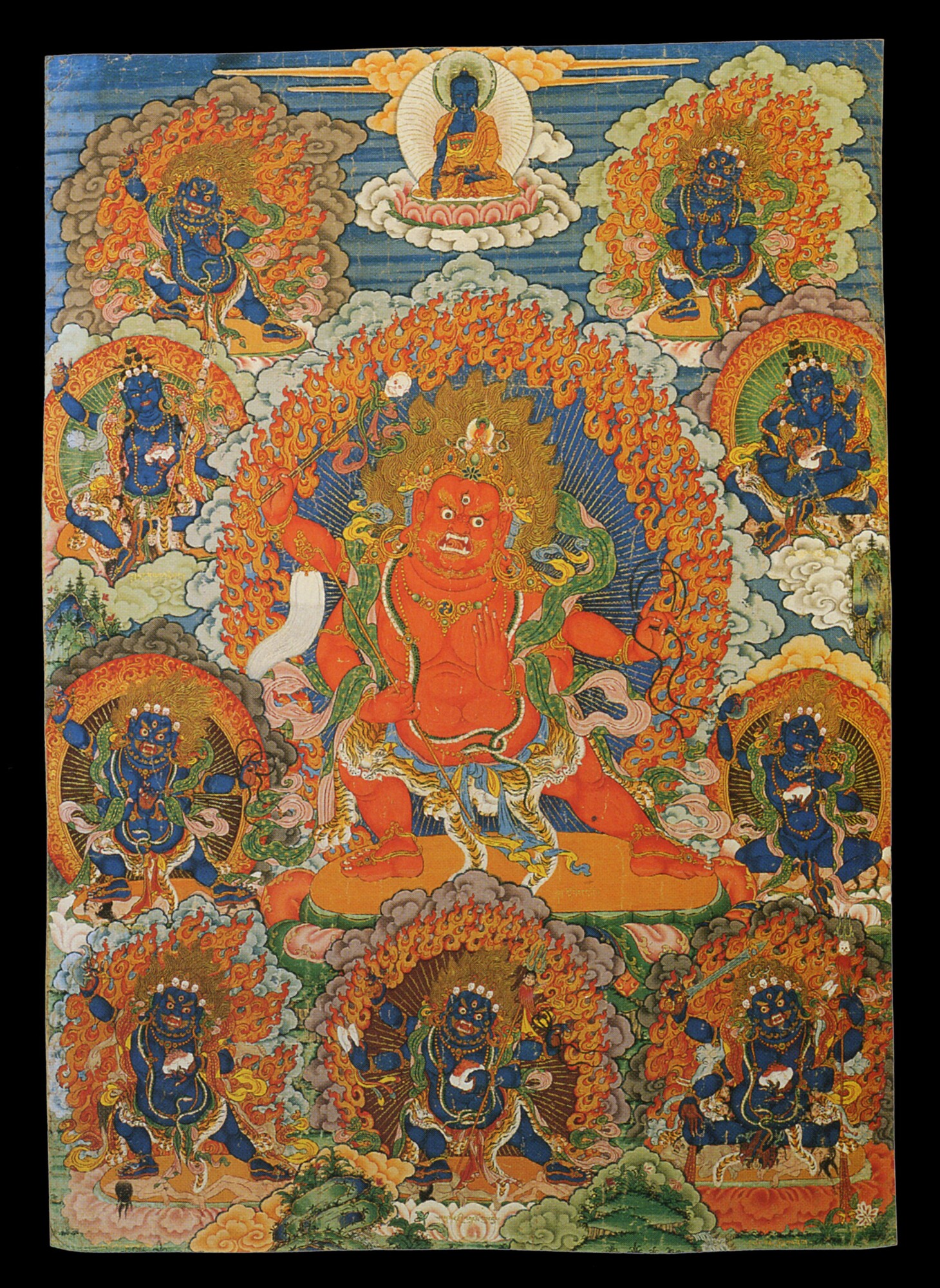
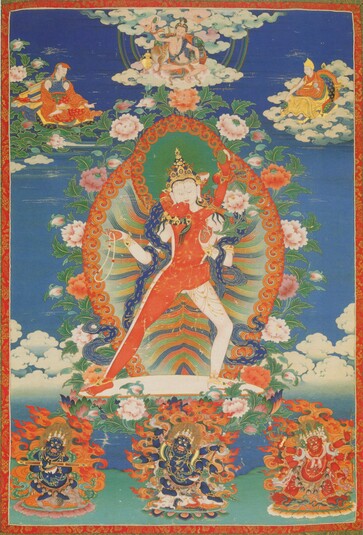
    So, does this seems to have a continual representation borne out by 1800s Bhutan? It does. Here is Akshobhya over Mahabala, with a supporting cast that certainly indicates all of the foregoing.


    Descending on the (viewers) left is Vighnantaka, Hevajra Heruka, Bhutadamara Vajrapani, and Kartaridhara Mahakala.

    Descending on the right are Humkara, Hevajra Sahaja Heruka, Vajra Nairatmya, and Chaturbhuja Mahakala. At the bottom center is a variant form of Bhutadamara Vajrapani.


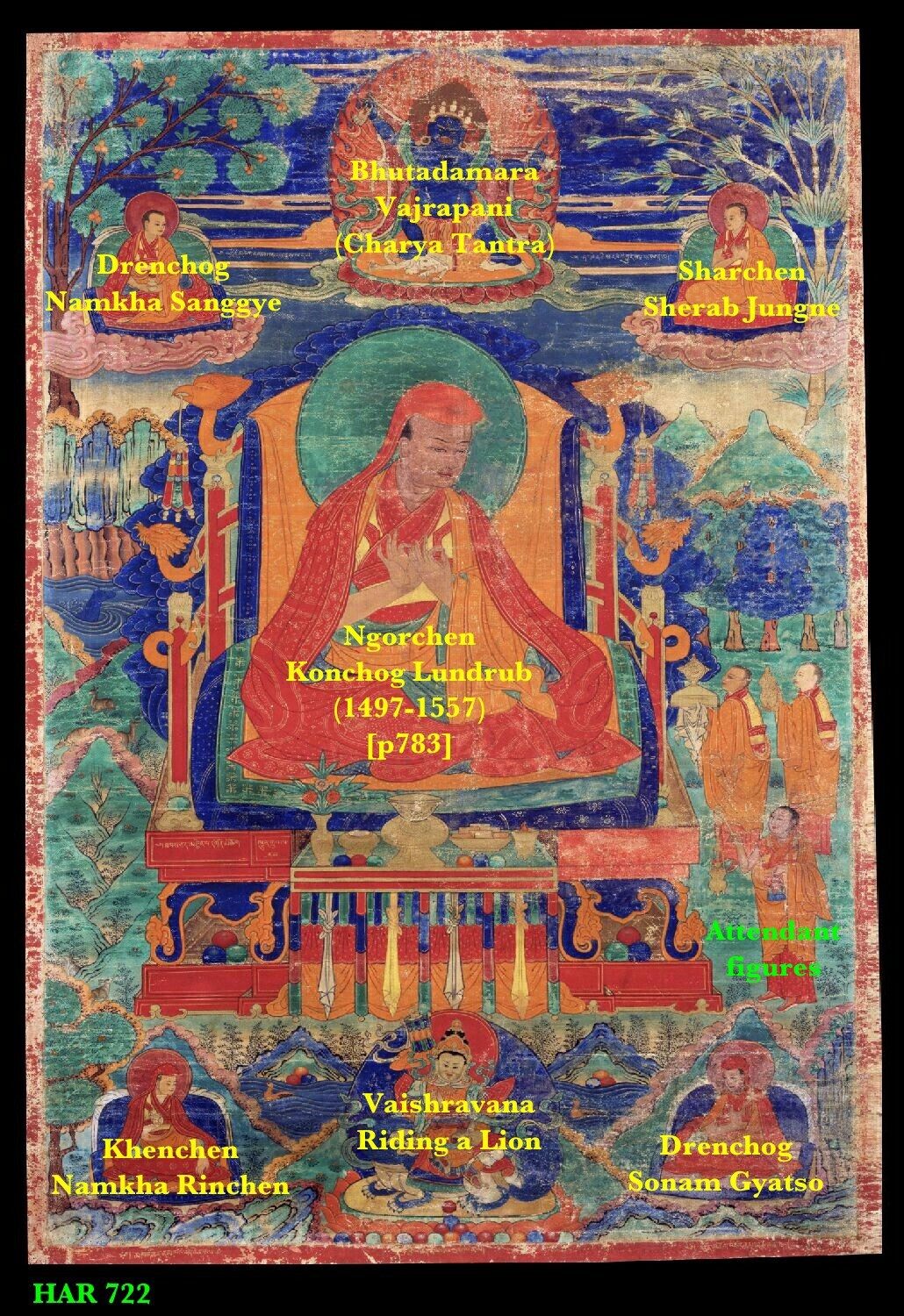
    The first thing of note is the persistence of Bhutadamara Varapani. He is unmistakable in that transmission of Sadhanamala as 1500s Ngor One Hundred Methods of Accomplishment which seems to end on Sukla Tara:


    The second thing of note with Mahabala is Sarma usage of Heruka. This is to take it as Akshobhya and therefor it begins to refer to forms that are simple, two armed, and more or less realistic, compared to their many other appearances.

    Therefor, "Hevajra Heruka" is a certain stream of Akshobhya drawn from what we might call "Akshobhya Heruka" in Dakini Jala. "Sahaja Hevajra" is the Heruka transmitted by Ratnakarasanti. And so the thangka is tuned towards the Hevajra genre with Nairatma. However, its upper figures, Vighnantaka and Humkara, are older and more generic.


    Those two, with Mahabala, and Bhutadamara, are somewhat detachable from that display and movable elsewhere.


    If we adjust the expression to Chakrasamvara Heruka, it comes through in a remarkable way.

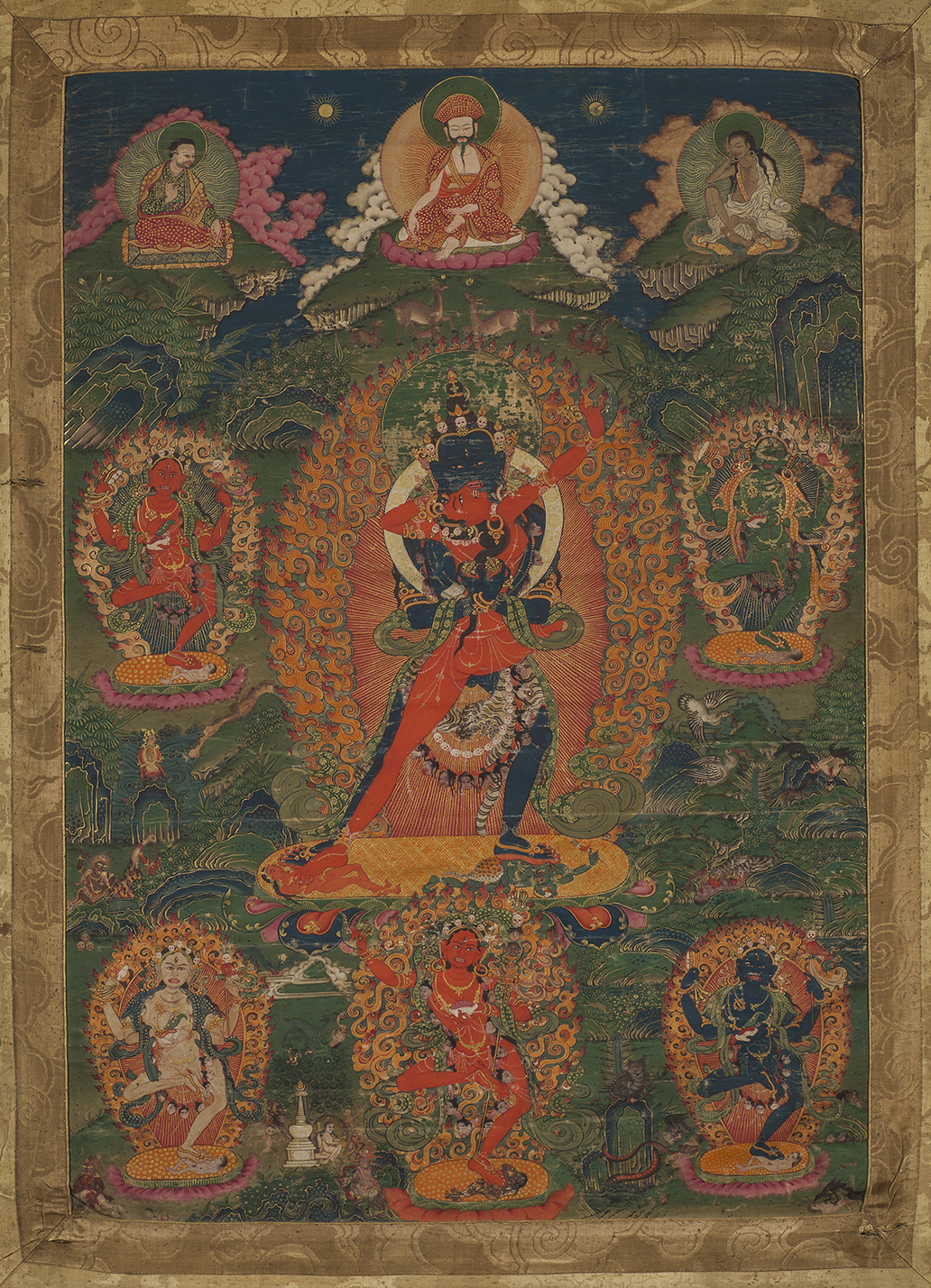
    First of all, the cultural accompaniment to the production of Mahabala turns out to be the same as ours, 1800s Bhutanese Drukpa with Gampo Marpa Mila:


    I may be wrong and the central upper figure may be a Drukpa, but regardless, this is a Kagyu Chakrasamvara. And this is why it is more important, I think, than most such articles.

    You have to consider the lower red figure as a worldly or perhaps Kriya deity, which is again changeable, such as Tinuma, or Naro Dakini, or that of Indrabhuti. The others are the Four Dakinis who are permanent once you realize them, through the whole Dakarnava.


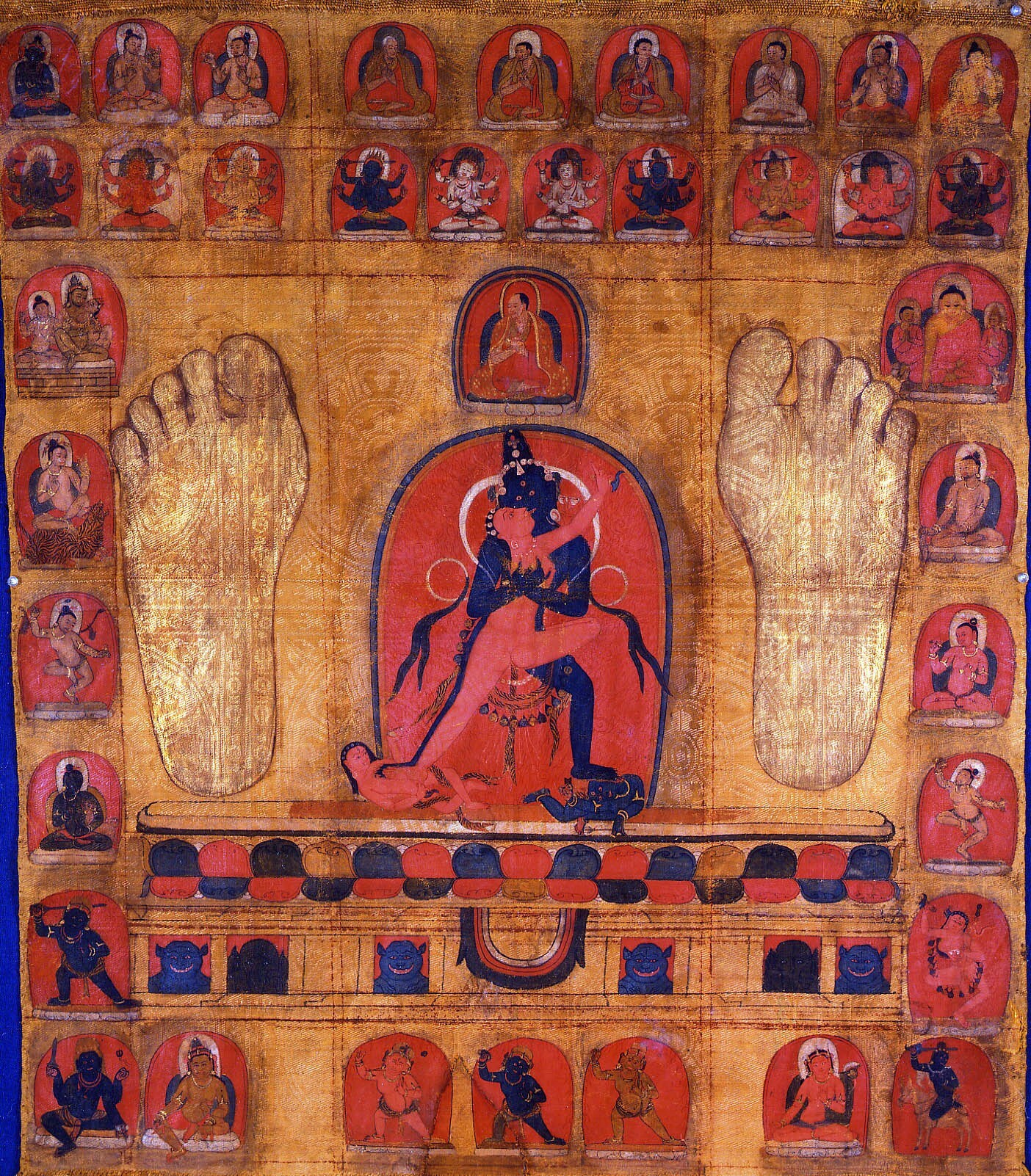
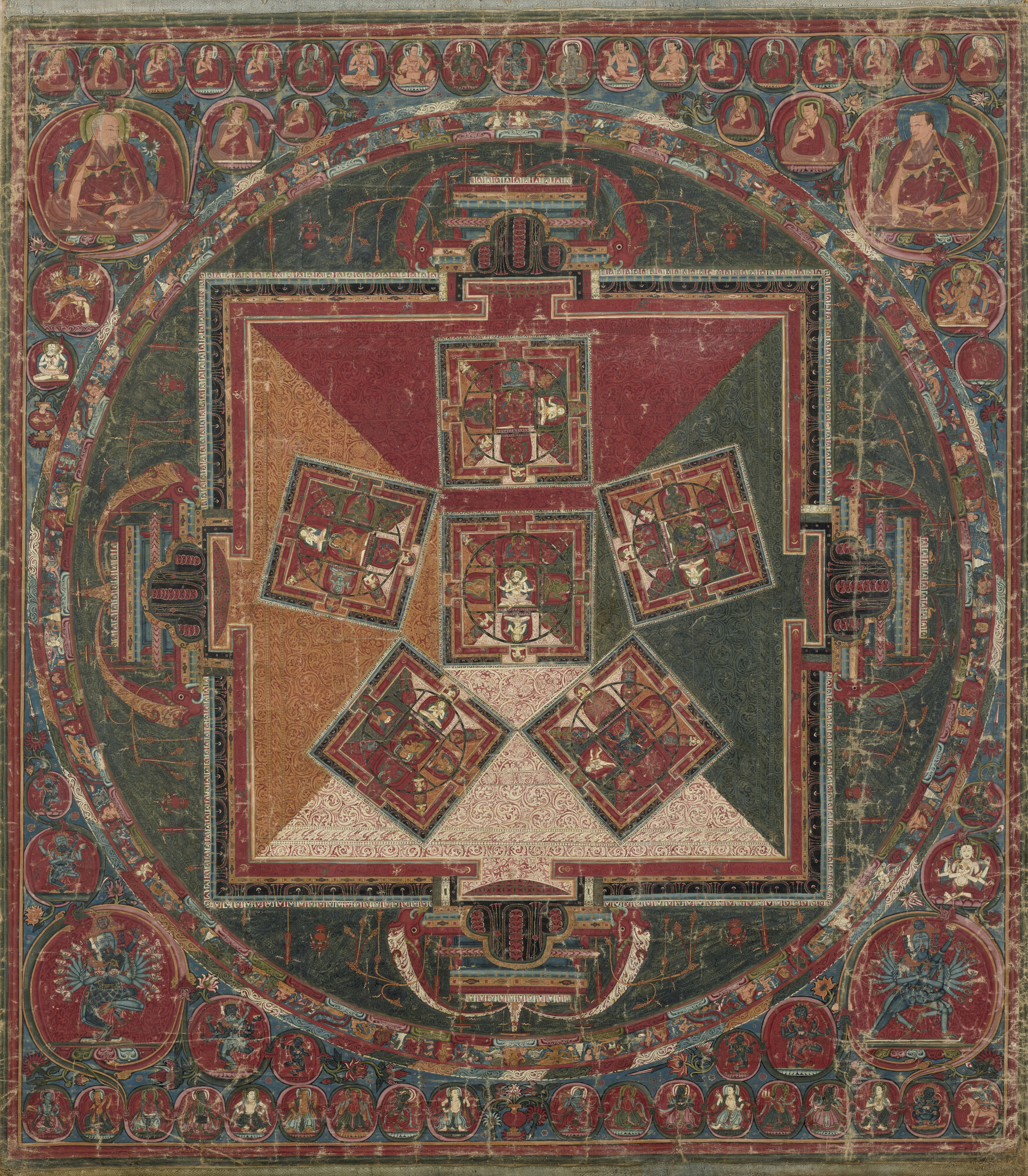
    As for the historicity of the Bhutanese Heruka, these are the 1200s footprints of Drigung Tangpa Chenpo at the right and left.

    Quote In the top register, starting at the left corner, are Vajradhara, Tilopa, Naropa, Gampopa, Pagmodrupa, Marpa, Milarepa, and two unidentified figures.

    Descending vertically in the two outer registers are the Eight Great Siddhas. Beginning on the left are King Indrabhuti, with Virupa on one side and Lakshminkara on the other. Below that is Dombi Heruka riding atop a tiger with his consort. Below that is Saraha in a standing posture and holding a bow across the shoulders, accompanied by two consorts. Below that is Kukkuripa, holding a dog. Descending on the right are Nagarjuna seated on the right side of Shakyamuni Buddha with Atisha seated on the other side of the Buddha. All three are dressed in the robes of a monk. Below Nagarjuna is Luipa with both hands raised up and dressed in the attire of a mahasiddha. Below that is Padmavajra embracing a consort. Below that is Vajra Ghantapa, holding a vajra scepter and a bell.


    It's largely indifferentiable from Kagyu. Luipa and Ghanatapa are the foremost Chakrasamvara lineages.


    Sometimes a "special offering" is made, and the thangka involved is collored yellow. Here is such an example with Milarepa and H. H. Karmapa on the upper right:


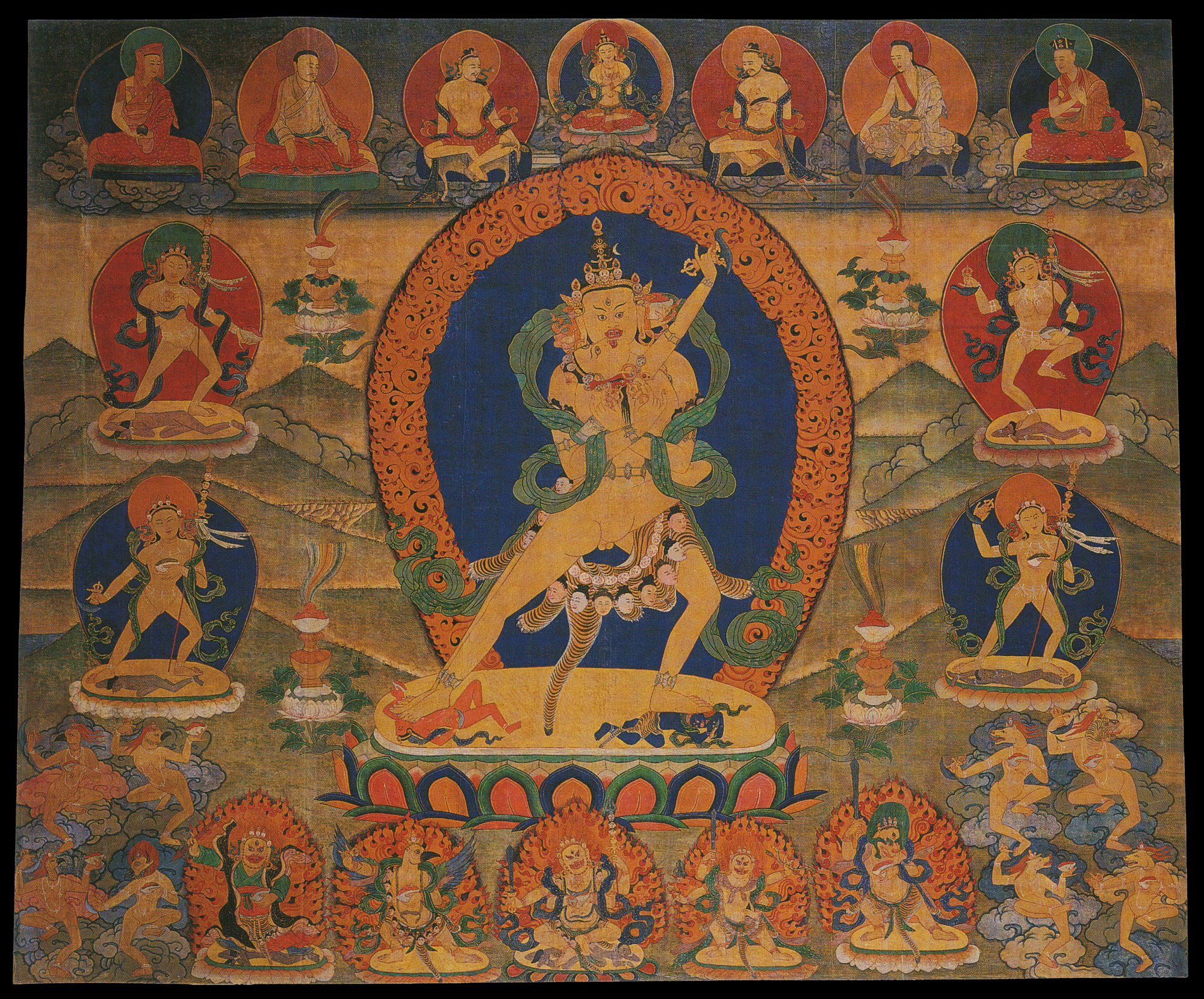
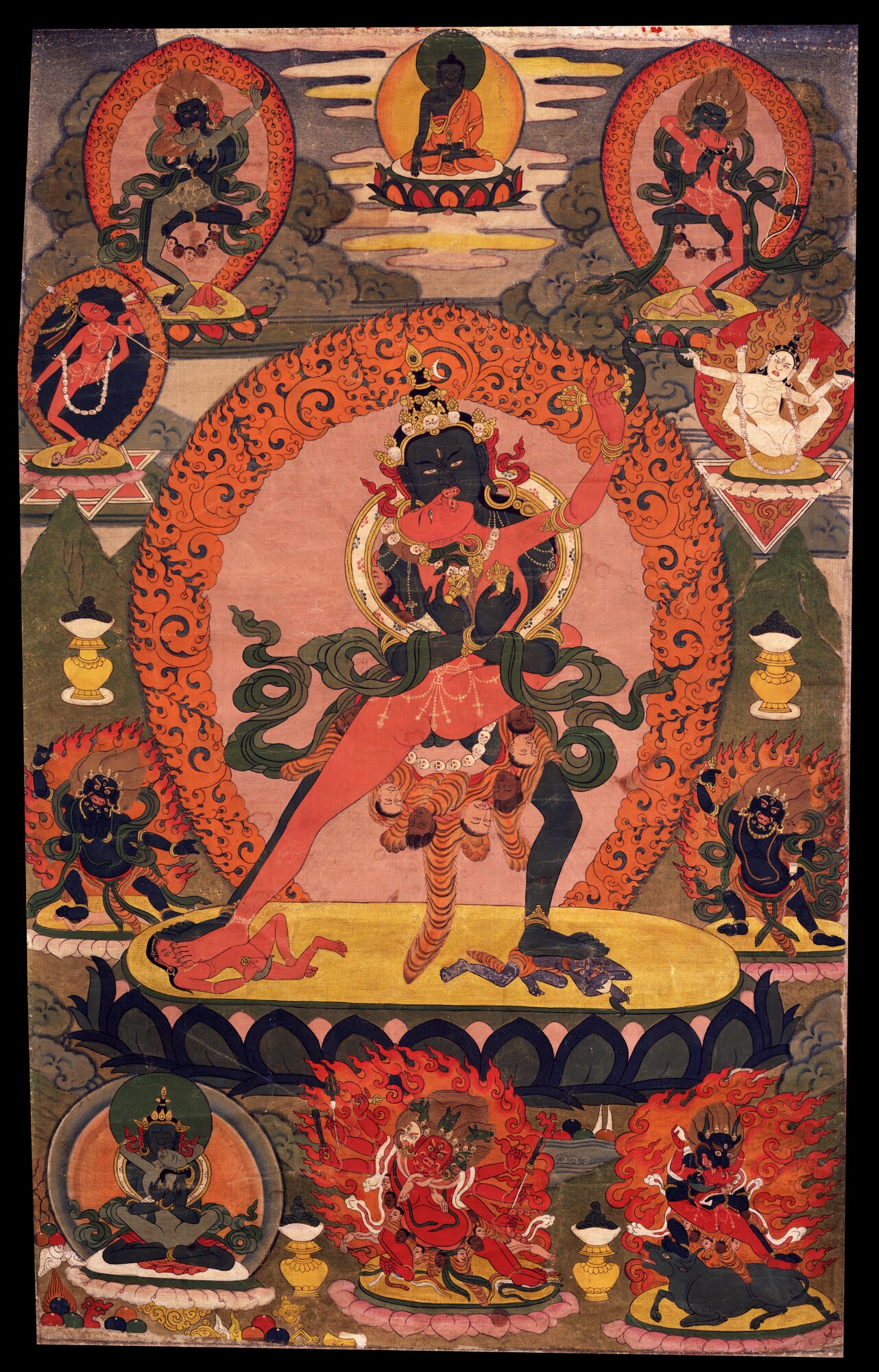
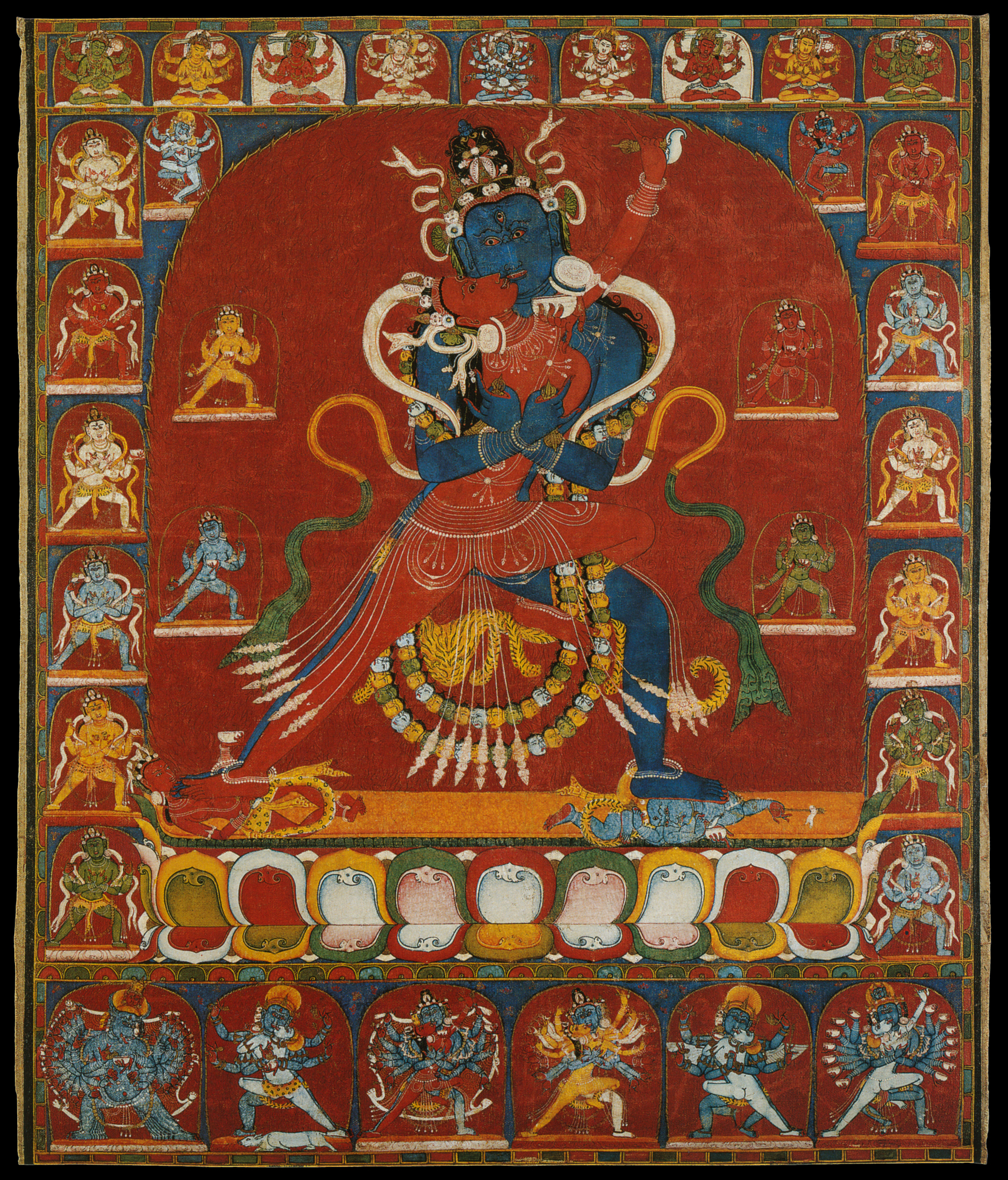
    Here is an example that includes Mahamaya Heruka.

    1800s Shangpa with Hevajra in the upper left and Mahamaya on the upper right:


    This one is awash in the sea of most of the major tantras. But, it still retains in a prominent position of unusual closeness, the Four Dakinis:


    I might tend to call them a drillbit through infinity.

    That would be a more realistic exposition of the inner meaning, moreso than presenting ferocious forms of Sri Devi or Mahakala as Protectors. Those are difficult commitments. The Four Dakinis are simply aspects of reality itself.


    They cannot be given or taken away, only discovered.

    Howso?

    They are Yoga deities.


    That is to say, what we are developing is a broad, slow, comprehensive series that will eventually evoke or [I]release[/I these Dakinis.

    Or, for the rare individual of rapid advancement, you can be aware there is this safety valve should it become necessary.


    The reason is these are not from Chakrasamvara, he has acquired them.

    The Four Dakinis are the retinue of Guhyajnana Dakini, who is placed at the head of Mahayoga, and must be construed as the chieftess of Cemetery Yoga in Sitavana from whatever nebulous mist we are able to make of it.

    Correspondingly, could Chakrasamvara have been transmitted from Manjughosha to a Nepalese Vajracharya in the 600s?

    It would be "further details" on the Dasa Karma, which we have to consider probably could be linked to Vajrasattva at the time.

    What seems to be the case, if we look at our known lineages Luipa and Ghantapada, these seem to have been brought to Vikramasila and then re-radiated. Actually, its main purpose may have been to establish a thorough Chakrasamvara commentarial system. The actual sources are just as well Maharashtra and Bengal. And for instance we see the justification for Kukkuraja and Santikar Acharya is manifestation or realization of Vajrasattva. But we have just shown "Heruka" was meaningful independently, and it could be that such an experience of realization becomes collected as the Samvara corpus.


    To describe how they are "permanent", in Buddhist tantra, Vajrasattva presides the highest Pithas of the Four Dakinis:


    Vajrasattva (वज्रसत्त्व) is the name of a deity presiding a group of four sacred districts, according to the Abhidhānottarottaratantra and the 9th-centruy Vajraḍākatantra.—Accordingly, Vajrasattva presides over the districts Pullīramalaya (Pūrṇagiri), Oḍyāna (Oḍyāyana), Jālandhara and Arbuda.


    where?

    The Amnayamanjari comments that Pollagiri, Kollagiri, Pulliramalaya, and
    Vajrapitha (rdo rjehi gnas) are synonymous terms.


    Nisisamcara ch. 4:


    10 kolagirya<m> mahalaksml karalayonisambhava \
    kalarupa sthita devi dandahasta subhisana ||


    Kolagiri ~ Kolhapur.


    Chakrasamvara has evolving sets of Pithas which are the Subtle Body, and these are blatantly Kolhapur Mahalakshmi Pithas.


    Vajradaka is an important iteration; and these range up to Dakarnava with 986 deities. At this colossal scale, his nucleus is still the Four Dakinis. They are surrounded by a Vajracakra which is a Pitha system.

    Here is how he is completely transcendent.

    The lowest manifestation of his Body or Kayacakra is Kama Loka:


    Cāturmahārājakāyikī & Cāturmahārājakāyikacakravartin,
    Trayastriṃśacakravartinī & Trayastriṃśacakravartin,
    Yāmī & Yāmacakravartin,
    Tuṣitī & Tuṣitacakravartin,
    Nirmāṇaratayī & Nirmāṇaratacakravartin,
    Paranirmitavaśavartinī & Paranirmitavaśavarticakravartin,


    further around this ring are Akanistha and the Formless Realms:

    Akaniṣṭhavartinī & Akaniṣṭhacakravartin,
    Ākāśānantyāyatanī & Ākāśānantyāyatanacakravartin,
    Vijñānānantyāyatanī & Vijñānānantyāyatanacakravartin,
    Ākiṃcanyāyatanī & Ākiṃcanyāyatanacakravartin,
    Naivasaṃjñānāsaṃjñānī & Naivasaṃjñānāsaṃjñānacakravartin,


    towards the end, this is significant:


    33. Vimānacāriṇī & Vimānacakravartin


    All tantra is based on a primary Four Pithas. As to which those are, differences are given; but this is semi-real. The Subtle Body is not objective. It's not really what we mean if you were to do an astral projection. It's conduits of life force. It's like having a crumpled-up radar dish that you are unfolding and smoothing and wiring; it is inert in the current condition. It doesn't mean the city of Oddiyana really exists in a person somehow. It is the fact that you focus and stabilize on it. Overall, the litanies of Pitha inhabitants are deities that represent various categories of Abhidharma, such as the Seven Jewels of Enlightenment.

    The Four Dakinis are such agents of reversal, they may be understood as Four Qualities of the Dharmakaya, which we have posted as "positivity" flowing from the properly-transformed Garbha or Dhatu.


    We reach a different working hypothesis:


    Aside from legends and lineages, seen as a layer of intellectual history, the sadhanas of Kukkuraja appear primal in terms of tantra or Vajrasattva Yoga.

    He adds Heruka, whereby Dakini Jala appears to provide the Heruka in the same way it does the Samvara, and not only does this convey the presence of Nine Moods, its Vetali is completely backwards.


    As for Kriya Samgraha, 1977 Devanagari calls it a Collection by Kuladatta.

    Skorupski 2002 translates it, and you immediately find Janguli and a Vase Initiation for Vajradhatu. It eventually reaches the Five Abhisambodhis.

    It has one of the oldest (1216) manuscripts, but speculating this actual text is much older than Vagisvarakirti is difficult. It is primarily Vajradhatu STTS Yoga; it refers to Subahu Pariprccha; and uses this wrathful deity:


    Vajrajvålånalårka


    This is an accretion which has nothing to do with "Kriya Tantra", it is rites of all levels of tantra.

    It sounds very Nepal, or, Newar, and it simply contains contents from all ages of Buddhism. It's unlikely to prove when those were.


    Having broached the subject of Moods, let us find something I thought there should be a word for:


    Quote “Although one regularly meets with the beloved and is well-acquainted with the beloved, the ever-fresh sentiment of intense attachment causes the beloved to be newly experienced at every moment as if one has never before had any experience of such a person. The attachment which inspires such a feeling is known as anurāga.”

    Buddhism:

    Quote When anurāga reaches the state where it becomes the object of its own experience it is known as sva-saṃvedya.

  2. The Following User Says Thank You to shaberon For This Post:

    Bill Ryan (24th November 2025)

  3. Link to Post #22
    United States Avalon Member
    Join Date
    1st April 2016
    Posts
    6,047
    Thanks
    29,910
    Thanked 34,016 times in 5,697 posts

    Default Re: Subtle Yoga in Buddhism: Mantra, Life Wind, Luminescence

    Amsu Samvat, the Chakravartin King Harsha, and Princess Bhrkuti


    This is the answer to something that bothered me for most of my life:


    Find a time-keeping system that begins when someone says "go".


    Almost every calendar is finagled; it is an idea where someone retro-actively assigns a beginning to some event. For instance, the Mandean year 483,000 does not represent someone sitting around counting those years going by; it is their guess when Adam lived. Nothing else is that big, but they all work like that. Krishna and the Kali Yug is just a saying.

    The numerous Kings Lists say "go", but, it is only in terms of that individual. Is there something continuous that has a definite starting point?

    Some rather interesting definitions will also define a change of ages:


    Quote Uḍḍiyāna is mentioned in the Sādhanamālā rather frequently. The earliest manuscript of the Sādhanamālā is dated in the Newari Era 285 which is equivalent to A. D. 1165. In this work Uḍḍiyāna is connected with the Sādhana of Kurukullā, Trailokyavaśaṃkara, Mārīcī and Vajrayoginī. The Sādhanamālā also connects Uḍḍiyāna with such Tantric authors as Saraha. The Jñānasiddhi of Indrabhūti is stated in the last colophon as having started from Uḍḍiyāna (Oḍiyāna).

    Uḍḍiyāna is possibly identified with Vajrayoginī.—Uḍḍiyāna being one of the four Pīṭhas sacred to Vajrayoginī should be at least near Kāmākhyā (Kāmarūpa), and Sirihaṭṭa (Sylhet) in Assam and it is not unusual to think that all these four Pīṭhas received their sanctity from temples dedicated to Vajrayoginī. Thus Uḍḍiyāna has to be located in Eastern and Assam area. [...] It is possible to spot [Uḍḍiyāna] which is connected with Vajrayoginī. Thus it becomes evident that the present [Bengal] village Vajrayoginī was originally known as Uḍḍiyanā but as the deity Vajrayoginī became more popular later, the original name gradually disappeared giving place to the name of the deity. Tantrism of the Buddhists therefore originated here in Uḍḍiyanā-Vajrayoginī, and thence was transmited to the rest of India.

    Uḍḍiyāna (उड्डियान).—The Chinese pilgrim Song Yun, who visited the country in 520 AD, convey to us a vivid picture of Uḍḍiyāna: “the pleasant weather, the abundance of crops, the sound of the bells that in the evening clang from the many Buddhist monasteries, the colours of the flowers that, everywhere and in every season, the land produces and people offer to the Buddha”
    .


    If you do exercises, Uddiyana Bandha would be immediately recognizable as "abdominal lock". Fortunately, this is mixed in with multiple purposes:


    Quote U/Oḍḍiyāna in South Indian languages and in the yoga tradition refers to a belt worn by a woman either as jewelry or as a support for meditation. In Hata Yoga Uḍḍīyana is a term employed referring to the abdominal area.

    The southern evidences are more compelling for Oddiyana in Orissa; the Assam reference is conjecture. It may be there was more than one.

    We see a "Newar era" or "Nepal Samvat" that begins around 879; but this was new. A prior system ended, and this one began. It's not the equinox moving. It's an announcement.


    An independent Gaud or Gaur existed:


    Quote The Chinese monk, Xuanzang (Hiuen Tsang) travelled from the country of Karnasubarna to a region in Orissa ruled by Shashanka.

    for about another eight months until 626.

    Sasanka was King of Gaud who took over a sliver of Orissa.


    The kingdom in Bengal barely outlasted him and was taken over by India. After him, King Harsha Vardhana ruled most of the area until ca. 647. Following Harsha was a Chinese attack and then a "power vacuum" until the Varman Yashovarman (c. 725–752 CE), followed by minor kings in decline until the Pala Empire arises ca. 770. That describes the region around Nalanda, Bodh Gaya, Sitabani, etc., meaning it experienced instability from around the time of Candragomin, until the Palas emerge from Gaud or Bengal.


    As we see, this makes it difficult for anyone to renounce the throne of Gaud in the 600s. We just posted about someone doing this. Where did he come from? It sounds like Prachanda Deva renounced his royal position during a minor or turbulent time, it may have just been the area at the border of Bihar. There was nobody to renounce a Kingdom of Gaud in the 600s. There could only have been minor fiefs in that area. Or, it could have been occupied by the Varmans of Assam, and he was one of them.

    At any rate, it seems the story could only be possible if it meant a petty kingdom in the region of Gaud, and nothing that would compare to a state of Bengal.


    It is not impossible that he found a type of "tantric" Guru who must have practiced in Nepal in the 600s, or impossible that the name "Vajrasattva" could have been applied. As to whether this actually means Chakrasamvara as the Nepalese think, I am not sure. What is described in Santipur sounds like Luipa Chakrasamvara.


    Luipa was initiated "into" something, for which he was probably the first to obtain:


    Quote ...direct transmission from the Dakini Vajra Varahi.

    Taranatha's account differs significantly from Bu ston's in that Luipa was a scribe to the King of Oddiyana, and was initiated into Vajra Varahi's mandala.


    We have something that is not quite as extravagant as Adam, but, sounds a little farfetched.

    In the mystical history of Nepal:

    Quote "Bipaswi" came to this place & forsees to be suitable for settlement thought to drain out all the water from the lake. This Buddha planted a seed of lotus amidst of the lake. After 6 months, the seed grew up to become a LOTUS and spreaded an extraordinary flame called Swayambhu flame. Hearing this event later "Sikhi Buddha", "Bishambhu Buddha" etc came to this place and worshiped this flaming god ( Adhi Buddha or Primordial Buddha) and returned by telling the idea of draining out the water of this lake.

    Manjushri saw the Swayambhu from Wu Tai Shan and came and split open Chobar Gorge and drained the lake from Kathmandu Valley. Geological surveys confirm that such an event did take place, 30,000 years ago. Archaeology estimates stone age settlement ca. 10,000 years ago. This legend is correct, perhaps not as details, but in this grand sense.


    It is strongly suggestive of Kiratic migration from Mongolia in the Ice Age.

    Buddhist Majushri says this, however, the non-Buddhist Lepcha of Sikkhim agree.


    That's off the scale, because what the scale is must be based from the human transmission of Chakrasamvara.

    Could it possibly involve this person, as far as we know, said to be an emanation of Vajrasattva:


    Quote Prachanda Deva built a STUPA encasing the sacred flame of Swayambhu. He (Kanakamuni) also advised the king (Prachanda) to become the disciple of Gunakar, one of the disciples of Manjushri...
    and he becomes Santikar Acarya and permanently enters the Santipur, having installed a successor:


    Gunakamadeva was a Lichhavi ruler who founded the city of Kathmandu in 723 CE.:


    Quote He was known for his tantric abilities which was demonstrated by him entering Shantipur in Swayambhunath.

    Something is wrong with the page, which shows 900s Thakuri, even though its support for this statement reverts to their sources:


    The one event in Asia 723.

    Manju Patan as the era-appropriate name from Britannica.

    If they say "city", obviously this is in addition to "meditation caves" and the like.

    He was merging two smaller towns that have their origin estimated at 167 B. C. E.. The stone edge tools have been excavated further down the valley at other sites.


    Licchavis surnamed Deva have the oldest inscription in Nepal (464).


    Prachanda Deva possibly transported a name. An old Calcutta Review says he was from Santipore amidst the Gar Gowala people, and renounced the world to retire to Nepal. There is a namesake in West Bengal:


    Quote Since ancient times, Santipur and the surrounding region has been famous for handloom saris (saree). The handloom weaving style unique to this region are famously known as Santipuri Sari (tant).

    It may be that the name Santipur was introduced for a reason.

    In Nepal, part of the difficulty is that the Swayambhu Stupa is believed to have been built much earlier, ca. 500. It may have been repaired or expanded. No one became King of Nepal in the 600s to build it.


    In Early Medieval Nepal:


    He is described to have received his initiation in a cave at
    Svayambhu from a Siddha Guru Gunakar Acarya who had attained all the
    powers of a Vajracarya by his own yoga.

    Gunakar, the disciple of Manjusri...


    Also called self-taught in a Mahachaitanya Stupa article.


    It would be possible to be inspired by Vajrasattva, initiated by Manjushri into the Ten Rites, and by Gunakar Acharya into Guhya Abhiseka or Chakrasamvara.

    From a summary of Swayambhu Purana:


    Quote Upon arrival, he bowed and paid homage to the luminous Swayambhu Dharmadhatu. There, he encountered the eight vitaragas (Astavitaraga – अष्टवीतराग), whom he worshipped, praised, and served with great devotion. He also performed ritual worship for the Great Goddess Khaganana Nairatyma Guheswari. Finally, he visited the shrine of Manjushri, where he praised and worshipped the deity with unwavering faith.

    Regardless of what kind of Gaud someone may have ruled or not, would this be remotely possible in the way we know it, even a hundred years before we think it should be known?


    We are going to have to suspend our textual transmission questions because of everything else.

    It sounds like we are talking about a few stone agers working their way out of huts, but Nepal had already established itself as a commercial nexus between China, Tibet, and the India of King Harsha. This was quite serious, and why most of the next two hundred years happened.

    The cultural ebullience is such that not just Buddhism, but the national deity Pasupati also comes pouring in. Most of the royalty of course favors this.


    There is an almost identical path of Skanda Purana and Pasupati traveling from west India to Nepal at the same time as Manjushri and Vajrayana, and Manjushri and Skanda are both Mars, the important deity of Ujjain, center of Time.

    Amsuvarma is Time, in the sense of the first era that is directly attachable to its source, and the main reason is Debt Jubilee.


    The time of independent Gaud was the Nepal of Amsu 605 - 621:


    Quote Amshuverma also introduced the second Licchavi era (samvat). Economically, Nepal was much developed during his time. His ruling period is known as the 'Golden Period' in the history of Nepal.

    Amsu Samvat is defined as beginning in our year 606, although its year 1 is back-dated to around 576, which possibly simply indicates the birth of Amsuvarma. It is "year twenty-nine" when he takes the throne; it does not commence with inauguration. He starts it, but not by counting from one. In 606, the standard Saka calendar was dismissed, and suddenly replaced by a system, which may have simply shorn 500 years off the previous. It has nothing to do with the stars, an estimate, or third-party story. It would be the same as India's Harsha Samvat, except that has only been found on a few coins, while this one sat fully intact for nearly 300 years.


    The Saka calendar was another whose "origin date" was a speculation.


    Amsu Samvat matches something peculiarly well.

    That would be the reign of Harsha of Kannauj 606-647.

    His kingdom previously was centered on Thaneswar or Sthanisvara near Kurukshatra, Haryana:


    Kanyakubja is Kannauj, which he made his new capital. Then we see it goes on the engulf the former Gaud and its slice of Orissa.

    Harsha has seals at Nalanda. It is argued he may not "technically" have been a Chakravartin, that it may be exaggerated because he is the beginning of:


    carita kavya


    entertaining literature designed to convey a king's struggles and challenges and how his character was tested and responded.


    It is exactly in this setting that Buddhism first enters Tibet.

    This is not a transmission -- it's a marriage:

    Bri-btumn or Bhṛkuti

    Licchavi Queen of Tibet 622-649


    She is a Nepalese Buddhist, whom the Tibetans do not give a name, despite the fact that the Jokhang in Lhasa was built for her Akshobhya statue. The Tibetan given above is from a single, later source, which is interesting because it is not the name given to Devi Bhrkuti, but looks like a transliteration.


    Why, conceivably, were there bronze workers skilled at making Akshobhyas. Is it a Heruka? Yes.


    Her personal move may have been 624 or even 632, but it's not Pasupati.


    There is another angle to this. Something is new in India, which lacks precision but has a ton of context, Jagannath of Puri:


    Quote The Vimala Temple (Bimala Temple) is considered one of the most important of the Shakta pithas. It is located near Rohini Kund in the temple complex. Until food offered to Jagannath is offered to goddess Vimala it is not considered Mahaprasad. The temple of Lakshmi, the consort of Jagannath, has an important role in rituals of the main temple.

    Many of the temple rituals are based on Oddiyana Tantras which are the refined versions of Mahayana Tantras as well as Shabari Tantras which are evolved from Tantric Buddhism and tribal beliefs respectively.


    Concerning the Mahaprasad, its inspiration traces to the region as described by Godbole:


    Quote A mountain named ‘Khirdhar’ is situated at the banks of river Hingol. At the extreme end portion of this mountain, which is popularly known as Kanraj, there is an ancient cave known as ‘Hingalaj’. This place is situated in Tehsil Lyari of Baluchistan and is, since ancient times, reckoned as the largest and the most famous place of Worship of the Goddess Hingla in the Indian Sub-continent.

    The Goddess killed Hingol in a cave at a place known as “Satdeep” in, what is known as ‘Baluchistan’ today. Hingol, just before meeting his death, requested and prayed to Goddess Shakti, that he be identified and be synonymous with his name. The place, thenceforth, was known as “Hingol Tirth”.

    Those devo-tees, visiting this place Hingalag are addressed as ‘Kapdis’. The pilgrims, after completion of their pilgrimage, sport a string, made out of “Thumra”, a variety of stone, mined from “Thatta” in Sindh.

    Why -- because she is the source of Fire at Puri:

    The worship of Maa Hingula represents
    a mixture of tribal worship and Sakta Cult. The
    earlier practice of animal sacrifice is no more.
    Now only vegetable and sweets are offered as
    Bhog. Hingula represents fire and every year
    appears in the form of flame at different places.


    In Puri, she is also considered among the Eight Mahavidyas of Mahalakshmi.


    One clue of correspondence is that the main mountain in Nepal is Annapurna Lakshmi.

    This deviates from normative Indic scripture which assigns the name "Annapurna" to Uma.


    Another correspondence is in the Orissan Shaktis' Festivals:


    Quote During the month of Chaitra, another festival is observed in the temple every Thursday which is referred as Jantal Puja. As the goddess is seen in the form of fire 'Sabari Mantra' is chanted by Dehury and fire is lit on Charapthar (char/coal).

    So it is actually across Sati Pithas that we might observe the spread of Hingula:


    Hinglaj Devi along with another Devi called “Kurukullh” was

    once upon a time, universally worshipped. Hingula means “cinnabar”, largely used as materia medica in ancient India.

    The mantra or incantation for Devi Hinglaj is attributed to Saint Dadhichi, an important saint in Hindu theology.


    She has a secondary mantra as well:


    “Mahaamaayaa (Queen of Illusions) who represents the supreme virtue by reigning over all three virtues, has Bhimalochana as her

    Bhairava, and derides the worldly trappings by dancing naked, resides in this cave of Hingula that enshrines her sacred head [Brahmarandra].”


    Reason for the symbolism:


    ...the head with its Hingul (Sindhoor, Vermillion) fell at this place on the Kunraj hills.

    This Peeth is considered supreme because Sati’s head had fallen here.


    We would want to think of Lakshmi and Hingula as separate tracks, because, I do not think we can get rid of Tri-Shakti, since, even if some if its subsidiaries have problems, we could just about call Rajas, Tamas, and Sattva, the "Fundamental Forces of Sanskrit". Part of that is because goddess Vimala is effectively "the female half of Brahma", but, she has been obscured by more numerous manifestations of her counterparts. Vimala is a Sula Pani, Holder of a One Pointed Spear, like Bhima and Ekajati; this point is soon lost to "Trident". And, correspindingly, "Vimala" has an unusually exalted place in Buddhist dharanis.


    "Jagannath", the male deity, in turn is among the Vindhyavasini:


    According to the local legend the
    first ancestor of the tribe was an old Bhil hermit named
    Sawar who lived in Kharod two miles from Seorinarayan.
    The god Jagannath had at this time appeared in Seori-
    narayan and the old Sawar used to worship him, being the
    only person who knew where the god dwelt. The king of
    Orissa had built the great temple at Puri and wished to
    instal Jagannath in it, so he sent a Brahman to fetch him
    from Seorinarayan. But nobody could bring him to the
    god except the old hermit Sawar.

    The Sawaras are
    great sorcerers and their charms, known as Sabari Mantra,
    are considered to be very efficacious in appeasing the spirits
    of persons who have died a violent death.


    Cunningham believes a "savara" is an Axe, and that they are older and more influential than most other tribal groups such as Gonds. For instance:


    Varaha Mihira in the Brihat Samhita (ca. 550) shows the existence of Parna Sabaras.


    Vikramaditya and King Harsha interacted with them, and what he found is that they are the source of "cemetery practices" including states of possession, which are silent in Hinduism.


    Sabari mantras are for the pacification of various "demons" which are really "demon ghosts", particularly these:


    Preta, Bhuta, Vetala, Pisaca


    That is what we would expect, where "Heruka" was assumed to be found in Subahu Pariprccha, I do not believe that is correct.


    As remembered by the Vaisnava:


    Quote According to another legend, after the construction of Lord Jagannath Temple was finished at Puri, Lord Jagannath ordered King Indradyumna to bring Goddess Hingula from Bidarbha to Puri to cook His Mahaprasad. Raja Indradyumna requested the King of Bidarbha to bring the Goddess to Puri. Meanwhile, the Bidarbha king Ramananda was also given the divine instructions to shift the Goddess to Puri.

    King Ramananda was bringing the Goddess on his shoulder by covering her with a cloth. At Gopalprasad, Ramananda felt thirsty, brought Hingula down and went to a nearby pond to take water. When he returned, he found that the Goddess had vanished. When the king cursed himself, the Goddess appeared before him and told him to establish a temple for her there, and she wanted to cook Mahaprasad for Lord Jagannath from there. The fire used to cook the Mahaprasad in the kitchen of the Jagannath Temple at Puri represents Maa Hingula.

    Again, who is that? Are these real kings? In terms of origin, we should ignore "temple", which means 1,100s. The actual Shaktis are present at some level, as attested by the 400s Gilgit Manuscripts. By the 600s, this arm of Buddhism enters Sogdia.


    It is a cultural overlap because Zoroastrians only practice Air Burial, and the art that has developed are Ossuaries based on Sraosa and the Amesha Spentas. And this is not entirely unlike Vajrasattva and the Dhyani Buddhas. And we have to push the cusp of Sraosa in Parthian-era Chorasmia:


    Sraosa corresponds to the Youth Form of Verethragna.

    Sraosa is the first hearer of and reciter of mantras.


    There was a recent find of a structure from the 200s with a photograph that was pale and weak in detail. This is a sketch based from the same relic. In the art world, this is a huge leap for a Book Deity, who is half man, half book. Problematically for current historical analysis, this shows a written Zend Avesta centuries before any such thing was believed made:


    Moreover, it is attuned with Hesiodic Cosmology:


    Quote Hesiod refers to the “Isles of the Blest” in his didactic poem “Works and Days”:

    “And they live untouched by sorrow in the islands of the blessed along the shore of deep-swirling Ocean, happy heroes for whom the grain-giving earth bears honey-sweet fruit flourishing thrice a year, far from the deathless gods, and Cronos rules over them.”
    There are explanations of Zoe as Hades -- Dionysus, Hermes as a death guide like Sraosa or Shem, or Seth or Pusan, and that the scene of Hades was never elaborated like that of Hell, perhaps in dread of mentioning it.

    So, yes, up to about the 600s, Buddhism and Greco-Iranian Syncretism must have shared some common ground, as shown by Herakles Vajrapani.

    As we go further, Islam, Zoroastrianism, and Mandeanism retain a strong focus especially on this Bridge of Death as well as the Afterlife, which is practically absent from Judaism and Christianity, except for Apocryphal Enoch.

    I think of that as like our coffee table discussion we could have with anyone. I, of course, am forced to claim that Vajrasattva goes into further and better detail, particularly in Sarvadurgati Parishodana Tantra, but otherwise I think the older and more basic forms of those ideas are superior to ignoring it.


    At 606 we go to a new Samvat:


    Quote Historians indicate that the evidence at Battisputali and Bajrayogini provides insights into Bikramaditya, who arrived in Kathmandu, settled the debts of the people, ascended to the throne, and established Bikram Sambat.


    Sifting this Nepal Samvat


    Several legends also relate Vikramaditya of Ujjayan with
    Nepal because of his mysterious deeds (Paudyal 1963: 58-
    75). In Daniel Wright’s History of Nepal we read that during
    the reign of Amsuvarma, Vikramajit, a powerful monarch
    from Hindustan who had founded a new era, came to Nepal
    in order to introduce his era and spend the rest of his life
    there (Wright 1972: 131-132). Citing the Bhasa Vamsavali,
    a nineteenth-century chronicle written in Khas-Nepali,
    certain supporters claim the VS to be an original Nepalese
    era, but there is no evidence to validate this. They claim a
    bronze sculpture kept at the temple dedicated to Vajrayogini
    in Sankhu portrays the head of Vikramaditya, which
    iconographically has been identified to be the head of the
    Buddha (Sharma 1970: 3). The Bhasa Vamsavali includes
    confusing stories about Vikramsen or Vikramaditya. It
    credits King Manadev for introducing VS to Nepal. On the
    one hand, it presents Vikram as Mandeva’s grandfather;
    on the other hand, it says Mandava merely obeyed the
    Emperor Vikramditya, who initiated VS by using the wealth
    the female deity Vajrayogini bestowed upon him to relieve
    people of their debt (Paudyal 1963: 76).


    Blurry, but, the Amsu Samvat is there possibly as a simple consequence of Harsha Samvat.

    And we again find Jubilee in a more favorable view towards Harsha Samvat:


    Vikrama certainly introduced
    the Samvat era in Nepal and, it is said, paid off all debts-
    There is indeed a curious tradition all over India that the
    founder of an era must pay off all debts existing in the
    country, and thus make all men happy.


    Concerning King Sivadeva:


    Their son
    was Jayadeva who married Rajyadevi daughter of
    Harshadeva king of Assam who had conquered Gauda,
    Udra, Kalinga and other countries.

    Pandit Bhagavanlal rightly observes that Amsuvarman in
    these inscriptions is the same Amsuvarman who is spoken
    of by Hiuen Tsang as ruling in Nepal about his time. He
    appears to have been a Thakuri or Rajput and originally
    a Samanta or feudatory of the Lichhavi king of Nepal
    named Sivadeva ; but gradually to have assumed real sov-
    ereignty himself. Now his first inscription is dated
    Samvat 34.


    Vikramajit a powerful monarch of Hindustan founded
    a new era and came to Nepal to introduce his era here.
    Now this is a second mention of the coming of Vikramajit
    and Pandit Bhagvanlal is correct in holding that this
    refers to the conquest of Nepal by Harsha and the intro-
    duction of his era, the legend confounding him with
    the Vikrama of 57 B.C. The change in the era in the
    inscription's also indicates the same thing.


    The first thing to be
    noticed is that Harsha seems very definitely to have con-
    quered Nepal and introduced his era there. This was in
    the days of a Licchavi king named Sivadeva and must have
    happened very soon after Harsha's accesion, sometime-
    about 610 A. D. The king being thus weakened his Saman-
    ta Amsuvarman, a powerful prince, easily became ascen-
    dent...


    Inscription no. 7 is by Amsuvarma him-
    self and is dated Samvat 39 which being in Harsha's era
    gives A. D. 645.


    Amsuvarman is not a Licchavi, he was installed, and it is a long period of time before that dynasty truly re-establishes power. It sounds a bit like he is naming Harsha Samvat for himself. This doesn't have any record of a big military clash, but, he does seem to have replaced the Devas through some agency of Harsha.


    It is unlikely that either one of them was Buddhist. It is very certain they respected it. We are a minority where something else dominates.


    Skanda Purana also uses the expression Amsuvarman Samvat.


    The oldest known Skanda Purana manuscript from our year 810 is dated in Amsuvarman Samvat.


    Buddhist evidence will break the previous record. There is a mention of Gum Vihara in 32 Amsu Samvat.


    Vajrayoginī is a Buddhist deity which the Hindus borrowed in the form of Chinnamaṣṭā. Thus the name of the village appears to be unmistakably Buddhist. The village must have derived its name from the temple of Vajrayoginī which was in existence in early times.


    This is at Vikrampur, Bengal:


    Quote On 13 April 2012, archaeologists announced the discovery of a 2.5-meter-wide wall around three feet below the surface, which was thought to belong to a Buddhist temple; this was confirmed on 23 March 2013. They also unearthed around 100 Buddhist statues, sculptures, and copper plates, and declared the site to be around 1,000 years old. The research director of the project, Professor Sufi Mustafizur Rahman, told The Daily Star, “This is an incident of huge importance to all of us. Many historians have mentioned about a Vihar at Bajrojogini in Bikrampur, but we are lucky to find it just within three years.”


    ...consider the contents of tortoiseshell inscriptions discovered at Vajrayogini (Vikrampur): both the Buddha and Vāsudeva, i.e. Viṣṇu, are praised side by side...


    In the 600s, the Varmans of Assam allied with Harsha against a common foe in Bengal. This Vajrayogini Town is the birthplace of Atisha ca. 980. But that is not particularly old evidence of it. Here again, because Bengal does not have its own history such as the roots of Baul, they turn to Nepalese Vajrayogini Dance entitled:


    bama kapara dhari


    by:

    King Pracanda Dev of Gaur/Bengal who became Santikar Acharya of Nepal


    He is considerably older than Atisha and enmeshed in Nepalese history. Is a dance reliable in archeological terms?

    For the Swayambhunath Stupa:


    Quote Available Nepalese historical inscriptions do not push the antiquity of Swayambhunath beyond the life and times of Shankara Deva, the grand father of Man Deva (c. 467 A.D.), the first Lichhavi king of historical importance. But if we were to go by Chinese records such as the T’ Ang Annals, to which scholars ascribe dates more than sixteen centuries prior to the composition of treatises such as the Swayambhu Purana, the exact antiquity of this great Stupa poses a baffling problem.

    In any case, few grudge it the distinction of being one of the most ancient of all the chaityas in Asia.

    The Bengali did not become king of Nepal, but something more like this:


    Quote Prachanda Deva, King of Gaur (Bengal) built the Swayambu stupa encasing the eternal flame and his nephew Gunakadeva was anointed as the King of Nepal.


    It may have come from Kanakamuni:


    Quote ...sent to Nepal by Kankamuni Buddha who came to Nepal on pilgrimage. Basupur, Agnipur, Bayupur, Nagpur and Shantipur-all shrines dedicated to the different elements of nature as earth, fire, air, water etc, which stand even to this day in the precincts of Swayambhu, are said to have been built by Prachanda Deva. After the death of Prachanda Deva, his son Shakti Deva ruled over Nepal.

    or Kasyapa:


    After obtaining blessings
    and instructions from Kasyapa Tathagata he went to Kathmandu renouncing his kingdom. King Prachanda Deva paid
    homage to lord Swayambhu and became a disciple of Acarya
    Gunakara. Acarya Gunakara ordained and initiated him in
    the mysteries of Sutras and Tantras. He was then called Santikar Acarya. Acarya Santikar, thinking of the later periods,
    when people with evil mind might destroy this self-originated
    divine light, decided to cover it by erecting a stupa over it.
    Bhikshu Gunakara gave him permission to construct a stupa
    and conferred on him the title of Vajracharya. After completing the stupa he went to the retreat in Santipur.


    Here is how it lines up according to Dowman:


    Quote In the {temple called Santipuri} Manjughosa's emanation, the Dharmaraja Amsuvarman ('Od-zer Go-cha), met Vajrasattva's emanation, the Acarya Santikar, who had obtained the Body of Immortality.

    If we accept Santikar Acarya as the actual builder of the concrete Stupa and accept SK's assertion that Amsuvarman was Santikar's contemporary...because Santikar is associated with the establishment of the vajrayana this date assumes a very early arrival of Tantra in Nepal. There is only one early inscription at Swayambhu, and we have only incidental literary evidence that the Stupa was worshipped by countless devotees from all over the Buddhist world...

    ...leaving his kingdom in the hand of his son, Sakti Deva...

    King Gunakamadeva entered Santipur and met the Acarya Santi Sri...

    Gunakamadeva is said to have been a puppet of Amsuvarman, an interloper who seized power at the beginning of the 7th century and became the greatest of the Nepali Kings of the Licchavi...


    Licchavi Dynasty as currently estimated.


    But from the East Nepal Terai, Mung Maw Rong held one of the main forces used to smash the Indian pretender after Harsha:


    Quote This was the time when his contemporary Srong-Tsen Gampo of Tibet was consolidating his kingdom in the east, west, north and south. Assisted by the clever tact of Mung Maw Rong, he managed to gain the confidence of all the Bhutia tribes of Khampa Jong; ultimately, he was elected the Phipon or Headman of the Khampa Jong village under King Srong-Tsen Gampo of Tibet.

    During this period, Senje Lungma or Kathmandu Valley was under the rule of a Kirat King called Hangsu Deva who ruled from the fortress at Koli or Kori Drang. Kirat MSS indicates that while he led a self indulgent life and spent a major part of his time hunting, he reigned a peaceful kingdom with happy subjects and had embraced Hinduism although he did not attach much significance to religious instructions. King Hangsu Deva had a council of ten ministers who were called Karthaks, his chief minister Karthak Wookdey was himself a Buddhist. When Karthak Wookdey observed the king's habit of ignoring religious instructions, he made an effort to convert the king into Buddhism. Convinced by his Chief Minister and his council of ministers King Hang-su Deva permitted the teaching of Buddhism in the kingdom and Karthak Wookdey successfully converted him into a Buddhist.

    The year 640 AD saw the death of Kirat King Hangsu Deva and the ascension of his son-in-law, King Srong-Tsen Gampo of Tibet on the throne of Koli or Kathmandu since the king had no male heir to the throne. Srong-Tsen Gampo ruled Nepal valley for a year and it is during his reign that he brought twelve divisions of Tamang force and kept them round the Kathmandu Valley for its protection.


    In all likelihood, there was a power vacuum, since this Tamang cavalry made major settlements all through the area, that part is not an allegory.


    Most of the Silk Road through and around India is used for Buddhism including Assam:


    Quote This is a relatively unknown, ancient trade route that is considered a part of the larger web of Silk Roads. This route existed before the Central Asian Silk route became popular. This trade route between Eastern India and China came to be known during the early 3rd century BCE, and it became popular by the 2nd century BCE. By 7th century AD various other branches of the SSR emerged to create web of trading routes.

    Indian sources have failed to provide abundant evidence about the SSR and the interaction that took place across this route...


    It has no written history but a ton of actual existence as the Eastern Gate:

    ...kaolin ceramic and four pieces of roulted pottery of
    Roman civilisation dated to the 1st and 2nd century AD...


    Kabul, Peshawar, Attari, Amritsar, Kashmir, Ambala, Kurukshetra, Delhi, Mathura,
    Patna, kolkata. They were important trade networks for long distance and local trade as well and were also
    routes through which Buddhist monks passed by on their way to pilgrimages. There are many pre historic sites
    all along this route like the Harappan sites, Buddhist stupas and monasteries Kos Minars (Mile Stones), Baolis
    (wells) etc. Other sites nominated for the UNESCO World Heritage site and which fall on the silk route in India
    are Vikramshila, Vaishali, Kushinagar, Ahichchhatra, Indraprastha, Arikameduin Pondicherry (Fonia, R.S).

    When Buddhist monks travelled to India on pilgrimages they carried silk textiles which could be used
    as cash. These silk which came to them in the form of religious donations were exchanged for lodgings and
    other facilities. The pilgrims gave silk to monasteries along the routes. This system of bringing silk by Buddhist
    pilgrims was initiated by Xuanzang who was initially denied travel documents to India by the Chinese Emperor
    (Tang Dynasty). However he soon received 30 horse loads of treasure mostly silk textile from the ruler of
    Gaochang just outside the Tang frontier. This system was followed by other pilgrims for a long time (Liu. X,
    2010).


    BhaskarVarman who was the greatest ruler of ancient Kamrup was a highly intelligent and a farsighted
    person who encouraged Sino-Indian co-operation in commerce and culture. He sent valuable presents to Chinese
    envoys such as a map of Assam, eastern India and Bengal. Silk textiles and books on aloe bark were sent as gifts
    to HarshaVardhana by BhaskarVarman from Assam. Scholars identified such fabrics with muga and pat, the
    traditional silk of Assam which suggests that these were locally produced as early as the 7th century.


    Till the 18th century AD, North East India was self-sufficient. Assam was a meeting ground for various civilisations. People from the vast expanse of South East
    Asia migrated into this land and settled here, and have formed the composite Assamese culture. Into this North
    Eastern region of India which was originally Assam before becoming separate independent states, traders from
    South, South West China and Myanmar (Burma), came for commercial activities. Many travellers have travelled
    on this road for thousands of years and kept it extremely lively with their commercial and cultural activity. This
    route forms a wonderful tourist destination and provides a whole array of expectations from large scale tourism
    and other industrial avenues.


    Harsha's calendar has a few copper plates in Uttar Pradesh. The memory was so strong, the articles were not even discovered until 1894.

    But in Nepal, for example, on p. 5, a Vamshavali uses some Harsha Samvat dates.


    Examining there more closely in terms of Three Vajracharyas:


    It is Manju Dev Acharya, who
    brought Dharmakar, a Chinese Prince along with him...

    Gunakar Acharya was the person who created the
    heir to Manju Dev Acharya and introduced the procedure
    of Abhishek in Nepal.

    Shantikar Acharya...paying homage and performing puja
    of the Goddess Guheswari and the selfless
    Swayambhu in the form of flame.


    To King Gunakamadeva in a Cultural Portrait:


    Quote The Goddess Laxmi (goddess of wealth,light,wisdom and fortune) appeared to the king as he was worshiping, and told him to build a city at the junction of the Vishnumati and Bagmati rivers. The city was to be built in the shape of a sword in this scared place. The king duly did what was requested and moved his court to Kathmandu from Patan.


    Gunakar Acharya is mentioned as an astrologer discussing Saturn somewhat differently than Alan Leo does.


    It is also said he built the stupa in the reign of King Vrisha Deva, with Gunakar being a self-taught devotee of Manjushri.


    Then with respect to Avalokiteshvara and Santikar:


    Quote According to Guru his disciple Bandhudatta brought Karunāmaya to Nepalmandal from Kāmarukāmaksha, Asam.

    It is Red, Rakta, or Rato Avalokiteshvara, often mistaken for Matsyendranath who was somewhat later.

    In a legendary shape from Gellner:


    kAsyapa

    Varanasi

    (Benares)

    Taught Pracanda
    Dev = Santa Sri
    Vajracarya


    On the one hand, the Svayambhu Purana relates that Vajracaryas are the
    descendants of [lit. ‘flow from’] the tradition of Santikar Acarya. On the other hand,
    according to the Vajracaryas’ [own] tradition, it is also said that they take the form
    of guru Vajrasattva’s ‘created body’ ( nirmanakaya ).


    In the Sanskrit Swayambhu Purana, Pracanda and Gunakar are in Chapter Seven.


    Santikar Acharya is in Chapters Nine and Ten, up to the last verse 161/170.


    The whole thing would slip and occur in the time of Gunakamadeva II if the following were true in Tibetan:


    Quote According to the writings of Situ Panchen (1700–1774), Shantikar Acharya was Vikramashila’s western door-keeper, known as Acharya Vagishwarikirti (~10th century).


    According to the Nepalese:


    Quote The tradition of this Svayambhū Purāna was handed down from Buddha Śākyamuni to Maitreya, and continued as follows: Maitreya→ Bhikshu Upagupta→ King Aśoka...


    Whether this integrated system appeared as a systematic Hinduization process or as the Newar Buddhists' strategy for survival of their tradition is open for discussion.

    They have not found a manuscript older than around 1389, when the Mughals attacked Nepal. One would think if the story had been around since Asoka, that it would be...pretty well known? So at the worst, there was no such story, and they slapped it together as a survival mechanism.


    What is unusual about the Purana is that it seems to refer to Kali Yug:


    Quote Many ages later, during the time of Buddha Kashyapa, the Indian king Pracandadeva left his kingdom of Gauda in the east and traveled to Swayambhunath, where he took ordination under the name Shantashri (Skt. Śāntaśrī; Tib. shi ba dpal). Concerned about the damage that people of this afflicted, degenerate age might inflict upon such a sacred site, Shantashri decided he must protect the stupa. He covered the original with rock, and built another above it, out of bricks. Thus emerged the stupa as we see it today, cherished by all the masters of our era.

    And then if we thought in objectively possible terms of, well, perhaps this refers to Disciple Kasyapa, then, even since before the 600s, he is believed to reside in Bihar at Mount Kukkutapada, which would make sense for a historical Pracanda.

    If the story of Swayambhu was a later fabrication, why would he have left Bengal to see it?

    There obviously was a Swayambhu Stupa well prior to the 1300s text, and almost no one would argue there was not an existing site which was enlarged with brickwork around the time of Pracanda. This would not happen unless the main part of the story was already in place.


    Bajracharya 2014 thinks a Chariot Festival was already in Maghada in the 5th century and shared with Nepal; in his telling:


    He is described to have received his initiation in a cave at
    Svayambhu from a Siddha Guru Gunakar Acarya who had attained all the
    powers of a Vajracarya by his own yoga. After the initiation, he was named
    Acarya Shantikara and he erected five temples for five deities around the
    Svayambhu stupa. In the temple of Akaspur, he erected a life-sized image of
    Heruk-Cakrasamvar and his consort Vajrabarahi and consecrated the shrine as
    an agam for the worship of tantric deities. Later, the shrine came to be known
    as Santipur. It is described that he performed the tantric initiation of those
    wishing to become Vajracarya. The lack of historical evidences makes it
    difficult to point out when the tradition of the tantric initiation started in the
    Nepal valley.


    However, the term Swayambhu is found first used in Gunakaranda Vyuha written during third century and has reference about the concept of PancaBuddhas. The concept of five Buddhas and its five consorts as supreme knowledge was being taken as guiding tools since the Licchavi times since every worldly thing classified
    under a Buddha family among five Panca Buddha.


    I would suspect there was an early version based on Vajrayogini, and a later version on Vajravarahi, so that both are true but conflated. The timing for the earlier group matches the correspondingly weird politics. From Art During the Malla Period:


    All Vajracaryas of Kathmandu belong to the Acarya Guthi: its
    leaders meet once a year on the eighth_day of the dark fortnight of the month of Cait. The main
    shrine of the Guthi is in the cave-like Agama-che, nowadays called Santipur, below Svayambhunath.
    According to oral tradition, Santikar Acarya, the first man in the Valley to be initiated as a
    Vajracarya, originally named this Agama-che: Akasapur “the city of space”.


    AmSuvarman was a usurper whom the
    vamsavalis designate as a Thakuri or a Vaisya Rajput. He may have been a Gupta. He was the
    minister of the Licchavi Sivadeva, his Mahasamanta, and his son-in-law, before he established his own
    kingdom. He reigned from a palace known as Kailasakutabhavana which had been built by his father-
    in-law. Hstian-Tsang says that he wrote a linguistic work the Sabda-vidya-sastra, “A Treatise on the
    knowledge of Sounds,” which is not extant. He was sufficiently influent to be able to marry his
    sister to Surasena of the Indian Maukhari dynasty; and the son from this marriage wed the Gupta
    ruler of Magadha, Adityasena. Tibetan tradition maintains that the Tibetan king Srong-btsan
    sgam-po married Amsuvarman’s daughter Bhrkuti and she is said to have carried with her to Tibet
    images of Aksobhya, Maitreya and Tara. In reality Bhrkuti was probably the sister of
    Narendradeva. Narendradeva seized power from Visnugupta who had succeeded to the throne
    after Amsuvarman’s death. It was during Narendradeva’s reign that Chinese representatives visited
    the court and we shall quote the description from the T’ang History...


    The Varmans were brought for a reason such as if you travel:


    Quote Singhakhetu, the last ruler of his dynasty brought prosperity to the kingdom. Subsequent to the rule of the Gunakadeva dynasty, rulers from India, particularly from Bengal and then Madras province ruled Kathmandu.

    This was followed by the reign of Abhir dynasty of eighth rulers and Kiratis said to be originally of the North Eastern hill region of India. Their succession of 29 rulers reigned here until the Lichavis came into power.


    Although that is true, it is not really all that long before more Abhir Guptas come in contending for power. "Varman" ordinarily means "armor, coat of mail", so it is actually frequent for a few different families of warriors to use the name. It being somewhat implied that Amsu Varman was from Assam, this is ambiguous because Maukharis are all Varmans. Sharvavarman made a chronology seal, and has other seals at Nalanda showing it must be contemporary to him, c. 560-575 CE. The first one may be the first of its kind, i. e., a visible attempt at recording "normal history". The end of his reign is congruous to the beginning of Harsha or Amsu Samvat.


    For Amsuvarman:


    Some early historians in Nepal had mistakenly concluded that the pictographic symbol used to name the father of Bhrikuti in Tang Annals stood for Amshu (which means the rays of the rising sun in Sanskrit, the language used in Nepal then), where as Udaya (the rise of the sun) would also be written with the same symbols.

    His ruling period is known as the 'Golden Period' in the history of Nepal.


    Meaning what? Since before Sivadeva's time, control of Kathmandu had been falling in the hands of the Abhira Gupta:


    Quote Bhaumagupta was a de facto ruler until A.D 590, when King Sivadeva, the reigning Licchavi had, in fact, begun to assert his royal authority probably with the support of the Varman family.


    Sources of the family of Amshuverma are silent and there was marital relation between the Deva and Verma clans.

    After Amsuvarma, something happens that caused Udaya and Narendra to be banished to Tibet:


    Quote Udaydeva's inscription declaring him king is dated in the A.D 621. Three years later in year 624 A.D, Jishnugupta's first inscription appears and his usurption of throne is proven.

    Vishnugupta enjoyed a brief reign and must have been ousted from the throne by Narendradeva, who restored the Licchavi dynasty in Nepal in A.D 643 with the help of Tibetan king.


    Amsuvarma as a Winged Lion with a Bull as the Body of Desire:


    That is called a "Licchavi coin". But actually, the Licchavis were mostly interrupted from 606-643, first by Varman and then by Gupta rulers.


    Amsuvarman was at the time of King Harsha, who is in one of the largest Buddhist texts:


    K.P. Jaiswal in Imperial History of India, says that according to a 7-8th century Buddhist text, Mañjuśrī-mūla-Kalpa, Harsha was born of King Vishnu (Vardhana) and his family was of Vaishya caste. This is supported by some more writers.


    This chapter is exceptionally difficult. It is written like a prophecy, "will happen", for events that are already in the reader's past. So it may be a little dolled up, but, a reasonably accurate story begins at:


    53.­656
    “Then, his younger brother with the initial H...


    MMK adds an extensive trip to Hell after describing numerous problems in Bengal until events matching the Reign of Harsha:


    Quote Harsha, having recovered his sister – a young lady of exceptional attainments, learned in the doctrines of the Sammitiya ,school of Buddhism...

    The King of Central Bengal, Sasanka, who has been mentioned as the treacherous murderer of Harsha’s brother, and who was probably a scion of the Gupta dynasty, was a worshipper of Siva, and hated Buddhism, which he did his best to destroy. He dug up and burned the holy Bodhi tree at Bodh Gaya, on which, according to legend, Asoka had lavished inordinate devotion; he broke the stone marked with the footprints of Buddha at Pataliputra; and he destroyed the convents, and scattered the monks, carrying his persecutions to the foot of the Nepalese hills. These events must have happened about 600 A.D. The Bodhi tree was replanted after a short time by Purnavarman, King of Magadha, who is described as being the last descendant of Asoka, and as such was specially bound to honour the object venerated by his great ancestor.


    By the end of five and a half years the conquest of the north-western regions, and probably also of a large portion of Bengal, was completed...

    The Kings of Ujjain in Central India and of Pundravardhana in Bengal, both of which kingdoms were more or less subject to Harsha’s control, belonged to the Brahman caste.


    Sasanka was defeated, evidently was allowed to remain in place, performed years of penance, and went to hell.

    MMK is barely readable like that, in most cases you have to do extra work and would need other sources in order for it to make sense. It does mention "Satavahana", but mostly leaves you guessing. This most likely reflects that the subject would have been known to the audience.


    It is more or less the saga of Manjushri guiding kings, who in some cases are mantrins, but, in the Kali Yug, become increasingly evil and violent. This being the main theme, one can also find the Pandavas occupying a somewhat exalted position. So it has to be at least somewhat complementary to the Mahabharata.


    The beginning of the chapter is very well done, because it is a large section on the importance and nature of the doctrine. As it moves into its references to at least some real people, in the past and then around the time of Buddha was a stronger proportion of virtuous kings, and it starts off focusing on Ajatasatru and Asoka. The first, nothing less than the King of Maghada, is referred to in Buddhist and Jain legends, which are widely different.

    Not much is in the link other than the legends. There perhaps aren't many sources, or nothing to suggest why any of the anecdotes were better or worse. As MMK goes along, Asoka is recognizable enough, and for example to summarize the Licchavis section:


    In the country called Nepāla
    Nestled at the foothills of the snowy mountains,
    There will be King Mānavadeva,
    Born to the Licchavi clan. {53.501}
    53.­502
    “He too, having accomplished his mantric quest...

    ...After that, the kings will defy propriety
    By serving the interests of foreigners.


    I would say that stuff is not really the subject, which is Manjushri:


    The inner essence of every being is that of the divine youth,
    Who exercises his power over the worlds.


    Manjushri is explained as and establishes the practice of Karttikeya -- Mars. As this Root Manual heavily concerns mantra, in the Vimalakirti Sutra he deals with the Buddha-era Vimalakirti Licchavi, to which, there is a quite bizarre return in the 700s for the sources of mantra or guidance in using them. That is, Kukkuripa in many cases is also said to have spoken to Vimalakirti, but, on close examination, he was using the Sutra as the framework on how to arrange newer tantric texts, such as the Vajrasekhara system. So this particular Sutra has already completely conditioned any person's perception of the tantras.


    In Harsha's writings, one finds the eclectic sense in Nagananda:


    Quote The unique characteristic of this drama is the invocation to Buddha in the Nandi verse, which is considered one of the best examples of the dramatic compositions.


    And a depth of inter-textuality in Ratnavali:


    Quote ...also the title of a 3rd-century Buddhist philosophical work by Nagarjuna, a discourse addressed to an Indian king (possibly a Satavahana monarch).

    ...the story of their courtship and wedding is the subject of an earlier work, Svapnavasavadattam, written by Bhāsa.

    Many distinguished poets of ancient India, who flourished before Harsha, have referred to the love of Udayana and Vasavadatta, and the devotion of Yougandharayana for his master Udayana. This shows how popular the story of Udayana was even in Ancient India.


    In other words, it is a semi-fictional literary scene going since around 100 B. C. E.. Frequently in India, a "fictional" story is usually based on either a true story or at least an accepted myth. They tend to feed off each other instead of each author making their own brand new ethos. Here I would suggest the title used verifies an authentic piece by the real original Nagarjuna, compared to the possibility Harsha may have even known that the name had already been used by ghost writers. This is somewhat problematic to the understanding of Buddhist history. In actuality, Nagarjuna interacting with the Satavahanas was a heavy conditioning factor to multiple Indian states for quite some time.

    And so like this story, there are a few other creative ideas, which were applied to the basic report on King Udayana, which again relies on a Buddhist source:


    Quote The commentary on the Dhammapada describes the story of his marriage with Vāsavadattā or Vāsuladattā, the daughter of Pradyota, the king of Avanti. It also mentions about his two other consorts, Māgandiyā, daughter of a Kuru Brahmin and Sāmāvatī, the adopted daughter of the treasurer Ghosaka.


    Similarly around the time of Harsha:


    The Mahabharata and the Harivansa states the close connection between the Vatsas and the Bhargas.

    And this makes a lot of sense taking into view Thanesar, the Pasupata Order, and Skanda Purana and Harsha's court poet Bana:


    The Skandapurana (SPS 167.123–29) informs us that the fourth pupil of
    Lagudi was a brahmacarin who came from a distinguished family in the (Land
    of the) Kurus.


    The major city in the ‘Land of the Kurus’ in the 5th and 6th centuries was
    Thanesar. In his Harsacarita, Bana depicts Thanesar (Sthanvısvara) under (the
    legendary) King Pusyabhuti as a country completely devoted to Mahe´svara.
    It is therefore not impossible, at least it is suggested by the Skandapurana, that
    the Pasupata movement had reached Kanauj from Gujarat via Kuruksetra and
    had thus passed through Thanesar.

    If the above dating is correct, the text was composed under the
    rule of either the Maukharis or Harsavardhana of Kanauj (see below, pp. 601 ff.).

    The historic relations between the Pasupatas of Varanası and those in Kanauj
    and Thanesar at the time of its composition also seem to emerge from the Skandapurana itself.

    This mythology relates that the ´Saiva sage Dadhıca (son of Cyavana, grandson
    of Bhrgu), whose asrama is on the Sarasvatı River, defeats his Vaisnava
    rival Ksupa with ´Siva’s help. To commemorate this victory the site (sthana)
    named ‘Sthane´svara’ is established.

    Bana ingeniously adapted this mythological complex by linking
    his own descent to Dadhıca, when he made the latter’s son (by his divine wife
    Sarasvatı), viz. Sarasvata, the foster brother of another scion of the Bhargava
    lineage, namely Vatsa; Vatsa again is the ancestor of the Vatsyayanas to whom
    the author of the Harsacarita belongs on his own account (see Figure 13). When
    he embroidered on the story of Dadhıca’s mother Sukanya, told in Mahabharata
    3.121–25, Bana and his audience may have been aware of the mythology that
    attributed the foundation of Harsa’s native city Thanesar to Dadhıca as told in
    the Skandapurana.


    Since the earliest transmission to Nepal relates to an ancestor of
    our ms S1, this transmission must, according to Yokochi’s theory, have taken
    place before ad 700.


    Daughter of the King of Maghada:


    Vatsadevı, married the
    Licchavi king of Nepal, ´Sivadeva II, father of Jayadeva. This Jayadeva and
    his Indian mother recorded this fact in their Pasupati Temple Inscription,
    [Amsuvarman] Samvat 157 (ad 732).

    If our conjecture
    above is right and the composition of the SP was begun under the Maukharis
    of Kanauj, it is conceivable that the princess, or someone in her entourage,
    took this text to Nepal as part of the Maukhari heirloom.


    No one mentioned the veneration of Mars at Ujjain, where he is part of a temple that also has a Koti Tirtha.


    As an aspect of Shiva, the power at this temple is also Swayambhu, and, is the epicenter of Zodiacal Time:


    Quote ...the 12 rays of the Sun first fell on the earth, and from them, 12 Jyotirlingas were established on the earth. Mahakaleshwar Jyotirling of Ujjain is also a Jyotirlinga that originated from the same Sun Rashmi.

    ...the standards of the whole world have been set in Ujjain since ancient times.

    The face of Mahakaleshwar situated here is also towards the south direction, that is why people doing the action of tantra mantra especially come to this temple for darshan.

    Ujjain is of course along the arc just described as the transmission of Pasupati.


    Similarly to Swayambhu Stupa, the Pasupati is not just one of the oldest shrines in Nepal, but in Hinduism. Amsuvarman was a donator to it and calls himself "favored by". Around page nine from Levi, we find the title:

    bappa pade parigrhita


    appearing to use Pasupati as the "father" he cannot claim for his royal position, while the god watches over him.


    This is repeated by Gellner on Lalitpur -- Patan:


    There is a reference to Managupta Gomin, his
    great grandfather.^^^ Jisnugupta describes himself as belonging to
    Chandravamsa {Somanvaya khusana) and has added almost all the
    epithets of Amsuvarman, like bhagvat pasupati bhattaraka padanugra-
    hita, etc. This expression showed that like other rulers of Nepal he
    also tendered unqualified devotion to Lord Pasupati. But he has
    acknowledged the overlordship of the Prince occupying the throne in
    Managriha...


    Patan Charter. — This is incised in a stone slab in the temple
    of Chhinnamastika in Patan (B.G.L. Ins. No. IX).


    For the first time the reference to Buddhism as such is available
    from an inscription of Amsuvarman dated Samvat 32 (Levi, XIX) which
    records donation of some money to certain monasteries (Vihara).

    There is no direct evidence of the time when Buddhism was intro-^
    duced into Nepal.


    No, as in there is no clearly written date establishing anything verifiable about some kind of Buddhist activity, then, like a switch, you go from zero to the level of the national god of the majority of the population. There is circumstantial evidence before this. But at the same time, in the new era, there is a huge upwelling of magic. The donation is remarkable.

    That is to say, this is one of his very first acts. What would make this site of particular importance?

    As seems appropriate to intellectual history, there was a review and overhaul of Levi from India 1960:


    The account of the Vamsavali (chronology) purports that
    Vikramaditya conquered Nepal just before Amsuvarman founded the
    Thakuri dynasty, which must be an indirect allusion to Harsa’s con-
    quest of Nepal.


    Harsa's conquest never extended beyond the present boundary of the Gorakh-
    pur district.

    Amsuvarman does not mention Harsa
    who in his turn did not use the title of Vikramaditya.


    It was not determined whether he may have been a Maukhari or Vardhana, just that he had that type of origin and had probably functioned as a Samanta in eastern Nepal and somehow managed to steadily gain influence. As we have seen, eventually this is significant to Tibet:


    ...the Princess from Nepal took with her a contingent of Buddhist prea-
    chers and artists who helped to build a new culture for that country.
    The name of Silamanjusri occurs in the list of Nepalese teachers who
    went to Tibet in that connection.


    The author is a great historian who may not understand Buddhist intricacies in detail:

    Gumvihara 7,
    2 (Mani Chuda Chaitya)

    This inscription indicates that up till his time
    the tantric Mahayana and Vajrayan deities had not made appearance
    in Nepal.


    I thought it meant that, at his time, it was worth a large gift of money.

    Gum Vihar is at Sankhu and may have been a Kirati Mangkhim:


    Quote It can be inferred that when the 6th Lichavvi King Manadeva ascended the throne, Gum Baha was already an established religious site.

    The fact that the same of amount of grant was given to Gum Vihara as that of the most prominent temple in all of Nepal proves that Gum Vihara must have been a highly revered site during this period.

    Spiritually powerful places of Kirati origin in the Nepal valley are placed in locations that command geomantic perfection. Ancient Kiratis understood the focal points of natural energy and chose spots and topography such as hill tops, phallic peaks, crags, confluence of rivers and natural amphitheaters. One perfect example is the ancient site of Galdang-guldung Thang.kuh ( Pubung, Darjeeling), an assortment of caves that sit on a natural amphitheatre. Unlike present day Mangkhims that are built without any consideration for focal points or cardinal directions, ancient power places built by the Kiratas fulfill that criteria. Gum Bahal’s location too, points to this same practice as it sits atop a hill that acts like a center of a circle open on all sides and fairly above levelled ground...

    Srestha's Sankhu 2002 is a current project on assembling the history and calendar, traditions, and continuity of this very thing. It is remarkably fusionistic like Hingula Mata.


    Thread and weaving had a certain meaning in west India, and watch how it unfolds with the spread of culture across boundaries into Sankhu:


    Quote The present temple was built by Raja Prakas Malla in 1655. It enshrines the main sacred representations of this site, Ugra-tara manifesting as Ekazati, which are said to give very powerful blessings, particularly the image in the upper temple. The image in the lower temple is red in colour with one face and four arms, two of which hold a skull-cup (kapala) and knife at her heart, and the remaining two hold a sword and an utpala lotus [Guhya Jnana Dakini]. In the upper temple is an identical image of Ugra-tara in bell metal, in which her left leg is outstretched. In the upper temple is the loom of the Nepali Princess Brhikuti, spouse of the Tibetan king Songtsen Gampo. In both the upper and lower temples, Vajrayogini is flanked Baghini and Singhini, the Tiger and Lion-headed Yoginis.
    The primordial Indian Buddhists in Orissa are weavers, and, Assamese tantrists "joined" weaver caste. Assam is also the Eastern Gate towards:


    Quote Suchuwang or that part of China near Kham was an empire since ca. 200 that a Queen expanded possibly as far west as Pamir. And it subjugated the Horpas, the Turkish Kirat descendants of Japeth, propagating the Chinese cult of Yuma Sam (Udhauli) onto them.

    Mythology as conveyed by the Limbu says:


    Amsuvarman was not an
    exception to the traditional and almost universal application of outside
    nationality to the rulers in Nepal, who without a single exception, have
    shown a unity of origin in this respect.


    The possibility of
    his being another type of head for the state of Nepal, probably in the
    nature of a President of a republic, seems to be nearer to fact, while at
    the same time his power was unchallenged and unequalled with any
    autocratic king and there was no lessening of status by an inch even,
    as his assumption of the authority and royalty by which he could issue
    command to other Feudatories and injunctions to future kings {Svayam
    ajna) would convey.


    The common people nurtured a hidden grievance against the Gupta
    usurpers and there was a longing in their heart of hearts to welcome
    the old Lichhavi dynasty whose position in the realm was regarded as
    the only legal royalty by the populace. This rendered the Lichhavi
    restoration a matter of public concern and Amsuvarman at the head
    of the army had only responded to this long felt want of the people
    in waging a war with the Guptas to drive them out.

    The course of battles waged by him is unknown, as we have no
    account, local or foreign, of this particular subject.


    Amsuvarman had a concourse of scholars
    around him including that great grammarian Chandra Varman who
    had made a name in the Nalanda University as a talented scholar. In
    conjunction with him Amsuvarman helped a great deal to give effect
    to the use of correct Sanskrit language in all written works which so
    long were subject to the odd type of defective language current in the
    locality. In his time the language used in inscriptions appeared puri-
    fied and recorded a seemingly improved style over the one contributed
    previously. His literary pursuit was carried with the best of feeling
    and courage and though himself a public figure Amsu never allowed
    the least lack of zeal or interest on account of diversion to affect his
    activity in that sphere. No wonder that under such a man Nepal banish-
    ed the evils of illiteracy from its border.


    Amsuvarman was always guided in his action with the highest
    patriotic motives. He was a man of character and integrity par ex-
    cellence. He was unique of all the dictators kings or regents of the age,
    who behaved strictly as a true servant of the people having always before
    him the only one desire and that was how to serve the best interest
    of the people. One inscription of his time speaks of him as one
    who was ever prepared to solve any problem of public welfare.


    Xuan Zang has singled the Regent of Nepal not only out of the
    coteries of his hill contemporaries or out of the long list of names
    belonging to the plains to whose individuality a reference could have
    been made, but out of the whole series of trans-Himalaya Kings, a
    fact which testifies to the high place the potentate enjoyed amongst
    the fellow royals of those days. It was not merely military achievements
    as we know, that endowed Amsuvarman with such high reputation.
    Foremost of all, he was an administrator of great talents and of high
    moral strength and of broad mentality and magnanimous spirit, built
    up to perfection of all the high ideals of public service and shorn of
    the blemishes of narrow religious zeal and bigotry. To him no
    orthodoxy appealed and to him no vain glory or pride could approach,
    and him no self interest could touch, says a chronicler.


    Here the Bull is perhaps mis-named, as Nandi is a late idea:


    ...he was devoted to Shiva and this is further confirmed by the image
    of a bull (Nandi) in some of his inscriptions...

    How he revered the Buddhist religion is
    expressed by his adoption of the symbols of the wheel of law between
    two deer (Bungmati Inscription) in his inscriptions, which is cer-
    tainly expressive of his intention to protect all religions from unlawful
    encroachments and harassment by the one enjoying undue royal muni-
    ficence. It was really a big achievement to have successfully improved
    on the much deteriorated condition of the last reign, which seems to
    have been characterised by communal quarrels and disturbances.


    Amsuvarman with his
    keen insight of human behaviour and laudable conception of public
    duty reoriented the policy pursued by the Lichhavi Kings, himself
    helped to restore the Lichhavi throne and willingly and sincerely put
    his own faith in the order of the Buddha as a measure of harmonious
    understanding between the rulers and the ruled, between different sects
    and communities. Under him the sanctity of Buddhist images and
    monasteries was well preserved and honourably maintained.

    The repercussion of this non-committal and tolerant policy was
    far reaching. An atmosphere of good-will and trust amongst the
    different sections of the people and of veneration to all types of reli-
    gious beliefs irrespective of caste and creed enveloped the land of
    the Nepalese to an extent that the whole envelopement is still casting
    its impact on the social life of the people in this country, the same
    feature of society which was so markedly noted by the Chinese pilgrim
    when he spoke of the Hindu temples touching the Buddhist convents,
    the same structure of harmony and complete fraternal adjustment
    which are indelibly passed on to the present generation unallected by
    any sort of political bickerings and incitement to communal animosity.
    The message of toleration, the gift of Amsuvarman’s reign, rings sweet
    in the ears of every Nepalese even today and blends him with all his
    fellowmen in the perfect bond of brotherhood and amity the world
    has ever seen. Amsuvarman has certainly raised his fame to the zenith
    as a man of the people to have dissociated himself and his politics
    from religious prejudices and to have looked upon all with no partiality
    or reserved feeling in which policy Asoka alone can be his equal.


    That's a lot of testimony. The Licchavi Dynasty was "interrupted", not exactly by Amsuvarman, but by the Abhira Guptas both before and after him. The odd system of "two rulers" was not understood, which caused early scholars to think of them as two separate dynasties, which would separate and extend their history unrealistically too far back. A lot of this was happening at the same time. Amsuvarman seems to have eventually purged them. It was the deaths of Harsha and Amsuvarman which resulted in Tibetan forces entering Nepal and part of India.


    At the same time, if you read through Nepal theologically, it has its own Pitha site at Swayambhu, and, relatively near there, is Sankhu, which is characterized by figuratively importing the rest of the Pitha system. It is mainly Vajrayogini (Bengal), who is understood as being capable of appearing in various forms, such as Guhyajnana Dakini (Bihar) and Ugra Tara (Assam). These in turn are significant because of the first Pitha, Hingula in Baluchistan, who clearly has the origin of the spread of Fire and Thread in a certain way.


    This shows a quite early recording of equal tribute paid to Gum Vihara as to Pasupati, the national deity.


    Looking at Nepal's Ten Rites:


    Quote The practices of dasakarma were initially performed by King Pracanda Deva of Gaud (India), who is said to have come to Nepal on a pilgrimage to pay homage to Svayambhu. This king, being highly inspired by the supreme serenity and spiritual tranquility of the Svayambhu jyoti rupa- the rays radiating from Svayambhu-made up his mind to renounce his kingship and sought ordination of cudakarmabhiseka (first initiation of entry into the life of homelessness), subsequently followed by acaryabhiseka (initiation into priestly life) bestowed on him by Manjusri.

    The whole Tantra, that is, all of the Tantric stanzas together, are known as Subahu pariprccha Tantra, which are the instructive guidelines of the Kriya Samgraha of Dasakarma Vidhi.

    The translators realize that it lands in the same subject as with Sabari Mantras:


    Vetala and Possession


    mostly as instructed by Vajrapani. So you do get the beginning of Cemetery Yoga in a concretely-written form. And then the reality is that this process is placed right before the esoteric training of Inner Yoga as for example as given by Panchen Sonam Drakpa, which is effectively the Buddhist equivalent of the Hindu Mahavidya system based in mantras:


    This vehicle contains various tantras dealing with the tenets and basic
    practices of [those realized beings known as] Vidyadhara Knowledge
    Holders') and therefore [the canon of this vehicle] is known as the
    vidyadharapitaka ('basket of teachings of the Knowledge Holders').
    If we now ask, "To which of the three baskets do~ this basket belong?",
    the answer is found in the Sutra Requested by Subahu. {'Listen and I will
    explain," it says. "Secret mantra is taught in the manner of the basket of
    sutras." Also, Santipa [Ratnakarasanti] has said, "It is the basket of sutras
    which shows the condensed profound meaning."

    The final text, the Subsequent Concentration Tantra (Kriyatantradhyanottara), teaches general aspects of the path of Action tantra such as the
    meditative stabilizations of the four branches of mantra repetition, the meditative stabilization of abiding in fire, the meditative stabilization of abiding
    in sound, and the meditative stabilization of the liberation beyond sound,
    as well as the procedural methods before and after these meditative
    stabilizations. This text also teaches rituals for achieving magical attainments (siddhi), the fire offering ritual (homa), and describes the methods of
    investigating the sites suitable for meditation.


    Vajrapani authoritatively says or does something which we as students of magic are baffled and amazed. Its companion, however, is a type of commentary:


    Buddhaguhya in his Dhyanottara-patala-tika (PTT, Vol. 78, p. 75-4)


    It is mostly a set of instructions. In fact it is synonymous to the instructions for the famous:


    Adamantine Pinnacle


    also called Vajra Sekhara, Diamond Peak, and similar names, practiced in China and the Shingon of Japan. Something gigantic that occupies a lifetime. Firstly noting that these encyclopedic transmissions were not made until Amoghavajra ca. 746, the commentary is remembered as:


    Quote The names of the *Ch'an and *Zen schools are both derived from the word dhyana. dhyana-paramita (Skt.). The Perfection of Meditation, the fifth of the Six Perfections (*sad-paramita) that make up a central element of the *Mahayana path. dhyani-Buddhas (Skt). 'Meditation Buddhas', in the sense of *Buddhas seen in meditation or used as a subject of meditation practice. It is a generally obsolete term invented and formerly used by Western scholars to denote the Five *Jinas or *tathagatas.

    Dhyanottara-patala. A key *kriya-tantra work only surviving in Tibetan translation, purportedly a chapter (patala) from the lost Vajrosnisa Tantra, it comprises 74 verses on the basics of tantric *mantra recitation and meditation. A detailed commentary also exists by the early Indian tantric scholar Buddhaguhya.


    Vajrosnisa, its concise form (laghu-tantra) Dhyanottara (Toh. 808)

    On the link above, Subahu is 805, so you can tell they are kept close together.


    Gray uses Vajrosnisa and Vajrasekhara as equivalents.


    So he is referring to a scripture, Vajra Usnisa, which would have the same intent as the synonyms just given.

    Note that it is one work, and, the "system" in its full form is eighteen large volumes.

    This has two aspects. It is scalar like a fractal. So it is again eighteen mandalas. Then it is one mandala with eighteen objects.


    Tsem Rinpoche claims there is a Sankhu inscription about Vajrayogini to Sankhadeva 538.

    Sacred Town of Sankhu does not think so:


    The legend Manisaila Mahavadana presents Sankhadeva as the
    founder king of Sankhu, but there is no inscriptional evidence to indicate
    that any king named Sankaradeva ever ruled Sankhu in the past.


    They say it is more plausible that Manadeva did penance at Gum Vihara, out of which he built Boudanath Stupa.


    Therefor, the Vajrayogini shrine was probably enhancing a prior Gum Vihara.


    That her name is used for a town in Bengal is correct, however, the Buddhist site, at the oldest, might be from 700.

    That may be pushing it; so it definitely does not seem to be a Vajrayogini source from the 600s. Rather, it seems to match the Buddhist wave of the Palas.


    If there was a 600s Bengali Pracanda, this is unlikely to be a human name. It's not even Puranic. It is used many times for "beings", but hardly any people. This is one of them:


    Pracaṇḍa (प्रचण्ड):—The name of a minister of King Ajātaśatru, according to the Suvarṇavarṇāvadāna


    This Avadana is unknown in China, found in Tibet by Rahul Sankrityayan:


    Quote This is an avadana type of Mahayana text having the object to provide material for propagation of Buddhism, though the legendary basis of the story relates to the pre- Mauryan period. Various information contained in the work as such reflect the political, religious, social and economic life of India in the 4th-5th century A. D. when the text was originally written.

    The name was coined or popularized before 600, although it refers to a person in Buddha's time.


    According to the MMC manuscript:

    In the year 1858 Kaligata, in the night of the full-moon of the Kartika
    month prince Manadeva, the son of Samkhadeva offered his body to the
    goddess Ugratara by burning his body. He covered his body with cotton as
    a great light (mahadipa) and merged his body with that of the goddess
    (MMC: 14-15).


    from a non-Buddhist source:


    DevamalaVamsavali has described that Sankhu was
    formulated in the shape of a conch cell by Sankardev in Kaligat Sambat 3925 (825 AD) and it
    was offered to the goddess Vajrayogini


    Consequently, A Moore 2024 did her thesis on Sankhu and provides an MMC text.

    Look at the manuscript and the thesis, and you see Ugra Tara.

    Moore says it is a Mahatmya, that is, a local tale about an emanation of Ugra Tara. It's not a transmission of Chakrasamvara with Vajrayogini. It's a Mahavidya. She says that Nepal is largely characterized by Mahatmyas, i. e. Sankhu is one of them, like Kathmandu is its own story, and there are others. But the more famous sites follow the Dakinis of Naro, Maitri, and Indrabhuti, which are imported Chakrasamvara.


    It is hard to prove or dis-prove a Kathmandu-originated Chakrasamvara.

    It is far easier to accept a Vidyadhara era, where, like Vajrasattva, Ugra Tara could be met by someone.

    Rather than precise textual and historical information, I would think the key is in a certain artifact:


    The Loom of Bhrkuti


    for which, we have just related weaving to Shantipur, Bengal. This is not limited because we are thinking ultimately of a Weaver Caste which emigrated from Hinglaj, Balochistan to Vidarbha and Gujarat. Around perhaps the 500s, this proceeded over to Orissa and Bengal, like the fire of the Mahaprasad. This itself reaches Jvalamukhi, Assam. And then we would find Ugra Tara with Kamakhya Devi at Guhawati. On a historical basis, Guhawati probably is the major source of what India calls "The Mahavidyas" that parallel the "Vidyadhara era" of Buddhism.


    Bhrkuti had the Akshobhya that to this day is a national icon of Tibet; she also had personal images of Maitreya and a Sandalwood Tara. On this, I am repeating their national memory of her, which has one of my all-time favorite quotes:


    Quote Atisha says in the Ka khol ma that, one morning king Songtsen Gampo said to his ministers Thönmi Sambhota and Gartong Tsen, as they were walking into his room, “Give me some chang,” and then added, “Last night, I dreamed of the Western land of Nepal, of a beautiful princess named Brhikuti, and the city of Yabu Yagal.". The next day the two ministers met near O Thang lake with the chieftains of the Seven Cities. They had asked the chiefs to bring some food, and they each brought different parts which, together, constituted a complete animal. This was considered a very auspicious sign, and they decided to invite the princess. Thönmi Sambhota and Gartong Tsen then left for Nepal, together with a hundred horsemen carrying numerous gifts as well as gold. Songtsen Gampo also gave them three letters in case the Nepali King Amshuvarman refused to accede to his request.

    When they arrived in Nepal they met with the king. Gartong Tsen offered the gifts and asked for the princess for the king of Tibet, while Thönmi Sambhota acted as translator. The king of Nepal flew into a terrible rage and told them, “You are insulting me greatly! I will only give my daughter to someone of my own rank and I am superior to the king of Tibet: I have the holy Dharma and supports of the Buddha's body, speech and mind from the time of Buddha Kashyapa. The Dharma has been well established here since king Kri Kri, who reigned at the time of the Buddha Shakyamuni. My riches are like the smoke of the eternal fire, plates are never empty of food, the sound of flour mills never ceases. In Tibet, the king of the hungry ghosts, doesn't have all this, and since there is no law, thieves reign and battles rage. I won't give him my daughter!”

    Each time he refused the minister presented him with another letter, written in Nepali in gold on blue paper. At length, the king gave the princess, together with the statues of Jowo Mikyö Dorje (a representation of Buddha Akshobhya) and Maitreya, the texts Tog, Gra lnga , and the Sutra of the White Lotus, as well as several artists and seven elephants loaded with precious diamonds. The princess herself rode on an elephant, holding a sandalwood statue of Tara, and surrounded by her many servants. The king went in person to see her off, he went as far as Mangyul, on the border of Nepal and Tibet.


    It must be dramatic irony.

    Amsu was not Buddhist and Bhrkuti most likely was not his daughter.

    There actually is, however, evidence of the stuff. There definitely is motive for this kind of political marriage at the time. Nepal says they have kept a loom belonging to this person and agree her name.

    Akshobhya and Maitreya are obviously Sutra deities of supreme enough standing, no one would question their presence.

    This is the early 600s, prior to Candragomin, and she is not from any major or central part of India but has a Tara icon.

    The Vidyadhara Era is characterized by Manjushri Mula Kalpa and Tara Mula Kalpa.


    MMK is para-historical, and available on 84,000; it has some indications and intent about Mantratantra or the Vidyadhara. The TMK, on the other hand, was just recently published by Landesman 2020 and is non-historical and very different:


    Quote The scripture entitled Tara-mula-kalpa (Tara's Fundamental Ritual Text) documents the emergence of the quintessential female Buddha Tara in seventh-century India. Its contents capture an important Buddhist tantric tradition in mid-formation. In this regard, it presents a singularly unique snapshot of a canonical religious text in a stage of evolution that is seldom, if ever, seen. By examining Tara in the Tara-mula-kalpa with enlightened figures in other early Buddhist Tantras, one learns how Tara was promoted as a female Buddha within the context of primarily male Buddhas and Bodhisattvas. This primary source introduces crucial new material for gender studies in religion and Tara's origins, status, and relationships with other Indian goddess traditions, including the ten Hindu Mahavidyas.


    She cautiously says "600s". But Bhrkuti was not "in" India, and she is from the early 600s. So this is a bit conservative. The TMK is reflective of something that already happened by 600. Its full blown rituals are its own property and possibly slightly later, but, the type of belief and spell-like meditative use were probably already occurring. If we were to take a clue, sandalwood is suggestive of the Vindhyas or even Orissa.


    The "dharani system" overall is that of Tara and Vajrayogini.

    By this, it could be said Akanistha and Bliss.


    From my view, it is Deathless, and uses Pure Land like Amitabha and Akshobhya from their Sutras.

    The difference is that Tara is very immanent and that she is effectively help up the slopes of Mt. Meru and easy to find. Vajrayogini is considered to be in a special place in the Akanistha itself. That is why, for most of us, it is best to think of these as two classes of goddesses. Either one is The Object of Yogacara. Therefor you can literally learn to read them. You will more or less auto-tune your mind and prana by non-dualizing it.


    Tara didn't come out in a Sutra like Manjushri and go around teaching for centuries. It's like she precipitated out of the ether everywhere. You would expect Mayuri who has a Sutra and statuary. But then much like in Cave Twelve, the importance is that she is in a ring of goddesses such as Bhrkuti, as is depicted in MMK. In terms of "population", it's very extensive.


    Tantalizingly in Vajrayana Traditions:


    The term vajrayāna is found only
    once and in fragmentary form in the known corpus of inscriptions during
    the reign of the powerful Amshuvarman (ruled 605–631), but it is on a
    shard that allows no scope for serious speculation.


    Well, no, it won't identify Luipa Chakrasamvara or Kukkuripa Mahamaya, although it is a misleading idea. This is an instance of new language. If merely a shard in Nepal represents it, what is it doing there in the 600s?

    There wouldn't be any tantras for it to be a vajrayana of.

    The Vajra Words of Maitreya maybe?

    The existence of Vajracharyas of the time?

    That shard did not start anything, it has referred to something at the same level as Mahayana.


    Because Golden Light Sutra is important to Nepal, we see Dharmaraksa's Chinese translation is considered "incomplete" at:

    4 fasciculi; 18 chapters


    and this is supplemented by a "commentarial tradition":


    • A hidden meaning of (or introduction to) the SuVarnaprabhasasutra. No. 127.' Spoken by K'-ko-ti-ah' (E'-i), of the Thien-thai hill or school, of the Sui dynasty, A. d. 589-618; and
    recorded by his disciple Kwan-tin. 2 fasciculi.

    A commentary on the preceding work. Compiled, by .£''-li, of the Thien-thai school, of the
    later Sun dynasty, A. D. 960-1127. 6 fasciculi. The
    last three characters in the title, being a special name
    for this work, may be translated into ' record of picking
    up what has been left unrecorded.'

    ' (An explanation of) the words and sentences of the Suvarnaprabhasa-sutra, No. 127.'
    Spoken by Z'-zlb-ta-sh' (K'-i), of the Thien-thai hill
    or school, of the Sui dynasty, A. D. 589-618. 6 fasciculi.


    The distinction about Nepal is that it doesn't say it starts "Tantrayana" with Vajravarahi, it is Nairatma Guhyesvari (Mamaki), who in theory more closely resembles Hevajra Tantra. Mamaki is Vast Explanation. This is more generalized and based from Dharanis and a Prajna goddess, whereas Varahi is a relatively specific emanation that has been tremendously magnified by continuous use as an important principal. When we turn towards dharanis and Yoga sadhanas, the impetus for Varahi is Marici.

    So what we get is a feminized track that is similar to Vairocana Abhisambodhi and Vajrapani Abhiseka, since Mamaki would be the state of realization that Vajrapani is advancing. This would be the purpose of Yoga, since I can't say to do rites for worldly benefits.


    Himalayan Buddhist Art is a decent blog which shows this trait of Bhrkuti:


    The upper right hand makes a gesture to accompany music (like Vasudhara)


    And when we review the time period involved, we were dealing with the eastern extent of Tyche, so we may be designing a variant of Mural Crown. A "wooden Tara" is a quite common object, which means of course many of them don't survive multiple centuries. Here are a couple Bhrkutis.


    1300s Nepali:


    1700s Nepali:


  4. The Following 2 Users Say Thank You to shaberon For This Post:

    Bill Ryan (27th November 2025), Yoda (27th November 2025)

  5. Link to Post #23
    UK Avalon Founder Bill Ryan's Avatar
    Join Date
    7th February 2010
    Location
    Ecuador
    Posts
    38,606
    Thanks
    275,169
    Thanked 514,383 times in 37,144 posts

    Default Re: Subtle Yoga in Buddhism: Mantra, Life Wind, Luminescence

    Quote Posted by shaberon (here)
    Do you know where that photo was taken? I've spent time in Kashmir and Ladakh (but not Assam or Sikkim), and I don't believe I've ever seen that beautiful place before.

  6. The Following 3 Users Say Thank You to Bill Ryan For This Post:

    shaberon (28th November 2025), Violet3 (28th November 2025), Yoda (27th November 2025)

  7. Link to Post #24
    United States Avalon Member
    Join Date
    1st April 2016
    Posts
    6,047
    Thanks
    29,910
    Thanked 34,016 times in 5,697 posts

    Default Re: Subtle Yoga in Buddhism: Mantra, Life Wind, Luminescence

    I can't specifically say!

    The original report has regional information. such as evidence of the Southern Silk Route following the Brahmaputra River, but nothing says if the picture is supposed to connect to that, or what pass it is.


    Assam is amazing. It includes the wettest region in the world where a day without rain is unknown. Because of this, it is now used as a physical substitution for the variable term Bronze Age, replacing it with Meghalayan Age:


    Quote This age is named after the Northeast Indian state of Meghalaya, where the stalagmite was found that is used to mark out its years.

    The Meghalayan begins 4,200 years BP (c. 2251 BCE) with a 200-year drought that impacted human civilizations in the Eastern Mediterranean, Mesopotamia, the Indus Valley and the Yangtze River Valley.

    It has none of its own history, which is reduced to physical finds such as:

    Quote Experts speculate that another significant find at Ambari is Roman era Roman roulette pottery from the 2nd century BCE.

    Evidence indicates presence of civilisation in Assam around 2nd century BCE, a rock cut stupa at Sri Surya Pahar has been dated to 200 BCE contemporary with rock cut Karle and Bhaja caves of Maharashtra. The site is located in a hilly terrain where several rock-cut shivalingas, votive stupas and the deities of Hindu, Buddhist and Jain pantheon are scattered.
    Sri Surya Pahar has about twenty-five stupas.

    That's beyond Asoka's India. It's theoretically out-of-place and way too early. We just posted about Ugra Tara moving from there to Sankhu, which appeared to be at a Kirat-selected power site. But the Assamese are Kiratic, and so the Stupas on Sun Hill amount to the same thing.

    Overall, I would say that is an important sub-stratum to the cultural level, that there are a preposterously large amount of natural wonder sites all over the place. India has always been sought by settlers and invaders because it is an agricultural haven. One of our treks on following a river into Tibet crosses through all five or six micro-climates from Alpine to Sub-tropical. The places in India that Tibetans call "poison lakes" are in fact sources of the highest bio-diversity in the world, including some of the longest migratory flight paths.

    The Indian trans-Himalaya is like The Moon. It's beautiful if you like "desolate".


    The origin of Ugra Tara in Assam probably belongs to Kirats known to us as Khasi:

    Quote Historians suggested that the Kamakhya temple of Assam's Nilachal Hills was an ancient sacrificial site for an Austroasiatic tribal goddess, locally called or known as "Ka Mei Kha" (literally: old-cousin-mother), of the Khasi tribe supported by the folk lores of these very peoples. The traditional accounts from Kalika Purana of (10th century) and the Yogini Tantra too recorded that the goddess Kamakhya is of Kirata origin, and It is said that the worship of Kamakhya goddess predates the establishment of Kamarupa in (4th century CE).


    What is going on is found when we intercept this region in the textual records from the 700s or so, it is a huge deal to replace "actual sacrifice" as reported above with "symbolic sacrifice".

    I personally think this is the intent of Sukla Yajur Veda, particularly via Brihadarankyaka Upanishad in Nepal, which is the Yogacara that is the basis for Buddhist Yogacara. I'm guessing the Veda did not start animal sacrifices, these were probably already occuring. It seems to have dealt with it in a way to subordinate it to a "symbolic teaching", which probably began to be successful in some areas, but to this day there are a few holdouts who insist on the spilling of blood.

    Assam was never a part of political India until the British wanted to use it to get at China in the 1800s.

    It's also very dangerous, this eastern silk road had dacoits everywhere and was very unsafe due to human prowlers. The terrain is nearly impassable, and you have to protect yourself from other people. The linked article introduces it by:


    Quote To follow the Silk Road is to follow a ghost. It flows through the heart of Asia, but it has officially vanished leaving behind the pattern of its restlessness: counterfeit borders, unmapped peoples. The road forks and wanders wherever you are. It is not a single way, but many: a web of choices.

    I'm going to take a guess as to why it looks like we are looking at a highway on the eastern silk route with nothing on it.

    The most likely answer is Pangsau Pass.

    It's not the Silk Road because it was built in 1945.

    This is the Ledo -- Stillwell Road:


    Here is a more recent version from BBC 2015.


    We are probably looking at a newer and neater picture because, according to Changlang District, the Indian leg of the road is being repaired.

    This is the famous Burma Road built by the Allies in WWII which runs about 700 miles of Burma and then another 900 in China, in order to get at the Japanese.

    Original use:


    Current status in India:


    The main reason for the deterioration is because the McMahon Line of 1914 was an agreement between Lamaist Tibet and British India, which supposedly says "if China agrees to it". China does not agree to it. That is why they believe that parts of Arunchal Pradesh that are ethnically and historically Tibetan, such as Tawang near Guwahati are theirs.


    I could be wrong, but if that is it, then it is what I just mentioned in the Patkai mountains:

    Quote The Patkai mountains, part of the Purvanchal Range, are not as rugged as the Himalayas and the peaks are much lower. Features of the range include conical peaks, steep slopes and deep valleys.

    Three mountain ranges come under the Patkai: the Patkai-Bum, the Garo-Khasi-Jaintia hills and the Lushai Hills. The Garo-Khasi range is in the Indian state of Meghalaya. Mawsynram and Cherrapunji, on the windward side of these mountains are the world's wettest places, having the highest annual rainfall.

    For a connection to Tibet near Pawang, Se La Pass is in an excellent travel blog that does ornithography, and gets a lot of spectacular birds, as well as a yak and a vole or something. There's a lot of great shots of them, I'm not going to copy it, worth a look if you care about bird watching in remote locations.
    Last edited by shaberon; 28th November 2025 at 07:44.

  8. The Following 3 Users Say Thank You to shaberon For This Post:

    Bill Ryan (28th November 2025), Mari (28th November 2025), Yoda (28th November 2025)

  9. Link to Post #25
    UK Avalon Founder Bill Ryan's Avatar
    Join Date
    7th February 2010
    Location
    Ecuador
    Posts
    38,606
    Thanks
    275,169
    Thanked 514,383 times in 37,144 posts

    Default Re: Subtle Yoga in Buddhism: Mantra, Life Wind, Luminescence

    Yes, many thanks, it's all here:

    The Stilwell Road - Ledo, India to Kunming, China

    https://kaziranganationalparkassam.in/stilwell-road-ledo-india-to-kunming-china-the-epitome-of-an-american-engineering-marvel

    (this is how I find out about things... I get curious, and then dive into rabbit holes as winding as this beautiful road )

    Last edited by Bill Ryan; 28th November 2025 at 12:52.

  10. The Following 4 Users Say Thank You to Bill Ryan For This Post:

    kudzy (28th November 2025), Mari (28th November 2025), shaberon (28th November 2025), Yoda (28th November 2025)

  11. Link to Post #26
    United States Avalon Member
    Join Date
    1st April 2016
    Posts
    6,047
    Thanks
    29,910
    Thanked 34,016 times in 5,697 posts

    Default Re: Subtle Yoga in Buddhism: Mantra, Life Wind, Luminescence

    Dhyanottara or Vajrosnisa explanation; Japanese and Nepalese text structure


    I find it reassuring that during the time I have been collecting and posting this topic, it has grown to a paradigm level, such as currently a study in Austria about Ratnakarasanti re-defining the entire Buddhist curriculum. Or that, herself coming from a Drikung Kagyu affiliation, Amber Moore was able to in person replicate the entire Mahatmya of Sankhu and Ugra Tara. This is, I would say, next generation compared to, I would say around 2008, we saw more and more academics start asking the right questions. For example, with IVC Seals according to Iravatham Mahadevam, what if his thesis isn't any good? What do the seals say for themselves? It's more respectful and realistic.


    I am posting a form of meditation, for which we haven't said to do anything but read Heart Sutra and be quiet. Most of these posts are Adhyatmika, which is absorption of Mahayana ideas, during which time spent, you are not being suffused with other ones. This changes you.

    Another thing I have done is, of course, to parse the Veda and attempt to scrub away some of its misunderstandings. And I can say that it demonstrates the attempt to move the sacred ability of the Rishis into the practice of an ordinary householder. This includes a similar type of Devata Yoga. First, deities in a human but perhaps colored form are invited to appear, and then one's mantras or possibly whole mind are supposed to follow them up to Heaven. What we are doing is close to the same thing, with several of the same deities.


    It doesn't work without Bhava, i. e. you have to learn about them and learn to associate with them and have a motive. This is what we want to combine so that we do not do yoga by physical force.


    We want to begin to show how Vajrosnisa summarizes a transition from novice to skilled practitioner.


    This is primarily taught in Buddhaguhya's Dhyanottara commentary.


    An in-depth review is given by a messy scan of Jamgon Kongtrul Indestructible Way of Secret Mantra:


    Anandagarbha is one of the renowned “three experts on yoga tantra” (rnal ’byor rgyud la mkhas pa’i mi gsum), Shakyamitra and Buddhaguhya being the other two.

    If one is to understand the steps of the path of becoming a Buddha
    by way of the Kriya Tantra, one must understand the meaning of those
    four Tantras (discussed above). Which commentators should be fol¬
    lowed? The manuals of the great authoritative teachers Candragomin,
    Santaraksita, and so on, treat only the minor matters of the rites. There¬
    fore one must follow Buddhaguhya and *Varabodhi (T. byan chub
    mchog ), two learned teachers of the Kriya and Carya Tantras who are
    as honored in India as the sun and moon. Buddhaguhya wrote the
    Dhyanottara-tika (Toh. 2670), the Subahupariprccha-pindartha (Toh.
    2671), and the Tshig don gyi brjed byah (Toh. 2672).


    Buddhaguhya gives a series of techniques, which, for me, personally, came more from non-Buddhist Laya Yoga. My conversion had nothing to do with the merits of Vajrasattva, or the ancient Prajnaparamita Sutra, it was what happened at the induction of Newari Vajrayana in Toronto starting from Tara:


    ,,,the significance
    of her green-hued manifestation related to elemental forms of prāṇa and
    enlightened activity.

    On Monday evening at the Institute for Traditional Medicine, Dr.
    Bajracharya introduced us to the meaning and practical functions of the
    dhāraṇī: Sanskrit syllables or sounds strung together which he explained
    possess more than a mere semantic meaning. Somewhat longer than the
    further encapsulated mantra, we learned that the dhāraṇī can either con-
    tain the pith-meaning of an important text or effectively embody the
    essence of a deity. Dr. Bajracharya discussed how dhāraṇīs have been tra-
    ditionally engaged, and even imbibed, through all five modes of sensory
    perception. After a preliminary commentary on the saptavidhānut-
    tarapūjā known also as the samantabhadracaryāpraṇidhānam, he instructed
    us on several popular dhāraṇīs to be utilized at the time of death, healing,
    and even for the generation of empathy: the durgatipariṡodhana dhāraṇī,
    the aparimitāyu dhāraṇī and the āryāvalokiteśvara dhāraṇī to name a few.


    I'm glad they are hearing about it. This is what I do, so, I can assure them it is valid.


    As this is co-eval with a much larger literary outpouring, it turns out the best explanation of our 700s fragments is in Japan.

    It is a "tantric prototype", where the "Guhyasamaja yoga" consists of the first five chapters of GST. So this fails to prove an early existence of the whole Guhyasamaja Tantra as we know it. In other cases, some of these tantras were probably complete or had available complete versions. It may be possible that GST was complete, but not completely exported. Or, the GST may not have been complete in the mid-700s, and, chances are, the so-called "advanced tantras" seem to already come in around the time GST was likely finished. We have this compilation due to Amoghavajra and a record preserved in Japan.


    The Juhatte-shiiki is the treatise which enumerates all the sessions of the vast Vajrasikhara-sutra of one hundred thousand verses composed of eighteen sessions...


    ( 1) Sarvatathagatatattvasamgraha-tantra-raja ············[STTS]

    ( 2) Sarvatathagata-guhyadhipati -yoga · · · · · · · · · · · · · · · · · · · · · Akanisthadeva

    (3) Sarvatantrasamgraha-yoga ··················the dharma-dhatu palace

    (4) Trailokyavijayavajra-yoga ·····················the top of Mt. Sumeru

    (5) Lokalokottaravajra-yoga ············the "sky-sphere" of Varanasi

    ( 6) Mahasukhamoghasamaya tattva -yoga······ the palace of Paranirmitavasavartin

    (7) Samantabhadra-yoga ···the palace of Samantabhadra Bodhisattva

    (8) Paramadya-yoga ···························the palace of Samantabhadra

    (9) Sarvabuddhasamayogadakinijalasamvara-yoga······ the mantra palace

    (10) Mahasamaya-yoga ························the palace of dharma- dhatu

    (11) Mahayanabhisamaya -yoga · ·· · · · · · · · ·· · · · · · · · · · · · · · .. · .. Akanistha -deva

    ( 12) Samayaparama -yoga ······the bodhimandala of the "sky-sphere"

    (13) Mahasamayatattva-yoga ······ Vajradhatu-mandala-bodhimandala

    ( 14) Tathagatasamayatattva-yoga······

    (15) Guhyasamaja-yoga ·········the so-called secret place, yosidbhaga (palace of prajnaparamita)

    (16) Advayasamata-yoga ····················· the palace of dharma-dhatu

    (17) Khasama-yoga ·································the palace of bhuta-koti

    ( 18) Vajramukuta-yoga ···························the fourth dhyana-heaven


    Mukuṭa (मुकुट) refers to “crown”, according to the Vajratuṇḍasamayakalparāja, an ancient Buddhist ritual manual on agriculture from the 5th-century (or earlier), containing various instructions for the Sangha to provide agriculture-related services to laypeople including rain-making, weather control and crop protection.—Accordingly, “Now the Bhagavān was residing in the abode of Brahmā. [...] [There was] the Garuḍa Lord, the Great King, the one with golden wings, [...]. His head was bound with a crown and a fillet (mukuṭa-paṭṭa). He was decorated with golden ornaments. He had a firmly fixed glance of dreadful character and a seat made by a serpent lord. [...]”.


    That goes in pulses, starting from STTS Trailokyavijaya and Transcendentalism or Lokalokottara represented at Mt. Meru.

    There is Mahasukha in Kama Loka that has to do with Samantabhadra Paramadya and SBS Dakini Jala.

    Then Guhyasamaja goes to Khasama and the Crown Initiation.


    Generally, this Eighteen Assemblies is most related to STTS and Vajradhatu, but not in isolation or exclusivity.

    But so is the Kriya Samgraha of Nepal and basically the entire Buddhist culture there is in this one mandala.


    And this has its parallel in a Dharani system centered on Vajra Dhatu Ishvari or Vajradhatvishvari.


    One of the murals at Alchi shows the Dharani-based female substitution of the entire Vajradhatu mandala which is the pinnacle of Shingon and Vajrasekhara-based practices. To all appearances it is based on a female Sarvavid Vairocana and has Thirty-seven goddesses:


    Om Vajra Guhya Abhisinca Hum


    It is the second mandala, or STTS Chapter Two, Vajraguhya Mandala.

    This actual painting is very old, and when it was made its subject was ancient.


    We mainly care about the subject, that is, how a lay person can find out about Families and Purifications and so forth at their own pace, by their own merit. This is ingrained in Nepal.

    To see this, we return to 1841 when Brian Hodgson published a lot of perfectly relevant information about Sanskrit Buddhism in Nepal that simply went neglected.

    It is based in mantrification of the Three Jewels into Three Families, including the common Lotus Family mantra:


    Om Sarva Vidya Hum

    Om Prajnaye Hum

    Om Manipadme Hum


    By "Triad", he means

    (Adi) Buddha (A),

    (Adi Prajna) Dharma (U),

    (Padmapani) Sangha (presumably M).


    This Padmapani holds Jewel and Lotus, and Nine Hindu Deities issue from him [i. e., a form of Avalokiteshvara]. Adi Prajna is Lakshmi or Prajnaparamita, Arya Tara, mother of Adi Buddha, wife of Buddha, Desire, Akasa springs from her, Trikonakara Yantra or Yoni or downward triangle with bindu, Dhyanarupya, Modesty, Prosperity, in his synonyms.

    These are the terms of the Three Families, Tathagata, Vajra, Lotus.

    Hodgson recorded five colors of Yamari Tantra. What is more interesting is that these are right after he uses the name Dakini Jala Tantra, as if that actually was its colloquial name in Nepal instead of the SBS used by modern academics which omits this half of the name. The list goes on to include Sadhanamala and Dharani Samgraha as tantras.

    That will be self-apparent, as these are collected for this purpose.


    The subject of Families is confined in Appendix B:


    Sri Ekamnaya--Navamnaya--Devatah


    This iterates the Three Jewels, uses a normal system of Families, and adds its own that is only relevant in Swayambhu Purana terms.


    The supreme existences of One are:

    Ekamnaya

    Upaya.
    Adi-Buddha.
    Maha-Vairochana.

    Ekamnayi.

    Prajna.

    Prajna-paramita


    Two is their forms of polarity:

    Upaya. Prajna.

    Prajna. Upaya


    Three triples the Three Jewels:

    Dharma. Buddha. Sangha.

    Sangha. —-_Buddha. Dharma.

    Buddha. Dharma. Sangha


    There is no four or eight in this.


    Nepal's Nine Dharma Families compared to regular six families use Vajradhatvishvari -- Vairocana, Locana -- Vajra, Mamaki -- Ratna, Pandara -- Lotus, Tara -- Amoghasiddhi, Vajrasattvatmika -- Vajrasattva.

    The female Dharmas it adds to the Six Family version are Vasudhara, Pratyangira, Guhyeshvari. The Buddhas of these families are Vajraraja, Vajradharma, and Vajrakarma (aspects of Vajradhara). That naming convention is used in Thirty-seven deity Sarvavid Vairochana in Sarvadurgati, and Vajra Karma is a multi-colored deity in Sarvadurgati and in Vajradhatu mandala. Vajrakarma Paramita is also the multi-colored highest Paramita of Namasangiti, which would be "extra" or eleventh compared to the Sutra list of ten.


    These are from Dharma Samgraha as given by Pandit Amritananda to Brian Hodgson. It must not be the same as the published Dharma Samgraha, which was compiled by a Japanese student of Max Muller. Nepal follows a customary system of Six, and for Seven, just has the Heroic or Historical Buddhas--and then makes these nine by adding Sakyamuni Buddha and Dipamkara.

    The lists are intended to designate mandalas, which is why the numbers look out of order. The first one of the series of nine is Nine Misrita (mixed) Prajna and Buddha Families, centered on Vairocana with Vajradhatvishvari, with the usual ring of Akshobya and the others, then Locana and the rest. This would standardly be called a nine deity configuration, since the central couple is counted as a single entity. Nothing unusual here unless you wonder if this Vajradhatvishvari is Marici

    Then it gives Nine Dhyani Buddha Families, extending the five usual ones with Vajrasattva, Vajraraja, Vajradharma, and Vajrakarma. This matches Nine Dhyani Prajna Families, meaning Vajradhatvishvari and the regular ones, then Vajrasattvatmika, Ratnavajrini, Dharmavajrini, and Karmavajrini.

    This is followed by two lists of the Sangha which are Bodhisattvas. Examples are Samantabhadra as Tathagata Dhyani Bodhisattva, and Ghantapani for Vajrasattva Family.

    Then there are Nine Sutras, which are the Root of Puja Krama.


    Then there is a Sangha of nine female Bodhisattvas, which are unique here: Bhrikuti, Maitrayani, Pushpa Tara, Sita Tara, Ekajati, Vagisvari, Dhupa Tara, Dipa Tara, and Gandha Tara.

    Then there are Nine Devi Prajna Families, such as Vasudhara, Vajravidarani, Ganapati hridaya, Usnisa, Parnasabari, Marici, Grahamatrika, Pratyangira, Dhvajagrakeyura.

    This is a special ring of dharani goddesses that has no male equivalent.


    Then comes the Misrita (mixed) Nine Dharma Families, which are the same six Prajnas, plus Vasudhara, Pratyangira, and Guhyeshvari.


    In the Pravrtti direction, a Dhyani Buddha is inert, and must emanate, a devoted agent. In Nirvrtti, to us, Dhyana is like a process of Dharani to Guhyesvari, that places us in the state of a Dhyani Buddha.


    This is further recognized by Alice Getty in the expression Dhyani Bodhisattva:


    Quote Each Dhyani-Bodhisattva in the group of five is evolved, according to the system, by his Dhyani-Buddha. He is a reflex, an emanation from him; in other words, his spiritual son. Certain Northern Buddhist sects that interlink the dogmas of the Tri-kaya and the Tri-ratna look upon the Dhyani-Bodhisattva as the active creator, Sangha, product of the union of Buddha (mind) and Dharma (matter). According to the system of Adi-Buddha, the Dhyani-Bodhisattva receives the active power of creation from Adi-Buddha through the medium of his spiritual father, the Dhyani-Buddha.

    The Dhyani-Bodhisattva of this group of five have a definite place in the Mahayana system and for a special purpose, that is, to evolve, each in his turn, from his own essence, a material and perishable world over which he is to preside until the advent of the (Human) Manushi-Buddha of his cycle. At the death of his mortal Buddha, he must continue the work of the propagation of Buddhism until his successor creates a new world.

    Three of the Dhyani-Bodhisattva have created worlds, and are now engrossed in worshipping Adi-Buddha, or, according to some, have been absorbed into Nirvana. The present world is the fourth, and there is the fifth yet to come.

    The first world was created by Samantabhadra (Dhyani-Bodhisattva). His spiritual father Vairocana (Dhyani-Buddha) manifested himself on earth in the form of Manushi-Buddha, Krakucchanda. In the same way we have:

    The second world.
    Dhyani-Bodhisattva: Vajrapani.
    Dhyani-Buddha: Akshobhya.
    Manushi-Buddha: Kanaka-Muni.

    The third world.
    Dhyani-Bodhisattva: Ratnapani.
    Dhyani-Buddha: Ratnasambhava.
    Manushi-Buddha: Kasyapa.

    The fourth world is the present one, created by Avalokitesvara (Dhyani-Bodhisattva). His spiritual father, Amitabha (Dhyani-Buddha), manifested himself on earth in the form of Gautama-Buddha, Sakya-muni. The Northern Buddhists believe that Avalokitesvara continues the work that Gautama Buddha began, and, in order to do so, incarnates himself in each successive Dalai-Lama of Lhassa.

    Five thousand years after the death of Gautama Buddha, Maitreya will appear as Manushi-Buddha in the fifth world, which will be created by VisVapani (fifth Dhyani-Bodhisattva), who dwells in the Rupadhatu heaven waiting for the fifth cycle, when he will receive active power of creation and evolve the fifth world.

    I suppose "world creation" is grand enough, but, in Yogacara, the sense is this refers to transitory pulsations of Skandhas; that is what is creating the world. Rather than "ages", we are more personally concerned with the ongoing moment-to-moment cycle, which is, so to speak, the covering over the "Primordial" Dhyani Buddhas.

    The intercession is not by the Buddha or Prajna on its own plane; but by like-minded Celestial Bodhisattvas. One follows them to attain dissolution like in Laya Yoga.


    The caveat to the Navamnaya as presented is that it refers to a certain state or condition, because the mandala is not static. There are movements to new positions by some goddesses, especially Locana, Sattvavajri or Vajrasattvatmika, and Mamaki.


    The curious result of three superior Adi Prajnas from three higher Families is as in Kongtrul referring to Buddhaguhya on Subahu Pariprccha that there are:


    Quote ...three supramundane families and three mundane ones. The supramundane families are the transcendent family, the lotus family, and the vajra family. The mundane families are the jewel [wealthy] family, the family of playing with five dice [or prosperity], and the family of ordinary worldlings.

    Tantras that exemplify the [three supramundane] families are the tantra of Trisamayavyuha, lord of the transcendent family, and tantras of [other] buddhas; the tantra of Avalokiteshvara, lord of the lotus family; and the tantra of Vajrapani, lord of the vajra family. Each has its own divisions of [[[tantras]] of] the lord of the family, master, mother, ushnisha [class of deities], male and female wrathful deities, male and female messengers, and male and female servants.

    The wealthy family [[[tantras]]] are those taught by the yaksha Manibhadra; the family of playing with five dice [or prosperity] [[[tantras]]], taught by the yaksha Panchika, [his wife] Mekhala, Nandikaraputra, and others; and the ordinary worldlings family [[[tantras]]], taught by Brahma, Maheshvara, Vishnu, Garuda, Sun, Moon, and countless other gods. The six families taken collectively are contained within the categories of the three supramundane families.

    Awareness mantra comprises the female deity, her shape, the utterances associated with her method, and seals [[[mudras]], insignia,] and so on. The opposite to that, [the male deity, and so on,] is characteristic of secret mantra.

    It is widely known that in action tantra There are the water and crown initiations.

    This citation indicates that, as initiations serving as entrances to action tantra, the water and diadem are widely held to be the only two. These two initiations serve to ripen [the student’s mind] in that the water initiation establishes the potential for [the attainment of] the reality dimension of awakening, and the diadem initiation, the form dimension.


    There are important reasons why we focus on Yoga exegetes. From this view, Yoganiruttara or non-dual highest tantras are a sub-set, a continuation. The main difficulty for almost all people is the symbolic inner transition of outer things. This would be marked by an actual Crown which is not an initiation, but perhaps an aura as seen from Zoroastrian art.


    The constituents of Yoga include Atma Tattva and Deva Tattva from Kriya-Charya, followed by Mandala. In other words, progress in Yoga Tantra goes to Full Mandala. But for its input, it is looking for a primary deity as developed in Kriya-Charya.

    For historical accuracy, we would say it could be a popular deity, Vairocana, Prajnaparamita, Avalokiteshvara, or Vajrasattva. The main difference is Vajrasattva is a type of commitment. So the following analysis begins with rather generic terms. We will take a large extract of this important Sastra.


    Together, Atma and Deva Tattvas make Tattva Devata, the first of six or the reality god. The Six Gods of Kriya-Charya are intended as the Abhisambodhis plus Manifest Buddha.


    Yoga Nidra is a copy of most of this, along with Homa material.


    From Wayman's Introduction to the Buddhist Tantric Systems, it characterizes the instructions that are generally absent from lower tantra that prevent it from being the same as Completion Stage, such that a "conceptual model" of the Five Abhisambodhis is not very effective:


    In the three lower Tantras (i.e., Kriya, Carya, and Yoga) there are neither the aims (artha) nor the terms (vyavahara) of the Steps of Production {utpatti-krama) and the Steps of Completion ( nispanna-krama ). If one proceeds according to the characteristics of the Steps of Production, it is not sufficient to limit oneself to an intense contemplation (bhavana ) in immediacy conforming to the five perfections of the resultative complete Buddha, for it is also necessary to have the yoga of intense contemplation conforming to the three spheres of purification, namely, birth, death, and the intermediate state.


    Well, we already understand about the additional purifications and have ways of training this, and we have the aims and terms of Utpatti or Generation Stage. This is a Gradual teaching because ordinary worldly beings cannot just come in and do this:


    For the complete characteristics of the Steps of Completion, it does
    not suffice to have merely the intense contemplation of voidness ( sunyata )
    of the natural state of things ( dharma ) and the intense con¬
    templation of the yoga of the winds ( vayu ), but it is also necessary to
    have three special things, as the case may be: (1) the knowledge of bliss-
    void ( sukha-sunya ) which occurs from making the wind(s) enter, stay,
    and rise for leaving in the central vein ( avadhuti ); (2) the divine body
    which occurs from that [knowledge]; and (3) the yoga of piercing the
    vital centers in the uncommon ‘means’ body (upaya-deha) attracted by
    those two (i.e. the knowledge and the divine body). In the three lower
    Tantras, there is the intense contemplation of the voidness of the natural
    state and there is the intense contemplation of the yoga of the winds;
    but as the others (i.e. the three special things) are lacking, there is no
    intense contemplation of the Steps of Completion.


    While we are getting there, it is said that things from "lower tantras" are still baskets that can be sensitive to more profound practice:

    ...in each of the three lower Tantras, there are both the yogas
    called “with signs” ( sanimitta-yoga ) and “without signs” (animitta-yoga).


    Since we are mainly using information "from the schools" on a comparative basis, we can take the position that yes, the "system of Tara" involves simple Kriya deities such as Parasol and Marici who do operate and manifest everything it is said they "don't teach". They don't actually have them. They apply them. To get Picuva Marici to work, we have to learn and figure out the Nine Moods on our own.


    It is conversant with using Mahamudra = Body Mandala:


    In the Kriya-Carya one contemplates the Body as the Great Seal ( maha -
    mudra ), Speech as Incantation ( dharani ), and Mind as Reality ( tattva ).

    Body as the Great Seal: This is the contemplation of the six gods.

    [that is not Six Families, but rather more like increments of one]


    Speech as Incantation : This is the meditative object in the sounds of
    the syllables of the Incantation, and the meditative object in the form
    of the syllables, in the phase of meditation attended with muttering.
    However, the main part is the meditative object in the sounds of the
    Incantation in the phases of meditation of dwelling in the flame and
    meditation of dwelling in the sound.

    [here again is muttering and the union of wind and mantra]


    Mind as Reality : This is [the three things, viz.] the meditative object
    in the Reality of the mind, the yoga without signs, and the limit of the
    meditation of dwelling in the sound. Because it constitutes the contem¬
    plation of voidness which is the basis of the affiliation with the Dharma-
    kaya at a subsequent time, it grants the freedom of the Dharmakaya,
    and thus is the meditation which grants freedom at the limit of the
    sound. That being so, those three are identical.


    Parasol is going to commandeer this Vajrosnisa ability which is the same explanatory structure:


    The Dhyanottara is a portion of the great Tantra of the Kriya Tantra
    called the Vajrosnisa-tantra. It is also regarded as a kind of Continuation
    of that Tantra. It deals with ten kinds of subject matter: 1. The char¬
    acteristics of the place where one practises; 2. The Self Reality; 3. The
    Reality of the vidya-dharani ; 4. The Reality of the God; 5. The medita¬
    tion of dwelling in the fire; 6. The meditation of dwelling in the sound;
    7. The meditation which grants liberation at the limit of the sound; 8.
    The rite of engaging in the practice of the vidya-dharani 9. The rite of
    the burnt offering; 10. The initiation rite. Of these, the three headed
    by “The Self Reality” show the four members of recitation that are of
    great importance in both the Kriya and Carya Tantras. The three kinds
    of meditation, starting with “dwelling in the fire”, are the main part
    (maula ) of the action of the Kriya and Carya Tantras. The rite of en¬
    gaging in the practice of the vidya-dharani shows how to perform the
    service ( seva ) which precedes [that main part] and how to perform that
    which concludes [it].


    So, to mostly just be making a rolling snowball of awareness about the Abhisambodhis, we are going to truncate them into the "gods", which equivalently translate into a syllable such as Tam for Tara, or Mam for Marici, and so on. If we rigorously followed the rites that visualize them, the first Abhisambodhi, Pratyaveksana, places the sixteen vowels as sixteen kinds of voidness transforming into a moon disk in the heart. This is basically the same as full Nairatma retinue, or, all ten Gauris plus the activated seed or nucleus of five. We will just sort of bookmark the equivalencies, and look at this as the streamlined generic method to obtain a Devata or Deity.


    This Kriya-Chara Devata has six iterations, related to Abhisambodhi, which are:

    Abhi. no. 1, meditation on sixteen kinds of voidness, and God no. 1, contemplation of voidness;

    Abhi. no. 2, symbols of consonants, and God no. 2, sound god;

    Abhi. no. 3, sees directly the Samantabhadra, and God no. 3, the God seen on one’s own mind;

    Abhi. no. 4, beams of light from all three realms enter thunderbolt of his heart, and God no. 4, the rays, together with the gods, withdrawn;

    Abhi. no. 5, transformation into body with Characteristics and Minor Marks, and God no. 5, blesses spots in his body.

    Finally representing Emergence as a Complete Manifest Buddha.


    Buddhist Deity Yoga derives from Tattva or "aspects of reality" starting with Atma Tattva. In the Preliminaries, we find that there is a type of exchange from residing in a human ego, to that of Vajrasattva. And so we are reading atma in those terms, and mostly without recourse to the self-generation, and it is going to combine Tattva with Muttering, which is Pranayama.


    The main part of the four members of muttering (Ground, Objective and Subjective;
    Immersion in Mind; Immersion in Sound):

    Here there are two parts : the service to be done through contemplation
    of Self Generation; and the method of presenting offerings through the
    contemplation of Generation in Front.

    [Self = Subjective Ground, and Front = Objective Ground]


    a. Generation of Self into Deity [here at most we do Divine Pride of Vajrasattva, or possibly start a connection to Tara, etc., in an outer form]

    The first god

    The Self Reality ( *atma-tattva ) is the contemplation (bhavana) that (1) is
    free from such concepts as singleness and multiplicity by recourse to
    the reasoned formulations of the Madhyamika; and (2) which decides
    that one’s own mind is void because accomplished by intrinsic nature.
    -After that, the God Reality (*devata-tattva) is the contemplation of the
    reality of the god to be contemplated and the Self Reality as inseparable
    and as devoid of intrinsic nature. The two realities constitute the Reality
    God ( *tattva-devata ) among the six gods. They are equivalent to the
    contemplation of voidness in the higher Tantra divisions that attends
    the muttering of such expressions as svabhava and sunyata.

    (* svabhava ’ and * sunyata the author presumably refers to the
    two dharanis : Om svabhavasuddhah sarvadharmah svabhavasuddho ’ham and Om
    sunyatajnanavajrasvabhavatmako 'ham)

    [So the first, Suddha or Purity mantra, concerns Atma Tattva or Self Reality, concept-free by becoming centered in Catuskoti, the second, Sunyata or Emptiness Mantra, concerns the inseparable Devata Tattva or God Reality, or Ishvar Reality. Together, they are the Tattva Devata or Ishvar. Again, this is inherently constructed to the formula of Guru Yoga plus Deity.]


    In Tson-kha-pa’s Shags rim chen mo, 60a-6, ff., the first god is called the don dam pahi lha ( *paramartha-deva ) and consists in the pride that oneself is one with the god (bdag dan lha gnis gcig par na rgyal byas te), indissoluble like the mixture of water and milk.

    The combination makes a Reality God: Tattva Devata. This is "the first god".

    "You" are not a permanent entity, neither is it, you are a witness of "some processes", and the Deity is one that is not dependent, nor false, nor bait for some new suffering; it lacks faults. Neither one of you have intrinsic or truly-established existence, you are united by being mutual outcroppings of Void.


    The second god

    Then one imagines that the god to be contemplated (i.e. created medi¬
    tatively) out of the sphere of the Void is that very god in essence, and
    that his aspect (akara) is the intonation of the sounds of the dharani to
    be muttered. That [aspect] as the mind’s sole meditative object ( alam -
    bana) is the Sound God (*sabda-devata).


    The third god

    Then one imagines that his own mind ( citta ) transforms itself in the sky
    into a moon disk ( candra-mandala ) upon which the god to be contem¬
    plated is that very god in essence. The contemplation of its aspect as
    the aspect of the letters, the color of liquid gold, of the dharani to be
    muttered, is the Letter God ( *aksara-devata)

    For those Sound and Letter Gods, it is satisfactory to use either the
    long ( dirgha ), the essence (hrdaya), or the near-essence ( upahrdaya )
    dharani.

    The Shags rim chen mo, 60b-4, makes it clear that the Letter God is the inseparable
    union of oneself and the God Reality like the attachment of pure quicksilver to golden
    sand.


    The fourth god

    Then one imagines that from those letters emanate innumerable rays
    of light, from the ends of which issue innumerable aspects of the body
    of that god to be intensely contemplated. They purify all sentient beings
    from their sins, obscurations, and sufferings, and they give joy to all the
    Buddhas and their sons [i.e. Bodhisattvas] by making offerings to them.
    Then the rays, together with the gods, are withdrawn, absorbed by the
    letters; and the moon, together with the letters, transforms itself into
    the perfected body of the god to be contemplated. This as the meditative
    object is the Form God (*rupa-devata).

    At the time of doing service through contemplation of Self Generation,
    one need only contemplate the Lord ( *prabhu ) but not his retinue ( pari -
    vara ), palace ( vimana ), etc.


    [Fourth is really Hook Rays, common to sadhanas, which for Letter God means they issue from the Letters, but, it is a general principle of filling space with purification and returning to manifest something.]


    The fifth god

    Then, if one knows [them] he touches with the various dharanis and seals
    (mudra): 1 . the crown of the head, 2. the space between the eyebrows
    ( urna-kosa ), 3. the eyes, 4. the shoulders, 5. the neck, 6. the heart,
    and 7. the navel. If one does not know [them] to that extent, he touches
    those places with a single dharani and seal of that particular Family
    among the three Families. And having been [thus] blessed (adhisthita),
    they are the Seal God (*mudra-devata).

    That is equivalent to the blessing of the sense bases (ayatana) in the
    higher Tantra divisions.


    [It has smoothed the hundreds of mudras of the complex systems into a basic Nyasa or Placement.]


    The sixth god

    Then, while the aspect of the god is bright, one fortifies the ego ( aham -
    kara or garva). That [aspect] taken as the mind’s sole meditative object
    is the Sign God ( *nimitta-devata ).

    Those [gods] are equivalent to the generation by means of the five
    Abhisambodhis in the higher Tantras.


    When achieving the sixth, you begin Muttering or Pranayama:


    The Anuttara pranayama means the abolition
    of the coursing into the right and left channels; the present pranayama [i.e. of the
    Kriya Tantra] means the abolition of the coming and going of the wind (vayu) riding
    on discursive thought (vikalpa ), as well as the inner containment [of the wind].

    Vairocana tantra and Buddhaguhya say: prana is the vital air (vayu) passing through the
    doors of the sense organs ( indriya ); ayama is the dispersal into other
    sensory domains ( visaya ) of the mental elements (*tarka). Binding or
    abolishing the prana-ayama means preventing the vital air and the mental
    elements from escaping outside, and containing them inside.

    On what occasion should that [particular pranayama] be contemplated?
    On the occasion of yoga with signs (sanimitta-yoga). And on what
    occasion within that [yoga with signs] should it be contemplated?

    It is contemplated on the occasion of service ( seva ) in the Kriya and Carya
    Tantras, either after completing contemplation of the six gods, or after
    accomplishing Generation in Front, as the case may be.

    For the sake of what requirement is it contemplated? The requirement
    to solidify the meditative object involving the abolition of the craving
    for ordinary appearances and involving the transfiguration of one’s
    body into that of a god. For solidifying that, the requirement to inhibit
    the escape of the mental elements.

    What is the profound means of inhibiting that? The mind’s steed is
    the vital air (vayu); therefore, when the vital air is contained within,
    the mind is held with no freedom of its own. That is why one contem¬
    plates the prana-ayama.

    What is the procedure in this contemplation?

    Controlling the vital centers of the body, one draws the upper vital air (urdhva-vayu) inside
    to the navel, pressing it down; and draws the lower vital air (adhas-vayu)
    up to the navel, holding it there. The mind is fixed solely upon the god.
    Thereupon, when one is no longer able to retain the vital air, it is emitted,
    and while one is relaxing, the mind is fixed solely upon the god. Then
    he again holds the vital air within and contemplates in the same manner.


    [It looks like you have done well in Yoga when it becomes easy to draw the prana into the Three Channels. In Kriya-Chara, it is mainly just to "hold still" and get rid of distractions and stop it from leaking; in Yoga, you bind these doors and pull it inwards in reverse, from elaborate networks to more basic pathways until it centers in the navel.


    So in the many stages of progress, Pranayama at first smooths Vikalpa or discursive or distracting thought, until, eventually, energy is restricted to the Avadhut. You do it when you achieve the "six gods", or, once you kind of have this down, "six gods" is generic for Front Generation.]


    It describes the approximate sadhana before aspects of Muttering, each of which probably takes months. Everything is combined, and the new additions will be Mind and Sound:


    Generation of Deity in Front

    There are six things, offering and so on, to be done while accomplishing
    the Generation in Front: generation of the residence; invitation to the
    gods to be residents and offering of seats; exhibition of the seals; offering
    and praising; confession of sins; contemplation of the four boundless
    states, compassion ( karuna ), friendship {maitri), sympa¬
    thetic joy ( mudita ), and indifference ( upeksa ).


    "Residence" includes Flask, Golden Ground, Ocean of Milk, Mt. Meru, and everything up to stupas of the nature "victorious" and "radiant".

    Invitation requires oblations and uses the two thumbs gesture.

    Exhibition of Seals uses Vajra Samaya Mudra, then the seals of Three Families, and Removes Obstacles.

    Praise uses the more formal Offerings.


    A'. Confession of sins (papa-desana).

    B'. Refuge formula (sarana-gamana).

    C'. Sympathetic delight ( anumodana ) [with the merit (punya) and
    knowledge (jnana ) amassed by the Buddhas and Bodhisattvas].

    D'. Exhortation and entreaty [to the Buddha to turn the Wheel of the
    Law and to not depart into Nirvana as long as there be candidates].

    E'. Fervent aspiration ( pranidhana ) [to alleviate the sufferings of
    humanity].

    VT. Contemplation of the four boundless states (caturapramana-bhavana)
    and Generation of the Mind (cittotpada)


    In Sadhanamala, it is typical to do something similar, and the Four Boundless States are "plunged" into a Void condition, from which the deity begins its personal spawn sequence. From here, the Cittotpada is going to add Muttering on Mind and Sound:


    Those two [i.e., the Generation of Self and the Generation in Front]
    constitute members of muttering ( japa-anga ). For the genuine muttering
    one must complete the four members of muttering (Ground, Objective and Subjective;
    Immersion in Mind; Immersion in Sound). Consequently, the
    Dhyanottara says, “Immerse yourself in the sound, the mind, and the
    ground.”

    The “ ground ” member : The “ground” (T. gzi , S. *vastu ) is the body
    of the god in whose heart the dharani wheel is deposited. Of the two
    kinds, the “subjective ground” (bdag gi gzi) is the contemplation of
    oneself transfigured into a god; and the “objective ground” {gzan gyi
    gzi) is the contemplation of the god generated in front.


    The other two members of Muttering are visual -- the Shape of the syllables -- and their Sound:

    The member of immersion in mind (*citta-nimna): This has the vivid
    meditative object ( alambana ) consisting in one’s mind (citta) in the shape
    of a moon-mandala in the heart of the deity generated in front.

    The member of immersion in sound (*svara-nimna): This has the vivid
    meditative object consisting in the letters of the dharani to be recited,
    located upon that [moon -mandala].


    [That is a mantra wheel, which is standard for most deities.]


    Muttering while dwelling on the Shape of the syllables

    There are two kinds: muttering while dwelling on the shape of the
    syllables in the heart of the deity generated in front; muttering while
    dwelling on the shape of the syllables in one’s heart.

    The first kind : One binds the prana-ayama as previously described
    and mutters by way of the complete four members of muttering while
    simultaneously dwelling on the body of the deity generated in front and
    on the three syllables which are on the moon seat in the heart [of the
    deity’s body]. When exhaling, one should not mutter dharanis , but hold
    the mind fixed on one’s own body contemplated as the deity. Then,
    again holding the breath, one should mutter as before.

    The second kind : The garland of dharanis is at a modest distance in
    front of himself, slightly higher than himself, upon the moon in the
    heart of the deity generated in front. While inhaling, he attracts that
    [moon and garland] into himself and transfers it into his own heart.
    He dwells on it while muttering, as long as he does not release his breath;
    but when he exhales the wind, he is to imagine that the moon, along
    with the garland of dharanis , is emitted together with the wind and then
    is stationed in the heart of the god in front. Again in the same manner
    as before he transfers it into his own heart.


    Muttering while dwelling on the Sound of the syllables

    First one distinctly recalls the four members of muttering. Then,
    without dwelling on the shape of the syllables of the dharani, the moon,
    or the body of the god, one dwells on the tone of the sounds of the
    dharani while he recites. Moreover, it is not as though the dharani were
    being uttered by another person and being heard by oneself, but rather
    one dwells on the tone of the sounds of that dharani at the time oneself
    is reciting it.

    This rite of dwelling on the tone of the dharani involves both mental
    recitation and whispered recitation. The commentary (Toh. 2670) [on
    the Dhyanottara ] states that one cannot employ whispered recitation
    while restraining the prana-ayama. [the work] explains the sequence
    in outline this way: first one performs the whispered recitation; when,
    during that [recitation], the mind is not distracted, then one restrains
    the prana-ayama, performing the mental recitation.

    According to the commentary, in the first case (T, the first kind),
    there are three meditative objects: the god, the moon, and the dharani -
    garland; in the second case (T, the second kind), there are two medita¬
    tive objects: the moon and the dharani-garland; in the third case (IT),
    there is only one meditative object: the sound [of the dharani]. A single
    person must proceed by these three steps.


    One must complete the muttering with recitation ;

    Then permanently protect it by doing

    The muttering twenty-one times

    To the Mother and Master of the Family.

    The Mothers of the three Families are Locana, Pandara, and Mamakl.


    (c) Terminating acts to the four members of muttering

    The way in which one concludes the four members of muttering is to
    offer his roots of merit (kusala-mula) as a cause ( hetu ) for siddhi to the
    deity by means of the seal of the flask (kalasa-mudra ).

    One releases in reverse order to the se¬
    quence in which the six gods were contemplated.

    The meditative object in the sound of the dharani being recited is
    released by dwelling on the letters of the dharani ; those, in turn, by
    dwelling on only the moon. The moon is released by dwelling on just
    the body of the deity; that body in front, by thinking only of one’s own
    divine body.

    That divine body of Self Generation is released by thinking only of
    the syllables in its heart; that, in turn, by dwelling on the sound; the
    sound, in turn, by dwelling on the Knowledge Body of the god; that, in
    turn, by dwelling on the Dharma-kaya. In turn, unsupported by that,
    one should dwell on the Self Reality (*atma-tattva). That, in turn, is
    released by thinking of the Maturation Body ( vipaka-kaya ) which ap¬
    pears as an illusion, mirage, and so forth.

    Having summarized by steps those meditative objects, finally he is
    equipoised in voidness ( sunyata ). Thereupon, because he emerges in
    the fashion of an illusion, even at the time of giving up the watch, he
    should not release his hold on divine egoity. This procedure is equiv¬
    alent to the unification in the phase of the Anuttara.


    MEDITATION WITHOUT MUTTERING

    This has three sections, namely, exposition of the meditation ( dhyana )
    of dwelling in the flame, exposition of the meditation of dwelling in
    the sound, and exposition of the meditation granting freedom at the
    limit of the sound.

    a) Meditation of dwelling in the flame

    What type of person has this contemplation? The one who has come
    to the limit of the contemplation of the six gods has this contemplation.
    What is the method of contemplation? One contemplates himself as
    the deity; in his heart he contemplates a tongue of flame, like a bright
    and blazing butter lamp, and in it he discerns the Self Reality; and he
    contemplates the aspect of his mind’s reality as the tone of the sound of
    whatever dharani is to be uttered.

    The standard for having come to the limit is as follows: When one
    does not feel the pangs of hunger and thirst, although not partaking
    of external food or drink, and when one depends on internal warmth
    and beatitude, the samadhi is produced.

    (b) Meditation of dwelling in the sound

    One contemplates himself as the deity; in his heart, inside the moon-
    mandala, he contemplates a tiny body of the deity, similar to himself.
    In its heart, he imagines [a flame] like that of a burning butter lamp,
    and within [the flame], he contemplates the tone of the sounds of the
    dharani. This is not the same as the dwelling on the sounds of the syl¬
    lables in the phase attended with muttering. In that case, it was a dwelling
    on the sounds recited by oneself, whether the recitation be whispered
    or mental. In the present case, there is no recitation by oneself: one
    dwells on the tone of the sounds of the dharani within the flame, heard
    as a bystander. The situation in the phase of dwelling in the flame is
    also like the present case.

    And again the present case, one contemplates its aspect as the tone of
    the sounds of the dharani and its essence as the essence of one’s own mind.

    In the present case, one vividly imagines the body of the god, and
    so on, in sequence. Thereupon, one hold the mind solely on the sound,
    paying no attention to other objects, such as the body of the god. On
    the other hand, at the time of dwelling in the flame, one holds the mind
    on both fire and sound.

    The standard for having come to the limit is as follows: For example,
    when one goes to the limit of the contemplation of a god, the bodies,
    colors, hand symbols, and so on, of the chief god and of all his retinue
    become simultaneously more clearly visible than ever when seen without
    loss of definition before the [ordinary] eye. Likewise in the present case,
    when one reaches the limit, the sounds of the syllables of the dharani do
    not appear one after another, but arise in the mind simultaneously, more
    clearly and distinctly than when heard by the ear as audible sound.

    All those [i.e., (1) Meditation with muttering, and (a) and (b) of (2)
    Meditation without muttering] are yoga with signs ( sanimitta-yoga ).

    (c) Meditation granting freedom at the limit of the sound

    Buddhaguhya (Toh. 2670), Thu, 26b-7, describes the meditation this way: “The
    expression ‘granting freedom at the limit of the sound’ should be considered. The
    previously mentioned ‘limit of the sound’ is silence ( *nihsahda ); when one dwells
    solely on the sound of the mantra and then releases it, there is the limit of the sound.
    The meditation is the mindfulness that the mantra at the limit of the sound has granted
    the freedom abiding in the intrinsic nature of the Dharmakaya”

    In general, the samadhi in which Calming (samatha) and Higher Vision
    (vipasyana ) are combined together ( yuganaddha) is the backbone, so to
    say, of the path of both the Paramita-yana and Mantra-yana. Of those,
    in the Paramita-yana, having first developed Calming and having at¬
    tained in full measure its characteristics, one develops, on the basis of
    that, Higher Vision. Having attained in full measure the characteristics
    of the latter, one proceeds to Calming and Higher Vision combined
    together. However, in none of the four Tantra divisions is the method
    of accomplishing explained in terms of Calming, nor is that necessary,
    because by the contemplation itself of the yoga of the deity, one develops
    the complete characteristics of Calming.

    Thus, in the two higher Tantras fi.e., the Yoga and Anuttara] one
    accomplishes the complete characteristics of Calming when reaching
    the limit of the two yogas of the deity, the rough and the fine. The
    equivalent to that in the Kriya-Carya is the accomplishment [of those
    complete characteristics] when contemplating the six gods and when
    reaching the limit of the meditations of dwelling in the flame and dwelling
    in the sound.

    Even when one reaches the limit of the meditations with signs he is
    still without the basic antidote that eradicates the root of the ‘cycle of
    transmigration’ (samsara). For eradicating the root of samsara, one
    must have the yoga without signs (animitta-yoga). In the latter contem¬
    plation, one does not contemplate any conventional aspect, such as the
    body of a god, but contemplates according to the precepts through
    becoming skilled in the analyzing contemplation and the
    stoppage contemplation of voidness. If, through one’s own
    power of contemplation in that manner, one is able to attract in actuality
    the physical and mental cathartic, one accomplishes the complete char¬
    acteristics of Higher Vision.


    That is necessary for Maha Siddhis--such as life for eons--but not minor siddhis like assuaging illness or demons. When it manifests Prasrabdhi, the physical and mental cathartic, you are on the Path of Insight.


    When you get to the "limit" of the Six Gods meditation, you transit to Flame (ignoring bodily sensations except for Tummo), then Sound (using Concentration Hero), which is different from Muttering because you hear the Sound in the Flame, rather than producing it. You do this until every detail of the deity is vivid; this is Sanmitta, Yoga with Signs. The details may be "Rough"--his general shape and location--or "Fine", where the eyes, etc., are vivid.

    At the limit of that Sound is the practice of Yughanadda. The Flame and Sound Yogas here are Generation Stage (Utpatti).


    The Susiddhi explains that when one is in the phase of yoga of the
    deity, these are the omens that his muttering and contemplation are
    succeeding: trifling hunger, freedom from illness, outstanding awareness,
    great and strong nimbus ( tejas ), good dreams and prophetic dreams,
    rapture during the muttering, negligible fatigue, emission of fragrant
    odors, earnest application to acquiring merit, deep reverence toward
    the deity.

    The Dhyanottara explains the causes for departure of the deity to
    be these: lack of faith, slothfulness, discomfiture by hunger and thirst,
    distraction, downheartedness, doubts concerning the rite, disinclination
    toward the muttering and meditation, delight in idle talk, prohibited
    pursuits, demonic obsession, the dreaming of bad dreams, and so on;
    and explains the causes for approach of the deity to be these: the allaying
    of craving, hatred, pride, deceit, and so on, and the continuous dwelling
    of the mind in the muttering.


    Although "without images" is a subtle, refined state, according to Vairocana Abhisambodhi, it is not in isolation or at expense of "with images":

    (1) PROCEDURE OF PRELIMINARY SERVICE AFTER
    BEING COMMITTED TO THE PLEDGES

    There are two phases: Yoga with images; Yoga without images. The
    first of these is the yoga of the deity not governed by voidness; the
    second, the yoga of the deity governed by voidness. However, one
    should not contemplate only voidness, because one does not become a
    Buddha by merely contemplating voidness: it is explained that one does
    not accomplish both siddhis by means of the Yoga without images.
    Moreover, if someone enacts the contemplation of voidness prior to
    the contemplation of Yoga with images, with that alone he does not
    pass into Yoga without images.

    Vairocana's Yoga with images is much as the prior description with also:

    From the sphere of the void, one generates as before [a deity] or the
    Victor Sakyamuni from any of the four letters A, A, Am, Ah. This is
    the ‘Subjective Ground’. It is taught that in the heart of that [deity] he
    imagines an unblemished moon-disk like a mirror with two surfaces.
    He fixes [his attention] on it, contemplating his own body until he sees
    it as the body of the deity.

    [Two-sided mirror is described further along]

    (b) Yoga without images (animitta-yoga)

    This is the habituation in the decisive knowledge that concludes through
    higher cognition that all things (sarvadharmah) are void and not isolated,
    as regards accomplishment by intrinsic nature.

    The “signature” of that intense contemplation is the trans¬
    figuration of the body of the deity on the manas-face as though
    before the eyes, after reaching the limit of Yoga with images. And when
    he contemplates in the manner by which that brightness appears only
    on the buddhi-side without leaving it, and the body
    of the deity appears to be like the illusion of a void accumulation, he
    is able to attract the complete characteristics of higher vision {vipasy-
    ana). In the present Buddhist nomenclature, the first side of the buddhi is called the manas face; the reverse side of
    the buddhi , the buddhi-side. Hence, the limit of Yoga with images is still involved with
    the first side of the “mirror” but with eidetic or “realistic” imagery. Thereafter, Yoga
    without images is involved with the reverse, or inward-directed, side, on which one
    cognizes things as arising dream-like or as void.

    [So there is a small glimpse of Buddhi, which, with continuation, takes the whole person inside the mirror]


    If we understand Kriya-Charya, what does it mean to enter Yoga?

    Union {yoga, nal jor ) means union with the dharmadhatu, the interior objects of the mind {manas), according to Buddhist
    Abhidharma theory; the ‘source of natures’ ( dharmodaya ) and the Absolute ‘Object’ [(paramartha ) in Buddhist Tantra] by means of Knowledge {jnana).


    By "union", it would mean unwavering attention on this Dharmadhatu environment. The exercises with visualizations are "compressed", so to speak, into the Dharmodaya, which is like a lever or gate for Paramartha. Or, the whole Manas Face of the Moon Mirror has been restrained to reveal the Buddhi Face. When the main Kriya-Charya guidelines as above establish a good Samaya with a deity, then it can move to the Yoga Tantra practice, which as we see there will make a full Heruka that can do the technique necessary for Completion Stage by dissolving the Voids into Paramartha.


    When we begin to present Yoga Muttering deities, it has all this for feet.

    The way in which Yoga incorporates Atma Tattva and Devata Tattva is in its own peculiar sphere of Thirty-seven Point Enlightenment which is composed of Tattvas. According to Padmavajra’s Tantrarthavataravyakhyana (Toh. 2502), which we cite in abbreviation as Avatara-vyakh , there are thirty-seven categories (tattva), which we give in Sanskrit reconstruction.


    Four crowning practices from STTS:

    (1) hrdaya, (2) mudra, (3) mantra, (4) vidya,

    Four related inner experiences:

    (5) adhisthana, (6) abhiseka, (7) samadhi, (8) puja,

    The preceding instructions as related to a mandala deity:

    (9) atmatattva, (10) devatattva, (11) mandala,

    (12) prajna, (13) upaya,

    (14) hetu, (15) phala,

    (16) yoga, (17) atiyoga, (18) maha-yoga, (19) guhyayoga, (20) sarvayoga,

    Muttering followed by associated techniques:

    (21) japa, (22) homa, (23) vrata, (24) siddhi, (25) sadhana, (26) dhyana, (27) bodhicitta,


    Wisdoms which would require Six Families to explain:

    (28) sunyata-jnana, (29) adarsa-jnana, (30) samata-jnana, (31) pratyaveksana-jnana, (32) krtyanusthana-jnana, (33) visuddhadharmadhatu-jnana,


    Four Activities:

    (34) akarsana, (35) pravesana, (36) bandhana, (37) vasikara.


    We might say this takes a single deity and expands it to Six Families due to having Six Wisdoms, and so then Dakini Jala becomes very accurate to this.

    Devata and Sadhana could be "anything appropriate". And so we say some Taras come pretty fast. Compared to the above, she easily occupies Four Activities and Six Families.

    The same author, Padmavajra, when commenting Highest Yoga Tantra (Dakarnava) is going to imply a seventh Family by describing a seventh Buddha Kaya.

    In such schemes as the one above, the last is usually considered the "synthetic" aspect composed of the Six by Six or thirty-six others, and, here in Yoga, the final tattva equates to Avesa or Possession, which has to do with Luminous Mind, which is the real Sadhana, and when this is of a certain caliber, you have Heruka Yoga, which does the Completion Stage Highest Yoga Tantras, which we are saying do not work if you just pick them up and try them.


    Those are guidelines to adjust you from cold unfamiliarity into how a meditation uses for instance the sound of a syllable and its letter, and how these are related to a human-like form of a deity. If it is not a Worldly Deity, any Wisdom Deity has at least some aspect of Ultimate Reality. You can't exactly do a wrong one. As we go along, Vajrasattva has a pre-eminent relationship with Bodhicitta, which is most important for being the true Mahayana motivation. That is why we are saying "you have to have this". Using his STTS mantra. Subsequently, Six Families and Four Activities are basically permanent in terms of sadhanas.


    There is a bit more we can add from Kriya-Charya due to mentioning "movement" of Locana and other goddesses. This part is tricky and links to a unique large Manjuvajra mandala of the Jnanapada tradition. It is a type of hypostatis. Mamaki is not "in" Jewel Family. She has been stationed as the consort of Ratnasambhava. But she is the ultimate goddess of Swayambhu Purana and this is reflected in a dharani system culminating in Adi Prajna.

    Part of the rationale for this movement it that the Fourth Activity is a Bell, and yet we see expressions such as "Ghantapani" relevant to the Sixth Family. You might be able to say the consort of Vajrasattva is something like Bell Goddess coming to life. He consists of mantra and life wind, and she is composed of him. And so they have Bell and Vajra like Humkara.

    These shifts are visible in, I believe, Vairocana Abhisambodhi, STTS, Paramadya, and Guhyasamaja, which superficially appear somewhat disconnected, but we have just seen bound together by Amoghavajra.


    For that reason, we will attempt to post those related parts together, and then I think our true transition is King Indrabhuti and Dakini Jala. The SBS Dakini Jala itself apparently had a prior existence, which, then, via inquiry through Kukkuraja, is cemented as the basis of Mahayoga, as his own sadhanas with Mahamaya, is similar with Amoghavajra, and the Mahamudra and Samvara genre as a whole. Meaning that is all with Vajrasattva and a related commentarial system, which is the only way I, personally, know how to proceed with the doctrine of Buddhist Yoga.


    The main reason, as I try to describe it, is from "discovering" the Dhyani Buddhas out of the forces of Nature amplified by Laya Yoga, by learning how to pattern them after the Elements but more particularly by learning how to identify them as psychological Skandhas. It is exactly this transformation that I think is exceptionally brilliant in the human knowledge base. Correspondingly, Vairocana is simple because he is Form, which in that Nath-like practice you are able to already send to dissolution. By realizing there were additional Skandhas, then it became possible to begin enriching this basic function, and I was able to focus on Tara as a sort of Mistress of Execution of all Skandhas, prior to a Lokottara experience. However, I never got much better detail especially on Jewel and Lotus Families. So it is much better to start with a doctrine of Vajrasattva that says, part of his system means the use of All Families Equally. And we should already have that sense from RGV.


    Chakrasamvara is a collection of several sets of Abhidharma as Mantras. One of them is the most precise summary of our whole system. It is stealthy, because it is more popularly known in Rinjung Lhantab or Icons Worthwhile to See as:


    Seven Syllable Saptaksara Heruka Avalokiteshvara

    This Seven Syllable Avalokiteshvara is simply Maha Sri Heruka. He is the embodiment of a shared mantra. The full explanation of it is given by Vajradaka. It is mentioned in Sukla Kurukulla 180 or used several times. Otherwise, I have not seen it pushed to the foreground, or explained as a step proceeding from the basics.


    This Avalokiteshvara suddenly appears as a member of Vajra Family. Perhaps unusual, this kind of behavior is about to be repeated. It is elaborated in Sadhanamala by:


    Durjayachandra (250) commented by Advaya Vajra or Maitri (251)


    Lacking the original, it is published in an article from Himalayan Passages: Tibetan and Newar Studies. Part of the reason for this is because the Tibetan translation has mistakes about the Shaktis, making some of them unintelligible. Restored from the original, it makes sense.

    These are the principals:


    Hum syllable then arises as three faced, six armed Vajradaka Mahasukha. He is crowned with Crossed Vajra. Varahi uses Four Activities to summon Six Shaktis.


    This is a special mode to say someone like Vajradaka is crowned by the symbol of Karma Family.

    What we are doing is effectively learning that sadhana.


    Similarly, Cinnamasta is a build of Chakrasamvara mantras, such that the name only describes the form of Tri-kaya Vajrayogini who also praises Mahasukha kaya:


    That's not exactly a "form" because it is a ritual action, her name is a verb. Like Ugra Tara, she is also copied in the Shakta Mahavidyas, where it is not possible she could be the same. They don't know what a Tri-kaya is. Our Cinnamasta won't be any different until we learn what this is. Therefor, it is something we could say, at the moment, we are relatively ignorant of, but, with practice, it is our inevitable destiny.

    Vajrayogini is easily immanent to an advanced practitioner.

    Tara is so forgiving, you can mis-pronounce the mantra and not understand her reality, and she will still help you.


    In Yogini's Eye, after note 772 informs us that Amnaya Manjari by Abhayakaragupta is the most extensive commentary on Samputa Tantra. He says only here is Great Ecstasy Kaya [Mahasukha Kaya] taught as a female knowledge-holding Sambhogakaya.

    In Sadhanamala, Vajradaka is a "Mahasukha" form (Sambhogakaya).

    Almost everything after Vajradaka is a Heruka Yoga. I believe one of the remote exceptions is Vajramala or Vajra Rosary Tantra, which is more like Vajrasattva and Vajradhara. The Vajra Rosary however has practically no background. Only a Tibetan version has survived. It was mostly re-constructed from a commentary. It was noted that Taranatha thinks that Nagabodhi composed the texts attributed to Nagarjuna and Aryadeva. The translator guesses that one of the Vajra Rosary translators, Sujana Srijnana, might possibly be Atisa. Its limited re-applications include:


    ...brief quotations in Aryadeva's Caryamelapakapradipa.


    and also a larger part:


    Mantrakalasa is also the translator of Sri Laksmi's Pañcakrama-tika-kramarthaprak
    sika, which, according to Alex Wayman, was the only commentary he could find
    other than the PU that quotes the famous forty verses from the Vajra Rosary’s chapter
    fifty-nine.

    The intertextuality among the VR, PU, PK and Sri Laksmi’s PK commentary referenced here and, in
    part, by Yukei Matsunaga, see below, merits a full philological study.

    Chandrakīrti's Illuminating Lamp (Pradīpoddyotana [PU])


    The only Indian commentary on the Pradipoddyotana translated into Tibetan that generously treats these verses with comments is Bhavyakirti's Prakasika.


    Its subject matter is not exclusive. In the Kagyu Explanation of the Hidden Vajra Body, Vajra Rosary is mis-attributed for a quote that is actually from Non-dual Victory Tantra. Nevertheless, some common ground is found:


    The same branch channels that Yang dgon pa lists here can
    be found Sampuṭa Tantra (Sde dge Bka' 'gyur), 156-57, and Kittay, “Interpreting the Vajra
    Rosary,” 599-600.


    and very significantly:

    Quote ...the five winds presented in the Vajramālā accord with those found in the Visuddhimagga 11: 37.

    Later, Mkhas grub je uses its Completion Stage knowledge as a guide for Generation Stage practice.


    Concerning the newer parts:


    Matsunaga had speculated that Guhyasamaja Chapter Eighteen and Vajra Rosary Chapter Sixty-eight were "plants" or retro-injections from the Arya lineage to give it their air of authenticity. The pro-and-con argument is that VR 68 is a close re-enactment of PK. However, it does have portions and synonymous parallels in prior areas. The chapter also has a proper closure, which otherwise the tantra would be gaping wide open without.


    Tson-kha-pa in his Mchan hgrel (p. 41) mentions that an almost identical verse is found in the Candraguhyatilaka (another quotation from this work in the Pradipoddyotana is reproduced in the initiation remarks in the section 'The two stages, initiations, and the clear light'; and Aryadeva appeals to this Tantra for the expression '100 lineages').

    and, referring back to the text accidentally mentioned in Kagyu:


    ...it so happens that this same verse is cited by Indrabhuti in his Jnana-siddhi...On the preceding page he has cited the Advayasamatavijaya [Non-dual Victory].


    Not only that, but, the very subject, Life Winds, goes back through Asanga and Sapta Visuddhi:


    Quote It should be noted that the seven stages of purification form the basis of the book called the “Path of Purification” or “Visuddhimagga” written by the Indian Buddhist scholar and commentator Venerable Buddhaghosa. It was written in Ceylon (Sri Lanka) during the 5th century AD and has been described as the most important text of the Theravada Buddhism other than the Pali canon (tripitaka).
    Sevenfold Purification is a selective mining of Pali sources, and it is likely that in Ceylon, Mahavihara was trying to improve its status versus Abhayagiri Vihara of the Mahayana, and so this selection and method became the focus. It does not stand out in similar views, such as the Vimuttimagga. That one extends to nine, up to the purification of liberation.


    Quote Asaṅga in his Yogācārabhūmi-śāstra (瑜伽師地論) also discusses the seven kinds of purification (七種清淨) to be gradually practiced for the procurement of the uncreated ultimate nirvāṇa (為得無造究竟涅槃).

    In these sources the seventh purification is described as 行斷知 [智] 見淨, which literally means "the purification by knowledge and vision for elimination or cessation".

    It may be interesting to know that the seventh purification by knowledge and vision is supposed to mean for the elimination or cessation (行斷), perhaps, of all forms of defilement that become hindrances for the attainment of nirvāṇa.


    And even "existence" is promulgated in Visuddhimagga, where the Alaya is synonymous to Bhavanga Vijnana:


    Quote ...the Tamraparniyas state that Hrdaya-vastu (Heart seed) is the seat of Mano-vynana-dhatu (Manas or soul); it exists in Formless arupa loka, that there is Formless "arupa matter". Northern Abhidharma knows of hrdaya-vastu as mana indriya or mano-dhatu. "Dhatu" or "element" may also be called gotra (seed--lineage) or akara (source). Hṛdaya-vastu [hadaya-vatthu] means heart-basis. The heart is considered as the physical support of all cittas other than the two sets of fivefold sense consciousness which take their respective sensitivities as their bases. The hṛdaya-vastu is described as the seat of thought and feeling -- the basis of mind. It is the seat of the divine intuition and of the Buddha-nature.
    Mindfulness is called Eka Gatta, similar to Ekajata.


    The memory is held in a certain area found from a Beta Indo-Tibetan Lexical Resource:


    Quote A very brief description of Maitreya can be found in the Vajrāmṛtamahātantrarājaṭīkā by Śrībhānu...

    Very good. As the person who was somewhat bewildered that something like Jewel Family should be patently obvious, but, it hasn't hardly any tantras, which is here, all of its connections are singular. Maitreya is involved, and Ratnakarasanti uses it to introduce Subtle Yoga in Mahamaya Tantra.


    The way it emerges from Three-Family tantras and the way Mamaki is involved should tell us it is a kind of Alchemy.


    But Sentience or Vedana Skandha is the home of the Buddhist enemy, Dukha, or Suffering.

    The Skandha is quite simple in that it refers to the processing of sensory inputs in only three ways, good, bad, or indifferent or neutral. This also refers to "mental senses", i. e. you go to meditate, and you have a disturbing vision, or perhaps an unpleasant memory, then it still irritates Vedana Skandha.

    On the other hand, Mahasukha would be someone who has worked their way well past this point.

    That's how I suggest looking at a handful of early tantras that do not conform to the Chakrasamvara genre. It's something like a cycle about how Three Families would have been easily recognizable to anyone as the Three Jewels of Refuge Vow. It is a Noumenal process that exudes Jewel Family like oil from a warm lamp. And then although it is relatively "low" on the scale of explanatory power, Dakini Jala with Six Families supports the whole thing.

  12. The Following User Says Thank You to shaberon For This Post:

    Bill Ryan (29th November 2025)

  13. Link to Post #27
    United States Avalon Member
    Join Date
    1st April 2016
    Posts
    6,047
    Thanks
    29,910
    Thanked 34,016 times in 5,697 posts

    Default Re: Subtle Yoga in Buddhism: Mantra, Life Wind, Luminescence

    Vairocana Abhisambodhi Sutra, Dharmadhatu Vajra and Sattvavajri


    This "Sutra or Tantra" is the main basis of Kriya-Charya, i. e., a set of incomplete instructions. That is because it is designed to interface with the penchant for ritual and various objects, while training us to translate these into inner and subjective terms. It is always assigned a Vajra Family companion that appears to reside in the truly subjective counterpart. This is highly visible, and combined with what we would call names for four Mudras in Shingon:


    Quote These four Mandalas depict the entire universe of the life force of the Buddha, but since we cannot easily understand them, the theory of these four Mandalas have been drawn as iconographic figures of the buddhas on two Mandalas, the Vajradhatu Mandala and the Garbhakosa Mandala.


    The Vajradhatu Mandala represents the world of the buddhas explained in the Vajra Peak Sutra, while the Garbhakosa Mandala expresses the truth of the buddhas described in the Mahavairocana Sutra.

    Garbhakosa is the same as "MKG", Mahakarunagarbhodbhava, and the retinues here are the legion of the entire Vajrasekhara -- although "traditions vary".


    Vajradhatu is the very nucleus of Guhyagarbha Tantra:

    Quote The Yogin (rnal-'byor), by means of (-kyis) skillful means (thabs) which is naturally represented by the male consort and (dang) discriminative awareness (shes-rab) which is naturally represented by the female consort, should meditate on the (-du-bsgom) five Tathāgatas (de-bzhin gshegs-pa) and (dang) their five respective female consorts (yum); and he should meditate on (-du-bsgom) the sense-organs and aggregates of thought as the nature of the male and female spiritual warriors (sems-dpa' sems-ma-nyid), alone with the male and female gatekeepers. These deities also emanate ('phro) a profusion or multitude (rnam-pa mang-po) of light rays ('od-zer) throughout the ten directions.

    which again has different "traditions":

    Quote In the sPar-khab Commentary (P. 4718) this is said to be the condensed Magical Net. comprising a maṇḍala of eighteen deities. Although there is no contradiction, according to the root-text Itself it is the maṇḍala of the forty-two conquerors which is radiantly visualised.
    Comparatively, the Hundred Deity Kagye' is attributed to Vimalamitra.


    There is a brief report on Common Elements of "a" Vajradhatu Mandala.


    STTS and Vairocana Abhisambodhi are found in two libraries arranged by Buddhaguhya.


    In his Vairocanabhisambodhitantrapindartha, To. 2662:


    Sarvatathagatatattvasamgraha (ref. fols. 3b3, ^ 3 - 6 , i6b2, 34b5-6),

    Mahavairocanabhisambodhitantra (ref. fols. i0ai, 23a5, 36ai, 36a7),

    *Trisamayaraja (ref. fol. 3b4),

    Vajrapany-abhiseka-mahatantra (ref. fol. 3b4),

    Paramadya (ref. fol. 3b3),

    *Samayoga (fol. 20b7),

    *Guhyamandalopade'sa (fol. 23a2),

    *Vajrasamayasamodaya (fol. 26b4),

    Trailokyavijaya (fol. 26b7-27ai),

    *Acalamantra (fol. 27ai), Subahupariprccha (fol. 28a7).


    In the Dhyanottara-patala-tika, To. 2670:

    *Vajrosnisatantra (fols. 3a4, ^ 4 7),

    Susiddhikara (fol. 9a4),

    Subahupariprccha (fol. 9a4-7),

    Mahavairocanabhisambodhitantra (fols. 9a5-b3, ijbi),

    Vajrapany-abhiseka-mahatantra (fol. 9a5-b4),

    Vidyadharapitaka (fol. 9a6),

    Sarvatathagatatattvasamgraha (fol. 30b4),

    Vajra'sekhara (fol. 30b4-5).


    The STTS expects you to simply know and apply the teaching found in Dhyanottara:


    pañcākārābhisaṃbodhikrama


    It is telling you to use the instructions we already posted; it does not give them.

    I have noticed this type of Sanskrit-ism; a text will be weak in some area, because it is referring you to an outside source. For instance, Sadhanamala only has two or three tiny little blurbs about Cunda, which is not ignorance but a way of saying she is well-established elsewhere. So STTS or i. e. Vajradhatu, is expecting you to apply a previous ability associated with Vairocana, and then one is said to be practicing Yoga.


    Consequently, there is something very difficult about the locations and meanings of certain deities, particularly Vairocana and Akshobhya and their consorts.

    This, and the occasional color and other changes were the real reason for studying 108 Mandalas of Mitra Yogin, we must also say the liturgy is impeccable. By watching closely what is to be developed, that book becomes transparent. It may be the best version of what you might call "Tibetan Sadhanamala portions" and it is necessary to explain our most technical mysteries.


    First we have to sort this basic one.

    The "definition" of a mandala can be problematic because Locana is presented two different and contradictory ways. So it grabbed my attention when, in this early STTS, she is related to another slightly unstable one, Sattvavajri.


    As well as a Sattvavajri "paramita goddess", STTS is largely based on Sattvavajri Mudra.


    Quote This gesture, as the late 8th-century STTS commentator, Śākyamitra, explains, represents a vajra standing upon a moon disc:

    Resting within mind-only, that mind-only is explained to be like a moon disc. In order to make that firm, moreover, a five-spoked jñānavajra is placed there. This is the samaya; it is established as the form of the jñāna of the buddhas and bodhisattvas throughout the Mahāyāna. How so? The moon disc is demonstrated by the vajra-clasp, and the vajra is shown as the two raised middle fingers.

    The vajrasattvīmudrā, then, is an instantiation of the buddhas’ jñāna, here symbolised by a vajra standing upon a moon disc. The identification of samaya with the mind of buddha is seen throughout the STTS, wherein the four mudrās of mahāmudrā, dharmamudrā, samayamudrā, and karmamudrā are correlated with the buddha’s body, speech, mind, and activities. The vajrasattvīmudrā is therefore equivalent to the samaya and thus to the buddhas’ jñāna.

    This is studied with its likely evolution into the Second Initiation first clearly mentioned by Jnanapada:


    Quote ...the sattvavajrī pāramitā goddess who performs the consecration in a ritual setting. Thus, Amoghavajra’s ritual manual for the worship of Uṣṇīṣavijayā...

    In Esoteric Buddhism, the first mantric system mixed with a form of initiation was:


    Ekāksara-usṇīsa-cakravartin

    Universal Emperor from the Buddha’s Usṇīsa [assuming the aspect of] a Single ̣Syllable

    The most important works are those
    dedicated to or at least included the emerging Usṇīsa system, espe- ̣
    cially his Dhāraṇīsaṃgraha (ca. 654), which was constructed by Atikūta working with his colleagues ̣
    Kāśyapa, *Saṃghānandavimoksa, and others, most of whom were said ̣
    to be from a monastery of Bodhgayā.


    The Usṇīsa system was to be the most important tantric system for ̣
    the next several decades, eventually eclipsed by and subsumed into the
    scriptures included in a Vajra-usṇīsa.


    Atikuta has essentially concretized Asanga and Vasubandhu's techniques, not very long after them. Subsequently, it cannot be too long before Vairocana Abhisambodhi.


    So we see this Vajra-usnisa as well as "Sattvavajri Mudra" are directions taken by Vairocana.

    And if he is an important and large "proto-tantric" vessel with perhaps the first distinct Vajrasattva, what is going on here?


    There aren't grounds for disputation about the doctrines in Vairocana Abhisambodhi Sutra:


    Quote Within the vision of the Mahavairocana Sutra, the state of bodhi ("awakening, enlightenment") is seen as naturally inherent to the mind - the mind's natural and pure state (as in Dzogchen and Tathagatagarbha) - and is viewed as the perceptual sphere of non-duality, where all false distinctions between a perceiving subject and perceived objects are lifted and the true state of things (non-duality) is revealed. This is also the understanding of Enlightenment found in Yogacara Buddhism.

    A major commentary by Buddhaguhya was written in about 760 and is preserved in Tibetan. Hodge translates it into English alongside the text itself.


    In Wiki's summary from Hodge, he:


    Quote ...defines emptiness (sunyata) as suchness (tathata) and says that suchness is the intrinsic nature (svabhava) of the mind which is Enlightenment (bodhi-citta). Moreover, he frequently uses the terms suchness (tathata) and Suchness-Awareness (tathata-jnana) interchangeably. But since Awareness (jnana) is non-dual, Suchness-Awareness is not so much the Awareness of Suchness, but the Awareness which is Suchness. In other words, the term Suchness-Awareness is functionally equivalent to Enlightenment. Finally, it must not be forgotten that this Suchness-Awareness or Perfect Enlightenment is Mahavairocana [the Primal Buddha, uncreated and forever existent]. In other words, the mind in its intrinsic nature is Mahavairocana, whom one "becomes" (or vice-versa) when one is perfectly enlightened.


    It was probably composed in the middle of the 7th century, in all probability in north-eastern India at Nālandā.


    It appears that Mind = Vairocana is retained in Guhyagarbha, and so there must be further reason to expand the statement so that the same understanding yields Body = Vairocana.


    There are a couple available versions:

    Vairocana Abhisambodhi Sutra, Chinese without Uttaratantra and commentary

    Mahavairocana Abhisambodhi Sutra, Tibetan with Buddhaguhya's commentary


    By linking these Sutras, anyone may pursue them to the degree they see fit. I am not in a position to teach this like H. H. D. L. did in Japan so they use it as a service. We do it as a reference to insure we are developing a coherent system. The larger, newer one is an unsearchable image whose space is mostly taken by commentary, making the first one more aesthetically pleasing.

    So far it sounds wrong to say Vairocana = Body, except we mean something more like Vajrosnisa Body Mandala having the intent of Pratyahara and Dhyana, as related to "Thirty-seven Tattvas" in Yoga of the Guhyasamaja:


    Quote To anticipate, the four diamond rites (of Seva) are named 1. yoga, 2. anuyoga, 3. atiyoga, and 4. mahayoga.

    Then the superior service is the six members of yoga in the Stage of Completion.


    seva covers pratyahara, dhyana, pranayama, and dharana; upasadhana equals anusmrti; and both sadhana and maha-sadhana are included in samadhi.

    Yoga...Mahayoga <--> Pratyahara...Dharana.


    We are further cutting that in half, so that Yoga...Anuyoga <--> Pratyahara...Dhyana <--> Vairocana Abhisambodhi or Vajrosnisa Body Mandala.


    This course is anywhere from lengthy to perennially near impossible, depending on temperament. The next block is palpably different.

    Dharana includes the Voids, Three Lights and Clear Light or Prabhasvara, which is not itself a Complete Sadhana:


    Quote A few remarks are in order regarding the correlation of the shared steps of service with parts of the Stage of Completion. Seva in the Stage of Generation is the conceptual reach up to the Clear Light. In the second stage, the yogin is held to enter the Clear Light with a subtle body in the krama of Svadhisthana. Therefore, all the members and kramas up to Svadhisthana are the superior kind of Seva. Upasadhana in the Stage of Generation evokes the 'primeval lord' {adinatha) with a mantra-body (a kind of mahamudra). In the Stage of Completion, the Abhisambodhi-krama represents the emergence from the Clear Light with the Sambhoga body, a knowledge body (also a kind of mahamudra). Therefore Upasadhana is the superior step in this case.

    Therefor, what we call a Yoga Sadhana is not physically possible. Obviously something very weird has happened with Prana in a way that has an effect of totality. You have to have this combined with the Dharma transformations of mundane qualities into that of the deities. It is knowledge plus actual result, not either one by themselves.


    Those categories also have attributions as Prajnas:

    Quote Caturdevipariprccha, in the commentary of Smrti (PTT, Vol. 66, p. 155-2), shows that the four steps of sadhana are identified with the four goddesses: 1. seva = Locana; 2. upasadhana— Mamaki; 3. sadhana » Pandara, 4. mahasadhana — Tara.

    Locana captured the majority of what anyone could practice any time soon.


    What can we find from Vairocana Abhisambodhi?


    Superficially, it is simple, having Three Families and Three Mandalas, Body, Speech, and Mind. There is also a Secret Mandala but it comes from Mind.


    Quote It is broadly behind any Mahayana and Vajrayana owing to Śāntideva’s acceptance and use as a textual authority (āmnāya) of the Trisamaya–rāja, one of the sources of the Mahā–vairocana Tantra. It is well-known; Vairocana Abhisambodhi Tantra is commented by Buddhaguhya in Pindartha.
    It is Yogacara doctrine:


    Quote ... when the MVT [i.e. Mahavairocana Tantra] speaks of knowing your mind as it truly is, it means that you are to know the inherent natural state of the mind by eliminating the split into a perceiving subject and perceived objects which normally occurs in the world and is wrongly thought to be real. This also corresponds to the Yogacara definition ... that emptiness (sunyata) is the absence of this imaginary split. ...

    There are no known surviving Sanskrit copies. There is a Tibetan to Japanese comparison which runs over 2700 pages and has fifty-five Lokesh Chandra articles.


    Kwan Yin says:

    Quote If you want to be reborn in the pure lands of the ten directions, then make the utpala mudra of holding a blue lotus.

    The Mudra is found in Vairocana Abhisambodhi. Bhattacharya explains it well in Indian Buddhist Iconography around p. 22 on Arya Tara, although Sita is the only one given who actually does it. Arya Tara says:

    "With this Mudra the goddess of the essence of Knowledge in the
    front should be propitiated, and then she should be commingled with
    the goddess of the essence of Time within, and by so doing the non-
    duality of the two should be meditated upon."


    Vairocana is going to hypostasize Prajnaparamita (Sutra) to Locana (Tantra) through a White Dharmodaya or Reality Source. Therefor, this would be the beginning of what is called in the tantras Locana doing Dharmadhatu Suvisuddhi or the interior mental purifications which are the experience of the Bodhisattva Path.

    At the most basic, Locana means Eye.

    At the more profound, Locana is the Wisdom of Vairocana, which we do not have in our mundane conditions, so she and the Prajnas are going to get burned along with the male Buddhas.


    The Body Mandala in VAS starts with a Hundred and Twenty-two deities in what the translation calls:

    That Arisen from the Matrix of Great Compassion (Maha Karuna Garbhodbhava or MKG):


    It has one gate.

    East is the Tathagatas' mandala--which is a white lotus with a white triangle (sunya, animitta, and apranidhi), which is marked with anusvara and vajra. Two rays of light arise from it and go to the Ten Directions. The rays are sambhoga and nirmana kayas arising from the dharmakaya. Or it is encircled with white rays and Gagana Locana is to its north. She is Gold Dressed in white, has the nature Prajnaparamita of Abhisambodhi, Mother of Protectors--Buddhas. This triangle is a Dharmodaya, whitish green triangle or Dharmakaya or mudra of all the Buddhas.

    North, Avalokiteshvara is with Light Green Tara dressed in white, Three-eyed white Bhrkuti with white, yellow, and red rays, Pandaravasini dressed in white, Vidya Vasumati, Maha sthama prapta, Gold Yasodhara; Hayagriva the color of the rising sun. Pandara is the utterly pure continuum, Hayagriva is the burning path to her; Tara is similarly described as a method of Pandara who herself is the continuum of reality.

    South is a Cintamani and Yellow-Green Vajradhara; Vajrapani serves as Accomplishment of Activities here. Mamaki is his consort (destroys demons with a fury illusion, Vajrapani's consort, the Perfection of Insight endowed with Awareness Accomplishing Activities in nature), Greenish-Yellow Vajrashrnkala the Noble Path who is the Summoner (Priyangu greenish-yellow who threatens, gazes, then smiles, and pulls beings on the Path with her Chain), Vajrankusi, Vajrasuci (the Immediate Path of Mother Prajnaparamita in nature) , Candra Tilaka, Sixteen Vajradharas of four kinds of Vajradhara starting with Nisprapancha, Gaganamala (Pure Sky), Vimalanetra (Stainless Eye), ending with Citravasadhrk (wears multi-colored clothes).

    West is for Acala, considered the inner gatekeeper. Acala squints one eye and is Awareness of Sameness, or Ratna Equality Wisdom. Wayman also stumbled with whether Trailokyavijaya is Acala or a specific deity, or a mission that could be handled by a few. The three worlds conquered are earth, ether, heaven, or the tiers of this mandala. Trailokyavijaya is murky black, color of the end of time.


    The second ring starts in the east with Sakyamuni in a Mahendra mandala; Buddha Locana, is to his east; her symbol is a Fiery Yellow Triangle. She appears to be doubled in this mandala.

    He emits five Usnisas, and then there is Urna, Aparajita and Aparajita, and the other three Usnisas. Aparajita is Sakyamuni's Immediate Path in nature and Aparajita reveals his power.

    There is a batch of Hindu entities from Prithvi to Camunda he has female Jaya and Vijaya. Buddha Locana (his "mother" or yum) and Vidya Urna (Tilaka), Sitatapatra and Usnisa deities, and undrawn but imagined Pure Abode and Worldly deities, including the Lord of Mantras Aparajita with Aparajita goddess with a Parasol (the Immediate Path in Nature of Sakyamuni). All of the second rank is his. To his east are Varuna and Surya -- Aditya with his consorts Jaya and Vijaya. The directions, path of the moon, etc., are in Antariksha, or, this is in Sambhogakaya, explaining the Dharma.

    Then in the Third rank or Earth plane there is Vajravarada which is Manjughosha. He has four male Heroes and five female Messengers, Kesini, Upakesini, Citra, Vasumati, and Akarsani. Then several male Bodhisattvas such as Ksitigarbha (earth womb who includes Ratna deities) and Akashagarbha.


    Vajradhara is serving as a conflux of Jewel and Karma Families hypostasized to Vajra.

    That is highly strange, it's like a Crystal Ball. We went for something simple about Three Families. This is one or is Body Mandala dominated by Tathagata Family with the presence of others.

    It has Kriya deities like Parasol, but there is a Dharmodaya or Reality Source, and Pandara as the continuum of reality. That is humbling because it says it takes Fire to hang on to it. Vajrasrnkhala is obscure but is retained as the Hevajra Samadhi goddess, and so is found on the Shangpa Herukas we posted with our examples.

    They still have Varuna, that most mysterious entity who plunges into the mists of Irano-Indic theoretical root language.


    In the latter portions of the book there are given a few seed syllables like Gam Gagana Locana, Bhrum Urna, and in the secret portion you find Vidya Queen Sumbha, and Maha Yoga Yogini Yogesvari Khanjalike (Kha Anjali). Space is supposed to be bluer than Wind because it has all the powers of samadhi. This is Upholding Yoga Mudra.

    That is from the end of Chapter Fifteen "Eight Secret Mudras". The last one, Upholding Yoga Mudra, is for Yogeshvari, who is saying two things to the trainee, Maha Yoga, and Kha. So it implies a more powerful yoga practice than currently known, and represents Kha as deep blue space.

    Sumbha is associated with Noose, Gagana Ganja is second or Samadhi of Entry, similar to Entering the Mandala.


    What Locana's mudra does is Uphold the Secret Mandala or Pancha Jina with the Tathagata retinue Ratna-ketu is white, Samkusumita-raja is yellow, Dundubhi-ghosa is maroon and Amitabha is red.

    In the southeastern
    comer there is the Bodhisattva Samantabhadra, in the north-eastern
    comer there is the Bodhisattva Avalokitesvara, in the south-western comer
    there is the Bodhisattva Manjusri-kumara-bhuta and in the north-western
    comer there is the Bodhisattva Maitreya. On all the stamens you should
    depict the Mother of all the Bodhisattvas, the Six Perfections and the
    Samadhis. Below, you should depict the crowds of Vidyadharas and Wrathful
    Ones. At the stalk is Vajrapani. The remainder is a great ocean.


    VAS is probably the thing that goes most quickly and directly to the point of definitely "getting" Emptiness as Sky -- Gagana and aligning it to an Inner Mental practice involving Yogeshvari of a Kha nature.

    The translation insists that there is a Buddha Image meditation with six attributes, and that is also necessary to have an image-free state. The teaching of mantra assists in this. It teaches to move to Whispered and Silent/Mental recitation as the way to do it. It is replete with Mudras, which each have a mantra and visualization. For example:

    Ch. VIII Samadhi without Perceptual Forms

    Just as when you have changed your body into the impure deity, (139a) you have
    changed to resemble the colour and shape of that deity, so also when you have
    changed yourself into the intrinsic nature of the deity without perceptual forms, you
    change yourself into the intrinsic nature of the pure deity, if you have entered the
    samadhi which is without perceptual forms. He will attain the samadhi which is without
    perceptual forms. He will reside in the intrinsic nature of the pure deity.

    6. ‘Lord of the Secret Ones, when he abides in the samadhi without
    perceptual forms, the mantra deities uttered by the Tathagatas will draw near
    and come into his presence.’

    When he abides in the intrinsic nature of the pure deity, the deities of the techniques
    spoken of by the Tathagata will be accomplished. 'Come into his presence' means that
    those deities will come face to face with that mantrin.


    Then it is going to explain Pranayama, that you recite a mantra spoken, then whispered, then mentally:


    I have explained the four members [of recitation]
    which combine the inner and outer:
    that is the mundane [recitation],
    best of those with cognitive objects.
    The excellent whispered recitation
    engrossed in the drawing-in of the syllables,
    with your manas focussed on the deity,
    I have prescribed for that with cognitive objects. (155b)
    The supramundane is that done mentally,
    ceasing to do the drawing-in and so on.
    You should make yourself one with the deity,
    perceiving both to be identical,
    it should be inseparable from the nature of your manas.
    In no other way should it be done.


    And so that is Nirakara in a Yogacara teaching. In the next chapter, it is then taught as the one link to the Dharmakaya via the Speech or mantric aspect. It sounds a little more powerful and so yes learning how to do the Pranayama and about Forms and Formlessness is powerful. As it indicates when all are combined properly you are going to enter Luminous Mind.

    Then the Speech aspect begins:

    Ch. 10

    THE WHEEL OF LETTERS

    Vairocana emanates Gagana Locana and enters the samadhi called ‘Arising From the Deathless’ (amrtodaya): Amrta
    signifies ‘deathless’ and also the dharmakaya, emptiness.

    How does that embodiment of the core of
    Enlightenment, which they see, appear? It is ‘devoid of proliferations, like space’ and so
    forth. Like space: Its intrinsic nature is emptiness, luminous by nature and without
    impurities. Without proliferations ( nisprapanca): This means it is free from all internal
    selective concepts (vikalpa) of the intellect (mano-vijnana). In non-dual union with
    practice. It is the non-dual union of practice by the configurations of his Body, Speech
    and Mind, and the embodiment of the core of Enlightenment {bodhimanda-kaya) ,
    because the two are inseparable in nature. The embodiment of the core of
    Enlightenment is ’like the fruition of karmic action’.


    It uses colors, and gives seed syllables for the retinues beginning with:

    A = Gold Mahavairocana

    East = Am

    Northeast = Ga Gagana Locana

    As a comparison to this sky-based Locana, from Visible Mantra who lists Vairocana's consort as Akasha Dhatvishvari:

    Quote In Shingon there is another important mantra which links Mahāvairocana to the six elements - the five letters here representing the material elements, and Mahāvairocana himself represents the element of consciousness. The idea is that the whole of the universe is a manifestation of Mahāvairocana - all forms of the body of Mahāvairocana; all sounds are the voice of Mahāvairocana; and all mental activity are the mind of Mahāvairocana.

    A Vira Hum Kha

    It unusually ends on Sky or Kha syllable.

    Bafflingly, Kukai "lost" Mahamudra out of his next mantra, and, even when restored, people want to translate it to Great Seal. You can't really translate Mahamudra. Anyway, the above summarizes that Vairocana is doomed and he has to arise as Mahavairocana which means in Complete Sambhogakaya which makes Complete Manifest Buddha. Fivefold form is a unit, like a pill that he takes.


    Continuing in Speech Mandala, very many mudras are given, beginning with the assassin of the sixth Skandha or Sakkaya Ditthi:


    The Sword Mudra is the symbol of the Awareness that realizes the absence of
    autonomous existence to both phenomena and the individual. By this Awareness,
    belief in an innately existing person (sahaja-satkaya-drsti) will be severed.

    it goes up to a roster that involves a swath of things from "higher tantras":


    74 Canda Maharosana, Mamaki, Vajrasrnkhala, Candra Tilaka, Vajrasuci, Vajra Fist, and it keeps going through the retinue through Locana, Aparajita, all the Hindu deities out to Nagas, Pisacinis, until out beyond the Planets it ends on Raksasas and Dakinis, who are Hri.

    We already know that Hri and dakinis have a ton to do with Lotus Family and Speech in all the tantras. And so we are kind of aiming at the same endpoint or bullseye as that.


    VAS has thirty chapters which end with a section about Agni:

    You should know that when the Bhagavat was formerly engaged in the Bodhisattva practice, the
    Bhagavat himself taught the virtuous instructions that appear in the Tirthika
    scriptures, such as, ‘You should not kill creatures apart from doing so as offerings
    to the gods'. The explanations about Agni in the Vedas of the Brahmins were
    taught in order to reduce the amount of slaughter of creatures among the
    Tirthikas and so forth, who being disposed to perversity, engage in such evil deeds.
    How is that known lo be so? Because as it says in the Noble Manjusri Tantra. ‘Even that
    with a small amount of truth was taught by me.

    He says that Abhiman Agni was self-arisen and then enumerates Agni's descendants. And from here he recommends doing an Inner Homa. This again has its version of the Four Activities and "miscellaneous rites". Inner Homa is Atharva Veda and remains permanently true for the Chakrasamvara system of Nepal.


    What stood out to me in the retinue is the sequence Mamaki -- Vajrasuci -- Vajrasrnkhala.

    Mamaki is Prajnaparamita endowed with Krtyanusthana Jnana, Accomplishing Activities in nature, Wisdom of Amoghasiddhi. That is very unusual because she ostensibly is in Vajra Family, but, this tantra lacks the development found in STTS that may have said Karma Kula for the first time.

    Suci is below Mamaki, whereas Srnkhala is beside Vajrapani. She also is going to be seen as part of Karma Family in later tantras.

    Suci is Solar Fire in VAS as it always is elsewhere.

    She mantricly Penetrates all Dharmas:

    NSV Sarvadharma- Nirvedhani Vajrasuci Varade


    VaJRasUCI (Vajra Needle). Because she is the Immediate Path of the Mother
    Perfection of Insight in nature, she is drawn below her. She is called 'Vajrasuci
    because it is her disposition to pierce through to reality. (71b) Completely surrounded
    by her assistants: She has the branches of the Immediate Path, and since this is a royal
    entourage, it is possible for there to be servants and so on.

    She sounds important but we know nothing about her really. The Samputa Tantra does use it in a lower-case, generic way, that if you mess up your Samayas, then when you die, you will surely fall on the vajra needle. It sounds like it makes your aura burst like a water balloon, and, I suppose, whatever is left goes straight to hell.

    Immediate Path of Prajnaparamita.


    VAS does have something quite close to the Inverted Stupa, i. e. Crescent and Fiery Triangle, which previous Buddhas have explained, with Mamaki and Vajrasrnkhala being its first inhabitants.

    This also has Aparajita and Aparajita, who is "striking" (tadita), or such is her mantric epithet. When it means "striking the ground" it can also mean "lightning". That is possible, but, her images are usually called Slapping Aparajita.


    Vairocana Abhisambodhi is partly spoken by Nisprapanca Viharin Vajradhara, which Wayman translates as "dweller in non-elaboration". Its three mandalas are for Sky, Antariksa or Space, and Prithvi or Earth, and he also sensed that Sarasvati with Ila and Bhu or Bharati had been kept from the Vedic rite.


    Vajragarbha is Vajrapani in VAS. In other tantras he seems to convey the alphabet wheel.


    Mind or Secret Mandala avoids space and time, takes places in the lower earth, one should abide in the samadhi of a yellow Buddha with hair tied up in a jewel crown, called the ground of earth mandala. This system also uses the name Ratnaketu for the Buddha of Jewel Familiy. This rite is Vairocana providing inexhaustible Dharmadhatu to beings by the means of samadhi in this mandala. It is commented that sentient beings crave "realms" (dhatu), and dhatu is a coloring element to the white blankness or White Void Dharmadhatu, or, in weaving, void is white vertical threads, and dhatu is the variety of colored threads crossing it. It is taught not to think of the void only as enlightenment and ignore the realms, so again, prajna + compassionate means is emphasized. This is considered the top of Charya Tantra.

    The actual casting starts by saluting Prithvi:

    "“O Goddess [Devi]! You are a witness
    to the Levels [Bhumi] and Perfections [Paramitas],
    the special methods of practice
    of all the Protector Buddhas.
    Just as the Protector Sakyasimha
    overcame the armies of Mara,
    Likewise I shall be victorious over Mara
    and draw a mandala hereby!”

    It mentions that mantras with Hum and Phat accomplish what is in the province of Usnisa deities. Ones with namah and svaha are for samadhi-comprehension. Pure letters of quiescence and "fulfilling all hopes and wishes" are of all Buddhas and protective Bodhisattvas.


    Overall, there are three common combined forms of Dhatu and Ishvari into Dhatvishvari, which we have already found as:


    Akashadhatvishvari

    Dharmadhatvishvari

    Vajradhatvishvari

    Space, Mind, and Subtle Elements.

    Akashadhatvishvari appears to abdicate "Empty Niche" and her name transfers to Maitri's Dakini. This is something to watch, since each nuance has a meaning, but the terms are sometimes bandied about carelessly or arbitrarily.


    On a Sutra basis, Dharmadhatu is generally explained as mental objects, including the skandhas.

    But there is a difference between the unshaped, primordial Element, and its offspring or daughter as an Object consisting of it.

    The Objects therefor are the domain of Offering Goddesses (Bodhisattvas) and is generally a name with "vajra" as a suffix, such as Sabda Vajra or Prithvi Vajra, who are Sound Object, or, Earth Object, and so on.

    For meditative purposes, Dharmadhatu Vajra effectively means visualization of the deity. It does not come from an external stimulus, it exists in your mind, and so while the "mental object" of a worldly mind shifts constantly, we are trying to reduce our attention to only this thing as vividly as possible.


    Dharmadhatu Vajra's Root Element, Mother, or Prajna, in Kalachakra, is Viswamata (central energy from the heart down) whose higher aspect is Vajradhatvishvari (centered life energy from the heart up). The Great Commentary states:

    The purified forms of the two parts of the central channel, avadhuti
    above and s'ankhinl below, are the two other sakti, Jnanaparamita of the
    gnosis element, symbolized by the visarga, and Prajnaparamita of the space
    element, symbolized by the drop.


    Longchenpa's Great Chariot says that the Parasol is the Dharmadhatu; in Hevajra, Dharmadhatu Vajra is Khecari in the ring of Gauris.


    Here is Damarupa, fifth teacher of Margapala, surrounded by the Sense Goddesses, with Dharmadhatu Vajra bottom center holding a "triangular receptacle". Hers is white and points down. We have seen this, with Vairocana Abhisambodhi, where it is with Gagana Locana [Buddha Eye] or Prajnaparamita--from his perspective, this triangle also points down. Also, here, Rasa Vajra is holding a skull filled with the three nectars (medicine, deathlessness, wisdom). So these are preliminary seed images of what Generation Stage, or Varuni, will accomplish, a working Dharmodaya Mudra (ch. twelve in Sadhanamala) and the brewing of nectar.

    1600s Sakya:


    It arises in stages so "this" triangle will become the Triangle of Inverted Stupa when mixed with the heat of Tapas and Pranayama, which perhaps is indicated by the second Locana in the VAS mandala.


    Peaceful Sitabani charnel ground is called the source of Upa-yoga, which is Vairocana Abhisambodhi and Vajrapani Abhisekha. When Mahesvara was destroyed, his heart went to Sitabani, and so it is no surprise it was an epicenter of tantric transmission.

    This is a Nyingma Vajrapani. On Mount Malaya, Taksaka was one of Five Excellent Ones to receive his yoga teaching. What is unusual is that in the sphere are three places identified by inscriptions: Varanasi, Sitavana Charnel Ground, and Meri Bawa (Akanistha or another charnel ground).


    VAS is Upa Yoga because it is really the top of the class of Charya Tantra. And so here it will dovetail with instructions for getting to Sva Deva or Deity. It has a specific standard:


    The equivalent to that [Calming or Shamatha] in the Kriya-Carya is the accomplishment [of those
    complete characteristics] when contemplating the six gods and when
    reaching the limit of the meditations of dwelling in the flame and dwelling
    in the sound.

    If, through one’s own power of contemplation in the meditation of
    dwelling in the sound, one is able to attract in actuality the physical and
    mental cathartic (kaya-prasrabdhi and citta-prasrabdhi), one accomplishes
    the complete characteristics of Calming.


    Prasrabdhi.

    VAS is painstakingly teaching how to do it, but, if you can accomplish it through your own power, that works. It is a bit confusing by saying "six gods" whereas it is more like "increasingly intense stages of arising" of just one form, through things such as a Letter, and so on.


    In Sadhanamala, Khasarpana Avalokiteshvara 15 specifically refers to Vairocana Abhisambodhi Tantra, whereas White Kurukulla 185 is dealing with:

    vajragarbhābhisambodhipadaṃ


    Body-as-form is something that is easy to tell yourself is illusory, in theory, however "Videha" or the state of Body-less-ness pre-dates Buddhism. In Yoga, it is found to have a fascinating and bedazzling "assembly point".

    Physiologically, Indra Jala is above, or between the throat and the brain, and is mostly equivalent to Rupa Skandha, or, the junction of the senses.

    It is called Khecari among other things.


    Vairocana originally usually is the center, or Space Element, of the mandala, but in other tantras, he is soon pushed out to the East to take over the Earth Element. The voidness of space is not just nothingness for its own sake, but, is the field in which Buddha Mind expresses itself. When that takes over the body due to mantric resonance, you have a Nirmana Chakra, or Vairocana and Locana related to Earth. That is the first chakra in the Buddhist subtle body. Obviously then it does not really even exist by default.

    The physical part in the throat -- head, does, and so from the Noumenal view, we are just sort of becoming aware of it.

    You may have "psycho-physical centers", but, you don't have any Chakras, because they must be manufactured, starting with Nirmana, which can be considered the "Svadhisthana" or Manipur" of popular systems, the sacral or solar plexus center. Most of our exegetical materials tend towards the sacrum, although, solar plexus is allowed, and for various reasons, that is the presentation we will stick with.


    I have a reaction to VAS, because Vajrasattva is the apparent, and, we want to see him as the Ground, that is, the First Bhumi. This has the Mood Mudita, Joy, both personally as well as a fondness for seeing it in others, and, Dana Paramita, or Generosity. In several senses, most of us can be generous primarily with our time.

    That becomes the meaning of Samaya in this sense, a bond of dignity you uphold with Vajrasattva. It is like an equation, time spent actually representing this bond in the world, becomes time spent in the actual manifestation of the deity in sadhanas.


    I recall somewhere learning him in a purely basic Kriya rite, There was no mantra. It was a standard visualization, where you imagine a deity is seated on a Lotus Throne, which levitates. Of course it does. They can sit on the ground if they want to, or, they can sit in the air. Vajrasattva is usually given as a lunar-white miniature who is about half a foot or maybe a foot or so big, and, he floats over your head, and turns into a type of cleansing rain that flows through your body so it also washes away impurities from the inside.

    That is the main idea, the bond is based in purification so you open Bodhicitta rather than committing more sins.

    Now, there is a more powerful way to do this. It is called Pride of the Deity, and what you can do, is put your hand on top of your head for thirty seconds. Take it away, and you will have a sensation of warmth, like something is there. And we use this to move Vajrasattva into that "raincloud" position and we have to be sincere about things we have done that were wrong and stupid. You can of course use your hand to learn how to do this, but, if you do it right, it will start working on its own. You can do a confession and visual cleansing without the mantra.


    His mantra contains a very unusual line called "Divine Laughter" as from Bodhicitta Sangha:


    ha ha ha ha hoḥ

    Seed syllables of the four immeasurables, the four empowerments, the four joys, the four kayas, and the five wisdoms


    And so we start getting circles of redundancies -- the Four Immeasurables are in any meditation, and, preferably, in awareness at all times. The Four Empowerments are in a small model, conceptual, permission-seeking way in Guru Yoga. The rest are some of the main tantric Dharma points. You don't have to read five thick books on these subjects before doing the mantra -- but you can see this untranslatable section is simply a container for all of that. Alternately:

    ha ha ha ha
    These represent the four immeasurables, the four empowerments, the four joys, and the four kāyās.

    hoḥ
    What joy!


    HO
    Syllable of joyous laughter in them.

    What Vajrasattva is not saying, is that Hoh is also the syllable of Bell Goddess, Vajravesi, or Possession.


    This is significant, because we don't have anything that continues the retinue as found in VAS, however it does have a type of permanency by installing the Four Activities. It starts in a fragmented way, in a Mandala that has one gate, but these Four Activities are distributed across practically all tantras as Four Gatekeepers. That makes it one of the first things to develop.


    As a long-term result, we certainly have an evolution of Kriya-to-Tantra, which I was inspired that others recognized coming out of the graphics of Pala-era illuminated manuscripts. That is because I thought I was seeing something similar, while comprehending it as within some sadhanas as well. In the words of Receptacle of the Sacred, Prajnaparamita becomes Vajradhatvishvari by appropriating Marici and radiating light. Marici is the only one in Sadhanamala who is Vajrasattva Ishvari. She is also Marici Vajradhatvishvari.


    That doesn't convey the sense of consort but more like Mother, or, i. e., to assign Marici as the Prajna of the Sixth Element.


    And, there has to be a hypostasis, that is, we have defined Dhatu as something inert and imperceptible to us as worldly beings, there isn't a Sixth Element except as a conceptual word. Interposing itself is primarily Form, Vairocana, intellect-within-the-senses and therefor the ongoing burial of what we would like to be our "mental intellect" to Form and Illusion or Maya and Kalpita. We don't have a firmly resolute Bodhi Mind. The Kriya-Charya generally is turning to Akshobhya and Vajra Family in order to emanate, to us, this resolve and its enlightenment, and that is how we get Vajrasattva as a type of new and independent deity. He's not a harnessed aspect of nature or even transformation of the senses, because he only exists as produced by Buddhist Yoga.


    So he is something like a Prodigal Son of Vajra Family, but we see he definitely changes the Mudra or gesture, because Akshobhya does Bhumi Sparsha or earth-touching gesture, which is for Initial Consecration and Final Enlightenment. Vajrasattva mostly does Humkara, usually with a Bell and Vajra. And although our focus is Subtle Yoga, as we said, those would be the main two practice items if one were to physically adapt some of these practices. Those and preferably you set up a spot where you are facing East.


    The existence of a consort of him is polyvalent. In one sense, she is similar to Bell Goddess. In another sense, the Four Activities are also referents to stages of attraction, which are to smile at one another from distance, gaze fondly in a personal approach, embrace, and enter sexual union. In STTS, we find an important goddess called Sattvavajri who seems like she does something, moves, and then in further texts fades out by letting herself metamorphose into others.


    In the standard Vajradhatu, Akshobhya emanates Sattvavajri and Vajrasattva.


    Quote Vajradhatu, the "Diamond Realm." Nine lotuses arranged in three registers support deities within the main chamber (kutagara). In the center lotus is Sarvavid ("The Omniscient") Vairocana, surrounded by Sattvavajri (E), Ratnavajri (S), Dharmavajri (W), and Karmavajri (N).
    These are Kula Matrs or Family Mothers in STTS, Sattvavajri being of Vajra Family.

    "Default conditions" consist of Vairocana facing a Vajra Family goddess.


    To find her "ongoing explanation", again, we will skim through some other things to make a circle before returning to Vairocana Abhisambodhi.


    There is a strength and weakness of Guhyasamaja Tantra as has come down through the literature.

    The simplicity of the Arya lineage would be that, when governed by Akshobhya, and having its final chapter or GST 18, and, commented by Aryadeva in CMP, you get one of the most potent and important of all practices.

    But this is Citta Visuddhi, which is also enacted by Yangdak Heruka of the Nyingma.

    So, the important thing is the teaching and the inner meaning, and those two are like terminal wires out of a bunch. Guhyasamaja in fact works in Three Families, as shown on an Ngor Vajravali relationship. The upper left is Lokeshvara, beside that is Manjuvajra, and Akshobhya is in the lower left:


    Those are three stand-alone Guhyasamajas; the tantra can be performed by any of those principals.


    Although Manjuvajra appears to be chronologically the first of them, it is criticized for probably only having seventeen chapters, and it is not an obvious or clear reference to Vajra Family, and it does not look like CMP would touch it.


    The consorts also function strangely. According to Circle of Bliss, Locana is only Akshobhya's consort in Guhyasamaja, otherwise it is Mamaki. When Guhyasamaja centers on Akshobyavajra, he is with Sparshavajra, and Locana is beside Vairocana.


    Manjuvajra is transmitted in the Jnanapada lineage:

    Quote There are three principal lineages for Manjuvajra form of the meditational deity Guhyasamaja. The first is the lineage of Abhayakaragupta contained in the Vajravali text. The second lineage is that of the Yogini Risul and Nyen Lotsawa, no.44 in the Gyu de Kuntu set of mandalas. The third lineage belongs to Marpa Lotsawa and the text is found in the Kagyu Ngag Dzo.


    Manjuvajra is the very beginning of Nispannayogavali, and therefor may be called NSP1, but Manjushri is weird and there are two of him. This is where something unexpectedly goes on with Sattvavajri.


    I am not sure there is any meaningful difference when names are suffixed with -vajra, -vajri, or -vajrini, howver these have the designation, "Object".

    In his first given mandala, he has Six Sense Object Goddesses, Rupa Vajra up to Dharmadhatu Vajra, and here it is clear that "vajra" means "object comprehended by rupa or sight", and so forth.


    There are a plethora of "student" drawings which are not all that attractive, but, the images are massive and highly detailed to match the description as closely as possible. And, with this unbalanced number, six, you can tell because two of them look like they are "hanging", which is in the East, and Dharmadhatu Vajra, the one on the left, is holding an Inverted Triangle or Dharmodaya:


    Actually holding the Triangle like we posted for Locana is extremely rare.

    Now, because in this classification, it designates a goddess as Dhamadhatu Vajra, we must give this a considerable berth. This is the main application of Dhatu as we studied on a Sutra basis and especially in RGV. That has to mean something to you before this retinue can possibly work.

    Her counterpart on the right is Sparsha Vajra.

    That kind of detail can be undetectable on even some of the best specimens:


    This is tremendously important to the Sakya, who list their lineage starting from the upper left:

    1. Manjuvajra
    2. Buddhashrijnana
    3. Dipamkarabhadra
    4. Shrideva
    5. Vimala Gupta
    6. Rinchen Dorje
    7. Rinchen Drakpa
    8. Paiṇḍapatika (11th century)
    9. Nyen Lotsawa (11th century)
    10. Nang Kaupa (aka Darma Sengge; 11th century)
    11. Sachen Kunga Nyingpo (b.1092 – d.1158)
    12. Sonam Tsemo (b.1142 – d.1182)
    13. Drakpa Gyeltsen (b.1147 – d.1216)
    14. Sakya Pandita (b.1182 – d.1251)


    It continues into the 1500s.

    What we find in NSP is very unusual Family information.


    In this mandala, Akshobhya emanates Manjuvajra, the Tathagatas, Mamaki, and Sabdavajra. Manjuvajra is the central deity and there is no visible presence of Akshobhya. Vairocana emanates Locana, Ratnasambhava emanates no Prajna, Amitabha produces Pandara, Amoghasiddhi makes Tara, and then the mysterious "Vajradhara or Akshobhya Family" emanates Dharmadhatu Vajra, or Mental Object Goddess.

    At this time, Locana is with Vairocana, and Mamaki is essentially "gifted" to Ratnasambhava. In that way, Manjuvajra is surrounded by Eight Dhyani Buddhas and Prajnas, Six Senses, and Ten Wrathful Ones including Mahabala.

    Amoghasiddhi emanated Sparsavajra or Touch Object, related to his Air Element whose location is "Body -- Entire Surface", in the sense that when air is still, we quit noticing it, but when it moves, we feel a breeze all over. And so Touch Object being related to this is an ordinary physical condition.

    When yoga affects the body so that this external attention moves inside and the Sense of Touch starts to have the subtle body as its object, then, Sparshavajra moves, she enters the center of the mandala and the Element Space and her name gains a more general meaning of "Contact", meaning either contact of sense to object, or, contact to a deity. That is the basic idea of how the Guhyasamaja process starts.

    That is the first mandala in NSP.

    It comes from Shri Vajra Hridaya Lamkara Tantra-nama or a further explanation of Guhyasamaja.


    I think this is a serious contemplation, to consider what we mean by Mental Object and Touch Object and what may be going on here. The Akshobhya mandala omits this, by having Sparsha Vajra already as the consort, and no representation of Dharmadhatu.

    But more specifically, we would want to invoke Dharmadhatu Vajra in order to evoke Dharmadhatu Ishvari, that is, so to speak, a Prajna-level goddess of the Sixth Element.

    This is perfectly straightforward and axiomatic. That will be a main core of our thread, more precisely, as you begin to comprehend the definitions, it is in the guise of Guhyajnana Dakini as transmitted by Nyen Lotsawa (as listed above).


    The rest of it is very intricate, as even in the Akshobhya mandala, you get Rotation of the Yoginis.


    But something even stranger happens with Manjuvajra. He has a second, forty-three deity mandala, NSP 20.


    This retinue is mostly a standard set of Buddhas and Prajnas, Bodhisattvas, and Wrathfuls. However, his second ring contains standard Vajri goddesses in the cardinal directions, but then a peculiar selection in the corners. Guhyasamaja Akshobhyavajra utterly lacks these; Manjuvajra's bonus is:

    Cunda NE
    Ratnolka SE
    Bhrkuti SW
    Vajrashrnkala NW


    So he places Locana and Cunda in the northeast, so they would normally be associated with the eastern deities, Akshobhya and Sattvavajri. Mamaki has gone southeast and would presumably relate to the southern deity, Ratnasambhava, like Ratnolka.

    There is no Vairocana or Buddha Family in this. Manjuvajra is Vajrasattva, and so it begins with:


    Vajrasattva Family: Manjuvajra [and his unwritten consort, Sparshavajra as Vajradhatvishvari]

    He then emanates his own family, from the position of, or in the role of, Vairocana.

    Manjuvajra Family: Four Dhyani Buddhas, Locana, Cunda


    Then Akshobya emanates Mamaki, Sattvavajri, and others; Ratnasambhava emanates no Prajna. Amitabha and Amoghasiddhi emanate their own, Pandara and Tara.

    Manjuvajra Vairocana has "sent" Locana and Cunda to Akshobya, who has "sent" Mamaki to Ratnasambhava, similar to the first mandala. And so Manjuvajra is showing that Cunda is also related to Locana (due to her direction), who is able to move between Vairocana and Akshobhya. Motion of Locana perhaps first comes from Vairocana Abhisambodhi Tantra, where she is Gold with White Clothes and is with a White Dharmodaya.

    What "sent" them is something about Purified Sense of Touch entering the sphere at the center.

    In this lineage, Manjuvajra peculiarly emanates in the Northeast, Yellow Locana, and Cunda in her Maha form, which goes with her regular dharani, according to Taranatha.


    He has Sparshavajra or Vajradhatvishvari, i. e. he has started the tantric process of pulling his sense of Touch out of Air -- Entire Surface and inwardly sensitized it to Prana and Space -- Akash.

    This mandala has the appearance of some extra consorts, but, if you follow the intermediate directions of his inner ring, there is Gold Locana, Blue Mamaki, White Pandara, and Green Tara. The second ring starts with Blue Sattvavajri in the East, and then the intermediates have White Twenty-six Arm Cunda, Gold Ratnolka, White Bhrkuti, and Green Vajrashrnkhala.

    So we see the three goddesses in the same area, Gold Locana, White Cunda, and Blue Sattvavajri, from the descent:

    Vajrasattva-->Manjuvajra-->Akshobhya and other Dhyanis, Locana, and Cunda

    Akshobhya-->Sattvavajri and Mamaki


    According to Manjuvajra, in the mandala with the major Cunda, Ratnolka, Bhrkuti, and Vajrashrnkala, when Mamaki is with Ratnasambhava, Manjuvajra is "tied" to Vajradhatvishvari, who does not appear in the list of deities. Those dharani goddesses correspond to Sattvavajri, Ratnavajri, Dharmavajri, and Karmavajri.

    Sattvavajri is under Locana who is with Akshobya. Akshobya and Locana have eight arms, and the other Dhyanis and Prajnas have six. This is according to the mandala's housing in Torino, IT.


    Maha Cunda is actually in the relationship thangka; she has so many arms, she looks like a circle. Here, we can make out her hands:


    Actually, that link is dead but Torino has a slightly different version, or, the background is different, having two Maricis in Stupa.


    To me, it implies Cunda as behind the "Guhyasamaja centers" founded by the Pala Dynasty, because behind the empire itself.

    She has an incredibly low amount of written material, yet a variety of forms up to some of the most complex we have, and a huge following except in Tibet.

    Vajrasattva distinctly emanates basic Cunda because:

    A Cause Crown-seals a Result [in some cases she is crowned by him, or by Manjughosha in the Manjuvajra mandala].

    There are just a few deities who are crowned by Vajrasattva.


    It is something like in the early tantras, Sattvavajri is an emanation of Vajra Family, then she gets ahold of the Bell and the Fourth Activity, Avesa, which are usually in Karma Family, and eventually she more or less becomes Vajrasattva Family, similar to Cunda.

    She is an emanation of Akshobhya, with Vajra and Tarjani Pasa (Noose held in a Threatening Gesture), or, just a Vajra.

    Circle of Bliss gave us the commentary that in yabyum, Sattvavajri is vigorously animated, while Vajrasattva is rock still. They have a dhyana which is called a "composite" of multiple sources, so I am not immediately sure what they are quoting. It is followed by an article on her Blue form. They think it refers to Sambhogakaya, Sarva Akasha, and Completion Stage. Possibly also she has merged with Vajradhatvishvari.


    So far, Sattvavajri "corresponds" to Cunda to some extent, however, she has her own tangent as found by Livingston 2001:


    Quote ...the secondary figures of a Tibetan thangka can be even
    more important than the central figure, as they lead the practitioner who
    meditates on them to the realization of the spiritual enlightenment
    symbolized by the main deity. John Huntington notes in Leaves from the
    Bodhi Tree that in discussions with Tibetan informants, he has learned
    that this is, indeed, the case, particularly among the laity.

    Or, what they do is show a personal selection.


    She studied a 3/5 set of Dhyani Buddhas, wherein Amitabha has unusual associates. We are looking at the lower register. There are a million of these, none the same; this one includes the Pancha Raksa, which is not all that noteworthy. However, the central figure, Usnisa Vijaya, divides them. She holds an Amitabha icon, which does not mean she is "in" Lotus Family. On the far right:


    Quote Sattvavajri, the female counterpart of the adamantine being Vajrasattva, who is directly
    above her in the upper enclosure. Like her consort, she holds the vajra
    and ghanta, representing the male and female aspects of enlightenment.


    The bottom row is Pramardani, Mantranusarini, Pratisara, Usnisa, Mayuri, Sitavati, Sattvavajri.

    That is unusual, because most of them are standard Dharani goddesses, and Sattvavajri is not.

    Is this extraneous? Should it be Vajragharvi or Vajrasattvatmika? We are relying on someone's visual identification.


    It is sure when in the right place, such as Ratnagiri Vajradhatu:


    The attributes of these female goddesses are
    mentioned in the Nishpannayogavali according to which Sattvavajri displays vajra and
    tarjani-pasa; Ratnavajri displays the jewel and tarjani-mudra, Dharmavajri displays
    lotus and Karmavajri displays visva-vajra and tarjani-mudra in their right and left
    hands respectively. This implies that these goddesses are none but the Prajnas of the
    tathagatas. But, it is known that they are created after the likeness of the tathagatas
    and they are known as panca-tathagata-swarupa as well as svabha (reflection) of the
    tathagatas (Ghosh 1980: 91). So, it is probable that these goddesses may be represented
    similar to the tathagatas where their right hand displays the characteristic mudra while
    the left-hand rests on the lap. If we take this point into consideration, it is likely that
    the Prajnas were represented as attended by four female deities, similar to their
    consorts who are attended by four Bodhisattvas.


    in STTS:

    Quote According to Sakyamitra, the Symbol-consorts refer to the four Paramitas, i.e. Sattvavajri symbolising ‘perfection of knowledge (jnana)’, Ratnavajri ‘perfection of generosity {dana)', Dharmavajri symbolising ‘perfection of wisdom (prajna)', and Karmavajri symbolising ‘perfection of exertion (virya).

    I am going to guess Sattvavajri has to move because she is expressing the Tenth Paramita at the very beginning of a retinue to a yoga novice. It can't be all that real, yet, but we see its subject is exactly what Vajrasattva is interested in.


    In this case, the thesis we linked integrates commentary from Sakyamitra, Amoghavajra, and Anandagarbha on STTS. Drawing from this resource, these are her references.

    Four Paramita Bodhisattvas:-

    Sattvavajri is ‘Knowledge Pledge of all the Tathagatas (.sarvatathagatajnanasamaya),
    Ratnavajri is ‘Great Consecration {mahabhiseka) Dharmavajri is
    ‘Vajra Dharmahood (vajradharmata) and Karmavajri is ‘All Worship
    (sarvapuja). These are ‘Paramitas of all the Tathagatas {sarvatathagataparamita)


    ...in order to seal the knowledge of each (Tathagata) family
    with a mudra, the four Mudra-Masters (i.e. Sattvavajri,
    Ratnavajri, Dharmavajri and Karmavajri) should transform each of
    the four mudras abiding in each quarter.


    Four Activities:

    The four Guardians (i.e. Vajrankusa,
    Vajrapasa, Vajrasphota and Vajravesa) are Heart, Affection
    toward Living Beings, Exertion of Teaching and Perfection of
    Wisdom.

    ‘Meditating on the maha-mudra of Vajrasattva’ means that one
    conceives of oneself as Vajrasattva. Concerning the four syllabled seed-mantras,
    i.e., JAH HUM VAMHOH, the STTS states that this is the hrdaya of summoning,
    drawing in, binding and subduing the Mahasattvas.


    The mudra of Sattvavajri is introduced at this stage on the principle that all the Tathagatas by
    nature are generated from Sattvavajri and the other three Paramita Bodhisattvas. In
    connection with the yoga, David Snellgrove interprets the first mantra, ‘SAMAYAS
    TVAM" as ‘You are now the union of your own human body and the
    supramundane element of Buddhahood.’


    Sakyamitra states that the vajra-knowledge
    in this context indicates Vajravesa (Vajra-Enchantment), who is one
    of the four Guardians and completes the pervasion of the mandala by wisdom.
    Anandagarbha regards the vajra-knowledge as the imperishable knowledge which
    is endowed with the nature of the bhumis.

    Concerning “generating the vajra-possession”, Sakyamitra states that it means “performing
    the yoga of Vajrasattva”. (.Kosalalamkdra, Vol. 70, No. 3326, p. 238-4-6). Anandagarbha
    regards it as a kind of secret yoga, which refers to the union with a female deity such as
    Sattvavajri. (Tattvaloka, TTP. Vol. 71, No. 3333, p. 198-1-3-5).


    For Chapter Two, Guhya Mandala:

    The five Tathagatas,
    for instance, are manifested in the form of vidya, i.e. Vajradhatvisvari, Vajravajrinl,
    Ratnavajrinl, Dharmavajrini and Kamiavajrim, and correspond to the five
    Tathagatas, namely, Vairocana, Aksobhya, Ratnasambhava, Amitabha and
    Amoghasiddhi respectively. According to Amoghavajra, this mandala contains
    thirty-seven deities, all of whom abide in the form of Paramita (Bodhisattvas).

    The Vajraguhya Vajramandala which constitutes the supreme samaya-mudra
    represents the Mind of Vairocana, which is revealed by the thirty-seven female
    deities who are manifested through the samddhi of Vajrasattva or Vajrapani and are
    replaced by their symbols in the constructed mandala. These thirty-seven female
    deities, who symbolise the minds of the thirty-seven deities of the Vajradhdtu
    Mahdmandala and the Buddha's infinite love, generate the love or passion inside
    the sddhaka}s mind, the power by which the sddhaka gains the four attainments, i.e.
    subjugation, attraction, destruction and pacification.


    There is a specific exchange:

    ...samaya-mudra of Sattvavajri is replaced by samaya-mudra of Vajrahumkara for
    the Vajra-family.


    What happens is we get a large number of chapters on wrathful practice.

    Much as Chapter Two refers to "a Vajradhatu mandala showing its female equivalent", these chapters are all "a Vajradhatu mandala in wrathful appearance". And, if it may be forming a hypostasis, this is expressed as:

    ...abiding in the Vajrasattvasamadhi
    while thinking that I, Samantabhadra, am the Desire of bestowing bliss to
    all sentient beings, and worshipping oneself as Vajrasattva, (c) abiding in the
    Vajrahumkara-yoga while thinking that I, Samantabhadra, am the Wrath of
    bestowing benefits to all sentient beings, and worshipping oneself as
    Vajrahumkara


    Curiously, at the end of several chapters, the last section says it can all be truncated into "the Vajrahumkara Mandala" for:


    ...the attainment of Trilokavijaya (or Vajrahumkara),


    It all comes down to that. The Dhyana is nothing special, this is just the Vajrahumkara section of the Vajradhatu Mandala pulled out to stand alone.

    The whole bulk of several chapters is a re-distribution of "Humkara" so you get "Ratnahumkara" and all the others; so, Vajrahumkara is like a torch, who brings in the mantric power of Hum. The syllable here is expressed rather destructively. It creates "Outer Vajra Family", meaning worldly deities such as Brahma and the others have been "converted"; it subjugates beings to Dharma. It removes interferences.


    Next in Jewel Family:


    ...the attainment of Mahatejas

    Ratna-attainment (namely, the attainment of Vajragarbha)


    Mention of the Family Vehicles, elephant, horse, peacock and Garuda.


    In Lotus Family:

    ‘Karmarahasya-
    mudra-jnana\ which means the knowledge of the secret mudra of the
    {Padmakula) Karmamandala.


    One should search for the treasure trove through the union of the
    two organs (dvaya-indriya-samapatti).


    STTS is repeating the sequence of Four Mudras in each Family, and it blatantly reaches a point of sexual visualizations. It is commented that it is not quite giving sexual yoga. What happens is, you get a few of the male -- female correspondences in Abhidharmic terms, and, an inner generation of the awareness of Bliss, which is used to cause visualized deities to have sex, leading to an interior transfer or generating oneself as a divinized sexual being and so forth.

    The last few chapters are its own Uttaratantra, which similarly compresses all of the extensive practices into their core visualizations and samadhis in just that way.


    It begins what we will come to know as Nyasa or "placement" of charged symbols:

    the empowerment
    of all the families is accomplished by means of binding the mudras, i.e. (a) mudra
    of Vajradhatvisvari with a well-concentrated mind, (b) mudra of Sattvavajri with
    the Vajrasattva-samadhi, (c) mudra of Vajrahumkara with a well-concentrated
    mind, (d) mudra of Vajrapadma witii the Lokesvara-samadhi, (e) mudra of
    Mahavajramani with the Vajragarbha-samadhi, and then by means of empowering
    these mudras at the four sites of the body, i.e. heart, crown (urna), throat, and
    forehead (with the mudras of the four Paramitas).

    The consecration of all the families is accomplished by means of (a) binding the
    mudra of Ratnavajri and placing this mudra on the forehead, (b) binding the mudra
    of Vajradhatvlsvari and meditating on Vairocana on the crown; binding the mudra
    of Sattvavajri and meditating on Aksobhya on the forehead; binding the mudra of
    Ratnavajri and meditating on Ratnasambhava in the right ear; binding the mudra of
    Dharmavajri and meditating on Amitabha at the back of the head; binding the
    mudra of Karmavajri and meditating on Amoghasiddhi in the left ear, (c) binding
    Vajrabhisekamaia and placing it on the forehead, (d) binding Dharmavajri and
    placing it on the head, (e) binding Vajraratnankura and placing it on the forehead.


    In summary of Vajradhatu, we find a reason that begins to spurn criticism such as "personified Dharmadhatu" based on what, in my experience, is also a fact, that the mythical deity being referred to actually does something. That this is a verb, something dynamic, is evident from the following.

    With regard to the essences of the thirty-seven deities, Sakyamitra explains:-

    “The Lord Vairocana is endowed with the nature of the
    Dharmadhatu and becomes the supreme teacher of the lords of the
    mandala. He induces Samantabhadra and the five Tathagatas such
    as Aksobhya, consecrates (them) by means of the mudra, the
    activity of generating sattvas, the samadhi and the power of
    empowerment, and makes (them) join in the activities.
    The Lord Aksobhya is endowed with the nature of Mirror-like-
    Wisdom and generates mudras and sattvas. The Lord
    Ratnasambhava is endowed with the nature of Equality-Wisdom
    and generates {mudras and sattvas). The Lord Amitabha is
    endowed with the nature of Discriminating-Wisdom and generates
    {mudras and sattvas). The Lord Amoghasiddhi is endowed with
    the nature of Active-Wisdom and generates {mudras and sattvas).
    These (Tathagatas) become induced and are ordered to release
    mudras by the Lord Vairocana, they are then endowed with the
    task of generating sattvas. Accordingly, the essences of the five
    Tathagatas become established and placed into the mandala
    perfectly by the Buddha who consists of the five Dharmas.

    The first Sattva, that is, the Lord Vajrasattva, is the essence of the
    thought of enlightenment. Having generated the thought of
    enlightenment, one should assemble living beings.


    This is doubly especially true in the art of Sadhana to be developed:


    The four Secret-Offerings, namely, Vajralasya, (Vajramala, Vajragita and
    Vajranrtya) are Pleasure in the Thought of Enlightenment, Garland
    of all the Tathagatas, Melody of all the Tathagatas and Drama of
    all the Tathagatas. Since these become the highest, they are placed
    as the form having the nature of the Great Goddess of the family.


    STTS has given us a lot of information that supports that tantras in a bed-like manner. Although Amoghasiddhi is present with all his technically-correct details, the text failed to invoke Karma Family, there are only four, he has not been distinguished from Jewel Family, who have all the subjects similar to "Action" that normally comprise Karma Family.


    Sattvavajri is also in Namasangiti, as a way of showing which principles are purified as the Mirror Wisdom is like a seed from which the others unfold, as shown in Names of Wisdom:


    Caksurupadivasana -- Alaya -- Adarsana or Mirror Wisdom, Sattvavajri
    Klista Manas, Samata or Equality Wisdom, Ratnavajri
    Vikalpamanas or Manovijnana, Pratyaveksana, Dharmavajri
    Caksuradivijnana, Pancha Vijnana, Krtyanusthana, Karmavajri


    Circle of Bliss has articles on a few of Vajrasattva's practices and finds one of them to appear in blue, where she is described as being in "a difficult posture":


    or:


    A comparable Nyingma icon calls them Akshobhya Vajrasattva and Vajradhatu Ishvari in the Guhyagarbha tradition.


    Along the top, identified by inscriptions, beginning at the left side are Vimala (8th century), Lotsawa Ma Rinchen Chog (11th century), Gyere Chogyong, Rinchen Zhonnu...


    The Pala-era stonework from Nalanda depicts a rare iconic form of Vajrahumkara and Sattvavajri:


    Vajrahumkara is a three-headed and six-armed deity accompanied by his female
    consort, presiding in mandala practices of the Nishpannayogavali and
    the Vajramrtamahatantra. The Pala sculpture from Nalanda depicts a rare iconic
    form of Vajrahumkara and Sattvavajri. The main deity has six arms, in which the
    upper right and left hands hold a rosary and a bow respectively, while the second
    right hands display an arrow, but the left hand is overlapped by the female consort.
    His principal hands hold a thunderbolt (vajra) at his chest and a bell (ghanta) held
    in vajrahumkara mudra.

    His consort, Sattvavajri is two-armed, her right arm is
    resting on Vajrahumkara’s leg, while the other hand is in a teaching gesture
    (vitarka mudra). In the Buddhist context, this is an unusual pose substituting union
    (yuganaddha), showing the deities in an embrace. Her left leg is bent and raised,
    rests on the pedestal, while the right leg is pendant.


    So it is claimed, but, again, it is unclear why this would be Sattvavajri. It may be inscribed. It may be a quotation from somewhere. We can follow our sources to see that, in similar terms for Jewel Family, Pratisara is like a collision of Manidhari and Vajrini. To describe this as "expanded to popularize it" cheapens the content, which is on Bodhisattva in the Womb related to Blue Lotus Mudra. It is, rather, a whole Kriya-to-Yoga digest approximately equal to the entire pile of multiple versions of Eighteen Assemblies related to Vajradhatu.


    To gloss part of the post's original concern, from reviews and legends, for one thing it is really Vajrapani who is the interlocutor in VAS. It is not directly about Vajrasattva. It is indirect, because it is a promotion of Chapter Two, Mandala Practice:


    The Buddha said, “This is called the ‘Maṇḍala Which Generates the
    Buddhas.’ It is of a taste (maṇḍa: “essence”) that is utterly without compare
    and of a taste that is unsurpassed, and therefore it is referred to as ‘maṇḍala.’
    Furthermore, Lord of Mysteries, because of pity for boundless realms of
    beings this is in a broad sense the maṇḍala ‘Born of the Matrix of Great
    Compassion.’


    After the sixty types of false minds and other categories of slow awakening, it is recognized there is such a thing as Mantra Practice:

    “Lord of Mysteries, those who have not practiced the Great Vehicle in
    the past and have never thought about the practices of the Mantra Vehicle
    are unable in the slightest degree to see or hear them, rejoice in them, and
    accept them on faith.


    and so, i. e., mantrins can understand the Mandala if they so choose. This is persuasion, encouraging its virtues to a field that has not heard of it. I have the strong sense that nothing is invented or started here, that there must have been centuries of yoga and mantra of various kinds, and this is trying to systematize it by Mandala. And it is exactly here that those Mahayana Mantrins who are good candidates for Mandala are Vajrasattvas because:


    Quote ...their minds are very stable, they are not distracted by heresies and demons, so their mind is vajra-like.

    It's not quite a deity, it's an Empowerment based on Sattvavajri mudra, the seed syllable vam and the invocation vajratmako'ham. You take/use/do it. When it comes up again, it is taken for granted that the Vajra Master simply does this before casting a Mandala:


    Next, on the following day, having empowered himself as Vajrasattva
    and made obeisance to the World-honored One Vairocana, [the ācārya] should
    take a clean flask and fill it with perfumed water; reciting the mantra of
    Trailokyavijaya, he empowers it, places it outside the first entrance, and uses
    it to sprinkle [water] over people [as they enter the maṇḍala].


    Again the importance was a firm, vajra-like mind.

    The Vajrasattva mind is the mind of the core of Enlightenment that is "authentically consummate in character":

    aviparyasya-parinispanna-laksana


    This is a somewhat basic language where vidyadharas are vajradharas, into which, Vajrasattva becomes a standard fusion, such as:


    he makes [himself into]
    Vajrasattva by empowering himself as Vajradhara, either with his seal or
    with the letter Va

    There are about ten such uses, and one that stands out differently:


    Think on the true meaning of this, that all dharmas are dissociated
    from speech,
    And endowed with the seal and so on, you will be the same as
    Vajradhara.
    You should know the appearance of the seal: first, with [both hands
    making] the saṃpuṭa [hand-clasp],
    The middle fingers form a point in the middle, their tips sharply
    joined together;
    The forefingers, forming hooks, are extended, bent, and placed
    alongside [the middle fingers],
    And the ring fingers are interlocked in between the palms.

    The mantra of Vajrasattva is: Namaḥ samantavajrāṇāṃ, caṇḍamahāroṣaṇa hūṃ

    Next, you should singlemindedly form the seal for subduing demons:
    The wise person should rotate it everywhere while intercorresponding
    with the mantra.
    Able to remove evil-minded beings of extreme ferocity,
    You will see adamantine blazing fiery light all over the ground.

    The mantra for vanquishing demons is: Namaḥ samantabuddhānāṃ,
    mahābalavati daśabalodbhave mahāmaitryabhyudgate svāhā. [287 = 159]

    You should form an adamantine fist with the right hand,
    Extend the forefinger straight out, and apply it to the place of the
    white tuft [between the eyebrows],
    Like an expression of bhṛkuṭi (frown)—this is the insignia.
    This seal is called a great seal, and if you keep it in mind, you will
    remove many demons.
    By merely binding this ritual [seal], immeasurable armies of the
    heavenly demon
    And other obstructors will all most certainly disperse.

    Next, use the mystic seal and mantra of the Unendurable One,
    Using them to bind the surrounding boundary, which will be so
    fearsome that none can look at it.


    There's nothing in here that gives Vajrasattva any identity. It sounds like a synoptical reading of Bodhicitta used to spawn a Mandala.

    I would most readily accept that it is simply reporting on what was already being done. This is strongly potential in MMK and actually done in Tara Mula Kalpa.

    That is, MMK and texts like Mayuri will at least foster a sense of retinues, which could be in rings, but Tara and VAS combine this with fixed traits like the Four Directions. Mayuri deals with Sima or Boundary as mentioned here, which is a cue for a magic circle or protected area. As well as Tara, Dakini Jala would have to be considered likely relevant to "Mandalas of the 600s". We haven't discussed the Vinasikha, which is a Brahmanical text of a similar Five Elements nature, which strongly competed with Buddhism as both intertwined with the royal houses in Khmer and Java. And so there could have been a "general mandala" movement, to which, Vajrasattva clearly defines the one consisting of Bodhi Mind. The text seems to say you should be practicing this, this way.


    I get the sense VAS is distant -- and quite possibly considerably distant -- from the first use of Vajrasattva.


    STTS is definitely a huge advance for Vajrasattva. Interestingly for Lasya:


    mahādevī vajrasattvasadṛśātmabhāvā


    Now, whoever came up with "Common Elements" for Vajradhatu may have been doing so deductively. We see it is in Japan with hundreds of deities because they take it to mean everything. It is used with Namasangiti and in Maitreya Temples. It is the Garbha of Guhyagarbha Tantra but the system is different and the connection is lost.

    STTS is a little different because it uses Vajrasattva Hundred Syllable Mantra.

    I have been using it for untold ages, and, I found out it came from here sometime in the past few months.

    What is strange is in the west, we were supposed to get 1975 Vajradhatu; this is fifty years later and I kind of "get it".

    With Vairocana it is the Dharmadhatu, and with Vajrasattva, the Vajradhatu.

    There is a limited amount we can post that is still outside the range of incipient Vajrasattva. As we have seen, he is credited as manifesting through the people that "arranged the tantras", i. e. Kukkuraja or Santikar Acharya, and his textual source is not really even a deity, although it involves "bodily transformation" of the practitioner. If this was already written in the 600s in such a way that it may have been in practice during the time of Princess Bhrkuti, then indeed such a Vajrayana may have been taking place. Over the 700s, we are left with nothing other than training a Sadhana based on Mandala. Paying close attention to the instructions, we realize we are not going to do a Sadhana, we are going to learn how to do it.

    In turn, the Sadhana can only be taught by Vajrasattva, which is an inner guide and experience. You can't read and follow instructions to do it. That is the formal priest-level mandala, which isn't quite the same as Entering the Mandala, which is like the Second Activity, Noose.


    We just saw an inner ring of Vajri goddesses who are all doing Tarjani Pasa along with their Family Symbol.

    We obviously have to start with the First Activity, Hook, which is to bring in any deity and accomplish the Dhyanottara.

    That means you have to contrast the universal Vajrasattva with something else, a "corresponding cause" or a Tutelary Deity, which may seem awkward to some devotees. We will let this simmer for a while and then proceed.


    As devotees of Yoga, then, we should consider it takes ages to learn the parts of a mandala. De-tuned from its technical requirements, stepping down a level would simply be a retinue, from which we drop down another level to any deity whatsoever and how does it have a companion. VAS enumerates many that obviously have some kind of pre-existing yogic correspondence such as:


    Candratilaka, Vidyarajni Urna, Sitatapatra


    And it is coherent towards other systems, such as Avalokiteshvara makes two emanations:


    To his right is the holy one, the honored one Tārā, of great renown:
    With the colors blue and white intermixed, she has the appearance
    of a mature woman,
    Clasps her palms together and holds a blue lotus, is encircled with
    light all-pervading,
    Glows just like pure gold, smiles, and has fresh white robes.

    To the left [of Avalokiteśvara] is Bhṛkuṭī, a rosary of counting beads
    (mālā) hanging from her hand:
    With three eyes and wearing her hair in a topknot, her honored
    figure is as if white,
    And the light that encircles her has no dominant color, with yellow,
    red, and white intermingling.


    It is noticeable that as soon as scriptural Vajrasattva begins, Bhrkuti is already a glowing Rosary goddess with a third eye.

    The STTS explains itself as having described how Mahayana works.

    Moreover, we see how it exemplifies fractal behavior of Dharma categories. At face value it sounds like actually following it would be a meditation the size of college. It would take you a year just to get used to it, and three more to really immerse yourself. But it has a Dharani Mandala and certain secrets that streamline it.

    The theological question is whether Parasol is a legitimate dharani system that would similarly feminize Navosnisa Body Mandala and serve as a Mahamudra in a way similar to how STTS does it.


    One of the most major examples was probably Pratisara as shown in Java 800s, coming from a dharani system estimated to reach Cunda in the 600s.

    It is not difficult to read her as beyond mundane:

    Quote It is said that one who holds the Dharani of Mahapratisara will be protected from all forms of illness, eliminate the past non-virtuous karma, protect from all sorts of dangers. They take rebirth in higher realms. Their body becomes a vajra body not affected by fire, weapons, and others.

    And she almost certainly was this type of proto-tantric ethos in Gilgit, China, and Tibet.

    In Sadhanamala, she is a Mahabala or Raudra Krama.


    However it is with Parasol we may find a clear expression of Five Families. And, this is something like Ugra Tara, that is, it may be transmitted to a specific location in Nepal where it is practiced. So I think we will post this next. If she is equivalent to most of the supporting texts such as in Eighteen Assemblies, and then Vajrasattva will advance with Dakini Jala, Paramadya, and Khasama.

    That is extensive, and so merely reading the contents of VAS and seeing how it consists of raising the Dharmadhatu remains the primary way of making it start.

  14. The Following User Says Thank You to shaberon For This Post:

    Bill Ryan (3rd December 2025)

  15. Link to Post #28
    United States Avalon Member
    Join Date
    1st April 2016
    Posts
    6,047
    Thanks
    29,910
    Thanked 34,016 times in 5,697 posts

    Default Re: Subtle Yoga in Buddhism: Mantra, Life Wind, Luminescence

    Sitatapatra Parasol


    This deity has a particular relation to Cunda.


    In terms of iconography, Cunda usually has, and is often identified by a Bowl -- "Patra".

    The "Parasol" is represented by "Tapatra", i. e., an inverted bowl raised up.

    That obviously has to do with the head, while the regular Bowl of Cunda has to do with the lower centers, Manipura or Solar Plexus on down. For curiosity's sake, Buddhism is nearly oblivious to the "root" or Muladhara center -- it is considered advanced, and I can't post nothing about it until we get there. For the time being, we don't care, that much, the lower Chakra is effectively two or three chakras in the usual terms.

    These goddesses are also mantricly related via saptinam samyak sambuddha kotinam.


    Who is Parasol? We have to retrieve her from a set ofVidyadhara Sanskrit documents in Beijing.


    It contains an usual article sounding much like Mayajala - or - Indrajala:

    indra guha sadhana vidhi (buddha tells vajrapani how to see maitreya in the indra cave)


    Not found in the early transmissions, Parasol is attested by:


    *Paramiti (Canton 705)
    surangama sutra


    And nothing else.

    She doesn't re-appear in the massive batch from Amoghavjra, which includes:

    canda maha roshana acala vidhi (from vajrapany abhisheka uttara tantra)
    ushnishavijaya mudropadesha (from vajrapany abhisheka uttara tantra)


    There are long-standing claims of antiquity from reading the titles. Yes, it would be worth checking, but she is not in:


    *Chu luh yen (224-230) with che k'ien
    matangi sutra
    sardula karna vadana


    The rebuttal stems from the study oftime with this vocabulary builder:


    division of the day into the nychthemeron or of twenty-four hours


    That's not fully explanatory. I can explain it. It's not Buddhist. This is the Buddhist material:

    Quote The Sardula Karnavadana, which was translated into Chinese in the third century A.D. and' the framework of (which) avadana itself must be of great antiquity' according to its learned editors Cowell and Neil, not merely contains reference to the planets including Rahu and Ketu, but even a division headed Dvadasa-ras'ika, the twelve signs of the zodiac. This avadana contains a volume of astrological information which would warrant great astrological knowledge among the Hindus.

    What? It's not a mantra. It is like a sneak preview of Horas in Vajradaka Tantra. And its travel companion, the Matangi Sutra, is likewise said to be on the subject of Astronomy.


    As described in Chinese astronomy:

    Map of Heaven and Earth in the Matangi Sutra


    So actually there was a main subject for a few centuries other than mantra. Math and science!


    In those writings, there is Ananda and Matangi, not Parasol.

    Nor is she in this source from Kumarajiva:


    Śūraṅgama Samādhi Sūtra


    This is the right subject. Surangama or Hero's March is the first Samadhi, prior to Gagana Ganja that we just studied in VAS.

    Lamotte's Kumarajiva Surangama Samadhi Sutra finds the first Chinese translation in the year 186.


    Lamotte's Introduction is fairly certain the main subject of the Surangama Samadhi Sutra is Samadhi. This coincides with trying to unhook it from general synonyms and re-shape it in a Buddhist meaning:

    Concentration, samadhi, is understood
    to denote the altered mental states
    attainable through Buddhist meditation
    techniques, in particular that in which
    discursive thought is allayed, the mind is
    calm and is capable of sustained awareness
    of a single object.


    The Samadhi in mind is a merge of Prajna and Sampatti:

    Without this Prajna, it is impossible for the
    ascetic to sever the passions connected with the fourth and last
    samapatti.
    However, this Prajna, although it may dispel delusion, does not
    eliminate the desires related to the various realms of existence; the latter
    have to be eliminated through meditation (bhavanaheya), through the
    four dhyanas and the four samapattis described above. This is why the
    path of Nirvana links Prajna indissolubly with Samadhi.


    Prajna is highly effective at overcoming Form, and apparently quite slow in further progress unassisted. Until one is an Anangamin, the Kama Loka is still present rather than the ninth sampatti:

    passions which attach
    him to the nine realms of existence: the Kamadhatu, the four Dhyanas
    of the Rupadhatu and the four Samapattis of the Arupyadhatu


    At the point of having vaporized Kama Loka:

    ...of the nine successive abodes (anupurvavihara), namely the attainment
    consisting of the cessation of perception and feeling (samjnavedayitanirodhasamapatti).
    This is the only attainment that does not have an existence as its fruit. The holy one reaches Nirvana there, but in
    the absence of thought and feeling he reaches it only with his body
    (kayasaksin). On leaving this attainment, he thinks: 'Oh, this attainment
    of nirodha is as calm as Nirvana!' We know that the Buddha practised
    this and that it is reserved for the great holy ones (the Anagamins) but
    that it in no way contributes to holiness".


    Exactly. It produces no Merit. It is important, or, rather the deepest kind of meditation, but not, itself, the production of Full Buddha.

    Having gone this far with it, one can see that this is not the same thing as Shurangama Sutra, which, in its full Chinese title is:


    Quote The Sūtra on the Śūraṅgama Mantra that is spoken from above the Crown of the Great Buddha's Head and on the Hidden Basis of the Tathagata's Myriad Bodhisattva Practices that lead to their Verifications of Ultimate Truth


    Now, because we want to be as clear as possible about everything, is this written in STTS terms, no. Any linguist, and, I think, any person with a few minutes on their hands could line these up and see they are not running the same engine. Maybe we could call this a dialect. The easiest thing to do is point out if it's not Vajrasattva-compatible, that it definitely does reflect another source.


    The dharani format as used in Surangama Sutra -- which itself does not appear much older than ca. 700 -- clearly reflects an older origin: Manjushri Mula Kalpa.


    cakravartī tathā cakram uṣṇīṣe sita-m-udbhave // 38.17 //
    ap38.­18
    sitātapatraṃ mukhyena maṇḍale tu samālikhet /
    buddhānāṃ dharmacakraṃ vai padmaṃ padmakule tathā // 38.18 //
    ap38.­19
    vajraṃ vajrakule proktaṃ gajaṃ gajakulodbhave /
    tathā maṇikule kumbhaṃ niyujyāt sarvamaṇḍale // 38.19 //


    The order is flipped, but, there is Mani and Gaja Kula.

    Surangama Sutra related to similarly-named titles from ca. 200 is at best a mistaken notion, perhaps even an intentionally fraudulent claim. Conversely, calling it outright apocryphal is incorrect because the main basis of it comes from MMK -- which mysteriously has no known commentaries at all. This colossus is something like "the first Skanda Purana" and we have been oblivious to it until this translation of a ca. 1926 printing in Hindi.


    The fifth Family was mantrified in the previous chapter between Mamaki and Samantabhadra:

    oṁ gajāhvaye hūṁ khacare svāhā /


    Chapter Thirty-seven is in the paradoxical position of apparently being read to Manjushri in order to write it:


    Quote There is, Mañjuśrī, in your root manual, another most secret mudrā. Its ritual procedure [represents] the entire mudrā system.


    Following intuition, the arch mudra is -- Usnisa Mudra. It goes through various permutations, including ones that match Navosnisa of Sarvadurgati Parishodhana.

    Many more are given, along with mantras such as Pandara and Mamaki. As to "Elephant":


    Quote Similarly, in the Royal2362 family, [one will accomplish all activities by combining] the one-syllable heart mantra of the bodhisattva Gajagandha2363 with his mudrā.

    In place of “Royal family,” the Tibetan translates as, “Elephant family.”

    The Tibetan reflects the Sanskrit *Gajagandha instead of the extant Skt. Rājagandha.

    Similarly, in the Elephant2424 family, there is, the mantra of the bodhisattva Gajagandha:

    “Oṁ, you with an elephant’s name, hūṁ! You who walk in the sky, svāhā!

    Here rājakule (“in the Royal family”) is read as gajakule (“in the Elephant family”) based on the Tibetan, as the mantra that follows is clearly associated with the Elephant family.

    Chapter Thirty-eight adds mandalas and such language as:


    Quote the secret maṇḍala of all the mantra [deities] in all the tantras.

    mantras employed in tantric methods.

    It is talking about drawing mandalas, sometimes using symbols such as:


    The elephant, the Elephant family;
    And the jar, the Jewel family.
    These allocations apply to every maṇḍala.


    Here, there was no indication it might be the Raja or Royal Family. "Family" in this usage is not quite as distinct as "Buddha Family"; some of them are, and it keeps going:

    To represent the distinguished yakṣa family,
    One should draw a fruit that is a source of phalaja. [Fruit Born, not understood by translator]


    [Whether it is] ordinary speech,
    Lamentation, weeping, laughter, wailing,
    Or any [other kind of] speaking or talking,
    All of them have their place in the mantras.


    I am not sure why, in this chapter, the ideas of mandalas and tantrism are put together as if this was a Purana that had been soaking up entire tantric villages. It is really telling you to do all kinds of mandalas. They are generally based on Chakravartin or Sitatapatra and Four Families. So it does have this Quintessence. It may not be too obvious, but, it does say allocated to every mandala. If one of those Families was "Royal", it might be redundant because of the next two:


    The two eminent families, the Celestial and the Noble,2464
    Should be drawn as the endless knot and swastika respectively.

    The Tibetan translates as, “the other Celestial family,” possibly reflecting the Sanskrit *divyānyau instead of the extant Skt. divyāryau.


    Divya Arya, Divine and Noble. Celestial and Divyarya sound like two more Buddha Families in this context. It did use the expression Eight Families. Actually it looks like Celestial refers to Akanistha; and the Yaksha is the Noble Family.

    But then there is pretty clearly a Pancha Jina Quintessence that seems to have a choice of being centered on a Wheel or Parasol. That is quite similar to the Navosnisa.

    In pdf, the MMK comes to 1,777 pages, having only male Sitatapatra. Sita is feminized, and is or is with Pandaravasini, although carries an additional meaning:

    Sitā
    gdugs dkar
    གགས་དཀར།
    sitā
    Another name of the river Ganges.


    The significance is that the Shurangama Sutra which has little to no substantial evidence of being much older than ca. 700 turns out to be one of the few if only places that has kept the Quintessence of a mandala as found in MMK. I'm not sure the Root Manual focuses this, but simply contains the components.


    Manjushri has a connection to China that goes back before writing. In this present case, it is in a writing that is called pre-tantric meaning it does not, or perhaps cannot, give the rest of the teaching. How it could say tantras have mantras or deities in all of them related to a mandala would supposedly be meaningless in this regard, but so we are told. This is telling you to go ahead and try the stuff in a basic way.


    In other mudras:

    Quote As with the vajra, so with the trident—there is no difference between them—if it is raised, the [mudrā] is associated with Vajradhara; if lowered, with Maheśvara. If it is formed in the center, it is associated with the venerable masters and teachers as well as all humankind.


    If one is firmly set with the left foot outstretched, the right knee touching the ground, the left [hand] extended backward, and the right poised to deliver a blow, this is the mudrā of Aparājitā. The corresponding mantra is:

    oṁ hulu hulu caṇḍāli mātaṅgi svāhā

    In this case, the Mulakalpa would be about two hundred years too late to tell us about those girls being extended into the Gauris. But it did introduce Parnasabari and Janguli -- Manasa as the leading Vidyarajnis. And here they, meaning the class of Gauris, are attached to Aparajita.


    Avalokiteshvara in Lotus Family:


    oṁ jiḥ jiḥ jināṅga­bhṛdbhaya­bhedine svāhā


    Pandara:

    Quote Oṁ kaṭe vikaṭe nikaṭe kaṭaṅkaṭe kaṭavikaṭa­kaṭaṅkaṭe svāhā

    In this mantra, Pāṇḍaravāsinī is addressed by a series of epithets difficult to translate‍—these are kaṭā and its derivations. Kaṭā possibly suggests a woman with broad hips. The mantra also affords protection to those visiting any of the charnel grounds.
    But it is saying this supposedly before there is such a thing as Cemetery Yoga.


    That is another we have found an extremely rare practice in the Simhanada line which seems like it should be incorporated to the more widely-known Mahakarunika and Sragdhara systems. Strangely there has never been much about a plain Red Tara in Lotus Family.


    Mamaki:

    oṁ kulandhari bandha bandha huṁ phaṭ


    Mamaki is very familiar, in the sense we are very familiar with how mysterious she is. Friendly but weird. Something like that. In this root mantra she is executing something like the Vajra Bond made by Vajrasattva. Hers is less individual and more accessive of the Family.


    The chapter concludes with another mantra based on this concern:

    Quote One should recite this mantra while displaying the mudrā of Māmakī and then tie the thread around one’s hips. If one wraps it around three times, the semen will be arrested.

    By way of reasoning, Sitavasini is Pandara herself, and Sita is not very distinguished. On the other hand, I think there is a prototype for Sitatapatra:


    dkar mo chen mo

    When combined with the mudrā peacock seat,
    This vidyā may be employed in all rites.
    She is called Mahāśvetā, the brilliantly white one.
    With her wondrous, inconceivable form,
    She brings prosperity and happiness to the world,
    Enthralling both men and women.


    It consistently uses vidya for female and mantra for male deities, so, i. e., Vidyaraja = he is the king of her dharani.


    In Shurungama Sutra, Matangi instantly became an Anangamin, or she traversed the whole Kama Loka. To the extent it is related to MMK, Matangi has this one appearance, in a mantra of Aparajita. MMK emphasizes Families in the style of Shurungama Sutra, and Usnisa deities as seen in Sarvadurgati Parishodhana. It states that mantras taught in the Shaiva, Garuda and Vaishnava tantras will be effective if applied by Buddhists since they were all taught originally by Manjushri. As far as its actual age, we should be careful. For example Rigpa Wiki says:


    Quote The earliest textual reference of Tara is the Manjushri mula kalpa, which arose between the 5th and 8th century, where Tara is mentioned in some of the mandalas.
    The oldest manuscript known to the translators is perhaps eleventh century. As to why it should be the "first tantra" (its internal subject is mantratantra), or if the beginnings of VAS and Dakini Jala are more accurately placed ca. 650 would do it, is hard to say. I do not know how it could talk about "all the tantras" if it was first. It is generally suggested an older core may not have contained all parts. It's not very chronological. The translators do not understand what it says:


    The kings said [to have ruled] in the first eon
    Are those of the Nahuṣa and Pārthiva lines.


    because those are the Aila Pauravas and Ayodhya Parthavas of the Rg Veda. There are others such as Sagara and Mandhatr, and, although these are past-tense, they perform the male Navosnisa mantras such as Sitatapatra and others. That's not exactly what it says in the Veda, and it makes no sense objectively but it might not be impossible.


    It is correct Parasol is just the feminized version of a male Sitatapatra from the Navosnisas. This is like a precursor for STTS Guhya Mandala. This may be saying both male and female Sitatapatra (or Mahasveta or Pandara) are in MMK. Its population is too much; assuming it wrote down everything that was known at the time is not a misleading idea. What it accreted must have been selective. If Manjushri started Chakrasamvara in Nepal in the 600s, I am not sure his Root Manual covers this.


    We can be pretty sure Parasol and MMK are funneled towards Nepal, but Canton indicates the book went to China by sea, meaning it was likely present in south India.


    The Samadhi quote given above is a huge deal of semantics. We are talking about a self-created language; that it comes from Pali and Sanskrit, but rescends it by applying its own definitions. And, especially, with Samadhi, this could be said to have nothing to do with what is said about it in exterior sources. It takes four or five batches of steps to see what I mean. I've worked it out; again, it is the kind of thing that is most useful if you have been in Indian philosophy or meditation, but if you are simply interested in Buddhism, we don't need to derive all that.

    We would have to say that we discuss it in a few ways, such as strong, and weak.


    Conceptually, we would learn about a weak kind, but Hero's March does not sound like this is adequate.


    To even get weakly started, the Auxiliaries of Penetration or Insight, which, from the Pali, are:


    the four roots of good (kuśalamūla) practiced in the path of preparation (prayogamārga) immediately preceding the path of seeing (darśanamārga)


    This is prior to the First Bhumi or before the actually-manifested Vajrasattva. So the term "Prayoga" should be pretty obvious. This planting of Wholesome Roots has its epoch. In Mahayana, they are to be practiced during:


    Quote the level of activity in faith (adhimukticaryabhūmi), the stage preparatory (prayogamārga) to entry into the bhūmis


    and this corresponds exactly to Namasangiti, which has a non- or introductory Paramita using the same name as the Bhumi or Ground just given:


    Ayur............................Adimukticarya........Ratna .............Vasumati Mahalakshmi


    It just referred me to an entire non-Buddhist Lakshmi dharani pantheon from the Bombay region. Oh, this is still public, it might not be surprising if a billion people use it every day.

    You would be confused if you thought it was the first Paramita; the Path would collapse. There is not another Tantric Paramita system that includes this. They all start with the First Bhumi. This is not really among them, it is Prayoga. Its practices, the four auxiliaries of penetration or insight (nirvedhabhāgiya) are:

    heat (uṣmagata),
    summit (mūrdhānaḥ),
    patience (kṣānti),
    supreme dharma (laukikāgradharma).

    the four nirvedhabhāgiyas correspond to four concentrations (samādhi): the acquisition of light (ālokabhāghiya), the increase of light (ālokavṛddhi), penetration of one part of the truth (tattvaikadeśanupraveśa), the concentration immediately preceding the path of seeing (āntaryasamādhi).


    There. You don't even have Vajrasattva. The Namasangiti Mandala goes on to have the normal Ten Bhumis, and then a final or eleventh one. There are several systems that correspond to "eleventh bhumi", and I have seen one that goes to thirteen, which is excessive for the person who hasn't started the Path. Manjushri is kind enough to roll out this Golden Carpet, which is telling you to take Mastery of Ayur or Life itself.


    Magical Power Rddhi is much like Increase or Prajnavardhani. And, by a principle of exclusion, prior synonyms of samadhi are being disregarded:


    Quote ...when the yogin has obtained the true wisdoms that are the four foundations of mindfulness (smṛtyupasthāna) and these right exertions (samyagvīrya) that are the four right efforts (samyakpradhāna), his wisdom (prajñā) is increased (vardhate) by means of these exertions; however, the strength of his concentration (samādhibala) remains weak.

    These practices do indeed contain [a certain measure] of concentration, but although wisdom (prajñā) and exertion (vīrya) are strong in them, concentration is weak. That is why the yogin did not realize his wishes (praṇidhāna) as he desired.
    When Prajna, Virya, and Pranidhana are Bala or strong, you enter the Rddhi or bases of magical power:

    Quote Together with the five good elements (kuśalaskandhasaṃsargāt) these practices are called [bases of] magical power by connection (the four bases are Zeal or Chanda, Virya, Citta, and Mimamsa).

    so...you have all that before the Bala or sought-for breed of Samadhi.


    I have an almost indescribable experience with Subtle Yoga, but, from looking into the above...have I ever done a Buddhist Samadhi...no, I haven't.

    I believe I have seen where I could have connected to the Fifth Yoga, Smrti, but because of lacking a good guide, it was really just an image or potential, something like death-and-rebirth of consciousness. Riveting. But I only have pale and cookie-cutter versions of most of what we are learning about. The aura and its energies, the organism, is what I consider myself strangely advanced about; just the Subtle Yoga process derived from Heat, and how to merge it with Bodhicitta.


    So, we found the shared vocabulary with MMK, and, it is not just words, it is what is said with words. We just posted a great deal on subjugation or conversion of Indian worldly deities to Buddhism. But if we scroll to the dharani in the Shurangama Ritual, those deities are hailed as paramount in the opening verse, such as:


    laksmi panca mahamudra

    kali tripura smasanavasini matr-gana


    All of the Buddhist terms are groups, it is only non-Buddhist deities that have individual names in the first verse.


    The fact that Kali is followed by a precise naming of Five Families is a redeeming factor.


    If we think this may be a dialect of Manjushri, his consort is Sarasvati. Whatever was good and true before Buddha, he put it there, and, Manjushri Yamantaka summons everything back in MMK. My personal reaction is that an important field of myth that is neither from the Vedas nor Buddhism is Ocean of Milk. And so I think we can press for a genre of literature that does not depict rivalry with cults, deities, etc., and we just legitimized Lakshmi as a Kriya Dharani goddess for anyone. In turn, we find Lakshmi and Devi texts that accept Bauddha Dharma as a legitimate branch of her teaching.

    Manjushri, Parasol, Paramadya, and SDPT just straightforward have Lakshmi and others as Wisdom Beings.


    In the beginning of Shurangama, there is only one Buddhist entity that, to my analysis, relates this to what other stream it may be near:


    bhaisajya guru vaidurya prabha rajaya


    Medicine Buddha.


    Its content is primarily conversant with Manjushri Mula Kalpa, and it doesn't have personalities or deities that are regularly re-used in Chakrasamvara. In between the universe and nobody is the King of Lapis Lazuli Light.


    That Chinese writeup has no attributed source. Nepal has a similar Sitatapatra Dharani:


    āryasarvatathāgatoṣṇīṣasitātapatrānāmaparājitā pratyaṅgirā mahāvidyārājñī


    Does this repeat Shurangama or the mantras found there? No.

    It appears related in such a way that, I am going to suggest it is trying to steer the "singular" Quintessence or Five Families from MMK and Shurangama, and blend them into family names as known in most of the rest of the scriptures.


    Like everything else, it will mostly fall into place when seeing what is old and familiar, and what is new or unusual. It perhaps should be called a Sutra because it starts that way (which is not done at the previous link) and the setting is Trayastrimsa or Indra Heaven of the Thirty-three, which, according to the Purana, are supposed to include Surabhi Rudras. Buddhism -- and this is something I do not know a transition about -- as far back as Prajnaparamita has for some reason already "promoted" Indra, he no longer lives in Svar Loka, he is in the second plane of Kama Loka. At any rate, it should be immediately reminiscent of Bhutadamara and Sarvadurgati Parishodhana, and quite possibly Parasol's large mandala supposed to house the Thirty-three. Without quite trying to determine exactly who these may be, the way some of those present are addressed is:


    namo bhagavate rudrāya umāpatisahitāya|

    namo bhagavate nārāyaṇāya| mahāpañcamudrā namaḥ namaskṛtāya|


    As the greetings keep going around, eventually she gets to the Buddha Families. Her first Quintessence starts with the easily-recognizable Three Families. After these, the group would apparently be finished with Mani and Gaja Families like in MMK. But as she keeps going, it is like she is giving another Pancha Jina, starting backwards with these two in their newer names, Karma and Ratna:


    namo bhagavate maṇikulasya| namo bhagavate gajakulasya| namo bhagavate karmakulasya| namo bhagavate ratnakulasya| namo bhagavate kumārakulasya| namo bhagavate nāgakulasya| namo bhagavate rāgakulasya|


    It then goes on to add the name Amoghasiddhi into what is otherwise a well-known list such as Bhaisajyaguru and the Seven Buddhas, and Samantabhadra and so forth.

    Curiously enough, Kumara and Naga can be found in SDPT in a way that appears to amount to Seven Families.


    So far, there is room to speculate that tantra was established from Usnisavijaya and Sitatapatra dharanis that exist in circulation.

    Even in the first one linked, we find that Vajrapani is primarily involved.


    Then we find a bizarre litany on Parasol:


    aparājitāṃ mahāghorāṃ mahābalāṃ mahātejāṃ mahācaṇḍāṃ mahāśvetāṃ mahadīptāṃ mahāmālāṃ mahājvālāṃ mahāpāṇḍaravāsinīm|


    She makes Kumari sound a bit like Mamaki:

    vajrakaumārī kulaṃdarī

    and then two possible synonyms of Karma and Jewel Families followed by the Light of Vairocana Family:


    kusuṃbharatnā(radanā) caiva vairocanakulaprabhā|


    In Dharani Samgraha, there is only one more such Mala, in the hands of Manjushri. Parasol is the only one who does anything additional with it, via Bhrkuti:


    āryatārā bhṛkuṭī caiva jayā ca vijayā tathā|

    sarvamāravihantrī ca vajramāleti viśrutā||


    She is the only one who "does" something with it; all Maras are destroyed by Vajramala flowing forth or becoming known, sarvamaravihantri. Manjushri is just holding it. So I mean that is not foolproof, but, at a glance, Parasol is the sole employer of Vajramala. Otherwise there is only a misprint with it, repetition of two lines starting with "revasini".

    This was not intended to be any old Mothers' Circle, but, has the intent of Mahamudra:


    mahāmudrāgaṇāḥ sarvamātṛgaṇāśca


    Mahamudra is also with Mahamaya Vijayavahini, Ekajati (also with Nagaphani), Usnisavijaya, and Pratisara, in Dharani Samgraha. So that is not terribly uncommon; but there appears to be only one active use of Vajramala here.


    Further along in the Dharani is a slightly out-of-place:


    vajrakaumārīye vidyārājñīye phaṭ|


    and a bit further along in what probably are sub-deities come a few that we would recognize as Gauris:


    pukkasīye phaṭ| artharvaṇīye phaṭ| śabarīye phaṭ| kṛṣṇaśabarīye phaṭ| yamadūtīye phaṭ|


    and that Janguli may be the only Kasmira in Sadhanamala, but not in the dharani system:


    adhimuktikakāśmīramahāśmaśānavāsinīye phaṭ|


    At one point, Sitabani was the Maha Smasana. According to Parasol, Kasmir is also a Maha Smasana.


    There are also a hundred-ish formulaic repetitions of a "Kila" type phrase, and, after some general accomplishments of the dharani are given, there are more, starting with the purpose of Kila, which is Sima or Boundary:


    sīmābandhanaṃ karomi dharaṇībandhanaṃ karomi daśadigbandhanaṃ karomi parasainyastambhanaṃ karomi|


    After the Boundary is Dharani itself, Ten Directions, and the Parasainya is recognizable as the class of Final Samadhi. Parasol is supposed to be the first "real" one, Shurangama Samadhi.


    One of her other attributes is Vajrasrnkhala, the Activity aspect of Samadhi.

    There are still Vajrapani mantras here like in Shurangama. I think it means she adopts his behavior, or, will either perform his roles in Sarvadurgati, or refer us to someone who does. Here she has only revealed the majority of her aliases. Not until the very end does she repeat a few Shurangama mantras including her title:


    khasame

    Which is either reflective of "the missing root tantra", or, she is similar to Khasama Vajrasattva as he has become known.


    This most likely is the properly-written version of the same text in Dharani Samgraha. She is between Mantranusarini and Mahamaya Vijayavahini, from p. 434:

    om namobhagavatyai āryya mahāpratyaṁṅirāyai

    to 461:

    āryā sarvatathāgatoṣṇīṣa śitātapatrenāmāparājitā mahāpratyaṁgirā mahāvipyā rājñī parisamāptaḥ ||


    It does not have the mirror-like flow of Families as in the neater version. But this is not a system of organized points like in Prajnaparamita. It does not specifically mention Trayastrimsa.

    Her placement is very interesting between Mantra Goddess and Mahamaya Mahalakshmi.


    Parasol has textual varieties:


    84,000 Shurungama Mantra

    Shurangama Sutra

    Wisdom of the Sages

    Lotsawa House has a small Sitatapatra section where the long dharani is accepted as Words of the Buddha like Marici.


    The "clean" Nepalese version is the only one with the Families as mentioned extensively. The others just show the five like in MMK. They also do not speak to Golden Light the same way and do not have Vajramala Mahamaya devi. It is tough to compare these line-by-line.

    Mahamaya is in the "sloppy" version. This amounts to an extension of Part I of common Shurungama Mantra. We cannot say for sure whether Nepal added something, or China did not get the additional part. They have something more than just the 705 spell, like the Tibetan is also more, but I think the Nepalese turns out to be unquestionably more thorough and diligent.


    If we do start to compare, the Chinese is:


    padmakah vajra-jihvah ca mala


    Something like a Lotus makes a Vajra Tongue of the Mala. A Subtle Vajra on the Tongue is used in STTS and similar techniques.


    The clean version says:


    padmā bhāvajacinhā ca mālā

    Lotus gives birth or origin to the Symbol/Family sign of Rosary.


    The following deity is Vajradanda in some texts, Vajratundi here. Some of the texts mention a puja to put her in a Saumya or pleasant form, but, the better version says it is Body-less puja:


    śāntā vaidehapūjitā||


    Vajratundi is not particularly familiar from Sarma.

    Her only definition is:

    Vajratuṇḍī (वज्रतुण्डी).—epithet of Tārā: Hoernle [Manuscript Remains of Buddhist literature found in Eastern Turkestan] 54.2; said (see n. 14) to mean vajra-navel; compare Vajranābhi.


    Due to the umbilical region sometimes resembling a beak.


    We think it is Yoga such as Garuda Vajratunda Dharani.

    Waddell from Indian Antiquary 1914:


    Quote In No. 2 the appearance and functions of the bird are described. By No. 6 important light is thrown upon the genesis and evolution of the Buddhist goddess Tara, the so-called 'Queen of Heaven' and 'Mother of the (celestial) Buddhas.' The identity of Ta ra with the goddess Uznisa-Vijaya was pointed out by me long ago. Now, in this Dharani Tari is identified with Durga (who also bears the title of Vijaya) and Kali and most of those other Mother'she-devils of pre-Vedic times, who have in later days been imported into and incorporated with Brahmanism. She is moreover especially identified with the Garuda under the title of the " Female Thunderbolt-Beak," Vajratundi.

    A fragment of this Dharani from the Sanskrit has been published with translation by Dr Hoernle...

    Aside from a few catalogs, the knowledge base at that time amounted to:

    Quote Of Dharani a few have been translated or summarised from the Sanskrit by R. L. Mitra ("Nepalese Buddhist Literature" 1882), by Max Muller (Unisa-vijaya D); by R. Hoernle (Maha-mayuri in Bower MS."). From the Chinese, a few by S. Beal (Catena); by H. Kern (Sacred Books of the East. XXI)
    She was actually mentioned in Indian Buddhist Dharani as the second half of the sentence about Parasol's superiority, quoting Waddell:

    Quote ...or the Vajratunda-dharani is superior against Vedic mantras to stop raining.
    She has one more Buddhist location, in Durjayachandra's Mitapadapanjika, Vajratunda has a mandala.


    Vajratundi has to do with Vaideha, and Parasol goes on to:


    vajrā kanakaprabhā locanā vajratuṇḍikā|


    followed by other permutations of Locana, and then:


    vajramālā mahāmāyā devī

    Is the only devi mentioned in a Heaven filled with classes of Devas.


    As to whether it is actually suggestive of the next dharani, Mahamaya Vijayavahini, considering that it the only time she is ever named/practiced this way, I am not sure.

    After the golden light and eyes epithets:


    vinītā śāntacittā ca ātmaguṇajñā śaśiprabhā||

    Peaceful mind arises; and you know/admire the qualities/merits of Moonlight.


    It is supposed to be a Mother's Circle from Pandara -- Fire, through golden Light, Mahamaya, and others, into Moonlight.

    I can't quite say how it works or how many of those are individual goddesses.


    After the Mothers' Circle is a new section sonsisting of:

    mahavajrodāre tribhuvanamaṇḍale|


    It is possible Parasol is called Vajradhara and Vajrapani and/or Vajrasattva. The following "Boundary" exclusions and so forth take up most of the rest of the article.


    The finish is very similar to "a Shurungama mantra":


    Quote om anale anale acare acare khasame khasame vīre vīre saumye saumye sarvabuddhādhiṣṭhānādhiṣṭhite sarvatathāgatoṣṇīṣasitātapatre sarvaduṣṭacittān hūm phaṭ svāhā

    Or, there are a few similar kinds, with a variant ending, or different pairs. These are very recognizably hers. No one comes close to this type of mantrification because it is frightfully similar to Vajrasattva. For this, khasame is utterly unique for Parasol, no one else has this.


    I'm not sure what would be more appropriate, if we suggest she may have come from a different geographical region at about the same time, at first, she is very different, and then on a comparative basis, the Nepalese archive is a highly evolved work.

    Half the time, maybe more, its version it better than anything found in the field.


    She is hardly -- if ever -- just called Parasol. Usually combined with Usnisa, etc.; there is once in the middle she is called:


    Vikasita (विकसित) refers to “blooming” (viz., of a flower)

    which is an original sense of Karma Family, along with Kusuma and similar titles, when it was attempted at being distinguished individually, which Parasol appears to do. Blooming or blossoming seems to be the "Activity" called to mind here. Shurangama presentations have "The Assembly of Karma Family". However, Vikasita is in Buddha Family. In one translation, it is Hell Light:


    ASITA NARAKAH PRABHA SPHUTA VI-KAS SITATAPATREH

    or:

    asita na-la-rka prabha sphuza vi-kas sitata-patre

    which is closer to the Nepalese:

    asitānalārkaprabhāsphuṭa-vikasitasitātapatre


    Probably should be Asita Analarka, fiery or blaze, which is a Wrathful One.

    It used to be said the dharanis were degraded or confused, but, actually, it is a mantra, not sheet metal fabrication, and so the twists and plays you get from connecting hell or fire to darkness are intentional.


    The standard write-up says the dharani is "in" the Shurungama Sutra. What they consider it to be is similar to a mandala, it is like a Quintessence, except instead of a single deity, the directions are inhabited by an Assembly. It is divided in such a way that does not match any way of casting such retinues. These are the line breaks or changes:


    Vajra Family in the East, starting with Namo Sarva Tathagata.

    Jewel Family in the South, starting with Om Rsiganaprasaste.

    Lotus Family in the West starting with Raja Bhaya.

    Buddha Family in the Center, starting with Bhagavan Sitatapatra.

    Karma Family in the North, starting with Dusta Citta, ending shortly after the Om Anale mantra. What we can see here is that they call this the Heart Mantra but have used the similar-sounding one that has Vajrapani. However this well-known mantra is not present in the Nepalese text at all; there is one similar in another area, but not the same. One of the differences is that it has Maunya (Silence).

    The Chinese text took the statements about Karomi followed by the Vajrapani mantra and shifted them to the end.


    The ways these breaks have been made puts the Tribhuvana Mandala in Jewel Family along with what would look like normal male Vajradhara. The Chinese version has totally different mantras, and then starts a sentence with "Bhagavan Tathagatosnisa", except it is a strand of her names, followed by the name of a mandala and a mantra. Now in most cases it is impossible to tell if a name like Vajrapani has been feminized. If he is supposed to be the Heart, then this would make an equivalent doctrine that in Parasol's Heart resides Vajrapani, like Lakshmi lives in Vishnu's chest and was a bit irritated by the footprint, and many others that are similar. It is an easy statement to make. But it might just be herself that is like a female Vajrapani. And here on this line, they just called her a man. Instead, the Nepalese version breaks after the mantras and starts what would apparently be a different part with:

    namo bhagavati

    and continuing the same sentence would make it seem like she is female Vajradhara and has, is in, or is casting, a Three Worlds mandala.

    Then it would seem to me at least that the expression "mandala" was relevant to the things in forward order, such as Kings, Thieves, Fire, Water, Poison, etc., and then the next large section with Kila would sound like it was simply making boundaries for this. There is not much from within the text that would suggest Five Families, in a country where this is pretty much a standard landmark and national symbol. Pasupati is the national deity and he is a Quintessence. And so it would be accurate to say that Nepal does not have any non-tantric belief systems; if anything, they are different traditions of Quintessence.

    The entities being sanitized include Deer Marked Moon, which we found in Tara's Verse Nineteen with Mayuri:

    caṇḍamṛgabhayāt


    It would look like after all the Kilas, then the attention returns to Parasol, until you have Eight Karomis similar to accomplishments like siddhi; it would look like the first four are Vidya plus Fire makes two kinds of superior Vidya. And then it would re-iterate that I have accomplished Kila and the Ten Directions. That summarizes the majority of Mahayoga, or STTS or Vajrasekhara. It has nothing that says Vajrasrnkhala in the North or anything like that. After the Karomis when it gives Vajrapani mantra and he was just called Guhyakadhipati, here, he is Master of Secrets,.

    After Kila or Boundary, there is a vast arsenal of Weapons or mantras ending on Phat. It sounds like an unreasonable amount of power-ups that are applied to the following hypostatic individual:


    vajraśṛṅkhalebhya phaṭ| mahāpratyaṅgirārājāya phaṭ| kālāya phaṭ| mahākālāya phaṭ|


    who casts what is probably a normal ring of Eight Mothers and something far worse:


    mātṛgaṇebhyaḥ phaṭ| mahāmātṛgaṇanamaskṛtāya phaṭ|


    I would get frustrated because there are too many and they are disruptive towards even trying to do that. My guess is that some of the names are the directions:

    vaiṣṇavīye phaṭ|
    māheśvarīye phaṭ|
    brahmāyaṇīye phaṭ|

    agnīye phaṭ| mahākālīye phaṭ| kāladaṇḍīye phaṭ| aindrīye phaṭ| raudrīye phaṭ| cāmuṇḍīye phaṭ| vārāhīye phat| mahāvārāhīye phaṭ| kālarātrīye phaṭ| rātrīye phaṭ| yamadāḍhīye phaṭ| kāpālīye phaṭ| mahākāpālīye phaṭ| kaumārīye phaṭ| yāmīye phaṭ|

    vāyave phaṭ|
    nairṛtīye phaṭ|

    vāruṇīye phaṭ| mārūtīye phaṭ| mahāmārutīye phaṭ| saumyāye phaṭ|

    aiśānīye phaṭ| pukkasīye phaṭ| artharvaṇīye phaṭ| śabarīye phaṭ| kṛṣṇaśabarīye phaṭ| yamadūtīye phaṭ| niśīdivācarebhyaḥ phaṭ| trisandhyācarebhyaḥ phaṭ| dharaṇīye phaṭ| adhimuktikakāśmīramahāśmaśānavāsinīye phaṭ|


    But that is not very satisfying. It just says Mothers' Circle and names them. It does not resemble any normal way of doing things.

    The Chinese version wrote the first four as males; it is a different order, but similar. Even the way they say it, this is Buddha Family in the center and it is a Mahakali Mother's Circle ending on Smasana Vasini. Slightly less detailed, but, still pretty obvious who is prominent here. It lacks the corresponding mantra which is based on:

    om ṣṭrau bandha

    The strau is the women, i. e., these mothers. It is really hard to tell how they might be geometrically arranged. That is the main thing in the whole text you are bandha or "tied" to, this, and the Karomi or accomplishments. This is everything up to Vajrapani, and, after him, one might suspect the next section is led by Pasi or Noose. That seems to mainly involve Nagas and is smaller. Might be a finishing touch to what has already been done.


    Parasol is at least partially Vajrasrknhala (Samadhi) and yet heavily enmeshed with a Smoky goddess of Kashmir, Smoke being the Samadhi color in symbolism. She must be relevant to the Hevajra system. Here, you are actually making a bond to Saivite goddesses like Kapali. It seems to be among the most specific points to the exercise.


    This has an eerie similarity to the Gauris' mantra in Lotus Sutra, where the mantra and associated block of text are switched between the Kumarajiva and Amoghavajra translations. In one they are with Dhrtarastra, and in the other I think they were with Virudhaka. Something like that. That is one of the first major institutionalized scriptures isn't it? Not some marginalized dharani?

    So I mean, without any clamoring about whether the Nepalese is more authentic or original, or sat in India getting contaminated by Brahmanism, the fact remains that in the Chinese version, they are still mantrifying a Mothers' Circle led by Mahakali ending on Smasanavasini. So the potentially-controversial topic is still right there. Here we can blame Mahakali not just for being an epithet of Parasol, but then doubled into the ring, or rings, or cloud, or whatever this is. It may be thirty-three deities around the Kasmir goddess. It is not clear that the ones ending on "-bhyah" are individuals. It would be likely that Atharvani means Atharvana Bhadrakali.


    Parasol appears to be commenting MMK into Hevajra. That happens to mean about the same thing as Mahayoga.

    She perhaps is acting like Bhutadamara Vajrapani and converting these other goddesses to Dharma, without, necessarily, changing their names. Yamaduti is especially meaningful in Buddhist tantra, but not otherwise. Yamadadhi is the same way.

    As to why they have been stuffed in different places in what otherwise is a fairly recognizable strand of Hindu devis, I am not sure. I don't think I have ever noticed them there before. Might have missed something. I have looked over them a lot and had a general problem that on the one hand "she just has a different name in every village" versus the fact that many of these have more particular meanings than just being an honorific title. These names are not present in the Chinese text; instead, Indra leads the Mothers' Circle, which is not even an alternative spelling because Indrani is still in it.


    Here, this is how it is cleverly Vajrayana. We perhaps are seeing two kinds of Parasol. Wrathful:


    aparājitāṃ mahāghorāṃ mahābalāṃ mahātejāṃ mahācaṇḍāṃ mahāśvetāṃ mahadīptāṃ mahāmālāṃ mahājvālāṃ mahāpāṇḍaravāsinīm|


    and Peaceful:

    saumyarūpā mahāśvetā jvālā pāṇḍaravāsinī|

    āryatārā mahābalā aparā vajraśṛṅkhalā||


    In further passages, look how the given epithet becomes split:


    vajraśṛṅkhalāya mahāpratyaṅgirāya phaṭ|

    vajraśṛṅkhalebhya phaṭ| mahāpratyaṅgirārājāya phaṭ|


    It is there in the aggregate. After Devas, Nagas, Gandharvas, etc., Vajrasrnkhala is -bhya or the seed emanation of the group/familiy/plurality same as the previous.


    The only possible plural Vajrasrnkhalas are Samadhis of the practitioners.


    In more standard terms, Vajrapani seemed to be the Master of the Kila process, and we eventually get to:


    vajradhara bandhabandhani vajrapāṇe phaṭ|


    shortly followed by:


    om vajrapāśe bandha


    which refers to the Noose, the item of Aparajita.

    So this doesn't quite show vajradhara as an individual name and does not have Vajrasattva.


    Parasol is like an Adamantine Mirror that will show us our face of why we can't really do Smrti and what it is like to move that way. She doesn't "directly teach" it, but, we can go to Prajnaparamita Sutra and/or, perhaps we could say, Mahayoga, for any missing details. It seems to me she perhaps is a bit more of opening portals in the subconscious or pre-verbal levels, and probably a lot of them and very fast.

    sarvatathāgatoṣṇīṣasitātapatrānāmāparājitāṃ pratyaṅgirāṃ mahavidyārājñīṃ


    Vajra Ushnisha Sitatapatra (Tibetan: dor je tsug tor dug kar mo. English: The White Parasol One of the Vajra Crown Protuberance [of the Buddha])

    Buddha Tathagata, Ushnisha Sitatapatra, Vajrapani, Dasa Samadhi, Chandragomin, Giravati, Vajra Tikshna, Padma Angkusha, Brahmin Ratna Vajra, Jetari, Vajrasana the Senior and Younger, Bari Lotsawa, Denma Kyura Akyab, Sachen Kunga Nyingpo (1092-1158)


    unidentified, inscribed for Muttering Om Ah Hum:


    Chinese 1700s under Tson kha pa with retinue from Mitra Gyatsa Twenty-nine deities:


    Because she also has a tiered self-hypostasis, it is apparent in this 1600s Sakya mandala of her Eight Arm form, her minor form is to the lower right, with Mahakala. Opposite her is Ekajati:


    Heruka:


    That term is particularly appropriate because she mimics Dakini Jala Samvara.

    That generally means a Heruka, a Four-, and Six-Armed form that are the graded experiences of the deity, or the ranks of hosts or archangels, or however one might like to put it, in Theurgical terms.

    That is part of how the Chakrasamvara and Hevajra tantras work. Similar to Three Vajras or Body, Speech, and Mind Mandalas.

    Parasol is similar, but has even more forms, including a clandestine one that lacks a parasol item.


    Jamgon Kongtrul ends his long list of initiations with the cycle of Vajradakini Sitatapatra and the cycle of Padmadakini Kurukulle.

    This is identifiable in Rinchen Terdzo as coming from the final terton. This almost certainly refers to "the class of vajradakinis", something stable in the subtle world. However, there is one particular way it may be Vajradakini in the actual tantric meaning.


    We have to combine this, so to speak, with "totality".


    Receptacle of the Sacred explained MSD3 as Prajnaparamita becoming Vajradhatvishvari by appropriating Six Arm Arch Marici and radiating light. This Arch form is rare and not among most known sadhanas. The authors believe this to be the Esoteric form of Prajnaparamita, i. e. generated by Prabhasvara. Quoting Sarvarahasyatantra, they say the goddess residing in the heart, causing the yoga of the yogin, the Mother of All Buddhas, is called Vajradhatvishvari (Queen of the Diamond Realm).


    That sounds separate, and will be pulled in.


    In terms of a "class", Parasol is perhaps a dharani-based Vajradakini. Vajradakinis are a class, a type of potency. In one sense they are Parasol and Marici, and in another sense they are also a host inside a special Flask used with Golden Drop Lakshmi and Tarodbhava Kurukulla. The Gauris and all of Heruka's retinue are Vajradakinis. Suras and Varnanis are Vajradakinis.


    The individual named Vajra Dakini is, ostensibly, a blue figure in Vajra Family; but she is not always with Five Dakinis, since she is in the Vajraraudris and the Jewels of Enlightenment, which are peaceful and wrathful transforms. Sometimes she is white.

    What is happening is that she is formulaicly introduced as Vijnana Skandha; but as we see, the tantric process is to burn this off; and then, Vajra Dakini arises in Jewel Family as the Fiery Crown Center at the top of the head, Usnisa. We are taking this from the doctrine of Transference. There is nothing higher. This is the whole disembodied move of consciousness to enter another vehicle, such as, i. e., you could possess someone, or re-animate a corpse. But these are worldly siddhis. The true Transference means to the deity, i. e., a samadhi, or, more poignantly, at the moment of death.


    That is effectively how our groundwork is for the Six Dharmas of Naro and Niguma, i. e., primarily, this is a good guide particularly for matters of death and rebirth. There are other results, but Sanskrit has been saying this is an Amrita or Deathless doctrine for centuries. We mean that in terms of consciousness. That it will remain stable during transitions and transmigrations.


    That justifies statements like "Ratnasambhava emanates no Prajna" followed by "Mamaki is in Vajra Family". Why are they together?

    I think of her as loaned out, because Mamaki is the consort of Vajrapani, which again appears contradictory except we need to think about movement in time.


    Something very similar is seen with Life Winds in the Ten Directions and the casting order of retinues. Where do they start and stop?


    SDPT calls forward a group wherein Vajradhatvishvari comes first, not with Prajnas, but with Vajravajrini and other Vajrinis of the families.

    I have found three ways that a deity in such a group becomes placed in the center. Prajnaparamita appears to follow the same mode as Vajradhatvishvari in Maitri's Prajna practice, and as Dharmadhatvishvari in Vajravilasini's rite, cast last in order to move to or inhabit the center.

    In groups of ten where Vajradhatvishvari is summoned last, they seem to show that Mamaki remains in Vajra Family when becoming the consort of Ratnasambhava, which is why Vajradhatvishvari is thought of as being in Jewel Family.


    That's very intricate and arcane.

    Except it is completely obvious if you look at any of the mandalas.

    Mamaki substituted for whatever Ratnasambhava failed to create, which may be the Vajra Queen in the middle.

    In Highest Yoga the casting is reversed, such that the Jewel Family dakini, Rupini or Perfect Image comes last.

    That is strongly allusive to Abhisambodhi and Heruka, and, i. e., Sambhogakaya and Complete Manifest Buddha, this re-arising Perfect Image. And that kind of thing is exactly what was missing from me being able to learn Smrti and Samadhi in their full function.


    A simple name with "Vajra" first is not definitive.


    Originally, it looks like Vajradhatvishvari is "a female Vairocana". And in this case, Maitri is one of the few sources for a Prajna practice. They are well-known. They are utterly formulaic. One can find any number of areas saying tatha locana mamaki pandaravasini tara caiva, but you would never know anything about them. And if we have somewhat of a riddle about Mamaki "visiting" Jewel Family leading to a doctrine of continuity of consciousness over death, and, Pandara is the continuum of reality. it makes sense these are stages of Locana Purifying the Dharmadhatu.


    Jewel Family has a special, one-rail track, i. e. Sri Paramadya (Yoga) and Vajramrta (Yoganiruttara). The curious lore is that Vajramrta calls for a principal that we have just heavily scrutinized:


    Vajrahumkara


    The others are Heruka and Ganapati (Amrtakundalin).


    And so there may be many who can perform Trailokyavijaya, however we keep finding reason that Vajrahumkara stands out massively in terms of inter-textuality.


    There is something odd about Mamaki and some un-emanated Jewel Family goddess, there is a kind of Alchemy taking place, and the corresponding tantras are remarkably unpublished. There is a fluidic motion and energy. But it is very much like this:


    The main thing is to start with the Skandhas.

    There is an occluding goddess which is Vajradakini in her default form which is impassable because she is a Skandha.


    In other words, a basic retinue of Five Dakinis is real in the sense of a welded unit, the Skandhas are tightly-knit, mutually corroborative, and ordinarily undetectable.

    The magical change that moves Vajradakini to the Fiery Crown Center is Jnana Dakini, the Sixth Dakini. She is somewhere beyond the blasting of Skandhas. It should be self-apparent this means advanced Yoga, that something has happened with Heat and the human aura. Those are not exercises you can read and get to work. They are appropriate for a strongly-charged Usnisa.


    I am going to post a bit more on Parasol separately, because some of it is Chinese practice suggestions. We also have Paramartha Parasol. Here, we have just uncovered Vajra Mala which will be interesting in the light of the Chinese claim.

  16. The Following User Says Thank You to shaberon For This Post:

    Bill Ryan (5th December 2025)

  17. Link to Post #29
    United States Avalon Member
    Join Date
    1st April 2016
    Posts
    6,047
    Thanks
    29,910
    Thanked 34,016 times in 5,697 posts

    Default Re: Subtle Yoga in Buddhism: Mantra, Life Wind, Luminescence

    Parasol and Surangama Sutra, Lankavatara Sutra


    We are in the last little corner of existence before Vajrasattva.

    This is a semi-dark age, where we have some records and transmissions, but they are not very complete. So, we can do a bit of free association, gathering the fragments and doing our best to piece it together. This is a case where a single source won't do much good, two is entirely inadequate, and so on, until we get as much as we can, until she is very much about the same as Vajrasattva.

    She appears to be a similar system, although he is the Ground or Bhumi and she is Samadhi.


    I am not sure we can pin her to a specific origin, but let us try to see how she comes in with Candragomin.


    The mistake of Alaya Vijnana as Ultimate Reality is attributed to "many Buddhologists", such as E. J. Thomas, History of Buddhist Thought, 1933. This disregards the explanations of Asanga, Vasubandhu, and Sthiramati. A few in the east have also made this particular mistake. Evidently, because so much time is spent describing it as the cause if not ruler of mundane consciousness, it sounds powerful and so people want to associate it with the Mahat or World Soul or something. But it is a whole lot closer to the Sutra subject of Dependent Origination.


    Some say Sthiramati has the best details on mind and mental factors.


    In his description of the diffusion of zhentong, [Jamgon] Kongtrul Lodro Taye
    claims that it goes back to Nagarjuna's and Maitreya's commentaries of the
    final dharmacakra (i.e., Nagarjuna's collection of hymns and the Maitreya
    works except the Abhisamayalamkara), which were further commented
    upon by Asanga, Vasubandhu, Candragomin, Santipa, and Sajjana. Both
    Ngog Loden Sherab and Tsen Kawoche are mentioned as having received
    these teachings from Sajjana.


    Ask a Yogacara question, get an answer that is the same as Ratnagotravibhaga transmission.


    In China, we find Alaya-as-Mahat, and systems of eight or nine "consciousnesses" or "minds". A focus on Seven is found in something that appears to influence neither China or Maitreya. It doesn't matter where it came from or who said it, the question is about tracing the same inner meaning. The logic is about the same as white and the color spectrum. You wouldn't say white is an eighth color at the end of the list. It doesn't even exist unless considered as the sum-total. By "total", in Yogacara terms, we mean Citta as the total mental existence, which, in worldly beings, is run by Alaya. And then even for the mantrin or yogin, it is hard to stop this. Effectively, most of the time, Citta is Alaya; and so we should introduce a little bit of a text where this is counted as if it were "white".


    In Lankavatara Sutra:


    102. They are neither different nor not-different: the
    relation is like that between the ocean and its waves. So are
    the seven Vijnanas joined with the Citta (mind).

    As to the other seven Vijnanas beginning with the
    Manas and Manovijnana, they have their rise and complete
    ending from moment to moment; they are born with false
    discrimination as cause, and with forms and appearances
    and objectivity as conditions which are intimately linked
    together.


    In practice, it equates transforming Alaya Vijnana with Tathagatagarbha:


    [But] when a revulsion [or turning-back] has not taken
    place in the Alayavijnana known under the name of Tatha-
    gata-garbha, there is no cessation of the seven evolving
    Vijnanas. Why? Because the evolution of the Vijnanas is
    depending on this cause; but this does not belong to the
    realm of the Sravakas, Pratyekabuddhas, and those who are
    disciplining themselves in the exercises of the philosophers.
    As they [only] know the egolessness of the self-soul, as they
    [only] accept the individuality and generality of the
    Skandhas, Dhatus, and Ayatanas, there is the evolving of
    the Tathagata-garbha. When an insight into the five
    Dharmas, the three Svabhavas, and the egolessness of all
    things is obtained, the Tathagata-garbha becomes quiescent.
    By causing a revulsion in the continuous development of
    the graded stages, [the Bodhisattva] may not be led astray
    in the path [of enlightenment] by those philosophers who
    hold different views. Thus establishing himself at the
    Bodhisattva stage of Acala (immovable), he obtains
    the paths leading to the happiness of the ten Samadhis.


    ...this, Mahamati, was told by me in the canonical text
    relating to Queen Srimala, and in another where the
    Bodhisattvas, endowed with subtle, fine, pure knowledge, are
    supported [by my spiritual powers]—that the Tathagata-
    garbha known as Alayavijnana evolves together with the
    seven Vijnanas. This is meant for the Sravakas who are
    not free from attachment, to make them see into the egoless-
    ness of things; and for Queen Srimala to whom the Buddha’s
    spiritual power was added, the [pure] realm of Tathagata-
    hood was expounded. This does not belong to the realm of
    speculation as it is carried on by the Sravakas, Pratyeka-
    buddhas, and other philosophers, except, Mahamati, that this
    realm of Tathagatahood which is the realm of the Tathagata-
    garbha-Alayavijnana is meant for those Bodhisattva-Maha-
    sattvas who like you are endowed with subtle, fine, penetra-
    ting thought-power and whose understanding is in accordance
    with the meaning...

    So it is said:

    1. The Garbha of the Tathagatas is indeed united with
    the seven Vijnanas; when this is adhered to, there arises
    duality, but when rightly understood, duality ceases.


    Of these, name and appearance [nimitta] are
    known as the Parikalpita [false imagination]. Then, Maha-
    mati, discrimination [samkalpa] which rises depending upon them, is
    the notion of an ego-soul and what belongs to it,—the notion
    and the discrimination are of simultaneous occurrence, like
    the rising of the sun and its rays. Mahamati, the dis-
    crimination thus supporting the notion of self-nature which
    subsists in the multiplicities of objects, is called the Para-
    tantra [dependence on another]. Right knowledge [samyagjnana] and
    suchness [tathata], Mahamati, are indestructible, and thus they are
    known as Parinishpanna [perfect knowledge}.


    529. When the Parikalpita is thoroughly understood
    [as to its nature], the Paratantra is not born; when the
    Paratantra is understood, the Parikalpita becomes suchness.


    687. General discrimination belongs to the Citta,
    imagination to the Manas, and particular discrimination to
    the Manovijnana...


    That's not Shentong, where Dolpopa says only Parinispanna continues to exist. Yogacara says the two false aspects transform.

    Since Lankavatara Sutra (with verses), Akanistha is also a synonym of Sambhoga.


    This Sutra was not used by Asanga, but, it seems to repeat the same point. If put in modern terms, it would say something like Buddha Nature is subconscious slavery to the deceiver.


    It must have been in circulation by the time of that restorer of Yogacara to Nalanda, Candragomin.

    No one in Tibet knows how to directly connect him to their lineages, but they assert him. The massive gap is primarily occupied by Vikramasila. That doesn't really establish a transmission lineage such as to Nagarjuna; I'm not sure we can directly connect objective biographies prior to Vajrasattva Yoga.


    Candragomin wrote a summary of the Sila [Discipline, third Paramita] portion of Bodhisattva Bhumi.

    Xuanzang does not know of him, but I Tsing does--"still living" in the 670s.

    He composed texts on all subjects, and is one of only two known Siddhas who also composed a drama with singing and dancing which was performed "all over east India" according to I Tsing. This of course is a non-monastic Bodhisattva practice taking its inspiration from Bodhisattva Bhumi. I don't know if we would call these operas, but in the 600s there were:


    Joy for the World (Lokānandanāṭaka), followed by Nagananda by King Harsha.


    So he was going to Nalanda which operated on a system "if you are willing to talk to the Tirthakas, go outside the walls". He found Candrakirti outside, who asked what Dharma he knew:


    Panninian grammar, one hundred and fifty-one verses [Prajnaparamita] and Namasangiti


    The sentence sounds like maybe three books, but, in the context of the time, it was understood as:


    Everything, all of the Sutras, and all of the Tantras.


    Then Candrakirti understood who he was.

    The result is a somewhat famous story of a debate; eventually Candragomin prevails.

    The position of Buddhapalita and Candrakirti that Candragomin argued against was called:


    Nihsvabhavavada


    As a synonym of "selflessness", it is a facet of Yogacara, in fact I think it is even in the Fourth Initiation. This, and other terms such as "amanasikara" and "apratisthana nirvana" have for some reason been singled out by Sunyatavada as if they were going to bring forward something not known to Yogacara. We have tended to see this as "arguments about words" by persons who are not that adept at yoga. They have taken these words and appear to give a different meaning to practice and realization of reality. Although originally perhaps a "mistake", it is later thought to be "dangerous". Candragomin was eventually able to overpower the argument due to nightly communion with Avalokiteshvara.


    Among Pramana authors:


    Chandragomin, purported author of the *Nyāyasiddhyāloka


    According to Tatz on the Bodhisattva Vow, this text follows Sthiramati's commentary on Madhyanta Vibhaga. It is his only Logic class book.

    There is this unusual information from the Chinese Tripitaka:


    梵文:Nyāyasiddhyāloka


    造者:Candragomin
    西藏譯師:Vairocana
    印度譯師:Śrīsiṁhaprabha


    It is mentioned in a recent study on Altered States of Consciousness.


    What we found with the Logic books is that they establish "valid perception", or Pramana, which for the most part is the precursor to Svasamvedana and Suchness of the tantras. Yogacara gives you the feedback that as soon as you start doing it right, that is real, the truth, etc., because that is the only kind of "valid perception" from the Ultimate view.


    Candragomin composed several Tara songs but not the Ekavimsati or Twenty-one (O 77). Instead, based on that, he "did the twenty-one rituals", believed by Wayman to be O 4491-2; Tatz says O 3905-3925.

    or:

    ...he composed the Ekavimsatisadhana , including
    the set of magical acts (probably his works Toh. 3669-3670 are all meant).


    Wayman says the song comes from:

    Sarva - tathagata-matara-visvakarma-bhava-tantra-nama (Toh. 726) in thirty-
    five chapters. In its third chapter are praises of Tara left in the original
    Sanskrit language, the “Twenty-one Salutations to Tara” ( namastare
    ekavimsati).


    Candragomin wrote a few things "for the beginning Bodhisattva", and then a large number of tantric commentaries, praises, and some sadhanas, for instance Amoghapasha. But there is something more noticeable in his work which also is not that much remembered in Tibet. Parasol. By browsing in Tibet, I am not sure if Wayman found something akin to our Paramartha Parasol:


    Among those (four), the one
    with complete subject matter is the “ paramasiddha ” (Toh. 591).

    Its commentary (Toh. 2689) by Suramgamavarma expounds four
    mandalas based on a division of dharanis into four kinds, vidya, mantra ,
    hrdaya, and upahrdaya. His interpretation is usually taken as fun¬
    damental, but we do not hold it to be entirely infallible.

    Only the fourteen “exemplars” ( dpe sna) composed by acarya Can-
    dragomin are authoritative. They include the Sadhana (Toh. 3083), the
    Bsruh hkhor bri thabs “Drawing of the protective circle” (Toh. 3086),
    the Dharani-vidhi (Toh. 3096), the Balividhi (Toh. 3084), and the Hkhrul
    hkhor (yantra) (Toh. 3087).

    There are also the Upadesa (Toh. 3110) by Vajrasana, and the Homa-
    vidhi (Toh. 3105) by the acarya *Tiksnavajra. The two mandala rites
    by acarya Padmankusa (i.e. Toh. 3106) and by acarya Varmavajra (i.e.
    Toh. 3108) are not “pure” because they discuss the vows, the dharanis ,
    etc. of the five Families (kula).


    I did not put that there. I am not sure if Wayman knows what he said. He has found the ordinary Sanskrit "yantra" which has a normal meaning of circular diagrams and symbols, in MMK and Krsna Yamari Tantra, that part is similar to Hinduism. But in this case, Tibet has translated "engine or machine", Trulkhor:


    It is "a system of practice that includes physical movements, breathing exercises and methods of concentration. It can be considered the equivalent of hatha yoga within the Buddhist tradition." It is often connected with the practice of tummo.

    Wheels of technique (Berotsana)

    Yogic practices. Exercises utilized in the Six Doctrines of Naropa [RY]


    Evans-Wentz did not realize he had a legitimate text related to something other than drawn circles.

    Tatz just called it "Yantra" which is inadequate in this case, it is "movement", which sounds in line with Candragomin placing dancers on stage. It is listed in the "tantra" section after Parasol. He puts everything remotely attributed to Candragomin, while noting that in many cases, the attribution was added by the translator. In his "praise" section, he uses the name "Maha Sri Tara", and also "Amoghapasha Pancha Deva" which is strongly suggestive of the Families.


    This early Trulkhor transmission to Tibet:


    Quote On the Union of Sun and Moon through the Yantra of the Body of Vajra

    owes to Vairocana Lotsawa, derived from Padmasambhava, Sri Simha, and Vimala Mitra.

    We just saw that the Chinese, for some reason, associated Candragomin, Vairocana, and Sri Simha. The Tibetans have almost the same thing, although it would not have been unusual if they first had a text by Vairocana, and the similar one by Candragomin could have come across at any time.


    From a witness:


    Quote He is reputed to have been a mantravAdin of great siddhi-s, who journeyed from nAlandA to the Andhra country, where he was locked in prayoga battles with Astika mantravAdin-s who deployed saiddhAntika, bhairava and kubjikA mantra-s to counter him. He is said to have composed several long stotra-s to ma~njughoSha, avalokiteshvara and the kula goddess sitAtapAtrA. While visiting gavalakuNDa, R’s father brought out an old file of handwritten papers and showed me a prayoga stotra to pratya~NgirA composed by chandragomin along with some nAstika mantra-s to the same deity.

    chandragomin identifies pratya~NgirA with his chosen deity the kula-mistress sitAtapAtrA, whom he calls the queen of chandradvIpa. A tale is narrated where an irate ruler tries to drown chandragomin, but he is carried by the devI to chandradvIpa and saved. This is of considerable interest because chandradvIpa is also the primal kShetra of kubjikA. kubjikA too is identified with pratya~NgirA as ghora rudrakubjikA-atharvaNa-bhadrakAlI in the tradition of the uttarAmnAya and the kubjikA upaniShad. chandragomin begins his invocation to pratya~NgirA by using the compound name uShNISha-sitAtapAtrA-pratya~NgirA, which is parallel to another stotra in which he identifies aparAjitA with sitAtapAtrA. Another text of chandragomin (of course given as a dialog between shuddhodhana-putra and his disciples) showed by R’s father was the dhAraNI of mahApratya~NgirA, which had a picture of the devI with numerous arms holding all kinds of weapons. Another text of chandragomin had a long nAstika-pratya~NgirA mAlA mantra which seeks protection against all kinds of dangers.

    That is interesting in its own regard, but, if you follow our Pitha system, the sites are virtually the same as for Kubjika. This is a simple fact in Vajradaka and most Chakrasamvara literature. If I had not heard of Buddhism, someone could probably talk me into Kubjika tantra. As it stands, I would simply accept her as a Kriya deity similar to Parasol.


    Candragomin is also significant in the Simhanada Avalokiteshvara lineage. This one shows us Citta Visrama or Mind at Ease, and is therefor like a Kriya precursor for the Mountains of Vajrayogini. The attributions here are:


    Vajradhara, Simhanada, Chandragomin, Shridhara, Naropa, the Phamting Brothers, Asthulya Vajra, Manju Ling Thugje Chenpo, Mal Lotsawa, Sachen Kunga Nyingpo (1092-1158), etc.


    It's missing about three centuries, but, what comes to light is a variation from Sankhu Ugra Tara. That is to say, Naro, as well as Maitri, Marpa and Mila, are considered Phamting pas, that is, another small site in Nepal similar to Sankhu, but having generally un-named "Brothers" that appear in these lineages.


    Those forms of Avalokiteshvara, Amoghapasha and Simhanada, are themselves equivalent to basically the same Dhyanottara that we are primarily expressing via goddesses.


    Avalokiteshvara is depicted as dispeller of aṣṭamahābhayas in the Deccan before Tārā takes over this role in the 7th c. CE both in Western and Eastern Indian iconography. This might be connected with the spread of her cult through the writings of one of the goddesses' most devote propagator, Candragomin (7th c. CE): Aṣṭamahābhaya-Tārā is prominently invoked in his hymns.

    On the highest tantric level, Vajravilāsinī (a specific form of Vajrayoginī/-
    vārāhī) assumes Aṣṭamahābhaya-Tārā's role (see English 2002, 85).


    and perhaps not out of the question if he might have had a "Parasol system" as implied:


    ...a set of 100 Tārās in a tradition attributed to Candragomin is referred to in
    Tibetan sources, e.g. in the gcig shes kun 'grol initiation cycle compiled by the 9th Karmapa,
    dBang phyug rdo rje (1559-1603).


    The Song pre-dates him and Tara is older than that.


    On the other hand, he perhaps composed multiple songs. In a diatribe not to re-ify the sugatagarbha, Mikyo Dorje quotes:

    Mahākāruṇikakuvākyastotra (MKS) by Candragomin


    Manjushri Adhisthana Stuti as another example.


    Part of his doctrine is Candragomin on Four Wisdoms and Three Kayas


    Abhayakaragupta quotes Candragomin's Trikayavatara which was thought lost. Taranatha says Trikayavatara was once a standard institutional book.

    He sounds like Sadhanamala, meaning largely based on Manjushri, Avalokiteshvara, and Tara. They each have robust sets of exercises from very basic to highly advanced.

    Tara is a bit stranger than they are, in the sense she means any goddess who is capable of a Peaceful Bodhisattva appearance. That means most of them. There are Wrathful Taras, but these are just forms. Parasol isn't Tara, in the sense that she doesn't come from Karma Family with a weird explanation, but she is a Tara for practical purposes.


    Surangama Sutra


    The Sutra is relatively unknown in Tibet, although they have the Parasol deity. Bu-ston said one of their Sutra copies was Chinese, perhaps implying the other was Indian.

    Quote An original Sanskrit source is not known, but around 2010 a majority was discovered. Henan Nanyang Bodhi Temple originally had one Sanskrit language manuscript Shurangama sutra, consisting in total 226 leaves, of which 6 were missing... according to introduction, it contains the Śūraṅgama Sūtra and most probably the only extant Sanskrit manuscript dating from the Tang Dynasty. The letters are roundish and belongs to a type used in South India...


    What is interesting is that in the 1800s, Tibet had the Rime' movement, a reunion and reconciliation between sects to form a common understanding. I'm not sure everyone agreed with it, but many did. Then in China it is really a Yogacara revival. That is the main reason we have this.

    It brings in our structural issues of Seven and Lankavatara Sutra and seems strangely closer to our core than most other things.


    I have no connection to Chinese Chan or anything like that, except by way of Shaolin as a martial arts citadel having Vajrapani as Protector. This is entirely tenuous, particularly since it became associated with Bodhidharma mostly in the 1600s and we don't know that it is anything more than urban legend. It was held by the Tibetans to represent Sudden Enlightenment, which they refuse to accept, which is why there is not such an open door. China wholesale imported scriptural baskets from Khotan and south India, not Tibet. I think most people missed the point of the elegance of Maitreya's Vajra Pada. So, let's give them a chance to see what they come up with in relatively modern times.


    Ven. Hsuan Hua says in another Alaya commentary:


    Quote Someone wants to know what the seven great elements are that are the Treasury of the Thus Come One, as discussed in the Shurangama Sutra. They are “great” because they fill every place and pervade the Dharma Realm. They aren’t just in one place, nor is there any one place where they are not present. There is no place they are, and no place where they are not. All seven are that way, but people only see a small amount of them, and are unaware of their filling the Dharma Realm. Instead, people feel they themselves are the great element, far greater than the other seven.

    The Seven Great Elements

    The element of Earth
    The element of Water
    The element of Fire
    The element of Air (wind)
    The element of Space
    The element of Vision
    The element of Consciousness

    People fail to recognize the seven as great and either don’t know about them, or add themselves as the eighth great. Their reasoning then goes that since the other seven greats need the eighth great to know them so they won’t remain unknown, the eighth must therefore be the greatest.

    According to Shurangama, the various assets on the Nidana wheel are the Suchness of the Treasury, but it is not said they penetrate the Dharma Realm (Ultimate Meaning or Paramartha) as do the Seven.

    He also says about the Bodhisattva Grounds:

    Quote The Unmoving Ground is the Eighth Ground. Prior to the eighth ground, that is, on the seventh ground, the seventh consciousness relinquishes its innate attachment to the eighth or storehouse consciousness being the self. This takes place as the seventh consciousness transforms itself into the Wisdom Whose Nature is Equality.

    We said the flaw of the Seventh Consciousness, Addicted Mind or Klista Manas, is Drsti, which is any self-view, and this quote is telling us that the seventh or Upaya Paramita is the killing of Drsti versus Alaya. This section adds:


    Quote The principle now being explained will lead to an explanation of the seven elements - earth, water, fire, wind, emptiness, perception, and consciousness - as pervading the dharma-realm. The five skandhas, the six entrances, the twelve places, the eighteen realms discussed before explained the wonderful true suchness nature of the treasury of the Thus Come One, but it was not said that they pervaded the dharma-realm.

    The first part of this is utterly baffling:

    Quote Shurangama Mantra contains all of the major 32 Tantric deities of the Nagarjuna introduced practice of the Guhyasamaja Highest Yoga Tantra Sadhana contained in the Geluk tradition of Tibetan Vajrayana Tantric Buddhism Buddhism. Thus, in many ways one could say the Shurangama Mantra is Highest Yoga Tantra Vajrayana Buddhism buried within the Chinese Chan and Pure Land traditions including references to many Iṣṭha-devatās Avalokiteshvara as Mahakala, Ganapati, Vajrayogini and Heruka Chakrasamvara in the form of Umapati and Rudra. Because of its vastness of deities including Brahma, Indra, Rudraya and his consort Uma, Narayana, Varuna, and Ganesh as Ganapati the Shurangama Mantra acts as a Buddhist bridge to devotional Hinduism.


    As a general student, we see the thirty-two deity practice is not in the Guhyasamaja Tantra either. It is supposed to come from Vajramala. What is this? It can't possibly mean they're "arranged". Does it?


    According to Alex Wayman, "the Shurangama Mantra contains all of the major 32 Tantric deities of the Nagarjuna introduced practice of the Guhyasamaja Highest Yoga Tantra Sadhana contained in the Geluk tradition". According to an expanded study, section one of the mantra should include:


    H. Sages of the Seven Elements Section
    Perfect Penetration Sages reveal 7 elements, 7 cognitive organs, 7 sense objects

    around line 137, shortly before e li ye dwo la or White Tara.


    In Shurangama, Avalokiteshvara is described as reaching enlightenment by concentration or samadhi on the sound or nada. Jamgon Kongtrul calls it extremely important, and synonymous with Bindu, Mahamudra, Mahasukha, Vajra, Yeshe Wind or Lung, Ham, Sugatagarbha, Sherab phar phyin or Prajnaparamita.


    We should not consider the mis-attribution a Parasol text, but, we should consider what is actually in it. The older meaning of "Matangi Sutra" is as in a dharani dissertation:


    Quote ..and the ‘six syllables mantra' (sadaksari-vidya) promulgated by the Buddha in the second or third century CE Sarvastivada's Sardulakarnavadana (Divy: 613-614). In this text the incorporation of the mantric lore belonging to the ‘holders of knowledge' (Skt. vidyadhara) and to the followers of the non-Vedic goddess Matangi into Buddhism is dramatized, through the monastic ordination of ‘Prakrti' (‘nature'), daughter of the mahavidyadhari Matangi, that, despite falling in love with Ananda, finally she became a nun through the Buddha's mantric power.

    That's independent and quite early.

    Shurangama Sutra has a few editions; these are, I think, in reverse chronological order:


    City of Ten Thousand Buddhas

    Ven. Hsuan Hua

    Charles Luk 1967


    Quote The Śūraṅgama Sūtra teaches about the Śūraṅgama Samādhi, which is associated with complete enlightenment and Buddhahood. This samādhi is also featured extensively in the Śūraṅgama Samādhi Sūtra, another Mahāyāna text. It is equally praised in the Mahāparinirvāṇa Sūtra, where it is explained by the Buddha that this samādhi is the essence of the nature of the Buddha and is indeed the "mother of all Buddhas." The Buddha also comments that the Śūraṅgama Samādhi additionally goes under several other names, specifically Prajñāpāramitā ("Perfection of Wisdom"), the Vajra Samādhi ("Diamond Samadhi"), the Siṃhanāda Samādhi ("Lion's Roar Samādhi"), and the Buddhasvabhava ("Buddha-nature").

    The Śūraṅgama Sūtra contains teachings from Yogācāra, Buddha-nature, and Vajrayana. It makes use of Buddhist logic with its methods of syllogism and the catuṣkoṭi "fourfold negation" first popularized by Nāgārjuna.

    Part of it that is up for interpretation is Koti, which is traditionally translated as "myriads, millions", which affects the meaning of the Mantra. It is Seven Kotinam of Buddhas. To suggest it as a synonym for "Family" would be appropriate for some of its minor uses:


    9) A class, department, kingdom

    11) The pinnacle, peak (śikhara)

    It is not out of line to think it may simply mean Seven Buddha Families.


    There were once some clear recordings of her that have been removed, or locked out from hotlinking. They may have been the best examples. Anyway, in terms of Sadhanamala, one of the best Tibetan streams is Bari lineage, which carries what I find to be a high quality variant of her Samadhi mantra:


    Tadhyatha Om Anale Anale Khasama Khasame Bhaira Bhaire Sauma Saume Sarva Buddha Adhisthana Adhisthite Sarva Tathagata Usnisa Sitatapatra Hum Phat Hum Mama Hum Ni Svaha


    The end of this mantra is the common short mantra. In Sanskrit, "mama" has to do with me/mine, whereas words meaning "mother" use a "t", such as Mata or Matr. And so if she is doing something to "me", such as Raksa Mam is "protect me", what is she doing?

    The only other halfway normal word is "Ni", which is "to lead, to govern", which becomes conjugated through forms of "naya", which is why the last line of Mahakarunika Dharani, Jvalanam Apanaye Svaha, means Blazing Wisdom, Lead Me Away. In reverse, if we take a look at Naya, it says it comes from Ni:

    Naya (नय).—a. [nī bhāve ac]

    1) Leading, conducting.

    2) A guide.

    3) Suitable, right, proper.

    -yaḥ 1 Guiding, leading, managing.


    The Tibetans just say it. You don't find "Ni" in other mantras like you don't find "Khasame". That is why this one is unique, personal. That is why when I hit this, I surrendered. It makes the mantra to say Lead me on this Hero's March. As soon as that happens, I'm locked in.


    Here is something that is not the whole Sutra, it's the section on Five Assemblies:


    Its recital will give you some Medicine Buddha protection. He says it should be combined with Prajnaparamita, Vispasi, Simhanada, and Mahakaruna.

    Importance of the Śūraṅgama Mantra by Venerable Master Hsuan Hua:


    Quote When there is no longer anyone who can recite the Śūraṅgama Mantra, then very quickly the world will be destroyed, because the Proper Dharma no longer abides.

    As long as there is even one person who can recite the Śūraṅgama Mantra, the demons, ghosts, and strange entities don’t dare show themselves in this world.

    They fear the mantra.

    But when not even one person can recite the Śūraṅgama Mantra by heart, then those weird entities, those demons and ghosts will come out of hiding. Depraved and up to no good, they will not be recognized by most people. At this point in time, since there are still those who can recite the mantra from memory, those malevolent beings haven’t made their appearance yet. And so, if you want to keep the world from being destroyed, quickly learn the Śūraṅgama Mantra and read the Śūraṅgama Sūtra to keep the Proper Dharma in the world.

    We want to contemplate if the foregoing is like in Mahayoga, the five transcendent sadhanas are Manjusri Yamantaka (enlightened form), Padma Hayagriva (enlightened speech), Visuddha (enlightened mind), Vajramrta Mahottara (enlightened qualities), and Vajrakllaya (enlightened activity).


    Here are some images of her as a support figure.


    "Arising historically from the chaitya (funerary mounds) of early Buddhism and symbolically from the tope (ushnisha), bundle of hair, on the crown of the Buddha's head, the stupa is viewed as a physical representation of the unseen enlightened mind of a Buddha - incorporating both the blueprint for the path to enlightenment and enlightenment itself."


    Parasol to the upper right of Nepal's Boudhnath Stupa:


    There, she is over Green and White Tara, whom we will mention again in a moment.


    To the lower left over Marici:


    Her CV from Teahouse:


    Quote From the Trayatrimsa heaven, Buddha emanated light from his ushnisha – the oval at the top of his head which symbolises the attainment of enlightenment. The light materialized in the syllables of the goddess’s mantra, and then in the goddess herself. This legend also explains her full name, Ushnisha Sitatapatra (Tib. Tsugtor Dugkar), which expresses her nature, combining the protective power and the luminosity of the supreme spiritual achievement.


    She actually does have a considerable array of practices, such as by Mipham.


    Karma Thinley has one that may be doable right off the page.


    To explain Yoga, let's use Parasol as Buddha Mother. This is translated to English, so, it is not quite like what we will develop mostly in Sanskrit, because it is a Kriya you could pick up at any time.


    Here is a recording of the mantra. This one is musical in a very mellow, reflective and devotional way:


    Om Sarva Tathagata Usnisa [Sitatapatra] Hum Phat Hum Mama Hum Ni Svaha

    Hum Mama Hum Ni Svaha


    So he didn't use her full name. Usually, this one is done in a wrathful tone. Although it is lacking, to make it work with the music, the calmer style sounds more fitting for the sadhana.

    This is the exercise where we immediately notice she is Left-handed:


    Quote The Mantra Recitation

    First, visualize the universe in the color white. Then, the whole universe dissolves into a white "Om" syllable. Then from the white "Om," arises the Buddha Mother Sitatapatra. (Sitatapatra has one head, two arms, three eyes (the third eye in located between the eyebrows), her left hand holds a parasol, the right hand is in the wish-bestowing mudra, and she sits in the meditation style on a lotus.)

    Then, you recite the mantra:

    Om sarva tathagata anika sitatapatra hum phat! hum mama hum ni svaha! (Long mantra)

    Hum Mama hum ni svaha! (short mantra)

    Recite the long and short mantra 108 times each.

    Entering the Samadhi of Sitatapatra

    Form the Sitatapatra Mudra, this mudra is only available to people that have taken refuge under a guru.

    Recite the Four Syllable Mantra:

    Ja (visualize Sitatapatra appearing in the sky above you.)
    Hum (Sitatapatra moves to the space above your head.)
    Vam (the lotus in the center opens. On the lotus, there is a white "Om." Sitatapatra enters and sits on the lotus in the center of your heart.)
    Hoh! (While on the lotus in the center of your heart, Sitatapatra starts to emanate a form facing you.)

    Visualize that the parasol of Sitatapatra covers your house or Buddha altar. Then visualize Sitatapatra's crown chakra opening, and a white "Om" comes out and forms a parasol. This parasol then also covers your house or altar.

    Recite the mantra 108 times:

    Hum Ma Ma Hum Ni Svaha!

    Praising Protectress Sitatapatra

    Recite the following praise. Ring your dorje bell and damaru if you have one:

    Abiding in the selfless void,
    manifests a white Sitatapatra
    With one face, two arms, and three eyes;
    Wearing a jeweled crown and layers of celestial garments.
    Every palm possess an eye,
    Her left hand holds a parasol and her right forms the refuge-granting gesture.
    She sits in the in the Full Lotus position on the lotus-moon;
    Om Vajra samaya Jah!

    Dedication

    Recite the dedication prayer once:

    The Supreme Crown of all Tathagatas,
    Manifest on the clouds in the heavens.
    The powerful and liberated White Parasols,
    I prostrate to every one of them;
    May my practice of the White Parasol,
    speedily accumulate the invincible Dharma Light,
    Shielding all beings and subjugating all maras;
    Together, may we all soar to the Buddha-Lands!

    They didn't describe what her Mudra is, and so you ignore that or do something else.

    We see a routine that is similar to Vajrasattva, but instead of washing away filth, she manifests before you. That's the main idea of Yoga. These manifestation steps work in different ways. Sometimes they are spontaneous, and sometimes they are more complicated than this. It's unusual for a deity to sit in Full Lotus. Her pictures in the previous post match this. She sits on a Moon Disk on a Lotus Base. Her Heruka form show this. She even has fancy pants, which is for Sambhogakaya. You are trying to get where you really see this.

    That is a Dhyana, similar to Pure Land except you notice what you are getting here is a lot of whiteness.

    What he is calling "Four Syllable Mantra" is the Four Activities, not being literally displayed here, but made into a sequence of Murtis or Parasols who have moved around in an entirely unrealistic manner. She is different sizes in the sky, over your head, and in your heart, and then more or less normal in the Yoga view. If they are magical, then one of their abilities is to become a more or less normal person capable of interacting with you in a way you understand. So, we are trying to make this kind of visualization, not just as a creative art that comes easily to some people, but with the intensity and stability of Dhyanottara.


    If she makes "Refuge-granting gesture", the archive informs us she is:


    sarvadurgatibhayottaraṇīm


    Again, I get the sense the SDPT proceeds from an Usnisa dharani system reflected off of Vajrapani.


    Since the Dhyana given above represents a Heruka, she is intended to augment her mantra while shifting from two, to four, to six arm forms like male Heruka and Hevajra.


    In a Six Arm form, she is practiced in Drukpa, and with Eight Arms, in Mitra's sadhanas. The Six Arm form is the one that loses the Parasol and would have a Vajra or Wheel as main item.


    We have a massive book that combines Rinjung Lhantab (source of Icons Worthwhile to See) with two other manuals that clocks in around 800 pages in an image-based pdf. You can't copy that text. That is what these next numbers refer to.

    In 217 in Tibetan Deities, from Bari Lineage and Ngor, she is crowned with Vairocana in Thousand Arm form, Aparajita, which states the equivalent medium form is Six Arm 424, and condensed form is Two Arm with Parasol. The article tells us this.

    In 217, Khasame is "equal to sky", Some is Soma Lady. In the short mantra, they do not attempt to translate "Ni". But this is also the third Dakini, Ha Ri Ni Sa.

    424 in Tibetan Deities, as the Usnisa of Tathagata Family, uses Parasol's Six Arm form to make a Heart Gnosis being. Instead of the short mantra, it has the dharani with Anale Anale Visade Visade (fire, fire, bright, bright) where she is Vajradhari:


    Om Anale Anale Visade Visade Vajra Vajra Vajradhari Bandhani Bandhani Hum Hum Phat Phat Svaha


    She is a structured build of increasing mantras onto increasingly complex forms. The instructions pretty plainly state the basic view of her is similar to a normal two armed lady. With Six Arms, she has Om Ah Hum in her three places, she works like a female Vajradhara with a pledge being, which really also has Concentration Hero Om.

    Right after her, 425 is Eight Arm Stupa Usnisa Vijaya also with a gnosis being; she is holding Amitabha as usual, but is crowned with Vairocana. She has six deities, two yellow devas crowned with Ratnasambhava pour nectar on her, and she has unusual body syllables. 183 is similar but uses her short mantras, from Maitreya and Asanga through Bari. So her retinue lacks a Karma Family representative. She is, so to speak, Bhrum, the life-imbued syllable at the top of the mandala that opens Sambhogakaya or Akanistha.


    Her name extends by absorbing other deities.


    Sitatapatra Aparajita, who is three faced, six armed, and has three eyes in each of her faces. She is of white colour. Is a Vairocana deity, wrathful destroyer, but still a Bhagavati, i. e. basically pleasant with some angry features. This one has no trace of an umbrella. Basic Two Arm Sitatapatra has it; Two Arm Aparajita has a Noose and is being sheltered by an umbrella. These deities are different in origin but they seem destined to fuse. Sitatapatra Aparajita carries in her three right hands the Cakra, the goad and the bow, and in the three left the white Vajra, the arrow and the noose with the Tarjani.

    Pratyangira is an advanced deity that has no less than Six Arms, who then appears to make this into a triple hybrid, Sitatapatra Aparajita Pratyangira. In her own name as Pratyangira, she has one face, which is extremely rare for the multi-armed. She shows in her three right hands the sword, the goad, and the Varada mudra, and in her three left hands she holds the Tarjani with the noose against the chest, the red lotus and the trident; she originates from the syllable "Hum", bears the image of Aksobhya on her crown, is decked in all sorts of ornaments, and is young and beautiful. In Nepal, she is called Maha Pratyangira, also having a form with innumerable heads; same deity.


    Let's see. She was emanated by Vairocana, she is Pandaravasini, and takes two independent forms involving also the Noose, Sword, and Vajra Family. These are the doings of an Adi Prajna.


    Tabo in Spiti, Himachal Pradesh, Trans-Himalaya, is a massive intact complex from the 11th century, built on Vajradhatu mandala. A lot of it is deteriorated, but, one of the main images is Aparajita Sitatapatra -- the Parasol without a Parasol effective against Planets like Grahamatrika. It may take forever to find it in that vault; it was featured in a book called:


    Inside the Forbidden Temple

    which got paywalled or something, so, we will just be aware that at least part of this difficult system has taken place in rugged HP for a very long time.


    A few more mantra examples.

    This is a Tibetan melange, part of "White Umbrella Deity Torma Offering For Turning Away Harms", which happens to include Bari or the Anale Anale Khasame Khasame version, as the soft-spoken part after some Tibetan:


    This is Shurangama heart mantra chant which is correct on two accounts. It does not repeat Tadyatha. Also, most of the oriental versions use Bhrum, but this appears more correct because it uses Trum with a certain sound as in the Five Assemblies. Trum is Tra which is the protection syllable, same as in man-tra, or as the syllable of Ratna Family particularly protecting the crown center:


    Tadyathā: Oṃ anale anale viśade viśade vīra vajra-dhare, bandha bandhani, vajra-pāṇi phaṭ! hūṃ trūṃ phaṭ! svāhā. Namaḥ stathāgatāya sugatāya arhate samyak-saṃbuddhāya, siddhyantu mantra-pada svāhā.


    Tson kha pa uses Hero's March and Spring Drop or Vasanta Tilaka to emphasize the teaching that one who aspires the Ultimate does not neglect the beginning or Generation Stage.


    As a retinue, Tinuma Vajrayogini grabs four Taras out of Suryagupta's system, including Tara Who Burns Suffering, Dukhadahana, with a stove, firepot, or red dharmodaya. She is "Tara nineteen" in his system; the standard Tara nineteen is Parasol.

    Tinuma is a special Sakya Vajrayogini, using an offshoot of Dakinis' mantra; her composite picture has Tseringma at the bottom, and "Long Life deities" at the top--White Amitayus, Red Amitayus with consort, and then...there is not supposed to be such a thing as Blue Amitayus with consort, having a vase and long-life spear. The other holder of such a firepot is Agni. Stand-alone variants of this Tara have a red upright triangle; in this detail, hers is not red, but is like Agni's:


    There is nothing in Parasol's iconography suggestive of fire; she may be found over Long Life Trinity, or even holding Usnisa in her palm, that is about as close as it gets. The ultimate explanation of Pandara is Fire. Yet this comes from something that initially is pure white.


    If the pictured Dukhadahana and Parasol are used to embody the same idea, what is that? The commentary relates to armor and balancing the winds.

    Quote The nineteenth is homage to Mipham Gyalmo,Tib the “Undefeated Queen”, who averts conflicts and bad dreams. She is white and holds a white umbrella. Indra, Brahma, gods of the desire and form realms, demons and local gods who harm beings, and the gods of mountains, lakes and trees who help beings, honor her without exception. In general, by the mantra that is blessed by her and the visualization of her body as armor, all conflicts and bad dreams can be averted. In particular, the multi-colored vajras and the sparkles they emit avert religious and political critics, and make their statements powerless. She wears a crown to symbolize honoring lamas as deities, actualization of primordial wisdom, and stabilization of bodhicitta. She wears earrings as a sign of refraining from the humiliation of lamas. Her armlets, bracelets, and anklets, six in number, signify that she refrains from killing insects. Her necklaces represent her perfect recitation of mantra. Her belt, lower garments and ornaments indicate that her body is endowed with bodhicitta. All of her ornaments are like fine armor, whose splendor can avert criticism and the bad dreams caused by the imbalance of the winds (prāṇa), channels (nāḍī ) and seminal essence (bindu). The inner meaning is that by having the karmic wind flow into the central channel, dbu ma Tib, avadhūtī Skr, the experience of the armor of emptiness is actualized, averting the delusions that cause conflict and bad dreams.


    Comparatively, Bhattacharya says there is a rare male Shurangama Bodhisattva. Suraṅgama’s name occurs in the third list of the sixteen Bodhisattvas headed by Maitreya. In the Niṣpannayogāvalī his name is referred to twice only and his single independent form is described in the Durgatipariśodhana-maṇḍala. Ritual for the dead. The actual or original Buddhist "Book of the Dead".

    Nepalese drawing:


    I found the "revival" has been carried through a bizarre Ayurvedic Program:


    Dharma Ayurveda or Buddhist Ayurveda. This lineage is through Hsuan Hua and H. H. D. L. and Nalanda Monastery in France, which perhaps was related to Kethumpas or herb gatherers thought to have been disciples of Koothoomi. This is who they claim to follow:

    Quote Venerable Monk Ayurvedic Doctor Arya Nagarjuna Bodhisattva of ancient Nalanda Monastery and Nalanda University. Namo Arya Monk Buddhist Nagarjuna Bodhisattva (200 A.D. abbot of Nalanda Monastery - the largest
    University in the world for 1000 years, Chan - Zen Meditation Patriarch, greatly renowned Ayurvedic Doctor and alchemy researcher and author of Ayurvedic classic Sushruta Samhita, responsible for bringing us
    the Avatamsaka Sutra and Shurangama Sutra and Mantra from the Naga realm)
    They do Lama Chopa and Shurangama.

    It's not exactly...true...Nalanda being opened probably in the 500s. I, personally, am leery of Avatamsaka because it is...too much...and so far nothing has mandated its need. Lankavatara Sutra is big enough and much more readable, and is probably all Ratnakarasanti adds to the Agama of Asanga.


    The statement as given of course sounds like Theosophy, and, it could only be true, subjectively, if Nagarjuna meant a whole lineage. But these are big jumps that need connections given. I think there were probably three later ones, Vidyadhara, Tantric, Alchemist. This is what I mean by Kagyu, we don't have any concrete lineage before Tilo. It just stops. Yes, he has two or three Nagarjuna lineages, but this is conjecture for further study. The Kagyu is in the intermingling of the teachings themselves.

    Taxila may have been a more important university. Anything about Nalanda growing large really just reflects the Pala Empire. Its intellectual history starts with Cunda and adds Prajnaparamita and Guhyasamaja by or before 800. I don't think that group's objective ideas hold any water, but, I hope this is also not the point of it. That if they really do Ayurveda in the manner described, that this is like a Rime' -- Chan Theosophy that could even be the vestigial trace of the Mahatmas.

    They said it gives you Medicine Buddha, I only read what they were talking about and could only relate to that one thing.


    Now, we will leave her with an invisible SDPT relationship. That is to say, she should lead a feminized Navosnisa, which is Om syllable and Body Mandala, as in the upper right here of the scriptural male version:


    The two lower mandalas are Vajrapani with the Four Kings and with the Eight Directions.

    That, so to speak, has to do with the perimeter of Kama Loka, whereas Trayastrimsa is slightly above that. Therefor, there is a Parasol that should be equal to the section of SDPT shown above, and it should be connective to the next destination.

    Since this frontier can be...well, it might be macabre...this is a concentration you need to be able to do.


    From Boudnath Stupa, that showed us Parasol indispensible to Tara, and what was troublesome for me is that I knew Tara and then when I started looking into practices on her, it didn't work, there was contradiction, about like the Puranas. What I mean is there isn't a system of Taras. There are mandalas in the Mula Kalpa that may be surprisingly "tantric" for their seeming age. I just knew, personally, like the Angel of Death, Karma Tara as the Prajna of Air, that I later learned and trained myself was a type of devotional deity, but then her common song is a matter of some dispute.

    It's not about forms of Tara.

    There are at least five Sastras that assign multiple forms to the song, but then there is a statue set that shows something different, and none of these are scriptural, they are all a "dharani system" based from interpretations.

    Worst of all, the discussions fall apart as soon as you say White Tara.

    So, the pictures from Icons Worthwhile to See are not all properly named on the art website. Despite the fact they are actually inscribed. Nevertheless, I figured out how to navigate the set and line it up with the descriptions in the massive image text that can't be copied. This, in turn, has its component Rinjung Lhantab 1983 published by typewriter that we more or less can copy. The manuscript is among the first uses of color block printing, by or before 1810 under the aegis of the Panchen Lama with, I believe, a Rime' intent, maybe before that word applied.


    Near the beginning, we will find the Taras of Nyan Lotsawa.

    First of all, you can immediately distinguish lineages of "White Tara". These come in pages of three, where we find Nyan's Three Eyed Tara with ordinary creases in her palms, Bari or Sakyasri's Two Eyed Tara with a small Tilaka, and Atisha's Tara with Eyes in her palms:


    another similar White Tara, then Sarasvati, then Nyan's Six Yogas or Sadanga Green Tara:


    Here again I had to stop in one place. I thought that was mine. Or I thought this presence, that I knew from inside, as an agent of Subtle Yoga, was reaching out by way of revelation to explain this Six Limb Yoga system that is the real Samadhi used in all the tantras.

    I was forced into that position, and I look around and see he is doing this in the 1,200s among the last transmissions of Indian Buddhism.

    The previous translator made the mistake of thinking it meant she has Six Arms. No. This is the Yoga system taught in extensive commentaries like Vimalaprabha. It is restrictively packed away in a few hard-to-get areas, and then it is used broadly as just instructions of "do the Six Yogas" without saying anything about it.

    It has been moved forward to a standard Kriya Devi almost in the beginning of the set.

    Then the same Nyan continues to give us the actually-perceived Dharmadhatu as Guhyajnana Dakini.

    It's definitely a dharani equivalent to Generation Stage.


    That's what we are establishing in various ways; Parasol is perhaps "optional", but there is one that functions similarly that is not, Vasudhara. She will apply the same pattern of increasing arms with longer dharanis, and is not necessarily required as the first goddess a person learns, but interposes herself at the gate of the tantras. Guhyajnana is actual, that is, a result, manifested by a radical transformation. You can't "pray" to something like that. She does not function by empowerments which is almost unique, for an advanced deity. It defines her as being there when obstructions are removed, like the Dhatu.

    Parasol is very famous as a Wind Horse goddess along with Dhvajagrakeyura Victory Banner. That is why these similar items are often paired at the top of artwork, shown as if transforms of Moon and Sun. But Wind Horse is more or less a personal application of Ayurveda since both are about life winds. Yoga is about feeling them and letting them come to life in the mind, the Rider on the Winds. This remains the appropriate metaphor even though Tibetan Snow Lion does not at first sound like Brihadaranyaka Upanishad.

    To proceed, having accepted there are dharanis and Mahayana meditation prior to and alongside of "our system", we are going to bind and collate it in a certain way. This is a system of Vajrasattva and Vasudhara. While the latter is in Jewel Family in the vast majority of her forms, Vajrasattva has a peculiar personal transform of Jewel Family out of the basic Three Families. We will present him that way as from the early tantras parallel to STTS.

  18. The Following User Says Thank You to shaberon For This Post:

    Bill Ryan (7th December 2025)

  19. Link to Post #30
    United States Avalon Member
    Join Date
    1st April 2016
    Posts
    6,047
    Thanks
    29,910
    Thanked 34,016 times in 5,697 posts

    Default Re: Subtle Yoga in Buddhism: Mantra, Life Wind, Luminescence

    Sri Paramadya and Prajnaparamita in 150 Lines


    The Paramadya is supposed to be influential to Dakini Jala, it must be very important, but it is stuck with the Vajramrta Tantra in basically an unpublished lacuna. We have to chip away at it from the outside, starting once again from there is no single "the Paramadya mandala", because Alex Wayman talks about a small one, the "system" is mainly about a medium one, and there are textbook standards which are gigantic. It is cited in the Vajrasekhara set, however it may have a prior independent existence, once we see how similar it is to one that proves it was around far earlier.


    We found Candrakirti (ca. 600 - 670) used Prajnaparamita in 150 Lines -- he quoted it -- to uphold Nihsvabhava.

    It is thought he had a "short" Sri Paramadya. I'm not yet sure it can be specifically shown.


    According to Conze, these two texts are strongly linked:


    The Pañcavimšati-prajñāpāramitā-mukha, the "Twenty-five
    doors to Perfect Wisdom' is preserved in full only in Tibetan. The
    25 formulas themselves, without the framework of a Sutra,
    do however, occur elsewhere, - in the Tibetan and two Chinese translations
    of the Adhyardhaśatikā ( -A 1 ), and in the Sri-paramādya. The 25
    formulas which constitute the doors to the entrance into transcendental
    wisdom, or, alternatively, the faces or aspects of transcendental wisdom,
    either express a metaphysical truth, or a state of spiritual perfection,
    or a short mantra. The loving enumeration of the classes of
    supernatural beings at the beginning, the constant references to vajra,
    terms like nisumbhah at 14, or mahārāga at 7, and the reference to
    the body, speech and mind of the Tathāgatas mark this as a work
    of the Tantric Vajrayāna. The Sutra is addressed to Vajrapāņi, 'the
    spirit who bears the thunderbolt,' a symbol of irresistible strength.
    He has always been closely associated with the Prajnāpāramitā. In
    the Aşțasāhasrikā it is said that he always follows closely behind
    an irreversible Bodhisattva, so as to protect him. In the list of the
    Mahāmāyuri he is the Yakşa of the Vulture Peak, near Rājagrha, the
    scene of most of the sermons on Perfect Wisdom.

    The text falls into 15 chapters. The 15th chapter consists of
    10 verses, The first 14 chapters, each very short, except for the first,
    are spoken by a number of mythical Buddhas, who, successively,
    expound the various methods (naya) of the Prajnāpārmitā.


    The summarizing last chapter is aimed at:


    Mahasukhavajramogha


    but 150 Lines is all on one page. Not very big.


    This is also an Abhiseka or Initiation, and has the Kaya Vak Citta structure and Seals.

    This is where we find the "argument".

    These "chapters" are very short and individualized, so there is only one short section with "initiation", Abhiseka:


    sarvatraidhātukādhipatistathāgataḥ punarapi sarvatathāgatābhiṣekasaṃbhavajñānagarbhaṃ


    The next section concerns All Tathagatas and Kaya -- Body, similar to Parasol:


    sarvatathāgatajñānamudrā

    sarvatathāgatakāyamudrā


    It has the corresponding Speech and Mind:


    vāgmudrāparigrahaḥ sarvadharmapratilambhāya saṃvartate|

    cittamudrāparigrahaḥ sarvasamādhipratilambhāya saṃvartate|


    They are fused in a certain way:


    vajramudrāpratigrahaḥ sarvakāyavākcittavajrasattvasarvottamasiddhaye saṃvartate iti||


    This is almost certainly an earlier appearance than in Vairocana Abhisambodhi Sutra; Vajrasattva means the Three Vajras of Body, Speech, and Mind with the intent of Uttama Siddhi, that is, the highest yoga.

    But then we start reading this part differently:


    śūnyāḥ sarvadharmā sarvadharmā niḥsvabhāvayogena, nirnimittāḥ sarvadharmā nirnimittatāmupādāya, apraṇihitāḥ sarvadharmā apraṇidhānayogena, prakṛtiprabhāsvarāḥ prajñāpāramitāpariśuddhyā iti||


    Candrakirti emphasizes the first part, Sunya, whereas Yogacara emphasizes the last part, Prakrtiprabhasvara.


    But that's not the point or the summary of the text. It goes on to rejoin the "Garbha" of the "Abhiseka":


    sarvasattvāstathāgatagarbhāḥ samantabhadramahābodhisattvasarvātmatayo (yā ?)| vajragarbhā sarvasattvā vajragarbhābhiṣiktatayā, dharmagarbhāḥ sarvasattvāḥ sarvavākpravartanatayā, karmagarbhāḥ sarvasattvāḥ sarvasattvakaraṇatāprayogatayā iti||


    and then you reach the conclusion, Mahasukhavajramogha.


    He is followed by five feminized Bodhisattvas who constitute a Dharma Cakra:


    vajrapāṇinā bodhisattvena mahāsattvena, avalokiteśvareṇa ca bodhisattvena mahāsattvena, ākāśagarbheṇa ca, vajramuṣṭinā ca, mañjuśriyā, ca sacittotpādadharmacakrapravarta(rti)nā (?) ca,


    and appear to be followed by a sixth:


    gaganagañjena ca, sarvamārapramardinā ca bodhisattvena mahāsattvena|


    after which it switches tone and actually says Eight Bodhisattva Kotis (kinds or families), and then clearly iterates at least around fourteen of the Visuddhipadas found in Paramadya Tantra:


    evaṃpramukhairaṣṭābhirbodhisattvakoṭibhiḥ * * * ādau kalyāṇaṃ madhye kalyāṇaṃ paryavasāne kalyāṇaṃ sadarthaṃ supadākṣaraṃ paryavadātam, sarvadharmaviśuddhinirhāraṃ deśayati sma-


    kāmaviśuddhipadametat yaduta bodhisattvapadam|

    dṛṣṭiviśuddhipadametat yaduta bodhisattvapadam|

    rativiśuddhipadametat yaduta bodhisattvapadam|

    tṛṣṇāviśuddhipadametat yaduta bodhisattvapadam|

    bhūṣaṇaviśuddhipadametat yaduta bodhisattvapadam|

    āhlādanaviśuddhipadametat yaduta bodhisattvapadam|

    ālokaviśuddhipadametat yaduta bodhisattvapadam|

    kāyasukhaviśuddhipadematat yaduta bodhisattvapadam|

    [vāksukha] viśuddhipadametat yaduta bodhisattvapadam|

    manoviśuddhipadametat yaduta bodhisattvapadam|

    śabdaviśuddhipadametat yaduta bodhisattvapadam|

    gandhaviśuddhipadametat yaduta bodhisattvapadam|

    rasaviśuddhipadametat yaduta bodhisattvapadam|

    sparśaviśuddhipadametat yaduta bodhisattvapadam|

    tatkasya hetoḥ? tadyathā sarvadharmāḥ svabhāvaviśuddhāḥ| sarvadharmāḥ [svabhāvaśūnyāḥ]| svabhāvaśūnyatayā prajñāpāramitāviśuddhirbhavati||


    As this is virtually identical to Sri Paramadya, in it, for the first time evidently, are particular deities with colors and symbols who each embody a specific aspect of dharma.

    The purifications are for instance, Rasa Vajra = Rasa Visuddhi. But this is also deified to the extent that deities have an attribute other than their name. Each is a unique combination of teaching, mantra, and mudra, which is believed to be demonstrated for the first time here. It is possible these ideas had antecedents; Paramadya is clearly the first major exposition on the practice. Overall it is supposed to result in Hand Symbol.


    To extract the Visuddhi or Purifications assigned to the new deities of the medium Paramadya Mandala:


    Males

    1. Surata -- Pleasure, Vajrasattva


    Cardinal directions:

    2. Kama -- Desire, Vajramanodbhava with Kamadeva's Arrow

    3. Sparsha -- Touch, Vajrakilikila with a Vajra

    4. Bandhana -- Embrace, Vajranismara with Kamadeva's Makara Banner

    5. Sarvaisvarya -- Sovereignty, Vajragarva, Vajragarva Mudra with both hands


    Females


    Inner Offerings similar to Vajradhatu mandala (except Hasya), in the corners of the outer square:


    6. Drsti -- Looking, Lasya (Manodbhava)

    7. Rati -- Delight, Hasya (Rativajra)

    8. Trsna -- Craving, Gita (Trsna)

    9. Garva -- Pride, Nrtya (Vajragarva)


    Four Seasons in the corners of the inner square, equivalent to Puspa and others of the outer square in Vajradhatu:


    10. Bhusana -- Ornament, Madhuvajri (Puspa)

    11. Ahladana -- Refreshing, Vajramegha (Dhupa)

    12. Aloka -- Light, Saradavajra (Aloka)

    13. Kayasukha -- Physical Happiness, Hemantavajra (Gandha, applying unguents)


    The apparent reversal of Puspa's area is from a statement in Mahasamayasattvavajra of Paramadya tantra.


    Males

    Gatekeepers:


    14. Rupavisuddhi, Rupavajra (Vajrankusa)

    15. Sabdavisuddhi, Sabdavajra (Vajrapasa)

    16. Gandhavisuddhi, Gandhavajra (Vajrasphota)

    17. Rasavisuddhi, Rasavajra (Vajraghanta)


    This anglicized Paramadya is a close copy of fourteen visuddhipadas from the 1961 transliteration of a Nepalese Prajnaparamita above.

    The study says that Paramadya is unclear about the much larger "great mandala", so, commentarial systems are required in order to use it on a large scale. On its own, it already has many tiers of such mandalas, as if it were the Vajrasekhara system. It does, however, establish a principle that you can change the inner deities, and keep the outer ones; different mandala practices share modular components.


    Then for example it has:


    Chapter Six, Mahasukhaguhyavajra


    It has given us these very basics, and then the Illustrated History book is on history, so it goes on to the genesis of the Vajradhatu mandala and Dakini Jala. Sort of a combined scriptural and commentarial overview.

    What we have is more like Vajrasattva looking at aspects of himself, whereas, in the interpretation from Alex Wayman, it is a smaller mandala with what appear to be feminized equivalents of the inner ring of this one.


    So what Anandagarbha is doing is like a big crossroads of Paramadya into the "Vajradhatu systems", meaning multiple Vairocana tantras.

    At the same time, Paramadya says the same thing as STTS Chapter Two, the mandala can be run by goddesses. This is what is visually shown in Dakini Jala.


    If we continue to think on how yoga works and peel back the blinders of the translator, the first Visuddhipada is:


    Surata (सुरत) refers to “mutual sexual intercourse”


    So if this was in basic widespread literature, I am not sure where any confusion might come from.


    Illustrated History found another area in Tibet with a rare preservation of Paramadya, using unusual iconography. Amitabha does Dharmacakra Mudra, and the elemental patterning is White--Akshobhya, Blue--Ratna, Gold--Amitabha, Multicolor--Amoghasiddhi.


    We only have a few sources about Paramadya, such as Alex Wayman, and Illustrated History of the Manadala, which is a very recent publication that is not freely posted online. It does what it can to see how Prajnaparamita Sutra evolved into a mandala or rather a set. The main point it finds is that Paramadya is the first place to make a one-to-one correspondence of deities with dharmas. Also, we are given:


    Prajnaparamita Sutra is a system of Eighteen Mandalas related to Vajrasekhara

    Seventeen Visuddhi Padas are the seventeen deity mandala


    Seventeen Deity Vajrasattva is the "representative" mandala of Prajnaparamita Sutra, with, they say, the main version being Parama Rahasya in the Mantrakhanda portion of the Chinese translation.


    Visuddhi is the act of purifying defilements by applying deities to them.


    This has a backbone, because:


    Amoghavajra's Visuddhipadas in Liqu Shijing match those in Anandagarbha's Paramadya commentary.


    Amoghavajra's work may have various spellings, such as Liqushi from a paper saying it has never really been studied.


    In the Tibetan tradition, the Abhisamayālaṃkāra is traditionally said to be a commentary to seventeen Prajñāpāramitā (PP) source texts which are collectively known as the "Seventeen Mothers and Sons". Among these "Sons":


    4. The 150 Lines

    5. The 25 Doors


    This fourth son is also behind the system of Amoghavajra:


    Quote This Taishō is based on an eighth-century version by Amoghavajra of the Prajñāpāramitānaya-sūtra, a literary work by an unknown seventh-century author. The text depicts an ideal being, Vajrasattva, in its universal drama and offers a pathway to transformation and salvation. This text, in its Japanese version, the Hannyarishukyō, has been extensively used in the Shingon tradition, and is still recited daily in that tradition.
    Source

    Skt. Adhyardhaśatikā-prajñāpāramitā-sūtra, translated by Amoghavajra into the Chinese as Daluo jingang bukong zhenshi sanmoye jing


    This side of things is very published:


    ...one of the most influential and revered scriptures in East-Asian esoteric Buddhism.


    beginning:

    1.1.1 The Adhyardha´satik¯a and the Param¯adya Cycle


    In Wayman's Buddhist Tantras, we are going to be told that a Mudra is something other than a gesture.


    Anandagarbha comments Paramadya about the subject of Inner Guru which he calls presiding deity:

    “One’s presiding deity is kamadeva. The
    conviction that his diamonds of body, speech, and mind are one’s own —
    with a praxis that it is really so — is the meaning of yoga. The “presiding
    deity” appears to mean the same as the “tutelary deity” (ista-devata), or
    the deity which the disciple serves with daily devotions and enshrines in
    the heart."


    The tantra goes on to the Reality of the Hand Symbol (Vajra), and to the subject of Vajra in Lotus.

    When goddesses are present in the inner ring, they become able to confer the Diadem Initiation of the Four Families:


    Anandagarbha {op. cit. p. 129-3) identifies the set of four
    goddesses with Tathagatas in the sense that each goddess confers the
    diadem initiation going with the family (or lineage) of that Tathagata.


    It begins talking about the Three Vajras as mysteries. Something to personally experience. It is not praising Buddha for his perfections, or asking him to teach them, but to install it via Vajrasattva.

    Then, there are Four Goddesses since Vajrasattva is ordinarily male, but it also begins calling the same group Five Goddesses. In Hundred Syllable mantra, it asks Vajrasattva to bestow siddhis -- and so that line is essentially what is being employed here:


    The great weapon of the great lord who has the supreme success
    (siddhi) that is great, is said to be the five-pronged thunderbolt
    which is the great reality of the five secrets.

    Anandagarbha’s extensive commentary on this verse (PTT. VoL 73,
    p. 127-5 to p. 130), starts by explaining that the “supreme success” is the
    siddhi of Sri-Vajrasattva (the glorious diamond being). The “great lord”
    is Mahavajradhara. The great reality of the five secrets amounts to the
    (1) bodhicitta (mind of enlightenment), (2) understanding it, (3) its realiza-
    tion, (4) its non-abandonment, and (5) the knowledge characterized by
    attainment; and these are represented by five goddesses, who are “seals”
    (mudra) arising from the Body, Speech, and Mind diamonds (vajra) of
    Mahavajradhara. Observe that the source is again the “three mysteries of
    the Buddha.”


    And so if Vajrasattva is questionably called a goddess, and described as having Sukha (female) and Unwasted Vajra (male), then "he" really is Androgyne. I don't know if he was just unaware of Mahasukhavajramogha. But this is something obviously much smaller than the mandala that goes through an inter-textual tunnel.


    He gets this female retinue which is perhaps a bit unusual since Raga is in Vajra Family and there is also Kama at the end:


    Bodhicitta---Vajrasattva (who has both the great pleasure and the unwasted vajra)


    Females:

    Understanding Bodhicitta--Vajra Family Ragavajra (who pleases Vajrasattva's mind so he will not swerve from the thought of enlightenment)

    Realization of Bodhicitta--Ratna Family Vajrakilikila (Joyful utterance, the pledge to arouse attachment to the great pleasure and unwasted vajra)

    Non-abandonment--Dharma Family Vajrasmrti (unshattered, victory over lust, etc.)

    Knowledge characterized by Attainment--Karma Family Vajrakamesvari (sensory objects materialized by Vajrasattva)


    Subsequently Anandagarbha {pp. cit., p. 130-2,_ 3) refers to this group of
    four as the “secret mandala'' {gsah ba'i dkyil "khor); calls this the “city of
    liberation”; and says the word “secret” in this mandala context means
    that the body of the lord dwells amidst the set of diamond goddesses. He
    means that Vajrasattva is surrounded by the four goddesses. In this case,
    the word “secret” again has a sexual meaning, now referring to the privacy
    of the queen harem. But it is not the sexual language which is secret, rather
    what it symbolizes. The real secret is that the mind of enlightenment (the
    bodhicitta) has enticed the four lovers called “understanding it,” “its
    realization,” “its non-abandonment,” and “the knowledge characterized
    by attainment.” And a further secret is that the “mind of enlightenment”
    itself contains another lover called “great pleasure.”


    So we get an idea that "Body" is something more than an image of a deity projected onto ourselves. And in this sense, goddesses are taking over, since Vajrasattva lives or dwells in them. Wayman has not quite connected "mind of enlightenment" with "melted bodhicitta", so it must be talking about a transitional stage. Here, he finds:


    It follows from the explanation of Vajrasattva that his inclusion in the five
    goddess group is simply because he has the “great pleasure” which must be
    counted as female in contrast with the “unwasted vajra'" which is male.
    This is the closest this literature comes to the “passive-active” polarity.
    It is because Vajrasattva is androgyne that both men and women can
    practice the Tantras as yogins and yoginis.


    Without all the mandala details, it is not hard to guess that Kameswari is supposed to be Visva Varna or multi-colored. Here is a Gayatri:

    Om, sukapriyaye ca vidmahe
    Sri Kamesvariyai dhimahe, tanno Syama prachoddayat.


    That is really Matangi, "suka" in this case being a Parrot.

    In Vajrasattva's retinue, Raga Vajra has the character of Manohara, pleasant to the mind, and she is in what would normally be the first or Hook position, similar to Sattvavajri.


    What has been expressed here is similar to a peaceful version of the Four Activities.

    Paramadya surprisingly ends like Guhyasamaja. The latter talks about thirty-eight classes of samadhi from initial training up to the hundred lineages, it then talks about after-stability, so one remains in inseparable void ecstasy, the union of vajra and lotus or Vajrapadmasamayoga:


    By the yoga of '‘after-stability' one is ever stabilized. That
    practice in all thoughts is called ‘practice of mantras’.

    Whatever the sense basis and whatever its path ( — sense
    object), precisely that approach in its own-being leads
    to all Buddha-equality by the yoga of ‘after’-stability.

    Accordingly, the asamahita is the place
    in the intervals by means of ‘divine pride’ ( devata-garva ). The
    two of them do not exist separately in the yughanaddha-krama
    because there is a single own-being of ‘profound concentration’.


    So the Yoga techniques and samadhis should make a seamless garment to outer activities. The process shows us to cash in our old Garva and get a new one.


    Paramadya similarly says:

    Whatever the sense basis and whatever its path, he should
    act in the own-being of the former and the latter. By
    yoga after stability, he will unite with his own presiding
    lord ( adhideva ). By this very yoga he will accomplish
    everything. He will always see and perfect all the Buddha
    natures.


    In asking what might be more about the "secret" indicated by Paramadya he took the:


    ...explanation of Lilavajra (the teacher of Buddhasrijnana) about three kinds
    of “secrets”: The first, the “self-existent”, is a secret element located in the
    stream of consciousness, certainly by the commentarial indications to be
    identified with the “embryo of the Tathagata”, the potentiality of Buddha-
    hood. The second is the “pregnant” (sbas pa), and this is the kind which is
    conferred by the guru when the disciple is initiated; that is, when the
    disciple is prepared through initiation, the tantric secrets become in the
    disciple the “pregnant”. The third, the profound, is conferred by oneself.
    Here again the terminology of “secret” brings in the female element, first
    with the seed in her, next with her pregnancy, and last with the profundity
    of insight (the goddess).


    He of course is mainly into the Arya system of Tson kha pa, and says this also refers to:


    Lva-ba-pa’s commentary
    (presumably Toh. No. 1401, the Sadhananidana-sricakrasamvara-nama-
    panjika) and is practically the same as the list in the Samputottara (in fact,
    PIT. Vol. 2, p. 283-3,4). He slightly expands each item of the seven,
    as follows :


    1. The secret domain of reality, i.e. the domain of the prajna which
    is reality.

    2. The secret circle of the Victor, i.e. the circle of deities.

    3. The secret “pregnant” truth, i.e. as in the Samputottara, the
    illustrious pregnant things.

    4. The secret which is the secret lotus, i.e. the lotus in the mula-cakra
    as well as the lotus of the mudra.

    5. The secret delight by the seed, i.e. the delight engendered from
    the dripping of bodhicitta from the HAM syllable at the crown of
    the head.

    6. The secret which is combining all, i.e. combining the secrets of
    vajra and lotus, etc.

    7. The secret uninterrupted bliss, i.e. entering the single uninterrup-
    ted taste of both the objective reality and the subjective.


    So he finally grabbed something which refers to Subtle Yoga, and also says:


    Naro-pada explains divinity in terms of the one who achieved ecstasy
    in the body (the co-natal joy) and who comprehended, i.e. was enlightened.


    He makes a table of Six Families starting from Vairocana to Ratna, and says Tson kha pa takes Six Yoginis from Dakarnava Tantra as the Six Yogas of Completion Stage and describes this.

    Paramadya appears to have used a mandala of Purifications followed by one that makes Vajra Hand Symbol.

    So far, it makes sense this ought to be fundamental to the nature of Vajrasattva.


    This seems to be conveyed under the rubric of Prajnaparamitanaya:


    maha-sukha-vajra-amogha-samaya-sutra


    In Japan:


    Fugen Emmei

    Vajramogha-Samaya-Sattva, Samanta-bhadrayu


    And from a closer study of Rishukyo:


    In his research into the various components which
    go to make up the extended versions of the Rishukyo, Fukuda
    Ryusei discovered three distinct ritual cycles.

    mahasukha-vajramogha-samaya

    mahasukhavajraguhya

    sri paramadya


    The opening section of the third contains the basic pattern for
    the so called Five Mysteries strand of the tradition, explaining
    as it does the mandala and mantra of Vajrasattva and his
    four consorts, along with the eight Worshipping and four
    Gathering Bodhisattvas who surround them. After this it
    contains a good deal of material which simply deals with
    rituals for mundane ends, such as inducing and stopping rain
    and the avoidance of disasters.70


    70. An exception is part XXI (T.244: 811b26-814a19), which also deals
    with the Five Mysteries. Tellingly, the Consorts as enumerated there (in
    a section consisting of transcriptions from the Sanskrit: 812a3-10) all
    have the epithet Maharata-sri-vajramogha-rati-samaya common to their
    appellations. I am preparing an annotated translation of this section of
    T.244.


    Prajnaparamita in 150 Lines used only one kind of "Guhya":


    guhyadharmatā


    right in the line where it concludes "therefor is" Mahasukha Vajramogha.

    One can see in the layers above, a continuity from what is in this Prajnaparamita into Paramadya.


    Here is a Japanese edition of Vajramogha and Mahasukha mantras.

    it is part of a Samayodaka Siddhi Abhisinca. This begins with Garuda and the Jvalosnisa dharani that Imee Ooi sings, gets to Gagana, and pulls Mahasukha Vajrasattva from there and blends him with Vajramogha.


    According to Jamgon Kongtrul Book Six Part Four, Paramadya and Prajnaparamita are this close:


    The Glorious Supreme Original Being Tantra (Toh. 487) and the Mode of Transcendent Wisdom in One Hundred and Fifty Stanzas (Toh. 489) are mother, or wisdom, tantras.


    Butön states that each section of the Summation of Essential Principles [in Paramadya] includes the heart, seal, secret mantra, and awareness mantra. Heart consists in the mandala of the body (kaya-mandala) in which the great seal is emphasized. Seal consists in the retention mantra mandala (dharani-mandala) in which the pledge seal is emphasized. Secret mantra consists in the doctrine mandala (dharmamandala) in which the seal of the doctrine is emphasized. Awareness mantra consists in the action mandala (karma-mandala) in which the action seal is emphasized. In the dharani mandala, the dharani deities are arranged as insignias (vajra, etc.), and in the action mandala, all deities, with the exception of the five transcendent ones, are transformed into female deities; thus, these two are wisdom mandalas. The other two are method mandalas.


    But, as we were told in Genesis and Development of Tantra, Paramadya also has advancement:


    Vajranarayana, [Vajra]candisvara,
    and Vajrapadmodbhava, that is to say, Vajrayanist transformations of Visnu, Rudra,
    and Brahma, together with their consorts Vajrasri, Vajragauri, and Vajratara, join
    Akasagarbha and Khavajrini to form the retinue of Vajrasattva in the central sec-
    tion of the abridged Mandala (bsdus pa'i dkyil 'khor) of the Yogatantra Paramadya.


    (note: Wayman's translation Clear Light (= Diamond Sky, khavajra))


    Anandagarbha says of Vaisnava, that in its own teachings it says:

    Visnu is Bhagavan ['the possessor of bhaga-'] in that
    he resides in the genitals (bhaga-) of women. He is called Narayana [for the same
    reason,] because [by residing there] he gives pleasure to men.


    In the same way the Sriparamadya also teaches as follows:

    It is [a practitioner] himself who is all Buddhas and a son of Buddha.
    He should therefore accomplish himself by the yoga of his chosen deity.
    By practising asceticism and keeping endurable observance, his body is
    pained and [therefore] weakened. If [the body] is pained, the mind be-
    comes distracted. If the mind is distracted, the accomplishment is not
    realised. Because of stability of the mind and the body, comfort of him-
    self becomes stable. [On the other hand,] it becomes unstable and also
    destructed by the pain.

    attributed to:

    paramadyamahayogatantre


    From Wayman on Guhyasamaja:


    Quote Buddhist Tantra speaks of success in the incantation as the state when the mantra seems to pronounce itself, thus assuming the role of a deity's body (mantramurti). An interesting example of this is in the last chapter of the Sri Paramadya tantra (PTT, Vol. 5, p '. understood with the help of Anandagarbha's commentary (PTT, Vol. 73, p ). The Tantra states: "How is the Bhagavat the master of the deeds of "diamond pride'? Because the best mudra belongs to the great lord (mahesvara) who has the best of great siddhis and she greatly praises the diamond lord, the one who says 'I am the master of diamond pride' is the Bhagavat. the supreme primordial person.'"

    The idea here, as gleaned from Anandagarbha's comments, is that 'diamond pride' is the name of a goddess and she is the best mudra. Since she praises the Bhagavat, he is her master (pati). This alludes to the state when the mudra coalesces with the mantra to reveal i - sense as the [Amnayamanjari?] would say : and since its sense is 'diamond pride' (vajragarva) the mind united with that mudra can be proud. She praises without any prompting; the incantation sounds by itself. She has her own deeds or functions.


    Soma in the earliest context of Ganacakra (Paramadya Tantra) in Ratnakarasanti's Ganacakravidhi looks like the transformation of impure substances.

    He quotes Paramadya in Khasama Tika to state that Khasama is the root or Uttara Tantra of them all. It is said to be in Apabrahmsa of the Siddha Tradition.


    Glorious Supreme Primal Tantra - dpal mchog dang po'i rgyud, Skt. Shri Paramadi Tantra

    qualities tantra of Mahayoga


    Usually in Kagye', Jewel Family occupies the center of Wrathful Deities:


    Chemchok, the deity embodying enlightened qualities is an emanation of Samantabhadra, and is therefore the chief of the mandala and appears in the centre.


    Synonymously listed by Dilgo Kyentse Rinpoche:


    Mahottara Amṛta[kuṇḍalī], Enlightened Qualities and Jewel family.

    the Vajrāmṛta cycle by Vimalamitra


    Since, from the saga according to H. H. Gyalwang Karmapa:


    Quote Vidyadhara Vimalamitra came from Hastivana in the West and was proficient in the secret practice of the wrathful Bodhisattva Samantabhadra, called Vajramrita.

    This circle concerns wrathful deities for the most part. By implication, Paramadya is a peaceful expression of Vajramrita.

    Oddly, his deities themselves do not have a manifestation of Jewel Family. The teaching and practice that is in these few tantras is that of Jewel Family. But it does not seem to have a "portrayal" amongst them. This is unusual. If there are not many Lotus Family tantras, you never have to question if Avalokiteshvara represents this. The Vajramrta principals are in Vajra Family, most notably Vajrahumkara.


    Vajramrita Tantra has another origin than Vimalamitra. We do not know if it is the same source or how close the texts are.


    What we find in the lore of that tantra is a Jewel Family Initiation, called Vajrasurya Abhiseka.

    So, it is by no means obscure, since Dakini Jala uses primordial names for the Buddhas of the Families except they are wrathful. "Vajrasurya" is the name given for what might otherwise be called Wrathful Ratnasambhava. If we can see it may have an interpretation like "Secret Sun", that is where we have found in Sarvadurgati Parishodhana Tantra, what appear to be obscure names for the Sun, indicative of the Vajramrita Tantra (the Sun is Vajrakundalin and female Vajramrita).


    Concerning Vajramrita's members:


    Vajramrita is Mahasukha.

    Vajrahumkara is in it.

    Heruka.

    And Amritakundalin (Ganapati or Ganesha).


    So it probably does expect that you have experience with Humkara, and it is Heruka Generation Stage.


    The whole thing is not published, but we do have many of the subjects from it. Compared to most tantras, this one is relatively brief and only discusses its principles and exercises. It does not give a Pitha list, or Homa rites, etc., but it is doing sadhanas of an exceedingly difficult fashion. One may note it ends on Five Nectar Offering:


    pañcāmṛtasādhanopāya-nirdeśa


    Vajrasurya Abhiseka is "beyond" Vajrapani Abhiseka, however it happens to be used by Ratnakarasanti's Vajra Tara. Inverse of Mamaki, she is in Jewel Family having a Vajra as her main item. That sounds suspiciously similar to producing a Vajra Hand Item by the Paramadya method.


    Neither the Paramadya nor the Vajramrita have ever been published in any way. Mitra Yogin includes Paramadya and Vajramrita mandalas. It's a relatively narrow focus from the 1,200s, like a distillation of Sadhanamala, NSP, and Samputa Tantra, which shows this continued combination along with the relevant expansion over centuries.

    An Indonesian source has gathered something that appears to call itself guru ratna mandala kham, which at least appears to be an indirect Mahayana revival of at least several related dharanis. Also as kept in Tibet:


    dpal mchog lha mo bcu gnyis dang rtse mo'i gsang ba yum bzhi'i mchod gar

    Content synopsis: directions for the sacred dance performances (nrtyapuja) performed by the 12 devis of the paramadya tantra and the four guhyamatr of the vajrasekhara tantra
    toh: 5128


    In Dakini Jala Rahasya, the Sixth Yoga, Samadhi, is based in Anuraga:


    tataḥ samādhirnāma iṣṭadevatānurāgād


    And all six or Sadanga appear related to Paramadya:


    iha ṣaḍaṅgabhāvanāyoge [ne] ti saṃkṣepeṇoktam , vistareṇa abhidhārnaparamādyatantre ca sadgurupadeśato'vagantavya iti yoginīmahāmudrāsiddhayarthineti


    Guhyasamaja-tantra, Chap. XVII, p. 137: pancaskandhah samasena
    pancabuddhah prakirtitah / “The five personality aggregates {skandha) are,
    in short, the five Buddhas,” The process of effectuating these identities is
    called anuraga, attraction of deific essence...


    The anuraga phase is part of the Stage of Generation, as set forth extensively in
    Tson-kha-pa’s Snags rim chen mo. This is of utmost importance in determining the
    difference between the Stage of Generation and the Stage of Completion.


    It is in Sadhanamala one time with Vajra Ananga Manjushri 60, who is a Hrih-related Manjughosha:

    svasaṃvedyam ātmānurāgaṃ kārayet


    In Vaisnava Psychology:


    Visvanatha regards attachment (raga) as sexual attraction
    (anuraga) which is evoked at the sight of a woman.


    (6) Anuraga is the excess
    of love (raga) which attains the state of self-consciousness, and is
    expressed in the ecstasy of physical union.

    ...serve Krsna for the sake of his delight
    only. Their love for him is transcendent attachment (anuraga)
    which is spotless and pure (Buddha).


    When anuraga heightens to a state of svasamvedya-dasa (or in Latin, sui juris, “capable of managing its own affairs”), it is called bhava (ecstacy).


    Even more so in Pure Bhakti:


    Quote Srimati Radhika's unprecedented anuraga for Krsna attains the level of svasamvedya-dasa, when the asta-sattvika bhavas (eight types of bodily transformations arising from suddha-sattva) manifest in the sudipta (blazing) condition.


    And in Concealed Essence of Hevajra:


    Quote tatra madhye 'ham vidye tvaya stut Ilium varanane/ maharaganuragena sahajanandasvarupatah// (7) There at the centre of the Mandala, O beautiful one, I am together with you, impassioned with the great passion, being the essence of the Innate Joy.

    The 'great passion' is the passion utilised for the benefit of the world. anuraga (impassioned): Means delighted by the great passion. Therefore it is said: sahajanandasvarupatah (being the essence of the Innate Joy)


    Is it synonymous to the terms appended to Vajrasattva?


    According to a study in visuddhipada thought, Anandagarbha says the first or Surata Visuddhi Pada has sixteen more visuddhis in four sets of four, which have Paramartha and Samvrtti aspects.

    "Darsana sukha visuddhi pada" has as its aim Anuttara Samyak Saumbuddha, Complete Manifest Buddha, so its contents are the same as the Bodhisattva Pada, according to Kuei chi. When you look at the world through real mental eyes, that is Prajnaparamita, from which standpoint the Elements are nothing but Purity. The following commentary therefor is applicable to Purity mantra, sometimes called Svabhava:


    Quote In the Prajnaparamitanaya-kanda, this svabhavavisuddhi of every element is explained in three stages, i.e., svabhava-sunya, svabhava-viraga and svabhavasanti.


    Surata-visuddhi corresponds to Svalaksana-prajnaparamita, Prajnapamita corresponds to vipasyana-prajnaparamita, and Bodhisattva-padartha corresponds to Padaprajnaparamita. Beside "Prajnaparamitanaya-kanda", complicated explanations and analyses are all omitted. and simply represented as every element is svabhava-visuddhi in its own nature.


    Prakrti visuddha, the upper domain of having done such purifications, attains a familiar quality:

    Prakriti Prabhasvara which is akara and avikalpa.


    Quote Maharaga-visuddhi or Surata-visuddhi is not only the theory of enlightenment, but also the representation of svabhava-visuddhi or svabhava-sunya in its own nature.


    That's not vajrasattva, the word, it's Vajrasattva Yoga in a full iteration, much more explicitly than VAS turned out to be. It is supposed to inform SBS Dakini Jala, which we do not have in manuscript form. This is what we need. We will post what we can of it, but, we want to see the parallels from Sri Paramadya.


    For Dakini Jala Heruka, there is a Hindu Tri-shakti similar to the one in Paramadya:


    Pramoha is invoked as Vajranarayani, Cauri as Vajracandesvari, and Ghasmari as Vajramahesvari.

    The titles are the same as their "consort" roles in Paramadya Tantra, which is the major basis of Dakini Jala, as mentioned previously:

    Visnu, Rudra, and Brahma (Narayan, Candesvara, Padmodbhava) and their consorts Vajrasri, Vajragauri, and Vajratara, join
    Akasagarbha and Khavajrini to form the retinue of Vajrasattva in the central section of the abridged Mandala of the Yogatantra Paramadya.


    At that point they were not troubled about Five, or Six, Families of Buddhas, they are responding to the Tri-murti or Tri-shakti, which, in modern times, I have seen described as an "attempt" to reveal the Tri-kaya. We have a very similar doctrine with a different emphasis or perspective, and so I think it is great to show these "previous entities" as becoming involved and functional, with just a bit of a tune-up as needed. Our Dhyanottara is just slightly different from other yogas, although it is drastically different from religions. I would say the Dhyanottara itself is pretty similar to Vedic Vishnu. He is a Trailokyavijaya in most senses of the word, I think that "level" has been floating around in human consciousness since that time, and Mahayana has seized upon it under its own terms.


    Here is a bit more of what goes on in the Paramadya text.

    In Paramaditika, Anandagarbha shows the Assembly Mandala as built through the preceding chapters of the Mantra Khanda of the Paramadya Tantra. Vairocana has projected Vishnu, Avalokiteshvara is Brahma, and Candisvara is Vajrajvalanalankara.


    He just changed or re-wrote Rudra or Shiva.

    I doubt this is an accident, since this entire thing is a progression of hypostases. We can sift this out from Genesis and Development, there is a breakdown similar to the Rishukyo:


    Paramadya's Prajnakhanda is the first of the tantra's iterations in the Tibetan canon; its Mantrakhanda is incorporated in the title of the second half.

    Caryamelapakapradipa [CMP] quotes the seventeen Visuddhipadas from the opening of Prajnakhanda. These chapters are taken from Mahasukhavajramoghasamaya, the second half from Mahasukhaguhyavajra.


    There is recourse to a Sanskrit CMP. It is noticeably later, a valuable contribution or one of the best sastras on par with Asanga, and the familiarity that makes me say that is ignorant of what or why a big chunk of Paramadya is sitting in it.

    These are the points I was able to gather from the Paramadya commentary:


    Anandagarbha's Paramaditika says the first part, Prajnakhanda, contains fifteen mandalas: Vajra, Tathagata, Trailokyavijaya, Avalokiteshvara, Akasagarbha, Vajramusti, Manjushri, Vajracakra, Gaganaganja, Vajrayaksha (Sarvamarapramardin), Assembly, Shiva, Matrka, Three Brothers, Four Sisters.

    Part Two, Mantrakhanda, contains a Mula Tantra and an Uttara Tantra. The ten mandalas of the Mula Tantra are Vajrasattva, Tathagata, Krodhasuratavajra, Avalokiteshvara, Maniratnakula = Akasagarbha, Assembly, Three Brothers, Four Sisters, Asura, and Naga, found in Chapters Fifteen to Twenty.

    The Uttara Tantra has nine mandalas, Mahasukhamahavajra, Sarvatathagata, Vajrajvalanalarka, Avalokiteshvara, Akasagarbha, Three Brothers, Four Sisters, Naga, Assembly.


    Tri-samaya and Five Secrets are part of its pata or instructions.

    As this has three main sections which may have been independent tantras joined together, there is a similar retinue which represents Outer Vajra Family around the evolving central figure, Vajrasattva, who then becomes Mahasukhamahavajra.

    Anadagarbha's lack of additional details suggests that re-iterations of the same mandalas are basically the same.

    The translator thinks the main three mandalas are assemblies six, seven, and eight in Vajrasekhara.

    All the Paramadya mandalas are in the south chapel of Shalu Monastery in poor condition.

    The first or Paramadya Mandala is in the Ngor mandalas and is Mitra's M34.

    The Mahasamayasattvavajra of the Paramadya states the gates should contain symbols of the four senses, which are the four final vishuddhipada. The deities hold a Mirror, a Vina, a Conch Shell with Incense, and a Container for Food Offerings. In the Prajnakhanda they are "doubled", whereas in later editions, the regular Outer Gatekeepers are mixed in.

    The outside is supposed to have Kamadhatu deities such as Sakra, Brahma, and Shiva, and others similar to Vajradhatu Mandala (Outer Vajra Family).


    When we see the presence of Vajrajvalanalankara, this reinforces the "Mahabala dharani system" I suggested regarding the Ten Wrathful Ones. This one is the chief of the "new" names.

    Bhattacharya just says Humkara makes "new" wrathfuls, but, this is in NSP, which is for Completion Stage. As one's abilities become more intricate, you meditate with Four Directions, then Eight, then Ten. Along with the geometric increase, it uses deities that we find in dharanis and artwork which all seem to be about becoming "more powerful". Especially here, this adds additional components such as Fire. Jvala and Anala are both terms for "Blaze".

    The overview does not sound like MMK, it does sound like VAS by having Akasagarbha as a Fourth Family, while something fifth is its main point or thing to be discovered. Just knowing what the mandalas are based on for Paramadya and Vajramrta is a superb orientation. It's useful enough to start to assess what is going on here.


    Although Paramadya content does not seem to be directly used in Sarma tantras, it will continue to assert its presence. Unlike the Chinese pilgrims, who gave us detailed descriptions of India from early times, no Tibetan does this except for Dharmasvamin:


    At Nalanda he propitiated in front of the image of the
    Samvara Temple, 9 and had a vision of Samwara, and showed
    assiduity in meditation.


    9. bDe-mchog-gi-lna-khari


    He is in India from 1224 - 1226.

    He has found what the Kagye' calls Demchok:


    Quote The wrathful manifestation of Vajrasattva is Yangdak Heruka. He is similar to the deity known as Chakrasamvara (Tib. Demchok), who is practised in the Gelug tradition, and all the deities of the Mother Tantras are included in the practice of Yangdak.

    Kagyu on Demchok from Tilo:


    Quote The third special transmission came from Lawapa (la ba pa) and is called “Demchok” or, alternatively, “Khorlo Dompa” (bde mchog, khor lo sdompa, Skt. Chakrasamvara), and the practice called “Clear Light” (odgsal, Skt. Prabhasvara).
    Yangdak is similar to Chakrasamvara, as Akshobhya is similar to Vajrasattva, and the Citta Visuddhi intended by Yangdak is the new destiny of Yoga, as progressed from Kriya or Dhyanottara.

    It's intriguing, because, for Chakrasamvara, have we had much need to refer to Nalanda, no. This is six hundred years after its origin and development. And, I haven't criticized it recently, but, the Abbots of Nalanda is about like the Chan lineage of Bodhidharma. To present those as facts is something I would call spurious, although, to some extent, they contain facts. This biography is one of the most objective views to be found in Tibet. Dharmasvamin was not an urchin, but, descended from a grandfather who was:


    ...especially well read in the great commentaries on the Yoga (Tantra), who
    composed the rules of drawing the coloured mandala of
    Sri-Paramadya. The goddesses Remati and Aparajita,* wearing
    the garland of the sun, the moon and skulls, attended on him.

    His father was the great teacher ( maha-acharya)

    Dar-ma ’byun- gnas, a devotee of Samvara in the sahaja aspect4 and Vajrapani...

    4. bDe-mchog lhan-skyes.


    Vikramasila was still existing in the time of the Elder Dharmasvamin
    and the Kashmir Pandita*, but when the Dharmasvamin visited the country there were no traces of it left, the
    Turushka soldiery having razed it to the ground, and thrown
    the foundation stones into the Ganga.


    The procedure of the image worship in Buddhist temples of
    Bihar and Nepala was at this time very similar to that in Hindu
    shrines. The Panchamrita-snana or the bath in curds, milk,
    honey, sugar and ghee had become quite common in the Buddhist
    temples ; only its constituents sometimes differed. In Nepala,
    both sugar and raw sugar (gur) were used, and ghee was omitted.


    Speaking of chariot festivals:

    ...he refers to their popularity in the earlier days of Chandragomin and Chandrakirti.

    There was a convention that in the Rathayatra procession, none but the image could ride in a conveyance. There used to be a special image for the procession
    and it was generally woden (pp. 54-9). We learn from our
    pilgrim that the Rathayatra was common in Nepala; the image was taken out in a great procession on the eighth day in autumn.
    What followed, however, has no parallel in Hinduism. After
    this ceremonial procession, the image used to be invited every
    day by a different devotee, and was offered the Panchamrita- snana and other offerings. This went on for one full month and
    then the image was reinstalled in its proper place after being
    painted once more to counteract the effects of the daily Panchamrita-snana.

    To judge from the accounts of Dharmasvamin, BodhaGaya was a strong-hold of Hinayana Buddhism and Nalanda of
    Mahayana Buddhism and Tantricism. The Ceylonese Hinayanist
    priests of the Bodha-Gaya temple had no soft corner for the Tibetan Tantrikas and Mahayanists.


    The Dharmasvamin said that, according to the story, when the Acharya Chandraklrti went out to see
    (where Chandragomin had gone), he saw the stone image of Khasarpana, whose right hand was
    in the danamudra, raise its finger as if in a prasangika debate. The image remained
    in the posture of preaching the Doctrine to Chandragomin.
    Even nowadays, the image, of human size, is seen with a raised
    finger. The Acharya Chandraklrti, without showing partiality,
    requested to be given instruction in the Doctrine. To this the image replied, “For five hundred rebirths you had been
    reborn as a Pandita blessed by Manjughosha. I shall not expound
    ( the Doctrine ) to you. Meditate on the Guhyasamaja ?”


    Doing so for seven days, he:

    ...perceived Avalokitesvara of white colour standing erect in the West. The Dharmasvamin added that though the image was
    called of “white countenance”, it was said to have been red.


    When Candragomin has to pay a troupe of dancers and singers:


    He offered prayers to an image of Tara which was
    painted on the wall of the eastern side of the Vihara, and the image
    uttered the following words, “Give these ! ” and with her
    left hand she took off some rings from her right hand, and gave
    them to Chandragomin. She then gave away with her both
    hands her shoulder ornaments, and a whistling sound was clearly
    heard. The Panditas (of Nalanda) inquired, “From where so many (ornaments) had come ?” and having investigated
    (the matter) found that on the image of the goddess there were
    left only traces of ornaments on her fingers and shoulders and
    thus the image became known as the Tara “Without ornaments”. When one looks at the western gate of the temple of Nalanda, on the inside surface of the eastern wall, directly in front of the
    feet (of the image), there is the spot which Chandragomin
    touched with his head when he asked lor the goddess’s blessing.
    Oil drips from it and when the black spot sinks into the ground, a trace of it always remains. This auspicious sign can be seen even nowadays.


    Local geography:

    Jnananatha- temple : When an officer of the Turushka soldiery
    took up residence in the Vihara of Odantapuri, situated at a
    distance of a day’s march to the east of Nalanda...


    Paramadya must have been actively transmitted in the 1100s; the generations were described as many Tibetans flocking to the Indian schools, some of them becoming so fluent in Sanskrit that Indians thought they were Indian. And yet here comes another big balloon of it. The Bodong Monastery was started around 1049 affiliated to Sakya. Paramadya asserts itself again in a notably large block in the even later collected works of Bodong Panchen Chogle Namgyal (1375-1451). We will truncate this large list of things meaning he personally responded to them, rather than simply copying or translating. You can look at the whole basket, but, these highlights indicate how close it is to Yogacara and our principal tantras:


    16. Abhidharmasamuccaya of Asanga.
    17. Madhyamakavatara of Chandrakirti and Bodhicaryavatara.
    18. Ratnakuta and Madhyamaka philosophy.


    22. Uttaratantrashastra and various ritual texts.

    27. [Kriya Tantra] Trisamayavyuha

    29. manjushrimulakalpa Tantra.

    33. Vidyottamamahatantra.
    34. Vajrapani of the Vidyottamatantra.
    35. Sarvadurgatiparisodhani, Usnisavijayanama Dharani, Acalanama Dharani, mahasitavati of the Mahasitavati
    Sutra, Hiranyavatinama Dharani, Mahasahasrapramardani and Mahamayuri.


    38. Vajrapani, Vasudhara, Mekhala, Mahananda and Amrtakundali.
    39. Manjushri, Marici, Usnisavijaya and Acala.
    40. Vairocanabhisambodhi Tantra.
    41. Vajrapani and Vajrapatala Tantra.
    42. Vajradhatu Mandala as described in the Tattvasamgraha Tantra.
    43. Trailokyavijaya and other mandalas of the Tattvasamgraha Tantra.

    46. Mandalas of the Paramadya Tantra.
    47. Paramadya Tantra.
    48. " "
    49. Vajradhatumandala from the Tattvasamgraha Tantra.
    50. Mandalas of the Vajrasekara Tantra.
    51. Paramadya Tantra.
    52. Paramadyaguhyavajrasattvamandala.
    53. Paramadya Tantra.
    54. Sarvadurgatiparisodhana Tantra.
    55. " " and of the Mayajala Tantra.
    56. Vairocanabhisambodhi Tantra, Mayajala Tantra and related works.


    Bodong Panchen indifferently takes both kinds of Guhyasamaja, including:


    66. Mahakarunika Padmajala

    69. Vajramalabhidhanamahayoga Tantra, Akhyata Tantra of the Guhyasamaja.


    The terminology is still effective, Vajra Mala is Mahayoga.

    And very similarly to where we are going:


    80. Explanation of the Mahamudra practice of Cakrasamvara.

    95. Samputa Tantra.

    108.Vajracaturpitha and Sarvabuddhasamayayoga Tantras.
    109. " " " " "
    110. " " " " "
    111. Hevajra Tantra.
    112. Vajracaturpitha and Sarvabuddhasamayayoga Tantras.


    We might say He Vajra is used in the Name Initiation of STTS, and, it can also be found as He Vajra Mahasukha. It doesn't have any lower existence. The meaning of it is on the other side of Preliminary Yoga.


    Candragomin returns is a description by H. H. Gyalwang Karmapa:


    4. Single Tara Who Shakes the Three Worlds

    His Holiness began with a short description and history. This form of Tara has four faces and eight arms. It is a mother tantra within the Lotus family of kriya tantra. The practice comes from the tantra known as “The One Hundred and Eight Names of Tara” which was taught by Chenresig on the Potala Hill. The Indian master Chandragomin composed a sadhana for each of the 108 names. (He was called ‘chandra’ because of a moon-shaped birthmark on his forehead, and ‘gomin’ because he held strict upasaka vows.) A renowned scholar who received blessings directly from Tara, he received this tantra directly from her, and the lineage was passed down unbroken until it finally entered the Karma Kamtsang tradition through the 9th Karmapa, Wangchuk Dorje.

    6. Single Auspicious Tara who Accomplishes Aims

    This form of Tara is yellow-skinned, and has four faces and eight arms. This sadhana also comes from the sadhanas of “The One Hundred and Eight Names of Tara” composed by Chandragomin.


    This immediately resembles Vajra Tara.

    Such forms are definitely in the Tara Tantra; we do not yet know about Tara Mula Kalpa.

    There is some late evidence of his system.

    He is thought to have been discovered in Dunhuang by Zhang 2021:


    Tārā Mural in Cave No.2 at Eastern Thousand Buddha Caves


    is based on Candragomin's Astamabhaya Tara.


    This is what he added that is not in her basic version:


    Around Tārā’s lotus seat, four immediate attendant deities are seated at the level
    of her waist. Each deity has her throne with a throne back in the color of turquoise green.
    On Tārā’s left, a blue-black goddess sits right next to her. The goddess holds a curved
    knife (kartrika) in her right hand and a skull cup (kapala) in her left hand. Her red hair
    stands upward on top of her head. She has three big round eyes with a wrathful
    expression. She wears a yellow tight short sleeve cropped top with decorative patterns.
    She is adorned with golden necklaces, armlets, and bracelets. According to the
    description in Arya Tārā Astambhaya Trata Nama Sadhana, by Indian scholar
    Chandragomin, she is the wrathful goddess Bhrkuti.


    East: White Pratisara

    South: Mahamaya

    West: Marici or a boar-headed goddess


    There are six Bodhisattvas, and then the "Eight copies".

    The author thinks Dunhuang resembles Bari's sadhanas. There are really only about a hundred caves, wherein the walls and ceiling are painted with various mandalas with the intent to practice here.


    Roughly speaking, in the west, we have mostly been presented with Astamabhaya Tara. That is how I mainly learned her as a devotional goddess who could actually help me alter the way my mind works, compared to tantric Tara Prajna of Air, who basically just stopped it. Upon re-starting, it was a matter of time before I would drag up the same old issues, until I started learning the subjective meaning of Fears. At face value they sound like worthless charms against tigers, snakes, floods, and so on, but you can re-learn them as inner adversaries. And so by making this type of Dharmic correspondence, then, the interesting image, Tara, began to have an effect, as per the teaching of her mantra. It worked for me.


    The Dunhuang study gives notice of Sacred Visions, source of this amazing claim:


    an illuminated
    manuscript from Vikramashila monastery, dated to the
    fifteenth year of Gopaladeva (ca. 1140)

    Closely related in style is the sole manuscript
    (executed in 1145) to survive from Vikramashila
    (fig. 16)

    The British Library (Or Ms. 6902, folio 336v.)


    The earliest securely datable thankas lead us to a
    rather unexpected conclusion: that the eastern Indian
    style to which they appear closest is that of Bengal and
    particularly that of Vikramashila monastery (situated
    in Bihar but on the border of Bengal). Their style is so
    close to that of contemporaneous Indian models that
    they appear to be part of that tradition rather than a
    later reaction to it. Surely an artistic connection
    between the style of Vikramashila and the style of the
    paintings we have been examining is likely.


    Better information about the Dunhuang retinue is given by Hubert Decleer:


    Candragomin's (7th c.) verse sādhana of Tārā Protecting from the Eight Fears
    (Astabhayatrāņa Tārā), where the attendant goddesses are given as follows:
    ... MārTcī and Pratisarā,
    golden-colored, one-faced, two-armed, ... in their left (hands)
    holding ašoka tree (branch) and vajra (respectively),
    and right (hands) in the manner of wish (-granting).
    At lower right is the Boar-faced Goddess, orange-colored,
    ... with mudrā of explaining the Dharma. At lower left is Bhrkuti,
    the color of kohl, of wrathful mien,
    holding a chopper, and a skullcup filled with blood.
    To the eight intermediate points between these, emanate eight Tārās
    who protect from the eight dangers


    because he also finds it on the cover of Sacred Visions, which, by the author, was thought of as two, and, another person found three.

    It's a bit compromising, because in the art world this has been famous since 1967 as "Green Tara of the Ford Collection".

    An image that is perhaps more aesthetically pleasing because of saturation is at The Rubin.

    There is better detail on this from The Walters. This is called "accuracy while hiding the wrathful aspect".

    You may not notice her at first, but number three is the blue face of Bhrkuti under Tara's left elbow.

    The last -- and we don't know if he said Varahamukhi or what in the original -- is opposite Bhrkuti, as the red pig face popping over Marici's right shoulder.

    Expanded to full size it is still hard to tell.


    That is right in so many ways.

    Sadhanamala Marici spawns a lot of pig face goddesses. The form is also found in Heruka's Dakini Jala retinue (Pramoha). That is the first thing that comes to mind when he refers to "the boar face goddess" in a familiar tone.

    In terms of this sadhana, you would have to call this a Candragomin Astamabhaya, since there is a more generic way of doing it with just Tara and eight copies. It does not sound impossible that dharani goddesses such as he added were in existence and available to him, so what is noticeable is Bhrkuti the blood drinker.

    She's not half a Kila, but yes, of course a Bowl of Blood enters our practices. I did not know it came from here.

    Candragomin does not seem to have really created anything, however he may have debuted the art of retinue in a way that at least sounds like Tara Mula Kalpa. Artistically, at least, he has Marici and Pratisara both doing the Mudra of Jewel Family. Dharmachakra done by the pig face goddess suggests Vairocana.


    Vikramasila Tara is a little scuffed up, but familiar. It's not necessarily the oldest, or the highest quality, just the only thing thought to be from there. At the level of detail available, we would tend to think this was with Marici and Ekajati:


    As estimates to its total scale, Vikramasila housed up to a hundred and sixty Acharyas and over a thousand students. So a Gatekeeper must have been a difficult position to earn.


    Also in this Vidyadhara era, Vajratunda includes at 2.20 "kata vikata" similar to Pandara, followed by savari.


    It sounds paradoxical, but so far I think we have shown vajrasattva was a word that was embedded in a Sastra in a way that simply made sense in context. The context was probably the focus, i. e., Mudras of Body, Speech, Mind, and Jnana of All Tathagatas similar to Parasol. Candragomin is not known for expounding Vajrasattva; rather, he shows an extant, web-like, and ongoing dharani chain, which, when called, Vajrasattva immediately devours like a bookworm that goes on to new texts from the inside.


    Tucci studied Gyantse Kumbum near Sikkhim featuring a very interesting Vyuha Vairocana along with identification of his forms or mandalas from various tantras; includes the realization that STTS Chapter Two can be overtaken by "Vajrini or Vajradhatvishvari", and Paramadya is mixed in with the Vairocana Yoga.

    Vajrasattvamaṇḍala (वज्रसत्त्वमण्डल) is defined in the ‘vajrahūṃkāra-sādhana’ chapter of the 9th-century Vajrāmṛtatantra or Vajrāmṛtamahātantra: one of the main and earliest Buddhist Yoginītantras. The maṇḍala of Vajrasattva, which is connected with (the teachings of) the Vajrāmṛta(-tantra), is endowed with the five ambrosias (pañcāmṛta), and implies the destruction of all the bad destinies.


    Butön states that each section of the Summation of Essential Principles [in Paramadya] includes the heart, seal, secret mantra, and awareness mantra. Heart consists in the mandala of the body (kaya-mandala) in which the great seal is emphasized. Seal consists in the retention mantra mandala (dharani-mandala) in which the pledge seal is emphasized. Secret mantra consists in the doctrine mandala (dharmamandala) in which the seal of the doctrine is emphasized. Awareness mantra consists in the action mandala (karma-mandala) in which the action seal is emphasized. In the dharani mandala, the dharani deities are arranged as insignias (vajra, etc.), and in the action mandala, all deities, with the exception of the five transcendent ones, are transformed into female deities; thus, these two are wisdom mandalas. The other two are method mandalas.

    Kittay says:

    Interestingly, the colophon to the sriparamadyatantra- mantrakalpakhanda, Toh. 488,
    translated by Zhi ba ‘od and Mantrakalasa, states that Rin chen bzang po couldn’t find the
    text and so didn’t translate it, but Zhi ba ‘od did, so the instance of the Vajra Rosary is
    not the only one where the efforts of Zhi ba ‘od and Mantrakalasa to find a lost text were
    successful.


    Zhi ba'od had a reputation for eliminating superfluous texts, Tibetan or Indian, that he considered unreliable. Yet he was the one who brought Paramadya and Vajramala, virtually the alpha and omega of the whole system.

    The Nyingma Catalogue translates the colophon to the sriparamadiya, Toh. 488, also translated at Tho ling by Zhi ba ‘od and Mantrakalasa, presumably identical to that of the Vajra Rosary, as “Tr. at the vihara of dpal dpe-med lhun-gyis grub-pa at Tho-ling in the province of Gu-ge.


    Gauris are Buddhist, their mantras were adopted from those of members of the retinue of Vajrajvālānalārka given in the “Mantrakhaṇḍa” of the Paramādyatantra, which itself is the major basis of Dakini Jala -- except this Samvara genre adds Karma Family and gives it four corner mandalas as if to mean Four Activities. "Illustrated History" explains that Vajrajvalankara is Candisvari, and Paramadya uses the goddesses Vajraśrī (Prajnaparamita), Vajragaurī, Vajratārā, and Khavajriṇī (related to Akashagarbha), and Karma Paramita, as these are all secret names of four paramitas. In Paramadya, Trailokyavijaya absorbs Vajrajvalana.


    Dakini Jala's wrathful side appears to be characterized by Gauris; its peaceful side by Mahasukha and Chakrasamvara Sacred Sites as in NSP 25.

    In Dakini Jala, 6/8 of the Gauris are the same as those of Hevajra, although they have unique forms.

    The Gauris are Wrathful; in Dakini Jala, they are called Vajradakinis and are the inmost retinue of Vajra Family Heruka, a Bhairava with a Trident and separate bowls for flesh and blood. In Anandagarbha's Vajrajvalodaya, the whole retinue is Srigauryadivajradakini gana.


    Differently from Paramadya, it formulaicly uses four theriocephalic (Pisaci or Tramen) gate-guardians: Turangama, Vajramukhi, Vajramamaki, and Bhasmapralayavetali (horse, boar, crow, dog). Vajramukhi is the first name given to Varahi at her conversion.

    The Gauris are the closest thing to Vajra Heruka. This Heruka brings his original mantra from STTS that was used to draw in the Hindu mother goddesses and adds a seed syllable:

    OM. HERUKAVAJRASAMAYA H<R>IH. SARVADUSTASAMAYAMUDRAPRABHANJAKA HUM PHAT

    Musicians appear in this tantra because this Heruka is dancing (nrtyam).


    These are a few references to Vajradakini, the indivisual name.

    In Muses 1961, Vajradakini says the time to apply the teaching of Transference is death.


    Saraha Sutra Mahamudra:

    Saraha begins, ‘Salutation to Shri Vajradakini.’


    By Dharmakirti:


    Greatly terrifying, with bared fangs,
    Ornamented with the flower garland of mantra,
    Voraciously eating great meat,
    Praises and prostrations to the glorious blood-drinker!
    Glorious Vajradakini,
    The Dakini who turns the wheel,
    The five wisdoms and three bodies personified,
    Praises and prostrations to the protector of beings!

    Recite this with the stable pride of the deity.
    OM SARVA VIRA YOGINI KAYA VAKA CHITTAM VAJRA SVABHAVA ATMA
    KO HANG.


    Now, we will take a quick glance at how our lay persons' sadhanas are structured. In Sadhanamala, there are some very good details; it has not been directly translated to Tibetan, there are just several batch transfers of varying amounts of its contents. It does far more with several deities than known in Tibet period. It does so much with some of them, these Kriya deities are equivalent to the whole Generation Stage. It's intricate, but very powerful.

    Intercepting what we have studied, Marici 140 is:


    vajra-sattveśvari

    mātikramatha mahāsukha-vivṛddhaye

    hrīḥkāreṇa huṃkārādinā

    vajraḍākini samayas tvaṃ

    "Hrih" comes from one of the most basic deities, Sadaksari Mahavidya, of Lotus Family, who is:


    sitahrīḥkāraṃ


    If we understand what a Vidya is, then, this may get our attention about her:


    027ḷ06 mahāvidyāṃ / tataḥ oṃ mahāsukha vajrasattva jaḥ huṃ vaṃ
    027ḷ07 hoḥ suratas tvaṃ alalalalahoḥ aḥ aḥ aḥ aḥ ity adhiṣṭhānamantrajāja


    This is so heavily ingrained, one of the first articles in the book is only a few lines that constitute a stand-alone sadhana of hers:

    12.

    kvacit ṣaḍakṣarīsādhane bhagavān samaṇipustakāṅkitapadmadharaḥ, maṇidharas tu pustakarahitamaṇipadmadharaḥ, ṣaḍakṣarī tu maṇirahitaustakapadmadharā / pūjāmantraḥ oṃ lokeśvara puṣpaṃ pratīccha svāhā evaṃ dhūpaṃ dīpaṃ ityādi boddhavyam / anyadevatāyāṃ tatsambodhanaṃ kāryam / jñānamaṇḍalākṛtaṣṭāvayaṃ mantraḥ, oṃ mahāsukha vajrasattva jaḥ huṃ vaṃ hoḥ suratas tvaṃ alalalalahoḥ aḥ aḥ aḥ aḥ //

    [ṣaḍakṣarīsādhanam]


    There are no other Mahasukha Vajrasattvas, and no other use for Sadaksari Mahavidya.


    Bhutanese view of Avalokiteshvara, Sadaksari is on the right, over a white dakini:


    That includes the common three deity Four Arm Avalokiteshvara with Manidharin and Sadaksari from Karanda Vyuha Sutra.

    In other words, the Sutra devi went some five hundred years and turned in to a conduit of that Vajrasattva who has graduated Paramadya.


    If we continue the Sadhanamala exercises, Virayogini is attracted by Vajravarahi 226, who turns her into Vajradakini. In Shiva tantra, Vira concerns sex and retention of semen (same as Heruka in Kazi Dawa-Samdup's Samvara).


    Here is the remark about its broken artwork. In figure 50.6, Gerd Mavissen found "a thangka" whose lower register is seven goddesses from the special series leading to the Maha Pancha Raska 206. It is centered on Pratyangira, and the deities appear in mandala sequence, not linear. It does not include Mantranusarini; Mavissen believes that since accurate detail was paid to the group, the display stopped in order to avoid the issue that the normal Mantranusarinis are incorrect.


    Sadhanamala has a semi-rigorous Mahayoga structure; this will take some room, but it has a beginning that is at least similar to Vairocana and Vajrapani Abhisekha. It is a flagship standard of Yoga sadhanas a person can do.


    In the more obscure and shadowy guise of an ongoing strand of mantras and vidyas, the following represents the classes or categories in Dharani Samgraha:


    Vajrasattva Kaya: Four kinds of Prajnaparamita
    Sapta or Seven Buddhas, i. e. Historical Buddhas
    Vajrasattva Kayodbhava, born from the body of Vajrasattva: Vairocana, Musa Mantra Vidya, Maya Jala, Akshobya, Ratna, Amitabha, Amoghasiddhi
    Namasangiti followed by many Manjushris and Lokeshvaras

    Sarvadurgati Parishodana and Sutras

    It then becomes almost a "who's who" of Sadhanamala with Pancha Raksa and so forth, and does contain certain rare things showing they are pretty closely related:

    Dhvajagrakeyura
    Guhyeshvari
    Janguli
    Sragdhara
    Swayambhu Purana
    Vasudhara and Vajravidarini
    Vijayavahini

    Seeming to end with:

    Vajra Tara and Paramitas, Mahakala or Panjara or Canopy.


    It'a almost unreadable, because almost nothing is spelled correctly, which makes it nearly opaque. However, it does have a similar internal structure to Rinjung Lhantab/IWS, which, along with Sadhanamala, again resembles the Mahayoga design that consists of entire texts. In other words, it is like Vairocana Abhisambodhi Sutra compressed into a few sadhanas and mantras, and so on to Vajrapani and the other steps. Sadhanamala is additive of Jewel Family in Vajrasurya Abhiseka. And again, I think the importance of this is noticeable as soon as we post Dakini Jala as the most important "root tantra". Tibet's paleness in this regard is because after Padmasambhava, they were averse to "strong language" and suggestive imagery in tantras, so, they effectively barred SBS from entering the country. Later, when they get material from the Samvara genre, they have confused the Dakinis from the Sanskrit originals. We want to present it as the foundation and main continuity for the discrete progress of Indian Buddhism. The SBS Dakini Jala is as relevant in the 1,200s as it is when seen in any of the first known Mahayoga sets.

    That effectively makes it the ethos, I suppose, although it is not expected to contain the yogic details we will primarily get from commentary.

    We will bring it in next, so, we get a fairly full spectrum about Vajrasattva so that we are better informed about how and why to go to a system of Vajrasattva Yoga.
    Last edited by shaberon; 11th December 2025 at 18:33.

  20. The Following User Says Thank You to shaberon For This Post:

    Bill Ryan (14th December 2025)

  21. Link to Post #31
    United States Avalon Member
    Join Date
    1st April 2016
    Posts
    6,047
    Thanks
    29,910
    Thanked 34,016 times in 5,697 posts

    Default Re: Subtle Yoga in Buddhism: Mantra, Life Wind, Luminescence

    Sarva Buddha Samayoga Dakini Jala


    This marks the end of the Vidyadhara Era, although exactly when and where remains hard to say.

    As RGV is to the Sutras, Dakini Jala probably is to the Tantras, in the way that a skeleton is an important organ for a body, and the relationship is very similar.


    On behalf of this text, we have originally been forced to compare different Tibetan sources against each other. In some cases it turns out that the old typewritten sadhanas have better information.


    It is supposed to be the origin of the Samvara genre. One way to understand this is that Chakrasamvara uses a set of core mantras. Uniquely among these is a Seven Syllable mantra. which is paramount not just because it is an instance of seven discrete entities, but you could probably say it is equivalent to the whole Generation Stage. Seven Syllables is the Near Essence mantra of Chakrasamvara. Such as in Luipa Chakrasamvara. With Avalokiteshvara, who is Hum, continuously pronounced, it makes a ring of Six Vajra Dakinis. He is "inseparable from Heruka" because of the shared mantra.

    This Upahrdaya mantra is traceable to Kambala (Blanket Guru).


    In Rinjung Gyatsa, the Armor sadhana is bracketed by Blue and White Herukas who use the Seven Syllable mantra, followed by Seven Syllable deity with retinue.

    Armor is used with most major deities, but physically, in the book, it is sandwiched with Seven Syllable mantra all around it, and the Armor goes onto the Seven Syllable deity.

    Blue and White Herukas are the primary formats of Dakini Jala, and of Seven Syllable deity.

    One of the main transmitters of Seven Syllable practice was Mitra; Avalokiteshvara is the recipient of this mantra and of Guhya Jnana Dakini.

    There is something described as samadhi of Om Manipadme Hum, and Avalokiteshvara was liberated into sound.

    Taranatha's Secret Accomplishment Avalokiteshvara (Mitra tradition) is a Two Armed, Three Eyed, White form with reddish radiance, an Amitabha Hrih deity with Red Guhyajnana Dakini (Sangye) in the aspect of Varahi with a drum and skullcup. They are seated and he embraces her with his left arm. She becomes a simple extension to the mantra:

    Om Manipadme Hum / Dakini Ha Ri Ni Sa Hum

    White Lokeshvara with Guhyajnana, but not seated:


    This is the same Dakini that initiated Padmasambhava and his predecessors. She is almost the same inherent meaning as SBS Dakini Jala.

    Its geometry is the same as this set that also associates the Bodhisattva Bhumis:


    From Abhidhanottara commentary on Chakrasamvara, Vajrasattva is Pramudita (Joy), Vairocana is Stainless (Vimala), Ratna is Providing Radiance (Prabhakari), Amitabha is Intense Radiance (Arcismati), Akshobya is Difficult to Achieve (Sudurjaya), Amoghasiddhi is Highest Face (Abhimukhi). The central deity is Blue Vajrasattva and Red Jnanadakini, whereas Akshobya is actually zenith, and nadir is an empty dharmodaya, which is in the Nirmanakaya; most deities are in Akanistha -- Sambhogakaya; Akshobya is in Dharmakaya.

    Dakini Jala and Jnana Dakini are virtually copied into Samputa Tantra.

    The real Ghasmari is the Power of Food and the Enjoyment of Nectar and is the whole Samputa Tantra.

    Ghasmari defeats the chief or Isana Mahesvara.

    The highest doctrines, Bardo and Transference, come from Sukhasiddhi. Transference is based in Mystic Kiss (four yoginis joined at the mouth) and Vajra Chaturpita or Four Vajra Thrones tantra. Samputa is the common explanatory tantra; Chatur Pitha are the four chakras.


    That is a baseline assemblage, which we are validating with evidence five hundred years younger. And this will be something that is effectively brand new to us.


    The reason that Ngor so strongly answers a search for Sadhanamala deities is Sabzang Pakpa Zhonnu Lodro, who primarily transferred the Kriya Samucchaya to Tibet. This was followed by that vast majority of all the classical tantras.


    We have gotten a 2023 update which is very useful. Himalayan Art Resources is good about providing a lot of details; the question is, did the reviewer make a mistake, or did the Tibetans. The link does not use a proper form like Sarvabuddha Samayoga Dakini Jala, but that is what they mean as its identification. This contrasts a more generic Six Chakravartins as used for prior discoveries, which does appropriately match a Tibetan version. This recent addition is supposed to match the original tantra. Here's what they say it is supposed to be.

    Principal Deities of the Six Mandalas:

    Heruka (central mandala)
    Vairochana (East)
    Ratnsambhava Vajra Surya (South)
    Amitabha Padmanarteshvara (West)
    Amoghasiddhi Vajra Hayagriva (North 1)
    Vajradhara/Vajrasattva (North 2)


    1400s Sakya Gyantse Kumbum mural:


    The Tibetans are wrong because that's not Hayagriva. The first mistake is that Wrathful Amoghasiddhi is named Paramasva in the original text, which is suggestive of "Supreme Horse" but it is not the same form as Hayagriva which is a Vishnu incarnation.


    The Tibetan lineage does not trace itself to anywhere in India. They claim to have gotten it from Jnana Dakini:


    Quote In the central mandala is Heruka is blue in colour with four faces, eight arms and two legs with the consort Ishvari. They are accompanied by eight attendant figures: Gauri, Chauri, Pramoha, Vetali, Pukkashi, Chandali, Ghashmari and Dombini.

    In the eastern mandala is Vairochana, white, with four faces and four arms and the consort Lochana. They are accompanied by eight attendant figures.

    In the southern mandala is Ratnasambhava Vajra Surya, yellow, with four faces, four arms and the consort Mamaki. They are accompanied by eight attendant figures.

    In the western mandala is Amitabha Padmanarteshvara, pink, multi-faced, fifty arms with the consort Gauri.

    In the first northern mandala is Amoghasiddhi Hayagriva, green, with four faces, eight arms, four legs, with the consort Tara. They are accompanied by ten attendant figures.

    In the second northern mandala is Vajradhara, white, with four faces, four arms, with the consort Samvara. They are accompanied by eight attendant figures.

    In the outer mandala are four offering goddesses and four door keeper goddesses: horse-faced, boar-faced, crow-faced and dog-faced.

    The early lineage mentions Vimalakirti and Kukkuraja followed by a number of variations of lineage teachers and lines entering Tibet. The lineage listed below is known as the 'Secret Lineage.'

    So, that lineage was edited. It would be nice to mention the "early part". As textual transmission, we keep reverting to Kukkuraja as an origin, and we can understand that three centuries of individuals dealing with something encyclopedic might as well be summarized as "Jnana Dakini". This is what we do in Kagyu. It is like Naro got these "indeterminate" lineages from Tilo blended with personal revelation of Jnana Dakini. I far more agree with "trying to get a more accurate idea about", rather than saying there was a tulku or definite lineage as some sources do.

    Moreover, one sees an immediate clash with most mandala systems because it said Vairocana with Locana.

    That is, a clash with sub-par descriptions such as "a mandala is..." or "the Family is...", because there is a reason which is a time or state of being that is different from Locana being in the East with or without Vairocana. In her case, she is Purifying the Dharmadhatu, which is plausibly both rising in the Bhumis as well as at times, deploying other goddesses to the center.

    As far as we know, Locana does not change here.


    Quote In the thirty-two volume publication of the Collection of All Tantras, a compilation of the Sakya tradition, there are two versions of the Buddhasamayoga mandala described, however both versions include the same deities in name and number.
    1300s Sakya:


    This is something different.

    Almost all the other tantras have a puzzling switch of Vairocana or Akshobhya as the center of a mandala of Five Families.

    Here, Akshobhya switches with Vajrasattva or Vajradhara in six visible Families.

    The Tibetan Six Chakravartins is basically similar, adding, and any Family may take the center. That is effectively correct in the long run, but this is a baseline starting point which means there is a reason to contemplate the two main species.

    I would suggest Vajrasattva is a hypostasis emanating from Vajra Family, while the Vajra, itself, is the product of Sri Paramadya. And "this" Vajrasattva is probably effective for quite some time.


    They have a closer view of Ahshobhya:

    Quote In the central mandala is Heruka is blue in colour with four faces, eight arms and two legs with the consort Ishvari. They are accompanied by eight attendant figures: Gauri, Chauri, Pramoha, Vetali, Pukkashi, Chandali, Ghashmari and Dombini.

    Wrathful in appearance, blue in colour, he has four faces and eight hands. The first pair embrace the consort Ishvari. In a dancing posture atop a corpse he stands in the center of a lotus surrounded by eight seated figures of various colour. In the outer mandala are four offering goddesses and four door keeper goddesses: horse-faced, boar-faced, crow-faced and dog-faced. At the four corners of the top and bottom are sixteen seated buddha figures all identical in appearance.


    That's all we are able to get from it. He's not asking about how this arose in India and the Sanskrit system, of which the Tibetan is based.

    We would ask if this could be tracked with Indra Dakini and Charchika. The net result is they are together in Tibet, and we are curious about whether it is a later attribution or if it is a continuity that would be equal to descent from Kukkuraja.


    The website is willing to identify the Dakini Jala mandalas from Lokesh Chandra's Tantra Samuccaya but has nothing to say about them.

    However we can clearly find something that calls for a better description than "the mandala". The two versions above are basically identical, and are a question of what it means to be in the center.

    This is still Six Families, but, in a different state, because Karma Family is split into four sub-mandalas. Then, we see the South quadrant is Fiery:


    We can't say if that represents Vajrasurya Abhiseka or not.

    In the Six Court version, it is to be visualized the sixth is above the others:


    You have gone from something plainer to something that has added Four Fiery Gatekeepers.

    This is a Heruka Yoga in its presentation so far, yet we see Chakrasamvara is prepared to receive Vajrasattva in the center and Akshobhya in the heavens or Dharmakaya.

    It's not the heruka form, it is Dhyani Buddha Akshobhya.

    That's the basis of Anandagarbha's sadhana with a retinue of vajradakinis.

    It becomes apparent the individual Heruka mandala above is not the same (even though the description was used). On the other hand, the works that include the Heruka mandala may be correct. They probably do have the dakinis of the sadhana.


    We find SBS in the Sanskrit Paramadya Tantra parenthetically commented about twenty times, such as after the very medieval-sounding Paramesvara:


    parameśvaratām jināḥ//

    (sarvabuddhasamāyoga)

    paramādya


    It is also found openly about four times within the original text. From the benefit of hindsight, this area is immediately recognizable as Chakrasamvara commentary:


    sarvabuddhasamāyoga

    paramādya

    rahasye parame ramye

    sarvātmani sadā sthitaḥ/

    sarvabuddhamayaḥ sattvo

    vajrasattvaḥ paraṁ sukham//


    In essence, the Mahamudra argument about Seals is already present right there, which is the terminology used to express the Four Joys.

    You will see it like a standard refrain many times. In this or in similar phrasing with conjugations of ramya-, the meaning is "playful, sportive".


    The comments continue to refer to SBS as a sub-stratum:


    (subhāṣitasaṁgraha,mūlasūtra=sarvabuddhasamāyoga)


    (sarvabuddhasamāyoga pāda ab=vajrasattvasādhana)


    (viṁśatividhi=sarvabuddhasamāyoga)


    Subhasitasamgraha is from the ca, 1200s and continues to retain the same root text. SBS is a Vajrasattva Yoga with twenty points in Sri Paramadya.

    Paramadya even makes a few references to dakinis:


    pradīptavajramahāyoga

    ḍākinyā sarvato jvala

    iti vajraṁ/


    Within these early texts, Vajrasattva is immediately requested to arise as a Mahasukha. From there, were are contending with a Jala or Net of multiple dakinis, wherein we have a genre developed by Dakinijala Samvara.

    There is something that translates to the secret doctrine of dakinijalasamvara, Dakinijala Samvara Rahasya:


    Ḍākinījālasaṃvararahasyam
    anaṅgayogipraṇītam

    om namaḥ śrīvajrayoginyai

    praṇīpatya jagannāthaṃ dākinījālasaṃvaram |


    and it begins with him addressed as the deity of Orissa and Indrabhuti, Jagannath.

    If we try to argue this is a 1,200s text spamming it in there by way of subjugation, this is contradicted by the higher gravity of Vajrasattva as Jagannath to begin with.

    I don't think this is a commentary on the tantra; it may barely even directly deal with it. It is more like a commentary on sadhana practices based from the tradition. It may be best to say guidance by Vajrayogini.


    The age of SBS must be something before Kukkuraja and Amoghavajra, although its idiomatic language does not seem to echo with any prior authors.

    The texts must have pre-dated him. He was unfamiliar with the Vajrasekhara class, but he knew the "esoteric" Buddhism, which, is what we would presume is in his personal affairs, which is Dakini Jala as from the biography of Kukkuraja:


    (1) Acarya Kukraja delivered the meanings of the Sarvabuddhasamayoga.
    (2) It was done in the land of this King or Zahor district.
    (3) He was given a promise of Vajradhatumandala by Vajrasattva.
    (4) Further this dharma was transmitted by the Acarya to the prince Sakrabhuti.


    Nominally, these explain Vyuhas or Arrays, which could mean retinues or mandalas:


    Quote Sri-Vajrasattva-guhya-artha-dhara-vyuha-nama (T. 1644, P, 2537; T.
    and P. stand for Tohoku and Peking photostat catalogues respectively).

    Sri-Vajra-heruka-guhya-artha-dhara-vyuha-nama (T. 1665, p. 2538).

    Sri-Vairocana-guhya-artha-dhara-vyuha-nama (T. 1666, P. deest).

    SrI-Padmanartesvari-guhya-artha-dhara-vyuha-nama (T. 1667, P. 2539).

    Sri-Vajra-ratna-prabha-guhya-dhara-vyuha-nama (T. 1668, P. 2540).

    Sri-Sughotalalita-guhya-artha-dhara-vyuha-nama (T. 1669, P. 2541).

    Sarva-mandala-anuvarti-panca-vidhi-nama (T. 1670, P. 2542).

    Sri-Sarvabuddha-samayoga-mandala-vidhi-nama (T. 1671, P. 2543).

    Maha-mayatantranusari-heruka-sadhana (T. 1627, P. 2499).

    Vajrasattva-sadhana (T. 1628, P. 2500).

    Mohataruna-kalpa (T. 1629, P. 2501).

    Mahamaya-sadhana-mandala-vidhi (T. 1630. P. 2502, 2516).

    Sri-mahamaya-tattva-sukha-bhavana-anusari-yogabhavana-upadesa
    (T. 1631, P. 2503).

    (Sri-mahamaya-) Tattva-(sukha-) bhavana-anusari-yoga-bhavana-
    upades'a-nama (T. 2391, P. 3233).

    (14) Srava-paricchedana-nama (T. 2329, P. 3234).

    Generally speaking, these are the sadhanas of Mahamaya tantra or Yoga-tantra which offered to Heruka, Vairocana and Vajrasattva.

    Yes. Sadhanamala 240 is not Lakshmi, it is Heruka Mahamaya, as most likely related to Dakini Jala Heruka. Mahamaya Tantra is not Heruka.


    Now, to update with our color photos in 2023, Sanskrit Dakini Jala Tantra.

    The only thing it is believed to draw from is:


    Trisamayarājakalpa


    Does it contain any details such as an intricate mandala design, no.

    This has an abridged sense compared to prior impressions.


    I can't translate it, but I can kaleidoscope it into the present and absent Yoga terminology. In this sense, does it have something new, yes, blatantly:


    Hatha Yoga


    Now, as Buddhists we do not teach this and it is not exactly what we are doing. And so I think this tantra may be reviewing the similarity. Our first argument is that we do not want to present Subtle Yoga except in the realm of Vajrasattva. Commensurately, if you want to read the tantra in terms of Awakening Bodhicitta, yes, it does that more than once. It does focus these basics, it is not very advanced, it is graphic sexually and violently right from the beginning as a clear Vajrasattva Yoga.

    It doesn't anything. There's no setting, explanation, or introduction, it starts Vajrasattva Yoga and runs like this through a large number of what it calls Mudras.


    Concerning what this is and how to do it, very near the beginning, it announces that yoga of Voidness is a vehicle for Compassion -- Karuna:


    na śūnyaṁ nāpi vā śūnyaṁ madhyamā nopalabhyate|

    prajñāpāramitāyogādyupāyaḥ karuṇātmanā||17||


    and the perhaps new compounds such as Karunopaya and Prajnopaya appear:


    tataḥ sa karuṇopāyaprajñāpāramitāṁ sphuṭām|

    or


    prajñopāyamayaḥ sūryaḥ pratāpaḥ paramārthataḥ||117||


    Voidness is considered:

    Ati Yoga


    Its "Mudras" involve some type of Dhyana and sometimes a dharani; they are not as concise as "this is the seed syllable, this is the hand symbol", etc., of a mandala vidhi or Sadhanamala. In some cases it seems to be a hand gesture, and in others a knowledge seal.


    So, the way that practices come and go and change is Akashic. With most of these "Mudras" we will find an instruction that our tantric element Dharmadhatu becomes the Fifth Element Akasha, in about thirteen passes saying:


    evamādyāmtvanantāgrā dharmadhātuḥ samāsamā|

    ākāśadhātvaparyantaṁ sarvabhāvaṁ bhavatyasau|| 16||


    It's simple; Mahayana says to train in Formlessness as a meditative liberation and not to rest in the passive state, but to return to Form with the intent to manifest Qualities. And so if we say the reason for Akash is so it becomes permeated with Karuna, Vajrasattva comes out of these voids for reasons indicated herein such as:


    Gita Raja and Paryanka


    It is a song for re-arising for Activity based from Qualities, which in turn inspires the dance of doing it.


    Primarily, Sarva Buddha Samayoga is Vajrasattva repeating that type of...routine...while it molds the Akasa Dhatu into its own special kind of wheel, the Sattva Dhatu, which is a vessel of Moksha or Liberation with Magic Women giving the best explanation or rite:


    tatastrisamayādyaistu sarvakalpaniruttaraiḥ|

    ākāśadhātvaparyantaḥ sattvadhātuvimokṣitaḥ|| 32||


    The Sattva Dhatu occupies about the first third of the book, where its instances sequentially appear with a Dhyani Buddha:


    tatastrisamayādyaistu sarvakalpaniruttaraiḥ|

    ākāśadhātvaparyantaḥ sattvadhātuvimokṣitaḥ|| 32|| iti||


    śrīvairocanāśvāsaḥ||


    śrīvajrakāmakrodhādyaiḥ sarvakalpairanuttaraiḥ|

    ākāśadhātvaparyantaḥ sattvadhātuḥ prasādhitaḥ||54||iti||


    śrīherukāśvāsaḥ||


    śrīpadmanarteśvarādyaiḥ sarvakalpairanuttaraiḥ|

    ākāśadhātvaparyantaḥ sattvadhātu-viśodhitaḥ|| 61|| iti||


    śrīpadmanarteśvarāśvāsaḥ||


    triloka-vijayādyaistu sarvakalpairanuttaraiḥ|

    ākāśadhātvaparyantaḥ sattvadhāturvimocitaḥ|| 69|| iti||


    śrīvajrasūryaśvāsaḥ||


    tataḥ śrīparamāśvā(dyā)dyaiḥ sarvakalpairanuttaraiḥ|

    ākāśadhātuparyantaḥ sattvadhātuḥ praśādhitaḥ|| 88|| iti||


    śrīparamāśvāśvāsaḥ||


    It doesn't quite have families, in the sense of wives and offspring and converts, but it clearly does some type of "Mudra" with Five Dhyani Buddhas.

    If one were to claim early tantras were fragmentary, it would usually consist of its first few chapters, which would be this. Kukkuraja could follow an esoteric tradition of mandalas or deity sadhanas that could have been based on that much of it.


    The cycle contained here returns to a medieval-sounding Purification of them:

    atyantaduṣṭaraudrāgra-sattvadhātuviśuddhaye|

    śrīherukamahāvajra-mudreyaṁ pārameśvarī||72||


    Dakini Jala moves forward to Abhiseka:


    Quote sarvadhātumayairvāpi jīvamūlyamayaistathā|

    buddharatnābhiṣekaistu vicitraṁ kalpayed budhaḥ|| 40||


    mūrdhni caiva lalāṭe ca pārśvayoḥ pṛṣṭhatastathā|

    sarvabuddhamahāratnamakuṭaḥ paramākṣaraḥ|| 41||


    The term has a few other uses, but, this is how it comes in, and seems to condition them and sum them up perhaps like Heruka just did with Purification.


    After the relatively obvious pattern by Buddhas, the "Mudras" continue in ways that fluctuate. One of them is recognizable to us as Extreme:


    paramaratātiyoga-subhagaḥ śrīvajrasattva-yogasaṁvarakelīkilā-nāmamudrā||


    To the extent that some of these probably are gestures, an important one appears to be Anjali:


    śrīvajravalitāṁjali-buddhapūjānāmamudrā||


    which makes sense unquestionably.


    Curiously, there is another type of gesture that seems to manifest and then be distributed to other Buddhas. Fist or Musti:


    vajramuṣṭiṁ samādhāya


    This is not surprising because the same idea is in Vajrasekhara and other places. When it gets to the end of the various Fists, it had what at first I thought might have been a retinue, but, its not. It's eight dharanis:


    Quote prathamā buddhasaṁgītiḥ dvitīyā sau(śau)riṇī tathā|

    samantabhadrā tṛtīyā caturthākṣayakaraṇḍakāḥ(kā)||58||


    śrīsarvabuddhā bhagavatī sumukhā dhāraṇī tathā||

    saptamī ca mahāmeghā aṣṭamī gagaṇa-locanā||59||


    sarvadhāraṇīmudrā||

    It's not directly very meaningful. Not sure what to make of it. Among Ucchusmas, Sumukhi Devi is a Pisaci, but this is a non-Buddhist Mahavidya. However we have the gossamer Ganapati Hrdaya which could be relevant.


    It is less certain what "Mudras" are as it continues to give them, but, it has some meaningful examples:


    śrīvajranārāyaṇīnāmamudrā||

    śrīvajrakāmadevīnāmamudrā||

    śrīvajravārāhīnāmamudrā||

    śrīvajradhātu-punaḥsaṁjīvanīnāmamudrā||


    It would make great sense if it was drawing from a full STTS. If not, we see a common cultural or linguistic background. This statement could be the reason a Vajradhatu Mandala came to be, as the early parts may have inspired the known Heruka sadhanas. Most of the examples above are just a few sentences.


    The master of the dakini mandala, so to speak, is Vajra and Heruka:


    Quote sa tābhiḥ sahito rājāśmaśānapravikurvati|

    sa vajra vajra-samāyogaḍākinīmaṇḍalojjvalaḥ||52||


    ataḥ paraṁ pravakṣāmi viśvamudrā pratisthitāḥ|

    śrīheruka-samāveśa-buddhaḍākinimaṇḍale||83||


    There are not quite specific devis in here, they are an aggregate or category, but as well as a Santi and Kama, we also find:


    parameśvaramākramya prasajyabalamānaḥ|

    bhīmādevīṁ samākaṭyacopabhogairbhunaktyasau|| 77||


    Part of the reason for them and perhaps the "Mudras" is to bring to life the Family Emblem -- Cihna:


    sarvadevīgaṇaḥ siddhaḥ cihnamudrāgaṇaḥ param||50||


    If that has something to do with Heruka or Vajrasattva attaining a Union with multiple kinds of deities, this is how it begins with Magic Women:


    Quote sarva-strīmāyāmudreyamayaṁ advayānamuktam|| 3||


    sarvāsāmeva māyānāṁ strīmāyā praviśiṣyate|

    prakṛtyaiva hi sā siddhā prabhāvena svabhāvataḥ|| 4||


    sarvastrī-māyayā siddhāḥ svarūpaparivartanaiḥ|

    vicitramāyā mudreya ḍākinīiti milicchayā||6||


    ḍe vihāyasi gamane buddhadhātuvikalpitaḥ|

    sarvākāśacarā siddhiṁ ḍākiniti prasiddhyati|| 7||


    sarvato viśvamudrāṁ tu sarvato viśvasaṁvaraiḥ|

    sarvabuddhasamāyogo ḍākinīti prasiddhyati|| 8||


    ḍe vihāyasi gamane buddhadhātuḥ vikalpitaḥ|

    sarvato gāmino siddhiḥ sarvabuddhātmaḍākinī||9||


    It contains the doctrine of Prakriti Prabhasvara as this is the main meaning established in the first few lines.

    It requires Vicitra or variegated dakinis.


    In total it is not what we mean technically by Heruka in the Six Yogas, which has a simple heruka form.

    It does not have the name or word Mahamaya. If that was a type of "spoken tradition" that was supposed to relate to this Heruka, would it make sense? Yes, it would make sense in context, even though it is not used here. It doesn't have examples of Vajra Dakini and the others.

    This doesn't have any "evolution of mantras". You wouldn't be able to get Anandagarbha's Heruka from this either. It may even be the short Nyingma edition. There is no colophon and the very last line is a refrain on Maya:


    sarvabuddhamayo rājā vajrasattvaḥ prasiddhyati|| 161||


    It has this piece of Chakrasamvara:


    śumbhaniśumbha


    The mantra is found after pracanda near a repeated explanation that seems to blend Raudra and Saumya in a similar manner to Prana and Upaya:


    Quote atyantaduṣṭaraudreṣu saumyatā nopayujyate|

    prajñopāyamayamanyucakraḥ sarvatathāgatāḥ|| 42||


    This mantra has not been transmitted properly in most contexts, or, i. e. what we find in Sanskrit is not seen in Tibet.


    A triplicity formed with Pramoha is its self-stated secret doctrine:


    Quote śāntaraudra-pramohotthatyānṛtyāsana mūrttayaḥ||84||


    dṛṣṭimudrāḥ paraṁ siddhāḥ rahasyā yogasamvaraiḥ|

    puṣpadhūpaprayogāgra-madyodakalatāstathā||85||


    It intends to be a six-fold classification of Mahayana:


    tato mahāmahāyāna-sadbhūtaguṇavistaraiḥ|

    traiyadhvikāstrisamayā gītāḥ sarvatathāgatāḥ|| 19||


    which it re-states as something like Vajra Jewel Heart Conqueror:


    bodhicittamahāyānaṁ vajraratnīhṛtojinaḥ|


    It does not have "Vajradhara" as an individual name, but, a class or form such as in:


    Quote darśaya śuddhasattva kamalottamajāla ratim|

    a la la la la hoḥ pranartteśvara mokṣaratim||112||


    buddhohaṁ vajradharohaṁ brahmāviṣṇumaheśvaraścāham|

    candrasūryaścāhaṁ a la la la la hoḥ padmajālaśrīḥ||113||


    That's what dharanis do. They will swap out "Padma" for "Prana" when two things are at play with each other. So a name is spelled wrong. And this is over the top with Tri-murti acceptance. It is a way of saying "and Karuna sweeps over the cosmos". It is, so to speak, the spirit of Avalokiteshvara.


    This barely tells us anything about Dakinis except to install them in an unmistakable manner.

    It's Hatha Yoga as performed by the Bodhi Mind, largely based on realizing Akasha Dhatu or perhaps Ati Yoga.

    It seems to be "in place of its own techniques".

    That is because Subtle Yoga is a vocabulary that has not yet extruded itself from the way Yoga was being done generally. The SBS Dakini Jala appears to be that extradition. It is a specific template and a different direction.


    The culture of Tibet has prominent things that are not really in the Sanskrit ethos, such as Atisha's Taras, Kalachakra, King Gesar, Chinese Astrology, or Pehar Gyalpo, which for our purposes we basically avoid. On the other hand, we are of course going to show the continuities along with any mistakes made concerning them.

    That is interesting because it worked for me to get through to Lotus Family by reading through the Dakini Jala.

    That is because this Padmanarttesvara is the same Lord of the Dance at Mani Rimdu.


    Conveniently, the Lotus Family we need has permeated Tibetan culture. There are too many Avalokiteshvaras. Only a few kinds are necessary, and this is not one of them. Unless something designates a Bodhisattva, Padmanarttesvara is Dhyani Buddha Amitabha.

    His primary emanation is Amitayus.


    Therefor, the Lotus Family practices we have in mind are represented here in an unprovenanced ca. 1,400s thangka.

    On our left around Buddha is a descending row of two Simhanadas, a pratyeka, White Padmanarttesvara and "consort", and Eighteen Arm "Padmanartesvara or Padmajala":


    The lower left is Hayagriva beside Charchika, who is almost Guhyajnana, she has chopper, sword, bowl, and lotus, wears a tiger-skin skirt and an elephant hide. The bottom center is Green Vidarani. Bhrkuti is second on the lower right. The top center is again Buddha in a more formal appearance. Most of the figures are the Sixteen Arhats and various kinds of Lokeshvara, although it includes Blue and White Acala. Nothing is said about Six Arm White Lokeshvara with a small consort.

    The right column is probably Sukhavati figures.

    Four Dakinis are with White Padmajala at Swayambhu Chaitya.


    Mitra's Jinasagara 62 comparatively "is centered" on Tathagata Family, although he is with Guhyajnana and the Four Dakinis and Messengers or Dutis of the Four Families, Vajra, Jewel, Lotus, and Karma. The following Eight Arm Padmanarttesvara 63 with Pandara has effectively "centered" Lotus Family and pushed Blue out to the West. His retinue includes Vilokini--E, female Vajrasattva--SE, Isvari--S, Ratnasattva--SW, Bhrkuti--W, Padmasattva--NW, Tara--N, Visva--NW. It says three of these are from Lotus Family in Dakini Jala, the first place to use a Six Family system. It then also has Four Offering Goddesses and the usual Gatekeepers.

    This is his Seven Syllable Avalokiteshvara from a set of Mitra Gyatsa at Tibet House:


    It doesn't look like it fits in, because manifesting Six Vajradakinis is a very particular role.


    With Dakini Jala, we are waiting for a Critical Edition which will tell us whether our single Nepalese manuscript is like others. It has been in the works for a few years and we may have picked up a component.


    From what I have seen so far, I would be satisfied that Paramadya with a Five-fold Vajra has entered a new venue of Six Mandalas, with, at least, Mudras to the Buddhas.

    It is not very advanced, it is plain metaphysical because of Akasha Dhatu.


    Our standing information is Anandagarbha's Heruka and a few fragments.

    The reason for conserving this is the ring of Gauris.


    The tantric Gauris are extraordinary and are what I would call Magic Women, who are in essence behind the veil of the Dakini Jala.

    They are you transforming into some other-worldly being, which is why if you are nervous or contaminated, you are going to get a horror show. If you are serious, you will get something much better. This is why we don't want to force it to happen too quickly. But if you "get" them, you are definitely going to know you are "getting" something. Maybe they are like torches. Not for the faint of heart.


    We see the teaching that Karuna will bring you out of whatever Void they may fling you to, but it was not said that Karuna brings their presence and makes you able to withstand them.

    So, while I said copying Tibetan culture is not Buddhism, and, their texts can be confusing, it remains true that Lotus Family Tantra is not different from Kriya Avalokiteshvara forms such as Simhanada, and, of course, this is the Buddhist explanation which is why we are not just worshipping the Akash or Void or divine light just for existing as natural energy. In the Vedas I have referred to it as "Illumination", which, even there, is succeeded by Liberation from Sin. We see the same Akash, but we want to flood it with Karuna, and so Lotus Family continues with Sukhavati and Pandara, which starts to exceed "level one" or Sunyata Intent, and we will say a few things about how this is not "Tibetan" but also originated with Dakini Jala and therefore simply sat there in India for an epoch.


    Our "fragments" are examples Szanto used to show some of the lines almost from the very beginning of Dakini Jala are copied into Samputa Tantra. It is much larger, but, it appears to represent Dakini Jala continuity with selective accretion.

    On the other hand, there are multiple commentaries wherein we get both kinds of mandalas described.


    What I find amusing is that if you search for "Subhasita Samgraha", you will get a traditional compendium of around 25,000 common Sanskrit figures of speech. The Nepalese work of the same title says it has Dakini Jala as the root text, and quotes quite a few other things from the development through the Samputa. Cecil Bendall published this around 1905 in an attempt to show how vulgar and heathen the Asians were. However, the inter-textuality of this thing is at genius level. It's not a "collection of sayings", so much as a carefully-carved elucidation of everything drawn from everything Vajrayana. I take it as a riposte to the "Nagarjuna hymns", which I might agree are generally good as subject matter, but not as any doctrine one Nagarjuna did this. The "collection of sayings" is almost a Kongtrul-level dissertation in fine detail, while freely playing ad libretto on everybody.


    Our available references are like a Sukla Dakini Jala, since they are clearly presented and well-organized. But there is something else we might call a Krsna Dakini Jala, because it is hazy and inferential and can only be postulated.


    That's because it starts with women. The expression tulku is Tibetan and has the connotation of a re-incarnating mindstream. An exact parallel is not obvious in India. There is something a bit different. A deity such as Guyajnana Dakini is generally thought to be in the Sambhogakaya. When a practitioner propitiates a deity, to the extent that deity merges into the practitioner's mindstream, they become known as the Nirmanakaya of that deity.


    It's not that the deity has incarnated, or, that the practioner was born that way. It's usually a bond forged during life. So, it may be that some of the women are tulkus, but, it appears moreso that there was an office of the Nirmanakaya-holder of Guhyajnana Dakini that was called Siddharajni:


    Quote Now the text before us is the sadhana for the dakini that belongs to a cycle of six dakini practices that are known as the personal practice of the princess of Zur. She was the consort of Prince Damdzin at the time when Padmasambhava was in Tibet. These six practices include Tara, Vajravarahi, Guhyajnana, Mandarava and Yeshe Tsogyal, and the guru sadhana.

    The title Siddharajni is shared with Niguma and Machig Labdron (Sukhasiddhi). The first one known appears to be Mandarava, consort of Padmasambhava. The same office appears to have initiated Maitri and Marpa.


    The Guhyajnana sadhana is apparently recorded in such a way no one would know it came from a woman.

    Siddharajni contributed two Amitayus sadhanas that are considered nearly identical:

    Tshe dang ye shes dpag tu med pa zhes bya ba'i sgrub thabs

    Tshe dang ye shes dpag tu med pa'i grub thabs


    Specifically to Jnanadakini Siddharajni are attributed a Hayagriva sadhana (part of the Great Play of the Quintessential Lotus and the Treasury of One Thousand Essential Instructions of Tantra on the Union of Hayagriva and Vajravarahi), as well as Aparimitayur jnana nama sadhana, Aparimitayur homa vidhi sadhana, Aparimitayur jnana sadhana, Bhagavad Aparimitayur jnana mandala vidhi nama. These are systems of Drubpai Gyalmo passed to Jamgon Kongtrul. Chime Soktik is also her tradition. Kagyu uses Amitayus - empowerment of the single deity and single vase, from the tradition of the Queen of Siddhas (Siddharajni). She gave Rechung a dakini skull from Oddiyana. Tiphupa calls her Varahi and Pandara and specifically says she is white with a red luster.


    Miranda Shaw says Siddharajni pioneered the Sarma Padmanartesvara, more commonly known as Jinasagara. This is Guhyajnana in union, with either four or two arms, with Pancha Jina in union, going on to other deities.

    Her Amitayus is even recently spreading in the U. S.:

    Thangtong Gyalpo Amitayus Empowerment Thangtong Gyalpo

    Limitless Life Buddha Amitayus Empowerment

    "Limitless Life Buddha" or Amitayus is the symbol of the Deathless state, the perfection of wisdom and compassion. This special tantric empowerment comes from an unbroken, pure lineage of great beings that originated with the female Indian tantric-adept, Siddharajni (ca. 10th century, "Queen of Tantric Adepts").

    The Siddharajni transmission should say "Drubpai Gyalmo" as we noted for Jamgon Kongtrul, but in its common or abbreviated nickname, "mo" is dropped, which is feminine, so people wouldn't know it came from her. She should be seated Tara style, semi-wrathful, with an Amitayus vase and one hand near her heart, or, a dancing dakini with chopper and skullcup. She is said to have experienced Amitayus directly.

    That may help us fetch Lotus Family from across the Dharmadhatu back to ordinary waking consciousness.

    What I am talking about is the vision of Amitayus by females and that this concerns a Vase of Amrita. This is something actual, which means in our sadhana, we have to have multiple vessels, so the practitioner can alchemically brew what this means.


    What we are going to do in the long run is handcraft a Guhyajnana Dakini that opens that realm.


    First, from trying to understand Vajrasattva and Dakini Jala, we saw that this tantra is classed as Body Mandala in the Mahayoga system patterned by Families. Now, here is a much later compilation for the Hevajra system. What we see is, if you can't just do Hevajra from a cold start, most of the warmup is Chakrasamvara in which Dakini Jala is still given first.


    The Vajra Panjara is really difficult and it is the main source of Mahakala, who is really difficult. These references are for parallel awareness as I do not suggest trying to pursue it. Instead we are going to figure out why it exalts Dakini Jala goddess Ghasmari.


    Panjara uses the term "Vajradaka" for Father Tantra (Mahayoga), and "Yogini" for Mother Tantra. It says:


    Vajradaka tantras bring benefit to other beings, i. e., emphasize method (or Karuna), and has four root tantras:


    1. Delightful Dakini or Dakini Ecstasy is Sarva Buddha Samayoga

    2. Ocean of Ecstasy is Dakarnava Tantra

    3. Space or Equal to Space is Khasama Tantra

    4. Golden Rain is Chaturpitha Tantra


    And four explanatory tantras:

    5. Great Pleasure or Secret Moon is Candra Guhya Tilaka Tantra

    6. Ghasmari or Power of Food is Samputa Tantra (Seven Secrets)

    7. Extreme Amusement or Secret Enjoyment

    8. Secret Charm or Great Ecstatic Charm


    Yogini Tantras:

    1. Hevajra

    2. Secret Treasury

    3. Source of Vajra Nectar -- Vajramrita Tantra (explanatory for Secret Treasury)

    4. Union of Chakras -- Chakrasamvara Tantra

    5. Canopy -- Vajra Panjara Tantra (explanatory for Hevajra)

    6. Source or Heruka Manifestation -- Heruka Bhudaya Tantra (explanatory for Chakrasamvara)


    From the current translating work:

    The supplementary scripture, the Sarvakalpasamuccaya (D 367) was only translated later during the second dissemination.


    I'm going to arrange a chronology of its references, and then its sadhana in another post. However, since we are going to transfer to something you can do, I am going to iterate a format. This is neither Hevajra nor Chakrasamvara but Nepalese. This is a sequential addition starting from the premise of Six Families in generally peaceful appearance. Here is a table of Dakini Jala Families, Samvarodaya Armor Viras, and six of the Jewels of Enlightenment in correspondence.


    Vajrasattva...Vairocana...Vajrasurya...Padmanarttesvara...Paramasva...Heruka..........[Buddhas]

    Samvari........Locana........Mamaki.........Pandara..................Tara..........Isvari..........[Prajnas]

    Vairocani.......Yamini......Samtrasani........Mohani...................Candi.......Sancalini.....[Armor Viras]

    Vajrabhairavi...Vajradakini..Vajrabhaskari...Ghoracandi........Vajraraudri...Heruki.........[Jewels]


    In other words, you have to have Five Families, then Six, and then in wrathful fashion which is used here. Only after that, for instance, would you apply the Armor. The two rings of vajradakinis I have added are from Samvarodaya and Vajradaka.


    SBS Dakini Jala does not in fact have the term yogini.

    It does have something that invites it:


    śrīvajrayogasaṁgītaṁ


    Gum Vihara has its oldest written reference to Mahasanghika, probably is not an Ugra Tara shrine until that arrives, and then, at some point, Vajrayogini arrives with an ensemble similar to Dakini Jala:

    Quote As the pilgrim emerges from the stairway his eyes turn to the left where in an cramped, open area rise two gems of Nepalese architecture, a larger temple whose three gilt roofs sparkle
    in the sunlight coming through the trees and a smaller two-roofed temple to the right. The larger temple is the shrine of the powerful Buddhist tantric vajrayogini. Approaching the temple the pilgrim’s gaze falls upon the central figure in the intricate gilt torana over the main doorway. Glimmering in the shadowy light of the temple varanda. Her eight hands hold a variety of tantric symbols. She is an enigma: her face speaks of peace and serenity, or perhaps abstraction, yet her topmost right hand brandishes a gilt sword, and stands in a dancing posture treading underfoot two prostrate figures. She wears a graceful, flowing skirt, but over is a garland of human skulls. Her two main hands hold violent symbols: the chopper and the skullbowl. Yet she is surrounded by seven peaceful and serene figures: Vajrasattva, Vajradhara and the five Transcendent Buddhas (Vairocana, Amitabha, Amoghasiddhi, Aksobhya and Ratnasambhava).


    Historically, we would have to surmise the beginning of Dakini Jala continuity is simultaneous with Kukkuraja:


    Quote Also, in his famous work Jñānasiddhi, king Indrabhūti opens it with an invocation to Lord Jagannātha, a deity intimately associated with Orissa and with no other area of India.


    Jnanasiddhi uses Dakini Jala for Consecration and for persons of Highest Capacities.

    And so if we look at the way Indrabhuti's transmission was remembered, and, it refers to a Sambalpur or Udayagiri location in Orissa, then, we see he has acquired Charchika from there. Indrabhuti was a Jagannath devotee, and also Carcika. So if we see the obscure, but potent, position she is in, that is why we will have her as one of the highest sadhana deities of Pranayama; in fact she can practically be used to define it.


    Kukuraja's Mahamaya perhaps ought to be re-named because:


    Quote I salute to Vajradaka.

    His text does not mention Heruka, it uses what we would take as a personalization of the above:


    Quote Karuna-acala-vajra

    This is a two-stage performance, because what you do is chant individual Heruka syllables until:


    Quote After (chanting) above, (you) will realize Sunyata and will be able
    to chant the mantra.

    It sounds like Dakini Jala telling me to go to the Akasha Dhatu from which Karuna will arise.

    That is what happens, and he gives a Mahasukha Apabrahmsa verse, called Srivajra Giti that ends with:


    Quote vajradakinl-nrtyena vajrasattvam nivesayet'


    He meets Four Dakinis of the Families who are defined as representing what we call Prajnas -- Purified Elements such as:


    Quote ...the reality of the wisdom of the fire-world.


    The deities exemplify Wind and you:


    Quote realize according to the teaching of the
    mandala of Mahendra, Varuna and Agni.


    He has done something that is an advanced Vajrasattva Yoga. It does not directly represent anything that is in the Dakini Jala, except it clearly copies the stages of Akash and Karuna.


    King Dharmapala had Jnanapada and Haribhadra for preceptors, and started Vikramasila University. He made thirty-five Prajnaparamita centers and numerous tantric ones; Jnanapada mainly spread the Guhyasamaja, Mayajala, Sarvabuddha Samayoga, Candra Guhya Tilaka, and Manjushri Krodha. He used introductory Kriya tantras in a limited way. Some monks from Ceylon did make trouble by attacking tantra as a money-making scheme. Kriya tantra is mainly intended for the Brahmin class, outer tantras are for the upper classes, but Anuttara or Yoganiruttara Tantra is for the working class. So there is an inverse relationship of simplicity or rote to the social classes expected to employ that style most, with the profound meaning intended for the lower class generally. The Vajravali system of Abhaya stems from the system of Jnanapada. This is distinguished by Guhyasamaja Manjuvajra with the large Cunda (who is in the Guhyasamaja Tantra itself).


    Dharmapala r. ca. 770 - 810:


    Quote Dharmapala was a great patron of Buddhism. He granted 200 villages to Nalanda university and revived it. He founded the Vikramashila monastery, which later evolved into a great learning centre of Buddhism. Vikramashila had about 100 professors and was managed by a governing body of six members. The most celebrated name associated with the Vikramshila University was that of Buddhist scholar Atiśa, who was greatly respected in Tibet. One of its rectors, Ratnakirshanti, a logician, was invited to Ceylon. During Dharmapala's reign, Buddhagupta was rector of the university. Dharmapala built the great Somapura Mahavihara in Paharpur, Naogaon District, Bangladesh. Taranath also credits him with establishing 50 religious institutions and patronising the Buddhist author Haribhadra. Buton Rinchen Drub credits Dharmapala with building the monastery at Uddandapura (Odantapuri), although other Tibetan accounts, such as that of Taranatha, state that it was magically built and then entrusted to Devapala.


    Anandagarbha was a major exponent of Yoga Tantra, especially on STTS, Sarvabuddhasamayoga, Mayajala, Sarvadurgatiparishodhana, Guhyasamaja and Paramadya. There is furthermore one sadhana, the Vajrajvalodaya-sadhanopayika, still available in Sanskrit, which was not translated into Tibetan.

    According to Wayne Verrill, Chakrasamvara Root Tantra (Laghusamvara) separates Sarva Buddha Samayoga as not being "limited", in that Tattvasamgraha, Guhyagarbha, Paramadya, and Vajrabhairava mostly use mantra repetition and fire offerings, i. e., external ritual actions, which is truncated and performed in Chakrasamvara by meditation alone. The Samayoga is not limited that way, and may also be taken as Mother tantra.


    Dakini Jala was practiced by Gambhiravajra in Sitabani charnel ground, and he obtained Vajramrita Tantra (and also is credited with Mahamaya Tantra).


    Yamari's "four yogas" generation stage is in common with Dakini Jala and Candra Tilaka or Secret Moon Essence. Kongtrul turned to "everything" to make the Rime' non-sectarian movement, and yet he still relies heavily on Ratnakarasanti for Krsna Yamari and Mahamaya. So Ratnakarasanti's work became pan-Tibetan even though his ideas are not. Dakini Jala uses Four Seals as commented in Anandagarbha's Vajrajvalodaya.

    Aryadeva's Caryamelakapradipa calls it a Mahayoga Tantra. Chapter Two, Body Isolation, quotes Dakini Jala.

    He cites the Vajra Door {Goddess} (Vajramukhi) Tantra as the source of the terms he prefers (vitality, etc . , and up-moving, etc.) [for the pranas].

    Aryadeva does not simply classify Dakini Jala as Mahayoga, the entire Chapter Nine of Caryamelakapradipa is on it.


    Its title is:

    Resolution of Doubts [about] the Integration of
    the Bodhisattva Practice with Elaboration, the
    Enlightenment of the Reality-Source, according to
    the Method of the Union of All Buddhas : Magical
    Supreme Bliss of the Dakinis


    Chapter Nine's extensive Arali mandala appears to be Vajrasattva with twenty goddesses of Dakini Jala.


    Naro also sent Marpa to learn Mahamaya from Dog Guru Kukurija, who lived on an island in poison lake. In that account, he later goes to the far side of "a" poison lake to receive Chaturpitha from Jnanadakini. He later returns to Kukuripa, who is with Rupai Gyenchenma, Yogini Adorned with Bones. Bihar actually is marshy, and, in another account, Marpa reaches the island by being in water up to the knees for two days, and gets to an island of mountains. There is a vast amount of wetlands and some areas are called lakes and they are about knee-deep. However these are almost all in north Bihar.

    Kukuripa was from Kapilavastu, Nepal, and picked up his famous dog near Lumbini. Dogs were considered unclean and you did not co-habitate with them. After realization, he lived the rest of his life as a great teacher and was revered by the people of Lumbini and Kapilavastu until he entered the Dakini's paradise. There is no information that locates Kukuripa in the south, except that Lumbini is at the southern edge of Nepal, near the northwestern tip of Bihar but actually bordering Uttar Pradesh, the general area called Mithila.


    Samvarodaya Tantra explains Dakini Jala Samvara:


    This is the supreme pleasure (satsukha) of a multitude
    of dakinis through the union with all the heroes (10). (Here,)
    everything has become one; (it is) the amrta and is the goddess of
    dreadful appearance; it is the destroyer, the maker and the enjoyer;
    and so is the amrta of her womb (11).

    Kunda (the hearth-pit or a bowl to brew sura with) is said to
    be “the origin of dharma” {dharmodaya) ; the globular water-jar
    (golaka) is asserted to be the amrta. Suras (spirituous liquors) are
    vajrayoginis ; and intoxication is Heruka (12).


    In Bengal Iconography


    Quote Of the seated figures the most well-known, no doubt, is the deity from Sompara, Vajrayogini (Munsiganj), now in BNM. Tara is attended upon by Mahamayuri to the right and Ekajata to the left, and is surrounded by eight seated Taras representing the deliverence from eight great perils (mahabhaya). This image is therefore called Astamahabhaya-Tara.

    For their Parnasabaris:

    Quote The pot-bellied deity standing in pratyalidha position trampling down two male figures representing diseases is three-headed and eight-armed. She holds clockwise in her six hands: elephant-goad, arrow, thunder-bolt, leaves, bow and tarjani-mudra. She is accompanied by two figures, one riding a donkey. Below on the pedestal is shown a crawling figure with an elephant head and holding sword and shield. The figure represents no doubt an obstacle or vighna. On top five Transcendent Buddhas are shown with Amoghasiddhi in the middle. The two images, one from Vajrayogini and the other from Naynanda, are now in BNM, and belong to c 11th century (Fig-40).


    Ratnavajra made a Dakini Jala commentary. From Indian Teachers:


    ‘ Sri-sarva-Buddha-Samayoga-dakini-jala-
    sambara-maha-tantra-raja-nama-mapdalopa-
    yika Sarva-sattva-sukhodaya-nama .’


    This work curiously omits the Logicians of Nalanda. For Ratnakarasanti, it includes Abhiseka Nirukti.


    Jamgon Kongtrul refers to Abhayakaragupta in a dedicated manner, such as for two kinds of Four Seals in his Samputa commentary (Awn of Esoteric Instructions). That same link will highlight his text Toh 1198 (Sheaves of Pith Instructions), which is a commentary on Dakini Jala, followed by definitions of Utpatti and Nispanna.

    In his biographical view, he was Abbot of Bodhgaya and Nalanda, at either end of the trail that passes through Sitabani, and at Vikramasila. Secret mantra prospered in Koki, Vindhya, and even Dravida. That link also goes forward into the Family of Permanence, which is the Mahamaya and Buddhakapala transmission from Ratnakarasanti and Abhayakaragupta. Ironically it no longer exists, the main tradition is Marpa's Dakini Wearer of Human Bone Ornaments. The others are in parallel streams and recital transmissions.

    His link here can be used to scroll past point four, and again in a footnote, which talks about the Pranayama Bindu at the Nose Tip, and then the Two Secret Nose Tips of Voice Isolation. So that is a bit like Pranayama and Dharana, the Third and Fourth Yogas, together.

    In Blue Annals, Vajrayogini tells him to comment Samputa and Buddha Kapala, and to arrange Vajravali.


    That covers the spread between a short Dakini Jala being in the first transmission, but getting buried by the edict of 814, which effectively shut the door towards our course of developments. By the time of the apex of our system with Abhayakara, this kind of text would no longer seem desirable because no advanced instructions are in it. I think they missed out. On the other hand, the question for us, is what is involved in it? Most of its deities are not part of Chakrasamvara. I don't think they are in MMK. Mandalas are much more difficult if you only get a name and an image. They need a certain constitution in order to become meaningful. So, we will look at some of the membership before posting the mandalas.


    There are unusual deities in this practice. Most of the Buddhas are standard, but there are two that stand out:


    Heruka + Isvari

    Vajradhara + Samvari


    We were told this Heruka adds a seed syllable in his mantra:

    OM. HERUKAVAJRASAMAYA H<R>IH. SARVADUSTASAMAYAMUDRAPRABHANJAKA HUM PHAT

    compared to STTS:

    oṃ herūka vajra samaya sarvaduṣṭa samaya mudrā prabhaṃjaka huṃ phaṭ // sarvamātṝṇāmiti //


    How did he get that, what is he doing with a syllable that should belong to Lotus Family?

    I am not sure, but, the vow that subjugates Yakshas, etc., is sometimes called the Vow of Lotus Family.


    That mantra certainly is not present in the tantra, but Samaya is one of its main themes. It comes up in the context of Varasattva, Tri-samaya, and Stri Samaya, and the collective fusion seems to be the main thrust producing this near the end:


    mahāsamayamudrājñānam||


    My first reaction is to take that under the rubric of Vajrasattva Samaya.

    This may not say he is the First Bhumi or any other advanced assignment, but I think Samaya may be the purpose here. It looks like about twenty remarks are the development of this bond. However, it is introduced quite near the beginning in a way that appears to osmose Devata Tattva and Atma Tattva as in Dhyanottara:


    sa tattvāśayayogānāṁ devatālambanaṁ prati|

    ātmayogaḥ svasamayaḥ siddhyate paramākṣaraḥ||21||


    It makes sense, if it were to say the Samaya resides in the Atma Tattva, it looks like you mantrify the deity and then try to bond your pledge into it.

    Since the given Heruka mantra is not from the tantra but a separate mandala vidhi, one could argue that an STTS practice has been transferred to Dakini Jala with a minor alteration that alters it completely.

    It could be the other way around -- a Dakini Jala mandala could have inspired STTS. You notice the difference that the second mantra is lifted directly from the text; it is a completely different style of writing that begins addressing such details.

    The timing is not directly answerable, but the inter-textuality is unavoidable. The specific syllable Hrih is similar to Kukkuraja's Karuna.


    Going from Illustrated History, and, an archive of Genesis and Development pdf is where we get our summaries and points.


    What is a Samvara? Well, it begins by separating this word individually and starting with a Buddha Dhatu:


    ḍe vihāyasi gamane buddhadhātuḥ vikalpitaḥ|

    sarvato gāmino siddhiḥ sarvabuddhātmaḍākinī||9||


    sukhaṁ samiti vikhyātaṁ sarvabauddhaṁ mahāsukham|

    sarvamāyā prayogaistu saṁvaraṁ tena saṁvaram|| 10||


    sarvatra sarvataḥ sarvaṁ sarvathā sarvadā svayam|

    sarva buddhādi sthiracalaṁ sarvabhāvaṁ bhavatyasau||11||


    cittasattvaḥ samādhiśca bodhicaryāvicitradhā|

    mārāṇarūpī caiva bodhibuddho bhavatyasau|| 12||


    This is a mental being that samadhi teaches Bodhi to.


    The expected phrase "sarva tathagata" is subordinated to this primary message:


    śrīvajrasattvastathāgataḥ|


    Vajrasattva certainly has the tone of a cause, where all tathagatas are more like a result:


    sarva-tathāgatavicitraḍākinījālaḥ


    There is a total mental union of Buddhas along with Dakinis, which is atma.


    Each Buddha has his own court, most of which consist of Seventeen goddesses "unique to him", and then a set of Gatekeepers that is common to all and not really counted. There are two main ways of arranging the mandalas. The second, or Vajrasattva-centered mandala scheme in Dakini Jala has Vairocana East, Heruka South, Padmanartesvara West, and Vajrasurya North. Paramasva Family has four mandalas in the corners; in Chaturangarthaloka, Humkarakirti describes these as Four Activities, although an example has not been found in Tibet.

    In the Heruka-centered version of Dakini Jala, Karma Family has two extra goddesses, counted as one, Citrapadma and Citravajra, are found in front of the central deity in the sub-Mandala of Paramasva.


    The retinue of Vajrasattva has the eight peculiar to him being Samvari, Ahosukha, Pradipa, Sisya, Buddhabodhi, Dharmacakra, Trailokya, and Kamalata.

    This is not a Paramadya clone.

    Who is involved here?


    Samvari is also mentioned in Vajrasattva's retinue; at first, this would sound like a female Chakrasamvara, but grueling looks at all possible Shakti Pithas gives:

    Samvari Devi/Vimala Devi

    In Kurukshetra, Samvari and Vimala occupy the same Pitha, where the Bhairava is Samvarta.


    Samvari and Cunda are in Samputa Chapter Six, which is an enquiry by devi and the lord explains the subtle body. He talks about the physical constituents and then:


    Now, the goddess, having inserted
    The lord’s bola into her kakkola,
    Gratified the great being
    And spoke these words: {6.1.41}

    Section Three is operation of the channels similar to Inverted Stupa, called Yoga Puja.

    Section Four explains deities and the secret circle of dakinis, to which:


    Quote Then all the goddesses, headed by Nairātmyā, including Locanā, Māmakī, Pāṇḍaravāsinī, Tārā, Bhṛkuṭī, Cundā, Parṇaśavarī, Ahomukhā and Śaṃvarī—yoginīs as numerous as the dust particles on Mount Sumeru—became utterly bewildered, fainting and trembling. {6.4.22}

    One of those is probably an alias:

    Ahomukha (अहोमुख).—commencement of the day, morning, dawn.

    They had just been told some fairly basic things, such as the Buddhist Crown or Mahasukha Cakra is not exactly physical, but, arises via the Tri-kaya:


    The three bodies are said to reside within the body
    In the form of the three cakras.
    The cakra of great bliss is understood
    In terms of fully cognizing the three bodies. {6.4.5}


    Vajrasattva's first two companions may be individualized, and the rest of them sound like feminized principles or like STTS, which mostly gives the impression of a female equivalent to a male form, with minor opportunity for individual character such as Sattvavajri.


    Now, of course, if we look at the Heruka description from the website, there is another predictable mistake; there is no Dombini.


    What happens in the later editions of Gauri practice is that Pukkasi's multi-colored nature is swiped by Dombi, who goes in the final slot and offers her body to the principal deity, when they are all in a single ring of eight. The final deity in Dakini Jala is guilty of being "just like" Heruka, who is the principal deity, so her intentions may be similar to Dombi's. Is she likely contiguous to Heruki, the Enlightenment Jewel of Dharma Investigation, probably so. That is what Mamaki is, or does, explain and guide us in Vastness, in the role of the Flask(s).

    It's not Dombi, it's Heruka-samnibha.


    The point I am trying to make is that this actual Heruka retinue is very different and informative.

    Given the hint from Samputa, it turns out there is one majorly powerful character here:


    Ghasmari


    Luminous Wisdom (Hevajra commentary) gives Hevajra's Ghasmari as the purified sixth principle, manas of self-grasping, or sakkaya-ditthi or what we have called Sixth Skandha and Gnosis Element. Nairatma "is" this principle, Ghasmari is its purified state.

    Ghasmari is in Panchadaka (Hevajra explanatory system) as a green Bell goddess, the Fourth Activity; and she becomes the South Gatekeeper of Dakarnava's Jnana Chakra, having characteristics of the southern dakini. Ghasmari is power of food, or taste, similar to Rasa, and the enjoyment of soma or amrita or nectar. She is defined by Drakpa Gyaltsen as the Samputa Tantra itself. Samputa and Hevajra are slightly different systems of similar ingredients; Samputa having more to do with making a Bliss Chakra of Four Dakinis, whereas Hevajra takes this for granted and applies it to higher stages of the Path.

    She is one of the extremely few who carries the Agni Kunda or the main tantric fire, as well as a Sword.

    So, she has two different gatekeeper roles, and the intent is that she is ultimately a purified Dharmadhatu Vajra goddess in the Offering or Bodhisattva or Sister class.


    That's almost the complete throughput of anything we can possibly study or train in.


    Starting now. This is where we have to re-think someone's interpretation about Moods. We are talking about Indian theater that must have been hugely promoted by King Harsha and followed in kind by Candragomin. It quickly would have become common knowledge that wouldn't take a lot of scriptural elaboration, and therefor not obvious to Tibetans. But it is effectively an Abhidharma in this mandala.


    The translation says Ghasmari is "eating a corpse", but if we challenge this against the original, it actually says:


    mrta-carvanamukhi bhaksanadrstih


    and it may have to do more with catharsis:

    Mrta is dead, but the expression carvana is obscure, does not seem to mean "eating"; according to Rasa, or, the expression of emotion in theater:


    Quote "Bhattauta, another scholar from Kashmir, in his treatise called Kavya Kautuka, also says that a dramatic presentation is not a mere physical occurrence. In witnessing a play we forget the actual perpetual experience of the individuals on the stage. The past impressions, memories, associations etc. become connected with the present experience. As a result, a new experience is created and this provides new types of pleasure and pains. This is technically known as rasvadana, camatkara, carvana."

    The next phrase, Bhaksana, is a deity's consumption of sacrificed food. Drsti has to do with eyes, view, wrong view, look, divine eye, or in theater, "has the look in her eye". Ghasmari's hands are busy, so, she does not seem to be eating a corpse the way some deities do, by hand. It sounds like she has a dramatic expression of eating the meditator's death. Mrta is not a noun, unless it means food obtained by begging, it is the adjective, dead, and the closest noun is mrtam, death, neither one of which is a body. If taken almost literally, it would say face of begging for food of catharsis, and satisfied look of receiving food offering. The closest term for "corpse" is Mrtaka; all other forms of "corpse use" abandon this word and use a form of Zava, or, occasionally, Kravya. Black corpse-eater seems to be a hasty translation, especially in context, they sound more like actresses, with expressions, gestures, and moods.


    The Moods are expressed by drsti, "look in her eye", such as Gauri is:


    santadrstih (peaceful expression)


    These phrases are the way they are expressing the Moods:


    santadrstih saumyamukha

    raudradrstimukha yajnopavitayogena

    adivarahamukha pramohadrstih

    harsamukhim mrtakotthapanadrstih

    nrtyamukhi nrtyadrstih

    mrtacarvanamukhi bhaksanadrstih

    herukarupa-samnibha, presumably having Heruka's mood


    Vetali is laughing (Harsa) while having this look at death:


    Utthāpana (उत्थापन, “revival”) refers to “revival of form” and represents to the fourth of eighteen alchemical purification processes of mercury (mahārasa, rasendra or pārada). A religio-philosophic base was given to mercury-based alchemy in India. Mercury was looked upon as the essence of God Śiva, and sulphur as that of Goddess Pārvatī.

    Utthāpana is the “resurrection” of swooned mercury


    Ghasmari could be "tasting" death, or:


    Carvaṇa (चर्वण) refers to “relish”, according to the Mahānayaprakāśa by 12-century Kashmiri Śitikaṇṭha.—Accordingly, “By its unfolding, the will arises which generates (all things). It is emanation (sṛṣṭi). The supreme and the first, she is called the Pervasive One (vyāpinī). Whenever this will falls spontaneously on (any) external object, that relish (carvaṇa) (of its essential nature) is persistence and is said to be the Equal One (samanā). Assuming its own essential nature, (that same energy is) withdrawn because (of the ensuing) indifference (to the object once known and experienced) and the contraction of the expansion (in the previous phases). Thus, due to the power of the Transmental, withdrawal (saṃhāra) takes place”.


    Vetali is laughing about it, and Ghasmari appears to be an obssessed fiend of it. Since "she" is a part of one's inmost being, something in there has "assumed the essential nature" of death.


    Ghasmari is a Black or Dark Mahesvari with a Sword in her Musti -- Fist and an Agni Kunda which is a Dharmodaya.


    Vajramahesvari continues in Samputa Tantra. That is one reason Ghasmari could be considered the tantra's equivalent. But it is only as this mantra. She rephrases herself:

    bhakṣaya sarvaduṣṭān nirmatha hṛdayaṃ


    She may be eating evil (dusta), or, if evil is Food, the symbolic version as described, if eaten will place you in Dissolution.

    Her heart is composed of something which could be violent, sexual, or mantric (Fire by Friction):


    Nirmatha (निर्मथ).—(-nirmatha), adj. (to Sanskrit nir-math-, used of churning the ocean), churning, i.e. doing violence to (a figurative ocean): sarvasattvābhiniveśasāgara-nirmathānāṃ (bodhi- sattvānāṃ) Gaṇḍavyūha 188.23.

    2) The wood used for producing fire by friction.

    3) Rubbing two pieces of wood together to produce fire.


    The Carya Samgraha could be called the Songbook of Vajrayogini. It uses the Hevajra circle of Gauris. Curiously, it has a song only using Ghasmari and Cauri:

    50. (NC. 97 no. song)


    rāga : karṇāṭi tāla : jhāpa


    śrīhevajra nerātmā devi tribhuvana nāthā

    pañcajina vyāpita pañcavarṇadehā||

    namāmi śrīgocchāgra (śrīgopucchāgra) caityā

    heruka śrīguhyeśvari vaja (vajra) yogini śunyatā||

    pūrvādigasthita bhairava nilavarṇa (nīlavarṇā)

    dahina pātradhāri vāmabindu dharā||

    ghasmari cauri yogini devi

    gāṁvati (gāvanti) nirāvarja (līlāvajra) hūmkāra saṁvajā (saṁvajrā)||


    another instance:

    ghasmari (ghasasari) ghori caurivetāri (vetāli)

    lepana ca-usama heruva vālī||


    another goddess:

    śavargajāte araṇye īśāne vartakapādapaṁ bhiṣaṇā (bhoṣaṇā ) bhairavā

    mahālakṣmi (mahālakṣmī) śvetā śaṁkhapālanāgā kilikili lāvāvarṣaṇa jaladā|


    153 is a Mahesvari-based Nava Durga.

    Ninety is:

    ekajaṭi vaja (vajra) yogini

    156 is also directly to her.

    Vilasini is here a few times; in Seventy-five, she is with the Four Dakinis, and, here, is Lakshmi of the Pithas and Charnel Grounds:


    70. (NC. not collect this song)


    rāga : madhumanta tāla : durjamāna


    likṣma (lakṣmī) kṣaṇahina (bhanayi) sarasūtra

    yesya devi yogini gaṇamaṇḍa (gaṇamaṇḍala)||

    namohūm śrīvajravirāsini (śrīvajravilāsini)

    catura viṁśati pithveśvarī gaṇamaṇḍalā||

    yasmābhāryyā sva sva sthāne ānandamuruti

    vajramaṇḍala padmāvali nida||

    aṣṭaśmaśāne jājvalamāna

    candrasūrya dinarātri tāture||

    dānaprati sarvavighna nivāraṇaṁ

    guru upadeśa mokṣaphalaṁ||


    That one does not privilege Hevajra and it in fact supports Pitheshvari Tara. Generally, Chakrasamvara assigns eight pithas apiece to Body, Speech, and Mind, to which, the Cemeteries are "outside". The Hevajra has a few different deities and primarily uses a very specific meditation based on its particular assignments and the alphabet. Aside from this variation in form, the teaching and practice are the same.

    The quickest way I could describe it, is, compared to prior or other discussions, Chakrasamvara is raising questions about the Third Joy, which is why there is a repeated refrain ever since Paramadya, parame ramye. Hevajra runs from this to the most subtle issue about what the Fourth Mudra is or means or how it works.

    The songs just quoted are Sutra Mahamudra, meaning you already have all the right information to do this. In other words, we can kind of ignore classes of tantras and which tantras. There are two Siddhis, Generation and Completion Stages. We are going to take elaborate and full detail on Generation Stage, for which the mantras and deities involved simply continue into Completion Stage of Chakrasamvara or of Tri-kaya Vajrayogini Cinnamasta.


    Back to Dakini Jala, another note has Rukmini = Vishnu consort (rather than Rupini) and Bhimadevi = Shiva consort (rather than Uma) in the context where he is taking Hindu shaktis by force for enjoyment, in a motif that seems to intend replacing Raudra with Saumya. One is evidently also lifting Prasanta Devi from Prajapati, and Ratipriti from Kamadeva. That is suggested to us as what is happening. So far I only know these are present in the Tantra rather than the mandala.


    Candesvari is mentioned before Carcika as a goddess of phallic rites and serpents at Hingulaja.

    Mentioned by Buhnemann with respect to its Bhairava mural.

    Her temple is the site of the Asta Matrika's daily Nityakarma or dance in a relatively interesting history. She is tall, and transforms into a snake.


    In terms of the forms, the Pramoha from Anandagarbha has a full boar's face, which is exceptionally rare, moved forward on a form named Artha Siddhi.


    Most forms of Vajravarahi look human except for a Ghona or "snout", usually a miniature pig's face sticking out of her ear.

    Humkaravajra varies the Heruka sadhana by giving Pramoha the form of Indrabhuti's Vajravarahi:

    According to Humkaravajra's Herukasadhana she has two heads, that of a boar
    above and a red head below. Moreover, he has her raise with her two lower hands
    a wheel ('khor lo) rather than the earth.


    Here is a response about the Cemetery from Nastika Notes


    Quote The kAlikA purANa 67.69 states that heruka was also worshiped in a li~Nga in a shmashAna at kAmAkhya. I was informed by the vaiShNava that in the original sarva-buddha-samAyoga-DAkinI-jAla-shambara, which is a precursor of the yoginI-tantra category, heruka is described as a similar shmashAna deity who fights against mAra-s and such demons.


    Well, that is not a really difficult piece of information, but, as to why that specific title might be uttered by a Vaisnava in modern times is outright bizarre.

    Yes, he is in such a place having to do with Fire and Purification. There is countering of Mara.

    The insight says it is almost certainly older than all of the other advanced tantras:

    Quote Another peculiar tantra that arose around the same time as the yogottara tantra-s was the sarva-buddha-samAyoga-DAkinI-jAla-shambara. This text had the central deities of the maNDala as emanations of the buddha-s engaged in actual maithuna with their praj~nA-s and surrounded by a kula of DAkinI-s. This tantra was to be the precursor of the final group of tantra-s the yoginI tantra-s. I am of the opinion that a version of this text and examples of the yogottara tantra-s (see below) were in place by 650 CE.

    It may have been. The Paramadya, effectively, is a male reflection of Prajnaparamita in 150 Lines. We see there was an Usnisa Dharani system, which has a female reflection like Guhyavajra Mandala in STTS. The trail in question does not really take centuries to develop. Because it is not the focus of Candragomin, we would deny it was a system in 650, but it may have started somewhere.


    Quote Thus, they are in sense reminiscent of the saMvartAmaNDala sUtra-s with which the Astika kubjikA tantra-s, like kubjikA-mata or ShaTsAhasra saMhitA, open.

    ‘e’ is verily the lady praj~nA (the nAstika equivalent of shakti or dUtI) having the nature [or of the form] of the instant of the pause and the like [virAma=the consonantal end like k or g without a vowel]; this root is pointed out as [said to be] the experience [perception] in the three worlds.

    vajrapANi who is mentioned as becoming brahmA through the vajra body, maheshvara through the vajra speech and viShNu of great opulence through the vajra mind...

    Dakini Jala is similar, except Avalokiteshvara does that.

    In removing Mahesvara and his emanations in Chakrasamvara:


    Quote To take them out, vajradhara emanated 62 beings headed by heruka and his consorts, including mahAsukhadevI-s to counter the umA-s and samayadevI-s to counter the mAtR^ikA-s. They started behaving like maheshvara and his gaNa-s, wearing tiger-skins, osseous ornaments, imbibing blood and holding gaNa-chakra-s in crematoria. Then they absorbed the consciousness of rudra and his gaNa-s, so that rudra would become the tathAgata of ash in the future, and sat on the preta-s of their counterparts and removed the duality between them. The 24 bhairava-s are usually stationed in 3 circles of 8 each around the central deity of the heruka maNDala-s. Likewise, they may also be surrounded by 8 DAkinI-s corresponding to the 8 mAtR^ikA-s. Thus, from relatively transparent myth preserved by the Tibetan Lamas we can see that the bauddha-s appropriated bhairavAchAra whole scale via the medium of the heruka deities of the yoga tantra-s.

    This re-manifested Tathagata of Ash is Mahakala.

    And, yes, probably the next closest thing to Buddhist Yoga is Bhairavi tantra from around the 1,600s, which we will connect with.

    The circumstances seem generally true about Kamakhya, i. e. source of Ugra Tara and our similarity with Kubjika Tantra.


    Quote Additionally, the vibhava of viShNu, hayagrIva, who was already incorporated into the bauddha maNDala-s in charyA layer, came of his own as a heruka figure: hayagrIva with his yoginI who is either mArIchI or vajravArAhI. However, the root yoginI tantra of hayagrIva appears to have been lost (though there are clear allusions to it in Tibetan sources) and his sAdhana-s appear in the sAdhana mAla.

    Alice Getty thought Hayagriva's consort was Marici. It is like a whisper in the background that is difficult to ascertain. Most researchers wind up concluding that Marici is Vajravarahi. I do not quite think that is the case. Marici does not go easily into words, but, she is a hypostasis of, at the very least, Prajnaparamita, Vajradhatvishvari, Vajravarahi, and Vetali. Therefor on a dharani basis, she more or less incorporates most of the major tantras.


    Quote The eight yoginI-s who in the heruka myth are supposed to counteract the 8 mAt^ikA-s of rudra’s assembly and surround the central heruka figure also might differ from maNDala to maNDala. This arrangement also might not be something new to the yoginI tantra-s. In an earlier period they (as saptamAtR^ikA-s) were incorporated into a maNDala from an obscure kriyA tantra, the vidyottama-tantra. Here the tathAgata, calls the Astika goddesses rAkShasI-s and asks them to be a part of his maNDala, surrounding the bodhisattva vajrapANi. They are to be worshipped on the day before a full-moon with mada, mAMsa and rakta by a bauddha mantra-vAdin in order to attain extraordinary siddhi-s. However, in the yoginI tantra layer they are no longer the sapta-matR^ikA-s called rAkShasI-s by the buddha but accommodated for the siddhi-giving rituals. Instead, they come of their own as major goddess, just as the aShTa-yoginI-s and their derivatives of the kaula system among the Astika-s.


    Well, in Dakini Jala we have taken them as Rasayana or Nine Moods. And these actually have a significance related to the Fourth Activity. According to Disgusting Bodies:


    However, there are four valuable textual sources which illuminate the
    experience of rasa becoming avesa in Buddhist ritual. The
    Sarvabuddhasamayogadakinijalasamvara is a very earlier Cakrasamvara tantra, which uniquely
    discusses rasa leading to avesa states that correspond to different buddhas.


    Although there is a significant dearth of direct references in Buddhist tantras connecting
    avesa states to rasas, there is one eighth century early yogini tantra which does just this. This
    Buddhist text, extant now only in Tibetan, may be the earliest yogini tantra, according to Gray
    (Smith 305). The Samabuddhasamayoga dakinijalasamvara describes how in ritual the nine
    rasas states can lead beyond the creation of sentiments to avesa. In this tantra male buddhas
    manifest as the nine rasas and lead to different states of avesa. Smith has discovered no other
    Hindu or Buddhist tantric text which links rasas with meditations on specific deities, in order to
    induce avesa. The text claims that through endowment with srngara rasa and so forth, “dancing
    with the various gestures ( mudras ), and uniting oneself with all, one will achieve all avesa states”
    (Smith 333). This tantra links rasa and avesa states in Buddhist tantric practice and implies that
    just as there is a diversity of rasas, so too is there a diversity of ways in which avesa can be
    expressed, which are all valid means of conveying the bodily presence of different buddhas
    during ritual.


    Vajrajvalodaya Summary shows Possession as one of its steps.


    Laksminkara certainly blends Srngara Mood and Possession, from He Dances, She Shakes:


    Vajravarahi in Tibet took on what could be considered to be an even more unique
    form, that of a living line of Tibetan women, the Samding Dorje Phagmos, who like many great
    Tibetan masters, trace their origins back to India, and most specifically to the princess
    Laksminkara.

    The placement of Laksminkara’s erotic verse in a Vajravarahi sadhana is apt considering
    she was a devotee of the goddess Vajravarahi and herself engaged in consort practices.

    However, beyond Laksminkara’s ties to this erotic goddess and sexual practices transforming
    srngara rasa, she was also a proponent of nondualism, linking her to the higher rasa of
    samarasa. In this way she is reflective of many Buddhist siddha poets who focused on the
    expression of the innate ( sahaja ) awakening, which while drawing on worldly sentiments, such
    as srngara rasa, ultimately express the flavour of samarasa, for those who can see beyond their
    erotic exterior.


    In Vanaratna’s work the eighth century Indian princess Laksminkara, one of the eighty-
    four mahasiddhas (great accomplished ones), is the author of this poem found in the most erotic
    section of the practice (consort practice):

    “The graceful [deity] possessed of the precious vajra [penis enters] into the tip [of] the
    opening [of his] consort.

    From binding [the legs] in the cross-legged posture, [he enters] into the padma [vagina]
    treasure chest.

    As long as there is flavour of the Buddha’s presence, the moon [nectar] in the drop (bindu)
    coming forth.

    For that long [one] attains the highest citadel [of] Lord Buddha.”

    Laksminkara’s poem describes the posture taken by the male and female buddhas in
    sexual union. The penis, symbolically termed a vajra, meaning diamond or thunderbolt, must
    enter the tip of the vagina (San. padma, lotus) of the consort and the male must bind this with the
    mudra (seal) of a cross-legged posture ( asana ). This position is maintained for as long as the
    male partner can control the circulation of semen, called the moon, within his body. The goal of
    this practice is not only to create an erotic mood, but to experience the “flavour of the Buddha’s
    presence” that is the taste of nonduality and the possessed state of Vajravilasini and
    Cakrasamvara within the practitioners’ respective gendered bodies. My thesis explores how the
    erotic sentiment ( srngara rasa ) is transformed into the nondual taste of samarasa, which results
    in a state of possession ( avesa ) by the deities and is expressed by gendered performance.


    Public rituals are no longer exactly this, but:

    "...a woman of the tantric lineage cannot undergo possession
    (literally “shaking,” khaye) in the company of uninitiated men, or it will be impossible to end the
    possession."

    That, potentially, is why Guhyajnana's mantra says Dhuma Khaye. It is probably a Newari word.

    Abhinavagupta distinguishes between gross shaking (ghurni) and subtle trembling (kampa).


    I don't know if she is addressed as Siddharajni. However she is just as pivotal as King Indrabhuti, and perhaps could be called Vajrayogini.


    That's what it's about -- Moods up to the intensity of Possession.


    Dakini Jala is clean in that it is cleanly severed from almost all modern-sounding tantric vocabulary. It appears to tell you to do mandala practices, although I do not see anything resembling what these are. It is not very good for details, but I would say it is axiomatic by the use of Akasha Dhatu as well as a "return" to something fundamental like Karuna or Moods.


    We will round this out with another remark about a particular way of handling Ten Wrathful Ones.


    Vajrahumkara just has the mandala of Wrathful Ones, whereas he is propelled into Vajramrita Tantra into this form:


    Quote Vajrahūṃkāra, who has three faces and six arms, has to be placed in the centre of this maṇḍala, surrounded by a halo of trembling lights, embellished with ornaments, and encircled by four mudrās (Kelikilā, Vajrāstrā, Vajragarvā, Sparśavajrā).

    The text continues with a list, sometimes accompanied by iconographical descriptions, of the objects and the deities that have to be drawn in the maṇḍala; the latter include Umā, the Vidyās (Puṣpā, Dhūpā, etc.), the door-guardians, and the eight Bodhisattvas (Maitreya, Mañjuśrī, etc.). By making oblations to deities (bali), by making offerings of food to living beings (balya), and by drinking liquors and juices, on the eighth and fourteenth days of the black fortnight, the practitioner should throw (an animal) made of powdered grains into the maṇḍala and offer it ritually.
    This is the same as Mitra 28.

    Mitra 25 is Krodhahumkara, i. e. normal Vajrahumkara, followed by Six Cakravartins i. e. Dakini Jala, followed by Vajramrita Tantra mandalas, including the increased Vajrahumkara. It says basic Vajrahumkara is not well-known in Tibet.

    SBS Dakini Jala is defrayed into the set of explanatory sadhanas known as Six Chakravartins. We are basically doing this, while emending and sometimes rescinding parts that do not agree with Sanskrit.


    As if we were flooding the language itself, there is now:


    Dakinijala 2024 definition

  22. The Following User Says Thank You to shaberon For This Post:

    Bill Ryan (14th December 2025)

  23. Link to Post #32
    United States Avalon Member
    Join Date
    1st April 2016
    Posts
    6,047
    Thanks
    29,910
    Thanked 34,016 times in 5,697 posts

    Default Re: Subtle Yoga in Buddhism: Mantra, Life Wind, Luminescence

    Dakini Jala practices


    Among the early Vajrasattva texts, VAS and STTS are quite large and feel like institutional use, whereas Dakini Jala is medium-sized and very directly apprehendable as Vajrasattva Yoga. To me, at least, it has the potential of being more mainstream as in more accessible to the lay person. It's still not a tantra like "Manjushri gives this to Jnanapada", it's a broad instruction on how to learn what these tantric principles are.


    Ronald Davidson worked with the long recension (Toh. 366). We're not sure if it's different. He is a good starting point.

    What we want to do this time is describe the two main mandalas and the beginning of our commentarial tradition. I am trying to bring up mandalas at this time primarily to illustrate the motion, that is, a type of cycle that goes around the ring. That way, you don't get just a static view, like, "the West is Fire", but that the west is the third stage of a type of inner knowledge being imparted.


    Davidson explains how the subject forms the interior of future texts:


    Quote In the Samayoga, the universe is being destroyed by evil beings (stirred up by Mara), and all the Hindu deities seek refuge in Vajradhara, who assembles all the Buddhas. Since these evil beings are not able to be subdued by peaceful means, the Buddhas must manifest ferocious appearances. Heruka is born from Vajradhara, and he burns up the entire universe, purifying it in the process.

    Among the Yoginitantras there are the Sarvabuddhasamayoga-Dakini-jalasamvara, the Hevajradakinijalasamvara (the full title of the Hevajratantra), and the Dakinijalasamvara (as the Abhidhanottara also calls itself). The expression Dakinijalasamvara/-samvara occurs frequently in the Samvara texts as a description of their subject matter; in the Dakarnavamahayoginitantra the term sarvavirasamayoga, 'the fusion of all the Heroes' qualifies ultimate reality, and in the Samvarodaya we have the expression sarvavirasamayogadakinijalasatsukham, where satsukham, 'excellent bliss', is evidently an etymological substitute for samvara [Tib. bdem-mchog].


    Heruka


    Dakini Jala Heruka is noticeably different due to the presence of Musicians and Dancers. Moreover, these Gauris appear correlated to Moods, which is similar to Cemeteries, in certain sources. They seem to be involved with the evoking of the Ninth Mood, Santi, onto the principal Heruka. The retinue is unusual, because it begins with Gauri who is tranquil and fair-faced, and, it ends on one who sounds like "future Heruka consort", Herukasannibha. The principal Ishvari perhaps only has a basic form similar to Nairatma, while this last Gauri would mirror however large Heruka becomes. Also it includes Nectar Vetali sounding a lot more like "Vidya of Natural Light" and "Jnanadakini" than she ever does later. This is a very different presentation of corpse or ghoul.


    Candali, I think, is always called Fire in the Hevajra system, but in Dakini Jala she appears more as Air.


    The material is more easily searchable in Genesis and Development text. It has Sanskrit Vajrajvalodaya and its own translation.


    Their mantras are in Samputa Tantra. Right now I am just going to add their Moods. These names, deities, mantras are heavily re-used a lot and are a fomenting crucible of ideas, so, here, we want to start with a basic look at the forms and progression; it is not one, but two rings:


    Quote Gauri (E) is fair in colour and tranquil-faced. Eight-armed, she cuts off each of the four heads of Brahma by simultaneously firing arrows from four bows. santadrstih saumyamukha

    Cauri (S) is red and fierce-faced. Wearing a chaplet of skulls she holds a goad-hook (ankusah) in her left hand at her heart with a skull-staff in the crook of her left arm resting on her left shoulder, and holds aloft an eight-spoked discuss with the middle finger of her right, pressing down on the three worlds with her left foot. raudradrstimukha

    Pramoha (W) is black and four-armed, with the face of Visnu's boar-incarnation (adivarahamukha, or, according to Humkaravajra, boar above and a red head below. Moreover, he has her raise with her two lower hands a wheel ('khor lo) rather than the earth). In her first left hand she holds a skull-bowl full of wine and in her first right a Vajra. With her other two hands she imitates the boar-incarnation by raising up the earth. pramohadrstih

    Vetali (N) is white and joyful-faced. With her right hand she pours a stream of the nectar of immortality from a transparent skull-cup and with her left shows the Vajra banner gesture. harsamukhim mrtakotthapanadrstih

    Pukkasi [E] is multi-coloured (visvavarna) and dancing in a smoky cremation-ground full of strings of skulls and the like. In her right fist she clasps a five-pronged Vajra and in her left a wind-buffeted tendril from the wish-granting tree of paradise (kalpavrksalata). nrtyamukhi nrtyadrstih

    Candali (S) is dark blue and riding on a whirlwind (vatamandalika). In her right fist she clenches a Vajra-topped trident and with her left releases a whirlwind against her victims. savibhramamukhi urdhvadrstih

    Ghasmari (W) is black [?] and eating a corpse [?]. In her left hand she holds a blazing sacrificial fire-vessel (agnikunda-) and with her right grasps a sword. mrtacarvanamukhi bhaksanadrstih

    Herukasamnibha (N), black like Heruka, holds a skull-cup [to her heart] in her left hand, with a skull-staff resting on her left shoulder, and a five-pronged Vajra in her right.


    The interface with Brahma perhaps dissolves the worlds and unleashes the four Bringers of Awareness.


    The general retinue description calls them a class of Vajradakinis, in red light like the fire at the end of time, although this may not mean they are all in fire or dancing. They have at least shiny (prajvalit) upwards hair (urdhvakesa):


    sarvam srlgauryadivajradakiniganam nirmaya
    prajvalitordhvakesam | raktajvalabhamandalam mahapralayakalograsmasanagni-
    sadrsam samkruddham ekakapalaikabuddhamakutam svacihnadharam yatha-
    sthane nivesayet.


    Brahma's Head, Trailokyavijaya, Wine and Earth raised from the Waters, Corpse and Nectar. That is what the first ring is showing. And the conclusion of Vajramrita Tantra is Corpse and Nectar. So I think it may be "further details" on something that is only hinted at here.

    The first ring is saying something very intriguing about Nectar, and the second ring sounds almost exactly like the tantric pattern as we know it. Pukkasi is saying you will see Five Colored Light if you do Cemetery Yoga. And then there is Pranayama (Wind and Fire) aimed at the original Cemetery deity.


    Pukkasi is really not a bad marker because the Wish-granting Tree is from Cintamani Tara and Kurukulla. That's actually a very significant item.


    Considered carefully, the beginning of the retinue is the three Hindu devis, completed by White Vetali with a Crystal Skull-cup and making the gesture of Dhvajagrakeyura -- Banner.

    This is Joyful.


    Candali in the second ring is:


    Savibhrama (सविभ्रम).—a. Sportive, coquettish, wanton

    Savibhrama (सविभ्रम).—adj. playing, looking amorously, employing amorous or coquettish glances

    Vibhramā (विभ्रमा) refers to “she who is whirling about”, according to the Śrīmatottara-tantra, an expansion of the Kubjikāmatatantra. The goddess in the End of the Twelve (dvādaśānta) is Mālinī in the form of the Point. She stands in front in the form of the spread tail of a peacock (mayūracandrikā). She always stands before the eyes and (in the form of) many desires she is whirling about (vibhramā). In a moment, time and again, she generates desire in the form of the Point.


    The second ring also has corner deities, followed by the rest of the retinue:


    Capadharini (SE) is red and, holding a Vajra bow with her left hand, fires Vajra
    arrows by drawing back the bowstring with her right. Khatvarigadharini (SW)
    is ash-white, wearing a chaplet of skulls and the Buddha on her crown, [holding
    a skull-staff with her left hand and] hurling a blazing fire-pronged Vajra from
    her right. Cakradharini (NW) is light green and holds aloft an eight-spoked dis-
    cuss on the middle finger of her right hand and threatens [the wicked] with her
    left fist clenched in anger. Citrapatakadharini (NE) is golden in colour, holding a
    multi-coloured banner in her right hand. The four offering-goddesses stand in the
    directions holding the offerings that they personify: flowers, an incense-burner,
    a lamp, and fragrant powder; and the four goddesses Turangama, Vajramukhi,
    Vajramamakl/Aloka, and Bhasmapralayavetali stand in the four gates of the en-
    closure to subjugate all hostile deities (krodhakulam), with the heads of a horse,
    a boar, a crow, and a dog, and holding a hook, noose, chain, and bell.


    Humkara's sadhana mantrifies the items of the Four Activities to these Gatekeepers, lacking the verb. Notably, rather than Vajrasphoti, it is Vajrasrnkhala who is so mantrified, in the form Om Vajrasrnkhala Vam. It may be that "Sphoti" is a metrical adjustment for the later mantra with verbs, yielding Om Vajrasphoti Bandhaya Vam.


    Concerning its Heruka, preserved in stand-alone versions by Anandagarbha and Kalyanagarbha:


    There is also a chapter in the Abhidhanottara of the Cakrasamvara
    corpus (B ff. 121v5-129vl: Patala 22) which teaches a hybrid pantheon in which the
    goddesses of this Heruka's retinue have been incorporated into that of Heruka and
    Vajravarahi, the former taking on the appearance of the Heruka of the Sarvabud-
    dhasamayoga, being four-faced and eight-armed.


    For his name:

    Thus, for example, we are told that 'He-' means 'un-
    caused' (hetuvarjitam), '-ru-' means 'formless' (rupanirmuktam), and '-ka' means
    'free of sense-faculties' (karanojjhitam); see Vajrapani, Laghutantratika, p. 45;
    Bhavabhatta, Cakrasamvarapanjika, p. 5; and the Tibetans, who translated names
    if they were meaningful, either left this untranslated or substituted a description,
    namely Khrag 'thung 'Blood-drinker', a meaning that cannot be justified etymolog-
    ically.


    The following subject on meeting Dakinis is found in Nisisamcara, f. 10v2-3:

    ...as he wanders in this manner visiting the
    Ksetras, intent on the Ghorasadhana.


    Anandagarbha's commentary is called Vajra Jvala Udaya (Vajrajvalodaya) retrieved under the following circumstances:


    The dating of Anandagarbha in the ninth century seems probable solely on the
    grounds of the range of his exegesis, which covers the Yogatantra systems of
    the Sarvatathagataattvasamgraha (his Sarvavajrodaya, his commentaries on the
    Sarvatathagatatattvasamgraha [Toh. 2511]), the Paramadya (his commentary
    [Toh. 2512]), the Mayajala (his commentary [Toh. 2513]), Guhyasamaja (his com-
    mentary [Toh. 1917]), and the Sarvabuddhasamayogadakinijalasamvara (his com-
    mentary on the Sarvakalpasamuccaya [Toh. 1662]). In the last of these Tantric
    systems we also have in Sanskrit but not in Tibetan translation his Vajrajvalodaya
    nama sriherukasadhanopayika in a codex photographed by Rahula Sankrtyayana
    in the Ngor monastery in Tibet which comprises apart from this work forty-one
    items pertaining to the cult of Hevajra (Isaacson 1999). The dating is supported
    by the tradition (Blue Annals, p. 373) that he was a pupil of Dipankarabhadra, who
    was a pupil of Buddhajnana...


    They took his title in stride without suggesting perhaps vajra fire is the intent of Generation Stage. Moreover, it spills into the retinue, such that the Dharmodaya that Ghasmari carries is a:


    vajrajvalagnikunda


    and she was the last one, before, I am not sure this is even a name:


    uttare sriherukarupa-samnibha vamakarena *casakakapalam (casaka conj. : capasa Cod.) dadya
    vamaskandhe khatvangam dharayanti | daksine tripatakakarena pancasucika-
    jvalavajram dadya sriherukapade dvibhujaikamukhi samsthita |


    Vajra Fire is what is in the Dharmodaya, and then this Heruki displays a Fiery Vajra. The central consort is "Ishvari", and we do not know if she is defined in a more specific way in the Dakini Jala tantra, but the related Six Chakravartins practice describes it as an office or title held by the most appropriate deity you know.


    Anandagarbha at first gives the Four Face Eight Arm Heruka of Dakini Jala, and then says:


    Or he may be single-faced and two-armed,
    with a five-pronged Vajra in his right hand raised above his shoulder and a skull-
    bowl full of human flesh in his left, with a skull-staff resting on his left shoulder
    and held in the crook of his left arm. He wears a chaplet of skulls with the Bud-
    dha [Aksobhya] adorning his flaming hair, is surrounded by an aureole of flames,
    poses with his left foot on the ground and his right leg raised so that the sole of
    the foot touches his left thigh, has dancing eye-brows knitted in anger, and has
    round, fire-red darting eyes.


    These Gauris are not copies of each other.


    Gauri is mantrified as Smasana Vasini, although there is nothing about her that suggests that location, unless, perhaps, it was a Peaceful Cemetery.

    Pramoha shares a benediction with Pukkasi involving the command "Come":


    ehi bhagavati vajraguhyeśvari bahuvividhaveśadhāriṇi sarvaduṣṭa­nivāriṇi


    which may sound insolent, but, this is a Vedic tradition with the three, Sarasvati, Ila, and Bhu. Pramoha is then told to remove evils, but Pukkasi is going to:

    nartāpaya


    i. e., a command to dance.

    Her epithet has a different application:


    ehi bhagavati vajraguhyeśvari bahuvividhaveśadhāriṇi sarvatathāgata­puṣṭe samayam


    Pramoha "would be" Vajravarahi, except this is before STTS, where she only gets the name Vajramukhi. I am not sure we could place Vajravarahi in her typical guise until the 800s or so. Considering the above, Guhyesvari appears to be a more ancient title, moreover, it is shared with Nepalese Pukkasi who is the first to exhibit a brace of "future standard" Gauri or tantric traits. This second ring is the Tree, the Wind, Fire, female Heruka.

    When Dakini Jala refers to "Heruka's consort", it just says "Ishvari", which is understood as mutable to Vajravarahi, Mahamaya, or others, at least in Six Chakravartins practice based from this.


    Pukkasi appears to be in a state of Possession by an "arm of knowledge". She has the same phrase as Sukla Tara "in the middle of the cemeteries":


    smasanamadhye nrtyaprayogena |


    For the Nava Rasa or Nine Moods, possession is equal to a Buddha:


    Srngara corresponds to Vajrasattva, Vira to Hero Tathagata, Karuna to Vajradhara, Hasya to Lokesvara, Raudra to
    Vajrasurya, Bhayanaka to Vajrarudra, Bibhatsa to Sakyamuni, Adbhuta to Arali and Santa to Buddha.

    Genesis and Development does not list Buddha and instead uses Sasvata--Vairocana there.


    Santa , in its ability to be formed from the full spectrum of rasas, may relate to Buddhist
    perspectives of samarasa. Furthermore, santa is described as not only a rasa but a rasasvada,
    an enjoyment of aesthetic tasting, which is a “a temporary aesthetic glimpse” into one’s pure
    divine self ( atma-sva-rupa ). Sahaja, which is described as having one
    taste {samarasa) is also described as a rasasvada, as the
    anupamarasasvadana, literally “the most excellent experience of tasting”.

    The anubhavas are the four progressive stages of contact: eye-contact, smiles, bodily-contact and sexual embrace, which are correlated to the four tantric systems. The vyabhicaribhavas are the increasing degrees of pleasure
    experienced from the four joys: ananda “bliss,” paramananda “supreme bliss,” viramananda
    “bliss of cessation,” and sahajananda “innate bliss.”


    again suggestive of:

    bringers of awareness (anusmrtyupasthanas)

    Siori 2018 summary of steps, much briefer than STTS.


    Vajrasattva


    The aim is Mahamudra; this is of course first Karma Mudra, and the final chapter is Jnana Mudra.

    This is taken from the CMP by Aryadeva.


    Resolution of Doubts [about] the Integration of
    the Bodhisattva Practice with Elaboration, the
    Enlightenment of the Reality-Source, according to
    the Method of the Union of All Buddhas : Magical
    Supreme Bliss of the Dakinis


    Chapter Nine speaks to a few other things first; when he gets to Dakini Jala:

    What, then, is practice with elaboration?

    That with elaboration is the extensive play (aralli) of all transcendent
    lords, as taught in the Transcendent Lord Chapter and the Vajradhara
    Chapter.78 What is [practice] without elaboration? Because of the constant
    necessity of extensive business, sometimes play (aralli) may be
    done without elaboration. What is [practice] completely without elaboration?
    Leaving aside all socializing, the one who lives and consumes
    only meditation (dhyana) may train in equipoise [with] a gnosis consort
    - that is [practice] completely without elaboration.


    78 Aryadeva is referring to the Sarvabuddhasamayoga Tantra (SBS: the primary source for the
    "practices" in this chapter), presumably the fifth chapter, which devotes several sections
    to the tisvasa/dbugs-byung-ba of the transcendent lords Vajrasattva, Vairocana, Padmanartesvara,
    Vajrasurya, and Paramasva.


    Likewise, some, inclining toward Great Yoga Tantra[s] such as the Glorious
    Supreme Prime, 87 invoke the state of great bliss 88 by means of the practices
    with elaboration [which is] the erotic play of all transcendent lords including
    adopting the paryanka position and the nine dramatic moods, and
    so on.

    87 Sri Paramadya Tantra

    88 Mahamudra


    What happens is that he is going to give Dakini Jala's Vajrasattva mandala and just sort of subsume "STTS, etc." as under or within it, after having just included Paramadya as Mahayoga:


    Now, the practices with elaboration are introduced in the Great
    Yoga Tantra, the Glorious Union of All Buddhas: Magical Supreme Bliss
    of the Dakinis:

    Now, therefore, I will make known
    The highest, which pervades all,
    The Union of All Buddhas,
    Magical Supreme Bliss of the Dakinis.
    Being secret, supreme, [and] delightful,
    [It is] always situated in all souls (atman) The
    glorious, composed of all the buddhas,
    Bliss, the ascension of Vajrasattva. [or: emergence; cf. Samputa.]
    Great divinity of [the] transcendent lords,
    Adorned with lacework of jewels, 98
    Thence, they [should] practice
    In a splendrous, outspread velarium,
    Endowed with bell[s],
    In a building or, instead, in parks [or] the like,
    The Union of All Buddhas,
    *Magical Supreme Bliss of the Dakinis. 1oo
    There, sit on a seat at first,
    Comfortable, soft to the touch ,
    Wrapped in fine cloth of multi-colored lotuses That
    is the seat of all the buddhas,
    Where they display
    The forms of Vajrasattva,

    98 TIB inserts an extra verse between the two lines of this SKT verse: "Vajra songs and the
    various offerings, Magically manifested songs and cymbals, Flowers, incense compounds,
    Lamps, perfumes, and so forth.

    100 TIB reads "[They] practice the Union of All Buddhas Magical Supreme Bliss of the
    Dakinis [They] practice in either the triple world (*tribhuvana) Or in their own resi·
    dence (*svasthana) Or in a pleasure grove (*udyana)


    That was a "Madhyamaka philosopher" who just said the tantric secrets were in the Atma. I didn't put it there. If it said Dhatu I might. Atma = Dhatu = Tathagatagarbha. Continuing next page:


    Made of all the elements .
    Formed, too, of the root of vitality.
    The employment [of] the symbols ( cihna) and seals ( mudra)
    By those face-to-face with their own presiding deity. [is as
    follows: ]
    Cast or molded.
    Polished. or well-decorated -
    A lovely image, the symbol-seal (cihna-mudra).
    Should [be] installed.
    By those face-to-face with their own presiding deity,
    A woman, well-dressed,
    Beautiful with [one 's] own symbols and seals,
    Should be prepared- the host mandala.


    It goes on about you building a temple, or at least a house or something, but, if you just put a new astroturf mat outside an apartment door, with feeling, that will work. Part of the redecoration is that you are breaking old habits away. Anything that will convince yourself you have become less interested in mundanities and more in samadhi. The text also assumes you could do it as a host. Most of us don't have that kind of karma. Do whatever you do, and then you:


    ...with a fearless heart like a lion, should engage in
    the practice of the Great Seal (Mahamudra) by this process:

    "Regarding that, this [is] the process: preceded by focusing on ultimate
    reality, having created oneself in the form of Vajrasattva by the
    process of self-consecration, adopting the role of the overlord of the mandala,
    [one] enjoys material objects. Then, in order to reveal the female
    phantasmical forms [of] all transcendent lords, one stands before the
    Lord, in the form of Samvari, with the nature of the passion lineage.

    One stands in the southern direction, in the form of Ahosukha, with the
    nature of the lovemaking lineage.

    One stands in the western direction, in
    the form of Pradipa, with the nature of the wrath lineage.

    One stands in the northern direction, in the form of Sisya, with the nature of the life
    lineage. These [are] the companions.

    "One is situated in the south-east, in the form of Buddhabodhi, in
    order to purify ignorance.

    One is situated in the south-west, in the form
    of Dharmacakra, in order to purify the arrogance of rejecting the [task
    of] transcending the triple world.

    One is situated in the north-west, in
    the form of Trailokyavijaya, in order to eliminate hatred.

    One is situated
    in the north-east, in the form of Kamalata, in order to eliminate passion
    and benightedness (tamas).

    One is situated in the outer south-east corner in the form of Susira
    [the Flute Goddess].

    One is situated in the outer south-west corner in the
    form of Nrtya, [the Dance Goddess] , bringing the triple world under
    [her] control by erotically playing the lute (vena).

    One is situated in the
    outer north-west corner in the form of Vitata, [the Stringed Instrument
    Goddess,] playing a mukunda-drum in order to eliminate poison and
    fever.

    One is situated in the outer north-east corner in the form of
    Ghana, [the Percussion Goddess,] playing a muraja-drum.

    One is situated in the south-eastern corner, outside {the curtain
    (panjika)} , in the form of Vajrapuspa, [the Adamantine Flower Goddess,]
    holding a flower in her hand.

    One is situated in the south-western corner,
    in the form of Vajradhupa, [the Adamantine Incense Goddess,] bearing
    an incense censer.

    One is situated in the north-western corner, in the form
    of Vajraloka, [the Adamantine Lamp Goddess,] bearing a great lamp.

    One is situated in the north-eastern corner, outside the curtain, in the form of
    Vajragandha, [the Adamantine Scent Goddess,] holding in her hand a
    conch-shell completely brimming with scents.

    One is situated, guarding the eastern door, in the form of Turaga
    (the Horse Goddess,] dessicating the triple realm (tribhuvana) with
    breath from the mouth of Paramasva, [the Supreme Horse] .

    One is situated
    guarding the southern door, in the form of Vajramukhi, [the Adamantine
    Door Goddess,] annihilating the triple world.

    One is situated guarding
    the western door, in the form of Vajraloka, [the Adamantine Luminance
    Goddess,] surveying the triple world.

    One is situated guarding the
    northern door, in the form of an ashen, destructive zombiess, revivify-
    ing the three worlds, giving life even to [those] reduced to ashes.


    He is going to tell us to do Inverted Stupa and Nectar Offering, and melt the Tathagatas to the extent of Abhisambodhi (the vowels and consonants). It may not have the technical term "Generation Stage", "Pancha Krama", and so on, but it looks like a close parallel of the whole nine yards:


    Concerning that [rite], the Lord Great Bliss (Mahasukha), the Universal
    Monarch, preceded by recollection of the samadhi 139 which conduces
    to the real, generates the distinctive pride that ' I will delight all the
    transcendent lords who reside in my own body mandala.' Having first
    savoured the threefold [sense] objects such as [visual] form, and so on,
    [and] subsequently consecrating all foods by the twofold technique
    such as purification, and so on, [He] recalls the natural, inner fire-
    offering-pit, [and] generating the pride that ' I will offer the {two} oblation{
    s} in the center of the three-pronged fire, the [very) mouth of the


    139 bhuta-nayatmaka-samadhi; This, of course, is the samadhi mentioned in the initial
    dialogue between Vajra Student and Vajra Mentor in Chapter I, above (see also the end
    of Chapter V).


    samadhi-being. [He] consumes [it]. Then, [He] transforms [it] by
    means of bliss; [and it] becomes the elixir of immortality (rasayana).

    .. The practitioner, having thus gratified the body vajra by means of
    all kinds of food, delicacies, and drinks, at the end he savours the fifth
    the object of touch. By this procedure, too, having observed the retinue
    of goddesses such as the companions, and so on, [who are] skillful in
    lovemaking, he chooses a consort according to [his] desire. Having set
    her in [his] lap, generating the firm aspiration that 'I will perfect the
    power (siddhi) of the Great Seal ,' he performs the embracing, kissing,
    sucking, striking with the nails, [emitting] cries of pleasure, [making
    erotic noises such as the song of the] kokila [bird and] the humming of
    bees, stimulating the veins, and so on. Adopting the [sexual] positions
    such as the transcendent lord posture, the adamantine posture, the jewel
    posture, the lotus posture, the action posture, he should become engaged
    in action (karma -stha). Then, setting wisdom and art in equipoise through
    the friction of the vajra and lotus, starting from the crown of the head,
    [He] makes all transcendent lords who have the nature of the aggregates,
    and so on - introspectively known as the proper form of the Transcendent
    Virtue of Wisdom-descend from the seventy-two thousand
    psychic veins, in appearance [like] the ( stainless) stream of a waterfall.
    liquified in [the form of] vowels and consonants, [by] the stages of passion,
    dispassion, and moderate passion.

    Thus, the yogin who has achieved eminence through (repeated]
    cultivation of the samadhi of Glorious Great Bliss (Mahasukha) right there
    in the host mandala matures beings through inducements and deterrents
    (nigrahanugraha). Whomsoever should have a view which is obsessed
    with voidness, [for] that very one the Lord (Srimahasukha), in the form of
    Mahavairocana, provides a deterrent to [such a reified] view of voidness,
    perfecting by means of the samadhi of great pacification the character of
    unlocated nirvana which is neither void nor yet non-void. Similarly, [for]
    those hard to tame [who are] extremely fierce, having dissuaded [them
    from their] base view by means of the wrathful samadhi of Glorious Vajra
    Heruka offers inducements. [For] those with false views, having perfected
    the ultimate reality in the form of Padmanartesvara, [He] masters
    [them] . [For] the extremely base, envious [and] greedy, in the form
    of Glorious Vajra Surya, [He] provides a deterrent to [their] defiled view
    through the samadhi of great prosperity { [and] a rain of all wealth and
    jewels.} [For] those extremely lacking in heroism, in the form of Paramasva,
    [He] provides a deterrent to weak heroism through the hathayoga
    samadhi [and] through courage.


    "Regarding that, the Lord Glorious Mahasukha, in order to demon-
    strate the nature of the erotic play of the great aralli of the reality-source,
    exerts undivided attention. And, for mutual arousal, [ He] performs the
    buddha-dance. By this process is performed the symbolic procedure
    (samketena vyava harab ) - seal , counter-seal, salutation, counter-salutation,
    worship, counter-worship, performance, counter-performance, song,
    counter-song, the bodily tokens, [and] the verbal tokens.


    It continues with Anuraga:

    "Worshipping regularly (kramat), [one] says suratas tvam. Recollecting
    one's own deity, [one] says surato 'ham. Exclaiming anuragayami
    [is] the practice (sadhana) of Vajrasattva. Exclaiming anubodhayami
    [is] the Sri Vairocana practice. Exclaiming anumodayami [is] the
    practice of (Sri) Herukavajra. Exclaiming anuragayami [is] the Sri Pad-
    manartesvara practice. Exclaiming anumodayami [is] the Vajrasurya
    practice. Exclaiming anumardayami [is] the practice of Paramasva.
    [When] the goddesses are to be worshipped, [one says] this: samayas
    tvam. To recollect one's own deity, [one] says: samayo 'ham. [This is]
    the worship of the host of the blessed mandala of Sn Vajrasattva. [This
    is] the procedure of the chapter [on] verbal tokens.

    "Thus, doing away with worldly meditation [and] casting away
    mental fancies, the one who is always joyous in mind, playing [erotically]
    with the yoginis, having transformed his body just like King
    Indrabhuti [and] become a vajra-body, disappearing together with his
    harem, goes from buddha-field to buddha-field endowed with the eight
    superhuman powers. As it is said in the Root Tantra [Sutra in Tibetan and in Subhasitasamgraha]:

    The pleasures of all goddesses
    Being enjoyed as one pleases.
    One should worship oneself
    Through union (yoga) [with] one 's own personal
    divinity.
    One should worship by the anuyoga
    All the pleasures of yoga.
    The one who savours [these]
    Succeeds by [means of] atiyoga.
    Hence, the one who is the self of all buddhas
    By the bliss of alchemy (rasayana),
    May achieve { true} bliss -
    The vitality, youth, and health of Vajrasattva.
    The great body of all buddhas;
    The (sweet) speech of all buddhas,
    The great mind of all buddhas,
    The great offering of all buddhas,
    The great king of all buddhas,
    The overlord of all vajradharas,
    Lord of all world-lords (lokesvara),
    Lord of all wealth gods (ratnadhipa) -
    The one who consorts with these
    Is resurrected as desired.
    [He] succeeds [who is] the universal monarch,
    The great accomplished one (mahasiddha) of all goddesses.


    "Or, those of small means, who are unable to constantly engage in
    the extensive elaboration of erotic play (krida) by the process just
    described -for them the [practices] without elaboration and completely
    without elaboration are taught here in the { Glorious} Supreme Bliss.


    Regarding some minor bits:

    This verse is SBS V.33 (ff. 1 56b7- 1 57a1 ); it also is found in both PK (111.36) and the
    Cittavisuddhi-prakarana attributed to Aryadeva (v. 76).


    And then the "streamlined" practices are in the next chapter from GST.


    Indrabhuti


    Consecration is derived from Dakini Jala.


    Ganavidhi is Indrabhuti's main explanation of it. There is also an SBS Tika by Indranala and a Lamkara by Suratavajra.


    From Indian Esoteric Buddhism, a Charyagita song apparently from one of the Siddha Sabaras:


    The Vision of Emptiness

    The reality of mind’s highest realization is declared as a seed in the realm of space. I embrace the nubile nonself by the throat and remain in the state of awakening. “Reject!” “Take!” — these delude the self. Hey! Savari plays with all the fetters within great bliss. I embrace the Empty Lady. Hey! Body, speech and mind are matured. By inspection throughout all times, Savari will become drunk. In every form of joy, Savari falls asleep, Passes out in the realm of space. Hey! My reality is declared a seed in the realm of space. The fruit shines like the Morning Star. “Reject!” “Take!”—these delude the self. I kill the elephant of mundane fetters and make an offering cake of the five senses. I reject all of my suffering. “Reject!” “Take!”—these delude the self. Not sleeping day or night, I act as the watchman of my own mind. The woman born from it, stays alone, having gone to a secluded spot. The chieftain is said to be Lokanatha. “Reject!” “Take!”—these delude the self. So I embrace the Empty Lady—Savari plays in great bliss.


    Scrip­tures like the Matangi-sutra— more recently relegated to the position of an in­troductory story in the Sardulakarnavadana— articulated the authenticity of the disempowered, in this case an outcaste woman who becomes an arhat.

    For example, in the Sardulakamavadana, a text composed in the early centuries of the common era, an outcaste or tribal woman (matangi) is described as a great sorceress (mahavidyadhari) when she casts a love spell to cause the Buddha’s cousin, Ananda, to fall hopelessly in love with her daughter.

    As already seen, the earliest sur­viving text assigning the use of mantras to the historical Buddha, the Matangi-sutra section of the Sardulakarnavadana, depicts the Buddha’s ritual combat with a woman who is of the Matanga group.

    To Vilasavajra, at Gunodaya, the Odiyana of the North:

    Quote Buddhajnanapada went to his place and propitiated him. He learned many anuttara yoga tantras, and learned the teacher’s exposition of the sacraments and the consecra­tions, and immediately set to meditation. In a dream, a deity explained to Buddhajnanapada, “In the northern door of Odiyana is a sixteen year old young outcaste girl [matangi or candali] named Jathig Jvala. She is actually the same as Mahalaksmi born into a high caste. If you go there, your wish will be accomplished!” According­ly, he left Guneru’s entourage and went to make friends with her, and pro­pitiated her for eight months. He realized then that he had obtained real­ization in the Great Seal. Since he had been granted some subtle instruction, he attained the siddhi of the god Jambhala.

    This is notable as our goddess-based dharanis have a tendency to accumulate towards Red Jambhala.

    Buddhaguhya is described as the most apt at "insitutionalizing" tantric scriptures, and particularly by refusing an invitation to emigrate to Tibet. Compared to the ways usually trained by monks:


    Quote ...the sex­ual sacrament, by that time called the “consort vow” (vidyavrata), continued to be practiced separately. The ninth-century author Padmavajra dedicates two chapters of his classic, the Guhyasiddhi (Secret Accomplishment), to the de­scription of this activity.
    Heruka became the characteristic rite of Ratnagiri Vihara:


    Quote While Heruka is formed in imitation of Mahesvara in the myth contained in the Sarvatathagata-tattvasamgraha, the 726 c . e . translation of the Subahupariprccha contains an apparently earlier reference to Heruka [which should be lower-case, generic class like dakini or yakshi], there de­picted as a local demon like a ghost (pisaca). This is in close consonance with the Kalika-purana, which identifies Heruka as the divinity of a cremation ground (smasana). And there is a cemetery called Heruka, ferocious and red in color. He car­ ries a sword and human skin, angry, devouring human flesh. Festooned with three garlands of heads, all oozing blood from their severed necks, he stands on a ghostlike corpse, its teeth falling out from the cremation fire. Ornamented with weapons and his vehicle, let him be worshiped only with your mind.

    In the Kalika-purana description, Heruka is clearly divine, yet is to be wor­shiped only mentally, rather than with great physical offerings. Moreover, the Heruka origin myth, as recounted in the longer Sarvabuddhasamayoga [Dakini Jala], de­scribes Heruka in the manner of a cemetery divinity, rather than specifically either as the tamer of Mahesvara or as his imitation. In this mythic beginning, Mara and other criminal elements are more clearly specified as his opponents. Thus the Buddhists apparently appropriated a local term for a spe­cific Assamese ghost or cemetery divinity and reconfigured it into the mythic enemy of evil beings in general. Because Siva and Mara were at the head of the very long list of criminal gods, they were included and subordinated to Heruka’s establishment of his mandala. His local and possibly tribal background suggests that there may have been a tribal affiliation as well.
    This Kalika Purana ends with Mahamaya entering a chaotic Sabara festival.

    Evidently, Heruka should be construed as a male pisaca complimentary to the tantric Gauri class.


    It says that a Nilagiri Hill was the original site of Kamakhya temple when perhaps this "heruka" term was in vogue.

    Author believes that Vidyottama is the earliest text cleanly showing something like Vajrapani with a ring of Seven Matrikas.

    Does not know of a female-centric mandala ringed by males. We can provide one.


    Heruka Yoga is something like an advanced inner translation for which we may extract an explanatory Dakini Jala "fragment" interfaced with the outer or Nirmana world:


    Quote Among the most detailed of the earlier de­scriptions is a work dedicated to the ganacakra rite associated with the Sarvabuddhasamayoga [Dakini Jala] -tantra. Attributed to an Indrabhuti, the text is a relatively early description, in which are provided very specific instructions. One who has completed the collections of both merit and wisdom will achieve success in a place appropriate for the specific arrangement of the family [kula] for the complete ganacakra. The place should be one that is perfect as explained in the scripture, or at least a pleasant place like a gar­ den, etc. The time for the ganacakra is at one of the two twilight periods on the eighth or fourteenth of the waning moon or the eighth or tenth of the waxing moon. First arrange seats there that are soft and delightful to the touch. They should be covered with cotton cloth on which are printed all kinds of lotuses. These are the completely pure seats. These are the glori­ous sacraments [srisamaya] of all the Buddhas. They become the joyful ap­ pearance of Vajrasattva. They are the excellent citadels of the Tathagata. Ornament them with jewels and other ornaments. If you cover the site over with a good canopy, then miraculously there will occur songs and music of the excellent vajra-words, and so forth. Set out fragrant flowers and oil lamps with scented oil. Then you will accomplish the highest bliss that is the dakinis’ assembly, the sexual union of all the Buddhas [sarvabuddhasamayoga-dakinijala-samvara].

    Having first correctly asked the Lordly Teacher [Acaryanatha], then re­quest the followers. With the secret signs of the Buddha, take flowers and admonish these beings. “All you Yogins and Yoginis! With an intention that is both happy and pure, I pray that you come to my place tonight to perform the ganacakra!” “Hey, son, compassionate one!” [they will reply]. Now if they show you the rosary in their hands, then it is to say that “we will come.” Since he has moved them to present their rosaries, he becomes sacramental, one with a good vow, a hero, acting for the welfare of others. Then, there is the evening gathering. Externally they are cleansed: washing with powdered soap and fragrant water, bedecked with flowers, their yoga is purified with the Dharma mantras.

    Internally, they bathe as well. They are protected and blessed with mantras. The avowed congrega­tion [samayagana] is fully renewed in their esoteric promises. They then may gradually enter the ritual enclosure. In order to test for the secret signs of those having taken the vows, there are the two Agents [*karmin] dressed in the blue wrathful ornaments. These two ascertain who knows the signs as they recite spells [to which oth­ers are to respond correctly]. They [stand at] the frames of the two doors for the sake of protection, saying: Hey, you here, beautified with the blue ornaments of the Wrathful Kings [krodharaja]! You Sacramental agents [*samayavicaraka], holders of the Jeweled Club of Accomplishment [siddhiratnadanda]! Heroes and heroines, assemble! I now permit the holy name holders [having received a name with the consecration] in the circle of yoginis who have beautiful vaginas! om mahAsa[ma]ya hOm | surata stAm

    At this time, one of the Sarvabuddhasamayoga mandalas is constructed, and offerings of various varieties are made, including those of fish, meat, and liquor. Everyone meditates, visualizing the gnostic mandala that is propitiat­ed. The offerings are then consumed, for, “There are no false conceptions to­ ward these foods. The Brahman, the dog, and the outcaste all eat together, for they are each of the same nature.” Likewise, the yogins and yoginis engage in ritual intercourse. The yogin is instructed to consider that, without affec­tion toward any of the deities of the mandala, “I am the Mahaheruka!” Having relinquished his own nature, he is to indulge in whatever he likes, without being afflicted by the restraint of his discipline. He is the “Latter-day Buddha,” to enjoy himself without fear. After having washed again, the assem­bly concludes with more meditation and a calling of the divinities for assis­tance. The divinities are ritually returned to their homes, and the congregation does likewise.

    ...In distinction, Indrabhuti’s text seems to be addressed to the person in the position of patron, but does not describe him as such, and we have little sense of the rite serving an ulterior motive beyond the sacra­mental. One of the most interesting sections of the text describes the Agents, called karmavajrin in the Samvarodaya Tantra. They, like all the assembly, are dressed in blue and bedecked with ornaments of the Wrathful Kings. They guard the doorways and allow in only those who know the secret signs, mak­ing sure that the participants are cleansed and generally ensuring the mainte­nance of order.


    As well as Kukkuraja, Dakini Jala also appears to descend from the Vidyadharas Vimalamitra and Humkara.


    Regarding Humkara’s writings, the Tengyur preserves in total five texts attributed to him. All of them are classified as ritual manuals of the Sarvabuddhasamayoga (D 1674-78) and three of them are dedicated to a deity referred to as Shri Heruka (Wyl. dpal he ru ka, D 1674, 1675 & 1678).


    Vajrahumkara was a yogi who lived in Sitavana charnel ground and empowered Padmasambhava with Vajrasattva. The article gives clear Sanskrit names for the Vidyadharas of this group and that Vajramrita was considered Wrathful Samantabhadra.


    Vajrasurya, or Secret Sun, is a title of Ratnasambhava as used in Anandagarbha's time, when a yogi called Gambhiravajra propitiated Vajrasurya by means of Sarvabuddha Samayoga Dakini Jala tantra in Sitavana cemetery. He obtained the vision of Vajramrita Maha Mandala and the sadharana siddhi.

    He was then sent to Dhumasthira (Steady Smoke) to find a blue (utpala) woman with an emerald-colored tikka. She conferred to him the initiation of Catuh Vajra Amrita Mandala. She taught him the rest of the tantras, he meditated on Heruka, until attaining Mahamudra siddhi.

    Amrita tantra uses the longer and shorter texts of The Display of Nectar, the tantra of enlightened qualities, and the deity Amritaguna (Wrathful Vajrasattva or Ratna Heruka).

    IWS 474 discusses Vajravali Samputa (Peaceful Sambara Vajrasattva) without anything about the retinue.

    Samputa is "Vajrasattva or Vajradhara" in a six-arm white ardha paryanka form with reddish tinge. He has vajra, sword, and hook, then bell, skull, and noose, copulating a consort (red and two armed, or similar to himself). He has a complex crown, but is an Akshobya deity. He has Concentration Hero, i. e. a Heruka in his heart, in whose heart is a black (probably blue) Hum. He is peaceful, but expresses all nine sentiments (somehow).

    His heart mantra is:

    Om Vajramrita Mahasukha Hum Ham Svaha

    and the All-purpose mantra is Vajraghanta (Bell):

    Om Ah Vajra Ghante Hoh Hum Svaha


    Vajrasattva is construction of a mantric body, such as in Kambala's Sadhananidhi Chapter Eight on Four Chakrasamvara mantras, regarding particularly the Six Armor Yoginis, Seven Jewels, and Vajravairocani. It mostly describes related mandalas; interestingly, in the first, Vajravarahi is green, and in the second and fourth, blue.


    There you can find the exact transition. The Six Yoginis are also the Six Yogas, but then when Heruka gets involved, the male deity takes over the Fifth Yoga, Smrti.


    That is exactly what we are trying to replicate.


    The reason being that for persons such as myself and Dolpopa, who have a natural affinity for the tantric application of Life Winds, most of these very intense experiences are still within the domain of the Fourth Yoga. And so what we mean by Heruka Yoga is this advanced outcome of Vajrasattva Yoga.

    In other words, we can take a Vidyadhara or Dharani system focusing goddesses that is effective for Six Families up to the whole Vajradhatu Mandala, and this is practically all Generation Stage. You are generating something that is Complete. And it has an odd sound to say "Complete Stage". But it has the meaning of a Complete Jnana Kaya or Gnosis Body that produces vivid experiences, dies, and resurrects, and so it is this re-arisen state that is meant by Heruka -- Smrti. Because of this, he inevitably installs himself into a network of goddesses that has been propitiated.


    That would be similar to manifesting the Four Dakinis.

    It is a reticent topic in Mudras but is also correct this four-fold wavelike description of a lesson ending on Bell is also developed around Four Kinds of Women as discussed in the well-known Kama Sutra.

    In Buddhism, I suppose we have an introductory way of thinking of this in terms of physical characteristics. But if we scrutinize Chakrasamvara, it again follows an idea like Four Mudras or Four Initiations, and it means women who are on these stages. The clue is quite simple because the first of the Four Dakinis is named "Dakini", which has an almost generic meaning of yogini, mantrika, etc., as a novice.

    There is a total difference between Indian Lama and the Tibetan use of an unrelated word. From Sanskrit it has a foreign, probably Kiratic connotation, and their own mono-syllabic language or code. Moreover, it has a sense of accomplishment, similar to vidyadhari, "a mahalakshmi", mayavi, and so forth. So the second woman is obviously the maturity of the first.


    When we first encounter them, Lamas do not have very specific names, except Revati, and one is Culi, which is not a Sanskrit word, but is part of Cunda's mantra. The first three are a sensible phrase, "yogini rupini lama", and the suggestion is that the names mean shapes they can take. The class as a whole is "rupika" (changes shapes) and cumbika (kisses). The Tibetan interpretation of this kind of "kiss" is the extended tongue gesture, which signifies Khecari Mudra. Well of course the trans-Himalayans are thought of as Tibetan and Kiratic and foreign, such as Indians say about these Lamas, but I am not sure if this is the right answer. Kinnari women and Bhima Devi are among the oldest known evidences there and seem appropriate.

    The Sammoha-tantra (fol. 39b) in another place distinctly refers to a Tantrik practice (vidyā) called Lamayāmnāya i.e. the āmnāya of the Lamas or Lāmās.

    That is from the 13th century. The other source, Jayadratha Yamala, is much older, being an extension of Brahmayamala, an early Bhairava tantra ca. 8th century.


    There is quite a bit that is written nowhere at all. Buddhism was active in Himachal Pradesh by at least ca. year 100, but there are Stupas in Assam older than that. The same type of four-fold Mudra cycle describes their looks, their sexual behavior, and their power level or Shakti. Somehow, these ideas came to be, before being tabulated in the commentaries.


    Considering most of us do not inhabit a society of Gancakras, it holds meaning on a personal level. That is to say, the entire teaching is based in sexual yoga. What we call the Four Joys are really Sexual Moments, which obviously must occur after the four-fold cycle of personal approach and starting sex as already mentioned. The experience of actually doing the Moments is supposed to translate to an inner experience of the Subtle Body. Sex is like a chariot you can steer in that direction. In actuality, the Subtle Body does not require sex in order to do the Yoga. In that way, the knowledge received during union with a consort is Karma Mudra, and the knowledge received mentally via use of the Subtle Body is Jnana Mudra.

    It makes a juxtaposition where the same idea rolls forward in a with and without sex context. Most of the gurus say a person cannot actually do Jnana Mudra from a complete lack of sex. That is more or less why there were assigned rituals. We just have to leave it on a personal level, and say not to enact a union sadhana like a form of roleplaying, but, it also has mantric basics that can be built to a point where a large sadhana is fitting.


    Cumulatively, we are talking about all ways females entice a male deity that is not ordinarily present in human consciousness.


    This fundamental teaching is the same to human females. That it works almost the same so she becomes Vajradhara.

    This contradicts doctrines asserting women have to be reborn as or change into men. By and large the classifications of Dakini Jala and Prajnas and ranks of goddesses don't change due to the sex of the practitioner; they are the Knowable Object. Something changes the way the mind works so it shines to Perfection.


    The forthcoming Critical Edition may have more than our single manuscript as per the following.

    Japanese Chapter One of Dakini Jala notes corresponding passages in Bhavabhatta's Chakrasamvara Vivriti, two of Ratnakarasanti's commentaries, and then used Abhayakara's Amnayamanjari to re-construct the tantra.


    The confusion is I don't think it tracks a variant Dakini Jala.

    What is readable there is the Amnayamanjari. It uses one or two Dakini Jala lines at a time and gives commentary of a page or more. It has taken a huge leap because for instance there is no "Adarsana Jnana" in Dakini Jala. Amnayamanjari begins by saying Adarsa Jnana (and others) are the Sarvabuddha form of Vairocana (and others), which is again "Mirror Wisdom first" as Naro said:


    [§1.1] sarvabuddha (109rl)

    adarsadijnanarupa vairocanadaya, taih saha sunyataikarasa jnanamrtamayataya sarva buddharupa tvena jagadartha
    avirbhutasya vajrasattvasya samayogo mahasukhamayam trayodasyam vajradharabhumau milanam yasya


    This is like the Namasangiti commentary. It is excellent, but you don't see how it derives from the text. It is a colossal assignment. It is this same one, Mirror Wisdom first, as Naro said. In some cases, this is not original, as it is repeating Bhavabhatta's commentary. It is hard for me to call either one a "commentary on the text", because, as you can see, that is like a whole tantric library built into the first word of the title.

    Because this paper is Japanese, I don't know why they include the Manjari as the translation of Dakini Jala, since the relationship is backwards; it contains the quotes that Abhayakara uses to portray a whole system not present in the actual tantra.


    The largest, introductory chapter shows it is based on a refrain.

    1.11cd & 1.2 cd:


    sarvabuddhadisthiracalasarvabhavo bhavaty asau I
    sarvabuddhasamayogadakinijalasamvarah II


    The explanation begins about:


    catuhkayatma bodhicittavajra


    We are given an Artha -- Explanation:


    Nisprapancajnanamayyo dakinyas ceti vajradakinyarthat I


    First it gives us a simple breakdown of the name:


    dakini prajna sunyata (110rl), jalam upaya karuna, tabhyam sam
    sukham varam utkrstam yasya, nisprapancatva-mahattva-nirantaratvaniravadhikala
    vasthayitvotkarsais I

    tad avadyebhyo bahirkrtya vrnoti
    veti dakinijalamsamvaras ca nitarthe I


    Vara = "utkrsta" is similar to "uttara", or best, most excellent, ploughed out and extracted, i. e. similar to Sahaja or Completion Stage.


    That is a Nitartha or Ultimate assertion.

    Transitionally as Neyartha, you get there by yoga of the Skandhas (the Buddhas) and Nadis (the Dakini Jala):


    [§2] neyarthe tu sarvabuddhasamayogena (110r5) rupaskandhadirupavairocanadimilanena,
    dakinyo'dhyatmam rajorupa va nadyo va tasam jalam
    samuhah, tat bhagavan sukratma milanena samvrnoti niravaranamahasukhaikarasikarotiti
    dakinijalasamvaras ca I


    Going from the premise you have opened Mirror Wisdom, then Akshobhya takes over the rite by having his Gauris:


    vineyajanavarjanaya gauryadivajradevirupamaya darsanat I


    with Vajradhara as the Fruit of the practice:


    vajradhara eva phalatantrasvarupah kayacatustayatma, parama svarthasampatti


    and:


    bhogalinganacumbanavajrapravesadibhir
    labhyata iti sarvalabham ca tat sukham ca sahajam


    In this area, nothing was really said about Four Kayas, but they appear at Causal and Fruitional levels.


    Abhayakara appears as though he is going to treat Vajravarahi as mistress of illusory women. That there is a ring of Gauris, and then there is another ring of Vajravarahi and her kind.


    Around I.13 there is an apparent verse about three families, which is commented into six:


    vajram advayajnanatmaksobhyah I vajradharo vajrasatvah I padmam
    iva padmam vairocano jaladosabadhitapadmavat samsaradosair
    abadhitatvat I


    Here we have the terms Jala -- Net and Samsara.

    Then Amitabha is described as Padmadhara, Mani Yoga is Ratnasambhava, and Manidhara is Amoghasiddhi. At the end he has a Jewel Sword.

    "Locana and others" are meant by Kula here.


    That was unclear. It evolutes Vajra Akshobhya --> Vajradhara Vajrasattva, Padma Vairocana --> Padmadhara Amitabha, and Mani Ratnasambhava --> Manidhara Amoghasiddhi.

    That's about all that was published, so, a whole Amnayamanjari would be great. It is really a commentary on Samputa Tantra which, itself, is copying from Dakini Jala. There is a study on Quotations used in the First Four Chapters of the Manjari, which has everything from Mahabharata to Asanga's Mahayanasamgraha, numerous works we have and have not studied, and everything from Namasangiti to Hevajra. There are dozens of things poured into only four chapters, which would be half, or less, of the Samputa.

    It's on the way:

    Quote This research project is the construction on the edition and annotated translation study of the first volume of the Amnayakalpadrumanjari ('The Cluster of Oral Tradition as a Wonder-Tree'), an encyclopaedic commentary on Indian Tantric Buddhism by Abhayakaragupta (late 11th - early 12th century). Although this is a commentary on the Samputhodbhavatantra, it is positioned as a synthesis of several hundred years of Indian Tantric Buddhist wisdom that transcends specific schools and scriptures, and has important implications for the establishment of commentary literature in India and Tibet. The present study has clarified the basic character of the scripture based on new founded Sanskrit-Tibetan bilingual codex, including the directly related Indo-Tibetan commentary literatures.


    Our Dakini Jala is almost ready, however, I am not sure the translation will add much. The narratives and instructions I can't read are summarized by Szanto and Griffiths in a 2015 Synopsis, which firstly finds Dakini Jala completely poetical compared to texts like STTS, and, more arcane. It does not contain any retinues or mantras, which come from the:


    Sarvakalpasamuccaya

    ...this supplementary scripture is referred to as the Śaṃvarottara
    by at least one Indian exegete, Ratnākaraśānti.


    The art is misidentified because the website used:


    the “old” canon preserves a short text simply called the *Buddhasamāyoga


    The Sarvakalpasamuccaya deals mostly with the
    encoding and decoding of mantras (mantroddhāra)
    of the Śaṃvara cycle. The encoding system taught
    here is an adaptation from the Śaiva Vīṇāśikhatantra,
    making this passage one of the earliest instances of
    tantric Śaiva-Buddhist intertextuality.

    The Sarvabuddhaṭīkā of Ānandagarbha
    is perhaps completely lost and known only from
    a reference.


    The unwieldy title Sarvabuddhasamāyogaḍākinī­jālaśaṃvara is often used as a refrain in the text,
    forming precisely one anuṣṭubh hemistich.


    One very significant group of artifacts in this
    respect is a hoard of bronze statuettes from Surocolo (Java, Indonesia), which was identified by Keiji
    Matsunaga as remains of a three-dimensional
    maṇḍala of the Vajrasattva family (discussed in
    Tanaka, 2010, 339).


    I am not sure they looked into Vinasikha spreading across Pagan and Khmer to Java.

    They confirm the text really only deals with Buddhas of the Families; Dakinis are generic. It is therefor open to "adaptation". It agrees that any Family could be the center of the rite.


    This has practically become Vajrasattva Gita Raja Adi Kavya.

    The review did not mention Akash and the declaration of mental yoga. The Vinasikha is an exact parallel at least up to the point of Akash. Therefor, Vajrasattva and Buddhas-as-Skandhas is exactly how we begin to differentiate our process.


    The central ideas from Dakini Jala all mostly comprise what we will present as Guru Yoga.

    One way to put it, is that, when Tilo was asked about his guru many times, he wouldn't give any human answer, it was "Vajradhara".

    This has a clear picture of Vajrasattva and Six Families, while the nature of the "Guru" could be said to reside beyond as seventh with Vajrayogini and Prana.

    Guru Yoga is based on a single visualization. You *can* try a Vajrasattva retinue; the idea is an outer view, like looking at a thangka. You could do that. Guru Yoga does not specify any tutelary deity or Ista Devata. We discuss certain things as universals -- i. e. the Buddhas are the Skandhas for anyone -- while there is still room for preference or individuality, under the expectation that different personalities respond differently to deities. For example, when I learned the Eight Fears as symbolic for subjective experiences, Tara changed from "why am I worried about tigers?" to "this really helps". She is approachable and generally popular, but, I cannot quite say that Tara or this particular form is a required attachment to Vajrasattva Yoga. It's not. It's what we will build as our main system, but needs to be presented as secondary.

    Dakini Jala is Vajrasattva's forte' and we will post probably once more on him and then start Guru Yoga.

    Considering how I had to scratch around to get this in the first place, I of course wish there had been this better and extended information. I had nothing but the purifying shower for a long time. Nothing is wrong with that, I still do it, but after something much more affable. So far I haven't seen that rite at all in these texts. I found the mantra, And that is actually more predominant, because it is a mantra practice.

    I also spent most of my life with that long invocation written out in "practice notes". It's hard to learn. I frustrated myself and quit doing it for a few months. Suddenly one day I just knew it out of nowhere.

    It may not quite have been as in the explanation, effortlessly listening to the mantra sound itself, but it was spontaneously effortless in knowing how to recite it.

  24. The Following User Says Thank You to shaberon For This Post:

    Bill Ryan (17th December 2025)

  25. Link to Post #33
    United States Avalon Member
    Join Date
    1st April 2016
    Posts
    6,047
    Thanks
    29,910
    Thanked 34,016 times in 5,697 posts

    Default Re: Subtle Yoga in Buddhism: Mantra, Life Wind, Luminescence

    Khasama Vajrasattva


    This is a little different, because it is not really a mandala system, but almost like "Sayings Gospel of Vajrasattva",


    We find it in the Mahayoga set, associated with Guhyasamaja Tantra. Many strange and unnecessary things have been said about the Guhyasamaja, however, it contains new vocabulary that recurs throughout the whole commentarial system. While Dakini Jala asserts, so to speak, Akash and a second state, Guhyasamaja spawns technical yoga terminology because it means very subtle and profound things about moving through these states.


    Vajrasattva was something I learned as the "purifying cascade" visualization, but, I have also been guided by non-Buddhist yoga to do the same type of thing with a waterfall on a tropical island. The effect was similar. So why Vajrasattva? It's not a Sutra legend, a myth from outside sources, a journey to the stars, or anything readily identifiable, so what motivates it?


    Mahamaya Tantra copied the Dakini Jala standard of Akash followed by a magical manifestation; Ratnakarasanti comments this tantra in a work called Gunavati, which turns around and quotes Dakini Jala in the first few lines, on the stem dai- for "flight". He has also created a Vajrasattva Khasama Tika.


    He says that it is the Uttara Tantra of all the tantras, viz., Guhyasamaja, Sri Paramadya, Vajresekhara, even though he has six Khasama manuscripts with different readings. Therefor he has quoted it so heavily he has almost re-written the entire tantra in his commentary. The notes are so extensive it can be considered "the only surviving Sanskrit version of Khasama".

    So while the Samputa Tantra is a high level of tantric inter-textuality, Khasama is a much more accessible focus on Vajrasattva; an easy read mostly narrative.

    This is not the same as another "Khamasa Tantra", which is a brief, related text, Toh 386:


    Quote Ratnākaraśānti's commentary, the Khasamatantraṭīkā, Toh 1424, is not a. commentary on this text, but on the Yathālabdhakhasamatantra, Toh 441.

    Yathālabdha (यथालब्ध):—[=yathā-labdha] [from yathā > ya-tama] mfn. as obtained or met with, as actually in hand

    Sachen identifies dakinijalasamvara with Sri Khasama Adi Tantra, "the legendary root text of this tradition".


    It is not on 84,000; but they place it exactly in tantras of the Six Families:


    Quote (a) Those in which the six families are taught to be equal (rigs drug ka mnyam par ston pa, Toh 366 and 367), the tantras of Ḍākinījālaśaṃvara.

    ...

    (g) The Vajradhara family (rdo rje ’chang gi rigs), here a single tantra, the Extant Khasama Tantra (Toh 441).


    It is because this is Yogacara according to Ratnakarasanti:


    G. Tucci publishes the Sanskrit and the Tibetan versions of a part of Ratnakara
    santi's commentary to the Khasama-Tantra. This passage, worthy of attention from
    the point of view of Buddhist dogmatics, treats of the âsraya-paravrtti («révolution
    ■of the support»). The publication of the Sanskrit version is based on two Nepalese
    manuscripts and that of the Tibetan one on the Sde-dge and the Snar-thañ éditions
    •of the Tanjur. (Ratnâkarasânti on Âsraya-parâvrtti)


    It was the spine of Vikramasila.


    For instance, while explaining the first
    stanza of the Cakrasaṃvaratantra:

    athāto rahasyaṃ vakṣye samāsān na
    tu vistarāt | śrīherukasaṃyogaṃ [sic] sarvakāmārthasādhakam ||


    Jayabhadra, the author of the oldest available commentary in
    Sanskrit on this work, explains that the phrase athātaḥ indicates
    that the teaching which is about to be imparted is given
    immediately after the preaching of the mūlatantra. Therefore, it is
    understood that the laghutantra which we have access to should
    be seen as a direct continuation of the deeper and more extensive
    preaching of the mūlatantra (i.e. the Khasamatantra) and that the
    preacher remains the same.


    He says:

    Immediately after [the teaching of the mūlatantra], I shall
    concisely, and not at length [ as in the Khasama], teach the
    secret [Heruka], namely the union [with Vajravārāhī] of the
    glorious Heruka, [i.e. the Bhagavān] who realizes the aim,
    i.e. the desire of all [people].

    While commenting on the same text, Bhavabhaṭṭa more or less
    follows the interpretation of his predecessor; the main difference
    between the two being that, according to Bhavabhaṭṭa, the
    Khasamatantra is, in turn, derived from a larger scripture.


    The same logic then looks at Ratnakarasanti's Mahamaya commentary, the Gunavati, as well as at Namasangiti, finding the beginning "Therefor..." (athata) as their motif, and so, that makes them "further details" on something previously mentioned. This is followed by J Omi 2021:


    Quote In the Khasamā and the Guṇavatī, Mahāmāyā is interpreted as a Super-goddess who integrates other goddesses, and this interpretation of Ratnākaraśānti serves as one piece of evidence to support the author’s hypothesis regarding the relationship of Mahāmāyā described in the Devīmāhātmya and in the MMT (especially, chap. 1).


    We also found that the term "khasama" occurs in Maitri's copy of Saraha's songs. Bits and pieces of these songs really are the foundation of the tantras. Similarly it also seems to come from Luipa. Recently this concept resulted in a wide study of Apabrahmsa Verses:


    Quote This trope occurs in the Hevajra Tantra, the Caṇḍamahāroṣaṇa Tantra, the Abhayapaddhati, the Buddhakapāla sādhanā in the Sādhanāmālā, the Kṛṣṇayamāri Tantra, and the Khasama Tantra.


    In Nyingma, Khasama is listed as Vast Space of Vajrasattva in Original Perfection as transmitted from Sri Simha to King Trisong Dentsen of Tibet. The collection is the main basket of Dzogchen.

    The basket and particularly the Khasama has been translated. Wilkinson 2015 translated "Khasama" and published it as Vajrasattva Equal to the End of the Sky:


    Quote This is a Tantra of the Great Perfection tradition of Buddhism, and is a thorough presentation of instantaneous enlightenment, translated from a Tibetan manuscript first translated into Tibetan in the 8th Century by Vairochana Raksita. The text presents itself as an esoteric work of Buddhism, but contains ideas that are considered unorthodox by most Buddhist traditions, such as an eternal luminescent wisdom. It is possible that Gnostic or Upanishadic thinking are elements. Scholars interested in the early period of Buddhism in Tibet and the history of Indian philosophy, those interested in possible connections between Buddhist and non-Buddhist tradition, and those who wish to read authentic source material on the Great Perfection will be most interested. The Tantra is a brilliant elucidation of Sudden Enlightenment, which will make it of particular interest to those interested in the debate regarding whether enlightenment is sudden or gradual.

    Well, no, I'm not really trying to debate that. I'm pointing out that this citation is about the origin of Dzogchen from Sri Simha, and this text is concordant to the Sarma transmission as in the chart of Six Families we linked. Khasama goes for about two hundred pages using the main format of Nine Spaces and Nine Treasures and then Luminosity, relying on familiar terms such as Akanistha and Svasamvedana.

    It was not titled "Vajrasattva", it was khasama anta, and it verifies this, while it is understandable that the title's addition would make it noticeable by the public. You might as well add "Sixth Family" because it is specifically identified this way.

    It's not "of the Great Perfection", it's "of" somewhere in India probably Sitabani, and of course it has possible precursors and Luminous Wisdom is central to Kagyu, and I don't know who considers it "unorthodox" but Nihsvabhava-adherents refute it. Dzogchen accepts Luminosity as well as "instant enlightenment". I suppose Bodhi can be rather instantaneous but Anuttara Samyak Sambodhi is not. Those are not the reasons I was interested in it, either, but because it nourished Sarma for some five hundred years.


    The link is a way to get a physical copy.

    The server that had it in readable form went offline. So we can't link it. I may have a copy on a defunct system.


    Its content makes sense, in a way that is STTS and Guhyasamaja language; in Khasama Tantra, Sattvavajra addresses Tathagata Vajrasattva, who refers to the Cuckoo and Samantabhadra as the gift-waves of the reality he expresses.


    I'm going to add that this is something, that is, Samantabhadra is not a benediction, it is something like a psychic reverberation you might say is equal to the Bodhi Mind that started it. It is in a technical sense unnecessary because you can do the yoga without it, and it is simply better in the way a meal is better than crumbs.

    From the Tibetan:

    sems dpa’ rdo rje - indestructible cognitive responsiveness, vajra-being, indestructible being, vajra of the mind, nature of the mind, great being, Sattvavajra.


    Interestingly it uses system of Nine and if is related to sadhanas, I would suggest it is to Picuva Marici, because the text does not use dakinis or anything like that, but, Marici is the speaker of the end of the first chapter, with a flock of subtly ornamented birds, Emanations of Light Rays, The goddess of mental pleasure. The text regularly threatens you with falling on a Vajra Needle.

    It speaks of Nine Spaces, Nine Treasuries, Nine Realities, all the way through itself, with the major emphasis being on self-luminosity, which is Akanistha. It mentions svasamvedana or reflexive awareness.

    Nine is the very subject:


    The Tantra on the Nine Spaces that is Equal to the Sky,[29]

    [29] Nam mkha’ mnyam pa klong dgu’i rgyud


    It tells you to make your own commentary, which, we may have to, because it does not technically give them, but refers to them:


    The nine spaces
    Are the spaces of the root of the mind itself,
    Yet they have no mind.

    They sound like Spaces of the Winds, or perhaps the Nine Ways or Moods that Vajra Rosary says they convey through six chakras.

    Nine Treasuries is mDzod dgu and then:


    The nine jeweled spaces[33] are luminescent in our hearts.

    [33] gLong


    After the Five Buddhas are finished, the end of Chapter One with Marici's statement is:


    Then the blessings of heroic compassion
    Showed themselves in a body,
    Using their five lights,
    As a force of encouragement for people
    At the end of the dominion of desire
    Who have three names,
    For there were three omens.
    From atop the throne of a Dharma wheel,
    Beneath a shining firmament of blazing jewels,
    Vajra proclaimed the unspoken.
    Princely people,
    Having the resolve of awareness,
    Understood what it means,
    And that very moment
    Was the instant of the ending of time for them.
    So it was that the twenty thousand volumes
    On the nine spaces[20]

    [20] kLong dgu

    Were disseminated in the abodes of the fortunate gods.
    Then, through the blessings of their compassion,
    A flock of subtly ornamented birds,
    Emanations of Light Rays,[21]

    [21] ‘Od zer can

    The goddess of mental pleasure,
    Gathered at a cave in the land of Dhanakośa,
    And out of the symbol at her heart
    She took on a fantastic form,
    And expounded on the emptiness
    That is not to be sought.
    She was invested with empowerment
    With the vase of royal investiture,
    From seven fortunate children who were also emanations,
    And met with the Bodhicitta without hindrance.
    This wheel of secrets is a treasure of awareness.
    It is most significant,
    And does not require the assembly of the pieces of signs.
    We achieve it by settling into whatever pleases us,
    Without looking for anything.
    Innumerable Victorious Ones have brought this together
    From out of their perfect stores,
    And proclaimed its teaching broadly.
    There is nothing that is not included in the Nine Spaces.
    The fortunate, those who know compassion,
    Will understand this instantaneously.
    Their bodies will fill the great expanse[22] of the vajra sky.

    [22] Kyel po che

    They will cut through the complications
    Of there being a middle and extremes.
    They will carry a wheel of wisdom lamps,
    Without being given them.
    Their luminescence is unspeakable.
    Their inspiration equals the end of the sky.
    They are primordially cleansed
    From the complications made by definitions.
    In the wheel of self-illuminating awareness
    They are skilled in the methods
    Of thought, speech, and practice.
    In the wheel of the awareness of equanimity,
    They lay things out with definitions and grammar.
    From out of the wheel of self-occurring wisdom
    Their fabulous compassion naturally arises.
    The Tathagata Vajrasattva
    Rises up from out of the wheel of self-occurring secrecy,
    As do the teachings on the Nine Spaces,
    And demonstrates how the self-occurring
    Is clear by itself.
    It explains things to itself.
    It teaches itself.
    It gathers itself,
    And brilliantly comes together,
    Dwelling as one with the uncontrived circle.[23]

    [23] Thig le

    The proclamations on awareness are clear by themselves,
    And are beyond speaking.
    This is well known as the Tantra on Effortless Perfection.[24]

    [24] Bya bral rdzogs pa’i rgyud


    I only know about enough Tibetan to say Ozercan = Marici and Thigle = Bindu.


    The most specific way I can find Nine Spaces described so far is in the Heart, which suggests eight spokes and an axis, or the mystical way of counting Ten Winds.


    The Khasama regularly threatens you with falling on a Vajra Needle.

    Marici uses this as one of her main weapons to prevent that.


    As Khasama delivers his word/texts, the devotees "get it", and:


    And that very moment
    Was the instant of the ending of time for them.

    Then, through the blessings of their compassion,
    A flock of subtly ornamented birds,
    Marici,
    The goddess of mental pleasure,
    Gathered at a cave in the land of Dhanakośa...


    She went to Amaravati, or a lake in Orissa, which is an early site of Padmasambhava. Out of the distorted Tibetan geography, this is one of the only things that makes plain sense, or is easily verifiable.


    In external sources, Nine Nets appear to be a symbol of Sampatti with Lakshmi or Sri Devi Dudsolma, whereas Marici is in this early text referring to Vajrasattva and Spaces. She does have nine-fold symbolism on one of her rarest, least explained, and most mistaken forms, Picuva Marici. This name is not even a word, and scholars have spent centuries trying to pin it down, even to the extent some believe it to be an anagram.

    I think it may be short for something like "Picuvaktra" or more likely the Picu Picu mantra itself.. But we see what is important that is going on here. Marici is in this "root tantra", at a geographical location, Dhanakosa, which is famous with Padmasambhava and the Mahayoga texts, but Marici is hardly known in Tibet.

    She is primarily known in the Sadhanamala. She has a powerful yet unwritten role with Vajravarahi and Chakrasamvara. This is why this is one of the most excellent Dharani goddesses. Again this is saying that a "Kriya deity" perhaps explains at a Kriya level, but that deity is not limited. It does this to become accessible. Marici does not become invalid because one's practice ability grows; rather, her forms closely match step with the pattern.

    Marici uses Chakrasamvara mantras.

    Her name can mean mirage but it is also a cosmic flash of light that informs Tathagatas in the Ten Directions that a Bodhisattva has just become a Buddha.

    She actually has the same connotation as Vedic Usas, which is pre-dawn twilight usually governed by Venus. The actual physical sunrise is just the Sun or Surya.

    Usas is as spectacular and fascinating as Marici making it difficult to find any substantial difference. Usas is poly-valent and is an excellent Kriya Deity. I find Vedic cosmo-physiology, i. e., its deities, to be largely workable. The power of the Buddha has recommended Indra and Agni, and we have something similar to an Apri Hymn. But Buddha was Angiras, and the so-titled Angiras Apri Hymn is by Dirghatamas but it does not have that classification because it was first. It is a mnemonic for something like sixteen ritual items. And we are in a position to consider our sadhana uses a stripped-down version of this. We are doing something mentally portable, whereas it really includes a shed, and two wagons, and multiple hearths, among other things.


    The term "khasama" is with a possible reference to the symbol "Inverted Stupa", such as in Maitri's Saraha songbook, Nadi Jala is perhaps a name of it:


    yathā nadyāṃ jalaṃ saiva taraṅgo nānyaḥ tathā bhavasamāvaśuddhitvāt śāntirūpameva khasamarūpaṃ nānyaḥ |


    "Nadi Jala" may also mean "subtle body" in general.


    In the related vein:

    Texts informing the SBS The Trisamayarājakalpa (Tōh. 502; also alluded to, along with other
    kalpas), the so-called 'longer' Paramādya/mantrakalpakhaṇḍa (Tōh. 488), the Vajramaṇḍālaṃkāra
    (Tōh. 490; parallel - but not dependence - already noted by Tanaka 2007).


    among its commentaries:

    Tōh. 1660 by *Pramuditavajra is probably the latest,
    refers to Ānandagarbha (not traceable in Tōh. 1662) and *Praśāntamitra; also discusses the
    caturthābhiṣeka and refers to (amongst others) the Herukābhidhāna and a commentary of it, the
    Catuṣpīṭha, and the Vajraḍāka.


    Scrolling back to the Khasama quote, Marici has the Vase of Initiation.

    Dakini Jala is strewn everywhere like molecules.

    Several passages appropriated by scriptures: Herukābhidhāna, Vajraḍāka,
    Caturyoginīsaṃpuṭa, Abhidhānottara, Saṃpuṭodbhava, Ḍākārṇava, etc. Quoted with or without
    attribution (sometimes simply incorporated) by the following early (i.e. 9th c.) works: Āt-
    masādhanāvatāra, Sūtaka, Jñānasiddhi, Anonymous Tantric Treatise (NAK 3-737 = NGMPP A 37/4),
    Nāmamantrārthāvalokinī, Cittaviśuddhiprakaraṇa, Svādhiṣṭhānakramaprabheda, Pradīpoddyotana, Va-
    jrasattvaniṣpādanasūtra, Tattvasiddhi, Pañcakrama, Viṃśatividhi of Nāgabuddhi, Sārdhatriśatikā of
    Dīpaṃkarabhadra, etc..


    Without having the rest of the Khasama to post, a look at its contents shows probably the closest thing to what we might call a normal book:


    1 The Basic Scene 7
    2 The Self-Occurrence of Wisdom 15
    3 Opening the Nine Spaces with the Key of Explanation 25
    4 The Treasure of Jewels that Must be Known 35
    5 The Jewel Treasure of the Nine Treasuries 43
    6 Analogies to Illuminate Awareness 51
    7 Empowerment into the True Significance 59
    8 The Self-Luminescence of Awareness 67
    9 What is Obscured by What? 75
    10 A Perfect Store 83
    11 Seeing the Self-luminescence of Wisdom 89
    12 Teaching the Specifics on Practice 97
    13 Self-luminousness that is Not Wild 109
    14 The Face of Wisdom Teaches on the Vase of Royal Investiture 115
    15 Placing Unprotected Awareness into Happiness 119
    16 Becoming Successful without a Search 129
    17 Teachings on Good Words that are Effortless 135
    18 There is Nothing to Travel towards or Study 143
    19 Teaching Wisdom 153
    20 Prophecy 161
    21 Dividing the Nine Spaces 167
    22 Teaching that the Root of the Nine Spaces is Subsumed into One 173
    23 All Dharmas are Published in the Supreme Heart of the Vajra 179
    24 Teaching an Account of the Names 185
    25 Planting the Instructions 189
    26 Investigating the People 193
    27 Retaining the Tantra 197


    Vajrasattva is still the principal in a sort of re-iteration of Dakini Jala in an Ngor Vajravali set of Six Chakravartins (NSP 25).

    ca. 1430 -1456

    Samvara, Shadchakra, 72 Deity


    The main individuals in the four corners are Naro Dakini, Maitri Dakini, then I believe a White Indra Dakini and Cinnamasta on the lower left.


    As an "incidental" cross-cultural "explanation" (?), Amnaya Manjari refers to something -- one way or another -- that is used very curiously in a broadly anthropological article by Wayman 1968:


    Quote The Meaning of ‘Primitive’

    Long ago Andrew Lang pointed out, “Nor can man be caught in a ‘primitive’ state: his intellectual beginnings lie very far behind the stage of culture in which we find the lowest known races.” My teacher of Sanskrit, Prof. Murray B. Emeneau, who established the Linguistic Department at the University of California, once told me that no primitive languages have been found anywhere on earth. The present low races are those far behind technologically, therefore disadvantaged in the equipment and professional training which we find essential for our way of life. Besides they have relatively pure traditions contrasting with our own complex, cross-fertilized intellectual heritage. The civilized and uncivilized groups with their several billions of persons are equally incapable of Edison’s invention, providing modern electric lighting of homes among advantaged classes of mankind. By the same token, archaic times had no monopoly on savagery and butchery, as one great progressed nation of today has demonstrated with latest efficiency in cruelty. Unless the hearts of men will change, every nation can explode in colossal horror from the subterranean depths of sex and nutrition.

    Sir Francis Galton made the pioneer investigations of human faculty, especially in the intensity of mental imagery compared with verbal thinking. Among the ‘primitives’ this imagery has a strength comparable to what can be found in our society among architects and painters, and generally among children. The primitive person lives more in sensory objects; he has a much greater sensory acuity than the over-verbalized modern.

    This brings us to consider the extent to which Gautama Buddha was ‘primitive’ when he left home behind, cut off his hair, and meditated for six years, especially by the river Nairanjana; or, the same regarding the Tibetans, preeminently Milarepa, who meditated for years in caves. Adopting terminology I have found in Buddhist Tantra literature, these yogins reach a ‘non-discursive ecstasy’ (avikalpa-sukha) in one or other of three main varieties, to wit, ‘non-discursive ecstasy’ from sound, form, or the tangible. As I have studied this terminology, it refers to three mystic states of increasing primitiveness, or retreat from our normal discursive consciousness. It would be the difference between hearing the Lord (the commonest), seeing the Lord (much rarer), and touching the Lord (the rarest of all). The last case, ‘non-discursive ecstasy’ from the tangible is the primitive state analogous to dreamless sleep, or to the caterpillar in the chrysalis.

    In short, the yogins do become ‘primitive’ through meditative attainment; but when they talk about it later to their disciples, they return to the complexity and conventional symbols of their particular culture.

    Besides, all mankind reduces to an identical denominator of ‘primitive’ by sex and nutrition. Thus the word ‘primitive’ can be properly applied to a state of being and to a type of indulgence but is misapplied to a society of persons.

    For our purposes, the ‘state-of-being’ sort of ‘primitive’ is in point. Our foregoing allusion to three levels of ecstasy is a formulation in psychological terms, and it is this very ecstasy which Eliade takes to be the essential feature of shamanism, while arguing that this ecstasy does not require ‘possession’ by a deity. If we favor this view, we should also notice the body of Upanishadic literature as constituting metaphysical speculations based on those primary experiences called the waking, dream, dreamless, and fourth states (avastha); and we should call the Upanishadic masters, the ‘shamans’. In agreement, ancient Buddhism discounted the service to deities and stressed an ethical and psychological cultivation. It employed experiential terms for the meditational discipline, e.g., ‘calming of mind’ (shamatha) and ‘higher vision’ (vipashyana). Nevertheless, the Buddhists said that by such mental training one would be reborn in the higher worlds, those called the ‘realm of form’ and the ‘formless realm’, and that these higher realms as well as the ‘realm of desire’, making up the three worlds, are all inhabited by different classes of deities, among whom the meditator could be said ‘to dwell’.

    ‘Dwelling among’ means, in Buddhist terminology, a concordance of sensory experience; and when the dwelling is among a class of deities, it implies a certain ecstasy, as previously stated, from sound, form, or the tangible. This may be illustrated by a sentence from the Adhyardhashatika Prajnaparamita, a sutra associated with the Yogatantra literature: “[The Lord as Mahavairocana] was dwelling in the palace of the King of the gods who are Paranirmitavashavartin ‘dominated by the magical manifestations of others’ throughout the ‘realm of desire’. To understand this remark, we should know first that this group of gods is one of the six classes of gods placed by Buddhist metaphysics in the ‘realm of desire’. Also, each of these six classes is held to keep its sexual power intact while having sexual commerce in various ways. In non-tantric Buddhism, according to the analysis of Lin Li-kouang, the Paranirmitavashavartin gods, in common with the Nirmanarati gods, come to climax through mutual conversation, hearing of voice, and sensing of odor. In a certain work of Buddhist Tantra, that description applies to just the Nirmanarati gods, while the ecstasy of the Paranirmitavashavartin gods is reached through mutual gazing, i.e., the ‘non-discursive ecstasy’ from form.[24] We may infer that when the Buddha is said to dwell in the palace of the King of those gods he has the comparable ecstatic sense experience but there is no suggestion of ‘possession’. Indeed, the son of the god Mara, who tempted with a hideous and sensual display the future Buddha meditating under the tree of enlightenment, is the King of the Paranirmitavashavartin gods. This ecstatic experience is localized at evening twilight.

    If these Buddhist yogins could achieve such ‘non-discursive ecstasies,’ it should be apparent that while the terminology is Buddhistic, the experiences themselves belong to humanity, the potentiality of human beings. But, in fact, it is the experience of certain members of the human community, distinguished by their intensity of religious experience, and, as explained by Eliade, “is preceded by the experience of the initiatory death” of vulgar sense perception.


    [24] This is in Abhaya kara-pada’s Amnaya-Manjari commentary on Shri-Samputa-tantra, 23rd Manjari, the Tibetan Tanjur. This formulation is fairly consistent with Louis de la Vallee Poussin, L’Abhidharmakosha de Vasubandhu, III, p. 164.


    Wayman's selection of vocabulary will reappear from Yonghua 2014:


    The third chapter will elucidate the development of the tathāgatagarbha as
    luminous mind, in Pāli nikāya and Sanskrit āgama, and appears in Abhidharma. This is
    considered as the period of the rise and formation of the tathāgatagarbha, because the
    nature of tathāgatagarbha is the essence nature of pure mind (citta-prakṛti), purity
    (pariśuddha) of equanimity (upekṣa), which is born of concentration (śamatha &
    vipaśyanā), this is suggested by the Buddha.

    The tathāgatagarbha developed in later
    Mahāyāna Buddhism. The Bodhisattva through the ṣaṭ-pāramitā, nature-thought
    (prabhāsvara) or the great perfect wisdom (prajñā-pāramitā/ādarśa-jñāna),11 to see the
    defilements (āgantuka-kleśa) which is śūnyatā,
    and the practice of brahmavihāra to
    develop the state of mind to attain the luminous mind (citta-prakṛti) either in Theravāda
    and Mahāyāna Buddhism.


    11 Yogācāra: the ādarśa-jñāna is
    the avikalpa or nirvikalpa-jñāna/tathatā-jñāna, which is the cognitive aspect of the revulsion (parāvṛitti) one
    experiences.


    This is where those terms that may have been read as philosophical, conceptual, or theoretical, funnel down to the point where they mean something tangible.

    As the person who knows what the intent means, then, yes, Wayman is correct. I would say the genre he is referring to as shamanic is similar to other yogas and that of course the experiences are real, and words are a somewhat awkward tool in explaining it. When it gets to Adarsana Jnana or Mirror Wisdom, it returns us to what Naro said; that in this way, the tantric experiences of the Subtle Body match the training and sadhana. That is because it is talking about the Bindu or Drop which is part of Ordinary Waking Consciousness. What one would typically think of as "sanity" is compressed into this. So, the mind has a reflex of saying "I want this there" and so it generates its own pressure keeping itself intact. Meanwhile, it is possible to have other experiences involving the Subtle Body or Dreams or Visions that do not affect or involve it.

    That is why Vajrasattva is not an identity, but, knowledge that involves Melting the Bindu.

    It perhaps compares to a pearl, like a series of accretions, upon which the action of Prana is acidifying; it is possible to feel the thing yield and partially crumble or slough some of itself. This is incomplete. The Third Yoga, Pranayama, is like a laser focus that obliterates it. Complete skill at something that is psychological but it is also physiological being that your body knows what is happening.

    The Fourth Yoga, Dharana or Retention, is more like a wheel of associated abilities, stability, sadhana praxis, mantra, and so forth, based in the prior. It's not really anything different but similar to how a Lama is beyond a Dakini.

    That is the framework for having a Guru Yoga based in Vajrasattva. It handles a Quintessence which consists of psycho-physiological components, which we are primarily working on slowly, thoroughly, and stably. From Guru Yoga, we will then get further sadhanas which elaborate in meticulous detail the targeting and operations on the Bindu. And, handled well, it is very enjoyable. This is very true.

    Comparatively, from the literature, we see in rare cases like Dolpopa, it might take someone six months. But there are several stories such as Yeshe Tsogyal or Virupa who was frustrated for twelve years. So this is very relative and subjective. We think it is important to provide better access about the Subtle Body because a person actually can connect into it one way or another; there isn't any way to really restrict a fact of nature. Most of the corresponding information is locked behind Initiations, which obscures the facts or stages it is referring to are really the Mudras in the Mahamudra context.

    Some literature has focused it perhaps a bit much as a catechism rather than the tip of an iceberg of Vajrasattva with Dakinis.

    I tend to take those works as post-meditative stability. So the expression Sutra Mahamudra more or less puts this together with Subtle Yoga which may not be detailed in a general Mahamudra discourse, even though that discourse, may be of the Ultimate Nature.

    The distinction being made is on Melting the Bindu. If you do that, Complete Mahamudra is additional steps or further directions; whereas, if you achieve this with just a Mahamudra catechism, it won't deliver the protections and wisdoms in vivid detail as brought by the sadhanas.


    To finish with a bit more from the catechism-esque Khasama and i following sadhanas.


    This first came up in a remarkable way. I was basically doing this, tracking down all these Yogacara materials, when I started talking to the only person who sort of understands it. However he was not really a Buddhist. He was that type of person with the innate artistic eye who can do any kind of stable, detailed visualization at will. I cannot. And he had gotten some of our manuals and done various dhyanas that we do not recommend. It was when I posted the verses about Marici and the Nine spaces that it clicked with the in the wild experiences induced by something like qi gong or maybe a Taoist yoga-alike thing which was very physical. It was something I'm not going to do, and it is without the right usage of the things I was researching.


    I would not normally have paid that much attention to it, except the altered states induced by the practice began to resonate with, and even match, meanings relevant to our sadhanas, particularly Cunda, Indrajala, Kurukulla. But that's without attempting the sadhanas or mantras, but just from the natural visions compared to what it sounded like to me. Of course, these materials are dealing with three of the Chakras, so, whatever is envisaged in the Buddhist liturgy is at least partially validated by a non-Buddhist, not even yoga, but I would say an awkward and severe method that induces a type of psychic or clairvoyant vision, as distinguished from this person's ability to mentally "paint" anything they want. Their spontaneous realization of deeper and deeper psychic states, was, as far as I could tell, energetically the same as what we would call non-dualization. Sort of like a balance. The Wind blows everywhere, and most places you will blow to one side or another, and the only way through is an equilibrium or balance point.


    Khasama is an extension of a by-then ancient metaphor:


    The [Aṣṭasāhasrikā]prajñāpāramitāsūtra says:
    The mind is no-mind. The nature of the mind is luminosity.”
    This is also stated many times in the tantras and treatises, thus expressing
    that [mind as such] is endowed with purity.


    So, we have had a verse, and a few variants and synonyms. passed through centuries with Nine Examples from RGV, so the basic message in Khasama is un-original. But the Khasama does not go off into the Paramitas and Bhumis, or cumbersome details or changes of subject. It more or less dwells on this verse, in a way that no longer confines it in a trivial bubble, and yet is not an unceasing spew of words to just keep making noise about it either. It is more like the maturity of that brief idea into a way of life.


    Its message is pretty specific about this warning, which is rarely spoken of elsewhere if at all:


    If we do not hold to what is holy and victorious,
    We might become learned in innumerable Tantras,
    But we will die,
    And when our hearts are not connected
    We will surely fall onto the vajra needle.


    Fair enough. Chances are, if you can do just one mantra, with the right faith, that will not happen. If you are fake, no amount of consecration or prayer is going to help you. This is immanent death, in the way that, if I wanted to know what Asanga said, I would have to look it up. Here, we have a bold, clear announcement that is basically the same as the Bridge of Death passage with Zoroastrian Sraosa or Vedic Pusan. In this case, the character of Pusan was practically omitted from the Puranic era, whereas Sraosa became the standard on Sogdian ossuaries. This is not entirely dissimilar to Vajrasattva and the Families. Curiously, Sraosa is a deity from spoken transmission who had relatively recently become a "book deity" because the book itself was a new invention; in a material sense, we see this done by Prajnaparamita and Mayuri, and Vajrasattva is simply later and able to start as a book. By "start", in this sense, I mean to go into public distribution, as opposed to something like temple hymns. Most of our books seem to be recording something already in practice. The only times we might say something "started" is when a sadhana is composed by a particular author. Such as "Nagarjuna's Khadiravani" and other Taras usually having a known source.


    Khasama begins peculiarly.

    Quote These things were once spoken:

    This awareness treasure subsumes all the secrets.
    It is a Tantra that does not exemplify self-luminescence
    Through words, writing, symbols, or definitions.
    It is called: “The Unwritten Tantra."


    He has a retinue of natural essence, a retinue who looks after this nature,
    and a retinue who actually attains this nature. They are like this: They are of
    earth, water, fire, wind, space, the realm of desire, the realm of form, and the
    formless realm.


    The wheel of self-luminescence has a purpose.
    This jeweled wheel is All Good.
    It abides in the self-luminescent hearts
    Of the six kinds of living beings.


    I just know enough English to say All Good = Samantabhadra. This is another strident expression which is bringing up purpose.


    In relation to someone "not getting it" where mandala = supreme reality:


    They hold their breath and stop breathing.
    They count,
    And they cleanse their average minds,
    Then they join together with their perfected minds,
    But they do not get the meaning of self-luminescent wisdom.
    They use a fierce introduction into opening and closing
    The three channels where wisdom is condensed,
    In connection with a structure of four mirrors
    To stick the mandala of the sky into a lonely place.
    They do not reach the end
    Of the true light of burning wisdom.
    They draw everything in,
    Then join it into a single circle of wisdom.

    This string of ropes made of magical jewels
    Is like a crystal.
    It holds a circle of purity.
    Its light pervades and encompasses the three worlds,
    Then melts once again into the heart-essence of wisdom.
    The ambrosia fills up the dominion of the sky,
    Then they savor the tastes of a hundred kinds of happiness
    By cleansing the sky with ambrosia:
    A great thousand of worlds spread out in clear light,
    But this is also a contrivance.
    It is a reverted pathway.
    The mandala of the dominion of undeceiving power
    Exists as a triangle, with what a shape!
    There is a jeweled wheel on top of it,
    Resting in the style of a construction of mirrors.
    It has two sets of thirty-two.
    They have a seed of coolness at their centers,
    And are surrounded by the wheels of peace.
    Both have eight leaves shining brightly.
    There is one for each of the three wonders there are
    In having the wisdom of the dominion of the Dharma
    In our spirits.
    Spheres of light rays and Putri Oṃ
    Are in the way of tents made of bright silk.
    What seem to be magical eyes and Apri Hūṃ
    Are in the way of stringing blue crystal beads.
    You must know that the sliver of the dark-red moon,
    In the shape of a bow,
    Is Bridu Oṃ.
    The six classes of sentient beings do not understand this.
    When we understand,
    Our bodies, speech, and minds
    Are blended in non-duality.
    This is wisdom.


    It is, in some way, trying to "pull" one through the complexities of the tantras:

    The magical door of an awareness inclusive of methods
    Holds heaps of self-originating jewels.
    We open the door of this miraculously occurring awareness
    With the key of self-luminous awareness,
    And on a golden ground of precious jewels
    There is the door to the elixir of jeweled awareness.
    The stake of unchanging luminescence is planted there.
    The illuminator is presented as a blazing jewel.
    We do not turn back.
    We must hold to our resolve.
    We join the words to the meaning
    To find the meanings of the symbols.


    Here's what happened. I have done a lot of preparation about Vairocani because she is a Puranic goddess. I would tend to argue that describing her is the value and purpose of the Puranas, except only two of them are of much use. She is part of the Chakrasamvara mantras, but, she only has one extensive role, which is in the Samvarodaya Tantra.


    Samvarodaya Heruka is also taught as expressing Nine Moods.


    Its final self-summary calls itself:

    Quote the Sahajodaya-kalpa extracted from the Sriherukabhidhana-mahatantraraja

    It is a system of Sahaja Udaya, that is, the Source of Sahaja. Sutra Mahamudra is Sahajayana.


    What this is, is a minor system or "Kalpa", which is Nepalese and only known in Nepal.

    This Samvara text bases itself on something quite huge. Here is a bit about its mythos.


    "In chapter 53 of the Abhidhanottara, we find the following
    verse:

    'The mandala is the highest truth; it is Sriheruka, the highest
    jnana, The mandala is the lotus of bhaga; it is the happiness
    (subha) originated from the body of Varahi."


    "'Sriheruka is the supreme hero; he is the union of all the
    pleasures (priya). The attainment (of his status) will be realized
    by Soma-drink. It is the highest abode of eternity, dakinijalasamvara
    (which) has been extracted from the Khasama
    (-tantra). sarvajnajnana is his essence.'"

    "Sriherukasamayoga fulfils all the wanted benefits. It is
    superior to the superior, dakinijalasamvara. It resides always
    in the essence of everything, in the joy of the supreme secret.
    The being who is composed of all the dakinis is Vajrasattva,
    the highest pleasure. This is the self-originating Lord, the
    hero, dakinijalasamvara. '

    As can be seen the word dakinijalasamvara occurs twice in this
    passage. The meaning with it is used at the end of the passage
    has brought a two-fold explanation from bTson kha pa :

    ...dakini means heroes and their female partners; jala is their
    assemblage. Samvara means (the state in which) all of them
    are bound together as the essence of the one and only Heruka.
    The context is: by the Lord who is in this state the tantra is
    explained. '


    Dakini is thirty-six veins and humours flowing in them. jala
    means assemblage. The wisdom appeared from the bodhi-mind
    (bodhicitta) which is aroused by the wind circulating in it is
    samvara; samvara means the supreme pleasure.'"

    "We conclude: the system of the Samvarodaya-tantra can be
    supposed to reflect the system of the Samvara literature. Its
    originality lies in the fact that it introduces the concept of
    dakinijalasamvara, and in the fact that this concept is an effective
    expression of a fundamental image of the world, an image which
    conveys the original identity of the ultimate reality and the
    individual existence."


    This confirms a combination of Dakini Jala and Khasama would be the major basis of these two related tantras, Samvarodaya and Heruka Abhidhanottara.


    But there is a really specific reason I was looking at the Samvarodaya besides a narrow focus in Nepal or what it might be related to. That reason is because Vairocani is a Puranic devi. And so she is a Kriya Deity but she hasn't really got any Buddhist background. And so we realize she is that Puranic devi, in the same way that more widely-known Nepalese practices include Varuni. These are tantrikas but they are the ones in the Puranas.

    That gives us a pre-configured lens on Chakrasamvara. The significance here is because all the more common practices are based on Vajravarahi. And we give her that type of reverence where we say, well, this is something strongly tied to the direct transmission, and is initiatic, like Hevajra. It takes the empowerment and then you are in a daily commitment you are supposed to do for perhaps hours. By using the Samvarodaya format, we can avoid Vajravarahi because Vairocani is in her place.


    Dhyani Buddha Vairocana has a Puranic namesake that he does not represent. It can't because there are no Dhyani Buddhas in the Puranas. It's the same name, that's all. And so Puranic Vairocani is not the "consort of Vairocana" or anything from the by-now familiar Buddhist masculine and feminine uses of the same name. I am not sure you have to know the Puranas very much to know the deity, because she is Inner Fire "also called" Mahamaya, Candali, Vajravarahi, and other names. So, if you are more like me, you can't imagine what she looks like very clearly, but you actually do know how to gather this fire that "is known by" various deified names, then you would be able to operate this Vairocani.


    Due to death arising as a serious topic, the continuances of this focus are Sarvadurgati Parishodana and Vajra Rosary.


    The SDPT is a meeting of Sarvavid Vairocana with Vajrasattva. It is not *named* for Durga, but, it would be correct to describe its population as:


    Lion Buddha at the beginning and Lion Durga at the end.

    And, those are Navosnisa and Nava Durga.


    That may make it close to "Nine Spaces", and it opens by invoking Vajrasattva. He is the first of Four Pranama (Obeisances), and he is Adhistitha (Consecration). He comes up over thirty times, appears to be involved with Vajra Nama or Name Initiation, with Krodhas as Mahabala, is with or is Samantabhadra Mahasukha, is not far from Vajra Daka and Vajrapani, seems to be a hypostasis of Vajrahumkara. Skimming through that makes it look as if the major aspect of this tantra is in Vajrasattva becoming Wrathful and handling the magic of mandalas.

    Its first emanations are:

    i. Vairocana
    i., Mahavairocana Sakyasimha

    2. Mahavairocana
    Vajrosnisa and three others (i, e, the main Usnisas)


    The context is, that, it is not "just" Vairocana, the Omniscient Dhyani Buddha, but, that he arises in Complete Sambhogakaya, Mahavairocana. That is what Buddha has that we do not.

    It contains a lot of standard deities, but does something very weird to the Planets and ends with things like these:


    3. Vajrankusa and Vajramukhi on Sesha Naga
    6. Vajrabhairava and Vajravikata on Ghost

    After Vajravinayaka on a Rat, there is Putana on a Rat, Bhima, Sri, Sarasvati, and Simhadurga.


    Iconographically, Lion Durga is Peaceful, which has always suggested Simhanada as used in Buddhist vocabulary to me.


    One SDPT review mixed it with an Ngor Vajradhatu depiction of Sixteen Vajrasattvas.

    SDPT and Dharmadhatu Vagisvara Manjughosha are both systems of male Vajrosnisa as emanated by Sakyamuni Buddha.

    In SDPT, the male-sounding Sattvavajra appears to be part of a phrase "sattvavajri and other mudras" becoming Vajrahumkara as mahamudra. The personal name Sattvavajra appears mostly to be in the Khasama.


    We see Humkara coming forward as a dividing line, whether in terms of a person, a deity, or a gesture, it is marked off as something more intense that has something more like Khasama as a milder onset. This is relevant both to visualizations and to what one does. A basic Vajrasattva murti has the items, Bell and Vajra, but is not doing Humkara. This is consistent with one of his -- and one of all -- oldest images from the 1100s:


    The manifestation of Vajrasattva
    Should be declared to be the yoga.

    The particular deity of a concordant cause
    Is referred to as the subsequent yoga.

    The manifestation of the entire retinue
    Is the meditation of the superior yoga.

    The consecration of the deity’s eyes, and so forth,
    And that of the awakened bodies, voices, and minds,
    Drawing in the pristine-awareness mandala,
    Tasting the nectar, and worship by means
    Of vast offerings and words of praise:
    These are considered to be the great yoga.

    In that way, these four yogas are expounded in the Yamari cycle of tantras.
    The Buddhasamayoga sets forth [four yogas whose] names and meanings
    for the most part correspond to these.


    That cocoons what I am going to post as Vajrasattva Guru Yoga and its related practices. Nothing is really being discussed other than Two Siddhis that are different from any other kind of yoga. It is not used in everything that qualifies as Mahayana Buddhism, and nothing is refuted, but the solely-Sutra-based or Paramitanaya is criticized for eonic slowness. I will re-emphasize the main reason I do this is because the "fastness" implied by this and similar doctrines is very real.

  26. The Following User Says Thank You to shaberon For This Post:

    Bill Ryan (21st December 2025)

  27. Link to Post #34
    United States Avalon Member
    Join Date
    1st April 2016
    Posts
    6,047
    Thanks
    29,910
    Thanked 34,016 times in 5,697 posts

    Default Re: Subtle Yoga in Buddhism: Mantra, Life Wind, Luminescence

    Guru Yoga and Vajra Rosary


    This is effectively permanent in the career of a Buddhist mantrin.

    It is not static, but moves a bit like an accordion, in order to accommodate the devotee's knowledge base.

    So far I have only discussed meditation as a recital of Prajnaparamita Heart Sutra and a period of shamatha or stillness.


    Vajrasattva is a Dharani for Establishing the Grounds, for the First Bhumi, for a Samaya to a gnostic mentor.

    Prajnaparamita speaking of Dharani explains all the Bodhisattvas as having dharani, describes it mainly as words, qualities, and Upekka, and:


    Quote ...is contained in one element (dhātu), one basis of consciousness (āyatana) and one aggregate (skandha), namely, dharmadhatu, dharmāyatana and saṃskāraskandha.

    Nine knowledges (jñāna) cognize it [Note: it is outside the knowledge of destruction of the afflictions (kṣayajñāna)]. One single consciousness (vijñāna) is aware of it [Note: the mental consciousness (manovijñāna)]. According to the Abhidharma, this is the definition of dhāraṇī.

    What we are going to do is something that requires belief in non-entities, universal principles.

    As you learn and unfold the inner meaning, then you go on to that part of the practice. So we are looking at a way, that, when you are comfortable with it, you proceed to add Vajrasattva into the training, and then, eventually, Vajradhara. You shouldn't just read the stuff out loud. You should take it and process it to the point where it makes sense to do so. And then, the only difference between me giving a Kagyu format, is that human personalities are invoked, and if you are not connected you simply omit this.

    At the same time, we begin to look at the Sadanga or Six Limb Yoga. Jonang Practice Outline describes the Six Yogas from the Completion Stage view:


    Quote Each phase of the 6-fold yoga is practiced until accomplished before progressing on to the next yogic phase. Retreat durations are usually for the periods of 3, 6, or 9 years, depending upon the individual’s capacities, dispositions, and opportunities.

    Pratyahara is done in the dark until you see it.


    If Pranayama is the Third Yoga, then, we are taking about something that would usually be three periods of three years with retreats--after having accomplished the Preliminaries and Deity Yoga Generation Stage (ca. one year).


    Comparatively, the beginning of practice starts with:


    A) Common Preliminaries (thun mong gi sngon ‘gro)

    1) Refuge and Prostrations
    2) Awakening Bodhicitta Mind
    3) Vajrasattva Meditation & Recitation
    4) Mandala Offerings
    5) Guruyoga


    Each Common Preliminary is accomplished 100,000 times. Then you have:

    Generation Stage or Skye Rim

    also:

    Quote The 3 isolations of the body, speech, and mind are performed as a special preparation for the completion stage yoga. These practices are performed in a dark-room in order to isolate the habitual activities of one’s ordinary perceptions and expressions.


    So Guru Yoga is really the full form of Preliminaries or Ngondro for the ways of doing Six Limb Yoga.


    The difficulty is that (1) and (2) when expressed and practiced at great length are already going to take around an hour. That is how I started in it. That is how meditation is ordinarily taught at a starting level.


    If you are not yet sure that Vajrasattva is appropriate, then, just do the Prostration of Seven Limbs and Generate Bodhicitta on a Sutra basis. Whatever it takes for you to find this, because, it is the necessary input for Vajrasattva.


    The seven limbs are:

    Prostrations, Offerings, Confession, Rejoicing, Requesting to Teach, Requesting to Live Long, and Dedication


    From Berzhin on Shantideva:


    Quote Prostration, with Refuge and Bodhichitta

    Next, we "take refuge and develop bodhichitta." This means that we reaffirm our aim and wish to go in a safe, positive direction in life, which is how I translate "taking refuge." We try to think and feel that I want to go in a safe direction in order to avoid problems and difficulties; I do not want to have them. I dread continuing in my difficult situation. What indicates the positive direction to avoid problems? A state of mind completely free of confusion and filled with all positive good qualities. Such a state of purification and growth is the Dharma. Those who have fully achieved such a state and who show that direction are the Buddhas. Those who have attained such a state in some measure also show this direction. They are the Sangha. That is the direction that I am going to put in my life. Taking refuge means reaffirming this direction in life.

    Moreover, I am taking this safe and positive direction in order to be able to help others as fully as is possible, not just to benefit myself. To achieve this aim, I need to travel this direction all the way to the end, to enlightenment, and not give up, not be satisfied with just going part of the way. This is what we do when we reaffirm refuge and bodhichitta.

    When we feel this attitude or state of mind of going in a safe direction to be able to help others and going fully in that direction to help others as much as is possible, then we make prostration. If we have already sat down and decide not to get up and physically prostrate, we may simply imagine making prostration. In a sense, prostrating is like throwing ourselves fully in this direction; and doing so with respect – respect for those who have gone in this direction and respect for ourselves and our abilities to do the same. Thus, making prostration is not a self-denigrating act; it is not putting ourselves down, but lifting ourselves up.

    That is the first of the seven-limb practice: prostration with refuge and bodhichitta. If we are practicing in class, we sit down at this point.

    As generically adapted from H. H. Khenchen Rinpoche:


    Prostration:

    I prostrate to the well of the three secrets of your body, speech and mind.

    Offering:
    I mentally offer outer, inner and secret offerings, of my own and others. I offer the actual objects and those I visualize of body, wealth, all virtues and all that is amazing and marvelous. Throughout the three times, I offer to you, a visualized ocean of clouds like Samantabhadra’s offerings.

    Confessing:
    I confess that my mind is oppressed with the stifling darkness of ignorance. I have done many wrongs against reason and vows. Whatever mistakes I have made in the past, with a deep passion of regret, I apologize. I will never repeat them and without reservation, I confess everything to you. I am very, very sorry my Guru, Guru Rinpoche.

    Rejoicing:
    Rejoicing from the depths of my heart, I rejoice in the enlightening deeds of the sublime masters and in virtuous actions past, present and future that are performed by myself and all others as well as by ordinary, excellent beings of the three secret traditions. (Hinayana, Mahayana and Tantrayana)

    Requesting:
    I request that every day you wake sentient beings from the sleep of ordinary and instinctive defilements with the divine music of the Dharma’s pure truth, resounding with the melody of profoundness and peace and in accordance with the dispositions of your various disciples. I pray.

    Entreating:
    I entreat you to firmly establish your feet upon the indestructible Vajra throne in the indissoluble state of AWAM until every sentient being gains the calm breath of joy in the state of final realization, unfettered by external extremes of worldliness or tranquil liberation. I pray.

    Dedication:
    I totally dedicate my virtuous actions of all the three times so that I may receive continuous care from my Guru Rinpoche and attain full enlightenment for the benefit of all, through completion and the supreme deed of Buddha Samantabhadra. I pray.


    You can stick to that routine as long as you need to until generating bodhicitta takes on a powerful inner meaning.


    By adding the deities, the Seven Limb process will simply move inside Guru Yoga. Vajrasattva himself will personally be the Bodhicitta.


    esa svabhavika kaya sunyata-karuna-advaya


    We are going to let Vajrasattva bring two mantras.

    One is his own, and the other is Purity Mantra, which is a marker for the ability to peacefully settle in the Akash, like in the Dakini Jala and Mahamaya explanations. Basically the same. What could be called the Requisite Sunyata Intent can therefor be seen as taught by Prajnaparamita, and experienced by someone following Vajrasattva in specific focus.


    So, you could do Heart Sutra and then Seven Limb with only Vajrasattva Yoga. And you should do this for whatever time period matches what it takes for you to learn and progress in Purity and Samaya and that fading to a sort of nothingness results.

    When you can, so to speak, purge yourself in hyssop of that variety, then you contemplate something further, something fuller and more transcendental, so formless it can only touch the Akanistha, and then you are ready to invoke the Guru, Vajradhara. Then you could do this whole thing.

    In terms of fluency, because I know the mantras, Vajrasattva is perfectly easy. It causes me to divide personal practices into two kinds, brief and extensive, Vajrasattva being the brief form.


    THE SUTRA OF THE HEART OF TRANSCENDENT KNOWLEDGE

    Thus have I heard. Once the Blessed One was dwelling in Råjagriha at Vulture Peak
    mountain, together with a great gathering of the sangha of monks and a great gathering of
    the sangha of bodhisattvas. At that time the Blessed One entered the samådhi that expresses
    the dharma called “profound illumination,” and at the same time noble Avalokiteshvara,
    the bodhisattva mahåsattva, while practicing the profound prajñåpåramitå, saw in this way:
    he saw the five skandhas to be empty of nature.

    Then, through the power of the Buddha, venerable Shåriputra said to noble Avalokiteshvara,
    the bodhisattva mahåsattva, “How should a son or daughter of noble family train,
    who wishes to practice the profound prajñåpåramitå?”

    Addressed in this way, noble Avalokiteshvara, the bodhisattva mahåsattva, said to
    venerable Shåriputra, “O Shåriputra, a son or daughter of noble family who wishes to
    practice the profound prajñåpåramitå should see in this way: seeing the five skandhas to
    be empty of nature. Form is emptiness; emptiness also is form. Emptiness is no other than
    form; form is no other than emptiness. In the same way, feeling, perception, formation, and
    consciousness are emptiness. Thus, Shåriputra, all dharmas are emptiness. There are no
    characteristics. There is no birth and no cessation. There is no impurity and no purity. There
    is no decrease and no increase. Therefore, Shåriputra, in emptiness, there is no form, no
    feeling, no perception, no formation, no consciousness; no eye, no ear, no nose, no tongue,
    no body, no mind; no appearance, no sound, no smell, no taste, no touch, no dharmas; no
    eye dhåtu up to no mind dhåtu, no dhåtu of dharmas, no mind consciousness dhåtu; no
    ignorance, no end of ignorance up to no old age and death, no end of old age and death; no
    suffering, no origin of suffering, no cessation of suffering, no path, no wisdom, no
    attainment, and no nonattainment. Therefore, Shåriputra, since the bodhisattvas have no
    attainment, they abide by means of prajñåpåramitå. Since there is no obscuration of mind,
    there is no fear. They transcend falsity and attain complete nirvåïa. All the buddhas of the
    three times, by means of prajñåpåramitå, fully awaken to unsurpassable, true, complete
    enlightenment. Therefore, the great mantra of prajñåpåramitå, the mantra of great insight,
    the unsurpassed mantra, the unequaled mantra, the mantra that calms all suffering, should
    be known as truth, since there is no deception. The prajñåpåramitå mantra is said in this
    way:

    OM GATE GATE PÅRAGATE PÅRASAMGATE BODHI SVÅHÅ

    Thus, Shåriputra, the bodhisattva mahåsattva should train in the profound prajñåpåramitå.”
    Then the Blessed One arose from that samådhi and praised noble Avalokiteshvara, the
    bodhisattva mahåsattva, saying, “Good, good, O son of noble family; thus it is, O son of
    noble family, thus it is. One should practice the profound prajñåpåramitå just as you have
    taught and all the tathågatas will rejoice.”

    When the Blessed One had said this, venerable Shåriputra and noble Avalokiteshvara,
    the bodhisattva mahåsattva, that whole assembly and the world with its gods, humans,
    asuras, and gandharvas rejoiced and praised the words of the Blessed One.


    Refuge Vow:


    Buddha Saranam Gacchami

    Dharma Saranam Gacchami

    Sangha Saranam Gacchami


    Generate Bodhicitta

    Imagine in the Space before you, or, over the crown of your head, Vajrasattva:


    Visualize Vajrasattva and recite:

    OM VAJRA-SATTVA SAMAYA-MANU-PALAYA, VAJRA-SATTVA TVENO-PATISHTA,

    (Om, Vajrasattva, uphold your samaya; bring it about that I remain closely bonded)

    DRIDHO ME BHAVA, SUTOSHYO ME BHAVA, SUPOSHYO ME BHAVA, ANURAKTO ME BHAVA,

    (Bring it about that I am stable; that I am happy; that I am joyous; that I am safeguarded)

    SARVA SIDDHIM ME PRAYACCHA, SARVA KARMA SUCHA ME, CHITTAM SHRIYA KURU

    (Bestow on me all attainments; Make all my actions excellent; make the mind supreme)

    HUM, HA HA HA HA HOH

    BHAGAVAN, SARVA TATHAGATA VAJRA, MA ME MUNCHA, VAJRI BHAVA, MAHA-SAMAYA-SATTVA, AH.


    (Transcendent master surpassing all, vajra state of the tathagathas, do not let me loose, Vajra being of great, wise samaya)


    Make a statement to Vajrasattva about how sorry you are for all the ill deeds you have done in the past, and declare your strong intention to avoid these ill deeds in the future. Then imagine that the Vajrasattva that you have been meditating on dissolves into you.


    Meditate that everything is purified into emptiness by means of the Svabhava mantra:


    Om Svabhava Shuddha Sarva Dharma Svabhava Shuddho Ham


    It is the Purity mantra: oṃ (by) self-nature pure (are) all dharmas; by self-nature pure (am) I. Repeat this many times in decrescendo and experience shamatha (tranquility without thinking).


    In Space, Bhagavan Vajradhara appears.


    1) Visualize Guru Vajradhara: There is a calm lake, in which a tree of five branches grows. At the center where the branches join, on a lotus, sun and moon above my head is my root guru, Vajradhara, exquisitely adorned. He sits in the Vajra posture, holding a vajra and bell in his crossed hands. Gurus and precious ones are gathered around him in great numbers, some above each other, some in great clusters.The guru is in the sky directly in front of our head. His throne is held up by two lions in each of its four sides and covered in brocades and silks; on top of a lotus and moon seat is our teacher in the form of Vajradhara. If it is too difficult to imagine all these figures, the Karmapa said it would be all right to consider that all of these beings are embodied in the central figure of Vajradhara. It is especially important to think of our lama as incorporating all of the Three Jewels. Then recite:

    "Om, all pervading ones, you are the very nature of all things, like space you have neither abiding or going, nor any of the material characteristics of coming or going, yet like the moon reflecting in water, you manifest wherever someone thinks of you. Glorious Herukas who conquer the armies of negative forces, gurus, yidams, dakinis and all those who accompany you, if now I pray to you with faith, please manifest here clearly the power of your non conceptual compassion."

    2) Perform the Seven Limb Prayer (Shantideva version)

    "I take safe direction, till my purified state, from the Buddhas, the Dharma, and the Highest Assembly. By the positive force of my giving and so on, may I actualize Buddhahood to help those who wander. May the surface of the land in every direction be pure, without even a pebble, as smooth as the palm of a child's hand, naturally polished, as is a beryl gem. May divine and human objects of offering, actually arrayed and those envisioned as peerless clouds of Samantabhadra offerings, completely fill the sphere of space.

    (1) Prostration

    I prostrate to all you Buddhas who have graced the three times, to the Dharma and to the Highest Assembly, bowing down with bodies as numerous as all the atoms of the world.

    (2) Offering

    Just as Manjushri and others have made offerings to you, the Triumphant, so do I, too, make offerings to you, my Thusly Gone Guardians, and to your spiritual offspring.

    (3) Confession

    Throughout my beginningless samsaric existence, in this and other lives, I've unwittingly committed negative acts, or caused others to commit them, and further, oppressed by the confusion of naivety. I've rejoiced in them – whatever I've done, I see them as mistakes and openly declare them to you, my Guardians, from the depths of my heart.

    (4) Rejoice

    With pleasure, I rejoice in the ocean of positive force from your having developed bodhichitta aims to bring every limited being joy and in your deeds that have aided limited beings.

    (5) Request for Dharma

    With palms pressed together, I beseech you Buddhas of all directions: please shine Dharma's lamp for limited beings suffering and groping in darkness.

    (6) Request to Remain

    With palms pressed together, I beseech you Triumphant who would pass beyond sorrow: I beg you, remain for countless eons so as not to leave in their blindness these wandering beings.

    (7) Dedication of Merit

    By whatever positive force I've built up through all of these that I've done like that, may I remove every suffering of all limited beings. By directing and offering to the Buddha-fields this base, anointed with fragrant waters, strewn with flowers, and decked with Mount Meru, four islands, a sun, and a moon, may all those who wander be led to pure lands. Om idam guru ratna mandala-kam nir-yatayami. I send forth this mandala to you precious gurus."


    3) Recite Supplications to the Guru (Short Vajradhara, Nalanda Translation Committee version)

    "Great Vajradhara, Tilo, Naro, Marpa, Mila, Lord of Dharma Gampopa, Knower of the Three Times, omniscient Karmapa, Holders of the four great and eight lesser lineages – Drikung, Tag-lung, Tsalpa, these three, glorious Drukpa and so on – Masters of the profound path of Mahamudra, Incomparable protectors of beings, the Takpo Kagyü, I supplicate you, the Kagyü Gurus, I hold your lineage; grant your blessings so that I will follow your example.

    Revulsion is the foot of meditation, as is taught. To this meditator who is not attached to food and wealth, Who cuts the ties to this life, Grant your blessings so that I have no desire for honour and gain.

    Devotion is the head of meditation, as is taught. The Guru opens the gate to the treasury of oral instructions. To this meditator who continually supplicates him, Grant your blessings so that genuine devotion is born in me.

    Awareness is the body of meditation, as is taught. Whatever arises is fresh – the essence of realization. To this meditator who rests simply without altering it, Grant your blessings so that my meditation is free from conception.

    The essence of thoughts is dharmakaya, as is taught. Nothing whatever but everything arises from it. To this meditator who reflects on unceasing play, Grant your blessings so that I realize the inseparability of samsara and nirvana.

    Through all my births may I not be separated from the perfect Guru And so enjoy the splendour of Dharma. Perfecting the virtues of the paths and bhumis, May I speedily attain the state of Vajradhara.

    May precious bodhicitta be born in those in whom it has not arisen. Having arisen, may it not degenerate, and may it continue to develop more and more.

    Either (A):

    "All beings, my mothers, throughout space, pray to the Lama, the precious Buddha, All beings, my mothers, throughout space, pray to the guru, the all-pervading Dharmakaya, All beings, my mothers throughout space, pray to the guru, the very blissful Sambhogakaya, All beings, my mothers throughout space, pray to the guru, the very compassionate Nirmanakaya."

    Or (B):

    "I and all sentient beings limitless as the sky supplicate to the Guru Dharmakaya. I and all sentient beings limitless as the sky supplicate to the Guru Sambhogakaya. I and all sentient beings limitless as the sky supplicate to the Guru Nirmanakaya, the compassionate one. I and all sentient beings limitless as the sky supplicate to the Guru, the precious Buddha."

    Recite mantra: "Karmapa Chenno" (embodiment of Buddha actions, know me and remember me)

    "I pray to the precious guru, Grant your blessing that my mind may let go of the belief in a self, Grant your blessing that desirelessness be born in me, Grant your blessing that non Dharma thoughts may cease, Grant your blessing that I may realise my mind as unborn, Grant your blessing that delusion may subside of itself, Grant your blessing that phenomena be realised to be the Dharmakaya"

    Calling the Lama from Afar (Excellent Path of Supreme Great Bliss version):

    "Namo gurubhyaḥ!"

    (All vehicles, causal and resultant, Teach that the guru is an emanation of the Buddha, And, therefore, those who pray to him or her with devotion will undoubtedly receive blessings. Yet this depends mainly upon one’s own devotion, For how could blessings and accomplishments ever result From merely mouthing the words of calling out to the guru while still remaining doubtful? It is vital, therefore, that you supplicate the master strongly with full confidence and assurance While Calling the Guru from Afar like this):

    "lama khyen

    Guru, please think of me, know me, and bless me!"


    (After calling out three times like this, the master’s compassion reaches out and touches you, and you continue with):

    "Within the essence, dharmakāya, all-pervasive as the sky, The nature, unlimited sambhogakāya, shines like the sun’s luminous rays, And compassion, like a rainbow, arises as nirmāṇakāya. To awaken in the depths of my heart the wisdom realization of these three kāyas, inseparable –Vajra Guru, essence of the Buddha, please bless me!

    So that I may realize the original ground, the Great Perfection free from eight limitations, Through the direct path on which the veils of view and meditation are removed, And, joining with the fruition in which effort and aspiration are no more, Be liberated in the original dharmakāya, where ground and result have always been indivisible – Vajra Guru, essence of the Buddha, please bless me!

    So that I do not squander the excellent support Of this precious human rebirth, found only once in hundreds of lifetimes, But, accompanied by guides who have mastered the profound instructions for life, death and the bardo, Achieve the fullness of realization, the perfection of the three kāyas’ own dynamic energy – Vajra Guru, essence of the Buddha, please bless me!

    So that I may understand the faults of this momentary, impermanent universe and all it contains, And arrive right now, immediately and effortlessly, At a state of uncompounded, spontaneously present great bliss, Which is primordial – never having arisen, developed, or changed in any way – Vajra Guru, essence of the Buddha, please bless me!

    So that I may enjoy the ambrosia of ripening empowerments and liberating instructions Of Ati and Yangti, the culmination of the nine vehicles of sublime Dharma, Which protects from saṃsāra’s terrifying ravines, And save myself immediately from sinking deeper into saṃsāra’s mire – Vajra Guru, essence of the Buddha, please bless me!

    The root of saṃsāra’s vicious circle of confusion – good or bad, happy or painful – Lies in the seeds of twofold ignorance: connate and conceptual. So that I may banish this ignorance, the heart’s darkness, right in its own place With the lamp of self-emergent awareness, the wisdom that realizes the absence of self, Vajra Guru, essence of the Buddha, please bless me!

    Awareness, ever free, is the ultimate refuge, the fundamental nature of reality, While uncertain or temporary refuges fail to bring about the absolute fruition. So that I may realize this supreme refuge, the vajra-mind, perfectly accomplished, Beyond any notion of subject, object or action of taking refuge – Vajra Guru, essence of the Buddha, please bless me!

    So that I may leave behind attachment to good intentions produced by wishful thinking, Caught in the dualities of self and other, saṃsāra and nirvāṇa, and hope and fear, And remain instead in the certainty that never strays From the innate nature of mind – boundless, ultimate, and awakened – Vajra Guru, essence of the Buddha, please bless me!

    The thick darkness of the two obscurations, difficult to discern, has been present throughout beginningless time, But so that the radiant sun of luminous wisdom-awareness May clear defiled habits, transgressions, and downfalls into their natural purity, And I may be established as the stainless conch-white Lord Protector – Vajra Guru, essence of the Buddha, please bless me!

    So that I may perfect the great accumulation – realizing the fundamental nature of reality to be my own nature – And abide in the infinitely uniform expanse of Samantabhadra’s wisdom mind, with its six special features of awakening, Through the vehicle of Ati, which is effortless and uncomplicated, May I seize the kingdom of dharmakāya in this present lifetime: Vajra Guru, essence of the Buddha, please bless me!

    So that I may behold the true master – awareness-emptiness – in the centre of my heart, Through the immediate cause of praying intensely with genuine devotion, And realize the great empowerment of awareness’s dynamic energy, May the wisdom transmission of ultimate indication be transferred this very instant! Vajra Guru, essence of the Buddha, please bless me!

    Although accumulation and purification are pure in themselves, may gathering merit never cease. Although self and other are non-dual, may generating bodhichitta never stop. Although the mind is recognized to be the guru, may heartfelt practice never end. Although the deities’ wisdom forms are never separate, may we strive in the two stages of the path. Vajra Guru, essence of the Buddha, please bless me!

    In short, in caves and huts in isolated mountain retreats, Through the path of enlightenment without meditation, knowing the one crucial point that liberates all, And supported by the truly royal yogic lifestyle of renouncing pointless activity, May I be able to erase the dividing line between saṃsāra and nirvāṇa – for this alone I pray! Vajra Guru, essence of the Buddha, please bless me!

    Having perfected ourselves, in the space of great simplicity, the unborn dharmakāya, Endless wisdom embodiments will appear to serve others through noble enlightened activity. So that I may follow this path actualized by the buddhas and their sublime heirs, And fulfil my aspiration to empty the three realms of saṃsāra from their very depths, Vajra Guru, essence of the Buddha, please bless me!"


    (The Empowerment):

    "Glorious perfect guru, please grant me the four empowerments that bring spiritual maturity. Bless me that I may quickly be ripe for the four streams of practice. Grant me accomplishment of the four activities"

    (Everything else merges into Vajradhara)

    (Then from him, a white light emanates from his forehead and dissolves in my forehead, it purifies all obstructions caused by physical misdeeds, I receive the vase empowerment, enabling me to practise the visualisation stage of meditation, I now have the fortunate opportunity of achieving the Nirmanakaya.

    From his throat, a red light emanates and dissolves into my throat, and dissolves all obscurations caused by speech, I receive the secret empowerment enabling me to meditate on the subtle channels and energies. I now have the fortunate opportunity of achieving the Sambhogakaya.

    From his heart, a blue light emanates and dissolves into my heart, and purifies all obstructions of the mind. I receive the wisdom empowerment, enabling me to practise the meditation that establishes the stability. I now have the fortunate opportunity of achieving the Dharmakaya.

    Then the three lights, white, red and blue radiate together and purify simultaneously my three centres. I receive the fourth empowerment enabling me to realise Mahamudra. I now have the fortunate possibility of achieving the Svabhavikakaya, the union of the three kayas.)

    (We now feel that we have completely, experientially realised the enlightened state of Mahamudra. This is what we call the Four Empowerments of body, speech, mind, and all three together. When we receive it, we should very strongly feel that we are transformed, that we actualize the enlightened state. This is a very important part and almost the end of the guru yoga. After having given the empowerments, the guru melts, becomes a ball of light, and that ball of light enters into our body through the top of our head, and we become one with him.)

    5) Recite the Vajra-Guru mantra (numerous times)

    OM AH GURU VAJRADHARA HUM

    6) Prayers of Dedication

    "Every being without exception has the vajra mind, eternal and blissful. I dedicate the virtue generated by this practice to them all since it brings Buddhahood, immortality, through the union of skills and understanding and entry into changelessness through the inner path. Through this virtue may I quickly achieve the Mahamudra and thereafter my I bring all beings, without exception, to that same state. Through the blessings of the buddhas' achievement of the three kayas, through the blessing of the truth of the changeless Dharma and through the blessing of the sangha's undivided aspiration, may this dedication prayer come true.

    Through the goodness of all the roots of virtue I have gathered in the three times, may I, in all my lives, collect and uphold the pure teachings of my Guru, Karmapa, the Lord of Dharma. Thereby may the development of my own and others' understanding be brought to complete maturity. May I, in each and every one of my existences, be like splendid Vajrapani, unerring in everything related to the quintessence of the subtle form, speech and mind.

    May I always be a fitting vessel for the study of, and realisation through insight of all aspects of liberation of the subtle form, speech and mind. May I never be separate from them in all my existences, even for an instant, just as the body is never separate from its shadow. May I achieve the felicity of the five joys. May I be able to complete all my projects, just as planned, through learning a vast panorama of activities which cultivate the two accumulations. May I never be lazy even for a moment in being an instrument of my guru's activity. May I achieve his works through the four modes of peaceful, increasing, powerful and wrathful activity. May whatever actions I perform through my three doors carry my guru's instructions to completion. May what I achieve through the nine modes of service be pleasing to him. May whatever virtuous, unvirtuous or neutral action I perform be something which is pleasing for him. May I never for an instant do something which is displeasing for him. May I be the instrument of the principal activity of my Guru and great master of Dharma. May I become the inheritor of the teachings of my Guru. May I become able to quell all sickness, strife and famine throughout the ten directions. May I truly actualise the Mahamudra at the clear light stage of death. May there be no intermediate bardo manifestations but integration into the mandala of glorious Vajrasattva.

    Abiding in that state, may I elevate all beings to the state of great Vajradhara through the mighty play of the Vajrayana. In brief, may I become like my guru, the profound master of Dharma, one through whom there is liberation when seen, when heard, when called to mind and when touched. May I ever be mindful, in the depth of my hear, of the absolute certainty in death. May I enter the blessing of Mikyo Gawa through complete authentic renunciation born of total weariness with Samsara and the growth of natural faith and devotion. May there never be, either for myself or any other person, involvement with arrogance about oneself, condemnation of others and delight in others' weaknesses and downfalls. In all my existences, may I be nurtured and cared for by the best of all friends, the supremely caring holder of the Black Crown, the essence yidams glorious Dewacho and Chakrasamvara. May I, in each and every one of my existences, achieve the state never separate from guru Mikyö Dorjé, yidam Vajrayogini, Dharma protector Mahakala and so forth.

    Every being, without exception, has the Vajra mind, eternal and blissful.

    I dedicate the virtue (generated by this practice) to them, since it brings Buddhahood - immortality, through the union of skills and understanding and entry into changelessness through the inner path."

    SARVA MANGALAM

    ------------------------------------------


    It is a Kagyu version of Vajradhara and when done this way, the Empowerments release Four Activities, and the Three Lights are the basis for Om Ah Hum, and this is how it starts to involve other deities. By referring to Svabhavikakaya, it is upgrading the nature of Vajrasattva from only a purifier into the vehicle for the practice of Gnosis (Jnana).

    The difference of Deity Yoga would be that, instead of going through the Empowerment, you summon Guru Vajradhara, do the supplications, and then ask to send me so-and-so; and then you fade him out with Purity Mantra, and start another exercise from the Akash.

    In the ideal, Guru Vajradhara is a personal experience of the Dharmakaya. So these Preliminaries or Ngondro are said to take 100,000 times to get there; ensuingly, this format would be truncated to do something more.


    That is how these meditations work on a Sutra basis by self-effort. You study the inner meaning until you "get it" and go on to another increment.

    Obviously this first one is very important. Vajrasattva is a Samaya. It's not so rigorous you have to train for three hours a day, however, it does mean you have to stand for and uphold the values permanently. That is why he is confessional; you have to be brutally honest and eat your mistakes, but, at the same time, you should be able to make some good examples and take a form of pride in this. However small. Anything. It doesn't have anything to do with the spread of Mahayana practices, just any situation where benefit is provided to other beings, whether a moment of happiness or aversion of an accident. The actual Gnosis you may perceive in a sadhana relates to these outer conditions.


    In that sense, this is still primarily Vajrasattva Yoga, since Vajradhara doesn't really do anything, nor is he positioned as this type of watchman or mentor like Vajrasattva, who starts any procedure we do.

    It's not really a religion; because he is made of moral and psychological components.


    Vajra Rosary


    The tantras are not really about Vajradhara, there really is not much that would seem to justify him as a central figure. This has one exception that is kind of important.

    This is something that mostly speaks to the Life Wind itself.


    Vajra Mala or what we call Vajra Rosary is an Appendix from pp. 423-777 in a Columbia partial PhD fulfillment from David Kittay.

    It is commenting Guhyasamaja into Chakrasamvara. In Vajra Rosary, Vajradhara is understood as Guru, and the way he does this, is that he asks questions which are answered by Mahasukha Vajrasattva.

    Mahasukha Vajrasattva is a snarky character who did not think anyone would understand him, and he hid his teaching in all the tantras. So he clearly discusses it in Vajra Rosary, and, even if we scan the entire Dharma, we will hardly find anything else that will focus on Hum Hoh. These two seed syllables form a partnership here.

    The "commitment body" is called the practitioner's body, and from then on, his identity is Vajrasattva or the one experiencing Gnosis of the various experiences. One who becomes Vajrasattva as meant by Vajra Rosary is also Vajrabhairava, Chakrasamvara, Kalachakra, Manjushri, etc., so that this type of Vajrasattva Guru Yoga sub-stands any or all of the extensive practices.


    Non-conceptuality is Thatness or Suchness and Mahamudra and is the main theme of Vajra Rosary:


    The term “non-conceptual” (nirvikalpa, rnam par mi rtog , rnam rtog med pa) is
    used thirty-three times in the Vajra Rosary. Non-conceptuality is deployed as a synonym for emptiness and it is used to describe the fourth ecstasy, innate ecstasy occurring when the enlightenment spirit dissolves in the navel chakra and “is born in the Great Bliss Wheel [crown chakra].”

    The text describes as “true yoga” the part of the practice of vajra repetition where the yogi counts the one hundred eight conceptual energy-winds in the “supreme practice of non-conceptuality.” When the enlightenment spirit overflows from the crown chakra, it goes to the wind chakra between the eyebrows where it is held there by the yogi in a state of “non-conceptuality.” When the “great non-conceptual energy-wind” flows through the central channel, overcoming the conceptual energy-winds: “Non-conceptual bliss/ Will be achieved/ Through the reality/ Of mantra.” The achieving of the state of non-conceptuality is crucial: “Whoever always achieves/ Nonconceptuality/ Effects all actions/ And becomes an expert.”

    It defines Vajradhara as the seed of non-conceptual mind which is responsible for all the winds. In other words he is like Klista Manas without the Klista--some have tried to call this Alaya Vijnana, others, Vimala. The non-conceptual mind can only really be clear when it is solely mounted on the non-conceptual wind.

    Similarly to the important teaching of Four-fold Om, Vajra Rosary deals with Om as A U M. The syllable Hum is actually Ha plus A U M. That is how Hum is "universal Om" individualized in a Jiva or individual being, "Ha" indicating "I".


    Its limited re-applications include:


    ...brief quotations in Aryadeva's Caryamelapakapradipa.

    Mantrakalasa is also the translator of Sri Laksmi's Pañcakrama-tika-kramarthaprak
    sika, which, according to Alex Wayman, was the only commentary he could find
    other than the PU that quotes the famous forty verses from the Vajra Rosary’s chapter
    fifty-nine.

    The intertextuality among the VR, PU, PK and Sri Laksmi’s PK commentary referenced here and, in
    part, by Yukei Matsunaga, see below, merits a full philological study.

    Chandrakīrti's Illuminating Lamp (Pradīpoddyotana [PU])


    The only Indian commentary on the Pradipoddyotana translated into Tibetan that generously treats these verses with comments is Bhavyakirti's Prakasika.


    Although this is inter-textualized, it is unusual if Aryadeva and Candrakirti were supposed to be following Nagarjuna:


    neither the CMP nor the
    PU ever cite the text of the PK.


    Again, we are talking about Citta Visuddhi, Mind Mandala or Purification, which is necessary for tantric Completion Stage. In Nagarjuna's PK, this section is actually written by Sakyamitra, and then for some reason, PK is simply not used in these texts that are supposed to explain it. This reticence is matched by GST 18, which does not seem to be in the early Guhyasamaja, however VR 68 seems to belong, does not have a sense of "later addition".


    Inter-textuality as described by Kagyu Explanation of the Hidden Vajra Body:


    Quote The same branch channels that Yang dgon pa lists here can
    be found Sampuṭa Tantra (Sde dge Bka' 'gyur), 156-57, and Kittay, “Interpreting the Vajra
    Rosary,” 599-600.

    ...the five winds presented in the Vajramālā accord with those found in the Visuddhimagga 11: 37.


    Like the Bhutadamara, Vajra Rosary is simply not obvious because it is packed in a larger study; and of course anyone may pursue the complete text. What follows are a few extracts. The meaning explicitly uses:


    ...the energy associated with sexual union and tapas or
    tummo, to produce experiential states for a Buddhist soteriological purpose, which, we
    will see in detail in Chapter Three is the subject of much of the Vajra Rosary.

    In his commentary on chapter three, Alamka
    explains that this state of the four ecstasies is what is referred to in the Mahayoga Tantras
    as manifest enlightenment [Abhisambodhi] and the state of integration [Yughanaddha], the fourth and fifth of the five
    stages [of PK].


    If not persuaded by the contents of the Upayakausalya Sutra, we should consider
    Asanga’s...Mahayanasutralamkara or Universal Discourse Literature.
    There, in the course of advocating the “transmutation” of the five sense faculties, Asanga
    says, “In the transmutation of (sensation, even in) sexual union, highest mastery is
    attained in the station of the buddhas’ bliss, while in the unaddicted vision of the
    consort."


    Yes, we found this by reviewing Asanga, along with Sambhogakaya. It's not a common sentiment in Sutras. So, we note that the main justification for Vajra Rosary is Yogacara. I repeatedly find this in all this literature, minus, perhaps, Candrakirti II, who is not really called for, to fill in any of our gaps, but has been mentioned in terms of a dissident movement. The VR starts with something about the Four Joys, which at least conceptually are in the Vajrasattva mantra. Over its large number of chapters, we are told they are a mix of "loopy" and linear:


    For example, while chapter sixty-two states that ejaculation is a “fault” in the practice and that the
    guru “should…control the vajra, delighting the deities in whatever way,” i.e. control
    release and not reach orgasm, chapter fifty-four refers to “conventional enlightenment
    spirit falling into the yogini.” Chapter six exclusively employs the mantra Hum Hoh
    for vajra repetition, while chapters fifteen and twenty-two use Om Ah Hum. Chapter
    fourteen is a discussion of the various meanings of “vajra” and “lotus,” while chapter
    forty-two discusses the meaning of “vajra.” Chapter sixty-two returns to a description,
    that we saw in chapter forty-four, of the five types of yoginis from the five Buddha clans,
    how they look, and what the proper signals and responses are.


    The following groupings of chapters make thematic sense: chapters 9 and 10 relating to the
    vow and the commitment; 17 and 18 relating to the chakras and the channels; 19 and 20
    on the instants and the ecstasies; 21-25 concentrating on vajra repetition practice,
    including the crucial connection with emptiness in 25; 26-41 relating to the chakras, the
    channels and cutting off conceptuality; 42-48 explaining terms; 49 and 50 relating to
    emptiness; 51-53 describing the luminances; 54 and 55 detailing the twenty rituals and
    their meaning; 56 and 57 on the role of yogic bliss; 58 and 59 deriving the meaning of the
    entire perfection stage from the syllables evam and evam maya and so forth; 60 and 61 on
    the inner offering; 62 and 63 relating to the ganacakra; and 66 and 67 on mundane
    siddhis.

    On the other hand, the placing of some material seems rather random: the naming
    of the energy-winds and conceptualities in chapter 3; the discussion of emptiness in 5; the
    hermeneutical exposition of vajra and lotus in 14.


    It says it is for Mahayoga tantras and Yoginitantras. It uses Yogacara expressions such as "alayavijnana" and "klistamanas" while also using the "Arya" expressions for Three Lights and Sixteen Voidnesses similar to Candrakirti's.


    “Opening the Secret Heart of All Tantras: The Great Yoga Tantra,
    the Clear Expression of the Glorious Vajra Rosary.” This is followed by homage to Mañjusri, Vairocana,
    Vajradakini and the Three Jewels.

    The opening sentence of this first chapter is nearly identical to that of the Secret
    Community Root Tantra, with Buddha “dwelling in the vaginas of the Vajra Queens, the
    essence of the body, speech and mind of all the Tathagatas,” with the additional language
    “with clear realization through the immeasurable Great Seal,” meaning, according to
    Alamka, “the formless nature of clear light speech,” which is realized through vajra
    repetition.


    Although there is a great crowd, what is noticeable are the thirty-two main deities of Akshobhya Guhyasamaja. Buddha ejaculates vajra rosaries which enter everyone's crown cakra, and then he ejaculates his consort. Vajrapani is again the querent here. And as we see, it is not unusual for Vajradakini to be invoked liberally in many tantras. This has also lifted Mahamudra into the introduction, calling it something other than a "gesture".


    It appears that although Vajra Rosary is a Mahamudra text, it gives Four Joys and Four Seals in the common order with Sahaja and Mahamudra last.


    If Nagarjuna followed it that closely, it is hard to imagine he would write "Four Seals" as a re-analysis which resembles Hevajra Tantra instead. That is to say, what I would call the extensive analysis says something a bit different from what we find in VR; but as this is an argument of the Subtle Body, we won't worry about it at first, and just call it the Question.


    It really only describes the Joys in a sexual manner. It has the normal sexual initiations. It repeatedly claims itself and the Guhyasamaja to be sexual yoga. And as a consequence from that, it explains Four Joys in a rising manner which lead to melting, and then four descending of melted bodhicitta.


    That is not our system, we don't have any names for that first set, it begins on the second set here and then rises as Mercury. So although it is mostly the same picture as Vasantatilaka, it is actually only half the tantra. And so that is why I would say some of these texts are neyartha because there is no Ascending Four Joys based on the concentration and rise of Inner Fire. That is just the Candali or Vairocani, etc., of the lower center itself. Yes it may trigger pleasant or ecstatic states, but what we are counting only starts from a full Melting of the Bindu.


    It is not a Heruka yoga, by performing these instructions, one becomes Vajrasattva.

    It also has no solution, not even Tson kha pa could figure out all 108 winds, and, the modern Vajracharya's advice is "good luck".


    It very nearly begins on Abhisambodhi and Sahajananda:


    “Vajra Rosary” also refers to the “thirteenth stage,
    the genuine state of the fourth ecstasy, the ecstasy of universal emptiness.” This
    thirteenth stage is presumably that referred to in the second chapter as corresponding with
    the third empowerment, the wisdom-knowledge empowerment, referred to there as “true
    union.” Alamka explains that this state of the four ecstasies is what is referred to in the
    Mahayoga Tantras as manifest enlightenment and the state of integration and in the
    Yogini Tantras as innate or orgasmic ecstasy, reflecting the status of the Vajra Rosary as
    common to both branches of Tantra.


    Guhyasamaja:


    It is called “Community” because it involves mingling or mixing (‘dres pa) during sexual
    yoga “when the two secret channels perfectly join and touch,” which results in the
    blazing of tummo, which awakens the channels and fills them with enlightenment spirit
    from the crown chakra.

    In his commentary on chapter four, Alamka states that “Community” also refers to the vajra
    repetition mantric practice of placing Sanskrit syllables on the petals of each chakra,
    and, in addition, to the stage of Tantra, i.e. sexual yoga.


    Nirvikalpa is one of its primary teachings, attached closely to Melting:


    Non-conceptuality is deployed as a synonym
    for emptiness and it is used to describe the fourth ecstasy, innate ecstasy occurring
    when the enlightenment spirit dissolves in the navel chakra and “is born in the Great
    Bliss Wheel [crown chakra].” When one engages in sexual yogic practices, it is done
    not in a state of ordinary sexual conceptual fantasy and the like, but in a “non-conceptual
    state,” the yogi having consumed all of the conceptual energy-winds.

    The text describes as “true yoga” the part of the practice of vajra repetition
    where the yogi counts the one hundred eight conceptual energy-winds in the
    “supreme practice of non-conceptuality".

    Non-conceptuality is the one
    characteristic of self-consecration or illusory body, the third of the five stages.

    The Great Seal itself, the object of Tantric practice, is non-conceptuality.


    We can see that description placed Melting as fourth, or last, where from the Crown you get Great Bliss or Mahasukha, which is true. If this happens, almost as soon as it does, you will no longer need extensive guidance on how to do it. Instead, or rather obviously, you will enter the realm of Melted Bodhicitta, and this is the part that is even more important, in terms of what the Buddhist sadhana is here to provide.


    In chapter two, Buddha describes the four empowerments required for perfection
    stage practice.

    Chapter eight describes the increasingly blissful states of ecstasy as being born in
    the crown chakra and dissolving in the navel chakra, although the Tantra subsequently
    describes in much greater detail this “reverse” generation of the ecstasies, as well as the
    “forward” method. Sexual yoga, “the equal union of vajra and lotus,” while causing the
    reality of energy-wind “to be held in the central channel,” through the placing of mantras
    at the tips of the sexual organs, “bestows all bliss".


    So, yes, it contains its own contradiction, or refers to a sub-system, here thought of as "reverse". We are ignoring the first part, and taking this Reverse along with a new kind of Forwards.


    Chapter nine concerns itself
    with the various levels of meaning of the vows necessary to protect the practice. The first
    aspect of the Tantric vow, which Alamka denotes as conventional, is not emitting semen.


    Chapter forty-four, the last full chapter Alamka’s commented upon, discusses in
    detail the various types of “seals,” categorized in the Tantra as reality, action,
    commitment and “Great Seal".

    The “commitment seal” is that of inseparable wisdom and compassion of the bodhisattvas,
    which benefits others, “spontaneously manifested by the power of prayer,” purifying
    the Buddha field. Finally, the “great seal” is “the nature of that which lacks inherent
    existence".


    The “great seal” of
    secret meaning is the non-conceptual state of great bliss emptiness wisdom attained by
    the yogi as a result of practicing yoga with the Tantric consort.

    The Tantra also specifies here that without the wisdom empowerment, “not
    knowing the personal instruction in this, the meditation on the creation stage, rejecting
    this knowledge, you won’t become enlightened by other methods".


    The locus for most if not all of the sexual yogic practices is the ganacakra,
    described in detail in chapter sixty-two.

    While all these activities should be done by the Vajra Master, if the Vajra Master
    isn’t present, the Vajra Assistant will do, and if there is no Vajra Assistant, anyone can
    preside, acting as Vajrasattva. The presiding one “should summon again and again
    yoginis of various types,” and he might commit the fault of ejaculating. At this point, if
    you wish to offer your “mother, sister or daughter,” you should do so, at which time the
    guru “should…control the vajra, delighting the deities in whatever way,” reiterating
    that he is to control release and not reach orgasm.


    In chapter forty-one of the Vajra Rosary, Vajradhara defines and discusses the
    “reality realm,” the dharmadhatu. This is defined as the unseen element pervading all
    things, “just as sesame oil is in a sesame seed, and just as fire is in wood.” It is not
    even seen by intelligent ordinary people “because it is covered by adventitious stains.”
    The reality realm is only seen by the meditator on the two stages who practices the yoga
    of emptiness wisdom, meaning “emptiness wisdom characterized by body isolation
    which serves as the antidote to subject and object.” Seen in this way “all things are
    explained as a bhaga,” and the “sphere” of reality as enlightenment spirit.
    And in chapter forty-two, the Vajra Rosary again explains the term “vajra.” With
    the nature of the five Buddha wisdoms, “it dissolves into the five [main] channels”.


    In chapter sixty, the completion stage teachings of the Vajra Rosary are
    analogized to the traditional Vedic puja, or fire offering.718 It is the “inner nature” that
    “is the supreme fire offering:” “a fire of the seed of instinctual consciousness, the
    kindling of the five aggregates and great yogic wisdom.” In order to make the
    offering, the two sexual organs unite, fanning the fire in the center of the navel chakra.
    This “fills up with butter” i.e. enlightenment spirit melting from the crown chakra, with
    HAM as the “small ladle” of the puja, the penis as the “large ladle,” and “the vagina…as
    the hearth.” Completing the analogy, “the aggregates become the sacrificial firewood;
    the butter is explained as enlightenment spirit.” This internal offering satisfies the
    deities of the body, constituting “the unexcelled divine commitment.”


    718 See generally Y. Bentor 2000, for an excellent discussion of the interiorization of the fire offering in
    India and Tibet. There, however, the focus is on the Sri-Vajradaka Tantra and commentarial works, and
    the Vajra Rosary is not mentioned. Bentor subdivides interior fire rituals into five categories: (1) based on
    inner heat and the subtle body; (2) offerings of great bliss performed with a consort; (3) food ritual; (4)
    mental; and (5) offerings of wisdom which destroy ignorance, noting that “no single Tibetan work I have
    consulted recounts all five of these categories in a straightforward manner.”


    It has the Moments in their usual order:


    Chapter nineteen is a very short summary of the four “instants” of
    sexual yoga: Variety; Ripening; Triumph; and Beyond Characteristics.

    Ripening is when the bliss in the channels
    reaches the throat; Triumph is “innate” or “orgasmic” wisdom, with “the character of a
    vajra rosary, the formless instant, complete manifest enlightenment;” and Beyond
    Characteristics is “the formless instant, complete manifest enlightenment, surpassing the
    semen that emerges from the channels.”

    Ecstasy is located in the navel chakra; Supreme Ecstasy in the heart; Transcendent
    Ecstasy in the throat; and Innate or Orgasmic Ecstasy in the crown chakra. Alamka
    explains that this starts with the support of the letter A in the navel chakra, and ends with
    the innate in the crown chakra “because in it there is the indestructible shape of the
    syllable HA.” In the forward method, these are the other way round, with Ecstasy
    starting in the crown chakra with the melting of the enlightenment spirit there by the
    wisdom fire, and the more intense ecstasies experienced in the throat, heart and navel
    chakras, respectively.

    Then the four instants are described in somewhat greater detail and correlated
    with the four ecstasies, all in the context of the “reverse” method. Variety is the
    experience of “looking, attracting…and kissing on the mouth,” and causes Ecstasy.
    “Ripening” is (all in the context of sexual yoga) when the two organs meet and cause the
    fire in the navel chakra (tummo) to melt the enlightenment spirit in the crown chakra,
    overcoming conceptuality and giving rise to Supreme Ecstasy and being the cause a
    little later of Innate or Orgasmic Ecstasy. It is centered in the heart chakra. The
    instant of Overcoming is identified with the throat chakra and Transcendent Ecstasy,
    where the entire central channel is experienced as undifferentiated, as the enlightenment
    spirit falls straight down from the crown, unimpeded. The instant Free From or
    Beyond Characteristics, associated with Innate Ecstasy, is the “peaceful state of great
    bliss,” explained by Alamka as “Free from the characteristics of the three other
    [ecstasies], abandoning passion and dispassion.”

    The Tantra then explains the “forward” method, stating that after the practices of
    the energy-winds explained in chapter twelve, the rising stream up the chakras, from the
    navel to the crown chakra, is the cause of achievement of the yogi. In this method,
    Ecstasy and Variety are associated with the navel chakra; Supreme Ecstasy and Ripening
    with the heart chakra, which is also stated to be “the supreme basis of all emptiness
    accomplished by the yogi;” Transcendent Ecstasy and Overcoming with the throat
    chakra; and Innate Ecstasy and the instant Free From Characteristics with the crown
    chakra.


    As explained in more detail in the CMP, meditation on the energy-winds is the
    preparatory stage of the first of Nagarjuna’s five stages, vajra repetition. In accordance
    with the well-known notion that the subtle body energy-winds are the mounts of the
    subtle-mind conceptualities, chapter three concludes with the naming of the one hundred
    eight conceptualities.


    The Vajra Rosary is regarded by many in the tradition as being the urtext
    on this subject. The subject of the sixth chapter is the yoga of energy-wind and
    mantra, specifically the opening of the three-fold knot in the center of the heart chakra...

    Alamka notes, quoting the Sri-Herukabhyudaya-nama, that the practice of mantra (e.g.
    as briefly discussed in chapter eleven) must be mastered before taking on the reality of
    the energy-winds, consisting mainly of “meditat[ing] on the five or ten kinds of energywinds
    and … causing [them] to be identified precisely.


    Alamka explains that, “You should
    know the five types of energy-wind as manifest enlightenment in five aspects through the
    purification of the five wisdoms.”


    Alamka says:

    “’Gathering the dakinis’ is causing the gathering of the seeds of the five Buddhas in the
    place of the heart, which are made to be invisible, [and] therefore are expressed as
    dakinis who gather, expressed in order to know that.”


    As a result of completion stage practices, the enlightenment spirit from the crown
    chakra flows through all the channels. At the moment of the holding of the flowing
    energy-wind at the tip of the penis and vagina, that is, at the substance drop, the yogi
    meditates the mantra KSHMI at the tip of the penis, which at this point is in contact
    with the palate, explained by Alamka to mean the “lower” palate, “the very long channel
    in the middle of the vagina.” This “causes the attainment of supreme yoga, the
    supreme basis of all bliss.”

    Tsong kha pa, and that, in general, the Secret Community “is taught for the sake of the person
    who has lust for the union of the two organs….”

    “Inconceivable time,” the “fourth moment” discussed in chapters nineteen and
    twenty, that of “beyond characteristics,” is expressed in the Tantra as “one time,” as in
    its beginning words, “One time I heard.” In this moment time is unitary, all the elements,
    and you abandon great bliss as well as “wisdom consciousness,” explained by Alamka
    as both kinds of the spirit of enlightenment. This fourth moment of inconceivable time is
    “free from expressed and expression” because it is “free from the conceptuality of the
    [third ecstasy] free from ecstasy.” You are “definitively liberated from passion and
    dispassion” “because you are free from emptiness and extreme emptiness;” you “abandon
    the state of great bliss” because you “are free from great emptiness.” The fourth moment
    is “the genuine basis of the Great Seal,” “because it has the nature of universal
    emptiness


    The channels arise when the sense powers are joined with the sense objects, “produced by the union
    of mental engagement and energy-wind.” This gives rise to the instinctual natures
    and the one-hundred eight channels and causes conceptuality and the constant return to
    the cycle of birth, old age, sickness and death. The way to break the cycle is by de-reifying
    the sense powers and their objects through the wisdom that purifies them of their
    “thing-ness.” This is accomplished by understanding that things are “devoid of any
    ultimate nature” through the standard techniques of meditating on emptiness...
    When you do this, the channels disappear.


    On Fruit, Abhisambodhi, Three Luminances, Mahamudra, Mahasukha in Chapter Forty:


    Although this state is “the epitome of Mahayoga,” “you learn the wonderful supreme essence from the Yogini
    Tantras, causing the taste of great wisdom to descend.”1274


    1274 Alamka explains: “Because it is realized from the Wisdom Dakini Tantra” (ye shes kyi mkha’ ‘gro
    ma’i rgyud las rtogs par bya ba nyid kyi phyir). Alamka 208B. I have not been able to locate a Tantra by
    that name, Jñanadakinitantra...


    There. They just said so.

    In other words, Mahayoga--meaning Guhyasamaja, Yamari, and all "lower tantras" and so on, as summed up by Perfection Stage in these vyakhyas and commentaries, is, again, actually distilled to Jnanadakini.


    It once had a system going to:


    ...the fourth empowerment, which follows the three signs of
    luminance, radiance and imminence, at which time the intelligent yogi sees reality.
    The three luminances cause the five clairvoyances...


    But one notices a large leap from Pranayama, because it associates Dharana:


    ...retention with clear light; and recollection and concentration with integration.


    which really encapsulates all the yoga. He suggests Smrti and Samadhi --> Yuganaddha of the PK.

    We want to make an important distinction between Melting and Prabhasvara. Yet these are natural phenomena which do not require Buddhism to experience. The commentaries are saying that this ability to experience it should be merged into the yogic sadhana appropriately. So, if one could experience this, then you would actually be "prepared" for the Fourth Initiation. However the Dharana stage really does intend a replete mastery. And so we see how it is a lot like grounding you in an ability which, itself, is the basis for the Fifth and Sixth Yogas.


    Mostly this text talks about Six Cakras, although a couple of times it does refer to four, similar to the ones in Vajradaka. It also says "know this from yoginitantras" more than once. And for the Four Joys, the commentary relies on one of the lines used to argue that the "fourth joy", i. e. Sahaja, is "before the last moment".


    Alamka quotes the Hevajra Tantra:

    Quote “Slight bliss is Ecstasy/ Supreme Ecstasy is more than that/ Transcendent Ecstasy is free from passion/ The
    fourth is free from these.”

    The simplest response is that this is like male edging where I'm not sure how to make any female equivalent. That is because you are dealing with sexual yoga and in the vast majority of cases, the male is going to ejaculate and the activity is over, so a pattern needs to conform to that.

    The idea is that the tremendous Bliss you get from that can be "found" in an instant prior, and when you find it then you hold it so you are, so to speak, getting a protracted Third Joy, and then the Fourth is more like a controlled ending of the sadhana. Then, what used to be "the end", is "before the end", because it's not stopping.

    This has a certain artificiality, because in female terms, an orgasm does not stop sexual activity, and, moreover, the Yoga subject is really the Subtle Body or the Four Joys themselves arising spontaneously by meditative skill. Because such a skill is elusive, that is why these works are laden with sexual parallels. I personally have done sessions with full facial prostrations, and we have just posted it is ok to imagine this. Almost nothing physical or external is really required; on the other hand, you start getting the sense it might be done in union with a consort. Yes, it works like that.

    Vajrasattva is more or less supposed to encourage it.

    I tend to think of it as meta-sexual, being that the person generates their own internal Bliss, which makes it easy to unleash in a sexually affectionate manner. At that point, you are trying to merge inner Bliss with inner Bliss, rather than sponge it in a vampiric way.


    Garab Dorje's view says that Uddiyana Vajradhara mainly has the form of three nadis and four chakras, and has a Six Buddha crown centered on Samantabhadra. The document has three more Candali articles; three nadis and four chakras comes up again as the important form of the body.

    The channels and chakras are Inner Candali; Blazing and Dripping is Secret Candali.

    The articles all refer to Muttering and a few different exercises of Pranayama.

    One notices the "increment" -- in Kriya exercises such as the Guru Yoga, it deals with Lights of Three Places. That's because the Fourth or Nirmana Chakra is created by mantra; is very nearly the same as the First Bhumi. So at first you are only looking at Head, Throat, and Heart, as Body, Speech, Mind.

  28. The Following User Says Thank You to shaberon For This Post:

    Bill Ryan (23rd December 2025)

+ Reply to Thread
Page 2 of 2 FirstFirst 1 2

Posting Permissions

  • You may not post new threads
  • You may not post replies
  • You may not post attachments
  • You may not edit your posts