+ Reply to Thread
Page 2 of 2 FirstFirst 1 2
Results 21 to 25 of 25

Thread: Have you experienced a spiritual awakening? Here is a clear explanation of what it is and the stages involved

  1. Link to Post #21
    Norfolk Island Avalon Member Szymon's Avatar
    Join Date
    15th April 2023
    Language
    English
    Posts
    440
    Thanks
    969
    Thanked 3,684 times in 435 posts

    Default Re: Have you experienced a spiritual awakening? Here is a clear explanation of what it is and the stages involved

    I began with the Tara Springett videos; they really helped connect the dots. We watched all of them three times. Her interviews were so impressive that Guru Viking kept asking for more.

    https://projectavalon.net/forum4/sho...=1#post1701712

  2. The Following 3 Users Say Thank You to Szymon For This Post:

    Bill Ryan (14th February 2026), Harmony (14th February 2026), petra (14th February 2026)

  3. Link to Post #22
    United States Avalon Member
    Join Date
    1st April 2016
    Posts
    6,202
    Thanks
    30,530
    Thanked 34,728 times in 5,850 posts

    Default Re: Have you experienced a spiritual awakening? Here is a clear explanation of what it is and the stages involved

    Quote Posted by Szymon (here)
    I didn't know it was that extensive.


    It's so extensive, I can't "read" Sanskrit sentences, but I can "get" the mantrification, so to speak.


    When you do Kirtan, then you are at what we normally call Sangiti.


    Let's say this is normal, relatively easy, and "exoteric" as it were. You chime in with something, perhaps memorize it. For example, we have Nama Sangiti, "Chanting Together the Names (of Manjushri)". It's 160 verses! Most Nepalese Buddhists know it by the time they are six. They still have this cultural habit, they get together and sing something, pretty much daily.

    Most of our tantras are derived out of Bengali or the Baul tradition.

    Those songs are completely coded, they have a surface meaning and an interpreted one, and the interpretations of Manjushri and the Vajra Giti are the tantras.


    When you think of a "mantra", you probably don't think of 160 verses that takes almost an hour to recite. Especially as non-native speakers, we have to pick up small bits. Correspondingly, most practices work that way anyway. Usually you have a "root" and a "seed" and maybe a few other basic things, something like this:


    Quote Adi Mantra (Ong Namo Guru Dev Namo):
    Tunes you into the divine teacher within and the lineage of Kundalini Yoga.

    This is something that remains real in Asia, which there is no western equivalent to, a lineage. In Buddhism I don't really have any transmission lineages, whereas in other things I do. For purposes of meditation, I only have a general association, meaning I can reliably say Tilo Naro Marpa Mila Gampo Karmapa, are actual historical figures in the background of generations of Tibetans I couldn't say the names of, through various centers that came to me. There's a human chain, but I have no idea what it would be apart from them.

    Like a lot of people interested in meditation, I don't have a human guru. Consequently, we have a way of turning to inner guru. Overall, then, we can say there is a kind of Sutra Yoga which is go at your own pace, learn-as-you-can, and if you are sincere it will work. I don't mean you can pick up a Chakrasamvara ritual text and get it to work; you can't. But you can find something appropriate.


    Quote Mangala Charan Mantra (Aad Guray Nameh...): Used for protection, surrounding the practitioner in a field of white light.

    This has a curious dual meaning (as do a lot of these terms). At its basis, the word "mantra" is:


    man (mind) tra (to protect)


    which might perhaps be translated as psychotherapy.

    The simple way to explain this, is, while you are doing a mantra, you are vacuuming out whatever the brain might otherwise be doing.

    On the other hand, mantras have different purposes, one of which is protection from environmental interferences. This, of course, means the devil comes running out of the abyss to eat your liver. And so while I would say we have additional forms of protection, that nevertheless, the beginning of meditation would use this same whiteness (also for cleansing).


    Quote Sat Nam: The "seed mantra," meaning "Truth is my identity." Used for grounding and aligning with one's highest self.


    Almost the whole philosophy revolves around Sat or "real existence", which, according to some, as a Buddhist, I am supposed to refute. Most of the responses I get are like that, I am supposed to uphold No Self, or, it is a superior explanation of what I am saying.

    I'm not in that school. I am only dealing with Yogacara or "yoga school". This is why I refer to our Sanskrit texts. From this view, it means that people and things are not permanent entities, that, as I am now, is not real, because a mental construct. In order to be empty, there must be something which is empty of something else. Therefor, the real, or Sat, is that which remains when everything else is cut off.

    It's not my normal waking consciousness, I'm sure of that.


    It was a similar mantra that opened a lot of inner space for me in the early times, usually known as Swan or Breath:


    so 'haṃ haṃsaḥ


    which is derived from Isopanishad (Isha Upanishad):


    Quote tejo yat te rūpaṃ kalyāṇatamaṃ tat te paśyāmi yo 'sāv [asau puruṣaḥ] so'ham asmi

    "The light which is thy fairest form, I see it. I am what that is"

    This page also tells us:


    Quote In Vedic philosophy it means identifying oneself with Brahman.

    In Vedic Sanskrit, Brahman is Atharvan. Then, Brahman is the atharvan, meaning "chief priest", because it is the one with experience in realization. It's not "out there" somewhere; is a state of being.

    The mantra is used by Adi Shankara, Nath, and Kriya yoga practices generally. Anyone can do this. I did. This is part of what caused a drastic change in my experience of life force.

    Nath are "Hindu and Buddhist" yogis.

    The Isopanishad starts with the end of Sukla Yajur Veda:


    Om Kham Brahma


    and this is probably the last line added to the Vedas. It is the only line in the Vedas that starts with Om. It hasn't made such a rule and it hasn't started a new system of deities such as "Brahma". It more or less says "praise heaven".

    What I am calling Yogacara stems from the Brihadaranyaka Upanishad, which is transmitted with Sukla Yajur Veda, shortly before the time of Buddha and in the same place.


    I would say, well, we're just making some changes or refinements to it.


    Quote Since you started, what kind of benefits or experiences have you noticed?

    Well, I see on the link with serpent symbols, an unusual looking kind of Buddha.

    It's that.


    That's because, we did not invent yoga, this is something that can be experienced in a non-Buddhist manner. So I was using "various" methods from eastern and shamanical sources, and it was enough that I discovered reversal of the life winds leading to stages we call The Method such as:


    Rising Energy

    Ego Death

    Void Gnosis

    Clairvoyance


    And so I was physiologically already doing this, while I began to find more Buddhist material, which seemed to anchor my attention.

    I had a hard time understanding some of it, except for the part that explained to me what I was suddenly and totally aware of. That was a "moment of balance" where, so to speak, one's energy is indrawn and it is making something like a spring force. Following the teaching, this is Air Family, getting ready to shoot an arrow at normal waking consciousness.

    I lost the simple way to do this, so, I am going to have to use this elaborate Nepalese thangka.

    Not most of it. We are looking at the upper yellow frame that has the Five Dhyani Buddhas. If you open it in a new frame, it has good detail. And you are going to find one that looks like the one from the previous post doing Refuge Granting Gesture under a Serpent Hood.

    Now, in part, we could say these are the Five Pythagorean Elements. That would be true. The real form is that the middle one is the middle of a mandala, the others in the cardinal directions around him, and the order would be Blue Earth, Yellow Water, Red Fire, Green Air, then White in the middle. That corresponds to the desired cycle of yogic energy, It goes around the ring, and Air, or life wind, shoots through ordinary waking consciousness into Space, Ether or Akash.

    I personally didn't know there were preliminary stages. That is, whatever Earth, Water, and Fire were supposed to teach, already came naturally and easily because of the Nath or shamanistic stuff, so it sort of blew by until I entered Air Family by being highly interested in what this concentrated energy could do. And this worked because its Buddha is Amogha Siddhi, Not Ignorant about Yoga Powers.

    To say a little bit about why this is not just Pythagoreanism or anything else, I will name their gestures in order from left to right.

    Wish Granting, Earth Touching, Wheel Turning, Meditation, Fearlessness:
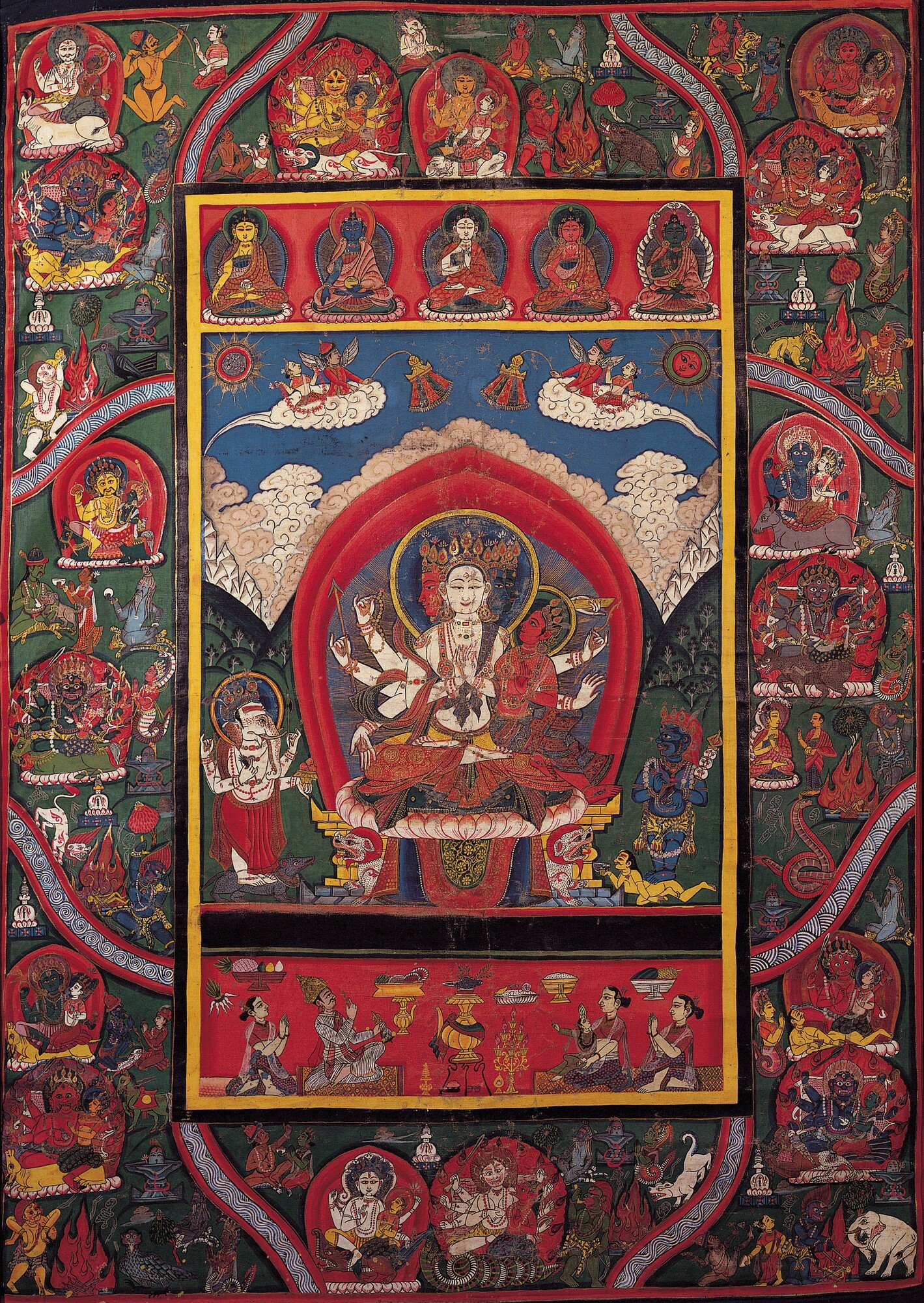


    In the lower register can also be seen a similar figure with a Serpent Hood riding a Makara, and another on Sesh Nag or Infinity or the "brother of Vishnu".

    But even more powerfully, this appearance is shared with India's Manasa Devi. This work is probably from around the eleventh century:
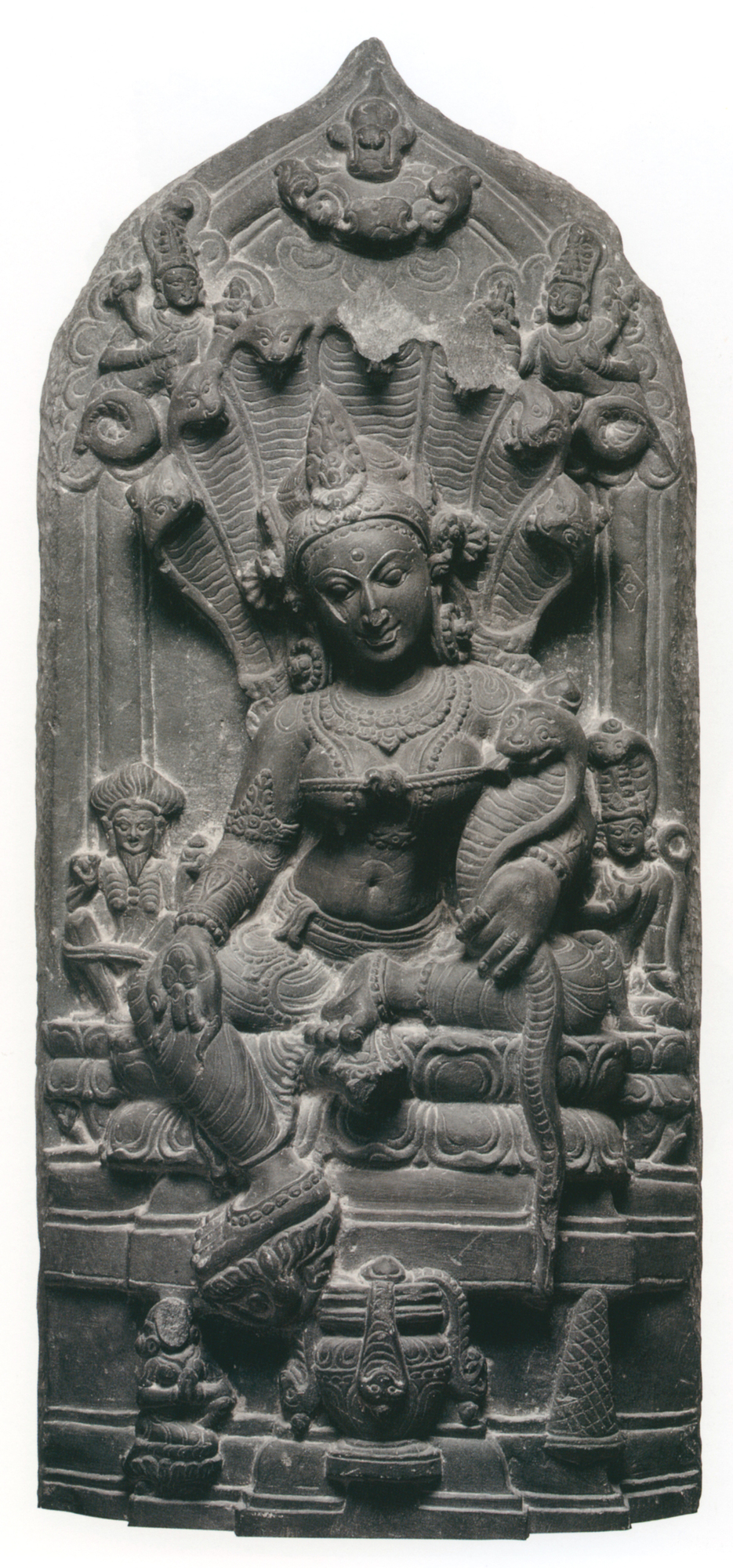


    Manasa:
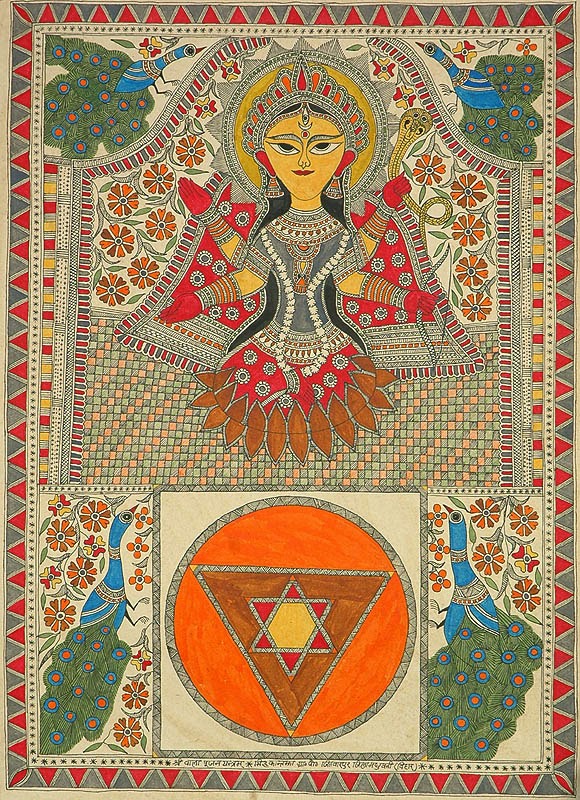


    Here is a modern bhajan, or personal devotion, to Manasa, from Bengal. It may be kind of unwatchable, but it has a certain rhythm to listen to it.


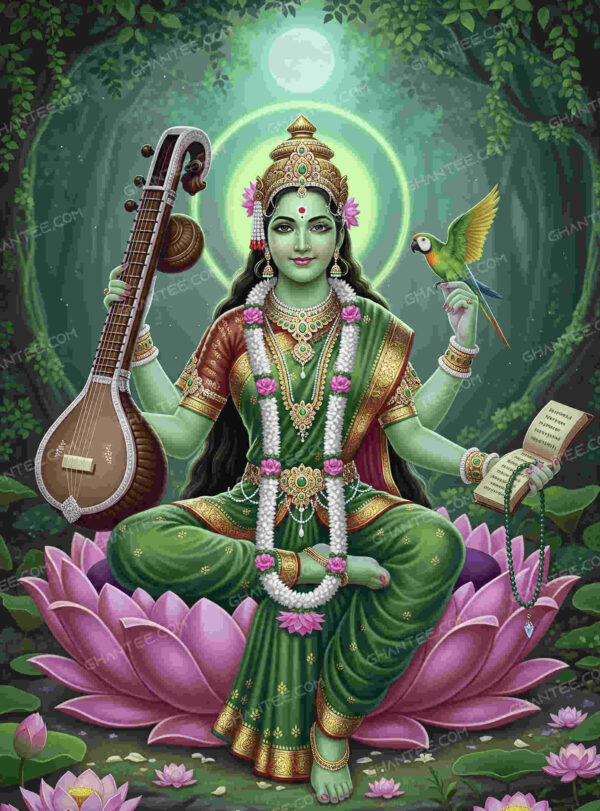
    It turns out that Buddhism has mixed her with tantric Sarasvati called Matangi:
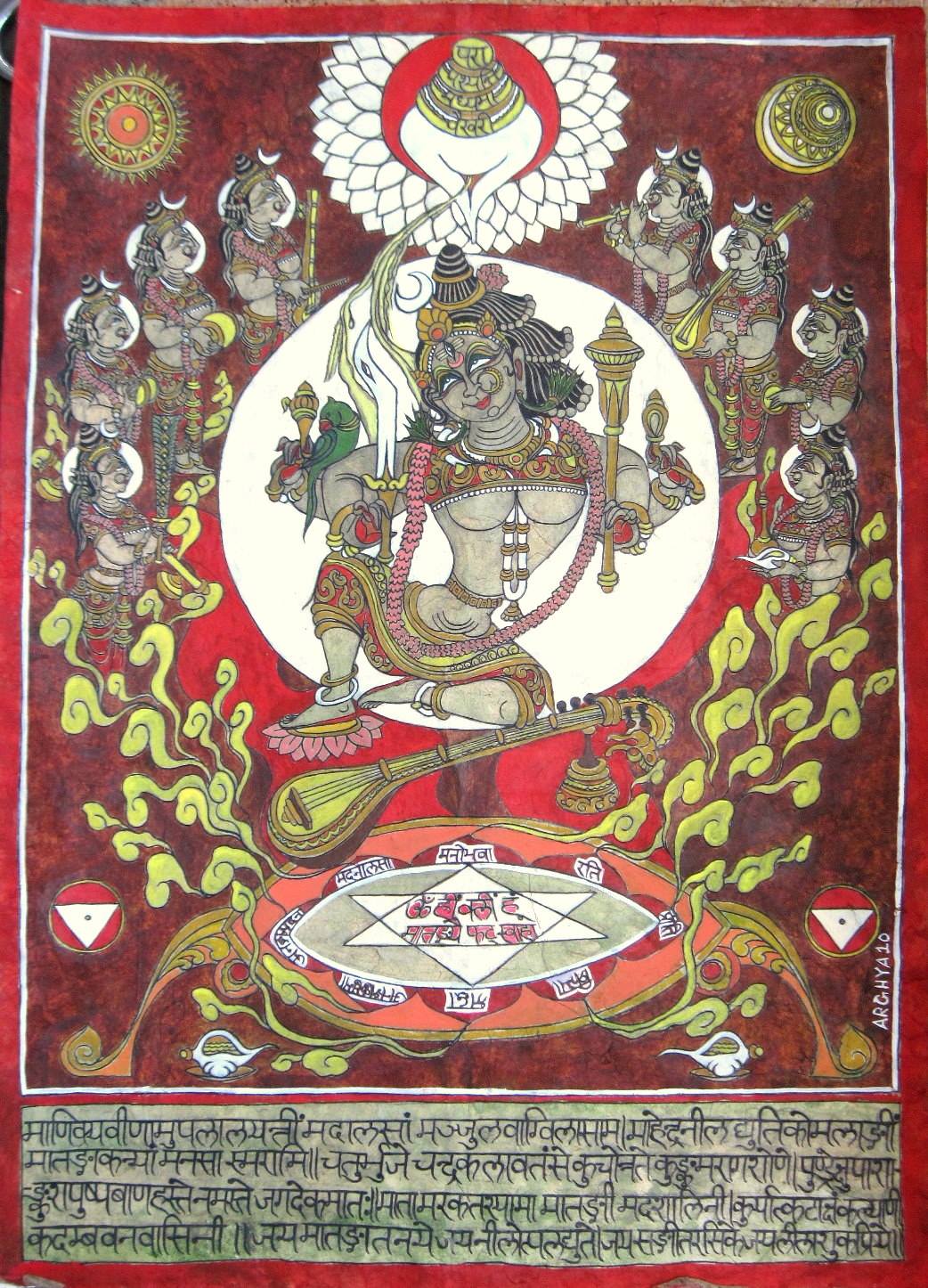


    om sukapriyaye cha vidmahe sri kameshvariyai dhimahe tanno syama prachodayat


    is her Gayatri.

    This one goddess basically emanates all yoga teachings, Speech especially, or she is Om itself. I have freely cultivated Matangi in her independent form. She is part of the Sri Vidya or Mahavidya system and this is her Yantra:


    The system of Ten Mahavidyas may be accessible for someone who finds the Planets of symbolic value. I consider it a kind of community trough obviously. When I first came to this house, I didn't quite do Subtle Yoga, I did a type of Armor and she was involved.


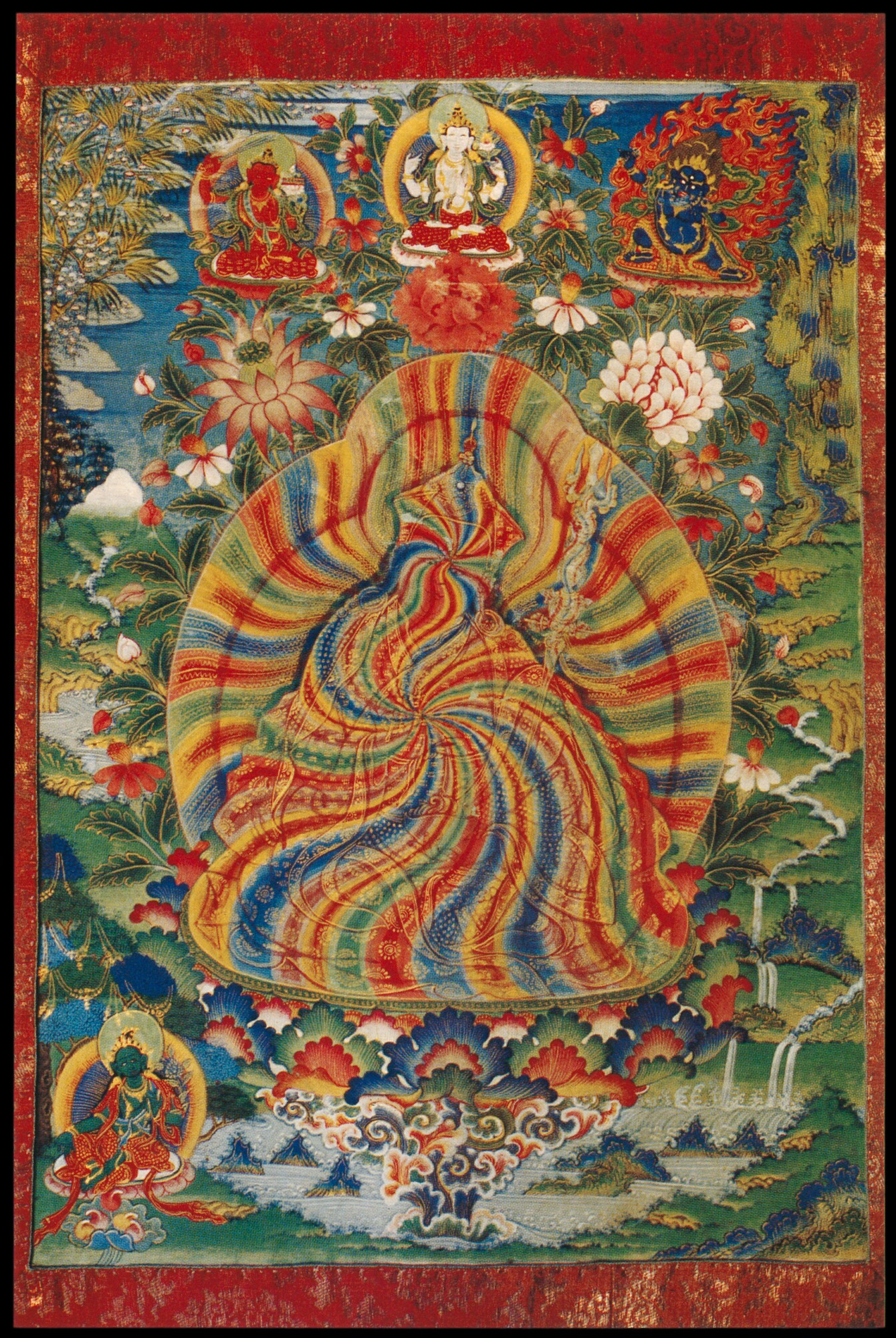
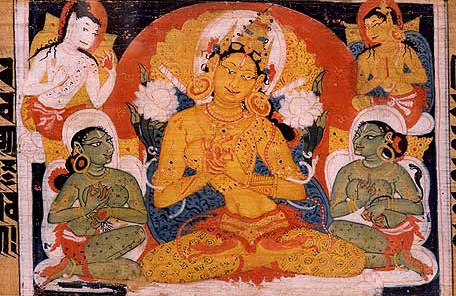
    In Buddhism, she is called Janguli which means what it sounds like, jungle girl. Historically, they were of extremely high value as yoginis. Another one is named for wearing a peacock plume, Mayuri. That means she is different because her mantras are entirely different. This is an illuminated manuscript from probably the twelfth century, with the main Buddhist Text goddess, Prajnaparamita in 8,000 Lines, with Mayuri and Janguli:


    That little chick requires almost every single piece of knowledge I can scrap together. That is, her practices, as they stand, call for it. She's a Sutra goddess. But it would probably take me the rest of my life to make this fully work. That is, more of the wisdoms and benefits for self and others, a purposeful re-arising from meditation. That is what I mean by "converted to Buddhism" by starting to realize I needed to ask for a little more than just the yogic energy process itself.

    The technique is actually a slowed-down version of what beings experience for a split second when falling asleep.

    Also, being that such episodes can be cold like Death, or warm like Bliss, these are twin aspects of the same thing, neither to be avoided nor clung to.


    So the subject of mantra covers everything from outer to inner. As we said about Atharva Veda, you are also going to do it symbolicly or mentally, Manasa. That in fact is our technical name for it, Manasa Japa, Mental Recitation, such as you might do it 108 times (i. e. a rosary).

    The Path is non-different or is not other than mantra. I can't say you're going to get rich or fall in love, it's not hexcraft or doesn't mean anything in any conventional way, it only works subjectively in the way it says it does. That is why practices are kept over a test of time.


    I am a critic and I think a lot of Indian stuff sounds like a tin can or is otherwise unsatisfying, but I have been able to find a few things of better quality and authenticity. Just because it is musically interesting, here is one from Adi Shankara, Mangala Rupini, in Tamil. It is for Mahavidya Kamakshi, who is performing a Buddha-alike action, Dukkha nivarani or removing layers of suffering.


    Mangala roopini madhiyani
    soolini manmadha paaniyale,
    Sangadam neengida saduthiyil
    vandhidum shankari soundariye,
    Kangana paaniyan kanimugam
    kanda nal karpaga kaminiye,
    Jeya jeya shankari gowri kripakari
    dhukka nivarani kamakshi.
    Jeya jeya shankari gowri kripakari
    dhukka nivarani kamakshi.


    Kaanuru malarena kadhiroli
    kaatti kaathida vandhiduvaal,
    Thaanuru thavaoli thaaroli
    madhioli thaangiye veesiduvaal,
    Maanuru vizhizhaal maadhavar
    mozhizhaal maalaigal soodiduvaal,
    Jeya jeya shankari gowri kripakari
    dhukka nivarani kamakshi.
    Jeya jeya shankari gowri kripakari
    dhukka nivarani kamakshi.


    Shankari soundari chaturmukan
    potrida sabayinil vandhavale,
    Pongari maavinil ponn adi
    vaithu porindhida vandhavale,
    Yenkulam thazhaithida ezhil
    vadivudane ezhunthanal durgayale,
    Jeya jeya shankari gowri kripakari
    dhukka nivarani kamakshi.
    Jeya jeya shankari gowri kripakari
    dhukka nivarani kamakshi.


    Dhanadhana dhann dhana thaviloli
    muzhangida thanmani nee varuvaay,
    Gangana gan gana kadhiroli
    veesida kannmani nee varuvaay,
    Banbana bam bana parai oli
    koovida pannmani nee varuvaay,
    Jeya jeya shankari gowri kripakari
    dhukka nivarani kamakshi.
    Jeya jeya shankari gowri kripakari
    dhukka nivarani kamakshi.


    Panchami bhairavi parvatha
    puthri panchanal paaniyale,
    Konjidum kumaranai gunamigu
    vezhanai koduththanal kumariyale,
    Sangadam theerthida samaradhu
    seythanal shakthi enum maaye,
    Jeya jeya shankari gowri kripakari
    dhukka nivarani kamakshi.
    Jeya jeya shankari gowri kripakari
    dhukka nivarani kamakshi.


    Enniyapadi nee arulida
    varuvaay en kula deviyale,
    Panniya seyalin palan adhu
    nalamaay palgida aruliduvaay,
    Kannoli adhanaal karunayai
    kaatti kavalaigal theerpavale,
    Jeya jeya shankari gowri kripakari
    dhukka nivarani kamakshi.
    Jeya jeya shankari gowri kripakari
    dhukka nivarani kamakshi.


    Idar tharum thollai inimel
    illai endru nee solliduvaay,
    Sudar tharum amudhe sruthigal
    koori sugam adhu thandhiduvaay,
    Padar tharum irulil paridhiyaay
    vandhu pazhavinay ottiduvaay,
    Jeya jeya shankari gowri kripakari
    dhukka nivarani kamakshi.
    Jeya jeya shankari gowri kripakari
    dhukka nivarani kamakshi.

    Jeya jeya bala chamundeshwari
    jeya jeya sridevi,
    Jeya jeya durga sriparameshwari
    jeya jeya sridevi,
    Jeya jeya jayanthi mangalakaali
    jeya jeya sridevi,

    Jeya jeya shankari gowri kripakari
    dhukka nivarani kamakshi.

  4. The Following 3 Users Say Thank You to shaberon For This Post:

    Bill Ryan (Yesterday), Harmony (Yesterday), Szymon (Yesterday)

  5. Link to Post #23
    United States Avalon Member
    Join Date
    1st April 2016
    Posts
    6,202
    Thanks
    30,530
    Thanked 34,728 times in 5,850 posts

    Default Re: Have you experienced a spiritual awakening? Here is a clear explanation of what it is and the stages involved

    Quote Posted by petra (here)
    Bliss huh? Interesting. I just seem to be doing a lot of crying. There was a point I was outraged and so mad that I couldn't cry.

    That was what it was like when I crawled into that suicidal cocoon. It spent its energy.


    I got up and started walking around again, not really because I have anything to live for, but because of the following.


    Everything we have is based in Four Truths:


    Quote cattāri ariyasaccāni; "The Four arya satya"


    a statement of how things really are when they are seen correctly


    Dukkha is an innate characteristic of transient existence; nothing is forever, this is painful

    together with this transient world and its pain, there is also thirst (desire, longing, craving) for and attachment to this transient, unsatisfactory existence

    the attachment to this transient world and its pain can be severed or contained by the confinement or letting go of this craving

    marga (road, path, way): the Noble Eightfold Path is the path leading to the confinement of this desire and attachment, and the release from dukkha.


    That's a synopsis, or summary, of longer text, where in the original, Dukkha is defined as:


    Quote ...the five aggregates subject to clinging are suffering.

    This is a unique psychology not found elsewhere. It is the Five Dhyani Buddhas as previously described. In the sense I was describing energy flowing around a ring to do Subtle Yoga, the five aggregates are what it is doing in ordinary consciousness. That is to say, it is a cycle, like a computer processor cycle, which sweeps through a process to build a "moment".

    There is, of course, such a thing as "brainwaves" measured in Hertz. Our yogis did not know that. This is direct insight, or revelation, of mental mechanics at ten or more frames per second, maybe a hundred.

    A Sutra-based teaching is like this, where we give some definitions and discuss the philosophy and say we are going to do it. Yoga says that is cumbersome and eonic, that progress will be very slow. A combination of mantra and life wind burns through it. It's like an ultra-compression of 1,500 years of additional details using the same Four Truths. We take all that and annihilate the obstacles like a fist.


    The components that make Buddhist Yoga distinct from other kinds are the psychology of the aggregates -- Skandhas -- and that also we are practicing Bliss. This is true on multiple levels. It is possible to generate a yogic bodily bliss, that I am a mooncalf for. It kills Skandhas and reveals Buddhas. That is how it is supposed to work. It does.


    If we say we are minorly changing older Yoga, well, we know how this happened. Buddha had been trained in Upanishadic meditation, and he was going around wondering why he was unsatisfied, or why it seemed incomplete. And then he remembered a spontaneous joy from childhood, that came on its own for no reason, and it seemed to him this would help. That is where it comes from.


    Our mantra system is structured so that you do a Void Realization, and a Bliss or Sukha Realization. That is the main component of Chakrasamvara, or Dakini Jala Samvara. The whole concept is Hero enlightened by Bliss.


    So you take particular mantras, and you try to meditate a single Cup of Five Colored Light. It's like liquid energy of bliss stuff, and you don't mind pouring a cup because you are so saturated you can't tell the difference. And it is, this is some kind of actual stuff we can personally produce.


    Now, if you can do this, if you can begin to do this, if you can do Subtle Yoga at all, it is possible on an energy basis that you can experience what Buddha experienced. Maybe just for a second, or a minute, but it is possible to penetrate the Void so completely you are a Buddha.

    The reason we are different is not found in those terms. It's not in negation and vision of infinity. It's the way Buddha did it. He may have visited the ultimate other-worldly stillness, but, he came back and re-arose in Complete Enjoyment Body:


    That is so other beings experience Bliss.

    It is what we consider Stability.

    It is inexhaustible and does not decay.

    I'm not that...good at it, but I can say yes, there is such a thing, and it spreads within this meditation chain. The whole thing is driven by the meditative experience of Sukha or Bliss.


    This is the beginning of the root tantra:


    rahasye parame ramye sarvātmani sadā sthitaḥ |sarvabuddhamayaḥ sattvo vajrasattvaḥ paraṃ sukham || 1.1

    asau svayaṃbhūr bhagavān eka evādhidaivataḥ |sarvabuddhasamāyogaḍākinījālaś(/s)aṃvaraḥ || 1.2


    “secret and supremely blissful nature of all beings/things” (rahasye parame ramye sarvātmani)


    This is Chakrasamvara Tantra:


    uttarādapi cottaraṃ ḍākinījālasaṃvaram |
    rahasye parame ramye sarvātmani sadā sthitaḥ || 2 ||


    which is, so to speak, semi-technical, in the sense of what Param Sukham, Infinite Bliss, means from the first quote. If this has a physiological meaning in Subtle Yoga, then, it is meaningless to anyone who has not experienced Bliss to begin with. It is difficult to know it is even a question. But yes, that is how we know it is true that Suffering can be alleviated.

  6. The Following 4 Users Say Thank You to shaberon For This Post:

    Bill Ryan (Yesterday), Harmony (Yesterday), petra (Today), Szymon (Yesterday)

  7. Link to Post #24
    Norfolk Island Avalon Member Szymon's Avatar
    Join Date
    15th April 2023
    Language
    English
    Posts
    440
    Thanks
    969
    Thanked 3,684 times in 435 posts

    Default Re: Have you experienced a spiritual awakening? Here is a clear explanation of what it is and the stages involved

    Quote Posted by rgray222 (here)
    Just for the record, I posted this on a similar thread in 2019 called "The Zone".

    I certainly wouldn't call my experiences an awakening, but I would say that I have had spiritual experiences throughout my life. When I was a child, I referred to these experiences as "moments of clarity". It's a feeling of such complete clarity and unity with the universe that it almost seems magical. I am always a bit saddened, only because these feelings are so fleeting; they never lasted more than 5-30 seconds and occasionally several minutes. I never know what prompts it to happen or how long it is going to last. During these moments of clarity, there is a connection to virtually everything and every person on the planet. Although brief, it has always left me with the understanding that there is profound meaning to life and that there is so much more than we are capable of understanding in our present human form.

    As I got older, these events still occurred, but not as frequently. I stopped trying to figure out the how, when and why of it all and became thankful that it still occasionally happened. When it did happen, I learned to smile and just say to myself wow. These moments of clarity always left me feeling fulfilled and content.

    Several years ago, I was on my deck speaking on the phone, it was late summer, about 10 in the morning. We lived on 10 acres of property, the deck overlooked a fairly pretty forest with a lovely pond. I had built a large brick fireplace on the deck with a good-sized chimney. At the end of the call, I went over and leaned against the chimney. I was just standing there thinking about the day and all the things I wanted to get accomplished. Nothing of any real importance, just routine stuff. I was looking at the edge of the trees and marvelling at how pretty the property had become since we had owned it. I started to notice that the greens seemed greener, the brown browner, and the sky was a much more beautiful blue than normal. I felt an incredibly strong connection to everything. I smiled and said wow, it was an unforeseen moment of clarity. I fully expected this connection to stop in a few seconds, but it did not.

    This is really hard to explain, but I will give it a try. After about a minute, I realized that this was different; it was lasting longer, and the connection to everything was stronger than I had ever experienced. I felt a sense of motion. I knew my body was standing in one place, but it was as if my soul was moving all over the ten acres at a speed that was hard to comprehend. I knew that the trees, the water, the soil, the rocks, virtually everything I had seen, were connected. This included all the materials and metals that were used to make the cars in the driveway and the plastics that were used to make the trash cans next to the cars. I felt that I was no less and no more important than everything I had just seen. Everything on this planet was connected and served a purpose.

    At the very moment that I understood everything had value and purpose, I felt a sense of ascending very quickly into the sky. It seemed as if I were in the universe, soaring at an unnatural speed, seeing stars and planets made up of colors that I was completely unfamiliar with. Every sense in my body was being told that everything in the universe is connected. Nothing in this universe is more important than anything else. Life and death, while we are in this human experience, seem important, but on the grander scale, they are just part of a process. I was also left with the feeling that the concept of time is needed for the human experience, but outside of that, it has negligible meaning and significance.

    After some time (I have no idea how much), I found myself leaning against the chimney on the deck. I recognized that I now had a much deeper and much more meaningful understanding of life. I wasn't that I intellectually knew that everything was connected, now I actually believed it and understood it in the core of my being.

    This feeling of being connected lasted almost two days. For that time, I felt a mild sense of euphoria and a profound sense of well-being. It may sound like an odd thing to say, but my soul felt much more complete.

    I understand that it may be hard to believe that this actually happened. It changed me forever and left me wanting more. Sadly, I have not had another similar experience, although I have had brief moments of clarity from time to time.
    That sounds amazing, Rgray222. I had a similar experience before my awakening. This was about two years into my daily meditation and Ashtanga Yoga. One day, I was at Sydney Park Wetlands.

    https://www.google.com/search?q=Sydney+Park+Wetlands

    And for some reason, I started admiring the creator. I began looking at the trees, the landscape, the birds, the lushness. I was so mesmerised by its beauty that suddenly I felt this cold energy climbing up my spine. It felt like someone was gently stroking my spine with an ice cube. It's hard to explain the feeling. Shortly after, I couldn't open my new car using the remote control. This feeling lasted about three hours.

    Rgray222, interesting that you felt a connection for two days. Did you engage in any spiritual practices after that event? It does sound like a blissful moment in your spiritual awakening.

    Cheers,
    Szymon

  8. The Following 3 Users Say Thank You to Szymon For This Post:

    Bill Ryan (Yesterday), Harmony (Today), petra (Today)

  9. Link to Post #25
    Norfolk Island Avalon Member Szymon's Avatar
    Join Date
    15th April 2023
    Language
    English
    Posts
    440
    Thanks
    969
    Thanked 3,684 times in 435 posts

    Default Re: Have you experienced a spiritual awakening? Here is a clear explanation of what it is and the stages involved

    Quote Posted by shaberon (here)
    Quote Posted by Szymon (here)
    I didn't know it was that extensive.


    It's so extensive, I can't "read" Sanskrit sentences, but I can "get" the mantrification, so to speak.


    When you do Kirtan, then you are at what we normally call Sangiti.


    Let's say this is normal, relatively easy, and "exoteric" as it were. You chime in with something, perhaps memorize it. For example, we have Nama Sangiti, "Chanting Together the Names (of Manjushri)". It's 160 verses! Most Nepalese Buddhists know it by the time they are six. They still have this cultural habit, they get together and sing something, pretty much daily.

    Most of our tantras are derived out of Bengali or the Baul tradition.

    Those songs are completely coded, they have a surface meaning and an interpreted one, and the interpretations of Manjushri and the Vajra Giti are the tantras.


    When you think of a "mantra", you probably don't think of 160 verses that takes almost an hour to recite. Especially as non-native speakers, we have to pick up small bits. Correspondingly, most practices work that way anyway. Usually you have a "root" and a "seed" and maybe a few other basic things, something like this:


    Quote Adi Mantra (Ong Namo Guru Dev Namo):
    Tunes you into the divine teacher within and the lineage of Kundalini Yoga.

    This is something that remains real in Asia, which there is no western equivalent to, a lineage. In Buddhism I don't really have any transmission lineages, whereas in other things I do. For purposes of meditation, I only have a general association, meaning I can reliably say Tilo Naro Marpa Mila Gampo Karmapa, are actual historical figures in the background of generations of Tibetans I couldn't say the names of, through various centers that came to me. There's a human chain, but I have no idea what it would be apart from them.

    Like a lot of people interested in meditation, I don't have a human guru. Consequently, we have a way of turning to inner guru. Overall, then, we can say there is a kind of Sutra Yoga which is go at your own pace, learn-as-you-can, and if you are sincere it will work. I don't mean you can pick up a Chakrasamvara ritual text and get it to work; you can't. But you can find something appropriate.


    Quote Mangala Charan Mantra (Aad Guray Nameh...): Used for protection, surrounding the practitioner in a field of white light.

    This has a curious dual meaning (as do a lot of these terms). At its basis, the word "mantra" is:


    man (mind) tra (to protect)


    which might perhaps be translated as psychotherapy.

    The simple way to explain this, is, while you are doing a mantra, you are vacuuming out whatever the brain might otherwise be doing.

    On the other hand, mantras have different purposes, one of which is protection from environmental interferences. This, of course, means the devil comes running out of the abyss to eat your liver. And so while I would say we have additional forms of protection, that nevertheless, the beginning of meditation would use this same whiteness (also for cleansing).


    Quote Sat Nam: The "seed mantra," meaning "Truth is my identity." Used for grounding and aligning with one's highest self.


    Almost the whole philosophy revolves around Sat or "real existence", which, according to some, as a Buddhist, I am supposed to refute. Most of the responses I get are like that, I am supposed to uphold No Self, or, it is a superior explanation of what I am saying.

    I'm not in that school. I am only dealing with Yogacara or "yoga school". This is why I refer to our Sanskrit texts. From this view, it means that people and things are not permanent entities, that, as I am now, is not real, because a mental construct. In order to be empty, there must be something which is empty of something else. Therefor, the real, or Sat, is that which remains when everything else is cut off.

    It's not my normal waking consciousness, I'm sure of that.


    It was a similar mantra that opened a lot of inner space for me in the early times, usually known as Swan or Breath:


    so 'haṃ haṃsaḥ


    which is derived from Isopanishad (Isha Upanishad):


    Quote tejo yat te rūpaṃ kalyāṇatamaṃ tat te paśyāmi yo 'sāv [asau puruṣaḥ] so'ham asmi

    "The light which is thy fairest form, I see it. I am what that is"

    This page also tells us:


    Quote In Vedic philosophy it means identifying oneself with Brahman.

    In Vedic Sanskrit, Brahman is Atharvan. Then, Brahman is the atharvan, meaning "chief priest", because it is the one with experience in realization. It's not "out there" somewhere; is a state of being.

    The mantra is used by Adi Shankara, Nath, and Kriya yoga practices generally. Anyone can do this. I did. This is part of what caused a drastic change in my experience of life force.

    Nath are "Hindu and Buddhist" yogis.

    The Isopanishad starts with the end of Sukla Yajur Veda:


    Om Kham Brahma


    and this is probably the last line added to the Vedas. It is the only line in the Vedas that starts with Om. It hasn't made such a rule and it hasn't started a new system of deities such as "Brahma". It more or less says "praise heaven".

    What I am calling Yogacara stems from the Brihadaranyaka Upanishad, which is transmitted with Sukla Yajur Veda, shortly before the time of Buddha and in the same place.


    I would say, well, we're just making some changes or refinements to it.


    Quote Since you started, what kind of benefits or experiences have you noticed?

    Well, I see on the link with serpent symbols, an unusual looking kind of Buddha.

    It's that.


    That's because, we did not invent yoga, this is something that can be experienced in a non-Buddhist manner. So I was using "various" methods from eastern and shamanical sources, and it was enough that I discovered reversal of the life winds leading to stages we call The Method such as:


    Rising Energy

    Ego Death

    Void Gnosis

    Clairvoyance


    And so I was physiologically already doing this, while I began to find more Buddhist material, which seemed to anchor my attention.

    I had a hard time understanding some of it, except for the part that explained to me what I was suddenly and totally aware of. That was a "moment of balance" where, so to speak, one's energy is indrawn and it is making something like a spring force. Following the teaching, this is Air Family, getting ready to shoot an arrow at normal waking consciousness.

    I lost the simple way to do this, so, I am going to have to use this elaborate Nepalese thangka.

    Not most of it. We are looking at the upper yellow frame that has the Five Dhyani Buddhas. If you open it in a new frame, it has good detail. And you are going to find one that looks like the one from the previous post doing Refuge Granting Gesture under a Serpent Hood.

    Now, in part, we could say these are the Five Pythagorean Elements. That would be true. The real form is that the middle one is the middle of a mandala, the others in the cardinal directions around him, and the order would be Blue Earth, Yellow Water, Red Fire, Green Air, then White in the middle. That corresponds to the desired cycle of yogic energy, It goes around the ring, and Air, or life wind, shoots through ordinary waking consciousness into Space, Ether or Akash.

    I personally didn't know there were preliminary stages. That is, whatever Earth, Water, and Fire were supposed to teach, already came naturally and easily because of the Nath or shamanistic stuff, so it sort of blew by until I entered Air Family by being highly interested in what this concentrated energy could do. And this worked because its Buddha is Amogha Siddhi, Not Ignorant about Yoga Powers.

    To say a little bit about why this is not just Pythagoreanism or anything else, I will name their gestures in order from left to right.

    Wish Granting, Earth Touching, Wheel Turning, Meditation, Fearlessness:


    In the lower register can also be seen a similar figure with a Serpent Hood riding a Makara, and another on Sesh Nag or Infinity or the "brother of Vishnu".

    But even more powerfully, this appearance is shared with India's Manasa Devi. This work is probably from around the eleventh century:


    Manasa:


    Here is a modern bhajan, or personal devotion, to Manasa, from Bengal. It may be kind of unwatchable, but it has a certain rhythm to listen to it.


    It turns out that Buddhism has mixed her with tantric Sarasvati called Matangi:


    om sukapriyaye cha vidmahe sri kameshvariyai dhimahe tanno syama prachodayat


    is her Gayatri.

    This one goddess basically emanates all yoga teachings, Speech especially, or she is Om itself. I have freely cultivated Matangi in her independent form. She is part of the Sri Vidya or Mahavidya system and this is her Yantra:


    The system of Ten Mahavidyas may be accessible for someone who finds the Planets of symbolic value. I consider it a kind of community trough obviously. When I first came to this house, I didn't quite do Subtle Yoga, I did a type of Armor and she was involved.


    In Buddhism, she is called Janguli which means what it sounds like, jungle girl. Historically, they were of extremely high value as yoginis. Another one is named for wearing a peacock plume, Mayuri. That means she is different because her mantras are entirely different. This is an illuminated manuscript from probably the twelfth century, with the main Buddhist Text goddess, Prajnaparamita in 8,000 Lines, with Mayuri and Janguli:


    That little chick requires almost every single piece of knowledge I can scrap together. That is, her practices, as they stand, call for it. She's a Sutra goddess. But it would probably take me the rest of my life to make this fully work. That is, more of the wisdoms and benefits for self and others, a purposeful re-arising from meditation. That is what I mean by "converted to Buddhism" by starting to realize I needed to ask for a little more than just the yogic energy process itself.

    The technique is actually a slowed-down version of what beings experience for a split second when falling asleep.

    Also, being that such episodes can be cold like Death, or warm like Bliss, these are twin aspects of the same thing, neither to be avoided nor clung to.


    So the subject of mantra covers everything from outer to inner. As we said about Atharva Veda, you are also going to do it symbolicly or mentally, Manasa. That in fact is our technical name for it, Manasa Japa, Mental Recitation, such as you might do it 108 times (i. e. a rosary).

    The Path is non-different or is not other than mantra. I can't say you're going to get rich or fall in love, it's not hexcraft or doesn't mean anything in any conventional way, it only works subjectively in the way it says it does. That is why practices are kept over a test of time.


    I am a critic and I think a lot of Indian stuff sounds like a tin can or is otherwise unsatisfying, but I have been able to find a few things of better quality and authenticity. Just because it is musically interesting, here is one from Adi Shankara, Mangala Rupini, in Tamil. It is for Mahavidya Kamakshi, who is performing a Buddha-alike action, Dukkha nivarani or removing layers of suffering.


    Mangala roopini madhiyani
    soolini manmadha paaniyale,
    Sangadam neengida saduthiyil
    vandhidum shankari soundariye,
    Kangana paaniyan kanimugam
    kanda nal karpaga kaminiye,
    Jeya jeya shankari gowri kripakari
    dhukka nivarani kamakshi.
    Jeya jeya shankari gowri kripakari
    dhukka nivarani kamakshi.


    Kaanuru malarena kadhiroli
    kaatti kaathida vandhiduvaal,
    Thaanuru thavaoli thaaroli
    madhioli thaangiye veesiduvaal,
    Maanuru vizhizhaal maadhavar
    mozhizhaal maalaigal soodiduvaal,
    Jeya jeya shankari gowri kripakari
    dhukka nivarani kamakshi.
    Jeya jeya shankari gowri kripakari
    dhukka nivarani kamakshi.


    Shankari soundari chaturmukan
    potrida sabayinil vandhavale,
    Pongari maavinil ponn adi
    vaithu porindhida vandhavale,
    Yenkulam thazhaithida ezhil
    vadivudane ezhunthanal durgayale,
    Jeya jeya shankari gowri kripakari
    dhukka nivarani kamakshi.
    Jeya jeya shankari gowri kripakari
    dhukka nivarani kamakshi.


    Dhanadhana dhann dhana thaviloli
    muzhangida thanmani nee varuvaay,
    Gangana gan gana kadhiroli
    veesida kannmani nee varuvaay,
    Banbana bam bana parai oli
    koovida pannmani nee varuvaay,
    Jeya jeya shankari gowri kripakari
    dhukka nivarani kamakshi.
    Jeya jeya shankari gowri kripakari
    dhukka nivarani kamakshi.


    Panchami bhairavi parvatha
    puthri panchanal paaniyale,
    Konjidum kumaranai gunamigu
    vezhanai koduththanal kumariyale,
    Sangadam theerthida samaradhu
    seythanal shakthi enum maaye,
    Jeya jeya shankari gowri kripakari
    dhukka nivarani kamakshi.
    Jeya jeya shankari gowri kripakari
    dhukka nivarani kamakshi.


    Enniyapadi nee arulida
    varuvaay en kula deviyale,
    Panniya seyalin palan adhu
    nalamaay palgida aruliduvaay,
    Kannoli adhanaal karunayai
    kaatti kavalaigal theerpavale,
    Jeya jeya shankari gowri kripakari
    dhukka nivarani kamakshi.
    Jeya jeya shankari gowri kripakari
    dhukka nivarani kamakshi.


    Idar tharum thollai inimel
    illai endru nee solliduvaay,
    Sudar tharum amudhe sruthigal
    koori sugam adhu thandhiduvaay,
    Padar tharum irulil paridhiyaay
    vandhu pazhavinay ottiduvaay,
    Jeya jeya shankari gowri kripakari
    dhukka nivarani kamakshi.
    Jeya jeya shankari gowri kripakari
    dhukka nivarani kamakshi.

    Jeya jeya bala chamundeshwari
    jeya jeya sridevi,
    Jeya jeya durga sriparameshwari
    jeya jeya sridevi,
    Jeya jeya jayanthi mangalakaali
    jeya jeya sridevi,

    Jeya jeya shankari gowri kripakari
    dhukka nivarani kamakshi.
    A very interesting and fascinating reply, thank you for that. Szymon

  10. The Following 2 Users Say Thank You to Szymon For This Post:

    Bill Ryan (Yesterday), Harmony (Today)

+ Reply to Thread
Page 2 of 2 FirstFirst 1 2

Posting Permissions

  • You may not post new threads
  • You may not post replies
  • You may not post attachments
  • You may not edit your posts