+ Reply to Thread
Page 2 of 2 FirstFirst 1 2
Results 21 to 28 of 28

Thread: Have you experienced a spiritual awakening? Here is a clear explanation of what it is and the stages involved

  1. Link to Post #21
    Norfolk Island Avalon Member Szymon's Avatar
    Join Date
    15th April 2023
    Language
    English
    Posts
    469
    Thanks
    1,052
    Thanked 3,874 times in 466 posts

    Default Re: Have you experienced a spiritual awakening? Here is a clear explanation of what it is and the stages involved

    I began with the Tara Springett videos; they really helped connect the dots. We watched all of them three times. Her interviews were so impressive that Guru Viking kept asking for more.

    https://projectavalon.net/forum4/sho...=1#post1701712

  2. The Following 3 Users Say Thank You to Szymon For This Post:

    Bill Ryan (14th February 2026), Harmony (14th February 2026), petra (14th February 2026)

  3. Link to Post #22
    United States Avalon Member
    Join Date
    1st April 2016
    Posts
    6,251
    Thanks
    30,773
    Thanked 34,996 times in 5,901 posts

    Default Re: Have you experienced a spiritual awakening? Here is a clear explanation of what it is and the stages involved

    Quote Posted by Szymon (here)
    I didn't know it was that extensive.


    It's so extensive, I can't "read" Sanskrit sentences, but I can "get" the mantrification, so to speak.


    When you do Kirtan, then you are at what we normally call Sangiti.


    Let's say this is normal, relatively easy, and "exoteric" as it were. You chime in with something, perhaps memorize it. For example, we have Nama Sangiti, "Chanting Together the Names (of Manjushri)". It's 160 verses! Most Nepalese Buddhists know it by the time they are six. They still have this cultural habit, they get together and sing something, pretty much daily.

    Most of our tantras are derived out of Bengali or the Baul tradition.

    Those songs are completely coded, they have a surface meaning and an interpreted one, and the interpretations of Manjushri and the Vajra Giti are the tantras.


    When you think of a "mantra", you probably don't think of 160 verses that takes almost an hour to recite. Especially as non-native speakers, we have to pick up small bits. Correspondingly, most practices work that way anyway. Usually you have a "root" and a "seed" and maybe a few other basic things, something like this:


    Quote Adi Mantra (Ong Namo Guru Dev Namo):
    Tunes you into the divine teacher within and the lineage of Kundalini Yoga.

    This is something that remains real in Asia, which there is no western equivalent to, a lineage. In Buddhism I don't really have any transmission lineages, whereas in other things I do. For purposes of meditation, I only have a general association, meaning I can reliably say Tilo Naro Marpa Mila Gampo Karmapa, are actual historical figures in the background of generations of Tibetans I couldn't say the names of, through various centers that came to me. There's a human chain, but I have no idea what it would be apart from them.

    Like a lot of people interested in meditation, I don't have a human guru. Consequently, we have a way of turning to inner guru. Overall, then, we can say there is a kind of Sutra Yoga which is go at your own pace, learn-as-you-can, and if you are sincere it will work. I don't mean you can pick up a Chakrasamvara ritual text and get it to work; you can't. But you can find something appropriate.


    Quote Mangala Charan Mantra (Aad Guray Nameh...): Used for protection, surrounding the practitioner in a field of white light.

    This has a curious dual meaning (as do a lot of these terms). At its basis, the word "mantra" is:


    man (mind) tra (to protect)


    which might perhaps be translated as psychotherapy.

    The simple way to explain this, is, while you are doing a mantra, you are vacuuming out whatever the brain might otherwise be doing.

    On the other hand, mantras have different purposes, one of which is protection from environmental interferences. This, of course, means the devil comes running out of the abyss to eat your liver. And so while I would say we have additional forms of protection, that nevertheless, the beginning of meditation would use this same whiteness (also for cleansing).


    Quote Sat Nam: The "seed mantra," meaning "Truth is my identity." Used for grounding and aligning with one's highest self.


    Almost the whole philosophy revolves around Sat or "real existence", which, according to some, as a Buddhist, I am supposed to refute. Most of the responses I get are like that, I am supposed to uphold No Self, or, it is a superior explanation of what I am saying.

    I'm not in that school. I am only dealing with Yogacara or "yoga school". This is why I refer to our Sanskrit texts. From this view, it means that people and things are not permanent entities, that, as I am now, is not real, because a mental construct. In order to be empty, there must be something which is empty of something else. Therefor, the real, or Sat, is that which remains when everything else is cut off.

    It's not my normal waking consciousness, I'm sure of that.


    It was a similar mantra that opened a lot of inner space for me in the early times, usually known as Swan or Breath:


    so 'haṃ haṃsaḥ


    which is derived from Isopanishad (Isha Upanishad):


    Quote tejo yat te rūpaṃ kalyāṇatamaṃ tat te paśyāmi yo 'sāv [asau puruṣaḥ] so'ham asmi

    "The light which is thy fairest form, I see it. I am what that is"

    This page also tells us:


    Quote In Vedic philosophy it means identifying oneself with Brahman.

    In Vedic Sanskrit, Brahman is Atharvan. Then, Brahman is the atharvan, meaning "chief priest", because it is the one with experience in realization. It's not "out there" somewhere; is a state of being.

    The mantra is used by Adi Shankara, Nath, and Kriya yoga practices generally. Anyone can do this. I did. This is part of what caused a drastic change in my experience of life force.

    Nath are "Hindu and Buddhist" yogis.

    The Isopanishad starts with the end of Sukla Yajur Veda:


    Om Kham Brahma


    and this is probably the last line added to the Vedas. It is the only line in the Vedas that starts with Om. It hasn't made such a rule and it hasn't started a new system of deities such as "Brahma". It more or less says "praise heaven".

    What I am calling Yogacara stems from the Brihadaranyaka Upanishad, which is transmitted with Sukla Yajur Veda, shortly before the time of Buddha and in the same place.


    I would say, well, we're just making some changes or refinements to it.


    Quote Since you started, what kind of benefits or experiences have you noticed?

    Well, I see on the link with serpent symbols, an unusual looking kind of Buddha.

    It's that.


    That's because, we did not invent yoga, this is something that can be experienced in a non-Buddhist manner. So I was using "various" methods from eastern and shamanical sources, and it was enough that I discovered reversal of the life winds leading to stages we call The Method such as:


    Rising Energy

    Ego Death

    Void Gnosis

    Clairvoyance


    And so I was physiologically already doing this, while I began to find more Buddhist material, which seemed to anchor my attention.

    I had a hard time understanding some of it, except for the part that explained to me what I was suddenly and totally aware of. That was a "moment of balance" where, so to speak, one's energy is indrawn and it is making something like a spring force. Following the teaching, this is Air Family, getting ready to shoot an arrow at normal waking consciousness.

    I lost the simple way to do this, so, I am going to have to use this elaborate Nepalese thangka.

    Not most of it. We are looking at the upper yellow frame that has the Five Dhyani Buddhas. If you open it in a new frame, it has good detail. And you are going to find one that looks like the one from the previous post doing Refuge Granting Gesture under a Serpent Hood.

    Now, in part, we could say these are the Five Pythagorean Elements. That would be true. The real form is that the middle one is the middle of a mandala, the others in the cardinal directions around him, and the order would be Blue Earth, Yellow Water, Red Fire, Green Air, then White in the middle. That corresponds to the desired cycle of yogic energy, It goes around the ring, and Air, or life wind, shoots through ordinary waking consciousness into Space, Ether or Akash.

    I personally didn't know there were preliminary stages. That is, whatever Earth, Water, and Fire were supposed to teach, already came naturally and easily because of the Nath or shamanistic stuff, so it sort of blew by until I entered Air Family by being highly interested in what this concentrated energy could do. And this worked because its Buddha is Amogha Siddhi, Not Ignorant about Yoga Powers.

    To say a little bit about why this is not just Pythagoreanism or anything else, I will name their gestures in order from left to right.

    Wish Granting, Earth Touching, Wheel Turning, Meditation, Fearlessness:
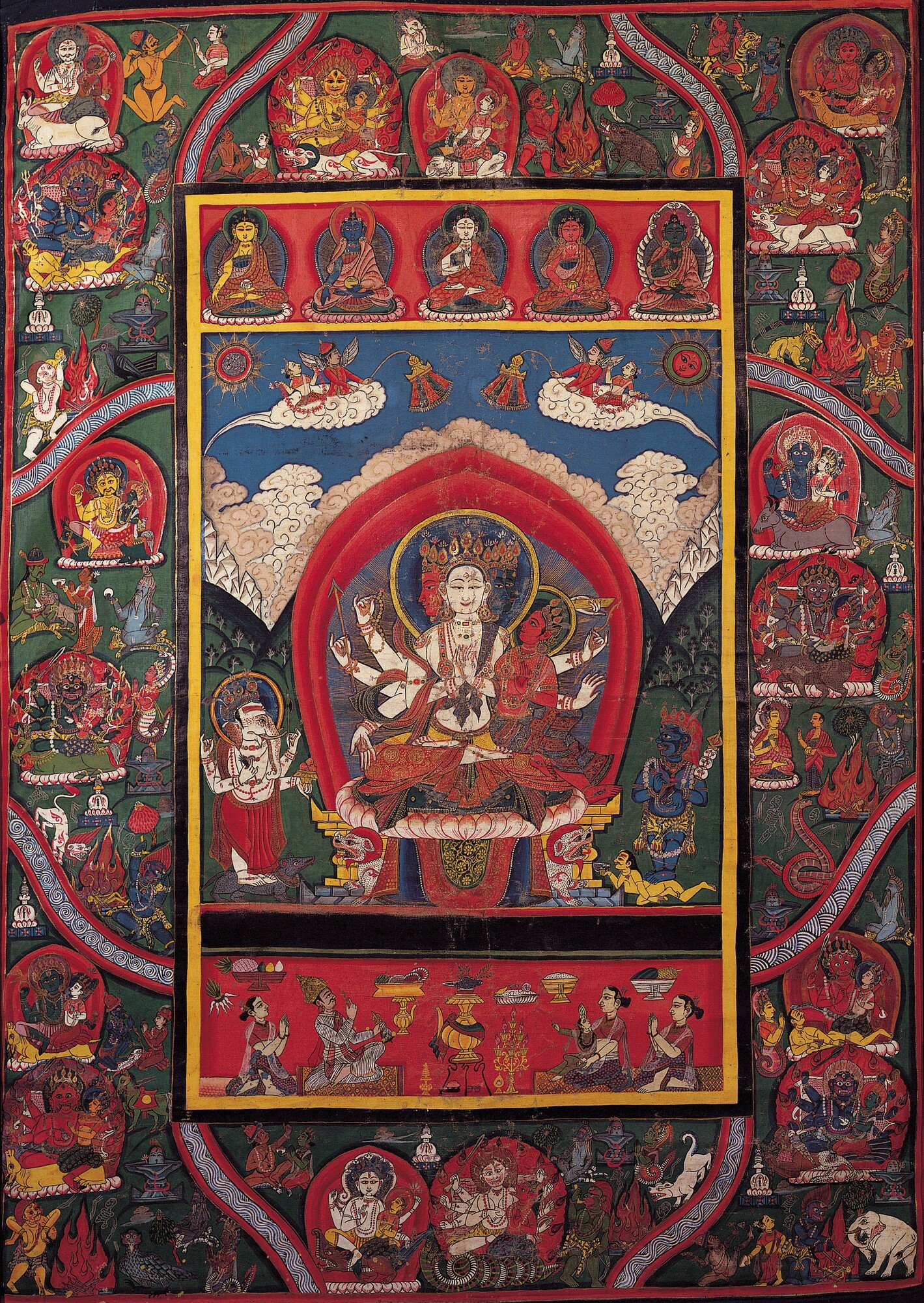


    In the lower register can also be seen a similar figure with a Serpent Hood riding a Makara, and another on Sesh Nag or Infinity or the "brother of Vishnu".

    But even more powerfully, this appearance is shared with India's Manasa Devi. This work is probably from around the eleventh century:
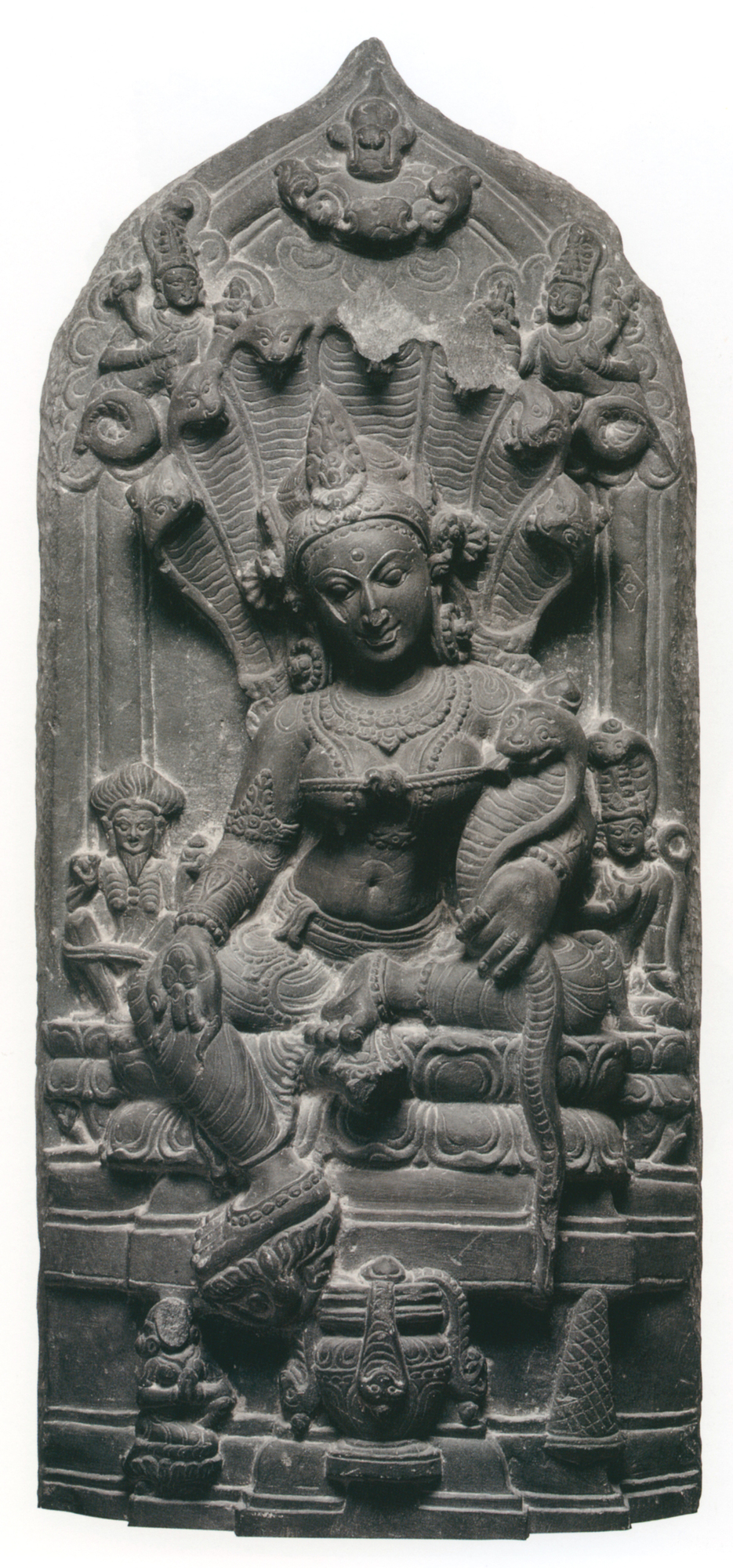


    Manasa:
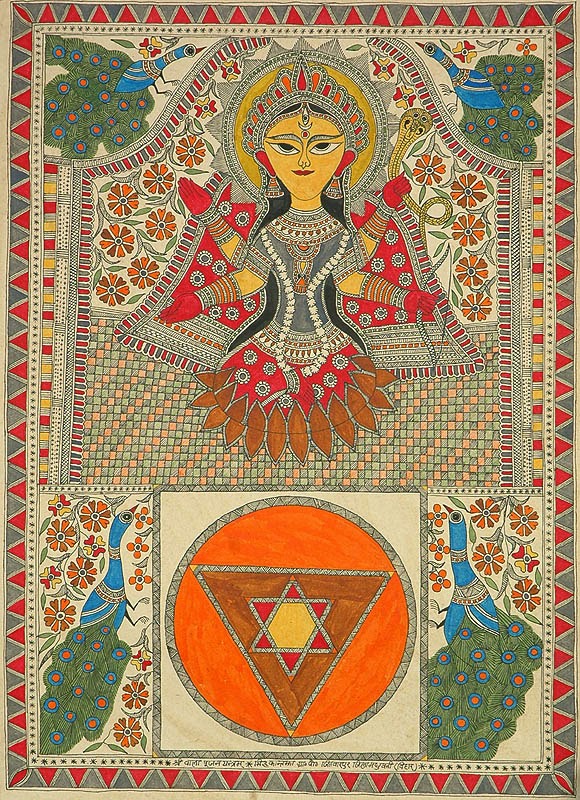


    Here is a modern bhajan, or personal devotion, to Manasa, from Bengal. It may be kind of unwatchable, but it has a certain rhythm to listen to it.


    It turns out that Buddhism has mixed her with tantric Sarasvati called Matangi:
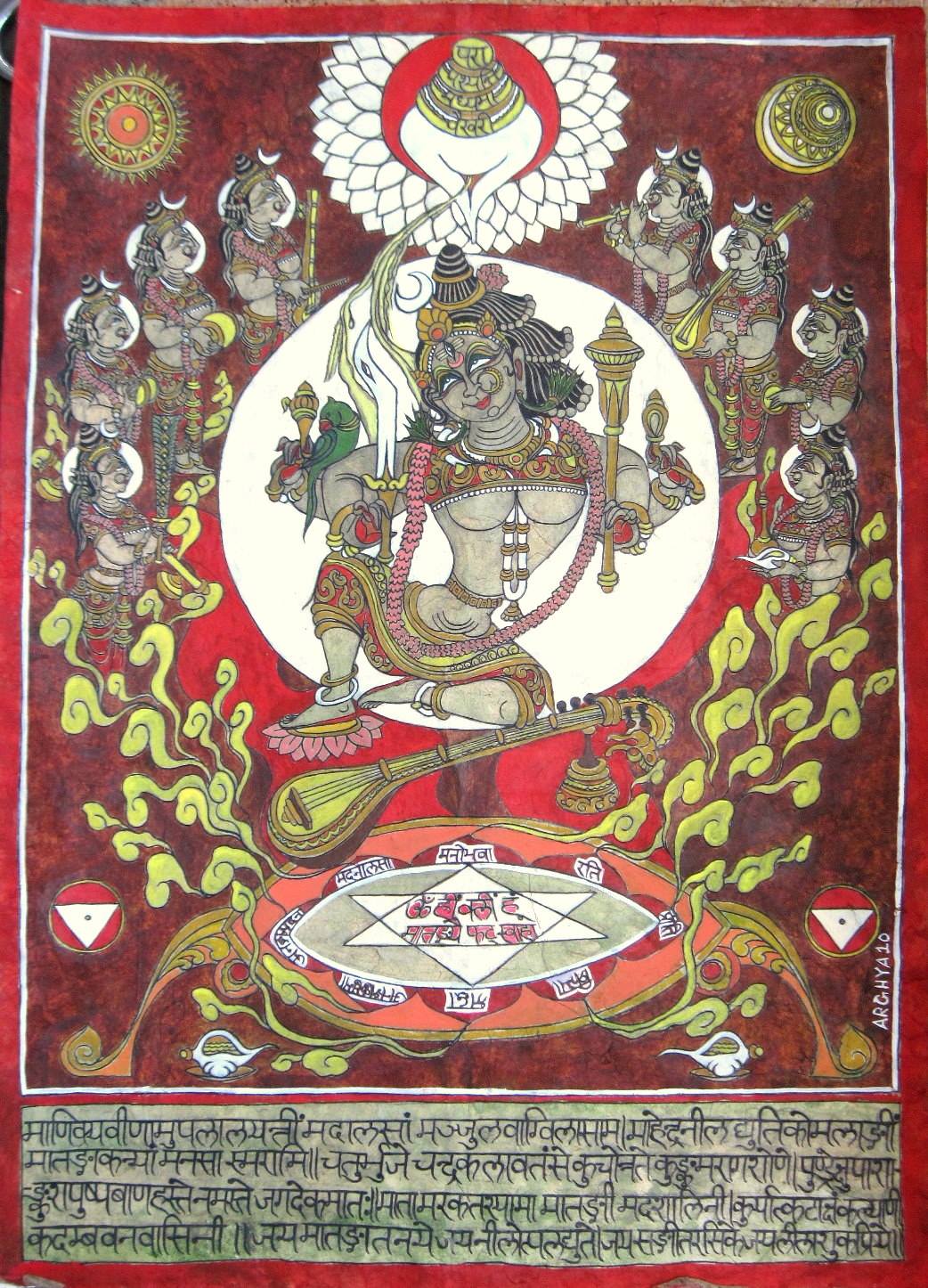


    om sukapriyaye cha vidmahe sri kameshvariyai dhimahe tanno syama prachodayat


    is her Gayatri.

    This one goddess basically emanates all yoga teachings, Speech especially, or she is Om itself. I have freely cultivated Matangi in her independent form. She is part of the Sri Vidya or Mahavidya system and this is her Yantra:


    The system of Ten Mahavidyas may be accessible for someone who finds the Planets of symbolic value. I consider it a kind of community trough obviously. When I first came to this house, I didn't quite do Subtle Yoga, I did a type of Armor and she was involved.


    In Buddhism, she is called Janguli which means what it sounds like, jungle girl. Historically, they were of extremely high value as yoginis. Another one is named for wearing a peacock plume, Mayuri. That means she is different because her mantras are entirely different. This is an illuminated manuscript from probably the twelfth century, with the main Buddhist Text goddess, Prajnaparamita in 8,000 Lines, with Mayuri and Janguli:


    That little chick requires almost every single piece of knowledge I can scrap together. That is, her practices, as they stand, call for it. She's a Sutra goddess. But it would probably take me the rest of my life to make this fully work. That is, more of the wisdoms and benefits for self and others, a purposeful re-arising from meditation. That is what I mean by "converted to Buddhism" by starting to realize I needed to ask for a little more than just the yogic energy process itself.

    The technique is actually a slowed-down version of what beings experience for a split second when falling asleep.

    Also, being that such episodes can be cold like Death, or warm like Bliss, these are twin aspects of the same thing, neither to be avoided nor clung to.


    So the subject of mantra covers everything from outer to inner. As we said about Atharva Veda, you are also going to do it symbolicly or mentally, Manasa. That in fact is our technical name for it, Manasa Japa, Mental Recitation, such as you might do it 108 times (i. e. a rosary).

    The Path is non-different or is not other than mantra. I can't say you're going to get rich or fall in love, it's not hexcraft or doesn't mean anything in any conventional way, it only works subjectively in the way it says it does. That is why practices are kept over a test of time.


    I am a critic and I think a lot of Indian stuff sounds like a tin can or is otherwise unsatisfying, but I have been able to find a few things of better quality and authenticity. Just because it is musically interesting, here is one from Adi Shankara, Mangala Rupini, in Tamil. It is for Mahavidya Kamakshi, who is performing a Buddha-alike action, Dukkha nivarani or removing layers of suffering.


    Mangala roopini madhiyani
    soolini manmadha paaniyale,
    Sangadam neengida saduthiyil
    vandhidum shankari soundariye,
    Kangana paaniyan kanimugam
    kanda nal karpaga kaminiye,
    Jeya jeya shankari gowri kripakari
    dhukka nivarani kamakshi.
    Jeya jeya shankari gowri kripakari
    dhukka nivarani kamakshi.


    Kaanuru malarena kadhiroli
    kaatti kaathida vandhiduvaal,
    Thaanuru thavaoli thaaroli
    madhioli thaangiye veesiduvaal,
    Maanuru vizhizhaal maadhavar
    mozhizhaal maalaigal soodiduvaal,
    Jeya jeya shankari gowri kripakari
    dhukka nivarani kamakshi.
    Jeya jeya shankari gowri kripakari
    dhukka nivarani kamakshi.


    Shankari soundari chaturmukan
    potrida sabayinil vandhavale,
    Pongari maavinil ponn adi
    vaithu porindhida vandhavale,
    Yenkulam thazhaithida ezhil
    vadivudane ezhunthanal durgayale,
    Jeya jeya shankari gowri kripakari
    dhukka nivarani kamakshi.
    Jeya jeya shankari gowri kripakari
    dhukka nivarani kamakshi.


    Dhanadhana dhann dhana thaviloli
    muzhangida thanmani nee varuvaay,
    Gangana gan gana kadhiroli
    veesida kannmani nee varuvaay,
    Banbana bam bana parai oli
    koovida pannmani nee varuvaay,
    Jeya jeya shankari gowri kripakari
    dhukka nivarani kamakshi.
    Jeya jeya shankari gowri kripakari
    dhukka nivarani kamakshi.


    Panchami bhairavi parvatha
    puthri panchanal paaniyale,
    Konjidum kumaranai gunamigu
    vezhanai koduththanal kumariyale,
    Sangadam theerthida samaradhu
    seythanal shakthi enum maaye,
    Jeya jeya shankari gowri kripakari
    dhukka nivarani kamakshi.
    Jeya jeya shankari gowri kripakari
    dhukka nivarani kamakshi.


    Enniyapadi nee arulida
    varuvaay en kula deviyale,
    Panniya seyalin palan adhu
    nalamaay palgida aruliduvaay,
    Kannoli adhanaal karunayai
    kaatti kavalaigal theerpavale,
    Jeya jeya shankari gowri kripakari
    dhukka nivarani kamakshi.
    Jeya jeya shankari gowri kripakari
    dhukka nivarani kamakshi.


    Idar tharum thollai inimel
    illai endru nee solliduvaay,
    Sudar tharum amudhe sruthigal
    koori sugam adhu thandhiduvaay,
    Padar tharum irulil paridhiyaay
    vandhu pazhavinay ottiduvaay,
    Jeya jeya shankari gowri kripakari
    dhukka nivarani kamakshi.
    Jeya jeya shankari gowri kripakari
    dhukka nivarani kamakshi.

    Jeya jeya bala chamundeshwari
    jeya jeya sridevi,
    Jeya jeya durga sriparameshwari
    jeya jeya sridevi,
    Jeya jeya jayanthi mangalakaali
    jeya jeya sridevi,

    Jeya jeya shankari gowri kripakari
    dhukka nivarani kamakshi.

  4. The Following 4 Users Say Thank You to shaberon For This Post:

    Bill Ryan (15th February 2026), Harmony (15th February 2026), Szymon (15th February 2026), Victoria (20th February 2026)

  5. Link to Post #23
    United States Avalon Member
    Join Date
    1st April 2016
    Posts
    6,251
    Thanks
    30,773
    Thanked 34,996 times in 5,901 posts

    Default Re: Have you experienced a spiritual awakening? Here is a clear explanation of what it is and the stages involved

    Quote Posted by petra (here)
    Bliss huh? Interesting. I just seem to be doing a lot of crying. There was a point I was outraged and so mad that I couldn't cry.

    That was what it was like when I crawled into that suicidal cocoon. It spent its energy.


    I got up and started walking around again, not really because I have anything to live for, but because of the following.


    Everything we have is based in Four Truths:


    Quote cattāri ariyasaccāni; "The Four arya satya"


    a statement of how things really are when they are seen correctly


    Dukkha is an innate characteristic of transient existence; nothing is forever, this is painful

    together with this transient world and its pain, there is also thirst (desire, longing, craving) for and attachment to this transient, unsatisfactory existence

    the attachment to this transient world and its pain can be severed or contained by the confinement or letting go of this craving

    marga (road, path, way): the Noble Eightfold Path is the path leading to the confinement of this desire and attachment, and the release from dukkha.


    That's a synopsis, or summary, of longer text, where in the original, Dukkha is defined as:


    Quote ...the five aggregates subject to clinging are suffering.

    This is a unique psychology not found elsewhere. It is the Five Dhyani Buddhas as previously described. In the sense I was describing energy flowing around a ring to do Subtle Yoga, the five aggregates are what it is doing in ordinary consciousness. That is to say, it is a cycle, like a computer processor cycle, which sweeps through a process to build a "moment".

    There is, of course, such a thing as "brainwaves" measured in Hertz. Our yogis did not know that. This is direct insight, or revelation, of mental mechanics at ten or more frames per second, maybe a hundred.

    A Sutra-based teaching is like this, where we give some definitions and discuss the philosophy and say we are going to do it. Yoga says that is cumbersome and eonic, that progress will be very slow. A combination of mantra and life wind burns through it. It's like an ultra-compression of 1,500 years of additional details using the same Four Truths. We take all that and annihilate the obstacles like a fist.


    The components that make Buddhist Yoga distinct from other kinds are the psychology of the aggregates -- Skandhas -- and that also we are practicing Bliss. This is true on multiple levels. It is possible to generate a yogic bodily bliss, that I am a mooncalf for. It kills Skandhas and reveals Buddhas. That is how it is supposed to work. It does.


    If we say we are minorly changing older Yoga, well, we know how this happened. Buddha had been trained in Upanishadic meditation, and he was going around wondering why he was unsatisfied, or why it seemed incomplete. And then he remembered a spontaneous joy from childhood, that came on its own for no reason, and it seemed to him this would help. That is where it comes from.


    Our mantra system is structured so that you do a Void Realization, and a Bliss or Sukha Realization. That is the main component of Chakrasamvara, or Dakini Jala Samvara. The whole concept is Hero enlightened by Bliss.


    So you take particular mantras, and you try to meditate a single Cup of Five Colored Light. It's like liquid energy of bliss stuff, and you don't mind pouring a cup because you are so saturated you can't tell the difference. And it is, this is some kind of actual stuff we can personally produce.


    Now, if you can do this, if you can begin to do this, if you can do Subtle Yoga at all, it is possible on an energy basis that you can experience what Buddha experienced. Maybe just for a second, or a minute, but it is possible to penetrate the Void so completely you are a Buddha.

    The reason we are different is not found in those terms. It's not in negation and vision of infinity. It's the way Buddha did it. He may have visited the ultimate other-worldly stillness, but, he came back and re-arose in Complete Enjoyment Body:


    That is so other beings experience Bliss.

    It is what we consider Stability.

    It is inexhaustible and does not decay.

    I'm not that...good at it, but I can say yes, there is such a thing, and it spreads within this meditation chain. The whole thing is driven by the meditative experience of Sukha or Bliss.


    This is the beginning of the root tantra:


    rahasye parame ramye sarvātmani sadā sthitaḥ |sarvabuddhamayaḥ sattvo vajrasattvaḥ paraṃ sukham || 1.1

    asau svayaṃbhūr bhagavān eka evādhidaivataḥ |sarvabuddhasamāyogaḍākinījālaś(/s)aṃvaraḥ || 1.2


    “secret and supremely blissful nature of all beings/things” (rahasye parame ramye sarvātmani)


    This is Chakrasamvara Tantra:


    uttarādapi cottaraṃ ḍākinījālasaṃvaram |
    rahasye parame ramye sarvātmani sadā sthitaḥ || 2 ||


    which is, so to speak, semi-technical, in the sense of what Param Sukham, Infinite Bliss, means from the first quote. If this has a physiological meaning in Subtle Yoga, then, it is meaningless to anyone who has not experienced Bliss to begin with. It is difficult to know it is even a question. But yes, that is how we know it is true that Suffering can be alleviated.

  6. The Following 6 Users Say Thank You to shaberon For This Post:

    Bill Ryan (15th February 2026), earthdreamer (21st February 2026), Harmony (15th February 2026), petra (16th February 2026), Szymon (15th February 2026), Victoria (20th February 2026)

  7. Link to Post #24
    Norfolk Island Avalon Member Szymon's Avatar
    Join Date
    15th April 2023
    Language
    English
    Posts
    469
    Thanks
    1,052
    Thanked 3,874 times in 466 posts

    Default Re: Have you experienced a spiritual awakening? Here is a clear explanation of what it is and the stages involved

    Quote Posted by rgray222 (here)
    Just for the record, I posted this on a similar thread in 2019 called "The Zone".

    I certainly wouldn't call my experiences an awakening, but I would say that I have had spiritual experiences throughout my life. When I was a child, I referred to these experiences as "moments of clarity". It's a feeling of such complete clarity and unity with the universe that it almost seems magical. I am always a bit saddened, only because these feelings are so fleeting; they never lasted more than 5-30 seconds and occasionally several minutes. I never know what prompts it to happen or how long it is going to last. During these moments of clarity, there is a connection to virtually everything and every person on the planet. Although brief, it has always left me with the understanding that there is profound meaning to life and that there is so much more than we are capable of understanding in our present human form.

    As I got older, these events still occurred, but not as frequently. I stopped trying to figure out the how, when and why of it all and became thankful that it still occasionally happened. When it did happen, I learned to smile and just say to myself wow. These moments of clarity always left me feeling fulfilled and content.

    Several years ago, I was on my deck speaking on the phone, it was late summer, about 10 in the morning. We lived on 10 acres of property, the deck overlooked a fairly pretty forest with a lovely pond. I had built a large brick fireplace on the deck with a good-sized chimney. At the end of the call, I went over and leaned against the chimney. I was just standing there thinking about the day and all the things I wanted to get accomplished. Nothing of any real importance, just routine stuff. I was looking at the edge of the trees and marvelling at how pretty the property had become since we had owned it. I started to notice that the greens seemed greener, the brown browner, and the sky was a much more beautiful blue than normal. I felt an incredibly strong connection to everything. I smiled and said wow, it was an unforeseen moment of clarity. I fully expected this connection to stop in a few seconds, but it did not.

    This is really hard to explain, but I will give it a try. After about a minute, I realized that this was different; it was lasting longer, and the connection to everything was stronger than I had ever experienced. I felt a sense of motion. I knew my body was standing in one place, but it was as if my soul was moving all over the ten acres at a speed that was hard to comprehend. I knew that the trees, the water, the soil, the rocks, virtually everything I had seen, were connected. This included all the materials and metals that were used to make the cars in the driveway and the plastics that were used to make the trash cans next to the cars. I felt that I was no less and no more important than everything I had just seen. Everything on this planet was connected and served a purpose.

    At the very moment that I understood everything had value and purpose, I felt a sense of ascending very quickly into the sky. It seemed as if I were in the universe, soaring at an unnatural speed, seeing stars and planets made up of colors that I was completely unfamiliar with. Every sense in my body was being told that everything in the universe is connected. Nothing in this universe is more important than anything else. Life and death, while we are in this human experience, seem important, but on the grander scale, they are just part of a process. I was also left with the feeling that the concept of time is needed for the human experience, but outside of that, it has negligible meaning and significance.

    After some time (I have no idea how much), I found myself leaning against the chimney on the deck. I recognized that I now had a much deeper and much more meaningful understanding of life. I wasn't that I intellectually knew that everything was connected, now I actually believed it and understood it in the core of my being.

    This feeling of being connected lasted almost two days. For that time, I felt a mild sense of euphoria and a profound sense of well-being. It may sound like an odd thing to say, but my soul felt much more complete.

    I understand that it may be hard to believe that this actually happened. It changed me forever and left me wanting more. Sadly, I have not had another similar experience, although I have had brief moments of clarity from time to time.
    That sounds amazing, Rgray222. I had a similar experience before my awakening. This was about two years into my daily meditation and Ashtanga Yoga. One day, I was at Sydney Park Wetlands.

    https://www.google.com/search?q=Sydney+Park+Wetlands

    And for some reason, I started admiring the creator. I began looking at the trees, the landscape, the birds, the lushness. I was so mesmerised by its beauty that suddenly I felt this cold energy climbing up my spine. It felt like someone was gently stroking my spine with an ice cube. It's hard to explain the feeling. Shortly after, I couldn't open my new car using the remote control. This feeling lasted about three hours.

    Rgray222, interesting that you felt a connection for two days. Did you engage in any spiritual practices after that event? It does sound like a blissful moment in your spiritual awakening.

    Cheers,
    Szymon

  8. The Following 5 Users Say Thank You to Szymon For This Post:

    Bill Ryan (15th February 2026), Harmony (16th February 2026), petra (16th February 2026), shaberon (20th February 2026), Victoria (20th February 2026)

  9. Link to Post #25
    Norfolk Island Avalon Member Szymon's Avatar
    Join Date
    15th April 2023
    Language
    English
    Posts
    469
    Thanks
    1,052
    Thanked 3,874 times in 466 posts

    Default Re: Have you experienced a spiritual awakening? Here is a clear explanation of what it is and the stages involved

    Quote Posted by shaberon (here)
    Quote Posted by Szymon (here)
    I didn't know it was that extensive.


    It's so extensive, I can't "read" Sanskrit sentences, but I can "get" the mantrification, so to speak.


    When you do Kirtan, then you are at what we normally call Sangiti.


    Let's say this is normal, relatively easy, and "exoteric" as it were. You chime in with something, perhaps memorize it. For example, we have Nama Sangiti, "Chanting Together the Names (of Manjushri)". It's 160 verses! Most Nepalese Buddhists know it by the time they are six. They still have this cultural habit, they get together and sing something, pretty much daily.

    Most of our tantras are derived out of Bengali or the Baul tradition.

    Those songs are completely coded, they have a surface meaning and an interpreted one, and the interpretations of Manjushri and the Vajra Giti are the tantras.


    When you think of a "mantra", you probably don't think of 160 verses that takes almost an hour to recite. Especially as non-native speakers, we have to pick up small bits. Correspondingly, most practices work that way anyway. Usually you have a "root" and a "seed" and maybe a few other basic things, something like this:


    Quote Adi Mantra (Ong Namo Guru Dev Namo):
    Tunes you into the divine teacher within and the lineage of Kundalini Yoga.

    This is something that remains real in Asia, which there is no western equivalent to, a lineage. In Buddhism I don't really have any transmission lineages, whereas in other things I do. For purposes of meditation, I only have a general association, meaning I can reliably say Tilo Naro Marpa Mila Gampo Karmapa, are actual historical figures in the background of generations of Tibetans I couldn't say the names of, through various centers that came to me. There's a human chain, but I have no idea what it would be apart from them.

    Like a lot of people interested in meditation, I don't have a human guru. Consequently, we have a way of turning to inner guru. Overall, then, we can say there is a kind of Sutra Yoga which is go at your own pace, learn-as-you-can, and if you are sincere it will work. I don't mean you can pick up a Chakrasamvara ritual text and get it to work; you can't. But you can find something appropriate.


    Quote Mangala Charan Mantra (Aad Guray Nameh...): Used for protection, surrounding the practitioner in a field of white light.

    This has a curious dual meaning (as do a lot of these terms). At its basis, the word "mantra" is:


    man (mind) tra (to protect)


    which might perhaps be translated as psychotherapy.

    The simple way to explain this, is, while you are doing a mantra, you are vacuuming out whatever the brain might otherwise be doing.

    On the other hand, mantras have different purposes, one of which is protection from environmental interferences. This, of course, means the devil comes running out of the abyss to eat your liver. And so while I would say we have additional forms of protection, that nevertheless, the beginning of meditation would use this same whiteness (also for cleansing).


    Quote Sat Nam: The "seed mantra," meaning "Truth is my identity." Used for grounding and aligning with one's highest self.


    Almost the whole philosophy revolves around Sat or "real existence", which, according to some, as a Buddhist, I am supposed to refute. Most of the responses I get are like that, I am supposed to uphold No Self, or, it is a superior explanation of what I am saying.

    I'm not in that school. I am only dealing with Yogacara or "yoga school". This is why I refer to our Sanskrit texts. From this view, it means that people and things are not permanent entities, that, as I am now, is not real, because a mental construct. In order to be empty, there must be something which is empty of something else. Therefor, the real, or Sat, is that which remains when everything else is cut off.

    It's not my normal waking consciousness, I'm sure of that.


    It was a similar mantra that opened a lot of inner space for me in the early times, usually known as Swan or Breath:


    so 'haṃ haṃsaḥ


    which is derived from Isopanishad (Isha Upanishad):


    Quote tejo yat te rūpaṃ kalyāṇatamaṃ tat te paśyāmi yo 'sāv [asau puruṣaḥ] so'ham asmi

    "The light which is thy fairest form, I see it. I am what that is"

    This page also tells us:


    Quote In Vedic philosophy it means identifying oneself with Brahman.

    In Vedic Sanskrit, Brahman is Atharvan. Then, Brahman is the atharvan, meaning "chief priest", because it is the one with experience in realization. It's not "out there" somewhere; is a state of being.

    The mantra is used by Adi Shankara, Nath, and Kriya yoga practices generally. Anyone can do this. I did. This is part of what caused a drastic change in my experience of life force.

    Nath are "Hindu and Buddhist" yogis.

    The Isopanishad starts with the end of Sukla Yajur Veda:


    Om Kham Brahma


    and this is probably the last line added to the Vedas. It is the only line in the Vedas that starts with Om. It hasn't made such a rule and it hasn't started a new system of deities such as "Brahma". It more or less says "praise heaven".

    What I am calling Yogacara stems from the Brihadaranyaka Upanishad, which is transmitted with Sukla Yajur Veda, shortly before the time of Buddha and in the same place.


    I would say, well, we're just making some changes or refinements to it.


    Quote Since you started, what kind of benefits or experiences have you noticed?

    Well, I see on the link with serpent symbols, an unusual looking kind of Buddha.

    It's that.


    That's because, we did not invent yoga, this is something that can be experienced in a non-Buddhist manner. So I was using "various" methods from eastern and shamanical sources, and it was enough that I discovered reversal of the life winds leading to stages we call The Method such as:


    Rising Energy

    Ego Death

    Void Gnosis

    Clairvoyance


    And so I was physiologically already doing this, while I began to find more Buddhist material, which seemed to anchor my attention.

    I had a hard time understanding some of it, except for the part that explained to me what I was suddenly and totally aware of. That was a "moment of balance" where, so to speak, one's energy is indrawn and it is making something like a spring force. Following the teaching, this is Air Family, getting ready to shoot an arrow at normal waking consciousness.

    I lost the simple way to do this, so, I am going to have to use this elaborate Nepalese thangka.

    Not most of it. We are looking at the upper yellow frame that has the Five Dhyani Buddhas. If you open it in a new frame, it has good detail. And you are going to find one that looks like the one from the previous post doing Refuge Granting Gesture under a Serpent Hood.

    Now, in part, we could say these are the Five Pythagorean Elements. That would be true. The real form is that the middle one is the middle of a mandala, the others in the cardinal directions around him, and the order would be Blue Earth, Yellow Water, Red Fire, Green Air, then White in the middle. That corresponds to the desired cycle of yogic energy, It goes around the ring, and Air, or life wind, shoots through ordinary waking consciousness into Space, Ether or Akash.

    I personally didn't know there were preliminary stages. That is, whatever Earth, Water, and Fire were supposed to teach, already came naturally and easily because of the Nath or shamanistic stuff, so it sort of blew by until I entered Air Family by being highly interested in what this concentrated energy could do. And this worked because its Buddha is Amogha Siddhi, Not Ignorant about Yoga Powers.

    To say a little bit about why this is not just Pythagoreanism or anything else, I will name their gestures in order from left to right.

    Wish Granting, Earth Touching, Wheel Turning, Meditation, Fearlessness:


    In the lower register can also be seen a similar figure with a Serpent Hood riding a Makara, and another on Sesh Nag or Infinity or the "brother of Vishnu".

    But even more powerfully, this appearance is shared with India's Manasa Devi. This work is probably from around the eleventh century:


    Manasa:


    Here is a modern bhajan, or personal devotion, to Manasa, from Bengal. It may be kind of unwatchable, but it has a certain rhythm to listen to it.


    It turns out that Buddhism has mixed her with tantric Sarasvati called Matangi:


    om sukapriyaye cha vidmahe sri kameshvariyai dhimahe tanno syama prachodayat


    is her Gayatri.

    This one goddess basically emanates all yoga teachings, Speech especially, or she is Om itself. I have freely cultivated Matangi in her independent form. She is part of the Sri Vidya or Mahavidya system and this is her Yantra:


    The system of Ten Mahavidyas may be accessible for someone who finds the Planets of symbolic value. I consider it a kind of community trough obviously. When I first came to this house, I didn't quite do Subtle Yoga, I did a type of Armor and she was involved.


    In Buddhism, she is called Janguli which means what it sounds like, jungle girl. Historically, they were of extremely high value as yoginis. Another one is named for wearing a peacock plume, Mayuri. That means she is different because her mantras are entirely different. This is an illuminated manuscript from probably the twelfth century, with the main Buddhist Text goddess, Prajnaparamita in 8,000 Lines, with Mayuri and Janguli:
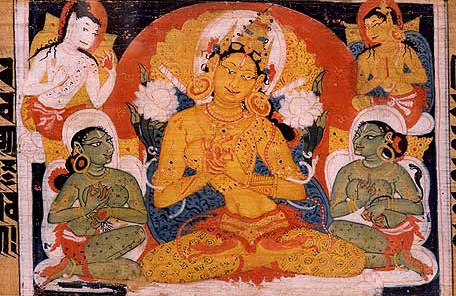


    That little chick requires almost every single piece of knowledge I can scrap together. That is, her practices, as they stand, call for it. She's a Sutra goddess. But it would probably take me the rest of my life to make this fully work. That is, more of the wisdoms and benefits for self and others, a purposeful re-arising from meditation. That is what I mean by "converted to Buddhism" by starting to realize I needed to ask for a little more than just the yogic energy process itself.

    The technique is actually a slowed-down version of what beings experience for a split second when falling asleep.

    Also, being that such episodes can be cold like Death, or warm like Bliss, these are twin aspects of the same thing, neither to be avoided nor clung to.


    So the subject of mantra covers everything from outer to inner. As we said about Atharva Veda, you are also going to do it symbolicly or mentally, Manasa. That in fact is our technical name for it, Manasa Japa, Mental Recitation, such as you might do it 108 times (i. e. a rosary).

    The Path is non-different or is not other than mantra. I can't say you're going to get rich or fall in love, it's not hexcraft or doesn't mean anything in any conventional way, it only works subjectively in the way it says it does. That is why practices are kept over a test of time.


    I am a critic and I think a lot of Indian stuff sounds like a tin can or is otherwise unsatisfying, but I have been able to find a few things of better quality and authenticity. Just because it is musically interesting, here is one from Adi Shankara, Mangala Rupini, in Tamil. It is for Mahavidya Kamakshi, who is performing a Buddha-alike action, Dukkha nivarani or removing layers of suffering.


    Mangala roopini madhiyani
    soolini manmadha paaniyale,
    Sangadam neengida saduthiyil
    vandhidum shankari soundariye,
    Kangana paaniyan kanimugam
    kanda nal karpaga kaminiye,
    Jeya jeya shankari gowri kripakari
    dhukka nivarani kamakshi.
    Jeya jeya shankari gowri kripakari
    dhukka nivarani kamakshi.


    Kaanuru malarena kadhiroli
    kaatti kaathida vandhiduvaal,
    Thaanuru thavaoli thaaroli
    madhioli thaangiye veesiduvaal,
    Maanuru vizhizhaal maadhavar
    mozhizhaal maalaigal soodiduvaal,
    Jeya jeya shankari gowri kripakari
    dhukka nivarani kamakshi.
    Jeya jeya shankari gowri kripakari
    dhukka nivarani kamakshi.


    Shankari soundari chaturmukan
    potrida sabayinil vandhavale,
    Pongari maavinil ponn adi
    vaithu porindhida vandhavale,
    Yenkulam thazhaithida ezhil
    vadivudane ezhunthanal durgayale,
    Jeya jeya shankari gowri kripakari
    dhukka nivarani kamakshi.
    Jeya jeya shankari gowri kripakari
    dhukka nivarani kamakshi.


    Dhanadhana dhann dhana thaviloli
    muzhangida thanmani nee varuvaay,
    Gangana gan gana kadhiroli
    veesida kannmani nee varuvaay,
    Banbana bam bana parai oli
    koovida pannmani nee varuvaay,
    Jeya jeya shankari gowri kripakari
    dhukka nivarani kamakshi.
    Jeya jeya shankari gowri kripakari
    dhukka nivarani kamakshi.


    Panchami bhairavi parvatha
    puthri panchanal paaniyale,
    Konjidum kumaranai gunamigu
    vezhanai koduththanal kumariyale,
    Sangadam theerthida samaradhu
    seythanal shakthi enum maaye,
    Jeya jeya shankari gowri kripakari
    dhukka nivarani kamakshi.
    Jeya jeya shankari gowri kripakari
    dhukka nivarani kamakshi.


    Enniyapadi nee arulida
    varuvaay en kula deviyale,
    Panniya seyalin palan adhu
    nalamaay palgida aruliduvaay,
    Kannoli adhanaal karunayai
    kaatti kavalaigal theerpavale,
    Jeya jeya shankari gowri kripakari
    dhukka nivarani kamakshi.
    Jeya jeya shankari gowri kripakari
    dhukka nivarani kamakshi.


    Idar tharum thollai inimel
    illai endru nee solliduvaay,
    Sudar tharum amudhe sruthigal
    koori sugam adhu thandhiduvaay,
    Padar tharum irulil paridhiyaay
    vandhu pazhavinay ottiduvaay,
    Jeya jeya shankari gowri kripakari
    dhukka nivarani kamakshi.
    Jeya jeya shankari gowri kripakari
    dhukka nivarani kamakshi.

    Jeya jeya bala chamundeshwari
    jeya jeya sridevi,
    Jeya jeya durga sriparameshwari
    jeya jeya sridevi,
    Jeya jeya jayanthi mangalakaali
    jeya jeya sridevi,

    Jeya jeya shankari gowri kripakari
    dhukka nivarani kamakshi.
    A very interesting and fascinating reply, thank you for that. Szymon

  10. The Following 4 Users Say Thank You to Szymon For This Post:

    Bill Ryan (15th February 2026), Harmony (16th February 2026), shaberon (20th February 2026), Victoria (20th February 2026)

  11. Link to Post #26
    United States Avalon Member
    Join Date
    1st April 2016
    Posts
    6,251
    Thanks
    30,773
    Thanked 34,996 times in 5,901 posts

    Default Re: Have you experienced a spiritual awakening? Here is a clear explanation of what it is and the stages involved

    Because of this, illumination came forward. I found something in looking through ways some other Yoga is somewhat close to ours.


    It's a song that will cross-reference the entire historical knowledge base in a particular way.


    As you can probably tell, I have a great deal of respect for study of the inner meaning of mantras, and in consequence that makes the Rg Veda itself paramount in the sense of scripture compared to later material. And the trouble with holding these mantras in high regard is that it would have upsetting remarks towards commonly held beliefs in the Indian public.

    For example, the Satapatha Brahmana includes a version of the Babylonian Flood Myth, which is not in the Veda.

    The revelation of it is supposed to take place at Manali at the "World's End", which is really the height of the Kullu Valley in Himachal Pradesh, and the scenes of the Old Books are in Lower Himachal Pradesh, so obviously there is some time frame before anyone could get there.


    On the other hand, if we say the redistributable value of the Veda is not so much to build a complete temple system, but, the method of Atharva Veda is the basis of what we know as yoga, then, historically it was also the beginning of Medicine or Ayurveda.


    In actuality, India has no chance of knowing these details of the Veda, because it was simply unavailable. Aurobindo Ghose was the first one around the 1930s to really take it to task and formulate some kind of response, and he spent eight years studying it before producing a work on Book One.

    Let's say Book One is backwards, it has a fulcrum around which the back half is older or the beginning. This even calls attention to itself because it is the only hymn that consists of a single verse. Perhaps closer to what is often thought of as "a mantra". Here is the information about I.99:


    Ṛṣi (sage/seer): kaśyapo marīciputraḥ
    Devatā (deity/subject-matter): agnirjātavedāḥ ;
    Chandas (meter): nicṛttriṣṭup


    It's in a form of Tristubh and the composer Kasyapa is a follower of Sage Marica, who only has hymns found in the Atharva Veda, and they are of course thought to be early founders of Ayur Veda. We would think this suggests a school system in a stable, prosperous kingdom, nested inside the success of whatever really took place in these times. The Medical school gives the first known attestation of Balkh, Afghanistan, which was not founded earlier than 1,500 B. C. E., so this has a realistic time frame.

    There is no Kasyapa of the Vedas at the dawn of time, tortoise or not, and it's not a re-cycled name, it's just him.


    This is the hymn:

    Quote “We offer oblations of Soma to Jātavedas, may he consume the wealth of those who feel enmity against us; may he transport us over all difficulties; may Agni convey us, as in a boat over a river, across all wickedness.”


    jātavedase sunavāma somam arātīyato ni dahāti vedaḥ | sa naḥ parṣad ati durgāṇi viśvā nāveva sindhuṃ duritāty agniḥ ||


    Agni is frequently called jatavedase, "knower of the Veda", with of course the aspiration that he reveal it. That would be the vast majority of "Vedic belief" or "mantra practice", interactive response.


    And so I was going around and one particular part of Sri Kula uses important Buddhist principles such as Bliss and Compassion. This deity is in conjunction with Matangi I posted before, and has a surprise:


    Ananda Bhairavi


    Quote Bhairavi is revealed from the Vedic mantra ‘jata vedase Sunavame Soman arati yato nidahati vedah, sa nah parsadati durgani viswa naveva sindhum duri atyagnih’


    In the satakshari vidya of Tripuratapini Upanishad, catushpade gayatri is the first part which focuses Sundari upasana;

    jata vedase Sunavame Soman etc in Trishtubh chandas is the second part which defines Bhaivari upasana;

    ‘Tryambakam yajamahe..’ is the third part which defines the Pracandacandika upasana, which gives inmortality.


    I did not realize that. It's not "Vedic", in the way that is tossed around as if it applied to anything from India, it is the proper article. She just said the Kasyapa mantra belongs to her personally as if she were Agni Jatavedas. Being called Ananda is Bliss, as in the trinity of Sat Chit Ananda, existence awareness bliss.


    There is very little of the Rg Veda that is used in any ongoing way. One exception is Devi Sukta which is a complete hymn. This Kasyapa and Ananda Bhairavi verse is another. But the way we know it is from the first detailed expression of yogic ideas involving a goddess from ca. 300 B. C. E..

    This is in the line of the Black or Taittiriya recension, which is actually named after a pigeon, of the Krsna (Dark) Yajur Veda. It has this name because it is dis-organized, it is more difficult and takes a higher degree of familiarity. Comparatively, the Flood Myth goes into the simpler White or Sukla recension.


    Taittiriya Sakha, a lineage-based south Indian library, containing the Taittiriya Aranyaka:


    Quote Taittiriya Aranyaka contains a Brahmana text of its own, the Pravargya Brahmana, as well as two Upanishads, the Taittiriya Upanishad (a Muktika or primary Upanishad) and the Mahanarayana Upanishad (a minor Vaishnava Upanishad).

    Taittiriya Upanishad is remarkable for its doctrine of Anandamaya Kosha:


    Quote The Ananda valli is one of the earliest known theories in history on the nature of man and knowledge, and resembles but pre-dates the Hellenistic Hermetic and Neoplatonic theories recorded in different forms about a millennium later, such as those expressed in the Corpus Hermetica.

    Taittiriya Aranyaka Chapter Ten is Mahanarayana Upanishad.


    Quote ....the text references and integrates numerous hymns and their fragments from the Vedas, as it solemnizes Narayana and Rudra.

    The text extracts, repeats and integrates the hymns from the Vedic texts. For example, its first ten chapters reference and include hymn fragments or entire hymns from Rigveda 1.18, 1.22, 1.164, 2.3, 4.58, 5.82, 9.96 and 10.81, Yajurveda 32.1 through 32.4, Atharvaveda 10.8.13.

    The chapter 2 of the text gives, for example, an elaborate version of the Rigvedic Gayatri mantra.

    The major effort of the work is balance with Rudra, and this general page omits any information on I.99 and Durga Sukta. This is a song starting from the one-verse mantra. And if I boil down the Chakrasamvara system I am using, it comes to here. I think this is a common origin. Moreover, we think there are two reasons for the use of Puranic material in Hindu and Buddhist Yoga alike:


    Maheshvara Subjugation

    Churning the Ocean of Milk


    That is because it is something Wrathful and something Blissful on a personal level.

    This is an additional level of detail not evident from the Rg Veda. And of course a good way to show that is to put a Veda mantra in an expansion. There is a song for this with a very good vocalist, because you can hear how chanting is supposed to be done.

    If a line ends on "h", it's supposed to have an echo. This has a lot of -ih, -oh, and -ah, and you can get the effect.


    Taittiriya Aranyaka was the source of Viraja Homa mantra, and of Durga Suktam.

    What Durga Suktam does is take traditional Agni mantras and blend them with a verse for Devi.

    The point is that she does so in a way specifically meaning the fiery heat of Tapas in Yoga.

    Because this is a physiological fact in nature, one is able to tell if one is entering what is called yoga.

    You don't have to worry about whether she is a river, or one of the seasons or something, because this Devi is not, she is inner fire. This is the same as Ananda Bhairavi. It is arguable whether "Durga" is a personal name here, or, a trait of hers that is being admired. One could read it either way. It has taking Refuge, a Buddhist ideal. The song is nicely triangulated between the Rg Veda, any Yoga, and Buddhism.


    Greenmessage translation:

    जातवेदसे सुनवाम सोममरातीयतो निदहाति वेदः ।
    स नः पर्षदति दुर्गाणि विश्वा नावेव सिन्धुं दुरितात्यग्निः ॥१॥
    Jaatavedase Sunavaama Somam-Araatiiyato Nidahaati Vedah |
    Sa Nah Parssad-Ati Durgaanni Vishvaa Naave[a-I]va Sindhum Durita-Aty[i]-Agnih ||1||

    Meaning:
    (We offer our oblations to the Fire of Durga to cross over this very difficult ocean of worldly existence)
    1.1: To that Jataveda (one from whom the Vedas are born) we press out the Soma (i.e. Invoke Her ardently); (We invoke that Jataveda) Who consumes by Her Fire of Knowledge (Veda) all the Adversities (within and without) (And frees us from the bondage of the world),
    1.2: May that Agni (Fire of Durga) carry us over this Ocean of the World which is full of Great Difficulties and beset with great Perils; like a Boat (carrying one over a very rough Sea),

    तामग्निवर्णां तपसा ज्वलन्तीं वैरोचनीं कर्मफलेषु जुष्टाम् ।
    दुर्गां देवीँशरणमहं प्रपद्ये सुतरसि तरसे नमः ॥२॥
    Taam-Agni-Varnnaam Tapasaa Jvalantiim Vairocaniim Karma-Phalessu Jussttaam |
    Durgaam Devii[ngu]m-Sharannam-Aham Prapadye Su-Tarasi Tarase Namah ||2||

    Meaning:
    (We offer our oblations to the Fire of Durga to cross over this very difficult ocean of worldly existence)
    2.1: To Her, Who is of the colour of Fire (Agni Varna) and blazing with Tapas (Tapasa Jwalantim); Who was born of that Fire (of Tapas) (Vairochinim), and Who is worshipped through Fruits of Actions (Karma Phalas) (offered to Her Fire as oblations),
    2.2: To that Durga, to that Devi, I take Refuge (Sharanam Aham) by falling at Her Feet (Prapadye); (O Mother Durga, I Prostrate before You) Please ferry me mercifully (over this Ocean of the World full of great Difficulties and Perils),

    अग्ने त्वं पारया नव्यो अस्मान् स्वस्तिभिरति दुर्गाणि विश्वा ।
    पूश्च पृथ्वी बहुला न उर्वी भवा तोकाय तनयाय शंयोः ॥३॥
    Agne Tvam Paarayaa Navyo Asmaan Svastibhir-Ati Durgaanni Vishvaa |
    Puush-Ca Prthvii Bahulaa Na Urvii Bhavaa Tokaaya Tanayaaya Shamyoh ||3||

    Meaning:
    (We offer our oblations to the Fire of Durga to cross over this very difficult ocean of worldly existence)
    3.1: O Agni (Fire of Durga), You Who are eulogized (for carrying one across this Samsara); Please ferry us (too), by carrying us (i.e. our Souls) over Your Auspicious Nature, and make us cross this World full of Great Difficulties (Samsara), ...
    3.2: ... (and also spread Your Auspicious Nature over the) Land and Earth, (so that the Earth) becomes abundantly Fertile and Green (and we feel Your presence in external Nature); And fill us, (We who are) Your Children with Your Bliss (so that we feel Your presence internally),

    विश्वानि नो दुर्गहा जातवेदः सिन्धुं न नावा दुरितातिपर्षि ।
    अग्ने अत्रिवन्मनसा गृणानोऽस्माकं बोध्यविता तनूनाम् ॥४॥
    Vishvaani No Durga-Haa Jaatavedah Sindhum Na Naavaa Durita-Ati-Parssi |
    Agne Atrivan-Manasaa Grnnaano-[A]smaakam Bodhy[i]-Avitaa Tanuunaam ||4||

    Meaning:
    (We offer our oblations to the Fire of Durga to cross over this very difficult ocean of worldly existence)
    4.1: O Jataveda (one from whom the Vedas are born), You remove (grave) difficulties in all the Worlds; Please carry us like a Boat in this very difficult Ocean of the World (Samsara),
    4.2: O Agni (Fire of Durga), our Minds are invoking You (ardently) like sage Atri (who continuously chants the mantras), and our beings are (now) filled with Your Consciousness (by continuously invoking You),

    पृतनाजितँसहमानमुग्रमग्निँ हुवेम परमात्सधस्थात् ।
    स नः पर्षदति दुर्गाणि विश्वा क्षामद्देवो अति दुरितात्यग्निः ॥५॥
    Prtanaa-[A]jita[ngu]m-Sahamaanam-Ugram-Agni Huvema Paramaat-Sadhasthaat |
    Sa Nah Parssad-Ati Durgaanni Vishvaa Kssaamad-Devo Ati Durita-Aty[i]-Agnih ||5||

    Meaning:
    (We offer our oblations to the Fire of Durga to cross over this very difficult ocean of worldly existence)
    5.1: (She is) the (Great) Fire Who is Invincible in Battle, and charges ahead in a Terrible manner conquering (the Enemies); We invoke Her together from the Highest Assembly (i.e. ardently invoke Her together with the greatest reverence),
    5.2: May that Agni (Fire of Durga) carry us over this World full of Great Difficulties, by (charging ahead and) Burning to ashes the very difficult Enemies (within us) with Her Divine Fire,

    प्रत्नोषि कमीड्यो अध्वरेषु सनाच्च होता नव्यश्च सत्सि ।
    स्वां चाग्ने तनुवं पिप्रयस्वास्मभ्यं च सौभगमायजस्व ॥६॥
    Pratnossi Kam-Iiddyo Adhvaressu Sanaac-Ca Hotaa Navyash-Ca Satsi |
    Svaam Ca-Agne Tanuvam Piprayasva-Asmabhyam Ca Saubhagam-Aayajasva ||6||

    Meaning:
    (We offer our oblations to the Fire of Durga to cross over this very difficult ocean of worldly existence)
    6.1: You are lauded for spreading Bliss in the Sacrifice since ancient times (The Bliss resulting from killing the inner Enemies); You act as a Hota (Invoker of Bliss) by abiding as a New Maiden (Who is eternally young and free of decay) (in the Sacrificial Altar within the Hearts of the Devotees),
    6.2: Your own Conscious Form, O Agni (Fire of Durga) is a source of Happiness (Bliss) for us, and a source of Welfare for our Sacrifice,


    गोभिर्जुष्टमयुजो निषिक्तं तवेन्द्र विष्णोरनुसंचरेम ।
    नाकस्य पृष्ठमभि संवसानो वैष्णवीं लोक इह मादयन्ताम् ॥७॥
    Gobhir-Jussttam-Ayujo Nissiktam Tave[a-I]ndra Vissnnor-Anusamcarema |
    Naakasya Prssttham-Abhi Samvasaano Vaissnnaviim Loka Iha Maadayantaam ||7||

    Meaning:
    (We offer our oblations to the Fire of Durga to cross over this very difficult ocean of worldly existence)
    7.1: With Senses (i.e. Mind and Heart) Pleased (by Your Blissful Presence) and becoming Unattached (to the external world), we are Infused with Your (Devotion), O the Highest One; May we Follow (i.e. Immerse ourselves in) Your All-Pervading (Blissful Consciousness) ...
    7.2: ... within the Spiritual Sky (Chidakasha), and dwell here in this Vaishnavi Loka (World of Your All-Pervading Consciousness), being Intoxicated (by Your Blissful Nature),

    ॐ कात्यायनाय विद्महे कन्याकुमारि धीमहि
    तन्नो दुर्गिः प्रचोदयात् ॥
    Kaatyaayanaaya Vidmahe Kanyaakumaari Dhiimahi
    Tan-No Durgih Pracodayaat ||

    Durga Gayatri:
    1: Om, (Let our mind contemplate) on Devi Katyayani to know Her (Conscious Form); (And then) Meditate on that Kanyakumari deeply (Who is the Universal Mother),
    2: May that (Fire of) Durga awaken (our Consciousness).

    ॐ शान्तिः शान्तिः शान्तिः ॥
    Om Shaantih Shaantih Shaantih

    Om, (May there be) Peace, Peace, Peace

  12. The Following 4 Users Say Thank You to shaberon For This Post:

    Bill Ryan (20th February 2026), Harmony (20th February 2026), Szymon (21st February 2026), Victoria (20th February 2026)

  13. Link to Post #27
    United States Avalon Member
    Join Date
    1st April 2016
    Posts
    6,251
    Thanks
    30,773
    Thanked 34,996 times in 5,901 posts

    Default Re: Have you experienced a spiritual awakening? Here is a clear explanation of what it is and the stages involved

    I posted a mistaken comment that the author of one of the recordings was Adi Shankara; it is not. The Dukha Nivarani song has a different composer:


    Quote This stotram was composed by Sri Durgai Chithar [Durgai Siddhar swamigal]. Sri Durgai Siddhar Swamigal is a Siddar or saint from Tamil Nadu, who has his jeeva Samadhi in Padappai Chennai. He has written many stotram and devotional songs most of them about Goddess Durga.

    That is correct; this line requests Durga to protect my family/clan/yoga lineage (Kula):

    Quote Yenkulam thazhaithida ezhil
    vadivudane ezhunthanal durgayale

    It does? But the refrain is to Kamakshi.

    There are two somewhat overlapping but similar systems; Nine Durgas and Ten Mahavidyas. The idea is that it is one goddess in many forms, and, the polytheistic view is that all of those forms are important.


    I posted the song because I like it musically, I don't know it because it is only partly Sanskrit, and, the meaning is not taught. There is a rough translation which causes me to make a couple points starting with the first line:


    Quote Mangala Roopini, mathi ani soolini, Manmatha paniyale

    Who is in her auspicious form , who wears moon,
    Who holds the trident, who holds the weapons of love god

    This is an abundant confusion, but it is very simple. We are given "Trident" in most translations, but, plainly enough, in Sanskrit this would be Tri-sula. And so what is in the song is really a one-pointed spear, Sula. And we have this same thing in Buddhism. It comes from the original Shakti iconography, where if you studied Theosophy, you might have seen Brahma Viraj and Vach Viraj, meant as the two halves of the Primordial Androgyne. This is correct. That is why Viraja is the "first Shakti" and why the weapon is simple (a Trident represents a consort). This system comes from Orissa around the year 2 - 300. This form has a very elaborate symbolism but for now, it is just to verify this is a Spear:


    Further along, this line is difficult:


    Quote Panchami bhairavi parvatha
    puthri panchanal paaniyale


    Who is as pretty as the fifth crescent , who is fearful ,
    Who is the daughter of mountain and who has the five good approaches

    If this was Durga, Panchami or "fifth day of the moon" would usually be Tripura Sundari. It is also correct that in another month, it is Naga Panchami or day of the snakes, therefor goddess Manasa in Orissa, Bengal, and Assam. The first makes more sense because Tripura Sundari is called Kamakshi (Orissa) and Kamakhya (Assam). "Daughter of the Mountain" applies to her, but Bhairavi implies another form. That is the only part in this song that does. The song neither gives Nine Durgas nor the Mahavidyas, it is all colloquial for Tripura Sundari, in sort of a bridge between both systems.


    This has a particularly important line:


    Quote Oh nectar who gives light, give us pleasures by saying the Vedas,
    And you would drive away my bondage of fate by coming as a Garuda

    Sudar tharu amudhe , sruthigal kori sukhamathu thanthiduvay,
    Padar tharu irulil parithiyay vandhu pasha vinai ottiduvay,

    Sruti includes the Veda mantras (Samhita), as well as literature bound to it (Upanishads, Brahmanas, Aranyakas), in the sense these are heard. It literally means someone has spoken it to you.

    You have to know this, otherwise it makes no sense how you get "Veda" out of that line. Like I have no idea where they see "Garuda".

    It will make a little more sense along with something else I did not understand about a goddess I posted. I learn it when things speak for themselves. There is something more interesting about Ananda Bhairavi that I did not know about non-Buddhist Sanskrit. It will come from the layers of subtle yoga.


    What I mean by "Nath" is perhaps best summarized by the oldest known work on the yogic subtle body, Amritasiddhi:


    Quote ...about the 11th century, is the earliest substantial text on what became haṭha yoga, though it does not mention the term.


    It does not have the term because, for one thing, its purpose is yoga of the subtle body for immortality. It does so with a set of strenuous, forceful poses.

    The text is quasi-Buddhist being that it does use a handful of things, but it is not Buddhist Yoga. This is something general or very public that threads into basically all yoga systems. And so I think they mean it is the first "stand-alone Yoga manual" of this kind, even though that's what the Upanishads more or less are, in a philosophical manner. Amritasiddhi is "applied" or really only deals with "inner energy" combined with a tough physical routine.


    Surprisingly it begins this way:

    Quote A primary Buddhist feature is the opening verse praising the goddess Chinnamasta:

    At the navel is a white lotus. On top of that is the spotless orb of the scorching-rayed [sun].... In the middle [emanating from a downward-facing triangle for the female sexual organ]... I worship her... Chinnamasta... who is a yoginī, bearing the seal of yoga.

    We just found the trio, Tripura Sundari, Ananda Bhairavi, and:


    Pracandacandika upasana, which gives inmortality.


    which is a name of Cinnamasta.

    Chakrasamvara is Buddhist Cinnamasta. Or has, provides, produces, unfolds, something like that. These are subjective deities that do not exist or will not work on their own but are a process.

    From a review of Mahavidya as a process:


    Quote ...the tapas of Tripura Bhairavi...

    Chinnamasta is known as Prachanda Chandi

    As the thunderclap, She is known as Indrani, the Shakti of Indra.

    As Indra’s Shakti, Chinnamasta rules over the Universal Mind and acts through the human mind, as the power of perception behind all senses. Thus, sense organs are called “indriya”, after Indra, the ruler of the mind who operates through Chinnamasta.

    After Sri Aurobindo, the second fair analysis of Rg Veda was done by David Frawley and Ganapati Muni, who believe "Indra Shakti" is a Vedic doctrine woven into the hymns. It is. They think they have solved our lack of understanding, but I would say it goes a little further.


    The trio of non-Vedic goddesses are three stages or levels of yoga practice. An ordinary person has no Tapas. You can't just read this or do postures. You have to build it by experience. That is why this is in a framework of beginner and advanced material. If you dial it in to the point you are at, then it will work.


    "Ananda Bhairavi" is just a feminized name of Shiva. However she has a more personal name. I did not catch her epithet in this invocation:


    Quote s-h-kSh-m-l-v-r-yIM sudhAdevyai vauShaT ||

    aIM klIM sauH ||

    because Sudha is not a Buddhist expression. This is where it is used:


    Quote Sudhā (सुधा) refers to “nectar”, according to the Amṛtasiddhi, a 12th-century text belonging to the Haṭhayoga textual tradition.—Accordingly, “The moon is on the peak of Meru and has sixteen digits. Facing downwards, it rains dewy nectar (sudhā—tuṣārābhāṃ sudhāṃ) day and night”.

    Sudhā (सुधा) refers to the “wine” (which inebriates the Goddesses’ consort), according to the Kularatnoddyota, one of the earliest Kubjikā Tantras.—Accordingly, “[...] Energized by the (mantras called the) Five Jewels, enveloped by the seven bodily constituents, her nature the wine (sudhā-svarūpiṇī) (that inebriates her consort) and divine, she is coloured with the colour of the principles of existence. That goddess is (the god’s) own will, Bhairavī, (who is in the company) of the God of the gods. [...]”.

    Sudhā (सुधा) refers to “nectar”, according to the second chapter of the Kāśyapa Saṃhitā: an ancient Sanskrit text from the Pāñcarātra tradition dealing with both Tantra and Viṣacikitsā (Toxicology).—Accordingly, text text dictates that a Garuḍa-upāsaka, the aspirant, must meditate on Garuḍa of the following form—[...] Garuḍa, seated on a lotus, adorned with these ornaments [i.e., the eight divine serpents], has huge wings and immense energy. Garuḍa of smiling countenance, blazes with eight shoulders adorned by the weapons—conch, discus, nectar-pot (sudhā-kumbha), serpent, mace, and sword and two hands reaching out to the feet of the Lord.

    It also appears to be in the line of that Tamil song.

    I would say it is a type of energy work in advanced Yoga of each school.

    It is correct that "advanced" Yoga is medieval, there is nothing ancient about it. As far as I can tell, the pivot is ca. 300 B. C. E. Durga = Tapas. That is where you have an immanent goddess realizable by mantra.


    I consider this important, because when I started doing Nath and Laya Yoga, it was easy to gain intense experiences, but then, it didn't really give you anything to go on. You were able to do this amazing thing, and that's it. And so in the long run, one searches for more, which is what pulled me personally into Buddhism. It turns out the Mahavidyas are similar, and this may be more accessible to the general person. There isn't anything you have to do to get into it. You can't "convert" to Tripura Sundari, you just learn about it.

    A robust system will give you enough repetition to drive some things down to the sub-conscious, and, variety, whereby you don't necessarily just have one thing you do all the time. I did not have that when I discovered I was that person who has an unusually high capacity for the physiological change of state which is very real. That is why I have responded with these ideas.

  14. The Following 3 Users Say Thank You to shaberon For This Post:

    Bill Ryan (21st February 2026), Harmony (21st February 2026), Szymon (21st February 2026)

  15. Link to Post #28
    United States Avalon Member
    Join Date
    1st April 2016
    Posts
    6,251
    Thanks
    30,773
    Thanked 34,996 times in 5,901 posts

    Default Re: Have you experienced a spiritual awakening? Here is a clear explanation of what it is and the stages involved

    I have one more thing to add, a song from the Rg Veda, a living tradition of today that goes back over three thousand years. Not something random or incidental, but more like the spine of yoga.


    Mantras as we are usually shown are one line beginning with "Om...", but this is a convention. Vedic om appears in the middle of lines, it is a placeholder, like "oh..." in any song. It's that, with a resonant "m". We won't find it here.


    In the way that Durga Suktam has a Vedic mantra in it, this time we will bring up the one that survives as a larger, distinct individual. Here is how it comes around as a subject. Vedic hymns do not have titles; those are conveniences.


    We posted that the Veda does not have a Sumerian Flood Myth; nor does it have any corresponding "Genesis" story. It "begins" at its own beginning, and only discusses "first man" or "ancient forefathers" in the logical sense there were previous people. It does not describe them or give a single story or useful reference about it. No strange questionable claims. Those are in the Puranas, which do not appear until about the year 200, and undergo about a thousand years of modifications.

    Although it does not have these "objective" stories, it does talk about that metaphysical element, Creation.

    Utterly unlike Genesis and the others, it actually discusses this in multiple ways. Not "versions", but completely different ways.

    This is a kind of simultaneity I have acquired by accepting both are true. It is a case of working beyond logic. That has its place, objectively, but we are in a thread with at least recognition of a different kind of experience that does not go into words so plainly.


    The, shall I say, "abused" Creation hymn is Purusha Sukta X.90, which begins with a Thousand-headed form, recognizable as the later Satarupa or Viraj. The problem is not the Sukta itself, but, that it was selectively used as the basis for the caste system. That is a Portuguese word, casta, means a breed of plants or livestock selectively bred by humans. The more correct Sanskrit is Varna, meaning "employment, profession", and four of these are in the hymn with Sudra -- Labor as the Feet. This is a perfectly fine symbol or metaphor. It definitely does not say that because you are born in the Sudra class, you are locked in and permanently servile to anyone above you. It's actually saying we cannot walk without you. But if you make everyone forget the text, and pull out these four lines as a way of stating your superiority, people will fall for it.

    This actually happened around 800 B. C. E. until the Sramana tradition (Buddhist, Jain, "wilderness") rolled it back for a few centuries.


    One that is more metaphysical or perhaps clairvoyant is Hiranyagarbha Sukta X.121 "Golden Egg" addressed to the Divine Who. Here you will get recognizable ideas such as Cosmic Waters; it is composed by Rishi Narayan, a name re-used around the formation of the Theosophical Society by a yogi near Madras. This is a comment on the subject that Deity is Who:


    Quote Having given you my might, then whom am I?" Indra replied, "If you ask 'who (ka) am I?' that be you (i.e., be you ka)."

    This arcane subject moves "inside" other hymns such as I.164, but X.121 is where it is basically the only subject. It is also adjunct to another "Creation" hymn, the one of the few things that has been passed down to us, Devi Sukta X.125.


    Ideas about its preservation from R Harish:


    Quote 1. Firstly, as mentioned earlier, it is evidently the earliest hymn about a universal mother goddess, from a time much before the conceptualization of the three principal female divinities – Mahalakshmi, Mahasaraswati and Mahakali. To explain, Devi Suktam is from Rig Veda, which is much earlier (perhaps by a thousand years) to Devi Mahatmya/Markandeya Purana and other sources which refer to a universal female deity or a trinity of female deities. Devi Suktam is in fact the vedic basis for Devi Mahatmya. Devi Suktam expounds on the idea that this entire universe emerges from one primeval source, and visualizes this universal power as a female, rather than as a male.

    2. Also, the seer of this hymn is a rishika (a female rishi) by name Vaak. Further, the hymn also relates to a female deity, whose name too is Vaak (literally means speech). It is one of the few hymns where both the seer and the divinity are female. It is also perhaps the only hymn where the seer and the divinity have the same name.

    3. A very unique feature of this hymn is that unlike other hymns, it is not addressed by a seer (rishi) to a divinity (deva). On the contrary, the devi (Vaak) herself explains about her own glory (i.e., atmastuti) in this hymn. It is explained that this hymn was rendered by the rishika (Vaak) in a state of ecstasy, when she had identified herself as being one with the goddess (Vaak), and hence spoke as the goddess herself.

    That's not completely correct, but it is the main idea. Vak is is not the only place an All-Goddess occurs. For instance, Aditi from Gautama Rahugana:


    Quote “Aditi is heaven; Aditi is the firmament; Aditi is mother, father and son; Aditi is all the gods; Aditi is the five classes of people; Aditi is generation and birth.”

    Vak is the "basis" for Devi Mahatmya or Candi Path (part of the Markandeya Purana, one of the oldest and least sectarian) as from a discussion:


    Quote This sUktaM is known as Devi SUktaM and is chanted at the conclusion

    of Devi MAhAtmya (Devi SaptashatI) reading.

    A portion of this is transferred into Devi Bhagavata Purana.

    One has to read the Devi Mahatmya carefully, but, it does say that Mahalakshmi is the Adi Shakti "who is behind all these shaktis".


    Now, to become a bit sectarian without setting it up as rival cults, but by way of explanation. Two of the Puranic goddesses have different meanings, especially as considered in the Pithas, or "sacred sites" of India. There is a set that is "Sati" or Kali or "wife of Shiva", and another set that is Lakshmi. The first is a set of material energy. The legends are about the death of Sati and Shiva roaming around bearing her corpse, until, in order to stop the depression, Sati's body is blasted apart by energy such as the Chakra of Vishnu, and some number, usually fifty-one, of pieces, scatters all over India, and wherever they hit the ground or penetrated the earth is a sacred site. Although there are various versions, they all revolve around the first or head chakra, the Tika mark of Sati fell at Hingula Mata far to the west in Pakistan.

    The set of Lakshmi's sites is totally different; it refers to areas where the goddess manifested, incarnated, or took birth, and therefor did something. As a practitioner, I would say components of Lakshmi Tantra were a huge boon in getting started. In turn, Buddhist Yoga also has a propensity for Mahalakshmi -- Adi Shakti or Mahamaya.

    The other major goddess, Sarasvati, has been given more of the meaning of Speech. But none of the Vedic Samhitas really say this but the Brahmanas do. The Atharva Veda references used do not support it at all. Soma is the giver of eloquence where Sarasvati is only mentioned in passing.


    The best suggestion is to take the Mahatmya as an allegory for personal struggle. These three goddesses mostly represent the Three Gunas (active, inert, balanced) with Sarasvati being Sattva -- harmony or balance. This is from Samkhya or "Enumeration", not Veda, more of a yogic philosophy.


    Devi Mahatmya contains a second or its own "Devi Suktam" and it also has Rg Veda X.127 Ratri Suktam (which had the purpose to be used after bad dreams).


    It begins with a coded explanation that it is about the seed syllable Hrim:


    ‘Savarnih suryatanayo yo manuh Kathyate-shtamah‘


    The explanation is based on Savarni Manu as the eighth manu, in the future. This is its own code, because the actual Vedic Savarni Manu already happened a long time ago, was one of the chiefs in the early kingdom.

    I will say however that Hrim is essential in Buddhism, and Chakrasamvara also uses Sumbha Nisumbha from here, which Buddhists get confused about; for example, you see Sumbhani Sumbha, and commentary that makes it obvious the connection is broken. We definitely are using these components. It's just practiced differently than reading the whole Devi Mahatmya, which is more or less what this is, public transmission by poetry, like the Iliad and Odyssey. The general public gets one chance a year to hear these things, in their original setting.


    It's unlikely you would memorize most of that stuff, but, most people can learn a few songs. So far, I haven't seen anyone dare comment how Devi Mahatmya may be inspired by a Vedic hymn, like the mantra letter codes can be explained. There is a bit about the song itself. Compared to the one verse of Kasyapa that was transmitted, this tradition uses an intact hymn of multiple verses. Reviewed by the discussion:


    Quote The Devisukta (RV 10.125) declares that the Goddess is the power

    expressed through all the gods, that they are united in her who

    shines with consciousness, that her presence is all-pervading, that

    she supports all of creation, that she is the source of righteousness

    and the revealer of truth, that she is the source of all worlds, yet

    that she shines transcendent beyond them. Among Shaktas this Vedic

    hymn is held in high esteem and is considered to be the source from

    which the entire Chandi sprang.


    This hymn, though the name vac does not appear in it, is the most

    magnificent chant to this feminine principle, the devi of the supreme

    power, which later on would be known under the name of shakti.


    Vac was before all creation, preexisting before any being came to be.

    It was she who initiated the creative process. The first two stanzas

    require a total immersion into the Vedic world in order for their full

    meaning to be grasped. With a beauty of their own, they say in solemn

    cadences that the Word is not only the First of the whole Vedic

    pantheon, but that she has a unique place, for her nature is not to be

    compared with that of any other being, whether created or uncreated.


    The Word is not only an integral part of the sacrifice; she is also the

    Queen who commands homage in every sphere and who, expressing herself

    under different forms, remains essentially the unique Word that

    preserves the unity of all worship. Vac is the lifegiving principle

    within all beings, even if they do not recognize this fact; she is the

    wind, the breath of life. She is the mother, attentive to the needs of

    both Gods and Men. She bestows her gifts and favors graciously and

    freely. She, existing from all eternity, reveals the Father and for the

    sake of creatures "begets" him who otherwise would remain utterly

    disconnected and nonexistent....."


    So, that is roughly correct, and yes, it is inter-textual with other parts of the Veda, because the whole thing works that way.

    There is a slight error, because I ran into this looking at female Rishikas, and something is over-stated here. Reviews make up a new persona by saying "daughter of Sage Ambhrini", but there is no such person. Nor is that what it actually says:


    Ṛṣi (sage/seer): vāgāmbhṛṇī;
    Devatā (deity/subject-matter): vāgāmbhṛṇī


    It's a compound word. It is Vak, voice or speech, combined with:


    Ambhṛṇa (अम्भृण).—a. Ved.

    1) Powerful, great, mighty (mahat).

    2) Roaring terribly.

    -ṇaḥ 1 A vessel or tub used in preparing the Soma juice.


    It has this attestation from Parucchepa Daivodasi:


    Quote piśaṅgabhṛṣṭim ambhṛṇam piśācim indra sam mṛṇa | sarvaṃ rakṣo ni barhaya ||

    “Destroy, Indra, the tawny-coloured, fearfully-roaring, piśāci; annihilate all the rākṣasas.”


    And so there is no "daughter" mentioned here, it is something more like "Voice of Thunder", which is superficially indistinguishable from that of a pisaci.


    We were given hints towards Vagambhrini's connection to other hymns, but not that in VIII.100, as Rastri -- Queen, she is already commented as Thunder:


    Quote When Vāk, the queen, the gladdener of the gods, sits down (in the sacrifice) uttering things not to be understood...


    Then it says the Devas produced Vak Devi and animals speak her.


    Vak is mantrified elsewhere with a whole lot more to it than was mentioned. This is from the view that Book Ten also has very old parts in it, and, this is one such example, composed by Brhaspati. The elusive or ephemeral nature of the goddess is in Jnana X.71:


    Quote “One (man) indeed seeing Speech has not seen her; another (man) hearing her has not heard her; but to another she delivers her person as a loving wife well-attired presents herself to her husband.”

    But here is where it makes the most logical historical analysis I have seen. It has nothing to say about truly ancient people who did not speak. It does have something to say about the dawn of Speech:


    Quote WHEN-men, Brhaspati, giving names to objects, sent out Vak's first and earliest utterances,
    All that was excellent and spotless, treasured within them, was disclosed through their affection.

    It doesn't have their legends or stories. It gives one thing, a reason for speaking.

    I find that to be profound. I consider it to be what has come to me. It's not unnecessary details of unbelievable things, it's this quality.

    If Vak is universal enough to qualify as the first words, Sarasvati requires a high development of Speech in order to be "named". You could argue she existed and gave benefits to beings anyway, but that does not get her this credit here. At the same time, Vak is not praised but only described; the result of using her wisely and properly is the infusion of Lakshmi:


    lakṣmīr nihitādhi vāci ||


    This hymn is definitely followed by details of metaphysical things in Deva Creation X.72:


    Quote Daksa was born of Aditi, and Aditi was Daksa's Child.

    which goes on to Martanda as a re-incarnating Eighth Aditya.


    That is the Veda -- there are not Twelve Adityas. Varying amounts are given, until this is the largest group with Martanda "Egg" as effectively the same as Hiranyagarbha.


    These points are somewhat made in a study on the commentary, also saying:


    Quote In this context, one can also refer to Taittirīya Brāhmaṇa (2.2.9.4) where it has been said that heaven and earth, the two worlds are jointly known as Rodasī because Brahman, the creator of the whole universe had filled these two worlds with his terrible cry at the very beginning of creation.

    which, again, is not accurate. If we look at the Deva Creation, it was done by Brahmanaspati. That, properly, is the Vedic deity, and is an obvious male correspondence to female Vak. It means the lord of priests, of those who pray, of the prayer itself, i. e. he is the supreme mantrin. At no point is any "Brahman" or "Brahma" used this way, those are all derivative terms based in this same principle or practice.

    This is a book of mantras under the aegis of the mantric creator of the universe, indirectly, because here he is creating the Deva realm, and it is another process that forms our material planet.

    The study corrals material so we will begin to see Vak as referring to Prana, which is not very clear or is an undeveloped subject in the Vedas. In AV VI.41, it is attributed to Sarasvati.

    The Rg Veda hymn is copied as Atharva Veda IV.30. That suggests independent circulation, portable use, and personal practice not reliant on a seasonal ritual. Neither one of those fuse Vak and Sarasvati.


    Before presenting the hymn, my reaction so far is that in many ways, Vak is the most important principle. If we were to say that Mind, in its true nature, is already tuned to Satya or Ultimate Reality, there's nothing for it to do. It's practically automatic. Evil arises from defects in the Speech nature. It does something. And we found that "Four-fold speech" is present in the Veda and this is the basic cycle:


    Ideas seeking expression -- mental words forming to express it -- manifested speech -- silence.


    similarly with breath:


    inhale -- retain -- exhale --retain.


    If we do it slowly and carefully, a syllable like Hrim can transform our lives; otherwise we suffer delusions and commit grievances.


    It is also correct that X.125 is in a rare, but not exclusive, style. The vast majority of hymns are written as praise to something. In a few cases, the deity itself is talking, and a few are written from the "I" perspective; this one is both.

    It begins this way, aham "I am" the Rudras, Vasus, and Adityas -- the denizens of Indra's Heaven of Thirty-three Devas. And, at least, in my tradition, this is terribly important. This is an aspect of metaphysical reality, or a universal principle.

    It doesn't give us these details; it refers to divine groups, as well as dualities, and individuals.

    I am able to find it as thoroughly timeless, because, here is one of our technical Buddhist Yoga terms, Murdhan or "Summit" being used the exact same way. We also have a problem with a yogi named Sabara; that there probably was one such person, is not much to question, but later he is a symbol, Old Man of the Mountain, simply referring to the Murdhan itself. Therefor the phrase "meets the teacher Sabara" is not a specific individual on an actual mountain, but, yogic achievement that has brought new energy to the head.

    That's what comes from breaking down Buddhist Yoga to its rudiments -- one song for Tapas and this one for Murdhan contain the antecedents.


    So this mantra is a public domain kirtan or sangiti from the oldest linguistic or intellectual history. It has to be called "aham rudre" because there are a lot of other matches for "devi suktam". This is less musical than the others, it's quite soft.


    aháṃ rudrébhir vásubhiš carāmi
    ahám ādityáir utá višvádevaiḥ
    ahám mitrā́váruṇobhā́ bibharmi
    ahám indrāgnī́ ahám ašvínobhā́
    aháṃ sómam āhanásam bibharmi
    aháṃ tváṣṭāram utá pūṣáṇam bhágam
    aháṃ dadhāmi dráviṇaṃ havíṣmate
    suprāvíye yájamānāya sunvaté
    aháṃ rā́ṣṭrī saṃgámanī vásūnāṃ
    cikitúṣī prathamā́ yajñíyānām
    tā́m mā devā́ ví adadhuḥ purutrā́
    bhū́riṣṭhātrām bhū́ri āvešáyantīm
    máyā só ánnam atti yó vipášyati
    yáḥ prā́ṇiti yá īṃ šṛṇóti uktám
    amantávo mā́ṃ tá úpa kṣiyanti
    šrudhí šruta šraddhiváṃ te vadāmi
    ahám evá svayám idáṃ vadāmi
    júṣṭaṃ devébhir utá mā́nuṣebhiḥ
    yáṃ kāmáye táṃtam ugráṃ kṛṇomi
    tám brahmā́ṇaṃ tám ṛ́ṣiṃ táṃ sumedhā́m
    aháṃ rudrā́ya dhánur ā́ tanomi
    brahmadvíṣe šárave hántavā́ u
    aháṃ jánāya samádaṃ kṛṇomi
    aháṃ dyā́vāpṛthivī́ ā́ viveša
    aháṃ suve pitáram asya mūrdhán
    máma yónir apsú antáḥ samudré
    táto ví tiṣṭhe bhúvanā́nu víšvā
    utā́mū́ṃ dyā́ṃ varṣmáṇópa spṛšāmi
    ahám evá vā́ta iva prá vāmi
    ārábhamāṇā bhúvanāni víšvā
    paró divā́ pará enā́ pṛthivyā́
    etā́vatī mahinā́ sám babhūva


    I walk with the Rudras and the Vasus, with the Adityas and All-Gods I wander.
    I hold aloft both Varuna and Mitra, Indra and Agni, and the Pair of Asvins.

    I cherish and sustain high-swelling Soma, and Tvastar I support, Pusan, and Bhaga.
    I load with wealth the zealous sacrificer who pours the juice and offers his oblation.

    I am the Queen, the gatherer-up of treasures, most thoughtful, first of those who merit worship.
    Thus Gods have stablished me in many places with many homes to enter and abide in.

    Through me alone all eat the food that feeds them,-each man who sees, breathes, hears the word outspoken
    They know it not, but yet they dwell beside me. Hear, one and all, the truth as I declare it.

    1, verily, myself announce and utter the word that Gods and men alike shall welcome.
    I make the man I love exceeding mighty, make him a sage, a Rsi, and a Brahman.

    I bend the bow for Rudra that his arrow may strike and slay the hater of devotion.
    I rouse and order battle for the people, and I have penetrated Earth and Heaven.

    On the world's summit I bring forth the Father: my home is in the waters, in the ocean.
    Thence I extend o' er all existing creatures, and touch even yonder heaven with my forehead.

    I breathe a strong breath like the wind and tempest, the while I hold together all existence.
    Beyond this wide earth and beyond the heavens I have become so mighty in my grandeur.

  16. The Following 2 Users Say Thank You to shaberon For This Post:

    Bill Ryan (23rd February 2026), Harmony (23rd February 2026)

+ Reply to Thread
Page 2 of 2 FirstFirst 1 2

Posting Permissions

  • You may not post new threads
  • You may not post replies
  • You may not post attachments
  • You may not edit your posts