


 Re: Neo-Platonism vs. Capitalism
Here is something that came up about "What is Semitic?", to which I at least would suggest it is Aramaic, extending to Mandaic as the "Semitic religion" in the sense of actually revering Shem as a central spiritual figure.
Moreover, this entwines with the Indian riddle of Three Worlds. Particularly when you try to translate it. In Sanskrit, you have expressions for "atmosphere" and "outer space", and then metaphors where those locations or directions represent what we might call "the astral plane" and "the afterlife".
This is not at all cut-and-dried, because its then-current audience would have understood it in context, and we don't.
The same difficulty underlies Semitic Lord of Heaven:
Baalshamin (Imperial Aramaic: ܒܥܠ ܫܡܝܢ, romanized: Baʿal Šāmīn or Bʿel Šmīn, lit. 'Lord of Heaven[s]'), also called Baal Shamem (Phoenician: 𐤁𐤏𐤋 𐤔𐤌𐤌, romanized: Baʿl Šāmēm) and Baal Shamaim (Hebrew: בַּעַל שָׁמַיִם, romanized: Baʿal Šāmayīm), was a Northwest Semitic god and a title applied to different gods at different places or times in ancient Middle Eastern inscriptions, especially in Canaan/Phoenicia and Syria. The title was most often applied to Hadad, who is also often titled just Ba‘al. Baalshamin was one of the two supreme gods and the sky god of pre-Islamic Palmyra in ancient Syria (Bel being the other supreme god). There his attributes were the eagle and the lightning bolt, and he perhaps formed a triad with the lunar god Aglibol and the sun god Malakbel. The title was also applied to Zeus.
The earliest known Phoenician reference to Baalshamin is in the Yehimilk inscription, dated to the 10th century BCE.
The earliest known mention of this god or title is in a treaty of the 14th century BC between Suppiluliumas I, King of the Hittites, and Niqmaddu II, King of Ugarit. Although this could be a reference to Baal Hadad, and again when the name appears in a Phoenician inscription by King Yeḥimilk of Byblos, other texts make a distinction between the two.
In the treaty of 677 BC between King Esarhaddon of Assyria and King Ba‘al I of Tyre, a curse is laid against King Baal if he breaks the treaty, reading in part:
"May Baal-sameme, Baal-malage, and Baal-saphon raise an evil wind against your ships, to undo their moorings, tear out their mooring pole, may a strong wave sink them in the sea, a violent tide [. . .] against you."
The god Baal-malage is otherwise unexplained. Baal-saphon here and elsewhere seems to be Ba'al Hadad, whose home is on Mount Ṣaphon in the Ugaritic texts. But interpreters disagree as to whether these are here three separate gods or three aspects of the same god, a god who causes stormy weather on the sea.
In Nabatean texts in Greek, Baal Shamin is regularly equated with Zeus Helios, that is Zeus as a sun-god. Sanchuniathon supports this:
"... and that when droughts occurred, they stretched out their hands to heaven towards the sun; for him alone (he says) they regarded as god the lord of heaven, calling him Beelsamen, which is in the Phoenician language 'lord of heaven', and in Greek 'Zeus'."
Writers in Syriac refer to Baalshamin as Zeus Olympios Zeus who shines.
Interesting. "Heaven", I think, is a higher level than "Storms", rain being atmospheric.
This was pre-eminently current in the Gospel era. Here is the deity with Moon and Sun:
Aglibol, Baalshamin (center), and Malakbel (1st century; found near Palmyra, Syria):
Palmyra's most important deities: (right to left) Bel, Yarhibol, Aglibol and Baalshamin:
Palmyra reached a tremendous size including most of Egypt during the brief tenure of Zenobia:
Only Christian accounts note Zenobia's Jewishness; no Jewish source mentions it
An inscription, found in Palmyra and dated to August 271, called Zenobia eusebes (the pious); this title, used by Roman empresses, could be seen as a step by the queen toward an imperial title.
Zenobia was a cultured monarch and fostered an intellectual environment in her court, which was open to scholars and philosophers. She was tolerant toward her subjects and protected religious minorities. The empress maintained a stable administration, which governed a multicultural, multiethnic empire.
From the second to the fourth centuries, Syrian intellectuals argued that Greek culture did not evolve in Greece but was adapted from the Near East. According to Iamblichus, the great Greek philosophers reused Near Eastern and Egyptian ideas. The Palmyrene court was probably dominated by this school of thought, with an intellectual narrative presenting Palmyra's dynasty as a Roman imperial one succeeding the Persian, Seleucid and Ptolemaic rulers who controlled the region in which Hellenistic culture allegedly originated.
Well, yes. It seems so. Something was grafted by Greece, and "localized" to its own environment. I don't think there is any dishonesty here. Zeus translates Baal Shamin. The point is equivalency, rather than domination or asserting something is false.
Manicheans claim Zenobia became Manichean, Christians claim she became Jewish. She was just pagan yet involved with what was becoming the church. Did they thank her by maintaining the continuity? It is not sure how long she may have personally survived after 274, but, it is then we start getting not so much just polemics, but more like excommunication or damnation by different religions of each other.
Here is an example of how she was viewed.
Relief depicting Ishtar and Tyche in the likeness of Queen Zenobia and her servant from a Hypogeum at Palmyra, Syria:
Similarly, we might say Ishtar is Queen of Heaven, Tyche has individual manifestations per each city.
She has a notably long run in coinage:
Coin of Justin I, minted 518 – 527, Antioch. Notable for being the last pagan-themed Roman / Byzantine coin. Minted long after Christianity was declared the sole religion of the empire.
While the Parthian Empire was completely syncretic, Palmyra rose by defeating its successor:
Temporarily you have pagan Palmyra balancing what will be a new Zoroastrian persecution, and what becomes the solidifying of Christianity in the late Roman Empire.
Zenobia is particularly held to be a model of Syrian nationalism. It must not have much to do with her personal beliefs.
She got in trouble because she made an Empress coin of herself backed by Juno:
Roman Emperor Aurelian came out and crushed Palmyra.
In the Gospel era, this is what was going on between the two powers:
A denarius struck in 19 BC during the reign of Augustus, with the goddess Feronia depicted on the obverse, and on the reverse a Parthian man kneeling in submission while offering the Roman military standards taken at the Battle of Carrhae...
Some have suggested Jesus may have been related to Parthian nobility:
Who is Feronia?
She is a native Italic Tyche, who becomes taken as one of the most massive Roman projects, Fortuna Primigenia:
The small circular temple which topped off the sanctuary, today incorporated into the Palazzo Colonna Barberini, hosted the gilded bronze statue of goddess Fortuna represented as a young warrior.
From about 175 to 50 BC a series of extravagantly monumentalised sanctuaries were built across Latium such as at Tibur, Nemi and Terracina. The inspiration for this feat of integrated urbanistic design originally lay not in republican Rome but in the Hellenistic monarchies of the eastern Mediterranean, such as the sanctuaries of Delos and Kos.
There was a double cult here; that of Fortuna and another where honey was believed to have oozed from an olive tree.
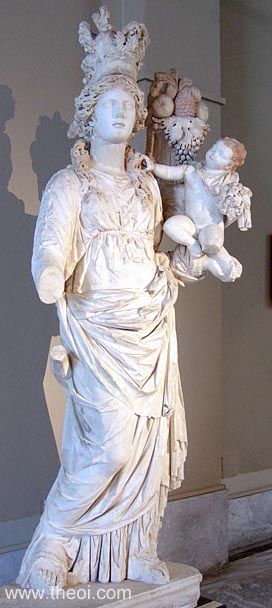
The goddess Fortuna here went by the epithet of Primigenia (meaning "first born") and was represented suckling two babes, as in the Christian representation of Charity, said to be Jupiter and Juno, and she was especially worshipped by matrons. The cult featured an oracle, consulted by the picking of lots as described by Cicero. The oracle continued to be consulted down to Christian times, until Constantine the Great, and again later Theodosius I, forbade the practice and closed the temple.
The monument to Victor Emmanuel II in Rome owes much to the site.
Tyche was quintessential until forced closure.
She is far from one-dimensional. She has a couple of peculiarly important epithets:
Αγαθη Τυχη Agathê Tykhê
Σωτηερια Sôtêria
Correspondingly, aside from her standard form, she has different appearances:
Pausanias, Description of Greece 9. 26. 8 :
"[At Thespiai, Boiotia there is an] image of Tykhe (Fortune), and in another place that of Hygeia (Health) . . . Athene Ergane (Worker), as well as that of Ploutos (Wealth), stands beside her."
III. LEBADEIA Village in Boeotia
Pausanias, Description of Greece 9. 39. 4 :
"This is what happens at the oracle [of Trophonios in Lebadeia, Boiotia]. When a man decides to go down to Trophonios, he first lives a certain number of days in a building which is consecrated to Agathe Tykhe (Good Fortune) and the Daimon Agathos (Good Spirit). Living there he purifies himself."
The statue is significant, because, the thing that steals everyone's names, also describes itself as giving us ploutos, as a noun, stripped off the deity. At the time, the Thespian School portrayed Tyche also with infant Ploutos:
His origin is compressed:
[1.1] IASION & DEMETER (Hesiod Theogony 969, Diodorus Siculus 5.77.1, Hyginus Astronomica 2.4)
[1.2] DEMETER (Folk Songs Frag 862, Greek Lyric Scolia Frag 885)
[2.1] TYKHE (Aesop Fables 130)
From Hesiod:
Aesop is a little different, is a didactic, and just bears a remark about Tyche and not mentioning a father; but this is incidental in the process of Herakles solely disliking Ploutous of all immortals:
The moral is we have a philosophical and moral struggle of Herakles in terms of what is Victory.
I would contend that Ploutous is strongly akin to our Buddhist Yaksha, which works with Demeter -- Tyche as similar to Lakshmi. I can sense the presence of a syncretic deity. That this was the mold from which the oldest surviving Indic scriptures attested.
Now, considering the region in Greece has the name of constellation Bootes:
Exactly whom Boötes is supposed to represent in Greek mythology is not clear. According to one version, he was a son of Demeter, Philomenus, twin brother of Plutus, a plowman who drove the oxen in the constellation Ursa Major. This agrees with the constellation's name. The ancient Greeks saw the asterism now called the "Big Dipper" or "Plough" as a cart with oxen. Some myths say that Boötes invented the plow and was memorialized for his ingenuity as a constellation.
It's not unclear. Hesiod is something like "scripture", to whom we might compare Aesop and some Playwrights as "hypothetical", such as Tyche may have just been implied as equivalent to Demeter. Or, it is a word twist on their meaning. Or, something could be made up or changed. In some cases, there are further details, such as Hyginus elaborates on Hesiod:
Theoretically, from Cretan times, Wealth was agricultural wealth, and eventually there is the association Ploutous <--> Plouton (Hades), subterranean wealth (minerals and metals) or hidden wealth (esoterism).
Holding an infant definitely does not equate to motherhood, as, for example, elsewhere, Ploutous is held similarly by Irene (Peace).
If this means Booetia acquired agriculture from Crete, it may be Saffron. I would tend to guess these symbols are more real than King Minos. We found infant or youth Zeus is from Crete.
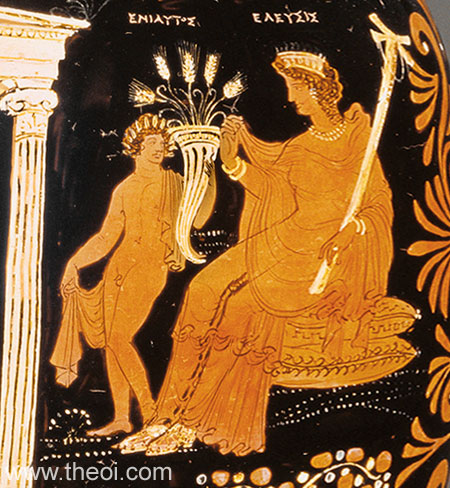
As a very strong suggestion towards that, Demeter may be distinguished by a tiara and other details.
Detail of Demeter and Plutus from a painting depicting the tale of Leda and the Swan.
The goddess Demeter, seated on a pair of cushions and holding a four-headed Eleusinian torch, is labelled "ELEUSIS", as queen of the Eleusinian Mysteries. Her son Plutus, here named "ENIATOS" (Year), holds a cornucopia (horn of plenty) bursting with heads of grain:
Iasius the father of Ploutous is simply stated as such by both Hesiod and Homer; and later chronicles give many versions.
So, from evaluating Eros as closely corresponding to our Amitayus, aside from finding this in Orphic Theology, it seems that the subject of Eros has perhaps been squeamishly avoided according to Braga 2025:
Ok. Seems odd we would just examine Tyche as "good fortune" and crown her with the walls of a city, and turn around and blame her for "rupture".
That is kind of the point, there is more to a deity than praise it and get a free paradise.
Aside from Aesop's remark, Tyche does not have children and is not depicted as the consort of a male deity. Her appearance with Herakles is a role or an interaction. And in coinage we find such a panoply leading up to Eros and Tyche:
Eros r., holding a long sceptre, facing Tyche l., holding a long staff and cornucopiae; between them, a burning altar:
Tyche seated on a rock; on the Severus Alexander coins she is accompanied by Eros and the river-god Tembris, on those of Caracalla and Maximinus I by two Erotes with torches:
She's not Psyche. This is some kind of twist or plot in that overall pursuit. Erotes relates to the doctrine of Eidola.
There are similar designs in statuary:
Agatha Tyche, or, the non-rupturing of one's Eros, would appear to depend on Agathodaimon. This is extraordinarily personal or esoteric once you start to get it.
Pausanias, Description of Greece 7. 26. 8 :
"I remember observing at Aigeira [in Akhaia] a building in which was an image of Tykhe (Fortune) carrying the horn of Amaltheia. By her side is a winged Eros (Love), the moral of which is that even success in love depends for mankind on fortune rather than on beauty. Now I am in general agreement with Pindar's ode, and especially with his making Tykhe one of the Moirai (Fates), and more powerful than her sisters."
...at Lebadeia, together with agathos daimôn.
Hesiod calls Tyche an Okeanid, that is, a River Goddess whose origin is Antioch on the Orontes. Therefor, it is plausible she could take a second birth in the sense of a meaning elaborated by the Greek pantheon itself. And in this way, she becomes associated with a particular aspect of Zeus:
"Daughter of Zeus Eleutherios (Liberator), Tykhe (Tyche, Fortune) our saviour goddess."
Orphic Hymn 72 to Tyche (trans. Taylor) (Greek hymns C3rd B.C. to 2nd A.D.) :
"Queen Tykhe (Tyche) . . . born of Eubouleos (Eubuleus) [Zeus, the Counsellor] famed."
And so there, we are seeing her Soter manifestation, derived from a type of Zeus that is not automatic for everybody. At least I get the sense something would have to be earned there, not just given. Aristophanes has a large Plutus extraction from a play, which is relatively deep with introspection on the issues.
So her epithets are probably designations, such as Tyche Soteria -- Daughter of Zeus, and Agatha Tyche -- Sister of Agathodaimon. She interfaces with Nemesis, Aphrodite, and Psyche.
These roles are perhaps something like astrological Houses.
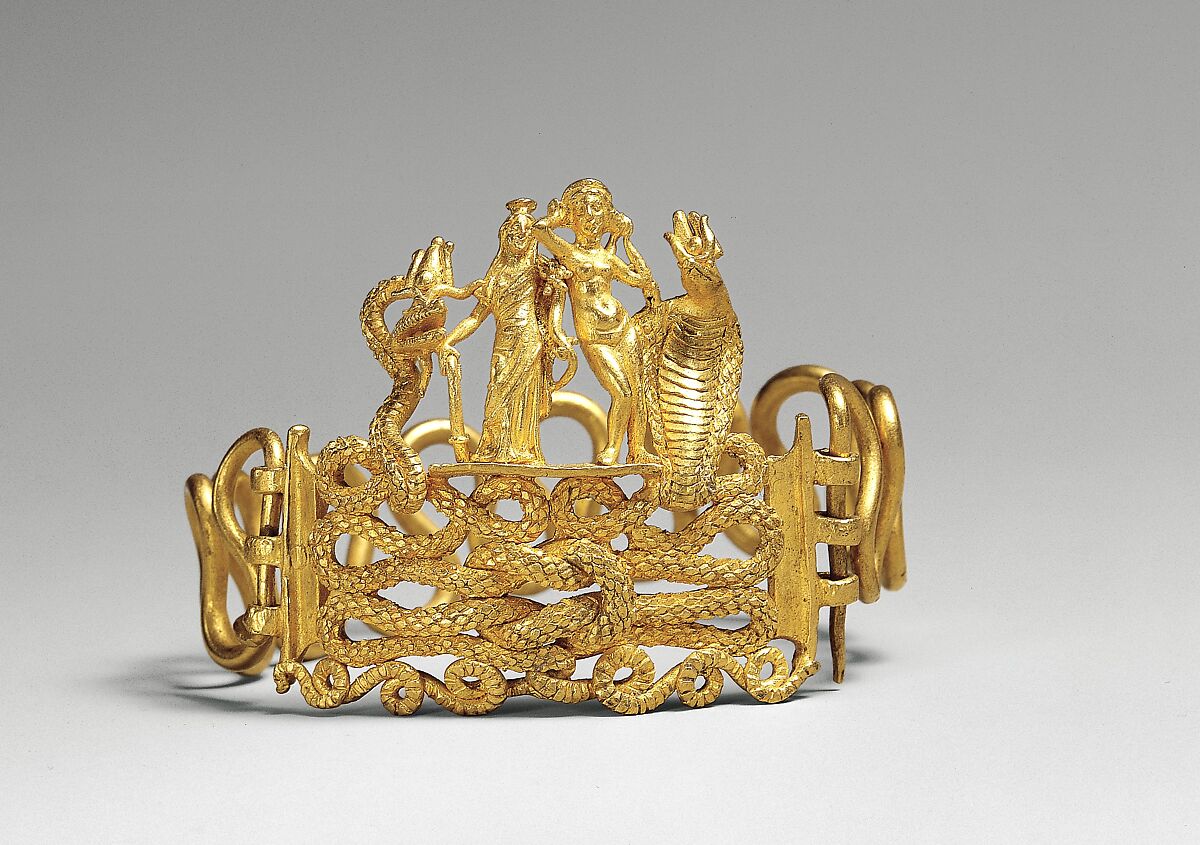
We have seen this before, it is this theophany cast in Gold from Alexandria at The Met.
Powerful talismans of fertility and good destiny are woven into this rich golden composition. The bodies of two snakes intertwine to form a Herakles knot, the centerpiece of this bracelet. The snake on the left represents Agathodaimon, and the cobra on the right Thermouthis, two agrarian/fertility deities associated with Serapis and Isis, respectively. On the platform between them stand two goddesses, Isis-Tyche (or Isis-Fortuna), a deity closely associated with Alexandria, and the nude Aphrodite:
- Home
- Forum
- Chat
- Donate
-
Site Links

-
Avalon Library
-
External Sites
- Solari Report | Catherine Austin Fitts
- The Wall Will Fall | Vanessa Beeley
- Unsafe Space | Keri Smith
- Giza Death Star | Joseph P. Farrell
- The Last American Vagabond
- Caitlin Johnstone
- John Pilger
- Voltaire Network
- Suspicious Observers
- Peak Prosperity | Chris Martenson
- Dark Journalist
- The Black Vault
- Global Research | Michael Chossudovsky
- Corbett Report
- Infowars
- Natural News
- Ice Age Farmer
- Dr. Joseph Mercola
- Childrens Health Defense
- Geoengineering Watch | Dane Wigington
- Truthstream Media
- Unlimited Hangout | Whitney Webb
- Wikileaks index
- Vaccine Impact
- Eva Bartlett (In Gaza blog)
- Scott Ritter
- Redacted (Natalie & Clayton Morris)
- Judging Freedom (Andrew Napolitano)
- Alexander Mercouris
- The Duran
- Simplicius The Thinker




 Reply With Quote
Bookmarks