+ Reply to Thread
Page 12 of 13 FirstFirst 1 2 12 13 LastLast
Results 221 to 240 of 241

Thread: The Great Gold Heist

  1. Link to Post #221
    United States Administrator ThePythonicCow's Avatar
    Join Date
    4th January 2011
    Location
    North Texas
    Language
    English
    Age
    78
    Posts
    30,717
    Thanks
    37,446
    Thanked 154,219 times in 23,587 posts

    Default Re: The Great Gold Heist

    Quote Posted by shaberon (here)
    A massive outflow is not a "good" sign usually. I don't know of a way to call it a healthy symptom.
    On the accounting books, it is not a massive outflow. It's a minor loss of further income to some U.S. vault(s) for vault storage fees.

    When you drive your $250,000 custom Rolls Royce out of the parking lot and pay the parking fee you accumulated, the parking lot did not have a $250,000 outflow; it only lost its profits, after expenses, of further parking fees.

    (you do have a Rolls, I trust ...)
    My quite dormant website: pauljackson.us

  2. The Following 4 Users Say Thank You to ThePythonicCow For This Post:

    Bill Ryan (25th April 2026), Ravenlocke (28th April 2026), shaberon (25th April 2026), Yoda (25th April 2026)

  3. Link to Post #222
    United States Avalon Member
    Join Date
    1st April 2016
    Posts
    6,617
    Thanks
    34,417
    Thanked 37,735 times in 6,267 posts

    Default Re: The Great Gold Heist

    Quote Posted by ThePythonicCow (here)
    On the accounting books, it is not a massive outflow. It's a minor loss of further income to some U.S. vault(s) for vault storage fees.

    Probably, but those are just accounting books. Are these not one of the main sources of deceptive economics, e. g. double-entry bookkeeping which allows you to remove the financial aspect from the actual material one.

    As an "investment", it may also look good, if it is something like purchases at $3k were unloaded for a slightly off-peak $4.2k, then someone did indeed raise some cash.

    As for the movement:


    Quote Repatriation, which is the return of foreign-earned profits or assets back to a home country, is not counted as an export in trade statistics.

    That's not being counted, and we don't see any movement by the Central Bank, so the Forbes figures must only be about private sales.

    In the physical world, it is a significant departure of a commodity, the one you are particularly advised not to release.


    Considering that markets basically only care about the price movement:


    Quote Analysts attributed the move to a stronger U.S. dollar, rising bond yields and growing expectations that persistent inflation would keep interest rates higher for longer, reducing the appeal of non-yielding bullion.


    Price compared to purpose by Gabelli Funds:


    Quote Mancini told Kitco News on Tuesday that while the gold price may have fallen since the outbreak of the Iran conflict, it’s a sign that the yellow metal is serving its purpose in times of crisis – for states as much as for investors.

    “Turkey as well as the Gulf states might be selling, especially if they’re unable to export their oil and need to cover their expenses,” he said. “They have gold reserves, and gold is serving its purpose as a liquid asset right now.”

    Mancini contrasted gold’s simple liquidity with the lessons the world has learned about government debt.

    “Gold is an asset that is no one’s liability,” he said. “Unlike Treasuries, German bonds, or French bonds, you aren’t lending to anyone when you buy gold. When you purchase gold, you simply own it outright, but when you buy a Treasury, you’re lending to the United States government.”

    “As debts and deficits grow, gold tends to become more attractive, which is one aspect of the trade right now,” he added. “Increased defense spending will likely contribute to that dynamic as well.”

    Mancini pointed out that the Iran war and the surge in defense spending are happening against the backdrop of a long-term move away from the U.S. dollar.

    “We’re going through a major paradigm shift in terms of the de-dollarization of global reserves,” he said. “When Russia invaded Ukraine, the United States effectively confiscated the Treasuries that Russia owned, meaning Russia had been lending to the United States, and we essentially said we wouldn’t pay them back. That event helped drive gold from around $2,000 an ounce to about $5,000.”

    “We’re seeing discussions from the President and others about a potential new world order. In that environment, there’s a real possibility that the dollar may no longer serve as the global reserve currency,” Mancini said. “Running a foreign exchange surplus requires buying dollars and Treasuries and effectively lending to the United States government. Given what’s happening right now with the broader paradigm shift and evolving global order, there’s a strong chance that surplus countries may no longer want to continue lending to the United States.”

    “If that’s the case, gold will become the primary alternative.”

    Looking past the current conflict to the medium term, Mancini still expects gold to rise above $6,000 per ounce.

    “The price was around $5,300, and it pulled back amid a bout of selling and related factors, he said. “But once things settle and this new paradigm shift takes hold, gold should move above $6,000.”


    And on trends rather than predictions:


    Quote BRICS+ nations now hold 17.4% of global gold reserves, up from 11.2% in 2019, while the dollar’s share of global reserves fell to its lowest level since 1994 – and one BRICS member could well buy as much as all other countries combined, according to Michael Harris, technical analyst at EBC Financial Group.

    In a new analysis published Tuesday, Harris wrote that central banks bought more gold in the past three years than at any point in modern history – and the concentration of bullion among BRICS+ members’ reserves is skyrocketing.

    Harris noted that central banks bought more than total annual mine production of several mid-sized gold-producing countries in 2025. “This is not speculative demand, it is policy,” he said. “The buyers are concentrated, but the trend is broad. Russia, China, India, Turkey, and Poland have led the accumulation, but more than 40 central banks participated in 2025.”

    “The buying has been one-directional and price-insensitive, meaning sovereign purchasers absorb supply regardless of whether gold trades at $4,000 or $5,000.”

    And the member states of the so-called ‘BRICS+’ – originally Brazil, Russia, India, China, and South Africa, with later additions Egypt, Ethiopia, Iran, and the UAE – are among the global leaders in gold acquisition.

    “BRICS+ nations now hold over 6,000 tonnes of gold, representing approximately 17.4% of total global central bank reserves, up from 11.2% in 2019,” Harris said. “Russia leads with 2,336 tonnes, China holds 2,298 tonnes, and India follows with 880 tonnes. Together, Russia and China control roughly 74% of the bloc’s total gold holdings.”

    Harris pointed out that from 2020 and 2024, BRICS members’ central banks represented over 50% of all sovereign gold purchases globally. “In the first nine months of 2025, BRICS nations added 663 tonnes worth approximately $91 billion,” he said. “Brazil made its first gold purchase since 2021, adding 16 tonnes in September 2025.”

    The turning point, however, happened in 2022, when the United States and its allies froze roughly $300 billion in Russian foreign exchange reserves following its invasion of Ukraine.

    “That action sent a clear message to every central bank holding dollar-denominated assets: reserves stored in another country’s financial system can be seized,” Harris wrote. “The response was immediate. Central bank gold purchases jumped from roughly 500 tonnes per year before 2022 to over 1,000 tonnes annually in each of the three years since. Gold stored in domestic vaults cannot be frozen or confiscated through the SWIFT system.”

    But while gold accumulation represents one side of this structural shift, the other side is the U.S. dollar’s declining share of global reserves.

    “IMF COFER data shows the dollar’s share fell from 71% in 1999 to roughly 57% by the end of 2025, its lowest reading since 1994,” Harris said, but noted that foreign central bank holdings of dollar-denominated assets have actually remained steady since 2014. “The decline in share is driven not by active selling but by faster growth in reserves held in euros, yen, gold, and a growing basket of non-traditional currencies.”

    Harris cited the 2025 World Gold Council survey which found that 73% of participating central bankers believe the dollar’s reserve share will decrease further over the next five years, while 43% of surveyed central banks plan to increase their gold holdings – both record-high levels.

    But while the impact on the dollar side has been gradual, the gold side of the equation has exploded.

    “Gold’s share of official reserve assets has more than doubled from below 10% in 2015 to over 23% today,” he wrote. “Much of this reflects gold’s price appreciation, but the direction is unmistakable: central banks are allocating a growing share of their portfolios to gold, and the Hormuz crisis has only reinforced the urgency.”

    And the largest economy in the Persian Gulf also represents one of the biggest wildcards in this shift. “Saudi Arabia holds approximately 323 tonnes of gold, just 2.6% of its total reserves,” Harris noted. “For a nation sitting on over $500 billion in reserves, that allocation is remarkably low. A move to just 5% gold allocation would require purchases equivalent to the entire projected central bank demand for 2026 from a single buyer.”

    “The Kingdom has not publicly announced plans to increase gold holdings, but its BRICS+ membership, its participation in the mBridge platform, and its deepening ties with Beijing all point toward a strategic repositioning that could logically include gold.”

    Turning to the gold market itself, Harris offers an analysis of the impact of central bank demand in creating a structural floor for prices.

    “Gold is trading near $4,660 per ounce as of early April 2026, having surged over 60% in 2025 alone,” he said. “The rally has pushed forecasts sharply higher, with Deutsche Bank targeting $6,000, JPMorgan at $6,300, Goldman Sachs at $5,400, and Societe Generale calling $6,000 conservative. The World Gold Council projects 750 to 850 tonnes of central bank purchases in 2026, still far above historical norms.”

    “That volume represents roughly 20% of annual global mine supply, absorbed as a one-directional flow regardless of price,” he added. “This creates a structural floor that has made each correction shallower than the last.”

    Institutional flows are also serving to reinforce central bank demand. “Gold ETF inflows accelerated through 2025, and China’s insurance sector has been allocated pilot positions in gold,” Harris wrote. “When sovereign, institutional, and retail buyers all move in the same direction simultaneously, the supply-demand picture tightens in ways standard price models fail to capture.

    Harris then proposes three potential developments that would accelerate the current sovereign trend away from the dollar and into gold.

    Firstly, if China becomes more transparent about their gold purchases and reveals larger-than-expected gold holdings, “that would be an immediate catalyst,” he said. “Second, any formal gold allocation increase by Saudi Arabia or the UAE would confirm that the newest BRICS+ members are following the Russia-China playbook.”

    “Third, watch for further declines in the dollar’s reserve share in the next IMF COFER release, since each incremental drop reinforces the narrative driving sovereign gold demand.”

    “The shift from dollar reserves to gold is not a prediction but a trend, supported by three years of data, more than 40 participating central banks, and over 3,000 tonnes of metal moved into sovereign vaults since 2022,” Harris concluded. “The dollar remains dominant, but the direction is clear: central banks are building positions in an asset no foreign government can freeze, at a pace not seen in half a century.”

    “Gold at $4,660 reflects that reality, and the forecasts above $5,000 reflect where the market thinks this goes next.”


    Quote (you do have a Rolls, I trust ...)

    I park one at each hole on my many golf courses

  4. The Following 4 Users Say Thank You to shaberon For This Post:

    Bill Ryan (27th April 2026), Ravenlocke (28th April 2026), ThePythonicCow (26th April 2026), Yoda (25th April 2026)

  5. Link to Post #223
    United States Administrator ThePythonicCow's Avatar
    Join Date
    4th January 2011
    Location
    North Texas
    Language
    English
    Age
    78
    Posts
    30,717
    Thanks
    37,446
    Thanked 154,219 times in 23,587 posts

    Default Re: The Great Gold Heist

    Quote Posted by shaberon (here)
    I park one at each hole on my many golf courses
    You're clearly a man who organizes his life well.
    My quite dormant website: pauljackson.us

  6. The Following 3 Users Say Thank You to ThePythonicCow For This Post:

    Bill Ryan (27th April 2026), shaberon (26th April 2026), Yoda (26th April 2026)

  7. Link to Post #224
    United States Avalon Member
    Join Date
    1st April 2016
    Posts
    6,617
    Thanks
    34,417
    Thanked 37,735 times in 6,267 posts

    Default Re: The Great Gold Heist

    Quote Posted by ThePythonicCow (here)
    Quote Posted by shaberon (here)
    I park one at each hole on my many golf courses
    You're clearly a man who organizes his life well.


    It's a sordid history with gold, the kind that makes you want to play Russian roulette, with imaginary ghosts, and silver-tipped bullets.

    The Prospector was real, and it was something about a 1950s limited edition Ford about which I am not sure I can remember the name, although I posted something about it, I cannot remember where, maybe it was in here. But I can't remember or not.

    I remember when Rothschild sold their seat off the gold fix.

    It was all too revealing about human psychology, but, that genie won't go back in that bottle.

  8. The Following 3 Users Say Thank You to shaberon For This Post:

    Bill Ryan (27th April 2026), Ravenlocke (28th April 2026), Yoda (26th April 2026)

  9. Link to Post #225
    United States Administrator ThePythonicCow's Avatar
    Join Date
    4th January 2011
    Location
    North Texas
    Language
    English
    Age
    78
    Posts
    30,717
    Thanks
    37,446
    Thanked 154,219 times in 23,587 posts

    Default Re: The Great Gold Heist

    Quote Posted by shaberon (here)
    It's a sordid history with gold,
    No doubt it's sordid.

    But Prof. Michael Hudson calling this (gold moving from the U.S. to nations such as Poland) an "export" and evidence of the U.S. having to sell large amounts of U.S. owned gold, hence evidence of U.S. bankruptcy, are not justified by the evidence we have. Hudson should know that.

    I am not saying that the U.S. was not selling gold. I was not saying the U.S. is not bankrupt. We can only speculate on such concerns, doing so with full confidence that we're being lied to six ways from Sunday.

    But Hudson's conclusions do not conclusively follow from the (rather misrepresented and likely unreliable) data he offered.
    My quite dormant website: pauljackson.us

  10. The Following 4 Users Say Thank You to ThePythonicCow For This Post:

    Bill Ryan (27th April 2026), Ravenlocke (28th April 2026), shaberon (26th April 2026), Yoda (26th April 2026)

  11. Link to Post #226
    United States Avalon Member
    Join Date
    1st April 2016
    Posts
    6,617
    Thanks
    34,417
    Thanked 37,735 times in 6,267 posts

    Default Re: The Great Gold Heist

    Quote Posted by ThePythonicCow (here)
    But Prof. Michael Hudson calling this (gold moving from the U.S. to nations such as Poland) an "export" and evidence of the U.S. having to sell large amounts of U.S. owned gold, hence evidence of U.S. bankruptcy, are not justified by the evidence we have. Hudson should know that.

    I am not saying that the U.S. was not selling gold. I was not saying the U.S. is not bankrupt. We can only speculate on such concerns, doing so with full confidence that we're being lied to six ways from Sunday.

    But Hudson's conclusions do not conclusively follow from the (rather misrepresented and likely unreliable) data he offered.

    Well, that was a clip from an interview I am not aware of, and, as such, comments are a bit off-the-cuff and imprecise.

    It's not possible for the United States or any sovereign country to be bankrupted, but, this term appears to be used by millions on a perpetual basis.

    The gold is an "export". It's not about repatriated gold. It wasn't sold by "the U. S. government" but by agencies in America, which, on a dollar basis, narrowed the trade deficit by 25%. Nevertheless, it's still a big deficit.

    So, yes, I think it was a hasty way of saying something that could have been expressed better. What we find is that it is currently less attractive as an investment. The point is it should be something you hoard. In the aftermath of World War Two, the United States received 75% or more of total world gold because it remained a financial and industrial power when most other places were severely battered. Now, no sign of this remains.

    The difficulty in following market news is that there is so much of it, unless you perhaps know the day a similar story may have been revealed, it's too hard to find, but if we could, such articles tend to be more specific on the sources and/or perceived reasons for drastic activity. In former times, I followed this every day, which is 95% uneventful with an occasional splash of insight, so I really don't like doing it.

    I certainly don't see misrepresented data on the large, sudden sale of gold.

    To summarize, we have gone from a year or so ago when bullion could not be provided fast enough to keep up with demand, to a fire sale this February.

    Compared to even its now-sky high cost:

    Quote Gold exports increased by $7.69 billion (75.4%) compared to January 2026, rising from $10.2 billion to $17.9 billion.


    Congressional report:


    Quote Today, the Joint Economic Committee released its analysis of the latest Monthly Trade Update based on information compiled from the Bureau of Economic Analysis, U.S. Census Bureau, Treasury Department, and the Bureau of Labor Statistics. The total trade deficit in February was $57.35 billion, up $2.67 billion from January and 11 percent below the 12-month average.

    In trade of goods, the U.S. ran a trade deficit of $84.60 billion, up $2.47 billion from January and 8 percent below the 12-month average. In trade of services, the U.S. ran a trade surplus of $27.26 billion, down $204.00 million from January and 1 percent below the 12-month average.

    Over the 12 months through February 2026, the U.S. ran a total trade deficit of $775.60 billion. In trade of goods, the U.S. ran a trade deficit of $1.11 trillion. In trade of services, the U.S. ran a trade surplus of $329.60 billion.

    Over the 12 months through February 2026, the U.S. had the largest goods trade deficits with Mexico, with net exports of -$194.61 billion, 17.76 percent of the total goods trade deficit; Vietnam, with net exports of -$187.93 billion, 17.15 percent of the total goods trade deficit; and China, with net exports of -$172.90 billion, 15.78 percent of the total goods trade deficit.

    Over the same time period, the U.S. had the largest goods trade surpluses with The Netherlands, with net exports of $65.56 billion, -5.98 percent of the total goods trade deficit; United Kingdom, with net exports of $42.57 billion, -3.88 percent of the total goods trade deficit; and Hong Kong, with net exports of $36.16 billion, -3.30 percent of the total goods trade deficit.

    Additionally, over the 12 months through February 2026, the most exported goods by value were civilian aircraft, engines, equipment, and parts; pharmaceutical preparations; and nonmonetary gold. Together, these goods accounted for 17.14 percent of the value of all exported goods over those 12 months.

    Over the same time period, the most imported goods by value were pharmaceutical preparations; computers; and passenger cars, new and used. Together, these goods accounted for 20.25 percent of the value of all imported goods over those 12 months.

    In February 2026, the U.S. calculated $21.24 billion in import duties, which is 13.25 percent lower than the 12-month average. Over the 12 months through February 2026, the U.S. calculated $293.80 billion in import duties. In February 2026, the average applied duty rate, defined as calculated duty revenue as a share of total imports for consumption, was 8.48 percent, which is 0.56 percentage points lower than the 12-month average.

    The trade deficit or balance-of-payments is the petrodollar, empire, or colonialism, in the sense if we buy billions of Qatari oil, they don't return it by buying a whole lot of American stuff. Instead, they are yoked to investing their profits in US stocks and Treasuries. It's a form of diktat or tribute. "Trade" nominally refers to only goods, whereas "payments" includes services.

    Losing $200B to Mexico doesn't quite come back the same way. As an example, many formerly American companies now are owned by Mendelez or something else in Mexico. Mexico controls the production, hence the profits, and what we are selling appear to be "services", such as use of the name "Twinkies".


    Quote The trade deficit allows Americans to consume more goods than they produce by borrowing from abroad.

    As per Congress:


    Quote The reason that the trade deficit must equal net foreign capital flows is because the only way the United States can import more than it exports is if it borrows an amount equivalent to the difference between the two (i.e., the trade deficit). By accounting identity, saving must equal investment—the money that is invested must come from somewhere. The United States is essentially investing more than it is saving and needs foreign saving to make up the difference, resulting in a trade deficit. There are two main reasons for this (1) The United States has a relatively low national saving rate, and (2) U.S. investment opportunities are relatively attractive to foreigners.
    Long-term historical trend:


    We are running on short-term fixes that miraculously have not blown up yet. It tends to benefit wealthy capitalists. Most of the rest of us can only say our gas and food has not totally disappeared, even if gold is hard to find.

  12. The Following 3 Users Say Thank You to shaberon For This Post:

    Bill Ryan (27th April 2026), Ravenlocke (28th April 2026), Yoda (26th April 2026)

  13. Link to Post #227
    United States Administrator ThePythonicCow's Avatar
    Join Date
    4th January 2011
    Location
    North Texas
    Language
    English
    Age
    78
    Posts
    30,717
    Thanks
    37,446
    Thanked 154,219 times in 23,587 posts

    Default Re: The Great Gold Heist

    Quote Posted by shaberon (here)
    The gold is an "export". It's not about repatriated gold.
    I am confident that Poland repatriated some gold and purchased some gold.

    Which is which, and how much of each is which, as it changed over time, is not evident from Hudson's summary numbers. Can you show me evidence that none of this gold that moved from a US vault to a Polish vault was repatriated?
    My quite dormant website: pauljackson.us

  14. The Following 3 Users Say Thank You to ThePythonicCow For This Post:

    Bill Ryan (27th April 2026), Ravenlocke (28th April 2026), Yoda (27th April 2026)

  15. Link to Post #228
    United States Avalon Member
    Join Date
    1st April 2016
    Posts
    6,617
    Thanks
    34,417
    Thanked 37,735 times in 6,267 posts

    Default Re: The Great Gold Heist

    Quote Posted by ThePythonicCow (here)
    I am confident that Poland repatriated some gold and purchased some gold.

    Which is which, and how much of each is which, as it changed over time, is not evident from Hudson's summary numbers.


    Yes, the Polish Central Bank has done both.

    I am presuming you are referring to the article you cited from May 9, 2025, which says:

    Quote Starting in mid-2019, NBP quietly began shipping bullion from the Bank of England and the Federal Reserve Bank of New York back to Polish soil. By early 2021, roughly 100 tonnes of gold—which had lain abroad since the 1950s—were sitting under reinforced vaults in Warsaw’s Świętokrzyska headquarters and a newly excavated bunker in Wrocław’s suburbs.
    In other words, it is talking about a six-year trend from two sources.

    The big balloon is for February, 2026 where from OEC export data, Poland is not a big customer, meaning its purchases were less than $294M, if they bought anything from the US at all.


    Quote Can you show me evidence that none of this gold that moved from a US vault to a Polish vault was repatriated?

    This year, yes, in Poland:

    Quote While no new mass repatriation from foreign vaults was announced in early 2026...

    I think you were reacting to a graphic that I posted showing Poland as the largest central bank purchaser of Gold in 2026 at 20.2 tons? That's just a total purchase regardless of source. All Prof. Hudson said, leaving off the poetical conclusion, is:


    Quote The #1 US export for 5 months straight is gold. Not AI, not aircraft. Gold to Switzerland, Hong Kong, China. In 1971 Nixon shut the gold window to stop it. Now America can't -- it IS the one selling.

    As an export, then, it is just a comparison of dollar amounts. He didn't publish any figures, I was only responding to the "#1" claim, which is confirmed everywhere.

    The combination says that in 2026, Poland's central bank has hardly repatriated anything, it has bought way more than anyone except for a couple of developing countries, and very little if any of that came from the US.

    I posted those because I did not know if "US" meant the country/central bank, or, the American people. They're export data which means sales, which has not been of central bank bullion held at the NY Fed which Treasury says has not fluctuated an ounce.

    When calling that "liquidation", that is true, even redundantly so. The colorful expression "America's broke" is...I mean, that's not really a tangible statistic of any kind, and I don't think it is intended as wall-to-wall penniless...and here is where it is too nice, I would put it as "generationally raped by a government that prefers corporations to human beings". But those were just a few sentences, I fetched those graphics off the web.


    Curious about what the Poles are up to? Kill:


    Quote Poland’s finance minister has dismissed as “a mirage” the president’s plan to sell central bank gold reserves to fund the military instead of tapping cheap EU loans intended for the same purpose.

    Andrzej Domański said Warsaw would seek to access the EU’s €150bn Security Action for Europe defence fund despite a presidential veto even if it meant reduced “flexibility” in using the loans for non-military investment.

    He pushed back against suggestions by President Karol Nawrocki and central bank governor Adam Glapiński to use the proceeds of gold sales as an alternative way to finance military expenditure.

    “I refuse to accept the [idea of] modernising the Polish army based on the mirage of future profits of the central bank — I refuse,” Dománski told the FT during a trip to Washington.

    While it was for the central bank to decide how to use its reserves, the institution would not have a final picture of its annual earnings until the spring of 2027, he said.

    “We need resources to modernise the Polish army now. I see no point in waiting, and this is why we will use Safe as quickly as possible.”


    Last year Poland was among the biggest central bank purchasers of gold, closing 2025 with about 550 tonnes of the metal, worth more than one-quarter of its total reserves. In January, Glapiński set a new target for the National Bank of Poland to own 700 tonnes.

    Two months later, Glapiński sided with Nawrocki in his feud with the pro-EU government of Prime Minister Donald Tusk over Safe. Glapiński and Nawrocki are nominees of the rightwing opposition Law and Justice party.

    While Nawrocki vetoed the government’s Safe bill, Glapiński suggested Polish gold could be sold and perhaps later repurchased, as an alternative to the EU loans of the Safe programme.

    However, Domański said any gains on sales of reserves could be offset by foreign-exchange movements during the financial year and the central bank had recently been making losses.

    Tusk has opposed the plan to use gold reserves. His government is in talks with the European Commission about channelling Safe loans into an existing Polish army fund, which has some spending restrictions but does not require presidential approval.

    Domański said his team was also in talks over another international defence funding proposal, called the multilateral defence mechanism.

    Championed by countries including the UK, Netherlands and Finland, the MDM would issue debt backed by guarantees from its members and use it for defence procurement, achieving economies of scale and easing member countries’ funding costs.

    The proposal, he said, might be an “interesting option” for Poland. “My top priority right now is Safe, but my team is also participating in MDM.”

    Domański and Glapiński also used their trip to Washington for the IMF spring meeting to promote Poland’s bid for membership of the G20. The US, which holds the G20 presidency, has invited Poland to attend December’s meeting of the group in Miami as a guest nation.

    I am no more interested in re-arming Europe than I am in US bases in West Asia.

    Unfortunately, most of political Europe has to scream about Russia so they have an excuse to re-run the Cold War.

  16. The Following 4 Users Say Thank You to shaberon For This Post:

    Bill Ryan (27th April 2026), Ravenlocke (28th April 2026), ThePythonicCow (27th April 2026), Yoda (27th April 2026)

  17. Link to Post #229
    United States Administrator ThePythonicCow's Avatar
    Join Date
    4th January 2011
    Location
    North Texas
    Language
    English
    Age
    78
    Posts
    30,717
    Thanks
    37,446
    Thanked 154,219 times in 23,587 posts

    Default Re: The Great Gold Heist

    By "US" I meant gold vaults in the United States, without intending to mean any particular owner of said vaults or of the gold therein.

    Yes, I agree that Hudson wrote what you quoted. I don't know what really happened, however.

    Yes, announced Polish repatriations were in prior years, so far as I know. What happened in Feb 2026 ... I don't reliably know.

    Yes, "export" usually means something like "sell (relinquish ownership for some compensation) and deliver", not "repatriate." That is how I presume Hudson intended the word, and only by stretching the meaning of "export" to its Latin roots, meaning "to port or carry away from" could I give him any benefit of the doubt and take his words to mean what I suspected was, in part, repatriation.

    I do doubt that the Feb 2026 U.S. exports (sell and ship) of gold were the largest exported good for that month, when those exports are historically less than (even when bundled with gems and other precious metals) the U.S. exports of any of the usually larger categories of 1. Mineral fuels including oil, 2. Machinery including computers 3. Electrical machinery and equipment, or 4. Aircraft and spacecraft.

    I do doubt that we can know what is really happening with most of the tonnage of above ground refined gold on this planet ... who holds it, and who thinks they own it, and how many times ownership claims are rehypothecated.
    Last edited by ThePythonicCow; 27th April 2026 at 10:36.
    My quite dormant website: pauljackson.us

  18. The Following 4 Users Say Thank You to ThePythonicCow For This Post:

    Bill Ryan (27th April 2026), Ravenlocke (28th April 2026), shaberon (27th April 2026), Yoda (27th April 2026)

  19. Link to Post #230
    United States Avalon Member
    Join Date
    1st April 2016
    Posts
    6,617
    Thanks
    34,417
    Thanked 37,735 times in 6,267 posts

    Default Re: The Great Gold Heist

    Quote Posted by ThePythonicCow (here)
    I do doubt that the Feb 2026 U.S. exports (sell and ship) of gold were the largest exported good for that month...

    Understandable, but is there evidence on that behalf? I don't see how it is supportable.


    Quote I do doubt that we can know what is really happening with most of the tonnage of above ground refined gold on this planet ... who holds it, and who thinks they own it, and how many times ownership claims are rehypothecated.

    Gold is protected by machine guns by people who monitor every gram. We had a "bullion shortage" because most of the bars were old and lacked a .5% of purity and had to be re-cast to modern standards. If something physically goes wrong, there would be an immediate uproar.

    As to the second part, that is worse. Lack of the audit of Fort Knox would be the biggest doorway of doubt, but, the number of types of "paper transactions" can be almost impossible to track and resolve. Of course, those do not exist in all countries, but, places where "financial services" prevail.


    The trend continues:


    Quote “[T]he National Bank of Poland increased its gold reserves by 11 tonnes in March,” Gopaul noted. “This lifts its YTD net purchases to 31 tonnes, and total gold holdings to 582 tonnes.”

    The Central Bank of Uzbekistan also increased its gold reserves by nine tonnes in March – its sixth straight month of buying. “Net purchases over Q1 totalled 25 tonnes, lifting overall gold holdings to 416 tonnes,” he said.

    That's in part because of 30% of price vanishing since the beginning of this year.

    Russian central bank sales, on the other hand, should be construed as a need for cash due to the Ukraine conflict and ongoing sanctions against them. That's tapping the reserve because they really need it.

    The best way to make a profit is to bankrupt a business. You can form a mining company, make an IPO, have futures contracts flipped around and re-hypothecated in any way, never mine a single ounce, take the profit you can and stick a court with trying to dole out the leftovers to creditors. It's the same with insurance. Running an ongoing company is more of a nag.

    Only so much can be said about personal gold owned as jewelry or a nugget you found in a stream, but, in "product" condition -- bars and coins -- it's hermetically sealed.

  20. The Following 4 Users Say Thank You to shaberon For This Post:

    Bill Ryan (27th April 2026), Ravenlocke (28th April 2026), ThePythonicCow (27th April 2026), Yoda (27th April 2026)

  21. Link to Post #231
    Avalon Member Ravenlocke's Avatar
    Join Date
    28th September 2011
    Posts
    27,567
    Thanks
    15,243
    Thanked 225,980 times in 27,559 posts

    Default Re: The Great Gold Heist

    Ben Norton

    This bombshell report shows how the US government buys black market gold from violent Colombian drug cartels, but falsely claims the gold originated in the US.

    Ironically the US government designated these cartels as terrorist orgs, as it buys their gold.
    https://nytimes.com/2026/04/26/insid...ug-cartel.html

    https://x.com/BenjaminNorton/status/2048939111994855760


  22. The Following 3 Users Say Thank You to Ravenlocke For This Post:

    Bill Ryan (28th April 2026), shaberon (28th April 2026), Yoda (28th April 2026)

  23. Link to Post #232
    United States Avalon Member
    Join Date
    1st April 2016
    Posts
    6,617
    Thanks
    34,417
    Thanked 37,735 times in 6,267 posts

    Default Re: The Great Gold Heist

    Quote Posted by Ravenlocke (here)
    This bombshell report shows how the US government buys black market gold from violent Colombian drug cartels, but falsely claims the gold originated in the US.

    Good point.

    The apparent precision I mentioned is only real in the case of market gold.

    It can't answer as to all possible sources, it just refers to good delivery bars, and, to a lesser extent, coins. They could have been made out of someone's false teeth.


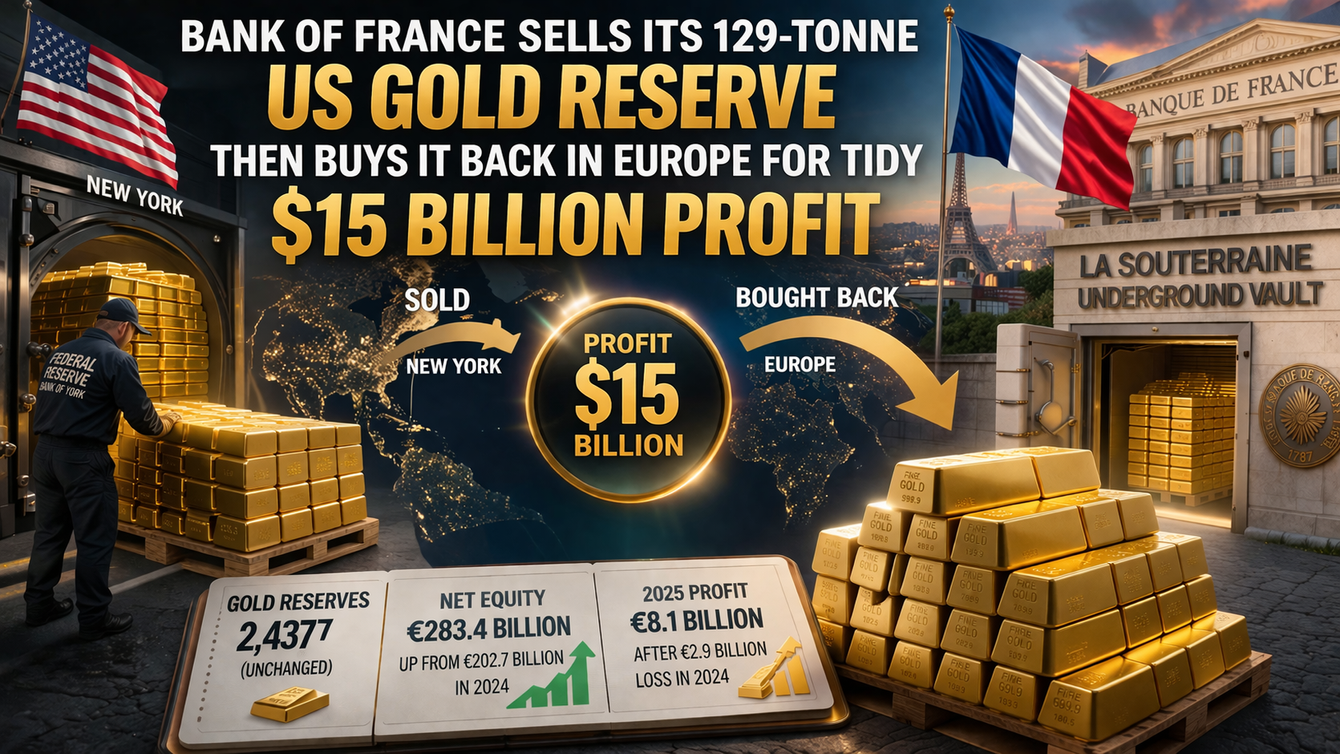
    France now holds all of its own gold, but, it did not all come in as repatriation:


    Quote The Bank of France found a novel way to get their gold out of U.S. custody without a diplomatic kerfuffle: Sell it at a profit in New York, then buy it right back on the continent.

    As part of their fiscal year 2025 announcement, the central bank revealed an “exceptional item” that allowed it to flip a EUR 2.9 billion loss into an EUR 8.1 billion annual profit.

    The move was as clever as it was profitable. Unlike the ongoing saga of Germany’s massive U.S.-based gold holdings – which remain in the Federal Reserve Bank of New York’s vaults, much to the consternation of many of the country’s politicians – the Bank of France did not try to raise the issue of withdrawal or transfer of their gold. Instead, they simply sold the older, less pure gold bars in New York for what they were worth in U.S. dollars as gold prices were reaching all-time highs, then pocketed the cash and bought bars that met their updated weight and purity standards in Europe, as prices conveniently pulled back.

    The types of things a central bank may do in a brief period of time are such that, due to the conflict in early 2026, Turkey liquidated -127t but in the past two weeks has bought back 36.


    The polar opposite are the re-hypothecated derivatives, which became concentrated in Deutsche Bank to the value of some $4T. This is their current view, which is worth comparing to some pages ago I think we posted on Basel III which is a new reserve requirement:


    Quote Gold is poised to benefit significantly from an increasingly fragmented world as nations continue to pivot into the metal and away from the US dollar as their go-to reserve asset, according to Deutsche Bank.

    In a note published on Monday, the German investment bank said it sees a scenario where central banks, especially those in emerging economies, continue to increase their gold holdings as a financial safety net to protect themselves from Western sanctions.

    The bank highlights that these central banks have added over 225 million ounces to their reserves since the 2008 financial crisis, while their holdings of US dollars have fallen from a peak of over 60% in the early 2000s to about 40% today.

    It is not only the major holders — China, Russia, India and Turkey — that are buying up gold. As Deutsche Bank noted, the purchases are broadening to include countries like Kazakhstan, Saudi Arabia, Qatar, Egypt and the United Arab Emirates.

    Should this trend continue, bullion’s share of global central bank reserves could realistically reach 40%, up from 30% currently, the bank predicts. At that allocation, Deutsche Bank ran a simulation that projects gold prices to hit $8,000 an ounce within five years — a near 80% rise on current levels.

    While this price projection is conceptual in nature and not an official forecast, it aligns with the industry’s prevailing view that gold stands to be the biggest beneficiary of the global de-dollarization movement as trust in US assets continues to erode.

    A survey last year by the World Gold Council revealed that central banks see economic and geopolitical uncertainty as a key factor influencing their decision to accumulate gold.

    So far this year, the precious metal has risen by nearly 8%, building on the strong momentum from central bank purchases last year. However, prices have been on a decline since the US-Iran war broke out, wiping out two-thirds of its gains from January, when it rallied to a record high.

    It's like juggling water. You want a generous pile of gold, since uncontrollable circumstances like for Turkey might compel you to sell something, or the unpredictable nature of the dollar and political dislike of Treasuries make them of lesser interest.

    I don't necessarily care about such a big prediction, but, it helps in getting a look at aggregate behavior.

  24. The Following 2 Users Say Thank You to shaberon For This Post:

    Bill Ryan (28th April 2026), Yoda (28th April 2026)

  25. Link to Post #233
    United States Avalon Member
    Join Date
    1st April 2016
    Posts
    6,617
    Thanks
    34,417
    Thanked 37,735 times in 6,267 posts

    Default Re: The Great Gold Heist

    Under the headline Not Good News, Forbes had already discussed the bubble we recently saw. But it was for 2025 generally:


    Quote ...in October, the value of U.S. gold exports was $16.72 billion, the highest one-month total ever and the first time gold had ever ranked first among all U.S. exports.

    In November, that total slipped to $12.45 billion, the second-highest total on record and enough to remain as the nation’s leading export.

    ...seven of the 10 months with the largest total for gold exports going back two decades occured in 2025.

    The main destination was predictable:


    The relatively minor reaction to it:


    Quote The increase in gold’s price from less than $3,000 per ounce prior to Trump’s April 2 announcement of his trade war with the world, to more than $5,500 less than a year later, was never good news.

    Those that paid attention to these things, and many others, were unnerved.

    While gold’s brief reign at the top of the export chart will almost certainly fade, the forces that pushed it there might not. President Trump’s chaotic first year back in the White House, symbolized by an on-again, off-again, on-again trade war with the world, has frightened investors and central bankers. In the end, gold’s ascension in October and November should serve as a reminder that when policy becomes unpredictable, even the world’s reserve currency can look less like a safe harbor than a risk to hedge.

    Now, for the first time in thirty years, the top export destination is Mexico, overtaking Canada.

    China faded by some 6%.

    Anyway, I think that could be considered bleeding...it wasn't a one-off month, this is a trend under the current Administration, which is a disaster in progress.

  26. The Following 4 Users Say Thank You to shaberon For This Post:

    Bill Ryan (30th April 2026), mountain_jim (1st May 2026), ThePythonicCow (1st May 2026), Yoda (1st May 2026)

  27. Link to Post #234
    United States Administrator ThePythonicCow's Avatar
    Join Date
    4th January 2011
    Location
    North Texas
    Language
    English
    Age
    78
    Posts
    30,717
    Thanks
    37,446
    Thanked 154,219 times in 23,587 posts

    Default Re: The Great Gold Heist

    Quote Posted by shaberon (here)
    Anyway, I think that could be considered bleeding...it wasn't a one-off month, this is a trend under the current Administration, which is a disaster in progress.
    Investors, like sailors, pull in their sails in stormy weather.

    Whether the storm is an unfolding disaster, or a rough patch on a successful journey to a new land, is not obvious to the seasick passenger in the ship's hold.
    My quite dormant website: pauljackson.us

  28. The Following 4 Users Say Thank You to ThePythonicCow For This Post:

    Bill Ryan (1st May 2026), mountain_jim (1st May 2026), shaberon (1st May 2026), Yoda (1st May 2026)

  29. Link to Post #235
    United States Avalon Member
    Join Date
    1st April 2016
    Posts
    6,617
    Thanks
    34,417
    Thanked 37,735 times in 6,267 posts

    Default Re: The Great Gold Heist

    It's definitely a disaster off Reuters a few minutes ago:


    Quote In thrall to an AI boom that has sent stocks to record highs and harbouring hopes of a short-lived Iran war, investors have yet to prepare for a doubling of physical oil prices. The window to do ​so may soon be closing.

    There are plenty of reasons for market confidence, largely centred on the artificial intelligence galaxy of hyperscalers, semiconductor makers and software developers and robust ‌earnings growth. The S&P 500 hit fresh record highs on Thursday.

    While price pressures are showing up in business activity surveys and consumer inflation expectations, growth and employment remain on a fairly even keel and global central banks suggest they will not rush to raise interest rates as they weigh the impact of the war.

    The part of the energy landscape where the real issue lurks is the physical market, where actual barrels of crude and refined products change hands, rather than ​electronic futures.

    At around $130 per barrel, prices here are some 70% higher than where they were in February, whether that is North Sea Forties, Angolan Cabinda or Norwegian Troll.

    This reflects much higher energy ​costs for the world economy than implied by Brent crude futures , which are trading around $110 a barrel, 50% higher than at the end of February.

    Brent for delivery ⁠in 12 months' time is above $80 a barrel, 20% above late-February levels .

    "The physical markets reflect the reality on the ground and the futures market reflects more perceptions and hopes," said Tamas Varga, an ​analyst at energy broker PVM Oil Associates.

    "One might say that physical markets are the true reflection of actually what's happening around the Strait of Hormuz."

    Finished off by:

    Quote In under ​18 months, the Trump administration has shaken up global trade and international relations, generating near-unprecedented levels of uncertainty about America's reliability as ​an economic and security partner.


    I would not rely on the power of metaphor and logical possibilities to justify gross mismanagement.

    The expectation is that some of the highly wealthy can weather any storm. That's really nice, when human lives are tossed like so much debris into extinction.

    Yesterday I was looking for any new figures about large gold moves. They're not out yet; typically running a couple months behind. It turned out there is a retrospective picture to say, gold has been unusually high or even the peak of American exports for an extended time period. That's great, if you are producing it from a mine, but we see if someone like the Turkish Central Bank is forced to do so out of necessity, its next plan is to immediately accumulate a higher level.

  30. The Following 2 Users Say Thank You to shaberon For This Post:

    Bill Ryan (2nd May 2026), Yoda (1st May 2026)

  31. Link to Post #236
    United States Administrator ThePythonicCow's Avatar
    Join Date
    4th January 2011
    Location
    North Texas
    Language
    English
    Age
    78
    Posts
    30,717
    Thanks
    37,446
    Thanked 154,219 times in 23,587 posts

    Default Re: The Great Gold Heist

    Quote Posted by shaberon (here)
    I would not rely on the power of metaphor and logical possibilities to justify gross mismanagement.
    I would not rely on the power of Reuters to provide unbiased reporting on serious challenges to the British Empire.
    My quite dormant website: pauljackson.us

  32. The Following 2 Users Say Thank You to ThePythonicCow For This Post:

    Bill Ryan (2nd May 2026), Yoda (2nd May 2026)

  33. Link to Post #237
    United States Avalon Member TODD & NORA's Avatar
    Join Date
    2nd July 2013
    Language
    English
    Posts
    379
    Thanks
    706
    Thanked 1,797 times in 325 posts

    Default Re: The Great Gold Heist

    Gold will likely drop until the Iran war reaches its apex...then it would be a good time to buy. We are holding UVIX now, as this next round is expected to crater markets by 20+%.

  34. The Following 4 Users Say Thank You to TODD & NORA For This Post:

    Bill Ryan (2nd May 2026), gini (13th May 2026), ThePythonicCow (2nd May 2026), Yoda (2nd May 2026)

  35. Link to Post #238
    United States Avalon Member
    Join Date
    1st April 2016
    Posts
    6,617
    Thanks
    34,417
    Thanked 37,735 times in 6,267 posts

    Default Re: The Great Gold Heist

    Extract from Prof. Hudson based on 1971 as the stoppage of gold flow out of the US:


    Quote The business community is not the economy. The American Empire was able to achieve its military dominance and economic dominance after 1945 because its economy was strong.

    What began to undercut its international economic power was the Vietnam War. It actually began with the Korean War in 1950 and 1951. That was the year in which America’s balance of payments moved into deficit. By the Korean War, every single Friday in the mid-1960s, when I was working at Chase Manhattan. We would look Friday morning at the Federal Reserve statements of the gold supply, and we were watching all the dollars that America was spending in Vietnam and Cambodia, elsewhere in Asia, being turned over to the French banks for General de Gaulle to cash into gold. And Germany was also picking up the slack from the United States.

    We were watching the gold flow out of the United States and ultimately forced the dollar off gold convertibility in 1971. Well, this didn’t turn out to be the disaster that the Americans expected for the reasons that I discussed in Superimperialism.

    Today, let’s look at the situation again. The largest commodity exports from the United States, for the last five months, can you guess what commodity it is? Not aircraft, not automatic intelligence, not computers. It’s non-monetary gold. America’s largest export is now the gold that its private holders and perhaps even the U.S. government have had. The largest exports of gold are to Britain and Switzerland, Switzerland being a transfer point to China and Hong Kong. Hong Kong is the third major destination of this gold.

    Forbes magazine, just in the last few days, came out with all of these figures saying, there’s about a six week to eight-week lag in the publication of foreign trade figures, but the most recent figure we have is in February, and that’s five months in a row where gold is a major American export.

    In 1971, the United States said, okay, we’re not selling you gold anymore. What’s your choice? You don’t have any choice. How are you going to save all these dollars that you’re accumulating? Well, there’s really no alternative to gold. We’re not going to let you invest in American companies or control our economy like we use your balance of payments to buy out your economy. All you can do is buy U.S. Treasury securities or corporate bonds.

    That’s not the case now because Iran, like Venezuela, was saying, we don’t want to hold dollars, and we have alternative dollars now. We can hold Chinese yen, essentially. So now, when America loses gold, this money is not recycled into loans to the U.S. Treasury to fund the balance of payments deficit to continue waging war.

    America is being stripped of its gold and its core international economic power, just as it’s being stripped of its bombs and missiles and aircraft and all the other elements of war. America’s left without any cards to play the game, if you want to look at it in terms of game theory. America is broke. That is what the Iran war has done to Trump’s plans. And this is what didn’t occur in any of the past wars because other countries had no alternative.

    Now we’re seeing an alternative to the U.S. Empire come into being: de-dollarization, and the whole world is splitting, as Richard and I have been describing for the last year.

  36. The Following 2 Users Say Thank You to shaberon For This Post:

    gini (13th May 2026), Yoda (4th May 2026)

  37. Link to Post #239
    Netherlands Avalon Member gini's Avatar
    Join Date
    29th January 2016
    Location
    Northern Thailand
    Posts
    1,525
    Thanks
    36,412
    Thanked 11,487 times in 1,509 posts

    Default Re: The Great Gold Heist

    --
    May 12, 2026
    India’s Prime Minister has urged citizens to stop buying gold for a year.

    Why?

    Because India is facing a mounting foreign-exchange squeeze, rising oil import costs, pressure on the rupee, and a growing need to conserve dollars. At the same time, Indian banks have reportedly faced weeks of disruption importing gold and silver, with customs delays, tax uncertainty, and supply bottlenecks creating pressure in the world’s second-largest gold market.
    This is not just a story about jewellery demand.

    Download Your Exit Plan: https://info.goldcore.com/the-exit-plan

    It is a story about currency pressure, government control, physical supply, and why gold becomes politically inconvenient when citizens want to protect themselves outside the banking system.

    In this episode, we look at:

    Why India’s official gold imports collapsed in April 2026

    Why Modi asked citizens to avoid gold, fuel use, foreign travel, and imported consumption

    How the oil crisis is putting pressure on India’s foreign-exchange reserves

    Why physical gold premiums reveal more than import figures

    What this tells us about government control during monetary stress

    Why gold is treated differently when central banks buy it versus when citizens do

    Gold is not being targeted because it is useless. It is being targeted because it is useful.

  38. The Following 2 Users Say Thank You to gini For This Post:

    shaberon (13th May 2026), Yoda (13th May 2026)

  39. Link to Post #240
    United States Avalon Member
    Join Date
    1st April 2016
    Posts
    6,617
    Thanks
    34,417
    Thanked 37,735 times in 6,267 posts

    Default Re: The Great Gold Heist

    Quote Posted by gini (here)
    India’s Prime Minister has urged citizens to stop buying gold for a year.

    It's more than that.

    He's trying to deal with the trade deficit or balance-of-payments. The "urge" is called a tariff and it has immediate consequences:


    Quote Gold discounts in India breach $200/ounce record amid profit-taking


    Gold discounts in India widened to a record of more than $200 an ounce on Wednesday, as a ​surge in prices after the import duty hike triggered investor selling ‌in an already weak demand environment, bullion dealers told Reuters.

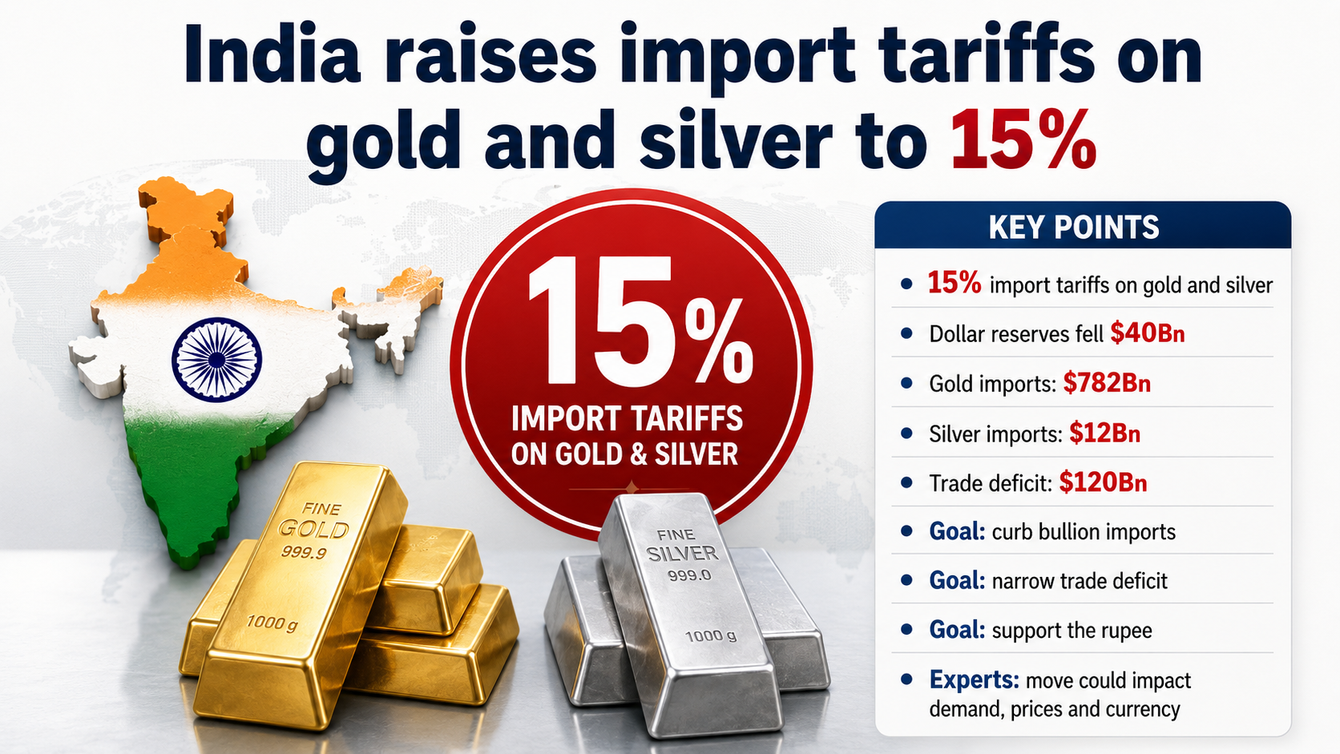
    India on Wednesday raised import tariffs on gold and silver to 15% from 6% as part of efforts to curb overseas purchases ​of the metals and ease pressure on the country's foreign exchange reserves.

    The duty hike triggered a sharp ​rise in local gold prices, prompting some investors to cash in on ​gains by offloading gold, even at heavy discounts...


    ...


    Bullion dealers also expressed concern that the latest duty hike could boost smuggling, as it widened margins for grey-market operators to ⁠about 18%, ​from around 9%, said a Chennai-based bullion dealer.

    Grey ​market operators smuggle gold from overseas and sell it for cash to avoid duties, allowing them ​to offer it at discounts to market prices by evading taxes.

    In further detail:


    Quote The government of India announced this week that they have reversed earlier duty cuts by raising import tariffs on gold and silver in the world’s second-largest precious metals market to 15% as of today – a move that could have a significant impact on precious metals prices and global demand, according to experts and industry insiders.

    The Modi government announced the move was aimed at curbing bullion imports, narrowing the trade deficit and supporting the Rupee amid external pressures.

    “India's central bank dollar reserves fell $40Bn in the first month after the start of the Gulf war; India's gold imports were $782Bn in fiscal 2026 and silver imports were 12Bn while the trade deficit was $120Bn,” noted Rhona O’Connell, Head of Market Analysis for EMEA and Asia at StoneX. “It is well known that India is one of the key consuming nations when it comes to gold jewelry and bar and coin.”

    O’Connnell noted that between 2010 and 2025, Indian demand in these categories combined averaged 795 tonnes per year, though the run to all-time high prices in the early part of last year kept a lid on demand. “That led blew off in the wake of a successful monsoon and harvest, and buying took off,” she said. “For context, gold mine production is ~3,700tpa.”

    “The Indian overall trade balance is of concern to Prime Minister Modi and on 10th May he asked the local populace to suspend gold purchases for at least a year, in an effort to conserve FX reserves,” O’Connell wrote. “Gold is the second largest Indian import bill, behind oil. Whether the locals follow his request remains to be seen, given the religious and cultural importance of gold to the population. One leading jeweler commented publicly immediately after Mr. Modi's request, saying ‘A temporary short-term slowdown may happen if the government decides to do something but we don't expect a man to get destroyed in India.’”

    “Well the Government has done something, raising import duty to 15% from 6% and the national Secretary of the India Bullion and Jewelers Association postulates that demand could be hit by 10%.”

    The new tariff regime is effective as of May 13, 2026, and it reverses the 2024 duty cuts.

    "The basic customs duty on gold and silver imports has increased to 10% from 5%, with an additional 5% agriculture infrastructure and development Cess levy aimed at curbing bullion imports, narrowing the trade deficit and supporting the rupee in the face of external pressures," wrote Robert Savage, Global Head of Markets Strategy and Insights at BNY. "Customs duties on precious metal findings and recyclable waste were also revised, with gold and silver findings now at 5%, platinum at 5.4% and spent catalysts at 4.35%."

    "The move comes in response to surging bullion imports and a weakening rupee."

    Ross Norman, CEO at Metals Daily, characterized the move as “bullish and bearish at the same time.”

    “We are now seeing second-order consequences of the Iran war manifest,” he wrote, adding that India “is particularly exposed to energy costs” from the Middle East.

    “India is interesting because there are many layers to the motivations for owning gold: weddings, festivals, reliable savings, culture and fashion, and conspicuous displays of wealth,” Norman said. “At its core, however, gold is an asset of last resort — and Indians know that. So when the government takes an action like this — effectively burning the lifeboats to keep warm — you know there is a real problem. There is a whiff of a real panic about this ... and that makes it good and bad for gold simultaneously.”

    Norman said that while this could result in a “dramatic reduction in purchases” from the number-two gold and silver consuming nation, “the move also signals that conditions are so severe the Prime Minister felt compelled to ask people not to buy gold one day and impose punitive taxes the next — and in doing so reinforces the fundamental reason for owning gold.”

    Norman said that in his view, “closing the door on gold is unlikely to be fully effective — it will be smuggled in through the window.”

    “How do we read this? Probably mildly bearish in the short term but well supported by buyers beneath the market; longer term, this reinforces the argument for owning gold — and in our view, that is the only way it should be played.”


    That's a pretty serious thing. He doesn't have a "petro-rupee" to turn around and make oil colonies sponge up the capital flight. He's trying to do something to keep the government out of defaults. That's what it sounds like is going on here.

    Small Global South countries are unlikely to have this tool at their disposal.

  40. The Following 3 Users Say Thank You to shaberon For This Post:

    gini (14th May 2026), Stardad (14th May 2026), Yoda (13th May 2026)

+ Reply to Thread
Page 12 of 13 FirstFirst 1 2 12 13 LastLast

Posting Permissions

  • You may not post new threads
  • You may not post replies
  • You may not post attachments
  • You may not edit your posts