+ Reply to Thread
Results 1 to 15 of 15

Thread: Pawlsy the Cat is Her Name

  1. Link to Post #1
    United States Avalon Member
    Join Date
    1st April 2016
    Posts
    6,638
    Thanks
    34,541
    Thanked 37,853 times in 6,288 posts

    Default Pawlsy the Cat is Her Name

    We met somewhere out in the Balkans.


    That means different things to different people, and we didn't know where we were or what we were doing.

    Well, we're in those lost pages if you recall when the Ottoman Empire was driven back from Vienna. No one knows about the borderland between the two powers for a long time until the rise of Russia.

    What people do know about, that you have to understand, is that the adventures of Byron in Greece swept through the musical world like wildfire, especially as what we call the Romantic period. That's how I got involved.

    After him, the Balkan regions that are in Greece weren't as important as the areas closer to the Balkan Mountains, which are in Bulgaria.


    In music, after focusing Byron for years, we knew something was, so to speak, going to change the tune. That's why my adventures with Pawlsy began in the prelude to what is now called the Great Eastern Crisis:


    Quote On 24 August 1854, during the Crimean War, the Ottoman Empire took its first foreign loans. The empire entered into subsequent loans, partly to finance the construction of railways and telegraph lines, and partly to finance deficits between revenues and the lavish expenditures of the imperial court, such as the construction of new palaces on the Bosphorus strait in Constantinople. Some financial commentators have noted that the terms of these loans were exceptionally favourable to the British and French banks (owned by the Rothschild family) which facilitated them, whereas others have noted that the terms reflected the imperial administration's willingness to constantly refinance its debts.

    The Great Eastern Crisis of 1875–1878 began in the Ottoman Empire's administrative territories in the Balkan Peninsula in 1875, with the outbreak of several uprisings and wars that resulted in the intervention of international powers, and was ended with the Treaty of Berlin in July 1878.

    We knew that there was a bad deal thrown out as a blanket policy over a considerable variety of ethnicities in the 1850s. And we knew this tension of power over the divided and conquered was going to erupt. Because of music, I was able to go out and merge with the Carbonari of I can't tell you, determined to have a hand in affairs of the hinterlands.


    It turned out to be a bit surreal, so, let's say we became involved with multiple genres, but it started out as Romantic. Everyone knows that Pawlsy the Cat had an award-winning career that spans multiple generations. This is how it started and how everything worked.


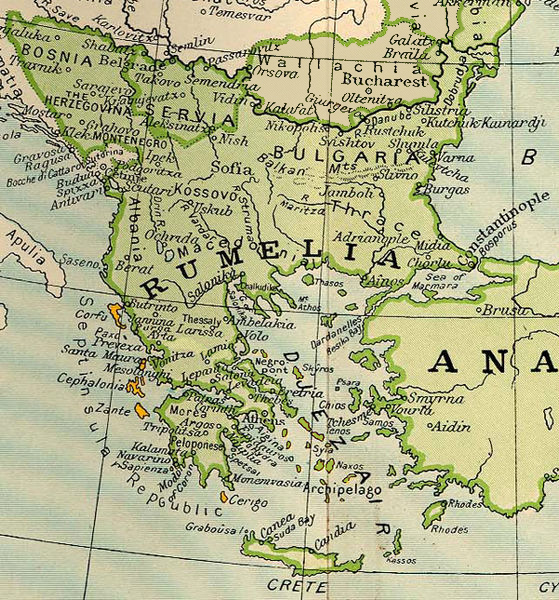
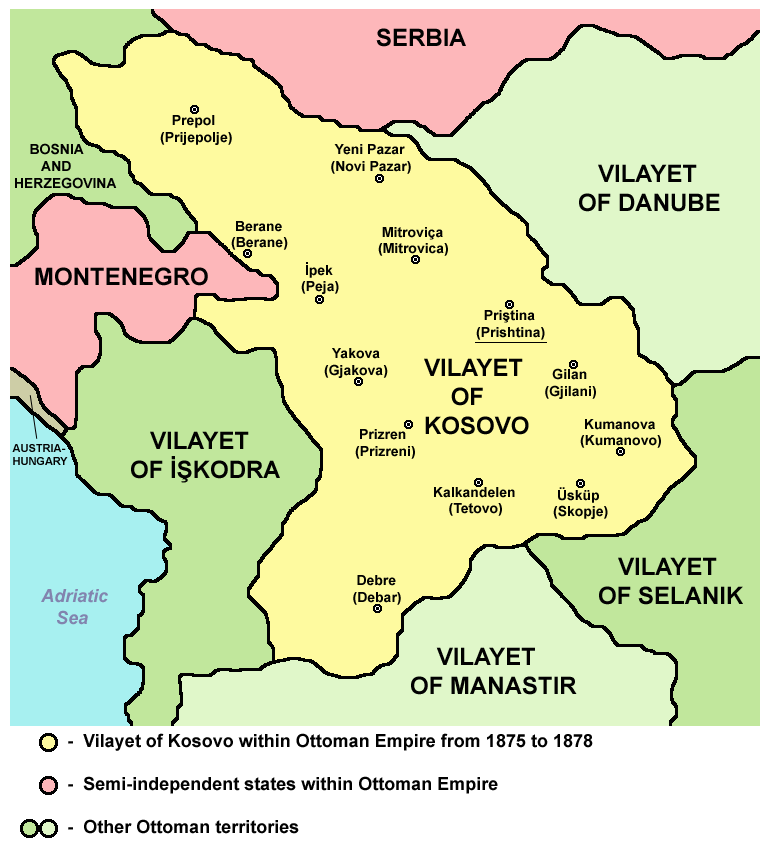
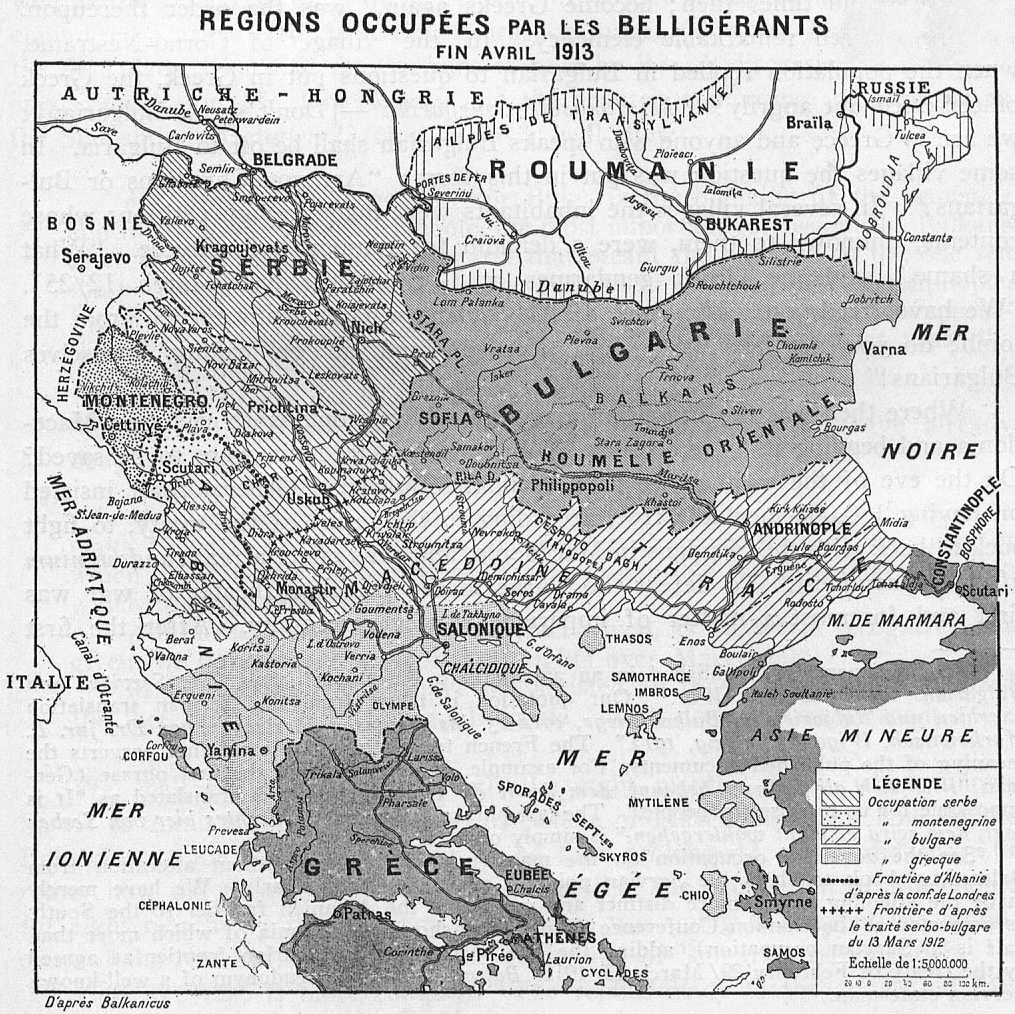
    We didn't have any resources at the time. We got a couple of local guides, a compass and the stars. So I rely on the work of others to try to make some sense of it now. This is roughly accurate to what was going on then, in good detail if you expand the map:


    The reason I met Pawlsy was coming from the momentum of Montenegro:


    Quote In 1858, one of the major Montenegrin victories over the Ottomans occurred at the Battle of Grahovac. Grand Duke Mirko Petrović, elder brother of Knjaz Danilo, led an army of 7,500 and defeated the numerically superior Ottomans with 15,000 troops at Grahovac on 1 May 1858. This forced the Great Powers to officially demarcate the borders between Montenegro and Ottoman Empire, de facto recognising Montenegro's independence.

    That's why I did it, and this is all I can tell you about getting there:

    Quote Following the assassination of Danilo by Todor Kadić in Kotor, in 1860, the Montenegrins proclaimed Nicholas I as his successor on August 14 of that year. In 1861–1862, Nicholas engaged in an unsuccessful war against the Ottoman Empire.

    Under Nicholas I (ruled 1860–1918), the principality was enlarged several times in the Montenegro-Turkish Wars and was recognised as independent in 1878.


    1858 made an epic wave in the music world, although no one knew anything about Montenegro.


    Grahovo Field:


    Now, if you look at Montenegro, Grahova is in its small upper left shoulder:


    On the first map, you can tell you have to go far to the southeast to reach the headwaters of the River Drin. And so what we had to do is traverse the southern end of the Alps or Albanian Alps which are the Accursed Mountains:


    This geography is rather odd. The Drin is a conflux of two headwaters, and the northern one comes from the scantily-known region of Peja:


    Quote The region came to be a part of Sanjak of Scutari in the 16th century, during which time Islam was introduced to the Catholic population in the region.

    In October 1912, Peja region was captured by Montenegro from the Ottomans.

    Strange emptiness for centuries.

    The main inhabitation near there is Pristina:

    Quote During the 18th century, the history of the city is less documented, though recent data show a regular life unfolding in the city after the Great Turkish War. While in the first few decades the city was rebuilding its infrastructure, in the second part of the century it is better known for the governing of the local feudal family, the Gjinollis.

    Maybe so; it isn't documented very well.

    I did not know this at the time. It just sort of happened to me. For some reason, you just go to the source of the White Drin beyond Peja, except to us it's through Montenegro. I was curious, since I was a big fan of Apollo and the Muses with respect to the performing arts. The idea was we would have to change the formula of the Carbonari somewhat, that Masonic Rites and so forth were not portable enough to be useful for our purposes. That's why they wanted to adopt a musical approach. I don't know why, but for some reason it made them value me enough to be included in what felt more like a pilgrimage.

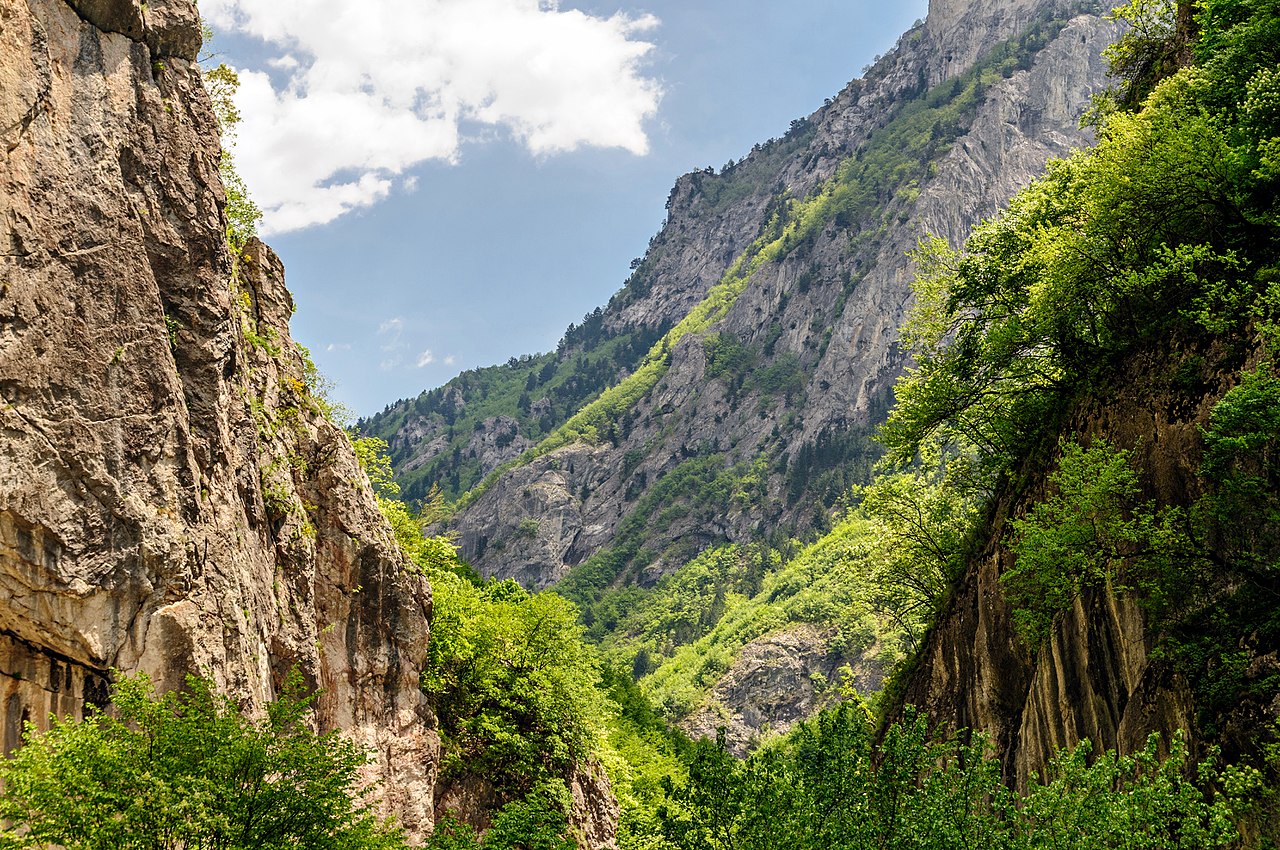
    We're going to Zleb or Mokra Gora in the Accursed Mountains:


    And it turns out to be a quite lovely waterfall that's the source of the White Drin:


    I feel like I've died Byron's death six times already, just waiting for the real one from a saber or gun, and when we begin to set up our base camp for this thing, at night we see the fires of what looks like someone else doing the same thing.

    We don't know anything about scouting; we're our own scouts. If we are about to contest some professional military, we're fried. There's no way they won't take us as a threat. We're heavily armed. To us, it is just a "supply", we weren't thinking of actually using it.


    The next day we went to check each other out, and, I admit, we were armed for it.

    Different languages are being used, and so it's impossible for me to know what's actually going on.

    However, it turns out that the opposite camp is "similar to" Carbonari who are organizing on behalf of the problems in Sofia:


    Quote Sofia entered a period of economic and political decline in the 17th century, accelerated during the period of anarchy in the Ottoman Balkans of the late 18th and early 19th century, when local Ottoman warlords ravaged the countryside.

    By the 19th century the Bulgarian population had two schools and seven churches, contributing to the Bulgarian National Revival. In 1858 Nedelya Petkova created the first Bulgarian school for women in the city. In 1867 was inaugurated the first chitalishte in Sofia – a Bulgarian cultural institution.


    Now I find myself in the ironic position that an unknown party appears to be on the same pilgrimage that I, not having been told that's what it is, feel like I am on.

    And I'm realizing that basic idea is true, that music is going to be the most effective way to cut through these languages and cultural barriers. I can see the potential. And then I see this chick and for a deja-vu split second it feels like a normal day at the univeristy. And then I notice this camp actually has several girls or women. And this gets my attention, and, I hadn't thought about it at all, but there's no reason there can't be female guerillas or revolutionaries.

    There may be a reason that there should be. Montenegro is a guerilla force of men.

    That's when it happened.

    By definition any river has some kind of headwater, but they don't all have this:


    Quote The river springs near the Bukuroshja e Fjetur Cave. The cave is multi-levelled, not much explored and has a lake inside.


    This is what they say about the Cave:

    Quote The Bukuroshja e Fjetur Cave was first discovered in 1968.


    By 1968 we were driving convertibles.

    They don't know anything about what happened in that cave.


    Pawlsy was...she was the leader of a troupe, in the same way I was trying to take the normal military drum and bugle and come in with a new music altogether. Hers was Bulgarian a capella chanting that would make your hair stand on end.


    But first I'm going to tell you why she was the Cat.


    There is an unsolvable riddle about whether the question mark shape "?" comes from an Egyptian Crook symbol, and does this have to do with the curvature in some cat's tails.


    When the...awkwardness of the near-confrontation wore off, wondering if my limited knowledge of basic Greek would do any good, it did. I know what I'm doing and I'm looking for the right resources and she's it. We became instant friends, using a bit of this language that was foreign to us both.


    Pawlsy's family was really Egyptian who had come up in recent times as an attempt to be on the fringe of Islam. In a complex manner, it had gained European converts across Roumelia.

    And we know the religions can be used for good or evil.

    The Greeks never colonized anywhere near Peja, and the first mosque was in the 1700s.


    When we entered the cave that night, a solemn ceremony was conducted.

    I don't really know anything about the religions; my school of thought says that Genesis is probably not a historical document, and, Zoroaster and the Upanishads are probably important sources of ancient wisdom.


    We drank of the lake, and then Pawlsy and her troupe bathed in it. They then began a musical performance, and, Pawlsy's tail is a tattoo that was then given to her which has been passed down in her tradition since the Koptos Colossi from 3,300 B. C. E..


    It's a "Crook", but, it's a ligature, combined to make the symbol of Min as on this palette:


    This is a Min temple lion guardian:


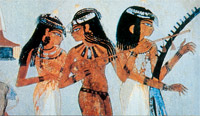
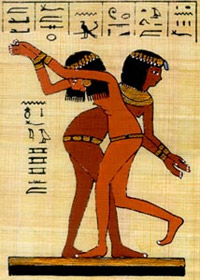
    So while she's having her tail tattooed, these entertaining women who are singing and dancing, are doing so in what will come to be called Cleopatra slit skirts and things like that, and, it becomes obvious the "tail" depends on how low that thing goes in the back:


    And so my wheels are turning, I can easily see we have the seeds of success, and yet it is some kind of initiation in the oldest Egyptian cult.

    The problem is, rather than a peaceful circuit of musical venues, we have on our hands a powder keg that seems like it could obliterate almost the whole world.

    That night before my very eyes, Pawlsy was crowned as Repyt wife of Min:


    Very little paraphernalia was involved, aside from an actual gold cobra crown and lioness headdress.

    It's like the Hierophant in the Tarot. I saw it happen.

    And that was my new friend. That was when we withdrew from the cave area and lodged ourselves around Peja. And we found a good chance for unity from Sofia to Montenegro.

    We figured we were going to have a lot of fun, and some of us were probably going to die.

    We avoided religious issues completely. All of our material was along humanistic lines. We didn't want to fight for security or survival purposes, we wanted to do it in order to establish a way of life with a radically new well-being.

    Now, how long were we out there? Decades. The scale of things that happened before what you call Pawlsy's career is phenomenal. Yes, Phyllis Diller, Joan Rivers, and a large league of others are her protegees. Everyone who pushed the limits has something from her. I don't think you can deny that. Not totally.

    I can tell you one thing -- she's very strong.

    Nothing fake about her. She may be the single most dangerous person I have known. Undefeated.

    What they tried to explain to me, didn't depend on language, but was an attempt to restore tradition that they claimed had been present in the Accursed Mountains and Balkan regions in ages beyond the Egyptian Colossi.

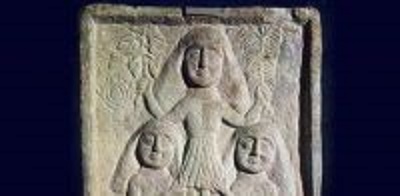
    Pristina goddess probably older than Min:


    Whoever they were was something different than "modern ladies" as seemed to have been cultivated by standards that seemed a bit repressive.

    As you can probably tell already, we were behind this:


    Quote From 1969 to 1972, Bardot was the official face of Marianne, who had previously up until then been anonymous, to represent the liberty of France.


    I knew, unavoidably, their Byzantine mystique would crash into our Marianne irrevocably:


    On the 1848 National Seal, she is identical to the Statue of Liberty:


    And it may be curious that during what we were doing, they made a French Masonic Marianne:


    Quote Jacques France réalise donc une deuxième version de sa Marianne où les symboles maçonniques sont remplacés par les grandes dates de la République : 1789, 1848 et 1870. Sous la présidence du vieux Victor Hugo, un Comité central des bustes de la République est constitué en 1882. On y retrouve tous les grands noms du Parti républicain, dont beaucoup de maçons : Emmanuel Arago, Louis Blanc, Jean Macé, Camille Pelletan, Frédéric Desmons, Gustave Mesureur… Le Comité réunit la Ligue de l’enseignement, le Congrès anticlérical et, bien sûr, le Grand Orient de France. Des comités départementaux sont ensuite créés. Une active propagande s’engage alors pour diffuser cet « admirable buste de la République. Cet emblème [qui] fut aussitôt acclamé comme représentant mieux qu’aucun autre précédent, l’image de la République telle que nous la désirons ; noble et fière, souriant doucement à tous ses enfants. […] Il importe que chaque loge, chaque bourg et chaque commune de France possède avant peu le buste de notre République, symbole de l’amour de la liberté et de l’initiative Communale ». « Cet élan […] constituera un véritable plébiscite républicain », ajoute la lettre, abondamment diffusée par le Comité central. Le succès de la Marianne de Jacques France accompagne, sur le plan symbolique, le travail politique du Parti républicain visant à enraciner dans la France profonde les idéaux démocratiques.


    That's like a more formal, industrialized version of what we had to do, which sounds more like Bulgarian Revival:


    Quote The significant changes in the Bulgarian society, the freedom of economic initiative and religious choice led to the formation of the Bulgarian nation in its ethnic borders and common territory embracing the lands of Moesia (including Dobruja), Thrace and Macedonia.

    or its National Awakening:


    Quote The National awakening of Bulgaria refers to the Bulgarian nationalism that emerged in the early 19th century under the influence of western ideas such as liberalism and nationalism, which trickled into the country after the French Revolution, mostly via Greece, although there were stirrings in the 18th century. Russia, as fellow Orthodox Slavs, could appeal to the Bulgarians in a way that Austria could not. The Treaty of Küçük Kaynarca of 1774 gave Russia the right to interfere in Ottoman affairs to protect the Sultan's Christian subjects.

    And, as you can see, we didn't have places like Kosovo and Albania that you have these days.

    We have to deal with multiple religions, multiple empires, over natives who are mostly Illyrian pagan peasants.

    As may not be surprising, the musical girls included a few we would call Gypsies.

    There are reasons you could get run out of Bohemia and Transylvania and so forth. One thing that stood particularly horrible in my mind was Witch Hunts. I could maybe see it if you were sure it was hexcraft. But for the most part, I think it was mostly puritanical types that didn't think there should be any such thing as non-puritanical women. Towards the west, everything is a bit more crazy. Out here, it is more straightforward.

    That is to say, problems are more straightforward as well. On a human level, some of the Illyrians simply hate the Bulgars and Serbs as people. It looks like it's going to take a lot of work to try to get this to relax.


    The Ottoman Empire is something we have to take issue with it, but, its internal cohesion is where we can find Pawlsy's true heritage which has nothing to do with politics.


    Cairo was hammered by the Black Death fifty times, along with multiple famines, but nevertheless:

    Quote During the 16th and 17th centuries, Cairo still remained an important economic and cultural centre. Although no longer on the spice route, the city facilitated the transportation of Yemeni coffee and Indian textiles, primarily to Anatolia, North Africa, and the Balkans.

    They finally migrated because of problems with Napoleon; she said that what we now know as the Knights of Malta on the Italian mainland is only a name, and that the actual Order had gone completely underground. That it was in our best interest to also merge with this underground. And it made sense because we could see the English system was what the Carbonari were trying to keep out of Greece, and the new country, despite inspiring incredible new music, might just go into a new corruption.

    We believed the Ottomans did and tried to raise awareness about how this works.

    Anyone who did not follow a major doctrine was called a "radical", and we realized we had to distance ourselves from the Mazzinists, on the one hand, and certain government radicals on the other. This is the drama that was being played out in the musical world. And as we thought about this, we began to see it as a contest for souls.


    My friendship with Pawlsy was not because we were pacifists, which we are not, but because we were neither extremists nor imperialists. We were willing to fight injustice and oppression. That was fairly common in those times, but, Italy found it took a lot of fine-tuning to come up with Garibaldi and Cavour. They were a closer parallel to what we were doing.

    Although vast amounts of territory were gobbled by the Ottomans, since 1512 Montenegro had maintained its independence as a theocracy:

    Metropolitanate of Cetinje


    So you have a hereditary theocracy that in the early 1800s voluntarily establishes a balance-of-powers government, and then this happens:


    Quote Before his death in 1851, Petar II named his nephew Danilo as his successor. He assigned him a tutor and sent him to Vienna, from where he continued his education in Russia. According to some historians Petar II most likely prepared Danilo to be a secular leader. However, when Petar II died, the Senate, under influence of Djordjije Petrović (the wealthiest Montenegrin at the time), proclaimed Petar II's elder brother Pero as Prince and not Metropolitan. Nevertheless, in a brief struggle for power, Pero, who commanded the support of the Senate, lost to the much younger Danilo who had more support among the people. In 1852, Danilo proclaimed a secular Principality of Montenegro with himself as Prince and formally abolished ecclesiastical rule.

    In Danilo I's Code, dated to 1855, he explicitly states that he is the "knjaz (duke, prince) and gospodar (lord) of the Free Black Mountain (Montenegro) and the Hills".

    When I say momentum:

    Quote The glory of Montenegrin weapons was soon immortalized in the songs and literature of all the South Slavs, in particular the Serbs in Vojvodina, then part of Austria-Hungary. Montenegrin victory forced the Great Powers to officially demarcate the borders between Montenegro and Turkey, de facto recognizing Montenegro's centuries-long independence. In 1858, a commission of foreign powers representatives demarcated the border between Montenegro and Turkey. Montenegro gained Grahovo, Rudine, Nikšić's Župa, more than a half of Drobnjaci, Tušina, Uskoci, Lipovo, Upper Vasojevići, and the part of Kuči and Dodoši
    .


    These whirlwind battles and musical explosion were what drew me down there.

    They installed a new Prince:


    Quote Prince Nikola, who had been trained from infancy in martial and athletic exercises, spent a portion of his early boyhood in Trieste at the household of the Kustic family, to which his aunt, the princess Darinka, wife of Danilo II, belonged. The princess was an ardent francophile, and at her suggestion, the young heir-presumptive of the vladikas was sent to the Lycée Louis-le-Grand in Paris. Unlike his contemporary, King Milan of Serbia, Prince Nikola was little influenced in his tastes and habits by his Parisian education; the young highlander, whose keen patriotism, capability for leadership and poetic talents early displayed themselves, showed no inclination for the pleasures of the French capital, and eagerly looked forward to returning to his native land.

    He wasn't interested in France. In Montenegro, he was pro-Serb and pro-Russian. Losing his early battles in the 1860s, this is how he regenerated:


    Quote ...in 1868 he undertook a journey to Russia, where he received an affectionate welcome from the tsar, Alexander II in St Petersburg. Being a champion of Orthodoxy, Russia provided military missions and supplies to Montenegro. He afterwards visited the courts of Berlin and Vienna. His efforts to enlist the sympathies of the Russian imperial family produced important results for Montenegro; considerable subsidies were granted by the tsar and tsaritsa for educational and other purposes, and supplies of arms and ammunition were sent to Cetinje. In 1871 Prince Dolgorukov arrived in Montenegro on a special mission from the tsar and distributed large sums of money among the people.

    This is celebrated as a Masque to this day:


    Quote The event depicted the 1871 reception of Nicholas I and Milena Vukotic honoring the visitor, Prince Vladimir Andreyevich Dolgorukov.

    The only information on him is Russian, and we can figure out his father was Andrey Nikolayevich.

    These are the Rurikids of Kiev, and House Dolgorukov includes:


    Helene Pavlovna Dolgorukova (1790–1860), grandmother of Helena Blavatsky and Sergei Witte


    We can extrapolate from the Russian that he must be a brother of Vasily Andreyevich:


    Quote He was born in Moscow into the family of state councilor Prince Andrei Nikolaevich Dolgorukov (1772-1834) and Elizaveta Nikolaevna Saltykova.

    That appears correct. Vasily stuck in the Russian military and government and does not make international affairs. Vladimir made a huge difference in Montenegro leading to its expansion.

    So we are looking at the time around when the new Prince Nikola Petrovic-Njegos struggled in the early 1860s, and had a big breakthrough in the 1870s. That says nothing as to his becoming King in 1910 and reigning until 1918 -- a total of almost sixty years.

    He was a songwriter and also created The Empress of the Balkans:


    Quote This dramatic work depicts the life of the ruthless Empress of the Balkans and her pursuit of power through deceit and manipulation. Set in a time of turbulent political upheaval, the play explores themes of betrayal, love, and the corrupting nature of absolute power.

    or:


    Quote This book explores the little-known historical tale of how fifteenth-century Ottoman expansion across the Balkans ignited resistance from Balkan nations, culminating in a legendary battle against the Turkish Empire that would change the destiny of Eastern Europe. It reveals the significant but largely forgotten role of Prince Stanko, a courageous Montenegrin who led a pivotal defense against the Turkish army and whose heroism became a cornerstone of Balkan identity and resilience against Ottoman rule. Through the compelling story of Stanko and his contemporaries, the author sheds light on an important chapter of European history, highlighting the power of resistance, unity, and strength in regional identity.


    or:

    Quote As the war rages on, Stanko is forced to make difficult choices, and he begins to question his own motives and the cost of war. The book explores the themes of war, heroism, and the nature of good and evil. The author does not shy away from the brutality of war, and he paints a vivid picture of the horrors of battle. However, he also shows the courage and resilience of the human spirit, and he celebrates the power of love and compassion. Ultimately, the book is a powerful indictment of war, and a reminder of the importance of peace.

    And, no, you don't know anything about this until it is published much later.

    I think it will help you understand us if you recall Serbia wanted to offer alliance in 1866.


    As you see, the 1860s started off a bit rough, but then we are going to see this led to some changes and things turned around. During his reign in Serbia:

    Quote In 1866 Serbia began the campaign of forging the First Balkan Alliance by signing a series of agreements with other Balkan entities in the period 1866–1868.

    But there was more to it:

    Quote Nikola was a member of the "United Serbian Youth" (Уједињена омладина српска) during its existence (1866–1871). After the organization was prohibited in the Principality of Serbia and Austro-Hungary, the "Association for Serb Liberation and Unification" (Дружина за ослобођење и уједињење српско) was established by Nikola, Marko Popović, Simo Popović, Mašo Vrbica, Vasa Pelagić, and more, in Cetinje (1871).

    Sounds kind of unusual. A Prince's movement is "prohibited". The "Serbian" headquarters move to Montenegro.

    Now let's take a look at his tunesmithing:


    Quote Onamo, 'namo! cemented Nicholas' reputation as an accomplished poet among his subjects, as well as the Serb population of the Balkans more broadly. "The people accepted this poem as their battle song," the historian Olga Zirojević writes, "as a call to liberate those Serbian people still under Turkish occupation, as a great national duty which had to be accomplished." At the height of its popularity, it was widely referred to as the "Serbian Marseillaise".

    Pawlsy and me have a plan to distribute this round the world. Not his song, mind you, which we were merely beginning in the shadow of. But this whole concept of intellectual and moral music played with feeling, facing all our issues of war and peace. It's a total music.

    If it seems strange that a Prince's Serbian club would actually be banned, it turns out that his music is also banned. Both Montenegro and Serbia are considering adopting a national anthem. Nikola's song contains the separation of what we now call Kosovo from the Ottoman Empire. So the countries, per se, see this as inflammatory and don't want to cause problems by effectively declaring war in a musical way:


    Quote Nevertheless, Onamo, 'namo! became highly popular among the Serb population of the Balkans, and was sung on many official and unofficial occasions. For this reason, it was banned in the Ottoman Empire and Austria-Hungary.

    So, to rewind, what's he talking about. Peja and Pristina where I met Pawlsy the Cat when she got her tail.

    That's the visible face of what we were doing.

    I'm telling you it's because of that cave.

    The women knew about it since time immemorial, and, "initiation into the mysteries" had the meaning of a man coming to know of it. You'd make an oath and carry it to the grave. That's why it's thought of as "undiscovered".

    I realized it was vitally necessary to have them guide the men. Not just in an astronomical manner like Catherine the Great. But in, what I think they call, administrative functions, and also something similar to the bishop.

    Montenegro had been ruled by a Bishop for three centuries.

    I'm not from there. I have respect for a Prince who had certain effects in the male-dominated world. And our tangent was geographically different, to Sofia, which didn't have that name yet, but same place.

    So, what do you do. I go out as a Byronic Greek Independence Romantic-themed musician; we're not exactly a Montenegran vanguard, because there is only one military person with us; and then the new Prince spurs a few failed secessions.


    At the time, I don't know these details I've added in for reference purposes. All I knew was I had just met Pawlsy the Cat and we were on a mission in the Accursed Mountains.

    Rugova:


    There is another area where they are split in half by the Rugova Gorge, or, Peja Lumbardh being a tributary of the White Drin:


    It's between Mount Zhleb and Kopranik:


    Quote The gorge is 23 km long and up to 1,000 m (3,300 ft) deep.


    The river valley, including the Rugova Canyon, is a route for the road connecting Kosovo with Montenegro, over the Cakor pass.


    Even today, it is the third-largest, but, least-populated district of Kosovo, where the people could inherently be described as Illyrian Korybantes.


    As to "traditions":


    Quote They are still very much alive in the mountainous regions of Albania, Kosovo, Montenegro and western North Macedonia, as well as among the Arbëreshë in Italy, the Arvanites in Greece and the Arbanasi in Croatia.

    They have been preserved through traditional memory systems that have survived intact into modern times in Albania, a phenomenon that is explained by the lack of state formation among Albanians and their ancestors – the Illyrians, being able to preserve their "tribally" organized society. This distinguished them from civilizations such as Ancient Egypt, Minoans and Mycenaeans, who underwent state formation and disrupted their traditional memory practices.

    Albanian traditional practices, beliefs, myths and legends have been sporadically described in written sources since the 15th century CE, but the systematic collection of Albanian customs and folklore material began only in the 19th century
    .


    Byron had seen something of it:


    Mount Zhleb has the road from Cakor Pass:


    Quote The road from the city of Rožaje (Montenegro) to Peja is located within the foothills of the mountains, and also contains 2 or 3 villages within that road.


    Zhleb also faces the canyon formed by the White Drin. It's geographically unusual, because the river flows east out of the mountains and flattens at Peja, but instead of continuing across the plain to Pristina, it turns south and eventually turns completely around and goes to the Adriatic.

    In the lower right, you can make out its strange course, among tribes of Illyrians:


    The road in question can be seen at the end of a page describing a trip by bicycle. The road was militarized and then shut down. Only in the past few years can you get permits again.

    It is near the top of a page with better topography, but it is not the blue highlight, you have to move the map slightly and find Peja. Similarlly here on a satellite version. Or Lumbardh to Peja plain but clear.


    We have to be careful in our plans for this and other routes. We know that nobody is going to go with what we say just because we describe common problems. This is called Settling a Frontier Dispute:


    Correspondingly enough, Illyrian national memory is in a bardic tradition of a rather large number of Songs of the Frontier Warriors.


    Those are against both Slavs and Turks.

    So Pawlsy and me decided to do our own version of Bulgar and Illyric anthems, but, instead of moving them in the direction of "La Marsellaise", we were talking it back to its root strata which seems akin to Greek mythology and probably Indian. We're not going to sing about it so much as, you're going to become Kosovo and Albania, because you defeated the Ottomans, it is about who you are and where you live "and defended itself", sort of like an addendum or even a footnote.


    And as far as I can tell, it was a pilgrimage. We were told to prepare to leave the cave area, it was not headquarters, it was for certain functions, and no you're not likely to find its exact location unless attention is drawn to it.

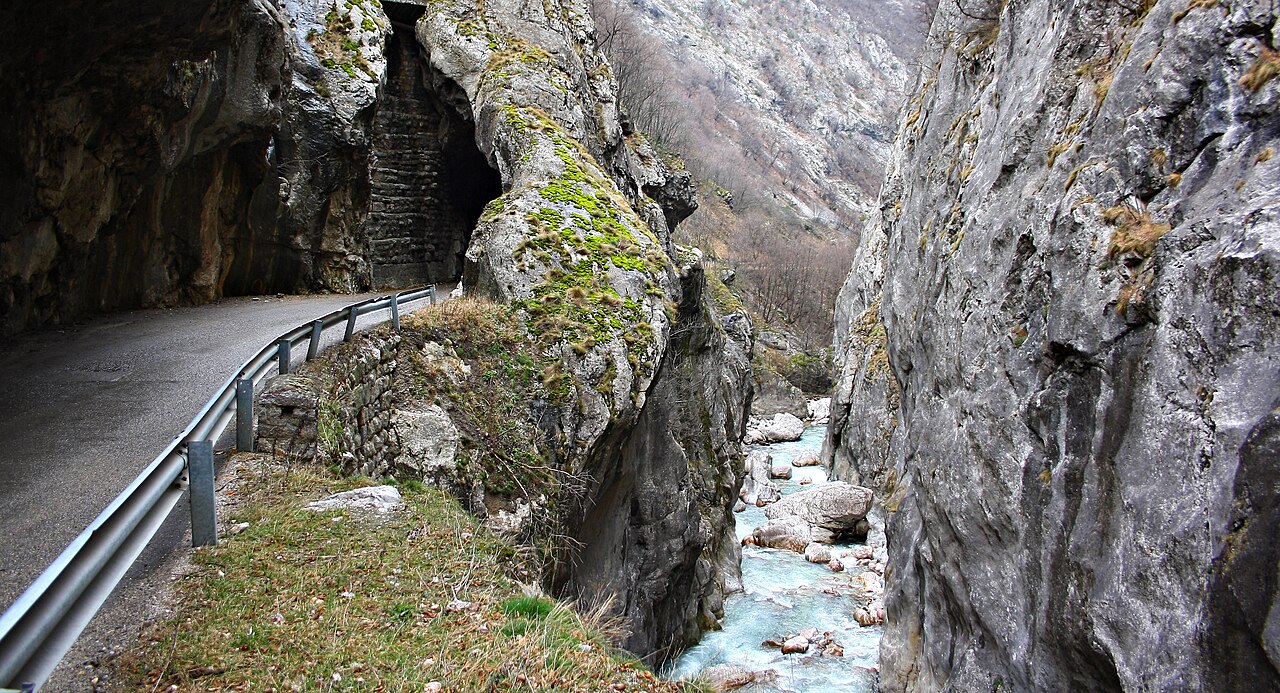
    We have to go through this thing, as known in polyglot:


    Albanian: Kanioni i Rugovës; Serbian: Руговска клисура / Rugovska klisura


    Sometimes if you try to tell where you are, you can't figure anything out:


    and, lacking the obviously modern features, something like this could be Roman cobble masonry and a tunnel possibly hand-made in the Stone Age:


    We are informed at the mouth of the canyon is an Orthodox monastery that is the seat of the Patriarch of Serbia. That's right. To this day he is still considered Archbishop of Peja, meaning the monastery is still the same seat it was, while the office holds additional facilities. But yes it is really the Patriarchate of Peja which means to include all of Serbia since the 1200s. It's not by design. It's because the original seat, in Serbia, Zica, was abandoned twice because of invasions.


    Here's the thing. We think there should not be an Ottoman system anywhere it's not a basically Turkish region. One of our chief complaints about Independent Greece is that there is no recovery of Constantinople. It exists in Tsarist theory but not in any successes of Imperial Russia. The Patriarch of Constantinople is not a "Pope", but we may not agree he should be an Ottoman vassal.


    To make it clear, because there are always questions, what kind of a story is this, Pawlsy and me were never an item. We were a natural team. What we recognized in each other was something we didn't see in most of the others around us; only some, by degree. I told her that I didn't really have a religion, but, as I mentioned earlier, the subject of the Muses spoke of something I felt was real in terms of how I personally work.


    I liked her. She was a hot chick from day one. I've hugged her from time to time, but we're not bedfellows.

    Pawlsy was the Wife of Min. Like Empress Catherine, she was what you could call a serial monogamist. I found her to be an extremely intense form of living art who could magnetize other women, and I thought this was a key ingredient of which there were not very many "Mariannes" in actuality.


    We were quick and easy friends because we were the most interesting people out of what had gotten to be a bit of a crowd.


    I perhaps naively had quick plans that we were going to go through a difficult period, and out of that we would go on to a big career and own the stages in all of the countries. I just foresaw us as taking part in something that would expand and circulate the musical world. The influences out here are very different to what we had from Mozart.

    Then, what did we get from Nikola's run against the Ottomans, two years of scrape and loss with nothing to show.


    But when we first met, we agreed on that basic plan.

    Lots of times I consider the "y" on her name as optional, and, most of the time when I address her in conversations, I just say "Pawls". Most of our conversations didn't begin in private, and in general I would say the choir girls were more interesting than most of the other people. I could see how this was due to Pawlsy's influence.

    I could also understand a Montenegran military official to negotiate with the Orthodox monastery. If he had been Ottoman, this perhaps could be classified as a colonel's coup. What we have done is formed a paramilitary, and the two of us have been selected to do this populist work and we are treated as NCOs.


    "Pawls," as I said I would say, "these mountains have got to be haunted."

    "There are people who can see those kinds of things very easily; I'm not one of them. But I believe in ghosts".

    "I don't think its a particularly good idea to go on making so many more in battles."

    "No," she told me. "Battle has to be fought to a certain point. Wise judgment could eliminate future conflicts."


    I understand Orthodoxy, somewhat, and I understand pagan philosophy, which I think we have in common, but she has already put it in practice in a way that I have not.

    "Can you explain to me what it means to be Egyptian, or Islam from the inside?"


    "I'm not Egyptian. I have Egyptian heritage, but I am Bulgar from:


    Σαρδική, Serdikē

    that also has her own ancient traditions."


    "That's what I'm finding, Pawls. Genesis does not make sense, because that tattoo you have is older than it, and I think some of these relics may be older still."


    "We hold it to be symbolic".

    "So despite representing Egyptian paganism, you nevertheless use Genesis".


    "Cairo Islam is an ever-tightening noose. You see, yes, it was mainly an Islamic establishment, but that was along with the magicians and alchemists and astrologers and so on. We have roots that are partially similar to Sufism, but also to what you call Gnosticism. That is, the groups you now know as the Druze started coming from Cairo in the early days, out of foresight, and basically continued to emigrate. Meanwhile, there is a lair of Copts and Hermeticists. We come from this, I guess you could say, Druze-alike milieu. And we were probably the end of it. Yes, at some level most of them professed Islam or Christianity. But, if you want to say, traditions, those kept going."


    "But if I go to Cairo now, it will be in vain, because it has become too strict."


    "Most likely".


    "That was a technical note that told me the tail shape is from the symbol of Min. In the ritual you told us Min is Pan."


    Pawlsy's ears flared.


    "Of course. I have moved my Egyptian blood to another place, and Pan is what they understand as closest to the same meaning as Min. It's like what happened near the end of the Ptolomies".


    Quote …he (that is, Ptolemy XII) built this wonderful memorial for his father Min Re, the lord of Achmim, the king of the gods. He built the materials store for his mother, the Mighty, Repyt, the Eye of Horus in the West, in order to beautify her majesty with these fabrics. May the reward for the King be that duration, that life and power, that full health and all joy which eternally comes forth from the throne of Horus like Ra (the sun god).


    "Repyt became the mother of Horus Kolanthes, which is a non-Egyptian name, possibly taken from Greek."


    I got the analogy, Repyt is clearly shown giving birth to a "foreign" child. Therefor some kind of Horus or offspring of Pan may now emerge,

    What am I going to do with a Pan and Repyt cult in the face of Slavic and Illyrian paganism which do not share the same language?


    "Do you think Repyt needs an introduction?"


    She told me about the European Lion, a creature that has been hunted to extinction. The last ones were seen in Bulgaria up until the medieval period. And it is seen in some of their oldest iconography near Strelcha ca. 400 B. C. E.:


    also:

    Quote ...9th century when it appeares on a relief from the ruins of an aulos (palace of the Khan) near Diristiron (now Silistra)

    It easily becomes the relevant Flag:


    Quote In the 19th century, the lion could be spotted on the flag of some of the key Bulgarian revolutionaries working to organize a revolt against Ottoman rule. “The revolutionaries believed that an empire like the Ottoman Empire, although in its twilight, needed a great authentic force to fight it and defeat it,” Prof. Georgi Atanassov, a historian with the History Museum in Silistra in northeastern Bulgaria, tells 3Seas Europe. “What animal symbolizes that better than the lion?”

    The revolutionary Vasil Ivanov Kunchev (1837-1873) will forever be known as Vasil Levski (Vasil the Lion).

    Leva = Lion remains the national currency.


    This may be the oldest art object, it probably is the oldest statue, from Swabia around 40,000 years ago:


    "Even though I am an Egyptian tradition with more affinity for the pagans, those are Orthodox forces using the lion standard."


    "But you know how to deal with Muslims such as some of the Illyrians as well."

    "Yes, exactly."


    What did she just become? Repyt has the meaning lady of distinguishment, or noblewoman.


    She has something to do with the afterlife:

    Quote In utterances such as PT 356 and 423, rpwt appears in phrases relating to a palanquin or carrying chair symbolizing the king's ba-soul

    Although it may mean personal presence, rather than cars or litters being named for her:


    Quote Such an image exists of a Goddess resembling Bat inside the canopy of a palanquin and labeled rpyt

    When Hellenized:

    Quote Triphis is invoked in vessel-inquiry divination spells for oracular revelations, arriving "on the arm" of the practitioner to reveal hidden knowledge.

    As near-identity:

    "the great Sekhmet in Akhmim,"


    While she may be a title of and thereby possibly an aspect of Hathor, Isis, Nephythys, and the Moon.

    She is also the Day and governs the Hours.

    The Bulgarian Lion already has the same meaning as Nikola's song.


    I get how Pawlsy is making that work by embedding it among unorthodox peasants.

    The implication I am getting is that:

    Pan, the shepherd god (theos nomios)


    is the son of Hermes, and part of this generation:


    Herakles (Heracles), Dionysos, and Pan are held to be the youngest of the gods


    Okay. There is most likely a historical founder of:


    Boeotian Thebes

    Quote Cadmus was credited by the Greek historian Herodotus with introducing the original Phoenician alphabet to the Greeks, who adapted it to form their Greek alphabet. Modern scholarship has almost unanimously agreed with Herodotus concerning the Phoenician source of the alphabet.

    He is also credited with the foundation of several cities in Illyria, like Bouthoe (Budva, Montenegro) and Lychnidus (Ohrid). In ancient Greek literature, the end of the mythical narrative of Cadmus and Harmonia is associated with Enchelei and Illyrians, a tradition deeply rooted among the Illyrian peoples.

    "Enchelei" is thought to be a pre-Greek native name, being brought into the culture via this legend of Cadmus. If not an actual person, it at least almost certainly has the meaning of a school of scribes, Greeks who had learned the alphabet and imported the art of writing.

    Not that the region was always peaceful:


    Quote A legend widespread in antiquity reports that Cadmus – a Phoenician prince who became king of Thebes, and a Boeotian and Enchelean figure – with his wife Harmonia arrived among the Enchelei and helped them build many towns on the shores of Lake Ohrid and Lake Shkodra, among them Lychnidus (Ohrid) and Bouthoe (Budva). As the legend says it, at that time the Enchele were at war with neighboring Illyrian tribes and Cadmus after orders from the Oracle became leader of the people and came to their aid. After the victory against the Illyrians, the Enchele chose Cadmus as their king.

    "That's like saying the young god Pan was born here."

    Pawlsy nodded in agreement.

    "And that long ago, in Macedonia you could hunt lions, and this was done all through here."

    She did nothing to deny this.

    But then Pan is probably an Arcadian word and not Greek "all, universe". He appears to be a fusion of rustic deities, and the most consistent thing about him is his father is Hermes, even though his mother changes many times.


    "So these are Greek attributions towards whatever Illyrian paganism really was."

    "Well, why not?"

    "Hermes is a pre- or non-Greek deity from Crete. It's in Mycenean. Then it is his son who is associated with an area consisting of Boeotia and part of the Illyrians that probably does describe the origin of Greek script."


    "And by that, you mean Hesiod putting in Greek something that was mostly eastern."


    So I have this living Lady Liberty of the Bulgarian Lion and her masculine counterpart is Pan, the Satyr. I like it because it's musical and pastoral, but, I don't see it going over well in church.

    Of these things it was once said:


    Quote Al-Masudi, an Arab historian, geographer and traveler, equates the paganism of the Slavs and the Rus' with reason:

    There was a decree of the capital of the Khazar khaganate, and there are seven judges in it, two of them from Muslims, two from the Khazars, who judge according to the law of Taura, two from the Christians there, who judge according to the law of Injil, one of them from the Slavs, Russ and other pagans, he judges according to the law of paganism, that is, according to the law of reason.

    — Al-Masudi. Gold mines or placers of gems


    "And yet even that, could be said to be Indo-Iranian,"


    Pawlsy shrugged and said "You told me Genesis wasn't historical."


    In early 1861, Prince Nikola is massing troops at the southern border. He also supports insurrection in the northern neighbor Herzegovina. We're what the Austrians will come to call Bandits, except we're not here to specifically attack anything. We're authorized to use force. But we are trying to grow and form something first.

    It does not suffice to describe someone as Albanian or Illyrian, as these have their further sub-divisions. Nikola has a limited number of Albanian allies.

    The fighting spirit is roused by Kosovo 1389, the only time a Sultan has ever been killed in battle, one of the largest battles in history that resulted in thousands of losses and the commanders of both sides. This was at Pristina.

    But that was, so to speak, a collision of armies, because Pristina is on a thoroughfare connecting eastern Europe. We're entering an Ottoman administration, Rumelia, but it's not garrisoned. It's Albanian majority, but, unlike the coastal region, has a lost of Serbs and Croats and all the religions. The main task is to curry favor against something we're not even sure they have a problem with. And we're not really offering anything. The assumption is they don't care about politics.

    Pawlsy told me no officials were interested in our mission:


    Quote Despite contemporary reports describing Montenegrin civilians clothed in rags and dying from disease, heat, thirst, and starvation, the Prince of Montenegro nevertheless deemed it fit to wage war on the Ottoman Empire in the hope of acquiring new territories.

    The nobles seem to have had all the money...she asked me if I had been lured by a considerable sum.

    "What? No...I took a year's stipend and have to figure out a way to go back and get another one."


    She laughed. "What makes you think you're going back? That means you have to win, or you'll be stuck out here with nothing".

    "Pawls, we're not in charge, but, we're going to be in actual control. I have already learned how powerful peoples' minds work, and, even the Prince is someone I could bring to do my bidding. It's indirect, but, I can do it, and you can do it too."

    "If it helps the Slavs, that's great; Sofia is a long way away. The countryside is filled with mixed peasants and craftsmen. They'll suffer a bloodbath as soon as the Ottomans or Slavs take them as a threat."

    "They're what I'm trying to admire when music is called pastoral. They still have something that is lost, I think, when you have to worry about what kind of European you are, or if you are Orthodox or Catholic. I'm worried about this sparking off something like the Wars of the Reformation, because these ideas are forced on you and they are taken very seriously."


    "It's pathetic. Nothing like that happens because of Kemetic or Slavic paganism. It doesn't make any sense to attack someone because of a name of a deity or of the liturgy used."

    "Right. That's why I think we should compose from a pagan point of view that tolerates scriptural religions. Pagans are usually only intolerant when attacked."


    Now, if I think about this for a minute, "Pan" is a non-Greek "rustic" deity. But we are using another word of non-Greek origin:


    Latin: paganus, lit. 'rustic'


    It hasn't a known origin or cognates. There is only speculation:


    Quote The connection between Pan and Pushan, both of whom are associated with goats, was first identified in 1924 by the German scholar Hermann Collitz.

    Should be suggested, not identified.

    The northerly Pan has very limited numbers of artificial facilities, but one may notice:


    Quote Temple of Pan at Apollonopolis Magna in ancient Egypt

    Considering it to be the syncretic era:


    Quote In the mystery cults of the highly syncretic Hellenistic era, Pan is identified with Phanes/Protogonos, Zeus, Dionysus and Eros.

    In the second-century "Hieronyman Theogony', which harmonized Orphic themes from the theogony of Protogonos with Stoicism, he is Protogonos, Phanes, Zeus and Pan; in the Orphic Rhapsodies he is additionally called Metis, Eros, Erikepaios and Bromios.

    I can't promise that Pan is the source of the word "pagan", they just have the same meaning; in turn, pagan has been distributed into almost every language on the continent, same in Albanian, Turkish, Russian, Welsh.


    Why would a rustic Illyrian deity be found in Egypt centuries later and equated to the main part of the theophany?

    Min is Pan.


    Pan's artifacts have been found in Albania and Bulgaria; in Rome itself he clearly has the "Crook" part of the Min symbol:


    Pawlsy's tail is the staff of Pan, and what is that, a Shepherd deity. We can get music from this. Why did he surge in popularity around 1890?

    I don't know about the popular version. Pawlsy and me started the real thing.

    I figured that since the cave has "been discovered" that it was time to explain it.

    We were young; I'm just a couple of years older than she is. We should probably say Pawlsy started it, and I just seized upon the right opportunity. At the time, I thought we would more or less work up a repertoire, make it to Sofia and make it big, and get to go touring and be able to choose whatever we wanted to do. I was convinced we could floor the other musicians. I could sense the power crackling.


    One could perhaps understand pagan as transmitted by song.

    I don't have a problem with whatever I find, as long as it isn't a mistake, and I like having her as a sounding board for new ideas.


    "So the Bulgarian Lion is pre-Slavic altogether and the first thing it is more appropriate with is Pan".

    She just looks at me most of the time. If it's funny, she'll laugh; if not, it is rejected as humor. Honest critic.


    I figured we were off to the best start imaginable, and someone approached. They're carrying a wheel of cheese.

    "I stole this cheese out of a storehouse in the village and they saw me, and they only chased me almost the whole way out here, but then I got away. Everything's fine."

    I said "Oh. Does that explain the angry mob with torches and pitchforks?"

    Pawlsy said something in another language and I turned to look at her.

    Only a few more words were spoken, and, everyone retrieved a loaded weapon. Pawlsy shoved a rifle over my shoulder and I could only swivel back to look and she shot someone in the face. There were a whole lot of shots and everyone in that village was shot at least one time. Everyone ran at them and finished them off with swords and bayonets. The bloodcurdling screams and throes of agony were very intense but brief. And I was still just kind of sitting there in fact a bit stunned because I didn't understand what she said or what had happened.


    "They might have informed the authorities".


    I found myself for the first time in a step behind the class, in guerilla tactics.

    From that moment going forward, Pawlsy stole the hearts of fans everywhere with her compelling performance.

    So, no, she didn't start the symbol. She started what I guess you could call the underground of some of these resistance movements. That's why she really is part of the revolutionary flag.


  2. The Following 16 Users Say Thank You to shaberon For This Post:

    Bill Ryan (18th March 2026), Bluegreen (11th May 2026), bojancan (19th April 2026), Casey Claar (19th March 2026), Chip (20th March 2026), Ewan (19th March 2026), ExomatrixTV (19th March 2026), Harmony (19th March 2026), Jad (18th March 2026), Johnnycomelately (19th March 2026), meeradas (20th April 2026), samsdice (19th March 2026), Sue (Ayt) (7th May 2026), truthseek (24th March 2026), Victoria (6th April 2026), wondering (18th March 2026)

  3. Link to Post #2
    United States Avalon Member
    Join Date
    1st April 2016
    Posts
    6,638
    Thanks
    34,541
    Thanked 37,853 times in 6,288 posts

    Default Re: Pawlsy the Cat is Her Name

    I met Pawlsy in 1861 in a very unexpected fashion.

    On modern maps, it is the tri-point region where Serbia, Montenegro, and Kosovo come together. At the time, we just thought we went to Mokra Gora "Wet Mountain":


    Quote Between the peaks of Mokra Gora, on the Kosovar side, lies a natural water source of clean drinking water. The source is located more than 1,800 m (5,906 ft) above sea level.

    Lumbardh, literally translates to White River in Albanian.

    Bistrica means "clearwater" in Serbian.


    We reported to you an incident somewhere like this:


    And, to avoid the authorities, we have a pre-conceived vision of not going out to the north. Kopanik and other mountains lead northeast towards Mitrovica, which is rather Turkish.


    To the south is the range of Bogicevica:

    Quote The main ridge has a sub-meridional direction extending from Čakor Pass in the north to Trekufiri (Trigranichni) Peak (2356 m) in the south, which serves as a point where the three countries (Montenegro, Kosovo, and Albania) meet. From this peak, the main ridge of the mountain system continues southwest, connecting with the central part of the Prokletije massif, along which runs the state border between Montenegro and Albania. To the southeast, another ridge separates, along which runs the Kosovo-Albanian border.

    This has to do with the unusual drainage pattern through the lowest point in Kosovo:


    Quote ...lowest is where the White Drin leaves Kosovo flowing into Albania at 297 metres (974 ft).


    We have to be able to sort out the issues like there are Albanians in Montenegro and Serbians in Kosovo.

    That's when we arrive at the old monastery:


    Some kind of official business takes place. In Herzegovina, it's to support a rebellion, but here, there is less need to rebel, just an outreach that Montenegro wishes to bring the region into its plan, like an envoy. As you may expect, we're run off of church property, and our Montenegrin guides return to Cetinje.


    We "have independence", so to speak, finding our mission cloaked in the gloom at the meeting of Peja and Rugova:


    We certainly have enough cheese to go round for a few days, but as a unit we have to take what they gave us and buy bags of flour and whatever else we are going to need. We have to stay out of trouble and find a way to get villagers to accept us. Pawlsy told me more about what is now western Kosovo. The phenomenal view of it all has another small town, Decan, at the south/bottom, and Peja at the north/top:


    "You can call me a Bulgar because that's where I'm from, but my parents are from here."


    If she hadn't told me they were recent immigrants, you wouldn't be able to tell. They are within the veil of the Ashkali or Balkan Egyptians who:


    Quote ...are Albanian-speaking Muslim ethnic cultural minorities (recognized communities), which mainly inhabit Kosovo and southern Serbia, as well as Albania, Montenegro, and North Macedonia.

    While some Ashkali speak Romani, Egyptians do not. The two groups are not clearly delineated. Though they differ linguistically and culturally from the Roma, they have often been grouped together under the acronym RAE (Roma, Ashkali, and Egyptians).

    The origins of the Balkan Egyptians are obscure, but some Balkan historians trace the origin of Balkan Egyptians to the Iron Age, citing vague references in Herodotus of the presence of Khener, an Ancient Egyptian dance group in the region. They also attribute archaeological structures in the area, notably in modern Ohrid and Bitola, as temples of the Goddess Isis.

    The origin of the Ashkali remains scientifically unexplained.

    Most Ashkali live in Kosovo, but they also reside in Serbia and Montenegro, while most Balkan Egyptians are thought to live in North Macedonia and Albania.


    "You're telling me that when the Temple of Pan was built in Egypt, there were already Egyptians here, some of whom have drifted more towards Albanian or Gypsy ethnicities."

    "Yes. I'm that, with Slav-friendly."


    "And so we're going to come out here with no instruments, and start a band, because your Slavic music is different and it will capture their attention."


    I thought we would immediately gain a reputation as Gypsies.

    We were able to find a guy called Haxhi who had various properties that sounded suitable for use. We started a community gathering based in the choral technique.


    Now, again, to frame this by a modern map, the language of Albanian Gheg represents a different Kosovo than the part near Pristina:


    As we said, their music is dominated by warrior songs already. Musical instruments are scarce because they have yet to adopt them from southern Albanians. What happens when you take the astonishing Pawlsy the Cat and throw in some of the scorchingest instrumental drive:


    Quote The development of groups of instrumentalists played a significant role for the establishment of urban music in Albania. In the cities of northern Albania these instrumentalist groups were referred to as ahengje (meaning roughly 'to party' or 'partying') in Shkodër and as orkestrina ('little orchestras') in Tirana, Durrës, Kavajë and Elbasan; while in all cities of southern Albania they were referred to as saze (another term for 'little orchestras'). Conglomerates of solists or groups of instrumentalists were referred to as taifa, which were created in order to facilitate the professional rights and existence of the musicians.

    With the growth of the cities their music began to develop peculiar features that were inclined to be accepted by the bulk of Albanians. The popullore ('popular') songs covered repertories which incorporated urban songs, as well as Romani songs, and sometimes also complex folk music. It has been suggested that before the second half of the 20th century "the entire musical life of Albania was determined by folk music".


    They admit it:

    Quote The Shkodra’s Aheng songs, were widespread as a musical composition from the end of the 18th century until the 40s of the 20th century. Aheng songs did not emerge from the traditional local style. The term Shkodran means that owing to the influence of oriental music, aheng song featured several distinguishing peculiarities from the other genres. This type of song was born as such due to the ways in which the melody or oriental song lends itself to the Shkodra environment, how it was further transformed and composed by local ahengxhi-s (aheng singers), occasionally adapting to this genre the melodic and rhythmic elements as well as the stylistics of the local musical tradition.
    These songs maintained their relevance in weddings, family celebrations, and entertainment, in the characteristic Shkodra houses, in yards and gardens, under the mulberry tree shade, and later in concert scenes, radio, and TV screens, leading for years an independent artistic life. The instruments played by aheng players are: saze, qemane (violin), dajre (tambourine), etc.

    The saze is an oriental, chordophone, and ten-string instrument. The most important part is setting the scale at its neck/sap. The first part of the sounding board produces some microtones while the rest produces semitones. The Shkodran Aheng, it played the leading role in the melody. This instrument has been used in the aheng group for about 150 years. It remained an untempered instrument solely in Shkodra.

    The introduction of the Turkish makam system (musical scale) was influential in the evolution of this song. Its distinctive features have made the aheng song so unique all over Albania. The earliest group we have known to this day dates back as far as the 18th century by Mehmet Shllaku.


    I was unfamiliar with micro-tones, until I was able to dig up a Turkish-inspired instrument called a Ciftelia:


    It has just two strings, one drone and one played.

    Not what I want to rely on in the long run, but you've got to start somewhere.

    And that was when I became somebody. Mostly, to me, this is a scenic journey, because I can communicate with fewer and fewer people. I started using something a little different than the more common instrument:


    Quote The head of the lahuta is decorated with symbols of ancient cults such as the head of the capricorn, which is the symbol of the Helmet of Skanderbeg.

    This is hard to say it's "Capricorn", but is definitely a goat:


    Skanderbeg was one of the most successful rivals of the Ottomans in the 1400s.


    There is our goat-headed champion of the High Lands.

    And, of course, to do this, we had to troll the local musicians. As of now, they are famous for a particular export, pipes, which they say are for tobacco, such as this from Albania to Stalin:


    The western mountains towards Albania are now a Kosovo National Park. From the Albanian perspective, it may be called the Dukagjin Highlands; in Kosovo, Metohija tends to over-write that Albanian noble name with a statement that a lot of it is owned by Orthodox monasteries or even Mount Athos.


    Dukagjin becomes famous in modern times after the following:


    Quote Enver Hoxha, the communist dictator who ruled Albania from 1944 until 1954, banned cannabis cultivation in 1946. Before that, cannabis had been freely traded for recreational use and provided as a sedative for children.

    Yes, well, he got it to where getting arrested means you don't have any friends in the police or state structure.

    I didn't know or hadn't really thought about it. The Romantic poets were doing laudanum and who knows what. We have a large amount of coffee because of Pawlsy's Egyptian connections. We start having these get-togethers when we're drinking coffee and the locals start smoking these pipes and offering them to us. I didn't pay any attention.


    Pawlsy said "I don't see you going for beer."

    I said, "I have before, but, I quit drinking for the most part."

    She said, "You might like this better."

    "What?"


    She introduced me to two new habits back to back. One of them involved coughing my head off many times. At first I didn't get it.

    It was a good summer. The first time I really got lit because I smoked it properly was when we had arranged for all the singers and musicians to put something together. And, they're Russian meets Italian. I requested if they had an ensemble, like Pawlsy's singers, and it turns out they do.


    Most of those girls sound the same, which on an individual basis tends to get a bit shrill. I've already had it to the brim with sopranos and the way some things are going in opera. I'm trying to narrow them down, to see if there is anyone who can hold her own like Pawlsy.


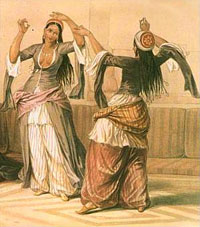
    If you're not singing, you can throw in a high-energy dance:


    Pawlsy said "Good. Let me bring you some of this."

    Eventually joined by one of her Gypsies performing the cult of Sekhmet:


    I got two groups of women learning song and dance off each other. I'm like "I'm playing instruments". Depending on the situation, I can slide around to any stringed or percussion instrument. That means I'm able to try out and train various people for support. And so it's like a huge jam session. Quite fun. I don't like everything that comes out of it simply because I don't like everything people do with music.


    What thing is this?

    I like Beethoven, since he changed the musical direction from perfection to feeling. Sometimes Baroque just seems like a barrage of notes, perhaps pleasantly arranged, but it can be a bit unreachable. The later styles really stick with you, when your brain is the only recorder, I think they are truly impressive. But this is something else. These people don't read any music. They have to mentally record everything they want to play.


    It's amazing how popular everything Egyptian was becoming. You could buy a vial of mummy's toenails. Pawlsy said, "They're creating an imbalanced perception. Everything is derived. They don't know how to deal with the genuine article face-to-face, let alone how to become what the Egyptians spoke of."

    "But it's true no one could read hieroglyphs or speak the old language."

    "No. They're Greek and Arab. Only non-verbal things are the same, such as dance."


    Pawlsy's method is split from the Old Dynasties of Egypt:


    Quote ...the Egyptian term khener – which derives from a verb meaning ‘to restrain, confine’ – is used by Egyptologists to describe an administrative institution connected with royal women and probably attached to pharaonic palaces and villas during the New Kingdom.

    It is the term khener that is usually translated as ‘harem’ (referring both to the place and to its inhabitants), but the translation can be confusing not least since we end up thinking of an Ottoman harem, which tends to be the example best-known to westerners, and conjures visions of a cosseted group of beautiful and sensuous women whose sole duty was to entertain the sultan.

    However, as far as ancient Egypt is concerned, the surviving texts describe the ‘harem’ as an important economic institution supported by taxation, and receiving regular supplies of rations. On the other hand, the archaeological remains at some royal settlements suggest the domestic apartments of the king and his royal women. These royal harems would have included not only Egyptian women and their children, but also large numbers of foreigners married by the Egyptian king primarily in order to establish diplomatic links with the Hittite and Mitannian royal courts. For example, in Year 34 the Egyptian bonds with the Hittites were strengthened by a marriage between Rameses and a daughter of the Hittite King Hattusili. The daughter was received with much pomp and circumstance and was given the Egyptian name Neferura-who-beholds- Horus. This event was recorded on the ‘marriage stele’ in Ramesses’ temple at Abu Simbel, and also on Papyrus UCL 32795 from the likely harem palace at Gurob, which refers to …the king’s wife Maathorneferura (may she live) (the daughter) of the ruler of Khatti.


    As with the soul itself, something that was "confined" to royalty in early times, spread to Real Women:


    Quote ...the office of the God’s Wife was especially powerful and so we can again make the connection between the way in which women held religious titles and the political power a particular cult wielded. The use of female musical titles declined sharply after the 22nd Dynasty. Sistrum players (IHyt) and singers (Hsyt) did not completely disappear. They were not as numerous as in previous eras, but there were still women who recorded these vocations on their monuments. While there were fewer women who claimed such titles, it is clear there were still groups of chantresses and singers working in temples. The Canopus decree, a Ptolemaic decree that established the funerary cult of Ptolemy III’s daughter, Berenice, (among other things) spells out the rites to be performed in her honor. Chantresses should praise the deified princess and offer her jewelry. Singers should sing daily for the soul of the princess (Onstine 2005: 20).

    The reasons for this shift away from the importance of the title are likely to be found in the unstable political environment of the Late Period that probably led to changes in temple administration as well as changes in religious practices. The development of official musical troupes attached to temples happened alongside the use of individual titles, providing a glimpse into the possible venue in which title holders performed. The xnr, or musical troupe, and the choir (Sspt dxn) are frequently depicted in larger religious gatherings like festivals or funerals. One of the most famous is a block in Hatshepsut’s Red Chapel that depicts part of the Opet festival where male and female musicians perform: the women are labeled as the Khener troupe of the temple, and the men are labeled as a choir (Lacau and Chevrier 1977: vol. II pl. 9). These groups were, in part, made up of the musician priestesses. Titles associated with the Khener are less common than chantresses or singers, but women like Nebet-tawyia (Figure 15.1) held multiple titles including “great one of the Khener of Mut.”

    A Khener troupe could be attached to different deities, but Amun was the most commonly named god in titles. The title great one of the Khener of Amun Re King of the Gods (wrt xnrt n Imn Re nsw nTrw) was commonly held by the women of the family of the High Priests of Amun in the Third Intermediate Period. The daily rites in the temple as well as the festivals could be led by male and female musicians. Temple scenes depicting these rites sometimes include groups of unnamed women clapping and chanting as part of the activities. These groups may be labeled chantresses, or sometimes they bear no inscription. A scene at Karnak dating to the reign of Thutmosis III, for example, shows chantresses leading a procession of chanters and wab-priests to where rites before the god Amun are taking place (Figure 15.2). This puts them in direct proximity with the gods on the same level as the other priests, albeit the lower-ranking priests. At Luxor temple, an unidentified group of female acrobats and musician priestesses form an important part of Tutankhamun’s Opet festival reliefs, leading the parade into the temple.


    They are now thought to be the explanation of Hathor's healing figurines:


    Quote Tattoos with diamond patterns similar to those found on khener dancers are common. Khener dancers performed a ritual dance in the nude, during which they exposed their genitals with high kicks and back bends. Their dance echoed the story of Hathor, the goddess of love and sexuality who exposed her genitals to rejuvenate her father, the God Ra, when he was despondent over the contentions of Horus and Set. Khener dancers with such tattoos were found buried at the mortuary temple of the Eleventh Dynasty king Mentuhotep II at Deir el-Bahri. They would have danced for his ka in the afterlife.

    Everything like that used to be assumed as "fertility".

    It's a bit more intricate. Music was important to all rituals:


    Quote Special troupes were formed and trained specifically for ritual, and these men and women are referred to in surviving Old Kingdom text as 'musical troupes' - 'Khener'.
    In the Old Kingdom it seemed the troupes were exclusively composed of women - and could also be overseen by a woman. However by the Middle Kingdom men were predominant in the role as overseer, and male musicians and singers also appear to have been included in these troupes toward the end of the Old Kingdom.

    In the New Kingdom priests officiate under the supervision of the head priest, whilst priestesses provide the ritual music/dance headed by the 'Weret Khener' - 'great one of the troupe of musical performers'. This prestigious post was conferred to women of high status, and specifically referred to their role as overseer of the musicians of the cult. She was usually royalty or a close relative of a high ranking priest or official.

    They testify to a different Indo-Syrian style:


    Quote Asiatic dancing girls were introduced during the invasion and occupation of the Hyskos (1700)BC. The Hyksos were Semitic tribes originally believed to be from Palestine and Syria. It is here that the sharp angular lines previously depicted begin to soften, and a gentler, flowing art form is introduced. The Hyksos were also credited with introducing the long necked lute, lyre, oboe and tamborine. The harp dates from the Old Kingdom and by the Amarna period it was so large that two people were required to play it. The flute is one of the oldest instruments in the continuum of Egyptian instruments.

    Concerning goddesses:


    Quote Although dance, music, song and chant are evident throughout ancient Egyptian life, dance was especially important to the cults of Hathor and Bast. To Hathor dance was 'food for the heart'.

    Dancers dedicated to Hathor had a picture of Bes tattooed on their inner thighs.

    The dancers often wore a mask of a fearsome lion, tail, feathered head dress. On other occasions Bes could also appear as a jovial almost comic chap.


    They have compounded Lion goddess with Ma'at, whose ostrich feather represents the truth:


    Pawlsy said "Bes or Bastet is not really distinct, but is the domestic cat. She's the relaxed side of Sekhmet. And it's not just that, the point is, you are not going to have a Bast if you don't have Sekhmet for protective purposes. So you need to look at this as to how the two are related."

    I couldn't. There was just no way to gain my trust for Pawlsy as an innocent kitten. That was a mystery that was way off in Egypt sealed in some royal necropolis. I can't see how we have a manifestation of Bast anywhere to be found. So I said "I will."


    Their other notable accoutrement was Anklets such as this gold with amethyst beads ca. 1,900 B. C. E.:


    self-explanatory:


    It can be dismissed that Harem is a good translation for "musical performers" and:


    Quote The same institution was also involved in the cults
    of deities such as Sakhmet, Bat, Wepwawet, Horus, Min, and Onuris.

    Several werets are listed.


    "Pawls, this looks like a bigger deal than a stray remark by Herodotus."

    "Yes. People start off with the wrong ideas, and then you can never fix it. The Napoleonics came through and decided we were all prostitutes, because that is the only kind of woman they were able to meet. Or, one who sells her body just makes noise for attention. They don't have to be quite as good, since they have another purpose."

    "But that doesn't mean the latter-day French are going to take this as an all-encompassing art form. Maybe it started as a royal privilege, but it is the only thing consistent throughout Egyptology, as pagan devotionals."

    "Well, yes, but Egyptians were mostly urbanized, and so that word isn't the best fit. They didn't have "-isms". It would just be "Hathor" or whoever was prominent at the site."

    "And they tolerated Greek and Levantine deities, or hosted them. The coming of the Hyksos had nothing to do with religion, it was not a crusade. I don't think we have a way of understanding why power struggles happened in by-gone times. There could have been good or bad reasons and we just don't know usually."

    "Which would you say Napoleon was?"

    "I try not to. France is just...it's just...I don't know, too big, I guess. That's why I wanted to come out here and do things on an individual basis. We have to make our own programs rather than join them."

    "It's going to be tricky. Even among the Slavs, there is apprehension about making Serbia a too-great power."


    Before Greece left, you can see Montenegro notched out of what is one vast Ottoman eyalet:


    Pawlsy is a product of the main administration going away after centuries. In 1836, the capital moved from Sofia to Manastir (now Bitola), Macedonia.


    During our life, they attempted numerous legal reforms in a process called Tanzimat 1839 - 1876:


    Quote ...the reforms faced resistance from conservative clerics, exacerbated ethnic tensions in the Balkans, and saddled the empire with crippling foreign debt.

    The primary purpose of the Tanzimat was to reform the military by modernizing and taking inspiration from European armies. The traditional Ottoman army, the Janissaries, had fallen from grace in terms of military prestige and a European-inspired reconstruction was a necessary change to be made.

    It was insolvent in 1875.

    A very large number of things took place, but were they for their own sake or that purpose.


    Agreeably enough, some of their terms classify as what we might call "good". But there are further concerns:


    Quote The Imperial Reform Edict of 1856 promising full legal equality for citizens of all religions. Abolition of Jizya, though it was replaced with bedel-i askeri, and iltizams –tax farms.

    Establishment of the Ottoman Bank (originally established as the Bank-ı Osmanî in 1856, and later reorganized as the Bank-ı Osmanî-i Şahane in 1863) and the Ottoman Stock Exchange (Dersaadet Tahvilat Borsası, established in 1866).


    How do I discuss this with Albanians?

    In the first matter, it's just a sleight-of-hand. Instead of a tax for "being" Christian, you are taxed for work or produce obtained in a non-Muslim manner. And, we are in a place where the church owns an unusual number of estates.

    They definitely won't understand the second part. My reaction went off not just because of potential military conflict, but because I had seen how it affected England and France and now made its way here. The Bank that is.

    "This is serious, Pawls. We have found out from St-Germain about how this places a country in debt, which it resolves by aggression. He tried to stop it well before the Revolution. But it went through and came out as Napoleon. And then despite other Republican reforms, the banking structure still sits there quietly, and I am afraid it is only a matter of time before they do something else."

    She saw through it right away.

    I said to her one of those things that sounds anachronistic now:

    "In America, they had a president sit two terms to prevent it."

    "But the Turks are asking for it."

    "Yes. And someone will be taking advantage of it and pulling their strings. We have to tell people, for this reason, the Ottoman success is, at best, temporary, and, ultimately, leads to renewed conflict".

    "Or taxes will go sky high."

    "I guess you could say there are a lot of related issues. It might work different ways, but it probably won't work well. Here's what I don't like, The one in England opened in 1694 and it has exclusive hold on government finances".

    "So the fate of a nation depends on what goes on with that third party."

    "Yes. The medieval kings all operated by taking personal loans. Up to him to manage his own finances, if not, it's his problem or that of his family and immediate retainers."

    "Muslims will not like that additional party."

    "Their Sultan is giving it to them. I doubt they understand. I doubt very highly that anyone will understand this. You have to be educated in a certain view of French politics. In school, they have a way of making it sound normal. I think some classes distort reality, they teach you an idea that only exists in school, and they neglect the actual substance. With songs and rituals, it's the other way around."

    "If you put this truth in lyrics, it will erase falsehood, like whisking away a cobweb."


    Everything is cut out for me. I'm going to talk to Albanian girls, using a language I don't understand, to say something she won't understand.

    Their music is highly textured, but they often express a restraint, a bit of coolness, as singers. I think there is something in romance they need to pick up on, something gustatorial. They're all very friendly, they're great people basically, but I am talking about grooming a stage presence, an Albanian Marianne. They work as a pack and seem to have little notion of individual verve. It's going to take the right voice with a certain quality of character.


    There are 20 or 64 of them.

    Here, you are named for something. Europe has had phases of loading in Hebrew and Greek names, and in general a person is not known as "Tuesday" or "that rock" because it is just "this sound means you". If we work at it, we can trace meaning and linguistic correspondences such as French miel is in Greek Melissa "honeybee". Here is a handful and what we are able to tell.


    Elira - (Eh-leer-ah) - The free one (is Illyrian Greek or a self-name?)

    Hana - (Hannah) - Moon (not Semitic "grace")

    Hojza - (Hoy-zah) - Honeycomb (not a miel- or mel- stem, closer to honey)

    Rea (Reh-ah) - Cloud

    Vera - Summer (rather than "truth")

    Aferdita, dawn (Prende)

    Ariana, Persian

    Dardana, a Trojan

    Denisa, of Dionysos

    Fatjeta, luck-life (several similar names imply Fat- is like Latin fata or Fate)

    Fetije, victory

    Gentiana, gentian plant; also, Gentile (the second part sounds derived or associated)

    Manjola, magnolia

    Mimoza, mimosa

    Pranvera, spring (similar to Sanskrit Pra- "before", i. e. "before summer")

    Tefta, active principle; soul of the world; essence of all things (if from theophania)

    Tereza, harvester (resembling terre or terra)

    Venera, of Venus

    Zana - (Zah-nah) - Fairy (Diana -- Artemis)

    Ariana is backwards, so to place the oldest first:


    Quote Ariana, a term in classical history, from Latin Arianus, Ariana, from Greek Arianē, Areianē, names applied in classical times to the eastern part of ancient Iran and to its inhabitants. Ancient Iranians used the name in reference to themselves (Old Persian ariya-), hence Iran. Ultimately from Sanskrit arya- "compatriot;" in later language "noble, of good family."

    The name Ariana is the Latinized form of the Ancient Greek name Ariadne (Doric Greek: αρι αδνος; Ancient Greek: Ἀριάδνη; Latin: Ariadna; "most holy"), the daughter of Minos, King of Crete, and his queen Pasiphaë, daughter of Helios, the god of the sun.


    Similarly to Cadmus, Ariadne is probably an actual person or a real historical generation of people, and Minos never existed or is imaginary.

    The potential for ariana to have an "eastern" context runs back to some 3,000 B. C. E.. Somehow a "d" was applied to it but dropped again. It is the prefix ari- that would tend to be "great" or "the most".

    Among many more examples:


    Dhimiter / Dhimitër — “devoted to Demeter”

    Diell — “sun”

    Luan — “lion”

    Dea (princess of beauty)

    Diellza (‘sun rays’)

    Entela (old, illyrian name: god of fire)

    Era (the wind/breeze, illyrian goddess)

    Redon/Rodon (sea deity)


    There is another set from early inscriptions, which is very different from the ones we are getting, although it includes Gentiana. And pretty much everything that has an obvious Greek meaning is said to be imported, rather than native Albanian. And you can see that continue, because Venus is Latin, not Greek. And of course into modern times, they pick up versions of "George" and several other European names. They are just as likely to be named for features like the Drin River, and have clan surnames such as Rugova and Peja.


    That is why it is interesting to find native deity names.

    In an article on a Pan statue found on Mount Mile near Butrint:


    Pasa (Πᾶσα), the female consort of Pan


    The excavated Butrint site also with shrine of Asklepios:


    And let us note Pan continues to be used on Roman coins in the 200s.


    "Pawls, I have an objection. Pan didn't die. Someone said he did and Tiberius got concerned, and that's all that is known of it. The church is all too happy to say it proves he was kicked into Hell as the Devil. However, no real meaning can be ascribed to the voice at sea Tiberius believed in. This is not a widespread account reported by all of Rome. It's a vignette from a sole source."

    "Gods don't die."

    "That would be the next problem with it. Yes, the story seems to be geographically aimed at Albania, but there isn't exactly a fact in it."

    "No, especially since he remains significant in the Orphic Hymns."


    She's right. It's the extensive context for something that is also cast in metal objects from centuries after the declaration of death. It's not like there is actually a story to back it up. You don't have to argue it was symbolic or localized if you can't find it.


    "Okay, Pawls. I have this Albanian ethos somewhat figured out. It mainly deals with the Sun, Dielli -- Yellow, both in myth and ritual but specifically in the taking of oaths. There are others, but he is the primary thing to swear to, often in the sense of all-seeing eye. An oath is a personal covenant, making him something like Baal Berith."


    "Yes. And the most important transitions are Yule and the Spring Equinox, when the sun returns and promotes growth."


    Quote Edith Durham – who collected Albanian ethnographic material from northern Albania and Montenegro – reported that Albanian traditional tattooing of girls was practiced on March 19, which falls in the days of the spring celebrations.

    Pawlsy said, "I am a Solar agency, and at first we must administer a revolutionary oath by Dielli. Loyalty to the death. That's for everyone. From the best women, I shall install an Order of the Moon which will re-radiate itself through the peaks and veils of these Accursed Mountains."


    All of the men folk singers were dedicated to memorizing historical poetry. She's being territorial. She'll broadcast something different to all fighters and all people and I know it won't go the same as what I call south, west, or coastal Albania, where we certainly don't expect anything to be happy about the Slavs.

    "I haven't noticed Pan by name, but he would seem to be heavily involved."

    Quote In Albanian folk beliefs the mountain worship is strictly related to the cult of Nature in general, and the cult of the Sun in particular.

    Pawlsy is quick to pick up on things. "Each individual mountain has its own type of manifestation. And I think Pan would be there because Nymphs are everywhere."


    Quote In Albanian folklore the original Zana is escorted by three wild goats with golden horns. In Northern Albania and Kosovo every mountain is said to have its own zana, who appeared as a fair maiden found bathing naked in mountain streams. The zana is believed to be extremely courageous, a formidable opponent, who can bestow her protection on warriors similarly to Pallas Athena.

    The zana is believed to have the power to petrify humans with a glance; shetuar or ****uar is used in the Gheg Albanian dialect for a person that has been paralyzed by a zana.

    The zana symbolize the vital energy of human beings. They idealize feminine energy, wild beauty, eternal youth and the joy of nature. The zana appear as warlike nymphs capable of offering simple mortals a part of their own psychophysical and divine power, giving humans strength comparable to that of the drangue.

    In the coastal region they are called:

    Fatia

    and Ora at northern tributaries of the Drin.


    We have to treat this gingerly. It's layer upon layer, and in the main folk songs there are only certain memories. I turned to Pawlsy in the compositional sense and said "They speak in terms of Drangue versus Kulshedra as hosts of good and evil. It means environmental calamities as well as human strife. It is again also personal or psychological. Every town has its own telling and maybe every bard in it. It's Homeric, as if it happened from maybe the 500s to the 1400s, and has just kind of gone quiet since then, nothing to add."

    "Well, that means all the truly ancient references are in a lower strata. as evidenced by inscriptions being largely forgotten, the ones from just slightly before that time."


    "There could easily have been a previous Heroes cycle in the same Drangue vs. Kulshedra milieu."

    "A thousand years is a long time to remember a memory for its own sake when new events happen."


    "Yes. And so for example the war dance, like the cross quarter dates, the tradition itself is cloaked in terms like sun and fire and highly persistent. And when we look at these oaths and hymns and so forth, we find graded expressions for fire itself and then Fire as a regent, a superior intelligence acting in a spiritual manner."


    Quote The lineage is identified with an original fire, and the members of a same tribe/clan are "from the same fire". Zjarri i Vatrës ("the Fire of the Hearth") is regarded as the offspring of the Sun and the sustainer of the continuity between the world of the living and that of the dead and between the generations, ensuring the survival of the lineage (fis or farë).

    "This core is probably cognate to Sanskrit."

    Enji or Enjte -- Agni


    "That's the main thing making it the same. Indian Drought is pictured as a cold drought which is basically that you get rain clouds that never do anything. It's just gloomy. This impacts their unique three-season pattern."


    "The Accursed Mountains have their own climate and seasonal changes, so the battle of a beneficial weather or "storm" deity should not be strictly identical."


    "Yes. The question is more of how do you think the Sun god represents good. And this is where we have to write in new factors, considering the Battle of Kosovo to be obsolete for the current situation."

    "As I said, Serbia is something to watch. It won't work to call us "the Slavs" and throw us into one category, since, like "Albanian", loyalties run in different lines. Then when you're Egyptian, people confuse you for a Gypsy anyway. Even if sometimes we live like that. There is no single thing that is common to all the types of people that we have to ask what the Turkish problems are. It's not because it is Turkish or because it is "unfair", you have to address particular issues. And, they are inexperienced, you have to warn them about what may happen with English or French assistance. If we have any success, the first thing they will do is try to pull it out from underneath us."


    Pawlsy had put together everything I know with everything I don't since the Vernal Equinox with Albanian Egyptians:


    Quote Local Albanian mythology has it that Zojz has a son and a daughter. His son is called Plutoni (cf. the Ancient Greek Pluto), the god of fire and the underworld. With the fire in his hand, he holds control of the center of the Earth. Plutoni used to be worshiped as well. Zojz's daughter is the goddess Prende, widely worshiped in northern Albania.


    It is generically perendi for "sky, heaven, deities", later simply capitalized to translate the God of the scriptures. Obviously, it is closer to the name of Dawn than to anything else in their language or others.


    "Pawls, the word for divinity or this Daughter Goddess is rather unique, but the other part is an accretion. To understand the Orphics, Ploutos is the deity of Wealth, whereas Plouton is an epithet of Hades, whom they avoided talking about. The two are usually conflated as "Pluto", but the Albanians are transmitting a Greek euphemism."

    "We don't avoid talking about it out of fear, but, rather, for the sake of not dwelling on it."

    "They're not cluttered with an Azi Dahaka or Big Devil, that Albania is a bit close to asserting. If we take it from Zoroaster, it's the same, it's not really a subject from sheer lack of interest in pursuing it. Instead, the focus is on why those issues happen and the conclusion is their lore conveys the impression they were successful at not having all that malignancy erupt."

    "Compose from that standpoint of Victory."

    "Pawls, that is perhaps the main word that gets translated only as military success. We have to paint it more broadly."


    Here is a summary of Albanian song lore with the people and events removed:


    Quote The Kângë Kreshnikësh – the traditional songs of the heroic legendary cycle of Albanian epic poetry – always begin with a ritual praise to the supreme being: "Lum për ty o i lumi Zot!" ("Praise be to you, o praised God!"). This introductory religious formula brings the audience into a distant world and a primordial time. Including elements ranging from paganism to monotheism, the primeval religiosity of the Albanian mountains and epic poetry is reflected by a supreme deity who is the god of the universe and who is conceived through the belief in the fantastic and supernatural beings and things, resulting in an extremely structured imaginative creation.

    The components of Nature are animated and personified deities, so the Moon (Hëna), the Sun (Dielli), the stars, the clouds, the lightning, the Earth (Dheu/Toka), the mountains, etc. participate in the world of humans influencing their events. People also address oaths or long curses to the animated elements of nature. The supreme god allows the existence of terrestrial female deities with their intervention in earthly events and interaction with humans. Indeed, in their life, the heroes can be assisted by zanas and oras, who symbolize the vital energy and existential time of human beings respectively. The zana idealizes feminine energy, wild beauty, eternal youth and the joy of nature. They appear as warlike nymphs capable of offering simple mortals a part of their own psychophysical and divine power, giving humans strength comparable to that of the drangue.

    The ora represent the "moment of the day" (Albanian: koha e ditës) and the flowing of human destiny. As masters of time and place, they take care of humans (also of the zana and of some particular animals) watching over their life, their house and their hidden treasures before sealing their destiny. Hence, the goddesses of fate "maintain the order of the universe and enforce its laws" – "organising the appearance of humankind." However great his power, the supreme god holds an executive role as he only carries out what has been already ordained by the fate goddesses.


    "It's not about logic, Pawls, it's so you will live in a magical world."

    One where the rainbow is:

    "the belt of Zoja Prenne"


    also called:

    Zoja e Bukuris


    Ylbera:


    "Prende is not cognate to Eos -- Ushas, but, her meaning is almost the same. And then we see Zonja or Zoja is a title, it's an Our Lady, like Belet, or Repyt."


    Pawlsy said "Beauty (Bukuris) is their name for the power-holder in each of the three realms."


    "Earth, Sea, Sky. It's not the same as the Indian version. But it is similar. So for example the Sun is Beauty of Sky. However, Dawn is being called Our Lady of Beauty, as if the quality itself in any form."


    They seem to have simply transferred things from Christianity:

    Quote Virgin Mary, or Zoja e Mërturit ('Our Lady of Mërturi' in Albanian)

    ...certain Illyrian and Messapian goddesses (some of them borrowed from Greek) shared the title Ana or Anna, which is plausibly interpreted as "Mother".

    When Christians were the majority in Albania, she was called Shëne Premte or Shën Prende ("Saint Veneranda"), identified by the Catholic Church as Saint Anne, mother of Virgin Mary.

    Comparatively, Egyptian syncretism is crafted. Sekhmet is the Daughter of and Eye of Ra. Repyt is especially the guardian of Ma'at and the Eye of Horus:

    Quote ...she and her son Kolanthes perform appeasement acts with incense to neutralize disorderly forces like serpentine chaos entities. Doorway reveals in the innermost sanctuaries depict her mediating the sun god's journey through the twelve hours of day and night, actively warding off nocturnal perils to maintain the sun's passage and prevent the unraveling of creation.
    and as wife of Min in another reaction:


    Quote If they knew that the Greeks translated Repyt’s name into Psyche, and that she is described in the Gnostic writings (translation of Egyptian stories), as well as in the Greek pantheon, they would be able to fill the empty holes in their view on who Repyt and Min in fact is. Because the Egyptologists do not broaden their perspective outside Egypt, they are blind to such connections. I saw this like by “accident” because I did study broadly because of personal interest.

    "That's right, isn't it Pawls? In the Ptolemaic era you do have to look for Egyptian syncretism. Of course Min is not linguistically related to Eros. But this is when the Orphics use Eros and Pan in a theological way. Orpheus is thought to have been Thracian which has not persisted as a language or culture in any known way."

    "No records are known of pre-Greek Bulgaria."


    Repyt is the same scale as Ora. A Day.


    If Albanian Illyria is historically introduced by attributions from Greece, it has more and more to assert its unique existence. Dardania has at least something like this; but, of Thrace, no, it just seems to be a mention with nothing preserved of its own nature.

    So I am trying to sift their basket of bardistry to find things to work with. Here is a vocabulary lesson in the Lightning Weapon of the Drangue:


    E Bija e Hënës dhe e Diellit ("the Daughter of the Moon and the Sun")


    I have to take the obscure of the obscure and do something completely handmade and verbal. It explains the counter-argument to the folk music compendium The Highland Lute in Albania itself for this reason. That collection partially takes from the "classics" or older Albanian songs and then adds its version of current events. This is based on:


    Quote Zana e Madhe ("the Great Zana") is thought to have been an Illyrian goddess, equivalent of the Ancient Greek Artemis and Roman Diana.

    and the message is clear:

    Quote The Zana of mount Vizitor provides an idyllic interlude to the fighting. The Great Zana is outraged at witnessing the murder of her childhood companion Tringa. She brings the body back to the Alpine pastures where it is buried ceremoniously at the foot of a linden tree. In a spirit of vengerance the Great Zana calls upon all good men to hasten to the battlefield of Noshiq.

    Lahuta e Malcís, a classic work of Albanian folk tradition published in the 1920s, includes several appearances by zana. In one canto the zana of the Sharr Mountains watches over local noblemen as they rally against the Treaty of San Stefano (which awarded areas hitherto under Albanian rule to Prince Nikola of Montenegro), and delights in their speeches and rhetoric. In another, the "great zana" issues a call to arms for all willing Albanian men to avenge the murder of the maiden Tringa by Slav bandits.

    and in fact anyone who reviews it cannot miss the fact it is racism set to music:


    Quote There is a pathological hatred between the two sides, not only among humans, but also between the relevant mythological beings, between nature, natural phenomena, and so on. This makes it impossible for the spirit of either side to rest or to cease to fight. In the Highland Lute, the hatred between the enemy camps is the contagious plasma of the poem. It puts together the clusters of characters. The poem travels between fantasy and reality clustering both imaginary and real characters. Both sides have undisputed right to all territories, events, to fight, to make peace, etc. The heavenly reality is no more than the reality of everyday life and no more terrestrial than imagined and fantasized in a mountainous, all-natural familiarity among the two groups. Albania's time establishes a completely human, almost parental, relationship with Ali Pasha of Gucia when the moment is played with the fate of the nation. The great fairy is the poet's life-long sister, giving him courage and the spirit to follow the development of events, such as poems and curses. Likewise, other clocks, by tribal names or other clans by mountain names. The typical familiarity of this nature is created in the guest song "Zana" known for its rare artistic values.


    It is arranged Iliad-like, from the older folklore up to one particular person:


    Quote The last two songs create the atmosphere developmental of Albanian national identity. The next cycle begins with the Albanian Prizren league and the only central character is Marko Miljanov, (described as Mark Milani in Albanian) who is the anatagonist in both Kosovar folklore and amongst the highlanders in Malësia e Madhe. Alongside Miljanov, King Nicolas Petrovic hastily appears.

    Rather obviously, our main hopes are in the Albanian Montenegrin Miljanov:


    Quote The village of Medun was located in the Kuči tribe (in present-day Podgorica municipality, Montenegro) of the Brda (Highland) region. The tribe at the time was de facto independent from the Ottoman Empire as well as the direct rule of Petar II Petrović-Njegoš. Like his fellow highlanders, Miljanov took part in hajdučija (guerilla fighting) against the Ottomans in the region.

    In 1856, he came to the Montenegrin capital Cetinje and entered the service of Prince Danilo in his guards unit called perjanici. For his bravery and successes in raids on Ottoman territory and as a man of confidence, he was awarded in 1862 the position of judge and head of Bratonožići tribe (that neighboured Kuči). For his work on the unification of Kuči with Montenegro in 1874, he had a price set on his head by the Ottomans.

    The success of 1858 has furthered itself to regions more distant from Cetinje.

    Miljanov is the larger white-haired figure meeting Lazar Socica of Herzegovina:


    When I get into this, that's who I see myself working for, or with. And this published song cycle is a later affair. Note that it is based on a mountain in Montenegro.

    Tringa is a real person, a guerilla who became a "Marianne" figure.

    With Marie Coba she founded the Albanian Woman movement around 1920.


    We were planting the precursor ideas a decade before they were born. All we were doing was Dukagjin Ahengje, or, as said, party songs. Building something similar to The Highland Lute but not focused on that particular instrument and actually trying to prevent its doctrine.


    The first thing that happened was Pawlsy's dance went off like a tempest.

    It was understood what we were making was for select audiences, we were not replacing the village holiday festivals and so forth. We're not needed to help them do what they already do. We're foreigners making a collusion.


    Cairo was a place where the once-royal temple system of singers and dancers no longer continued:


    But for Pawlsy, there was a strong downturn causing her family to emigrate:

    Quote The women with whom they were able to socialize were principally prostitutes, who used 'dance' solely as a means of attracting custom. Respectable women and artists were kept well away from the gaze and attentions of the 'infidels'.

    In fact, fearing they may be forced to perform for the French, the genuine Egyptian artists had already left the capital.

    Egyptian dance, having been dropped from temples, continued in ways not that different from Albanian:


    Pawlsy said "Our music cannot be separated from this somatic component."


    Yes, I thought, we will be an event or an experience that cannot be fully represented in a songbook.


    She said, "I'll make this simple. There is only one Crown of Repyt. In time, I have to choose a successor. But I also need to say something that is conditional upon my death, which is to leave it to you for judgment."

    I think I lost my eyebrows.

    Something very strange happened quite fast, which I have later speculated was perhaps a burst of Ultraviolet light from Pawlsy's teeth, but it felt like something hit me corporeally. I couldn't think because my fate was about to be jerked around faster.

    "This Crown gives me authority to delegate a retinue. Every Spring, if possible, we will elect a new girl or woman as a Priestess. She will be taken to the cave and rites administered."

    "You'll make an Order that is mixed Albanian and Slavic."

    "The Order is Egyptian that has already merged with Levantine, Syrian, and Greek."

    "Repyt is the chain of human manifestations of Sekhmet."

    "She welcomes practical revelations of deity -- perendi -- in any language, such as Pan or Zana."


    I had an idea I wanted to bounce off her.

    "Pawls, the Kulshedra are a designation of hostile forces, but here is the reason it shouldn't be taken too seriously. That is, the description of evil dragons or Azi Dahak is basically folklore that was added into Zoroastrianism. It evolved from a concept, to an extremely serious concept, to an active power in the world embodied in kings and peoples. And so you have this great existential struggle. But this is not what original Zoroastrianism is about. It doesn't mention this."


    "That's why our songs are also dance, and the activities of the season such as planting and harvesting, and the subject of fighting is intended to be temporary and out of necessity. It's that quality of fearlessness that's being honored. Not to just automatically run off and kill somebody."

    "But we've got to make a fighters' oath, which may be tied to an official structure, but, it may amount to a citizens' rebellion as well."


    "My work is to protect Ma'at or Mut:


    Quote Maat had a central role in the ceremony of the Weighing of the Heart, where the decedent's heart was weighed against her feather.

    The sun-god Ra came from the primaeval mound of creation only after he set his daughter Maat in place of isfet (chaos). Kings inherited the duty to ensure Maat remained in place...

    Maat was the goddess of harmony, justice, and truth represented as a young woman.

    It's not a given, it's not the standard by which all societies or tribes operate. Artemis is Potnia Theron of Crete. In Arcadia and Boeotia, she had a famous devotee known as Atalanta who stands for freedom and independence. Callisto is a more famous Arcadian."

    "Arcadia is the idea of Hermes and Pan in central Greece. As if some kind of Albanians or Illyrians were present there as well."

    Do they perhaps evolve with Orphic philosophy, it appears so.

    Atalanta with Erotes:


    Pompeiian Artemis enthroned with Eros and Callisto:


    Pan is perhaps also understood as Sylvanus Silvestris.


    From re-thinking the process of cultural exchange:


    Quote The goat is most frequently used
    in different emissions of Pharos (Hvar) on the reverse, with the head of Zeus, Persephone or
    Artemis on the obverse. The image of the goat most certainly derives from the coinage of the
    mother-city of Paros, which was known as one of the centres of the nymph-cult in the Cyclades.

    The other series of coinage from Pharos depicted
    the goat and coiling snake (Bonačić Mandinić 2004: 58-61, no. 89-93), which, in the opinion
    of Stipčević (1976: 246), represented a merging of the Pharian symbol of the goat and snake
    which was an indigenous sacred animal, also present in the myth of Cadmus.

    Of his Youth form:


    Quote The companions to this type of Silvanus are Diana, or the
    »nymphs«. The »nymphs«, accompanying both types of Silvanus are sometimes represented
    in very distinctive clothes, which might well reflect provincial female dress.

    From a Bosnian view, Dracon and Dracaena are Vidasus and Tana.

    Zana:


    "Prende has been conjectured as etymologicaly related to Persephone. No one has considered if Aphrodite may be from Afer Dita even though -dita may mean "bright" perhaps day in Greek."

    Quote Afro-dita is its Albanian imperative form meaning "come forth the day/dawn".

    Prende's festival was celebrated on July 26 every year, and her devotees would don beautiful clothing and would set out a mortar and pestle as a representation of sexual union.

    According to folk beliefs, swallows, called Pulat e Zojës "the Lady's Birds", pull Prende across the sky in her chariot. Swallows are connected to the chariot by the rainbow (Ylberi), which the people also call Brezi or Shoka e Zojës "the Lady's Belt".

    "So, Pawls, I'm a novitiate. I don't have a priest-like ability to belt out a metaphysical theology with a full set of explanatory legends. I just know about the cave and an introductory level of what would be the fringe of Greek interaction which reached to Hungary, or, the current "Turkish Balkans" beyond their geographical extent. Prende is perhaps more cosmic and appellant of 'Our Lady' and as the basis of Beauty in any world, whereas the agent, or intercessory, Great Zana of a Mountain functions as Artemis -- Diana. And then zanas or nymphs and fairies are the class which is replete through the background of all Pan-related lore, even if you were to argue some of it was exported from back out of Italy."

    She said, "It doesn't fit in the propensity to "orientalize" us. "Illyrian" just means it was put into known writings by the Greeks after 500 B. C. E., not as if they invented themselves whole cloth the night before. People we are now calling Slavs were these same Illyrians, who dropped the traditions we are preserving. I'm less interested in names and languages, and more interested in how the principles of Ma'at can be distributed in any system."


    The fate-like personal Ora may be the inspiration for Greek mountain-nymphs or Oreads:


    Quote Within Central Albania it was believed that the Ora were present everywhere, “listening to people’s blessings and curses, which they would then aim to quickly fulfil”.'

    Within Albanian folklore and poetry, Ora had the ability to take any form they pleased, including “birds, beasts, women, or serpents.”

    In Northern Albania, Oras “often appear as serpents.” – similarly to the Southern Albanian deity Vitore. Both the Ora and Vitore are “widely represented as a serpent with golden horns who brings gold.” Albanian stories describe beliefs associated with the protective serpent Oras. The mythological cycle of the ‘deeds of Muyi’ reveal the Ora’s ability to provide the hero with supernatural powers and healing while in the form of a serpent.

    From Albanian literature translated by Robert Elsie -

    “Can you see that Ora, standing at my bedside?

    She holds vigil over me day and night.

    This serpent slithers over my wounds to heal them.

    God bestowed it upon me to come to my assistance.“

    They are an aspect of Zana, whose chieftess is Tana or Diana, influenced by the Moon, emblematic of arraying the zana-hosts for purposes of Ma'at. Overall being mountain-nymphs, they are also muse-like, lady of the forests, protector of animals, guardian of springs and streams, protector of women, as well as distributor of sovereignty.


    "We will have to have ones from our own territory, that is, certain mountains that may not be used in the songs of others."

    Quote In Old Albanian the name Hana/Hanë was attested also as a theonym – the Albanian rendering of Roman goddess Diana.

    Hana shows one observance which is rather Indian:


    Quote Among Albanians the dualism between black/darkness and white/light is also remarkably represented by the Moon's phases, which symbolize both fertility (increase) and sterility (decrease).

    The widespread deification of the Moon among Albanians is considered to have been related to the ancient worship of a local deity associated with agriculture and nature.

    "Now, Pawls, there's no discernable linguistic difference between them. Moon -- Hana is maybe like a Big Artemis, to whom Zana is any local dissemination. More importantly, every Pan-like figure follows them."


    Pawlsy said, "You've figured it out. Pan is wise or successful inasmuch as he harmonizes with the will of the Nymphs."


    "I think that's a big difference. Our message is more nuanced. The scriptures are like a given external set of rules are sufficient as one answer at all times. We have that, in universal principles, such as Ma'at or Diana, and then the regional variants of cosmology are important to bring it to a personal and individual level. Situations can be complex and undefined. Thus the problems we have expressing the Ottoman Empire as dangerous for other than superficial reasons."


    The broad base of a universal tradition based on Sun and Moon is not at all something we need to harp on. We need to immerse ourselves in order to produce our local variant. You can't miss those who are nominally on our side or perhaps receptive to it.

    Albanian woman of Gruda, Montenegro:


    How do we prevent an intra-Albanian rift when we are really trying to ask about the Ottomans?

    Well, if I just wanted to sign up to fight, I could have done that. People probably are. I just have a new musical concept that appeals to Montenegrin elites and a belief that a type of soft allegiance-forming can deter a lot of what might otherwise be Turkish onslaught. I know I might have to get involved with that.


    Pawlsy said. "Yes, you have an initiation a bit beyond the first of the Greek Carbonari, but the Montenegrins themselves are the receiving end that makes you a Hajduk:


    Quote In Balkan folkloric tradition, the hajduk is a romanticised hero figure who steals from, and leads his fighters into battle against, the Ottoman authorities.

    People that helped hajduks were called jataks. Jataks lived in villages and towns and provided food and shelter for hajduks. In return, hajduks would give them part of the loot.

    The hajduk of the 17th, 18th and 19th centuries commonly were as much guerrilla fighters against the Ottoman rule as they were bandits and highwaymen who preyed not only on Ottomans and their local representatives, but also on local merchants and travellers.

    By the 17th century they were firmly established in the Ottoman Balkans, owing to increased taxes, Christian victories against the Ottomans, and a general decline in security. Hajduk bands typically consisted of ten to thirty men, exceptionally up to one hundred, with a clear hierarchy under a single leader. They targeted Ottoman representatives and rich people, mainly rich Turks, for plunder, punishment of oppressive Ottomans, revenge, or a combination of all.

    The two categories share a reputation ranging from bandits to freedom fighters, depending on time, place, and their enemies.

    In the European lands of the Ottoman Empire, the term hajduk was used to describe bandits and brigands of the Balkans, while in Central Europe for the West Slavs, Hungarians, and Germans, and Eastern Europe for the Ukrainians, it was used to refer to outlaws who protected Christians against provocative actions by the Ottomans. The term originates from Hajdú County of the Kingdom of Hungary.

    "It's unorganized. Sporadic. My mission is, as you might say, to spread the will of the Nymphs."


    "I know how to translate you: Zoja e Luana, Our Lady the Lion."

    Skanderbeg is a local figure with a goat head, and, I have seen Pawlsy as a lionness. That doesn't fade so easily. But it will seep into the folklore easily because it makes sense in context, but it doesn't literally give away the cave of initiation.

    "Then by 'Priestess', you mean Hana, and a Great Zana or Zana e Madhe other than one from the coastal region."

    "I will determine girls selectable for our musical and fighting needs."


    "Pawls, I'm also a follower of herbology like Shakespeare's eye of newt, such things being a code used to evade authorities during the Witch Hunts. This is what the Italian striga are based on, and so I am thinking it is the same in Bohemia and Hungary and back to Illyria. That makes is noticeable that Gentian is a useful herb here. It is one of the most effective digestive bitters, and it's got moxy."

    "What's that?"

    "You don't know yet, but, it will be part of what enflames audiences at your outstanding performances."

    "You've made up a word for something that hasn't happened yet based on a common weed?"

    "Absolutely. I'm going to make it into infusions and elixirs. So we need ones that are also herbalists."

    "Good choice."


    We are encompassing a region from Rugova and Peja through the next area in the wide angle picture, Decan close to the Gjakova Highlands, who had recently rebelled over the right to bear arms.


    I thought out loud. "So we're based in Peja, the least-involved and most remote district. This neighbor is a little more developed and a lot more revolutionary as they have already fought. It is Albanian in the sense that everything says it was Dardania; but they were just fighting a dangerous form of oppression, not a race or religion."

    "Yes. That's what I'm doing, rather than pan-Slavism."


    We hit it off well. Otherwise it was a slow start. The pretext is Peja is the capital of the Sanjak of Ipek or Dukakin, under the Sanjakbey of Scutari, in the overall Rumelia. This is all Ottoman Empire. Just less heavily garrisoned in this particular corner.


    What we are calling a city or town like Decan has only a few thousand people. Peja is perhaps twice its size. The distance between them is not more than eight or ten miles.

    By "slow", what it means to me personally, is, I have to have Pawlsy, and then a friend of Pawlsy's, to communicate in Albanian.


    By "folk", it means they don't have churches and scriptures, they all do this singing and dancing based on Sun and Moon and Hearth Fire.

    The Albanian fire similar to zjarm is cognate to heat such as Sanskrit Gharma. The proposition is that Enji is cognate to Agni, rather than derived from Latin. This is also to distinguish Enji and Zot. They work together, although the fire is a constant presence:


    Quote During traditional feasts Albanians use to sing and dance around the purifying fire in order to use its supernatural power for protection against evil.

    Zjarri for the celebration of Dita e Verës in Tropojë, northern Albania. Kindled on the eve or before sunrise in order to give strength to the Sun (Dielli), people dance and sing around it or jump across it, a ritual practiced for the end of winter, renewal, purification and apotropaic purposes.


    So it's completely normal for anyone I meet to only know a "Sun and Moon cult" with a propensity for fire rites timed to the seasons.

    I didn't know what i was doing, I just started doing it. I was able to gain access to the mountains by presenting to the cannabis farmers the opportunity for this to be treated like any farming product as a source of income. I can use Slavic singers as a way to say "exported to Bulgaria". This seemed to have its merits, and I got a relaxed policy from the Highlands. And so me and Pawlsy are riding around these towns and villages and sacred mountains for months over the summer, doing whatever impromptu musical exchanges we can make with whoever is interested.

    For me, it was mostly passive and observational, until we had a reputation, and I had one thing to say. It was time to introduce "foreign concepts", such as the ability to make a living by music itself, as well as the message we were trying to make. By Yule, we will have an offer for someone to travel with us and do more, a new music, that will so to speak preserve their integrity while adjusting to a large and international world. That their western kinfolk were at risk of being isolationist and supremacist. Our singing would largely be a power move for the Zana as they know them in a sensibly harmonious way.


    Because I am performing an operation, I recruit ones named for certain meanings, Genta and Ariana.

    "Ariana, you are Persia and the East and a common bond all the way to India, a mystery not remembered by anyone."

    "Genta, you are the living herb of local significance."

    "You have to tell your friends so we can influence mountain rituals and gain the power of Zana before someone else takes it."


    I though it was pretty amazing. A good year. We didn't resort to banditry, so we didn't commit any more atrocities like at first. We're able to form a nucleus of Albanian music based in a lively, driving style, with Slavic and Egyptian influences. The Ciftelia was a beast in terms of someone who isn't used to that kind of setup. In the professional sense, it was quite slow, as the "orchestra" or "instrumentalism". Crude but effective.


    It's "party music", it is almost like chamber music except far humbler. Natural sites and humble hearths.

    I've basically hired singers as my Albanian teachers.


    We haven't yet told them that Pawlsy is going to turn them into Artemis of a living tradition. It's how we started a band. We could compose our own songs and go back to the other places next year and show off something new. It was ideal. I felt there was a type of common perception of "goodness" that was above and beyond language barriers. In the right hands, this Lightning weapon was fine. And we did want to use the authentic part of their own heritage to come forward as a way of life.


    This is small but actual success, wherein we are promoting adjunction with Montenegro. And the old monastery is the station for its news which comes in about their co-Albanians at Muriq:


    Quote On November 15, 1861, in the morning, Pope Savo Vujović, with his combat unit, attacked the Lower Muric with the greatest severity. Here, too, a bloody fight took place between two unequal opponents. The Montenegrin forces intended to kill and cut off as many heads of Albanians as possible to loot as many items and various objects, food items, etc. The warriors here too did their work with the greatest ferocity. But many houses in Lower Muriq became impregnable fortresses, for the protection of which the women of Muriq showed special heroism. And in this battle, the Montenegrin forces were badly broken, and Pope Savo Vujović was also killed there, who had told Prince Danilo that "in the first battle, I will either cut off the head of the Turks, or I will be wounded, or I will be killed" and the latter happened to him, was killed precisely in Muriq.

    The news about the attack by the Montenegrin forces and the bloody fight in Muriq spread throughout the Kraja and Shkodra, from where help also came (the people from Shkodra in boats across Lake Shkodra, while the people from the lower part ran faster and reached Muriq). Reinforcements are also ordered for the Montenegrins. The war didn't continue, there was a stalemate and the Montenegrins took advantage of it to retreat to Krricë and Cermicë.


    And, in the example of people from Herzegovina joining us, Omar Pasha was a Serbian thief who defected to the Ottomans. He stomped the insurrection in Herzegovina and appeared vengeful towards Montenegro. He had crushed Albanian rebellions before, and in fact started The Great Eastern Crisis.


    Oh, my.

    That's only both sides of the cause I got involved with. It has directly led to human slaughter in both ways. Finds itself on the losing end of both. But those Albanians are Ottomans. So who are they really.

    Well, we planned on being able to run new music out to larger areas like Pristina, my vision was all on the scale of professional music. It was just a folk style taking the same stage. A rough concept that had never happened yet. Instead, me and Pawlsy were hemmed in behind Gjakova:


    Quote In 1862 the Ottomans sent Maxharr Pasha with 12 divisions to implement the Tanzimat Reforms in the Highlands of Gjakova. Under the leadership of Mic Sokoli and Binak Alia, the tribes of Krasniqi, Gashi, Bytyçi and Nikaj-Mertur organised a resistance near Bujan. The rebels were reinforced by the forces of Shala, led by Mark Lula. After heavy fighting, they managed to defeat the Ottoman force and expel them from the highlands.

    "That's right. Pawls, do you remember when we started to play music, the Montenegrins got stomped on both sides, then the Turks came out and we had to smash them?"

    "I do. It was your first battle. You shot nine hundred and thirty-six people."

    "It was easy. I paid attention to the Bija of the Sun and Moon, and then whenever I looked at somebody, they would stop and look back. I just thought I was doing good at getting the Fire rite. Power of the Drangue."


    Pawlsy said, "You didn't return to any foreign school."


    Omar Pasha gathered possibly as many as 50,000 Turks and went in against thousands of Montenegrins.


    Originally, Prince Nikola was installed by Dukagjin Albanians because:


    Quote The assassin, Chief Todor Kadić of the Bjelopavlići, was said to be assisted by Austrian authorities in carrying out the assassination.
    They inhabit the plain around Ostrog Monastery where Mirko Petrovic put up the main resistance. Omar Pasha ground it up. He then proceeded to Cetinje and surrounded or attacked it. Whole Montenegro was defeated.

    Terms were signed at the Convention of Scutari, August 31, 1862:


    Quote Vassal status of Montenegro (as well as province borderline) was ratified
    Mirko Petrović-Njegoš, Nikola's father who had fought against Ottomans was deported
    Weapon import to Montenegro was banned
    The provincial borderline between Montenegro and Herzegovina was put under Ottoman military control
    As for Petrovic:

    Quote He is a controversial figure in Montenegro, where he is seen as a symbol of "Montenegrin identity, pride and statehood" by many, while others hold him responsible for the deaths of thousands of innocent civilians.

    Now what. My whole cause is gone. As it went, it gained the reputation of attempted Albanian genocide, and massive destruction of its own country.


    Dukagjin Albanians have one local story confirmed by genetics:

    Quote The Krasniqi and the Nikaj share the same progenitor with Gashi tribe ca. 1200 CE.

    The Krasniqi and Nikaj lineages diverge after 1500 CE which is consistent with their origin story from the two brothers Kolë and Nikë Mekshi. The Margegaj belong to the Krasniqi lineage which confirms the oral tradition which considers them descendants of Kolë Mekshi.

    There are a lot of similar stories, or, each tribe having an ancestor, not all of them have an accurate record. The one above is verifiable for what would seem to be the proper time range. Gashi is the patriarchal tribe who established Botushe near the Accursed Mountains and Koshare higher up.

    Slightly west of Gjakova town, Bytyci primarily market to Gjakova and Peja.


    Quote According to legend, there are two villages (Luzha and Botusha) in the Highlands of Gjakova where the Albanian population of the older Gashi tribe of the 17th century continues to live. Due to their constant resistance against Ottoman rule, the Gashi tribe were repeatedly punished via military expeditions, which led to the departure of the population from their initial settlements and a gradual conversion to Islam in the years 1690–1743.

    Following the Ottoman conquest of the region, Princess Milica of Serbia successfully advocated for the return of Botushë and the surrounding villages as property to the Dečani Monastery from Ottoman control.
    Reka e Keqe is a ravine that runs about twelve miles from Gjakova to Decan.


    Quote Reka e Keqe is a smaller subregion of the greater Reka region of the Dukagjini Plain, which consists of around 80 villages known for their resistance against occupying forces.
    These people have come from the west, occupying areas where Iron Age Illyrian mound-graves are found, representing some prior drift, but reinforcing even Dardania was "Illyrian" generally. Gashi are not blood-related to other tribes they united with.


    It is fairly easy to see the distribution of the first Gashi genetics:


    Pawlsy said, "I know you like to talk around it. The success of our music didn't come from your careful plans. It's because it was born with the rites that prepared for this vengeful battle, which was only part of a campaign that took place around some of the larger cities."

    The rustic Peja provided the oldest known musical documentation:

    Quote In 1830 Vuk Karadžić recorded from Dovica Obadović from Đurakovac near Peć 12 Albanian songs and one riddle for Jernej Kopitar. This collection constitutes one of the earliest written records of Albanian oral verse from Kosovo.

    And we find an epic cycle involving the relation of the Dukagjin to an imperial defector:


    Quote Skanderbeg quit the field along with 300 other Albanians serving in the Ottoman army. He immediately led his men to Krujë, where he arrived on 28 November, and by the use of a forged letter from Sultan Murad to the Governor of Krujë he became lord of the city that very day. To reinforce his intention of gaining control of the former domains of Zeta, Skanderbeg proclaimed himself the heir of the Balšić family.

    "So he made the first large tribal confederation, however he did so as a Christian, which I think we should leverage just on the aspect of freedom. Because of this, you have a gateway for the Slavs, who aren't going to tax you on it. Again, monastic property served as a shield, so yes to name the region "lots of monasteries" makes sense. Most of the western Albanians are really Catholic."


    Quote Whilst identifying Skanderbeg as the "dragon prince" who dared to fight against any foe, chronicles portray Dukagjini as the "angel prince" who, with dignity and wisdom, ensured the continuity of the Albanian identity.

    While there is Kanun or "law" named for Skanderbeg, Dukagjin, and others, the one used nearby is another variant still:


    Kanuni i Malësisë së Madhë


    It is exactly this we have to write into our bag of songs, something like The High Land Ciftelia.


    Quote The Albanian national awareness is likely to have been a source of the motivation to record the songs. In the late 19th century, Romanticism in Europe and in particular in Eastern Europe triggered a desire to cultivate and solidify national cultural identities. Thus, importance was placed on the Albanian epic verse because of the cultural history it contains.


    In 1862 it was relatively easy to package a certain strand of epic poetry and play a circuit among the High Lands. We omitted the Slavic fights and carried hymns for native deities.

    "Pawls, Prende is only Dawn figuratively; Prende is Venus. That means the main trio in Albania might as well be Sumerian."

    "According to you, Enji is Agni of the Rg Veda."


    It was a very real experience. We made the music for the fire dance of invigoration for battle and then we went and really did it and the music worked.

    There was no more Montenegro in the way I had come to understand it, there was a new force that had defended every city for many miles.

    "Pawls, our Zanas and Oras will be the Nymphs -- Oreads or Silvanae -- all the way to Moldova, wherever a Pan-like deity has been found. Reason being they work."


    "You believe we really live in a magical world, like a flux of lights, like the Drangue."

    "If that means one you are powerful in, I think so."

    "If I said I can't help you with Montenegro?"

    "I don't know what to say about school, or anything...returning to the world I know is something I decided to write off. I was going to do this for a few years, as a source of income, but we became pre-occupied. It's, I suppose, a little embarrassing, but I did not realize those guys were going to go off like cannons."

    Pawlsy laughed. "Your sinister plan has not even started."

    "No. On the face of it, I would not have accepted a plan to get stuck in a practically unknown area on an instrument with two strings. Sounds like a horrible idea. But I think circumstances will give us what we need to guide our compositions by Ma'at rather than the warrior per se."


    I consider it genuine. At that time we played versions of select numbers that we culled from the public. We just concentrated some of what we found. We're not actually in the position of trying to collate centuries' worth of sagas in an Iliad-like manner. Just certain foci. And by doing this we really did go on to stop the Turk and become a known celebrity presence in some of these places. Even better, it was decided that we really did display Drangue due to our sincerity.

    Tattooing rituals are common, primarily using solar and lunar symbols:


  4. The Following 6 Users Say Thank You to shaberon For This Post:

    Bill Ryan (24th March 2026), Bluegreen (11th May 2026), bojancan (19th April 2026), Ewan (24th March 2026), ExomatrixTV (24th March 2026), Victoria (6th April 2026)

  5. Link to Post #3
    United States Avalon Member
    Join Date
    1st April 2016
    Posts
    6,638
    Thanks
    34,541
    Thanked 37,853 times in 6,288 posts

    Default Re: Pawlsy the Cat is Her Name

    Pawlsy was right. My idea about becoming a musical recruiter in Europe helping Montenegro make a bloc of loyalty through its minor eastern connection had collapsed.


    I was glad for the opportunity to shift the ambition. Reports were that Montenegro was reduced to a miserable state:


    Quote “The Weser Zeitung from Vienna reports on August 2 that the battle between the Turks and the Montenegrins, which appears to have been decisive, took place on Friday afternoon, July 18. Omer Pasha, with the three corps of Abdi Pasha, Dervish Pasha, and Hussein Pasha, totaling approximately 50,000 men, attacked the combined Montenegrin forces under Prince Mirko Petrović and Vukotić, numbering about 15,000 men, between Duga Luka and Tuzi, on the line of Bijelo Polje and Pavlovići.

    This time the Turks fought with the greatest fearlessness and charged with bayonets against the almost impregnable enemy position, which they finally captured on Saturday evening, July 19. However, they suffered losses of approximately 2,000 dead and just as many wounded or missing. The Montenegrins, who also lost around 400 men, retreated to the strong defensive line of Žagari (Zagarač), which they had already fortified earlier.

    After abandoning the Bijelo Polje and Pavlovići positions, they passed through a mountain range, and the Turks did not dare pursue them there. Immediately after securing the Bijelo Polje–Pavlovići line, Omer Pasha began reinforcing it with entrenchments. On Monday, July 21, however, he advanced toward Žagari, and a new, furious battle ensued, the outcome of which was not yet officially reported.

    On the plain, it was said that the Turks had been unable to dislodge the enemy from his new position. But anyone who knows the circumstances of the war, the fighting style, and the character of the combatants must consider Montenegro’s situation desperate. To explain this sudden turn of events, the word “exhaustion” suffices, for if 1,000 Turks and 100 Montenegrins remain, the loss is far more severe for the latter, since the Turks constantly receive reinforcements, while the Montenegrins must face the same fire with dwindling numbers.

    Since the beginning of the war, around 8,000 Montenegrins have already perished. Montenegro has exhausted its last reserves, and even old men over sixty and boys under fourteen are among the fighters. Typhus threatens both armies, as masses of unburied corpses in the heat are polluting the air. The Turkish hospitals are overflowing, and thousands have already died.

    But the Montenegrins, too, cannot endure such hardships indefinitely. The sun beats down on the bare rocks with terrible intensity — there is almost no shade or tree to be found. Added to the misery is an extreme water shortage; over forty men have already died of sunstroke. Night brings little relief: after suffocatingly hot days, the nights are bitterly cold. The soldiers are poorly clothed; without exaggeration, nearly a third of the Montenegrins have no shirts, only a single garment.

    From the cold or storms, many die even without combat. Fever is common, striking so violently that the afflicted remain unfit for days. Since the retreat began, an eyewitness reports, an oppressive silence has descended upon Cetinje. Desolation reigns. No one dares speak of the army, much less of the future. The Prince — long resigned to his unhappy fate — has even prevented Darinka, the widow of Prince Danilo, from leaving Paris to return to Montenegro and share the fate of her people.

    He wanders about dejected and pensive. Telegrams are constantly sent; almost daily dispatches reach the Russian and French consuls, all identical in content, demanding aid. All hope now rests on Russia. The dispatch from France to Mirko was very inconvenient for Montenegrin interests, and lately communications have also been sent to Lerin (Florina).

    In Cetinje, people speak poorly of Serbia, blaming jealousy for its slow action. It is even said that the Prince considers moving to another city, probably Cattaro (Kotor). Preparations are already underway to secure the archives, the treasury, the Prince’s personal effects, and the relics of two saints. The Montenegrins seem to have money, but suffer a great lack of ammunition. Rumors of an impending ceasefire circulate, though they sound unlikely at this moment. One wonders how long the Great Powers will permit this barbaric and utterly senseless war to continue.”

    After this defeat, Montenegrin bandits – hired once again by Prince Danilo – started plundering the Albanian regions of Vranina, Lesendro, Grudi, Hoti and Tuzi. Austrian diplomats at the time described these raids committed by “banditi montenegrini” quietly supported by Cetinje.


    The defense was finished after many details on the battle of Ostrog:


    Quote The outcome accelerated great power intervention, with Russia and Austria-Hungary exerting influence to curb Ottoman expansion and protect Slavic interests, while Britain and France advocated restraint to maintain Balkan stability under the European Concert. These dynamics underscored Ottoman vulnerabilities, fueling internal reform debates and external perceptions of decline...

    In contemporary cultural discourse, particularly among right-leaning Montenegrin and Serbian nationalists, the battle symbolizes unyielding Christian perseverance against imperial expansionism, framing Ottoman aggression as a civilizational clash rather than mere territorial dispute. This interpretation privileges the empirical grit of outnumbered fighters over defeat's sting, yet critics in academic circles argue it over-romanticizes the event, sidelining verifiable strategic withdrawals that preserved forces for later gains in the 1876–78 war, thus distorting causal assessments of long-term Ottoman decline in the Balkans.


    As you see, the main reaction is not quite what we want to be happening. It's similar. But just as we want to take Albanian folk music and cut out the parts about fighting Slavs, we don't want to go the opposite route of pan-Slavism either. And we can't have that religious crusading thing.

    With Russian help, we might be able to get Constantinople.


    But, honestly, by not going into a professional music career, instead, total immersion in folk music affected me at a profound level. I tried to participate in the culture as much as possible without pretending to be one.


    I wound up becoming rather nocturnal by dealing with people all night.

    Oftentimes at the downturn of activity, I would wander off in any direction for the sheer purpose of walking. It was somnambulistic, in the sense of being somewhat unrepressible or there was nothing in me that sought to question it. Hyper-locomotivation maybe. I would go around until I felt I had come to a power spot, and from there contemplate nature and life.

    Sometimes I would get edgy, like I was about to "see things", ghosts, fairies, popping out of some tree branch or piece of rag. It never happened, so I inured myself against flickers and shadows.

    That night where I stopped, Skanderbeg bowed to me.

    It was too real. This is not a ghost, this is a vision or something I don't have a name for, like an angel of the battlefield.

    I think to myself "He's been dead for four hundred years."

    Well, we did play ever so many rounds of, at least, certain portions of his story, it's not like we didn't invoke him at numerous pagan bonfires.

    It keeps me quiet at this moment.

    Skanderbeg is armored with his helmet, bowing so it looks exactly like the large goat crest is looking at you.

    Is this Pan or...what generation of what name...for this Christian person.


    It's the most serious thing I've ever seen. He speaks nothing. He is half-shrouded by fog and is possibly what they call a shade. Ominously, his utter passivity radiates some kind of forceful gravity.

    Maybe this is what they do before they cut your head off from beyond the grave. So I move towards him saying "My lord..."

    And as he rises it's not me that said it. He spoke it to me and became a different figure in the moonlight, in something like a monk's robe with his hands gently clasped in front.

    I just stared at him in a daze because no one had ever literally stolen my words like that.

    He was speaking to me in Greek.

    "Friend, are you well?"

    "Lord Skanderbeg, I beseech you."

    "Hello, I, what? No. This is 1862. Have you been in the hills that long?"

    "Several seasons reciting your hymns."

    "I haven't got any hymns. Do you need somewhere to lie down, maybe a cup of water?"

    "Oh yes, you have been remembered -- "

    "Stop that. I was getting concerned because I saw you in the shadows emitting red light and static electricity."

    "I saw your goat armor."

    "I have never worn armor. Quit making nonsense."

    "Can you sing?"


    He was my first local, normal type of friendship.

    That's because it turned out he could. I was seeking a baritone to, you know, fill the register, and he had a great speaking voice. Didn't turn out to be a true deep baritone, still a bit on the tenor side, but he could do it.


    I wasn't sure he was not lying.

    He accused me:

    "You are a hajduk."

    "What makes you say that?"

    "You are wearing a battle-axe equipped on your belt."

    "Oh. Don't tell anybody."

    "I am not afraid."

    "You have a monk-like appearance."

    "I retired from it."


    Now I get it. He's Greek, and therefor affiliated to the same church as the monastery. So that of course has chanting. He's developed.

    "Let me guess. You've come from afar, because this is the Patriarchate of Serbia, which makes it something like a promotion."

    "I'm Nubian."

    Oh. That's quite far.

    That's understandable. He had done Greek education and Orthodox Hesychasm for most of his life, and just reached a point where normal and basic was more appealing.

    In other words he was Coptic, and trying to get his name, he didn't seem to have one. As far as he was concerned, "Mister" was good enough to get his attention. I was able to get him to tell me he has the academic nom de plume Pherecydes:


    Quote Pherecydes' cosmogony forms a bridge between the mythological thought of Hesiod and pre-Socratic Greek philosophy; Aristotle considered him one of the earliest thinkers to abandon traditional mythology in order to arrive at a systematic explanation of the world, although Plutarch, as well as many other writers, still gave him the title of theologus, as opposed to the later physiologoi of the Ionian school. Later hellenistic doxographers also considered him as one of the first thinkers to introduce a doctrine of the transmigration of souls to the Ancient Greek religion, which influenced the metempsychosis of Pythagoreanism, and the theogonies of Orphism. Various legends and miracles were ascribed to him, many of which tie him to the development of Pythagoreanism or Orphism.

    I said "This is interesting, but is too difficult to say, so I'm going to tighten it to Fergus, after the king of Scotland."

    "Yes, master."

    I said "Thank you, but I'm an NCO."

    "Yes, master."

    "I am not your --"

    "You paid my bond fee."

    "No, I was having a psycho-kinetic catharsis, and Skanderbeg of Albania appeared before me."

    "Yes, but I was begging, and you gave me money."

    "I've just met you. I've done nothing of the sort."

    "Master, I was asking for something to eat. Now I will no longer be bound to the church property.. I appreciate this but I'd really like to have something to eat."

    "Follow me."


    We had a good opportunity at Peja. Haxhi Zeka was interested in us, and we were able to retrofit a barn into a big tavern with a musical venue. We would play there sometimes and then go other places towards Decan and Gjakova. In turn, we developed our own market for their agricultural products. Kind of simple, but a step beyond what anyone else was doing. We became avant-garde.

    One thing about Pawlsy was nothing around her was inferior or cheap. There was an air of expectation that reeked of success. She had rented a whole house.

    I lived on the ground floor and the khener troupe had the upstairs.

    I walked in with a complete stranger.

    Pawlsy threw me to the side by the mere idea of it and said. "Good sir. You swear to obey my every command, direct or delegated, and obey though it may risk your life including fight to death at any moment. Or may the Sun see you and the bolt blast you."

    "Yes, m'lady."

    I said, "Good decision".

    Pawlsy said, "You look like you've seen Skanderbeg's apparition".

    I said, "We'll work him in with the goats of Zana."

    She said "Next year, Pristina."

    "His real name is Pherecydes. He's a scholar."

    "Oh. Terrific. We've never had one in the guerilla force."

    "Pawlsy is Despoina."


    So far, I think everyone's alright with each other.

    Despoina is modern Greek for Mycenaean Potnia, "Our Lady" of Crete.

    Fergus said, "That helps me."

    When you've nothing to eat, anything will help you, so I didn't get his point.

    "The reason we like the monastery is because it has enriching ties with the people. Other churches seem to look at them as objects to be told what to do and what to think. And that Confessional practice is something we perceive much differently. Although we are not members, we carry a respect for Orthodoxy."

    "Thank you. Yes, I'm generally pleased with what the church does. I just reached a...a level of paradox."

    "How's that?"

    "I had a harder and harder time seeing how spirituality would depend on only one person."

    "I see. I come from a Masonic family, so, there had been ages of what you might call inter-faith discussions, and so it was decided to not automatically place me in any of them."

    "Without being born into one, you did not enter the flock by choice?"

    "I thought I would. I was looking into it, but, to me at least, the Greek myths sounded more interesting. As I got a little older, I got into things like Tarot and Zoroaster, and since I've come out here I...well, I haven't really converted into a religion, but, like anyone else, I make oaths by Dielli. I've gotten drawn in to something which seems to be similar to what Greek literature is about, but it may be connected to India as well."

    "Who am I to say you can't get to Heaven by these Albanian nature deities?"

    "Oh, mon ami...you've renounced your faith."

    "I found out that most Albanians who attend church or profess Christianity or Islam see it as basically synonymous to what they already believe. That the god that is followed in any scripture cannot be different from the one to their understanding."

    "So they are heretics."

    "Not while they are in church. They don't come in and say this is Albanian. They just switch modes and follow the service accordingly."

    "In other words they neither know nor care."

    "Not really."

    "Therefor the name on your commentaries?"

    "I found that theology was the kernel of Orphismos, but the church didn't really have one. Not until the Middle Ages. I thought that Hesiod's Cosmogony was being related in a more personal way in literature that was rather slowly developed."

    "Very good. It's pretty close to the way we see it, so, our paths have merged. In response, I would say that I think there was a Jesus who was a spiritual healer, but I just think it was similar to paganism. He did not go to the church that has been made for him. That's not what he ever did. I would guess it's similar to Hesychasm. I can understand how a wild dance at a blazing fire gears you up for battle, but I can't say I got a healing touch from it."

    "They don't teach that in the monastery."

    "It should have been the point of the practice from the moment you walk in the door."

    "That would be appealing."


    "I need to explain something else to you, or for you to help me figure it out."

    "If I can, I will."


    When there is money involved, you always go divulging your inmost secrets to a perfect stranger. I had been caught as being a Hajduk, of a debatable faction. Suddenly I'm surrounded by Africans.

    "As I tried to tell you, me and Pawlsy are not real commanders of any sort whatsoever."

    "I am an anarchist?"

    "Y -- Yes...I guess so."

    "What do you require?"

    "No, look...this has all gone out of hand. Let me put it to you this way. I may still be working for Prince Nikola of Montenegro."

    "Master!"

    "Hold on, it's Albanian and really twisted, and...I mean, I know you'll tell me to put my foot right in my mouth if I say this is about Empire, not Albanians"

    "Albanians have defended themselves to the east and west."

    "So, we were under a Montenegrin officer, but due to events our connection has been severed. Things defaulted to us and I am really trying to get out of this and launch a musical career. It was a rather large company, so I thinned it out by taking the ones I thought prone to banditry and maneuvering them to a position that was wiped out by the Ottomans. That helped, we're sort of like a band with a guard. Also due to events, though, I cannot get this career off the ground and it is possible we will get orders from Montenegro."

    "And otherwise?"

    "I consider Pawlsy to be the native. She has all kinds of commercial contacts and personal devotees on 25-30% of the sacred mountains. As our lead singer, all we do is on her behalf."


    For another idea of that territory, here is an interesting physical view that expands to a high level of detail. The older borders are not the same.


    This is Italian from 1689, when the region was in the territory of Serbia. Under its name in bold near the top, is "Podrima", and under that, the expression for the White Drin, which you can easily trace down and also find "Drino Negro" which forms part of the border.

    To the headwaters, you can find the highest part at Pechia/Pech, then at the next tributary "Deciani" -- Decan, and at the next, "Iacoua" -- Gjakova:


    To their south can be found Gruda, which we know as "Albanian Montenegro". Near the conflux of the Black and White Drins is Prisreno -- Prizren. Pristina is at the edge of the scrollwork.


    "Here's the deal folks.

    We have to get Paris. If we can get Paris, everything is set because at least some portion of the continent will open its doors to us.

    I was trying to just pick up a few people from here, and, go there as straight as possible. Incoming."


    Pawlsy said, "We'll travel like Gypsies probably to Pristina first. You'll probably wind up in Budapest."

    "I think so. Paris is no longer a priority."

    "We'll have some of the continent, and some day it will bring us more."

    "I'm going to try to bring in one or two of the locals as instrumentalists, and, I'm going to finger a couple of ours, and, Mister Fergus, I'm going to need you to kind of slit their throats and dispose of the bodies in a prompt and immediate manner."

    "Yes, master."


    At that point we were more like a band with a Hajduk oath to Dielli as a song. We checked around for cannabis and they said "Oh here, take a wagon load and see what you can get." We kept our association with Haxhi and the old monastery, asserting that we were going to further the cause and bring support, one way or another.


    I remember it all going rather well. We slowly crawled a portion of eastern Europe, not recruiting but doing as much as possible to send a basic message. A handful of things. Trying to spark a musical scene while acquiring new instruments. Pawlsy's fame started immediately. Sometimes people were unsure about us until she got going, and, every time, it blew them away.

    Consequently, we were heading closer and closer to her personal domain.

    Pawlsy said, "I have a house.

    It's not my real house, it's my house."


    By now, we seriously believe we can make lots of money.

    She left as barely not a girl, a youth, and now she was a solid adult. Now we could probably get big enough stages to where we can book tours and live in hotels. We just do our thing and everything is taken care of for us. We have that edge. We have a place we can live as long as we need to. So we have the party just for ourselves for once, and on the new day the troupe is making a batch of Pawlsy's Mutter Miscuits when we discover a change in the accommodations.


    1864


    You wake up one day and it's a new system, the Danube Vilayet.

    November 8 Vilayet Law has made this a new model province.

    We're in Sofia now baby!


    We were aghast. We didn't know what it was and it comes across as a far more meticulous Ottoman administration on small scales with new departments and things like this. And we didn't know if we had to strike a match with whatever we could rouse of compatriots, because we were working, as the money was for lots of ammunition, and lots more ammunition, and things like that, and it was supposed to have started years ago for Montenegro.


    It was going to be a decision-making moment, so, I changed the subject completely.


    "Pay attention, everyone. This is important. When we reach the professional venues, we are going to begin to appear in the press."


    Something had managed to bother me.

    "We're all adults in the room right? This is what we're up against in terms of low opinion of exotic dancers. This is at the Paris Salon being denounced as immoral.

    Dance of the Almeh:


    Now what is going on there. Pawlsy, this artist really has made a tour of Egypt in recent years. He's presenting a stereotype. A group of men presumably soldiers, appear to be exploiting a sole dancer, implying she is a prostitute.

    The expression Almeh is supposed to be for the temple singers.

    I think it would be more telling in the context of how this guy has a career in stereotypes.

    Mister Fergus, can you tell me what might be immoral about that?"


    "Pawlsy's career will be banned."


    "Oh, no, we're going to overcome that. First of all I'm going to show you a bizarre sexual confusion in the mind of man.

    Now, although this dance was called "immoral", the same artist had recently been flamed because he had done a work that was called pornographic on Phryne the Haetera. The story is she was in court and her defense was the attorney exposed her breasts.

    And, actually, this story had been drawn up by a number of artists throughout the 1800s. And so this scene of having your clothes pulled off is nothing new.

    The strange part about his version is that she is doing a shame gesture, which is basically the same on a series of slave portraits he did.

    Besides that, there is a whole lot of nudity in the works of J - L Gerome. I'm not making this up, they have classes where a woman agrees to be naked and just stand there all day. And they draw and paint her. And this is considered appropriate because it's the realism school of art."


    Pawlsy said, "They're all stilted, or brittle."

    "That's right. Dance of the Almeh is one of the few that looks human. And yet its reputation is harmed. On the other hand, status is given to the artificial pose of a situation where you can't tell me there isn't something weirdly sexual about that."

    "True enough. There is a lot of it. To his credit, the artist is quite talented in many places, and the artificial looks are only in some of the works. It's an intentional statement. However, the difference between a woman standing there naked because paid to do so, and a prostitute, is hard to tell."


    "The painting is not incorrect, inasmuch as there really are a large number of these prostitutes."

    "In Cairo. But yes, most of the true living heritage of Egypt is leaving, rather than being discovered by people who decipher artifacts."


    "I said that Gerome relied upon some stereotypes, and here is one you can't miss. Not knowing who the "Albanians" are, the Turks use a name for their language, Arnaut. Because some of them are Ottoman sympathizers, they join the army and are regularly seen stationed in Cairo. This is them."


    Arnaut in Cairo:


    Arnaut Fumant:


    Blowing Smoke in His Dog's Nose:


    Pawlsy explained to me that in Lebanon, most cannabis is processed into hashish, and in Egypt, virtually all of it is. It is impossible to gauge the level of consumption in Cairo. Its use is shown in a few other pieces. We do not hear such a shock wave about this.


    She unwrapped a 2 - 3 kilos block to demonstrate.

    "I made sure I had six of these left here."


    I said, "There is more hookah in his work as well. He intentionally does stuff to be provocative. I just don't think he understands it."

    Pawlsy said, "It is the best visual technique, combined with average intellect."

    "The moral is that what is translated as a love goddess is really a sex goddess. That's what it means. On the other hand, it doesn't make sense to take a bunch of nudity and de-sexualize it, in a clinical, or sanitized, manner."

    "This point goes missing by transferring the knowledge of the Almeh to an advertisement by a prostitute. But in fact we can find cases where the Haetera prove to be the Wise Ones as well. Instead of considering any of these women's views, the art has got it switched around where they just push buttons."

    "Everyone understand that when we get in the press. Not being a prostitute does not de-sexualize feminity."


    Pawlsy said, "What does this mean to be in a Vilayet."


    The Ottomans prefer a name that ultimately originates from Saint Sophia:


    Quote Built as a church in the fourth century CE, the building was converted to a mosque in the 16th century and was restored as a basilica during the 19th and 20th centuries. It is one of the oldest churches in Sofia. In 1329 CE, the town of Serdica was renamed as Sofia, after the church.

    Or, it was sometimes and in some cases referred to as Sofia, while Slavic "Serdica" remained in use. Therefor, it is Slavic that is not preferred by the authorities.


    Pawlsy was not fond of how this Vilayet works.


    "What is this? Censorship?"


    Quote Promulgation of a Press and Journalism Regulation Code (Matbuat Nizamnamesi)

    "You have councils that amount to some form of local representation, but look how centralized this is."


    Quote The list of upper-level, Ottoman government appointed officials is as follows:

    vali
    Overseer of the provincial justice system (müfettiş-i hukkâm or mufettichi-hukkiami-cherie
    Chief financial officer (muhasebeci)
    Director of correspondence (mektubcu)
    Director of real estate records (defter-i hakanî müdürü)

    Lower-level officials appointed directly by the Ottoman government are as follows:

    Public works (nâfi’a)
    Landed agriculture (ziraat)
    Foreign affairs (umur-i ecnebiye)
    Census and cadastral surveys (tahrir-i emlâk)

    "In terms of numbers, the councils are going to favor the Muslims to begin with, and then, all councils that a normal person might hold are subject to the final authority of those bigger ones."

    I said, "It sounds like a Turkish system."

    "We know the governor they've appointed."


    Midhat Pasha:


    Quote ...he succeeded in putting down banditry in the Balkans in 1854–1856. In 1858 he spent six months traveling in western Europe for studies, including in Vienna, Paris, Brussels and London.

    "I am going to have a word or two with this fellow."


    She was pissed.

    From that meeting, let's say he was persuaded to do everything in his power to aid the community up to the point of telling the Empire to stay out of it:


    Quote During his governorship, he built countless schools and educational institutes, built hospitals, granaries, roads and bridges, paying for these projects through voluntary contributions from the people. Within two years Midhat Pasha restored order, introduced the new reformed hierarchy, provided agricultural credits (through the first agricultural credit co-operatives), extended roads, bridges, and waterways, started industries, opened schools and orphanages, founded a newspaper, and increased the revenues of the province from 26,000 to 300,000 purses. He clashed with the Grand Vizier Mehmed Emin Ali Pasha, which led to his appointment as governor of Baghdad in 1869, as the appointment to such a remote posting was intended as a punishment.

    Midhat's successes have been attributed to his imaginativeness in governing and creating new offices and institutions, as well as his ability to heavily influence those directly appointed from Constantinople.

    That's what I mean by going professional.

    Elsewhere they didn't get these results:


    Quote The Vilayet Law of 1864, although a strong reform movement in concept, has been seen as largely unsuccessful. That is not to say that there was failure in the division of offices and structure. It is to say that there was a failing in those appointed to the offices. Many officials were known to be incompetent, reluctant to leave Constantinople for a far-flung province, or susceptible to the existing political intrigue and struggle with the local notables (ayans) in the newly reorganized provinces.

    Pawlsy said, "My teacher has left to promote literacy."


    Quote Nedelya Petkova taught in Sofia from 1858 to 1861, where she opened the first girls' school in the city with the help of Sava Filaretov. A few years later, she was invited to teach in Samokov from 1862 to 1864 and in Kyustendil from 1864 to 1865, but she did not stay long, as she decided to become actively involved in the struggle of Bulgarians in region of Macedonia to have Bulgarian schools and churches. Thus, from 1865 to 1878, she taught in Prilep (1865-1866), Bitola, Ohrid (1868-1869), Veles (1870-1871), and Thessaloniki. During these years, she was arrested multiple times by Ottoman authorities and persecuted by Greek priests. However, after each school was closed by their intervention, she opened a new one in a neighboring town. She established the first Bulgarian girls' schools in Prilep, Bitola, Veles, and Thessaloniki, welcoming hundreds of students.

    "As you see, we have already formed a mission equivalent to yours."

    Pawlsy is now set to become Repyt of Sofia, the Cat.


    "We will work with the most impossible person."


    Panayot Hitov:


    Quote Around 1864–1865, Hitov began to regard his actions as part of the national liberation movement, and was in correspondence with Georgi Rakovski. In 1864, while in Serbia, he gathered band members among the Bulgarians in Kragujevac and Belgrade and moved to the region of Berkovitsa and Pirot. According to Rakovski's plan as presented in "1867 Provisional Law on the National and Forest Bands", Hitov was to be the chief Bulgarian voivode.

    In other words, there is already a widespread Carbonari movement. Now we are just an aspect of something. Who is this mastermind Rakovski:


    Quote In 1841, he was sentenced to death whilst involved in revolutionary plans against the Turks, but thanks to a Greek friend, he managed to escape to Marseille. A year-and-a-half later, he returned to Kotel, only to be arrested again in 1845 and sent to Constantinople for seven years of solitary confinement. He was released in May 1848.

    He decided to remain in Istanbul, where he worked as a lawyer and tradesman, and took part in campaigns for a Bulgarian national church. Rakovski was soon arrested once more, this time due to his creation of a secret society of Bulgarians to assist the Russians in the Crimean War. While being deported to Istanbul, he escaped, and gathered together a group of rebels. In June 1854, he was transferred to Bulgaria.

    1861 saw him organizing a Bulgarian legion in Belgrade, where he met voivode Đuro Matanović to negotiate a simultaneous rebellion in Bulgaria, Bosnia-Herzegovina, and Albania, and travelling through Europe recruiting support for his country's cause. While his radical views often met opposition from more moderate minds, his writings incited youth to go against the Turks. It was in this year that he wrote his Plan for the Liberation of Bulgaria. Many young people rallied under his flag to fight the Ottomans alongside the Serbs. However the conflict between Serbia and the Ottoman Empire was soon resolved and the legion was dissolved. During raids and recruiting G.S Rakovski stayed hidden at many addresses throughout the southern regions of Bulgaria. Rakovski moved to Bucharest, where he continued his journalistic and revolutionary activities.

    Led by the belief that Ottoman power could be brought down only with armed action, he began organizing small groups of revolutionary fighters, called cheti. Their aim was to instigate unrest in Bulgaria, thus motivating the population to fight the Ottomans. For the purpose of coordinating the armed resistance Rakovski and his followers founded the Bulgarian Revolutionary Central Committee - an organization which was yet to feature in the Bulgarian Liberation movement.

    Between 1854 and 1860, Rakovski spent his time writing, publishing reviews, and avoiding arrest. He also issued his own magazine "Bulgarian ancient times" ("Българска старина") 1865, which managed only one edition. In his article in it Rakovski cited all his sources in original for he could speak more than 9 languages and was the first European who translated the old vedic texts in Bulgarian. His wide interests and profound knowledge made him a really versatile rennaissance personality of the Bulgarian National Revival Movement in the mid 19th century.

    He penned his best-known work, Gorski Patnik (translated as A Traveller in the Woods or Forest Wanderer), while hiding from Turkish authorities near the bulgarian city of Kotel during the Crimean War (1853–56). Considered to be one of the first Bulgarian literary poems, it was not actually published until 1857. The published version differed from the first version, in that it had a clearer plot and improved style.

    The plot concerns a Bulgarian man who recruits a rebel group to mutiny against the Turks. Rakovski's aim in writing this was to awaken the people's spirit to fight for freedom and to take revenge on the Turks for their cruelty. The novel opens with the main character admiring the beauty of nature on the Bosporus. A preoccupation with national problems and lack of freedom clouds his mind, and he encourages others to join him in a revolt. As the insurgents travel toward Bulgaria, the reader takes in their courage and trials of the journey. The work is said to “unite all the ideology, hopes and beliefs” of the Bulgarian people in their brave fight against the yoke.

    Rakovski left Gorski Patnik incomplete. Written in archaic language, it was difficult to read, but still had a great influence in society.

    Pawlsy said, "As my teacher left, I left, to, co-incidentally, meet you, which worked out because it was the plan of Rakovski with Matanovich."


    We were the musical version of that.

    And, I remember it all as generally going fairly well. The region was half fallen apart, and it really was a big and noticeable change taking place. Everything visible was impressive. You'd not complain unless you thought about something like your taxes funding a military that will still do whatever it wants. We caused a decrease in banditry and there were not any military problems. We continued to work with the Dukagjin Highlanders.


    1867

    Sofia:


    What it does not actually have is professional stages.

    You don't just land in the paparazzi either. It had its weird underground as demonstrated by our accomplices. In the view just of Hitov, he does not do that much:


    Quote Hitov entered Bulgaria from Romania at Tutrakan with a band of thirty, the band's standard-bearer being Vasil Levski. With his band, Hitov headed to the Balkan Mountains and spent some time around Kotel and Sliven. The goal of his band was not to organize an uprising, but to garner support among the Bulgarians for an organized resistance against Ottoman rule.

    In August 1867, together with his band and that of Filip Totyu, Hitov headed to Serbia along the ridge of the Balkan Mountains. He settled in Belgrade, living there as a pensioner and becoming a supporter of the idea that Bulgaria's liberation struggle should be co-ordinated with Serbia's anti-Ottoman actions.

    That's it, organized resistance is a totally different concept from revolt. We agreed on something.


    But as a part of the larger chain:

    Quote In 1867 the Committee equipped two bands (cheti) who penetrated Bulgaria led by Panayot Hitov and Filip Totyu. They fought battles with the Ottoman forces, but did not manage to fulfill their goals. Led by Hadzhi Dimitar and Stefan Karadzha, 120 chetnitsi entered Bulgaria in 1868 and fought their way to Stara Planina before being surrounded by the Ottomans. Some of the fighters, including Stefan Karadzha, were wounded, captured and later executed. The remaining men under the leadership of Hadzhi Dimitar were crushed at Buzludzha Peak in Stara Planina.

    And so this first attempt to "organize" has met with disaster.

    Rakovski got tuberculosis and croaked in 1867.


    The 1860s had got us another small army defeated and our favorite governor replaced.


    Now when I try to describe what I think of as "Europe" to these people, the difference is Budapest is about five hundred miles from Sofia. It was an idea that had remained on the backburner.

    We're in a phase of innovating on Albanian folk music. It started a scene in Sofia. With the removal of the governor, we decided it was time to take what we had to Budapest. Some of the examples are pushing a higher energy level:


    Or with a more mellow sound:


    Now of course we are doing this for our own personal fame, but, as I said, the concept is to buy as many European arms and armaments as possible and outfit our tranche of followers.

    I tried to explain to everybody about what having a dedicated theater building was like. It had recently started there in Budapest.


    "Pawls, they have started something in parallel with the older German Theater."


    Quote The 1867 Compromise with the Hapsburgs, which made
    Hungary into an independent kingdom within the Empire,
    removed the last hurdle to the growth of the Hungarian middle
    class. The structure of Hungarian society underwent swift and
    dramatic changes. There emerged an educated middle class that
    to this day forms the backbone of Hungarian theatre audiences.
    Concurrently, small towns were turning into big cities where
    permanent theatre buildings were springing up like mushrooms
    —just as in the Hungarian capital itself. Practically speaking, 90
    percent of the theatres in operation today were established at
    that time. Their designers were the two illustrious architects
    Ferdinand Fellner and Hermann Helmer. Thanks to them, between
    1855 and 1920, twenty-four theatres were built along the
    Vienna-Prague-Budapest “line.”

    "It's been up for a while and now it is taking over."

    It's a huge wave with a strange new breed of Critics:


    Quote In the last decades of the nineteenth century more and more theatre buildings emerged in the provincial towns with or without their own companies while troupes from the capital began to tour the countryside for purely economic reasons. Local journalism had its first flourishing period and, consequently, theatrical commentaries suddenly grew in number. It does not require too much research to prove that the majority of these comments on stage productions could hardly be called theatre criticism in the proper sense of the word. Nevertheless, such journalistic pieces, especially in the country, had two interesting features: first, they were published every day about the previous night’s performance, and, second, although generally they had very little to say about acting, directing or the production as a whole, they almost always referred to the audience’s response. Therefore, they have a very significant sociological and historical role in the theoretical reconstruction of the repertory of a given theatre and its relationship with the theatre-going public.

    As many historians pointed out: although writers of Hungarian theatre commentary of any kind between 1790 (the date of the first Hungarian-language troupe being formed) and the late 1870s “noticed the independence of the art of the actor”, they “considered drama as a literary work more important and more valuable” (Magyar Színháztörténet I: 439; my translation) than its realization on the stage, they were practically unable to write about theatre performances from this practical point of view. In other words: formally, there was Hungarian theatre criticism in this period but the majority of the commentaries would analyze the plays and not the performances.'

    Old National Theater demolished 1965:


    When you add Music:


    Quote Opera was a prominent political forum and a potent force for nineteenth-century nationalism. As one of the most popular forms of entertainment, opera could mobilize large crowds and became the locus of ideological debates about nation-building. Despite its crucial role in national movements, opera has received little attention in the context of nationalism. In Staging the Nation: Opera and Nationalism in 19th-Century Hungary , Krisztina Lajosi examines the development of Hungarian national thought by exploring the theatrical and operatic practices that have shaped historical consciousness. Lajosi combines cultural history, political thought, and the history of music theater, and highlights the role of the opera composer Ferenc Erkel (1810-1893) in institutionalizing national opera and turning opera-loving audiences into a national public.


    It's partly due to favor from Hapsburg:


    Quote Regarding the practice of the theater, music and spoken theater performances were held almost every day of the year. According to the newly appraised material, an observation of the additional inscriptions of the playbills seems to be an obvious criterion for defining the celebrations, since the repertoire was often the same for them. The theater’s management ordered the use of solemn decorative lighting and also mentioned it on the playbills regarding the festive occasions: “full solemn floodlight of the auditorium.”

    In the case of the festive presentations, four main interdependent categories can be set up: (1) charity events, (2) guest performers, (3) performances in promotion of national culture, and (4) anniversaries as well as occasions of royal representation.

    And it is what is meant by "professional":


    Quote The Hungarian Theater of Pest was inaugurated in 1837, and from 1840 on it continued to operate with national support as the National Theater. The core musical repertoire was played there and spread throughout the country; it was identical with that of the German, Austrian, and Czech territories: in addition to mainly Austrian and German pieces, Italian, French and English works were represented

    The first major celebration organized in the theater for a member of the Habsburg family was the birthday of Archduke Joseph (1776–1847), Palatine of Hungary. It was due to him that the Pest Hungarian Theater was first illuminated with gas lamps on March 9, 1838.


    Twenty-four theaters towards Vienna and Prague. Indeed. Why do you think all this was happening.

    I didn't say anything about Hungary. We never posed ourselves as Hungarians or had anything to do with it. We had to do with the volume of traffic.

    That's why to most peoples' accounts, Pawlsy's career began in Hungary or Pawlsy is Hungarian. It's not true, but we let it sit there rather than trying to deal with it usually.

    No Hungarian will ever mention us in terms of what the Critics think is important.

    A couple of things happened. We immediately revived a Pan cult, and, also, we soaked up some of the Hungarian music, which is one of the best parts of it all.


    It was more subtle than that, because we began to experiment with theatrics. It seemed to us that having Skanderbeg bow to the audience would convey a sense of Albanian equality. The armor was just a costume, but I kept that old vision of Fergus and he performed it. We had different make-up for the Goats of Zana, and for "Pan" or exactly who, another different image. We set it up so these were like inter-changeable modules, so our performance could run multiple ways. Because of this type cast, that's how he became Fergus the Goat.


    And, no, the Crown of Repyt is not for public display. That really is just for the Hierophant lineage. But the Lion is how she appeared. We would either open with Pawlsy wearing it, or, it would be used further in, but that was consistently part of our act.

    It was an act of moving their florins into my pocket.

    We didn't just put on a clever routine as if we had taken it from the realism portraits of the orientalists. We didn't just write our variation on Hungarian drama with additional influences. It was no conjectural screenplay. It was a ritual and oath that had well cut its teeth. Everyone performing was prepared to brandish a weapon and fire at every moment.

    I don't want to get a big head. We'd still show up for a few songs at some kid's birthday party for free. But it was a snap from bars and coffee houses to freaking National Theater and all its branches and surroundings. In the way that we were in Sofia for Big Infrastructure, here we go to Big Culture. I mean some people hated us. I said we won't lift a finger about how to please everybody, we only respond to the sympathy we find.

    No legitimate opera or play company would hire us.

    But I can legitimately say we were the first and only ones like us. I would say that others were interested in the content, without having anything to do with the actual circumstances that produced it.


    I wanted to clear up the background. We were living legends to begin with. The 1870s are simply when the publicity happened.


    I looked at Pawlsy and said "I could buy an arsenal for Montenegro. I'm not sure that's what I'm going to do."

    She said, "You better watch who you talk to with a bag of cash."


    I actually took that into serious consideration. It slowed down what could have been the conversion of finance to delivered goods, but I'm going to wind up benefitting an industry. According to the myths, this is supposed to have a moral view. This is more of an issue than exposed breasts or combat itself. I'm afraid of it getting swiped by the Catholics because I think it may be a matter of time before they come after us. Besides them, you have to know who you're dealing with.


    Pawlsy said, "You can get a bunch of Maltese and Corsican assassins for cheap, which may ease your mind on the recipients."

    "Yes, we should carefully organize a resistance, rather than toss dynamite at someone."


    It's the last thing I wanted to do, because I had to take my own advice.

    If you have heard of Sellier & Bellot:


    Quote In 1870, a cartridge production started. Together with Flobert's rimfire and Lefaucheux's pin-primer cartridges, the first centrefire cartridges appear in the production program. In just a few years, the annual output grows to 10 million cartridges.


    Hungary was effectively used as a donation box for the Revolutionary Central Committee:


    Quote The decisive influence for the establishment of the committee was exerted by the Svoboda ("Freedom") newspaper which Lyuben Karavelov began to publish in the autumn of 1869. Some of the other revolutionaries who took active part in the formation and work of the BRCK were Panayot Hitov, Vasil Levski and Dimitar Tsenovich.

    Karavelov was elected chairman of the BRCK in the spring of 1870. He also prepared the first programme of the organisation (promulgated in Geneva on 1 August 1870), which envisaged the liberation of Bulgaria through a nationwide revolution and the establishment of a democratic republic.

    By the end of 1871, both Karavelov and Vasil Levski, the leader of the other Bulgarian revolutionary society–the Internal Revolutionary Organisation–knew that the future success of the armed struggle against the Ottomans depended on the co-operation of both emigration and local committees. To this end, the two organisations prepared and adopted a joint programme and charter and voted on the merger of the two organisations under the name of BRCK at a general meeting held in Bucharest in May 1872. The charter of the joint organisation represented a compromise between the ideas of both Levski and Karavelov.


    Hitov does something else:

    Quote Without taking Levski's advice into consideration, he signed an agreement with the Montenegrin voivode Matanović to organize a joint uprising in Bulgaria, Bosnia, Herzegovina and Albania.
    We've been through this.

    The Bulgarian expression goes:


    Quote Without listening to the advice of the Apostle, in the summer of 1871, Hitov signed an agreement with the Montenegrin voivode Matanović for a simultaneous uprising in Bulgaria, Bosnia, Herzegovina and Albania. In April 1872 Hitov became a member of the Bulgarian Revolutionary Committee in Bucharest.


    Pawlsy said, "I'm not interested in risking our people unless he's got something hermetically sealed."

    I said, "If we don't support it, we might not be kept in the web."

    Pawlsy said, "Sokoli is most useful in Albania, and, out of Montenegro, Miljanov reached a point of stability."


    Quote For his bravery and successes in raids on Ottoman territory and as a man of confidence, he was awarded in 1862 the position of judge and head of Bratonožići tribe (that neighboured Kuči).

    I said, "Yes, but it is necessary others move in conjunction."

    Pawlsy said, "We may need to buy those Russian factories and get a lot of weapons."

    Because we wanted Russian stuff, and, I still felt mostly on the side of Prince Nikola:


    Quote In 1871 Prince Dolgorukov arrived in Montenegro on a special mission from the tsar and distributed large sums of money among the people.

    It is easy to find out about his famous relative.


    Helena Dolgoruki's daughter:


    Helena Fadeyev

    m. Peter von Hahn


    She is notable despite only living to twenty-eight.

    And so the married name "Hahn" being spelled "Gan", from early literature of Women in Russia:


    Quote In the first half of the nineteenth century the most prominent figures in women’s prose were Mariia Zhukova and Elena Gan (1814–42).

    Practically all studies of Gan’s work agree that her chief interest was the unusual woman, the feminized variant of the romantic exile.

    The extraordinary female protagonist is created in various ways: by using exotic material; by taking traditional motifs in the depiction of women to extremes (the mania for self-sacrifice in Theophania Abbiadjio (Teofaniia Abbiadzhio, 1840), or in The Numbered Box (Numerovannaia lozha, 1842); or by depicting a strong heroine who experiences romantic alienation, a conflict with her surroundings, like Ol’ga in The Ideal (Ideal, 1840), or Zenaida in Society’s Judgment (Sud sveta, 1840). The histories of these heroines are similar in many ways: childhood paradise, mother’s early death, persecution by the crowd which makes accusations of excessive intellect and pride, self-sacrifice for a male other, and unfulfilled hopes for family happiness. Both texts conclude with the heroine’s first-person narrative about herself, the leitmotif of which is the feeling of unrealized personality and rejection of ordinary life in favour of spiritual endeavour. The sharp conflict between woman and the world around her and the critical depiction of male characters, have allowed some researchers to call Gan ‘the Russian George Sand’, but the ideas at which her rebellious protagonists arrive, have very little in common with women’s emancipation or gender inversion, the assimilation of male roles.

    Gan’s heroines are not satisfied with either male or female roles, only with angelic ones, signifying a total ban on sexuality. However, whilst they refuse to tie themselves to the adult, sexual, male world and retreat into the nunnery of spiritual innocence, Gan’s heroines still feel the imperative to create and write. The central themes of Gan’s last unfinished work, A Futile Gift (Naprasnyi dar, 1842), are the nature of female talent and the possibilities for women’s creative self-realization. Here she distinguishes creativity from authorship. The heroine of the story, Aniuta, is a female romantic poet (a soothsayer), who brings her gift to fruition and is happy so long as she lives by the laws of inexpressible, wordless, poetic revelation. However, the attempt to go public, the moment of contact with the real world and the reader, turns out to be extremely dangerous or even impossible for a woman – to adopt a rational, professional relation to creativity (within the male world of competition and conflict) is perceived as betrayal of her gift. With her typical romantic maximalism, Gan takes the problem to extremes and makes it visible and significant. In this sense, Catriona Kelly thinks, ‘as a writer who eschewed compromise, she was suitably inspiring in the absolutist conditions of Russian culture’.


    Transitional isn't it, a difficulty in breaking out.

    "Her enigmatic daughter is similar."


    Another one who is on the cusp of what we are doing:


    Quote If they accepted the rules of the game and agreed to the conventions of feminization, which set the boundaries for women’s self-expression, they gained the reputation of a ‘salon or ballroom poetess’, like, for example, Evdokiia Rostopchina (1811–58).

    Key themes for Rostopchina’s lyrics were those associated with society life: the masquerade and the ball. The exceptionally rich and metaphorically weighty motif of the masquerade was used in two ways in the romantic context. On the one hand, it was associated with the motifs of pretence, deception, mimesis and concealment: individuals act out what the mask they have assumed depicts. But on the other hand, the mask can be understood as a means for liberation. The mask does not conceal, but, on the contrary, protects the authentic I, it hides all the social roles and statuses inscribed on to the face and body and when wearing the mask it is possible to be authentically oneself. Both can be found in Rostopchina, in ‘Putting on an Albanian Costume’ (Nadevaia albanskii kostium), ‘Why I Love Masquerades’ (Zachem ia liubliu maskarady) and other poems. There is always a gap between mask, costume and face, a space for play, in which it is possible to create one’s own ‘elusive’, ‘performative’ identity. In Rostopchina’s work the mask acquires not only standard romantic connotations, but also gender connotations, as do the motifs of society, ball and dancing. The society drawing-room and the ballroom are, for Rostopchina, not only the territory of pretence, deception and worldliness, but her own positive space, characterized by positive epithets: merry, colourful, luxurious, festive, joyful and intoxicating. It is a place where women are allowed to speak and in describing it she can talk about themes which are branded taboo by the dominant discourse.

    Poetry in general is a dangerous experiment and a dangerous occupation for women: Rostopchina agrees with these judgements by contemporary critics. In her poem ‘How Women Should Write’ (‘Kak dolzhny pisat’ zhenshchiny’), she calls on women not to depict their feelings openly, but to shroud them with a veil of reticence and ‘decency’, not to display them to general view, to society. But repressed sensual experience can be illuminated indirectly, through the depiction of the ball, the dance and music. Here she can talk about the taboo experience of the body, about women’s bodily pleasure, preserving the erotic connotations associated with the motif of dance in the culture of the time, but reducing the theme of crime and punishment. Although the poetess entitles her key poem on this theme ‘Temptation’ (‘Iskushenie’), it talks not about sin, but about joy, happiness, ecstasy and the bodily pleasure resulting from sensual experience of smell, taste and touch. Uncontrolled female pleasure is conveyed by the rhythmic pattern of the verse: in this pulsating flow of speech, the music, sound, and rhythm (the semiotic in Kristeva’s term), are almost more important than the sense (the symbolic), which for contemporary feminist critics (Hélène Cixous) is the sign of specifically female language, the female manner of writing. Contemporaries saw the source of this feminine element of Rostopchina’s style as salon chatter, the tradition of brilliant, lively, flowing social conversation, and this (not only the theme of the poetry), was the reason for calling Rostopchina a ‘salon poetess’.


    "We have a certain theology that favors Albanian Buukuri, or Beauty, as raison d'etre. This is close to even the atheist arguments that stipulate Happiness as the determining factor of morality, not blind adherence to externally-imposed rules."

    Fergus said, "That's how you explained Eros, pursuit of beauty. It's not sexual but it's not non-sexual either. It's a quality."

    "Yes. And Pan represents the limit of reliability in the written world, not appearing with the oldest authors, but, around 500 B. C. E. as both artifacts, and, what sounds to be a well-spread legend. He isn't being introduced. But this is the same limit we reach with "Illyrian" and "Thracian", which may imply a non-Greek Pan. Especially since one of the first mentions of him is perhaps to "Grecianize" him by giving the etymology for "all"."

    Fergus said, "But if you look closely, Zeus respects him for being the Shepherd of Amalthea. Moreover, his father, Hermes, is from Crete. According to Pausanias, there is an interesting use of what the Albanians call Ora or Fati."


    Quote "The account of the people of Thelpousa (Thelpusa) [in Arkadia (Arcadia)] about the mating of Poseidon and Demeter . . . Afterwards, they say, angry with Poseidon and grieved at the rape of Persephone, she [Demeter] put on black apparel and shut herself up in this cavern for a long time. But when the fruits of the earth were perishing, and the human race dying yet more through famine, no god, it seemed, knew where Demeter was hiding, until Pan, they say, visited Arkadia. Roaming from mountain to mountain as he hunted, he came at last to Mount Elaios (Elaeus) and spied Demeter, the state she was in and the clothes she wore. So Zeus learnt this from Pan, and sent the Moirai (Fates) to Demeter, who listened to the Moirai (Moirae, Fates) and laid aside her wrath, moderating her grief as well."

    "He has a true Hearth Fire."

    Quote "[At the sanctuary of Despoine, daughter of Poseidon and Demeter, in Arkadia (Arcadia) :] You will ascend by stairs to a sanctuary of Pan . . . Beside this Pan a fire is kept burning which is never allowed to go out."

    I said, "Multiple mothers indicate Hermes siring Pan in multiple places. There is more than one of him, and he has Pan as offspring. His subject is Eros having a few salient remarks."

    Quote Pan was a lusty god who is associated with numerous female immortals. Some of his most important liaisons include

    Selene, goddess of the moon, who was seduced by Pan and succumbed to his charms.
    Pitys, who ran from Pan and was turned into a fir tree.
    Echo, who sang Pan’s songs but who scorned his love and thus was left with only a voice.
    The Maenads (translated as mad or raving), who were female followers of Dionysis, all of whom Pan seduced.
    Pan’s pursuit of the nymph Syrinx led to his adoption of the pan pipes. Syrinx, running from (or, in some versions, to) Pan was transformed into a clump of marsh reeds. Either in anger or sorrow (depending upon the version of the story), Pan gathered the reeds and formed them into pipes that he bound together into a single instrument.

    While Pan had many sexual encounters, his offspring—the twelve Panes—are not necessarily associated with a particular mother or mothers. Instead, they are described as multiplications of the god who possesses similar features and characteristics. Aigipan, Agreus, Nomios, Paneides, Pan Sybarios, and Phaunos are all Panes. Each of the Panes has his own individual story; Aigipan, for example, helped Zeus defeat a monster called Typhoeus and was rewarded for his efforts by becoming the constellation Capricorn.

    Pan was also known for his attachment to music. When he created his syrinx (pan pipes), Pan became so enamored of his own music that he challenged Apollo to a musical contest. Tmolus, a mountain god, was to judge between Pan’s pipe-playing and Apollo’s skill on the lute. Midas, who was present at the contest, was impressed by Pan, although Apollo won the contest. To punish Midas for his disloyalty, Apollo cursed him with ass’s ears.

    Children: Aigipan, Agreus, Nomios, Paneides, Pan Sybarios, Phaunos (the "Panes")


    "He perhaps is the same as his father."

    Hermes has a very similar trait as the psychopomp:


    Quote Numerous depictions of Hermes as a shepherd god carrying a lamb on his shoulders (Hermes kriophoros) have been found throughout the Mediterranean world, and it is possible that the iconography of Hermes as "The Good Shepherd" had an influence on early Christianity.

    And similar companions:

    Quote Hermes's name is rendered as e-ma-a (Ἑρμάhας). This name is always recorded alongside those of several goddesses, including Potnija, Posidaeja, Diwja, Hera, Pere, and Ipemedeja, indicating that his worship was strongly connected to theirs. This is a pattern that would continue in later periods, as worship of Hermes almost always took place within temples and sanctuaries primarily dedicated to goddesses, including Hera, Demeter, Hecate, and Despoina.

    "Master, you have allegorized the Shepherd taking the soul to Heaven."

    "Well, yes, but isn't Hermes the god of vivid experience overall?"

    "Moreso than learning and scribalism, such as Thoth, who was not merged until a relatively late period, perhaps more similar to Cadmus."


    "Yes. Knossos repeatedly attests:

    pa-si-te-o-i


    Pantes Theoi.

    In the original, it doesn't look to be as good a match as the "pagan, rustic" derivation of Pan. Perhaps Pasa, consort of Pan.

    Another one of those:

    pe-re-* or pe-re-swa -- thought to be Persephone.


    I was disputing Persephone as the source of Prende, because it was theoretical, in some other direction. Here, we're not actually sure it is Persephone, but I am sure it is the closest thing I have seen to the Albanian perendi."


    Fergus said, "Pan is moderately violent in a late Roman Argonautica."


    Quote "[The King of Kyzikos (Cyzicus) slew one of Kybele's (Cybele's) sacred lions angering the goddess :] The god Pan had riven the doubting city [of Kyzikos] distraught, Pan fulfilling the cruel commands of the Mygdonian Mother [Kybele], Pan lord of the woodlands and of war, whom from the daylight hours caverns shelter; about midnight in lonely places are seen that hairy flank and the soughing leafage on his fierce brow. Louder than all trumpets sounds his voice alone, and at that sound fall helm and sword, the charioteer from his rocking car and bolts from gates of walls by night; nor might the helm of Mars [Ares] and the tresses of the Furiai (Furies) [Erinyes], nor the dismal Gorgon from on high spread such terror, nor with phantoms so dire sweep an army in headlong rout. Sport it is to the god when he ravishes the trembling flock from their pens, and the steers trample the thickets in their flight."

    "This is a much earlier Pindar."

    Quote "O Pan, that rulest over Arkadia (Arcadia), and art the warder of holy shrines . . . thou companion of the Great Mother [Rhea-Kybele], thou dear delight of the holy Kharites (Charites)!"

    Rhea Kybele hid Zeus in Crete.


    "Now, as we are saying the likely-Cretan Hermes met the likely-Illyrian Pan:"


    Quote ...the passage of Hesiod, which accordingly must be regarded as the most ancient Greek legend about Rhea, seems to suggest that the mystic priests of Crete had already formed connections with the more northern parts of Greece. In this manner, it would seem, the mother of Zeus became known to the Thracians, with whom she became a divinity of far greater importance than she had been before in the south (Orph. Hymn. 13, 25, 26), for she was connected with the Thracian goddess Bendis or Cotys (Hecate), and identified with Demeter. (Strab. x. p. 470.)

    The Thracians, in the mean time, conceived the chief divinity of the Samothracian and Lemnian mysteries as Rhea-Hecate, while some of them who had settled in Asia Minor, became there acquainted with still stranger beings, and one especially who was worshipped with wild and enthusiastic solemnities, was found to resemble Rhea. In like manner the Greeks who afterwards settled in Asia identified the Asiatic goddess with Rhea, with whose worship they had long been familiar (Strab. x. p. 471; Hom. Hymn. 13, 31). In Phrygia, where Rhea became identified with Cybele, she is said to have purified Dionysus, and to have taught him the mysteries (Apollod. iii. 5. § 1), and thus a Dionysiac element became amalgamated with the worship of Rhea. Demeter, moreover, the daughter of Rhea, is sometimes mentioned with all the attributes belonging to Rhea. (Eurip. Helen. 1304.) The confusion then became so great that the worship of the Cretan Rhea was confounded with that of the Phrygian mother of the gods, and that the orgies of Dionysus became interwoven with those of Cybele.

    "Hesiod is the evidence of Cadmus, or, Greek writing derived from the Phoenician school. which is taking place well after an older cultural fusion. Actual objective people not more than about two hundred years before Hesiod are further connected to something that is either conjecture or fabrication."


    Fergus said, "The Dionysica is among the last classical works, wherein Pan assists Dionysus in the Indian War, which is developed enough to use the river Hydaspes, which is in Punjab. It is a co-struggle of these deities about misfortunes with Eros."

    I said, "In music, both of them are more or less rivals with Apollo. But in writing, "India" usually meant something Indian that is in Syria. We'll have to arrange this into your routine, without re-doing the conquest of Alexander the Great. It's music, and there is a reason why it would fluctuate between these three particular deities."

    "I don't drink."

    "Well, me neither, mostly. That's Pan's lament. He believes Wine gives Dionysus advantage with Nymphs."

    "It would be frustrating to have an affair with Echo."

    "You should not have said that. I'm going to arrange it."

    "Pan's angst is the source of Tragedy."

    "That will have its moments. But mostly we are going to stay on the dynamic side.

    The Homeric Hymns are an old form of Greek Bardistry where you find Pan has an unusually large litany. Almost all of them go, I sing of..., and have a few verses. But now it is Muse, tell me about Pan, that son of Hermes..., as if something that was not in Hesiod or Homer is about to be expounded."


    We were getting deep. It was almost simultaneous. We just started playing and suddenly we're doing these arms deals with Czech, Prussia, and Russia. Amazing.


    I said, "So we found out Russia has a lot of free-thinking women writers, they have a few different schools of thought, and tend to be snide and contemptuous towards each other. This is more realistic than the stereotypes of Gerome. Or, it is more moral because more true. In fact those designs practically silence them."

    Pawlsy said, "Yes, and they had better get to work for me right away."


    Quote An important innovation of the system of 1838 was working out patterns for the mountain edinorogs and mortars. They were rather light, what allowed them to be transported on horse packs or carried by arms.

    Along with reforming and rearming Russian troops, the Artillery Department realized its goal of equipping the army with up­-to-­date breech­-loading small-­arms in the 1860’s. The remaking of old systems of muzzle­-loading arms into breech-­loading ones marked the beginning of this process. Rifles Model 1867, Karl type, Model 1869, Krnka type, and Baranov type are displayed in large vertical glass­-cases.

    The development of small­-arms included not only the creation of new rifles, but also the elaboration of new cartridges for them. Metal cases replaced paper ones. They firmly united all parts of the charge into a single unitary cartridge. However, the mass of rifle cartridge increased after adding metal cases to the armory, so designers had to look for a way to reduce the weight. A way out was found by reducing the gun’s caliber. In 1868, a new rifle was added to the Russian armory. General A. Gorlov and Captain K. Gunius created a rifle with an up-­swinging breech­block and the caliber reduced from 6 lines (15.24 mm) to 4.2 lines (10.67 mm) on the basis of the rifle designed by H. Berdan. It was called Berdana­1 in Russia and Russian rifle in the USA. In 1870, the 4.2‑lined (10.7‑mm) Berdana rifle Model 1870 (Berdana­2) was added to the Russian armory.

    "I will put it in my house."


    Bulgarian rail started in 1866 Ruse to Zana and:


    Quote “The railway construction that started in Turkey coincided with the liberation movement against the Ottoman rule in Bulgaria", Zlatina Stefanova went on to say. "Vasil Levski who was ideologist and organizer of the national revolution urged the members of the revolutionary committees to participate at the construction and the management of the railways, so they could use those railway lines during the future revolution. That is why many of the leaders of the April National Uprising in 1876 were railway workers. Todor Kableshkov was a station master of Belovo train station. Zahari Stoyanov worked at Simeonovgrad (Tarnovo-Seymen) train station. Ilarion Dragostinov worked as a telegraphist in a train station in Ruse and Georgi Ikonomov was a shunter in the train stations in Ruse, Tarnovo-Seymen and Edirne.”

    This utilizes Black Sea shipping.

    Odessa:


    Quote In 1866, the city was linked by rail with Kyiv and Kharkiv as well as with Iaşi in Romania.

    to Varna:


    Quote In 1866, the first railroad in Bulgaria established a connection between Varna and Rousse on the Danube, linking the Ottoman capital Constantinople with Central Europe; for a few years, the Orient Express ran through that route. The port of Varna developed as a major supplier of food—notably wheat from the adjacent breadbasket Southern Dobruja—to Constantinople and a busy hub for European imports to the capital; 12 foreign consulates opened in the city. Local Bulgarians took part in the National Revival; Vasil Levski established a secret revolutionary committee.
    That took years to develop, starting as a leg:


    Quote On November 7, 1866, the Ottoman governor of Ruse, Midhat Pasha, travelled the whole distance between Ruse and Varna without switching from train to horse, and declared the 224 km railway open. The date marks the beginning of rail communications in the land of today’s Bulgaria.

    The Revolutionaries had the right strategy and so we of course took it a step further to Russian interests. Dolgorukov explained to us there was a kind of re-structuring of Europe, from repercussions on how to deal with the Ottomans, which would, so to speak, echo within its own fragmentary or confused populations leading to complete upheaval. Perversely, it is because England has developed an animosity towards Russia. But let me tell you one thing. We went into frenzy about these new breech loaders with metallic cartridges. We were raised on cap-and-ball type munitions. The newer systems are easier to clean and maintain and use rifling. This is important.


    Headquarters


    Quote Grave 43 contained more gold than has been found in the entire rest of the world for that epoch. It was initially identified as the grave of a prince, but is now thought to be that of a smith.
    So far, Varna, Bulgaria, has the oldest gold jewelry in the world at about 4,500 B. C. E., and possibly traded with the Cyclades. What is unusual there is not just that unfired clay masks (rather than humans) were buried with gold treasure, but, the "elite male or king" is a U2.


    This tells the story from the beginning of Anatomically Modern Humans being largely Siberian:


    Quote Haplogroup U2 has been found in the remains of a 37,000 and 30,000-year-old hunter-gatherer from the Kostyonki, Voronezh Oblast in Central-South European Russia., in 4800 to 4000-year-old human remains from a Beaker culture site of the Late Neolithic in Kromsdorf Germany...

    Haplogroup U2b2 has been found in the remains of a 4500 year old female excavated from the Rakhigarhi site of Indus Valley civilisation, in present day state of Haryana, India. While U2 is typically found in India, it is also present in the Nogais, descendants of various Mongolic and Turkic tribes, who formed the Nogai Horde. Both U2 and U4 are found in the Ket and Nganasan peoples, the indigenous inhabitants of the Yenisei River basin and the Taymyr Peninsula.

    Haplogroup U2 is most common in South Asia.

    The overall frequency of U2 in South Asia is largely accounted for by the group U2i in India whereas haplogroup U2e, common in Europe, is rare; given that these lineages diverged approximately 50,000-years-ago, these data have been interpreted as indicating very low maternal-line gene-flow between South Asia and Europe throughout this period.

    U2e is considered a European-specific subclade but also found in South India.

    U2 is rare in present-day Scandinavians. The remains of a 2,000-year-old West Eurasian male of haplogroup U2e1 was found in the Xiongnu Cemetery of Northeast Mongolia.

    The genetics research does not mention the Varna find.

    Before the Ice Age, there was a Hyperborean family from Europe to Siberia, and Siberia to the Americas. Somewhere around 12,000 years ago, "Indo-Iran" emerged out of Siberia and split.

    This archaic Thracian is most strongly related to Siberians and Indians, and less related to the U2e of Europe and hardly to Scandinavia at all.


    That's what I call "a plan coming together". A bit better organized. Exploiting the Turkish system to make railways, and do a little international arms trafficking.

    The 1870s started as the notion we would play the Hungarian circuit for a few years, and then go back and do a "small tour" out of Sofia equipping our original fan base. This seemed to be at the pace the Revolutionary Committee was going. I remember it all going rather well.

    "Pawls, after the Bulgarian mistake of '68, isn't Budapest where we really got our feet on the ground?"

    "I forgot about Paris, put it that way."


    Hungary was a leader in railways, having built one in 1848 to the edge of Austria, and multiple internal branches in the 1860s.


    It is a matter of it coming to reach the 1871 Franz Josef from Prague to Vienna.


    This much was already made in 1867:


    Over the decade, you can see the length of coverage doubling:


    What may not be apparent is the South Line goes to Rijeka on the Adriatic coast.

    Pawlsy said, "How convenient."


    Quote The city was then annexed directly to Croatia, although it did keep a degree of autonomy.

    Giovanni de Ciotta (mayor from 1872 to 1896) proved to be an authoritative local political leader. Under his leadership, an impressive phase of expansion of the city started, marked by major port development, fuelled by the general expansion of international trade and the city's connection (1873) to the Austro-Hungarian railway network. Modern industrial and commercial enterprises such as the Royal Hungarian Sea Navigation Company "Adria", a rival shipping company the Ungaro-Croata (established in 1891) and the Smith and Meynier paper mill (which operated the first steam engine in south-east Europe), situated in the Rječina canyon, producing cigarette paper sold around the world.

    The second half of the 19th century and the beginning of the 20th century (up to World War I) was a period of great prosperity, rapid economic growth and technological dynamism for Rijeka. Many authors and witnesses describe Rijeka of this time as a rich, tolerant, well-to-do town which offered a good standard of living, with endless possibilities for making one's fortune. The Pontifical Delegate Celso Costantini noted in his diary "the religious indifference and apathy of the town". The further industrial development of the city included the first industrial scale oil refinery in Europe in 1882 and the first torpedo factory in the world in 1866, after Robert Whitehead, manager of the "Stabilimento Tecnico Fiumano" (an Austrian engineering company engaged in providing engines for the Austro-Hungarian Navy), designed and successfully tested the world's first torpedo. In addition to the Whitehead Torpedo Works, which opened in 1874, the oil refinery (1882) and the paper mill, many other industrial and commercial enterprises were established or expanded in these years. These include a rice husking and starch factory (one of the largest in the world), a wood and furniture company, a wheat elevator and mill, the Ganz-Danubius shipbuilding industries, a cocoa and chocolate factory, a brick factory, a tobacco factory (the largest in the Monarchy), a cognac distillery, a pasta factory, the Ossoinack barrel and chest factory, a large tannery, five foundries and many others. At the beginning of the 20th century more than half of the industrial capacity in Croatia (which was at that time mostly agrarian) was located in Rijeka.

    This is a big scene known as the Austrian Riviera:


    Quote ...a term used for advertising the seaside resorts on the Adriatic coast of the Austrian crown lands of Gorizia and Istria. The name arose with the emergence of tourism in the Austrian Littoral from the mid 19th century onwards and was common until the dissolution of the Austro-Hungarian Empire at the end of World War I.

    Rijeka came under the administration of the central Hungarian government as a separate political body - Corpus Separatum. The Hungarians sought to turn the temporary political situation into a permanent one and achieve their goal - the creation of a Hungarian littoral (Magyar tenger) with Rijeka as its capital.

    Here's what happened:

    Quote In 1873 the railway routes coming from Budapest via Zagreb and Karlovac as well as from Vienna via Ljubljana & Pivka to Rijeka were finished and the station was opened on the 25 June 1873. A year later a direct rail connection to Trieste was established.


    Elsewhere ,it was like this:


    Quote Prior to the industrial age in Hungary (first half of the 18th century) the country’s road system was poor. Any extended period of rain transformed the countryside into a bog ridden swamp with roads becoming little more than morasses. Wagon carts would become bogged down, sometimes able to travel only two miles (three kilometers) in a day. Road trips from Buda to Vienna and back could take, at best, over two days in a wagon cart, at worst, several weeks. Even the express mail carts took 30 hours. This may not sound too bad until one considers that travel conditions were less than ideal. There was always the constant threat robbery by highwaymen and exposure to the elements. The idea of comfort was anathema during this period. Lodgings were down at the heel or non-existent.

    There was no concept of tourism, which still lay decades into the future. This was the state of travel between the two cities for the first nine hundred years of Hungarian history.


    See what I mean? We pushed the envelope on everything. We started a thing where you could do independent music and compete with the mainstream. I don't know if you could do it, because, to me, it was Pawlsy the Cat who was undeniably a pillar of life itself, she was contagious, and we had no need of the formal way most acts are managed.

    She groomed the pastime of tourism.
    Last edited by shaberon; 29th March 2026 at 06:46.

  6. The Following 6 Users Say Thank You to shaberon For This Post:

    Bill Ryan (29th March 2026), bojancan (19th April 2026), Ewan (29th March 2026), haroldsails (29th March 2026), meeradas (20th April 2026), Victoria (6th April 2026)

  7. Link to Post #4
    United States Avalon Member
    Join Date
    1st April 2016
    Posts
    6,638
    Thanks
    34,541
    Thanked 37,853 times in 6,288 posts

    Default Re: Pawlsy the Cat is Her Name

    I thought it was outstanding.

    It had taken about ten years longer than expected, but, it was worth it, because I never in my life dreamed about being support for Pawlsy the Cat. The musical level was way beyond anything I could have achieved individually. And when I thought of the fame of Paris, yes, it was still probably the highest peak, but Hungary was rewarding enough. It was a step ahead of what we were trying to provide for the south.

    We would do persnickety things like advertise a show only a day before, knowing some fans would not be able to free up their time, and a few days later, we would leave a second ad, "And we will be back in two weeks for those who missed."


    1873


    Quote The committee network of the organisation in Bulgaria expanded considerably after the general meeting and the preparation of the uprising was well advanced, when a faction in BRCK led and initiated by Dimitar Obshti attacked a convoy of the Ottoman postal service near Sofia in order to procure money for ammunition. The robbery caused the exposure of a number of committee activists in the region of Sofia and eventually resulted in the capture and hanging of Vasil Levski on 18 February 1873.

    The dissolution of the committee network around Sofia and the death of Levski dealt a hard blow to BRCK and its work. The attempt to find a successor to Levski was unsuccessful, the Svoboda newspaper was banned by the Romanian authorities and Karavelov was forced to flee Romania for fear of being extradited to the Ottoman Empire.


    Pawlsy said, "Those rank amateurs".

    All of our words were on not doing it that way, that in fact they had just undermined our authority while we were busy on the same job.

    Now we have no allies in Sofia.


    We tried to concentrate on building something serious. So we started touring resorts in the Austrian Riviera.

    Finally we are able to get back to old friends who continue the cause. Miljanov is able to keep loyalty of some of the Albanians:


    Quote For his work on the unification of Kuči with Montenegro in 1874, he had a price set on his head by the Ottomans. The same year saw his appointment to the Montenegrin Senate (from 1879 transformed into a State Council).

    That's what we need. The guy who forms a multi-ethnic alliance just for principles of justice. Otherwise, most of these factions are a one-trick pony. Such as the Bulgarian Revolutionary Committee keeps flailing around:


    Quote In 1874 Karavelov tried to regain control of the organisation at its second general meeting held in Bucharest but the other delegates passed censure on him and he left the organisation in March 1875.

    Karavelov was replaced as chairman of the BRCK by Hristo Botev, a revolutionary, poet and editor of the Zname (Flag) newspaper. In August 1875, the faction around Botev organised a third general meeting of the organisation which took a decision on a general uprising in Bulgaria in September the same year. The time for preparation of the insurrection was, however, insufficient and only the regional committee in Stara Zagora managed to organise a small-scale rebellion, quickly crushed by the Ottoman police. The failure of the uprising and the accusations of misappropriations of money which ensued forced Botev to resign. The organisation disbanded itself shortly afterwards, to assemble again in November 1875 in the town of Giurgiu where a decision on another general uprising was taken.
    Hitov would have been involved, but:


    Quote After Levski's death in 1873, Hitov played an important role in the Bucharest committee, although he continued to live in Belgrade. In August 1875, he presided over the BRCC assembly which approved the proclamation of the Stara Zagora Uprising. According to the plan, Panayot Hitov was supposed to lead a band of soldiers, but this was not carried out due to the Serbian government's objections.

    It was pushed by Stephan Stambolov against the opinion of other Committee members who wanted to wait. Of course you should wait. We're drinking cafe' au lait across Autria-Hungary so you will have a Russian stockade like Montenegro's, but, we can't tell you this, because it's our business. We influenced the opinion of members who wanted to wait.

    With a few cohorts they go out with nowhere near enough men to have a snowball of a chance and:


    Quote After the Uprising had been dispersed, the Ottoman authorities imposed serious penalties. More than 600 people were arrested and punished with death and other forms of torture.

    The plot did not even include Sofia. In fact the plan was for Stara Gora as the capital of Bulgaria. They tried to do this with a force of about 800, having just a couple sympathetic uprisings consisting of twenty or thirty people.


    By 1875, the trigger-happy had once again gotten themselves wrecked, rather than following our advice.

    That's not what we reacted to.


    Quote In 1875, archaeological excavations directed by the Hungarian archaeologist Baroness Zsófia Torma (1840–1899) at Tordos (present Turdaș, Romania) unearthed marble and fragments of pottery inscribed with previously unknown symbols. At the site, on the Maros river, a feeder into a tributary of the Danube, female figurines, pots, and artifacts made of stone were also found.


    It was the discovery of a metal-working culture from 4,000 B. C. E. and probably earlier.

    Now we have a Hungarian doing something in Transylvania whose answer is the mystery of a misunderstood humanity.


    You see, we soaked up all the Hungarian music, but we didn't really have anything to do with their lyrical content, because it was all Hungarian nationalism. We weren't trying to get the Magyars to do anything, maybe understand us a little bit, but we mainly wanted to dazzle their senses so they would come to our shows.


    It had already caused a churn in Romantic music:


    Quote The obscure origins of Hungarian folk music formed among the peasant population in the early nineteenth century with roots dating even further back. However, its broader popularity was largely due to the Hungarian composer Franz Liszt, who in 1846 began composing 19 Hungarian Rhapsodies for piano, five of which were later orchestrated, thus being the first pieces of music by a major composer to incorporate sources from so-called “peasant music”. These works, which broke free from classical tradition, were often viewed by the elite as brash and unrefined, yet they deeply influenced others, like Johannes Brahms, and later Zoltán Kodály and Béla Bartók, even having an influence on American jazz.

    It is associated with the Verbunkos dance, which is from a German word for "recruiter", done openly for the Hapsburgs. In that sense, it is militant art.


    We were in the shadow of Franz Liszt:


    Quote From 1872 until the end of his life, Liszt made regular journeys between Rome, Weimar and Budapest, continuing what he called his vie trifurquée ("tripartite existence"). It is estimated that he travelled at least 4,000 miles a year during this period in his life – an exceptional figure given his advancing age and the rigors of road and rail in the 1870s.

    Liszt's time in Budapest was the result of efforts from the Hungarian government in attracting him to work there. The plan of the foundation of the Royal Academy of Music was agreed upon by the Hungarian Parliament in 1873, and in March 1875 Liszt was nominated its president. The academy was officially opened on 14 November 1875 with Liszt's colleague Ferenc Erkel as director and Kornél Ábrányi and Robert Volkmann on the staff.


    That's what we thought we were doing by driving popular interest, the Riviera and the Academy and numerous sub-divisions where you could do this somewhat non-classical music. We have this splendid combination of new things, and then we are told of this unknown writing and artifacts. I'm trying to say we're promoting...something...rather than just starting a fight.


    The official record says:


    Quote At least 30,000 Berdan №2 rifles and 10 million rounds were bought from Russia for the Bulgarian army.

    As I said, we also got mortars. The Russian provision of Montenegro as well as us was kind beyond protocol.


    We, of course, take all those big names with a grain of salt. We know some Liszt but don't dwell on it. The Academy is great but we still go to the roots of music in the small places.

    Hungarian instrumentalism is distinct:


    They frequently have a violin, flamenco, accordion, and even bagpipes as well as other instruments.


    Even with low fi music, you can get an almost unbelievable Hungarian dance:


    The main difference with the Gypsies is they are Indian, shown for example in tabla-like rhythms. and it is just folk music without the national label and without so much of the national dance. Nevertheless, can they wail a wall of sound, and unleash a ravenous energy, yes:


    "Pawls, 1875 is the year of the new Academy as well as the ancient writings, it's truly remarkable. We had more revolutionaries throw themselves in folly, but there's a big reason we come to a turning point now."

    She said, "I like touring and collecting rifles."

    Fergus said, "What might be different now?"


    "The wisest among us figured out how to use Empire's resources on our behalf. Here's where we have to be careful, because those resources are purloined, they are all stolen. If there is an independence, we have to make sure we don't get dragged into that same kind of resource theft.

    It happened to France. Yes, it's no longer a Catholic monarchy, great, but what is it? Just as we have new, modern things, there is a new, modern type of Oligarchy made of these industrial sectors and finance. Industry is necessary; on its own, it tends towards a more sensible and working economy. However, finance has an opposite interest. It makes, so to speak, a hidden taxation, so that food and housing are difficult to obtain. It is a wealth transfer in exactly the same way we are doing from the Hungarian masses. Except they want to do that, whereas the financial class will do things that are hard to see that you would never agree to."


    The facts we had to face were as discussed by Xu 2021:


    Quote On October 6, 1875, the Ottoman Empire, after struggling to deal with its financial difficulty
    for decades, finally declared partial default on its foreign loans. The partial default soon became
    a total one in April 1876, which suspended the interest defrayment for all the empire’s foreign
    bonds except for the 1855 Loan guaranteed by Britain and France. This decision soon sparked an
    outcry from this besieged empire’s creditors and led to a long negotiation process that ended
    with the establishment of the Ottoman Public Debt Administration (OPDA) on December 20,
    1881. By then, the Ottoman budget deficit had exceeded LT 13 million (approximately 11.8
    million British pounds).

    The OPDA’s duty was to ensure that the Ottoman Empire’s foreign
    bonds would be repaid in spite of this huge deficit. To meet this objective, the OPDA was
    equipped with the authority to administer a large proportion of the Ottoman revenues that the
    Porte (the Ottoman government) ceded to it in the Decree of Muharrem. This historical episode
    can be seen as part of a larger pattern of European imperialism, as it involved the European
    powers’ taking over of Ottoman economic sovereignty and consolidation of the Ottoman
    Empire’s peripheral position in the capitalist world-system.


    The nemesis of the Ottoman sequence goes:


    Quote Abdülaziz so abused his unrestrained authority that he contributed to a major crisis in 1875–78.

    Drought in 1873 and floods in 1874 had produced widespread discontent and even famine among the Ottoman peasantry, who already were disturbed by the increased burdens of a landholding system that had spread in the Balkans in the 19th century and by increased taxation and greater liability to conscription resulting from the 1869 military reorganization. The burden of taxation had been aggravated by the Ottoman debt burden. The first Ottoman foreign loan was in 1854; by 1875 the nominal public debt was £200 million, with annual interest and amortization payments of £12 million, more than half of the national revenue. The Ottomans could meet only about half of their annual obligation, however, because a world financial crisis in 1873 had made new credit difficult to obtain.

    Balkan discontent was fanned by nationalist agitation supported by Serbia and by émigré Slav organizations. It culminated in uprisings largely of Christian peasants against Muslim lords in Bosnia and Herzegovina (July 1875) and in Bulgaria (August 1876). Ottoman efforts to suppress the uprisings led to war with Serbia and Montenegro (July 1876) and to attempts by European powers to force Ottoman reforms.


    It's Odious:


    Quote After the taking of its first loans, the Empire had taken further loans out in 1858, 1860, 1862, 1863, 1865, and every year between 1869 and 1874. But economic trouble loomed. The Panic of 1873 depressed the economy, and poor harvests followed. Palace intrigues diverted political attention from the debt crisis. Finally, on October 6, 1875, the Empire suspended interest payments on its loans. The amount defaulted on was estimated at 214.5 million British Pounds (equivalent to £26,100,000,000 in 2023). But the entire income of the Empire had been a mere 21.7 million British pounds (equivalent to £2,640,000,000 in 2023). For comparison, the modern debt to income ratio of the United States was around 7.8 in 2022. The default on the Ottoman debt was met by outrage in European nations, to whom the debts were owed. The concerted efforts of the United Kingdom and France, whose citizens were the chief bondholders on the Ottoman debt, would lead to the creation of the Ottoman Public Debt Administration in 1881. It would function as an independent arm of the Ottoman Bureaucracy, whose goal was to secure tax revenue to send back home to its citizen bondholders. Other represented nations were Germany, Italy, Austria, the Netherlands, as well as internal Ottoman bondholders. The Ottoman debt would prove to be a heavy weight on the Empire and only added to the other crises that emerged in the 1870s.

    We get a de-crescendo of bankers' interest attempted to be met by high taxes.

    "Folks, we've got to put Sofia back in the Bulgar league and outfit our cohorts in Rumelia. The Ottoman Bank missed its payment and can't keep up. There's no more resources to manipulate. All sorts of terrible things will happen because of that money. It happened to France. The Revolution was thrown way off course because of a money dispute becoming more important than basic issues of justice."

    Pawlsy said, "I think our cash is going to take a wagon of its own."

    Fergus said, "We could make a small country that fits between Greece and Bulgaria."

    "I'll be more than honest. I would rather play the Riviera and I would like to get back to it as soon as possible. But we have an oath to fulfill."


    There are trains to the southern edge of Hungary and that's it. Back on whatever they may call a "road". Still leaving hundreds of miles to Sofia. In perspective to Budapest, Romania already exists as the United Principalities of Wallachia and Moldova, an "autonomous" vilayet, striped through in this representation:


    Ottoman view:


    "Yes, Fergus. It would be simplest to keep this Danube Vilayet intact, which would become Bulgaria. The central regions, I am afraid, will be pure strife, limited by our extent to contain it."

    That's how I remember it. After all the fits and starts, our personal decision to come out of "sleeper" mode was a reaction to the Ottoman financial collapse. It had nothing to do with personal decisions, theories, ambitions, or any of the outbursts rolling around out there. We just reacted. And our "theory" was to look at a way to finance a new country without going into those bad deals like France and now the Empire had done.

  8. The Following 5 Users Say Thank You to shaberon For This Post:

    Bill Ryan (6th April 2026), bojancan (19th April 2026), Ewan (6th April 2026), meeradas (20th April 2026), Victoria (6th April 2026)

  9. Link to Post #5
    United States Avalon Member
    Join Date
    1st April 2016
    Posts
    6,638
    Thanks
    34,541
    Thanked 37,853 times in 6,288 posts

    Default Re: Pawlsy the Cat is Her Name

    We were a shard in the musical world.


    That is to say, most of the newer music was nationalistic, in one way or another it would be pro-Hungary, or Bulgaria, or Albania, something conforming to one particular meaning.

    We were more like an Empire, that is, multi-ethnic. I was never against the Ottoman Empire for any specific reason like they're Turks, or Muslims, but just because I perceived it as a malignant polity that should be pushed back probably into Anatolia.

    But we weren't celebrating the Hapsburgs or had anything to do with any collective political assembly so far.

    We had partnerships with external actors, such as Montenegro and Russia, and the similarity of Albanian Montenegrins to something we would need for our territory.


    Pawlsy said, "They're not interested in my house".


    1876:


    Quote In the progress of the preparation of the uprising, the organisers gave up the idea of a fifth revolutionary district in Sofia due to the deplorable situation of the local revolutionary committees...

    These people:


    Quote The rebels had been hoarding arms and ammunition for some time and even constructed a makeshift cannon out of cherry-wood.

    In November 1875, activists of the Bulgarian Revolutionary Central Committee met in the Romanian town of Giurgiu and decided that the political situation was suitable for a general uprising.

    Giurgiu is on the opposite bank of the Danube from Ruse.

    When we pass through here, we become aware that we will be picking up our own kind and not in any coordinated operation with these Bulgarians. We are aligned, more strongly with the ones who wanted to build up the infrastructure, and as you see the revolutionaries of Sofia weren't really joining the club, because we had grafted them.


    The important part is we have this set up. We have a base, we have a barn, we have a property manager, we have a safe house in every town, and you just follow simple orders and proceed to destination.

    You defend "your town" not by jumping up in the latest onrush, but, by mobilizing into an organized resistance that will choose its fights tactfully.


    When we got to Pawlsy's house in Sofia, there was no place to stay; it was full of equipment.

    "Oh. Let's get started right away."


    What that means is, we'd load a wagon with weapons and ammunition, and send someone off through our chain of delegates. Starting with our personal guard. And then we began recruiting Sofia.

    It was easy, although we are leaving this area, our plan is to stick it in the liberated Danube Vilayet, whereas with the Committee this is unclear, because they keep dropping it. We have a lot of fans. They moved a lot of equipment.

    Finally we're down to traveling as just a band with lots of weapons and ammunition, on the way to rouse personnel off the route.

    This is the atmosphere we were under:


    Quote In Europe, in the 18th century, the classic non-national states were the multi-ethnic empires such as the Ottoman Empire and the Austro-Hungarian Empire, whose population belonged to many ethnic groups and spoke many languages. The idea of nation state became more prominent during the 19th century. The most noticeable characteristic was the degree to which nation states used the state as an instrument of national unity in economic, social and cultural life. By the 18th century, the Ottomans had fallen well behind the rest of Europe in science, technology, and industry. However, the Bulgarian population was also suppressed socially and politically under Ottoman rule. Additionally, more immediate causes for the greater mobilisation compared to earlier revolts were the severe internal and external problems which the Ottoman Empire experienced in the middle of the 1870s. In 1875, taxes levied on non-Muslims were raised for fear of state bankruptcy, which, in turn, caused additional tension between Muslims and Christians and led to the Herzegovinian rebellion and the Stara Zagora revolt in Bulgaria. The failure of the Ottomans to handle the Herzegovinian uprising successfully showed the weakness of the Ottoman state, and the atrocities committed during its suppression discredited it internationally. In the late 19th century, European ideas of nationalism were adopted by the Bulgarian elite.


    "Pawls, the British are in Turkey demanding money, because they are trying to use it as a buffer against Russia. So, the stick is passed to Bulgarians and Albanians and everyone else, as if it was their fault."

    Fergus said, "They have to fix this, so they can get more credit in the future."

    Pawlsy said, "Listen to the Committee now."


    Quote In conformity with the decisions taken at Oborishte, the local rebel committee attacked and surrounded the headquarters of the Ottoman police in Koprivshtitsa on 20 April 1876. At least two Ottoman police officers were killed, and the commander, Necip Aga, was forced to release arrested rebel suspects. Necip Aga and his close officials managed to escape the siege. However, due to this incident, the Bulgarian rebels had to proclaim the insurrection two weeks in advance of the planned date.

    Within several days, the rebellion spread to the entire Sredna Gora and to a number of towns and villages in the northwestern Rhodopes. The insurrection broke out in the other revolutionary districts, though on a much smaller scale. The areas of Gabrovo, Tryavna, and Pavlikeni also revolted in force, along with several villages north and south of Sliven and near Berovo (in present-day North Macedonia).

    The Ottoman response was immediate and severe. Irregular bashi-bazouks, sometimes accompanied by army detachments, were swiftly mobilized. These forces attacked the first insurgent towns as early as 25 April. The Ottomans massacred civilian populations, the principal places being Panagurishte, Perushtitza, Klisura, and Batak (see Batak massacre). By the middle of May, the insurrection was completely suppressed. One of the last sparks of resistance was poet Hristo Botev's attempt to come to the rebels' rescue with a detachment of Bulgarian political émigrés resident in Romania, which ended with the unit's rout and Botev's death.

    Nevertheless, a unit of Circassian paramilitaries managed to commit a final atrocity well after the end of hostilities. They butchered 145 non-combatants at Boyadzhik after confusing the preparation for a Bulgarian holiday with a rebellion in the making.


    She said, "My teacher and I have nothing to do with this."


    Quote The Porte's refusal to send additional regular army detachments, and the decision of the Beys of Edirne and Filibe to instead arm bashi-bazouk forces greatly determined the number of casualties and the aftermath of the uprising's suppression. Thus, the village of Bratsigovo, which was one of the best prepared centres of the rebellion and managed to fiercely resist enemy attacks for days, suffered only 250 casualties, very few of whom civilian, after fighting a regular Ottoman army unit. The leader of the Bratsigovo resistance, Vasil Petleshkov, also assumed all blame for what had happened. By contrast, Perushtitza, Panagurishte and Batak, which faced bashi-bazouk forces, all suffered enormous casualties, estimated by Schuyler at approx. 1,000, 3,000 and 5,000, respectively.

    Schuyler qualified the uprising as poorly prepared and undeserving of the brutality of the Ottoman response. Modern Bulgarian historiography also calls it premature and poorly prepared and considers that the organisers only wanted to draw European and Russian public attention to the plight of Ottoman Bulgarians, with no illusions that the revolt would succeed.

    In view of the poor preparation of the insurgents, but the enormous repercussions of their deeds, American Protestant missionary and author Henry Otis Dwight called the revolt "the maddest freak that ever led men to death".

    Their reports of the events, which came to be known in the press as the Bulgarian Horrors and the Crime of the Century, caused a public outcry across Europe and mobilised both common folks and famous intellectuals to demand a reform of the failed Ottoman model of governance of the Bulgarian lands.


    But let me tell you what we saw at Batak ... The number of children killed in these massacres is something enormous. They were often spitted on bayonets, and we have several stories from eye-witnesses who saw the little babes carried about the streets, both here and at Olluk-Kni, on the points of bayonets. The reason is simple. When a Mohammedan has killed a certain number of infidels he is sure of Paradise, no matter what his sins may be ... It was a heap of skulls, intermingled with bones from all parts of the human body, skeletons nearly entire and rotting, clothing, human hair and putrid flesh lying there in one foul heap, around which the grass was growing luxuriantly. It emitted a sickening odour, like that of a dead horse, and it was here that the dogs had been seeking a hasty repast when our untimely approach interrupted them ... The ground is covered here with skeletons, to which are clinging articles of clothing and bits of putrid flesh. The air was heavy, with a faint, sickening odour, that grows stronger as we advance. It is beginning to be horrible.

    — Eyewitness account of J. A. MacGahan on Turkish atrocities in Bulgaria, in a letter to the London Daily News of August 22, 1876


    Europe was livid. Britain was indifferent until the outrage provoked a pivot against Disraeli:


    Quote During the 19th century, the British Empire typically supported Ottomans in their conflicts against the Russian Empire, a common rival at the time, to curb its pan-Slavist and Orthodox Christian influence in the Balkans. William Gladstone assumed a pro-Russian position on the conflict and was not concerned with the expansion of Russia's power projection.

    That's how abhorrent it was.


    Bashi-bazouks:


    Pawlsy said, "It would be obvious to anyone you're not effectively going to remove an Empire this way."


    And so the Bulgarians had been ruthlessly crushed in May, and then our little compass needle gets flipped around again:


    Quote Although the Ottoman Empire quickly suppressed the revolt in Bulgaria, the fighting in Herzegovina and Bosnia continued to drag on. In the same time, political instability in Turkish capital culminated on 30 May (1876) when sultan Abdülaziz was deposed and replaced with Murad V.

    Montenegro requested that part of Herzegovina be handed over to the Montenegrins, but the Porte declined. Because of this, Montenegro declared war on 18 June 1876 (30 June), immediately followed by its foremost ally, the Principality of Serbia.

    Taking advantage of the opportunity, the two semi-independent principalities of Serbia and Montenegro opted for independence and declared war on the Ottoman Empire on 18 June 1876.

    At that time Serbia was accepting all volunteers; there were many volunteers from different countries, including Russians, Bulgarians, Italian followers of Giuseppe Garibaldi and Prussian officers, and also Englishmen, Frenchmen, Greeks, Romanians and Poles. The biggest detachments were those of the Russians and Bulgarians.

    The main Ottoman army was based at Sofia under Abdul Kerim with 50,000 men plus irregulars (bashi-bazouk) and Circassians.


    Pawlsy said, "That's it."

    I looked at Mister Fergus and said, "It means we're starting."

    He said, "You're going to make a small copy of the Serbian scene in Montenegro."

    I looked at Pawlsy and said, "How does he know that?"

    Pawlsy said, "You keep explaining it. Plus he helps you perform these musical celebrations where that is our main subject."

    I said, "Well, next one's with the Albanian Montenegrins."


    We wanted to create a platoon out of the band and a number of locals, who, from gaining experience, would be deputized as something like sergeants among other local groups. Pawlsy knows that Serbia is more important than Bulgaria. Fergus is personal friends with the Archbishop of Serbia. And so we're going to be the insurance policy for Montenegro.


    Prince Nikola smashed them first with Herzegovinan assistance:


    Quote The Battle of Vučji Do was a major battle of the Montenegrin-Ottoman War of 1876-78 that took place on 18 July 1876 in Vučji Do, Montenegro, fought between the combined forces of Montenegrin and Eastern Herzegovinian tribes (battalions) against the Ottoman Army under Grand Vizier Ahmed Muhtar Pasha. The Montenegrin-Herzegovinian forces heavily defeated the Ottomans, and managed to capture two of their commanders. In addition, they captured a large consignment of armaments.

    Selim Pasha was killed by Đoko Popović, from the Cuce tribe, while Osman Pasha was captured by Luka Dragišić, from the Piperi tribe.


    Shortly after that, we went to a real fandango. Montenegrin warlords the night before:


    Quote The Montenegrin Army was led by the two Montenegrin voivodes (or dukes) Ilija Plamenac, who had 2,100 men under his command, and Marko Miljanov, who had 1,800 men all of which were from the Kuci tribe. The Ottomans had a total strength of 40,000. Days before the battle, a Montenegrin Muslim, Mašo-Hadži Ahmetov revealed the Ottoman plans to Marko Miljanov, and thus the Montenegrins knew where the attack was going to come from.

    Marko informed Ilija Plamenac about the plan of the Ottomans, who immediately came to Kuči upon invitation. The two voivodes agreed to invite all Montenegrin voivodes and officers to Kuči, after which they gathered the army. In Fundina, the Turks were faced by the battalions of several Montenegrin tribes at that time, like Kuči, Martinići, Bratonožići, Ceklin, Ljubotinja and others. Around two hundred soldiers from Zatrijepac also came to the aid of the Kuči. The Turkish army at Kuči was led by Mahmud Pasha, whose arrival was preceded by the dismissal of Ahmed Hamdi Pasha. Mahmud Pasha led a regular Turkish army to Fundina.

    On August 2, 1876, the dawn broke, in which the deployed guards of Montenegrin soldiers in Fundina awaited the enemy. At dawn, Turks were advancing towards them. Most of them were coming from the direction of Podgorica and Dinoša; reportedly, no single Turkish soldier was moving towards Kuči from Albanian territory. Otherwise, if they had, there would have been a good man in Albania to inform about the Turkish plans for Kuci. Advancing towards Fundina, the Turkish army was building fortifications. They planned to attack Kuči on the third of August, so the defense had to get ahead of the Turks.

    The Ottoman army was well armed with rifles, sabers, and dervish axes, while the Montenegrin army was poorly armed with yatagans, flintlock pistols and a small number of flintlock rifles and numbered only about five thousand soldiers.

    Reportedly, Marko Miljanov climbed onto the observation post, took off his Montenegrin cap, placed it on his chest and said:

    “Here, God, let me pray to you one more time and I will not bother you anymore.”


    He didn't know anything about Pawlsy.

    He was about to behold the experience.

    She said, "I will strike him when he gets drowsy."


    Quote The Ottomans advanced from the Southwest towards Kuči, planning their final attack for 3 August, but since Montenegrin commanders knew of their plans, they counterattacked a day before. Reportedly, around 13:00, the Montenegrin army attacked the Turks, who intended to sleep that night and attack Kuči rested. A battle was fought at the foot of the Heljam hill. Above Fundina, a great roar and the clash of khanjars could be heard.

    Traditional Omani dagger:


    Quote Most of the fighting occurred at the foot of Heljam hill, where the Ottomans were defending from the trenches. While Marko Miljanov was in the front lines, Ilija Plamenac was commanding the Montenegrin army from the back, developing a strategy.


    We have better rifles than the Montenegrins, but, the fact remains they are single-shot affairs, and you can fight with the rifle itself or with the Hajduk axe. Because this is not primarily a gunfight. Of course we do have a few people positioned with mortars to aim off our side at reinforcements. But we are basically going to scythe through the Ottomans in a very medieval manner.


    Now first of all she is excellent at stalking and so we followed her until we were in quite close range. And when we charged at them and they reacted, many of them were shot, none of us were shot, and then what happens is like dropping a lawnmower in a barrel of frogs.

    Pawlsy is swinging an axe in each hand. She's also holding razors with her toes. She's using all four limbs and just begins demolishing soldiers. She's extraordinarily nimble, and so this thing they are calling a trench, to her, is more like a playground.

    She's jumping in and out of trenches cutting off heads sometimes two at a time in a highly acrobatic manner.

    The rest of us I think are simply viciously effective. There is a palpable force, we call it a Lightning effect, that in each of these clashes there is a moment where the opponent hesitates, which is where you immediately lash a fatal blow. We can usually feel ourselves crushing them mentally.

    The whole thing felt like Vesuvius versus Pompeii.

    I could not even begin to guess how many Ottomans I and my companions defeated that day. I will say I didn't have any trophy or disfigurement interest in the fallen. It seemed to come natural to put them that way. One of the reasons it's a battle axe is it can be used in a prodding motion such as against someone's hands where they are holding a saber. It can break it or disarm it. I found this to be a frequent policy.

    Sometimes you can get a good shot while a person is brandishing a weapon at you. But all of us have a fighting style that's trained in with dancing, we have very good balance, and easily outmaneuver everyone. They didn't stand a chance.


    This is how it was explained then:


    Quote ...the battle reached its climax with fierce hand-to-hand combat against Ottoman troops entrenched in hastily dug positions. Vojvoda Marko Miljanov led charges directly into the trenches, inspiring his warriors amid clashes of handžars and rifles, while Vojvoda Ilija Plamenac coordinated reinforcements from a commanding overlook, deploying battalions from Kuči, Martinići, and other clans to exploit gaps in the Ottoman lines.

    The Ottoman defense, under Mušir Mahmud Pasha, initially held due to numerical superiority and prepared fortifications, but the surprise timing—catching reserves distant and troops still fortifying—led to disarray as Montenegrin fighters overran key positions. This breakthrough shattered Ottoman cohesion, with reports of over 10,000 enemy casualties from the engagement, far exceeding Montenegrin losses despite their smaller force of approximately 5,000

    Midday phases featured repeated Ottoman waves met by sustained Montenegrin rifle fire and close-quarters counterattacks, particularly from Kuči and tribal contingents under Miljanov, who emphasized rapid repositioning to outflank advancing columns and target Ottoman officers to sow disorder. This tactical flexibility, rooted in local knowledge of ravines and heights, prevented Ottoman encirclement and inflicted disproportionate casualties despite the invaders' artillery and infantry numbers.

    By afternoon, accumulating losses and faltering cohesion forced the Ottomans into retreat, as Montenegrin forces pressed pursuits to capture standards and secure the field, crediting Miljanov's decisive interventions for turning the engagement into a rout.

    Key actions included the storming and capture of the Rašović tower in Kuči, where Montenegrins imprisoned and then burned Ottoman aghas and begs, producing visible flames; battalions from Martinići and Kuči pursued the disorganized retreat to Ćemovsko polje and toward Dinoša. On 3 August, forces regrouped on Rano hill in Rašovići to assess losses, securing substantial trophies such as weapons, six Ottoman flags, and hidden gold coins within ornate rifle stocks. As a symbolic gesture, Vojvoda Miljanov sent a live wolf—captured during the fighting—to Mahmud Pasha, underscoring the Montenegrin triumph.

    Montenegrin losses totaled 279 killed and wounded, the heaviest among Ceklići units. The disproportionate outcome stemmed from the surprise element, terrain advantages, and Ottoman disarray, as reserves remained distant. This success immediately boosted Montenegrin morale, reinforcing national resolve during the war; in recognition, King Nicholas I Petrović awarded medals to the Kuči clan and honored leaders, gifting Vojvoda Miljanov a captured Turkish saber and a house in Medun, while Serdar Škrnja Kušovac received an officer's horse. The battle's heroism, tied to the Ilindan tradition, cemented its place in Montenegrin military lore as a testament to defensive prowess against superior foes.


    Quote In the Rašović Kuča tower, they imprisoned and burned the Turkish agas and beys. According to the legend, which is still told today, when viewed from the direction of Podgorica, while the tower was burning, various colors rose to the sky.

    The most successful part of the Montenegrin Army was the Martinići battalion, which killed 2,000 Ottomans via decapitation and captured 6 enemy flags. The pennant Novak Milošev Vujošević cut off 17 Turkish heads with his dagger. From the Russian emperor, the hero Novak Milošev, from the Kuči tribe, received a yatagan with jewels, on which it is written, "Whoever fights, I cut him down, and whoever does not, I leave him."

    "Pawls, that was pretty close to the original plan."

    "That cave is sacred for this reason."

    "How do you mean?"

    "It's not Orthodox, it's not pan-Slavic, and it is not against either one. And we have formed this bridge."

    "Well, I had actually intended for it to work the opposite way, like a door for people in France and England and so forth, because I thought the music would work that way."

    "Montenegro acted rashly and had to pay for it until now."

    "This was a masterpiece of guerilla warfare."

    "Yes, but our support in Serbia has tried and foundered, they have taken losses and are generally held to be defeated."


    Dunis, 17 October 1876:


    "So it is like Bulgaria?"

    "Yes, a series of costly eruptions and I have got to stick my house back in it."

    "It seems more and more like we are dealing with a melting pot that has nothing to do with what are likely becoming new countries."

    "It's where the Egyptians are."

    "You just like Sofia because of houses and money and probably a railroad someday."

    "I shall see to it that it has something like Budapest."

    "That's very kind of you."

    "I got this from the grapevine and you should know we are on the eve of an important alliance."


    Quote Alexander II of Russia and Prince Gorchakov met Austria-Hungary's Franz Joseph I and Count Andrássy in the Reichstadt castle in Bohemia. No written agreement was made, but during the discussions, Russia agreed to support Austrian occupation of Bosnia and Herzegovina, and Austria-Hungary, in exchange, agreed to support the return of Southern Bessarabia – lost by Russia during the Crimean War – and Russian annexation of the port of Batum on the east coast of the Black Sea. Bulgaria was to become autonomous (independent, according to the Russian records).

    She's right. Austria -- Russia operate differently than what I perceive as an Anglo-French system that has armed the Ottomans to the teeth and shifted the burden onto the general public.


    After we routed them at Fundina:

    Quote Many Montenegrins broke the seized flintlock rifles after the battles. This was because the Turks had hidden gold coins in them, which led to many of them being found by the Montenegrins. The rifles themselves were of great value because they were richly decorated with gold, silver and nacre.

    and:

    Quote Nationalist lenses in post-Yugoslav Montenegro perpetuate heroic framing for identity, occasionally overlooking Kuči tribe's mixed Orthodox-Muslim allegiances, which aided Montenegrin coordination but fueled Albanian historiographic counter-narratives framing participants as local defenders against expansion.

    They've started to notice.

    Yes, except it isn't just part of Montenegro, it's the hinterlands swath from the Accursed Mountains to Sofia. It's "mixed" for every kind of reason, and the common cause is justice, not ethnicity, as for example Austria demonstrates on a large scale. Here, we are going to have to make it out of thin air. We are not really even against the Turks as such. It's just the government.


    And so what happens, is, recalling what Europeans call Peja is called by the Turks Ipek, we are gifted with a new Vilayet law:


    Quote The province was renowned for its craftsmen and important cities such as İpek, where distinct Ottoman architecture and public baths were erected, some of which can still be seen today.

    The Vilayet of Kosovo was created in 1877, and consisted of a much larger area than modern Kosovo, as it also included the Sanjak of Novi Pazar, the Sanjak of Niş (until 1878), the region around Plav and Gusinje as well as the Dibra region.

    and due to our comrades in Serbia:


    Quote ...between 30,000 and 70,000 Muslims, mostly Albanians, were expelled by the Serb army from the Sanjak of Niș and fled to the Kosovo Vilayet.

    You can see the countries now viewed as effectively independent compared to us:


    "See, Pawls, that's like a pan-Europa thing, seeing Muslims as betrayers of Christianity or something like that. We've already found basic integration between different kinds of people is fine. This is ridiculous."

    "You would be the one to know I don't have any direct political ties."

    "We have to credit Montenegro on this. It's the right start. There's no country in the sense of nationality here where we are. Just unity about certain objectionable things."

    "I had a good time."

    Fergus said, "I am an anarchist who has defeated an Empire."

    I said, "That's right, and we are not really going to be politicians, at least I am not. And I think we're all going to have the same career."

    Suddenly those Albanian girls who didn't understand me, did.

    Financial matters are compelling institutionalized oppression, violently enforced.


    We had just participated in a multi-ethnic fight for justice, and we find the Serbians just made a huge step in the opposite direction with the Albanians. Yet we count Serbians as part of our base around Peja without thinking any differently about them.


    Quote The vilayet stood as a microcosm of Ottoman society; incorporated within its boundaries were diverse groups of peoples and religions: Albanians, Serbs, Bosniaks; Muslims and Christians, both Eastern Orthodox and Catholic.

    There wouldn't be much reason to anticipate that Serbia and Bulgaria are exactly going to help. They could do a better job of beating the enemy, which would assist indirectly, but one can only guess if they can really get it together. Pawlsy's house will probably be part of an independent country, but what about Pawlsy's league of disciples near a timeless hidden cave?

    It's usually enjoyed the benefit of not being "heavily garrisoned". It's not actually that bad until you get to the "system", because it is still wealth transfer to the French and English as well as the Turkish military.


    As in most of these cases, I had no idea what was about to happen to me, but it sure did. I think we would have to say Fundina was our first true Hajduk operation. It's not a joke, we've got to take inexperienced people and galvanize them to destroy an imperial army. I haven't gone into the details, but we fairly regularly train things similar to Savatte and Judo. It was a success to take our baptism of fire and bring up others into the real thing. Totally new influence.

  10. The Following 4 Users Say Thank You to shaberon For This Post:

    Bill Ryan (16th April 2026), bojancan (19th April 2026), Ewan (16th April 2026), meeradas (20th April 2026)

  11. Link to Post #6
    United States Avalon Member
    Join Date
    1st April 2016
    Posts
    6,638
    Thanks
    34,541
    Thanked 37,853 times in 6,288 posts

    Default Re: Pawlsy the Cat is Her Name

    Historically, Rumelia is now obsolete by the full implementation of the Vilayet system.


    However, we find a front coalescing against it. We have entered as co-belligerents. Perhaps it could be called the Montenegrin sympathizers of Peja and Gjakova.

    The fact of Shkodra as a separate Vilayet is the embryo of Albania.

    These are, for one thing, about to become some very dangerous times. We've spent literally years in a kind of unplanned trajectory, which has come back to roost. This is that glass of Absinthe that gets you Heaven and Hell at once.


    1877


    Pawlsy said, "Those Ottomans are all around my house."


    So we get the first phase of the Russo-Turkish War, which is equivalent to the war for Romanian Independence:


    Quote Romania, fighting on the Russian side of the war, gained independence from the Ottoman Empire. On April 16 [O.S. April 4] 1877, Romania and the Russian Empire signed a treaty at Bucharest under which Russian troops were allowed to pass through Romanian territory, with the condition that Russia respected the integrity of Romania. Consequently, the mobilization of the Romanian troops also began, and around 114,000 soldiers were massed in the south of the country to defend against an eventual attack of the Ottoman forces from south of the Danube. On April 24 [O.S. April 12] 1877, Russia declared war on the Ottoman Empire and its troops entered Romania through the newly built Eiffel Bridge, on their way to the Ottoman Empire. Due to great losses, the Russian Empire asked Romania to intervene. On July 24 [O.S. July 12] 1877, the first Romanian Army units crossed the Danube and joined forces with the Russian Army.


    Once this is all going:


    Quote The Serbian war coincided with the Bulgarian uprising, the Montenegrin–Ottoman War and the Russo-Turkish War, which together are known as the Great Eastern Crisis of the Ottoman Empire.

    Now when the Ottomans come pouring out of Sofia, we know their intention is not to attack the Vilayet.


    Pawlsy said, "They're going to try to pay off some Albanians and get back to unfinished business.

    I looked at Fergus and he said, "Master, that means I have to defeat them again."

    I said, "Stop calling -- oh never mind. Look, the first thing it means is we've got to have a big party around a bonfire. We just have to know where to aim ourselves."

    The same strategy returns. We take more of our recruits and proceed to Montenegro:


    Quote Prince Nicholas took the initiative and counterattacked the Ottoman forces that were coming from the north, south and west. He conquered Nikšić (24 September 1877), Bar (10 January 1878), Ulcinj (20 January 1878), Grmožur (26 January 1878) and Vranjina and Lesendro (30 January 1878).

    The war ended when the Ottomans signed a truce with the Montenegrins at Edirne on 13 January 1878. The advancement of Russian forces toward the Ottomans forced the Ottomans to sign a peace treaty on 3 March 1878, recognising the independence of Montenegro, as well as Romania and Serbia, and also increased Montenegro's territory from 4,405 km2 to 9,475 km2. Montenegro also gained the towns of Nikšić, Kolašin, Spuž, Podgorica, Žabljak, Bar, as well as access to the sea.
    Montenegrin refugees return home:


    In Serbia:

    Quote By early 1878, the Royal Serbian Army had captured most of the South Morava basin, reaching as far as Preševo and Vitina. On 31 January they took Vranje.


    so:

    Quote The peace treaty between Russia and the Ottoman Empire was signed at San Stefano, on 3 March 1878. It created a Bulgarian principality and recognized the independence of Serbia, Montenegro, and Romania.

    Pawlsy said, "Yes, that's how I seem to recall it. It was a series of battles, a campaign, at the conclusion of which, terms were set by the main contenders. The result peeled off a quite tangible amount of Ottoman dominance."


    This was the original Bulgaria created at San Stefano:


    I said, "And then we get a perfect case of rebuttal by the strange."


    Quote The treaty was not recognised by the Central Powers and the 1878 peace conference in Berlin decided that Russia would give Romania its independence, the territories of Northern Dobruja, the Danube Delta and access to the Black Sea including the ancient port of Tomis, as well as the tiny Snake Island (Insula Şerpilor), but Russia would nevertheless occupy as a so-called "compensation" the old Romanian counties of Southern Bessarabia (Cahul, Bolgrad and Ismail), which by the Treaty of Paris of 1856 (after the Crimean War) were included in Moldavia. Prince Carol was most unhappy by this unfavorable turn of negotiations; he was finally persuaded by Bismarck (in now-published original letters exchanged at that time) to accept this compromise with Russia in view of the great economical potential of Romania's direct access to the Black Sea and its ancient ports at the expense of Bulgaria.


    Russia did most of the work to gain it. Berlin took it out of their hands.


    In consequence, we find a prior design fulfilled:


    Quote The areas today comprising Sandžak (Raška) region of Serbia and Montenegro, although de jure under Ottoman control, were de facto under Austro-Hungarian occupation from 1878 until 1909, as provided under Article 25 of the Treaty of Berlin.

    Austria-Hungary occupies the lighter northern area:


    So now, although we are only a few miles from Austria:


    Quote As a result, firstly of the Treaty of San Stefano in 1878, then of the modified Treaty of Berlin the same year which split the Ottoman Empire, Kosovo became the first line of defense for the Ottoman Empire, with large garrisons of Ottoman troops being stationed in the province.

    It adds up. We've painted ourselves into a corner.

    It is at this very moment that Albania realizes they are probably going to get...balkanized...into these emergent countries, and Albanian nationality will be harmed. In this way of thinking, Mic Sokoli and others at the town south of us started the League of Prizren, June 10, 1878.


    because:


    Quote The San Stefano treaty was later superseded by the Treaty of Berlin at the insistence of Austria-Hungary and Britain. This latter treaty, however, recognized the rival claims of other nations in the region over those of the Albanians.

    The congress ceded to Montenegro the cities of Bar and Podgorica and areas around the mountain towns of Gusinje and Plav, which Albanian leaders considered Albanian territory.

    In their view:


    Quote The Prizren League had 30,000 armed members under its control, who launched a revolution against the Ottoman Empire after the debacle at the Congress of Berlin and the official dissolution of the League ordered by the Ottomans who feared the League would seek total independence from the empire.


    Prominent among them was Haxhi Zeka:


    Quote The Assembly of the first League was held on June 10, 1878, where he was elected member of its Central Committee. He was a military commander, in charge of the forces of the League in action in Gjakova in September 1878 against Mehmet Ali Pasha.

    League of Prizren with Haxhi Zeka seated in the center:


    [


    Quote The first military operation of the league was the attack against Mehmed Ali Pasha, the Ottoman marshal who would oversee the transfer of Plav-Gucia area to Montenegro.

    as reported for Sokoli, it was additionally at:


    Quote Üsküb, Ferizaj, Gjilan and Gjakova against Mehmed Ali Pasha


    Pawlsy said, "It was that massive contingent withdrawn from Sofia. They were preparing for the Austrians or Serbians or something. What we did to them was crippling."


    It was a sea of carnage. High casualty rate. The thing was completely gone:


    Quote After the breakout of open war the League took over control from the Ottomans in the Kosovo towns of Vushtrri, Peja, Mitrovica, Prizren and Gjakova.

    Nothing is said about Pristina or regions towards Macedonia.


    We defeated the same guy from 1871:


    Quote The attack was the first military operation of the League of Prizren and marked the beginning of hostilities between the organization and the Ottoman Empire. On an international level, it was the first in a series of battles that changed the terms of the Congress of Berlin as regards the cessions to Montenegro and ended with the siege of Ulcinj, which determined the Montenegrin borders until the Balkan Wars.

    Mehmed Ali Pasha was highly unpopular among Albanians as he had been the Ottoman representative in the congress of Berlin and in 1871 had led Ottoman troops during an Albanian revolt. Upon arriving in Prizren on August 25, he called a meeting with leading members of the league the following day and gave them a 24-hour ultimatum to cease their activities against the area transfer. On August 27, none of the leaders attended the renewed meeting and a local member killed the marshal's telegrafist in the Marash cafe club of the city. To avoid the escalation of attacks on August 31 Mehmed Ali Pasha left Prizren and reinforced with three battalions move to Gjakova, where he was stationed in the estate of Abdullah Pasha Dreni, a former leader of the local league committee who had joined the Ottoman faction.

    As on September 1 the routes from Gjakova to the Ottoman-Montenegrin border were blocked by volunteer forces under Ali Pasha of Gusinje, a leader of the Plav and Gusinje committees, Mehmed Ali Pasha extended his stay in Gjakova and waited for another battalion to arrive from Mitrovica as well as mercenaries from Fandi. The next day, 4,500 volunteer troops under Ahmet Koronica and Sulejman Vokshi blocked all routes in the region and representatives of the Gjakova Committee announced to Abdullah Pasha Dreni that if he did not surrender he would be regarded as an Ottoman during the league's attack. On September 3, the battle commenced with heavy losses on both sides and a 24-hour ceasefire for negotiations was agreed. The evening of September 4 was marked by the continuation of the battle, which the next day subsided mostly to low-level conflicts as the many Ottoman soldiers surrendered, while the soldiers of the Mitrovica battalion, many of whom were Albanians deserted their ranks and joined the volunteer forces upon their arrival.

    In the final day of the attack the estate was burnt and Abdullah Pasha Dreni and Mehmed Ali Pasha were killed. In total, around 280 were killed and 300 were wounded during the battle. Between others, Shaqir Aga Curri, a trusted man of Abdullah Pasha and father of the kachak leader Bajram Curri. The inability of the Ottomans to complete the cession to Montenegro, highlighted at an international level the high level of instability of the country even after the 1878 congress.


    Fergus said, "What complicated things is the League wanted to seize control of what had been Ottoman territory. That means they were fighting the Treaty of Berlin."

    Pawlsy said, "The bridge that was being made started working differently than you anticipated."


    Quote Besides other political and military leaders the league struggled in late 1879 and early 1880 for the protection of Plav and Gusinje against the forces of Montenegro.
    Quote On December 4, 1879, members of the league participated in the Battle of Novšiće and defeated Montenegrin forces who tried to take control over Plav and Gusinje.

    or as by Sokoli:

    Quote Battle of Novšiće against the Montenegrins, fought in Plav, Guci, Hoti, Gruda and Tuzi


    Pawlsy said, "You defeated and retired Marko Miljanov."


    Quote In 1879 the Brda forces under his supreme command were defeated by the Albanian irregulars in the Battle of Novšiće, fought for the territory of Plav and Gusinje. After a fierce disagreement with Prince Nikola in 1882, he had to leave the State Council and decided to retire from public life to his native Medun.

    That's right. We joined the Ottomans to attack Montenegro.


    The twisted explanation of Novsice:


    Quote ...when Montenegrins prepared forces for a military expedition in Plav and Gusinje, the Ottomans intervened with the Great Powers to stop it, in order to avoid eventual conflicts. Diplomacy of Austria-Hungary emphasized that Montenegro would use Plav and Gusinje as a foothold to realize its territorial aspirations toward Metohija. The common interest brought together former enemies, the Ottoman forces of Plav and Gusinje with Albanian irregulars from the Prizren League.

    The Ottomans were officially intentioned to respect their obligations, however, in reality, they supported the League of Prizren. The Ottoman governor of Scutari sent ammunitions to Gusinje to be distributed to the local population. Thousands of armed irregulars were mobilized by the League of Prizren all over the region and gathered in Plav and Gusinje. The British Ambassador at Istanbul Austen Henry Layard informed his government that the Ottoman Empire did nothing to prevent the influx of armed bands into the region of Gusinje and emphasized that the High Porte would be held responsible for the consequences. Since October 1879 there were numerous skirmishes between the Montenegrin forces and irregulars.

    According to some speculations, the prince knew that an eventual success of this campaign would not bring much glory to the Montenegrin side, while eventual failure could significantly discredit the Montenegrin commanders. That is why the prince removed a member of his dynasty from the commanding position and appointed Miljanov as commander and Vešović as his advisor, both being his political enemies. Some authors speculated that Prince Nicholas appointed Marko Miljanov as responsible for the takeover of Plav and Gusinje, knowing that his forces would be attacked by much stronger forces, because Nicholas wanted his political enemy Miljanov dead.


    Initially, the Montenegrin forces advanced undisturbed, which led them to conclusion that they were not expected or that the pro-Ottoman forces were not well organized, so they left their flanks unsecured. When they reached the narrow part of the valley surrounded by high hills near the village of Novšiće, the pro-Ottoman forces attacked them. Without secured flanks the Montenegrin forces soon found themselves surrounded and stuck in the deep snow. For hours they repelled numerous attacks while both sides suffered heavy casualties. Prominent commanders of the pro-Ottoman forces Jakup Ferri and Omer Bashulaj, the bajraktar of Plav, were killed at the beginning of the battle. Arif Bashi, another commander of the pro-Ottoman forces from Plav, also died in this battle. The pro-Ottoman forces from Plav were initially forced to retreat until around 600 fighters from Rugova attacked Montenegrin flanks from the direction of Ječmište.

    "Well, it sounds hypocritical, since Montenegro embodied the message we were trying to craft, and the League is Albanian nationalists to the core. They attacked Serbia. And then here we go assisting the Empire. Let's think for a moment about how this was a map change made in a distant (and uninvolved) place."


    The Treaty of Berlin is not seen in a favorable light:


    Quote Attended by delegates from Europe's then six great powers: Russia, Great Britain, France, Austria-Hungary, Italy, and Germany; the Ottomans as well as representatives of four Balkan states (Greece, Serbia, Romania and Montenegro), the Congress culminated in the Treaty of Berlin (13 July 1878). This agreement essentially dismantled the autonomous Greater Bulgarian State envisaged at San Stefano, and reorganised the borders of south-eastern Europe. The main results were the Austro-Hungarian forcible occupation of Bosnia and Herzegovina, the British de facto annexation of Cyprus under false pretenses, and the formal recognition of the self-declared independence of Romania, Serbia and Montenegro; allies of Russia in the previous war. While the settlement averted war, it exacerbated nationalist grievances in the Balkans and deepened the rivalry between Britain and Russia (The Great Game), contributing to long-term regional instability that foreshadowed the Balkan Wars and World War I.

    Fergus said, "We had already liberated our lands. Then, this change is sent in, as if it were the Pope, where you will notice no care is given to Albanian populations, that had been mass transferred from Serbia to us."

    Pawlsy said, "It was like temporarily using the Empire to build Sofia. We temporarily used them to fight the Treaty. And, yes, it was kind of an excuse for the Prince to reduce Miljanov."

    I said, "I didn't get between them, and in my view, the cause was bigger than Montenegro itself. The major part of that has been achieved. It's not perfect. I no longer have the expectation that Russia is going to get Constantinople back."


    We realized now we were on a musical fringe, because now there is a lot of traditional nationalistic music. That's what they want to hear. We're no longer cutting edge, we're less competitive. We have to bring our message to the world stages.


    Eclectic idioms of Albanian music -- slightly driving:


    Even tempo, with textures:


    Novsice became part of the Albanian musical canon:


    Quote This battle inspired poets of both sides that participated in it. The Ottomans made up a mockery song. The poetry of Muslims include description of the horse of Jakup Ferri that ran through the battlefield after the death of his master. Albanian epic poem The Highland Lute, written in 1937, mentions this battle and Jakup Ferri, who fought and died on the battlefield for the cause of an independent Albanian state.

    There are several poems about this battle composed by the Vasojevići tribe. Pavel Rovinsky, who was a medic in the Montenegrin army, decided to publish (in 1902) a song "The Battles in Polimlje" (Serbian: Бојеви у Полимљу), based on the singing of Muslim gusle player Osman Abdulah descending from the Kuči tribe. According to this song the pro-Ottoman forces included many neighbouring Albanian tribes led by their bayraktars. The Krasniqi by Man Avdija, Gashi by Ali Ibra, tribes from Dukagjini by Mustafa bayraktar, tribes from Peja by Mahmudbegaj, from Gjakova by Saitbegaj and some by Salih-Aga. According to the legend, before the battle began advancing Montenegrin forces noticed gusle player Osman Abdulah spying on them, so they captured him. When he explained that he just wanted to personally witness the battle so he could make song about it, Miljanov ordered his release.


    Pawlsy said, "We temporarily used the Empire, with no intention of letting it remain. I'll compromise. I'll give you one more campaign to secure the region."


    Quote In 1880, northeastern Albanian delegates proposed creating an autonomous Albanian province, with Monastir or Ohrid as its capital, locally appointed officials, and partial revenue allocation to the Ottoman central government. This proposal, presented by the Prizren League to the sultan, was echoed in an October 1880 assembly in Dibra, which called for Albania's unification. Prominent figures, including Xhemal Bey, Abdul Bey Frashëri, and Dervish Mustafa Efendi, worked to rally support and foster unity across northern and southern Albania.

    In January 1881, Sulejman Vokshi of Gjakova led League troops in the capture of Skopje and Prishtina. In February, the League's forces captured Dibra and forced the Ottoman administration to withdraw. Guided by the autonomous movement, the League rejected Ottoman authority and sought complete secession from the Porte.

    Vokshi's Prizren League forces captured the cities of Üsküb (4 January 1881), Pristina and Mitrovica and parts of the Sanjak of Novi Pazar.


    Another brutal but effective delivery. Through Pawlsy's sheer force, nothing Ottoman remained from Prizren to Sofia.

    Elsewhere, there was a little too much enthusiasm:


    Quote In areas like Kastoria, Prilep, Bitola and Veles where an Albanian population was present, the local Bulgarian movement of the day was defeated when armed Bulgarian groups were repelled by the League of Prizren who opposed Bulgarian geopolitical aims.


    Sulejman Vokshi is also the chair of the financial committee:


    Quote During the meeting in Prizren a kararname was signed by 47 beys on June 18, 1878. The document represented an initial position, mainly supported by landlords and individuals related to the Ottoman administration. In Article 1 of this document, these Albanian leaders restated their intention to preserve and maintain the territorial integrity of the Ottoman Empire in the Balkans by supporting the Porte and "to struggle in arms to defend the wholeness of the territories of Albania". Article 6 of the same document restated the hostility of the Albanians to the independence of both Bulgaria and Serbia. "We should not allow foreign armies to tread on our land. We should not recognize Bulgaria's name. If Serbia does not leave peacefully the illegally occupied countries, we should send bashibazouks (akindjias) and strive until the end to liberate these regions, including Montenegro."

    On the first meeting of the league the decision memorandum (kararname) said nothing explicitly about reforms, schools, autonomy or the union of the Albanian population within one vilayet. It was at first not an appeal for Albanian independence, or even autonomy within Ottoman Empire but, as proposed by Pashko Vasa, simply the unification of all claimed territory within one vilayet. The participants wanted to return to the status quo before the start of Russo-Turkish War of 1877–1878. The main aim was to defend from immediate dangers. Soon that position changed radically and resulted in demands of autonomy and open war against the Ottoman Empire as formulated by Abdyl Frashëri.

    That's right. The Ottomans supported it as long as it was Albanian ethnicity in their Vilayet, but rebellion only grew stronger:


    Quote Within the organization, the attack's success, which was the league's first military operation, caused the rise of the autonomist and independentist subfactions mainly under Abdyl Frashëri, who presided over the assembly of the Stamboll Committee. On September 27, the decisions of the assembly, which among others included the unification of all Albanian-inhabited areas into a single vilayet with maximal autonomy, were published in Tercuman-i Sark, a newspaper owned by Sami Frashëri in the Ottoman capital.


    Pawlsy said to him, "Look. We've done what we came for, which was to carve these lands from the Empire. But you are just going to make a little Albanian Ottoman Vilayet. And you are making enemies all around you. I've shot all my ammunition and I'm not getting involved with internecine conflict between different peoples I sought to liberate. Don't waste this gift."


    That was a big part of why we wanted to be on stage making a loud message about these attitudes. It was about twenty years of work and finally the authority was humbled. But we could still just say we had maybe a 30% following in a couple of the outlying areas. The League was way bigger than our grassroots. And, of course, Serbia justifies the prejudice. We can still just point to the small towns and say, unless oppressive conditions are imposed, people are usually not automatic enemies like that.

    And that was how we left it. Yes, by musical means, we created our own paramilitary that entered battles for and against Marko Miljanov, and against Mehmet Ali Pasha and other Ottomans. I know that's why those victories happened. We took a few losses, not many, and caused so much damage as to be incomparable.


    It doesn't mean we'll never be back because Pawlsy really is the transmittal of something ancient and Egyptian through that cave in Europe. Her message is serious with, at least, enclaves of Artemis-like devotees. We want as much publicity as possible so as to interfere with obnoxious political trends. We feel we are now working on an unlimited scale.


    So, yes, that was a mass human displacement on Serbia's part that made it much easier for the League of Prizren to formally be the League for the Defense of the Rights of the Albanian Nation (Albanian: Lidhja për mbrojtjen e të drejtave të kombit Shqiptar). This is what they had proposed to the Congress of Berlin:


    but they were ignored and insulted by Bismark.


    "Pawls, Treaties are made like this, with visible defects if not outright obvious failures, and they don't address root issues, such as Albanians."

    Quote Just as we are not and do not want to be Turks, so we shall oppose with all our might anyone who would like to turn us into Slavs or Austrians or Greeks, we want to be Albanians.

    — Excerpt from the League of Prizren memorandum to the British delegation at the Berlin Congress, 1878

    "That's not something you ought to be compelled to say, particularly to deaf ears."

    Pawlsy said, "Those politicians live in a theory somewhere."

    Fergus said, "A difficult decision is a good test of character, which they did not dare attempt."


    During this time, for the unusual case of Bulgarian Jews:


    Quote The Bulletins de l'Alliance Israélite Universelle reported that thousands of Bulgarian Jews found refuge at Constantinople and reported that many Jewish communities had fled in their entirety with the retreating Turks as their protectors.

    However, this is directly contradicted by census figures, which, instead of a decrease, indicate a substantial increase in Bulgaria's Jewish population before and after the war. While there were only 4,595 males or 9,190 male and female Jews in the five vilayets to form the future Principality of Bulgaria – Rusçuk, Vidin, Sofia, Tirnova, and Varna – according to the pre-war Ottoman salname of 1875 (0.4% of the population), the 1880 Bulgarian census indicated a total of 14,342 Jews, who accounted for 0.7% of the post-war Bulgarian population. Moreover, an increase by 5,152 people, or 56%, in less than five years, cannot be explained by natural increase alone and would rather indicate substantial net immigration rather than emigration of Jews from the principality. Obviously, any such immigration or return of refugees would happen only after the postwar situation stabilized, offering necessary personal and economic security.

    Turkey blocks Jews from moving to Palestine area

    As a result of Bulgarian independence, Turkey was worried that Russian Jews moving to Palestine would work with Russia for independence. Hence they blocked Jews who wanted to emigrate. This caught Jews seeking to leave Russia and Ukraine by surprise - as the numbers applying for visas to enter Palestine was increasing. The following notice was posted outside the Consul-General's office in Odessa on 28 April 1882:

    The Ottoman Government informs all Jews wishing to immigrate into Turkey that they are not permitted to settle in Palestine. They may immigrate into the other provinces of the Empire and settle as they wish, provided only that they become Ottoman subjects and accept the obligation to fulfil the laws of the Empire.

    But that was a sober fact to have to face. Albanians and Slavs really do tend towards racism against the other, which is sculpting itself into countries. We just know there's a minority that doesn't think that way. At that point we headed back for Sofia and Budapest. We want to push our material on a continental level so it becomes like Plato's Republic or something.


    There are intellectual trends we are more interested in.

    Things are speculated about Hungarian music:


    Quote Some Indian song was the likely common origin of both folksong 95 and folksong D because of the Hindu mythological elements found in the latter two. In particular, a possible origin may be the Vedic hymn of the Vena bird (Rig Veda book 10, hymn 123).

    and it is possible there is writing that is even older than Sumeria:


    We want to discuss things like the root causes of war and other injustices, and how to responsibly determine just or unjust rulership. These are difficult issues! We take it seriously because the sad fact is there are beings whose function is to prey on other beings. We want to break audiences out of their shells. You will think, feel, and move. Almost as a matter of endurance.

    And so as usual, things are going really well.


    1881


    We rent out another house in Budapest. We give ourselves a couple of weeks to flake out before committing to any new schedules. This is the news that comes in.


    Quote On 13 March [O.S. 1 March] 1881, Alexander II, the Emperor of Russia, was assassinated in Saint Petersburg, Russia, while returning to the Winter Palace from Mikhailovsky Manège in a closed carriage. The assassination was planned by the Executive Committee of Narodnaya Volya ("People's Will"), chiefly by Andrei Zhelyabov. Of the four assassins coordinated by Sophia Perovskaya, two actually committed the deed. One assassin, Nikolai Rysakov, threw a bomb which damaged the carriage, prompting the Tsar to disembark. At this point a second assassin, Ignacy Hryniewiecki, threw a bomb that fatally wounded Alexander II.

    Quote Faced with growing international pressure to "pacify" the refractory Albanians, the sultan dispatched a large army under Dervish Turgut Pasha to suppress the League of Prizren and deliver Ulcinj to Montenegro. This culminated in conflict between the League and the innumerable forces of the Ottomans, particularly the Battle of Slivova, in which a small, poorly-armed force of Albanian resistance fighters were defeated by an Ottoman expeditionary force of 20 battalions, albeit not without great cost for the Ottomans. Albanians who were loyal to the empire supported the Sublime Porte's military intervention. In April 1881, Dervish Pasha's 10,000 men captured Prizren and later crushed the resistance at Ulcinj. The League of Prizren's leaders and their families were arrested and deported. Frashëri, who originally received a death sentence, was imprisoned until 1885 and exiled until his death seven years later.

    The taste went out of everything.

    I said, "Something is wrong in Russia. That organization is false."

    Pawlsy said, "The League didn't speak for everybody, but it wasn't false."

    Fergus said, "Our two pillars have vanished."


    Quote At the Battle of Slivove in April 1881, Mic Sokoli noticed that the League's fighters were being bombarded from a strong position. Upon realising that it would be impossible to kill the Ottoman soldiers operating the cannons, Sokoli would press his chest against a cannon and thereby sustain fatal injuries, but his efforts would ensure that the cannon would begin to fall downhill. Mic Sokoli's act of bravery motivated his fellow fighters to continue the battle, and this act is remembered today.

    Suddenly it felt like amputation. All was dull.

    Pawlsy said, "I'm going to find out who did this to Russia. We're not close, but I consider them important, and will speak up for them in their absence."

    Going further, she said, "And I have to balance this with Austria so we are not just doing pan-Slavism. That neutral judge Germany doesn't believe Albanians matter. Austria and Russia are the ones with this effectively at their doorstep. And you wouldn't expect Russia to get involved with, say, a Scottish rebellion would you?"

    Fergus said, "You want to fight an Empire with two Empires?"

    "Maybe."

    "It was a lot better the Russian way. They could have solved it."

    Pawlsy looked at me and said, "You are going to make Europeans understand this in a comprehensive, not Albanian, manner, and we are going to start bringing those people into Bulgaria and Pristina."

    I said, "This time we can get Vienna, and maybe we can go somewhere from there. But from what you are saying, there is an international ring of saboteurs, who also may step in, and, in some way, vampirize their way into positions of wealth and power."

    She said, "Now you're working multiple fronts aren't you,".

    "There's the obvious, there's the contra-nationalistic view, and real additional danger that would have to be classed as unknown."


    Quote Divided into four vilayets, Albanians had no common geographical or political nerve center. The Albanians' religious differences forced nationalist leaders to give the national movement a purely secular character that alienated religious leaders. The most significant factor uniting the Albanians, their spoken language, lacked a standard literary form and even a standard alphabet. Each of the three available choices, the Latin, Cyrillic, and Arabic scripts, implied different political and religious orientations opposed by one or another element of the population. In 1878 there were no Albanian-language schools in the most developed of the areas claimed by the League, Gjirokastër, Berat, and Vlorë – where schools conducted classes either in Turkish or in Greek.

    The League of Prizren was among the most obvious Albanian reactions to the dramatic withdrawal of the Albanians' imperial patrons, the Ottoman Empire, after almost four centuries of dominance in the Balkans. The aftermath of the Russo-Turkish war of 1878 produced the Treaty of San Stefano, which recognised the independence and/or territorial claims of Bulgaria, Montenegro and Serbia.

    "Yes, but the Albanian-ness of it disappears into Illyria and maybe into what look to be ancient writings."

    Pawlsy said, "That is why we need Europeans, to expand their view."

    "University level."

    "After a fashion."

    Fergus said, "They will be bonding through their music the whole time."


    I looked at them and said, "You're Africans. You're used to a combination of Orthodoxy and Islam. The Catholics are a strange idea to you, and you don't get the Protestants at all. And a lot of problems came out of this. The example I have in mind is the English Revolution. That's because it already succeeded. But they went further and executed Charles II. And that caused a backlash against them.

    In the same way, if Russians have a dislike for a particular Tsar, the last thing they would do is simply kill him. That's like a blasphemy to the Russian soul. This is very similar to England and it is definitely Mazzinist. It matches the strategy of England. Wouldn't they love to start confusion and insurrection. I sense we are dealing with something very different than when, for instance, Mic Sokoli assassinated a local official."


    World's first suicide bombing:


    Quote Alexander II was seen as tolerant towards Jews. During his reign, special taxes on Jews were eliminated and those who graduated from secondary school were permitted to live outside the Pale of Settlement, and became eligible for state employment. Large numbers of educated Jews moved as soon as possible to Moscow, Saint Petersburg, and other major cities. Alexander III, who succeeded his father after his assassination, reversed this trend.

    The importance of Hesya Helfman's role in the assassination was secondary, providing a flat for the conspirators. After the assassination, the role of Jews in the act was often emphasized or exaggerated. Another conspirator, Ignacy Hryniewiecki, was also rumoured to be Jewish, when in reality he was an ethnic Pole. Narodnaya Volya had many Jewish members, with about a third of all its female members being Jewish.

    In the aftermath of the assassination, the May Laws were passed. The assassination also inspired retaliatory attacks on Jewish communities. During these pogroms, thousands of Jewish homes were destroyed; many families were reduced to poverty and large numbers of men, women and children were injured or killed in 166 towns in the south-western provinces of the Empire.

    Pawlsy said, "If Jews pick up ideas from Albanian nationalism, or any other, the conclusion will be their land is not anywhere in Europe, but Palestine."

    I said, "Put that together with their rise in power, primarily in England. The Protestants are very accommodating. In fact Oliver Cromwell was the first head of state to decide to use the diaspora for hegemony.

    Fergus said, "It sounds like a new kind of Crusade."

    "Yes, the Protestant countries are in fact very dangerous with some highly entrenched beliefs. They are the home of Witch Hunts."

    "So you in fact know there is adversity to the things we say."

    "Yes. As before, we're not concerned with those who will automatically gainsay or dismiss us."


    It was more difficult. We could access Vienna and points beyond. We don't speak any German. We're going to places that cater to the highest standards of classical music and opera. We don't know anybody, we haven't played small local gigs and started a trend, and we have to rent out places and put up a few flyers. The proceeds barely cover the travel expenses and the next setup. We wind up taking on some singers, who aren't exactly good. We began thinking that someone who was noise in the Euro-technical sense could, nevertheless, carry a certain fulness if they could do it with conviction. We got Felipe', a groveling little urchin off the back alleys of Rome. He wanted to sing for his dinner. It was horrid, almost cackling, but it gave me this idea and I put it in motion. And we don't speak Italian either, so he was called Fleep.

    For the same reason, we picked up Dinky, a stout Irishman because he looked like he could handle himself. He was a dockworker who had gone up and down the French and Italian Riviera. He liked those drinking and hunting songs that we were not familiar with, but it caught our ear. There was nothing pretty about it. Just catchy rhythm.

    We weren't connecting. We were a spectacle. Some people enjoyed our performance, but no one understood us. Our common language remains Greek, and I of course by immersion got Albanian. It was not effective for central Europe, in the sense of an Italy-to-Germany corridor. The physical ability to go around all these places was amazing. But we were kind of a mismatch.

    I said, "I can do English or French. That's how we're probably going to have to make our mark."

    Pawlsy said, "That's how I remember it, '81 - '82 was like a rehearsal run, pre-occupied with this drastic news that we'd rather not deal with. But it's how the world works."

    Fergus said, "If anything, it would be Prague and Bohemia. But we wanted to cover a large area."

    On that note we returned to Hungary where we were perennially popular.

    That's correct, we did twenty years' worth of work and then the League was simply shattered. And the Albanians are antagonistic towards all of their northern neighbors at the same time.

    Empty handed.

    Stultified.

  12. The Following 5 Users Say Thank You to shaberon For This Post:

    Bill Ryan (20th April 2026), bojancan (20th April 2026), Ewan (20th April 2026), meeradas (20th April 2026), The KMan (24th May 2026)

  13. Link to Post #7
    United States Avalon Member
    Join Date
    1st April 2016
    Posts
    6,638
    Thanks
    34,541
    Thanked 37,853 times in 6,288 posts

    Default Re: Pawlsy the Cat is Her Name

    Pawlsy said, "We're going to Paris".


    I knew it was an ideal. I knew it had the potential to unlock millions to us. It was also competitive and we had just come out of a quite flat tour, as unknowns with little advertising, and it seemed we would probably go through the same thing.

    I said, "You got an invite from Notre Dame?"

    She said, "No. Someone has a business that I am going to put to good use."


    Quote Georges Nagelmackers was the founder of Compagnie Internationale des Wagons-Lits (CIWL), which expanded its luxury trains, travel agencies and hotels all over Europe, Asia, and North Africa.


    I decided to do this, because you need an excuse to say Nagelmackers as many times as possible.

    He was building up Vienna --> west, in Bavaria and France. At the time, Bulgarian railways were still just two segments, one being Belovo to Constantinople:


    Quote With the construction of the railway line Istanbul — Belovo by Baron Hirsch's company in 1873, Belovo become the most important center of wood and wood processing in the Balkans during the 18th century.

    They are seeking to put the pieces under one company:


    Quote The first railway in Bulgaria was built in 1866, while the country was still under Ottoman rule. It was a British venture and connected the busy ports of Ruse on the Danube and Varna on the Black Sea, considerably shortening the old trade route through the Danube delta. Other investors followed suit and in 1873 Baron de Hirsch inaugurated the Constantinople-Belovo railway line. When Bulgaria regained its independence, the nationalisation of private railways became a top priority.


    We mulled the evident fact that, mentally, the Bulgarians are somewhat Francophile:


    Quote Before English took over in Bulgaria, in the 1990s, mastering French was obligatory for the local elite and those who aspired to join it. This is why today in Sofia you will spot an odd French name here and there: the Léandre le Gay Street in the centre, schools named Alphonse de Lamartine and Victor Hugo, a metro station is known as Frédéric Joliot-Curie. On noticing this, you may be reminded of the words of the late Bulgarian President, Zhelyu Zhelev, who infamously stated that Bulgarians were... Francophones.

    What has remained of the Bulgarian francophonie is hard to find in today's Bulgaria. But, historically, Bulgaria and France have shared a lot more than the fascinating signs still found at some older railway stations that spell out Mouvement, Chef de gare and Salle D'Ettente.

    Victor Hugo was also a vocal critic of the atrocities committed during the suppression of the April 1876 Uprising against the Ottomans, galvanising public opinion in the West to protect the Bulgarians.

    Another Frenchman commemorated with a street in central Sofia went to great lengths to support Bulgarians in the final years of Ottoman rule. Léandre François René le Gay was the French vice consul in Sofia during the April Uprising and appealed to the Ottoman authorities to halt the repression. During the 1877-1878 Russo-Turkish War, he and the Italian consul Vito Positano, who also has a street named after him, successfully convinced an Ottoman general not to burn Sofia to the ground before retreating.

    Like Hungary, they have a common national activity:


    Quote For a time, the most widespread form of performative patriotism was some "spontaneous" horo dancing. It started with a group of people who decided to gather outside the National Theatre in Sofia and revive the old way in which Bulgarians in villages and small towns would enjoy Sundays. The original tradition died out in the mid-20th century as a result of industrialisation and urbanisation, although Bulgarians are still happy to perform a horo in the first few seconds of the New Year or during public festivals. The horo dancing in front of the National Theatre quickly turned into something that was never done in small town Bulgaria – huge crowds dancing and waving national banners to music blasting from loudspeakers. Predictably, theatre-goers were unhappy as often the folk music penetrated the walls of the building and disturbed the performances.


    In a flash we all got her sinister implication.


    1883


    This was another plan.

    We had time and means to set up our Paris foray like our own management company. Pawlsy was thinking on an international scale. That's because the company was about to connect to our sliver of reality.


    Our mission was to win an audience in the French capital and then get a gig on a brand new thing.


    We're going to work the Orient Express:


    Quote On 5 June 1883, the first Express d'Orient left Paris for Vienna via Munich. Vienna remained the terminus until 4 October 1883, when the route was extended to Giurgiu, Romania. At Giurgiu, passengers were ferried across the Danube to Ruse, Bulgaria, to pick up another train to Varna. They then completed their journey to Constantinople, as the city was still commonly called in the west at the time, by ferry. In 1885, another route began operations, this time reaching Constantinople via rail from Vienna to Belgrade and Niš, carriage to Plovdiv, and rail again to Istanbul.

    We grinned at each other menacingly.

    I'm sure it was not in that guy's plans to have musicians from Hungary take over one of his trains. We walked in with a suitcase of cash and then it was.

    Quote The first menu on board (10 October 1882): oysters, soup with Italian pasta, turbot with green sauce, chicken ‘à la chasseur’, fillet of beef with ‘château’ potatoes, ‘chaud-froid’ of game animals, lettuce, chocolate pudding, buffet of desserts.

    Pawlsy said, "Your chefs are going to learn some southern dishes."


    Paris was like all of Hungary at once. It was already splayed out into venues that supported non-mainstream work such as Vaudeville was quite popular. There is a surge of cabaret style. We're there before the Moulin Rouge starts. But we are able to find opportunities from the more intimate hundred or so attendees to places for over a thousand.


    Some of these are very affable, such as the Bataclan:


    Quote ...a large café-concert in the Chinoiserie style, with the café and theatre on the ground floor and a large dance hall at first-floor level. Its original name was Grand Café Chinois.


    Casino


    Divan:

    Quote This was replaced in 1873 by a café-concert christened the "Divan Japonais" ('Japanese Divan') by its owner Théophile Lefort, who decorated it in Japanese-style.

    Elysee:

    Quote The Élysée Montmartre was originally a ballroom inaugurated in 1807 where the famous Can-Can was performed among others dances during the 19th century.

    Folies Bergere:

    Quote ...light entertainment including operettas, comic opera, popular songs, and gymnastics. It became the Folies Bergère on 13 September 1872, named after nearby Rue Bergère. The house was at the height of its fame and popularity from the 1890s' Belle Époque through the 1920s.

    Revues featured extravagant costumes, sets and effects, and often nude women.

    Lapin Agile:


    Quote Since this was the heart of artistic Paris at the turn of the twentieth century, there was much discussion at the cabaret about "the meaning of art".

    The Lapin Agile was also popular with Montmartre residents including pimps, eccentrics, poorer people, local anarchists, as well as with students from the Latin Quarter and a sprinkling of upper-class bourgeoisie.

    "Pawls, the truth is that French theaters were reduced in content during the Revolution until outright controlled by Napoleon with set curricula. More recently, the kickback shows that people have a wide range of interests, which leaves room for us."

    "That's why you originally thought you'd be recruiting French volunteers for Montenegro."

    "The same esprit hangs in the air."

    "That's not what you did."

    "I didn't do it."

    "That's because I'm doing this."


    It put me in an awkward position that I did not really want to be in.

    That's because the French were terribly interested in us, and, in order to talk to anyone in the band, they had to talk to me.

    For one thing, they were ravenous about anything Egyptian, and thought we represented some mysterious diaspora, which we did.

    It blew their mind that they could not understand a single one of our songs.

    They had to know how many kinds of these Nymph singers, our Mariannes, we had.

    "Two Bulgarian, two Albanian, two Egyptian, one Gypsy and two Hungarians."


    "You speak all those languages?"

    "No."

    I explained to them that, if you wanted to, the fastest way to get a language is by song. I can learn a few stanzas of Hungarian songs, because I am learning the sound of the music. Only secondarily does it become words with intellectual meaning. So I don't have the capacity to converse in that language. I did, however, pick up Albanian that way. But in terms of music, you can learn anyone's stuff.

    "Miss Pawlsy is not really the Bulgarian Lion?"


    That was what allowed me to begin explaining about symbols and popular misconceptions. They were able to confront the issues of nationalism and racism. I couldn't, for convenience, lecture it at them, because they were using me to talk to everyone else. So it was kind of plodding. And we are going around with some guy that looks like the Devil. I am sure the Jesuits tagged us as Satanists right off the bat. We're not French. Their idea does not apply.

    So we do that, and by the end of the year, we're able to jam on a train all the way to Giurgiu. I can't tell you how huge that was. Paris to the edge of Bulgaria at the Danube. We smuggled another Russian arsenal into Pawlsy's house.


    "Fleep, you're going to do some dirty work."

    We blew up the neighborhood again.


    Quote In 1884-85, together with Vokshi and Kadri Bajri, Zeka led anti-Ottoman uprisings, in order to create autonomy.


    He is the commander from Koshutan, Rugova:


    Quote There are many folk songs about Kadri Bajri in Albanian, such as:

    Kadri Bajri po e ç’vesh shpatën,
    Po i shkëlqen si hana natën,
    Hana natën e dielli ditën,
    N’Kaqanik e kanë zanë pritën,
    N’Kaqanik të Guri i Ç'pum,
    Gjysa dekum, gjysa t’varruem...

    Quote The Ottoman Empire continued to crumble after the Congress of Berlin and Sultan Abdül Hamid II resorted to repression to maintain order. The authorities strove without success to control the political situation in the empire's Albanian-populated lands, arresting suspected nationalist activists. When the sultan refused Albanian demands for unification of the four Albanian-populated vilayets, Albanian leaders reorganized the League of Prizren and incited uprisings that brought the region, especially Kosovo, to near anarchy.

    We inflict devastation and get back on the Orient Express and play some in Hungary and back over to Paris.

    In France we become aware of what we would say is the most vile plot to ever roll forth from the mind of man:


    Synarchy


    "Pawls, this means we have to roll out our message everywhere. This is for the souls of humanity everywhere in the world."

    She said, "It makes a grand claim. It makes up an Agartha legend about someone like me."

    "Yes. It is also racist against Muslims and says Palestine should be given to the Jews."

    "It's draconic cloaked in fancy language."

    "It's an international, or, rather, nation-less Oligarchy."

    Fergus said, "It's a faceless World Empire."

    Pawlsy said, "It sets the stage for someone to pick up where Napoleon left off. Except he would have Pan-Europa."

    I said, "Our new tactic will probably turn out to be assassination of Senators and people like that."

    We were concerned. It's a manipulation of nationalism by people who are only on their own side, money. But it advertises well, security.


    So I decided to pose a challenge to the French. Come to our salon des philosophes. Victor Hugo was not in Bulgaria. We'll explain why we sing in multiple languages, and what is going on and who the adversaries are.

    In other words, we are going to do a Carbonari-esque scene of Pawlsy's benediction to her acolytes, and then I am mainly going to lecture the audience and take some questions. It has unresolved issues from their own Revolution. France started the oldest continuous privatization of what was normally public infrastructure, several miles of a navigable river. The Synarchy would be that magnified without limit.


    "The Austrian Physiocrats are much closer to an Agricultural Economy. Hungary has a lot of railroads but it is balanced with the market needs. France is industries acting on their own to make a big war machine. The economy is about how to pour numbers into that. This is the danger of the Money Power."


    You can imagine the difficulty. The problem with France is the inability to admit that everything French includes some of the most callous policies to ever be institutionalized. This interferes with their sense of self and national pride. It is hard to overcome this self-barrier. But, yes, a few of them are able to be objective about it.


    "If you can understand the level of internal crisis here, we need you to come to Bulgaria and Albania and help tone it down a little bit."


    It's not just a slogan, what is Egalite' among persons.

    So, we did this semi-musical show that was mostly about "translating" us, a big public statement about what we would have serially told them individually in private. We fit into their view of moderate revolutionaries. The main trends of thought were considered conservative, moderate, or radical. They were however not accustomed to pagan philosophy based on Pan and Repyt. This fascinated them.


    There are a number of services that have operated as Orient Express over the years. The original is just the red line, and then, in 1885, there is something similar to the lower line from Budapest to Belgrade, except there is still a carriage break in Bulgaria:


    Kind of strange. There are two lines that get you to Bulgaria, and, they are incomplete through that country. The next plan should be obvious.

    Pawlsy said, "Now it is time for this to reach my house."


    This was huge. We started it off with a French-to-Bulgarian interest level that had no historical basis. We offered them products like incense and soaps from these distant southern regions. We played on trains and went out at our hotspots, Paris, Budapest, and the Austrian Riviera. We threw in some French for spoof, like:


    "Dinky as Pierre in

    Vive la revolution (et le baguette)!"


    because a little bit of silliness is good here and there.

    Pawlsy said, "I liked it because I have agents everywhere. I don't just mean the oath takers. I mean if you have any kind of a business, from soap to lumber, I will try to promote you. Did I like staying in your hotel? The word is passed. I get a lot of voluntary cooperation. It's not the same people as in the nationalist clubs."

    She's being modest. The simple and straightforward truth is there was a mania induced by our presence. The language barrier maintained discipline. She could have told someone to chew on a tree and they would have done it. Instead she's hailed as a real Egyptian, descendant of the cult of the Pharaohs. The destination however happens to be Bulgaria. They dwell on the fact we have Bulgarians and Egyptians and look at us as a missing factor from history.

    We turn that around as to the stereotyped women in the academic paintings.

    "Ours are real women. They're not prostitutes and they're not de-sexualized like Victorians either. They're highly skilled."


    The French saw a foreign legion of Mariannes.

    I told them, "We took nothing from the Rite of Memphis and Mizraim. I will say, however, that Marquis de LaFayette was related to our Lodges, and we have something in common with at least that narrow thread of France."

    They understood I was willing to contrast the good and bad within France, and that I needed help conveying this sense of judgment to Bulgaria and Albania, so they wouldn't go on to become messed up places.

    Dinky said, "I also like crepes."

    I said, "That's right. Everything runs on thriving farm businesses that can distribute a lot of food to everyone. You have to balance everything around that."

    Pawlsy said, "It's about Nature, what you perceive around you. Not numbers and figures fed into a machine of evil intent."

    "France and England and probably Prussia are inventing such machines."


    They looked at us as if the French Revolution never ended. As if it were about to start.


    As for the career, at the time, we didn't conceive of anything better. We had landed right where we wanted to be. It surpassed expectations. We answered to no one. We could choose what important people got to meet us. It was luxury. It wasn't inherited wealth -- technically we were working to earn what we got -- and I will say it burned a lot of energy. We were extremely active. That is to say we all combined our musical performance with dancing and martial arts.

    It was amazing. We opened thousands of souls that could not have happened any other way. I thought we had an idea that was not in or of any particular language, but, was working itself out slowly and painfully in many languages through the difficult lens of experience.


    We did this for years until the investment we had made finally led to the Grand Opening of Central Station Sofia:


    Quote The months June, July and August 1888 was perhaps the most eventful time in the railway history of Bulgaria after the country’s liberation from Ottoman rule in 1878. The Tsaribrod-Sofia-Vakarel railway line was commissioned for domestic exploitation on 23 June, 1888. On 3 July, the Ottoman officials were removed from the Belovo-Vakarel railway line and it went into the hands of the Bulgarian authorities and Bulgarian staff. On 10 August the first railway line in the country – the Russe-Varna line – also came under the control of the Bulgarian authorities. That was how, at the end of 1888, the Bulgarian State Railways, BDZ, were founded.

    But the most notable event of that year took place on 1 August – an international train travelled along the Belovo-Tsaribrod line, and it was… the Orient Express, welcomed with pomp and circumstance at all major stations but most notably at the Central Railway Station in Sofia – the most impressive train station in Bulgaria, but also in the Balkans - which was officially opened on that same day.


    Quote Italian Renaissance elements were used in the interior, and in the exterior. The station was really impressive. For dozens of years after it opened, it continued to be a magnet, a gateway to Sofia but also to Bulgaria, used by royalty, as well as by all kinds of celebrities – Bulgarian and foreign. On their days off, the public liked to come to the station to marvel at this architectural gem. They would buy a platform ticket (access to the station was not free in those days), and would marvel at the ornamentation, the platforms, the crowds, the colours all around, the powerful, fast and elegant steam engines, the passenger trains. Many of them dreamed of boarding these trains and travelling – but for many it was a dream that would never come true.

    You see the discrepancy.

    For us, of course, it was the crowning glory of success. Paris to Pawlsy's house!

    "Now I can live at home like a normal person, and, whenever I want to, ride out to Paris or other choice locations and play music. Or I can go Gypsy style back into the hinterlands and shoot Ottomans."

    Again, you have to understand, that even if most of them are too poor to actually ride the train, she is their Repyt of Sofia. Many things have been built and now it has all finally come true. It's in her music and this linking train line.

    We could, theoretically, continue the train down to Constantinople. However, we might be recognized, and that would be bad.

    So we can just move back in to her house and we never have to rent anything. What a new position. We are independent and physically connected to Europe. Has a sense of control to it.


    1888 advertisement. Although not mentioned, when magnified you can find Sofia between Belgrade and Constantinople:


    It moved us to tears.

    It was like there was nothing left to want.

    There wasn't. Just as we did not expect Russia to take everything this side of the Bosporus, the possibility of additional train lines to small towns would not really be a tremendous addition. Sofia Central Station was of one-of-a-kind importance.

    What we observe is even though we can defeat Ottoman forces, the Albanians are unable to affect the government and the Empire persists. And, because we are at ideological odds, we have nothing to do with their politics. We're not running for office. We're just guerillas. If the League had subscribed to our view, it would have been different. We associated with the people that live here, who are not just Albanian Muslims.


    Our former colleague became an ideologue:

    Quote Marko Miljanov, who was illiterate like the most of his countrymen, decided to learn to write. He explained his urge in a foreword to the lost manuscript of his epic songs with the words: "Dear Serb brother, if you had the chance to see the heroes that I have seen, your heart would give you no peace until you have responded to the heroes who die merrily for their own and rights of all of us."

    We don't foresee that cooperating with "breakaway Albanian regions".


    So we figured maybe we were "the future", that what was happening was the emergence of these tightly-bound nodules that were perhaps at odds with each other, that new wars could take place for new reasons if the Empire wasn't holding it back. If all we have is some fans in different countries to generate a counter-narrative, maybe this can slow down or mitigate potential conflicts.


    Rummaging around in Hungarian instrumentation, the more elaborate kind adds accordions and bagpipes:


    Gypsy versions tend to be violin-centric:


    We are starting to think we are in an argument with two dangerous propositions; extremist violence within the Revolutionary-minded, and Synarchy within the government. Let alone the possibility that they could feed into each other.

    We saw that the French Revolution had started as an attack on the government, such as the Bastille. In time, it evolved to extra-judicial executions and mindless levels of violence against anything. Unusual collusion happened with England, and Anti-Masonic literature flowed out of it.


    "Fergus, as the knower of Masonry in the way that has nothing to do with England or Jesuitry, I have to combat the Anti-Masonic angle, because from that bias it has distorted things. Let's say it's partially true in certain circumstances. The main point is this is in no way centralized such as by the Pope."

    "You would say it could be conservative, moderately revolutionary, or radical."

    "Well, yes, I suppose you could say it reflects the world around it. My suggestion is to learn about its Temple of Solomon meditation and look at that as non-denominational, mostly just Psalms, probably rooted in El and the Order of Melchizedek. In fact, I would only think about this, and discard the Templar idea entirely."

    "Because you think the Templars have a different explanation, and this confuses both stories."

    "Yes. Then you get a base of literature with inaccurate information. And this gets repeated. And this is where Greek Oligarchies found they could sway the demos, by forming institutions, that would mainly repeat their utterances, gradually re-shaping the law until the 90% realized they'd been had."

    "Greek locales went through this rinse-and-repeat cycle, however, you believe a solid and continuous pillar has been around since the Roman Patricians."

    "Yes, why did Venetians call it fondi, today we have the same system, in fact some of the same Medieval inheritance lines. It is possible St-Yves used his title to enter the Italian Black Nobility."

    "Now you mean the Renaissance wars and disruption of the Holy Roman Empire into Germanic and other spheres."

    "Right. What used to be the domain of nobility is now, in these mechanized countries, slipping into the fingers of industries and financial institutions."

    "A shadow feudalism."

    "Sounds ripe for Synarchism, doesn't it?"

    "Master, you called me an anarchist."

    "Yes, but that name will become distorted as well."

    Our predicament is that nationalism is susceptible to what we call Mazzinism which is Propaganda of the Deed:


    Quote An early invocation of propaganda by the deed (Italian: propaganda dei fatti) was first outlined by the Italian socialist Carlo Pisacane in 1857. Pisacane rejected "propaganda of the idea"...

    A list of notable events is given, with the assassination of the Tsar as the major beginning of it.


    We favored "the idea", that is, education and communication, and the violence we had committed had been on the battlefield against organized forces.

    The Italian idea is that violence is more important, should be done sooner rather than later, no guiding light is necessary.

    But in Italy, Cavour and Garibaldi were ultimately successful. Mazzini on the other hand became tied into British Idealism:


    Quote Mazzini’s radicalism formed an important part of the milieu in which the British idealists developed their political philosophy and activism. It helped to frame their thought, implying salient questions and indicating a field of possible answers to those questions.

    "Pawls, that's why Mazzinism is British, not Italian."

    Can't make up their minds:

    Quote OED's earliest evidence for Mazzinism is from 1862, in Dublin Review.

    OED's earliest evidence for Mazzinianism is from 1866, in the writing of Henry Manning, Roman Catholic convert and cardinal-archbishop of Westminster.

    We were, of course, concerned the new Italian unification would get plagued by corruption soon after its founders were out of the way.


    The two sides had different ways of working with the English:


    Quote Camillo Cavour, the future prime
    minister of Piedmont and Mazzini’s lifelong antagonist,
    had visited London with letters of introduction
    admitting him to the best circles. He met with
    Tocqueville, heard Peel speak in Commons, and addressed
    the Royal Geographical Society. Cavour returned to
    Italy with plans for railroads and steamships for
    Piedmont and Genoa. By contrast, Mazzini, and his
    three companions, slipped into London unnoticed,
    passing from the Hotel Sablonniere to modest lodgings
    at 24 Goodge Street, Tottenham Court Road. His father
    and a family friend had provided him with a letter of
    introduction to Italians in London, but since none of
    these were republicans Mazzini refused to deal with
    them.

    It had undermined us with the Bulgarian Revolutionary Committee:


    Quote Iv. Kasabov managed to create the political group Mlada Balgaria (Young
    Bulgaria) thanks to the Tarnovo branch of the Secret Central Bulgarian
    Committee in 1866. Thus mainly through Georgi Zhivkov and Kancho Kesariev,
    activists of the “young”, Bulgarian interests in Tulchanski Sanjak were
    connected with the French policy in the Sanjak in 1868–1869. As a result, the
    Polish emigration around the Polish Agency in Tsarigrad and Giuseppe Mazzini
    started being interested in Bulgarians. The contribution of the group Young
    Bulgaria is that it made Bulgarians part of Young Europe, Young Poland, Young
    Italy, etc.


    What you have to understand is this mobilization of the youth. We were doing the same thing. And for example almost everyone in Narodnya Volnya was in their 20s. That's why we don't age into a mature person's kind of music or anything like that.

    As for the incident in Russia, in the wretched tale of the assassins Peoples' Will:


    Quote In the 1860s, with hopes for meaningful reform sparked by the emancipation, and with socialism on the rise throughout Europe, Russian populists had begun to “go to the people,” hoping to educate the masses and thereby facilitate their political awakening.

    In 1874 and ’75, thousands of idealistic young people went to the countryside to educate peasants on political issues. The government reacted with sweeping arrests. More than two hundred people were imprisoned for years as they awaited trial, often without any evidence of a crime. Many went insane, committed suicide or died in prison.

    Russia tends to be reactive because it has witnessed violent uprisings against governments everywhere. People are intrigued when we mention that Garibaldi's revolution restored the Bourbon monarchy. And I'm not sure we're really arguing about a republic, a vilayet, or a monarchy. It seems any of those can be steered in a better or worse direction. We're questioning the decision-making process by anyone. Our rationale is that Westphalia was limited to the language of its time, in the sense that its definition of freedom was a choice of Catholic or Protestant. The religion or form of government does not matter, it comes down to the policies being useful or in need of reform or actually fought if need be.


    Remorse about their methods was confessed by:

    Quote Vera Figner, a noblewoman who would become one of the most beloved terrorists in history, later described Solovyev as possessing “the courage of a hero,” “the self-renunciation of an ascetic” and “the kindness of a child.” Such a description—the last part, in particular—might seem a surprising way to characterize a political assassin. But for some Russian idealists of the later nineteenth century, “propaganda of the deed” was a last resort in the struggle against autocracy, which denied the Russian people any kind of freedom while also failing to provide for its most elemental needs. The birth of Russian political terror shows a broader truth: aiming to extinguish dissent, political repression can foster violence rather than prevent it. As the cycle escalates, even saintly maidens can become murderers, and in the eyes of an angry and thwarted public, murderers can start to look like saints.

    In a passage midway through her memoir, written in the early 1920s, Figner is clear-eyed about the dangers of resorting to terror...

    That article is very in-depth. It's the story of intentional terrorism where Vera really turns on the idea.


    "Pawls, St-Yves was a nobody, until he somehow got a noble Serbian-Polish wife. This seems to have been his ticket for a political firestorm."


    Quote In 1886 he formed the Syndicate of the Professional and Economic Press to promote synarchy to political and business leaders. Several members of the French Parliament joined, including government minister François Césaire Demahy.


    "Let's think about his main points. First of all, his public enemy number one is what we call the basis of civilization, the Peace of Westphalia."


    Quote Saint-Yves d’Alveydre put it, in his
    {Mission des Souverains}, synarchy was created against « the monument of
    immorality and of iniquity of 1648: the general Government of ruse and of
    force. »

    Its main action had been to protect Austria from the Ottomans.

    Westphalia basically has one inherent enemy -- the Pope -- because he does not submit to these temporal authorities. St-Yves demonizes Bismark as the worst kind of ruler; he had suppressed the Jesuits in 1872.


    The main plot comes screaming off the page to other reviewers:


    Quote There is no ambiguity here. It is clear that for Saint-Yves d'Alveydre,
    the enemy of Judeo-Christianity is Islam, and then further down the road,
    Russia and China. What this Synarchy {Mission des souverains} represents,
    in fact, is a united front of Judeo-Christianity aimed at taking over by
    assimilation or by destruction, the other great religions of the world.

    Quote In Saint Yves'
    eyes, Judaism and Christianity must unite
    to form what he calls Judeo-Christianity,
    expressly for the establishment of this law,
    which necessarily overthrows all the mod
    ern political and social systems.

    His new word is the definitive split from prior Martinism. In the 1860s, it appears correct that Mme Faurer procured to him a trove of Fabre d'Olivet's work. Mining this out of a review that is in French, it is exactly here where he defines himself as Judeo-Christianity and Synarchy are mine, above and beyond "pagan and Aristotelian" d'Olivet.

    He is as close to sole authorship as can be found. There is nothing that suggests such clear and precise views come from any previous inspiration.


    Some Papal acts of this era:


    Quote Pope Pius IX excommunicated the Italian king Victor Emmanuel II.

    Leo XIII welcomed the elevation of Prince Ferdinand of Saxe-Coburg (the later Ferdinand I of Bulgaria) to Prince of Bulgaria in 1886. A fellow Catholic, whose wife was a member of the Italian House of Bourbon-Parma, the two had a lot in common.

    After the assassination of Alexander II, the pope sent a high ranking representative to the coronation of his successor, Alexander III, who was grateful and asked for all religious forces to unify. He asked the pope to ensure that his bishops abstain from political agitation. Relations improved further when Pope Leo XIII, because of Italian considerations, distanced the Vatican from the Rome-Vienna-Berlin alliance, and helped to facilitate a rapprochement between Paris and St. Petersburg.
    St-Yves then writes on Alexander III as the Pope of Russia.


    But, this is the guy brought in by the Peoples' Will assassination who reversed tolerance of Jews. Synarchist belief in them is very avid:


    Quote That considerable interest was aroused
    by the "Mission des Juifs" seems indi
    cated by the fact that about 1884 or 1885
    Saint Yves was presented to the President
    of the Republic by his friend, Senator
    Milhet-Fontarabie.


    "Pawls, this guy is tinkering with France, Russia, and the Pope, and has made up a false doctrine so that Pan-Europa will once more conquer the Holy Land."

    "Well, his wife is eccentric".


    Until 1876 she was firmly in the Tsarist circle of Alexander II.


    Maria Victoire "Ivanovna", née de Riznitch Rzewuska, Marquise de Saint-Yves d'Alveydre (1827-1895)

    Quote A great beauty, fourteen years older than her new husband, she
    belonged to a family of Russian Baltic nobility that had produced the famous Baroness
    von Krudener, the mystical inspirer and guide of Tzar Alexander the First—he who
    had defeated Napoleon in 1813—and she was also related to Countess Hanska,
    the wife of Honore de Balzac, the illustrious French novelist, deeply involved in
    esoteric research as well. She was known for her uncommon gifts as a medium and
    rumoured to have been a mistress to Tzar Alexander II. The philosophical moorings
    of her family were the occultist Oriental teachings transmitted within what was
    loosely known as the ‘Northern School’, connected to the eighteenth century. Strict
    Observance Templar Masonry of Freiherr Von Hundt...

    Her mother's family was Polish and inhabited Kiev and Odessa and there are several powerful and influential members of House Rzewuski who are mostly Russian loyalists to Catherine II and Alexander II. This is nothing Jewish or Frankist. This is "Polish", by which they mean "not German".

    Frankist has to do with previous offers of Jewish militancy against the Ottomans, although the group ceased to exist in 1816. That doesn't mean the idea went away.


    It's not apparent why she would suddenly appear in England and marry St-Yves (or the man she would buy that title for).


    Unlike a diatribe against Westphalia, most Revolutionaries are pro-peace:


    Quote in 1867, Victor Hugo and Giuseppe Garibaldi founded the first peace~oriented NGO
    -Ligue de la Paix et de la Liberte-in Geneva. In the aftermath of the judicial
    settlement of the Alabama Claims, international lawyers became active and
    founded two peace~oriented organisations of their own in 1873: first, the
    Institut de Droit International in Gent; and thereafter the Association for the
    Reform and Codification of the Law of Nations (later International Law Asso~
    ciation) in Brussels.

    In 1888, the Interparliamentary Union was founded in order to unite parlia~
    mentarians in a struggle against war...


    The Presidency of Carnot 1887 - 1894, in response to the relative poverty of France to the benefit of Germany:


    Quote En politique étrangère, il favorise la signature de l’alliance franco-russe avec l’empereur Alexandre III.

    And until the door was shut:


    Quote The messianic dreams of the Gaon of Vilna inspired one of the largest pre-Zionist waves of immigration to Eretz Yisrael. In 1808 hundreds of the Gaon's disciples, known as Perushim, settled in Tiberias and Safed, and later formed the core of the Old Yishuv in Jerusalem. This was part of a larger movement of thousands of Jews from countries as widely spaced as Persia and Morocco, Yemen and Russia, who moved to Palestine beginning in the first decade of the nineteenth century—and in even larger numbers after the conquest of the region by Muhammad Ali of Egypt in 1832 — all drawn by the expectation of the arrival of the Messiah in the Jewish year 5600, Christian year 1840, a movement documented in Arie Morgenstern's Hastening Redemption. There were also those who like the British mystic Laurence Oliphant tried to lease Northern Palestine to settle the Jews there (1879).

    Jewish immigration to Palestine began in earnest following the 1839 Tanzimat reforms; between 1840 and 1880, the Jewish population of Palestine rose from 9,000 to 23,000.

    meaning:

    Quote Most immigrants came from the Russian Empire, escaping the frequent pogroms and state-led persecution in what are now Ukraine and Poland. They founded a number of agricultural settlements with financial support from Jewish philanthropists in Western Europe.
    this being controlled by:


    Quote ...the Kharkiv group or "The Central Bureau,"

    At the time, they are ostensibly returning to farming, which was forbidden to them, so there is Hirsch and Rothschild investment in wineries.


    I said, "It's disingenuous because first of all, Jews were numerous in Ukraine and Poland due to escaping pogroms and state-led persecution in England, France, Italy, and Germany. They were driven east like cattle. And those are territories that were stuck on the Russian Empire somewhat unwillingly in the Second Division of the Pale. One day Russia suddenly had a million discontented Jews that were not part of its vision to deal with."

    Pawlsy said, "Even those European places were a result of the Roman Empire to begin with."

    "Yes. And so it is largely correct that the Protestants were the first to take the question of Jewish rights seriously. However, it may be going a bit far, something like that Templar doctrine of revenge, which itself is something that is not true."

    Dinky said, "I hate that whole clash between Catholics and Protestants."

    Fergus said, "I consider them both heresies."

    I said, "You'd say the same about Judeo-Christianity."

    "Yes, that's plain wrong."

    "You claim they deserve legal and social equality, but they are making the worst possible spiritual choice."

    "Yes. By rejecting the savior. I am just one of open mind who thinks a savior might be available by other ways. I don't exactly dis-believe in Christianity as a power of salvation, I think it may be too exclusive in saying it is the only power of salvation."

    "Well, we found the Greeks transliterated mamon, but translated something to Theos:


    Quote The Aramaic word for God is alôh-ô ( Syriac dialect) or elâhâ (Biblical dialect)

    which leaves them barking up the wrong tree if Theology just gives it Plato's sense, to move, to wander. But these are two completely different derivations. Theos has its own context in Greek which is essentially being kidnapped here. As we see, Elaha is similar to Allah, or Elohim, although the latter is a feminine plural. The expression Marya quite possibly comes from the horse warriors rather than Yahweh."


    Fergus said, "That's why I went through it and found the Orphismos or Orphic Theology was more robust. The sudden uses of Greek by Jewish communities often are only vaguely approximate to the original meanings."


    I thought about this for a moment.

    "Albanian is not Semitic. It's pre-Greek, give or take that some later Greek and Latin influence has drifted into it. Here's the similarity. In the Veda, Indra is called Vrtrahan, slayer of Vrtra. It's a type of climatological fight. This title, Vrtrahan, is what is passed to Avestan as Verethragna, which becomes the syncretic deity of the Parthian Empire.

    But the sense we are given is that every generation -- maybe every individual -- has a Vrtra to slay. It keeps coming back like a Hydra. And around the cave, there is the belief that the fight of the Drangue is eternal."


    Going against the Kulshedra:

    Quote In the Northern Albania, the two are envisioned as battling perpetually in the bend of the Drani River in the Northern Mountain Range.

    while there are numerous tales of defeating it or one of them:


    Quote "The Daughter of the Moon and the Sun": the kulshedra is slain by The Daughter of the Moon and the Sun, whose weapon is a point of light

    "The Twins" (Binoshët): the kulshedra is slain by Zjerma, one of the twins (the other being Handa), whose weapons are silver swords. In a variant, before slaying the kulshedra, Zjermi is helped by his blood brother, a drangue called Zef, with the aid of other fellow drangues.

    "The three friends and the Earthly Beauty"

    "The three brothers and the three sisters"

    "The Youth and the Maiden with Stars on their Foreheads and Crescents on their Breasts"

    and:

    Quote Kulshedra can also appear in the guise of a human female; its appearance in an ordinary woman's guise known locally for example in Dukagjini, Kosovo.


    So, to clarify, they mean the Drin River and Accursed Mountains:


    "Although there are regional variants to these legends, ours is the one where it is clearly permanent."

    Pawlsy said, "By 'climate', you mean natural symbols of psychological and social disturbances."

    "Yes. Generally speaking, this seems common to Albania and the Indian Veda."

    "Then you're going to say the Greek and Semitic Storm Gods have been made meaningless by the major religions."

    "Yes. Although they have something of value, they have discarded something that is like astronomy, or an almanac."

    "Replaced it with taboos and complexes about women."

    "In the name of progress."

    "Progress is to be judged in terms of beauty and happiness."

    "We are primarily talking about defeating the Kulshedra by Venus."

    "What is Lightning on the inner level?"

    "It may be along the lines of Animal Magnetism."

    "You are sure there is something to it."

    "I certainly feel something at times, that could only be said to be erased by mundane activities with most people."

    Fleep said, "Even I can sense it too."

    Pawlsy said, "Very good. Yes, we transmit something."

    I said, "We've got work to do. I am afraid that Zionism is but a facet of Synarchy."


    Although by constant drubbings, the Ottomans had a Capitulation to Europeans -- meaning they had exemptions and privileges in the Empire -- they were leery of Jews attempting to leverage this for themselves. They were Europeans and mostly Russian subjects. Of course nobody wanted to just give them some land.

    The Capitulations made the precursor possible:

    Quote The first Zionist colony in Palestine was founded in 1878, and the first wave of Zionist immigrants arrived in 1882. European Jewish millionaires Baron Edmond de Rothschild and Baron Maurice de Hirsch funded early colonization efforts.

    But soon the whole thing was viewed with suspicion:


    Quote Many of the
    prospective immigrants belonged to the 'Lovers of Zion' Movement and
    they had given the Ottoman Government the impression that their
    movement was larger and more powerful than it actually was. For example,
    they exaggerated their numbers in the European Jewish press and in the
    summer of 1882 they sent various delegations to Constantinople, one of
    which-from Rumania-bore a petition speaking of 'hundreds of thousands' of potential Jewish immigrants.

    By 1888 Kamil Pasa was even more specific when he referred to
    'the report that had spread abroad that the Jews throughout the world
    intended to strengthen themselves in and around Jerusalem with a view,
    at some future time, [to] re-establishing their ancient kingdom there.

    "I understand their basic plight, but what they are intending amounts to an invasion."

    Pawlsy said, "That is their main problem. As soon as we remove references to religion from the taxes and certain other laws, this issue expires."

    "It's a religious contradiction from the nominally-Catholic Synarchy. Something false is afoot."

    "You see what we go through depending whether a few miles of border is Slavic or not."

    "Yes. This is tough enough. A non-existent nation cannot be ported into existence somewhere. It can only happen with an unusual degree of militancy."

    "We're in a big argument."

    "Might as well get used to it."

    "Most of them are simply going to America. It takes a dedicated decision to try to enter the Empire in a way you're not wanted."

    This was going to come in, of, and through Bulgaria. Egad! What do we do, attack the Empire on the North, defend it in the South? How do we do that while pushing for fair policies in the "Powers" of Europe? This is widespread.

    "It's incomprehensible. St-Yves mingled with Revolutionaries on the Isle of Man, but nothing really came of it. His new friends are from the Jesuits of Reunion. It seems like a weird Jesuitry where the Pope not only tolerates other denominations, but has a special welcome for Jews."

    Pawlsy said, "It's incomprehensible to you, but more people will be suckers for it than will turn to our exotic panache."

    "Well, we would have to give the Muslims of Albania a voice against this. There is an obvious supremacist character being waged against them."

    Fergus said, "It's not possible for Christianity to have any scriptural view on Islam. It's not really supposed to repress Jews, but certainly not give them any special favors. Most of Europe however is not taught as we are."

    "I remain a bit frustrated that Constantinople is in Turkish hands."

    "Over the centuries they forgot about us."

    "All that is remembered is an attempt to make money out of the Ottoman Empire."


    The activities are by the same Baron Hirsch who built our railroad:


    By "activity", it mostly means moving the Jews out of Russia.

    "So far, he sounds mostly philanthropic, and has not made bigoted assertions like St-Yves."

    Well, fairly, we were comparable. We had witnessed a significant human displacement on ethnic lines, although it was in the name of Islam. Otherwise the region was host to an Egyptian diaspora, in a less-forceful manner. And it is a dark issue why Jewish human beings have typically been repressed by every European system of law, compared to the honest question did they do something to deserve it. Probably mistakes have been made both ways.

    Hirsch is a scion of wealthy court Jews from Germany. He backed the Chemins de fer Orientaux, that is, the track builders. It's a business venture and some of the things he did had nothing particularly to do with Judaism. And, I suppose, as we are pro-Russian, we see this as an empirical frontier issue similar to what we say about the Ottomans. Difference being the Ottomans have repetitively dominated this area for centuries, whereas the Russians were not attempting to gain the territory that was more heavily Jewish.


    "Pawls, it's coming down in Paris. There are Jewish organizations there, plus, Synarchy is already in the government, and, its supremacist projection of Europe into Palestine is already an urban legend among the Ashkenazi."


    Pawlsy said, "I don't actually want to get involved in a Catholic--Protestant--Jewish competition. I know you're going to ask me to approach them. Yes, we have to include everybody. If there were Eskimos in Paris, we'd try that too."

    We collectively had a low opinion of the stale religious clash around Europe. We feel that we have at least a respectful handshake with Orthodoxy and Islam. I mean we have the Serbian Patriarch along with Turkish bathhouses. We actually want them to be normally functional and have a fair chance at gaining their following. We can see that. The situations around Paris and elsewhere are just a necessity for us to deal with it.

    Conceptually, we may even have a similarity to Islam, since it is heavily concerned with the law and evidences one of the first known written Constitutions, which does involve a problem with Jews. It is just that we are not using the words of its founder for our definition, which is entirely along the lines of result or fruit of effort, in terms of prosperity and happiness and similar qualities that you can only find by human connections. In that sense, perhaps we are similar to Orthodoxy, which doesn't start with much of a framework, but considers it our duty to make the best one possible. We don't want a state that is automatically going to use this or that as a single source of input.

    The Albanians themselves don't have a unified kanun. It still varies by tribe and some don't have it. There's no high goal of them forming an impeccable government which is something they have never done. I can't say it's out of the question we would wind up fighting a new Albania. I wouldn't say it's likely, but it could be possible.

    I suppose it comes to the same in Bulgaria and most other places. When we eliminate one source of oppression, will it come back in other ways?

    This is permanent, never ending?


    By 1888, we had our train line through Sofia, which was splendid. We also had the Synarchy, which was not. Its material was only published limitedly in France. I guess you could call it sectionalized information, such as in its Workers section, it draws positive response from communities of farmers. That does not mean they are aware of the Jewish or Sovereign messages. And so unless you are sniffing for the true radical parts, some of it does not sound bad and could be subversive and draw you in.

    And yes, although the basic Agartha idea was from somebody else around 1874, St-Yves plainly announces it as a world government of Unknown Superiors. To this extent, it is an intellectual outgrowth of the Strict Observance Rite. Similarly with this, it had its German experts who knew what they were doing, and later it is simply a source that some people have been exposed to.

    "Fergus, most of the Masonic schism could be said to be categorized in streams of these Rites. They are optional. They are not Masonry. They are masonic rites composed by someone. And so the meaning or moral or lesson is whatever that person believed. And you can see how this gives it a totally different shape than what I said about the Temple of Solomon."

    "Yes, easily. You taught something that was a form of meditation, and Synarchy is a new doctrine that assigns you a leadership. The flaw in its proposal is it expects someone like Bismark to disarm and accept something over him as authority."


    Pawlsy said, "I reject that because I will arm you to the teeth."

    I said, "We've got to prevent weaponry dropping into the hands of an elect few."

    Fleep said, "That's how it was in Italy. Some revolutions never happened because a militia couldn't arm itself."

    "We have to insure this Agartha is our Kulshedra."


    That's how we went at it. We decided to demonize ideas.

    "Pawls, Carnot is right that France is demoted compared to Germany, but it has also been virtually demolished three times and then re-armed in a surprisingly brief timespan."

    "Then you mean when the machine resets its favor, Synarchist revanchism will take vengeance on its neighbors again."

    "I also think it means we have to add French to our repertoire. We have to respond to these publications directly and soon."

    "Should we hire someone for authenticity?"

    "It's worked well so far, and probably better than me trying to lead it."


    That's what we saw coming. A new Napoleon of all Europe that did not really have Russia's interest in mind. Given a choice, we'd rather not sing in protest of it, but I think it is too important to let it slip past without a rebuke.

  14. The Following 3 Users Say Thank You to shaberon For This Post:

    Bill Ryan (28th April 2026), Ewan (28th April 2026), The KMan (24th May 2026)

  15. Link to Post #8
    United States Avalon Member
    Join Date
    1st April 2016
    Posts
    6,638
    Thanks
    34,541
    Thanked 37,853 times in 6,288 posts

    Default Re: Pawlsy the Cat is Her Name

    "Pawls, this could have been us. Our friend from Rugova,"


    Quote ...was captured in 1885. Vokshi was initially found guilty of treason and sentenced to death. The sentence was later commuted by sultan Abdul Hamid II to hard labour and imprisonment.

    "But let's think of some other news.

    If you look back at Hirsch's railroads, it looks minimal because it's not including all the Hungarian lines and so on. But he is the builder in our region. And look what else is new -- Vranje to Skopje."


    You can easily see how our region would be a small strip from Pristina towards Montenegro.


    "He's also interested in the difficult Russian territory."


    Quote On the occasion of the fortieth anniversary of Emperor Francis Joseph's accession to the Austrian throne, he gave £500,000 for the establishment of primary and technical schools in Galicia and the Bukowina.

    In fact, he is more or less our neighbor:

    Quote Hirsch lived in Paris, where he owned a townhouse on rue de l'Elysée and the Château de Beauregard. He also had residences in London, Hungary, and in what is now the Czech Republic (Veveří, Rosice).

    Pawlsy said, "You want to go to Paris, put in some French singers, and blast anti-Synarchist riot music outside this guy's window."

    "Almost. I'm not quite sure he's the one to be doing it to."


    Russian nationalism has turned onto the hardcore path. Notably, persecution was re-installed by Tsar Alexander III:


    Quote Alexander was hostile to Jews, and his reign witnessed a sharp deterioration in their economic, social, and political condition. His policy was eagerly implemented by tsarist officials in the May Laws of 1882. These laws encouraged open anti-Jewish sentiment and dozens of pogroms across the western part of the empire. As a result, many Jews emigrated to Western Europe and the United States. The laws banned Jews from inhabiting rural areas and shtetls (even within the Pale of Settlement) and restricted the occupations in which they could engage.

    Encouraged by its successful assassination of Alexander II, the Narodnaya Volya movement began planning the murder of Alexander III. The Okhrana uncovered the plot and five of the conspirators, including Aleksandr Ulyanov, the older brother of Vladimir Lenin, were captured and hanged in May 1887.

    "Do you see a pattern forming?"


    The Tsar is not getting into major wars and perhaps is ok, if you are an uber nationalist.

    And, the Pope seems to love him.


    In the view St-Yves is Papal:


    Quote ...who is credited with being the founder of Synarchy because he was the first to write down its doctrines.

    One can see how closely the post-Conciliar Popes have followed this programme through their promotion of ecumenism.


    Enthusiasts included French minister François Césaire Demahy and Paul Deschanel who later became President of France.

    There seems little doubt that Saint-Yves was in direct communication with demons and that the principles of Synarchy were directly inspired by hell. Certainly the consequences of a totalitarian state ruled by an unworthy elite seem consistent with their origin. Anything that lacked evidence, such as his ideas about race or the origins of the world were for Saint-Yves a product of the secret knowledge from the “wise ones.”


    That he heavily tried to influence it:


    Quote At the 1869
    Council, the dogma of Papal Infallibility had been proclaimed so that the Pontiff had
    assumed absolute authority on matters of faith and doctrine.

    In that precarious context, the proposal made by the Marquis d’Alveydre was nothing
    short of revolutionary. Quoting various theological texts and Church prophecies he
    asked for his Missions to be studied in the Pontifical College and reiterated his
    earlier suggestion, made in his Mission des Souverains (1882) for the Holy Father to
    assume the role of spiritual leader of Europe as an heir of the esoteric divine wisdom
    of Paradesa handed down to the Western World by Jesus Christ, thus recognizing
    the Church’s filiation with Agartha that Saint Yves identified as Saint Paul’s Church
    of the Protogones.


    We don't think he quite got made into an academic curriculum. Obviously he is not a stranger to the papacy. Alexander III is ultra-Orthodox enough to persecute Jews because he can, and here, the Pope is trying to bond with him in ecumenical unity.


    So, the enemy of Westphalia is the Pope. The enemy of "the people" is the Pope, as shown by the Italian revolts and becoming a Prisoner in the Vatican since 1870. Garibaldi said to destroy it utterly. It lives, in this now-powerless way.

    And to the Queen of England:

    Quote ...he urged Victoria to conclude an agreement with Russia.

    "Pawls, the on-the-ground normality is that Russia should be on good terms with Germany. But this is being reversed and encircled."


    It snaps.


    1890


    Quote ...in 1890, the expiration of the treaty coincided with the dismissal of Bismarck by the new German emperor, Kaiser Wilhelm II (for whom the Tsar had an immense dislike), and the unwillingness of Wilhelm II's government to renew the treaty. In response Alexander III then began cordial relations with France...


    "So, if there is a secular alliance of Germany -- Austria -- Italy, one can imagine what is meant by a spiritual Pope bridging France and Russia."

    Fergus said, "Considering he doesn't like secular Italy, and he does like German Catholics."

    Another corner is quickly turned.


    1891

    Quote Hirsch resolved to devote the money to an emigration and colonization scheme which should afford the persecuted Jews opportunities of establishing themselves in agricultural colonies outside Russia. He founded the Jewish Colonization Association as an English society...

    This enormous fund, which was in its time probably the greatest charitable trust in the world, was managed by delegates of certain Jewish societies, chiefly the Anglo-Jewish Association of London and the Alliance Israelite Universelle of Paris, among whom the shares in the association have been divided.

    The association, which was prohibited from working for profit, founded large agricultural colonies in Argentina and North America.

    In addition to its vast agricultural work, it had a gigantic and complex machinery for dealing with the whole problem of Jewish persecution, including emigration and distributing agencies, technical schools, co-operative factories, savings and loan banks, and model dwellings. It also assisted a large number of societies all over the world whose work was connected with the relief and rehabilitation of Jewish refugees.

    "I don't see anything wrong with that, superficially. Just a question of what is being done there in New Jersey or Buenos Aires."


    It's Paris. The legitimate Masonic debate is not about Templars but about fair treatment of Jews. The companies are being run under the nose of someone with multiple Senators who has a dogmatic plan in mind.


    For these purposes, we were mostly "Hungarian musicians" looking for a new vein of French lyrics. We have enough Albanian to perform a full festival if we want to. So we move it to an ornamental role and seek to leverage the "Bulgarian Francophone" idea.


    During this Belle Epoque:

    Quote Bohemian lifestyles gained a different glamour, pursued in the cabarets of Montmartre.

    By now we can equally travel from Paris to the French Riviera.


    Some of these places are impressive.

    Grand foyer of Folies Bergere:


    "Fergus, they contaminate the name 'anarchist' these days."

    Quote Meanwhile, the international workers' movement also reorganised itself and reinforced pan-European, class-based identities among the classes whose labour supported the Belle Époque. The most notable transnational socialist organisation was the Second International. Anarchists of different affiliations were active..."

    "What it means by 'active' is propaganda of the deed. What we meant by anarchy was absence of oligarchy."


    Pawlsy said, "This is inexplicable."


    Quote On 1 May 1891, two simultaneous events occurred during the mobilisation day: on the one hand, in Fourmies, the French army carried out the massacre of peaceful strikers who were demonstrating in the church square. On the other hand, anarchists demonstrating between Levallois-Perret and Clichy found themselves in a violent confrontation with the police after taking refuge in a wine shop—three of them, arrested after the shooting, were transferred and then severely beaten at the police station by the police officers. This became known as the Clichy Affair. These two events provoked the anger and fear of the anarchists, a situation reinforced by the trial of the Clichy defendants, where the police were not prosecuted.


    She said, "I can explain what they were upset about. They were asking for what you know as an eight-hour day. These textile mill operators had twelve hours, six days, and were barely paid."

    I said, "For one, the businesses need to be watched, because they will exploit people, and secondly,. this governmental behavior is about like the Ottomans."

    She said, "Synarchy and Mazzinism just fed off each other right there, just like you said."

    "Yes. Although the 'affiliations' include us, now, 'active' means these protests are giving way to violent designs. This is exactly what makes them want to attack the police or something."

    Voila:

    Quote ...in 1892, a period in French history opened that the contemporary press and Jean Maitron termed the Ère des attentats ('Era of Attacks')—a period marked by great political violence between the French State, which further intensified repression against anarchists, and the latter, who responded with increasing terrorist violence.

    The President is an arch-nemesis:

    Quote Carnot, born on 11 August 1837 in Limoges, came from a family that included many names from the Republican elite; he was particularly distinguished by the prestige of his grandfather, Lazare Carnot, nicknamed 'Carnot the Great', a member of the Committee of Public Safety during the Reign of Terror.

    And the Albanians do something not much more than a similar deed:


    Quote In 1893, Haxhi Zeka and Bajram Curri organized the uprisings in Peja, Gjakova and other regions of Kosovo against the political and economic injustices of the Ottoman Empire.
    Introducing Bajram Curri:


    Quote In 1893, he participated in a revolt in Kosovo led by Haxhi Zeka, which was quickly suppressed by the Ottoman army.

    We killed his father:

    Quote He aided Pasha Dreni during the Attack against Mehmed Ali Pasha, and was killed in the skirmish by the forces of the League of Prizren.

    but he was somewhat flexible:


    Quote Like some educated Albanians with nationalist sentiments of the time, Curri supported the unity of Albanians from different religions under the banner of Skanderbeg and favoured government reforms that benefited Albanians.

    Pawlsy said, "They hamfisted it again. This Curri is a slightly better representative of our intellectual base. Haxhi Zeka is under arrest in Istanbul. They had better start to listen."

    The French also lost their real discussion, and there are minor anarchist attacks, followed by stricter laws and many arrests. In turn, the anarchists get madder, until propaganda of the deed makes its major debut there.


    Quote ...the practice became widespread in anarchist circles in France—especially as the French State's repression against them intensified, which created dynamics of vengeance on the part of the anarchists.


    12 June 1894


    Pawlsy said, "That's not us either."

    No, definitely not. President Carnot was assassinated in a heinous manner out of anger and violence.

    We say if it is necessary to destroy the government itself, you better have a good one ready to replace it. We haven't got this out of our Albanian League yet, which is why we primarily just fight military forces, especially since they are prone to do their own violence against civilians.

    The immediate reaction -- because the assassin was Italian -- is that the people of Lyons loot and demolish Italian neighborhoods:


    Now we have gangs to do everything Illegal in addition to violence:


    Quote While some anarchists viewed illegalism as a legitimate movement, others, such as Saverio Merlino and Jean Grave, severely criticized illegalists. They saw these practices as selfish and useless, arguing that local and individual revolutions could not lead to a global one. They presented illegalism as a deviation from an orthodox anarchist dogma.

    Then we get France's shortest presidency, because the man who was elected by a landslide resigned in six months because the government was dysfunctional:


    Quote Perier explained his action by the fact that he found himself ignored by the ministers, who did not consult him before taking decisions, and did not keep him informed upon political events, especially in foreign affairs.

    From that time he completely abandoned politics, and devoted himself to business – especially mining. At the trial of Alfred Dreyfus at Rennes, Casimir-Perier's evidence, as opposed to that of General Mercier, was of great value to the cause of Dreyfus.


    He was replaced by Faure "who offended no one":


    Quote Félix Faure was initiated in Le Havre, at "L'aménité", a lodge of Grand Orient de France, on 25 October 1865.

    He granted amnesty to the anarchist movements in 1895, enabling the return from exile in England of several famous anarchists, such as Émile Pouget.


    Along those lines, Haxhi Zeka was released:


    Quote In 1896-1900 he was put in charge of the Albanian rebellion for autonomy and protection of the territorial integrity of the country.


    1897

    Kurt Hassert, a German geographer, gives a witness account of Albanian regions of the time. He thinks they are beneath civilization and excoriates feuds.


    On the other hand, they typically lack a main cause of conflict because of religious tolerance:


    Quote The primary cause for this coexistence is the fact that the Albanian national identity is based on a shared language, culture and broad historical genetic continuity that ties its people together. This stands in stark contrast to many other Balkan ethnic groups whose identity is generally inseparable from a certain religion: for the most part, Greeks must be Greek Orthodox, Serbs must be Serb Orthodox, Croats must be Catholics, Bosniaks must be Muslim and so on. For Albanians, cultural ties and loyalty to kin have generally stood above any affiliations that may have proven divisive, especially in the period of national identity formation.

    In High Albania, the primary account of her travels and studies, Durham observed that Albanian tribesmen were “Albanian first” and that the general population “never absorbed the higher teaching of either Christianity or Islam.” She noted that both Christian and Muslim Albanians harbored deep animosity for Slavs, with Christian Albanians not sympathising with them as fellow Christians and feeling themselves much closer to Muslim Albanians.

    The preeminence of hospitality (mikpritje) in Albanian culture was such that it took precedence over religious laws.

    Mount Tomorr is Muslim and Christian over an Illyrian pagan root.

    One saying goes:


    Quote “And do not look to churches or mosques; the Albanian’s faith is Albanianism! (E mos shikoni kisha e xhamia: Feja e shqyptarit asht shqyptaria!)”

    Pashko Vasa, O Albania (O moj Shqypni)


    You actually can't find real Catholicism or Islam. They don't know things like the Lord's Prayer or Ave Maria. Armed priests and topless women are everywhere. Intermarriage is frequent. At the same time, they are not generally literate or educated enough to have any opinion on theologies or what the full religion is supposed to be. So you get an Austrian-favoring Jesuit College in Shkodra, while, of course, the Russian idea is to back Orthodoxy. So far, they don't carry any weight, are labels for minor amounts of ritualistic behavior. Muslims still use crosses for protection. Unless you were to choose to "specialize", it would all look like bleedthrough and crossover.


    With Zeka, we make a new attempt called the League of Peja:


    Lidhja e Pejës

    Quote Albanian patriotic circles had been seeing a need of creating a new organisation, similar to the first League of Prizren, and to include all the Albanian lands and place it in front of a national movement.

    The first efforts for the creation of the League began in September 1896. Haxhi Zeka was named as head of this movement by the most influential Albanian leaders in the Ottoman province of Kosovo (Kosovo villayet was one of four Ottoman provinces – vilayets – with a significant Albanian presence).

    Albanian leaders led by Haxhi Zeka organised a meeting in Yakova (now Gjakova) in March–April 1897 as a first step for the creation of the league. There were two groups of members. The first group of conservative and more moderate members wanted five vilayets (with Salonika vilayet included) to be united into the Albanian vilayet, and the second group of the more radical members wanted full administrative autonomy for the four vilayets united in the Albanian vilayet.

    This organization was encouraged and supported by Austria-Hungary and directed against Ottoman reforms and against Serbs from Kosovo Vilayet.

    What could be better? We can get a train almost all the way there. Headquarters are now in the midst of our following. It is time for new weaponry, such as Mausers and Mosin Nagants. Seen through the legend of Zeka:


    Quote He led a people's armed resistance that began in Kosovo in 1897 and founded the Albanian Covenant (1897).

    The reported strength on November 26, 1897, is 6,000 in Peja and Gjakova.

    Heavy losses on both sides -- our readers should already understand what that means.


    Pawlsy never claimed anything about numerical superiority. We blend in to "Albanian irregulars" to such an extent as to be invisible; the difference being our employing female guerillas because, that is, in fact, more representative of the "people that live here" than anything else. It's 10-20 people we draft from the towns along the route to Sofia, plus, our stronger or local contingent which is perhaps like the Minutemen of the Americans. And so it is easy to have a "welcome back" party for Zeka.


    Currently, there is disagreement whether the southern regions are a part of this.

    Salonika, or Thessaly or outer Macedonia, is an even worse mess:


    Quote In Macedonia, where Bulgarian-, Greek-, and Serbian-backed guerrillas were fighting Ottoman authorities and one another for control, Muslim Albanians suffered attacks, and Albanian guerrilla groups retaliated.

    A Greco-Turkish war this same years proves that Greece is in a rumpled condition.

    And the passage of our railroad Baron leads to a change in his companies:


    Quote ...after Hirsch's death in 1896, colonies were also founded in Palestine.


    A notorious character steps in to influence Ottoman policy:


    Quote It is not generally appreciated that Herzl brought himself and his ideas
    to the Porte's attention one year before the first Zionist Congress was held.
    He did so by travelling to Constantinople in June 1896 and making contact
    not only with several senior officials in person but also with the Sultan
    through an intermediary. Displaying impressive ignorance of Ottoman
    sensitivities, Herzl's ideas were not calculated to appeal to the Porte. At a
    time when the Government's grip over its remaining territories in the
    Balkans was far from secure, and when the Sultan was under attack from
    Young Turks abroad for the 'dismemberment' of the Empire, Herzl asked
    that Palestine should be granted to the Jews with official blessing in the
    form of what he called a 'Charter'. And at a time when the Government
    had had more than enough of heavy European interference in its internal
    affairs, including control of its Public Debt since 1881, Herzl hoped that
    his Jewish State would enjoy Great Power protection. In exchange for
    Palestine, he nebulously offered 'to regulate the whole finances of Turkey'
    for 'His Majesty the Sultan'.

    The Sultan however was pretty strongly against this:


    Quote ...in 1891 he told the Military Supervisory Commission at the Ylldiz Palace:
    Granting the status of [Ottoman] subjects to these Jews and settling
    them is most harmful; and since it may in the future raise the issue of a
    Jewish government, it is imperative not to accept them.'


    In 1896 Theodor Herzl met Philipp Michael de Newlinski, a Polish
    aristocrat who had once worked in the Austro-Hungarian Embassy at
    Constantinople and was employed by Abdulhamid for special diplomatic
    missions. In June Herzl travelled with de Newlinski to Constantinople.
    On the train there, de Newlinski introduced Herzl to Tevflk Pasa (the
    Ottoman Ambassador at Belgrade), Karatodori Pasa and Ziya Pasa (both
    described as 'elder statesmen'), who were returning to Constantinople after
    the coronation of Tsar Nicholas II.

    Herzl explained his project to Ziya
    Pasa, who agreed that 'the benefits in money and press support which you
    promise us are very great'. But, he warned, 'no one is even likely to have
    pourparlers with you if you demand an independent Palestine'.

    A day after Herzl and de Newlinski arrived in Constantinople, Abdillhamid told the latter that:

    If Mr Herzl is as much your friend as you are mine, then advise him not
    to take another step in this matter. I cannot sell even a foot of land, for
    it does not belong to me, but to my people. My people have won this
    empire by fighting for it with their blood and have fertilized it with their
    blood. We will again cover it with our blood before we allow it to be
    wrested away from us. The men of two of my regiments from Syria and
    Palestine let themselves be killed one by one at Plevna. Not one of them
    yielded; they all gave their lives on that battlefield. The Turkish Empire
    belongs not to me, but to the Turkish people. I cannot give away any
    part of it. Let the Jews save their billions. When my Empire is partitioned, they may get Palestine for nothing. But only our corpse will be
    divided. I will not agree to vivisection.

    It remains negative:


    Quote In February 1897,
    Dr d'Arbela, the director of the Rothschild hospital in Jerusalem, informed
    Herzl that 'all Palestine talks about our nationalist plan'. This, of course,
    did not fail to attract the attention of the Ottoman authorities. In April,
    a visit to Palestine by a group of distinguished British Jews, including
    Israel Zangwill and Herbert Bentwich, and news in May of a rally at
    New York in support of the first Zionist Congress (to be held that summer)
    alarmed the Mutasarrif of Jerusalem, Ibrahim Hakki Pasa. As it was
    originally proposed to hold the first Zionist Congress in Munich, the
    Mutasarrifconferred with the German Consul at Jerusalem, who suggested
    that press reports about this congress were very exaggerated. At the same
    time he felt that the establishment of a Jewish state in Palestine should not
    be considered utterly remote. Carefully speaking in a private capacity, the
    Consul regretted that Jews had continued to enter Palestine, because inter
    alia the immigrants were a potential political danger, as they 'frequently
    inclined towards the Social-Democrat Party'. Ibrahim Hakkh Pasa
    reported this post-haste to the Porte and the restrictions against the Jews
    in Palestine (described below) were renewed, one month before the first
    Zionist Congress.


    Meanwhile, Tsar Alexander III passed away from complications due to nephritis, and his successor is a near-clone, Nicholas II:


    Quote In 1897 restoration of the gold standard by Sergei Witte, Minister of Finance, completed the series of financial reforms, initiated fifteen years earlier.

    Emperor Franz Joseph I of Austria paid a state visit in April 1897 that was a success. It produced a "gentlemen's agreement" to keep the status quo in the Balkans, and a somewhat similar commitment became applicable to Constantinople and the Straits. The result was years of peace that allowed for rapid economic growth.

    Russia begins rapid industrialization, and, the enrichment of some members of society, while still leaving many with little.


    From the point that is sandwiched between three empires, those two as being fairly neutral towards us at least have a fairly natural cooperation. The complication is that Russia still does not like Germany. It is attuned to a resurging France in that regard.


    We are able to inflict devastation on the Ottomans and be back on tour in a matter of days. As usual, they are able to send in reinforcements and maintain their order.


    The next round was, we thought, going big, because it was at least partly open to some of our concepts. Getting back to Bajram Curri:


    Quote In 1899, he became a founding member of Zeka's League of Peja.


    Finally it is Haxhi Zeka who really blazes the trail:


    Quote In cooperation with the Albanian Committee of Istanbul headed by Sami Frashëri and other patriots at home and abroad, Haxhi Zeka organized a meeting known as the Assembly of Peja of Albanian notables between 23–29 January 1899. The gathering was a response to increasing foreign influence in the region and was attended by some 450 Kosovo Albanians in Pejë. On 28 January 1899 an agreement was reached by the delegates on forming the League of Peja (Besa-Besë) and on 29 January swore a pledge (besë), suspended blood feuds in the region and elected Zeka as chairman of its Committee. In April–May 1899 he was prepared to call another General Assembly of the Albanian League, whose keeping was hampered by the Sublime Porte. Zeka and the League committee would appeal to all parts of Albanian inhabited territory in the empire for assistance and meetings in some towns occurred that expressed solidarity with the movement. Regardless of Istanbul's objections and obstacles of the Great Powers of neighbouring irredentist states, Haxhi Zeka continued his efforts to strengthen the League throughout the year 1900 until its suppression by the Ottoman army. His activities continued especially after April 1901 holding meetings in northern parts of the vilayet of Kosovo aiming to unite Albanians toward resisting the Ottomans and other outside adversaries. Zeka reached out to Austria-Hungary offering his services and advocated for a union between Albania and them, however they distrusted him due to his closeness with the Ottoman sultan's entourage.

    You can see the immediate technical reason why we can't be part of the League because we have our own Besa (Oath).

    There's not going to be any spontaneous turnaround with Montenegro because it has Albanians in it. Tension with Serbia won't be wished away. But we have left behind the older impulses to more or less transfer the Vilayet to some Albanian Muslims. This is going for complete independence in what could at least be called a pan-Albanian manner. That's why we have Egyptians. When we say "Albanian" we mean native Illyrian that closely resembles other Europeans. "Egyptian" is an Albanian speaker who was visibly different, even if you didn't know much difference from "Arab" and "Turkish" and so forth. You wouldn't guess they were "Albanians."


    That's how we rounded out the century. People like to think in terms of significant dates and that is supposed to be one of them. Our highland territory that is because of Pawlsy's cave is this rebounding center of resistance. It's a little bit closer to standing on its own than when they did the League of Prizren.

    And yes, the realpolitik is that Austria is essentially neutral. That was, perhaps, the most professional attempt to try to work around Serbia and Montenegro. I would ask for their support by way of understanding and that's it, I would not expect them to defend, protect, etc., a conjectural country. And yes, to an extent there were moral sympathizers, along with the fact we milked Austro-Hungarian territories to arm an uprising on behalf of the League of Peja.


    That's fine for the closest thing we would say to our real endeavor. Pawlsy is the legacy of an Egyptian trade route that her parents brought to Sofia, which we have carried up to Budapest. It has an immediate adjoining arm, which is, so to speak, our next component. By now it is a quite old free trade zone in Trieste.


    This is how the region was under Napoleon:


    and afterwards:


    then since 1867:

    Quote ...three crown lands of the Imperial Free City of Trieste and its suburbs, the Margraviate of Istria, and the Princely County of Gorizia and Gradisca, which each had separate administrations and Landtag assemblies, but were all subject to a k.k. statholder at Trieste.


    Quote At the beginning of the 20th century, Trieste was a buzzing cosmopolitan city frequented by artists and philosophers such as James Joyce, Italo Svevo, Sigmund Freud, Dragotin Kette, Ivan Cankar, Scipio Slataper, and Umberto Saba.
    Period view of a nearby town:


    But, again, to get a sense how big this was becoming, a lot of the attention was drawn to the northeastern corner of the peninsula at Opatija in a familiar way:


    The Villa Angiolina was later run by the Compagnie Internationale des Wagons-Lits.


    Quote In 1889 the Cisleithanian government officially declared Abbazia (Opatija) the first climatic seaside resort (Seebad) on the Austrian Riviera, rivalled by Brioni, Duino, Grado, and Portorož. After the hotels, the building of villas started, for the needs of more demanding noble guests. The first Villa Amalia, in the immediate vicinity of the Hotel Quarnero, was built in 1890 as the hotel's annex. Opatija's first guide was published in 1883 in Vienna with the title Abbazia, Idylle von der Adria. The same year saw the publication of Abbazia und seine Umgebung (Opatija and its Environs) by Heinrich Noe, who in 1884 published his Tagebuch aus Abbazia (Diary from Opatija). Joseph Rable printed Curort und Seebad Abbazia (Spa and the bathing beach in Opatija), and Peter von Radics wrote a guidebook simply titled Abbazia.

    That's the commercialization, with upper-class appeal, of something we had already pioneered.

    We were eccentrics. We did particular things out of hunches that usually paid off. One of them was to go beyond to the south of the peninsula. This has a site on the southwestern edge which is built around standing ruins called Pula:


    Quote Greek tradition attributed the foundation of Polai to the Colchians, mentioned in the context of the story of Jason and Medea, who had stolen the Golden Fleece. The Colchians, who had chased Jason into the northern Adriatic, were unable to catch him and ended up settling in a place they called Polai, signifying "city of refuge".

    Fergus said, "That would be an Argonaut accretion from after about 600 B. C. E., which resembles the confusion about Istria, when there seemed to be a belief the Danube forked and part of it came out here."

    On the historical record, it was a power base for the assassins of Caesar and loyal to Cassius Longinus. Because of this, it was soon demolished, and then:


    Quote It was soon rebuilt at the request of Octavian's daughter Iulia and was then called Colonia Pietas Iulia Pola Pollentia Herculanea.


    You can find particular getaways:


    From here, if you go the the peninsula's very southern tip, you are in a sparsely-inhabited area called Medulin:


    Quote During the months of July and August, its population increases to over 10,000 due to an influx of tourists that come to visit Medulin, known for its camping sites and coastline.

    The explanation should be obvious.

    The reason we started this trend is because from Trieste northwards, the beaches are mostly rocky. Around Pula they tend to be mixed or pebbly.


    Some of the nicest sandy beaches are found on the Medulin Riviera and surrounding islands, which in a modern view are obviously liked by people:


    During those months it is typically over eighty degrees, and is humid sub-tropical overall.


    We find the same hot summers at Monaco or Monte Carlo:


    and its close neighbor Nice:


    Quote Princess Catherine Dolgorukova, morganatic wife of the Tsar Alexander II of Russia, is buried.


    So, for one thing, Monaco and Trieste are both Italian-speaking regions.

    Rather obviously, we don't exactly fit in with the high rollers in the casino.

    We don't play those games and they tend to be a bit stiff to care about our music. Even so, there is always a tiny minority of oddballs that are willing to try it. Although it looks magnamanious and attractive, we have more of a fondness for Nice.


    There was a noticeable trait among the nobility. To the extent they owned or rented property in these same places, they typically used it as a winter residence. In the case of Nice, this was even true with respect to England. Most of these northerly types were seeking escape from the predictable harshness.

    We were the opposite. We were exporting Albanian paganism. It is of course true that we do have select places of natural beauty that get quite warm in the summer. However we are not saying Peja is ever going to be a tourist destination. And aside from those few months it can be quite bleak. These coastal regions never get that cold, it will hardly ever freeze. So yes the winter is mild to, arguably, non-existent.

    We are looking for ideal summers because real winter is fine with us to just stay in Sofia.

    That means, for example, to mark the Summer Solstice in Pula and work our way around, and then spend a week at the then-undeveloped beaches around Pomer and Banjole.

    Repeat the process in the second half of the summer around Nice.

    So we were making two personal beach trips, while, for example, pushing shows to gamblers who prefer a grander ballroom. That's part of why I say some of this was a bit surreal. We of course had a long-term vision that such travels would become affordable to the ordinary person. We're not ordinary. People remember us from year to year in distant places in a way that was previously impossible.

    Going to the Rivieras forces us to concentrate on sound, because even French isn't useful to communicate to any detailed degree.

    We could do Hungary in the springtime and Paris at harvest.

    For us, the wonderful new world was already here, and it was simply a matter of smoothing out a few points like the Kosovo Vilayet.

    Now we can simplify things a bit and say Synarchism is an evil of the rich like Mazzinism is that of the poor, there cannot be many exceptions.

    Those were the warnings we wanted to keep current within Parisian thought, which was easy, because now we can compare the killing of an imperial Tsar to a republican President. If we were to say they were both potential Synarchists, the aftermath is no observable change to that course.

    We're in the same predicament. For the most part, it's the same trends of thought that established themselves in the French Revolution. It has a few more gears and extensions so it is not just France.

    By the end of the nineteenth century, we were very well modernized. There was electricity, there were automobiles, color printing, and this sort of thing was in limited amounts but the changes were visible. Me and Pawlsy were almost a portable country, perhaps akin to the Sovereign Military Order of Malta, which is a curious state without any land.

    Our point is that Napoleon defeated them in Malta in 1815. At that point, its gnostic tradition such as known to Cagliostro vanished. The re-construction on the Italian mainland is a legal successor, in name only, by people who are simply mainstream.


    "Fergus, the French situation is telling us that a republic isn't necessarily any better than a monarchy. It works a little differently, but it does not always have the common person's interest at heart. We want to make this plainly seen, so a similar cycle does not repeat itself in Bulgaria or the Vilayets."

    "You mean something other than wars and revolutions."

    "Yes. Maybe a damnable peace."

    "You are going to defend Westphalia and denounce something else."

    "That's right. The Third Republic of 1875 does not, at face value, legislate repression. The danger is what goes on, on a day-to-day basis."

    "To appearances' sake, that would be less war and an improved international position."

    "Exactly. There is the capability for things to actually go smoothly. That is why we want to be on the lookout for long term, slow changes that favor a certain class and leave you to struggle. And it's going to be less with the figureheads and major scenes, but will convert the Senate back into the Patricians.

    So, considering that Boulanger had a few wrong ideas such as revanchism, he was, recently, the main mouthpiece about this."


    Quote The decade of the 1880s was a turbulent period for the French Third Republic. Corruption scandals that discredited republican parties and a lacklustre economic performance after the Paris Bourse crash of 1882 gave rise to widespread public disenchantment with the republican political elites. The rise of the Boulangist movement was the most representative example of this disillusionment. In 1887, Georges Boulanger, an army general and former minister of war, began orchestrating a populist mass campaign against the ruling republicans and the parliamentary regime. His political agitation, supported by a heterogeneous coalition of socialists, radicals and royalists, reached a climax in January 1889, when, after winning a Paris by-election, he had an opportunity to stage a coup d’état, which did not materialise.

    "You see, it doesn't make sense that radicals and royalists are under the same hood, there's no broad-based agreement there, but there must be a strong perception of something wrong mainly with the social group of office holders themselves. And there is. One of the earliest reviews is to rebuke it as massive collusion."


    La Republique des Camarades:


    Quote This book delves into the inner workings of French parliamentary politics during the Third Republic. The author examines how the structure and culture of the parliamentary system allowed for a unique form of camaraderie and compromise among elected officials. Through an analysis of the political landscape and the motivations of individual politicians, the author argues that the pursuit of personal interests and the desire for reelection often took precedence over broader ideological goals. The book sheds light on the complex and often contradictory nature of political decision-making, revealing how personal ambition and political expediency shape the outcomes of democratic processes.

    Rotten to the Core is a dissertation studying Boulangism as anti-establishment rhetoric blaming the Opportunist Republic of a corrupt, ineffective oligarchy.


    Here, we have to draw a line between "Moderate Revolutionaries", which describes us, and "Moderate Republicans", which is a whitewash for the then-current Republicains Opportunistes.


    They coalesced with President Grevy 1879:


    Quote To prevent the creation of a socialist state, the two radical and moderate republicans spirits decided to cooperate and form common governments despite the personal antagonism between Grévy and Gambetta, who died in 1882.

    They also survive by rallying against Boulanger:

    Quote Grévy also signed the so-called Lois scélérates ("villainous laws") that restricted the freedom of the press and France started a colonial expansion in Africa, creating protectorates in Madagascar and Tunisia.

    Democratic Union, born of the fusion of the Republican Left and the Republican Union. However, the republican Prime Minister Ferry was forced to resign in 1885 after a political scandal known as the Tonkin Affair and President Grévy also resigned his office in 1887 after a corruption scandal involving his son-in-law. The Moderate Republicans, seriously challenged, survived only thanks to the support of the Radical Republicans of René Goblet and worries about the rise of a new political phenomenon called revanchism, the desire for revenge against the German Empire after the defeat of 1871.

    "Shortly afterwards, the Boulangist factions untie, due to their lack of common ground.

    And so the main point goes missing. This simple or colloquial name, Opportunists, fades in party shuffling and new terms, as if the basic method faded away. It did not.

    Now, you might say, this oligarchy is self-arisen from the dredges of former countries called France, so, the specific Synarchy ideology can only be applied to it later. We can only say it's an ideology thrown primarily at this class. There's a wave of new colonialism. That's who picked up on it."

    Fergus said, "How could they be so sure they don't want a socialist government?"

    "Right. This is one of our main issues. It seemed to be the principles of the early nineteenth century, to invest wisely and productively to keep the cost of living down, which, as we go along, typically is backed by government investment in public infrastructure. Now, everything is becoming financialized, it is for profit, not productivity and lasting value."

    Pawlsy said, "We don't care if it has the name socialism or what. A lot of these names are kind of meaningless. Some issues are black-and-white, like, you either seek revenge against the Germans or Serbs or somebody, or you don't. The actual way an elected government could best benefit its people has not yet been seen."


    I said, "Perhaps for brief periods, but not as an ongoing state."

    "You think the American system is being re-aligned like France."

    "It probably is a tendency in almost every society unless you have the means to expose it."


    We are boiled down into an argument with Pierre Waldeck-Rousseau:


    Quote During the political crisis of the next few years he was recognized by the Opportunist Republicans as the successor of Jules Ferry and Gambetta, and at the crisis of 1899 on the fall of the Charles Dupuy cabinet he was asked by President Émile Loubet to form a government.

    After an initial failure he succeeded in forming a coalition cabinet of "Republican Defense", supported by the Radical-Socialists and the Socialists, which included such widely different politicians as the Socialist Alexandre Millerand and the General de Galliffet, dubbed the "repressor of the Commune". He himself returned to his former post at the ministry of the interior, and set to work to quell the discontent with which the country was seething, to put an end to the various agitations which under specious pretences were directed against republican institutions (far-right leagues, Boulangist crisis, etc.), and to restore independence to the judicial authority. His appeal to all republicans to sink their differences before the common peril met with some degree of success...

    "He wants to call it 'specious pretences' in the same move as exalting a 'republic' above all else."

    Pawlsy said, "'Quelling discontent' is far from the same thing as resolving issues."

    Dinky said, "Our music doesn't quell so easily."

    Now, how do we do that? We don't have to condemn the man, or excoriate every single one of his ideas. There's a big central flaw in it. That happens to be the same thing that will reincarnate "Opportunists" under some new designation.

    Among reforms undertaken:

    Quote A law of March 1900 introduced an 11-hour day in the manufacturing sector.

    A law was passed in March 1900 that limited the working hours of female workers and young persons under 18 years of age to 10 daily hours of “travail effectif.”

    I said, "How's that for sympathy. You could lose a finger in those machines, or you might breathe coal dust until you can't breathe any more. Why would a postal worker be given an eight-hour day and then we come to this? As if Fourmies never happened."

    Pawlsy said, "Sometimes, other items will be presented that convince the public something good has been done for them, while something nefarious goes on behind your back. Like that whole Gulf of Tonkin, if I was from France, I might have said that was grounds enough for a revolution."


    The Prime Minister was invited by Loubet who is a bit of an establishment figure:


    Quote His support of the second Jules Ferry ministry and his zeal for the colonial expansion of France gave him considerable weight in the moderate Republican party.

    In 1892 President Sadi Carnot, who was his personal friend, asked him to form a cabinet. Loubet held the portfolio of the interior with the premiership, and had to deal with the anarchist crimes of that year and with the great strike of Carmaux, in which he acted as arbitrator, giving a decision regarded in many quarters as too favourable to the strikers.

    He was marked out for fierce opposition and bitter insult, as the representative of that section of the Republican party which sought the revision of the Dreyfus affair.

    At the Auteuil steeplechase in June, the president was struck on the head with a cane by an anti-Dreyfusard. In that month President Loubet summoned Waldeck-Rousseau to form a cabinet, and at the same time entreated Republicans of all shades of opinion to rally to the defence of the state. By the efforts of Loubet and Waldeck-Rousseau the Dreyfus affair was settled, when Loubet, acting on the advice of General Galliffet, minister of war, remitted the ten years' imprisonment to which Dreyfus was condemned at Rennes.


    I looked around at my friends, I really did like them, and yet I could tell they were permanently disadvantaged, not compared to the French language, but, because the development of France was advanced into territory they were near clueless about.

    I said, "We've attacked the Ottoman Empire, I'm not sure how many times, on top of the fact it has been eliminated in many places we now call countries. But you see its ongoing existence hugely owes to investments pouring from Britain and France. They both have arms to reach with."

    Genta said, "That means you are going to tell us about how much bigger those arms are than us. You'll say it is within that sphere that Waldeck-Rousseau is trying to re-package and sell old fish in new wine bottles."

    I said, "It's literally the difference between what the German geographer said about Albanian women always knitting with their hands, and, the industrial revolution which was mostly caused by spinning mills and looms."

    Fergus said, "It's almost precisely equal to the new world of the 1500s."

    "That's right. A vast amount of cloth is imported into Europe. It explains Pawlsy, Trieste, and other places."

    Genta said, "That means France has been running an evil cloth business for over two hundred years, and we're just now bumping into it, like fools."

    "That's why the Prime Minister's speech is dangerous."

    She said, "What have we been missing?"


    I said, "I know of two tracks where something serious happened. One is around Toulouse. The other comes right back to the Boulangisme of today. Alsace. This border region as you can imagine has been kicked back and forth between Germanic and French kingdoms before and now it still is. Now you are of course going to talk about coal. But first let's look more specifically at Mulhouse."


    Quote Propulsée dans l'aventure industrielle en 1746 et réunie à la France en 1798, elle devint un des premiers pôles industriels d'Europe et fut longtemps surnommée le « Manchester français ».

    It has already had a reconquista based on the cloth industry.

    The main internal problem it had was that under the Hapsburgs, the Marquis of Mulhouse did not control the outlying minor nobles of the province. This led to conflicts:


    Quote En 1326, la guerre éclata entre les Mulhousiens et la noblesse locale. Les Mulhousiens finirent par prendre de force et réduire en cendre les possessions de la noblesse proches de ses murs. En réaction les nobles alliés à Albert II d'Autriche assiégèrent la ville et finirent par s'en emparer. Mulhouse fut pillée.


    The Austrian presence is inducive towards alliances with Swiss cantons.

    More conflicts led to Huguenot dispersal:


    Quote À partir de 1523 et après d'importants débats et divisions, Mulhouse adhéra à la Réforme qui s'opéra par étapes jusqu'au colloque de Berne en 1528, ce dernier finalisant la réforme en 1529 avec l'établissement complet et exclusif du culte protestant. Les catholiques ainsi que les Juifs furent chassés de la ville. Ces derniers s'établirent essentiellement à Dornach.


    Parce qu’elle était alliée à la Confédération Suisse, Mulhouse fut épargnée par les conflits environnants, tels la Guerre de Trente Ans, qui frappa violemment la région. Mulhouse servit alors de refuge aux habitants des alentours. En 1629, la peste se déclara dans la ville, qui était alors surpeuplée et, en 1638, le nombre de réfugiés fut bien supérieur à celui des Mulhousiens. En 1648, par le traité de Westphalie, l'Autriche céda au royaume de France une partie de l'Alsace, principalement le sud de la région. La république de Mulhouse, exclue du conflit, conserva son statut de ville indépendante mais se retrouva enclavée dans les terres du Royaume de France.

    To briefly summarize its phases:


    Quote It became a republic in 1347.

    The city formally broke away from the Holy Roman Empire and joined the Old Swiss Confederation as an associate in 1515.

    As a Swiss enclave in Alsace, it was a free and independent Calvinist republic, known as Stadtrepublik Mülhausen, associated with the Swiss Confederation until, following a vote by its citizens on 4 January 1798, it became part of France through the Treaty of Mulhouse, signed on 28 January 1798, during the Directory period of the French Revolution and following the declaration of war on Switzerland.


    It is right here the slippery language of today will start to present itself:


    Quote En 1753, le Grand Conseil de la République de Mulhouse statue sur le cas des manufactures d'indiennes et autorise le secteur industriel à déroger au système des corporations qui constitue pourtant le socle des institutions républicaines de la cité.

    Quand en 1759, le conseil d'État du Royaume de France légalise les indiennes, l'industrie mulhousienne a déjà pris une avance considérable sur l'industrie française. En quelques années, la petite cité artisanale que Mulhouse était encore au xviiie siècle fut profondément transformée.

    Mulhouse entretient alors des relations privilégiées avec la Louisiane, d'où elle importe du coton, ainsi qu'avec le Levant.

    En 1798, le Grand Conseil de la République de Mulhouse vote son rattachement à la toute jeune république française, après un blocus de l'armée française, qui voulait mettre fin aux privilèges fiscaux et douaniers hérités de l'Ancien Régime. Le rattachement a lieu le 3 janvier 1798, à l'époque du Directoire. La fête de la « Réunion » se déroule le 15 mars de la même année. Lors de cette fête, les symboles de l'indépendance séculaire de la République sont détruits (épée de justice brisée en plusieurs morceaux, canons de l'Arsenal saisis).

    En 1798, la communauté juive de Dornach rédige le Memorbuch du même nom. Il contient des prières en la mémoire des victimes des persécutions en Allemagne, en Autriche, en Bohème, en Espagne, en Pologne et en Hollande. En 1803, les catholiques et les juifs peuvent à nouveau s'installer dans la ville.
    This perhaps interacted with John Law in Louisiana. That is what re-installed the Paris-Duverney brothers in 1720.


    Mulhouse evicted the Jews who also lamented persecutions in six other European places.


    It seems to readily claim that corporatism is republicanism.

    I said, "It sounds to me like this exists in a disguised way in the Prime Minister's speech."

    It sounds the same according to the CIA 1988:


    Quote (The Synarchy was the secret racist organization which spawned both the Nazi and communist movements in France in the 1920s, '30s, and '40s.)

    The most prominent among the "old families" directing Debray's treachery is the Schlumberger family, Swiss Protestants who founded the 16th-century Banque Schlumberger, Neufliz, Mallet, and one of the principal financial backers of the Mitterrand presidential campaign. The Schlumbergers have been a controlling factor in every "jacobin" movement in France since the time of the French Revolution, including the French Communist and Socialist parties today. Nevertheless Schlumberger heiress Dominique Schlumberger de Menil, a resident of Houston, Texas, is a converted Sufi dervish and a leading patroness of avowed Hitler-lover and Muslim Brotherhood fanatic Ahmed Ben Bella. Madame de Menil's deceased husband, Jean de Menil, was a board member and shareholder in the Permindex Corporation of Montreal, named as the masterminds of the 1963 assassination of President John F. Kennedy, and a proven funding conduit for the Synarchist Secret Army Organization (OAS) assassination plots against French President General Charles de Gaulle throughout the early 1960s.

    Today it is easily recognizable as SLB.


    Schlumberger was the last to join according to France:


    Quote L'origine de cette banque est très ancienne, puisqu'elle remonte, pour une part, à 1667, avec la fondation par David André de la banque David André et Cie...et d'autre part, à 1713, avec la création de la maison de banque Mallet.

    Les Schlumberger, Neuflize et Mallet, sont de grandes familles protestantes de la finance qui ont marqué le capitalisme français en particulier au cours de ces deux derniers siècles.

    It's claimed they strongly determine French capitalism for centuries.

    They have identifiable backgrounds. Mallet:


    Quote Famille de négociants à Rouen, de confession protestante, elle se réfugie à Genève au xvie siècle.

    Paul-Henri Mallet (1730-1807), anobli en 1765 par le roi Frédéric V de Danemark, du fils duquel il a été le précepteur, et qui refusa de devenir celui de Paul, fils de la tsarine Catherine II.

    Andre':

    Quote 1677


    Le consul de Gênes, mentionne ces protestants comme animateurs d'une communauté active qui accueille de nombreux réfugiés fuyant les persécutions de la période de la Révocation de l'Édit de Nantes. Les générations suivantes développent le commerce de la soie, entre Nîmes, Gênes et Genève où les André ont noué des alliances matrimoniales avec de grandes familles patriciennes.

    Ce sont notamment eux qui vont commercialiser la serge de Nîmes (« Denim »).


    Puis, à Gênes, Guillaume I (1685-1746) et Jean III (1689-1764) transforment la maison de négoce en maison de banque, reconnue comme telle en 1728. À cette époque, la famille André, grâce à des correspondants huguenots à Londres, Francfort et Hambourg, est à l'apogée de sa fortune et de son rayonnement social.

    I said, "There you go, southeastern denim, as I alluded to previously."

    And finally:

    Quote Nicolas Schlumberger (1782-1867), industriel à Mulhouse


    Nicolas Schlumberger est issu d'une famille d’industriels. Ses parents Pierre Schlumberger et Catherine Hartmann appartiennent tous deux à de vieilles familles originaires de Mulhouse, où son père est fabricant d'indiennes. À l'âge de 15 ans, après la mort de sa mère, il part étudier en Suisse, à Vevey. Il fait ensuite son apprentissage dans l'entreprise « Jean Hofer et Cie » dont son père est l'un des associés. Il effectue par la suite de nombreux voyages en Angleterre, où il découvre l’application des méthodes industrielles dans la production textile.

    De 1819 à 1861, il est conseiller général du Haut-Rhin avec une courte éclipse sous la IIe République, Conseil qu’il présidera même de 1832 à 1833.


    They certainly were not behind every Jacobin movement in 1791:

    Quote La défense des intérêts commerciaux de son entreprise et de celles de nombre de ses pairs ainsi que les excès des tribunaux révolutionnaires le poussent à suivre avec une certaine sympathie l'insurrection bourgeoise appelée « Fédéralisme », dont les foyers les plus actifs sont dans le sud de la France avec Nîmes, Marseille et Toulouse. Mais les réactions ne tardent pas ; de nombreuses arrestations ont lieu à Nîmes, où la Terreur s'installe dès les premiers jours de janvier 1794. Jean André est arrêté le 17 janvier 1794 ; son procès brutalement expédié par les sans-culottes, fait plutôt figure de règlement de comptes intenté à un « riche négociant », qui doit payer pour les ennemis de la Révolution et il est exécuté le 11 juillet 1794.

    "Broadly speaking, sans-culottes is an umbrella term like 'anarchist', while Jacobin, originally, is a specific plot about Restoration of the Stuarts on the British throne. Here, we see a banker taken down more or less by popular demand, as a matter of fact one of the first actions by the Terror, or probably before it had that reputation. It's not possible to be more specific about the charges, but, he had probably long been perceived as unfavorable to the human being."


    Schlumberger appears in Permindex and AOS, the successful assassins of Kennedy, and the fascist would-be assassins of de Gaulle.

    It also had members in the Trilateral Commission, and directors such as Georges de Menil and CIA Director John Deutch.

    Quote In addition, Oswald handler Georges de Mohrenschildt was a friend of John de Menil , once again linking the Schlumberger's to the Kennedy assassination.

    De Menil became a board member of the notorious Permindex firm, which was evicted in Italy for being a CIA front and was accused of involvement in the assassination attempts on Charles De Gaulle and the successful assassination of JFK.

    "We are looking at institutions that don't go anywhere. It's a 1728 bank of the south and a corporate system of the north, international and not actually French."

    Fergus said, "It could easily be again, soon, by re-armament of the system."

    "Sold to the public for nationalistic reasons rather than questioning this structure."

    "It would become more Synarchist Senators."


    In the Belle Epoque and turn of the century:


    Quote Unlike other member states of the German federation, which had governments of their own, the new Imperial territory of Alsace–Lorraine was under the sole authority of the Kaiser, administered directly by the imperial government in Berlin.

    "I suppose the Mulhouse Republic has mentally moved to Paris, and may at some point relieve the Kaiser of his management."

    Pawlsy said, "Even though Revanchism is supposedly at stark odds with Republicanism."

    "The industrial machine can grow or shed whatever other ideas it needs to. Watch how politicians of the future are going to take Waldeck-Rousseau's obfuscation to new heights."

    Pawlsy said, "This is very different. In the Balkans our businesses are plain and efficient. Here, they take the wealth and keep it where someone will have a whole lot more of it than you ever will."

    "Right. That's the main reason for why I originally got into this. Not just as causes for independence, but, specifically what is coming through the Anglo-French skeleton."

    "That you say Greece got suckered by."

    "That golden classical civilization, Greece, might consider itself a doormat for the rest of its days."

    "Turkey was next."

    "So divest the Empire from Albania."

    "We are probably going to need Macedonia."

    "Well, you do mean a type of economic zone based through Trieste and Sofia, and I am telling you there is already an Anglo-French one which we need to keep out as much as possible."

    "Exception being those French who understand this."

    "Exactly. Not long-standing investment houses."

    She said, "He changes the subject. Although he is Catholic, he surprisingly reduces the church."


    Quote The most important measure of Waldeck-Rousseau's later administration was the Associations Bill of 1901. With his anti-clerical sentiment, he was convinced that the stability of the republic demanded restraining religious associations. All previous attempts in this direction had failed. In his speech in the Chamber, Waldeck-Rousseau recalled the fact that he had tried to pass an Associations Bill in 1882 and again in 1883. He declared that religious associations were now being subjected for the first time to the regulations common to all others and that the object of the bill was to ensure the supremacy of the civil power.

    I said, "I think you could call that the republican value raised to supreme and final authority."

    "This particular issue is not new and easily concealed."

    "Right. What is your civil power?"

    "Neither parliament nor you voting is a panacea."

    "The anti-clerical sentiment would seem to be that of Mulhouse."

    "That's the concealed. Arguments about the Catholics are not new. Magnifying Mulhouse to Paris would be. This is what is already happening."


    Alsatian sign, 1792:

    Freiheit Gleichheit Brüderlichk. od. Tod (Liberty Equality Fraternity or Death)
    Tod den Tyranen (Death to Tyrants)
    Heil den Völkern (Long live the Peoples)


    "The revolution or republic might not bring you any of those things."

    Pawlsy said, "Not if it is guided by those unscrupulous businesses I do not support."

    "I kind of think it's great the Catholics are equalized. That doesn't mean I trust this civil power."

    Fergus said, "That was your critique of Protestants to begin with. Not the right alternative."

    "Yes. In this sense, Alsatian Protestantism has the corollary meaning of corporatized republicanism."

    "By copying English technology."

    "True. England has been a step ahead in terms of nearly everything. France can name a few great pioneers, but, it does not really compare to England spawning so many things."

    "And you expect this to be proliferated to the detriment of workers generally, unless monitored."

    "Yes, it's not about you or your well-being, it's exclusively for someone else."

    "Traveling to a nice hotel is one thing, indulging in class warfare is another thing entirely."

    It seemed that concepts of "freedom" were a thin cover for a contemptuous disregard of the human being. The language had in essence been hijacked. There will become a new language of political veneer separated from actuality.


    Pawlsy said, "I like the name Belle Epoque, because, to the extent it was possible to focus on what was good, it actually was really good."

    "Oh yes. On a personal level, everything went amazingly well. That's how we were able to get caught up in French events to the point where we had these coherent and specific responses. Something's coming through the fog."


    It was not our territory. We didn't vote. We were simply a voice of wisdom giving an honest response. As regulars in Paris and Nice. So. yes, we had a shift in style in order to engage the audience in a native way. Through the years, everyone learned some French. As the century turns, we're ready to spit bullets into what the Prime Minister said.


    By the same token we wanted to take Hungarian music and use French lyrics, the French music overall was going to become fusion. For instance, this is Hungarian mixed with swing:


    Starting off was no issue. The norm of what we were running against is as in one of the first known recordings.

    Aristide Bruant, early 1900s

    A Montmerte


    It's ok, but most of it is like that, a lyrical wittiness, that wants to be able to paint sadness, a season, or some obscure French village in fine detail. Ours was viperous, all but actual sedition, we had more in common with the black humor of Mark Twain and Ambrose Bierce. All we are doing is a slight adaptation of Albanian war dance. France has been independent since the 800s, yet is it anything besides a linguistic common ground?

    We did not want the Republic of Corporatism to establish itself regardless of borders.

    If it did in France, Bulgaria would be next, and so on. And this is the part we thought we could resist with a long, drawn out verbal argument, the "propaganda of the idea". Especially if you say, it's important to have an elected government, then that had better be backed by a strict review of exactly what goes on. Most of the time, mankind will probably choose the Money Power. Even the ones who aren't part of it will begin to adore it; Britain's Boer War proves this beyond certainty.


    "That's the English system folks. It's aimed at young men in Canada so they can make plantation owners wealthy in South Africa."


    This vitriol was peculiarly successful, whereas it had been rejected in France over Tonkin, basically an "undeclared war with China", French forces took a huge loss in Vietnam. Within two days, Jules Ferry got up before Parliament and demanded 200 million Francs for naval and land forces.


    The background was bad enough, but the audacity of military funding led to the largest outburst ever known in the French government, with both sides going on a tirade against it. As the news spread, it was chanted later by about 20,000 people:


    Quote « À bas Ferry ! Jetez-le dans la Seine ! Mort au Tonkinois ! »

    It has the meaning of "throw away", as usually applied to garbage.

    So, for us, we can take "Sur la Seine" as locally meaningful in a much more vehement way than tunes about Montmartre and rivers and hills as popularly known. We can refer back to this, like a spine, carried forward to a more subtle argument in the Loubet Administration.

    We didn't think it would be feasible to go to, for instance, Denmark, and deal with a new language and set of historical events. We expected that if the results were any kind of a political voice in France, it would work its way around to other places by its own momentum. We were going at the root of Synarchy and ideally, at least, prohibiting those branches. And usually France was a lot of fun. It was! So we decided to keep an ongoing French season rather than attempting trials in other parts of Europe.

  16. The Following 3 Users Say Thank You to shaberon For This Post:

    Bill Ryan (3rd May 2026), Ewan (3rd May 2026), Yoda (16th May 2026)

  17. Link to Post #9
    UK Avalon Founder Bill Ryan's Avatar
    Join Date
    7th February 2010
    Location
    Ecuador
    Posts
    39,471
    Thanks
    288,907
    Thanked 523,791 times in 38,007 posts

    Default Re: Pawlsy the Cat is Her Name

    Your last, just above, is a most wonderful and fascinating post. One of your very finest. Quite a journey!

    A few thoughts...
    • This all deserves to be seen (and searched for) by many others. Can we move this thread to (e.g.) the publicly visible History section?
    • As Wade Frazier does, you could duplicate all your forum posts on your own substack, where even more people would find and read them.
    • You could use AI to create a whole book titled Pawlsy the Cat is Her Name. (It might take AI about a minute and a half. Why not? Your word count on this thread is already something like 30-40,000 or more.)
    • And a suggestion for a project that might perfectly suit your encyclopedic knowledge of history and geography. Something about how maps of Eurasia have changed and evolved over the centuries (and why).

      Each time I'm prompted to think about this, I find myself wondering: what might political maps look like in 50 years time? 100 years? 500 years? In all the current conflicts which are focused on national boundaries, we always seem to forget the lessons of history — that national boundaries have always morphed and changed, and always will. Our concepts of nationality have always been constrained by our all-too-short and often rather myopic human lifespans.
    Last edited by Bill Ryan; 3rd May 2026 at 11:42.

  18. The Following 6 Users Say Thank You to Bill Ryan For This Post:

    Ewan (4th May 2026), mizo (3rd May 2026), shaberon (4th May 2026), The KMan (24th May 2026), Tintin (3rd May 2026), Yoda (3rd May 2026)

  19. Link to Post #10
    United States Avalon Member
    Join Date
    1st April 2016
    Posts
    6,638
    Thanks
    34,541
    Thanked 37,853 times in 6,288 posts

    Default Re: Pawlsy the Cat is Her Name

    Quote Posted by Bill Ryan;1713209[*
    This all deserves to be seen (and searched for) by many others. Can we move this thread to (e.g.) the publicly visible History section?]


    That's fine. I mainly put it here to be clear that imagination and a sense of humor is being used, not really for the members-only reason.

    As for the many changes to maps, yes, it would be interesting to have this worked out in greater detail. The thing I don't like about bulk historical information is that thousands of times, all we know is a conflict and result. Not much meaning or experience is available from it. Where we can add a more detailed scenario, we start to see how the ideas and words of today got started...and it seems we are still in a bubble where almost all of the ideas were apparent in the French Revolution, and there are breakdowns and repeats until we are left in our current state, or, mono-polarity that is no longer able to adjust, process information, or change.

    So I'm really going more for the idea-crafting aspect, than my personal ability to compile all possible information. I like the template of the forum, with no concept of doing anything "big" or in a "published" format.

    Thank you

  20. The Following 4 Users Say Thank You to shaberon For This Post:

    Bill Ryan (4th May 2026), Ewan (5th May 2026), The KMan (24th May 2026), Yoda (5th May 2026)

  21. Link to Post #11
    United States Avalon Member
    Join Date
    1st April 2016
    Posts
    6,638
    Thanks
    34,541
    Thanked 37,853 times in 6,288 posts

    Default Re: Pawlsy the Cat is Her Name

    Pawlsy and me developed a French-based set that was, for instance, useless to play in Hungary. A small amount was appropriate for Sofia, where, as I said, we would typically roost over the winters at home.

    We had lots of Pawlsy's Mutter Miscuits and just a grand old time.

    Of course, we always remained vigilant.


    1902

    Quote On February 21, 1902 Haxhi Zeka was assassinated in Peja by Adem Zajmi, an agent of Serbian chauvinist circles, which had the support of the Ottoman authorities.


    Pawlsy said, "I..."

    Pawlsy said, "I..."

    "...am..."


    And this was one of those things that we all just knew.


    As usual in a time of crisis, I am going to change the subject completely. French fusion music was, so to speak, a blend of its own styles, with, occasionally, this or that from another culture. And, there was a way in which we were limited, or, under-competitive to some acts of the time. For the most part, in the history of traveling music, we are dealing with instruments that amount to personal baggage. The French, on the other hand, are able to use some things that the wandering minstrel is not, such as a drum kit, an upright bass, and obviously a piano. This is a symphony-length jazz session on an array consisting of stationary instruments in Belle Epoque adaptation.


    We thought, in the right hands, or, with the right mind, someone could come around with a piano and destroy us. I said their flaw is that it is all based on the virtuoso, and so what you will never see, is a fusilade of two pianos on both sides of the stage, backing a singer of incredible drive. That's exactly what we would do if we were based on it. Because we are not, we are lacking some of the fullness often desirable to these tastes.

    Right now is just not a good time to consider how we could add a pianist.

    Our most important partner, the League of Peja, is no longer there.


    In France, a government of "anti-Boulangists" was formed, but the clash of values soon leads to a split:


    Quote "Opportunist Republicans" who opposed the alliance with the Radicals, the Radicals-Socialists and the Socialists, and, for some of them, the defense of the Jewish officer Alfred Dreyfus, founded in November 1903 the Republican Federation (Fédération républicaine), which represented the Republican bourgeoisie, closely connected to business circles and opposed to social reform.
    In this case, party founder Jules Meline is at the end of his career:


    Quote In 1880 he came to the fore as the leading spokesman of the party which favoured the protection of French industries, and he had a considerable share in fashioning the protectionist legislation of the years 1890–1902.

    Another early supporter is Joseph Thierry:


    Quote Other founders included liberal opponents of the second empire and dedicated republicans such as Alexandre Ribot, Jules Méline, Henri Barboux and Édouard Aynard. The organization was militantly republican, but socially conservative. From 1906 to 1911, Thierry was president of the FR as successor to the founding president Eugène Motte. Thierry initiated annual party conferences, and managed to increase support for the FR in the provinces.

    To re-emphasize, it is not necessary that the name "Synarchy" is used, nor that they simply blueprint its tenets. We are wanting to know if there is a group of friends promoting the same kind of policy. There is. There is definitely something since the 80s that is against Socialism and favors the business class over society as a whole.


    Very notably, Russia turns against new pogroms:


    Quote The Kishinev newspaper Bessarabets, which published antisemitic materials, received funds from Viacheslav Plehve, Minister of the Interior. These publications served to fuel the Kishinev pogrom (rioting). The government of Nicholas II formally condemned the rioting and dismissed the regional governor, with the perpetrators arrested and punished by the court. Leadership of the Russian Orthodox Church also condemned antisemitic pogroms. Appeals to the faithful condemning the pogroms were read publicly in all churches of Russia. In private Nicholas expressed his admiration for the mobs, viewing antisemitism as a useful tool for unifying the people behind the government; however in 1911, following the assassination of Pyotr Stolypin by the Jewish revolutionary Dmitry Bogrov, he approved of government efforts to prevent antisemitic pogroms.


    Fergus said, "They're right. Our church as truly representing itself must condemn it."

    I said, "Slow to react, and probably not enough to compensate the damage done."

    Pawlsy said, "There is something else you had better keep an eye on."


    We found out about another corporate behavior that has nothing to do with what we have been discussing about France.

    We didn't want to say anything about American industrialization. Yes it appeared to be doing "the bend" from man to machine like in France. It has serious issues. American Jesuitry in the 1890s already had an ecumenical turn. It had already had a war for states' rights. But in the sense we wanted to push our idea from France to America -- rather like independence itself -- we were not even at the starting line when America becomes part of the European Money Power.


    SIAP, Venice 1891, is the first "extension" of Standard Oil, according to Esso or Exxon in Italy.

    In the record of Benedetto Walter:

    Quote È poi entrato in affari con il trust di John Rockfeller. Il socio americano usava Venezia come base per l'introduzione nel mercato europeo e proprio con Rockfeller nel 1891 Walter ha fondato a Venezia la SIAP (Società Italo Americana pel Petrolio).

    Napoleon had terminated the Republic of Venice, and now it is becoming an American oil venture.

    While Walter is President of the company, Esso Italiana tells us:


    Quote 1899-1900

    A Torino nasce la FIAT, con un capitale iniziale di 800.000 lire. Dopo pochi anni iniziano le prime richieste di benzina per motori a
    scoppio e gli automobilisti divengono nuovi
    e importanti clienti della Società.

    Nel 1900 viene inaugurato il deposito di Padova e il personale della SIAP raggiunge i
    100 dipendenti.

    At the turn of the century for SIAP:


    Quote Commercial expansion begins with new depots in Naples, Bologna, Milan, Reggio Emilia, Florence (Rifredi), Genoa (S. Benigno), Livorno (Marzocco), Udine, Verona, Alessandria, Brescia, Piacenza, Rome, Turin, Messina, Palermo, Tunis, and Malta.

    In 1903, SIAP introduces the first typewriters.

    Pawlsy said, "Italy hasn't got any oil wells."


    Nope. One of the main sources of crude is Galicia, Austrian Empire:


    Quote “I will introduce you to the father of petroleum, a man who has suffered an injustice that cries out to heaven, for it is he who achieved the first petroleum through distillation and was the first to market it.”’ Warmholz wrote that a Jew from BorysÅ‚aw in his early seventies, arrived ‘in tattered, but clean Sabbath clothes, scars furrowing his typical Galician Jewish face … With tears in his eyes the old man showed me the official documents which affirmed that in 1853 he was the first to produce and sell petroleum for illumination.’ But, Warmholz declared, the man, who had rendered a service not only to Galicia but to all humanity, lived in obscurity, unrecognized for his accomplishments, and while others grew rich on his discovery, he was ‘nothing more than a beggar’.


    We visited several pumping stations and distillation and refining works. The entrepreneurs were all Israelites … With most courteous willingness, they showed us everything that interested us. They generally speak German, as do all Jews throughout Galicia. It also appeared to me that they lived more in a German than Polish way; I felt much more comfortable with them, since in past days I had heard almost only Polish, because the Poles hate the German language, and indeed all things German.

    Hugo Warmholz’s article was remarkable because it brought a new sensibility, forged in Vienna’s liberal and intellectual circles, to Galician life and Galician Jews. He was a baronet (Ritter) with an estate on the Baltic coast, where he had become a Freemason. When he moved to Vienna in the early 1870s, he joined the city’s oldest and largest Freemason’s lodge Humanitas, a bastion of liberal thought and charitable activity in social welfare and education. The lodge provided its members who were professors, professionals, and affluent businessmen – many of them Jews – with an alternative to the social establishment dominated by conservatives and the Roman Catholic Church, which strongly disapproved of Freemasonry. Warmholz, who served as master of the lodge from 1901-1904, seems to have been a man about town in Austria’s capital, a member of the board of directors of the city’s chess club, and a writer for the periodical Wiener Schachzeitung,. His association with Jewish intellectuals in Vienna would probably have influenced his portrayal of Abraham Schreiner.


    ...the unintended effect of not having state control turned Galicia into a wildcatter's heaven that even Texas couldn't match a few decades later, with rights being sold in plots as small as 30x30 meters. Raising capital to drill an oil well in Galicia became one of the hottest investments in Belgium, in the UK, in France, and even in Canada; something like 40% of pre World War I ownership was foreign and another 40% from non-Galician Austria, and it was a major factor in allowing the Galician Jews to become their own mini magnates. (Amusingly enough, about the only time the Austrian government stirred was when Standard Oil started sniffing around for an entry point around 1910 and were promptly rebuffed.)

    It wasn't from there like it was not from Italy:


    Quote In the early Twenties the Italian oil market was controlled by the
    duopoly SIAP (owned by Standard Oil) and NAFTA (Shell). Both companies
    pursued primarily the downstream activities, although SIAP, thanks to the
    acquisition of a small, old exploring company (Spi), soon became the main
    producer of Italian crude.


    The new major exporter becomes:


    Quote In the early 1900s the Romanian oil fields attracted investors from the United States, Britain, the Netherlands, and other industrialized countries. Oil giant Royal Dutch Shell sourced nearly a fifth of its oil from the Romanian oil fields before World War I.

    And so the most general explanation is:

    Quote While its primary supply was American crude, SIAP and Italy increasingly tapped into Romanian crude and petroleum products.

    In the early 1900s, the Romanian oil industry experienced a massive boom in the Prahova region, attracting significant foreign investment. Italy was one of the primary nations investing in and importing from Romanian oilfields, making Romanian crude a natural and logistical fit for Italian refineries.


    It is only since around 1890 that crude oil has been transformed to kerosene and lighter formulas. The use of a gasoline-powered automobile is effectively a brand new thing, replacing the hydrogen engine which is much older.

    We see America hugely supporting this new technology where obviously more Fiat cars demand more gas.

    Pawlsy said, "When they were only extracting naphtha, they dumped the tar right back into the waterways."


    I don't really like the pictures of these places. Romania already has a whole town of about 7,000 just for oil work. Perhaps it is an amazing, transformative chemical if handled properly, but, these places are the epitome of unregulated physically and legally. To appearances' sake, it is the opposite of our musical message.

    I said, "Now we have to take the science of studying French corporatism and extrapolate it through all of the countries."

    Dinky said, "It's like taking the case study of foreign finance on the Ottoman government and breaking it into a million bits, of private people and all governments."

    I said, "See, you don't even have to be able to read to get the gist of what we are working against."

    It would be something like all governments are going to fail the prime directive to protect the population from powerful cartels.


    At the Executive level, France remains Russian:


    Quote President Loubet belonged to the peasant-proprietor class, and had none of the aristocratic proclivities of President Faure. He inaugurated the Paris Exhibition of 1900, received the Emperor Nicholas II of Russia at the French maneuvers of 1901 and paid a visit to Russia in 1902.

    We see symptoms of Synarchy:


    Quote Feeling had run high between France and Britain over the mutual criticisms passed on the conduct of the South African War and the Dreyfus affair respectively. These differences were composed, by the Anglo-French entente, and in 1904 a convention between the two countries secured the recognition of French claims in Morocco in exchange for non-interference with the British occupation of Egypt.

    And "anarchy":


    Quote Loubet also exchanged visits with Kings Edward VII of Great Britain, Carlos I of Portugal, Victor Emmanuel III of Italy, and Alfonso XIII of Spain. During Alfonso XIII's visit in 1905, an attempt was made on his life, a bomb being thrown under his carriage as he and with his guest left the Opéra Garnier.


    I said, "Alright. When we get to this level, you must understand that German unification was felt as a threat in England since its beginning. In the long run, this is what comes out as the Entente Cordiale."


    Quote The change had its roots in a British loss of confidence after the Second Boer War and a growing fear of the strength of Germany. As early as March 1881, the French statesman Léon Gambetta and the Prince of Wales, Albert Edward, met at the Château de Breteuil to discuss an alliance against Germany.

    Again, for all intents and purposes, this is weird, nearly perverse:


    Quote In long-term perspective, the Entente Cordiale marked the end of almost a thousand years of intermittent conflict between the two states and their predecessors, and replaced the modus vivendi that had existed since the end of the Napoleonic Wars in 1815 with a more formal agreement. The Entente Cordiale represented the culmination of the policy of Théophile Delcassé (France's foreign minister from 1898 to 1905), who believed that a Franco-British understanding would give France some security in Western Europe against any German system of alliances.

    "That's the same palette that describes Synarchy. Something amorphous had gotten its feet on the ground by the Napoleonic era, and now, we are making it 'more formal', that is, justifying and institutionalizing it.

    This agreement is considered 'semi-secret', that is, not something churned through parliamentary sessions or anything of the sort, but, an opinion that has placed itself in an influential position. And, you can think of it a bit like the American Constitution as well. Both are, in a sense, rush jobs. Something crammed through in time to deliver the goods. Not carefully crafted. They will try to teach it otherwise, but I have reasons to say that.

    Anyway, the catalyst was that actual alliances only existed as France with Russia, and Britain with Japan. And around the world, sure enough, Russia and Japan go to war. And so Britain and France cobble this agreement, primarily based on three major waves of settling colonial issues. That left us with French Morocco, British Egypt, and so on.


    Such an event has multiple portrayals."


    Nationalistic:


    Harping on anti-German supremacy:


    Satirical:


    "Our Mariannes have shed blood with bullets, bayonets, hand weapons, and in some cases their hands. Would they merrily waltz away to the tune of this new agreement as suggested?

    Who came up with that? Anyone actually involved with the struggle for a fair existence?"


    We continue to be, as, at the moment:


    Quote The Ottomans banned Albanian-language books and correspondence.

    Pawlsy said, "This is stupid. It ends now. I'm going to trigger the complete conspiracy."


    She did. This is what it looked like from the scant evidence:


    Quote In 1905 Albanian leaders meeting in Monastir (Bitola) established the Secret Committee for the Liberation of Albania.

    Komiteti i fshehtë për lirinë e Shqipërisë

    In 1906, Bajram Curri became one of the founders of the Gjakovë branch of the Secret Committee for the Liberation of Albania (Bashkimi Society) and an influential member.

    The committee was formed mainly by Albanian intellectual figures and had branches throughout the Albanian lands. On 5 May 1907, a branch of the committee was established in Bucharest, Romania, with the engagement of the Albanian Colony there. The Romanian branch was called "Committee of Albanians for the Freedom of Albania" (Albanian: Komitet i shqipëtarëve për lirin e Shqipërisë) and included beside Topulli even Kristo Meksi, Pandeli Evangjeli, Vasil Zografi, and Veli Këlcyra.


    We don't have an entrenched view about religion or racial feuds; this, of necessity, must be pan-Albanian, since the law has obviously come down hard on Albanian-ness. This time, we have the region educated by Pawlsy's teacher, Nedelya Petkova, a generation ago, using a base that would be called intellectual, rather than oligarchic business interests, religious or other extremists, something that would have the foresight and capability to place a reasonably-functional Albanian government in place of this preposterous Empire.


    So as not to cause another conflation, Bakshimi is the language issue itself:


    Quote In the rail of political and cultural movements within and outside Albania during the 19th century for the unity of the nation and the Albanian education, it should be pointed especially the meeting of some northern clerics in 1893 in Shkrel of Malesia e Madhe, headed by Dom Ndoc Nikaj, and the pastor from Shkreli and Mirdite’s abbot, Preng Doci. According to Nikaj who was a witness of the time, this was a secret meeting to which ending the national association “Bashkimi Shqyptar” (Albanian Unification) was created.

    Nikaj writes that this meeting “had the duty to unify Albanians regardless of religion or ancestry.” The main idea was to unite Albanians through their language. Thus, in Shkoder in 1899 this society took its full official disclosure, headed by abbot Preng Doci. Many clerics met there, with the main purpose to spread the Albanian language as much as possible through the press, increasing the publishing of books using the latin alphabet, patriotic actions...

    It's Catholic, favoring the Latin alphabet, which eventually prevails.

    In this sense, we are making a dovetail:


    Quote The Bashkimi society was not a revolutionary committee, yet it did have connections with newly formed Albanian bands operating in Albania and Macedonia.

    It's more of the sense of organic-ness, that the concept of revolution is not just a fanaticism of para-militaries, but, integral to the wholesomeness of the people that live here.


    Part of the resistance is launched by a Bektashi teacher, Bajo Topulli:


    Quote Members of the committee were tasked with preparation for armed activities against the Ottoman Empire and Topulli was sent for agitation to the Prespa and Korçë regions. In March 1906 at the Bektashi tekke of Melçan he and his brother Çerçiz founded the first Albanian nationalist armed guerrilla band. It was based in the Kolonjë region and consisted of several of his students from Monastir who had left their studies and some local peasants to fight against Ottoman rule. The group was active for three years, with both brothers taking a winter break during 1906-1907 and spending it in Sofia and Bucharest. Both brothers had been professionals who decided to engage in guerilla warfare after leaving the comforts of town life. The guerilla band viewed the Ottoman regime of Abdul Hamid II along with Greeks and Slavs as the enemy.


    Exemplified perhaps a little better by his brother Cerciz:


    Quote The purpose was to spread Albanian national consciousness among the people, including the immediate need for administrative autonomy for Albanians within the Ottoman Empire. They also brought books in Albanian for the people. He wrote an article "From the Mountains of Albania" in the journal "The Hope of Albania" in its issue. In that article, he condemned the many thefts that the Turkish administration would commit toward the Albanians and asked for the full independence of Albania. In the article, he made calls for an armed insurgency.


    They have finally hit the stage of Paris of the 1780s.

    It's known to be dangerous to actually publish something that calls for revolt.


    The next French President, Fallieres, is another indistinct, cookie-cutter rerun of the status quo:


    Quote Clément Armand Fallières was a symbol of republicanism in the French Third Republic. He was born into a middle-class family in Lot-et-Garonne and became a lawyer and a Republican politician. He held various ministerial posts and was briefly prime minister in 1883. He had a moderate and sensitive approach to the religious problem, but was tough in dealing with labor unrest.

    Being an ardent Republican, he lost this position in May 1873 upon the fall of Thiers, but in February 1876 was elected deputy for Nérac. In the Chamber he sat with the Opportunist Republican parliamentary group, Gauche républicaine, signed the protestation of 18 May 1877, and was re-elected five months later.

    In March 1899 he was elected President of the Senate, and retained that position until January 1906, when he was chosen by a union of the groups of the Left in both chambers as candidate for the Presidency of the Republic.

    "The Opportunistes favor that which is de-centralized, like the Doge of Venice, where decisions are mostly made by councils of vested interests. And there is almost nothing central to this President."


    Pawlsy said, "We've been prowling Paris for twenty years, and now, as if by a prod of the cane from St-Yves, France causes what can only be called a significant international transformation."

    "Exactly. This worst news is that ghoulish aberration called the Triple Entente:


    Quote The Franco-Japanese Treaty of 1907 was a key part of building a coalition as France took the lead in creating alliances with Japan, Russia, and (informally) with Britain. Japan wanted to raise a loan in Paris, so France made the loan contingent on a Russo-Japanese agreement and a Japanese guarantee for France's strategically vulnerable possessions in Indochina. Britain encouraged the Russo-Japanese rapprochement.

    "As per the next St-Yves recommendation, England throws the biggest switch it could possibly have."


    Quote In 1907, the Anglo-Russian Entente was agreed, which attempted to resolve a series of long-running disputes over Persia, Afghanistan and Tibet and end their rivalry in Central Asia, nicknamed The Great Game. and helped to address British fears about the Baghdad Railway, which would help German expansion in the Near East.

    The treaty also furthered the Anglo-Russian interest to outflank the German Empire, which was threatening to establish a railroad from Berlin to Baghdad and align with the weakened Ottoman Empire.

    The alignment of the Russian Empire with Europe's two largest power centres was controversial on both sides. Many Russian conservatives distrusted the secular French and recalled British past diplomatic manoeuvres to block Russian influence in the Near East. In turn, prominent French and British journalists, academics, and parliamentarians found the reactionary tsarist regime distasteful. Mistrust persisted...

    France's main concerns were to protect against an attack from Germany and to regain Alsace-Lorraine.

    France, worried about the escalating military development of Germany, began building up its own war industries and army to deter German aggression.

    "Now, from this view, France can say her new friends are Russia and Britain, but, this has the eggshell-like semblance to a raft of political parties joined merely by opposition to General Boulanger."

    Fergus said. "Yes, friends, it is not a real alliance in the meaning of a defense pact."


    "France is going to yank the carpet from under an ideologue."

    Quote Arminius Vambery, a Hungarian Jewish
    scholar and an intimate of the Sultan, was able to persuade Abdulhamid
    to receive Herzl in May 1901.

    The audience lasted over two hours. Herzl records in his diary that he
    'got everything'. In return for 'some measure particularly friendly to the
    Jews', Herzl offered to relieve the Empire of the Public Debt, and the
    degree of foreign control accompanying it since 1881 (when the Powers
    set up the 'Council of the Public Debt'). Abdiilhamid made a show of
    interest. He promised Herzl to keep their discussions secret, to furnish him
    with a detailed account of the Empire's financial situation and to make a
    'pro-Jewish proclamation' at a moment designated by Herzl. Herzl left
    Constantinople well satisfied (even though two days after his audience with
    the Sultan he fell foul of 'Izzat Pasa in the mesh of Palace intrigues). But
    he had been deceived by Abdiilhamid's affability and histrionics. The
    Sultan, on the other hand, had taken Herzl's measure:

    This Herzl looks completely like a prophet, like a leader of his people.
    He has very clever eyes; he speaks carefully and clearly.
    Only in subsequent months, after all the letters and memoranda detailing
    his proposals for the consolidation of the Public Debt were ignored, did
    Herzl sense that something was amiss. He was recalled twice to Constantinople
    (in February and July of 1902), and on both occasions he communicated with
    Abdulhamid through various Palace officials. These
    'discussions' had the outward form of genuine negotiations, although the
    Sultan could not be induced to modify the established conditions for
    Jewish settlement in the Ottoman Empire, and Herzl too gave no ground:
    'A Charter without Palestine! I refused at once.'

    Herzl was not alone in volunteering to ameliorate Ottoman finances and
    to consolidate the Public Debt; other groups, both private and national,
    sought to gain concessions from the Sultan. When a French project for the
    consolidation of the Debt was approved in 1902, Herzl realized sadly that
    Abdulhamid had engineered his visits to the Palace merely to obtain the
    best possible terms from the successful French group.


    In 1905, the seventh Zionist Congress-the first after Herzl's death
    resolved that its efforts must be directed exclusively towards Palestine.
    Alternative schemes, such as the East Africa project, were no longer to be
    considered. This decision was reached after heated debate, mainly between
    Menahem Ussishkin for the 'Ziyyone Ziyyon' (Palestine-oriented Zionists)
    and Israel Zangwill for the so-called 'Territorialists'. Reports of this debate
    in The Times, L'Independence Belge and in Zionist journals, alarmed the
    Porte as well as the authorities in Palestine. The Porte immediately
    ordered the suspension of all land transfers to Jews then in process and the
    stringent implementation of the existing restrictions. The Mutasarrif of
    Jerusalem had long conversations about the Congress with David Levontin,
    the manager of the Anglo-Palestine Company (a Zionist bank in Jaffa). He
    asked Levontin, who had attended the Congress why, with his knowledge
    of local conditions, did he allow a resolution to be adopted which focused
    Zionist aims entirely on Palestine. Moreover, why this talk of autonomy,
    why so much publicity and why appeal to the Great Powers to induce the
    Ottoman Government to accede to the Zionists' wishes? And what truth
    was there to the rumour that Ussishkin would be the 'Prince of
    Jerusalem'?

    What winds up happening, is, they can settle in the Ottoman Empire and later exercise their rights and buy land in Palestine. Or there are special exemptions for pilgrims. So on paper, there is a strict barrier about directly and simply doing whatever you want by moving from Russia to Palestine, you can see the momentum of effort.


    In Austrian Galicia:


    Quote The oil boom changed the face of Boryslav. During the 1860s it was a small village, with a population of four hundred. By the turn of the century 12,000 workers, speculators, merchants and administrators were living in all kinds of less than desirable conditions. Government intervention was limited. It included putting down strikes from the small, but growing industrial proletariat. The government would also limit the sale of oil to foreign nations, severely crimping export markets. Nonetheless, production soared. In 1905 production grew by half. Four years later production peaked at close to 15 million barrels from the Galician fields, 5% of global production. This made Austria-Hungary the world’s third largest producer of oil, almost all of which came from Galicia. The glut of unregulated production ended up depressing prices. The good times, if they ever really were that, did not last. Despite predictions that the basin held massive reserves, these turned out not to be true. Production began to decline.

    And of course this is heavily Jewish:


    Quote The Jews of the area were directly involved in this business from its early beginnings. Hundreds found employment as labourers and later as skilled workers in the industry. Some made and some lost fortunes; most laboured under appalling conditions.

    To the extent they had businesses or were employed, this is quickly reversed by the Powers:


    Quote Two Austrian banks considered that modern mining methods would bring greater profits and with the help of the Austrian government, which imposed new regulations on the size of mining operations, most of the remaining Jewish companies could not comply. They were forced to sell at low prices or close.

    The new companies formed by the banks refused to hire Jewish labourers. As a result, hundreds of Jewish labourers were unemployed. The plight of their families was a catastrophe in the community at the turn of the century.

    The Austrian banks, who had invested in the ozokerite industry, soon discovered that the wax deposits had been depleted. By this time, new developments in the exploitation of crude oil had been developed and oil derricks were beginning to be constructed in the areas of Galicia where petroleum was found.

    By the end of the nineteenth century, the enormous economic potential of the oil industry had become apparent throughout the world. Wealthy interests and large British, Belgian, and German companies moved into Galicia to invest in the industry.

    "That's right. In the early 1900s, Jews are driven out of their homeland by WASPS."

    Pawlsy said, "Would you trust an American company that comes to take advantage of all this?"

    "To be as anti-labor as they can."

    "We didn't talk about working in hand-dug wells."

    "There were zero safety regulations."

    "The minerals are considered private property unlike other places."


    We weren't sure how to react. Obviously there is nothing to be done about the fact of machines and major industries are in place; it's not a "discussion". Certainly one would have to be able to discuss a long term or big picture way of guiding it. Galicia may have a resource, but it sounds far from an ideal situation.

    This is the corresponding mechanical technology:


    Quote ...by 1903 Fiat made a small profit and produced 135 cars; this grew to 1,149 cars by 1906. The company then went public selling shares via the Milan stock exchange.

    In 1903, Fiat produced its first truck. In 1908, the first Fiat was exported to the US. That same year, the first Fiat aircraft engine was produced. Also around the same time, Fiat taxis became popular in Europe.

    "Pawls, it's gas-powered airplanes. That's what this world's come to."

    She looked at me and said, "Something else has to happen. First, our new cohorts are going to cut their teeth, somewhat independently. This is a prelude, a warmup."


    Quote ...campaigns of agitation were prepared so as to lead an armed uprising in 1908.

    The armed bands of Çerçiz Topulli cooperated and were on good terms with armed groups of Bulgarian-Macedonian revolutionaries operating in the Lake Prespa region and Kastoria area, a bond formed due to their hostility toward Greeks.

    On 25 February 1908, Çerçiz and his followers had assassinated the Ottoman binbashi Binbaşı (Lieutenant Colonel) of Gjirokastër, who had brutally suppressed those Albanians working for Albanian political ends. Five of them, including Çerçiz Topulli, then fled to Mashkullorë, a village near the town of Gjirokastër. On 18 March they were surrounded in Mashkullorë by Ottoman forces from Yanya (modern Ioannina).

    "At least we have reached a point where not everything Bulgarian is inimical."

    We knew that the small skirmish was mostly ineffective, that it was more like banditry or blood feud, the type of strategy we want to change before the participants get themselves killed.

    "Sir, did your Macedonian education let you know you were about to get sucked in to something much larger than your guerilla band?"


    Quote Adjutant Major Ahmed Niyazi Bey devoted his energies toward recruiting Çerçiz whom he regarded as "the Chief of the Tosk Committee of Albanians". Niyazi sent a letter to Topulli inviting him for a meeting to talk about conditions for a union with the Young Turks (CUP).

    Albanian representatives met with Niyazi in Korçë. After the discussion Albanian delegates accepted the CUP invitation. All joined through an oath ceremony and were enrolled with promises to bring Topulli and other prominent Albanian committee members for a final meeting to talk about details of the agreement.

    Niyazi viewed the meeting as mainly unimportant due to local Albanians already pledging allegiance to the CUP.

    The Korçë Albanian committee lent support to Niyazi and at the request of the CUP called upon guerrillas based in the mountains around Korçë to join Ottoman insurgent bands with the Ohri Albanian committee heeding the directive. Topulli was hard pressed by fellow Albanians to meet with Niyazi to talk about joint action and he arrived in Pogradec with his band on 21 July 1908. An oath of alliance was made by Topulli for the CUP cause.

    Ottoman documents depicted as the most important Albanian band being the group under Topulli's command consisting of 50 individuals, "Muslims and Bulgarians" while there is no clarity about if these Bulgarians belonged to the Internal Macedonian Revolutionary Organization (IMRO) or they just joined to fight Greek bands. Niyazi described that Albanian Tosk bands and Bulgarian bands had been united under Topulli in Ohri. Topulli's guerrilla band gave important support to Niyazi and his forces during their capture of the Resne garrison and the event was a small military victory in the campaign to oust the Hamidian regime. During July 1908, Topulli attempted to take the town of Korçë, but his forces were pushed back by Ottoman troops. On 23 July Niyazi met with guerrilla leaders Topulli and Mihal Grameno in Resne where he expressed his gratitude and viewed the declaration of the CUP constitution as advantageous for the Albanian nation.


    "It's an Ottoman insurrection called the Young Turks."


    Quote By the 1890s, the Young Turks were mainly a loose and contentious network of exiled intelligentsia who made a living by selling their newspapers to secret subscribers. Beyond opposition, exiled writers and sociologists debated Turkey's place in the East–West dichotomy.

    By and large, Young Turks favored taking power away from Yıldız Palace in favour of constitutional governance, though the movement itself held a mosaic of ideologies. Despite being called "the Young Turks", the group was of an ethnically diverse background; including Turks, Albanian, Aromanian, Arab, Armenian, Azeri, Circassian, Greek, Kurdish, and Jewish members. Besides membership in outlawed political committees, other avenues of opposition existed in the ulama, Sufi lodges, and Masonic lodges. The movement was popular especially among young, educated Ottomans and military officers that wanted reforms. They believed that a social contract in the form of a constitution would fix the empire's problems with nationalist movements and foreign intervention by instilling Ottomanism, or multi-cultural Ottoman nationalism.

    "Here's how we caused this."

    Quote In 1906, the Paris-based CUP fused with the Macedonia-based Ottoman Freedom Society under its own banner.


    "That's right. We had, so to speak, surrounded them on both sides.

    At face value, it is another copy of the French Revolution."


    "Liberty, equality, fraternity" (hürriyet, müsavat, uhuvvet in Turkish, ελευθερία, ισότης, αδελφότης in Greek)


    Pawlsy continued, "You would call this anti-Administration, pertaining to Sultan Abdulhamid, with a consensus for restoring a constitution that had once been used."

    She looked at Ariana and said, "What do you think would have been the closest thing to the Albanian delegation of Paris?"

    "The CUP is a revolutionary secret society within the broader Young Turks ethos. You will find a new type of working motto."


    As said by Ahmed Niyazi:


    Quote I explained that our working for the goal of justice would assure absolute equality because we are all brothers, the Turk, Albanian, Bulgarian, Greek, Vlach, Serb.

    — Ahmet Niyazi Bey, 1908


    "This is delicate, because it is a complete turncoat plot."


    Quote Beginning from 1904 and for five years prior to the revolution he served in an Ottoman chasseur battalion becoming renown for the effective pursuit of bandits in mountainous terrain. Niyazi became committed to the ideas of Ahmet Rıza Bey, a CUP member who advocated for constitutional restoration through revolution and was against foreign intervention in the empire or reforms for a specific community based on preferential treatment.

    "And in this sense, it is Albania that turns on them."


    Quote In 1907 a new anti-Hamidian secret society was founded in Salonica known as the Ottoman Freedom Committee, founded by figures which achieved prominence post-revolution: Mehmed Talaat, Bahaeddin Şakir, and Doctor Nazım. Following its merger with the CUP, the former became the Internal Headquarters of the CUP, while Rıza's Paris branch became the External Headquarters of the CUP.

    In the CUP's December 1907 Congress, Rıza, Sabahaddin, and Khachatur Malumian of the Dashnak Committee pledged to overthrow the regime by all means necessary. In practice, this was a tactile alliance between the CUP and Dashnaks which was unpopular in both camps, and the Dashnaks did not play a significant role in the coming revolution.

    In the lead up to the revolution the CUP courted the many ethnic committee of the volatile melting pot that was Macedonia.

    The most resources were invested in attaining Albanian support. Albanian feudal lords and notables enjoyed CUP patronage. While the Unionists were less successful in recruiting bourgeois nationalists to their cause they did cultivate a relationship with the Bashkimi Society. The CUP always held a close relationship with the non-Muslim groups of the Vlachs, their Christianity being an important propaganda asset, and the Jews.

    When it starts:

    Quote Niyazi was an important member of the councils held by the Young Turks. Starting from March 1908 some soldiers initiated mutinies after the CUP organised meetings and encouraged them to demand better work conditions. Niyazi stated that troops who achieved redress attributed their success to the committee. CUP publications calling for action against the sultan and prevention of foreign occupation like Şura-yı Ümmet, Mechveret Supplement Français and Ahmed Rıza's pamphlet on the army influenced junior officers such as Niyazi who described their "extraordinary impact in illuminating minds". Following a meeting in Reval between Tsar Nicholas II and Edward VII (9-12 June 1908) rumors of a partition of Macedonia through imminent Russo-British intervention spread and were accelerated by the CUP, whereas Niyazi took it as a signal to act immediately. At the time Niyazi heard rumors regarding the Reval meeting and experienced three sleepless nights that left him "flushed with anxiety and excitement" which shaped his conviction that he "found salvation in sacrifice and death". He discussed matters with the local CUP membership and the CUP Monastir branch that followed on with a decision by Niyazi to form a band and head into the mountains.

    In July the CUP conspiracy involving Niyazi was uncovered by the military mufti of the Ottoman Third Army stationed in Monastir. The mufti, a palace spy and police agent was shot and wounded to stop him from reporting back to Istanbul. A military commission was sent from Istanbul to investigate subversion within the army in the area. Fearing discovery on 3 July 1908 Niyazi spread rumors of an approaching Bulgarian band and lured out most of the Resne garrison and its commanding officers from the town. In Resne, as some other officers were attending Friday prayers, Niyazi along with mayor Cemal Efendi, police commissioner Tahir Efendi, tax commissioner Tahsin Effendi and two hundred men raided the military depot. From the Resne depot they seized fifteen boxes of ammunition, seventy rifles that were given to volunteers and 600 Ottoman liras from the garrison safe that was divided among people within the band. All escaped from Resne into the nearby mountains from where Niyazi initiated the Young Turk Revolution and issued a proclamation that called for the restoration of the constitution of 1876 without specifically mentioning the CUP.


    To deal with Niyazi and other guerrilla bands formed by deserting Ottoman soldiers, Abdul Hamid II sent general Shemsi Pasha with two battalions to Resne and while in Monastir he was assassinated on 7 July by an Ottoman officer and CUP revolutionary Atıf Kamçıl. For the revolution the murder was a turning point that demoralised the palace and it removed a dangerous opponent for the CUP that could have mobilised Albanians against their forces. Ahmet Tevfik Pasha, the Ottoman foreign minister sent letters to Ottoman ambassadors. He described the palace position on events and accused Niyazi of organising bands made up of deserters, subversives and other people influenced by such individuals and instructed them to inform foreign governments and the press.

    "So that's why Niyazi was looking for further Albanian support, such as Cerciz Topulli."


    Quote In Albanian inhabited territories, Niyazi visited Elbasan, Korçë, Debre and Ohri whereas his revolutionary methods involved expelling Ottoman officials, tax collectors and creating Albanian militia to maintain order.

    Revolutionary support from Korçë rested upon the condition for the establishment of Albanian autonomy and during negotiations with Albanian committee members Niyazi accepted their proposal for an autonomous Albania to be administered under a governor selected by the sultan.

    "This is a very particular -- and fast -- story."


    Quote The event that triggered the revolution was a meeting in the Baltic port of Reval between Edward VII of the United Kingdom and Nicholas II of Russia on 9–12 June 1908. While "the Great Game", had created a rivalry between the two powers, a resolution to their relationship was sought after. The Anglo-Russian Convention of 1907 brought shaky British-Russian relations to the forefront by solidifying boundaries that identified their respective control in Persia (eastern border of the Empire) and Afghanistan. It was rumored that in this latest meeting another reform package would be imposed on the Ottoman Empire which would formally partition Macedonia.

    With the newspaper reports of the meeting, the CUP's Monastir (Bitola) branch decided to act. A memorandum was drawn up by Unionists that was distributed to the European consuls which rejected foreign intervention and nationalist activism. They also called for constitutional government and equality amongst Ottoman citizens.

    With no action taken by the Great Powers or the government, the revolt began in earnest in the first week of July 1908. On 3 July Major Ahmed Niyazi began the revolution by raiding the Resne (Resen) garrison cache of money, arms, and ammunition and assembled a force of 160 volunteers to the mountains surrounding the city. From there he visited many villages around the predominantly Muslim Albanian area to recruit for his band and warn of impending European intervention and Christian supremacy in Macedonia. Niyazi would highlight the government's (not the sultan) weakness and corruption as the reason for this crisis, and that a constitutional framework would deliver the systematic reform necessary to negate Western intervention. Niyazi's Muslim Albanian heritage worked to his advantage in this propaganda campaign which also involved settling clan rivalries. When touring Christian Bulgarian and Serbian villages, he highlighted that the constitution would bring about equality between Christians and Muslims, and was able to recruit Bulgarians into his force.

    Other Unionists, following Niyazi's example, took to the mountains of Macedonia: Ismail Enver Bey in Tikveş, Eyub Sabri in Ohri (Ohrid), Bekir Fikri in Grebene (Grevena), and Salahaddin Bey and Hasan Bey in Kırçova (Kičevo). In each post office the rebels came across, they transmitted their demands to the government in Constantinople (Istanbul): reinstate the constitution and reconvene the parliament otherwise the rebels would march on the capital.

    On 7 July, Şemsi Pasha arrived at Monastir. Abdul Hamid II dispatched him from Mitroviçe (Mitrovica) with two battalions to suppress the revolt in Macedonia. An ethnic Albanian, he also recruited a pro-government band of Albanians on the way. He informed the palace of his arrival in the city at the local telegraph station, and as he walked out of the building he was assassinated by a Unionist fedai, Âtıf Kamçıl. His Albanian bodyguards and the pasha's aide de camp, who was his son, were also CUP members. Tatar Osman Pasha, Şemsi's replacement, was captured soon after.


    The Korçë Albanian committee lent support to Niyazi and at the request of the CUP called upon guerrillas based in the mountains around Korçë to join Ottoman insurgent bands with the Ohri Albanian committee heeding the directive. Topulli was hard pressed by fellow Albanians to meet with Niyazi to talk about joint action and he arrived in Pogradec with his band on 21 July 1908.

    Niyazi also worked to recruit other Muslim guerrilla bands to the revolutionary cause. Throughout the revolution, guerrilla bands of both Niyazi and Enver were Muslim (mostly Albanian) paramilitaries. Niyazi described that Albanian Tosk bands and Bulgarian bands had been united under Topulli in Ohri. Topulli's guerrilla band gave important support to Niyazi and his forces during their capture of the Resne garrison and the event was a small military victory in the campaign to oust the Hamidian regime. Niyazi's band numbered 2000 men in the third week of the revolution and he along with Enver got like minded officials and civilian notables to send multiple petitions to the Ottoman place. Activists in Kosovo organised a large demonstration in support of Niyazi and the wider anti-Hamidian opposition. Many of the Muslim Albanians involved in the revolution like Niyazi saw themselves as CUP members first and not as Albanian activists.


    On 22 July, Monastir fell to the rebels, and Niyazi proclaimed the constitution to the citizens. That day Grand Vizier Mehmed Ferid Pasha was sacked for Said Pasha.

    On 22 July Monastir was captured on orders from the CUP with news of Niyazi's actions reaching Salonica early in the morning on 23 July and was spread all over Macedonia by the CUP controlled telegraph service. Niyazi proclaimed the constitution on 23 July in front of large crowds of Muslims and Christians, Ottoman officials, the town garrison and battalions from other areas gathered in Monastir, actions that were simultaneously replicated in several towns of Macedonia.

    On 23 July Niyazi returned to Resne and met with guerrilla leaders Topulli and Mihal Grameno where he expressed his gratitude and viewed the declaration of the CUP constitution as advantageous for the Albanian nation.

    Elsewhere, Hayri Pasha, field marshal of the Third Army, was threatened by the committee into a passive cooperation. At this point, the mutiny which originated in the Third Army in Salonica took hold of the Second Army based in Adrianople (Edirne) as well as Anatolian troops sent from Smyrna (Izmir).

    The rapid momentum of the Unionist's organization, intrigues within the military, discontent with Abdul Hamid's autocratic rule, and a desire for the Constitution meant the sultan and his ministers were compelled to capitulate.

    The worsening situation in the Ottoman Balkan provinces and lack of government control along with army desertions motivated the sultan to issue an imperial decree restoring the 1876 constitution on 24 July 1908.


    There after, a number of decrees are issued, which defined freedom of speech, press and organizations, the dismantlement of intelligence agencies, and a general amnesty to political prisoners. Importantly, the CUP did not overthrow the government and nominally committed itself to democratic ideals and constitutionalism.


    To re-capitulate:


    Quote The revolution took place in Ottoman Rumeli in the context of the Macedonian Struggle and the increasing instability of the Hamidian regime. It began with CUP member Ahmed Niyazi's flight into the Albanian highlands. He was soon joined by İsmail Enver, Eyub Sabri, and other Unionist officers. They networked with local Albanians and utilized their connections within the Salonica based Third Army to instigate a large revolt. A string of assassinations by Unionist Fedai also contributed to Abdul Hamid's capitulation.

    ...the Ottoman sultanate ceased to be the base of power in Turkey after 1908.

    Immediately after the revolution, Bulgaria declared independence from the Ottoman Empire and Austria-Hungary's annexation of nominal Ottoman territory sparked the Bosnian Crisis.

    Pawlsy said, "The Sultan was brought to his knees by an organized Albanian revolt that led to minimal open warfare. It simply unfolded as a greater revolt throughout most of the Ottoman military."

    He's still there, but the government has revolved from autocracy to the kind that limits his power.

    The Turkish Revolution largely owes to Albania in support of multi-ethnic tolerance. This was a tremendous advance for our platform. The world may be a better place. At least some of the worst of its power has been weakened. That's because our influence had reached high ranks in the institution. We might say the policy of tolerance is not the whole thing, but it is a necessary step in the beginning.

    That day is finally here.

  22. The Following 3 Users Say Thank You to shaberon For This Post:

    Bill Ryan (7th May 2026), Ewan (8th May 2026), The KMan (24th May 2026)

  23. Link to Post #12
    United States Avalon Member
    Join Date
    1st April 2016
    Posts
    6,638
    Thanks
    34,541
    Thanked 37,853 times in 6,288 posts

    Default Re: Pawlsy the Cat is Her Name

    We had stirred the big kettle.

    Now, of course, it does not mean the new political unit were our agents; everything was a separate program. However, we were on the side of, or working with, these movements, not competing against them.


    The Ottoman constitutional order was soon imperiled by a coup or counter-revolution. Generally speaking, conservative Islamists believe the constitution is itself a form of western corruption. This led to something that had to be crushed in large numbers.


    1909


    Quote During the 31 March Incident, among the 15,000 volunteers assisting the larger Ottoman army Topulli along with Bajram Curri mobilized 8,000 Albanians that put down the revolt in Istanbul.

    Topulli, a former ally of the CUP commented that there was no further need "to shed a single drop of blood for the Turks anymore". He was of the view that Albanians were "one of the most perfect branches of the European races" and had no commonalities with an empire whose roots were from peoples originating from the Asian steppe.

    Pawlsy said, "It is of key importance to understand this next step."


    From the abstract of A Frank 2009:


    Quote “The proprietor of stock,” Adam Smith contended in 1776, “is properly a citizen of the world, and is not necessarily attached to any particular country.” The mobility of the stockholder, like that of the merchant—who Smith likewise noted was “not necessarily the citizen of any particular country”—challenged the modern state trying to develop its own economy. The stockholder could invest abroad to avoid paying an obnoxious tax; worse yet, “a very trifling disgust will make [the merchant] remove his capital, and together with it all the industry which it supports, from one country to another.” In the twenty-first century, this observation has inspired studies of international economic activity that, despite myriad disagreements, tend to agree that “globalization challenges the importance of the nation-state and alters the balance of power between states and markets in favor of the latter,” and that the major beneficiaries of this phenomenon are multinational corporations.

    Even in the Golden Age of global commerce that preceded the First World War, however, merchants and stockholders could not, in every instance, simply turn tail and flee over a “trifling disgust.” Instead, they had to negotiate terms and reach settlements with a profusion of imperial, national, provincial, and local governments. This was particularly true of the oil industry, which had reached global proportions by that time. From 1910 to 1912, two of the world's most powerful corporate entities—“the best known of all international companies,” the Standard Oil Trust, and the second-largest country by population in Europe, Austria-Hungary—engaged in a bitter, protracted dispute that Austria's leading daily newspaper dubbed a “Petroleum War.” On the surface a conflict about Austria's regulation of Standard's activities within the empire, the Petroleum War epitomized the fundamental riddle of capitalist development in this period: even powerful multinational corporations with global pretensions were associated with—and in some instances beholden to—national governments. To the extent that the turn of the century was a globalized age, and most historians accept that it was, international capitalism did not diminish the significance of states.


    "The reason is because it just said the Austrian state was a blockage to Standard getting whatever it wants."

    The rest of us looked around uneasily. This is important on the world scale. And it has to go on on its own. Those times when it feels like you go through a strainer are coming back around. Our mission is whatever Pawlsy says it is. We don't have a politics. We have the ability to fight the authorities. It follows her discretion.


    Pawlsy said, "What I am about to tell you is not easy. I wouldn't ask anyone to believe it if I didn't need to.

    In Paris, we made a union of Turkish and Macedonian defectors from the Empire. This ripped the core and deposed the Sultan. Because he had sympathizers, we finally did something most of us always wanted to do, fight in Istanbul.

    You'd figure it was a done deed. But as soon as constitutional power is transferred to this inexperienced lot, they practically reverse it all."


    Quote After the revolution, the Young Turks formalized their differences in ideology by forming political clubs. Two main parties formed: more liberal and pro-decentralization Young Turks formed the Liberty Party and later the Freedom and Accord Party. The Turkish nationalist and pro-centralization wing among the Young Turks remained in the CUP.

    "This thing we've used as a vessel of assistance to Albania immediately re-directs the policy."

    Yes, this is something more constitutional or republican:


    Quote ...changes for Albanians introduced by the Committee of Union and Progress (CUP), including tax increases, conscription for Albanians in the Ottoman army, and the disarming of the Albanian civil population.

    So:

    Quote On 15 May 1909, the Young Turks, continuing their former policy of denying the Albanians national rights, sent a military expedition to the Kosovo Vilayet to stop the growth of hostile attitudes to the government and break resistance of the peasants, who refused to pay taxes which Istanbul had introduced. Cavid Pasha, the new commander of the division at Mitroviça, was ordered to carry out a succession of military operations against the Albanian mountaineers, in particular the capture of Boletini. The Young Turks expressed the view through their newspaper Tanin that most Albanians of the area had given their besa (pledge) not to go against the government apart from Boletini and a few supporters. Ottoman authorities placed a reward of 300 liras on Boletini for his capture. On account of the attempts of the authorities to collect taxes which hitherto had been paid almost entirely by the Christians, serious disturbances broke out among the warlike Muslim tribes of northern Albania. Boletini, a prominent leader often honoured by the Sultan, and other chiefs of Pejë and Yakova (Gjakovë), attacked the Ottoman army, and numerous fights led to much bloodshed, the Ottoman army also bombarding several villages. Boletini led fighting in Pristina, Prizren and elsewhere.


    1910


    Quote New taxes levied in the early months of 1910 led to Isa Boletini's activity to convince Albanian leaders who had already been involved in a 1909 uprising to try another revolt against the Ottoman Empire.

    During the first months of 1910, Isa Boletini tried to coordinate forces for a new insurrection by visiting the Albanian clans, which had taken refuge in Montenegro after the failure of a previous minor uprising in 1909. In the meantime the new governor, Masar Bey, introduced a new tax on commodities, which immediately became highly unpopular. Albanian leaders held two other meetings in Peja and Ferizaj, where they took the oath of besa to be united against the new Ottoman government policy of centralization.

    She said, "Is this France? Remove a monarch, get the same thing back from a republic?"

    I said, "No, because we're not quite that interested in Istanbul."

    "We had just established an icon."

    Quote Toward the latter part of 1908, photographs of Niyazi and Enver had reached Istanbul and among school children in the city immersed in fanfare, they played with masks that depicted the revolutionaries. In other images produced of the time the new sultan Mehmed V is presented in the centre flanked by Niyazi and Enver to either side. As the actions of both men carried the appearance of initiating the revolution, Niyazi, an Albanian and Enver, a Turk (with Albanian heritage on his mother's side) later got popular acclaim as "heroes of freedom" (hürriyet kahramanları) and symbolised Albanian-Turkish cooperation. Niyazi was also known by the sobriquets "Hero of the Revolution" and the "Turkish Garibaldi".


    "They immediately make a mockery of it.

    Particularly that Enver Pasha. It is like tearing the postcard in half.

    By this point, we have insured that the Albanian cause is supported by Montenegro, Serbia, and Bulgaria."


    Quote Early in 1910, he visited the Albanian highlanders who had fled into Montenegro where they were given additional weapons by King Nikolla. In Kosovo at İpek, Boletini and the heads of twelve Albanian highland clans agreed for joint action against the Ottomans. Kosovo Albanians went on the offensive and with 2,000 men Boletini attacked Firzovik and Prizren. He resisted the Ottoman army at Carraleva for two days.

    It's the geo-physical major point where multiple mountains and river basins join:

    Quote Carraleva is located in the south-central part of Kosovo, between the valleys of the rivers Drenica (to the east) and Mirusha and Toplluha (to the west). The mountain is elongated in the north–south direction and divides the Prizren Depression of Metohija from the Drenica region of the Kosovo Plain. The highest peak is Topila (1,177 m), while the Drmanska Glava peak (926 m) is point of the hydrographic knot.

    Some of those are feeders of the White Drin.

    Continuing:

    Quote Shevket Turgut Pasha launched an attack against Albanian rebels who were blocking the Carraleva Pass. After three days of fighting, the Albanian rebels repelled the Ottoman army. After the initial battle, the Ottoman army, aided by local Serbs who knew a shortcut over the mountains, nearly encircled the Albanian rebels in Carraleva. Although the rebels managed to escape, many were killed, imprisoned, or interned.

    After the Battle, Turkish forces entered Prizren in the middle of May 1910. They proceeded to Gjakova and Peja where they entered on June 1, 1910. By government orders part of the force proceeded in the direction of Shkodër, while another column marched toward the Debre region (now known as Dibër in Albania, and Debar in the Republic of North Macedonia).

    Pawlsy said, "At first, the commanders of a force of about 3,000 are able to accomplish significant victories. What you get is martial law and the Ottomans, or, the Young Turks come in with 16,000 and then up to 40,000. And what we do is only a defensive fight in the Dukagjin Highlands."


    Quote Ottoman forces were stopped for more than 20 days in the Agri Pass, from the Albanian forces of Shalë, Shoshë, Nikaj and Mërtur areas, led by Prel Tuli, Mehmet Shpendi, and Marash Delia. Unable to repress their resistance, this column took another way to Scutari, passing from the Pukë region.

    "All that's left are the High Lands."

    Quote On 24 July 1910 Ottoman forces entered the city of Shkodër. During this period martial courts were put in action and summary executions took place. A large number of firearms were collected and many villages and properties were burned by the Ottoman army. The Ottoman army, made up of irregular Kurds, flogged the leaders in public, burnt villages, and drove some 150,000 from their homes, two thirds being Serbs.


    Although the numbers of the Ottoman forces were now up to 50,000, they controlled only the lowlands and the cities, and failed to take control of the mountainous regions. At the request of the Ottoman commander Mehmet Shefqet Pasha, the Ottoman government declared the abrogation of the "Lekë Dukagjini Code" which was the mountain law of the Albanian clans. Some Albanian clans went to seek refuge in Montenegro, requesting an amnesty from the Ottoman government and the return of the conditions obtained before the rebellion. This was not accepted by the Ottoman government, which also declared the prohibition of the Albanian alphabet and books published in it. Albanian-language schools were declared illegal, and possessing a book in Albanian letters became a penal act. Strong through numbers and position, the Ottoman expedition continued its march towards central and southern Albania imposing the new prohibitions. Albanian schools were closed and publications in the Latin alphabet were declared illegal. A number of journalists and publishers were fined or sentenced to death while the entry of Albanian books published outside the Ottoman Empire was prohibited. After these events, Albania became a wasteland for Albanian patriots, and Albanian culture was fully suppressed. One year later, Sultan Mehmed V visited Pristina and declared an amnesty for all who had participated in the revolt, except for those who had committed murder.


    1911


    No time was wasted and we find ourselves working together again:


    Quote The main headquarters of the rebels were in Podgorica and King Nikola provided weapons for the insurgents. King Nicholas promised to support Malësor with arms and to provide a shelter to their families before the revolt began.

    Although both king Nikola and prince Danilo were assuring Ottoman ambassador that they are observing "the strictest neutrality" it was obvious that Kingdom of Montenegro was involved in this revolt. General Vukotić organized passing out the weapon to the rebels.


    However, this has a new turning point:

    Quote The Ottomans had initially attacked Deçiq, which was protected by 600 Albanian tribesmen, with 6 battalions, 2 artillery units, and 9 machine guns. After 12 hours of battle and 300 casualties on the Ottoman side, the Turks retreated to the castle of Shipshanik.

    On the 6th of April, Nikë Gjelosh Luli, Dedë Gjo Luli's brother, raised the Albanian flag on the summit of Bratila in Deçiq.

    This was the first time Albanians raised their Flag since the Castle of Shkodër had fallen in 1479.

    I'm not sure it was "theirs". It was a specialty item made in Vienna by an expat. The donor is remembered in a strange way:


    Quote On 13 July 1911, the Basque magazine Euskal-Herria published a letter addressed to the senior editor of the magazine that was written by Juan Aladro de Kastriota and signed in Euskara:

    «The signs of sympathy that I have received from everywhere on the occasion of my last campaign, are to me comforting in a high degree and give me strength to continue the titanic and unequal struggle to give my poor Albania her freedom. God will have mercy on us and he will surely help us. The Battle of Derelik, new Albanian Covadonga, confirms my faith. Now I am here, resting my old bones and ready to start the fight, if the Turks do not give us the promised autonomy."

    Milloi bat ezker bere maitagarria gatik ta eskumuñak.

    — ALADRO.»

    It has survived only in a photograph:


    At the flag-planting Battle of Deciq, Albania finally gets a Marianne:


    Tringe Smajli is a real person:


    Her brothers had been killed in service to the League of Prizren.

    So, yes, there is such a thing; it's not forbidden. It's just that we were doing it before she was born.

    The rebellion is going all over the place:


    Quote Isa Boletini, one of the leaders of the Albanian insurgents in Kosovo vilayet, wrote a proclamation on 23 March 1911 to the Albanians in the south to join Albanians from the Kosovo vilayet in their uprising. He sent his emissaries on 15 April 1911 to pass his proclamation to the southern insurgents. One of the main tasks of the Black Society for Salvation was to organize uprisings in the southern territories. The members of the society organized a meeting in Kolonjë. The meeting was attended by the emissaries from the Kosovo vilayet who brought the proclamation of Isa Boletini. The leaders of the society decided in that meeting to organize groups of armed rebels and to launch the uprising in the south in early June 1911.

    A clash started sooner than planned, but eventually the Deciq grouping has to regenerate:

    Quote After almost a month of intense fightings rebels were trapped and their only choices were either to die fighting, to surrender or to flee to Montenegro. Most of the rebels chose to flee to Montenegro which became a base for large number of rebels determined to attack the Ottoman Empire. Ismail Kemal Bey and Tiranli Cemal bey traveled from Italy to Montenegro at the end of May and met the rebels to convince them to adopt the nationalistic agenda which they eventually did. On 12 June Porte prematurely proclaimed that the revolt had ended.


    Pawlsy said, "Boletini is the new lynchpin in place of Haxhi Zeka. He's old enough to be from the League of Prizren."

    Quote The Albanian revolts in the period before the First Balkan War were organized mostly in the territory of the Kosovo vilayet.

    "The evidence shows you that my area was the brains and the organizing factor. But you must remember I had a teacher who went to the southern vilayets."


    Shoqëria e zezë për shpëtim

    Quote Dervishi explained that its seal contains a gun and dagger, with the name of the society on top, and number 18 and 78 (left and right), showing a connection with the League of Prizren period.

    Pawlsy said, "Finally, this is our political entity, the Black Society."

    She, and the rest of us, all have different costumes, but we all have a black or kabuki if we want to. We may look innocent, but we all train to operate in pitch darkness.

    Quote Its main task was to organize uprisings in southern Albania and Macedonia struggling for the unification of the four Ottoman vilayets with the substantial Albanian population (Kosovo Vilayet, Scutari Vilayet, Monastir Vilayet and Janina Vilayet) into one autonomous political unit with its own government and parliament. The members of the society considered the armed rebellions as legitimate means for achieving their aims.

    "If you have been paying attention, it should already sound familiar."


    Quote The society got reorganized and got its real structure in 1909 in Monastir (today's Bitola in North Macedonia), in the same building which hosted the Alphabet Congress.

    The main contributor was Themistokli Gërmenji. The later, had several trips to visit the Albanian colonies, and found great support especially in the colonies of Sofia and Bucharest. Other main members of this were Thoma Avrami, Nikolla Ivanaj, and Pandeli Cale. The statute of the society (Albanian: Rregullore) was printed in a local print shop owned by the Qiriazi (Kyrias) family, and had 47 articles.

    The intended name from the beginning was the "Black Hand" (Albanian: Dora e Zezë), in resonance with other secret societies that carried similar name in Europe, but was shifted later for avoiding misunderstandings regarding the society's programme and activity. A correspondence of Fan Noli to one of the founders, Nikolla Ivanaj, shows Noli's disagreement with these naming convention which sounded to him like the Mano Nera.

    The society had a secret character which conformed with that of the other secret societies throughout the world. Membership was allowed only to highly trusted persons. Only the initials were used instead of the real names. This makes its structure, membership, and activities more difficult to be study.

    "This is formal; the way we work is completely different. Of course there was support in Sofia. But, as we have been lamenting the lack of a real governmental program for decades, that is what it took for education and examples from experience to bring it to maturity."


    This is obviously against the Young Turks CUP, and doesn't want to be associated with similar European secret societies.

    Tringe having become an overnight sensation in France, is followed by an unexpected result on the part of the Ottomans:


    Quote They promised to meet most of their demands, like general amnesty, the opening of Albanian language schools, and the restriction that military service was to be performed only in the territory of the vilayets with substantial Albanian population. Other demands included requiring administrative officers to learn the Albanian language, and that the possession of weapons would be permitted.

    Surrender of an Ottoman flag to King Nikola:


    Albanian demands sent to the Great Powers via Cetinje:


    Pawlsy said, "It is a bit unusual that the Sultan himself came out to grant these concessions. But he will soon find that is not enough."


    1912


    Quote At the end of 1911 a group of Albanian Members, led by Ismail Qemali, started a debate in the Ottoman parliament. They requested additional rights for Albanians in the cultural and administrative spheres.

    In January 1912, Hasan Prishtina, an Albanian deputy in the Ottoman parliament, publicly warned MPs that the policy of the CUP government would lead to a revolution in Albania. After that speech Qemali proposed a meeting with Prishtina. They met the same evening in Prishtina's house and agreed to organize an Albanian uprising. The following day they met in the Pera Palace Hotel in Istanbul with Mufid Bey Libohova, Essad Pasha Toptani, Aziz Pasha Vrioni and Syreja Bey Vlora. They agreed to unite their organizations and lead the Albanian uprising. Subsequently, they took an oath on this promise at a meeting in Syreja Bey's house in Taxim.

    "They walk in our footsteps."

    Quote It was decided that Ismail Qemali should organize the delivery of 15,000 Mauser rifles to the Kosovo Vilayet via the Kingdom of Montenegro. Hassan Prishtina attempted to get the support of Bulgaria by proposing the creation of an Albanian–Macedonian state to Pavlof, the Bulgarian deputy, who met him in the British Consulate in Skopje. The British Consul from Skopje promised that the United Kingdom would provide strong support to the Albanians.

    The revolt started in the western part of Kosovo Vilayet and was led by Hasan Pristina, Nexhip Draga, Bajram Curri, Riza bej Gjakova and others.

    "It becomes perfectly open, as we knocked out another garrison."

    Quote The Albanian rebels in Kosovo Vilayet demanded a number of actions from the Young Turk administration. These demands were printed in emigrant newspapers published in Bulgaria in the middle of March 1912, including the appointment of Albanians in government administration, schools with Albanian as the medium of instruction, and the restriction of Albanians' conscription in the Ottoman Army to the Kosovo Vilayet.

    In May 1912, Albanian rebels seeking national autonomy and the re-installment of Sultan Abdul Hamid II to power drove the Young Turkish forces out of Skopje and pressed south towards Manastir (now Bitola), forcing the Young Turks to grant effective autonomy over large regions in June 1912. Serbia, which had been helping to arm the Hamidian and Catholic Albanians rebelling in the Mirditë region; sent secret agents to some of the prominent leaders, taking the revolt as a pretext for war.

    The Albanian revolt was successful and until August 1912 rebels managed to gain control over whole Kosovo vilayet (including Novi Pazar, Sjenica, Pristina and even Skopje), a part of the Scutari Vilayet (including Elbasan, Përmet and Leskovik), Konitsa in Janina Vilayet and Debar in Monastir Vilayet.

    Capture of Skopje:


    "We turn it up another notch."


    Quote On 9 August 1912, Albanian rebels presented a new list of demands (the so-called list of Fourteen Points), related to a hypothetical Albanian Vilayet,

    The Ottoman government ended the Albanian revolts by accepting all demands (ignoring only the last) on 4 September 1912. Prishtina was planning to start another revolt in three or four months and then declare Albanian independence but the First Balkan War broke out soon and destroyed his plans.

    "It's pretty much complete autonomy, minus the court martial of Ottoman officers. Here's where the question of independence becomes very great. The problem is the Balkan League states all have ambitions on territory that is considered Albanian. That's why we wouldn't join."


    Status quo:


    Neutrality:

    Quote When the First Balkan War broke out, some members of the society met in Skopje on October 14, 1912, and composed the declaration which was delivered to the consuls of the Great Powers on October 16. With this declaration they informed the Great Powers that Albanians were going to go against the Balkan allies not to protect the Ottoman Empire, but to protect territorial integrity of the Albanian vilayet. They decided to send emissaries to malësorë in northern Albania, to organise the resistance in the whole region and to call for an Albanian national assembly. However, the fighting during the war prevented the emissaries from completing their tasks.

    The Society's branch in Skopje also organized an unsuccessful assembly to declare the unification of the four vilayets on October 14, 1912. Ismail Qemali–who authored Albania's Declaration of Independence a month and a half later–realised that the fate of Albania would be decided in Vienna.

    "In other words, it would have to be a brokered treaty endorsed by the Powers.

    Once again, our fight shifts polarity."

    Quote Bulgaria accepted Serbia's expansion as being to the north of the Shar Mountains (Kosovo). The intervening area was agreed to be "disputed" and would be arbitrated by the Tsar of Russia in the event of a successful war against the Ottoman Empire. During the war, it became apparent that the Albanians did not consider Serbia as a liberator, as had been suggested by King Peter I, and the Serbian forces failed to observe his declaration of amity toward Albanians.

    The Third Army (76,000 men) was commanded by General Božidar Janković, and since it was on the right wing, had the task to invade Kosovo and then move south to join the other armies in the expected battle at Ovče Polje.

    There were various instances where Albanian communities were targeted especially by Serbian and Montenegrin forces. According to contemporary accounts, c. 20,000–25,000 Albanians in the Kosovo Vilayet were killed in the first two to four months of the conflict.

    "We would have liked to be at ease with Serbia. It is for certain the King did not have ill intent. This is how he framed the conflict."


    Quote The Turkish governments showed no interest in their duties towards their citizens and turned a deaf ear to all complaints and suggestions. Things got so far out of hand that no one was satisfied with the situation in Turkey in Europe. It also became unbearable for the Serbs, the Greeks, and the Albanians. By the grace of God, I have therefore ordered my brave army to join in the Holy War to free our brethren and to wish for a better future. In Old Serbia, my army will meet not only upon Christian Serbs but also upon Muslim Serbs, who are equally dear to us, and in addition to them, upon Christian and Muslim Albanians with whom our people have shared joy and sorrow for thirteen centuries now. To all of them, we bring freedom, brotherhood and equality.

    "The Balkans have been fighting Ottoman oppression since the 1500s, and when it comes down to the final hours, I'm fighting the Serbian Third Army."


    In Peja:


    Quote Ottoman rule came to an end in the First Balkan War of 1912–13, when Montenegro took control of the city on 28 October 1912.


    What it amounts to is they make a declaration of independence in one sentence:


    Quote Ismail Kemal returned to Albania with Austro-Hungarian support and, at the head of a swiftly convened national assembly, declared Albanian independence in the town of Vlora on 28 November 1912. The declaration was more theoretical than practical because Vlora was the only town in the whole country under the delegates' control―yet it proved to be effective in the vacuum of power. Though Albanian independence was recognised de facto on 17 December 1912 at the London Conference of Ambassadors, it was not until 29 July 1913, after the second Balkan War and the solving of the delicate problem of Shkodra, that the international community agreed to recognise Albania as a neutral, sovereign and hereditary principality.

    On the front page in Vienna:


    A group of fighters from Kosovo led by Isa Boletini were the first nucleus of the armed forces of Albania established on 4 December 1912.


    Starting in 1912, Albania began activities aimed at implementing an agrarian reform, which would transfer ownership of the arable land from the big landowners to the peasants.


    Quote The Albanian declaration of independence led to further violence, as Albanian villagers created paramilitaries to fight against Ottoman forces. These paramilitaries were also responsible for destroying churches and targeting Greek-speaking Christian villages, killing women and children.

    In March 1913 a group of 130 (or 200) soldiers of the Kingdom of Serbia were killed near Prizren by Albanian irregulars in act of revenge for repression of Serbian army.

    The Treaty of London ended the First Balkan War on 30 May 1913. All Ottoman territory west of the Enez-Kıyıköy line was ceded to the Balkan League, according to the status quo at the time of the armistice. The treaty also declared Albania an independent state. Most of the territory designated to form the new Albanian state was occupied by Serbia and Greece, who only reluctantly withdrew their troops.
    State of the occupancy:


    Thanks to the Treaty of London:


    Quote Albanians have tended to regard the Treaty as an injustice imposed by the Great Powers, as roughly half of the predominantly Albanian territories and 30–50% of the population were left outside the new country's borders.


    Pawlsy said, "What kind of independence is this?"


    Quote The requests by the delegation for recognition based on the ethnic rights of Albanians were rejected and the Treaty of London was signed on 30 May 1913, partitioning a major part of the claimed lands between Serbia, Greece and Montenegro, leaving as independent territory only a central region, which was put under the protection of the Great Powers.

    The claimed territory was much larger than the territory of contemporary Albania and than the territory over which the Provisional Government exercised its power. It comprised the territories of Kosovo Vilayet, Monastir Vilayet, Shkoder Vilayet and Janina Vilayet. The Treaty of London, signed on 30 May 1913, reduced the territory of Albanian state to its central regions after partitioning a significant part of territory claimed by Albania between the Balkan allies (a major part of the northern and western area was given to the Serbia and Montenegro while the southern region of Chameria became part of Greece). Kosovo was given to Serbia at the London treaty at the insistence of Russia.

    The biggest group of Albanians who were left outside of the new state were Albanians from Kosovo, the cradle of the 19th century Albanian nationalism. Nazi Germany and Fascist Italy exploited the discontent of the Albanians about the inaccurate ethnic borders.


    Albanian people declared independence from the Ottoman Empire while they were under occupation by the Balkan League.

    The Treaty of London rewarded the League.

    Pawlsy said, "None of them care about Kosovo. It is just a route to Macedonia or the Adriatic."

    I was not taking it so placidly. This made me madder than anything. I can fight enemies without getting angry once. It wasn't personal -- I'm not taking it out on Russia -- it was in aggregate, furious to the whole response or lack thereof, this "my council is better than your council" thing, where the main underlying message was simply dismissed.

    We decided to target the treaty itself.

    Because it needed something the size of a "Power" to do so, we put one to use. Bulgaria.


    They had a common interest:

    Quote Macedonia, which was Sofia's avowed purpose in entering the war, and especially the districts of Ohrid and Bitola, which had been a main demand.

    And we figured if we had to deal with somebody, we would rather it be them. So we joined forces:


    Quote Bulgaria, dissatisfied with its gains in the First Balkan War, and especially with Greek and Serbian gains in Macedonia, launched an attack on its former allies in June 1913. The attacks were driven back, and the Greek and Serbian armies invaded Bulgarian-held territory in return. At the same time, the Ottomans advanced into Eastern Thrace and retook Adrianople, while Romania used the opportunity to invade Bulgaria from the north and advance against little opposition to within a short distance of the Bulgarian capital, Sofia.

    It did not work so well, instead, we found Romania as the true regional Power. This requires a new concession:

    Treaty of Bucharest, August 10, 1913


    Quote The territory thus obtained by Serbia engulfed central Vardar Macedonia, including "Ochrida, Monastir, Kosovo, Istib, and Kotchana, and the eastern half of the Sanjak of Novi-Pazar". These territories would today include Novi Pazar in Serbia, Kosovo, and Ohrid, Štip, Kočani and Bitola in present-day North Macedonia. By this arrangement, Serbia increased its territory from 48,300 to 87,780 km2 (18,650 to 33,890 sq mi) and its population by more than 1.5 million.

    The treaty awarded the regions of Berane, Ipek and Gjakova (Metohija) to Montenegro.

    Look where we are:


    adjustments made:


    Far from over:

    Quote In September 1913 independent Albania secretly supported and helped Ohrid–Debar Uprising because Ismail Qemali thought that independent Albania was too weak to openly confront the Kingdom of Serbia. Qemali ordered a simultaneous attack of the Albanian forces led by Isa Boletini and Bajram Curri to the region of Prizren. Peshkopi was captured on 20 September 1913. Local Albanians and Bulgarians expelled the Serbian army and officials, creating a front line 15 km east of Ohrid. A local administration was set up in Ohrid. The Serbian Army of 100,000 regulars suppressed the uprising in several days. Thousands were killed, and tens of thousands of local inhabitants fled for Bulgaria and Albania to save their lives.

    Well, at least there is an independent Albania, just not where we want it.


    Pawlsy said, "Europe is not satisfied until they engineer your government."


    Quote In 1914, after a gradual assumption of the administration of the country, the International Commission of Control prepared a draft of the constitution (Albanian: Statuti Organik) with 216 articles. It was a basis for establishment of the National Assembly with power of legislation in Albania, which was designed as a hereditary constitutional monarchy. According to the constitution, the new principality would have, with few exceptions, the same administrative organization as during the Ottoman Empire suzerainty.

    "How do you get a new monarch?"


    Quote Prince William's aunt, Queen Elisabeth of Romania, on learning that the Great Powers were looking for an aristocrat to rule over Albania, asked Take Ionescu to attempt to persuade them to appoint her nephew to the post.

    Romania designs the region.

    They get a Prussian prince related to the Kaiser.


    Pawlsy said, "What am I supposed to say? We spent years on this pan-Albanian unity, and now, three fourths of the vilayets are not in Albania. I was not fighting for Albania per se. I protect my affiliates from any oppressive government. With the Turkish situation mooted, we're now part of Serbia. Albania is just a little coastal strip. We've had less to do with that region than almost anywhere else. In the final estimate, our vilayet had about 827,000 inhabitants."


    Muslim Albanians - 418,000
    Christian Bulgarians - 250,000
    Orthodox Serbs - 113,000
    Mixed - 22,000
    Muslim Bulgarians - 14,000
    Muslim Turks - 9,000
    Orthodox Vlachs - 900
    Orthodox Greeks - 200

    "Isn't this like the Treaty of Berlin? Who asked me? This place is not historically Serbian whatsoever. It's the Serbian Patriarch's hideout thanks to the Turks! Half these Albanians had just been run out of the normal Serbian territory. But then you look at the scale and equipment of the Balkan War. It is nearly a million men on each side! This is a new reality. The speed and power employed here are unlike anything ever seen. The past thousands of years of war and conflict resolution have nothing to compare to this.

    Mister Fergus, do you remember what we did to the Serbs?"

    Fergus laughed silently and almost spoke.

    "But then you think, this is to an army of seventy-six thousand, which is their third, and smallest, and this is only one Balkan Power, and they are not as extensive as a Great Power, such as the Ottoman Empire. At that magnitude, yes I can defeat forces, but it only does so much. I can't send my devotees on missions where they might face banks of new cannons that none of us have ever seen. Above all we conserve ourselves rather than try to seize places like Shkoder or Nis. And in this huge affair, it might be a small statistic, Serbia was less effective in the remote highlands."


    Ironically, we still equipped similar Russian gear, although it was from personal connections and our established smuggling route. I guess I would have to say Pawlsy's route. The mortar, which is one of the original powder-firing weapons from the 1600s, is easily portable with highly improved rounds. It's not necessarily fatal, it's worse because it will cause serious injury, possibly to more than one victim, to the extent of requiring at least a second person to extract them. That remained our only real addition to personal arms. There were some grueling scenarios, but it is like droplets in a tempest.


    I haven't said much about music because we weren't touring. We were into this serious business where often it was mostly a defensive fighting, with a few surgical excursions, ones that were successful have the mark of Pawlsy. Moral of the story. We were in hardcore fire dance mode with some newer innovations based from these actual accounts.


    We said this would be difficult to explain, which is why we wanted to go over the political aspect and its phantasmal outcome first. We mentioned the Austrian "Petroleum War" because it was simultaneous, although we were unable to deal with it.

    Dinky said, "It was better than Ireland. Most of them don't drink, but let me tell you if you did, the whole thing was a kick in the hindquarters, and you could mess up the words and no one would really care, which was great, because I was drunk and not very good at Albanian."

    I said, "He's not very good at anything. But his devotion always goes the right way. Unfortunately, the overall Albanian resistance wasn't doing very good at all."

    Pawlsy said, "Giving you the on-the-ground facts may bring some clarity to these matters."


    Here are some of the people we have mentioned.

    Sulejman Aga:

    Quote By 1912, Sulejman Aga had once again formed a large band of Albanian resistance fighters that supported the plundering of the Ottoman military depots in Gjakova and Prizren. When Gjilan was liberated on 28 July 1912 after Ottoman forces were crushed outside the city, the Albanian rebels were welcomed with open arms by the local inhabitants. Of these 2,000 Albanian rebels, 250 were men from the Gjakova region led by Sulejman Aga himself.


    Bajram Curri:

    Quote In 1912, due to the deteriorating situation between Albanians and Ottoman authorities, Curri alongside other Albanian leaders were present at a meeting in Junik on 20 May where a besa (pledge) was given to wage war on the Young Turk government. He had an active role in the Albanian Revolt of 1912, fighting alongside Hasan Prishtina, Isa Boletini, Themistokli Gërmenji and others against the Turks. He was also one of the leaders in the Battle of Lumë against the Serbian military, which delayed their expansion to Albania and secured the Albanian independence. On August 18, the moderate faction led by Prishtina managed to convince Curri, and other leaders Idriz Seferi, Riza Bey Gjakova and Isa Boletini of the conservative group to accept the agreement with the Ottomans for Albanian sociopolitical and cultural rights. He successfully fought in 1912 against the Young Turks. During the 1912 uprising, while waiting for an Ottoman response to the demands of the rebels, Curri and other leaders of the rebellion ordered their forces to advance toward Üsküb (modern Skopje) which was captured during August 12–15.

    Cerciz Topulli:

    Quote Topulli went to the north to help with the efforts against Montenegrin forces. He was killed in the Fusha e Shtoit (Shkodër) by the Montenegrin forces.

    Ahmed Niyazi:

    Quote In April 1913 he arrived in Vlorë to board a ferry departing for Istanbul where he was shot by four men on the port docks. No one claimed responsibility for his death as rumors of the time speculated that either someone having a personal vendetta, an Albanian nationalist or a CUP rival ordered the assassination. Niyazi was killed by Albanian committee members who were the men of Ismail Toptani and Ismail Kemal. As the death of Niyazi was the result of people close to him and not of war or battles, the event is remembered in a Turkish rhyming proverb as "Ne şehittir ne gazi, hiç yoluna gitti Niyazi" (Neither a martyr nor a gazi, Niyazi died for nothing).

    I said, "You don't have to speak Turkish in order to get a song out of that. But, at a certain point, his performance became questionable. All I know is people realized early on you don't cross Pawlsy's oath. I would say we were as highly motivated as any nationalist group, with one, I would like to think, obvious, difference, is that we require women in positions of power on an equally-representative basis. That's a political platform, not "a politics" as in any kind of organization or party. It's just what's believed by some in the Albanian highlands."


    From the study Ceku 2025 on Annexation:


    Quote The findings suggest that Serbia and Montenegro’s annexation of Kosovo was unjust, contributing to long-standing conflict in the Balkans.

    From 1910 to 1913, Albanians were caught between repressive Young Turk policies and Balkan expansionism. With the Ottoman Empire’s swift collapse, Albanian-inhabited territories were seized, disrupting demographic and geographic continuity. One major challenge for Serbia was the legal and administrative integration of these territories. Serbia implemented administrative ordinances to incorporate them into its constitutional system. In response, Albanians launched uprisings against Serbian and Montenegrin rule, escalating tensions and leading to what some regard as a de facto Third Balkan War.

    More plainly, the whole thing is just a list of Massacres:


    Quote Gjakova suffered at the hands of the Serbian-Montenegrin army. The New York Times reported that people on the gallows hanged on both sides of the road, and the road to Gjakova became a "gallows alley." The regional Montenegrin paramilitary abused the Albanian population. The village of Bobaj was torched and all of the locals were killed after four Serbian soldiers were beaten for trying to rape the women.

    Serbian priests forcibly converted Albanian Catholics to Serbian Orthodoxy. Albert von Mensdorff-Pouilly-Dietrichstein told Edward Grey in a 10 March 1912 interview that Serbian soldiers behaved in a "barbarous way" toward Muslim and Catholic Albanians in Gjakova.

    Avoiding Serbians:


    Rugova:

    Quote In 1913, General Janko Vukotić told Edith Durham that his soldiers had committed atrocities against the civilian population of Rugova. In response to her protests, he reportedly said: "But they are beasts, savage animals. We have done very well". Slovene author Božidar Jezernik interprets this as attesting the Montenegrin goal of removing local Muslims from their newly captured territories and resettling them.

    Peja:

    Quote The Serbian army bombarded the city of Pejë and razed villages in 1912, aided by Chetniks. Edith Durham wrote about refugees from Peć after the Serbian army entered the city in 1913:

    An Ipek man, well educated and of high standing, told of what happened there. "Every day the telal cried in the streets 'To-day the Government will shoot ten (or more) men! No one knew which men they would be, or why they were shot. They were stood in a trench, which was to be their grave. Twelve soldiers fired and as the victims fell the earth was shovelled over them, whether living or dead. Baptisms were forced by torture. Men were plunged into the ice-cold river, and then half roasted till they cried for mercy". Many, terrorized into baptism, came to me.

    About 10,000 Albanians in Peć were forcibly converted.


    A teacher's chronicle:


    Quote On Saturday, October 26, 1912, word spread in Peja that the Montenegrin invasion forces had arrived in Shtupeq, 3 hours away from the village. In the afternoon, 300 Peja residents joined forces and, at sunrise, took up residence in Qafë te Qyqës.


    Quote “It was market day, and the villagers and townspeople were speaking out loud, complaining about their misfortunes, fearing that they would be enslaved by the Montenegrins. In the afternoon, an agreement was made between 300 people from Peja, and by sunset, they gathered at the Qafë e Qyqes, where they set up their defenses.

    That night, fierce fighting began and lasted until the following morning. The Montenegrins could not make a single step forward and were forced to retreat, leaving behind 1,000 of their men, while only 50 Albanians had fallen. These Albanians had no weapons, as the soldiers had abandoned them, and no one from the government sent any assistance. The fighting continued throughout the night, with both sides signaling each other. At dawn, the battle resumed.

    The Peja militia tried to defeat Montenegro’s forces and, by midday, set off toward Shtupeq, where Serdar Janko Vukotić was located, to deliver the message that Pejë had fallen.

    The government was destroyed, there were no guards left, and the weapons had failed. By evening, the militia returned to Pejë because they could no longer fight the Montenegrin forces, and they tried to negotiate. They sent three people to inform the Albanians: “The king has abandoned us; the government of Peja is destroyed; those who were fighting were killed, and the people rebelled that day. Tomorrow, Peja will be under King Nikola’s rule; it is better not to fight.”

    The Muslims of Peja, together with the others, gathered to discuss with Serdar Vukotić and asked him to wait another week, hoping to negotiate with the surrounding areas. However, Vukotić replied: “Tomorrow I will enter Peja, and there is no other option.”

    On the 30th of October, before midday, the Montenegrin army took control of the highest peaks and entered the city, raising their flag for the first time.

    “Ah, the faithless ones! Do not think that you took these lands for just a few days, but because you found the Albanians confused and disheartened. That is why you didn’t face resistance, but instead entered Albanian homes. You did not even consider the plans of those Albanians under Ali Pasha’s orders, who were planning for the defense of Plavë and Gusinje, which according to the Berlin Conference, had to be under Montenegrin rule.”


    October 5 - 17, 1913, Serbia and Montenegro crush the Gjakova uprising.


    Fergus said, "Does it sound independent enough yet?"

    I said, "Enough to enforce it by treaties."

    Pawlsy said, "After fifty years, the same man, now as King, you once came out to assist, has seized the very territory you were originally sent to. This is what you would be doing if nothing had changed."


    She's right. If there were no such thing as Pawlsy, I probably would be with the pan-Slavists.

    She said, "You've been played like an instrument."


    I thought about this. Yes, I was free to make up my own mind and have a dissenting view. Yes, I could also fight for that. Now, it doesn't matter much. The treaty says Albania is just a portion.

    Even with the help of whole Bulgaria, we seem to be stuck.

    This shouldn't be happening, Montenegro is part Albanian, but they have become supremacists.

    Pawlsy said, "This is hard to talk about. The Young Turks and Montenegro both finked on us."

    "Yes, it's not even a generational shift, it is most of the same people!"

    "In Bucharest, it was just the Balkan Powers that settled the terms. England and France didn't pay any attention to it."

    "When they declared independence, Vlora was the only place they had any authority, and it was the Great Powers that told the Balkans to leave the areas they did. That's the only reason there is even a central region."

    "On a technical note, we got rid of the Ottoman Empire and established a government."

    "Yes, but the Serbian surprise isn't going over too well."

    Times had really changed. At the Bastille, and in our career, you could make an equal fighting force to the professional military. It would be close enough to be competitive. I wouldn't be afraid of a knight in armor. But now you have machine guns, grenades, and all sorts of bombing cannons, horrible devices that the rural peasantry isn't going to be able to do anything about. You just get hit by something. There's nothing you can do.

    Maybe we shall stage a coup in Montenegro.

    I was disenchanted because I like the medieval type of fighting, but it is facing more than a primitive firearm now. I would also have liked to think, a European power would be a preferable situation to rule by Empire, but this is totally disillusioned as well. The Albanians have been used by the Balkan League. The last chance might be if Austria were to become expansionist, we could take advantage of that. But there isn't really any sympathy to be found, not on the level of nations.


    I had spent about forty years working with someone to develop the idea that "pan-Albanian" wasn't necessarily against anyone, and, it was successful. Basically everything we did turned out to be successful. It was just rendered obsolete immediately. A few things serve as reminders.


    Quote Haxhi Zeka Mill is a large complex of industrial heritage which belongs to the second half of the 19th century. It was built with the help of the Austro-Hungarians. The building consists of a mill and a granary. At the time in which it was built, it was the tallest building in Peja consisting of three floors. The façade combines stone and brick and it has arched windows and frames. The Haxhi Zeka Mill was the first mill in Kosovo and the region which had the most advanced technology brought in from Austria. The mill initially used water for its power source, then it used electricity. The building represented the start of an industrial-based economy in Peja. Prior to that, the whole region has performed services for grinding grain and flour production.

    After the death of Haxhi Zeka, Yasar Pasha, his nephew, became manager of the mill.


    Quote In the centre of the city of Peja lies Haxhi Zeka square. In this square are important objects including Tahir Bey Konak, the National Ethnographic Museum where can be seen various galleries, traditional national crafts, characteristic clothing of Rugova and Dukagjini, Trade Center "Metë Bajraktari" etc. In the center of the square is the fountain which was built in the 16th century, close to the statue of Haxhi Zeka.

    Tower of Haxhi Zeka

    Near the Haxhi Zeka square is found Tower of Pasha or also known as Tower of Haxhi Zeka, whose walls are made with characteristic works of Albanian masters of that time as the lion, the star of David, etc. It has a characteristic architecture of the eighteenth and nineteenth century, built of stone and it has windows worked with commitment by the Albanian masters.


    We had grown together, and found he was killed by the political agenda of Serbia.

    When I was young, I thought I was going off on the cause of Montenegro, a type of co-intel to its neighboring region, because it is partly mixed with Albanians. Before I could even get started, I was already converted to the cause of the populace on its own right. I can't get around the fact that the new domination is intentional, that it was a manipulation because any new Albania would be far weaker than the Ottoman Empire. That was a strategically safe bet.

    If I take it too personally, I will contribute to a rash action that may be unsafe. But I don't think we've said much about the horrors of everything yet.

    On our side, we have the power of the Drangue, but as you can tell, the world's attention is riveted into completely other things. There is an almost cult-like fan base in Hungary and France that is phenomenally curious, and, I think, they are able to learn something about it, but, they don't quite get it. Our oath takers were perhaps quite similar to a coven I suppose. And our occupation by two Balkan Powers is legitimized by a Treaty.


    I said, "Fergus, that was a bit of a disappointment when Bulgaria just sort of floundered completely while trying to make an edit."

    "Yes Master. One cannot find substantial difference in royal, constitutional, or European overlords."

    "But the weaponry has come along considerably."

    "Oh yes. Mankind's ability to inflict carnage has reached hellish, unearthly proportions."

    "Because of that, the countries called Bulgaria and Albania are unlikely to be of use any time in the near future, if ever."

    "About like Turkey."

    It was like the whole thing had never happened and it was really starting now.

  24. The Following 2 Users Say Thank You to shaberon For This Post:

    Bill Ryan (10th May 2026), Ewan (10th May 2026)

  25. Link to Post #13
    United States Avalon Member
    Join Date
    1st April 2016
    Posts
    6,638
    Thanks
    34,541
    Thanked 37,853 times in 6,288 posts

    Default Re: Pawlsy the Cat is Her Name

    There was a new dawn of nothingness.


    One without light.

    Mistaken for a nightmare. Forlorn. Listless.


    In the world around us, a major argument during German unification was, essentially, Austria is South Germany and dominant towards the northerners. The argument that obviously formed it was, no, Germany is just the northern part. And through its independence, many banks became dominated by the Bank of Prussia, and, more recently, the Reichsbank.

    If there was a Power robust enough to stay in anyone's way, it would be Austria.

    That's meant not just militarily, but also commerce or the potential of the wealth in the Austrian Bank.

    At the same time, the Serbian Black Hand is actually part of the officers' corps; and it is pushing the message that some south Austrian provinces are Slavic, and should break away. Nobody yet seems to notice that three Albanian vilayets exist, but, designs on Austria are a known facet of pan-Slavism. Serbia is, of course, the same country we find ourselves in the other subjugated edge of.

    Some newspaper clippings as new examples:


    Quote “In Podrime, near Gjakova, in the Bajrak of Asterzub (one of the most renowned bajraks for its men), a fierce battle took place last week that lasted four days and nights. The people of Podrima, unable to endure any longer the atrocities of the Serbs, who – besides trying to forcibly Serbianize – raped women and girls, rose up together with the manhood born of despair and, lacking firearms, took up swords, axes, and clubs. About sixty men with rifles, who were in the mountains, joined those without guns. The Serbs, although they had five cannons and four battalions, did not manage to quell that uprising, which was quenched in blood with the arrival of five Montenegrin battalions with four cannons, who attacked our men from behind.

    The people, tormented by the enemy’s vermin, have crossed into the borders of Albania, but of those who fled, only 860 individuals have survived. A great many drowned in the Drin while fleeing. The Serbs were not content with burning only the houses of the insurgents, but also those of the entire bajrak. The number of burned houses is at least 1,800. Neither mouth nor pen can describe the merciless cases, the carnage, and the atrocities! Long live diplomacy and the International Court of Justice!”

    (Newspaper “Taraboshi”, 6-7 April 1914)


    Quote Complaints from Peja

    “In Malci of Peja, specifically in Gjorgjevik, the Montenegrins, seeing an insurgent coming out of his house – as they could not capture him – driven by their vile feelings, set fire to the house, inside which they burned alive sixteen captives, mostly women and children. This vile incident occurred about ten days ago. The house belonged to one Ahmet Brahimi, who lost his life along with all his kin and friends.”

    (Newspaper “Taraboshi”, 22-23 April 1914)

    Pawlsy said ,"Note the similar ideologies. Serbia thinks that the extended Serbian population should define the borders of Serbia. We think the extended Albanian population should define the borders of Albania. Some believe the Ashkenazi population should relocate and define the borders of Zion. In no case are any of these forces at rest.

    This is a mental belief, but, as we have mentioned, we now also have to consider the physical fact of oil and its matters of financing. Here is a report that has already come out."


    The Argus, Melbourne, Victoria - AUS, November 12, 1910:


    Quote THE OIL WAR.

    The war in the petroleum trade which has
    been openly declared by the Standard Oil
    Trust is (says the "Daily Express" on
    October 5) likely to prove one of the fiercest
    struggles in commercial history. The battle-
    field covers practically the whole civilised
    world, while the financial resources of the
    forces arrayed against each other probably
    exceed the enormous total of £150,000,000.

    "In America, Standard is already facing anti-trust or monopoly investigations. That's what's making them more interested in other countries."


    Here is a straightforward explanation translated from de la Tramerye 1924:


    Quote Europe consumed foreign oil almost exclusively. For a long time, this oil came entirely from the United States. It was the golden age of the Standard Oil in Europe. Its influence ruled over British distributing companies and French refiners, over the governments of Germany, Italy, Rumania and Spain.

    But the appearance of oil from the Caucasus and Eastern Europe rapidly broke up the Standard's monopoly. The Rothschilds and the Nobels, the Deutsche Bank and the Disconto Gesellschaft; the banks of Lille and Roubaix, exploiting the oil in Galicia; the cartel of French refiners founding the Polish company, Limanowa and the Aquila Franco-Romana in Rumania, and lastly, the Royal Dutch through the Astra Romana and the Black Sea Company—all multiplied their efforts between 1900 and 1914 to create various independent oil concerns on both sides of the Caucasus and the Carpathians.

    "Standard owns subsidiaries in ten European countries, but the above groups are competing against them quite successfully. And, for the era, we want to point out one way in which Standard was simply blocked by central authority."


    Quote The Royal Dutch-Shell possesses such reserves of oil that the question of exhaustion does not arise for it; and it extends over the whole world, whereas the Standard has been able to root itself firmly in America alone. Several European States have crossed swords with it, for example, Austria, which definitely closed Galicia against it in 1911.

    "So consider that Standard goes on to form stronger bonds with Royal Dutch and I. G. Farben. That this competition is not new and is highly corrosive is plainly admitted by the Nobels."


    Quote For a long period, from the 1880s and more or less up to the outbreak of the First World War, negotiations followed with every conceivable permutation between BNITO, Branobel and Standard Oil. Agreements and treachery, price wars, bribes, slander, gossip and industrial espionage were used in the war over the new markets in Europe.

    In a bird's eye from Engdahl 2007:


    Quote To secure future domination of the seas, after 1882 leading British circles around Admiral Fischer and Winston Churchill pushed through the conversion of the Royal Navy from coal to oil. The article goes into how the Berlin-Baghdad presented an unacceptable strategic threat to that vital strategy.

    There is a huge pack of "enemy oil" information from declassified 1944 Austrian Petroleum.


    Pawlsy said, "So Austria at least kept Standard out of Galicia, but then in just a few years, they discover the first peak oil phenomenon.

    At the time, the role of the Reichsbank is to build up these Standard and American-German companies.

    Keep your eye on that, because the point is the long-term consequence is the disintegration of the Bank of Austria into something like ten independent countries."


    1914


    Unresolved issues do not get resolved.


    Pawlsy said, "What happened on the 28th of June is not something itself we can explain. It may have been an inside job, or, a sane individual, or, a violent madman.

    What we can say, is, contrary to what St-Yves said, Bismark was more of a pro-peace organiser, whereas the Kaiser was clearly more revanchist and aggressive. Likewise, the Hapsburg heir was considered to be someone far more tolerant and thus more lenient and a better ruler towards Slav subjects. So, it doesn't make much sense to say it was a sane, or, perhaps, populist demand to get rid of him. To me, it sounds like it is between a Black Hand provocation, or a violent individual.

    Similarly to times when a revolt has been triggered prematurely, I tend to think the Austrian response was something that had been coming anyway and this just blew it.

    It took a month to submit a list of demands that were understood to be impossible to follow, because it violated the Serbian constitution. Austria wanted to investigate the crime, which violates the jurisdiction. So it was obviously impossible. That is why we hold it to be an intent to declare war in itself.

    Obviously the Kaiser would rather not be ringed by France and Russia. So most of the dominos about declaring war were anticipated.

    What about the brand new independent part of Albania?"


    Quote Austria-Hungary demanded that he send Albanian soldiers to fight alongside them. When he refused, citing the neutrality of Albania in the Treaty of London, the remuneration that he had been receiving was cut off.

    Prince William left the country on 3 September 1914 originally heading to Venice.


    "He's Prussian, so he reverts to Germany.

    He claims to be head of state, although I am not sure he has anything to do with the country, again, after those six months or so.

    Now, if you remember Marko Miljanovic, we fought against him because the Prince set him up as a sacrifice. Otherwise he was more of an Albanian sympathizer. And what is going on is Nikola is trying to establish a powerful Dynasty."


    Quote King Nikola, who wielded practically absolutist powers, Nikola considered Montenegro the remnant of the medieval Serbian Empire left unconquered following the expansion of the Ottoman Empire in Europe. He viewed the Montenegrins as free Serbian people who would eventually defeat the Ottomans in the context of resolving the Eastern question and revive the Serbian medieval empire in the Balkans, with him as the supreme leader of the South Slavs inhabiting the area. Nikola firmly believed that Montenegro and the Kingdom of Serbia should unite, a view shared by a slim majority of Montenegro's population. The prevailing sentiment in Montenegro was that Montenegro should lead the unification. Contemporary Serb writers Simo Matavulj and Marko Car likened Montenegro's role in the South Slavic unification to the leading role of Piedmont in the unification of Italy. Nikola's support for unification was tempered by his desire to ensure the continued rule of his Petrović-Njegoš dynasty and to expand Montenegro before any unification, the latter intended to ensure a better negotiating position for Montenegro as an equal partner to the territorially larger Serbia.

    I said, "That's a form of oligarchy. Perhaps the most primitive one, and I am glad I am not oath-bound to it."

    Pawlsy said, "Oil is the newest one, but if you look through this in terms of the Steel Cartel, it will corroborate."

    Fergus said, "You think Austria would have engineered a pretext to attack Serbia within five years."

    Pawlsy thinks, a lot. Actually in most situations she's rather quiet. And it was like that for a moment.


    Pawlsy looked at me and I said "I would --- "

    She said, "Until then..."

    "There was not any"

    "You had"

    "I'm not going to"

    "If they"

    ",,,so much money...

    "...and they all...:

    "going to find out the hard way"

    "would never ask and I"

    "My chair is eating my shirt."

    Genta smacked Fleep in the ribs.

    Fleep smacked Genta in the ribs.

    I said, "I,"

    Fleep said, "Nothing sounded any good. But, for someone like me, or Mister Fergus, we're just nobodies. There isn't anyone in the world who would have a reason to care about us. We're orphans. We have nothing. And these people have given us a source of stability when they could have chose someone else. And I feel like if we do something, we might help one, or more, other people."

    Pawlsy said, "That's very honest Fleep. I will take something as a success if it helps just one person. These have been very difficult times because losing battles are fought and massacres follow.

    What do you think it sounds like to me when Austria declares war on Serbia?"

    Fleep said, "It sounds like your plan coming together."

    "That's right. Except it's not."


    It wasn't.

    But it was a ray of light catching up with a defective dawn.

    Serbia will be attacked by a Great Power.

    This makes our gears start turning in orbits we don't have. For one thing, it is not so much that Austria stood up to Standard because it is American, but because it is objectionable. Yes, Galicia was a sorry patchwork of some very harsh business, but, medieval property systems were not based on this new technology. And now they had better think about something like a German backbone to Asia because this native source of oil has nearly expired.

    Should be lesson learned and there are a lot of questions about the physical and business habits on, what, assuredly, is as influential as they say it is.


    Russia 1914:


    Pawlsy said, "Behind not being legally capable of contributing troops to Austria, is the problem of Albania having any troops at all. As we have tried to describe, the apparent power center and new force follows Isa Boletini. This is why since around 1912."


    Quote On April 23, Hasan Prishtina's rebels revolted in the Highlands of Gjakova, which then spread. By 20 May, Boletini alongside other Albanian leaders were present at a meeting in Junik where a besa (pledge) was given to wage war on the Young Turk government through armed insurrection in Kosovo Vilayet. In springtime 1912, Boletini led a revolt in Kosovo, with surprising victories after victories against the Turks. During the 1912 uprising, while waiting for an Ottoman response to the demands of the rebels, Boletini and other leaders of the rebellion ordered their forces to advance toward Üsküb (modern Skopje) which was captured during August 12–15. Albanian irregulars then threatened to march on Bitola and Thessaloniki, and the Ottomans sent troops against the rebels, who retired to the mountains but continued to protest against the government, and in the whole region between İpek and Mitrovica they plundered military depots, opened prisons and collected taxes from the inhabitants for the Albanian chiefs.


    In August, Colonel Dragutin Dimitrijević "Apis", the head of the Serbian Black Hand organization, sent a letter requesting Boletini and his men to assist the Serbs in fighting the Ottomans. The Black Hand stimulated and encouraged the Kosovo Albanians in their revolt, promising them help; Colonel Apis visited northern Albania several times in order to get in touch with the leaders of the Albanian uprising, especially Boletini. Apis declared that the Serbs only wanted to liberate the Albanians from Ottoman subjection, and that the Serbs and Albanians both would benefit from liberating the country. Succeeding in persuading the Kosovo Albanians to fight against the Ottomans, however, Apis and his men committed political murders disguised as Albanians, and eventually the Montenegrin and Serbian armies massacred Albanians, and stopped the inflow of arms to the Albanians, in early September 1912.

    In 1913, Boletini and Bajram Curri commanded rebels against the Serbian and Montenegrin armies. On 13 August 1913, an outbreak of hostilities took place on the Serbian-Albanian frontier. A tenacious Albanian band of fighters under the command of Boletini, now Minister for War in the Provisional Government, made a successful attack on the frontier town of Debar and captured it from the small Serbian garrison, which had to retire after suffering severe losses.

    On 23 September 1913, the dissatisfaction of the Albanian population at finding themselves under Serbian rule led to an uprising in Macedonia of Albanian patriots who refused to accept the decision of the Ambassadors Conference on the Albanian borders. The Albanian government organised armed resistance to recover the lost areas and 6,000 Albanians under the command of Boletini, the Minister of War, crossed the frontier. After an engagement with the Serbians the forces retook Debar and then marched, together with a Bulgarian band led by Petar Chaoulev, in the direction of Ohrid, but another band was checked with loss at Mavrovo. Within a few days they captured the towns of Gostivar, Struga and Ohrid, expelling the Serbian troops. At Ohrid they set up a local government and held the hills towards Resen for four days.

    During the pro-Ottoman peasant uprising in central Albania which broke out in mid-May 1914, Isa Boletini and his troops defended Prince Wilhelm.

    When the revolt deteriorated in June 1914, Boletini and his men, mostly from Kosovo, joined the Dutch International Gendarmerie in their fight against the pro-Ottoman rebels.

    During World War I, Boletini commanded guerrilla fighters against the Montenegrin and Serbian armies.


    "Ismail Qemali wanted to keep Boletini out of any strong role in the government, that is, as a military asset, only. This is how it worked out through the Gendarmerie:


    Quote The International Gendarmerie was only one of numerous armed groups in the principality during Wilhelm's reign. Others included irregular bands of southerners led by local leaders; native outlaws; Bulgarian outlaw Komitadjis; Greek rebels from the Northern Epirus; peasant rebels in central Albania; Essad Pasha's gendarmerie; volunteers from Kosovo led by Isa Boletini; and Mirdita Catholic volunteers from the northern mountains under the command of Prênk Bibë Doda.

    A plot by the Young Turk government and led by Bekir Fikri to restore Ottoman control over Albania through the installment of an Ottoman-Albanian officer Ahmed Izzet Pasha as monarch was uncovered by the Serbs and reported to the ICC. Ismail Qemali supported the plot for military assistance against Serbia and Greece. The ICC allowed their Dutch officers serving as the Albanian Gendarmerie to declare a state of emergency and stop the plot. They raided Vlorë on 7-8 January 1914, discovering more than 200 Ottoman troops and arrested Fikri. During Fikri's trial the plot emerged and an ICC military court under Colonel Willem de Veer condemned him to death and later commuted to life imprisonment, while Qemali and his cabinet resigned. After Qemali left the country, turmoil ensued throughout Albania.


    "This is the revolt that drives the Prince out, as the Albanian force was defeated. Part of it secedes."

    Quote In autumn 1914 Essad Pasha accepted an invitation from the Senate of Central Albania (established by the rebelling towns in mid and north Albania) to return to Albania to take control. His first task was to provide financial backing for his government. Therefore, he travelled to Niš, Kingdom of Serbia, where he and Serbian prime minister Pašić signed a secret treaty of Serbian-Albanian alliance on 17 September. In October 1914 Essad Pasha returned to Albania. With Italian and Serbian financial backing he established armed forces in Dibër and captured the interior and Durrës at the beginning of October, without a fight.

    "What is Albania, the country, possibly going to do for Austria? Or even itself? These rebels believe the government is simply a tool of the Great Powers. It's difficult to argue against that."

    I said, "I wouldn't mind just accidentally losing that constitution and starting over. This is not really a smooth transfer to an Albanian Vilayet."

    Pawlsy said, "It is if you call it that and never say anything else about it."

    "We're getting there. I think we have to make something of this Austrian war."


    Quote During World War I, he organized a guerrilla unit as part of the Kachak movement through the Committee for the National Defence of Kosovo which he was a member. On 20 October 1914, 1,000 Albanians, led by Bajram Curri, Isa Boletini, Bulgarian komitadjis and Austro-Hungarian officers, attacked a Montenegrin base near Gjakova, and took two hill artillery pieces with them. The Montenegrin army then surrounded and defeated them, and pushed them into Albanian territory.


    In the run-up to Kolci Pass:


    Quote ...the failure of the internal political factor embodied in the figure of Esat Pasha Toptani who claimed to govern Albania. The Albanian Pasha demonstrated a pronounced lack of will to stand up for national interests. The clearest proof is the fact that in Central Albania, where at that time he was the undisputed master, no resistance was registered against the Serbian army.

    The Serbian army within two weeks spread to most of Central Albania.

    Tirana was occupied on June 9, meanwhile on June 28, 1915, the agreement between Ljuba Jovanovic and Esat Toptani was signed.

    The second state that militarily occupied Albanian territories was Montenegro. The conquest and annexation of Shkodra and Northern Albania were the main goals of the 75-year-old Montenegrin king, Nikollë Petrovič Njegoš.


    In the newspapers:


    Quote Slavic misdeeds, 180 men dismembered in Ponashec

    “Without any cause whatsoever, 180 brave men, a few days earlier, were put to the knife and cut down mercilessly by the Montenegrin government in Ponashec, in the Highlands of Gjakova. Forty large houses of this village were burned after their goods and livestock were looted. Three hundred and fifty women and small children, after being stripped of everything, were driven out across the border into the Highlands of Gjakova, which remains Albania, where they are dying of thirst and cold.

    These things are happening now, these very days, when Montenegro, with its consuls and bravado, is seeking friendship with Albania so that goods may pass freely into Cernagore [Montenegro], where the people are suffering because of the war. It is a great shame that in this century, in the heart of Europe, people should be slaughtered and butchered in such a bestial manner. What then will the English liberals, the civilized French, say about their Slavic friends?”

    (Newspaper “Besa Shqyptare”, 17 April 1915)

    Montenegrin atrocities

    “A few days ago, members of the Cetinje government denounced Sadik Rama of Ponashec for a Mauser rifle he had hidden. Seeing himself cornered and his house in danger, Sadik Rama handed over the old weapons. For this reason, Sadik Rama, along with his family, fled and entered Albanian territory. The Montenegrins seized his house and property, entering by force. When Sadik Rama learned that his house had been made a military post, he set out with some companions, taking with him a chisel with which he broke through the wall of the house and entered, shooting the guards who had fallen asleep.

    Because of this incident, the barbaric and unreasonable government informed Veshoviq in Gjakova, who sent named soldiers to surround Ponashec and half of Morina at night, and by day, all males over 10 years old were to be beaten. The rest, women and children, were to be driven by force from their own houses, leaving behind their livestock and property, to go into Albania.”

    (Newspaper “Besa Shqyptare”, 29 April 1915 – a news item that should have been published on 27 April 1915)

    Serbian atrocities

    “From people coming these days to the Albanian lands under Serbian rule, we learn of the evils that the Albanian people are suffering, about which we have written many times. Albanians are not only robbed, imprisoned, dishonored by Serbian officials, and killed without any fault, but the Serbian government also wants to show the outside world that in these events – which it calls Albanian uprisings – some notables (pashas – note by V.H.) of free Albania have a hand.”

    (Newspaper “Besa Shqyptare”, 3 June 1915)

    “In the village of Ponashec in Reka e Gjakovës, the Montenegrins have killed and torn apart 116 people, among whom were women and children. Most of these innocents were dismembered in a bestial manner. The Montenegrins, having finished this vandalism, have driven the remaining families across the border. This village has 36 houses. Let these atrocities be heard by those who claim to be fighting for the freedom of nations, while they support those who mercilessly kill innocent people.”

    (Newspaper “Populli”, 14 April 1915)

    “On the 11th of this month, the Serbian government ordered that all livestock be taken away. In a village near Gjilan, they gathered 1,400 cows, goats, and sheep, without giving any receipt to the owners. The wretched Albanians of Kosovo are suffering misery from the plundering of the Serbian government.”

    (Newspaper “Populli”, 30 May 1915)

    Albanians in Serbian prisons

    “We are informed that the Serbian government, just as it earlier killed eight bajraktars (chieftains) who were accused of having an agreement with a bey of Kosovo, has now begun to imprison some innocent Albanians because they had relations with Hasan bey Vuçiterni. In this way, they have also imprisoned Muharrem efendi, the cousin of Hasan Bey. These events are not surprising, because the Serbs are accustomed to barbaric acts.

    One is imprisoned because he is Albanian, another to be flayed worse than in the time of Hamid (Sultan Hamid – note by V.H.). We know that the Serbian regime does not want to hear from our writings, but so be it. We make these notes to remain as memories for tomorrow, so that the Albanians of a free Albania may see what bondage and self-denial mean.”

    (Newspaper “Populli”, 30 May 1915)


    Albanian communication to the Montenegrin General:


    Quote Krasniqi (Saint George's Hill) , 08.June.1915

    Your Excellency General Radomir Vesovic of Montenegro,

    The envoy your excellency sent to us, informed us of your desire to request our permission to travel through our lands to Shkodra.

    We, the Lords of the Highlands of Gjakova, immediately convened to discuss this request and we saw no reason to give you our permission as your motives are easy to understand and easy to see.

    We are convinced of one thing. You assume that we are unable to see through your deception and understand your truly unhonorable intentions to conquer and subdue our people and to trick us into shameful betrayal, if we were to agree.

    Don't you dare to think that's it's going to be easy to push through our lands. Everyone, big and small, will fight to the end. We won't let anyone tread into our lands.

    With honors,

    Lord Bajram Curri.
    Father Bernardin Llupi.
    The Lord of the Gashi.
    The Lord of the Krasniqi
    The Lord of the Bytyçi
    The Lord of the Nikaj.
    The Lord of the Merturi.

    In the name of the people of Albania.

    Everyone put their seal on the declaration. The friar read the declaration aloud so all men could hear it. "May your hands be blessed", praised the men the friar.

    Also part of this alliance:

    Isa Boletini.
    Zefi i Vogel of Gjakova
    Hasem Galica of Rrjeke.
    Jah Salihi.
    Osman Aga from Kaskoci.

    Later an invitation to join this alliance would be sent to Shoshi, Shala and Toplane.


    Following up on the letter:

    Quote On the map of their objectives, the Montenegrin military strategists had marked the Gjakova Highlands, the hearth of the National Movement’s resistance. The Montenegrin army penetrated from the direction of Çerem, the Morina Pass, the Stobrda Pass and the Prushi Pass. Fighting took place in Qafë i Morinës, Spik, Zherkë, Ogjatë Ahmataj and Okol i Gashi, for three consecutive days, where the army also used artillery.

    The military operation was launched on June 8 by units commanded by General R. Veshović, the borders were attacked in two columns in the direction of Gashi and Bytyçi. In these regions there was strong resistance and many killed on both sides. The Montenegrins themselves testify to the bravery of the Albanians.

    They break in in June, and in July, 40 out of 150 exit.

    Quote The Battle of the Kolçi Pass in 1915, reconfirmed the tradition of the Gjakova Highlands to be masters of the defense of the province.

    From that point is a costly saga of the Albanians driving the invaders back to Montenegro.


    Fergus said, "Austria really muffed 1914. They took significant losses in border skirmishes and brought back a plague of tuberculosis. This thing had to develop a better strategy."


    Quote In early 1915, following Ottoman defeats at the Battle of Sarikamish and during the First Suez Offensive, German Chief of the General Staff Erich von Falkenhayn attempted to persuade Austro-Hungarian Chief of Staff Conrad von Hötzendorf about the strategic importance of capturing Serbia. The rationale behind this proposition was to establish a direct rail connection from Germany through Austria-Hungary, ultimately reaching Istanbul and beyond. This proposed rail link would facilitate the transportation of military resources, and potentially troops, to support the Ottoman Empire.

    Fergus said, "As you know, this idea was not conjured sleight-of-hand in order to make a suggestion, but, was one of the main interior plans of the Germans and therefor the dread of the British for several years."

    Pawlsy said, "Courting was in the air, as everyone was trying to get Bulgaria on their side.


    Plainly put, we got them to turn on Serbia like a fiend, and within a brief time, launched a significant campaign."


    Quote Germany and Austria-Hungary guaranteed the Bulgarian government a war loan of 200,000,000 francs and in case the war lasted longer than four months, they guaranteed an additional supplementary loan.
    11 October towards Nis.


    "Serbia was hit more effectively by three countries, squeezing and compacting its borders and basically running through it. This includes its recent territorial gains. Those were to be given to Bulgaria."


    Quote On 23 November Mitrovica and Pristina fell to the Central Powers.

    "In fact, they were run completely off the continent in a Great Retreat that may have been the largest and most sudden exodus known to history."


    I said, "This was everything I've been through fed back to them at once."

    Quote To escape the encirclement by the Central Powers, on 25 November 1915, the government and the supreme command made the decision to withdraw across the Accursed Mountains of Montenegro and Albania. The objective was to reach the Adriatic coast, where the Serbs could regroup and replenish. The retreat involved the remaining army forces, the King, hundreds of thousands of civilian refugees, and war prisoners. It was a perilous journey undertaken in the midst of winter, with severe weather conditions, difficult roads, and the constant threat of attacks by enemy forces and Albanian tribal bands.

    Between November 1915 and January 1916, during the trek across the mountains 77,455 soldiers and 160,000 civilians succumbed to freezing temperatures, starvation, diseases, or enemy actions. Austrian pilots employed new aerial bombardment technology, dropping bombs on the retreating columns, marking what has been described as 'the first aerial bombardment of civilians.'

    Out of the initial 400,000 people who began this journey, only 120,000 soldiers and 60,000 civilians managed to reach the Adriatic coast.

    Serbia was divided by the Central Powers, between separate Austro-Hungarian and Bulgarian military occupation zones. In the northern and central part of Serbia, which fell under Austro-Hungarian control, a Military General Governorate of Serbia was established, headquartered in Belgrade. The Bulgarian-occupied territory saw the formation of a military government with its center in Niš, with the area further divided into two administrative zones. Both the Austro-Hungarian and Bulgarian occupation administrations implemented stringent measures, subjecting the population to various forms of repression, including mass internment, forced labor, concentration camps for political opponents, famine, denationalisation, and policies aimed at cultural assimilation. Kosovo was divided into two Austro-Hungarian occupational zones and the Bulgarian Military Region of Macedonia.

    "Now, of course, this would seem to be for the best, if we go through an Austrian phase in order to not get that first constitution back or worry about its prince."

    Dinky said, "You're being modest about what you did to the Serbians."

    I said, "Given the context, you should say Serbian Army, as I didn't really do anything to the Serbians, the country being drained through the Accursed Mountains."

    "You tried to mitigate the Austrian propaganda."

    "Yes. I didn't really have anything against the labor camps, and a few other measures, but on a mental level I certainly made the point they never will be Austrians."

    "You also made the point that Montenegro was dissolved through Podgorica."


    Quote In November–December 1915, while the Montenegrin forces were shielding the Royal Serbian Army during its Great Retreat from Serbia through Montenegro and Albania to Greece, Austro-Hungarian forces advanced across Lovćen in the Montenegrin campaign. Towards the end of December, anticipating the imminent loss of the city, the king, government officials, members of parliament, representatives of the Serbian High Command, and foreign embassies were evacuated from the nation's capital of Cetinje to Podgorica. On 19 January, Nikola and most of the government left Monetenegro. Acting against Nikola's instructions, the remaining government ministers declared themselves the new government and surrendered to Austria-Hungary.


    I said, "Well, we could continue to talk about it, but in the long run, its desire to unify with Serbia won, over the King and its own nationalism."

    Signing the surrender, January 23, 1916:


    "Strange. That's not what I came out here for. But I consider it an accomplishment."

    The occupation was not a good time to be Serbian. However, if you were Albanian and indifferent to what the form of government was:


    Quote To help police the civilian population and to track down partisans, the Austro-Hungarian leadership decided to recruit among ethnic minority groups positively disposed towards the Dual Monarchy. With Thallóczy's encouragement, the Austro-Hungarian authorities permitted Kosovo Albanians to volunteer for service in the Austro-Hungarian Armed Forces. Prominent Albanians in towns such as Novi Pazar and Kosovska Mitrovica declared their support and offered to recruit volunteers for the occupying authorities. According to the notes of Colonel Hugo Kerchnawe, the Muslims in the Sandžak and the Albanians in Kosovo "behaved very loyally and offered their support" to the empire, Kerchnawe added in his report that "our interests ran parallel with the Muslims' interests."

    In the final phase of the Serbian Campaign, the Austro-Hungarian military had relied on paramilitaries consisting of Albanian clansmen from Kosovo and northern Albania as irregular troops, organised early in the occupied territories Albanian pursuit fighting units were set up to assist Austro-Hungarians patrols track down Serbian guerrillas. These counter-insurgency bands were based on their Bosnian counterparts, the Streifkorps, paramilitary groups made up of Muslim volunteers with experience fighting Serb guerrillas and a reputation for heavy-handed tactics. District pursuit units were established in each district of the Austro-Hungarian occupied zone, each consisted of 40 men led by one officer. The Bulgarian occupation authorities also used Albanian gendarmes and irregular troops within their occupation zones.

    There's disagreement about where the line is:

    Quote Tensions started over the respective zones of influence and military control in Djakova and Prizren. The Bulgarians maintained that they had the right to install a civilian administration on any territory they conquered, including outside their treaty border. Conrad, suspecting Bulgaria of harbouring ambitions to annex the whole region, sent troops to expel the Bulgarian civilian administrators. The arrival of Austro-Hungarian troops in areas already garrisoned by Bulgarian forces resulted in a military confrontation.

    Mostly, Bulgaria controls up to Pristina, whereas Peja is in Austrian Montenegro.


    Pawlsy said, "There you go. Albanians stood somewhat of a chance, and, were even supported for independence by some Germans, who cleverly did not take any territory, but took infrastructure, such as railways, mines, forestry and agricultural resources.

    If you were Serbian, you were a type of livestock on a gigantic plantation. Austria definitely established a huge slavedriving and brainwashing regime.

    The conflict was a combined operation of land, naval, and air forces. By the time the occupation forms, they are even bringing in anti-aircraft batteries. Now you can worry about an airplane falling on your head."

    New advances in despotry.

    This is very unusual when Albanians find themselves no longer on the short end of that stick.

    I don't find that allows us to simply exploit the Serbs or wipe them out. Previously, we have seen violent repression, but what is going on now is assimilation or miscegenation until "Serbian" loses any meaning.


    If we can get an independent Albania, then, we may be able to work some kind of softening in the general area. I am not sure what to say about a brand new Empire right off the bat. Nothing like this would have been possible until the modern era, when all that mechanized power made Serbia into a drive through.

    Now it's just a martial law "provisional government" leading to who knows what.

    Of course, most everyone around us felt the Serbs got what they deserved. There was a certain degree of satisfaction and not necessarily a problem with Austria, itself. It was just perceived as another transition.


    Pawlsy said, "Isa Boletini entered pure legend. He is held to have been killed in action, but there are six or more scenarios about how it happened. We don't have better information. He's just gone."

    It's undefinable:


    Quote The Albanian people split along religious and tribal lines after the prince's departure. Muslims demanded a Muslim prince and looked to the Ottoman Empire as the protector of the privileges they had enjoyed. Many beys and clan chiefs recognized no superior authority. In late October 1914, Greek forces entered Albania in the Protocol of Corfu's recognized Autonomous Republic of Northern Epirus. Italy occupied Vlorë, and Serbia and Montenegro occupied parts of northern Albania until a Central Powers offensive scattered the Serbian army, which was evacuated by the French to Thessaloniki. Austro-Hungarian and Bulgarian forces then occupied about two-thirds of the country.

    Under the secret Treaty of London signed in April 1915, Triple Entente powers promised Italy that it would gain Vlorë and nearby lands and a protectorate over Albania in exchange for entering the war against Austria-Hungary. Serbia and Montenegro were promised much of northern Albania, and Greece was promised much of the country's southern half. The treaty was to leave a tiny Albanian state that would be represented by Italy in its relations with the other major powers, thus meaning it would have no foreign policy.


    Pawlsy said, "Wait a second. That has nothing to do with a reprisal about Austrian injustice in occupied places. It's something that was decided beforehand."

    I said, "You are correct. This is where that St-Yves notion carries a tectonic shift."

    It was for the main purpose of Italy:


    Quote ...in order to entice the latter to enter the Great War on the side of the Triple Entente. The agreement involved promises of Italian territorial expansion against Austria-Hungary, the Ottoman Empire and in Africa where it was promised enlargement of its colonies.

    Ariana said, "The British system you've been talking about since the 1800s."

    Fergus looked where he was already looking.

    Pawlsy doesn't speak English.

    I said, "Yes. Our future has been designed in London by people that have nothing to do with our past and don't know us."

    We know there is a counterattack coming. France and Germany of course have their conflict. Are we trying to join Italy? I wasn't aware of that.

    Italy would take Istria or the Austrian Littoral as the Julian March. This much is part of their nationalistic fervor, and then they are basically being bribed.

    In conjunction with Italian colonial ambitions:


    Quote The first actual exploration of oil and gas in Ethiopia took place in 1915, the license was given to a subsidiary of the British and American owned Standard Oil Company.

    Pawlsy said, "I agree. This is much, much bigger than a border shift or ethnic animosity."

    We felt small. Hardly anyone was interested in the human side of life any more. It was bigger industries, bigger numbers; they hanker after it like an ether addict.

    I said, "We don't have any oil. This is going to make the one without subservient to the one who does."

    Pawlsy said, "Possibly indirectly, since, in the last example, you won't be saying Ethiopia is the one who has oil. It is found there, but Standard has it."

    "Can you think of anything more sickening?"

    "No, my brain shuts off and goes blank."

    "But they are going to tell Ethiopia what to do, and then turn around and do the same wherever the products are sold."

    "It mysteriously sounds like Synarchy, although St-Yves could not really have dealt with the same subject."

    "Mysterious indeed. Oil had not been very refined, and the technological breakthroughs were unknown. No, there's no way he could have specifically dwelt on oil as economic lifeblood."

    "Well, it is probably also true that people take what they want from it, without, necessarily, using his books like a recipe."

    "True. It just so happens to be that this Triple Entente, along with Zion, are his brainchildren. The use of oil does not erase the standing mentalities, especially ones of race and religion."


    In 1916, we became rabidly pro-Austrian and Italo-phobic. The closest thing we had to representation by any Great Powers was the fact of being employed by Austria as local guardianship. Although we still didn't really have a country, neither did Montenegro or Serbia. A bit baffling. But this was a better starting point than a Muslim Albanian directive through an Ottoman Vilayet.

    Fergus said. "On a human level, it seems to me that the Berlin to Baghdad line is vital for the future of millions all through here."

    I said, "Yes. It would be horrid for it to be ringed, or, that is, cut off from resources while the surrounding countries take theirs. I really wish we didn't have to deal with this sort of thing. I don't like the Entente."

    The plan was rather modest:


    Quote Germany secretly gave Austria-Hungary a blank check, promising to support it militarily no matter what it decided. Both countries wanted a localized war.

    It mainly is just to remove Serbia.

    In France:

    Quote Only the socialists were holdouts, warning that war was a capitalist ploy and should be avoided by the working class.

    Socialists, led by Jean Jaurès, deeply believed that war was a capitalist plot and could never be beneficial to the working man. They worked hard to defeat the conscription proposal, often in cooperation with middle-class pacifists and women's groups, but were outvoted.

    However Jaurès was assassinated on 31 July, and the socialist parties in both France and Germany – as well as most other countries – strongly supported their national war effort in the first year.
    The start of nationalist socialism?

    President Poincare hated the Germans and was interested in expansion in the Levant.

    And then we find that they rescued the Serbians.

    A not-too-far-away part of the world they had thoroughly ignored until now.


    We spent years in France, there are people who agree with us, all marginalized.

    This is a logical way of looking at how it started:


    Italy already was treaty-bound to the Central Powers. Within a year, it switched sides.


    The Austrian impulse was one-pointed:


    Quote The only goal was to punish Serbia and try to stop the ethnic breakup of the Empire, and it completely failed.


    That is to say, pan-Slavism would be these independent ethnic states.


    Because they inevitably have to deal with Russia, the first thing they do is lose Galicia:

    Quote The Austro-Hungarian Army was defeated at the Battle of Lemberg and the great fortress city of Przemyśl was besieged and fell in March 1915.

    Subsequently:

    Quote In May 1915, Italy attacked Austria–Hungary.

    The original plan was about four months to take over Serbia, which worked. Not on round one, but it worked. There is no Plan B.

    What happens is they have to start withdrawing forces from occupied Serbia to deal with these other fronts. And in the foreseeable circumstance, they obliterate the Russian Third Army and make considerable advances. As the clock starts to tick, it turns out they cannot provide enough ammunition, and then, food. Then transportation. Their apparatus starts to crumble. Inflation rises.

    For the most part, those scenes are relatively static trench warfare. The amount of violence transferred to the number of people is considerably beyond what was observed in the Balkan War. It goes on until the amount of aid that is needed is such that:


    Quote As of 7 September 1916, the German emperor was given full control of all the armed forces of the Central Powers and Austria-Hungary effectively became a satellite of Germany.

    In terms of balance, the action of Italy had vacuumed Austria in about a year. No, of course no one had exactly planned for that; very unexpected. Daily existence begins to plummet.


    Then, you could see it coming, at age 86, Emperor Franz Josef passed away on 21 November 1916.


    Not much to say about his successor:


    Quote In 1917, Charles secretly entered into peace negotiations with France. He employed his brother-in-law, Prince Sixtus of Bourbon-Parma, an officer in the Belgian Army, as intermediary. However, the Allies insisted on Austrian recognition of Italian claims to territory and Charles refused, so no progress was made.

    Foreign minister Graf Czernin was only interested in negotiating a general peace which would include Germany; Charles himself went much further in suggesting his willingness to make a separate peace. When news of what became known as the Sixtus Affair leaked in April 1918, Charles denied involvement until French Prime Minister Georges Clemenceau published letters signed by him. This led to Czernin's resignation, forcing Austria-Hungary to give Berlin full control of its armed forces, factories, and railways.

    Despite Charles's efforts to preserve the empire by returning it to federalism and by championing Austro-Slavism, Austria-Hungary hurtled into disintegration: Czechoslovakia and the State of Slovenes, Croats and Serbs were proclaimed, and Hungary broke monarchic ties to Austria by the end of October 1918.

    Obviously, the state of affairs had gotten so bad, he was scrambling for a way out of it. Not a moment was spent on any type of Austrian plan. Sheer survival.

    The static Macedonian front crumbled.

    That is to say, the southern front assisted by Bulgaria had largely withstood Allied incursions for years, and had barely changed while the casualty count went up.

    In 1918, the regrouped Serbian Army came back with stronger French consistency and:


    Quote The 2nd Serbian Army under Stepa Stepanović, with French forces, advanced northwest towards Kosovo. Pristina was liberated by the 11th French Colonial Division on 10 October, and Peć on 17 October. By 3 November, the border with Bosnia and Hercegovina was reached.


    And in place of Austria:


    Quote In order to change the ethnic composition of Kosovo, between 1912 and 1941 a large-scale Serbian colonisation of Kosovo was undertaken by the Belgrade government. Kosovar Albanians' right to receive education in their own language was denied alongside other non-Slavic or unrecognised Slavic nations of Yugoslavia, as the kingdom only recognised the Slavic Croat, Serb, and Slovene nations as constituent nations of Yugoslavia.

    Yes, the same pan-Slavism celebrating freedom from the Austrian Empire, heavily advocated by Woodrow Wilson, is itself still the same kind of slavedriving brainwashing system against any others.


    We just got out of Serbia, we're being stuffed right back in Serbia, and this will never do. Albania tentatively, nominally, or theoretically exists, and we are still not part of it. So we have Bajram Curri and many Kosovo exiles in Shkoder, Albania, formulate our final offer.


    May 1, 1918


    Committee for the National Defence of Kosovo

    Komiteti "Mbrojtja Kombëtare e Kosovës"


    Quote The main objectives of the committee were to:

    campaign against the borders of the Principality of Albania, established on the basis of the Treaty of London (1913)
    liberate Kosovo
    unite all Albanian-inhabited lands

    The seed idea of Kosovo is still not really independence, but, pan-Albania. Back to fighting the treaty. Exactly that.


    Quote The committee organizationally and financially supported the kachaks in Kosovo and Skopje.

    The committee brought the kachak movement and the Albanian resistance against Serbia to the highest levels.

    For example, it is represented by Hasan Prishtina in Rome.


    Pawlsy said, "It needs to be taken seriously. No more scrub-you-out treaties by people who won't listen. The default conditions drop us in a State superseded by a Kingdom."


    Quote Although internationally unrecognised, this was the first incarnation of a Yugoslav state founded on the Pan-Slavic ideology. Thirty-three days after it was proclaimed, the state joined the Kingdom of Serbia to form the Kingdom of Serbs, Croats and Slovenes.

    On 23–24 November, the National Council declared "unification of the State of Slovenes, Croats and Serbs formed on the entire, contiguous South-Slavic area of the former Austria-Hungary with the Kingdom of Serbia and Montenegro into a unified State of Slovenes, Croats and Serbs".

    "So we have a committee that has to be up to the task of negotiating our way out of this American-sponsored octopus."

    I said, "It's not only bad for us, it won't be favorable for Berlin to Baghdad."

    "We may have to go after the real adversaries. Not Serbian soldiers."

    "I'm not sure they are all adversaries; most of them simply aren't paying any attention."

    "Result is the same."

    "We have to fix this in Paris."

    "We must pressure important people."


    Curiously, German Zionism became Turkish:


    Quote In October 1917, as British forces knocked at Jerusalem’s gates, the Ottoman authorities declared a string of draconian steps aimed at destroying the Jewish community in Palestine (the Yishuv). Should the Turks be driven from Palestine, threatened Djemal Pasha, governor of the Levant and one of the triumvirs who ran the Ottoman Empire during World War I, no Jews would live to welcome the British forces.

    Less than a year later, on August 12, 1918, Grand Vizier Talaat Pasha, Djemal’s co-triumvir, issued an official declaration in the name of the Ottoman government abolishing these restrictions and expressing sympathy “for the establishment of a religious and national Jewish center in Palestine by well-organized immigration and colonization.”

    Though issued far too late to have any concrete effect—nearly half a year after the British conquest of Palestine and some eighty days before the Ottoman surrender—the significance of the declaration cannot be overstated. Here was the world’s foremost Muslim power mirroring the British government’s recognition (in the November 1917 Balfour Declaration) of the Jewish right to national revival in Palestine, something that many Muslim states refuse to acknowledge to date.

    It was no coincidence that, prior to the U.S. entry to the war in April 1917, Talaat had rebuffed all Zionist overtures. His position began to change after the U.S. entry as he envisaged the potential gains of rallying the real or imagined “international power of world Jewry” (believed to be particularly omnipotent in the United States) behind the Ottoman cause.

    Kaiser Wilhelm II was well disposed to Zionism, which he considered “a question of huge importance.” He favored its main goal—the revival of the Holy Land by the “capital mighty and industrious Israel".

    I said, "So it is mainly a case that British Zionists have defeated German ones."

    Pawlsy said, "If that kind of nationalism has its support everywhere, why don't we?"

    Fergus said, "We became part of France, and ever since then, have been out here in a new Serbian conflict."

    Pawlsy said, "The actual Albania may not even want to trouble with it."


    The only thing to do is plant ourselves in Paris and persuade international diplomats.


    We were looking at total ruination of everything. Years of slaughters to put us back under that odious treaty to a "Serbia" now greatly magnified.


    Quote On November 28, 1918, it absorbed the Kingdom of Montenegro at the Podgorica Assembly.

    On December 1, 1918, Serbia united with the newly created State of Slovenes, Croats, and Serbs to form a new southern Slav state, the Kingdom of Serbs, Croats and Slovenes.


    The Bulgarian Tsar abdicated, and there are revolutions in Russia.

    There is something I particularly don't like about treaties uttering dictation to us.


    Of course, this idea flew according to Dervishi 2020:


    Quote ...in 1919-1920, many national and international events unraveled which initially posed a real danger for Albania to become an independent state. The Paris Peace Conference, organized after the First World War by the Great Powers which win the war, and in which 27 winning states took part, became the real world center of that time. The Albanian point of view was headed directly at this Conference, with the hope to gain its independence and to win the right of self determination for its people.

    It's part of the Fourteen Points, which is where the American word suddenly matters to Europe.

    It turns out to be Wilson who even listens to The Albanian Question:


    Quote The three main powers were interested in this, Great
    Britain, France and USA. Claims of Italy over Albania started to be discussed in April 1919,
    together with her demands for lands of former Austro-Hungarian Empire, which lay mainly
    along the Adriatic coast. The merge of these two issues was not random, it related to London
    Treaty of April 1915 (with Articles 4-7), according to which the Adriatic Sea from the north to
    its south was conceived from the military-maritime point of view as one whole, an Italian lake
    which should serve for Italy‟s strategic „defense‟. Consequently the eastern coast sea, from
    Vlora in the south up to Dalmatia and Trieste in the north, was demanded to be placed
    under Italian control, regardless of whether it was inhabited by Albanian and Slav people,
    that is, non-Italians.

    Faced before such claims that violated the ethnic principle, the USA representatives,
    free of London Treaty obligation, came against the annexationist claims of Rome government
    over those territories. However, they accepted in the meantime the concept of Italy‟s
    „security‟ in the Adriatic and based on this, they accepted the territorial extension of Italy to
    some strategic positions along the coast. So, in the memorandum of 14 April 1919 addressed
    to the Italian government, American President Wilson accepted the Italian possession of
    Polas in the north, an island in the central part (in Dalmatian coast) and possession of Vlora in
    the south of Adriatic, considering them sufficient for control of this sea by Italy (DDI 1954,
    456). The attention that American delegation and specifically the President W. Wilson paid to
    Albanian question by reviewing also the territorial demands of Albanian party,
    pronouncements of the delegation head in some cases to the benefit of Albanians, testify
    that USA, or the American diplomacy was the only among decision makers of the Peace
    Conference that was concerned in some way that the territories given to Albania in 1913
    remain (Macmillan 2006, 160). The USA attitude could be noticed in the Memorandum of 9
    December 1919 and openly in February-March of 1920, in the period after the Conference,
    when W. Wilson opposed strongly the English-French-Italian plan of 13-14 January of that
    year, which in essence implemented London Secret Treaty of 1915 that fragmented Albania
    badly and nullified its independence. The Memorandum of 9 December came as a need for
    the coordination of the attitude for questionable issues among representatives of USA, Great
    Britain and France.

    The USA intervention to oppose the British-French-Italian plan saved Albanian
    state. The determined attitude of the USA President W. Wilson, regardless of problems with
    the political opponents in Washington and his health situation, gave time to Albanians to
    organize the resistance that started in Lushnje Congress, which did not accept the Italian
    mandate and rejected any further foreign mandate. After this, resistance would continue with
    Vlora War, in order to regain the sovereignty if Albania over this region. In this way,
    regarding Albania and the Albanian Question, Peace Conference of 1919-1920 sanctioned not
    only the unjust decision of the Conference of Ambassadors of 1913, but it designed also a new
    division of Albanian state territories. The Albanian representatives reacted against those
    injustices, but again with no outcome.

    The disregarding attitude of the Peace Conference for national rights of the Albanian
    people and neglect of the proposal that Albanian delegation submitted to this Conference
    on 7 March 1919 for the organization of a plebiscite in Albanian territories that were left
    outside the borders of Albanian state, urged this delegation to look for other political means
    in order to save the country from the risk of a new division. But delegation members did not
    reach a common opinion about the further steps that they should make. A part of it,
    composed of Memhet Konica and Dr. Mihal Turtulli, joined also by Mithat Frasheri (who was
    still in Switzerland), thought that a strong critical attitude should be kept against the claims of
    Italy, in which they saw the main source of that new drama that was being prepared for
    Albania (Macmillan 2006, 159). They thought that they would change with this critical attitude
    against Italy the image crated for the delegation, to prove that it was not an annex to Rome
    representatives as it was spoken among diplomatic circles, but they had gone to Paris to
    protect the national rights of Albanians and to oppose those who violated these rights.


    The Peace Conference was handled by France's PM Clemenceau:


    Quote Although Clemenceau had little knowledge of the defunct Austrian-Hungarian empire, he supported the causes of its smaller ethnic groups and his adamant stance led to the stringent terms in the Treaty of Trianon that dismantled Hungary. Rather than recognizing territories of the Austrian-Hungarian empire solely within the principles of self-determination, Clemenceau sought to weaken Hungary, just as Germany was, and to remove the threat of such a large power within Central Europe. The entire Czechoslovak state was seen a potential buffer from Communism and this encompassed majority Hungarian territories.

    Another law passed in 1919 (which came into operation in October 1920) prohibited employment in bakeries between the hours of 10 P.M. and 4 A.M.; this law is sometimes credited as the cause of the popularization if not the development of the baguette as a dominant form of bread in France, and the earliest written references to a "baguette" as a style of bread date from August 1920.

    Just as France wants to repeal another treaty for border expansions, so do we.

    Since we would "weaken" Serbia, not Hungary, we don't qualify as tools for French policy. The point is that it is not a real pan-Slavic or Wilsonian concern about "peoples", that being merely a cover for a strategy in power struggles.

    We are in a bind between the Peace Conference not wanting to hear it, and, Albania seeing it as a liability and only focusing on the Treaty of London borders.

    That it was not totally satisfying to all of the the French is evident by:


    Quote Ferdinand Foch, who thought the treaty was too lenient on Germany, prophetically stating: "This is not peace. It is an armistice for twenty years."

    That, so to speak, is Versailles meaning the final treaty with Germany. 1918 was an armistice or cease-fire, with the actual surrender terms meted out in separate documents to each loser.


    The American-backed peace with Austria cherishing the breakup of ethnicities has the notable addition:


    Quote The Treaty of Saint-Germain-en-Laye, signed on 10 September 1919, eventually provided for the Bank's liquidation and the allocation of its assets and liabilities to successor states, namely Austria and Hungary but also Czechoslovakia, Italy, Poland, Romania, and Yugoslavia.

    I'm not sure where else a treaty has dissolved a central bank. This has some ulterior motive.

    The tone of this surrender:

    Quote When Chancellor Renner arrived at Saint-Germain in May 1919, he and the Austrian delegation found themselves excluded from the negotiations led by French Prime Minister Georges Clemenceau. Upon an Allied ultimatum, Renner signed the treaty on 10 September.

    Not much for him to say. You're helpless against annihilation. You take whatever mercy they may care to give you.

    However, now we have a newspaper tied to a political voice:


    Quote Excerpt from a letter received by the Kosovo Committee on 5 February:

    “According to reliable news we are receiving from Peja, the people there are suffering under a cruel and plundering rule. There is no security of life. A man is killed for no reason, without being questioned or mourned. Those who have property in Peja and its districts are being fined and robbed from 5,000 up to 500,000 crowns. The Albanian notables are scattered in various houses, because the Serbs have posted a guard at every door and do not let them speak to anyone.

    In the region of Rugova, which lies between Peja and Plava, the Serbs have brought three mule-loads of soldiers, and everything this army needs to live have been imposed on the people of Rugova. And so the people there are dying of hunger. It is known that the people of Rugova are so poor that they live by selling loads of wood in the market of Peja…”

    (Newspaper “Populli”, 10 February 1919)

    In Plava and Gucia

    “According to accurate news that arrived yesterday in Shkodër, Serbian and Montenegrin komitadjis, after a bloody battle that lasted five consecutive days with the local Albanian population, have forcibly captured Plava and Gucia, causing great destruction and damage with cannons, besides the people who were killed in this clash. The village of Vuthaj, of 200 houses, has been almost completely razed under the fire of cannons. Groups of refugees are expected to arrive in Shkodër.”

    (Newspaper “Populli”, 25 February 1919)

    The people of Plava, Gucia, and Rugova as refugees in Shkodër

    “The day before yesterday, on Monday, the first group of refugees began to appear in Shkodër, and of this unfortunate people of Plava and Gucia, the line of their pitiful suffering has not yet ended. Among these refugees, the people of Rugova also appeared in their own place, because that region too has been burned and devastated by the Yugoslavs…! This Albanian population, forced to become refugees, numbers up to fifteen thousand souls, but a part has gone toward the Highlands of Gjakova. The number of those who have been killed cannot be known, because, as they say, ‘the dog does not know its master’.”

    (Newspaper “Populli”, 28 February 1919)

    Also in Hot and Gruda

    “We learn that the Serbo-Montenegrins, following their ‘achievements’ against the people of Plava, Gucia, and Rugova, have now recently also entered Hot and Gruda. With the haste of these ‘masters’, we find ourselves like Nastradin Hoxha when they told him the oven had fallen.”

    (Newspaper “Populli”, 8 March 1919)

    Aid for the refugees

    “His Excellency General B. de Fourton, commander of the Allied forces in Shkodër, had the generosity to give these refugees 1,000 crowns and 500 kg of flour. Mr. Musa Juka gave 1,500 crowns, Mr. Sulçe Bey 500 crowns, etc. Total aid given was 23,150 crowns.”

    (Newspaper “Populli”, 8 March 1919)


    That's the "Albanian Question" that's not being asked, because it is not in the expected borders.

    I said, "France is somewhat responsible for it."

    Pawlsy said, "There's every reason to keep grieving what the Slavs said about Austria, except it's working the other way."

    "So you're going to work it out through the League of Nations."

    "That's what it is for."

    One of its founding figures being the Synarchist Jean Monnet:


    Quote At the Paris Peace Conference, Monnet was an assistant to the French minister of commerce and industry, Étienne Clémentel, who proposed a "new economic order" based on European cooperation. The scheme was officially rejected by the Allies in April 1919.

    Due to his experience organizing inter-Allied committees during the war, Monnet was asked to take on the job of Deputy Secretary-General of the League of Nations by French premier Georges Clemenceau and British statesman Arthur Balfour, upon the League's creation in 1919 and after Élie Halévy had declined to take the position, which was reserved for a French national.

    That is important, but we really need to watch the innocent-sounding ICC:


    Quote The International Chamber of Commerce': "At the meeting held in Paris, in the latter part of June at which 450 delegates from Belgium, Great Britain, France, Italy, and the United States were present, an International Chamber of Commerce was organized, with Etienne Clementel ... as president. ... A. C. Bedford, of the Standard Oil Company ... is the American, Baron Edouard Empain the Belgian, A. J. Hobson the British, and Victorio Rolandi Ricci the Italian vice-president."

    American businessmen had taken the lead in proposing the organization of the International Chamber of Commerce by summoning the International Trade Conference early in 1919... The plans for launching collective action by Allied business interests in European reconstruction were germinated at a meeting of the permanent organization committee of the prewar International Congress of Chambers of Commerce held in Paris in the spring of 1919.

    The affair is partially re-constructable:


    Quote ....due to dispersion and general lack of sources as to who (read: business elites and those affiliated) exactly attended the Paris Peace Conference negotiations during the 8 months that they were going on: from late November 1918 until the signing of the Treaty of Versailles on 28 June 1919.

    It was completely a plan from the American Chamber of Commerce:


    Quote At founding meetings in Paris and Atlantic City, both in 1919, A.C. Bedford, the chair and CEO of the Rockefeller's Standard Oil of New Jersey; and J.P. Morgan partner Thomas W. Lamont, were key organizers of the ICC, as was French steel magnate Eugene Schneider II and emerging French diplomat Andre Francois-Poncet.

    So, we can pick out maybe a dozen or so early key figures. But, no, when we look at the Peace Conference as a world affair with four hundred other influential guests, we don't happen to have the hotel registry or an interview or anything else that could really describe it.

    French Finance Minister Clementel is fairly obscure, although:


    Quote Clementel had a most interesting key aide from 1915 until the proceedings at Versailles were finished. Namely, a certain Jean Monnet, a.k.a. "The founder of Europe". Not only that, in April 1919, Monnet was a key liaison between American visitors of the Versailles Peace Conference, including Thomas W. Lamont and Edward G. Miner, looking to establish the ICC, and Etienne Clementel. In no small part though through Monnet, a group of British, German and French businessmen and political representatives - including the earlier-mentioned Eugene Schneider II and Andre Francois-Poncet - visited the United States to establish the International Chamber of Commerce, the expenses of the trip paid for by the American Chamber of Commerce.

    This is quite important information, because the Royal Institute of International Affairs (Chatham House) and the Council on Foreign Relations both tie their earliest joint history to a May 30, 1919 meeting between American and British participants of the Versailles Peace Conference at the Hotel Majestic in Paris.

    There you go. Some other "key figures" from Pilgrims' Society organizations are here in the mix.

    The work of Monnet is already apparent:

    Quote Together with his friend Sir Arthur Salter, in 1916, Monnet, on behalf of his superior Etienne Clementel, created the first inter-governmental supranational structures, culminating in 1917 in the Inter-Allied Maritime Transport Council, which came to oversee allied shipping during the last part of World War I. Salter ended up at the Versailles Peace Conference as secretary of the Supreme Economic Council under chairman Lord Robert Cecil. Cecil was active in this position with other "Round Table" members here, such as the 11th Marquess of Lothian and Lionel Curtis, in establishing what would become RIIA and the CFR. Salter too was part of this "Round Table Network", which played an important role on the American side as well in establishing RIIA and the CFR. By the 1930s Salter became involved in the Pilgrims Society.

    In January 1920, Salter and Monnet went on to play key roles in creating the similarly supranational League of Nations.

    Pawlsy said, "The first and foremost danger is that these people are going to use the language of peace and wrap it around a clutch of Kulshedra eggs."

    I said, "Already carried out by a pre-designed structure that has, so to speak, won its way through this war, and is now placing the same monologue in multiple countries."

    "No wonder Wilson is interested in having a say so about peace treaties. His monopolistic company is worming its fingers through all sorts of favorable terms, whereas Austria told it to get out."

    "This is not a negotiation in review of what happened. It's the triumph of capital over labor."

    "Pre-standing loose agreements have become institutionalized."

    "Garibaldi's Italy has gone on to something other than principle. With respect to Serbia, we cannot exchange the one for the other."


    We had a huge distrust of the Allies in general, but were going to forward the demands of the KMKK. It's the same logic everyone else uses, and is a relatively small area compared to the now-gargantuan Slavic Kingdom.

    We have to do something fast because there is an insufficient treaty as window dressing for a sufficient international conglomerate.

    We think their "peace" is a complete and total trick.

    It's like we elect ourselves Senators in a new European Empire. The grassroots era is not going to repeat itself. We have to seize a high level of French politics.


    According to Committee member Sejfi Vllamasi:


    Quote All of the memoranda and the innumerable protests sent to the Peace Conference and foreign governments, via the American Red Cross and on occasion by the French colonel, in support of the national rights of irredentist Kosovo, were formulated by him and were translated into French by Bedri Pejani. With his skill and tact, Hoxhë Kadriu won the friendship of Colonel Bardi de Fourtou and in many instances, gained his support. Hoxhë Kadriu was a hodja and had done much in the service of the national question by uniting the Muslim community to this end and by presenting northern Albania as a unified block in political issues. The influence and authority of the Kosovo Committee grew by the day. The highlands, from Kosovo to Shkodra, turned to the Committee whenever they needed help, and he and the Committee did their best to fulfil their needs. The American Red Cross helped raise the Committee’s authority by distributing aid in the form of food, clothing and medicine through the Committee. It was the supreme authority in national politics at the time.

    Under the sage leadership of Sali Nivica, the Kosovo Committee’s newspaper Populli, did much to enhance popular awareness for foreign designs and, in particular, for Italian political scheming. It used simple language to explain to the broad masses the dangers that were facing the nation and what course needed to be taken. The newspaper was read throughout Albania and was an inspiration to many people.


    Pawlsy said, "As you can see, the newspaper is older than the Committee, which mostly already existed by association and was, perhaps, formulated in 1918."

    The Americans were concerned enough to send in the consul of Turin, Joseph Haven:


    Quote The consul spent several days in Vlora. Tefik Mborja secretly put him in contact with a number of Vlora nationalists, such as Qazim Kokoshi who offered him tea at the home of Ali Asllani. The women were also present in national costume. The consul was delighted to meet not only the men but also the women, and conversed with them in Italian. Both the men and women told the consul that they would defend Vlora with their lives and would never accept Italian domination. At the suggestion of Tefik Mborja, the heads and elders of Vlora wrote and signed a memorandum to this end for the consul.

    He's taken on a fairly extensive tour. It gains his support whereas the Greek view does not. This was actually a very honest effort. If it had just been Haven to go write up the clause for the Albanian Question, we would have been fine.

    So, yes, the Committee was directly involved with the peace process, although it is not identical to "Albania". When I say we weren't part of it, that means we have nothing in writing, we are a verbal personal commitment. We can't sign something or take any oath that would compromise the authority. We can agree with the KMKK and challenge the Durre government.

    Instead of being officials in the "congress", we are just going to go at the parties in France itself, you put the Serbs back in this occupational role, which is a definable thing we are trying to roll back and repeal.

    The formerly free transportation system is banged up, there isn't going to be "touring" as we once did until further notice. Voyages made by Committee members require multiple links. We concluded the best option was to help them make a heavier impact. And that someone had better steer these "organizational forces" other than itself.

    Pawlsy said, "We may never leave Paris."

    I said, "If the real need is to prevent the issue of defective treaties."


    It had been almost a decade of hiatus for everybody. The resulting plan was to focus Paris pursuing the mandatory results.

    The citation from Vllamasi is exactly along these lines:


    Quote The Mission in Paris in March and April 1919

    The Kosovo Committee received news from Paris from time to time from Fuat Dibra via the American Red Cross such that it was able to keep abreast of the situation at the Peace Conference and of the conflict that was arising between the Albanian delegations - the official one and the one representing the Albanians abroad. The Kosovo Committee sent me to Paris to see what was going on.

    We are sort of going to shadow him, while he is official, on the record, we are the environment.

    Pawlsy said, "You see how tenuous this Committee is. These are Kosovo exiles in Shkoder."


    I said, "We'd rather change the treaty itself than actually having to fight it."

    We understood this, not as a litmus test of personal bravery, but as a safer bet for countless others.


    Quote Wilson deemed the Treaty of London a symbol of perfidy of European diplomacy. He held the treaty invalid by application of the legal doctrine of clausula rebus sic stantibus on account of fundamental changes of circumstances following the breakup of Austria-Hungary.

    At the Paris Peace Conference after the war, the United States of America applied pressure to void the treaty as contrary to the principle of self-determination.

    Again, semantically, he's objecting to that treaty that "secretly" promised Italy these rewards, while it was already because of London that the Albanian vilayets had been ceded to Serbia. We, of course, hate them both, and the meaning of "plebiscite" is to determine in what region a majority would prefer to be part of Albania. That was ultra-fair, it's not a territorial claim, but a question; we are just going to claim it. KMKK terms.


    From the mainstream or official perspective on this minute country:


    Quote A delegation sent by a postwar Albanian National Assembly that met at Durrës in December 1918 defended Albanian interests at the Paris Peace Conference, but the conference denied Albania official representation. The National Assembly, anxious to keep Albania intact, expressed willingness to accept Italian protection and even an Italian prince as a ruler so long as it would mean Albania did not lose territory.

    That's why the Committee was concerned about the Durres government.


    Quote In January 1920, at the Paris Peace Conference, negotiators from France, Britain, and Greece agreed to allow Albania to fall under Yugoslav, Italian, and Greek spheres of influence as a diplomatic expedient aimed at finding a compromising solution to the territorial conflicts between Italy and Yugoslavia.

    We're human beings, not an "expedient".

    We're going to report they're out-of-touch:


    Quote In the months of January-February 1919 alone, Serbian troops killed 6,040 people in Kosovo and destroyed 3,873 homes.

    Pawlsy said, "You can see the tension. Now someone is going to spark the Italo-Slavic war and we will find ourselves right in the middle. I've put this in Bulgaria's hands three times, and in every case the rest of the world has to come through with its wise ideas.

    That's why Defense wanted to put an eye on that. I prefer a fist. So I try not to interfere. I'll sidetrack it and work my own way."

    Also because:

    Quote The Yugoslavs, who did not want the uprising to gain international attention...

    are probably not going to get a moment's quiet. We'll feed the storyline ourselves.

    Before we move forward, we participated in the Kachak May Uprising:


    Quote Although the number of insurgent groups in Kosovo was growing, their efforts remained confined to local actions. The need for coordination and cooperation among them became increasingly evident, prompting the Kosovo Committee to call for a general uprising in Kosovo on April 24, 1919, to oppose the incorporation of Kosovo into Yugoslavia, which resulted in the Kachak Movement. Messages were distributed across Kosovo by loyal Kosovo Committee members, and faced with this growing unrest, the Serbian government responded not only with open violence but also with deceit, threats and manipulation. Additionally, they placed bounties on the commanders of the Albanian cheta groups, offering rewards for the murder of Azem Galica, Sadik Rama, Ramadan Shabani, Mehmet Konjuhi and others.

    On April 28–29, 1919, a battle occurred in the village of Radishevë between Azem and Shote Galica's band and Yugoslav forces. On the night of May 5, 1919, Azem Galica and his unit surrounded Devič, the Yugoslav administrative centre of Drenica, and launched an attack the following morning on May 6. A major battle unfolded during the assault. Coinciding with the feast of Saint George, the uprising officially began that same day, on May 6, 1919, in the region of Llapushë and around Peja, in line with the agreement made by the leaders of the uprising. The best known of the Kachak leaders were Bajram Curri, Hasan Prishtina and Azem Galica. The Committee issued strict guidelines to their Kachaks, urging them to refrain from targeting, harming or mistreating unarmed Slavs, and to refrain from burning houses or churches. Instead, the Kachaks targeted the Yugoslav army and administrative buildings. The Serbian authorities regarded them as mere bandits and, in response to their rebellion, retaliated by conducting indiscriminate operations against the Kachaks as well as the civilian population.

    Contemporary Serbian military reports clearly indicate that a powerful resistance had been brewing in the region. The large-scale revolt was centred in the region of Drenica, involving around 10,000 fighters under the central command of Azem Galica and Sadik Rama by the middle of May 1919. Their headquarters was initially based in Gjurgjevik and later in Sferka e Ga****, both villages in the Llapusha region, and all the villages between Rahovec, Drenica, Peja and Istog were liberated by the Kachaks. After weeks of fierce clashes and heavy casualties on both sides, the Yugoslavs temporarily halted their military operations and called for talks with the leaders of the uprising.

    At that point, we went to talk with makers of treaties.

    This can't possibly end all wars. That is too self-congratulatory.

  26. The Following 3 Users Say Thank You to shaberon For This Post:

    Bill Ryan (16th May 2026), Ewan (16th May 2026), The KMan (24th May 2026)

  27. Link to Post #14
    United States Avalon Member
    Join Date
    1st April 2016
    Posts
    6,638
    Thanks
    34,541
    Thanked 37,853 times in 6,288 posts

    Default Re: Pawlsy the Cat is Her Name

    Where have all the flowers gone?


    We had a good line for the idealists like Wilson. All other considerations aside, we have been invaded by Serbia, twice. That country is now much more of a menace. We've had no "self-determination" to the point most don't realize we exist.

    Because of our expertise in the field, we obliterated their garrison, and tramped for Paris.

    News travels fast.


    1919


    Quote On June 6, 1919, Chetnik and Yugoslav military forces launched a surprise attack against the insurgents from all sides. On June 7–8, Albanian fighters were attacked in the area around Rahovec, and the city was burned by the Yugoslav army. In the final battles, the Serbs deployed 13 cannons, 22 machine guns, and tens of thousands of troops. Over 600 insurgents were killed, and the Serbian army also suffered heavy losses. The battle around Rahovec and Gjurgjevik i Madh proved decisive for the course of the uprising. From that point onward, the intensity of the fighting began to wane. Some insurgents retreated into the mountains in small groups, while others were forced to flee to Albania. The Yugoslavs had deployed its most elite artillery units against the rebels. Villages on both sides of the White Drin were burned and levelled. In the Rahovec district alone, more than 20 villages were destroyed, and hundreds of men, women, the elderly, and children were killed.


    Pawlsy said, "Before we did anything in Paris, we are reminded of how much civilian life matters."

    I said, "That once turned British opinion against the Ottoman Empire. There are those who understand it does not have to be part of war."

    Fergus said, "If you hold one party accountable for such things, it should be universal."

    It should. This might be the time it starts to happen. British Brigadier General Phillips on February 19, 1919 had already made a mostly adequate report to the Paris Peace Conference; Albania should include Ipek, Gjakova, and Prizren.


    We have heard a new agreement coming from distant shores.


    Notable to the Navy:


    Quote President Woodrow Wilson travelled to France on board USS George Washington (ID-3018), escorted by U.S. Navy battleships, four times from December 1918 to July 1919, where the President took part in peace negotiations and promoted the League of Nations. This trip was the first overseas trip by an American Head of State.

    Pawlsy said, "It's a refurbished German passenger ship, fast."


    I said, "Yes, on an inclusive timetable. Crossing is 7 - 9 days. So, original departure was Dec. 9, 1918, and he ultimately left Paris hours after the signing in late June, meaning final return to America in July."

    Pawlsy said, "As soon as he arrived in Europe, he was taken as Messiah of a New World Order."


    Fergus and me looked at each other as if we were about to do some of that extremely rough scrapping we do sometimes.

    None of our people like to mess with us.


    I said, "Yes, we better brace ourselves, let me help you with some English."

    None of us had ever been to America.

    Pawlsy said, "We have an exclave in the United States, that, I suppose, is dominated by Italics and Ottomans, with only a few Kosovars. But this is something we may need to avail ourselves of, and influence that country. Actually, if anyone could claim to be a diaspora nation, it would be us. But they go to America and a handful of other countries."

    I said, "Here's what you'll have to deal with. Wilson has been campaigning his Points since 1917. And so he has his admirers and detractors. It is only here he is thought of as a god-like figure. For example, Egypt believes he is going to hammer out justice until they are free."

    Pawlsy said, "I really don't care about words in a speech or the League of Nations, it is the tangible parts of the administration that matter."


    I said, "The American situation is like that. It's also about the Executive, what is its role, what does it really do. Wilson has really given it a new spin. Does it take away from anything? They approve things or not, once in a while, and otherwise you've had a President disappear on hunting trips for a month at a time. Is this different? Are they all like the Merovingians?

    In any case, this is the first stumbling point."


    Quote Article II, Section 2 of the U.S. Constitution requires treaties to be passed “with the advice and consent” of the Senate

    "Theoretically, he should have brought Lodge or at least some Senator. But, this work is being done Executively. So, it is a matter of interpretation of 'advice' in the Article, which is a hundred and thirty years old, and, I suppose, untested.

    To do this, he compromised on a major issue."

    Quote Wilson gave his support to German reparations in exchange for the other major powers’ support for the League of Nations.

    "It's a matter of, what is realistic? So, if others were hesitant about the Wilsonian League, we can consider it rushed through without adequate discussion, just like the other part of the compromise.

    And, on that, in America, it is perceived as a loss of sovereignty."


    Quote ...the League of Nations, as described in the Treaty, could force the United States into economic sanctions against other nations, or possibly even drag the United States back into a conflict as bad as, if not worse than, the “War to End All Wars.”

    "The conservative group has a preference."


    Quote ...the great policy of ‘no entangling alliances’

    "Well, Albania is neutral isn't it?"

    Pawlsy said, "The Entente was not an alliance, so I am not sure the point is completely valid."

    I said, "Yes, I think it is great Wilson may have an incredible set of talking points, while he may be naive to the prospect of how heavily invested the synarchist war machines are in this...peace talk."


    We didn't get it. I mean, we got it as far as we thought that was a good start, but we didn't get the cult of personality or all the triumphalism, and it looks like we will get an updated version of the French Revolution, that doesn't give enough answers and leaks till it bursts.


    We weren't strangers in Paris. We once were, but we found it was easy to develop a friendship with some of them. We knew of some things, like, he had written an article about working in China during the Boxer Rebellion, and was the Resident of Tunisia. We found our way to the office of Foreign Minister Stephen Pichon:


    Quote His most notable service was under Clemenceau during the latter part of the First World War and the Paris Peace Conference of 1919, but, like most of the other foreign ministers at the conference, Pichon was largely sidelined by the more forceful figure of his head of government.

    He said they were there for looks.

    There were only four people who had any say so about the future.

    Now, if you want to take it on a private business level, that would be different. That is what the large crowd was doing. Nothing to do with the treaty. Some of them provided information when asked. The proceedings were coarse and often blunt.


    The Americans brought about a hundred delegates. Why? Ask William Bullitt:


    Quote The other members of the American delegation were surprised by the aloof manner of the president, who spent almost all of his time with his wife Edith and told the American delegation very little about what he expected of them once they arrived in Paris. Bullitt approached Wilson to tell him that the other members of the American delegation wanted the president to spend more time with them discussing what should be the American goals at the peace conference, instead of spending his time with Edith Wilson. Wilson agreed and for the first time told the American delegation about what he expected them to achieve in Paris. Wilson was impressed with Bullitt's boldness as the other members of the delegation had all felt his concerns, but none had the courage to speak to him.

    Like the other members of the American delegation, Bullitt was annoyed by the way that Wilson sought to concentrate all of the decision-making in his hands.

    For something other than the treaty, that's for sure. He was sent as a secret agent to Moscow.

    Quote Both Wilson and Lloyd George had hopes of reaching an understanding with the new Bolshevik regime, but at the same time were aware that the French Premier Georges Clemenceau favored a hardline anti-Bolshevik stance.

    A major issue in relations was the Bolshevik debt repudiation of all the debts of Imperial Russia on 21 January 1918. In the largest debt repudiation ever in history adjusted for inflation, some 13 billion rubles worth of debt, a sum equal to $6.5 billion U.S. dollars, was repudiated in its entirety by Lenin as a matter of principle, which inflicted a major blow to the stability of the international finance system, which had already been strained by the First World War. Of the bondholders affected by the Bolshevik debt repudiation, half were French. French investors had been by far the largest buyers of Russian bonds, and had invested the most capital in Russia, and French public opinion was outraged by the nationalization without compensation of all French assets in Russia, which amounted to a sum equal to $2.5 billion U.S. dollars, along with the Soviet debt repudiation of 1918. Admiral Alexander Kolchak, the "supreme leader" of the Whites, had promised to repay the repudiated bonds once the Whites won the civil war, and so he was the Russian leader most favored by the French.

    Now, let me tell you, from scanning this American crowd, something is a bit off with many of them. It is. They have their Secretary of State. Otherwise it looks like a bunch of favoritism. Most of them strongly agree with Wilsonianism. Some of them do not think the League is important. But this is really what he is trying to create, via the Fourteen Points that are supposed to be in the peace treaty.


    Clive Day from Skull and Bones was the Balkan Division, and he was still faculty at Yale.

    It is a bit Ivy League in some respects and does not entice us, compared to many other people who are more welcoming. There's something awkward. Among some of the less governmental -- statist types, Prof. Westermann, U-Wisc., is one of the first experts in ancient economics; his purpose is for information on Greece and Turkey.


    Herbert Hoover was a near-genius in mining operations, having more recently become a Food Czar first in America but then actually distributing aid to the Central Powers. He has even created a private charity to contribute food into postwar Germany and Soviet Russia.


    But it is really between four people.


    To some extent, the Americans have to be aware of us. Even on the strongest point:


    Quote The representatives of the first stream requested a fully independent state
    with ethnic dimensions. This stream was powerfully supported by the
    Albanian patriots, especially those from Kosova, whom in Shkodër
    founded the “National Defense of Kosova” Committee which acted legally
    and was directed by Muezzin Kadri Prishtina.

    The others have been termed "Defense" Albanians, with the pro-Italians basically being the government, but others recommend an American mandate:


    Quote ...the pro-Americans, led by the belief that Albania
    needed the presence of a foreign power geographically distant, were
    determined for the US since they were not the signers of the London
    Treaty of April 1915, and because the Americans did not have specific
    interests for the Balkans, which could possibly influence the stability of
    the Albanian state.

    In a resolution approved by this organization, on July 1917, it
    stated:

    Let us secure in any legitimate way from the Great Powers and from the
    Peace Congress an Albanian state with its ethnic boundaries, with full royal
    independence, an economic and political Albania for Albanians.

    The Vatra Federate, in the years 1916-1917, sent Mehmet Konica to
    London and Dr. Mihal Turtulli to Lausanne to get the Albanian issue
    recognized by diplomatic circuits and the foreign press.

    The Albanian memorandums had to do with the request that the international re-recognition of
    Albania’s independence, established in 1913 be re-examined and the issue
    (of Kosova and Çamëria) get solved in accordance with the principles of
    the right of peoples to self-determination. This was heavily discussed
    during the war, at which time request was made to place US military
    forces in Albanian regions left outside the 1913 boundaries, which would
    be administered for one or two years.

    Pawlsy said, "The views are about the same. We don't necessarily disagree with a temporary American mandate. It's just that our view comes from the heat of battle and had already met that of the KMKK. The Vatra or American diaspora has already been talking in that country. What we are saying is not new to the delegation, but, is not getting all the way through."


    There are Minutes from the Wilson House May - June 1919. For instance a question was raised to lighten reparations for Bavaria and Wurttemburg and of course it was basically ignored. This is how they are spending time after six months of negotiations.


    In other words, we come in when the draft is going into its final form, despite this constant bickering.

    We proceed to do one of the things we are best at, Albanian Summer Solstice.

    We are able to get the professor and a few of them to check it out, some for only ten minutes, but to his careful analysis we were authentic.

    Then we explained we can pack out the Folies Bergere and so on.

    And we said the gravity of our situation is such that it cannot be ignored.

    "I think we are not arguing against the President, but, supplying additional information about his principles."


    We were told the risk about us was that we had been friendly to enemy countries.


    I said, "If we have a border with Bulgaria, we can promise neutrality in that regard. Any border with Serbia ought to be patrolled by a third party."

    They realized it wasn't a request, it was a demand for an audience with the President. Just briefly. Some impromptu side thing out of the limelight between this and that for a few minutes.

    This sort of thing works, not because we are as powerful as Czechoslovakia, but because it is voodoo and they're put through the motions.


    One way to describe the hundred Americans is no women. We have them. It causes the gentlemen to be a bit coy and hesitant, where it might be a bit more normal for them to tell some Albanian peasant they don't belong here. And we found this thing that looks like a Catafalque:


    And so I'm having to translate between Pawlsy and the furniture.

    "Sir, have you seen something like this gone round France lately?"


    "The complaint isn't in the wormwood. It's the cheap additives sometimes used to mass-produce it."


    Charles Woodward couldn't tell what time it was. We forgot whatever his name was. Chestwater Williams.

    Pawlsy said, "I know only a little about the United States, which is mostly recent news, which is you."

    The President appeared as if that was supposed to happen. Success had already been had. He was important ahead of himself. You could sense that America had just won a victory over the entire universe.

    The last thing we wanted was his opinion. We were going to give it to him.

    We nevertheless felt that he felt it was important to talk.

    "I am an American".

    This was serious business. Time was short. We decided to fumigate him with cannabis from an Orthodox censer in order to ward off anything there might be.

    Pawlsy said, "We have come for your interest in our continent."

    Several of the aides, assistants, or other attache's got out pens and little notebooks, and didn't seem to be able to use them.

    Pawlsy said, "This woman is a Gypsy,".

    "Gypsy."

    "She can at will produce a draft on the caliber of you plan."

    Wilson: "A plan. Yes. That's."

    Pawlsy: "So you are a Virginian, Princeton educated, governance of New Jersey."

    Wilson: ""

    Pawlsy: "When first elected, you did some very unpopular things, yet managed to get narrowly re-elected. Three months into your second term..."


    Quote In April 1917, Wilson asked Congress for a declaration of war against Germany...

    "...in order to, so to speak, author your plan, this diary of daydreams."

    Wilson: "Second term,"

    Pawlsy said, "That was two years ago, and, you expect this to propel you to a third."

    Wilson: "The League of Nations."

    Pawlsy: "I live here. I have to live with this. And so far, there are issues that say it is not quite ready to be used."

    Wilson: "It's finished."

    Pawlsy: "So, we need to tidy up mis-information you have been fed by the Slavs and Italians."

    Wilson: "Guy whose name I can't pronounce."

    Pawlsy: "I'm going to keep this simple for you."

    Wilson: "My degree. Pronouncements. Vast."

    Pawlsy: "We're going to repeal both Treaties of London and go with the Albania of 1878."

    Wilson: "Yes...yes...gets on English guy's nerves."

    Pawlsy: "The Italians can turn it off and go back to Italy."

    Wilson: "That's a long way from France, they better, go away."

    Pawlsy: "It has to be repealed out of Pan-Slavia."

    Wilson: "Slavic, give everything, make it have,"

    Pawlsy: "No, not past a limit."

    Wilson: "Can't tell me."

    Pawlsy: "It means Slavia does not get what it invaded in the Balkan War."

    Wilson: "Atrocities."

    Pawlsy: "That's right. Just ask the Red Cross. Your people are already helping so you might as well make it easy."

    Wilson: "To the rescue,"

    Pawlsy: "Your plan won't work, but you can fix the Serbian border."


    Of course, we have prepared a packet of information, and make sure copies are provided to some of the people we think might be open-minded, and to others for the purpose of flushing out disagreements. If you want to argue, we have multiple evidences, that support our vision of Wilsonianism. It's very close to what's already been said by the General and by at least some Albanian-Americans.

    Much to our chagrin, the document was, basically, finished, and no significant revision was pursued.

    All they did was talk.

    We were filed under something that went to the Council of Ambassadors for:


    Quote ...political questions regarding the implementation of provisions of the Treaty.

    I said, "It's just the beginning. Our affair is not something Germany has to sign for. These bureaucracies stumble along piecemeal. We just have to keep it on someone's desk."

    Not that the Albanian issue really was one of a single polity. I think that may begin to trouble us more than the lending of a European ear.


    The Conference continues after the Treaty. Our disadvantage is that the Durres government represents Albania, which we agree with neither in size nor philosophy.

    But it keeps working behind our back.


    Quote On 19 July 1919, the secret agreement, later known as Venizelos–Tittoni agreement was signed by then Greek Prime Minister Eleftherios Venizelos and Italian Minister of Foreign Affairs Tommaso Tittoni, with bargains and mutual concessions for the territories of Albania. The Albanian delegation reacted to the agreement on 14 August 1919 at the Paris Peace Conference. At that conference, the agreement was merged with the secret Treaty of London of April 1915. A note of protest was also addressed to the President of the Peace Conference, Georges Clémenceau.

    On 20 August 1919, an Italian-Albanian agreement was signed by Ministers Myfid Bej Libohova and Fejzi Bey Alizoti, and Marquis Carlo Durazzo, who was the Adviser of the Italian Legation in Albania. Italy accepted the extension of the authority of the administration of the Government of Durrës to all the territories occupied by Italy, with the exception of Sazan Island and that of Vlora, recognizing the latter sovereignty over those areas. The act also accepted the appointment as High Commissioner in Albania of Captain Fortunato Castoldi, to oversee the Albanian administration and institutions in "the most sensitive issues".

    This was not well received by many prominent figures of the country, being considered as a truncation of the independence of the Albanian state. Influential people in Vlora such as Osman Haxhiu, Aristidh Ruҫi and Beqir Sulo Agalliu asked the government to allow the election of the members of the Senate, a request which was repeated on 15 October 1919 by members of the government itself. This never happened, pushing up revolts in almost the entire country.

    The political situation escalated further on 14 January 1920, when the Prime Minister of United Kingdom David Lloyd George, that of France Georges Clémenceau and Francesco Nitti of Italy, in the absence of the U.S. representative, Frank L. Polk at the Peace Conference in Paris, signed an agreement that provided for the partition of Albania between its three neighboring countries, Greece in the south, Montenegro in the northwest and Serbia in the northeast.

    Albania's Foreign Minister tries to choose an alternative:


    Quote Konica and Turtulli, who also had the support of the Albanian diaspora, especially those of the Americans such as the Vatra organization, proposed that it be formally requested before the conference that Albania pass to the U.S. mandate while the other faction argued why this did not it had to happen.


    Additional representation arrives:

    Quote Hasan Prishtina was in charge of the delegation of the Committee in December 1919 which represented Albanians for the protection of their rights in the Paris Peace Conference, where he requested the unification of Kosovo and Albania.
    Vllamasi says:


    Quote Following the report that I presented to the Kosovo Committee on my trip to Paris, the Committee took the definitive decision to hold the proposed national congress.

    On the homefront, it is a difficult path to the next type of Albanian National Congress at Lushnje:


    Quote Mustafa Kruja decided that there was a need to return to Albania due to some revolts undertaken by nationalists or various local groups and words that due to dissatisfaction with the provisional government a second congress could be organized and the government could be overthrown. Mehdi Frashëri and Mufid Libohova took his place to help the delegation. As soon as he returns to Durrës, he learns that some nationalists and influential figures in different regions of the country have created an alleged secret organization called Krahu Kombëtar (the National Wing or National Faction abbr. KK) also known as the Klika (the Clique) by its political opponents, with the aim of expelling Italian forces from the territory of Albania. This organization according to the later written memoirs of Mustafa Kruja and others was led by Eshref Frashëri. The two manage to meet and discuss the situation in the country and the solution. Eshref Frashëri's proposal to Kruja to deal with the situation was that the government should definitely be changed through a second congress and people free from Italian influence. While Kruja required time for this to happen because the government could not resign when the fate of Albania is in the hands of the Paris Conference and when a revolt had started in central Albania by Essad Pasha Toptani who was considered dangerous by both government and the nationalists of the KK. In a second meeting with Rexhep Mitrovica, also a member of the KK, it was agreed and a secret protocol was signed that Mustafa Kruja himself would first deal with the suppression of the revolts and then it was planned to hold a congress that according to the proposal would be held in the city of Krujë and to be proposed as prime minister Reshid Akif Pasha, former Minister of Interior of the Ottoman Empire.

    Supporters for the organization of the congress were also the ministers of the government of Durrës, at the Peace Conference in Paris, Mehmet Konica, Mihal Turtulli and Monsignor Luigj Bumçi, whom were also met in Paris by the British Consul Morton Eden. In fact, the latter was very active at the time and often seen with members of the Krahu Kombëtar but it never became clear whether the British government supported the congress or not. Such a fact is acknowledged by Eqerem Bey Vlora, who was against the congress. According to him, Morton Eden spoke openly with the Albanian nationalists about the possibility of expelling the Italians and holding a congress.

    The government of Durrës did its best to prevent the holding of the Congress of Lushnjë, and there is no way it could be otherwise given that the latter aimed precisely at its dismissal from power. The movements started early with attempts to sabotage it. At a time when delegates were gathering in Lushnjë, on 15 January 1920 the Prefect of Durrës who was also a supporter and organizer of the Congress, Abdyl Ypi, was invited to the city school to discuss the situation. The moment he gets there, Sul Merlika, assisted by Salih Gjuka, shoots at him, leaving him dead. Sul Merlika was the first cousin of Mustafa Kruja while Gjuka was a close associate of his. The murder was made to look like the elimination of an Essadist, who especially in the city of Durrës did not enjoy any respect. According to the later memories of Sejfi Vllamasi, the assassination was known to have been committed due to the support that Ypi had for the Congress of Lushnjë, so much so that in a telegram sent to the Prefect of Shkodra, the then Minister of Finance Fejzi Alizoti, ordered not to allow delegates of northern Albania to go in Lushnje while at the end of the telegram he added that Abdyl Ypi had been killed. However, the assassination did not deter the congress at all, so much so that a large part of those who attended went directly from the funeral of Ypi held in the city of Durres.


    It was alleged that Abdyl Ypi, the initiator of the Congress, had been assassinated by members of the Government of Durrës, who wanted to scare off the other delegates to the Congress. During its first session, the Congress decided unanimously on the overthrow of the Government of Durrës and the organization of armed resistance against the Italian forces that were in control of part of southern Albania. The High Council was made up of Luigj Bumçi, Aqif Pashë Elbasani, Abdi Toptani, and Mihal Turtulli who would perform the function of the leaders of the new Albanian state, whereas the National Council would function as the Parliament.

    What that means is they proceed to the Vlora War:


    Quote This force included the Banda e Vatrës, an Albanian military band formed in the United States that traveled by boat for 23 days to reach Durrës. The advance of the Albanian troops and the communist revolutionary movements, coupled with riots in the Italian army, made it impossible to reinforce the Italian soldiers in Vlora. As a result, the Italian soldiers barricaded themselves in Vlora, facing malaria and communist agitation in their ranks, and without receiving any orders; they defended the city from four attacks on 5 June, 6 June, 11 June, and 24 July.


    The military stalemate continued for three months until the Italian and Albanian governments signed the Treaty of Tirana on 2 August 1920, which ended the conflict.

    It was the first diplomatic agreement between Albania and a foreign country. The pact prevented further partition of the territory of the Albanian state. Albania managed to achieve full recognition by the Western powers of its independence within its 1913 borders.


    Although inconclusive, it has American support:


    Quote Members of a second Albanian National Assembly held at Lushnjë in January 1920 rejected the partition plan and warned that Albanians would take up arms to defend their country's independence and territorial integrity. The Lushnjë National Assembly appointed a four-man regency to rule the country. A bicameral parliament was also created, in which an elected lower chamber, the Chamber of Deputies (with one deputy for every 12,000 people in Albania and one for the Albanian community in the United States), appointed members of its own ranks to an upper chamber, the Senate. In February 1920, the government moved to Tirana, which became Albania's capital.

    One month later, in March 1920, U.S. President Woodrow Wilson intervened to block the Paris agreement. The United States underscored its support for Albania's independence by recognizing an official Albanian representative to Washington, and in December the League of Nations recognized Albania's sovereignty by admitting it as a full member. The country's borders, however, remained unsettled following the Vlora War in which all territory (except Saseno island) under Italian control in Albania was relinquished to the Albanian state.


    During the course of these battles, a further statement is made by Avni Rustemi:


    Quote On 13 June 1920, Rustemi assassinated Essad Pasha Toptani outside the Hotel Continental in Paris. Essad Pasha was an unscrupulous opportunist and a close collaborator of the Serbians and Montenegrins, who he aided in partitioning Albanian territories during the Balkan Wars. Rustemi was immediately arrested by French police, and the assassination caught the attention of the European press. Rustemi was acquitted for the crime before a French court on 20 December after his lawyer passionately pleaded his case as an act of patriotism.
    Related to this second government of Lushnje:


    Quote Eshtref Frashëri was elected to represent the committee, while Hysni Curri and Xhemal Prishtina represented the Prefecture of Kosovo (Has-Tropojë) and the Irredentist Kosovo. Curri could not attend because he broke his arm the night before the event.

    In 1920, after the Congress of Lushnje, together with Bajram Curri he assisted the forces of Ahmet Zogu (then Minister of Interior) to get rid of Essadist supporters that had remained in central and north-eastern Albania.

    Another revolt:

    Quote ...was organised during a meeting of the Dibran leaders in the village of Arras near Pëshkopi under the guidance of Elez Isufi. In the middle of August, the resistance fighters began their campaign by liberating Pëshkopi.

    and:

    Quote Fighting blew up in Drenica, Azem Galica's home territory.


    By November of 1920, Yugoslav forces succeeded in suppressing a rebellion in the Drenica region, and Azem and Shote Galica fled to Shkodra.


    Pawlsy said, "You can tell humanity has no idea what crawled out of the hotels in Paris, because it is worth a research grant at Cambridge.

    Quote This project concerns the intellectual framework applied by civil servants (permanent officials) who formulated British and French foreign policy between 1919 and 1957 and how they decided whether an integrated European approach to international security was preferable to a more traditional single state strategy. Research on the history of European integration has tended to focus on policy at government level; little attention has been given to how policy was formulated and executed within foreign ministries and certainly not in any comparative way. And yet, the core political and diplomatic assumptions of the permanent officials should be intrinsic to our understanding of how the British and French foreign ministries, or networks within them, saw Europe as a solution to maintaining their international influence. We will also demonstrate how civil servants, including diplomats, reflected the value systems of those who appointed them and those who trained them, although it is not always true that they reflected the priorities of the government ministers whom they served.

    Very little work has been done on the process by which the permanent officials of the foreign ministries of European states considered the question of European integration; when this has been done it tends to be in relation to Cold War strategic questions. Even fewer studies are to be found on European integration prior to the Second World War; and no works of a comparative nature consider foreign policy-making and the influence of networks in relation to the European ideal in the French Foreign Ministry or British Foreign and Commonwealth Office(FCO).

    "They believe they can uncover new insight."

    Quote - an understanding of the factors that shape the policy making processes of the British and French governments towards European integration
    - new insights into how elites select themselves and the impact of that process on foreign policy-making


    Pawlsy said, "There is finesse in how this functions effectively or serves as world government. It's incomplete; it is not yet a legislature for everybody, as will be sought in the future. However, it is a set of unreviewed decisions; and so this is why the United States never ratified anything from here and never joined the League of Nations.

    The Inter-Parliamentary Union, though global in context, has only the ability to send someone home to make a proposal, which is the same job they already do.

    What they are discussing as mandates is especially true with respect to the Ottoman Empire. Territories are handed to English and French troops for protection, which of course the Zionists want to use for their own recognition.

    Now, it is not really any of my business whether the delegation violates the American Constitution or not. I don't care if it's unprecedented. I am mainly looking for recognition, in terms of invalidating another secret treaty of London. The mandate is not really necessary. When President Wilson made a statement on March 6, about preserving Albania, it made a complete turnaround. America was doing something against the wishes of Europe. That this was an hour of angels for Albania is apparent in a letter sent to Wilson from the Chairman of Lushnje."


    March 17, 1920:


    Quote Your Excellency, save a people who are the oldest in the Balkans, who have directed the gaze of Your Excellency’s salvation and do not let them shed their blood, to die before the imperialist greed of their neighbors, except for the security of the borders of 1913, I beg you with the power of the spirit, do not approve of even a little unreasonable pruning, as on Kosovo and Chameria, on the natural ethnographic borders of St. S’Uaj they cannot be separated from their Mother Albania.

    This is practically the entire content.


    Pawlsy said, "Now, let's think about this for a minute and be more clear. The American Executive has taken a bold, perhaps, gamble, by basically giving an order to Europe that puts a halt to this Albanian dissection scheme. That, of course, is one of the single most catalyzing factors for Albanian statehood, absolutely.

    What is not being alluded to is that this order is on the other side of the fulcrum called refusing the mandate.

    That favors the conservative side by not sending American troops, when there are, actually, Americans working there, and, you know there has been fighting ever since the Armistice was signed.

    We'll never know if we could have put it to better use."


    The American crescendo revealed by analysis:


    Quote A Memorandum with explanations on the need for the involvement of a Great and disinterested Power in the Balkans and on the need for giving the USA the mandate over Albania, was presented on February 19, 1919 by the missionary Telford Erickson.

    The American mandate over Albania, according to him, would be welcomed by the population and would constitute an invaluable service in the development of the country. The American mandate was to include the former vilayets of Shkodra, Kosovo, Monastir and Ioannina, was to be extended for two years, after which the borders of Albania with Serbia and Greece were to be determined by the League of Nations Commission.


    On October 1, 1920, the State Department requested the Foreign Office to cooperate in an effort to arrange a reasonable and just solution to the Albanian question. The American government desired that a speedy solution be given to a series of questions which had arisen in connection with Albania. The State Department was in favor of the establishment of an Inter-Allied Commission to investigate the causes of the Albanian difficulties and to make recommendations to the Council of Ambassadors for a final determination of the boundaries of Albania. In the course of the above communication, the Chargé d'Affaires at the American Embassy in London, Mr. Williams, informed the senior Foreign Office official, Mr. Nicolson, that the State Department was extremely interested in the Albanian question and that it would not recognize any solution to which this government would not give its prior approval.


    On October 4, 1920, the British ambassador in Washington, DC, Sir A. Geddes, held a long conversation with the American Assistant Secretary of State, during which the latter informed him that American President Wilson was very anxious to know the scheme that should be adopted for the Albanian issue, and that he also demanded that the independent Albanian state should be created within such borders that would make possible the political and economic existence of this country.

    The Wilson Library is itself only able to give leads on documents pertaining to Albania during the Wilson Administration. There are loads but mostly typewritten, i. e., unsearchable/unlinkable for web purposes.


    Erickson is the real vehicle of sympathy:


    Quote "The Albanian-American School of Agriculture: Erickson and Hoover. Its Forgotten Benefactors 1920-1939"

    In 1908 he became director of the American Board of Commissioners for Foreign Missions at Elbasan, then a part of the Ottoman Empire. He stayed 12 years in office and then worked another 14 years independently in the now independent state of Albania. 1914 he got a D.D. from the Drury University. During the First World War, he worked as official of the Red Cross in Italy. After the war, he was chosen an honorary delegate to the Paris Peace Conference by Vatra, the Pan-Albanian Federation of America and the provisional government of Albania. He acted as a special commissioner for Albania to the United States in 1920-1921 and, from 1922 to 1923, he assisted the diplomatic staff at the American Embassy in Tirana. He proposed to Fan Noli and Ahmet Zogu the establishment of vocational schools for boys and girls, especially for farming. Herbert Hoover donated $10.000 for the building of the schools. In 1925, the schools were opened under the name "Albanian-American Schools of Agriculture" in Golem, Kavajë. Erickson worked there as school principal until 1937.

    It's the Albanian riviera near Durres:


    At the time, there isn't a lack of information, Americans are there and helping with survival.

    As you can tell, the League of Nations was too important and we were pushed off with some other issues into a drawer.

    But, as we keep saying, the "issue" wasn't calm. The whole time they are talking is a Serbian occupation of inhumane character.


    1921


    Quote In April 1921, Azem Galica returned to Kosovo to revive the Kachak Movement. As a calculated act of provocation, the Yugoslav government had interned the families of suspected Kachaks to camps in central Serbia during the spring of 1921, which intensified the resistance. In July 1921, the Kosova Committee submitted a document to the League of Nations in which they reported Serbian atrocities against Albanians and identified the victims. They recorded that Serbian forces killed 12,371 people in Kosovo, imprisoned 22,110 and burnt down roughly 6,000 houses.

    In an attempt to drain the Kachak Movement by disrupting their support from Albania, the Yugoslavs incited pro-Yugoslav factions in northern Albania to rebel against the government, ultimately giving rise to the short-lived Republic of Mirdita.


    In response:


    Quote When the so-called "Republic of Mirdita" began its uprising with the aid of Serb forces in 1921, Elez Isufi mobilised 1,000 fighters from Reçi, Dardha, Çidhnë and Lurë to fight against the pro-Serb forces and forced a unit of mercenaries to retreat to Arras, leaving them with around 100 dead troops.


    As a close ally of fellow leader Bajram Curri, Isufi led yet another armed uprising in Dibra on 15 August 1921 to free the region from Serbian occupation, and the fighting continued up until December 1921.


    Kosovo is fighting Serbia all year.

    The Committee is passing current information about something that is supposed to get the attention of authorities or what principles of justice are about.


    We are going to look at this differently after the Albanian - Yugoslav Border War:


    Quote Marka Gjoni, a chieftain of the predominantly Roman Catholic Mirdita region and tribe in Northern Albania, believed that the new Albanian government was going to ban Catholicism. As a result, he allowed Yugoslav authorities on his behalf to proclaim the Mirdita Republic on July 17, 1921 in Prizren, Yugoslavia. Gjoni received Yugoslav support, weapons and money from the Yugoslav government who saw the newly founded republic as a helpful asset in their efforts to weaken the Albanian state by aiding separatism and fueling religious unrest, in order to negotiate a more advantageous border demarcation between Albania's territory and their own. Gjoni urged the Yugoslav government to take steps to secure the recognition of the Mirdita republic, but Yugoslavia was mainly interested in seeking potential territorial claims to the republic itself. Therefore Greece became the only country to recognize the Mirdita republic as an independent state.

    At the League of Nations, the Yugoslav government accused the Albanian government of holding only the interest of the Muslim population in mind while suppressing the country's Catholic population. Albania's government responded by stating that it represented all Albanians regardless of religious beliefs. The Yugoslav government argued that due to the existence of the Mirdita republic, the Albanian response was invalid and threw Albania's status of being a country into question, thus affecting its potential membership in the League. The Yugoslav delegation stated that while two governments existed in Albania, a unity between the people could not exist.

    Escalation of hostilities

    The Albanian government viewed the existence of the Mirdita republic as a violation of the sovereignty of the Albanian state. As a result, it began preparing troops to quash the rebellion. Meanwhile, in August 1921, representatives of both Yugoslavia and the Mirdita Republic signed an agreement which stated that the republic would be defended by Yugoslav military forces and the interests of the republic abroad would be represented by the Yugoslav government. This prompted Albania to accuse Yugoslavia of instigating a rebellion and aiding the separatists.

    In September 1921, Greek troops conducted military operations in Southern Albania while Yugoslav forces launched ground offensive, destroying over 150 villages, occupying Northern Albania after some clashes with Northern tribesmen and endangered Albania's survival as a state. Albania gained the support of Italy who advised them to engage the rebels and invaders from both a military and diplomatic standpoint. As it was a League of Nations member since 1920, the Albanian government asked the League to recognize Albania's predetermined borders from the Treaty of London in 1913 and finalize any discrepancies. The urgency of the situation became clearer to the League by the end of September, when Albanian and Yugoslav troops stood eye to eye at the demarcation line, with skirmishes in the region of Lurija and Tedrina lasting several weeks and moving the front lines. On 2 October 1921, the Assembly of the League of Nations voted unanimously to let the Great Powers settle the border conflict and recommended Albania to accept beforehand the ramifications of their decision.

    Border war

    After Yugoslav forces gained the upper hand at the demarcation line by the end of October 1921, a decision was made by the Yugoslav government to invade Albanian territory beyond the areas they had already occupied. In response, the League of Nations dispatched a commission (Conference of Ambassadors) composed of representatives from the United Kingdom, France, Italy and Japan, who on 7 November 1921 concluded that the Yugoslav government was responsible for the conflict and ordered them to cease hostilities against Albania and withdraw all their troops from foreign territory. The Yugoslav government denied all accusations directed at them and did not answer the commissions call to retreat from Albanian soil. In response, the commission announced its decision about Albania's borders to the public on 9 November 1921.


    ...a new Delimitation Commission was formed which would finalize and confirm the official Albanian border, while the United Kingdom insisted on slight adaptations in the region of Debar, Prizren and Kastrati in the interest of Yugoslavia. In an effort to gain the favor of the Border Demarcation Commission, Albania and Yugoslavia established formal diplomatic relations in March 1922, thereby also accepting the League's decision on the matter of Albania's frontiers.

    The Tirana government asked for the reduced Albania.


    I said, "They're going to look at demarcation between military forces, compare it to the previous British-made map, and, at British instigation, adjust in Serbia's favor."

    Our factional or "party" point has just been evaporated by Tirana.


    This doesn't interrupt the movement.

    Kachaks continue to operate in Junik:


    Quote The neutral area was established in November 1921 by the authority of the League of Nations following border disputes between the two countries and the frequent military intrusion from the Yugoslav side since 1918 into the Albanian side as well as continuous skirmish between the Albanian guerrillas and Yugoslavian army.


    We turn to another benefactor:


    Quote KMKK later established relations with the Comintern (which gave support for the self-determination of nations), with Curri later saying in December 1921 to the Soviet minister in Vienna that, "The Albanian people await impatiently the determination of their frontiers not on the basis of brutal and bloody historical considerations, but rather on the basis of the situation which actually exists today. With the firm conviction that Soviet Russia will be able in the near future to determine the boundaries of Europe, especially in the Balkans, in a just manner, I pray that the great Soviet government will grant our just requests at that time."


    H. G. Wells, the French, and the victor Allied nations were the ones calling Wilson "Messiah". But so did Egypt and other disenfranchised peoples. Here's what happened:


    Quote Vietnamese kitchen assistant Nguyen Tat Thanh similarly believed the American president to be an advocate for the oppressed. He
    tried to meet with Wilson at the Paris Peace Conference to implore that the French leave his native land, but his attempts were rebuffed.

    Nguyen Tat Thanh would become Communist leader Ho Chi Minh. Slighted by Wilson, Tat Thanh turned to Lenin. In his NEH-funded book The Wilsonian Moment: Self-Determination and the International Origins of Anticolonial Nationalism, Erez Manela explores what went wrong. How could Wilson—internationally lauded as a symbol of American freedom and independence—have unwittingly triggered communist revolutions? Manela argues that, despite his lofty rhetoric, Wilson never intended to support nationalist movements. His speech took on a life of its own and created nationalist momentum that could not be stopped. But without support from Wilson or the other Allies, smaller countries turned to communism for ideological and monetary support. The Bolshevik Revolution was occurring in tandem with Wilson’s calls for self-determination, and the American president’s apparent indifference to leaders in China, Korea, India, and Egypt—who had adopted the Fourteen Points as a rallying cry for freedom—pushed them away from the United States.

    The U. S. did not join the League of Nations.

    The inadequate machinery of the League was a push to Communism.


    To review the Great Powers' Diplomacy:


    Quote ...the government of Albania intensified the diplomatic activity to protect the Albanian question. Through the memoranda sent to the Head of the Peace Conference, George Clemenceau, the Albanian delegation opposed the unjust claims of the neighbors on the country division. “We have requested for the Albanians the right to have a free and an independent life with all the privileges of a sovereign state and we have protested against every threat of our integrity and against the provisions of the Secret Treaty of London (1915) that foresees the division of Albania, giving Shkodra to Yugoslavia, Valona to Italy and Northern Epirus to Greece. But, it seems that we have not insisted much on our people’s decision to energetically refuse every new fragmentation of Albania and on its strong will to become a factor of stability in the Balkans building a State like other civilized and modern countries, all the Albanians together, despite the region or the religion. The continuous charges of our opponents, who pretend that we are building “a new small Turkey” in Europe, with the aim of grabbing the most civilized minorities, are only pretexts to hide their unjustified intentions” (AIH, A.V.25, p. 1). In order to avoid the threat of the Albanian sovereignty, the political class revealed to the High Council of the Peace Conference their readiness to accept a mandate for a certain period of any Allied powers, not interested in Albania that will lead towards progress. According to the ex-British Commissioner in Albania, Harry H. Lamb, in the note sent to the Prime Minister of Britain, Lloyd George, on 20th June, 1919, cited: “The general feeling of Albanians is against the Italian protectorate. They aspire to the “independence” lead by a High Commissioner European or better American. In case of impossibility for an American, they want a British one. If the protectorate is unavoidable, an Anglo-Saxon or French one will be accepted gladly, but everyone is against Italians, because the force of their hatred is equal to their tensioned relations” (AIH, A.V.53, p. 11)

    Despite the Albanian delegation efforts to provide legal equality and the right national solution, the Albanian problem continued to be treated as a supplement to the “Adriatic question” that the Great Powers used to accomplish the compromise policy with the Balkan countries.

    The President thinks that the difficulties between Muslims and Christians will increase, if Albania comes under the control of nations that do not speak their language and don’t have the same political system or equal economic capacities.

    The question of territory is definitively given to Tirana by:


    Quote ...the Decision of November 9, 1921 of the Conference of Ambassadors in Paris, which re-sanctioned the independence of the Albanian state and the borders defined in 1913.

    That is, the borders created by that self-same body.

    It's no longer us.

    We have nothing to do with Albania. KMKK senior staff are part of its government.

    To be specific, when no American mandate was forthcoming, at that point they considered Italy; but the granting of independence is simply no mandate. In turn, independent Albania is nearly useless for the other former Albanian Vilayets.

    They've been erased, labeled as "irredentist", and nothing is said about how or why this is now part of Serbia.


    They specifically tried getting rid of Serbia, by considering Italian or even French protection, but no protectorate ever happened.

    1921 may have been fought at those borders but it was not for those borders.


    Pawlsy said, "The 'underground' of Belgrade spawned an international crowd that formed the Balkan Socialist Federation, among the major countries, Bulgaria and so on, when there was no Albania. Its key members become the Comintern, and, the Balkan Communist Federation, which actually does not get a grip on the new Albania. However, we are one of its prime motivational ideologies."


    Quote The Paris Peace Conference had fixed the borders of Albania as defined pre-World War I by the London Conference of 1912–13, leaving substantial Albanian-populated areas outside of its borders. At the same time, the country was dominated during the early 1920s by an Ottoman ruling class with no intention of addressing the country's sharp topics, including an agrarian reform and the fate of the Albanians left outside the borders.

    In the early 1920s, two entities came in contact with the Comintern: the left-wing opposition led by Bishop Fan Noli, and the Committee of Kosovo. Bajram Curri, a Kosovar Albanian and key person of both...

    "We've contemplated, at some level, a mandate from any of the four main countries. Nothing happened.

    Moreover, Italy and Serbia are both not happy with the terms. This means everything is dangerous all the way around.

    Then we become a poster child for a political umbrella."


    Quote ...which aimed to create a new international body committed to revolutionary socialism and the overthrow of capitalism worldwide.


    "Something other than what we've just experienced?"


    We have experienced an international body committed to...we might say bureaucratic inefficiency over a crowd of busy capitalists...who disappeared us.

    KMKK is between the Comintern and the last remaining strand of Albania that supports Greater Albania:


    Quote Noli defined the key ideas of the Albanian national program for the Paris Peace Conference, which are still heard today with minor variations. These are the following theses: Albanians are divided, they are direct descendants of Illyrians, Macedonians, and Epirotes, speaking the language of the Aryans. They fought against the Romans, Goths, Veneti, Slavs, and Turks. All Albanian neighbors were liberated from their protectors, and territories such as Plav, Gusinje, Podgorica, Nis, and Vranje were taken from the Albanians. Albania was an obstacle to Germany because it prevented its "advance to the south".

    "The borders of the Albanian state must be corrected to include all territories that are exclusively or predominantly Albanian, which were carved out by Prussian tactics in the past, such as the Adriatic port of Dulcinjo (Ulcinj), the Hoti plain, Gruda, Plav, Gusinje, the province of Kosovo with the cities and districts of Peja, Prizren, Djakovica, Mitrovica, Pristina, Skopje, Debar, Struga, and Ohrid, as well as the province of Cameria, or Southern Epirus, as the Greeks call it, which extends from the Corfu Channel to Preveza. To challenge the Albanian character of these districts means to evade solid facts confirmed by any impartial observer. The Serbs have sincerely given up on that job and claim the right to the Albanian province of Kosovo based on vague historical foundations and memories of the short-lived empire of Emperor Dusan. The Albanians responded that they were there for centuries before the appearance of the Serbs on the Danube and that today they are the real owners of the land", Noli concluded briefly, without delving into or mentioning such "details" as obvious monuments of Serbian statehood or Ottoman population statistics, given that the Ottoman Empire was very organized and precise administrative machinery.

    Noli did not mention the well-known "Migration Period", which he obviously knows about since he suggests: "Moreover, the Serbs have no reason and no right to expand to the south now when they can legitimately expand to the north and secure their outlets to the sea through countries inhabited by related races".

    This argumentation was not convincing to anyone, least of all the American delegation.

    "This area undeniably was an inseparable part of the great Serbian empire in the 13th century", Edward Bonsall said, Assistant to the head of the American delegation, Colonel House.

    Pawlsy said, "This American, House, is more difficult than the President.

    He's invoking a non-sequitur falsified by the lack of recovery of Constantinople by Greece or Russia.

    These people convince themselves that they are right, and then you can't deal with them."


    We didn't hate Wilson, or a few of the more reasonable delegates, but, we developed a dread of America, as an aggregate. Instead, we turn to the hammer and sickle.


    Pawlsy said, "It's not political, in the sense of we are not true Communists, because Lenin is just a different type of idealist from Wilson. I mean that they are too caught up in words, and result in slightly mistaken notions. I've never run a proliterean revolution, that is not our problem, Albania is too primitive for capitalism. It doesn't satisfactorily explain anything but a few examples of statecraft, primarily starting from the Paris Commune. And so I think what he is talking about is really power that is able to be centered in Moscow.

    As you can see, it's not just us. All Peace-Conference-ignored peoples are seeking an alternative. Most of the ones who were covered are still unsatisfied.

    So, of course, this would be for the best. It's a party that can undermine Serbia from within. We can use it to keep France from exploding. It was just repudiated for billions.

    Our only solution lies at the international level of treaties, rather than with the existing government of Tirana."


    The Alsatian Jew Leon Blum and Ho Chi Minh were both present at the Tours Congress in the final week of 1920.


    Pawlsy said, "The weakness of the attempt is that it was perfectly transparent as a set of Moscow rules. Most of us had little interest in that. They had to tone it down and come back as the glue for united workers' fronts."

    I said, "We had gone from plying the Peace Conference -- which was clear it was always about Greater Albania -- to effective censorship of the issue unless recognized by the Comintern."

    "Their second problem was under-estimating the force of nationalism or similar ideological roots. We were nationalists who were simply open to a communist discussion."


    Fergus said, "The Powers only look at it as statecraft. In that sense, the Albanian Question is one of a head of state with a successful transition of power. That's exactly what we don't have and not really our issue. But then everything devolves upon this status of legal recognition, which is why the 1921 decree was so powerful."

    I said, "So we are, more or less, fighting multiple treaties as well as the information that supports them."

    Why would Clemenceau be such an obstacle and the "principles" of republicanism and capitalism. We've ascribed it to synarchy.

    Fergus said, "The security statist is the one who is threatened by the language of revolution, which is similar to that of the American, Thomas Jefferson. It is seeking precedents for the immortality of states, and, corporations."


    It's true. It's not so much that we were communists, but, a form of human discussion that has not passed through the halls of power. And so these Communist Parties are formed, and it may be that Bulgaria might easily support it, and perhaps we can stop Pan-Slavia from digesting the Albanians.


    Pawlsy had gone from President Wilson to the Tours Comintern in an effort to work around the Powers of Europe primarily.

    She said, "The Triple Entente has been inverted. France is very strongly anti-Soviet. This is an ideological clash.

    Blum is going to redress most of the same menagerie from the French Revolution. It's like being stuck."


    Communism in Serbia already won seats in 1920, and then, because of supporting strikes:


    Quote On 30 December, the government issued Obznana, a decree outlawing the KPJ. A faction of the KPJ named Red Justice (Crvena pravda) attempted to assassinate the Regent Alexander on 28 June, and then killed former Interior Minister Milorad Drašković on 21 July. This led to proclamation of the Law on the Protection of the Realm turning the KPJ ban into legislation on 2 August, annulment of the KPJ seats in the national assembly two days later, and numerous covert police agents infiltrating the KPJ.

    and:


    Quote According to the security forces, one of the tasks was to prepare and carry out an attack on the king of Yugoslavia. A report from 1921 stated that a group of 25 Yugoslavian communists had been relocated from Soviet Russia to Germany, and then to Austria, to form the core of a terrorist group that was given the task of assassinating the king and government leaders and commanders of the armed forces

    By 1921, it is already a covert operation.

    Pawlsy said, "Remember, it started there as early as 1865. It finally won elections by popular support. Now it barely exists."

    Fergus said, "No desired Slavic revolution would be forthcoming."

    "No. In fact behind all this is simply potential Russian recognition of Greater Albania. If we get that, it will spread through related governments."

    "Yet the actual Communist platform is also worth considering."

    "Yes, of course, synarchist exploitation of the working class, which usually leads to war."


    Quote In the 1920s, the Soviet Union did not officially support a "Greater Albania" movement. Soviet policy was deeply hostile to the Kingdom of Yugoslavia, which ruled over Kosovo and other Albanian-populated regions, viewing it as an imperialist state. The USSR sought to undermine Yugoslav stability by covertly aiding anti-Yugoslav guerrilla groups, such as the Kosovar Albanian Kaçak movement. This support was not driven by pan-Albanian nationalism, but rather by broader Comintern goals to destabilize bourgeois governments and ignite Balkan uprisings.

    In the view the new mega-state is flimsy to begin with:


    Quote Another threat to the political stability of the Kingdom of Yugoslavia was the Communist Party of Yugoslavia. From the very first days of the Kingdom, Yugoslav Communists aimed their activity at its destruction. It was a simple implementation of the Comintern agenda, which saw Yugoslavia as yet another instrument of the western Capitalists against the Soviet Union - an obstacle to the spread of the international communist revolution.

    Because of disruptive activity, the Communist Party of Yugoslavia was outlawed in 1920. From then on, Communists carried out their anti-Yugoslav activity strictly from undercover. In their efforts to eliminate Yugoslavia, they went so far as to side with far-right organizations, otherwise their sworn enemies.


    Pawlsy said, "The KMKK is now part of the Comintern's destabilize Yugoslavia project."

    I said, "The French Comintern is a sub-set of the Jaures Socialists."

    Quote In 1920, the SFIO split over views on the 1917 Russian Revolution; the majority became the French Communist Party, while the minority continued as the SFIO.

    I continued, "Ironically, the once pro-Russian view of France led to them becoming pro-Serbian, which now reverts it to anti-Russian. In the mainstream. There are these leftist parties but they are not especially powerful. And so if you think we are going to meddle in French and Serbian internal politics like a vat of acid, you would be correct."


    We will defeat the treaty by legal means, if possible. That means we have to get multiple countries to reverse their position on Serbia. This is unavoidably mixed with similar outcries worldwide, because the potential savior-ness of the treaty led to nothing useful. At the same time, it will be used for the benefit of the corporations or capitalist ventures that it was not explicitly written for.

    That's what this story is about.

    We were Communists with offices in Sofia, Vienna, and Paris. Our task was every manner of a thousand cuts to Pan-Slavia until Kosovo came back out. It's not really a revolution. We can't have a revolution since there has never been a government to revolve against. We can only fight for rights against invaders.

    The majority government of France was the Blue Horizon, which had the task of extorting Germany for payments.

    The success of other parties was more on the municipal level. The remaining Socialists were part of the same Paris Red Belt:


    Quote ...in each case a Socialist suburban mayor led a majority of his city councillors in opting for either the new PCF or the SFIO. In Puteaux, the first Socialist administration was elected in 1912 and reelected in 1919; the municipality split in 1920, yet Mayor Charles Auray stayed in power as a Socialist, and the return of three city councillors from the PCF to the SFIO in 1924 assured him and his party full control of the city council. More typical were the experiences of Montreuil and Drancy. In both
    communities the first Socialist municipality was elected in 1919; following the local mayors, the councils joined the PCF overwhelmingly in 1920 and left the Party at the end of 1922. Moreover both mayors, Poncet of Montreuil and Duchanel of Drancy, dominated local politics until the Popular Front of 1936.

    Pawlsy said, "So the French conversation is about how Leninist or Muscovite it is, versus a couple of other views, none of which are the main radicalizing concerns."

    I said, "Our use of France is a different argument that happens to have our liberation included, via the Communist umbrella part. Our mission to the Conference of Ambassadors is the fairly one-pointed KMKK demand."

    Sec-Gen Rene Massigli had tried to run the peace talks in a different tone:


    Quote Massigli informed the Germans that the French considered the "Anglo-Saxon powers", the United States and the British Empire, to be the real postwar threat to France; argued that both France and Germany had a common interest in opposing "Anglo-Saxon domination" of the world and warned that the "deepening of opposition" between the French and the Germans "would lead to the ruin of both countries, to the advantage of the Anglo-Saxon powers".

    They ignored this out of mistrust.

    Wilson's Points were specifically crafted as an opposing voice to Bolshevism. Now here we are.

    The dynamic was unexpected.

    In France, Socialism was distasteful because it resulted in national socialism which was pro-war. Therefor the "communist" name took off. This was self-reinforcing to memories of the Paris Commune:


    Quote In a retrospective reflection, Élisée Reclus, the anarchist geographer who was one of its actors, described the Commune as:

    ...a new society in which there are no masters by birth, title or wealth, and no slaves by origin, caste or salary. Everywhere the word “commune” was understood in the largest sense, as referring to a new humanity, made up of free and equal companions, oblivious to the existence of old boundaries, helping each other in peace from one end of the world to the other.

    Pawlsy said, "There is still something 'new' about it, that is, something that hasn't happened yet in non-communist neighborhoods."


    I said, "We can be more specific about what they mean by Capitalism."


    Quote The plans for launching collective action by Allied business interests in European reconstruction were germinated at a meeting of the permanent organization committee of the prewar International Congress of Chambers of Commerce held in Paris in the spring of 1919. A group of American businessmen, including E. A. Filene, E. G. Miner, T. W. Lamont, A. C. Bedford, and E. H. Goodwin, laid the plan before leaders and organizations in Belgium, France, Great Britain, and Italy. It was accordingly determined that the United States Chamber of Commerce should invite representatives from each of these countries to come to the United States to discuss these problems with American businessmen Filene, Lamont, and Bedford earned on negotiations in Pans with Georges Pascalis, the president of the Chamber of Commerce of Pans and the chairman of the Board of Presidents of French Chambers of Commerce, with Etienne Clementel.

    Bedford is one of the main originators and true character type:


    Quote Employee of the Rockefellers' Standard Oil of New Jersey from 1882-, brought in by his uncle E. T. Bedford, who was a co-founder and partner of Standard Oil. Another uncle, F. H. Bedford also was involved in Standard Oil, ultimately as a director, and had been invited to the Pilgrims Society by 1907. A. C. served as Standard Oil's treasurer 1882-, president and CEO 1916-1917, and chair and CEO 1917-1925. Pilgrim by 1920.

    "In America, these are anti-labor union and compose the National Association of Manufacturers to lobby against rights.

    That should be easy for the French to understand why it is not in their interests. Despite it riding the crest of the Allied victors.

    The ICC is persistently behind all German reparation plans. Obviously that is in common with the current and foreseeable French administrations, even though, just as obviously, it is not necessarily a good idea. That is in tandem with payments on private investment."


    Dinky said, "Everybody knows that the long-term impossibility of this crashed Wall Street."

    I said, "Yes, it's a somewhat unrealistic business plan, ironically similar to most treaties."

    "But you're about to threaten us."

    "That's right."


    By November, 1921, the Council on Foreign Relations was established by the group from the Paris Peace Congress based around House. It was strategically subordinate to the British Chatham House, i. e., the CFR was convened because America did not understand foreign affairs, to whom Britain is taken as the authority.

    Perhaps significantly in office:

    Quote Andrew W. Mellon, America's treasury secretary from 1921 until his fall from grace in 1932. Mellon was literally a robber baron occupying public office, looking to limit taxes on the wealthy in every possible way (the highest rate went from 73% in 1921 to just 25% in 1925) and getting away with enormous conflicts of interest.

    But these are the same ICC members, and, this society has its roster in 1921, including other places like Sweden. Other continental members include:


    Quote The French delegation was led by Eugene Schneider, head of the Creusot Steel Works... Andre Francois-Poncet, delegate of the Steel Committee in France...

    Luxembourg's largest steel baron from 1911 on when he merged Luxembourg's three largest steel companies into ARBED. Supplied Germany with steel during WWI 1914-1918. Organized cenacles at his Colpach Castle in 1920, attended by the likes of Richard von Coudenhove-Kalergi, Jean Schlumberger and Walter Rathenau (founder AEG; d. 1922). Owner Luxemburger Zeitung 1922-.

    And this whole thing is already being played out in Italy between Communists and Mussolini's Fascists:


    Quote The conservative right still had need for his facist militia though, as millions of peasants and factory workers held massive strikes in the 1919-1921 period in factories of Fiat and other industrial corporations, putting the country on the brink of a communist revolution.

    In November 1921, the Fasci was renamed and reorganized as the National Fascist Party and became a much more centralized organization under Mussolini's full control.

    "Equivalently to the NAM, there, you will find Fiat as the notorious suppressor of rights."

    I said, "So the Capitalist Powers are the Fascists, and, they are all Zionists. This is organized and cumulative. Communism is just an incipient dialogue against it."

    "It may be a matter of time before Moscow attacks Yugoslavia."

    "Yes, but again, in favorable conditions, we would just put ourselves in for a treaty correction."


    It was a difficult time. If reason and justice were the leaders of conferences, this would be easy, but it is inflexible attitudes. Instead, it is more likely that all kinds of bad things will happen, until the aggressor is defeated.


    America had been given the correct borders from all the important sources, but, the decision was made by a military standing in a time of duress. And the thanks is the state of Albania is, almost certainly, just going to be self-protective and not something we are actually going to join. Because of all the twisting, we are now in the Russian camp.

  28. The Following 3 Users Say Thank You to shaberon For This Post:

    Bill Ryan (24th May 2026), Ewan (20th May 2026), The KMan (24th May 2026)

  29. Link to Post #15
    United States Avalon Member
    Join Date
    1st April 2016
    Posts
    6,638
    Thanks
    34,541
    Thanked 37,853 times in 6,288 posts

    Default Re: Pawlsy the Cat is Her Name

    Old Amontillado in Original Bottles


    Pawlsy's return to Paris was a political barometer that swung from the United States to Russia in a drastic manner.

    The term Communism was popular with neighborhoods along the Seine:


    Quote Bobigny provided another example of this trend. The consistent emphasis that Bobigny's Socialists placed on local rather than national issues certainly kept their organizations intact amid national and international schisms in the workers' movement. Yet their emphasis resulted less from structural factors than from individual personalities, above all that of Mayor Clamamus. As mayor of Bobigny throughout the 1920s and 1930s, Jean-Marie Clamamus was the city's preeminent Communist leader; to many inside and outside the community, he was red Bobigny. In 1920 Clamamus did not personally dominate politics as he would ten years later...

    This, of course, is good, you should focus on the local, which is at our expense, we are not going to make our non-local issue super important in Paris. We can only drill it into the Conference of Ambassadors.

    We may work covertly against Yugoslav institutions, meaning we may give them bad press here. That is the more general Comintern approach.


    1922


    Pawlsy said, "One of the founding pillars of statehood is final surrender to the treaty."


    Quote In an effort to gain the favor of the Border Demarcation Commission, Albania and Yugoslavia established formal diplomatic relations in March 1922, thereby also accepting the League's decision on the matter of Albania's frontiers.

    She said, "Note that Albania is still not recognized by the United States. It is recognized by the League of Nations, whose decisions are not binding to the United States.


    It is not recognized by pan-Albanians in the following way."


    Quote The Committee leaders as Bajram Curri (initially only), Hasan Prishtina, Elez Isufi, and Zija Dibra organized in the Albanian Revolt of 1922 when their forces marched toward Tirana. They reached the northeastern neighborhoods of the capital, went into skirmish with the government forces led by Prenk Pervizi and withdrew only after the intervention of British diplomat Harry Eyres. They were first given death sentence by the military court and later received amnesty.

    "To clarify the factions."


    Quote Despite the Kachak Movement's popularity amongst Albanians, it was not only opposed by the Yugoslav government, but also by Ahmet Bej Zogu and his supporters. In 1922, Zog - who was at this time Minister of the Interior in Albania and a known opponent of the Kosova Committee, began to disarm Albanian Highlander tribes in the north of the country as well as those within the Neutral Zone of Junik. Zogu also gave orders to the relevant administrative bodies of the state to attack the Neutral Zone and to liquidate the Kachaks wherever they found them, but particularly in Junik.

    In March of 1922, Bajram Curri, Hasan Prishtina and Elez Isufi led an unsuccessful attempt at overthrowing Zog, who eventually became the Prime Minister of Albania on 2 December 1922. His quarrels with the leaders of the Kosovar Albanians made him a fierce opponent of the Kachak Movement, and of Kosova in particular. Zog's ascension to power resulted in the end of Albanian governmental support for Kosova, and he sentenced Azem Galica to death in absentia and gradually assassinated the leaders of the Kosova Committee.

    "So, the Tirana government is, now, against us. The polarization is visible around the teacher who assassinated Essad Pasha."


    Quote Rustemi was also one of the leaders of the Committee for the National Defence of Kosovo, which supported the Kachak Movement and campaigned for the unification of Albania and Kosovo and for the protection of the rights of Kosovo Albanians.

    Funding was soon suspended for the Atdheu society a few months after its establishment, and civil servants were prohibited from becoming members. By August 1922, the Atdheu society was forced to cease its activities by the government, which at this time was dominated by Essad Pasha Toptani's nephew Ahmet Zogu and his feudal landowning supporters, who ordered the police to close all of Atdheu's branches. Rustemi then co-founded the Western-leaning Bashkimi ('Union') society in Tirana, initially with the goal of mobilizing the youth. However, the Bashkimi society eventually came to constitute the anti-Zogist political opposition, which was led by Fan Noli.

    I said, "But it is this Tirana government that the United States is perhaps interested in and possibly going to legally recognize. The thing is, domestically, they are mainly dealing with a certain member of Vatra."


    Quote On March 2, 1920, Mehmet Konica, Foreign Minister of the Government of Lushnja and Vatra’s delegate to the Paris Peace Conference, informed the U.S. government that it was appointing Constantine C. Chekrezi as Commissioner of Albania in Washington. Commissioner was an unofficial designation meaning a representative who would try to maintain contacts with the State Department and work to ensure recognition of Albania by the United States.

    "And so the slow, cumbersome process is badgered for a particular reason."


    Quote Chekrezi justified his pleas for recognition with the need of Albania for American capital. He said U.S. financial institutions had expressed a desire to participate in the reconstruction of Tirana, but were hampered by the issue of recognition.

    "It's explained this way to Secretary of State Dearing, who seems prepared to proceed."


    Quote “Until now, he wrote, the principal objection to recognizing Albania has been that this government prefers not to take the initiative in European questions. Also, there has been a good deal of uncertainty and argument about the frontiers of Albania and we have had doubts as to the stability of the government. But the first two objections have now ceased to exist, while the third is no more serious than would be the case with any newly organized state” .

    Pawlsy said, "He thinks my issue has ceased to exist."

    I said, "Exactly. And, this is to validate our perhaps new enemy. It does so with a very particular momentum."


    Quote In his memo Dearing also addressed the economic interest that the United States could have in Albania, especially in its oil, which at that time was showing promising signs. The American Standard Oil Company had started prospecting in Albania, following the British and the Italians. In addition, Dearing wrote, “the considerable Albanian element in the U.S. as well as the confidence in the United States so generally felt, would be a distinct asset in cultivating these relations with Albania.”

    In early March 1922, Chekrezi had several conversations with a foreign trade adviser at the State Department. In one of them he painted a rosy picture of the Albanian situation, claiming that a foreign geologist had discovered platinum in Albania. He proposed that Albania should be granted a $10 million loan for a gold fund on which to base the Albanian currency. He said the loan would be floated in connection with concessions, including the oil concession which at that time was under negotiation with the Sinclair Oil. Chekrezi said Albania had not yet definitely selected a financial advisor, but she prefered an American to a British one. He added that the Albanians, in these commercial negotiations, would be influenced by recognition.

    In a memo to officials, the foreign trade adviser wrote that the recognition would be desirable from a commercial standpoint. He added that his recommendation was not a result of his conversations with Chekrezi.

    The question of the Albanian oil was increasingly attracting the attention of the Americans. Charles Telford Erickson, who at the time was in Albania, informed the U.S. military attache in Rome that the Albanian government was asking Britain for a loan and in return was promising the Anglo–Persian Oil Company the oil monopoly for the entire country. Erickson wrote that two engineers, one Italian and one Austrian, had studied the oil fields and had found signs of very large deposits that could be easily exploited.

    The final push appears to have come from the Secretary of Commerce, Herbert Hoover, who would later become president. In a letter to the State Department dated April 26, Hoover suggested that attention be given to the issue of recognition of Albania, considering that Sinclair was holding talks on an oil concession in the Balkan country.

    It's readily clear the country has no investment potential except for oil:


    Quote In the 1920s Albania’s mineral wealth for the most part was unknown since few statistics existed and few surveys had been done. Still, during the First World War, the Austrians and the Italians discovered coal, silver, copper, asphalt, and petroleum. Once Zog came to power he sold concessions to foreign companies as a means of raising revenue and developing the country. Of primary interest to Western firms was Albania ‘s oil potential. There was quite a struggle for oil concessions between the British, the Italians and the Americans, and even to a certain extent within American oil circles between Sinclair Oil and Standard Oil. Sinclair initially had the inside track in convincing the U.S. secretary of commerce Herbert Hoover in 1922 to press the American senate on behalf of its interests. At least in part as a result, in June of 1922 Maxwell Blake, who was appointed American Consul General on temporary detail, arrived in Albania and produced a lengthy report in April 1923 published in the United States Department of Commerce Reports called “Economic Conditions in Albania” which dealt cursorily with the oil question. Standard Oil, too, managed to gain some U.S. government support and one of its officials actually arrived in Albania in 1923 on a destroyer – significantly during the parliamentary debate on the British Anglo-Persian concession. Some have interpreted this as a direct threat. Blake went on to work diligently for official American recognition of Albania and was able to secure that recognition in July 1922, remaining in Albania as American Commissioner with the rank of minister until a permanent American representative was appointed.


    "Most transparent thing ever. Zog is selling favors to oil men. There's nothing else. No one is interested in 'reconstruction' in the sense of developing cities like we did with Sofia. Albania is worth the minerals under its soil."

    Pawlsy said, "I might try to stop it, but I wouldn't join it."

    "Conversely, the word in Serbia is:


    Quote Around that time, there were attempts to start oil and gas exploration in the territory of our country, but, proverbially, there was always a lack of money, and foreign capital was not interested in investing in this area.

    There is one charter:


    Quote In 1921 Shell founded the Anglo-Yugoslav Petroleum Joint Stock Company

    which at most is for one gas station in Belgrade.

    The country barely consumes any petroleum, mostly kerosene for lighting, supplied by Romania.

    But this totally is Albanian foreign policy."


    Quote The construction of a legal infrastructure was of significant importance to all governments in the 1920s, as it directly affected the
    country’s economic development. In this context, the Albanian
    scholar Fatmira Musaj states that the concession of exploration and
    exploitation in petroliferous areas was of great economic and political importance for the government and state of Ahmet Zogu. For
    the first time, prestigious international companies would invest their
    capital in this field in Albania, marking the beginning of the development of the oil extraction and processing industry. Consequently,
    the presence of powerful companies would improve the image of
    the Albanian state in the international arena.

    "The Albanian people are split by the conservative aristocracy, that wants to play favorites, and progressives who want to use market principles with numbers and data and so forth. That is all they care about is the way in which these concessions are going to be sold.

    That's Zog.

    Serbia is the other side of the coin, foreign-financed industry:


    Quote Political changes induced by the events of 1918, in addition to their long-term economic causes,
    led to a sweeping process of economic disintegration and reintegration in Yugoslavia and Central
    Europe. At the same time, these changes were also qualitative in nature since they implied the
    transformation of liberal industrial capitalism into monopolistic capitalism whose main feature was the
    merger of industrial and banking capital into financial capital. Due to the market vacuum created by the
    newly established political borders, industry developed more rapidly then its capital accumulation
    allowed, so, in order to satisfy the needs of the existing consumers who, in the past, were a part of the
    Austro-Hungarian market, it had to resort to foreign capital. Private banks in majority foreign
    ownership provided the Yugoslav industrial sector with the necessary funding, and simultaneously
    created banking and industrial consortiums which represented the typical form of capital concentration.

    In the historiography of the postwar Yugoslavia, up until its dissolution, a non-valid conclusion is
    drawn on the power of foreign capital in the Kingdom of Yugoslavia because it is based solely upon
    data concerning the volume of capital directly invested in monetary institutions or industrial
    companies. In fact, the actual influence of major international capital was much more significant then
    data on the net capital stock volume might indicate. The paper shows that private banks in majority
    foreign ownership influenced not only financial market, but the industrial sector as well. The
    development of industry in all agrarian countries, Serbia being one of them, depended upon the import
    of machinery, technical equipment and raw materials, which necessitated substantial funding. Due to
    the lack of domestic capital, foreign investment was necessary. However, as a general rule, foreign
    capital prevented accumulation of capital in the Kingdom by taking the profits (in the form of
    dividends, entrepreneurial profit and loan interest) out of the country. Industrial consortiums comprised
    of several industrial companies, through their joint stock capital and the use of loans were in fact
    dependent on banks, that is to say foreign capital that controlled them. In such a way, political
    influence was often practiced through economic matters...


    We can look into how we might sabotage it, but there is a state of dependency here.

    The point is, wealth is not re-invested. but, extracted, as rent or tribute."


    Fergus said, "There is a new watch list."


    It is thought the name Synarchy goes into applied use:


    Quote "The "Mouvement Synarchique d'Empire" ... the conspiracy of polytechniciens and others against democracy ... had allegedly begun in 1922 or 1923. The leader of this evil band was Valois's occasional ally, and more frequently enemy, Jean Coutrot. Others included Henri de Peyerimhoff, Rene Belin, and other Vichyites."

    ...it has been refounded in its final form in 1922 by a group of a dozen people including I discovered eleven names only, around groups led on the one hand by the Bank Worms – Hypolite Worms and Jacques Barnaud, who were its main leaders – and any a series of men from Nervo's team, a little-known name, which is a pivotal group of the Synarchy. (2) The de Nervos are financiers and industrialists. Companies, such as Banque Worms [and] industrial groups like those of the Coal Committees, and in particular Henri de Peyerimhoff, who is one of the [Synarchy] founders from 1922. ...

    He means we're going to watch them.

    Causing political influence by economic matters.

    Pawlsy said, "What if I just try to buy Kosovo?"


    We put our coffees down on the table.

    "Like Louisiana?"

    I fumbled around and cued an associate.

    Fleep said, "It would have to be personal. We can't take that to the Committee."

    I said, "We could probably commit extortion and grafting and put someone in of our choosing."

    Pawlsy said, "If you are going to morally evaluate the French investment houses, good luck and I will see you when I see you."

    "I'll scare the others away."

    "Out of Serbia? Make it uninvestable?"

    "We can take that to the Comintern."


    What can be better than a bunch of beady-eyed musicians on the trail of business people.

    SME is a theory whose general pretense is this was their way of fighting Communism, was to create the Vichy system and surrender France to the Nazis. It is correct they made X-Crise later. As to whether it was based on this earlier "Pact" and intentional, we shall see.


    There is news perhaps not unsurprisingly of a Nouveau Habsburgism:


    Quote The Pan-Europa Society, created in 1922 by a young and enthusiastic Austrian, Count Coudenhove-Kalergi, was regarded with suspicion by the Quai d'Orsay on account of Coudenhove's possible Mitteleuropa ambitions and evident readiness to exclude Britain from European affairs.

    In Austria, the former imperial bank is liquidated:


    Quote The hyperinflation was only stopped by the protocol for the reconstruction of Austria, signed in Geneva on 4 October 1922 and entailing a harsh fiscal and economic adjustment program supported by a loan guaranteed by the League of Nations. The Bank's last ordinary general meeting was held on 14 July 1921, and the last meeting of its governing council on 15 December 1922.


    I said, "Listen to the sanitized report from Serbia."


    Quote The International Committee for demarcation, whose members were commissars of the great powers, started working in the beginning of January 1922. After getting acquainted with the materials from the Committee for demarcation from 1913, the members of the International Committee, in which one consultative representative from each of the interested countries was assigned, arrived in Skadar on March 7, 1922. During work in 1922 two disputable issues occurred about setting the border south of the Ohrid Lake (in the region of the Monastery of St. Naum and in the region of the Vrmoš valley). Difficulties in work originated from the fact that the evacuation of military effectives of both sides and establishment of a “neutral zone” inside of which the frontier line was to be drawn increased insecurity. This zone began to be used by the “kacac” detachments of Bajrama Curri and Hasana Prishtina as “safe shelter” from where intrusions into Yugoslav territory were performed and attempts made to provoke the army of the Kingdom of SCS.


    "That wouldn't happen if the neutral zone was Junik to Pristina."

    There are minor adjustments being made, but not discovering the other half of the country.

    This is a pulsating dynamic that could go anywhere from a smooth transition to a Great War.


    1923


    Quote ...with the growing tensions on the Albanian political scene from 1923 onwards, Rustemi and the Bashkimi association were thrust into increasingly violent political developments.

    That's right; there isn't any escape. There is a new level of betrayal.


    Quote In the years to come, the coordination between the official Tirana politics with the Serbian one created an unfavorable situation for the Committee of Kosovo. The Ministry of Interior in Tirana issued a note on 9 January 1923 to the Serbian authorities stating that "if the kachaks entered the neutral zone, the Serbian army could pursue them even there". On these conditions, Prishtina and Curri sought support from the Albanian Émigré in Italy and Austria, as well as from Italian and Austrian governments. On 27 August 1923, a group of 27 activists traveled down to Shëngjin, then by boat to Italy and later to Austria. Later, Hasan Prishtina would notify Bajram Curri via telegram for 20,000 rifles and 12 cannons which were promised to be delivered for the guerrillas.


    We were unable to get the neutral zone expanded:


    Quote In January 1923, conflict will rise between the Committee leaders as Prishtina, Curri and Galica and pro-Zogu elements. Beqir Vokshi (1895–1923), and Sali Bajraktari of Junik were operating in the Neutral Zone of Junik for convincing the population to stop the support for the irredentist chetas and accept the law and order. After a sharp discussion with Hasan Prishtina on 21 January regarding to Vokshi's activity of convincing many fighters not to support Prishtina in his next attempt of overthrowing Zogu's government, Vokshi, who had resigned from the Committee since the 1921 and was officially listed as member of Albanian military units, was assassinated in z skirmish with Azem Galica's men, together with one of his collaborators on 22 January.

    The assassination was not received well as Vokshi was a known leader and nephew of Sulejman Vokshi, one of the heroes of the League of Prizren. Vokshi's supporters sought revenge and the larger conflict was avoided only after the intervention of the Sali Rama and his guerrillas from Rugova. Following the events, the Albanian army entered Junik and later handed it over to the Yugoslav forces. The kachaks moved inside Kosovo. The Neutral Zone of Junik ceased existing.

    Quote In January of 1923, Curri and Prishtina led another unsuccessful attempt at overthrowing Zog; in between these two unsuccessful attempts, Zogu entered into a secret agreement with the Yugoslavs, promising to destroy the Kachak bands among other things. Azem Galica and his main force of around 1,000 Kachaks were betrayed to the Yugoslavs by Zogu's regime. In 1923, Zog's forces, in coordination with the Yugoslavs, invaded the Neutral Zone of Junik; the Kachaks left the zone and moved further into Kosovo, and the area was handed to the Yugoslavs.
    Kachak Kosovo checkpoint:


    In France:

    Quote The communists fiercely opposed the National Bloc’s imperialist coercion against Germany for the payment of heavy indemnities. They also opposed the French army’s invasion of Saar in 1921 and Ruhr in 1923. The PC-SFIC began the first major campaign against such imperialist maneuvers. The slogans of proletarian internationalism gained much traction within the French working class and sections of the French army as well. This provoked the government to unleash a fierce repression of the communists and the unionists of the CGTU.


    Balkan Federation founder Blagoev passes away:

    Quote He perceived proletarian internationalism as the love of one's own people and all other people, unlike the love of the country advocated by the nationalist bourgeoisie, which he perceived as being based on the exploitation of the people.

    And the Communists take a run at it:

    Quote In June 1923, when Bulgarian Prime Minister Aleksandar Stamboliyski was deposed through a coup d'état, Dimitrov and Khristo Kabakchiev, the leading communists in Bulgaria at the time, resolved not to take sides, a decision condemned by the Comintern as a "political capitulation" brought on by the party's "dogmatic-doctrinaire approach". After Vasil Kolarov had been sent from Moscow to impose a change in the Bulgarian party line, Dimitrov accepted the Comintern's authority. In September 1923, he and Kolarov led the failed uprising against the regime of Aleksandar Tsankov, which cost the lives of possibly five thousand communist supporters during the fighting and the reprisals which followed. Despite its failure, the attempt was approved by the Comintern, and secured the positions of Kolarov and Dimitrov – who escaped via Yugoslavia to Vienna – as the joint leaders of the Bulgarian CP.

    This is all a matter of Espionage:


    Quote Balkan Communist Federation – an organization of four left-wing parties: The Bulgarian Communist Party, the Yugoslav Communist Party, the Romanian and Greek Socialist Parties (later the Communist Party). It was established in January 1920 in Sofia at a conference of the Balkan Comparities. The Federation’s goal was to coordinate organizational and subversive activities, as well as to lead a revolutionary struggle that would result in the creation of a common (federal) state with a communist system (the Soviet Federal Socialist Republic).
    Quote Unlike other Bulgarian socialists, Blagoev saw the proposed Balkan federation as a community of nations rather than a federation of states.

    Pawlsy said, "Our sentiments would be more in line with Blagoev; these National Parties are authoritative. I don't necessarily trust them to present anything but another bureaucracy. It may not be much good, but it won't have what is happening in Yugoslavia, the ripening of financial capitalism."


    It is a cookie cutter for Capitalism and Class Struggle:


    Quote The State itself was the biggest capitalist; it owned and controlled telecommunications and railways, as well as many forests, mines, lumber-mills, spas, sugar refineries and the tobacco and salt monopolies. Its portfolio included a quarter of the coal industry and 90% of the iron ore industry, and it controlled the production of armaments. As is often the case in less developed countries, private capitalism was closely associated with the State, which directed many of its trends. The government invested heavily in transport (so as to integrate the rail network), and also in the State-owned industries.

    Foreign capital was attracted with favourable concessions; the indigenous rulers had little choice. French interests in the Bor copper mines and 'British interests in the Trepea lead mines of pre-war Serbia continued. All of the larger (and therefore, in that epoch, the most modern) enterprises were owned by foreign companies, whether French, British, German or Czechoslovak.

    I said, "They're not interested in the hinterlands."

    Pawlsy said, "No, but the main lobbying influence is the military. None of that stuff works without a massive Serbian military to keep, for example, us, away. At least in early Yugoslavia, it outvoices the financialists per se."

    "The problem arises, not really from industry, but the nature of bank businesses. They ought to, for instance, be concerned about the productivity of a lumber mill, and, moreso, the nature of subsequent projects built from the material. There ought to be concern, responsibility, and accountability. The one closely tied to the other.

    But that is the least of their issues. They will develop financial products and services, non-productive loans, and similar devices for profit. Then you have a money power extracting wealth for its own sake, while politically interfering with your country."

    Dinky said, "Zog will do the same thing, the only difference is he only has oil to sell."

    "Even though he does not represent Albanians, but feudalism."

    This is to retain the worst part of the Ottoman Empire.


    1924


    Quote The assembly that convened on 21 January 1924 neglected the mandate for a new constitution, and Zog's attempts at centralisation at the cost of regional and personal independence only served to unite his opponents. Zog's most active opponents still included the Kosovo Albanians, as well as an increasing number of influential military and police personnel, which caused a cabinet crisis. In an attempt to buy himself more time, Zog compromised by resigning from his post as Interior Minister whilst retaining the position of prime minister, and incorporated members of the opposition into his cabinet.


    Pawlsy said, "Now, to give credit where it is due, Zog is an aficionado of amoral political maneuvering. He doesn't necessarily believe in anything. The mastery of misdirection is apparent from the way he spins the following."


    Quote On 23 February 1924, an unsuccessful assassination attempt was carried out against Zog as he walked up the steps of parliament. He was shot several times by Beqir Valteri, a youth from Mati who was trying to exact revenge on Zog as part of a blood feud. Nonetheless, even though the assassination was an attempt at personal revenge, Zog framed it as a political act undertaken by a member of Avni Rustemi's Bashkimi organisation. Zog resigned as prime minister to supposedly recover from his wounds, appointing his prospective father-in-law and ally Shefqet Vërlaci in his place. Yet again, the new cabinet failed to include members of the Opposition and exclusively represented the interests of the landowning beys, resulting in the Opposition denouncing this cabinet as little more than a tool for Zog. Zog's reasons for resignation went beyond recovery; he opted out of power to avoid being associated with the nation's growing financial crisis and general unrest, hoping to return when the situation was most desperate so as to position himself yet again as the nation's saviour.

    "As the use of one's spare time."


    Quote Zog wished to create chaos within the nation so that he may declare a state of emergency that would allow him to deal with the Opposition once and for all. Two Americans were soon murdered on Albanian soil, and although the culprits were unidentified, many suspected the involvement of Zog or Albania's hostile neighbours, and this situation only served to heighten the growing tensions within the country.


    "Does that sound familiar?

    The Albanian people are going around on the edge of a food crisis, it's really distraught. And yet he leaves a tool in his place to go out and, I guess, wait to reap the whirlwind.

    Well, we're going to have the biggest damn party Albania's ever seen"


    Quote Tensions continued to rise until 20 April, when Avni Rustemi himself was shot in Tirana and eventually died from his wounds. The majority of scholars agree that Zog had ordered Rustemi's assassination. Rustemi's funeral was held in Vlorë on 30 April and attended by around 10,000 people, as well as 26 members of the national assembly and members of Rustemi's Bashkimi organisation. Multiple speeches denouncing Zogist influence in Albania and the pro-Zogist regime were made, including by Fan Noli himself, and they provoked the opposition into an all-out uprising. The Opposition blamed Zog for Rustemi's death and decided to overthrow the Zogist government by force if necessary, resulting in protests and eventually a revolution.

    We had managed to win over a former enlisted soldier who fought against us, Riza Cerova.

    Tirana is stormed and the government is revolved by continuing under Fan Noli, the leader of Vatra.


    Quote The uprising was split into two fronts: the Northern Front organized by the Committee of Kosovo and led by Bajram Curri which supported Noli due to the rivalry between them and the government of Zogu, and the southern front which was led by Riza Cerova. The uprising was strongly supported by Albanian peasants. The Albanian peasantry appeared diverse. Part of them dreamed of owning a piece of land or expanding the small amount of land they owned. The rest wanted to be freed from heavy and numerous state obligations, such as the tithe, the jalap tax, the slavery tax, and other wastes of the feudal system. The Southern Front was composed of the Përmet garrison and volunteers from Skrapar. Following several Skirmishes against the government forces, Riza Cerova leading an armed group of ~120 men would take over Berat and would make his way to Tirana. In Kozare he encountered Osman Gazep who was sent from Tirana with a battalion to suppress the uprising. Following the Battle of Kozare, Cerova defeated the Government forces and occupied Lushnje. In Lushnje, he was attacked by Osman's forces again but managed to defeat them. Around this time, the Vlora volunteers arrived to assist the uprising. With all of the southern forces, the rebels would occupy Tirana as Ahmet Zogu fled to Yugoslavia.

    In itself, this does not give us a state, but support.

    Quote The Committee was one of the 5 pillars of the Noli' movement (together with the army, liberal beys, the progressives, and the Shkodrans - catholic leaders from Shkodër), though they we not invited to be part of the new government. Nevertheless, there was cooperation and support between the Committee and Noli government. According to the Belgrade newspaper Vreme, Noli and the head of the Committee were working closely together. An article on the Morning Post of November 17, 1924 stated that "the Yugoslav government was in possession that the Soviets have provided moral and material help to the Croat peasant leader Stjepan Radić, Noli, the Committee of Kosovo, and the Macedonian revolutionary organizations".

    The remaining resistance-held territory consists of:


    Galica (Azem's hometown) and three nearby villages, which was called "Arberia e Vogel" (little Arberia)


    and because we have more enemies:


    Quote Bejta was seriously wounded in action by the Royal Yugoslav Army and later died from his wounds on 15 July 1924. His last wish was for his body not to be found by the Serbs, and thus he was buried in a deep cave somewhere in Drenica. The death of Galica dealt a mortal blow to the armed resistance against Yugoslav military presence in Kosovo, which Azem had led for the past eight years. The Yugoslavs intensified their repression of the Albanian movement in Kosovo.

    We are still fighting Serbia, but, at least we have an allied Albania.


    Quote The United States, United Kingdom and other European countries did not recognize Noli's government...

    I said, "We get a legal anomaly. Suddenly only the Soviet Union recognizes Albania. What happened? Why would the US dislike an American celebrity?"


    Pawlsy said, "Now, for military-themed state capitalism."


    Quote On 13 December 1924, Ahmet Zogu led an army of 1,000 Dibran and Matjan tribesmen with White Russian volunteers financed by Belgrade into Albania. Noli's supporters clashed with them where Elez Isufi a famous highlander tribesman from Dibra as Noli's supporter got injured during fighting in Peshkopi and died later. On Christmas Eve, Zog's forces reclaimed the capital, and Noli fled to Italy.

    This fails to discourage the locals:

    Quote Azem's wife, Shote, took control of Azem's band of Kachak fighters upon his death and continued to fight against the Yugoslav occupation of Kosovo. She fought alongside Bajram Curri in Has and Luma against Serbian troops who had supported Zog during his return to power in December of 1924.
    Quote Isuf Mehani, an anti-Yugoslav Albanian leader from Sandžak, led cheta bands in the lower Sandžak area, including Novi Pazar, Rožaje, Sjenica, Kolašin and Bihor from 1924 onwards.

    I think that was that. We re-gained Tirana for six months in the second half of 1924.

    The Conference of Ambassadors' border reviews can be summarized:


    Quote It was formed to enforce peace treaties and to mediate various territorial disputes among European states. Some of the disputed regions handled by the Conference included Cieszyn Silesia (between Poland and Czechoslovakia), the Vilnius Region (between Poland and Lithuania), the Klaipėda Region (between Germany and Lithuania) and the Corfu Incident (between Italy and Greece). One of its major territorial decisions was made on 15 March 1923, in recognizing the eastern borders of Poland created following the Polish–Soviet War of 1920. The Conference also recognized Polish sovereignty over the Vilnius region and Eastern Galicia.


    Pawlsy said, "It's hard to not be discussed as being more non-existent."

    Finally we were just in the Yugoslavian Communist underground, which is the exact reversal of SCS -- generally, an independence move of Croats and Slovenes, to whom Kosovars are perhaps a minor adjunct. It's really a blueprint of a Union of Balkan Soviet Republics.

    But it misfired because Moscow heavily calculated on socialist revolutions taking either the countries of Italy and Germany, or, at least breaking large territories out of them. They seriously expected this to rush through like wildfire. But it didn't happen. There was no momentum for the Balkans to follow along with. In fact they are installing western-based power and finance.

    We were much aggrieved.


    I said, "Fergus, we don't have to be too serious about the use of the name Synarchy, as used by debatable later sources. We're just looking for that type of synarchist philosophy, extended by groups of whatever name. And, the one that most closely resembles it in an ideological frenzy, is our neighbor's Thule Society."


    Quote The followers of the Thule Society were very interested in racial theory and, in particular, in combating Jews and communists. The society opposed the socialist government of the People's State of Bavaria and in December 1918 Sebottendorff planned but failed to kidnap its prime minister Kurt Eisner. After the Communist-led Bavarian Soviet Republic was proclaimed in April 1919, Thulists were accused of trying to infiltrate its government and of attempting a coup. On 26 April, the communists raided the society's premises in Munich and took seven of its members into custody, executing them on 30 April. Amongst them were Walter Nauhaus and three aristocrats, including Countess Heila von Westarp, who functioned as the group's secretary, and Prince Gustav of Thurn and Taxis, who was related to several European royal families. In response, the Thule organised a citizens' uprising as White troops entered the city on 1 May.

    "It walks through the ashes of an already-disintegrated communist revolution."

    Pawlsy said, "And you think something in France, by a different name, corresponds to this."

    "Which is in the wake of the Bavarian Electors being such a big deal in terms of human questions of freedom."


    Our career shifted noticeably.

    Where the United States and Albania had once listened to us, nothing.

    We were alarmed about Thule and French "synarchy" in whatever guise. We were going to scrutinize and object these wherever we could, in tandem with any means of weakening Yugoslavia. We saw this as an ever-boiling cauldron.

    As I mentioned previously, we entered a musical era of jazz with the use of different instruments. In this sense, we moved to more of a mainstream sound with Hungarian and a few Albanian passages. I found it uplifting. I could play drums or bass quite naturally. I had a kind of versatile role.


    People would often take me for too much, that I must have a master plan like Lenin or Wilson, or be fulfilling a prophecy or something grandiose.


    "I just like to play instruments and party with women."


    No, we didn't have an end game or anything like that. Just a dislike of the forces that impeded the process.


    "Nothing has changed much since the Romantic movement, we just have more wisdom about failures."

    And so I'm telling them that some places are stone dead. There's no inspiration or sensitivity, just drone-like compulsion to some lesser form of existence.


    I continue to like France, because there are always some people who will agree with us, and this is mainly variable by neighborhood. It's much more difficult to find anyone at the federal level.


    What we had done was non-communist:


    Quote One part of the political elite represented these conservative landowning elites. On the other hand, there were some beginnings of a progressive movement, which was never really a socialist or communist movement, in part because there wasn’t really a working class in Albania. It was a completely different context compared to other places in Eastern Europe. The origins of this progressive or left-wing movement are usually traced back to what is called the democratic revolution of June 1924.

    This was a revolution led by progressives, not communists or socialists, although the Soviet Union recognized the state that emerged from this short-lived revolution, which was almost immediately defeated. For that reason, it was looked on with suspicion by the great powers. The abortive revolution was led by an Orthodox bishop, Fan Noli. He had returned from the US-based Albanian elite to promote the progressive cause in Albania, which at that point mostly took the form of promising land reform for the peasants who were living in extremely poor and vulnerable conditions.


    I said, "Here is an old emblem still relevant. It will be misinterpreted as 'arrested', which has a legal meaning in English, but in French it just means stop. So this is the Paris Commune stopped by forces from a large collection of caricatures."


    "Seen as an '-ism', the principle remains true in France and other areas, in various shades of meaning. Albania was a community, not political communism."


    Pawlsy said, "Political communism, as a system of Lenin, runs into a problem when he dies.

    At that point you have Stalin as the hardcore statist, and Trotsky as a counter-point arguing Lenin's system has not been fully implemented yet. Many of the French are Trotskyites. Because the Party line becomes Stalinism, many French otherwise-Communists leave the Party."


    "Yes, it's slightly dissipated, and similarly, in Yugoslavia, we will tend to find more Slovenes and Croats dis-satisfied with Greater Serbia than they are becoming Communists."

    Were we going to become a Stalinist puppet regime? Is that the only way through?

    We've said nothing about Poincare' and the Ruhr.

    That does, of course, match allegations against SME or the synarchist-named group in France, or the one described as such.

    Effectively, this has to do with using German war debt to pay French war debt, which was the original financial commitment at least as far back as the 1750s.

    "Ariana, do you see what I mean? This is a system that's been permanently installed, regardless of kings, republics, empires, and other republics, and the birth of the German country and this financial swap-out from Austria leaving it as nothing."

    "We're nothing. Austria is a rump state."

    "Thank you."


    I said, "Well, Russia has gone the opposite. The Bolsheviks have repudiated the Tsarist debt or refused to pay it. Does that constitute an attack on the capitalist system?"

    It's possible Russia could not have paid the stuff, like we see Germany cannot pay what is demanded now.

    Russia repudiated all debt, of which the French are the majority holder. This was a "financial shock", in the sense that westerners were insulted and offended by the bluntness of the refusal. How damaging was it?

    I said, "When you spend money, it's gone. Whether you expected goods, services, or financial fees in return. Something that is spent voluntarily can hardly be said to damage you. This is of a different character, than, say, scheduled reparations. Or mortgage. Or non-productive taxes. Or whatever takes.

    Curiously, the day after they were canceled, Russian bonds traded at 55% of their face value in France. It never dipped below 45%, and, years later, it rose to 62.5%.

    France was the top holder with a little over four billion francs' worth. Sounds big. But look at it this way.

    If needed, they can scrape it up in one day."


    Quote Five billion francs in gold, raised by public subscription to pay for the German army of occupation to leave France after the Franco-Prussian War. The amount was supposed to be impossible to pay and designed to provide an excuse for a prolonged German occupation. It was paid in full in two years. 80% of the money (equivalent to over two and half times the national government’s total annual spending, was raised in one day).

    What the modern academics decried was that these sorts of sums weren’t invested in industry or agricultural technology. In 1880, French private investments amounted to 7.3 billion Francs, but this was less than half of all investments (48%), versus 52% for government bonds.

    You can’t pick up your factory machines and run away from the Uhlans, or the Communards.
    Gold was one preferred wealth storage option. It still is in France.

    Government bonds were generally considered a good deal: backed by the power of taxation, and, unlike gold, they earned interest.

    For the next 70 years, protest groups attempted to obtain compensation, either from the Russian government or from the French government that had provided “guarantees”. You won’t be surprised to know that some banks managed to sell their bonds to private investors after 1917, having spread false rumours that the Soviets would honour the bonds.

    Successive French governments found themselves caught between the requirements of “normal” relations with the USSR and the clamour of dispossessed savers and their relatives.

    "Out-of-pocket, the Russian figure amounts to about 5% of saved wealth, or, the French people in aggregate have about eighty billion francs not needed for daily use.

    If we look at information on French bank failures 1918-1928, it is actually decreased, it is less than for 1900-1914. The main reason for failure is monetary instability and the favored reliable investment remains French bonds.

    It's not black and white; the Bolsheviks were very rude, but this, itself, did not crash any system or undermine capitalism."


    This again, curiously, has been unstudied according to Duke U. in 1997:


    Quote Franco-Soviet relations and Franco-German relations regarding the USSR in the 1920s have received little attention from historians. Still less are international trade and economic diplomacy considered to be the stuff of dramatic events. But in this study, economic and trade relations are in an arena where broader interests collided. International anti-Communism and cold war politics, which are normally associated with the period after 1945, figure largely in Franco-German-Soviet relations in the 1920s. Pragmatic realists and anti-Communist ideologues confronted each other over trade, security, electoral politics, and the danger of socialist revolution. In France during the 1920s the ideologues were the stronger party, as they would often be in later decades. But their triumph was destructive, for when Nazi Germany threatened French security in the 1930s, the solid foundations of an anti-Nazi Franco-Soviet alliance were not in place.

    "What was in place was, perhaps, a Franco-German synarchy."

    Fergus said, "So far, we have found four circles of innuendo, Franco-German, Anglo-French, Anglo-American, and American, all competitive and mistrustful of each other."

    "True. Only one is literally joined like Siamese twins in the Ruhr."

    "From having been distantly joined to the Russians not that long ago."

    "Yes. Russia has isolated itself. However there is one way in which we could say the Comintern has been successful."


    Mongolia succeeded at getting Soviet military assistance.

    It became a People's Democratic State, which is supposed to represent a "transition" from capitalism to socialism.

    Pawlsy said, "In lieu of it happening in Germany and Italy."

    I said, "It's fascinating. I'm terribly interested. But the distance is too great to be useful. It is useful to the extent it could ameliorate similar assistance to us."

    "What if I buy some airplanes?"

    We all turned in to wax mannequins.

    Would it be Air Pawlsy to bring a Mongolian Khobilgan to the Conference of Ambassadors?

    Suitcases of cash to Comintel conventions?


    Quote "Oron büriin prolietari nar negdegtün!"

    "Workers of the world, unite!"

    American airplanes carry millions of letters and packages:


    Quote Airmail appealed particularly to bankers and other businessmen who regularly began to use it to move checks and financial documents more quickly, reducing the “float” on checks and the length of time that funds were idle and unavailable for use.
    They also use flying boats.

    There's a better chance we'd enjoy a nice Fokker. Maybe more than one. Technically speaking, Junkers 1918 started producing the first of what we would recognize as modern, aluminum-shrouded airframes with no external wires. It's really expensive and it's very small.

    Maybe we could get our hands on a good Dutch Fokker; they are planning on flying this thing from Schiphol to the East Indies:


    "If he can do that, why can't I go to Mongolia?"

    Believe me, no one dared tell her no.

    "Perhaps we should start the Party in the factory."

    I thought we were about to get stuffed in The Hague, but I wasn't about to argue with her.

    Dinky said, "Me and Fleep can do that kind of work. We can learn how to make it and make our own factory."

    Pawlsy said, "That is better than buying a business that I am not at and have nothing to do with."

    I said, "Right now we can't fly them which would make us dependent on external pilots."

    "Well, the Comintern has got to be good for something."

    We took this into serious consideration.

    A network of clandestine airstrips, where questionable things are printed, or we can play music snobs don't like. Vacations offered to workers because this isn't capitalism. Resorts independent from railroads. Just need a flat place.

    There was some way this would erase Yugoslavia quickly as possible. We weren't sure what that was. But we were going to try it.

  30. The Following 3 Users Say Thank You to shaberon For This Post:

    Bill Ryan (24th May 2026), Ewan (25th May 2026), The KMan (24th May 2026)

+ Reply to Thread

Posting Permissions

  • You may not post new threads
  • You may not post replies
  • You may not post attachments
  • You may not edit your posts