+ Reply to Thread
Page 2 of 2 FirstFirst 1 2
Results 21 to 30 of 30

Thread: Pawlsy the Cat is Her Name

  1. Link to Post #21
    Scotland Avalon Member Ewan's Avatar
    Join Date
    24th February 2015
    Location
    Ireland
    Age
    66
    Posts
    2,837
    Thanks
    87,932
    Thanked 22,915 times in 2,792 posts

    Default Re: Pawlsy the Cat is Her Name

    You know you have a book here, in these pages?

  2. The Following 4 Users Say Thank You to Ewan For This Post:

    Bill Ryan (7th June 2026), Eva2 (20th June 2026), Johnnycomelately (7th June 2026), shaberon (7th June 2026)

  3. Link to Post #22
    United States Avalon Member
    Join Date
    1st April 2016
    Posts
    6,822
    Thanks
    35,321
    Thanked 38,916 times in 6,471 posts

    Default Re: Pawlsy the Cat is Her Name

    It's a bit like that, except the forum works more like a set of updatable algorithms.

    A book is more like a final product, and rather static. With these pages, if we post an error, we can change or remove it; or add more links or pictures for better detail.

    This technique is where I learn more by making posts, and why AI cannot do the same thing.

    Here's an example.

    I linked a Dharma Samgraha published in 1885, that Max Muller found in a young Japanese student's collection, written in Sanskrit. An important bloc is 41-60.

    It's the same as a Tibetan version by Khenpo Choga.

    These lists elaborate the prose commentary by Khenpo Kunpal, which comments Shantideva's Bodhisattva-caryavatara.

    You're not given that book. In fact all this material is only based on Chapter One.

    It ultimately traces to Manjughosha, which, by a similar process, would tend to negate splits against Yogacara. The linked material is a Nyingma commentary, which, very unusually, lacks its own distinct division and heavily relies on the later Sarma schools.

    So, if you look into the actual historical spread and transmission, it's huge, some seven hundred years of Tibetan commentaries alone.

    From a practical standpoint, if you start looking at some of the Dharma lists, it's much simpler and easier.

    Like many others, I started with Shantideva, and yes of course it is worthwhile...but sort of bulky and slow. That's why some of the lists are faster and more powerful...on their own, they would just be hollow shells; so that is your learning curve.

    With this thread, I am posing us as students who found we could start that way, rather than the more typical experience, where you are faced with massive Sutras and historical and commentarial information that is sometimes contradictory. This, at least, is formulaic, while the inner works of European politics are coming up as...a little less than a formula...most of it ranking from dangerous to detrimental. Rather than consecutive steps in a learning process, so far, we have only found the appearance of defective treaties.


    Correspondingly, by Mme. David-Neel:

    Quote In the course of such investigations as I have pursued,
    the information obtained on one particular day is sometimes not completed till several months or several years
    later. It is only by presenting the final results of
    information gathered in various places that one can
    hope to give an adequate idea of the subject I am
    describing.
    Last edited by shaberon; 7th June 2026 at 18:32.

  4. The Following 4 Users Say Thank You to shaberon For This Post:

    Bill Ryan (7th June 2026), Eva2 (20th June 2026), Ewan (8th June 2026), Johnnycomelately (8th June 2026)

  5. Link to Post #23
    United States Avalon Member
    Join Date
    1st April 2016
    Posts
    6,822
    Thanks
    35,321
    Thanked 38,916 times in 6,471 posts

    Default Re: Pawlsy the Cat is Her Name

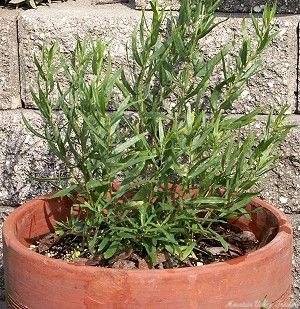
    Pawlsy's next move went well. We set up a farm that would allow us to produce lightweight items of value, such as Lavender, and, one of our all-time favorites, French Tarragon:


    Quote The French call French Tarragon, Herbe au Dragon. Indeed, the word Tarragon is thought to be a poorly pronounced French word Esdragon. The French got their Dragon monikers from the Latin species name for French Tarragon which is dracunculus. Roughly translated this means little dragon. And, while there is a lot of written speculation that the dragon part refers to some ancient use of this herb to cure bites and stings of all manner of creatures. More likely, it refers to the fire it leaves on your palate.


    This is one time where you really can be above it all because of the much higher quality as well as the work involved:


    Quote Why you ask would any one bother to sell a tasteless culinary herb?
    Because it can be grown from a seed instead of a cutting which is preferred by commercial growers.

    French Tarragon rarely blooms and, even then, makes only sterile seed.


    That's right. It's just cuttings. That makes it of the same nature as Saffron. It's like one plant that keeps being spread by people. This must be one of the closest things to physical immortality we can think of. Most plants can be cloned, and, in the case of trees, it's usually faster, but not many things are only propagated this way.


    In order to make this work, we were going to have to get an airplane and learn to fly it, while The Great Depression starts to rake its claws in France.

    Clemenceau did all this stuff to prop up the Central Bank of Yugoslavia, and, at the turn of the page, Britain killed the gold standard, which kills it for everyone else.


    We are highly averse to the European Money Power, which, itself, is coming together in a kind of Synarchy, along with a new x-factor, the United States.

    It's not really the basic existence of credit we oppose; it has more to do with the impunity of decisions at a high level. The way that life-altering bad decisions are forced on you. It's a financial world, which isn't really connected to the real world, and offers a nest for a privileged class. Did we buy a mansion and have someone else take care of our needs? Not hardly. But this seems to be the ideal.

    Fergus said, "Call them the Merovingians."

    If you understood him a little better, there's not a harsher thing he could say.


    Kathleen Tyson describes part of what happened:


    Quote I was looking into the history of the Bank for International Settlements. When it was founded in 1930, almost the first thing that John Foster Dulles — a very big New York lawyer, he was an advisor to the Treasury at the time — did was to infiltrate his sister Eleanor into Basel, into the Bank for International Settlements, to document every single detail of its founding and organization: every executive, every board member, all their views on all of the different possible policies, what was resolved, all of its transactions, including in 1932 a payment of one hundred and twenty-five million from New York to Nazi Germany. And it’s an amazing book because it’s basically her diary of her infiltration of the BIS, which of course she then published as her doctorate at Harvard, and gave to her brothers — John Foster Dulles, who became Secretary of State after World War II, and Allen Dulles, who became director of the CIA after World War II. So they had an inside diagram of how to subvert the BIS right from the get-go. And then unsurprisingly, when World War II comes about, there’s a very pro-Nazi American at the head of the BIS.

    Pawlsy said, "The power of the Austrian Empire has been transferred to Nazi Germany, but not any of its redeeming qualities."

    I said, "With modern manufacturing, they can make an army ten times as powerful in only a few years."

    Fergus said, "They never de-militarized, or paid reparations on the damages."

    "It's almost a free ticket for the Great War, the one that dissolved Austria and left us trampled by Serbia."


    The BIS already looked like a vehicle for predatory lending, the kind that leads to asset confiscation or military consequences.


    As you know, we have already slipped our fingers into this, in an amateurish way. We spent five years absconding Ottoman funds to build infrastructure in Sofia. This was deliberate on our part. We did it in the same breath as criticizing the state of Ottoman finances. We had no regard for the long-term health of the Empire, or anything like that; it was a polite form of banditry. It was never a realistic, long-term plan; we might have done that for Albania if they hadn't given up on us.

    As of now, we think they are such a horrid example, we make this report from Vienna:


    Quote Another attempt occurred on 20 February 1931, while Zog was visiting the Vienna State Opera house for a performance of Pagliacci. The attackers (Aziz Çami and Ndok Gjeloshi) struck whilst Zog was getting into his car. The attempt was organized by "National Union" (Albanian: Bashkimi Kombëtar"), a union of Zog opponents in exile which was formed in Vienna (1925) with the initiative of Ali Këlcyra, Sejfi Vllamasi, Xhemal Bushati etc. Zog was in the company of Minister Eqrem Libohova, who was wounded, while Zog's guard Llesh Topallaj was mistaken for Zog by Gjeloshi, and shot three times in the back of the head. Çami's gun was stuck and did not fire. Zog came out of the event unharmed, thanks also to the prompt intervention of Albanian Consul Zef Serreqi and local police. The Austrian authorities arrested Çami, Gjeloshi, and later Qazim Mulleti, Rexhep Mitrovica, Menduh Angoni, Angjelin Suma, Luigj Shkurti, Sejfi Vllamasi, etc. All the Albanian political émigrés in Vienna were subsequently arrested, beside Hasan Prishtina. Most of them were quickly released and expelled from Austria. Gjeloshi was sentenced to 3 years and 6 months of jail, while Çami got 2 years and 6 months.

    Pawlsy said, "Perfect setup, and they killed the wrong guy."

    Fergus groaned.

    That was KONARE.

    I said, "Fortunately, Riza Cerova was in the other office, where he

    Quote ...joined the Communist Party of Germany in 1930. During that period he wrote many articles against King Zog I. Cerova's articles were published in media like Liria Kombëtare, a journal published by KONARE (Komiteti Nacional Revolucionar, National Revolutionary Committee).

    As far as we know, he simply winds up going to Moscow to become a more perfect Stalinist."

    Noli went to the United States.

    Quote In 1932, Boshnjaku appears in an Albanian anti-Monarchist committee in Constanța, Romania, together with other Albanian emigre members settled there.

    Nothing really left of what once was.


    Pawlsy said, "I am trying to liberate an area that finds itself on the receiving end of a France -- Yugoslavia tentacle."


    From Cambridge on Stabilization:


    Quote Powerful interest groups in banking and industry that exerted a substantial influence on Yugoslavia's financial institutions shared the belief in this benefit of the gold exchange standard. Bankarstvo captured the views of 21 industrialists, representatives of industrial interests, and banks on the gold exchange standard from across the kingdom, which are across the board positive. One of these was from the president of the Division for Trade and Industry in Zagreb, Vranić, who noted that industrial circles approved of dinar stabilisation. The president of the Chamber of Commerce, Exchange and Industry, Jeličanin, viewed commercial circles as the main proponents of legal stabilisation.

    "The theory does not have one person in mind, You."

    Quote It is noteworthy that ‘lower layers’ of the Yugoslavian society, such as agricultural workers, whose loans at commercial banks appreciated due to the discount rate increases by the NBKY, fiercely opposed legal stabilisation. In that sense, the Yugoslavian gold exchange standard reflects Gallarotti's theory that legal stabilisation mirrored the victory of groups that favour stable exchange rates because they are importing machinery from abroad (industrialists) and those who act as creditors within the country (financial interest groups), over the interests of debtors and exporters who prefer depreciated exchange rates.

    "It has an unmistakable strategy."

    Quote Another reason why the Banque de France supported Yugoslavia with legal stabilisation was political. Yugoslavian newspapers at the time argued that France was trying to build a new ‘Middle Europe’ with its lending practices, as French bankers required political guarantees before granting loans, with the main goal of enabling France to isolate Germany economically and politically. Furthermore, French lending practices were intended to contain British political influence in the Balkans.

    "It's even the foundation of the miraculous new system."

    Quote The third international financial institution exerting pressure on Yugoslavia to adopt and maintain a gold exchange standard was the BIS in Basel, which was founded as an alliance of central banks in 1930. Its primary purpose was the commercialisation of German reparation payments and the creation of a stable system for international payments, which meant restoring the gold standard. In the words of Toniolo, ‘the gold standard was embedded in the very DNA of the BIS’.

    "Well, when Britain ditched it, they got the quickest recovery. What's going to happen with France, the gold bloc countries, and Yugoslavia when this boomerang hits?"


    Fergus and I beat each other up.

    "A large part of the regime was so that France would be paid in gold."

    Quote The Permanent International Court of Justice in The Hague ruled on 12 July 1929 that the substantial Yugoslavian debts owed to French lenders had to be repaid 55 per cent in gold starting from 1 April 1930, while the share of gold should gradually increase until the loans were completely repaid in gold. Hence, by supporting the legal stability of the dinar, the Banque de France could stabilise the conditions for the repayment of the substantial amount of private and public loans which Yugoslavian lenders owed to French banks.

    "Although the British decision was more influential, this was not even its idea."


    Quote Germany's exit from the gold standard on 15 July 1931

    The dominos were Austria's Creditanstalt on 11 May 1931, Landesbank der Rheinprovinz on 11 July 1931, and Danat-Bank on 13 July 1931. It triggered Germany's exit from the gold standard on 15 July 1931.

    On 15 July 1931, the Reichsbank suspended the convertibility of the Reichsmark, effectively taking Germany out of the gold standard, and imposed capital controls.


    Pawlsy said, "Although capital controls are subject to change, suddenly, this becomes the way to establish stability."

    It's deep. The existence of a gold standard does not in itself answer for having gold, or, the relative value of your currency to it. It's just a known unit of value. Convertibility is not quite the same, either; if I said a million marks was an ounce of gold, that says nothing as to terms of payment, such as in the court order above.

    The debilitating factor that no one has mentioned yet is Fractional Reserve Lending. Although this has existed since medieval times, back then, you still had to have a substantial reserve. Now these people will start worming their way to making loans out of smaller and smaller reserves.

    We don't claim to know ultimate answers about gold and money. We claim those handling it don't either, and must be kept on a short leash.

    Most of the gold was flowing to the United States and France. Rather than all these adjustments and prestige advances, it is arguable the calamitous deflation could have been avoided by sticking to the cover ratios of 1928.

    In other words, by trying to fix it, they made things worse.


    This is what happens:


    Quote At the Lausanne Conference of July 1932, an agreement was outlined on a three-year suspension of German reparations, but that was rejected by the U.S. Congress in December 1932, triggering defaults by France and the UK on interallied war debts.  Ultimately, losses of U.S. investors in German debt amounted to 13 to 16 percent of U.S. 1931 GDP...


    "Dinky, it's


    Heinrich Aloysius Maria Elisabeth Brüning


    who serves as Chancellor of Germany for the transition off gold, known for austerity, unemployment, and hunger.

    He was removed from office in 1932. Who do you think got the office for these decisions about capital controls."


    Dinky said, "Franz von Papen".

    "So there are Nazis behind this paper money, as well as the BIS, even though it was intended for gold."

    "We're surrounded."


    They are the ones who had skipped an opportunity to publicize Buddhism. Schglagentweit had three brothers who went on a mission from 1854 - 1858. One of them met a Sikkhimese Lama; they got things from Brian Hodgson and visited sites in Leh, Ladakh. Despite this pioneering effort, it does not seem to have taken hold.


    Pawlsy said, "Most of our readers will be unable to comprehend the following."

    Indo-tibetica 1: Mc'od rten e ts'a ts'a nel Tibet indiano ed occidentale: contributo allo studio dell'arte religiosa tibetana e del suo significato, Roma, Reale Accademia d'Italia, 1932 (Chinese transl.:《梵天佛地 1: 西北印度和西藏西部的塔和擦擦——试论藏族宗教艺术及其意义》, 魏正中 萨尔吉 主编. 上海, 上海古籍出版社)


    Fleep said, "I'm from Rome, at least from what I can remember. You made me use other languages, so, my Italian is a bit rusty. But that's got to be something from Buddhism."

    I said, "This is going to be hard to say. Giuseppe Tucci is a straight Mussolini Fascist, who, moreover, is going to go to Japan and spread Fascism there, along lines like racial purity.

    That's going to be our next major trove of Buddhism. Numerous high-quality photos of things that are in Tibet. We didn't discuss Eugenics. It's American. Ivy League. It's the same word but not necessarily the same thing as Plato's Eugenics."

    Fergus said, "Idiot is a Greek expression for thinks of himself, in the sense of a man who stays inside his house and experiences no other influence. Modern doctors turn it into a medical condition."

    Pawlsy said, "It spread with iron roots across all countries involved with modern medicine."

    I said, "Or, especially the UK, Germany, Sweden, and Japan."

    "Herbalists are now spit at as snake oil salesmen."

    "I would take allopathic medicine for acute trauma, like if I break my arm. I mean something more like treatment by a medic, than a course of medicine after the fact."

    Fergus said, "They are finding ways to sell the kind that is made from petroleum."

    "You think that's bad? Well, it is, until you find out how the medical system will be there to steal your house.

    Louis McFadden helped craft the Federal Reserve Note, having an Act named for him in 1927."


    Quote Comptroller of the Currency Henry M. Dawes, whose proposals shaped the McFadden Act

    "Without knowing exactly who said what, we do notice the favor that the corporate charters for these banks exist in perpetuity."

    Fergus said, "That's as anti-American as you can get."

    "The Federal Reserve's own autobiography confesses that, if you know how to see through the surface of it."


    It wasn't long before McFadden turned on the idea vociferously. Time Magazine reported he said the Hoover Moratorium sold out the United States to international bankers.

    Allow me to clean up the record from June 10, 1932:


    Quote Mr. Chairman, we have In this country one of the
    most corrupt Institutions the world has ever known. I
    refer to the Federal Reserve Board and the Federal reserve
    banks. The Federal Reserve Board, a Government board,
    has cheated the Government of the United States and the
    people of the United states out of enough money to pay the
    national debt. The depreciation and the iniquities of the
    Federal Reserve Board and the 'Federal' reserve banks acting
    together, have cost this country enough money, to pay the
    national debt several times over.

    He goes on at great length about it.

    What are they doing? "Rolling it over."

    Pawlsy burst out laughing.

    "I can't take the Americans seriously any more."

    "Pawls, we tried. We gave them twenty years to think about people who are being massacred in a eugenic manner. Nothing registered. You see how they operate."

    "Here, we assume in Europe it's basically evil, one kind always trying to dominate another. America has all these sayings and songs about freedom and something that is supposed to be great. No one can tell what that may be."

    "They put their taxpayers permanently in debt to a private institution."

    Fergus said, "Wait til you find out how they deceived them all by sneaking it in over Christmas break."

    "What!"


    France was still mostly functional, as long as you were employed.


    Quote Breton journalist Morvan Lebesque described the period thus:

    The winter I spent on the streets - the winter of '32-33 - was no milder nor harder than any other winter; the winter cold is like labour pains - whether it lasts for a longer or shorter period of time there is always the same amount of pain. That particular winter, it snowed and it froze; thousands of young men, forced out of their jobs by the crisis, struggled on to their last penny, to the end of their tether then, in despair, abandoned the fight... On street benches and at métro entrances, groups of exhausted and starving young men would be trying not to die. I don't know how many never came round. I can only say what I saw. In the rue Madame one day I saw a child drop a sweet which someone trod on, then the man behind bent down and picked it up, wiped it and ate it.

    Pawlsy said, "The stratification is very real.

    There are people I can charge twenty francs for a ticket. Fifty if I want. I can make it seventy-five because of some cloisonne' porcelain I hold up before the crowd. I've never pursued this direction, but, if I decided to charge a hundred and twenty, they would still do it.

    A lot of workers can barely afford anything. They need an outlet more, and can hardly find the opportunity."


    In turn, it's difficult for us. We have to take two weeks off to be able to reach Provence. But there is a way we can make it a round trip in a day.


    The idea of getting into innovation was no problem, seeing as France is this close to the particular innovation:


    Quote In 1908 the American Wright brothers visited France to demonstrate the military advantages of their primitive ‘Wright Flyer’ machine, the first controllable powered aircraft, to the French army. The Wrights' demonstration flights came to the attention of two French brothers living in northern Picardy. Rene and Gaston Caudron worked on their father’s farm in the Somme basin but the brave new world of aviation grasped the imagination of the Caudron brothers. They designed and built an aircraft for themselves. Their skills developed and led to a factory and flying school. The rest is great French history.

    They had no financial resources and no real equipment. They just had bags of enthusiasm, imagination and dogged tenacity and it was that which enabled them to complete their project. Their farmyard horse Luciole assisted with the early glider launches but just a year later they were using an engine and flying for 10km at a time. The Caudrons created a factory in the town of Rue, close to their home and farm. There they built the first G-3 and G-4 aircraft for the French military. They also established a civil flying school at Le Crotoy on the gently sloping beaches.

    Bleriot crosses the Channel in 1909 in the first mono-winged aircraft:


    No compass, following a frigate, patch of fog, crash landing.


    So we were not cutting edge on this. We were joining a trend that had civilian enthusiasts.

    I don't really mean "we". I am not going to do anything with a piece of machinery. It means we sent Dinky and Fleep to flight school and to work in a factory.

    Pawlsy said, "Don't get in fights, and don't kill anyone either. Be nice."

    We actually gave them appropriate clothes for the ordeal, and, they still looked weird, just not as weird. They're so...we were concerned they may have the tendency to get picked on.


    I said, "To go over what we've been discussing, Eugenics is a British reaction from the Boer War. They found that industrialization had caused a drop in fitness to the point there was an unacceptable level of failures for military qualification. There are a lot of issues inside that.

    The American Federal Reserve is like a state within a state; you pay for the privilege of using a currency owned by a private institution. What happens is, the government will sell a thousand-dollar bond for a thousand Federal Reserve Notes (FRNs), accepted as a substitute, but as you can see this is just a loan that must be paid back with interest. And these payments appear to be super important, more important than you are."

    Fergus said, "The decision of Britain, similar to that of Germany, appears to quickly re-build domestic production. Good for them, perhaps, but what else?"

    Pawlsy said, "The Bank of England archives contain brief reports on the matter."

    Jan. 21, 1932:


    Quote It was not to be expected that such a momentous step as the suspension of the Gold
    Standard by Great Britain, after six years of imperfect and difficult working, would
    be without grave and far-reaching repercussions on the rest of Europe.

    "That's in less than six months. Obviously, the direct result is, France holds about sixty-two million Pounds Sterling, and, de-valuation means that about twenty million in value just disappears."


    Quote The dollar has replaced the £ as the basis for calculating the value of the Greek
    drachma in foreign currencies.

    "Sounds like a good idea, until the US de-values."

    Quote Bulgaria has suffered serious dislocation of her export trade as the great majority of
    exports have always been contracted in pounds. There has been a heavy drop in
    exports and a restriction of credit.

    "They don't really mention this is the tortoise-shell survival strategy."

    Quote Switzerland followed the general tendency and strengthened its position by the
    withdrawal of funds from abroad and by the conversion of foreign exchange into
    gold. The gold reserve on Banque Nationale Suisse was only £28 million on 31st
    December 1930, [but] by the end of September 1931 it was £68 million and had
    risen to £93 million by the 31st December 1931. Sterling held at the Bank of
    England was entirely liquidated, but gold held has risen 19th September to over £6
    million.

    Here is a pretty direct counter-argument from July 11, 1932:


    Quote 1. The Board of the Bank for International Settlements recognising the necessity
    of the reestablishment between nations of a monetary system with a common basis
    in order to facilitate international settlements under more stable and secure
    conditions, is unanimously of opinion that the gold standard remains the best
    available monetary mechanism and the one best suited to make possible the free
    flow of world trade and of international financing; it is desirable, therefore, to
    prepare all the necessary measures for the reestablishment of the functioning of the
    gold standard.

    "They are still advocates of reparations for German damage that was done by 1918.

    It is in large agreement with the Gold Delegates of the League of Nations.

    It claims that efficient management by Central Banks cannot be done without governmental action that makes it so."


    Fergus said, "America is going to undergo a painful transition."

    Quote Ironically, the latest, massive round of bank collapses from November 1932 to March 6, 1933, was caused by speculators buying up gold in (correct) anticipation that FDR would get off the gold standard, devaluing the dollar. The Federal Reserve made mistakes here as well with regard to the interest rate, later admitting this, as well as, with some reluctance, that FDR's policy of getting off the gold standard had been the correct one.

    I said, "Just like Germany, it will suspend convertibility. We see who is the vanguard of this issue, it's the Nazis and Anglos."

    Fergus said, "German ethnic nationalism means it is really dominated by Austria. And then these people are focusing in Munich and Bavaria, which is in south Germany, raising the opposite point that Austria is nothing or it is not counted, because the true Germany is what we used to call Prussia."


    Pawlsy said, "There is a candid getting-together of like-minded individuals."

    Quote At the invitation of Thyssen, Hitler actually made a rather notable speech to this club on January 26, 1932:

    "It was one of those rare cases in which Hitler spoke the truth because he believed it would be of use to him. Restlessly he shot his eyes to the bearers of the most famous names, to [Gustav] Krupp, [Fritz] Thyssen and [Emil] Kirdorf, to [Hermann] Abs and [Robert] Pferdmenges, to [Hermann] Rochling and [Paul] Reusch, to [Ernst von] Borsig and [the sons of Hugo] Stinnes. Hitler [explained:]:

    ""Don't bother with the name of my party, with that ringing term Socialist German Workers' Party. The name was chosen to attract the workers. In truth, the NSDAP stands on the ground of free entrepreneurship. ... If we are accused of our intolerance, we proudly acknowledge it! We have made the relentless decision to root out Marxism in Germany to the very last!""

    "When Hitler sat down, the audience, which had long since given up any distance, stood up and cheered him."

    "It has reached across barriers, since, those who previously had not been all that interested in the Nazis, see the potential."


    Quote Reusch was not necessarily in the Hitler camp. He also supported other ultraright, union-busting candidates, but in November 1932 he certainly did sign the Industrielleneingabe Letter / The Industrial Input Letter asking General Paul von Hindenburg to transfer "responsible leadership" to Adolf Hitler. He did so alongside the ICC's Baron Kurt von Schroder, the ICC-tied Hjalmar Schacht, Emil Helfferich, discussed earlier as the sponsor at the Keppler circle of ICC German committee chairman Karl Lindemann 173, with both directors of the Rockefeller-owned Deutsche-Amerikanische Petroleum A. G. (DAPAG) 174; and Fritz Thyssen and Albert Vogler of Vereinigte Stahlwerke.

    "Many of them continued in a perhaps unofficial format."


    Quote Hitler's Keppler Circle, founded in December 1932


    "In everything that follows, they never pay the damages, they pay interest on the finances of it."


    Quote Nouvelle Solidarite, Interview with Annie Lacroix-Riz, 'Fascisme financier hier et aujourd'hui; le choix de la défaite': "["Can we say that it is to maintain the payment of these interests at all costs that we are ready to go as far as fascism?"] I think so, that it is as important a fact as anti-Sovietism. We can see this concretely, since it takes on very surprising proportions when Germany lacks gold reserves and the Bank of France and the Bank of England (which are directly involved because gold depends on the central banks of the two countries) made it possible to seize Austrian gold during the Anschluss in 1938, then Czechoslovak gold. There, you enter into a form of collaboration with Germany which is extremely surprising. I believe I have demonstrated, with the help of the archives of the Banque de France, that the Dawes and the Young [plans] were the fundamental factor in the disposition of financial circles to tremble before the demands of the Reich. And I'm not the only one. Sylvain Schiermann, who had worked on Franco-German economic relations from 1932 to 39, had shown very clearly that there was only one priority: that Germany should pay the Dawes and the Young [plans]. And Schacht spends his time, from 1933, blackmailing debt repayment by saying: I'm not paying anymore. But he always ends up paying, and we know that Germany paid until the end since the last payment was made in gold, stolen, as I have shown in other works, with the backing of the banks power stations. The last payment made to the BRI was in April 1945. That is to say, at the time of the surrender, Germany was still paying the interest of Dawes and Young. ...

    "We've seen this before. The Ottoman Empire dragged along by this theory of interest-only payments. A way to leave the principal on the shoulders of the people, accumulating.

    But this German system is two-faced, calling itself a Workers' Party and probably uttering words to this effect, but, its allegiance is to its major backers, who are anti-labor and every other synonym up to anti-Communist.

    Well, the force of it re-casts Yugoslavian Communism."


    Quote The "ultra-leftist" line pursued since 1928 was abandoned in 1933 when Adolf Hitler came to power in Germany. Instead, the KPJ turned the idea of forming a popular front together with other anti-fascist organisations. The strategy aimed to attract broad coalition of allies since it was no longer thought feasible to achieve quick introduction of communist rule. The popular front strategy coincided with assignment of Milan Gorkić to the KPJ leadership from his posting at the Comintern in 1932. Gorkić set about to introduce discipline to the KPJ top ranks and establish ties with the JSDS, the HSS, the Montenegrin Federalist Party, the Slovene Christian Socialists, and pro-Russian right wing organisations in Serbia with Moscow now advocating Yugoslav unity. This placed the KPJ at odds with the Comintern which continued to advocate breakup of Yugoslavia...

    "What is this? Ok, a coalition against Mussolini and now Hitler may make some sense, but, it's not my issue. How do I get our liberation back on the table? Hasan Prishtina?"


    Quote In 1933, he was killed by Ibrahim Celo in a cafe in Thessalonika, on the orders of King Zog.


    "Listen to this defiant remark by Yugoslavia's King Alexander I."


    Quote Alexander said through an intermediary to the Italian government, "If you want to have serious riots in Yugoslavia or cause a regime change, you need to kill me. Shoot at me and be sure you have finished me off, because that's the only way to make changes in Yugoslavia."

    Pawlsy said, "That's the apparent level of trust there, but, France wants to balance them, so he goes to an important meeting."


    Quote The French Foreign Minister Louis Barthou had attempted in 1934 to build an alliance meant to contain Germany, consisting of France's allies in Eastern Europe like Yugoslavia, together with Italy and the Soviet Union. The long-standing rivalry between Benito Mussolini and King Alexander had complicated Barthou's work as Alexander complained about Italian territorial claims against his country and Italian support for Hungarian revisionism and the Croat Ustaše.

    As long as the French ally Yugoslavia continued to have disputes with Italy, Barthou's plans for an Italo-French rapprochement would be stillborn.

    Mussolini had come to believe that it was only the personality of Alexander that was holding Yugoslavia together and that if the king were assassinated, Yugoslavia would descend into civil war, which would allow Italy to annex certain regions of Yugoslavia without fear of reprisal from France. However, France was Yugoslavia's closest ally, and Barthou invited Alexander for a visit to France to sign a Franco-Yugoslav agreement that would allow Barthou to "go to Rome with the certainty of success". As a result of the previous deaths of three family members on Tuesdays, Alexander refused to undertake any public functions on that day of the week. On Tuesday, 9 October 1934, however, he had no choice, as he was arriving in Marseille to begin a state visit to France to strengthen both countries' alliance in the Little Entente.


    "This is part of a larger trip, as you will see when Bulgaria gets on board after a right-wing coup on May 19, 1934."


    Quote The new government abolished the Tarnovo Constitution, dissolved the National Assembly and banned all political parties and organizations, revolutionary organizations and trade unions. All their property got confiscated and severe sentences were provided for attempting to renew a party in any form or to establish a new party. A new governmental system was introduced wherein the central authority would appoint mayors and would establish state trade unions. Additionally, measures were adopted to deal with the workers' and socialist movement in the country. A state monopoly was introduced, which affected the interests of the big companies.

    In foreign policy, Zveno's most notable act was to establish diplomatic relations with the USSR on 23 July 1934 and steer Bulgaria towards France. Kimon Georgiev saw that one way to do that was through improvement of the relationships with Yugoslavia and to bring the two countries closer as Bulgaria's neighbour was an ally of France at that time. As a result, king Aleksandar I of Yugoslavia visited Bulgaria on 27 September 1934.


    "Yugoslavian Communism is anti-Fascist, while most of the groups that seek to harm Yugoslavia are Fascists. There is an anti-Yugoslav fighter called Chernozemski."

    Quote Chernozemski also entered the region of Vardar Macedonia with IMRO bands and participated in more than 15 skirmishes with Yugoslav police.

    On April 24, 1931, Chernozemski was sentenced by the Sofia District Court to life in prison. After the amnesty on January 5, 1932, he was released from the Sofia Central Prison. A week later, he went underground, and on July 15, 1932, he disappeared from Sofia.

    "This is complicated, because Macedonian means Bulgarian for the most part. It's a remnant of the Ottoman resistance. But the group has never had a clear platform, whether it is ethnic or regional, whether it is Bulgarian or independent, or what its politics are. It doesn't really represent indigenous Macedonians. It's just located there. It forms a partnership with the Croation Ustase. That's where Communism underestimated the power of nationalism. It's very right-wing. And so these are more like groups of Fascists that desire the breakup of Yugoslavia."


    Quote On October 9, as King Alexander's motorcade drove at 8 km/h down a Marseille street, Chernozemski emerged from the crowd, approached the king's car and leapt onto its running board while concealing his Mauser C96 semi-automatic pistol in a bouquet of flowers and chanting "Vive le roi" ("Long live the King"). He shot Alexander repeatedly, fatally hitting him in the chest and liver. The chauffeur—who tried to push Chernozemski off the car—and General Georges were also shot. The shot killed the chauffeur on the spot. A police officer fired at Chernozemski but missed and wounded Alexander's companion French Foreign Minister Louis Barthou. Barthou died due to blood loss.

    After firing his shots, he was struck by Colonel Pierre-Henri-Jules Piollet with a sabre, shot by a police officer and beaten by the crowd while the police watched. Chernozemski attempted to kill himself by shooting himself in the mouth, but his pistol was knocked out of his hand. The police had "fired haphazardly into the crowd". 10 civilian bystanders were injured, while 4 people died. In shock, Kralj did not throw a grenade and instead slipped out of the crowd. After bringing Chernozemski to custody, the French authorities attempted to interrogate him. However, his face was disfigured and he was unable to say anything. Chernozemski died around 8 pm.

    They also found a Walther pistol, two bombs, a compass and 1,700 French francs in his possessions.


    For murdering King Alexander I, Chernozemski was posthumously declared the most dangerous terrorist in Europe.

    "It's very famous."

    Quote It was one of the first assassinations to be captured on film; the shooting occurred in front of the newsreel cameraman, who was only metres away at the time. While the exact moment of shooting was not captured on film, the events leading to the assassination and the immediate aftermath were. The body of the chauffeur Foissac, who had been mortally wounded, slumped and jammed against the brakes of the car, which allowed the cameraman to continue filming from within inches of the King for a number of minutes afterwards.

    Fergus said, "This has nothing to do with a communist revolution, which didn't happen."

    The royal will stipulates the regency of the unusual Anglophile Prince Paul until 1941:


    Quote Through careful never to openly criticise the constitution, Paul sympathised with the Croat demand to turn Yugoslavia into a federation, and felt that many Serb politicians were being unrealistic in expecting that Croat discontent would just dissolve of its own accord if given enough time.

    Prince Paul, far more than Alexander, was Yugoslav rather than Serb in outlook, and unlike Alexander, he was inclined much more toward democracy. In its broadest outline, his domestic policy worked to eliminate the heritage of the Alexandrine dictatorship's centralism, censorship, and military control, and to pacify the country by solving the Serb-Croat problem. Paul wanted to achieve a Serb-Croat reconciliation, but also felt for a considerable period of time that he had the duty to hand over the kingdom to Peter more or less unchanged when he reached his maturity, and thus was unwilling to entertain constitutional changes.

    Paul had been thrust into a position of power that he did not want by Alexander's assassination (which was why Alexander had chosen him in his will to serve as a regent, knowing he would never try to seize the throne from his son), and throughout his regency he gave the impression that ruling Yugoslavia was a burden to him.

    Married to a Greek princess and intensely Anglophile and Hellenophile, Paul distrusted Fascist Italy and Nazi Germany.

    French premier Pierre Laval-who was seeking an alliance with Italy-made it very clear to Paul that France would not support Yugoslavia if it chose to make an issue of Italian involvement in the assassination of the king, saying that the most Yugoslavia could do was to blame Hungary. The way that the French were prepared to disregard Yugoslav concerns about the regicide for the sake of better relations with Italy soured Paul on the French alliance.

    Although he spent about twenty years amongst Oxford elites, as a child, he is seen in the garb of Kosovo:


    Pawlsy said, "It appears to be incorrect that the country will be torn with strife by the removal of the king.

    Although the regent is perhaps a better person, we understand, it's basically a job, give the intact Yugoslavia to the next king."


    It doesn't directly help; the French economic encirclement of Germany goes cold.

    In fact, it could now be worse. Kinder Yugoslav policies may make less people want to rebel. The Comintern strategy is to shear three or four countries off its edges, which is where our liberation lies. We think it will take something of this magnitude, since none of them will be able to do it individually. Second choice is to have it crushed by a Power such as Italy. But then how do you get rid of the Italians.

    It certainly won't be from anyone listening to the pleas of those who have been ethnically cleansed ever since we can remember.

    France and Yugoslavia are in an impotent, nose-down slump. Of course, most of the world is like this by now. Except for the UK and Germany. Do they have sustainable turnarounds? Does Germany run on sympathy?


    I already felt like we were in a post-modern age. That the mere evolution of technology, financial capitalism, and militant fanaticism had created an entirely brand new, artificial specie of man, like a homonculus. The British Army was more or less correct about Eugenics, other than they shouldn't have been running the Boer War, should have used common sense and been cleaner and healthier while industrializing, and not re-defining "good breeding" in the way that they have. The simple fact that humans were failing and probably should have better care taken, is quite serious.

    I said, "Buddhism in part answers for this, at least outside of Tibet. In most other countries it is associated with the warriors' training hall. In Afghanistan, you had Pankration, in Siam Muay Thai, perhaps you have heard of the Shaolin Monastery.

    It should be obvious that is part of Vajrapani -- Herakles.

    And so this is normal for the Greek sphere.

    But the Romans didn't do it.

    In the Olympic Games, they were getting trounced by Asians. That is why towards the end of it, they banned pagans.

    And after that there was not standardly such a thing as combat sports as part of a typical education. Not there. But from India to Japan, it simply continued."


    Fergus said, "So, roughly speaking, you think the Eugenecists caught on to the deficiency, and put in a synthetic substitute."

    I said, "Something like that. It seems like mostly self-caused problems, which would never occur to anyone raised otherwise. That's how I see a lot of what's going on here, is that it is simply unnecessary."

    "Would you like me to win some boxing matches?"

    I looked at Pawlsy.

    She said, "I bet five francs he can end a boxing match whenever he wants."

    It's not what we do, it's a set of rules for a western sport. We are masters of destroying the human being with our hands. On this level, we have not really found anyone who can keep up with us. Modern guns and bombs are an artificial compensation.


    She continued. "The thing is, Communism is turning into Antifa, which is not aimed at a soft Yugoslavian Regent. But the Slavic rebels are Fascists. We might not have anything, unless we can replace, for instance, the Ustase with Communists."

    Fergus said, "My idea was simpler; I know I can get it to work."

    "You're right. I think a Communist revolution will work in Bulgaria. Perhaps almost inevitably like the books seem to say. Yugoslavia is a tough cookie."

    I said, "We have the least desirable land. There's no oil or gold. In fact there is nothing desirable about it unless you admire the rustic natural beauty. It's just agriculture and traditional craftsmanship. Still nineteenth-century."

    "Yes, but money can be extracted from any human resources."

    "A form of ownership."

    "Maybe I could just buy it from the Regent in a few years. Just a small nibble off what would still be mostly intact."

    "You want to make him an offer, and blackmail him with civil wars."

    Fergus said, "I certainly do."

    Pawlsy said, "We might try to deal with him.

    I suspect we might get Bulgaria and maybe Hungary into Comintern. If we had that, we could shrink Yugoslavia, one way or another."

    I said, "Czechoslovakia."

    Fergus said, "That's two nations mashed into one if there ever was one."

    "Well, let's take France's Mitteleuropa, and shape it in the countries excluding Yugoslavia, under the aegis of united workers' fronts. Obviously making it the same here in France."

    The case of the stolen tentacle?

    Fergus said, "Undermining and replacing the official attempt."

    Pawlsy said, "With what happened in Vienna, that was a major resource. We need to press results in multiple areas. I've decided it's necessary we have some international support. Remember when everybody thought the United States was really opening the way. Then it was the League of Nations. And then even the Conference after that.

    Now it's Comintern, should that, in fact, be able to get countries."


    Zog was in about 600 feuds when he came to power, and survived about fifty-five assassination attempts. And now that is just Albania and tough luck to us.

    Pawlsy overthrew the Ottoman Empire. We'll figure this one out too. It's...different. I am a bit neutral about Germany, although I would say it sounds like they will craft a remarkably oppressive form of government that I would not want to be under. Yet, something very strange is going on, in terms of its reparations being cordoned off from new investments, for which, there is a lot of foreign interest. The so-called national interest of France, and the UK, is the total opposite. Yet the French are aware that a weak Germany is not going to result from anything that has happened since the Armistice. Instead, they, themselves, can barely compete.


    We are reaching a stuffed-to-the-brim point.

    "Now, we shall apprise ourselves of one of those things that just doesn't go away."


    Quote On the other end of the spectrum was ICC council member John Jacob Raskob, representing the Du Pont fortune, who, despite being a Democrat in name, set up an additional group in 1934 called the American Liberty League, just to campaign against the New Deal. General Motors' Alfred Sloan, Jr., J. P. Morgan & Co.'s chief attorney and then-Rockefeller Foundation trustee John W. Davis, Jay Gould and Harriman lawyer Elihu Root and Grayson M. P. Murphy of Anaconda Copper, Guaranty Trust and Bethlehem Steel were important co-founders, as was Irenee du Pont.

    Conclusion? The ICC's "merchants of peace" did not like having to implement basic labor rights.

    Pawlsy said, "That's in America, and appears to be a broadly-split argument."


    Quote Aug. 25, 1934, New York Times, 'Roosevelt Twits Liberty League as Lover of Property': "He indicated his belief that it laid too much stress on protection of property and too little on protection of the average citizen."

    "He's more or less describing them as similar to the Italian power."


    Quote Founding ICC board member Alberto Pirelli, who helped fund Mussolini from the moment he switched from socialism to fascism in late 1914...was a key founder in 1934 of the (Italian) Institute for International Political Studies / Istituto per gli Studi di Politica Internazionale, a Mussolini-backed RIIA- and CFR-clone.

    ISPI's [was] launched on 27th March 1934 by a group of young scholars from the Universities of Milan and Pavia ... inspired by the examples of London's Royal Institute of Foreign Affairs [RIIA] and New York's Foreign Policy Association. [A] meeting in February 1935 with Alberto Pirelli ... did not only guarantee the funding ... but it also provided strong links with the business community [which was supporting fascism...], while ensuring some autonomy from the fascist regime...in 1934 SIAP at the very least was not disadvantaged by tariff and license regulations for the oil industry implemented by Mussolini.

    "It's wholly owned by Standard Oil."

    I said, "President Roosevelt has made our main basic point. Is it a populist message he can fail to work for? Maybe. It sounds like a pretty clear warning that his political adversaries are American Nazi Fascists."

    Fergus said, "So far, the performance by the experts ranks as abysmal. Can we throw away the twentieth century and get another one?"

    Pawlsy said, "Yes. Let's have an ideological clash."


    Quote We entered, in 1934, in a very active phase of the political projects of Synarchy, to which must be added all the nebula of economic power. You have to remember that in Synarchy, there is also the coal and therefore, Henri de Peyerimhoff, the chef of the Coal Committee.

    "We don't know who is the twelfth founding member of Synarchy, but considering what happens in 1934, the Comite des Forges is involved in all aspects."

    Considering theories of the Synarchy are so closely associated with industrialists and bankers supporting the suppression of labor unions, it might be interesting to note that both the Synarchy and the funding of extreme right action groups as the Croix de Feu and apparently too the Faisceau were tied to the Comite des Forges, a lobby representing the steel industry headed from 1918 to 1940 by steel industrialist and Banque de France director Francois de Wendel.
    It's a police report where he gave Croix de Feu a large sum of money.

    Again, in the case of France, we have to take the name Synarchy not too literally, but we can be sure of the underlying fact:


    Quote ...there is no doubt that leading French industrialists, some of them to be found in the ICC, were all too keen to use fascism to quash the labor movement...

    It doesn't have to mean they all believe in the same kind of Agartha fantasy government. Some of them do believe in various kinds. It mainly effectively means, in France, fascist collaborators.


    Pawlsy said, "By active phase, it means this root, the International Chamber of Commerce, will itself fade into obscurity, because superseded by newer and more technocratic organizations."

    Fergus said, "It seems like we're missing a small detail."

    "Well, do you want to tell them?"

    "I think we all do. There's songs in this."

    I said, "When the Levee Breaks (Kansas Joe McCoy and Memphis Minnie, 1929)."

    Pawlsy said, "Done."

    "High Germany (English traditional ballad ca. 1700s)

    "Easy."

    Fergus said, "Make one up."

    I said, "That would be Pawlsy's career."

    Pawlsy said, "They handed it to us on a silver platter."

    Fergus said, "Perhaps it is time to ad libretto from Edgar Allen Poe's Murder in the Rue Morgue."

    I said, "It all began with the finding of a body."


    Quote Serge Alexandre Stavisky (1888–1934), who became known as le beau Sacha ("Handsome Sasha"), was a Russian Jew who was born in modern-day Ukraine; his parents had relocated to France. Stavisky tried various professions, working as a café singer, a nightclub manager, a soup factory worker and as the operator of a gambling den. During the 1930s, he managed municipal pawnshops in Bayonne and also knew people active in the financial sector. Stavisky sold worthless bonds and financed his "hockshop" on the surety of what he called the emeralds of the late Empress of Germany, which were later revealed to be glass.

    Stavisky maintained his reputation by using his acquaintances with important people. If a newspaper tried to investigate his affairs, he paid it to stop either with large advertisement contracts or by buying the newspaper's company.

    In 1927, Stavisky was put on trial for fraud for the first time. However, the trial was postponed repeatedly, and he was granted bail nineteen times. Stavisky probably continued his scams during that time. One judge who claimed to have secret documents involving Stavisky was later found decapitated. Janet Flanner wrote:

    The scheme which finally killed Alexandre Stavisky, his political guests' reputations, and the uninvited public's peace of mind, was his emission of hundreds of millions of francs' worth of false bonds on the city of Bayonne's municipal pawnshop, which were bought up by life-insurance companies, counseled by the Minister of Colonies, who was counseled by the Minister of Commerce, who was counseled by the Mayor of Bayonne, who was counseled by the little manager of the hockshop, who was counseled by Stavisky.

    At the risk of exposure in December 1933, Stavisky fled. On 8 January 1934, the police found him in a chalet in Chamonix; he was dead from a gunshot wound. Stavisky was officially determined to have committed suicide, but there was a persistent speculation that police officers had killed him. Fourteen Parisian newspapers reported his death as a suicide, but eight did not. The distance that the bullet had travelled caused the newspaper Le Canard enchaîné to propose sarcastically that Stavisky had "a long arm".

    Pawlsy said, "How can this not look stupid on purpose."


    Quote ...they found a pistol in his left hand and the entry wounds were located above his right temple.


    Quote After Stavisky's death, details about his long criminal history, his relations with the French establishment and his controversial death became public. His involvement with so many ministers caused the resignation of Prime Minister Camille Chautemps with accusations from the right-wing opposition that he and his police had killed Stavisky intentionally to protect influential people.

    "He was under investigation in the wake of another investigation."


    Quote "The Stavisky Affair" erupted on Christmas Eve 1933 with the arrest of a certain Gustave Tissier, director of Crédit Municipal de Bayonne, for forgery, use of forgery and misappropriation of public funds.


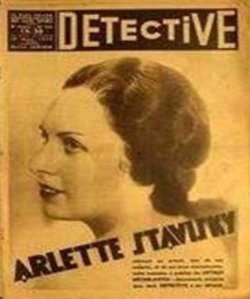
    Quote Sasha developed extensive contacts among the rich and powerful, and became a wealthy man in his own right. He kept company with some of France’s most glamorous women, until Arlette Simon, a dress model for the house of Chanel, agreed to marry him after he promised her that he would reform. In the 1930s, Sasha managed municipal pawnshops in Bayonne and simultaneously infiltrated French financial circles.

    Premier Camille Chautemps, leader of the left wing coalition, approved of the government’s investment in pawnshop securities. Pawnbrokers had been
    carefully regulated by the state since the time of King Louis XVI, and a Credit
    Municipal, or local council could not organize without the consent of the
    Premier. Stavisky sold stacks of worthless bonds and financed his pawnshop with
    the surety of what he called “the emeralds of the later Empress of
    Germany.”

    These emeralds turned out to be glass, but Stavisky and Joseph
    Garat the mayor of Bayonne, issued fraudulent bonds in the sum of 239 million
    francs.

    Charismatic Sasha charmed his way into the lives of people with important
    connections. Over a six year period, he paid out over three million dollars in
    bribes to French business leaders and politicians and recorded their names in a
    ledger listing the monies paid as “stock dividends.”

    "The resigned head of state is replaced by an ardent follower."


    Quote The new Prime Minister was Édouard Daladier, and one of his first acts was to dismiss the prefect of the Paris police, Jean Chiappe, who was notorious for his rightist sympathies and suspected of encouraging previous anti-government demonstrations. Daladier then dismissed the director of the Comédie Française, who had been staging William Shakespeare's controversial play Coriolanus, and replaced him with the director of the Sûreté-Générale, a protégé of Chautemps and Daladier's centre-left Radical‐Socialist Party. He also appointed a new Interior Minister, Eugène Frot, who announced that demonstrators would be shot.

    "In other words, the French government does not have a large standing of these para-Nazis, but they come crawling out of the woodwork."


    Quote Daladier's dismissal of Jean Chiappe, the anti-communist Paris Prefect of Police, caused multiple far-right leagues to organize protests. These rapidly degenerated into a riot on the Place de la Concorde, near the building used for the National Assembly, against Daladier's centre-left government and the Third Republic.


    Quote Fomented by several conservative, anti-Semitic, monarchist or fascist groups, including Action Française, the Croix-de-Feu and the Mouvement Franciste, the demonstration occurred on the night of 6–7 February 1934. The police fired upon and killed 17 people, nine of whom were far-right protesters..

    Croix de Feu:


    Quote As one of the most essential paramilitary associations and because of its anti-Semitic position, the Croix-de-Feu and La Rocque were considered by the political left to be among the most dangerous imitators of Mussolini and Hitler.


    Pawlsy said, "They were actually several hundred meters away at Palais Bourbon.

    Now, the level of violence here is like child's play. It is horrid but something like this happens every day in Serbia. Nevertheless, all I need to do is be able to bring it to your attention."


    Quote France's political left claimed it was a fascist coup d'état attempt, leading to the creation of several left-wing anti-fascist organizations such as the Comité de vigilance des intellectuels antifascistes.

    It was the first time during the Third Republic that a government had to resign as a result of riots by the opposition. Other results were the formation of anti-fascism leagues and an alliance between the French Section of the Workers' International (SFIO), the main socialist party, and the French Communist Party.

    "Boom, that was when it hit."

    Fergus said, "Yes. Mud was flinging in every direction."


    Quote The scandal involved a remarkable range of people from politics, wealthy society and the literary-intellectual elite of Paris. Mistinguett was asked why she had been photographed with Stavisky at a nightclub. Georges Simenon reported on the affair and Stavisky's ex-bodyguard threatened him with physical violence. Colette, referring to the alleged inability of any of Stavisky's important friends to remember him, described the dead con artist as "a man with no face".

    A trial of twenty people associated with Stavisky began in 1935. Printed charges were 1200 pages long. All of the accused, including Stavisky's widow, two deputies and one general, were acquitted the next year. The amount defrauded was estimated to be the equivalent of $18 million at the prevailing exchange rates, plus an additional $54 million that came within months of being attained. The location of Stavisky's wealth is still unknown.

    The Stavisky affair left France weakened internally. The country remained divided politically for the rest of the decade, but the political weaknesses it exposed and exacerbated were not confined to France. The affair was emblematic of a more general decrease of popularity of democratic values and institutions in Europe during the Great Depression.

    Pawlsy said, "Was it a riot, an insurrection, yes, but a coup, no. Anything like that is a serious exaggeration. On the other hand, it does represent a buildup in that direction. So it doesn't matter. The point is to knock it down.

    As you can imagine, the two main mentalities in France have their pre-determined relation to Germany."

    Fergus said, "They started a new race of man, the Algerian European."

    I said, "Oh, the future is here."

    "No, that would be the murder of a judge from the financial division followed by some suicidal failures."

    Pawlsy said, "History Today 1958 attributes this riot as the foundation of French Fascism."

    I said, "They want to be like the Germans, although they are already aware they are lower ranking. That is, the German industry must be more significant."


    That was the dividing wedge. It was time to rub salt in the wound so that half of France would admonish the right wing and be on positive terms with Socialism and Communism.


    Pawlsy said, "So we did some popular tunes from back then, that you still know today.

    We didn't really have anything to do with sopranos, but, Jacqui McShee of Pentangle is one who can nail it here and there."

    Fergus said, "This band can pull off a type of texturing that's hard to find; most of their instruments are in non-standard tuning. Some of their moments get kind of thin. But at least some of the songs on multiple albums are very memorable."

    "Music is how we had anything to do with English whatsoever. We wanted to know what some of these songs mean. We would take something like this and do it in French using multiple idioms of playing styles. We'd do it really loud with snares, timpani, and kettle drums. We totally lacked the refinement of the classy Paris acts and everything we did was really serious. We'd introduce this as an English lament of more or less our current problems, and it would generate empathy.

    This is them playing it in 1972."


    Oh Polly love oh Polly the rout is now begun
    And we must march away at the beating of the drum
    Go dress yourself in all your best and go along with me
    I'll take you to the cruel wars in High Germany.


    I fear the treacherous journey bitter cold and burning heat
    Rough roads and stony mountains they will wound my tender feet
    To your kinsmen I might prove untrue if from them I do go
    For maids must bide at their parents' side while the men do face the foe.


    I'll buy for you a horse my love and on it you will ride
    Then all of my contentment will be riding at my side
    We'll stop at every ale house and drink when we are dry
    So quickly on the road my love we'll marry by and by.


    Oh Billy love oh Billy now mind what I do say
    My feet they are so tired I cannot go away
    Besides my dearest Billy I am with child by thee
    Not fitting for the cruel wars in High Germany.


    Oh Polly love oh Polly I love you very well
    There are few in any place my Polly can excel
    And when your babe is born and sits smiling on your knee
    You will think on your Billy that's in High Germany.


    Oh cursed be the cruel wars that ever they began
    For they have pressed my Billy and many a clever man
    For they have pressed my Billy likewise my brothers three
    And sent them to the cruel wars in High Germany.

  6. The Following 3 Users Say Thank You to shaberon For This Post:

    Bill Ryan (11th June 2026), Ewan (11th June 2026), Johnnycomelately (Yesterday)

  7. Link to Post #24
    United States Avalon Member
    Join Date
    1st April 2016
    Posts
    6,822
    Thanks
    35,321
    Thanked 38,916 times in 6,471 posts

    Default Re: Pawlsy the Cat is Her Name

    Underground Aviation


    We tried to describe the vat of acid in France that we used like a fulcrum.

    What it did was to make proto-Fascism visible, and, a great deal of the public did not want that.

    Again, there, we are criticizing a type of government that has two main characteristics; first, it values capital over labor, businesses over the human being, whether that means workplace safety, or a rising cost of living that impoverishes you. Secondly, it favors that kind of nationalism that tells you that your neighbor is an other, a non-human being, fit only for chattel slavery or else extermination.

    The phrase finance capitalism is already used by the Comintern; it applies to the Great Powers, although manifested differently amongst them, if we say France really likes gold, and the New York Stock Exchange is more like a gambling house than any of them.


    The details of the Stavisky affair were almost irrelevant, in the sense that this mass reaction spread like wildfire:


    Quote The February 1934 Uprising of Socialists against right wing forces in Austria and movement towards cooperation between Socialists and Communists in France in fighting a nascent fascist movement there convinced Bulgarian Communist Georgi Dimitrov, a leading figure in the Communist International that the Comintern's hostility towards joint action between Communists and Socialists was ill-considered. Dimitrov made his triumphant return to Moscow in April 1934 following acquittal in the Reichstag Fire trial determined to change the Comintern's fundamental strategy from one of antagonistic opposition to social democracy to one of cooperation in a joint struggle.

    How?

    We found out Fokker licensed F-VIIIs to here:


    "Oh," said Pawlsy, "Mr. Weiss."

    Originally founded as a cannery, it soon became the major arms manufacturer not just for Austria-Hungary, but, for half of Europe.

    It's Hungarian.

    Most people think we are Hungarians who picked up a few Gypsies. But, no, as I said, I know enough Magyar to be able to pronounce a few songs and have the basic idea what they mean. I just like their music. But we did for several years take advantage of their development of a railroad system, some of which was used for deliveries of untold amounts of ammunition from Weiss.

    Just because of who we were, we got one of these puppies:


    Dinky said, "You're going to like this.

    The airplane itself is pretty simple. It really is like a big bicycle.

    We can do some surface stuff like spark plugs and tune it. But we can't tear down and re-build the engine. That's its own specialty. The plane is made to attach whatever kind of engine to it. This one is running British-designed nine-cylinder Jupiters, made under license in France. They send them to Weiss, or Fokker, whatever. These are a new generation, lighter weight, more powerful, eliminating the third engine on the nose. This plane is a better design and it's not the biggest one, but it's not small. If you had jumped on the bandwagon, you'd probably be going around in a four-seater."

    Fleep said, "The thing you didn't tell us about is this freak called the atmosphere."

    "Yeah. There's things like turbulence and sudden downdrafts that could kill us all."

    "You want to go when it is as clear and calm as possible. And we can't land anywhere at night that doesn't have specialized lighting."

    Would you want to trust your life with these two people who -- they've been hit in the head so many times it's amazing -- until very recently could not read?


    "And, another thing is, we're too short to see out."

    "That means we'll have to do this a little unconventionally, but once you get used to it, it's a lot of fun."

    "Until then, the ride is like someone putting you in a box and rolling it downstairs."

    "Airsickness is frequent."

    Pawlsy said, "If I don't kill you while you are doing that, you can land me different places, in any country?"

    "Any time."

    "Make it so. While you are flying, you have immunity from retributive strikes."

    "Thank you."


    That was the beginning of our inter-office link such as when we needed to get something straight with Dimitrov.

    We just want to make sure the actual Comintern carries an agenda about Yugoslavia and its outlying regions. That's because it would vanish as a "lesser threat" in the mere Antifa view. But in actuality, for any type of progress, we should ally whatever you want to call pure Muscovite Communism with other kinds of socialism.


    Current French affairs are called a distraction from the scandal in Time, March 12, 1934:


    Quote Whether Judge Prince was still alive when tied to the track was unknown, although a doctor discovered poison in his body tissues which seemed to indicate that he was already dead. By then a new theory had arisen, wild as anything in the entire case: Judge Prince was murdered by a gang of professional criminals that had revived the name and the manner of the Carbonari. The theory was voiced officially last week by white-chinned old Henri Chéron, now Minister of Justice. Said he:

    “We must succeed in finding the assassins of the unfortunate counselor Albert Prince. . . . The country has been the prey of a band of evildoers who have recoiled before nothing to achieve their crimes. That band must be completely unmasked and punished.”

    A bloodstained knife and a powder puff were found near the Prince body. Brushing aside the powder puff, police concentrated on the knife. In the 1820’s, when pomaded romantics sniffed laudanum, read Lamartine and drank from skull-shaped mugs, a secret society known as / Carbonari (the Charcoal Burners) nourished in France and Italy. There was nothing criminal about the original members who were exiled Neapolitan Liberals, forced, like true charcoal burners, to hide in the forests. Soon they took to murdering their political opponents, and later their members were neither Neapolitan nor Liberal. Their mark was a bloody dagger, left beside each of their victims. If Albert Prince was killed by such as these they were still at large last week, despite a reward of 140,000 francs for their capture.


    Part of the missing Stavisky evidence was a book of check stubs:


    Quote Next night Minister of Interior Albert Sarraut, Public Prosecutor Gomien, Examining Magistrate Ordonneau and “a Personality” whose name no reporter could learn, assembled in the home of Inspector Bony. With a bow the Personality produced the check stubs, 1,200 of them, to a total value of $13.000,000 and explained that “Sacha” Stavisky had given the stubs to his Secretary Anton Romagnino. Romagnino had given them back to Mme Stavisky, who had handed them to the Personality.

    Mme Stavisky was promptly arrested “for obstructing justice.” Her jewels and furs were taken from her and she was locked in La Petite Roquette prison to await trial. She sent a message to the nurse at her apartment:

    ”Don’t tell the children where I am. If they cry very much tell them I have gone on a cruise.”

    The end of mystery was not yet. Stavisky Secretary Romagnino had disappeared. So had a pasteboard box crammed with 10.000.000 francs worth of jewels which Alexandre Stavisky is supposed to have salvaged from the collapse of his Bayonne pawnshop and hidden in his Paris apartment.

    Fergus said, "The national response was to bring in a popular former President, a centrist more or less. And, the point is, the following should not necessarily be a distraction."


    Quote No man knew better than Gaston Doumergue that the crisis that still grips France will not end until the entire Stavisky rottenness is exposed, explained and paid for in the penitentiary. Gaston Doumergue was called from sunny retirement in Southern France a month ago to save France. The country was on the verge of violent revolution. Hundreds were wounded and more than a score killed in the bloodiest riots Paris has seen since 1871. The plump little Premier came and a distraught people cheered him to the echo. He whipped together a cabinet drawn from every party but the Socialists, Royalists & Communists. He promised sweeping reforms. He soothed frayed nerves by beaming with vast good nature on everyone in sight. But Gaston Doumergue knew and every French politician knew that the barricades would rise again amid the crack of rifles, the clatter of charging troops and the dreadful roar of marching mobs if the Stavisky scandal is not blotted out of memory by an era of honest government.

    All this will take time. Meanwhile there were other problems, the solution of which would help to distract the public. The budget was completely unbalanced. Gold was pouring to the U. S. and the franc seemed in danger. France was engaged in an expensive trade war with Britain, and there remained as always the Hitler bugaboo. To drive the stubborn Deputies, Premier Doumergue had just one effective weapon: the threat to resign, go back to his country place, and leave Mm. les Deputées to the mobs of Paris.

    Budget, One of the conditions under which the smiling little Southerner agreed to return to politics was that the long-dangling Budget be passed before March 1. Recalcitrant Deputies were dragooned by an ancient device. At midnight Feb. 28 lackeys stepped into the Chamber and stopped the clocks. Mm. les Deputés settled down to wrangle hoarsely till dawn. At 6:30 in the morning, the final vote was taken, and the Budget passed. It called for an expenditure of 50,162.000,000 francs ($3.172,000.000) and leaves France with a deficit of 1,881.000.000 francs. But Premier Doumergue was given dictatorial power to slash expenditures until the Budget balances.

    New Deal! Clearer & clearer Frenchmen began to see parallels between Gaston Doumergue’s emergency Cabinet and the Roosevelt New Deal. Last week President Roosevelt asked Congress to authorize him to raise and lower tariffs and make foreign trade bargains (see p. 13). Last week Premier Doumergue received precisely that same authority with the Budget bill. Just as President Roosevelt likes to rule by executive order when Congress is away, so Premier Doumergue plans to do the same thing as soon as he can send the Chamber packing. The Ministry of Commerce is to be reorganized and something suspiciously like an NRA code is hanging over the French heavy industries including steel whose leaders have been meeting quietly for days to consider a voluntary agreement covering wages and production for the next three years.

    Defense. Nothing served better to take Frenchmen’s minds off the Stavisky scandal than new plans for national defense. But this was no cheap distraction. France already has the biggest and best army in Europe, and a navy that has improved 1,000% since the War. For the first time since the Third Republic was founded, two generals sit in the Cabinet—Marshal Petain, Minister of War. and General Denain. Minister of Air. Bills were sent to Parliamentary committees last week providing for military expenditures of six billion francs ($390.000.000′). France will continue her frontier chain of forts. Because she is absolutely dependent on foreign oil she will build a series of enormous oil reservoirs for the army and navy such as Italy already has. She will set aside a special sum to be used over three years in developing swifter fighting planes. She will build a new 26,000-ton battleship. sister ship to the still incomplete Dunkerque.

    Reforms. Of topnotch interest to every French citizen were proposals for reforming and reorganizing the entire parliamentary system. What would Premier Doumergue suggest? How far would he go in overhauling democratic machinery that failed to function in a crisis? The best answer seemed to be in the character of the man himself.

    Which may be summarized:

    Quote On the side lines, as President of France, Gaston Doumergue acquired a vast disgust for the French political game of which he had been a part for so long. As head of the State, he had a chance for the first time in a generation to appreciate the layman’s point of view as governments fell, week after week, month after month, with nothing done. But. like most Frenchmen, honest “Gastounet” is at heart extremely conservative. He may adopt such simple superficial reforms as commend themselves to his cautious Gallic mind. But anyone who expects him to remake the legislative and political machine of France, to rid it of blocs, to break with deep-rooted traditions, is likely to be disappointed.

    "On the whole, knowing there is collateral damage of a French statesman in Vienna..."

    Quote There was, however, an upturn in public finances, which allowed the price of government bonds to gain ten to twelve points between March and June. He was also weakened by the assassination of Louis Barthou on 9 October, and preferred to resign soon after, on 8 November.

    "I just saw some pretty big issues that are just dragging along there."

    Pawlsy said, "Now you're really going to see the heat cranking."


    1935


    Pierre Flandin, in whose term a number of important things were signed.


    First is a bi-lateral pact with Italy that amounts to pandering. It offers numerous territorial concessions in anticipation of an alliance. Then, with the UK joining, it leads to something like Locarno II called the Stresa Front:


    Quote The Stresa Front was triggered by Germany's declaration of its intention to build up an air force, increase the size of the army to 36 divisions (500,000 men) and introduce conscription, in March 1935. All of these actions were direct violations of the Treaty of Versailles, which limited the size of the German Army to 100,000 men, forbade conscription in Germany and prohibited a German air force.


    Pawlsy said, "And this is news to those who have just been born. They have never really complied with Versailles, despite which, Standard Oil and numerous other investors seek to ply its economy."

    Fergus said, "Fortunately, our idea led to major change."


    Dimitrov and Stalin came to an agreement:


    Quote ...to end the practice of denouncing Social Democrats as 'social fascists', practically indistinguishable from actual fascists, and to instead promote "united front" tactics against the threat of European fascism. In April, as Dimitrov's fame grew in the wake of the Leipzig Trial, he was appointed a member of the Executive of Comintern and of its political secretariat, in charge of the Anglo-American and Central European sections. He was being groomed to take control of the Comintern from two of the so-called "Old Bolsheviks", Iosif Pyatnitsky and Wilhelm Knorin, who had held the position since 1923. Finally, in 1934, Stalin chose Dimitrov to head the international organization. At this point, Tzvetan Todorov writes, Dimitrov "became part of the Soviet leader's inner circle."


    Eventually, Comintern hosts its Seventh Congress:


    Quote Preparations for a 7th World Congress of the Comintern began in Moscow late in 1934, with the Executive Committee of the Communist International (ECCI) establishing a commission to draft programmatic resolutions for that body. This body was divided between Dimitrov and others advocating a move towards a "general democratic, anti-Fascist" orientation and hardliners who continued to argue that the battle against fascism was inseparable from the task of overthrowing the bourgeoisie, implying a simultaneous fight against the fascist right and the reformist constitutionalist and socialist movements. With no rapid agreement forthcoming, on 8 March 1935, the scheduled opening of the 7th Congress was moved back to the end of July.

    It would be the exigencies of Soviet foreign policy which ultimately shaped the Comintern's orientation, when on 2 May 1935, the two countries most concerned about the implications of growing German militarism — France and the Soviet Union — concluded the Franco-Soviet Treaty of Mutual Assistance, a mutual aid pact in which each promised to come to the other's defense in the event that aggression violating the Covenant of the League of Nations was suffered.
    Here is Dimitrov, seated on the left, and Wang Ming -- China, seated on the right:


    "China seems a bit far out to be interested in European affairs, but, Japan is taking an equally sharp turn towards Fascism. So, yes, they are joining themselves to the consensus."


    In the wake of the Franco-Soviet Treaty of Mutual Assistance:


    Quote On 16 May 1935 the Czechoslovak–Soviet Treaty of Alliance was signed after the Soviet treaty with France, which was Czechoslovakia's main ally.

    Adolf Hitler justified the remilitarisation of the Rhineland by the ratification of the Franco-Soviet Pact by the French Parliament and claimed that he felt threatened by it. In the UK parliament, the former British Prime Minister David Lloyd George who was sympathetic to Germany stated that "if Herr Hitler had allowed that to go without protecting his country he would have been a traitor to the Fatherland".

    Pawlsy said, "You see the technical term, alliance, and these French documents do not create alliances."

    Fergus said, "The Germans certainly seem to have a wide range of open approval."

    It's certainly a fact in the United States. We haven't covered, for example, how Jewish boycotts on German businesses were really a tremendous factor. But, yes, quite many Anglos are as complacent with Nazism as could be. Military buildup on the edge of France is seen as normal.


    I said, "On the private side, Jean Monnet, the Father of Europe, gets a big headstart."


    Quote Versailles is where he became really close to the Dulles brothers for the rest of his life. In 1935 John Foster Dulles and Dulles' law firm Sullivan & Cromwell financed the founding of Monnet, Murnane & Co., the investment bank of Monnet and CFR member George Murnane. By that time, Monnet's close "Round Table Network" friend, Sir Arthur Salter, had written his 1929 essay 'The "United States of Europe" Idea' (published in expanded book form in 1933), advocating for a federal Europe within the framework of the League of Nations. Monnet's later idea for the European Union would closely mirror the proposals in this work.


    "But then here is a form of authority interfering with private business."


    Quote What we also know is that by 1935 Mussolini had his eyes on conquering Ethiopia due to what was suspected to be vast, untapped oil riches. On August 31, 1935 word got out of a secret "Rickett concession" in which Ethiopian emperor Haile Selassie handed over "more than half his empire" in a 75-year lease to Standard Oil in order to protect himself from a looming Italian invasion. Already on September 3, 1935 the agreement fell apart when the new anti-Wall Street U.S. president FDR refused to accept it as legitimate, got his secretary of state to tell Standard Oil to back out, and informed reporters a day later that, "dollar diplomacy is no longer recognized by the United States Government."

    Fergus said, "How dare you! Now, for a horror story from your own people."


    Quote By the end of September the same "Mr. Rickett" who negotiated the failed backdoor deal with Emperor Haile Selassie met with his "old friend" Mussolini in Rome. Secret deals were made, and also as a result of the "Rickett concession" having fallen apart, a month later, on October 3, 1935, Mussolini began his conquest of Ethiopia.

    As western countries boycotted Italy, Standard Oil was pressured to stop supplying oil to the country, which both Mussolini and Nazi Germany's I.G. Farben scientists recognized was absolutely crucial in allowing Italy to continue the invasion of Ethiopia. Standard Oil refused, only agreeing to not increase oil deliveries over what they had been the previous year. For some reason, apparently to keep the door open to negotiations, FDR agreed with this policy, but this token appeasement of the international community obviously led to a lot of criticism.

    In early December 1935 news started going round of a "gentlemen's agreement" that had been negotiated between Standard Oil and Mussolini, apparently by the same Mr. Francis Rickett in the days before the Ethiopian invasion. The "gentlemen's agreement" involved Standard Oil, through its Societa Italo-Americana Pel Petrolio, arranging for Mussolini to circumvent any upcoming League of Nations oil embargo on Italy by continuing to supply oil from wells outside the United States. Oil to Italy would come from Romania, through Hungary and Austria; and oil to Eritrea and Somaliland for Italy's war effort would come from the Middle East. In return, Standard Oil expected a 30-year monopoly on oil deliveries to Italy. It also agreed to float a one billion gold lire (about $50 million at the time) loan to Italy to pay for oil deliveries.

    The existence of this scheme was denied by interested parties as Standard Oil chief Walter Teagle and the Italian government, but at the same time it was observed that "more and more tankers with Standard petroleum came to Italy, the warehouses filled up again [and] the danger of the oil squeeze seemed averted."

    Apparently, the agreement between Standard Oil and the Mussolini government would only go into effect officially from the moment that the League of Nations oil embargo became active, a move that was to be anticipated beforehand. This never happened though, in part because the Standard deal would have made it ineffective and apparently also because competitors as Shell and Sinclair started lobbying to prevent the embargo from becoming active from the moment they heard about Standard's "gentleman's agreement".

    In any case, Standard continued to supply oil to the Mussolini regime throughout the Ethiopian campaign. As the FDR government would demonstrate, it even lied that it had not vastly increased the amount of oil delivered to the war effort. In the same period the Anglo-Iranian Oil Company, the precursor to BP tied to the later coup of Iranian leader Mohammad Mossadeq, was refueling Italian warships, all contributing to the idea of sanctions being pointless...

    "Did they say they are going to lend out money to buy oil from themselves??"

    There are different reactions to this:


    Quote Fifty-one countries voted sanctions against Italy and declared an embargo on war supplies - not including oil. The United States, which was not a member of the League, allowed its nationals to carry on trade with Italy at the shipper's own risk. Jersey was in a difficult position; the Italian government was pressing Societa for increased supplies, while many Americans demanded that no assistance be given Italy as the aggressor. Jersey decided that, as in similar instances in the past, its policy should be to maintain its normal operations; it would supply its Italian affiliate, but only to the extent of the preceding year. The parent company was criticized in the American press for this operation. The difficulty over furnishing products to an aggressor was the most striking event in the operations of Societa Italo-Americana during the 1930's."

    "At that time, almost everyone in the world was saying, you don't give supplies to an aggressor, not even oil.

    What is plainly happening is that -- in this shorthand (Standard Oil of New) Jersey has helped Italy to the utmost extent launch a war for oil.

    If they do this once, who knows when they will stop."


    Pawlsy said, "They're taking advantage of the fact that France is basically going to turn a blind eye to it. And that they are against sanctions.

    Guess who shows up in Paris?"


    Quote On November 16, 1935, the joint committee of the ICC and the Carnegie Endowment for International Peace... [Members were] Thomas J. Watson ... James T. Shotwell, representing the Carnegie Endowment ... Per Jacobsson of the [BIS] ... Rene P. Duchemin of France...

    "You had better be suspicious of anything with a name like Peace in it. Versailles has just...has never really happened, and the League of Nations is not necessarily bad, on principle, but in practice it is a bit lacking. The United States can freely work against it, and, we think some oversight should have been used. Obviously, this oil war is a private decision rather than national will, which is insidious because it means a few years down the road, it can become the national will."

    I said, "That's one of our main factors in training. Do it right the first time. If you learn something wrong, you may never recover."


    The new ICC product is a French "information" or intelligence office in the United States:


    Quote Headquartered at Place de la Concorde and Rockefeller Center.

    Members: Marshall Petain | Rothschild | Masson | Banque de France | Paul Reynaud | Raymond Patenotre | Morgan | Rockefeller | Vanderbilt | Frank Polk | Eugene Meyer | Ogden Reid | Louis Wiley.

    Pawlsy said, "In Paris you see Watson, the founder of International Business Machines.

    The French member is well known."


    Quote Rene P. Duchemin, an industrialist engaged in a dye cartel with I.G. Farben since 1927.

    Peyerrimhoff, Rene Duchemin and Francois de Wendel, the head of the fascist-sponsoring Comite des Forges, were accused in 1931 of having paid in 1929 four times the market value for Les Temps in an attempt to control the narrative of this newspaper.

    All collaborating since 1926 in CFAID - a precursor of the 1952-founded European Coal and Steel Community (ECSC).

    "But wait -- there's another new type of international office."


    Quote ...the Franco-Germany Committee, founded in 1935 by Otto Abetz, German Ambassador in Paris during the war, is almost a small piece of the iceberg. We believed that this committee was something much more political than the Anglo-German Association, of which we know then for a very long time that it is composed of most prominent names in the City and bands industrial. But the real founders of France-Germany Committee are those who are at the origin of the “Franco-German Committee for Information and Documentation” (CFAID) based in Luxembourg, on the initiative of Mayrisch, President of Arbed. The CFAID was formed in 1926, from the so-called phase of reconciliation which accompanied the formation of the steel cartel. Among the founders, we have the Schneiders, the Laurent, Peyerimhoff, of the Committee of Houilleres, Duchemin, president of Kuhlmann and the CGPF, Wladimir d'Ormesson, Schlumberger and others. They were the fundamental part of the future France-Germany Committee which has been set up moreover at the same address as the CFAID. ..

    "And this other person?"

    Quote On behalf of the coal lobby Peyerimhoff formally endorsed the Redressement Francais, a corporate movement existing between 1925-1935 looking to revive the economy by doing away with parliament.

    The Redressement seeks to rule by authority rather than a political body:


    Quote Le Redressement français est un mouvement créé en décembre 1925 par l'industriel de l'électricité et du pétrole Ernest Mercier sous le patronage du maréchal Foch qui voulait le voir « rassembler l’élite et éduquer les masses ». Il promouvait une politique technocratique et corporatiste.

    "That's the director of French Petroleum, CFP, the forerunner of Total."

    Quote Son siège se situe à Paris, 28, rue de Madrid (VIIIe). Le Redressement accueille surtout des industriels, pour la plupart des polytechniciens des industries électriques, pétrolières, chimiques et métallurgiques, et des intellectuels. Le Redressement français, selon Kuisel, représente « l'arme de propagande de l'élite industrielle moderniste, qui souhaite vendre ses idées à la nation ».

    From a French discussion of them:


    Quote Le Redressement, en gros, c'est un peu les marionnettistes de Pétain, ils lui proposent leur aide et le laissent en place comme une figure de proue.

    Roger Mennevee criticizes them, primarily, and Anti-Masons, secondarily, as financial oligarchy, Synarchy, and Jesuitry, in real time of it happening.

    This, itself, begins a cycle of "conspiracy theorists" and "debunkers".

    Pawlsy said, "As we keep saying," and said, "beware of what's in a name. Again, the specific term, synarchy, is rarely used. We can see who is involved. Oil and electricity. The kind that run propaganda against us. Here, we have flushed out the most extreme statement of it.

    Extinguish the legislative branch."

    Fergus said, "That would only seem to work by a coup, not by any visible process."

    I said, "I don't think we would want that."

    "We didn't".

    "We asked a few audiences if they did."

    "The response was negative."

    "If we compare them to what the right wing said about Algeria," which certainly was not lacking in pride, "and what St-Yves was doing with the Jesuits of Reunion, we see the policies these guys are working with are what is described as the manner of colonialism."

    "France is to be treated like a foreign and subservient country by its own people."

    "That seems to be the doctrine."

    Pawlsy said, "Then why do you think they cleared out of this address at a balance-shifting time?

    Powder puffs."


    There we were, a breath away from being Stalinists.


    Although there is no secret of Italian military buildup, they start a war with no declaration, throwing in:


    Quote 6,000 machine guns, 2,000 pieces of artillery, 599 tanks and 390 aircraft. The Regia Marina (Royal Navy) carried tons of ammunition, food and other supplies, with the motor vehicles to move them, but the Ethiopians had only horse-drawn carts.

    Their air force sprays about 330 tons of mustard gas.

    Britain and France go along with it, so he will help "contain Germany". That's still official policy, while commercial interests appear otherwise.

    Fleep was simply astounded by the massiveness of the force which could transport itself to such a distant place.

    He said, "If I had stayed, I would be proud of what they are able to make, but I would still have the same problem with it that I do right now."

    Pawlsy said, "Most of that comes from those who are given choice careers, into the hands of those who would probably otherwise be unemployed."

    "It's like that. You can easily get stuck somewhere you don't want to be."

    "So if Germany does it next, and then France, where does it end?"

    "I don't know. Moscow maybe? The Turks will sign on in a heartbeat."

    Fergus said, "You had better win some parliament seats or topple some governments fast."

    Now we can just tie the industrialists of France with those Blackshirts and everything else unjust that is being done to Ethiopia.

    I said, "I prefer the Seventh Congress, because, for any revolution to be viable, it needs a share of the bourgeoisie. They should be willing to live by the same principles as anyone else. It would be inaccurate to say we inherently threaten wealth, itself."

    Fergus said, "But you define the Dharmic King as the one who protects the populace from those powerful interests."

    "True; and on that account, we are left to figure out the nuts and bolts for ourselves."

    The new Comintern:


    Quote Dimitrov began with an analysis of fascism, which he characterized as "the open terrorist dictatorship of the most reactionary, most chauvinistic, and most imperialist elements of finance capital," intent upon wreaking organized "terrorist vengeance against the working class and the revolutionary section of the peasantry and intelligentsia." With respect to its foreign policy, Dimitrov condemned fascism as "jingoism in its most brutal form, fomenting bestial hatred of other nations."


    1936


    Go.


    "This is where everyone wants to get involved with that bloodcurdling thing."


    In the grand scheme, what had happened was that Communism had been flushed out of Germany. Comintern came back with something that would usually be called Popular Front. But we notice some places, Communists fail to unite with the Socialists and others, in the UK, Italy, or the United States.

    In actuality, it first won elections in Spain in January.


    Pawlsy said, "In France, for the first time, we're part of something bigger than ourselves. We're not French citizens. Call us foreign idealists, or sympathizers, or whatever you wish, but we are on board with the priorities."


    It was a noticeable victory for France's Popular Front:

    Quote The Popular Front won the general election of 3 May 1936, with 386 seats out of 608. For the first time, the Socialists won more seats than the Radical-Socialists, and the Socialist leader, Léon Blum, became the first Socialist Prime Minister of France and the first Jew to hold that office. The first Popular Front cabinet consisted of 20 Socialists, 13 Radical-Socialists and two Socialist Republicans (there were no Communist Ministers) and, for the first time, included three women (who were then not able to vote in France).


    Pawlsy said, "The contrast of current republicanism or capitalism in France is immediately revealed by sweeping reforms. There is the creation of what is now known as fair labor law, like the "NRA code" previously mentioned. There is attention to social welfare. There is even a certain financial reform."


    Quote The Blum administration democratised the Bank of France by enabling all shareholders to attend meetings and set up a new council with more representation from government. By mid-August the parliament had passed:

    the creation of a national Office du blé (Grain Board or Wheat Office, through which the government helped to market agricultural produce at fair prices for farmers) to stabilise prices and curb speculation
    the nationalisation of the arms industries
    loans to small and medium-sized industries
    the raising of the compulsory school-leaving age to 14 years
    measures against illicit price rises
    a major public works program

    The legislative pace of the Popular Front government meant that before parliament went into recess, it had passed 133 laws within the space of 73 days, a pace of nearly two enactments a day.

    "He also axed what we started finding in the 1880s as veterans' associations, which proceeded to become these things that are not exactly political parties."

    Leagues:


    Quote Far-right leagues in France were characterized by their nationalist, militarist, anti-Semitic, anti-parliamentarist and anti-Communist opinions. In addition – and in particular in the 1930s – they were often modelled after Benito Mussolini's paramilitary Blackshirts and favored military parades, uniforms, and displays of their physical might.

    Fergus said, "There is some cagey rhetoric in a lot of this reporting. It's somewhat openly debated about whether this truly qualifies as French fascism or what.

    It just means these are private clubs of military people, not industrialists in cartels. It's physically different people, and obviously they lack a Fuhrer or Duce to gather round in a centralized way. Over time, we are looking at who stays in place, and how."

    I said, "There are a large number, twenty or so, documented. Most had sprung up right around 1925-6, similarly to the cartels."


    Pawlsy said, "They paraded all the time, Their existence was no secret."

    "No. But we understand a little better now. They're not opposed to some parliamentary faction, or office, ministry, district, house, or any conceivable aspect, because it means rule by unchecked executive authority."

    Fergus said, "Not necessarily like Roosevelt."

    "Right. It's a question of what's behind someone's autocratic dictation."

    "He may have had a decent motivation and questionable solutions about it."

    Or, even if they use Executive Orders, there is still a Legislature.


    Dinky said, "As usual, something went seriously wrong."

    Pawlsy said, "Apparently parades and slogans were no longer sufficient. Out of the ashes of the Orleanists comes something that demands our attention.

    It translates as The Hood."


    Quote La Cagoule was founded by Eugène Deloncle and bankrolled, among others, by Eugène Schueller, the founder of L'Oréal.

    The group was founded in 1936 or 1937 by Eugène Deloncle and enjoyed privileged relations within industrial circles (National Federation of Ratepayers, Lesieur, L'Oréal etc).

    An important member was Joseph Darnand, who later founded the Service d'ordre légionnaire (SOL), the forerunner of the Milice, the collaborationist paramilitary of the Vichy regime. His nephew Henri Charbonneau was also a member.

    Another member was Jean Filiol, who was appointed as the head of the Milice in Limoges. He fled to Spain at the end of World War II and he worked in the Spanish subsidiary of L'Oréal. Gabriel Jeantet was a lover of a sister of François Mitterrand, who later recommended him for the Order of the Francisque. Dr. Henri Martin was a physician suspected of having forged the Pacte synarchique...

    "Fair enough. Leave it to your suspicion. Disinformation? Distortion based on fact? Or actual summary? This synarchy is supposed to refer to collaboration with the Germans. That happened.

    As for the meaning of the name."


    Quote In Nice, new members were initiated in a formal ritual. In the presence of the Grand Master, dressed in red and accompanied by his assesseurs dressed in black, with their faces covered, new members stood before a table draped with a French flag. A sword and torches were placed on it. Each man raised his right arm and swore the oath, Ad majorem Galliæ gloriam ("For the greater glory of France"). This oath echoed the Jesuit motto, Ad Majorem Dei Gloriam (For the greater glory of God).

    "Obviously, the hoods imply something like Agartha, or Unknown Superiors, or certain lines of Martinism. When put together with that motto and that most of them are Catholic, you're looking at something closer to Opus Dei."

    "But Pawls, no one will figure that out for fifty years."

    Fergus said, "You mean in America."

    "Oh; I suppose so. We're not going to be able to ignore La Cagoule."

    Pawlsy said, "No. But what has happened in Spain is the reforms are so sweeping, they have swept out the professional military, and armed the Popular Front itself."


    Quote The Spanish Civil War broke out in July 1936 and deeply divided the government, which tried to remain neutral. The French left massively supported the Republican government in Madrid, and the right mostly supported the Nationalist insurgents, some even threatening to bring the war to France. Blum's cabinet was also deeply divided. Fear of the war spreading to France was one factor that made him decide on a policy of non-intervention. He collaborated with Britain and 25 other countries to formalize an agreement against sending any munitions or volunteer soldiers to Spain.

    The air minister defied the cabinet and secretly sold warplanes to Madrid.

    "The military has re-grouped under Franco.

    Now, you're telling me, very violent things are about to occur in France and Spain, and, it affects what I am working on, and, I have an airplane to get around, what do you think is going to happen."


    Comintern International Brigades:


    Quote ...volunteer soldiers organized by the Communist International to assist the Popular Front government of the Second Spanish Republic during the Spanish Civil War.

    The main recruitment center was in Paris, under the supervision of Soviet colonel Karol "Walter" Świerczewski. On 17 October 1936, an open letter by Joseph Stalin to José Díaz was published in Mundo Obrero, arguing that victory for the Spanish second republic was a matter not only for Spaniards but also for the whole of "progressive humanity"; in short order, communist activists joined with moderate socialist and liberal groups to form anti-fascist "popular front" militias in several countries, most of them under the control of or influenced by the Comintern.

    Entry to Spain was arranged for volunteers, for instance, a Yugoslav, Josip Broz, who would become famous as Marshal Tito, was in Paris to provide assistance, money, and passports for volunteers from Eastern Europe (including numerous Yugoslav volunteers in the Spanish Civil War).

    The French Communist Party provided uniforms for the Brigades.

    Fergus said, "As you can guess, this is how we got Yugoslavian Communism."


    Pawlsy said, "But let's give you an idea who Leon Blum really is."


    Newsweek on the 1934 riots:


    “On that evening thousands of French veterans of World War I, bitter at rumors of corruption in a parliament already discredited by its inefficacy against the Great Depression, attempted to invade the French parliament chamber just as the deputies were voting yet another shaky government into power. The veterans had been summoned by right-wing organizations [seeking] to replace what they saw as a weak parliamentary government with a fascist dictatorship on the model of Hitler or Mussolini.”


    Most of the rioting was not really done by Croix-de-feu.

    Action Francaise:


    Pawlsy said, "This is early in the year while he is still a parliamentarian."


    Quote February 13, 1936. Blum is in a car with his wife and another socialist MP when they cross paths with a funeral march for a far-right historian. Action Française members at the march recognize him and block the car, jeering, “Death to the Jew!” “Let’s hang him,” and the like.

    They start pummeling the car with their hands and canes. Then one finds a metal bar, smashes it through the window and into Blum’s head. The mob drags him out of the car and continues to beat him. Two nearby police officers fail to stop them, but a group of construction workers intervene. They manage to save Blum and get him to the hospital.

    It’s quite clear that the “camelots” intended to kill Blum. Three men were arrested, including the main attacker and Action Française leader Charles Maurras, who had openly called for Blum’s murder. Maurras wrote in 1935 that Blum was “human detritus” and deserved to “shot, but in the back.” After his arrest in 1936, he again called for Blum to be killed.

    "That's no mere figure of speech."

    Camelots:


    Quote On 9 December 1935, 97 Camelots du Roi from the 17th team of the 16th arrondissement of Paris sent a Memorandum on immobility (French: Mémoire sur l'immobilisme) to Maurice Pujo, Georges Calzant and Maxime Real del Sarte, accusing them of letting the movement collapse. The memorandum's signers included Eugène Deloncle, Jean Filiol, Aristide Corre, Jean Bouvyer, Michel Bernollin and Paul Bassompierre. On 11 January 1936, Eugène Deloncle and seven other people were officially excluded.

    These activists then formed the National Revolutionary Party (French: Parti national révolutionnaire) and the Cagoule, which carried out the attack on future Prime Minister Léon Blum on 13 February 1936...a group of Camelots du Roi led by the hooded Jean Filiol injured him.

    "Do you get it? They have created an us-and-them scenario on the ground, in Paris and many places in France."

    Fergus shook his head.

    You'd rather deal with the government, abolishing your organization, than with us.

    We don't have any limits. We're worse than you. And, we have an airplane. We can do our own intelligence in France, and respond to the International's intelligence in Spain.

    "Fleep, if you thought Ethiopia was something, it is German Magic Fire that takes to task bringing over most of the Franco loyalists, which are the colonial army in Morocco."

    Fleep said, "But these Camelots and so forth in France are also a transfer of colonial militarism to the home country."

    "Yes. We can't let it grow here, as you see to our south, a Popular Front election has led to direct consequences assisted by Germany and Italy."


    Fergus said, "As we are looking at French Fascists as mainly composed of the military, rather than politicians, it is exactly so in Spain. The coup by Franco in July has no effect on the government; he has to physically defeat it. And so it starts from a staging ground, making advances towards Madrid. The new Spanish government is relatively clueless how to deal with this. Its Prime Ministers resign until:


    Quote José Giral. Giral agreed to arm the trade unionists to defend the Republic and had 60,000 rifles delivered to the CNT and UGT headquarters although only 5,000 were in working order. In a radio broadcast on the 18th, the communist leader Dolores Ibarruri coined the famous slogan ¡No pasarán! ("They shall not pass") to urge resistance against the coup. The slogan was to become synonymous with the defense of Madrid and the Republican cause in general.

    He gets about this far."

    Quote Azaña ordered Giral to form a new government constituted exclusively by republicans. Giral's government lasted from 19 July to 4 September 1936. Then, with the fall of Talavera de la Reina and the Army of Morocco within reach of Madrid, Giral was forced to cede power to Francisco Largo Caballero.

    Franco rapidly advanced with German air support. Caballero's era is Comintern and Madrid gains an air force of Soviet planes. Mankind has crafted fighters and bombers as well as anti-aircraft guns. They're positioned to siege Madrid by November.


    Pawlsy said, "In France, La Cagoule is no secret because a plot was exposed and arrests were made. Its extent is a matter of some debate."


    Quote Deloncle had boasted that he had 12,000 men under his order in Paris, and 120,000 in the provinces, but it is likely there were no more than 200 men who knew much about the organization and its structure, and another several hundred who were more loosely affiliated with the group.

    "Because it uses cells, then, yes, of course a fewer number can be said to be in on the plot. It's indeterminate how far this thing really reached. But it's quite serious."


    Some of its functions were that it:

    Quote ...trained men in terrorism, built underground prisons and "ran guns in Belgium, Switzerland and Italy".

    In so doing, they murdered the arms supplier Léon Jean-Baptiste in October, 1936, for cheating on the prices.


    Fergus said, "It's hardcore co-intel."

    Quote The "street fighting" handbook was titled Secret Rules of the Communist Party to avoid revealing the Cagoule in case the booklet was found by the police.

    I said, "Yes, it is trying to come up with Reichstag-type maneuvers, so the public will be terrified about Communism. And, I don't think you can necessarily say it is small, restrained, or confined, due to having patrons."


    Quote Sources of funding: Eugène Schueller (L'Oreal), Louis Renault, Lemaigre Dubreuil (owner of table oil Lesieur and department stores Le Printemps), Gabriel Jeantet (Lafarge cements), Pierre Pucheu (Comptoir Sidérurgique)

    Pawlsy said, "Well, they stepped in to a criminal underworld.

    We started playing around different parts of France, and soaking up their rumors. We'd leave someone behind to shadow a target. It was usually easy to determine if someone was in fact involved. We would off them and move on to another.

    Because these are actual crimes, I can't be too specific about dates and locations, or who they were. I can tell you it was not retributive strikes for any particular deed. It was ideologically motivated. We began hunting them shortly after the beating of Mr. Blum."


    Dinky said, "It's true. That one really got under her skin. Once it became so plain this faction was a true force in France, she sent us on these little excursions."

    "My people are so good, I can sanitize someone with a very small team."

    Fergus said, "It was low key in the sense we weren't going after figureheads or famous people; this usually had an in your neighborhood feel. It triggered a few local investigations that no one ever put together."

    I said, "We spoiled a few gun shipments."

    "That means no evidence of such guns was found."

    "You did it."

    "You did it."

    It was like we knew secrets about each other.

    That was how we entered as belligerents in '36. The Spanish Republicans had thwarted Franco's attacks on Madrid. It was quite costly. From that point the Comintern effectively takes over.


    Fergus said, "They started off with a certain edge."

    Quote ...on 7 November, the Republicans had captured plans of the attack on the body of an Italian officer found in a destroyed tank and so could concentrate their troops in the Casa de Campo to meet the main attack.

    Pawlsy said, "Look at this, 17 November, 1936."


    "That's near Puerta del Sol, the main square in Madrid. Coming from a Luftwaffe bomber."


    The Soviets were dumbstruck to find out we had been using Russian arms supplies since the first sealed cartridges. And of our intricate position with Yugoslavia.

    We showed them how easily a recruitment center would run. It did. Then we set up Spanish headquarters when Albacate:


    Quote ...fell back into the hands of Madrid. For most of the war, the airbase at Los Llanos was the main headquarters of the Republican air force. It was also the headquarters of the International Brigades (supporters of the Republican cause from other countries who fought in the Spanish Civil war).

    unknowns:


    Pawlsy said, "It has the manpower, but it isn't efficiently organized, and the language barrier leads to some dire consequences.

    I don't speak Soviet, at all, if I am supposed to call it that. But I do have an interest in an alignment of the Popular Front. And it is much easier for me to take part in an organized conflict. This one has a long-term and fairly clear vision. They began to take me as important, thinking of me as similar to an order of knighthood. Yes, although knights usually have a land deed and maybe certain other perks. I'm not looking for land. I have land, that is, the cause of a populace. I've come to agree it is similar in many places, which is why we should have this international force."


    Fergus said, "But,"

    I said, "This has happened before."

    Pawlsy said, "Albania, in its machinations against Yugoslavia, has Italian support. Because of this, it flips the switch on the Kosovo Defense Committee."


    Quote King Zog accepted in 1936 the re-establishment of the Committee by even offering wages for the leadership under Qazim Koculi.

    In 1936, there was a revival in the Committee with new members as Sali Moni (Bajraktari), Xhaferr Spahija from Tropojë, Mehmed Alija from Vlanë, Has, Baftijar Kollovozi of Luma, Murat Kaloshi, etc. The cells were directed by Ismet Bey Kryeziu of Gjakova, a former representative in the Parliament of Kingdom of Yugoslavia, and Salih Bey Vuçitërni, a Kosovar Albanian politician who had come to Albania in early '20s. Both were trusted men of Zog, unlike the original members during the foundation. A small correspondent cell existed in Kosovo, stationed in Mitrovica led by Ferhat Draga, another person in good relations with Zog. Other members there were Xhafer Deva, Shaban Mustafa, and Mustafa Aliu, all from Mitrovica.

    Despite its presence, the committee's work was limited to diplomacy, propaganda, and recruiting, rather than any military activity.

    "Well, I'm not surprised it doesn't just start doing something. It's in a corner."


    Quote After the World Congress, Tito worked to promote the new Comintern line on Yugoslavia, which was that it would no longer work to break up the country and would instead defend the integrity of Yugoslavia against Nazism and Fascism.

    "I'm not on a side here. It doesn't have to be a territorial breakup if a revolutionary government will federate us out of Fascist policies. One, the other, both, most of us do not care what the form of government is, but we sure do have something to say about the quality of treatment."

    Fergus said, "Our actual faction, the Comintern, has us as nothing more than a commentarial footnote if one were to take a closer look at it. Obviously, the tenor of the project is oblivious to it. And, this Defense Committee is mostly unseasoned, new Albanian people, rising more as nationalists, which means we cannot be sure how far Zog or Mussolini might be able to work their way in."


    So, behind the facade of French nationalism, some quite unsavory beliefs have become standard. As there have been so many groups based on it, and they were not political parties, the meaning of it had eluded public consciousness. There is something that may make it come more prominently to our attention.


    I said, "Here is where we have to fill in the blanks, because it is certainly where at least most brief biographies go cold.

    Marshall Foch is known for stating the obvious, that Versailles was corrosive and would only result in a twenty-year armistice. And then he more or less retires, and is said to be old and in poor health, and nothing much more is heard from him on that scale of importance.

    They are simply omitting what he patronized, the Redressement, from its beginning.

    He passed away in 1929, and then Redressement was finished in 1935, and if we look at who remains from the middle of it all, it is that rare individual who straddles both the military and industrial worlds, the Algerian Mercier."


    "From military service, he was already in the graces of those generals."

    Quote Blessé d'un éclat d'obus au pied alors qu’il commande sur le Danube des troupes roumaines, il est rapatrié à Paris où il devient l’agent de liaison de Louis Loucheur, ministre de l’Armement de Georges Clemenceau, avec les généraux Ferdinand Foch et Philippe Pétain ainsi qu’avec les troupes américaines. Après guerre, pour les Anglo-Américains, il demeure le colonel Mercier. Quand Louis Loucheur est nommé ministre des Zones libérées, Mercier le suit et s’occupe des usines allemandes dépendant de la commission de contrôle militaire.

    "His business represents the French strategy of energy independence. They have no oil; they want their own refineries and sources, so no one like Standard will be directing the country."


    Quote La Compagnie française des pétroles (CFP) est fondée en mars 1924. Une loi votée en 1931 donnera 35 % de son capital, alors entièrement privé, à l’État, mais Mercier se satisfera d’avoir réussi à éviter une loi donnant à ce dernier un contrôle total sur l’entreprise. À partir de son premier actif, 25 % des parts de la Turkish Petroleum Company (TPC), la CFP se développe grâce à l’exploitation de pétrole près de Kirkouk en Irak, puis en Colombie et au Venezuela. La CFP avait aussi des intérêts en Roumanie (Steaua Roumania).

    "And if you want to know if it depended on one veterans' association, no, it did not."


    Quote À la mort de Louis Loucheur, en 1931, il prend la tête du comité français Pan-européen. En 1932, un comité d’experts se réunit sous les auspices du Redressement français et préconise une alliance avec l’Angleterre pour faire pression sur les Allemands. En 1934, il préconise un rapprochement avec l’URSS de manière à encercler l’Allemagne. C’est dans cette optique, semble-t-il, qu’il a donné une conférence sur la Russie en 1936 au Centre polytechnicien d’études économiques qui poursuivit l’œuvre du groupe X-Crise. Il est l'un des organisateurs de la Conférence mondiale de l'énergie tenue en 1936.

    "Again that returns us to Synarchy sleuthing; X-Crise is a non-profit think tank of Technocratic Economists, having three main strands, one of which is Socialist. It has the Liberal or Liberty doctrine of Rene Duchemin; and Capitalists such as Jean Coutrot.

    And again the argument about the future of these members. Obviously, some are dedicated French nationalists, pro-British and Soviet; but we have all these warning signs of German collaborators; and we are just saying both are Fascists."


    Pawlsy said, "Mussolini actually insults Blum, and, whatever looked like any Italian favor, has gone out the window. France is in an unusual position of need from the United Kingdom."


    Quote The need for British support played a major role in causing Blum to cease the arms shipments to Spain and instead have France join the ineffectual Non-Intervention Committee. In July 1936, the League of Nations ended the sanctions imposed on Italy for invading Ethiopia, and therefore, France ended its sanctions on Italy.

    "He manages to talk down the Nazis."


    Quote Blum believed that the colonial question was the principal problem in Franco-German relations and that there was a "moderate" faction within the German government led by the Reichsbank president Dr. Hjalmar Schacht who were both willing and able to restrain Adolf Hitler.

    "Meanwhile putting France in an arms race."


    Quote On 7 September 1936, the Blum cabinet approved Daladier's 14 billion franc plan for rearmament.

    At the time the franc was overvalued, as it was still based on the gold standard. Blum, however, had promised during the election to uphold the gold standard, in order to reassure voters worried about inflation. In the expectation of the franc being devalued, throughout the prior year, investors had been moving a massive amount of capital and gold out of France. The overvalued franc made French exports expensive while making foreign imports cheaper in comparison with French goods. The sums allocated to the arms race with some 21 billion francs for the French military committed in total accelerated this capital flight as bond investors saw the Popular Front's fiscal policies as irresponsible. Maiolo wrote: "Everyone knew the Popular Front could not cut the deficit and fund work creation projects, nationalize the arms industry and buy arms without borrowing. By hoarding their capital abroad, private speculators in effect vetoed the policies of the Popular Front". By mid-September 1936 France's gold reserves had fallen close to 50 billion francs, which was the minimum amount considered necessary to fund rearmament. To stabilize the economy and pay for rearmament, Blum engaged in secret talks for Anglo-American financial support. On 26 September 1936, the franc was devalued while on the same day an economic agreement on currency stabilization with the United States and the United Kingdom was announced.

    "Let's face it. There is an unbidden contract which cannot be missed."


    Quote In September 1936, Hitler at the Nuremberg Party Rally launched the Four Year Plan to have the German economy ready for a "total war" by September 1940, which greatly alarmed Blum.

    "That means that the other very important French accomplice is the Soviet Union, who is saying France is a bit late to reality."


    They may be right. We see that Italy is able to deploy armies to two countries that are not connected to it. The notorious General Franco has Nazi and Fascist units, and yet the world is being asked not to support the Madrid Republicans.


    Quote In mid-October 1936 the first International Brigades volunteers started to arrive in Albacete, which soon turned into the principal interbrigadista base.


    At first, Blum sold twelve million francs worth of obsolete planes before agreeing to stop.


    The Republicans had numerical superiority in the air. Except for two DC-2s, everything they had was from the 1920s. After this, the Soviets proceed to ship in numerous fighters and bombers.

    So much that it makes a massive page of daily logs and personal testimonies:


    Quote On 7 November, it was decided to form a ‘legion’ with which to fight the threat of internationalised Bolshevism. To the world, this legion would be seen as embarking on a crusade against the dark forces of oppression. Hence was born the Legion Condor.

    It's found to be better at one particular thing, low-altitude strafing, and becomes very dangerous. The weaponry of older airplanes is sometimes ineffective against the target; the Germans have a measurable improvement here.

    Pawlsy said, "Worse yet, the Spanish Terror Blanco. It just marks you for death."


    Quote ...liberals, socialists of different stripes, anarchists, intellectuals, homosexuals, Freemasons, and Jews as well as Basque, Catalan, Andalusian, and Galician nationalists as enemies.

    Fergus said, "Openly supported by the Catholic Bishops."

    "It's religious and scientific -- eugenic, highly unpalatable."

    Galician reapers shot by the Nationalists in Talavera de la Reina in 1936; the execution was attributed to the Republicans by the Francoist propaganda which distributed the photo as evidence of atrocities by the "Marxist hordes":


    Republicans in Extremadura:


    I said, 'They literally start doing experiments to figure out what is wrong with the brain of those who do not think like them."

    "Well," said Pawlsy, "we have been through this before. It's pathetic. We really don't have these inherent enemies. Until it comes to someone spouting such a doctrine. At that point, your life is forfeit, in my eyes."


    It was the last straw. We were determined to defend Madrid as well as stopping the menace in France. We fully believed it could go on for years as it would arc across Europe until we were able to salvage Kosovo. whether it was independent, part of Albania, Bulgaria, or perhaps Communist Yugoslavia. Fate was uncertain but we will still have it stand for human rights rather than Fascism.

    "What do you think it is, Fergus? Is it a basic brain difference? Genetic? Or exposure to religious extremism?"

    "Perhaps we should interrogate the defectors who came in on their Junkers aircraft."

    I have to say it was a pretty tiny minority. You'd find someone here and there who had more or less escaped. But nothing to the extent of a counter-coup by the Nationalist army falling apart. And so we and the Comintern started taking over, because any persistence of the traitors is an evil thing. We were going to take a big step beyond Blum's token. We have to concede that Germany was a bigger issue because the Nationalists weren't taking aim at France. But to simply call this a Spanish Civil War is not true. The conflict is majorly escalated by Communist and Fascist regimes. Many volunteers come from a surprisingly large number of countries, including the United States, but about half of it comes from France. That is the different view as seen by "the people".


    Towards the end of the year, it was only because we were involved in the recruitment effort that we liquidated Cagoulistes around Paris. Just rank and file that looked like they had a future. Not many. Not more than one or three a week. Finally we recruited ourselves and entered Spain for the first time.
    Last edited by shaberon; 16th June 2026 at 04:20.

  8. The Following 3 Users Say Thank You to shaberon For This Post:

    Bill Ryan (16th June 2026), Ewan (16th June 2026), Johnnycomelately (Yesterday)

  9. Link to Post #25
    United States Avalon Member
    Join Date
    1st April 2016
    Posts
    6,822
    Thanks
    35,321
    Thanked 38,916 times in 6,471 posts

    Default Re: Pawlsy the Cat is Her Name

    Pawlsy did not like the contents of most right-wing propaganda.


    We described how most of what might have been called speculation or suspicion was true in France and coming to life in screaming vivid detail in Spain.


    But there are also speculative schools of thought which turn out to be incorrect.

    One of them is the Anti-Masons. This is a once-popular theory from misunderstanding the French Revolution, which wound up getting less attention over the nineteenth century in the light of secret societies who were not Masons. In more recent times, the idea has been revived and all sort of amalgamated into an emotionally-charged rave. To the extent that these organizations are real, this is simply not the right way of understanding it.


    The French have a succinct way of explaining Anti-Masonry:


    Quote À la suite notamment des ouvrages de l'abbé Barruel, qui défend la thèse que la Révolution française résulterait d'un complot maçonnique, l'antimaçonnisme devient progressivement une doctrine qui se développe dans les milieux catholiques ultramontains et chez les penseurs de la contre-révolution.

    Au XXe siècle, si la franc-maçonnerie est jugée « contre-révolutionnaire » par l'Internationale communiste qui l'interdit à ses partisans, la défiance à son encontre est reprise par l'extrême droite qui l'associe au discours antisémite par une dénonciation de « complot judéo-maçonnique », soupçonnant l'existence d'un faisceau d'intérêts communs.


    I said, "It becomes confusing to readers," because language is imprecise, "because La Cagoule is against the Masonic Lodge, while, to itself, the adjective masonic may be used for its own rites. In other words, it may appear to be what it is denouncing.

    Moreover, there is no consistent type of revolutionary force within the Lodge. You may have noticed, the Comintern, now subject to Stalin's Great Purge, is the closest thing to such a joint resolution between many peoples. So the Anti-Masonic thesis is specious nonsense. We are the closest thing to it actually happening."


    Fergus said, "On the other hand, it just reveals what they think. It names two kinds of people who are now simply on a kill list, Jews and Masons. And if it is all nonsense wrapped up in a bundle, the net result is anti-Communism."

    Pawlsy said, "That's because they said Action Francaise was too weak, meaning Cagoule are Mazzinists."

    I said, "So they are making up a death manual about things that are imaginary."

    "But it is not an invention to call these death manuals as such."

    "Not any more.

    This one is from America, and you can see how it is -- it is maybe a little uptight and misguided, from 1831."


    Fergus said, "You perhaps mean immature."

    "Intellectually dishonest."

    Pawlsy said, "This is not some new idea, but, an organized force.

    Although it is true that there is such a thing as violent Communist agitators, these are usually individual crimes of passion. Cagoule is part of a real bloc, a pre-meditated, cold, institutionalized machine."


    Quote Historians believe that many low-level members were recruited in the belief that it was an auto-defense organization, which was intended to fight against a communist takeover.

    Originally the Secret Organisation for Revolutionary National Action (Osarn or OSAR, Organisation secrète d'action révolutionnaire nationale), the group's name was later officially changed to the Secret Committee of Revolutionary Action (CSAR, Comité secret d'action révolutionnaire).

    Organised along military lines, the Cagoule infiltrated parts of the French military via Georges Loustaunau-Lacau's Corvignolles as a means to acquire weapons.

    Michelin finance également le mouvement à hauteur de trois millions.

    "That's basically correct. Those low-level members who believed they were going to fight communists were effectively correct, at least in their prejudices. Everyone in the band had been snuffing them for a while. And we would have kept on doing that, but, as I said, we took a plane to Spain. Well, I hadn't said it like that, and I'm not going to strew it out into silliness. So we will give out some Cagoule reports that came up when we flew out to Los Llanos."


    1937

    January 26, 1937


    Quote Dimitri Navachine, who was a Soviet national and for several years the respected director of the Paris branch of the Soviet State Bank

    "French allegations are that it was Cagoule done by a certain director."


    Le maréchal Franchet d'Espèrey


    "They suspect he was putting his men on a trial run for loyalty, combined with a particularly high-level target, an obvious adversary.

    The case however was inconclusive."


    Maurice Juif, February 1937


    Quote Ces deux personnages servent d'intermédiaires dans le cadre de livraisons d'armes à l'insurrection franquiste en Espagne. Ils en profitent pour détourner de fortes sommes et mener la grande vie dans le sud de l'Espagne déjà conquis par Franco. L'assassinat de Léon Jean-Baptiste est camouflé au moyen d'une édition « pirate » du quotidien Diario de Salamanca diffusée en France.

    "That's two of their personal suppliers. Both of them were suppliers to General Franco. Dangerous world to do business in."


    Quote la très rocambolesque « affaire Roidot » ou « affaire des poisons »

    "That was something out of science fiction, where forged documents were used to move living toxins such as botulin to a guy's personal laboratory."


    Fergus said, "I'm kind of glad we missed that."

    "The French government was not, currently, under attack. If we get this kind of Spain, it probably will be."


    The Fascists had gotten near Madrid but not surrounded it:


    Quote Further Nationalist attempts after Christmas to encircle Madrid met with failure, but not without extremely violent combat. On 6 January 1937, the Thälmann Battalion arrived at Las Rozas and held its positions until it was destroyed as a fighting force. On 9 January, only 10 km had been lost to the Nationalists, when the XIII International Brigade and XIV International Brigade and the 1st British Company, arrived in Madrid. Violent Republican assaults were launched in an attempt to retake the land, with little success. On 15 January, trenches and fortifications were built by both sides, resulting in a stalemate.

    I said, "We mingled with the Internationals, who were going in to reinforce the Madrid positions and prevent a siege by encirclement."


    Republican defense of the River Jarama, February 5:


    Quote The Nationalists, as was the fashion of the Army of Africa, advanced in mobile brigade-sized columns and overwhelmed the unprepared Republicans.

    Escámez attacked on 6 February at Ciempozuelos and overran the Republican forces from 18 Brigade which lost 1,300 men. Rada's men took La Marañosa hill, 700 metres (2,300 ft) high, which overlooked both banks of the Jarama. The two Republican battalions atop La Marañosa vainly stuck to their cliff-top defences and fought there to the last man.

    They're breaking through!

    Quote On 11 February 1937, a Nationalist brigade launched a surprise attack on the André Marty Battalion (XIV International Brigade), killing its sentries silently and crossing the Jarama. The Garibaldi Battalion stopped the advance with heavy fire.

    However:


    Quote ...ultimately the force that had been allocated to the centre of the Nationalist advance proved too small to effect a breakthrough during the initial assault.

    Sensibly, they choose not to extend their flank positions and thin themselves out. They hit pretty hard but the result was unsuccessful.

    Pawlsy said, "This is where aerial combat begins."


    Quote Barrón's brigade was held up by the Garibaldi Battalion, which held the high ground near Arganda. Late in the day, units of XI International Brigade held off a Nationalist push onto the Arganda–Colmenar road. The Republicans then counterattacked twice with Soviet T-26 tanks, which were beaten off with artillery fire from Nationalist batteries dug in on La Marañosa, but they served to hold up further Nationalist advances. When Junkers of the Condor Legion appeared overhead in support of the Nationalists, Republican planes shot them down and took control of the skies. Until 13 February the Republican air force, largely composed of Soviet machines and pilots, maintained air supremacy. However, they were challenged by the arrival of more Italian and Spanish nationalist aircraft and a large scale dogfight was fought over Arganda, and they suffered heavy losses from German 88 mm guns while undertaking ground attack missions.

    But we defended something famous.


    Suicide Hill


    Pawlsy said, "Next, we went to support the Dimitrov Battalion."


    Quote The first commander of the battalion was the Bulgarian Ivan Paunov (pseudonym Grebenarov) who perished under frontal attack on 12 February 1937.


    Quote The Nationalists brought their reserves forward and on 12 February opened a powerful attack in the direction of Morata. Asensio's troops took the Pingarrón hills and assaulted the Pajares heights to the north. This struggle for the high ground east of the Jarama would see some of the most bitter fighting of the battle. The Republican XI International Brigade and 17 Brigade defending the Pajares found itself outmanned and outgunned. Nationalist artillery massed on the heights of Pingarrón and pummeled the defenders, but they managed to hold. Meanwhile, along the San Martin–Morata Road, the newly formed XV International Brigade, consisting of a British Battalion, the Balkan Dimitrov Battalion and the Irish, and the Franco-Belgian Sixth of February Battalion, had been hurriedly put into the line to help stem the tide of the Saenz de Buruaga's brigade. Heavy fighting followed and the Nationalist advance was blunted.

    A furious and confused fight followed in which the British Battalion lost poet Christopher Caudwell and 375 of their 600 men, including almost every officer, including the battalion commissar and Captain Tom Wintringham, in gaining and then holding and finally retreating from a position they named "Suicide Hill". On their right, though, the Franco-Belgians were forced to withdraw suddenly and in the ensuing confusion the British Battalion's machine-gun company was captured. To their right, the Dimitrov Battalion fought a desperate defensive action alongside the neighbouring German Thälmann Battalion, which held off a frontal assault on their hill-top, inflicting severe casualties on the attacking regulares with machine gun fire. The rapid withdrawal of the Franco-Belgian battalion meant that Suicide Hill had to be abandoned, but the delay caused by XV International Brigade had slowed the Nationalist advance, masking the weakness of the Republican line.

    At the end of the day, only 225 of the 600 members of the British battalion remained. One company was captured by ruse, when Nationalists advanced among their ranks singing The Internationale.


    "See? They didn't get it. They went the other way.

    Then they go to the grinder."


    Quote On 14 February the Republicans counter-attacked Barrón's men with fifty T-26 tanks, supported by infantry, artillery and air cover. Although it did not re-take any lost ground, the counter-attack again bloodied the Nationalists and halted their advance. The shaken Nationalists went as far as to call the 14th "el día triste del Jarama" ("the sad day," a throwback to Hernán Cortés' Noche Triste).

    She was aware of her own prowess. This killed Franco's plan that had been worked on for months.

    With a smirk she said, "This is followed by resolute Spanish and American maneuvers."


    Quote Forces under Líster made a frontal assault on the heights at Pingarrón, only to be driven back with up to 50% casualties. On the tactical execution of these counterattacks, one Nationalist soldier reflected:

    We only just held on to the position after two days of fighting. It was partly the courage of the Requetés that saved us, partly the arrival at a critical moment of a squadron of our tanks, but chiefly the inept and suicidal tactics of the enemy. They put in a frontal assault in broad daylight across a plain dominated by our positions and almost devoid of cover. ...They were Spanish troops and I greatly admired their bravery, but I wondered what kind of military cretin had ordered such an attack.


    Further Republican counter-attacks followed between 23 and 27 February. General Gal ordered another attempt to storm the Nationalist strongpoint at Pingarrón. The Republican forces involved included 450 Americans of the Abraham Lincoln Brigade under Robert Merriman. The inexperienced troops, advancing without artillery or air support, marched towards the Nationalist lines and were gunned down. Poet Charles Donnelly (part of an Irish contingent known as the Connolly Column) was heard to remark, "even the olives are bleeding", before being gunned down by a burst of machine gun fire and killed. Captain Merriman was among those wounded. The Americans lost 120 dead and 175 wounded, or 66% casualties.

    After Jarama, the Americans were heard to remark: "Small wonder our unit was named after Abraham Lincoln: He, too, was assassinated."

    Should they have been there?


    Quote On 22 February 1937, the League of Nations Non-Intervention Committee ban on foreign volunteers went into effect.


    Pawlsy said, "Those nincompoops."

    I said, "Fergus, can you explain hypocrisy?"

    Fergus said, "Yes, this repeats Versailles, except much faster."

    This is more or less how the Anglos went at it:


    Quote ...the Republic appealed to the Council of the League of Nations for assistance. U.S. President Franklin Roosevelt, who was also approached, ruled out U.S. interference with the words "[there should be] no expectation that the United States would ever again send troops or warships or floods of munitions and money to Europe"

    Cordell Hull continued to doubt the extent of German and Italian operations, despite evidence to the contrary.

    Britain's new prime minister, Neville Chamberlain, saw securing a friendship with the Italian Benito Mussolini as a top priority. Eden confided he wished Franco to win and so Italian and Germany involvement would be scaled back; Chamberlain considered Spain a troublesome complication to be forgotten.

    Fergus said, "The continental view was entirely useless.

    A volunteer such as myself is one thing, but, these are German and Italian Air Forces also operating there.

    Most of the Europeans are saying they don't want to get involved, don't want to take a side; and for this reason, they tamp down on private efforts, which of course are going to both sides. As you can imagine, nothing ever impedes Franco from assistance by Italy and Germany. They effectively are participating in this Civil War, despite the fact that the Republicans are the real government which ought to have authority to buy planes or take in whatever volunteers it wants."


    Quote ...the Nationalists received vast supplies on credit from the US and Britain...


    Pawlsy said, "You know, once, a few in-print reports were all it took to sway British public opinion about Ottoman atrocities in Bulgaria. And the government shifted to conform to that disgust.

    The same favor was skipped for Kosovo, and now, Chamberlain is saying that Spanish human beings might as well be forgotten.

    Is the English language a descent into madness?"

    Fergus said, "Perhaps they are selective about who qualifies as a victim."

    "All this idle talk, and the Soviets are the ones who help."

    "I admire the fact we bring in the world, from America to Vietnam, it really shows a common bond."

    I said, "Yes, if it was any Judeo-Masonic Communism, the sinister plot is they all have this defensive, protective view."

    Pawlsy said, "That's right. We didn't get a parade of Mazzinists in here. It wasn't violence for money. It was against oppression."

    Fergus said, "That's what's on the menu."

    "The enemy stalled at the Jarama River and attempted to advance towards Madrid on another axis. And this is really..."

    "You are trying to blame it on Vatican City."


    It's actually a Crusade:

    Quote The Catholic Church took the side of the rebels and defined the religious Spaniards who had been persecuted in Republican areas as "martyrs of the faith". It selectively ignored the many believing Catholic Spaniards who remained loyal to the Republic and even those who were later killed during the persecution and the massacres of Republicans. The devout Catholics who supported the Republic included high-ranking officers of the Spanish Republican Army such as the Republican General Vicente Rojo Lluch and the Catholic Basque nationalists, who opposed the rebels.

    And it has a strong blame-the-Soviets compulsion:


    Quote Francoist propaganda and influential Spanish Catholics labelled the secular Republic as "the enemy of God and the Church".

    The Church, which upheld the idea of a 'National Crusade' in order to legitimize the military rebellion, was a belligerent part during the Civil War, even at the cost of alienating part of its members. It continues in a belligerent role in its unusual answer to the Historical Memory Law by recurring to the beatification of 498 "martyrs" of the Civil War. The priests executed by Franco's Army are not counted among them... In this political use of granting religious recognition one can perceive its indignation regarding the compensations to the victims of Francoism. Its selective criteria regarding the religious persons that were part of its ranks are difficult to fathom. The priests who were victims of the republicans are "martyrs who died forgiving", but those priests who were executed by the Francoists are forgotten.

    Pawlsy said, "Thank you, yes. No one should have serious doubts about Opus Dei."

    "The Pope is attacking the Soviets as if he were attacking Orthodoxy."

    I said, "So the Italians decided to go for unfortified Guadalajara."


    Pawlsy said, "And we are looking at their whole theater army."

    Quote The Nationalist forces, after a defeat at the Battle of Jarama, were exhausted and could not create the necessary momentum to carry the operation through. However, the Italians were optimistic after the capture of Málaga, and it was thought that the Italian forces could score an easy victory owing to the heavy losses sustained by the People's Republican Army at Jarama. Italian dictator Benito Mussolini endorsed the operation and committed Italian units to it.

    The whole Italian expeditionary corps—35,000 men, with 80 battle tanks and 200 field artillery—was deployed, as Benito Mussolini wanted the victory to be credited to Italy.

    "That sounds quite personal about defeating the Spanish Republic."


    We really were back to Garibaldi all over again. Is that the Black Nobility coming at us? Of course not, they don't emerge from their villas. We were of course admirers of Tuscany and the Ghibelline Dante, and of course the neo-Platonists around Pico della Mirandola. There are certainly things we've heard about Italy that we like. Today we are looking at something like Cagoule would want to pull off. Or the next Ethiopia. We'll make it more like the Shroud of Turin.


    "On March 8, they appeared in sleet and fog crawling a few kilometers. The next day they got going again."


    Quote The main attack was carried out with tanks but again bogged down from poor performance and low visibility. The Republican 50th Brigade escaped without a fight. At about noon, the Italian advance was suddenly turned back by battalions of the XI International Brigade (battalions involved were initially the Edgar André Battalion, Thälmann Battalion and Commune de Paris Battalion – with soldiers mainly from Germany, France, and the Balkan countries).

    "What confuses the International Brigade is that almost all the Yugoslavians and Albanians are from exile countries. We even get some from Montenegro. Out of frustration they call us Balkans, and, you know, I didn't know anything about Basque until I got here, and that's really cool.

    The next confusing thing is that a lot of the named battalions are being grafted into larger numbered units. Here we condense forces and work with the Italian Garibaldis."


    Quote The Republican forces received new reinforcements: Italians and Poles from the XII International Brigade (two battalions; Jarosław Dabrowski Battalion and Giuseppe Garibaldi Battalion), three artillery batteries, and an understrength battalion of tanks. The Republican forces now had 4,350 soldiers, 8 mortars, 16 artillery pieces, and 26 light tanks.

    In the morning, Italian forces on the Nationalist side launched heavy artillery and air bombardments and without success began the assault on the XI International Brigade. At that point they had committed 26,000 soldiers, 900 machine guns, 130 light tanks, and a large number of artillery pieces. The Nationalists captured the towns Miralrio and Brihuega. The latter town fell almost without opposition.

    Nationalist attacks on XI and XII International Brigades continued in the afternoon, still without success. At Torija, the Nationalists faced the Italian Garibaldi Battalion. Italians in the Garibaldi Battalion encouraged the Fascist soldiers to join the Republicans. The attacks halted toward evening, and the Italian Nationalists built defensive positions.


    "The International is of course Republican, but, that still has its proper meaning about loyalist units of Spain, who still operate as themselves, and come to the scene."


    Quote The Republican forces under Líster's command redeployed in the morning and launched a counterattack at noon. Close to one-hundred "Chato" and "Rata" fighter planes and two squadrons of Katiuska bombers of the Spanish Republican Air Force had been made available at the Albacete airfield. While the aircraft of the Italian Legionary Air Force were grounded on water-logged airports, the Republicans did not have this problem since the Albacete airfield had a concrete strip.

    After an air bombardment of the Italian positions, the Republican infantry supported by T-26 and BT-5 light tanks attacked the Italian lines. Several Italian tankettes were lost when General Roatta attempted to change the position of his motorized units in the muddy terrain; many got stuck and were easy target for strafing fighters. The advance reached Trijueque. An Italian counterattack did not regain lost terrain.


    March 14:

    Quote The International Brigade captured the Palacio de Ibarra.

    "They are broken on March 18."


    Quote After midday, the weather had improved enough to allow the Republican air force to operate. At around 13:30, Jurado gave the order to attack. Líster was slowed by the Italian Littorio Division, largely considered to be the best of the Italian units. The 14th Division managed to surround Brihuega, and the Italians retreated in panic. The remaining Italian soldiers were cleared out by the Assault Guards and XI International Brigade.

    An Italian counterattack on Republican positions failed and was repulsed by the Assault Guard Division, arguably the best of the Spanish Republican units. The attack by the Assault Guard Division was spearheaded by the 1st Assault Brigade to devastating effect, inflicting heavy losses on the Italians. The Littorio Division saved the Italians from a complete disaster when they conducted a well-organized retreat.

    "We spent about four days swarming the surrounding territory."

    I said, "We relieved them of their merchandise."


    Quote ...the Republican army captured sizeable quantities of badly needed materiel, including 65 artillery pieces, 500 machine guns, 67 trucks and vehicles, 13 mortars, 10 tanks, and plenty of ammunition. Strategically, the Republican victory prevented the encirclement of Madrid, ending Franco's hopes of crushing the Republic with a decisive strike at its capital.

    Pawlsy said, "In addition to the obvious, tactical notes also inform us of technology."


    Quote The superiority of Russian T-26 tanks, equipped with rotating gun turrets, over Italian tankettes


    "This is absolutely typical of the affected areas."

    Somewhere, Guadalajara:


    "When I look at what's being done, these are exactly the people I'm up against."


    "Their performance was so sub-par, the Spanish Nationalists made a song for them."


    Guadalajara no es Abisinia,
    Los españoles, aunque rojos, son valientes,
    Menos camiones y más cojones

    Guadalajara is not Abyssinia,
    Spaniards, even the red ones, are brave,
    [You need] fewer trucks and more balls


    "Terribly unimpressive".

    Fergus said, "That's what we mean by guns and bombs are a cheap substitute for human combative skill."

    I said, "Most of our tactics are still about getting into close quarters. The modern addition is to steal your vehicle."

    Pawlsy said, "We don't personally want it."

    Fleep said, "No, but what got me interested in coming out here was this report from one of the Republican airmen.


    Quote Alférez Jesús García Herguido of Grupo de Caza No 13 strafed the enemy airfield at Huesca, landed, saluted the astonished enemy airmen that ran up to his fighter with a tight fist and then took off again! The prank was recorded in a communique from Barcelona, which noted ”The advance on Huesca goes on. A loyal aeroplane landed on the enemy airfield. It took off again safely”.

    Why can't we steal their airplanes?"

    "Might be able to do that.

    But with the Italian menace thwarted, we returned to Paris. We were unsatisfied and wanted the International office of Josef Broz to keep going. In this sense, it might not be out of the question that we might wind up a Soviet Republic in Yugoslavia. It's more of a question how freely people are able to do bad things in that area, which remains unresolved."


    Back at the Paris office, is someone who could be said to be from Pawlsy's underground:


    Quote Popović came from a prosperous Belgrade family and spent the First World War in Switzerland. He was also one of the thirteen signatories of the Serbian Surrealist manifesto in 1930.

    In 1929, Popović moved to Paris to study Law and Philosophy. Here he mixed with the Left Bank world of poets, writers, artists and intellectuals. He became an active Surrealist, active in both the French and Serbian Surrealist groups. In 1931 Nacrt za jednu fenomenologiju iracionalnog (Outline for a Phenomenology of the Irrational) was published which he had co-written with Marko Ristić.

    Popović then became involved with the then illegal Yugoslav Communist Party. In Paris there was a center run by Comintern and headed by Josip Broz Tito, which was used to feed volunteers from the Balkans to the Republicans in the Spanish Civil War. Popović was drafted through this center along with a select group of Party members. Popović fought with Spanish Republican forces and not the International Brigades, holding the rank of artillery captain.


    Pawlsy said, "Koca Popovic is part of what we conceive is to come for Yugoslavia. I have to say, we can only talk about this on the part of the survivors.

    So we all have a bigger future in mind. And I can't make it a priority but I can make them aware of the Albanian issue. Also, I want this Parisian center to be able to work the other way, towards the east. What landing sites can be used in order to avoid Germany. I'm anticipating being unwelcome. Not that I plan on being in Italy any time soon."


    Fleep said, "On a good day, we can go four hundred miles on a load of fuel, and we do it at all of about seventy miles an hour.

    You can't take that thing anywhere near the conflict; it would be a paper target in a gallery."


    So she's got this office, but in her personal time she's hunting La Cagoule, because we are a step shy of this same kind of "Civil War" here in France. It's about to happen. We found Croix de Feu out there with the Spanish Nationalists. Then we found a freaking Crusade about anything resembling the Popular Front.


    In Spain, Franco's idea was to forget Madrid and go somewhere else, leading to one of the most notorious events known to man.


    Quote On 26 April 1937, the Basque town of Guernica (Gernika in Basque) was aerially bombed during the Spanish Civil War. It was carried out at the behest of Francisco Franco's rebel Nationalist faction by its allies, the Nazi German Luftwaffe's Condor Legion and the Fascist Italian Aviazione Legionaria, under the code name Operation Rügen.


    Pawlsy said, "There they go again. They'll debate whether this constitutes genocide.

    This will be normalized as the conditions.

    Seventy-five per cent of Guernica was obliterated like that, and almost all of the remainder was damaged.

    And it will be excused because it doesn't mean every single civilian was killed?"


    Fergus said, "Remember, they don't want you to volunteer about this. They want the office to shut down and might call the police or something."

    "But it's appropriate for the Luftwaffe to use it as a testing ground for new bombs."

    "That would appear to be the consensus."


    You'd wax nostalgic for some of that Locarno sedative. Like Pernod as the surviving green drink. It's the Red Baron's nephew. We're not saying the Italians weren't doing it. We're saying it was not even a military attack. The parts that were of military value were left intact. For instance two arms factories.


    To me it looks like fifty-fifty whether Germany is going to do that to France, or, factions of the French military are going to copy the Spanish coup and put in a Technocratic French Fascist government. I think we are at a moment of particular peril. Foch's twenty years is eerily approaching.


    The group continues to expose itself by high profile killings.

    Quote To ease its obtaining arms from Fascist Italy, on 9 June 1937, the group assassinated two Italian antifascists, the Rosselli brothers, who were refugees in France.


    Fergus said, "I suppose we contributed to some obituaries, but not front page headlines."

    I said, "Yes. You can't tell the public, or the Comintern, it's like a service."

    You didn't see us massacre a meeting or burn someone's house. It may just be a matter of time before these forces are flushed out into the open in some form of revolt or civil uprising. Again, we don't see a bloodless coup, as in suddenly having a large amount of the government turn coat, as possible; and that the pattern established by Franco seemed likely. After all, it's been said that someone wanted that. If it's easy for them to do, they will; as for example how easy it is for the Fascists to reinforce Spain. To have any luck at self-protection, I want everyone to remain vigilant about this easy factor.

    Fergus said, "As soon as anything becomes complex, it stretches the limits of their abilities."

    Pawlsy said, "The chances of failure go up exponentially."

    "Unintended consequences."

    "Severe repercussions."

    "Like things inflicted by us."


    Everyone in this band is guilty of multiple felonies committed during the reign of a government we supported. Sorry about that, French justice system, but until anyone makes the connections, we don't intend to incriminate ourselves.

    An air of concern settled around us.

    Pawlsy said, "On the private level, the Cagoule began to realize someone was working against them.

    That's when they attempt a complex maneuver.

    You need to remember this false flag operation attempting to get the office shut down."


    Quote On 11 September 1937, the Cagoule blew up two buildings owned by the Comité des Forges (Ironmasters Association) to create the impression of a communist conspiracy. Although it was widely believed at the time that communists had set the bombs, the government took no official action against the French Communist Party, to the disappointment of the group's members. The Cagoule tried to infiltrate the International Brigades for the same purpose.

    Rue de Presbourg:


    Fergus said, "If you want to bolster the belief in Judeo-Masonic Communist conspiracy theory, that was supposed to be your justification.

    Instead, it is that same conspiracy, as performed by those who are inventing it."


    Pawlsy said, "So we would go around doing wet work and began passing clues to the authorities."

    I said, "It worked; no one really fell for it. And, it was literally true."

    "That's right. It's literally true there was a Franco-type plot for a revolution to overthrow the Popular Front or the government of France. This was the motivation of the people we had been executing. And before long, it was tremendously publicized."


    Quote On 15 November 1937, Marx Dormoy, Minister of the Interior and the highest officer of law enforcement, denounced its plot and ordered wide arrests of members. The French police seized 2 tons of high explosives, several anti-tank or anti-aircraft guns, 500 machine guns, 65 submachine guns, 134 rifles and 17 sawn-off shotguns. Some of the arms were of German or Italian origin, and about 70 men were arrested.

    From our view, it was a personal vendetta because of hitting Mr. Blum in the first place.

    This Fascist underground of France was defeated almost solely by Pawlsy the Cat.


    It was nationally cathartic; subject to all manner of mockery.

    masquerade:


    Pawlsy said, "So, of course that means a particular plot was stopped, but it does not mean all the cells have been extinguished. Obviously not. The point is how this is all rather plain in the press and is basically true.

    At the same time, the major threat claimed by this group, is so false it is almost exactly backwards. If anything, a large communist conspiracy has only just recently been formed as a reaction to these people."

    Fergus said, "Correct. They have galvanized the resistance."

    In the wake of this, Mme. David-Neel leaves for China to study Taoism.

    Germany and Japan sign an Anti-Comintern Pact.

    Mr. Tucci is instrumental for Italy taking part in this. He is a Fascist, although he opposes what he calls "rationalism" and looks at Tibet more or less through the lens of romantic pastorality, where those saturated by industrialism:


    Quote figuratively could escape and find peace, a cure for western ills

    Pawlsy said, "That's not exactly why we are into this. Maybe it is like a superficial introduction. We already offer a figurative escape of Albanian paganism set to music. It stems from such a pastoral existence. But this is still not important to anybody yet."

    I said, "Pushed to its logical conclusion, Tucci's avenue would have to be considered anti-clerical by the extremists. So I think he better present it in a package or they won't support him."

    So we never really had that many retreats at Samten Dzong. We saw Buddhism as a form of discipleship that was, I guess you could say, more profound than Orphismos or paganism because the tradition had never stopped. The Khutuktu passed away, and so communist Mongolia does not develop into a Theocracy. To us, it is slightly more tempting than Tibet.


    What happened in France led to the arrest of several high-level arrests of Croix de feu guys such as General Duseigneur:


    Pawlsy said, "It's not a question about whether there was any collaboration."

    Quote Il est en contact avec le chef de la Cagoule, Eugène Deloncle. Tous deux se seraient rencontrés vers juin ou juillet 1936 et seraient allés ensemble en Italie, pour rencontrer Mussolini, qu'ils n'auraient pas vu cependant, et en Espagne.

    "The only defense would be about whether or how involved he was in the revealed plot.

    What is notable is a petition in his honor, signed by a lot, twenty or so generals, and some other people. It shows you the ideological support level is obviously not small.

    Are all those generals franquists?"


    While this was going on, Tito was made Sec-Gen of Yugoslavian Communism in Paris, August, 1937:


    Quote He also promoted the idea that the upper echelons of the CPY should be sharing the dangers of underground resistance within the country. He developed a new, younger leadership team that was loyal to him, including the Slovene Edvard Kardelj, the Serb, Aleksandar Ranković, and the Montenegrin, Milovan Đilas. In December 1937, Tito arranged for a demonstration to greet the French foreign minister when he visited Belgrade, expressing solidarity with the French against Nazi Germany. The protest march numbered 30,000 and turned into a protest against the neutrality policy of the Stojadinović government.

    Pawlsy said, "We were impressed by that.

    It worked; there is some kind of connection between France and Yugoslavia on an important human level.

    It is most closely related to Surrealism, the trend of looking into all possible contents of the mind, rather than a simple stream of linear rationality."


    "But you can't remain neutral in the face of disaster.

    This was the first time I really connected with Yugoslavia.

    When we were getting started, we'd go around Vranje and Nis, but, it was always kind of strained, the easing of tensions. We didn't achieve any depth.

    Now they're in Spain, and we can make a viable solidarity with France, not by capitalist instructions but our own decisions."


    Fergus said, "Both sides are guilty of art."

    Quote During an International Art Exhibition in Paris in 1937 in which both the Nationalist and the Republican governments were present, the Holy See allowed the Nationalist pavilion to display its exhibition under the Vatican flag although the Nationalist flag was still not officially recognised.


    "It's the new Ultramontanism.

    Note that it is not being rolled out as a grand declaration. This is more like specifically an agreement with those Bishops in Spain and allowing it to be graced by the Church in this local way. But if you were Catholic and did not agree, they would erase your existence."

    I said, "Perfidy."

    "One of the most famous Surrealists, Salvador Dali, was a Spanish Nationalist."

    "And of that situation?"

    Pawlsy said, "Well," with an informed positivity, "on the ground, just costly, insignificant skirmishes. The Spanish Republicans however started a major issue that the country really was Spain, and so there was a split from the Communists, and thereby the Anarchists and other groups that were part of the Spanish Popular Front."

    Fergus said, "This is a realpolitik, a compromise by us for example. Everyone has to forego a bit of his own issues in order for any to ever succeed. We know that. But first there has to be survival of the coming onslaught."


    We were successful on a personal level. We actually had defeated an Italian field army and a French secret society. However, these were just battles in a larger chain of events. The world was stunned by the bombing of Guernica, in the sense of they just stopped and didn't even know how to talk about it. France had better come off its neutrality. Who are you kidding. You need an engineering miracle. The assaults by German aircraft are a very eye-opening thing and they have very good guns against similar enemy attempts. This isn't fear mongering. It's a material fact.


    Pawlsy said, "My kind of fighting has nothing to do with this modern situation."


    We've gone from having to be worried about what tanks might do to someone fifty miles away, to who planes might bomb five hundred miles away.

    Dinky said, "As an aviator, seeing that makes me really mad, and I'd love to get trained in fighter planes and stop them. But for one, you never know where they're going to be, so I can't just automatically find them.

    Secondly, the French had better take this seriously. You need to improve the quality of your planes so they are faster and more powerful, and more maneuverable. I've never done it, but I can tell it wouldn't be like my personal self, where I can control whatever I do; you'd be subject to the limitations of the vehicle. If it can't compete with the Germans, it's a bad idea.

    Word is that the Soviet designs are better, but the manufacturing isn't reliable. You get a lot of engine problems particularly.

    I just make stuff. I can't tell you of a way to make the plane so it works better."


    No. He's as aerodynamic as putty.

    Pawlsy said, "Let's think about those planes."


    We have got this from a retired American Major General who is telling us about industrialists who profit from public funds.

    He believes the American Navy should be on a short leash and the Army on the American territory, so it will not commit aggression.

    Is he, perhaps, referring to all those French generals who signed the petition?"


    Dinky said, "I'm sure that's how Germany came up with those powerful new planes."

    "Yes. From what I can tell of America, it is standing on the same brink. Listen to this report on industrialization. The Dust Bowl that happened was beyond control, but they had better find out what happened to Senate Document 264."


    Quote Anemic Earth was written in
    1936, and submitted as part of a Congressional investigation into U.S. farming practices.
    The leading authorities of the day had been sounding the alarm that depleted soils were
    causing a significant decline in the nation's health, evidenced by a steady increase in
    degenerative diseases. But when Congress saw the price tag on repairing the nation's
    farm and range soils, they swept their own investigation under the carpet.

    Fergus said, "What will happen is they will do just like Europe, and the Fascists will blame the problems they create on the Communists.

    Then they will pretend they are not Fascists because the conflicts are happening elsewhere. No one will fight them."

    I said, "Someone who accuses Roosevelt's Executive Orders as being autocratic, can achieve things by other similar means, such as stacking judges. We are effectively doing the same thing, that is, by putting in the Popular Front as a majority, then, of course, it is in a similar position to a dictator. Suddenly it starts telling us what to do. That's true. The main difference is most of these things are what we wanted."

    Pawlsy said, "I can't answer for Spain getting into a power struggle about itself. Albania did that and it's useless. By far, the Soviets have been the most useful to the Republicans, and, I think we can steer France out of this British-backed neutrality or what could be seen as appeasement of Germany."

    "Yes, because they are afraid that whoever helps Spain would be seen as entering war with Germany."

    "The occupiers of the Rhineland."

    "Those."

    Pawlsy said, "You want to know who else is like me? Haile Selassie. He's running around in exile hopeful for any other countries to assist him. Italy has demolished Ethiopia, and, if that were not enough, they have slain about twenty per cent of Addis Ababa."


    Quote According to Mockler, "Italian carabinieri had fired into the crowds of beggars and poor assembled for the distribution of alms; and it is said that the Federal Secretary, Guido Cortese, even fired his revolver into the group of Ethiopian dignitaries standing around him." Hours later, Cortese gave the fatal order:

    Comrades, today is the day when we should show our devotion to our Viceroy by reacting and destroying the Ethiopians for three days. For three days I give you ''carte blanche'' to destroy and kill and do what you want to the Ethiopians.

    Some even posed on the corpses of their victims to have their photographs taken.

    "I am glad to have harmed them phenomenally in Spain, but, the hour is here Germany really is exactly that same kind of force.

    France had better buckle down."

    It looked to us like there were two viable Powers, France and the Soviet Union. France is dangerously close to becoming one of them. We feel it is important to maintain the integrity of France and install a Popular Front in Yugoslavia, before a pro-Serbian monarchy returns in 1941. It has not been as bad there lately but we are living on borrowed time.


    "It's complicated when you assign the American oil companies as responsible."

    "Their actions could even dictate if war is possible or not. An embargo is going to place any country into the fate of Ethiopia."

    "That's going to be the one weakness of Germany. Adequate raw materials. So then with American help, they are kind of unstoppable."

    Fergus was displeased.

    Fleep said, "Realistically, there's no way someone like us can do anything about chains of supply ships, ports, refineries, and all the rest of this industrial system that runs most of Europe. That's a lot of stuff. By the same token, something on the scale of Germany must be wholly reliant on this vast external network."

    Pawlsy said, "We were once going to solve that by Berlin-to-Baghdad."

    "Other countries have a persistent interest in Germany not having access."


    We don't see them as honestly ever coming off a war footing. Not any of the countries that have been called Powers.

    Peace is the time when you are thinking of your next move.

    Pawlsy said, "I am not sure what an outsider is supposed to think of the views of Stalin once the Great Purge sets in. I, personally, understand the condition, since all of my people are pledged to the death, even if it means I am the one killing them. We have agreed to live like this.

    And so I am going to refrain from making a judgment, because it is too big and too far away, whereas in France we know what to do."


    Yes, stir the hornets' nest.

    It was ironic, if you want to think of the Roman Church as any kind of unifying force.

    Garibaldi liberated Italy from it, and, pledged to utterly disintegrate it. Now, instead we find the liberated Italian state at the forefront of a Papal Crusade. France tried, a lot, to get a rapprochement; but their reward for fifteen centuries of the Ultramontane is to be told no by that state.

    Most of what we see in the government and in the right-wing groups is containment of Germany, which is why Italy is important; a different view is published in April, 1937, Nouveaux Cahiers:


    Quote Ses collaborateurs plaidaient pour la collaboration économique franco-allemande et réclamaient un plus grand pouvoir pour l'élite technicienne. Ils étaient en faveur de la construction d'un syndicalisme ouvrier et patronal, apolitique et obligatoire.


    Pawlsy said, "It's a glib claim.

    All they mean by apolitical is that this is not propaganda of any particular political party.

    Obviously, its intent is almost purely politics.

    The difficulty is it is trying to bring in the Socialists. In other words, to strip away the Popular Front by migrating them here. I guess it's going to give them the modern expertise about how this is a technocratic workers' movement or something."


    Quote Celle-ci réunissait à la fois des banquiers (banque Worms, notamment), des industriels, des hauts fonctionnaires et des syndicalistes.


    "It's twisted, because, just like Hitler, its underlying thesis is anti-Communism."


    Quote Se réclamant de principes proches du corporatisme (qui connut un essor spectaculaire durant les années 1930, notamment dans les régimes autoritaires), les membres des Nouveaux cahiers proposaient une collaboration du patronat avec les syndicats ouvriers pour faire face à la crise et, dans une perspective anticommuniste, mettre fin à la lutte des classes autrement que dans l'optique historiciste propre au marxisme. Devant la victoire du Front populaire, les Nouveaux cahiers tentèrent de gagner l’appui d'une certaine gauche socialiste radicale et antibolchévique.

    "The way out of the economic crisis is for workers to join our anti-Communist Corporatocracy. It's just a different flavor from the nationalist-religious campaign of Franco. The same thing but perhaps more of science."

    I said, "But it does seem to gather Socialists and Fascists under one roof."


    Quote Jean Coutrot

    Ernest Mercier

    "Yes, it is of course right-wing compatible, and as Hitler said, using words like socialist workers is just a ruse to get them to go along with anti-Communist Corporatocracy. This Cahier is like airs played on his terse remark."


    I said, "Here is a quick data mining of its subjects."


    Quote Liens internes

    Corporatisme
    Institut d'histoire sociale
    Planisme
    Synarchie
    Technocratie
    X-Crise

    Pawlsy said, "Let's see. According to the Soviets, France is late to the military reality.

    According to the British, France is late to the economic reforms. It was the last country to be forced off the gold standard and de-value its currency in 1936. That just feeds the fire for some new economics agenda to float up. The Popular Front has done very well about reforms mostly for humans, but, it has not been able to do anything to un-depress the French economy. That gives speaking room to the critics."


    None of us said we were perfect. We never said we had pre-determined answers about government structures or large economies. We don't believe anyone else does either. We do believe that if a group like this keeps going, at some point they gain power and provide those answers anyway.

    And so there are two kinds of extreme solutions that are unacceptable; the military bunch is mostly against Germany, while this pro-German faction is more intellectual.

    Both are corporate capitalists who will unveil a new feudalism where they will be the overlords. This looks like a lot of work for an International Resistance.

  10. The Following 3 Users Say Thank You to shaberon For This Post:

    Bill Ryan (20th June 2026), Ewan (20th June 2026), Johnnycomelately (Yesterday)

  11. Link to Post #26
    United States Avalon Member
    Join Date
    1st April 2016
    Posts
    6,822
    Thanks
    35,321
    Thanked 38,916 times in 6,471 posts

    Default Re: Pawlsy the Cat is Her Name

    Pawlsy said, "Some of this is very real to me, and some of it I cannot understand.

    We hear more and more about, it's really not the right word for it, anti-Semitism.

    Well, in actuality, we have issues with the Roman Catholics from the very beginning. It is true they maintained laws that were unfavorable to Jews, who, over time, of course they are going to resist and attempt to better represent themselves. I can understand that.

    We don't really agree with what any of them believe in, but, we look at it as a personal choice, and it shouldn't really matter.

    But between them and the Protestants, it comes down to some really serious arguments. We will take up the talking point that the Peace of Westphalia was something like the first real international conversation about national sovereignty and opposition to war. Great. Their idea of the freedom of these sovereigns was a choice of being Catholic or Protestant. Not Jewish or anything else. Reality was pre-supposed. It had to be in that category. But it was really important at the time to support this by law. It preserved freedom on a thing that had been responsible for numerous wars, religion of royalty.

    And so we are looking at these attitudes today, and they are worse."


    Fergus said, "For some people at least. You can't say there's a blanket belief until you look at the private clubs like La Cagoule or something."


    "True. They are like us, just on the other side.

    I didn't really force or forbid anything about how you think.

    My policies are behavioral, how people treat each other. That's why we were excited when France nationalized the arms industry, and approved labor regulations, such as limiting the number of hours per week. This, of course, caused the French military material production to decline. Usually, no one would care, because to be honest we are not building a country for the purpose of being the ultimate war machine.

    But this is France. I'm making recommendations and friendships. Everything is ultimately their decision.

    The office of Prime Minister had passed to Camille Chautemps, who mostly continued the Popular Front system, like, he nationalized the railroads, creating the SNCF, which is successful to this day.

    Alright. I can't vote, but, I can end the lives of dangerous people who plan on killing Jews, Communists, or whoever else is not a part of them. I can work with France in preventing the Spanish Civil War from doing the same thing here.

    Possibly to prevent the Communist presence from alienating Italy, Chautemps does something unpredictable."


    1938


    Quote ...in January 1938, he formed a new government consisting solely of ministers from the nonsocialist republican centre- left. His government fell on 10 March.


    Fergus said, "What a poor choice. Why would you even try that at a time like this?"

    I said, "It was so bizarre and inappropriate, no one knew."

    Pawlsy said, "No, but it was more appropriate to replace the previous Prime Minister, Leon Blum. He was back within days.

    Folks, if you want to understand, then you must study him in greater detail. He's a Jew, meaning that is his background, but, just like Fleep, neither one of them is very religious. Nevertheless, that means he has to live with constant opposition, and yet he's the first to do what he did.

    At this point, finally, he has been persuaded that France cannot remain neutral, nor can it lapse from the arms race. Now, like his first term which was a bucket of reforms dumped in a huge mass, he jumps in and kickstarts the industry."


    Quote Blum was prime minister again in March 1938, long enough to ship heavy artillery and other much needed military equipment to the Spanish Republicans. Blum made a call to the parties of the centre-right to create a "sacred union" government like that which had governed France in World War One to face the present crisis, an offer that was rejected. Besides allowing arms to be shipped to Spain, on 15 March 1938 Blum proposed at a cabinet meeting that France intervene in the Spanish Civil War on the side of the Republicans. Blum told the cabinet: "Why not send General Franco an ultimatum? If, within twenty-four hours, you do not renounce the assistance of foreign troops France will resume its liberty of action and the right to intervene". As Italy and Germany had intervened on the side of the Spanish Nationalists, the majority of the cabinet led by Daladier rejected Blum's course under the grounds that it would mean war with Italy and Germany.

    "Are they afraid of it?

    Why can't you negotiate with them individually and then say you get out of Spain first?

    Does Spain border Italy or Germany?

    The Soviets sent tons of military equipment, freely enough.

    But, I suppose, for their lack of confidence in the French military, no hand was lifted. On top of that, we find the right wing refusing to unite with Popular Front whatsoever. That's a vote for Franco."


    I said, "It was freaky. It is like the military types get an inferiority complex, while the truth is that Italian, German, and Spanish Fascists are their friends."


    Pawlsy said, "Now for a little gedankenexperiment upon them while we analyze for battle."


    Quote Franco decided to turn south against the capital of the Spanish Republic at Valencia, because he feared French intervention in Catalonia, following the Anschluss, March 12, 1938. Furthermore, he didn't want a swift end to the war, as he wanted a war of annihilation against the Republic in order to crush all opposition. Dionisio Ridruejo said that: "A long war meant total victory. Franco chose the crueller option which, from his point of view, was also more effective."

    "Anschluss was the rump state of Austria being attached to the modern country of Germany.

    Austria helped me not that long ago because of Serbian nationalists. Its empire was then picked apart by the Powers and today it apparently had to beg for survival.

    Notice that Franco both believed France was coming in, and was concerned about it."


    So, yes, that could have been the moment for the Army, but it was not. After Nationalist advances slicing it in two, part of Spain is at the French border, and part of it is in the southeast. This is a really serious conflict. We go back to it to make sure the re-supply goes to adequate use.

    Word sent from France:

    Quote Blum drew up a new armament plan in early 1938 that was as he put it "analogous to the Russian Five Year Plans or Göring's Four Year Plan". To finance the armament plan, Blum planned a steep increase in taxes on income and corporate profits, to borrow on a massive scale on the bond markets, to embark on an inflationary course by printing more francs in the form of credit notes to pay for munitions, and for exchange controls to stop the expected flight of capital. The American Treasury Secretary Henry Morgenthau Jr. sent word to Blum that the Roosevelt administration would not oppose "temporary" exchange controls in France, though British prime minister Neville Chamberlain was non-committal when sounded out. Blum's armament plan was defeated in the Senate on 5 April 1938, leading to him to resign. He was unable to establish a stable ministry; on 10 April 1938, his socialist government fell and he was removed from office.

    "What is the Senate trying to do? Sacrifice France?"

    As we see it, the non-Fascist part of Europe is working on an emergency basis. It's like the forgotten sliver of population we are really working for is now everywhere. You can't control someone else's forces by thinking about it or talking to it. You have to realize tanks and planes can show up in massive quantities. The kind of violence we are seeing these days was inconceivable not that long ago. I train people to defeat other people, but, there's not much I can tell you about being on the receiving end of today's explosives. Whenever they get a good shot, it's over. And we send in the famous French airplane:


    'Flying Coffin' (Spanish: Ataúd Volante)


    Quote ...on 17 March 1938, after the Anschluss, the French government decided to reopen the frontier. The Republican Army in Catalonia received 18,000 tons of war material between March and mid-June.

    "Franco is worried the French Army will come pouring through there.

    In actuality, Catalonia is fragmented by every faction struggling for itself. This is the border region where Barcelona is. Everyone thought it could be easily defeated, which would probably win the war, but as we see, Franco has elected to destroy all opposition.

    Well, most of the hardware was nested there. We went to Valencia, because we flew to Los Llanos, which had mainly received more planes."


    On the ground, this is our attempt to merge with the Internationals, now the 129th:


    Quote The defunct mixed brigade was revived as the CXXIX International Brigade in Chillón (Ciudad Real Province) on 8 February 1938. It brought together the odds and ends of assorted reorganized international units. Although nicknamed "Forty Nations Brigade", most of its men were from Poland, Czechoslovakia and Yugoslavia. Its first leader was Polish officer Wacław Komar, who had previously led the Dombrowski Battalion in the XIII International Brigade. On 13 February it was made part of the 45th Division. After having been sent west to Castuera on 16 February the CXXIX International Brigade saw its first brief combat action at the Extremaduran Front.


    At first, the battlefield is shaped:


    Quote The Nationalists found it slow going due to rainy weather in March and April that slowed the offensive, the difficult terrain that aided the defense of Republican forces being driven back before them, and the dogged determination of the Republican troops, reinforced with new weapons brought in from France: Soviet Supermosca (I-16 Type 10) fighters with four machine-guns, 40 Grumman FF fighters, and anti-aircraft guns. On June 13, Castellón fell to Garcia Valiño's corps after several days of fighting...

    "That's a coastal city, so they have gained another port; but that is about all.

    However, the consequence is, he has split the International forces in half -- some are relegated to Catalan, and some are coming to Valencia."


    Quote Owing to the severe depletion of its ranks, the brigade was sent then to nearby Sant Mateu for reorganization. As it happened to be further south of the eastward-pushing rebel thrust, the CXXIX International Brigade had become detached from the remaining international brigades of the 45th Division and it was discharged from it on 30 June.

    In its new location the brigade was strengthened with new weapons and Spanish recruits, being made part thenceforward of the 39th Division. In the course of the following months the brigade took refuge in La Iglesuela del Cid and took part in numerous actions of the Levante Campaign.


    Pawlsy said, "The conquerors of Castellon now have a different opinion."


    Quote The Nationalists were surprised by the resistance of the Republican forces, and General Alfredo Kindelán tried to persuade Franco to abandon the operation. The Condor Legion was exhausted and was eventually withdrawn from the front. Nevertheless, Franco ordered the attack to be continued and Valencia be captured by July 25...the Nationalists had nine hundred cannon and four hundred aircraft in this front, and had just received about 50 Italian medium bombers (BR.20, SM.79, SM.81).

    "Well, that sounds lovely, but you are getting in the way of my plan.

    Valencia is named for valentia, or valor, having the Cornucopia as its symbol."


    "They are in Castellon, the northern part, and then, where you see a mountains-to-sea effect, that's the defended area."


    Quote On 5 July, Garcia Valiño attacked from Castellón, but he was stopped by the Republican forces led by Colonel Gustavo Duran and General Menendez at the Sierra de Espadan. The final push of the Nationalist offensive began on 13 July. To the west, Solchaga's corps moved south from Teruel with Varela's corps and the Italian CTV on their flank to the east, and the Garcia Valiño formation tried to advance down the coast. After some determined resistance at Mora de Rubielos and Sarrion, the Republican line in the Sierra del Toro crumbled. The Nationalists then advanced 60 miles along a front of twenty miles wide until they were stopped by the XYZ Line fortifications running east and west from Viver into the Sierra de Espadan.

    "Viver is the halfway point on the main route through."


    Quote 69 km (43 mi) from Valencia, 70 km (43 mi) from Castellón de la Plana

    The town is on the C-5 del núcleo de cercanías de Valencia Valencia-Caudiel that connects Valencia and Castellón de la Plana.

    "And that's where their progress was crushed."


    Quote The XYZ Line was a simple system of trenches and bunkers, built to withstand heavy artillery or 450-kilogram (992 lb) aerial bombs, and took advantage of some of the most difficult terrain in Spain in the Iberian System ranges to the north and northeast of Valencia.

    Between 18 and 23 July these defenses, held by two Republican corps led by Colonels Ernesto Güemes and Carlos Romero, were successful in halting the Nationalist advance. Republican positions were well-placed and entrenched which gave them a major tactical advantage over the Nationalists. Machine gun nests were set up to crossfire to easily repel assaults. Many positions were hidden which made them difficult to detect, and therefore difficult to call in artillery or for aircraft to bomb them. The Nationalists tried to break the republican defenses with waves of infantry and intense bombing raids, but the Republican defenders through the use of well planned trenches and protected lines of communication were able to inflict heavy casualties on the Nationalists (about 20,000 casualties), suffering relatively few themselves (only 5,000 casualties). On 23 July the offensive was halting...The Nationalist offensive ended less than forty kilometres from Valencia.

    Dinky said, "It was one of the more interesting times I've had."

    Fergus said, "You got a workout."

    "Yes, it was surprisingly easy to sleep."

    I said, "Well, those Nationalist Spaniards are also really brave, but, on a personal level, they are only slightly less disheveled than the Italians."

    Pawlsy said, "Yes, lots of weaponry deployed here, but those people wouldn't make it in Albania."

    "No. I mean I think it is true we can observe the degradation brought by lack of real combat training."

    Fleep said, "I find it addictive."

    "Someone would have just offed you in Rome."

    "I know."

    "You did really good on behalf of the Community of Valencia."

    "Thank you."


    We picked our people because of their hearts, not because of their size or prior accomplishments. Because his personal process mostly came to agree with our view, we turned someone who would never be picked first for any team, into an unstoppable tiger. I mean, he's as friendly as could be, but on command he turns Spaniards into confetti. Maybe not all 20,000 of the ones just accounted for, but it was a quite generous contribution.


    From that moment going forward, an alternative was possible; however:


    Quote ...rather than adopting strong defences and hoping for a wider European conflict or harrying the Nationalist forces...

    Republican forces put in a major assault trying to reclaim the main route. This caused the Nationalists to be pulled away from Valencia. There was a rapid decline in anything for us to do. It was abrupt. Premature.


    There wasn't really any future of the International Brigades.

    By cooperating with the non-interference doctrine:


    Quote In September the unit attained distinction in battle in combats and skirmishes around the Alto del Buitre and the Sierra de Javalambre, being collectively awarded the Medal of Bravery...on 21 September the Republican prime minister, Juan Negrin, announced the unconditional withdrawal of the International Brigades.

    On the 16 October the brigade lost its international members...

    That's succumbing to the British-backed "resistance against resistance" if you will; everyone is moved to be sent out.


    The rebel Nationalists aren't abiding by those terms, in fact:


    Quote ...after Franco signed a new mining law that made large concessions to the German government, Germany sent new weapons to the Nationalist forces and in December, Franco launched an offensive against Catalonia.

    Negrin, for the purpose of coalescing power in a single Party, threw away the entire Republican Army. The Internationals were withdrawn out of it, but, instead of fortifying Valencia and Madrid, the Republicans took an ill-advised course to try to immediately eradicate the Nationalists. Under the limitations, we just go back to France. The sad fact is the Republican forces were almost thoroughly destroyed without a single objective being met. Pretty close to Franco's concept of annihilation.

    France had just rejected building its own defenses.

    After hating Blum's re-armament so much they now have Prime Minister Daladier, France spent this year not being able to deal with its known insurgents:


    Quote Cela ne permet cependant pas de détruire complètement ses ramifications dans les milieux économiques, en particulier dans les grandes entreprises (Renault, Michelin, L'Oréal, Lesieur etc.) qui, selon les Renseignements généraux et la police judiciaire, ont financé le mouvement terroriste.


    Pawlsy said, "Everyone will go, oh, they thought it was just for a political party. They didn't know. And it will be overlooked. It's too close. No one wants to know what France will do to France. It goes quiet without a new terrorist thing for a reminder."


    While the Internationals were getting kicked out of the Spanish Republic, such an event happened elsewhere, despite:


    Quote a previous 1924 alliance agreement and a 1925 military pact between France and the Czechoslovak Republic.

    Germany had started a low-intensity undeclared war on Czechoslovakia on 17 September 1938.


    Pawlsy said, "This is how fiendishly clever it is. Czechoslovakia's pact with the Soviets mandates military assistance when a French response is triggered.

    The French one really is a defensive alliance. France is obliged to react against this little incursion. Thanks to Daladier, they don't. They just drop it.

    Nevertheless, Soviet assistance is diplomatically offered, and rejected by transit countries.

    The result is a complete handout."


    30 September 1938:


    Quote An emergency meeting of the main European powers—not including Czechoslovakia, although their representatives were present in the town, nor the Soviet Union, an ally to France and Czechoslovakia—took place in Munich, on 29–30 September. An agreement was quickly reached on Adolf Hitler's terms, and signed by the leaders of Germany, France, Britain, and Italy.

    Fergus said, "This spells the end of any organized defense."

    Pawlsy said, "Sudetenland is a small German-speaking portion. He's being given what I have asked for, for decades."


    Quote By 1938, the appeasement policies implemented by British Prime Minister Neville Chamberlain and French Prime Minister Édouard Daladier ended collective security and further encouraged German aggression. The German Anschluss of Austria in 1938 and Munich Agreement, which led to the dismemberment of Czechoslovakia in 1938 and 1939, demonstrated the impossibility of establishing a collective security system in Europe...

    I said, "Guess what that means?

    The French Popular Front has just torn itself from the not-to-be-cowed Comintern."


    Quote In late 1938, the Communists broke with the coalition by voting against the Munich agreement, in which the Popular Front had joined with the British by handing over part of Czechoslovakia to Germany. The government denounced the Communists as warmongers, who provoked large-scale strikes in late 1938. The Radical government crushed the Communists and fired over 800,000 workers. In effect, the Radical Party stood alone.

    Pawlsy said, "These are the warmongers who just tried to keep Spain from being crippled, who just disputed a German act of war?"


    So that makes room for the weird Socialists of X-Crise to step up.

    We were aghast. A rash decision had spontaneously wiped out the closest thing to cooperation going.

    That's one issue, one punch. Hope all the anti-Communist conspiracy believers are happy now by ignoring Germany three times.

    She shrugged and pointed east.


    Quote Tito spent 1937 and early 1938 in Yugoslavia organising the KPJ there as a disciplined covert organisation drawing new members loyal to the communist ideas and Tito personally from all nations within Yugoslavia, except Macedonians.

    We had to think about the realpolitik of power and force:


    Quote ...the defense of Yugoslavia became an official Communist line. This way any support for the Committee of Kosovo faded. The introduction of Fascist Italy's interests in the equation completely disrupted any connection between Albanian nationalist movements and the Comintern. KONARE would also dissolve in the mid-1930s, leaving the Comintern with few scattered communists groups within Albania.

    She said, "It's ok. We can never be normal nationalists, since Kosovo has never been an independent country; and that may not be the best thing for it. At least we can work within this organization, and if it comes out in a Communist Federation of Yugoslavia, that may be the way to go."


    Fergus said, "In a certain aspect, the French are glad to avoid war. It may not have been worth it; Germany is not encroaching on whole Czechoslovakia. Maybe it is an agreeable move.

    On behalf of Albanians we suggested a plebiscite to see if they wanted to be part of Serbia. That was ignored. It could have been done again here. For whatever reason, the simplest story about that is not in the news."


    "Blum and Daladier both supported Munich. Not gleefully, because Blum certainly supported renewed strength, but because no fighting was involved. Daladier might have done it, but, realistically, needs British backup. And their suspicions lie elsewhere."


    Quote The principal object of his criticism was not Daladier-whom he knew to be a reluctant appeaser-but rather the foreign minister, Georges Bonnet. Bonnet was known to be the advocate of some sort of Franco-German understanding under which France would recognize Eastern Europe as being in the German sphere of influence and abandon all of France's allies in Eastern Europe. Blum focused his criticism on Bonnet as the main advocate of appeasement in the cabinet.

    "The French government proceeds towards re-armaments -- not by using Blum's plan -- but by repealing his labor reforms. He attempts to make amends and sides with the Communists and strikes. France represses this with military and police."


    Quote Blum accused Daladier of using repressive methods to crush the French working class and revert France back to the pre-1936 economic system. Complicating matters was the beginning of an acute crisis in Italo-French relations. On 30 November 1938-the same day as the general strike-a carefully staged "spontaneous" demonstration organized by the Italian Foreign Minister Count Galeazzo Ciano took place in the Italian Chamber of Deputies where on cue all of the deputies rose up to shout "Tunis, Corsica, Nice, Savoy!" Benito Mussolini had intended to use what he called "Sudeten methods" on France as the Italian media started a violent anti-French campaign demanding that France cede Corsica, Nice, Savoy and Tunisia to Italy.

    Pawlsy said, "Oh. Now the guy you spent twenty years trying to court is going to say you owe him something."


    Blum is trying to sway the Socialists to the Communist view:


    Quote At a Socialist Party congress in Montrouge in December 1938, Blum called upon his party to abandon pacifism and support French rearmament. Blum argued that the idea championed by his mentor Jaurès of general strikes in all European nations to stop a war was no longer possible as the trade unions and the Social Democratic Party in Germany had been long since banned, and there was no possibility of a general strike in the Reich to stop a war. In a speech delivered on 27 December 1938, Blum accused the governments of Germany, Italy and Japan of being committed to policies of ultra-aggressive imperialism and argued that the way to stop another world war was rearmament and an alliance of all the states threatened by the Axis powers. Blum stated that he did not want a war, but he favored rearmament to avoid the "atrocious choice between submission and war". On 28 December, the congress ended with 4,332 Socialist delegates voting for Blum's call for rearmament vs. 2,837 votes for Paul Faure's pacifist motion opposing rearmament and another 1,014 delegates who chose to abstain. Through Blum had triumphed at the Montrouge congress, the results of the vote showed a significant element of the Socialist Party opposed to or at least lukewarm about rearmament. On 10 February 1939, Blum met with the Soviet ambassador in Paris, Jakob Suritz, where he told him of his belief that Daladier and Bonnet were leading France "to a new Sedan". Suritz described Blum as morose and disconsolate as he noted that Blum seemed convinced that France was heading towards a catastrophe without being willing to do anything to stop it.

    "They don't bother to mention that refugees are pouring in from Catalonia, mostly into camps and also concentration camps, probably half a million clawing for survival there in south France."

    Fergus said, "It is impossible to ignore, unless you are somewhere else and above it all."

    "France and Spain have internally divested themselves of Popular Front. That relegates me, the Yugoslavs, and Soviets, to another focus."


    Instead, they have their homegrown Technocracy, which we had simply pushed to the side for a few years:


    Quote Such corporatist conceptions had led to the neo-socialist movement, whose members had been excluded from the SFIO on 5 November 1933. However, scientific racist positions were upheld inside the SFIO and the Radical-Socialist Party, who supported colonialism and found in this discourse a perfect ideological alibi to justify colonial rule. After all, Georges Vacher de Lapouge (1854–1936), a leading theorist of scientific racism, had been a SFIO member, although he was strongly opposed to the "Teachers' Republic" (République des instituteurs) and its meritocratic ideal of individual advancement and fulfillment through education, a Republican ideal founded on the philosophy of the Enlightenment.

    It may be filed as Neosocialism:


    Quote Some of its promoters looked favourably on fascism and became wartime collaborators...

    In the wake of the Great Depression, a group of parliamentary deputies led by Henri de Man in Belgium (the leader of the Belgian Labour Party's right-wing and founder of the ideology of planisme, i.e. planism, referring to economic planning)...

    ...influenced by de Man's planism, they promoted a "constructive revolution" headed by the state, where a democratic mandate would be sought to develop technocracy and a planned economy.

    The neosocialist faction inside of the SFIO, which included the senior party figures Déat and Pierre Renaudel, was expelled at the November 1933 party congress, partly for its admiration for Italian fascism...


    Pawlsy said, "Now, despite being so sure that Blum's plan was inadmissable, this is how Daladier's term starts."


    Quote The French economic situation was very worrying since the French franc had been devalued on 4 May 1938 for the third time since October 1936. Daladier wanted to stabilise the franc and so had fixed the exchange rate to 176 francs per pound sterling. The crisis of 20–22 May 1938 made the franc come under immense financial pressure since many investors did not wish to hold French assets or debts if France went to war. Jacques Rueff, the director of direction générale du mouvement des fonds and special adviser to Finance Minister, Paul Marchandeau, stated in a report that the government must cut defence spending or find more sources of short-term loans, as the French government was running out of money. Marchandeau stated that ordinary charges upon the treasury in 1938 would "exceed" 42 billion francs, and Rueff warned that France would go bankrupt once the legal limits upon short-term loans from the Bank of France was reached. Marchandeau, in testimony before the Senate Finance Committee, stated that the government had only 30 million francs in its account and 230 million francs available from the Bank of France.


    To provide revenue, the government needed to sell more short-term bonds, but investors were highly reluctant to buy French bonds if Germany was threatening Czechoslovakia and put France on the brink of war. Because the franc was tied to the pound, France needed loans from Britain, which were not forthcoming, and so France was left "with its hands tied". British and American investors were unwilling to buy French bonds as long as the Sudetenland Crisis continued, which caused "severe monetary problems" for the French government in August–September 1938. Only when Daladier moved the "free-market liberal" Paul Reynaud from the Justice Ministry to the Finance Ministry in November 1938 did France regain the confidence of international investors, who resumed buying French bonds.

    "This is exactly how it's done."

    Quote ...the 40-hour work week was ended, taxes were sharply increased; social spending was slashed, defence spending was increased, the power of unions was restricted and (most controversially) Saturday was once again declared to be a workday. In a radio broadcast on 12 November 1938, Reynaud stated, "We are going blindfold towards an abyss". He also argued that however much pain his reforms might cause, they were absolutely necessary. As part of the effort to put the French economy on a war footing, Reynaud increased the military budget from 29 billion francs to 93 billion francs.

    "The thing is, he probably would have chosen war, if the British had not jumped for appeasement."

    Quote On 27 September, Gamelin, when asked by his chef de cabinet if Daladier was serious about war, replied, "He'll do it, he'll do it"

    In October 1938, Daladier opened secret talks with the Americans on how to bypass the Neutrality Acts and to allow the French to buy American aircraft to make up for the underproductive French aircraft industry. Daladier commented in October 1938, "If I had three or four thousand aircraft, Munich would never have happened". He was most anxious to buy American war planes as the only way to strengthen the French Air Force.

    Dinky said, "This is such a strong opinion, and, it's so illegal because they have been in default since 1932, but they wind up offering territories and billions in cash bribes. I learned how to make planes right here in France. It's the freaking pioneer of aviation minus only the first successful test flights. There was a great opportunity to beef up the production to help Spain. And now here we go, trading what should be the national productivity to America."

    Fergus said, "At the same time, they are putting an eye on Japan in Asia, and Italy in Africa."


    Quote Mandel launched a propaganda campaign emphasising how the French colonial Empire was a source of strength under the slogan "110 million strong, France can stand up to Germany" in reference to the fact that the population of Germany was 80 million and that of France was 40 million, with the extra 70 million credited to France being the population of its colonies.

    "France is going to save itself with American planes and foreign conscripts at some point in the indefinite future."


    Quote Daladier had a low opinion of Britain and told Bullitt in November 1938 that he "fully expected to be betrayed by the British.... he considered Chamberlain a desiccated stick; the King a moron; and the Queen an excessively ambitious woman.... he felt that England had become so feeble and senile that the British would give away every possession of their friends rather than stand up to Germany and Italy".

    "So you should see him as actually belligerent, and, so to speak, not in agreement with the British attitude, but restrained by their inability to stand for anything. That means France is not fit to win on its own either."

    I said, "Now Blum was suspicious of the Foreign Minister, and it is quite obvious that Daladier is a different character type, who has not much to do with him either. So this Georges Bonnet is his own man, or, at least, is not on the same page as either one of them.

    And so from Munich forward, his influence is increasingly paramount, and I mean that in a fairly independent way.

    Building to this point, he is far from unknown."


    Quote In 1932, Bonnet headed the French delegation at the Lausanne Conference, where he first met Franz von Papen, who was serving as the German chancellor.

    In 1936, Bonnet emerged as the leader of 18 Radical deputies who objected to their party's participation in the Popular Front. Bonnet was regarded as the leader of the right wing of the Radical Socialist party, which, despite its name, was neither radical nor socialist. As a result, the French Premier Léon Blum, a socialist, effectively exiled Bonnet in January 1937 by appointing him Ambassador to the United States even though Bonnet did not speak English.

    As Finance Minister, Bonnet imposed sharp cuts in military spending. He felt that the costs of the arms race with Germany were such that it was better for France to reach an understanding that might end the arms race than continue to spend gargantuan sums on the military. Besides the economic problems associated with budgetary stability and his attempts to maintain the value of the franc against currency speculation, Bonnet was concerned with the social conflict caused by the need for increased taxation and the decreased social services to pay for arms.

    In a meeting with Papen, now the German Ambassador to Austria, in November 1937, Bonnet and Chautemps expressed the hope that an understanding might be reached in which France might accept Central and Eastern Europe as Germany's exclusive sphere of influence in return for German acceptance of Western Europe as France's sphere of influence.

    The Radical Socialist Party, which had a largely-lower-middle class membership, was divided between a left-liberal wing associated with Daladier that was willing to accept participation in the Popular Front as a way to defend France from fascism both at home and abroad and a right-wing "neo-radical" wing that was associated with Bonnet and saw the participation in the Popular Front as a betrayal of the party's traditional defence of private property and capitalism. The "neo-radical" wing of the Radicals tended to support appeasement and saw the foreign policy of the Popular Front as potentially leading France into a disastrous war with Germany that would benefit only the Soviet Union.

    In June 1938, there was a major dispute between Daladier and Bonnet over the question of continuing French arms shipments to the Spanish Republicans during the Spanish Civil War.

    In October 1938, Bonnet became increasingly preoccupied with the subject of Jewish refugees from Germany who were arriving in France in increasing numbers, and sought a "friendly settlement" with Germany.

    In the fall of 1938, Bonnet started to advocate the ending of the French alliance system in Eastern Europe and ordered his officials at the Quai d'Orsay to start preparing grounds for renouncing the French treaties with the Soviet Union and Poland.

    Pawlsy said, "West Europe, such as German-conquered Spain, is your sphere?"

    Fergus said, "And our Eastern Europe is a gift to them?"

    I said, "The one where there aren't Germans, but we got French goofy intellectuals coming in ever since Sofia."

    The party ethos is private property and capitalism.

    Churchill calls him the quintessence of defeatism.

    Is this cowardice ascending the throne?

    Suitable to Anti-Communists?

    As soon as this synchs with the military right wing, you pretty much have a Fascist country. In France and Germany they are fake Socialists by name.


    Munich and now its Advocate. He is the French version of that British pale spirit.


    What kind of "understanding" do Georges Bonnet and Franz Papen have?

    Why should it be a vague concept to the Prime Minister?

    This is really serious when someone jumps up about forgetting the Soviet Union. Maybe this seems minor, but yes, on a human level, France is connected to eastern Europe. It's not as big as the colonial system. And it has an opposite nature. You can call it intellectual and artistic, among other things, but it's not exactly big business. No, it's not quite France's economic sphere. It was about sharing life beyond cultural differences, or despite them. Just normal friendliness really. We remain positive that different kinds of people can work with each other perfectly well when a system works fairly.

    They got rid of Blum and the Communists for planning to re-arm, and then re-armed anyway under much harsher terms.

    That's pretty close to what Negrin just did in Spain. France is turning into an anti-Communist monoparty.


    Britain never won anything by might. It was all cleverness. It was all like the Longbow defeating the Crossbow at the Battle of Crecy in the 1400s -- faster and more maneuverable. Same concept took out the Spanish Armada. Their empire was run by a mole system, where they would go to whatever a decision-making center was, and control or at least attempt to influence that office. Yes, that sort of thing is effective, and no, it's not enough to, for instance, overtake modern Germany. But France is deteriorating to where that would be their only potential ally, an island.

    It may be the facepalm of all times to eject the Popular Front for attempting to protect the country, and go in a circle to get the Radical Socialists to do it.


    Pawlsy found another oblivious example in the news.

    America ignored its soil study.

    "The President's bravado about the Agricultural Adjustment Act 1938 is oblivious to Anemic Earth.

    You have a subsidy, for instance, to not produce, in order to protect an area from erosion.

    Neither Dr. Charles Northen nor the author Rex Beach seem to go on to be accepted at any great length.

    That seems strange you would not pay any attention to the disappearance of your nutrients."


    I said, "The Americans are a bit slow on the uptake. They'll be going around with rickets and jaundice and still deny the obvious.

    Like how the following formation has become the cartel of cartels."


    Quote The regular biennial congress of the ICC, meeting in Berlin in June 1937, carried this movement to the capital of economic nationalism... The congress, in the presence of Reich Chancellor Hitler, heard Goering extol the four-year plan and Schacht excoriate the circumstances which had produced economic nationalism. .., In the discussion on economic nationalism, James T. Shotwell, representing the Carnegie Endowment for International Peace, suggested that the ICC make a new approach to the problem of trade barriers and also to labor."

    Shotwell joined the CFR in 1924, collaborated with the ICC in the mid 1930s through his Carnegie Endowment ("for International Peace"), was a speaker at the ICC's 1937 congress in Berlin alongside international pro-Nazi businessmen, Adolf Hitler, Hermann Goering and Hjalmar Schacht.

    Thomas J. Watson: The ICC's international president from June 1937, appointed at the ICC's Berlin congress where he was awarded by Hitler

    "But this gets only a brief flicker of recognition."


    Quote "The totalitarian state which has shocked the conscience of America is the product of economic concentration through the corporation... If you seek the reason for the appearance of dictators like of Hitler and Mussolini and Stalin you will find it in this precise fact: that under the corporate system, unregulated, there has developed an economic concentration which has made the creature more powerful than the creator."

    Dec. 29-30, 1938, Handbook of the Association of American Law Schools, p. 121.

    "That's rooted in the Liechtenstein Company Law."

    Fergus said, "But the ICC and Standard Oil are American."

    "Yes, they're having a slow, delayed reaction."

    Pawlsy said, "Didn't we just find out the Federal Reserve is chartered perpetually?"

    "Yes, that's a bit...unregulated."


    She looked puzzled. "This seems embedded, rather than openly discussed, as it should be in America."

    We knew she wasn't impressed by them, and, we thought some of them were alright sometimes, but this was a pertinent discovery.


    "We would have to question the Law Schools whether Stalin is like them or Communism is this same system; Russia is industrialized, but, we seem to be having differing views on systems. Because the first two certainly represent it, we can understand them more clearly.

    The Italian system was made by Standard Oil as early as 1900, and just trammeled Ethiopia for this purpose, and Spain on principle.

    The German system while arming Spain just promoted the American owner of International Business Machines.

    Is America not warning itself?"


    It is like operating in an Aristotelian manner, piecing together scattered evidence, which is only the consequences of their decisions; whereas we see it in a Platonic manner, that the root level decisions should be challenged in the first place.

    Fergus said, "Their underlying decisions are not very different, but confused if you just look at Germany as expelling Jews and France being accommodating. That just gives a cover to France to obliterate the Popular Front values and proceed with the same corporatism as Germany."

    Pawlsy said, "The United States will do it, with only a variation on the theme."

    Dinky said, "Stalin has become rather heavy handed, which is an excuse for all communist and socialist ideas to be labeled by the Powers as enemy and rejected without consideration."


    ICC is the wrong kind of internationalism. These are consortiums of business leaders who have little interest in anything other than money by exploiting labor. That's what's being developed as the perfect system, by those who have no clue of what such a thing would be.

    Labeling France "good" and Germany "bad" based on this Jewish issue is nonsense.

    France has its share of "Anti-Semites" and, because of its pacifist buzz from Locarno and so on, they are a step behind this hyper-fused government of Nazis. The way they have switched polarity to begin a similar institution is astounding. And now it is openly said that the treaties with Poland and the Soviet Union are liabilities, and should be curtailed. That of course is rampant pacifism. Did you lose that much prestige by getting stepped on and then mocked by Mussolini?


    Although Daladier is not too sure about what kind of "understanding" France has with Germany, he might reflect on the Nazi representative Otto Abetz:


    Quote From 1938, he was representing Germany in Paris...Abetz attended the Munich Conference in 1938, where he worked to inform and distract French journalists.


    Abetz started a Franco-German cultural group for youths, along with Jean Luchaire, known as the Sohlberg Congress. The group brought together German and French youth of all professions, social classes, political leanings, and religious affiliation. The group held their first conference in the Black Forest, and were frequently convened around ski slopes, campfires, and in hostels. The group maintained relations with the media through Luchaire's connection to Notre Temps, and Abetz started the Sohlberg Circle (Sohlbergkreis). In 1934 the Sohlberg Circle was reborn as the Franco-German Committee (Comité France-Allemagne), which included Pierre Drieu la Rochelle and Jacques Benoist-Mechin.


    Fergus said, "It's the whole gestation of Nazism before there was that name. It's been reaching across the border the whole time. Now you want France to be Radical Socialist. Any substantial difference is hard to find."

    Pawlsy said, "I would be glad to be in favor of German nationalism, meaning I think you should be able to keep your language and customs intact, without anyone trying to erase it. We haven't seen France or Poland particularly threatening this. I am expecting a Slav monarch within just a few years, who is anticipated to have this hostility towards Albanians and perhaps others. I've been able to let them drift thanks to a conciliatory regent. And I can hardly see these Nazi claims as comparable to mine.

    The Sudetenland wasn't exactly being slaughtered daily, was it?"


    It's like a fuse. We're going to need to put Communism in power in Yugoslavia, or else, be there to deal with the fallout if some malicious monarchy returns.

    We really thought that Austria could have been our leg up, many years ago. Now it is just a stooge, or a small part of this German government managing a corporate entity.

    French Communists are apparently the only ones to notice the danger at Munich:


    Quote It was the only political party in France to denounce this agreement.

    Daladier is switching France over to fake Socialists, including ones he knows nothing of, such as his Foreign Minister, and the fact that this Germanic coalition has been brewing since Versailles.

    Pawlsy was nonplussed.

    "You know, the type of tourism that I created, that was mostly a plaything in the hands of the rich, had finally, thanks to Blum, became something the ordinary person could do.

    I opened a lot of doors and I know for a fact that everything I did worked.

    Even in this last little go, in Spain, it was amazing. I fell in love with Valencia. We really wanted to have this as the west end on a big circuit that had a lot of southern Europe, and Paris and Budapest; it really was beneficial, and we didn't see any way it had caused a problem.

    I don't just mean vacationing, but I do mean, at least, some, small-scale economics of raw materials and produced goods. Nothing that Standard Oil would be interested in, but, people liked it."


    It made us very sad.

    The decisions of Negrin and Daladier made us think that nothing would be left besides an ongoing Spanish Civil War from France to Yugoslavia.

    I said, "See, the French Revolution is complicated. It's still going on. Right now it is just becoming more clear in more places."


    I ordered Fergus to make a written format of our ideas and information. We had so much music based on events in France, from Gulf of Tonkin to today, I farmed out some of our French lyrical sets to locals and told them to play it, record it, put it on the radio, keep it and use it.

    On the horizon, we did not think it was our place to do anything other than to have made these comments and shared everything verbally with the population. It was welcome, at least to some, who turned around and applied it. And we got the Popular Front. If this is going to be dismantled, then, we are going to have to leave repairing the government, legitimately or by revolution, to the French.

    We have no close connection to the Soviets. We have an archaic bridge from the Tsarist era based on weapons. It looks like we are going to have to make use of whatever that is now.

    Over there, we can do differently. If we decide to destroy whole government Yugoslavia, that's what happens. Preferably, one could just install the Party. Even if the main result is they don't repress you for being Albanian, and, however they manage things is not a spawn of Franco-German corporatism. We're really just asking for a couple of big differences, and, actually, no one would probably care if it was a Yugoslavian government, like we are practically certain that being part of Bulgaria would be fine.

    Independence could be risky, especially before you are sure you can trust the neighbors. Again, we just mean by nationalism what we just said, don't single out some group for repression.


    Pawlsy said, "We can tell something about it by the Yugoslavian Parliamentary election, 11 December, 1938.

    Number of seats won by Right Wing and Opposition:


    306 67


    Corresponding popular vote:

    1,643,783 1,364,524


    It's rigged."


    Quote Although the United Opposition, de facto led by the Croatian Peasant Party leader Maček, had attracted 44.9% of the vote, due to the electoral rules by which the government parties received 40% of the seats in the National Assembly before votes were counted, the opposition vote only translated into 67 seats out of a total of 373.


    "The Opposition is primarily Croat and Slovene. Kosovo disappears in the southern blob of a heavily Right Wing area."

    Fergus said, "This country has a Constitutional issue that must be altered or abolished."

    "That is a good thing to use as a talking point. It's overbearing."

    I said, "A lot of Opposition parties use the term democratic, which must be understood as right wing nationalism. Remember the Ustase, I don't think it's much different. There is even a Montenegrin Federalist Party, which is again a bit misleading, because half of them are royalists. So this is not quite Popular Front, because socialist ideas are submerged in the main or nationalistic dissent.

    In that case, they are generally at odds with Comintern, because this is all about weakening Yugoslavia by fragmentation. Yet there still isn't any Kosovar representation in any of these parties."

    Pawlsy said, "And so if Zog is, basically, hiring them, that means we would be at risk of getting an independent country that is itself Fascist, if not part of Italy."

    Fergus said, "Because these people have no experience running a country, they would probably swallow capitalism, hook, line, and sinker."


    We couldn't see how there was anything worth investing in, which is part of why we're not interested in those doctrines.

    We were at an impasse whether bullets would start flying in France, or what was going to go on with Tito in Yugoslavia.

    Anyone who wants to blame Russia or the Soviets for this is barking up the wrong tree. They have only acted in situations that opened normally for them. By now, we have to seriously consider adding Poland as our affiliate rather than France. We don't even know what it is, other than "not German". There's a pretty sharp ethnic divide between the two. It will probably be about twenty minutes before scientific racism has something to say about that.

    Well, we are a symbiote that has one purpose, to hunt and kill someone. In France, we might do it covertly or overtly, but at the end of the day, we have to leave their governance up to them.

    We spent many years in the mentality, in a conversation, that really oiled the gears for the Popular Front to happen. If nothing like that is to gauge the nation's future, then, we cannot continue as an international "containment" of Germany. And if you try to give east Europe to them, I don't believe we want anything to come out of that.

    We though about donating our airplane for the sake of our farm in Provence and getting a new one, possibly by stealing it from one of the big companies.

    Pawlsy said, "Dinky, we can't fabulously swipe an enemy fighter plane right now, but what would you say about some fat cat's personal ride?"

    He laughed so hard almost a whole glass of milk shot out of his nose.

    Fleep said, "I'll look into doing it away from Paris and meet you somewhere."

    I considered it handled.

    Pawlsy said, "And while you are looking into it, I want you to learn how to refurbish the interior, such as carpet, upholstery, paint, anything."

    They bowed.

    I was still unsure about putting them behind the stick of fighter planes.

    Pawlsy said, "I think the anti-aircraft guns are going to be highly important. It's a lot easier for many more of my people to use. That is the only thing that would adjust the odds of the power of bombers."

    "It's much more effective for a small country than it would be for France."

    Fergus said, "Anything worth bombing better have batteries of those guns, or the enemy will figure it out and go there.

    If all we have worth bombing are human beings, then, yes, we need this to protect a small region."

    Fleep said, "The most important use of planes might be for reconnaissance, like you patrol the air, and you can find other planes or ground forces, and radio it back."

    I said, "What if you find a submarine?"

    "Well, that would mean you're in the upside-down world."

    "Maybe that's why I should stay out of the cockpit."

    Fergus said, "No, you should stay out of the cockpit because you are ambidextrous dyslexic, and subject to petits mal. Better try a unicycle."

    "Are we the circus?"

    "Slightly."

    He of course would punch me. I told him to a long time ago.

    Things like this were used as backup plans unless something better comes along. Obviously, if you are on our list, we stop at nothing. I mean, it is a death squad, just not the right wing type. Is it para-theocratic? It is a philosophy attuned to personal spiritual nature. We think it is likely similar to Veda, from which Zoroaster and then Buddhism is much more profound, is much more highly developed as a spiritual practice, which we remain mindful of.

    Because of what we have done, we have karma to fulfill, one way or another.

    It's not a political party. We still consider ourselves total Anarchy, but, if we had to be something, I suppose it would be the Order of Diana of the Accursed Mountains. In our dialect, Zana.

    And, you know, this is like getting rid of the Ottoman Empire and Serbia blows in almost immediately. We went from underground to the Popular Front, and whoosh, it's not there. And therefor the international or treaty-based thing we were hoping France would support and we would manifest, isn't there. In fact, it's probably going far in the opposite direction.

    Nothing about Versailles or the League of Nations has borne out to be useful.

    We are not terribly sure what makes a country made of paper, a Constitution, inherently superior to a monarchy. A King of France would probably not work the same way as a Prime Minister who doesn't know what the Foreign Minister has been up to. This is dire.

    Ultimately it is the Senate who is responsible for rejecting the Socialists and accepting the fake Socialists. Much like the Patricians of the Roman Empire. We seem to still have that. This tends to be the most dangerous body in any system. Is it inherently a kind of class warfare? Is that what we are revolutionizing against?

    We see France and the UK in the same bloc as Germany and Italy, putting the Soviet Union off to the side. It sounds like a terrible idea. We had that whole east-west thing coming together. But, ok, it's not.

    France made this country of Yugoslavia exist that put us in this whole predicament to begin with.

    We're still dealing with monarchies, Tsarist Bulgaria and soon-to-be King of Yugoslavia. There are still Bulgarian Socialists. We are probably going to need this, and Hungary, and Poland, in the "Soviet sphere".

    Pawlsy said, "I'll still take the Macedonians, if they would like to figure out how to be part of something without rebelling against it.

    But, if it was up to me, I would probably chart a map of alliances that way. I think we will always be suspicious of those Powers of western Europe. Unless they rubbish the Radical Socialists as quickly as they did the last program, I don't see our bridge being built. And, that hinges on what happens between France and the Soviets."

    Fergus said, "It is disappointing that mankind develops in this manner."

    Dinky said, "I like Albania. I'm not really into development that much. Maybe it's good fortune not to have gold and oil."

    Pawlsy said, "Yes, my friend, you are right. That is the whole point, that it is relatively undesirable for profiteering. It is desirable for Romantic era pastorality. That's not to be lost."

    "You're an environmentalist."

    "Extremely."

    The French Alps had been hugely de-populated by the Great Depression. It is always possible that freer people in the old "Vilayets" might choose urban migration in a big wave. So, yes, we might be involved with one of the smallest, weakest things that can hardly qualify as a "country". Fine. No matter how small, we will have it on the side of justice without regard to ethnic barrier. And, that just may not mix well with the future King.


    It is always nice to be rid of massacres, at least temporarily, but it's still a colony:


    Quote ...the Yugoslav colonization of Kosovo would be intensified by the Yugoslav authorities and around 60,000 Serb and Montenegrin colonists would settle in Kosovo, including those who had participated in the repression. The Yugoslav government promoted this policy under the guise of agrarian reform, and although this would have also benefitted Albanians in principle, they received smaller plots than Serb colonists. The land reforms also prompted tenants in Serb-controlled Kosovo, Macedonia and Novi Pazar to stop paying rent to their mostly Muslim landlords.


    Pawlsy said, "Germany has actually become the main benefactor of Serbia, not necessarily for all Yugoslav citizens, but for this reason they can claim to be more involved than France.

    What are they doing in my backyard, farming. Yes, that's about exactly what it's worth. And more and more of it belongs to the colonists.

    Well, if we look at the other work the Germans just did, the Americans were in on it too."


    Quote Some American businesses supported Franco. The automakers Ford, Studebaker, and General Motors sold a total of 12,000 trucks to the Nationalists. The American-owned Vacuum Oil Company in Tangier refused to sell to Republican ships at the outbreak of the war. The Texas Oil Company rerouted oil tankers headed for the Republic to the Nationalist-controlled port of Tenerife and illegally supplied gasoline on credit to Franco. Despite being fined $20,000, the company continued its credit arrangement until the war ended. After the war had ended, José María Doussinague, an undersecretary at the Spanish Foreign Ministry, stated that "without American petroleum and American trucks, and American credit, we could never have won the Civil War".

    "But I am going to have to think about this because something else is in the wind."


    Quote At the close of the Spanish Civil War Popović escaped through France and made his way back to Yugoslavia.

    In 1938, the Anschluss brought the Third Reich to the borders of Yugoslavia, and early elections were held in December. In this background, the Royal Yugoslav Air Force (VVKJ) commander, General Dušan Simović, had been involved in two coup plots in early 1938 driven by Serb opposition to the Concordat with the Vatican, and another coup plot following the December election.

    "I am going to use the British mole system to install the Communist bloc and everyone will go home to his karma."

    Fergus was entranced.

    I didn't know what she was talking about.

    As you can see, any Yugoslav would tend to have an unfavorable reaction to this Rhineland-occupying type maneuver.

    "Moreover, I am going to use France as the catalyst".

    We couldn't imagine.

    We believed anything she said, but that didn't mean we understood it. As far as we knew, our whole, so to speak, superstructure had just dissolved before our very eyes. The positive force of...anything...was not particularly apparent. It was a sordid and rather queasy sensation that everything about Synarchy was not literally true according to every word St-Yves wrote, but, it was actually true as the Radical Socialists and the "colonial authority". We see a lot of examples of bad examples. We'd rather just be doing music because this has gone on far too long for at least what I planned for. It's something that seems to accumulate in the Senate of probably any government. We had been tracking down some kind of cooperation ever since we met the United States, which still seems really low.

    "Just watch."

  12. The Following 3 Users Say Thank You to shaberon For This Post:

    Bill Ryan (29th June 2026), Ewan (29th June 2026), Johnnycomelately (Yesterday)

  13. Link to Post #27
    United States Avalon Member
    Join Date
    1st April 2016
    Posts
    6,822
    Thanks
    35,321
    Thanked 38,916 times in 6,471 posts

    Default Re: Pawlsy the Cat is Her Name

    This is one of those things where I was sort of just there. I was enthralled by Pawlsy's natural leadership as much as could be. She cherry picks noise for the important parts. One day she'll tell you to shoot Francoists, and another to find something in the library. She had informants on a level that was undescribable. None of us were able to fathom the level where her decisions were made.


    So far, we've talked very little about the UK, and now we will, as a manipulable object.


    Pawlsy said, "This is a case where one hand doesn't know what the other is doing.

    But I do."


    Fergus said, "Your reasoning is based on the British strategy to keep Germany down, which has failed to be applied ever since Germany was defeated at war and Foch's dread has reached its twenty year mark."

    "Yes. If it is a potential competitor or threat because it is bigger, then it is a competitor or threat now.

    But France is getting drawn into what the Soviets call reality where the British are lame. And, if the sad truth is Britain is the most important potential ally, then, you can understand, the French want an insurance policy about that, especially since Munich.

    A quick way to accomplish this is to employ a ruse."


    1939


    Quote ...the importance of France to British security had increased after a violent anti-British propaganda campaign launched in Germany in November 1938, which had led the Chamberlain government to perceive German foreign policy as anti-British. That scare was combined with rumours that Bonnet was secretly attempting to negotiate a Franco-German "special relationship", which might leave Britain facing a hostile Germany without any allies with the large armies that Britain lacked.


    Daladier let Bonnet pursue his own foreign policy in the hope that it might finally spur the British into making the "continental commitment" since a France aligned with Germany would make the Reich Europe's strongest power and leave Britain with no ally of comparable strength in Europe. In January 1939, Daladier let the Deuxième Bureau manufacture the "Dutch War Scare". French intelligence fed misinformation to MI6 that Germany was about to invade the Netherlands with the aim of using Dutch air fields to launch a bombing campaign to raze British cities to the ground. As France was the only nation in Western Europe with an army strong enough to save the Netherlands, the "Dutch War Scare" led the British to make anxious inquiries in Paris to ask the French to intervene if the Netherlands were indeed invaded. In response, Daladier stated that if the British wanted the French to do something for their security, it was only fair for the British do something for French security. Daladier gave evasive answers to the British ambassador Sir Eric Phipps that France would do if Germany invaded the Netherlands, and that "French military authorities do not consider France is now in a position to defend herself without the military assistance from the United Kingdom". On 6 February 1939, Chamberlain, in a speech to the House of Commons, finally made the "continental commitment" as he told the House: "The solidarity that unites France and Britain is such that any threat to the vital interests of France must bring about the co-operation of Great Britain".

    Chamberlain stated to the House of Commons on 6 February 1939 that any German attack on France would automatically be considered an attack on Britain, which led the British to make the "continental commitment" to send a large army to defend France that successive French diplomats had struggled to obtain since 1919.

    This is while all the Spanish Republican aircraft are being impounded in France. The majority of the Republican Army threw a coup in order to surrender and we still find stalwarts:


    Quote Negrín fled to France on 6 March, but the Communist troops around Madrid rose against the junta, starting a brief civil war within the civil war.

    if you were Yugoslavian:


    Quote ...those who managed to flee across the Pyrenees fell captive in internment camps in France, with many being repatriated illegally by the Yugoslav communist organisation.

    Fergus said, "British advice gave Spain to the Fascists. But now a hint of that same Fascism anywhere near Britain has perked them into defending, I guess what we would call, themselves. They might figure out that the scenario was not quite true, but look how easily they believed it and strongly it affected them."

    I said, "So that is phase one of, so to speak, using them. Make them realize the danger. A fake scenario does not change the nature of the aggressor."


    If France can do that, we can do it.

    Pawlsy understood a lot more about the numerous individuals needing passage for eastern Europe. We knew several of the Yugoslavs. It remains true that many of them are normal people and not Serbo-Fascists or whatever. The drawdown in Spain pushed so much traffic into France, it is not even reasonable. The Soviet pilots were arrested. The last problem of a soldier is unemployment. Suddenly all that belongs to France.

    If I were Britain, I would be suspicious at the point where someone told me we would be razed to the ground. I would have thought, if it's about military sites, possibly being invaded or conquered, that could be a real plan. I would not understand why someone would sit in the Dutch airports and relentlessly devastate everything. Yes, Guernica was along those lines, but, in general, most attacks are on military targets, which often included soldiers taking cover in a house. Regardless of the exaggeration, they took it seriously and made an announcement.

    Because they didn't know what they were doing in west Europe, we feel we are able to manipulate the more distant part.

    This is really where we started to think Pawlsy must be psychic, which she denies. Of course, none of us are natives except for her and her Egyptian khenr troupe. My main purpose was to hook us up with Paris and lay the foundation of what -- it had various components leading to Surrealism -- gained power as the Popular Front. Now, there is no such thing, and Britain is on a war footing against Germany.


    Pawlsy could see through eastern Europe inconceivably. She began to explain what was not really her plan, but what we were all going to have to react to.


    "What no one suspects is relevant is a pregnant Queen. First let's explain a bit about who she is.


    This has to do with, what would be called in Theosophical terms, real Rosicrucians, and even the Cagliostro Jewel if you are interested."


    Dinky said, "This is about the real structure of so-called secret societies. Our influential author, HP Blavatsky, really is not a Mason whatsoever."

    Fergus said, "No. She was given an honorary certificate by John Yarker. That was his way of saying her knowledge was important. But not by being part of a Lodge."

    Pawlsy said, "Correct. Her 'masonic' pelican symbol has to do with a Rosicrucian degree."

    I said, "The degree is not part of Craft Masonry. It is a rite, that is, its own practice begun at some Lodge or other. It could be brought in from elsewhere."

    "Meaning from the real Knights of Malta to Prague in the time of Rudolph II, to Vienna."

    "But we are going to find what the English have is not right."


    HPB's Rosicrucian view is, historically, that of Mackenzie, and for a while had high hopes for what might spill forth from his progress and research. They are minorly mistaken about Bibractis, in the sense that there is a Druidic site near there, not that the town itself was a humongous Druidic citadel.

    We are going to dispute the 1809 Cipher Manuscripts:


    Quote William Wynn Westcott, a London Deputy Coroner, member of the S.R.I.A. and one of the founders of the Golden Dawn, claimed to have received the manuscripts through Rev. A. F. A. Woodford, who was a colleague of noted Masonic scholar Kenneth R. H. Mackenzie. The papers were to have been secured by Westcott after Mackenzie's death in 1886, among the belongings of Mackenzie's mentor, the late Frederick Hockley, and by September 1887, they were decoded by Westcott.

    He claims that he was tutored in this material by a Miss Sprengel of Germany. No such person or visible means of support has been forthcoming. It is believed he simply borrowed the name Golden Dawn.

    Back translated into Hebrew and other languages brings it to 1807: A French Masonic Strict Observance Lodge is charted in Frankfurt named Loge St. John de L’aurore Naissante or Chabrath Zereh Boqer Aour; unlike other German Lodges of the time, this one admitted Jews; rechartered as Loge zur aufgehenden Morgenrothe by the Duke of Sussex in 1817 (1812-1842, His Royal Highness Augustus Frederick, Duke of Sussex, son of King George III, the Duke of Sussex united the rival lodges, the Ancient and the Modern, into a single, potent force). Under the German name they had applied for a charter with Karl of Hesse Kassel, but he refused. Jews are able to become Craft Masons, but they are seeking an alternative to the Scottish Rite, which is Christian only. Interest would have naturally flowed towards Strict Observance, or, potentially, the Cipher could have been a plan for a new alternative. Morgenrothe itself has no records about setting up Golden Dawn in England.


    Pawlsy said, "We don't find enough to give credence to him.

    The Theosophical view is that Mackenzie's obscure initiation source is intended to be Count Gyorgy Apponyi.

    Let's see...where were we...not strictly Habsburg, it's Hungarian House Apponyi."


    This has many famous members such as Count Heinrik who made a travel diary:


    Quote India and Tibet (1930). His travel notes were published in London in 1937 under the title My big-game hunting diary from India and the Himalayas

    However the name Gyorgy has been passed down since:


    Quote ...a major cultural figure who founded the Apponyi Library. Joseph Haydn dedicated him six quartets in 1793 (No. 54 to 59, Op. 71 & 74), since known as "Apponyi Quartets". Wolfgang Amadeus Mozart is also believed to have composed several pieces for him. In 1795, Antal György Apponyi invited Ludwig van Beethoven to try his hand at a string quartet, an attempt that only materialized a few years later with the Opus 18 quartets published in 1801.

    So the relevant "Count Apponyi" may be a prior one.

    Pawlsy said, "They are mainly two things, Hungarian diplomacy, and this library which has been said to have amassed 30,000 articles; some of which were dispersed starting in the nineteenth century.

    Rosicrucians or Theosophists seem to have drawn from this, and from that of Wilihorski in Poland."

    Fergus said, "HPB as a child was in that of Dolgoruki."

    "Yes, those are tentative associations to make. In other words, what Theosophy considers the most authentic type of Rosicrucian lineage in Europe, disappeared from named associations into certain private affairs in Hungary, Poland, and Russia. And, of course, it is a total severance from that other stuff in England.

    Now from the Apponyi, the White Rose of Hungary."


    Countess Géraldine Margit Virginia Olga Mária Apponyi de Nagy-Appony


    "Hungarian, but, think, where she more or less comes from."


    Quote ...when Geraldine's father died in 1924, her mother and their three children (Geraldine, now nine, Virginia, and Gyula) went to live in the resort of Menton, in the south of France. When the Countess married a French officer, her Hungarian in-laws insisted that the children be returned to Hungary for their schooling. The girls were sent to the Sacred Heart boarding school in Pressbaum, near Vienna. Geraldine's happy childhood then continued at the chateau Oponice (Appony), the Apponyi family's ancestral possessions, in present-day Slovakia; at the time, it was part of Czechoslovakia, whose citizenship Geraldine gained, and she lived there until 1938.


    Menton:


    Quote It had been always a fashionable tourist centre with grand mansions and gardens.

    By the end of the 19th century, tourism was an important factor in Menton's growth. The town was popular with British and Russian aristocrats who built many of the hotels, villas, and palaces which still grace Menton today.


    "Outside of Nice and Monaco towards the Italian frontier.

    She winds up back in Bratislava, until one day."


    Quote Geraldine was introduced on New Year’s Day 1938 to King Zog I of the Albanians, who had seen a photograph of her. She visited the Albanian Kingdom and within days the couple were engaged to be married.

    They drove to their honeymoon in an open-top scarlet Mercedes-Benz 540K, a present from Adolf Hitler.

    "Let's use better foresight than the British do.

    She's why the rest of this happens."


    Quote ...the imminent birth of an Albanian royal child threatened to give Zog the opportunity to establish a lasting dynasty. After Hitler invaded Czechoslovakia (15 March 1939) without notifying Mussolini in advance, the Italian dictator decided to proceed with his annexation of Albania. Italy's King Victor Emmanuel III criticized Mussolini's plan to annex Albania by stating that it was an extremely unnecessary risk for an almost negligible gain. Rome, however, delivered Tirana an ultimatum on 25 March 1939, demanding that it consent to Italy's occupation of Albania.

    On 5 April the king's son was born and the news of his birth was announced by the firing of cannons. Alarmed, people poured out into the streets, but the news of the birth of the new prince calmed them. People suspected that something else was going on, which led to an anti-Italian demonstration in Tirana the same day. On 6 April, several demonstrations were staged in Albania's main cities. That same afternoon, 100 Italian aircraft flew over Tirana, Durrës, and Vlorë, dropping leaflets which instructed the people to submit to Italian occupation. The people were infuriated by this demonstration of force and they called for the government to resist the Italian occupation and release all of the Albanians who were previously arrested on the suspicion that they were "communists". The crowd shouted, "Give us arms! We are being sold out! We are being betrayed!"

    The original Italian plans for the invasion called for the deployment of up to 50,000 men who would be supported by 51 naval units and 400 airplanes. Ultimately, the invasion force grew to 100,000 men who were supported by 600 airplanes, but only 22,000 men actually took part in the invasion. On 7 April Mussolini's troops, led by General Alfredo Guzzoni, invaded Albania, simultaneously attacking all Albanian ports. The Italian naval forces which were involved in the invasion consisted of the battleships Giulio Cesare and Conte di Cavour, three heavy cruisers, three light cruisers, nine destroyers, fourteen torpedo boats, one minelayer, ten auxiliary ships and nine transport ships. The ships were divided into four groups that carried out landings at Vlorë, Durrës, Shëngjin and Sarandë.

    By 1:30 pm on the first day, all Albanian ports were in Italian hands. King Zog, his wife, Queen Geraldine Apponyi, and their infant son Leka fled to Greece the same day, taking with them part of the gold reserves of the Albanian central bank. On hearing the news, an angry mob attacked the prisons, liberated the prisoners and sacked the King's residence. At 9:30 am on 8 April, Italian troops entered Tirana and quickly captured all government buildings. Italian columns of soldiers then marched to Shkodër, Fier and Elbasan. Shkodër surrendered in the evening after 12 hours of fighting. During the Italian advance in Shkodër the mob besieged the prison and liberated some 200 prisoners.

    On 12 April the Albanian parliament voted to depose Zog and unite the nation with Italy "in personal union" by offering the Albanian crown to Italy's King Victor Emmanuel III. The parliament elected Albania's largest landowner, Shefqet Vërlaci, as Prime Minister. Vërlaci served as interim head of state for five days until Victor Emmanuel III formally accepted the Albanian crown in a ceremony at the Quirinale palace in Rome.

    Upon the capture of Albania, Italian dictator Benito Mussolini declared the official creation of the Italian Empire and King Victor Emmanuel III was crowned King of the Albanians in addition to his title of Emperor of Ethiopia, which had been occupied by Italy three years before. The Albanian military was placed under Italian command and formally merged into the Italian Army in 1940. Additionally, the Italian Blackshirts formed four legions of Albanian Militia, initially recruited from Italian colonists living in Albania, but later from ethnic Albanians.

    Pawlsy said, "He perhaps is not aware that I have defeated an Empire.

    This Italian one sounds powerful, but, that is because of the modern mechanized equipment. I've seen these people. It's not something we would use for a recruiting ground, ever.

    Well, I am sorry about the country Albania, which turned its back on us, and that is what you get.

    If it's going to be an Italian Empire as neighbor, my presence is needed."


    She understood this the whole time because of the Queen. In this sense, the White Rose of Hungary was used to haul her husband into perdition.

    But one last little peek about these Synarchist affairs.

    There is a mini-scandal about Nazi Ambassador Abetz:


    Quote He was expelled from France in June 1939 following allegations he had bribed two French newspaper editors to write pro-German articles; his expulsion created a scandal in France when it emerged that the wife of the French Foreign Minister Georges Bonnet was a close friend of the two editors, which led to much lurid speculation in the French press that Bonnet had received bribes from Abetz, though no firm evidence has ever emerged to support the rumours.

    Pawlsy said, "It is not that important about the specific crime.

    After all, any public figure can be accused of anything at any time; and in many cases, those allegations are frivolous.

    What we are more concerned with is the collusion -- who is ideologically bonding with who, and what is it about.

    These politicians and some of the press are certainly sharing an idea. There likely are gifts involved. Doesn't have to be a bribe to make someone go against their will."

    Fleep said, "If it walks like a duck, it's a Nazi."

    Fergus said, "How many millions in France?"

    Pawlsy said, "Or, if only a few, are they in influential positions?"


    Well, you may have noticed Albania didn't have any allies; Spain had provoked a furor, but, Albania was apparently freely given to Italy like most things. They defended themselves for hours, with a few machine guns and cannons, four airplanes, and five patrol boats. Something that might protect a small port against an insincere adversary.


    "You can forget Zog; he never comes back. They will still be trying to put his son on the throne decades from now. But there are only a few people who really argue with the Fascists."


    Quote The resistance was largely carried out by Communist groups...

    "Don't get carried away; it's not a revolution. Just a few Kachaks here and there. Very typical for Albania, but, this time you can attach the tag, Communist, to them.

    And, there are a few thousand in Yuogoslavia."


    Quote Tito received the Comintern mandate to lead the KPJ in 1939.


    Milan Stojadinović second cabinet collapsed in February 1939, due to his pro-Axis policy. He was replaced by Dragiša Cvetković as Prime Minister and de jure JRZ leader. The Cvetković–Maček Cabinet was concluded in August 1939 establishing autonomous Banovina of Croatia.

    "Similar to modern Bosnia-Herzegovina. This was Prince Paul's last resort, because, he had almost held out to the time of the new King without any Constitutional changes. The pressure was so great by this time that he has all but granted independence to a non-Communist party which is Democratic - Nationalistic.

    I'm going to give you a moment to think about who would have been interested in a less-Axis-friendly policy.

    Now, if you want to accuse me of framing a narrative, that's what I'm going to do. We can ignore most of the details about Georges Bonnet. The important part was right at the beginning, he got the British continental commitment. And in truth he goes to every other country, trying to rustle up the same thing, whether the 'appeasement' of Italy and Germany, or, he goes back on what he said and tries to get Poland and the Soviets united stronger.

    None of the rest of that worked.

    In fact, it was too late.

    Because France was seen as shifty and ephemeral, the Soviets went ahead and made a non-aggression pact with the Nazis in the intent of economic cooperation."


    Quote With the signing of the Nazi–Soviet Pact in August 1939, the Comintern again changed its line, denouncing the war between Nazi Germany and the Western powers as an "imperialist war" and abandoning its anti-fascist stance.


    "This is all related, because it is simultaneous. They completely signaled that anything serious about France was up in the air. So of course you get this big power shift that came as a surprise to others.

    Yugoslavia giving leeway to the Croats did not please everybody."


    Quote The agreement was very unpopular with the Serbs, especially when reports emerged that the prečani Serbs were being discriminated against by the authorities of the autonomous banovina. The tense international situation of August 1939 with the Danzig crisis pushing Europe to the brink of war meant Paul wanted to settle one of the more debilitating internal disputes in order to make Yugoslavia more capable of surviving the coming storm.
    "And then what was said about Versailles proves to be true."


    Quote A week after signing the pact, on 1 September 1939, Germany invaded Poland. On 17 September, one day after a Soviet–Japanese ceasefire came into effect after the Battles of Khalkhin Gol, and one day after the Supreme Soviet of the Soviet Union approved the Molotov–Ribbentrop Pact, Stalin, stating concern for ethnic Ukrainians and Belarusians in Poland, ordered the Soviet invasion of Poland. After a short war ending in military defeat for Poland, Germany and the Soviet Union drew up a new border between them on formerly Polish territory in the supplementary protocol of the German–Soviet Boundary and Friendship Treaty.

    "So if you are Yugoslavia, you find yourself sandwiched between an aggressive Italy and Germany."


    The experts say this marks the beginning of World War Two, but it didn't really mark anything.

    This is the trail of consequences of removing Habsburg Austria, which had attained continental Europe's longest-known peace of forty years or so.

    You could say Italy sequentially attacked Ethiopia, Spain, Albania. This last is our cue to re-recruit Internationalists from the herded pool of humanity that should not have happened.


    France tried to revive the Entente, which didn't work because it was unreliable, too artificial.


    However, their spine is bolstered with what they consider important:


    Quote By September 1939, France's aircraft production was equal to Germany's, and 170 American planes were arriving per month.

    Pawlsy said, "After his empty-handed travels, when the mess hits the fan, Bonnet is clearly the ringleader of the plan to betray Poland."


    Quote On the evening of 31 August 1939, at a meeting of the French cabinet, Bonnet was the leading spokesman for the idea of using the peace mediation proposals of Benito Mussolini as a pretext for ending the alliance with Poland.

    As the cabinet meeting opened, Daladier quite consciously turned his back on Bonnet and refused to speak to him as a way of showing he was against the munichois faction in the cabinet, headed by Bonnet.

    One who was present wrote that Daladier "bristled like a hedgehog. He turned his back on Bonnet from the first minute. His expression was one of contemptuous disgust". At that cabinet meeting, Bonnet stated that France should accept the Italian offer and reject the British precondition for acceptance, the demobilisation of the German Army. Daladier had been well briefed by St. Léger to rebut Bonnet. Daladier read out to the cabinet Coulondre's letter, which he had received two days earlier, and then said, "The trial of strength turns to our advantage. It is only necessary to hold, hold, hold!" St. Léger had kept Coulondre's letter a secret from Bonnet but passed it on to Daladier.

    Daladier, strongly supported by Gamelin, argued that Mussolini's proposed peace conference was a trick to prevent France from declaring war on Germany, and France should not send a delegation to attend it.

    "Georges lies to both British and Italian officials that the peace conference is happening and will pass in France. And we will find all kinds of supporters popping up."


    Quote Present in Bonnet's office were his allies François Piétri; Henri Béranger, the chairman of the Senate Foreign Affairs Committee; Jean Mistler, the chairman of the Chamber of Deputies Foreign Affairs Committee; and Air Minister Guy la Chambre.

    Bonnet, together with his allies in the "peace lobby" both in and out of the government like Anatole de Monzie, Jean Mistler, Marcel Déat, Paul Faure, Paul Baudoin, Pierre Laval, René Belin, Adrien Marquet, and Gaston Bergery, spent 1 to 3 September lobbying the Daladier government, the Senate and the Chamber of Deputies against going to war with Germany. Bonnet told Daladier the lie that that Count Ciano had persuaded the Germans to accept an armistice as part of the peace plan, but in fact, Ciano had told Bonnet the precise opposite.

    Bonnet was demoted to minister of justice on 13 September.

    "France definitely declared war on Germany on September 3. The liberation of Poland has an odd appearance."


    Quote a period of inaction called the Phoney War (the French Drôle de guerre, joke war or the German Sitzkrieg, sitting war)

    We didn't call it much of a World War. Change of plans, maybe. Denouncement of Germany. But nothing that would really affect them. It was a period of tension when even 1940 rolled around; and we were mostly in south France trying to comb the camps for anyone for the Balkans.


    Our pilots came back with a report.

    Dinky said, "Aviation in France is actually a really big thing. There are a whole lot of planes being made by numerous companies. Flying boats are popular, and you don't have to do anything to water to make a runway. In turn, a lot of these planes are only built as a prototype and never produced. It gets down to as small as a company that makes one plane and that's it. So, you'd probably want something built by a manufacturer that is still around."

    Fleep said, "Among the things that are out there, most private planes are a single-seater up to maybe five passengers. Anything bigger than our plane goes to the airlines. It's all commercial.

    I'd like to introduce you to something that was built as the Breguet 670T in 1935.

    They had acquired the Wibault company, and tried this as one of the unbuilt designs. The plane's systems were rigorously tested for a year and then it had a technical repair."


    Quote This was followed by about six months testing and refining at the hands of pilots Détroyat and Ribière before going for its air ministry tests at Villacoubly.

    In June 1936 structural problems appeared when the passenger door detached from the fuselage whilst the aircraft was on the ground; it turned out that the adhesive attaching soundproofing material to the cabin walls was attacking the duralumin. After a major rebuild ownership passed in March 1938 to La Société Française des Transports Aériens, a company formed to supply aircraft clandestinely to the Spanish Republican government forces during the Spanish Civil War.

    "Its fate is unknown; thought to have been re-registered, perhaps cannibalized or bombed.

    This sucker pushes two Mistral Major 14-cylinder, supercharged twin row radials, and it is bigger and faster than the American DC-2."


    Pawlsy said, "I'll take it."

    "You own it."

    "I do?"

    "Yes, I forged everything."

    Dinky said, "It's not as versatile being able to land as many places as the Fokker can. Got to have over a quarter mile of runway. You'll go over a thousand miles at close to two hundred in speed."

    Pawlsy gave them some Mutter Miscuits.

    "We didn't actually have to kill anyone to get to it since it was coming from friendlies. So we bit the Cagoule a few times because we don't want them in aviation. A whole lot of piloting goes on for the colonies; the mix should be obvious."

    We got some Soviet pilots out of jail to use the Fokker for our site in Marcoux.

    We didn't know what Pawlsy was up to.

    Communism in Yugoslavia is not even able to put on a strike. The fact that there is more or less a Soviet-aligned ideology in a few groups here and there is something that seems to us will again be quite a long time to push into popularity. But we can try.


    She said, "You'll begin to see what I mean about the other hand in Yugoslavia."


    Quote From the outbreak of war British diplomacy focused on keeping Yugoslavia neutral, which the Ambassador Ronald Ian Campbell apparently still believed possible.

    By the time of the German invasion of Poland and subsequent outbreak of war in September 1939, the Yugoslav Intelligence Service was cooperating with British intelligence agencies on a large scale across the country. This cooperation, which had existed to a lesser extent during the early 1930s, intensified after the Anschluss. These combined intelligence operations were aimed at strengthening Yugoslavia and keeping her neutral while encouraging covert activities. In mid to late 1940, British intelligence became aware of coup plotting, but managed to side-track the plans, preferring to continue working through Prince Paul. The Special Operations Executive (SOE) office in Belgrade went to significant lengths to support the opposition to the anti-Axis Cvetković government, which undermined the hard-won balance in Yugoslav politics that that government represented. SOE Belgrade was entangled with pro-Serb policies and interests, and disregarded or underestimated warnings from SOE and British diplomats in Zagreb, who better understood the situation in Yugoslavia as a whole.

    "This isn't exactly a secret. The British are a big step ahead of the Communists in plying Yugoslavia's internal affairs. They have already pushed for a couple of coups that haven't gotten started. And so they have this white knuckle grip on the concept that Yugoslavia should not give any aid to Germany. Despite the confusion between the two stations. The actual United Kingdom clearly does not want any German support there, not a right of passage or anything."


    Fergus said, "If they want a strong Yugoslavia, there is someone who thinks otherwise."


    Quote Italy also attempted to legitimize and win public support for its rule over Albania by supporting Albanian irredentism, directed against the predominantly Albanian-populated Kosovo in the Kingdom of Yugoslavia. Italy financed Albanian figures and groups in Kosovo, developing a strategy which promoted cultural and nationalist propaganda.


    "The Kosovars are 850,000 Albanians, strong of body, firm in spirit, and enthusiastic about the idea of a Union with their Homeland. Apparently, the Serbians are terrified of them. Today one must ... chloroform the Yugoslavians. But later on one must adopt a politics of deep interest in Kosovo. This will help to keep alive in the Balkans an irredentist problem which will polarize the attention of the Albanians themselves and be a knife at the back of Yugoslavia..."

    — Galeazzo Ciano, Mussolini's son-in-law, the Italian Minister of Foreign Affairs, speaking of Albanian claims to Kosovo as valuable to Italy's objectives.

    Pawlsy said, "They are more or less correct in terms of scientific racism.

    Albania was brought into the Roman Empire before northern Italy. And, yes, of course, the people are more closely related to the Italians than to the Serbs."


    Fergus said, "You have something particular in mind."

    "That's right."

    "It's sinister."

    "Indefinitely."

    "And if we don't do it we're all dead."

    "What choice do you think you really have?"

    "I don't".

    "That's what will make it easy for you to do.

    Don't fight a Junkers with a carbine.

    We may become undercover Fascists since as you see, Communism is not opposing them.

    I am going to make the mechanized armies destroy themselves."


    We liked the sound of it. We still didn't understand, or, we understood even less, now, but we've been through Spain and we have to testify as to the power of all those bombs and so on.

    Hitler's view is actually reasonable about remembering what the Serbs have done, and he sees a unified Yugoslav army as a peer rival. Not in total size, but that it cannot be attacked without a significant cost to the attacking forces.

    You can tell that a move has happened:


    Quote In October 1940, the Fifth Land Conference of the KPJ was held covertly in Zagreb, as the final act of Tito's campaign to assume full control of the party. The conference represented a full takeover of now organisationally stronger, centralized, disciplined, and bolshevized, but politically isolated KPJ by Tito in full alignment with the leftist line pursued by the Comintern at the time.

    The final months of 1940 were marked by militarisation of politics in Yugoslavia leading to incidents such as the armed clash between the KPJ and the far-right Yugoslav National Movement in October leaving five dead and 120 wounded.


    1941


    Pawlsy was serious, even stern. We had to give up entertaining until such time as those were the days again. She is grilling us about the current state of the Yugoslavian Regency.


    "Alright. The real German - Italian allies are the independence-seeking Croatians. Ever since the Ustase. The main part of Yugoslavia is friendly to the Allies and the Soviet Union. Hitler, of course, has the opposite plan from the British and compels them to sign a neutrality pact with the Axis."


    Fergus said, "In this sense, like the British, the King would not be expected to favor pro-Fascist fragmentation."


    Quote many Serbs believed that Peter, the son of King Alexander, would continue with his father's centralising policies when he reached his majority.


    Pawlsy said, "Yes. And when push comes to shove, the Yugoslavs won't join their government."


    Quote Prince Paul submitted to fascist pressure and signed the Tripartite Pact in Vienna on 25 March 1941, hoping to continue keeping Yugoslavia out of the war. However, this was at the expense of popular support for Paul's regency. Senior military officers were also opposed to the treaty and launched the Yugoslav coup d'état when the king returned on 27 March. Army General Dušan Simović seized power, arrested the Vienna delegation, exiled Prince Paul, and ended the regency, giving 17-year-old King Peter full powers.

    "This is called critical timing, since he would have legally assumed power in just a few months."


    Quote On the morning of 27 March, the royal palace was surrounded and the coup's advocates issued a radio message that impersonated the voice of King Peter with a "proclamation to the people", calling on them to support the King. Peter was surprised by the coup, and heard of his coming of age for the first time on the radio.


    "That's a bit odd; he didn't do it, he's just a teenager."


    "It's disputed how much the British and Soviets had to do with it, or which officers were most important. It had foreign assistance, but the momentum, the action, was all Yugoslav."


    Quote The activities of the USSR in Yugoslavia had been boosted by the establishment of a Soviet mission in Belgrade in 1940; the Soviet Union had been developing its intelligence network through left-wing journalists and academics at the University of Belgrade. The German embassy in Belgrade was certain that the coup had been organised by British and Soviet intelligence agencies.

    Those that favoured the coup included the older generation of generals, including the former prime minister Petar Živković and his brother Dimitrije Živković, intellectuals, leftist students, the opposition, the army and army air force, and the Orthodox Church.

    Hitler stated that the coup had been a shock.

    "It's celebrated all the way to Skopje, and, in fact, in most of the Allied countries."


    Quote The crowds at these demonstrations shouted slogans in support of the United Kingdom, and also frequently used the slogan that had been used by demonstrators the day before the coup,

    Bolje grob nego rob, Bolje rat nego pakt


    "Better the war than the pact, better the grave than a slave". Members of the Communist Party of Yugoslavia, which had been outlawed since 1920, also took part in pro-putsch rallies all over the country.


    "Sounds like everything coming together, right? Even the Comintern is on board with a centralized Yugoslavia, not on terms with the Axis.

    Here's why I put in a Serbian monarch."


    Quote A coup d'état in Yugoslavia on 27 March caused Adolf Hitler to order the conquest of that country.

    The invasion of Yugoslavia by Germany and Italy began on 6 April 1941.


    Sucker."


    Quote Hitler took the coup as a personal insult, and was so angered that he was determined, in his words, "to destroy Yugoslavia militarily and as a state" (Jugoslawien militärisch und als Staatsgebilde zu zerschlagen) and to do so "with pitiless harshness" and "without waiting for possible declarations of loyalty of the new government".


    This is our bid for freedom and justice, to have Yugoslavia smashed by the two jaws of Fascism?

    It's not quite that simple.


    Pawlsy said, "Want to play my little game?"

    Most of our songs were sincere; they were spoken as oneself about something that was believed. I guess I mean our original songs; over time, in France, in order to portray the other side, we had to perform as actors. That seems like it is going to be called for.

    "Well, his underlying facts may be mostly true, but, we still don't particularly like Mr. Mussolini. But we are going to use him on a temporary basis and I'll tell you why he will disappear like a black widow in boiling water.


    Quote ...in April 1941, South and Middle Kosovo became "New Albania" under Italian control. During the occupation, coercive measures against Serbs in the region were documented and Serbians were killed or expelled from the Italian-occupied areas.

    He didn't get any oil from Ethiopia."


    It's that simple.

    "Now," said Pawlsy, leering like a fiend, "Hitler told the truth in the meeting.

    Nazism is ardently against Communism. The Soviets should have taken that more seriously.

    Operation Barbarossa has been delayed by a month by the coup, and, this Yugoslavian investment is going to tie down Nazi forces and be very detrimental to that plan that won't work."

    Who would have thought Hitler would go against a written agreement and all of the generals in order to blitzkrieg Moscow?

    Someone who understands the feverish obsession of ideology.

    The Comintern somehow temporarily forgot Antifascism, until this little mishap flips on them about as quickly as things sometimes go for us.


    The immediate repercussion is that Fascists and Communists square off in Yugoslavia:


    Quote On 10 April 1941, Slavko Kvaternik proclaimed the Independent State of Croatia, and Tito responded by forming a Military Committee within the Central Committee of the Communist Party of Yugoslavia (CPY).

    On 27 June 1941, the Central Committee appointed Tito commander-in-chief of all national liberation military forces. On 1 July 1941, the Comintern sent precise instructions calling for immediate action.

    On 21 December 1941, the Partisans created the First Proletarian Brigade.

    Popović organized the Kosmaj detachment during the uprising in Serbia. On the formation of the First Proletarian Brigade, Popović became its commander, and subsequently commanded the First Proletarian Division.

    That's much faster than France. You go from about eight thousand members of an illegal party to a competent resistance army in a direct line of volunteerism.

    The effect of this is to dip its fingers into Albania:


    Quote At the time of the Italian invasion, the Shkodër communist group included Qemal Stafa, a student, Vasil Shanto, an artisan, Liri Gega, an intellectual, Imer Dishnica, a doctor, Zef Mala and others. The leaders were Mala, Shanto, Stafa and Kristo Themelko. The Shkodër group's activities also spanned over Kosovo and western Macedonia, and the organization included several emigrants from Gjakova and other places in Kosovo, who had moved to Albania between 1930 and 1937. In spring 1941, Shanto and Stafa met with fellow Communist Fadil Hoxha due to his earlier contact with Yugoslav communist Miladin Popović. Miladin Popović and Dušan Mugoša were the Yugoslav delegates that helped unite the Albanian communist groups in 1941.


    Konstandin Boshnjaku enters:


    Quote ...the communist side of National Liberation Movement (Albanian: Lëvizja Nacional Çlirimtare or Lëvizja Antifashiste Nacional Çlirimtare, LANÇ).

    Pawlsy said, "I don't really care about the country, Albania, or, Yugoslavia; to me, they are bundles of man's laws, and subject to change.

    The twisted circumstance is that Albanian Nationalists ally to the Communists, both in opposition to Italy."


    Quote The nationalists and communists had formed an ad hoc alliance against the Italian occupation, which had been withering away in Albania due to continued attacks. However the debate on the future of Kosovo became notable as the Balli Kombetar supported an Albanian union with Kosovo while the communists, funded and backed by Tito’s Yugoslav Partisans opposed such an annexation leading to a breakdown of relations.

    "Now, you may think, the Albanian Nationalists have taken up my issue, unification with Kosovo. But, no, my issue is not for that Albanian government to be given authority over this disputed territory.

    It has to do with the concept of federalism.

    That's because in the United States, the Federal Government isn't federal, neither were the Federalists."


    Fergus said, "So you'd consider a Federation of Yugoslavia, with Croatia and Kosovo intact, if it went with the real meaning, instead of whatever Americans think."

    "Yes," she said, "The common language does not itself constitute or define a country. Fascists like to use it as a pretext. Greater Albania was at one time a possibility, but, so far, Comintern is the only type of thing not getting swallowed up by these weird western governments."

    "That means thousands of people are about to get blown away by bullets and bombs."

    "I'm not Albanian. The whole ethos of Kosovo is federal, it's just an old hinterlands crossroads, where even us Egyptians have passed through there. And that is how it is going to be."

    "Not according to Germany."

    "Yes but it was transparent they would not tolerate the coup."

    "It was like a lure, and now, you're literally going to fight Fascism versus Communism."

    "That's what it has come down to."

    "By Fascist, you mean all the western Powers, Italy and Germany simply being belligerents."

    "Yes."

    Pawlsy was adamant about the communist principle of class warfare or proliterian revolution, except that's not the best description of it. Perhaps class protection along with things like public infrastructure we did in Sofia. In her view, all those Powers were that class that, I guess you could say, that causes this protect-or-revolt situation.

    Fergus said, "You're not intentionally drawing a line where Orthodoxy is the predominant faith, but, that is exactly how this political divide is forming."

    Communism is Christianity?

    We saw a big wall coming in which would exclude Christian denominations, but include Mongolian Buddhist Communists. It's a deep-seeded, intractable difference, probably even taking Albania with it. So far, you know, under review, none of mankind's monarchy-alternatives have really put their feet on the ground and been around long enough to see how it works. If Popular Front was a cultivated proposition of changes, and, it was in effect for maybe two years, you don't get a good picture of it. We expect something like that to need continuous analysis and modification. Similarly, Comintern might start something based on a few fundamental exemptions from western law, but you are probably going to need to keep refining it, like improving airplane designs.


    Our departure from France followed its demise.


    Quote Blum later wrote that he had been in "illusion" about Pétain who immediately became the loudest voice of defeatism in the cabinet.

    Pawlsy said, "There is no reason we would rely on French Neo-Socialism. It's never been used. But this is who coalesces around Marshall Petain."

    I said, "Yes. The French military campaign was so poorly handled that it has been considered a form of collaboration.

    Germany overwhelmed it in a matter of months."


    Quote On 12 June, after a second session of the conference, the cabinet met and Weygand again called for an armistice. He referred to the danger of military and civil disorder and the possibility of a Communist uprising in Paris. Pétain and Minister of Information Prouvost urged the cabinet to hear Weygand out because "he was the only one really to know what was happening".

    On 21 June 1940, Hitler visited the site to start the negotiations, which took place in the same railway carriage in which the 1918 Armistice was signed. It had just been removed from a museum building and placed on the spot where it was located in 1918. Hitler sat in the same chair in which Marshal Ferdinand Foch had sat when he faced the defeated German representatives. After listening to the reading of the preamble, Hitler left the carriage in a calculated gesture of disdain for the French delegates and negotiations were turned over to Wilhelm Keitel, the chief of staff of OKW.


    Pawlsy said, "Quite obviously that led to the rebel movement of de Gaulle. And again we don't want to be too black-and-white here. He's not a Communist. And so yes, he's going to abolish the Vichy anti-semitism and censorship and so on, but, is the total throughput of the French system not still a type of Neo-socialism? Is he a crypto-Cagoulard?"

    Fergus said, "You haven't won much with Free France."

    "Well, no. It turns out that Communism is still popular and joins the Resistance, but doesn't go on to live there."


    Quote After the German invasion of 1940 the party began to organise opposition to the occupation. Shortly before Germany invaded the Soviet Union the next year, the PCF formed, in May 1941, the National Front movement within the broader Resistance, together with the armed Francs-Tireurs et Partisans (FTP) group. At the same time the PCF began to work with de Gaulle's "Free France" government in exile, and later took part in the National Council of the Resistance (CNR).

    ...amid concerns within France and abroad over the extent of communist influence, the PCF was excluded from government in May 1947.

    Fergus said, "That's not what we did."

    "No. What we got is a decree."


    Quote After the Axis invasion of Yugoslavia in 1941, most of Kosovo was assigned to Italian-controlled Albania, with the rest being controlled by Germany and Bulgaria. A three-dimensional conflict ensued, involving inter-ethnic, ideological, and international affiliations.

    "In other words, this is the result of the destruction of the Yugoslavian government, not another military campaign.

    You can see that the direction of attacks have almost entirely spared us."


    "And in this whole war, it only has this crossroads value, which can be seen in movement from Nis to Skopje."


    "And so it's just Italy and Germany conversing with the newly-founded Ustase Croatia, which grants us to Fascist Albania."


    "Our neighbor is like this."

    Quote From 1941 to 1945, the Croatian Ustaše regime persecuted and murdered around 300,000 Serbs, along with at least 30,000 Jews and Roma; hundreds of thousands of Serbs were also expelled and another 200,000-300,000 were forced to convert to Catholicism.

    "And Albania is the same way, except, you can add it persecutes questionable Albanians.

    You'll start to notice that the war for liberation is not going to be fought here. We have to take it wherever it is needed to go."


    Quote Building on its experience in clandestine operation across the country, the KPJ proceeded to organise the Yugoslav Partisans, as resistance fighters led by Tito. The KPJ assessed that the German invasion of the Soviet Union had created favourable conditions for an uprising and its politburo founded the Supreme Headquarters of the National Liberation Army of Yugoslavia (Narodonooslobodilačka vojska Jugoslavije) with Tito as commander in chief on 27 June 1941.

    In terms of military training, the Partisans relied on those among its ranks who had completed the mandatory national service in the Royal Yugoslav Army or fought in the Spanish Civil War. Many KPJ members were veterans of that conflict, and would go on to assume commanding positions in the Partisan ranks. In addition to military training, political training was given increasing importance as the war progressed. It was provided by political commissars based on the Soviet model.

    "It is the same people fighting Italy and Germany at both ends of Europe."

    That's why we didn't notice any particular historical marking point. Just one frying pan to another.


    The French Resistance was mainly run by the Communist Partisans FTP, along with Spanish Republicans from twenty-two concentration camps, hundreds of thousands.


    Pawlsy said, "I put it in the hands of a friend."

    Betty


    Quote Madeleine Passot joined the French Communist Party (PCF) in 1936. She became a member of the party's Union des jeunes filles de France (UJFF). In 1938 she accepted a permanent job with the PCF, where she met Maurice Tréand, head of the cadres organization. With the approach of World War II (1939–45) she was given the job of secretly preparing for the survival of the party if it were made illegal, as seemed likely. This included arranging hiding places for the party records, couriers and mailboxes.

    After the outbreak of war the party was dissolved, and during the Phoney War period Madeleine Passot's activity increased. She helped in organizing the Resistance forces with Jacques Duclos and Arthur Dallidet. She worked as a liaison agent under the aliases "Lucienne Langlois" or "Betty". Madeleine Passot traveled throughout France recruiting new members of the communist resistance. She would often sit beside Germans on trains in the expectation that they would gallantly protect the elegant young woman, unaware that she was carrying money and papers hidden in her luggage and handbag.

    "That's what I was doing, onstage.

    Now, although whatever this war is, hasn't amounted to any defense of Poland, from our point of view, this preparatory joke period had a definitive ending marker."


    Quote On 10 May 1940, Wehrmacht armies invaded Belgium, Luxembourg, the Netherlands and parts of France.

    "This is a lot like Spain. The Benelux is where the bulwark of French forces are. The Germans encircled them and reached the sea, cutting them off from the main part of France."

    Dinky said, "The surrender was so fast, it is hard to take them seriously. Your military is just like butter, and the Germans can cruise over to Paris like they were practically invited?"

    "That's right.

    You can look at how Petain was appointed by the President with no government present, or, his government was formed without a quorum.

    Or how he tore up the Constitution anyway.

    I, myself, would do those illegal moves, but not to deliver you the Vichy regime."


    Fergus said, "We had to leave the Gaullists sort of up in the air. They're not a popular movement, but a military twist, the one that starts in the colonies with the first French-on-French fighting."

    Pawlsy said, "Yes. The Communists, remains of the Popular Front, Spanish Republicans, Maquis, all those are fine, while De Gaulle is the forefront of the non-surrendering military. You might think of him as, physically, a rebel just like Franco, of the opposite alignment against Germany."

    I said, "This is FTP to Petain."


    It was almost exactly like the Spanish Civil War with a few pieces re-arranged.

    But when we come barreling out of there in late 1940 in one of the largest planes on the market, there is a certain impact of us dealing with the relevant authorities.

    Pawlsy said, "In Yugoslavia, the coup was run through what turns out to be a surprising role of the Yugoslavian Air Force."


    Quote The VVKJ command decided to disperse its forces away from their main bases to a system of 50 auxiliary airfields that had previously been prepared. However, many of these airfields lacked facilities and had inadequate drainage which prevented the continued operation of all but the very lightest aircraft in the adverse weather conditions encountered in April 1941.

    "Now, you saw, on the maps, Kosovo was irrelevant to the mechanized forces and major clashes.

    It actually turns out to be the only successful resistance against the Fascists by Yugoslav forces."


    Quote At the beginning of the April war, the VVKJ was armed with some 60 German designed Do 17Ks, purchased by Yugoslavia in the autumn of 1938, together with a manufacturing licence. The sole operator was 3 vazduhoplovni puk (3rd bomber regiment) composed of two bomber groups; the 63rd Bomber Group stationed at Petrovec airfield near Skopje and the 64th Bomber Group stationed at Milesevo airfield near Priština.

    In accordance with the Yugoslav Army's war plan, R-41, a strategy was formulated that, in the face of a massive Axis attack, a retreat on all fronts except in the south be performed. Here the 3rd Yugoslav Army, in cooperation with the Greek Army, was to launch an offensive against the Italian forces in Albania. This was in order to secure space to enable the withdrawal of the main Yugoslav Army to the south. This would be via Albanian territory in order to reach Greece and the Allied forces to be based there. The strategy was based on the premise that the Yugoslav Army would, together with the Greek and British Armies, form a new version of the Salonika front of World War I.

    The 3rd Yugoslav Army of the 3rd Army Group was tasked with conducting offensive operations against the Italian army in northern Albania. For this purpose, the 3rd Army had concentrated four infantry divisions and one combined regiment (Odred) in the Montenegro and Kosovo regions:

    15th Infantry Division "Zetska"
    13th Infantry Division "Hercegovačka"
    31st Infantry Division "Kosovska"
    25th Infantry Division "Vardarska"
    "Komski" cavalry Odred.
    The strategic reserve of the 3rd Army Group, the 22nd Infantry Division "Ibarska", was situated around Uroševac in the Kosovo region.

    In addition, offensive operations against the Italian enclave of Zara (Zadar) on the Dalmatian coast were to be undertaken by the 12th Infantry Division "Jadranska".

    The first elements of the 3rd Army launched their offensive operations in North Albania on 7 April 1941, with the Komski Odred covering the Gusinje-Prokletije mountains area advancing towards the village of Raja-Puka. The Kosovska Division crossed the border in the Prizren area of Kosovo and was advancing through the Drin River valley. The Vardarska Division gained some local success at Debar, while the rest of the army's units were still assembling.

    The next day, the 8th, found the Zetska Division steadily advancing along the Podgorica–Shkodër road. The Komski cavalry Odred successfully crossed the dangerous Prokletije mountains and reached the village of Koljegcava in the Valjbone River Valley. South of them the Kosovska Division broke through the Italian defences in the Drin River Valley, but due to the fall of Skopje to the attacks by the German Army, the Vardarska Division was forced to stop its operations in Albania.

    "Comparatively speaking, Hitler was wrong. German losses were light, perhaps trivial; the Italians were the ones who took significant losses thanks to these combined air and ground operations.

    It lasted about eleven days.

    During this time the Kosovar division attacked Albania. The surrender of forces was decided elsewhere.

    However, you see Skopje is a high-quality airfield, used by Yugoslavian airlines able to link to Vienna since 1935."

    Fergus said, "The Pristina airfield disappears into secret military use."


    If anything, German losses were high in terms of about sixty aircraft. If that is seen as about equal to the Yugoslav loss, it happens to represent most of the whole air force. Only a few surviving planes evacuated to Egypt or the Soviet Union.


    Fleep said, "It's interesting to see what they can make here.

    Quote ...continued domestic aircraft production during the invasion supplied the VVKJ with an additional eight Hurricane Is, six Dornier Do 17Ks, four Blenheim Is, two Ikarus IK 2s, one Rogozarski IK-3 and one Messerschmitt Bf 109 from the local aeronautical industry's aircraft factories and workshops.

    Luftwaffe planes and the Ikarus series is a native design by French-trained individuals."


    Pawlsy said, "We were pro-coup in Yugoslavia, at a certain level, rejecting the Tripartite Pact.

    Mine was with the intent that the Royal Dynasty would be obliterated by the Nazis and bash Albania on the way out. It's predictable because the Salonika option is a known, standing strategy.

    So, comparing back to our Right Wing tsunami from the prior election map, I have gotten Kosovo to be a relatively unaffected part of the Fascist Dissection of Yugoslavia."


    Fergus said, "Looks unappealing."

    "It is."


    Yes, it was a British-backed coup, but, the reason they did it, backfired.

    We did it with no intention for Allies to show up and stop Germany. We did it to get rid of the King and were impressed how easy it was.

    Comintern, of course, proposes to re-integrate the entire map. We have Albanians trying to keep us in Albania, while we think Bulgaria is a better option.


    Pawlsy said, "But, remember, this was just a diversion while Hitler has really decided to attack the Soviet Union."

    Fergus said, "Seems unwise, but, you know he is going to attack Communism. And, he hasn't let the least bit of local administration come back here. It's a German police state. This is, from what we can tell, the least-effective means of holding a territory."

    France and Yugoslavia were both defeated by Germany in about a month; the first, generally speaking, at least having its share of collaborationists with a view to a future integrated system. The second was a ruse for the purposes of sheer destruction.


    Pawlsy said, "France, that country that gave us the Serbian occupation, has now given itself German occupation, in a way that was obvious from Versailles up to the moment it happened.

    What I have done was a complete surprise for the Nazis. And they have done a lot of work that I could never have hoped thousands of practically unarmed Albanians to do anything but perish.

    The situations are nearly identical; the Germans have occupied north France, in the same way they are in north Serbia, there isn't anything in our region of interest. However, France has its own collaborators as a government, whereas Ustase is rather limited to Croatia."

    Fergus said, "That would tend to make it easier for us to join the invitation of Albania."

    Pawlsy said, "It would probably be a faster start. But I'm not sure it's a destiny I would want to inflict on anyone."

    Although Italy has acquired most of Kosovo by proclamation, going to war with France, they seize one area, Menton.


    Pawlsy was not personally responsible for the actions of these armies; she could read through it timed in such a way we have airports but no direct oppressor.

    Kind of unusual. But, yes, we threw a coup to fight a treaty, so that the installed government would be removed for violating that treaty. At the moment, no Yugoslav administration means the treaty has not come back. This part is working as intended.

    She looked at the disposal of the occupant as the end of Versailles.


    Part of La Cagoule sits more or less intact:


    Quote During the Occupation of France in 1940, the Vichy government arrested Marx Dormoy, as he had refused to vote for full powers for Pétain, and it eventually interned him under house arrest at Montélimar. He was assassinated on 26 July 1941 by a clockwork bomb set off at the house. It was believed to have been done by Cagoule terrorists in reprisal for Dormoy's arrests in 1937 and his attempt to suppress the organization.

    Some of them joined various Fascist movements; Schueller and Deloncle founded the Mouvement Social Révolutionnaire, which conducted various activities for Nazi Germany in occupied France. It bombed seven synagogues in Paris in October 1941. Others became prominent members of Philippe Pétain's Vichy Regime. Darnand was the leader of the Milice, the Vichy paramilitary group that fought the French Resistance, and enforced antisemitic policies. He took an oath of loyalty to Adolf Hitler after he had accepted a Waffen SS rank.

    But our concept of a French ally has passed the way of Greater Albania; neither has anything left to offer.

    We have something left. Italians, British, Germans, don't quite know what they are talking about. We have removed the Ottoman Empire, and, unless further information comes along, we have removed the Kingdom of Serbia. That was just so Pawlsy could line us up for a fight.

  14. The Following 3 Users Say Thank You to shaberon For This Post:

    Bill Ryan (5th July 2026), Ewan (5th July 2026), Johnnycomelately (Yesterday)

  15. Link to Post #28
    United States Avalon Member
    Join Date
    1st April 2016
    Posts
    6,822
    Thanks
    35,321
    Thanked 38,916 times in 6,471 posts

    Default Re: Pawlsy the Cat is Her Name

    Our World, Your War


    We're sorry that France didn't work out the way we had wanted it to go.

    They made Yugoslavia, which was unbearable, to which the answer came through the same communist influence as had slipped away in France and in Spain. So the Yugoslavian monarchy was deposed by a significant portion of its government and armed forces.


    Those were a series of calculated actions on our part. We threw a near-bloodless coup to get rid of the Tripartite Pact, used the Royal Yugoslavian Army to attack the Italians, and the Nazis to destroy Yugoslavia.


    Pawlsy said, "It's our turn to play influence-peddling.

    Our people are the fulcrum between Tito's Comintern and the 'scattered groups' of Albania.

    And I am returning to the underground of Dusan Mugosa."


    Quote He completed his lower secondary education in Peć (now Peja) and began his upper secondary education in Prizren, which he had to abandon due to his political activities. During his schooling, Mugoša connected with communists and progressive youth. In 1934, he became a member of the Communist Party of Yugoslavia (KPJ). By 1938, he was elected to the KPJ City Committee in Peć, and in 1940, he was elected to the District Committee of the KPJ for Kosovo and Metohija. Due to his revolutionary activities, Mugoša was frequently arrested and persecuted, and after demonstrations in Peć in May 1940, he went underground.


    "After the dissection of Yugoslavia, things take a new look."

    Quote In late 1941, following a directive from the Central Committee of the Communist Party of Yugoslavia (KPJ) and an invitation from Miladin Popović, the Secretary of the District Committee for Kosovo and Metohija, he went to Albania. Mugoša and Popović were members of the Regional Committee KPJ (OK KPJ) of Kosmet (Kosovo and Metohija).

    In October 1941, OK KPJ Kosmet representatives Boro Vukmirović, Dušan Mugoša, Pavle Jovićević and Ali Šukrija met with Albanian communist delegation made up by Koço Tashko, Xhevdet Doda and Elhami Nimani in Vitomirica (in Kosovo). After having persuaded the disunited Albanian communists to pursue a common fight for "liberation from capitalistic exploitations and Imperial slavery", the work culminated in the meeting of 8 November 1941, with over twenty representatives, that ended in the official establishment of the Albanian Communist Party. He also worked on establishing the Communist Youth of Albania, and forming combat and sabotage groups to fight against fascist occupiers and their collaborators.

    "The Albanians have actually traveled to a sub-division of Peja having this for coat-of-arms."


    She's saying that to be coy because she supervised it.

    But, yes, that constitutes international affairs, and it is effervescent because Kosovo is somewhat unguarded. There is one Italian division to cover the whole thing. And Peja, where we started so long ago with Haxhi Zeka, is again a center of revolutionary thought.


    "Comintern tends to use the compound term, Kosmet.

    It's not a bad name, since Kosovo and Metohija are a physical, geographical division."


    "The antiquity of our sleeper cells is as shown by Boro Vukmirovic."

    Quote Near the end of 1934, he became a bureau member of the Communist Party District Committee for Peć.

    At the first regional KPJ conference for Kosovo and Metohija at the beginning of July 1937, he was chosen as the organizational secretary for the Regional Committee. At the beginning of August 1940, he was chosen as a member of the KPJ Regional Committees for Montenegro, Sandžak and Kosovo and Metohija. In October 1940, Vukmirović was in Zagreb for the Fifth Worldwide KPJ Conference at which he was a candidate for member of the Central Committee of the League of Communists of Yugoslavia (CK KPJ). He was organizer of numerous strikes, demonstrations and other working-class protests in Peć and other places in Kosovo and Metohija such as the large anti-fascist demonstrations on 11 May 1940 and the March demonstrations in Peć in 1941.

    In October 1941, he was named as the political commisar for the Metohija Partisan Unit and in October 1942 he was chosen as a member of the temporary Main Unit of the Kosovo and Metohija Partisan units. He then founded the newspaper Glas naroda (Voice of the People) which he led until his death as a tribune of the KPJ Regional Committee and the People's Liberation Struggle in Kosovo and Metohija.

    Pawlsy is now able to operate over a continuous command from "Kosmet" through most of the former Kingdom of Yugoslavia. The Albanian side is not necessarily integral to our progress.

    Peja is the main center for Comintern strategy out here. The main channels of influence to Albania are these Kosovar Communists.


    This is how it starts:


    Quote The CPY conducted its resistance as a broad multinational antifascist movement, deliberately setting aside the issue of socialist revolution in favour of national and antifascist liberation appeals, enabling non-Communists to join the movement.

    Pawlsy said, "The directive when Barbarossa hit is that the Communists come to the aid of the Soviet Union. Here in Yugoslavia, it's interpreted to mean doing something to the Germans."


    Quote Communist sympathisers in Srđan Budisavljević's Ministry of the Interior in Dušan Simović's government, such as Janko Janković, destroyed files on communists held in prewar police archives. So when mass arrests of communists began after the launch of Barbarossa, few records were available for the Gestapo to use. The communists then considered that all the requirements for the uprising were met.

    "The first resistance they organize, however, is against Ustase genocide."

    Drvar at 3.30, 27 July 1941, was an Italian-supported combination of Royalists and Communists attacking Croatia.


    Pawlsy said, "That's a little bit like France with de Gaulle and the Communists. In Yugoslavia, it is held together by nothing, and they are going to split."


    Quote Only in September, after the Stolice conference, would communist rebels adopt the name "partisans", and nationalists around same time begun calling themselves "chetniks".

    The Chetnik leader Dragoljub Mihailović abandoned the uprising in late October and entered into negotiations with the quisling government and the Germans in order to destroy the rival Partisans.

    "Nevertheless, Drvar becomes Headquarters, and Tito is a little bit like me by using a cave there."


    "In recent years, the Serbians have been helping themselves to our land."


    Quote ...in 1941, 200,000 hectares of agricultural land in Kosovo (over a third of the total amount of agricultural land available) were confiscated from their original owners during the interwar period, and half of it was distributed to colonists. Additionally, around 90,000-150,000 Albanians and other Muslims migrated from Kosovo during the interwar period.

    "Italy has become quite popular by forming Greater Albania."


    Quote ...during the occupation of Kosovo, 70,000-100,000 Serbians were deported or forced to flee by the Albanian authorities. Albanian authorities also targeted Yugoslav colonists while simultaneously bringing 72,000 Albanian colonists to Kosovo from Albania.

    "Most Albanians are Fascists. Communism is only just re-established there."


    Quote Starting from December 1941 the communist party began to create small groups of resistance made up of 5-10 people called guerilla units. These detachments began to engage in various acts of sabotage against the Italian forces. They also started to disseminate antifascist propaganda in order to gain the attention and the support of the civilians.

    Fergus said, "Willing complicity makes it much easier for the Italian plan to run. It hates Yuogoslavia or Serbs. We have been trying to overcome Albanian and Slavic racism for ages. Here we are back to square one of gathering Albanians who may agree with us."


    1942


    Pawlsy said, "Comintern makes a decree where it has no authority."


    Quote On 25 May 1942, Mugoša began his trip crossing Montenegro, joining up with Todor Vojvodić and Spasoje Đaković in Andrijevica. As the secretary of OK KPJ of Kosmet, he announced the annexation of Kosovo and Metohija to Serbia.

    "The actual government would seem to disagree."


    Quote Mustafa Kruja, the then-Prime Minister of Albania, was in Kosovo in June 1942, and at a meeting with the Albanian leaders of Kosovo, he said: "Efforts should be made to get rid of the Serbian population in Kosovo and Metohija as soon as possible ... All indigenous Serbs should be declared as colonists and, with the help of the governments of Albania and Italy, should be sent to concentration camps in Albania. The Serbian settlers should be killed."

    "That's Albanian-speak that we have campaigned really hard to wash away. And because of the checkered past, many of us feel no affiliation to the western or coastal region. We wouldn't join it for the sake of an Albania we don't want. Let's do a little guerilla training."


    Quote Although the communist activity was increasing, the main concern for Italians were the northern bands. The Italians had given up on governing Northern Albania. The security posts composed of gendarmes in Southern Albania were mostly concerned for their own security and rarely ventured themselves outside their posts, and convoys along the roads were to be accompanied by strong Italian military detachments.

    Pawlsy said, "What that means is, I made northern Albania ungovernable for them.

    And what we were able to help provide is a functioning Party."


    16 September:

    Quote In the conference the Communist Party of Albania invited all the Albanian resistance leaders to create a national resistance front. The Communist Party saw the creation of this front as a necessity for Albania. Its intention was to dominate this front, although some figures within the Albanian Communist Party opposed the idea of an organised front with other nationalists, fearing their possible betrayal.


    The councils in areas yet to be liberated would function as propaganda agencies, would collect material necessary for the war, conduct espionage, organize the economic struggle against Italian companies, and sabotage the collection of agricultural products by the fascists. In already liberated areas, they were to function as new state. They were to maintain law and order developing local economy; overseeing food supply, trade, education, culture, and press. They would also settle blood feuds, and maintain readiness for war.

    At the end of 1942 there were 2000 partisans plus a larger number of territorial units.


    "In Yugoslavia, Germany sends an immediate reprisal against insurgency in January 1942."


    Quote ...the offensive failed to destroy the Partisans, who established a new headquarters at Foča, resumed direct radio contact with the Comintern, and reorganised their movement under a broader national liberation appeal, issuing directives establishing people's committees as the civilian organs of authority in liberated territory.

    By June the Partisans had lost practically all their free territory in eastern Bosnia, Montenegro and Herzegovina; the surviving main force began a long march westward toward western Bosnia at the end of June.

    "Towards the end of the year, Tito finally starts to see some success."


    Quote In a major defeat for Ustasha forces, Partisan units from Bosanska Krajina, Lika and Kordun took Bihać and neighbouring towns on 4 November 1942, in what Enver Redžić described as the Partisans' most serious blow against the Ustasha since the start of the uprising.

    On 26–27 November the town hosted the first session of the Anti-Fascist Council for the National Liberation of Yugoslavia (AVNOJ), laying the political foundations for a new Yugoslav state.

    ...on 16 December 1942 Adolf Hitler ordered the Armed Forces Commander in Southeast Europe, Generaloberst Alexander Löhr, to crush the resistance in Yugoslavia.

    "Partisans are fighting Germans, Italians, Croatians, and Serbian Chetniks."

    Fergus said, "So far, it is credited with escaping. They have freed villages and established two Republics, but get attacked on all these fronts and have gotten pushed west. Well, it started without equipment, funds, and all that, and despite its losses, has a couple reasons for rapid growth."


    Quote 1. A small but valuable cadre of Yugoslav volunteers in the Spanish Civil War who, unlike anyone else at the time, had experience with modern war fought in circumstances quite similar to those of World War II Yugoslavia

    2. They were founded on ideology rather than ethnicity, which meant the Partisans could expect at least some levels of support in any corner of the country, unlike other paramilitary formations whose support was limited to territories with Croat or Serb majorities. This allowed their units to be more mobile and fill their ranks with a larger pool of potential recruits.

    Occupying and quisling forces, however, were quite aware of the Partisan threat, and attempted to destroy the resistance in what Yugoslav historiographers defined as seven major enemy offensives.

    "That's right. So our message has a lot of momentum in Yugoslavia, while in Albania it remains debatable.

    Removing the Italian mandate would remove the Italian claim on Kosovo. This has all been Fascism. The Party is at the very least concerned with scrapping it."


    Fergus said, "So from your point of view, we were raiding Fascists in Albania, while Tito was being circulated around in multiple retreats. But that gets back to your foresight at the beginning of all this."

    "Yes. We watched how the oil industry pushed Italy into attacking Ethiopia. Unfortunately for them, the goal, oil, was not found. Despite that, what is happening is that Italy is being defeated in Africa. And because it is a big, inter-dependent system, this takes a quick toll on its supply lines, and the military rapidly grows weak."

    "But Albania is close to home, provides them oil and other economic incentives."

    Fleep said, "That's true, but the United States is in a position called unlimited.

    It might be like if Europe were not competing for all these resources. But no one is infringing on their oil, or dictating how to do their military industrial capacity, nothing, it has all the advantages and nothing to worry about."

    Pawlsy said, "Yes. Might want to ask them why they are fighting a country they worked so much to build up."


    1943


    This is really where what Pawlsy considers war begins.

    Meaning having taken definitively the side of Tito and the Partisans, and willing to work for their installation in at least the Belgrade region; which in theory will be the country related to our area.


    We'll find something to do with Weiss 20 January 1943.


    We're getting compacted by the Nazi belief the Allies could make a landing in Yugoslavia or Macedonia:


    Quote In such an event, resistance forces in Yugoslavia would be likely to interfere with German defensive operations as well as their economic exploitation of natural resources, including timber, copper and bauxite.

    Pawlsy said, "That's right. I'd 'interfere', like we were just doing in Albania, except this is going to get a little more serious. This is their reaction."


    Quote In a meeting of 18–19 December, the General Staff of the Wehrmacht decided on the destruction of the Bihać Republic.

    The Germans aimed to destroy the central command of the Partisan movement, the Central Committee of the Communist Party of Yugoslavia as well as the bulk of the Partisan units around the Supreme Headquarters.

    "The re-direction from prior battles means the Partisan stronghold Bihac is in Croatia. And the Axis plans on sending in a force three or four times that size."


    Quote 90,000 Germans, Italians, NDH troops

    12,000–15,000 Chetniks

    12 air squadrons

    "This is their attitude towards us."


    Quote The "March on Bosnia" also called for the ethnic cleansing of the Muslim population in Bosnia and Herzegovina and in Sandžak.

    On 2 January Draža Mihailović reported his plan to the Chetniks for the destruction of the Partisans' Bihać Republic in order to "liberate this Serb territory from Communist terror". On the 21st he wrote: "Indeed, the question of Bosnia is most important. In western Bosnia and Lika we are currently making the final preparations for the definitive destruction of the Communists, who are preventing us from destroying Pavelić's Croatia"."

    The orders for the operation called for extreme severity towards captured Partisans and the civilian population. The former were to be shot after capture, and civilian populations deemed hostile were to be deported to transit camps. Villages in the combat area were to be razed to the ground. The commanders on the ground were prohibited from punishing their subordinates for excessive harshness.

    "This is where you start to look at it differently. You could just say it looks like German tactical success."


    Quote Germans retook Bihać on 29 January, Drvar on 27 February, and Livno on 5 March 1943.


    "But they had attacked from all directions on the 20th and it did not go well."


    Quote ...the Partisans remained successful in blocking German attacks, while launching fierce night counterattacks. The 717th Division tried a diversionary attack from Sanski Most westwards with the 2nd Mountain Home Guard Brigade. On 25 January this battle group of two Home Guard battalions and one German company was attacked by the 1st Battalion of the 6th and the 3rd Battalion of the 1st Krajina Brigade, and was routed with heavy losses. The Partisans seized weaponry including 40 light and 10 heavy machine guns and four mountain and one anti-tank cannons. Gen. Dippold, commander of the 717th Division, reported to Gen. Lüters that on 26 January the 2nd Home Guard Brigade was completely shattered, and that the remnants of the 2nd and 4th battalions were absorbed into 749th Grenadier Regiment.

    Simultaneously, the 717th Division resumed the attack on the main enemy forces towards Ključ and Bosanski Petrovac. The attack was scheduled to begin in the early hours of 28 January, but battalions of the 1st Krajina Brigade succeeded in surprising the Germans during the night with a preventive attack at their starting positions, scattering their units. The next day the Germans launched an attack led by tanks with the intention of collecting weapons and stragglers, but Partisan anti-tank fire destroyed the first tank, killing the commander of the 202nd Tank Battalion, Lt. Col. von Geyso.

    The 7th SS Division reached Petrovac on 7 February, and on 9 February finally managed to link up with the 717th Division, thereby fulfilling the task originally scheduled for the second day of the operation.


    "Tito was working on his own plan, which was to link back to the eastern half of the country. He kicks it into gear because of Weiss, and sends the Proletarian Brigades towards the Neretva River."


    Quote On 15 February it reached Neretva and attacked a small Italian garrison in Drežinca. The 1st Battalion of the 260th Regiment of the Division Murge intervened from Mostar, but was almost completely annihilated (120 dead and 286 captured, including the Commander, Lt. Col. Francesco Metella), on 16 February with the loss of all its equipment.

    Destroyed Italian column near Drezinca:


    "One of the critical resources is the Hospital, which goes in this central mass and wrecks the Italians."


    Quote In the opening phase the Central Column (3rd Division) captured Gornji Vakuf on 30 January, and by 8 February was making preparations for an attack on the Prozor garrison. Prozor was defended by the 3rd Battalion of the Italian 259th Regiment, reinforced with some infantry and artillery units, along with a company of L3 light tanks. The town was heavily fortified with a large number of stone and concrete bunkers surrounded by wire obstacles and covered by a well-organized fire system. The Partisan attack began on the evening of 15 February, but failed due to the fierce resistance of the garrison.

    After receiving reinforcements, the 3rd Division made another attempt and the second attack ultimately succeeded. The Italian garrison was destroyed, with 120 killed and 220 captured. Partisans also captured four 100 mm howitzers, two 47 mm anti-tank guns, nine 81 mm mortars and 12 heavy and 25 light machine-guns. All of the tanks were captured or destroyed: nine of them were captured in the Prozor area, and two were captured later in Ostrožac, and all eleven were used for the formation of the Tank Company of the Supreme Command. The Italian reinforcements sent earlier that day were also destroyed: the 1st Battalion of the 260th Regiment near Drežnica, and a company of 1st Battalion of the 259th Regiment, sent from Konjic, was destroyed near Prozor.

    In the meantime, the 4th Proletarian Brigade from the Right Column captured a further 270 Italians, 140 of whom were in the town of Jablanica, which was taken on 22 February. Among the captured were Lieutenant Colonel Pelleroni, commander of the Jablanica garrison, and Colonel Malantonio, commander of the 259th Regiment. Colonel Malantonio was shot after the Partisans had determined that he was a prominent member of the Fascist Party, and that he had taken part in the Spanish Civil War as an officer in the Italian Corpo Truppe Volontarie. With the fall of Jablanica, Partisans were in control of the entire Neretva valley between Mostar and Ivan Sedlo; only the strategically important town of Konjic was still in Italian hands.

    The 1st Proletarian Brigade captured the important mountain pass Ivan Sedlo and Raštelica station on 17 February by a coup de main. The Italian fortifications were overcome on 18 February, after some artillery and mortar fire exchanges, and after an intervention attempt by an armored train from Konjic had been repulsed.


    "This leads to a souvenir moment."


    Quote Jablanica was the site of a successful raid by a group of Partisans led by Josip Broz Tito. A rail bridge over the river was blown up while a train was in the middle of crossing.


    "That's because the Germans have arrived, and, he does something weird, that works."


    Quote In order to counter this strategic "checkmate" Tito prepared an elaborate deception. He ordered his sappers to actually blow up all the bridges on the river. When air reconnaissance brought this information to the German command, they concluded that the Partisans must be preparing a final dash north of their current position (along the western shore of the Neretva), and had blown up the bridge to prevent desertion as well as attack by Chetnik forces from the other side of the river. They thus began a redeployment of troops in the area to block the anticipated movement.

    This redeployment gave the Partisan engineers precious time needed to sufficiently repair the bridge and to eliminate the Chetnik troops defending its far side. The Germans, characteristically, quickly caught on, but were unable to correct their mistake and prepare a serious attack in time, because of their previous redeployment orders. With their rearguard fighting off an increasingly powerful German advance, the Partisans crossed the river under intense aerial bombardment (the Axis deployed large Luftwaffe formations), but the mountainous landscape prevented accurate destruction of the makeshift bridge. After the escape was complete, the weak bridge was finally rendered useless to prevent pursuit. The humiliating strategic defeat was amplified by Tito being able to keep his well-known pledge not to leave the wounded behind, as they faced certain execution at the hands of the Axis.


    "This represents the withdrawal from Prozor in the north out through Jablanica."


    "And so it is a territorial loss, but, Mister Tito does not have a country. This is a merry band. And someone is going to find out they are being used."


    Quote The Chetniks would have been disarmed by Germans if they had succeeded against Partisans in Operation Weiss.

    "Therefor, from the survival aspect, we take it as a victory."

    Quote Despite these heavy losses and a tactical victory for the Axis powers, the partisan formations secured their command and the hospital, and were able to continue operations. In fact, once they reached the eastern parts of Bosnia and Herzegovina, the Partisans had to face only the Chetniks, and in turn almost entirely incapacitated them in the area west of the Drina river.


    I said, "It was really a wooden footbridge, and hospital means guys being carried on stretchers. You try that under attack by Stuka dive bombers with those shrieking bombs. And where does that leave us?"


    Fergus said, "Italy shows signs of weakness, and Adolf Hitler is a Nazi."


    Quote On 29 April 1943, at the meeting in Klessheim, Adolf Hitler rejected Mussolini's proposition to seek a separate peace with Russia and move the bulk of the German Army south.

    Pawlsy said, "It won't be the bulk, but it will be some.

    To us, this is not really another stage, but it is another reinforcement by the Nazis, Schwarz 15 May 1943."


    Quote The Axis rallied 127,000 land troops for the offensive, including German, Italian, Croatian, Bulgarian, and over 300 aeroplanes.

    For this operation, the Commander of the Southeast, colonel-general Alexander Löhr, received elite 1st Mountain Division from the Eastern Front as reinforcements.


    "He gets this massive force, and we get a new directive."


    Quote The Comintern was officially dissolved on 15 May 1943.

    The stated reasons were that the centralized international organizational form had become a drag on the further strengthening of national working-class parties and that the diverse conditions in different countries required greater independence and maneuverability.

    Stalin, in a rare interview, added that the dissolution would expose the "lie of the Hitlerites" that Moscow intended to intervene in other nations and "Bolshevise" them, and would facilitate the work of patriots in uniting freedom-loving peoples against Hitlerism.

    The dissolution is widely seen as a gesture by Stalin to appease his Western Allies (Britain and the United States), particularly to facilitate the opening of a second front in Europe, and was the final step in subordinating the goal of world revolution to the Soviet strategy of dividing the post-war world into "spheres of influence"

    After 1943, an organizational framework continued in Moscow under Dimitrov, attached to the CPSU Central Committee as the International Department, and through "special institutes" (numbered 99, 100, and 205) that carried on tasks like training cadres, maintaining radio links, and gathering intelligence. This ensured continued Soviet influence over the international communist movement.


    "What he is trying to do is corral us in the Dinaric Alps of Montenegro and exterminate us like vermin with fleets of airplanes and so on.

    But as you can see, it's just where Tito and the Partisans have been able to make it to in only a very brief time."


    Quote After operation Weiss, the operative group of Partisan divisions set out with all its might through Herzegovina to break into Montenegro, destroying the Chetniks and Italians units on its path, and taking control over the area. In that area, the exhausted fighters would rest, the wounded would be treated, and then they would move towards Kosovo and southern Serbia.

    Fierce battles between partisans and Italian-Chetnik forces were fought in the sector Foča-Kalinovik-Gacko-Šavnik. Nevesinje passed from hand to hand as many as eight times. On April 6, Partisan forces forced the Drina, defeated parts of the Taurinense division and the Chetniks near Ifsar, captured Čajniče and besieged Foča, where an Italian battalion and about 1,000 Chetniks were surrounded. Chasing the Chetniks deeper and deeper into Montenegro, the Supreme Headquarters moved to Mount Durmitor.

    After the heavy defeat inflicted on the Italians in Pivka Javorka, on 1 May, the First and Second Proletarian Divisions embarked on a comprehensive offensive to liquidate the Italian-Chetnik garrison in Kolašin, with the intention of continuing the advance towards Berane. As part of the siege of Kolašin, a strike group of battalions (two battalions of the Fourth and one battalion of the Fifth Montenegrin Brigade) defeated the Italian regiment near Bioč on 15 May.

    "They're getting stamped down when the Germans show up."


    Quote The Axis troops used the advantage of better starting positions to encircle and isolate the partisans on the Durmitor mountain area, located between the Tara and Piva rivers in the mountainous areas of northern Montenegro and forced them to engage in a fierce month-long battle on waste territory.


    "And they do it. The Partisans are getting surrounded, and a few counterattacks don't seem to work. It looks like we are fish in a barrel.

    Then we find something new."


    Quote Informed on 20 May 1943 of the arrival of the British military mission, the Supreme Headquarters left Đurđevića Tara and settled in the forest near Black Lake, at the foot of Durmitor.

    Black Lake:


    Quote On the night of 27/28 May, the British Liaison Department arrived. At the head of this mission were Captain William F. Stewart, who worked at the British Consulate in Zagreb before the war and spoke Serbo-Croatian, and William Deakin, a history professor at Oxford. In addition to the two of them, the mission had 4 more members.

    The very next day, Tito received the British. He demanded military assistance and that the British Air Force bomb German concentration centres.

    From 31 May until 5 June, the 4th Montenegrin, 7th Krajina and 10th Herzegovinian brigades fought fierce and exhausting battles with the Germans on the rugged sides of the mountain Bioč and in the upper course of the Piva. The successes achieved were insufficient, given the reserves available to the Germans.

    "Yes, the British are firm in this anti-Nazi policy. But, I mean, we're still surrounded. It's not like we would have stopped them if they aimed bombs at Germans instead of diplomats at us. I made one thing clear to them. The Partisans don't end here.

    And this is a case where a single success is going to count."


    1st Proletarian Division – commanded by Koča Popović
    2nd Proletarian Division – commanded by Peko Dapčević


    Quote The German 118th Jäger Division had the task of breaking out on Piva from the west and blocking it. On 22 May, her 738th Regiment, without contact with Partisan units, broke out on Vučevo, a plateau west of Piva. However, they could not organize communications and supplies in this wide and impassable area, so the regiment commander, lieutenant colonel Anacker, sent one battalion to the south to establish a connection with the 7th SS Division, and one to the west, to connect with the headquarters of his division. The remaining, 2nd Battalion, in a battle on 29 May, was repelled from dominant positions by the two battalions of the 2nd Proletarian Brigade. The intervention of parts of the division from the north, across the Drina, was suppressed by the forces of the 1st Proletarian Division, which moved across the Tara. Thus, the Partisan forces firmly occupied Vučevo and prevented the Germans from closing the ring on Piva.

    Without that battle, they would have ended.

    Now to play Nutcracker Suite in Albanian.


    "I'm going to drag them down to my level."


    Quote The First Proletarian Division was sent to attack the valley of Sutjeska via Piva and Vučevo. As a dominant point, it was necessary to take the hill at Vučevo, to make a corridor for the free passage over Sutjeska, in the direction of Zelengora and further to Bosnia. The German command also foresaw such a possibility, so it sent an advance force to take Vučevo. In a hand-to-hand battle, the forces of the 1st Proletarian Division managed to overcome the Germans and take control of this dominant point.

    We couldn't compete with bombers and cannons. However, everything has its weakness, and having good people on the ground makes all the difference. If the Germans had sealed this, the world would have been different; they would have made an impact on history. Instead, it's another impact on them.


    Quote The First Proletarian Division marched through Milinklade and on 8 June 1943, broke out on Zelengora.

    On 9 June, Tito was nearly killed on Milinklade when a bomb fell near the leading group, wounding him in the arm. The popular post-war report of the event credited Tito's German shepherd dog Luks, for sacrificing his life to save Tito's. Captain William F. Stewart (a Special Operations Executive operative who was parachuted into Tito's headquarters alongside Captain William Deakin during May) was also killed by the explosion.

    Facing almost exclusively German troops, the Yugoslav National Liberation Army (YNLA) finally succeeded in breaking out across the Sutjeska river through the lines of the German 118th and 104th Jäger and 369th (Croatian) Infantry divisions in the northwestern direction, towards eastern Bosnia.


    "That makes escape for the main part of the Partisan force, however the reserves were still in the surrounded area. The Germans annihilated the hospital."


    Quote ...the Germans, searching the terrain with search dogs, killed them almost to the last, together with the nurses. In addition, a large number of civilians were also killed.

    The German field commander, General Rudolf Lüters, in his final report, described the so-called "communist rebels" as "well organized, skillfully led and with combat morale unbelievably high".

    The successful Partisan breakout helped their reputation as a viable fighting force with the local populace. Consequently, they were able to replenish their losses with new recruits, regroup, and mount a series of counterattacks in eastern Bosnia, clearing Axis garrisons of Vlasenica, Srebrenica, Olovo, Kladanj and Zvornik in the following 20 days.

    The battle marked a turning point toward Partisan control of Yugoslavia.

    "Or, that was the turning point."


    Fergus said, "The German entrapment had run its course mid-June and the Partisans fan out. The next turning point is something you said."

    Fleep said, "Benito Mussolini was arrested on July 25 on the grounds of the Villa Savoia."


    Quote At 22:45 on 25 July 1943, Titta Arista (nicknamed the "voce littoria") announced that Mussolini had resigned and that Badoglio was the new premier. The communique finished with the words: "La guerra continua. L'Italia tiene fede alla parola data" ("The war goes on. Italy will be true to its word"). After the end of the transmission, the population slowly became aware of the resulting political situation.

    Pawlsy said, "Hitler becomes agitated."

    Quote From 26 July until 8 August, eight German divisions and one brigade were moved without Italian consent to northern and central Italy – the same troops that Hitler had denied to Mussolini two weeks before in Feltre.

    "But in Italy, everyone dumped Fascism. There wasn't really any violence; people shouted slogans and disposed of symbols."

    Fleep said, "The people hate Fascism, a lot of officials are taken out of office, but the country still exists and is in the same military commitments. So Albania is basically the same, except with an odd internal agreement about throwing out the Italians."


    Quote The Mukje Agreement was a treaty signed on August 2, 1943, in the Albanian village of Mukje between the nationalist Balli Kombëtar and the communist National Liberation Movement. The two forces would work together in fighting off Italy's control over Albania. However, a dispute arose concerning the status of Kosovo.

    Pawlsy said, "That's right. That's no seamless garment.

    But if you want to work out the dispute, first, when Italy surrenders on September 8, you've got to eat the German invasion of Albania, 9 September 1943."


    Fergus said, "That part was more like a gas explosion.

    What was a relatively modest Italian occupation grows Fuhrer fangs."


    Quote The 297th Infantry Division successfully reached Prishtina and Prizren as planned.


    Pawlsy said, "That's right.

    Exciting isn't it?

    Keep in mind they are in the main corridor of lower Kosovo, not the highlands. So far it represents a fairly easy thing for them to do. Quite different from the appearance of Yugoslavia."


    Quote In that August of my arrival [1943] there were over 30 enemy divisions on the territory of Jugoslavia, as well as a large number of satellite and police formations of Ustashe and Domobrani (military formations of the puppet Croat State), German Sicherheitsdienst, chetniks, Neditch militia, Ljotitch militia, and others. The partisan movement may have counted up to 150,000 fighting men and women (perhaps five per cent women) in close and inextricable co-operation with several million peasants, the people of the country. Partisan numbers were liable to increase rapidly.

    "That's hard to deny; millions of Yugoslavs may rise up. A parallel is seen correspondingly with their invasion, you get the Albanian Civil War."


    Quote After failure of the agreement, Balli Kombëtar chose to openly collaborate with the Germans after the capitulation of Italy, while the Communist Party of Albania continued to fight alongside the Yugoslav Partisans.

    October 1, 1943, is considered the official start of the civil war. On that date, in a letter to the Central Committee of the Communist Party in Gjirokastër, Enver Hoxha declared:

    "The unity with Balli Kombëtar is now a dead issue and will no longer be discussed. Now the priority is their destruction."

    "He's become the main leader. If what Enver Hoxha says comes to be, Fascism is gone and you have a Communist country.

    Locally, we are going to repeat the same nucleus as the Communism of Yugoslavia and Albania, countries, if you can call them that, when something that is legally banned attempts to work against Nazis."


    Quote VIth Council of the Party's Provincial Committee for Kosovo and Dukagjin (Sharri, 3-5 November 1943).

    To form the Provincial National Liberation Council for Kosovo and the Dukagjin Plateau.
    Establish the Chief of Staff of the National Liberation Army and the Partisan troops for Kosovo and the Dukagjin Plateau.
    Change the name "Metohija" to "Dukagjin Plateau ".

    "Enver Hoxha's word is challenged by Germany's Winter Campaign 5 November 1943."


    Fergus said, "Too bad for that unit, but, listen to us, we are finally being taken seriously on a world scale."


    Quote After the Partisans managed to endure and avoid these intense Axis attacks between January and June 1943, and the extent of Chetnik collaboration became evident, Allied leaders switched their support from Draža Mihailović to Tito. King Peter II, American President Franklin Roosevelt and British Prime Minister Winston Churchill joined Soviet Premier Joseph Stalin in officially recognising Tito and the Partisans at the Tehran Conference.

    Pawlsy said, "Yes. Enver Hoxha is not there. This is the Anglo Allies and the Soviets making a significant agreement with us in Tehran, 28 November – 1 December 1943, where Stalin got the Allies to commit to a western front, meaning primarily France.

    As you see, we now have just communist countries rather than an enforcement bureau managed by him. And so now we have Yugoslavian Communists who are able to talk about both sides of the issue, like Miladan Popovic."


    Quote Inside the CPA and the CPY relationship, Popović always took a pro-Internationalism and pro-Albanian stance. In 1943, he sent a letter the Central Committee of the CPY regarding the self-determination of Kosovo: "We have stressed the slogan of self-determination for the future. The Albanian people could not be mobilized against the 'liberator' occupier in this way... the CC of the CPY [must] take a concrete stand and define the form of the self-determination of the Albanians in Yugoslavia."

    The Germans chase Yugoslav Partisans again with Kugelblitz 3 December 1943, which does not prove to be effective. While Albania is basically paved, Yugoslavia is too big and all that can really be found here is a trading of mass casualty events.


    We looked at each other like Christmas gifts with very strange wrapping paper.

    We just explained how Pawlsy thought the Anglos were Fascists, and, what was represented in Tehran had more to do with the principle of non-aggression, the idea of Westphalia that conflict is a last resort and you must try to work things out by other means. That dangerous concepts of Eugenics is taking place within countries and between them. If we don't know everything about everything, we can all agree that Italy and Germany have both made multiple unprovoked attacks.

    This is a fair trade; deleting the Comintern obliterates the perception that the Bolsheviks are seizing all governments. It's uncomfortable to us, having been our backbone this whole time, but it will more or less cause the Americans to liberate France while recognizing Tito, at the very least, as legitimate.

    Actually he generated near-messiah veneration and was seen as an ideal of freedom by everyone on both sides.


    Dinky said, "I didn't notice an existential argument against Communism."

    Pawlsy said, "No. Now would have been the time to make it. Instead, it's sounding very American.

    If I were going to make a political question, it might start about America and France; in America, citizenship is pretty much given to you, whereas in France, it must be achieved.

    But this is not about me, personally, and in Albania, we do a new kind of communist internationalism, the Bujan Conference."


    Quote During the New Year's Eve between 1943 and 1944, Albanian and Yugoslav partisans gathered at the town of Bujan, near Kukës in northern Albania, where they held a conference in which they discussed the fate of Kosovo after the war. Both Albanian and Yugoslav communists signed the agreement, according to which Kosovo would have the right to democratically decide whether it wants to remain in Albania or become part of Serbia. This was seen as the marxist solution for Kosovo.

    "What they call communism is, of course, modernized guerilla warfare."


    Quote The conference took place within the Kulla of Sali Mani, a Bajraktar of the Krasniqi tribe of the Gjakova Highlands. 49 delegates participated in the conference. It was welcomed by Fadil Hoxha - commander of the Chief of Staff of the National Liberation Army for Kosovo and Dukagjin Plateau, P.Jovicevic - on behalf of the Communist Party of Yugoslavia Regional Committee for Kosovo and Dukagjin Plateau, Xhafer Vokshi - on behalf of the Anti-fascist Youth, Sabrije Vokshi - on behalf of the Anti-fascist Women's Front, Xhevdet Doda - on behalf of the Kosovar-Macedonian Brigade and Mehmet Bajraktari - on behalf of Krasniqi National Liberation Council.


    Pawlsy said, "There is a signed document expressing the demand for Kosovar - Albanian union. It has this air of heavy expectation. Tito personally said it would be considered.

    This was one of those times I had to let them talk; the pertinent fact from Tehran is that the Allies will only permit a return to pre-war boundaries."


    Fergus said, "This is futile; the replacement for the Comintern is now whatever is agreed between the Anglos and the Soviets.

    But you couldn't tell them that at such a stirring event."

    "No; there are Nazis all over the place. At the current moment, there is only one objective."


    They killed our hospital which had three thousand patients.

    It's hard to find any special sympathy for some particular group like Jews; the Nazis turned our entire nursing staff into a pile of corpses. We don't have a country either, largely thanks to the United States forgetting us the first time. Now, they are going to have to make up for it. If that makes us Yugoslavia, that is fine, as long as it is communist or some closely-related alternative. A Greater Albania might even enflame the tension more.


    1944


    I said, "I've picked on the British, perhaps excessively, but we have to hold out the possibility for change for the better for anyone. I really don't like what they've done in India, or France, or so many places, such as if they messed with Russia, maybe this can now be mended.

    Of course I do not think they have just one view; and so if they have new people willing to work with communists, we'll try, as long as it does not turn into one of those one-sided things. If I had oil, like Iran, I would never trust them; but we are trying to make a coalition against the Nazis.

    In Albania, Balli Kombetar wiped out the British SOE, with one temporary survivor."


    Quote Acting Brigadier Arthur Nicholls contracted severe frostbite while leading his men through the mountains and both of his feet needed to be amputated, after which he had to be dragged on a greatcoat. He died in Tirana of his wounds the following month.

    Pawlsy said, "Welcome to Albania."

    I said, "Where it is estimated there are 700,000 Nazi occupants. Yet now there is a different tone in the chain of LANC counter-offensives."


    Quote As Balli retreated north, fighting shifted to central and northern Albania. In March 1944, the communists clashed with Ballist forces led by Nezir Muzhaqi in Polis, Elbasan, Xhem Hasa in Dibër. By spring and summer, battles expanded to central Albania in areas such as Kavajë, Shijak, and Tirana.

    On 29 May 1944, the National Liberation Front held the Congress of Përmet, which chose an Anti-Fascist Council of National Liberation to act as Albania's form of administration and legislature.

    LANÇ forces liberated Vlorë after a short-battle with the German forces in the area.

    In July 1944 German forces occupied Peshkopi, but later that month they were forced to withdraw by the communists. Fighting continued in the Dibër region until early September and ultimately led to the LANÇ troops capturing the region. During the same time, communist forces ambushed a group of German troops near the town of Librazhd, killing 200 men and capturing the town.

    Scattered Ballist forces regrouped in Pezë, Tirana where they gathered reinforcements before retreating towards Northern Albania and Kosovo, leading to clashes breaking out between 21–23 September in Kukës.

    Pawlsy said, "Rather than being cauldroned by the Nazis in Montenegro, we've drawn the Albanian Fascists here."

    Fergus said, "This is my favorite part."

    Genta said, "There's a song in this."

    I said, "Several."

    This is one of those times when you refill your coffee and smoke something. If you need to wear a turtleneck, or remove one, you need to do it now.


    Pawlsy said, "This is a matter of sacrificing lives.

    I don't like asking anyone to do it. But, you know, not many people can say they were subjugated by Italy and then taken over by Germany. Double helping.

    And, yes, Partisans have a great deal of momentum. They are the red shaded area, meaning mountainous regions and secondary routes, while it is obvious the Germans have the main industrial centers and highways. Therefor, the area from Peja to Pristina is not liberated."


    She's right. It's like almost all of history. Peja usually only had a "small" Ottoman garrison, and so on with the other occupations. With trucks and airplanes, its distance factor is no longer comforting; armies can foist destruction all the way to Africa relatively quickly. In 1944, the Wehrmacht has our main territory and the Albanian Ballists have the rest.


    Pawlsy said, "Because we are close to Dimitrov, we understand what Communism is up to.

    That is that the Soviets are defeating the Germans, and they enter Romania, which removes its Fascist government in a coup 23 August 1944. You wake up one morning and you're on the other side.

    The same thing happens at my house."


    Quote Bulgaria quit as well and, on 10 September, declared war on Germany and its remaining allies. The weak divisions sent by the Axis powers to invade Bulgaria were easily driven back.

    After the occupation of Bulgaria by the Soviet army, negotiations between Tito and the Bulgarian communist leaders were organised which ultimately resulted in a military alliance between the two.


    "Now, I'll give you the Albanian view of Enver Hoxha, which is mostly on their own."


    Quote In fall 1944, the communists launched attacks in Kosovo, targeting Ballist forces led by Ejup Binaku, as well as nationalist groups in Shkodër and Dukagjin organized by the Kazazi brothers, Mark Sadiku, and Ndue Pali.

    Communists also targeted forces led by Gani Kryeziu in the Gjakova Highlands. On November 28–29, 1944, Shkodër fell to Partisans, and Albania was entirely under communist control.

    "Now, the truth about the Kosovo Operation 15 October 1944."


    Quote Although the Bulgarian army was the main force which drove the Germans out of the area, subsequent Yugoslav historiography has downplayed its role for political reasons.

    Dinky looked wired.

    Fergus could handle coals with his fingers.

    I said, "Pawls!"

    She said, "I bring you the real coalition."


    Quote On 15 October 1944, LANÇ forces, together with the Yugoslav Partisans, and Bulgaria, mounted an Operation in Kosovo against the German army, Ballists, and the Government of National Salvation.

    "To a feast."

    So we are in an occupied area, with a technically light garrison. And if we look at what is happening, it looks like the whole history of humanity.

    Hitler is forming a retreat from Greece of about 300,000 individuals, as you see, attempting to use our fork of the road as a main route."


    Quote German Army Group E, retreating from Greece and North Macedonia, considered the Kosovo communication line (specifically the Kosovska Mitrovica – Skopje route) vital for the withdrawal of its troops toward Bosnia. To secure this corridor, the Germans mobilized approximately 30,000 Albanian collaborators (Balli Kombëtar), who were deployed to hold positions against the advancing 24th and 46th Serbian Divisions of the NOVJ and the Bulgarian forces.

    In September under the leadership of the new Bulgarian pro-Soviet government, four Bulgarian armies, 455,000 strong in total, were mobilized. By the end of September, the Red Army (3rd Ukrainian Front) troops were concentrated at the Bulgarian-Yugoslav border. In the early October 1944 three Bulgarian armies, consisting of around 340,000 men, together with the Red Army, reentered occupied Yugoslavia and moved from Sofia to Niš, Skopje and Pristina to block the German forces withdrawing from Greece.

    Bulgarian forces were tasked to push into Kosovo with the Yugoslavs. This cooperation symbolized the new anti-fascist unity in the Balkans, with Yugoslav and Bulgarian units fighting shoulder-to-shoulder to cut off the German retreat.

    Fergus said, "She has a vanguard of her own Bulgarian people, who were Nazis last month, coming in with air support of nearly 2,000 planes, just for the asking, in alliance with Tito's people who are our traditional enemies, filling our ranks with Diana cultists, to exterminate the last conqueror of Kosovo as it were."


    Pawlsy the Cat of Sofia is Repyt of Kosovo.


    Quote The main forces involved in this undertaking were Bulgarian 2nd Army supported by the Yugoslav 24th and 46th Divisions as well as the 1st through 5th "Kosovo-Metohija" Brigades and the Albanian 3rd and 5th Brigades of the People's Liberation Army of Albania. These forces were assisted by air sorties of the Western Allies and the Soviets.


    I said, "I have no idea how she did that. Somehow she saw through the Queen of Albania to the Bulgarian Army."

    Fleep said, "It was the most precise aim as anyone could want."

    In the political sense, it was the end of Albanian Fascism:


    Quote The operation lasted until 22 November, during which the communist Albanians mounted an offensive against the Ballists in the Dukagjin region, attacking their forces in the Gjakova highlands. The operation was an allied success and led to their capture of Kosovo. On 23 October, during the Operation, 131 LANÇ soldiers were captured and executed by the SS Skanderbeg. After the defeat in Kosovo, most Balli Kombëtar forces deserted and dispersed, with its main leaders, Mit'hat Frashëri and Ali Këlcyra fleeing Albania.

    In the actual sense? Everyone in this band has killed so many Nazis and blown up so much Nazi stuff, it's untrackable.

    Bulgaria liberated Kosovo.

    Peja was held by Albanian Fascists until November, 1944, like it has been "held" by someone through recorded history until now, when it was liberated by Pawlsy.

    That's what she meant about mechanized armies destroying each other. Germany got rid of the Italians, Bulgaria got rid of the Germans.

    The survivors holed up in Croatia.


    Want to know what's even better? Nothing of ours was really targeted by cannons and bombs. We don't look like the Spanish Civil War blew through here.

    Pawlsy said, "Now," with an innocent smirk, "I also manipulated the Fascist administration which had planned on leaving only Serbian schools."


    Quote With the intervention of Ernest Koliqi, this initial plan of the fascist elite of Rome changed. Koliqi opened and supported Albanian schools in Kosovo, and from these schools emerged the first elite of Kosovar teachers and intellectuals. Vasil Andonin, contrary to the opinion of all the heads of the ministry, was appointed as director of the dormitory in Pristina.

    On November 12, 1941, with a special decree of the General Viceroyalty, following the proposal of the Minister of Education, Ernest Koliqi, numerous schools were added to the already existing ones. The decree gave the possibility to students of Albanian nationality from high schools closed to Yugoslavia and who came from abroad, to enroll in high schools of the Kingdom of Albania, which were located within the old borders. The schools were all maintained at state expense. The Ministry of Education, in order to cope with the extraordinary needs for hiring contract teachers, gave the teaching staff salaries of 250 to 300 Albanian francs per month. Dormitories were also built in Pristina and in annexed Tetovo (present-day North Macedonia).

    In the school year 1941 - 1942, 173 primary schools, 3 secondary schools and several lower gymnasiums were opened. Later this number reached 264, while in the school year 1943 - 1944 the figure reached 400 schools in the Albanian language. In this school year, over 25,000 Albanian students attended in these schools.

    By 1943, in Kosovo and Albanian-controlled parts of Macedonia and Montenegro, 511 Albanian primary schools were opened, consisting of 19,121 students, who were taught by 487 teachers. Koliqi contributed directly to the opening of the Normal School of Prishtina, the Lyceum in Prizren and Tetovo, the Normal School in Gjakova, the Agricultural Technical Institute and the Gymnasium in Peja.


    Pawlsy the Cat brought in modernized education under the cover of World War Two.

    In our experience, the war ended in a certain way.

    That's because, as we said, the original Yugoslavian borders were a pre-determined outcome, and we have generally aligned to Partisan Communists and in addition they are accepted by the Allies and Soviets. I mean, this has been a compromise, for survival. And we feel a debt is fairly owed, because, with any slip, we could have been wiped out by those mechanized armies.

    But this makes a lot of Kosovars feel cheated, because of Bujan and so on. I understand. But that was kind of like a Declaration of Independence, with no Constitution to follow. It's a statement, not a legal document.

    They are angry, and so there is a Yugoslavian attempt to round up weapons, which leads to the Drenica Uprising by 2 December around Mitrovica.

    That means we have to clash with some locals.


    Drenica caused a definition:


    Quote At the time when the Yugoslav forces were carrying out the bloodiest operations in Drenica, on February 8, 1945, the supreme commander of the UNČJ, JBTito, with special order no. 31, established military administration in Kosovo.

    Tito took this decision on February 7, 1945 in Belgrade, in a meeting with the Serbian military: Savo Dërlević, Gjuro Medenica and Kërsto Filipović. With this order, all power in Kosovo would pass to a certain group of Serbian-Montenegrin soldiers, who would exercise political, executive and judicial power.

    After which:


    Quote By mid-February, the rebellion was crushed. Shaban Polluzha and other key leaders—including Miftar Bajraktari, Mehmet Gradica, and Gani Llaushi—were killed in battle alongside 430 Albanian rebels.

    Miladin Popovic:


    Quote ...was killed on 13 March 1945 in Pristina by two Kosovar Albanians, Haki Taha and Qazim Vula, both members of the anticommunist Albanian National Democratic Movement (NDSH). Taha killed himself right after murdering Popović, whereas Vula was arrested and given a life sentence, but managed to escape from the prison of Niš, and fled to Albania, where he was again arrested.

    The terms:


    Quote The three most influential in the decision of uniting Vojvodina and Kosovo and Metohija to NR Serbia were Jovan Veselinov, Dušan Mugoša, and Mehmed Hoxha, who represented the provinces on the extraordinary session of the Anti-Fascist Council of the National Liberation of Serbia on 6 April 1945.

    Pawlsy said, "Lohr surrendered a day after Germany on May 10."


    Quote "Every German unit which could safely evacuate from Yugoslavia might count itself lucky."

    They have clean-up operations for about a month on scattered Nazi remnants.


    And the last vestige of Fascism:


    Quote Now "an armed uprising of massive proportions" broke out in Kosovo led by the Balli Kombëtar (which still had around 9,000 men under arms at the time), which aimed to resist incorporation of Kosovo into communist Yugoslavia. It was only in July 1945 that the Yugoslav Partisans were able to put down the uprising and establish their control over Kosovo.

    We saw that as conclusive on the level of force.

    We had to do it; they mauled the Partisans.

    Unlike everyone else, we didn't think it ended until that July, when we were killing our own people for supporting an idea we had once held (and might again some day).

    That's not what won against Fascism. It was a remarkable series of intrigues understood only by Pawlsy the Cat.

    Gani Kryeziu:


    Quote ...was caught in a fire triangle between the Germans, Albanian partisans, and Kosovo partisans of Fadil Hoxha. The Albanian partisans caught him in 1945, handed him over to the Yugoslavian communists who surprisingly sentenced him to only five years of hard labor.

    We never stopped using battle axes and daggers. We never had cannons. We didn't actually like guns and considered packing them in grease and handing them over to Tito. As long as Yugoslavia is "taken over" by something closer to the Soviet model than the western, we have to park it there.


    Quote In July 1945, a "Resolution for the annexation of Kosovo–Metohija to federal Serbia" was passed by Kosovo's "Regional People's Council".

    The Autonomous Region of Kosovo and Metohija was created on 3 September 1945.


    It's an Oblast.

    "Pawls, that took over eighty years."

    "Well, I didn't want you to get used by King Nicholas."

    Fergus laughed. "I have enjoyed all the new music."

    We had tried everything, we did swing and rock and roll, bossa nova, we thought some of the flamenco guys were at a skill level we might not be able to reach.

    That's when the film offers came pouring in.

    But in '45 we were kicking it with churchbells, we did standards, requests, tell-us-what-you-want-to-hear; we had never had the flexibility to play anything that wasn't ultra serious. This was that time.


    It's not a country, but a semi-autonomous oblast having as its first Prime Minister, Fadil Hoxha:


    Here is a summary by British diplomat Ralph Stevenson, who served in Spain during the Civil War, was in Yugoslavia in early 1945:


    Quote Towards the end of 1943, the first was heard of Kosmet, the staff of the Yugoslav Army of National Liberation for the Kosovo and Metohija. This was responsible directly to Tito and consisted half of Serbs and half of Albanians, amongst whom were Mehmet Hoxha and Fadil Hoxha. Kosmet was forced to confine itself to political activity, mainly trying to abate anti-Serb feeling among the Kossovars.

    Despite the lack of military activity in the Kosovo, Kosovo units fought from an early date with the Yugoslav Army of National Liberation both in Macedonia and Serbia under the command of the headquarters for these areas. In 1942, two Kosovo battalions formed in the hills west of Tetovo and fought with the 1st Macedonian Brigade until transformed into the 1st Kosovo Brigade, about 800 strong, in June 1944.

    Not until the summer of 1944 did Kosmet start to take on a military character and in August, when it was in the Pec-Djakovica area, it was joined by the 1st Kosovo Brigade from Macedonia.

    In general, the majority of the partisans, who had much to do with the Albanian minority during the war, such as General Vukmanovic Tempo, often stated that they were unregenerate bandits who must be brought to heel by harsh methods when the country was liberated. The Albanian minority in north-west Macedonia, many of whom belonged to the Bal Kombetar, were particularly regarded as brigands.

    The fact that Kosmet was able to exist at all in the Kosovo was probably due to the support of the F.N.C. in Albania. So close was the liaison of Kosmet with the F.N.C. that British officers who penetrated the Kosovo at the end of 1943 believed Kosmet to be an offshoot of the F.N.C. The F.N.C. appear, however, to have recognised that Kosmet formed part of the Yugoslav Army of National Liberation rather than of their own forces and, during the summer of 1944, Hoxha publicly recognised Kosmet and recognised Kosovo as belonging to Tito's sphere of influence.

    From the Yugoslav side, the withdrawal of the Germans gave the Yugoslav Army of National Liberation their first opportunity to penetrate the Kosovo. At this time the persistently gloomy attitude of the partisans regarding the possibility of conciliating the Kossovars underwent a sudden change. There were mass desertions from Kosovo quisling units. Two new Partisan Kosovo brigade were formed by the end of October and two more were in formation. The Kossovars and the Albanians in north-west Macedonia were reported to be fighting the Germans as they withdrew. Meanwhile the partisan-Bulgarian assault on the Kosovo forced the Cetniks of the Skopska Crna Gora and to the south of Kopaonik, the latter under Zika Markovic, back into the Kosovo where they fought alongside the Germans and their Kossovar units.


    His view is that Tito attempts to use a reasonable persuasion:


    Quote He urged the Kossovars to wipe out the blot on the reputation of the Kosovo themselves. He pointed out that with many of the dissidents, it would be enough to try to convince them of the rightness of the partisan cause since they had merely come to the Kosovo because they could not be convinced. He said that they must use strong measures to correct this attitude. It seems possible that this was an oblique reference to the move to the Kosovo of the main anti-F.N.C. elements in Albania, a fast which may be borne out by the movement of F.N.C. troops there. The Albanian delegates did not deny the existence of subversive elements, but pleaded in extenuation that they were largely due to lack of education.

    Pawlsy said, "That's it.

    I spent years on this in France, I went to the League of Nations who simply forgot and discarded us.

    Comintern accepted it. Yes, eventually, it had a change in strategy, for integrated Yugoslavia. We are primarily fighting Communism versus Fascism. So of course we would rather persuade locals to be on our side. The consequences of being considered a remnant are not survivable."


    Fergus said, "We're not socially engineering, we're clawing for survival. The fact that Communist Yugoslavia will be recognized and upheld by the Allies is critical -- even if that just means they are not enemies right out of the gate."

    Dinky said, "It's not just that, it really is the Soviet Union who has paid a really high cost and are the ones who truly defeated the Nazis on their own. The Kosovars need to appreciate what looked massive to us was a tiny sliver of what the Soviets went through. We can give Albania credit for actually turning against us, and not having any historical legal claim. Soviets, Yugoslavs, and Bulgarians did practically everything for us. As Hajduks, we were only a form of assistance to something much larger."

    Fleep said, "What difference does a border make if you're not enemies?"


    It was like that. It was like what Tito said, only worse. That's why it lasted a little longer here than most other places.

    It's not like we had anything against Germany to begin with. They could have spared themselves.

    I can tell you a little more about Pawlsy the Cat. This all happened not quite because she was personally responsible, but because she was able to stalk the unfolding chain of events that allowed us to physically destroy an ideology in her territory.

    We were heavily interested in continuing as entertainers. You know, we were semi-industrialists, we wanted to encourage tourism and the transit of goods and people by ship, rail, and air. But there has to be a responsible oversight of human behavior. That doesn't simply mean an authority with force. It does mean something like when Austria prevented Standard Oil from just barging in. We more or less want Pristina on the map but a whole lot of our region is what will come to be national parks.

    So we believed in all kinds of safety inspections.

    In our view, the real economy was food, and we took the American Anemic Earth very seriously. We didn't know anything about biology or things with microscopes, but we understand the basic principle of things working as molecules and elements, like you can't get the nutritious kind of iron by eating rust. There must be a science how herbalism works, which pagans have figured out by trial and error I guess. Correspondingly, a carrot is not an apple, and by having different properties, foods are medicines to begin with. And what is strange is that Eugenics started out as a reaction to how industrialization harms and impairs the health, and then it turns into everything else without ever really addressing that issue.

    If Fascism is like Eugenics cranked to maximum force, then, no, they didn't grapple with this particularly well.

    We were all about harnessing technology in a very careful manner, unlike Technocracy, which is to magnify it exponentially.

    We think this may be appreciated more in the Soviet sphere, like Kazakhstan, which is close to Mongolia. We're as interested in an east-to-west corridor as you could get. I have no idea how many languages that involves. How many airports. Trains. Whatever.

    We make someone else be the manager who has to figure out all that stuff and we just show up.

    That was a bloody few months in a way that we want to reform by education and we want to keep an eye out because you can never be sure you are rid of Fascists. But since the by far major part of the life of it is gone, we think we might be able to get back to entertaining full time, and just keep doing that, maybe we will see some new and better times, with a relieved Kosovo as part of it.


    There is, of course, an outburst of music:

    Quote “Padaj, silo i nepravdo” meaning “fall, violence and injustice”, from the another important wartime battle at the Neretva.

    But we are trying to play in such a way that it will never die:


    Quote Partisan songs can be seen as subversive in today’s context of a global capitalist crisis.

    Anti-communist slogans have become a dominant strategy for the legitimization of the new political elites in all the countries of former Yugoslavia, who more or less openly advocate ethnically pure states and follow a nationalist agenda.

    It has created a narrative in which there is nothing positive to say about the 45 years of Communist Yugoslavia, or the Partisan movement, which many historians call the largest resistance movement in Nazi-occupied Europe.

    “Since the breakup of Yugoslavia and the rise of militant nationalism, and the later introduction of radical neo-Liberal policies, the National Liberation War has been ‘labeled’ as a problematic Socialist past and has become the subject of denial and revisionism,” Hofman says.

    “Partisan songs were sidelined to the margins of public space, as an ‘ideologically contaminated’ musical genre – a construct of the Communist regime without ‘real’ social significance and potential,” Hofman says.

    Similarly:


    Quote Over 200 feature films were released in post-war Yugoslavia about the Partisans, several of which became massive hits such as Walter Defends Sarajevo and Battle on the Neretva. The Communist regime constructed a legend under which depicted almost all of the Yugoslav peoples rallying under the leadership of Tito in the People's Liberation War as the war was called in Yugoslavia to resist the occupation. At least for a time, this legend served as an unifying factor.


    Pawlsy said, "Lest we forget.

    Yugoslav Partisans were the largest and most effective Nazi resistance."


    Quote In two major operations, Operation Weiss (January to April 1943) and Operation Schwarz (15 May to 16 June 1943), the Axis attempted to stamp out the Yugoslav resistance once and for all. In the Battle of the Neretva and the Battle of the Sutjeska, the 20,000-strong Partisan Main Operational Group engaged a force of around 150,000 combined Axis troops. In both battles, despite heavy casualties, the Group evaded the trap and retreated to safety. The Partisans emerged stronger than before...

    "And, to the end, we were still clearing Albanian Fascists out of Peja and Rugova Gorge well past the end of the Nazi war.

    And remember, the name Partisans has little meaning other than an Anti-Fascist coalition."


    Quote Unlike the various nationalist militias operating in occupied Yugoslavia, the Partisans were a pan-Yugoslav movement promoting the "brotherhood and unity" of Yugoslav nations and representing the Yugoslav political spectrum's republican, left-wing, and socialist elements.

    After the Axis occupied the kingdom during World War II, the Anti-Fascist Council for the National Liberation of Yugoslavia (AVNOJ) announced in 1943 the formation of the Democratic Federal Yugoslavia (DF Yugoslavia or DFY) in the country's substantial resistance-controlled areas. The name deliberately left the republic-or-kingdom question open.

    "It's not a form of government; that is for the future to decide."


    Quote ...the establishment of the Democratic Federal Yugoslavia, a state that would be a federation of six equal South Slavic republics (as opposed to the alleged Serb predominance in pre-war Yugoslavia). The council decided on a "neutral" name and deliberately left the question of "monarchy vs. republic" open, ruling that Peter II would be allowed to return from exile in London only upon a favourable result of a pan-Yugoslav referendum on the question...the nature of its government remained unclear, and Tito was reluctant to include the exiled King Peter II in post-war Yugoslavia, as Winston Churchill demanded. In February 1945, Tito acknowledged the existence of a Regency Council representing the King, but the council's first and only act was to proclaim a new government under Tito's premiership.


    The Tito-Šubašić agreement of 1944 declared that the state was a pluralist democracy that guaranteed democratic liberties; personal freedom; freedom of speech, assembly, and religion; and a free press. But by January 1945, Tito had shifted his government's emphasis away from pluralist democracy, claiming that though he accepted democracy, multiple parties were unnecessarily divisive amid Yugoslavia's war effort, and that the People's Front represented all the Yugoslav people.


    "Tito explains his view."


    Quote I am not in principle against political parties because democracy also presupposes the freedom to express one's principles and one's ideas. But to create parties for the sake of parties, now, when all of us, as one, must direct all our strength in the direction of driving the occupying forces from our country, when the homeland has been razed to the ground when we have nothing but our awareness and our hands ... we have no time for that now. And here is a popular movement [the People's Front]. Everyone is welcome within it, both communists and those who were Democrats and radicals, etc., whatever they were called before. This movement is the force, the only force which can now lead our country out of this horror and misery and bring it to complete freedom.


    "That's what I've been doing, and, it is easy to understand zealousness."


    Quote An American OSS officer reported from Dubrovnik: "The inhabitants were living in a state of mortal terror...The Partisan attitude was that anybody who had stayed in town during the occupation and didn't work in the Partisan underground was ipso facto a collaborator. The dreaded secret police was going to work and people were being taken from their homes to the old castle and shot everyday". One witness reported in the early summer of 1945: "In Crnogrob there are mass graves. Trucks are bringing men with bound hands and feet every evening from the prison in Škofja Loka and none are ever seen again. Every evening one hears shots from Crnogrob". In July 1945, Tito ordered a stop to summary executions, but it was not until the fall of 1945 that the mass executions finally stopped.

    "So yes, of course there are Communist massacres; innocent people were probably killed. But you have to take into account the gravity of the situation. And you see further along, it subsides."

    Fergus said, "We may find that the following political words mean different things in English, French, and Slavic."


    Quote On 29 November, the second anniversary of the Second Session of the AVNOJ, the Constituent Assembly of Yugoslavia formally abolished the monarchy and declared the state a republic. The country's official name became the Federal People's Republic of Yugoslavia (FPR Yugoslavia, FPRY), and the six federated states became "People's Republics". Yugoslavia became a one-party state and was considered in its earliest years a model of Communist orthodoxy. The principal concern of the new regime was rebuilding a country devastated by the war under the slogan "No rest while we're rebuilding!"

    One-third of Yugoslav industries had been destroyed in the war and every single mine in the country had been wrecked. In 1944–1945, the Wehrmacht staged its standard "scorched earth" policy while retreating, and systematically destroyed bridges, railroads, telephone lines, electrical plants, roads, factories and mines, leaving Yugoslavia in ruins.

    In 1945, women were given the right to vote and hold office.

    Pawlsy said, "That's right. Now what in the world is a communist republic of republics? We don't know what we're doing. These are obvious birth pangs. I mean, here, at least, around Kosovo, we still understand Ottoman as multi-ethnic. The intent is pretty old. But in practice, no conqueror has ever applied any such thing fairly. We're not conquered, we fought with the Partisans, and we are unified by Anti-Fascism."


    I was satisfied by working with Pawlsy and Tito. We have fought many battles, and finally won the war. Kosovo is a legitimate part of something that is internationally recognized, with the threat removed. More specifically, the Albanian Fascists were eventually exterminated by us.

    They both believe that education is the most important factor about how a person comes to view and participate in civilization.

    And I think they are more honest than politicians by not pretending to have the right answer for all these ills. We have values and motives. The nuts-and-bolts of the coming system will have to be figured out along the way.

    It may change our life. We are going to menace the border, because you can never be sure if Fascists might come pouring out of Albania. If not, we conceivably could stop fighting.

    Dusan Mugosa was the one person who was at the founding of the Albanian Communist Party in Peja in 1941, and brought Kosmet to the extraordinary session of the Anti-Fascist Council of the National Liberation of Serbia on 6 April 1945. Closest thing to "our politics" that has yet come into existence.
    Last edited by shaberon; 14th July 2026 at 03:06.

  16. The Following 4 Users Say Thank You to shaberon For This Post:

    Bill Ryan (14th July 2026), Ewan (14th July 2026), grapevine (18th July 2026), Johnnycomelately (Yesterday)

  17. Link to Post #29
    United States Avalon Member
    Join Date
    1st April 2016
    Posts
    6,822
    Thanks
    35,321
    Thanked 38,916 times in 6,471 posts

    Default Re: Pawlsy the Cat is Her Name

    We got a little anxious not knowing who to fight.

    At least I did. I would not believe me if I said there's nothing to worry about. How is that possible? But unless something bad comes up to the borderlands...there's no enemy here.


    The way we did that was to fight a winning battle with something behind it to carry on afterwards.

    Although we have won many battles, it was in a tenuous association with someone who was not going to last.

    What we have been doing throughout these tales, is, usually, executing maneuvers with a unit of our personal followers. When the Bulgarians came in, that's when we all came in, meaning a few hundred. Pawlsy unleashed her domestic horde. That's because it was her move to risk it all. And so we did take some losses. It was a rather stout victory but they weren't fighting with rubber bands.

    Pawlsy went to each of the affected families and negotiated restitution.

    If we can stop fighting, you know, we've blown through millions in weapons and ammunition, and we could re-direct all that into something for the common good. Military needs have changed and we think the best investment is anti-aircraft weaponry. Me and Pawls can help you, personally, but we can't do anything about a thousand-pound bomb that happens to be falling on your head. Tito has been as close to that as we have. There's an understanding that if you make it easy for someone to do this, they will.

    We went through the whole phase one of Yugoslavia in the wake of an armistice that made it easy for Germany to do this.

    We destroyed that state.

    We have come back with one that is at root Anti-Fascist. That is the correct original name before Partisans.


    Fergus said, "These are mush words, in the sense that the '-ist' refers more to a person, and by extension a political party.

    The '-ism' is a mentality, that can float around without necessarily having a party; it's a belief with feeling."


    I said, "So, if the related thoughts get circulated, then it can come back in a new form."

    Pawlsy said, "That's right. And I am dealing with only a few hundred miles. It's difficult to see justice flooding the world in a tidal wave. And the idea can hit somewhere else and they can just show up with ships and planes. And so we have to watch, maybe, everybody."


    This is what's on hand:


    Quote Until 15 May, numerous units managed to escape to Austria. 150,000 German soldiers of the Army group were captured by Tito's forces. At that time, Army Group E consisted of seven German divisions, two Cossack divisions of the XV SS Cossack Cavalry Corps and nine Croatian divisions. 220,000 members of the Croatian forces who fled to Austria with Army Group E were extradited by the British to the Tito partisans after their surrender.

    That's 370,000 captures by a force of about 20,000.


    Pawlsy and the Bulgarians gave us back a mostly intact Pristina in 1945:


    On vigilant patrol, it is easy to find the Albanian Fascists simply continue as Committee of the Mountains:


    Quote In September 1946, the Postribe uprising broke out under the leadership of Osman Haxhia and Jup Kazazi. In Mirdita, the anti-Communist movement was led by the Markagjoni clan.

    Gjon Markagjoni and his son Ndue Markagjoni emigrated to Italy, where they subsequently established connections with the CIA. They exercised political leadership.

    Pawlsy said, "These are the same people, or, you might want to say, connected tribes, mostly Catholics, that are friends with Italy.

    It has a disturbing resonance with what will become Operation Valuable."


    Quote British plans for the overthrow of Hoxha and the communist regime in Albania had existed since 1946. The Russia Committee, established in 1946 by the British Foreign Office, was created to oppose the extension of Soviet control by promoting civil strife in Russia's western border nations.

    Pawlsy turned sixteen shades of orange and fuschia.

    "What is this!

    A series of inflammatory telegrams from Frank Roberts, March, 1946??"


    Having this rapid of an official response:


    Quote Minutes of Russia Committee meeting, 2 April 1946

    It's not the church choir:


    Quote In 1946 and 1947, the Russia Committee contained a number of senior and influential Foreign Office officials including Assistant Under- Secretaries Sir Oliver Harvey and Sir Nigel Ronald; Christopher Warner, head of the northern department and subsequently Assistant Under-Secretary; and Robin Hankey who succeeded Warner as head of the northern department.


    Dinky said, "Wait. Stop everything. This is too stupid. You're telling me that the same Britain that just fought Fascism so hard, it sent in agents by parachute to help the Communists but they were all killed by Albanian Fascists, is now going to turn around and support the same Albanian Fascists to get rid of the Communists."

    Pawlsy said, "Not bad."


    I said, "He figured it out, but why would you do this?"

    Taking it from the government of the UK:


    Quote The influence of intelligence on policymaking in the early Cold War can be found in government papers. While Attlee’s government remained committed to preserving cordial Anglo-Soviet relations, intelligence gave warnings of Moscow’s post-war policy and the expanding influence of Communist parties worldwide. Yet most of this information appears to have come from diplomatic or open sources. In early 1946, the Joint Intelligence Committee (JIC) advised that the Soviets, while aiming to protect the security of the Eastern Bloc, would be ‘aggressive by all means short of war’. Another report warned Communism was a ‘serious menace to the interests of the British Commonwealth’. Ministers and officials read these reports with alarm. The Foreign Office responded with the Russia Committee to review Britain’s future policy. Ministers approved measures to review Communist activities at home and overseas, and to look for long-term counter-measures.

    Lacking Intelligence?

    Yet there remained significant intelligence gaps. In marked contrast to the successes enjoyed by British intelligence in wartime, the intelligence community had a hard time against the new Soviet threat. In March 1946, the JIC even admitted its reports were speculative given the ‘limited evidence’ on Soviet policy. Reports from Britain’s Embassy in Moscow formed the basis for these assessments. A report on intelligence written by Sir Douglas Evill in late 1947 pointed to the ‘very disturbing’ lack of information. The Foreign Office’s ban on wartime intelligence operations against Russia, the change to peacetime conditions and the effectiveness of Soviet security all played a part. The Secret Intelligence Service’s attempts to recruit spies in the Soviet Union proved difficult. Harold Caccia of the Foreign Office’s Services Liaison Department explained that SIS needed ‘patience, support and interest’ if it was to succeed. Even the newly named Government Communications Headquarters (GCHQ) had a hard time against high-level Soviet communications, though there were successes against low-grade traffic.

    Ministers were aware of the problem, and not sympathetic. In January 1947, Attlee’s Minister of Defence A.V. Alexander told a meeting of Ministers that ‘intelligence on Russia is very limited, particularly regarding her inner political activities’. During a meeting of the Defence Committee two years later, Alexander openly questioned the value of intelligence (‘… what do we get from intelligence anyway?’) and later told the Joint Intelligence Bureau’s Kenneth Strong he ‘could not see the justification for heavy intelligence expenditure’.


    In Downing Street, Attlee read the JIC’s Soviet assessments and shared a close working relationship with MI5’s Director-General, Sir Percy Sillitoe. This experience allowed him to raise concerns.


    Pawlsy said, "That's all true, but what is more disturbing is that all came from a famous and public foregone conclusion."


    Quote March 5, 1946, former British Prime Minister Winston Churchill delivered his historic "Iron Curtain" speech in Fulton, Missouri, formally warning the world of Soviet expansion in Eastern Europe.

    The BBC Russian Service was launched on March 24, 1946, to provide listeners behind the Iron Curtain with uncensored news and an alternative to state-controlled Soviet propaganda. The very first broadcast, presented by Sonya (Betty) Horsfall, focused on the withdrawal of Soviet troops from Iran.

    Fergus said, "And we return to a defensive posture."


    Quote Yugoslavia shot down two American airplanes flying in Yugoslav airspace, on 9 and 19 August 1946. These were the first aerial shootdowns of western aircraft during the Cold War and caused deep distrust of Tito in the United States and even calls for military intervention against Yugoslavia.

    Pawlsy said, "Curious. Why are we so mean? Those were C-47 transports.

    Well, we are not eye to eye with America on some things, like there is already a Greek Civil War where they are fighting Communism versus Fascism. There is a disagreement about the Julian March. And so I can sympathize, a bit, with the American view that this is a bit severe."


    Quote In the course of the crisis the U. S. State Department made public a note of May 20 (in reply to a Yugoslav protest of March 27) which charged Yugoslav authorities with intimidating local populations and officials in the Venezia Giulia area, fomenting labor troubles, and encouraging criminal and terrorist activities. A second note on August 15 justified the action of American troops in two frontier clashes on July 12-13, both on the west side of the “Morgan Line.”

    "Okay. We can intercept the communiques of the American State Department, and, yes, the attack on the planes sounds a bit uncalled for. It's outside of civilizational norms. But if you keep looking around the room, it is immediately obvious that they are trying to change the form of government in all these countries, Hungary, Romania, and others. Excuse me?"


    Fleep said, "The Yugoslavian view is that they have recorded ongoing daily overflights without permission. They have attempted to interrupt the process, but their messages and signals were misunderstood. That's why it built to the point that they responded with force."


    "Yes. It would have been mean to automatically gun down the first one. This will probably be held by the Americans as a pretext for something. However, the incidents were in Yugoslavia, not the United States.

    And what do they mean by intending to alter the governments of eastern Europe?

    We have all just been battered by pure hell and are really just trying to get back to our lives where everyone else will simply leave us alone.

    But in 1946, they have already launched BBC Russia as a Propaganda unit, in ways to make it look like the government is not directly involved, like this is pure investigative journalism and independent conclusions.

    Regardless of the governmental link, this is broadcast throughout the popular level, just like the performance of Churchill. You may note he was not currently then Prime Minister, and had, in fact, traveled to the United States as a private citizen, not an official representative. Yet the speech is "formally to the world". What a fountain of bombast. It's his own dark delirium freely distributed, apparently relished with zeal by other know-nothings.

    If this is the free Anglo world, on a mental level, I believe we may be ideological opposites. These ideas shared on a private and personal level are going to make us remember Churchill's speech as assassination of the soul."


    Quote Joseph Stalin claimed a leading role, constantly emphasizing that as the main victor over fascism and the main sufferer from it, the USSR had more rights in deciding post-war arrangements, especially in Europe and Asia. There was active expansion of communist influence in Eastern Europe and Southeast Asia, as well as growing influence of communists in Western Europe. In Greece, a civil war was underway between communists and anti-communist forces. The USSR presented territorial claims to Turkey and delayed the withdrawal of troops from Iran. When Churchill delivered his speech, the crisis had reached its peak, and President Truman even threatened to use nuclear weapons. General Eisenhower's headquarters had even prepared the "Totality" plan – the first of the American war plans against the USSR (in England, such planning began on Churchill's initiative as early as spring 1945 – see Operation Unthinkable).

    At the same time, in the West, among the broad masses as well as in liberal and socialist circles, there remained a belief that the friendly and allied relations with the USSR, established during the war, could be maintained. The claims of the USSR were viewed in these circles as a legitimate concern for its own security and the need for compensation for the suffering and sacrifices borne by the Soviet people during the war

    Fulton was the hometown of President Truman and an object of his patriotic feelings. Churchill set the condition that Truman must accompany him to Fulton and be present for the speech.


    "What is this? Churchill is a known, ardent anti-communist."

    Unthinkable is plans that never manifested, essentially contemplating an attack on the Soviets as soon as the Nazis surrendered; top secret but known to us by agents such as Guy Burgess who are pretty well situated in the British machine.


    Quote Churchill had been developing the main theses outlined in the speech since 1943.


    "The reactions of many people are that it is pusilamious garbage. Its flaws and manipulations are obvious."


    Quote On March 14, 1946, German Lieutenant General Erich Reuter (who was then in Soviet captivity) addressed the Soviet authorities with the following:

    …I request to be used, if necessary, in the service of the Soviet Union against England – the old enemy of Germany.

    The 42-year-old Reuter recalled that during World War I, as a schoolboy, he along with other children repeated the slogan "Gott strafe England" ("God punish England") every day. Reuter said he had lost his apartment in Berlin due to an English air raid and nearly lost his family. Reuter noted that Churchill "now wants to impose a war on the Soviet Union just as he, unfortunately, succeeded in doing twice with Germany".

    Fergus said, "Winston is seemingly more against the '-ists', that is, the membership of a political party and the power it holds.

    The American State Department opposes the "-ism", that is, they do not want us to have our forms of government; although what the difference is, remains unclear, the opposition is apparent."


    Dinky said, "They're talking circles around it. The British and Americans are Anti-Communists, which has little meaning other than they are Fascists."

    Pawlsy said, "Yes. Only the tone of the particular nationalism has changed.

    Instead of Anti-Semitic Fascism, you have Zionist Fascism."

    I said, "Plus, it is all couched in a rhetoric much more related to French Neo-socialism, that is, it is going to worship technology and capitalism, while attempting to hide its take-over-the-world intent."

    Fergus said, "It is in the Truman Doctrine, can't miss it."


    We were appalled, nearly nauseous.

    From this side, listening to Churchill about Communism and how it is this monolithic slab infecting everything, is egregious, this is just like when the Cagoule bombed the twin towers on September 11th.

    If anything, it would be our decision to rely on the Soviet Union more. Of course that's what we're going to do. How could you be so naive?

    No page has turned. We have gone through the complete surrender of Germany, but it looks to us like the Fascists are the entire west, who would like to have power over the east. Britain's theoretical Soviet invasion is a canard.

    Considering the fact the Americans were willing to use atomic bombs on Japanese civilians, we can only conclude that they and their airplanes are extremely dangerous.

    Liberate a country, make an enemy of half the world, just by existing.


    Churchill troped America with Fiction.

    It has the odd flavor of the UK recalling its former colonies. They have been mentally ducked into obedience. Physically that is not the case. America is the most well-to-do place in the world right now. They haven't paid any particular price. The British can at least legitimately say they were subjected to terrorist bombing. But the United States is in the process of digesting the former British Empire to become the next new one.


    That's messed up. We crushed material Fascism in order for it to be re-branded somewhere else.

    I looked at Fergus out of sheer concern. "Do you think it is somehow possible to salvage the English speakers?"

    He's very smart and very strong and had nothing to say.


    Quote In 1946, Dimitrov returned to Bulgaria after 22 years in exile. After a referendum abolished the monarchy in September, Bulgaria was declared a people's republic. Later that year, he succeeded Kimon Georgiev as Prime Minister, though Dimitrov had already been the most powerful man in the country since the monarchy was abolished two months earlier. He retained his Soviet citizenship.

    One of Dimitrov's first acts as Prime Minister was to negotiate with Josip Broz Tito on the creation of a Federation of the Southern Slavs. The Bulgarian and Yugoslav Communist leaderships had been discussing this matter since November 1944. The idea was based on the fact that Yugoslavia and Bulgaria were the only two homelands of the Southern Slavs, and were separated from the rest of the Slavic world.

    Fergus said, "The Slavic speakers might stand a better chance."

    Pawlsy said, "What we see as a difficult-to-establish peace throughout ruined countries is highly fictionalized as the next terrorist bomber of London."

    I said, "Despite real information that says the information is unreliable."

    "It's ideological supremacy, closer to racism. That is what Stalin said. The common view in Russia is going to be that Anglos are simply racists, meaning, on that level, pretty close to the Nazis."

    "Can you imagine attending Fulton University?"

    I've never actually seen Pawlsy look shocked or startled. This question seemed to have disturbed her.

    "That's saying I cannot protect Kosovo without an internal American campaign to undermine their ideology."

    Fergus said, "The British are coming, with their kids."

    Fleep said, "You'll never see them. They'll do it with their planes and just leave you in ruins. They won't be invading anything like Germany just did."

    I said, "But they will have an insurgency, here, just like they are getting the Albanians already."

    Dinky said, "You called it the mole system. They'll just get their hands in the decision-making process."

    Ariana said, "Italian - Albanian Fascists will be working for the New York Stock Exchange."

    Threatening us as being the next war is an excuse to do it yourself.

    When you are willing to do that based on faulty intelligence, something is wrong with you, mentally. We are highly averse to this new national character among the Allies. It's like a disease that requires a team of specialists to eradicate.


    We were more interested in Mongolia for a variety of reasons. It probably was the most straightforward example of a Comintern country. They had fought against Japan, and were recently recognized as an independent country by China and others. But for the most part, you could say they did not have political parties, and, Comintern more or less started and grew and is all that is really there.


    Quote The 1924 constitution founded the Mongolian People's Republic (MPR), and its capital was renamed Ulaanbaatar (meaning "red hero").


    Fleep said, "They seem to have looked at the Buddhists like we look at the Pope and the Catholics. The monasteries have been mostly sacked and considered a feudal system.

    This is the national symbol on the gate of the government palace."


    Quote The Soyombo symbol is a special character in the Soyombo script created by the Mongolian Buddhist monk Zanabazar in 1686. The name "Soyombo" is derived from Sanskrit svayambhu 'self-born'. The Soyombo symbol serves both as a traditional symbol of Mongolia, Buryatia and Kalmykia, and as a national symbol of Mongolia, to be found on the flag and emblem of Mongolia, as well as on many other official documents.


    Fergus said, "The same, on the new flag with a Comintern star."


    Pawlsy said, "I am afraid they are making industrialization choices in a hasty manner."


    Quote Under political pressure, traditional Mongolian arts were suppressed in favor of Soviet-inspired "socialist realism". Much of traditional culture was viewed as "feudal" or "religious", and was officially abandoned in favor of artworks depicting revolutionary heroism, intended to mold the "new man" of the socialist society. The MPRP established systematic censorship of press, publications, and artistic performance.

    I said, "That's not what we want for Albania; it's not what the Kurds are seeking either.

    It sounds like India. Like the people have an inferiority complex because they are not modernized and want to show off. Same thing, there, they put a Buddhist symbol on a new flag, although this does not really represent anything they are doing."

    It contradicts our idea of nationalism. The better kind of "new" person perhaps is the one who gets enough education to be aware that some kinds of traditions are detrimental, like blood feuds and war, and develop the wisdom to end those problems. If you have something else that's not very good, then, maybe you should think about that, but not stamp out traditional arts just for its own sake.

    "Mongolia was one of the last major converts to Buddhism, 1400s. I suppose it was voluntary, but Tengri is indigenous. It's the total opposite view; man is not ready for civilization. This appears correct, if what we have seen in Europe represents modernization. Buddhism is supposed to be the transition, urbanizing, at a technology level that was practically the same until the advent of steam power. Mongolia is missing this; they have sudden access to Soviet industry, encountering Buddhism that never altered the nomadic lifestyle."

    Fergus said, "Buddhism is not trying to stamp out Tengri for backwardness; it may be a good guide for industrialization, but not if you eliminate it for backwardness."


    Was it possible for us to present ourselves as associates, and soften the blows?


    Fleep said, "To think in terms of possible navigation, due to the similarity of names, there is something we don't want to get confused with."

    General Chennault:

    Quote ...became an outspoken critic and opponent of Communism in the Far East. In 1946 he organized a civilian airline in China, which airlifted supplies to Nationalist forces fighting in the interior until the end of the civil war. The airline was reorganized in 1948 as the Civil Air Transport (CAT), one of the largest air-cargo carriers in the world. This airline would become the Central Intelligence Agency’s first “proprietary” enterprise and played a covert role in the Korean War, Indochina, North Vietnam, Laos, and Tibet as well as at Dien Bien Phu in 1954.

    "That's because of the similar name used in Mongolia."


    Quote ...in 1946 Civil Air Transportation is founded
    with the establishment of a civil air transport detachment
    with 7 super airplanes and 1 Po-2 aircraft and started civil
    air services to several domestic destinations.

    Prior to its commercial airline:


    Quote In 1946, the Civil Air Transport Department (Mongolian: Иргэний агаарын тээврийн тасаг) started operations with eight aircraft. It conducted direct flights from Ulaanbaatar to nearby provinces Selenge, Bulgan, Arkhangai, Övörkhangai, Khentii, Sükhbaatar, Dornod and performed limited charter and unscheduled airmail flights to the more isolated provinces.


    Dinky said, "It's a little bit blurry about their new civil or commercial air service, but, it's clear this is no groundbreaking industry, it's a subdivision of the Air Force."


    Quote The Mongolian Air Force was established on February 21, 1925.

    Dinky said, "It's already had the Same Soviet I-15s that were used in the Spanish Civil War. It's fought the Battle of Kalkhin Gol and other engagements."


    According to Russia:


    Quote The starting point for the creation of MNR aviation was the arrival, in the spring of 1925, to Ulan Bator, of three transport aircraft of the Junkers U-13 type.

    In 1931, the Soviet Union transferred the first batch of three combat aircraft to the Armed Forces of Mongolia. The additional aircraft that came after it made it possible to form the Sukhe-Bator aviation detachment.


    Fleep said, "So, a few military vehicles are equal to the beginning of civil aviation after that. This isn't France. It's various types of small-bodied crafts that we can see in their operational history; meaning they don't have a larger paved runway that would be suitable for our plane. Youi can get about as close as Irkutsk."

    We'll have to mull this over; Mongolia's not dead, it's just over-enthusiastic about something that is made of limited resources anyway.

    Nothing near Albania is comfortable once we realize the Allies have made an existential doctrine against us. An uprising is almost guaranteed, and, probably just a matter of time before serious attempts to topple governments. Why do they have to say this thing and go believing all this stuff? It's dis-educational.


    Most of the Mongolian lay people remained Buddhists, with a household altar frequently having images of Lenin and Buddha.

    The Buddhist institutions were all shut down except for one cluster at Gandan:


    Quote Before the purge, there had been special monastic schools in the Western monastic district of the old capital, Ikh Khüree. This district was called “Gandan” or “Baruun Khüree” (Mong. baraγun küriyen / küriye). After the purge, it still had a few buildings that remained standing. Only the Tsogchin Temple (Tib. tshogs-chen), which was the main assembly hall, some other temples in the main courtyard, and the Migjid Janraiseg Temple (Mong. ǰanrayisig, Tib. mig-’byed spyan-ras-gzigs, Skt. avalokiteśvara) remained, while none of the monastic schools survived.

    In the Soviet Union, Stalin removed Kalmykia due to a perception as collaborators:


    Quote On 28 December 1943, the Soviet government accused the Kalmyks of collaborating with the Germans and deported the entire population, including Kalmyk Red Army soldiers, to various locations in Central Asia and Siberia. Within 24 hours the population transfer occurred at night during winter without notice in unheated cattle cars.

    Fergus said, "Those are the Oirat Mongols, obviously a medieval population drift to begin with.

    They are Vajrayana Buddhists, and that is who HPB saw as a child. Something she would have counted as meeting 'real practitioners of magic' until later when figuring out this is part of a larger Buddhism.

    This is Swiss from 1910 on ethnicities, which is in high detail, where as you can easily see Albania creeps towards Bulgaria, Kalmykia is obviously a residence at the north Caspian."


    Buddhism was in Siberia many centuries before there was such a thing as Russia.

    Fergus said, "The Indian monastery system was rather a university, which either supported the local economy, or, possibly the economy depended on it. Everyone had to get involved with some kind of a business. A Buddhist library would have all the Indian classics, plus, its own specialized sub-genre. That means everything from math to blacksmithing was on its shelves and in its workshops on or off campus."

    Pawlsy said, "I have in mind something like that, even though we must have a limited idea of what that sub-genre is.

    In that case, we should probably be looking at places closest to India."


    Fleep said, "The C-47 is a military version of the DC-3. This is the first evidence of aviation in Nepal."


    Quote 7 May 1946 - A Royal Air Force Douglas C-47 Skytrain overran the runway upon touchdown at Simara Airport and was fully destroyed. There were no fatalities.

    Dinky said, "We don't know exactly how it happened. But if the plane takes 800 meters to come to a stop, I wouldn't want someone telling me, oh, our runway's 850. I'd rather fly big, but, the difference is, these bigger planes don't play when it comes to touchdown. You have to get it flat and straight, and, the room to do it should be obvious."

    Fleep said, "However, it means they must have reason to believe they might be able to land such planes, and now they can correct it to safety. It's in the Terai or flat lowlands along the Indian border."


    Pawlsy said, "You're telling me I'll be able to enter Nepal before Mongolia.

    Well, the Mongols are, I think, political allies, that we would like to see not commit cultural suicide. The interest level of it being a Buddhist country is, as you can see, dampened. If the monasteries had an unfair advantage in acquiring lands and cattle, there are more appropriate ways to deal with it."

    I said, "Pawls, we could arrive in time to form its communist party."


    Quote By 1930, communist writings had begun to be smuggled into Nepal and two of the four great martyrs, Dasharath Chand and Gangalal Shrestha were known to have been readers of communist literature. The country was still largely illiterate. Much of what would become the first communist party of Nepal was born during the Indian independence movement.

    Pushpa Lal joined the political fight against the autocratic Rana regime at a young age. He began his political career as a member of Nepal Praja Parishad, which was dissolved in 1941, following the execution of the great martyrs.

    "Praja Parishad was a nascent anti-establishment or anti-monarchist subversion, which was shut down.

    Nepal is really a Gurkha country, not Buddhist, but it just happens to be a continuous Buddhist presence for all of known history, or, Buddha himself is from Lumbini or the southern frontier of it.

    This will probably be a complex hybrid with Indian nationalism.

    Nepal corresponds favorably to Kosovo, a crossroads on a thoroughfare between larger civilizations."

    "You think I should overthrow the Ranas just to satisfy my intellectual curiosity?"

    "Unless you want to go to Ceylon."


    Quote The Marxist Lanka Sama Samaja Party (LSSP), which grew out of the Youth Leagues in 1935, was the first party to demand independence. The first manifesto of the Lanka Sama Samaja Party declared that its aims were the achievement of complete national independence, the nationalisation of the means of production, distribution, and exchange, and the abolition of inequalities arising from differences of race, caste, creed or gender.

    Fergus was shrewd. He understood the Indian Ambedkarite Buddhists were a new social movement based on rejecting caste. In Ceylon, Sinhalese Buddhist Nationalism is similar to Nepal, as a Buddhist root from early medieval times. Nepal has had perhaps a small handful of Buddhist kings, while Ceylon has been ethnically split between Sinhalese and Tamils.

    Neither Nepal or Ceylon is exactly Comintern or Stalinist, but, rather, are more inspired by communist and socialist literature and therefor have a similar mindset within their independence movements. Well, Nepal is really a revolution or independence from its own unconquered monarchy; Ceylon is a colony like India.


    We thought we would go to Mongolia as music students at some point in the indefinite future when they get pavement. Just a little twinge so hopefully they don't forget their human side.


    Russia already has Datsan Gunzenchoinei built by Aghavan Dorzhiev in St. Petersburg, 1915:


    Quote The temple was spared from bombing during the Siege of Leningrad thanks to the lobbying by the Buddhist sympathizers within Ahnenerbe.


    I said, "The Stalinists are generally against all religion, because it decreases productivity.

    Orthodoxy tends to see Buddhism as pagan superstition. So it was treated worse than anything."

    Fergus said, "In Ceylon, Buddhism benefited by partnering with the American Temperance Movement against alcohol."

    Dinky said, Ratmalana has been landing B-24 Liberators from Perth, the world's longest non-stop flight."

    Pawlsy said, "Very well. We shall work on re-building Yugoslavia and forcing the Fascists away, and we are going to take a summer vacation in Ceylon and I am going to talk to the Buddhists and the Tamils. So far, I am far more in favor of Lanka Samaj than Arya Samaj. The Russian affair is really complicated."


    Quote Throughout the 19th and early 20th century, Russian researchers began studying Tibetan Buddhism. However, because of Orientalism and the frequent Christian or missionary background of the scholars, their works are not considered academic in modern times, with many scholars of the time assuming that Buddhism was defective and utilizing little textual material to enforce their biases. With the advent of Buddhist studies in western Europe in the 19th century, Russian society was similarly exposed to the idea that Buddhism contained an impressive philosophy and history. However, Russian elites and academics saw true Buddhism a religion of the past or existing in certain regions like Sri Lanka. Siberian Buddhism was seen as backward throughout the 19th and early 20th century. In the late 19th century and early 20th century, parts of Russian society began having positive views of Tibetan Buddhism but advocating for the Europeanization of Buddhism and closer incorporation of Buddhists in an effort to "civilize" them.

    It may be possible to reach the famous Dandaron:


    Quote In 1933, Dandaron moved to Leningrad (present-day, Saint Petersburg), and studied aeronautical engineering at Leningrad Civil Aviation Institute. In 1936, Dandaron met Agvan Dorzhiev at Datsan Gunzechoinei. Following Dorzhiev's recommendation Dandaron began attending the Tibetan language lectures of Andrey Vostrikov at Leningrad State University.

    On 3 June 1937, Dandaron was arrested for counter-revolutionary activities and charged under Article 58 and sentenced to 10 years imprisonment. During his imprisonment Dandaron was tortured and contracted tuberculosis. On 4 February 1943, Dandaron was released due to illness and returned to Buryatia and resumed his religious studies.

    Buryatia is south from Irkutsk:


    Quote The Ivolginsky Datsan was opened in 1945 as the only Buddhist spiritual centre of the USSR, home to the Central Spiritual Board of Buddhists of the USSR, the state-controlled sangha.

    Pawlsy said, "We decided that Buddhism can't be counted as a religion. Again this is a Latin word perhaps distinguishing itself from paganism, and Buddha is more like the pagans. The Abrahamics are religions, especially because all they do is assert how they are different from everything else.

    Because this is a troubling time of re-building, we can understand the communist emphasis on work; and perhaps if they get something done, they might be able to relax.

    China, to some extent, is trying to build it in to its idea of communism."


    Review of Buddhism, War, and Nationalism


    The one who thought it was China's soul is Tanxu.

    Also spelled Taixu, he developed a thesis on Buddhist anarchism. On the political level:


    Quote ...most of the above Buddhist
    progressives were invested less in Buddhism as a set of institutions and
    ritual practices than as a set of beliefs, doctrines and—most crucially—
    values.

    "That's the only possible starting point; and largely self-guided."


    Quote The place of the Buddhist layperson was in fact
    redefined at the time, as Buddhism was “secularized” in the sense of being
    reimagined as a set of ideas and practices broadly applicable to anyone
    with access to Buddhist texts and (lay) teachers.

    I said, "Yes, that is why, to them, the secretive Tibetan lineages are superfluous.

    But we've analyzed this; China, the recipient of thousands of Indian Buddhist texts, does not have the tantra class."

    Fergus said, "That is where you would benefit from instruction, or, really, the personal teacher is practically required."

    "Yes. Historically, people were mostly illiterate or hardly educated at all, so, basic texts would take them a lot of work. My understanding of modern would be better educated, meaning a modern person ought to have a headstart or advantage over a medieval."

    "If an intelligent Chinaman were given the tantras, he could probably figure it out, or at least get started."

    "If he doesn't think they exist, then all of his decisions about Buddhism will be incomplete."

    Pawlsy said, "They decided it has to be modernized, which, I think is a little bit backwards if we want to say a full modern education is the best way to start reading Buddhism."

    "Pawls, it makes me leery. It would be like discarding the battleaxe because bombs are falling. Buddha is kind of a permanent word of wisdom, which, yes, is adaptable to lifestyle changes, but the Buddhism is not the lifestyle."

    Fergus said, "Those reviews were unable to find anything that truly relates Buddhism to current political trends. It has nothing to say about different kinds of socialism or democracy. That's why we decided its purpose is to force you to figure that out on your own, and take responsibility for the consequences.

    After all, it is perfectly well aware of failure."

    "Look at it this way. In medieval Asia, books were high-value items. It was an industry. We're talking about sending something from Ceylon to Hong Kong by sea. Europe at the time had one book that only a few people could read. Buddhism is like an organic library developed by generations of the educated."

    "Ultimately, most of that is contained within the Indian sub-continent, like genetics."


    You also have Tibet. I think, on a comparative basis, Tibet is more closely linked to Indian Buddhism, even if China has more total Buddhist literature.


    I looked at Fergus, tackled Dinky, suppressed him, and choked him so he had to tap out to breathe again.

    Dinky said, "I get it. It's fine. It means that this is like airplanes. I know how to build the plane, meaning I know how to mount an engine and hook up its fuel lines, but engines are made with such specialized metal forming machines that I don't even know how to use the tools.

    China is like my level of planes; the engine design is in India."

    Ariana said, "This is the thing about Theosophy."

    I said, "Yes. In terms of modernising, wouldn't you say China is spontaneous and rather ad hoc?"

    "Of course; if it is a shallow knowledge of Buddhism mixed with political theories that hardly have existing examples, what are they talking about?"

    "Well, that would be the Chinese nation itself."

    Pawlsy said, "Say it."


    I didn't say anything. I said, "I'll tell you."

    We knew, but, subconsciously; and this is like her map of World War Two. Once you start seeing it, it makes perfect sense. But it is obscure.


    "Mister Fergus, we may be wanting to go to India as well. There is an unusual and quite modern export of Buddhism from Tibet to India made by two different sects."


    Gelug Gaden Tharpa Choling 1912:


    Nyingma Zangdokpalri 1946:


    These are in the same area in Sikkhim.

    "HPB stayed here at Ghum, which was regulated by the same Lama who was trained at Tashi Lhunpo from 1874-1894, covering the time period she was there as well.


    These Tibetan institutes were in the distant past so severed from India, it is impossible to find any connection. But then in the 1770s, there was an envoy sent from the Panchen Lama to the Maharaja of Benares (Varanasi).

    The motto of the Theosophical Society is the motto of the Maharaja of Benares.

    HPB described herself as involved with the private retreat of the Panchen Lama.

    They don't explain that in the early 1800s the Panchen was involved with Rime' or non-sectarian movement. He also published a series of over 500 color blockprints of Buddhist deities. It's like encyclopedic Buddhist theosophy or something. Overcoming limitations in the sense that these sects could be fairly hostile to each other.

    In actuality they are a bit different, and, this would be a sorry excuse to cause harm. So Rime' is tolerance and an intellectual comparison of the total milieu of Tibet."


    As far as we know, Mme. David-Neel is going around China, but what is extraordinary is she is a replica of the original TS:


    Quote In 1891, she visited India for the first time, and met her spiritual preceptor, Swami Bhaskarananda Saraswati of Varanasi.

    I said, "That means the Swami is Kashi Naresh, that is, the spiritual preceptor to the Maharaja of Benares.

    Now, if you understand the transmission of names, it becomes readily apparent that his 'brother' is Dayanand Sarasvati, meaning they were trained by the same guru also named Sarasvati. Dayanand was not supposed to be just a TS member, he was supposed to be, I guess, what you might call the native authority.

    He was thrown out and replaced by Subba Rao because he was a devious individual who went on to found Arya Samaj and therefor a huge stripe in current Indian nationalism.

    She was in her early 20s, anarchist and self-proclaimed Buddhist.

    What do you think happens in Sikkhim on her first solo trip."


    Quote Lama Kazi Dawa Samdup accompanied Alexandra David-Néel to Kalimpong, where she met with the 13th Dalai Lama in exile. She received an audience on 15 April 1912, and met Ekai Kawaguchi in his waiting room, whom she would meet again in Japan. The Dalai Lama welcomed her, accompanied by the inevitable interpreter, and he strongly advised her to learn Tibetan, an advice she followed. She received his blessing, then the Dalai Lama engaged the dialogue, asking her how she had become a Buddhist. David-Néel amused him by claiming to be the only Buddhist in Paris, and surprised him by telling him that the Gyatcher Rolpa, a sacred Tibetan book, had been translated by Phillippe-Édouard Foucaux, a professor at the Collège de France.

    "That's what we call Lalitavistara which is a famous Sutra.

    She sounds self-willed like a Chinese. Olcott and HPB took vows from a priest in Ceylon."


    We fulminated but not tempestuously.

    "It's not technically possible, because you have to take refuge in the sangha.

    There has got to be an impulse from outside of the psyche. I think she became a Buddhist when she went there and anyone accepted her."


    Pawlsy said, "But that's not the story of Kalimpong."

    "Oh, no. Noooo....."

    Fergus said, "You got us lost in 1930s horror films so our dramatic appearance lost its edge."

    "I saw someone drinking."

    "Master, if you get me involved with Buddhism, I will go to hell twice, for knowingly violating the main precept of two faiths."

    "Bhagavad Gita for you my friend."

    "Yes, Master."

    Fleep said, "Yes, you can get into India."


    Quote Gaya International Airport (IATA: GAY, ICAO: VEGY) is an international airport serving Gaya, Bihar, India. It is located 12 kilometres (7+1⁄2 miles) southwest of Gaya and five kilometres (three miles) from Bodh Gaya, where Gautama Buddha attained enlightenment.

    "Ike has a USAF map you can inspect closely and find that, in the vein of Ceylon, there are not that many airports in India.

    Well, if you think of the war's needs, there is a crop of airports from Bengal over to Burma.

    Rupsi, Assam, is relatively not that far from Sikkhim, and, Sylhet is another site you're going to be asking me for."

    Pawlsy said, "That all sounds very fascinating."

    I said, "It's all British."

    "Oh."

    "But, you're smart, you know that despite it being China, communists are not going to approve of excess Buddhism."

    "Right. We wanted to point out they threw it in political discourse, where it has nothing to say that you couldn't get from many other sources of values, such as Zoroaster. I agree the values are important or I wouldn't have killed so many people. The text material is about something else entirely."

    "Something is growing or being built in Sikkhim, in the Rime' spirit, which looks like Buddhism's personal attempt to render and present itself to the west, to emerge from Tibet as it were."

    "I wouldn't have cared if you had just told me they put up a building, but there is much more to this. It's like a handshake that took over a hundred years to connect. I can appreciate the work that must have been involved."

    "I haven't told you about it. I just sort of said that it's there."

    Fleep said, "You convinced us it mirrors the pattern of the Theosophical Society."

    "Yes but they didn't tell you that much about Buddhism did they?"

    "No, maybe it was something, like a syllabus for a course to come."

    "We're going to have to let you ruminate over this before we explain it."


    This was of actual interest. We think we can get to those places that have an advanced level of Buddhism and try to ensure it remains while the communist discussion is gestating and preservation of arts will remain important. Right here and now, re-building from war is essential, and, we can understand running on an emergency basis for a while. That is true. But we think the Mongolians and Chinese have misconceived "modernizing" in a way these other countries can avoid.

    Although we are probably going the other way, our French friends can at least resume at Samten Dzong:


    Quote In 1945, Alexandra David-Néel went back to India thanks to Christian Fouchet, French Consul at Calcutta, who became a friend; they stayed in touch until David-Néel's death. She finally left Asia with Aphur Yongden by airplane, departing from Calcutta in June 1946. On 1 July, they arrived at Paris, where they stayed until October, when they went back to Digne-les-Bains.

    In Ceylon, although he passed away in 1933, nationalism and independence is formulated by the argumentative Anagarika Dharmapala:


    Quote Dharmapala eventually broke with Olcott and the Theosophists because of Olcott's stance on universal religion. "One of the important factors in his rejection of theosophy centred on this issue of universalism; the price of Buddhism being assimilated into a non-Buddhist model of truth was ultimately too high for him." Dharmapala stated that Theosophy was "only consolidating Krishna worship". "To say that all religions have a common foundation only shows the ignorance of the speaker; Dharma alone is supreme to the Buddhist."

    Fergus said, "Theosophy is not a religion; it is a universal brotherhood aside from religion. Something like the ideological opposite of the Cold War."


    Outside reviews of Dharmapala attribute him with a revolutionary tone:


    Quote ...it is in itself a protest against claims of Christian superiority, colonialism, and Christian missionary work aimed at weakening Buddhism. "Its salient characteristic is the importance it assigns to the laity." It arose among the new, literate, middle class centred in Colombo.

    The term 'Buddhist modernism' is used to describe forms of Buddhism that suited the Modern World, usually influenced by modern thinking, and often adapted by Buddhists as a counter to claims of European or Christian superiority. Buddhist modernists emphasise certain aspects of traditional Buddhism, while de-emphasising others. Some of the characteristics of Buddhist modernism are: importance of the laity as against the sangha; rationality and de-emphasis of supernatural and mythological aspects; consistency with (and anticipation of) modern science; emphasis on spontaneity, creativity, and intuition; democratic, anti-institutional character; emphasis on meditation over devotional and ceremonial actions.


    He is famous and far from new:

    Quote This paper was read to a crowded session of the Parliament of World Religions in Chicago, 18 September 1893. At this early stage of his career, Dharmapala was concerned with making Buddhism palatable to his Western audience. This talk is full of references to science, the European Enlightenment, and Christianity. While presenting Buddhism in these familiar terms, he also hints that it is superior to any philosophy of the West. In addition, he spends considerable time discussing the ideal Buddhist polity under Asoka and the Buddha's ethics for lay people.

    I said, "He's not Chinese. I would say he is distinguishable. At the event, from the left you can see an obvious Jain fellow, then Dharmapala, then Swami Vivekananda who perhaps looks a bit like Aleister Crowley."


    Founder of Mahabodhi Society:


    Quote One of its primary aims was the restoration to Buddhist control of the Mahabodhi Temple at Bodh Gaya, the chief of the four ancient Buddhist holy sites. To accomplish this, Dharmapala initiated a lawsuit against the Brahmin priests who had held control of the site for centuries. After a protracted struggle, this was successful only after Indian independence (1947).

    Pawlsy said, "So this route that to us looks like an interesting theory is already going into practice."

    Correct; for this reason, Gaya Airport will become the destination of pilgrims from all over Asia.


    For once in history, we may have stabilized something. We aren't under foreign forces, and haven't been able to detect an insurrection. In Albania, Anti-Communism appears limited to Mirdita:


    Quote After the death of Mark Markagjoni in a shootout with Sigurimi on June 14, 1946, in Seven in the Morning, the Mountain Committee was headed by Sander "Llesh" Markagjoni. He died under the same circumstances on August 9, 1947. He was replaced by Gjon the elder's cousin Ndue Pjeter Gjomarkaj, who was considered to be aggressive and merciless.

    Activists of the Mountain Committee conducted anti-communist and anti-government raids, militants attacked representatives of the communist party administration and activists of the PPSH, They committed sabotage, arson, and murder pro communist Albanians. On April 25, 1948, the village teachers, sisters Tarazhi - Marta and Prenda - were killed for “serving the communists”.


    We just are not seeing an immediate physical threat.

    We seem to be successfully attached to whatever Yugoslavia could be:


    Quote In 1947, Tito launched an ambitious Five-Year Plan, closely modelled after the First Five-Year Plan in the Soviet Union, that placed the first emphasis on investing in shipyards, machine manufacturing, and the electrical industry along with reopening the iron and coal mines with the aim of making Yugoslavia into a major producer of steel. A major weakness for the old Kingdom of Yugoslavia was a lack of an arms industry, and Tito intended for Communist Yugoslavia to be self-sufficient in arms, leading for dozens upon of arms factories being opened in Bosnia and Serbia.

    If so, we don't see a huge local threat, but it may be another twenty year armistice until the Anglos come at us with ships and planes.

    A new strategy emerges as Cominform 5 October, 1947.


    Quote Cominform was initially located in Belgrade, Federative People's Republic of Yugoslavia.

    It's similar to Comintern, but not the same strategy, nor the same kind of control mechanism; it's more like an official communist newspaper.


    Naturally, there are a whole heap of nationalistic songs of various kinds being penned in Bulgaria. Here is a period example of dance music; this is a new tune based on the liberation of Dubrovic:


    They also keep some of their "folk" examples, such as Dyelo Hayduk, which is a regional variant of our same practice, obviously from a prior epoch; this one has dozens of renditions.

    Fleep said, "This is also on board the Voyager spacecraft going who knows where to represent Earth."


    Pawlsy said, "Thank you. As you know, I am not concerned with any particular country, but, a healthy connection between Bulgarian Sofia and Albanian Pristina. I don't pretend to answer Albanians or Slavs. Any kind of Balkan League that is able to start and survive without Turkish or European occupiers. We don't know the future. But you had better take the next five years seriously, because we are being discriminated over distance now."


    It certainly was Bulgarian neighborliness that we were most interested in. To us, the inclusion of Serbia is a bit of a surprise; sheer opportunism rather than an expected outcome.


    Quote The idea eventually resulted in the 1947 Bled Accord, signed by Dimitrov and Tito, which called for abandoning frontier travel barriers, arranging for a future customs union, and having Yugoslavia unilaterally forgive Bulgarian war reparations. The preliminary plan for the federation included the incorporation of the Blagoevgrad Region ("Pirin Macedonia") into the People's Republic of Macedonia and the return of the Western Outlands from Serbia to Bulgaria.

    In late July to early August 1947, in Bled, PR Slovenia, Bulgarian leader Georgi Dimitrov and Yugoslav leader Josip Broz Tito (in the presence of the Yugoslav Macedonian prime minister Lazar Koliševski), agreed on political relations and economic cooperation between PR Bulgaria and FPR Yugoslavia.

    Fergus said, "We are the first major recipient of international aid."


    Quote ...a sum equal to $553.8 million US dollars to help rebuild from various sources, including $419 million from the United Nations.


    I didn't see any point in us being an independent country or part of Albania. At the same time, there probably is benefit to being part of Yugoslavia. That does not mean we believe it to be perfect from day one. Its very existence and stability for more than a year is an impeccable achievement.


    Pawlsy became interested in Ceylon because its revolution was mainly coming from the petits-bourgeoisie.

    It doesn't have a powerful communist party or an armed uprising; it has workers' groups who arranged strikes in 1946 and again:


    Quote ...and a second general strike broke out in May–June 1947. The Ceylon Defence Force was recalled from leave in order to aid the police in crushing this upsurge. V. Kandasamy of the Government Clerical Service Union was shot dead at Dematagoda, on the way to Kolonnawa after a strike meeting at Hyde Park, Colombo, when the police repeatedly fired on the crowd. The suppression was successful in breaking the strike. However, it was set in stone for the British authorities that their position in the country was untenable.

    So, in a certain sense, they are trying to do a bloodless coup without any military. They have already agreed a new constitution in 1946. The totality of the emerging country is at first cobbled together by the pro-business UNP. That is to say, centrists with left and right wings and multiple parties, with just a common goal of independence.

    This is what Pawlsy wanted to see:


    Quote Parliamentary elections were held in Ceylon between 23 August and 20 September 1947. They were the first elections overseen and administered by the newly formed Department of Parliamentary Elections.

    Although it took place before independence was actually granted, it was the first election under the Soulbury Constitution.

    Or, she wanted to see Bled and the transformation of Ceylon.

    In 1947:


    Quote Chen Chien Ming (Chinese: 陳健民; pinyin: Chén Jiànmín; 1906–1987), also known as Yogi C. M. Chen or simply as Yogi Chen, was a Chinese hermit who lived in Kalimpong, India.

    "Yes; I could go there to be a nobody, to the point where they speak English and Indian and I don't."

    I bowed.

    This has been published in Sofia:


    Well and good enough. It leaves us very curious about the coming Ceylonese equivalent:


    Quote From the point of view of Buddhist monastics, the idea that Buddhist monks should be involved in politics was vigorously defended by the followers of Anagarika Dharmapala, and by monks such as Walpola Rahula, who wrote an influential book called Bhiksuvage Urumaya (The Heritage of the Bhikkhu) in 1946 defending the idea. Rahula draws from the Mahavamsa to argue that the Sinhala Buddhist monk had always been socio-politically engaged (in the past, this meant close ties with kings). He defends the politically engaged monk and argues that they are nobler and more righteous than the forest hermit. Some Buddhists did not adopt a nationalist politics and instead adopted Socialism, seeing capitalism as a Western corruption. This Buddhist Socialism was most strongly defended by D. C. Vijayavardhana, in a book titled Dhamma Vijaya (the Revolt in the Temple).


    Considering it also has the historical presence of Sanskrit Mahayana, the island definitely has an important role:


    Quote The wealth of coins, Intaglios, jewelry and glazed tiles hitherto discovered show the variety of international visitors to these monasteries. The existence of a most noteworthy Mahayana scripture, the Prajnaparamita, engraved on gold plates, as well references to some texts in Mihintale inscriptions is proof that the Sanskrit Mahayana literature was not only preserved but held in esteem. Bactrian coins discovered in Situlpavva in the south show a close relationship of this monastery with the land of King Menander (Milinda). It is possible that Sri Lankan Bhikkhus and bhikkhunis were involved in the development of Buddhism outside the Island in a fair portion of the then known world.

    I tried to summarize for Pawlsy something nebulous that was outside of anyone's understanding.

    "Pawls, after the Mauryan Empire, the Indian sub-continent mostly remained fragmented as smaller kingdoms and statelets. But we are able to find the continuity of Buddhism at a Stupa in Sanchi, in central India.

    When you find something Bactrian, here, that mirrors south Indian evidence as found in the Gilgit Manuscripts of Pakistan.

    There was no country, India, but there was a type of thoroughfare of Buddhist traffic from Ceylon to Bactria by around the 400s."

    Fergus said, "And that's what you're trying to study."

    I said, "Yes. Ceylon is particular for the Pali Canon and the Visuddhimagga. We looked at our friend Xandrina's early life and questioned if you can actually become a Buddhist by intellectual affiliation to some of its works. This same question has already been heavily debated based from Ceylon by thinkers from surprisingly Germany."


    Quote The center of German-Buddhist migration was the Island Hermitage, founded in 1911 by Anton Gueth. Born in 1878 in Wiesbaden, Germany, Gueth was ordained as a Buddhist monk in 1903 in Rangun, Burma, and took the name Nyanatiloka. During the First World War, Nyanatiloka was held in the Diyatalava internment camp in British Ceylon, and in 1919 he was repatriated to Germany. After a short stint there, which he used to publicize the Island Hermitage in German Buddhist circles and thus attract new adherents and benefactors, he spent the next several years in Japan teaching Pali, before returning to the Island Hermitage in 1926. The Hermitage had fallen apart due to neglect, but was soon rebuilt and attracted more visitors thanks to its prominent status in the German Buddhist scene.

    "Of course, during the last war, the British sent them to Dehra Dun.

    These guys aren't Nazis. They seem to be pretty sincere. If we get our feet in the door, it is possible that we might get a kind of pan-Europa field of interest in old Asian things.

    On the total level, we are probably going to have to go to Nepal and Sikkhim for the additional Mahayana texts."

    Pawlsy said, "If Germany can have an Island Hermitage, Yugoslavia can have an Island Commune."

    I said, "The Germans tend to be among the most reasonable linguists. They try to come up with accurate meanings for Pali and Sanskrit, instead of projecting limitations and assumptions at it."

    Fergus said, "Yes, that's true. You can almost rate these people by how many pet theories they hold on to. Those are distortions on the lens. The more we improve the quality, the more we come to realize that European languages are limited or inadequate, if not totally lacking in the components which could even try to match the expression."

    "Like Dharmapala said."

    "Yes. He didn't mince words. He just asked for Buddhism to be put at the same table of recognition as anybody else. He gave credit due to them and went on to Buddhism is something else, of higher quality. As far as I am able to tell, this is what it means when you take refuge in the Dharma."

    "Sure, He didn't gainsay or attempt to impede the others."

    "No. That was already done since the 1860s, if you want the details from those historical articles, it is about the Buddhists trouncing Christians in public debate."


    After a moment, he added, "That does not mean Orthodoxy, nor even Thomasene Christianity native to India. The Portuguese had physically wiped out Buddhism in the 1500s."

    Pawlsy said, "That puts it in a similar time frame to our experience with the Ottoman Empire."

    I said, "The Mughals never got it, so, south Indian Buddhism continued to tick along, and Tibet's Taranatha is probably the last person to verify this by collecting material there.

    It was eventually repressed into the Kandya sector and is remembered for Dagobas that radiate light at night due to the presence of bone relics.

    Olcott, himself, did not start, but joined, the Buddhist resurgence, obviously being the catalyst for its success in the British period."

    "I am only partially impressed by Olcott's Catechism; it's a bit artificial and doesn't flow that well."

    Fergus said, "In the thirty-third edition, he says he is surprised they are still using it."


    Ariana said, "We have seen in the iconography that there is something far more elaborate than anything so far would seem to indicate."

    I said, "So, for a vast array of literature, you've got to think of some of it as, what do you tell little kids? It has to cover the span from the most basic to the most advanced."

    Dinky said, "When you show me that in artwork, something hits a lot faster that we don't really know what it is. We had to research the Asoka Tree to find out that it means Yakshas like at the Sanchi Stupa you just mentioned, but Olcott's Life of Buddha does not mention this."

    "No, it didn't.

    Now, the reason I say Pakistan reflects the existence of south India from an early time is the attestation of goddess Ekajati.

    This is curious because she is often interpreted to mean 'one braid of hair', leading to images where she has one eye and one tooth. However if you follow the Sutras, you will encounter the phrase ekajati pratibandha, which means bound for one final re-incarnation. This would be to look at her as a Tenth Stage Bodhisattva.

    This is like a yogini at a high level of realization, although she is a Raksasi, meaning the flesh-eating monster called the enemy of the Veda; which is to say the power of the Buddha has pressed her into a corner and caused her to repent.

    If we stick to the Indian interpretation, the result is that her hair is bristled, standing up."


    It worked on everybody.

    "Friends, we don't have the details, but we can show you sort of a roadmap."

    Genta said, "A descent to the Underworld."

    "Yes.

    Now, this comes from a Nagarjuna, but not the Nagarjuna of the early Mahayana or Satavahana era.

    It revolves around a central figure called Khadiravani Tara, named after Acacia Grove or Sandalwood Forest.

    I began to look at her because this is similar to Pure Land Buddhism, but, you will note that the Pure Lands are all made of jewels and palaces and things like that.

    Tara inhabits a unique place, that is, made of entirely natural surroundings.

    What we get from Nagarjuna of perhaps the 700s includes a basic three-deity configuration of Tara with Marici and Ekajati that is highly persistent throughout time and space.

    What I mean is this is salvaged from Mongolia from probably the 1800s.

    This is a relatively simple, clear portrait where they have their fancy pants."


    "Visually, their pants tell us these deities have a Sambhogakaya aspect. Meaning those colors are the hint of their real form. The simple space is devoid of thought construction.

    This is almost the same thing, but they have somehow conjured up Dhyani Buddha Akshobhya in front of them."


    Pawlsy said, "This is simple. Tara is, so to speak, yielding the floor to Ekajati, in the same way that Buddha liked to listen to his disciples."

    "I think so. When Tara remains the focus, it would show Karma Family, such as here, they are under Dhyani Buddha Amoghasiddhi."


    Fergus said, "But they are Alchemical; a color is not an automatic identifying feature."

    I said, "No; here they are under Dhyani Buddha Amitabha, and in front is Amitayus, the deity of Long Life Practice."


    "Finally, along the bottom you can see the soul of the deceased taking a boat across the River Styx, riding a snake out, and going somewhere.

    Above the main deities, you can find a Peacock Plume in a Vase, or, i. e., Gandharva Sattva, the reincarnating being who knows the Pure Land forms are themselves the stable meditational base for Formlessness."


    Pawlsy said, "Some of the nuances are apparent.

    In the Karma Family example, you can see Eight Fears, Tara copies, which is not apparent here. This is a different thing, where for example Ekajati wears a Tiger Skin Skirt.

    Usually, a weak impression of Greek concepts would suggest, well, these figures are drawn from a certain legend, and so it remembers and honors that legend. And maybe the early Dhyana Pure Lands were like that. In the Greek sphere, it is not until Orphismos, that we might say, aren't you seeking the active counsel of that deity, rather than remembering something you have learned?

    I get the sense from this art that the subject is far more of an immanent presence than an image of a past event.

    The company could not be more suggestive of Day and Night, although I've seen nothing that actually says this, and it may be inadequate."

    Fergus said, "Yellow and blue make green."

    I said, "The absent colors are red and white, suggesting those might form a completely different subject."

    Pawlsy said, "If I understand the charts from Nepal, you are telling me this Tara is a Dhyani Bodhisattva, who has been emanated by Tara on the plane of the Dhyani Buddhas, who may be called a Buddha, but as female is also called a Dhyani Prajna, or, Sakti, in reference to a male. In that aspect she is Purified Elemental Air, but in the way we are seeing her, she is capable of Perfect Buddha Speech.

    The rationale in following Nagarjuna's Tara is that she is highly accessible and fast, in the way that ta- is one of the quickest syllables you can say."

    "Yes. In fact, her common mantra does not really even say anything, but alliterates this principle."


    om tare tuttare ture svaha


    Fergus said, "That's where western experts are going to tie it off, that's it, this is superstitious nonsense, you cannot take something that is not even a sentence and use it as an article of faith, they will whip you in the face."

    I said, "Very much so. That's why it's not possible for them to know what they're talking about."

    "Artifacts that to us look old perhaps from the 1600s, are still close to the same as something from about a thousand years prior."

    "Metal is a bit more forgiving of time; here they are from Nepal from about the 1400s.

    Marici has been cast in a Yakshi form."


    Dinky said, "I get it.

    You described the Yakshas as gatekeepers of the unknown. One part of that is they will introduce you to stranger creatures, and here, unless someone told you Ekajati is a short, pot-bellied Raksasi, you wouldn't know."

    Pawlsy said, "They might be described as troublemakers, but the Yakshas are not cruel, such as a cannibal is considered to be.

    It's like asking me to balance a cup of tea on my head while walking a tightrope in a tempest. The real Yaksha is sitting in a tree on the other side just waiting to witness success."

    I said, "Yes, in the yogic sense. In that case, the Pure Land has them as control valves."


    A self-limited experience of paradise?

    Fleep said, "I think it's a self-limited experience of paradise. The reason you don't experience heaven on earth at this very moment is due to ruptures formed by the flaws of self in your mind. I don't know how it works, but it looks to me like those meditational images are based from this idea or teaching, to actually doing it.

    I can easily imagine this has been passed along for centuries because at least some people were able to successfully enter that state."

    Pawlsy said, "There isn't a better explanation."

    I said, "That's not what we'll be doing in Ceylon.

    To some extent they may even be against this material.

    If challenged, we may say, if what you are saying is true, why would it not be true during these meditations?"

    Fergus said, "That's unfair."

    "Well, I don't want to get into any kind of grinding. Any tradition has got to be some kind of sect or school and we are just asking what that is. If we must relent that these meditations are only in Yogacara, that's all there is to it. Say which is which, and what's different, and anyone may choose. I'm certainly not going to bother a new national movement with something which is foreign."

    Pawlsy said, "You said Mahayana was historically present but had mostly left on its own accord when the Europeans showed up."

    "I think so. The Theravadins are purists in a canonical gospel way. That puts them in the position to argue nothing in Mahayana came from Buddha."

    "Rather than contending with that argument, you're saying, that's fine, it comes from the omniscient Buddha that is not limited in time to that lifetime."

    "Well, the term Mahayana is unknown until after original Nagarjuna, while earlier texts that would still be included in this vein are better described as Lokottara Vada or Transcendence."


    Fergus said, "It is like saying Mantra Vada is an original term for what came to be classed as riks and samans.

    Forgive me if I am mistaken, but, this is Loka 'world' plus uttara 'furthest, ultimate, beyond."

    "Yes.

    Same reasoning that compared to most known siddhis -- Laukika or Worldly Siddhis -- Buddhist Yoga leads to two unique Lokottara Siddhis."

    "That would seem to be reflexive to that early standard reference you just made."

    "I guess so. From the word to a system? Something like that."


    That's why in the Summer of '47, when Yugoslavia had gotten its feet on the ground, Pawlsy told us to go to Ceylon.

    "Pawls, this part of the Theosophical Society has worked, it has revived a native tradition.

    There is, in fact, a whole strand of schools Olcott opened."


    "We may want to follow to Srawasthi Mandiraya, recently gifted to the nation by, because he was a veterinarian, Dr. de Silva, President of the Buddhist Theosophical Society (BTS) and General Manager of the BTS Schools for fifteen years, Minister of Health (1936 - 1942)."


    Quote One of the largest houses in Colombo at the time, Dr de Silva hosted many dignitaries such as Jawaharlal Nehru, Rabindranath Tagore and Lord Donoughmore.

    De Silva married Catherine née Sri Chandrasekera, who came from an affluent Buddhist family in Moratuwa, and inherited the estate of her millionaire father Mudaliyar Simon Fernando Sri Chandrasekera. His nephew was Sir Susantha de Fonseka, Deputy Speaker of the State Council of Ceylon, who he raised.

    Dr De Silva and his wife were well known philanthropists, they founded the Sri Lankadhara Society in 1922 having built a purpose built building at High Street, Wellawatta to house underprivileged girls and women.

    "Pawls, this is intricate because you have to understand the native Tamils of Jaffna."


    Quote ...non-white British identity in the British Empire and its aftermath, by focussing on the Tamils of Jaffna in northern Ceylon (Sri Lanka). Tamils from socially and intellectually elite backgrounds exemplify the nuances of a particular type of non-white ‘British’ identity...


    Having this variety of Aspirations:


    Quote ...as the 19th century progressed, Tamils proved especially responsive to the educational opportunities provided by Christian missionaries from Britain and elsewhere. Combining as they did educational advantage with entrepreneurial flair, Tamils moved en masse not only into the colonial administration, but also into property and commercial enterprise in Colombo and the Western Province.

    "This is the oppression the Sinhalese Buddhists were reviving and reacting against, that Olcott came in and developed the schools.

    It's not what I, personally, meant by Tamil, which is at least strongly Indian not British. And this is the exploited class in service to the other Tamils.

    There is a quite clear split definition."


    Quote The “Indian” Tamils are the descendants of indentured labours brought by the British to work on the plantations in the hilly areas of central Ceylon around Kandy. By the early 20th century tea and rubber were extremely important, profitable crops.

    “Ceylon” Tamils live in the north and north east of the island. The Tamil populations have links to similar peoples in Tamil Nadu, southern India, facing Ceylon/Sri Lanka a short distance across the Palk Strait.

    Most Tamils are Hindus. Under colonial rule the Tamils – or at least middle class, educated Tamils - became somewhat privileged as a result of British policy which promoted them into the civil service bureaucracy via English-language schools placed in Tamil-majority areas.

    "They've become nearly artificial. You can usually tell the more natural ones."


    Fergus said, "Most of those Tamils do not speak Tamil."

    "Yes, that's how British they are. So the Sinhalese point is well-taken."

    Pawlsy said, "Yes, that is what I meant. Of course we are going to the people on the plantations. I've no envy of someone who modernizes that much as the northern Tamils."

    "Buddhist Nationalism was an intellectual weapon against the British before the Theosophical Society was an idea.

    In actuality, Kandy is a Sinhalese kingdom which resisted coastal colonialists for centuries and was not taken over until 1815 by the British. Upon so doing, they rapidly reduced it to poverty and importing the 'Indian Tamil' labor of hundreds of thousands. Therefor, Buddhist resistance is somewhat of a national pastime."


    Quote Kandy is the administrative capital of the Central Province, and considered as the cultural capital of Sri Lanka, due to its architectural heritage. Kandy is the home of the Temple of the Tooth Relic (Sri Dalada Maligawa), one of the most important places of the Buddhist world. It was declared a World Heritage Site by UNESCO in 1988. Historically the local Buddhist rulers resisted Portuguese, Dutch, and British colonial expansion and occupation.

    As effectively the cultural capital of Ceylon, Asgiri Maha Viharaya has been in operation since the 1300s.


    "Pawls, you'd be surprised at the older stonework."

    Quote Parana Viharaya or the old temple contains a serene statue of Buddha under a Makara Thorana (Dragon Arch), and the interior is very similar to that of Gedige Viharaya. There are also two statues of deities "Natha" and "Saman" to the right and left side of the Buddha statue respectively.


    "The first one is Avalokiteshvara, and the second, a native deity believed by Buddhists to be connected to Adam's Peak, rather than Vishnu or Adam.

    But the institution, that is, the current organization, came in as Siam Nikaya 1753, which even attempted a coup. It then restricted higher ordination to two privileged castes, creating Buddhist feudality. It thought of "corruption" as astrology and Buddhist use of Hindu deities. This is what fought the Dutch, complicated by having a few Telugu kings.

    So, this is like a Siamese mainstream, although it is not the universal view."


    Quote ...some members of the Buddhist Sangha in the Kandyan Kingdom privately held land, had wives and children, resided in private homes and were called Ganinnanses. It was a period when the traditional nobility of the Kandyan Kingdom was decimated by continuous wars with the Dutch rulers of the Maritime Provinces. In the maritime provinces, too a new order was replacing the old. Mandarampura Puvata, a text from the Kandyan period, narrates the above radical changes to the monastic order and shows that it was not a unanimous decision by the body of the Sangha. It says that thirty-two ‘senior’ members of the Sangha who opposed this change were banished to Jaffna by the leaders of the reform.

    Presently, an exception is the Rangiri Dambulla sect which welcomes all communities while being a Siam Nikaya subsect.

    Pawlsy said, "So even a Buddhist organization is prone to temptation.

    The Europeans are categorically worse, but we need to meet some of these people and see how they are."


    It's not totally diverse, because the Siamese monasteries cane from Lankan originals, but you are supposed to have five fully-ordained people in order to run such an establishment. There are other examples of this kind of monastic re-supply.

    I said, "There is a verbatim orthodoxy riddle to the whole thing, since Buddha said you could change some minor rules if need be."

    Fergus said, "With no indication as to what those are."

    "There has to be, I think, something, that congrues to the method of apostolic succession. I'm not sure picking up a medieval book in China in order to refer it to modernization, is Buddhism."

    Pawlsy said, "The monastery would have to exist in order to be the source of literature available to lay people."

    Fergus said, "It, or, Mahayana, at least, says texts are essential, are among the most important things."

    I said, "There is fertile and abundant ground for personal inquiry, but it seems to me that personal connection to monks or teachers or experienced devotees is important, in terms of unity, in fact like the Cominform. We are trying to get something like the Cominform of Buddha."

    Pawlsy said, "That makes sense. It's similar to political groups, and, therefor, the possible weakening by too many parties, while it would be an error to conceive it directly speaks to those issues."

    "It was somehow under the wing of Mahatma Morya. As a Rajput, it is true that they have a connection to Nepalese Buddhism because of Guru Nanak and his son.

    Morya, for some reason, regularly went there to Ceylon. And there was something he called my family Bible. It turns out to be a relatively short work of moral precepts, in Pali, quite similar to what we might expect to be given in grade school here. Nothing esoteric at all. Just values.

    There's no apparent reason why by around 1800 any Rajputs would pay attention to Pali Buddhism.

    Mahatma Koothoomi refers to the Avatamsaka Sutra, which does make sense if you were involved with Chinese monasteries, which seems to be the case. Both of them claim to have always been Buddhists, they were never Hindus. But Morya refers to Rajput ancestry, which has got to be one of the least connectable things to Ceylonese Buddhism. Maybe he was being sarcastic and the particular book hadn't really been passed down by his family; even so, he held it in esteem, and for some reason, went to this island."

    Fergus said, "Intellectually, it makes sense; perhaps the Panchen Lama is trying to re-iterate what went on with the debates with the English missionaries. Perhaps Morya was aware of the mission from Siam. The physical sense of anyone in north India having anything to do with this during the colonial era is difficult."

    I said, "However, St-Germain met the antecedent of Mahatma Narayan at Madras around 1756, where he had traveled with the English armed forces of Fort George."

    "Who is known for one letter around 1882."

    "It's not in the Barker collection."

    "Point being the first Theosophical headquarters were in Madras, meaning you think some Indian yogis must be aware of the progression, if not being themselves the cause of it."

    "Yes; but that does not quite yield Buddhists in Ceylon. Nor were any of those famous figures attributed as being there or from there, as if it's not qualified to be involved.

    In the absolute sense, the Theosophical Society is a latecomer for both Tibetan Rime' and the Ceylonese argument against British religion and politics. It has these flavors, but has nothing about how, I guess you could say, public, that already was."

    "That is thoroughly wicked."

    "When we look at things in terms of what is true or valuable about it, we get something, and it is not what a lot of it seems to be about, like the race doctrines, this doesn't really have any kind of presence in Buddhism, or the planetary chains, things like that, and those are not questions that I personally even have.

    I think it does have something to do with the writing in English of something derived from an inter-faith dialogue drawn from a large geographical area, which means it can only partially be about Buddhism."

    "Despite its many lambasts, it does have something respectful to say about a few non-Buddhist yogis, but no, there aren't any Ceylonese I recall in its accepted ranks."

    They were spoken about, and used as an example, but it's not like there is a shining graduate of a new school playing any significant role.


    I remembered the nineteenth century. "The difference is because it is not Ceylonese or limited to or about there; if Buddhists were arguing with English missionaries, Theosophy is Garibaldian, an attack on the Papacy.

    It doesn't seem to know how to do that while sparing Orthodoxy. We could, but Theosophy continues to maintain that Christianity and Judaism are initiatic traditions. Such as, Moses was an initiate. We tend to disagree, saying Moses is fiction."

    Fergus said, "But you don't intend to parade that in Moscow."

    "No. I just don't want anyone to throw away their culture because the past was not industrialized. It looks like Indians and Mongolians are getting sucked into something. I imagine there is a similar shockwave elsewhere in Asia. Maybe with good timing, we can make Communism and Buddhism names that are at least capable of standing together."


    Would we really do this? Go around unarmed somewhere, as nobodies? That would be a first.

    We could set it as a language defect, Buddhism, and Communism, what do these mean to you -- it may not be the same in China or Bulgaria. What are differences we can live with, and when does it become an issue.


    Fergus said, "The capital, Colombo, has nothing to do with Latin names related to Columbus:


    Quote The author of the oldest Sinhala grammar, Sidatsangarava, written in the 13th century wrote about a category of words that exclusively belonged to early Sinhala. It lists naramba (to see) and kolamba (fort or harbour) as deriving from the indigenous Vedda language.

    "The Sinhala language differs from Buddha's Magadhi Prakrit by blending with Vedda.

    Politeness in linguistics is to say Vedda is otherwise derived from an isolate.

    The possible meaning we have kept for Ships of Tarshish is something large enough to reach Ceylon from the Red Sea in the era of King Solomon, ca. 1,000 B. C. E.; if not, Nabathean Arab is probably almost as old, and the Cochin Jews. We can only say these are strong possibilities, hard to prove one way or the other. But yes it became a kind of ultimate destination for centuries, and then the dissemination of Buddhist lineages and books was a major factor in commerce.

    Starting with the Portuguese in the 1500s, it is well known in a recorded way. Although I am sure a lot of that must have gone poorly, the net result is not total hatred."


    Quote Even today, the influence of the Portuguese, the Dutch and the British is visible in Colombo's architecture, names, clothing, food, language and attitudes. Buildings from all three eras stand as reminders of the turbulent past of Colombo. The city and its people show an interesting mix of European clothing and lifestyles together with local customs.

    Pawlsy said, "We need to see this.

    I want to see what is by choice and what is by force.

    How do we have this name from a supposedly primitive people with nothing bigger than a canoe.

    They are lucky the British admit their position is 'untenable', since we are being pestered by a flyswatter of theirs."

    I said, "Pawls," and said, "although nothing came out in actuality, the very fact that they took, seriously, trying to get America to attack the Russian forces that had just occupied Germany, is astonishing.

    In less than a year, the thing has offices and radio stations and I guess everyone in America knows about it, Anti-Communism."

    Fergus said, "They will devour themselves with neurotic paranoia."

    "Perhaps being part of a country that is interested in do-it-yourself counter-air batteries is what we need the most."


    It was the answer to modernity.

    Dinky said, "You'll be arriving at Colombo Airport which is already commercialized."


    Quote Douglas DC-3 Dakota and Lockheed Constellation aeroplanes of Air Ceylon flying out of it. In 1947, KLM flew Douglas DC-4 Skymasters through the airport on the route from the Netherlands to the Dutch East Indies (Indonesia).

    "You'll be operating the Pawlsy's Mutter Miscuits Tea Company, which confers full diplomatic immunity, the ability to operate under multiple aliases, and grants certain accommodations similar to the following."

    Portuguese governor welcomes the Empress of Ceylon, 1594:


    "It has one employee to function as your translator and riksha driver. When traveling incognito you will be indistinguishable from any tourist or pilgrim."

    "So I don't have to do anything with a tea plantation?"

    "No. It was cheaper this way."

    "Like a glorified airplane ticket."

    "Basically."

    Fleep said, "Our time there will in part consist of seeking to establish a type of agro-technical exchange, from Ceylon, to Yugoslavia, to France. If we can find the right combination, maybe something will come out of it. Whether or not we gain any material business, we will do what we can to forward peace and understanding among humanity."

    "Very well. I have never been to Asia."

  18. The Following 3 Users Say Thank You to shaberon For This Post:

    Bill Ryan (20th July 2026), Ewan (20th July 2026), Johnnycomelately (Yesterday)

  19. Link to Post #30
    Canada Avalon Member Johnnycomelately's Avatar
    Join Date
    14th January 2022
    Location
    Edmonton, Alberta, Canada
    Language
    English
    Age
    67
    Posts
    2,077
    Thanks
    26,467
    Thanked 12,760 times in 2,050 posts

    Default Re: Pawlsy the Cat is Her Name

    Ewan, yeah. Shaberon’s posts here are bonkers magnifique. Have only skipped through, and am both enthused and daunted at tackling the whole thing.

    Shabs, your work is above my pay grade. Bravo.


    My pay grade, heheh:

    Pawlsy the Cat would be a fun name for a dog. ~8D
    Last edited by Johnnycomelately; Yesterday at 17:53. Reason: Typo

  20. The Following User Says Thank You to Johnnycomelately For This Post:

    Bill Ryan (Yesterday)

+ Reply to Thread
Page 2 of 2 FirstFirst 1 2

Posting Permissions

  • You may not post new threads
  • You may not post replies
  • You may not post attachments
  • You may not edit your posts