+ Reply to Thread
Page 2 of 2 FirstFirst 1 2
Results 21 to 40 of 40

Thread: Great women in history

  1. Link to Post #21
    United States Avalon Member
    Join Date
    1st April 2016
    Posts
    6,802
    Thanks
    35,272
    Thanked 38,785 times in 6,452 posts

    Default Re: Great women in history

    Very good. I am pleased to see that on mention of this topic, both of my heroines have been mentioned.


    To this, I'll add somewhat of a third, Enheduanna ca. 2,300 B. C. E.:


    Enheduanna is the first known named author.

    She has less details and the general problem of possibly later works simply being attributed to her name or to the "priestess of En"; nevertheless, there was at least such a person around the beginning of what's considered "recorded history".

    There are a few older fragments, but you can literally study 2,300 B. C. E., which reveals a veritable explosion of written works in Akkadia and Syria. Without going into details, one might reasonably summarize Enheduanna as the beginning of intellectual history.

    The other two are also epochial.

    Hypatia of Alexandria marks the beginning of the Dark Age. That is to say, a more or less intact "world order", represented by open debates, was murdered by a monologue, which violently blanketed all Europe except for the Balkan states, creating a mentally-closed monoculture.

    HPB marks the beginning of the Modern Age, that is, when discussion from *outside* of the monologue asserted its way back into common parlance. She had no formal education, which is why her books are stuffed with quotes from so many male authors, that is, to put her on equal footing with males publishing from institutions. It worked, because her material was the main conversation piece everywhere for about fifty years.

    Her life and career is fearless and fascinating and is *not* represented by later branches of pseudo-Theosophy.


    If you take a close look at the Greek Oracles, you can trace how this language was suborned and regurgitated in a distorted meaning starting from the Septuagint. Oracles and healing revolved around the services of Daimons, beings of light. If they may have had a malevolent class, it would be prefixed as Kako-daimon. The Septuagint erases this and gives back "Daimon" as strictly an "evil being", from which we get the English demon. Use of this word is to go along with a Jewish fabrication.

    Judaism does not actually forbid dealings with "demons" in the sense of some kind of monstrous being, such as a shedu or something even more grotesque, believed to stalk the earth and be harmful to people, etc.; what it forbids is sorcery.


    As an American Buddhist, that is what got my attention about HPB. What do you mean she was the first western convert. Howcome none of these supposed followers are Buddhists. Something is inconsistent there. Her real story is best told by Alice Cleather and the Panchen Lama. It actually is a rather incredible thing that led to the dispensation of Buddhism via Sikkhim. Followers in this line include Mme. David-Neel and A. E. Evans-Wentz.


    That is not to say there is nothing else "great", but those three women virtually define history in a way that cannot be rivalled.

  2. The Following 9 Users Say Thank You to shaberon For This Post:

    Bill Ryan (11th May 2025), Ewan (12th May 2025), gini (6th April 2026), Jaak (11th May 2025), onawah (11th May 2025), petra (3rd July 2026), Ravenlocke (12th June 2025), Sue (Ayt) (2nd July 2026), Yoda (11th May 2025)

  3. Link to Post #22
    United States Avalon Member onawah's Avatar
    Join Date
    28th March 2010
    Language
    English
    Posts
    26,073
    Thanks
    54,612
    Thanked 140,840 times in 24,487 posts

    Default Re: Great women in history

    What was posted in post #20 here:
    https://projectavalon.net/forum4/sho...=1#post1667780
    ...was not written by me, but something I simply copied and pasted from this site: https://blavatskyarchives.com/longseal.htm
    Apologies if it is not wholly accurate.
    My intention was not to misinform, but simply to bring attention to Blavatsky's considerable impact on history and on the world.
    Thanks for any corrections you might care to make.

    Although Blavatsky was most known for her work as an innovative scholar, I also noted that she was reported to have great ability as a healer, and no doubt as a psychic or at least, as an "intuitive", as well.
    The abilities of women as healers, intuitives and psychics is what I most wanted to highlight, as in the history written by patriarchy they have so often been branded as unholy and dangerous.
    ...Which may or may not be the case, depending on the individual, but in large part they have been been painted with the same brush in less enlightened times.


    Quote Posted by shaberon (here)
    What do you mean she was the first western convert. Howcome none of these supposed followers are Buddhists. Something is inconsistent there. Her real story is best told by Alice Cleather and the Panchen Lama. It actually is a rather incredible thing that led to the dispensation of Buddhism via Sikkhim. Followers in this line include Mme. David-Neel and A. E. Evans-Wentz.
    That is not to say there is nothing else "great", but those three women virtually define history in a way that cannot be rivalled.
    Last edited by onawah; 11th May 2025 at 21:28.
    Each breath a gift...
    _____________

  4. The Following 10 Users Say Thank You to onawah For This Post:

    avid (12th May 2025), Bill Ryan (11th May 2025), Ewan (12th May 2025), gini (6th April 2026), petra (3rd July 2026), Ravenlocke (12th June 2025), shaberon (14th May 2025), Sue (Ayt) (2nd July 2026), wondering (28th December 2025), Yoda (11th May 2025)

  5. Link to Post #23
    Estonia Avalon Member
    Join Date
    20th February 2023
    Language
    Estonian
    Age
    38
    Posts
    1,125
    Thanks
    3,054
    Thanked 8,307 times in 1,116 posts

    Default Re: Great women in history

    Blavatsky is a nice mention to the topic . One lecture about her that is quite good.

  6. The Following 8 Users Say Thank You to Jaak For This Post:

    avid (12th May 2025), Bill Ryan (11th May 2025), Ewan (12th May 2025), gini (6th April 2026), onawah (11th May 2025), Ravenlocke (12th June 2025), shaberon (14th May 2025), Yoda (11th May 2025)

  7. Link to Post #24
    UK Avalon Founder Bill Ryan's Avatar
    Join Date
    7th February 2010
    Location
    Ecuador
    Posts
    39,752
    Thanks
    292,195
    Thanked 526,746 times in 38,288 posts

    Default Re: Great women in history

    Quote Posted by shaberon (here)
    Followers in this line include Mme. David-Neel and A. E. Evans-Wentz.
    A small question: you wrote A. E. Evans-Wentz, but did you mean Walter Evans-Wentz? You almost never (or maybe never at all!) get anything wrong, so I found myself a little confused.

    Alexandra David-Néel deserves her own long post here, which I'd love to add later. A most, most remarkable woman, who 100 years ago traveled extensively in then-forbidden Tibet disguised as a monk and wrote in detail about her many profound and extraordinary experiences.

    ~~~

    And an interesting personal aside. One of my closest friends is an Austrian woman who had been Helena Blavatsky previously. I've known her for over 35 years, and she is a spiritual teacher herself.

    She has many extremely detailed memories of her life as Blavatsky, and has corroborated them with extensive past-life regression. I have zero doubt that my friend was indeed her. She has told almost no-one else about this, has never written about it, and confided in me that "Helena made many mistakes."

    Last edited by Bill Ryan; 11th May 2025 at 21:49.

  8. The Following 12 Users Say Thank You to Bill Ryan For This Post:

    avid (12th May 2025), Ewan (12th May 2025), gini (6th April 2026), Jaak (11th May 2025), kudzy (11th May 2025), onawah (12th May 2025), Peace in Oz (5th July 2026), petra (3rd July 2026), Ravenlocke (12th June 2025), shaberon (14th May 2025), wondering (28th December 2025), Yoda (11th May 2025)

  9. Link to Post #25
    United States Avalon Member
    Join Date
    1st April 2016
    Posts
    6,802
    Thanks
    35,272
    Thanked 38,785 times in 6,452 posts

    Default Re: Great women in history

    Quote Posted by Bill Ryan (here)
    Quote Posted by shaberon (here)
    Followers in this line include Mme. David-Neel and A. E. Evans-Wentz.
    A small question: you wrote A. E. Evans-Wentz, but did you mean Walter Evans-Wentz? You almost never (or maybe never at all!) get anything wrong, so I found myself a little confused.

    Yes indeed -- I mixed up a "W" -- A. E. Waite of another organization.

    I make a mistake every day. Once in a while someone can spot this -- which I take as symptomatic of an active mind. Big purpose of posting things publicly.

    Walter Evans-Wentz was a humble Theosophist who did what he could to authentically research into Buddhism. Resultingly, it may have over-colorized some of our lenses based on the Bardo Thodol or "Book of the Dead", which is a ca. 1,300 terton or revelation within a certain Nyima lineage. For example, that's not what David-Neel was doing.

    Intellectually she was much closer to the true core and on a personal level testifies to "remarkable" results.

    HPB on the other hand, as far as I can tell, was not taken in to any initiate or otherwise advanced status within our lineages.

    The great strength in reading her is that she brings up the correct basics of Yogacara, however I have several reason to suspect she was more highly exposed to Chinese Chan which is not the same as Indian Yogacara. Consider the unusual prevalence of Chinese terms in The Secret Doctrine.

    The real mistake she made, is in praising the Alaya as if it were Vishnu or something. This is non-Buddhist entirely. Buddhist Yogacara teaches the extinction of Alaya by Asraya Paravrtti or "revolution of the basis", which, i. e. is detectable as what Mme. David-Neel experienced, even if she lacked the technical vocabulary to express it.

    Also, HPB's authority on the ancient-ness of Buddhism was a hypothetical Bodhidharma lineage which is used in the martial arts, because i. e. it is famous in China. At best we can call it a semi-mythical reconstruction. It does seem to validly refer to a teacher in south India from around the year 400 or so. Otherwise it is probably not all literally true.

    The much more accurate and authentic records in China are catalogs of translations that begin in the 100s at White Horse in Luoyan, i. e. "Han culture". These fill a lacuna because India hasn't really got any records until maybe the 500s. The Chinese even kept records of texts that had been lost for generations. This information is very poignant, because it can be used to determine redacted or ghost-written texts, while establishing that, at best, Chinese translations are not that good, and, secondly, they are notorious for wanting to throw something in or change it around on their own.

    Tibet has similar issues.

    The office of the Dalai Lama is rather like that.

    It's there because of once gaining the graces of the Mongol Khans.

    On the other hand, I, personally, come from Kagyu, which is actually the first tulku lineage.

    So, we see the Dalai has essentially been eradicated and driven out, and, the Panchen has effectively been nullified by being installed by the Chinese government, so, those seats are off their bloom. That means, at least, in more or less the common esprit de corps, the highest-ranking Lama is a woman:


    Samding Dorje Phagmo


    who is Vajravarahi tulku since the 1400s.

    This is Bodong Panchen school, which is a Kagyu, sort of a cousin because it has its own origin, but is somewhat enfolded because of similarities.

    Overall, through Tibet, and back to India, we have a high level of acceptance of female practitioners, yoginis, that reaches to or is the "highest level".

    If I put that together with something HPB said, I believe it may have been beyond what she understood. It makes sense because she *was* working in the aegis of the Panchen Lama. What is curious about this office was that it had decided to make a colorized block-print edition of the over five hundred Buddhist deities. Editions were published from around 1810. When performed as a series of empowerments, it takes about a month. They still do this. Anyone can get it. This part, at least, is far from a "secret".

    She made an entirely relevant comment when saying she was referring to the path of:


    Cinnamasta tantrikas.


    That's not in China. I don't think they have it in Japan.

    In Buddhism it means Crazy Princess Laksminkara.

    And so in a liturgical and yogic sense, I would say our school primarily derives from her.

    Before her, almost all we have is fragmentary records, and since then it would not be possible that she is not behind Samding Dorje Phagmo.

    Definitely from my view, there are a lot of great historical women, but it's just from "within a tradition" , nothing much objective like inventions or what have you.


    I can think of one example who is credible both as a yogini and historically pivotal:


    Nepalese Princess Bhrkuti


    who has everything to do with why there is Buddhism in Tibet.


    HPB was aware of some of the deities and the underlying philosophy of Five Elements, but the primary source of her eastern knowledge appears to have been the Puranas. In that sense, I think, yes, she most likely was associated with normal Indian yogis around Madras and Kashi. There is a lot to say she really was on the receiving end of a coalition that had formed for a hundred years in the contemplation of how to write to the west. I would say that actually happened, and was followed by an arc of Buddhism through Sikkhim in the early 1900s, which is what some known authors got ahold of, i. e. Anagarika Govinda who is really German, for example.


    The London Lodge of Theosophy, was put in the hands of another woman, Anna Kingsford, with the intent to teach Hermetism which was considered to have been more palatable to the audience. However she became more influenced by Golden Dawn, which is a different thing entirely. It was basically this, or, skepticism, that captured the attention of English Theosophists.


    Outside of Buddhism, I would suggest that one of the most authentic seekers was again a woman. This will give you another entire slab of history. It's what I call the West. It was in the 1930s I think that E. S. Drower went to an enclave of the Mandeans, which is how HPB directly threatened "religion" by posturing something of an anti-papal nature.

    If you go back before she was famous, and look at what she was doing with Garibaldi, it may seem like you have run into a deep intelligence network. She was quite highly aware of a lot of things in the objective world, and railed on several of the same topics we are still on today. And I think if you fairly look at the Russian side, it will justify itself. The lady was Roerich and Dolgorukii. She actually wanted to be "Lady Liberty" like Marianne of France. She was really hardcore. She took a saber that narrowly missed her heart, and one of those bullets never came out of her. Definitely an adventuress on a level considerably beyond these others who are "writers".

    Considering this to be in the footsteps of Count St-Germain, in dread of what might have been called vaguely around Europe "Money Power", then for the late 1700s there are again three women related to the problem of how to counter it:


    Marie Antoinette

    Maria Theresa

    Catherine the Great


    But, then, it turns out that what we might call the politics of Mazzini ravages the continent until bringing us to the state we are in today, which is all explained by Ukraine. Or for example, this is how HPB would refer to someone as a walking gun-for-hire, "a Mazzinist".

    Propaganda of the Deed 1857:

    Quote To Pisacane, all citizens of a country ought to cooperate with social revolution; he specified conspiracies and assassination attempts as examples of ways citizens could contribute to a social revolution.

    Generally credited as the first success was the world's first suicide bombing:


    13 March [O.S. 1 March] 1881 – Tsar Alexander II of Russia is killed in a bomb blast by Narodnaya Volya.


    In this case, HPB is giving the courtroom details and surrounding events. The plot is considered impossible without the assistance of "a Rothschild-type banker". And if you look around, you find these are student groups, meaning they have a few people in their upper 20s and no one over 30. These then become attached to youth movements. And so you have these groups of radicals with no experience like building bridges or running a cement plant. They plot on selling a violent act to someone and this is your "future".

    For some more cloak and dagger, it would be generally correct that the Carbonari under the guise of Memphis and Mizraim rites were an attempt to counter the English freemasonic system and the hegemony of Urquhart and Palmerston of the United Kingdom. But aside from maybe Switzerland, European "revolutions" have usually been agitated violence with that hand behind it. Greece wound up with a Bavarian government. Once this is achieved, the next target is:

    Austria.


    That's because, as suggested, it developed an intellectual disfavor of the ideals of "Money Power" and was terribly financially successful. It actually was a power that could rival The Power.

    It was not only blown to bits; to this day its Constitution says it may not form any defense pacts.

    By saying much of the era can be characterized by a few women, they are classed as Enlightened Monarchs, which is a rare breed that does not exist in the United Kingdom.

  10. The Following 6 Users Say Thank You to shaberon For This Post:

    Bill Ryan (14th May 2025), Ewan (6th April 2026), gini (6th April 2026), petra (3rd July 2026), Ravenlocke (12th June 2025), Yoda (14th May 2025)

  11. Link to Post #26
    United States Avalon Member
    Join Date
    1st April 2016
    Posts
    6,802
    Thanks
    35,272
    Thanked 38,785 times in 6,452 posts

    Default Re: Great women in history

    Quote Posted by onawah (here)
    Although Blavatsky was most known for her work as an innovative scholar, I also noted that she was reported to have great ability as a healer, and no doubt as a psychic or at least, as an "intuitive", as well.
    The abilities of women as healers, intuitives and psychics is what I most wanted to highlight, as in the history written by patriarchy they have so often been branded as unholy and dangerous.

    Almost literally true.

    The curious thing here is Saffron.

    The spice we value as Saffron is a specially-cultivated variety that has extra-long stigmas. The genetics of this plant begin only on the Greek mainland or on Crete after 3,000 B. C. E.; this plant reproduces exclusively by cuttings.

    Ancient Cretan symbols are illegible, but there is definitely artwork of women and saffron.

    Civilizations of that time are thought to have revolved around what's considered a Temple Economy.


    There was what must have been a very devastating volcanic eruption.

    I am aware of nothing that was written in a period-appropriate manner that reflects any memory of this.

    Instead, what we know from what is written is that Crete was re-developed by the Myceneans who ran a Palace Economy. This means a blend of capitalism and oligarchy. Moreover, it became a "system", spreading to multiple Mycenean trading partners around the eastern Mediterranean. There probably was such a thing for a full three hundred years. It disintegrated; and from that point, one can more easily trace pro- and con- arguments of this Patrician class.

    Crete lost its dominance at the Saffron market, whose new center became Isfahan, in western Iran, ca. 1,000 B. C. E..

    Consequently, for India, true Saffron is not an ancient product of native origin, but, must have been obtained from the west. It perhaps could have come from ancient Crete. "Minoan" is a terrible name, since "Minos" was coined by classical Greek authors who fairly clearly knew almost nothing of the place. It's brushed with legend.


    Now, going back the other way. It is almost bewildering what E. S. Drower says about the Mandeans under the subject:


    Hirmiz Shah, dancing girls, and Simurgh


    The pipers play the same Iranian "ambibi" that the Romans credit Syrian dancers with.


    What does that mean, well, for one thing, the Mandeans have selected a few Zoroastrian traditions (Rostam and the Simurgh) and yet the lineage of teachers carrying the story is Hermes.


    And what is used in the story is some kind of flute, as found along with a lyre-like instrument in Latin Cinara and Syrian musiciennes:


    Quote Horace’s interest in Syrian music-girls is otherwise attested by the ambubaiarum collegia (“colleges of pipers”) who head his appealing list of artistic low-lifes to whom the late piper Tigellius was so generous; that the ambubaiae certainly took their name from an ancient Semitic word for double-pipes (Akk. embūbu, Ebl. na-bu-bù-um) is a strong parallel for seeing ‘Cinara’ as also embodying a Syrian instrument.


    Juvenal, a century after Horace, looks back on the flood of Syrian music-girls who prostituted themselves around the Circus, playing the very instruments that are illustrated in the ensembles (‘colleges’) of ninth/eighth-century Syrian and Cypro-Phoenician art (Figures 29, 31): double-pipes, frame-drums, and “horizontal strings” (obliquas / chordas)—an unambiguous allusion to Syro-Levantine playing technique. One should recall Isaiah’s kinnōr-playing ‘harlot’ of Tyre, the ‘lyre-of-lust’ (kinar šiha) in Mandaean tradition, and so on.

    What is happening there is that Old Syria (ca. 1,800-1,600 B. C. E.) more or less was India. On the ancient side, you find plausible room for India to have interacted with "Minoan Crete", and later there is this type of cultural residue based through kinnar or music.


    What has generally been considered "classical history" is a Greek record post-Trojan War that glorifies the Golden Ram or Aries, which is quite curious because this sign was not invented until perhaps 1,300 B. C. E.. But also from around this time, there is such a thing as Luwian Apollo which is followed by Oracles in Asia Minor. And it is not really "prophecy" that is important about them, at least, not on a regular day-to-day basis. It would have been more like medicine and healing. Secondarily it may have been poetry or music, or saffron dividing or other arts, but for the most general purposes, it is like saying any given region has a few herbalists.

    In the Greek sphere, they would have used the names of "Daimons" to enumerate aspects of physical and mental health. The name of this class, overall, has become "demons" thanks to the Septuagint, but then what is rather strange is that personal names of Daimons are then considered virtues by the Bible.

    Even so, they have lost their flair, and are watered down, adjectival.

    For example, in Oracle-speak, we could have:

    Eudaimonia

    "Happiness"


    I can imagine if I were running around feeling beat up, and, I went to a village healer and they taught me about this, maybe gave me a song, or a way to focus, or to figure out how to stop damaging it, that would probably help me. Personal beliefs were adjustable, you could shift the emphasis this way or that, and then it might be obvious why something like "Justice" Dike might become of widespread popularity.

    Over the centuries, it seems like anything resembling "herbalism" came to be viewed as "witchcraft". I suppose, however, that may be the definition of Abrahamic traditions -- no herbs and no daimons. Anyone is entitled to that opinion, but, I would argue it does not flow from this type of lay persons' sorority which had generally been respected in Syria, Asia Minor, Greece.

  12. The Following 8 Users Say Thank You to shaberon For This Post:

    Bill Ryan (14th May 2025), Dilettante (21st May 2025), Ewan (13th June 2025), leavesoftrees (14th May 2025), petra (3rd July 2026), Ravenlocke (12th June 2025), Reinhard (30th December 2025), Yoda (14th May 2025)

  13. Link to Post #27
    Avalon Member Ravenlocke's Avatar
    Join Date
    28th September 2011
    Posts
    28,768
    Thanks
    15,679
    Thanked 232,183 times in 28,756 posts

    Default Re: Great women in history

    Text:
    We might FINALLY have a cure for cancer, and a Black American woman is the inventor. Dr Hadiyah Nicole Green invented a device that only kills cancer cells. She wants it to be free and is trying to raise money to get it approved #BlackHistoryMonth    #blackinventors.

    https://x.com/Marcel4Congress/status...65943541448706


    Text:
    Hadiyah-Nicole Green, is an African medical physicist in America , known for her development of a method using laser-activated nanoparticles as a potential cancer treatment. She is one of 66 black women to earn a Ph.D. in physics in the United States between 1973 and 2012, and is the second black woman and the fourth black person ever to earn a doctoral degree in physics from The University of Alabama at Birmingham.

    https://x.com/cecild84/status/1933112255924580558

    "Hope is the thing with feathers that perches in the soul and sings the tune without the words and never stops at all."
    - - - - Emily Elizabeth Dickinson. 🪶💜

  14. The Following 7 Users Say Thank You to Ravenlocke For This Post:

    avid (13th June 2025), Bill Ryan (13th June 2025), Ewan (13th June 2025), gini (6th April 2026), onawah (13th June 2025), Sue (Ayt) (2nd July 2026), Yoda (13th June 2025)

  15. Link to Post #28
    United States Avalon Member onawah's Avatar
    Join Date
    28th March 2010
    Language
    English
    Posts
    26,073
    Thanks
    54,612
    Thanked 140,840 times in 24,487 posts

    Default Re: Great women in history

    But has it been adequately tested for safety and side effects?
    Quote Posted by Ravenlocke (here)
    Text:
    We might FINALLY have a cure for cancer, and a Black American woman is the inventor. Dr Hadiyah Nicole Green invented a device that only kills cancer cells. She wants it to be free and is trying to raise money to get it approved
    Each breath a gift...
    _____________

  16. The Following 5 Users Say Thank You to onawah For This Post:

    avid (13th June 2025), Bill Ryan (13th June 2025), petra (3rd July 2026), Sue (Ayt) (2nd July 2026), Yoda (13th June 2025)

  17. Link to Post #29
    UK Avalon Founder Bill Ryan's Avatar
    Join Date
    7th February 2010
    Location
    Ecuador
    Posts
    39,752
    Thanks
    292,195
    Thanked 526,746 times in 38,288 posts

    Default Re: Great women in history

    Quote Posted by onawah (here)
    Quote Posted by Ravenlocke (here)
    Text:
    We might FINALLY have a cure for cancer, and a Black American woman is the inventor. Dr Hadiyah Nicole Green invented a device that only kills cancer cells. She wants it to be free and is trying to raise money to get it approved
    But has it been adequately tested for safety and side effects?
    Or maybe more to the point, would she be permitted by Big Pharma to create and distribute a free cancer cure? (If her cure is real, it's an exact analogy to the barrier faced by Free Energy researchers for decades now.)


  18. The Following 8 Users Say Thank You to Bill Ryan For This Post:

    avid (13th June 2025), Ewan (30th December 2025), gini (6th April 2026), onawah (13th June 2025), petra (3rd July 2026), Reinhard (30th December 2025), Sue (Ayt) (2nd July 2026), Yoda (13th June 2025)

  19. Link to Post #30
    UK Avalon Founder Bill Ryan's Avatar
    Join Date
    7th February 2010
    Location
    Ecuador
    Posts
    39,752
    Thanks
    292,195
    Thanked 526,746 times in 38,288 posts

    Default Re: Great women in history

    Bumping this thread by copying grapevine's new post on the Humans are Amazing thread:

    (Krystyna Skarbek's very interesting and extensively detailed Wiki page is here:
    https://en.wikipedia.org/wiki/Krystyna_Skarbek)

    ~~~


    Krystyna Skarbek (also known as Christine Granville): -
    The Polish Countess who outwitted a Gestapo commander


  20. The Following 8 Users Say Thank You to Bill Ryan For This Post:

    Bluegreen (24th February 2026), bojancan (28th December 2025), Ewan (30th December 2025), gini (6th April 2026), grapevine (28th December 2025), onawah (23rd February 2026), Sue (Ayt) (2nd July 2026), Yoda (28th December 2025)

  21. Link to Post #31
    UK Avalon Member
    Join Date
    2nd January 2011
    Location
    In the playground
    Language
    English
    Posts
    2,943
    Thanks
    39,395
    Thanked 22,899 times in 2,831 posts

    Default Re: Great women in history

    The Courageous Zinaida Portnova - "Hero of the Soviet Union"

    http://https://en.wikipedia.org/wiki/Zinaida_Portnova
    Zinaida Martynovna Portnova (Russian: Зинаида Мартыновна Портнова; 20 February 1926 – 15 January 1944) was a Soviet partisan and posthumous Hero of the Soviet Union. She is known for sabotaging and poisoning German troops during World War II before being captured, tortured and then killed at the age of 17
    "Is there an idea more radical in the history of the human race than turning your children over to total strangers whom you know nothing about, and having those strangers work on your child's mind, out of your sight, for a period of twelve years?" John Taylor Gatto

  22. The Following 9 Users Say Thank You to grapevine For This Post:

    Bill Ryan (23rd February 2026), Bluegreen (24th February 2026), Ewan (23rd February 2026), gini (6th April 2026), Mike Gorman (12th April 2026), onawah (23rd February 2026), Sue (Ayt) (2nd July 2026), ThePythonicCow (28th February 2026), Yoda (23rd February 2026)

  23. Link to Post #32
    Germany Avalon Member Open Minded Dude's Avatar
    Join Date
    21st May 2020
    Language
    German
    Posts
    1,010
    Thanks
    2,099
    Thanked 8,275 times in 997 posts

    Default Re: Great women in history

    Yesterday watched a good documentary on Netflix. (Yes, despite all the garbage there and their 'politics' they still have a few of them).

    Since Chess is a topic here often on Avalon already (quite currently in another thread as I've seen) I think it fits well in here.

    It was quite entertaining as well as informative, featuring the Hungarian chess player Judit Polgár. One of the best women in chess, or maybe even the very best. Also features quite an amount of the legendary Garry Kasparov too and his special rivalry to this young lady which lead to some kind of friendship and mutual respect later on.

    Most of you won't have Netflix subscriptions but maybe some here have 'other means' of watching it anyway. I definitely recommend it.

    https://en.wikipedia.org/wiki/Judit_Polg%C3%A1r

    Quote Judit Polgár[a] (born 23 July 1976) is a Hungarian chess grandmaster, widely regarded as the strongest female chess player of all time.[1] She is the only woman to be ranked in the world top 10 (and one of only three to make the top 100, together with Maia Chiburdanidze and Hou Yifan), the only woman to achieve a rating over 2700,[2][3] reaching a peak rating of 2735, and the only woman to compete in the final stage of a World Chess Championship. She was the top-rated woman in the world from January 1989 until her retirement from competitive chess in 2014.
    (...)
    She is the only woman to have won a game against a reigning world number one player, and defeated eleven current or former world champions in either rapid or classical chess: Magnus Carlsen, Anatoly Karpov, Garry Kasparov, Vladimir Kramnik, Boris Spassky, Vasily Smyslov, Veselin Topalov, Viswanathan Anand, Ruslan Ponomariov, Alexander Khalifman, and Rustam Kasimdzhanov.[
    Here is the trailer from Netflix on YouTube:

    Quote A Hungarian girl dreams of conquering the male-dominated world of international chess. After a 15-year battle against world champion Garry Kasparov, Judit Polgár revolutionizes the sport’s patriarchal culture to become one of the greatest chess prodigies in history and the greatest woman chess player of all time.
    Propaganda entails appealing to the best in human nature to convince the audience to do the worst in human nature. - Glenn Diesen

  24. The Following 8 Users Say Thank You to Open Minded Dude For This Post:

    Bill Ryan (27th February 2026), Ewan (27th February 2026), gini (7th April 2026), grapevine (2nd July 2026), Paul D. (28th February 2026), petra (3rd July 2026), Sue (Ayt) (2nd July 2026), Yoda (27th February 2026)

  25. Link to Post #33
    UK Avalon Founder Bill Ryan's Avatar
    Join Date
    7th February 2010
    Location
    Ecuador
    Posts
    39,752
    Thanks
    292,195
    Thanked 526,746 times in 38,288 posts

    Default Re: Great women in history

    Quote Posted by Open Minded Dude (here)
    Yesterday watched a good documentary on Netflix. (Yes, despite all the garbage there and their 'politics' they still have a few of them).

    Since Chess is a topic here often on Avalon already (quite currently in another thread as I've seen) I think it fits well in here.

    It was quite entertaining as well as informative, featuring the Hungarian chess player Judit Polgár. One of the best women in chess, or maybe even the very best. Also features quite an amount of the legendary Garry Kasparov too and his special rivalry to this young lady which lead to some kind of friendship and mutual respect later on.

    Most of you won't have Netflix subscriptions but maybe some here have 'other means' of watching it anyway. I definitely recommend it.

    https://en.wikipedia.org/wiki/Judit_Polg%C3%A1r

    Quote Judit Polgár[a] (born 23 July 1976) is a Hungarian chess grandmaster, widely regarded as the strongest female chess player of all time.[1] She is the only woman to be ranked in the world top 10 (and one of only three to make the top 100, together with Maia Chiburdanidze and Hou Yifan), the only woman to achieve a rating over 2700,[2][3] reaching a peak rating of 2735, and the only woman to compete in the final stage of a World Chess Championship. She was the top-rated woman in the world from January 1989 until her retirement from competitive chess in 2014.
    (...)
    She is the only woman to have won a game against a reigning world number one player, and defeated eleven current or former world champions in either rapid or classical chess: Magnus Carlsen, Anatoly Karpov, Garry Kasparov, Vladimir Kramnik, Boris Spassky, Vasily Smyslov, Veselin Topalov, Viswanathan Anand, Ruslan Ponomariov, Alexander Khalifman, and Rustam Kasimdzhanov.[
    Here is the trailer from Netflix on YouTube:

    Quote A Hungarian girl dreams of conquering the male-dominated world of international chess. After a 15-year battle against world champion Garry Kasparov, Judit Polgár revolutionizes the sport’s patriarchal culture to become one of the greatest chess prodigies in history and the greatest woman chess player of all time.
    Here it is:
    (I've not watched it yet, but I certainly will )

  26. The Following 7 Users Say Thank You to Bill Ryan For This Post:

    Ewan (28th February 2026), gini (7th April 2026), grapevine (2nd July 2026), Open Minded Dude (28th February 2026), Paul D. (28th February 2026), Sue (Ayt) (2nd July 2026), Yoda (28th February 2026)

  27. Link to Post #34
    UK Avalon Founder Bill Ryan's Avatar
    Join Date
    7th February 2010
    Location
    Ecuador
    Posts
    39,752
    Thanks
    292,195
    Thanked 526,746 times in 38,288 posts

    Default Re: Great women in history

    Copying the second part of gini's post on the thread titled The Women's Meditation Tradition in Tibet.

    This had a significant impact on me personally.

    ~~~

    YESHE TSOGYAL | The LOST BUDDHA Who Saved Tibetan Buddhism


    THE MOTHER OF TIBETAN BUDDHISM YOU'VE NEVER HEARD OF

    Who was Yeshe Tsogyal, the legendary yogini known as the Mother of Tibetan Buddhism?

    In the 8th century, while Padmasambhava brought Buddhism to Tibet, it was Yeshe Tsogyal who ensured the teachings would survive for centuries. Her story reveals how one woman helped preserve Vajrayana Buddhism, hid sacred teachings across the Himalayas, and became one of the most revered figures in Tibetan Buddhist history.
    This is the untold story of the woman Padmasambhava called his equal, the first person in Tibet to achieve rainbow body, and the master Western Buddhism forgot.

    DISCOVER:
    • The hidden role Yeshe Tsogyal played in preserving Tibetan Buddhism
    • How a thirteen-year-old child bride became Tibet's first rainbow body master
    • The terma system: Buddhism's 1,200-year preservation network hidden across the Himalayas
    • The mystery of the “rainbow body” and the legends surrounding her enlightenment
    • Her partnership with Padmasambhava and the birth of Vajrayana Buddhism in Tibet
    • How this "lost Buddha" still protects Tibetan Buddhism in the 21st century
    00:00 The Rainbow Body Dissolution
    00:59 The Woman Western Buddhism Never Taught You About
    02:29 Born from Lotus, Sold Like Cattle
    05:25 Twelve Years in the Cave Where a Queen Disappeared
    09:51 The Hidden Network
    12:51 The Woman Who Hid the Future
    18:06 The Body That Became Light
    19:56 The Legacy That Outlived Death

  28. The Following 11 Users Say Thank You to Bill Ryan For This Post:

    Abondance (12th April 2026), Casey Claar (6th April 2026), Chip (6th April 2026), Ewan (6th April 2026), gini (6th April 2026), grapevine (6th April 2026), leavesoftrees (7th April 2026), Peace in Oz (5th July 2026), petra (3rd July 2026), Sue (Ayt) (7th April 2026), Yoda (6th April 2026)

  29. Link to Post #35
    Canada Avalon Member Johnnycomelately's Avatar
    Join Date
    14th January 2022
    Location
    Edmonton, Alberta, Canada
    Language
    English
    Age
    67
    Posts
    2,070
    Thanks
    26,389
    Thanked 12,718 times in 2,043 posts

    Default Re: Great women in history

    This woman seems like she rates being posted here. Still walking this fascinating mortal coil, her greatness fleets like wind through wildfires.

    The Fire Ecology of Utah

    The Lookout
    58.8K subscribers


    Quote Veteran Utah fire ecologist Linda Milbury Chappell breaks down factors driving the explosive growth of the Cottonwood Fire: Utah’s rugged landscapes, and decades of drought, fuel buildup, and past management decisions. They explore historical fire ecology, fuels treatments, aspen restoration, wildlife impacts of large fires, and the tension between suppression and managed fire, offering hard-earned insights for anyone trying to understand Western megafires.

    Thanks to our sponsors:
    FIRESTORM--https://firestormfire.com
    WATERAX - https://waterax.com
    FYREBX - https://fyrebx.com
    Wildfire Safety Systems - https://www.wildfiresafetysystems.com/
    QTAC--https://qtacfire.com - Use checkout code 'The Lookout' for a free draft hose kit with any UTV or Pickup skid order!
    To learn more about your local Prescribed Burn Association, check out calpba.org.


  30. The Following 5 Users Say Thank You to Johnnycomelately For This Post:

    Bill Ryan (3rd July 2026), grapevine (2nd July 2026), Mark (Star Mariner) (2nd July 2026), Sue (Ayt) (2nd July 2026), Yoda (2nd July 2026)

  31. Link to Post #36
    Administrator Mark (Star Mariner)'s Avatar
    Join Date
    15th November 2011
    Language
    English
    Posts
    6,773
    Thanks
    43,590
    Thanked 57,098 times in 6,684 posts

    Default Re: Great women in history

    Some may disagree with the insertion of a rock star into this illustrious thread. It's my submission and I'm sticking to it!

    One of my favourites, and staple of my youth, Blondie. The lead singer of course being the one and only Debbie Harry.

    ------------

    Angela Trimble is born on July 1, 1945, inside Jackson Memorial Hospital in Miami, Florida.

    Her birth mother cannot keep her. Three months later, a couple named Richard and Catherine Harry adopt the baby girl and rename her Deborah.

    She grows up in Hawthorne, New Jersey, a quiet gift-shop town nowhere near a stage or a spotlight.

    At age four, she learns she is adopted. It changes something in her, quietly and permanently.

    Decades later, she finally locates her birth mother, a concert pianist. The woman chooses not to build a relationship with her.

    By the late 1960s, Deborah Harry moves to New York City with nothing but ambition.

    She works as a secretary, a beautician, and a waitress at Max's Kansas City, the legendary bar where rock stars and artists collide every night.

    She becomes a go-go dancer in Union City and a Playboy Bunny in Vernon Township. None of it feels like her real life.

    Here is what most people miss: before Debbie Harry became an icon, she survived New York's streets completely unprotected.

    In the early 1970s, after failing to hail a cab late at night, she climbs into a stranger's car for a ride.

    Something about the man feels wrong. The inside of the car is stripped bare. The passenger door has no handle. She escapes.

    Years later, she becomes convinced the driver was serial killer Ted Bundy.

    She keeps moving forward. In 1973, she joins a female punk trio called The Stilettos and meets a young guitarist named Chris Stein.

    They fall in love. In 1974, they leave The Stilettos and form a new band. Truck drivers used to shout one word at platinum-haired Harry on the street: "Blondie." She turns the insult into a name.

    In 1976, Blondie released their self-titled debut album. Critics barely noticed.

    In 1977, Plastic Letters followed. Mainstream America still was not paying attention.

    Then, in 1978, everything changes.


    Parallel Lines becomes a phenomenon. "Heart of Glass" hits number one in the United States. "Picture This" and "One Way or Another" become anthems.

    "One Way or Another" is not fiction. Harry writes it after being stalked by a man in real life.

    In 1980, "Call Me," co-written with producer Giorgio Moroder for the film American Gigolo, becomes Blondie's second US number-one hit.

    In 1981, "Rapture" hits number one too. It becomes one of the first songs to bring rap into mainstream American radio, years ahead of its time.

    By 1981, Debbie Harry is one of the most famous women on Earth. She is also nearly broke.

    Here is what most people miss: their record contracts, signed back when the band was unknown and desperate, locked them into an unheard-of low percentage of their own earnings.

    Then it gets worse. Harry's business manager fails to pay her taxes for two years. The Internal Revenue Service seizes her assets.

    The world sees a platinum superstar. Behind the scenes, she is fighting to keep her home.

    In 1982, disaster strikes again. Chris Stein is diagnosed with a rare, life-threatening autoimmune skin disease.

    Blondie breaks up. Harry walks away from her own career at its peak to care for him full time.

    She nurses him back to health over several years, spending nearly everything she has earned to do it.

    They split romantically in 1987. But she never leaves his life. She becomes godmother to his two daughters and remains his close friend for decades.

    Harry battles heroin addiction during these same hard years. She gets clean and keeps going.

    She rebuilds as a solo artist. KooKoo arrives in 1981, produced by Nile Rodgers, and goes gold. Rockbird follows in 1986.

    Def, Dumb & Blonde arrives in 1989, giving her a UK top-20 hit with "I Want That Man." Debravation follows in 1993.

    In 1999, after a 17-year wait, Blondie reunites and releases No Exit. The comeback single "Maria" shoots straight to number one in the UK.

    The woman once written off as a washed-up 1970s act proves everyone wrong.

    In 2006, Blondie is inducted into the Rock and Roll Hall of Fame.

    She keeps releasing music into her sixties and seventies: Panic of Girls in 2011, Ghosts of Download in 2014, and Pollinator in 2017, which reaches number four in the UK charts.

    In 2019, Harry publishes her memoir, Face It. For the first time, she tells the world about the rape she survived at knifepoint inside her own apartment, and about the night she believes she escaped a serial killer.

    In 2023, Rolling Stone ranks her among the 200 greatest singers of all time.

    She never marries. She never has children. She builds something else instead: a body of work that outlives every label executive who once underpaid her.

    On July 1, 2026, Deborah Harry turned 81 years old.

    She was given up at birth. She was underpaid, robbed by her own accountant, assaulted in her own home, and possibly hunted by a killer. She still became one of the most influential voices in music history.
    "When the power of love overcomes the love of power the world will know peace."
    ~ Jimi Hendrix

  32. The Following 9 Users Say Thank You to Mark (Star Mariner) For This Post:

    Bill Ryan (3rd July 2026), grapevine (Today), Jaak (3rd July 2026), Johnnycomelately (3rd July 2026), kudzy (3rd July 2026), petra (3rd July 2026), Sue (Ayt) (3rd July 2026), Tintin (3rd July 2026), Yoda (3rd July 2026)

  33. Link to Post #37
    Estonia Avalon Member
    Join Date
    20th February 2023
    Language
    Estonian
    Age
    38
    Posts
    1,125
    Thanks
    3,054
    Thanked 8,307 times in 1,116 posts

    Default Re: Great women in history

    Love Blondie and her music . Never knew about her sad past.
    Sadly i think she does not own much of her music , record label does or some other greasy corporates.
    David Simon wanted her song Dreaming for The Deuce series intro and made her remake it so she could get all the royalties for that new version instead some record label/corporations. Sounds as good as the old version if not even better.

  34. The Following 8 Users Say Thank You to Jaak For This Post:

    Bill Ryan (3rd July 2026), grapevine (Today), Johnnycomelately (3rd July 2026), Mark (Star Mariner) (3rd July 2026), petra (3rd July 2026), Sue (Ayt) (3rd July 2026), Tintin (3rd July 2026), Yoda (3rd July 2026)

  35. Link to Post #38
    United States Avalon Member
    Join Date
    1st April 2016
    Posts
    6,802
    Thanks
    35,272
    Thanked 38,785 times in 6,452 posts

    Default Re: Great women in history

    Blondie is certainly one, and I would say that Tina Turner also has a kind of tragic story, which she resolved by becoming a Buddhist thanks to the Lotus Sutra.

    Another convert is Zeena, daughter of Anton LaVey from the Church of Satan.

    From deeper in history, this is another one:

    Quote Posted by Bill Ryan (here)
    In the 8th century, while Padmasambhava brought Buddhism to Tibet, it was Yeshe Tsogyal who ensured the teachings would survive for centuries. Her story reveals how one woman helped preserve Vajrayana Buddhism, hid sacred teachings across the Himalayas, and became one of the most revered figures in Tibetan Buddhist history.

    Yes this took place around 770 - 800.

    It's inaccurate because Buddhism was brought to Tibet previously by Nepalese Princess Bhrkuti.

    The big difference is that Padmasambhava subdued demons all across Tibet. That's what Tibet is as a Buddhist nation. This is about six hundred years prior to those you call Lamas.

    In that sense, it is its own sect because it is based in "termas" or concealed texts as well as the personal revelations of its lineage masters. I respect it and I tend to think it is most appropriate for Tibetans.


    I say that, because, for instance, I have tried Padmasambhava Guru Yoga, and I couldn't get it to work, because I don't have the connection. Same for Tson kha pa. However, these have common elements, which are tied to all sadhanas of a certain class:


    Immortality


    This usually goes masking as "Long Life", because it mixes long physical life, with good health, and means a type of mental or spiritual immortality.


    I'll try to show a bit about this because Padmasambhava really had Five Consorts:


    Quote Mandarava, Body-emanation, sku ; Yeshe Tsogyal, Speech-emanation, gsung ; Shakyadevi, Mind-emanation, thugs ; Kalasiddhi, Qualities-emanation, yon-tan ; Tashi Khyidren, Activity-emanation, phrin-las.

    It means they are all considered aspects of goddess Vajravarahi:


    Quote - Mandarava of Zahor, considered an emanation of Vajravarahi's Body
    - Yeshe Tsogyal of Tibet, emanation of Vajravarahi's Speech
    - Belmo Sakya Devi of Nepal is considered an emanation of Vajravarahi's Mind
    - Belwang Kalasiddhi also of Nepal, emanation of Vajravarahi's Quality
    - Mangala (Monmo Tashi Khyeudren) emanation of Vajravarahi's Activity

    So, if there is such a thing as mental immortality, this is represented in the Buddhist Tulku lineages of personal reincarnations. And one of these is perhaps the most important Tulku in Tibet now, Samding Dorje Phagmo:


    Yeshe Tsogyal, Machig Labdron (Sukhasiddhi), etc., which was recognized by Bodong Panchen in the 1400s, starting with Chokyi Dronma (Lamp of Dharma), followed by Kungamo, and known as a Khutuktu, or Mongolian for Tulku. She is probably the least compromised Tibetan spiritual leader, who could be said to have been assisted by China (not installed like the current Panchen or kicked out).

    So if she was held to be "the third most important Lama", and, the famous other two are effectively over, what is left?

    Both of them were of the Gelug order, and she, obviously, is not.


    But I am going to tell you who is more immanent.


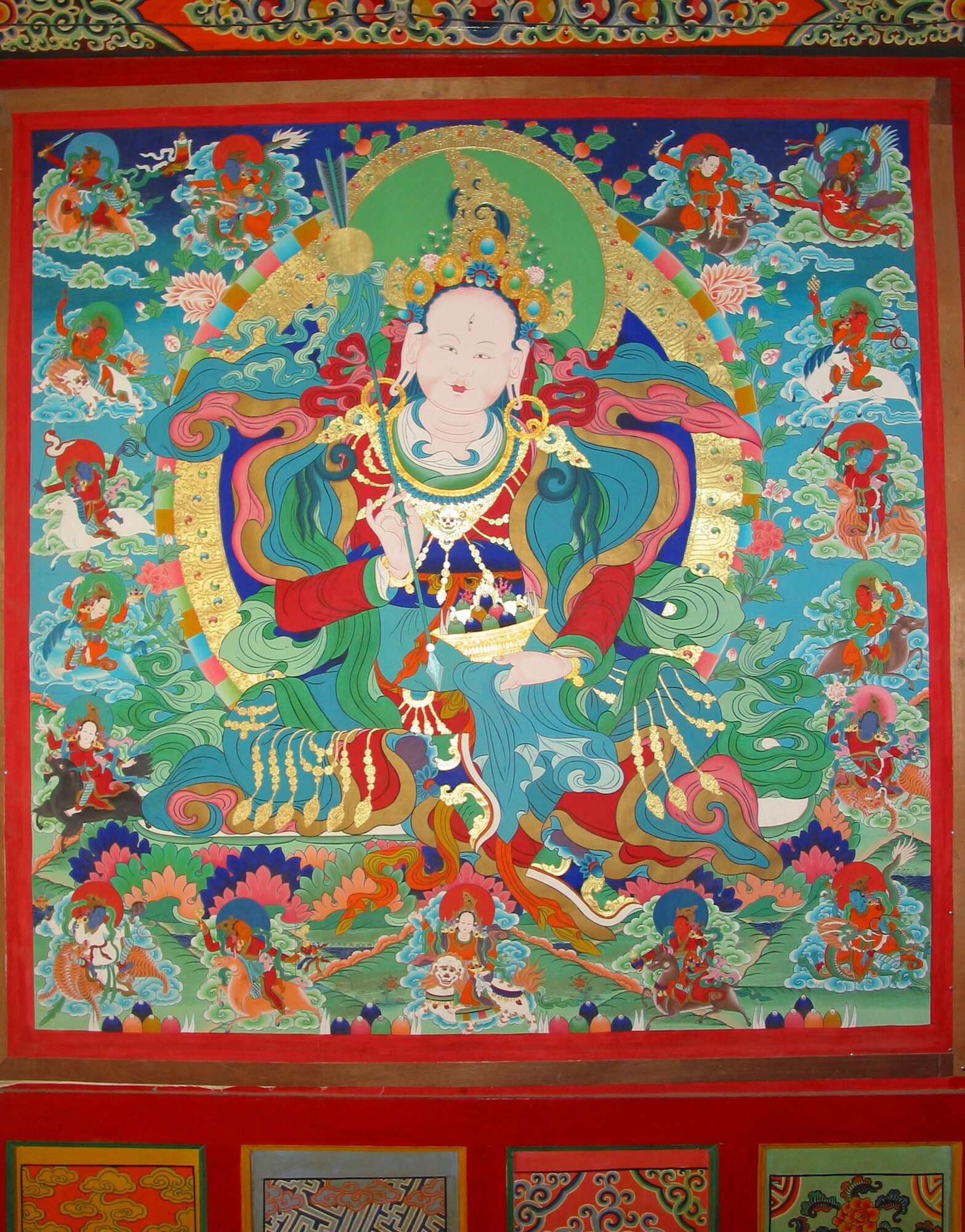
    Mandarava


    I could link things where a psychically-sensitive Taoist attained realization of her.

    She has been found in multiple incarnations:


    Gomadevi and Saraha's Arrow Dakini

    Siddhirajni (Machig Drupa'i Gyalmo)

    Niguma

    Risul or Yogini Adorned with Bone Ornaments of Marpa, Nyen, and Maitri.


    And what seems to be the case is she is born an aristocrat, and becomes a renunciant in a cave or cemetery or something.

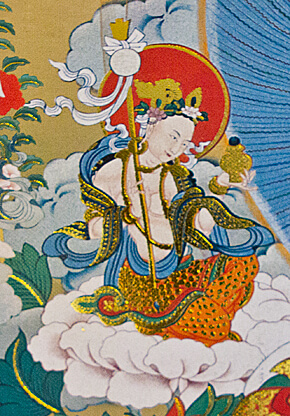
    In iconography, there are several kinds of arrows, and Mandarava holds a Long Life Arrow (which may be called Dadar) and a Vase filled with Nectar of Immortality:


    When asked by Yeshe Tsogyal, Guru Rinpoche recalled the Lives of Mandarava.


    Quote From the five places of Pāṇḍarāvasinī, supreme consort of Amitāyus,

    Light flooded the pure realms as the fivefold form of Dhātviśvarī, Queen of Space.

    When she attained rainbow body, this is considered her becoming Guhyajnana Dakini, who stems from the very origin of all these practices.

    She is Pandara in Sukhavati, Nartesvari in Khecari, and White Conch Medicine in Zahor.

    Mandarava is Pali for Sanskrit Mandara: the coral tree, Erythrina fulgens (considered also as one of the 5 celestial trees). The blossoms mentioned fall from the next world.


    It is the name for the mountain from Churning the Ocean of Milk:

    Quote The Mandara-mountain is named
    "diamond-like wisdom" (jnanavajra); the region of empty sky
    (khadhatu) is the ocean of milk (2). When the amrta was being
    churned in the beautiful sea, the ocean of milk, the goddess Sura
    arose from it; she is a maiden who can assume any shape at will
    (3).


    Mandarava is a link from the first Guhyajnana Dakini which must have been ca. 700, through Mani Rimbum and Padmanarttesvara -- Lord of the Dance in popular Tibetan culture, to the extent of a Guhyajnana Dakini Tantra composed there in the 1700s.

    If we see that, in large part, she is teaching about a Flask of Nectar of Immortality, this is a much better idea of what these practices are about.


    Essence Mantra of Mandarava extracted from Shang Shung Dzogchen:


    OM HRĪ BAM JÑĀNA DHĀKKINI MANDARAVA ĀYU SIDDHI JA HŪM


    She is the principal transmitter of Amitayus or the One Life in Theosophical terms. She transmitted Hayagriva to Yeshe Tsogyal.

    What may seem unusual is a similar Arrow is found in the hand of Lakshmi:


    I'm going to have to say they are similar.

    Lakshmi is a name for a type of permanent existence that has manifested or taken birth in the human world several times.

    The specific Buddhist terminology here would say that Guhyajnana Dakini is a Sambhogakaya or a Stable Form, which must be transcendental; it emanates bodies or Nirmanakaya, such as Gomadevi, Mandarava, and so forth. That is to say, these incarnations do a yoga practice which infuses them with the Sambhogakaya.

    All of those famous figures, Padmasambhava, Saraha, etc., are initiated by Guhyajnana Dakini, over centuries.

    She is, so to speak, the proper term for a power that can become apparent to the senses, whereas Vajravarahi is a meditational or tutelary deity.


    The Jewel of Reality used to find the hidden dakini:


  36. The Following 6 Users Say Thank You to shaberon For This Post:

    Bill Ryan (3rd July 2026), grapevine (Today), petra (3rd July 2026), Sue (Ayt) (3rd July 2026), Tintin (Today), Yoda (3rd July 2026)

  37. Link to Post #39
    UK Moderator/Librarian/Administrator Tintin's Avatar
    Join Date
    3rd June 2017
    Location
    Project Avalon library
    Language
    English
    Age
    56
    Posts
    8,256
    Thanks
    90,691
    Thanked 71,370 times in 8,222 posts

    Default Re: Great women in history

    Elizabeth Heyrick - another remarkable woman. Her pamphlet "Immediate, not gradual abolition" is now in our library


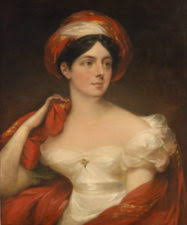
    Portrait of Elizabeth Heyrick
    Creator: National Portrait Gallery London | Credit: National Portrait Gallery London


    Source: https://en.wikipedia.org/wiki/Elizabeth_Heyrick


    Elizabeth Heyrick (née Coltman; 4 December 1769 – 18 October 1831) was an English philanthropist and campaigner against the slave trade. She supported immediate, rather than gradual, abolition.

    Early life
    Born in Leicester, Elizabeth was the daughter of John Coltman, a manufacturer of worsted cloth and a Unitarian. Her mother, Elizabeth Cartwright, was a poet and writer. She met John Wesley when he visited the family and soon began to practise Methodism.[1]

    In 1787 she married John Heyrick, a lawyer descendant of Robert Herrick the poet. After her husband's death in 1795, when she was only 28, she became a Quaker and soon after took to social reform, becoming one of the most prominent radical women activists of the 1820s.[1][2]

    Emancipation
    In the early 19th century, the prominent leaders of the British abolitionist movement, William Wilberforce and Thomas Clarkson, believed that when the slave trade was abolished in 1807, slavery itself would gradually die out. However, this proved to be not the case as without legislation, planters refused to relinquish their enslaved property. Campaigners such as Heyrick wanted complete and immediate abolition of slavery as an institution. A decade after the abolition of the trade, it became clear to the movement that slavery itself would not die out gradually. As a strong supporter of complete emancipation, she decided to address the leaders of the abolitionist movement.

    In 1823 or 1824, Heyrick published a pamphlet entitled "Immediate, not Gradual Abolition", criticising leading anti-slavery campaigners such as Wilberforce for their assumptions that the institution of slavery would gradually die out and for focusing too much on the slave trade: "The West Indian planters have occupied much too prominent a place in the discussion of this great question. The abolitionists have shown a great deal too much politeness and accommodation towards these gentlemen." However, "this pamphlet changed their view", and "they now attacked slavery as a sin to be forsaken immediately."[3]

    Aiming to promote public awareness of the issues of the slave trade and hit the profits of planters and of importers of slave-produced goods, Heyrick encouraged a social movement to boycott sugar from the West Indies, visiting grocers' shops in Leicester to persuade them not to stock it. Heyrick believed that women should be involved in these issues as they were qualified "not only to sympathise with suffering, but also to plead for the oppressed."[4]

    In 1823, Heyrick joined the new Anti-Slavery Society, the Society for the Mitigation and Gradual Abolition of Slavery Throughout the British Dominions. Other founder members included Mary Lloyd, Jane Smeal, Elizabeth Pease, Joseph Sturge, Thomas Clarkson, William Wilberforce, Henry Brougham, Thomas Fowell Buxton and Anne Knight.[5]

    Heyrick was a founding member of the Birmingham Ladies Society for the Relief of Negro Slaves in 1825, the first ladies' anti-slavery society in the world.[6]

    Other causes
    Elizabeth Heyrick was concerned with the welfare of long-term prisoners and worked as a prison visitor. In 1809 she prevented a bull-baiting contest by purchasing the bull. She was the author of more than 20 pamphlets and other writings on those subjects and others such as war, the plight of the poor, vagrancy, wages, corporal punishment and electoral reform. Towards the end of her life she became involved in the campaign against capital punishment. It was said that she fell in love with a slave.[1]

    Death
    Elizabeth Heyrick did not live to see the Slavery Abolition Act 1833 put one of her major social ambitions into practice. She died on 18 October 1831 and was buried in Leicester.[1]

    ________________________________
    References
    1 "Heyrick [née Coltman], Elizabeth". Oxford Dictionary of National Biography (online ed.). Oxford University Press. (Subscription, Wikipedia Library access or UK public library membership required)
    2 Midgley, Clare (21 April 2011). "The Dissenting Voice of Elizabeth Heyrick: An Exploration of the Links Between Gender, Religious Dissent, and Anti-Slavery Radicalism". In Clapp, Elizabeth J.; Jeffrey, Julie Roy (eds.). Women, Dissent, and Anti-Slavery in Britain and America, 1790–1865 (1 ed.). Oxford: Oxford University Press. pp. 88–110. ISBN 978-0-19-958548-9.
    3 Elizabeth Heyrick, Immediate, not Gradual Abolition, 2nd ed., Boston: Isaac Knapp, 1838.
    4 Elizabeth Heyrick, Appeal to the Hearts and Consciences of British Women, Leicester: A. Cockshaw, 1828, [British Library], p. 4.
    5 Slavery and abolition. Oxford University Press[permanent dead link]. [dead link - needs investigation]
    6 Simkin, John. "Women and the Anti-Slavery Movement". Spartacus Educational. Retrieved 20 December 2020.
    Hochschild, Adam (2005), Bury the Chains, The British Struggle to Abolish Slavery, London: Macmillan, ISBN 978-0-330-48581-4, OCLC 60458010
    “If a man does not keep pace with [fall into line with] his companions, perhaps it is because he hears a different drummer. Let him step to the music which he hears, however measured or far away.” - Thoreau

  38. The Following 2 Users Say Thank You to Tintin For This Post:

    grapevine (Today), kudzy (Today)

  39. Link to Post #40
    UK Moderator/Librarian/Administrator Tintin's Avatar
    Join Date
    3rd June 2017
    Location
    Project Avalon library
    Language
    English
    Age
    56
    Posts
    8,256
    Thanks
    90,691
    Thanked 71,370 times in 8,222 posts

    Default Re: Great women in history

    Grace Hopper:


    Grace Hopper at the UNIVAC console


    A little here from Brian Roemmele, before the Wiki extract:
    Grace Hopper suggested teaching computers English, critics scoffed, insisting that machines "only do arithmetic."

    She built the world's first compiler in her spare time.

    She was right and the experts were wrong..

    In the early 1950s, processing time on million-dollar machines like the UNIVAC I was treated as infinitely more valuable than the labor of the human programmers who operated them.

    At the time, programming was a brutal exercise in hardware manipulation. Programmers had to write instructions in pure machine code or octal notation, manually keeping track of where every variable was stored in the machine's memory. The job required a deep understanding of the computer's internal architecture and an immense tolerance for tedious, error-prone translation.

    Grace Hopper, a mathematician working on the UNIVAC, believed this manual translation was backwards. If computers were so good at repetitive tasks, she reasoned, they should be the ones translating human-readable instructions into machine code. In 1951, she proposed a "compiler"—a program that would take high-level mathematical symbols and automatically convert them into executable binary code.

    The computing establishment rejected the idea outright. Critics argued that computers were not built for symbolic manipulation, and even if they were, using precious machine cycles to compile code was a foolish waste of resources.

    After proving her compiler concept worked with the A-0 system, she didn't stop at mathematical symbols. She recognized that for computers to be truly useful in business and industry, non-mathematicians needed a way to program them. Her team developed FLOW-MATIC, the first programming language to use English keywords like "COMPARE," "ADD," and "TRANSFER."

    By demonstrating that software could be written in a language close to plain English, Hopper fundamentally changed the trajectory of computer science. Her work proved that writing software could be abstracted away from the physical hardware, shifting programming from an exercise in binary translation into a tool for broad logical problem-solving.

    This conceptual leap laid the direct foundation for COBOL, democratizing software development and setting the standard for almost every high-level programming language that followed.
    _______________________

    Grace Brewster Hopper (née Murray; December 9, 1906 – January 1, 1992) was an American computer scientist, mathematician, and United States Navy rear admiral.[1] She was a pioneer of computer programming. Hopper was the first to devise the theory of machine-independent programming languages, and used this theory to develop the FLOW-MATIC programming language and COBOL, an early high-level programming language still in use today. She was also one of the first programmers on the Harvard Mark I computer. She is credited with writing the first computer manual, "A Manual of Operation for the Automatic Sequence Controlled Calculator."

    Before joining the Navy, Hopper earned a Ph.D. in both mathematics and mathematical physics from Yale University and was a professor of mathematics at Vassar College. She left her position at Vassar to join the United States Navy Reserve during World War II. Hopper began her computing career in 1944 as a member of the Harvard Mark I team, led by Howard H. Aiken. In 1949, she joined the Eckert–Mauchly Computer Corporation and was part of the team that developed the UNIVAC I computer. At Eckert–Mauchly she managed the development of one of the first COBOL compilers.

    She believed that programming should be simplified with an English-based computer programming language. Her compiler converted English terms into machine code understood by computers. By 1952, Hopper had finished her program linker (originally called a compiler), which was written for the A-0 System.[2][3][4][5] In 1954, Eckert–Mauchly chose Hopper to lead their department for automatic programming, and she led the release of some of the first compiled languages like FLOW-MATIC. In 1959, she participated in the CODASYL consortium, helping to create a machine-independent programming language called COBOL, which was based on English words. Hopper promoted the use of the language throughout the 1960s.

    The U.S. Navy Arleigh Burke-class guided-missile destroyer USS Hopper was named for her, as was the Cray XE6 "Hopper" supercomputer at NERSC,[6] and the Nvidia GPU architecture "Hopper".[7][8] During her lifetime, Hopper was awarded 40 honorary degrees from universities across the world. A college at Yale University was renamed in her honor. In 1991, she received the National Medal of Technology. On November 22, 2016, she was posthumously awarded the Presidential Medal of Freedom by President Barack Obama.[9] In 2024, the Institute of Electrical and Electronics Engineers (IEEE) dedicated a plaque at the University of Pennsylvania in honor of invention the A-0 compiler, that functioned as a linker/loader, by Grace Hopper during her time as a lecturer in the School of Engineering.[10][11]

    Early life and education
    Grace Brewster Murray was born in New York City. She was the eldest of three children. Her parents, Walter Fletcher Murray and Mary Campbell Van Horne, were of Scottish and Dutch descent, and attended West End Collegiate Church.[12] Her great-grandfather, Alexander Wilson Russell, an admiral in the US Navy, fought in the Battle of Mobile Bay during the Civil War.[12]: 2–3 

    Grace was very curious as a child; this was a lifelong trait. At the age of seven, she decided to determine how an alarm clock worked and dismantled seven alarm clocks before her mother realized what she was doing (she was then limited to only one clock).[13] Later in life, she was known for keeping a clock that ran backward; she explained, "Humans are allergic to change. They love to say, 'We've always done it this way.' I try to fight that. That's why I have a clock on my wall that runs counterclockwise."[14] For her preparatory school education, she attended the Hartridge School in Plainfield, New Jersey. Grace was initially rejected for early admission to Vassar College at age 16 (because her test scores in Latin were too low), but she was admitted the next year. She graduated Phi Beta Kappa from Vassar in 1928 with a bachelor's degree in mathematics and physics and earned her master's degree at Yale University in 1930.

    In 1930, Grace Murray married New York University professor Vincent Foster Hopper (1906–1976); they divorced in 1945.[15][16] She did not marry again and retained his surname.

    In 1934, Hopper earned a Ph.D. in mathematics from Yale[17] under the direction of Øystein Ore.[15][18] Her dissertation, "New Types of Irreducibility Criteria",[19] was published that year.[20] She began teaching mathematics at Vassar in 1931, and was promoted to associate professor in 1941.[21]
    “If a man does not keep pace with [fall into line with] his companions, perhaps it is because he hears a different drummer. Let him step to the music which he hears, however measured or far away.” - Thoreau

+ Reply to Thread
Page 2 of 2 FirstFirst 1 2

Posting Permissions

  • You may not post new threads
  • You may not post replies
  • You may not post attachments
  • You may not edit your posts