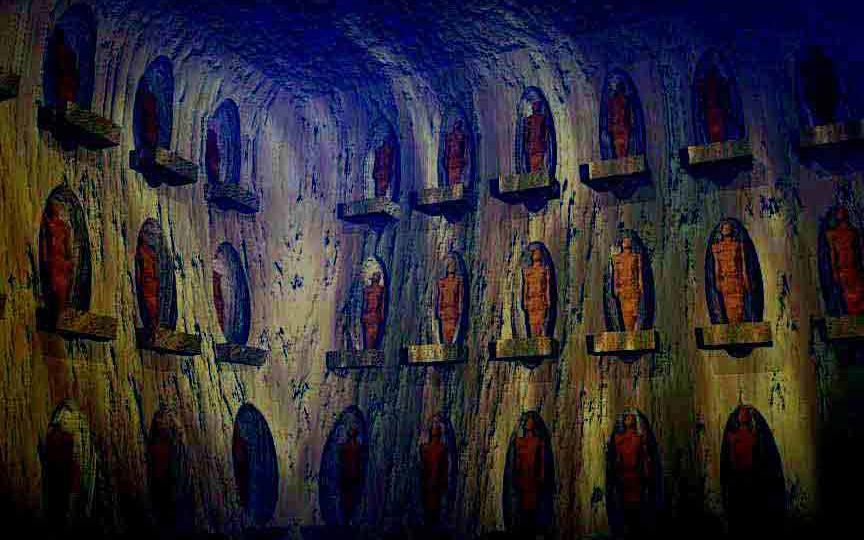
wherein were found mummies, copper instruments, sharp-edged and hard as steel, and many urns and stone tablets covered in hieroglyphics. Couple this with the many isolated rock formations named after Egyptian and Hindu gods,
Sheba Temple, The Tabernacle, Rama Shrine, Vishnu Temple, Krishna Shrine, Ottoman Amphitheater, Zoroaster Temple, Brahma Temple, Thor Temple, Solomon Temple, Jupiter Temple, Shinumo Altar, Shinumo Amphitheater, Wotan Temple, Angels Gate, Temple Deva, Manu Temple, Buddha Temple, Isis Temple, Shiva Temple, Cheops Pyramid, Tower of Set, Hindu Amphitheater, Tower of Ra, Horus Temple, Confucius Temple, Mencius Temple, Tower of Bable, Holy Grail Temple, King Arthur Castle, Guinevere Castle, Lancelot Point, Galahad Point
and the evolutionary theory of isolationism begins to fall apart while the mystery begins to unfold.
https://dailyoddsandends.wordpress.c...yptian-relics/
Another location of great mystery is that of the dense jungles of South America such as the Amazon. Older publications tell of explorers discovering great stone cities of colossal proportions some with roads paved in gold and magnificent statuary of unknown figures lost to time. These unknown cities are so difficult and treacherous to reach that most don’t make it back alive due to the harsh climate, unforgiving terrain, fierce Indian tribes, many cannibalistic, as well as countless other poisonous critters, not to mention whatever else may be hidden within such inhospitable jungles.
But there's one thing that has always stuck with me after reading these books, something that lit a fire in my mind ever since. It has to do with an eternal light that never goes out. I’m including the first few paragraphs of this excerpt from
Secret Cities of Old South America, by Harold T. Wilkins, as an example of the “whatever else my be hidden within such inhospitable jungles” while the eternal light is in the last paragraph.
There is a Matto Grosso Indian tradition, still extant, about a great and very ancient white ruler of old Brazil, who was a great cacique ruling over ten other chiefs of vassal tribes. This sounds remarkably like an echo of the ten kings who periodically met and held state councils and religious festivals in the great golden temple of Poseidonian Atlantis. (Vide Plato's Dialogues of Timseus and Critias.) The same Indians of the Matto Grosso and the Goyaz, as well as down south in the state of Sao Paulo, have traditions that a great cataclysm forced their ancestors to quit the shores of an ancient Maranon-Amazon basin, where were located great cities of shining white stone ruled over by powerful white chiefs, in a very far day. Even to-day, these Indians have a tradition that, in the western Matto Grosso, as it now is, and on the site of the Gran Chaco of forests and swamps that borders Paraguay, western Brazil and Bolivia—home, by the way, of at least one great monster of an amphibian dinosaur, called the "buey jagua"—there was a prehistoric sea called 0 Xarayes. This name is borne by one Indian tribe in the upper reaches of the Paraguay, contacted, in 1723, by Capitao Antonio Pires de Campos, and called by him "o gentio Saraye^'. The waters of this prehistoric sea, said to be older than the rise of the Andes, laved the slopes of the old Brazilian Highlands, on which the great megalithic cities were located, and extended a good way southwards to what is now the Argentina.
A correspondent of mine, in Sao Paulo, tells me that it is known there, by certain people, that, in the 1900's, when Colonel Fawcett was delimiting the frontiers of eastern Peru, Bolivia and Brazil, he reached the country of the formidable Nhambiquaras. These Indians are the subject of jokes among other Indian tribes in Brazil, by reason of the abnormal size of their virile organ! They are powerfully built and dark in hue and may be descendants of the very ancient black aborigines of South America. They are definitely of Stone Age culture.
Fawcett was told by a cacique of the Nhambiquaras that a megalithic ancient city lay east of their country, towards the head-waters of the Rio Xingu. This dead city was hemmed in by a belt of very dense forests, beset with the fierce Suyas, a tribe of very savage Indians. The cacique gave to Fawcett, one is told, a pebble carved in intaglio with a figure of a sandalled man wearing a sort of ancient Roman toga. It was very ancient. Other stones were incised with letters like those found in a.d. 1745, by the old bandeiristas who entered another dead Atlantean-Hy Brazilian, considerably to the east of the Xingu country.
These ruins of the Nhambiquara cacique are said to be in a plain encircled with a range of blue mountains, and with dense jungles and forests coming up to the massive walls. There are moats and massive paved stone causeways and streets. It is ,very reminiscent of the dead city described in my Mysteries of Ancient South America. There were also tales of monstrous animals in this region, some of dinosaur type wallowing in reedy lakes, and others oddly like the King Kong ape, of the late Edgar Wallace's fantasy, ten or twelve feet high, with human-like hands instead of opposed thumbs.
Albert de Winton—it is uncertain whether this luckless gentleman was a British or an American citizen, for he lived, at one time, in Hollywood, California—died of. poison slipped into his fruit-drink, by treacherous Indians of an aIdeia bordering the land of these very Suyas. De Winton was then (about 1934) searching for a solution of the Fawcett mystery, and he had reached the fringes of the Suyas forests. My Sao Paulo correspondent says it is believed that poor de Winton left manuscripts that have fallen into private hands in Cuyaba. In one paper, de Winton told of meeting an Indian who had escaped from his savage custodians of Suyas, by whom he had been held captive, and who are guardians of the strange dead city. This Indian spoke of a stone tower of very ancient and massive construction, from which, day and night, there shines an eternal light. It is very bright, and whatever form of physical energy or chemiluminescence be used in this light, it seems one unknown to modern illuminating engineers.
And here’s another form of this eternal light referred to as perpetual lamps. I believe what always stuck with me about these eternal lights, as it says in the footnote below, was that they were a symbol of the immortal spirit, the light that never goes out. I didn’t realize it at the time but it’s a beautiful metaphor, not only the metaphysical metaphor of an immortal spirit but also the thought of our ancient ancestors, these keepers of the knowledge, hiding in cities of a once great civilization, now covered in dense jungle, keeping the flame alive until we’re ready to receive it again.
Investigating field-workers in Colombia have found in certain ancient sites of races unknown indications that these ancient men may have possessed knowledge of some form of illumination very like that of our modern electric current. In the jungle of the Matto Grosso, as an Indian told Colonel P. H. Fawcett in the frontier township of Cuyaba, there are, and have existed for ages, known to and seen by himself—the Indian and his Indian forbears, strange, fixed lights. This singular light, age by age, untended, shines out of the window openings in tall buildings, shrouded in dense forest, of ancient dead cities of Atlantean Brazil. It seems to be some form of cold light energy, possibly a type of fire-fly luminescence, multiplied by many candle- power, which is unknown to modern physicists. (A footnote was placed here and is inserted below)
So-called "perpetual lamps" are said to have been known to the Romans, and Bailey's Philologos speaks of them. There was the one found burning in the tomb of Tullia, daughter of Cicero, on the Appian Way, temp., Pope Paul III. It had burnt for 1,550 years, but the opening of the sepulchre caused the light to go out. In Egypt, they are also said to have been known and used in tombs and sepulchres. Kircher's CEdipi JEgyptiaci Theatrum Hieroglyphicum also mentions them. Plutarch says he saw one in the temple of Jupiter Ammon where the priests told him it had been alight continuously for years, standing in the open where wind nor water could put it out. Old Memphis's temple is said to have had many such lamps, regarded as the symbol of the immortal spirit, which was distinct from the soul, which was only semi-immortal. Kedrenus says he saw one such lamp at Edessa, Syria, where, hidden on top of a gate, it had burnt for 500 years. Such lamps are said to have been known in Tibet, where the Abb£ Hue said he saw one ; and at Travan- core (Trevandrum), India, by a London missioner. "Oiliness of gold", reduced to a fluid which reabsorbs the oily fluid and gives it out again, with a reaction of light, is alleged to "explain" the luminescence, which also seems to have been connected with maintenance of a near-vacuum. Modern science knows of the "cold light" produced by luciferin and a catalyst called luciferase. This system is not "perpetual" and needs reactivation with hydrogen. How the firefly reactivates its own "cold light" none know. But no form of known chemiluminescence will last indefinitely without renewal or attention. The autoluminescence of radioactivity, which, theoretically, should last for one thousand years, means death to human beings exposed to the bombardment of the rays. Also, electroluminescence, such as the neon light, or the sodium vapour lamp, radiates only in one or two particular wave-lengths, such as red or deep yellow, is extremely expensive, and certainly not "perpetual". The ancient world of South America, as also that of old Egypt, possessed some secret we do not know. It would seem that these lights, once started, could never be put out. —Author.