 Posted by Bluegreen
(here)
Meet The 'Bottle Tree' Whose Sap Is Both Poison And Medicine
Posted by Bluegreen
(here)
Meet The 'Bottle Tree' Whose Sap Is Both Poison And Medicine
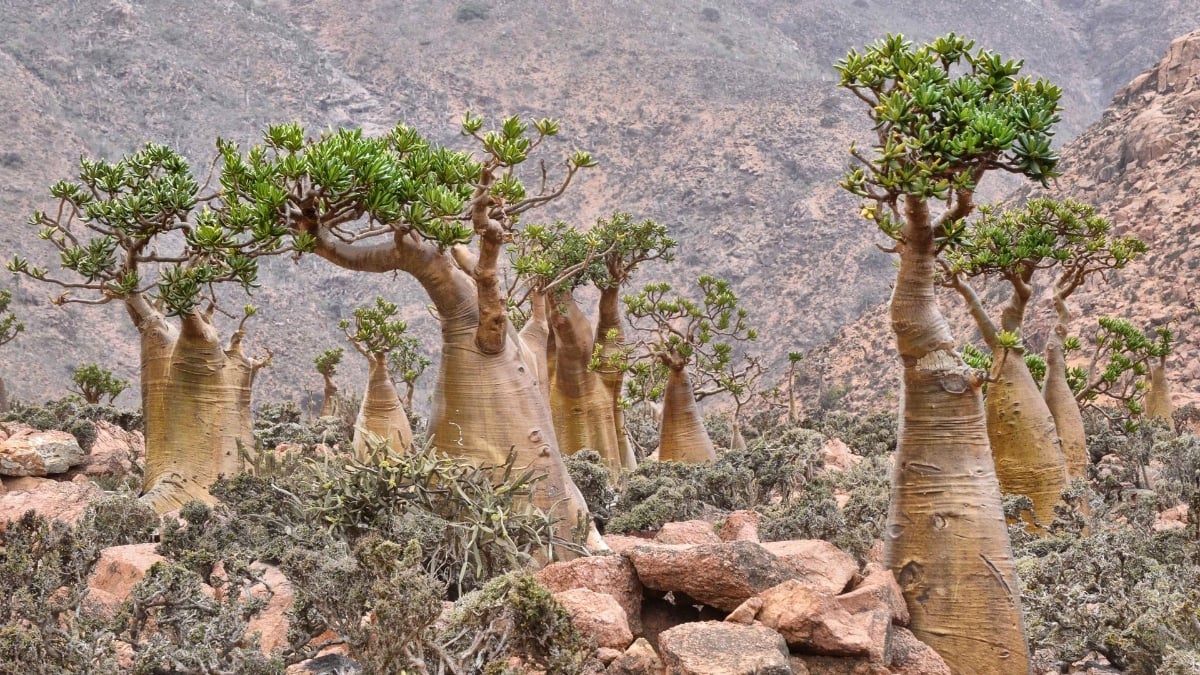
The Socotra variety of the desert rose
(Adenium obesum) looks like a tree that a child might draw. Its rounded, bulbous trunk, spindly branches, and brilliant pink blooms appear both otherworldly and too delicate for its home.
It is only found on the rocky landscape of Socotra, a Yemeni island in the Indian Ocean, where it's sometimes called the bottle tree.
With a base that can grow to about 2.4 meters (8 feet) across, that name makes perfect sense – it looks like a giant soft-sided water bottle plopped down on Earth's surface. That swollen form is an adaptation to life in a harsh, dry environment: The plant stores water in its enlarged trunk and roots.
After spending months looking like an exceptionally strange piece of desert architecture, it puts on a show. From early March through late April, Socotra's desert roses can erupt in striking pink-and-white flowers.

All five varieties of
A. obesum grow in dry places: some are native to the Sahel regions south of the Sahara Desert, some to southern Africa and parts of Australia, and others found on the Arabian Peninsula (like Socotra in Yemen). It's a weird-looking plant – but its strangeness is more than skin-deep.
It's also medicinal. Ceremonial. And poisonous.
When it's injured, it produces a milky white latex, and that sap contains compounds that can affect the heart.
Those compounds are part of what makes this toxic tree so fascinating – and so dangerous. If consumed in small quantities, cardiac glycosides can increase the force of the heart's contractions while simultaneously slowing its rate, and so they can be useful for treating various kinds of heart failure.
The same chemistry that makes the plant potentially helpful for healing also makes it a poison. Too much of the cardiac glycosides can cause vomiting, blurred vision, dangerously abnormal heart rhythms, and other potentially life-threatening effects.
But again, poison can also be useful.
In northern Tanzania, for example, the Hadza have traditionally used A. obesum as an arrow poison for hunting animals including buffalo, zebras, giraffes and birds. Other communities have used the plant to poison fish, pests and vermin.
A 2024 review of the plant's ethnobotanical uses found an incredibly wide range of applications. In different regions, people have used parts of the plant for skin problems, wounds, earaches, tooth decay, lice, and various infections.
This wide range of uses may explain why the desert rose is also used in mystical or religious practices. The sap is believed to be efficacious in collaring illness caused by the evil eye, and is used as a protection tool against "evil spirits and ill-wishers."
Published 27th August 2026 by Starre Vartan – Science Alert
https://www.sciencealert.com/this-tr...d-can-kill-you
(1:09)


 Re: Up At The Ranch And Beyond



 Reply With Quote























Bookmarks