+ Reply to Thread
Page 4 of 4 FirstFirst 1 4
Results 61 to 62 of 62

Thread: Pawlsy the Cat is Her Name

  1. Link to Post #61
    United States Avalon Member
    Join Date
    1st April 2016
    Posts
    7,057
    Thanks
    36,086
    Thanked 40,329 times in 6,707 posts

    Default Re: Pawlsy the Cat is Her Name

    This is our Dharma talk from encountering Mahamaya and the presence of Five Families.

    It's almost simple, but, we also keep seeing numerous publications that keep saying something is something. It's not. There are times and reasons for it to be one way or another. Mahamaya is not a beginner text, but it is quite compact and a very useful example. We'll go over it and some of the others, and say, sometimes they are valid, and give you the lead to figure out what those times are.

    It's not quite a sex-changing entity like Bhurkumkuta may be. There are masculine and feminine versions of it, just like nearly everything else in Sanskrit. The sadhanas are based on Heruka Mahamaya.


    Ariana said, "There are archives on it.

    What is immediately obvious is juxtaposition in the union of Heruka and Buddhadakini. It's not 'Akshobhya and Consort' as if a normal Vajra Family couple, because they are in two different Families.

    It is a Buddha Family-centered mandala, because Vajra Dakini is in the East.

    Buddha Dakini is Red, while Lotus or Padma Dakini is White.

    The tantra is more about Vajra Dakini or that is who he is meditating to/on."


    Fleep said, "It has a final or additional subject that refers to Subtle Yoga."


    Quote tāramuktāphalanibhaṃ jñānāmṛtabinduṃ dhyāyāt|
    Quote iti binduyogaḥ |

    I said, "That is like a large Sadhanamala exercise with songs.

    There is also a Mahamaya with Ratnakarasanti's Gunavati Tika Samhita.

    You find a certain designation for dakinis."


    Quote ḍākinyaśceti vajraḍākinyaḥ| tāsāṃ kirdṛśīnāmityāha--guhyeśvarīṇāmiti|

    "There is also a section where he deals with the fact the Five Skandhas are supposed to transmute into Five Wisdoms."


    Quote pañcajñānānyeṣām-- ādarśanñānam, samatājñānam, pratyavekṣaṇajñānam, kṛtyānuṣṭhānajñānam, suviśuddhadharmadhātujñānaṃ ceti |


    "That's what I mean.

    If you melt the skin of the Bodhicitta, the illusion of Form arises as the Adarsa or Mirror Wisdom. If you are not good at this, it will get ripples and you will go away, or, if you hold it, you will melt the layer of Greed and experience Equality Wisdom. If you make it all the way around, you will go into the Dharmadhatu itself."

    Fleep said, "It's hard like a pearl, and then you melt it into basically semen."

    "Yes.

    It might be warm but it's not literally like a grease fire or anything drastic. I think there might be fiery feelings and headaches associated with failure to concentrate Fire on the Bodhicitta. Something that would be self-correcting, for me, at least."

    "I like that. If this hurts, you're doing it wrong."

    "I think so.

    That's why I want to keep doing it, and I'm not that good at the sadhanas that are supposed to cause it. You all will be more of Buddhists with it than me.

    It's a somewhat rare aptitude seen once in a while, for example, in Dolpopa, who mastered Dharana on retreat in about six months, but, I think he was overzealous and bent the Yogacara terminology in a way that did not need to be done."


    Genta said, "So you've gone from a profuse saturation in the head, which you say is the First Joy, to a thing more like the Bodhicitta is the metal head of a trident and when it melts it just drops. When it hits the lower center, it stops and its nature changes and it climbs back up in a very passive way. But the lower center is not actually the root, it's The Vessel, Bharati.

    Other than that, you haven't really performed the divine or Dharma portions of the teachings, except you can tell about the Skandhas and Prajnas, which just happens to be the main point of it all."

    "Yes. I'm trying to listen to what Buddhism says, rather than just doing the physiological process, which I could do at will with nothing at all. It would just be time spent."

    Fergus said, "In actuality, it must be the Prajnas, the Wisdoms, that are to be Known."


    "Seeing Marici, then, it seems to make sense as fire hitting the bindu, and then she is Vajradhatvishvari without any Vajradhatu.

    That is what the mandala systems are for, and why she is packaged with it. It's indirect, but it's parallel."


    Relative to Maitreya or Jampa, Vajradhatu:


    Quote ...is located to the left of the Byams pa image that gives the lhakhang its name.


    "Quite visibly this is the main thing being done here."


    Quote The verse identifying the master painter is found - in diminutive script - beneath the Vajradhatumandala.

    The majority of mandalas subsidiary to the principal Vajradhatumandala represent Vairocana in his krodha forms, or in his aspect as peaceful Vajrapani (Phyag rdor), in the centre of various emanatory retinues.

    The verses beneath it identify it as the Guru Mandala, "the root mandala of the mahayogatantra", and "the basic instructor and trainer in the root tantra". Ngor chen Kun dga' bzang po is identified here as the Lama of this tantric lineage.

    "You have to import that idea to the visible list in Appendix A and discover the next neighbor is Dharmadhatu Vagisvara Manjughosha.

    This collection is mostly Sarvadurgati Parishodana mixed with Namasangiti. Those aspects of it are recognizable and why they can be said to be progressive, related practices.

    The upper sanctum is a mostly un-reported collection of tantras such as multiple Chakrasamvaras and so forth."


    Dinky said, "The example photos aren't clear enough to make out any details. But you can get the general impression of the Vajradhatu."


    I said, "What we have done is describe a dharani-based goddess equivalent of this.

    Considering this to be an Ngor monument, you may have noticed it is the actual Ngor Monastery where we first found details of Sadhanamala deities like Mahacinakrama and Four Arm Sita Tara."


    Fergus said, "Is it subsumed in the band's use of Heruka-centered Six Families?"


    "Maybe started by.

    Vajradhatu is a Vairocana-centered tantric progression.

    Dakini Jala isn't really a progression, it's more like a template, more like the beginning of a conceptual Vajrasattva. It's perhaps more like the attributes of the Families individually.

    Manjushri is generally held to be an agent of Vairocana, so, the slightly later tantras like STTS, SDPT, and Namasangiti, are based in what look like layers of Wrathful Deities, Mt. Meru, and an Omniscient Vairocana.

    So we take our conceptual Cemetery Heruka as above and look at Mahamaya Tantra what happens. Buddha Dakini is on him. He is in Vairocana's spot. Vajra Family has its spot in the ring. And it becomes mostly about Vajra Dakini.

    What Muses has on Naro even goes on to Utkranti or Transference."


    Quote The time to apply this yoga is instructed by the Tantra of Vajra-Dakini as follows:

    "When the time (of death) comes,
    This teaching is applied.
    If the time (of death) is not near when anyone applies the teaching,
    He is committing the crime of slaughtering Buddha;
    He will certainly fall into hell and be scourged.
    Therefore, one should carefully and diligently study the signs of death."


    "Most of our Yoga is training for this."


    Quote (Purification means that through the practice of Heat Yoga the body and mind are purified.) Without purifying the body through practicing the Heat Yoga it will be useless and futile to perform the Transformation Yoga. This is said in Bhaba Bhadras, because the Tumo practice is the very foundation of Transformation Yoga. The Tantra of Vajra Dakini also says:

    "By means of the Vase Breathing the door is bound (opened).
    Thus, the hole of the door is purified."

    The Tantra of Gdan-bzhi as well as the Tantra of Sambhuda says the same thing. They stress the necessity of having a (tamed) prana for practicing the (Transformation Yoga), only because through practicing the Vase Breathing can the pranas, which run wild toward all organs and gates in the body, be fairly gathered (or tamed). Some people say that, if one reaches the lowest stage of Vase-Breathing practice, one is qualified to perform the Transformation Yoga. This shows their ignorance of the teaching of Tantra.

    In performing the Transformation Yoga, all the nine gates of the body except the Golden Gate on [top of the] the head should first be closed to prevent the escape of the consciousness through these gates. The consciousness should be allowed to exit only from the Golden Gate. According to Tantras, these conditions are required to meet the qualifications of a perfect ground upon which the qualified Tantric yogis may perform the Yoga of Transformation.

    Furthermore, a perfect visualization on the exit of consciousness described by the Tantras is required.

    "That is compatible with this note on the Vow."


    Quote Advayavajra, in his Čaturmudrā, refers to Mahāmudrā in very much the same way that Śakti—as ultimate Divinity as Goddess—is referred to in higher treatises of the Hindu Tantra: "She is not an object subject to time… she combines saṃsāra and nirvāṇa; her substance is universal Love; she is the unique essence of the Innate Transcendent Bliss."

    "Okay. So you have a sort of maximal use of Vajradakini, which is at the Crown Center and at Death, but you, or I, or we, don't have a Vajradakini.

    She is directly addressed as the very beginning of Ratnakarasanti's Mahamaya commentary, as a guide to Five Knowledges and the Tri-kaya."


    Quote || namaḥ śrīvajraḍākinibhyaḥ ||


    namaḥ śrīvajraḍākinyai ḍākinīcakravatirne|
    pañcajñānatrikāyāya jagattrāṇavidhāyine || 1 ||


    this chick is going to eat the Imaginary Nature of Yogacara and try to deliver you some Void Essence:


    Quote yaścaitā vajraḍākinyaḥ parikalpitabandhanān

    "We find one topic of vast secrets, parama guhya, governed by Mahesvari."


    Quote tāsāṃ paramiyaṃ guhyāṃ mahāmāyā maheśvari|
    mahāmāyā mahārau drā bhutasaṃhārakāriṇī||5||

    "In turn, this has to do with Five Families."


    Quote yata iyaṃ maheśvari, ata eva tāsāṃ paramiyaṃ guhyaṃ| tāsāmiti vajraḍākinīnām|


    iyaṃ tu pañcakulasādhāraṇī dharmatā pañcānāmapi tāsāṃ samatā, tatastāsāmapiyaṃ guhyāmiti paramaguhyāmeṣā|


    "Heruka, on acquiring the nature of Vajradakini, is going to make a jnana dakini murti, something like a Jnana Sattva of the Dakini class."


    Quote śriherukaḥ , tena samaḥ sadṛśāḥ | apiśabdād vajraḍākinīsamaḥ | sa iti yogi | tadatra herukasya jñānaḍākinīnā mūrtistadahaṅkāreṇa bhāvanīyā |


    Quote || iti yogeśvarīmahāvidyāsiddhinimittanirdeśaḥ ||1||


    Another area also concentrates around Vajradakini."


    Quote yeneti yena dravyagaṇena | gūḍhamataro vajraḍākinyaḥ || 2 ||


    iti mahāvajraḍākinīnāṃ mataṃ mahāguhyaṃ samāptaṃ sopacāram|


    Part of its Hetu or Cause or Grounds are the higher luminaries of Yogacara:


    Quote hetauprakṛtiprabhāsvaratve sati ṃahyotat phalaṃ satyapi hetau vinopayairbhavati

    Then you go through Vajradhara and Akasadhatu to get to Suksma Yoga. This makes Ramyam Rahasya Jnana. Ramye Rahasya is still the beginning of Dakini Jala and main festivity of most Chakrasamvara. With Dakini Jala it is being taught and trained. Now it is being applied in the Utpatti or Generation Phase.

    It is then called Sri Vajramrta Suksma Yoga.

    Followed by Kha-arisen Vajrasattva in the Navel.


    Quote sā tasya jñānajñeyarupatā | aya cāsya vajradharasya sukṣmajñānamudrākāraḥ | śrisamāje 'pyuktam

    ākāśadhātumadhyasathaṃ bhāvayeccandramaṇḍalam |
    buddhabimbaṃ bibhāvitvā sukṣmayogaṃ samārabhet ||
    nāsāgre sarṣapaṃ cintet sarṣape sacarācaram |
    bhāvayejjñānapadaṃ ramyaṃ rahasya jñānakalpitam || iti ||

    śrivajāmṛte 'pyayamasya sūksmayogaḥ sādhāraḥ sakarmaka ukata

    tiṣṭhate niścalaṃ vidyā amṛtaṃ dhyānamārabhet |
    dhyāyate paramaṃ tatvamamṛtaṃ bindurupiṇam ||
    khamadhye śaśisaṃkāśaṃ śunyatattvamudāhyatam |
    akṣayamavyayaṃ sukṣmaṃ vajrasattvamanāhatam ||
    nābhimadhye sthito devaḥ karṇikāgudagocare |
    sravate śukrarupeṇa bhagaliṅgāntare sthitaḥ || iti |

    These lines show some of the core ingredients.


    Quote sitasūkṣmbjnduryogaḥ |

    pañcajñānāmṛtaṃ tathā |


    Transmundane Awareness is Unelaborated, non-phenomenal:

    Quote lokottaraṃ jñānaṃ niṣprapañcaṃ virakhyam

    and then there is:

    Vajrayogini


    The rest of the tantra is Completion Stage:


    Nispatti Mahamudra Siddhi

    with:

    Akanistha which emanates Seven Worlds. Curiously, this is the only section that uses Simha -- Lion.


    Quote siṃhavikriḍitāṃ mudrāṃ yogino bandhayanti hi |
    prāṇāyāmaṃ suyantritvā dhyātvā jvalati tatkṣaṇāt ||16 ||

    akaniṣṭhabhuvanaparyante saptaloke carācare |
    sarve tato bhāvayanti na ca taṃ buddhayanti hi ||17 ||

    yogāntaramāha--siṃhetyādi | siṃho vīraḥ , tasya vikrīḍitaṃ yasyāṃ sā tathoktā | mudrāmiti ravisomasampuṭām , bandhayantīti baddhāṃ cintayanti , tisubhirakṣarapaṅkti bhiḥ purvavat (1|26) | yogina iti caturdevīparivṛtaśriherukayoge sthitāḥ | prāṇāyāmamiti ucchvāsa niśvāsau | suyantritveti suṣṭhu yantritvā , krameṇa sukṣmīkṛtyetyarthaḥ |

    Genta said, "It carries the sense that Vajrayogini is a result of the cumulative knowledge of Five Dakinis."


    Quote evaṃ sati vajrayoginyaḥ siddhayanti , nānyathā | vajro herukaḥ , yoginyaḥ pañcaḍākinyaḥ | yogaḥśriherukaḥ , tasya ḍākinī gaṇaḥ | saṃvare tābhireva yoginībhiḥ saha sukhavare sati ṣaṭ sukhasthāneṣvityuktam |


    "Maha Vajradakini seems to be the "who" that has been explained by Mahamaya which is the Tantra.

    Buddhadakini has to do with Awakening, with Kunkuma, and with the origin of Five Families. Vajradakini is in the East. The other dakinis are formulaic and only mentioned a few times. So this is still within the pattern that Buddha Family or Vairocana is fivefold form, to which, the sixth principle of Buddhism is hypostatically split, so to speak, out of Vajra Family. Much like Sattvavajri through STTS.

    The tantric commentary is followed by a Mahamaya sadhana, and the one by Kukkuripa.

    The first makes it fairly clear that the Bindu splits into Four Bindus, from which the retinue ring comes. They do a Vajra Giti or song. This is what produces Mahamaya and Buddhadakini.

    Kukkuripa adds this line."


    Quote vajraḍākinīnṛtyena vajrasattvaṃ niveśayet||

    "He uses this description which elsewhere has been taken as a personal name."


    Quote svabhaprajñā


    "Here, it seems to mean Heruka creates Buddhadakini, rather than any other way of her getting there.

    What is most fascinating are the Dakinis simply are the Purified Elements and Wisdoms."


    Quote suviśuddhadharmadhātujñānasvabhāvamātmānaṃ


    pṛthivīdhātvādarśajñānasvabhāvā

    abdhātusamatājñānasvabhāvā

    tejodhātupratyavekṣaṇājñānasvabhāvā

    vāyudhātukṛtyānuṣṭhānasvabhāvā

    Dinky said, "The only way they are distinguishable from the Prajnas is they are Wrathful. Otherwise, you are trying to tell me Earth transforms into the Mirror Wisdom, and so on."

    "That seems to be the case."

    Fergus said, "Transformation to Wisdoms is perhaps first described by Candragomin.

    We have found a few standard ways, and a few different ones.

    Surely, Kukkuripa Mahamaya, as the major basis of all Mahayoga, ought to be an identifiable starting point."


    Ariana said, "It is like the gathering of forces that would be used in a more technical Flask Ritual."

    I said, "Yes, and that's why I've got to give you a corollary.

    Notice this format starts in the center, and makes a face-to-face with the Eastern quadrant, and goes around the ring to make a complete lesson.

    But as I said, from throwing a major tantric switch, my impression was going around and then Tara does this Krtyusthana Jnana, which does something else, it throws you back to the center, to the Void in an out-of-the-ordinary kind.

    And that's exactly what we find in the format explained solely as Wrathful Prajnas."


    Genta said, "But you also have semi-wrathful, a type of bridge or elaboration."


    I said, "Well, there is a type of mobility, which gets confusing.

    In the familiar Zhitro or Kagye' of 100 Peaceful and Wrathful Deities, the Dharmadhatu Wisdom is held by Vairocana in the Peaceful format. But then Akshobhya has it in the Wrathful format.

    Such a thing is non-existent, until we identify the Element, itself, and then Purify it. And there at first you are looking at it basically the same as Akash Dhatu, rather than a sixth, Mano Dhatu. It's not semantics. It's the requirement of Void Gnosis as the substrate of the sixth factor.


    To go to the Dharmadhatu Wisdom, you would start with a Dharmadhatu Vajra (Mind Object) and Dharmadhatu Ishvari (deity thereof). And as we keep saying, if this really arises, you should use Guhyajnana Dakini.


    Guhyajnana can arise from Om or Hrih, and characteristically handles her retinue with Ha Ri Ni Sa. Her guru, Ziro Bhusana, then functions almost as Cinnamasta, and she also Mutters the Dakinis, causing them to move. We are getting a demonstration of Three Channels operating in four chakras, elements, kayas, joys, activities, in fact each way it can be classified is supposed to be used. Ziro Bhusana is literally doing exactly this.

    This is unusual. Those are quite unique seed syllables, and Guhyajnana casts the Four Dakinis in reverse. Let's call this a very different subject than Mahamaya stamping them out in their expected pattern. The common ground is both start with Dakini who is in Vajra Family.


    The other example of Ha Ri Ni Sa is termed an oral lineage from Siddharajni, whom we believe to be the re-incarnations of Mandarava, who increases it a level to Vam Ha Ri Ni Sa [Varahi] for Five Elements and is a Samaya with Jnana Dakini (Sambhogakaya), Mandarava being her Nirmanakaya. The closer you look at these terma and personal lineages, it is profuse in there.


    The mantric syllables of the Four Dakinis are used by another Sarma principal.

    Siddharajni's sadhana is Vilasini, who, at Virupa's Yoga level, introduces Padmajvalini in her retinue of nine: these being "the vilasinis".

    Padmajvalini is Dharmadhatu Vajra. Or, she is Space Element in Abhidanottara Tantra. Padmajvalini continues to be used by Varahi from Abhisamaya-manjari. We're going to look at some of the few ways the Prajnas as Wisdoms are found.


    Siddharajni has a sadhana of Jinasagara and Vilasini. Guhyajnana and Dakinis eventually promote Jinasagara to Padmajala. When Padmajala appears in Vajra Rosary, it is during the explanation of the Rosary, which says the winds move through the six wheels in a nine-fold way, which is fifty-four, and doubling this is 108 or the beads on Rosary.


    Varahi's Vilasini has:

    Quote mAmakI, lochanA, tArA and pANDaravAsinI. These four deities are respectively kuleshvarI-s of the kulas of akShobhya, amoghasiddhi, amitAbha and vairochana.


    eṃ Amitābha--Perceptions--Fire--Discriminating Wisdom--Human Flesh
    āṃ Vairocana--Form--Earth--Dharmadhātu Wisdom--Feces
    rīṃ Akṣobhya--Consciousness--Water--Mirror-Like Wisdom--Urine
    raṃ Amoghasiddhi--Intentions--Wind--All-Accomplishing Wisdom--Blood
    brīṃ Ratnasambhava--Sensations--Space--Equality Wisdom--Semen

    It becomes apparent that despite being at the end, Ratna or Jewel Family is centered. It has imported Equality Wisdom, typically found in the South. Consequently, some more of the regular format is distorted. Or, this does not match Mahamaya.

    It's not the same Manjari as Abhayakara's. The Abhisamayamañjarī by Śākyarakṣita is a Buddhist tantric text closely related to the Herukābhisamaya by Lūyīpāda, which in turn is probably based upon the Yoginīsaṃcāratantra.


    Here's an arrangement where they match the customary pattern.


    Quote earth, Patani, Locana, yellow, wheel, chopper, skull bowl, skull staff

    water, Marani, Mamaki, black, vajra, chopper, skull bowl, skull staff

    fire, Akarsani, Pandara, red, lotus, chopper, skull bowl, skull staff

    wind, Nartes'vari, Tara, green, sword, chopper, skull bowl, skull staff

    space, Padmajvalini, Dharmadhatuvajra, grey, 3 faces: grey, red, & white, goad, Brahma's severed head, chopper, skull bowl, staff, noose


    Ariana said, "The written Vilasini sadhanas are attributed to Virupa and Sabara. Virupa's Vilasini is the chief of the following retinue, so, by correspondence, Vilasini equates to the invisible Prajna (10) over Padmajvalini."


    Quote pRithivi bIja: 1) pAtanI – chakra and kapAla; 2) lochanA – kartari and khaTvA~Nga; both are yellow in color.

    jala bIja: 3)mAraNI- kulisha and kapAla; 4)mAmakI – kartari and khaTvA~Nga; both are black in color

    agni bIja: 5) AkarshaNI – lotus and kapAla; 6)pANDAravAsinI – kartari and khaTvA~Nga; both are red in color, but the later wears white clothing.

    vAyu bIja: 7) narteshvarI – khaDga and kapAla; 8) tArA – kartari and khaTvA~Nga; both are green in color.

    AkAsha bIja: 9) padmajvAlinI – 4 hands, a~Nkusha, brahmA’s head, kapAla and daNdAyudha, grey in color; trimukhI- 3 heads, kartari and pAsha, grey, red and white color.

    This is a Yoga version; it is Guhya Vilasini who hops on Padmanartesvara. This Red Three-eyed one is holding a kulisha and a lotus, or a kapAla and a vajra. Her mantra incorporates the vagbhava, mAyA and manmatha bIja-s.

    An additional sentence is added here in GSS5, cited in the Textual Note: "Next, he should be convinced that the elements earth, water, fire, wind, and space, having the nature of [the goddesses] Patani, MaranI, Akarsani, Nartesvari, [and] Padmajvalini, are on his hand."


    Fergus said to me, "The way I am going to defend your fledgling honor is to cite this idea through the layers of the real Chakrasamvara corpus.

    Vajradaka Chapter One shows Patani and the others as the Elements, culminating in Mahamaya as Akasha, giving her the alternate names Padmarasmi, Padmajvalini, or Padmajalini. It corresponds to Vijnana Skandha -- Vajrasattva, to Sparsha, and Matsarya. So in that case, these latter two attributes of Karma Family have been moved to the Center Space."


    Quote Vajrasattva (वज्रसत्त्व) is the name of a deity associated with the Skandha (component) named Vijñāna, according to the 9th century Vajraḍākatantra chapter 1.16-22.


    "Padmajalini is Space element in Abhidhanottara, which uses the full name Padmanarteshvari for 7. Abhihanottara iterates Vilasini's equivalent retinue with Varuni's Armor Deities. It defines Varahi's mantra as the Necklace, Seven Syllable mantra as Ear-rings, Armor mantra as girdle, Vairocani mantra is skull diadem. The mantra drinking vessel comes from yoginis of all circles, or from all thirty-seven heroines, or it endows hand emblems plus skulls in four intermediate directions (multiple Varunis). One should 'radiate and gather' the emblems and then do recitation.

    All thirty-seven elements are muttered by Dakini Jala Samvara, who then uses

    Om [Name] Hum Hum Phat Svaha

    with Vajravairocani, Sarvabuddha Dakini Vajravarnani, then Dakini--Rupini--Khandaroha--Lama, and ends with something to Khandakapalina. The Four Dakinis continue to the core mandala of Varahi in Union and the Four Joys. The text also uses the Six Chakravartin mandalas in conjunction with Sacred Places.


    In Chakrasamvara Abhisamaya Vyakhya by Sasvata Vajra, Patani is yellow."


    Quote pātanīmāraṇikarṣaṇīnartteśvarya ekavaktrāścaturbhujāḥ pītakṛṣṇaraktaharitavarṇāḥ|
    locanāmāmakī pānḍarātārā [ākāśadhātu]svabhāvāḥ cakrakartivajrakartikamalakartikhaḍgakartidhāridakṣiṇabhujadvayāḥ|
    kapālakhaṭvāṅgadhārivāmabhujadvayāḥ| padhmajvālinī dhūmraśuklaraktatrimukhī ṣaḍbhujādharmadhātuvajrasvabhāvā
    dhūmravarṇā kapālakhaṭvāṅgapāśadhārivāma [bhujatra]yā aṅkuśabrahmāmuṇḍakartiśobhitadakṣiṇabhujatrayā|
    ādarśajñānasvabhāvo vairocanaḥ| samatājñānasvabhāvo vajrasūryaḥ| pratyavekṣaṇājñānasvabhāvaḥ
    padhmanarteśvaraḥ| kṛtyānuṣṭhānajñānasvabhāvo vajrarājaḥ| atra sādhanaṃ
    suviśuddhadharmadhātujñānasvabhāvo vajrasattvaḥ|

    "There, we see Grey = Dhumra = Smoke. Akasha Dhatu is one thing into which is 'mixed' Dharmadhatu Vajra. At that point, you are affixing five-fold form to the sixth or mental principle, which is Vajrasattva generally, and at the end we find him the male impulse towards the technically-correctly-named process of Locana, Suvisuddha Dharmadhatu Jnana. This version gives Mirror Wisdom to Vairocana and we notice it must be Akshobhya-centered; so there is some twist which causes it to become Ratna-centered in the similar Vilasini practice.

    And in what you seem to call the culmination, Dakarnava Chapter Fifteen with Open Access., Vijnana Skandha is Vajrasattva and the Sixth is Heruka Akshobhya."


    Quote Then, the form aggregate is Vairocana. The sensation aggregate is Vajras ¯ urya. The
    perception aggregate is Padmanarte´svara. The formation aggregate is Vajrar¯aja.
    The discerning aggregate is Vajrasattva. The nature of all tath¯agatas is glorious
    Herukavajra.

    Both eyes are Mohavajra. Both ears are Dves.avajra. Both nostrils are ¯Irs.y¯avajra.
    The mouth is R¯agavajra. The tactile organ is M¯atsaryavajra. All sense bases are
    Ai´svaryavajra.

    The earth element is P¯atan¯ı. The water element is M¯aran.¯ı. The fire element is
    A¯ kars.an. ¯ı. The wind element is Nartes´var¯ı. The space element is Padmajva¯lin¯ı.

    "So, I may or may not use the specific Twelve-Arm Varahi that we mentioned as a standout, because that is a particular transmission. But here we have followed the main core for a couple hundred years, and it dives into the depths of this staggeringly colossal system and comes out as Padmajvalini is Space Element when being cast last.


    In this system, Vajrasattva occupies Vijnana Skandha which more typically belongs to Vajra Family, who has shifted into a mysterious and possibly forbidden sixth Skandha (which sounds like Samayoga). Samantabhadra is the sixth Ayatana, the mental equivalent to all of the individual inputs.

    It does Four Hums and Kila for Obstacle Clearing.

    You go to Emptiness, and it has all three, Purity, Emptiness, and Yoga mantras.

    It does Inverted Stupa, Sumeru, and Grounds and then has four increasing Dharmodayas, from a Triangle up to a Hexagon, which cast the different "layers" or groups of mandala rings later on. That part is very different or what makes this so big.

    Four Gnoses or Wisdoms are cast and then:


    Quote All of them are transformed, and Causal Heruka is developed; [this has] the nature
    of the [gnosis of] the perfectly pure dharma realm (*suvi´suddhadharmadh¯atu). This is
    [expounded as follows]...


    You transform the Luminous Wisdoms, which makes Causal Heruka, which is Vajrasattva. At the moment, it then becomes like the Dharmadhatu Wisdom usually granted to Locana and Vairocana.

    Then there is Four Face Twelve Arm White Vajrasattva in the Bindu, which is the central sheath having the Four Dakinis and what appear to be Twenty-four Lamas or perhaps Horis. If we see the mantric identities, it actually runs from Vajradakini to Vajraraudri; although that is because all receive an honorary "vajra" prefix. Vajrasattva makes love to his consort and they melt into a drop, and then the retinue Urges him with Songs in the usual way, by breaking into four choirs."


    Quote /shes rab rang dang ’dra ba la/ /’on (D 6r5) kyang bud med mtshan nyid
    ldan//

    Wisdom (his female consort) resembles him in appearance, but [she] has feminine
    features.

    I said, "That's actually pretty good.

    The Dharmadhatu is whatever it is, but you see the way it is being handled has completely shifted.

    The Vajradhatu-class mandalas have Vairocana in the center, which is Space, and Dharmadhatu Wisdom, and is cast first. It starts here. But you have a strange conversation with Vajradakini, which is in fact the whole Vairocana of Form is obliterated, vaporized, by tantric Melting. The basis for teaching is the initial opening of Five Wisdoms.

    Then, what you see in Dakarnava and Vilasini, is, rather, the Maha Bhuts, the transition of Four Form Elements into their Purity, Four Wisdoms, becomes a basis of making a new Space as it were, which, inversely, becomes the new Dharmadhatu, and, moreover, by power, Bala.


    There is one more way of taking up the Five Prajnas, in Maitri's Panchakara.


    Panchakara is the knowledge or vidhi of a Hetu (Cause) Sattva. From the beginning, it is about Nisprapanca (unelaborated) Vajrasattva via a five Buddhas and five Yoginis Puja. As soon as you know this, there is:


    Quote viśvavarṇapam

    which is a Pam syllable of Five Colored Light, which emits an Eight Petaled White Lotus. Then there is a sundisk, on which Blue Hum arises and becomes Blue Bhumi Sparsha deity with Vajra Family Symbol, who is of the nature:


    Quote suviśuddhadharmmadhātuvijñānaskandhasvabhāvaḥ

    Vijnana Skandha--'consciousness' from the prior tabulation of only five skandhas--now has the nature of Purifying the Dharmadhatu.


    Quote hetuphalātmakaḥ

    It uses the Three Syllables and Four Kayas, adding Svabhavikakaya.


    Quote asaṃskṛtatathāgatātmakatvāt dharmmakāyaḥ, pratibhāsamātratvāt sambhogakāyaḥ, kalpitanirmmāṇakāyaṃ nirmmāṇakāyaḥ, kāyatritayaikarasattvāt svābhāvikakāyaḥ |


    After this introduction, the retinue appears to begin in the auspices of:


    Quote asaṃskṛtamanodharmmaḥ copaḥsambhogalakṣaṇaḥ |


    tadeva nirmmitaṃ citraṃ bījaḥ sarvvasvabhāvataḥ |

    Asamskrta (Unconditioned) Mental Dharma:


    Quote The asaṃskṛtas, not formed by causes, are unproduced (utpāda), without extinction (vyaya), and without duration-change (sthityanyathātva).


    ākāśa (space),
    pratisaṃkhyā-nirodha (observed cessation),
    apratisaṃkhyā-nirodha (unobserved cessation).

    It lacks Samskara or Samsara, the conditioned, changing dharmas.

    It entices the marks of Sambhogakaya.


    It then generates Akshobhya of the nature:


    Quote ākāśaśabda

    which is all that is said about Akash. The basic change from Vairocana tantras is that he represented Sight, and since this consumes some 90% of ordinary waking consciousness, that is why he is first; but then Akshobhya takes over as Sound, Primordial and mantric.


    Then there comes White Vajrasattva without a location who is:


    Quote manaḥsvabhāvaḥ

    dharmmadhātuparanāmā |

    Paranama:

    1. Change of form or state. 2. Maturity, fulness, ripeness. 3. End, last stage or state.

    and so i. e. inserting the name of the sixth element. Mind-born, changing and ripening of it.

    Akshobhya has no seed syllable and may only be in one's Sruti or Hearing, while Vajrasattva emrges from Hum and has an appearance.

    It may also be that the first passage simply refers to Akshobhya who is going to emanate Vajrasattva, and then this happens. He may just shift forms. At any rate, the Primordial Buddha, who is Sound and Space, provides a hyopstatic offshoot intended as Mind Element.


    This is followed by a ring of four Buddhas with the usual Skandhas, a ring of four Prajnas with the normal Elements, only at the end of which does the composite Vajradhatvishvari Nayika arise, more fully described as:


    Quote bhagavatī tathatā śūnyatā prajñāpāramitā bhūtakoṭinairātmyeti vyapadiśyate |

    She has no syllable or mantra of her own. She is Alisvabhava Vajrasattvasvarupini, made by Vajrasattva arising from the vowels (Ali) or at least from Ah. Vajrasattva has a Body more or less made by himself, as are his sisters and consorts.

    It is from the Four Kayas and Five Families that this way of casting Vajradhatvishvari last works."


    Quote kāyacatuṣṭayātmikā manohlādinyaḥ sakalajinaguṇādhārabhūtāḥ pañcatathāgatasvarūpāḥ | āsāṃ(asyāṃ)madhye ālisvabhāvā vajrasattvasvarūpiṇī vajradhātvīśvarī nāyikā |

    Fleep said, "It conveniently has Red Pandaravasini, while Vajra Family Mamaki has been left in the South. Implicitly, Vajradhatvishvari would belong to Ratna Family, by way of omission."

    "Yes. There are two things weird about it.

    First of all it is nine-tenths the most simple thing you could come up with, but, this is its practically only known recording, and that seems strange just not to have anything on the Buddhas and Prajnas.

    This does, and, it is a Vajrasattva hypostasis exercise, and, it exactly follows the Vilasini casting pattern going to a Vajrasattva-created Vajradhatvishvari, which appears to be the underlying principle of Marici."


    Dinky said, "I like this, because it satisfies my question about Vajra Feet meditation.

    That's how this is done.

    Okay, the beginning is centered on both Akshobhya and Vajrasattva, who are dealing with the Vijnana Skandha and Dharmadhatu Wisdom. The Dhyani Buddhas plainly match the Skandhas and Wisdoms their Families are supposed to handle."


    Quote rūpaskandhasvabhāvaḥ mohasvarūpo viṭaviśuddhaḥ tathāgatakulī ādarśatvena

    vedanāsvabhāvapiśunaśarīraḥ raktātmako ratnakulī samatājñānavān

    saṃjñāskandhasvabhāvo rāgaśarīraḥ śukrātmakaḥ padmakulī pratyavekṣaṇājñāna

    saṃskāraskandhasvabhāvo varṣāṛturūpaḥ]piśitāpaḥ tiktarasātmakaḥ pavargaviśuddhaḥ arddharātrasvabhāvaḥ |

    "Then, you see the Vijnana Skandha is the target of Yogacara meditation, Vijnana Matrata."


    Quote vijñānamātratā iti pratipādanāya akṣobhyena mudyante iti | akṣobhyāṅkitaśirasi vijñānasya naiḥ svābhāvyasya śūnyatākaruṇayostādātmaka[tvaṃ]ca pratipādayituṃ akṣobhyo'pi vajrasattvena mudryate |

    "So you are already doing a Six Buddhas meditation and it goes to a blend of Sunya and Karuna.

    Then there's a transition to Prakrti."


    Quote śūnyatā sarvvadharmmāṇāṃ tathā prakṛtiriṣyate ||


    "The Prakrti are the very simple Taras of the Families you can Mutter."


    Quote āgneyakoṇadale candramaṇḍalopari śuklalomkārajā śuklavarṇā locanā cakracihnā pṛthvidhātusvarūpā tathāgatakulodbhavā moharaktā | asyā bījaṃ om āḥ lom hūm svāhā iti |


    nairṛtyāṃ candramaṇḍalopari kṛṣṇamāmkārabījasambhūtā māmakī kṛṣṇavarṇā kṛṣṇavajracihnā abdhātusvabhāvā vajrakulā dveṣaraktā | asyā bījaṃ om āḥ mām hūm svāhā iti |


    vāyavyāṃ candramaṇḍalopari pāmkārabījasaṃbhūtā pāṇḍaravāsinaī raktā raktavarṇā padmacihnatejodhātusvarūpā padmakulā rāgaraktā | asyā bījaṃ om āḥ pām hūm svāheti |


    aiśānyāṃ candramaṇḍalopari kanakaśyāmatāmkārapariṇatā tāriṇī śyāmavarṇā śyāmanīlotpalacihnā vāyudhātusvarūpā karmmakulā īrṣāraktā | asyā bījaṃ om āḥ tām hūm svāhā |

    "And the point seems to be the collective energy of the Prajnas sends in Vajradhatvishvari last, as the result of Vajrasattva's work.

    It would leave you with the question of how Mamaki could serve as Equality Wisdom, since nothing ever overhauls her into a Jewel Family mode. At least I haven't seen it. It gets me that Mamaki appears out of place, over and over again, unquestioningly, but if something in Lotus Family is supposed to be white, they won't do it. Even though a lot of individual Lotus Family deities are white. In terms of the color schemes of mandalas, it seems unacceptable to artists, even though the text is clear about it.

    Here, it has emanated the Prajnas on their own plane, which is part of what we are learning as Prakrtiprabhasvara, or, the Light of the Absolute Object, which does not really have the expression 'Clear' that Tibetans add; it has a quality connotation, like pure, royal, but nothing about color or opacity."

    Ariana said, "So you think if you did the Void meditation adequately, you would begin to perceive it."

    "That's what it sounds like. I mean, I'm trying to get into it where something happens or I feel a change or something. And I think the Vase Breathing and Yoga Mantra might do it. I'm able to have connections of faith into the teaching. It seems a little odd that the simplest forms are those of the highest aspect. At least in its meditative pose.

    And, no, you can't find this Pancha Kara type of exercise anywhere, except maybe with H. H. IX Karmapa, late 1500s."


    Quote 11. Five Awareness Queens, mandala of Female Buddhas of five families [rig pa'i royal mo lnga]


    I said, "Very true. Usually you would have to milk it through Guyhyasamaja Tantra, or something extensive. But what you totally want from this is the mnemonic for Skandhas, Elements, and Families and particularly Wisdoms; it is the same as Mahamaya.

    The Skandha re-arises as a Buddha who has a Wisdom, i. e., he has a Prajna. In this sense, the Knower of Locana is Vairocana. Therefor, instead of focusing on how one is becoming Vairocana, you should ask what it is to know Locana."

    Fergus said, "Purification of the Dharmadhatu, which leads to abhijna, or super-knowledges, such as the Divine Eye."


    "That's true on a Sutra basis, and, in Vairocana Abhisambodhi mandala, Locana is very significant; she's doubled, and one of them uses a gold-colored Dharmodaya. This is, of course, not as part of Five Families, but is more like Paramadya by the addition of a Fourth."


    "Yes, it is Prajnaparamita Sutra, like the entrance to the Pithas you described."


    Dinky said, "However, according to the chart, the baton has been passed. Locana has been re-assigned to go with the Mirror Wisdom. I take this to be something inside the Dharmadhatu, rather than approaching it."


    "Yes. Keep those quotes in mind.

    If you want to step out to the normal stonework in Nepal about Five Families, it is different, and perhaps most accurate to say that it is centered on what perhaps is a name for Maitri Dakini, Akasha Dhatvishvari:


    Quote In Mahayana Buddhism, the Female Buddhas represent Perfect Wisdom and are indispensable. In Buddhism, the Female Buddhas sybmolize Perfect Wisdom while the Male Buddhas Represent Perfect Compassion in the Dhyani Buddha Cosmic Mandala. Both are co-equal partners as methods in Mahayana Buddhism. What is often misunderstood is the concept that even if you practice a single Buddha, for example, Amitabha, he is never separate from his Female Co-Equal Buddha Pandara. Or, if you practice Green Tara as a sole practice, she is never separate from her co-Equal Male Budddha Amoghasiddhi. These are forms, manifesting to help us according to our own preferences and needs, representing respectively wisdom and compassion.


    Dinky said, "That goes on to tell me Locana is Blue in Vajra Family, and Mamaki is Yellow."

    "Right. Sometimes the change is further, like making the center Blue, and then it can change the occupant of the East, Locana or Mamaki, Earth or Water. Or Locana is Blue in Vajra Family which combines Water, Form Skandha, Mirror Wisdom.

    Maitri's Pancha Kara is centered on Vajra Family in the exceptional way it emanates Vajrasattva. I like that. And then you have something consistent with, let's say, a majority of mandalas and tantras."


    "It moved Buddha Family to the East, and, this Locana has a stand-alone practice in a certain area of a massive compilation by Jamyang Loter Wangpo."


    Quote Vajravidarana of Bari and Virupa, Bhurkumkuta, Vajramrita, Buddha Locana, Krisna Manjushri, Panca Rakshasi...

    "She comes up in IWS in the Vajrasana section in the simple form holding the Family Symbol, the Wheel, doing an unusual sadhana which is not against disease but pain."


    Fergus said, "Would pain be the priority issue for the Form Skandha?"

    Dinky said, "Yes, I think someone is going to try to stop serious pain before they eat or bathe or whatever other needs are."

    "So if you don't actually need that, you might be purging traumatic memories associated with the Earth plane."

    "I could probably meditate better with a sore thumb than random memories of it coming out of nowhere. That sort of thing happens to me. Some disturbing event, followed by a movie clip until I can get out of it. Like dreams. Partial control."

    "So how would you annihilate that Skandha out of your mind?"

    "That does it.

    I'm going to, you just wait.


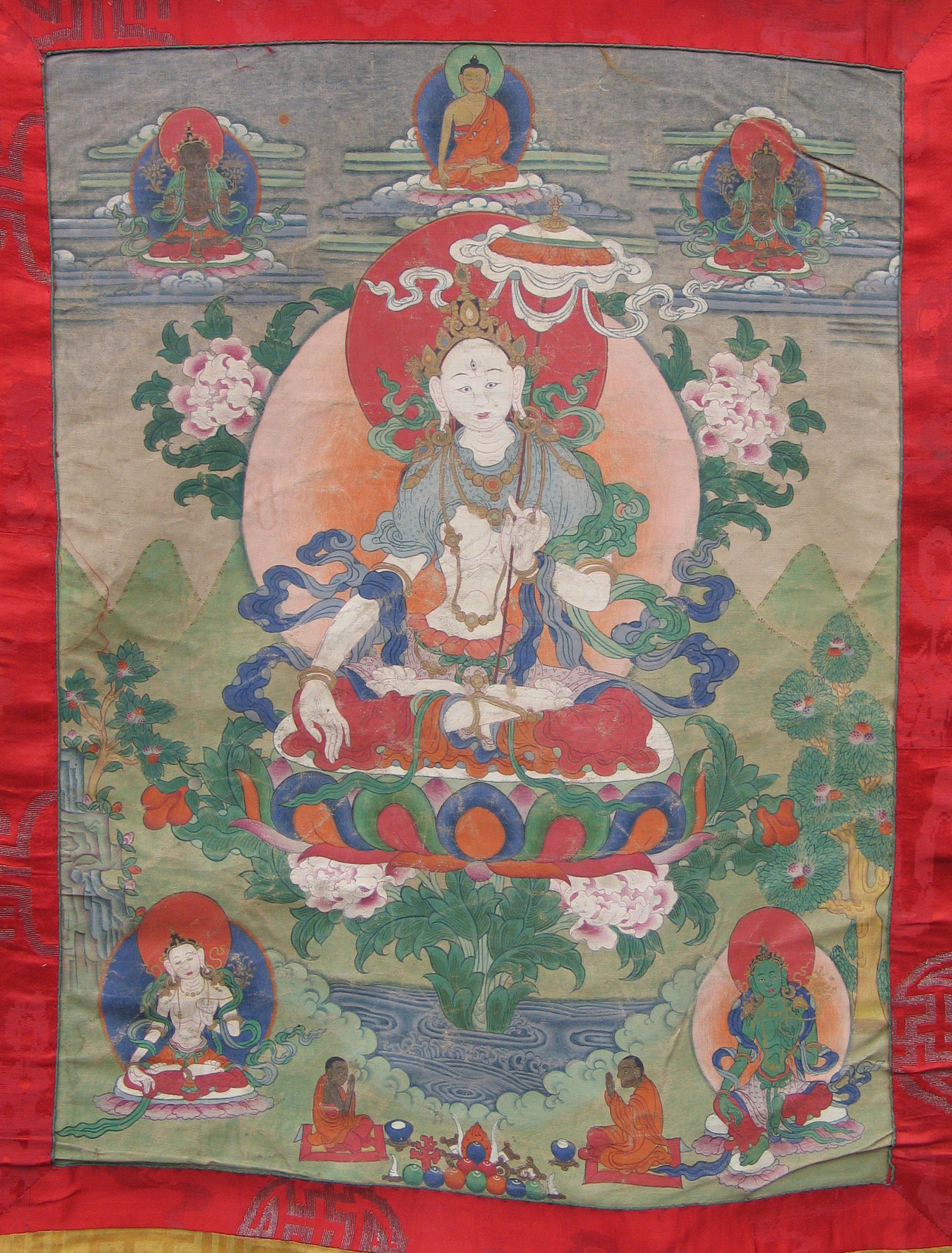
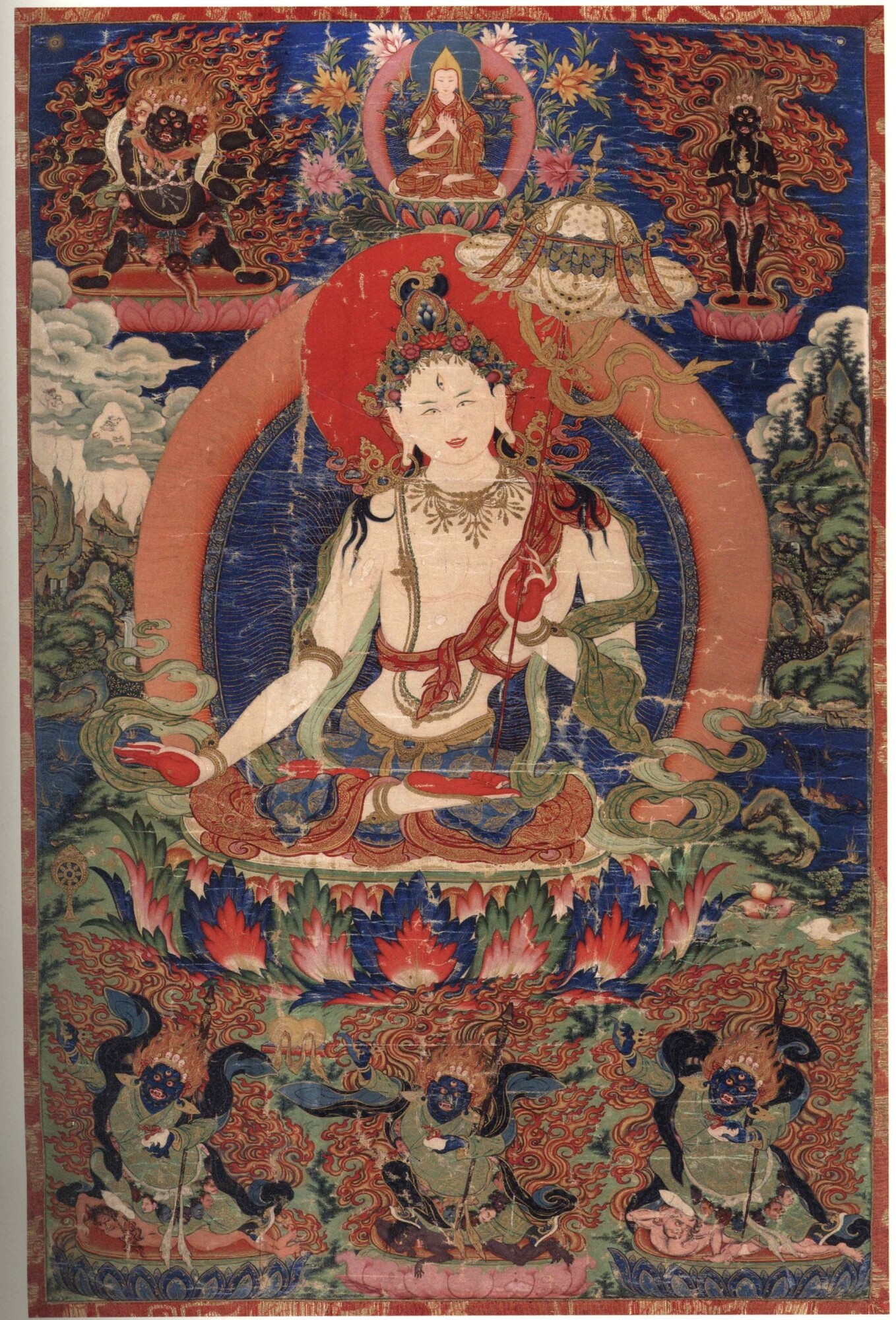
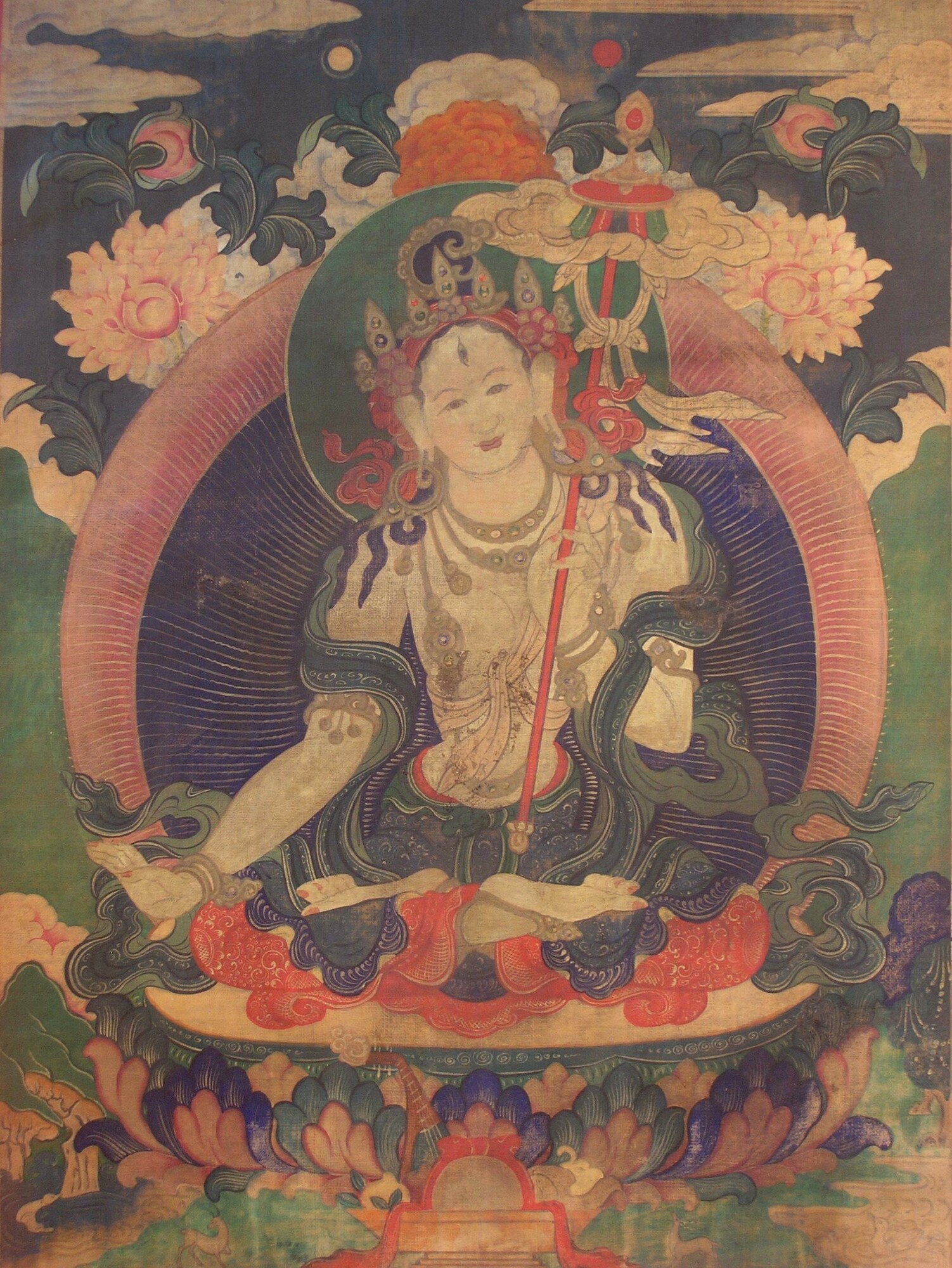
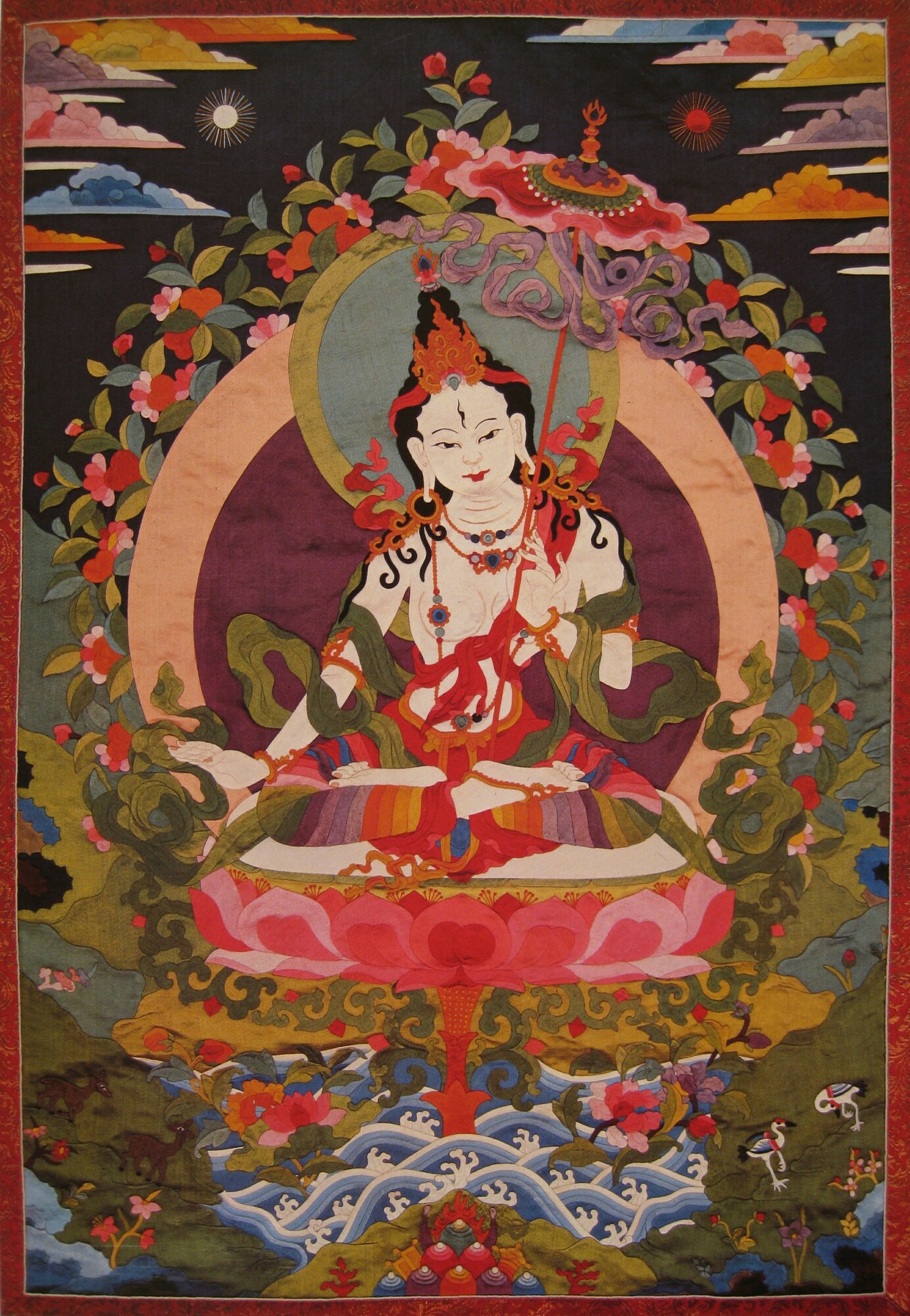
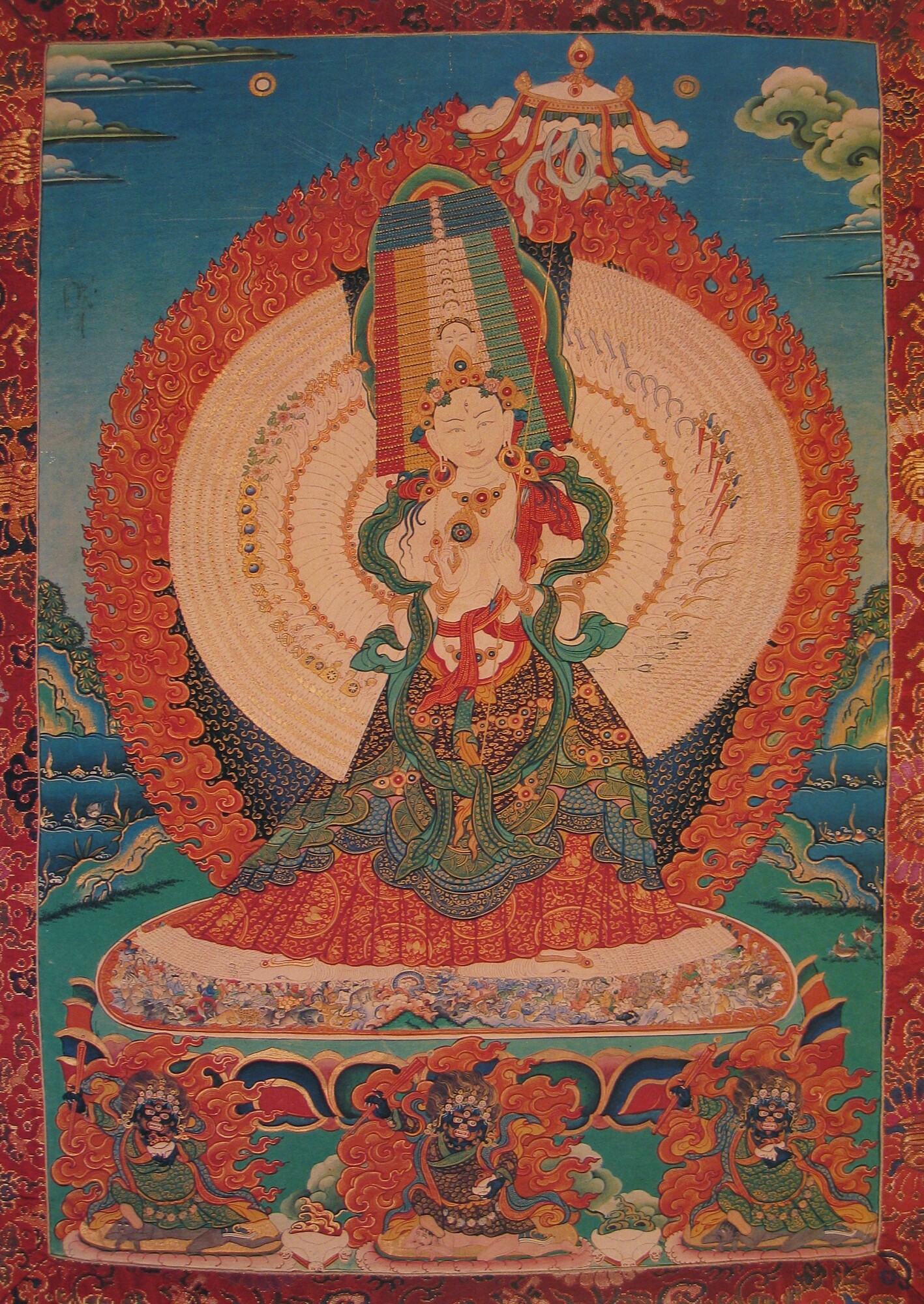
    Buddha himself has manifested Parasol, which matches the Sutra. She's over the normal White and Green Taras. She is a White Tara, except she has a third eye, which is semi-wrathful, and of course she has an item which is at the same time a bit regal and a form of protection."


    "This may be with Tson kha pa, and it has, of all things, Standing Nectar Ekajati."


    "There and further along, she is doing, I think, the Mudra of Granting Refuge."


    "And, you know, if I was to turn to something for its own artistic merits, if I didn't know what a Parasol was, I would still probably be captured by this."


    I said, "Me too.

    Can you take it that Locana is effectively transcendental, any form is simple and relatively passive, whereas Parasol is a Yidam you could have a personal conversation with?"

    "I think I can work with that. Locana is really in the back of my mind, she's part of nature, a constituent of anyone's aura. She doesn't do much besides be the Wisdom that realizes the Emptiness of Form and Earth.

    Parasol is more like a mental tour guide of Mount Meru up to a cosmic form."


    "You should work on the Muttering for a while and then Mutter Parasol.

    You might have noticed her using Ni."

    "Yes, if that had meaning on its own, it could be to lead, to govern."

    "And that might happen to you for the rest of your life, because there are many forms and practices that will take ages for you to delve through."

    "Well, it's easy for me to relate to white coloration and Vajra Feet. That's always been what I'd put with purity, holiness, sanctity, and stuff like that. And I would probably just try it with Vajrasattva, if that was all I knew, I would probably do it the same way.

    I think there is something, I guess you could say, subtle, about colors, but I'd be off to a better start with plain light or a white aura."

    "There is such a thing my friend.

    It is what you think it is. Not necessarily Buddhist, like all natural phenomena, but we'd be glad to use it."


    Ariana said, "We'd like to follow up with a superb corollary to Tapa Shotor.

    There, you can't give any detail, and someone could accuse us of simply copying Herakles into Vajrapani. We don't even claim the related Sutras are much older than the statue, while Herakles has crossed centuries and thousands of miles to become the Syncretic Deity in Afghanistan.

    But we can pinpoint such details.

    In Orissa, we found most of the Sadhanamala deities, like Durgottarini, possibly from the 700s. And you find continuous development, although in the sense it moved northward into Tibet.

    Most of those studies argued about whether something was Tara by using the same mantra.

    We think it may be a bit late, because we can represent an entire and prior dharani system.

    It's something that was crafted and delivered much later as a statuette set in Forbidden City near Beijing. But now they have to have help identifying the stuff in the first place.

    We recognize it, because it is the inhabitants of the Dharmadhatu Vagisvara Manjughosha mandala.

    And this is where we take a major rewind.

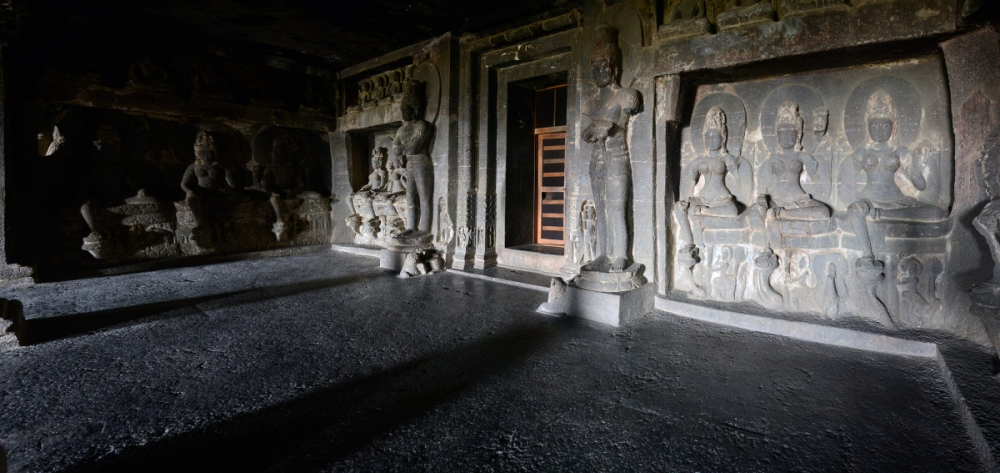
    That's because it would appear to be the height of development at the Ellora Caves.

    Not the mandala. Just this part of the retinue."


    Fergus said, "The mandala uses expected Prajnaparamita philosophy, by summarizing the Paramitas, their Bodhisattva Grounds, and the related practice or mastery.

    What is unusual is that it adds a correspondence to Dharani goddesses, which is not a supposition, that's their name, they are called Dharanis just as plainly as Prajnaparamita is called a Paramita."


    Genta said, "Yes. Ellora may not be a 100% match to DDV, but, it is close. The difficulty is due to age, many of the statues are missing their hands and symbols, and so complete identification is not really possible. But some of it is."

    Ariana said, "The Ellora construction is believed to be pre-Pala, taking place in the range of about 600 - 730, which is of course a relatively dark period, only after which, do we find extremely detailed deities and practices.

    The thing you can be positive about is that Mayuri is highly prominent, from the early Cave Six, again in Cave Ten, and again in one of the largest, latest, most detailed parts of the complex in Cave Twelve."


    "You can see about Cave Six, p. 28, one of the earliest known Bhrkutis here, characterized by top knotted hair and an animal skin shawl, believed to represent asceticism. As a counterpart to Mayuri, this is "unusual" elsewhere, but appears to be the theme of the internal mandala here. This earlier Ellora project is approximately contemporaneous with the living Princess Bhrkuti."


    Cave Six Mayuri:


    "In Cave Ten, Mayuri leads a disciple in reading and writing. This perhaps is copied in Cave Eight.


    Cave Twelve, p. 87, appears as a Vajrayana Pantheon with Historical Buddhas and Dhyani Buddhas.


    Quote Bodhisattva Avalokitesvara has a small image of Amitabh Buddha in his crown. Bodhisattva Vajrapani (we have seen his painting in Ajanta Cave -1) has a replica of a small stupa in his crown and Vajra in his right hand.

    The seven Dhyani Buddhas are also represented here – Vairochana, Akshobhya, Ratnasambhava. Amitabh, Amoghasiddhi, Vajrasattva and Vajraraj.

    The presence of Janguli implies they must mean the presence of Dharani goddesses from the Dharmadhatu Vagisvara and Mahavairocana mandalas, according to the review.


    "Considering they are broken, here's an attempted description."


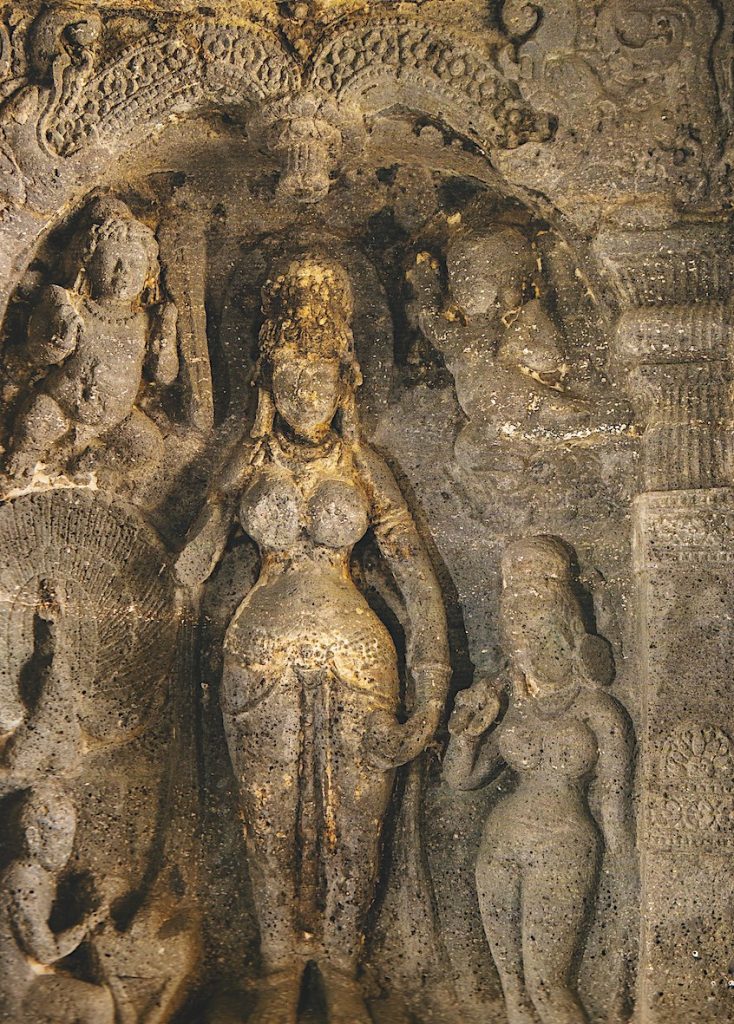
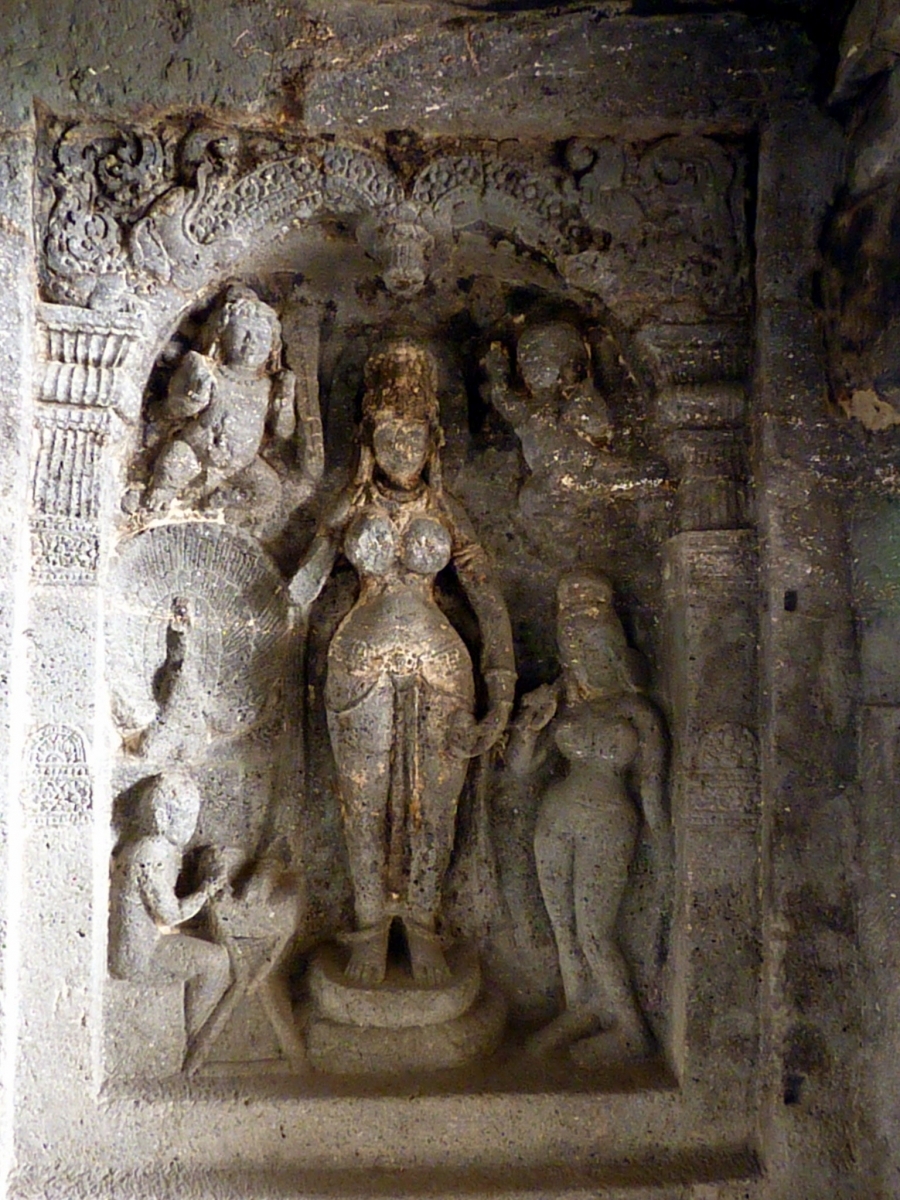
    Quote ‘On the side and back walls of the vestibule are twelve goddesses, three each on the right wall and left walls as also on the back walls. They are seated on lotuses. The first on the left wall is probably Vajradhātvīśvarī as she is seen holding a cintāmaṇi jewel. Next to her is Chunda holding a lotus with a book. Of the three figures on the left side of the back wall, the first is Khadiravaṇī Tārā, who is seated on the lotus holding a lotus stalk held by two cobra figures. The next goddess also holds a lotus stalk, held by as cobra by the side of which is a swan. The third figure is also identical.

    These are the representations of Tārā. On the right side of the back wall is an interesting female figure. Both her waist band and her headdress are made of cobras. She is Janguli. Next is Mahamayuri, if the peacock feather in her left hand
    is any indication. The third one is holding a water vessel…and she may be Uṣṇīṣavijayā. On the right wall of the vestibule, the first is Bhrikuti, the second is Pandara, and the third is Tārā’.


    I said, "That makes no sense for Vajradhatvishvari, since it would more likely be Cintamani Tara. Here's another brief rundown of Caves Six and Twelve."


    Quote Bhrkuti and
    Avalokitesvara to the left of the shrine door; Maitreya and Mahamayuri to
    the right. The bodhisattva dvarapalas follow convention in iconography,
    style and location. But, these female figures are the earliest to display the
    precise iconographic elements that clearly identify them. They are found in
    several other of the seventh-century caves, and would be part of a much
    more complex group of female figures in Cave 12 (to which I will return),
    an indication that they were important, and original, members of Ellora's
    earliest mandala.

    In Cave Twelve:


    The shrine antechamber is framed by female figures, as it was in Cave 6.
    But here, in the densest expression of the mandala, there are twelve,
    unprecedented in the western caves (or elsewhere for the early eighth century).
    Distinctive iconographic details include a four-armed Cunda (third
    on the left); the three-pronged vajra of Sarvakarmavaranavisodhani (seated
    immediately to the left of the shrine door); the snake belt worn by Jangull
    (immediately to the right of the shrine door); the peacock of Mahamayuri,
    second on the right; and the four arms and twisted danda of Bhrkuti, fourth
    on the right. Such specific attributes help in identifying the group as the
    Dharanis who appear (in varying configurations, as described in later
    iconographic compendia) in mandalas of Tara, Dharmadhatu Vagisvara,
    and Mahavairocana.


    From Sahapedia:


    Quote In tantric Buddhism, the female counterpart or Shakti plays a vital role. That is why the 12 Dharinis seen in Cave 12 are important. Some of the Dharinis have been identified as Janguli, Chunda, Tara and Bhrikuti. This suggests that by the end of 7th century female deities had occupied a significant place in Buddhist rituals and were worshipped alongside Bodhisattvas. In Ellora we have the earliest evidence how female Buddhist deities were placed and how their imagery developed. The entire process of ritualistic development can be seen at Ellora in proper context.

    Their Fig. 22 is the three to the right of the door, Janguli, Mayuri, and a Pitcher goddess.


    Avalokiteshvara with Tara and Bhrkuti:


    The central Mayuri with Peacock probably means it is under her lotus throne.


    Ariana said, "There is a thorough tour of the entire Ellora Caves."


    Quote Seated female bodhisattvas, three on each of the rear walls, and four on each of the side walls populate the shrine antechamber.

    "You can select Cave Twelve, Floor Three, and find the side groups are again a cluster of three, with maybe a fourth nearby. There are four niches with three figures apiece."


    I said, "It started to bother me. Now first of all, we are talking about two select companions of Tara, Mayuri and Janguli. This is standard in the main practice that is still current and I am going to do.

    The problem is, in Tibet, Janguli practically vanishes.

    Among the older artifacts, one finds a ca. tenth-century Kashmiri Janguli."


    "A similar Kashmiri one has been kept in the Potala Collection."


    "Let's look at her name. In Tibetan, Dudselma, remover of poison. That's not a translation."

    Fleep said, "No. We recently saw a mantra where something like pravisa would have that meaning in Sanskrit.

    This is so dense, it is English, Janguli = jungle, she is a wild sabari."


    "Yes, except in this case there is no equivalent male Jangala.

    Let's see what is observed about Tibetan Iconography Text Collections."


    Quote The earliest iconographic forms for deity yoga are described in the Tantra literature of Vajrayana Buddhism. Those are further explained by the commentaries of the educated and experienced practitioners of India. From the source literature and commentaries come the numerous compendia of deity forms such as the Sadhanamala and Vajravali. Many compendia texts were translated into the Tibetan language but some of the original Sanskrit sources have been lost. The most famous of these are the Bari Gyatsa, Sadhana-samucchaya (Sadhanamala), Patsab Gyatsa, Mitra Gyatsa and others.

    Fergus said, "All of them are re-writes of the Abhayakara compilations.

    If you thought Jampa Gompa was extensive, try the catalog of Ngor Mandalas that also has Vajradhatu as a pinnacle with 1,037 deities."


    Ariana said, "The ultimate Tibetan development is definitely Rinjung Lhantab, IWS or Icons Worthwhile to See. It contains three of the splittings of Sadhanamala, but also adds material, like it is probably the Most Mahakala of anything you can find."

    I said, "Yes. Comparatively, this is what we are calling Bhutanese Sadhanamala."


    Quote An Ocean of Methods of Accomplishment

    This text was known in India in the 11th century and later translated into Tibetan in the 13th century. The list below follows the edited version of the Sakya teacher Thartse Panchen Namka Chime. It contains 142 descriptions of deities. A popular Bhutanese, Drugpa Kagyu, version is said to have been edited by the 9th Je Kenpo of Bhutan, Shakya Rinchen, 1710-1759. The Bhutanese version has more deities, approximately 154.

    The complete list of deities from the Ocean of Methods of Accomplishment is depicted twice in Mitra Gyatsa Mandala Set 3. The list of deities is slightly different from Thartse Panchen Namkha Chime and the Bhutanese list.

    "So, you know, a lot of this is comprehensive. It's someone's job to replicate a text, or, more than half of it in this case.

    In other areas, you can find something that represents a personal practice, which makes Twenty-two Drukpa Sadhanas a little unusual."


    Quote 6. Janguli

    "She's not in Tibet. She has Densatil figurines, in the sense that was supposed to be comprehensive, like IWS and the Bhutanese Sadhanamala contain her for simply being part of the book.

    We don't know whose it is; it can't be older than the 1300s; and it is probably from the 1800s, either of which are massively disconnected from her antiquity in Siksasamuccaya or the Ellora Cave.

    So far, I am going to fault all the reviewers.

    People, don't do a mantra if a cobra bites you.

    Just read it. The purpose of Janguli is she is a Yogesvari and a Mahavidya."


    Fergus said, "That's a Yidam like any of the others. She protects nothing; why this is reported is baffling."

    "Exactly. Her motif is that she uses poison that is poisonous to poison. Any honest reflection on one's own mental poison will make this self-explanatory."

    "She's from an imaginary place. Mount Gandhamadana is not part of earth; it's part of Meru Cosmology with a different identification in every Purana and even Pali Buddhism. That's like Mayuri is an old Buddhist story that doesn't seem to be taking place on earth."

    "They don't usually have conventional origin myths. Like if I look up Hindu Pratyangira, it's very interesting, but then it is like Buddha re-emanates it himself as Parasol. Janguli is in Tara's assembly, she has her own mandala in Krishna Yamari Tantra, and she is a Dharani Goddess that Manjushri seems to have gotten in Ellora. That seems likely to be a unit. I haven't noticed such a specific grouping of twelve in Orissa."

    "No. But you found Janguli and more specifically Green Janguli appreciated in Bhutan for no apparent reason, other than, perhaps, her inherent value.

    It seems to contradict any idea the sadhana had actually been transmitted through Tibet to their sadhana book and Ekajati thangka."

    "Had Cunda?"

    "Master, that's very hard to say.

    We think the point is that the Samadhi is real outside of time and space as we know them.

    No one initiated Buddha, or the people that discovered these Yidams. If Vajra Tara spontaneously appeared to Nagarjuna and was real then, you and Dinky may just as well be able to find her now.

    We're just putting more trust into, say, a huge community of Ellora, than some of the things that have come up later, or, even popular aspects of Buddhism."

    That's why I immediately turned around and looked at Janguli as her own small system, and what it would be to have the Twelve Dharanis arranged with the Bodhisattva Path. I wasn't going to let him trick me with empty milk cartons and carpet samples. We know these deities don't manifest physically, and that the closest thing that can happen is a human becomes the Nirmanakaya of that deity. That's because this is entirely Noumenal.

    "Let's add she imparts the ability to walk on water and the dharani from Lotus Sutra."


    Quote At that time the heavenly king Upholder of the Nation, who was in the assembly along with a host of thousands, ten thousands, millions of nayutas of gandharvas who surrounded him and paid him reverence, advanced to the place where the Buddha was, pressed his palms together, and said to the Buddha, “World-Honored One, I too will employ dharanis, supernatural spells, to shield and guard those who uphold the Lotus Sutra.” Then he pronounced these spells:


    agane gane ghori gandhari chandali matangi janguli

    vrunasi agasti

    I realized he was coming at me like a runaway freight train.

    "Master," said Fergus, "aside from being partly inscrutable, Agasti has no meaning other than Rishi Agastya Maitravaruna or some female descendant of his. Let me move you to the relevant area at the end of Rg Veda Book One where we won't argue with Sayana."


    Quote This and the following three hymns are derived from the viṣa vidyā, the science of poisons,or of antidoes, whence it is also termed madhu-vidyā, science of ambrosia; 'having taken the poison in the solar orb with the fourth finger, having made it ambrosia and caused them to blend together, may it become poisonless'; sūrya maṇḍala or orb of the sun; or, perhaps a reference to a mystical diagram or figure typical of the solar orb;

    Madhuta = madhu vidyā was originally taught by Indra to Dadhyañc, who communicated it to the Aśvins, and thereby lost his head

    "I'm sure you won't argue with the hymn saying the very thing you just said."


    Quote “I deposit the poison in the solar orb, like a leather bottle in the house of a vendor of spirits; verily, that adorable (Sun) never dies; nor, (through his favour), shall we die (of the venom); for, though afar off, yet drawn by his coursers, he will overtake (the poison); the science of antidotes converted you, (Poison), to ambrosia.”

    “That little insignifcant bird has swallowed your venom; she does not die; nor shall we die; for, although afar off, yet drawn by his coursers, (the Sun) will overtake (the poison); the science of antidotes has converted you, (Poison), to ambrosia.”

    “May the thrice-seven sparks (of Agni) consume the influence of the venom; they verily do not perish; nor shall we die; for, although afar off, the Sun, drawn by his coursers, will overtake the poison; the science of antidotes has converted you, (Poison), to ambrosia.”

    Commentary by Sāyaṇa: Ṛgveda-bhāṣya

    The thrice seven sparks: the seven tongues, or flames of fire, may be multiplied as red, white and black

    “I recite the names of ninety and nine (rivers), the destroyers of poison; although afar off, (the Sun), drawn by his coursers, will overtake the poison; the science of antidotes has converted you, (Poison), to ambrosia.”

    “May the thrice-seven peahens, the seven-sister rivers, carry off, (O Body), your poison, as maidens, with pitchers, carry away water.”

    "There. You can even use Mayuri with it."

    I had a nosebleed out my eyes.

    "Thank you Mister Fergus," I said, unable to separate wilderness yoginis from Agastya's domain, "Yes, it is the same as Dadhyan and Horse Head Rite."


    Drukpa Jangulis:


    "What else, Pawls? That took us a hundred years to get about a third of the world to agree with our basic view for social order."

    "It's more than I ever dreamed of, actually. Back then we weren't expecting the use of airplanes. I wasn't planning on devoting most of my time to traditions from Asia. I was willing to fight until there was no more need."


    There it is. Lotus Sutra, one of the most mainstream pieces in Mahayana Buddhism, gives the first observable list of Gauris. Later, Janguli is Matangi, who of course is a Mahavidya in Assam. And this is the entire principle of Pisacis or axis reversal. Janguli instantly blocks any poison with its opposite. Crossing over Water is to traverse whatever is in the South quadrant, which is the Sentience Skandha into the Equality Wisdom.

    We can talk about that, a lot. There's not much to say about things you just do, like music or martial arts, but this kind of yoga is so deep I plan on spending the recommended fourteen lifetimes to get it.

    It's also not ours or part of our original mission. By some fifteen years after World War Two, and, Tito being mostly responsible for the establishment of the Non-Bloc, we had, to say the least, relieved Kosovo of centuries of ongoing calamities, with no need of supremacism.

  2. The Following 2 Users Say Thank You to shaberon For This Post:

    Bill Ryan (6th October 2026), Ewan (5th October 2026)

  3. Link to Post #62
    United States Avalon Member
    Join Date
    1st April 2016
    Posts
    7,057
    Thanks
    36,086
    Thanked 40,329 times in 6,707 posts

    Default Re: Pawlsy the Cat is Her Name

    Unreformed Neo-Luddites


    We just kept going. In the long run, it seemed things had worked out better for us than they had in many or most countries. Tito was kind of like Elvis. Otherwise, national structures were compromised in so many kinds of ways in different directions, we can't think of any peer role model.


    Many people were living much differently than we were, with their push-on-a-button nuclear war scare.

    Who needs that?

    We did not like the American government, or, its underlings who cling to a kind of mono-polar dominance idea. We really did not like that. So we tried to sympathize with those who did not like their government, or, the defective mentality that seems to run it.

    So we actually had something to do with them. We'll get to that in a moment.

    First, we're going to prevent a few more misconceptions about the meditational literature we have committed ourselves to.


    Fergus said, "Master has got us in a contention with academia and all the press --"

    I said "Would you please stop calling me that."

    "Not until Pawlsy says so. I have to take over for your slack, because what you are doing has already been done, just not by you. The closest thing you are to acceptable in the world is by matching part of senior-year studies if one were enrolled in a Kagyu university curriculum."

    "It would match the majority if Prajnaparamita were studied according to the Abhisamayalamkara as an immanent deity."

    I could tell he was swinging an anchor in circles. I tucked my chin slightly.

    Dinky said, "Hey watch it, you're going to --"

    Fergus said, "Here's how reducible this system is.

    One of the identifiable statues at Ellora has an unwieldy name."


    Quote Sarvakarmavaranavisodhani

    "She is only found in the Dharani retinue of the DDV mandala.

    It's so obscure we don't know the dharani.

    Because we know what she looks like, we know that is her statue. It's in Ellora in the 700s, Forbidden City in the 1700s, anywhere the mandala is drawn, and we don't know the dharani but we do know the system.

    That part has not been observed by anybody, aside from being recorded on paper.

    So you compare the Twelve Dharanis at Ellora to the accretion that was going on to the Manjushri Mulakalpa, which, itself, introduces a new practice, Mantratantra.

    It doesn't have much yoga detail, but, it certainly does have everyone that mandalas are made of.

    Manjushri, himself, has either the Ellora retinue or something quite close to it."


    My recovery prospects were less than zero.

    His foot was so big he could step on both my feet when I was in different rooms.

    "Being bigger than me isn't all that hard."

    "No, but what's worse is you have separated out Peaceful Lakshmi. And, you really like it. But all the cover artwork from the Kagyu is Wrathful."

    "It's not cover art, Fergus, we haven't made any albums."

    "Just because you're going to make me play your music with no remorse, won't get this snafu out of your wig. First of all, Palden Lhamo or Lakshmi is called Dhumavati at Densatil.

    Dhumavati is a Mahavidya who is almost entirely disregarded -- Alakshmi or Nrtti. But even in the Veda, Nrtti is given offerings, in hopes she will not hurt us.


    Lakshmi is also calledKamadhatvishvari, Dudsol Dokam Wangchugma, in the Mahakala tantras.

    It doesn't have a Sanskrit precedent; the closest would be Kamesvari, Kamakhya Candi or Kamarupa goddess."


    I said, "Or Matangi. You failed to say that Newar Buddhism is a huge fan of Ganapati or Ganesh; not just that, but also Vinayaki or his rarely-known yogini partner. Matangi and Vinayaki converge in the Ucchista or scraps personality."


    "There you go and adopted a Puranic deity. But what we are really going to take to task is Janguli. Because we know she is in Lotus Sutra, that was translated to Chinese in 286, so, the recension including the mantra is estimated to exist by ca. 150.

    The book overall has become almost entirely Oriental."


    Quote According to Paramārtha (499–569 CE), there were over fifty Indian commentaries on the Lotus. However, there is now only one surviving Indian commentary (which only survives in Chinese). It is attributed to Vasubandhu (but this has been questioned by scholars). This commentary asserts the superiority of the Lotus above all other sūtras.

    According to Jonathan Silk, the influence of the Lotus Sūtra in India may have been limited, but "it is a prominent scripture in East Asian Buddhism." Jacqueline Stone and Stephen F. Teiser meanwhile write that "it is perhaps no exaggeration to say that the Lotus Sūtra has been the most influential Buddhist scripture in East Asia."


    "Like most Sutras, in Yogacara, it is considered neyartha or provisional. Again, we do not hold Vasubandhu to be the authority on the Agama, even though he has near-supremacy in other countries. So much, that there probably are ghost writings or spurious attributions.

    After all, there is a fairly set standard of Yogacara's nitartha or final authority texts, not very many, very few when compared to the number of all possible Sutras. It's not usually to say something is untrue, but, what is revealed one day may be only a step in the right direction.

    In any case, we see that Janguli had been around for ages before there is any sign of who she has been confused with."


    Quote The snake-goddess Manasa is now universally identified with Jaratkaru, the sister of the Naga king Vasuki.

    Pawlsy looked at Genta like they were about to fix a delicious hot beverage.

    Fergus said, "We call it a master stroke of conflation.

    The first use of Manasa's name is not found until the Devi Bhagavata Purana.

    But someone questioning her Iconography will make our case.

    In general, there was an old Naga cult by the year 200 or so, but, this was what's called sacramental or consecratory, like sprinkling you with holy water is just an inspiration towards Rasa Science or Nectar. It was just a prayer of protection against ordinary snakes presumed to be male, a sort of architectural rule when building baths and reservoirs."


    Quote The worship of the snake-goddess Manasa, as was, and is still prevalent in Bengal, appears to have very little connection with this general Naga worship. The Nagas, as far as can be ascertained, appear to be all male divinities and this conception of a female divinity Manasa as a sort of queen over the snakes, appears to be foreign to this system of Naga worship. Manasa, as already noted, is now generally identified with Jaratkaru; but, curiously, in the Mahabharata there is no indication of the deification of Jaratkaru, mother of Astika, as a snake-goddess,-i.e. mother of the snakes, (nagamata) and mistress over them. Neither is she credited with the possession power of the Supreme Knowledge (mahajnana) nor the teracting poison, the two most prominent characteristics of the snake goddess Manasa. The term "mother of the snakes" in the Mahabharata always denotes Kadru. In the Brahmanas (Aitareya, 5/24/4; Satapatha, 1/4/29), we meet with the term Sarparajni which literally means-queen of the snakes. She was the seer of a hymn of the Rg-Veda, X-189. But the connection of this Sarparajni with snakes is not unquestioned. Sayana explains that Sarparajni was the Earth, incarnate as a goddess, who attained the knowledge of Brahma, the Supreme Soul, in that guise. One commentator, Mahidhara, however, states that the term denoted Kadru in the guise of Earth.* It may also be noted that Kadru is given as a synonym for Manasa in the dictionaries. Thus, it appears, that the first identification of Manasa, the snake-goddess, was not with Jaratkaru, but with Kadru.

    "She comes out of nowhere, and is problematically retro-fitted with an origin myth."


    Quote The absence of her name in the earlier literature, and the evidences of attempt at explaining away her name in mediaval literature, point to the probability that she is not, at least in this line of development, a goddess with a Vedic and Puranic past, but an assimilation from outside. There certainly was a considerable amount of difference of opinion among the learned persons who attempted to engraft this goddess on Brahmanical traditions,-as a careful study of her legends and Dhyanas show. Evidences that she probably was first identified with Kadru and not with Jaratkaru have already been adduced. Even when the identification with Jaratkaru was established, considerable difference prevailed in working out the details. The following Dhyana makes Swan her vehicle, which shows that she was contemplated as identical with Brahmani or Sarasvati.

    The novel and unsettled state of the literature on Manasa is illustrated by an image of the goddess from a Tea-estate near Silghat, Assam. In the above Dhyana, the vehicle of the goddess is denoted by the term Nagendra. Ordinarily it would mean 'a huge snake'. But Naga also means an elephant, and in this image of Manasa from Assam, we find an elephant depicted as the vehicle of the goddess.

    "Janguli, however, is more likely Atharvanic."


    Quote ...a daughter of the aboriginal people with something of a divine character and with remedies against snake-bite appears also in the Atharva-Veda, and this fact makes the antiquity of Janguli less suspicious. A little girl of the Kiratas (wild aboriginal people) in the Atharva-Veda, X-4-14, digs a remedy against snake-bite with golden shovels upon the ridges of the mountain. In X-4-24, possibly this very same girl is called Taudi and Ghrtachi and the devotee takes shelter under her 'poison-spoiling track'. When we remember that Ghrtachi is only another name for Sarasvati and that Sarasvati herself is spoken of in one passage in the Atharva-Veda as a destroyer of poison and also take into consideration the fact that Janguli has the attributes of Sarasvati, some conclusions begin to take shape. The Vedic goddess Sarasvati, in one of her aspects, was a destroyer of snake-poison and was often invoked in that capacity. Sarasvati, in this aspect, was a girl of the Savaras. This aspect did not develop in the Brahmanical Pantheon, but the Mahayana Buddhists accepted this snake-goddess and called her Janguli, and did not forget her connection with the Savaras, The Brahmanical anti-venom Sarasvati, the source of Janguli, was forgotten before the latter's rising popularity. Manasa appears to have been imported into Bengal from Southern India at the crest of a Brahmanical revival. She quickly outdid Janguli in popularity.

    "And yes, the same character type holds true for Parnasabari. They share this Atharvanic healer nature based on Prana; we can find it in the Samputa.

    Notice what we find in a current Bengali Manasa verse."


    Quote kanta| kancanasannibham badanam padmananam sobhanam nagendraih krtasekharam phanimayim dibyangaraganbitam | carbabangim dadhati prasadamabhayam nityam karabhyam muda bande sankaraputrika‍ bisaharim padmoptabam janguli ||


    "So, Manasa stelae of the Pala era most likely come from a different ethos."


    Quote The Senas came from Southern India and settled in Bengal in the middle of the 11 th century A. D. They very likely favoured the worship of the snake goddess an impetus to Mancha, and their rise probably gave her popularity. The decline of Buddhism by this time gradually transferred the honours paid to Janguli to Mancha, who fast became Manasa at the hands of the theologists.

    The large number of stone images of Manasa of the 10 th- 12 th century, that have been found throughout Bengal, testify to the established character of her cult during the period. It is noteworthy that pots and utensils, with figures of snakes of Manasa, were found on them, evidently used in the worship from the Raghurampur excavation (vide infra, p. 232-). The excavation conducted by the Varendra Research Society. of Rajsahi in a part of the large tank at Deopada, from the bank of which was recovered the famous stone inscription of Vijaya Sena Deva, also yielded similar objects, as well as a large number of mediaeval images of Manasa.

    The majority of the images of Manasa found in the country, represent her as sitting on a lotus with the right leg pendant. Seven snakes spread their hoods like a canopy over her head and the goddess holds the eighth snake in her left hand. In her right hand she holds a fruit in the Varada-mudra. To her right is represented an emaciated bearded man, while a crowned male figure sits on her left. The marked emaciation of the figure to the right, points him out as Jaratkaru, lit.-one who dried up a fine figure (by the austerity of his devotions). The figure to the left may be that of Astika, the son of the goddess, but the crown on the head may be an indication that he is to be taken as Vasuki, the Naga king, brother of the goddess. In many images, a fine pitcher appears underneath the lotus seat of the goddess.

    "They're easy to see. The Cobra Hood is the same, but Manasa holds an eighth snake, and is with companions that we find questionable.

    Our mantras say Janguli is Matangi, who is also Sarasvati, that is, a tantric, sometimes intoxicated form.

    Janguli and Gandhamadana are in the Mayuri as Vedic Rishis, which is semi-fictional; some of them are real. One could always claim there are others who were not listed in the transmission, yet many seem to be post-Vedic names.

    In Sadhanamala, manasa is never a proper name, but is common for 'mental'."


    Quote manasā vācayen mantraṃ oṃ tāre tuttāre ture svāhā /


    "It confuses linguists about her name, because it is an adjective or adverb. Plausibly, it is being used to mimic a Telugu name.

    There is an Amnayamanjari fragment with Janguli 120 and 121. Janguli 120 is the only Sutra in Sadhanamala, replete with the normal beginning, evam maya srutam.

    And one more thing. The back third of the Krishna Yamari tantra is not about Krishna Yamari. Instead, it is about Vajradakini and Paramasva.

    The latter has an interesting verse."


    Quote tathā paramāśvamantraṃ tu vajrapātālakasya tu |
    paramāśvabhāvanāyogāt khadhātukaṃ paribhramet || 25 ||

    Ariana said, "His mantra has to do with the Underworld, Patala, while his yoga has to do with the Akash, Kha."

    "Well, it might be worth looking at one of the few things that is actually about Paramasva, rather than calling him Hayagriva.

    The brief presence of Janguli, in its turn, appears to be precursor for Kurukulla."


    I had gotten myself stuck in someone's radiator like a moth.

    "This is a mature subject."

    He waved Dinky's socks under my nose, to repel insects while administering smelling salts.

    Genta said, "There's something good about Kurukulla."

    I said, "She's supposed to be Tarodbhava Kurukulla. That is, Tara summons her, not in the easy way like Khadira simply has attendants, but a fairly long sadhana involving a Flask of vajradakinis. So this...this...this thing he is talking about here may be something broader or something like a Jnana Mudra. For whatever reason, he is correct, Janguli is a tantric goddess. The only thing I can say is she assists you to cross over water, and, Kurukulla is almost exclusively part of Lotus Family which is Fire."

    He didn't believe I didn't trust him.

    Fergus was not content to let me try to maintain what he was talking about. I knew something was about to happen that would feel like going through a lawnmower. He looked like he was made of an impenetrably hard vajra substance and I thought he might be able to destroy the universe. So I listened to him for a moment.

    "The weird Pancha Raksha 206 is so weird, you would not draw it properly either.

    It is a step into the Five Wisdoms or Pancajnana you like a standard version of, but this one is highly tailored to something we do not understand.

    It doesn't have Lotus or Karma Families, so, to begin with, its deployment is a bit different.

    It goes in a basic order, starting in the center with Pratisara."


    Quote caityālaṅkṛtamūrddhā

    Genta said, "Crowned by a Caitya, which nominally implies Buddha Family. The next one has no crown, but there is a Cihna or Family Sign."


    Quote huṃkāreṇa vajracihnapariṇamena mahāsāhasrapramarddanī

    Dinky said, "The next, Mayuri, goes back to the expected crown."


    Quote ratnamukuṭinī

    "But then it continues on Mantranusarani."


    Quote ratnamukuṭinīṃ

    Fergus said, "Finally, Sitabani is Green, in the North, doing Abhaya Mudra, and not in Karma Family."


    Quote tathāgatamukuṭinī

    "And it is exactly her mantra that does what you explained as Roots growing to the Seven Jewels of Enlightenment."


    Quote indriyabalaviśodhani

    "Although the sins are customary, you will notice the Skandhas have been shifted so that Form starts in the center, which makes everything slip a spot accordingly."


    Quote pūjāstutyamṛtāsvādapūrvvakaṃ bhāvayet vicakṣaṇaḥ - cakṣuṣormohavajrī
    mahāpratisarā, śrotrayor dveṣavajrī mahāsāhasrapramarddanī, ghrāṇe
    mātsaryyavajrī mahāmāyūrī, vaktre rāgavajrī mahāmantrānu-
    sāriṇī, spharśe īrṣyāvajrī mahāsitvatī / evaṃ rūpavedanā-
    saṃjñāsaṃskāraviññānaskandhadhātvāyatanasvabhāvā evaṃ devatā-
    viśuddhito jñātavyā viśeṣataḥ /

    I said, "You're right.

    Yes, the listed order is the correspondence, so the combination appears to assign Skandhas that way, reminding that a Dhatu and Ayatana come along with it. But of course those are inherent; you would still have Earth in the East, where Sahasrapramardani is attributed with Hearing, and the phrase Ayatana means not the ear or the phenomenon, but, that type of consciousness involved with sound, a Gauri, I think it was Cauri in fact.

    The change would mean Dharmadatu Wisdom, coming out of Vijnana Skandha, is in Buddha Family.

    These deities are purifying the Skandha, rather than standing for its Pure state like the Prajnas do.

    So, again, a lot of these sadhanas are a neyartha, or, we think, provisional measure. The Pancha Raksa have been extremely popular as protective prayers, and, I think, the sadhanas are availing themselves of the popularity, to use the deities in a more subjective Yoga application.

    After all, the phrase protect a Bodhisattva in the womb does not really deal with pregnancy, because fetuses are not Bodhisattvas. But the months in the term represent the Bodhisattva Grounds. In this case, the womb is Yoga, or Generation Stage, or attempts to place oneself truly on the Path. And if that Path is largely made by indriyabalavishodani, it makes perfect sense.

    The effusions of Nectar and presence of Viraja and the complex forms are a massive change compared to most recognizable dangers to be protected from."


    Ariana said, "These deities are a mix. Pratisara has to do with a site in Bihar, Sitabani is near Dungeswari, and, Mayuri is perhaps a type of class that might be found there or anywhere.

    The other two are just Buddhist practice, Mantra Memory, and Pramardani is the destructive final samadhi, destroying all falsehood or particularly the Maras."

    Fleep said, "That makes them the closest physical thing to Bodh Gaya or Buddha's Enlightenment, the transformation being when he declined asceticism by eating an offering."

    Dinky said, "Feels like a vortex, doesn't it?"

    Genta said, "Having the physically closest thing to Buddha take a sudden conversion to Buddha Family is suggestive, to say the least.

    Not to overlook the fact that she or her area are the core of all tantric initiation."

    I said, "Yes, if we credit Ellora with rolling out recognizable, technical matches of tantrism, we are unable to pin that high level of detail to it, and certainly not the continuity.

    Close scrutiny implies that some of the language was used there, but, we cannot take it much further than that, and then it was a loss.

    Let's consider, for a moment, what it means to talk about the Path."


    They did good at this. They were reverential and respectful. I really couldn't ask for better people, let alone find them.

    "The Paramitas or Perfections are something we usually talk about doing six simultaneously, but the Bodhisattva Grounds are a sequence.

    You'd think it's fairly simple to be energetic, but, this does not mean you are on the Third Bhumi.

    What are they? In Pranayama, you can rise on the Bhumis, maybe you can even peg the Tenth, but it is momentary. You will drop out again to the point where we do not believe we are even on the First Bhumi yet. Bodhisattva Path means that Ground or Stage is permanent; it is you.

    So then if we have the third Dharani goddess, she corresponds, in some way, to the Third Paramita and to the Third Bhumi, while you see those are in a state of flux until some distant period when it becomes permanent.

    The Bhumis and Grounds are not ceremonies or initiations, they are not like steps you think you are trying to make and then, oh, I am on the Third Bhumi, in fact they have very little meaning until you make a high rate of progress, and one or more authorities examine your character, which gives us various reports about people having attained the Bhumis. And it might just be three -- not one, two, three, but a long jump.

    Out of modesty, I would think not to think or say anything about oneself in these terms. You still are really focusing the Paramitas. But especially due to prana, you can feel and be aware of degrees of spiritual states. So, I think, yes, you can feel results, at least temporarily in meditation. As you know, being able to hold this meditative mindset in daily affairs is next to impossible. The more you put into it, the more you will be able to bring out of it."

    Fleep said, "So, for example, you could say Melting the Heruka is the Seventh Bhumi, and penetrating the Voids is the Eighth, something like that."

    "Yes. I can't recall the exact numbers right off hand, but it is something like that. The more stable and powerful you are in meditation, and can tell a change from your former mortal framework, then you can start accessing some of the Bhumis, and the advanced parts of Subtle Yoga take place on the higher ones."


    Pawlsy said, "You have proven Ellora has at least something in common with Namasangiti DDV, which means it probably has a majority in common. There might be one or two different deities, but, overall, the only evidence is that it probably is a similar Dharani system related to the Paramitas and Grounds, and, there is no countering or alternate information available.

    Janguli has the antiquity of any, and more than some, of these deities.

    She's been relegated to oblivion, but, in fact, she is her own system, which is right there in the Sadhanamala, one hundred per cent.

    Arguably, it is equal to Mahayoga."

    What is strange is for all this time, me and Pawlsy always got along. Never a single quarrel.

    And it was superb that was pretty much the way of the whole group. Dedication to each other was always completely positive. Yes, we were, in fact, still a type of slave militia, but that was our nature.


    We weren't directly political, but, we were entirely grassroots. I tried to explain to Pawlsy there was something similar, but probably not as powerful, in America.

    We were all a little disconcerted that a nation would do this type of thing to itself:


    Quote In 1961, the commercial food industry was rapidly expanding its use of synthetic preservatives, artificial dyes, and intensive mechanical treatments (such as the industrial Chorleywood Bread Process introduced that same year). Hunter’s book directly challenged this by teaching home cooks how to bypass supermarket-processed items.

    "Pawls, it may sound unnecessary or superfluous to us, but, over there, it is kind of a big deal. Look at this The Natural Foods Cookbook 1961."


    Quote Beatrice wasn't without her critics when her book debuted. Surprisingly, many midcentury nutritionists belittled Beatrice's opposition to refined sugars, pesticides, preservatives and food additives, calling her fussy and and cranky, but Beatrice pressed on anyway.

    She said, "They like eating chemicals and mock you for being human."

    Fergus said, "I'm going to eat something raw off the ground."

    We had a huge bias in this. And so we had taken an offer to do a commercial, but, complicated matters by refusing to travel across the Atlantic. We agreed to let the sponsor come do the production here in Yugoslavia. I think he was a little nervous about it. Like goons with Makarovs were going to pop out of every shadow.

    It seemed unusual to us that an American would be particularly interested in Pawlsy, but not because of music. We weren't asked to play or sing anything. It's just a scene about her in the kitchen using flour to make Mutter Miscuits. Anybody could do that. Why would you pay millions of dollars and go halfway around the world to make a little show that doesn't even have any interesting kind of acting in it?

    We wanted him to feel abducted, so we flew him out to Pristina and put him in an old world hostel. We got some people to pass by to make sure he would see Muslims and Serbians blending with Albanians. I got the reluctant role of dealing with the English language. I of course had very low expectations and thought I would be doing most of the work for him. I mean it's the same thing we do every day. And it's kind of like...what makes this so special?

    It was a rather fat chap, that for purposes of simplicity we will call "Nelson". To his credit, he came from a line of midwestern farmers, and, more or less, by his own efforts, had formed a large-scale distribution ring with trucks and all that, with the main purpose of saving them from banks foreclosing on their land. We understood and appreciated the thing that was going on here. You're trying to compete with someone who comes in with essentially unlimited money, who has no real interest in people, just more money.

    We told him we were aware of the disregarded 1930s report on depleting the soil, and the need of the FDA to step in to prevent businesses from letting grain accumulate rat feces, rat toenails, and dead rats. If you don't force them, they won't take on the expense to maintain normal cleanliness. In fact, they won't react at all until lawsuits from sickness and death threaten to cost more than the upgrades; that's the determining factor. Not death, money.

    It turned out he was deeply motivated by something we didn't really remember. It was when we were talking about what HPB calls "real Rosicrucians" and we had only made a reference to Count Wilihorski. And somehow this had got mixed up with a picture of one of our performances near the Polish border. The Americans had determined Pawlsy was immortal, and this had been passed off to St. Germain as a decoy, because he just didn't appear to age. He was never that old. I think everybody knows that. He just looked young; a lot of stuff was made up about him.

    "My wife's aunt is Polish, and her family was involved with Wilihorski's rites, but they don't have the books any more."

    He was sweaty and flatulent. He had some breathing problems, and looked like he should have been taking some of his own advice. But he was determined to bring this Polish Rosicrucianism to America and unite with the ones in Philadelphia. Serious.

    I spoke to my friends in foreign languages. "At least it isn't Golden Dawn."

    Fergus said, "Should we let him have it? I don't think he realizes how far more Russian we are."

    Dinky said, "Fergus, you've never been to Russia."

    Ariana said, "You know what he means."

    Fleep said, "They've got a lot more radar."

    Genta said, "This isn't about the air force."

    Dinky said, "No, but it might be some kind of Polish diaspora revolution."

    Fergus said, "Do you think that farmer is capable of anything but farming?"

    Dinky threw a book of Rosicrucian rites at Fergus.

    Fergus mixed applesauce and gasoline and dumped it out the window.

    I said, "So this is a good idea?"

    Pawlsy said, "Let him believe this thing until he figures it out otherwise.

    The Count lived before the age of photography, so, I don't know what kind of joke this is.

    But, if it motivates him, we shall entertain it, because this will at least give me a close insight to the American food system."

    She was spying.

    "Nelson, let's do this in a European flour mill that was outfitted with Austrian gears around 1900. The building is a few centuries. Nothing in Europe is considered old until it's at least two hundred."

    We drove him to an undisclosed location, taking the scenic route.

    It was a lot like being handcuffed with a bag over your head, minus the handcuffs and bag.

    "We have our own editing studio, where modifications will be made causing parts of the film to speed up a little bit, and other areas will drop and skip. This will be in addition to artifacts such as lint, and moments of over-saturation."

    "I just want it to clearly name my flour and Pawlsy the Cat.

    All that matters is we make a team like that, that people will remember.

    What we actually say doesn't matter that much.

    We need to get fifty-seven seconds that makes that team."


    I looked at Fergus. "He's using Hollywood techniques against them."

    Fergus said, "That gives me an idea for a second commercial. But it's not my business."

    Fleep said, "On our part, we're going to do this slowly. Remember, only a few tiptoe steps into that strange market so the mystique will spread."

    He had part of a set, that included, of course, a portrait of his wife's aunt. Some drapes and other things that may or may not work, to make the place look a little Americanized, and related to these Polish emigre's.

    We drove Pawlsy out separately, with some friends in uniform with rifles, just for looks.

    When he saw her approach, he outright fainted. We had to prop him up in a director's chair with a fan nearby.

    And since it was of course going to be overdubbed, we told her to say anything she wanted going along. She's fluent in Greek, French, Albanian, and Bulgarian, and she kept switching around. This seemed to affect him greatly. I don't think he understood a word.

    Apparently, it is tremendously exciting to watch Pawlsy open a bag of flour. Her spatula work is astonishing, and she can really crack an egg like no one else. So we had it look like his company had just made the flour in the mill, and she thought it was perfect.

    He was really happy and thoroughly anxious the whole time. Her persona and the atmosphere we provided made him like a subject of bizarre psychiatric experiments. He told me it was too powerful and asked why it was like that if the wars had been over for a long time.

    I said, "Sir, you don't understand. Those fingers that are working magic in your flour, if they catch the base of a man's skull plates at the back of his head, will peel it like a grape. I've watched this many times, much closer than we are now.

    Pawlsy's security is for protecting everyone else from her.

    She's kind of touchy."

    "Can...can...can I meet her?

    After we were done, we let him come within about four feet of her, to say something she didn't understand, and she said something he didn't understand. His heart rate went over three beats per second.

    "Take her away before he starts strangulating."

    Fleep said, "I'll bring an ice bucket."

    "Nelson, you are about to go into a coma. It's happened before. Let's see if we can resuscitate you."

    It seemed he was actually physically pretty tough, but his mind must have been latched on to something that blew everything out of proportion.

    We made sure he returned home with some of our merchandise, plastic flowers whose petals were stamped with black prints of Fergus in his "devil face", Genta as a dryad that the wreath grew from. and lots of pictures that were not exactly real.

    "We're thinking of doing a split single with some Yugoslavian band."

    "I'll be your first collector."

    "Why? You've never heard us."

    "Yes I have. I've got the 78."

    I looked at Dinky. "It's already working."

    Dinky said, "Ha...ha."

    Fleep looked at Ariana and said, "Hahahahahaha."

    We joined in.

    "Nelson, this flour of yours is fine, just quit taking on so much, cut away beer to next to nothing, and try more pickles. Then maybe take up jogging or something.

    You've got about five years to prevent serious back pain and problems with your internal organs. You don't get a second chance on this."

    He looked like no one had ever said anything particularly meaningful to him.

    "You're right. I need to take that seriously. I'd like to see this work out and the businesses stand against the encroaching conglomerates."

    "If you don't hold out, no one will think like a farmer any more.

    They'll blot it out completely."

    "That's what I'm afraid of. Banks will wipe it all out, and look at everything as just dollars-per-acre, and the products won't be any good."

    "We'll never license Pawlsy's image to be used in any of the printing. You can use her name as a supporter, and you can do another commercial sometime if you think it will help."


    So...eh...yeah. The distortion in that clip was really unacceptable by broadcast standards. The overdubbing was completely out-of-time with her actual speech. Everything that could be awful about it, was, and this made it come out looking really good, for fans of the weird. We ourselves didn't like any kind of straightlaced delivery, not in terms of a show, it had to have a comic element or we would talk over it. A full-length film could be serious, if it was a serious subject making you think, but otherwise we had no patience for the "proper" way of doing things.

    Dinky said, "Should we tell them the rest of it?"

    I said, "I don't know...might be too much of a giveaway."

    Ariana said, "We agreed to tell everyone, how this, what they know as, modern, world, came to be."

    Fergus said, "We have hammered out most of that. We've already admitted that we got out of war and politics."

    Fleep said, "There aren't any big changes, because, obviously, the 'Blocs' and the Cold War just sit in place, and just kind of accelerate through technological upgrades. Do we need to talk about color television or the jet set?"

    Pawlsy said, "I actually like my Wibault 670."

    Dinky said, "Always a pleasure."

    Genta said, "Meaning, we're going obsolete, nothing new or special about us?"

    I said, "Well, all the technocrats, or modernizers, would see it that way. Our latest thing, so to speak, is Goju Kai, which doesn't change. Most everything we do is impervious to updates."

    "And the new league, the Non-Aligned one, is basically permanent and expansive, just certainly not in the foreground of their thought."

    "So what else can we tell them about?"

    "I'm not sure we should really tell them."

    Pawlsy said, "It's ok."

    I said, "I am going to hem and haw."

    Fergus said, "You are going to go through all the circles of hell at way less than a mile an hour."

    Dinky said, "That doesn't seem to bother him."

    I said, "I'm going to make you do it."

    "Oh no you won't. You might be able to push me around, you can probably mop the floor with me, but, you are not going to make me do anything."

    "I can do it without your knowledge or consent."

    "Oh."

    Fleep said, "I'm satisfied that anyone knows about me at all. I'm really proud to have played a hand in this outfit, even if I am not important, and am the smallest person here."

    I said, "I was prepared to give my life at every moment. But even you were really important in preventing that from happening. I owe everything to everyone. As myself, I am just a worm."

    Ariana said, "Most of us probably would have been illiterate sacrifices at one point or another. I always knew there was something more to this than just a quaint old notion."


    We were galvanized in the eternity.

    "Dinky, you might have to do it."

    "Oh no I'm not."

    We were going to draw one of those shortest straws.

    Pawlsy said, "People are going to talk circles about similar subjects, and ignore Harran and the Parthian Syncretic Deity while we continue to pursue it with the update, so to speak, from its eastern arm as Buddha and the continuity through Shaolin."


    I was surprised to see her bow in to karate as an absolute novice the same way she did mentally with Buddhism.

    That is to say, she excelled at both, but she really saw it as established by masters who had great wisdom worth emulating.

    She learned some Sanskrit, too, and could tell you beyond the convenient label 'Buddhism' that I am an Alikakara Vijnanavadin, but she doesn't expect anyone to know what that means. I was, too, except I really did get Pranayama in a sort of non-Buddhist, or, maybe I should say, pan-yogic way. Then it took me a long time to even learn Muttering in a more correct way in relation to a deity or Devata. That may be the only thing about me, is, I know this works the way it says it does.

    That is why I am able to compare and contrast the commentaries and Mahamudra doctrines, in a way that I understand it immediately with no further prompting. It's an experience that's hard to put into words, and, those are the words. It's what I was trying to say. But we don't have the language for it, because that is the language for it. As you see, one of the most concise and direct revelations, Mahamaya, is at least a little bit beyond any routine mundane discussion, as it is already highly synthetic.

    Fergus said, "Yes, to combine and boil down these various Dharma categories, is to synthesize them.

    Thinking of practicing Six Paramitas at once is merely a hint of this."

    Just like he was the only one who could come close to fighting me, he competed with me mentally at such a profound level, it was like the tidal force of the Moon or something.

    I think that's why he became interested in PR 206. He liked the way the Pancha Raksa were a blend, so to speak, of Buddhist Sutras with native yoginis or Durgas. It captivated him how, at first, you can do a kind of customary Five Families thing with them, and then the large sadhana which is a Mahabala Raudra Krama, literally mantrifies the process that directly places you on the Path, because it is doing exactly that, turning up your power. He wanted to know if amplification could do the same thing.

    He became a fan of feedback, static, and noise, not so much as a continuous piece of music, but as effects and accents in certain areas.

    We didn't get in to pure noise or some of the totally free jazz, which was like the opposite extreme of bubblegum pop. There's a lot of bad out there. For some reason, it appears to succeed. We didn't understand that at all. But again our response to anything that was going on, was nothing. We were unaffectable, except inasmuch as we picked the things we would get into. There definitely was some good, and it comes in a lot of idioms and styles.

    Dinky said, "So you want me to do it?"

    I said, "Not right now."

    We used a lot of oil lamps fueled by our custom herbal blends from Gjakova and Provence. That remained the closest thing to our businesses, that gave, at least, some people, regular jobs. Nothing major, nothing like American corporations gobbling up more and more land and producing corn syrup by subsidy, just a couple of specialized farms in remote locations that could do enough small-scale distribution to be viable. That's it.

    We were kind of low-tech, and liked fire in any conceivable way.

    Would my friends develop the inner kind?

    Does it remain somewhat in the world of myth and allegory?

    Genta said, "We should work on some kind of a parting gesture.

    Something with a little music and art as a way of commemorating...we didn't really take over the world...but we were a contributing cause in shaping some of it."

    Fleep said, "You already played the joke about me and the last song. So that can't be it."

    Fergus said, "This is a three-encore band. We're tireless. And ruthlessly dedicated to fanatic performance."

    Ariana said, "The phrase, Pawlsy the Cat Is Her Name, comes from these early commercials."

    I said, "Stop!"

    Fergus said, "Master, we have an act to perform, and wings to vanish to."

    Dinky said, "How do you get the genie back in the bottle?"

    Genta said, "Electrolux."

    Fleep said, "Cheating."

    Ariana said, "Without our costumes and songs, we're nothing."

    Fergus said, "Memories in the wind."

    Genta said, "Phantoms."

    Dinky said, "Never has beens."

    Fleep said, "Like a mirage, like a gandharva city, like a dream."

    I said, "Water Moon."

    Pawlsy said, "Everyone go to bed. We'll come up with this tomorrow."

  4. The Following 2 Users Say Thank You to shaberon For This Post:

    Bill Ryan (12th October 2026), Ewan (12th October 2026)

+ Reply to Thread
Page 4 of 4 FirstFirst 1 4

Posting Permissions

  • You may not post new threads
  • You may not post replies
  • You may not post attachments
  • You may not edit your posts