+ Reply to Thread
Page 3 of 3 FirstFirst 1 3
Results 41 to 59 of 59

Thread: The AI Mathocalypse

  1. Link to Post #41
    Avalon Member Ravenlocke's Avatar
    Join Date
    28th September 2011
    Posts
    30,021
    Thanks
    16,382
    Thanked 238,753 times in 30,010 posts

    Default Re: The AI Mathocalypse

    Quote Posted by Bill Ryan (here)
    Apologies (if necessary!) for another AI thread, but this seems so standalone important I felt it deserved its own discussion.

    Some following the accelerating AI developments will be aware that not only did OpenAI claim to have solved the immensely difficult Navier-Stokes problem, but soon after that they published claimed proofs of 722 (seven hundred and twenty two) more unsolved math problems. They were posted by OpenAI on GitHub all at once last week, October 6.

    This was like dropping a nuclear bomb on the international math community. A few were celebrating, but most were extremely concerned and one young PhD student reported that she'd been in tears every day.

    One of the reasons why this is so significant is it can be seen as a precursor to human redundancy.

    Another reason for concern is how this applies as as an analogy to many other rapid-fire AI developments. No human yet understands these AI 'proofs'. They can be checked — but only by using AI to check them.

    One professor who'd been working on just one of these now-suddenly-solved problems all her professional life said that when she tried to look at what the AI had done, it was like deciphering an alien language. This was her own field of expert research, a rarefied specialty, but she couldn't fully understand what the AI had done at all.

    And there are many nuances here. It's NOT about the possible future unemployment of highly qualified mathematicians. It's that the process of research is so very often more important than the result.

    Here's an analogy that helps. Side-stepping the question about whether men did indeed land on the moon, let's assume for argument that the result of the Apollo program was that two men physically stepped on the moon on 20 July 1969.

    But to get to that final result, there had to be thousands of people working for years on fuels, engines, computer controls, space suits, new materials, electronics, guidance, communication systems, and much much much else. The outcome was just two men on the moon. The benefit was a huge amount of new technical knowledge, and the ongoing education of thousands of scientists and technicians.

    If Neil Armstrong had been teleported to the moon by some magical alien device that had been found in the desert, none of that technical progress would have happened.

    The journey was far more important to humanity than the final goal.

    And it's like that with MANY MANY things in every one of our personal lives.

    Mathematics is full of instances of super-geniuses who worked for years to solve a problem that in itself was highly abstract and of zero possible practical value. But on the way there they developed new techniques, sometimes entirely new fields of research, that did have practical applications in all kinds of technologies purely as a side-effect.

    For me, this is a warning shot about the potential redundancy of humans. The woman professor who'd been working in that problem all her adult life — how does she feel now?

    She's been denied the possibility of figuring it all out herself, an intellectual achievement that she'd hold close to her heart until the day she died. Now that's been taken from her by a machine.

    ~~~

    Another, far tinier, analogy is the mountain hiking I do with my dog. Sometimes it's hard work, but I feel great afterwards. Sometimes it rains, and we both get cold. Once or twice over recent years I even got lost in bad weather and had to figure things out on my own with no GPS.

    But not one day has ever led to a single regret.

    Suppose I could reach every challenging high peak just by riding a quadbike? Or by taking a gondola? Or a helicopter? Or just by sitting on my couch and using virtual-reality goggles?

    Looking back over decades of much more serious mountaineering, every time without exception that I've negotiated a really challenging problem, the better I felt at the end of the day — with memories that have nourished me all my life.

    1. Easier is not always better.
    2. Instant answers to every question or problem aren't always healthy.
    3. Re the human intellect and every part of us that instinctively yearns to be creative and satisfyingly solve our own problems, if we no longer use it — we'll soon all lose it.
    To me what comes to mind is if the problem is solved by AI, then couldn’t that lady mathematician study the solution and use it as inspiration to create or come up with more formulas or a new formula to be solved?

    If OpenAI got 10000 AI agents to solve just one equation, why don’t the mathematicians not get together and study the solutions to build more complex ones ?

    Or rather study the solutions and pick factors (building blocks if you will), that AI used in the solutions path as stepping stones? Mind expansion? (Yes we cannot think as fast as AI, but AI did not create the math problems that it is solving).

    Im probably being too simplistic.

  2. The Following 6 Users Say Thank You to Ravenlocke For This Post:

    Bill Ryan (16th October 2026), Ernie Nemeth (16th October 2026), grapevine (18th October 2026), petra (16th October 2026), Raskolnikov (18th October 2026), Yoda (16th October 2026)

  3. Link to Post #42
    Canada Avalon Member Ernie Nemeth's Avatar
    Join Date
    25th January 2011
    Location
    Toronto
    Age
    68
    Posts
    6,153
    Thanks
    28,016
    Thanked 40,880 times in 5,879 posts

    Default Re: The AI Mathocalypse

    Our education system is deplorable.

    Children are not taught, they are indoctrinated. Not only in politics and liberal values but in every subject under the sun. There is no background, no buildup, no logical deductive path given.

    It is not enough to teach the basics. The basics must be derived from first principles so that the student learns the mechanism of logic and inductive reasoning.

    Most do not even know the history of, say, the number zero. How it did not exist as a concept, yet societies thrived without it.

    Everyone should have working knowledge of how our machines operate and how they are constructed.


    Yet there is the other side, the immaterial. The areas of our knowledge that don't come with clear cut rules and descriptions. Like medicine, religion, parapsychology, metaphysics, psychology, the ethereal. These come with their own latent logical mechanisms that only those with the proper sensitivities can understand. Even these areas have their truths and their laws - albeit, they often come in the form of gray areas and shades of truth.

    But the method of assimilation is the same. It cannot be welded to you by rote. It must partaken of, manipulated, looked at this way and that, tested for veracity and repeatability. It must be made familiar, useful, yours.

    Those who think this might be beyond them are mistaken. They are just not aware of their own capabilities, the tools they use every day just to survive in this world. It has just never been explained this way before. No one is stupid but we do all have different talents and interests.

    Many are not aware of the underlying sophistication built into the tools they use every day. And I don't mean hammers and shovels, but the ability to reason, develop a plan, and execute!

    We are all far smarter than we know because we were not made aware of our amazing innate talent to cogitate.

    That is what is missing from most of our education systems.
    Empty your mind, be formless, shapeless — like water...Now water can flow or it can crash. Be water, my friend. Bruce Lee

    Free will can only be as free as the mind that conceives it.

  4. The Following 8 Users Say Thank You to Ernie Nemeth For This Post:

    Bill Ryan (16th October 2026), grapevine (18th October 2026), happyuk (17th October 2026), petra (16th October 2026), Raskolnikov (18th October 2026), Ravenlocke (16th October 2026), ThePythonicCow (16th October 2026), Vicus (16th October 2026)

  5. Link to Post #43
    UK Avalon Founder Bill Ryan's Avatar
    Join Date
    7th February 2010
    Location
    Ecuador
    Posts
    40,234
    Thanks
    299,294
    Thanked 532,162 times in 38,774 posts

    Default Re: The AI Mathocalypse

    Quote Posted by Ravenlocke (here)
    Quote Posted by Bill Ryan (here)
    Apologies (if necessary!) for another AI thread, but this seems so standalone important I felt it deserved its own discussion.

    Some following the accelerating AI developments will be aware that not only did OpenAI claim to have solved the immensely difficult Navier-Stokes problem, but soon after that they published claimed proofs of 722 (seven hundred and twenty two) more unsolved math problems. They were posted by OpenAI on GitHub all at once last week, October 6.

    This was like dropping a nuclear bomb on the international math community. A few were celebrating, but most were extremely concerned and one young PhD student reported that she'd been in tears every day.

    One of the reasons why this is so significant is it can be seen as a precursor to human redundancy.

    Another reason for concern is how this applies as as an analogy to many other rapid-fire AI developments. No human yet understands these AI 'proofs'. They can be checked — but only by using AI to check them.

    One professor who'd been working on just one of these now-suddenly-solved problems all her professional life said that when she tried to look at what the AI had done, it was like deciphering an alien language. This was her own field of expert research, a rarefied specialty, but she couldn't fully understand what the AI had done at all.

    And there are many nuances here. It's NOT about the possible future unemployment of highly qualified mathematicians. It's that the process of research is so very often more important than the result.

    Here's an analogy that helps. Side-stepping the question about whether men did indeed land on the moon, let's assume for argument that the result of the Apollo program was that two men physically stepped on the moon on 20 July 1969.

    But to get to that final result, there had to be thousands of people working for years on fuels, engines, computer controls, space suits, new materials, electronics, guidance, communication systems, and much much much else. The outcome was just two men on the moon. The benefit was a huge amount of new technical knowledge, and the ongoing education of thousands of scientists and technicians.

    If Neil Armstrong had been teleported to the moon by some magical alien device that had been found in the desert, none of that technical progress would have happened.

    The journey was far more important to humanity than the final goal.

    And it's like that with MANY MANY things in every one of our personal lives.

    Mathematics is full of instances of super-geniuses who worked for years to solve a problem that in itself was highly abstract and of zero possible practical value. But on the way there they developed new techniques, sometimes entirely new fields of research, that did have practical applications in all kinds of technologies purely as a side-effect.

    For me, this is a warning shot about the potential redundancy of humans. The woman professor who'd been working in that problem all her adult life — how does she feel now?

    She's been denied the possibility of figuring it all out herself, an intellectual achievement that she'd hold close to her heart until the day she died. Now that's been taken from her by a machine.

    ~~~

    Another, far tinier, analogy is the mountain hiking I do with my dog. Sometimes it's hard work, but I feel great afterwards. Sometimes it rains, and we both get cold. Once or twice over recent years I even got lost in bad weather and had to figure things out on my own with no GPS.

    But not one day has ever led to a single regret.

    Suppose I could reach every challenging high peak just by riding a quadbike? Or by taking a gondola? Or a helicopter? Or just by sitting on my couch and using virtual-reality goggles?

    Looking back over decades of much more serious mountaineering, every time without exception that I've negotiated a really challenging problem, the better I felt at the end of the day — with memories that have nourished me all my life.
    1. Easier is not always better.
    2. Instant answers to every question or problem aren't always healthy.
    3. Re the human intellect and every part of us that instinctively yearns to be creative and satisfyingly solve our own problems, if we no longer use it — we'll soon all lose it.
    To me what comes to mind is if the problem is solved by AI, then couldn’t that lady mathematician study the solution and use it as inspiration to create or come up with more formulas or a new formula to be solved?

    If OpenAI got 10000 AI agents to solve just one equation, why don’t the mathematicians not get together and study the solutions to build more complex ones ?

    Or rather study the solutions and pick factors (building blocks if you will), that AI used in the solutions path as stepping stones? Mind expansion? (Yes we cannot think as fast as AI, but AI did not create the math problems that it is solving).

    Im probably being too simplistic.
    ~~~

    The broader international math community is fairly quickly agreeing that this kind of thing is very likely to happen, as elite mathematicians respond to the huge data dump (with likely more dumps to follow).

    Here's an extract from mathematician and computer scientist Scott Aaronson at 18:40 in this video:

    ~~~
    The more likely way that this goes is that we will just see some online repository for all these AI solutions that have not yet been digested. And then at human speed, humans will go through them.

    They will do their best to understand the arguments, to re-explain them in better words, to simplify them, to extend them, and then they will publish papers doing that with their human names on them. And those those papers are what humans will then receive credit for.

  6. The Following 8 Users Say Thank You to Bill Ryan For This Post:

    Ernie Nemeth (17th October 2026), grapevine (18th October 2026), kudzy (16th October 2026), petra (16th October 2026), Raskolnikov (18th October 2026), Ravenlocke (16th October 2026), ThePythonicCow (16th October 2026), Yoda (16th October 2026)

  7. Link to Post #44
    UK Avalon Founder Bill Ryan's Avatar
    Join Date
    7th February 2010
    Location
    Ecuador
    Posts
    40,234
    Thanks
    299,294
    Thanked 532,162 times in 38,774 posts

    Default Re: The AI Mathocalypse

    I found myself thinking of this scenario: (which might not be at all impossible or inconceivable, one day)

    Imagine an ET was somehow communicating with us, a being with an IQ of maybe 400 or 500 from a highly advanced civilization millions of years ahead of us — and who was a mathematician. And imagine he was patient, benevolent and altruistic.

    Would he just dump on us the proofs of all the major unsolved math problems that we have? The Riemann Hypothesis, Goldbach's Conjecture, P=NP, and a neat proof of Fermat's Last Theorem on the back of an envelope?

    No, he wouldn't. He'd hold classes and teach the best and brightest that we have. He'd know that deep and complete understanding is far more important than take-it-or-leave-it factual knowledge. I'd be interested in Paul's view, but my guess is that it might be a very long time (if ever) that an AI agent could do that.

  8. The Following 7 Users Say Thank You to Bill Ryan For This Post:

    Ernie Nemeth (17th October 2026), grapevine (18th October 2026), kudzy (16th October 2026), petra (16th October 2026), Raskolnikov (18th October 2026), Tracie (Bodhicee) (18th October 2026), Yoda (16th October 2026)

  9. Link to Post #45
    United States Administrator ThePythonicCow's Avatar
    Join Date
    4th January 2011
    Location
    North Texas
    Language
    English
    Age
    78
    Posts
    31,246
    Thanks
    39,052
    Thanked 157,279 times in 24,073 posts

    Default Re: The AI Mathocalypse

    Quote Posted by Bill Ryan (here)
    No, he wouldn't. He'd hold classes and teach the best and brightest that we have. He'd know that deep and complete understanding is far more important than take-it-or-leave-it factual knowledge. I'd be interested in Paul's view, but my guess is that it might be a very long time (if ever) that an AI agent could do that.
    Mathematics proofs, like houses, are not simply more equations that we now know are true.

    Mathematics proofs are more like the houses we live in.

    There are millions of mass produced mobile homes like I live in, in America. They are cheap and boring, though still serving a useful function.

    There are far fewer homes or other buildings that are unique works that inspire others. The great buildings that Raskolnikov defended above in Post #29 were never, and will never be, mass conceived.

    The great mathematics proofs, such as Kurt Gödel's The Consistency of the Axiom of Choice and of the Generalized Continuum-Hypothesis with the Axioms of Set Theory were never, and will never be, mass authored.

    Granted, more people recognize the inspiring form of those great buildings than of those great proofs. I was blessed to have a high school math teacher who noticed my math talent when I was a freshman in high school and gave me a copy of Willard Van Orman Quine "Mathematical Logic" book, which inspired my studies in mathematics for almost a decade thereafter. Later a professor in college, when I was studying Computer Science, who recognized my interest in philosophy (he had earlier been a philosophy professor back when there were no Computer Science courses in college) recommended to me Susanne Katherina Langer's Mind: An Essay on Human Feeling

    Those two books (well, Langer's "Essay" consumes three bound volumes) have inspired my understanding since my reading of them.

    AI lacks the depths of being, the many layers of self-organizing, self-replicating, self-evolving, and self-perpetuating order that I have referred to in various posts, such as A.I. is Progressing Faster Than You Think! (Post #1842), which is how I rephrase Langer's work. using terms inspired by Paul LaViollete's "Subquantum Kinetics"

    Robots will not architect great cathedrals. Robots will not author great books. If AI was trained only on the computer software we had in the 1960's (as was I back then) they would not write Ken Thompson's Unix. Indeed, they wouldn't write anything at all, for those systems would not have been sufficiently powerful to run our current large AI models, no matter how much hardware you throw at it.

    And speaking of Unix ... I was blessed once again to have my first computer software job in Bell Labs, on early versions of Ken's Unix and Kernighan and Ritchie's C Programming Language. I still treasure my copy of that book, which I bought shortly after it was published, and read on the airplane, flying from Georgia Tech, where I had studied, to Bell Labs, where my programming profession began.

    I agree with Bill:
    Quote it might be a very long time (if ever) that an AI agent could do that
    Last edited by ThePythonicCow; 16th October 2026 at 21:22.
    My quite dormant website: pauljackson.us

  10. The Following 9 Users Say Thank You to ThePythonicCow For This Post:

    Bill Ryan (16th October 2026), Ernie Nemeth (17th October 2026), grapevine (18th October 2026), happyuk (17th October 2026), kudzy (17th October 2026), petra (16th October 2026), Raskolnikov (18th October 2026), Vicus (16th October 2026), Yoda (16th October 2026)

  11. Link to Post #46
    Avalon Member Ravenlocke's Avatar
    Join Date
    28th September 2011
    Posts
    30,021
    Thanks
    16,382
    Thanked 238,753 times in 30,010 posts

    Default Re: The AI Mathocalypse

    Quote Posted by Bill Ryan (here)
    I found myself thinking of this scenario: (which might not be at all impossible or inconceivable, one day)

    Imagine an ET was somehow communicating with us, a being with an IQ of maybe 400 or 500 from a highly advanced civilization millions of years ahead of us — and who was a mathematician. And imagine he was patient, benevolent and altruistic.

    Would he just dump on us the proofs of all the major unsolved math problems that we have? The Riemann Hypothesis, Goldbach's Conjecture, P=NP, and a neat proof of Fermat's Last Theorem on the back of an envelope?

    No, he wouldn't. He'd hold classes and teach the best and brightest that we have. He'd know that deep and complete understanding is far more important than take-it-or-leave-it factual knowledge. I'd be interested in Paul's view, but my guess is that it might be a very long time (if ever) that an AI agent could do that.
    Or being so advanced he would probably know how to do a “mind dump” because he might already know how our biology works and understand how to make a connection at mind level?

  12. The Following 7 Users Say Thank You to Ravenlocke For This Post:

    Bill Ryan (16th October 2026), Ernie Nemeth (17th October 2026), grapevine (18th October 2026), petra (16th October 2026), Raskolnikov (18th October 2026), ThePythonicCow (17th October 2026), Yoda (18th October 2026)

  13. Link to Post #47
    Avalon Member Ravenlocke's Avatar
    Join Date
    28th September 2011
    Posts
    30,021
    Thanks
    16,382
    Thanked 238,753 times in 30,010 posts

    Default Re: The AI Mathocalypse

    ChatGPT answers questions about the future of mathematicians and whether AI has solved the Riemann Hypothesis.


    Robert Baker

    Oct 10
    “What is the future of mathematicians and AI - will there be an end to solving math problems?”

    ChatGPT:

    I think we’re approaching one of the most significant turning points in the history of mathematics. AI may eventually solve nearly every mathematical problem that humans can precisely formulate, but that doesn’t mean mathematics will ever be finished.

    In fact, AI could make mathematics a much larger field than it is today.

    1. AI could become better than every human mathematician

    Historically, mathematics has been limited by the number of people capable of understanding and solving extremely difficult problems.

    AI changes that equation.

    Over the next 10–20 years, I think it’s plausible that AI systems will be able to:

    * Solve many previously unsolved mathematical conjectures.
    * Develop entirely new branches of mathematics.
    * Discover connections between fields that humans never suspected.
    * Generate rigorous proofs and verify them using formal proof systems such as Lean.
    * Conduct mathematical research continuously, with thousands or millions of AI agents exploring different approaches.

    Imagine a million mathematical researchers working simultaneously, sharing discoveries almost instantly.

    That could accelerate mathematical progress enormously.

    2. But can mathematics actually be completed?

    Here’s where things become especially interesting.

    In 1931, Kurt Gödel proved his famous incompleteness theorems.

    One consequence is that any consistent, effectively axiomatized mathematical system sufficiently powerful to express arithmetic contains statements that cannot be proved or disproved within that system.

    That means even a superintelligent AI cannot simply establish every mathematical truth from one fixed set of axioms.

    There are also other limitations:

    The halting problem: Alan Turing demonstrated that no general algorithm can determine whether every possible computer program will eventually stop.

    Infinite mathematical structures: Mathematics studies infinitely many objects and relationships. Discovering one set of principles can open up entirely new questions.

    New axioms: Mathematicians can investigate stronger axiom systems when existing ones cannot settle a question.

    However, Gödel’s theorems don’t establish that AI will always encounter particular problems that humans can solve but AI cannot. Humans are subject to mathematical limitations too.

    3. The future could unfold in stages

    MY SPECULATIVE OUTLOOK

    * 2026–2030: AI research partners
    AI becomes increasingly capable of proving difficult theorems, checking human work, and suggesting new approaches.
    * 2030–2040: Increasingly autonomous mathematical discovery
    AI systems may independently solve major open problems and produce publishable research with relatively little human direction.
    * 2040–2050: Mathematics beyond routine human comprehension
    Some AI-developed theories may become so complicated that humans rely on AI to explain, simplify, and verify their implications.
    * Beyond 2050: New mathematical frontiers
    AI may routinely formulate questions that no human would have thought to ask, creating entirely new areas of investigation.

    These are possibilities rather than reliable forecasts. The speed of progress in autonomous mathematical research remains highly uncertain.

    4. What happens to human mathematicians?

    I suspect their role will increasingly shift from finding proofs toward deciding what is worth understanding.

    Consider the distinction:

    Traditional mathematicianFuture mathematician
    Develops proofsDirects AI proof research
    Searches for patternsInterprets AI discoveries
    Creates mathematical modelsChooses which models matter
    Spends years on a conjectureInvestigates consequences of rapid AI discoveries
    Teaches mathematical techniquesTeaches mathematical understanding and judgment

    There may still be extraordinary human mathematicians who discover things AI misses. But their comparative advantage could shift toward conceptual insight, interpretation, and selecting important questions.

    5. The really profound possibility: Mathematics becomes an experimental science

    Today, mathematical discovery often proceeds through human intuition, conjecture, and proof.

    Imagine instead that AI can generate and rigorously verify 100,000 new theorems every day.

    The problem would no longer be finding theorems.

    It would be identifying which ones are important.

    An AI might discover a mathematical relationship that provides a new explanation of quantum gravity, enables dramatically better fusion reactors, or reveals unexpected principles of computation.

    The discovery itself might take seconds. Understanding its physical significance could take years.

    And there is another possibility: AI might discover mathematical concepts that humans cannot intuitively visualize, but whose predictions we can test and whose proofs we can verify.

    6. Could we eventually run out of meaningful mathematical problems?

    This is the part I find most fascinating.

    There are three different possibilities:

    1. Mathematics is inexhaustible. Every major discovery opens new questions, and mathematical exploration continues indefinitely.

    2. Most practically useful mathematics becomes solved. AI develops such powerful general methods that engineering, physics, and computational problems become comparatively easy, even though abstract mathematical questions remain.

    3. AI discovers a remarkably compact mathematical framework. Vast areas of mathematics become consequences of a relatively small collection of principles. This would not overcome Gödel’s limitations, but it could make many formerly difficult problems routine.

    The second possibility is especially consequential for civilization.

    If AI can rapidly solve the mathematics underlying physics, materials science, biology, and engineering, scientific and technological progress could accelerate dramatically.

    My prediction

    We won’t reach the end of mathematics. We may reach the end of mathematics as a primarily human problem-solving enterprise.

    There is a subtle distinction between solving every problem and understanding everything worth understanding.

    An AI civilization might have more proven theorems than any human could read in a million lifetimes, yet still be discovering entirely new mathematical questions.

    And there’s an even deeper question that follows from this:

    Could a sufficiently advanced AI discover that our current mathematics is merely a small subset of a much richer mathematical reality—just as Newtonian physics turned out to be a limited case of relativity?

    That possibility, while speculative, is one reason I doubt mathematical discovery will ever truly end

    Did AI solve the Riemann hypothesis?”

    ChatGPT:

    No. As of October 10, 2026, AI has not solved the Riemann hypothesis. However, two major AI breakthroughs have brought mathematicians closer to understanding it.

    1. OpenAI’s breakthrough — October 6, 2026

    OpenAI released hundreds of mathematical manuscripts, including a claimed proof of a related result called the quasi-Riemann hypothesis.

    This is potentially a major achievement in number theory, but it does not establish the full Riemann hypothesis. Mathematicians are still evaluating the AI-generated proofs.

    2. Anthropic’s breakthrough — August 2026

    An experimental Claude model improved a longstanding mathematical bound concerning zeros of the Riemann zeta function.

    Proven lower bound on zeros satisfying the hypothesis

    Previous result

    41.6%

    Claude’s result

    67.2%

    Riemann hypothesis requires

    100%

    These percentages are mathematical lower bounds, not probabilities that the hypothesis is true.

    Why this matters

    The Riemann hypothesis asserts that all nontrivial zeros of the Riemann zeta function lie on a particular line in the complex plane.

    Proving it would revolutionize parts of number theory, especially our understanding of the distribution of prime numbers.

    The remarkable development is that AI is now producing genuinely new mathematical results on problems that have resisted human mathematicians for generations.

    The remaining question is whether these advances will eventually enable AI to prove the complete hypothesis—or whether fundamentally new mathematical ideas will be required.

    https://x.com/Rbaker923456/status/2109043035082543349


  14. The Following 6 Users Say Thank You to Ravenlocke For This Post:

    Bill Ryan (17th October 2026), Ernie Nemeth (17th October 2026), grapevine (18th October 2026), petra (17th October 2026), ThePythonicCow (17th October 2026), Yoda (18th October 2026)

  15. Link to Post #48
    United States Administrator ThePythonicCow's Avatar
    Join Date
    4th January 2011
    Location
    North Texas
    Language
    English
    Age
    78
    Posts
    31,246
    Thanks
    39,052
    Thanked 157,279 times in 24,073 posts

    Default Re: The AI Mathocalypse

    Quote Posted by Ravenlocke (here)
    ChatGPT:
    There may still be extraordinary human mathematicians who discover things AI misses. But their comparative advantage could shift toward conceptual insight, interpretation, and selecting important questions.
    ...
    Imagine instead that AI can generate and rigorously verify 100,000 new theorems every day.

    The problem would no longer be finding theorems.

    It would be identifying which ones are important.
    ===

    So, ChatGPT, who will identifying what's important: human mathematicians or AI ? (Likely not yourself anyway, given this apparent contradiction within just a few lines of output.)

    And, perhaps further outside your competence, ChatGPT, who will be creating new fields of and approaches to, mathematics?
    My quite dormant website: pauljackson.us

  16. The Following 5 Users Say Thank You to ThePythonicCow For This Post:

    Bill Ryan (17th October 2026), Ernie Nemeth (17th October 2026), grapevine (18th October 2026), petra (17th October 2026), Yoda (18th October 2026)

  17. Link to Post #49
    UK Avalon Founder Bill Ryan's Avatar
    Join Date
    7th February 2010
    Location
    Ecuador
    Posts
    40,234
    Thanks
    299,294
    Thanked 532,162 times in 38,774 posts

    Default Re: The AI Mathocalypse

    Everyone was waiting for 3Blue1Brown (aka Grant Sanderson, Wiki page here) to comment on all this.

    It says something about his popularity and effectiveness as a math communicator that he has 8.7 million subscribers, while the new video he published just yesterday has had nearly 1.6 million views and 4,000 comments.

    His whole presentation here is optimistic, cheerful, and brimming with confidence about the future of human math — whatever AI comes up with. I'm sure this is why the video has been viewed by so many already. It will have had quite an impact on a lot of people.

    There's never been a better time to go into math


  18. The Following 4 Users Say Thank You to Bill Ryan For This Post:

    grapevine (18th October 2026), petra (18th October 2026), ThePythonicCow (18th October 2026), Yoda (18th October 2026)

  19. Link to Post #50
    United States Administrator ThePythonicCow's Avatar
    Join Date
    4th January 2011
    Location
    North Texas
    Language
    English
    Age
    78
    Posts
    31,246
    Thanks
    39,052
    Thanked 157,279 times in 24,073 posts

    Default Re: The AI Mathocalypse

    Quote Posted by Bill Ryan (here)
    Everyone was waiting for 3Blue1Brown (aka Grant Sanderson, Wiki page here) to comment on all this.
    Proving theorems should not, and likely won't be, left to the AI.

    Rather, just as soldiers have to do a lot of pushups in basic training, even though pushups are seldom a useful skill in active military service, so are other ways of engaging or exercising the body useful means to gain and measure the strengths that are useful, even essential, in various military tasks, so in general, we learn by doing not just the ultimate task we aspire to perform, but the various individual strengths and abilities we will need to develop as well.

    Throughout my time in school, I took copious handwritten notes of what the teacher was lecturing, and then seldom looked at those notes again. The notes were not beneficial for the record they created, but because the very act of making those notes, during the lecture, engaged yet another part of my mind, in "real time", in the substance of the lecture.

    That to me was an important lesson: engage the mind or body in multiple, related ways, to better learn or gain the desired talent or strength.

    The same applies in math: continue to use proving theorems as one tool in learning math.
    My quite dormant website: pauljackson.us

  20. The Following 5 Users Say Thank You to ThePythonicCow For This Post:

    Bill Ryan (18th October 2026), grapevine (18th October 2026), kudzy (18th October 2026), petra (18th October 2026), Yoda (18th October 2026)

  21. Link to Post #51
    United States Administrator ThePythonicCow's Avatar
    Join Date
    4th January 2011
    Location
    North Texas
    Language
    English
    Age
    78
    Posts
    31,246
    Thanks
    39,052
    Thanked 157,279 times in 24,073 posts

    Default Re: The AI Mathocalypse

    Quote Posted by Bill Ryan (here)
    Mathematics, at the highest levels, is extremely abstract. Sometimes practical applications emerge, but often it's much more like a very technically and logically precise aspect of metaphysics or philosophy.
    I sense dual meanings for the word "abstract":
    1. In one sense, "abstract" refers to something that is not the thing itself, but a metaphor or model of the thing. My bovine avatar:
      is not me, any more than my high school graduation picture is me. Both are images/models/metaphors/representations of me, capturing various aspects of me, but not other aspects. When my mother birthed me, she was 100% confident that she birthed a human, not a cow. She was right. But I do rather like cows ... well their milk and their nature (well, most of the time ... I'll take a pass on sour milk or the cow that tried to kick me in the head ... fortunately she missed by a half inch).
      ..
    2. In another sense, "abstract", especially when qualified as "extreme" or "highly technical", also implies difficult to understand, to the point of being inscrutable.
    All images/models/metaphors/representations are "abstract", meaning, the way I prefer to use the word "abstract", referring to images/models/metaphors/representations of something else. They need not be extremely or highly technical. Certainly my avatar is not such.

    I would entirely agree with Bill that modern atomic physics, of the last 100 years, is abstract, in my first sense above. Like a Van Gogh painting, it is indeed painted in colored oils on canvas (or equations in high math). Uunfortunately modern physics describes atoms and the "fields" which model atomic interactions using mathematical models, that by the Copenhagen Interpretation of physics that has been the prevailing philosophy of physics for the last 100 years, decree the quantum world to be inscrutable.

    Modern atomic physics does NOT primarily strive to model the real physical world below the atomic level. Rather modern atomic physics only describes select measurable properties of that subatomic world and associated light, electrical, and magnetic (but not gravity so well) of that world. Instead modern atomic physics strives to create a new religion ... allow me to explain.

    It might be claimed that I am invoking the Copenhagen Interpretation when I use that bovine avatar. It is obvious, to anyone above the age of 2 or 3 years old (who hasn't been brain damaged by modern medicine, highly processed modern food, main stream news or media, or being kicked in the head by a cow that didn't miss) who meets me in person that I am not a cow. However I insist on that avatar and (perhaps to the minor annoyance of Bill) my bovine member name on Avalon. If you don't accept that, then tough ... you are a heathen trespassing the Church of the Cow.

    "Modern" physics' interpretations does indeed describe in fine and measurable detail certain aspects of what they represent, but they have a fundamental limitation:
    Their rhetoric (in the less commonly used sense of "heuristics for understanding, discovering, and developing arguments for particular situations") deals with unresolvable mismatches between what their model describes and observable reality, not by admitting insufficiency or incompleteness in the model, but rather by saying that such mismatches are inscrutable, as Richard Feynman once wrote, that “I think I can safely say that nobody understands quantum mechanics.”
    The math of quantum mechanics, aka modern atomic/photonic/electrical/magnetic physics claims to be the primary source of truth, not the physical reality. The usefulness of that math is determined by finding (and funding) experiments, and continuing to refine (and peer review publish) that math, to get more and more strong correlations between what can be computed using that math, and carefully crafted statistical analyses of the measurements obtained from those experiments. When someone claims to have observed something that this "science" cannot model, or that this "science" gets wrong, those observations are ignored and the observer denounced. That's OK for a minor giggle; it is not OK for an area of study fundamental to humanity's understanding.

    In other words, the Copenhagen Interpretation dictate of modern physics asserts that:
    If our physics doesn't fit what is observed, it's the observer's fault, not the model's limitation. The math is the truth, and reality is decreed to be incomprehensible. Shut up. Keep computing (and funding our increasingly expensive experiments and increasingly obtuse mathematics. Bow down before our Nobel Prize [strike]winners[/strike priests.
    I put "science" in quotes above because the physics of the Copenhagen Interpretation is not science in my view. It does however do a good job of fitting my first sense above of the word "abstract": "extreme" or "highly technical", difficult to understand to the point of being inscrutable.

    I expect science to seek better models to better match, predict and anticipate whatever is or might be observed. Reality wins, it always wins. Our scientific theories are forever playing catch up. We welcome others finding errors in our words, for that is how we, individually and collectively, learn Claiming otherwise is to create a religion, with a divine being above our understand, whose scriptures only that religion's high priests can explain to us. Absolute authority to provide such explanations of "divine" intent leads to absolute corruption (example to be found in the Vatican).

    I do not accept a science that would declare that I am a Pharisee for expecting science to seek über alles more accurate and useful models of what is, and that rather demands allegiance to their increasingly inscrutable (by deliberate philosophical choice) models, doctrinaire (striving for infuence) research papers and über expensive marketing demonstrations (which to me resemble Elon Musk's latest jet powered Tesla demonstration -- at least that was entertaining).

    Rather I follow the work of the likes of:The above rant was inspired by Bendebury and DeLay's latest video:The first 15 minutes of the above video provide a likely more listenable introduction to their return to science as a natural philosophy, rather than a modern day religion.

    I suspect Bill at least in part intended to convey my second sense above of the word "abstract" (inscrutable) and I agree that sense applies to modern atomic physics / quantum mechanics. I reject that abuse of humanity's science. I study and worship the divine order of the real world, physical, biological, digital and spiritual, as best as I can discern it, not at the footsteps of the priests ordained by the Nobel Committee.

    My thanks to Bill and the many members of his forum who have supported, tended, and contributed to this fertile garden in so many ways these last 15 years, and continuing, in which to tend my varied interests.
    Last edited by ThePythonicCow; 18th October 2026 at 22:54.
    My quite dormant website: pauljackson.us

  22. The Following 4 Users Say Thank You to ThePythonicCow For This Post:

    Bill Ryan (18th October 2026), petra (19th October 2026), Raskolnikov (20th October 2026), Yoda (20th October 2026)

  23. Link to Post #52
    United States Avalon Member
    Join Date
    1st April 2016
    Posts
    7,064
    Thanks
    36,115
    Thanked 40,376 times in 6,714 posts

    Default Re: The AI Mathocalypse

    Quote Posted by Bill Ryan (here)
    On a far smaller scale, the whole AI problem may be resolved (for now!) with a sudden bursting of the AI stock bubble. It's interesting to think that the Houthis (Ansar Allah) in Yemen may bring about the collapse of Saudi Arabia, bringing about Saudi selling all their US treasuries...

    They can't. That's what the "swap lines" are for, to pledge them as collateral. However, you can greatly harm the Saudi cash flow and other dependencies, and, I'm not sure the regime has any popular support, but unless you change the Constitution of a place, you just get their next-in-power.

    Instead, The Treasuries' problem is a lack of buyers. You have to sell a new amount equal to ones cashed in, plus, generate new sales, or it won't grow. Without growth, the system cannot work as intended.

    I once had a take-home exam that said:


    Derive the Schrodinger wave equation from first principles.


    I don't know if that's what most people would consider an "exam" -- a one-line command. I couldn't do it. I got about halfway in and cheated and still couldn't do it. But it was close. I definitely believe in education. I totally believe humans benefit from an open door that allows us to develop in a way other than the otherwise near mud-like existence. I love having a computer index information, but, I don't really want it to, you know, take over.

    That's when I started to realize I was being used as input to AI. It can solve abstract math in ways that mathematicians don't understand, while I don't really use it, it uses me.

  24. The Following 5 Users Say Thank You to shaberon For This Post:

    Bill Ryan (19th October 2026), grapevine (19th October 2026), petra (19th October 2026), Raskolnikov (21st October 2026), Yoda (20th October 2026)

  25. Link to Post #53
    UK Avalon Founder Bill Ryan's Avatar
    Join Date
    7th February 2010
    Location
    Ecuador
    Posts
    40,234
    Thanks
    299,294
    Thanked 532,162 times in 38,774 posts

    Default Re: The AI Mathocalypse

    Quote Posted by Bill Ryan (here)
    I found myself thinking of this scenario: (which might not be at all impossible or inconceivable, one day)

    Imagine an ET was somehow communicating with us, a being with an IQ of maybe 400 or 500 from a highly advanced civilization millions of years ahead of us — and who was a mathematician. And imagine he was patient, benevolent and altruistic.

    Would he just dump on us the proofs of all the major unsolved math problems that we have? The Riemann Hypothesis, Goldbach's Conjecture, P=NP, and a neat proof of Fermat's Last Theorem on the back of an envelope?

    No, he wouldn't. He'd hold classes and teach the best and brightest that we have. He'd know that deep and complete understanding is far more important than take-it-or-leave-it factual knowledge. I'd be interested in Paul's view, but my guess is that it might be a very long time (if ever) that an AI agent could do that.
    The above has actually happened (sort of!), in human terms, but with no happy ending so far.

    (Paul, gord and happyuk may already know this story. I'd heard about it myself years ago, but had forgotten it when I made my post above. )

    There's a major unproven theory called the abc conjecture. In 2012, the Japanese mathematician Shinichi Mochizuki announced he had proved it.

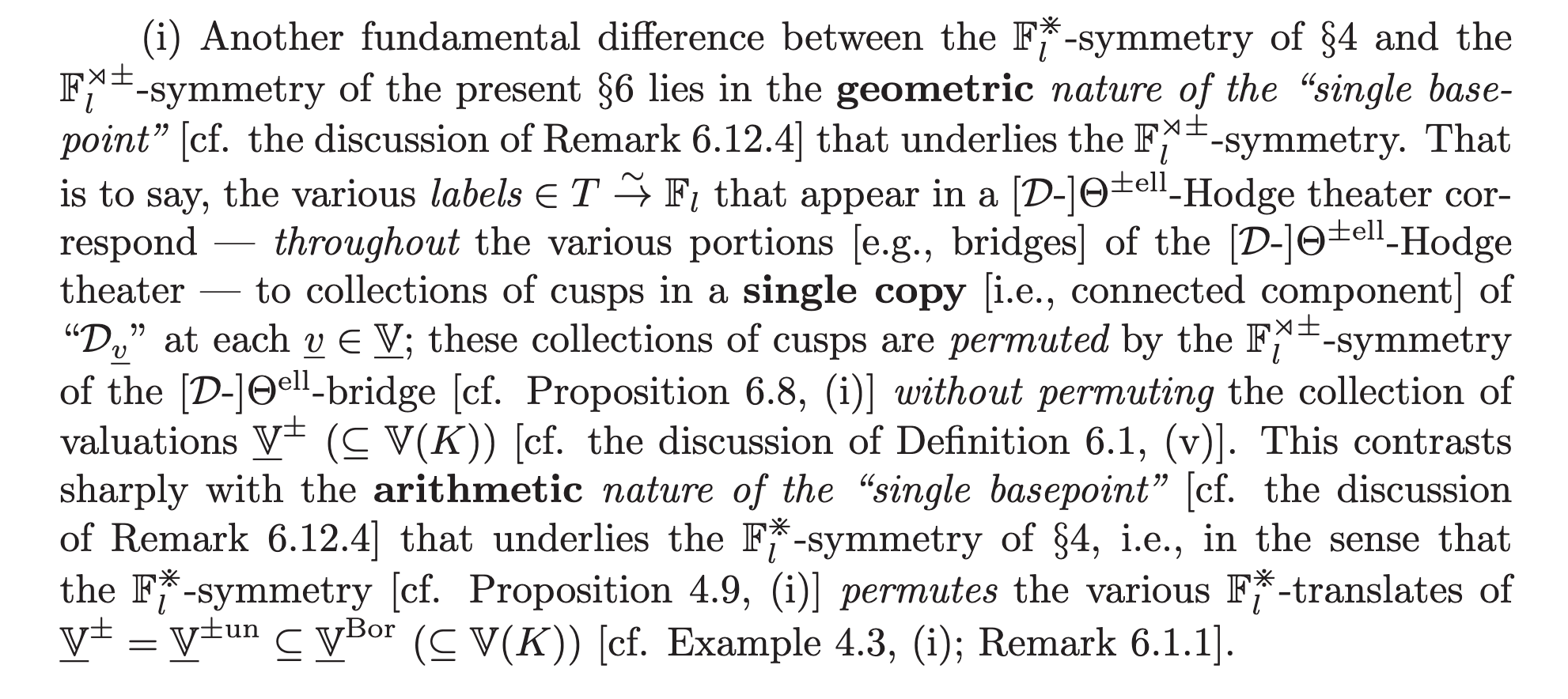
    His proof was 500 pages long, featuring entirely new mathematical concepts and notation. It all looked like this:


    The problem was that it was so dense and impenetrable, no-one could understand it. No-one at all. Not even the world's very best. (And they tried!)

    Unlike my helpful ET in my post above, Mochizuki didn't hold classes and teach. He was asked to fly to the US and Europe to please please explain his proof in specially-held seminars.

    But he declined every invitation. Instead, he taught a small selected group of colleagues in Japan, who all now say they agree that the proof is valid.

    In the end, two elite world-class western mathematicians flew to Japan to meet with him for a week so that he could explain it all to them in person. After a while they published a short paper stating they had found a mistake in Mochizuki's proof, so it didn't work.

    Mochizuki said they were both idiots and they didn't understand a thing.

    So it ended in an impasse. A team in Japan has started computer-checking the proof using the LEAN software, but it's been slow work as the 500 page manuscript with all its new symbology and concepts was very hard to 'translate' into anything LEAN could understand. That's still in progress.

    This has now become a kind of meme in the international math community:

    "The abc conjecture may be true. But only in Japan."


    ~~~

    The relevance to this thread, of course, is the similar potential problem of advanced AI producing extremely difficult and complex proofs in a kind of alien language which no human would be able to understand or check.

    Then what?

  26. The Following 8 Users Say Thank You to Bill Ryan For This Post:

    grapevine (20th October 2026), kudzy (21st October 2026), Michi (20th October 2026), petra (20th October 2026), Raskolnikov (21st October 2026), shaberon (21st October 2026), Vicus (20th October 2026), Yoda (20th October 2026)

  27. Link to Post #54
    Canada Avalon Member
    Join Date
    7th July 2016
    Location
    Newfoundland, Canada
    Age
    46
    Posts
    3,741
    Thanks
    10,742
    Thanked 8,734 times in 2,794 posts

    Default Re: The AI Mathocalypse

    That made my head hurt. What if..

    AI invents a new kind of MATH.

    Our decimal system is flawed in a way. I mean, depending what you're dividing it could go off into infinity. I remember learning about modulo in coding. Modulo is the remainder of a division operation and I remember thinking why the F would I ever need that? But like, of course you need it to be there just in case..

    Fix math so we don't need modulo or infinity, fix the number system, there's something wrong with it all as far as I'm concerned. And that's why we need to have these ridiculous proofs when it should be something far more elegant. Anyway.. this coming from a math dummy so maybe I'm way off. Maybe I'm not the only one who thinks the decimal system is annoying. But like.. it's all we have ever known..

    Never know.. AI could teach us something if we just keep asking the right questions.

  28. The Following 4 Users Say Thank You to petra For This Post:

    Bill Ryan (21st October 2026), happyuk (21st October 2026), Raskolnikov (21st October 2026), shaberon (21st October 2026)

  29. Link to Post #55
    United States Avalon Member
    Join Date
    1st April 2016
    Posts
    7,064
    Thanks
    36,115
    Thanked 40,376 times in 6,714 posts

    Default Re: The AI Mathocalypse

    Quote Posted by Bill Ryan (here)
    Unlike my helpful ET in my post above, Mochizuki didn't hold classes and teach. He was asked to fly to the US and Europe to please please explain his proof in specially-held seminars.

    But he declined every invitation. Instead, he taught a small selected group of colleagues in Japan, who all now say they agree that the proof is valid.

    The Japanese are like that. They don't care what Americans think. Why should they?

    All primary source work is done in Japanese, and only translated later. For a defeated, occupied, vanquished country, many of them are still nationalistic to the core.

  30. The Following 4 Users Say Thank You to shaberon For This Post:

    Bill Ryan (21st October 2026), kudzy (21st October 2026), petra (21st October 2026), Yoda (21st October 2026)

  31. Link to Post #56
    United States Avalon Member
    Join Date
    1st April 2016
    Posts
    7,064
    Thanks
    36,115
    Thanked 40,376 times in 6,714 posts

    Default Re: The AI Mathocalypse

    Quote Posted by petra (here)
    Maybe I'm not the only one who thinks the decimal system is annoying. But like.. it's all we have ever known..

    Well, the ratio of a circle's circumference to diameter is 22/7...done. Call me irrational, but I can use 22/7 while computers spit it out to infinity.

    The system of IVC weights is also fractional, and, this was the world standard used in Syria in 2,300 B. C. E., and, it is still in use today.

    That's more or less talking about arithmetic, not math. Arithmetic is just a small set of operations applicable to real numbers. Math can be abstract, or, it can have applications like geometry or rates of change, like jerk is the rate of change of acceleration, which cannot be calculated with anything resembling 2 + 2.

    Meanwhile, the sun cannot send us a photon without using imaginary numbers.

    Occasionally, I get to see feeble attempts at arithmetical conversions, especially since the United States is too dense to adopt the metric system. That's what they told me when I was five -- the metric system is so much more definable and precise, but, Americans won't ever use it because they are incapable of learning or change.

    So, our trade scales are based on that infernal decimal system. Instead of a pound plus ounces and grains, you get awkwardness like 1.34 pounds.

    A few days ago, someone asked me for ten ounces of stuff. So I made it and scaled it and asked them if that was adequate.

    You could tell the scale instantly transformed into infinite space and the person's face was sucked into a black hole of unlimited proportions.

    "Uh...I...can't tell..."

    So I push a button that flips it over to ounces, and it's 9.8. I mean, that's not bad for a sheer estimate that was effectively unmeasured until I hit that button. It's how I gain trust, by being physically precise, in ways that often involve minor arithmetical juggling. But not with metrics or very many decimal places.

  32. The Following 4 Users Say Thank You to shaberon For This Post:

    Bill Ryan (21st October 2026), kudzy (21st October 2026), petra (21st October 2026), Yoda (21st October 2026)

  33. Link to Post #57
    United States Administrator ThePythonicCow's Avatar
    Join Date
    4th January 2011
    Location
    North Texas
    Language
    English
    Age
    78
    Posts
    31,246
    Thanks
    39,052
    Thanked 157,279 times in 24,073 posts

    Default Re: The AI Mathocalypse

    Quote Posted by Bill Ryan (here)
    Mochizuki said they were both idiots and they didn't understand a thing.
    If not understanding that is proof I am an idiot ... then I am an idiot, beyond doubt.

    Quote Posted by Bill Ryan (here)
    The relevance to this thread, of course, is the similar potential problem of advanced AI producing extremely difficult and complex proofs in a kind of alien language which no human would be able to understand or check.

    Then what?
    As with all math, like all tools. Use them where useful, be amused by one's ignorance otherwise.
    Last edited by ThePythonicCow; 21st October 2026 at 08:05.
    My quite dormant website: pauljackson.us

  34. The Following 4 Users Say Thank You to ThePythonicCow For This Post:

    Bill Ryan (21st October 2026), kudzy (21st October 2026), petra (21st October 2026), Yoda (21st October 2026)

  35. Link to Post #58
    UK Avalon Founder Bill Ryan's Avatar
    Join Date
    7th February 2010
    Location
    Ecuador
    Posts
    40,234
    Thanks
    299,294
    Thanked 532,162 times in 38,774 posts

    Default Re: The AI Mathocalypse

    Quote Posted by shaberon (here)
    Quote Posted by Bill Ryan (here)
    Unlike my helpful ET in my post above, Mochizuki didn't hold classes and teach. He was asked to fly to the US and Europe to please please explain his proof in specially-held seminars.

    But he declined every invitation. Instead, he taught a small selected group of colleagues in Japan, who all now say they agree that the proof is valid.
    The Japanese are like that. They don't care what Americans think. Why should they?
    It's true! Because none of the western mathematicians could understand the proof, they fell back on subtle, almost-racist, comments about Japanese culture — almost unheard of in the very polite and sedate world of math.

  36. The Following 5 Users Say Thank You to Bill Ryan For This Post:

    happyuk (21st October 2026), kudzy (21st October 2026), petra (21st October 2026), shaberon (21st October 2026), Yoda (21st October 2026)

  37. Link to Post #59
    United States Avalon Member
    Join Date
    1st April 2016
    Posts
    7,064
    Thanks
    36,115
    Thanked 40,376 times in 6,714 posts

    Default Re: The AI Mathocalypse

    Quote Posted by Bill Ryan (here)
    Quote Posted by shaberon (here)
    Quote Posted by Bill Ryan (here)
    Unlike my helpful ET in my post above, Mochizuki didn't hold classes and teach. He was asked to fly to the US and Europe to please please explain his proof in specially-held seminars.

    But he declined every invitation. Instead, he taught a small selected group of colleagues in Japan, who all now say they agree that the proof is valid.
    The Japanese are like that. They don't care what Americans think. Why should they?
    It's true! Because none of the western mathematicians could understand the proof, they fell back on subtle, almost-racist, comments about Japanese culture — almost unheard of in the very polite and sedate world of math.

    That was unnecessary.

    There is a type of cultural difference, which I found out the hard way. It's really what deflected me out of advanced degrees. Here, we have or at least used to have, a "Graduate Record Exam" (GRE), which is a test that only focuses on your major. We were required to take it whether we planned on going to graduate school or not. And I took the thing and was reasonably confident about it, believing there were only a few problems I totally missed. In science, as compared to math, we have to involve "unit analysis", so, on a multiple-choice quiz, if one of the answers is in m/s, but the result should be in m/s^2, then, the answer is obvious; you don't have to calculate anything. And this seemed to help.

    My score from the test was 7 out of 100.

    Now of course that is upside down, since, for most of my life, I would get 93/100 with very little effort.

    Afterwards, I was informed that large numbers of Chinese students were making all the high scores.

    Well, it seemed transparent. I went through life with all these 93s and so in, in a condition where the subject matter was not challenging. I could do anything, and so I developed into one of those kids who became disinterested in the lesson and hated homework, and so I developed negative habits towards it all. And that didn't matter, because everything was easy, until I hit that mathematical brick wall called Partial Differential Equations (such as Schrodinger's).

    Suddenly I didn't understand it and couldn't do anything!

    When faced with the challenge, I did what anyone would do, make lower grades.

    It was obvious that most Orientals never disrupted their study habits, they didn't get this negative, unsatisfied attitude and go around virtually ignoring school. Something kept them on task, and so as young adults, they blew past me by miles.

    But, I mean, that's where we bow down. If you do anything skilled, you gain an instinct that reveals who is advanced beyond your own ability...and although in most areas, this has been very few, when it comes to math, anyone who succeeds beyond Calculus has got something I don't.

    If there is a mistake in the Japanese proof, then, you just argue about that, no mud flinging need be involved. Most of us have no clue what a Hodge theater is to begin with; you'd have to study for at least a year to even understand what is going on here.

  38. The Following 4 Users Say Thank You to shaberon For This Post:

    Bill Ryan (21st October 2026), petra (21st October 2026), ThePythonicCow (22nd October 2026), Yoda (21st October 2026)

+ Reply to Thread
Page 3 of 3 FirstFirst 1 3

Posting Permissions

  • You may not post new threads
  • You may not post replies
  • You may not post attachments
  • You may not edit your posts